EP3157641B1 - Nasse feuerschutzsysteme und verfahren zur aufbewahrung - Google Patents
Nasse feuerschutzsysteme und verfahren zur aufbewahrung Download PDFInfo
- Publication number
- EP3157641B1 EP3157641B1 EP15736710.3A EP15736710A EP3157641B1 EP 3157641 B1 EP3157641 B1 EP 3157641B1 EP 15736710 A EP15736710 A EP 15736710A EP 3157641 B1 EP3157641 B1 EP 3157641B1
- Authority
- EP
- European Patent Office
- Prior art keywords
- fluid distribution
- fire
- distribution devices
- detectors
- fluid
- Prior art date
- Legal status (The legal status is an assumption and is not a legal conclusion. Google has not performed a legal analysis and makes no representation as to the accuracy of the status listed.)
- Active
Links
Images



Classifications
-
- A—HUMAN NECESSITIES
- A62—LIFE-SAVING; FIRE-FIGHTING
- A62C—FIRE-FIGHTING
- A62C3/00—Fire prevention, containment or extinguishing specially adapted for particular objects or places
- A62C3/002—Fire prevention, containment or extinguishing specially adapted for particular objects or places for warehouses, storage areas or other installations for storing goods
-
- A—HUMAN NECESSITIES
- A62—LIFE-SAVING; FIRE-FIGHTING
- A62C—FIRE-FIGHTING
- A62C3/00—Fire prevention, containment or extinguishing specially adapted for particular objects or places
-
- A—HUMAN NECESSITIES
- A62—LIFE-SAVING; FIRE-FIGHTING
- A62C—FIRE-FIGHTING
- A62C31/00—Delivery of fire-extinguishing material
- A62C31/02—Nozzles specially adapted for fire-extinguishing
-
- A—HUMAN NECESSITIES
- A62—LIFE-SAVING; FIRE-FIGHTING
- A62C—FIRE-FIGHTING
- A62C35/00—Permanently-installed equipment
- A62C35/58—Pipe-line systems
-
- A—HUMAN NECESSITIES
- A62—LIFE-SAVING; FIRE-FIGHTING
- A62C—FIRE-FIGHTING
- A62C35/00—Permanently-installed equipment
- A62C35/58—Pipe-line systems
- A62C35/60—Pipe-line systems wet, i.e. containing extinguishing material even when not in use
-
- A—HUMAN NECESSITIES
- A62—LIFE-SAVING; FIRE-FIGHTING
- A62C—FIRE-FIGHTING
- A62C37/00—Control of fire-fighting equipment
- A62C37/36—Control of fire-fighting equipment an actuating signal being generated by a sensor separate from an outlet device
-
- A—HUMAN NECESSITIES
- A62—LIFE-SAVING; FIRE-FIGHTING
- A62C—FIRE-FIGHTING
- A62C37/00—Control of fire-fighting equipment
- A62C37/36—Control of fire-fighting equipment an actuating signal being generated by a sensor separate from an outlet device
- A62C37/38—Control of fire-fighting equipment an actuating signal being generated by a sensor separate from an outlet device by both sensor and actuator, e.g. valve, being in the danger zone
- A62C37/40—Control of fire-fighting equipment an actuating signal being generated by a sensor separate from an outlet device by both sensor and actuator, e.g. valve, being in the danger zone with electric connection between sensor and actuator
-
- A—HUMAN NECESSITIES
- A62—LIFE-SAVING; FIRE-FIGHTING
- A62C—FIRE-FIGHTING
- A62C99/00—Subject matter not provided for in other groups of this subclass
- A62C99/0009—Methods of extinguishing or preventing the spread of fire by cooling down or suffocating the flames
- A62C99/0072—Methods of extinguishing or preventing the spread of fire by cooling down or suffocating the flames using sprayed or atomised water
Definitions
- the present invention relates generally to fire protection systems for storage. More specifically, the present invention involves fire protection systems for storage arrangements having a reduced hydraulic demand for comparable sized storage arrangements.
- NFPA 13 Standard for the Installation of Sprinkler Systems (2013 ed.)
- Chapters 11-12 define standardized hydraulic design approaches for systems designed and installed with "automatic” storage sprinklers, such as for example, standard spray, control mode specific application (CMSA), extended coverage or early suppression fast response (ESFR).
- CMSA standard spray, control mode specific application
- ESFR early suppression fast response
- NFPA 13 defines "automatic sprinklers” as "a fire suppression or control device that operates automatically when its heat-activated element is heated to its thermal rating or above, allowing water to discharge over a specified area.”
- a “hydraulically designed system” is a calculated system in which pipe sizes are selected on a pressure loss basis to provide a prescribed water density, in gallons per minute per square foot, or a prescribed minimum discharge pressure or flow per sprinkler, distributed with a reasonable degree of uniformity over a specified area.
- the standards specify the hydraulic design area or sprinkler operational area, the density (GPM/SQ. FT) requirements, and/or minimum operating pressures for a given storage commodity and arrangement.
- a “hydraulic design area” is an area, defined in square units of measure, comprising a defined number of hydraulically remote sprinklers at a defined spacing between each sprinkler.
- Hydraulicically remote sprinklers are sprinklers that place the greatest water demand on a system in order to provide a prescribed minimum discharge pressure or flow. It is understood by those skilled in the art that the hydraulically remote sprinklers may or may not be physically located the furthest from the fluid the water supply providing the prescribed minimum pressure or flow.
- Section 21 of NFPA 13 provides for special approaches that permit hydraulic designs other than those specified under Chapters 11-20.
- the hydraulic design area can be defined by a number of design sprinklers as derived from worst-case results obtained from full-scale fire testing.
- the special design approaches of NFPA still include minimum design requirements.
- Section 21.1.8.1 requires that the number of design sprinklers defining the hydraulic demand be no less than: (i) twelve sprinklers for standard coverage sprinklers; (ii) eight sprinklers for extended coverage sprinklers on 3.66m ⁇ 3.66m (12 ft.
- Section 21.1.8.2 provides that the minimum operating area based on the sprinkler-to-sprinkler spacing of the given number of design sprinklers shall be no less than 71.3m 2 (768 square feet).
- Other industry accepted standards for example standards under FM Global (FM), define the number of design sprinklers for use in sprinkler systems for a storage occupancy based upon sprinkler orifice size, orientation, RTI (thermal response), spacing, and minimum operating pressure.
- the number of sprinklers is determined by a fire test in which an appropriate safety factor is assessed on the total number of sprinklers that operate, such as for example, a 50% safety factor.
- the safety factor is designed to account for uncertainty in the operation sequence inherent to thermo-mechanically operated automatic sprinkler systems due to things such as sprinkler skipping, fire chasing, etc.
- the hydraulic designs and demand of the system define the water supply requirements of the system and the economic burden to fulfill those requirements, such as for example, by supplying the appropriate number and size of pump, piping or other fluid distribution equipment to meet the hydraulic designs. Accordingly, there is a desired balance between fulfilling a level of hydraulic demand and the economic burden to supply that demand in order to provide a desired level of fire protection.
- the installation standards also include location requirements for the automatic sprinklers.
- Automatic sprinklers are located above the stored commodity at or near the ceiling of the occupancy in order that its heat-activated element can be activated by the air/gases heated by a fire in the occupancy.
- Section 8.12.4 of NFPA 13 also includes "distance below ceiling” requirements to locate the deflector of the automatic sprinkler below the ceiling of the storage occupancy. According to the standards, a deflector of a pendent sprinkler is to be located at a maximum of 45.72cm (18 inches) from the ceiling.
- the construction of the storage occupancy can present obstructions to the spray pattern of a sprinkler
- obstructions can include for example, beams, ducts, lights, trusses or bar joists at or near the ceiling.
- the installation standards provide for obstruction standards.
- Section 8.12.5 of NFPA 13 includes obstruction rules or requirements for Early Suppression Fast-Response Sprinklers to ensure that the sprinkler and its spray are clear of obstructions at or near the ceiling.
- the obstruction standards provide for a maximum allowable distance of the deflector above the bottom of the obstruction based upon the distance of the sprinkler from the side of the obstruction. Accordingly, both the structure of the automatic sprinkler and the existing installation standards can limit or restrict the ability to install a sprinkler above a stored commodity at increased distances from the ceiling which can add a burden to installing a system to provide a desired level of fire protection.
- a fire protection system for protection of a storage occupancy having a ceiling defining a nominal ceiling height, the system comprising:
- a method of fire protection of a storage occupancy having a nominal ceiling height of thirty feet or greater comprising:
- the Disclosure of the Invention and the preferred systems and methods described herein address the limitations of fire protection systems using automatic fire protections sprinklers under known design criteria, it be to be understood that the preferred systems and method can provide for storage fire protection using controlled actuated fluid distribution devices in systems of any desired hydraulic demand.
- the Disclosure of the Invention is provided as a general introduction to some embodiments of the invention, and is not intended to be limiting to any particular configuration or system. It is to be understood that various features described in the claims can be combined in any suitable way to form any number of embodiments of the invention. Some additional example embodiments including variations and alternative configurations are provided herein.
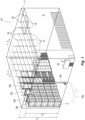
- FIG. 1 Shown in FIG. 1 is a preferred embodiment of a fire protection system 100 for the protection of a storage occupancy 10 and one or more stored commodities 12.
- the preferred systems and methods provide fire protection of a storage occupancy by: (i) sensing a fire; (ii) measuring the fire including its location and size; (iii) analyzing the fire; (iv) responding to the fire with controlled actuation of one or more selectively identified fire protection devices; and (v) terminating the threat from the fire by effectively addressing the fire.
- the preferred systems can effectively address the fire with any one of fire control, fire suppression, extinguishment or a combination thereof.
- fire suppression for storage protection is sharply reducing the heat release rate of a fire and preventing its regrowth by means of direct and sufficient application of a flow of water through the fire plume to the burning fuel surface.
- fire control is defined as limiting the size of a fire by distribution of a flow of water so as to decrease the heat release rate and pre-wet adjacent combustibles, while controlling ceiling gas temperatures to avoid structural damage.
- the preferred systems described herein include a fluid distribution sub-system 100a, a control sub-system 100b and a detection sub-system 100c.
- the detection and control sub-systems work together, preferably by communication of one or more detection signals DS, to sense, measure and analyze a fire.
- the control and fluid distribution sub-systems 100a, 100b work together, preferably by communication of one or more control signals CS, to target and timely deliver a volumetric flow V of firefighting fluid preferably substantially above and about the site of the fire in order to effectively address the fire.
- the volumetric flow V can be defined by one, or more preferably a collection, of distributed discharges Va, Vb, Vc, and Vd.
- the time at which the volumetric flow V of firefighting fluid is released is preferably determined so as to minimize the overall hydraulic demand on the system yet be sufficient to effectively address the size of the fire at the time of delivery.
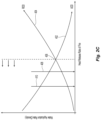
- Shown in FIG. 2C is a comparative graph 400 of heat release versus water application to show the preferred time of controlled actuation of the preferred system 100 as compared to known systems using independently actuated thermally responsive automatic sprinklers, such as for example, systems using early suppression fast response (ESFR) automatic sprinklers.
- the graph 400 shows a first curve 402 showing the actual delivery density (ADD) of water (in flow per area of application, e.g., gallons per minute per square foot (GPM/SQ.
- ADD actual delivery density
- a second curve 404 shows the required delivery density (RDD) of water required to be delivered to the stored commodity at the commodity in order to provide fire suppression by water delivered at a minimum density.
- RDD required delivery density
- the intersection of the ADD and RDD curves defines a time or moment 406 of heat release in the fire in which ADD and RDD are equal to one another. It is believed that any moment in the fire heat release or growth before (or to the left) of the intersection 406 of ADD and RDD can provide for fire suppression performance because the ADD is greater than the RDD.
- line 408 graphically shows a moment of early suppression with an early suppression fast response (ESFR) fire protection sprinkler using only automatic thermal response.
- ESFR early suppression fast response
- the preferred system 100 can provide for a controlled actuation, the preferred system 100 can provide for system response to a fire that is earlier than known ESFR systems. More specifically, the preferred control and detection sub-systems 100b, 100c function to detect a fire preferably in its initial or incipient stages. The control and fluid distribution sub-systems 100a, 100b operate thereafter to address the fire preferably in its incipient stages. Line 410 shows a preferred time in the fire growth or heat release that is earlier than know ESFR system responses (line 408) at which the preferred system 100 is operated to address and more preferably suppress the fire.
- the water demand of the system 100 is reduced as compared to known systems because the moment of controlled response defines an RDD that is smaller than the RDD of known suppression systems responding with only an automatic thermal response. It should be understood that the controlled system response of the system 100 can be controlled to alternatively provide for either standard response or early response to effectively address the fire.
- the preferred system 100 includes a plurality of fluid distribution devices 110, a plurality of detectors 130 and a centralized controller 120 for communication with each of the fluid distribution devices 110 and detectors 130.
- a preferred embodiment of the fluid distribution device 110 includes a fluid deflecting member 110w coupled to a frame body 110x as schematically shown in FIGS. 3A and 3B and arranged for controlled actuation in manner described herein.
- the frame body 110x includes an inlet for connection to the piping network and an outlet with an internal passageway extending between the inlet and the outlet.
- the deflecting member 110w is preferably axially spaced from the outlet in a fixed spaced relation.
- Water or other firefighting fluid delivered to the inlet is discharged from the outlet to impact the deflecting member 110w and generate a volumetric flow of fluid to effectively address a fire in a manner as described herein.
- the deflecting member can translate with respect to the outlet provided it distributes the firefighting fluid in a desired manner upon operation.
- the deflector or deflecting member can be oriented horizontal with respect to the commodity or otherwise oriented, for example, in an upright orientation relative to the frame body and its outlet.
- the fluid distribution device 110 can be structurally embodied with a frame body and deflector member of an "automatic fire protection sprinkler" as understood in the art and appropriately configured or modified for controlled actuation as described herein.
- This configuration can include the frame body and deflector of known automatic fire protection sprinklers with modifications described herein.
- the frame body and deflectors components for use in the preferred systems and methods can include the components of known automatic sprinklers that have been tested and found by industry accepted organizations to be acceptable for a specified sprinkler performance, such as for example, standard spray, suppression, or extended coverage and equivalents thereof.
- Alternate embodiments of the fluid distribution devices 110 for use in the system 100 include nozzles, misting devices or any other devices configured for controlled operation to distribute a volumetric flow of firefighting fluid in a manner described herein.
- the fluid distribution devices 110 of the preferred system 100 are interconnected by the fluid distribution sub-system 100a.
- the fluid distribution sub-system includes a network of pipes 150 preferably having one or more main pipes 150a from which one or more branch lines 150b, 150c, 150d extend.
- the preferred fluid distribution devices 110 are mounted or connected to the branch lines 150b, 150c, 150d.
- a branch line can define the device spacing a along a single branch line and the device spacing b between branch lines.
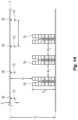
- the fluid distribution devices 110 are installed beneath a ceiling C of a storage occupancy, such as for example, a warehouse above a storage commodity 12. As shown in FIG. 1A and FIGS.
- the deflector 110w can be located below the ceiling C and above the stored commodity 12 to define a preferred deflector position at a preferred desired-to-ceiling distance S.
- the distribution 'devices 110 are preferably mounted to and spaced along the spaced-apart branch pipes 150b, 150c, 150d to form a desired device-to-device spacing a (along branch lines) x b (between branch lines) as seen in FIG. 1 .
- the device-to-device spacing is preferably 2.43m ⁇ 2.43m (8 ft. ⁇ 8 ft.); 3.05m ⁇ 3.05m (10 ft. ⁇ 10 ft.); 3.66m ⁇ 3.66m (12 ft. ⁇ 12 ft.); 4.27m ⁇ 4.27m (14 ft. ⁇ 14 ft.) or any combination thereof.
- the hydraulic demand can be directly related to the area of device operation over which a number of identified devices are controlled and operated to effectively address the fire in a manner as described herein. Accordingly, in a preferred aspect of the system 100, the spacing of the fluid distribution devices 110 defines the hydraulic demand of the system.
- the operation of the fluid distribution devices 110 in the preferred system 100 is not directly or independently triggered or actuated by a thermal or heat-activated response to a fire as in known "automatic sprinklers". Instead, the actuation of the fluid distribution devices 110 is controlled by the preferred controller 120 of the preferred control sub-system 100b. More specifically, the fluid distribution devices 110 are coupled directly or indirectly with the controller 120 to operate a select number of identified devices for distribution of a preferably fixed volumetric flow of fluid to effectively address the fire.
- the hydraulic demand can be controlled and therefore preferably minimized in a manner described herein. More particularly, the preferred system 100 provides for a controlled response to a fire by selecting the number and location of the devices 110 to define an area of operation above and disposed about the fire, in addition to controlling the time of actuation of the selected sprinklers to effectively address the fire.
- the hydraulic demand of the system 100 is preferably minimized. It is believed that the preferred controlled operation of the system 100 can provide for a hydraulic demand that is smaller than known system designs using automatic fire protection sprinklers of comparable flow and distribution characteristics configured to protect the same occupancy.
- the preferred storage fire protection system 100 and its demand is preferably hydraulically designed with a hydraulic design area A or area of device operation being less than about about 71.35m 2 (768 square feet), preferably less than 69.68m 2 (750 square feet); more preferably less than 65.03m 2 (700 square feet); and even more preferably equal to or less than about 53.51m 2 (576 square feet).
- a hydraulic design area A is an area, defined in square units of measure, comprising a defined number of hydraulically remote fluid distribution devices at a defined spacing between each device.
- Hydraulic design area A is an area, defined in square units of measure, comprising a defined number of hydraulically remote fluid distribution devices at a defined spacing between each device.
- Hydraulic design area A is an area, defined in square units of measure, comprising a defined number of hydraulically remote fluid distribution devices at a defined spacing between each device.
- Hydraulic design area A is an area, defined in square units of measure, comprising a defined number of hydraulically remote fluid distribution devices at a defined
- the hydraulic design area A is preferably defined by four hydraulically remote devices and the spacing therebetween.
- the preferred four hydraulically remote devices include two devices per branch lines on two branch lines with a device-to-device spacing of 3.05m (eight feet (8 ft.)) along and between the two branch lines to define a hydraulic design area that is preferably 23.78m 2 (256 square feet).
- the device-to-device spacing can be varied to be any one of 3.05m (ten feet (10 ft.)) or 3.66m (twelve feet (12 ft.)) to respectively define hydraulic design areas A being any one of 37.16m 2 (400 square feet) or 53.51m 2 (576 square feet).
- the hydraulic design area A is defined by nine (9) hydraulically remote fluid distribution devices with three devices per branch line on three branch lines with a device-to-device spacing of 2.43m (eight feet (8 ft.)) along and between the three branch lines to define a hydraulic design area A of 53.51m 2 (576 square feet).
- the preferred system 100 can be hydraulically designed with a hydraulic design area that is smaller than currently available under the known installation standards.
- the hydraulic demand of the system 100 is preferably defined by a number of design fluid distribution device being less than twelve and having at least four, preferably having eleven or fewer and more preferably ranging from eight to six and more preferably ranging from six to four.
- the devices 110 defining the preferably minimized hydraulic design area A or preferred minimum design devices provide a prescribed volumetric flow at a minimum fluid pressure sufficient to address a fire of a particular size or a fire of a particular hazard.
- the fluid distribution devices 110 in the system 100 are provided with a preferred minimum operating pressure range that can effectively address a worst-case scenario test fire with any one of fire control, fire suppression or a combination thereof when the operating pressure is provided to the fluid distribution devices defining a test operational area that is configured as one of the preferred hydraulic design areas A as previously described.
- a preferred controlled actuated system and its fluid distribution devices can be installed in a test-fire setup for a controlled actuation to define a desired test operational area that effectively addresses a test fire of a particular test commodity or hazard with a given test pressure.
- the system 100 can be preferably hydraulically designed with a minimum hydraulic design area equal to the test operational area and with a minimum design pressure equal to the test pressure to protect a hazard equal to or less than the test hazard.
- An exemplary test-fire setup is described below.
- hydraulic design parameters including the preferred minimum number of design fluid distribution devices and a minimum operation pressure can be provided for use in the preferred controlled actuated system 100 for protection of a storage occupancy.
- the hydraulic demand of the system 100 is preferably minimized. It is believed that the preferred controlled operation of the system 100 can provide for a hydraulic demand that is smaller than known system designs using automatic fire protection sprinklers configured to protect the same occupancy.
- the hydraulic demand of the system 100 is preferably defined by a number of design fluid distribution devices being less than twelve, eleven or fewer and more preferably ranging from eight to six and more preferably ranging from six to four.
- Fluid distribution device 110 in the preferred systems and methods can include frame bodies and or deflector members of standard spray sprinklers, suppression sprinklers or extended coverage sprinklers and equivalents thereof which are suitable for use in storage applications.
- U.S. Patent No. 8,176,988 shows an exemplary fire protection sprinkler frame and deflector for use in the systems described herein.
- ESFR early suppression fast response sprinkler
- the sprinkler shown in U.S. Patent No. 8,176,988 is a pendent-type sprinkler; however upright-type sprinklers can be configured for use in the systems described herein.
- sprinklers for configuration and use in the described systems herein include ESFR pendent sprinklers having a nominal K-factor of 362.88 litres/min/bar1 ⁇ 2 (25.2 GPM/(PSI) 1 ⁇ 2 ).
- a preferred fluid distribution device 110 for installation in the system 100 includes the frame body and deflector of the Model ESFR-25 Early Suppression, Fast Response Pendent Sprinkler from TYCO FIRE PRODUCTS, LP of Lansdale, PA having a nominal 25.2 K-factor ESFR.
- the preferred frame body and deflector member is shown in Tyco Fire Products, LP technical data sheet, TFP312 entitled, " Model ESFR-25, Early Suppression Fast Response Pendent Sprinklers 25.2 K-factor" (Nov.
- the K-factor is defined as a constant representing the discharge coefficient that is quantified by the flow of fluid in gallons per minute (GPM) from the outlet of the frame body divided by the square root of the pressure of the flow of fluid fed into the inlet of the frame passageway in pounds per square inch (PSI).
- the K-factor is expressed as litres/min/bar1 ⁇ 2 (GPM/(PSI) 1 ⁇ 2 ).
- a rated or nominal K- factor or rated discharge coefficient of a sprinkler as a mean value over a K-factor range.
- NFPA 13 provides the following nominal K-factors (with the K-factor range shown in parenthesis): (i) 161.28 (154.08-168.84) litres/min/Bar 1/2 (11.2 (10.7-11.7) GPM/(PSI) 1 ⁇ 2 ); (ii) 201.6 (194.4-208.8) litres/min/Bar 1/2 (14.0 (13.5-14.5) GPM/(PSI) 1/2 ); (iii) 483.84 (457.92-501.12) litres/min/Bar 1/2 (16.8 (16.0-17.6) GPM/(PSI) 1/2 ); (iv) 282.24 (267.84-296.64) litres/min/Bar 1/2 (19.6 (18.6-20.6) GPM/(PSI) 1/2 ); (v) 322.56 (306.72-338.40) litres/min/Bar 1/2 (22.4 (21.3-23.5) GPM/(PSI) 1/2 ); (vi) 362.88 (344.16-381.60)
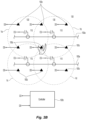
- FIGS. 3A and 3B are schematic representations of preferred electro-mechanical coupling arrangements between a distribution device assembly or device 110 and the controller 120 for controlled actuation of the device.
- a fluid distribution device assembly 110 that includes a sprinkler frame body 110x having an internal sealing assembly supported in place by a removable structure, such as for example, a thermally responsive glass bulb trigger.
- a transducer and preferably electrically operated actuator 110y is arranged, coupled, or assembled, internally or externally, with the frame body 110x for displacing the support structure by fracturing, rupturing, ejecting, and/or otherwise removing the support structure and its support of the sealing assembly to permit fluid discharge from the frame body.
- the actuator 110y is preferably electrically coupled to the controller 120 in which the controller provides, directly or indirectly, an electrical pulse or signal for signaled operation of the actuator to displace the support structure and the sealing assembly for controlled discharge of firefighting fluid from the frame body 110x to impact a deflector member 110w.
- An electrically responsive explosive squib is provided with electrically conductive wires that can be coupled to the controller 120. Upon receipt of an appropriate signal, the squib explodes to generate an expanding gas to the rupture disc to open the sprinkler.
- FIG. 2 of U.S. Patent No. 4,217,959 is an electrically controlled fluid dispenser for a fire extinguishing system in which the dispenser includes a valve disc supported by a frangible safety device to close the outlet orifice of the dispenser. A striking mechanism having an electrical lead is supported against the frangible safety device. The patent describes that an electrical pulse can be sent through the lead to release the striking mechanism and fracture the safety device thereby removing support for the valve disc to permit extinguishment fluid to flow from the dispenser.
- FIG. 3B Shown in FIG. 3B . is another preferred electro-mechanical arrangement for controlled actuation that includes an electrically operated solenoid valve 110z in line and upstream from an open sprinkler frame body 110x to control the discharge from the device frame. With no seal assembly in the frame outlet, water is permitted to flow from the open frame body 110x upon the solenoid valve 110z receiving an appropriately configured electrical signal from the controller 120 to open the solenoid valve depending upon whether the solenoid valve is normally closed or normally open. Water again discharged from the frame outlet to impact a deflector member 110w.
- Exemplary known electrically operated solenoid valves for use in the system 100 can include the electric 2/2 Series 8210 Pilot Operated General Service Solenoid Valves from ASCO ® and equivalents thereof.
- the detection sub-system 100c and its preferred detectors 130 sense and analyze, directly or indirectly, a fire in the occupancy 10.
- the detection sub-system monitors 100c the occupancy to determine environmental changes to identify a fire and its location within the storage occupancy 10.
- the system 100 and the controller sub-system 100b preferably include one or more controllers 120 and more preferably a centralized controller 120 coupled to the detectors 130 and fluid distribution devices 110 for the controlled actuation of a defined or select group of devices 110 for distribution of the preferred volumetric flow of firefighting fluid to address the detected fire.
- the centralized controller 120 Based upon the input from the detectors 130, the centralized controller 120 identifies ten or fewer devices 110 above and about the located fire to define the area of device operation, consistent with the hydraulic design area A of the system as previously described. In one preferred embodiment, the controller 120 identifies the ten or fewer, and more preferably the four or fewer, fluid distribution devices above and about the located fire for controlled actuation. Alternatively, the controller 120 identifies one, two or three select distribution devices 110 for addressing the detected fire.
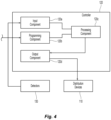
- a preferred centralized controller 120 is shown schematically in FIG. 4 for receiving, processing and generating the various input and output signals from and/or to each of the detectors 130 and fluid distribution devices 110.
- the preferred controller 120 includes a data input component 120a, a programming component 120b, a processing component 120c and an output component 120d.
- the data input component 120a receives detection data or signals from the detectors 130 including, for example, either raw detector data or calibrated data, such as for example, any one of continuous or intermittent temperature data, spectral energy data, smoke data or the raw electrical signals representing such parameters, e.g., voltage or current that would indicate a measured environmental parameter of the occupancy.
- Additional data parameters collected from the detectors 130 can include time data, address or location data of the detector.
- the preferred programming component 120b provides for user-defined operational parameters of the system to sense, measure and analyze a fire including, for example, its location and magnitude of its threat.
- the programming may be hard wired or logically programmed and the signals between system components can be one or more of analog, digital, or fiber optic data. Moreover, communication between components of the system 100 can be any one or more of wired or wireless communication.
- the programming component 120b can provide for input of user-defined algorithms to identify fluid distribution devices or assemblies 110 for operation and their time of operation in response to the fire.
- a known exemplary controller for use in the system 100 is the Simplex ® 4100 Fire Control Panel from TYCO FIRE PROTECTION PRODUCTS of Riverside, MA, which is shown and described in Technical Data Sheet S4100-0031-25 (Nov. 2013 ).
- FIG. 4A Shown in FIG. 4A is one preferred operation or algorithm 160 of the controller 120, in which the processing component 120c processes the input data to detect 162 and locate 164 the fire. Based upon the detection and/or other input data or signals, the processing component 120c identifies 166, in accordance with the programmed algorithm, fluid distribution devices above and about the located fire to address the fire. In one preferred embodiment of the system and the control algorithm, each of the fluid distribution devices 110 are addressable by the controller 120 for controlled actuation. The preferred algorithm 160 can preferably queue the identified devices for actuation at a select or determined threshold moment 168 as defined by the preferred algorithm.
- a minimum number of fluid distribution devices 110 can be identified for controlled actuation 170 to provide the desired fire protection performance, such as for example, control performance, suppression performance, extinguishment or any combination thereof thereby placing a minimized hydraulic demand on the system consistent with the system's preferably minimized hydraulic design as previously described.
- the preferred algorithm 160 provides for the identification of ten or fewer fluid distribution devices 110 above and about the located fire to define the area of device operation, consistent with the hydraulic design of the system, for controlled actuation to address the detected and analyzed fire.
- the algorithm identifies the five, and more preferably the four, closest and adjacent devices above and about the located fire for controlled actuation.
- the processing component 120c identifies one, two or three select distribution devices 110 for controlled actuation in accordance with the algorithm.
- the preferred algorithm provides for the identification of devices above and about the located fire to define the area of device operation for addressing the detected and analyzed fire consistent with the preferred eleven or fewer design fluid distribution devices.
- the algorithm identifies the five, and more preferably the four, closest and adjacent devices above and about the located fire.
- the processing controller 120c identifies one, two or three select distribution devices 110 in accordance with the algorithm.
- the processing component 120c preferably determines a threshold moment 168 in the fire, for example at a preferably incipient stage of the fire, for actuation of the identified and selected fluid distribution devices 110. Accordingly, the preferred processing component 120c and output component 120d of the controller 120 further preferably generate appropriate signals for the output component 120d to control operation 170 of the fluid distribution devices 110 in accordance with the programmed algorithm to effectively address the fire.
- the threshold moment 168 for actuation of the selected fluid distribution devices 110 can be a function of the collected data or parameters from the detectors 130 which measure the fire.
- the threshold moment 168 may define a user-defined threshold heat release, user-defined maximum ceiling temperature, or user-defined rate of temperature rise.
- the detection sub-system 100c preferably continuously monitors the occupancy to identify a fire and its location within the storage occupancy 10. Alternatively, monitoring by the detectors 130 can be intermittent. In preferred embodiments of the system 100, disposed proximate the fluid distribution devices 110 are detectors 130 for monitoring of the storage occupancy 10.
- the detectors 130 can be mounted so that they are axially aligned with the fluid distribution device and more particularly the frame body 110x, as seen for example in FIG. 3A , or may alternatively be above and off-set from the frame body 110x. Shown in FIG. 3B is the embodiment according to the invention, in which two detectors 130a, 130b are disposed above and preferably equally spaced about the frame body 110x for communication with the controller 120.
- the detectors 130 can be disposed elsewhere about the occupancy 10 provided the detectors 130 can monitor the occupancy 10 to detect a fire as described herein. More preferably, the detectors 130 are disposed beneath the ceiling C and above the fluid distribution devices 110 to provide ceiling detection of a fire for preferred continuous monitoring of the occupancy 10. The spaced apart detectors 130 monitor the occupancy to detect changes for any one of temperature, thermal energy, spectral energy, smoke or any other parameter to indicate the presence of a fire in the occupancy.
- the detectors 130 can be any one or combination of thermocouples, thermistors, infrared detectors, smoke detectors and equivalents thereof. More preferably, the detectors 130 provide ceiling detection of a fire product, e.g., temperature or smoke.
- detectors for use in the system include TrueAlarm ® Analog Sensing analog sensors from TYCO SAFETY PRODUCTS WESTMINSTER of Riverside, MA, and shown in Technical Data Sheet S4098-0019-12 (Aug. 2008 ).
- the detectors 130 are coupled to the controller 120 to communicate detection data or signals to the controller 120 of the system 100 for processing as described herein.
- the ability of the detectors 130 to monitor environmental changes indicative of a fire can depend upon the type of detector being used, the sensitivity of the detector, coverage area of the detector, and/or the distance between the detector and the fire origin. Accordingly, the detectors 130 individually and collectively are appropriately mounted, spaced and/or oriented to monitor the occupancy 10 for the conditions of a fire in a manner described.
- the preferably spaced apart detector 130 and fluid distribution device 110 of the system 100 physically separates or uncouples the fire detection and fluid distribution functions between the components.
- the fluid distribution device 110 can be located at any desired distance beneath the ceiling and above the stored commodity.
- the member 110w can be located above the stored commodity 12 and below the ceiling C at a preferred deflector-to-ceiling distance S that is greater than 0.46m (18 inches) and more preferably at a deflector-to-ceiling distance S of at least 0.51m (20 inches). Accordingly, a preferred frame body and its deflector member 110w of the fluid distribution device 110 can be located below the ceiling C without the distance limitations or restrictions provided under the industry accepted installation standards, so long as the deflector of the device 110 is located above the stored commodity to provide the necessary fluid distribution to effectively address a fire.
- the preferred installations of the system 100 can avoid the obstruction requirements under the standards. Therefore, the preferred systems 100 can provide for more flexibility in its installation as compared to known storage fire protection systems using only automatic sprinklers.
- the preferred fluid distribution devices 110, branch lines and main pipe(s) can be arranged so as to define either one of a gridded network or a tree network.
- the network of pipes can further include pipe fittings such as connectors, elbows and risers, etc. to interconnect the network or grid of fluid distribution devices to the fluid distribution portion of the system 100.
- the fluid distribution sub-system 100a further preferably includes a riser pipe 150f which preferably extends from a fluid supply 150e to the main pipes 150a.
- the fluid distribution devices 110 are coupled to a supply of firefighting liquid such as, for example, a water main 150e or water tank.
- the fluid distribution sub-system can further include additional devices (not shown) such as, for example, fire pumps, or backflow preventers to deliver the water to the network of piping at a desired flow rate and/or pressure.
- the riser 150f can include additional components or assemblies to direct, detect, measure, or control fluid flow between the water distribution portion and the network of fluid distribution devices 110.
- the system can include a check valve 152 to prevent fluid flow from the fluid distribution devices back toward the fluid source.
- the system can also include a flow meter 154 for measuring the flow through the riser 150f and the system 100.
- the system 100 is preferably configured as a wet system and can be further configured as a preaction system including variations thereof, i.e., single or double-interlock preaction.
- the riser 150f can include a fluid control valve, such as for example, a solenoid controlled deluge valve which operates upon detection of a fire by the detection sub-system 100c.
- a control actuated system as previously described can be subject to actual fire testing in order to identify or verify preferred hydraulic design parameters including the hydraulic design area and minimum operating pressure for use in a preferred control actuated system installed for protection of a storage occupancy.
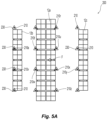
- a plurality of preferred fluid distribution devices 210 and detectors 230 are installed above rack storage of cartoned unexpanded Group A plastic stored to a nominal storage height of 12.19m (40 ft.) under a 13.72m (45 ft.) horizontal ceiling as shown in the plan view of FIG. 5 .
- the fluid distribution devices 210 are installed on 3.05m ⁇ 3.05m (10 ft. ⁇ 10 ft.) spacing and supplied with water so as to provide a flow from each fluid distribution device that is equivalent to a nominal K-factor of 360 litres/min/bar 1 ⁇ 2 (25 GPM/PSI. 1 ⁇ 2 ) supplied with an operating pressure of water at 2.41Bar (35 psi).
- the fluid distribution devices 210 are installed beneath the ceiling so as to locate the deflector of the devices 0.51m (twenty inches (20 in.)) beneath the ceiling C.
- the fluid distribution devices 210 are installed above Group A Plastic commodity that includes single wall corrugated cardboard cartons measuring 0.53m ⁇ 0.53m (21 in. ⁇ 21 in.) containing 125 empty crystalline polystyrene 473ml (16 oz.) cups in separated compartments within the carton.
- Each pallet of commodity is supported by a two-way 1.07m ⁇ 1.07m ⁇ 0.13m (42 in. ⁇ 42 in. ⁇ 5 in.) slatted deck hardwood pallet.
- the commodity is stored in a rack arrangement having a central double-row rack with two single-row target arrays disposed about the central rack. The geometric center of the central rack is centered below four devices as indicated.
- Two half-standard cellulose cotton igniters are constructed from 0.08m ⁇ 0.08m (3 in. ⁇ 3 in.) long cellulosic bundles soaked with 118ml (4 oz.) gasoline and wrapped in a polyethylene bag. The igniters were positioned at the floor and offset 0.53m (21 in.) from the center of the central double row rack main array.
- the igniters are ignited to provide a single fire test F of the system 200.
- the system 200 senses, measures and responds to the fire with a preferred control algorithm, for example, such as an algorithm previously described.
- a preferred control algorithm for example, such as an algorithm previously described.
- a total of nine fluid distribution devices 210r, 210s, 210t, 210u, 210v, 210w, 210x, 210y, 210z are identified for operation and operated within two minutes of ignition.
- the nine fluid distribution devices included four devices 210t, 210u, 210w, 210x located above and about the test fire F to define an included area of device operation of about 37.16m 2 (400 square feet).
- the four operated fluid distribution devices 210t, 210u, 210w, 210x effectively addressed the fire such that the fire and damage to the commodity was contained within the area of device operation and therefore did not spread to the ends of the main array or across the aisles to the targets.
- the maximum one-minute gas temperature above ignition was measured to be 154°C (309°F) and the maximum one-minute average steel temperature above ignition was measured to be 61°C (142°F).
- the inventors believe that the preferred systems and methods described herein can be used to provide fire protection systems for storage with hydraulic demands lower than previously known.
- the fire test showed that a device operational area of less than 71.35m 2 (768 square feet) and more particularly an operational area of 37.16m 2 (400 square feet) or less was effective in addressing a fire of a high hazard commodity. It is believed that the test setup could be alternatively configured with a smaller device spacing, water delivery pressure and appropriate algorithm to operate, for example, only the four fluid distribution devices above and about the test fire F to identify an operational area of 23.78m 2 (256 square feet) or other area to effectively address the high challenge test fire.
- preferred embodiments of the system 100 can be preferably hydraulically designed with a hydraulic design area having or equal to minimal operational area of less than 71.35m 2 (768 square feet), more preferably 37.16m 2 (400 square feet) or less and even more preferably 23.78m 2 (256 square feet) and with a minimum design pressure equal to the test pressure to protect a hazard equal to or less than the test hazard.
- additional hydraulic design parameters identified from the test results can include a hydraulic demand defined by a preferred minimum number of design fluid distribution devices and a minimum operating pressure for use in a preferred controlled actuated system for protection of a storage occupancy.
- the maximum number of design fluid distribution devices can be derived from directly or indirectly from the number of fluid distribution devices identified and actuated in the large-scale fire test to satisfactorily address the fire.
- a hydraulic demand defined by a preferred number of design fluid distribution devices being less than twelve, preferably nine or fewer and more preferably ranging from eight to six and more preferably ranging from six to four design fluid distribution devices.
- the number of design fluid distribution devices is less than any one of: (i) twelve sprinklers, the design devices providing standard coverage; (ii) eight sprinklers, the design devices providing extended coverage on 3.66m ⁇ 3.66m (12 ft. ⁇ 12 ft.) device-to-device spacing; or (iii) six sprinklers, the design devices providing extended coverage on 4.27m ⁇ 14.27m (14 ft. ⁇ 14 ft.) device-to-device spacing.
- a preferred minimum operating pressure identified for use can be at least 2.41Bar (35 psi.) or any minimum operating pressure for use with the preferred fluid distribution device to effectively address a fire in a preferred manner as described herein.
- one or more preferred hydraulic design parameters defining the hydraulic demand of the system include a preferred number of design fluid distribution devices, a minimum operation pressure and/or a preferred minimized hydraulic design area smaller than previously known can be provided for use in a preferred controlled actuated system for protection of a storage occupancy.
- the piping and other fluid distribution equipment can be appropriately sized in accordance with the hydraulic demand and design of the system.
- the preferred system 100 is further preferably defined by the storage occupancy in which it is installed.
- Parameters defining the system installation preferably include ceiling height H1 of the storage occupancy 10, storage height H2 of the commodity 12, classification of the commodity 12 and the storage arrangement of the commodity 12 to be protected.
- the ceiling C of the occupancy 10 can be of any configuration including any one of: a flat ceiling, horizontal ceiling, sloped ceiling or combinations thereof.
- the ceiling height H1 is preferably defined by the distance between the floor of the storage occupancy 10 and the underside of the ceiling C above (or roof deck) within the storage area to be protected, and more preferably defines the maximum height between the floor and the underside of the ceiling C above (or roof deck).
- the ceiling height H1 can be 6.1m (twenty feet (20 ft.)) or greater, and can be nominally 9.14m (thirty feet (30 ft.)) or greater, for example, up to a nominal 13.72 (forty-five feet (45 ft.)) or higher such as for example up to 18.29m (sixty feet (60 ft.)) or even greater.
- the stored commodity 12 can be configured as a commodity array 12, preferably of a type which can include any one of NFPA-13 defined Class I, II, III or IV commodities, alternatively Group A, Group B, or Group C plastics, elastomers, and rubbers, including exposed and unexposed expanded plastics or further in the alternative any type of commodity capable of having its combustion behavior characterized.
- the commodity array 12 can be characterized by one or more of the parameters provided and defined in Section 3.9.1 of NFPA-13.
- the array 12 can be stored to a storage height H2, in which the storage height H2 preferably defines the maximum height of the storage and a nominal ceiling-to-storage clearance CL between the ceiling and the top of the highest stored commodity.
- the storage height H2 can be 3.67m (twelve feet (12 ft.)) or greater and can be nominally 6.1m (twenty feet (20 ft.)) or greater, such as for example, up to a nominal 18.29m (sixty feet) or greater, preferably ranging nominally from between 6.1m and 18.29m (twenty feet and sixty feet), including being for example a nominal 16.76 (fifty-five (55 ft.).
- the storage height H2 can be maximized beneath the ceiling C to preferably define a minimum nominal ceiling-to-storage clearance CL of any one of 0.3m (one foot), 0.61m (two feet), 0.91m (three feet), 1.22m (four feet), or 1.52m (five feet (5 ft.)) or anywhere in between.
- the stored commodity array 12 can preferably define a rack arrangement, preferably a multi-row rack storage arrangement; and even more preferably a double-row rack storage arrangement.
- the commodity array can includes spaced apart rack arrangements, 12a, 12b, 12c with an aisle spacing therebetween W1, W2.
- the stored commodity array 12 preferably defines a high-piled storage commodity (in excess of 3.67m (twelve feet (12 ft.))) rack arrangement, such as for example, a single-row rack arrangement, preferably a multi-row rack storage arrangement; and even more preferably a double-row rack storage arrangement.
- a high-piled storage commodity in excess of 3.67m (twelve feet (12 ft.)) rack arrangement, such as for example, a single-row rack arrangement, preferably a multi-row rack storage arrangement; and even more preferably a double-row rack storage arrangement.
- non-rack storage arrangements including for example: palletized, solid-piled (stacked commodities), bin box (storage in five sided boxes with little to no space between boxes), shelf (storage on structures up to and including 0.76m (thirty inches) deep and separated by aisles of at least 0.76m (thirty inches) wide) or back-to-back shelf storage (two shelves separated by a vertical barrier with no longitudinal flue space and maximum storage height of 4.57m (fifteen feet)).
- Other storage configurations are possible, as defined by NFPA 13 such as for example, on floor, rack without solid shelves.
- the storage area can also include additional storage of the same or different commodity spaced at an aisle width W in the same or different configuration.
Landscapes
- Health & Medical Sciences (AREA)
- Public Health (AREA)
- Business, Economics & Management (AREA)
- Emergency Management (AREA)
- Engineering & Computer Science (AREA)
- Operations Research (AREA)
- Fire-Extinguishing By Fire Departments, And Fire-Extinguishing Equipment And Control Thereof (AREA)
Claims (10)
- Brandschutzsystem zum Schutz eines Lagerraums mit einer Decke, die eine nominale Deckenhöhe definiert, wobei das System Folgendes umfasst:eine Vielzahl von Flüssigkeitsverteilungsgeräten, die unter der Decke und über einem hoch gestapelten Lagergut im Lagerraum mit einer nominalen Lagerhöhe von mehr als 3,66m (zwölf Fuß (12 Fuß)) angeordnet sind,wobei jede der Vielzahl von Flüssigkeitsverteilungsgeräten für eine selektive Identifizierung und kontrollierte Betätigung als Reaktion auf einen Brand angeordnet ist; undeinen hydraulischen Bedarf des Systems, der durch mindestens eines der folgenden definiert ist:i) ein hydraulischer Auslegungsbereich mit einer Mindestbetriebsfläche von weniger als 71,35m2 (768 Quadratfuß); oderii) eine Anzahl von Auslegungsflüssigkeitsverteilungsgeräten, wobei die Anzahl der Auslegungsflüssigkeitsverteilungsgeräte weniger als zwölf beträgt und die Anzahl der Auslegungsflüssigkeitsverteilungsgeräte einen Abstand zwischen den Geräten von 2,4m × 2,4m (8Fuß × 8Fuß 3m × 3m (10 Fuß × 10Fuß); 3,66m × 3,66m (12 Fuß × 12 Fuß) oder 4,27m × 4,27m (14 Fuß × 14 Fuß) aufweist,weiter umfassend:ein Flüssigkeitsverteilungssystem, das ein Netzwerk von Rohren umfasst, die die Flüssigkeitsverteilungsgeräte mit einer Versorgung mit Feuerlöschflüssigkeit verbinden;eine Vielzahl von Detektoren zur Überwachung der Belegung des Feuers; und eine Steuerung, die mit der Vielzahl von Detektoren verbunden ist, um das Feuer zu erkennen und zu lokalisieren, wobei die Steuerung mit jedem der Flüssigkeitsverteilungsgeräte verbunden ist, um den Betrieb einer ausgewählten Anzahl von Flüssigkeitsverteilungsgeräten über und um das Feuer herum zu identifizieren und zu steuern,wobei die Steuerung eine Eingangskomponente, die mit jedem der Vielzahl von Detektoren verbunden ist, um ein Eingangssignal von jedem der Detektoren zu empfangen, eine Verarbeitungskomponente zum Bestimmen eines Schwellenmoments in der Ausbreitung des Feuers; undeine Ausgangskomponente zum Erzeugen eines Ausgangssignals für den Betrieb jedes der identifizierten Flüssigkeitsverteilungsgeräte als Reaktion auf das Schwellenmoment umfasst, wobei das Flüssigkeitsverteilungsgerät ein Deflektorelement mit einer Deflektorposition in einem Abstand zwischen Deflektor und Decke von mehr als 45,72cm (achtzehn Zoll (18 Zoll)) umfasst, wobei das Netzwerk von Rohren ein oder mehrere Hauptrohre und ein oder mehrere Zweigrohre umfasst, die von dem einen oder den mehreren Hauptrohren ausgehen,wobei die Flüssigkeitsverteilungsgeräte an den Zweigrohren montiert und entlang dieser beabstandet sind, wobei die Vielzahl von Detektoren in der Nähe oder nahe der Decke angeordnet ist und die Deflektorelemente unterhalb der Decke und oberhalb der hoch gestapelten Lagergüter angeordnet sind;wobei die Vielzahl von Detektoren zwei Detektoren für jedes Flüssigkeitsverteilungsgerät umfasst und wobei die Flüssigkeitsverteilungsgeräte selektiv identifiziert werden, um sie in einem Anfangsstadium des Feuers kontrolliert auszulösen.
- System nach Anspruch 1, wobei jedes der Vielzahl von Flüssigkeitsverteilungsgeräten einen Rahmenkörper und ein elektrisch betriebenes Magnetventil zur Steuerung des Flüssigkeitsflusses zum Rahmenkörper umfasst.
- System nach Anspruch 1 oder 2, wobei jedes der Flüssigkeitsverteilungsgeräte einen Rahmenkörper und einen elektrisch betriebenen Aktuator umfasst, der mit dem Rahmenkörper angeordnet ist, um den Flüssigkeitsfluss vom Rahmenkörper zu steuern.
- System nach einem der Ansprüche 1 bis 3, wobei der nominale K-Faktor 362,86 Liter/Minute/bar1/2 (25,2 GPM/PSI1/2) beträgt.
- System nach einem der Ansprüche 1 bis 4, wobei die Vielzahl von Detektoren zwei Detektoren für jedes Flüssigkeitsverteilungsgerät umfasst.
- System nach Anspruch 5, wobei die beiden Detektoren über und um das Flüssigkeitsverteilungsgerät herum angeordnet sind.
- System nach einem der Ansprüche 1 bis 4, wobei jeder Detektor axial mit einem Flüssigkeitsverteilungsgerät ausgerichtet ist.
- Verfahren zum Brandschutz einer Lagerbelegung mit einer nominalen Deckenhöhe von 30 Fuß oder mehr, wobei das Verfahren Folgendes umfasst:Anordnen einer Vielzahl von Flüssigkeitsverteilungsgeräten an der Decke für einen selektiven Betrieb als Reaktion auf einen Brand; undVerbinden der Vielzahl von Flüssigkeitsverteilungsgeräten mit einer Versorgung mit Löschflüssigkeit über ein Netzwerk von Rohren, wobei das Netzwerk von Rohren und die Vielzahl von Flüssigkeitsverteilungsgeräten einen hydraulischen Bedarf aufweisen, der durch mindestens eines der folgenden definiert ist:i) eine hydraulische Auslegungsfläche mit einer Mindestbetriebsfläche von weniger als 768 Quadratfuß; oderii) eine Anzahl von Auslegungsgeräten von weniger als zwölf, wobei der Abstand eines von folgenden ist 2,4m × 2,4m (8Fuß × 8Fuß); 3m × 3m (10 Fuß × 10 Fuß); 3,66m × 3,6 6m (12 Fuß × 12 Fuß); oder 4,27m × 4,27m (14 Fuß × 14 Fuß);wobei das System ferner ein Flüssigkeitsverteilungssystem umfasst, das ein Netzwerk von Rohren umfasst, die die Flüssigkeitsverteilungsgeräte mit einer Versorgung mit Feuerlöschflüssigkeit verbinden; eine Vielzahl von Detektoren zur Überwachung der Belegung im Brandfall; undeine Steuerung, die mit der Vielzahl von Detektoren verbunden ist, um das Feuer zu erkennen und zu lokalisieren, wobei die Steuerung mit jedem der Flüssigkeitsverteilungsgeräte verbunden ist, um den Betrieb einer ausgewählten Anzahl von Flüssigkeitsverteilungsgeräten über und um das Feuer herum zu identifizieren und zu steuern;wobei das Netzwerk von Rohren ein oder mehrere Hauptrohre und ein oder mehrere Zweigrohre umfasst, die von den einen oder mehreren Hauptrohren ausgehen, wobei die Flüssigkeitsverteilungsvorrichtungen an den Zweigrohren montiert und entlang dieser beabstandet sind;wobei das Verfahren ferner Folgendes umfasst:Kopplung der Vielzahl von Detektoren an eine Steuerung, um einen Brand in dem bewohnten Gebäude zu überwachen, zu identifizieren und zu lokalisieren; Kopplung jedes der Flüssigkeitsverteilungsgeräte an die Steuerung; undIdentifizierung von zehn oder weniger Flüssigkeitsverteilungsgeräten zur kontrollierten Betätigung, um einen lokalisierten Brand zu bekämpfen;wobei die Steuerung eine Eingangskomponente umfasst, die mit jedem der Vielzahl von Detektoren verbunden ist, um ein Eingangssignal von jedem der Detektoren zu empfangen, eine Verarbeitungskomponente zum Bestimmen eines Schwellenzeitpunkts für die Ausbreitung des Feuers; und eine Ausgangskomponente zum Erzeugen eines Ausgangssignals für den Betrieb jeder der identifizierten Flüssigkeitsverteilungsgeräten als Reaktion auf den Schwellenzeitpunkt,wobei die Vielzahl von Detektoren zwei Detektoren für jedes Flüssigkeitsverteilungsgerät umfasst und das Verfahren ferner das selektive Betreiben der Flüssigkeitsverteilungsgeräte in einem Anfangsstadium des Feuers umfasst.
- Verfahren nach Anspruch 8, wobei das Definieren eines hydraulischen Bedarfs mit einer hydraulischen Auslegungsfläche von weniger als etwa 71,35m2 (etwa 768 Quadratfuß) das Definieren einer hydraulischen Auslegungsfläche umfasst, die eine der folgenden aufweist: i) weniger als 69,78 m2 (750 Quadratfuß); ii) weniger als 65,03 m2 (700 Quadratfuß); oder iii) gleich oder kleiner als etwa 53,51 m2 (576 Quadratfuß).
- Verfahren nach Anspruch 8, wobei der Hydraulikbedarf durch eine Anzahl von ausgelegten Flüssigkeitsverteilungsgeräten definiert ist, die kleiner als zwölf ist, und die Flüssigkeitsverteilungsgeräte eine Standardabdeckung bereitstellen.
Applications Claiming Priority (3)
| Application Number | Priority Date | Filing Date | Title |
|---|---|---|---|
| US201462013591P | 2014-06-18 | 2014-06-18 | |
| US201462017370P | 2014-06-26 | 2014-06-26 | |
| PCT/US2015/036517 WO2015195974A1 (en) | 2014-06-18 | 2015-06-18 | Wet fire protection systems and methods for storage |
Related Child Applications (1)
| Application Number | Title | Priority Date | Filing Date |
|---|---|---|---|
| EP24200873.8 Division-Into | 2024-09-17 |
Publications (2)
| Publication Number | Publication Date |
|---|---|
| EP3157641A1 EP3157641A1 (de) | 2017-04-26 |
| EP3157641B1 true EP3157641B1 (de) | 2025-02-05 |
Family
ID=53541909
Family Applications (1)
| Application Number | Title | Priority Date | Filing Date |
|---|---|---|---|
| EP15736710.3A Active EP3157641B1 (de) | 2014-06-18 | 2015-06-18 | Nasse feuerschutzsysteme und verfahren zur aufbewahrung |
Country Status (3)
| Country | Link |
|---|---|
| US (7) | US10441830B2 (de) |
| EP (1) | EP3157641B1 (de) |
| WO (1) | WO2015195974A1 (de) |
Families Citing this family (15)
| Publication number | Priority date | Publication date | Assignee | Title |
|---|---|---|---|---|
| US20220161081A1 (en) | 2014-03-19 | 2022-05-26 | Firebird Sprinkler Company Llc | Combustible attic fire protection scheme |
| EP3157641B1 (de) | 2014-06-18 | 2025-02-05 | Tyco Fire Products LP | Nasse feuerschutzsysteme und verfahren zur aufbewahrung |
| WO2016018827A1 (en) * | 2014-07-28 | 2016-02-04 | Tyco Fire Products Lp | System and methods for wet system fire protection |
| US10940496B2 (en) | 2017-12-15 | 2021-03-09 | Tyco Fire Products Lp | Systems and methods of storage fire protection |
| US11224775B2 (en) | 2017-12-15 | 2022-01-18 | Tyco Fire Products Lp | Systems and methods of low clearance storage fire protection |
| US11020623B2 (en) | 2017-12-15 | 2021-06-01 | Tyco Fire Products Lp | Storage fire protection fluid distribution device and deflector |
| EP4566680A3 (de) * | 2018-05-21 | 2025-08-27 | Tyco Fire Products LP | Systeme und verfahren zur elektronischen echtzeit-brandsprinklerlokalisierung und -aktivierung |
| US11007388B2 (en) * | 2018-08-17 | 2021-05-18 | Viking Group, Inc. | Automatic fire sprinklers, systems and methods for suppression fire protection of high hazard commodities including commodities stored in rack arrangements beneath ceilings of up to fifty-five feet in height |
| US12194326B2 (en) * | 2018-08-17 | 2025-01-14 | Minimax Viking Patent Management Gmbh | Automatic fire sprinklers, systems and methods for suppression fire protection of high hazard commodities including commodities stored in rack arrangements beneath ceilings of up to fifty-five feet in height |
| US20240350841A1 (en) * | 2018-08-17 | 2024-10-24 | Viking Group, Inc. | Automatic Fire Sprinklers, Systems and Methods for Suppression Fire Protection of High Hazard Commodities Including Commodities Stored in Rack Arrangements Beneath Ceilings of Up to Fifty-Five Feet in Height |
| DE212019000362U1 (de) | 2018-08-24 | 2021-08-10 | Tyco Fire Products Lp | Brandschutzvorrichtung mit konformer Beschichtung |
| US11590371B2 (en) | 2018-10-05 | 2023-02-28 | Viking Group, Inc. | Systems and methods for fire protection of horizontal interstitial spaces with expanded localized heat detection areas |
| WO2021092569A1 (en) * | 2019-11-08 | 2021-05-14 | Viking Group, Inc. | Automatic fire sprinklers, systems and methods for fire protection of storage commodities with a hybrid minimum design pressure |
| EP4237100A4 (de) * | 2020-10-29 | 2024-08-14 | Tyco Fire Products LP | Gesteuertes system und verfahren für speicherstrukturbrandschutz |
| WO2022130073A1 (en) * | 2020-12-17 | 2022-06-23 | Tyco Fire Products Lp | Controlled system and methods of storage structure fire protection |
Family Cites Families (18)
| Publication number | Priority date | Publication date | Assignee | Title |
|---|---|---|---|---|
| DE2233876A1 (de) | 1971-07-12 | 1973-01-25 | Graviner Colnbrook Ltd | Feuerloeschgeraet |
| US3834463A (en) | 1973-02-28 | 1974-09-10 | Itt | Sensitive sprinkler |
| SE413579B (sv) | 1977-10-20 | 1980-06-09 | Gw Sprinkler As | Vetskespridare for en eldsleckningsanleggning |
| US5915479A (en) * | 1997-06-12 | 1999-06-29 | The Reliable Automatic Sprinkler | Velo sprinkler arrangement for protecting special occupancy hazards |
| US7165624B1 (en) * | 1998-05-15 | 2007-01-23 | Grinnell Corporation | Early suppression fast response fire protection sprinkler |
| US6296808B1 (en) * | 1999-03-30 | 2001-10-02 | Honeywell International Inc. | Method and apparatus for protecting building personnel during chemical or biological attack |
| US6585054B1 (en) * | 1999-05-28 | 2003-07-01 | The Viking Corporation | Fast response sprinkler head and fire extinguishing system |
| US7819201B2 (en) * | 2003-03-11 | 2010-10-26 | Tyco Fire Products Lp | Upright, early suppression fast response sprinkler |
| US7389824B2 (en) * | 2003-09-05 | 2008-06-24 | The Viking Corporation | Fire extinguishing system |
| JP2009516533A (ja) * | 2005-10-21 | 2009-04-23 | タイコ・フアイヤー・プロダクツ・エルピー | 倉庫占有部火災に対応する天井専用ドライスプリンクラーシステムと方法 |
| JP2007252636A (ja) * | 2006-03-23 | 2007-10-04 | Nohmi Bosai Ltd | 消火システム |
| US9381386B2 (en) * | 2006-06-27 | 2016-07-05 | Firebird Sprinkler Company Llc | Fire sprinkler with flue-penetrating non-circular spray pattern |
| WO2008006029A2 (en) | 2006-07-05 | 2008-01-10 | Tyco Fire Products Lp | Dry sprinkler system and design methods |
| EP2384230B1 (de) * | 2009-01-02 | 2020-12-09 | Tyco Fire Products LP | Nebelartige brandschutzvorrichtungen, systeme und verfahren |
| DE102009018501A1 (de) | 2009-04-23 | 2010-10-28 | Peter Fuchs | Brandlöschsystem mit Wasser oder Wassernebel für Lagerbehältersysteme |
| ES2683397T3 (es) * | 2012-04-20 | 2018-09-26 | Tyco Fire Products Lp | Conjuntos de rociadores en seco |
| CA2863034C (en) * | 2012-08-10 | 2018-07-31 | The Reliable Automatic Sprinkler Co., Inc. | In-rack storage fire protection sprinkler system |
| EP3157641B1 (de) | 2014-06-18 | 2025-02-05 | Tyco Fire Products LP | Nasse feuerschutzsysteme und verfahren zur aufbewahrung |
-
2015
- 2015-06-18 EP EP15736710.3A patent/EP3157641B1/de active Active
- 2015-06-18 WO PCT/US2015/036517 patent/WO2015195974A1/en not_active Ceased
- 2015-06-18 US US15/319,190 patent/US10441830B2/en active Active
-
2019
- 2019-09-04 US US16/560,682 patent/US11117003B2/en active Active
-
2020
- 2020-10-02 US US17/062,273 patent/US11324977B2/en active Active
- 2020-10-02 US US17/062,256 patent/US10960244B2/en active Active
-
2022
- 2022-04-04 US US17/713,041 patent/US11752373B2/en active Active
-
2023
- 2023-08-15 US US18/234,138 patent/US12070637B2/en active Active
-
2024
- 2024-07-24 US US18/782,693 patent/US20240374943A1/en active Pending
Also Published As
| Publication number | Publication date |
|---|---|
| WO2015195974A1 (en) | 2015-12-23 |
| EP3157641A1 (de) | 2017-04-26 |
| US20240374943A1 (en) | 2024-11-14 |
| US11752373B2 (en) | 2023-09-12 |
| US10960244B2 (en) | 2021-03-30 |
| US12070637B2 (en) | 2024-08-27 |
| US20220226681A1 (en) | 2022-07-21 |
| US10441830B2 (en) | 2019-10-15 |
| US11117003B2 (en) | 2021-09-14 |
| US11324977B2 (en) | 2022-05-10 |
| US20170113078A1 (en) | 2017-04-27 |
| US20210023403A1 (en) | 2021-01-28 |
| US20200069982A1 (en) | 2020-03-05 |
| US20230381557A1 (en) | 2023-11-30 |
| US20210023402A1 (en) | 2021-01-28 |
Similar Documents
| Publication | Publication Date | Title |
|---|---|---|
| US12070637B2 (en) | Wet fire protection systems and methods for storage | |
| US11980783B2 (en) | Controlled system and methods for storage fire protection | |
| US20230271040A1 (en) | Controlled system and methods of storage structure fire protection | |
| US12508453B2 (en) | Controlled system and methods of storage structure fire protection | |
| US20230356014A1 (en) | Controlled system and methods of automated storage and retrieval system fire protection |
Legal Events
| Date | Code | Title | Description |
|---|---|---|---|
| STAA | Information on the status of an ep patent application or granted ep patent |
Free format text: STATUS: THE INTERNATIONAL PUBLICATION HAS BEEN MADE |
|
| PUAI | Public reference made under article 153(3) epc to a published international application that has entered the european phase |
Free format text: ORIGINAL CODE: 0009012 |
|
| STAA | Information on the status of an ep patent application or granted ep patent |
Free format text: STATUS: REQUEST FOR EXAMINATION WAS MADE |
|
| 17P | Request for examination filed |
Effective date: 20161230 |
|
| AK | Designated contracting states |
Kind code of ref document: A1 Designated state(s): AL AT BE BG CH CY CZ DE DK EE ES FI FR GB GR HR HU IE IS IT LI LT LU LV MC MK MT NL NO PL PT RO RS SE SI SK SM TR |
|
| AX | Request for extension of the european patent |
Extension state: BA ME |
|
| RIN1 | Information on inventor provided before grant (corrected) |
Inventor name: MAGNONE, ZACHARY L. Inventor name: FARLEY, DANIEL Inventor name: DESROSIER, JOHN Inventor name: BRIGHENTI, DONALD D. |
|
| DAV | Request for validation of the european patent (deleted) | ||
| DAX | Request for extension of the european patent (deleted) | ||
| STAA | Information on the status of an ep patent application or granted ep patent |
Free format text: STATUS: EXAMINATION IS IN PROGRESS |
|
| 17Q | First examination report despatched |
Effective date: 20191016 |
|
| RAP3 | Party data changed (applicant data changed or rights of an application transferred) |
Owner name: TYCO FIRE & SECURITY GMBH Owner name: TYCO FIRE PRODUCTS LP |
|
| GRAP | Despatch of communication of intention to grant a patent |
Free format text: ORIGINAL CODE: EPIDOSNIGR1 |
|
| STAA | Information on the status of an ep patent application or granted ep patent |
Free format text: STATUS: GRANT OF PATENT IS INTENDED |
|
| INTG | Intention to grant announced |
Effective date: 20241017 |
|
| GRAS | Grant fee paid |
Free format text: ORIGINAL CODE: EPIDOSNIGR3 |
|
| GRAA | (expected) grant |
Free format text: ORIGINAL CODE: 0009210 |
|
| STAA | Information on the status of an ep patent application or granted ep patent |
Free format text: STATUS: THE PATENT HAS BEEN GRANTED |
|
| AK | Designated contracting states |
Kind code of ref document: B1 Designated state(s): AL AT BE BG CH CY CZ DE DK EE ES FI FR GB GR HR HU IE IS IT LI LT LU LV MC MK MT NL NO PL PT RO RS SE SI SK SM TR |
|
| REG | Reference to a national code |
Ref country code: GB Ref legal event code: FG4D |
|
| P01 | Opt-out of the competence of the unified patent court (upc) registered |
Free format text: CASE NUMBER: APP_335/2025 Effective date: 20250106 |
|
| REG | Reference to a national code |
Ref country code: CH Ref legal event code: EP |
|
| REG | Reference to a national code |
Ref country code: DE Ref legal event code: R096 Ref document number: 602015090961 Country of ref document: DE |
|
| REG | Reference to a national code |
Ref country code: IE Ref legal event code: FG4D |
|
| PG25 | Lapsed in a contracting state [announced via postgrant information from national office to epo] |
Ref country code: RS Free format text: LAPSE BECAUSE OF FAILURE TO SUBMIT A TRANSLATION OF THE DESCRIPTION OR TO PAY THE FEE WITHIN THE PRESCRIBED TIME-LIMIT Effective date: 20250505 |
|
| PG25 | Lapsed in a contracting state [announced via postgrant information from national office to epo] |
Ref country code: FI Free format text: LAPSE BECAUSE OF FAILURE TO SUBMIT A TRANSLATION OF THE DESCRIPTION OR TO PAY THE FEE WITHIN THE PRESCRIBED TIME-LIMIT Effective date: 20250205 |
|
| PG25 | Lapsed in a contracting state [announced via postgrant information from national office to epo] |
Ref country code: PL Free format text: LAPSE BECAUSE OF FAILURE TO SUBMIT A TRANSLATION OF THE DESCRIPTION OR TO PAY THE FEE WITHIN THE PRESCRIBED TIME-LIMIT Effective date: 20250205 |
|
| PGFP | Annual fee paid to national office [announced via postgrant information from national office to epo] |
Ref country code: DE Payment date: 20250626 Year of fee payment: 11 |
|
| PG25 | Lapsed in a contracting state [announced via postgrant information from national office to epo] |
Ref country code: ES Free format text: LAPSE BECAUSE OF FAILURE TO SUBMIT A TRANSLATION OF THE DESCRIPTION OR TO PAY THE FEE WITHIN THE PRESCRIBED TIME-LIMIT Effective date: 20250205 |
|
| PGFP | Annual fee paid to national office [announced via postgrant information from national office to epo] |
Ref country code: GB Payment date: 20250617 Year of fee payment: 11 |
|
| REG | Reference to a national code |
Ref country code: LT Ref legal event code: MG9D |
|
| PG25 | Lapsed in a contracting state [announced via postgrant information from national office to epo] |
Ref country code: IS Free format text: LAPSE BECAUSE OF FAILURE TO SUBMIT A TRANSLATION OF THE DESCRIPTION OR TO PAY THE FEE WITHIN THE PRESCRIBED TIME-LIMIT Effective date: 20250605 Ref country code: NO Free format text: LAPSE BECAUSE OF FAILURE TO SUBMIT A TRANSLATION OF THE DESCRIPTION OR TO PAY THE FEE WITHIN THE PRESCRIBED TIME-LIMIT Effective date: 20250505 |
|
| PG25 | Lapsed in a contracting state [announced via postgrant information from national office to epo] |
Ref country code: NL Free format text: LAPSE BECAUSE OF FAILURE TO SUBMIT A TRANSLATION OF THE DESCRIPTION OR TO PAY THE FEE WITHIN THE PRESCRIBED TIME-LIMIT Effective date: 20250205 |
|
| PG25 | Lapsed in a contracting state [announced via postgrant information from national office to epo] |
Ref country code: HR Free format text: LAPSE BECAUSE OF FAILURE TO SUBMIT A TRANSLATION OF THE DESCRIPTION OR TO PAY THE FEE WITHIN THE PRESCRIBED TIME-LIMIT Effective date: 20250205 |
|
| PG25 | Lapsed in a contracting state [announced via postgrant information from national office to epo] |
Ref country code: PT Free format text: LAPSE BECAUSE OF FAILURE TO SUBMIT A TRANSLATION OF THE DESCRIPTION OR TO PAY THE FEE WITHIN THE PRESCRIBED TIME-LIMIT Effective date: 20250605 Ref country code: LV Free format text: LAPSE BECAUSE OF FAILURE TO SUBMIT A TRANSLATION OF THE DESCRIPTION OR TO PAY THE FEE WITHIN THE PRESCRIBED TIME-LIMIT Effective date: 20250205 |
|
| PG25 | Lapsed in a contracting state [announced via postgrant information from national office to epo] |
Ref country code: BG Free format text: LAPSE BECAUSE OF FAILURE TO SUBMIT A TRANSLATION OF THE DESCRIPTION OR TO PAY THE FEE WITHIN THE PRESCRIBED TIME-LIMIT Effective date: 20250205 Ref country code: GR Free format text: LAPSE BECAUSE OF FAILURE TO SUBMIT A TRANSLATION OF THE DESCRIPTION OR TO PAY THE FEE WITHIN THE PRESCRIBED TIME-LIMIT Effective date: 20250506 |
|
| REG | Reference to a national code |
Ref country code: AT Ref legal event code: MK05 Ref document number: 1764793 Country of ref document: AT Kind code of ref document: T Effective date: 20250205 |
|
| PG25 | Lapsed in a contracting state [announced via postgrant information from national office to epo] |
Ref country code: SE Free format text: LAPSE BECAUSE OF FAILURE TO SUBMIT A TRANSLATION OF THE DESCRIPTION OR TO PAY THE FEE WITHIN THE PRESCRIBED TIME-LIMIT Effective date: 20250205 |
|
| PG25 | Lapsed in a contracting state [announced via postgrant information from national office to epo] |
Ref country code: SM Free format text: LAPSE BECAUSE OF FAILURE TO SUBMIT A TRANSLATION OF THE DESCRIPTION OR TO PAY THE FEE WITHIN THE PRESCRIBED TIME-LIMIT Effective date: 20250205 |
|
| PG25 | Lapsed in a contracting state [announced via postgrant information from national office to epo] |
Ref country code: DK Free format text: LAPSE BECAUSE OF FAILURE TO SUBMIT A TRANSLATION OF THE DESCRIPTION OR TO PAY THE FEE WITHIN THE PRESCRIBED TIME-LIMIT Effective date: 20250205 |
|
| PG25 | Lapsed in a contracting state [announced via postgrant information from national office to epo] |
Ref country code: IT Free format text: LAPSE BECAUSE OF FAILURE TO SUBMIT A TRANSLATION OF THE DESCRIPTION OR TO PAY THE FEE WITHIN THE PRESCRIBED TIME-LIMIT Effective date: 20250205 |
|
| PG25 | Lapsed in a contracting state [announced via postgrant information from national office to epo] |
Ref country code: AT Free format text: LAPSE BECAUSE OF FAILURE TO SUBMIT A TRANSLATION OF THE DESCRIPTION OR TO PAY THE FEE WITHIN THE PRESCRIBED TIME-LIMIT Effective date: 20250205 |
|
| PG25 | Lapsed in a contracting state [announced via postgrant information from national office to epo] |
Ref country code: EE Free format text: LAPSE BECAUSE OF FAILURE TO SUBMIT A TRANSLATION OF THE DESCRIPTION OR TO PAY THE FEE WITHIN THE PRESCRIBED TIME-LIMIT Effective date: 20250205 Ref country code: CZ Free format text: LAPSE BECAUSE OF FAILURE TO SUBMIT A TRANSLATION OF THE DESCRIPTION OR TO PAY THE FEE WITHIN THE PRESCRIBED TIME-LIMIT Effective date: 20250205 |
|
| PG25 | Lapsed in a contracting state [announced via postgrant information from national office to epo] |
Ref country code: RO Free format text: LAPSE BECAUSE OF FAILURE TO SUBMIT A TRANSLATION OF THE DESCRIPTION OR TO PAY THE FEE WITHIN THE PRESCRIBED TIME-LIMIT Effective date: 20250205 |
|
| PG25 | Lapsed in a contracting state [announced via postgrant information from national office to epo] |
Ref country code: SK Free format text: LAPSE BECAUSE OF FAILURE TO SUBMIT A TRANSLATION OF THE DESCRIPTION OR TO PAY THE FEE WITHIN THE PRESCRIBED TIME-LIMIT Effective date: 20250205 |
|
| REG | Reference to a national code |
Ref country code: DE Ref legal event code: R097 Ref document number: 602015090961 Country of ref document: DE |
|
| PLBE | No opposition filed within time limit |
Free format text: ORIGINAL CODE: 0009261 |
|
| STAA | Information on the status of an ep patent application or granted ep patent |
Free format text: STATUS: NO OPPOSITION FILED WITHIN TIME LIMIT |
|
| REG | Reference to a national code |
Ref country code: CH Ref legal event code: L10 Free format text: ST27 STATUS EVENT CODE: U-0-0-L10-L00 (AS PROVIDED BY THE NATIONAL OFFICE) Effective date: 20251217 |
|
| 26N | No opposition filed |
Effective date: 20251106 |
|
| REG | Reference to a national code |
Ref country code: CH Ref legal event code: H13 Free format text: ST27 STATUS EVENT CODE: U-0-0-H10-H13 (AS PROVIDED BY THE NATIONAL OFFICE) Effective date: 20260127 |
|
| PG25 | Lapsed in a contracting state [announced via postgrant information from national office to epo] |
Ref country code: MC Free format text: LAPSE BECAUSE OF FAILURE TO SUBMIT A TRANSLATION OF THE DESCRIPTION OR TO PAY THE FEE WITHIN THE PRESCRIBED TIME-LIMIT Effective date: 20250205 |