EP3156798A1 - A novel assay for the diagnosis of helminth infections - Google Patents
A novel assay for the diagnosis of helminth infections Download PDFInfo
- Publication number
- EP3156798A1 EP3156798A1 EP15002958.5A EP15002958A EP3156798A1 EP 3156798 A1 EP3156798 A1 EP 3156798A1 EP 15002958 A EP15002958 A EP 15002958A EP 3156798 A1 EP3156798 A1 EP 3156798A1
- Authority
- EP
- European Patent Office
- Prior art keywords
- agb8
- antibody
- echinococcus
- polypeptide
- echinococcus multilocularis
- Prior art date
- Legal status (The legal status is an assumption and is not a legal conclusion. Google has not performed a legal analysis and makes no representation as to the accuracy of the status listed.)
- Granted
Links
Images


Classifications
-
- G—PHYSICS
- G01—MEASURING; TESTING
- G01N—INVESTIGATING OR ANALYSING MATERIALS BY DETERMINING THEIR CHEMICAL OR PHYSICAL PROPERTIES
- G01N33/00—Investigating or analysing materials by specific methods not covered by groups G01N1/00 - G01N31/00
- G01N33/48—Biological material, e.g. blood, urine; Haemocytometers
- G01N33/50—Chemical analysis of biological material, e.g. blood, urine; Testing involving biospecific ligand binding methods; Immunological testing
- G01N33/53—Immunoassay; Biospecific binding assay; Materials therefor
-
- G—PHYSICS
- G01—MEASURING; TESTING
- G01N—INVESTIGATING OR ANALYSING MATERIALS BY DETERMINING THEIR CHEMICAL OR PHYSICAL PROPERTIES
- G01N33/00—Investigating or analysing materials by specific methods not covered by groups G01N1/00 - G01N31/00
- G01N33/48—Biological material, e.g. blood, urine; Haemocytometers
- G01N33/50—Chemical analysis of biological material, e.g. blood, urine; Testing involving biospecific ligand binding methods; Immunological testing
- G01N33/68—Chemical analysis of biological material, e.g. blood, urine; Testing involving biospecific ligand binding methods; Immunological testing involving proteins, peptides or amino acids
- G01N33/6893—Chemical analysis of biological material, e.g. blood, urine; Testing involving biospecific ligand binding methods; Immunological testing involving proteins, peptides or amino acids related to diseases not provided for elsewhere
-
- G—PHYSICS
- G01—MEASURING; TESTING
- G01N—INVESTIGATING OR ANALYSING MATERIALS BY DETERMINING THEIR CHEMICAL OR PHYSICAL PROPERTIES
- G01N2333/00—Assays involving biological materials from specific organisms or of a specific nature
- G01N2333/435—Assays involving biological materials from specific organisms or of a specific nature from animals; from humans
- G01N2333/43504—Assays involving biological materials from specific organisms or of a specific nature from animals; from humans from invertebrates
- G01N2333/43526—Assays involving biological materials from specific organisms or of a specific nature from animals; from humans from invertebrates from worms
- G01N2333/43539—Assays involving biological materials from specific organisms or of a specific nature from animals; from humans from invertebrates from worms from cestodes
- G01N2333/43543—Assays involving biological materials from specific organisms or of a specific nature from animals; from humans from invertebrates from worms from cestodes from Taenia
Definitions
- the present invention relates to a diagnostically useful carrier comprising a means for specifically capturing an antibody to p21 from Echinococcus multilocularis in a sample from a subject; a kit comprising the diagnostically useful carrier, preferably further comprising a means for detecting any captured antibody; a method comprising the step detecting the presence or absence of an antibody to p21 from Echinococcus multilocularis in a sample from a subject; a use of p21 from Echinococcus multilocularis or a variant thereof for increasing the diagnostic reliability, preferably the sensitivity of an assay for the detection of an Echinococcus infection, preferably for distinguishing an Echinococcus multilocularis infection from an Echinococcus granulosus infection; a polypeptide running at a molecular weight of 21 kDa from Echinococcus multilocularis, obtainable by separating according to molecular weight an extract from Echinococcus multilocularis using gel electrophoresis, or
- Helminth infection or worm infection also known as Helminthiasis
- Helminthiasis is a macroparasitic disease transmittable to mammals such as humans, dogs, foxes and wolves, characterized by infection of the body with helminths such as tapeworms of the Echinococcus type.
- E. granulosus and E. multilocularis are two of the world's major parasites. More than one million people are infected with one of them at any one time.
- Echinococcus infections There are two main types of Echinococcus infections, cystic echinococcosis and alveolar echinococcosis. Human infections occur following ingestion of eggs. Larvae are released in the host gut, penetrate intestinal villi and migrate to various organs.
- Alveolar disease usually begins in the liver but can spread to other parts of the body such as the lungs or brain. When the liver is affected the person may suffer from abdominal pain as well as weight loss and turn yellow. Lung disease may cause pain in the chest, shortness of breath and coughing. Without treatment, Echinococcus infections may be lethal.
- conventional immunoassays based on native antigens which may be extracted from whole worms or in vitro cultures, may be used in immunoblots to detect host antibodies to the parasite ( Ayadi, A., Dutoit, B., Sendid, B., and Camus, D (1995): Specific Diagnostic Antigens of Echinococcus granulosus detected by Western Blot. Parasite 2, 119-123 ).
- Such assays are commercially available, for example from EUROIMMUN, Lübeck (Anti-Echinococcus-granulosus WESTERNBLOT).
- E. granulosus In addition to detecting Echinococcus, parasitologists have an interest in distinguishing material from E. granulosus and E. multilocularis. Although the larvae of both parasites are predominantly found in the liver, their distribtions throughout the host's body differs at later developmental stages, with significant implications for the treatment of patients infected. For example, E. granulosus is most frequently found in the lung, whilst E. multilocularis may enter both the lung and the brain of the host.
- a problem underlying the present invention is to provide an assay for or aiding in the detection of Echinococcus infections which is improved compared to state of the art assays with regard to one or more of their various shortcomings.
- Another problem underlying the present invention is to provide an assay for the detection of Echinococcus having a higher degree of reliability, in terms of specificity and/or sensitivity, with regard to the detection of Echinococcus multilocularis and Echinococcus granulosus infections compared to state of the art assays.
- Another problem underlying the present invention is to provide an assay having a higher degree of reliability with regard to the distinction between Echinococcus multilocularis and E-chinococcus granulosus infections compared to state of the art assays.
- a diagnostically useful carrier comprising a means for specifically capturing an antibody to p21 from Echinococcus multilocularis in a sample from a subject.
- the carrier further comprises a means for specifically capturing an antibody to one or more polypeptides selected from the group comprising p7, p16/18 and p25/26 from Echinococcus multilocularis, preferably all of them.
- the means for specifically capturing an antibody to a polypeptide from the group comprising p21, p7, p16/18 and p25/26 from Echinococcus multilocularis is the respective polypeptide from the group comprising p21, p7, p16/18 and p25/26 from Echinococcus multilocularis or a variant thereof, preferably in a native form of the polypeptide.
- the means for specifically capturing an antibody to a polypeptide from the group comprising p21, p7, p16/18 and p25/26 from Echinococcus multilocularis is provided in the form of a polypeptide extract from Echinococcus, preferably Echinococcus multilocularis , more preferably separated according to molecular weight, and, and wherein the polypeptide extract comprises p16/18 and p21 from Echinococcus multilocularis which are separated sufficiently to allow for distinction between an antibody to p16/18 and another antibody to p21.
- the distance between p16/18 and p21 on the carrier is such that the bands associated with them do not overlap to such an extent that a signal indicating binding of an antibody to p16/18 cannot be distinguished from a signal indicating binding of an antibody to p21.
- the carrier may be used to detect whether antibodies to p16/18, to p21 or antibodies to both p16/18 and p21 are present in the sample.
- the carrier further comprises a means for specifically capturing an antibody to one or more polypeptides selected from the group comprising AgB8/1a, AgB8/1b, AgB8/2, AgB8/3, AgB8/4a and AgB8/4b from Echinococcus granulosus , Em18 and Em95 from Echinococcus multilocularis , preferably all of them.
- the means for specifically capturing an antibody to one or more polypeptides selected from the group comprising AgB8/1a, AgB8/1b, AgB8/2, AgB8/3, AgB8/4a and AgB8/4b from Echinococcus granulosus, Em18 and Em95 from Echinococcus multilocularis is the respective polypeptide from the group comprising AgBB/1a, AgBB/1b, AgB8/2, AgB8/3, AgB8/4a and AgB8/4b from Echinococcus granulosus, Em18 and Em95 from Echinococcus multilocularis or a variant thereof, preferably provided in the form of one or more recombinant and/or purified polypeptides.
- the problem underlying the present invention is solved by a kit comprising the diagnostically useful carrier according to the present invention, preferably further comprising a means for detecting any captured antibody.
- the problem underlying the present invention is solved by a method comprising the step detecting an antibody to p21 from Echinococcus multilocularis in a sample from a subject.
- the method further comprises detecting an antibody to one or more polypeptides selected from the group comprising p7, p16/18 and p25/26, preferably all of them, more preferably p7 and p16/p18, most preferably p7.
- the method further comprises the step detecting an antibody to one or more polypeptides selected from the group comprising AgBB/1a, AgB8/1b, AgB8/2, AgB8/3, AgB8/4a and AgB8/4b from Echinococcus granulosus, Em18 and Em95 from Echinococcus multilocularis , preferably all of them.
- antibodies to more than one of the polypeptides from said group are detected simultaneously.
- the antibodies to more than one of the polypeptides from said group are detected in spatially separate binding reactions or in a one-pot reaction, preferably in a one-pot reaction.
- an antibody to p21 detected can be distinguished from an antibody binding to p16/18.
- the problem underlying the present invention is solved by a use of p21 from Echinococcus, preferably Echinococcus multilocularis or a variant thereof for increasing the diagnostic reliability, preferably the sensitivity of an assay for the detection of an Echinococcus infection, more preferably for distinguishing an Echinococcus multilocularis infection from an Echinococcus granulosus infection.
- the problem underlying the present invention is solved by a polypeptide having a molecular weight of 21 kDa from Echinococcus multilocularis or a variant thereof, obtainable by separating according to molecular weight an extract from Echinococcus multilocularis using gel el ectrophoresis or an antibody to said polypeptide.
- the present invention is based on the inventors' surprising finding that a novel Echinococcus polypeptide, referred to throughout this application as "p21", exists that, when incorporated in assays for the detection of an Echinococcus infection, may enhance the overall assay sensitivity.
- the present invention centers around an assay for the diagnosis an Echinococcus infection that involves detecting in a sample from a subject suspected of having an Echinococcus infection antibodies to polypeptide p21 from Echinococcus multilocularis .
- p21 is a polypeptide having an apparent molecular weight of approximately 21 kDa as judged by SDS PAGE under reducing conditions and comparison with the running behavior of standard molecular weight marker proteins running under the same conditions.
- the p21 polypeptide band runs between the bands of the p16/p18 and p25/26 polypeptides described in the state of the art.
- Detection of antibodies to p21, and preferably to one or more polypeptides from the group comprising p7, p16/18 and p25/26 from Echinococcus multilocularis, AgB8/1a, AgB8/1b, AgB8/2, AgB8/3, AgB8/4a and AgB8/4b from Echinococcus granulosus and Em18 and Em95 from Echinococcus multilocularis may corroborate the assumption that the patient suffers from an Echinococcus infection and provide diagnostically relevant information.
- the diagnostically useful carrier comprises p16/18 and p21 from Echinococcus multilocularis or a variant thereof, which are separated sufficiently to allow for distinction between an antibody to p16/18 and another antibody to p21. More preferably, it may comprises in addition, in order of increasing preference, p7; p7 and Em18 from Echinococcus multilocularis ; p7, Em18 and Em95 from Echinococcus multilocularis ; or p7, Em18 and Em95 from Echinococcus multilocularis and AgBB/1a, AgB8/1b, AgB8/2, AgB8/3, AgB8/4a and AgB8/4b from Echinococcus granulosus or variants thereof.
- any polypeptide from the group comprising p7, p16/18 and p21 is a native polypeptide, whereas any polypeptide from the group comprising Em18 and Em95 from Echinococcus multilocularis and AgB8/1a, AgB8/1b, AgB8/2, AgB8/3, AgB8/4a and AgB8/4b from Echinococcus granulosus is recombinant .
- a carrier may be used to detect an Echinococcus infection at higher sensitivity.
- the native protein is obtainable by preparing a polypeptide extract from Echinococcus multilocularis preferably following the protocol by Spiliotis, M., Tappe, D., Sesterhenn, L., and Brehm, K. (2004) Long-termin in vitro cultivation of Echinococcus multilocularis metacestodes under axenic conditionsParasitol. Res. 92 (5), 430-432 .
- p21 may be detected, throughout the purification process, by way of immunoblotting, using a sample from an infected patient reactive with p21 as an antibody source.
- p21 is enriched relative to its proportion to other polypeptides in native tissue, for example by separating the polypeptide extract according to size, collecting fractions and preparing a mixture comprising a volume of p21-containing fractions that exceeds the volume of other fractions.
- p21 used according to the invention is non-recombinant p21 purified from a tissue.
- the protein band comprising p21 may be cut out from the gel following completion of the electrophoresis and the protein eluted using standard protein purification techniques. It may be separated from any polypeptide running at a similar molecular weight by way of affinity chromatography, using a sample from an infected patient reactive with p21 to obtain the antibody to p21 as the affinity ligand.
- affinity chromatography using a sample from an infected patient reactive with p21 to obtain the antibody to p21 as the affinity ligand.
- affinity chromatography affinity chromatography
- a piece of electrophoresis gel comprising polypeptides from Echinococcus, preferably Echinococcus multilocularis having an enriched proportion of polypeptides, among them p21, having a certain range of molecular weights as judged by standard molecular weight markers, compared to a non-processed polypeptide extract, may be cut out from an electrophoresis gel obtained by subjecting a polypeptide extract from Echinococcus, preferably Echinococcus multilocularis to preparative gel electrophoresis.
- the molecular weight range on the gel includes polypeptides from 1 to 200 kDa, more preferably 5 to 100 kDa, more preferably 6 to 50 kDa and more preferably 7 to 30 kDa, wherein, most preferably, native Echinococcus, preferably Echinococcus multilocularis polypeptides outside said molecular weight range are present at a lower proportion than in the polypeptide extract obtained directly from the organism.
- Polypeptides outside said molecular weight range may optionally be absent, for example as a result of cutting out the gel piece comprising the sought-after molecular weight range and discarding the remainder of the gel.
- Echinococcus preferably Echinococcus multilocularis polypeptides enriched in those polypeptides, compared to a non-processed polypeptide extract, within said molecular weight range, for example the use of size-exclusion chromatography.
- any separation according to molecular weight is sufficient to allow for distinction between p21 and any other polypeptide having a similar molecular weight, for example p18 and p25/p26.
- the person skilled in the art is familiar with suitable techniques, for example gel electrophoresis using gels with a polyacrylamide concentration tailored specifically for the efficient separation of polypeptides having a certain molecular weight, for example 21 kDa.
- the amount of p21, for any aspect of the present invention needs to be sufficient for detection separable from any background signals, for example for detection using a secondary labeled antibody, wherein preferably the label has enzymatic activity or is chemiluminescent, fluorescent or radioactive.
- the Echinococcus multilocularis polypeptides having said molecular weight range, optionally, associated with said piece of electrophoresis gel, may be transferred, for example by electroblotting, to a diagnostically useful, preferably solid carrier, optionally in the shape of a test strip, preferably a line blot.
- the solid carrier may comprise one or more recombinant and/or purified diagnostically relevant polypeptides from Echinococcus multilocularis in addition.
- the term "purified" polypeptide refers to a polypeptide that constitutes at least 50, 60, 70, 80, 90, 95 or 99 % of all polypeptides present as judged by SDS PAGE following Coomassie staining and visual inspection.
- the invention relates to a diagnostically useful carrier, which is preferably a solid carrier for contacting a means for specifically capturing an antibody, which means is associated with said carrier, with a bodily fluid sample from a subject, preferably a human subject.
- the solid carrier is a diagnostic device, more preferably selected from the group comprising one or more beads, a test strip, a microtiter plate, a blot, a glass surface, a biochip and a membrane, more preferably from the group comprising a blot, a test strip and a membrane.
- the diagnostically useful carrier is a line blot ( Raoult, D., and Dasch, G. A.
- the term "line blot”, as used herein, refers to a test strip, more preferably membrane-based, that has been coated with one or more means for capturing an antibody, preferably a polypeptide each. If two or more means are used, they are preferably spatially separated on the carrier, preferably along the longitudinal axis of a carrier shape in the form of a test strip.
- the width of the bands is at least 30, more preferably 40, 50, 60, 70 or 80 % the width of the test strip.
- the test strip may comprise one or more control bands for confirming that it has been contacted with sample sufficiently long and under adequate conditions, in particular in the presence of human serum, antibody conjugate, or both.
- a multitude of diagnostic solutions including line blots are commercially available, for example from EUROIMMUN, Lübeck, Germany.
- the sample used to practice the present invention comprises antibodies, also referred to as immunoglobulins.
- the sample is a bodily fluid comprising a representative set of the subject's antibodies.
- the sample may be selected from the group comprising whole-blood, serum, cerebrospinal fluid and saliva and is preferably serum or plasma, more preferably serum.
- the antibodies are human antibodies.
- the diagnostically useful carrier comprises a means for specifically capturing an antibody to one or more antigenic polypeptides of diagnostic relevance from Echinococcus, preferably Echinococcus multilocularis .
- the diagnostically useful carrier according to the invention serves as a scaffold for the one or more of these means, which are molecule capturing specifically the antibody of interest.
- the person skilled in the art is aware of a multitude of methods to make and identify molecules with desirable binding properties or to tailor existing molecule. These molecules include, but are not limited to polypeptides, aptamers, small molecules and derivatives thereof, and are preferably antigenic polypeptides.
- Said carrier is suitable for carrying out a diagnostic method.
- One first group of antigenic polypeptides of diagnostic relevance includes, in addition to p21, the polypeptides of the group comprising p7, p16/18 and p25/26 from Echinococcus multilocularis .
- These are known antigenic polypeptides, preferably non-recombinant, named in line with their molecular weight ( Asian, M., Yüksel, P, Polat, E., Cakan, H., Ergin, S., Oner, Y. A., Zengin, K., Arikan, S., Saribas, A., Mamal Torum, M., Kocazeybek, B.
- a second group of antigenic polypeptides of diagnostic relevance includes those from the group comprising AgB8/1a, AgB8/1b, AgB8/2, AgB8/3, AgB8/4a and AgB8/4b from Echinococcus granulosus , Em18 and Em95 from Echinococcus multilocularis , wherein the terms "AgB8/1a”, “AgB81b”, “AgB8/2”, “AgB8/3", “AgB8/4a” and “AgB8/4b” from Echinococcus granulosus , "Em18” and “Em95” from Echinococcus multilocularis , refer to the sequences represented by data base codes SEQ ID NO1 (Eg AgB8/1a), SEQ ID NO 2 (EG AgB8/1b), SEQ ID NO 3 (Eg AgB
- polypeptides or variants thereof may be fused to generate a fusion protein such as SEQ ID NO 9.
- a fusion protein such as SEQ ID NO 9.
- the carrier comprises one or more means for specifically capturing an antibody, preferably one or more, more preferably two or more, more preferably three or more, more preferably four or more such means, each of them capable of specifically capturing a different antibody.
- Said means is preferably immobilized on said carrier.
- the means for specifically capturing an antibody of interest is an antigenic polypeptide comprising or consisting of the antigenic polypeptide to which the antibody binds, preferably from the group comprising p21, p7, p16/18 and p25/26 from Echinococcus multilocularis , AgB8/1a, AgB8/1b, AgB8/2, AgB8/3, AgB8/4a and AgB8/4b from Echinococcus granulosus and Em18 and Em95 from Echinococcus multilocularis .
- Said antigenic polypeptide contains one or more characteristic epitopes comprising at least 7, preferably 10 more preferably 15 amino acids which confer the ability to bind specifically to the antibody in a sample from an infected patient.
- Said antigenic polypeptide, together with the insoluble carrier to which it is attached, may be separated from a reaction mixture comprising a sample to be analyzed in a straightforward manner, for example by filtration, centrifugation or decanting.
- One or more of these antigenic polypeptides for example p21 from Echinococcus multilocularis , may be used to manufacture a medicament for treatment of a disease or used for the manufacture of an agent for diagnosis of disease a disease, which disease is an Echinococcus infection.
- Said antigenic polypeptide may be immobilized in a reversible or irreversible manner.
- the immobilization is reversible if the molecule interacts with the carrier via ionic interactions which may be masked by addition of a high concentration of salt or if the molecule is bound via a cleavable covalent bond.
- the immobilization is irreversible if the molecule is linked to the carrier via a covalent bond that cannot be cleaved in aqueous solution.
- the polypeptide may be indirectly immobilized, for example by immobilizing an antibody or other entity having affinity to the polypeptide, followed by addition of the polypeptide and formation of a polypeptide-antibody complex.
- teachings of the present invention may not only be carried out using polypeptides having the exact sequences referred to in this application explicitly, for example by function, name, sequence or accession number, or implicitly, but also using variants of such polypeptides.
- the term "variant”, as used herein, may refer to at least one fragment of the full length sequence referred to, more specifically one or more amino acid or nucleic acid sequence which is, relative to the full-length sequence, truncated at one or both termini by one or more amino acids.
- a fragment comprises or encodes for a peptide having at least 10, 15, 25, 50, 75, 100, 150 or 200 successive amino acids of the original sequence or a variant thereof.
- the total length of the variant may be at 25, 30, 40, 50, 60, 70, 80, 90, 100 or more amino acids.
- such fragments may be made by limited proteolysis.
- an additional possibility is to express truncated polypeptides.
- the term "variant" relates not only to at least one fragment, but also a polypeptide or a fragment thereof comprising amino acid sequences, preferably a fragment comprising at least 25, more preferably 50, more preferably 200 successive amino acids, that are at least 40, 50, 60, 70, 75, 80, 85, 90, 92, 94, 95, 96, 97, 98 or 99 % identical to the reference amino acid sequence referred to or the fragment thereof, wherein amino acids other than those essential for the biological activity, for example the ability to bind specifically to an antibody of interest, or the fold or structure of the polypeptide are deleted or substituted and/or one or more such essential amino acids are replaced in a conservative manner and/or amino acids are added or deleted such that the biological activity of the polypeptide is at least partially preserved.
- the state of the art comprises various methods that may be used to align two given nucleic acid or amino acid sequences and to calculate the degree of identity, see for example Arthur Lesk (2008), Introduction to bioinformatics, Oxford University Press, 2008, 3rd editi on.
- the ClustalW software Larkin, M. A., Blackshields, G., Brown, N. P., Chenna, R., McGettigan, P. A., McWilliam, H., Valentin, F., Wallace, I. M., Wilm, A., Lopez, R., Thompson, J. D., Gibson, T. J., Higgins, D. G. (2007): Clustal W and Clustal X version 2.0. Bioinformatics, 23, 2947-2948 ) is used applying default settings.
- variants may, in addition, comprise chemical modifications, for example isotopic labels or covalent modifications such as glycosylation, phosphorylation, acetylation, decarboxylation, citrullination, hydroxylation and the like.
- This may include the chemical, non-recombinant ligation or a native or recombinant protein with a native, recombinant or chemically synthesized protein.
- the person skilled in the art is familiar with methods for the modification of polypeptides.
- variants may also be generated by way of fusion with other known polypeptides or variants thereof.
- the variant of the polypeptide has biological activity.
- biological activity is the ability to capture an antibody to the respective polypeptide from a sample obtained from a subject infected with Echinococcus that comprises such an antibody, but not from a sample obtained from a healthy subject.
- any polypeptide used to carry out the inventive teachings, including any variants, is designed such that it antigenic, i.e. comprises epitopes recognized by specifically by antibodies from patients suffering from an Echinococcus infection (but not by antibodies from healthy subjects), more preferably from an E. granulosus or E. multilocularis infection.
- such polypeptide comprises a stretch of 6, 7, 8, 9, 10, 11, 12, 20, 25, 30, 40, 50, 60, 70, 80, 90, 100 or more, preferably at least 9 but no more than 16, consecutive amino acids from the respective native Echinococcus polypeptide.
- the person skilled in the art is familiar with guidelines used to design peptides having sufficient immunogenicity, for example those described in Jackson, D. C., Fitzmaurice, C.
- the peptide meets as many as possible of the following requirements: (a) it has a high degree of hydrophilicity, (b) it comprises one or more residues selected from the group comprising aspartate, proline, tyrosine and phenylalanine, (c) is has, for higher specificity, no or little homology with other known peptides or polypeptides, (d) it needs to be sufficiently soluble and (e) it comprises no glycosylation or phosphorylation sites unless required for specific reasons.
- bioinformatics approaches may be followed, for example those described by Moreau, V., Fleury, C., Piquer, D., Nguyen, C., Novali, N., Villard, S., Laune, D., Granier, C. and Molina, F. (2008), PEPOP: Computational design of immunogenic peptides, BMC Bioinformatics 2008, 9:71 .
- an antigenic polypeptide when used to carry out the teachings of the present invention, may be provided in any form and at any degree of purification, from tissues or cells comprising said polypeptide in an endogenous form, more preferably cells overexpressing the polypeptide, crude or enriched lysates of such cells, to purified and/or isolated polypeptide which is essentially pure.
- the polypeptide is a native polypeptide, wherein the term "native polypeptide", as used herein, refers to a folded polypeptide, more preferably to a folded polypeptide purified from tissues or cells, more preferably from mammalian cells or tissues, optionally from non-recombinant tissues or cell. If a native polypeptide is used, it is preferably enriched compared to its natural state.
- the antibody captured or detected according to the present invention is preferably an IgG class antibody.
- the polypeptide may be a recombinant protein, wherein the term "recombinant”, as used herein, refers to a polypeptide produced using genetic engineering approaches at any stage of the production process, for example by fusing a nucleic acid encoding the polypeptide to a strong promoter for overexpression in cells or tissues or by engineering the sequence of the polypeptide itself.
- the person skilled in the art is familiar with methods for engineering nucleic acids and polypeptides encoded (for example, described in Sambrook, J., Fritsch, E. F. and Maniatis, T. (1989), Molecular Cloning , CSH or in Brown T. A.
- the polypeptide is an isolated polypeptide, wherein the term "isolated” means that the polypeptide has been enriched compared to its state upon production using a biotechnological or synthetic approach and is preferably pure, i.e. at least 60, 70, 80, 90, 95 or 99 percent of the polypeptide in the respective sample consists of said polypeptide as judged by SDS polyacrylamide gel electrophoresis followed by Coomassie blue staining and visual inspection.
- the subject according to the present invention is an organism producing antibodies, preferably infection-related antibodies, more preferably from a mammal, most preferably a human.
- antibodies preferably infection-related antibodies, more preferably from a mammal, most preferably a human.
- none of the methods according to the present inventions are practiced on the human or animal body, but under in vitro conditions.
- a diagnostically useful carrier comprising a means for specifically capturing an antibody to an antigenic polypeptide such as p21.
- the term "specifically capturing an antigen”, as used herein, refers to the ability to bind specifically to the antibody of interest to the effect that it is bound and removed from the sample rather than binding to any antibody or any antibody from a certain antibody class present in the sample.
- a means for specifically detecting a captured antibody is provided, optionally as part of a kit.
- the term "specifically detecting a captured antibody”, as used herein, means that the antibody binding specifically to the means for specifically capturing the antibody, preferably p21, following capture, is detected rather than the entirety of the antibodies present in the sample due to the ability of the means to bind specifically to the variable region of the antibody determining the antibody's binding specificity rather than its constant region.
- binding specifically means that the binding is stronger than a binding reaction characterized by a dissociation constant of 1 x 10 -5 M, more preferably 1 x 10 -7 M, more preferably 1 x 10 -8 M, more preferably 1 x 10 -9 M, more preferably 1 x 10 -10 M, more preferably 1 x 10 -11 M, more preferably 1 x 10 -12 M, as determined by surface plasmon resonance using Biacore equipment at 25 °C in PBS buffer at pH 7.
- the means for specifically capturing an antibody to a first antigenic polypeptide according to the present invention and the means for specifically capturing an antibody to a second antigenic polypeptide according to the present invention are on separate carriers. This means that the means are not attached to a single carrier, but one or more carriers that are separate and/or separable without damaging them.
- the means for specifically capturing an antibody p21 may be attached to a first test strip, and the detecting an antibody to p16 is attached to another test strip which is separate from the first test strip.
- the means for specifically capturing an antibody to a first antigenic polypeptide according to the present invention and the means for specifically capturing an antibody to a second antigenic polypeptide according to the present invention are on one, preferably covalently linked to one carrier.
- the means are attached to one carrier which cannot be disassembled, without damaging the carrier, such that the means are on separate carriers.
- the means may be all coated on one test strip, particular in the form of a line blot.
- kits preferably for diagnosing an Echinococcus infection, more preferably for distinguishing between an E. granulosus from an E multilocularis infection.
- a kit is a container that comprises specific reagents required to practice the method according to the present invention, in particular the diagnostically useful carrier according to the present invention, optionally in addition to one or more solutions required to practice the method according to the present invention, preferably selected from or all from the group comprising sample dilution buffer, washing buffer and buffer comprising a means for detecting any specifically captured antibody, such as a secondary antibody and optionally a means for detecting the latter.
- kits may comprise instructions detailing how to use the kit and the diagnostically useful carrier according to the present invention for contacting the polypeptide according to the present invention with a bodily fluid sample from a subject, preferably a human subject, for example a line blot, wherein the means for specifically capturing p21 according to the present invention, preferably a polypeptide comprising p21 or a variant thereof, is immobilized on the line blot.
- the kit may comprise a positive control, for example an antibody known to bind to p21, and a negative control, for example a protein having no detectable affinity to p21 such as bovine serum albumin.
- a kit may comprise a standard solution comprising a p21-binding antibody for preparing a calibration curve.
- the kit comprises a device, preferably a blot-based device such as a line blot coated with a means for specifically capturing an antigenic polypeptide according to the present invention.
- a means for detecting the one or more captured antibodies may be provided.
- the person skilled in the art is aware of many methods that may be used.
- a secondary antibody binding to the constant region of the one or more captured antibodies, which is the corresponding primary antibody is used, which secondary antibody may be associated with a label that is straightforward to detect, for example a fluorescent, radioactive or enzymatically active label, the latter of which may catalyze a chemiluminescent reaction or the generation of a molecule detectable using colourimetry or spectroscopy or another analytical method.
- the term “diagnosis”, as used herein, refers to any kind of procedure aiming to obtain information instrumental in the assessment whether a patient suffers or is likely or more likely than the average or a comparative subject, the latter preferably having similar symptoms, to suffer from certain a disease or disorder in the past, at the time of the diagnosis or in the future, to find out how the disease is progressing or is likely to progress in the future or to evaluate the responsiveness of a patient with regard to a certain treatment, for example the administration of suitable drugs.
- the term “diagnosis” comprises not only aiding the diagnosis, but also a prognosis and/or efforts to monitor the course of a disease or disorder.
- diagnosis does preferably not imply that the diagnostic methods or agents according to the present invention will be definitive and sufficient to finalize the diagnosis on the basis of a single test, let alone parameter.
- imaging techniques ultrasound scanning and computerized tomography
- diagnosis may refer to a contribution to what is referred to as a "differential diagnosis", i. e. a systematic diagnostic procedure considering the likelihood of a range of possible conditions on the basis of a range of diagnostic parameters.
- diagnosis may also refer to a method or agent used to choose the most promising treatment regime for a patient. In other words, the method or agent may relate to selecting a treatment regimen for a subject.
- the present invention relates to a method comprising the step detecting in a sample from a subject an antibody to an antigenic polypeptide such as p21.
- a method may comprise the steps a) providing in a sample from a subject, b) contacting the sample with the diagnostically useful carrier according to the present invention under conditions compatible with the formation of a complex comprising the diagnostically useful carrier and the antibody, more specifically the means for specifically capturing the antibody bound to the antigen, c) isolating any said complex, for example by removing the sample, d) optionally washing said complex, and e) detecting said complex.
- the method is preferably an in vitro method.
- the detection of an antibody, more specifically said complex according to the present invention comprises the use of a method selected from the group comprising immunodiffusion techniques, immunoelectrophoretic techniques, light scattering immunoassays, light scattering immunoassays, agglutination techniques, labeled immunoassays such as those from the group comprising radiolabeled immunoassay, enzyme immunoassays such as colourimetric assays, chemiluminscence immunoassays and immunofluorescence techniques.
- detecting an antibody optionally meaning determining whether the concentration of the antibody in the sample is beyond a certain threshold is sufficient for the diagnosis. If the antibody can be detected, this result will be instrumental for the clinician's diagnosis and indicates an increased likelihood that the patient suffers from a disease.
- the relative concentration of the antibody in the serum compared to the level that may be found in the average healthy subject, may be determined.
- the term "detecting", as used herein, means that it is sufficient to check whether a signal sufficiently beyond any background level may be detected using a suitable complex detection method that indicates that the antibody of interest is present or more antibody of interest is present than would be in a healthy subject.
- this may involve determining whether the concentration is at least 0.1, preferably 0.2, 0.5, 1, 2, 5, 10, 20, 25, 50, 100, 200, 500, 1000, 10000 or 100000 times higher than the concentration of the antibody of interest found in the average healthy subject.
- At least two antibodies, each to a different antigenic polypeptide according to the present invention are detected simultaneously, i.e. at the same time. This is convenient in terms of efficient diagnostic procedures, as a maximum of diagnostic information is obtained in a given period of time. Of course a prerequisite is that sufficient capacity is available for running all reactions.
- At least two antibodies, each to an antigenic polypeptide according to the present invention are detected in spatially separate reactions. This means that these reactions are run in different reaction mixtures in separate vessels.
- the method may be carried out in a one-pot reaction.
- the term "one-pot reaction”, as used herein means that two or more, preferably all reactions carried out for the purpose of detecting the presence or absence of an antibody are carried out in the same reaction mixture in one reaction vessel, without physical barriers between the reactions, by contrast to experimental settings contemplating that at least two reactions are carried out in separate solutions and reaction vessels.
- the one-pot mode is advantageous, since only one reaction has to be set up, thus saving time and resources. The minimum volume of sample required may be reduced.
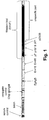
- Fig. 1 shows a diagnostically useful carrier according to the present invention. It is a line blot comprising a section coated with E. multilocularis polypeptide extract polypeptides in the molecular weight range from 7 to 160 kDa, separated according to molecular weight prior by way of electrophoresis following by transfer onto the line blot by electroblotting.
- fusion protein AgBB/1a, AgB8/1b, AgB8/2, AgB8/3, AgB8/4a and AgB8/4b from Echinococcus granulosus and recombinant Em18 and Em95 from Echinococcus multilocularis .
- Fig. 2 shows a range of line blots produced in the same manner as described before. Each has been contacted with a different patient sample. Comparison of the various developed blots shows that p21 is an antigenic polypeptide distinct from previously used antigenic polypeptides such as p18.
- Fig. 3 shows the part of line blots that comprises the native Echinococcus proteins separated according to molecular weights.
- the line blot depicted in Fig. 1 was used for the experimental programme described herein. It was prepared by electrophoretically separating polypeptides according to molecular weight from E. multilocularis polypeptide extract comprising proteins p7, p16/18, p21 and p25/26 in the molecular weight range from 7 to 160 kDa, as prepared as described in Spiliotis, M., Tappe, D., Sesterhenn, L., and Brehm, K. (2004) Long-termin in vitro cultivation of Echinococcus multilocularis metacestodes under axenic conditions Parasitol. Res.
- recombinant fusion protein comprising AgBB/1a, AgB8/1b, AgB8/2, AgB8/3, AgB8/4a and AgB8/4b (SEQ ID NO 9) and recombinant polypeptides Em18 (SEQ ID NO 16) and Em95 (SEQ ID NO 17). All recombinant proteins had been purified using standard protocols for the isolation of GST and/or His tagged protein.
- the blot produced as described in Example 1 was subsequently contacted with patient sera and developed using the reagents and instructions supplied with the commercially Anti- Echinococcus granulosus Westernblot (DY2320-G, EUROIMMUN, Lübeck).
- Antibodies to Em18 and/or Em95 were taken to indicate an Echinocuccus multilocularis infection, whereas antibodies to the AgB fusion protein in the absence of antibodies to Em18 and/or Em95 were taken to indicate an Echinocuccus granulosus infection.
- an Echinococcus infection could be detected on the basis of antibodies to p21, whilst not antibodies to p7 or p16/18 could be detected.
Landscapes
- Health & Medical Sciences (AREA)
- Life Sciences & Earth Sciences (AREA)
- Engineering & Computer Science (AREA)
- Immunology (AREA)
- Molecular Biology (AREA)
- Chemical & Material Sciences (AREA)
- Biomedical Technology (AREA)
- Urology & Nephrology (AREA)
- Hematology (AREA)
- Biotechnology (AREA)
- Microbiology (AREA)
- Cell Biology (AREA)
- Food Science & Technology (AREA)
- Medicinal Chemistry (AREA)
- Physics & Mathematics (AREA)
- Analytical Chemistry (AREA)
- Biochemistry (AREA)
- General Health & Medical Sciences (AREA)
- General Physics & Mathematics (AREA)
- Pathology (AREA)
- Proteomics, Peptides & Aminoacids (AREA)
- Peptides Or Proteins (AREA)
Abstract
Description
- The present invention relates to a diagnostically useful carrier comprising a means for specifically capturing an antibody to p21 from Echinococcus multilocularis in a sample from a subject; a kit comprising the diagnostically useful carrier, preferably further comprising a means for detecting any captured antibody; a method comprising the step detecting the presence or absence of an antibody to p21 from Echinococcus multilocularis in a sample from a subject; a use of p21 from Echinococcus multilocularis or a variant thereof for increasing the diagnostic reliability, preferably the sensitivity of an assay for the detection of an Echinococcus infection, preferably for distinguishing an Echinococcus multilocularis infection from an Echinococcus granulosus infection; a polypeptide running at a molecular weight of 21 kDa from Echinococcus multilocularis, obtainable by separating according to molecular weight an extract from Echinococcus multilocularis using gel electrophoresis, or a variant thereof, or an antibody to said polypeptide.
- Helminth infection or worm infection, also known as Helminthiasis, is a macroparasitic disease transmittable to mammals such as humans, dogs, foxes and wolves, characterized by infection of the body with helminths such as tapeworms of the Echinococcus type. E. granulosus and E. multilocularis are two of the world's major parasites. More than one million people are infected with one of them at any one time.
- There are two main types of Echinococcus infections, cystic echinococcosis and alveolar echinococcosis. Human infections occur following ingestion of eggs. Larvae are released in the host gut, penetrate intestinal villi and migrate to various organs.
- The disease often starts without symptoms and this may last for a year. The symptoms and signs that occur subsequently depend on the cyst's location and size. Alveolar disease usually begins in the liver but can spread to other parts of the body such as the lungs or brain. When the liver is affected the person may suffer from abdominal pain as well as weight loss and turn yellow. Lung disease may cause pain in the chest, shortness of breath and coughing. Without treatment, Echinococcus infections may be lethal.
- Since the patient may be asymptotic for some time and it becomes more and more difficult to provide effective treatment as the disease progresses, reliable tools for the early serodiagnosis of human helminthic infections are highly sought-after.
- Patients infected with Echinococcus display a variety of immune responses (Gottstein, B., Mesarina, B., Tanner, I., Ammann, R. W., Wilson, j. F., Eckert, J. Lanier, A. (1991): Specific Cellular and Humoral Immune Responses in Patients with Different Long-Term Courses of Alveolar Echinococcosis (Infection with Echinococcus multilocularis). Am. J. Trop Med. Hy. 45, 734-742.
- Therefore, conventional immunoassays based on native antigens, which may be extracted from whole worms or in vitro cultures, may be used in immunoblots to detect host antibodies to the parasite (Ayadi, A., Dutoit, B., Sendid, B., and Camus, D (1995): Specific Diagnostic Antigens of Echinococcus granulosus detected by Western Blot. Parasite 2, 119-123). Such assays are commercially available, for example from EUROIMMUN, Lübeck (Anti-Echinococcus-granulosus WESTERNBLOT).
- These natural antigens are limited in availability, suffer from batch-to-batch variation and lack the degree of diagnostic reliability that would be desirable. Further shortcomings include the fact that they are often cross-reactive, i.e. recognized by sera from patients infected with two or more helminth species.
- In addition to detecting Echinococcus, parasitologists have an interest in distinguishing material from E. granulosus and E. multilocularis. Although the larvae of both parasites are predominantly found in the liver, their distribtions throughout the host's body differs at later developmental stages, with significant implications for the treatment of patients infected. For example, E. granulosus is most frequently found in the lung, whilst E. multilocularis may enter both the lung and the brain of the host.
- Therefore, a problem underlying the present invention is to provide an assay for or aiding in the detection of Echinococcus infections which is improved compared to state of the art assays with regard to one or more of their various shortcomings.
- Another problem underlying the present invention is to provide an assay for the detection of Echinococcus having a higher degree of reliability, in terms of specificity and/or sensitivity, with regard to the detection of Echinococcus multilocularis and Echinococcus granulosus infections compared to state of the art assays.
- Another problem underlying the present invention is to provide an assay having a higher degree of reliability with regard to the distinction between Echinococcus multilocularis and E-chinococcus granulosus infections compared to state of the art assays.
- The problem underlying the present invention is solved by the subject-matter of the attached independent and dependent claims.
- In a first aspect, the problem underlying the present invention is solved by a diagnostically useful carrier comprising a means for specifically capturing an antibody to p21 from Echinococcus multilocularis in a sample from a subject.
- In a preferred embodiment of the first aspect, the carrier further comprises a means for specifically capturing an antibody to one or more polypeptides selected from the group comprising p7, p16/18 and p25/26 from Echinococcus multilocularis, preferably all of them.
- In another preferred embodiment of the first aspect, the means for specifically capturing an antibody to a polypeptide from the group comprising p21, p7, p16/18 and p25/26 from Echinococcus multilocularis is the respective polypeptide from the group comprising p21, p7, p16/18 and p25/26 from Echinococcus multilocularis or a variant thereof, preferably in a native form of the polypeptide.
- In another preferred embodiment of the first aspect, the means for specifically capturing an antibody to a polypeptide from the group comprising p21, p7, p16/18 and p25/26 from Echinococcus multilocularis is provided in the form of a polypeptide extract from Echinococcus, preferably Echinococcus multilocularis, more preferably separated according to molecular weight, and, and wherein the polypeptide extract comprises p16/18 and p21 from Echinococcus multilocularis which are separated sufficiently to allow for distinction between an antibody to p16/18 and another antibody to p21. In particular, the distance between p16/18 and p21 on the carrier is such that the bands associated with them do not overlap to such an extent that a signal indicating binding of an antibody to p16/18 cannot be distinguished from a signal indicating binding of an antibody to p21. In other words, the carrier may be used to detect whether antibodies to p16/18, to p21 or antibodies to both p16/18 and p21 are present in the sample.
- In another preferred embodiment of the any aspect, the carrier further comprises a means for specifically capturing an antibody to one or more polypeptides selected from the group comprising AgB8/1a, AgB8/1b, AgB8/2, AgB8/3, AgB8/4a and AgB8/4b from Echinococcus granulosus, Em18 and Em95 from Echinococcus multilocularis, preferably all of them.
- In another preferred embodiment of the first aspect, the means for specifically capturing an antibody to one or more polypeptides selected from the group comprising AgB8/1a, AgB8/1b, AgB8/2, AgB8/3, AgB8/4a and AgB8/4b from Echinococcus granulosus, Em18 and Em95 from Echinococcus multilocularis is the respective polypeptide from the group comprising AgBB/1a, AgBB/1b, AgB8/2, AgB8/3, AgB8/4a and AgB8/4b from Echinococcus granulosus, Em18 and Em95 from Echinococcus multilocularis or a variant thereof, preferably provided in the form of one or more recombinant and/or purified polypeptides.
- In a second aspect, the problem underlying the present invention is solved by a kit comprising the diagnostically useful carrier according to the present invention, preferably further comprising a means for detecting any captured antibody.
- In a third aspect, the problem underlying the present invention is solved by a method comprising the step detecting an antibody to p21 from Echinococcus multilocularis in a sample from a subject.
- In a preferred embodiment of the third aspect, the method further comprises detecting an antibody to one or more polypeptides selected from the group comprising p7, p16/18 and p25/26, preferably all of them, more preferably p7 and p16/p18, most preferably p7.
- In another preferred embodiment of the third aspect, the method further comprises the step detecting an antibody to one or more polypeptides selected from the group comprising AgBB/1a, AgB8/1b, AgB8/2, AgB8/3, AgB8/4a and AgB8/4b from Echinococcus granulosus, Em18 and Em95 from Echinococcus multilocularis, preferably all of them.
- In another preferred embodiment of the third aspect, antibodies to more than one of the polypeptides from said group are detected simultaneously.
- In another preferred embodiment of the third aspect, the antibodies to more than one of the polypeptides from said group are detected in spatially separate binding reactions or in a one-pot reaction, preferably in a one-pot reaction.
- In another preferred embodiment of the third aspect, wherein an antibody to p21 detected can be distinguished from an antibody binding to p16/18.
- In a 4th aspect, the problem underlying the present invention is solved by a use of p21 from Echinococcus, preferably Echinococcus multilocularis or a variant thereof for increasing the diagnostic reliability, preferably the sensitivity of an assay for the detection of an Echinococcus infection, more preferably for distinguishing an Echinococcus multilocularis infection from an Echinococcus granulosus infection.
- In a 5th aspect, the problem underlying the present invention is solved by a polypeptide having a molecular weight of 21 kDa from Echinococcus multilocularis or a variant thereof, obtainable by separating according to molecular weight an extract from Echinococcus multilocularis using gel el ectrophoresis or an antibody to said polypeptide.
- The present invention is based on the inventors' surprising finding that a novel Echinococcus polypeptide, referred to throughout this application as "p21", exists that, when incorporated in assays for the detection of an Echinococcus infection, may enhance the overall assay sensitivity.
- The present invention centers around an assay for the diagnosis an Echinococcus infection that involves detecting in a sample from a subject suspected of having an Echinococcus infection antibodies to polypeptide p21 from Echinococcus multilocularis. p21 is a polypeptide having an apparent molecular weight of approximately 21 kDa as judged by SDS PAGE under reducing conditions and comparison with the running behavior of standard molecular weight marker proteins running under the same conditions. The p21 polypeptide band runs between the bands of the p16/p18 and p25/26 polypeptides described in the state of the art. Detection of antibodies to p21, and preferably to one or more polypeptides from the group comprising p7, p16/18 and p25/26 from Echinococcus multilocularis, AgB8/1a, AgB8/1b, AgB8/2, AgB8/3, AgB8/4a and AgB8/4b from Echinococcus granulosus and Em18 and Em95 from Echinococcus multilocularis may corroborate the assumption that the patient suffers from an Echinococcus infection and provide diagnostically relevant information. Preferably the diagnostically useful carrier comprises p16/18 and p21 from Echinococcus multilocularis or a variant thereof, which are separated sufficiently to allow for distinction between an antibody to p16/18 and another antibody to p21. More preferably, it may comprises in addition, in order of increasing preference, p7; p7 and Em18 from Echinococcus multilocularis; p7, Em18 and Em95 from Echinococcus multilocularis; or p7, Em18 and Em95 from Echinococcus multilocularis and AgBB/1a, AgB8/1b, AgB8/2, AgB8/3, AgB8/4a and AgB8/4b from Echinococcus granulosus or variants thereof. Preferably any polypeptide from the group comprising p7, p16/18 and p21 is a native polypeptide, whereas any polypeptide from the group comprising Em18 and Em95 from Echinococcus multilocularis and AgB8/1a, AgB8/1b, AgB8/2, AgB8/3, AgB8/4a and AgB8/4b from Echinococcus granulosus is recombinant. Such a carrier may be used to detect an Echinococcus infection at higher sensitivity.
- The native protein is obtainable by preparing a polypeptide extract from Echinococcus multilocularis preferably following the protocol by Spiliotis, M., Tappe, D., Sesterhenn, L., and Brehm, K. (2004) Long-termin in vitro cultivation of Echinococcus multilocularis metacestodes under axenic conditionsParasitol. Res. 92 (5), 430-432. p21 may be detected, throughout the purification process, by way of immunoblotting, using a sample from an infected patient reactive with p21 as an antibody source. Preferably p21 is enriched relative to its proportion to other polypeptides in native tissue, for example by separating the polypeptide extract according to size, collecting fractions and preparing a mixture comprising a volume of p21-containing fractions that exceeds the volume of other fractions. Preferably p21 used according to the invention is non-recombinant p21 purified from a tissue.
- The protein band comprising p21 may be cut out from the gel following completion of the electrophoresis and the protein eluted using standard protein purification techniques. It may be separated from any polypeptide running at a similar molecular weight by way of affinity chromatography, using a sample from an infected patient reactive with p21 to obtain the antibody to p21 as the affinity ligand. The person skilled in the art is familiar with such methods.
- Alternatively, a piece of electrophoresis gel comprising polypeptides from Echinococcus, preferably Echinococcus multilocularis having an enriched proportion of polypeptides, among them p21, having a certain range of molecular weights as judged by standard molecular weight markers, compared to a non-processed polypeptide extract, may be cut out from an electrophoresis gel obtained by subjecting a polypeptide extract from Echinococcus, preferably Echinococcus multilocularis to preparative gel electrophoresis. Preferably, the molecular weight range on the gel includes polypeptides from 1 to 200 kDa, more preferably 5 to 100 kDa, more preferably 6 to 50 kDa and more preferably 7 to 30 kDa, wherein, most preferably, native Echinococcus, preferably Echinococcus multilocularis polypeptides outside said molecular weight range are present at a lower proportion than in the polypeptide extract obtained directly from the organism. Polypeptides outside said molecular weight range may optionally be absent, for example as a result of cutting out the gel piece comprising the sought-after molecular weight range and discarding the remainder of the gel. Other options are available for producing a fraction of Echinococcus, preferably Echinococcus multilocularis polypeptides enriched in those polypeptides, compared to a non-processed polypeptide extract, within said molecular weight range, for example the use of size-exclusion chromatography.
- It is advantageous that any separation according to molecular weight is sufficient to allow for distinction between p21 and any other polypeptide having a similar molecular weight, for example p18 and p25/p26. The person skilled in the art is familiar with suitable techniques, for example gel electrophoresis using gels with a polyacrylamide concentration tailored specifically for the efficient separation of polypeptides having a certain molecular weight, for example 21 kDa. The amount of p21, for any aspect of the present invention, needs to be sufficient for detection separable from any background signals, for example for detection using a secondary labeled antibody, wherein preferably the label has enzymatic activity or is chemiluminescent, fluorescent or radioactive.
- The Echinococcus multilocularis polypeptides having said molecular weight range, optionally, associated with said piece of electrophoresis gel, may be transferred, for example by electroblotting, to a diagnostically useful, preferably solid carrier, optionally in the shape of a test strip, preferably a line blot. The solid carrier may comprise one or more recombinant and/or purified diagnostically relevant polypeptides from Echinococcus multilocularis in addition. In a preferred embodiment, the term "purified" polypeptide, as used herein, refers to a polypeptide that constitutes at least 50, 60, 70, 80, 90, 95 or 99 % of all polypeptides present as judged by SDS PAGE following Coomassie staining and visual inspection.
- The invention relates to a diagnostically useful carrier, which is preferably a solid carrier for contacting a means for specifically capturing an antibody, which means is associated with said carrier, with a bodily fluid sample from a subject, preferably a human subject. In a preferred embodiment the solid carrier is a diagnostic device, more preferably selected from the group comprising one or more beads, a test strip, a microtiter plate, a blot, a glass surface, a biochip and a membrane, more preferably from the group comprising a blot, a test strip and a membrane. In a most preferred embodiment, the diagnostically useful carrier is a line blot (Raoult, D., and Dasch, G. A. (1989), The line blot: an immunoassay for monoclonal and other antibodies. Its application to the serotyping of gram-negative bacteria. J. Immunol. Methods, 125 (1- 2), 57-65;
WO2013041540 ). In a preferred embodiment, the term "line blot", as used herein, refers to a test strip, more preferably membrane-based, that has been coated with one or more means for capturing an antibody, preferably a polypeptide each. If two or more means are used, they are preferably spatially separated on the carrier, preferably along the longitudinal axis of a carrier shape in the form of a test strip. Preferably, the width of the bands is at least 30, more preferably 40, 50, 60, 70 or 80 % the width of the test strip. The test strip may comprise one or more control bands for confirming that it has been contacted with sample sufficiently long and under adequate conditions, in particular in the presence of human serum, antibody conjugate, or both. A multitude of diagnostic solutions including line blots are commercially available, for example from EUROIMMUN, Lübeck, Germany. - It is essential that the sample used to practice the present invention comprises antibodies, also referred to as immunoglobulins. Typically the sample is a bodily fluid comprising a representative set of the subject's antibodies. The sample may be selected from the group comprising whole-blood, serum, cerebrospinal fluid and saliva and is preferably serum or plasma, more preferably serum. Preferably the antibodies are human antibodies.
- It is essential that the diagnostically useful carrier comprises a means for specifically capturing an antibody to one or more antigenic polypeptides of diagnostic relevance from Echinococcus, preferably Echinococcus multilocularis. The diagnostically useful carrier according to the invention serves as a scaffold for the one or more of these means, which are molecule capturing specifically the antibody of interest. The person skilled in the art is aware of a multitude of methods to make and identify molecules with desirable binding properties or to tailor existing molecule. These molecules include, but are not limited to polypeptides, aptamers, small molecules and derivatives thereof, and are preferably antigenic polypeptides. Said carrier is suitable for carrying out a diagnostic method.
- One first group of antigenic polypeptides of diagnostic relevance includes, in addition to p21, the polypeptides of the group comprising p7, p16/18 and p25/26 from Echinococcus multilocularis. These are known antigenic polypeptides, preferably non-recombinant, named in line with their molecular weight (Asian, M., Yüksel, P, Polat, E., Cakan, H., Ergin, S., Oner, Y. A., Zengin, K., Arikan, S., Saribas, A., Mamal Torum, M., Kocazeybek, B. (2011) The diagnostic value of Western blot method in patients with cystic echinococcosis, New. Microbiol. 23, 173-177). A second group of antigenic polypeptides of diagnostic relevance includes those from the group comprising AgB8/1a, AgB8/1b, AgB8/2, AgB8/3, AgB8/4a and AgB8/4b from Echinococcus granulosus, Em18 and Em95 from Echinococcus multilocularis, wherein the terms "AgB8/1a", "AgB81b", "AgB8/2", "AgB8/3", "AgB8/4a" and "AgB8/4b" from Echinococcus granulosus, "Em18" and "Em95" from Echinococcus multilocularis, refer to the sequences represented by data base codes SEQ ID NO1 (Eg AgB8/1a), SEQ ID NO 2 (EG AgB8/1b), SEQ ID NO 3 (Eg AgB8/2), SEQ ID NO 4 (Eg AgB8/3), SEQ ID NO 5 (Eg AgB8/4a), SEQ ID NO 6 (Eg_AgB8/4b), SEQ ID NO 7 (Echinococcus multilocularis Em18) and SEQ ID No 8 (Echinococcus multilocularis Em95), respectively. Optionally one or more of these polypeptides or variants thereof, for example those from the group comprising AgBB/1a, AgB8/1b, AgB8/2, AgB8/3, AgB8/4a and AgB8/4b from Echinococcus granulosus, may be fused to generate a fusion protein such as SEQ ID NO 9. Any data base codes referred to throughout this application refer to the respective polypeptide sequence available via the NCBI data bases as online at the priority date of this application.
- According to the present invention, the carrier comprises one or more means for specifically capturing an antibody, preferably one or more, more preferably two or more, more preferably three or more, more preferably four or more such means, each of them capable of specifically capturing a different antibody. Said means is preferably immobilized on said carrier. In a preferred embodiment, the means for specifically capturing an antibody of interest is an antigenic polypeptide comprising or consisting of the antigenic polypeptide to which the antibody binds, preferably from the group comprising p21, p7, p16/18 and p25/26 from Echinococcus multilocularis, AgB8/1a, AgB8/1b, AgB8/2, AgB8/3, AgB8/4a and AgB8/4b from Echinococcus granulosus and Em18 and Em95 from Echinococcus multilocularis. Said antigenic polypeptide contains one or more characteristic epitopes comprising at least 7, preferably 10 more preferably 15 amino acids which confer the ability to bind specifically to the antibody in a sample from an infected patient. Said antigenic polypeptide, together with the insoluble carrier to which it is attached, may be separated from a reaction mixture comprising a sample to be analyzed in a straightforward manner, for example by filtration, centrifugation or decanting. One or more of these antigenic polypeptides, for example p21 from Echinococcus multilocularis, may be used to manufacture a medicament for treatment of a disease or used for the manufacture of an agent for diagnosis of disease a disease, which disease is an Echinococcus infection.
- Said antigenic polypeptide may be immobilized in a reversible or irreversible manner. For example, the immobilization is reversible if the molecule interacts with the carrier via ionic interactions which may be masked by addition of a high concentration of salt or if the molecule is bound via a cleavable covalent bond. By contrast, the immobilization is irreversible if the molecule is linked to the carrier via a covalent bond that cannot be cleaved in aqueous solution. The polypeptide may be indirectly immobilized, for example by immobilizing an antibody or other entity having affinity to the polypeptide, followed by addition of the polypeptide and formation of a polypeptide-antibody complex.
- However, the teachings of the present invention may not only be carried out using polypeptides having the exact sequences referred to in this application explicitly, for example by function, name, sequence or accession number, or implicitly, but also using variants of such polypeptides.
- In a preferred embodiment, the term "variant", as used herein, may refer to at least one fragment of the full length sequence referred to, more specifically one or more amino acid or nucleic acid sequence which is, relative to the full-length sequence, truncated at one or both termini by one or more amino acids. Such a fragment comprises or encodes for a peptide having at least 10, 15, 25, 50, 75, 100, 150 or 200 successive amino acids of the original sequence or a variant thereof. The total length of the variant may be at 25, 30, 40, 50, 60, 70, 80, 90, 100 or more amino acids. In the case of a native protein, such fragments may be made by limited proteolysis. In the case of a recombinant protein, an additional possibility is to express truncated polypeptides.
- In another preferred embodiment, the term "variant" relates not only to at least one fragment, but also a polypeptide or a fragment thereof comprising amino acid sequences, preferably a fragment comprising at least 25, more preferably 50, more preferably 200 successive amino acids, that are at least 40, 50, 60, 70, 75, 80, 85, 90, 92, 94, 95, 96, 97, 98 or 99 % identical to the reference amino acid sequence referred to or the fragment thereof, wherein amino acids other than those essential for the biological activity, for example the ability to bind specifically to an antibody of interest, or the fold or structure of the polypeptide are deleted or substituted and/or one or more such essential amino acids are replaced in a conservative manner and/or amino acids are added or deleted such that the biological activity of the polypeptide is at least partially preserved. The state of the art comprises various methods that may be used to align two given nucleic acid or amino acid sequences and to calculate the degree of identity, see for example Arthur Lesk (2008), Introduction to bioinformatics, Oxford University Press, 2008, 3rd edition. In a preferred embodiment, the ClustalW software (Larkin, M. A., Blackshields, G., Brown, N. P., Chenna, R., McGettigan, P. A., McWilliam, H., Valentin, F., Wallace, I. M., Wilm, A., Lopez, R., Thompson, J. D., Gibson, T. J., Higgins, D. G. (2007): Clustal W and Clustal X version 2.0. Bioinformatics, 23, 2947-2948) is used applying default settings.
- In a preferred embodiment, variants may, in addition, comprise chemical modifications, for example isotopic labels or covalent modifications such as glycosylation, phosphorylation, acetylation, decarboxylation, citrullination, hydroxylation and the like. This may include the chemical, non-recombinant ligation or a native or recombinant protein with a native, recombinant or chemically synthesized protein. The person skilled in the art is familiar with methods for the modification of polypeptides. Moreover, variants may also be generated by way of fusion with other known polypeptides or variants thereof.
- The variant of the polypeptide has biological activity. In a preferred embodiment such biological activity is the ability to capture an antibody to the respective polypeptide from a sample obtained from a subject infected with Echinococcus that comprises such an antibody, but not from a sample obtained from a healthy subject.
- Any polypeptide used to carry out the inventive teachings, including any variants, is designed such that it antigenic, i.e. comprises epitopes recognized by specifically by antibodies from patients suffering from an Echinococcus infection (but not by antibodies from healthy subjects), more preferably from an E. granulosus or E. multilocularis infection. In one embodiment, such polypeptide comprises a stretch of 6, 7, 8, 9, 10, 11, 12, 20, 25, 30, 40, 50, 60, 70, 80, 90, 100 or more, preferably at least 9 but no more than 16, consecutive amino acids from the respective native Echinococcus polypeptide. The person skilled in the art is familiar with guidelines used to design peptides having sufficient immunogenicity, for example those described in Jackson, D. C., Fitzmaurice, C. J., Brown, L. E., Zeng, W. (1999), Preparation and properties of totally synthetic immunogenes, ; and Black, M., Trent, A., Tirrell, M. and Olive, C. (2010), Advances in the design and delivery of peptide subunit vaccines with a focus on Toll-like receptor agonists, Expert Rev Vaccines, 2010 February; 9(2): 157-173. Briefly, it is desirable that the peptide meets as many as possible of the following requirements: (a) it has a high degree of hydrophilicity, (b) it comprises one or more residues selected from the group comprising aspartate, proline, tyrosine and phenylalanine, (c) is has, for higher specificity, no or little homology with other known peptides or polypeptides, (d) it needs to be sufficiently soluble and (e) it comprises no glycosylation or phosphorylation sites unless required for specific reasons. Alternatively, bioinformatics approaches may be followed, for example those described by Moreau, V., Fleury, C., Piquer, D., Nguyen, C., Novali, N., Villard, S., Laune, D., Granier, C. and Molina, F. (2008), PEPOP: Computational design of immunogenic peptides, BMC Bioinformatics 2008, 9:71.
- If an antigenic polypeptide is used as the means for specifically capturing an antibody, for example to p21, said polypeptide, when used to carry out the teachings of the present invention, may be provided in any form and at any degree of purification, from tissues or cells comprising said polypeptide in an endogenous form, more preferably cells overexpressing the polypeptide, crude or enriched lysates of such cells, to purified and/or isolated polypeptide which is essentially pure. In a preferred embodiment, the polypeptide is a native polypeptide, wherein the term "native polypeptide", as used herein, refers to a folded polypeptide, more preferably to a folded polypeptide purified from tissues or cells, more preferably from mammalian cells or tissues, optionally from non-recombinant tissues or cell. If a native polypeptide is used, it is preferably enriched compared to its natural state. The antibody captured or detected according to the present invention is preferably an IgG class antibody.
- According to the present invention, the polypeptide may be a recombinant protein, wherein the term "recombinant", as used herein, refers to a polypeptide produced using genetic engineering approaches at any stage of the production process, for example by fusing a nucleic acid encoding the polypeptide to a strong promoter for overexpression in cells or tissues or by engineering the sequence of the polypeptide itself. The person skilled in the art is familiar with methods for engineering nucleic acids and polypeptides encoded (for example, described in Sambrook, J., Fritsch, E. F. and Maniatis, T. (1989), Molecular Cloning, CSH or in Brown T. A. (1986), Gene Cloning - an introduction, Chapman & Hall) and for producing and purifying native or recombinant polypeptides (for example Handbooks "Strategies for Protein Purification", "Antibody Purification", published by GE Healthcare Life Sciences, and in Burgess, R. R., Deutscher, M. P. (2009): Guide to Protein Purification). In another preferred embodiment, the polypeptide is an isolated polypeptide, wherein the term "isolated" means that the polypeptide has been enriched compared to its state upon production using a biotechnological or synthetic approach and is preferably pure, i.e. at least 60, 70, 80, 90, 95 or 99 percent of the polypeptide in the respective sample consists of said polypeptide as judged by SDS polyacrylamide gel electrophoresis followed by Coomassie blue staining and visual inspection.
- The subject according to the present invention is an organism producing antibodies, preferably infection-related antibodies, more preferably from a mammal, most preferably a human. Preferably none of the methods according to the present inventions are practiced on the human or animal body, but under in vitro conditions.
- Within the scope of the present invention is a diagnostically useful carrier comprising a means for specifically capturing an antibody to an antigenic polypeptide such as p21. In a preferred embodiment, the term "specifically capturing an antigen", as used herein, refers to the ability to bind specifically to the antibody of interest to the effect that it is bound and removed from the sample rather than binding to any antibody or any antibody from a certain antibody class present in the sample.
- According to the present invention, a means for specifically detecting a captured antibody is provided, optionally as part of a kit. In a preferred embodiment, the term "specifically detecting a captured antibody", as used herein, means that the antibody binding specifically to the means for specifically capturing the antibody, preferably p21, following capture, is detected rather than the entirety of the antibodies present in the sample due to the ability of the means to bind specifically to the variable region of the antibody determining the antibody's binding specificity rather than its constant region. In a preferred embodiment, the term "binding specifically", as used herein, means that the binding is stronger than a binding reaction characterized by a dissociation constant of 1 x 10⁻⁵ M, more preferably 1 x 10⁻⁷ M, more preferably 1 x 10⁻⁸ M, more preferably 1 x 10⁻⁹ M, more preferably 1 x 10⁻¹⁰ M, more preferably 1 x 10-11 M, more preferably 1 x 10-12 M, as determined by surface plasmon resonance using Biacore equipment at 25 °C in PBS buffer at pH 7.
- In a preferred embodiment, the means for specifically capturing an antibody to a first antigenic polypeptide according to the present invention and the means for specifically capturing an antibody to a second antigenic polypeptide according to the present invention are on separate carriers. This means that the means are not attached to a single carrier, but one or more carriers that are separate and/or separable without damaging them. For example, the means for specifically capturing an antibody p21 may be attached to a first test strip, and the detecting an antibody to p16 is attached to another test strip which is separate from the first test strip.
- In another preferred embodiment, the means for specifically capturing an antibody to a first antigenic polypeptide according to the present invention and the means for specifically capturing an antibody to a second antigenic polypeptide according to the present invention are on one, preferably covalently linked to one carrier. This means that the means are attached to one carrier which cannot be disassembled, without damaging the carrier, such that the means are on separate carriers. For example, the means may be all coated on one test strip, particular in the form of a line blot.
- The teachings according to the present invention provide a kit, preferably for diagnosing an Echinococcus infection, more preferably for distinguishing between an E. granulosus from an E multilocularis infection. Such a kit is a container that comprises specific reagents required to practice the method according to the present invention, in particular the diagnostically useful carrier according to the present invention, optionally in addition to one or more solutions required to practice the method according to the present invention, preferably selected from or all from the group comprising sample dilution buffer, washing buffer and buffer comprising a means for detecting any specifically captured antibody, such as a secondary antibody and optionally a means for detecting the latter. Furthermore, it may comprise instructions detailing how to use the kit and the diagnostically useful carrier according to the present invention for contacting the polypeptide according to the present invention with a bodily fluid sample from a subject, preferably a human subject, for example a line blot, wherein the means for specifically capturing p21 according to the present invention, preferably a polypeptide comprising p21 or a variant thereof, is immobilized on the line blot. Furthermore, the kit may comprise a positive control, for example an antibody known to bind to p21, and a negative control, for example a protein having no detectable affinity to p21 such as bovine serum albumin. Finally, such a kit may comprise a standard solution comprising a p21-binding antibody for preparing a calibration curve. In a preferred embodiment, the kit comprises a device, preferably a blot-based device such as a line blot coated with a means for specifically capturing an antigenic polypeptide according to the present invention.
- According to the invention, a means for detecting the one or more captured antibodies may be provided. The person skilled in the art is aware of many methods that may be used. In a preferred embodiment, a secondary antibody binding to the constant region of the one or more captured antibodies, which is the corresponding primary antibody, is used, which secondary antibody may be associated with a label that is straightforward to detect, for example a fluorescent, radioactive or enzymatically active label, the latter of which may catalyze a chemiluminescent reaction or the generation of a molecule detectable using colourimetry or spectroscopy or another analytical method.
- In a preferred embodiment, the term "diagnosis", as used herein, refers to any kind of procedure aiming to obtain information instrumental in the assessment whether a patient suffers or is likely or more likely than the average or a comparative subject, the latter preferably having similar symptoms, to suffer from certain a disease or disorder in the past, at the time of the diagnosis or in the future, to find out how the disease is progressing or is likely to progress in the future or to evaluate the responsiveness of a patient with regard to a certain treatment, for example the administration of suitable drugs. In other words, the term "diagnosis" comprises not only aiding the diagnosis, but also a prognosis and/or efforts to monitor the course of a disease or disorder.
- Therefore, the term "diagnosis" does preferably not imply that the diagnostic methods or agents according to the present invention will be definitive and sufficient to finalize the diagnosis on the basis of a single test, let alone parameter. By contrast it has to be emphasized that a plethora of further information must be gathered, in particular by imaging techniques (ultrasound scanning and computerized tomography) and must be weighed carefully by a medical doctor to obtain a coherent picture which allows said doctor to provide a final diagnosis.
- The term "diagnosis" may refer to a contribution to what is referred to as a "differential diagnosis", i. e. a systematic diagnostic procedure considering the likelihood of a range of possible conditions on the basis of a range of diagnostic parameters. The term "diagnosis" may also refer to a method or agent used to choose the most promising treatment regime for a patient. In other words, the method or agent may relate to selecting a treatment regimen for a subject.
- The present invention relates to a method comprising the step detecting in a sample from a subject an antibody to an antigenic polypeptide such as p21. Such a method may comprise the steps a) providing in a sample from a subject, b) contacting the sample with the diagnostically useful carrier according to the present invention under conditions compatible with the formation of a complex comprising the diagnostically useful carrier and the antibody, more specifically the means for specifically capturing the antibody bound to the antigen, c) isolating any said complex, for example by removing the sample, d) optionally washing said complex, and e) detecting said complex. The method is preferably an in vitro method. The detection of an antibody, more specifically said complex according to the present invention comprises the use of a method selected from the group comprising immunodiffusion techniques, immunoelectrophoretic techniques, light scattering immunoassays, light scattering immunoassays, agglutination techniques, labeled immunoassays such as those from the group comprising radiolabeled immunoassay, enzyme immunoassays such as colourimetric assays, chemiluminscence immunoassays and immunofluorescence techniques. The person skilled in the art is familiar with these methods, which are also described in the state of the art, for example in Zane, H. D. (2001): Immunology - Theoretical & Practical Concepts in Laboratory Medicine, W. B. Saunders Company, in particular in Chapter 14.
- In many cases detecting an antibody, optionally meaning determining whether the concentration of the antibody in the sample is beyond a certain threshold is sufficient for the diagnosis. If the antibody can be detected, this result will be instrumental for the clinician's diagnosis and indicates an increased likelihood that the patient suffers from a disease. In a preferred embodiment, the relative concentration of the antibody in the serum, compared to the level that may be found in the average healthy subject, may be determined. In a preferred embodiment, the term "detecting", as used herein, means that it is sufficient to check whether a signal sufficiently beyond any background level may be detected using a suitable complex detection method that indicates that the antibody of interest is present or more antibody of interest is present than would be in a healthy subject. In a more preferred embodiment this may involve determining whether the concentration is at least 0.1, preferably 0.2, 0.5, 1, 2, 5, 10, 20, 25, 50, 100, 200, 500, 1000, 10000 or 100000 times higher than the concentration of the antibody of interest found in the average healthy subject.
- In a preferred embodiment, at least two antibodies, each to a different antigenic polypeptide according to the present invention, are detected simultaneously, i.e. at the same time. This is convenient in terms of efficient diagnostic procedures, as a maximum of diagnostic information is obtained in a given period of time. Of course a prerequisite is that sufficient capacity is available for running all reactions.
- In a preferred embodiment, at least two antibodies, each to an antigenic polypeptide according to the present invention, are detected in spatially separate reactions. This means that these reactions are run in different reaction mixtures in separate vessels.
- If more than one antibody is to be detected, the method may be carried out in a one-pot reaction. Preferably, the term "one-pot reaction", as used herein, means that two or more, preferably all reactions carried out for the purpose of detecting the presence or absence of an antibody are carried out in the same reaction mixture in one reaction vessel, without physical barriers between the reactions, by contrast to experimental settings contemplating that at least two reactions are carried out in separate solutions and reaction vessels. The one-pot mode is advantageous, since only one reaction has to be set up, thus saving time and resources. The minimum volume of sample required may be reduced.
- The present invention is further illustrated by the following figures and non-limiting examples from which further features, embodiments, aspects and advantages of the present invention may be taken.
-
Fig. 1 shows a diagnostically useful carrier according to the present invention. It is a line blot comprising a section coated with E. multilocularis polypeptide extract polypeptides in the molecular weight range from 7 to 160 kDa, separated according to molecular weight prior by way of electrophoresis following by transfer onto the line blot by electroblotting. - In addition it comprises a recombinant fusion protein AgBB/1a, AgB8/1b, AgB8/2, AgB8/3, AgB8/4a and AgB8/4b from Echinococcus granulosus and recombinant Em18 and Em95 from Echinococcus multilocularis.
-
Fig. 2 shows a range of line blots produced in the same manner as described before. Each has been contacted with a different patient sample. Comparison of the various developed blots shows that p21 is an antigenic polypeptide distinct from previously used antigenic polypeptides such as p18. -
Fig. 3 shows the part of line blots that comprises the native Echinococcus proteins separated according to molecular weights. - A number of polypeptide sequences are referred to throughout this application. They include:
SEQ ID NO Polypeptide (E.g. = E. granulosus; E. m. = E. multilocularis) SEQ ID NO 1 Eg AgB8/1a SEQ ID NO 2 Eg AgB8/1b SEQ ID NO 3Eg AgB8/2 SEQ ID NO 4 Eg AgB8/3 SEQ ID NO 5 Eg AgB8/4a SEQ ID NO 6 Eg AgB8/4b SEQ ID NO 7 Em18 SEQ ID NO 8 Em95 SEQ ID NO 9 Fusion comprising Eg AgB8/1a, Eg AgB8/1b, Eg AgB8/2, Eg AgB8/3, Eg AgB8/4a, Eg AgB8/4b SEQ ID NO 10 His-GST fusion comprising Eg AgB8/1a SEQ ID NO 11 His-GST fusion comprising Eg AgB8/1b SEQ ID NO 12 His-GST fusion comprising Eg AgB8/2 SEQ ID NO 13 His-GST fusion comprising Eg AgB8/3 SEQ ID NO 14 His-GST fusion comprising Eg AgB8/4a SEQ ID NO 15 His-GST fusion comprising Eg AgB8/4b SEQ ID NO 16 His fusion comprising Em18 SEQ ID NO 17 His fusion comprising Em95 - The line blot depicted in
Fig. 1 was used for the experimental programme described herein. It was prepared by electrophoretically separating polypeptides according to molecular weight from E. multilocularis polypeptide extract comprising proteins p7, p16/18, p21 and p25/26 in the molecular weight range from 7 to 160 kDa, as prepared as described in Spiliotis, M., Tappe, D., Sesterhenn, L., and Brehm, K. (2004) Long-termin in vitro cultivation of Echinococcus multilocularis metacestodes under axenic conditions Parasitol. Res. 92 (5), 430-432., with minor modifications, and transferring the resulting separated polypeptides on a membrane, wherein the pattern of polypeptides as separated remains intact. In addition, the membrane was coated using recombinant fusion protein comprising AgBB/1a, AgB8/1b, AgB8/2, AgB8/3, AgB8/4a and AgB8/4b (SEQ ID NO 9) and recombinant polypeptides Em18 (SEQ ID NO 16) and Em95 (SEQ ID NO 17). All recombinant proteins had been purified using standard protocols for the isolation of GST and/or His tagged protein. - To determine sensitivity, specificity, species differentiation rate and cross reactivity to other parasite infection a study was performed using 50 sera obtained from healthy blood donors, 50 sera obtained from tumor patients, 52 sera obtained from patients infected with E. multilocularis, 55 sera obtained from patients infected with E. granulosus, 122 sera obtained from patients infected with other parasites (n=5 Filaria, n=10 Toxocara, n=16 Anisakis, n=10 Strongyloides, n=9 Schistosoma, n=2 Multi-Helminths, n=7 Plasmodium, n=10 Ascaris, n=7 Taenia, n=13 Trichinella, n=17 Fasciola, n=11 Entamoeba, n=5 Leishmania). Patients were examined comprehensively by an expert clinician to establish the respective diagnosis. This included diagnostic examinations based on serology, sonography and computer tomography.
- The blot produced as described in Example 1 was subsequently contacted with patient sera and developed using the reagents and instructions supplied with the commercially Anti-Echinococcus granulosus Westernblot (DY2320-G, EUROIMMUN, Lübeck).
- If antibodies to at least one of the antigens from the group comprising Em18, Em95, the AgB fusion protein, p7, p16/18 and p21 could be detected, it was concluded that the respective patient suffers from an Echinococcus infection.
- Antibodies to Em18 and/or Em95 were taken to indicate an Echinocuccus multilocularis infection, whereas antibodies to the AgB fusion protein in the absence of antibodies to Em18 and/or Em95 were taken to indicate an Echinocuccus granulosus infection.
- The study revealed a sensitivity of 93%, a specificity of 100%, a species differentiation rate of 81%, and a cross reactivity of 6%.
- In several cases, exemplified by the sample analyzed in the bottom channel depicted in
Fig. 3 , an Echinococcus infection could be detected on the basis of antibodies to p21, whilst not antibodies to p7 or p16/18 could be detected.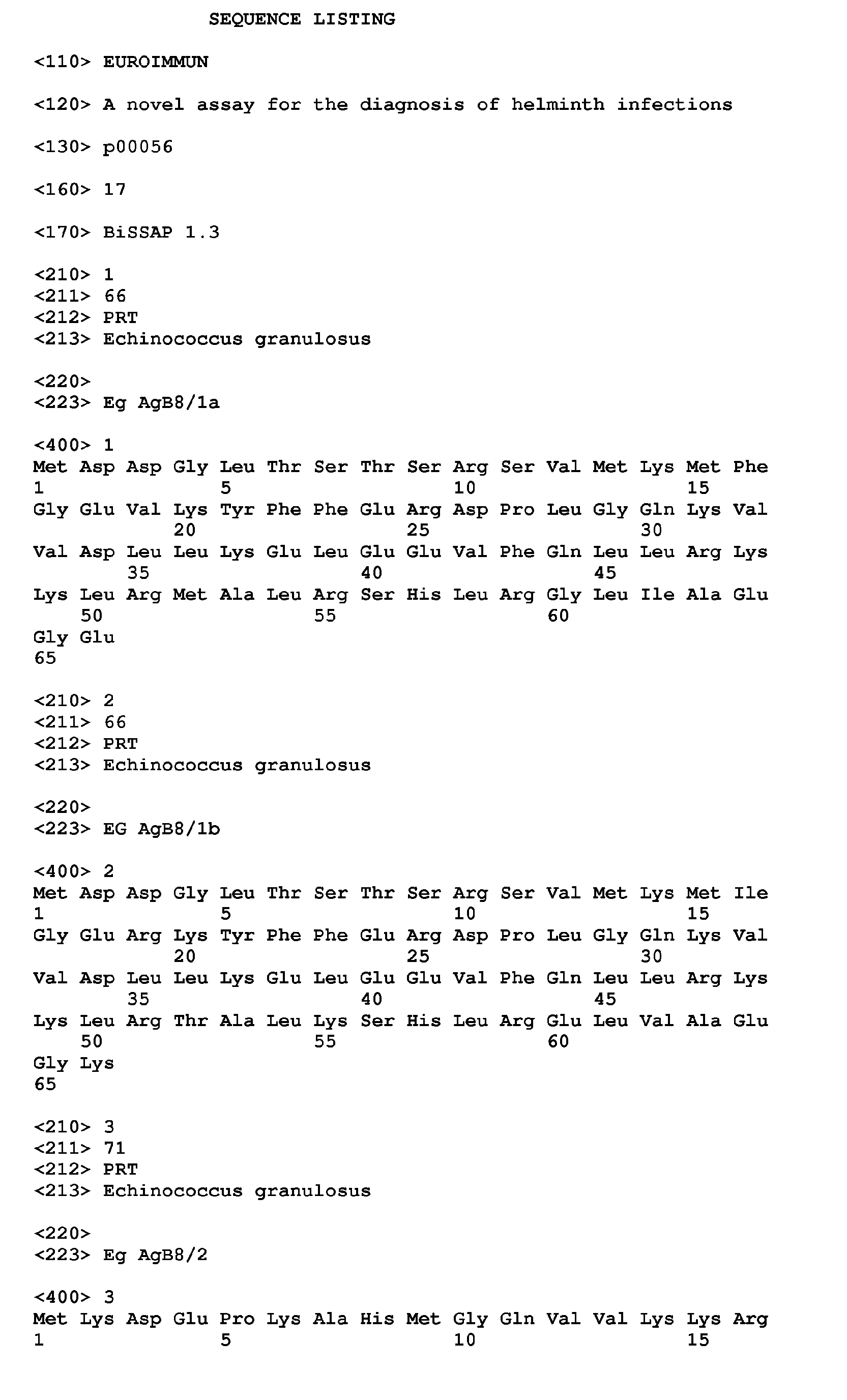


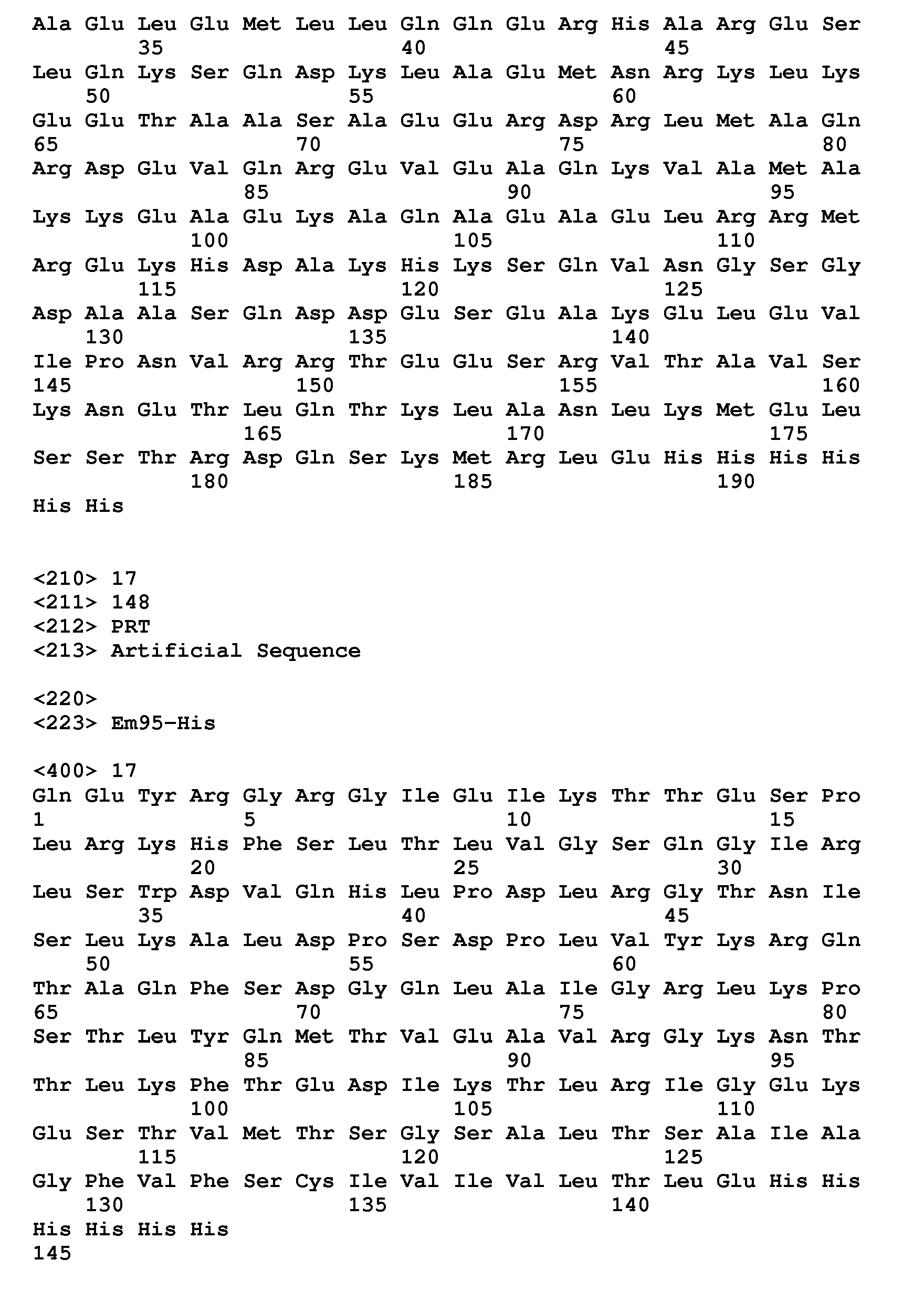
Claims (15)
- A diagnostically useful carrier comprising a means for specifically capturing an antibody to p21 from Echinococcus multilocularis in a sample from a subject.
- The diagnostically useful carrier according to claim 1, wherein the carrier further comprises a means for specifically capturing an antibody to one or more polypeptides selected from the group comprising p7, p16/18 and p25/26 from Echinococcus multilocularis, preferably all of them.
- The diagnostically useful carrier according to any of claims 1 to 2, wherein the means for specifically capturing an antibody to a polypeptide from the group comprising p21, p7, p16/18 and p25/26 from Echinococcus multilocularis is the respective polypeptide from the group comprising p21, p7, p16/18 and p25/26 from Echinococcus multilocularis or a variant thereof, preferably in a native form of the polypeptide.
- The diagnostically useful carrier according to any of claims 1 to 3, wherein the means for specifically capturing an antibody to a polypeptide from the group comprising p21, p7, p16/18 and p25/26 from Echinococcus multilocularis is provided in the form of a polypeptide extract from Echinococcus, preferably Echinococcus multilocularis separated according to molecular weight,
wherein the polypeptide extract comprises p16/18 and p21 which are separated sufficiently to allow for distinction between an antibody to p16/18 and another antibody to p21. - The diagnostically useful carrier according to any of claims 1 to 4, further comprising a means for specifically capturing an antibody to one or more polypeptides selected from the group comprising AgB8/1a, AgB8/1b, AgB8/2, AgB8/3, AgB8/4a and AgB8/4b from Echinococcus granulosus, Em18 and Em95 from Echinococcus multilocularis, preferably all of them.
- The diagnostically useful carrier according to claim 5, wherein the means for specifically capturing an antibody to one or more polypeptides selected from the group comprising AgBB/1a, AgB8/1b, AgB8/2, AgB8/3, AgB8/4a and AgB8/4b from Echinococcus granulosus, Em18 and Em95 from Echinococcus multilocularis is the respective polypeptide from the group comprising AgB8/1a, AgB8/1b, AgB8/2, AgB8/3, AgB8/4a and AgB8/4b from Echinococcus granulosus, Em18 and Em95 from Echinococcus multilocularis or a variant thereof, preferably provided in the form of one or more recombinant and/or purified polypeptides.
- A kit comprising the diagnostically useful carrier according to any of claims 1 to 6, preferably further comprising a means for detecting any captured antibody.
- A method comprising the step detecting an antibody to p21 from Echinococcus multilocularis in a sample from a subject.
- The method according to claim 8, further comprising detecting an antibody to one or more polypeptides selected from the group comprising p7, p16/18 and p25/26, preferably comprising p7 and p16/18, more preferably p7.
- The method according to claim 9, further comprising the step detecting an antibody to one or more polypeptides selected from the group comprising AgBB/1a, AgB8/1b, AgB8/2, AgB8/3, AgB8/4a and AgB8/4b from Echinococcus granulosus, Em18 and Em95 from Echinococcus multilocularis, preferably all of them.
- The method according to any of 9 to 10, wherein antibodies to more than one of the polypeptides from said group are detected simultaneously.
- The method according to any of 8 to 11, wherein the antibodies to more than one of the polypeptides are detected in spatially separate binding reactions or in a one-pot reaction, preferably in a one-pot reaction.
- The method according to any of 8 to 12, wherein an antibody to p21 is detected separately and can be distinguished from an antibody binding to p16/18.
- A use of p21 from Echinococcus multilocularis or a variant thereof for increasing the diagnostic reliability, preferably the sensitivity of an assay for the detection of an Echinococcus infection, preferably for distinguishing an Echinococcus multilocularis infection from an Echinococcus granulosus infection.
- A polypeptide having a molecular weight of 21 kDa from Echinococcus multilocularis, obtainable by separating according to molecular weight an extract from Echinococcus multilocularis using gel electrophoresis, or a variant thereof, or an antibody to said polypeptide.
Priority Applications (5)
| Application Number | Priority Date | Filing Date | Title |
|---|---|---|---|
| ES15002958T ES2714513T3 (en) | 2015-10-16 | 2015-10-16 | Novel trial for the diagnosis of helminth infections |
| PL15002958T PL3156798T3 (en) | 2015-10-16 | 2015-10-16 | A novel assay for the diagnosis of helminth infections |
| SI201530577T SI3156798T1 (en) | 2015-10-16 | 2015-10-16 | A novel assay for the diagnosis of helminth infections |
| EP15002958.5A EP3156798B1 (en) | 2015-10-16 | 2015-10-16 | A novel assay for the diagnosis of helminth infections |
| CN201610905940.4A CN106596964B (en) | 2015-10-16 | 2016-10-17 | Novel assay for diagnosing helminth infection |
Applications Claiming Priority (1)
| Application Number | Priority Date | Filing Date | Title |
|---|---|---|---|
| EP15002958.5A EP3156798B1 (en) | 2015-10-16 | 2015-10-16 | A novel assay for the diagnosis of helminth infections |
Publications (2)
| Publication Number | Publication Date |
|---|---|
| EP3156798A1 true EP3156798A1 (en) | 2017-04-19 |
| EP3156798B1 EP3156798B1 (en) | 2018-12-12 |
Family
ID=54337083
Family Applications (1)
| Application Number | Title | Priority Date | Filing Date |
|---|---|---|---|
| EP15002958.5A Active EP3156798B1 (en) | 2015-10-16 | 2015-10-16 | A novel assay for the diagnosis of helminth infections |
Country Status (5)
| Country | Link |
|---|---|
| EP (1) | EP3156798B1 (en) |
| CN (1) | CN106596964B (en) |
| ES (1) | ES2714513T3 (en) |
| PL (1) | PL3156798T3 (en) |
| SI (1) | SI3156798T1 (en) |
Cited By (2)
| Publication number | Priority date | Publication date | Assignee | Title |
|---|---|---|---|---|
| EP3539661A1 (en) | 2018-03-12 | 2019-09-18 | Euroimmun Medizinische Labordiagnostika AG | Incubation channel and incubation tub with multiple incubation channels |
| CN115746117A (en) * | 2021-09-03 | 2023-03-07 | 申联生物医药(上海)股份有限公司 | Preparation and application of echinococcus canadensis EC95 protein |
Families Citing this family (4)
| Publication number | Priority date | Publication date | Assignee | Title |
|---|---|---|---|---|
| CN107884578A (en) * | 2017-11-01 | 2018-04-06 | 杭州微瑞科技有限公司 | For echinococcosis antibody test card in Quantitative detection serum |
| CN109239211B (en) * | 2018-09-11 | 2022-04-15 | 江苏省血吸虫病防治研究所 | Serum markers and detection kits for identifying human hydatid infection |
| CN110261615B (en) * | 2019-07-04 | 2021-10-15 | 中国动物疫病预防控制中心(农业农村部屠宰技术中心) | Cystic echinococcosis diagnostic kit and application thereof |
| CN114264816B (en) * | 2021-12-24 | 2024-11-19 | 中国疾病预防控制中心寄生虫病预防控制所(国家热带病研究中心) | Echinococcus antibody immunochromatographic test strip and test card |
Citations (2)
| Publication number | Priority date | Publication date | Assignee | Title |
|---|---|---|---|---|
| FR2863499A1 (en) * | 2003-12-12 | 2005-06-17 | Univ Claude Bernard Lyon | NOVEL VACCINES FOR THE TREATMENT OR PREVENTION OF PARASITE INFECTIONS OF THE ECHINOCOCCUS FAMILY |
| WO2013041540A1 (en) | 2011-09-24 | 2013-03-28 | Euroimmun Medizinische Labordiagnostika Ag | Calibration strip for an immunoblot |
Family Cites Families (1)
| Publication number | Priority date | Publication date | Assignee | Title |
|---|---|---|---|---|
| CN202453359U (en) * | 2012-02-29 | 2012-09-26 | 厦门大学 | Dot gold immunofiltration kit of echinococcus multillocularis circulating antigen |
-
2015
- 2015-10-16 EP EP15002958.5A patent/EP3156798B1/en active Active
- 2015-10-16 PL PL15002958T patent/PL3156798T3/en unknown
- 2015-10-16 ES ES15002958T patent/ES2714513T3/en active Active
- 2015-10-16 SI SI201530577T patent/SI3156798T1/en unknown
-
2016
- 2016-10-17 CN CN201610905940.4A patent/CN106596964B/en active Active
Patent Citations (2)
| Publication number | Priority date | Publication date | Assignee | Title |
|---|---|---|---|---|
| FR2863499A1 (en) * | 2003-12-12 | 2005-06-17 | Univ Claude Bernard Lyon | NOVEL VACCINES FOR THE TREATMENT OR PREVENTION OF PARASITE INFECTIONS OF THE ECHINOCOCCUS FAMILY |
| WO2013041540A1 (en) | 2011-09-24 | 2013-03-28 | Euroimmun Medizinische Labordiagnostika Ag | Calibration strip for an immunoblot |
Non-Patent Citations (20)
| Title |
|---|
| A ITO ET AL: "Differential serodiagnosis for cystic and alveolar echinococcosis using fractions of Echinococcus granulosus cyst fluid (antigen B) and E. multilocularis protoscolex (EM18)", AMERICAN JOURNAL OF TROPICAL MEDICINE AND HYGIENE, 1 February 1999 (1999-02-01), UNITED STATES, pages 188 - 192, XP055251132, Retrieved from the Internet <URL:http://www.ajtmh.org/content/60/2/188.full.pdf> [retrieved on 20160218] * |
| AHN CHUN-SEOB ET AL: "An Echinococcus multilocularis Antigen B3 Proteoform That Shows Specific Antibody Responses to Active-Stage Alveolar Echinococcosis.", JOURNAL OF CLINICAL MICROBIOLOGY OCT 2015, vol. 53, no. 10, October 2015 (2015-10-01), pages 3310 - 3317, XP009188600, ISSN: 1098-660X * |
| ARTHUR LESK: "Introduction to bioinformatics", 2008, OXFORD UNIVERSITY PRESS |
| ASLAN, M.; YÜKSEL, P; POLAT, E.; CAKAN, H.; ERGIN, S.; ONER, Y. A.; ZENGIN, K.; ARIKAN, S.; SARIBAS, A.; MAMAL TORUM, M.: "The diagnostic value of Western blot method in patients with cystic echinococcosis", NEW. MICROBIOL., vol. 23, 2011, pages 173 - 177 |
| AYADI, A.; DUTOIT, B.; SENDID, B.; CAMUS, D: "Specific Diagnostic Antigens of Echinococcus granulosus detected by Western Blot", PARASITE, vol. 2, 1995, pages 119 - 123 |
| BLACK, M.; TRENT, A.; TIRRELL, M.; OLIVE, C.: "Advances in the design and delivery of peptide subunit vaccines with a focus on Toll-like receptor agonists", EXPERT REV VACCINES, vol. 9, no. 2, February 2010 (2010-02-01), pages 157 - 173, XP055164967, DOI: doi:10.1586/erv.09.160 |
| BROWN T. A.: "Gene cloning - an introduction", 1986, CHAPMAN & HALL |
| BURGESS, R. R.; DEUTSCHER, M. P., GUIDE TO PROTEIN PURIFICATION, 2009 |
| GOTTSTEIN, B.; MESARINA, B.; TANNER, I; AMMANN, R. W.; WILSON, J. F.; ECKERT, J; LANIER, A.: "Specific Cellular and Humoral Immune Responses in Patients with Different Long-Term Courses of Alveolar Echinococcosis (Infection with Echinococcus multilocularis)", AM. J. TROP MED. HY., vol. 45, 1991, pages 734 - 742 |
| HANDBOOKS: "ntibody Purification", GE HEALTHCARE LIFE SCIENCES, article "Strategies for Protein Purification" |
| JACKSON, D. C.; FITZMAURICE, C. J.; BROWN, L. E.; ZENG, W.: "Preparation and properties of totally synthetic immunogenes", VACCINE, vol. 18, no. 3-4, September 1999 (1999-09-01), pages 355 - 361, XP002624403, DOI: doi:10.1016/S0264-410X(99)00205-4 |
| LARKIN, M. A.; BLACKSHIELDS, G.; BROWN, N. P.; CHENNA, R.; MCGETTIGAN, P. A.; MCWILLIAM, H.; VALENTIN, F.; WALLACE, I. M.; WILM, A: "Clustal W and Clustal X version 2.0", BIOINFORMATICS, vol. 23, 2007, pages 2947 - 2948 |
| MOREAU, V.; FLEURY, C.; PIQUER, D.; NGUYEN, C.; NOVAII, N.; VILLARD, S.; LAUNE, D.; GRANIER, C.; MOLINA, F.: "PEPOP: Computational design of immunogenic peptides", BMC BIOINFORMATICS, vol. 9, 2008, pages 71, XP021031953 |
| RAOULT, D.; DASCH, G. A.: "The line blot: an immunoassay for monoclonal and other antibodies. its application to the serotyping of gram-negative bacteria", J. IMMUNOL. METHODS, vol. 125, no. 1- 2, 1989, pages 57 - 65, XP002991191, DOI: doi:10.1016/0022-1759(89)90078-1 |
| SAMBROOK, J.; FRITSCH, E. F.; MANIATIS, T.: "Molecular Cloning", 1989, CSH |
| SCHWEIGER A ET AL: "Serological diagnosis of echinococcosis: the diagnostic potential of native antigens", INFECTION ; A JOURNAL OF INFECTIOUS DISEASE, URBAN & VOGEL, MU, vol. 40, no. 2, 11 November 2011 (2011-11-11), pages 139 - 152, XP035050776, ISSN: 1439-0973, DOI: 10.1007/S15010-011-0205-6 * |
| SPILIOTIS, M.; TAPPE, D.; SESTERHENN, L.; BREHM, K.: "Long-termin in vitro cultivation of Echinococcus multilocularis metacestodes under axenic conditions", PARASITOL. RES., vol. 92, no. 5, 2004, pages 430 - 432 |
| SPILIOTIS, M.; TAPPE, D.; SESTERHENN, L.; BREHM, K: "Long-termin in vitro cultivation of Echinococcus multilocularis metacestodes under axenic conditions", PARASITOL. RES., vol. 92, no. 5, 2004, pages 430 - 432 |
| WEN H1 ET AL: "Immunoblot evaluation of IgG and IgG-subclass antibody responses for immunodiagnosis of human alveolar echinococcosis", ANNALS OF TROPICAL MEDICINE AND PARASITOLOGY, ACADEMIC PRESS, LONDON, GB, vol. 89, no. 5, 1 October 1995 (1995-10-01), pages 485 - 495, XP009188622, ISSN: 0003-4983 * |
| ZANE, H. D.: "Immunology - Theoretical & Practical Concepts in Laboratory Medicine", 2001, W. B. SAUNDERS COMPANY |
Cited By (4)
| Publication number | Priority date | Publication date | Assignee | Title |
|---|---|---|---|---|
| EP3539661A1 (en) | 2018-03-12 | 2019-09-18 | Euroimmun Medizinische Labordiagnostika AG | Incubation channel and incubation tub with multiple incubation channels |
| US11504718B2 (en) | 2018-03-12 | 2022-11-22 | Euroimmun Medizinische Labordiagnostika Ag | Incubation trough and incubation tray with a plurality of incubation troughs |
| CN115746117A (en) * | 2021-09-03 | 2023-03-07 | 申联生物医药(上海)股份有限公司 | Preparation and application of echinococcus canadensis EC95 protein |
| CN115746117B (en) * | 2021-09-03 | 2026-02-10 | 申联生物医药(上海)股份有限公司 | Preparation and application of Echinococcus canis EC95 protein |
Also Published As
| Publication number | Publication date |
|---|---|
| CN106596964B (en) | 2021-03-02 |
| ES2714513T3 (en) | 2019-05-28 |
| PL3156798T3 (en) | 2019-05-31 |
| EP3156798B1 (en) | 2018-12-12 |
| CN106596964A (en) | 2017-04-26 |
| SI3156798T1 (en) | 2019-03-29 |
Similar Documents
| Publication | Publication Date | Title |
|---|---|---|
| EP3156798B1 (en) | A novel assay for the diagnosis of helminth infections | |
| EP3734286A1 (en) | A method for determining the efficacy of a sars-cov-2 vaccine | |
| EP2952898B1 (en) | Diagnosis of a neurological disease | |
| EP3101424A1 (en) | Diagnosis of a neuroautoimmune disease | |
| Weiss et al. | Western blot analysis of the antibody response of patients with AIDS and toxoplasma encephalitis: antigenic diversity among Toxoplasma strains | |
| US10871493B2 (en) | Assay for the diagnosis of peanut allergy | |
| JP2015504420A (en) | Peptides and methods for detection of Lyme disease antibodies | |
| JP7592412B2 (en) | Methods and products for diagnosing seafood allergies | |
| WO2021233885A1 (en) | Mimotope peptides of the spike protein from the sars-cov-2 virus | |
| CN113671178A (en) | African swine fever virus antibody detection test paper established based on capsid protein p72 and preparation method thereof | |
| US12270806B2 (en) | Rapid assay for detection of SARS-CoV-2 antibodies | |
| EP3196209B1 (en) | A macadamia allergen | |
| JP2020090477A (en) | Diagnosis of blistering autoimmune diseases | |
| JP2710645B2 (en) | snRNP-A antigen and fragments thereof | |
| JP2017531657A (en) | Recombinant Borrelia protein and method for its use | |
| WO2010132758A2 (en) | Ospc-based diagnostic test for lyme disease | |
| Iraqi | Diagnostic value of semi-purified antigens of hydatid cyst fluid in human cystic echinococcosis | |
| US11835519B2 (en) | Autoantibodies to Septin-7 and diagnosis of neurological disease | |
| EP3530668A1 (en) | A novel assay for the diagnosis of viral infections | |
| JP2009029825A (en) | antigen | |
| EP3686601A1 (en) | Serological detection of plasmodium antibodies | |
| CN113640524A (en) | A compound antigen for detecting Haemonchus contortus infection and its application | |
| JP2021098746A (en) | Recombinant trypanosoma cruzi jl7 antigen variants and their use for detecting chagas disease | |
| EP3761029B1 (en) | A novel assay for the diagnosis of nematode infections | |
| EP4057009A1 (en) | Methods and reagents for detecting an antibody to a sesame nsltp |
Legal Events
| Date | Code | Title | Description |
|---|---|---|---|
| PUAI | Public reference made under article 153(3) epc to a published international application that has entered the european phase |
Free format text: ORIGINAL CODE: 0009012 |
|
| STAA | Information on the status of an ep patent application or granted ep patent |
Free format text: STATUS: THE APPLICATION HAS BEEN PUBLISHED |
|
| AK | Designated contracting states |
Kind code of ref document: A1 Designated state(s): AL AT BE BG CH CY CZ DE DK EE ES FI FR GB GR HR HU IE IS IT LI LT LU LV MC MK MT NL NO PL PT RO RS SE SI SK SM TR |
|
| AX | Request for extension of the european patent |
Extension state: BA ME |
|
| STAA | Information on the status of an ep patent application or granted ep patent |
Free format text: STATUS: REQUEST FOR EXAMINATION WAS MADE |
|
| 17P | Request for examination filed |
Effective date: 20171018 |
|
| RBV | Designated contracting states (corrected) |
Designated state(s): AL AT BE BG CH CY CZ DE DK EE ES FI FR GB GR HR HU IE IS IT LI LT LU LV MC MK MT NL NO PL PT RO RS SE SI SK SM TR |
|
| GRAJ | Information related to disapproval of communication of intention to grant by the applicant or resumption of examination proceedings by the epo deleted |
Free format text: ORIGINAL CODE: EPIDOSDIGR1 |
|
| STAA | Information on the status of an ep patent application or granted ep patent |
Free format text: STATUS: GRANT OF PATENT IS INTENDED |
|
| GRAP | Despatch of communication of intention to grant a patent |
Free format text: ORIGINAL CODE: EPIDOSNIGR1 |
|
| INTG | Intention to grant announced |
Effective date: 20180315 |
|
| GRAJ | Information related to disapproval of communication of intention to grant by the applicant or resumption of examination proceedings by the epo deleted |
Free format text: ORIGINAL CODE: EPIDOSDIGR1 |
|
| STAA | Information on the status of an ep patent application or granted ep patent |
Free format text: STATUS: REQUEST FOR EXAMINATION WAS MADE |
|
| GRAP | Despatch of communication of intention to grant a patent |
Free format text: ORIGINAL CODE: EPIDOSNIGR1 |
|
| STAA | Information on the status of an ep patent application or granted ep patent |
Free format text: STATUS: GRANT OF PATENT IS INTENDED |
|
| GRAJ | Information related to disapproval of communication of intention to grant by the applicant or resumption of examination proceedings by the epo deleted |
Free format text: ORIGINAL CODE: EPIDOSDIGR1 |
|
| STAA | Information on the status of an ep patent application or granted ep patent |
Free format text: STATUS: REQUEST FOR EXAMINATION WAS MADE |
|
| INTC | Intention to grant announced (deleted) | ||
| INTG | Intention to grant announced |
Effective date: 20180528 |
|
| GRAP | Despatch of communication of intention to grant a patent |
Free format text: ORIGINAL CODE: EPIDOSNIGR1 |
|
| STAA | Information on the status of an ep patent application or granted ep patent |
Free format text: STATUS: GRANT OF PATENT IS INTENDED |
|
| INTC | Intention to grant announced (deleted) | ||
| INTG | Intention to grant announced |
Effective date: 20180622 |
|
| GRAS | Grant fee paid |
Free format text: ORIGINAL CODE: EPIDOSNIGR3 |
|
| GRAA | (expected) grant |
Free format text: ORIGINAL CODE: 0009210 |
|
| STAA | Information on the status of an ep patent application or granted ep patent |
Free format text: STATUS: THE PATENT HAS BEEN GRANTED |
|
| AK | Designated contracting states |
Kind code of ref document: B1 Designated state(s): AL AT BE BG CH CY CZ DE DK EE ES FI FR GB GR HR HU IE IS IT LI LT LU LV MC MK MT NL NO PL PT RO RS SE SI SK SM TR |
|
| REG | Reference to a national code |
Ref country code: GB Ref legal event code: FG4D |
|
| REG | Reference to a national code |
Ref country code: CH Ref legal event code: EP |
|
| REG | Reference to a national code |
Ref country code: AT Ref legal event code: REF Ref document number: 1076703 Country of ref document: AT Kind code of ref document: T Effective date: 20181215 |
|
| REG | Reference to a national code |
Ref country code: DE Ref legal event code: R096 Ref document number: 602015021122 Country of ref document: DE |
|
| REG | Reference to a national code |
Ref country code: IE Ref legal event code: FG4D |
|
| REG | Reference to a national code |
Ref country code: CH Ref legal event code: NV Representative=s name: FREI PATENTANWALTSBUERO AG, CH |
|
| REG | Reference to a national code |
Ref country code: NL Ref legal event code: FP |
|
| REG | Reference to a national code |
Ref country code: LT Ref legal event code: MG4D |
|
| PG25 | Lapsed in a contracting state [announced via postgrant information from national office to epo] |
Ref country code: FI Free format text: LAPSE BECAUSE OF FAILURE TO SUBMIT A TRANSLATION OF THE DESCRIPTION OR TO PAY THE FEE WITHIN THE PRESCRIBED TIME-LIMIT Effective date: 20181212 Ref country code: LV Free format text: LAPSE BECAUSE OF FAILURE TO SUBMIT A TRANSLATION OF THE DESCRIPTION OR TO PAY THE FEE WITHIN THE PRESCRIBED TIME-LIMIT Effective date: 20181212 Ref country code: HR Free format text: LAPSE BECAUSE OF FAILURE TO SUBMIT A TRANSLATION OF THE DESCRIPTION OR TO PAY THE FEE WITHIN THE PRESCRIBED TIME-LIMIT Effective date: 20181212 Ref country code: BG Free format text: LAPSE BECAUSE OF FAILURE TO SUBMIT A TRANSLATION OF THE DESCRIPTION OR TO PAY THE FEE WITHIN THE PRESCRIBED TIME-LIMIT Effective date: 20190312 Ref country code: NO Free format text: LAPSE BECAUSE OF FAILURE TO SUBMIT A TRANSLATION OF THE DESCRIPTION OR TO PAY THE FEE WITHIN THE PRESCRIBED TIME-LIMIT Effective date: 20190312 Ref country code: LT Free format text: LAPSE BECAUSE OF FAILURE TO SUBMIT A TRANSLATION OF THE DESCRIPTION OR TO PAY THE FEE WITHIN THE PRESCRIBED TIME-LIMIT Effective date: 20181212 |
|
| REG | Reference to a national code |
Ref country code: ES Ref legal event code: FG2A Ref document number: 2714513 Country of ref document: ES Kind code of ref document: T3 Effective date: 20190528 |
|
| PG25 | Lapsed in a contracting state [announced via postgrant information from national office to epo] |
Ref country code: GR Free format text: LAPSE BECAUSE OF FAILURE TO SUBMIT A TRANSLATION OF THE DESCRIPTION OR TO PAY THE FEE WITHIN THE PRESCRIBED TIME-LIMIT Effective date: 20190313 Ref country code: RS Free format text: LAPSE BECAUSE OF FAILURE TO SUBMIT A TRANSLATION OF THE DESCRIPTION OR TO PAY THE FEE WITHIN THE PRESCRIBED TIME-LIMIT Effective date: 20181212 Ref country code: SE Free format text: LAPSE BECAUSE OF FAILURE TO SUBMIT A TRANSLATION OF THE DESCRIPTION OR TO PAY THE FEE WITHIN THE PRESCRIBED TIME-LIMIT Effective date: 20181212 Ref country code: AL Free format text: LAPSE BECAUSE OF FAILURE TO SUBMIT A TRANSLATION OF THE DESCRIPTION OR TO PAY THE FEE WITHIN THE PRESCRIBED TIME-LIMIT Effective date: 20181212 |
|
| PG25 | Lapsed in a contracting state [announced via postgrant information from national office to epo] |
Ref country code: PT Free format text: LAPSE BECAUSE OF FAILURE TO SUBMIT A TRANSLATION OF THE DESCRIPTION OR TO PAY THE FEE WITHIN THE PRESCRIBED TIME-LIMIT Effective date: 20190412 |
|
| PG25 | Lapsed in a contracting state [announced via postgrant information from national office to epo] |
Ref country code: SM Free format text: LAPSE BECAUSE OF FAILURE TO SUBMIT A TRANSLATION OF THE DESCRIPTION OR TO PAY THE FEE WITHIN THE PRESCRIBED TIME-LIMIT Effective date: 20181212 Ref country code: EE Free format text: LAPSE BECAUSE OF FAILURE TO SUBMIT A TRANSLATION OF THE DESCRIPTION OR TO PAY THE FEE WITHIN THE PRESCRIBED TIME-LIMIT Effective date: 20181212 Ref country code: IS Free format text: LAPSE BECAUSE OF FAILURE TO SUBMIT A TRANSLATION OF THE DESCRIPTION OR TO PAY THE FEE WITHIN THE PRESCRIBED TIME-LIMIT Effective date: 20190412 Ref country code: RO Free format text: LAPSE BECAUSE OF FAILURE TO SUBMIT A TRANSLATION OF THE DESCRIPTION OR TO PAY THE FEE WITHIN THE PRESCRIBED TIME-LIMIT Effective date: 20181212 |
|
| REG | Reference to a national code |
Ref country code: DE Ref legal event code: R097 Ref document number: 602015021122 Country of ref document: DE |
|
| PLBE | No opposition filed within time limit |
Free format text: ORIGINAL CODE: 0009261 |
|
| STAA | Information on the status of an ep patent application or granted ep patent |
Free format text: STATUS: NO OPPOSITION FILED WITHIN TIME LIMIT |
|
| PG25 | Lapsed in a contracting state [announced via postgrant information from national office to epo] |
Ref country code: DK Free format text: LAPSE BECAUSE OF FAILURE TO SUBMIT A TRANSLATION OF THE DESCRIPTION OR TO PAY THE FEE WITHIN THE PRESCRIBED TIME-LIMIT Effective date: 20181212 |
|
| 26N | No opposition filed |
Effective date: 20190913 |
|
| REG | Reference to a national code |
Ref country code: AT Ref legal event code: UEP Ref document number: 1076703 Country of ref document: AT Kind code of ref document: T Effective date: 20181212 |
|
| PG25 | Lapsed in a contracting state [announced via postgrant information from national office to epo] |
Ref country code: MC Free format text: LAPSE BECAUSE OF FAILURE TO SUBMIT A TRANSLATION OF THE DESCRIPTION OR TO PAY THE FEE WITHIN THE PRESCRIBED TIME-LIMIT Effective date: 20181212 |
|
| PG25 | Lapsed in a contracting state [announced via postgrant information from national office to epo] |
Ref country code: LU Free format text: LAPSE BECAUSE OF NON-PAYMENT OF DUE FEES Effective date: 20191016 |
|
| PG25 | Lapsed in a contracting state [announced via postgrant information from national office to epo] |
Ref country code: CY Free format text: LAPSE BECAUSE OF FAILURE TO SUBMIT A TRANSLATION OF THE DESCRIPTION OR TO PAY THE FEE WITHIN THE PRESCRIBED TIME-LIMIT Effective date: 20181212 |
|
| PG25 | Lapsed in a contracting state [announced via postgrant information from national office to epo] |
Ref country code: MT Free format text: LAPSE BECAUSE OF FAILURE TO SUBMIT A TRANSLATION OF THE DESCRIPTION OR TO PAY THE FEE WITHIN THE PRESCRIBED TIME-LIMIT Effective date: 20181212 Ref country code: HU Free format text: LAPSE BECAUSE OF FAILURE TO SUBMIT A TRANSLATION OF THE DESCRIPTION OR TO PAY THE FEE WITHIN THE PRESCRIBED TIME-LIMIT; INVALID AB INITIO Effective date: 20151016 |
|
| PG25 | Lapsed in a contracting state [announced via postgrant information from national office to epo] |
Ref country code: MK Free format text: LAPSE BECAUSE OF FAILURE TO SUBMIT A TRANSLATION OF THE DESCRIPTION OR TO PAY THE FEE WITHIN THE PRESCRIBED TIME-LIMIT Effective date: 20181212 |
|
| P01 | Opt-out of the competence of the unified patent court (upc) registered |
Effective date: 20230606 |
|
| PGFP | Annual fee paid to national office [announced via postgrant information from national office to epo] |
Ref country code: SI Payment date: 20251009 Year of fee payment: 11 |
|
| REG | Reference to a national code |
Ref country code: CH Ref legal event code: U11 Free format text: ST27 STATUS EVENT CODE: U-0-0-U10-U11 (AS PROVIDED BY THE NATIONAL OFFICE) Effective date: 20251101 |
|
| PGFP | Annual fee paid to national office [announced via postgrant information from national office to epo] |
Ref country code: NL Payment date: 20251023 Year of fee payment: 11 |
|
| PGFP | Annual fee paid to national office [announced via postgrant information from national office to epo] |
Ref country code: DE Payment date: 20251031 Year of fee payment: 11 |
|
| PGFP | Annual fee paid to national office [announced via postgrant information from national office to epo] |
Ref country code: GB Payment date: 20251024 Year of fee payment: 11 |
|
| PGFP | Annual fee paid to national office [announced via postgrant information from national office to epo] |
Ref country code: AT Payment date: 20251021 Year of fee payment: 11 |
|
| PGFP | Annual fee paid to national office [announced via postgrant information from national office to epo] |
Ref country code: IT Payment date: 20251031 Year of fee payment: 11 |
|
| PGFP | Annual fee paid to national office [announced via postgrant information from national office to epo] |
Ref country code: FR Payment date: 20251029 Year of fee payment: 11 |
|
| PGFP | Annual fee paid to national office [announced via postgrant information from national office to epo] |
Ref country code: BE Payment date: 20251022 Year of fee payment: 11 Ref country code: TR Payment date: 20251014 Year of fee payment: 11 |
|
| PGFP | Annual fee paid to national office [announced via postgrant information from national office to epo] |
Ref country code: CH Payment date: 20251101 Year of fee payment: 11 |
|
| PGFP | Annual fee paid to national office [announced via postgrant information from national office to epo] |
Ref country code: IE Payment date: 20251021 Year of fee payment: 11 Ref country code: CZ Payment date: 20251003 Year of fee payment: 11 |
|
| PGFP | Annual fee paid to national office [announced via postgrant information from national office to epo] |
Ref country code: PL Payment date: 20251008 Year of fee payment: 11 |
|
| PGFP | Annual fee paid to national office [announced via postgrant information from national office to epo] |
Ref country code: SK Payment date: 20251013 Year of fee payment: 11 |
|
| PGFP | Annual fee paid to national office [announced via postgrant information from national office to epo] |
Ref country code: ES Payment date: 20251114 Year of fee payment: 11 |