EP3156031A1 - Polymerisierbare zusammensetzungen auf basis von thermisch spaltbaren verbindungen - Google Patents
Polymerisierbare zusammensetzungen auf basis von thermisch spaltbaren verbindungen Download PDFInfo
- Publication number
- EP3156031A1 EP3156031A1 EP15189615.6A EP15189615A EP3156031A1 EP 3156031 A1 EP3156031 A1 EP 3156031A1 EP 15189615 A EP15189615 A EP 15189615A EP 3156031 A1 EP3156031 A1 EP 3156031A1
- Authority
- EP
- European Patent Office
- Prior art keywords
- independently
- radical
- acid
- bis
- weight
- Prior art date
- Legal status (The legal status is an assumption and is not a legal conclusion. Google has not performed a legal analysis and makes no representation as to the accuracy of the status listed.)
- Granted
Links
- 0 *C(CCC1)(C(*)=C(*)C2(*)C1(*)[U]*)N2C=C Chemical compound *C(CCC1)(C(*)=C(*)C2(*)C1(*)[U]*)N2C=C 0.000 description 4
- SKPPGZKUYLBULL-UHFFFAOYSA-N CC(C(OCCOC(c1ccc(CSC2(c3ccccc3)SC3(CCCCCCCCCCC4(C=CC5C4)SC5(c4ccccc4)SCc(cc4)ccc4C(OCCOC(C(C)=C)=O)=O)C=CC2C3)cc1)=O)=O)=C Chemical compound CC(C(OCCOC(c1ccc(CSC2(c3ccccc3)SC3(CCCCCCCCCCC4(C=CC5C4)SC5(c4ccccc4)SCc(cc4)ccc4C(OCCOC(C(C)=C)=O)=O)C=CC2C3)cc1)=O)=O)=C SKPPGZKUYLBULL-UHFFFAOYSA-N 0.000 description 1
- CKGIAYHAMQNEQC-UHFFFAOYSA-N CCN(CC)C1(SCc(cc2)ccc2C(OCCOC(C(C)=C)=O)=O)SC2(CCCCCCCCCCC3(C=CC4C3)SC4(N(CC)CC)SCc(cc3)ccc3C(OCCOC(C(C)=C)=O)=O)C=CC1C2 Chemical compound CCN(CC)C1(SCc(cc2)ccc2C(OCCOC(C(C)=C)=O)=O)SC2(CCCCCCCCCCC3(C=CC4C3)SC4(N(CC)CC)SCc(cc3)ccc3C(OCCOC(C(C)=C)=O)=O)C=CC1C2 CKGIAYHAMQNEQC-UHFFFAOYSA-N 0.000 description 1
Images


Classifications
-
- A—HUMAN NECESSITIES
- A61—MEDICAL OR VETERINARY SCIENCE; HYGIENE
- A61K—PREPARATIONS FOR MEDICAL, DENTAL OR TOILETRY PURPOSES
- A61K6/00—Preparations for dentistry
- A61K6/30—Compositions for temporarily or permanently fixing teeth or palates, e.g. primers for dental adhesives
-
- A—HUMAN NECESSITIES
- A61—MEDICAL OR VETERINARY SCIENCE; HYGIENE
- A61K—PREPARATIONS FOR MEDICAL, DENTAL OR TOILETRY PURPOSES
- A61K6/00—Preparations for dentistry
- A61K6/80—Preparations for artificial teeth, for filling teeth or for capping teeth
- A61K6/884—Preparations for artificial teeth, for filling teeth or for capping teeth comprising natural or synthetic resins
- A61K6/887—Compounds obtained by reactions only involving carbon-to-carbon unsaturated bonds
-
- A—HUMAN NECESSITIES
- A61—MEDICAL OR VETERINARY SCIENCE; HYGIENE
- A61L—METHODS OR APPARATUS FOR STERILISING MATERIALS OR OBJECTS IN GENERAL; DISINFECTION, STERILISATION OR DEODORISATION OF AIR; CHEMICAL ASPECTS OF BANDAGES, DRESSINGS, ABSORBENT PADS OR SURGICAL ARTICLES; MATERIALS FOR BANDAGES, DRESSINGS, ABSORBENT PADS OR SURGICAL ARTICLES
- A61L24/00—Surgical adhesives or cements; Adhesives for colostomy devices
- A61L24/04—Surgical adhesives or cements; Adhesives for colostomy devices containing macromolecular materials
- A61L24/06—Surgical adhesives or cements; Adhesives for colostomy devices containing macromolecular materials obtained by reactions only involving carbon-to-carbon unsaturated bonds
-
- A—HUMAN NECESSITIES
- A61—MEDICAL OR VETERINARY SCIENCE; HYGIENE
- A61P—SPECIFIC THERAPEUTIC ACTIVITY OF CHEMICAL COMPOUNDS OR MEDICINAL PREPARATIONS
- A61P1/00—Drugs for disorders of the alimentary tract or the digestive system
- A61P1/02—Stomatological preparations, e.g. drugs for caries, aphtae, periodontitis
-
- C—CHEMISTRY; METALLURGY
- C08—ORGANIC MACROMOLECULAR COMPOUNDS; THEIR PREPARATION OR CHEMICAL WORKING-UP; COMPOSITIONS BASED THEREON
- C08L—COMPOSITIONS OF MACROMOLECULAR COMPOUNDS
- C08L33/00—Compositions of homopolymers or copolymers of compounds having one or more unsaturated aliphatic radicals, each having only one carbon-to-carbon double bond, and only one being terminated by only one carboxyl radical, or of salts, anhydrides, esters, amides, imides or nitriles thereof; Compositions of derivatives of such polymers
- C08L33/04—Homopolymers or copolymers of esters
- C08L33/06—Homopolymers or copolymers of esters of esters containing only carbon, hydrogen and oxygen, which oxygen atoms are present only as part of the carboxyl radical
- C08L33/08—Homopolymers or copolymers of acrylic acid esters
-
- C—CHEMISTRY; METALLURGY
- C08—ORGANIC MACROMOLECULAR COMPOUNDS; THEIR PREPARATION OR CHEMICAL WORKING-UP; COMPOSITIONS BASED THEREON
- C08L—COMPOSITIONS OF MACROMOLECULAR COMPOUNDS
- C08L33/00—Compositions of homopolymers or copolymers of compounds having one or more unsaturated aliphatic radicals, each having only one carbon-to-carbon double bond, and only one being terminated by only one carboxyl radical, or of salts, anhydrides, esters, amides, imides or nitriles thereof; Compositions of derivatives of such polymers
- C08L33/04—Homopolymers or copolymers of esters
- C08L33/06—Homopolymers or copolymers of esters of esters containing only carbon, hydrogen and oxygen, which oxygen atoms are present only as part of the carboxyl radical
- C08L33/10—Homopolymers or copolymers of methacrylic acid esters
-
- C—CHEMISTRY; METALLURGY
- C08—ORGANIC MACROMOLECULAR COMPOUNDS; THEIR PREPARATION OR CHEMICAL WORKING-UP; COMPOSITIONS BASED THEREON
- C08L—COMPOSITIONS OF MACROMOLECULAR COMPOUNDS
- C08L2203/00—Applications
- C08L2203/02—Applications for biomedical use
Definitions
- the present invention relates to thermally dissociable compounds and their use as crosslinking monomer components in particular in polymerization resins and polymers such as adhesives, composites, stereolithography materials, moldings, thermosets and chemically reversible mounting and fastening elements and in particular in dental materials such as adhesives, cements and filling composites.
- Releasable adhesive bonds are becoming increasingly important in various fields of technology. Examples are the removal of components in the context of automated manufacturing processes, the repair of complex components with glued subcomponents or the simplification of the material separation during the recycling of such components at the end of the product life.
- the debonding of adhesive bonds can be achieved on demand by increasing the strength of the adhesive composite layer e.g. is significantly reduced by heating.
- WO 2010/128042 A1 describes technical adhesive compositions for releasable adhesive bonds for aircraft or vehicle construction, which consist of a conventional adhesive matrix and a particulate expansion substance such as azodicarbonamide. This takes place the dissolution of the components by heating the adhesive bond at least to the expansion temperature of the expansion substance.
- compositions based on dimethacrylates with acid-labile tertiary carbonate groups and photoacids such as triarylsulfonium salts. These compositions can be photochemically cured (photobonding) with suitable initiators such as the bisacylphosphine oxide Irgacure 819 with light in the visible range and re-softened by irradiation with UV light at elevated temperature (photothermal debonding).
- suitable initiators such as the bisacylphosphine oxide Irgacure 819 with light in the visible range and re-softened by irradiation with UV light at elevated temperature (photothermal debonding).
- WO 2013/034777 A2 describes dental materials containing polymerizable compounds having a thermolabile or photolabile group such as a thermolabile Diels-Alder group.
- thermolabile or photolabile group such as a thermolabile Diels-Alder group.
- the object of the invention is to provide compositions which are storage-stable at room temperature and polymerizable and polymerized to form network polymers Condition are reversibly thermally softened even at relatively low temperatures, in particular less than 100 ° C and thus especially for the production of materials with self-healing or debonding on-demand properties such as chemically reversible mounting and fastening elements and dental materials such as adhesives, cements and filling composites.
- a radical may be interrupted by a group such as -O- is understood to mean that the group is inserted into the carbon chain of the rest, that is bounded on both sides by carbon atoms.
- the number of these groups is therefore at least 1 smaller than the number of carbon atoms, and the groups can not be terminal. According to the invention, radicals which are not interrupted by the groups mentioned are preferred.
- compositions according to the invention which comprise at least one thermolabile polymerisable compound of the formula I can be polymerized very well free-radically to give network polymers which are storage-stable at room temperature but already at moderately elevated temperatures of, in particular, less than 100.degree show significant reversible thermal cleavage.
- These compositions are therefore particularly suitable for the production of materials having self-healing or debonding-on-demand properties, especially for the preparation of polymerization resins and polymers such as adhesives, composites, stereolithography materials, moldings, thermosets and mounting and fastening elements and for the production of dental materials such as adhesives, cements and filling composites.
- the novel compositions are suitable for the preparation of polymers which have a half-life temperature of less than 120 ° C., in particular less than 110 ° C., preferably less than 100 ° C. and particularly preferably less than 90 ° C.
- the term half-life temperature denotes that temperature at which half of the thermolabile groups T contained in a sample are present in split form.
- the determination of the half-life temperature can be carried out in particular on the basis of the spectroscopic monitoring of the retro-Diels-Alder reaction by means of a spectrometer with temperature-adjustable sample holder at a heating rate of 10 K / min.
- thermolabile polymerizable compounds of the formula I can be prepared simply.
- the synthesis of hetero-Diels-Alder adduct groups according to the invention (HDA adduct groups) can be carried out according to the following general formula:
- HDA adducts by reaction with suitable difunctional compounds, eg in the case of OH-functionalized HDA Adducts with diisocyanates or dicarboxylic acid derivatives, can be oligomerized using an excess of HDA adduct for OH-terminated oligomers:
- Suitable starting materials for the synthesis of the polymerizable di- or multifunctional Diels-Alder or hetero-Diels-Alder adducts of the general formula I are suitable diene derivatives which are mainly substituted 1,3-butadiene, cyclopentadiene (Cp ) or derivatives of furan.
- a special class are the photoenol derivatives, since here the diene species is first formed in situ.
- Photoenols can be prepared by a multistep synthesis of oxidation ( DM Bauer, A. Rogge, L. Stolzer, C. Barner-Kowollik, L. Fruk, Chem. Commun.
- 1,3-butadiene derivatives are commercially available, such as 2,4-hexadien-1-ol or sorbic acid. Further derivatives can be prepared by addition reactions ( WM Gramlich, G. Theryo, MA Hillmyer, Polym. Chem. 2012, 3, 1510-1516 ) as in 2-methylenebut-3-en-1-ol or by substitution reactions ( Y.
- Suitable Cp derivatives can be prepared, for example, by substitution reactions from the corresponding bromo-substituted derivatives with NaCp ( S. Bian, AM Scott, Y. Cao, Y. Liang, S. Osuna, KN Houk, AB Braunschweig, J. Am. Chem. Soc. 2013, 135, 9240-9243 ) or NiCp 2 ( M. Langer, J. Brandt, A. Lederer, AS Goldmann, FH Schacher, C. Barner-Kowollik, Polym. Chem.
- furan derivatives are, for example, furfural, furfuryl alcohol or pyruvic acid (cf. Ullmann's Encyclopedia of Industrial Chemistry, 5th Ed. Vol. A 12, VCH, Weinheim etc. 1989, 119 ff .).
- Substituted furan derivatives can be prepared by Paal-Knorr synthesis by heating of corresponding 1,4-diketo compounds (cf. W. Walter, W. Francke, Beyer-Walter Textbook of Organic Chemistry, S. Hirzel Verlag, Stuttgart and Stuttgart 2004, 24th ed., P. 769 ).
- thioester derivatives such as, for example, 4 - ((((((diethoxyphosphoryl) carbonothioyl) thio) methyl) benzoic acid or 4 - (( (Pyridine-2-carbonothioyl) thio) methyl) benzoic acid which undergo substitution reactions or salt metathesis ( A. Alberti, M. Benaglia, M. Laus, K. Sparnacci, J. Org. Chem. 2002, 67, 7911-7914 ).
- Thioaldehydes which are formed during the photochemical cleavage of phenacyl sulfides can also be used as dienophiles (US Pat. M. Glassner, KK Oehlenschlaeger, A. Welle, M. Bruns, C. Barner-Kowollik, Chem. Commun. 2013, 49, 633-635 ). They can be prepared by the reaction of phenacyl bromides with thiols ( GA-N. Gohar, SN Khattab, OO Farahat, HH Khalil, J. Phys. Org. Chem. 2012, 25, 343-350 ).
- dienophiles having an electron-withdrawing group in conjugation to the double bond such as substituted maleimides ( AS Quick, H. Rothfuss, A. Welle, B. Richter, J. Fischer, M. Wegener, C. Barner-Kowollik, Adv. Funct. Mater. 2014, 24, 3571-3580 ) suitable for (hetero) -Diels-Alder reactions.
- Hetero-Diels-Alder reactions typically proceed using a catalyst such as ZnCl 2 (cf. M. Langer, J. Brandt, A. Lederer, AS Goldmann, FH Schacher, C. Barner-Kowollik, Polym. Chem. 2014, 5, 5330-5338 ) or TFA ( AJ Inglis, L. Nebhani, O. Altintas, FG Schmidt, C. Barner-Kowollik, Macromolecules 2010, 43, 5515-5520 ) or catalyst-free ( M. Glassner, G. Delaittre, M. Kaupp, JP Blinco, C. Barner-Kowollik, J. Am. Chem. Soc. 2012, 134, 7274-7277 ).
- a catalyst such as ZnCl 2 (cf. M. Langer, J. Brandt, A. Lederer, AS Goldmann, FH Schacher, C. Barner-Kowollik, Polym. Chem. 2014, 5, 5330-
- thermolabile polymerisable compounds of the formula I are:
- the novel compositions preferably contain one or more additional free-radically polymerizable monomers (co-monomers), in particular monofunctional or polyfunctional (meth) acrylic acid derivatives.
- monofunctional (meth) acrylic acid derivatives are meant compounds having a polyfunctional (meth) acrylic acid derivatives with two or more, preferably 2 to 4 (meth) acrylic acid groups.
- Polyfunctional monomers have a crosslinking effect.
- Preferred mono- or polyfunctional (meth) acrylic acid derivatives according to the invention are methyl, ethyl, hydroxyethyl, butyl, benzyl, tetrahydrofurfuryl or isobornyl (meth) acrylate, bisphenol A di (meth) acrylate, bis-GMA (a Addition product of methacrylic acid and bisphenol A diglycidyl ether), UDMA (an addition product of 2-hydroxyethyl methacrylate (HEMA) and 2,2,4-trimethylhexamethylene diisocyanate), di-, tri- or tetraethylene glycol di (meth) acrylate, trimethylolpropane tri (meth) acrylate, Pentaerythritol tetra (meth) acrylate, glycerol di (meth) acrylate, 1,4-butanediol di (meth) acrylate, 1,10-decanediol di (meth)
- Particularly preferred mono- or polyfunctional (meth) acrylic acid derivatives are N-mono- or disubstituted acrylamides, such as N-ethylacrylamide, N, N-dimethacrylamide, N- (2-hydroxyethyl) acrylamide or N-methyl-N- (2-hydroxyethyl) acrylamide, N-mono-substituted Methacrylamides such as N-ethylmethacrylamide or N- (2-hydroxyethyl) methacrylamide and also N-vinylpyrrolidone and allyl ether.
- These monomers are characterized by a high resistance to hydrolysis and, because of their relatively low viscosity, are particularly suitable as diluent monomers.
- Preferred polyfunctional (meth) acrylic acid derivatives with high stability to hydrolysis are crosslinking pyrrolidones such as 1,6-bis (3-vinyl-2-pyrrolidonyl) hexane, bisacrylamides such as methylene or ethylenebisacrylamide and bis (meth) acrylamides such as N, N'-diethyl 1,3-bis- (acrylamido) -propane, 1,3-bis (methacrylamido) -propane, 1,4-bis- (acrylamido) -butane or 1,4-bis (acryloyl) -piperazine obtained by reaction can be synthesized from the corresponding diamines with (meth) acryloyl chloride.
- crosslinking pyrrolidones such as 1,6-bis (3-vinyl-2-pyrrolidonyl) hexane
- bisacrylamides such as methylene or ethylenebisacrylamide
- bis (meth) acrylamides such as N
- the novel compositions may also contain other thermolabile crosslinker monomers as co-monomers.
- Thermolabile crosslinker monomers have at least one thermolabile group between two polymerizable groups. Examples are polyfunctional (meth) acrylates or (meth) acrylamides having at least one thermolabile group between two (meth) acrylic groups. Suitable thermolabile groups are in particular thermolabile alkoxyamine, oxime ester, oximurethane or azo groups, peroxides and disulfones.
- Examples are the reaction products of N-hydroxy (meth) acrylamide with di- or triisocyanates such as hexamethylene-1,6-diisocyanate (HDI), 2,2,4-trimethylhexamethylene-1,6-diisocyanate or the HDI trimer and products obtained by stoichiometric reaction of di- or triisocyanates with 1-hydroxymethylacrylic acid esters such as 1-hydroxymethylacrylic acid ethyl ester or with ⁇ -ketoester (meth) acrylates such as 2-acetoacetoxyethyl methacrylate.
- Gas-releasing thermolabile crosslinker monomers are also particularly suitable.
- Examples are the esterification products of azobis (4-cyanovaleric acid) with hydroxyalkyl (meth) acrylates such as hydroxyethyl (meth) acrylate or hydroxypropyl (meth) acrylate or with N- (hydroxyalkyl) (meth) acrylamides such as N- (5-hydroxypentyl) methacrylamide or N-methyl-N- (2-hydroxyethyl) acrylamide.
- compositions according to the invention may preferably also contain radical-chain transfer-active additives which influence the structure of the polymers, in particular molecular weight, molecular weight distribution, network density and the adjustment of properties such as glass transition temperature, Width of glass transition, allow impact and fracture toughness.
- compositions according to the invention may preferably also contain free-radically polymerizable, acid group-containing monomers (adhesive monomers).
- acid groups are carboxylic acid groups, phosphonic acid groups, phosphoric acid groups and sulfonic acid groups.
- Preferred monomers with polymerizable carboxylic acids are maleic acid, acrylic acid, methacrylic acid, 2- (hydroxymethyl) acrylic acid, 4- (meth) acryloyloxyethyltrimellitic anhydride, 10-methacryloyloxydecylmalonic acid, N- (2-hydroxy-3-methacryloyloxypropyl) -N-phenylglycine and 4-vinylbenzoic acid.
- Preferred monomers having polymerizable phosphonic acid groups are vinylphosphonic acid, 4-vinylphenylphosphonic acid, 4-vinylbenzylphosphonic acid, 2-methacryloyloxyethylphosphonic acid, 2-methacrylamidoethylphosphonic acid, 4-methacrylamido-4-methylpentylphosphonic acid, 2- [4- (dihydroxyphosphoryl) -2-oxa-butyl] - acrylic acid, 2- [4- (dihydroxyphosphoryl) -2-oxa-butyl] -acrylic acid ethyl and -2,4,6-trimethylphenyl ester.
- Preferred monomers having polymerizable phosphoric acid groups are 2-methacryloyloxypropyl mono- or dihydrogenphosphate, 2-methacryloyloxyethylmono- or dihydrogenphosphate, 2-methacryloyloxyethylphenylhydrogenphosphate, dipentaerythritolpentamethacryloyloxyphosphate, 10-methacryloyloxydecyldihydrogenphosphate, phosphoric mono (1-acryloyl-piperidin-4-yl) - ester, 6- (methacrylamido) hexyl dihydrogen phosphate and 1,3-bis (N-acryloyl-N-propylamino) -propan-2-yl dihydrogen phosphate.
- Preferred monomers having polymerizable sulfonic acid groups are vinylsulfonic acid, 4-vinylphenylsulfonic acid and 3- (methacrylamido) -propylsulfonic acid.
- Particularly preferred monomer mixtures are shown in the following table: Component (% by weight) A B C D e F Compound of formula I 1-90 5-80 5-70 5-70 5-70 5-70 Co-monomer, in particular mono- and / or polyfunctional (meth) acrylate 0-70 0-60 1-60 5-60 5-50 0-30 another thermolabile crosslinker monomer 0-70 0-50 0-50 5-50 5-50 adhesive monomer 0-40 0-30 0-30 0-30 0-20 0-20 0-30 0-30
- compositions according to the invention preferably also contain an initiator for the free-radical polymerization.
- thermolabile compounds of the formula I preference is given to benzophenone, benzoin and derivatives thereof or ⁇ -diketones or derivatives thereof, such as 9,10-phenanthrenequinone, 1-phenyl-1,2-propanediol, diacetyl or 4, 4'-dichlorobenzil used.
- amines such as 4- (dimethylamino) benzoate, N, N-dimethylaminoethyl methacrylate, N, N-dimethyl-sym. -xylidine or triethanolamine used as a reducing agent.
- Norrish type I photoinitiators in particular acyl or bisacylphosphine oxides, monoacyltrialkyl or diacyldialkylgermanium compounds such as benzoyltrimethylgermanium, dibenzoyldiethylgermanium or bis (4-methoxybenzoyl) diethylgermanium. It is also possible to use mixtures of the various photoinitiators, for example dibenzoyldiethylgermanium in combination with camphorquinone and ethyl 4-dimethylaminobenzoate.
- redox initiator combinations for example combinations of benzoyl peroxide with N, N-dimethylsym.-xylidine or N, N-dimethyl-p-toluidine.
- redox systems consisting of peroxides and such Reducing agents such as ascorbic acid, barbiturates or sulfinic acids are particularly suitable.
- compositions according to the invention may additionally contain a thermally gas-releasing additive.
- gas-releasing additives are, for example, azo compounds such as azodicarbonamide, 2,2'-azobisisobutyronitrile or 2,2'-azobis (4-cyanopentanoic acid), N-nitroso compounds, hydrazides such as benzenesulfonylhydrazide, peroxides such as dicumol peroxide or acetonedicarboxylic acid. Examples of such compounds are approximately in St. Quinn, Plastics, Additives & Compounding 2001, 3, 16-21 described. In this case, the decomposition temperature can be adjusted, for example in the case of azo compounds in a conventional manner by the substituent pattern (see. D. Braun, R. Jakobi, Monatshefte Chemie 1982, 113, 1403-1414 ).
- compositions according to the invention may contain an additive which can convert irradiated electromagnetic radiation into heat.
- radiation-heat converters are organic, inorganic or organometallic substances or hybrid components capable of converting UV, NIR or IR radiation, visible light, microwave or radio wave radiation into heat to cleave thermolabile groups. Examples of these are UV, NIR or IR radiation absorbing dyes and pigments. Examples of dyes absorbing in the IR range are azo, methine, anthraquinone or porphyrin dyes. Examples of NIR radiation absorbing pigments are antimony and indium tin oxide, phthalocyanine pigments, carbon black, Ni and Pt dithiolene complexes.
- ultraviolet-absorbing compounds examples include benzotriazoles, triazines, benzophenones, cyanoacrylates, salicylic acid derivatives and hindered amine light stabilizers (HALS).
- additives which absorb in the frequency range of microwaves (1 to 300 GHz) or radio waves (10 kHz to 1 GHz) are ferromagnetic ceramics, so-called ferrites, which consist of the iron oxides hematite (Fe 2 O 3 ) or magnetite (Fe 3 O 4 ) and others Oxides, for example, the metals Zn, Mn, or Ni built and are commercially available as a powder.
- compositions according to the invention preferably also contain organic or inorganic filler particles in order to improve the mechanical properties or to adjust the viscosity.
- Preferred inorganic particulate fillers are amorphous spherical materials based on oxides such as ZrO 2 and TiO 2 or mixed oxides of SiO 2 , ZrO 2 and / or TiO 2 with an average average particle size of 0.005 to 2 ⁇ m, preferably 0.1 to 1 ⁇ m.
- nanoparticulate or microfine fillers such as fumed silica or precipitated silica having a mean average particle size of 5 to 200 nm, preferably 10 to 100 nm
- minifull fillers such as quartz, glass ceramic or glass powder having an average particle size of 0.01 to 10 ⁇ m, preferably 0, 1 to 1 .mu.m
- X-ray opaque fillers such as ytterbium trifluoride or nanoparticulate tantalum (V) oxide or barium sulfate having an average average particle size of 10 to 1000 nm, preferably 100 to 300 nm.
- novel compositions may contain other additives, especially solvents such as water or ethanol or corresponding solvent mixtures, and for example stabilizers, flavorings, colorants, microbicidal agents, fluoride ion donating additives, optical brighteners, or plasticizers.
- solvents such as water or ethanol or corresponding solvent mixtures
- stabilizers flavorings, colorants, microbicidal agents, fluoride ion donating additives, optical brighteners, or plasticizers.
- Adhesives preferably contain from 0 to 20% by weight and cements and composites preferably from 20 to 80% by weight of filler.
- Adhesives preferably contain preferably from 0 to 60% by weight and more preferably from 1 to 50% by weight of solvent.
- Compositions containing water as a solvent are preferred. Particularly preferred are compositions containing 0 to 20 wt .-% and in particular 1 to 10 wt .-% water.
- the debonding properties of compositions based on the novel compounds of the formula I can be influenced in a targeted manner by the composition of the materials.
- the setting of a composition suitable for a particular purpose belongs to the general knowledge and skill of the skilled person.
- the concentration of thermolabile components i. in the compounds of the formula I and, if appropriate, further thermolabile crosslinkers or gas-releasing additives in the adhesive or cement
- the debonding properties can also be varied by selecting the comonomers.
- the choice of monomers can specifically influence the glass transition region and thus the softening range of the polymers.
- the crosslinking density and thus also the strength and the modulus of elasticity can be varied with the proportion of crosslinking monomers or by addition of monofunctional monomers.
- the invention also relates to the use of a polymerizable composition according to the invention as a dental material or for producing a dental material, in particular an adhesive, cement or filling composite, and the use of a thermolabile polymerizable compound of the formula I. for the production of dental materials, preferably adhesives, cements or filling composites and particularly preferably self-etching adhesives, cements or filling composites.
- the novel compounds of formula I can also be used for the production of materials with self-healing properties.
- the polymer network structure can be changed and voltages reduced or microcracks removed by targeted tempering of such materials.
- the compounds of formula I can be used for the production of stereolithographic moldings.
- Keramikadoreköper show improved debindering behavior.
- internal stresses can be reduced in a controlled manner by heat treatment.
- Stereolithographically prepared wax models containing a polymer network based on the novel compounds of the formula I can be easily removed again by the polymer network is degraded at elevated temperature and the wax can then flow out.
- compounds of the formula I can be used for the production of chemically reversible assembly and fastening elements, for the reversible anchoring of materials or tools, in particular dowels, anchors, screws, fittings or other fasteners in masonry, concrete, lightweight or other components.
- the invention therefore also relates to the use of a polymerizable composition according to the invention as a polymerization resin, in particular as an adhesive, composite or stereolithography material, or for the production of a polymer, in particular a molded part, duromer, assembly or fastening element, and the use of a thermolabile polymerizable compound of the formula I. for the preparation of a polymerization resin or polymer and in particular for the production an adhesive, composite, stereolithography, molding, thermoset, or mounting or fastener.
- a polymerizable composition according to the invention as a polymerization resin, in particular as an adhesive, composite or stereolithography material, or for the production of a polymer, in particular a molded part, duromer, assembly or fastening element, and the use of a thermolabile polymerizable compound of the formula I. for the preparation of a polymerization resin or polymer and in particular for the production an adhesive, composite, stereolithography, molding, thermoset, or mounting or fastener.
- the suspension was filtered.
- the filtration residue was washed with AN (100 ml).
- the filtrate was added with methyl tert-butyl ether (MtBE, 200 ml) and saturated aqueous NaCl solution (100 ml), and the phases were separated.
- the organic phase was washed with saturated aqueous NaCl solution (2 ⁇ 100 ml).
- the combined water phases were reextracted with MtBE (100 ml).
- the combined organic phases were dried over anhydrous Na 2 SO 4 , filtered and concentrated on a rotary evaporator.
- the residue was combined with the above-obtained filtration residue, combined with AN (200 ml) and stirred at RT. After 4 h, the suspension was filtered.
- 3rd stage 4- (pyridine-2-carbothioylsulfanylmethyl) benzoic acid 2- (methacryloyloxy) ethyl ester
- Step 5 Bis-1,10- ⁇ 10- (3- ⁇ 4- [2- (methacryloyloxy) -ethoxycarbonyl] -benzylsulfanyl ⁇ -3-pyridin-2-yl-2-thia-bicyclo [2.2.1] hept-5-en-1-ylmethyl) ⁇ - decan
- the DiHDA linker prepared in Example 2 was admixed with 0.2% by weight of Ivocerin (bis (4-methoxybenzoyl) -diethylgermanium) as a photoinitiator, filled into a UV-Vis cuvette with a layer thickness of 1 mm and irradiated (30 min) with 3 Osram Dulux Blue lamps (3x 18 W,> 200 mW / cm 2 ) polymerized. Subsequently, absorption spectra were recorded in the range of 400-800 nm at temperatures of 25 to 140 ° C of the polymer network formed with a Cary 300 Bio-spectrometer with a temperature-adjustable sample holder. The conversion of the retro-hetero-Diels-Alder reaction (retro-HDA reaction), calculated from the maximum absorption at 530 nm in the temperature range from 25 to 140 ° C., is in Fig. 1 shown.
- Fig. 1 shows quantitatively on the basis of the VIS-spectroscopically detected regression of the colored dithioester unit by the retro-HDA reaction, the breaking of the polymeric network as a function of the temperature.
- the absorption increases in the visible region of the spectrum (Abs. Max : 530 nm) until it reaches a maximum at 130 ° C., which indicates the complete course of the retro-HDA reaction.
- the equilibrium of the HDA reaction at this temperature is completely on the side of the closed HDA form. That only the closed form is present at room temperature could also be confirmed by 1 H NMR spectroscopy of the DiHDA linker.
- the degree of retro Reaction can be specified and the half-life temperature is about 80 ° C (see. Fig. 1 ).
- test specimens with the dimensions L: 25 mm, W: 5 mm, D: 1 mm were irradiated (30 min) with 3 Osram Dulux Blue lamps (3x 18 W,> 200 mW / cm 2 ).
- test specimens were prepared from the urethane dimethacrylate UDMA with the addition of 0.2 wt .-% Ivocerin as a photoinitiator and subsequent irradiation.
- the measurement of the storage modulus G 'of the prepared samples was carried out by means of ARES-G2 rheometer (TA Instruments), which is a strain-controlled rotational rheometer.
- the rheometer has a force compensating transducer that allows torques between 50 nN * m and 200 mN * m with an accuracy of 1 nN * m.
- the applied oscillation frequency can be varied between 10 -7 rad / s and 628 rad / s.
- For the temperature control a circulating air oven with nitrogen supply was used.
- the temperature-dependent measurements were carried out with an axial force of 0.3 N, an excitation frequency of 1 Hz and a deformation of 0.1% in a temperature range of 25 to 130 ° C (heating rate: 1.5 K / min) and the G 'results for the Polymer networks of the DiHDA linker and UDMA are in Fig. 2 shown.
- G ' represents the flow resistance of a substance and is thus a measure of the strength of a material.
- the DiHDA-linker polymer network and the UDMA network show very different behavior with increasing temperature.
- the memory module G 'of the UDMA network shows in the range of 25 to 130 ° C, only a slight decrease, as expected for non-thermoresponsive networks (1.1 * 10 3 MPa at 25 ° C to 3.8 * 10 2 MPa at 120 ° C).
- G 'for the DiHDA linker network decreases dramatically in the same temperature range from 8.5 * 10 2 MPa at 25 ° C to 5.5 MPa at 120 ° C, which corresponds to a significant cleavage of the network.
- the DiHDA linker (20 mol%) prepared in Example 2 was mixed with isopropyl methacrylate (iPMA). After addition of 0.2% by weight of Ivocerin as photoinitiator, specimens with the dimensions L: 25 mm, W: 5 mm, D: 1 mm were irradiated (30 min) with 3 Osram Dulux Blue lamps (3 ⁇ 18 W, 200 mW / cm 2 ). As a reference sample, analogous test specimens were prepared from a mixture of the commercial crosslinker decandioldimethacrylate (D 3 MA) and iPMA (80 mol%) with addition of 0.2% by weight of Ivocerin as photoinitiator and subsequent irradiation.
- D 3 MA commercial crosslinker decandioldimethacrylate
- iPMA 80 mol%
- Fig. 3 shows comparison of the memory module G 'of a network of iPMA and the dimethacrylate D 3 MA with a network of iPMA and the DiHDA linker.
- the memory module G 'of the D 3 MA-iPMA network shows in the range of 25 to 130 ° C a significant drop due to the high proportion of flexible monomethacrylate iPMA.
- G 'for the DiHDA-linker iPMA network which contains only 20 mol% of thermally reversible degradable DiHDA linker, decreases significantly more significantly in the same temperature range.
- a self-hardening two-component cement (mixing ratio 1: 1 w / w) containing 20 mol% (based on the monomer mixture) of the thermally dissociable difunctional crosslinker DiHDA from Example 2 (cement A) was stirred.
- the first component contained 25.06% by weight of n-butyl methacrylate (BuMA), 0.01% by weight of 2,6-di-tert-butyl-p-cresol (BHT), 60.35% by weight.
- the second component contained 33.33 weight percent BuMA, 63.67 weight percent DiHDA linker and 3 weight percent 3,5-di-tert-butyl-N, N-diethylaniline (DABA).
- BuMA BuMA
- DiHDA linker 3 weight percent 3,5-di-tert-butyl-N, N-diethylaniline
- DABA 3,5-di-tert-butyl-N, N-diethylaniline
- a self-curing two-component cement (mixing ratio 1: 1 w / w) containing 20 mol% (based on the monomer mixture) of the non-thermally cleavable difunctional crosslinker bisphenol-A-glycidyl methacrylate (BisGMA) (cement B) was stirred in an analogous manner.
- the first component contained 47.90% by weight BuMA, 47.10% by weight BisGMA and 5% by weight BP-50-FT.
- the second component contained 54.30 wt% BuMA, 42.70 wt% BisGMA and 3 wt% DABA.
- test pieces cemented with cement A or cement B were randomly divided into two groups of 5 test pieces of equal size and water heated to 23 ° C. (first group) or 80 ° C. (second group) for 1 min dipped. Subsequently, the test specimens were each clamped in a universal tensile testing machine (Zwick-Roell Z010), the crowns were withdrawn from the abutment at a constant crosshead speed of 1.0 mm / min, and the maximum force occurring in each case was recorded as the withdrawal force. The mean value of the deduction force thus determined is shown in the following table.
Landscapes
- Health & Medical Sciences (AREA)
- Chemical & Material Sciences (AREA)
- Life Sciences & Earth Sciences (AREA)
- Veterinary Medicine (AREA)
- Public Health (AREA)
- General Health & Medical Sciences (AREA)
- Animal Behavior & Ethology (AREA)
- Oral & Maxillofacial Surgery (AREA)
- Epidemiology (AREA)
- Chemical Kinetics & Catalysis (AREA)
- Organic Chemistry (AREA)
- Medicinal Chemistry (AREA)
- Polymers & Plastics (AREA)
- Plastic & Reconstructive Surgery (AREA)
- Surgery (AREA)
- General Chemical & Material Sciences (AREA)
- Bioinformatics & Cheminformatics (AREA)
- Pharmacology & Pharmacy (AREA)
- Engineering & Computer Science (AREA)
- Nuclear Medicine, Radiotherapy & Molecular Imaging (AREA)
- Dental Preparations (AREA)
- Addition Polymer Or Copolymer, Post-Treatments, Or Chemical Modifications (AREA)
- Materials For Medical Uses (AREA)
- Adhesives Or Adhesive Processes (AREA)
- Organic Low-Molecular-Weight Compounds And Preparation Thereof (AREA)
Abstract
Description
- Die vorliegende Erfindung betrifft thermisch spaltbare Verbindungen und deren Verwendung als vernetzende Monomerkomponenten insbesondere in Polymerisationsharzen und Polymerisaten wie Adhäsiven, Kompositen, Stereolithographiewerkstoffen, Formteilen, Duromeren sowie chemisch reversiblen Montage- und Befestigungselementen und insbesondere in Dentalwerkstoffen wie Adhäsiven, Zementen und Füllungskompositen.
- Wiederlösbare Klebeverbindungen haben in verschiedenen Bereichen der Technik eine zunehmende Bedeutung. Beispiele sind das Entfügen von Bauteilen im Rahmen von automatisierten Fertigungsprozessen, die Reparatur von komplexen Bauteilen mit geklebten Teilkomponenten oder die Vereinfachung der stofflichen Trennung beim Recycling solcher Bauteile am Produktlebensende. Das Lösen (debonding) von Klebeverbindungen kann gezielt (on demand) dadurch erreicht werden, dass die Festigkeit der adhäsiven Verbundschicht z.B. durch Erwärmung deutlich verringert wird.
- So beschreibt
DE 198 32 629 A1 ein Klebstoffsystem zur Bildung reversibler Klebeverbindungen auf Basis von Polyurethanen, Polyharnstoffen oder Epoxidharzen, bei der eine Zusatzkomponente durch Energieeintrag so aktiviert werden kann, dass ein Abbau der Klebstoffkomponenten erfolgt. Beispielsweise können durch Eintrag von Wärme- oder Strahlungsenergie aus blockierten Precursoren organische Basen oder Säuren freigesetzt werden, die einen Abbau des Kleberharzes bewirken. -
WO 2010/128042 A1 beschreibt technische Klebstoff Zusammensetzungen für lösbare Klebeverbindungen für den Flugzeug- oder Fahrzeugbau, die aus einer üblichen Klebstoffmatrix und einem partikelförmigen Expansionsstoff wie z.B. Azodicarbonamid bestehen. Dabei erfolgt das Lösen der Bauteile durch Erwärmen der Klebeverbindung mindestens auf die Expansionstemperatur des Expansionsstoffes. - Im Dentalbereich ist das Lösen von Klebeverbindungen unter anderem in der Kieferorthopädie von Bedeutung, wo Brackets, die zur Korrektur von Zahnfehlstellungen auf die Zahnoberfläche geklebt werden, nach erfolgter Korrektur ohne Schädigung des Zahnschmelz wieder entfernen werden müssen. Ausserdem wären im Falle der Reparatur oder des vollkommenen Ersatzes von hochfesten keramischen Restaurationen oder Kronen, die mechanisch nur aufwändig entfernbar sind, einfach erweichbare bzw. trennbare Zementverbunde von Vorteil.
- Im Zusammenhang mit orthodontischen Anwendungen beschreibt
US 2007/ 0142498 A1 dentale Zusammensetzungen, die thermisch steuerbare Additive wie z.B. thermoplastische Polymere enthalten. -
US 2007/0142497 A1 beschreibt dentale Zusammensetzungen auf Basis von Dimethacrylaten mit säurelabilen tertiären Carbonatgruppen und Photosäuren wie z.B. Triarylsulfoniumsalzen. Diese Zusammensetzungen lassen sich mit geeigneten Initiatoren wie etwa dem Bisacylphosphinoxid Irgacure 819 mit Licht im sichtbaren Bereich photochemisch härten (Photobonding) und durch Bestrahlung mit UV-Licht bei erhöhter Temperatur wieder erweichen (photothermisches Debonding). -
WO 2013/034777 A2 beschreibt Dentalmaterialien, die polymerisierbare Verbindungen mit einer thermolabilen oder photolabilen Gruppe wie etwa einer thermolabilen Diels-Alder-Gruppe enthalten. Es hat sich jedoch gezeigt, dass diese Materialien zur Bewirkung einer ausreichend schnellen Erweichung relativ hohen Temperaturen von typischerweise mehr als 100 °C ausgesetzt werden müssen. - Der Erfindung liegt die Aufgabe zugrunde, Zusammensetzungen bereitzustellen, die bei Raumtemperatur lagerstabil und unter Bildung von Netzwerkpolymeren polymerisierbar sind und im polymerisierten Zustand bereits bei relativ niedrigen Temperaturen von insbesondere weniger als 100 °C reversibel thermisch erweichbar sind und sich damit vor allem zur Herstellung von Materialien mit selbstheilenden oder Debonding-on-Demand-Eigenschaften wie chemisch reversiblen Montage- und Befestigungselementen sowie von Dentalwerkstoffen wie Adhäsiven, Zementen und Füllungskompositen eignen.
- Diese Aufgabe wird erfindungsgemäss durch polymerisierbare Zusammensetzungen auf Basis einer thermolabilen polymerisierbaren Verbindung der Formel I gelöst:
A-[X-(T-X-Sp-X)p-T-X-Q-(Z)n]m Formel I,
in der - A
- für einen m-wertigen linearen, verzweigten oder cyclischen aliphatischen oder aromatischen C1-C30-Rest, der durch -O-, -S-, -CO-O-, -O-CO-, -CO-NR3-, -NR3-CO-, -O-CO-NR3-, -NR3-CO-O-oder -NR3-CO-NR3- unterbrochen sein kann, oder eine oligomere Gruppe mit einer Molmasse von 200 bis 2000 g/mol steht,
- Q
- jeweils unabhängig entfällt oder für einen (n+1)-wertigen linearen, verzweigten oder cyclischen aliphatischen oder aromatischen C1-C20-Rest steht, der durch -O-, -S-, -CO-O-, -O-CO-, -CO-NR3-, -NR3-CO-, -O-CO-NR3-, -NR3-CO-O- oder -NR3-CO-NR3- unterbrochen sein kann,
- Sp
- jeweils unabhängig für einen linearen, verzweigten oder cyclischen aliphatischen oder aromatischen C1-C30-Rest, der durch -O-, -S-, -CO-O-, -O-CO-, -CO-NR3-, -NR3-CO-, -O-CO-NR3-, -NR3-CO-O- oder -NR3-CO-NR3 unterbrochen sein kann, oder eine oligomere Gruppe mit einer Molmasse von 200 bis 2000 g/mol steht,
- T
- jeweils unabhängig ausgewählt ist aus

- U
- jeweils unabhängig für CH2, S, NH, O steht,
- V
- jeweils unabhängig für CH2, S, NH, O steht,
- W
- jeweils unabhängig entfällt oder für CH2, O, S oder NH steht,
- X
- jeweils unabhängig entfällt oder für -O-, -S-, -CO-O-, -O-CO-, -CO-NR3-, -NR3-CO-, -O-CO-NR3-, -NR3-CO-O- oder -NR3-CO-NR3- steht,
- Y
- jeweils unabhängig für H, R4, Aryl, Heteroaryl, -CN, -OR4, -N(R4)2 oder -P(O)(OR4)2 steht,
- Z
- jeweils unabhängig für eine polymerisierbare Gruppe ausgewählt aus Vinylgruppen, CH2=CR1-CO-O- und CH2=CR1-CO-NR2-steht,
- eine der Gruppen R
- für eine Bindung steht und die übrigen Gruppen R unabhängig für H oder einen linearen oder verzweigten C1-C9-Alkyl-Rest stehen,
- R1, R2 und R3
- jeweils unabhängig für H oder einen linearen oder verzweigten C1-C9-Alkyl-Rest stehen,
- R4
- jeweils unabhängig für einen linearen oder verzweigten C1-C9-Alkyl-Rest steht,
- m
- die Werte 2 bis 6 annehmen kann,
- n
- jeweils unabhängig die Werte 1, 2 oder 3 annehmen kann,
- p
- die Werte 0 bis 10 annehmen kann.
- Der Hinweis, dass ein Rest durch eine Gruppe wie beispielsweise -O- unterbrochen sein kann, ist so zu verstehen, dass die Gruppe in die Kohlenstoffkette des Restes eingeschoben wird, d.h. beidseitig von Kohlenstoffatomen begrenzt wird. Die Anzahl dieser Gruppen ist daher um mindestens 1 kleiner als die Zahl der Kohlenstoffatome, und die Gruppen können nicht endständig sein. Erfindungsgemäss sind Reste, die nicht durch die genannten Gruppen unterbrochen sind, bevorzugt.
- Dabei werden nur solche Verbindungen in Erwägung gezogen, die mit der chemischen Valenzlehre vereinbar sind.
- Erfindungsgemäss sind Verbindungen der Formel I bevorzugt, bei denen unabhängig voneinander
- U
- jeweils unabhängig für S, NH oder O steht und
- V
- jeweils unabhängig für S, NH oder O steht.
- Besonders bevorzugt sind solche Verbindungen der Formel I, bei denen jeweils unabhängig voneinander
- A
- für einen m-wertigen linearen oder verzweigten aliphatischen oder aromatischen C2-C20-Rest, insbesondere C4-C18-Rest, bevorzugt C8-C16-Rest und besonders bevorzugt C10-C14-Rest, der durch -O-, -CO-O-, -O-CO-, -CO-NR3-, -NR3-CO-, -O-CO-NR3-oder -NR3-CO-O- unterbrochen sein kann, oder eine oligomere Gruppe mit einer Molmasse von 400 bis 1000 g/mol steht,
- Q
- jeweils unabhängig entfällt oder für einen (n+1)-wertigen linearen oder verzweigten aliphatischen oder aromatischen C2-C15-Rest, insbesondere C3-C12-Rest und bevorzugt C5-C10-Rest steht, der durch -O-, -CO-O-, -O-CO-, -CO-NR3-, -NR3-CO-, -O-CO-NR3- oder -NR3-CO-O- unterbrochen sein kann, und besonders bevorzugt für -CH2-Phenylen-CO-O-CH2-CH2- steht,
- Sp
- jeweils unabhängig für einen linearen oder verzweigten aliphatischen oder aromatischen C2-C20-Rest, insbesondere C4-C18-Rest, bevorzugt C8-C16-Rest und besonders bevorzugt C10-C14-Rest, der durch -O-, -CO-O-, -O-CO-, -CO-NR3-, -NR3-CO-, -O-CO-NR3- oder -NR3-CO-O- unterbrochen sein kann, oder eine oligomere Gruppe mit einer Molmasse von 400 bis 1000 g/mol steht,
- X
- jeweils unabhängig entfällt oder für -O-, -CO-O-, -O-CO-, -CO-NR3-, -NR3-CO-, -O-CO-NR3- oder -NR3-CO-O- steht,
- Z
- jeweils unabhängig für eine polymerisierbare Gruppe ausgewählt aus CH2=CR1-CO-O- und CH2=CR1-CO-NR2- steht,
- R1, R2 und R3
- jeweils unabhängig für H oder einen C1-C7-AlkylRest, insbesondere H oder einen C1-C5-Alkyl-Rest und bevorzugt H oder einen C1-C3-Alkyl-Rest stehen,
- R4
- jeweils unabhängig für einen C1-C7-Alkyl-Rest, insbesondere einen C1-C5-Alkyl-Rest, bevorzugt einen C1-C3-Alkyl-Rest und besonders bevorzugt für Methyl, Ethyl oder Isopropyl steht,
- m
- die Werte 2, 3 oder 4 annehmen kann und bevorzugt 2 ist,
- n
- jeweils unabhängig die Werte 1 oder 2 annehmen kann und bevorzugt 1 ist und
- p
- die Werte 0, 1, 2 oder 3 annehmen kann, insbesondere 0 oder 1 ist und bevorzugt 0 ist.
- Insbesondere sind solche Verbindungen der Formel I bevorzugt, bei denen jeweils unabhängig voneinander
- T
- jeweils unabhängig ausgewählt ist aus

- R
- jeweils unabhängig für H oder einen C1-C7-Alkyl-Rest, insbesondere H oder einen C1-C5-Alkyl-Rest, bevorzugt H oder einen C1-C3-Alkyl-Rest und besonders bevorzugt für H steht.
- Ganz besonders sind solche Verbindungen der Formel I bevorzugt, bei denen jeweils unabhängig voneinander
- U
- für S steht,
- V
- für S steht,
- W
- entfällt oder für CH2 oder O steht und
- Y
- jeweils unabhängig für Heteroaryl oder -P(O)(OR4)2 steht und insbesondere für Pyridyl oder -P(O)(OEt)2 steht.
- Besonders bevorzugt sind jeweils solche Gruppen, in denen alle Variablen jeweils eine der oben definierten bevorzugten Bedeutungen haben.
- Es wurde überraschend gefunden, dass die erfindungsgemässen Zusammensetzungen, die mindestens eine thermolabile polymerisierbare Verbindung der Formel I enthalten, sich sehr gut radikalisch zu Netzwerkpolymeren polymerisieren lassen, die bei Raumtemperatur lagerstabil sind, aber bereits bei mässig erhöhten Temperaturen von insbesondere weniger als 100 °C eine deutliche reversible thermische Spaltung zeigen. Diese Zusammensetzungen eignen sich daher in besonderer Weise zur Herstellung von Materialien mit selbstheilenden oder Debonding-on-Demand-Eigenschaften, vor allem von zur Herstellung von Polymerisationsharzen und Polymerisaten wie Adhäsiven, Kompositen, Stereolithographiewerkstoffen, Formteilen, Duromeren und Montage- und Befestigungselementen sowie zur Herstellung von Dentalwerkstoffen wie Adhäsiven, Zementen und Füllungskompositen.
- Insbesondere eignen sich die erfindungsgemässen Zusammensetzungen zur Herstellung von Polymerisaten, die eine Halbwertstemperatur von weniger als 120 °C, insbesondere weniger als 110 °C, bevorzugt weniger als 100 °C und besonders bevorzugt weniger als 90 °C aufweisen. Dabei bezeichnet der Begriff Halbwertstemperatur diejenige Temperatur, bei der die Hälfte der in einer Probe enthaltenen thermolabilen Gruppen T in gespaltener Form vorliegen. Die Bestimmung der Halbwertstemperatur kann insbesondere anhand der spektroskopische Verfolgung der Retro-Diels-Alder-Reaktion mittels eines Spektrometers mit temperaturregulierbarem Probenhalter bei einer Aufheizrate von 10 K/min erfolgen.
- Die erfindungsgemässen thermolabilen polymerisierbaren Verbindungen der Formel I können einfach hergestellt werden. So kann die Synthese erfindungsgemässer Hetero-Diels-Alder-Addukt-Gruppen (HDA-Addukt-Gruppen) nach folgender allgemeiner Formel erfolgen:

- Konkretes Beispiel: Umsetzung eines Dithioesters mit Cyclopentadien:

- Werden Verbindungen mit Bis(dien)-Bausteinen mit Dienophilen, die polymerisationsfähige Gruppen enthalten, umgesetzt, so kommt man direkt zu Verbindungen der allgemeinen Formel I, wie z.B.:

- Bei der Reaktion von z.B. mit OH-Gruppen funktionalisierten Dien-Bausteinen (z.B. Furan-Derivat) und Dienophilen (z.B. Dithioester), kommt man direkt zu HDA-Addukten, die durch Reaktion mit geeigneten difunktionellen Verbindungen, z.B. im Falle der OH-funktionalisierten HDA-Addukte mit Diisocyanaten oder Dicarbonsäurederivaten, oligomerisiert werden können, wobei man für OH-terminierte Oligomere einen Überschuss an HDA-Addukt einsetzt:

- Durch anschliessende Endgruppenfunktionalisierung der multifunktionellen OH-terminierten HDA-Addukt-Oligomeren mit polymerisationsfähigen Gruppen sind dann die Verbindungen der Formel I zugänglich.
- Geeignete Ausgangsstoffe für die Synthese der polymerisationsfähigen di- oder multifunktionellen Diels-Alder- oder Hetero-Diels-Alder-Addukte der allgemeinen Formel I sind geeignete Dien-Derivate, die sich vor allem von substituierten Butadien-1,3-, Cyclopentadien- (Cp) oder Furanderivaten ableiten. Eine besondere Klasse stellen die Photoenol-Derivate dar, da hier die Dien-Spezies erst in-situ gebildet wird. Photoenole lassen sich über eine mehrstufige Synthese aus Oxidation (D. M. Bauer, A. Rogge, L. Stolzer, C. Barner-Kowollik, L. Fruk, Chem. Commun. 2013, 49, 8626-8628), Etherspaltung (K. K. Oehlenschlaeger, J. O. Mueller, N. B. Heine, M. Glassner, N. K. Guimard, G. Delaittre, F. G. Schmidt, C. Barner-Kowollik, Angew. Chem. Int. Ed. 2013, 52, 762-766), Williamsonsche Ethersynthese (D. M. Bauer, A. Rogge, L. Stolzer, C. Barner-Kowollik, L. Fruk, Chem. Commun. 2013, 49, 8626-8628) und einer Verseifung (T. Pauloehrl, G. Delaittre, V. Winkler, A. Welle, M. Bruns, H. G. Börner, A. M. Greiner, M. Bastmeyer, C. Barner-Kowollik, Angew. Chem. Int. Ed. 2012, 51, 1071-1074) herstellen. Eine Reihe 1,3-Butadien-Derivate sind kommerziell erhältlich, wie das 2,4-Hexadien-1-ol oder die Sorbinsäure. Weitere Derivate lassen sich durch Additionsreaktionen (W. M. Gramlich, G. Theryo, M. A. Hillmyer, Polym. Chem. 2012, 3, 1510-1516) wie beim 2-Methylenebut-3-en-1-ol oder durch Substitutionsreaktionen (Y. Jing, V. V. Sheares, Macromolecules 2000, 33, 6255-6261) wie beim 3-Methylen-4-pentennitril synthetisieren. Geeignete Cp-Derivate lassen sich beispielsweise durch Substitutionsreaktionen aus den entsprechenden Brom-substituierten Derivaten mit NaCp (S. Bian, A. M. Scott, Y. Cao, Y. Liang, S. Osuna, K. N. Houk, A. B. Braunschweig, J. Am. Chem. Soc. 2013, 135, 9240-9243) oder NiCp2 (M. Langer, J. Brandt, A. Lederer, A. S. Goldmann, F. H. Schacher, C. Barner-Kowollik, Polym. Chem. 2014, 5, 5330-5338) herstellen. Kommerziell erhältlich sind Cp-Derivate wie (1-Methyl-2,4-cyclopentadien-1-yl)methanol. Kommerziell zugängliche Furanderivate sind z.B. Furfural, Furfurylalkohol oder Brenzschleimsäure (vgl. Ullmann's Encyclopedia of Industrial Chemistry, 5th Ed. Vol. A 12, VCH, Weinheim etc. 1989, 119 ff.). Substituierte Furanderivate lassen sich durch Paal-Knorr-Synthese durch Erhitzen von entsprechenden 1,4-Diketoverbindungen herstellen (vgl. W. Walter, W. Francke, Beyer-Walter Lehrbuch der Organischen Chemie, S. Hirzel Verlag, Stuttgart und Leipzig 2004, 24. Aufl., S. 769).
- Für die Synthese der polymerisationsfähigen di- oder multifunktionellen Hetero-Diels-Alder-Addukte der Formel I sind besonders geeignete Dienophile Thioester-Derivate, wie z.B. 4-((((Diethoxyphosphoryl)carbonothioyl)thio)methyl)-benzoesäure oder 4-(((Pyridin-2-carbonothioyl)thio)methyl)-benzoesäure die sich über Substitutionsreaktionen bzw. Salzmetathese herstellen lassen (A. Alberti, M. Benaglia, M. Laus, K. Sparnacci, J. Org. Chem. 2002, 67, 7911-7914). Thioaldehyde welche bei der photochemischen Spaltung von Phenacylsulfiden entstehen, können ebenfalls als Dienophile verwendet werden (M. Glassner, K. K. Oehlenschlaeger, A. Welle, M. Bruns, C. Barner-Kowollik, Chem. Commun. 2013, 49, 633-635). Herstellen lassen sie sich durch die Reaktion von Phenacylbromiden mit Thiolen (G. A.-N. Gohar, S. N. Khattab, O. O. Farahat, H. H. Khalil, J. Phys. Org. Chem. 2012, 25, 343-350). Allgemein sind Dienophile mit einer elektronenziehenden Gruppe in Konjugation zur Doppelbindung wie z.B. substituierte Maleimide (A. S. Quick, H. Rothfuss, A. Welle, B. Richter, J. Fischer, M. Wegener, C. Barner-Kowollik, Adv. Funct. Mater. 2014, 24, 3571-3580) geeignet für (Hetero)-Diels-Alder Reaktionen.
- Hetero-Diels-Alder Reaktionen laufen typischerweise unter Verwendung eines Katalysators wie z.B. ZnCl2 (vgl. M. Langer, J. Brandt, A. Lederer, A. S. Goldmann, F. H. Schacher, C. Barner-Kowollik, Polym. Chem. 2014, 5, 5330-5338) oder TFA (A. J. Inglis, L. Nebhani, O. Altintas, F. G. Schmidt, C. Barner-Kowollik, Macromolecules 2010, 43, 5515-5520) oder auch katalysatorfrei ab (M. Glassner, G. Delaittre, M. Kaupp, J. P. Blinco, C. Barner-Kowollik, J. Am. Chem. Soc. 2012, 134, 7274-7277). Als Reaktionsmedium können sowohl organische Lösungsmittel als auch Wasser verwendet werden.
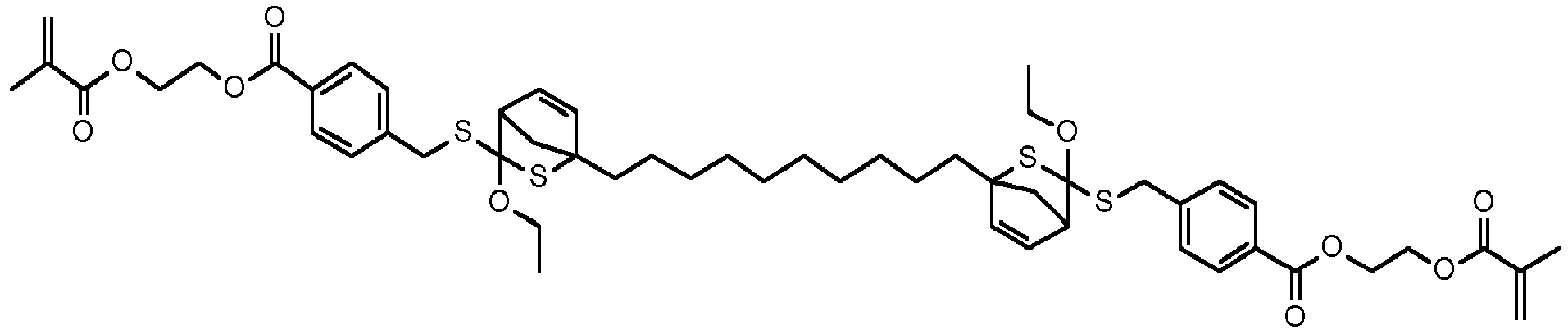
- Beispiele für die erfindungsgemässen thermolabilen polymerisierbaren Verbindungen der Formel I sind:




- Die erfindungsgemässen Zusammensetzungen enthalten neben der thermolabilen polymerisierbaren Verbindung der Formel I vorzugsweise ein oder mehrere zusätzliche radikalisch polymerisierbare Monomere (Co-Monomere), insbesondere mono- oder polyfunktionelle (Meth)acrylsäurederivate. Unter monofunktionellen (Meth)acrylsäurederivaten werden Verbindungen mit einer, unter polyfunktionellen (Meth)acrylsäurederivaten Verbindungen mit zwei oder mehr, vorzugsweise 2 bis 4 (Meth)acrylsäuregruppen verstanden. Polyfunktionelle Monomere haben eine vernetzende Wirkung.
- Erfindungsgemäss bevorzugte mono- oder polyfunktionelle (Meth)acrylsäurederivate sind Methyl-, Ethyl-, Hydroxyethyl-, Butyl-, Benzyl-, Tetrahydrofurfuryl- oder Isobornyl(meth)acrylat, Bisphenol-A-di(meth)acrylat, Bis-GMA (ein Additionsprodukt aus Methacrylsäure und Bisphenol-A-diglycidylether), UDMA (ein Additionsprodukt aus 2-Hydroxyethylmethacrylat (HEMA) und 2,2,4-Trimethylhexamethylendiisocyanat), Di-, Tri- oder Tetraethylenglycoldi(meth)acrylat, Trimethylolpropantri(meth)acrylat, Pentaerythrittetra(meth)acrylat, Glycerindi(meth)acrylat, 1,4-Butandioldi(meth)acrylat, 1,10-Decandioldi(meth)acrylat und 1,12-Dodecandioldi(meth)acrylat.
- Besonders bevorzugte mono- oder polyfunktionelle (Meth)acrylsäurederivate sind N-mono- oder -disubstitiuierte Acrylamide wie N-Ethylacrylamid, N,N-Dimethacrylamid, N-(2-Hydroxyethyl)acrylamid oder N-Methyl-N-(2-hydroxyethyl)acrylamid, N-monosubstituierte Methacrylamide wie N-Ethylmethacrylamid oder N-(2-Hydroxyethyl)-methacrylamid sowie N-Vinylpyrrolidon und Allylether. Diese Monomere zeichnen sich durch eine hohe Hydrolysestabilität aus und eignen sich aufgrund ihrer relativ geringen Viskosität besonders als Verdünnermonomere.
- Bevorzugte polyfunktionelle (Meth)acrylsäurederivate mit hoher Hydrolysestabilität sind vernetzende Pyrrolidone wie 1,6-Bis-(3-vinyl-2-pyrrolidonyl)-hexan, Bisacrylamide wie Methylen- oder Ethylenbisacrylamid und Bis(meth)acrylamide wie N,N'-Diethyl-1,3-bis-(acrylamido)-propan, 1,3-Bis(methacrylamido)-propan, 1,4-Bis-(acrylamido)-butan oder 1,4-Bis(acryloyl)-piperazin, die durch Umsetzung aus den entsprechenden Diaminen mit (Meth)acrylsäurechlorid synthetisiert werden können.
- Die erfindungsgemässen Zusammensetzungen können als Co-Monomere auch weitere thermolabile Vernetzermonomere enthalten. Thermolabile Vernetzermonomere weisen mindestens eine thermolabile Gruppe zwischen zwei polymerisierbaren Gruppen auf. Beispiele sind polyfunktionelle (Meth)acrylate oder (Meth)acrylamide mit mindestens einer thermolabilen Gruppe zwischen zwei (Meth)acrylgruppen. Dabei kommen als thermolabile Gruppen insbesondere thermolabile Alkoxyamin-, Oximester-, Oximurethan- oder Azogruppen, Peroxide und Disulfone in Frage. Beispiele sind die Umsetzungsprodukte von N-Hydroxy-(meth)acrylamid mit Di- oder Triisocyanaten wie Hexamethylen-1,6-diisocyanat (HDI), 2,2,4-Trimethylhexamethylen-1,6-diisocyanat oder dem HDI-Trimer sowie Produkte, die durch stöchiometrische Umsetzung von Di- oder Triisocyanaten mit 1-Hydroxymethylacrylsäureestern wie 1-Hydroxymethylacrylsäureethylester oder mit β-Ketoester(meth)acrylaten wie 2-Acetoacetoxyethylmethacrylat erhalten werden. Besonders geeignet sind auch gasfreisetzende thermolabile Vernetzermonomere. Beispiele sind die Veresterungsprodukte von Azobis(4-cyanovaleriansäure) mit Hydroxyalkyl(meth)acrylaten wie Hydroxyethyl(meth)acrylat oder Hydroxypropyl(meth)acrylat oder mit N-(Hydroxyalkyl)(meth)acrylamiden wie N-(5-Hydroxypentyl)methacrylamid oder N-Methyl-N-(2-hydroxyethyl)acrylamid.
- Die erfindungsgemässen Zusammensetzungen können neben der thermolabilen polymerisierbaren Verbindung der Formel I und ggf. den oben genannten Co-Monomeren vorzugweise auch radikalkettenübertragungsaktive Additive enthalten, die die Struktur der Polymerisate, vor allem Molmasse, Molmassenverteilung, Netzwerkdichte, beeinflussen und die Einstellung von Eigenschaften wie Glasübergangstemperatur, Breite des Glasübergangs, Schlag- und Bruchzähigkeit ermöglichen. Bevorzugte radikalkettenübertragungsaktive Additive sind Dithioester, Trithiocarbonate, Allylsulfone, Vinylsulfonester oder andere bekannte RAFT-Reagenzien (RAFT = Reversible Addition-Fragmentation Chain Transfer).
- Die erfindungsgemässen Zusammensetzungen können neben der thermolabilen polymerisierbaren Verbindung der Formel I und ggf. den oben genannten Co-Monomeren vorzugweise auch radikalisch polymerisierbare, säuregruppenhaltige Monomere (Haftmonomere) enthalten. Bevorzugte Säuregruppen sind Carbonsäuregruppen, Phosphonsäuregruppen, Phosphorsäuregruppen und Sulfonsäuregruppen.
- Bevorzugte Monomere mit polymerisierbaren Carbonsäuren sind Maleinsäure, Acrylsäure, Methacrylsäure, 2-(Hydroxymethyl)acrylsäure, 4-(Meth)acryloyloxyethyltrimellitsäureanhydrid, 10-Methacryloyloxydecylmalonsäure, N-(2-Hydroxy-3-methacryloyloxypropyl)-N-phenylglycin und 4-Vinylbenzoesäure.
- Bevorzugte Monomere mit polymerisierbaren Phosphonsäuregruppen sind Vinylphosphonsäure, 4-Vinylphenylphosphonsäure, 4-Vinylbenzylphosphonsäure, 2-Methacryloyloxyethylphosphonsäure, 2-Methacrylamidoethylphosphonsäure, 4-Methacrylamido-4-methyl-pentylphosphonsäure, 2-[4-(Dihydroxyphosphoryl)-2-oxa-butyl]-acrylsäure, 2-[4-(Dihydroxyphosphoryl)-2-oxa-butyl]-acrylsäureethyl- und -2,4,6-trimethylphenylester.
- Bevorzugte Monomere mit polymerisierbaren Phosphorsäuregruppen sind 2-Methacryloyloxypropylmono- oder -dihydrogenphosphat, 2-Methacryloyloxyethylmono- oder -dihydrogenphosphat, 2-Methacryloyloxyethylphenyl-hydrogenphosphat, Dipentaerythritolpentamethacryloyloxyphosphat, 10-Methacryloyloxydecyl-dihydrogenphosphat, Phosphorsäuremono-(1-acryloyl-piperidin-4-yl)-ester, 6-(Methacrylamido)hexyldihydrogenphosphat und 1,3-Bis-(N-acryloyl-N-propylamino)-propan-2-yl-dihydrogenphosphat.
- Bevorzugte Monomere mit polymerisierbaren Sulfonsäuregruppen sind Vinylsulfonsäure, 4-Vinylphenylsulfonsäure und 3-(Methacrylamido)-propylsulfonsäure.
- Vorzugsweise werden Mischungen der vorstehend genannten Monomere verwendet. Bevorzugte Monomermischungen enthalten bezogen auf das Gesamtgewicht der Monomermischung:
- 1 bis 90 Gew.-%, vorzugsweise 5 bis 80 Gew.-%, besonders bevorzugt 5 bis 70 Verbindung der Formel I,
- 0 bis 70 Gew.-%, vorzugsweise 1 bis 60 Gew.-%, besonders bevorzugt 5 bis 50 und ganz besonders bevorzugt 10 bis 30 Gew.-% Co-Monomer und insbesondere mono- und/oder polyfunktionelle (Meth)acrylate,
- 0 bis 70 Gew.-%, vorzugsweise 1 bis 60 Gew.-% und besonders bevorzugt 5 bis 50 Gew.-% weiteres thermolabiles Vernetzermonomer und
- 0 bis 40 Gew.-%, vorzugsweise 1 bis 30 Gew.-% und besonders bevorzugt 5 bis 20 Gew.-% Haftmonomer.
- Besonders bevorzugte Monomermischungen (jeweils bezogen auf das Gesamtgewicht der Monomermischung) sind in der nachfolgenden Tabelle wiedergegeben:
Komponente (Gew.-%) A B C D E F Verbindung der Formel I 1-90 5-80 5-70 5-70 5-70 5-70 Co-Monomer, insbesondere mono- und/oder polyfunktionelles (Meth)acrylat 0-70 0-60 1-60 5-60 5-50 0-30 weiteres thermolabiles Vernetzermonomer 0-70 0-50 0-50 5-50 5-50 5-50 Haftmonomer 0-40 0-30 0-30 0-20 0-20 0-30 - Ausserdem enthalten die erfindungsgemässen Zusammensetzungen vorzugsweise auch einen Initiator für die radikalische Polymerisation.
- Zur Initiierung der radikalischen Photopolymerisation insbesondere bei thermolabilen Verbindungen der Formel I werden vorzugsweise Benzophenon, Benzoin sowie deren Derivate oder α-Diketone oder deren Derivate wie 9,10-Phenanthrenchinon, 1-Phenyl-propan-1,2-dion, Diacetyl oder 4,4'-Dichlorbenzil eingesetzt. Besonders bevorzugt werden Campherchinon und 2,2-Dimethoxy-2-phenyl-acetophenon und ganz besonders bevorzugt α-Diketone in Kombination mit Aminen wie 4-(Dimethylamino)-benzoesäureester, N,N-Dimethylaminoethylmethacrylat, N,N-Dimethyl-sym.-xylidin oder Triethanolamin als Reduktionsmittel verwendet. Besonders geeignet sind auch Norrish-Typ-I-Photoinitiatoren, insbesondere Acyl- oder Bisacylphosphinoxide, Monoacyltrialkyl- oder Diacyldialkylgermanium-Verbindungen wie Benzoyltrimethylgermanium, Dibenzoyldiethylgermanium oder Bis-(4-methoxybenzoyl)diethylgermanium. Dabei lassen sich auch Mischungen der verschiedenen Photoinitiatoren wie beispielsweise Dibenzoyldiethylgermanium in Kombination mit Campherchinon und 4-Dimethylaminobenzoesäureethylester einsetzen.
- Als Initiatoren für eine bei Raumtemperatur durchgeführte Polymerisation werden vorzugsweise Redox-Initiatorkombinationen wie beispielsweise Kombinationen von Benzoylperoxid mit N,N-Dimethylsym.-xylidin oder N,N-Dimethyl-p-toluidin verwendet. Darüber hinaus sind auch Redoxsysteme bestehend aus Peroxiden und solchen Reduktionsmitteln wie z.B. Ascorbinsäure, Barbituraten oder Sulfinsäuren besonders geeignet.
- Die erfindungsgemässen Zusammensetzungen können zudem ein thermisch gasfreisetzendes Additiv enthalten. Geeignete gasfreisetzende Additive sind z.B. Azo-Verbindungen wie Azodicarbonamid, 2,2'-Azobisisobutyronitril oder 2,2'-Azobis(4-cyano-pentansäure), N-Nitrosoverbindungen, Hydrazide wie Benzolsulfonylhydrazid, Peroxide wie Dicumolperoxid oder Acetondicarbonsäure. Beispiele für solche Verbindungen sind etwa in St. Quinn, Plastics, Additives & Compounding 2001, 3, 16-21 beschrieben. Dabei kann die Zerfallstemperatur beispielsweise im Falle der Azoverbindungen in an sich bekannter Weise durch das Substituentenmuster eingestellt werden (vgl. D. Braun, R. Jakobi, Monatshefte Chemie 1982, 113, 1403-1414).
- Weiterhin können die erfindungsgemässen Zusammensetzungen ein Additiv enthalten, das eingestrahlte elektromagnetische Strahlung in Wärme umwandeln kann. Solche sogenannten Strahlung-Wärme-Umwandler sind organische, anorganische oder metallorganische Stoffe oder Hybridkomponenten, die in der Lage sind, UV-, NIR- oder IR-Strahlung, sichtbares Licht, Mikrowellen- oder Radiowellenstrahlung in Wärme umzuwandeln, um thermolabile Gruppen zu spalten. Beispiele hierfür sind UV-, NIR oder IR-Strahlung absorbierende Farbstoffe und Pigmente. Beispiele für im IR-Bereich absorbierende Farbstoffe sind Azo-, Methin-, Anthrachinon oder Porphyrinfarbstoffe. Beispiele für NIR-Strahlung absorbierende Pigmente sind Antimon- und Indiumzinnoxid, Phthalocyaninpigmente, Russ, Ni- und Pt-Dithiolen-Komplexe. Beispiele für im UV-Bereich absorbierende Verbindungen sind Benzotriazole, Triazine, Benzophenone, Cyanoacrylate, Salicylsäurederivate und Hindered Amine Light Stabilizers (HALS). Beispiele für Additive, die im Frequenzbereich der Mikrowellen (1 bis 300 GHz) oder Radiowellen (10 kHz bis 1 GHz) absorbieren, sind ferromagnetische keramische Stoffe, sogenannte Ferrite, die aus den Eisenoxiden Hämatit (Fe2O3) oder Magnetit (Fe3O4) und weiteren Oxiden beispielsweise der Metalle Zn, Mn, oder Ni aufgebaut und als Pulver kommerziell verfügbar sind.
- Weiterhin enthalten die erfindungsgemässen Zusammensetzungen zur Verbesserung der mechanischen Eigenschaften oder zur Einstellung der Viskosität vorzugsweise auch organische oder anorganische Füllstoffpartikel. Bevorzugte anorganische partikuläre Füllstoffe sind amorphe kugelförmige Materialien auf Basis von Oxiden wie ZrO2 und TiO2 oder Mischoxiden aus SiO2, ZrO2 und/oder TiO2 mit einer mittleren durchschnittlichen Partikelgrösse von 0,005 bis 2 µm, vorzugsweise 0,1 bis 1 µm, nanopartikuläre oder mikrofeine Füllstoffe wie pyrogene Kieselsäure oder Fällungskieselsäure mit einer mittleren durchschnittlichen Partikelgrösse von 5 bis 200 nm, vorzugsweise 10 bis 100 nm, Minifüllstoffe wie Quarz-, Glaskeramik- oder Glaspulver mit einer durchschnittlichen Teilchengrösse von 0,01 bis 10 µm, vorzugsweise 0,1 bis 1 µm, sowie röntgenopake Füllstoffe wie Ytterbiumtrifluorid oder nanopartikuläres Tantal(V)-oxid bzw. Bariumsulfat mit einer mittleren durchschnittlichen Partikelgrösse von 10 bis 1000 nm, vorzugsweise 100 bis 300 nm.
- Ausserdem können die erfindungsgemässen Zusammensetzungen weitere Additive enthalten, vor allem Lösungsmittel wie Wasser oder Ethanol bzw. entsprechende Lösungsmittelgemische, sowie beispielsweise Stabilisatoren, Aromastoffe, Farbmittel, mikrobiozide Wirkstoffe, fluoridionenabgebende Additive, optische Aufheller, oder Weichmacher.
- Besonders bevorzugt sind Zusammensetzungen auf Basis einer thermolabilen polymerisierbaren Verbindung der Formel I, welche die folgenden Bestandteile enthalten:
- a) 0,1 bis 50 Gew.-%, insbesondere 1 bis 40 Gew.-%, bevorzugt 2 bis 30 Gew.-% und besonders bevorzugt 5 bis 30 Gew.-% Verbindung der Formel I,
- b) 0,01 bis 10 Gew.-%, bevorzugt 0,1 bis 3,0 Gew.-% und besonders bevorzugt 0,2 bis 2 Gew.-% Initiator,
- c) 0 bis 95 Gew.-%, bevorzugt 5 bis 95 Gew.-% und besonders bevorzugt 5 bis 90 Gew.-% Co-Monomer,
- d) 0 bis 10 Gew.-%, insbesondere 0,1 bis 5 Gew.-% und bevorzugt 0,2 bis 3 Gew.-% Additiv.
- Gefüllte Polymerisationsharze und Komposite auf der Basis der erfindungsgemässen Verbindungen der Formel I enthalten vorzugsweise die folgenden Bestandteile:
- a) 0,1 bis 50 Gew.-%, insbesondere 1 bis 40 Gew.-% und bevorzugt 1 bis 20 Gew.-% Verbindung der Formel I,
- b) 0,01 bis 10 Gew.-% und insbesondere 0,1 bis 3 Gew.-% Initiator,
- c) 1 bis 80 Gew.-%, insbesondere 1 bis 60 Gew.-% und bevorzugt 5 bis 50 Gew.-% Co-Monomer,
- d) 5 bis 90 Gew.-% und insbesondere 20 bis 90 Füllstoff,
- e) 0 bis 10 Gew.-%, insbesondere 0,1 bis 5 Gew.-% und bevorzugt 0,2 bis 3 Gew.-% Additiv.
- Dentalwerkstoffe auf der Basis der erfindungsgemässen Verbindungen der Formel I enthalten vorzugsweise die folgenden Bestandteile:
- a) 0,1 bis 50 Gew.-%, insbesondere 1 bis 40 Gew.-%, bevorzugt 2 bis 30 Gew.-% und besonders bevorzugt 5 bis 30 Gew.-% Verbindung der Formel I,
- b) 0,01 bis 10 Gew.-%, insbesondere 0,1 bis 3,0 Gew.-% und bevorzugt 0,2 bis 2 Gew.-% Initiator,
- c) 0 bis 80 Gew.-%, insbesondere 1 bis 60 Gew.-% und bevorzugt 5 bis 50 Gew.-% Co-Monomer,
- d) 0 bis 80 Gew.-% Füllstoff,
- e) 0 bis 70 Gew.-% Lösungsmittel und
- f) 0 bis 10 Gew.-%, insbesondere 0,1 bis 5 Gew.-% und bevorzugt 0,2 bis 3 Gew.-% Additiv.
- Der bevorzugte Füllstoffgehalt richtet sich dabei nach der gewünschten Anwendung. Adhäsive enthalten vorzugsweise 0 bis 20 Gew.-% und Zemente und Komposite vorzugsweise 20 bis 80 Gew.-% Füllstoff.
- Dies gilt ebenso für den Lösungsmittelgehalt. Adhäsive enthalten vorzugweise bevorzugt 0 bis 60 Gew.-% und besonders bevorzugt 1 bis 50 Gew.-% Lösungsmittel. Zusammensetzungen, die Wasser als Lösungsmittel enthalten, sind bevorzugt. Besonders bevorzugt sind Zusammensetzungen, die 0 bis 20 Gew.-% und insbesondere 1 bis 10 Gew.-% Wasser enthalten.
- Die Debonding-Eigenschaften von Zusammensetzungen auf der Basis der erfindungsgemässen Verbindungen der Formel I können gezielt durch die Zusammensetzung der Materialien beeinflusst werden. Die Einstellung einer für einen bestimmten Zweck geeigneten Zusammensetzung gehört zum allgemeinen Wissen und Können des Fachmanns. So nimmt mit der Konzentration an thermolabilen Komponenten, d.h. an den Verbindungen der Formel I sowie gegebenenfalls weiteren thermolabilen Vernetzern bzw. gasfreisetzenden Additiven im Adhäsiv oder Zement die Fähigkeit zum gezielten Debonding durch Erwärmen zu. Weiterhin lassen sich auch durch die Auswahl der Comonomeren die Debonding-Eigenschaften variieren. Dabei kann durch die Monomerauswahl der Glasübergangsbereich und damit der Erweichungsbereich der Polymerisate gezielt beeinflusst werden. Ausserdem lässt sich mit dem Anteil an vernetzenden Monomeren oder durch Zugabe von monofunktionellen Monomeren die Vernetzungsdichte und damit auch die Festigkeit und der E-Modul variieren.
- Gegenstand der Erfindung ist auch die Verwendung einer erfindungsgemässen polymerisierbaren Zusammensetzung als Dentalwerkstoff oder zur Herstellung eines Dentalwerkstoffs, insbesondere eines Adhäsivs, Zements oder Füllungskomposits, sowie die Verwendung einer thermolabilen polymerisierbaren Verbindung der Formel I zur Herstellung von Dentalwerkstoffen, vorzugsweise Adhäsiven, Zementen oder Füllungskompositen und besonders bevorzugt selbstätzenden Adhäsiven, Zementen oder Füllungskompositen.
- Die erfindungsgemässen Verbindungen der Formel I lassen sich auch zur Herstellung von Werkstoffen mit selbstheilenden Eigenschaften einsetzen. Dabei können durch gezieltes Tempern solcher Materialien die Polymernetzwerkstruktur verändert und Spannungen abgebaut oder Mikrorisse beseitigt werden. Weiterhin lassen sich die Verbindungen der Formel I zur Herstellung von stereolithographischen Formkörpern einsetzen. So können darauf basierende stereolithographisch hergestellte Keramikgrünköper ein verbessertes Entbinderungsverhalten zeigen. Im Falle von stereolithographisch gebauten Polymer- oder Kompositformkörpern aud Basis der erfindungsgemässen Verbindungen der Formel I lassen sich innere Spannungen durch eine Wärmebehandlung kontrolliert abbauen. Stereolithographisch hergestellte Wachsmodelle, die ein Polymernetzwerk auf Basis der erfindungsgemässen Verbindungen der Formel I enthalten, lassen sich einfach wieder entfernen, indem das Polymernetzwerk bei erhöhter Temperatur abgebaut wird und das Wachs dann ausfliessen kann. Ferner lassen sich Verbindungen der Formel I zur Herstellung chemisch reversibler Montage- und Befestigungselemente, zur reversiblen Verankerung von Materialien oder Werkzeugen wie insbesondere Dübel, Anker, Schrauben, Beschläge oder sonstige Verbindungselemente in Mauerwerk, Beton, Leichtbau oder sonstigen Bauelementen einsetzen.
- Gegenstand der Erfindung ist daher auch die Verwendung einer erfindungsgemässen polymerisierbaren Zusammensetzung als Polymerisationsharz, insbesondere als Adhäsiv, Komposit oder Stereolithographiewerkstoff, oder zur Herstellung eines Polymerisats, insbesondere eines Formteils, Duromers, Montage- oder Befestigungselements, sowie die Verwendung einer thermolabilen polymerisierbaren Verbindung der Formel I zur Herstellung eines Polymerisationsharzes oder Polymerisats und insbesondere zur Herstellung eines Adhäsivs, Komposits, Stereolithographiewerkstoffs, Formteils, Duromers oder Montage- oder Befestigungselements.
Im Folgenden wird die Erfindung anhand von Ausführungsbeispielen näher erläutert. -

- Eine Suspension von 2-(Chloromethyl)pyridinhydrochlorid (32,81 g, 0,20 mol) in Acetonitril (AN, 200 ml) wurde mit Natriumphenylsulfinat (49,24 g, 0,30 mol), Tetrapropylammoniumbromid (10,64 g, 40,0 mmol) und 1,8-Diazabicyclo[5.4.0]undec-7-en (DABCO, 30,44 g, 0,20 mol) versetzt. Das Reaktionsgemisch wurde 16 h am Rückfluss erhitzt und anschliessend am Rotationsverdampfer eingeengt. Der Rückstand wurde in Dichlormethan (DCM, 200 ml) aufgenommen, mit gesättigter wässriger NaCl-Lösung (3x 100 ml) gewaschen, über wasserfreiem Na2SO4 getrocknet, filtriert und am Rotationsverdampfer auf ca. das halbe Volumen eingeengt. Die braune Lösung wurde über eine Schicht Kieselgel filtriert (SiO2, Ethylacetat). Man erhielt 41,55 g (89% Ausbeute) 2-Benzolsulfonylmethylpyridin als gelblichen Feststoff.
1H-NMR (400 MHz, CDCl3: δ, ppm) : 4,56 (s, 2H), 7,21-7,24 (m, 1H), 7,42-7,48 (m, 3H), 7,58-7,62 (m, 1H), 7,66-7,70 (m, 3H), 8,41-8,42 (m, 1H).
13C-NMR (101 MHz, CDCl3, δ, ppm): 64, 6, 123, 4, 125, 7, 128, 4, 129, 0, 133,8, 136,7, 138,2, 148,8, 149,7. -

- Zu einer Suspension von 2-Benzolsulfonylmethylpyridin (40,64 g, 0,174 mol) und Schwefel (16,76 g, 0,523 mol) in AN (500 ml) wurde unter Eiskühlung eine Lösung von DABCO (79.56 g, 0.523 mol) in AN (100 ml) zugetropft. Nach beendeter Zugabe wurde die dunkelrote Lösung 22 h bei Raumtemperatur (RT) gerührt, dann wurde 4-(Brommethyl)-benzoesäure (37,46 g, 0,174 mol) portionsweise zugegeben. Das Reaktionsgemisch wurde weitere 4 h bei Raumtemperatur gerührt und dann mit Salzsäure (2 N; 200 ml) versetzt (pH = 1). Die Suspension wurde filtriert. Der Filtrationsrückstand wurde mit AN (100 ml) gewaschen. Das Filtrat wurde mit Methyl-tert.-butylether (MtBE, 200 ml) und gesättigter wässriger NaCl-Lösung (100 ml) versetzt und die Phasen wurden getrennt. Die organische Phase wurde mit gesättigter wässriger NaCl-Lösung (2x 100 ml) gewaschen. Die vereinigten Wasserphasen wurden mit MtBE (100 ml) reextrahiert. Die vereinigten organischen Phasen wurden über wasserfreiem Na2SO4 getrocknet, filtriert und am Rotationsverdampfer eingeengt. Der Rückstand wurde mit dem oben erhaltenen Filtrationsrückstand vereinigt, mit AN (200 ml) versetzt und bei RT gerührt. Nach 4 h wurde die Suspension filtriert. Der Filtrationsrückstand wurde mit AN (50 ml) gewaschen und im Vakuumtrockenschrank getrocknet (50 °C, 125 mbar). Man erhielt 44,95 g (89% Ausbeute) 4-(Pyridin-2-carbothioylsulfanylmethyl)-benzoesäure als roten Feststoff.
- 1H-NMR (400 MHz, CDCl3: δ, ppm): 4,66 (s, 2H), 7,56-7,58 (m, 2H), 7,70-7,73 (m, 1H), 7,9 -7,96 (m, 2H), 7,00-8,03 (m, 1H), 8,26-8,28 (m, 1H), 8,66-8,68 (m, 1H), 13,03 (s, 1H).
13C-NMR (101 MHz, CDCl3, δ, ppm): 39,6, 121,9, 127,8, 129,4, 129,5, 129,9, 137,7, 140,6, 148,3, 155,3, 166,9, 226,0. -

- Eine Suspension von 4-(Pyridin-2-carbothioylsulfanylmethyl)-benzoesäure (10,39 g, 35,9 mmol), Hydroxyethylmethacrylat (4,67 g, 35,9 mmol) und N,N-Dimethylaminopyridin (DMAP, 0.60 g, 5,0 mmol) in DCM (100 ml) wurde auf 0 °C abgekühlt. 3-(Ethyliminomethylidenamino)-N,N-dimethyl-propan-1-aminhydrochlorid (EDC*HCl, 8,26 g, 43,1 mmol) wurde zugegeben und das Reaktionsgemisch wurde 1 h bei 0 °C und 16 h bei RT gerührt. Die rote Reaktionslösung wird über eine Schicht Kieselgel filtriert (SiO2, DCM) und das Filtrat wurde am Rotationsverdampfer eingeengt. Der ölige rote Feststoff wurde mit n-Hexan (100 ml) versetzt, 20 h bei RT gerührt und filtriert. Der Filtrationsrückstand wurde mit n-Hexan (50 ml) gewaschen und im Vakuumtrockenschrank getrocknet (50 °C, 125 mbar). Man erhielt 11,22 g (78% Ausbeute) 4-(Pyridin-2-carbothioylsulfanylmethyl)-benzoesäure-2-(methacryloyloxy)-ethylester als hellroten Feststoff (Smp: 80-81 °C).
- 1H-NMR (400 MHz, CDCl3: δ, ppm): 1,95 (s, 3H), 4,47-4,50 (m, 2H), 4,54-4,58 (m, 4H), 5,58-5,59 (m, 1H), 6,13-6,14 (m, 1H), 7,46-7,49 (m, 3H), 7,77-7,81 (m, 1H), 7,98-8,00 (m, 2H), 8,31-8,33 (m, 1H), 8,59-8,61 (m, 1H).
13C-NMR (101 MHz, CDCl3, δ, ppm): 18,3, 40,8, 62,4, 62,7, 122,3, 126,2, 127,0, 129,0, 129,5, 130,0, 135,9, 137,0, 141,0, 148,0, 156,1, 166,0, 167,1, 225,4. -
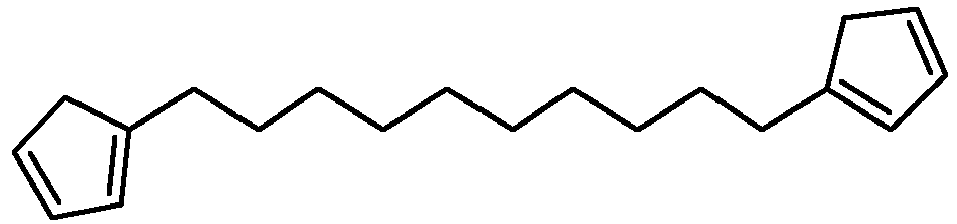
- Zu einer Lösung von Dibromdecan (30,01 g, 0,10 mol) in wasserfreiem THF (400 ml) wurde bei -5 °C eine Natriumcyclopentadienid-Lösung (2.0 M in THF, 100,0 ml, 0,20 mol) zugetropft. Nach beendeter Zugabe wurde die trübe braune Lösung 1 h bei -5 °C und anschliessend bei RT weitergerührt. Nach 20 h wurde die Suspension über Kieselgel filtriert (SiO2, Ethylacetat). Das Filtrat wurde am Rotationsverdampfer eingeengt. Der Rückstand wurde in n-Hexan (50 ml) gelöst, erneut über eine Schicht Kieselgel filtriert (SiO2, n-Hexan) und das Filtrat wurde am Rotationsverdampfer eingeengt. Man erhielt 22,64 g (84% Ausbeute) des Isomerengemischs von 1,10-Bis(cyclopentadienyl)decan als farbloses Öl.
- 1H-NMR (400 MHz, CDCl3: δ, ppm): 1,22-1,34 (m, 12H), 1,46-1,58 (m, 4H), 2, 29-2, 42 (m, 4H), 2, 79-2, 96 (m, 4H), 5, 95-6, 46 (m, 6H). 13C-NMR (101 MHz, CDCl3, δ, ppm): 29, 0, 29, 6, 29, 6, 29, 7, 29, 8, 29,9, 30,0, 30,8, 41,2, 43,3, 125,7, 126,2, 130,4, 132,5, 133,6, 134,9, 147,5, 150,2.
-

- Eine Lösung von 4-(Pyridin-2-carbothioylsulfanylmethyl)-benzoesäure-2-(methacryloyloxy)-ethylester (16,06 g, 40,0 mmol) in Chloroform (80 ml) wurde mit Chlorwasserstoff (∼1.25 M in Methanol, 32,0 ml, 40,0 mmol) versetzt und 5 min bei RT gerührt. Eine Lösung von 1,10-Bis(cyclopentadienyl)-decan (5,41 g; 20,0 mmol) in Chloroform (20 ml) wurde zugetropft und das Reaktionsgemisch wurde bei RT gerührt. Nach 20 h wurde die Lösung mit Wasser (3x 50 ml) und gesättigter wässriger NaHCO3-Lösung (50 ml) gewaschen, über wasserfreiem Na2SO4 getrocknet, filtriert und am Rotationsverdampfer eingeengt. Säulenchromatographische Reinigung (SiO2, DCM/ Ethylacetat) ergab 16,82 g (78% Ausbeute) des Isomerengemischs von Bis-1,10-{10-(3-{4-[2-(methacryloyloxy)-ethoxycarbonyl]-benzylsulfanyl}-3-pyridin-2-yl-2-thia-bicyclo[2.2.1]hept-5-en-1-ylmethyl)}-decan als gelbliches Öl.
- 1H-NMR (400 MHz, CDCl3: δ, ppm): 0,86-1,72 (m, 20H), 1,94 (s, 6H), 2,81-4,22 (m, 10H), 4,35-4,64 (m, 8H), 5,24-6,42 (m, 4H), 5,58 (s, 2H), 6,13 (s, 2H), 6,93-8,57 (m, 16H).
13C-NMR (101 MHz, CDCl3, δ, ppm): 18, 3, 26, 9, 28, 7, 29, 0, 29,1, 29,3, 29,5, 29,8, 29,9, 30,1, 33,5, 36,8, 37,2, 37,3, 49,7, 54,8, 56,5, 62,4, 62,5, 86,4, 121,4, 121,5, 124,9, 126,1, 126,2, 128,1, 128,9, 129,0, 129,0, 129,1, 129,6, 129,6, 135,9, 136,1, 136,3, 136,5, 143,7, 147,3, 152,9, 162,7, 166,1, 167,1. -

- Zu einer Suspension von 1.5 g NaH (1.5 eq., 62 mmol) in 20 ml THF (trocken) wurde eine Lösung von 5.3 ml Diethylphosphit (1,0 eq., 41 mmol, 5,7 g) in wasserfreiem 40 ml THF bei RT zugetropft. Nach Beendigung der H2-Entwicklung wurde 15 min zum Sieden erhitzt. Anschliessend wurde die Reaktionsmischung auf -90 °C abgekühlt und es wurden 12.3 ml Kohlenstoffdisulfid (CS2, 5,0 eq., 205 mmol, 15,6 g) zugetropft. Es wurde 2 h bei RT gerührt, wobei sich das Reaktionsgemisch braun verfärbte. Es wurden 750 ml THF zugegeben. Anschliessend wurde eine Lösung von 10,0 g 4-Bromomethylbenzoesäure (1,1 eq., 46 mmol) in 75 ml THF langsam zugetropft und 16 h bei RT gerührt, wobei sich das Reaktionsgemisch violett verfärbte. Nach Entfernung des Lösungsmittels wurde der Rückstand in einer Mischung aus DCM und H2O (1:1) aufgenommen. Die organische Phase wurde abgetrennt und die wässrige Phase mit DCM extrahiert. Die vereinigten organischen Phasen wurden über wasserfreiem Na2SO4 getrocknet und das Lösungsmittel wird entfernt. Das Produkt wurde anschliessend mittels Säulenchromatographie (Kieselgel 60, Cyclohexan:Ethylacetat:Essigsäure (1:1:0,01) gereinigt. Man erhielt 4.3 g (30% Ausbeute) PDTMBA als einen violetten Feststoff (Smp.: 113 °C).
- 1H-NMR (400 MHz, CDCl3: δ, ppm) : 1,37 (t, 6H, OCH2CH 3), 4,22-4,34 (m, 4H, OCH 2CH3), 4,54 (s, 2H, SCH2), 7,41 (d, 2H, ArH), 8,05 (d, 2H, ArH), 10,50 (bs, 1H, COOH).
13C-NMR (101 MHz, CDCl3, δ, ppm): 16,40 (OCH2 CH3), 40, 00 (SCH2), 65,14 (OCH2CH3), 129, 34 (Car), 129, 53 (Car), 130, 79 (Car), 140, 04 (Car), 170,73 (COOH), 226,92 (PC=S), 228,66 (PC=S). -

- Zu einer Lösung von 2,0 g PDTMBA (1,0 eq., 5,74 mmol) und 1,05 ml 2-Hydroxyethylmethacrylat (HEMA, 1,5 eq., 8.61 mmol, 1,12 g) in DCM (trocken) wurde eine Lösung von 2,2 g EDC*HCl (2,0 eq., 11,5 mmol) und 0.14 g DMAP (0,2 eq., 1,15 mmol) in DCM (trocken) bei RT zugetropft. Nach 20 h Rühren wurde mit NaHCO3-Lösung und Kochsalzlösung gewaschen. Anschliessend wurde über wasserfreiem Na2SO4 getrocknet und das Lösungsmittel entfernt. Das Produkt wurde mittels Säulenchromatographie (Kieselgel 60, Cyclohexan:EE (1:1)) gereinigt. Man erhielt 1.85 g (70% Ausbeute) an MA-PDTMBA als violette Flüssigkeit.
- 1H-NMR (400 MHz, CDCl3, δ, ppm): 1,37 (t, 6H, OCH2CH 3), 1,90 (s, 3H, CH3CMA), 4,22 - 4,34 (m, 4H, OCH 2CH3), 4, 42 - 4,58 (m, 4H, OCH 2CH 2O), 4,52 (s, 2H, SCH2), 5,55 (d, 1H, CCH2,trans), 6,10 (d, 1H, CCH2,cis), 7,37 (d, 2H, ArH), 7,98 (d, 2H, ArH).
13C-NMR (101 MHz, CDCl3, δ, ppm): 16,40 (OCH2 CH3), 18,40 (CMA CH3), 40, 00 (SCH2), 62, 60 (OCH2 CH2O), 65, 14 (OCH2CH3), 126, 27 (CH2CMA), 129,48 (Car), 129,65 (Car), 130,28 (Car), 136,03 (CMA), 139,50 (Car), 165,90 (Car C=O), 167,26 (CMA C=O), 227,18 (PC=S), 228, 93 (PC=S). -

- 0,59 g 1,10-DiCp-decan (aus Beispiel 1, 4. Stufe, 1,0 eq., 2,17 mmol), 2,0 g MA-PDTMBA (2,0 eq., 4,34 mmol) und 30 mg ZnCl2 (0,1 eq., 0,22 mmol) wurden in Ethylacetat gelöst und 30 min bei RT gerührt. Anschliessend wurde mit Wasser gewaschen und das Lösungsmittel entfernt. Man erhielt 2.56 g (99% Ausbeute) des DiHDA-Linkers als farblose hochviskose Flüssigkeit.
- 1H-NMR (400 MHz, CDCl3, δ, ppm): 1,25-1,65 (m, 28H, OCH2CH 3, CHDACH2 (CH 2)4), 1,94 (s, 6H, CH3CMA), 1,95-2,18 (m, 4H, CH2,HDA-Brücke), 2,18-2,50 (m, 4H, CHDACH 2(CH2)4), 3,35-3,68 (m, 2H, CHHDA), 4,00-4,25 (m, 8H, OCH 2CH3), 4,26-4,44 (m, 4H, SCH2Car), 4,45-4,58 (m, 8H, OCH 2CH 2O), 5,52-5,60 (m, 1H, CHHDA-Db,), 5,58 (d, 2H, CCH2,trans), 5,95-6,03 (2H, CHHDA-Db,), 6,13 (d, 2H, CCH2,cis), 6, 28 - 6,33 (m, 1H, CHHDA-Db,), 7,42 (d, 4H, ArH), 7,95 (d, 4H, ArH). MS: 1190,37 Da.
- Der in Beispiel 2 hergestellte DiHDA-Linker wurde mit 0,2 Gew.-% Ivocerin (Bis-(4-methoxybenzoyl)-diethylgermanium) als Photoinitiator versetzt, in eine UV-Vis-Küvette mit einer Schichtdicke von 1 mm gefüllt und durch Bestrahlen (30 min) mit 3 Osram Dulux Blue Lampen (3x 18 W, > 200 mW/cm2) polymerisiert. Anschliessend wurden Absorptionsspektren im Bereich von 400-800 nm bei Temperaturen von 25 bis 140 °C des gebildeten Polymernetzwerkes mit einem Cary 300 Bio-Spektrometer mit einem temperaturregulierbaren Probenhalter aufgenommen. Der aus der Absorption im Maximum bei 530 nm im Temperaturbereich von 25 bis 140 °C berechnete Umsatz der Retro-Hetero-Diels-Alder-Reaktion (Retro-HDA-Reaktion) ist in
Fig. 1 dargestellt. -
Fig. 1 zeigt quantitativ an Hand der VIS-spektroskopisch detektierten Rückbildung der farbigen Dithioestereinheit durch die Retro-HDA-Reaktion das Aufbrechen des polymeren Netzwerkes in Abhängigkeit von der Temperatur. Hierbei steigt mit zunehmender Temperatur die Absorption im sichtbaren Bereich des Spektrums (Abs.max: 530 nm) bis es bei 130 °C ein Maximum erreicht, welches den vollständigen Ablauf der Retro-HDA-Reaktion aufzeigt. Bei 25 °C kann keine Absorption im sichtbaren Bereich des Spektrums detektiert werden, was anzeigt, dass das Gleichgewicht der HDA-Reaktion bei dieser Temperatur vollständig auf der Seite der geschlossenen HDA-Form liegt. Dass bei Raumtemperatur nur die geschlossene Form vorliegt, konnte auch mittels 1H-NMR-Spektroskopie des DiHDA-Linkers belegt werden. Auf Grund der Beobachtung, dass das Gleichgewicht der HDA-Reaktion bei 25 °C zu 0% und bei 130 °C zu 100% auf der Seite der Retro-HDA-Produkte liegt, kann für jede beliebige Temperatur in diesem Bereich der Grad an Retro-Reaktion angegeben werden und liegt die Halbwertstemperatur bei ca. 80 °C (vgl.Fig. 1 ). - Aus dem in Beispiel 2 hergestellte DiHDA-Linker wurden nach Zugabe von 0,2 Gew.-% Ivocerin als Photoinitiator Prüfkörper mit den Abmessungen L: 25 mm, B: 5 mm, D: 1 mm durch Bestrahlen (30 min) mit 3 Osram Dulux Blue Lampen (3x 18 W, > 200 mW/cm2) hergestellt. Als Referenzprobe wurden analoge Prüfkörper aus dem Urethandimethacrylat UDMA unter Zugabe von 0,2 Gew.-% Ivocerin als Photoinitiator und nachfolgender Bestrahlung hergestellt. Die Messung des Speichermoduls G' der hergestellten Proben erfolgte mittels ARES-G2 Rheometer (TA Instruments), das ein dehnungskontrolliertes Rotationsrheometer ist. Das Rheometer besitzt einen Kraftausgleichswandler, der Drehmomente zwischen 50 nN*m und 200 mN*m mit einer Genauigkeit von 1 nN*m ermöglicht. Die angelegte Oszillationsfrequenz kann zwischen 10-7 rad/s und 628 rad/s variiert werden. Für die Temperierung wurde ein Umluftofen mit Stickstoffzufuhr verwendet. Die temperaturabhängigen Messungen wurden mit einer Axialkraft von 0,3 N, einer Anregungsfrequenz von 1 Hz und einer Deformation von 0.1% in einem Temperaturbereich von 25 bis 130 °C (Heizrate: 1.5 K/min) durchgeführt und die G'-Ergebnisse für die Polymernetzwerke des DiHDA-Linkers und UDMA sind in
Fig. 2 dargestellt. G' stellt den Fliesswiderstand einer Substanz dar und ist somit ein Mass für die Festigkeit eines Materials. WieFig. 2 dargestellt, zeigen das DiHDA-Linker-Polymernetzwerk und das UDMA-Netzwerk ein sehr unterschiedliches Verhalten mit steigender Temperatur. Der Speichermodul G' des UDMA-Netzwerkes zeigt im Bereich von 25 bis 130 °C nur einen leichten Abfall, wie es für nicht-thermoresponsive Netzwerke zu erwarten ist (1.1*103 MPa bei 25 °C bis 3.8*102 MPa bei 120 °C). Dahingegen nimmt G' für das DiHDA-Linker-Netzwerk im gleichen Temperaturbereich drastisch von 8.5*102 MPa bei 25 °C auf 5.5 MPa bei 120 °C ab, was einer deutlichen Spaltung des Netzwerkes entspricht. Damit konnte gezeigt werden, dass auf der Basis der polymerisationsfähigen multifunktionellen Hetero-Diels-Alder-Addukte der allgemeinen Formel I Polymernetzwerke zugänglich sind, die sich bei Temperaturen deutlich unter 100 °C thermisch reversibel abbauen lassen. - Der in Beispiel 2 hergestellte DiHDA-Linker (20 mol-%) wurde mit iso-Propylmethacrylat (iPMA) gemischt. Nach Zugabe von 0,2 Gew.-% Ivocerin als Photoinitiator wurden Prüfkörper mit den Abmessungen L: 25 mm, B: 5 mm, D: 1 mm durch Bestrahlen (30 min) mit 3 Osram Dulux Blue Lampen (3x 18 W, > 200 mW/cm2) hergestellt. Als Referenzprobe wurden analoge Prüfkörper aus einer Mischung des kommerziellen Vernetzers Decandioldimethacrylat (D3MA) und iPMA (80 mol-%) unter Zugabe von 0,2 Gew.-% Ivocerin als Photoinitiator und nachfolgender Bestrahlung hergestellt. Die Messung des Speichermoduls G' erfolgte wie in Beispiel 4.
Fig. 3 zeigt Vergleich des Speichermoduls G' eines Netzwerkes aus iPMA und dem Dimethacrylat D3MA mit einem Netzwerk aus iPMA und dem DiHDA-Linker. Der Speichermodul G' des D3MA-iPMA-Netzwerkes zeigt im Bereich von 25 bis 130 °C einen deutlich Abfall aufgrund des hohen Anteils des flexiblen Monomethacrylates iPMA. Dennoch nimmt G' für das DiHDA-Linker-iPMA-Netzwerk, das nur 20 mol-% an thermisch reversibel abbaubarem DiHDA-Linker enthält, im gleichen Temperaturbereich signifikant deutlicher ab. - Aus Zirkoniumdioxid wurden Testabutments (Geometrie eines Kegelstumpfes, Durchmesser der Deckfläche: 4 mm, Durchmesser Grundfläche: 6 mm, Höhe: 3 mm) gefräst. Passend hierzu wurden Kronen derart aus Zirkoniumdioxid gefräst, dass durch das Aufliegen der Krone auf der Schulter des Testabutments ein Zementspalt von 0,2 mm resultiert. Kronen und Abutments wurden jeweils sandgestrahlt (110 µm Al2O3, 1 bar), in entionisiertem Wasser per Ultraschall für ca. 2 min gereinigt, getrocknet und anschliessend mit Monobond Plus (Ivoclar Vivadent AG, Verarbeitung gemäss Gebrauchsinformation: auftragen, für 60 s einwirken lassen, mit ölfreier Luft trockenblasen) für die Zementierung vorbereitet.
- Für die Zementierung wurde ein selbsthärtendes Zweikomponentenzement (Mischungsverhältnis 1:1 w/w) enthaltend 20 mol% (bezogen auf die Monomermischung) des thermisch spaltbaren difunktionellen Vernetzers DiHDA aus Beispiel 2 (Zement A) angerührt. Dabei enthielt die erste Komponente 25,06 Gew.-% n-Butylmethacrylat (BuMA), 0,01 Gew.-% 2,6-Di-tert-butyl-p-kresol (BHT), 60,35 Gew.-% DiHDA-Linker und 14,58 Gew.-% BP-50-FT (50%-iges Dibenzoylperoxid, United Initiators) als Peroxid. Die zweite Komponente enthielt 33,33 Gew.-% BuMA, 63,67 Gew.-% DiHDA-Linker und 3 Gew.-% 3,5-Di-tert-butyl-N,N-diethylanilin (DABA). Die Mengen an BP-50-FT und DABA wurden dabei so gewählt, dass eine Verarbeitungszeit von ca. 1 bis 5 min resultierte.
- Als Vergleich wurde in analoger Weise ein selbsthärtendes Zweikomponentenzement (Mischungsverhältnis 1:1 w/w) enthaltend 20 mol% (bezogen auf die Monomermischung) des nicht thermisch spaltbaren difunktionellen Vernetzers Bisphenol-A-glycidylmethacrylat (BisGMA) (Zement B) angerührt. Dabei enthielt die erste Komponente 47,90 Gew.-% BuMA, 47,10 Gew.-% BisGMA und 5 Gew.-% BP-50-FT. Die zweite Komponente enthielt 54,30 Gew.-% BuMA, 42,70 Gew.-% BisGMA und 3 Gew.-% DABA.
- Jeweils zwei Tropfen des angemischten Zements wurden in eine vorbereitete Testkrone gegeben und das ebenfalls vorbereitete Testabutment aufgesetzt. Nach Belastung mit einem Gewicht von ca. 2 kg wurde der Zementüberschuss mit einem Wattepellet entfernt. Nach 10 min wurden Testkrone und Testabutment ausgespannt und für 3 Tage bei 23 ± 2 °C gelagert. Insgesamt wurden so 10 Kronen mit Zement A und 10 Kronen mit Zement B zementiert.
- Zur Untersuchung der Ablösbarkeit wurden die jeweils 10 mit Zement A bzw. Zement B zementierten Prüfkörper zufällig in zwei gleichgrosse Gruppen ä 5 Prüfkörper aufgeteilt und für 1 min in auf 23 °C (erste Gruppe) bzw. 80 °C (zweite Gruppe) temperiertes Wasser getaucht. Anschliessend wurden die Prüfkörper jeweils in einer Universalzugprüfmaschine (Zwick-Roell Z010) eingespannt, die Kronen mit einer konstanten Traversengeschwindigkeit von 1,0 mm/min vom Abutment abgezogen und die jeweils auftretende Maximalkraft als Abzugskraft registriert. Der Mittelwert der so ermittelten Abzugskraft ist jeweils in der nachfolgenden Tabelle dargestellt.
Zement Zement A (20 mol% DiHDA aus Beispiel 2; erfindungsgemäss) Zement B (20 mol% Bis-GMA; Vergleich) Abzugskraft [N] nach 1 min bei 23 °C 663 ± 184 962 ± 229 Abzugskraft [N] nach 1 min bei 80 °C 42 ± 15 553 ± 171 Prozentuale Verringerung der Abzugskraft durch Temperaturerhöhung von 23 °C auf 80 °C 94 % 42 % - Diese Ergebnisse zeigen, dass nur mit dem erfindungsgemässen Zement A auf Basis des thermolabilen DiHDA-Linkers aus Beispiel 2 bereits nach einer Minute bei 80 °C ein praktisch vollständiges Debonding der zementierten Kronen erreicht wird.
Claims (18)
- Polymerisierbare Zusammensetzung, die eine thermolabile polymerisierbare Verbindung der Formel I enthält:
A-[X-(T-X-Sp-X)p-T-X-Q-(Z)n]m Formel I,
in derA für einen m-wertigen linearen, verzweigten oder cyclischen aliphatischen oder aromatischen C1-C30-Rest, der durch -O-, -S-, -CO-O-, -O-CO-, -CO-NR3-, -NR3-CO-, -O-CO-NR3-, -NR3-CO-O- oder -NR3-CO-NR3- unterbrochen sein kann, oder eine oligomere Gruppe mit einer Molmasse von 200 bis 2000 g/mol steht,Q jeweils unabhängig entfällt oder für einen (n+1)-wertigen linearen, verzweigten oder cyclischen aliphatischen oder aromatischen C1-C20-Rest steht, der durch -O-, -S-, -CO-O-, -O-CO-, -CO-NR3-, -NR3-CO-, -O-CO-NR3-, -NR3-CO-O- oder -NR3-CO-NR3- unterbrochen sein kann,Sp jeweils unabhängig für einen linearen, verzweigten oder cyclischen aliphatischen oder aromatischen C1-C30-Rest, der durch -O-, -S-, -CO-O-, -O-CO-, -CO-NR3-, -NR3-CO-, -O-CO-NR3-, -NR3-CO-O- oder -NR3-CO-NR3 unterbrochen sein kann, oder eine oligomere Gruppe mit einer Molmasse von 200 bis 2000 g/mol steht,T jeweils unabhängig ausgewählt ist aus U jeweils unabhängig für CH2, S, NH oder O steht,V jeweils unabhängig für CH2, S, NH oder O steht,W jeweils unabhängig entfällt oder für CH2, δ, S oder NH steht,X jeweils unabhängig entfällt oder für -O-, -S-, -CO-O-, -O-CO-, -CO-NR3-, -NR3-CO-, -O-CO-NR3-, -NR3-CO-O- oder -NR3-CO-NR3- steht,Y jeweils unabhängig für H, R4, Aryl, Heteroaryl, -CN, -OR4, -N(R4)2 oder -P(O)(OR4)2 steht,Z jeweils unabhängig für eine polymerisierbare Gruppe ausgewählt aus Vinylgruppen, CH2=CR1-CO-O- und CH2=CR1-CO-NR2- steht,eine der Gruppen R für eine Bindung steht und die übrigen Gruppen R unabhängig für H oder einen linearen oder verzweigten C1-C9-Alkyl-Rest stehen,R1, R2 und R3 jeweils unabhängig für H oder einen linearen oder verzweigten C1-C9-Alkyl-Rest stehen,R4 jeweils unabhängig für einen linearen oder verzweigten C1-C9-Alkyl-Rest steht,m die Werte 2 bis 6 annehmen kann,n jeweils unabhängig die Werte 1, 2 oder 3 annehmen kann undp die Werte 0 bis 10 annehmen kann.
 - Zusammensetzung nach Anspruch 1, bei derU jeweils unabhängig für S, NH oder O steht undV jeweils unabhängig für S, NH oder O steht.
- Zusammensetzung nach Anspruch 1 oder 2, bei derA für einen m-wertigen linearen oder verzweigten aliphatischen oder aromatischen C2-C20-Rest, insbesondere C4-C18-Rest, bevorzugt C8-C16-Rest und besonders bevorzugt C10-C14-Rest, der durch -O-, -CO-O-, -O-CO-, -CO-NR3-, -NR3-CO-, -O-CO-NR3- oder -NR3-CO-O- unterbrochen sein kann, oder eine oligomere Gruppe mit einer Molmasse von 400 bis 1000 g/mol steht,Q jeweils unabhängig entfällt oder für einen (n+1)-wertigen linearen oder verzweigten aliphatischen oder aromatischen C2-C15-Rest, insbesondere C3-C12-Rest und bevorzugt C5-C10-Rest steht, der durch -O-, -CO-O-, -O-CO-, -CO-NR3-, -NR3-CO-, -O-CO-NR3- oder -NR3-CO-O- unterbrochen sein kann, und besonders bevorzugt für -CH2-Phenylen-CO-O-CH2-CH2- steht,Sp jeweils unabhängig für einen linearen oder verzweigten aliphatischen oder aromatischen C2-C20-Rest, insbesondere C4-C18-Rest, bevorzugt C8-C16-Rest und besonders bevorzugt C10-C14-Rest, der durch -O-, -CO-O-, -O-CO-, -CO-NR3-, -NR3-CO-, -O-CO-NR3- oder -NR3-CO-O- unterbrochen sein kann, oder eine oligomere Gruppe mit einer Molmasse von 400 bis 1000 g/mol steht,X jeweils unabhängig entfällt oder für -O-, -CO-O-, -O-CO-, -CO-NR3-, -NR3-CO-, -O-CO-NR3- oder -NR3-CO-O- steht,Z jeweils unabhängig für eine polymerisierbare Gruppe ausgewählt aus CH2=CR1-CO-O- und CH2=CR1-CO-NR2- steht,R1, R2 und R3 jeweils unabhängig für H oder einen C1-C7-AlkylRest, insbesondere H oder einen C1-C5-Alkyl-Rest und bevorzugt H oder einen C1-C3-Alkyl-Rest stehen,R4 jeweils unabhängig für einen C1-C7-Alkyl-Rest, insbesondere einen C1-C5-Alkyl-Rest, bevorzugt einen C1-C3-Alkyl-Rest und besonders bevorzugt für Methyl, Ethyl oder Isopropyl steht,m die Werte 2, 3 oder 4 annehmen kann und bevorzugt 2 ist,n jeweils unabhängig die Werte 1 oder 2 annehmen kann und bevorzugt 1 ist undp die Werte 0, 1, 2 oder 3 annehmen kann, insbesondere 0 oder 1 ist und bevorzugt 0 ist.
- Zusammensetzung nach einem der Ansprüche 1 bis 3, bei derT jeweils unabhängig ausgewählt ist aus
 R jeweils unabhängig für H oder einen C1-C7-Alkyl-Rest, insbesondere H oder einen C1-C5-Alkyl-Rest, bevorzugt H oder einen C1-C3-Alkyl-Rest und besonders bevorzugt für H steht.
 - Zusammensetzung nach einem der Ansprüche 1 bis 4, bei derU für S steht,V für S steht,W entfällt oder für CH2 steht undY jeweils unabhängig für Heteroaryl oder -P(O)(OR4)2 steht und insbesondere für Pyridyl oder -P(O)(OEt)2 steht.
- Zusammensetzung nach einem der vorhergehenden Ansprüche, die ein oder mehrere zusätzliche radikalisch polymerisierbare Monomere enthält und vorzugsweise
Methyl-, Ethyl-, Hydroxyethyl-, Butyl-, Benzyl-, Tetrahydrofurfuryl- oder Isobornyl(meth)acrylat, Bisphenol-A-di(meth)-acrylat, Bis-GMA, UDMA, Di-, Tri- oder Tetraethylenglycol-di(meth)acrylat, Trimethylolpropantri(meth)acrylat, Pentaerythrittetra(meth)acrylat, Glycerindi(meth)acrylat, 1,4-Butandioldi(meth)acrylat, 1,10-Decandioldi(meth)acrylat, 1,12-Dodecandioldi(meth)acrylat,
und/oder
ein oder mehrere N-mono- oder -disubstitiuierte Acrylamide, N-Ethylacrylamid, N,N-Dimethacrylamid, N-(2-Hydroxyethyl)-acrylamid, N-Methyl-N-(2-hydroxyethyl)acrylamid, ein oder mehrere N-monosubstituierte Methacrylamide, N-Ethylmethacrylamid, N-(2-Hydroxyethyl)methacrylamid, N-Vinylpyrrolidon, ein oder mehrere vernetzende Allylether,
und/oder
ein oder mehrere vernetzende Pyrrolidone, 1,6-Bis(3-vinyl-2-pyrrolidonyl)-hexan, ein oder mehrere vernetzende Bisacrylamide, Methylen- oder Ethylenbisacrylamid, ein oder mehrere vernetzende Bis(meth)acrylamide, N,N'-Diethyl-1,3-bis(acrylamido)-propan, 1,3-Bis-(methacrylamido)-propan, 1,4-Bis-(acrylamido)-butan, 1,4-Bis(acryloyl)-piperazin,
oder eine Mischung davon enthält. - Zusammensetzung nach einem der vorhergehenden Ansprüche, die ein oder mehrere radikalisch polymerisierbare, säuregruppenhaltige Monomere enthält und vorzugsweise
Maleinsäure, Acrylsäure, Methacrylsäure, 2-(Hydroxymethyl)-acrylsäure, 4-(Meth)acryloyloxyethyltrimellitsäureanhydrid, 10-Methacryloyloxydecylmalonsäure, N-(2-Hydroxy-3-methacryloyloxypropyl)-N-phenylglycin, 4-Vinylbenzoesäure,
und/oder
Vinylphosphonsäure, 4-Vinylphenylphosphonsäure, 4-Vinylbenzylphosphonsäure, 2-Methacryloyloxyethylphosphonsäure, 2-Methacrylamidoethylphosphonsäure, 4-Methacrylamido-4-methyl-pentylphosphonsäure, 2-[4-(Dihydroxyphosphoryl)-2-oxa-butyl]-acrylsäure, 2-[4-(Dihydroxyphosphoryl)-2-oxa-butyl]-acrylsäureethyloder -2,4,6-trimethylphenylester,
und/oder
2-Methacryloyloxypropylmono- oder -dihydrogenphosphat, 2-Methacryloyloxyethylphenyl-hydrogenphosphat, Dipentaerythritolpentamethacryloyloxyphosphat, 10-Methacryloyloxydecyl-dihydrogenphosphat, Phosphorsäuremono-(1-acryloyl-piperidin-4-yl)-ester, 6-(Methacrylamido)hexyldihydrogenphosphat, 1,3-Bis-(N-acryloyl-N-propyl-amino)-propan-2-yldihydrogenphosphat,
und/oder
Vinylsulfonsäure, 4-Vinylphenylsulfonsäure, 3-(Methacrylamido)-propylsulfonsäure,
oder eine Mischung davon enthält. - Zusammensetzung nach einem der vorhergehenden Ansprüche, die einen Initiator für die radikalische Polymerisation enthält.
- Zusammensetzung nach einem der vorhergehenden Ansprüche, die ein thermisch gasfreisetzendes Additiv enthält.
- Zusammensetzung nach einem der vorhergehenden Ansprüche, die ein Additiv enthält, das eingestrahlte elektromagnetische Strahlung in Wärme umwandeln kann.
- Zusammensetzung nach einem der vorhergehenden Ansprüche, die organischen und/oder anorganischen Füllstoff enthält.
- Zusammensetzung nach einem der vorhergehenden Ansprüche, diea) 0,1 bis 50 Gew.-%, insbesondere 1 bis 40 Gew.-%, bevorzugt 2 bis 30 Gew.-% und besonders bevorzugt 5 bis 30 Gew.-% Verbindung der Formel I,b) 0,01 bis 10 Gew.-%, insbesondere 0,1 bis 3,0 Gew.-% und bevorzugt 0,2 bis 2 Gew.-% Initiator,c) 0 bis 80 Gew.-%, insbesondere 1 bis 60 Gew.-% und bevorzugt 5 bis 50 Gew.-% Co-Monomer,d) 0 bis 80 Gew.-% Füllstoff,e) 0 bis 70 Gew.-% Lösungsmittel undf) 0 bis 10 Gew.-%, insbesondere 0,1 bis 5 Gew.-% und bevorzugt 0,2 bis 3 Gew.-% Additiv enthält.
- Zusammensetzung nach Anspruch 11 oder 12, die 0 bis 20 Gew.-% Füllstoff enthält.
- Zusammensetzung nach Anspruch 11 oder 12, die 20 bis 80 Gew.-% Füllstoff enthält.
- Verwendung einer Zusammensetzung nach einem der Ansprüche 1 bis 14 als Dentalwerkstoff und insbesondere als Adhäsiv, Zement oder Füllungskomposit.
- Verwendung einer Zusammensetzung nach einem der Ansprüche 1 bis 14 als Polymerisationsharz, insbesondere als Adhäsiv, Komposit oder Stereolithographiewerkstoff, oder zur Herstellung eines Polymerisats, insbesondere eines Formteils, Duromers, Montage- oder Befestigungselements.
- Verwendung einer Verbindung der Formel I wie in einem der Ansprüche 1 bis 5 definiert zur Herstellung eines Dentalwerkstoffs, insbesondere zur Herstellung eines Adhäsivs, Zements oder Füllungskomposits und vorzugsweise zur Herstellung eines selbstätzenden Adhäsivs, Zements oder Füllungskomposits.
- Verwendung einer Verbindung der Formel I wie in einem der Ansprüche 1 bis 5 definiert zur Herstellung eines Polymerisationsharzes oder Polymerisats und insbesondere zur Herstellung eines Adhäsivs, Komposits, Stereolithographiewerkstoffs, Formteils, Duromers oder Montage- oder Befestigungselements.
Priority Applications (6)
| Application Number | Priority Date | Filing Date | Title |
|---|---|---|---|
| EP15189615.6A EP3156031B9 (de) | 2015-10-13 | 2015-10-13 | Polymerisierbare zusammensetzungen auf basis von thermisch spaltbaren verbindungen |
| ES15189615T ES2759899T3 (es) | 2015-10-13 | 2015-10-13 | Composiciones polimerizables a base de compuestos térmicamente escindibles |
| JP2018518717A JP6726276B2 (ja) | 2015-10-13 | 2016-10-11 | 熱的に切断可能な化合物をベースとした重合性組成物 |
| PCT/EP2016/074305 WO2017064042A1 (de) | 2015-10-13 | 2016-10-11 | Polymerisierbare zusammensetzungen auf basis von thermisch spaltbaren verbindungen |
| CN201680059264.1A CN108348402B (zh) | 2015-10-13 | 2016-10-11 | 基于可热裂解化合物的可聚合组合物 |
| US15/743,731 US10667993B2 (en) | 2015-10-13 | 2016-10-11 | Polymerizable compositions based on thermally cleavable compounds |
Applications Claiming Priority (1)
| Application Number | Priority Date | Filing Date | Title |
|---|---|---|---|
| EP15189615.6A EP3156031B9 (de) | 2015-10-13 | 2015-10-13 | Polymerisierbare zusammensetzungen auf basis von thermisch spaltbaren verbindungen |
Publications (4)
| Publication Number | Publication Date |
|---|---|
| EP3156031A1 true EP3156031A1 (de) | 2017-04-19 |
| EP3156031B1 EP3156031B1 (de) | 2019-08-28 |
| EP3156031B8 EP3156031B8 (de) | 2019-11-20 |
| EP3156031B9 EP3156031B9 (de) | 2020-03-18 |
Family
ID=54541930
Family Applications (1)
| Application Number | Title | Priority Date | Filing Date |
|---|---|---|---|
| EP15189615.6A Active EP3156031B9 (de) | 2015-10-13 | 2015-10-13 | Polymerisierbare zusammensetzungen auf basis von thermisch spaltbaren verbindungen |
Country Status (6)
| Country | Link |
|---|---|
| US (1) | US10667993B2 (de) |
| EP (1) | EP3156031B9 (de) |
| JP (1) | JP6726276B2 (de) |
| CN (1) | CN108348402B (de) |
| ES (1) | ES2759899T3 (de) |
| WO (1) | WO2017064042A1 (de) |
Cited By (1)
| Publication number | Priority date | Publication date | Assignee | Title |
|---|---|---|---|---|
| EP3765574A4 (de) * | 2018-03-14 | 2021-11-24 | Ron Nagar | Lösbare klebstoffzusammensetzung, systeme und verfahren |
Families Citing this family (4)
| Publication number | Priority date | Publication date | Assignee | Title |
|---|---|---|---|---|
| CN110607123B (zh) * | 2019-10-04 | 2021-08-10 | 韶关长悦高分子材料有限公司 | 一种室温自修复涂料及其制备方法 |
| US20230345884A1 (en) * | 2020-08-14 | 2023-11-02 | Nine Ip Limited | Ground cover materials |
| WO2025090402A1 (en) * | 2023-10-23 | 2025-05-01 | Geisys Ventures, LLC | Debondable adhesive |
| WO2025173682A1 (ja) * | 2024-02-15 | 2025-08-21 | 日東電工株式会社 | 粘着剤および/または接着剤 |
Citations (6)
| Publication number | Priority date | Publication date | Assignee | Title |
|---|---|---|---|---|
| DE19832629A1 (de) | 1998-07-21 | 2000-02-03 | Daimler Chrysler Ag | Klebstoffsystem zur Bildung reversibler Klebeverbindungen |
| US20070142498A1 (en) | 2005-12-20 | 2007-06-21 | Brennan Joan V | Dental compositions including thermally responsive additives, and the use thereof |
| US20070142497A1 (en) | 2005-12-20 | 2007-06-21 | Kalgutkar Rajdeep S | Methods for reducing bond strengths, dental compositions, and the use thereof |
| US20070142494A1 (en) * | 2005-12-20 | 2007-06-21 | Kalgutkar Rajdeep S | Dental compositions including a thermally labile component, and the use thereof |
| WO2010128042A1 (de) | 2009-05-04 | 2010-11-11 | Eads Deutschland Gmbh | Klebstoff-zusammensetzung für lösbare klebeverbindungen und modifikation der verkapselungsmaterialien für gezielte energieeinbringung |
| WO2013034777A2 (de) | 2011-09-08 | 2013-03-14 | Ivoclar Vivadent Ag | Dentalmaterialien auf basis von monomeren mit debonding-on-demand eigenschaften |
Family Cites Families (1)
| Publication number | Priority date | Publication date | Assignee | Title |
|---|---|---|---|---|
| CA2655070C (en) * | 2006-06-09 | 2014-12-30 | Dentsply International Inc. | Flowable dental resin compositions with low polymerization stress |
-
2015
- 2015-10-13 ES ES15189615T patent/ES2759899T3/es active Active
- 2015-10-13 EP EP15189615.6A patent/EP3156031B9/de active Active
-
2016
- 2016-10-11 WO PCT/EP2016/074305 patent/WO2017064042A1/de not_active Ceased
- 2016-10-11 CN CN201680059264.1A patent/CN108348402B/zh active Active
- 2016-10-11 JP JP2018518717A patent/JP6726276B2/ja active Active
- 2016-10-11 US US15/743,731 patent/US10667993B2/en active Active
Patent Citations (8)
| Publication number | Priority date | Publication date | Assignee | Title |
|---|---|---|---|---|
| DE19832629A1 (de) | 1998-07-21 | 2000-02-03 | Daimler Chrysler Ag | Klebstoffsystem zur Bildung reversibler Klebeverbindungen |
| US20070142498A1 (en) | 2005-12-20 | 2007-06-21 | Brennan Joan V | Dental compositions including thermally responsive additives, and the use thereof |
| US20070142497A1 (en) | 2005-12-20 | 2007-06-21 | Kalgutkar Rajdeep S | Methods for reducing bond strengths, dental compositions, and the use thereof |
| US20070142494A1 (en) * | 2005-12-20 | 2007-06-21 | Kalgutkar Rajdeep S | Dental compositions including a thermally labile component, and the use thereof |
| WO2010128042A1 (de) | 2009-05-04 | 2010-11-11 | Eads Deutschland Gmbh | Klebstoff-zusammensetzung für lösbare klebeverbindungen und modifikation der verkapselungsmaterialien für gezielte energieeinbringung |
| WO2013034777A2 (de) | 2011-09-08 | 2013-03-14 | Ivoclar Vivadent Ag | Dentalmaterialien auf basis von monomeren mit debonding-on-demand eigenschaften |
| US20140329929A1 (en) * | 2011-09-08 | 2014-11-06 | Ivoclar Vivadent Ag | Dental materials based on monomers having debonding-on-demand properties |
| US20140371341A1 (en) * | 2011-09-08 | 2014-12-18 | Ivoclar Vivadent Ag | Dental materials based on compounds having debonding-on-demand properties |
Non-Patent Citations (17)
| Title |
|---|
| "Ullmann's Encyclopedia of Industrial Chemistry", vol. A 12, 1989, VCH, pages: 119 FF |
| A. ALBERTI; M. BENAGLIA; M. LAUS; K. SPARNACCI, J. ORG. CHEM., vol. 67, 2002, pages 7911 - 7914 |
| A. J. INGLIS; L. NEBHANI; 0. ALTINTAS; F. G. SCHMIDT; C. BARNER-KOWOLLIK, MACROMOLECULES, vol. 43, 2010, pages 5515 - 5520 |
| A. S. QUICK; H. ROTHFUSS; A. WELLE; B. RICHTER; J. FISCHER; M. WEGENER; C. BARNER-KOWOLLIK, ADV. FUNCT. MATER., vol. 24, 2014, pages 3571 - 3580 |
| D. BRAUN; R. JAKOBI, MONATSHEFTE CHEMIE, vol. 113, 1982, pages 1403 - 1414 |
| D. M. BAUER; A. ROGGE; L. STOLZER; C. BARNER-KOWOLLIK; L. FRUK, CHEM. COMMUN., vol. 49, 2013, pages 8626 - 8628 |
| G. A.-N. GOHAR; S. N. KHATTAB; 0. 0. FARAHAT; H. H. KHALIL, J. PHYS. ORG. CHEM., vol. 25, 2012, pages 343 - 350 |
| K. K. OEHLENSCHLAEGER; J. 0. MUELLER; N. B. HEINE; M. GLASSNER; N. K. GUIMARD; G. DELAITTRE; F. G. SCHMIDT; C. BARNER-KOWOLLIK, ANGEW. CHEM. INT. ED., vol. 52, 2013, pages 762 - 766 |
| M. GLASSNER; G. DELAITTRE; M. KAUPP; J. P. BLINCO; C. BARNER-KOWOLLIK, J. AM. CHEM. SOC., vol. 134, 2012, pages 7274 - 7277 |
| M. GLASSNER; K. K. OEHLENSCHLAEGER; A. WELLE; M. BRUNS; C. BARNER-KOWOLLIK, CHEM. COMMUN., vol. 49, 2013, pages 633 - 635 |
| M. LANGER; J. BRANDT; A. LEDERER; A. S. GOLDMANN; F. H. SCHACHER; C. BARNER-KOWOLLIK, POLYM. CHEM., vol. 5, 2014, pages 5330 - 5338 |
| S. BIAN; A. M. SCOTT; Y. CAO; Y. LIANG; S. OSUNA; K. N. HOUK; A. B. BRAUNSCHWEIG, J. AM. CHEM. SOC., vol. 135, 2013, pages 9240 - 9243 |
| ST. QUINN, PLASTICS, ADDITIVES & COMPOUNDING, vol. 3, 2001, pages 16 - 21 |
| T. PAULOEHRL; G. DELAITTRE; V. WINKLER; A. WELLE; M. BRUNS; H. G. BÖRNER; A. M. GREINER; M. BASTMEYER; C. BARNER-KOWOLLIK, ANGEW. CHEM. INT. ED., vol. 51, 2012, pages 1071 - 1074 |
| W. M. GRAMLICH; G. THERYO; M. A. HILLMYER, POLYM. CHEM., vol. 3, 2012, pages 1510 - 1516 |
| W. WALTER; W. FRANCKE: "Beyer-Walter Lehrbuch der Organischen Chemie", 2004, S. HIRZEL VERLAG, pages: 769 |
| Y. JING; V. V. SHEARES, MACROMOLECULES, vol. 33, 2000, pages 6255 - 6261 |
Cited By (1)
| Publication number | Priority date | Publication date | Assignee | Title |
|---|---|---|---|---|
| EP3765574A4 (de) * | 2018-03-14 | 2021-11-24 | Ron Nagar | Lösbare klebstoffzusammensetzung, systeme und verfahren |
Also Published As
| Publication number | Publication date |
|---|---|
| US10667993B2 (en) | 2020-06-02 |
| CN108348402B (zh) | 2021-02-02 |
| EP3156031B9 (de) | 2020-03-18 |
| JP6726276B2 (ja) | 2020-07-22 |
| EP3156031B1 (de) | 2019-08-28 |
| CN108348402A (zh) | 2018-07-31 |
| JP2019501230A (ja) | 2019-01-17 |
| US20180200155A1 (en) | 2018-07-19 |
| WO2017064042A1 (de) | 2017-04-20 |
| ES2759899T3 (es) | 2020-05-12 |
| EP3156031B8 (de) | 2019-11-20 |
Similar Documents
| Publication | Publication Date | Title |
|---|---|---|
| EP3150641B1 (de) | Acylgermanium-photoinitiatoren und verfahren zu deren herstellung | |
| EP1749513B1 (de) | Photopolymerisierbare Dentalmaterialien mit Bisacylphosphinoxiden als Initiator | |
| EP3692976B1 (de) | Dentalmaterialien auf basis von redoxsystemen mit geruchsarmen cumolhydroperoxidderivaten | |
| EP2450025B1 (de) | Polymerisierbare Phosphorsäurederivate umfassend ein polyalicyclisches Strukturelement | |
| EP2753291B1 (de) | Dentalmaterialien auf basis von verbindungen mit debonding-on-demand eigenschaften | |
| EP3166569B1 (de) | Komposite mit gesteuerter netzwerkstruktur | |
| EP3293215B1 (de) | Polymerisierbare zusammensetzungen mit acylzinn-photoinitiatoren | |
| EP3166568B1 (de) | Dentalmaterialien mit debonding-on-demand eigenschaften | |
| EP2910236B1 (de) | Dentalmaterialien auf der Basis von geruchsarmen Thiolen | |
| EP3156031B1 (de) | Polymerisierbare zusammensetzungen auf basis von thermisch spaltbaren verbindungen | |
| EP1222910B1 (de) | Dentalmaterialien auf der Basis polyfunktioneller Amide | |
| EP2103297A1 (de) | Polymerisierbare Zusammensetzung mit mehrere Germanium-Atome enthaltenden Initiatoren | |
| EP3090722B1 (de) | Durch kettenübertragungspolymerisation härtbare dentalmaterialien | |
| EP4039220B1 (de) | Dentalmaterialien auf der basis von polymerisationsfähigen thioharnstoff-derivaten | |
| EP3868767B1 (de) | Langwellig absorbierende photoinitiatoren | |
| JP2019501230A5 (de) | ||
| EP2404916A1 (de) | Dentalmaterialien auf der Basis von Dimersäure-Derivaten mit ringöffnend polymerisierbaren Gruppen | |
| EP1825843B1 (de) | Dentalmaterialien auf der Basis von multicyclischen Allylsulfiden | |
| EP3184096A1 (de) | Dentalmaterialien mit lichtinduzierter reversibler farbgebung | |
| EP1027377B1 (de) | Polymerisierbare zusammensetzung und ihre verwendung als haftvermittler | |
| EP2743267A1 (de) | Dentalwerkstoffe auf Basis von polymerisierbaren Aziden und Alkinen | |
| EP3932383B1 (de) | Komposite mit verringerter polymerisationsschrumpfungsspannung | |
| EP2883528B1 (de) | Dentalwerkstoffe auf Basis von polymerisierbaren Aziden und Alkinen | |
| DE102015217418A1 (de) | Radikalisch polymerisierbares Dentalmaterial |
Legal Events
| Date | Code | Title | Description |
|---|---|---|---|
| PUAI | Public reference made under article 153(3) epc to a published international application that has entered the european phase |
Free format text: ORIGINAL CODE: 0009012 |
|
| STAA | Information on the status of an ep patent application or granted ep patent |
Free format text: STATUS: THE APPLICATION HAS BEEN PUBLISHED |
|
| AK | Designated contracting states |
Kind code of ref document: A1 Designated state(s): AL AT BE BG CH CY CZ DE DK EE ES FI FR GB GR HR HU IE IS IT LI LT LU LV MC MK MT NL NO PL PT RO RS SE SI SK SM TR |
|
| AX | Request for extension of the european patent |
Extension state: BA ME |
|
| STAA | Information on the status of an ep patent application or granted ep patent |
Free format text: STATUS: REQUEST FOR EXAMINATION WAS MADE |
|
| 17P | Request for examination filed |
Effective date: 20171018 |
|
| RBV | Designated contracting states (corrected) |
Designated state(s): AL AT BE BG CH CY CZ DE DK EE ES FI FR GB GR HR HU IE IS IT LI LT LU LV MC MK MT NL NO PL PT RO RS SE SI SK SM TR |
|
| STAA | Information on the status of an ep patent application or granted ep patent |
Free format text: STATUS: EXAMINATION IS IN PROGRESS |
|
| 17Q | First examination report despatched |
Effective date: 20180816 |
|
| GRAP | Despatch of communication of intention to grant a patent |
Free format text: ORIGINAL CODE: EPIDOSNIGR1 |
|
| STAA | Information on the status of an ep patent application or granted ep patent |
Free format text: STATUS: GRANT OF PATENT IS INTENDED |
|
| RIC1 | Information provided on ipc code assigned before grant |
Ipc: A61K 6/00 20060101AFI20190318BHEP Ipc: C08L 33/10 20060101ALI20190318BHEP Ipc: A61L 24/06 20060101ALI20190318BHEP Ipc: C08L 33/08 20060101ALI20190318BHEP Ipc: A61K 6/083 20060101ALI20190318BHEP |
|
| INTG | Intention to grant announced |
Effective date: 20190423 |
|
| GRAS | Grant fee paid |
Free format text: ORIGINAL CODE: EPIDOSNIGR3 |
|
| GRAA | (expected) grant |
Free format text: ORIGINAL CODE: 0009210 |
|
| STAA | Information on the status of an ep patent application or granted ep patent |
Free format text: STATUS: THE PATENT HAS BEEN GRANTED |
|
| AK | Designated contracting states |
Kind code of ref document: B1 Designated state(s): AL AT BE BG CH CY CZ DE DK EE ES FI FR GB GR HR HU IE IS IT LI LT LU LV MC MK MT NL NO PL PT RO RS SE SI SK SM TR |
|
| REG | Reference to a national code |
Ref country code: GB Ref legal event code: FG4D Free format text: NOT ENGLISH |
|
| RIN1 | Information on inventor provided before grant (corrected) |
Inventor name: RIST, KAI Inventor name: LAMPARTH, IRIS Inventor name: BARNER-KOWOLLIK, CHRISTOPH Inventor name: SCHENZEL, ALEXANDER Inventor name: MOSZNER, NORBERT Inventor name: LANGER, MARCEL |
|
| REG | Reference to a national code |
Ref country code: CH Ref legal event code: EP |
|
| REG | Reference to a national code |
Ref country code: AT Ref legal event code: REF Ref document number: 1171465 Country of ref document: AT Kind code of ref document: T Effective date: 20190915 |
|
| REG | Reference to a national code |
Ref country code: IE Ref legal event code: FG4D Free format text: LANGUAGE OF EP DOCUMENT: GERMAN |
|
| REG | Reference to a national code |
Ref country code: DE Ref legal event code: R096 Ref document number: 502015010129 Country of ref document: DE |
|
| REG | Reference to a national code |
Ref country code: CH Ref legal event code: PK Free format text: BERICHTIGUNGEN |
|
| RIN2 | Information on inventor provided after grant (corrected) |
Inventor name: LAMPARTH, IRIS Inventor name: RIST, KAI Inventor name: MOSZNER, NORBERT Inventor name: LANGER, MARCEL Inventor name: SCHENZEL, ALEXANDER Inventor name: BARNER-KOWOLLIK, CHRISTOPHER |
|
| REG | Reference to a national code |
Ref country code: CH Ref legal event code: PK Free format text: BERICHTIGUNG B8 |
|
| REG | Reference to a national code |
Ref country code: CH Ref legal event code: NV Representative=s name: KELLER AND PARTNER PATENTANWAELTE AG, CH |
|
| GRAT | Correction requested after decision to grant or after decision to maintain patent in amended form |
Free format text: ORIGINAL CODE: EPIDOSNCDEC |
|
| REG | Reference to a national code |
Ref country code: NL Ref legal event code: MP Effective date: 20190828 |
|
| REG | Reference to a national code |
Ref country code: LT Ref legal event code: MG4D |
|
| PG25 | Lapsed in a contracting state [announced via postgrant information from national office to epo] |
Ref country code: NO Free format text: LAPSE BECAUSE OF FAILURE TO SUBMIT A TRANSLATION OF THE DESCRIPTION OR TO PAY THE FEE WITHIN THE PRESCRIBED TIME-LIMIT Effective date: 20191128 Ref country code: NL Free format text: LAPSE BECAUSE OF FAILURE TO SUBMIT A TRANSLATION OF THE DESCRIPTION OR TO PAY THE FEE WITHIN THE PRESCRIBED TIME-LIMIT Effective date: 20190828 Ref country code: PT Free format text: LAPSE BECAUSE OF FAILURE TO SUBMIT A TRANSLATION OF THE DESCRIPTION OR TO PAY THE FEE WITHIN THE PRESCRIBED TIME-LIMIT Effective date: 20191230 Ref country code: BG Free format text: LAPSE BECAUSE OF FAILURE TO SUBMIT A TRANSLATION OF THE DESCRIPTION OR TO PAY THE FEE WITHIN THE PRESCRIBED TIME-LIMIT Effective date: 20191128 Ref country code: FI Free format text: LAPSE BECAUSE OF FAILURE TO SUBMIT A TRANSLATION OF THE DESCRIPTION OR TO PAY THE FEE WITHIN THE PRESCRIBED TIME-LIMIT Effective date: 20190828 Ref country code: LT Free format text: LAPSE BECAUSE OF FAILURE TO SUBMIT A TRANSLATION OF THE DESCRIPTION OR TO PAY THE FEE WITHIN THE PRESCRIBED TIME-LIMIT Effective date: 20190828 Ref country code: HR Free format text: LAPSE BECAUSE OF FAILURE TO SUBMIT A TRANSLATION OF THE DESCRIPTION OR TO PAY THE FEE WITHIN THE PRESCRIBED TIME-LIMIT Effective date: 20190828 Ref country code: SE Free format text: LAPSE BECAUSE OF FAILURE TO SUBMIT A TRANSLATION OF THE DESCRIPTION OR TO PAY THE FEE WITHIN THE PRESCRIBED TIME-LIMIT Effective date: 20190828 |
|
| PG25 | Lapsed in a contracting state [announced via postgrant information from national office to epo] |
Ref country code: AL Free format text: LAPSE BECAUSE OF FAILURE TO SUBMIT A TRANSLATION OF THE DESCRIPTION OR TO PAY THE FEE WITHIN THE PRESCRIBED TIME-LIMIT Effective date: 20190828 Ref country code: LV Free format text: LAPSE BECAUSE OF FAILURE TO SUBMIT A TRANSLATION OF THE DESCRIPTION OR TO PAY THE FEE WITHIN THE PRESCRIBED TIME-LIMIT Effective date: 20190828 Ref country code: IS Free format text: LAPSE BECAUSE OF FAILURE TO SUBMIT A TRANSLATION OF THE DESCRIPTION OR TO PAY THE FEE WITHIN THE PRESCRIBED TIME-LIMIT Effective date: 20191228 Ref country code: RS Free format text: LAPSE BECAUSE OF FAILURE TO SUBMIT A TRANSLATION OF THE DESCRIPTION OR TO PAY THE FEE WITHIN THE PRESCRIBED TIME-LIMIT Effective date: 20190828 Ref country code: GR Free format text: LAPSE BECAUSE OF FAILURE TO SUBMIT A TRANSLATION OF THE DESCRIPTION OR TO PAY THE FEE WITHIN THE PRESCRIBED TIME-LIMIT Effective date: 20191129 |
|
| REG | Reference to a national code |
Ref country code: CH Ref legal event code: PK Free format text: BERICHTIGUNG B9 |
|
| PG25 | Lapsed in a contracting state [announced via postgrant information from national office to epo] |
Ref country code: TR Free format text: LAPSE BECAUSE OF FAILURE TO SUBMIT A TRANSLATION OF THE DESCRIPTION OR TO PAY THE FEE WITHIN THE PRESCRIBED TIME-LIMIT Effective date: 20190828 |
|
| PG25 | Lapsed in a contracting state [announced via postgrant information from national office to epo] |
Ref country code: IT Free format text: LAPSE BECAUSE OF FAILURE TO SUBMIT A TRANSLATION OF THE DESCRIPTION OR TO PAY THE FEE WITHIN THE PRESCRIBED TIME-LIMIT Effective date: 20190828 Ref country code: DK Free format text: LAPSE BECAUSE OF FAILURE TO SUBMIT A TRANSLATION OF THE DESCRIPTION OR TO PAY THE FEE WITHIN THE PRESCRIBED TIME-LIMIT Effective date: 20190828 Ref country code: PL Free format text: LAPSE BECAUSE OF FAILURE TO SUBMIT A TRANSLATION OF THE DESCRIPTION OR TO PAY THE FEE WITHIN THE PRESCRIBED TIME-LIMIT Effective date: 20190828 Ref country code: EE Free format text: LAPSE BECAUSE OF FAILURE TO SUBMIT A TRANSLATION OF THE DESCRIPTION OR TO PAY THE FEE WITHIN THE PRESCRIBED TIME-LIMIT Effective date: 20190828 Ref country code: RO Free format text: LAPSE BECAUSE OF FAILURE TO SUBMIT A TRANSLATION OF THE DESCRIPTION OR TO PAY THE FEE WITHIN THE PRESCRIBED TIME-LIMIT Effective date: 20190828 |
|
| REG | Reference to a national code |
Ref country code: ES Ref legal event code: FG2A Ref document number: 2759899 Country of ref document: ES Kind code of ref document: T3 Effective date: 20200512 |
|
| PG25 | Lapsed in a contracting state [announced via postgrant information from national office to epo] |
Ref country code: MC Free format text: LAPSE BECAUSE OF FAILURE TO SUBMIT A TRANSLATION OF THE DESCRIPTION OR TO PAY THE FEE WITHIN THE PRESCRIBED TIME-LIMIT Effective date: 20190828 Ref country code: CZ Free format text: LAPSE BECAUSE OF FAILURE TO SUBMIT A TRANSLATION OF THE DESCRIPTION OR TO PAY THE FEE WITHIN THE PRESCRIBED TIME-LIMIT Effective date: 20190828 Ref country code: SK Free format text: LAPSE BECAUSE OF FAILURE TO SUBMIT A TRANSLATION OF THE DESCRIPTION OR TO PAY THE FEE WITHIN THE PRESCRIBED TIME-LIMIT Effective date: 20190828 Ref country code: IS Free format text: LAPSE BECAUSE OF FAILURE TO SUBMIT A TRANSLATION OF THE DESCRIPTION OR TO PAY THE FEE WITHIN THE PRESCRIBED TIME-LIMIT Effective date: 20200224 Ref country code: SM Free format text: LAPSE BECAUSE OF FAILURE TO SUBMIT A TRANSLATION OF THE DESCRIPTION OR TO PAY THE FEE WITHIN THE PRESCRIBED TIME-LIMIT Effective date: 20190828 |
|
| REG | Reference to a national code |
Ref country code: DE Ref legal event code: R097 Ref document number: 502015010129 Country of ref document: DE |
|
| PLBE | No opposition filed within time limit |
Free format text: ORIGINAL CODE: 0009261 |
|
| STAA | Information on the status of an ep patent application or granted ep patent |
Free format text: STATUS: NO OPPOSITION FILED WITHIN TIME LIMIT |
|
| PG2D | Information on lapse in contracting state deleted |
Ref country code: IS |
|
| PG25 | Lapsed in a contracting state [announced via postgrant information from national office to epo] |
Ref country code: LU Free format text: LAPSE BECAUSE OF NON-PAYMENT OF DUE FEES Effective date: 20191013 |
|
| 26N | No opposition filed |
Effective date: 20200603 |
|
| REG | Reference to a national code |
Ref country code: BE Ref legal event code: MM Effective date: 20191031 |
|
| PG25 | Lapsed in a contracting state [announced via postgrant information from national office to epo] |
Ref country code: BE Free format text: LAPSE BECAUSE OF NON-PAYMENT OF DUE FEES Effective date: 20191031 Ref country code: SI Free format text: LAPSE BECAUSE OF FAILURE TO SUBMIT A TRANSLATION OF THE DESCRIPTION OR TO PAY THE FEE WITHIN THE PRESCRIBED TIME-LIMIT Effective date: 20190828 |
|
| REG | Reference to a national code |
Ref country code: CH Ref legal event code: PFA Owner name: IVOCLAR VIVADENT AG, DE Free format text: FORMER OWNER: IVOCLAR VIVADENT AG, DE |
|
| PG25 | Lapsed in a contracting state [announced via postgrant information from national office to epo] |
Ref country code: IE Free format text: LAPSE BECAUSE OF NON-PAYMENT OF DUE FEES Effective date: 20191013 |
|
| PG25 | Lapsed in a contracting state [announced via postgrant information from national office to epo] |
Ref country code: CY Free format text: LAPSE BECAUSE OF FAILURE TO SUBMIT A TRANSLATION OF THE DESCRIPTION OR TO PAY THE FEE WITHIN THE PRESCRIBED TIME-LIMIT Effective date: 20190828 |
|
| PG25 | Lapsed in a contracting state [announced via postgrant information from national office to epo] |
Ref country code: HU Free format text: LAPSE BECAUSE OF FAILURE TO SUBMIT A TRANSLATION OF THE DESCRIPTION OR TO PAY THE FEE WITHIN THE PRESCRIBED TIME-LIMIT; INVALID AB INITIO Effective date: 20151013 Ref country code: MT Free format text: LAPSE BECAUSE OF FAILURE TO SUBMIT A TRANSLATION OF THE DESCRIPTION OR TO PAY THE FEE WITHIN THE PRESCRIBED TIME-LIMIT Effective date: 20190828 |
|
| PG25 | Lapsed in a contracting state [announced via postgrant information from national office to epo] |
Ref country code: MK Free format text: LAPSE BECAUSE OF FAILURE TO SUBMIT A TRANSLATION OF THE DESCRIPTION OR TO PAY THE FEE WITHIN THE PRESCRIBED TIME-LIMIT Effective date: 20190828 |
|
| P01 | Opt-out of the competence of the unified patent court (upc) registered |
Effective date: 20230607 |
|
| REG | Reference to a national code |
Ref country code: CH Ref legal event code: U11 Free format text: ST27 STATUS EVENT CODE: U-0-0-U10-U11 (AS PROVIDED BY THE NATIONAL OFFICE) Effective date: 20251117 |
|
| PGFP | Annual fee paid to national office [announced via postgrant information from national office to epo] |
Ref country code: DE Payment date: 20251024 Year of fee payment: 11 |
|
| PGFP | Annual fee paid to national office [announced via postgrant information from national office to epo] |
Ref country code: GB Payment date: 20251024 Year of fee payment: 11 |
|
| PGFP | Annual fee paid to national office [announced via postgrant information from national office to epo] |
Ref country code: AT Payment date: 20251027 Year of fee payment: 11 |
|
| PGFP | Annual fee paid to national office [announced via postgrant information from national office to epo] |
Ref country code: FR Payment date: 20251027 Year of fee payment: 11 |
|
| PGFP | Annual fee paid to national office [announced via postgrant information from national office to epo] |
Ref country code: CH Payment date: 20251117 Year of fee payment: 11 |
|
| PGFP | Annual fee paid to national office [announced via postgrant information from national office to epo] |
Ref country code: ES Payment date: 20251104 Year of fee payment: 11 |