EP3154929B1 - Method of preparing a foam - Google Patents
Method of preparing a foam Download PDFInfo
- Publication number
- EP3154929B1 EP3154929B1 EP15782611.6A EP15782611A EP3154929B1 EP 3154929 B1 EP3154929 B1 EP 3154929B1 EP 15782611 A EP15782611 A EP 15782611A EP 3154929 B1 EP3154929 B1 EP 3154929B1
- Authority
- EP
- European Patent Office
- Prior art keywords
- formula
- foam
- multifunctional
- foam compositions
- groups
- Prior art date
- Legal status (The legal status is an assumption and is not a legal conclusion. Google has not performed a legal analysis and makes no representation as to the accuracy of the status listed.)
- Active
Links
- 0 C*C(C(CC(C)C)OC(C1*C)OC2(C(C)C)OC(CC(C)C)C(C(C)C)C2N)C1N(C)C Chemical compound C*C(C(CC(C)C)OC(C1*C)OC2(C(C)C)OC(CC(C)C)C(C(C)C)C2N)C1N(C)C 0.000 description 4
- JZUHIOJYCPIVLQ-UHFFFAOYSA-N CC(CCCN)CN Chemical compound CC(CCCN)CN JZUHIOJYCPIVLQ-UHFFFAOYSA-N 0.000 description 1
- FDLQZKYLHJJBHD-UHFFFAOYSA-N NCc1cccc(CN)c1 Chemical compound NCc1cccc(CN)c1 FDLQZKYLHJJBHD-UHFFFAOYSA-N 0.000 description 1
Classifications
-
- C—CHEMISTRY; METALLURGY
- C08—ORGANIC MACROMOLECULAR COMPOUNDS; THEIR PREPARATION OR CHEMICAL WORKING-UP; COMPOSITIONS BASED THEREON
- C08G—MACROMOLECULAR COMPOUNDS OBTAINED OTHERWISE THAN BY REACTIONS ONLY INVOLVING UNSATURATED CARBON-TO-CARBON BONDS
- C08G12/00—Condensation polymers of aldehydes or ketones with only compounds containing hydrogen attached to nitrogen
-
- C—CHEMISTRY; METALLURGY
- C08—ORGANIC MACROMOLECULAR COMPOUNDS; THEIR PREPARATION OR CHEMICAL WORKING-UP; COMPOSITIONS BASED THEREON
- C08G—MACROMOLECULAR COMPOUNDS OBTAINED OTHERWISE THAN BY REACTIONS ONLY INVOLVING UNSATURATED CARBON-TO-CARBON BONDS
- C08G63/00—Macromolecular compounds obtained by reactions forming a carboxylic ester link in the main chain of the macromolecule
-
- C—CHEMISTRY; METALLURGY
- C08—ORGANIC MACROMOLECULAR COMPOUNDS; THEIR PREPARATION OR CHEMICAL WORKING-UP; COMPOSITIONS BASED THEREON
- C08G—MACROMOLECULAR COMPOUNDS OBTAINED OTHERWISE THAN BY REACTIONS ONLY INVOLVING UNSATURATED CARBON-TO-CARBON BONDS
- C08G61/00—Macromolecular compounds obtained by reactions forming a carbon-to-carbon link in the main chain of the macromolecule
- C08G61/12—Macromolecular compounds containing atoms other than carbon in the main chain of the macromolecule
-
- C—CHEMISTRY; METALLURGY
- C08—ORGANIC MACROMOLECULAR COMPOUNDS; THEIR PREPARATION OR CHEMICAL WORKING-UP; COMPOSITIONS BASED THEREON
- C08G—MACROMOLECULAR COMPOUNDS OBTAINED OTHERWISE THAN BY REACTIONS ONLY INVOLVING UNSATURATED CARBON-TO-CARBON BONDS
- C08G73/00—Macromolecular compounds obtained by reactions forming a linkage containing nitrogen with or without oxygen or carbon in the main chain of the macromolecule, not provided for in groups C08G12/00 - C08G71/00
-
- C—CHEMISTRY; METALLURGY
- C08—ORGANIC MACROMOLECULAR COMPOUNDS; THEIR PREPARATION OR CHEMICAL WORKING-UP; COMPOSITIONS BASED THEREON
- C08J—WORKING-UP; GENERAL PROCESSES OF COMPOUNDING; AFTER-TREATMENT NOT COVERED BY SUBCLASSES C08B, C08C, C08F, C08G or C08H
- C08J9/00—Working-up of macromolecular substances to porous or cellular articles or materials; After-treatment thereof
- C08J9/02—Working-up of macromolecular substances to porous or cellular articles or materials; After-treatment thereof using blowing gases generated by the reacting monomers or modifying agents during the preparation or modification of macromolecules
-
- C—CHEMISTRY; METALLURGY
- C08—ORGANIC MACROMOLECULAR COMPOUNDS; THEIR PREPARATION OR CHEMICAL WORKING-UP; COMPOSITIONS BASED THEREON
- C08J—WORKING-UP; GENERAL PROCESSES OF COMPOUNDING; AFTER-TREATMENT NOT COVERED BY SUBCLASSES C08B, C08C, C08F, C08G or C08H
- C08J9/00—Working-up of macromolecular substances to porous or cellular articles or materials; After-treatment thereof
- C08J9/04—Working-up of macromolecular substances to porous or cellular articles or materials; After-treatment thereof using blowing gases generated by a previously added blowing agent
- C08J9/12—Working-up of macromolecular substances to porous or cellular articles or materials; After-treatment thereof using blowing gases generated by a previously added blowing agent by a physical blowing agent
-
- C—CHEMISTRY; METALLURGY
- C08—ORGANIC MACROMOLECULAR COMPOUNDS; THEIR PREPARATION OR CHEMICAL WORKING-UP; COMPOSITIONS BASED THEREON
- C08J—WORKING-UP; GENERAL PROCESSES OF COMPOUNDING; AFTER-TREATMENT NOT COVERED BY SUBCLASSES C08B, C08C, C08F, C08G or C08H
- C08J9/00—Working-up of macromolecular substances to porous or cellular articles or materials; After-treatment thereof
- C08J9/04—Working-up of macromolecular substances to porous or cellular articles or materials; After-treatment thereof using blowing gases generated by a previously added blowing agent
- C08J9/12—Working-up of macromolecular substances to porous or cellular articles or materials; After-treatment thereof using blowing gases generated by a previously added blowing agent by a physical blowing agent
- C08J9/125—Water, e.g. hydrated salts
-
- C—CHEMISTRY; METALLURGY
- C08—ORGANIC MACROMOLECULAR COMPOUNDS; THEIR PREPARATION OR CHEMICAL WORKING-UP; COMPOSITIONS BASED THEREON
- C08J—WORKING-UP; GENERAL PROCESSES OF COMPOUNDING; AFTER-TREATMENT NOT COVERED BY SUBCLASSES C08B, C08C, C08F, C08G or C08H
- C08J9/00—Working-up of macromolecular substances to porous or cellular articles or materials; After-treatment thereof
- C08J9/04—Working-up of macromolecular substances to porous or cellular articles or materials; After-treatment thereof using blowing gases generated by a previously added blowing agent
- C08J9/12—Working-up of macromolecular substances to porous or cellular articles or materials; After-treatment thereof using blowing gases generated by a previously added blowing agent by a physical blowing agent
- C08J9/14—Working-up of macromolecular substances to porous or cellular articles or materials; After-treatment thereof using blowing gases generated by a previously added blowing agent by a physical blowing agent organic
- C08J9/143—Halogen containing compounds
- C08J9/144—Halogen containing compounds containing carbon, halogen and hydrogen only
- C08J9/146—Halogen containing compounds containing carbon, halogen and hydrogen only only fluorine as halogen atoms
-
- C—CHEMISTRY; METALLURGY
- C08—ORGANIC MACROMOLECULAR COMPOUNDS; THEIR PREPARATION OR CHEMICAL WORKING-UP; COMPOSITIONS BASED THEREON
- C08G—MACROMOLECULAR COMPOUNDS OBTAINED OTHERWISE THAN BY REACTIONS ONLY INVOLVING UNSATURATED CARBON-TO-CARBON BONDS
- C08G2261/00—Macromolecular compounds obtained by reactions forming a carbon-to-carbon link in the main chain of the macromolecule
- C08G2261/30—Monomer units or repeat units incorporating structural elements in the main chain
- C08G2261/33—Monomer units or repeat units incorporating structural elements in the main chain incorporating non-aromatic structural elements in the main chain
- C08G2261/334—Monomer units or repeat units incorporating structural elements in the main chain incorporating non-aromatic structural elements in the main chain containing heteroatoms
-
- C—CHEMISTRY; METALLURGY
- C08—ORGANIC MACROMOLECULAR COMPOUNDS; THEIR PREPARATION OR CHEMICAL WORKING-UP; COMPOSITIONS BASED THEREON
- C08J—WORKING-UP; GENERAL PROCESSES OF COMPOUNDING; AFTER-TREATMENT NOT COVERED BY SUBCLASSES C08B, C08C, C08F, C08G or C08H
- C08J2203/00—Foams characterized by the expanding agent
- C08J2203/10—Water or water-releasing compounds
-
- C—CHEMISTRY; METALLURGY
- C08—ORGANIC MACROMOLECULAR COMPOUNDS; THEIR PREPARATION OR CHEMICAL WORKING-UP; COMPOSITIONS BASED THEREON
- C08J—WORKING-UP; GENERAL PROCESSES OF COMPOUNDING; AFTER-TREATMENT NOT COVERED BY SUBCLASSES C08B, C08C, C08F, C08G or C08H
- C08J2203/00—Foams characterized by the expanding agent
- C08J2203/14—Saturated hydrocarbons, e.g. butane; Unspecified hydrocarbons
- C08J2203/142—Halogenated saturated hydrocarbons, e.g. H3C-CF3
-
- C—CHEMISTRY; METALLURGY
- C08—ORGANIC MACROMOLECULAR COMPOUNDS; THEIR PREPARATION OR CHEMICAL WORKING-UP; COMPOSITIONS BASED THEREON
- C08J—WORKING-UP; GENERAL PROCESSES OF COMPOUNDING; AFTER-TREATMENT NOT COVERED BY SUBCLASSES C08B, C08C, C08F, C08G or C08H
- C08J2205/00—Foams characterised by their properties
- C08J2205/10—Rigid foams
-
- C—CHEMISTRY; METALLURGY
- C08—ORGANIC MACROMOLECULAR COMPOUNDS; THEIR PREPARATION OR CHEMICAL WORKING-UP; COMPOSITIONS BASED THEREON
- C08J—WORKING-UP; GENERAL PROCESSES OF COMPOUNDING; AFTER-TREATMENT NOT COVERED BY SUBCLASSES C08B, C08C, C08F, C08G or C08H
- C08J2207/00—Foams characterised by their intended use
- C08J2207/04—Aerosol, e.g. polyurethane foam spray
-
- C—CHEMISTRY; METALLURGY
- C08—ORGANIC MACROMOLECULAR COMPOUNDS; THEIR PREPARATION OR CHEMICAL WORKING-UP; COMPOSITIONS BASED THEREON
- C08J—WORKING-UP; GENERAL PROCESSES OF COMPOUNDING; AFTER-TREATMENT NOT COVERED BY SUBCLASSES C08B, C08C, C08F, C08G or C08H
- C08J2300/00—Characterised by the use of unspecified polymers
- C08J2300/10—Polymers characterised by the presence of specified groups, e.g. terminal or pendant functional groups
- C08J2300/104—Polymers characterised by the presence of specified groups, e.g. terminal or pendant functional groups containing oxygen atoms
- C08J2300/105—Polymers characterised by the presence of specified groups, e.g. terminal or pendant functional groups containing oxygen atoms containing carboxyl groups
-
- C—CHEMISTRY; METALLURGY
- C08—ORGANIC MACROMOLECULAR COMPOUNDS; THEIR PREPARATION OR CHEMICAL WORKING-UP; COMPOSITIONS BASED THEREON
- C08J—WORKING-UP; GENERAL PROCESSES OF COMPOUNDING; AFTER-TREATMENT NOT COVERED BY SUBCLASSES C08B, C08C, C08F, C08G or C08H
- C08J2300/00—Characterised by the use of unspecified polymers
- C08J2300/20—Polymers characterized by their physical structure
- C08J2300/202—Dendritic macromolecules, e.g. dendrimers or hyperbranched polymers
-
- C—CHEMISTRY; METALLURGY
- C08—ORGANIC MACROMOLECULAR COMPOUNDS; THEIR PREPARATION OR CHEMICAL WORKING-UP; COMPOSITIONS BASED THEREON
- C08J—WORKING-UP; GENERAL PROCESSES OF COMPOUNDING; AFTER-TREATMENT NOT COVERED BY SUBCLASSES C08B, C08C, C08F, C08G or C08H
- C08J2361/00—Characterised by the use of condensation polymers of aldehydes or ketones; Derivatives of such polymers
- C08J2361/20—Condensation polymers of aldehydes or ketones with only compounds containing hydrogen attached to nitrogen
-
- C—CHEMISTRY; METALLURGY
- C08—ORGANIC MACROMOLECULAR COMPOUNDS; THEIR PREPARATION OR CHEMICAL WORKING-UP; COMPOSITIONS BASED THEREON
- C08J—WORKING-UP; GENERAL PROCESSES OF COMPOUNDING; AFTER-TREATMENT NOT COVERED BY SUBCLASSES C08B, C08C, C08F, C08G or C08H
- C08J2365/00—Characterised by the use of macromolecular compounds obtained by reactions forming a carbon-to-carbon link in the main chain; Derivatives of such polymers
-
- C—CHEMISTRY; METALLURGY
- C08—ORGANIC MACROMOLECULAR COMPOUNDS; THEIR PREPARATION OR CHEMICAL WORKING-UP; COMPOSITIONS BASED THEREON
- C08J—WORKING-UP; GENERAL PROCESSES OF COMPOUNDING; AFTER-TREATMENT NOT COVERED BY SUBCLASSES C08B, C08C, C08F, C08G or C08H
- C08J2367/00—Characterised by the use of polyesters obtained by reactions forming a carboxylic ester link in the main chain; Derivatives of such polymers
-
- C—CHEMISTRY; METALLURGY
- C08—ORGANIC MACROMOLECULAR COMPOUNDS; THEIR PREPARATION OR CHEMICAL WORKING-UP; COMPOSITIONS BASED THEREON
- C08J—WORKING-UP; GENERAL PROCESSES OF COMPOUNDING; AFTER-TREATMENT NOT COVERED BY SUBCLASSES C08B, C08C, C08F, C08G or C08H
- C08J2379/00—Characterised by the use of macromolecular compounds obtained by reactions forming in the main chain of the macromolecule a linkage containing nitrogen with or without oxygen, or carbon only, not provided for in groups C08J2361/00 - C08J2377/00
Definitions
- the present disclosure relates generally to polymeric foam compositions, methods of using the compositions, and processes for preparing the compositions.
- the isocyanate is typically composed of methylene diphenyl diisocyanate (MDI), which when aerosolized exists as very fine airborne droplets. Exposure to aerosolized MDI can pose a severe health threat (e.g., allergic sensitization). Accordingly, there exists a need for spray foams that eliminate the use of MDI and provide systems safer to the applicator and to nearby personnel.
- MDI methylene diphenyl diisocyanate
- US 5368806 A discloses products with improved physical and thermal processes prepared via the RIM process using a reaction mixture containing an isocyanate, a specific low molecular weight diol or triol, and a specified amine terminated material.
- the amine terminated material is formed by reacting a polyfunctional acetoacetic acid with an excess of diamine.
- US 2013/036939 A1 discloses enamine resins which are the reaction products of an acetoacetylated resin, and a C1-C20 alkyl amine or a mixture of C1-C20 alkyl amines.
- the acetoacetylated resin is the reaction product of a polyol having 4 or more hydroxyl groups; and at least one acetoacetate.
- WO 2005/090039 A1 discloses a foam dispenser system (e.g. a urethane foam packaging dispensing system as in one with a hand held dispenser) and a base unit system for use in the dispensing system.
- the dispensing system utilizes the base unit system in conjunction with, for example, a hand held dual chemical mix dispenser and an in-line, in-barrel or some other source of chemical supply device for feeding chemical to the base unit where it is passed along an intermediate chemical line within an enclosed base unit.
- US 5242953 A discloses a stabilized composition containing a polyol/melamine and an effective stabilizing amount of an amine terminated polyether.
- the amine terminated polyether is prepared by reacting a polyfunctional acetoacetic acid ester with a polyamine.
- a method of preparing a foam comprising the reaction product of a multifunctional acetoacetate ester of formula (a) with a multifunctional amine of formula (b) in the presence of a blowing agent; wherein R 1 , and R 2 , at each occurrence, are each independently selected from a saturated or unsaturated, linear, branched, or cyclic hydrocarbon group, wherein each hydrocarbon group optionally includes one or more heteroatoms; an aromatic group; a heteroaromatic group; and a heterocyclic group; or any combination thereof; wherein said groups, at each occurrence, are independently unsubstituted or substituted with one or more suitable substituents; m is 2 to 200; and n is 2 to 200.
- the compositions are particularly useful for insulation applications (e.g., home and commercial use), air sealing, sound proofing, structural improvement, and exterior roofing, for example.
- the foam compositions can be applied via a two-part system (a plural component spray system), where the reactants are mixed at a 0.5-1.0:0.5-1.0 by volume basis (e.g., 0.5:1, 1:1, or 1:0.5 by volume basis).
- the foam compositions can be "open cell foams," “closed cell foams,” or a combination thereof.
- the disclosed foam compositions provide several advantages.
- the compositions contain no isocyanate containing compounds, and consequently, the hazards associated with aerosolized isocyanate are eliminated.
- the foam compositions can be biocompatible.
- the compositions can be derived from biocompatible monosaccharides, disaccharides, oligosaccharides, polysaccharides, and glycerine materials.
- the foam compositions may provide for in situ generation of blowing agent, eliminating the need for additional blowing agents to produce the foam.
- the compositions can be derived from components that yield water upon reaction, and the water may act as a chemical blowing agent. Use of water as a blowing agent can provide rigid or semi-rigid foams.
- the foams are provided by reaction of multi-functional acetoacetate esters with multi-functional amines.
- the acetoacetate esters can be disposed upon any selected substrate (e.g., a hydrocarbon chain, a monosaccharide, a disaccharide, a backbone polymer).
- the multifunctional amine can be, for example, an alkyldiamine, an aromatic diamine, or an amine-functionalized polymer. Reaction of the acetoacetate ester with the amine results in formation of an imine function (or its enamine tautomer), thereby linking the monomer units.
- the multi-functionality of the monomers and reaction thereof provides for a cross-linked polymeric structure, exemplified as a rigid or semi-rigid foam.
- the conjunctive term "or" includes any and all combinations of one or more listed elements associated by the conjunctive term.
- the phrase "an apparatus comprising A or B” may refer to an apparatus including A where B is not present, an apparatus including B where A is not present, or an apparatus where both A and B are present.
- the phrases "at least one of A, B, ... and N" or "at least one of A, B, ... N, or combinations thereof' are defined in the broadest sense to mean one or more elements selected from the group comprising A, B, ... and N, that is to say, any combination of one or more of the elements A, B, ... or N including any one element alone or in combination with one or more of the other elements which may also include, in combination, additional elements not listed.
- the modifier "about” used in connection with a quantity is inclusive of the stated value and has the meaning dictated by the context (for example, it includes at least the degree of error associated with the measurement of the particular quantity).
- the modifier “about” should also be considered as disclosing the range defined by the absolute values of the two endpoints. For example, the expression “from about 2 to about 4" also discloses the range “from 2 to 4.”
- the term “about” may refer to plus or minus 10% of the indicated number. For example, “about 10%” may indicate a range of 9% to 11%, and “about 1" may mean from 0.9-1.1. Other meanings of "about” may be apparent from the context, such as rounding off, so, for example "about 1” may also mean from 0.5 to 1.4.
- suitable substituent is intended to mean a chemically acceptable functional group (i.e., a moiety that does not negate the activity of the disclosed foam compositions).
- alkenyl refers a straight or branched hydrocarbon chain containing from 2 to 10 carbons and containing at least one carbon-carbon double bond formed by the removal of two hydrogens.
- Representative examples of alkenyl include, but are not limited to, ethenyl, 2-propenyl, 2-methyl-2-propenyl, 3-butenyl, 4-pentenyl, 5-hexenyl, 2-heptenyl, 2-methyl-1-heptenyl, and 3-decenyl.
- Alkenyl groups may be unsubstituted or substituted by one or more suitable substituents, preferably 1 to 3 suitable substituents, as defined above.
- alkoxy refers to an alkyl group, as defined herein, appended to the parent molecular moiety through an oxygen atom.
- Representative examples of alkoxy include, but are not limited to, methoxy, ethoxy, propoxy, 2-propoxy, butoxy, tert-butoxy, pentyloxy, and hexyloxy.
- alkyl refers to a linear or branched hydrocarbon radical having the specified number of carbon atoms.
- C 1 -C 6 -alkyl is defined to include alkyl groups having 1, 2, 3, 4, 5, or 6 carbons in a linear or branched arrangement.
- C 1 -C 6 -alkyl specifically includes methyl, ethyl, n-propyl, i-propyl, n-butyl, t-butyl, i-butyl, pentyl, and hexyl.
- Alkyl groups may be unsubstituted or substituted by one or more suitable substituents, preferably 1 to 3 suitable substituents, as defined above.
- alkynyl refers to a straight or branched hydrocarbon radical having 2, 3, 4, 5, 6, 7, 8, 9 or 10 carbons, and having one or more carbon-carbon triple bonds.
- Alkynyl groups include, but are not limited to, ethynyl, propynyl, and butynyl. Alkynyl groups may be unsubstituted or substituted by one or more suitable substituents, preferably 1 to 3 suitable substituents, as defined above.
- amino refers to an -NH 2 group.
- aminoalkyl refers to at least one amino group, as defined herein, appended to the parent molecular moiety through an alkyl group, as defined herein.
- Representative examples of aminoalkyl include, but are not limited to, aminomethyl, 2-aminoethyl, and 2-aminopropyl.
- aryl means monocyclic, bicyclic, or tricyclic aromatic radicals.
- Representative examples of the aryl groups include, but are not limited to, phenyl, dihydroindenyl, indenyl, naphthyl, dihydronaphthalenyl, and tetrahydronaphthalenyl.
- Aryl groups may be optionally substituted by one or more suitable substituents, preferably 1 to 5 suitable substituents, as defined above.
- Alkylcarbonylamino refers to groups such as acetamide.
- cycloalkyl refers to a mono, bicyclic or tricyclic carbocyclic radical (e.g., cyclopropyl, cyclobutyl, cyclopentyl, cyclohexyl, cycloheptyl, cyclooctyl, cyclononyl, cyclopentenyl, cyclohexenyl, bicyclo[2.2.1]heptanyl, bicyclo[3.2.1]octanyl and bicyclo[5.2.0]nonanyl, etc.); optionally containing 1 or 2 double bonds. Cycloalkyl groups may be unsubstituted or substituted by one or more suitable substituents, preferably 1 to 5 suitable substituents, as defined above.
- halogen refers to a fluoro, chloro, bromo or iodo radical.
- haloalkyl refers to an alkyl group, as defined herein, substituted by one, two, three, or four halogen atoms.
- Representative examples of haloalkyl include, but are not limited to, chloromethyl, 2-fluoroethyl, trifluoromethyl, pentafluoroethyl, 2-chloro-3-fluoropentyl, and 4,4,4,-trifluorobutyl.
- heteroaryl refers to a monocyclic heteroaryl or a bicyclic heteroaryl.
- the monocyclic heteroaryl is a five- or six-membered ring.
- the five-membered ring contains two double bonds.
- the five-membered ring may contain one heteroatom selected from O or S; or one, two, three, or four nitrogen atoms and optionally one oxygen or sulfur atom.
- the six-membered ring contains three double bonds and one, two, three or four nitrogen atoms.
- monocyclic heteroaryl include, but are not limited to, furanyl, imidazolyl, isoxazolyl, isothiazolyl, oxadiazolyl, 1,3-oxazolyl, pyridinyl, pyridazinyl, pyrimidinyl, pyrazinyl, pyrazolyl, pyrrolyl, tetrazolyl, thiadiazolyl, 1,3-thiazolyl, thienyl, triazolyl, and triazinyl.
- the bicyclic heteroaryl includes a monocyclic heteroaryl fused to a phenyl, or a monocyclic heteroaryl fused to a monocyclic cycloalkyl, or a monocyclic heteroaryl fused to a monocyclic cycloalkenyl, or a monocyclic heteroaryl fused to a monocyclic heteroaryl, or a monocyclic heteroaryl fused to a monocyclic heterocycle.
- bicyclic heteroaryl groups include, but are not limited to, benzofuranyl, benzothienyl, benzoxazolyl, benzimidazolyl, benzoxadiazolyl, 6,7-dihydro-1,3-benzothiazolyl, imidazo[1,2-a]pyridinyl, indazolyl, indolyl, isoindolyl, isoquinolinyl, naphthyridinyl, pyridoimidazolyl, quinazolinyl, quinolinyl, thiazolo[5,4-b]pyridin-2-yl, thiazolo[5,4-d]pyrimidin-2-yl, and 5,6,7,8-tetrahydroquinolin-5-yl.
- Heteroaryl groups may be unsubstituted or substituted by one or more suitable substituents, preferably 1 to 5 suitable substituents, as defined above.
- heterocycle refers to a monocyclic heterocycle, a bicyclic heterocycle, or a tricyclic heterocycle.
- the monocyclic heterocycle is a three-, four-, five-, six-, seven-, or eight-membered ring containing at least one heteroatom independently selected from the group consisting of oxygen, nitrogen, phosphorus and sulfur.
- the three- or four-membered ring contains zero or one double bond, and one heteroatom selected from the group consisting of oxygen, nitrogen, phosphorus and sulfur.
- the five-membered ring contains zero or one double bond and one, two or three heteroatoms selected from the group consisting of oxygen, nitrogen, phosphorus and sulfur.
- the six-membered ring contains zero, one or two double bonds and one, two, or three heteroatoms selected from the group consisting of oxygen, nitrogen, phosphorus and sulfur.
- the seven- and eight-membered rings contains zero, one, two, or three double bonds and one, two, or three heteroatoms selected from the group consisting of oxygen, nitrogen, phosphorus and sulfur.
- monocyclic heterocycles include, but are not limited to, azetidinyl, azepanyl, aziridinyl, diazepanyl, 1,3-dioxanyl, 1,3-dioxolanyl, 1,3-dithiolanyl, 1,3-dithianyl, imidazolinyl, imidazolidinyl, isothiazolinyl, isothiazolidinyl, isoxazolinyl, isoxazolidinyl, morpholinyl, oxadiazolinyl, oxadiazolidinyl, oxazolinyl, oxazolidinyl, phosphinane, piperazinyl, piperidinyl, pyranyl, pyrazolinyl, pyrazolidinyl, pyrrolinyl, pyrrolidinyl, tetrahydrofuranyl, tetrahydropyr
- the bicyclic heterocycle is a monocyclic heterocycle fused to a phenyl group, or a monocyclic heterocycle fused to a monocyclic cycloalkyl, or a monocyclic heterocycle fused to a monocyclic cycloalkenyl, or a monocyclic heterocycle fused to a monocyclic heterocycle, or a bridged monocyclic heterocycle ring system in which two non-adjacent atoms of the ring are linked by an alkylene bridge of 1, 2, 3, or 4 carbon atoms, or an alkenylene bridge of two, three, or four carbon atoms.
- bicyclic heterocycles include, but are not limited to, benzopyranyl, benzothiopyranyl, chromanyl, 2,3-dihydrobenzofuranyl, 2,3-dihydrobenzothienyl, azabicyclo[2.2.1]heptyl (including 2-azabicyclo[2.2.1]hept-2-yl), 2,3-dihydro-1H-indolyl, isoindolinyl, octahydrocyclopenta[c]pyrrolyl, octahydropyrrolopyridinyl, 9-phosphabicyclo[3.3.1]nonane, 8-phosphabicyclo[3.2.1]octane, and tetrahydroisoquinolinyl.
- Tricyclic heterocycles are exemplified by a bicyclic heterocycle fused to a phenyl group, or a bicyclic heterocycle fused to a monocyclic cycloalkyl, or a bicyclic heterocycle fused to a monocyclic cycloalkenyl, or a bicyclic heterocycle fused to a monocyclic heterocycle, or a bicyclic heterocycle in which two non-adjacent atoms of the bicyclic ring are linked by an alkylene bridge of 1, 2, 3, or 4 carbon atoms, or an alkenylene bridge of two, three, or four carbon atoms.
- tricyclic heterocycles include, but are not limited to, octahydro-2,5-epoxypentalene, hexahydro-2H-2,5-methanocyclopenta[b]furan, hexahydro-1H-1,4-methanocyclopenta[c]furan, aza-admantane (1-azatricyclo[3.3.1.1 3,7 ]decane), oxa-adamantane (2-oxatricyclo[3.3.1.1 3,7 ]decane), and 2,4,6-trioxa-8-phosphatricyclo[3.3.1.13,7]decane.
- Heterocyclic groups may be unsubstituted or substituted by one or more suitable substituents, preferably 1 to 3 suitable substituents, as defined above.
- hydroxy refers to an -OH group.
- hydroxyalkyl refers to an alkyl group, as defined herein, substituted by at least one hydroxy group.
- Representative examples of hydroxyalkyl include, but are not limited to, hydroxymethyl, 2-hydroxyethyl, 3-hydroxypropyl, 2,3-dihydroxypropyl, 2,3-dihydroxypentyl, 4-hydroxybutyl, 2-ethyl-4-hydroxyheptyl, 3,4-dihydroxybutyl, and 5-hydroxypentyl.
- alkylcycloalkyl contains two components: alkyl and cycloalkyl.
- the C 1 -C 6 -prefix on C 1 -C 6 -alkylcycloalkyl means that the alkyl component of the alkylcycloalkyl contains from 1 to 6 carbon atoms; the C 1 -C 6 -prefix does not describe the cycloalkyl component.
- the prefix "halo" on haloalkoxyalkyl indicates that only the alkoxy component of the alkoxyalkyl substituent is substituted with one or more halogen radicals. If the halogen substitution may only occur on the alkyl component, the substituent would instead be described as "alkoxyhaloalkyl.”
- a substituent is "substitutable" if it comprises at least one carbon or nitrogen atom that is bonded to one or more hydrogen atoms.
- hydrogen, halogen, and cyano do not fall within this definition.
- a sulfur atom in a heterocyclyl containing such atom is substitutable with one or two oxo substituents.
- a non-hydrogen radical is in the place of hydrogen radical on a carbon or nitrogen of the substituent.
- a substituted alkyl substituent is an alkyl substituent in which at least one non-hydrogen radical is in the place of a hydrogen radical on the alkyl substituent.
- monofluoroalkyl is alkyl substituted with a fluoro radical
- difluoroalkyl is alkyl substituted with two fluoro radicals. It should be recognized that if there is more than one substitution on a substituent, each non-hydrogen radical may be identical or different (unless otherwise stated).
- substituent When a substituent is referred to as “unsubstituted” or not referred to as “substituted” or “optionally substituted”, it means that the substituent does not have any substituents. If a substituent is described as being “optionally substituted”, the substituent may be either (1) not substituted or (2) substituted. If a substituent is described as being optionally substituted with up to a particular number of non-hydrogen radicals, that substituent may be either (1) not substituted; or (2) substituted by up to that particular number of non-hydrogen radicals or by up to the maximum number of substitutable positions on the substituent, whichever is less.
- any heteroaryl with less than 3 substitutable positions would be optionally substituted by up to only as many non-hydrogen radicals as the heteroaryl has substitutable positions.
- tetrazolyl (which has only one substitutable position) would be optionally substituted with up to one non-hydrogen radical.
- an amino nitrogen is described as being optionally substituted with up to 2 non-hydrogen radicals, then a primary amino nitrogen will be optionally substituted with up to 2 non-hydrogen radicals, whereas a secondary amino nitrogen will be optionally substituted with up to only 1 non-hydrogen radical.
- each substituent is selected independent of the other.
- Each substituent therefore, may be identical to or different from the other substituent(s).
- open-cell refers to individual cells that are ruptured or open or interconnected producing a porous "sponge” foam, where the gas phase can move around from cell to cell.
- closed-cell refers to individual cells that are discrete, such that each closed-cell is enclosed by polymeric sidewalls that minimize the flow of a gas phase from cell to cell. It should be noted that the gas phase may be dissolved in the polymer phase besides being trapped inside the closed-cell. Furthermore, the gas composition of the closed-cell foam at the moment of manufacture does not necessarily correspond to the equilibrium gas composition after aging or sustained use. Thus, the gas in a closed-cell foam frequently exhibits compositional changes as the foam ages.
- foam compositions having repeating units of formula (I), wherein
- the imine functionality (also referred to as a Schiff base) in the repeating units of formula (I) may exist as its enamine tautomer.
- the repeating units of formula (I) may also be depicted as follows: wherein R x , R y , A, B, s, and t are as defined above.
- A is a C 1 -C 20 hydrocarbon group. In certain disclosed foam compositions, A is a saturated, linear or branched C 1 -C 20 hydrocarbon group. In certain disclosed foam compositions, A is a linear C 6 hydrocarbon group. In certain disclosed foam compositions, A is a linear C 4 hydrocarbon group. In certain disclosed foam compositions, A is a linear C 3 hydrocarbon group. In certain disclosed foam compositions, A is a group of formula: wherein s is 2 at each occurrence.
- A is a heterocyclic group. In certain disclosed foam compositions, A is a group of formula: or any combination thereof.
- each A is independently selected from a linear C 3 hydrocarbon group, a linear C 4 hydrocarbon group, a linear C 6 hydrocarbon group, and a heterocyclic group. In certain disclosed foam compositions, each A is independently selected from a linear C 3 hydrocarbon group and a heterocyclic group. In certain disclosed foam compositions, each A is a group of formula: or any combination thereof.
- each A is derived from a multi-functional acetoacetate ester compound.
- A is derived from hydrocarbon compounds with two or more acetoacetate groups.
- Suitable multi-functional acetoacetate ester compounds include, for example, alkyl diol diacetoacetates (also known as alkyl diol bisacetoacetates) such as, for example, butane diol diacetoacetate, 1,6-hexanediol diacetoacetate, neopentylglycol diacetoacetate, 4,8-bis(hydroxymethyl)tricyclo[5.2.1.0 2,6 ]decane diacetoacetate, 2-methyl-1,3-propanediol diacetoacetate, ethylene glycol diacetoacetate, propylene glycol diacetoacetate; cyclohexanedimethanol diacetoacetate; other diol diacetoacetates; alkyl triol triacetoa
- Suitable multi-functional acetoacetate ester compounds include tetra-, penta-, and higher acetoacetates of polyhydric alcohols (i.e., polyhydric alcohols on which four, five, or more hydroxyl groups are linked to acetoacetate groups through ester linkages), including, for example, pentaerythritol tetraacetoacetate, dipentaerythritol pentaacetoacetate, and dipentaerythritol hexaacetoacetate.
- polyhydric alcohols i.e., polyhydric alcohols on which four, five, or more hydroxyl groups are linked to acetoacetate groups through ester linkages
- pentaerythritol tetraacetoacetate dipentaerythritol pentaacetoacetate
- dipentaerythritol hexaacetoacetate dipentaerythritol hexaacetoacetate.
- Suitable multi-functional acetoacetate ester compounds include ethylene glycol bisacetoacetate, 1,2-propanediol bisacetoacetate, 1,3-propanediol bisacetoacetate, 1,4-butanediol bisacetoacetate, neopentyl glycol bisacetoacetate, isosorbide bisacetoacetate, trimethylol propane tris acetoacetate, glycerol tris acetoacetate, castor oil tris acetoacetate, glucose acetoacetates (e.g., glucose tris acetoacetate, and glucose tetra acetoacetate), sucrose acetoacetates, sorbitol acetoacetates (e.g., sorbitol tris acetoacetate, and sorbitol tetra acetoacetate), and erythritol acetoacetates.
- glucose acetoacetates e.g., glucose tri
- A is derived from a multi-functional acetoacetate ester of a monosaccharide, a disaccharide, an oligosaccharide, a polysaccharide, or a combination thereof.
- A is derived from a multi-functional acetoacetate ester of glucose, fructose, galactose, sucrose, lactulose, lactose, maltose, trehalose, celloboise, kojibiose, nigerose, isomaltose, ⁇ , ⁇ -trehalose, ⁇ , ⁇ -trehalose, sophorose, laminaribiose, gentiobiose, turanose, maltulose, palatinose, gentiobiulose, mannobiose, melibiose, melibiulose, rutinose, rutinulose, xylobiose, fructo-oligosaccharides
- A is derived from a multi-functional acetoacetate ester of sucrose. In certain disclosed foam compositions, A is derived from a multi-functional acetoacetate ester of sorbitol. In certain disclosed foam compositions, A is derived from a multi-functional acetoacetate ester of erythritol.
- B is a C 1 -C 20 hydrocarbon group. In certain disclosed foam compositions, B is a saturated, linear or branched C 1 -C 20 hydrocarbon group. In certain disclosed foam compositions, B is a saturated, linear or branched C 2 -C 10 hydrocarbon group. In certain disclosed foam compositions, B is a group of formula: wherein t is 1 at each occurrence.
- B is arylalkyl, and more specifically, an aryl-dialkyl group.
- B is a group of formula: wherein t is 1 at each occurrence.
- B is a group of formula: or any combination thereof.
- B is derived from a multi-functional amine compound.
- B is derived from an alkylene diamine, an alkylene triamine, an alkylene tetraamine, or the like.
- B is derived from an aromatic-containing multi-functional amine.
- Suitable multi-functional amine compounds include, for example, ethylene diamine, hexamethylene diamine, 2-methyl-1,5-diaminopentane, diethylenetriamine, triethylenetetramine, tetraethylenepentamine, meta-phenylenediamine, para-phenylenediamine, meta-xylenediamine, and diaminodiphenyl sulfone.
- s at each occurrence, is independently selected from 2, 3, 4, 5, 6, 7, and 8. In certain disclosed foam compositions, s is 2 at each occurrence. In certain disclosed foam compositions, t, at each occurrence, is independently selected from 1, 2, 3, 4, and 5. In certain disclosed foam compositions, t is 1 at each occurrence.
- the foam compositions have formula (I-a), wherein A and B are as defined above.
- the foam compositions have formula (I-b),
- foam compositions comprising the reaction product of a compound of formula (a) with a compound of formula (b); wherein R 1 , R 2 , and R 3 , at each occurrence, are each independently selected from a saturated or unsaturated, linear, branched, or cyclic hydrocarbon group, wherein each hydrocarbon group optionally includes one or more heteroatoms (e.g., oxygen, nitrogen, sulfur, silicon, or phosphorous); an aromatic group; a heteroaromatic group; and a heterocyclic group; or any combination thereof; wherein said groups, at each occurrence, are independently unsubstituted or substituted with one or more suitable substituents; m is 2 to 200, preferably 2 to 20; and n is 2 to 200, preferably 2 to 20.
- R 1 , R 2 , and R 3 at each occurrence, are each independently selected from a saturated or unsaturated, linear, branched, or cyclic hydrocarbon group, wherein each hydrocarbon group optionally includes one or more heteroatoms (e.g
- R 1 is a C 1 -C 20 hydrocarbon group, wherein m is 2 to 20. In certain disclosed foam compositions, R 1 is a C 1 -C 10 hydrocarbon group, wherein m is 2 to 10. In certain disclosed foam compositions, R 1 is a C 1 -C 5 hydrocarbon group, wherein m is 2 to 5. In certain disclosed foam compositions, R 1 is a C 6 hydrocarbon group and m is 3 or 4. In certain disclosed foam compositions, R 1 is a C 4 hydrocarbon group and m is 2, 3, or 4. In certain disclosed foam compositions, R 1 is a C 3 hydrocarbon group and m is 3, wherein the compound of formula (a) is
- R 1 is a tetrahydrofuranyl or tetrahydropyranyl group, wherein said groups are substituted or unsubstituted with one or more suitable substituents.
- R 1 is a tetrahydrofuranyl or tetrahydropyranyl group, wherein said groups are substituted or unsubstituted with one or more suitable substituents; and m is 4 to 7.
- R 1 is derived from derived from compounds with two or more hydroxyl groups. Suitable multi-functional hydroxy compounds include, for example, diols, triols, and other polyhydric alcohols.
- R 1 is a polymer backbone.
- R 1 may be derived from a polyalkylene glycol (e.g., polyethylene glycol, polypropylene glycol), a polysaccharide (e.g., cellulose, starch, amylose, amylopectin, tapioca, dextrin), or a polyvinyl alcohol.
- the compound of formula (a) is a multi-functional acetoacetate ester compound.
- exemplary compounds of formula (a) include, but are not limited to, alkyl diol diacetoacetates (also known as alkyl diol bisacetoacetates) such as, for example, butane diol diacetoacetate, 1,6-hexanediol diacetoacetate, neopentylglycol diacetoacetate, 4,8-bis(hydroxymethyl)tricyclo[5.2.1.0 2,6 ]decane diacetoacetate, 2-methyl-1,3-propanediol diacetoacetate, ethylene glycol diacetoacetate, propylene glycol diacetoacetate; cyclohexanedimethanol diacetoacetate; other diol diacetoacetates; alkyl triol triacetoacetates (also known as alkyl triol trisacetoacetates), such as, for example, tri
- Suitable multi-functional acetoacetate ester compounds of formula (a) include tetra-, penta-, and higher acetoacetates of polyhydric alcohols (i.e., polyhydric alcohols on which four, five, or more hydroxyl groups are linked to acetoacetate groups through ester linkages), including, for example, pentaerythritol tetraacetoacetate, dipentaerythritol pentaacetoacetate, and dipentaerythritol hexaacetoacetate.
- polyhydric alcohols i.e., polyhydric alcohols on which four, five, or more hydroxyl groups are linked to acetoacetate groups through ester linkages
- pentaerythritol tetraacetoacetate dipentaerythritol pentaacetoacetate
- dipentaerythritol hexaacetoacetate dipentaerythritol hexaaceto
- Suitable multi-functional acetoacetate ester compounds of formula (a) include ethylene glycol bisacetoacetate, 1,2-propanediol bisacetoacetate, 1,3-propanediol bisacetoacetate, 1,4-butanediol bisacetoacetate, neopentyl glycol bisacetoacetate, isosorbide bisacetoacetate, trimethylol propane tris acetoacetate, glycerol tris acetoacetate, castor oil tris acetoacetate, glucose acetoacetates (e.g., glucose tris acetoacetate, and glucose tetra acetoacetate), sucrose acetoacetates, sorbitol acetoacetates (e.g., sorbitol tris acetoacetate, and sorbitol tetra acetoacetate), and erythritol acetoacetates.
- ethylene glycol bisacetoacetate 1,
- the compound of formula (a) is a multi-functional acetoacetate ester of a monosaccharide, a disaccharide, an oligosaccharide, a polysaccharide, or a combination thereof.
- the compound of formula (a) is derived from glucose, fructose, galactose, sucrose, lactulose, lactose, maltose, trehalose, celloboise, kojibiose, nigerose, isomaltose, ⁇ , ⁇ -trehalose, ⁇ , ⁇ -trehalose, sophorose, laminaribiose, gentiobiose, turanose, maltulose, palatinose, gentiobiulose, mannobiose, melibiose, melibiulose, rutinose, rutinulose, xylobiose, fructo-oligosaccharides, galactooligosaccharides, mannan oligosaccharides, arabinoxylans, cellulose, chitin, pectins, or a combination thereof.
- the compound of formula (a) is derived from sucrose. In certain disclosed foam compositions, the compound of formula (a) is derived from sorbitol. In certain disclosed foam compositions, the compound of formula (a) is derived from erythritol.
- the compound (a) has formula: or a combination thereof; wherein R 4 , at each occurrence, is independently selected from -H and -C(O)CH 2 C(O)CH 3 , provided that at least two R 4 groups are -C(O)CH 2 C(O)CH 3 ; and R 5 is -H or -C(O)CH 2 C(O)CH 3 .
- R 2 is a C 1 -C 20 hydrocarbon group, wherein n is 2 to 20. In certain disclosed foam compositions, R 2 is a saturated, linear or branched C 1 -C 20 hydrocarbon group, wherein n is 2 to 20. In certain disclosed foam compositions, R 2 is a saturated, linear or branched C 2 -C 10 hydrocarbon group, wherein n is 2 to 10. In certain disclosed foam compositions, R 2 is a C 6 hydrocarbon group and n is 2, wherein the compound of formula (b) is
- R 2 is aromatic-containing group.
- R 2 is an arylalkyl, and more specifically, an aryldialkyl group.
- R 2 is an aryldialkyl group and n is 2, wherein the compound of formula (b) is
- the compound of formula (b) is a multi-functional amine compound.
- the compound of formula (b) is an alkylene diamine, an alkylene triamine, an alkylene tetraamine, or the like.
- the compound of formula (b) is an aromatic-containing multi-functional amine.
- Suitable multi-functional amine compounds include, for example, ethylene diamine, hexamethylene diamine, 2-methyl-1,5-diaminopentane, diethylenetriamine, triethylenetetramine, tetraethylenepentamine, meta-phenylenediamine, para-phenylenediamine, meta-xylenediamine, and diaminodiphenyl sulfone.
- the compound of formula (b) has formula: or a combination thereof.
- Compounds and compositions disclosed herein may contain asymmetric centers and can thus occur as racemates and racemic mixtures, single enantiomers, diastereomeric mixtures and individual diastereomers. Additional asymmetric centers may be present depending upon the nature of the various substituents on the molecule. Each such asymmetric center will independently produce two optical isomers and it is intended that all of the possible optical isomers and diastereomers in mixtures and as pure or partially purified compounds are included within the scope of this invention. The present invention is meant to comprehend all such isomeric forms of these compounds.
- compositions can be better understood in connection with the following synthetic schemes and methods which illustrate a means by which the compositions can be prepared.
- Acetoacetylated compounds of formula (a) can be prepared as shown in Scheme 1.
- a polyhydric alcohol compound of formula (1) can be treated with tert-butyl acetoacetate of formula (2) to provide a multi-functional acetoacetate ester compound of formula (a).
- Glycerol triacetoacetate and sucrose multi-functionalized with triacetoacetate groups were each synthesized according to Scheme 1.
- the weight of evolved tert-butanol showed about 84% (6.7-7.0) of the available hydroxyl groups of sucrose had reacted (8.0 are available).
- Infrared (IR) analysis showed typical ketoester absorbances at 1750 cm -1 and 1720 cm -1 for the carbonyls, and 1630 cm -1 for the enol.
- the data for glycerol triacetoacetate showed about 100% reaction (2.9-3.0) of the hydroxyl groups; and the IR analysis showed similar ketoester absorbances for the diagnostic region.
- Foam compositions of formula (I-b), for example, can be synthesized as shown in Scheme 2.
- Glycerol triacetoacetate and xylene diamine can be combined to provide a foam composition of formula (I-b).
- the water produced in the reaction may serve as a blowing agent (e.g., a chemical blowing agent) to aid in the foam production.
- the products may be further modified, for example, by manipulation of substituents.
- substituents may include, but are not limited to, reduction, oxidation, organometallic cross-coupling, alkylation, acylation, and hydrolysis reactions which are commonly known to those skilled in the art.
- the order of carrying out the foregoing reaction schemes may be varied to facilitate the reaction or to avoid unwanted reaction products.
- one or more catalysts may be used in the foregoing reactions to initiate or assist with foam formation.
- Suitable metal-based catalysts include, but are not limited to, catalysts comprising tin, bismuth, zinc, iron, manganese, nickel, or cobalt, or a combination thereof.
- a tin catalyst e.g., dimethylbis[(1-oxoneodecyl)oxy] stannane
- the reactions may further include solvents or additives.
- one or more blowing agents or surfactants may be present to aid in the formation of the physical foam structure or augment foam physical properties.
- the foam compositions can include one or more additives.
- the foam compositions can include one or more blowing agents.
- Suitable blowing agents include compounds with low boiling points which are vaporized during the exothermic polymerization reaction. Such blowing agents are generally inert and therefore do not decompose or react during the polymerization reaction.
- at least one of the one or more blowing agents has a gas phase thermal conductivity of less than or equal to 0.016 W/m ⁇ K or less than or equal to 0.014 W/m ⁇ K or less than or equal to 0.012 W/m ⁇ K at 25° C.
- inert blowing agents include, but are not limited to, carbon dioxide, chlorofluorocarbons, hydrogenated fluorocarbons, hydrogenated chlorofluorocarbons, acetone, and low-boiling hydrocarbons such as cyclopentane, isopentane, n-pentane, and their mixtures.
- blowing agents include, but are not limited to, 1,1,4,4,4-hexafluoro-2-butene; carbon dioxide; hydrocarbons such as pentane, isopentane, cyclopentane petroleum ether, and ether; hydrochlorofluorocarbons such as 1,1-dichloro-1-fluoroethane (HCFC-141b); 2,2-dichloro-1,1,1-trifluoroethane (HCFC-123); 1-chloro-1,1-difluoroethane (HCFC-142b); 1,1,1,2-tetrafluoroethane (HCFC-134a); 1,1,1,3,3-pentafluoropropane (HFC-245fa) available from Honeywell (Morristown, N.J.); 1,1,1,3,3-pentafluorobutane (HFC-365) available as Solkane® 365mfc from Solvay Chemicals (Bruxelles, Belgium); incompletely halogenated
- a blowing agent is generated in situ during foam formation.
- enamine formation upon reaction of acetoacetate esters with amines yields water as a byproduct, and the water may act as a blowing agent (e.g., a chemical blowing agent).
- the foam compositions can include one or more surfactants.
- a surfactant can be employed to stabilize the foaming reaction mixture while curing.
- Such surfactants normally comprise a liquid or solid organosilicone compound.
- the surfactants are employed in amounts sufficient to stabilize the foaming reaction mixture against collapse and to prevent the formation of large, uneven cells.
- Suitable surfactants include, but are not limited to, those sold under the trade name "TEGOSTAB®” by Goldschmidt Chemical Company, such as TEGOSTAB® B-8407 surfactant; TEGOSTAB® B-8474 surfactant; TEGOSTAB® B-2219 surfactant; TEGOSTAB® B-8870 surfactant; TEGOSTAB® B-8433 surfactant; TEGOSTAB® B-8404 surfactant; TEGOSTAB® B-8462 surfactant; TEGOSTAB® B-8467 surfactant; TEGOSTAB® B-8465 surfactant; and TEGOSTAB® B-8470 surfactant.
- TEGOSTAB® B-8407 surfactant such as TEGOSTAB® B-8474 surfactant; TEGOSTAB® B-2219 surfactant; TEGOSTAB® B-8870 surfactant; TEGOSTAB® B-8433 surfactant; TEGOSTAB® B-8404 surfactant; TEGOSTAB® B-8462 surfact
- surfactant is SURFONIC® N-120 surfactant which is commercially available from Huntsman Petrochemical Corporation of The Woodlands, TX.
- Surfactants may also include silicone surfactants and combinations of surfactants. In certain embodiments, about 0.1% to about 5% by weight of surfactant based on the total weight of all foaming ingredients are used. In certain embodiments, about 1.5% to about 3% by weight of surfactant based on the total weight of all foaming ingredients are used.
- the foam compositions can include one or more flame retardants.
- Suitable flame retardants include, but are not limited to, phosphorus-containing flame retardants selected from the groups of the mono- and oligomeric phosphoric and phosphonic esters, phosphonate amines, phosphonates, phosphinates, metal dialkylphosphinates (e.g., aluminium tris[dialkylphosphinates] and zinc bis[dialkylphosphinates]), phosphites, hypophosphites, phosphine oxides, phosphazenes; and nitrogen-containing flame retardants individually or in a mixture, such as for example, melamine oxalate, melamine phosphate prim., melamine phosphate sec., and melamine pyrophosphate sec., reaction products of melamine with condensed phosphoric acids and reaction products of condensates of melamine with phosphoric acid or with condensed phosphoric acids, in particular melamine polyphosphate,
- condensates of melamine in particular melem, melam, melon, or compounds of this type with higher level of condensation, and reaction products of these with condensed phosphoric acids; tris(hydroxyethyl) isocyanurate and reaction products thereof with carboxylic acids, benzoguanamine and its adducts and its salts, and its products substituted on nitrogen, and also adducts and salts of these.
- Other nitrogen-containing components that can be used are allantoin compounds, and salts of these with phosphoric acid, boric acid or pyrophosphoric acid, and also glycol urils and salts of these; and any combination of the foregoing.
- the flame retardant is selected from phosphate flame retardants, melamine flame retardants, tris(2-chloropropyl)phosphate (TCPP), tris(2-chloroethyl)phosphate (TCEP), tris(1,3-dichloroisopropyl) phosphate (TDCPP), dimethylmethylphosphonate (DMMP), and diethylene glycol (DEG) and propylene glycol (PG) esters of tetrabromophthalic anhydride (ME-TBPA), or any combination thereof.
- the disclosed compositions can include expanded graphite as a flame retardant.
- crystalline flaky graphite When crystalline flaky graphite is oxidized with concentrated sulfuric acid and a hydrogen peroxide solution, washed with water, and then put into a high-temperature expansion furnace, it is expanded in the direction of a c axis of graphite crystal.
- the crystalline flaky graphite expanded to 100 ⁇ 700% of initial volume thereof is referred to as "expanded graphite.”
- the foam compositions can include one or more catalysts.
- Suitable catalysts include, but are not limited to, tin catalysts (e.g., dimethylbis[(1-oxoneodecyl)oxy] stannane)).
- ingredients may be included in the formulations for making foams.
- optional components include, but are not limited to, cell stabilizers such as silicones, crosslinking agents, chain extenders, pigments, preservatives, antioxidants, reinforcing agents, antistatic agents, fillers and combinations of any of these.
- the disclosed foam compositions can have one or more advantageous properties.
- Thermal conductivity is an intrinsic property of a material that measures its capacity to sustain heat flow.
- the symbol used to denote thermal conductivity is k (or lambda, ⁇ ), referred to as the material's K-value.
- the reciprocal of thermal conductivity is thermal resistivity, an intrinsic property of a material to resist one-dimensional heat flow, referred to as the material's R-value.
- Thermal conductivity can be measured according to ASTM-C518.
- the effectiveness of thermal insulation can be measured by its thermal resistance.
- the standard measure of an insulator's ability to resist thermal energy transfer is referred to as the insulation's R-value. The higher the R-value, the more effective the insulation. Knowing a material's R-value allows contractors, building inspectors, and homeowners to compare products and calculate the amount of insulation needed for a particular construction project. Additionally, regulatory agencies use R-values to establish recommended or mandatory guidelines for new buildings.
- the disclosed compositions may have a K value of 0.0180 to 0.0432 W/m.K (0.125 to 0.3 BTU per inch/°F-ft 2 -h).
- the foam compositions may have a K value of 0.504 W/m.K (0.35 BTU per inch/°F-ft 2 -h) or less, 0.0360 W/m.K (0.25 BTU per inch/°F-ft 2 -h) or less, 0.0288 W/m.K (0.2 BTU per inch/°F-ft 2 -h) or less, 0.0245 W/m.K (0.17 BTU per inch/°F-ft 2 -h) or less, 0.0202 W/m.K (0.14 BTU per inch/°F-ft 2 -h) or less, or 0.0187 W/m.K (0.13 BTU per inch/°F-ft 2 -h) or less.
- the disclosed foam compositions may have an R value of 24.3 to 55.5 m.K/W (3.5 to 8 °F-ft 2 -h/BTU per inch).
- the foam compositions may have an R value of 20.8 m.K/W (3 °F-ft 2 -h/BTU per inch) or greater, 27.8 m.K/W (4 °F-ft 2 -h/BTU per inch) or greater, 34.7 m.K/W (5 °F-ft 2 -h/BTU per inch) or greater, 41.6 m.K/W (6 °F-ft 2 -h/BTU per inch) or greater, 48.6 m.K/W (7 °F-ft 2 -h/BTU per inch) or greater, or 55.5 m.K/W (8 °F-ft 2 -h/BTU per inch) or greater.
- the foam compositions may have a glass transition temperature of 40 °C to 150 °C.
- the foam compositions may have a foam density of 1.60 kg/m 3 to 480.6 kg/m 3 (0.1 lb/ft 3 to 30 lb/ft 3 ), 8.01 kg/m 3 to 160.2 kg/m 3 (0.5 lb/ft 3 to 10 lb/ft 3 ), 24.03 kg/m 3 to 160.2 kg/m 3 (1.5 lb/ft 3 to 10 lb/ft 3 ), 27.23 kg/m 3 to 56.06 kg/m 3 (1.7 lb/ft 3 to 3.5 lb/ft 3 ), 24.03 kg/m 3 to 40.05 kg/m 3 (1.5 lb/ft 3 to 2.5 lb/ft 3 ), or 27.23 kg/m 3 to 40.04 kg/m 3 (1.7 lb/ft 3 to 2.5 lb/ft 3 ).
- the foam compositions may have a cream time of 1 second to 5 seconds, or 2 seconds to 4 seconds.
- the foam compositions may have a start to rise time of 2 seconds to 17 seconds, or 4 seconds to 8 seconds.
- the foam compositions may have a tack free time of 4 seconds to 30 seconds, or 8 seconds to 12 seconds.
- the foam compositions may be resistant to molding or fungus growth, as measured by ASTM C1338.
- the foam compositions may not serve as a food source for insects or rodents.
- the foam compositions may have negligible air infiltration, as measured according to ASTM E283-04.
- the foam compositions may have a water vapor infiltration of greater than 1 perm or 5.72 x 10 -8 g/Pa-s-m 2 .
- the foam compositions may have little or no odor.
- the disclosed foam compositions are useful in a variety of sealing and insulation applications. These include, for example, building insulation such as for walls, foundations, floors and roofs; gap and crack filling and crack repair applications in buildings, masonry and other structures; vehicular cavity-filling applications, and the like.
- the foams are also useful in producing boardstock insulation and/or construction materials by spraying or applying the uncured foam onto a facing material (such as, for example, a fiber layer, a wood or metal layer, and the like).
- the foam compositions may be injected for use in low temperature applications (e.g., refrigerators, freezers, refrigerated trailers, walk-in cold-storage).
- the foam compositions can be applied using spray foam equipment.
- the spray foam equipment may include separate containers for each of the A- side and B-side components.
- the containers can each be in fluid connection with a separate conduit, which each are in fluid communication with a mixing chamber which in turn is in fluid communication with a nozzle.
- the A-side component and B-side component can be pneumatically pumped from their containers into the respective conduits.
- the A-side and B-side components may then be brought to the mixing chamber under pressure from an electric or hydraulic pump, for example at a pressure of 3447-13790 kPa (500-2,000 psi), 5515-13790 kPa (800-2,000 psi), or 6205-8273 kPa (900-1,200 psi), and combined in a mixing device to form a reaction mixture.
- the mixing device may be a static mixer, a mix chamber, or other mixhead.
- the reaction mixture can then be expelled through a nozzle or other orifice.
- the conduit before the spray gun can be heated, for example, to a temperature of 21 °C to 93 °C (70 °F to 200 °F) or from 32 °C to 60 °C (90 °F to 140 °F).
- the expelled reaction mixture typically forms a spray which is directed to a mold or other surface upon which the polymeric foam is to be applied.
- the expelled reaction mixture typically forms a spray or a foam bead, depending in part on the nozzle size and type and the viscosity of the exiting material, which is directed to a mold or other surface upon which the polymeric foam is to be applied.
- the reaction mixture is then cured in situ.
- Suitable spray foam equipment includes that described in, for example, U.S. Patent No.
- An exemplary electric pump and proportioner that may be used includes an electric foam proportioner for medium- to high-output foam insulation applications that applies up to (30 lb) 13.6 kg per minute (e.g., Reactor E-20 available from Graco, Minneapolis, Minnesota).
- An exemplary hydraulic pump and proportioner that may be used includes a hydraulic foam proportioner for medium to high-output foam applications and roofing projects that applies up to (52 lb) 23.6 kg per minute (e.g., Reactor H-25, H-40 or H-50 available from Graco).
- An exemplary air purge spray gun may be a plural-component spray gun for high output spray foam applications, available from Graco.
- a preblend of certain materials is prepared prior to reacting the foam components [e.g., the compound of formula (a) and the compound of formula (b)].
- foam expansion agents, surfactants, catalysts and other foaming ingredients can each individually be blended with one or both of the foam reactants to provide one or more blends of the reaction components; and then the respective blend(s) can be combined to provide the reaction mixture resulting in a foam composition.
- all the foaming ingredients may be introduced individually to the mixing zone where the foam reactants [e.g., the compound of formula (a) and the compound of formula (b)] are contacted. It is also possible to pre-react all or a portion of the foam reactants to form a prepolymer (e.g., a polymer with reduced crosslinking).
- kits for conveniently and effectively implementing the disclosed methods may include a compound or composition of the invention, and optionally one or more of instructions, packaging, and dispensers.
- Kit components may be packaged for either manual or partially or wholly automated practice of the foregoing methods.
- a kit includes the disclosed foam reactants, and optionally instructions for their application as a foam material.
- DSC Differential scanning calorimetry
- Thermogravimetric analysis was used to determine decomposition onset temperature.
- Equipment that can be used to prepare foam compositions includes a high speed mixer; a stop watch; a balance; and calipers, among other equipment.
- Acetoacetylation was conducted at two ratios of sucrose to glycerin: 4/1 and 5/1.
- 4/1 preparation 160 grams of sucrose was charged to a 2L flask equipped with a mechanical stirrer, Dean-Stark trap, reflux condenser and temperature sensing thermocouple attached to a Thermowatch. Forty grams of glycerin was added and this mixture was heated at 100 °C until a quasi-homogeneous mixture was obtained (1.0-1.5 hours, some of the sucrose was dissolved, but it was all at least coated with glycerin).
- sucrose and glycerin 167 grams sucrose and 33 grams of glycerin.
- Sucrose and glycerin acetoacetates were prepared using 2,2,6-trimethyl-4H-1,3-dioxan-4-one (structure below) as a starting material.
- TDO 2,2,6-trimethyl-4H-1,3-dioxan-4-one
- the reaction mixture was brought to 96 °C at which point the evolution of acetone commenced. Acetone was collected over the next 1.5 hours until distillation stopped. The quantity of acetone collected showed that ⁇ 98 mol% of the available hydroxyl groups had reacted.
- the product was then tested as per the material obtained from the t-butyl acetoacetate synthesis. It per formed the same according to the previous Examples. This synthetic route provides for synthesis of the product at lower temperature
- Table 1 summarizes exemplary components used to prepare the foam compositions. The components are prepared by methods described herein or methods known in the art. All other chemical components are purchased from commercial sources. Table 1 Sucrose Acetoacetate Glycerine Acetoacetate Tin Catalyst (dimethylbis[(1-oxoneodecyl)oxy] stannane) Meta xylene diamine (MXDA) Dytek A (2-methyl-1,5-diaminopentane) Tegostab B-8407 (polyether modified siloxane surfactant) Tegostab B-8221 (surfactant) Tris(2-chloropropyl)phosphate (TCPP)-fire retardant HFC-365mfg (blowing agent)
- Foam compositions were prepared using a two-part system (e.g., side A and side B).
- Table 2 summarizes the components and amounts used to prepare an exemplary foam composition.
- Side A Sucrose Acetoacetate 25.00 grams (gr) Glycerine Acetoacetate 25.00 gr Tin Catalyst (dimethylbis[(1-oxoneodecyl)oxy]stannane) 1.49 gr Side B Meta xylene diamine (MXDA) 14.83 gr
- Dytek A (2-methyl-1,5-diaminopentane) 9.83 gr Tegostab B-8407 (polyether modified siloxane surfactant) 0.80 gr Tegostab B-8221 (surfactant) 0.50 gr Tris(2-chloropropyl)phosphate (TCPP)-fire retardant 15.38 gr HFC-365mfg (blowing agent) 3.00 gr
- Side A 50 grams of a 1:1 mixture (by weight) of sucrose acetoacetate and glycerine acetoacetate were measured into a container (Side A). 1.49 grams of catalyst were added to side A. Side A was mixed and set to the side. Hexane diol diacrylate (0.40 gr) was optionally added to side A.
- a rigid foam was prepared by adding Side B to Side A. The mixture was stirred under high shear for 3-5 seconds. A foam bun resulted. A cream time of 2-3 seconds was observed. The start to rise time of the foam was 5-14 seconds depending on catalyst composition and catalyst concentration. Tack-free time occured at 5-8 seconds as well.
- the measured density of the foam was 43.25 kg/m 3 to 80.09 kg/m 3 (2.7 to 5 lbs/ft 3 ).
- the measured T g of the foam was 57 °C.
- the decomposition onset temperature of the foam was 210 °C.
- Table 2 generated a foam with good cell structure, which is small and symmetric throughout the foam.
- Foam compositions can be prepared with acetoacetates mixed with diamines and a surfactant.
- Table 3 summarizes the components and amounts used to prepare an exemplary foam composition.
- Side A Sucrose Acetoacetate 25.00 grams (gr) Glycerine Acetoacetate 25.00 gr
- Side B Meta xylene diamine (MXDA) 14.83 gr
- Dytek A (2-methyl-1,5-diaminopentane) 9.83 gr Tegostab B-8407 (polyether modified siloxane surfactant) 0.80 gr
- the formulation of Table 3 provided a foam with a cream time of about 3-5 seconds.
- the start to rise time of the foam was 13-18 seconds.
- the density of the foam was determined to be about 80.09 kg/m 3 (5 lbs/ft 3 ).
- the foam was prepared without the use of a physical blowing agent.
- Example 3 Bulk up the composition in Example 3 to 15,000 total grams for each side in 18.9 L (5 gallon) plastic pails.
- the compositions are fed via pnumatic transfer pumps to a Graco HVR proportioner.
- the proportioner settings are as follows: Material Temperature 24 °C (75F), A and B side preheaters and line temperatures range from 32 °C to 49 °C (90F to 120F) and the pump pressure range from 6895 to 8274 kPa (1000 to 1200 psi).
- the resulting foam ranges in density from 27.23 kg/m 3 to 43.25 kg/m 3 (1.71b/cubic ft to 2.71b/cubic ft) and exhibits normal cell structure and physical foam characteristics.
- Example 3 Bulk up the composition in Example 3 to 15,000 total grams for each side in 18.9 L (5 gallon) plastic pails.
- the compositions are fed via pnumatic transfer pumps to a Graco E20 proportioner.
- the proportioner settings are as follows: Material Temperature 24 °C (75F), A and B side preheaters and line temperatures range from 43 °C to 71 °C (110F to 160F) and the pump pressure ranges from 5516 to 6895 kPa (800 to 1000 psi).
- the resulting foam ranges in density from 20.82 kg/m 3 to 28.83 kg/m 3 (1.31b/cubic ft to 1.81b/cubic ft) and exhibits normal cell structure and physical foam characteristics.
Landscapes
- Chemical & Material Sciences (AREA)
- Polymers & Plastics (AREA)
- Health & Medical Sciences (AREA)
- Chemical Kinetics & Catalysis (AREA)
- Medicinal Chemistry (AREA)
- Organic Chemistry (AREA)
- Materials Engineering (AREA)
- Engineering & Computer Science (AREA)
- Organic Low-Molecular-Weight Compounds And Preparation Thereof (AREA)
- Polyurethanes Or Polyureas (AREA)
- Pharmaceuticals Containing Other Organic And Inorganic Compounds (AREA)
- Heterocyclic Carbon Compounds Containing A Hetero Ring Having Nitrogen And Oxygen As The Only Ring Hetero Atoms (AREA)
- Manufacture Of Porous Articles, And Recovery And Treatment Of Waste Products (AREA)
Description
- The present disclosure relates generally to polymeric foam compositions, methods of using the compositions, and processes for preparing the compositions.
- Most current spray foam insulation liquid compositions are based on two components, a polyol component and an isocyanate component that are separate until the time of application. The isocyanate is typically composed of methylene diphenyl diisocyanate (MDI), which when aerosolized exists as very fine airborne droplets. Exposure to aerosolized MDI can pose a severe health threat (e.g., allergic sensitization). Accordingly, there exists a need for spray foams that eliminate the use of MDI and provide systems safer to the applicator and to nearby personnel.
-
US 5368806 A discloses products with improved physical and thermal processes prepared via the RIM process using a reaction mixture containing an isocyanate, a specific low molecular weight diol or triol, and a specified amine terminated material. The amine terminated material is formed by reacting a polyfunctional acetoacetic acid with an excess of diamine. -
US 2013/036939 A1 discloses enamine resins which are the reaction products of an acetoacetylated resin, and a C1-C20 alkyl amine or a mixture of C1-C20 alkyl amines. The acetoacetylated resin is the reaction product of a polyol having 4 or more hydroxyl groups; and at least one acetoacetate. -
WO 2005/090039 A1 discloses a foam dispenser system (e.g. a urethane foam packaging dispensing system as in one with a hand held dispenser) and a base unit system for use in the dispensing system. The dispensing system utilizes the base unit system in conjunction with, for example, a hand held dual chemical mix dispenser and an in-line, in-barrel or some other source of chemical supply device for feeding chemical to the base unit where it is passed along an intermediate chemical line within an enclosed base unit. -
US 5242953 A discloses a stabilized composition containing a polyol/melamine and an effective stabilizing amount of an amine terminated polyether. The amine terminated polyether is prepared by reacting a polyfunctional acetoacetic acid ester with a polyamine. - In one aspect, disclosed is a method of preparing a foam comprising the reaction product of a multifunctional acetoacetate ester of formula (a) with a multifunctional amine of formula (b) in the presence of a blowing agent;

- Disclosed are rigid and semi-rigid foam compositions, methods of making the compositions, and methods of using the compositions. The compositions are particularly useful for insulation applications (e.g., home and commercial use), air sealing, sound proofing, structural improvement, and exterior roofing, for example. The foam compositions can be applied via a two-part system (a plural component spray system), where the reactants are mixed at a 0.5-1.0:0.5-1.0 by volume basis (e.g., 0.5:1, 1:1, or 1:0.5 by volume basis). The foam compositions can be "open cell foams," "closed cell foams," or a combination thereof.
- The disclosed foam compositions provide several advantages. As one advantage, the compositions contain no isocyanate containing compounds, and consequently, the hazards associated with aerosolized isocyanate are eliminated. As another advantage, the foam compositions can be biocompatible. For example, the compositions can be derived from biocompatible monosaccharides, disaccharides, oligosaccharides, polysaccharides, and glycerine materials. As another advantage, the foam compositions may provide for in situ generation of blowing agent, eliminating the need for additional blowing agents to produce the foam. For example, the compositions can be derived from components that yield water upon reaction, and the water may act as a chemical blowing agent. Use of water as a blowing agent can provide rigid or semi-rigid foams.
- In one aspect, the foams are provided by reaction of multi-functional acetoacetate esters with multi-functional amines. The acetoacetate esters can be disposed upon any selected substrate (e.g., a hydrocarbon chain, a monosaccharide, a disaccharide, a backbone polymer). The multifunctional amine can be, for example, an alkyldiamine, an aromatic diamine, or an amine-functionalized polymer. Reaction of the acetoacetate ester with the amine results in formation of an imine function (or its enamine tautomer), thereby linking the monomer units. The multi-functionality of the monomers and reaction thereof provides for a cross-linked polymeric structure, exemplified as a rigid or semi-rigid foam.
- Unless otherwise defined, all technical and scientific terms used herein have the same meaning as commonly understood by one of ordinary skill in the art. In case of conflict, the present document, including definitions, will control. Preferred methods and materials are described below, although methods and materials similar or equivalent to those described herein can be used in practice or testing of the present invention. The materials, methods, and examples disclosed herein are illustrative only and not intended to be limiting.
- The terms "comprise(s)," "include(s)," "having," "has," "can," "contain(s)," and variants thereof, as used herein, are intended to be open-ended transitional phrases, terms, or words that do not preclude the possibility of additional acts or structures. The singular forms "a," "an" and "the" include plural references unless the context clearly dictates otherwise. The present disclosure also contemplates other embodiments "comprising," "consisting of' and "consisting essentially of," the embodiments or elements presented herein, whether explicitly set forth or not.
- The conjunctive term "or" includes any and all combinations of one or more listed elements associated by the conjunctive term. For example, the phrase "an apparatus comprising A or B" may refer to an apparatus including A where B is not present, an apparatus including B where A is not present, or an apparatus where both A and B are present. The phrases "at least one of A, B, ... and N" or "at least one of A, B, ... N, or combinations thereof' are defined in the broadest sense to mean one or more elements selected from the group comprising A, B, ... and N, that is to say, any combination of one or more of the elements A, B, ... or N including any one element alone or in combination with one or more of the other elements which may also include, in combination, additional elements not listed.
- The modifier "about" used in connection with a quantity is inclusive of the stated value and has the meaning dictated by the context (for example, it includes at least the degree of error associated with the measurement of the particular quantity). The modifier "about" should also be considered as disclosing the range defined by the absolute values of the two endpoints. For example, the expression "from about 2 to about 4" also discloses the range "from 2 to 4." The term "about" may refer to plus or minus 10% of the indicated number. For example, "about 10%" may indicate a range of 9% to 11%, and "about 1" may mean from 0.9-1.1. Other meanings of "about" may be apparent from the context, such as rounding off, so, for example "about 1" may also mean from 0.5 to 1.4.
- As used herein, the term "suitable substituent" is intended to mean a chemically acceptable functional group (i.e., a moiety that does not negate the activity of the disclosed foam compositions). Illustrative examples of suitable substituents include, but are not limited to, halo groups, perfluoroalkyl groups, perfluoroalkoxy groups, alkyl groups, alkenyl groups, alkynyl groups, hydroxy groups, oxo groups, mercapto groups, alkylthio groups, alkoxy groups, aryl or heteroaryl groups, aryloxy or heteroaryloxy groups, aralkyl or heteroaralkyl groups, aralkoxy or heteroaralkoxy groups, HO-(C=O)- groups, heterocylic groups, cycloalkyl groups, amino groups, alkyl - and dialkylamino groups, carbamoyl groups, alkylcarbonyl groups, alkoxycarbonyl groups, alkylaminocarbonyl groups, dialkylamino carbonyl groups, arylcarbonyl groups, aryloxycarbonyl groups, alkylsulfonyl groups, arylsulfonyl groups and the like. Those skilled in the art will appreciate that many substituents can be substituted by additional substituents.
- As used herein, the term "alkenyl" refers a straight or branched hydrocarbon chain containing from 2 to 10 carbons and containing at least one carbon-carbon double bond formed by the removal of two hydrogens. Representative examples of alkenyl include, but are not limited to, ethenyl, 2-propenyl, 2-methyl-2-propenyl, 3-butenyl, 4-pentenyl, 5-hexenyl, 2-heptenyl, 2-methyl-1-heptenyl, and 3-decenyl. Alkenyl groups may be unsubstituted or substituted by one or more suitable substituents, preferably 1 to 3 suitable substituents, as defined above.
- As used herein, the term "alkoxy" refers to an alkyl group, as defined herein, appended to the parent molecular moiety through an oxygen atom. Representative examples of alkoxy include, but are not limited to, methoxy, ethoxy, propoxy, 2-propoxy, butoxy, tert-butoxy, pentyloxy, and hexyloxy.
- As used herein, the term "alkyl" refers to a linear or branched hydrocarbon radical having the specified number of carbon atoms. The term "C1-C6-alkyl" is defined to include alkyl groups having 1, 2, 3, 4, 5, or 6 carbons in a linear or branched arrangement. For example, "C1-C6-alkyl" specifically includes methyl, ethyl, n-propyl, i-propyl, n-butyl, t-butyl, i-butyl, pentyl, and hexyl. Alkyl groups may be unsubstituted or substituted by one or more suitable substituents, preferably 1 to 3 suitable substituents, as defined above.
- As used herein, the term "alkynyl" refers to a straight or branched hydrocarbon radical having 2, 3, 4, 5, 6, 7, 8, 9 or 10 carbons, and having one or more carbon-carbon triple bonds. Alkynyl groups include, but are not limited to, ethynyl, propynyl, and butynyl. Alkynyl groups may be unsubstituted or substituted by one or more suitable substituents, preferably 1 to 3 suitable substituents, as defined above.
- As used herein, the term "amino" refers to an -NH2 group.
- As used herein, the term "aminoalkyl" refers to at least one amino group, as defined herein, appended to the parent molecular moiety through an alkyl group, as defined herein. Representative examples of aminoalkyl include, but are not limited to, aminomethyl, 2-aminoethyl, and 2-aminopropyl.
- As used herein, the term "aryl" means monocyclic, bicyclic, or tricyclic aromatic radicals. Representative examples of the aryl groups include, but are not limited to, phenyl, dihydroindenyl, indenyl, naphthyl, dihydronaphthalenyl, and tetrahydronaphthalenyl. Aryl groups may be optionally substituted by one or more suitable substituents, preferably 1 to 5 suitable substituents, as defined above.
- As used herein, the term "carbonyl" or "(C=O)" (as used in phrases such as alkylcarbonyl, alkyl -(C=O)- or alkoxycarbonyl) refers to the joinder of the >C=O moiety to a second moiety such as an alkyl or amino group (i.e. an amido group). Alkoxycarbonylamino (i.e. alkoxy(C=O)-NH-) refers to an alkyl carbamate group. The carbonyl group is also equivalently defined herein as (C=O). Alkylcarbonylamino refers to groups such as acetamide.
- As used herein, the term "cycloalkyl" refers to a mono, bicyclic or tricyclic carbocyclic radical (e.g., cyclopropyl, cyclobutyl, cyclopentyl, cyclohexyl, cycloheptyl, cyclooctyl, cyclononyl, cyclopentenyl, cyclohexenyl, bicyclo[2.2.1]heptanyl, bicyclo[3.2.1]octanyl and bicyclo[5.2.0]nonanyl, etc.); optionally containing 1 or 2 double bonds. Cycloalkyl groups may be unsubstituted or substituted by one or more suitable substituents, preferably 1 to 5 suitable substituents, as defined above.
- As used herein, the term "halogen" or "halo" refers to a fluoro, chloro, bromo or iodo radical.
- As used herein, the term "haloalkyl" refers to an alkyl group, as defined herein, substituted by one, two, three, or four halogen atoms. Representative examples of haloalkyl include, but are not limited to, chloromethyl, 2-fluoroethyl, trifluoromethyl, pentafluoroethyl, 2-chloro-3-fluoropentyl, and 4,4,4,-trifluorobutyl.
- As used herein, the term "heteroaryl" refers to a monocyclic heteroaryl or a bicyclic heteroaryl. The monocyclic heteroaryl is a five- or six-membered ring. The five-membered ring contains two double bonds. The five-membered ring may contain one heteroatom selected from O or S; or one, two, three, or four nitrogen atoms and optionally one oxygen or sulfur atom. The six-membered ring contains three double bonds and one, two, three or four nitrogen atoms. Representative examples of monocyclic heteroaryl include, but are not limited to, furanyl, imidazolyl, isoxazolyl, isothiazolyl, oxadiazolyl, 1,3-oxazolyl, pyridinyl, pyridazinyl, pyrimidinyl, pyrazinyl, pyrazolyl, pyrrolyl, tetrazolyl, thiadiazolyl, 1,3-thiazolyl, thienyl, triazolyl, and triazinyl. The bicyclic heteroaryl includes a monocyclic heteroaryl fused to a phenyl, or a monocyclic heteroaryl fused to a monocyclic cycloalkyl, or a monocyclic heteroaryl fused to a monocyclic cycloalkenyl, or a monocyclic heteroaryl fused to a monocyclic heteroaryl, or a monocyclic heteroaryl fused to a monocyclic heterocycle. Representative examples of bicyclic heteroaryl groups include, but are not limited to, benzofuranyl, benzothienyl, benzoxazolyl, benzimidazolyl, benzoxadiazolyl, 6,7-dihydro-1,3-benzothiazolyl, imidazo[1,2-a]pyridinyl, indazolyl, indolyl, isoindolyl, isoquinolinyl, naphthyridinyl, pyridoimidazolyl, quinazolinyl, quinolinyl, thiazolo[5,4-b]pyridin-2-yl, thiazolo[5,4-d]pyrimidin-2-yl, and 5,6,7,8-tetrahydroquinolin-5-yl. Heteroaryl groups may be unsubstituted or substituted by one or more suitable substituents, preferably 1 to 5 suitable substituents, as defined above.
- As used herein, the term "heterocycle" or "heterocyclyl" refers to a monocyclic heterocycle, a bicyclic heterocycle, or a tricyclic heterocycle. The monocyclic heterocycle is a three-, four-, five-, six-, seven-, or eight-membered ring containing at least one heteroatom independently selected from the group consisting of oxygen, nitrogen, phosphorus and sulfur. The three- or four-membered ring contains zero or one double bond, and one heteroatom selected from the group consisting of oxygen, nitrogen, phosphorus and sulfur. The five-membered ring contains zero or one double bond and one, two or three heteroatoms selected from the group consisting of oxygen, nitrogen, phosphorus and sulfur. The six-membered ring contains zero, one or two double bonds and one, two, or three heteroatoms selected from the group consisting of oxygen, nitrogen, phosphorus and sulfur. The seven- and eight-membered rings contains zero, one, two, or three double bonds and one, two, or three heteroatoms selected from the group consisting of oxygen, nitrogen, phosphorus and sulfur. Representative examples of monocyclic heterocycles include, but are not limited to, azetidinyl, azepanyl, aziridinyl, diazepanyl, 1,3-dioxanyl, 1,3-dioxolanyl, 1,3-dithiolanyl, 1,3-dithianyl, imidazolinyl, imidazolidinyl, isothiazolinyl, isothiazolidinyl, isoxazolinyl, isoxazolidinyl, morpholinyl, oxadiazolinyl, oxadiazolidinyl, oxazolinyl, oxazolidinyl, phosphinane, piperazinyl, piperidinyl, pyranyl, pyrazolinyl, pyrazolidinyl, pyrrolinyl, pyrrolidinyl, tetrahydrofuranyl, tetrahydropyranyl, tetrahydropyridinyl, tetrahydropyrimidinyl, tetrahydrothienyl, thiadiazolinyl, thiadiazolidinyl, thiazolinyl, thiazolidinyl, thiomorpholinyl, 1,1-dioxidothiomorpholinyl (thiomorpholine sulfone), thiopyranyl, and trithianyl. The bicyclic heterocycle is a monocyclic heterocycle fused to a phenyl group, or a monocyclic heterocycle fused to a monocyclic cycloalkyl, or a monocyclic heterocycle fused to a monocyclic cycloalkenyl, or a monocyclic heterocycle fused to a monocyclic heterocycle, or a bridged monocyclic heterocycle ring system in which two non-adjacent atoms of the ring are linked by an alkylene bridge of 1, 2, 3, or 4 carbon atoms, or an alkenylene bridge of two, three, or four carbon atoms. Representative examples of bicyclic heterocycles include, but are not limited to, benzopyranyl, benzothiopyranyl, chromanyl, 2,3-dihydrobenzofuranyl, 2,3-dihydrobenzothienyl, azabicyclo[2.2.1]heptyl (including 2-azabicyclo[2.2.1]hept-2-yl), 2,3-dihydro-1H-indolyl, isoindolinyl, octahydrocyclopenta[c]pyrrolyl, octahydropyrrolopyridinyl, 9-phosphabicyclo[3.3.1]nonane, 8-phosphabicyclo[3.2.1]octane, and tetrahydroisoquinolinyl. Tricyclic heterocycles are exemplified by a bicyclic heterocycle fused to a phenyl group, or a bicyclic heterocycle fused to a monocyclic cycloalkyl, or a bicyclic heterocycle fused to a monocyclic cycloalkenyl, or a bicyclic heterocycle fused to a monocyclic heterocycle, or a bicyclic heterocycle in which two non-adjacent atoms of the bicyclic ring are linked by an alkylene bridge of 1, 2, 3, or 4 carbon atoms, or an alkenylene bridge of two, three, or four carbon atoms. Examples of tricyclic heterocycles include, but are not limited to, octahydro-2,5-epoxypentalene, hexahydro-2H-2,5-methanocyclopenta[b]furan, hexahydro-1H-1,4-methanocyclopenta[c]furan, aza-admantane (1-azatricyclo[3.3.1.13,7]decane), oxa-adamantane (2-oxatricyclo[3.3.1.13,7]decane), and 2,4,6-trioxa-8-phosphatricyclo[3.3.1.13,7]decane. Heterocyclic groups may be unsubstituted or substituted by one or more suitable substituents, preferably 1 to 3 suitable substituents, as defined above.
- As used herein, the term "hydroxy" refers to an -OH group.
- As used herein, the term "hydroxyalkyl" refers to an alkyl group, as defined herein, substituted by at least one hydroxy group. Representative examples of hydroxyalkyl include, but are not limited to, hydroxymethyl, 2-hydroxyethyl, 3-hydroxypropyl, 2,3-dihydroxypropyl, 2,3-dihydroxypentyl, 4-hydroxybutyl, 2-ethyl-4-hydroxyheptyl, 3,4-dihydroxybutyl, and 5-hydroxypentyl.
- A prefix attached to a multi-component substituent only applies to the first component it precedes. To illustrate, the term "alkylcycloalkyl" contains two components: alkyl and cycloalkyl. Thus, the C1-C6-prefix on C1-C6-alkylcycloalkyl means that the alkyl component of the alkylcycloalkyl contains from 1 to 6 carbon atoms; the C1-C6-prefix does not describe the cycloalkyl component. To illustrate further, the prefix "halo" on haloalkoxyalkyl indicates that only the alkoxy component of the alkoxyalkyl substituent is substituted with one or more halogen radicals. If the halogen substitution may only occur on the alkyl component, the substituent would instead be described as "alkoxyhaloalkyl."
- A substituent is "substitutable" if it comprises at least one carbon or nitrogen atom that is bonded to one or more hydrogen atoms. Thus, for example, hydrogen, halogen, and cyano do not fall within this definition. In addition, a sulfur atom in a heterocyclyl containing such atom is substitutable with one or two oxo substituents.
- If a substituent is described as being "substituted", a non-hydrogen radical is in the place of hydrogen radical on a carbon or nitrogen of the substituent. Thus, for example, a substituted alkyl substituent is an alkyl substituent in which at least one non-hydrogen radical is in the place of a hydrogen radical on the alkyl substituent. To illustrate, monofluoroalkyl is alkyl substituted with a fluoro radical, and difluoroalkyl is alkyl substituted with two fluoro radicals. It should be recognized that if there is more than one substitution on a substituent, each non-hydrogen radical may be identical or different (unless otherwise stated).
- When a substituent is referred to as "unsubstituted" or not referred to as "substituted" or "optionally substituted", it means that the substituent does not have any substituents. If a substituent is described as being "optionally substituted", the substituent may be either (1) not substituted or (2) substituted. If a substituent is described as being optionally substituted with up to a particular number of non-hydrogen radicals, that substituent may be either (1) not substituted; or (2) substituted by up to that particular number of non-hydrogen radicals or by up to the maximum number of substitutable positions on the substituent, whichever is less. Thus, for example, if a substituent is described as a heteroaryl optionally substituted with up to 3 non-hydrogen radicals, then any heteroaryl with less than 3 substitutable positions would be optionally substituted by up to only as many non-hydrogen radicals as the heteroaryl has substitutable positions. To illustrate, tetrazolyl (which has only one substitutable position) would be optionally substituted with up to one non-hydrogen radical. To illustrate further, if an amino nitrogen is described as being optionally substituted with up to 2 non-hydrogen radicals, then a primary amino nitrogen will be optionally substituted with up to 2 non-hydrogen radicals, whereas a secondary amino nitrogen will be optionally substituted with up to only 1 non-hydrogen radical.
- If substituents are described as being "independently selected" from a group, each substituent is selected independent of the other. Each substituent, therefore, may be identical to or different from the other substituent(s).
- As used herein, the term "open-cell" refers to individual cells that are ruptured or open or interconnected producing a porous "sponge" foam, where the gas phase can move around from cell to cell.
- As used herein, the term "closed-cell" refers to individual cells that are discrete, such that each closed-cell is enclosed by polymeric sidewalls that minimize the flow of a gas phase from cell to cell. It should be noted that the gas phase may be dissolved in the polymer phase besides being trapped inside the closed-cell. Furthermore, the gas composition of the closed-cell foam at the moment of manufacture does not necessarily correspond to the equilibrium gas composition after aging or sustained use. Thus, the gas in a closed-cell foam frequently exhibits compositional changes as the foam ages.
- Disclosed are foam compositions having repeating units of formula (I),

- each Rx represents a group of formula:

- each Ry represents a group of formula:
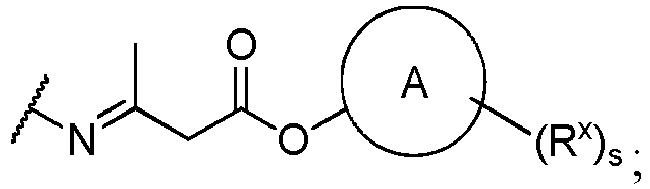
- A and B, at each occurrence, are each independently selected from a saturated or unsaturated, linear, branched, or cyclic hydrocarbon group, wherein each hydrocarbon group optionally includes one or more heteroatoms (e.g., oxygen, nitrogen, sulfur, silicon, or phosphorous); an aromatic group; a heteroaromatic group; and a heterocyclic group; or any combination thereof; wherein said groups, at each occurrence, are independently unsubstituted or substituted with one or more suitable substituents; and
- s and t, at each occurrence, are each independently an integer selected from 1 to 200, preferably 1 to 20.
- It is to be understood that the imine functionality (also referred to as a Schiff base) in the repeating units of formula (I) may exist as its enamine tautomer. For example, the repeating units of formula (I) may also be depicted as follows:

- In certain disclosed foam compositions, A is a C1-C20 hydrocarbon group. In certain disclosed foam compositions, A is a saturated, linear or branched C1-C20 hydrocarbon group. In certain disclosed foam compositions, A is a linear C6 hydrocarbon group. In certain disclosed foam compositions, A is a linear C4 hydrocarbon group. In certain disclosed foam compositions, A is a linear C3 hydrocarbon group. In certain disclosed foam compositions, A is a group of formula:

- In certain disclosed foam compositions, A is a heterocyclic group. In certain disclosed foam compositions, A is a group of formula:


- In certain disclosed foam compositions, each A is independently selected from a linear C3 hydrocarbon group, a linear C4 hydrocarbon group, a linear C6 hydrocarbon group, and a heterocyclic group. In certain disclosed foam compositions, each A is independently selected from a linear C3 hydrocarbon group and a heterocyclic group. In certain disclosed foam compositions, each A is a group of formula:

- In certain disclosed foam compositions, each A is derived from a multi-functional acetoacetate ester compound. In certain disclosed foam compositions, A is derived from hydrocarbon compounds with two or more acetoacetate groups. Suitable multi-functional acetoacetate ester compounds include, for example, alkyl diol diacetoacetates (also known as alkyl diol bisacetoacetates) such as, for example, butane diol diacetoacetate, 1,6-hexanediol diacetoacetate, neopentylglycol diacetoacetate, 4,8-bis(hydroxymethyl)tricyclo[5.2.1.02,6]decane diacetoacetate, 2-methyl-1,3-propanediol diacetoacetate, ethylene glycol diacetoacetate, propylene glycol diacetoacetate; cyclohexanedimethanol diacetoacetate; other diol diacetoacetates; alkyl triol triacetoacetates (also known as alkyl triol trisacetoacetates), such as, for example, trimethylol propane triacetoacetate, pentaerythritol triacetoacetate, glycerol triacetoacetate, or trimethylolethane triacetoacetate; and the like. Further examples of suitable multi-functional acetoacetate ester compounds include tetra-, penta-, and higher acetoacetates of polyhydric alcohols (i.e., polyhydric alcohols on which four, five, or more hydroxyl groups are linked to acetoacetate groups through ester linkages), including, for example, pentaerythritol tetraacetoacetate, dipentaerythritol pentaacetoacetate, and dipentaerythritol hexaacetoacetate. Further examples of suitable multi-functional acetoacetate ester compounds include ethylene glycol bisacetoacetate, 1,2-propanediol bisacetoacetate, 1,3-propanediol bisacetoacetate, 1,4-butanediol bisacetoacetate, neopentyl glycol bisacetoacetate, isosorbide bisacetoacetate, trimethylol propane tris acetoacetate, glycerol tris acetoacetate, castor oil tris acetoacetate, glucose acetoacetates (e.g., glucose tris acetoacetate, and glucose tetra acetoacetate), sucrose acetoacetates, sorbitol acetoacetates (e.g., sorbitol tris acetoacetate, and sorbitol tetra acetoacetate), and erythritol acetoacetates.
- In certain disclosed foam compositions, A is derived from a multi-functional acetoacetate ester of a monosaccharide, a disaccharide, an oligosaccharide, a polysaccharide, or a combination thereof. In certain disclosed foam compositions, A is derived from a multi-functional acetoacetate ester of glucose, fructose, galactose, sucrose, lactulose, lactose, maltose, trehalose, celloboise, kojibiose, nigerose, isomaltose, β,β-trehalose, α,β-trehalose, sophorose, laminaribiose, gentiobiose, turanose, maltulose, palatinose, gentiobiulose, mannobiose, melibiose, melibiulose, rutinose, rutinulose, xylobiose, fructo-oligosaccharides, galactooligosaccharides, mannan oligosaccharides, arabinoxylans, cellulose, chitin, pectins, or a combination thereof. In certain disclosed foam compositions, A is derived from a multi-functional acetoacetate ester of sucrose. In certain disclosed foam compositions, A is derived from a multi-functional acetoacetate ester of sorbitol. In certain disclosed foam compositions, A is derived from a multi-functional acetoacetate ester of erythritol.
- In certain disclosed foam compositions, B is a C1-C20 hydrocarbon group. In certain disclosed foam compositions, B is a saturated, linear or branched C1-C20 hydrocarbon group. In certain disclosed foam compositions, B is a saturated, linear or branched C2-C10 hydrocarbon group. In certain disclosed foam compositions, B is a group of formula:

- In certain disclosed foam compositions, B is arylalkyl, and more specifically, an aryl-dialkyl group. In certain disclosed foam compositions, B is a group of formula:

- In certain disclosed foam compositions, B is a group of formula:

- In certain disclosed foam compositions, B is derived from a multi-functional amine compound. In certain disclosed foam compositions, B is derived from an alkylene diamine, an alkylene triamine, an alkylene tetraamine, or the like. In certain disclosed foam compositions, B is derived from an aromatic-containing multi-functional amine. Suitable multi-functional amine compounds include, for example, ethylene diamine, hexamethylene diamine, 2-methyl-1,5-diaminopentane, diethylenetriamine, triethylenetetramine, tetraethylenepentamine, meta-phenylenediamine, para-phenylenediamine, meta-xylenediamine, and diaminodiphenyl sulfone.
- In certain disclosed foam compositions, s, at each occurrence, is independently selected from 2, 3, 4, 5, 6, 7, and 8. In certain disclosed foam compositions, s is 2 at each occurrence. In certain disclosed foam compositions, t, at each occurrence, is independently selected from 1, 2, 3, 4, and 5. In certain disclosed foam compositions, t is 1 at each occurrence.
- In certain disclosed foam compositions, the foam compositions have formula (I-a),

- In certain disclosed foam compositions, the foam compositions have formula (I-b),

- Disclosed are foam compositions comprising the reaction product of a compound of formula (a) with a compound of formula (b);

- In certain disclosed foam compositions, R1 is a C1-C20 hydrocarbon group, wherein m is 2 to 20. In certain disclosed foam compositions, R1 is a C1-C10 hydrocarbon group, wherein m is 2 to 10. In certain disclosed foam compositions, R1 is a C1-C5 hydrocarbon group, wherein m is 2 to 5. In certain disclosed foam compositions, R1 is a C6 hydrocarbon group and m is 3 or 4. In certain disclosed foam compositions, R1 is a C4 hydrocarbon group and m is 2, 3, or 4. In certain disclosed foam compositions, R1 is a C3 hydrocarbon group and m is 3, wherein the compound of formula (a) is

- In certain disclosed foam compositions, R1 is a tetrahydrofuranyl or tetrahydropyranyl group, wherein said groups are substituted or unsubstituted with one or more suitable substituents. In certain disclosed foam compositions, R1 is a tetrahydrofuranyl or tetrahydropyranyl group, wherein said groups are substituted or unsubstituted with one or more suitable substituents; and m is 4 to 7.
- In certain disclosed foam compositions, R1 is derived from derived from compounds with two or more hydroxyl groups. Suitable multi-functional hydroxy compounds include, for example, diols, triols, and other polyhydric alcohols. In certain embodiments, R1 is a polymer backbone. For example, R1 may be derived from a polyalkylene glycol (e.g., polyethylene glycol, polypropylene glycol), a polysaccharide (e.g., cellulose, starch, amylose, amylopectin, tapioca, dextrin), or a polyvinyl alcohol.
- In certain disclosed foam compositions, the compound of formula (a) is a multi-functional acetoacetate ester compound. Exemplary compounds of formula (a) include, but are not limited to, alkyl diol diacetoacetates (also known as alkyl diol bisacetoacetates) such as, for example, butane diol diacetoacetate, 1,6-hexanediol diacetoacetate, neopentylglycol diacetoacetate, 4,8-bis(hydroxymethyl)tricyclo[5.2.1.02,6]decane diacetoacetate, 2-methyl-1,3-propanediol diacetoacetate, ethylene glycol diacetoacetate, propylene glycol diacetoacetate; cyclohexanedimethanol diacetoacetate; other diol diacetoacetates; alkyl triol triacetoacetates (also known as alkyl triol trisacetoacetates), such as, for example, trimethylol propane triacetoacetate, pentaerythritol triacetoacetate, glycerol triacetoacetate, or trimethylolethane triacetoacetate; and the like. Further examples of suitable multi-functional acetoacetate ester compounds of formula (a) include tetra-, penta-, and higher acetoacetates of polyhydric alcohols (i.e., polyhydric alcohols on which four, five, or more hydroxyl groups are linked to acetoacetate groups through ester linkages), including, for example, pentaerythritol tetraacetoacetate, dipentaerythritol pentaacetoacetate, and dipentaerythritol hexaacetoacetate. Further examples of suitable multi-functional acetoacetate ester compounds of formula (a) include ethylene glycol bisacetoacetate, 1,2-propanediol bisacetoacetate, 1,3-propanediol bisacetoacetate, 1,4-butanediol bisacetoacetate, neopentyl glycol bisacetoacetate, isosorbide bisacetoacetate, trimethylol propane tris acetoacetate, glycerol tris acetoacetate, castor oil tris acetoacetate, glucose acetoacetates (e.g., glucose tris acetoacetate, and glucose tetra acetoacetate), sucrose acetoacetates, sorbitol acetoacetates (e.g., sorbitol tris acetoacetate, and sorbitol tetra acetoacetate), and erythritol acetoacetates.
- In certain disclosed foam compositions, the compound of formula (a) is a multi-functional acetoacetate ester of a monosaccharide, a disaccharide, an oligosaccharide, a polysaccharide, or a combination thereof. In certain disclosed foam compositions, the compound of formula (a) is derived from glucose, fructose, galactose, sucrose, lactulose, lactose, maltose, trehalose, celloboise, kojibiose, nigerose, isomaltose, β,β-trehalose, α,β-trehalose, sophorose, laminaribiose, gentiobiose, turanose, maltulose, palatinose, gentiobiulose, mannobiose, melibiose, melibiulose, rutinose, rutinulose, xylobiose, fructo-oligosaccharides, galactooligosaccharides, mannan oligosaccharides, arabinoxylans, cellulose, chitin, pectins, or a combination thereof. In certain disclosed foam compositions, the compound of formula (a) is derived from sucrose. In certain disclosed foam compositions, the compound of formula (a) is derived from sorbitol. In certain disclosed foam compositions, the compound of formula (a) is derived from erythritol.
- In certain disclosed foam compositions, the compound (a) has formula:

- In certain disclosed foam compositions, R2 is a C1-C20 hydrocarbon group, wherein n is 2 to 20. In certain disclosed foam compositions, R2 is a saturated, linear or branched C1-C20 hydrocarbon group, wherein n is 2 to 20. In certain disclosed foam compositions, R2 is a saturated, linear or branched C2-C10 hydrocarbon group, wherein n is 2 to 10. In certain disclosed foam compositions, R2 is a C6 hydrocarbon group and n is 2, wherein the compound of formula (b) is

- In certain disclosed foam compositions, R2 is aromatic-containing group. In certain disclosed foam compositions, R2 is an arylalkyl, and more specifically, an aryldialkyl group. In certain disclosed foam compositions, R2 is an aryldialkyl group and n is 2, wherein the compound of formula (b) is

- In certain disclosed foam compositions, the compound of formula (b) is a multi-functional amine compound. In certain disclosed foam compositions, the compound of formula (b) is an alkylene diamine, an alkylene triamine, an alkylene tetraamine, or the like. In certain disclosed foam compositions, the compound of formula (b) is an aromatic-containing multi-functional amine. Suitable multi-functional amine compounds include, for example, ethylene diamine, hexamethylene diamine, 2-methyl-1,5-diaminopentane, diethylenetriamine, triethylenetetramine, tetraethylenepentamine, meta-phenylenediamine, para-phenylenediamine, meta-xylenediamine, and diaminodiphenyl sulfone.
- In certain disclosed foam compositions, the compound of formula (b) has formula:

- Compounds and compositions disclosed herein may contain asymmetric centers and can thus occur as racemates and racemic mixtures, single enantiomers, diastereomeric mixtures and individual diastereomers. Additional asymmetric centers may be present depending upon the nature of the various substituents on the molecule. Each such asymmetric center will independently produce two optical isomers and it is intended that all of the possible optical isomers and diastereomers in mixtures and as pure or partially purified compounds are included within the scope of this invention. The present invention is meant to comprehend all such isomeric forms of these compounds.
- The disclosed compositions can be better understood in connection with the following synthetic schemes and methods which illustrate a means by which the compositions can be prepared.

- Acetoacetylated compounds of formula (a) can be prepared as shown in Scheme 1. A polyhydric alcohol compound of formula (1) can be treated with tert-butyl acetoacetate of formula (2) to provide a multi-functional acetoacetate ester compound of formula (a).
- Glycerol triacetoacetate and sucrose multi-functionalized with triacetoacetate groups were each synthesized according to Scheme 1. The weight of evolved tert-butanol showed about 84% (6.7-7.0) of the available hydroxyl groups of sucrose had reacted (8.0 are available). Infrared (IR) analysis showed typical ketoester absorbances at 1750 cm-1 and 1720 cm-1 for the carbonyls, and 1630 cm-1 for the enol. The data for glycerol triacetoacetate showed about 100% reaction (2.9-3.0) of the hydroxyl groups; and the IR analysis showed similar ketoester absorbances for the diagnostic region.

- Foam compositions of formula (I-b), for example, can be synthesized as shown in Scheme 2. Glycerol triacetoacetate and xylene diamine can be combined to provide a foam composition of formula (I-b). The water produced in the reaction may serve as a blowing agent (e.g., a chemical blowing agent) to aid in the foam production.
- In certain embodiments, the products may be further modified, for example, by manipulation of substituents. These manipulations may include, but are not limited to, reduction, oxidation, organometallic cross-coupling, alkylation, acylation, and hydrolysis reactions which are commonly known to those skilled in the art. In some cases, the order of carrying out the foregoing reaction schemes may be varied to facilitate the reaction or to avoid unwanted reaction products.
- In certain embodiments, one or more catalysts may be used in the foregoing reactions to initiate or assist with foam formation. Suitable metal-based catalysts include, but are not limited to, catalysts comprising tin, bismuth, zinc, iron, manganese, nickel, or cobalt, or a combination thereof. For example, a tin catalyst (e.g., dimethylbis[(1-oxoneodecyl)oxy] stannane) may be used in the reaction of Scheme 1. In certain embodiments, the reactions may further include solvents or additives. For example, one or more blowing agents or surfactants may be present to aid in the formation of the physical foam structure or augment foam physical properties.
- The foam compositions can include one or more additives.
- The foam compositions can include one or more blowing agents. Suitable blowing agents include compounds with low boiling points which are vaporized during the exothermic polymerization reaction. Such blowing agents are generally inert and therefore do not decompose or react during the polymerization reaction. In certain embodiments, at least one of the one or more blowing agents has a gas phase thermal conductivity of less than or equal to 0.016 W/m·K or less than or equal to 0.014 W/m·K or less than or equal to 0.012 W/m·K at 25° C. Examples of inert blowing agents include, but are not limited to, carbon dioxide, chlorofluorocarbons, hydrogenated fluorocarbons, hydrogenated chlorofluorocarbons, acetone, and low-boiling hydrocarbons such as cyclopentane, isopentane, n-pentane, and their mixtures. Specific exemplary blowing agents include, but are not limited to, 1,1,4,4,4-hexafluoro-2-butene; carbon dioxide; hydrocarbons such as pentane, isopentane, cyclopentane petroleum ether, and ether; hydrochlorofluorocarbons such as 1,1-dichloro-1-fluoroethane (HCFC-141b); 2,2-dichloro-1,1,1-trifluoroethane (HCFC-123); 1-chloro-1,1-difluoroethane (HCFC-142b); 1,1,1,2-tetrafluoroethane (HCFC-134a); 1,1,1,3,3-pentafluoropropane (HFC-245fa) available from Honeywell (Morristown, N.J.); 1,1,1,3,3-pentafluorobutane (HFC-365) available as Solkane® 365mfc from Solvay Chemicals (Bruxelles, Belgium); incompletely halogenated hydrocarbons such as 2-chloropropane; fluorocarbons such as dichlorodifluoromethane, 1,2-dichloro-1,1,2,2-tetrafluoroethane (CFC-114), trichlorotrifluoroethane (CFC-113), trichloromonofluoromethane (CFC-11), z 1,1,1,4,4,4-hexafluoro-2-butene (under the trade names FEA 1100 and Formacel® 1100, supplied by DuPont; the CAS (Chemical Abstracts System) Number is 692-49-9). In certain embodiments, the blowing agent is water.
- In certain embodiments, a blowing agent is generated in situ during foam formation. For example, enamine formation upon reaction of acetoacetate esters with amines yields water as a byproduct, and the water may act as a blowing agent (e.g., a chemical blowing agent).
- The foam compositions can include one or more surfactants. A surfactant can be employed to stabilize the foaming reaction mixture while curing. Such surfactants normally comprise a liquid or solid organosilicone compound. The surfactants are employed in amounts sufficient to stabilize the foaming reaction mixture against collapse and to prevent the formation of large, uneven cells. Suitable surfactants include, but are not limited to, those sold under the trade name "TEGOSTAB®" by Goldschmidt Chemical Company, such as TEGOSTAB® B-8407 surfactant; TEGOSTAB® B-8474 surfactant; TEGOSTAB® B-2219 surfactant; TEGOSTAB® B-8870 surfactant; TEGOSTAB® B-8433 surfactant; TEGOSTAB® B-8404 surfactant; TEGOSTAB® B-8462 surfactant; TEGOSTAB® B-8467 surfactant; TEGOSTAB® B-8465 surfactant; and TEGOSTAB® B-8470 surfactant. Another example of a suitable surfactant is SURFONIC® N-120 surfactant which is commercially available from Huntsman Petrochemical Corporation of The Woodlands, TX. Surfactants may also include silicone surfactants and combinations of surfactants. In certain embodiments, about 0.1% to about 5% by weight of surfactant based on the total weight of all foaming ingredients are used. In certain embodiments, about 1.5% to about 3% by weight of surfactant based on the total weight of all foaming ingredients are used.
- The foam compositions can include one or more flame retardants. Suitable flame retardants include, but are not limited to, phosphorus-containing flame retardants selected from the groups of the mono- and oligomeric phosphoric and phosphonic esters, phosphonate amines, phosphonates, phosphinates, metal dialkylphosphinates (e.g., aluminium tris[dialkylphosphinates] and zinc bis[dialkylphosphinates]), phosphites, hypophosphites, phosphine oxides, phosphazenes; and nitrogen-containing flame retardants individually or in a mixture, such as for example, melamine oxalate, melamine phosphate prim., melamine phosphate sec., and melamine pyrophosphate sec., reaction products of melamine with condensed phosphoric acids and reaction products of condensates of melamine with phosphoric acid or with condensed phosphoric acids, in particular melamine polyphosphate, and also the reaction products of melamine and polyphosphoric acid with basic aluminium compounds, with basic magnesium compounds and/or with basic zinc compounds, and also melamine cyanurate and amine neopentyl glycol borate; guanidine salts, such as guanidine carbonate, guanidine cyanurate prim., guanidine phosphate prim., guanidine phosphate sec., guanidine sulphate prim., guanidine sulphate sec., guanidine pentaerythrityl borate, guanidine neopentyl glycol borate, urea phosphate, and urea cyanurate. It is also possible to use condensates of melamine, in particular melem, melam, melon, or compounds of this type with higher level of condensation, and reaction products of these with condensed phosphoric acids; tris(hydroxyethyl) isocyanurate and reaction products thereof with carboxylic acids, benzoguanamine and its adducts and its salts, and its products substituted on nitrogen, and also adducts and salts of these. Other nitrogen-containing components that can be used are allantoin compounds, and salts of these with phosphoric acid, boric acid or pyrophosphoric acid, and also glycol urils and salts of these; and any combination of the foregoing. In certain embodiments, the flame retardant is selected from phosphate flame retardants, melamine flame retardants, tris(2-chloropropyl)phosphate (TCPP), tris(2-chloroethyl)phosphate (TCEP), tris(1,3-dichloroisopropyl) phosphate (TDCPP), dimethylmethylphosphonate (DMMP), and diethylene glycol (DEG) and propylene glycol (PG) esters of tetrabromophthalic anhydride (ME-TBPA), or any combination thereof. In certain embodiments, the disclosed compositions can include expanded graphite as a flame retardant. When crystalline flaky graphite is oxidized with concentrated sulfuric acid and a hydrogen peroxide solution, washed with water, and then put into a high-temperature expansion furnace, it is expanded in the direction of a c axis of graphite crystal. The crystalline flaky graphite expanded to 100∼700% of initial volume thereof is referred to as "expanded graphite."
- The foam compositions can include one or more catalysts. Suitable catalysts include, but are not limited to, tin catalysts (e.g., dimethylbis[(1-oxoneodecyl)oxy] stannane)).
- A variety of other ingredients may be included in the formulations for making foams. Examples of optional components include, but are not limited to, cell stabilizers such as silicones, crosslinking agents, chain extenders, pigments, preservatives, antioxidants, reinforcing agents, antistatic agents, fillers and combinations of any of these.
- The disclosed foam compositions can have one or more advantageous properties.
- The foam compositions may have advantageous thermal insulation properties, assessed by thermal conductivity and thermal resistance. Thermal conductivity is an intrinsic property of a material that measures its capacity to sustain heat flow. The symbol used to denote thermal conductivity is k (or lambda, λ), referred to as the material's K-value. The reciprocal of thermal conductivity is thermal resistivity, an intrinsic property of a material to resist one-dimensional heat flow, referred to as the material's R-value. Thermal conductivity can be measured according to ASTM-C518.
- The effectiveness of thermal insulation can be measured by its thermal resistance. In the insulation industry, the standard measure of an insulator's ability to resist thermal energy transfer is referred to as the insulation's R-value. The higher the R-value, the more effective the insulation. Knowing a material's R-value allows contractors, building inspectors, and homeowners to compare products and calculate the amount of insulation needed for a particular construction project. Additionally, regulatory agencies use R-values to establish recommended or mandatory guidelines for new buildings.
- The disclosed compositions may have a K value of 0.0180 to 0.0432 W/m.K (0.125 to 0.3 BTU per inch/°F-ft2-h). The foam compositions may have a K value of 0.504 W/m.K (0.35 BTU per inch/°F-ft2-h) or less, 0.0360 W/m.K (0.25 BTU per inch/°F-ft2-h) or less, 0.0288 W/m.K (0.2 BTU per inch/°F-ft2-h) or less, 0.0245 W/m.K (0.17 BTU per inch/°F-ft2-h) or less, 0.0202 W/m.K (0.14 BTU per inch/°F-ft2-h) or less, or 0.0187 W/m.K (0.13 BTU per inch/°F-ft2-h) or less.
- The disclosed foam compositions may have an R value of 24.3 to 55.5 m.K/W (3.5 to 8 °F-ft2-h/BTU per inch). The foam compositions may have an R value of 20.8 m.K/W (3 °F-ft2-h/BTU per inch) or greater, 27.8 m.K/W (4 °F-ft2-h/BTU per inch) or greater, 34.7 m.K/W (5 °F-ft2-h/BTU per inch) or greater, 41.6 m.K/W (6 °F-ft2-h/BTU per inch) or greater, 48.6 m.K/W (7 °F-ft2-h/BTU per inch) or greater, or 55.5 m.K/W (8 °F-ft2-h/BTU per inch) or greater.
- The foam compositions may have a glass transition temperature of 40 °C to 150 °C.
- The foam compositions may have a foam density of 1.60 kg/m3 to 480.6 kg/m3 (0.1 lb/ft3 to 30 lb/ft3), 8.01 kg/m3 to 160.2 kg/m3 (0.5 lb/ft3 to 10 lb/ft3), 24.03 kg/m3 to 160.2 kg/m3 (1.5 lb/ft3 to 10 lb/ft3), 27.23 kg/m3 to 56.06 kg/m3 (1.7 lb/ft3 to 3.5 lb/ft3), 24.03 kg/m3 to 40.05 kg/m3 (1.5 lb/ft3 to 2.5 lb/ft3), or 27.23 kg/m3 to 40.04 kg/m3 (1.7 lb/ft3 to 2.5 lb/ft3).
- The foam compositions may have a cream time of 1 second to 5 seconds, or 2 seconds to 4 seconds. The foam compositions may have a start to rise time of 2 seconds to 17 seconds, or 4 seconds to 8 seconds. The foam compositions may have a tack free time of 4 seconds to 30 seconds, or 8 seconds to 12 seconds.
- The foam compositions may be resistant to molding or fungus growth, as measured by ASTM C1338. The foam compositions may not serve as a food source for insects or rodents.
- The foam compositions may have negligible air infiltration, as measured according to ASTM E283-04. The foam compositions may have a water vapor infiltration of greater than 1 perm or 5.72 x 10⁻⁸ g/Pa-s-m2.
- The foam compositions may have little or no odor.
- The disclosed foam compositions are useful in a variety of sealing and insulation applications. These include, for example, building insulation such as for walls, foundations, floors and roofs; gap and crack filling and crack repair applications in buildings, masonry and other structures; vehicular cavity-filling applications, and the like. The foams are also useful in producing boardstock insulation and/or construction materials by spraying or applying the uncured foam onto a facing material (such as, for example, a fiber layer, a wood or metal layer, and the like). The foam compositions may be injected for use in low temperature applications (e.g., refrigerators, freezers, refrigerated trailers, walk-in cold-storage).
- The foam compositions can be applied using spray foam equipment. The spray foam equipment may include separate containers for each of the A- side and B-side components. The containers can each be in fluid connection with a separate conduit, which each are in fluid communication with a mixing chamber which in turn is in fluid communication with a nozzle. Upon opening the containers (via the opening of a suitable valve in each of the containers), the A-side component and B-side component can be pneumatically pumped from their containers into the respective conduits. The A-side and B-side components may then be brought to the mixing chamber under pressure from an electric or hydraulic pump, for example at a pressure of 3447-13790 kPa (500-2,000 psi), 5515-13790 kPa (800-2,000 psi), or 6205-8273 kPa (900-1,200 psi), and combined in a mixing device to form a reaction mixture. The mixing device may be a static mixer, a mix chamber, or other mixhead. The reaction mixture can then be expelled through a nozzle or other orifice. The conduit before the spray gun can be heated, for example, to a temperature of 21 °C to 93 °C (70 °F to 200 °F) or from 32 °C to 60 °C (90 °F to 140 °F). The expelled reaction mixture typically forms a spray which is directed to a mold or other surface upon which the polymeric foam is to be applied. The expelled reaction mixture typically forms a spray or a foam bead, depending in part on the nozzle size and type and the viscosity of the exiting material, which is directed to a mold or other surface upon which the polymeric foam is to be applied. The reaction mixture is then cured in situ. Suitable spray foam equipment includes that described in, for example,
U.S. Patent No. 8,568,104 ,U.S. Patent No. 6,991,185 , andU.S. Published Patent Application No. 2004-0109992 . An exemplary electric pump and proportioner that may be used includes an electric foam proportioner for medium- to high-output foam insulation applications that applies up to (30 lb) 13.6 kg per minute (e.g., Reactor E-20 available from Graco, Minneapolis, Minnesota). An exemplary hydraulic pump and proportioner that may be used includes a hydraulic foam proportioner for medium to high-output foam applications and roofing projects that applies up to (52 lb) 23.6 kg per minute (e.g., Reactor H-25, H-40 or H-50 available from Graco). An exemplary air purge spray gun may be a plural-component spray gun for high output spray foam applications, available from Graco. - In certain embodiments, a preblend of certain materials is prepared prior to reacting the foam components [e.g., the compound of formula (a) and the compound of formula (b)]. For example, foam expansion agents, surfactants, catalysts and other foaming ingredients can each individually be blended with one or both of the foam reactants to provide one or more blends of the reaction components; and then the respective blend(s) can be combined to provide the reaction mixture resulting in a foam composition. Alternatively, all the foaming ingredients may be introduced individually to the mixing zone where the foam reactants [e.g., the compound of formula (a) and the compound of formula (b)] are contacted. It is also possible to pre-react all or a portion of the foam reactants to form a prepolymer (e.g., a polymer with reduced crosslinking).
- Disclosed are kits for conveniently and effectively implementing the disclosed methods. Such kits may include a compound or composition of the invention, and optionally one or more of instructions, packaging, and dispensers. Kit components may be packaged for either manual or partially or wholly automated practice of the foregoing methods. In other certain embodiments, a kit includes the disclosed foam reactants, and optionally instructions for their application as a foam material.
- The disclosed compounds, compositions, methods and processes will be better understood by reference to the following examples, which are intended as an illustration of and not a limitation upon the scope of the invention.
- Differential scanning calorimetry (DSC) was used to determine glass transition temperature. Thermogravimetric analysis was used to determine decomposition onset temperature. Equipment that can be used to prepare foam compositions includes a high speed mixer; a stop watch; a balance; and calipers, among other equipment.
- Acetoacetylation was conducted at two ratios of sucrose to glycerin: 4/1 and 5/1. For the 4/1 preparation, 160 grams of sucrose was charged to a 2L flask equipped with a mechanical stirrer, Dean-Stark trap, reflux condenser and temperature sensing thermocouple attached to a Thermowatch. Forty grams of glycerin was added and this mixture was heated at 100 °C until a quasi-homogeneous mixture was obtained (1.0-1.5 hours, some of the sucrose was dissolved, but it was all at least coated with glycerin). Tert-butyl acetoacetate (864 grams) was added and this mixture was heated at 125-135 °C until the evolution of t-butanol ceased (3.0-3.5 hours). Samples were taken for viscosity measurements. Before any t-butanol had evolved the viscosity was about 2,600-3,000 centipoise (cps). As the reaction proceeded the viscosity decreased at first (down to about 200 cps), however, at the end the viscosity was up to 3,300 cps.
- For the 5/1 preparation, the same procedure was used with the appropriate ratios of sucrose and glycerin (167 grams sucrose and 33 grams of glycerin).
- Sucrose and glycerin acetoacetates were prepared using 2,2,6-trimethyl-4H-1,3-dioxan-4-one (structure below) as a starting material. A 2L flask equipped with a Dean-Stark trap, reflux condenser and thermometer, was charged with 100.3g of sucrose and 335g of 2,2,6-trimethyl-4H-1,3-dioxan-4-one (TDO). The reaction mixture was brought to 96 °C at which point the evolution of acetone commenced. Acetone was collected over the next 1.5 hours until distillation stopped. The quantity of acetone collected showed that ∼98 mol% of the available hydroxyl groups had reacted. The product was then tested as per the material obtained from the t-butyl acetoacetate synthesis. It per formed the same according to the previous Examples. This synthetic route provides for synthesis of the product at lower temperature and at higher conversion levels.

- Table 1 summarizes exemplary components used to prepare the foam compositions. The components are prepared by methods described herein or methods known in the art. All other chemical components are purchased from commercial sources.
Table 1 Sucrose Acetoacetate Glycerine Acetoacetate Tin Catalyst (dimethylbis[(1-oxoneodecyl)oxy] stannane) Meta xylene diamine (MXDA) Dytek A (2-methyl-1,5-diaminopentane) Tegostab B-8407 (polyether modified siloxane surfactant) Tegostab B-8221 (surfactant) Tris(2-chloropropyl)phosphate (TCPP)-fire retardant HFC-365mfg (blowing agent) - Foam compositions were prepared using a two-part system (e.g., side A and side B). Table 2 summarizes the components and amounts used to prepare an exemplary foam composition.
Table 2 Side A Sucrose Acetoacetate 25.00 grams (gr) Glycerine Acetoacetate 25.00 gr Tin Catalyst (dimethylbis[(1-oxoneodecyl)oxy]stannane) 1.49 gr Side B Meta xylene diamine (MXDA) 14.83 gr Dytek A (2-methyl-1,5-diaminopentane) 9.83 gr Tegostab B-8407 (polyether modified siloxane surfactant) 0.80 gr Tegostab B-8221 (surfactant) 0.50 gr Tris(2-chloropropyl)phosphate (TCPP)-fire retardant 15.38 gr HFC-365mfg (blowing agent) 3.00 gr - Side A: 50 grams of a 1:1 mixture (by weight) of sucrose acetoacetate and glycerine acetoacetate were measured into a container (Side A). 1.49 grams of catalyst were added to side A. Side A was mixed and set to the side. Hexane diol diacrylate (0.40 gr) was optionally added to side A.
- Side B: 14.83 grams of MXDA were added to a new container (Side B). 9.83 grams of Dytek A was added to side B. 0.80 grams of Tegostab B-8407 was added to side B. 0.50 grams of Tegostab B-8221 was added to side B. 15.38 grams of Tris(2-chloropropyl)phosphate (TCPP) was added to side B. 3.00 grams of blowing agent was added side B. Side B was mixed until a clear solution was obtained.
- A rigid foam was prepared by adding Side B to Side A. The mixture was stirred under high shear for 3-5 seconds. A foam bun resulted. A cream time of 2-3 seconds was observed. The start to rise time of the foam was 5-14 seconds depending on catalyst composition and catalyst concentration. Tack-free time occured at 5-8 seconds as well. The measured density of the foam was 43.25 kg/m3 to 80.09 kg/m3 (2.7 to 5 lbs/ft3). The measured Tg of the foam was 57 °C. The decomposition onset temperature of the foam was 210 °C.
- The formulation of Table 2 generated a foam with good cell structure, which is small and symmetric throughout the foam.
- Foam compositions can be prepared with acetoacetates mixed with diamines and a surfactant. Table 3 summarizes the components and amounts used to prepare an exemplary foam composition.
Table 3 Side A Sucrose Acetoacetate 25.00 grams (gr) Glycerine Acetoacetate 25.00 gr Side B Meta xylene diamine (MXDA) 14.83 gr Dytek A (2-methyl-1,5-diaminopentane) 9.83 gr Tegostab B-8407 (polyether modified siloxane surfactant) 0.80 gr - The formulation of Table 3 provided a foam with a cream time of about 3-5 seconds. The start to rise time of the foam was 13-18 seconds. The density of the foam was determined to be about 80.09 kg/m3 (5 lbs/ft3). The foam was prepared without the use of a physical blowing agent.
- Bulk up the composition in Example 3 to 15,000 total grams for each side in 18.9 L (5 gallon) plastic pails. The compositions are fed via pnumatic transfer pumps to a Graco HVR proportioner. The proportioner settings are as follows: Material Temperature 24 °C (75F), A and B side preheaters and line temperatures range from 32 °C to 49 °C (90F to 120F) and the pump pressure range from 6895 to 8274 kPa (1000 to 1200 psi). The resulting foam ranges in density from 27.23 kg/m3 to 43.25 kg/m3 (1.71b/cubic ft to 2.71b/cubic ft) and exhibits normal cell structure and physical foam characteristics.
- Bulk up the composition in Example 3 to 15,000 total grams for each side in 18.9 L (5 gallon) plastic pails. The compositions are fed via pnumatic transfer pumps to a Graco E20 proportioner. The proportioner settings are as follows: Material Temperature 24 °C (75F), A and B side preheaters and line temperatures range from 43 °C to 71 °C (110F to 160F) and the pump pressure ranges from 5516 to 6895 kPa (800 to 1000 psi). The resulting foam ranges in density from 20.82 kg/m3 to 28.83 kg/m3 (1.31b/cubic ft to 1.81b/cubic ft) and exhibits normal cell structure and physical foam characteristics.
- It is understood that the foregoing detailed description and accompanying examples are merely illustrative and are not to be taken as limitations upon the scope of the invention, which is defined solely by the appended claims and their equivalents.
- Various changes and modifications to the disclosed embodiments will be apparent to those skilled in the art. Such changes and modifications, including without limitation those relating to the chemical structures, substituents, derivatives, intermediates, syntheses, compositions, formulations, or methods of use of the invention, may be made without departing from the scope thereof.
Claims (13)
- A method of preparing a foam, comprising reacting a multifunctional acetoacetate ester of formula (a) with a multifunctional amine of formula (b) in the presence of a blowing agent:
 R1, and R2, at each occurrence, are each independently selected from a saturated or unsaturated, linear, branched, or cyclic hydrocarbon group, wherein each hydrocarbon group optionally includes one or more heteroatoms; an aromatic group; a heteroaromatic group; and a heterocyclic group; or any combination thereof; wherein said groups, at each occurrence, are independently unsubstituted or substituted with one or more suitable substituents;m is 2 to 200; andn is 2 to 200.
 - The method of claim 1, wherein the multifunctional acetoacetate ester of formula (a) and the multifunctional amine of formula (b) are pneumatically pumped from separate first and second containers to respective first and second conduits.
- The method of claim 2, wherein the multifunctional acetoacetate ester of formula (a) and the multifunctional amine of formula (b) are brought from their respective first and second conduits to a mixing chamber under pressure from an electric or hydraulic pump, the multifunctional acetoacetate ester of formula (a) and the multifunctional amine of formula (b) forming a reaction mixture;
optionally wherein the pressure is 3,400 - 14,000 kPa (500-2,000 psi). - The method of claim 3, wherein the reaction mixture is pumped from the mixing chamber through a third conduit to a nozzle or orifice and expelled through the nozzle or orifice.
- The method of claim 4, wherein:i) the third conduit is heated to a temperature of 21 °C to 93 °C (70 °F to 200 °F); and/orii) the expelled reaction mixture is directed to a mold or other surface.
- The method of any preceding claim, wherein the blowing agent is selected from carbon dioxide, chlorofluorocarbons, hydrogenated fluorocarbons, hydrogenated chlorofluorocarbons, acetone, and low-boiling hydrocarbons such as cyclopentane, isopentane, n-pentane, and their mixtures.
- The method of any preceding claim, wherein m = 3.
- The method of any preceding claim, wherein the multifunctional acetoacetate ester of formula (a) is

- The method of any one of claims 1 to 6, wherein m = 7 or 8.
- The method of any one of claims 1 to 6 or claim 9 wherein the multifunctional acetoacetate ester of formula (a) is

- The method of any one of claims 1 to 10, wherein n = 2.
- The method of any one of claims 1 to 11, wherein the multifunctional amine of formula (b) is

- The method of any one of claims 1-12, wherein water produced as a consequence of reaction between multifunctional acetoacetate ester (a) and multifunctional amine (b) acts as the blowing agent.
Priority Applications (1)
| Application Number | Priority Date | Filing Date | Title |
|---|---|---|---|
| EP20195596.0A EP3783048B1 (en) | 2014-04-21 | 2015-04-21 | A method for applying a foam composition using spray foam equipment |
Applications Claiming Priority (2)
| Application Number | Priority Date | Filing Date | Title |
|---|---|---|---|
| US201461982142P | 2014-04-21 | 2014-04-21 | |
| PCT/US2015/026923 WO2015164408A1 (en) | 2014-04-21 | 2015-04-21 | Foam compositions |
Related Child Applications (1)
| Application Number | Title | Priority Date | Filing Date |
|---|---|---|---|
| EP20195596.0A Division EP3783048B1 (en) | 2014-04-21 | 2015-04-21 | A method for applying a foam composition using spray foam equipment |
Publications (3)
| Publication Number | Publication Date |
|---|---|
| EP3154929A1 EP3154929A1 (en) | 2017-04-19 |
| EP3154929A4 EP3154929A4 (en) | 2018-06-13 |
| EP3154929B1 true EP3154929B1 (en) | 2020-09-16 |
Family
ID=54321440
Family Applications (2)
| Application Number | Title | Priority Date | Filing Date |
|---|---|---|---|
| EP15782611.6A Active EP3154929B1 (en) | 2014-04-21 | 2015-04-21 | Method of preparing a foam |
| EP20195596.0A Active EP3783048B1 (en) | 2014-04-21 | 2015-04-21 | A method for applying a foam composition using spray foam equipment |
Family Applications After (1)
| Application Number | Title | Priority Date | Filing Date |
|---|---|---|---|
| EP20195596.0A Active EP3783048B1 (en) | 2014-04-21 | 2015-04-21 | A method for applying a foam composition using spray foam equipment |
Country Status (5)
| Country | Link |
|---|---|
| US (6) | US9359471B2 (en) |
| EP (2) | EP3154929B1 (en) |
| CN (1) | CN106715383A (en) |
| CA (2) | CA3207515A1 (en) |
| WO (1) | WO2015164408A1 (en) |
Cited By (1)
| Publication number | Priority date | Publication date | Assignee | Title |
|---|---|---|---|---|
| EP4685176A1 (en) | 2024-07-24 | 2026-01-28 | Henkel AG & Co. KGaA | 2-component foams based on acetylacetonate and amines |
Families Citing this family (21)
| Publication number | Priority date | Publication date | Assignee | Title |
|---|---|---|---|---|
| US10745917B2 (en) | 2015-12-23 | 2020-08-18 | Certainteed Corporation | System, method and apparatus for thermal bridge-free insulation assembly |
| WO2018017837A1 (en) | 2016-07-20 | 2018-01-25 | The Regents Of The University Of California | Naturally sourced chitin foam |
| WO2018044883A1 (en) | 2016-08-29 | 2018-03-08 | Invista North America S.A R.L. | Multifunctional polyamine-based compounds |
| US10550568B2 (en) | 2016-09-30 | 2020-02-04 | Certainteed Corporation | Systems, methods, and apparatuses for insulating adjacent to a top of an attic |
| US11161954B2 (en) * | 2017-02-14 | 2021-11-02 | Cryovac, Llc | Isocyanate-free foam using carbon Michael addition chemistry |
| USD837038S1 (en) | 2017-03-31 | 2019-01-01 | Certainteed Corporation | Insulation hanger |
| CN111465641B (en) | 2017-11-20 | 2022-12-27 | 克里奥瓦克公司 | Method and formulation for isocyanate-free foams using unsaturated polyesters |
| RU2765709C1 (en) * | 2018-02-06 | 2022-02-02 | Макнейл Аб | Cartridge for an electronic delivery system |
| WO2019164900A1 (en) | 2018-02-21 | 2019-08-29 | Cryovac, Llc | Method and formulation for an isocyanate-free foam using isocyanate-free polyurethane chemistry |
| WO2019217268A1 (en) | 2018-05-07 | 2019-11-14 | Cruz Foam, Inc. | Biodegradable foams |
| KR102842578B1 (en) | 2018-12-04 | 2025-08-05 | 아르끄마 프랑스 | Multi-component system for manufacturing foamed products |
| US12162259B2 (en) | 2019-05-22 | 2024-12-10 | Cruz Foam, Inc. | Biodegradable foam with laminate layers |
| US12509565B2 (en) | 2021-08-24 | 2025-12-30 | Cruz Foam, Inc. | Biodegradable foams and methods of foam production |
| US12565570B2 (en) | 2021-10-04 | 2026-03-03 | Cruz Foam, Inc. | Foam manufacturing techniques |
| WO2023180786A1 (en) | 2022-03-22 | 2023-09-28 | Latvijas Valsts Koksnes Ķīmijas Institūts | Plant oil-based polymer foam and method of manufacture thereof |
| CN115819735A (en) * | 2022-12-07 | 2023-03-21 | 江西科技师范大学 | Liquid crystal elastomer and preparation method thereof |
| FR3163274A1 (en) * | 2024-06-13 | 2025-12-19 | L'oreal | A process for coloring keratin fibers comprising applying to the keratin fibers at least one protease, an acetoacetate compound, a coloring agent, and a (poly)amine compound |
| FR3163261A1 (en) * | 2024-06-13 | 2025-12-19 | L'oreal | A process for coloring keratin fibers using an acetoacetate compound, a (poly)amine compound, and a direct dye |
| FR3163270A1 (en) * | 2024-06-13 | 2025-12-19 | L'oreal | A process for treating keratin fibers using a basic pH composition, one or more acetoacetate compounds, and one or more specific polyamine compounds |
| FR3163265A1 (en) * | 2024-06-14 | 2025-12-19 | L'oreal | A method for making up keratinous materials comprising the application of at least one acetoacetate polysaccharide compound and a crosslinking agent |
| FR3163267A1 (en) * | 2024-06-14 | 2025-12-19 | L'oreal | A process for treating keratinous materials using at least one silica-containing polysaccharide compound with acetoacetate functions |
Family Cites Families (121)
| Publication number | Priority date | Publication date | Assignee | Title |
|---|---|---|---|---|
| NL99362C (en) * | 1956-05-12 | |||
| NL247436A (en) | 1959-01-17 | |||
| GB1016761A (en) | 1961-02-06 | 1966-01-12 | Timber Treat S Ltd | Structural materials |
| DE1238205B (en) | 1964-05-16 | 1967-04-06 | Hoechst Ag | Process for the production of foams |
| DE1595628A1 (en) | 1966-05-12 | 1970-01-22 | Hoechst Ag | Compounds with two or more acetoacetic ester groups |
| DE2721186C2 (en) | 1977-05-11 | 1986-04-24 | Bayer Ag, 5090 Leverkusen | Process for the preparation of a mixture of low molecular weight polyhydroxyl compounds |
| US4217396A (en) * | 1979-05-10 | 1980-08-12 | Armstrong Cork Company | Acrylate-acetoacetate polymers useful as protective agents for floor coverings |
| DE3134592A1 (en) | 1981-09-01 | 1983-03-10 | Bayer Ag, 5090 Leverkusen | Process for the preparation of compact or cellular polyurethanes |
| US4742147A (en) * | 1984-03-26 | 1988-05-03 | Gus Nichols | Liquid, solventless, complex polymeric compositions, thermosetting at ambient temperatures through addition polymerization mechanisms |
| US4525488A (en) | 1984-09-13 | 1985-06-25 | Texaco Inc. | Preparation of polyaddition products of Mannich condensates and polyisocyanates in polyols and their use in polyurethanes |
| DE3661834D1 (en) | 1985-03-29 | 1989-02-23 | Akzo Nv | A liquid coating composition and a process for coating a substrate with such coating composition |
| US4963399A (en) | 1987-03-31 | 1990-10-16 | Union Carbide Chemicals And Plastics Company, Inc. | Polyurethane foam with low vinyl-staining tendencies |
| US4866103A (en) | 1987-10-16 | 1989-09-12 | Ici Americas Inc. | Polyisocyanate compositions |
| US5011908A (en) * | 1988-07-12 | 1991-04-30 | Arco Chemical Technology, Inc. | Polymer polyol compositions and their use in the preparation of polyurethane foams |
| US5187229A (en) | 1988-08-26 | 1993-02-16 | Nippon Oil And Fats Company, Ltd. | Pigment dispersing agent |
| EP0358358B1 (en) | 1988-08-26 | 1994-11-30 | Nippon Oil And Fats Company, Limited | Pigment dispersing agent |
| WO1991009910A1 (en) | 1988-10-17 | 1991-07-11 | Guertin Bros. Coatings And Sealants, Ltd. | Nco-free resins useful as a substitute for polyurethanes |
| US5340888A (en) | 1988-12-22 | 1994-08-23 | Borden Inc. | Phenolic resin composition |
| GB8829984D0 (en) | 1988-12-22 | 1989-02-15 | Borden Uk Ltd | Phenolic resins |
| JP2641937B2 (en) | 1989-01-19 | 1997-08-20 | 花王株式会社 | Catalyst for polyurethane production |
| US5087661A (en) | 1990-07-20 | 1992-02-11 | Mitsui Toatsu Chemicals, Inc. | Moisture curable polyurethane composition comprising polyaldimine |
| DE4034279A1 (en) | 1990-10-27 | 1992-04-30 | Bayer Ag | USE OF ALKOXYSILYLAMINES AS HARDENERS FOR PLASTIC PREPARATORS HAVING ACETOACETATE OR ACETOACETAMIDE GROUPS |
| DE4122766A1 (en) | 1991-07-10 | 1993-01-14 | Bayer Ag | METHOD FOR PRODUCING ALD OR KETIMINE GROUPS AND THE PREFERRED CONNECTIONS AVAILABLE ACCORDING TO THIS METHOD |
| US5242953A (en) * | 1991-10-17 | 1993-09-07 | Miles Inc. | Method of stabilizing blends of melamine and polyols |
| US5288804A (en) | 1992-01-03 | 1994-02-22 | Reichhold Chemicals, Inc. | Acetoacetate aromatic aldimine resin composition |
| US5391624A (en) | 1992-02-10 | 1995-02-21 | S. C. Johnson & Son, Inc. | Thermosettable compositions |
| AT396934B (en) | 1992-02-14 | 1993-12-27 | Vianova Kunstharz Ag | METHOD FOR THE PRODUCTION OF AQUEOUS, SELF-CROSSLINKING POLYMER DISPERSIONS AND THEIR USE AS A BINDING AGENT FOR STORAGE-COMPONENT VARNISHES |
| DE4210333A1 (en) | 1992-03-30 | 1993-10-07 | Hoechst Ag | Liquid coating agent |
| US5368806A (en) * | 1992-11-05 | 1994-11-29 | Miles Inc. | Production of moldings by the reaction injection molding process |
| US5234965A (en) | 1992-12-04 | 1993-08-10 | Eastman Kodak Company | Process for the production of polyurethane foams |
| JPH08508518A (en) | 1993-01-06 | 1996-09-10 | アクゾ ノーベル ナムローゼ フェンノートシャップ | Oligomer polyamine cross-linking agent having steric hindrance and coating containing the cross-linking agent |
| DE4319948A1 (en) | 1993-06-16 | 1994-12-22 | Bayer Ag | Compounds containing tertiary amino groups, a process for their preparation and their use as catalysts |
| JPH07268272A (en) | 1994-03-31 | 1995-10-17 | Asahi Glass Co Ltd | Improved aqueous dispersion composition |
| JPH07268273A (en) | 1994-03-31 | 1995-10-17 | Asahi Glass Co Ltd | Aqueous dispersion composition |
| JP3443455B2 (en) | 1994-06-16 | 2003-09-02 | 神東塗料株式会社 | Microgel-containing anionic water-dispersible resin composition and electrodeposition coating composition containing the same |
| US5536784A (en) | 1994-10-06 | 1996-07-16 | Air Products And Chemicals, Inc. | Water borne crosslinkable compositions |
| US5451653A (en) | 1994-12-28 | 1995-09-19 | Air Products And Chemicals, Inc. | Curable crosslinking system with monobenzaldimine as crosslinker |
| JP2766875B2 (en) | 1995-04-10 | 1998-06-18 | 日本ピラー工業株式会社 | Shaft sealing system device |
| CA2222557C (en) | 1995-05-26 | 2008-05-20 | Ad Aerospace Finishes V.O.F. | Coating composition comprising polyacetoacetate, crosslinker and organosilane |
| US5913970A (en) | 1997-01-16 | 1999-06-22 | Eastman Chemical Company | Stabilized non-polymeric acetoacetate esters that promote adhesion to metallic and oxidized substrates |
| US5952443A (en) | 1997-08-01 | 1999-09-14 | Ppg Industries Ohio, Inc. | Acetoacetate functional polysiloxanes |
| US5945489A (en) * | 1997-09-19 | 1999-08-31 | Ashland, Inc. | Liquid oligomers containing unsaturation |
| EP1019447A1 (en) | 1997-09-29 | 2000-07-19 | The Procter & Gamble Company | Ethoxylated amino-functional polymers |
| KR20010015728A (en) | 1997-10-23 | 2001-02-26 | 베르너 훽스트, 지크프리트 포트호프 | Hardener for anhydride group-containing polymers |
| GB2332202A (en) | 1997-12-09 | 1999-06-16 | Courtaulds Coatings | Curable epoxy resin compositions |
| US6660782B1 (en) | 1998-04-22 | 2003-12-09 | Essex Specialty Products, Inc. | Rigid polyurethane foams and method to form said foams using low molecular weight diols and triols |
| US6399742B1 (en) | 1999-06-18 | 2002-06-04 | E. I. Du Pont De Nemours And Company | Low viscosity imine reactive diluents and coating compositions made therefrom |
| US6605688B2 (en) | 1998-06-22 | 2003-08-12 | E. I. Du Pont De Nemours And Company | Low Viscosity imine reactive diluents and coating compositions made therefrom |
| US6365673B1 (en) | 1998-06-22 | 2002-04-02 | E. I. Du Pont De Nemours And Company | Low viscosity imine reactive diluents and coating compositions made therefrom |
| US6121404A (en) | 1998-07-06 | 2000-09-19 | Dow Corning Corporation | β-diketo functional organosilicon compounds |
| BR9915515B1 (en) | 1998-11-20 | 2008-11-18 | curable composition of multicomponents. | |
| JP4229515B2 (en) | 1999-03-16 | 2009-02-25 | 化研テック株式会社 | Cleaning thinner composition |
| BR0011204A (en) | 1999-05-05 | 2002-02-19 | Du Pont | Coating composition and method of producing a coating on a substrate |
| US6764986B1 (en) | 1999-07-08 | 2004-07-20 | Procter & Gamble Company | Process for producing particles of amine reaction products |
| EP1067116A1 (en) | 1999-07-09 | 2001-01-10 | The Procter & Gamble Company | Process for the production of imines |
| US6972276B1 (en) | 1999-07-09 | 2005-12-06 | Procter & Gamble Company | Process for making amine compounds |
| PT1204709E (en) | 1999-07-30 | 2007-05-31 | Ppg Ind Ohio Inc | Coating compositions having improved scratch resistance, coated substrates and methods related thereto |
| CN1209427C (en) | 1999-07-30 | 2005-07-06 | 匹兹堡玻璃板工业俄亥俄股份有限公司 | Coating compositions with improved scratch resistance, coated substrates, and methods related thereto |
| BR0012882A (en) | 1999-07-30 | 2002-04-09 | Ppg Ind Ohio Inc | Cured coatings having improved scratch resistance, coated substrates and related methods |
| US6623791B2 (en) | 1999-07-30 | 2003-09-23 | Ppg Industries Ohio, Inc. | Coating compositions having improved adhesion, coated substrates and methods related thereto |
| US6610777B1 (en) | 1999-07-30 | 2003-08-26 | Ppg Industries Ohio, Inc. | Flexible coating compositions having improved scratch resistance, coated substrates and methods related thereto |
| BR0109941A (en) | 2000-04-12 | 2003-05-27 | Akzo Nobel Nv | Crosslinkable composition of two aqueous components |
| US6635341B1 (en) | 2000-07-31 | 2003-10-21 | Ppg Industries Ohio, Inc. | Coating compositions comprising silyl blocked components, coating, coated substrates and methods related thereto |
| US6727292B2 (en) | 2000-08-01 | 2004-04-27 | Huntsman International Llc | Manufacture of MDI-TDI based flexible polyurethane foams |
| WO2002014399A1 (en) | 2000-08-11 | 2002-02-21 | Akzo Nobel N.V. | Aqueous cross-linkable binder composition and its use in the production of lacquer coatings |
| MXPA03003973A (en) | 2000-11-06 | 2004-09-10 | Dow Global Technologies Inc | Multi-component foam dispenser with improved flow metering means. |
| AU2002253882A1 (en) | 2001-01-30 | 2002-08-28 | The Procter And Gamble Company | Coating compositions for modifying surfaces |
| ATE485321T1 (en) | 2001-04-01 | 2010-11-15 | Dow Global Technologies Inc | HARD POLYURETHANE FOAM |
| DE10142296C1 (en) | 2001-08-29 | 2003-02-13 | Bayer Ag | Polyurethane elastomers, used for making moldings, e.g. shoe soles, are produced using an amine catalyst and a catalyst mixture of organic titanium and/or zirconium and lithium compounds in reaction of isocyanate and polyether polyol |
| US6699916B2 (en) | 2001-10-29 | 2004-03-02 | Dow Global Technologies Inc. | Rigid hybrid polyurethane foams |
| US6765080B2 (en) | 2002-06-06 | 2004-07-20 | Bayer Corporation | High performance RIM elastomers and a process for their production |
| WO2004042484A2 (en) | 2002-11-04 | 2004-05-21 | Graco Minnesota Inc. | Fast set material proportioner |
| US20040109992A1 (en) | 2002-12-09 | 2004-06-10 | Gribble Michael Y. | Process for applying a polyurethane dispersion based foam to an article |
| EP1581260B1 (en) | 2002-12-31 | 2014-09-17 | Nektar Therapeutics | Polymeric reagents comprising a ketone or a related functional group |
| US20050081994A1 (en) | 2003-01-02 | 2005-04-21 | Beckley Ronald S. | Methods of using Michael addition compositions |
| US20050176839A1 (en) | 2004-02-10 | 2005-08-11 | Huzeir Lekovic | Low density acoustic foams based on biopolymers |
| CN100519615C (en) | 2004-03-11 | 2009-07-29 | 陶氏环球技术公司 | Adherent, highly reactive rigid polyurethane foams |
| WO2005090039A1 (en) | 2004-03-12 | 2005-09-29 | Intellipack | Dispenser system with base unit design |
| AU2005237474A1 (en) | 2004-04-21 | 2005-11-10 | Ashland Licensing And Intellectual Property Llc | Radiation curable high gloss overprint varnish compositions |
| US7214725B2 (en) | 2004-04-30 | 2007-05-08 | Ashland Licensing And Intellectual Property Llc | Radiation-curable lithographic inks from multifunctional acrylate oligomers |
| US20050255048A1 (en) | 2004-05-15 | 2005-11-17 | Collegium Pharmaceutical, Inc. | Sprayable formulations for the treatment of acute inflammatory skin conditions |
| EP1640388B1 (en) | 2004-09-24 | 2015-02-25 | Rohm and Haas Company | Biomass based Michael addition composition |
| EP1647588A3 (en) | 2004-10-13 | 2006-11-02 | Rohm and Haas Company | Surface promoted Michael Cure Compositions |
| JP5087817B2 (en) | 2005-02-15 | 2012-12-05 | 三菱化学株式会社 | Method for producing epoxy resin foam and epoxy resin foam |
| US7473734B2 (en) | 2005-05-02 | 2009-01-06 | Rohm And Haas Company | Michael addition compositions |
| WO2007040617A1 (en) | 2005-09-15 | 2007-04-12 | Dow Global Technologies, Inc. | Attached, high reactivity rigid polyurethane foams containing oxazolidone groups |
| DE102005058745A1 (en) | 2005-12-08 | 2007-06-14 | Wacker Chemie Ag | Enamine oils and process for their preparation |
| US20070173602A1 (en) | 2006-01-25 | 2007-07-26 | Brinkman Larry F | Encapsulated Michael addition catalyst |
| DE102006038062A1 (en) | 2006-08-16 | 2008-02-21 | Wacker Chemie Ag | Chelatpolymerisation |
| DE102006056402A1 (en) | 2006-11-29 | 2008-06-05 | Hilti Ag | Multi-component polyurethane / vinyl ester hybrid foam system and its use |
| US7919540B2 (en) | 2006-12-04 | 2011-04-05 | Rohm And Haas Company | Rigid, low density foam |
| DE602007004289D1 (en) * | 2006-12-04 | 2010-03-04 | Rohm & Haas | Hard foam with low density |
| US20110123717A1 (en) | 2006-12-29 | 2011-05-26 | O'leary Robert J | Two part spray foam using a blowing agent as a plasticizer and a room temperature crosslinking agent |
| US20080281006A1 (en) | 2007-05-09 | 2008-11-13 | O Leary Robert J | One-part non-toxic spray foam |
| JP4849688B2 (en) * | 2007-05-14 | 2012-01-11 | ローム アンド ハース カンパニー | Curable and hardened wood particle composite and process for its production |
| US8722835B2 (en) | 2007-09-17 | 2014-05-13 | Ppg Industries Ohio, Inc. | One component polysiloxane coating compositions and related coated substrates |
| US9309397B2 (en) | 2007-10-05 | 2016-04-12 | Rohm And Haas Company | Processing aids and polymer formulations containing the same and method for producing the same |
| JP5346192B2 (en) | 2007-10-05 | 2013-11-20 | ローム アンド ハース カンパニー | Improved polymer composition |
| WO2009146202A2 (en) | 2008-04-16 | 2009-12-03 | Segetis, Inc. | Transketalized compositions, synthesis, and applications |
| US20090326088A1 (en) | 2008-06-18 | 2009-12-31 | Elastochem Specialty Chemicals Inc. | Pre-Reacted Isocyanate Product |
| CA2669389A1 (en) | 2008-06-18 | 2009-12-18 | Guardian Building Products | Process and system for insulating a surface using a polyurethane foam made from a pre-reacted isocyanate |
| KR100892236B1 (en) | 2008-09-18 | 2009-04-09 | 박경도 | Process for preparing metal salt catalyst composition for polyurethane production |
| FR2940273B1 (en) | 2008-12-19 | 2010-12-31 | Saint Gobain Technical Fabrics | PAINTABLE PAINTING COMPRISING A FORMATEHYDE-RELEASING AGENT AND PROCESS FOR PRODUCING THE SAME |
| CN102245588B (en) | 2008-12-23 | 2016-05-04 | 塞格提斯有限公司 | Ketal amide compound, its preparation method and application |
| FR2947827B1 (en) | 2009-07-10 | 2012-01-06 | Michelin Soc Tech | COMPOSITION BASED ON NATURAL RUBBER AND A POLY-IMINE COMPOUND |
| WO2011097512A1 (en) | 2010-02-06 | 2011-08-11 | Ndsu Research Foundation | Novel acetoacetoxy and enamine compounds and coatings therefrom |
| WO2012006282A1 (en) | 2010-07-08 | 2012-01-12 | Dow Global Technologies Llc | Improved polyurethane sealing foam compositions plasticized with fatty acid esters |
| US8604091B2 (en) | 2010-09-03 | 2013-12-10 | Owens Corning Intellectual Capital, Llc | Non-isocyanate spray foam |
| CA2809376A1 (en) | 2010-09-03 | 2012-03-08 | Owens Corning Intellectual Capital, Llc | Non-aqueous colloidal dispersion spray foams |
| EP2621985B1 (en) | 2010-09-29 | 2019-07-24 | Dow Global Technologies LLC | Process for making high airflow and low compression set viscoelastic polyurethane foam |
| WO2012127009A1 (en) | 2011-03-23 | 2012-09-27 | Basf Se | Compositions containing polymeric, ionic compounds comprising imidazolium groups |
| US10016354B2 (en) | 2011-03-23 | 2018-07-10 | Basf Se | Compositions containing polymeric, ionic compounds comprising imidazolium groups |
| KR20140035359A (en) | 2011-04-08 | 2014-03-21 | 다우 코닝 코포레이션 | Method of preparing gas selective membrane using epoxy-functional siloxanes |
| CA2859818C (en) | 2011-12-26 | 2019-06-04 | Xin Jin | Non-isocyanate rigid polymer foams by carbon-michael addition, and foaming process |
| IN2014CN04779A (en) | 2011-12-28 | 2015-09-18 | Rohm & Haas | |
| FR2986531B1 (en) | 2012-02-07 | 2014-02-28 | Michelin & Cie | COMPOSITION BASED ON NATURAL RUBBER AND A POLYALDIMINE COMPOUND |
| JP5986423B2 (en) | 2012-05-17 | 2016-09-06 | 株式会社カネカ | Curable composition and cured product thereof |
| US20140025650A1 (en) | 2012-07-18 | 2014-01-23 | Microsoft Corporation | Abstract relational model for transforming data into consumable content |
| FR2993895B1 (en) | 2012-07-25 | 2014-08-08 | Michelin & Cie | RUBBER COMPOSITION COMPRISING A LIGNIN-BASED RESIN |
| FR2993892B1 (en) | 2012-07-25 | 2014-08-08 | Michelin & Cie | RUBBER COMPOSITION COMPRISING AN EPOXY RESIN AND A POLY-IMINE HARDENER |
| WO2014052081A2 (en) * | 2012-09-28 | 2014-04-03 | Dow Global Technologies Llc | Functionalized oligomers |
-
2015
- 2015-04-21 CA CA3207515A patent/CA3207515A1/en active Pending
- 2015-04-21 CN CN201580033511.6A patent/CN106715383A/en active Pending
- 2015-04-21 EP EP15782611.6A patent/EP3154929B1/en active Active
- 2015-04-21 CA CA2946714A patent/CA2946714C/en active Active
- 2015-04-21 WO PCT/US2015/026923 patent/WO2015164408A1/en not_active Ceased
- 2015-04-21 US US14/692,467 patent/US9359471B2/en active Active
- 2015-04-21 EP EP20195596.0A patent/EP3783048B1/en active Active
-
2016
- 2016-05-10 US US15/151,350 patent/US10017605B2/en active Active
-
2018
- 2018-06-27 US US16/019,607 patent/US10696784B2/en active Active
-
2020
- 2020-06-12 US US16/899,758 patent/US11525029B2/en active Active
-
2022
- 2022-11-07 US US18/053,206 patent/US12098240B2/en active Active
-
2024
- 2024-08-26 US US18/815,231 patent/US20240425643A1/en active Pending
Non-Patent Citations (1)
| Title |
|---|
| None * |
Cited By (2)
| Publication number | Priority date | Publication date | Assignee | Title |
|---|---|---|---|---|
| EP4685176A1 (en) | 2024-07-24 | 2026-01-28 | Henkel AG & Co. KGaA | 2-component foams based on acetylacetonate and amines |
| WO2026021768A1 (en) | 2024-07-24 | 2026-01-29 | Henkel Ag & Co. Kgaa | Foamable composition based on multifunctional acetoacetate compound |
Also Published As
| Publication number | Publication date |
|---|---|
| US10696784B2 (en) | 2020-06-30 |
| EP3154929A4 (en) | 2018-06-13 |
| US20160272754A1 (en) | 2016-09-22 |
| EP3783048B1 (en) | 2023-05-10 |
| US9359471B2 (en) | 2016-06-07 |
| US11525029B2 (en) | 2022-12-13 |
| EP3783048A1 (en) | 2021-02-24 |
| WO2015164408A1 (en) | 2015-10-29 |
| US20240425643A1 (en) | 2024-12-26 |
| US20230097878A1 (en) | 2023-03-30 |
| US12098240B2 (en) | 2024-09-24 |
| CA3207515A1 (en) | 2015-10-29 |
| US20200299456A1 (en) | 2020-09-24 |
| CA2946714C (en) | 2023-09-19 |
| CN106715383A (en) | 2017-05-24 |
| US20150299383A1 (en) | 2015-10-22 |
| EP3154929A1 (en) | 2017-04-19 |
| CA2946714A1 (en) | 2015-10-29 |
| US20180305493A1 (en) | 2018-10-25 |
| US10017605B2 (en) | 2018-07-10 |
Similar Documents
| Publication | Publication Date | Title |
|---|---|---|
| US12098240B2 (en) | Foam compositions | |
| KR100909643B1 (en) | New trimerization catalysts from steric hindrance salts | |
| JP6571087B2 (en) | Composition suitable for production of rigid polyurethane foam or rigid polyisocyanurate foam | |
| EP3144332B1 (en) | New trimer catalyst additives for improving foam processability | |
| US11248081B2 (en) | Hydrocarbon blown polyurethane foam formulation giving desirable thermal insulation properties | |
| JP2011041948A5 (en) | ||
| JP7586887B2 (en) | Polyurethane foams having improved combustion behavior | |
| KR20080007151A (en) | Stabilized carbanions as trimerization catalysts | |
| EP1852449B1 (en) | New trimer catalyst with improved processability and surface cure | |
| CN102272183A (en) | An isocyanate trimerisation catalyst system, a precursor formulation, a process for trimerising isocyanates, rigid polyisocyanurate/polyurethane foams made therefrom, and a process for making such foams | |
| CN106459335B (en) | Isocyanate trimerisation catalysts for making polyisocyanurate comprising foams | |
| US20080312351A1 (en) | Tetraalkylammonium Carboxylate Salts as Trimerization Catalysts for Spray Foam Applications | |
| KR20200030030A (en) | Improved form formulation | |
| CN102272182A (en) | An isocyanate trimerisation catalyst system, a precursor formulation, a process for trimerising isocyanates, rigid polyisocyanurate/polyurethane foams made therefrom, and a process for making such foams | |
| CN114341219B (en) | Phase transfer active trimerization catalyst salts | |
| CN102559032A (en) | Low-temperature spraying combination material, and preparation method and application of low-temperature spraying combination material | |
| JP2012508301A (en) | Isocyanate trimerization catalyst systems, precursor formulations, methods for trimerizing isocyanates, rigid polyisocyanurate / polyurethane foams (foams) made therefrom, and methods for making such foams | |
| CN104684704B (en) | The method preparing composite material | |
| WO2023036801A1 (en) | Ionic monomer- based polyurethane foams and use thereof in trench breakers or pipeline pillows or thermally insulative material |
Legal Events
| Date | Code | Title | Description |
|---|---|---|---|
| STAA | Information on the status of an ep patent application or granted ep patent |
Free format text: STATUS: THE INTERNATIONAL PUBLICATION HAS BEEN MADE |
|
| PUAI | Public reference made under article 153(3) epc to a published international application that has entered the european phase |
Free format text: ORIGINAL CODE: 0009012 |
|
| STAA | Information on the status of an ep patent application or granted ep patent |
Free format text: STATUS: REQUEST FOR EXAMINATION WAS MADE |
|
| 17P | Request for examination filed |
Effective date: 20170210 |
|
| AK | Designated contracting states |
Kind code of ref document: A1 Designated state(s): AL AT BE BG CH CY CZ DE DK EE ES FI FR GB GR HR HU IE IS IT LI LT LU LV MC MK MT NL NO PL PT RO RS SE SI SK SM TR |
|
| AX | Request for extension of the european patent |
Extension state: BA ME |
|
| DAV | Request for validation of the european patent (deleted) | ||
| DAX | Request for extension of the european patent (deleted) | ||
| RIN1 | Information on inventor provided before grant (corrected) |
Inventor name: NELSON, DANIEL Inventor name: TRUMBO, DAVID Inventor name: KROGMAN, NICK |
|
| RIC1 | Information provided on ipc code assigned before grant |
Ipc: C08G 73/00 20060101ALI20180131BHEP Ipc: C08G 12/00 20060101ALI20180131BHEP Ipc: C07C 69/72 20060101AFI20180131BHEP |
|
| A4 | Supplementary search report drawn up and despatched |
Effective date: 20180515 |
|
| RIC1 | Information provided on ipc code assigned before grant |
Ipc: C08G 12/00 20060101ALI20180508BHEP Ipc: C08G 73/00 20060101ALI20180508BHEP Ipc: C07C 69/72 20060101AFI20180508BHEP |
|
| STAA | Information on the status of an ep patent application or granted ep patent |
Free format text: STATUS: EXAMINATION IS IN PROGRESS |
|
| RAP1 | Party data changed (applicant data changed or rights of an application transferred) |
Owner name: FIRESTONE BUILDING PRODUCTS COMPANY, LLC |
|
| 17Q | First examination report despatched |
Effective date: 20191120 |
|
| GRAP | Despatch of communication of intention to grant a patent |
Free format text: ORIGINAL CODE: EPIDOSNIGR1 |
|
| STAA | Information on the status of an ep patent application or granted ep patent |
Free format text: STATUS: GRANT OF PATENT IS INTENDED |
|
| INTG | Intention to grant announced |
Effective date: 20200430 |
|
| GRAS | Grant fee paid |
Free format text: ORIGINAL CODE: EPIDOSNIGR3 |
|
| GRAA | (expected) grant |
Free format text: ORIGINAL CODE: 0009210 |
|
| STAA | Information on the status of an ep patent application or granted ep patent |
Free format text: STATUS: THE PATENT HAS BEEN GRANTED |
|
| AK | Designated contracting states |
Kind code of ref document: B1 Designated state(s): AL AT BE BG CH CY CZ DE DK EE ES FI FR GB GR HR HU IE IS IT LI LT LU LV MC MK MT NL NO PL PT RO RS SE SI SK SM TR |
|
| REG | Reference to a national code |
Ref country code: GB Ref legal event code: FG4D |
|
| REG | Reference to a national code |
Ref country code: CH Ref legal event code: EP |
|
| REG | Reference to a national code |
Ref country code: DE Ref legal event code: R096 Ref document number: 602015059206 Country of ref document: DE |
|
| REG | Reference to a national code |
Ref country code: IE Ref legal event code: FG4D |
|
| REG | Reference to a national code |
Ref country code: AT Ref legal event code: REF Ref document number: 1314048 Country of ref document: AT Kind code of ref document: T Effective date: 20201015 |
|
| PG25 | Lapsed in a contracting state [announced via postgrant information from national office to epo] |
Ref country code: HR Free format text: LAPSE BECAUSE OF FAILURE TO SUBMIT A TRANSLATION OF THE DESCRIPTION OR TO PAY THE FEE WITHIN THE PRESCRIBED TIME-LIMIT Effective date: 20200916 Ref country code: SE Free format text: LAPSE BECAUSE OF FAILURE TO SUBMIT A TRANSLATION OF THE DESCRIPTION OR TO PAY THE FEE WITHIN THE PRESCRIBED TIME-LIMIT Effective date: 20200916 Ref country code: BG Free format text: LAPSE BECAUSE OF FAILURE TO SUBMIT A TRANSLATION OF THE DESCRIPTION OR TO PAY THE FEE WITHIN THE PRESCRIBED TIME-LIMIT Effective date: 20201216 Ref country code: NO Free format text: LAPSE BECAUSE OF FAILURE TO SUBMIT A TRANSLATION OF THE DESCRIPTION OR TO PAY THE FEE WITHIN THE PRESCRIBED TIME-LIMIT Effective date: 20201216 Ref country code: GR Free format text: LAPSE BECAUSE OF FAILURE TO SUBMIT A TRANSLATION OF THE DESCRIPTION OR TO PAY THE FEE WITHIN THE PRESCRIBED TIME-LIMIT Effective date: 20201217 Ref country code: FI Free format text: LAPSE BECAUSE OF FAILURE TO SUBMIT A TRANSLATION OF THE DESCRIPTION OR TO PAY THE FEE WITHIN THE PRESCRIBED TIME-LIMIT Effective date: 20200916 |
|
| REG | Reference to a national code |
Ref country code: AT Ref legal event code: MK05 Ref document number: 1314048 Country of ref document: AT Kind code of ref document: T Effective date: 20200916 |
|
| REG | Reference to a national code |
Ref country code: NL Ref legal event code: MP Effective date: 20200916 |
|
| PG25 | Lapsed in a contracting state [announced via postgrant information from national office to epo] |
Ref country code: RS Free format text: LAPSE BECAUSE OF FAILURE TO SUBMIT A TRANSLATION OF THE DESCRIPTION OR TO PAY THE FEE WITHIN THE PRESCRIBED TIME-LIMIT Effective date: 20200916 Ref country code: LV Free format text: LAPSE BECAUSE OF FAILURE TO SUBMIT A TRANSLATION OF THE DESCRIPTION OR TO PAY THE FEE WITHIN THE PRESCRIBED TIME-LIMIT Effective date: 20200916 |
|
| REG | Reference to a national code |
Ref country code: LT Ref legal event code: MG4D |
|
| PG25 | Lapsed in a contracting state [announced via postgrant information from national office to epo] |
Ref country code: CZ Free format text: LAPSE BECAUSE OF FAILURE TO SUBMIT A TRANSLATION OF THE DESCRIPTION OR TO PAY THE FEE WITHIN THE PRESCRIBED TIME-LIMIT Effective date: 20200916 Ref country code: NL Free format text: LAPSE BECAUSE OF FAILURE TO SUBMIT A TRANSLATION OF THE DESCRIPTION OR TO PAY THE FEE WITHIN THE PRESCRIBED TIME-LIMIT Effective date: 20200916 Ref country code: LT Free format text: LAPSE BECAUSE OF FAILURE TO SUBMIT A TRANSLATION OF THE DESCRIPTION OR TO PAY THE FEE WITHIN THE PRESCRIBED TIME-LIMIT Effective date: 20200916 Ref country code: EE Free format text: LAPSE BECAUSE OF FAILURE TO SUBMIT A TRANSLATION OF THE DESCRIPTION OR TO PAY THE FEE WITHIN THE PRESCRIBED TIME-LIMIT Effective date: 20200916 Ref country code: RO Free format text: LAPSE BECAUSE OF FAILURE TO SUBMIT A TRANSLATION OF THE DESCRIPTION OR TO PAY THE FEE WITHIN THE PRESCRIBED TIME-LIMIT Effective date: 20200916 Ref country code: PT Free format text: LAPSE BECAUSE OF FAILURE TO SUBMIT A TRANSLATION OF THE DESCRIPTION OR TO PAY THE FEE WITHIN THE PRESCRIBED TIME-LIMIT Effective date: 20210118 Ref country code: SM Free format text: LAPSE BECAUSE OF FAILURE TO SUBMIT A TRANSLATION OF THE DESCRIPTION OR TO PAY THE FEE WITHIN THE PRESCRIBED TIME-LIMIT Effective date: 20200916 |
|
| PG25 | Lapsed in a contracting state [announced via postgrant information from national office to epo] |
Ref country code: PL Free format text: LAPSE BECAUSE OF FAILURE TO SUBMIT A TRANSLATION OF THE DESCRIPTION OR TO PAY THE FEE WITHIN THE PRESCRIBED TIME-LIMIT Effective date: 20200916 Ref country code: IS Free format text: LAPSE BECAUSE OF FAILURE TO SUBMIT A TRANSLATION OF THE DESCRIPTION OR TO PAY THE FEE WITHIN THE PRESCRIBED TIME-LIMIT Effective date: 20210116 Ref country code: ES Free format text: LAPSE BECAUSE OF FAILURE TO SUBMIT A TRANSLATION OF THE DESCRIPTION OR TO PAY THE FEE WITHIN THE PRESCRIBED TIME-LIMIT Effective date: 20200916 Ref country code: AL Free format text: LAPSE BECAUSE OF FAILURE TO SUBMIT A TRANSLATION OF THE DESCRIPTION OR TO PAY THE FEE WITHIN THE PRESCRIBED TIME-LIMIT Effective date: 20200916 Ref country code: AT Free format text: LAPSE BECAUSE OF FAILURE TO SUBMIT A TRANSLATION OF THE DESCRIPTION OR TO PAY THE FEE WITHIN THE PRESCRIBED TIME-LIMIT Effective date: 20200916 |
|
| REG | Reference to a national code |
Ref country code: DE Ref legal event code: R097 Ref document number: 602015059206 Country of ref document: DE |
|
| PG25 | Lapsed in a contracting state [announced via postgrant information from national office to epo] |
Ref country code: SK Free format text: LAPSE BECAUSE OF FAILURE TO SUBMIT A TRANSLATION OF THE DESCRIPTION OR TO PAY THE FEE WITHIN THE PRESCRIBED TIME-LIMIT Effective date: 20200916 |
|
| PLBE | No opposition filed within time limit |
Free format text: ORIGINAL CODE: 0009261 |
|
| STAA | Information on the status of an ep patent application or granted ep patent |
Free format text: STATUS: NO OPPOSITION FILED WITHIN TIME LIMIT |
|
| 26N | No opposition filed |
Effective date: 20210617 |
|
| PG25 | Lapsed in a contracting state [announced via postgrant information from national office to epo] |
Ref country code: DK Free format text: LAPSE BECAUSE OF FAILURE TO SUBMIT A TRANSLATION OF THE DESCRIPTION OR TO PAY THE FEE WITHIN THE PRESCRIBED TIME-LIMIT Effective date: 20200916 Ref country code: SI Free format text: LAPSE BECAUSE OF FAILURE TO SUBMIT A TRANSLATION OF THE DESCRIPTION OR TO PAY THE FEE WITHIN THE PRESCRIBED TIME-LIMIT Effective date: 20200916 |
|
| PG25 | Lapsed in a contracting state [announced via postgrant information from national office to epo] |
Ref country code: IT Free format text: LAPSE BECAUSE OF FAILURE TO SUBMIT A TRANSLATION OF THE DESCRIPTION OR TO PAY THE FEE WITHIN THE PRESCRIBED TIME-LIMIT Effective date: 20200916 |
|
| PG25 | Lapsed in a contracting state [announced via postgrant information from national office to epo] |
Ref country code: MC Free format text: LAPSE BECAUSE OF FAILURE TO SUBMIT A TRANSLATION OF THE DESCRIPTION OR TO PAY THE FEE WITHIN THE PRESCRIBED TIME-LIMIT Effective date: 20200916 |
|
| PG25 | Lapsed in a contracting state [announced via postgrant information from national office to epo] |
Ref country code: LU Free format text: LAPSE BECAUSE OF NON-PAYMENT OF DUE FEES Effective date: 20210421 |
|
| REG | Reference to a national code |
Ref country code: BE Ref legal event code: MM Effective date: 20210430 |
|
| PG25 | Lapsed in a contracting state [announced via postgrant information from national office to epo] |
Ref country code: CH Free format text: LAPSE BECAUSE OF NON-PAYMENT OF DUE FEES Effective date: 20210430 Ref country code: LI Free format text: LAPSE BECAUSE OF NON-PAYMENT OF DUE FEES Effective date: 20210430 |
|
| PG25 | Lapsed in a contracting state [announced via postgrant information from national office to epo] |
Ref country code: IE Free format text: LAPSE BECAUSE OF NON-PAYMENT OF DUE FEES Effective date: 20210421 |
|
| PG25 | Lapsed in a contracting state [announced via postgrant information from national office to epo] |
Ref country code: IS Free format text: LAPSE BECAUSE OF FAILURE TO SUBMIT A TRANSLATION OF THE DESCRIPTION OR TO PAY THE FEE WITHIN THE PRESCRIBED TIME-LIMIT Effective date: 20210116 |
|
| PG25 | Lapsed in a contracting state [announced via postgrant information from national office to epo] |
Ref country code: BE Free format text: LAPSE BECAUSE OF NON-PAYMENT OF DUE FEES Effective date: 20210430 |
|
| REG | Reference to a national code |
Ref country code: GB Ref legal event code: 732E Free format text: REGISTERED BETWEEN 20230119 AND 20230125 |
|
| REG | Reference to a national code |
Ref country code: DE Ref legal event code: R081 Ref document number: 602015059206 Country of ref document: DE Owner name: HOLCIM TECHNOLOGY LTD, CH Free format text: FORMER OWNER: FIRESTONE BUILDING PRODUCTS COMPANY, LLC, NASHVILLE, TN, US Ref country code: DE Ref legal event code: R081 Ref document number: 602015059206 Country of ref document: DE Owner name: AMRIZE TECHNOLOGY SWITZERLAND LLC, CH Free format text: FORMER OWNER: FIRESTONE BUILDING PRODUCTS COMPANY, LLC, NASHVILLE, TN, US |
|
| PG25 | Lapsed in a contracting state [announced via postgrant information from national office to epo] |
Ref country code: HU Free format text: LAPSE BECAUSE OF FAILURE TO SUBMIT A TRANSLATION OF THE DESCRIPTION OR TO PAY THE FEE WITHIN THE PRESCRIBED TIME-LIMIT; INVALID AB INITIO Effective date: 20150421 |
|
| P01 | Opt-out of the competence of the unified patent court (upc) registered |
Effective date: 20230516 |
|
| PG25 | Lapsed in a contracting state [announced via postgrant information from national office to epo] |
Ref country code: CY Free format text: LAPSE BECAUSE OF FAILURE TO SUBMIT A TRANSLATION OF THE DESCRIPTION OR TO PAY THE FEE WITHIN THE PRESCRIBED TIME-LIMIT Effective date: 20200916 |
|
| PG25 | Lapsed in a contracting state [announced via postgrant information from national office to epo] |
Ref country code: MK Free format text: LAPSE BECAUSE OF FAILURE TO SUBMIT A TRANSLATION OF THE DESCRIPTION OR TO PAY THE FEE WITHIN THE PRESCRIBED TIME-LIMIT Effective date: 20200916 |
|
| PG25 | Lapsed in a contracting state [announced via postgrant information from national office to epo] |
Ref country code: MT Free format text: LAPSE BECAUSE OF FAILURE TO SUBMIT A TRANSLATION OF THE DESCRIPTION OR TO PAY THE FEE WITHIN THE PRESCRIBED TIME-LIMIT Effective date: 20200916 |
|
| PGFP | Annual fee paid to national office [announced via postgrant information from national office to epo] |
Ref country code: DE Payment date: 20250428 Year of fee payment: 11 |
|
| PGFP | Annual fee paid to national office [announced via postgrant information from national office to epo] |
Ref country code: GB Payment date: 20250423 Year of fee payment: 11 |
|
| PGFP | Annual fee paid to national office [announced via postgrant information from national office to epo] |
Ref country code: FR Payment date: 20250422 Year of fee payment: 11 |
|
| PG25 | Lapsed in a contracting state [announced via postgrant information from national office to epo] |
Ref country code: TR Free format text: LAPSE BECAUSE OF FAILURE TO SUBMIT A TRANSLATION OF THE DESCRIPTION OR TO PAY THE FEE WITHIN THE PRESCRIBED TIME-LIMIT Effective date: 20200916 |
|
| REG | Reference to a national code |
Ref country code: DE Ref legal event code: R081 Ref document number: 602015059206 Country of ref document: DE Owner name: AMRIZE TECHNOLOGY SWITZERLAND LLC, CH Free format text: FORMER OWNER: HOLCIM TECHNOLOGY LTD, ZUG, CH |
|
| REG | Reference to a national code |
Ref country code: GB Ref legal event code: 732E Free format text: REGISTERED BETWEEN 20260212 AND 20260218 |