JP7586887B2 - Polyurethane foams having improved combustion behavior - Google Patents
Polyurethane foams having improved combustion behavior Download PDFInfo
- Publication number
- JP7586887B2 JP7586887B2 JP2022501241A JP2022501241A JP7586887B2 JP 7586887 B2 JP7586887 B2 JP 7586887B2 JP 2022501241 A JP2022501241 A JP 2022501241A JP 2022501241 A JP2022501241 A JP 2022501241A JP 7586887 B2 JP7586887 B2 JP 7586887B2
- Authority
- JP
- Japan
- Prior art keywords
- isocyanate
- compound
- reactive
- transition metal
- reaction mixture
- Prior art date
- Legal status (The legal status is an assumption and is not a legal conclusion. Google has not performed a legal analysis and makes no representation as to the accuracy of the status listed.)
- Active
Links
Classifications
-
- C—CHEMISTRY; METALLURGY
- C08—ORGANIC MACROMOLECULAR COMPOUNDS; THEIR PREPARATION OR CHEMICAL WORKING-UP; COMPOSITIONS BASED THEREON
- C08G—MACROMOLECULAR COMPOUNDS OBTAINED OTHERWISE THAN BY REACTIONS ONLY INVOLVING UNSATURATED CARBON-TO-CARBON BONDS
- C08G18/00—Polymeric products of isocyanates or isothiocyanates
- C08G18/06—Polymeric products of isocyanates or isothiocyanates with compounds having active hydrogen
- C08G18/08—Processes
- C08G18/09—Processes comprising oligomerisation of isocyanates or isothiocyanates involving reaction of a part of the isocyanate or isothiocyanate groups with each other in the reaction mixture
- C08G18/092—Processes comprising oligomerisation of isocyanates or isothiocyanates involving reaction of a part of the isocyanate or isothiocyanate groups with each other in the reaction mixture oligomerisation to isocyanurate groups
-
- C—CHEMISTRY; METALLURGY
- C08—ORGANIC MACROMOLECULAR COMPOUNDS; THEIR PREPARATION OR CHEMICAL WORKING-UP; COMPOSITIONS BASED THEREON
- C08G—MACROMOLECULAR COMPOUNDS OBTAINED OTHERWISE THAN BY REACTIONS ONLY INVOLVING UNSATURATED CARBON-TO-CARBON BONDS
- C08G18/00—Polymeric products of isocyanates or isothiocyanates
- C08G18/06—Polymeric products of isocyanates or isothiocyanates with compounds having active hydrogen
- C08G18/08—Processes
- C08G18/16—Catalysts
- C08G18/18—Catalysts containing secondary or tertiary amines or salts thereof
- C08G18/1808—Catalysts containing secondary or tertiary amines or salts thereof having alkylene polyamine groups
-
- C—CHEMISTRY; METALLURGY
- C08—ORGANIC MACROMOLECULAR COMPOUNDS; THEIR PREPARATION OR CHEMICAL WORKING-UP; COMPOSITIONS BASED THEREON
- C08G—MACROMOLECULAR COMPOUNDS OBTAINED OTHERWISE THAN BY REACTIONS ONLY INVOLVING UNSATURATED CARBON-TO-CARBON BONDS
- C08G18/00—Polymeric products of isocyanates or isothiocyanates
- C08G18/06—Polymeric products of isocyanates or isothiocyanates with compounds having active hydrogen
- C08G18/08—Processes
- C08G18/16—Catalysts
- C08G18/22—Catalysts containing metal compounds
- C08G18/225—Catalysts containing metal compounds of alkali or alkaline earth metals
-
- C—CHEMISTRY; METALLURGY
- C08—ORGANIC MACROMOLECULAR COMPOUNDS; THEIR PREPARATION OR CHEMICAL WORKING-UP; COMPOSITIONS BASED THEREON
- C08G—MACROMOLECULAR COMPOUNDS OBTAINED OTHERWISE THAN BY REACTIONS ONLY INVOLVING UNSATURATED CARBON-TO-CARBON BONDS
- C08G18/00—Polymeric products of isocyanates or isothiocyanates
- C08G18/06—Polymeric products of isocyanates or isothiocyanates with compounds having active hydrogen
- C08G18/28—Polymeric products of isocyanates or isothiocyanates with compounds having active hydrogen characterised by the compounds used containing active hydrogen
- C08G18/40—High-molecular-weight compounds
- C08G18/42—Polycondensates having carboxylic or carbonic ester groups in the main chain
-
- C—CHEMISTRY; METALLURGY
- C08—ORGANIC MACROMOLECULAR COMPOUNDS; THEIR PREPARATION OR CHEMICAL WORKING-UP; COMPOSITIONS BASED THEREON
- C08G—MACROMOLECULAR COMPOUNDS OBTAINED OTHERWISE THAN BY REACTIONS ONLY INVOLVING UNSATURATED CARBON-TO-CARBON BONDS
- C08G18/00—Polymeric products of isocyanates or isothiocyanates
- C08G18/06—Polymeric products of isocyanates or isothiocyanates with compounds having active hydrogen
- C08G18/28—Polymeric products of isocyanates or isothiocyanates with compounds having active hydrogen characterised by the compounds used containing active hydrogen
- C08G18/40—High-molecular-weight compounds
- C08G18/42—Polycondensates having carboxylic or carbonic ester groups in the main chain
- C08G18/4205—Polycondensates having carboxylic or carbonic ester groups in the main chain containing cyclic groups
- C08G18/4208—Polycondensates having carboxylic or carbonic ester groups in the main chain containing cyclic groups containing aromatic groups
- C08G18/4211—Polycondensates having carboxylic or carbonic ester groups in the main chain containing cyclic groups containing aromatic groups derived from aromatic dicarboxylic acids and dialcohols
- C08G18/4213—Polycondensates having carboxylic or carbonic ester groups in the main chain containing cyclic groups containing aromatic groups derived from aromatic dicarboxylic acids and dialcohols from terephthalic acid and dialcohols
-
- C—CHEMISTRY; METALLURGY
- C08—ORGANIC MACROMOLECULAR COMPOUNDS; THEIR PREPARATION OR CHEMICAL WORKING-UP; COMPOSITIONS BASED THEREON
- C08G—MACROMOLECULAR COMPOUNDS OBTAINED OTHERWISE THAN BY REACTIONS ONLY INVOLVING UNSATURATED CARBON-TO-CARBON BONDS
- C08G18/00—Polymeric products of isocyanates or isothiocyanates
- C08G18/06—Polymeric products of isocyanates or isothiocyanates with compounds having active hydrogen
- C08G18/28—Polymeric products of isocyanates or isothiocyanates with compounds having active hydrogen characterised by the compounds used containing active hydrogen
- C08G18/40—High-molecular-weight compounds
- C08G18/42—Polycondensates having carboxylic or carbonic ester groups in the main chain
- C08G18/44—Polycarbonates
-
- C—CHEMISTRY; METALLURGY
- C08—ORGANIC MACROMOLECULAR COMPOUNDS; THEIR PREPARATION OR CHEMICAL WORKING-UP; COMPOSITIONS BASED THEREON
- C08G—MACROMOLECULAR COMPOUNDS OBTAINED OTHERWISE THAN BY REACTIONS ONLY INVOLVING UNSATURATED CARBON-TO-CARBON BONDS
- C08G18/00—Polymeric products of isocyanates or isothiocyanates
- C08G18/06—Polymeric products of isocyanates or isothiocyanates with compounds having active hydrogen
- C08G18/28—Polymeric products of isocyanates or isothiocyanates with compounds having active hydrogen characterised by the compounds used containing active hydrogen
- C08G18/40—High-molecular-weight compounds
- C08G18/48—Polyethers
-
- C—CHEMISTRY; METALLURGY
- C08—ORGANIC MACROMOLECULAR COMPOUNDS; THEIR PREPARATION OR CHEMICAL WORKING-UP; COMPOSITIONS BASED THEREON
- C08G—MACROMOLECULAR COMPOUNDS OBTAINED OTHERWISE THAN BY REACTIONS ONLY INVOLVING UNSATURATED CARBON-TO-CARBON BONDS
- C08G18/00—Polymeric products of isocyanates or isothiocyanates
- C08G18/06—Polymeric products of isocyanates or isothiocyanates with compounds having active hydrogen
- C08G18/70—Polymeric products of isocyanates or isothiocyanates with compounds having active hydrogen characterised by the isocyanates or isothiocyanates used
- C08G18/72—Polyisocyanates or polyisothiocyanates
- C08G18/74—Polyisocyanates or polyisothiocyanates cyclic
- C08G18/76—Polyisocyanates or polyisothiocyanates cyclic aromatic
- C08G18/7657—Polyisocyanates or polyisothiocyanates cyclic aromatic containing two or more aromatic rings
- C08G18/7664—Polyisocyanates or polyisothiocyanates cyclic aromatic containing two or more aromatic rings containing alkylene polyphenyl groups
-
- C—CHEMISTRY; METALLURGY
- C08—ORGANIC MACROMOLECULAR COMPOUNDS; THEIR PREPARATION OR CHEMICAL WORKING-UP; COMPOSITIONS BASED THEREON
- C08J—WORKING-UP; GENERAL PROCESSES OF COMPOUNDING; AFTER-TREATMENT NOT COVERED BY SUBCLASSES C08B, C08C, C08F, C08G or C08H
- C08J9/00—Working-up of macromolecular substances to porous or cellular articles or materials; After-treatment thereof
- C08J9/0014—Use of organic additives
- C08J9/0038—Use of organic additives containing phosphorus
-
- C—CHEMISTRY; METALLURGY
- C08—ORGANIC MACROMOLECULAR COMPOUNDS; THEIR PREPARATION OR CHEMICAL WORKING-UP; COMPOSITIONS BASED THEREON
- C08J—WORKING-UP; GENERAL PROCESSES OF COMPOUNDING; AFTER-TREATMENT NOT COVERED BY SUBCLASSES C08B, C08C, C08F, C08G or C08H
- C08J9/00—Working-up of macromolecular substances to porous or cellular articles or materials; After-treatment thereof
- C08J9/0014—Use of organic additives
- C08J9/0052—Organo-metallic compounds
-
- C—CHEMISTRY; METALLURGY
- C08—ORGANIC MACROMOLECULAR COMPOUNDS; THEIR PREPARATION OR CHEMICAL WORKING-UP; COMPOSITIONS BASED THEREON
- C08J—WORKING-UP; GENERAL PROCESSES OF COMPOUNDING; AFTER-TREATMENT NOT COVERED BY SUBCLASSES C08B, C08C, C08F, C08G or C08H
- C08J9/00—Working-up of macromolecular substances to porous or cellular articles or materials; After-treatment thereof
- C08J9/04—Working-up of macromolecular substances to porous or cellular articles or materials; After-treatment thereof using blowing gases generated by a previously added blowing agent
- C08J9/12—Working-up of macromolecular substances to porous or cellular articles or materials; After-treatment thereof using blowing gases generated by a previously added blowing agent by a physical blowing agent
- C08J9/14—Working-up of macromolecular substances to porous or cellular articles or materials; After-treatment thereof using blowing gases generated by a previously added blowing agent by a physical blowing agent organic
- C08J9/141—Hydrocarbons
-
- C—CHEMISTRY; METALLURGY
- C08—ORGANIC MACROMOLECULAR COMPOUNDS; THEIR PREPARATION OR CHEMICAL WORKING-UP; COMPOSITIONS BASED THEREON
- C08G—MACROMOLECULAR COMPOUNDS OBTAINED OTHERWISE THAN BY REACTIONS ONLY INVOLVING UNSATURATED CARBON-TO-CARBON BONDS
- C08G2110/00—Foam properties
- C08G2110/0025—Foam properties rigid
-
- C—CHEMISTRY; METALLURGY
- C08—ORGANIC MACROMOLECULAR COMPOUNDS; THEIR PREPARATION OR CHEMICAL WORKING-UP; COMPOSITIONS BASED THEREON
- C08G—MACROMOLECULAR COMPOUNDS OBTAINED OTHERWISE THAN BY REACTIONS ONLY INVOLVING UNSATURATED CARBON-TO-CARBON BONDS
- C08G2110/00—Foam properties
- C08G2110/0041—Foam properties having specified density
- C08G2110/005—< 50kg/m3
-
- C—CHEMISTRY; METALLURGY
- C08—ORGANIC MACROMOLECULAR COMPOUNDS; THEIR PREPARATION OR CHEMICAL WORKING-UP; COMPOSITIONS BASED THEREON
- C08J—WORKING-UP; GENERAL PROCESSES OF COMPOUNDING; AFTER-TREATMENT NOT COVERED BY SUBCLASSES C08B, C08C, C08F, C08G or C08H
- C08J2203/00—Foams characterized by the expanding agent
- C08J2203/14—Saturated hydrocarbons, e.g. butane; Unspecified hydrocarbons
-
- C—CHEMISTRY; METALLURGY
- C08—ORGANIC MACROMOLECULAR COMPOUNDS; THEIR PREPARATION OR CHEMICAL WORKING-UP; COMPOSITIONS BASED THEREON
- C08J—WORKING-UP; GENERAL PROCESSES OF COMPOUNDING; AFTER-TREATMENT NOT COVERED BY SUBCLASSES C08B, C08C, C08F, C08G or C08H
- C08J2375/00—Characterised by the use of polyureas or polyurethanes; Derivatives of such polymers
- C08J2375/04—Polyurethanes
- C08J2375/08—Polyurethanes from polyethers
Landscapes
- Chemical & Material Sciences (AREA)
- Health & Medical Sciences (AREA)
- Chemical Kinetics & Catalysis (AREA)
- Medicinal Chemistry (AREA)
- Polymers & Plastics (AREA)
- Organic Chemistry (AREA)
- Engineering & Computer Science (AREA)
- Materials Engineering (AREA)
- Polyurethanes Or Polyureas (AREA)
- Compositions Of Macromolecular Compounds (AREA)
Description
本開示は、一般に、ポリウレタンベースの発泡体、およびより具体的には、改善された燃焼挙動を有するポリウレタンベースの発泡体に関する。 The present disclosure relates generally to polyurethane-based foams, and more specifically to polyurethane-based foams having improved burn behavior.
ポリウレタン硬質(PUR)発泡体は、高性能断熱材料として1960年代から建設において使用されてきた。ヨーロッパおよび米国における継続的な技術開発は、ポリイソシアヌレート硬質(PIR)発泡体と呼ばれる次の製品世代をもたらした。PURおよびPIRはどちらも、2つの反応物、イソシアネート(例えば、メチルジフェニルジイソシアネート、MDI)およびポリオールから製造されたポリウレタンベースの発泡体である。PURについて、イソシアネートおよびポリオールは当量と比較してほぼバランスの取れた比で実装される一方で、イソシアネートはPIRの生産中に過剰に使用される。イソシアネートは部分的にそれ自体と反応し、結果として得られるPIRは、リング状のイソシアヌレート構造を有する高度に架橋された合成材料である。高度な結合およびリング構造は、硬質PIR発泡体の高い熱安定性を保証する。PIRはまた、優れた寸法安定性を有する。 Polyurethane rigid (PUR) foams have been used in construction since the 1960s as a high-performance insulation material. Continuing technological developments in Europe and the United States have resulted in the next product generation, called polyisocyanurate rigid (PIR) foams. Both PUR and PIR are polyurethane-based foams made from two reactants, isocyanates (e.g., methyldiphenyl diisocyanate, MDI) and polyols. For PUR, the isocyanates and polyols are implemented in a nearly balanced ratio compared to the equivalent weight, while the isocyanates are used in excess during the production of PIR. The isocyanates partially react with themselves, and the resulting PIR is a highly crosslinked synthetic material with ring-like isocyanurate structures. The advanced bonds and ring structure ensure the high thermal stability of rigid PIR foams. PIR also has excellent dimensional stability.
PIR発泡体はまた、固有の炭化挙動のために火災挙動に対する非常に優れた反応を特徴とし、同様に、イソシアヌレート化学構造の卓越した熱安定性に関連する。炭形成をさらに促進するために、リンベースの難燃剤を追加することは、一般的である。断熱金属パネルまたは断熱ボードなどの建築製品が火に曝されると、断熱PIRコアは、下にある材料を保護するのに役立つ密着した炭を急速に形成する。そのことは、熱放出および煙に関して実際に寄与するのは火に曝された利用可能な可燃性断熱材料の限られた部分のみであるということになる。 PIR foams also feature very good response to fire behavior due to their inherent charring behavior, which is also related to the outstanding thermal stability of the isocyanurate chemical structure. It is common to add phosphorus-based flame retardants to further promote char formation. When a building product such as an insulated metal panel or insulation board is exposed to fire, the insulating PIR core rapidly forms a coherent char that helps protect the underlying material. It follows that only a limited portion of the available combustible insulating material exposed to the fire actually contributes in terms of heat release and smoke.
可燃性熱硬化性材料の火災挙動は、複雑な問題である。一例として、ハロゲン化難燃剤は、熱放出を低減するのに非常に効果的であるが、煙不透明度を悪化させ得る。Dow特許公開US2014/0206786A1は、トリス(2-クロロイソプロピル)ホスフェート(TCPP)などの従来のハロゲン化難燃剤と比較した際の煙抑制添加剤としてのトリエチルホスフェート(TEP)の使用を記載する。さらに、周知であるように、燃焼流出物の組成は(材料自体よりもさらに)、火災条件、特に温度、形状、および酸素の利用可能性を含む換気に強く依存する。上記のように、ポリイソシアヌレートの固有の炭化挙動が、燃焼するポリマーの量を限定および/または遅延させる(したがって、熱および煙の放出を限定および/または遅延させる)場合でも、燃焼/燃焼挙動をさらに改変し、したがって、煙不透明度および煙毒物を可能な限り多く低減することが、さらに望ましい。 The fire behavior of combustible thermoset materials is a complex issue. As an example, halogenated flame retardants are very effective at reducing heat release, but can worsen smoke opacity. Dow Patent Publication US 2014/0206786 A1 describes the use of triethyl phosphate (TEP) as a smoke suppressant additive when compared to traditional halogenated flame retardants such as tris(2-chloroisopropyl)phosphate (TCPP). Furthermore, as is well known, the composition of the combustion effluent (even more than the material itself) is highly dependent on the fire conditions, especially temperature, geometry, and ventilation, including oxygen availability. As noted above, even if the inherent charring behavior of polyisocyanurates limits and/or delays the amount of polymer that burns (and thus limits and/or delays heat and smoke release), it is still desirable to further modify the combustion/burning behavior, thus reducing smoke opacity and smoke toxics as much as possible.
本開示は、熱分解事象(例えば、火災)中のシアン化水素(HCN)および一酸化炭素(CO)の排出に関して改善された燃焼挙動を有するポリウレタンベースの発泡体を提供する。ポリウレタンベースの発泡体は、イソシアネート化合物およびイソシアネート反応性組成物の両方を含む反応混合物で形成される。ポリウレタンベースの発泡体のイソシアネート反応性組成物は、他のものに加えて、一緒になってポリウレタンベースの発泡体の熱分解中にHCNおよびCOの両方の顕著な低減をもたらすのに役立つ、ハロゲン不含難燃性化合物からのリンならびに遷移金属化合物からの遷移金属を含む。 The present disclosure provides polyurethane-based foams having improved combustion behavior with respect to hydrogen cyanide (HCN) and carbon monoxide (CO) emissions during a thermal decomposition event (e.g., fire). The polyurethane-based foams are formed with a reaction mixture that includes both an isocyanate compound and an isocyanate-reactive composition. The isocyanate-reactive composition of the polyurethane-based foam includes, among other things, phosphorus from the halogen-free flame retardant compound and a transition metal from the transition metal compound that together help to provide a significant reduction in both HCN and CO during thermal decomposition of the polyurethane-based foam.
本開示の実施形態について、ポリウレタンベースの発泡体を形成するためのイソシアネート反応性組成物は、イソシアネート反応性化合物および燃焼調整剤組成物を含む。イソシアネート反応性化合物は、イソシアネート反応性部分および芳香族部分を有し、芳香族部分は、イソシアネート反応性化合物の総重量に基づいて、イソシアネート反応性化合物の5重量パーセント(重量%)~80重量%である。燃焼調整剤組成物は、ハロゲン不含難燃性化合物からの0.1重量%~7.0重量%のリンと、遷移金属化合物からの0.05重量%~14.0重量%の遷移金属の両方を含み、遷移金属の重量%およびリンの重量%は、各々、イソシアネート反応性化合物、ハロゲン不含難燃性化合物および遷移金属化合物の総重量に基づく)。これらの所与の重量%値について、燃焼調整剤組成物は、0.05:1~5:1の遷移金属対リン(モル遷移金属:モルリン)のモル比を有し得る。 For an embodiment of the present disclosure, an isocyanate-reactive composition for forming a polyurethane-based foam includes an isocyanate-reactive compound and a flame modifier composition. The isocyanate-reactive compound has an isocyanate-reactive moiety and an aromatic moiety, the aromatic moiety being 5 weight percent (wt%) to 80 wt% of the isocyanate-reactive compound based on the total weight of the isocyanate-reactive compound. The flame modifier composition includes both 0.1 wt% to 7.0 wt% phosphorus from the halogen-free flame retardant compound and 0.05 wt% to 14.0 wt% transition metal from the transition metal compound, the wt% transition metal and the wt% phosphorus are each based on the total weight of the isocyanate-reactive compound, the halogen-free flame retardant compound, and the transition metal compound). For these given wt% values, the flame modifier composition may have a molar ratio of transition metal to phosphorus (mol transition metal:mol phosphorus) of 0.05:1 to 5:1.
本明細書で提供される実施形態について、ハロゲン不含難燃性化合物は、ホスフェート、ホスホネート、ホスフィネートおよびそれらの組み合わせからなる群から選択され得る。本明細書で提供される実施形態について、遷移金属化合物は、オキシド、カルボキシレート、塩、配位化合物およびそれらの組み合わせからなる群から選択され得、遷移金属は、銅、鉄、マンガン、コバルト、ニッケル、亜鉛およびそれらの組み合わせからなる群から選択され得る。好ましくは、遷移金属化合物は、酸化銅(I)、酸化銅(II)、エチレンジアミン四酢酸(EDTA)銅二ナトリウム塩およびそれらの組み合わせからなる群から選択される。様々な実施形態について、遷移金属化合物は、好ましくは、10nm~10μmの中央値粒子直径の(D50)を有する。本明細書で提供される実施形態について、イソシアネート反応性化合物のイソシアネート反応性部分は、ヒドロキシル部分であり得、イソシアネート反応性化合物は、ポリエーテルポリオール、ポリエステルポリオール、ポリカーボネートポリオール、ポリエステルカーボネートポリオール、ポリエーテルカーボネートポリオールおよびそれらの組み合わせからなる群から選択される。様々な実施形態について、本明細書で提供されるイソシアネート反応性組成物はまた、触媒、界面活性剤、発泡剤またはそれらの組み合わせを含み得る。 For embodiments provided herein, the halogen-free flame retardant compound may be selected from the group consisting of phosphates, phosphonates, phosphinates, and combinations thereof. For embodiments provided herein, the transition metal compound may be selected from the group consisting of oxides, carboxylates, salts, coordination compounds, and combinations thereof, and the transition metal may be selected from the group consisting of copper, iron, manganese, cobalt, nickel, zinc, and combinations thereof. Preferably, the transition metal compound is selected from the group consisting of copper(I) oxide, copper(II) oxide, ethylenediaminetetraacetic acid (EDTA) copper disodium salt, and combinations thereof. For various embodiments, the transition metal compound preferably has a median particle diameter (D50) of 10 nm to 10 μm. For embodiments provided herein, the isocyanate-reactive moiety of the isocyanate-reactive compound may be a hydroxyl moiety, and the isocyanate-reactive compound is selected from the group consisting of polyether polyols, polyester polyols, polycarbonate polyols, polyester carbonate polyols, polyether carbonate polyols, and combinations thereof. For various embodiments, the isocyanate-reactive compositions provided herein may also include a catalyst, a surfactant, a blowing agent, or a combination thereof.
ポリウレタン系発泡体を形成するための反応混合物は、本明細書で提供されるように、イソシアネート部分を有するイソシアネート化合物と、イソシアネート反応性化合物の総重量に基づいて、イソシアネート反応性化合物の5重量%~80重量%を構成するイソシアネート部分および芳香族部分を有するイソシアネート反応性化合物と、との両方を含む。本明細書の実施形態について、反応混合物は、1.2:1~7:1のイソシアネート部分対イソシアネート反応性部分のモル比を有し得る。例えば、イソシアネート反応性組成物のイソシアネート反応性部分はヒドロキシル部分であり、反応混合物は1.2:1~7:1のイソシアネート部分対ヒドロキシル部分のモル比を有する。反応混合物はまた、ハロゲン不含難燃性化合物からの0.1重量%~7.0重量%のリンおよび遷移金属化合物からの0.05重量%~14.0重量%の遷移金属を含み、リンおよび遷移金属の重量%値は、イソシアネート反応性化合物、ハロゲン不含難燃性化合物および遷移金属化合物の総重量に基づく。反応混合物は、ポリウレタンベースの発泡体を形成するための触媒、界面活性剤および発泡剤をさらに任意選択で含み得る。本明細書で考察されるように、ポリウレタンベースの発泡体は、反応混合物を用いて形成される。 The reaction mixture for forming a polyurethane-based foam, as provided herein, includes both an isocyanate compound having an isocyanate moiety and an isocyanate-reactive compound having an isocyanate moiety and an aromatic moiety that constitutes 5% to 80% by weight of the isocyanate-reactive compounds, based on the total weight of the isocyanate-reactive compounds. For embodiments herein, the reaction mixture may have a molar ratio of isocyanate moieties to isocyanate-reactive moieties of 1.2:1 to 7:1. For example, the isocyanate-reactive moieties of the isocyanate-reactive composition are hydroxyl moieties, and the reaction mixture has a molar ratio of isocyanate moieties to hydroxyl moieties of 1.2:1 to 7:1. The reaction mixture also includes 0.1% to 7.0% by weight phosphorus from the halogen-free flame retardant compound and 0.05% to 14.0% by weight transition metal from the transition metal compound, the weight percent values of phosphorus and transition metal being based on the total weight of the isocyanate-reactive compound, the halogen-free flame retardant compound, and the transition metal compound. The reaction mixture may further optionally include a catalyst, a surfactant, and a blowing agent for forming a polyurethane-based foam. As discussed herein, a polyurethane-based foam is formed using the reaction mixture.
本開示はまた、ポリウレタンベースの発泡体を生産するための反応混合物を調製するためのプロセスを提供する。プロセスは、イソシアネート部分を有するイソシアネート化合物を提供することと、イソシアネート反応性化合物の総重量に基づいて、イソシアネート反応性化合物の5重量%~80重量%を構成するイソシアネート反応性部分および芳香族部分を有するイソシアネート反応性化合物を提供することと、ハロゲン不含難燃性化合物からの0.1重量%~7.0重量%のリンおよび遷移金属化合物からの0.05重量%~14.0重量%の遷移金属を提供することであって、リンおよび遷移金属の重量%値は、イソシアネート反応性化合物、ハロゲン不含難燃性化合物および遷移金属化合物の総重量に基づく、提供することと、必要に応じて、触媒、界面活性剤および発泡剤を提供することと、イソシアネート化合物、イソシアネート反応性化合物、ハロゲン不含難燃性化合物、遷移金属化合物、反応混合物を形成するための任意選択の触媒、界面活性剤および発泡剤を混合することと、を含み得る。様々な実施形態について、反応混合物は、1.2:1~7:1のイソシアネート部分対イソシアネート反応性部分のモル比を有し得る。反応混合物を形成するための混合はまた、反応混合物中の0.05:1~5:1の遷移金属対リンのモル比(モル遷移金属:モルリン)を提供することを含み得る。プロセスの追加の実施形態は、遷移金属化合物から遷移金属を提供する際に、遷移金属化合物を液体担体と混合することをさらに含む。 The present disclosure also provides a process for preparing a reaction mixture for producing a polyurethane-based foam. The process may include providing an isocyanate compound having an isocyanate moiety, providing an isocyanate-reactive compound having an isocyanate-reactive moiety and an aromatic moiety constituting 5% to 80% by weight of the isocyanate-reactive compound based on the total weight of the isocyanate-reactive compound, providing 0.1% to 7.0% by weight of phosphorus from a halogen-free flame retardant compound and 0.05% to 14.0% by weight of a transition metal from a transition metal compound, the phosphorus and transition metal weight percent values being based on the total weight of the isocyanate-reactive compound, the halogen-free flame retardant compound and the transition metal compound, providing a catalyst, a surfactant and a blowing agent, as required, and mixing the isocyanate compound, the isocyanate-reactive compound, the halogen-free flame retardant compound, the transition metal compound, the optional catalyst, the surfactant and the blowing agent to form a reaction mixture. For various embodiments, the reaction mixture may have a molar ratio of isocyanate moieties to isocyanate-reactive moieties of 1.2:1 to 7:1. The mixing to form the reaction mixture may also include providing a molar ratio of transition metal to phosphorus (molar transition metal:mol phosphorus) in the reaction mixture of 0.05:1 to 5:1. Additional embodiments of the process further include mixing the transition metal compound with a liquid carrier when providing the transition metal from the transition metal compound.
本開示は、熱分解事象(例えば、火災)中のシアン化水素(HCN)および一酸化炭素(CO)の排出に関して改善された燃焼挙動を有するポリウレタンベースの発泡体を提供する。ポリウレタンベースの発泡体は、イソシアネート化合物およびイソシアネート反応性組成物の両方を含む反応混合物で形成される。本開示の実施形態について、ポリウレタンベースの発泡体を形成するためのイソシアネート反応性組成物は、本明細書で提供されるようなイソシアネート反応性部分および芳香族部分を有するイソシアネート反応性化合物を含む。イソシアネート反応性組成物はまた、他のものに加えて、一緒になってポリウレタンベースの発泡体の熱分解中にHCNおよびCOの両方の顕著な低減をもたらすのに役立つ、ハロゲン不含難燃性化合物からのリンならびに遷移金属化合物からの遷移金属を含む。 The present disclosure provides polyurethane-based foams having improved combustion behavior with respect to hydrogen cyanide (HCN) and carbon monoxide (CO) emissions during a thermal decomposition event (e.g., fire). The polyurethane-based foams are formed with a reaction mixture that includes both an isocyanate compound and an isocyanate-reactive composition. For embodiments of the present disclosure, the isocyanate-reactive composition for forming the polyurethane-based foam includes an isocyanate-reactive compound having an isocyanate-reactive moiety and an aromatic moiety as provided herein. The isocyanate-reactive composition also includes, among other things, phosphorus from the halogen-free flame retardant compound and a transition metal from the transition metal compound that together help to provide a significant reduction in both HCN and CO during thermal decomposition of the polyurethane-based foam.
様々な実施形態について、イソシアネート反応性化合物のイソシアネート反応性部分は、ヒドロキシル部分であり、イソシアネート反応性化合物は、ポリエーテルポリオール、ポリエステルポリオール、ポリカーボネートポリオール、ポリエステルカーボネート、ポリエーテルカーボネートポリオールおよびそれらの組み合わせからなる群から選択され得る。様々な実施形態について、イソシアネート反応性化合物は、2つ以上のヒドロキシル部分を含むことができ、活性水素原子は、イソシアネート化合物のイソシアネート基(-N=C=O)の炭素原子と反応性である。イソシアネート反応性化合物は、100g/mol~2,000g/molの数平均分子量を有し得る。他の数平均分子量値もまた、可能であり得る。例えば、イソシアネート反応性化合物は、100、200、300、350または400g/molの低い値~500、750、1,000、1,500または2,000g/molの上限値の数平均分子量を有し得る。本明細書で報告される数平均分子量値は、末端基分析、ゲル透過クロマトグラフィー、および当技術分野で既知である他の方法によって決定される。 For various embodiments, the isocyanate-reactive moieties of the isocyanate-reactive compound are hydroxyl moieties, and the isocyanate-reactive compound may be selected from the group consisting of polyether polyols, polyester polyols, polycarbonate polyols, polyester carbonates, polyether carbonate polyols, and combinations thereof. For various embodiments, the isocyanate-reactive compound may include two or more hydroxyl moieties, and the active hydrogen atoms are reactive with the carbon atoms of the isocyanate groups (-N=C=O) of the isocyanate compound. The isocyanate-reactive compound may have a number average molecular weight of 100 g/mol to 2,000 g/mol. Other number average molecular weight values may also be possible. For example, the isocyanate-reactive compound may have a number average molecular weight of a low value of 100, 200, 300, 350, or 400 g/mol to an upper value of 500, 750, 1,000, 1,500, or 2,000 g/mol. The number average molecular weight values reported herein are determined by end group analysis, gel permeation chromatography, and other methods known in the art.
イソシアネート反応性化合物はまた、芳香族部分を含む。様々な実施形態について、芳香族部分は、イソシアネート反応性化合物の総重量に基づいて、イソシアネート反応性化合物の5重量パーセント(重量%)~80重量%である。好ましくは、芳香族部分は、イソシアネート反応性化合物の総重量に基づいて、イソシアネート反応性化合物の8重量%~50重量%を構成する。より好ましくは、芳香族部分は、イソシアネート反応性化合物の総重量に基づいて、イソシアネート反応性化合物の10重量%~40重量%を構成する。本明細書で使用される場合、「芳香族部分」は、イソシアネート反応性化合物に共有結合している炭素原子の平面不飽和環の形態の少なくとも1つの環状に共役した分子部分である。炭素原子の平面不飽和環は、少なくとも6個の炭素原子を有し得る。例示するために、C12H14O6の分子式および254.2グラム/モルの式量を有するイソシアネート反応性化合物ビス(2-ヒドロキシエチル)テレフタレート、かつ76.1グラム/モルの対応する式量を有するC6H4の分子式に対応する芳香族含有量を有し、ビス(2-ヒドロキシエチル)テレフタレートの芳香族部分は29.9重量パーセント(重量%)であることになる。 The isocyanate-reactive compound also includes an aromatic moiety. For various embodiments, the aromatic moiety is 5 weight percent (wt %) to 80 wt % of the isocyanate-reactive compound, based on the total weight of the isocyanate-reactive compound. Preferably, the aromatic moiety constitutes 8 wt % to 50 wt % of the isocyanate-reactive compound, based on the total weight of the isocyanate-reactive compound. More preferably, the aromatic moiety constitutes 10 wt % to 40 wt % of the isocyanate-reactive compound, based on the total weight of the isocyanate-reactive compound. As used herein, an "aromatic moiety" is at least one cyclically conjugated molecular moiety in the form of a planar unsaturated ring of carbon atoms that is covalently bonded to the isocyanate-reactive compound. The planar unsaturated ring of carbon atoms may have at least 6 carbon atoms. To illustrate, the isocyanate-reactive compound bis(2-hydroxyethyl) terephthalate has a molecular formula of C 12 H 14 O 6 and a formula weight of 254.2 grams/mole, and a corresponding aromatic content of C 6 H 4 with a corresponding formula weight of 76.1 grams/mole, resulting in an aromatic portion of bis(2-hydroxyethyl) terephthalate of 29.9 weight percent (wt %).
いくつかの実施形態では、ポリエーテルポリオールは、分子当たり2個または3個などの少なくとも2個のヒドロキシル基を有するものを含み得、例えば、エチレンオキシド、プロピレンオキシド、ブチレンオキシド、スチレンオキシドまたはエピクロロヒドリンなどのオキシラン/環状エーテルの重合によって、それ自体で、BF3の存在下のいずれかで、または、水、アンモニア、アルコール、もしくはアミンなどの反応性水素原子を有する出発成分へのこれらのオキシランの化学的付加のプロセスによって、任意選択で混合物(エチレンオキシドとプロピレンオキシドとの混合物など)として、または連続して、調製され得る。好適な出発成分の例は、エチレングリコール、プロピレングリコール-(1,3)もしくは-(1,2)、グリセロール、トリメチロールプロパン、4,4’-ジヒドロキシ-ジフェニルプロパン、ノボラック、アニリン、エタノールアミン、o-トルエンアミンまたはエチレンジアミンを含む。スクロースベースのポリエーテルポリオールもまた、使用され得る。多くの場合では、主たる量の一級OH基(ポリエーテル中に存在するOH基の100重量%まで)を含有するポリエーテルを使用することが、好ましい。 In some embodiments, polyether polyols may include those having at least two hydroxyl groups per molecule, such as two or three, and may be prepared, for example, by polymerization of oxiranes/cyclic ethers such as ethylene oxide, propylene oxide, butylene oxide, styrene oxide, or epichlorohydrin, either by themselves, in the presence of BF3 , or by the process of chemical addition of these oxiranes to starting components having reactive hydrogen atoms, such as water, ammonia, alcohols, or amines, optionally as mixtures (such as mixtures of ethylene oxide and propylene oxide) or sequentially. Examples of suitable starting components include ethylene glycol, propylene glycol-(1,3) or -(1,2), glycerol, trimethylolpropane, 4,4'-dihydroxy-diphenylpropane, novolac, aniline, ethanolamine, o-tolueneamine, or ethylenediamine. Sucrose-based polyether polyols may also be used. In many cases it will be preferred to use polyethers which contain a predominant amount of primary OH groups (up to 100% by weight of the OH groups present in the polyether).
いくつかの実施形態について、ポリエステルポリオールは、分子当たり少なくとも1.8~3つのヒドロキシル基(平均数)を有するものを含み得る。そのようなポリエステルポリオールの例は、二価アルコールおよび/または三価アルコールなどの多価と、二塩基性および/または三塩基性などの、多塩基カルボン酸との反応生成物として形成されるものを含み得る。遊離ポリカルボン酸の代わりに、対応するポリカルボン酸無水物もしくは対応する低級アルコールのポリカルボン酸エステルまたはそれらの混合物が、遊離ポリカルボン酸とのそれらの混合物と同様に使用され得る。ポリカルボン酸は、脂肪族、脂環式、芳香族および/または複素環式であり得、それらは、例えば、ハロゲン原子によって置換され得、かつ/または不飽和であり得る。好適な例示的なポリカルボン酸、無水物、および低級アルコールのポリカルボン酸エステルは、コハク酸、アジピン酸、スベリン酸、アゼライン酸、セバシン酸、フタル酸、テレフタル酸、イソフタル酸、トリメリット酸、無水フタル酸、テトラヒドロフタル酸無水物、ヘキサヒドロフタル酸無水物、テトラクロロフタル酸無水物、エンドメチレンテトラヒドロフタル酸無水物、グルタル酸無水物、マレイン酸、無水マレイン酸、フマル酸、任意選択で単量体の脂肪酸、ジメチルテレフタレートおよびテレフタル酸-ビス-グリコールエステルと混合される、二量体および三量体の脂肪酸を含むが、これらに限定されない。他の好適なポリエステルポリオールの例は、通商指定子STEPANPOL PS-2352(酸価、最大0.6~1.0mg KOH/g、ヒドロキシル価230~250mg KOH/g、官能価2.0、Stepan Company)の下で提供されるものなどの、修飾された芳香族ポリエステルポリオールを含む。 For some embodiments, polyester polyols may include those having at least 1.8 to 3 hydroxyl groups (average number) per molecule. Examples of such polyester polyols may include those formed as the reaction product of polyhydric, such as dihydric and/or trihydric alcohols, with polybasic, such as dibasic and/or tribasic, carboxylic acids. In place of free polycarboxylic acids, the corresponding polycarboxylic acid anhydrides or corresponding polycarboxylic acid esters of lower alcohols or mixtures thereof may be used, as well as mixtures thereof with free polycarboxylic acids. The polycarboxylic acids may be aliphatic, cycloaliphatic, aromatic and/or heterocyclic, and they may be substituted, for example, by halogen atoms and/or unsaturated. Suitable exemplary polycarboxylic acids, anhydrides, and polycarboxylic acid esters of lower alcohols include, but are not limited to, succinic acid, adipic acid, suberic acid, azelaic acid, sebacic acid, phthalic acid, terephthalic acid, isophthalic acid, trimellitic acid, phthalic anhydride, tetrahydrophthalic anhydride, hexahydrophthalic anhydride, tetrachlorophthalic anhydride, endomethylenetetrahydrophthalic anhydride, glutaric anhydride, maleic acid, maleic anhydride, fumaric acid, dimeric and trimeric fatty acids, optionally mixed with monomeric fatty acids, dimethyl terephthalate, and terephthalic acid-bis-glycol esters. Other suitable examples of polyester polyols include modified aromatic polyester polyols such as those offered under the trade designation STEPANPOL PS-2352 (acid number, max. 0.6-1.0 mg KOH/g, hydroxyl number 230-250 mg KOH/g, functionality 2.0, Stepan Company).
例示的な好適な多価アルコールは、エチレングリコール、プロピレングリコール-(1,2)および-(1,3)、ブチレングリコール-(1,4)および-(2,3)、ヘキサンジオール-(1,6)、オクタンジオール-(1,8)、ネオペンチルグリコール、シクロヘキサンジメタノール(1,4-ビス-ヒドロキシ-メチルシクロヘキサンおよび他のアイソマー)、2-メチル-1,3-プロパン-ジオール、グリセロール、トリメチロールプロパン、ヘキサントリオール-(1,2,6)、ブタントリオール-(1,2,4)、トリメチロールエタン、ペンタエリスリトール、キニトール、マンニトールおよびソルビトール、メチルグリコシド、ジエチレングリコール、トリエチレングリコール、テトラエチレングリコール、ポリエチレングリコール、ジプロピレングリコール、ポリプロピレングリコール、ジブチレングリコールならびにポリブチレングリコールを含むが、これらに限定されない。ポリエステルはまた、ある割合のカルボキシル末端基を含有し得る。ε-カプロラクトンなどのラクトン、またはコ-ヒドロキシカプロン酸などのヒドロキシカルボン酸のポリエステルもまた、使用され得る。 Exemplary suitable polyhydric alcohols include, but are not limited to, ethylene glycol, propylene glycol-(1,2) and-(1,3), butylene glycol-(1,4) and-(2,3), hexanediol-(1,6), octanediol-(1,8), neopentyl glycol, cyclohexanedimethanol (1,4-bis-hydroxy-methylcyclohexane and other isomers), 2-methyl-1,3-propane-diol, glycerol, trimethylolpropane, hexanetriol-(1,2,6), butanetriol-(1,2,4), trimethylolethane, pentaerythritol, quinitol, mannitol and sorbitol, methyl glycoside, diethylene glycol, triethylene glycol, tetraethylene glycol, polyethylene glycol, dipropylene glycol, polypropylene glycol, dibutylene glycol and polybutylene glycol. The polyesters may also contain a percentage of carboxyl end groups. Polyesters of lactones, such as ε-caprolactone, or hydroxycarboxylic acids, such as co-hydroxycaproic acid, may also be used.
いくつかの実施形態では、ポリエステルポリオールは、芳香族ポリエステルポリオールである。芳香族ポリエステルポリオールの例は、芳香族多塩基酸および脂肪族多価アルコールの反応生成物から形成されたものを含む。他の例は、テレフタル酸、イソフタル酸、フタル酸、フタル酸無水物、トリメリット酸、またはトリメリット酸無水物のうちの少なくとも1つを含む多塩基酸と、エチレングリコール、プロピレングリコール、ジエチレングリコール、ポリエチレングリコール、ポリプロピレングリコール、またはグリセロールのうちの少なくとも1つを含む脂肪族多価アルコールとの反応から形成された反応生成物を含む。追加の例では、芳香族ポリエステルポリオールは、テレフタル酸の多塩基酸、ならびにジエチレングリコール、ポリエチレングリコール、および/またはグリセロールを含む脂肪族多価アルコールから形成された反応生成物である。様々な実施形態について、芳香族ポリエステルポリオールは、ポリエステルポリオールの総重量に基づいて8、10、12、または14重量%(重量%)の低い値および18、20、30、または40重量%の高い値からの芳香族含有量を有し、提供される低い値および高い値の任意の組み合わせが、可能である(例えば、芳香族ポリエステルポリオールの芳香族含有量は、8重量%~40重量%である)。いくつかの実施形態では、芳香族ポリエステルポリオールは、最低1.8、1.9、または2.0かつ最高2.4の平均ヒドロキシル官能価を有する。提供される低い値および高い値の任意の組み合わせが可能である場合(例えば、平均ヒドロキシル官能価は、1.8~3.0である)、2.7、または3.0。いくつかの実施形態について、芳香族ポリエステルポリオールは、最低300、350、400、または425かつ最高525、550、600、または800の数平均分子量を有し、提供される低い値および高い値の任意の組み合わせが、可能である(例えば、芳香族ポリエステルポリオールの数平均分子量は300~800である)。 In some embodiments, the polyester polyol is an aromatic polyester polyol. Examples of aromatic polyester polyols include those formed from the reaction product of an aromatic polybasic acid and an aliphatic polyhydric alcohol. Other examples include reaction products formed from the reaction of a polybasic acid including at least one of terephthalic acid, isophthalic acid, phthalic acid, phthalic anhydride, trimellitic acid, or trimellitic anhydride with an aliphatic polyhydric alcohol including at least one of ethylene glycol, propylene glycol, diethylene glycol, polyethylene glycol, polypropylene glycol, or glycerol. In an additional example, the aromatic polyester polyol is a reaction product formed from a polybasic acid of terephthalic acid and an aliphatic polyhydric alcohol including diethylene glycol, polyethylene glycol, and/or glycerol. For various embodiments, the aromatic polyester polyol has an aromatic content from a low of 8, 10, 12, or 14 weight percent (wt %) and a high of 18, 20, 30, or 40 wt %, based on the total weight of the polyester polyol, with any combination of the low and high values provided being possible (e.g., the aromatic content of the aromatic polyester polyol is 8 wt % to 40 wt %). In some embodiments, the aromatic polyester polyol has an average hydroxyl functionality of at least 1.8, 1.9, or 2.0 and at most 2.4, 2.7, or 3.0, with any combination of the low and high values provided being possible (e.g., the average hydroxyl functionality is 1.8 to 3.0). For some embodiments, the aromatic polyester polyol has a number average molecular weight of at least 300, 350, 400, or 425 and at most 525, 550, 600, or 800, with any combination of the lower and higher values provided being possible (e.g., the number average molecular weight of the aromatic polyester polyol is from 300 to 800).
そのようなポリオール成分はまた、プロパンジオール-(1,3)、ブタンジオール-(1,4)および/もしくはヘキサンジオール-(1,6)などのジオールの反応生成物などのポリカーボネートポリオール、ジエチレングリコール、トリエチレングリコールまたはテトラエチレングリコールを、ジフェニルカーボネートなどのジアリールカーボネート、ジメチルカーボネートなどのジ脂肪族カーボネートもしくはホスゲンとともに、またはオキシランおよび二酸化炭素の反応から含み得る Such polyol components may also include polycarbonate polyols such as reaction products of diols such as propanediol-(1,3), butanediol-(1,4) and/or hexanediol-(1,6), diethylene glycol, triethylene glycol or tetraethylene glycol with diaryl carbonates such as diphenyl carbonate, dialiphatic carbonates such as dimethyl carbonate or phosgene, or from the reaction of oxiranes and carbon dioxide.
好適なイソシアネート反応性化合物の他の例は、少なくとも75のヒドロキシル当量を有するプロピレンオキシドを用いて形成されたそれらのポリマーまたはコポリマーを含む。プロピレンオキシドは、1,3-プロピレンオキシドであってもよいが、より一般的には1,2-プロピレンオキシドである。コポリマーの場合、コモノマーは、例えばエチレンオキシド、2,3-ブチレンオキシド、テトラヒドロフラン、1,2-ヘキサンオキシドなどの他の共重合可能なアルキレンオキシドである。コポリマーは、25重量%以上、50重量%以上、かつ好ましくは75重量%以上の重合プロピレンオキシドを含有し得る。イソシアネート反応性化合物はまた、重合アルキレンオキシドの総重量に基づいて100%のプロピレンオキシドを用いて形成されたそれらのポリマーを含み得る。コポリマーは、好ましくは重合エチレンオキシドを75重量%以下、特に50重量%以下含有する。プロピレンオキシドのポリマーまたはコポリマーは、少なくとも2.0の公称官能価を有するはずである。公称官能価は、好ましくは2.5~8、より好ましくは2.5~7または2.5~6である。プロピレンオキシドのポリマーまたはコポリマーのヒドロキシル当量は、少なくとも100、好ましくは少なくとも150、より好ましくは150~1,000、いくつかの実施形態では150~750である。イソシアネート反応性化合物は、ブレンドで形成され得、ポリオールブレンドは、ジオールおよびトリオールのブレンドを含み得る。ジオールは、300~8,000グラム/モルの平均分子量(Mw)を有し、トリオールは、500~6,500グラム/モルの平均分子量(Mw)を有する。 Other examples of suitable isocyanate-reactive compounds include those polymers or copolymers formed with propylene oxide having a hydroxyl equivalent weight of at least 75. The propylene oxide may be 1,3-propylene oxide, but is more commonly 1,2-propylene oxide. In the case of copolymers, the comonomers are other copolymerizable alkylene oxides, such as, for example, ethylene oxide, 2,3-butylene oxide, tetrahydrofuran, 1,2-hexane oxide, and the like. The copolymers may contain 25% or more, 50% or more, and preferably 75% or more by weight of polymerized propylene oxide. Isocyanate-reactive compounds may also include those polymers formed with 100% propylene oxide, based on the total weight of polymerized alkylene oxide. The copolymers preferably contain 75% or less, especially 50% or less, by weight of polymerized ethylene oxide. The polymers or copolymers of propylene oxide should have a nominal functionality of at least 2.0. The nominal functionality is preferably 2.5 to 8, more preferably 2.5 to 7 or 2.5 to 6. The hydroxyl equivalent weight of the propylene oxide polymer or copolymer is at least 100, preferably at least 150, more preferably 150 to 1,000, and in some embodiments 150 to 750. The isocyanate-reactive compound may be formed in a blend, and the polyol blend may include a blend of a diol and a triol. The diol has an average molecular weight (Mw) of 300 to 8,000 grams/mole, and the triol has an average molecular weight (Mw) of 500 to 6,500 grams/mole.
様々な実施形態では、芳香族部分を有しない好適なイソシアネート反応性化合物は、芳香族部分を有する好適なイソシアネート反応性化合物とのブレンドとして形成され得る。非芳香族イソシアネート反応性化合物および芳香族含有イソシアネート反応性化合物のブレンドであるイソシアネート反応性化合物では、芳香族部分を含有するイソシアネート反応性化合物は、5重量パーセント(重量%)~80重量%の芳香族含有量を有する。好ましくは、芳香族部分は、芳香族部分を含有するイソシアネート反応性化合物の8重量%~50重量%を構成する。より好ましくは、芳香族部分は、芳香族部分を含有するイソシアネート反応性化合物の10重量%~40重量%を構成する。 In various embodiments, suitable isocyanate-reactive compounds without aromatic moieties may be formed as blends with suitable isocyanate-reactive compounds with aromatic moieties. In isocyanate-reactive compounds that are blends of non-aromatic isocyanate-reactive compounds and aromatic-containing isocyanate-reactive compounds, the isocyanate-reactive compounds containing aromatic moieties have an aromatic content of 5 weight percent (wt%) to 80 wt%. Preferably, the aromatic moieties comprise 8 wt% to 50 wt% of the isocyanate-reactive compounds containing aromatic moieties. More preferably, the aromatic moieties comprise 10 wt% to 40 wt% of the isocyanate-reactive compounds containing aromatic moieties.
様々な実施形態では、イソシアネート反応性化合物は、10mg KOH/g~700mg KOH/gのヒドロキシル価を有し得る。さらに別の実施形態では、イソシアネート反応性化合物は、100mg KOH/g~500mg KOH/g、または150mg KOH/g~400mg KOH/g、または190mg KOH/g~350mg KOH/gのヒドロキシル価を有する。本明細書で使用される場合、ヒドロキシル価は、1グラムのポリオールまたは他のヒドロキシル化合物中のヒドロキシル含有量に等しい水酸化カリウムのミリグラム数である。ポリオールはまた、2~2.7または2~2.5などの1.8~3の数平均イソシアネート反応性基官能価を有し得る。 In various embodiments, the isocyanate-reactive compound may have a hydroxyl value of 10 mg KOH/g to 700 mg KOH/g. In yet another embodiment, the isocyanate-reactive compound has a hydroxyl value of 100 mg KOH/g to 500 mg KOH/g, or 150 mg KOH/g to 400 mg KOH/g, or 190 mg KOH/g to 350 mg KOH/g. As used herein, hydroxyl value is the number of milligrams of potassium hydroxide equivalent to the hydroxyl content in one gram of polyol or other hydroxyl compound. The polyol may also have a number average isocyanate-reactive group functionality of 1.8 to 3, such as 2 to 2.7 or 2 to 2.5.
様々な実施形態について、ポリエーテルポリオールおよび/またはポリエステルポリオールはまた、親水性構造または疎水性構造を提供するために、当技術分野で既知のように、エチレンオキシド(EO)および/またはプロピレンオキシド(PO)を使用してキャップを外すか、またはキャップすることができる。 For various embodiments, the polyether polyols and/or polyester polyols can also be uncapped or capped using ethylene oxide (EO) and/or propylene oxide (PO) as known in the art to provide hydrophilic or hydrophobic structures.
本開示では、本開示のイソシアネート反応性組成物を形成する際に、ポリオール成分以外の他のイソシアネート反応性組成物を使用することができる。これにより、イソシアネート反応性組成物の二成分系が可能になり、本明細書で提供されるようなポリオールの代わりに、またはポリオールに加えて、アミンを硬化剤として使用することができる。このようなイソシアネート反応性組成物は、第1のアミノ基に対してオルト位に少なくとも1つのアルキル置換基、および第2のアミノ基に対してオルト位に2つのアルキル置換基を含有するもの、またはそれらの混合物などの、芳香族ジアミンを含み得る。いくつかの実施形態では、アルキル置換基のうちの少なくとも2つは、少なくとも2つの炭素原子を含有する。特定の実施形態では、イソシアネートに対するジアミンの反応性は、例えば、メチレン-ビス-クロロアニリン(MOCA)の場合と同様に、ハロゲン、エステル、エーテルまたはジスルフィド基などの電子吸引性置換基によって低減されていない。特定の実施形態では、そのようなジアミンは、イソシアネートと反応する他の官能基を含有しない。特定の実施形態では、前述のアルキル置換基は、最大20個の炭素原子を有することができ、直鎖型長鎖または分岐型長鎖であり得る。 In the present disclosure, other isocyanate-reactive compositions can be used in forming the isocyanate-reactive compositions of the present disclosure besides the polyol component. This allows for a two-component system of isocyanate-reactive compositions, where an amine can be used as a curing agent in place of or in addition to a polyol as provided herein. Such isocyanate-reactive compositions can include aromatic diamines, such as those containing at least one alkyl substituent ortho to the first amino group and two alkyl substituents ortho to the second amino group, or mixtures thereof. In some embodiments, at least two of the alkyl substituents contain at least two carbon atoms. In certain embodiments, the reactivity of the diamine towards isocyanates is not reduced by electron-withdrawing substituents such as halogens, esters, ethers or disulfide groups, as in the case of, for example, methylene-bis-chloroaniline (MOCA). In certain embodiments, such diamines do not contain other functional groups that react with isocyanates. In certain embodiments, the aforementioned alkyl substituents can have up to 20 carbon atoms and can be linear or branched long chain.
ポリウレタンベースの発泡体を形成するためのイソシアネート反応性組成物はまた、燃焼調整剤組成物を含む。様々な実施形態について、燃焼調整剤組成物は、ハロゲン不含難燃性化合物からの0.1重量%~7.0重量%のリンおよび遷移金属化合物からの0.05重量%~14.0重量%の遷移金属を含み、リンおよび遷移金属の重量%は、イソシアネート反応性化合物、ハロゲン不含難燃性化合物および遷移金属化合物の総重量に基づく。好ましくは、燃焼調整剤組成物は、ハロゲン不含難燃性化合物からの0.3重量%~5.0重量%のリンであって、ハロゲン不含難燃性化合物からのリンの重量%が、イソシアネート反応性化合物、ハロゲン不含難燃性化合物および遷移金属化合物の総重量に基づく、リンと、イソシアネート反応性化合物、ハロゲン不含難燃性化合物および遷移金属化合物の総重量に基づいて、遷移金属化合物からの0.1重量%~5.0重量%の遷移金属と、を含む。より好ましくは、燃焼調整剤組成物は、ハロゲン不含難燃性化合物からの1.0重量%~3.0重量%のリンであって、ハロゲン不含難燃性化合物からのリンの重量%が、イソシアネート反応性化合物、ハロゲン不含難燃性化合物および遷移金属化合物の総重量に基づく、リンと、イソシアネート反応性化合物、ハロゲン不含難燃性化合物および遷移金属化合物の総重量に基づいて、遷移金属化合物からの0.3重量%~2.0重量%の遷移金属と、を含む。所与の重量パーセント値について、燃焼調整剤組成物は、0.05:1~5:1の遷移金属対リン(モル遷移金属:モルリン)のモル比を有する。好ましくは、遷移金属対リン(モル遷移金属:モルリン)のモル比は、0.10:1~3:1である。より好ましくは、遷移金属対リン(モル遷移金属:モルリン)のモル比は、0.15:1~1:1である。 The isocyanate-reactive composition for forming the polyurethane-based foam also includes a flame modifier composition. For various embodiments, the flame modifier composition includes 0.1 wt. % to 7.0 wt. % phosphorus from the halogen-free flame retardant compound and 0.05 wt. % to 14.0 wt. % transition metal from the transition metal compound, the weight percent of phosphorus and transition metal being based on the total weight of the isocyanate-reactive compound, the halogen-free flame retardant compound, and the transition metal compound. Preferably, the flame modifier composition includes 0.3 wt. % to 5.0 wt. % phosphorus from the halogen-free flame retardant compound, the weight percent of phosphorus from the halogen-free flame retardant compound being based on the total weight of the isocyanate-reactive compound, the halogen-free flame retardant compound, and the transition metal compound, and 0.1 wt. % to 5.0 wt. % transition metal from the transition metal compound, based on the total weight of the isocyanate-reactive compound, the halogen-free flame retardant compound, and the transition metal compound. More preferably, the flame modifier composition comprises 1.0 wt% to 3.0 wt% phosphorus from the halogen-free flame retardant compound, where the weight percent of phosphorus from the halogen-free flame retardant compound is based on the total weight of the isocyanate-reactive compound, the halogen-free flame retardant compound, and the transition metal compound, and 0.3 wt% to 2.0 wt% transition metal from the transition metal compound, based on the total weight of the isocyanate-reactive compound, the halogen-free flame retardant compound, and the transition metal compound. For a given weight percent value, the flame modifier composition has a molar ratio of transition metal to phosphorus (mol transition metal:mol phosphorus) of 0.05:1 to 5:1. Preferably, the molar ratio of transition metal to phosphorus (mol transition metal:mol phosphorus) is 0.10:1 to 3:1. More preferably, the molar ratio of transition metal to phosphorus (mol transition metal:mol phosphorus) is 0.15:1 to 1:1.
本明細書で提供される実施形態について、ハロゲン不含難燃性化合物は、ホスフェート、ポリホスフェート、ホスホネート、ホスフィネート、ビホスフィネート、およびそれらの組み合わせからなる群から選択される。ホスフェートの例は、トリアルキルホスフェート、トリアリールホスフェート、ホスフェートエステルおよびレゾルシノールビス(ジフェニルホスフェート)を含む。本明細書で使用される場合、トリアルキルホスフェートは、2~12個の炭素原子を有する少なくとも1つのアルキル基を有する。トリアルキルホスフェートの他の2つのアルキル基は、独立して、1~8個の炭素原子を含有する第1のアルキル基と同じか、または異なっていてもよく、線状または分岐型アルキル基、環状アルキル基、アルコキシエチル、ヒドロキシルアルキル、ヒドロキシルアルコキシアルキル基、および線状または分岐型アルキレン基を含む。トリアルキルホスフェートの他の2つのアルキル基の例は、例えば、メチル、エチル、プロピル、ブチル、n-プロピル、イソプロピルを含む。n-ブチル、イソブチル、sec-ブチル、tert-ブチル、ブトキシエチル、イソペンチル、ネオペンチル、イソヘキシル、イソヘプチル、シクロヘキシル、プロピレン、2-メチルプロピレン、ネオペンチレン、ヒドロキシメチル、ヒドロキシエチル、ヒドロキシプロピルまたはヒドロキシブチル。異なるトリアルキルホスフェートのブレンドもまた、使用され得る。トリアルキルホスフェートの3つのアルキル基は、同じであり得る。トリアルキルホスフェートは、望ましくはトリエチルホスフェート(TEP)である。 For the embodiments provided herein, the halogen-free flame retardant compound is selected from the group consisting of phosphates, polyphosphates, phosphonates, phosphinates, biphosphinates, and combinations thereof. Examples of phosphates include trialkyl phosphates, triaryl phosphates, phosphate esters, and resorcinol bis(diphenyl phosphate). As used herein, trialkyl phosphates have at least one alkyl group having 2 to 12 carbon atoms. The other two alkyl groups of the trialkyl phosphate may be independently the same or different from the first alkyl group containing 1 to 8 carbon atoms, and include linear or branched alkyl groups, cyclic alkyl groups, alkoxyethyl, hydroxyl alkyl, hydroxyl alkoxy alkyl groups, and linear or branched alkylene groups. Examples of the other two alkyl groups of the trialkyl phosphate include, for example, methyl, ethyl, propyl, butyl, n-propyl, isopropyl. n-butyl, isobutyl, sec-butyl, tert-butyl, butoxyethyl, isopentyl, neopentyl, isohexyl, isoheptyl, cyclohexyl, propylene, 2-methylpropylene, neopentylene, hydroxymethyl, hydroxyethyl, hydroxypropyl, or hydroxybutyl. Blends of different trialkyl phosphates may also be used. The three alkyl groups of the trialkyl phosphate may be the same. The trialkyl phosphate is desirably triethyl phosphate (TEP).
ホスホネートの例は、ジエチル(ヒドロキシメチル)ホスホネート、ジメチルメチルホスホネートおよびジエチルエチルホスホネートを含む。ホスフィネートの例は、アルミニウムメチルエチルホスフィネート、アルミニウムジエチルホスフィネート、亜鉛メチルエチルホスフィネート、および亜鉛ジエチルホスフィネートなどの有機ホスフィネートの金属塩を含む。追加のハロゲン不含難燃性化合物の例は、9,10-ジヒドロ-9-オキサ-10-ホスファフェナントレン-10-オキシド、アンモニウムポリホスフェートおよびそれらの組み合わせを含む。 Examples of phosphonates include diethyl (hydroxymethyl) phosphonate, dimethyl methyl phosphonate, and diethyl ethyl phosphonate. Examples of phosphinates include metal salts of organic phosphinates such as aluminum methyl ethyl phosphinate, aluminum diethyl phosphinate, zinc methyl ethyl phosphinate, and zinc diethyl phosphinate. Examples of additional halogen-free flame retardant compounds include 9,10-dihydro-9-oxa-10-phosphaphenanthrene-10-oxide, ammonium polyphosphate, and combinations thereof.
本明細書で提供される実施形態について、遷移金属化合物は、オキシド、カルボキシレート、塩、配位化合物およびそれらの組み合わせからなる群から選択され、遷移金属は、銅、鉄、マンガン、コバルト、ニッケル、亜鉛およびそれらの組み合わせからなる群から選択される。遷移金属化合物の例は、酸化銅(I)、酸化銅(II)、酢酸銅(II)、酢酸銅(I)、酪酸銅、エチレンジアミン四酢酸(EDTA)銅二ナトリウム塩、ジ-μ-ヒドロキソビス[(N,N,N’,N’-テトラメチルエチレンジアミン)銅(II)]塩化物、スズ酸亜鉛、ヒドロキシスズ酸亜鉛、マンガン(II)2-エチルヘキサノエート、ジシクロペンタジエニル鉄(フェロセン)およびそれらの組み合わせを含む。好ましくは、遷移金属化合物は、酸化銅(I)、酸化銅(II)、エチレンジアミン四酢酸(EDTA)銅二ナトリウム塩およびそれらの組み合わせからなる群から選択される。本開示の遷移金属化合物は、イソシアネートおよびイソシアネート反応性組成物の反応にほとんどまたは全く影響を及ぼさない。遷移金属化合物は、好ましくは、遷移金属化合物を有しない同じポリウレタン発泡体配合物と比較して、ポリウレタン発泡体中のイソシアヌレート濃度を40%以上低減しない。より好ましくは、遷移金属化合物は、遷移金属化合物を有しない同じポリウレタン発泡体配合物と比較して、ポリウレタン発泡体中のイソシアヌレート濃度を30%以上低減しない。最も好ましくは、遷移金属化合物は、遷移金属化合物を有しない同じポリウレタン発泡体配合物と比較して、ポリウレタン発泡体中のイソシアヌレート濃度を20%以上低減しない。 For the embodiments provided herein, the transition metal compound is selected from the group consisting of oxides, carboxylates, salts, coordination compounds, and combinations thereof, and the transition metal is selected from the group consisting of copper, iron, manganese, cobalt, nickel, zinc, and combinations thereof. Examples of transition metal compounds include copper(I) oxide, copper(II) oxide, copper(II) acetate, copper(I) acetate, copper butyrate, copper ethylenediaminetetraacetic acid (EDTA) disodium salt, di-μ-hydroxobis[(N,N,N',N'-tetramethylethylenediamine)copper(II)] chloride, zinc stannate, zinc hydroxystannate, manganese(II) 2-ethylhexanoate, dicyclopentadienyliron (ferrocene), and combinations thereof. Preferably, the transition metal compound is selected from the group consisting of copper(I) oxide, copper(II) oxide, copper ethylenediaminetetraacetic acid (EDTA) disodium salt, and combinations thereof. The transition metal compounds of the present disclosure have little or no effect on the reaction of isocyanates and isocyanate-reactive compositions. The transition metal compounds preferably do not reduce the isocyanurate concentration in the polyurethane foam by 40% or more compared to the same polyurethane foam formulation without the transition metal compound. More preferably, the transition metal compounds do not reduce the isocyanurate concentration in the polyurethane foam by 30% or more compared to the same polyurethane foam formulation without the transition metal compound. Most preferably, the transition metal compounds do not reduce the isocyanurate concentration in the polyurethane foam by 20% or more compared to the same polyurethane foam formulation without the transition metal compound.
以下の実施例のセクションで考察されるように、所与のサイズ範囲の遷移金属化合物を有するポリウレタンベースの発泡体の熱分解からのHCN生成の驚くべき低減がある。好ましくは、本開示のポリウレタンベースの発泡体を形成するのに使用される遷移金属化合物は、1nm~100μmの中央値粒子直径(D50)を有する。好ましくは、本開示のポリウレタンベースの発泡体を形成するのに使用される遷移金属化合物は、10nm~10μmの中央値粒子直径(D50)を有する。本開示のポリウレタンベースの発泡体を形成するのに使用される遷移金属化合物の中央値粒子直径の他の好ましい値は、5nm~50μmおよび10nm~20μmを含む。 As discussed in the Examples section below, there is a surprising reduction in HCN production from the thermal decomposition of polyurethane-based foams having transition metal compounds of a given size range. Preferably, the transition metal compounds used to form the polyurethane-based foams of the present disclosure have a median particle diameter (D50) of 1 nm to 100 μm. Preferably, the transition metal compounds used to form the polyurethane-based foams of the present disclosure have a median particle diameter (D50) of 10 nm to 10 μm. Other preferred values of the median particle diameter of the transition metal compounds used to form the polyurethane-based foams of the present disclosure include 5 nm to 50 μm and 10 nm to 20 μm.
様々な実施形態について、イソシアネート反応性組成物は、70:1~1:1のハロゲン不含難燃性化合物からのイソシアネート反応性部分のモル対リンのモルのモル比を有する。好ましくは、ハロゲン不含難燃性化合物からのイソシアネート反応性部分のモル対リンのモルのモル比は、35:1~2:1である。最も好ましくは、ハロゲン不含難燃性化合物からのイソシアネート反応性部分のモル対リンのモルのモル比は、10:1~3:1である。 For various embodiments, the isocyanate-reactive composition has a molar ratio of moles of isocyanate-reactive moieties from the halogen-free flame retardant compound to moles of phosphorus of 70:1 to 1:1. Preferably, the molar ratio of moles of isocyanate-reactive moieties from the halogen-free flame retardant compound to moles of phosphorus is 35:1 to 2:1. Most preferably, the molar ratio of moles of isocyanate-reactive moieties from the halogen-free flame retardant compound to moles of phosphorus is 10:1 to 3:1.
本明細書で提供される実施形態について、イソシアネート反応性組成物は、触媒、界面活性剤、発泡剤またはそれらの組み合わせをさらに含み得る。当技術分野で既知の他の成分の使用もまた、ポリウレタンベースの発泡体を形成するための、本明細書で提供されるような反応混合物中のイソシアネート化合物とのイソシアネート反応性組成物の使用を増進および/または促進するためのイソシアネート反応性組成物に含まれ得る。 For the embodiments provided herein, the isocyanate-reactive composition may further include a catalyst, a surfactant, a blowing agent, or a combination thereof. The use of other components known in the art may also be included in the isocyanate-reactive composition to enhance and/or facilitate the use of the isocyanate-reactive composition with an isocyanate compound in a reaction mixture as provided herein to form a polyurethane-based foam.
水は、必要に応じて、反応を進めるために反応混合物に含まれ得、化学発泡剤として使用され得る。反応混合物中に存在する水の量は、イソシアネート反応性組成物の総重量に基づいて、0~5重量%の範囲であり得る。 Water may be included in the reaction mixture to drive the reaction and may be used as a chemical blowing agent, if desired. The amount of water present in the reaction mixture may range from 0 to 5 weight percent, based on the total weight of the isocyanate-reactive composition.
触媒は、反応混合物の総重量に基づいて0.1~3.0重量%の触媒で、反応混合物を提供するのに十分な量でイソシアネート反応性組成物中に存在し得る。触媒は、有機三級アミン、三級ホスフィン、酢酸カリウム、ウレタンベースの触媒および組み合わせからなる群から選択され得る。触媒はまた、当技術分野で既知であるように、有機スズ化合物を含み得る。 The catalyst may be present in the isocyanate-reactive composition in an amount sufficient to provide a reaction mixture at 0.1 to 3.0 weight percent catalyst based on the total weight of the reaction mixture. The catalyst may be selected from the group consisting of organic tertiary amines, tertiary phosphines, potassium acetate, urethane-based catalysts, and combinations. The catalyst may also include organotin compounds, as known in the art.
様々な実施形態について、触媒は、発泡触媒、ゲル化触媒、三量体化触媒、またはそれらの組み合わせであり得る。本明細書で使用されるとき、発泡触媒およびゲル化触媒は、発泡触媒の場合は尿素(ブロー)反応、またはゲル化触媒の場合はウレタン(ゲル)反応のいずれかを有利にする傾向によって区別され得る。三量体化触媒は、組成物中のイソシアヌレート反応を増進するために利用され得る。 For the various embodiments, the catalyst may be a blowing catalyst, a gelling catalyst, a trimerization catalyst, or a combination thereof. As used herein, blowing catalysts and gelling catalysts may be distinguished by their tendency to favor either a urea (blow) reaction in the case of a blowing catalyst, or a urethane (gel) reaction in the case of a gelling catalyst. A trimerization catalyst may be utilized to enhance the isocyanurate reaction in the composition.
発泡触媒、例えば、発泡反応を有利にする傾向があり得る触媒の例は、短鎖三級アミンまたは酸素を含有する三級アミンを含むが、これらに限定されない。アミンベースの触媒は、立体障害でない場合がある。例えば、発泡触媒は、特に、ビス-(2-ジメチルアミノエチル)エーテル、ペンタメチルジエチレン-トリアミン、トリエチルアミン、トリブチルアミン、N,N-ジメチルアミノプロピルアミン、ジメチルエタノールアミン、N,N,N’,N’-テトラ-メチルエチレンジアミン、およびそれらの組み合わせを含む。市販の発泡触媒の例は、他の市販の発泡触媒の中でも特に、EvonikからのPOLYCAT(商標)5である。 Examples of blowing catalysts, e.g., catalysts that may tend to favor the blowing reaction, include, but are not limited to, short chain tertiary amines or tertiary amines that contain oxygen. Amine-based catalysts may not be sterically hindered. For example, blowing catalysts include bis-(2-dimethylaminoethyl)ether, pentamethyldiethylene-triamine, triethylamine, tributylamine, N,N-dimethylaminopropylamine, dimethylethanolamine, N,N,N',N'-tetra-methylethylenediamine, and combinations thereof, among others. An example of a commercially available blowing catalyst is POLYCAT™ 5 from Evonik, among other commercially available blowing catalysts.
ゲル化触媒、例えば、ゲル化反応を有利にする傾向があり得る触媒の例は、有機金属化合物、環式三級アミンおよび/または長鎖アミン、例えば、いくつかの窒素原子を含有するもの、ならびにそれらの組み合わせを含むが、これらに限定されない。有機金属化合物は、有機カルボン酸のスズ(II)塩、例えば、スズ(II)ジアセテート、スズ(II)ジオクタノエート、スズ(II)ジエチルヘキサノエート、およびスズ(II)ジラウレート、ならびに有機カルボン酸のジアルキルスズ(IV)塩、例えば、ジブチルスズジアセテート、ジブチルスズジラウレート、ジブチルスズマレエートおよびジオクチルスズジアセテートなどの有機スズ化合物を含む。有機カルボン酸のビスマス塩はまた、例えば、ビスマスオクタノエートなどのゲル化触媒としても利用され得る。環式三級アミンおよび/または長鎖アミンは、ジメチルベンジルアミン、トリエチレンジアミン、およびそれらの組み合わせ。、およびそれらの組み合わせを含む。市販のゲル化触媒の例は、他の市販のゲル化触媒の中でも特に、EvonikからのPOLYCAT(商標)8およびDABCO(商標)T-12である。 Examples of gelling catalysts, e.g., catalysts that may tend to favor the gelling reaction, include, but are not limited to, organometallic compounds, cyclic tertiary amines and/or long chain amines, e.g., those containing several nitrogen atoms, and combinations thereof. Organometallic compounds include organotin compounds such as tin(II) salts of organic carboxylic acids, e.g., tin(II) diacetate, tin(II) dioctanoate, tin(II) diethylhexanoate, and tin(II) dilaurate, and dialkyltin(IV) salts of organic carboxylic acids, e.g., dibutyltin diacetate, dibutyltin dilaurate, dibutyltin maleate, and dioctyltin diacetate. Bismuth salts of organic carboxylic acids may also be utilized as gelling catalysts, e.g., bismuth octanoate. Cyclic tertiary amines and/or long chain amines include dimethylbenzylamine, triethylenediamine, and combinations thereof. , and combinations thereof. Examples of commercially available gelling catalysts are POLYCAT™ 8 and DABCO™ T-12 from Evonik, among other commercially available gelling catalysts.
三量体化触媒の例は、特に、N,N,N′,N′′,N′′-ペンタメチルジエチレントリアミン(PMDETA)、N,N’,N’‘-トリス(3-ジメチルアミノプロピル)ヘキサヒドロ-S-トリアジン、N,N-ジメチルシクロ-ヘキシルアミン、1,3,5-トリス(N,N-ジメチルアミノプロピル)-s-ヘキサヒドロトリアジン、[2,4,6-トリス(ジメチルアミノメチル)フェノール]、酢酸カリウム、オクタン酸カリウム、水酸化テトラメチルアンモニウムなどの水酸化テトラアルキルアンモニウム、水酸化ナトリウムなどのアルカリ金属水酸化物、ナトリウムメトキシドおよびカリウムイソプロポキシドなどのアルカリ金属アルコキシド、ならびに10~20個の炭素原子を有する長鎖脂肪酸のアルカリ金属塩、ならびにそれらの組み合わせを含む。いくつかの市販の三量体化触媒は、他の市販の三量体化触媒の中でも、DABCO(商標)TMR-2、TMR-7、DABCO(商標)K 2097、DABCO(商標)K15、POLYCAT(商標)41、およびPOLYCAT(商標)46を含み、各々は、Evonikからのものである。 Examples of trimerization catalysts include, among others, N,N,N',N'',N''-pentamethyldiethylenetriamine (PMDETA), N,N',N''-tris(3-dimethylaminopropyl)hexahydro-S-triazine, N,N-dimethylcyclo-hexylamine, 1,3,5-tris(N,N-dimethylaminopropyl)-s-hexahydrotriazine, [2,4,6-tris(dimethylaminomethyl)phenol], potassium acetate, potassium octanoate, tetraalkylammonium hydroxides such as tetramethylammonium hydroxide, alkali metal hydroxides such as sodium hydroxide, alkali metal alkoxides such as sodium methoxide and potassium isopropoxide, and alkali metal salts of long chain fatty acids having 10 to 20 carbon atoms, and combinations thereof. Some commercially available trimerization catalysts include DABCO™ TMR-2, TMR-7, DABCO™ K 2097, DABCO™ K15, POLYCAT™ 41, and POLYCAT™ 46, among other commercially available trimerization catalysts, each from Evonik.
様々な実施形態について、発泡剤は、反応混合物の総重量に基づいて1.0~15重量%の発泡剤で、反応混合物を提供するのに十分な量でイソシアネート反応性組成物中に存在し得る。発泡剤は、当技術分野で既知のように、水、揮発性有機物質、溶解した不活性ガスおよびそれらの組み合わせからなる群から選択され得る。発泡剤の例は、ブタン、イソブタン、2,3-ジメチルブタン、n-およびi-ペンタン異性体、ヘキサン異性体、ヘプタン異性体、ならびにシクロペンタン、シクロヘキサン、シクロヘプタンを含むシクロアルカンなどの炭化水素;HCFC-142b(1-クロロ-1,1-ジフルオロエタン)、HCFC-141b(1,1-ジクロロ-1-フルオロエタン)、HCFC-22(クロロジフルオロ-メタン)、HFC-245fa(1,1,1,3,3-ペンタフルオロプロパン)、HFC-365mfc(1,1,1,3,3-ペンタ-フルオロブタン)、HFC 227ea(1,1,1,2,3,3,3-ヘプタフルオロプロパン)、HFC-134a(1,1,1,2-テトラフルオロエタン)、HFC-125(1,1,1,2,2-ペンタフルオロエタン)、HFC-143(1,1,2-トリフルオロエタン)、HFC 143A(1,1,1-トリフルオロエタン)、HFC-152(1,1-ジフルオロエタン)、HFC-227ea(1,1,1,2,3,3,3-ヘプタフルオロプロパン)、HFC-236ca(1,1,2,2,3,3-ヘキサフルオロプロパン)、HFC 236fa(1,1,1,3,3,3-ヘキサフルオロエタン)、HFC 245ca(1,1,2,2,3-ペンタフルオロペンタン)、HFC 356mff(1,1,1,4,4,4-ヘキサフルオロブタン)、HFC 365mfc(1,1,1,3,3-ペンタフルオロブタン)などのヒドロフルロカーボン(hydroflurocarbon);シス-1,1,1,4,4,4-ヘキサフルオロ-2-ブテン、1,3,3,3-テトラフルオロプロペン、トランス-1-クロロ-3,3,3-トリフルオロプロペンなどのヒドロフルオロオレフィン;ギ酸および水などの化学発泡剤を含む。発泡剤はまた、酢酸エチルなどの他の揮発性有機物質;メタノール;エタノール;塩化メチレン、クロロホルム、塩化エチリデン、塩化ビニリデン、モノフルオロトリクロロメタン、クロロジフルオロメタン、ジクロロジフルオロメタンなどのハロゲン置換アルカン;ブタン;ヘキサン;ヘプタン;窒素などのガスと同様にジエチルエーテル;空気;および二酸化炭素を含む。 For the various embodiments, the blowing agent may be present in the isocyanate-reactive composition in an amount sufficient to provide the reaction mixture with 1.0 to 15 weight percent blowing agent based on the total weight of the reaction mixture. The blowing agent may be selected from the group consisting of water, volatile organic materials, dissolved inert gases, and combinations thereof, as known in the art. Examples of blowing agents are hydrocarbons such as butane, isobutane, 2,3-dimethylbutane, n- and i-pentane isomers, hexane isomers, heptane isomers, and cycloalkanes including cyclopentane, cyclohexane, cycloheptane; HCFC-142b (1-chloro-1,1-difluoroethane), HCFC-141b (1,1-dichloro-1-fluoroethane), HCFC-22 (chlorodifluoro-methane), HFC-245fa (1,1,1,3,3-pentafluoropropane), HFC-365mfc (1,1,1,3,3-penta-fluorobutane), HFC 227ea (1,1,1,2,3,3,3-heptafluoropropane), HFC-134a (1,1,1,2-tetrafluoroethane), HFC-125 (1,1,1,2,2-pentafluoroethane), HFC-143 (1,1,2-trifluoroethane), HFC 143A (1,1,1-trifluoroethane), HFC-152 (1,1-difluoroethane), HFC-227ea (1,1,1,2,3,3,3-heptafluoropropane), HFC-236ca (1,1,2,2,3,3-hexafluoropropane), HFC 236fa (1,1,1,3,3,3-hexafluoroethane), HFC hydrofluorocarbons such as HFC 245ca (1,1,2,2,3-pentafluoropentane), HFC 356mff (1,1,1,4,4,4-hexafluorobutane), and HFC 365mfc (1,1,1,3,3-pentafluorobutane); hydrofluoroolefins such as cis-1,1,1,4,4,4-hexafluoro-2-butene, 1,3,3,3-tetrafluoropropene, trans-1-chloro-3,3,3-trifluoropropene; and chemical blowing agents such as formic acid and water. Blowing agents also include other volatile organics such as ethyl acetate; methanol; ethanol; halogen-substituted alkanes such as methylene chloride, chloroform, ethylidene chloride, vinylidene chloride, monofluorotrichloromethane, chlorodifluoromethane, dichlorodifluoromethane; butane; hexane; heptane; diethyl ether as well as gases such as nitrogen; air; and carbon dioxide.
様々な実施形態について、界面活性剤は、反応混合物の総重量に基づいて0.1~10重量%の界面活性剤で、反応混合物を提供するのに十分な量でイソシアネート反応性組成物中に存在し得る。好適な界面活性剤の例は、シリコーンベースの界面活性剤および有機ベースの界面活性剤を含む。いくつかの代表的な材料は、一般に、米国特許第2,834,748号、同第2,917,480号、および同第2,846,458号に開示されるものなどの、ポリシロキサンポリオキシルアルキレンブロックコポリマーであり、これらの開示は、それらの全体の参照により本明細書に組み込まれる。また、米国特許第5,600,019号に記載されるように、ポリオキシエチレン-ポリオキシブチレンブロックコポリマーを含有する有機界面活性剤も含まれ、その開示は、その全体の参照により本明細書に組み込まれる。他の界面活性剤は、長鎖アルコールのポリエチレングリコールエーテル、長鎖アリル酸硫酸エステルの三級アミンまたはアルカノールアミン塩、アルキルスルホン酸エステル、アルキルアリールスルホン酸およびそれらの組み合わせを含む。 For various embodiments, the surfactant may be present in the isocyanate-reactive composition in an amount sufficient to provide a reaction mixture with 0.1 to 10 weight percent surfactant based on the total weight of the reaction mixture. Examples of suitable surfactants include silicone-based surfactants and organic-based surfactants. Some representative materials are generally polysiloxane polyoxyl alkylene block copolymers, such as those disclosed in U.S. Pat. Nos. 2,834,748, 2,917,480, and 2,846,458, the disclosures of which are incorporated herein by reference in their entirety. Also included are organic surfactants containing polyoxyethylene-polyoxybutylene block copolymers, as described in U.S. Pat. No. 5,600,019, the disclosure of which is incorporated herein by reference in its entirety. Other surfactants include polyethylene glycol ethers of long chain alcohols, tertiary amine or alkanolamine salts of long chain aryl acid sulfates, alkyl sulfonates, alkylaryl sulfonic acids, and combinations thereof.
反応混合物は、水、触媒、発泡剤、界面活性剤およびそれらの組み合わせに加えて、他の添加剤とともに充填剤をさらに含み得る。イソシアネート反応性組成物中に存在するそのような他の添加剤の総量は、反応混合物の総重量に基づいて0.01~3.0重量%の他の添加剤(例えば、充填剤)で、反応混合物を提供するのに十分であり得る。ポリウレタン発泡体に対する他の添加剤の使用もまた、知られており、本開示で使用され得る。 The reaction mixture may further include a filler along with other additives in addition to water, catalyst, blowing agent, surfactant, and combinations thereof. The total amount of such other additives present in the isocyanate-reactive composition may be sufficient to provide the reaction mixture with 0.01 to 3.0 weight percent of the other additives (e.g., filler) based on the total weight of the reaction mixture. The use of other additives for polyurethane foams is also known and may be used in the present disclosure.
本開示のポリウレタンベースの発泡体を形成するための反応混合物は、本明細書で提供されるように、イソシアネート部分を有するイソシアネート化合物と、イソシアネート反応性化合物の総重量に基づいて、イソシアネート反応性化合物の5重量%~80重量%を構成するイソシアネート部分および芳香族部分を有するイソシアネート反応性化合物と、を含む。本明細書の実施形態について、反応混合物は、1.2:1~7:1のイソシアネート部分対イソシアネート反応性部分のモル比を有し得る。好ましくは、イソシアネート部分対イソシアネート反応性部分のモル比は、1.5:1~5:1である。より好ましくは、イソシアネート部分対イソシアネート反応性部分のモル比は、2:1~4:1である。好ましくは、イソシアネート反応性化合物のイソシアネート反応性部分はヒドロキシル部分であり、反応混合物は、1.2:1~7:1、好ましくは1.5:1~5:1、より好ましくは2:1~4:1のイソシアネート部分対ヒドロキシル部分とのモル比を有する。 The reaction mixture for forming the polyurethane-based foam of the present disclosure, as provided herein, includes an isocyanate compound having an isocyanate moiety and an isocyanate-reactive compound having an isocyanate moiety and an aromatic moiety, the isocyanate-reactive compound constituting 5% to 80% by weight of the isocyanate-reactive compound, based on the total weight of the isocyanate-reactive compound. For embodiments herein, the reaction mixture may have a molar ratio of isocyanate moiety to isocyanate-reactive moiety of 1.2:1 to 7:1. Preferably, the molar ratio of isocyanate moiety to isocyanate-reactive moiety is 1.5:1 to 5:1. More preferably, the molar ratio of isocyanate moiety to isocyanate-reactive moiety is 2:1 to 4:1. Preferably, the isocyanate-reactive moiety of the isocyanate-reactive compound is a hydroxyl moiety, and the reaction mixture has a molar ratio of isocyanate moiety to hydroxyl moiety of 1.2:1 to 7:1, preferably 1.5:1 to 5:1, more preferably 2:1 to 4:1.
反応混合物はまた、ハロゲン不含難燃性化合物からの0.1重量%~7.0重量%のリンおよび遷移金属化合物からの0.05重量%~14.0重量%の遷移金属を含み、リンおよび遷移金属の重量%値は、イソシアネート反応性化合物、ハロゲン不含難燃性化合物および遷移金属化合物の総重量に基づく。様々な実施形態について、ハロゲン不含難燃性化合物および/または遷移金属化合物は、イソシアネート化合物および/またはイソシアネート反応性化合物のいずれかとの混合物中に含まれ得、ハロゲン不含難燃性化合物および遷移金属化合物の両方が本開示のイソシアネート反応性化合物とともに含まれる際、この混合物は、本開示のイソシアネート反応性組成物を提供できる。反応混合物は、さらに任意選択で、ポリウレタンベースの発泡体を形成するための、各々が本明細書で提供されるような、触媒、界面活性剤および発泡剤を含む。本明細書で考察されるように、ポリウレタンベースの発泡体は、反応混合物を用いて形成される。 The reaction mixture also includes 0.1 wt % to 7.0 wt % phosphorus from the halogen-free flame retardant compound and 0.05 wt % to 14.0 wt % transition metal from the transition metal compound, the weight percent values of phosphorus and transition metal being based on the total weight of the isocyanate-reactive compound, the halogen-free flame retardant compound, and the transition metal compound. For various embodiments, the halogen-free flame retardant compound and/or the transition metal compound can be included in a mixture with either the isocyanate compound and/or the isocyanate-reactive compound, and when both the halogen-free flame retardant compound and the transition metal compound are included with the isocyanate-reactive compound of the present disclosure, the mixture can provide the isocyanate-reactive composition of the present disclosure. The reaction mixture further optionally includes a catalyst, a surfactant, and a blowing agent, each as provided herein, for forming a polyurethane-based foam. As discussed herein, the polyurethane-based foam is formed using the reaction mixture.
様々な実施形態について、イソシアネート化合物は、150g/mol~750g/molの数平均分子量を有する。他の数平均分子量値もまた、可能であり得る。例えば、イソシアネート反応性化合物は、150、200、250または300g/モルの低い値~350、400、450、500または750g/モルの上限値の数平均分子量を有し得る。いくつかの実施形態では、イソシアネート化合物が、ゲル化または固化をもたらさない条件下でモル過剰のポリイソシアネート化合物または重合体のイソシアネート化合物とのイソシアネート反応性化合物の反応から生じるイソシアネートプレポリマーである場合、イソシアネートプレポリマーは、750g/molより高い数平均分子量を有し得、プレポリマーを調製する際に使用された各成分の数平均分子量およびそれらの相対質量から計算され得る。本明細書で報告される数平均分子量値は、末端基分析、ゲル透過クロマトグラフィー、および当技術分野で既知である他の方法によって決定される。イソシアネート化合物は、当技術分野で既知であるように、単量体および/または重合体であり得る。加えて、イソシアネート化合物は、80~400のイソシアネート当量を有し得る。 For various embodiments, the isocyanate compound has a number average molecular weight of 150 g/mol to 750 g/mol. Other number average molecular weight values may also be possible. For example, the isocyanate-reactive compound may have a number average molecular weight from a low of 150, 200, 250, or 300 g/mol to an upper limit of 350, 400, 450, 500, or 750 g/mol. In some embodiments, when the isocyanate compound is an isocyanate prepolymer resulting from the reaction of an isocyanate-reactive compound with a molar excess of a polyisocyanate compound or a polymeric isocyanate compound under conditions that do not result in gelation or solidification, the isocyanate prepolymer may have a number average molecular weight higher than 750 g/mol, which may be calculated from the number average molecular weight of each component used in preparing the prepolymer and their relative masses. The number average molecular weight values reported herein are determined by end group analysis, gel permeation chromatography, and other methods known in the art. The isocyanate compound may be monomeric and/or polymeric, as is known in the art. Additionally, the isocyanate compound may have an isocyanate equivalent weight of 80 to 400.
本明細書で使用される場合、重合体のイソシアネート化合物は、分子当たり2つ以上の-NCO基を含有する。様々な実施形態について、重合体のイソシアネート化合物は、脂肪族ジイソシアネート、脂環式ジイソシアネート、芳香族ジイソシアネート、ポリイソシアネート、イソシアネートプレポリマーおよびそれらの組み合わせから選択される。様々な実施形態について、重合体のイソシアネート化合物は、150g/mol~500g/molの数平均分子量を有する。加えて、高分子イソシアネート化合物は、80~150、好ましくは100~145、およびより好ましくは110~140のイソシアネート当量を有し得る。 As used herein, a polymeric isocyanate compound contains two or more -NCO groups per molecule. For various embodiments, the polymeric isocyanate compound is selected from aliphatic diisocyanates, cycloaliphatic diisocyanates, aromatic diisocyanates, polyisocyanates, isocyanate prepolymers, and combinations thereof. For various embodiments, the polymeric isocyanate compound has a number average molecular weight of 150 g/mol to 500 g/mol. In addition, the polymeric isocyanate compound may have an isocyanate equivalent weight of 80 to 150, preferably 100 to 145, and more preferably 110 to 140.
本開示の重合体のイソシアネート化合物の例は、メチレンジフェニルジイソシアネート(MDI)、MDIを含有するポリメチレンポリフェニルイソシアネート、重合体のMDI(PMDI)、1,6ヘキサメチレンジイソシアネート(HDI)、2,4-および/または2,6-トルエンジイソシアネート(TDI)、1,5-ナフタレンジイソシアネート(NDI)、テトラメチレン-1,4-ジイソシアネート、シクロヘキサン-1,4-ジイソシアネート、ヘキサヒドロトルエンジイソシアネート、水素化MDI(H12 MDI)、メトキシフェニル-2,4-ジイソシアネート、4,4’-ビフェニレンジイソシアネート、3,3’-ジメチルオキシ-4,4’-ビフェニルジイソシアネート、3,3’-ジメチルジフェニルメタン-4,4’-ジイソシアネート、4,4’,4“-トリフェニルメタンジイソシアネート、ポリメチレンポリフェニルイソシアネート、水素化ポリメチレンポリフェニルポリイソシアネート、トルエン-2,4,6-トリイソシアネートおよび4,4’-ジメチルジフェニルメタン-2,2’,5,5’-テトライソシアネート、メチレンビシクロヘキシルイソシアネート(HMDI)、イソホロンジイソシアネート(IPDI)ならびにそれらの組み合わせを含み得るが、これらに限定されない。好適なイソシアネートはまた、他の芳香族および/または脂肪族多官能性イソシアネートを含み得る。芳香族ジイソシアネートは、キシリレンジイソシアネートのトリメチロールプロパン付加物、トルエンジイソシアネートのトリメチロールプロパン付加物、4,4’-ジフェニルジメタンジイソシアネート(MDI)、キシリレンジイソシアネート(XDI)、4,4’-ジフェニルジメチルメタンジイソシアネート、ジ-およびテトラアルキルジフェニルメタンジイソシアネート、4,4’-ジベンジルジイソシアネート、1,3-フェニレンジイソシアネート、1,4-フェニレンジイソシアネート、ならびにそれらの組み合わせなどの、フェニル、トリル、キシリル、ナフチル、もしくはジフェニル部分、またはそれらの組み合わせを含有するものを含む。好適な脂肪族重合体のイソシアネートは、ヘキサメチレンジイソシアネートのトリマー、イソホロンジイソシアネートのトリマー、ヘキサメチレンジイソシアネートのビウレット、水素化重合体のメチレンジフェニルジイソシアネート、水素化メチレンジフェニルジイソシアネート、水素化MDI、テトラメチルキシロールジイソシアネート(TMXDI)、1-メチル-2,4-ジイソシアナト-シクロヘキサン、1,6-ジイソシアネート-2,2,4-トリメチルヘキサン、1-イソシアナトメチル-3-イソシアナト-1,5,5-トリメチルシクロヘキサン、テトラメトキシブタン1,4-ジイソシアネート、ブタン1,4-ジイソシアネート、ヘキサン1,6-ジイソシアネート、ジシクロヘキシルメタンジイソシアネート、シクロヘキサン1,4-ジイソシアネート、およびそれらの組み合わせを含む。他の重合体のイソシアネート化合物の例は、水素化キシレンジイソシアネート(HXDI)、p-フェニレンジイソシアネート(PPDI)、3,3’-ジメチルジフェニル-4,4’-ジイソシアネート(DDDI)、2,2,4-トリメチルヘキサメチレンジイソシアネート(TMDI)、イソホロンジイソシアネート(IPDI)、4,4’-ジシクロヘキシルメタンジイソシアネート(H12MDI)およびノルボルナンジイソシアネート(NDI)などの、天然における追加の脂肪族、脂環式、多環式または芳香族を含む。上記のイソシアネートと同様に、特に、ウレトジオン、イソシアヌレート、カルボジイミド、ウレトンイミン、アロファネートまたはビウレット構造、およびそれらの組み合わせを含む一部修飾ポリイソシアネートを利用してもよい。 Examples of polymeric isocyanate compounds of the present disclosure include methylene diphenyl diisocyanate (MDI), polymethylene polyphenylisocyanates containing MDI, polymeric MDI (PMDI), 1,6 hexamethylene diisocyanate (HDI), 2,4- and/or 2,6-toluene diisocyanate (TDI), 1,5-naphthalene diisocyanate (NDI), tetramethylene-1,4-diisocyanate, cyclohexane-1,4-diisocyanate, hexahydrotoluene diisocyanate, hydrogenated MDI (H 12 MDI), methoxyphenyl-2,4-diisocyanate, 4,4'-biphenylene diisocyanate, 3,3'-dimethyloxy-4,4'-biphenyl diisocyanate, 3,3'-dimethyldiphenylmethane-4,4'-diisocyanate, 4,4',4"-triphenylmethane diisocyanate, polymethylene polyphenyl isocyanate, hydrogenated polymethylene polyphenyl polyisocyanate, toluene-2,4,6-triisocyanate and 4,4'-dimethyldiphenylmethane-2,2',5,5'-tetraisocyanate, methylenebicyclohexyl isocyanate Suitable isocyanates may include, but are not limited to, trimethylolpropane adduct of xylylene diisocyanate (HMDI), isophorone diisocyanate (IPDI), and combinations thereof. Suitable isocyanates may also include other aromatic and/or aliphatic polyfunctional isocyanates. Aromatic diisocyanates include, but are not limited to, trimethylolpropane adduct of xylylene diisocyanate, trimethylolpropane adduct of toluene diisocyanate, 4,4'-diphenyl dimethane diisocyanate (MDI), xylylene diisocyanate (XDI), 4,4'-diphenyl dimethyl methane diisocyanate, di- and tetraisocyanates. Suitable aliphatic polymeric isocyanates include those containing phenyl, tolyl, xylyl, naphthyl, or diphenyl moieties, or combinations thereof, such as trialkyldiphenylmethane diisocyanates, 4,4'-dibenzyl diisocyanate, 1,3-phenylene diisocyanate, 1,4-phenylene diisocyanate, and combinations thereof. Suitable aliphatic polymeric isocyanates include trimers of hexamethylene diisocyanate, trimers of isophorone diisocyanate, biurets of hexamethylene diisocyanate, hydrogenated polymeric methylene diphenyl diisocyanates, hydrogenated methyl ... ethylene diphenyl diisocyanate, hydrogenated MDI, tetramethylxylol diisocyanate (TMXDI), 1-methyl-2,4-diisocyanato-cyclohexane, 1,6-diisocyanato-2,2,4-trimethylhexane, 1-isocyanatomethyl-3-isocyanato-1,5,5-trimethylcyclohexane, tetramethoxybutane 1,4-diisocyanate, butane 1,4-diisocyanate, hexane 1,6-diisocyanate, dicyclohexylmethane diisocyanate, cyclohexane 1,4-diisocyanate, and combinations thereof. Examples of other polymeric isocyanate compounds include additional aliphatic, cycloaliphatic, polycyclic or aromatic in nature, such as hydrogenated xylene diisocyanate (HXDI), p-phenylene diisocyanate (PPDI), 3,3'-dimethyldiphenyl-4,4'-diisocyanate (DDDI), 2,2,4-trimethylhexamethylene diisocyanate (TMDI), isophorone diisocyanate (IPDI), 4,4'-dicyclohexylmethane diisocyanate (H12MDI) and norbornane diisocyanate (NDI). As well as the above isocyanates, some modified polyisocyanates may be utilized, including, among others, uretdione, isocyanurate, carbodiimide, uretonimine, allophanate or biuret structures, and combinations thereof.
特定の実施形態では、イソシアネートは、Brookfield DVE粘度計を使用して測定される際に、25℃で5~10,000mPa・sの粘度を有する。他の粘度値もまた、可能であり得る。例えば、イソシアネート化合物は、5、10、30、60または150mPa.sの低い値~500、2500、5000または10,000mPa.sの上限値の、Brookfield DVE粘度計を使用して測定される25℃での粘度値を有し得る。 In certain embodiments, the isocyanate has a viscosity of 5 to 10,000 mPa·s at 25° C. as measured using a Brookfield DVE viscometer. Other viscosity values may also be possible. For example, the isocyanate compound may have a viscosity value at 25° C. as measured using a Brookfield DVE viscometer from a low of 5, 10, 30, 60 or 150 mPa · s to an upper limit of 500, 2500, 5000 or 10,000 mPa·s .
本明細書で提供される実施形態について、反応混合物は、任意選択で、本明細書で考察されるように、触媒、界面活性剤、発泡剤またはそれらの組み合わせを含み、これらの成分は、本明細書で考察されるイソシアネート反応性組成物に提供され得る。反応混合物はまた、ポリウレタンベースの発泡体を形成するために、本明細書で提供されるように、反応混合物を増進および/または促進するための当技術分野で既知の他の成分を含み得る。触媒、界面活性剤、発泡剤またはそれらの組み合わせは、イソシアネート反応性組成物および/またはイソシアネート化合物の任意の組み合わせで存在して、反応混合物について本明細書で提供されるそれらのそれぞれの重量%値に到達できることが、理解される。このことは、反応混合物の成分の使用を増進および/または促進するための当技術分野で既知の他の成分を有する反応混合物についての場合にも当てはまる。 For the embodiments provided herein, the reaction mixture optionally includes a catalyst, a surfactant, a blowing agent, or a combination thereof, as discussed herein, which components may be provided in the isocyanate-reactive composition discussed herein. The reaction mixture may also include other components known in the art to enhance and/or facilitate the reaction mixture, as provided herein, to form a polyurethane-based foam. It is understood that the catalyst, surfactant, blowing agent, or combination thereof may be present in any combination of the isocyanate-reactive composition and/or isocyanate compound to arrive at their respective weight percent values provided herein for the reaction mixture. This is also the case for reaction mixtures having other components known in the art to enhance and/or facilitate the use of the components of the reaction mixture.
本開示はまた、ポリウレタンベースの発泡体を生産するための反応混合物を調製するためのプロセスを提供する。このプロセスは、本明細書で考察されるように、イソシアネート部分を有するイソシアネート化合物を提供することを含み得る。プロセスはさらに、イソシアネート反応性化合物の総重量に基づいて、イソシアネート反応性化合物の5重量%~80重量%を構成するイソシアネート反応性部分および芳香族部分を有するイソシアネート反応性化合物を提供することを含む。プロセスはまた、本明細書で考察されるハロゲン不含難燃性化合物からの0.1重量%~7.0重量%のリン、および本明細書で考察される遷移金属化合物からの0.05重量%~14.0重量%の遷移金属を提供することを含み、リンおよび遷移金属の重量%値は、イソシアネート反応性化合物、ハロゲン不含難燃性化合物および遷移金属化合物の総重量に基づく。これらの所与の重量%値について、イソシアネート反応性組成物およびイソシアネート化合物を混合して反応混合物を形成することは、反応混合物中の0.05:1~5:1の遷移金属対リン(モル遷移金属:モルリン)のモル比を提供することを含み得る。プロセスは、任意選択で、触媒、界面活性剤および発泡剤を提供することをさらに含む。次いで、プロセスは、イソシアネート化合物、イソシアネート反応性化合物、ハロゲン不含難燃性化合物;遷移金属化合物;ならびに任意選択の触媒、界面活性剤および発泡剤を混合して、反応混合物を形成することを含む。様々な実施形態について、反応混合物は、1.2:1~7:1のイソシアネート部分対イソシアネート反応性部分のモル比を有し得る。 The present disclosure also provides a process for preparing a reaction mixture for producing a polyurethane-based foam. The process may include providing an isocyanate compound having an isocyanate moiety as discussed herein. The process further includes providing an isocyanate-reactive compound having an isocyanate-reactive moiety and an aromatic moiety, the isocyanate-reactive compound constituting 5% to 80% by weight of the isocyanate-reactive compound based on the total weight of the isocyanate-reactive compound. The process also includes providing 0.1% to 7.0% by weight of phosphorus from the halogen-free flame retardant compound as discussed herein, and 0.05% to 14.0% by weight of a transition metal from the transition metal compound as discussed herein, the weight percent values of phosphorus and transition metal being based on the total weight of the isocyanate-reactive compound, the halogen-free flame retardant compound, and the transition metal compound. For these given weight percent values, mixing the isocyanate-reactive composition and the isocyanate compound to form a reaction mixture may include providing a molar ratio of transition metal to phosphorus (molar transition metal:molar phosphorus) in the reaction mixture of 0.05:1 to 5:1. The process optionally further includes providing a catalyst, a surfactant, and a blowing agent. The process then includes mixing the isocyanate compound, the isocyanate-reactive compound, the halogen-free flame retardant compound; the transition metal compound; and the optional catalyst, surfactant, and blowing agent to form a reaction mixture. For various embodiments, the reaction mixture may have a molar ratio of isocyanate moieties to isocyanate-reactive moieties of 1.2:1 to 7:1.
プロセスの追加の実施形態は、遷移金属化合物から遷移金属を提供する際に、遷移金属化合物を担体と混合することをさらに含む。本明細書で使用される場合、担体は、典型的には、遷移金属化合物からの遷移金属を提供することを促進するためのスラリーまたは溶液を形成するための固体粉末である、遷移金属化合物と混合するために使用される、液体である(例えば、イソシアネート反応性組成物への混合)。ポリウレタン発泡体を調製するための反応混合物に使用される液体成分のうちのいずれかは、それがイソシアネート反応性であるかどうかに関係なく、遷移金属化合物を分散させるために使用され得る。そのような担体液体の例は、ポリオール、触媒、界面活性剤、難燃性添加剤、液体発泡剤、レオロジー調整剤、液体染料などを含むが、これらに限定されない。遷移金属化合物が、ポリウレタン発泡体を作製するためのイソシアネート化合物に直接分散されることさえできることもまた、当業者に既知である。様々な実施形態について、ポリウレタンベースの発泡体を生産するための反応混合物を調製するためのプロセス中に、本明細書で考察されるように、ハロゲン不含難燃性化合物からの0.1重量%~7.0重量%のリン(イソシアネート反応性化合物、ハロゲン不含難燃性化合物および遷移金属化合物の総重量に基づく重量%のリン)を、イソシアネート部分を有するイソシアネート化合物と混合することもまた、可能である。 Additional embodiments of the process further include mixing the transition metal compound with a carrier when providing the transition metal from the transition metal compound. As used herein, a carrier is a liquid that is typically used to mix with the transition metal compound, which is a solid powder to form a slurry or solution to facilitate providing the transition metal from the transition metal compound (e.g., mixing into an isocyanate-reactive composition). Any of the liquid components used in the reaction mixture to prepare polyurethane foam can be used to disperse the transition metal compound, regardless of whether it is isocyanate-reactive. Examples of such carrier liquids include, but are not limited to, polyols, catalysts, surfactants, flame retardant additives, liquid blowing agents, rheology modifiers, liquid dyes, and the like. It is also known to those skilled in the art that the transition metal compound can even be directly dispersed in the isocyanate compound to make polyurethane foam. For various embodiments, during the process for preparing the reaction mixture for producing the polyurethane-based foam, as discussed herein, it is also possible to mix 0.1 wt. % to 7.0 wt. % phosphorus from the halogen-free flame retardant compound (wt. % phosphorus based on the total weight of the isocyanate-reactive compound, the halogen-free flame retardant compound, and the transition metal compound) with the isocyanate compound having an isocyanate moiety.
以前に考察されたように、反応混合物のための触媒、界面活性剤、発泡剤またはそれらの組み合わせは、任意選択で、本明細書で考察されるように、イソシアネート反応性組成物に提供され得る。本明細書で提供される他の成分を、反応混合物を形成する際にイソシアネート反応性組成物およびイソシアネート化合物と混合することもまた、可能である。触媒、界面活性剤、発泡剤またはそれらの組み合わせは、イソシアネート反応性組成物および/またはイソシアネート化合物の任意の組み合わせで存在して、反応混合物について本明細書で提供されるそれらのそれぞれの重量%値に到達できることが、理解される。このことは、反応混合物中のイソシアネート化合物とのイソシアネート反応性組成物の使用を増進および/または促進するための当技術分野で既知の他の成分を有する反応混合物についての場合にも当てはまる。 As previously discussed, catalysts, surfactants, blowing agents or combinations thereof for the reaction mixture may optionally be provided in the isocyanate-reactive composition as discussed herein. It is also possible for other components provided herein to be mixed with the isocyanate-reactive composition and isocyanate compound in forming the reaction mixture. It is understood that catalysts, surfactants, blowing agents or combinations thereof can be present in any combination of the isocyanate-reactive composition and/or isocyanate compound to arrive at their respective weight percent values provided herein for the reaction mixture. This is also the case for reaction mixtures having other components known in the art to enhance and/or facilitate the use of the isocyanate-reactive composition with the isocyanate compound in the reaction mixture.
ポリウレタンベースの発泡体を生産するための反応混合物を調製するためのプロセスは、当技術分野における任意の既知のプロセス技術を通じて達成され得る。一般に、ポリウレタン発泡体は、一般に不連続パネルプロセス(DCP)および連続ラミネーションと呼ばれるプロセスを含む、不連続または連続プロセスによって生産され得、起泡反応およびその後の硬化は、型内またはコンベヤー上で実行される。本明細書で提供されるプロセスは、15℃~80℃の温度で実施され得る。プロセスのための混合圧力は、80kPa~25,000kPaの値を含み得る。混合は、当技術分野で既知である混合装置を使用して実施され得る。結果として得られる発泡体の密度は、10kg/m3以上、好ましくは15kg/m3以上、より好ましくは25kg/m3以上、最も好ましくは35kg/m3以上、かつ同時に、典型的には、200kg/m3以下、好ましくは100kg/m3以下、より好ましくは70kg/m3以下、さらに最も好ましくは50kg/m3以下であり得る。 The process for preparing the reaction mixture for producing polyurethane-based foams can be accomplished through any known process technique in the art. In general, polyurethane foams can be produced by discontinuous or continuous processes, including processes commonly referred to as discontinuous panel process (DCP) and continuous lamination, where the foaming reaction and subsequent curing are carried out in a mold or on a conveyor. The process provided herein can be carried out at a temperature of 15° C. to 80° C. The mixing pressure for the process can include values of 80 kPa to 25,000 kPa. The mixing can be carried out using mixing equipment known in the art. The density of the resulting foam can be 10 kg/m 3 or more, preferably 15 kg/m 3 or more, more preferably 25 kg/m 3 or more, most preferably 35 kg/m 3 or more, and at the same time typically 200 kg/m 3 or less , preferably 100 kg/m 3 or less, more preferably 70 kg/m 3 or less, and even most preferably 50 kg/m 3 or less.
本開示のポリウレタンベースの発泡体は、ASTM E662「Test Method for Specific Optical Density of Smoke Generated by Solid Materials」に従って決定される、低い煙生成および高い熱安定性を提供する。最大特定光学密度(Max Ds)のより低い値は、より少ない煙生成を意味する。質量損失%のより低い値は、より大きい熱安定性を意味する。Max Dsは、400以下、好ましくは200以下、より好ましくは100以下、およびさらに最も好ましくは50以下であり得る。質量損失%は、50%以下、好ましくは45%以下、より好ましくは40%以下、およびさらに最も好ましくは35%以下であり得る。 The polyurethane-based foams of the present disclosure provide low smoke generation and high thermal stability as determined according to ASTM E662 "Test Method for Specific Optical Density of Smoke Generated by Solid Materials". Lower values of maximum specific optical density (Max Ds) mean less smoke generation. Lower values of mass loss % mean greater thermal stability. Max Ds can be 400 or less, preferably 200 or less, more preferably 100 or less, and even most preferably 50 or less. Mass loss % can be 50% or less, preferably 45% or less, more preferably 40% or less, and even most preferably 35% or less.
本開示のポリウレタンベースの発泡体は、建物断熱などの用途において低い熱伝導率を有し得る。硬質発泡体の熱伝導率は、Kファクターで表される。Kファクターは、断熱特性の測定値である。調製された発泡体のKファクターは、30.0mW/m・K以下、好ましくは27.0mW/m・K以下、より好ましくは24.0mW/m・K以下、さらに最も好ましくは22.0mW/m・K以下であり得る。熱伝導率(Kファクター)を、75°Fの平均温度でASTM C-518-17を使用して測定した。 The polyurethane-based foams of the present disclosure may have low thermal conductivity for applications such as building insulation. The thermal conductivity of rigid foams is expressed as K-factor, which is a measure of thermal insulation properties. The K-factor of the foams prepared may be 30.0 mW/m·K or less, preferably 27.0 mW/m·K or less, more preferably 24.0 mW/m·K or less, and most preferably 22.0 mW/m·K or less. Thermal conductivity (K-factor) was measured using ASTM C-518-17 at an average temperature of 75°F.
本開示によって生産されたポリウレタンベースの発泡体の用途は、業界で既知のものである。例えば、ポリウレタンベースの発泡体は、建物の壁および屋根において、ガレージのドアにおいて、輸送用トラックおよび鉄道車両において、かつ冷蔵施設において使用される断熱のために使用され得る。本明細書に開示されるポリウレタンベースの発泡体は、これらの用途に望ましい特性の組み合わせを有し得る。例えば、本明細書に開示されるポリウレタンベースの発泡体は、望ましい低い熱伝導率、煙密度、熱安定性、および低減されたHCNおよびCO排出を伴う改善された燃焼特性を有利に提供し得る。 Applications for polyurethane-based foams produced according to the present disclosure are known in the industry. For example, polyurethane-based foams may be used for insulation used in building walls and roofs, in garage doors, in transportation trucks and rail cars, and in refrigeration facilities. The polyurethane-based foams disclosed herein may have a combination of properties desirable for these applications. For example, the polyurethane-based foams disclosed herein may advantageously provide desirable low thermal conductivity, smoke density, thermal stability, and improved flammability characteristics with reduced HCN and CO emissions.
ここで、本開示のいくつかの実施形態を、以下の実施例において詳細に記載する。 Some embodiments of the present disclosure are now described in detail in the following examples.
実施例において、例えば、以下を含む、材料の様々な用語および呼称を使用した。 In the examples, various terms and designations for materials are used, including, for example:
材料
実施例および/または比較例において用いられる材料は、以下を含む。
Materials The materials used in the examples and/or comparative examples include the following:
ポリオールAは、Dow Incからの、220mg KOH/gのヒドロキシル価、2の官能価、および14.8重量%の芳香族部分の総含有量を有する、ポリエステルポリオール(テレフタル酸、ポリエチレングリコール、およびジエチレングリコールからの芳香族ポリエステルポリオール)である。 Polyol A is a polyester polyol (aromatic polyester polyol from terephthalic acid, polyethylene glycol, and diethylene glycol) from Dow Inc, with a hydroxyl number of 220 mg KOH/g, a functionality of 2, and a total aromatic moiety content of 14.8 wt%.
ポリオールBは、Dow Incからの、315mg KOH/gのヒドロキシル価、2.4の官能価、および17.4重量%の芳香族部分の総含有量を有する、ポリエステルポリオール(テレフタル酸、ポリエチレングリコール、グリセロール、およびジエチレングリコールからの芳香族ポリエステルポリオール)である。 Polyol B is a polyester polyol (aromatic polyester polyol from terephthalic acid, polyethylene glycol, glycerol, and diethylene glycol) from Dow Inc, with a hydroxyl number of 315 mg KOH/g, a functionality of 2.4, and a total aromatic moiety content of 17.4 wt%.
トリエチルホスフェート(TEP)は、LANXESSからの難燃剤である。 Triethyl phosphate (TEP) is a flame retardant from LANXESS.
Fyrolflex(商標)レゾルシノールビス(ジフェニルホスフェート)(RDP)は、ICL
Industrial Productsからの難燃剤である。
Fyrolflex™ resorcinol bis(diphenyl phosphate) (RDP) is a
Flame retardant from Industrial Products.
ジエチル(ヒドロキシメチル)ホスホネート(DEHMP)は、Tokyo Chemical
Industry Co.,Ltd.からの難燃剤である。
Diethyl(hydroxymethyl)phosphonate (DEHMP) is available from Tokyo Chemical
and flame retardants from Polyethylene Glycol Industry Co., Ltd.
POLYCAT(商標)5は、Evonik Industries AGからの触媒である。 POLYCAT™ 5 is a catalyst from Evonik Industries AG.
POLYCAT(商標)46は、Evonik Industries AGからの触媒である。 POLYCAT™ 46 is a catalyst from Evonik Industries AG.
界面活性剤は、Evonik Industries AGからのシリコーン硬質発泡体界面活性剤である。 The surfactant is a silicone hard foam surfactant from Evonik Industries AG.
水は、25℃で10MΩ×cm(百万オーム)の比抵抗を有する脱イオン水である。 The water is deionized water with a resistivity of 10 MΩ×cm (million ohms) at 25°C.
シクロペンタン(c-ペンタン)は、Sigma-Aldrichからの発泡剤である。 Cyclopentane (c-pentane) is a blowing agent from Sigma-Aldrich.
PAPI(商標)580Nは、Dow Inc.からの30.8%のメチレンジフェニル
ジイソシアネート(MDI)を含有するポリメチレンポリフェニルイソシアネートである。
PAPI™ 580N is a polymethylene polyphenylisocyanate containing 30.8% methylene diphenyl diisocyanate (MDI) from Dow Inc.
Flukaからのエチレンジアミン四酢酸銅二ナトリウム塩(CuEDTA)。 Copper disodium ethylenediaminetetraacetate (CuEDTA) from Fluka.
Sigma-Aldrichからの銅(II)2-エチルヘキサノエート(CuEH)。 Copper(II) 2-ethylhexanoate (CuEH) from Sigma-Aldrich.
酸化銅(I)(Cu2O)、粉末、サイズ≦7μm、Sigma-Aldrichからの97%。 Copper (I) oxide (Cu 2 O), powder, size ≦7 μm, 97% from Sigma-Aldrich.
酸化銅(II)(CuO)、粉末、サイズ≦10μm、Sigma-Aldrichからの98%。 Copper(II) oxide (CuO), powder, size ≤ 10 μm, 98% from Sigma-Aldrich.
酸化銅(II)(CuO)、粉末、サイズ10nm、US Research Nanomaterials,Inc.からの98%。 Copper(II) oxide (CuO), powder, size 10 nm, 98% from US Research Nanomaterials, Inc.
酸化銅(II)(CuO)、粉末、サイズ40nm、US Research Nanomaterials,Inc.からの98%。 Copper(II) oxide (CuO), powder, size 40 nm, 98% from US Research Nanomaterials, Inc.
Flukaからのジシクロペンタジエニル鉄(フェロセン)。 Dicyclopentadienyl iron (ferrocene) from Fluka.
実施例(Ex)および比較例(C Ex)のためのポリウレタンベースの発泡体の調製
反応混合物中で次の成分を使用して、実施例(Ex.)1~17および比較例(C Ex.)A~Fのためのポリウレタンベースの発泡体を形成する。各成分の量を、ポリウレタンベースの発泡体を形成するために使用される反応混合物の総重量に基づいて、重量部(PBW)で挙げる。「遷移金属化合物」の量は表1に見られ、一方で、各実施例および比較例についての「遷移金属化合物」の組成を表2~5に示す。
以下のようにポリウレタンベースの発泡体を調製する。各実施例および比較例について、表1に提供されるシクロペンタンおよび遷移金属化合物を除くイソシアネート反応性組成物の成分を、プラスチックビーカー中で2000rpmで、ロータリーミキサーを用いて1分間(min)混合する。以下の遷移金属化合物の使用を除いて、各実施例および比較例のための遷移金属化合物を、イソシアネート反応性組成物と2000rpmでさらに1分間直接混合する。CuEHについて、最初にCuEHをTEPに溶解し、イソシアネート反応性組成物の残りの成分と混合する。次いで、各実施例および比較例のためのシクロペンタンを、イソシアネート反応性組成物と直接混合する。次に、イソシアネート反応性組成物およびイソシアネートを、ビーカー中で再び3000rpmで4秒間(s)混合する。混合後、直ちにビーカーの内容物を60℃に予熱した型(300ミリメートル(mm)×200mm×50mm)に注ぐ。60℃で20分間硬化させた後、ポリウレタンベースの発泡体を、型から取り外す。成形されたポリウレタンベースの発泡体のコア密度は、約40kg/m3であった。 The polyurethane-based foams are prepared as follows: For each Example and Comparative Example, the components of the isocyanate-reactive composition, except for the cyclopentane and transition metal compound provided in Table 1, are mixed in a plastic beaker at 2000 rpm for 1 minute (min) using a rotary mixer. Except for the use of the transition metal compounds below, the transition metal compound for each Example and Comparative Example is directly mixed with the isocyanate-reactive composition for an additional minute at 2000 rpm. For CuEH, the CuEH is first dissolved in TEP and mixed with the remaining components of the isocyanate-reactive composition. Cyclopentane for each Example and Comparative Example is then directly mixed with the isocyanate-reactive composition. The isocyanate-reactive composition and isocyanate are then mixed again in the beaker at 3000 rpm for 4 seconds (s). Immediately after mixing, the contents of the beaker are poured into a mold (300 millimeters (mm) x 200 mm x 50 mm) preheated to 60°C. The polyurethane-based foam is removed from the mold after curing for 20 minutes at 60° C. The core density of the molded polyurethane-based foam was about 40 kg/m 3 .
煙ガスの組成の分析
方法1-熱分解/GC
FID検出器を有するAgilent 6890 GCに取り付けられたFrontier Labs 2020D熱分解装置を使用して、熱分解試験を実施する。およそ200~250μgの試料を、Frontierラボのシリカ裏打ちされたステンレス鋼カップ中で秤量する。600℃の空気条件下で2分間、続いてヘリウム条件下でさらに2分間、分析のためにオーブン中に試料カップを落とすことによって、シングルショットモードによって熱分解を実施する。試料から排出された揮発性生成物を、マイクロ-クライオトラッピング装置(MCT)を使用して、分離カラムのヘッドで捕捉する。ガードカラムとしてHP-1(10m×0.53mm×2.65um)を有するAgilentからの10m×0.32mm ID×5μm PoraBond Qカラムを使用して、分離を達成する。バックフラッシュの目的でバックインレット圧力を使用する(PoraBond QおよびHP-1カラムへのヘッド圧力ティーとしてバックインレットを使用する0.5m×0.53mmガードカラム)。HCNを、バックFID検出器で検出した。HCN濃度比較のための試料重量によってHCNの正規化されたピーク面積を使用する。遷移金属含有試料の相対HCN含有量を、その正規化されたHCNピーク面積を、遷移金属を有しない比較対照例について正規化されたHCNピーク面積で割った比として定義する。
Analysis of Flue Gas Composition Method 1 - Pyrolysis/GC
Pyrolysis tests are performed using a Frontier Labs 2020D pyrolyzer attached to an Agilent 6890 GC with FID detector. Approximately 200-250 μg of sample is weighed into a Frontier lab silica-lined stainless steel cup. Pyrolysis is performed by single shot mode by dropping the sample cup into an oven for analysis at 600° C. under air conditions for 2 minutes, followed by an additional 2 minutes under helium conditions. Volatile products expelled from the sample are captured at the head of the separation column using a micro-cryotrapping device (MCT). Separation is achieved using a 10 m×0.32 mm ID×5 μm PoraBond Q column from Agilent with HP-1 (10 m×0.53 mm×2.65 um) as a guard column. Back inlet pressure is used for backflush purposes (0.5 m x 0.53 mm guard column using back inlet as head pressure tee to PoraBond Q and HP-1 columns). HCN was detected with a back FID detector. Use normalized peak area of HCN by sample weight for HCN concentration comparison. Relative HCN content of transition metal containing sample is defined as the ratio of its normalized HCN peak area divided by the normalized HCN peak area for the comparative control without transition metal.
GC条件:フロントインジェクションポート:300℃;1:1でのスプリットインジェクター;傾斜圧力:4.9psiを1.5分間、次いで50psi/minで3.1psiに保持する;バックインジェクションポート:4psi;GCオーブン:40℃で3分間、30℃/minで240℃に保持;FID:250℃、H2流量:40mL/min、空気流量:450mL/min、補給ガス(N2):30mL/min、50Hz。 GC conditions: Front injection port: 300°C; split injector at 1:1; pressure gradient: 4.9 psi for 1.5 min then held at 3.1 psi at 50 psi/min; back injection port: 4 psi; GC oven: 40°C for 3 min, held at 240°C at 30°C/min; FID: 250°C, H2 flow: 40 mL/min, air flow: 450 mL/min, make-up gas (N2): 30 mL/min, 50 Hz.
方法2-NBS/FTIR
ISO 5659:1994,Plastics-Smoke Generation-Part 2:Determination of Optical Density by a Single Chamber Testに従うNBS Smoke Chamber試験プロトコルを実施する。試料を、20分の試験期間の間、火炎暴露モードの50kW/m2の照射量に曝す。フーリエ変換赤外(FTIR)分光計を使用して、燃焼の生成物を分析する。毒性測定のためのガスサンプリングを、曝露の開始時に始め、試験期間の終了まで継続する。最大の検出された濃度を百万分率で、かつ検体の質量損失%を(初期質量-最終質量)/公称質量*100%として報告する。検体の公称質量は、3”×3”×1”の寸法を有する発泡体検体の総質量である。遷移金属含有試料の相対HCN含有量またはCO含有量を、遷移金属を有しない比較対照例についての最大HCNまたは最大CO濃度によって正規化された最大HCNまたは最大CO濃度の比として定義する。
Method 2-NBS/FTIR
The NBS Smoke Chamber test protocol is carried out according to ISO 5659:1994, Plastics-Smoke Generation-Part 2: Determination of Optical Density by a Single Chamber Test. The specimens are subjected to a flame exposure mode of 50 kW/m for a test period of 20 minutes. The samples were exposed to a fluence of 2.0 mg/kg/day. Products of combustion were analyzed using a Fourier Transform Infrared (FTIR) spectrometer. Gas sampling for toxicity measurements began at the start of exposure and continued until the end of the test period. Report the maximum detected concentration in parts per million and the % mass loss of the analyte as (initial mass-final mass)/nominal mass*100%. The nominal mass of the specimen is the total mass of a foam specimen having dimensions of 3" x 3" x 1". The relative HCN or CO content of the transition metal-containing samples was compared with that of a control sample having no transition metal. The HCN concentration is defined as the ratio of the maximum HCN or maximum CO concentration normalized by the maximum HCN or maximum CO concentration for the
NBS煙密度および質量損失%測定
ASTM E-662 Standard Test Method for Specific Optical Density of Smoke Generated by Solid Materialsに従うNBS煙密度測定を実施する。試料を、10分の試験期間の間、火炎暴露モードの25kW/m2での照射量に曝す。平均最大特定光学密度(Ds,max)および(初期質量-最終質量)/公称質量*100%としての検体の質量損失%を報告する。検体の公称質量は、3”×3”×1”の寸法を有する発泡体検体の総質量である。
NBS Smoke Density and % Mass Loss Measurements NBS smoke density measurements are performed according to ASTM E-662 Standard Test Method for Specific Optical Density of Smoke Generated by Solid Materials. The samples are exposed to an irradiance of 25 kW/ m2 in flame exposure mode for a test period of 10 minutes. The average maximum specific optical density (D s,max ) and the % mass loss of the specimens are reported as (initial mass-final mass)/nominal mass*100%. The nominal mass of the specimen is the total mass of the foam specimen with dimensions of 3" x 3" x 1".
相対イソシアヌレート含有量測定
減衰全反射フーリエ変換赤外分光法(ATR-FTIR)を、SMART iTXシングルバウンスダイヤモンドATRを用いるNicolet iS50 FT-IR機器で実施する。16回のスキャンを、4cm-1の解像度で4000~600cm-1のスペクトル範囲で取得する。成形されたポリウレタンベースの発泡体試料の中心から長方形の断面(10mm×60mm)を切り取る。断面に対する3回の試験を、特徴的なピークに対する3つの測定値を平均して実施する。相対イソシアヌレート含有量を、遷移金属を有しない比較対照例についてのこのピーク高さ比によって正規化されたイソシアヌレート基特徴的ピーク高さ(約1409cm-1)およびフェニル基特徴ピーク高さ(約1595cm-1)の比として定義する。
Relative Isocyanurate Content Measurement Attenuated total reflectance Fourier transform infrared spectroscopy (ATR-FTIR) is performed on a Nicolet iS50 FT-IR instrument using a SMART iTX single bounce diamond ATR. Sixteen scans are acquired in the spectral range of 4000-600 cm -1 at a resolution of 4 cm -1 . A rectangular cross section (10 mm x 60 mm) is cut from the center of the molded polyurethane-based foam sample. Three tests on the cross section are performed with the average of three measurements for the characteristic peaks. The relative isocyanurate content is defined as the ratio of the isocyanurate group characteristic peak height (about 1409 cm -1 ) and the phenyl group characteristic peak height (about 1595 cm -1 ) normalized by this peak height ratio for the comparative control example without transition metal.
結果
表2は、ポリウレタンベースの発泡体の優れた煙密度および熱安定性(Max Ds≦45、質量損失値≦35%、および相対イソシアヌレート含有量≧0.60)を維持する一方で熱分解/GCからのHCN生成の顕著な低減(相対HCN濃度<0.70)を示す。
表3および表4に見られるように、熱分解/GCからのHCN生成の顕著な低減、優れた煙密度、およびイソシアヌレート含有量は、異なるリン化合物で達成される。
表5に見られるように、熱分解/GCからのHCN生成の顕著な低減は、異なるタイプの遷移金属化合物の添加で達成され得る。
表6に示されるように、熱分解/GCからのHCN生成の顕著な低減は、異なるサイズの遷移金属添加剤添加することにより達成され得る。
高い熱流束曝露(50kw/m2)条件下でのNBS/FTIR試験において見られるように(表7)、すべての濃度でのCu2Oを有するポリウレタンベースの発泡体について観察されたHCNおよびCOの顕著な低減が存在した。驚くべきことに、より高い炭収率を伴うより大きな効率的HCNおよびCO低減が、0.25重量%の銅濃度で達成された。イソシアネート反応性組成物に可溶である銅化合物CuEHを使用し、HCN放出は対照(比較例A)よりも高かった。
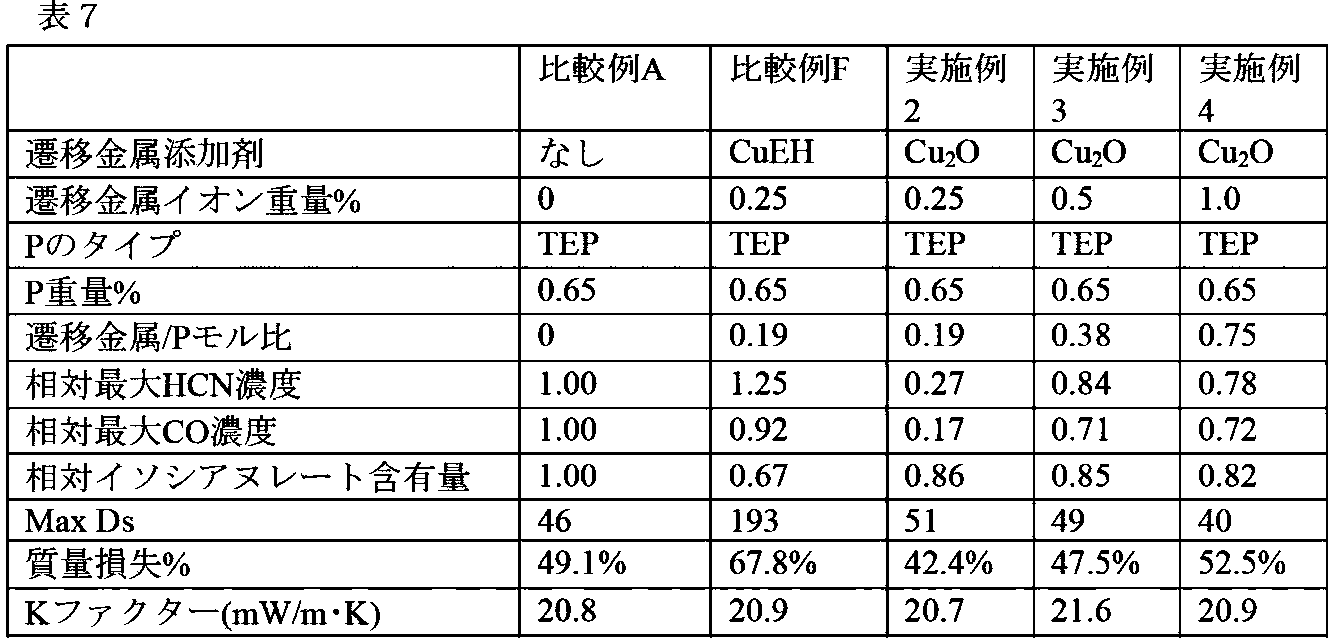
本出願の発明の例として、以下のものが挙げられる。
[1] ポリウレタンベースの発泡体を形成するためのイソシアネート反応性組成物であって、
イソシアネート反応性部分および芳香族部分を有するイソシアネート反応性化合物であって、前記芳香族部分が、前記イソシアネート反応性化合物の総重量に基づいて、前記イソシアネート反応性化合物の5重量パーセント(重量%)~80重量%である、イソシアネート反応性化合物と、
ハロゲン不含難燃性化合物からの0.1重量%~7.0重量%のリン、および
遷移金属化合物からの0.05重量%~14.0重量%の遷移金属を含む、燃焼調整剤組成物と、を含み、前記遷移金属の前記重量%および前記リンの重量%が、各々、前記イソシアネート反応性化合物、前記ハロゲン不含難燃性化合物および前記遷移金属化合物の総重量に基づく、イソシアネート反応性組成物。
[2] 前記燃焼調整剤組成物が、0.05:1~5:1の前記遷移金属対リンのモル比を有する、上記[1]に記載のイソシアネート反応性組成物。
[3] 前記ハロゲン不含難燃性化合物が、ホスフェート、ホスホネート、ホスフィネートおよびそれらの組み合わせからなる群から選択される、上記[1]に記載のイソシアネート反応性組成物。
[4] 前記遷移金属化合物が、オキシド、カルボキシレート、塩、配位化合物およびそれらの組み合わせからなる群から選択され、前記遷移金属が、銅、鉄、マンガン、コバルト、ニッケル、亜鉛およびそれらの組み合わせからなる群から選択される、上記[1]に記載のイソシアネート反応性組成物。
[5] 前記遷移金属化合物が、酸化銅(I)、酸化銅(II)、エチレンジアミン四酢酸(EDTA)銅二ナトリウム塩およびそれらの組み合わせからなる群から選択される、上記[1]に記載のイソシアネート反応性組成物。
[6] 前記遷移金属化合物が、10nm~10μmの中央値粒子直径を有する、上記[1]~[5]のいずれか一項に記載のイソシアネート反応性組成物。
[7] ポリウレタンベースの発泡体を形成するための反応混合物であって、
イソシアネート部分を有するイソシアネート化合物と、
イソシアネート反応性化合物の総重量に基づいて、前記イソシアネート反応性化合物の5重量パーセント(重量%)~80重量%を構成するイソシアネート反応性部分および芳香族部分を有する、前記イソシアネート反応性化合物と、
ハロゲン不含難燃性化合物からの0.1重量%~7.0重量%のリンおよび遷移金属化合物からの0.05重量%~14.0重量%の遷移金属であって、リンおよび前記遷移金属の重量%値が、前記イソシアネート反応性化合物、前記ハロゲン不含難燃性化合物および前記遷移金属化合物の総重量に基づく、リンおよび遷移金属と、
任意選択で、触媒、界面活性剤、発泡剤またはそれらの組み合わせと、を含む、反応混合物。
[8] 前記反応混合物が、1.2:1~7:1の前記イソシアネート部分対前記イソシアネート反応性部分のモル比を有する、上記[7]に記載の反応混合物。
[9] 上記[7]または[8]に記載の反応混合物を用いて形成された、ポリウレタンベースの発泡体。
[10] ポリウレタンベースの発泡体を生産するための反応混合物を調製するためのプロセスであって、
イソシアネート部分を有するイソシアネート化合物を提供することと、
上記[1]~[6]のいずれか一項に記載のイソシアネート反応性組成物を提供することと、
任意選択で、触媒、界面活性剤、発泡剤またはそれらの組み合わせを提供することと、
前記イソシアネート化合物、前記イソシアネート反応性組成物および前記任意選択の触媒、界面活性剤、発泡剤またはそれらの組み合わせを混合して前記反応混合物を形成することであって、前記反応混合物が、1.2:1~7:1の前記イソシアネート部分対前記イソシアネート反応性部分のモル比を有する、形成することと、を含む、プロセス。
As seen in the NBS/FTIR tests under high heat flux exposure (50 kW/ m2 ) conditions (Table 7), there was a significant reduction in HCN and CO observed for polyurethane-based foams with Cu2O at all concentrations. Surprisingly, more efficient HCN and CO reduction with higher char yield was achieved at a copper concentration of 0.25 wt%. Using the copper compound CuEH, which is soluble in the isocyanate-reactive composition, HCN emissions were higher than the control (Comparative Example A).
Examples of the invention of this application include the following:
[1] An isocyanate-reactive composition for forming a polyurethane-based foam, comprising:
an isocyanate-reactive compound having an isocyanate-reactive moiety and an aromatic moiety, the aromatic moiety being from 5 weight percent (wt %) to 80 wt % of the isocyanate-reactive compound, based on the total weight of the isocyanate-reactive compound;
0.1% to 7.0% by weight of phosphorus from a halogen-free flame retardant compound, and
and a combustion modifier composition comprising 0.05 wt. % to 14.0 wt. % of a transition metal from a transition metal compound, wherein said weight percent of said transition metal and said weight percent of said phosphorus are each based on the total weight of said isocyanate-reactive compound, said halogen-free flame retardant compound, and said transition metal compound.
[2] The isocyanate-reactive composition of [1] above, wherein the combustion modifier composition has a molar ratio of the transition metal to phosphorus of from 0.05:1 to 5:1.
[3] The isocyanate-reactive composition of [1] above, wherein the halogen-free flame retardant compound is selected from the group consisting of phosphates, phosphonates, phosphinates, and combinations thereof.
[4] The isocyanate-reactive composition of [1] above, wherein the transition metal compound is selected from the group consisting of oxides, carboxylates, salts, coordination compounds, and combinations thereof, and the transition metal is selected from the group consisting of copper, iron, manganese, cobalt, nickel, zinc, and combinations thereof.
[5] The isocyanate-reactive composition of [1] above, wherein the transition metal compound is selected from the group consisting of copper(I) oxide, copper(II) oxide, copper disodium ethylenediaminetetraacetic acid (EDTA), and combinations thereof.
[6] The isocyanate-reactive composition according to any one of [1] to [5] above, wherein the transition metal compound has a median particle diameter of from 10 nm to 10 μm.
[7] A reaction mixture for forming a polyurethane-based foam, comprising:
an isocyanate compound having an isocyanate moiety;
an isocyanate-reactive compound having an isocyanate-reactive moiety and an aromatic moiety that constitute from 5 weight percent (wt %) to 80 wt % of the isocyanate-reactive compound, based on the total weight of the isocyanate-reactive compound;
0.1 wt. % to 7.0 wt. % phosphorus from a halogen-free flame retardant compound and 0.05 wt. % to 14.0 wt. % transition metal from a transition metal compound, the weight percent values of phosphorus and said transition metal being based on the total weight of said isocyanate-reactive compound, said halogen-free flame retardant compound and said transition metal compound;
Optionally, a catalyst, a surfactant, a blowing agent, or a combination thereof.
[8] The reaction mixture of [7] above, wherein the reaction mixture has a molar ratio of the isocyanate moieties to the isocyanate-reactive moieties of from 1.2:1 to 7:1.
[9] A polyurethane-based foam formed using the reaction mixture according to [7] or [8] above.
[10] A process for preparing a reaction mixture for producing a polyurethane-based foam, comprising:
Providing an isocyanate compound having an isocyanate moiety;
Providing an isocyanate-reactive composition according to any one of [1] to [6] above;
Optionally providing a catalyst, a surfactant, a blowing agent or a combination thereof;
mixing said isocyanate compound, said isocyanate-reactive composition and said optional catalyst, surfactant, blowing agent or combination thereof to form said reaction mixture, said reaction mixture having a molar ratio of said isocyanate moieties to said isocyanate-reactive moieties of from 1.2:1 to 7:1.
Claims (8)
イソシアネート反応性部分および芳香族部分を有するイソシアネート反応性化合物であって、前記芳香族部分が、前記イソシアネート反応性化合物の総重量に基づいて、前記イソシアネート反応性化合物の5重量パーセント(重量%)~80重量%である、イソシアネート反応性化合物と、
ハロゲン不含難燃性化合物からの0.1重量%~7.0重量%のリン、および
遷移金属化合物からの0.05重量%~14.0重量%の遷移金属を含む、燃焼調整剤組成物と、
を含み、前記遷移金属の前記重量%および前記リンの重量%が、各々、前記イソシアネート反応性化合物、前記ハロゲン不含難燃性化合物および前記遷移金属化合物の総重量に基づくものであり、前記遷移金属化合物が、酸化銅(I)、酸化銅(II)、エチレンジアミン四酢酸(EDTA)銅二ナトリウム塩およびそれらの組み合わせからなる群から選択される、イソシアネート反応性組成物。 1. An isocyanate-reactive composition for forming a polyurethane-based foam, comprising:
an isocyanate-reactive compound having an isocyanate-reactive moiety and an aromatic moiety, the aromatic moiety being from 5 weight percent (wt %) to 80 wt % of the isocyanate-reactive compound, based on the total weight of the isocyanate-reactive compound;
a combustion modifier composition comprising: 0.1 wt. % to 7.0 wt. % phosphorus from a halogen-free flame retardant compound; and 0.05 wt. % to 14.0 wt. % transition metal from a transition metal compound;
wherein the weight percentage of the transition metal and the weight percentage of the phosphorus are each based on the total weight of the isocyanate-reactive compound, the halogen-free flame retardant compound, and the transition metal compound, and the transition metal compound is selected from the group consisting of copper (I) oxide, copper (II) oxide, copper ethylenediaminetetraacetic acid (EDTA) disodium salt, and combinations thereof .
イソシアネート部分を有するイソシアネート化合物と、
イソシアネート反応性化合物の総重量に基づいて、前記イソシアネート反応性化合物の5重量パーセント(重量%)~80重量%を構成するイソシアネート反応性部分および芳香族部分を有する、前記イソシアネート反応性化合物と、
ハロゲン不含難燃性化合物からの0.1重量%~7.0重量%のリンおよび遷移金属化合物からの0.05重量%~14.0重量%の遷移金属であって、リンおよび前記遷移金属の重量%値が、前記イソシアネート反応性化合物、前記ハロゲン不含難燃性化合物および前記遷移金属化合物の総重量に基づくものであり、前記遷移金属化合物が、酸化銅(I)、酸化銅(II)、エチレンジアミン四酢酸(EDTA)銅二ナトリウム塩およびそれらの組み合わせからなる群から選択される、リンおよび遷移金属と、
任意選択で、触媒、界面活性剤、発泡剤またはそれらの組み合わせと、
を含む、反応混合物。 1. A reaction mixture for forming a polyurethane-based foam, comprising:
an isocyanate compound having an isocyanate moiety;
an isocyanate-reactive compound having an isocyanate-reactive moiety and an aromatic moiety that constitute from 5 weight percent (wt %) to 80 wt % of the isocyanate-reactive compound, based on the total weight of the isocyanate-reactive compound;
0.1 wt % to 7.0 wt % phosphorus from a halogen-free flame retardant compound and 0.05 wt % to 14.0 wt % transition metal from a transition metal compound, the weight percent values of phosphorus and said transition metal being based on the total weight of said isocyanate-reactive compound, said halogen-free flame retardant compound and said transition metal compound, said transition metal compound being selected from the group consisting of copper (I) oxide, copper (II) oxide, copper disodium ethylenediaminetetraacetic acid (EDTA) and combinations thereof;
Optionally, a catalyst, a surfactant, a blowing agent or a combination thereof;
A reaction mixture comprising:
イソシアネート部分を有するイソシアネート化合物を提供することと、
請求項1~4のいずれか一項に記載のイソシアネート反応性組成物を提供することと、
任意選択で、触媒、界面活性剤、発泡剤またはそれらの組み合わせを提供することと、
前記イソシアネート化合物、前記イソシアネート反応性組成物および前記任意選択の触媒、界面活性剤、発泡剤またはそれらの組み合わせを混合して前記反応混合物を形成することであって、前記反応混合物が、1.2:1~7:1の前記イソシアネート部分対前記イソシアネート反応性部分のモル比を有する、形成することと、
を含む、プロセス。
1. A process for preparing a reaction mixture for producing a polyurethane-based foam, comprising:
Providing an isocyanate compound having an isocyanate moiety;
Providing an isocyanate-reactive composition according to any one of claims 1 to 4 ;
Optionally providing a catalyst, a surfactant, a blowing agent or a combination thereof;
mixing the isocyanate compound, the isocyanate-reactive composition and the optional catalyst, surfactant, blowing agent or combination thereof to form the reaction mixture, the reaction mixture having a molar ratio of the isocyanate moieties to the isocyanate-reactive moieties of from 1.2:1 to 7:1;
The process includes:
Applications Claiming Priority (3)
| Application Number | Priority Date | Filing Date | Title |
|---|---|---|---|
| IT201900011577 | 2019-07-12 | ||
| IT102019000011577 | 2019-07-12 | ||
| PCT/US2020/041400 WO2021011306A1 (en) | 2019-07-12 | 2020-07-09 | Polyurethane foam with improved combustion behavior |
Publications (2)
| Publication Number | Publication Date |
|---|---|
| JP2022540216A JP2022540216A (en) | 2022-09-14 |
| JP7586887B2 true JP7586887B2 (en) | 2024-11-19 |
Family
ID=68343376
Family Applications (1)
| Application Number | Title | Priority Date | Filing Date |
|---|---|---|---|
| JP2022501241A Active JP7586887B2 (en) | 2019-07-12 | 2020-07-09 | Polyurethane foams having improved combustion behavior |
Country Status (5)
| Country | Link |
|---|---|
| US (1) | US20220267510A1 (en) |
| EP (1) | EP3997145A1 (en) |
| JP (1) | JP7586887B2 (en) |
| CN (1) | CN114174366B (en) |
| WO (1) | WO2021011306A1 (en) |
Families Citing this family (5)
| Publication number | Priority date | Publication date | Assignee | Title |
|---|---|---|---|---|
| WO2021011226A1 (en) * | 2019-07-12 | 2021-01-21 | Dow Global Technologies Llc | Metal polyols for use in a polyurethane polymer |
| US20240034830A1 (en) * | 2020-07-17 | 2024-02-01 | Dow Global Technologies Llc | Polyurethanes with reduced cobalt extractables |
| KR102309426B1 (en) * | 2021-04-30 | 2021-10-06 | 대한폴리텍(주) | A semi-nonflammable foam used as insulation |
| MX428655B (en) * | 2021-10-25 | 2025-11-13 | Dow Quim Mexicana S A De C V | Flame retardant rigid high density polyurethane foam |
| CN119859234A (en) * | 2025-01-22 | 2025-04-22 | 安徽工业大学 | Flame-retardant rigid polyurethane foam heat-insulating material and preparation method thereof |
Citations (5)
| Publication number | Priority date | Publication date | Assignee | Title |
|---|---|---|---|---|
| JP2010163472A (en) | 2009-01-13 | 2010-07-29 | Mitsubishi Engineering Plastics Corp | Flame-retardant polyamide resin composition for ionizing radiation irradiation |
| JP2014532098A (en) | 2011-09-29 | 2014-12-04 | ダウ グローバル テクノロジーズ エルエルシー | Use of trialkyl phosphates as smoke suppressants in polyurethane foams |
| JP2016169314A (en) | 2015-03-13 | 2016-09-23 | 新日鉄住金化学株式会社 | Oxazolidone ring-containing epoxy resin, production method thereof, epoxy resin composition and cured product |
| WO2017204345A1 (en) | 2016-05-26 | 2017-11-30 | 積水化学工業株式会社 | Polyurethane composition |
| JP2020172603A (en) | 2019-04-12 | 2020-10-22 | 積水ソフランウイズ株式会社 | Foamable urethane resin composition and polyurethane foam |
Family Cites Families (21)
| Publication number | Priority date | Publication date | Assignee | Title |
|---|---|---|---|---|
| BE536296A (en) | 1954-03-22 | |||
| BE538608A (en) | 1954-06-10 | |||
| US2846458A (en) | 1956-05-23 | 1958-08-05 | Dow Corning | Organosiloxane ethers |
| US5600019A (en) | 1993-12-17 | 1997-02-04 | The Dow Chemical Company | Polyisocyanate based polymers perpared from formulations including non-silicone surfactants and method for the preparation thereof |
| JPH11140150A (en) * | 1997-11-13 | 1999-05-25 | Chisso Corp | Composition for low smoke generating flame retardant polyisocyanurate foam and low smoke forming flame retardant foam using the same |
| US6387973B1 (en) * | 1999-08-12 | 2002-05-14 | Kay Metzeler Limited | Flexible polyurethane foam containing copper |
| US8048935B2 (en) * | 2004-11-08 | 2011-11-01 | Carpenter Co. | Liquid foam systems and ASTM E-84 class 1 rated rigid, high-density polyurethane foams and articles prepared therefrom |
| US7666919B2 (en) * | 2006-03-14 | 2010-02-23 | Air Products And Chemicals, Inc. | Aromatic diacid ester diols and substituted carbamates thereof for minimizing deterioration of polyurethane foams |
| GB0713394D0 (en) * | 2007-07-11 | 2007-08-22 | Univ Strathclyde | Fire retarded polyurethane foams |
| JP2010222399A (en) * | 2009-03-19 | 2010-10-07 | Toyo Tire & Rubber Co Ltd | Polyol composition for rigid polyurethane foam |
| WO2010114703A1 (en) * | 2009-04-01 | 2010-10-07 | Dow Global Technologies Inc. | Polyurethane and polyisocyanurate foams having improved curing performance and fire behavior |
| CN102504751B (en) * | 2011-11-22 | 2014-05-07 | 东莞市普赛达密封粘胶有限公司 | Flame-retardant polyurethane sealant and preparation method thereof |
| JP2014181282A (en) * | 2013-03-19 | 2014-09-29 | Dic Corp | Composition for polyurethane resin and polyurethane resin foam using the same |
| CN103554428B (en) * | 2013-11-18 | 2015-05-13 | 中国林业科学研究院林产化学工业研究所 | Core-shell synergistic flame retardant polyurethane microencapsulation expandable graphite and application thereof in rigid polyurethane foaming plastic |
| TW201542682A (en) * | 2014-02-27 | 2015-11-16 | Sekisui Chemical Co Ltd | In-situ foaming system for forming flame-retardant polyurethane foam in situ |
| CN103910844B (en) * | 2014-04-24 | 2016-05-04 | 常州大学 | A kind of halogen-free low-smoke rigid polyurethane foam and preparation method thereof |
| CN105601864A (en) * | 2014-11-21 | 2016-05-25 | 合肥杰事杰新材料股份有限公司 | Low-smoke low-toxicity flame-retardation hard polyurethane foam plastics and preparation method thereof |
| MX2019015445A (en) * | 2017-06-27 | 2020-02-19 | Albemarle Corp | Flame retarded polyurethane foam. |
| JP7182601B2 (en) * | 2017-07-24 | 2022-12-02 | アイシーエル‐アイピー・アメリカ・インコーポレイテッド | Rigid polyurethane foam with reactive flame retardant |
| CN109111558A (en) * | 2018-02-13 | 2019-01-01 | 公安部天津消防研究所 | A kind of low-smoke low-toxicity flame retarded rigid polyurethane foams material and preparation method |
| US20210122872A1 (en) * | 2019-10-23 | 2021-04-29 | Ruei-Hong Hsu | Flame-resistant polyurethane foam material |
-
2020
- 2020-07-09 EP EP20746520.4A patent/EP3997145A1/en active Pending
- 2020-07-09 CN CN202080049675.9A patent/CN114174366B/en active Active
- 2020-07-09 US US17/625,608 patent/US20220267510A1/en not_active Abandoned
- 2020-07-09 JP JP2022501241A patent/JP7586887B2/en active Active
- 2020-07-09 WO PCT/US2020/041400 patent/WO2021011306A1/en not_active Ceased
Patent Citations (5)
| Publication number | Priority date | Publication date | Assignee | Title |
|---|---|---|---|---|
| JP2010163472A (en) | 2009-01-13 | 2010-07-29 | Mitsubishi Engineering Plastics Corp | Flame-retardant polyamide resin composition for ionizing radiation irradiation |
| JP2014532098A (en) | 2011-09-29 | 2014-12-04 | ダウ グローバル テクノロジーズ エルエルシー | Use of trialkyl phosphates as smoke suppressants in polyurethane foams |
| JP2016169314A (en) | 2015-03-13 | 2016-09-23 | 新日鉄住金化学株式会社 | Oxazolidone ring-containing epoxy resin, production method thereof, epoxy resin composition and cured product |
| WO2017204345A1 (en) | 2016-05-26 | 2017-11-30 | 積水化学工業株式会社 | Polyurethane composition |
| JP2020172603A (en) | 2019-04-12 | 2020-10-22 | 積水ソフランウイズ株式会社 | Foamable urethane resin composition and polyurethane foam |
Also Published As
| Publication number | Publication date |
|---|---|
| JP2022540216A (en) | 2022-09-14 |
| EP3997145A1 (en) | 2022-05-18 |
| US20220267510A1 (en) | 2022-08-25 |
| WO2021011306A1 (en) | 2021-01-21 |
| CN114174366B (en) | 2025-03-14 |
| CN114174366A (en) | 2022-03-11 |
Similar Documents
| Publication | Publication Date | Title |
|---|---|---|
| CN103827194B (en) | Trialkylphosphate is as the purposes of the smog inhibitor in polyurethane foam | |
| CN104334599B (en) | Manufacture of polyisocyanurate foam panels | |
| CN114174366B (en) | Polyurethane foam with improved combustion properties | |
| RU2679617C2 (en) | Process for preparation of solid polyurethane foam or urethane modified polyisocyanurate foam | |
| EP3864061B1 (en) | A rigid polyurethane foam formulation and foam made therefrom | |
| US11952491B2 (en) | Rigid polyurethane foam formulation and foam made therefrom | |
| JP7578423B2 (en) | Composition for polyurethane foam and polyurethane foam | |
| JP2021507968A (en) | Hard foam | |
| JP6262872B2 (en) | Catalyst composition and method for producing foam | |
| CN103339164B (en) | Polyol Formulations for Improved Low Temperature Skin Curing of Polyurethane Rigid Foams | |
| JP7861132B2 (en) | Flame-retardant rigid high-density polyurethane foam | |
| JP7805282B2 (en) | Transition metal chelate polyol blends for use in polyurethane polymers - Patent Application 20070122999 | |
| CN106459335A (en) | Isocyanate trimerization catalyst for making polyisocyanurate comprising foams | |
| JP7590404B2 (en) | Metallic polyols for use in polyurethane polymers - Patents.com | |
| JP2022064051A (en) | Polyisocyanurate foam forming composition, polyisocyanurate foam and insulation | |
| EP4353764A1 (en) | Polyurethane foam and manufacturing method therefor | |
| EP4011929A1 (en) | Composition for forming polyurethane foam, polyurethane foam, and thermal insulating material |
Legal Events
| Date | Code | Title | Description |
|---|---|---|---|
| A521 | Request for written amendment filed |
Free format text: JAPANESE INTERMEDIATE CODE: A523 Effective date: 20220118 |
|
| RD03 | Notification of appointment of power of attorney |
Free format text: JAPANESE INTERMEDIATE CODE: A7423 Effective date: 20220120 |
|
| RD04 | Notification of resignation of power of attorney |
Free format text: JAPANESE INTERMEDIATE CODE: A7424 Effective date: 20220511 |
|
| A621 | Written request for application examination |
Free format text: JAPANESE INTERMEDIATE CODE: A621 Effective date: 20230628 |
|
| A977 | Report on retrieval |
Free format text: JAPANESE INTERMEDIATE CODE: A971007 Effective date: 20240726 |
|
| A131 | Notification of reasons for refusal |
Free format text: JAPANESE INTERMEDIATE CODE: A131 Effective date: 20240806 |
|
| A521 | Request for written amendment filed |
Free format text: JAPANESE INTERMEDIATE CODE: A523 Effective date: 20241002 |
|
| TRDD | Decision of grant or rejection written | ||
| A01 | Written decision to grant a patent or to grant a registration (utility model) |
Free format text: JAPANESE INTERMEDIATE CODE: A01 Effective date: 20241022 |
|
| A61 | First payment of annual fees (during grant procedure) |
Free format text: JAPANESE INTERMEDIATE CODE: A61 Effective date: 20241107 |
|
| R150 | Certificate of patent or registration of utility model |
Ref document number: 7586887 Country of ref document: JP Free format text: JAPANESE INTERMEDIATE CODE: R150 |
|
| S802 | Written request for registration of partial abandonment of right |
Free format text: JAPANESE INTERMEDIATE CODE: R311802 |
|
| R350 | Written notification of registration of transfer |
Free format text: JAPANESE INTERMEDIATE CODE: R350 |