EP3148995B1 - 6-substituierte-3h-1,3-benzothiazol-2-on-verbindungen als tarp-gamma-8-abhängige ampa-rezeptorantagonisten - Google Patents
6-substituierte-3h-1,3-benzothiazol-2-on-verbindungen als tarp-gamma-8-abhängige ampa-rezeptorantagonisten Download PDFInfo
- Publication number
- EP3148995B1 EP3148995B1 EP15726843.4A EP15726843A EP3148995B1 EP 3148995 B1 EP3148995 B1 EP 3148995B1 EP 15726843 A EP15726843 A EP 15726843A EP 3148995 B1 EP3148995 B1 EP 3148995B1
- Authority
- EP
- European Patent Office
- Prior art keywords
- ethyl
- benzothiazol
- pyrazol
- pyridyl
- isomer
- Prior art date
- Legal status (The legal status is an assumption and is not a legal conclusion. Google has not performed a legal analysis and makes no representation as to the accuracy of the status listed.)
- Active
Links
- 0 CC([C@@]1N[C@](C(N)=CC=C(*)*)SC1)=NN* Chemical compound CC([C@@]1N[C@](C(N)=CC=C(*)*)SC1)=NN* 0.000 description 7
- HSTFGWLPYJDMQK-NORWICTASA-O C=C(C(/C=C\Nc(nc1)ccc1Br)=[NH2+])c(cc1S2)ccc1NC2=O Chemical compound C=C(C(/C=C\Nc(nc1)ccc1Br)=[NH2+])c(cc1S2)ccc1NC2=O HSTFGWLPYJDMQK-NORWICTASA-O 0.000 description 1
- GKUSUIIVUWWCMV-UHFFFAOYSA-N C=C(c1nc(-c2ccc(CCO)cn2)c[s]1)c(cc1S2)ccc1NC2=O Chemical compound C=C(c1nc(-c2ccc(CCO)cn2)c[s]1)c(cc1S2)ccc1NC2=O GKUSUIIVUWWCMV-UHFFFAOYSA-N 0.000 description 1
- QCVKRCNLOZJUJA-UHFFFAOYSA-N CC(C(OC(C)(C)C)=O)c(cc1S2)ccc1N(COC)C2=O Chemical compound CC(C(OC(C)(C)C)=O)c(cc1S2)ccc1N(COC)C2=O QCVKRCNLOZJUJA-UHFFFAOYSA-N 0.000 description 1
- GVPLXOUQLBMCDI-UHFFFAOYSA-N CC(C)(C#Cc(cn1)ccc1Br)OC1OCCCC1 Chemical compound CC(C)(C#Cc(cn1)ccc1Br)OC1OCCCC1 GVPLXOUQLBMCDI-UHFFFAOYSA-N 0.000 description 1
- DPLNOHLYSPQOEM-UHFFFAOYSA-N CC(C)(C)c1nc(C)c[s]1 Chemical compound CC(C)(C)c1nc(C)c[s]1 DPLNOHLYSPQOEM-UHFFFAOYSA-N 0.000 description 1
- NEKMDYCBSNOINL-UHFFFAOYSA-N CC(C)C1=NN(C(C)C)C(C)C1 Chemical compound CC(C)C1=NN(C(C)C)C(C)C1 NEKMDYCBSNOINL-UHFFFAOYSA-N 0.000 description 1
- MSUZFDOWKCIMJK-UHFFFAOYSA-N CC(COC(C)c1ccc(-[n]2nc(C(C)c(cc3)cc(S4)c3NC4=O)cc2)nc1)O Chemical compound CC(COC(C)c1ccc(-[n]2nc(C(C)c(cc3)cc(S4)c3NC4=O)cc2)nc1)O MSUZFDOWKCIMJK-UHFFFAOYSA-N 0.000 description 1
- BFQWQRNHJMYINE-UHFFFAOYSA-N CC(c(cc1)n[n]1-c(cc1)ncc1OCC(C)(C)O)c(cc1)cc(S2)c1N(COC)C2=O Chemical compound CC(c(cc1)n[n]1-c(cc1)ncc1OCC(C)(C)O)c(cc1)cc(S2)c1N(COC)C2=O BFQWQRNHJMYINE-UHFFFAOYSA-N 0.000 description 1
- SHQVYMYEWDQVAC-UHFFFAOYSA-N CC(c(cc1)n[n]1-c(nc1)ccc1C(OC)=O)c(cc1)cc(S2)c1N(COC)C2=O Chemical compound CC(c(cc1)n[n]1-c(nc1)ccc1C(OC)=O)c(cc1)cc(S2)c1N(COC)C2=O SHQVYMYEWDQVAC-UHFFFAOYSA-N 0.000 description 1
- NJXBJIFJINXPRD-UHFFFAOYSA-N CC(c(cc1)n[n]1-c(nc1)ccc1N(C)CCO)c(cc1S2)ccc1NC2=O Chemical compound CC(c(cc1)n[n]1-c(nc1)ccc1N(C)CCO)c(cc1S2)ccc1NC2=O NJXBJIFJINXPRD-UHFFFAOYSA-N 0.000 description 1
- FTTQEQYWQMTFNC-UHFFFAOYSA-N CC(c(cc1)n[n]1-c(nc1)ccc1N(C1)CC1(C)OC)c(cc1S2)ccc1N(COCC[Si](C)(C)C)C2=O Chemical compound CC(c(cc1)n[n]1-c(nc1)ccc1N(C1)CC1(C)OC)c(cc1S2)ccc1N(COCC[Si](C)(C)C)C2=O FTTQEQYWQMTFNC-UHFFFAOYSA-N 0.000 description 1
- VGLAOHLWNLQJOJ-UHFFFAOYSA-N CC(c(cc1)n[n]1-c(nc1)ccc1N(CC1)CCC1O)c(cc1S2)ccc1N(COC)C2=O Chemical compound CC(c(cc1)n[n]1-c(nc1)ccc1N(CC1)CCC1O)c(cc1S2)ccc1N(COC)C2=O VGLAOHLWNLQJOJ-UHFFFAOYSA-N 0.000 description 1
- AHBQTBZWZIRCBJ-UHFFFAOYSA-N CC(c(cc1)n[n]1-c(nc1)ccc1N1CCC(CCO)CC1)c(cc1S2)ccc1N(COCC[Si+](C)(C)C)C2=O Chemical compound CC(c(cc1)n[n]1-c(nc1)ccc1N1CCC(CCO)CC1)c(cc1S2)ccc1N(COCC[Si+](C)(C)C)C2=O AHBQTBZWZIRCBJ-UHFFFAOYSA-N 0.000 description 1
- WBUWLPNUBJKRRV-UHFFFAOYSA-N CC(c(cc1)n[n]1-c(nc1)ccc1OCCCOC1OCCCC1)c(cc1S2)ccc1N(COCC[SiH-](C)(C)C)C2=O Chemical compound CC(c(cc1)n[n]1-c(nc1)ccc1OCCCOC1OCCCC1)c(cc1S2)ccc1N(COCC[SiH-](C)(C)C)C2=O WBUWLPNUBJKRRV-UHFFFAOYSA-N 0.000 description 1
- XFPLAWTZTRVAGA-UHFFFAOYSA-N CC(c(cc1)n[n]1-c(nc1)ccc1Sc1ncc[n]1C)c(cc1S2)ccc1NC2=O Chemical compound CC(c(cc1)n[n]1-c(nc1)ccc1Sc1ncc[n]1C)c(cc1S2)ccc1NC2=O XFPLAWTZTRVAGA-UHFFFAOYSA-N 0.000 description 1
- KJXBTQGXUNPDRZ-UHFFFAOYSA-N CC(c(cc1)n[n]1-c1ccc(C(C)OCCO)cn1)c(cc1S2)ccc1N(COCC[Si+](C)(C)C)C2=O Chemical compound CC(c(cc1)n[n]1-c1ccc(C(C)OCCO)cn1)c(cc1S2)ccc1N(COCC[Si+](C)(C)C)C2=O KJXBTQGXUNPDRZ-UHFFFAOYSA-N 0.000 description 1
- NGDVQJFSXMSAPV-UHFFFAOYSA-N CC(c(cc1)n[n]1-c1ccc(C2OC(CO)CC2)cn1)c(cc1S2)ccc1NC2=O Chemical compound CC(c(cc1)n[n]1-c1ccc(C2OC(CO)CC2)cn1)c(cc1S2)ccc1NC2=O NGDVQJFSXMSAPV-UHFFFAOYSA-N 0.000 description 1
- XJYUBLNJGVWFJB-UHFFFAOYSA-N CC(c(cc1)n[n]1-c1ccc(CC(C)=O)cn1)c(cc1S2)ccc1NC2=O Chemical compound CC(c(cc1)n[n]1-c1ccc(CC(C)=O)cn1)c(cc1S2)ccc1NC2=O XJYUBLNJGVWFJB-UHFFFAOYSA-N 0.000 description 1
- WAGCXZARIGADLS-UHFFFAOYSA-N CC(c(cc1)n[n]1-c1ccc(CO)cn1)c(cc1S2)ccc1N(COC)C2=O Chemical compound CC(c(cc1)n[n]1-c1ccc(CO)cn1)c(cc1S2)ccc1N(COC)C2=O WAGCXZARIGADLS-UHFFFAOYSA-N 0.000 description 1
- RYGWJSCVRWEPFG-UHFFFAOYSA-N CC(c(cc1)n[n]1-c1ccc(CO)nn1)c1ccc2NC(O)Sc2c1 Chemical compound CC(c(cc1)n[n]1-c1ccc(CO)nn1)c1ccc2NC(O)Sc2c1 RYGWJSCVRWEPFG-UHFFFAOYSA-N 0.000 description 1
- YXJWKYPUPLAFRW-UHFFFAOYSA-N CC(c(cc1)n[n]1-c1ccc(COCC(C)(C)O)cn1)c(cc1S2)ccc1NC2=O Chemical compound CC(c(cc1)n[n]1-c1ccc(COCC(C)(C)O)cn1)c(cc1S2)ccc1NC2=O YXJWKYPUPLAFRW-UHFFFAOYSA-N 0.000 description 1
- NLLJBKWGHPARPW-UHFFFAOYSA-N CC(c(cc1)n[n]1-c1ncc(CCO)cc1)c(cc1S2)ccc1NC2=O Chemical compound CC(c(cc1)n[n]1-c1ncc(CCO)cc1)c(cc1S2)ccc1NC2=O NLLJBKWGHPARPW-UHFFFAOYSA-N 0.000 description 1
- FVOQEIZZKTYFSA-UHFFFAOYSA-N CC(c(cc1S2)ccc1N(COCC[Si+](C)(C)C)C2=O)=O Chemical compound CC(c(cc1S2)ccc1N(COCC[Si+](C)(C)C)C2=O)=O FVOQEIZZKTYFSA-UHFFFAOYSA-N 0.000 description 1
- CCDHABPZLYBFGJ-UHFFFAOYSA-N CC(c1nc(Br)c[s]1)c(cc1S2)ccc1N(COC)C2=O Chemical compound CC(c1nc(Br)c[s]1)c(cc1S2)ccc1N(COC)C2=O CCDHABPZLYBFGJ-UHFFFAOYSA-N 0.000 description 1
- UGBHBJRDKXMDOJ-UHFFFAOYSA-O CC1(CC[OH2+])C=NC(c2nc(C(O)=O)c[s]2)=CC1 Chemical compound CC1(CC[OH2+])C=NC(c2nc(C(O)=O)c[s]2)=CC1 UGBHBJRDKXMDOJ-UHFFFAOYSA-O 0.000 description 1
- ZYYXUAZCNBITJZ-UHFFFAOYSA-N CC1C=CC([SiH](C(C)(C)C)c2ccccc2)=CC1 Chemical compound CC1C=CC([SiH](C(C)(C)C)c2ccccc2)=CC1 ZYYXUAZCNBITJZ-UHFFFAOYSA-N 0.000 description 1
- LCKNQXUCLLGIPZ-UHFFFAOYSA-N CCOC(C(C)Sc1ccc(-[n]2nc(C(C)c(cc3S4)ccc3N(COCC[Si+](C)(C)C)C4=O)cc2)nc1)=O Chemical compound CCOC(C(C)Sc1ccc(-[n]2nc(C(C)c(cc3S4)ccc3N(COCC[Si+](C)(C)C)C4=O)cc2)nc1)=O LCKNQXUCLLGIPZ-UHFFFAOYSA-N 0.000 description 1
- YTCHAUYQRKNQJH-UHFFFAOYSA-O COCN(c(c(S1)c2)ccc2C(C([NH3+])=CC=N)=C)C1=O Chemical compound COCN(c(c(S1)c2)ccc2C(C([NH3+])=CC=N)=C)C1=O YTCHAUYQRKNQJH-UHFFFAOYSA-O 0.000 description 1
- XJCVKLBGLWGEAH-UHFFFAOYSA-N COCN(c(c(S1)c2)ccc2C(c2ccn[nH]2)=C)C1=O Chemical compound COCN(c(c(S1)c2)ccc2C(c2ccn[nH]2)=C)C1=O XJCVKLBGLWGEAH-UHFFFAOYSA-N 0.000 description 1
- ZNMBVASVBZWSBL-UHFFFAOYSA-O C[Si+](C)(C)CCOC[NH2+]C(C(c(cc1S2)ccc1NC2=O)=O)=CC=N Chemical compound C[Si+](C)(C)CCOC[NH2+]C(C(c(cc1S2)ccc1NC2=O)=O)=CC=N ZNMBVASVBZWSBL-UHFFFAOYSA-O 0.000 description 1
- OBSLLHNATPQFMJ-UHFFFAOYSA-N Cc1c[s]c(C)n1 Chemical compound Cc1c[s]c(C)n1 OBSLLHNATPQFMJ-UHFFFAOYSA-N 0.000 description 1
- DOYFKARFAVANEP-UHFFFAOYSA-N O=C(c1nc(Br)c[s]1)c(cc1S2)ccc1NC2=O Chemical compound O=C(c1nc(Br)c[s]1)c(cc1S2)ccc1NC2=O DOYFKARFAVANEP-UHFFFAOYSA-N 0.000 description 1
Classifications
-
- C—CHEMISTRY; METALLURGY
- C07—ORGANIC CHEMISTRY
- C07D—HETEROCYCLIC COMPOUNDS
- C07D417/00—Heterocyclic compounds containing two or more hetero rings, at least one ring having nitrogen and sulfur atoms as the only ring hetero atoms, not provided for by group C07D415/00
- C07D417/14—Heterocyclic compounds containing two or more hetero rings, at least one ring having nitrogen and sulfur atoms as the only ring hetero atoms, not provided for by group C07D415/00 containing three or more hetero rings
-
- A—HUMAN NECESSITIES
- A61—MEDICAL OR VETERINARY SCIENCE; HYGIENE
- A61K—PREPARATIONS FOR MEDICAL, DENTAL OR TOILETRY PURPOSES
- A61K31/00—Medicinal preparations containing organic active ingredients
- A61K31/185—Acids; Anhydrides, halides or salts thereof, e.g. sulfur acids, imidic, hydrazonic or hydroximic acids
- A61K31/19—Carboxylic acids, e.g. valproic acid
- A61K31/195—Carboxylic acids, e.g. valproic acid having an amino group
-
- A—HUMAN NECESSITIES
- A61—MEDICAL OR VETERINARY SCIENCE; HYGIENE
- A61K—PREPARATIONS FOR MEDICAL, DENTAL OR TOILETRY PURPOSES
- A61K31/00—Medicinal preparations containing organic active ingredients
- A61K31/33—Heterocyclic compounds
- A61K31/395—Heterocyclic compounds having nitrogen as a ring hetero atom, e.g. guanethidine or rifamycins
- A61K31/40—Heterocyclic compounds having nitrogen as a ring hetero atom, e.g. guanethidine or rifamycins having five-membered rings with one nitrogen as the only ring hetero atom, e.g. sulpiride, succinimide, tolmetin, buflomedil
- A61K31/4015—Heterocyclic compounds having nitrogen as a ring hetero atom, e.g. guanethidine or rifamycins having five-membered rings with one nitrogen as the only ring hetero atom, e.g. sulpiride, succinimide, tolmetin, buflomedil having oxo groups directly attached to the heterocyclic ring, e.g. piracetam, ethosuximide
-
- A—HUMAN NECESSITIES
- A61—MEDICAL OR VETERINARY SCIENCE; HYGIENE
- A61K—PREPARATIONS FOR MEDICAL, DENTAL OR TOILETRY PURPOSES
- A61K31/00—Medicinal preparations containing organic active ingredients
- A61K31/33—Heterocyclic compounds
- A61K31/395—Heterocyclic compounds having nitrogen as a ring hetero atom, e.g. guanethidine or rifamycins
- A61K31/41—Heterocyclic compounds having nitrogen as a ring hetero atom, e.g. guanethidine or rifamycins having five-membered rings with two or more ring hetero atoms, at least one of which being nitrogen, e.g. tetrazole
-
- A—HUMAN NECESSITIES
- A61—MEDICAL OR VETERINARY SCIENCE; HYGIENE
- A61K—PREPARATIONS FOR MEDICAL, DENTAL OR TOILETRY PURPOSES
- A61K31/00—Medicinal preparations containing organic active ingredients
- A61K31/33—Heterocyclic compounds
- A61K31/395—Heterocyclic compounds having nitrogen as a ring hetero atom, e.g. guanethidine or rifamycins
- A61K31/41—Heterocyclic compounds having nitrogen as a ring hetero atom, e.g. guanethidine or rifamycins having five-membered rings with two or more ring hetero atoms, at least one of which being nitrogen, e.g. tetrazole
- A61K31/425—Thiazoles
- A61K31/428—Thiazoles condensed with carbocyclic rings
-
- A—HUMAN NECESSITIES
- A61—MEDICAL OR VETERINARY SCIENCE; HYGIENE
- A61K—PREPARATIONS FOR MEDICAL, DENTAL OR TOILETRY PURPOSES
- A61K31/00—Medicinal preparations containing organic active ingredients
- A61K31/33—Heterocyclic compounds
- A61K31/395—Heterocyclic compounds having nitrogen as a ring hetero atom, e.g. guanethidine or rifamycins
- A61K31/435—Heterocyclic compounds having nitrogen as a ring hetero atom, e.g. guanethidine or rifamycins having six-membered rings with one nitrogen as the only ring hetero atom
- A61K31/44—Non condensed pyridines; Hydrogenated derivatives thereof
- A61K31/4427—Non condensed pyridines; Hydrogenated derivatives thereof containing further heterocyclic ring systems
- A61K31/4439—Non condensed pyridines; Hydrogenated derivatives thereof containing further heterocyclic ring systems containing a five-membered ring with nitrogen as a ring hetero atom, e.g. omeprazole
-
- A—HUMAN NECESSITIES
- A61—MEDICAL OR VETERINARY SCIENCE; HYGIENE
- A61K—PREPARATIONS FOR MEDICAL, DENTAL OR TOILETRY PURPOSES
- A61K31/00—Medicinal preparations containing organic active ingredients
- A61K31/33—Heterocyclic compounds
- A61K31/395—Heterocyclic compounds having nitrogen as a ring hetero atom, e.g. guanethidine or rifamycins
- A61K31/435—Heterocyclic compounds having nitrogen as a ring hetero atom, e.g. guanethidine or rifamycins having six-membered rings with one nitrogen as the only ring hetero atom
- A61K31/44—Non condensed pyridines; Hydrogenated derivatives thereof
- A61K31/445—Non condensed piperidines, e.g. piperocaine
- A61K31/4523—Non condensed piperidines, e.g. piperocaine containing further heterocyclic ring systems
- A61K31/4545—Non condensed piperidines, e.g. piperocaine containing further heterocyclic ring systems containing a six-membered ring with nitrogen as a ring hetero atom, e.g. pipamperone, anabasine
-
- A—HUMAN NECESSITIES
- A61—MEDICAL OR VETERINARY SCIENCE; HYGIENE
- A61K—PREPARATIONS FOR MEDICAL, DENTAL OR TOILETRY PURPOSES
- A61K31/00—Medicinal preparations containing organic active ingredients
- A61K31/33—Heterocyclic compounds
- A61K31/395—Heterocyclic compounds having nitrogen as a ring hetero atom, e.g. guanethidine or rifamycins
- A61K31/495—Heterocyclic compounds having nitrogen as a ring hetero atom, e.g. guanethidine or rifamycins having six-membered rings with two or more nitrogen atoms as the only ring heteroatoms, e.g. piperazine or tetrazines
- A61K31/50—Pyridazines; Hydrogenated pyridazines
- A61K31/501—Pyridazines; Hydrogenated pyridazines not condensed and containing further heterocyclic rings
-
- A—HUMAN NECESSITIES
- A61—MEDICAL OR VETERINARY SCIENCE; HYGIENE
- A61K—PREPARATIONS FOR MEDICAL, DENTAL OR TOILETRY PURPOSES
- A61K31/00—Medicinal preparations containing organic active ingredients
- A61K31/33—Heterocyclic compounds
- A61K31/395—Heterocyclic compounds having nitrogen as a ring hetero atom, e.g. guanethidine or rifamycins
- A61K31/535—Heterocyclic compounds having nitrogen as a ring hetero atom, e.g. guanethidine or rifamycins having six-membered rings with at least one nitrogen and one oxygen as the ring hetero atoms, e.g. 1,2-oxazines
- A61K31/5375—1,4-Oxazines, e.g. morpholine
- A61K31/5377—1,4-Oxazines, e.g. morpholine not condensed and containing further heterocyclic rings, e.g. timolol
-
- A—HUMAN NECESSITIES
- A61—MEDICAL OR VETERINARY SCIENCE; HYGIENE
- A61K—PREPARATIONS FOR MEDICAL, DENTAL OR TOILETRY PURPOSES
- A61K31/00—Medicinal preparations containing organic active ingredients
- A61K31/33—Heterocyclic compounds
- A61K31/395—Heterocyclic compounds having nitrogen as a ring hetero atom, e.g. guanethidine or rifamycins
- A61K31/55—Heterocyclic compounds having nitrogen as a ring hetero atom, e.g. guanethidine or rifamycins having seven-membered rings, e.g. azelastine, pentylenetetrazole
-
- A—HUMAN NECESSITIES
- A61—MEDICAL OR VETERINARY SCIENCE; HYGIENE
- A61K—PREPARATIONS FOR MEDICAL, DENTAL OR TOILETRY PURPOSES
- A61K31/00—Medicinal preparations containing organic active ingredients
- A61K31/70—Carbohydrates; Sugars; Derivatives thereof
- A61K31/7042—Compounds having saccharide radicals and heterocyclic rings
- A61K31/7048—Compounds having saccharide radicals and heterocyclic rings having oxygen as a ring hetero atom, e.g. leucoglucosan, hesperidin, erythromycin, nystatin, digitoxin or digoxin
-
- A—HUMAN NECESSITIES
- A61—MEDICAL OR VETERINARY SCIENCE; HYGIENE
- A61K—PREPARATIONS FOR MEDICAL, DENTAL OR TOILETRY PURPOSES
- A61K45/00—Medicinal preparations containing active ingredients not provided for in groups A61K31/00 - A61K41/00
- A61K45/06—Mixtures of active ingredients without chemical characterisation, e.g. antiphlogistics and cardiaca
-
- A—HUMAN NECESSITIES
- A61—MEDICAL OR VETERINARY SCIENCE; HYGIENE
- A61P—SPECIFIC THERAPEUTIC ACTIVITY OF CHEMICAL COMPOUNDS OR MEDICINAL PREPARATIONS
- A61P25/00—Drugs for disorders of the nervous system
-
- A—HUMAN NECESSITIES
- A61—MEDICAL OR VETERINARY SCIENCE; HYGIENE
- A61P—SPECIFIC THERAPEUTIC ACTIVITY OF CHEMICAL COMPOUNDS OR MEDICINAL PREPARATIONS
- A61P25/00—Drugs for disorders of the nervous system
- A61P25/04—Centrally acting analgesics, e.g. opioids
-
- A—HUMAN NECESSITIES
- A61—MEDICAL OR VETERINARY SCIENCE; HYGIENE
- A61P—SPECIFIC THERAPEUTIC ACTIVITY OF CHEMICAL COMPOUNDS OR MEDICINAL PREPARATIONS
- A61P25/00—Drugs for disorders of the nervous system
- A61P25/08—Antiepileptics; Anticonvulsants
-
- A—HUMAN NECESSITIES
- A61—MEDICAL OR VETERINARY SCIENCE; HYGIENE
- A61P—SPECIFIC THERAPEUTIC ACTIVITY OF CHEMICAL COMPOUNDS OR MEDICINAL PREPARATIONS
- A61P43/00—Drugs for specific purposes, not provided for in groups A61P1/00-A61P41/00
Definitions
- Epilepsy affects over 50 million people world-wide, with 30-40% of treated patients being resistant to current pharmacotherapies and only about 8% of treated patients being maintained seizure free. Epilepsy is often defined as when a person has two or more unprovoked epileptic seizures.
- the International League against Epilepsy (ILAE) defines an epileptic seizure as "a transient occurrence of signs and/or symptoms due to abnormal excessive or synchronous neuronal activity in the brain.” Seizures are thought to have a number of underlying causalities which adds to the difficulty in treating epilepsy.
- Seizures have been divided according to their clinical presentation including generalized seizures (absence, atonic, tonic-clonic (grand mal), and myoclonic), simple and complex partial onset seizures, gelastic seizures, dacrystic seizures, and status epilepticus.
- Current therapies target a variety of mechanisms including GABA ( ⁇ -aminobutyric acid) receptor agonism, T-type calcium channel blockers, sodium channel modulators, synaptic vesicle protein SV2A modulation, and inhibition of GABA transaminase. More recently, AMPA ( ⁇ -amino-3-hydroxyl-5-methyl-4-isoxazole-propionic acid) receptor antagonists have been investigated for treatment of seizures as well.
- AMPA receptors are glutamate sensitive ion channels on postsynaptic membranes of excitatory synapses in the central nervous system and are largely responsible for mediating fast neurotransmission across synaptic gaps.
- AMPA receptor antagonists are known anticonvulsant agents and their ability to down modulate excitatory neurotransmission is key to their anti-epileptic therapeutic potential.
- general antagonism affects most areas of the CNS resulting in undesired effects, such as ataxia, sedation, and/or dizziness, which are shared by all known general AMPA receptor antagonists.
- TARPs Transmembrane AMPA Receptor Regulatory Proteins
- TARP ⁇ 2 (stargazin) dependent AMPA receptors are primarily localized in the cerebellum and cerebral cortex and TARP ⁇ 8 dependent AMPA receptors are localized primarily in the hippocampus, which region is particularly relevant to seizure origination and/or propagation. It has been theorized that targeting individual TARPs may enable selective modulation of specific brain circuits without globally affecting synaptic transmission. ( Gill, Martin B. and Bredt, David S., Neuropsychopharmacology 36(1): 362-363 (2011 ).)
- Levetiracetam ( S )-2-(2-oxopyrrolidin-1-yl)butanamide), gabapentin (2-[1-(aminomethyl)cyclohexyl]acetic acid), topiramate (2,3:4,5-Bis-O-(1-methylethylidene)-beta-D-fructopyranose sulfamate), and carbamazepine (5 H -dibenzo[ b,f ]azepine-5-carboxamide) are current leading therapeutic drugs for epileptic seizures. None of the currently approved drugs appear to act entirely through modulation of AMPA receptors.
- Talampanel (8 R )-7-Acetyl-5-(4-aminophenyl)-8,9-dihydro-8-methyl-7 H -1,3-dioxolo[4,5-h][2,3]benzodiazepine), selurampanel (BGG492) (N-[7-isopropyl-6-(2-methyl-2H-pyrazol-3-yl)-2,4-dioxo-1,4-dihydro-2H-quinazolin-3-yl]methanesulfonamide), and parampanel (5'-(2-cyanophenyl)-1'-phenyl-2,3'-bipyridinyl-6'(1'H)-one) are general (non-TARP dependent/non-selective) AMPA receptor antagonists being tested as anti-epileptics.
- AMPA receptor antagonists for therapeutic use include those disclosed in WO 2010/041162 , WO 2013/036224 , US 2008/255086 , WO 98/15542 , Catarzi et al. (2007) and Chimirri et al. (1999).
- a selective TARP ⁇ 8 dependent AMPA receptor antagonist could be an effective anti-seizure/anti-epiletic therapeutic without the undesired effects (e.g. sedation, ataxis, and/or dizziness) of general (non-TARP dependent/non-selective) AMPA antagonists or TARP ⁇ 2 dependent AMPA antagonists, the later of which are more associated with AMPA receptor antagonism in the cerebellum.
- the present invention provides a family of compounds as described herein.
- the exemplified compounds demonstrate selective TARP y8-dependent AMPA receptor antagonist activity in vitro.
- the exemplified compounds demonstrate efficacy in animal models of seizure. Certain of the compounds demonstrate efficacy in animal models of pain.
- the compounds of the invention are believed to be useful for the treatment of seizures in patients with epilepsy, as for example simple and/or complex partial onset seizures, and/or primary and/or secondary generalized seizures.
- the compounds are alternatively believed to be useful in the treatment of pain.
- the present invention provides a compound of Formula I or a pharmaceutically acceptable salt thereof,
- composition comprising a compound of Formula I, or a pharmaceutically acceptable salt thereof, and one or more pharmaceutically acceptable carriers, diluents, or excipients.
- This invention also provides a compound of Formula I, or a pharmaceutically acceptable salt thereof for use in therapy.
- the invention provides a compound of Formula I, or a pharmaceutically acceptable salt thereof, for use in the treatment of seizures, as for example simple and/or complex partial onset seizures, and/or primary and/or secondary generalized seizures, in a mammal, particularly a human, with epilepsy.
- this aspect of the invention provides the compound of Formula I, or a pharmaceutically acceptable salt thereof, for use in simultaneous, separate or sequential combination with an antiepileptic drug, as for example levetiracetam, gabapentin, topiramate, or carbamazepine, in the treatment of seizures in a mammal, particularly a human, with epilepsy.
- an antiepileptic drug as for example levetiracetam, gabapentin, topiramate, or carbamazepine
- Another aspect of the invention provides a compound of Formula I, or a pharmaceutically acceptable salt thereof, for use in the treatment of pain, particularly nociceptive pain, in a mammal, particularly in a human.
- compositions of this invention have basic and acidic moieties, and accordingly react with a number of organic and inorganic acids and bases to form pharmaceutically acceptable salts.
- Pharmaceutically acceptable salts of the compound of the present invention are contemplated within the scope of the present application.
- pharmaceutically acceptable salt refers to any salt of the compound of the invention that is substantially non-toxic to living organisms.
- Such pharmaceutically acceptable salts and common methodology for preparing them are well known in the art. See, e.g., P. Stahl, et al., HANDBOOK OF PHARMACEUTICAL SALTS: PROPERTIES, SELECTION AND USE, (VCHA/Wiley-VCH, 2008 ); and S.M. Berge, et al., "Pharmaceutical Salts", Journal of Pharmaceutical Sciences, Vol 66, No. 1, January 1977 .
- isomer 1 refers to the separated stereoisomers that elute from chiral chromatography separations under the stated conditions as specified in the preparations and examples.
- One particularly preferred compound of the present invention is 6-[1-[1-[5-(2-hydroxyethyl)-2-pyridyl]pyrazol-3-yl]ethyl]-3H-1,3-benzothiazol-2-one, isomer 2 ((S) isomer), or a pharmaceutically acceptable salt thereof, with the freebase thereof being especially preferred.
- the compounds of the present invention can be prepared by general methods well known and appreciated in the art. Suitable reaction conditions for the steps of these schemes are well known in the art and appropriate substitutions of solvents and coreagents are within the skill of the art. Likewise, it will be appreciated by those skilled in the art that synthetic intermediates may be isolated and/or purified by various well known techniques as needed or desired, and that frequently, it will be possible to use various intermediates directly in subsequent synthetic steps with little or no purification. Furthermore, the skilled artisan will appreciate that in some circumstances, the order in which moieties are introduced is not critical.
- a compound of formula I may be prepared from a compound of formula II where Pg 1 is a suitable protecting group (Scheme 1). More specifically, a compound of formula II where Pg 1 is a protecting group such as methoxymethyl or trimethylsilylethoxymethyl is reacted with an acid such as trifluoroacetic acid in a suitable solvent to provide a compound of formula I.
- suitable solvents include tetrahydrofuran, dichloromethane and acetonitrile.
- a compound of formula II where Pg 1 is a protecting group such as trimethylsilylethoxymethyl is reacted with a fluoride source such as tetra-butyl ammonium fluoride in a suitable solvent to provide a compound of formula I.
- Suitable solvents include dichloromethane and acetonitrile.
- a compound of formula II where A is pyrazolyl may be prepared from a compound of formula IV where Pg 1 is a suitable protecting group (Scheme 2). More specifically, a compound of formula IV where Pg 1 is methoxymethyl or trimethylsilylethoxymethyl is reacted with a compound of formula III where L is a suitable leaving group in the presence of a suitable base in a suitable solvent to provide a compound of formula IIa.
- Suitable leaving groups include fluoro, chloro or bromo.
- Suitable bases include potassium carbonate, cesium carbonate, lithium t-butoxide, sodium t-butoxide, sodium hydride and lithium hexamethyldisilylamide.
- Suitable solvents include dimethylformamide and tetrahydrofuran.
- a compound of formula IIa may be prepared from a compound of formula IV via a compound of formula Va (Scheme 2). More specifically, a compound of formula IV is reacted with a compound of formula VI where L is a suitable leaving group such as fluoro, chloro or bromo and R is an appropriate precursor group to the group R 1 to provide a compound of formula Va. The reaction is carried out in the presence of a suitable base such as potassium carbonate, cesium carbonate, lithium t-butoxide, sodium t-butoxide, sodium hydride and lithium hexamethyldisilylamide in solvent such as dimethylformamide and tetrahydrofuran. A compound of formula Va is reacted under conditions including those described in the preparations and examples to convert the precursor group R to the corresponding group R 1 of a compound of formula IIa where Pg 1 is a suitable protecting group.
- a suitable base such as potassium carbonate, cesium carbonate, lithium t-butoxide, sodium t-butoxide, sodium hydride
- a compound of formula II where A is thiazolyl may be prepared from a compound of formula VII where Pg 1 is a suitable protecting group (Scheme 3). More specifically, a compound of formula VII where Pg 1 is methoxymethyl is coupled with a compound of formula IIIa in the presence of a suitable catalyst in a suitable solvent to provide a compound of formula IIb.
- Suitable catalysts include zinc chloride and palladium catalysts such as Pd 2 (dba) 3 and PEPPSI-iPr ([1,3-Bis(2,6-Diisopropylphenyl)-imidazol-2-ylidene](3-chloropyridyl)palladium(II) dichloride).
- Suitable solvents include dioxane and tetrahydrofuran.
- a compound of formula IIb may be prepared from a compound of formula VII via a compound of formula Vb (Scheme 3). More specifically, a compound of formula VII is coupled with a compound of formula VIa where R is an appropriate precursor group to the group R 1 to provide a compound of formula Vb. The coupling may be carried out as essentially described above as well as decribed in the preparations and examples. A compound of formula Vb is reacted under conditions including those described in the preparations and examples to convert the precursor group R to the corresponding group R 1 of a compound of formula IIb where Pg 1 is a suitable protecting group.
- a compound of formula II where A is thiazolyl may be prepared from a compound of formula VIII (Scheme 4). More specifically, a compound of formula VIII is reacted with a compound of formula IX in the presence of a base such as potassium carbonate in a solvent such as dioxane to provide a compound of formula IIc.
- a compound of formula IIc may be prepared from a compound of formula VIIIa via a compound of formula Vc (Scheme 4). More specifically, a compound of formula VIIIa where R is an appropriate precursor group to the group R 1 is reacted with a compound of formula IX to provide a compound of formula Vc. The reaction may be carried out as essentially described above as well as described in the preparations and examples. A compound of formula Vc is reacted under conditions including those described in the preparations and examples to convert the precursor group R to the corresponding group R 1 of a compound of formula IIc where Pg 1 is a suitable protecting group.
- yields are representative crude yields for products which are isolated by evaporation or filtration and used directly without further purification.
- Isomer 1 has a retention time of 5.12 min and Isomer 2 is 5.48 min. NOE experimentation indicates that Isomer 1 and 2 are cis diasteriomers and Isomer 3 and 4 are trans diasteriomers.
- a pressure vial is charged with 6-(1-(1-(5-iodopyridin-2-yl)-1H-pyrazol-3-yl)ethyl)-3-(methoxymethyl)benzo[d]thiazol-2(3H)-one (1.98 g, 4.0 mmoles), potassium phosphate (1.7 g, 8.0 mmoles), 1,1'-bi-2-naphthol (230.3 mg, 804.3 ⁇ moles), copper(I) bromide (115.4 mg, 804.3 ⁇ moles), and 4-hydroxypiperidine (610.2 mg, 6.0 mmoles). Then anhydrous Dimethylformamide (4.0 mL) is added.
- the title compound is prepared essentially by the method of Preparation 44 using 6-(1-(1-(5-iodopyridin-2-yl)-1H-pyrazol-3-yl)ethyl)-3-((2-(trimethylsilyl)ethoxy)methyl)benzo[d]thiazol-2(3H)-one and 4-methylpiperidin-4-ol as starting materials.
- M +1 566.
- the title compound is prepared essentially by the method of Preparation 44 using 6-(1-(1-(5-iodopyridin-2-yl)-1H-pyrazol-3-yl)ethyl)-3-((2-(trimethylsilyl)ethoxy)methyl)benzo[d]thiazol-2(3H)-one and 4-ethanolpiperidine as the starting materials.
- M+1 580.
- the title compound is prepared essentially by the method of Preparation 44 using 6-(1-(1-(5-iodopyridin-2-yl)-1H-pyrazol-3-yl)ethyl)-3-((2-(trimethylsilyl)ethoxy)methyl)benzo[d]thiazol-2(3H)-one and 1-mercapto-2-propanol as the appropriate starting materials.
- M+1 543.
- the title compound is prepared essentially by the method of Preparation 44 using 6-(1-(1-(5-iodopyridin-2-yl)-1H-pyrazol-3-yl)ethyl)-3-((2-(trimethylsilyl)ethoxy)methyl)benzo[d]thiazol-2(3H)-one and ethyl 2-mercaptopropionate as the appropriate starting materials.
- M+1 585.
- 2-Mercaptoethanol (0.18 mL, 2.57 mL) is added to a mixture of 6- ⁇ 1-[1-(6-chloro-pyridazin-3-yl)-1H-pyrazol-3-yl]-ethyl ⁇ -3-methoxymethyl-3H-benzothiazol-2-one (860 mg, 2.14 mmoles) and cesium carbonate (1.55 g, 4.71 mmoles) in Dimethylformamide (8 mL). After stirring ⁇ 1 hour, the liquid is decanted from the solids. The solids are washed with more ethyl acetate. The combined organics are washed with IN lithium chloride and saturated aqueous sodium chloride and concentrated to provide a clear oil.
- Racemic 3-(methoxymethyl)-6-[1-(1H-pyrazol-5-yl)ethyl]-1,3-benzothiazol-2-one is resolved into its enantiomers by chiral chromatography using (R,R) Whelk-O, 4.6 x 150 mm, 20% EtOH/80% CO 2 , 5 mL/min., 225 nm.
- Isomer 1 retention time is 2.0 min and isomer 2 is 2.6 min. Isomer 1 is carried forward.
- 6-[1-[1-(5-bromo-2-pyridyl)pyrazol-3-yl]ethyl]-3-(methoxymethyl)-1,3-benzothiazol-2-one (1 g, 2.2 mmoles), tris(dibenzylideneacetone)dipalladium(0) (514 mg, 0.25 equiv (molar); 561 ⁇ moles), X-phos (0.5 equiv (molar); 1.12 mmoles; 535.24 mg), sodium t-butoxide (445 mg, 4.5 mmoles), toluene (9 mL, 0.25 M), and morpholine (587 mg, 6.7 mmoles).
- the vial is evacuated under vacuum and flushed with nitrogen (3x).
- the mixture is heated to 100 °C in a microwave with stirring on and held for 30 min.
- EtOAc is added, and the mixture is filtered.
- the material is purified by flash chromatography (40 g silica gel, eluted with hexane to 50% acetone/hexane) to yield 3-(methoxymethyl)-6-[1-[1-(5-morpholino-2-pyridyl)pyrazol-3-yl]ethyl]-1,3-benzothiazol-2-one (300 mg; 29%).
- 6-[1-[1-(5-bromo-2-pyridyl)pyrazol-3-yl]ethyl]-3-(methoxymethyl)-1,3-benzothiazol-2-one (8.23g, 18.5mmol) is dissolved in tetrahydrofuran (110mL, 0.2M).
- PEPPSI-ipr (376mg, 0.55mmol) then purge this solution with nitrogen for 20min before adding a solution of chloro(2,2-dimethylpropanoyloxymethyl)zinc in ether (110.88mL of a 0.5M solution, 55.4mmol). Heat this mixture to 80°C under nitrogen with stirring.
- Racemic 6-[1-[1-[5-(acetonyloxymethyl)-2-pyridyl]pyrazol-3-yl]ethyl]-3H-1,3-benzothiazol-2-one is resolved into its enantiomers by chiral chromatography using Chiralpak® IA, 60/40 EtOH/ACN (0.2% IPA), 1 mL/min., 225 nm. Isomer 1 retention time is 3.22 min and isomer 2 is 4.71 min.
- 6- ⁇ 1-[1-(5-Methanesulfinyl-pyridin-2-yl)-1H-pyrazol-3-yl]-ethyl ⁇ -3H-benzothiazol-2-one isomer 4 is isolated from the mixture of isomers by 2 sequential chiral chromatography operations. Purification on Chiralpak® AD-H (3x25 cm, 5um, 60/40 ethanol/acetonitrile, 30 mL/min) gives 2 fractions. The first eluting fraction contains 3 isomers, including isomer 4. This mixture of 3 isomers is then separated on Chiralpak® AS-H (3x25 cm, 5um, 60/40 ethanol/acetonitrile, 25 mL/min).
- Example 6 & 7 Isolation of 6-[1-[1-[5-(1-hydroxyethyl)-2-pyridyl]pyrazol-3-yl]ethyl]-3H-1,3-benzothiazol-2-one, isomer 1 and isomer 2
- Racemic 6-[1-[1-(6-methylpyridazin-3-yl)pyrazol-3-yl]ethyl]-3H-1,3-benzothiazol-2-one is resolved into its enantiomers by chiral chromatography using Chiralpak® AD-H, 4.6 x 150 mm, 40% CAN/60% EtOH with 0.2% IPAm, 0.6 mL/min., 250 nm. Isomer 1 retention time is 6.0 min and isomer 2 is 11.0 min.
- Racemic 6-[1-[1-[6-(hydroxymethyl)pyridazin-3-yl]pyrazol-3-yl]ethyl]-3H-1,3-benzothiazol-2-one is resolved into its enantiomers by chiral chromatography using Chiralpak® AD-H, 4.6 x 150 mm, 3/2 EtOH/ACN 0.2% IPAm, 1 mL/min., 225 nm. Isomer 1 retention time is 3.26 min and isomer 2 is 4.29 min.
- Racemic 6-[1-[1-[5-(2,2-dideuterio-2-hydroxy-ethyl)-2-pyridyl]pyrazol-3-yl]ethyl]-3-(methoxymethyl)-1,3-benzothiazol-2-one is resolved into its enantiomers by chiral chromatography using Chiralpak® AD-H, 4.6 x 150 mm, 50% ACN/50% MeOH, 0.6 mL/min., 280 nm. Isomer 1 retention time is 8.1 min and isomer 2 is 14.7 min.
- 6-[1-[1-(5-morpholino-2-pyridyl)pyrazol-3-yl]ethyl]-3H-1,3-benzothiazol-2-one is resolved into its enantiomers by chiral chromatography using Chiralcel® OJ-H 4.6 x 150 mm, 95/5 MeOH/CAN 0.2% IPAm, 1 mL/min., 225 nm. Isomer 1 retention time is 4.9 min and isomer 2 is 7.1 min.
- Example 16 Isolation of 6-(1- ⁇ 1-[6-(2-Hydroxy-ethylsulfanyl)-pyridazin-3-yl]-1H-pyrazol-3-yl ⁇ -ethyl)-3H-benzothiazol-2-one, isomer 2
- Example 18 & 19 Isolation of 6-(1-(1-(5-((1-hydroxypropan-2-yl)thio)pyridin-2-yl)-1H-pyrazol-3-yl)ethyl)benzo[d]thiazol-2(3H)-one, isomers 1 and 2
- Racemic 6-(1-(1-(5-(4-hydroxy-4-vinylpiperidin-1-yl)pyridin-2-yl)-1H-pyrazol-3-yl)ethyl)benzo[d]thiazol-2(3H)-one is resolved into its enantiomers using Chiralcel® OJ-H, 40% MeOH/CO 2 , 5ml/min, 225 nm. Isomer 1 retention time is 3.5 min and isomer 2 is 4.0 min.
- a pressure vial is charged with 6-(1-(1-(5-iodopyridin-2-yl)-1H-pyrazol-3-yl)ethyl)-3-((2-(trimethylsilyl)ethoxy)methyl)benzo[d]thiazol-2(3H)-one (1.55 g, 2.7 mmoles), 3-methylazetidin-3-ol hydrochloride (496.6 mg, 4.0 mmoles) and cesium carbonate (2.8 g, 8.6 mmoles). To the vial is added dimethylformamide (4.5 mL) and the mixture stirred for 5 min under Ar gas.
- Racemic 6-(1-(1-(5-(3-hydroxy-3-methylazetidin-1-yl)pyridin-2-yl)-1H-pyrazol-3-yl)ethyl)benzo[d]thiazol-2(3H)-one is resolved into its enantiomers using Chiralcel® OJ-H, 40%MeOH/CO 2 , 5ml/min, 225 nm. Isomer 1 retention time is 3.5 min and isomer 2 retention time is 4.6 min.
- a flame dried vial is charged with tris(dibenzylideneacetone)dipalladium (0) (54 mg, 0.06 mmoles), 2-(dicyclohexylphosphino)-2'-methylbiphenyl (52 mg, 0.12 mmoles) and tetrahydrofuran (2 mL).
- the vial is flushed with argon for ⁇ 2 minutes and heated to ⁇ 45 °C in a heating block for ⁇ 20 minutes.
- a separate flame dried vial is charged with 6-[1-[1-(5-bromo-2-pyridyl)pyrazol-3-yl]ethyl]-3-(methoxymethyl)-1,3-benzothiazol-2-one (530 mg, 1.19 mmoles), Potassium phosphate tribasic (631 mg, 2.98 mmoles) and acetone (5 mL) and flushed with argon for 5 minutes.
- the catalyst solution is added to this mixture and heated to 70 °C in a heating block. When no starting material remains, the mixture is cooled to room temperature. The mixture is partitioned between water and tetrahydrofuran.
- Preparation 100a Isolation of 6-[1-[1-(5-acetonyl-2-pyridyl)pyrazol-3-yl]ethyl]-3H-1,3-benzothiazol-2-one, isomer 2
- This mixture is heated in a microwave reactor at 180° C for 2 hours, then cooled to ambient temperature and partitioned between ethyl acetate and water. After the aqueous layer is extracted with ethyl acetate (3x), the combined extracts are washed with water, brine, and dried over sodium sulfate.
- Manganese (IV) oxide (2.17 g, 21.23 mmol, 5 equiv.) is added to a solution of 6-[hydroxy-(1-tetrahydropyran-2-ylpyrazol-3-yl)methyl]-3-(2-trimethylsilylethoxymethyl)-1,3-benzothiazol-2-one (1.96 g, 4.25 mmol, 1 equiv.) in chloroform (20 ml) and the mixture is heated at 75°C for 90 minutes.
- the aqueous layer is extracted with dichloromethane and the combined extracts are washed with brine, dried over sodium sulfate, filtered, and concentrated to an oil.
- the crude product is dissolved in dichloromethane, treated with aqueous IN NaOH (25 ml), and stirred for 1 hour. The mixture is adjusted to pH 5 with IN HCl, and the aqueous layer is extracted with dichloromethane. The combined extracts are washed with water, brine, dried over sodium sulfate, filtered, and concentrated to an oil.
- the product is purified by silica chromatography eluting with 30%-70% ethyl acetate in hexanes to give 6-[1-[1-[5-(2-hydroxyethyl)-2-pyridyl]pyrazol-3-yl]ethyl]-3H-1,3-benzothiazol-2-one (1.49 g, 4.07 mmol, 81%) as a foam.
- LCMS (low pH): 367, M+H, r.t. 1.85 min.
- Racemic 6-[1-[1-[5-(1-hydroxy-1-methyl-ethyl)-2-pyridyl]pyrazol-3-yl]ethyl]-3H-1,3-benzothiazol-2-one is resolved into its enantiomers by chiral chromatography using Chiralcel® OJ-H, 4.6 x 150 mm, 40% MeOH/CO 2 , 5 mL/min., 225 nm. Isomer 1 retention time is 1.5 min and isomer 2 is 2.0 min.
- Racemic methyl 6-[3-[1-[3-(methoxymethyl)-2-oxo-1,3-benzothiazol-6-yl]ethyl]pyrazol-1-yl]pyridazine-3-carboxylate is resolved into its enantiomers by chiral chromatography using Chiralpak® AD-H, 4.6 x 150 mm, 40/60 ACN/EtOH, 0.6 mL/min., 280 nm. Isomer 1 retention time is 6.5 min and isomer 2 is 7.7 min. Isomer 2 is carried to next step.
- Racemic 6-[1-[1-[5-(2-hydroxy-2-methyl-propyl)-2-pyridyl]pyrazol-3-yl]ethyl]-3H-1,3-benzothiazol-2-one is resolved into its enantiomers by chiral chromatography using Lux Amylose-2, 30% MeOH/CO2, 5 mL/min., 225 nm. Isomer 1 retention time is 2.44 min and isomer 2 is 2.92 min.
- HCl salt preparation Separately, the isolated isomers are transferred to a tared bottle with DCM and concentrated in vacuo to a white solid (assume 100% transfer). Dissolve in MeOH (3 mL) and DCM (2 mL), and the clear and treat with 1.0 M HCl in Et 2 O (Aldrich).
- Preparation 140 Synthesis of 6-[1-[1-[5-(1-Acetonyloxyethyl)-2-pyridyl]pyrazol-3-yl]ethyl]-3-(2-trimethylsilylethoxymethyl)-1,3-benzothiazol-2-one
- Potassium phosphate, tribasic (369 mg, 1.7 mmol, 2 equiv.) is added to a mixture of 6-[1-[1-(5-iodo-2-pyridyl)pyrazol-3-yl]ethyl]-3-(2-trimethylsilylethoxymethyl)-1,3-benzothiazol-2-one (504 mg, 871 umol, 1 equiv.), morpholin-2-ylmethanol (153 mg, 1.3 mmol, 1.5 equiv.), 1,1 1 -Bi-2-naphthol (50 mg, 174 umol, 0.2 equiv.), and copper(I)bromide (25mg, 174umol, 0.2 equiv.) in N,N-dimethylformamide (0.9 ml).
- the cooling bath is removed, and the mixture is stirred at room temperature for 4 h and then heated at 95°C overnight.
- the mixture is partitioned between EtOAc and water.
- the aqueous phase is extracted with EtOAc (2x).
- the combined organic phase is washed with brine, dried (Na 2 SO 4 ) and concentrated.
- Example 46 & 47 Isolation of 6-(1-(1-(5-((2-hydroxypropyl)thio)pyridin-2-yl)-1H-pyrazol-3-yl)ethyl)benzo[d]thiazol-2(3H)-one, isomer 3 and isomer 4
- the mixture is heated at 110°C under nitrogen for 4 h.
- the mixture is cooled to room temperature, and a solution of 2-bromo-5-(2-tetrahydropyran-2-yloxyethoxy)pyridine (10.5 g, 35 mmoles) in 1,4-dioxane (6 mL) and a solution of potassium phosphate, tribasic, N-hydrate (26 g, 119 mmoles) in water (56 mL) are added.
- the mixture is heated at 110°C overnight.
- the mixture is cooled to ambient temperature and diluted with EtOAc.
- the mixture is filtered through diatomaceous earth.
- Racemic 6-[1-[4-[5-(2-hydroxyethoxy)-2-pyridyl]thiazol-2-yl]ethyl]-3H-1,3-benzothiazol-2-one is resolved into its enantiomers by chiral chromatography using Chiralpak® IA, 4.6 x 150 mm, 3/2 EtOH/ACN 0.2 IPAm, 1 mL/min., 225 nm. Isomer 1 retention time is 2.85 min and isomer 2 is 5.10 min.
- 6-(4-Bromothiazole-2-carbonyl)-3-(2-trimethylsilylethoxymethyl)-1,3-benzothiazol-2-one (2 g, 4.2 mmoles) is dissolved in 1,4-dioxane (14 mL) and to this added bis(pinacolato)diboron (1.1 g, 4.24 mmoles), tris(dibenzylideneacetone)dipalladium (0) (78 mg, 85 ⁇ moles), potassium acetate (833 mg, 8.5 mmoles) and 2-(dicyclohexylphosphino)-2',4',6'-triisopropylbiphenyl (324 mg, 0.67 mmoles).
- the mixture is heated 110°C under nitrogen. After 2 h, a solution of 2-chloro-5-(2-tetrahydropyran-2-yloxyethyl)pyridine (1.0 g, 4.2 mmoles) and potassium phosphate, tribasic, N-hydrate (4.5 g, 17 mmoles) in 1,4-dioxane (1 mL) is added. The mixture is heated at 110°C overnight. The mixture is cooled to ambient temperature and diluted with MeOH. The mixture is filtered through diatomaceous earth and the solvent removed.
- Racemic 6-[1-[4-[5-(2-hydroxyethyl)-2-pyridyl]thiazol-2-yl]ethyl]-3H-1,3-benzothiazol-2-one is resolved into its enantiomers by chiral chromatography using Chiralpak® AD-H, 4.6 x 150 mm, 3/2 EtOH/ACN 0.2% IPAm, 1 mL/min., 225 nm. Isomer 1 retention time is 2.67 min and isomer 2 is 3.67 min.
- the material is purified by flash chromatography (silica gel, 330 g, eluted hexane to 60% EtOAc/hexane) to obtain 2-bromo-5-(3-methyl-3-tetrahydropyran-2-yloxy-but-1-ynyl)pyridine (2.68 g; 59%).
- a flame dried flask is charged with 2-bromo-5-(3-methyl-3-tetrahydropyran-2-yloxy-but-1-ynyl)pyridine (1.2 g, 3.7 mmoles) and tetrahydrofuran (9 mL).
- the mixture is cooled in a dry ice acetone bath, and a 2.5 M solution of butyl lithium in hexane (1.5 mL, 3.7 mmoles) is added dropwise.
- the mixture is stirred for ⁇ 20 minutes, and a solution of zinc dichloride (555 mg, 4.1 mmoles) in tetrahydrofuran (15 mL) is added.
- the cooling bath is removed, and the mixture is allowed to warm to room temperature.
- PEPPSITM (76 mg, 0.11mmoles) is added followed by a solution of 6-[1-(4-bromothiazol-2-yl)ethyl]-3-(methoxymethyl)-1,3-benzothiazol-2-one (713 mg, 1.9 mmoles) in Tetrahydrofuran (9 mL). Nitrogen is bubbled into the mixture for 5 minutes, and then the mixture is heated at 65 °C for 1.5 h. The mixture is diluted with ethyl acetate and washed with 50% ammonium hydroxide and then saturated aqueous sodium chloride. The organic phase is dried over sodium sulfate, filtered and concentrated.
- the material is purified by flash chromatography (silica gel, 80 g, eluted hexane to 40% EtOAc/hexane) to obtain 3-(methoxymethyl)-6-[1-[4-[5-(3-methyl-3-tetrahydropyran-2-yloxy-but-1-ynyl)-2-pyridyl]thiazol-2-yl]ethyl]-1,3-benzothiazol-2-one (0.89 g, 88%).
- Racemic 6-[1-[4-[5-(3-hydroxy-3-methyl-butyl)-2-pyridyl]thiazol-2-yl]ethyl]-3H-1,3-benzothiazol-2-one is resolved into its enantiomers by chiral chromatography using Lux Cell-4, 40% EtOH/CO2, 5 mL/min., 225 nm. Isomer 1 retention time is 3.02 min and isomer 2 is 3.83 min.
- 6-bromo-3-(methoxymethyl)-1,3-benzothiazol-2-one (3.5 g, 12.8 mmoles), PEPPSI-ipr (260 mg, 0.38 mmoles), and tetrahydrofuran (64 mL).
- the mixture is purged with nitrogen for several minutes.
- a 0.5 M solution of (2-tert-butoxy-2-oxoethyl)zinc(II) chloride (77 mL, 38 mmoles) in diethyl ether is added, and the mixture is purged with nitrogen.
- the mixture is heated to 80°C (venting the vessel until the ether from the zincate reagent is blown off) for 3 days.
- a mixture of 3-(methoxymethyl)-6-[1-(4-pyridazin-3-ylthiazol-2-yl)ethyl]-1,3-benzothiazol-2-one (0.46 g, 1.2 mmoles) and trifluoroacetic acid (5 mL) is heated at 70°C for 18 h. The temperature is increased to 90°C, and the mixture is heated another 24 h. The mixture is concentrated to dryness, and tetrahydrofuran (15 mL) and 28% ammonium hydroxide (10 mL) are added. The mixture is stirred at room temperature for 1 h and partitioned between DCM and water. The aqueous phase is extracted with DCM (2x).
- Racemic 6-[1-(4-pyridazin-3-ylthiazol-2-yl)ethyl]-3H-1,3-benzothiazol-2-one is resolved into its enantiomers by chiral chromatography using Chiralpak® AD-H, 4.6 x 150 mm, 4/1 EtOH/ACN 0.2% IPAm, 1 mL/min., 225 nm. Isomer 1 retention time is 2.93 min and isomer 2 is 4.00 min.
- Tris(dibenzylideneacetone)dipalladium(0) (0.915 g, 1 mmole) and 1,1'-Bis(diphenylphosphino)ferrocene-palladium(II)dichloride dichloromethane complex (1.62 g, 2 mmoles) are added and the vessel is sealed and heated at ⁇ 90 °C for 3-4 hours. The mixture is cooled to room temperature and filtered. The filtrate is partitioned between ethyl acetate and saturated sodium bicarbonate.
- Methyl magnesium bromide (3M in diethyl ether, 11.28 mL, 33.8 mmoles) is added to a solution of 2- ⁇ 5-[2-(tert-Butyl-diphenyl-silanyloxy)-ethyl]-pyridin-2-yl ⁇ -thiazole-4-carboxylic acid methoxy-methyl-amide (6 g, 11.3 mmoles) in tetrahydrofuran (50 mL) at ⁇ 0 °C. Upon complete consumption of the ketone, the reaction is quenched with saturated ammonium hydroxide. The layers are separated and the aqueous layer extracted with ethyl acetate.
- this solution is added to a mixture of 6-[1-(4-bromo-thiazol-2-yl)-ethyl]-3-methoxymethyl-3H-benzothiazol-2-one (1.1 g, 2.85 mmoles) and PEPPSI (116 mg, 0.17 mmoles) in tetrahydrofuran (6 mL).
- the vial is flushed with argon and heated to 70 °C.
- the mixture is diluted with ethyl acetate, then washed with ⁇ 10% ammonium hydroxide and saturated aqueous sodium chloride. The organic layer is dried over sodium sulfate, filtered and concentrated.
- 6-[1-[4-(5-acetyl-2-pyridyl)thiazol-2-yl]ethyl]-3-(methoxymethyl)-1,3-benzothiazol-2-one (740 mg) is dissolved in Trifluoroacetic Acid (10 mL) and boiled under nitrogen overnight. The mixture is concentrated, dissolved in tetrahydrofuran (6 mL) and 28% ammonium hydroxide (1 mL) and stirred at room temperature. Upon completion of the reaction, the mixture is concentrated.
- Isomer 1 has a retention time of 5.12 min and Isomer 2 is 5.48 min. NOE experimentation indicates that Isomer 1 and 2 are cis diasteriomers and Isomer 3 and 4 are trans diasteriomers.
- TARP ⁇ 8 dependent AMPA receptor antagonists Data generated in vitro and in animal studies support a role for TARP ⁇ 8 dependent AMPA receptor antagonists, and the compounds of the present invention in particular, in the treatment of seizures. Specifically it is found that the compounds of the present invention selectively antagonize TARP ⁇ 8 dependent AMPA receptors.
- the compounds of the Examples are found to protect against seizures in the rat pentylenetetrazole (PTZ)-induced seizure model. Certain of the compounds of the present invention also are shown to demonstrate analgesic activity in the formalin induced pain model in mice.
- the TARP subtype-selectivity of AMPA receptor antagonist compounds is demonstrated by comparing activities of compounds at AMPA GluA1 flop isoform receptor subunits co-expressed in CHO-S cells with either a hippocampal enriched TARP (TARP ⁇ -8), or a cerebellar enriched TARP (TARP ⁇ -2).
- TARP dependency of the AMPA receptor antagonist compounds is demonstrated by comparing the above activities with activity at AMPA GluA1 flip isoform receptor subunits expressed in CHO-S cells in the absence of a co-expressed TARP.
- CHO-S (Invitrogen) cells are grown in suspension in 50/50 custom media to a density of 1x10 7 cells/ml.
- 50/50 custom media is a low calcium media made as a 1:1 (v/v) mixture of CD CHO media (Gibco #10743) and a custom complete media.
- the custom complete media is made by adding 0.40 mg/L tropolone, 5.00 mg/L insulin, 20 mM HEPES, and 0.075% Pluronic® F68 to a custom basal media having the following formula: (values as mg/L unless otherwise specified) 11.01 anhydrous calcium chloride, 0.050 ferric nitrate-9H 2 O, 0.420 ferrous sulfate-7H 2 O, 28.64 anhydrous magnesium chloride, 48.84 anhydrous magnesium sulfate, 312.14 KCl, 5505.96 NaCl, 62.57 monobasic sodium phosphate, 71.28 anhydrous dibasic sodium phosphate, 0.432 zinc sulfate-7H 2 O, 10.0 ethanolamine HCl, 6000 D-glucose (dextrose), 0.210 DL lipoic acid thioctic, 0.081 putrescine 2 HCl, 4.78 sodium hypoxanthine, 220.24 sodium pyruvate, 0.730 th
- GluA1 flip transfection of CHO-S cells human GluA1flip pcDNA3.1 DNA (Qiagen) is used. DNA(s) and FreeStyleTM MAX Reagent (Invitrogen cat#16447-500) are added to basal custom media (see above) in the proportions of 10 ⁇ g total DNA : 10 ⁇ l FreeStyleTM MAX Reagent: 1 ml media, to form a DNA complex. After 15 min., an appropriate volume (20% v/v) of DNA complex is added to the prepared cell culture. Transiently transfected CHO-S cells are harvested after 48 hours and frozen in aliquots for later use. The function and pharmacology of AMPA receptors in transfected cells is verified in both freshly prepared and thawed aliquots of cells.
- Frozen transfected CHO-S cells expressing AMPA receptors are thawed and plated in Dulbecco's Modified Eagle Media (DMEM media) (Gibco, cat# 11960) containing 5% dialyzed Fetal Bovine Serum (Gibco, cat# 26400-036) and 20 mM HEPES at 50,000 cells per well in 384-well Poly-D-lysine coated plates (Becton Dickinson, cat#3 54663) and cultured overnight at 37°C. On the day of an experiment, two fluorescence dye loading buffers are prepared.
- DMEM media Dulbecco's Modified Eagle Media
- Fluo-4 AM dye loading buffer consists of 5 ⁇ M Fluo-4 AM dye (Molecular Probes, cat# F-14202) in Hank's Balanced Salt Solution (HBSS) containing 20 mM HEPES (pH 7.4), 2.5 mM probenecid (Sigma, cat# P8761, inhibits cellular transporters from pumping the dye out), and 5 nM Pluronic® F-127 (Molecular probes, cat# P3000MP).
- Fluo-4 NW dye loading buffer is prepared by adding 100 ml of HBSS containing 20 mM HEPES (pH 7.4) and 2.5 mM probenecid to one bottle of Fluo-4 NW dye (Molecular Probes, high throughput pack, cat# F36205).
- GluA1- ⁇ 8 and GluA1- ⁇ 2 CHO-S cells are loaded with Fluo-4 AM dye loading buffer and incubated at 22°C for 2 hr.
- GluA1flip CHO-S cells are loaded with Fluo-4 NW dye loading buffer and incubated at 37°C for 30 min. followed by an additional 90 min. incubation at 22°C.
- Assay buffer consists of HBSS with 20 mM HEPES (pH 7.4), 2.5 mM probenecid and 4 mM CaCl 2 .
- the exemplified compounds are assayed essentially as described above and are found to inhibit glutamate plus CTZ activation of TARP ⁇ 8 dependent GluA1 flop receptors with relative IC 50's of less than about 350 nM, but did not inhibit flip isoform devoid of TARP, nor TARP ⁇ 2 dependent GluA1 flop receptors (IC 50 's > assay limit).
- the compounds of Examples 3, 27, 53, and 54 are assayed essentially as described above and are found to inhibit glutamate plus CTZ activation of TARP ⁇ 8 dependent GluA1 flop receptors with IC 50's of 91.1 ⁇ 48.1 nM, 61.6 + 23.5 nM, 65.6 + 14.9 nM, and 82.6 + 56.2 nM, respectively, but did not inhibit flip isoform devoid of TARP, nor TARP ⁇ 2 dependent GluA1 flop receptors (IC 50 's > assay limit of 9260 nM).
- physiologically relevant doses of the compounds of the invention are expected to provide inhibition of TARP ⁇ 8 AMPA receptors in vivo, while not substantially interacting with other physiologically relevant receptors, as for example TARP independent receptors or TARP ⁇ 2 dependent receptors, and thus may be useful in the treatment of seizure while avoiding undesired effects associated with non-TARP ⁇ 8-dependent AMPA receptor antagonists.
- mice Male Sprague Dawley rats (from Harlan Sprague Dawley. Indianapolis, IN), weighing 90-110 grams at time of test, are housed 5 per cage with ad libitum food and water in a large colony room with a standard light cycle (lights on 6 am, lights off 6 pm). Animals are maintained in the colony room for at least 3 days before testing. Animals are moved to a quiet room 1 hr. prior to the start of the test. Animals are used only once.
- Animals are removed and dosed with test compound or vehicle (5% DMSO, 10% acacia and 0.05% Dow Corning® 1510-US antifoam), p.o., 10 mL/Kg, and returned to their home cage. Twenty five min. after dosing, animals are placed onto a screen and the screen is inverted 180 degrees to test for motor impairment. The animals are scored 60 sec. after inversion as follows: 0 if the animal climbs over the screen; 1 if the animal is hanging onto the bottom of the screen; 2 if the animal has fallen off the screen. After completing the screen test, animals are dosed S.C. with 35 mg/kg PTZ in saline in a volume of 1 ml/kg.
- test compound or vehicle 5% DMSO, 10% acacia and 0.05% Dow Corning® 1510-US antifoam
- p.o. 10 mL/Kg
- Clonus is defined as clonic seizure of fore- and/or hindlimbs during which the rat demonstrates loss of righting.
- Tonic seizure is defined as loss of righting with tonic hindlimb extension. Lethality during the observation period is also recorded. Animals are scored according to the presence of a specific seizure type at any time during the observation period. Data are reported as the number of animals having a given seizure type (ex. 4/5 clonic seizures means 4 out of 5 animals exhibited at least one clonic seizure of any duration at any time during the observation period).
- the compounds of the Examples are tested essentially as described above in the dose range of 1-10 mg/Kg and are found to protect rats against PTZ induced seizures with an estimated ED 50 of at least better than 10 mg/Kg, without any observed motor impairment as measured by the inverted screen test.
- This data indicates that the compounds of the Examples are efficacious in a rat seizure model and, therefore, that compounds of the invention may be useful in the treatment of seizure while avoiding undesired effects associated with non-TARP-dependent AMPA receptor antagonists.
- the manual formalin induced pain model is well known for screening compounds for analgesic properties ( Mogil J.S. et al., Heritability of nociception I: Responses of 11 inbred mouse strains on 12 measures of nociception. Pain 80 (1999) 67-82 ).
- the assay is performed in Plexiglas® boxes approx. 10 cm x 10 cm x 10 cm in size. A mirror placed at the back of the cage allows the unhindered observation of the formalin injected paw.
- Non-fasted male mice (Harlan (HSD) CD1-Icr) are placed individually in the cubicles at least 60 min. prior to the experiment. All testing is conducted between 08:00 and 16:00 hr.
- test compound 3, 10 and 30 mg/kg
- vehicle 5% DMSO in 10%Acacia, 0.05% antifoam
- a positive control tramadol 80 mg/kg in 1% HEC, 0.25% Tween 80, 0.05% antifoam
- Formalin (20 ⁇ L of a 5% solution in 0.9% saline) is injected subcutaneously into the plantar surface of the left hind paw with a 27 gauge needle. Observation starts immediately after the formalin injection. Formalin induced pain is quantified by recording the number of seconds each licking event lasts in 5 min. intervals.
- the pain scoring is measured for 60 min. after the formalin injection.
- Two phases of pain behavior are observed as previously described ( Wheeler-Aceto, H., Porreca, F. and Cowan, A., The rat paw formalin test: comparison of noxious agents, Pain 40 (1990) 229-238 .).
- the early phase starts immediately after the formalin injection and lasts approximately 5 min., followed by the late phase that starts between minutes 10-15 with a maximum response typically observed around 25-40 min. after the formalin injection.
- animals are sacrificed with CO 2 followed by cervical dislocation.
- the total time spent licking and biting the injected paw is considered to be most relevant.
- the early phase score is the sum of time spent licking (seconds) from time 0 to 5 min.
- the late phase score is obtained by adding the total number of seconds spent licking from minute 15 to min. 55 of the observation period. Data are presented as means with standard errors of means ( ⁇ SEM). Data are evaluated by one-way analysis of variance (ANOVA) and the appropriate contrasts analyzed by Dunnett "t" test for two sided comparisons. Differences are considered to be significant if the P-value is less than 0.05.
- Example 3 The compounds of Examples 3, 27, 30, and 55 are tested essentially as described above and are found to reduce pain behavior with the dose responses presented in table 1.
- Table 1. Percent reversal of Late Phase Licking Example: EC 50 (mg/Kg) 3 S.E.M. 27 S.E.M. 30 S.E.M. 55 S.E.M.
- compounds of the invention may be useful in the treatment of pain.
- compositions comprising the compound of Formula I, or a pharmaceutically acceptable salt thereof, as an active ingredient and at least one pharmaceutically acceptable carrier, diluent and/or excipient.
- These compositions can be administered by a variety of routes including oral, sublingual, nasal, subcutaneous, intravenous, and intramuscular.
- Such pharmaceutical compositions and processes for preparing them are well known in the art. See, e.g., Remington: The Science and Practice of Pharmacy (University of the Sciences in Philadelphia, ed., 21st ed., Lippincott Williams & Wilkins Co., 2005 ).
- compositions are preferably formulated in a unit dosage form, each dosage containing from about 25 to about 1000 mg, more usually about 50 to about 500 mg, as for example about 100 mg of the active ingredient.
- unit dosage form refers to physically discrete units suitable as unitary dosages for human subjects and other mammals, each unit containing a predetermined quantity of active material calculated to produce the desired therapeutic effect, in association with at least one suitable pharmaceutically acceptable carrier, diluent and/or excipient.
- the compounds of Formula I are generally effective over a wide dosage range.
- dosages per day normally fall within the range of about 0.3 mg/kg to about 15 mg/kg, more usually from about 0.7 mg/kg to about 7.5 mg/kg, and as for example about 1.5 mg/kg of body weight.
- dosage levels below the lower limit of the aforesaid range may be more than adequate, while in other cases still larger doses may be employed without causing any harmful side effect, and therefore the above dosage ranges are not intended to limit the scope of the invention in any way.
- the amount of the compound actually administered will be determined by a physician, in the light of the relevant circumstances, including the condition to be treated, the chosen route of administration, the actual compound or compounds administered, the age, weight, and response of the individual patient, and the severity of the patient's symptoms.
- the compound of the invention or a pharmaceutically acceptable salt thereof, as for example in a pharmaceutical composition of the invention, will be used to treat seizures by chronic administration to prevent such seizures and/or by acute administration to control or stop ongoing seizures.
Landscapes
- Health & Medical Sciences (AREA)
- Chemical & Material Sciences (AREA)
- Life Sciences & Earth Sciences (AREA)
- Animal Behavior & Ethology (AREA)
- Veterinary Medicine (AREA)
- Public Health (AREA)
- Medicinal Chemistry (AREA)
- General Health & Medical Sciences (AREA)
- Pharmacology & Pharmacy (AREA)
- Epidemiology (AREA)
- Organic Chemistry (AREA)
- General Chemical & Material Sciences (AREA)
- Nuclear Medicine, Radiotherapy & Molecular Imaging (AREA)
- Engineering & Computer Science (AREA)
- Chemical Kinetics & Catalysis (AREA)
- Bioinformatics & Cheminformatics (AREA)
- Biomedical Technology (AREA)
- Neurology (AREA)
- Neurosurgery (AREA)
- Pain & Pain Management (AREA)
- Molecular Biology (AREA)
- Plural Heterocyclic Compounds (AREA)
- Pharmaceuticals Containing Other Organic And Inorganic Compounds (AREA)
Claims (22)
- Verbindung der Formel

A für
1 ausgewählt ist aus der Gruppe bestehend ausWasserstoff,Deuterium,Fluor,Methyl,HO-(C1-C4)-Alkyl, gegebenenfalls substituiert durch eine oder zwei Methyl- oder Deuteriumgruppen,HO-(C1-C3)-Alkoxy, gegebenenfalls substituiert durch eine oder zwei Methyl- oder Deuteriumgruppen,Fluor-(C1-C3)-alkyl,HO-(C1-C3)-Alkoxy-methyl, gegebenenfalls substituiert durch eine oder zwei Methylgruppen,Cyano-(C1-C3)-alkoxy,HO-(C1-C3)-Alkylthio, gegebenenfalls substituiert durch eine oder zwei Methylgruppen,HO-(C1-C3)-Alkyl-NH-,HO-(C1-C3)-Alkyl-N(CH3)-,Methylsulfinyl,Acyl,Aminocarbonyl,Methylcarbonylmethoxymethyl, AminomethylcarbonyloxyethoxyTriazolyl,1-Methylimidazol-2-ylthio,5-Hydroxymethyltetrahydrofuran-2-yl,3-Hydroxy-3-methylazetidin-1-yl,3-Methoxyazetidin-1-yl,3-Methoxy-3-methylazetidin-1-yl,4-Hydroxypiperidin-1-yl,4-Hydroxy-4-methylpiperidin-1-yl,4-Hydroxy-4-vinylpiperidin-1-yl,4-Hydroxymethylpiperidin-1-yl,4-(2-(Hydroxyethyl)piperidin-1-yl,Morpholin-4-yl,2-Hydroxymethylmorpholin-4-yl,Morpholin-4-ylethoxy undTetrahydropyran-4-yl,mit der Maßgabe, dass wenn A für
- Verbindung nach Anspruch 1 oder pharmazeutisch unbedenkliches Salz davon mit der folgenden Stereochemie:

- Verbindung nach Anspruch 1 oder Anspruch 2 oder pharmazeutisch unbedenkliches Salz davon, wobei X für CH steht,
A für
R1 ausgewählt ist aus der Gruppe bestehend ausDeuteriumFluor,2-Hydroxyethyl,1-Hydroxyethyl,2-Hydroxy-2,2-dideuteroethyl,1-Hydroxy-1-methylethyl,2-Hydroxypropyl,2-Hydroxy-2-methylpropyl,3-Hydroxy-3-methylbutyl,2-Hydroxy-2-methylpropoxy,3-Hydroxy-2,2-dimethylpropoxy,2-Fluorethyl,2-Hydroxyethoxymethyl,2-Hydroxy-2-methylpropoxymethyl,2-Hydroxypropoxymethyl,1-(2-Hydroxyethoxy)ethyl,1-(2-Hydroxypropoxy)ethyl,Cyanomethoxy,2-Hydroxy-1-methylethylthio,2-Hydroxyethylamino,N-(2-Hydroxyethyl)-N-(methyl)amino,Methylsulfinyl,Methylcarbonylmethoxymethyl,Aminomethylcarbonyloxyethoxy,1,2,3-Triazol-1-yl,1-Methylimidazol-2-ylthio,5-Hydroxymethyltetrahydrofuran-2-yl,3-Hydroxy-3-methylazetidin-1-yl,3-Methoxyazetidin-1-yl,3-Methoxy-3-methylazetidin-1-yl,4-Hydroxypiperidin-1-yl,4-Hydroxy-4-methylpiperidin-1-yl,4-Hydroxy-4-vinylpiperidin-1-yl,4-(2-Hydroxyethyl)piperidin-1-yl,Morpholin-4-yl,2-Hydroxymethylmorpholin-4-yl,Morpholin-4-ylethoxy undTetrahydropyran-4-yl. - Verbindung nach Anspruch 1 oder Anspruch 2 oder pharmazeutisch unbedenkliches Salz davon, wobei X für N steht,
A für
R1 ausgewählt ist aus der Gruppe bestehend ausWasserstoff,Methyl,Hydroxymethyl undAminocarbonyl. - Verbindung nach Anspruch 1 oder Anspruch 2 oder pharmazeutisch unbedenkliches Salz davon, wobei X für CH steht,
A für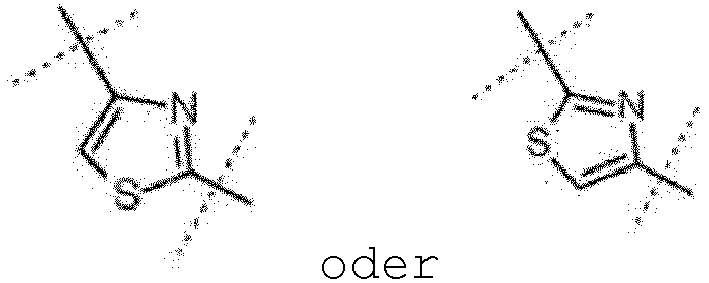
R1 ausgewählt ist aus der Gruppe bestehend ausWasserstoff,2-Hydroxyethyl,3-Hydroxy-3-methylbutyl,2-Hydroxyethoxy undAcyl. - Verbindung nach Anspruch 1, ausgewählt aus:6-[1-[1-[5-(2-Hydroxyethoxymethyl)-2-pyridyl]pyrazol-3-yl]ethyl]-3H-1,3-benzothiazol-2-on, Isomer 2,6-[1-[1-[5-(Acetonyloxymethyl)-2-pyridyl]pyrazol-3-yl]ethyl]-3H-1,3-benzothiazol-2-on, Isomer 2,6-(1-(1-(5-(4-Hydroxypiperidin-1-yl)pyridin-2-yl)-1H-pyrazol-3-yl)ethyl)benzo[d]thiazol-2(3H)-on, Isomer 1,6-{1-[1-(5-Methansulfinylpyridin-2-yl)-1H-pyrazol-3-yl]ethyl}-3H-benzothiazol-2-on, Isomer 4,6-[1-[1-[5-[2-(Hydroxymethyl)morpholin-4-yl]-2-pyridyl]pyrazol-3-yl]ethyl]-3H-1,3-benzothiazol-2-on, Isomer 2,6-[1-[1-[5-(1-Hydroxyethyl)-2-pyridyl]pyrazol-3-yl]ethyl]-3H-1,3-benzothiazol-2-on, Isomer 1,6-[1-[1-[5-(1-Hydroxyethyl)-2-pyridyl]pyrazol-3-yl]ethyl]-3H-1,3-benzothiazol-2-on, Isomer 2,6-[1-[1-(5-Fluor-2-pyridyl)pyrazol-3-yl]ethyl]-3H-1,3-benzothiazol-2-on, Isomer 1,6-[1-[1-[5-(2,2-Dideuterio-2-hydroxyethyl)-2-pyridyl]pyrazol-3-yl]ethyl]-3H-1,3-benzothiazol-2-on, Isomer 2,6-[1-[1-(5-Morpholino-2-pyridyl)pyrazol-3-yl]ethyl]-3H-1,3-benzothiazol-2-on, Isomer 1,6-[1-[1-[5-(2-Hydroxy-2-methylpropoxy)-2-pyridyl]pyrazol-3-yl]ethyl]-3H-1,3-benzothiazol-2-on, Isomer 1,6-[1-[1-[5-(2-Hydroxyethylamino)-2-pyridyl]pyrazol-3-yl]ethyl]-3H-1,3-benzothiazol-2-on, Isomer 2,6-[1-[1-[5-[2-Hydroxyethyl(methyl)amino]-2-pyridyl]pyrazol-3-yl]ethyl]-3H-1,3-benzothiazol-2-on, Isomer 2,6-[1-[1-[5-[(2-Hydroxy-2-methylpropoxy)methyl]-2-pyridyl]pyrazol-3-yl]ethyl]-3H-1,3-benzothiazol-2-on, Isomer 1 und6-(1-(1-(5-((1-Hydroxypropan-2-yl)thio)pyridin-2-yl)-1H-pyrazol-3-yl)ethyl)benzo[d]thiazol-2(3H)-on, Isomer 1 oderein pharmazeutisch unbedenkliches Salz davon.
- Verbindung nach Anspruch 1, ausgewählt aus:6-(1-(1-(5-((1-Hydroxypropan-2-yl)thio)pyridin-2-yl)-1H-pyrazol-3-yl)ethyl)benzo[d]thiazol-2(3H)-on, Isomer 2,6-(1-(1-(5-(4-Hydroxy-4-vinylpiperidin-1-yl)pyridin-2-yl)-1H-pyrazol-3-yl)ethyl)benzo[d]thiazol-2(3H)-on, Isomer 1,6-(1-(1-(5-(3-Hydroxy-3-methylazetidin-1-yl)pyridin-2-yl)-1H-pyrazol-3-yl)ethyl)benzo[d]thiazol-2(3H)-on, Isomer 1,6-(1-(1-(5-(3-Methoxyazetidin-1-yl)pyridin-2-yl)-1H-pyrazol-3-yl)ethyl)benzo[d]thiazol-2(3H)-on, Isomer 2,6-(1-(1-(5-(3-Methoxy-3-methylazetidin-1-yl)pyridin-2-yl)-1H-pyrazol-3-yl)ethyl)benzo[d]thiazol-2(3H)-on, Isomer 2,6-((S)-1-{1-[5-(2-Hydroxypropyl)pyridin-2-yl]-1H-pyrazol-3-yl}ethyl)-3H-benzothiazol-2-on, Isomer 2,6-[1-[1-(5-Tetrahydropyran-4-yl-2-pyridyl)pyrazol-3-yl]ethyl]-3H-1,3-benzothiazol-2-on, Isomer 1,6-[(S)-1-[1-[5-(2-Hydroxyethyl)-2-pyridyl]pyrazol-3-yl]ethyl]-3H-1,3-benzothiazol-2-on, Isomer,6-[1-[1-(5-Deuterio-2-pyridyl)pyrazol-3-yl]ethyl]-3H-1,3-benzothiazol-2-on, Isomer 2,6-[1-[1-[5-(1-Hydroxy-1-methylethyl)-2-pyridyl]pyrazol-3-yl]ethyl]-3H-1,3-benzothiazol-2-on, Isomer 1,6-[(1S)-1-[1-(5-(3-Hydroxy-3-methylbutyl)-2-pyridyl]pyrazol-3-yl]ethyl]-3H-1,3-benzothiazol-2-on, Isomer 1,6-[1-[1-[5-(3-Hydroxy-2,2-dimethylpropoxy)-2-pyridyl]pyrazol-3-yl]ethyl]-3H-1,3-benzothiazol-2-on, Isomer 1,6-[1-[1-[5-(2-Hydroxy-2-methylpropyl)-2-pyridyl]pyrazol-3-yl]ethyl]-3H-1,3-benzothiazol-2-on, Isomer 1,6-[1-[1-[5-(1-Methylimidazol-2-yl)sulfanyl-2-pyridyl]pyrazol-3-yl]ethyl]-3H-1,3-benzothiazol-2-onhydrochlorid, Isomer 1,6-[1-[1-[5-(Triazol-1-ylmethyl)-2-pyridyl]pyrazol-3-yl]ethyl]-3H-1,3-benzothiazol-2-onhydrochlorid, Isomer 1.
- Verbindung nach Anspruch 1, bei der es sich um:2-[[6-[3-[1-(2-Oxo-3H-1,3-benzothiazol-6-yl)ethyl]pyrazol-1-yl]-3-pyridyl]oxy]acetonitril, Isomer 2,2-Aminoessigsäure-2-[[6-[3-[(1S)-1-(2-oxo-3H-1,3-benzothiazol-6-yl)ethyl]pyrazol-1-yl]-3-pyridyl)oxy]ethylester,6-[(1S)-1-[1-[5-(2-Morpholinoethoxy)-2-pyridyl]pyrazol-3-yl]ethyl]-3H-1,3-benzothiazol-2-on,6-[1-[1-[5-[1-(2-Hydroxyethoxy)ethyl]-2-pyridyl]pyrazol-3-yl]ethyl]-3H-1,3-benzothiazol-2-on, Isomer 1,6-[1-[1-[5-[1-(2-Hydroxyethoxy)ethyl]-2-pyridyl]pyrazol-3-yl]ethyl]-3H-1,3-benzothiazol-2-on, Isomer 2,6-[1-[1-[5-[1-(2-Hydroxypropoxy)ethyl]-2-pyridyl]pyrazol-3-yl]ethyl]-3H-1,3-benzothiazol-2-on, Isomer 1,6-(1-(1-(5-(4-Hydroxy-4-methylpiperidin-1-yl)pyridin-2-yl)-1H-pyrazol-3-yl)ethyl)benzo[d]thiazol-2(3H)-on, Isomer 1,6-(1-(1-(5-(4-(2-Hydroxyethyl)piperidin-1-yl)pyridin-2-yl)-1H-pyrazol-3-yl)ethyl)benzo[d]thiazol-2-(3H)-on, Isomer 1,6-(1-(1-(5-((2-Hydroxypropyl)thio)pyridin-2-yl)-1H-pyrazol-3-yl)ethyl)benzo[d]thiazol-2(3H)-on, Isomer 3,6-(1-(1-(5-((2-Hydroxypropyl)thio)pyridin-2-yl)-1H-pyrazol-3-yl)ethyl)benzo[d]thiazol-2(3H)-on, Isomer 4,6-[1-[1-[5-(2-Hydroxypropoxymethyl)-2-pyridyl]pyrazol-3-yl]ethyl]-3H-1,3-benzothiazol-2-on, Isomer 3,6-[1-[1-[5-(2-Hydroxypropoxymethyl)-2-pyridyl]pyrazol-3-yl]ethyl]-3H-1,3-benzothiazol-2-on, Isomer 4 und6-[1-[1-[5-(2-Fluorethyl)-2-pyridyl]pyrazol-3-yl]ethyl]-3H-1,3-benzothiazol-2-on, Isomer 2, oderein pharmazeutisch unbedenkliches Salz davon handelt.
- Verbindung nach Anspruch 1, ausgewählt aus:6-[1-[1-(6-Methylpyridazin-3-yl)pyrazol-3-yl]ethyl]-3H-1,3-benzothiazol-2-on, Isomer 2,6-[1-[1-[6-(Hydroxymethyl)pyridazin-3-yl]pyrazol-3-yl]ethyl]-3H-1,3-benzothiazol-2-on, Isomer 2,6-(1-{1-[6-(2-Hydroxyethylsulfanyl)pyridazin-3-yl]-1H-pyrazol-3-yl}ethyl)-3H-benzothiazol-2-on, Isomer 2,6-[1-(1-Pyridazin-3-yl-1H-pyrazol-3-yl)ethyl]-3H-benzothiazol-2-on, Isomer 2 und6-[3-[1-(2-Oxo-3H-1,3-benzothiazol-6-yl)ethyl]pyrazol-1-yl]pyridazin-3-carbonsäureamid, Isomer 1, oderein pharmazeutisch unbedenkliches Salz davon.
- Verbindung nach Anspruch 1, ausgewählt aus:6-[1-[1-[5-[5-(Hydroxymethyl)tetrahydrofuran-2-yl]-2-pyridyl]pyrazol-3-yl]ethyl]-3H-1,3-benzothiazol-2-on, Isomer 1 cis,6-[1-[1-[5-[5-(Hydroxymethyl)tetrahydrofuran-2-yl]-2-pyridyl]pyrazol-3-yl]ethyl]-3H-1,3-benzothiazol-2-on, Isomer 2 cis,6-[1-[1-[5-[5-(Hydroxymethyl)tetrahydrofuran-2-yl]-2-pyridyl]pyrazol-3-yl]ethyl]-3H-1,3-benzothiazol-2-on, Isomer 3 trans und6-[1-[1-[5-[5-(Hydroxymethyl)tetrahydrofuran-2-yl]-2-pyridyl]pyrazol-3-yl]ethyl]- 3H-1,3-benzothiazol-2-on, Isomer 4 trans, oderein pharmazeutisch unbedenkliches Salz davon.
- Verbindung nach Anspruch 1, ausgewählt aus:6-[1-[4-[5-(2-Hydroxyethoxy)-2-pyridyl]thiazol-2-yl]ethyl]-3H-1,3-benzothiazol-2-on, Isomer 2,6-[1-[4-[5-(2-Hydroxyethyl)-2-pyridyl]thiazol-2-yl]ethyl]-3H-1,3-benzothiazol-2-on, Isomer 2,6-[1-[4-[5-(3-Hydroxy-3-methylbutyl)-2-pyridyl]thiazol-2-yl]ethyl]-3H-1,3-benzothiazol-2-on, Isomer 1, 6-[1-(4-Pyridazin-3-ylthiazol-2-yl)ethyl]-3H-1,3-benzothiazol-2-on, Isomer 2 und 6-[1-[4-(5-Acetyl-2-pyridyl)thiazol-2-yl]ethyl]-3H-1,3-benzothiazol-2-on, Isomer 2, oderein pharmazeutisch unbedenkliches Salz davon.
- Verbindung nach Anspruch 1, ausgewählt aus:6-(1-{2-[5-(2-Hydroxyethyl)pyridin-2-yl]thiazol-4-yl}ethyl)-3H-benzothiazol-2-on, Isomer 2 und6-[1-(2-Pyridin-2-ylthiazol-4-yl)ethyl)-3H-benzothiazol-2-on, Isomer 2, oderein pharmazeutisch unbedenkliches Salz davon.
- Pharmazeutische Zusammensetzung, umfassend eine Verbindung nach einem der Ansprüche 1-12 oder ein pharmazeutisch unbedenkliches Salz davon und einen oder mehrere pharmazeutisch unbedenkliche Träger, Verbindungsmittel oder Exzipienten.
- Verbindung oder Salz nach einem der Ansprüche 1-12 oder pharmazeutisch unbedenkliches Salz davon zur Verwendung in der Therapie.
- Verbindung oder Salz nach einem der Ansprüche 1-12 oder pharmazeutisch unbedenkliches Salz davon zur Verwendung bei der Behandlung von Krampfanfällen in einem Säugetier mit Epilepsie.
- Verbindung zur Verwendung nach Anspruch 15, wobei es sich bei den Krampfanfällen um einfache oder komplexe partielle Anfälle handelt.
- Verbindung zur Verwendung nach Anspruch 15, wobei es sich bei den Krampfanfällen um primäre oder sekundäre generalisierte Anfälle handelt.
- Verbindung oder Salz zur Verwendung nach einem der Ansprüche 15, 16 oder 17, wobei es sich bei dem Säugetier um einen Menschen handelt und/oder
wobei die Anwendung in gleichzeitiger, getrennter oder aufeinanderfolgender Kombination mit einem anderen Antiepileptikum erfolgt, wobei es sich bei dem anderen Antiepileptikum gegebenenfalls oder vorzugsweise um Levetiracetam, Gabapentin, Topiramat oder Carbamazepin handelt. - Verbindung oder Salz nach einem der Ansprüche 1-12 zur Verwendung bei der Behandlung von Schmerzen in einem Säugetier.
- Verbindung oder Salz zur Verwendung nach Anspruch 19, wobei es sich bei dem Säugetier um einen Menschen handelt und/oder
wobei es sich bei den Schmerzen um nozizeptive Schmerzen handelt. - Verbindung nach Anspruch 1, ausgewählt aus der Gruppe bestehend aus:6-[1-[1-[5-(2-Hydroxyethoxymethyl)-2-pyridyl]pyrazol-3-yl]ethyl]-3H-1,3-benzothiazol-2-on,6-[1-[1-[5-(Acetonyloxymethyl)-2-pyridyl]pyrazol-3-yl]ethyl]-3H-1,3-benzothiazol-2-on,6-(1-(1-(5-(4-Hydroxypiperidin-1-yl)pyridin-2-yl)-1H-pyrazol-3-yl)ethyl)benzo[d]thiazol-2(3H)-on,6-{1-[1-(5-Methansulfinylpyridin-2-yl)-1H-pyrazol-3-yl]ethyl}-3H-benzothiazol-2-on,6-[1-[1-[5-[2-(Hydroxymethyl)morpholin-4-yl]-2-pyridyl]pyrazol-3-yl]ethyl]-3H-1,3-benzothiazol-2-on,6-[1-[1-[5-(1-Hydroxyethyl)-2-pyridyl]pyrazol-3-yl]ethyl]-3H-1,3-benzothiazol-2-on,6-[1-[1-[5-(1-Hydroxyethyl)-2-pyridy]pyrazol-3-yl]ethyl]-3H-1,3-benzothiazol-2-on,6-[1-[1-(5-Fluor-2-pyridyl)pyrazol-3-yl]ethyl]-3H-1,3-benzothiazol-2-on,6-[1-[1-[5-(2,2-Dideuterio-2-hydroxyethyl)-2-pyridyl]pyrazol-3-yl]ethyl]-3H-1,3-benzothiazol-2-on,6-[1-[1-(5-Morpholino-2-pyridyl)pyrazol-3-yl]ethyl]-3H-1,3-benzothiazol-2-on,6-[1-[1-[5-(2-Hydroxy-2-methylpropoxy)-2-pyridyl]pyrazol-3-yl]ethyl]-3H-1,3-benzothiazol-2-on,6-[1-[1-[5-(2-Hydroxyethylamino)-2-pyridyl]pyrazol-3-yl]ethyl]-3H-1,3-benzothiazol-2-on,6-[1-[1-[5-(2-Hydroxyethyl(methyl)amino]-2-pyridyl]pyrazol-3-yl]ethyl]-3H-1,3-benzothiazol-2-on,6-[1-[1-[5-[(2-Hydroxy-2-methylpropoxy)methyl]-2-pyridyl]pyrazol-3-yl]ethyl]-3H-1,3-benzothiazol-2-on,6-(1-(1-(5-((1-Hydroxypropan-2-yl)thio)pyridin-2-yl)-1H-pyrazol-3-yl)ethyl)benzo[d]thiazol-2(3H)-on,6-(1-(1-(5-((1-Hydroxypropan-2-yl)thio)pyridin-2-yl)-1H-pyrazol-3-yl)ethyl)benzo[d]thiazol-2(3H)-on,6-(1-(1-(5-(4-Hydroxy-4-vinylpiperidin-1-yl)pyridin-2-yl)-1H-pyrazol-3-yl)ethyl)benzo[d]thiazol-2(3H)-on,6-(1-(1-(5-(3-Hydroxy-3-methylazetidin-1-yl)pyridin-2-yl)-1H-pyrazol-3-yl)ethyl)benzo[d]thiazol-2(3H)-on,6-(1-(1-(5-(3-Methoxyazetidin-1-yl)pyridin-2-yl)-1H-pyrazol-3-yl)ethyl)benzo[d]thiazol-2(3H)-on,6-(1-(1-(5-(3-Methoxy-3-methylazetidin-1-yl)pyridin-2-yl)-1H-pyrazol-3-yl)ethyl)benzo[d]thiazol-2(3H)-on,6-(1-{1-[5-(2-Hydroxypropyl)pyridin-2-yl]-H-pyrazol-3-yl}ethyl)-3H-benzothiazol-2-on,6-[1-[1-(5-Tetrahydropyran-4-yl-2-pyridyl)pyrazol-3-yl]ethyl]-3H-1,3-benzothiazol-2-on,6-[1-[1-[5-(2-Hydroxyethyl)-2-pyridyl]pyrazol-3-yl]ethyl]-3H-1,3-benzothiazol-2-on,6-[1-[1-(5-Deuterio-2-pyridyl)pyrazol-3-yl]ethyl]-3H-1,3-benzothiazol-2-on,6-[1-[1-[5-(1-Hydroxy-1-methylethyl)-2-pyridyl]pyrazol-3-yl]ethyl-3H-1,3-benzothiazol-2-on,6-[1-[1-[5-(3-Hydroxy-3-methylbutyl)-2-pyridyl]pyrazol-3-yl]ethyl]-3H-1,3-benzothiazol-2-on,6-[1-[1-[5-(3-Hydroxy-2,2-dimethylpropoxy)-2-pyridyl]pyrazol-3-yl]ethyl]-3H-1,3-benzothiazol-2-on,6-[1-[1-[5-(2-Hydroxy-2-methylpropyl)-2-pyridyl]pyrazol-3-yl]ethyl]-3H-1,3-benzothiazol-2-on,6-[1-[1-[5-(1-Methylimidazol-2-yl)sulfanyl-2-pyridyl]pyrazol-3-yl]ethyl]-3H-1,3-benzothiazol-2-onhydrochlorid,6-[1-[1-[5-(Triazol-1-ylmethyl)-2-pyridyl]pyrazol-3-yl]ethyl]-3H-1,3-benzothiazol-2-onhydrochlorid,2-[[6-[3-[1-(2-Oxo-3H-1,3-benzothiazol-6-yl)ethyl]pyrazol-1-yl]-3-pyridyl]oxy]acetonitril,2-Aminoessigsäure-2-[[6-[3-[1-(2-oxo-3H-1,3-benzothiazol-6-yl)ethyl]pyrazol-1-yl]-3-pyridyl]oxy]ethylester,6-[1-[1-[5-(2-Morpholinoethoxy)-2-pyridyl]pyrazol-3-yl]ethyl]-3H-1,3-benzothiazol-2-on,6-[1-[1-[5-[1-(2-Hydroxyethoxy)ethyl]-2-pyridyl]pyrazol-3-yl]ethyl]-3H-1,3-benzothiazol-2-on,6-[1-[1-[5-[1-(2-Hydroxyethoxy)ethyl]-2-pyridyl]pyrazol-3-yl]ethyl]-3H-1,3-benzothiazol-2-on,6-[1-[1-[5-[1-(2-Hydroxypropoxy)ethyl]-2-pyridyl]pyrazol-3-yl]ethyl]-3H-1,3-benzothiazol-2-on,6-(1-(1-(5-(4-Hydroxy-4-methylpiperidin-1-yl)pyridin-2-yl)-1H-pyrazol-3-yl)ethyl)benzo[d]thiazol-2(3H)-on,6-(1-(1-(5-(4-(2-Hydroxyethyl)piperidin-1-yl)pyridin-2-yl)-1H-pyrazol-3-yl)ethyl)benzo[d]thiazol-2(3H)-on,6-(1-(1-(5-((2-Hydroxypropyl)thio)pyridin-2-yl)-1H-pyrazol-3-yl)ethyl)benzo[d]thiazol-2(3H)-on,6-(1-(1-(5-((2-Hydroxypropyl)thio)pyridin-2-yl)-1H-pyrazol-3-yl)ethyl)benzo[d]thiazol-2(3H)-on,6-[1-[1-[5-(2-Hydroxypropoxymethyl)-2-pyridyl]pyrazol-3-yl]ethyl]-3H-1,3-benzothiazol-2-on,6-[1-[1-[5-(2-Hydroxypropoxymethyl)-2-pyridyl]pyrazol-3-yl]ethyl]-3H-1,3-benzothiazol-2-on,6-[1-[1-[5-(2-Fluorethyl)-2-pyridyl]pyrazol-3-yl]ethyl]-3H-1,3-benzothiazol-2-on,6-[1-[1-(6-Methylpyridazin-3-yl)pyrazol-3-yl]ethyl]-3H-1,3-benzothiazol-2-on,6-[1-[1-[6-(Hydroxymethyl)pyridazin-3-yl]pyrazol-3-yl]ethyl]-3H-1,3-benzothiazol-2-on,6-(1-{1-[6-(2-Hydroxyethylsultanyl)pyridazin-3-yl]-1H-pyrazol-3-yl}ethyl)-3H-benzothiazol-2-on,6-[1-(1-Pyridazin-3-yl-1H-pyrazol-3-yl)ethyl]-3H-benzothiazol-2-on,6-[3-[1-(2-Oxo-3H-1,3-benzothiazol-6-yl)ethyl]pyrazol-1-yl]pyridazin-3-carbonsäureamid,6-[1-[1-[5-[5-(Hydroxymethyl)tetrahydrofuran-2-yl]-2-pyridyl]pyrazol-3-yl]ethyl]-3H-1,3-benzothiazol-2-on, cis-Isomer,6-[1-[1-[5-[5-(Hydroxymethyl)tetrahydrofuran-2-yl]-2-pyridyl]pyrazol-3-yl]ethyl]-3H-1,3-benzothiazol-2-on, cis-Isomer,6-[1-[1-[5-[5-(Hydroxymethyl)tetrahydrofuran-2-yl]-2-pyridyl]pyrazol-3-yl]ethyl]-3H-1,3-benzothiazol-2-on, trans-Isomer,6-[1-[1-[5-[5-(Hydroxymethyl)tetrahydrofuran-2-yl]-2-pyridyl]pyrazol-3-yl]ethyl]-3H-1,3-benzothiazol-2-on, trans-Isomer,6-[1-[4-[5-(2-Hydroxyethoxy)-2-pyridyl]thiazol-2-yl]ethyl]-3H-1,3-benzothiazol-2-on,6-[1-[4-[5-(2-Hydroxyethyl)-2-pyridyl]thiazol-2-yl]ethyl]-3H-1,3-benzothiazol-2-on,6-[1-[4-[5-(3-Hydroxy-3-methylbutyl)-2-pyridyl]thiazol-2-yl]ethyl]-3H-1,3-benzothiazol-2-on,6-[1-(4-Pyridazin-3-ylthiazol-2-yl)ethyl]-3H-1,3-benzothiazol-2-on,6-[1-[4-(5-Acetyl-2-pyridyl)thiazol-2-yl]ethyl-3H-1,3-benzothiazol-2-on,6-(1-{2-[5-(2-Hydroxyethyl)pyridin-2-yl]thiazol-4-yl}ethyl)-3H-benzothiazol-2-on,6-[1-(2-Pyridin-2-ylthiazol-4-yl)ethyl]-3H-benzothiazol-2-on und
individuelle Stereoisomere und pharmazeutisch unbedenkliche Salze davon. - Verbindung nach Anspruch 1 oder pharmazeutisch unbedenkliches Salz davon mit der folgenden Stereochemie:

6-[1-[1-[5-(2-Hydroxyethoxymethyl)-2-pyridyl]pyrazol-3-yl]ethyl]-3H-1,3-benzothizol-2-on,
6-[1-[1-[5-(Actonyloxymethyl)-2-pyridyl]pyrazol-3-yl]ethyl]-3H-1,3-benzothiazol-2-on,
6-(1-(1-(5-(4-Hydroxypiperidin-1-yl)pyridin-2-yl)-1H-pyrazol-3-yl)ethyl)benzo[d]thiazol-2(3H)-on,
6-{1-[1-(5-Methansulfinylpyridin-2-yl)-1H-pyrazol-3-yl]ethyl}-3H-benzothiazol-2-on,
6-[1-[1-[5-[2-(Hydroxymethyl)morpholin-4-yl]-2-pyridyl]pyrazol-3-yl]ethyl]-3H-1,3-benzothiazol-2-on,
6-[1-[1-[5-(1-Hydroxyethyl)-2-pyridyl]pyrazol-3-yl]ethyl]-3H-1,3-benzothiazol-2-on,
6-[1-[1-[5-(1-Hydroxyethyl)-2-pyridyl]pyrazol-3-yl]ethyl]-3H-1,3-benzothiazol-2-on,
6-[1-[1-[5-Fluor-2-pyridyl)pyrazol-3-yl]ethyl]-3H-1,3-benzothiazol-2-on,
6-[1-[1-[5-(2,2-Dideuterio-2-hydroxyethyl)-2-pyridyl]pyrazol-3-yl]ethyl]-3H-1,3-benzothiazol-2-on,
6-[1-[1-[5-Morpholino-2-pyridyl)pyrazol-3-yl]ethyl]-3H-1,3-benzothiazol-2-on,
6-[1-[1-[5-(2-Hydroxy-2-methylpropoxy)-2-pyridyl]pyrazol-3-yl]ethyl]-3H-1,3-benzothiazol-2-on,
6-[1-[1-[5-(2-Hydroxyethylamino)-2-pyridyl]pyrazol-3-yl]ethyl]-3H-1,3-benzothiazol-2-on,
6-[1-[1-[5-[2-Hydroxyethyl(methyl)amino]-2-pyridyl]pyrazol-3-yl]ethyl]-3H-1,3-benzothiazol-2-on,
6-[1-[1-[5-[(2-Hydroxy-2-methyopropoxy)methyl]-2-pyridyl]pyrazol-3-yl]ethyl]-3H-1,3-benzothiazol-2-on,
6-(1-(1-(5-((1-Hydroxypropan-2-yl)thio-pyridin-2-yl)-1H-pyrazol-3-yl)ethyl)benzo[d]thiazol-2(3H)-on,
6-(1-(1-(5-((1-Hydroxypropan-2-yl)thio)pyridin-2-yl)-1H-pyrazol-3-yl)ethyl)benzo[d]thiazool-2(3H)-on,
6-(1-(1-(5-(4-Hydroxy-4-vinylpiperidin-1-yl)pyridin-2-yl)-1H-pyrazol-3-yl)ethyl)benzo[d]thiazol-2(3H)-on,
6-(1-(1-(5-(3-Hydroxy-3-methylazetidin-1-yl)pyridin-2-yl)-1H-pyrazol-3-yl)ethyl)benzo[d]thiazol-2(3H)-on,
6-(1-(1-(5-(3-Methoxyazetidin-1-yl)pyridin-2-yl)-1H-pyrazol-3-yl)ethyl)benzo[d]thiazol-2(3H)-on,
6-(1-(1-(5-(3-Methoxy-3-methylazetidin-1-yl)pyridin-2-yl)-1H-pyrazol-3-yl)ethyl)benzo[d]thiazol-2(3H)-on,
6-(1-{1-[5-(2-Hydroxypropyl)pyridn-2-yl]-H-pyrazol-3-yl}ethyl)-3H-benzothiazol-2-on,
6-[1-[1-(5-Tetrahydropyran-4-yl-2-pyridyl)pyrazol-3-yl]ethyl]-3H-1,3-benzothiazol-2-on,
6-[1-[1-[5-(2-Hydroxyethyl)-2-pyridyl]pyrazol-3-yl]ethyl]-3H-1,3-benzothiazol-2-on,
6-[1-[1-(5-Deuterio-2-pyridyl)pyrazol-3-yl]ethyl]-3H-1,3-benzothiazol-2-on,
6-[1-[1-[5-(1-Hydroxy-1-methylethyl)-2-pyridyl]pyrazol-3-yl]ethyl]-3H-1,3-benzothiazol-2-on,
6-[1-[1-[5-(3-Hydroxy-3-methylbutyl)-2-pyridyl]pyrazol-3-yl]ethyl]-3H-1,3-benzothiazol-2-on,
6-[1-[1-[5-(3-Hydroxy-2,2-dimethylpropoxy)-2-pyridyl]pyrazol-3-yl]ethyl]-3H-1,3-benzothiazol-2-on,
6-[1-[1-[5-(2-Hydroxy-2-methylpropyl)-2-pyridyl]pyrazol-3-yl]ethyl]-3H-1,3-benzothiazol-2-on,
6-[1-[1-[5-(1-Methylimidazol-2-yl)sulfanyl-2-pyridyl]pyrazol-3-yl]ethyl]-3H-1,3-benzothiazol-2-onhydrochlorid,
6-[1-[1-[5-(Triazol-1-ylmethyl)-2-pyridyl]pyrazol-3-yl]ethyl]-3H-1,3-benzothiazol-2-on-hydrochlorid,
2-[[6-[3-[1-(2-Oxo-3H-1,3-benzothiazol-6-yl)ethyl]pyrazol-1-yl]-3-pyridyl]oxy]acetonitril,
2-[[6-[3-[1-(2-Oxo-3H-1,3-benzothiazol-6-yl)ethyl]pyrazol-1-yl]-3-pyridyl]oxy]ethylaminoacetat,
6-[1-[1-[5-(2-Morpholinoethoxy)-2-pyridyl]pyrazol-3-yl]ethyl]-3H-1,3-benzothiazol-2-on,
6-[1-[1-[5-[1-(2-Hydroxyethoxy)ethyl]-2-pyridyl]pyrazol-3-yl]ethyl]-3H-1,3-benzothiazol-2-on,
6-[1-[1-[5-[1-(2-Hydroxyethoxy)ethyl]-2-pyridyl]pyrazol-3-yl]ethyl]-3H-1,3-benzothiazol-2-on,
6-[1-[1-[5-[1-(2-Hydroxypropoxy)ethyl]-2-pyridyl]pyrazol-3-yl]ethyl]-3H-1,3-benzothiazol-2-on,
6-(1-(1-(5-(4-Hydroxy-4-methylpiperidin-1-yl)pyridin-2-yl)-1H-pyrazol-3-yl)ethyl)benzo[d]thiazol-2(3H)-on,
6-(1-(1-(5-(4-(2-Hydroxyethyl)piperidin-1-yl)pyridin-2-yl)-1H-pyrazol-3-yl)ethyl)benzo[d]thiazol-2(3H)-on,
6-(1-(1-(5-((2-Hydroxypropyl)thio)pyridin-2-yl)-1H-pyrazol-3-yl)ethyl)benzo[d]thiazol-2(3H)-on,
6-(1-(1-(5-((2-Hydroxypropyl)thio)pyridin-2-yl)1H-pyrazol-3-yl)ethyl)benzo[d]thiazol-2(3H)-on,
6-[1-[1-[5-(2-Hydroxypropoxymethyl)-2-pyridyl]pyrazol-3-yl]ethyl]-3H-1,3-benzothiazol-2-on,
6-[1-[1-[5-(2-Hydroxypropoxymethyl)-2-pyridyl]pyrazol-3-yl]ethyl]-3H-1,3-benzothiazol-2-on,
6-[1-[1-[5-(2-Fluorethyl)-2-pyridyl]pyrazol-3-yl]ethyl]-3H-1,3-benzothiazol-2-on,
6-[1-[1-(6-Methylpyridazin-3-yl)pyrazol-3-yl]ethyl]-3H-1,3-benzothiazol-2-on,
6-[1-[1-[6-(Hydroxymethyl)pyridazin-3-yl]pyrazol-3-yl]ethyl]-3H-1,3-benzothiazol-2-on,
6-(1-{1-[6-(2-Hydroxyethylsulfanyl)pyridazin-3-yl]-1H-pyrazol-3-yl}ethyl)-3H-benzothiazol-2-on,
6-[1-(1-Pyridazin-3-yl-1H-pyrazol-3-yl)ethyl]-3H-benzothiazol-2-on,
6-[3-[1-(2-Oxo-3H-1,3-benzothiazol-6-yl)ethyl]pyrazol-1-yl]pyridazin-3-carbonsäureamid,
6-[1-[1-[5-[5-(Hydroxymethyl)tetrahydrofuran-2-yl]-2-pyridyl]pyrazol-3-yl]ethyl]-3H-1,3-benzothiazol-2-on, cis-Isomer,
6-[1-[1-[5-[5-(Hydroxymethyl)tetrahydrofuran-2-yl]-2-pyridyl]pyrazol-3-yl]ethyl]-3H-1,3-benzothiazol-2-on, cis-Isomer,
6-[1-[1-[5-[5-(Hydroxymethyl)tetrahydrofuran-2-yl]-2-pyridyl]pyrazol-3-yl]ethyl]-3H-1,3-benzothiazol-2-on, trans-Isomer,
6-[1-[1-[5-[5-(Hydroxymethyl)tetrahydrofuran-2-yl]-2-pyridyl]pyrazol-3-yl]ethyl]-3H-1,3-benzothiazol-2-on, trans-Isomer,
6-[1-[4-[5-(2-Hydroxyethoxy)-2-pyridyl]thiazol-2-yl]ethyl]-3H-1,3-benzothiazol-2-on,
6-[1-[4-[5-(2-Hydroxyethyl)-2-pyridyl]thiazol-2-yl]ethyl]-3H-1,3-benzothiazol-2-on,
6-[1-[4-[5-(3-Hydroxy-3-methylbutyl)-2-pyridyl]thiazol-2-yl]ethyl]-3H-1,3-benzothiazol-2-on,
6-[1-(4-Pyridazin-3-ylthiazol-2-yl)ethyl]-3H-1,3-benzothiazol-2-on,
6-[1-[4-(5-Acetyl-2-pyridyl)thiazol-2-yl]ethyl]-3H-1,3-benzothiazol-2-on,
6-(1-{2-[5-(2-Hydroxyethyl)pyridin-2-yl]thiazol-4-yl}ethyl)-3H-benzothiazol-2-on,
6-[1-(2-Pyridin-2-ylthiazol-4-yl)ethyl]-3H-benzothiazol-2-on und
beliebigen Stereoisomeren und pharmazeutisch unbedenklichen Salzen davon.
Applications Claiming Priority (2)
| Application Number | Priority Date | Filing Date | Title |
|---|---|---|---|
| US201462004005P | 2014-05-28 | 2014-05-28 | |
| PCT/US2015/031880 WO2015183673A1 (en) | 2014-05-28 | 2015-05-21 | 6-substituted-3h-1,3-benzothiazol-2-one compounds as tarp-gamma 8 dependent ampa receptor antagonists |
Publications (2)
| Publication Number | Publication Date |
|---|---|
| EP3148995A1 EP3148995A1 (de) | 2017-04-05 |
| EP3148995B1 true EP3148995B1 (de) | 2020-09-23 |
Family
ID=53277110
Family Applications (1)
| Application Number | Title | Priority Date | Filing Date |
|---|---|---|---|
| EP15726843.4A Active EP3148995B1 (de) | 2014-05-28 | 2015-05-21 | 6-substituierte-3h-1,3-benzothiazol-2-on-verbindungen als tarp-gamma-8-abhängige ampa-rezeptorantagonisten |
Country Status (9)
| Country | Link |
|---|---|
| US (1) | US9469632B2 (de) |
| EP (1) | EP3148995B1 (de) |
| JP (1) | JP6392898B2 (de) |
| KR (1) | KR101802691B1 (de) |
| CN (1) | CN106459027B (de) |
| AU (1) | AU2015267363B2 (de) |
| CA (1) | CA2947313C (de) |
| TW (1) | TW201609719A (de) |
| WO (1) | WO2015183673A1 (de) |
Families Citing this family (6)
| Publication number | Priority date | Publication date | Assignee | Title |
|---|---|---|---|---|
| JO3225B1 (ar) * | 2012-11-27 | 2018-03-08 | Lilly Co Eli | 6-((s)-1-{1-[5-(2-هيدروكسي-إيثوكسي)-بيريدين-2-يل]-1h-بيرازول-3-يل}إيثيل)-3h-1 ، 3-بنزو ثيازول-2- أون باعتباره مضاد مستقبل ampa يعتمد على tarp- جاما 8 |
| HRP20210403T1 (hr) | 2015-04-29 | 2021-10-29 | Janssen Pharmaceutica Nv | Azabenzimidazoli i njihova uporaba kao modulatora ampa receptora |
| AU2017350688B2 (en) * | 2016-10-26 | 2021-04-01 | Rapport Therapeutics, Inc. | Fused azaheterocyclic compounds and their use as AMPA receptor modulators |
| JP6953527B2 (ja) * | 2016-10-26 | 2021-10-27 | ヤンセン ファーマシューティカ エヌ.ベー. | 縮合二環ピリジン化合物、及びampa受容体調節因子としてのそれらの使用 |
| WO2018080918A1 (en) * | 2016-10-26 | 2018-05-03 | Janssen Pharmaceutica Nv | 3-aryl-2h-pyrazolo[4,3-b]pyridine compounds and their use as ampa receptor modulators |
| WO2021188431A1 (en) * | 2020-03-16 | 2021-09-23 | Es Therapeutics Llc | Method of treating glioma cancer using tarp gamma 8-dependent ampa receptor antagonists |
Family Cites Families (8)
| Publication number | Priority date | Publication date | Assignee | Title |
|---|---|---|---|---|
| UA52698C2 (uk) * | 1996-10-04 | 2003-01-15 | Х. Луннбек А/С | Похідні (3-алкоксіізоксазол-4-іл)заміщеної 2-амінокарбонової кислоти та їх сірковмісні аналоги, фармацевтична композиція на їх основі |
| PT1300396E (pt) | 2000-06-12 | 2009-04-20 | Eisai R&D Man Co Ltd | Compostos de 1,2-di-hidropiridina, processos para a sua preparação e sua utilização |
| WO2007076161A2 (en) | 2005-12-27 | 2007-07-05 | Myriad Genetics, Inc | Compounds with therapeutic activity |
| TW200817385A (en) | 2006-07-04 | 2008-04-16 | Organon Nv | Heterocyclic derivatives |
| JP2012505198A (ja) | 2008-10-08 | 2012-03-01 | ファイザー・インク | Cns障害を治療する際にampa調節剤として使用するためのテトラヒドロフラニルスルホンアミド |
| MX2014002693A (es) | 2011-09-07 | 2014-06-04 | Novartis Ag | Uso de 1h-quinazolina-2,4-dionas para usarse en la prevencion o el tratamiento de epilepsia fotosensible. |
| JP2014015452A (ja) * | 2012-06-15 | 2014-01-30 | Taisho Pharmaceutical Co Ltd | ピラゾール誘導体を含有する医薬 |
| JO3225B1 (ar) * | 2012-11-27 | 2018-03-08 | Lilly Co Eli | 6-((s)-1-{1-[5-(2-هيدروكسي-إيثوكسي)-بيريدين-2-يل]-1h-بيرازول-3-يل}إيثيل)-3h-1 ، 3-بنزو ثيازول-2- أون باعتباره مضاد مستقبل ampa يعتمد على tarp- جاما 8 |
-
2015
- 2015-05-15 TW TW104115664A patent/TW201609719A/zh unknown
- 2015-05-21 AU AU2015267363A patent/AU2015267363B2/en active Active
- 2015-05-21 JP JP2016568570A patent/JP6392898B2/ja active Active
- 2015-05-21 CA CA2947313A patent/CA2947313C/en active Active
- 2015-05-21 WO PCT/US2015/031880 patent/WO2015183673A1/en not_active Ceased
- 2015-05-21 US US14/718,129 patent/US9469632B2/en active Active
- 2015-05-21 CN CN201580026796.0A patent/CN106459027B/zh active Active
- 2015-05-21 KR KR1020167032653A patent/KR101802691B1/ko not_active Expired - Fee Related
- 2015-05-21 EP EP15726843.4A patent/EP3148995B1/de active Active
Non-Patent Citations (1)
| Title |
|---|
| None * |
Also Published As
| Publication number | Publication date |
|---|---|
| JP2017515877A (ja) | 2017-06-15 |
| AU2015267363B2 (en) | 2017-08-17 |
| KR20160141862A (ko) | 2016-12-09 |
| AU2015267363A1 (en) | 2016-11-17 |
| EP3148995A1 (de) | 2017-04-05 |
| CA2947313C (en) | 2018-10-30 |
| US9469632B2 (en) | 2016-10-18 |
| TW201609719A (zh) | 2016-03-16 |
| CN106459027B (zh) | 2019-04-02 |
| US20150344468A1 (en) | 2015-12-03 |
| KR101802691B1 (ko) | 2017-11-28 |
| WO2015183673A1 (en) | 2015-12-03 |
| JP6392898B2 (ja) | 2018-09-19 |
| CA2947313A1 (en) | 2015-12-03 |
| CN106459027A (zh) | 2017-02-22 |
Similar Documents
| Publication | Publication Date | Title |
|---|---|---|
| EP4667458A1 (de) | Pharmazeutische zusammensetzung zur behandlung von krebs mit sos1-inhibitor und antikrebsmittel | |
| EP3322711B1 (de) | Hpk1-inhibitoren und verfahren zur verwendung davon | |
| EP3177619B1 (de) | 2-(morpholin-4-yl)-1,7-naphthyridine | |
| JP5814491B2 (ja) | ベンズイミダゾール−プロリン誘導体 | |
| EP2935256B1 (de) | 4,6-diarylaminothiazine als bace1-inhibitoren und ihre verwendung zur verminderung der beta-amyloid-produktion | |
| EP2459197B1 (de) | Verbindungen zur reduzierung der beta-amyloid-produktion | |
| EP2978757B1 (de) | Indolinonanaloga als brd4 inhibitoren | |
| AU2015267363B2 (en) | 6-substituted-3H-1,3-benzothiazol-2-one compounds as TARP-gamma 8 dependent AMPA receptor antagonists | |
| EP3204359B1 (de) | Tetrahydroisochinolinderivate | |
| EP2356113B1 (de) | Heterocyclisch substituierte aryl-verbindungen als hif-inhibitoren | |
| EP2920175B1 (de) | Triazolopyridazinderivate als bromodomainhemmer | |
| CN104870000A (zh) | 作为bace抑制剂的c5,c6氧杂环稠合的亚胺基噻嗪二氧化物化合物,组合物及其用途 | |
| CN108699057A (zh) | 5-取代的2-(吗啉-4-基)-1,7-萘啶 | |
| EP2233474A1 (de) | Kondensiertes aminodihydrothiazin-derivat | |
| EP2925754B1 (de) | 6-((s)-1-{1-[5-(2-hydroxy-ethoxy)-pyridin-2-yl]-1h-pyrazol-3-yl}-ethyl)-3h-1,3-benzothiazol-2-on als tarp-gamma 8 abhängiger ampa rezeptor antagonist | |
| EP4142732B1 (de) | Verfahren zur verwendung von pyrimidinen als ferroportininhibitoren | |
| KR20240115979A (ko) | 혈소판-유래 성장 인자 수용체(pdgfr) 알파 억제제 및 이의 용도 | |
| KR20230007441A (ko) | 페로포르틴 억제제로서의 시클로알킬 피리미딘 | |
| US12466819B2 (en) | Tricyclic compounds with OMA1/OPA1 modulatory properties | |
| CN110218218B (zh) | 苯并呋喃类衍生物、其制备方法及其在医药上的应用 | |
| HK1164732B (en) | Compounds for the reduction of beta-amyloid production | |
| HK1209116B (en) | 6-((s)-1-{1-[5-(2-hydroxy-ethoxy)-pyridin-2-yl]-1h-pyrazol-3-yl}-ethyl)-3h-1,3-benzothiazol-2-one as a tarp-gamma 8 dependent ampa receptor antagonist | |
| HK1208449B (en) | Benzimidazole-proline derivatives |
Legal Events
| Date | Code | Title | Description |
|---|---|---|---|
| STAA | Information on the status of an ep patent application or granted ep patent |
Free format text: STATUS: THE INTERNATIONAL PUBLICATION HAS BEEN MADE |
|
| PUAI | Public reference made under article 153(3) epc to a published international application that has entered the european phase |
Free format text: ORIGINAL CODE: 0009012 |
|
| STAA | Information on the status of an ep patent application or granted ep patent |
Free format text: STATUS: REQUEST FOR EXAMINATION WAS MADE |
|
| 17P | Request for examination filed |
Effective date: 20170102 |
|
| AK | Designated contracting states |
Kind code of ref document: A1 Designated state(s): AL AT BE BG CH CY CZ DE DK EE ES FI FR GB GR HR HU IE IS IT LI LT LU LV MC MK MT NL NO PL PT RO RS SE SI SK SM TR |
|
| AX | Request for extension of the european patent |
Extension state: BA ME |
|
| STAA | Information on the status of an ep patent application or granted ep patent |
Free format text: STATUS: EXAMINATION IS IN PROGRESS |
|
| 17Q | First examination report despatched |
Effective date: 20180226 |
|
| GRAP | Despatch of communication of intention to grant a patent |
Free format text: ORIGINAL CODE: EPIDOSNIGR1 |
|
| STAA | Information on the status of an ep patent application or granted ep patent |
Free format text: STATUS: GRANT OF PATENT IS INTENDED |
|
| INTG | Intention to grant announced |
Effective date: 20200403 |
|
| GRAS | Grant fee paid |
Free format text: ORIGINAL CODE: EPIDOSNIGR3 |
|
| GRAA | (expected) grant |
Free format text: ORIGINAL CODE: 0009210 |
|
| STAA | Information on the status of an ep patent application or granted ep patent |
Free format text: STATUS: THE PATENT HAS BEEN GRANTED |
|
| AK | Designated contracting states |
Kind code of ref document: B1 Designated state(s): AL AT BE BG CH CY CZ DE DK EE ES FI FR GB GR HR HU IE IS IT LI LT LU LV MC MK MT NL NO PL PT RO RS SE SI SK SM TR |
|
| AX | Request for extension of the european patent |
Extension state: BA ME |
|
| REG | Reference to a national code |
Ref country code: GB Ref legal event code: FG4D |
|
| REG | Reference to a national code |
Ref country code: CH Ref legal event code: EP |
|
| REG | Reference to a national code |
Ref country code: IE Ref legal event code: FG4D |
|
| REG | Reference to a national code |
Ref country code: DE Ref legal event code: R096 Ref document number: 602015059493 Country of ref document: DE Ref country code: AT Ref legal event code: REF Ref document number: 1316277 Country of ref document: AT Kind code of ref document: T Effective date: 20201015 |
|
| PG25 | Lapsed in a contracting state [announced via postgrant information from national office to epo] |
Ref country code: NO Free format text: LAPSE BECAUSE OF FAILURE TO SUBMIT A TRANSLATION OF THE DESCRIPTION OR TO PAY THE FEE WITHIN THE PRESCRIBED TIME-LIMIT Effective date: 20201223 Ref country code: BG Free format text: LAPSE BECAUSE OF FAILURE TO SUBMIT A TRANSLATION OF THE DESCRIPTION OR TO PAY THE FEE WITHIN THE PRESCRIBED TIME-LIMIT Effective date: 20201223 Ref country code: HR Free format text: LAPSE BECAUSE OF FAILURE TO SUBMIT A TRANSLATION OF THE DESCRIPTION OR TO PAY THE FEE WITHIN THE PRESCRIBED TIME-LIMIT Effective date: 20200923 Ref country code: SE Free format text: LAPSE BECAUSE OF FAILURE TO SUBMIT A TRANSLATION OF THE DESCRIPTION OR TO PAY THE FEE WITHIN THE PRESCRIBED TIME-LIMIT Effective date: 20200923 Ref country code: GR Free format text: LAPSE BECAUSE OF FAILURE TO SUBMIT A TRANSLATION OF THE DESCRIPTION OR TO PAY THE FEE WITHIN THE PRESCRIBED TIME-LIMIT Effective date: 20201224 Ref country code: FI Free format text: LAPSE BECAUSE OF FAILURE TO SUBMIT A TRANSLATION OF THE DESCRIPTION OR TO PAY THE FEE WITHIN THE PRESCRIBED TIME-LIMIT Effective date: 20200923 |
|
| REG | Reference to a national code |
Ref country code: CH Ref legal event code: NV Representative=s name: VALIPAT S.A. C/O BOVARD SA NEUCHATEL, CH |
|
| REG | Reference to a national code |
Ref country code: AT Ref legal event code: MK05 Ref document number: 1316277 Country of ref document: AT Kind code of ref document: T Effective date: 20200923 |
|
| PG25 | Lapsed in a contracting state [announced via postgrant information from national office to epo] |
Ref country code: LV Free format text: LAPSE BECAUSE OF FAILURE TO SUBMIT A TRANSLATION OF THE DESCRIPTION OR TO PAY THE FEE WITHIN THE PRESCRIBED TIME-LIMIT Effective date: 20200923 Ref country code: RS Free format text: LAPSE BECAUSE OF FAILURE TO SUBMIT A TRANSLATION OF THE DESCRIPTION OR TO PAY THE FEE WITHIN THE PRESCRIBED TIME-LIMIT Effective date: 20200923 |
|
| REG | Reference to a national code |
Ref country code: NL Ref legal event code: MP Effective date: 20200923 |
|
| REG | Reference to a national code |
Ref country code: LT Ref legal event code: MG4D |
|
| PG25 | Lapsed in a contracting state [announced via postgrant information from national office to epo] |
Ref country code: EE Free format text: LAPSE BECAUSE OF FAILURE TO SUBMIT A TRANSLATION OF THE DESCRIPTION OR TO PAY THE FEE WITHIN THE PRESCRIBED TIME-LIMIT Effective date: 20200923 Ref country code: RO Free format text: LAPSE BECAUSE OF FAILURE TO SUBMIT A TRANSLATION OF THE DESCRIPTION OR TO PAY THE FEE WITHIN THE PRESCRIBED TIME-LIMIT Effective date: 20200923 Ref country code: SM Free format text: LAPSE BECAUSE OF FAILURE TO SUBMIT A TRANSLATION OF THE DESCRIPTION OR TO PAY THE FEE WITHIN THE PRESCRIBED TIME-LIMIT Effective date: 20200923 Ref country code: NL Free format text: LAPSE BECAUSE OF FAILURE TO SUBMIT A TRANSLATION OF THE DESCRIPTION OR TO PAY THE FEE WITHIN THE PRESCRIBED TIME-LIMIT Effective date: 20200923 Ref country code: LT Free format text: LAPSE BECAUSE OF FAILURE TO SUBMIT A TRANSLATION OF THE DESCRIPTION OR TO PAY THE FEE WITHIN THE PRESCRIBED TIME-LIMIT Effective date: 20200923 Ref country code: PT Free format text: LAPSE BECAUSE OF FAILURE TO SUBMIT A TRANSLATION OF THE DESCRIPTION OR TO PAY THE FEE WITHIN THE PRESCRIBED TIME-LIMIT Effective date: 20210125 Ref country code: CZ Free format text: LAPSE BECAUSE OF FAILURE TO SUBMIT A TRANSLATION OF THE DESCRIPTION OR TO PAY THE FEE WITHIN THE PRESCRIBED TIME-LIMIT Effective date: 20200923 |
|
| PG25 | Lapsed in a contracting state [announced via postgrant information from national office to epo] |
Ref country code: AL Free format text: LAPSE BECAUSE OF FAILURE TO SUBMIT A TRANSLATION OF THE DESCRIPTION OR TO PAY THE FEE WITHIN THE PRESCRIBED TIME-LIMIT Effective date: 20200923 Ref country code: AT Free format text: LAPSE BECAUSE OF FAILURE TO SUBMIT A TRANSLATION OF THE DESCRIPTION OR TO PAY THE FEE WITHIN THE PRESCRIBED TIME-LIMIT Effective date: 20200923 Ref country code: ES Free format text: LAPSE BECAUSE OF FAILURE TO SUBMIT A TRANSLATION OF THE DESCRIPTION OR TO PAY THE FEE WITHIN THE PRESCRIBED TIME-LIMIT Effective date: 20200923 Ref country code: PL Free format text: LAPSE BECAUSE OF FAILURE TO SUBMIT A TRANSLATION OF THE DESCRIPTION OR TO PAY THE FEE WITHIN THE PRESCRIBED TIME-LIMIT Effective date: 20200923 Ref country code: IS Free format text: LAPSE BECAUSE OF FAILURE TO SUBMIT A TRANSLATION OF THE DESCRIPTION OR TO PAY THE FEE WITHIN THE PRESCRIBED TIME-LIMIT Effective date: 20210123 |
|
| REG | Reference to a national code |
Ref country code: DE Ref legal event code: R097 Ref document number: 602015059493 Country of ref document: DE |
|
| PG25 | Lapsed in a contracting state [announced via postgrant information from national office to epo] |
Ref country code: SK Free format text: LAPSE BECAUSE OF FAILURE TO SUBMIT A TRANSLATION OF THE DESCRIPTION OR TO PAY THE FEE WITHIN THE PRESCRIBED TIME-LIMIT Effective date: 20200923 |
|
| PLBE | No opposition filed within time limit |
Free format text: ORIGINAL CODE: 0009261 |
|
| STAA | Information on the status of an ep patent application or granted ep patent |
Free format text: STATUS: NO OPPOSITION FILED WITHIN TIME LIMIT |
|
| PG25 | Lapsed in a contracting state [announced via postgrant information from national office to epo] |
Ref country code: SI Free format text: LAPSE BECAUSE OF FAILURE TO SUBMIT A TRANSLATION OF THE DESCRIPTION OR TO PAY THE FEE WITHIN THE PRESCRIBED TIME-LIMIT Effective date: 20200923 Ref country code: DK Free format text: LAPSE BECAUSE OF FAILURE TO SUBMIT A TRANSLATION OF THE DESCRIPTION OR TO PAY THE FEE WITHIN THE PRESCRIBED TIME-LIMIT Effective date: 20200923 |
|
| 26N | No opposition filed |
Effective date: 20210624 |
|
| PG25 | Lapsed in a contracting state [announced via postgrant information from national office to epo] |
Ref country code: IT Free format text: LAPSE BECAUSE OF FAILURE TO SUBMIT A TRANSLATION OF THE DESCRIPTION OR TO PAY THE FEE WITHIN THE PRESCRIBED TIME-LIMIT Effective date: 20200923 |
|
| PG25 | Lapsed in a contracting state [announced via postgrant information from national office to epo] |
Ref country code: MC Free format text: LAPSE BECAUSE OF FAILURE TO SUBMIT A TRANSLATION OF THE DESCRIPTION OR TO PAY THE FEE WITHIN THE PRESCRIBED TIME-LIMIT Effective date: 20200923 Ref country code: LU Free format text: LAPSE BECAUSE OF NON-PAYMENT OF DUE FEES Effective date: 20210521 |
|
| PG25 | Lapsed in a contracting state [announced via postgrant information from national office to epo] |
Ref country code: HU Free format text: LAPSE BECAUSE OF FAILURE TO SUBMIT A TRANSLATION OF THE DESCRIPTION OR TO PAY THE FEE WITHIN THE PRESCRIBED TIME-LIMIT; INVALID AB INITIO Effective date: 20150521 |
|
| P01 | Opt-out of the competence of the unified patent court (upc) registered |
Effective date: 20230413 |
|
| PG25 | Lapsed in a contracting state [announced via postgrant information from national office to epo] |
Ref country code: CY Free format text: LAPSE BECAUSE OF FAILURE TO SUBMIT A TRANSLATION OF THE DESCRIPTION OR TO PAY THE FEE WITHIN THE PRESCRIBED TIME-LIMIT Effective date: 20200923 |
|
| PG25 | Lapsed in a contracting state [announced via postgrant information from national office to epo] |
Ref country code: MK Free format text: LAPSE BECAUSE OF FAILURE TO SUBMIT A TRANSLATION OF THE DESCRIPTION OR TO PAY THE FEE WITHIN THE PRESCRIBED TIME-LIMIT Effective date: 20200923 |
|
| VS25 | Lapsed in a validation state [announced via postgrant information from nat. office to epo] |
Ref country code: MA Free format text: LAPSE BECAUSE OF FAILURE TO SUBMIT A TRANSLATION OF THE DESCRIPTION OR TO PAY THE FEE WITHIN THE PRESCRIBED TIME-LIMIT Effective date: 20200923 |
|
| PG25 | Lapsed in a contracting state [announced via postgrant information from national office to epo] |
Ref country code: TR Free format text: LAPSE BECAUSE OF FAILURE TO SUBMIT A TRANSLATION OF THE DESCRIPTION OR TO PAY THE FEE WITHIN THE PRESCRIBED TIME-LIMIT Effective date: 20200923 |
|
| PG25 | Lapsed in a contracting state [announced via postgrant information from national office to epo] |
Ref country code: MT Free format text: LAPSE BECAUSE OF FAILURE TO SUBMIT A TRANSLATION OF THE DESCRIPTION OR TO PAY THE FEE WITHIN THE PRESCRIBED TIME-LIMIT Effective date: 20200923 |
|
| PGFP | Annual fee paid to national office [announced via postgrant information from national office to epo] |
Ref country code: DE Payment date: 20250416 Year of fee payment: 11 |
|
| PGFP | Annual fee paid to national office [announced via postgrant information from national office to epo] |
Ref country code: GB Payment date: 20250410 Year of fee payment: 11 |
|
| PGFP | Annual fee paid to national office [announced via postgrant information from national office to epo] |
Ref country code: BE Payment date: 20250422 Year of fee payment: 11 |
|
| PGFP | Annual fee paid to national office [announced via postgrant information from national office to epo] |
Ref country code: FR Payment date: 20250422 Year of fee payment: 11 |
|
| PGFP | Annual fee paid to national office [announced via postgrant information from national office to epo] |
Ref country code: CH Payment date: 20250601 Year of fee payment: 11 |
|
| PGFP | Annual fee paid to national office [announced via postgrant information from national office to epo] |
Ref country code: IE Payment date: 20250423 Year of fee payment: 11 |