EP3148504B1 - Verfahren zur herstellung eines konditionierenden preshave- oder aftershavemittels - Google Patents
Verfahren zur herstellung eines konditionierenden preshave- oder aftershavemittels Download PDFInfo
- Publication number
- EP3148504B1 EP3148504B1 EP15721683.9A EP15721683A EP3148504B1 EP 3148504 B1 EP3148504 B1 EP 3148504B1 EP 15721683 A EP15721683 A EP 15721683A EP 3148504 B1 EP3148504 B1 EP 3148504B1
- Authority
- EP
- European Patent Office
- Prior art keywords
- preshave
- aftershave
- microemulsion
- weight
- agent
- Prior art date
- Legal status (The legal status is an assumption and is not a legal conclusion. Google has not performed a legal analysis and makes no representation as to the accuracy of the status listed.)
- Not-in-force
Links
Classifications
-
- A—HUMAN NECESSITIES
- A61—MEDICAL OR VETERINARY SCIENCE; HYGIENE
- A61K—PREPARATIONS FOR MEDICAL, DENTAL OR TOILETRY PURPOSES
- A61K8/00—Cosmetics or similar toiletry preparations
- A61K8/18—Cosmetics or similar toiletry preparations characterised by the composition
- A61K8/30—Cosmetics or similar toiletry preparations characterised by the composition containing organic compounds
- A61K8/60—Sugars; Derivatives thereof
- A61K8/604—Alkylpolyglycosides; Derivatives thereof, e.g. esters
-
- A—HUMAN NECESSITIES
- A61—MEDICAL OR VETERINARY SCIENCE; HYGIENE
- A61K—PREPARATIONS FOR MEDICAL, DENTAL OR TOILETRY PURPOSES
- A61K8/00—Cosmetics or similar toiletry preparations
- A61K8/02—Cosmetics or similar toiletry preparations characterised by special physical form
- A61K8/04—Dispersions; Emulsions
- A61K8/06—Emulsions
- A61K8/068—Microemulsions
-
- A—HUMAN NECESSITIES
- A61—MEDICAL OR VETERINARY SCIENCE; HYGIENE
- A61K—PREPARATIONS FOR MEDICAL, DENTAL OR TOILETRY PURPOSES
- A61K8/00—Cosmetics or similar toiletry preparations
- A61K8/18—Cosmetics or similar toiletry preparations characterised by the composition
- A61K8/30—Cosmetics or similar toiletry preparations characterised by the composition containing organic compounds
- A61K8/33—Cosmetics or similar toiletry preparations characterised by the composition containing organic compounds containing oxygen
- A61K8/37—Esters of carboxylic acids
- A61K8/375—Esters of carboxylic acids the alcohol moiety containing more than one hydroxy group
-
- A—HUMAN NECESSITIES
- A61—MEDICAL OR VETERINARY SCIENCE; HYGIENE
- A61K—PREPARATIONS FOR MEDICAL, DENTAL OR TOILETRY PURPOSES
- A61K8/00—Cosmetics or similar toiletry preparations
- A61K8/18—Cosmetics or similar toiletry preparations characterised by the composition
- A61K8/30—Cosmetics or similar toiletry preparations characterised by the composition containing organic compounds
- A61K8/55—Phosphorus compounds
-
- A—HUMAN NECESSITIES
- A61—MEDICAL OR VETERINARY SCIENCE; HYGIENE
- A61Q—SPECIFIC USE OF COSMETICS OR SIMILAR TOILETRY PREPARATIONS
- A61Q19/00—Preparations for care of the skin
- A61Q19/002—Aftershave preparations
-
- A—HUMAN NECESSITIES
- A61—MEDICAL OR VETERINARY SCIENCE; HYGIENE
- A61Q—SPECIFIC USE OF COSMETICS OR SIMILAR TOILETRY PREPARATIONS
- A61Q9/00—Preparations for removing hair or for aiding hair removal
- A61Q9/02—Shaving preparations
Definitions
- the invention is in the field of cosmetics and relates to a process for the preparation of a conditioning preshave or aftershave agent in which a microemulsion is mixed with a cosmetic carrier containing a specific alk (en) yl ether phosphate emulsifier, water and oil.
- the invention further relates to a conditioning preshave or aftershave agent comprising a microemulsion, a specific alk (en) yl ether phosphate emulsifier, water and oil, and the non-therapeutic use of this conditioning preshave or aftershave agent to improve the feel on the skin and / or Relieving the feeling of tightness and burning that occurs as a result of shaving.
- a conditioning preshave or aftershave agent comprising a microemulsion, a specific alk (en) yl ether phosphate emulsifier, water and oil, and the non-therapeutic use of this conditioning preshave or aftershave agent to improve the feel on the skin and / or Relieving the feeling of tightness and burning that occurs as a result of shaving.
- Cosmetic shaving aids in the form of creams, aerosols, gels, soaps or foams have long been known and are constantly being developed and / or adapted to the growing demands of consumers. They are usually applied just before shaving - as a so-called preshaving agent - or after a shave - as so-called anal shingles - on the skin.
- Classic shaving soaps often have the disadvantage that they can not be distributed optimally on the skin and irritate the skin.
- Gels and / or creams usually contain special polymers and / or fatty substances and have a better spreadability to the skin and a higher mildness compared to classic soaps.
- the additional care ingredients can also lead to an excessive lubricity of the skin, so that the razor blade glides over the skin, without the hair is completely removed.
- US 2011 / 262370A1 discloses shaving compositions containing an alkyloligoglycoside but not present as a microemulsion and methods of making these compositions.
- WO 2009 / 051486A1 discloses emulsion shaving compositions not present as a microemulsion.
- EP 813862A2 discloses perfume oil concentrates in the form of aqueous microemulsions containing from 1 to 30% by weight of alkyl glycosides and from 1 to 10% by weight of a co-oil component, which is preferably selected from dialkyl ethers.
- EP 507047A2 discloses microemulsions with high skin and mucous membrane compatibility, which contain alkylpolyglycosides and essential oils and optionally further oils and coemulsifiers.
- WO 2012 / 130655A2 discloses a method of making a conditioning detergent wherein a microemulsion containing at least one alkyl (oligo) glycoside, at least one mono- or diester of glycerine with at least one C 10 -C 24 fatty acid, at least one oil and water, with a cosmetic carrier is mixed, the contains a selected polyhydroxy compound.
- a major problem in shaving is the strong mechanical irritation of the skin and the associated unpleasant skin feeling.
- a particularly popular form of application for shaving aids for shaving irritated, sensitive, sensitive, impure and / or acne-stressed skin are shaving balms and shaving lotions have a medium oil content.
- the improvement of the skin feel in particular the relief of the feeling of tightness and burning that occurs as a result of shaving.
- the object of the present invention was therefore to provide shaving aids for the shaving of particularly sensitive skin (parts), since skin irritations and / or small injuries to the skin caused by the razor blade during wet shaving alone could be achieved by incorporating higher amounts of plasticizers The past can not always be prevented.
- the shaving aids should provide the hairy skin surface with sufficient suppleness to increase the lubricity of the razor blade without, however, injuring the skin. Another aim was to produce a shaving aid with a high skin care effect, which does not impart too high lubricity to the skin during and / or after shaving.
- a further object of the present invention was to provide an uncomplicated method for producing a conditioning preshave or aftershave agent.
- Another object of the invention was to produce transparent preshave or aftershave agents.
- Microemulsions a) which are suitable for use in the process according to the invention are preferably thermodynamically stable mixtures of oil, an emulsifier and a co-emulsifier.
- Particularly preferred microemulsions have a volume-average particle size in the range from 10 nm to 150 nm, preferably from 20 nm to 100 nm and particularly preferably from 30 to 80 nm.
- a cosmetic carrier is understood as meaning an aqueous or aqueous-alcoholic carrier.
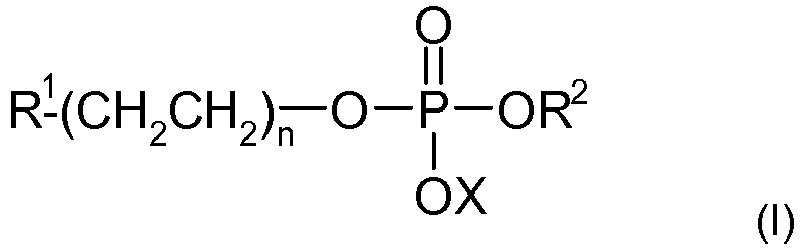
- the cosmetic water-containing carrier additionally contains as emulsifier at least one alkyl ether or alkenyl ether phosphate of the formula (I), in which R 1 is an aliphatic hydrocarbon radical having 8 to 30 carbon atoms, R 2 is hydrogen, a radical (CH 2 CH 2 O) n R 1 or X, n is from 1 to 10 and X is hydrogen, a radical (CH 2 CH 2 O) n R 1 , an alkali or alkaline earth metal or NR 3 R 4 R 5 R 6 , where R 3 to R 6 are independently of one another a C 1 to C 4 hydrocarbon radical.
- R 1 is an aliphatic hydrocarbon radical having 8 to 30 carbon atoms
- R 2 is hydrogen, a radical (CH 2 CH 2 O) n R 1 or X
- n is from 1 to 10
- X is hydrogen, a radical (CH 2 CH 2 O) n R 1 , an alkali or alkaline earth metal or NR 3 R 4 R 5 R 6
- a preferred emulsifier of the formula (I) is characterized in that the radicals R 1 are at least one group selected from lauryl, myristyl, cetyl, stearyl or oleyl and mixtures thereof; Particular preference is given to emulsifiers of the formula (I) in which the radicals R 1 for the mixture are cetearyl.
- radicals R 2 and X are a radical (CH 2 CH 2 O) n R 1 in which the radicals R 1 are at least one group selected from lauryl, myristyl, Cetyl, stearyl or oleyl and mixtures thereof.
- emulsifiers of the formula (I) are characterized in that n represents numbers of 2 to 6, preferably 3 to 5, particularly preferably 4.
- Particularly preferred emulsifiers of the formula (I) are characterized in that the radicals R 1 are at least one group selected from lauryl, myristyl, cetyl, stearyl or oleyl and mixtures thereof, in particular for the mixture cetearyl, furthermore the radicals R 2 and X is a radical (CH 2 CH 2 O) n R 1 , where R 1 has the abovementioned meaning and n is a number from 2 to 6, preferably 3 to 5, particularly preferably 4.
- a particularly preferred method according to the invention is characterized in that the emulsifier of formula (I) is selected from trilaureth-4-phosphate and triceteareth-4-phosphate and mixtures thereof.
- a process according to the invention in which the emulsifier of the formula (I) is selected from triceteareth-4-phosphate is extremely preferred.
- the process according to the invention does not require a specific sequence when mixing components a) and b). It is in principle possible, a mixture b) of water, the at least one alkyl ether or Alkenyletherphosphat of formula (I) as an emulsifier and the at least initially as a carrier to an oil, and then adding the microemulsion a). It is likewise possible to add to the microemulsion a) a mixture b) of water, to which at least one alkyl ether or alkenyl ether phosphate of the formula (I) as emulsifier and at least one oil.
- a cosmetic carrier in the form of the mixture b) described above is initially introduced from water, the at least one alkyl ether or alkenyl ether phosphate of the formula (I) as emulsifier and and at least one oil. Subsequently, all optional components of the preshave or aftershave agent, such as perfume or preservatives, are incorporated into the carrier mixture. It may be preferred that the carrier mixture b) is prepared at a temperature in the range of 50 to 95 ° C and the microemulson a) at a temperature of 12 to 45 ° C, in particular at a low shear rate of preferably 5 to 100 Is stirred in revolutions per minute.
- the viscosity of the preshave or aftershave agent is finally adjusted to the desired range using a thickening agent.
- Suitable alkyl ether or alkenyl ether phosphates of the formula (I) are preferably used in the process according to the invention in a total amount of 0.1 to 4% by weight, preferably 0.5 to 2% by weight, more preferably 0.8 to 1.5 % By weight, based in each case on the total weight of the preshave or aftershave agent, the quantities given being based on the total weight of the conditioning preshave or aftershave agent.
- alkyl (oligo) glycosides a are derived from aldoses and / or ketoses having 5 or 6 carbon atoms, preferably glucose.
- the radical R is particularly preferably an alkyl radical having 8 to 14 and in particular having 10 to 12 carbon atoms, in particular n-octyl, n-decyl and lauryl.
- the index number x in the general formula RO- [G] x stands for the degree of oligomerization (DP), ie for the distribution of the mono- and oligoglycosides.
- the index number x preferably has a value in the range from 1 to 5, particularly preferably in the range from 1 to 3, which may not be an integer but a fractional number which can be determined analytically.
- Particularly preferred alkyl (oligo) glycosides have a degree of oligomerization of from 1.2 to 1.5.
- Particularly suitable alkyl (oligo) glycosides are commercially available from various suppliers under the INCI names Decyl Glucoside, Lauryl Glucoside and Coco Glucoside.
- esters a (ii) are monoesters of glycerol with linear fatty acids having alkyl chain lengths of 12 to 22 carbon atoms.
- esters (ii) are glyceryl monolaurate, glyceryl monomyristate, glyceryl monopalmitate, glyceryl monostearate and / or glyceryl monooleate.
- Particularly suitable is glyceryl monooleate.
- Suitable oils a (iii) may be selected from mineral, natural and synthetic oil components and / or fatty substances.
- Preferred microemulsified oil components a (iii) are selected from dialkyl ethers.
- Particularly preferred dialkyl ethers are di-n-alkyl ethers having a total of 12 to 36 carbon atoms, in particular 12 to 24 carbon atoms, such as, for example, di-n-octyl ether, di-n-decyl ether, di-n-nonyl ether, di-n- undecyl ether, di-n-dodecyl ether, n-hexyl n-octyl ether, n-octyl n-decyl ether, n-decyl n-undecyl ether, n-undecyl n-dodecyl ether and n-hexyl n-undecyl ether, and di- tert-butyl ether, di-iso-pentyl ether, di-3
- natural oils a (iii) triglycerides and mixtures of triglycerides can be used.
- Preferred natural oils are coconut oil, (sweet) almond oil, walnut oil, peach kernel oil, apricot kernel oil, avocado oil, tea tree oil, soybean oil, sesame oil, sunflower oil, tsubaki oil, evening primrose oil, rice bran oil, palm kernel oil, mango seed oil, meadowfoam seed oil, thistle oil, macadamia nut oil, grapeseed oil, Amaranth seed oil, argan oil, bamboo oil, olive oil, wheat germ oil, pumpkin seed oil, mallow oil, hazelnut oil, safflower oil, canola oil, sasanqua oil, jojoba oil, rambutan oil, cocoa butter and shea butter.
- mineral oils a (iii) are used in particular mineral oils, paraffin and Isoparaffinöle and synthetic hydrocarbons.
- An example of a hydrocarbon which can be used is, for example, the 1,3-di (2-ethylhexyl) cyclohexane obtainable as a commercial product.
- Suitable synthetic oils are silicone oils.
- fatty alcohols in particular branched and / or unsaturated fatty alcohols, can be used as oil component a (iii), for example octenol, dodecenol, decenol, octadienol, dodecadienol, decadienol, oleyl alcohol, eruca alcohol, ricinol alcohol, isostearyl alcohol, linoleyl alcohol and linolenyl alcohol and their guerbet alcohols.
- microemulsifiable oils a) iii) are, for example, ester oils.
- Ester oils are the esters of C 6 -C 30 fatty acids with C 2 -C 30 fatty alcohols. The monoesters of the fatty acids with alcohols having 2 to 24 carbon atoms are preferred.
- fatty acid components used in the esters are caproic acid, caprylic acid, 2-ethylhexanoic acid, capric acid, lauric acid, isotridecanoic acid, myristic acid, palmitic acid, palmitoleic acid, stearic acid, isostearic acid, oleic acid, elaidic acid, petroselinic acid, linoleic acid, linolenic acid, elaeostearic acid, arachidic acid, gadoleic acid, behenic acid and Erucic acid and its technical mixtures.
- fatty alcohol moieties in the ester oils are isopropyl alcohol, caproic alcohol, capryl alcohol, 2-ethylhexyl alcohol, capric alcohol, lauryl alcohol, isotridecyl alcohol, myristyl alcohol, cetyl alcohol, palmoleyl alcohol, stearyl alcohol, isostearyl alcohol, oleyl alcohol, elaidyl alcohol, petroselinyl alcohol, linolyl alcohol, linolenyl alcohol, elaeostearyl alcohol, arachyl alcohol, gadoleyl alcohol, Behenyl alcohol, erucyl alcohol and brassidyl alcohol and their technical mixtures.
- microemulsifiable oils a) iii) are, for example, dicarboxylic acid esters, such as di-n-butyl adipate, di (2-ethylhexyl) adipate, di (2-ethylhexyl) succinate and diisotridecylvestat, and diol esters, such as ethylene glycol dioleate, ethylene glycol di-isotridecanoate, propylene glycol di (2-ethylhexanoate), propylene glycol di-isostearate, propylene glycol di-pelargonate, butanediol di-isostearate, neopentyl glycol dicaprylate.
- dicarboxylic acid esters such as di-n-butyl adipate, di (2-ethylhexyl) adipate, di (2-ethylhexyl) succinate and diisotridecylvest
- microemulsifiable oils a) iii) are, for example, symmetrical, asymmetrical or cyclic esters of carbonic acid with fatty alcohols, in particular glycerol carbonate or dicaprylyl carbonate.
- microemulsion a) Another essential ingredient of microemulsions a) is water.
- the microemulsion a) contains - based on their total weight - 40 to 66 wt .-%, preferably 45 to 60 wt .-% and in particular 50 to 55 wt .-% water.
- the microemulsion a) can (before carrying out the process according to the invention) preferably be prepared by mixing the liquid oil phases (ii) and (iii) with the surfactant-containing, aqueous phase ((i) and (iv)) with stirring.
- microemulsion a) in the process according to the invention can also be used as a prefabricated commercial product.
- An example of a commercially available microemulsion a) according to the invention is the microemulsion available from Cognis under the name "Plantasil Micro®".
- the microemulsion a) is preferably used in the process of the invention in an amount of 0.01 to 50 wt .-%, more preferably from 0.1 to 30 wt .-%, particularly preferably from 0.5 to 20 wt .-% and in particular from 1 to 15% by weight, the amounts relating to the total weight of the conditioning preshave or aftershave agent.
- At least one oil b) ii) which is different from the microemulsified oil a) iii) is present in the water-containing carrier mixture b) of the conditioning preshave or aftershave agent.
- oils b) ii but also suitable for microemulsification oils a) iii) suitable, which may be selected from mineral, natural and synthetic oil components and / or fatty substances.
- Preferred oil components b) ii) are selected from ester oils.
- Ester oils are the esters of C 6 -C 30 fatty acids with C 2 -C 30 fatty alcohols. The monoesters of the fatty acids with alcohols having 2 to 24 carbon atoms are preferred.
- fatty acid components used in the esters are caproic acid, caprylic acid, 2-ethylhexanoic acid, capric acid, lauric acid, isotridecanoic acid, myristic acid, palmitic acid, palmitoleic acid, stearic acid, isostearic acid, oleic acid, elaidic acid, petroselinic acid, linoleic acid, linolenic acid, elaeostearic acid, arachidic acid, gadoleic acid, behenic acid and Erucic acid and its technical mixtures.
- fatty alcohol components in the ester oils are isopropyl alcohol, caproic alcohol, capryl alcohol, 2-ethylhexyl alcohol, capric alcohol, lauryl alcohol, isotridecyl alcohol, myristyl alcohol, cetyl alcohol, palmoleyl alcohol, stearyl alcohol, isostearyl alcohol, oleyl alcohol, elaidyl alcohol, petroselinyl alcohol, linolyl alcohol, linolenyl alcohol, elaeostearyl alcohol, arachyl alcohol, gadoleyl alcohol, Behenyl alcohol, erucyl alcohol and brassidyl alcohol and their technical mixtures.
- ester oils are the esters of C 12 - C 24 fatty acids with C 12 - C 24 fatty alcohols. These ester oils spread slower than the less carbonated ester oils in the molecule and are a good complement to the lower molecular weight microemulsified oils for the end product application properties.
- oils b) ii) are dicarboxylic esters, such as di-n-butyl adipate, di- (2-ethylhexyl) adipate, di- (2-ethylhexyl) succinate and di-isotridecylvestat and diol esters, such as ethylene glycol dioleate, ethylene glycol di isotridecanoate, propylene glycol di (2-ethylhexanoate), propylene glycol diisostearate, propylene glycol di-pelargonate, butanediol diisostearate, neopentyl glycol dicaprylate.
- dicarboxylic esters such as di-n-butyl adipate, di- (2-ethylhexyl) adipate, di- (2-ethylhexyl) succinate and di-isotridecylvestat and diol esters, such as ethylene
- oils b) ii) are symmetrical, unsymmetrical or cyclic esters of carbonic acid with fatty alcohols, in particular glycerol carbonate or dicaprylyl carbonate.
- dialkyl ethers are selected from dialkyl ethers.
- Particularly preferred dialkyl ethers are di-n-alkyl ethers having a total of 12 to 36 carbon atoms, in particular 12 to 24 carbon atoms, such as, for example, di-n-octyl ether, di-n-decyl ether, di-n-nonyl ether, di-n- undecyl ether, di-n-dodecyl ether, n-hexyl n-octyl ether, n-octyl n-decyl ether, n-decyl n-undecyl ether, n-undecyln-dodecyl ether and n-hexyl n-undecyl ether and di-tert.
- butyl ether di-iso-pentyl ether, di-3-ethyl decyl ether, tert-butyl n-octyl ether, iso-pentyl n-octyl ether and 2-methylpentyl n-octyl ether.
- di-n-octyl ether which is commercially available, for example, under the name Cetiol® OE.
- natural oils b) ii) triglycerides and mixtures of triglycerides can be used.
- Preferred natural oils are coconut oil, (sweet) almond oil, walnut oil, peach kernel oil, apricot kernel oil, avocado oil, tea tree oil, soybean oil, sesame oil, sunflower oil, tsubaki oil, evening primrose oil, rice bran oil, palm kernel oil, mango seed oil, meadowfoam seed oil, thistle oil, macadamia nut oil, grapeseed oil, Amaranth seed oil, argan oil, bamboo oil, olive oil, wheat germ oil, pumpkin seed oil, mallow oil, hazelnut oil, safflower oil, canola oil, sasanqua oil, jojoba oil, rambutan oil, cocoa butter and shea butter.
- mineral oils b) ii) are used in particular mineral oils, paraffin and Isoparaffinöle and synthetic hydrocarbons.
- An example of a hydrocarbon which can be used is, for example, the 1,3-di (2-ethylhexyl) cyclohexane obtainable as a commercial product.
- Suitable synthetic oils b) ii) are silicone oils.
- fatty alcohols in particular branched and / or unsaturated fatty alcohols, can be used as oil component b) ii), for example octenol, dodecenol, decenol, octadienol, dodecadienol, decadienol, oleyl alcohol, erucalcohol, ricinol alcohol, isostearyl alcohol, linoleyl alcohol and linolenyl alcohol and their guerbet alcohols.
- the carrier mixture b) in addition to the at least one oil b) ii) which is different from the at least one microemulsified oil a) iii), the oil a) iii) in non-microemulsified form.
- the preshave or aftershave agent produced according to the invention or in each case based on its total weight 1 - 7 wt .-% oils, preferably 2-6 wt .-% oils, more preferably 3-5 wt. -% oils, including all microemulsified and non-microemulsified oils.
- the preshaving or aftershaving agent according to the invention or prepared according to the invention contains a total of 0.05-5 wt.%, Preferably 0.1-3 wt.%, Particularly preferably 0.2 1.5% by weight of one or more oils in microemulsified form.
- the preshaving or aftershaving agent according to the invention or prepared according to the invention in each case based on its total weight, contains 0.95 to 6.95% by weight, preferably 2 to 5% by weight, more preferably 3 to 4 % By weight of one or more oils in non-microemulsified form.
- the preshave or aftershave agent produced according to the invention or in each case based on its total weight 1 - 7 wt .-% oils, preferably 2-6 wt .-% oils, more preferably 3-5 wt. -% oils, of which 0.05 to 5 wt .-%, preferably 0.1 to 3 wt .-%, particularly preferably 0.2 to 1.5 wt .-% of one or more oils in microemulsified form and 0.95 - 6.95% by weight, preferably 2 - 5 wt .-%, particularly preferably 3 - 4 wt .-%, of one or more oils in non-microemulsified form.
- the production method according to the invention leads to conditioning preshave or aftershave agents which are transparent.
- Transparent is understood to mean that the conditioning preshave or aftershave agents have an NTU value (nephelometric turbidity unit) at 20 ° C. of not more than 100, preferably not more than 50 and in particular not more than 30.
- NTU value nephelometric turbidity unit
- the microemulsion contains a) except the 15 to 25 wt .-% of alkyl (oligo) glycoside (s) no further surfactants.
- the conditioning preshaving or aftershaving agent contains, in addition to the at least one alkyl ether or alkenyl ether phosphate of the formula (I) as emulsifier b) i) and to the surfactants from the microemulsion a) further surfactants in a total amount of 0 to 1, 5 wt .-%, preferably 0.01 to 1 wt .-%, more preferably 0.1 to 0.3 wt .-%, each based on the total weight of the preshave or aftershave agent.
- Particularly suitable optional amphoteric / zwitterionic surfactants are alkylamidoalkylbetaines and / or alkylampho (di) acetates of the abovementioned formulas (i) to (v), in particular the surfactants known under the INCI names cocamidopropylbetaine and disodium cocoamphodiacetate.
- the conditioning effect of the conditioning preshave or anal shampoo prepared by the method of the invention is achieved by homogeneously distributing and separating the lipid component (s) from the microemulsion on the skin. Surprisingly, it noticeably relieves the burning sensation and irritation of the skin irritated by the shave. In addition, when used as a preshaving agent, the glide of the razor blade on the skin is facilitated, but without the skin becomes too slippery and thereby the razor result would be impaired.
- the obligatory constituents of the carrier mixture b), namely the at least one alkyl ether or alkenyl ether phosphate of the formula (I) as emulsifier b) i) and the at least one oil other than the microemulsified oil a) iii) contribute to the skin soothing and nourishing effect ,
- the conditioning preshave or aftershave composition according to the invention may also contain a number of other optional active ingredients which can effect advantageous properties on the hair and which do not complicate the method according to the invention.
- the preferred optional agents include, for example: Thickener.
- auxiliaries and additives which can be used in the process according to the invention are, for example, plant extracts, humectants, perfumes, UV filters, dyes for dyeing the composition, substances for adjusting the pH, for example alpha- and beta- Hydroxycarboxylic acids such as citric acid, lactic acid, malic acid, glycolic acid, drugs such as bisabolol or allantoin, complexing agents such as EDTA, NTA, ⁇ -alaninediacetic acid and phosphonic acids, antioxidants and preservatives such as sodium benzoate or salicylic acid.
- alpha- and beta- Hydroxycarboxylic acids such as citric acid, lactic acid, malic acid, glycolic acid, drugs such as bisabolol or allantoin
- complexing agents such as EDTA, NTA, ⁇ -alaninediacetic acid and phosphonic acids
- antioxidants and preservatives such as sodium benzoate or salicylic acid.
- the process according to the invention is preferably suitable for the preparation of conditioning preshave or aftershave agents which have a pH in the range from 4.0 to 7.5, preferably from 4.5 to 6.5 and in particular from 4.5 to 5.0 exhibit.
- the inventive method has the advantage that it is particularly easy to perform and requires a low energy consumption.
- the care components a) and b) can be mixed with one another in any desired order and it is possible to incorporate further auxiliaries and active ingredients into the cosmetic carrier without the procedure thereby becoming considerably more complicated.
- conditioning Preshave- or anal shingles can be produced with the method according to the invention, which are transparent and stable.
- Skin treatment with a conditioning preshave or after shave according to the invention which is preferably accessible via the method according to the invention or a method preferred according to the invention, causes an improvement in the feel on the skin and / or a relief of the feeling of tightness and burning that occurs as a result of shaving.
- a third object of the invention is the use of the previously described cosmetic preshave or aftershave to improve the feel of the skin and / or to relieve the feeling of tightness and burning that occurs as a result of shaving.
- Triceteareth-4 phosphate 1.0 Propylparaben 0.2 Di-n-octyl ether (not microemulsified) 1 Erucic acid oleyl ester (oleyl erucate, not microemulsified)) 2 1,6-hexanediol 6 methylparaben 0.2 Glycerol 99.5% by weight 3 Water (carrier mixture b) 80.94 Lactic acid 80% by weight DAB 0.06 Perfume 0.6 Microemulsion, in it 3 Water (ex microemulsion) 1.6 Di-n-octyl ether (microemulsified) 0.6 Glyceryl mono - / - dioleate (ex microemulsion) 0.2 C8-16-alkyl polyglucosides (ex microemulsion, INCI: decyl glucosides) 0.6 Sepigel 305 (by Seppic) 2.0 Water (ex Sepigel 305 (by Seppic) 2.0 Water (ex Sepigel 305 (
- triceteareth-4 phosphate, propylparaben, di-n-octyl ether (not microemulsified) and erucic acid oleyl ester (not microemulsified) were melted together, mixed and heated to 90 ° C ( ⁇ oil phase).
- the water (carrier mixture b) was mixed with glycerol, 1,6-hexanediol and methylparaben and heated to 90 ° C. ( ⁇ water phase).
- the hot oil phase and the hot water phase were mixed together and homogenized to an emulsion representing the carrier mixture b.
- This carrier mixture b was cooled to 40 ° C. with stirring. Then the microemulsion, the perfume and the lactic acid were added. Finally, the thickener preparation (Sepigel 305) was added.
- the conditioning aftershave so prepared had a pH of about 4.6, measured at 20 ° C.
- the viscosity was about 6000 mPas, measured at 20 ° C with a rotational viscometer.
- conditioning aftershave was applied to shaved facial skin immediately after shaving. All subjects felt after shaving, but before applying the analgesic a feeling of tightness and burning of the skin. By applying the invention conditioning aftershave agent was an immediate relief of distension and burning. Furthermore, the subjects stated that they felt 30 minutes after the application of the anal cream an improved, soft, not exciting skin feeling.
Landscapes
- Health & Medical Sciences (AREA)
- Life Sciences & Earth Sciences (AREA)
- Veterinary Medicine (AREA)
- Animal Behavior & Ethology (AREA)
- General Health & Medical Sciences (AREA)
- Public Health (AREA)
- Birds (AREA)
- Epidemiology (AREA)
- Dermatology (AREA)
- Emergency Medicine (AREA)
- Chemical & Material Sciences (AREA)
- Dispersion Chemistry (AREA)
- Cosmetics (AREA)
Description
- Die Erfindung liegt auf dem Gebiet der Kosmetik und betrifft ein Verfahren zur Herstellung eines konditionierenden Preshave- oder Aftershavemittels, bei dem eine Mikroemulsion mit einem einen speziellen Alk(en)yletherphosphat-Emulgator, Wasser und Öl enthaltenden kosmetischen Träger vermischt wird.
- Die Erfindung betrifft weiterhin ein konditionierendes Preshave- oder Aftershavemittel, das eine Mikroemulsion, einen speziellen Alk(en)yletherphosphat-Emulgator, Wasser und Öl enthält, sowie die nicht-therapeutische Verwendung dieses konditionierenden Preshave- oder Aftershavemittels zur Verbesserung des Hautgefühls und/oder zur Linderung des Spannungsgefühls und des Brennens, das als Folge der Rasur auftritt.
- Kosmetische Rasierhilfsmittel in Form von Cremes, Aerosolen, Gelen, Seifen oder Schäumen sind seit langem bekannt und werden stets weiter entwickelt und/oder den wachsenden Anforderungen der Verbraucher angepasst. Sie werden üblicherweise kurz vor der Rasur - als so genannte Preshavemittel - oder im Anschluss an eine Rasur - als so genannte Aftershavemittel - auf die Haut aufgetragen.
- Klassische Rasierseifen weisen oftmals den Nachteil auf, dass sie sich nicht optimal auf der Haut verteilen lassen und die Haut reizen. Gele und/oder Cremes enthalten in der Regel spezielle Polymere und/oder Fettstoffe und weisen gegenüber klassischen Seifen eine bessere Verteilbarkeit auf der Haut und eine höhere Milde auf. Die zusätzlichen Pflegestoffe können jedoch auch zu einer allzu großen Schlüpfrigkeit der Haut führen, so dass die Rasierklinge über die Haut hinweg gleitet, ohne dass die Haare vollständig entfernt werden.
- In der Anmeldung
WO 95/05147 -
US 2011/262370A1 offenbart Rasierzusammensetzungen, die ein Alkyloligoglycosid enthalten, aber nicht als Mikroemulsion vorliegen, sowie Verfahren zur Herstellung dieser Zusammensetzungen.WO 2009/051486A1 offenbart emulsionsförmige Rasierzusammensetzungen, nicht als Mikroemulsion vorliegen.EP 813862A2 EP 507047A2 WO 2012/130655A2 offenbart ein Verfahren zur Herstellung eines konditionierenden Reinigungsmittels, bei dem eine Mikroemulsion, enthaltend mindestens ein Alkyl(oligo)glycosid, mindestens einen Mono- oder Diester von Glycerin mit mindestens einer C10-C24-Fettsäure, mindestens ein Öl und Wasser, mit einem kosmetischen Träger vermischt wird, der eine ausgewählte Polyhydroxyverbindung enthält. - Ein großes Problem bei der Rasur stellt die starke mechanische Reizung der Haut und das damit verbundene unangenehme Hautgefühl dar. Eine besonders beliebte Applikationsform für Rasierhilfsmittel für die Rasur gereizter, sensibler, empfindlicher, unreiner und/oder mit Akne belasteter Haut sind Rasierbalsame und Rasierlotionen, die einen mittleren Ölgehalt aufweisen. Für die genannten Hauttypen steht insbesondere die Verbesserung des Hautgefühls, insbesondere die Linderung des Spannungsgefühls und des Brennens, das als Folge der Rasur auftritt.
- Aufgabe der vorliegenden Erfindung war es daher, Rasierhilfsmittel für die Rasur besonders empfindlicher Haut(partien) bereitzustellen, denn allein durch die Einarbeitung höherer Mengen an Weichmachern konnten Hautreizungen und/oder kleine Verletzungen der Haut, die durch die Rasierklinge bei der Nassrasur entstehen können, in der Vergangenheit nicht immer verhindert werden.
- Die Rasierhilfsmittel sollten der behaarten Hautoberfläche eine ausreichende Geschmeidigkeit verleihen, um die Gleitfähigkeit der Rasierklinge zu erhöhen, ohne jedoch die Haut zu verletzen. Ein weiteres Ziel war die Herstellung eines Rasierhilfsmittels mit hohem Hautpflegeeffekt, das der Haut während und/oder nach der Rasur keine allzu hohe Schlüpfrigkeit verleiht.
- Der vorliegenden Erfindung lag weiterhin die Aufgabe zugrunde, ein unkompliziertes Verfahren zur Herstellung eines konditionierenden Preshave- oder Aftershavemittels bereitzustellen.
- Ein weiteres Ziel der Erfindung war es, transparente Preshave- oder Aftershavemittel herzustellen.
- Es wurde gefunden, dass die Kombination mikroemulgierter Öle mit bestimmten Emulgatoren in Rasierhilfsmitteln zu besonders pflegenden Produkten führt, die sich in einfacher Weise herstellen lassen.
- Gegenstand der Erfindung ist ein Verfahren zur Herstellung eines konditionierenden Preshave- oder Aftershavemittels, das die folgenden Schritte aufweist:
- a) Bereitstellen einer Mikroemulsion, enthaltend
- a) i) mindestens ein Alkyl(oligo)glycosid,
- a) ii) mindestens einen Mono- oder Diester von Glycerin mit mindestens einer C10-C24-Fettsäure als Coemulgator, zusätzlich dazu
- a) iii) mindestens ein Öl und
- a) iv) Wasser,
- I = 15 - 25 Gew.-%, bezogen auf das Gewicht der Mikroemulsion,
- II = 4 - 10 Gew.-%, bezogen auf das Gewicht der Mikroemulsion,
- III = 15 - 25 Gew.-%, bezogen auf das Gewicht der Mikroemulsion,
- IV = 40 - 66 Gew.-%, bezogen auf das Gewicht der Mikroemulsion,
- b) Vermischen der Mikroemulsion mit einem Wasser-haltigen kosmetischen Träger, der enthält:
- b) i) als Emulgator mindestens ein Alkylether- oder Alkenyletherphosphat der Formel (I),
- b) ii) mindestens ein -von a) iii) verschiedenes - Öl.
- b) i) als Emulgator mindestens ein Alkylether- oder Alkenyletherphosphat der Formel (I),
- Mikroemulsionen a), die sich für die Verwendung in dem erfindungsgemäßen Verfahren eignen, sind bevorzugt thermodynamisch stabile Mischungen aus Öl, einem Emulgator und einem Coemulgator. Besonders bevorzugte Mikroemulsionen weisen eine Volumen-mittlere Partikelgröße im Bereich von 10 nm bis 150 nm, bevorzugt von 20 nm bis 100 nm und besonders bevorzugt von 30 bis 80 nm, auf.
- Unter einem kosmetischen Träger wird ein wässriger oder wässrig-alkoholischer Träger verstanden.
- Der kosmetische Wasser-haltige Träger enthält daneben als Emulgator mindestens ein Alkylether- oder Alkenyletherphosphat der Formel (I),

- Ein bevorzugter Emulgator der Formel (I) ist dadurch gekennzeichnet, dass die Reste R1 für mindestens eine Gruppe, ausgewählt Lauryl, Myristyl, Cetyl, Stearyl oder Oleyl sowie Mischungen hiervon, stehen; besonders bevorzugt sind Emulgatoren der Formel (I), in denen die Reste R1 für die Mischung Cetearyl stehen.
- Weitere bevorzugte Emulgatoren der Formel (I) sind dadurch gekennzeichnet, dass die Reste R2 und X für einen Rest (CH2CH2O)nR1 stehen, in denen die Reste R1 für mindestens eine Gruppe, ausgewählt Lauryl, Myristyl, Cetyl, Stearyl oder Oleyl sowie Mischungen hiervon, stehen.
- Weitere bevorzugte Emulgatoren der Formel (I) sind dadurch gekennzeichnet, dass n für Zahlen von 2 bis 6, bevorzugt 3 bis 5, besonders bevorzugt 4, steht.
- Besonders bevorzugte Emulgatoren der Formel (I) sind dadurch gekennzeichnet, dass die Reste R1 für mindestens eine Gruppe, ausgewählt Lauryl, Myristyl, Cetyl, Stearyl oder Oleyl sowie Mischungen hiervon, stehen, insbesondere für die Mischung Cetearyl, weiterhin die Reste R2 und X für einen Rest (CH2CH2O)nR1 stehen, wobei R1 die vorstehende Bedeutung hat und n für Zahlen von 2 bis 6, bevorzugt 3 bis 5, besonders bevorzugt 4, steht.
- Ein erfindungsgemäß besonders bevorzugtes Verfahren ist dadurch gekennzeichnet, dass der Emulgator der Formel (I) ausgewählt ist aus Trilaureth-4-phosphat und Triceteareth-4-phosphat sowie Mischungen hiervon. Außerordentlich bevorzugt ist ein erfindungsgemäßes Verfahren, bei dem der Emulgator der Formel (I) ausgewählt ist aus Triceteareth-4-phosphat.
- Das erfindungsgemäße Verfahren erfordert keine bestimmte Reihenfolge bei der Vermischung der Komponenten a) und b). Es ist prinzipiell möglich, eine Mischung b) aus Wasser, dem mindestens einen Alkylether- oder Alkenyletherphosphat der Formel (I) als Emulgator und dem mindestens einem Öl zunächst als Träger vorzulegen, und anschließend die Mikroemulsion a) dazuzugeben. Ebenso ist es möglich, zu der Mikroemulsion a) eine Mischung b) aus Wasser, dem mindestens einen Alkylether- oder Alkenyletherphosphat der Formel (I) als Emulgator und mindestens einem Öl hinzuzufügen.
- In einer bevorzugten Ausführungsform wird zunächst ein kosmetischer Träger in Form der zuvor beschriebenen Mischung b) aus Wasser, dem mindestens einen Alkylether- oder Alkenyletherphosphat der Formel (I) als Emulgator und und mindestens einem Öl vorgelegt. Anschließend werden alle fakultativen Komponenten des Preshave- oder Aftershavemittels, wie beispielsweise Parfum oder Konservierungsstoffe, in die Trägermischung eingearbeitet. Hierbei kann es bevorzugt sein, dass die Trägermischung b) bei einer Temperatur im Bereich von 50 bis 95°C hergestellt wird und die Mikroemulson a) bei einer Temperatur von 12 bis 45°C zugegeben, insbesondere bei einer niedrigen Scherrate von bevorzugt 5 bis 100 Umdrehungen pro Minute eingerührt wird.
- Optional wird abschließend die Viskosität des Preshave- oder Aftershavemittels mit Hilfe eines Verdickungsmittels auf den gewünschten Bereich eingestellt.
- Geeignete Alkylether- oder Alkenyletherphosphate gemäß Formel (I) werden in dem erfindungsgemäßen Verfahren bevorzugt in einer Gesamtmenge von 0,1 bis 4 Gew.-%, bevorzugt 0,5 bis 2 Gew.-%, weiter bevorzugt 0,8 bis 1,5 Gew.-%, jeweils bezogen auf das Gesamtgewicht des Preshave- oder Aftershavemittels, eingesetzt, wobei sich die Mengenangaben auf das Gesamtgewicht des konditionierenden Preshave- oder Aftershavemittels beziehen.
- Mikroemulsionen a), die sich für die Verwendung in dem erfindungsgemäßen Verfahren eignen, enthalten - jeweils bezogen auf ihr Gesamtgewicht -
- (i) 15 bis 25 Gew.-%, weiter bevorzugt 18 bis 22 Gew.-% mindestens eines Alkyl(oligo)-glycosids der allgemeinen Formel RO-[G]x, in der R für einen Alkyl- und/oder Alkenylrest mit 8 bis 18 C-Atomen, bevorzugt mit 8 bis 14 C-Atomen, G für einen Zuckerrest mit 5 oder 6 C-Atomen, insbesondere für einen Glucose-Rest, und x für Zahlen von 1 bis 5, bevorzugt für Zahlen von 1 bis 3, steht,
- (ii) 4 bis 10 Gew.-%, weiter bevorzugt 6 bis 9 Gew.-% und insbesondere 7 bis 8 Gew.-% mindestens eines Monoesters und/oder Diesters von Glycerin mit einer gesättigten oder ungesättigten, verzweigten oder unverzweigten C10-C24-Fettsäure,
- (iii) 15 bis 25 Gew.-%, weiter bevorzugt 18 bis 22 Gew.-% mindestens eines Öls und
- (iv) 40 bis 66 Gew.-% Wasser.
- Besonders geeignete Alkyl(oligo)glycoside a(i) leiten sich von Aldosen und/oder Ketosen mit 5 oder 6 Kohlenstoffatomen, vorzugsweise von Glucose, ab.
- Der Rest R steht besonders bevorzugt für einen Alkylrest mit 8 bis 14 und insbesondere mit 10 bis 12 Kohlenstoffatomen, insbesondere für n-Octyl, n-Decyl und Lauryl.
- Die Indexzahl x steht in der allgemeinen Formel RO-[G]x für den Oligomerisierungsgrad (DP), d.h. für die Verteilung der Mono- und Oligoglycoside. Die Indexzahl x weist vorzugsweise einen Wert im Bereich von 1 bis 5, besonders bevorzugt im Bereich von 1 bis 3 auf, wobei es sich dabei um keine ganze Zahl, sondern um eine gebrochene Zahl handeln kann, die analytisch ermittelt werden kann. Besonders bevorzugte Alkyl(oligo)glycoside haben einen Oligomerisierungsgrad von 1,2 bis 1,5. Besonders geeignete Alkyl(oligo)glycoside sind im Handel von verschiedenen Anbietern erhältlich unter den INCI-Bezeichnungen Decyl Glucoside, Lauryl Glucoside und Coco Glucoside. Besonders geeignete Ester a(ii) sind Monoester des Glycerins mit linearen Fettsäuren, die Alkylkettenlängen von 12 bis 22 C-Atomen aufweisen. Beispiele für besonders geeignete Ester (ii) sind Glycerylmonolaurat, Glycerylmonomyristat, Glycerylmonopalmitat, Glycerylmonostearat und/oder Glycerylmonooleat. Insbesondere geeignet ist Glycerylmonooleat.
- Geeignete Öle a(iii) können ausgewählt sein aus mineralischen, natürlichen und synthetischen Ölkomponenten und/oder Fettstoffen.
- Bevorzugte mikroemulgierte Ölkomponenten a(iii) sind ausgewählt aus Dialkylethern. Besonders bevorzugte Dialkylether sind Di-n-alkylether mit insgesamt 12 bis 36 C-Atomen, insbesondere 12 bis 24 C-Atomen, wie beispielsweise Di-n-octylether, Di-n-decylether, Di-n-nonylether, Di-n-undecylether, Di-n-dodecylether, n-Hexyl-n-octylether, n-Octyl-n-decylether, n-Decyl-n-undecylether, n-Undecyl-n-dodecylether und n-Hexyl-n-undecylether sowie Di-tert.-butylether, Di-iso-pentylether, Di-3-ethyldecylether, tert.-Butyl-n-octylether, iso-Pentyl-n-octylether und 2-Methylpentyl-n-octylether. Besonders bevorzugt ist der Di-n-octylether, der im Handel beispielsweise unter der Bezeichnung Cetiol® OE erhältlich ist.
- Als natürliche Öle a(iii) können Triglyceride und Mischungen von Triglyceriden eingesetzt werden. Bevorzugte natürliche Öle sind Kokosnussöl, (süßes) Mandelöl, Walnussöl, Pfirsichkernöl, Aprikosenkernöl, Avocadoöl, Teebaumöl (Tea Tree Oil), Sojaöl, Sesamöl, Sonnenblumenöl, Tsubakiöl, Nachtkerzenöl, Reiskleieöl, Palmkernöl, Mangokernöl, Wiesenschaumkrautöl, Distelöl, Macadamianussöl, Traubenkernöl, Amaranthsamenöl, Arganöl, Bambusöl, Olivenöl, Weizenkeimöl, Kürbiskernöl, Malvenöl, Haselnussöl, Safloröl, Canolaöl, Sasanquaöl, Jojobaöl, Rambutanöl, Kakaobutter und Shea-Butter.
- Als mineralische Öle a(iii) kommen insbesondere Mineralöle, Paraffin- und Isoparaffinöle sowie synthetische Kohlenwasserstoffe zum Einsatz. Ein Beispiel für einen einsetzbaren Kohlenwasserstoff ist beispielsweise das als Handelsprodukt erhältliche 1,3-Di-(2-ethylhexyl)-cyclohexan.
- Als synthetische Öle kommen Silikonöle in Betracht.
- Auch Fettalkohole, insbesondere verzweigte und/oder ungesättigte Fettalkohole, können als Ölkomponente a(iii) eingesetzt werden, beispielsweise Octenol, Dodecenol, Decenol, Octadienol, Dodecadienol, Decadienol, Oleylalkohol, Erucaalkohol, Ricinolalkohol, Isostearylalkohol, Linoleylalkohol und Linolenylalkohol sowie deren Guerbetalkohole.
- Weitere mikroemulgierbare Öle a)iii) sind beispielsweise Esteröle. Unter Esterölen sind die Ester von C6 - C30 - Fettsäuren mit C2 - C30 - Fettalkoholen zu verstehen. Bevorzugt sind die Monoester der Fettsäuren mit Alkoholen mit 2 bis 24 C-Atomen. Beispiele für eingesetzte Fettsäurenanteile in den Estern sind Capronsäure, Caprylsäure, 2-Ethylhexansäure, Caprinsäure, Laurinsäure, Isotridecansäure, Myristinsäure, Palmitinsäure, Palmitoleinsäure, Stearinsäure, Isostearinsäure, Ölsäure, Elaidinsäure, Petroselinsäure, Linolsäure, Linolensäure, Elaeostearinsäure, Arachinsäure, Gadoleinsäure, Behensäure und Erucasäure sowie deren technische Mischungen.
- Beispiele für die Fettalkoholanteile in den Esterölen sind Isopropylalkohol, Capronalkohol, Caprylalkohol, 2-Ethylhexylalkohol, Caprinalkohol, Laurylalkohol, Isotridecylalkohol, Myristylalkohol, Cetylalkohol, Palmoleylalkohol, Stearylalkohol, Isostearylalkohol, Oleylalkohol, Elaidylalkohol, Petroselinylalkohol, Linolylalkohol, Linolenylalkohol, Elaeostearylalkohol, Arachylalkohol, Gadoleylalkohol, Behenylalkohol, Erucylalkohol und Brassidylalkohol sowie deren technische Mischungen. Besonders bevorzugt sind Isopropylmyristat, Isononansäure-C16-18-alkylester, 2-Ethylhexylpalmitat, Stearinsäure-2-ethylhexylester, Cetyloleat, Glycerintricaprylat, Kokosfettalkohol-caprinat/- caprylat, n-Butylstearat, Oleylerucat, Isopropylpalmitat, Oleyloleat, Laurinsäurehexylester, Di-n-butyladipat, Myristylmyristat, Cetearylisononanoat und Ölsäuredecylester sowie Mischungen dieser Ester.
- Weitere mikroemulgierbare Öle a)iii) sind beispielsweise Dicarbonsäureester, wie Di-n-butyladipat, Di-(2-ethylhexyl)-adipat, Di-(2-ethylhexyl)-succinat und Di-isotridecylacelaat sowie Diolester wie Ethylenglykol-dioleat, Ethylenglykol-di-isotridecanoat, Propylenglykol-di(2-ethylhexanoat), Propylenglykol-di-isostearat, Propylenglykol-di-pelargonat, Butandiol-di-isostearat, Neopentylglykoldicaprylat.
- Weitere mikroemulgierbare Öle a)iii) sind beispielsweise symmetrische, unsymmetrische oder zyklische Ester der Kohlensäure mit Fettalkoholen, insbesondere Glycerincarbonat oder Dicaprylylcarbonat.
- Ein weiterer wesentlicher Inhaltsstoff der Mikroemulsionen a) ist Wasser. Die Mikroemulsion a) enthält - bezogen auf ihr Gesamtgewicht - 40 bis 66 Gew.-%, bevorzugt 45 bis 60 Gew.-% und insbesondere 50 bis 55 Gew.-% Wasser.
- Erfindungsgemäß besonders bevorzugte Mikroemulsionen a) enthalten, jeweils bezogen auf ihr Gewicht,
- a) i) 15 - 25 Gew.-% C8-C16-Alkylglucoside mit einem Oligomerisierungsgrad von 1,2 bis 1,5,
- a) ii) 4 - 10 Gew.-% Mischung aus Glycerylmonooleat und Glyceryldioleat,
- a) iii) 15 - 25 Gew.-% Di-n-octylether und
- a) iv) 40 - 66 Gew.-% Wasser.
- Die Mikroemulsion a) kann (vor der Durchführung des erfindungsgemäßen Verfahrens) bevorzugt durch Vermischen der flüssigen Ölphasen (ii) und (iii) mit der tensidhaltigen, wässrigen Phase ((i) und (iv)) unter Rühren hergestellt werden.
- Alternativ kann die Mikroemulsion a) in dem erfindungsgemäßen Verfahren auch als vorgefertigtes Handelsprodukt eingesetzt werden. Ein Beispiel für eine erfindungsgemäß bevorzugte, im Handel erhältliche Mikroemulsion a) ist die unter der Bezeichnung "Plantasil Micro®" von der Firma Cognis erhältliche Mikroemulsion.
- Die Mikroemulsion a) wird in dem erfindungsgemäßen Verfahren bevorzugt in einer Menge von 0,01 bis 50 Gew.-%, weiter bevorzugt von 0,1 bis 30 Gew.-%, besonders bevorzugt von 0,5 bis 20 Gew.-% und insbesondere von 1 bis 15 Gew.-% eingesetzt, wobei sich die Mengen auf das Gesamtgewicht des konditionierenden Preshave- oder Aftershavemittels beziehen.
- Als weitere obligatorische Komponente ist in der Wasser-haltigen Trägermischung b) des konditionierenden Preshave- oder Aftershavemittels mindestens ein Öl b)ii) enthalten, das von dem mikroemulgierten Öl a) iii) verschieden ist.
- Durch die Auswahl verschiedener Öle erhält man eine Optimierung der Anwendungseigenschaften, insbesondere im Hinblick auf die Verteilbarkeit des finalen Produkts auf der Haut und das dabei erzielte Hautgefühl. Prinzipiell sind als Öle b)ii aber auch die zur Mikroemulgierung geeigneten Öle a)iii) geeignet, die aus mineralischen, natürlichen und synthetischen Ölkomponenten und/oder Fettstoffen ausgewählt sein können.
- Bevorzugte Ölkomponenten b) ii) sind ausgewählt aus Esterölen. Unter Esterölen sind die Ester von C6 - C30 - Fettsäuren mit C2 - C30 - Fettalkoholen zu verstehen. Bevorzugt sind die Monoester der Fettsäuren mit Alkoholen mit 2 bis 24 C-Atomen. Beispiele für eingesetzte Fettsäurenanteile in den Estern sind Capronsäure, Caprylsäure, 2-Ethylhexansäure, Caprinsäure, Laurinsäure, Isotridecansäure, Myristinsäure, Palmitinsäure, Palmitoleinsäure, Stearinsäure, Isostearinsäure, Ölsäure, Elaidinsäure, Petroselinsäure, Linolsäure, Linolensäure, Elaeostearinsäure, Arachinsäure, Gadoleinsäure, Behensäure und Erucasäure sowie deren technische Mischungen.
- Beispiele für die Fettalkoholanteile in den Esterölen sind Isopropylalkohol, Capronalkohol, Caprylalkohol, 2-Ethylhexylalkohol, Caprinalkohol, Laurylalkohol, Isotridecylalkohol, Myristylalkohol, Cetylalkohol, Palmoleylalkohol, Stearylalkohol, Isostearylalkohol, Oleylalkohol, Elaidylalkohol, Petroselinylalkohol, Linolylalkohol, Linolenylalkohol, Elaeostearylalkohol, Arachylalkohol, Gadoleylalkohol, Behenylalkohol, Erucylalkohol und Brassidylalkohol sowie deren technische Mischungen. Besonders bevorzugt sind Isopropylmyristat, Isononansäure-C16-18-alkylester, 2-Ethylhexylpalmitat, Stearinsäure-2-ethylhexylester, Cetyloleat, Glycerintricaprylat, Kokosfettalkohol-caprinat/- caprylat, n-Butylstearat, Oleylerucat, Isopropylpalmitat, Oleyloleat, Laurinsäurehexylester, Di-n-butyladipat, Myristylmyristat, Cetearylisononanoat und Ölsäuredecylester sowie Mischungen dieser Ester. Besonders bevorzugte Esteröle sind die Ester von C12 - C24 - Fettsäuren mit C12 - C24 - Fettalkoholen. Diese Esteröle spreiten langsamer als die Esteröle mit weniger Kohlenstoffatomen im Molekül und stellen für die Anwendungseigenschaften des Endprodukts eine gute Ergänzung zu den mikroemulgierten Ölen mit geringerem Molekulargewicht dar.
- Weitere geeignete Öle b)ii) sind Dicarbonsäureester, wie Di-n-butyladipat, Di-(2-ethylhexyl)-adipat, Di-(2-ethylhexyl)-succinat und Di-isotridecylacelaat sowie Diolester wie Ethylenglykol-dioleat, Ethylenglykol-di-isotridecanoat, Propylenglykol-di(2-ethylhexanoat), Propylenglykol-di-isostearat, Propylenglykol-di-pelargonat, Butandiol-di-isostearat, Neopentylglykoldicaprylat.
- Weitere geeignete Öle b)ii) sind symmetrische, unsymmetrische oder cyclische Ester der Kohlensäure mit Fettalkoholen, insbesondere Glycerincarbonat oder Dicaprylylcarbonat.
- Weitere besonders geeignete Öle b)ii) sind ausgewählt aus Dialkylethern. Besonders bevorzugte Dialkylether sind Di-n-alkylether mit insgesamt 12 bis 36 C-Atomen, insbesondere 12 bis 24 C-Atomen, wie beispielsweise Di-n-octylether, Di-n-decylether, Di-n-nonylether, Di-n-undecylether, Di-n-dodecylether, n-Hexyl-n-octylether, n-Octyl-n-decylether, n-Decyl-n-undecylether, n-Undecyln-dodecylether und n-Hexyl-n-undecylether sowie Di-tert.-butylether, Di-iso-pentylether, Di-3-ethyldecylether, tert.-Butyl-n-octylether, iso-Pentyl-n-octylether und 2-Methylpentyl-n-octylether. Besonders bevorzugt ist der Di-n-octylether, der im Handel beispielsweise unter der Bezeichnung Cetiol® OE erhältlich ist.
- Als natürliche Öle b)ii) können Triglyceride und Mischungen von Triglyceriden eingesetzt werden. Bevorzugte natürliche Öle sind Kokosnussöl, (süßes) Mandelöl, Walnussöl, Pfirsichkernöl, Aprikosenkernöl, Avocadoöl, Teebaumöl (Tea Tree Oil), Sojaöl, Sesamöl, Sonnenblumenöl, Tsubakiöl, Nachtkerzenöl, Reiskleieöl, Palmkernöl, Mangokernöl, Wiesenschaumkrautöl, Distelöl, Macadamianussöl, Traubenkernöl, Amaranthsamenöl, Arganöl, Bambusöl, Olivenöl, Weizenkeimöl, Kürbiskernöl, Malvenöl, Haselnussöl, Safloröl, Canolaöl, Sasanquaöl, Jojobaöl, Rambutanöl, Kakaobutter und Shea-Butter.
- Als mineralische Öle b)ii) kommen insbesondere Mineralöle, Paraffin- und Isoparaffinöle sowie synthetische Kohlenwasserstoffe zum Einsatz. Ein Beispiel für einen einsetzbaren Kohlenwasserstoff ist beispielsweise das als Handelsprodukt erhältliche 1,3-Di-(2-ethylhexyl)-cyclohexan.
- Als synthetische Öle b)ii) kommen Silikonöle in Betracht.
- Auch Fettalkohole, insbesondere verzweigte und/oder ungesättigte Fettalkohole, können als Ölkomponente b)ii) eingesetzt werden, beispielsweise Octenol, Dodecenol, Decenol, Octadienol, Dodecadienol, Decadienol, Oleylalkohol, Erucaalkohol, Ricinolalkohol, Isostearylalkohol, Linoleylalkohol und Linolenylalkohol sowie deren Guerbetalkohole.
- In einer besonders bevorzugten Ausführungsform kann die Trägermischung b) zusätzlich zu dem mindestens einen Öl b)ii), das von dem mindestens einen mikroemulgierten Öl a)iii) verschieden ist, auch das Öl a)iii) in nicht mikroemulgierter Form enthalten.
- In einer weiteren besonders bevorzugten Ausführungsform enthält das erfindungsgemäß hergestellte oder erfindungsgemäße Preshave- oder Aftershavemittel, jeweils bezogen auf sein Gesamtgewicht, insgesamt 1 - 7 Gew.-% Öle, bevorzugt 2 - 6 Gew.-% Öle, besonders bevorzugt 3 - 5 Gew.-% Öle, einschließlich aller mikroemulgierten und nicht mikroemulgierten Öle.
- In einer weiteren besonders bevorzugten Ausführungsform enthält das erfindungsgemäß hergestellte oder erfindungsgemäße Preshave- oder Aftershavemittel, jeweils bezogen auf sein Gesamtgewicht, insgesamt 0,05 - 5 Gew.-%, bevorzugt 0,1 - 3 Gew.-%, besonders bevorzugt 0,2 - 1,5 Gew.-% eines oder mehrerer Öle in mikroemulgierter Form.
- In einer weiteren besonders bevorzugten Ausführungsform enthält das erfindungsgemäß hergestellte oder erfindungsgemäße Preshave- oder Aftershavemittel, jeweils bezogen auf sein Gesamtgewicht, insgesamt 0,95 - 6,95 Gew.-%, bevorzugt 2 - 5 Gew.-%, besonders bevorzugt 3 - 4 Gew.-%, eines oder mehrerer Öle in nicht mikroemulgierter Form.
- In einer weiteren besonders bevorzugten Ausführungsform enthält das erfindungsgemäß hergestellte oder erfindungsgemäße Preshave- oder Aftershavemittel, jeweils bezogen auf sein Gesamtgewicht, insgesamt 1 - 7 Gew.-% Öle, bevorzugt 2 - 6 Gew.-% Öle, besonders bevorzugt 3 - 5 Gew.-% Öle, davon 0,05 - 5 Gew.-%, bevorzugt 0,1 - 3 Gew.-%, besonders bevorzugt 0,2 - 1,5 Gew.-% eines oder mehrerer Öle in mikroemulgierter Form und 0,95 - 6,95 Gew.-%, bevorzugt 2 - 5 Gew.-%, besonders bevorzugt 3 - 4 Gew.-%, eines oder mehrerer Öle in nicht mikroemulgierter Form.
- In einer besonders bevorzugten Ausführungsform führt das erfindungsgemäße Herstellungsverfahren zu konditionierenden Preshave- oder Aftershavemitteln, die transparent sind.
- Unter "transparent" wird verstanden, dass die konditionierenden Preshave- oder Aftershavemittel einen NTU-Wert (nephelometric turbidity unit) bei 20°C von maximal 100, bevorzugt von maximal 50 und insbesondere von maximal 30 aufweisen.
- Um die Stabilität und die besonderen Pflegeeigenschaften der Mikroemulsion a) nach dem Vermischen mit der Trägermischung b) zu bewahren, kann es bevorzugt sein, den Tensidgehalt der Trägermischung b), abgesehen von dem mindestens einen Alkylether- oder Alkenyletherphosphat der Formel (I) als Emulgator b) i) den Zusatz weiterer Tenside hinsichtlich Menge und Art der Tenside zu beschränken.
- In einer bevorzugten Ausführungsform enthält die Mikroemulsion a) außer den 15 - 25 Gew.-% an Alkyl(oligo)glycosid(en) keine weiteren Tenside.
- In einer weiteren bevorzugten Ausführungsform enthält das konditionierende Preshave- oder Aftershavemittel zusätzlich zu dem mindestens einen Alkylether- oder Alkenyletherphosphat der Formel (I) als Emulgator b) i) und den Tensiden aus der Mikroemulsion a) weitere Tenside in einer Gesamtmenge von 0 bis 1,5 Gew.-%, bevorzugt 0,01 bis 1 Gew.-%, weiter bevorzugt 0,1 bis 0,3 Gew.-%, jeweils bezogen auf das Gesamtgewicht des Preshave- oder Aftershavemittels.
- Zu den optionalen anionischen Tensiden zählen:
- lineare und verzweigte Fettsäuren mit 8 bis 30 C-Atomen (Seifen),
- Ethercarbonsäuren der Formel R-O-(CH2-CH2O)x-CH2-COOH, in der R eine lineare oder verzweigte, gesättigte oder ungesättigte Alkylgruppe mit 8 bis 30 C-Atomen und x = 0 oder 1 bis 16 ist,
- Acylsarcoside mit 8 bis 24 C-Atomen in der Acylgruppe,
- Acyltauride mit 8 bis 24 C-Atomen in der Acylgruppe,
- Acylisethionate mit 8 bis 24 C-Atomen in der Acylgruppe,
- Sulfobernsteinsäuremono- und/oder -dialkylester mit 8 bis 24 C-Atomen in der Alkylgruppe und Sulfobernsteinsäuremonoalkylpolyoxyethylester mit 8 bis 24 C-Atomen in der Alkylgruppe und 1 bis 6 Oxyethylgruppen,
- Alpha-Olefinsulfonate mit 8 bis 24 C-Atomen,
- Alkylsulfat- und/oder Alkylpolyglykolethersulfatsalze der Formel R-O(CH2-CH2O)x-OSO3 - X+, in der R eine bevorzugt lineare oder verzweigte, gesättigte oder ungesättigte Alkylgruppe mit 8 bis 30 C-Atomen, x = 0 oder 1 bis 12 und X ein Alkali- oder Ammoniumion ist,
- Sulfonate ungesättigter Fettsäuren mit 8 bis 24 C-Atomen und 1 bis 6 Doppelbindungen,
- Ester der Weinsäure und Zitronensäure mit Alkoholen, die Anlagerungsprodukte von etwa 2-15 Molekülen Ethylenoxid und/oder Propylenoxid an Fettalkohole mit 8 bis 22 C-Atomen darstellen.
- Optionale amphotere/zwitterionische Tenside können ausgewählt sein aus Verbindungen der folgenden Formeln (i) bis (v), in denen der Rest R jeweils für einen geradkettigen oder verzweigten, gesättigten oder ein- bzw. mehrfach ungesättigten Alkyl- oder Alkenlyrest mit 8 bis 24 Kohlenstoffatomen steht,
- (i)

- (ii)

- (iii)

- (iv)

- (v)

- Besonders geeignete optionale amphotere/zwitterionische Tenside sind Alkylamidoalkylbetaine und/oder Alkylampho(di)acetate der zuvor genannten Formeln (i) bis (v), insbesondere die unter den INCI-Bezeichnungen Cocamidopropylbetain und Disodium Cocoamphodiacetate bekannten Tenside.
- Optionale nichtionische Tenside/Emulgatoren sind beispielsweise
- C8-C30-Fettsäuremono- und -diester von Anlagerungsprodukten von 1 bis 30 Mol Ethylenoxid an Glycerin, beispielsweise das unter der INCI-Bezeichnung bekannte PEG-7 Glyceryl Cocoate
- Aminoxide,
- Anlagerungsprodukte von 2 bis 50 Mol Ethylenoxid und/oder 0 bis 5 Mol Propylenoxid an lineare und verzweigte Fettalkohole mit 8 bis 30 C-Atomen, an Fettsäuren mit 8 bis 30 C-Atomen und an Alkylphenole mit 8 bis 15 C-Atomen in der Alkylgruppe,
- Sorbitanfettsäureester und Anlagerungsprodukte von Ethylenoxid an Sorbitanfettsäureester wie beispielsweise Polysorbate,
- Zuckerfettsäureester und Anlagerungsprodukte von Ethylenoxid an Zuckerfettsäureester, und/oder
- Anlagerungsprodukte von Ethylenoxid an Fettsäurealkanolamide und Fettamine.
- Die Pflegewirkung der durch das erfindungsgemäße Verfahren hergestellten konditionierenden Preshave- oder Aftershavemittel wird dadurch erzielt, dass die Lipidkomponente(n) aus der Mikroemulsion auf der Haut homogen verteilt und abgeschieden wird (werden). Überraschenderweise werden dadurch das Brennen und das Irritationsgefühl der durch die Rasur gereizten Haut spürbar gelindert. Bei der Verwendung als Preshavemittel wird zusätzlich das Gleiten der Rasierklinge auf der Haut erleichtert, ohne dass aber die Haut zu schlüpfrig wird und das Rasurergebnis dadurch beeinträchtigt würde.
- Die obligatorischen Bestandteile der Trägermischung b), nämlich das mindestens ein Alkylether- oder Alkenyletherphosphat der Formel (I) als Emulgator b) i) und das mindestens eine - vom mikroemulgierten Öl a) iii) verschiedene - Öl tragen zur Haut beruhigenden und pflegenden Wirkung bei.
- Das erfindungsgemäße konditionierende Preshave- oder Aftershavemittel kann noch eine Reihe weiterer fakultativer Wirkstoffe enthalten, die auf den Haaren vorteilhafte Eigenschaften bewirken können und das erfindungsgemäße Verfahren nicht erschweren. Zu den bevorzugten fakultativen Wirkstoffen zählen zum Beispiel:
Verdickungsmittel. - Besonders bevorzugte Verdickungsmittel für das erfindungsgemäß hergestellte bzw. erfindungsgemäße konditionierende Preshave- oder Aftershavemittel sind ausgewählt aus mindestens einem Homo- oder Copolymer von Acrylsäure, 2-Methyl-2[(1-oxo-2-propenyl)amino]-1-propansulfonsäure (AMPS), Acrylsäureamiden oder Acrylsäureestern sowie aus Mischungen der genannten Monomere. Besonders bevorzugte Herstellverfahren und Mittel sind dadurch gekennzeichnet, dass das mindestens eine Homo- oder Copolymer von Acrylsäure, 2-Methyl-2[(1-oxo-2-propenyl)amino]-1-propansulfonsäure, Acrylsäureamiden oder Acrylsäureestern b) ii) ausgewählt ist aus Polyacrylsäure, den Salzen von Polyacrylsäure, Homopolymeren der 2-Methyl-2[(1-oxo-2-propenyl)amino]-1-propansulfonsäure, Copolymeren von 2-Methyl-2[(1-oxo-2-propenyl)amino]-1-propansulfonsäure und Acrylamid, Copolymeren von 2-Methyl-2[(1-oxo-2-propenyl)amino]-1-propansulfonsäure und Acrylsäure, Copolymeren von 2-Methyl-2[(1-oxo-2-propenyl)amino]-1-propansulfonsäure und 2-Hydroxyethylacrylat, Copolymeren von 2-Methyl-2[(1-oxo-2-propenyl)amino]-1-propansulfonsäure und Polyvinylpyrrolidon, sowie Mischungen hiervon. Weitere besonders bevorzugte Herstellverfahren und Mittel sind dadurch gekennzeichnet, dass das erfindungsgemäß hergestellte bzw. erfindungsgemäße konditionierende Preshave- oder Aftershavemittel mindestens ein Verdickungsmittel, ausgewählt aus mindestens einem Homo- oder Copolymer von Acrylsäure, 2-Methyl-2[(1-oxo-2-propenyl)amino]-1-propansulfonsäure, Acrylsäureamiden oder Acrylsäureestern sowie aus Mischungen der genannten Monomere, in einer Gesamtmenge von 0,01 bis 1,5 Gew.-%, bevorzugt 0,1 bis 1,1 Gew.-%, besonders bevorzugt 0,3 bis 0,8 Gew.-%, jeweils bezogen auf das Gewicht des konditionierende Preshave- oder Aftershavemittels, enthält. Bevorzugte konditionierende Preshave- oder Aftershavemittel weisen eine Viskosität im Bereich von 2000 bis 30000 mPas, bevorzugt von 5000 bis 15000 mPas, auf, gemessen bei 20°C mit einem Rotationsviskosimeter.
- Vitamine, Vitaminderivate und/oder Vitaminvorstufen, die in dem erfindungsgemäßen Verfahren bevorzugt in einer Menge von 0,001 bis 3 Gew.-%, weiter bevorzugt von 0,005 bis 2 Gew.-% und insbesondere von 0,01 bis 1 Gew.-% eingesetzt werden können, wobei sich die Mengenangaben jeweils auf das Gesamtgewicht des konditionierenden Preshave- oder Aftershavemittels beziehen.
- Unter geeigneten Vitaminen sind bevorzugt die folgenden Vitamine, Provitamine und Vitaminvorstufen sowie deren Derivate zu verstehen:
- Vitamin A: zur Gruppe der als Vitamin A bezeichneten Substanzen gehören das Retinol (Vitamin A1) sowie das 3,4-Didehydroretinol (Vitamin A2). Das β-Carotin ist das Provitamin des Retinols. Als Vitamin A-Komponente kommen beispielsweise Vitamin A-Säure und deren Ester, Vitamin A-Aldehyd und Vitamin A-Alkohol sowie dessen Ester wie das Palmitat und das Acetat in Betracht.
- Vitamin B: zur Vitamin B-Gruppe oder zu dem Vitamin B-Komplex gehören u. a.
- Vitamin B1 (Thiamin)
- Vitamin B2 (Riboflavin)
- Vitamin B3. Unter dieser Bezeichnung werden häufig die Verbindungen Nicotinsäure und Nicotinsäureamid (Niacinamid) geführt.
- Vitamin B5 (Pantothensäure und Panthenol). Im Rahmen dieser Gruppe wird bevorzugt das Panthenol eingesetzt. Einsetzbare Derivate des Panthenols sind insbesondere die Ester und Ether des Panthenols sowie kationisch derivatisierte Panthenole. Einzelne Vertreter sind beispielsweise das Panthenoltriacetat, der Panthenolmonoethylether und dessen Monoacetat sowie kationische Panthenolderivate.
- Vitamin B6 (Pyridoxin sowie Pyridoxamin und Pyridoxal).
- Vitamin C (Ascorbinsäure): die Verwendung in Form des Palmitinsäureesters, der Glucoside oder Phosphate kann bevorzugt sein. Die Verwendung in Kombination mit Tocopherolen kann ebenfalls bevorzugt sein.
- Vitamin E (Tocopherole, insbesondere α-Tocopherol).
- Vitamin F: unter dem Begriff "Vitamin F" werden üblicherweise essentielle Fettsäuren, insbesondere Linolsäure, Linolensäure und Arachidonsäure, verstanden.
- Vitamin H: Als Vitamin H wird die Verbindung (3aS,4S, 6aR)-2-Oxohexahydrothienol[3,4-d]-imidazol-4-valeriansäure bezeichnet, für die sich der Trivialname Biotin durchgesetzt hat.
- Weitere Wirk-, Hilfs- und Zusatzstoffe, die in dem erfindungsgemäßen Verfahren eingesetzt werden können, sind beispielsweise Pflanzenextrakte, Feuchthaltemittel, Parfüms, UV-Filter, Farbstoffe zum Anfärben des Mittels, Substanzen zur Einstellung des pH-Wertes, beispielsweise alpha- und beta-Hydroxycarbonsäuren wie Citronensäure, Milchsäure, Äpfelsäure, Glycolsäure, Wirkstoffe wie Bisabolol oder Allantoin, Komplexbildner wie EDTA, NTA, β-Alanindiessigsäure und Phosphonsäuren, Antioxidantien und Konservierungsmittel, wie beispielsweise Natriumbenzoat oder Salicylsäure.
- Das erfindungsgemäße Verfahren eignet sich bevorzugt für die Herstellung konditionierender Preshave- oder Aftershavemittel, die einen pH-Wert im Bereich von 4,0 bis 7,5, bevorzugt von 4,5 bis 6,5 und insbesondere von 4,5 bis 5,0 aufweisen.
- Das erfindungsgemäße Verfahren weist den Vorteil auf, dass es besonders einfach durchzuführen ist und einen geringen Energieaufwand erfordert. Die Pflegekomponenten a) und b) lassen sich in beliebiger Reihenfolge miteinander vermischen und es können weitere Hilfs- und Wirkstoffe in den kosmetischen Träger eingearbeitet werden, ohne dass das Verfahren dadurch merklich komplizierter wird.
- Ferner lassen sich mit dem erfindungsgemäßen Verfahren konditionierende Preshave- oder Aftershavemittel herstellen, die transparent und stabil sind.
- Die Hautbehandlung mit einem erfindungsgemäßen konditionierenden Preshave- oder Aftershavemittel, das bevorzugt über das erfindungsgemäße oder ein erfindungsgemäß bevorzugtes Verfahren zugänglich ist, bewirkt eine Verbesserung des Hautgefühls und/oder eine Linderung des Spannungsgefühls und des Brennens, das als Folge der Rasur auftritt.
- Ein zweiter Gegenstand der Erfindung ist ein konditionierendes Preshave- oder Aftershavemittel, enthaltend
- a) eine Mikroemulsion, enthaltend
- a) i) mindestens ein Alkyl(oligo)glycosid,
- a) ii) mindestens einen Mono- oder Diester von Glycerin mit mindestens einer C10-C24-Fettsäure als Coemulgator,
- a) iii) mindestens ein Öl und
- a) iv) Wasser,
- I = 15 - 25 Gew.-%, bezogen auf das Gewicht der Mikroemulsion,
- II = 4 - 10 Gew.-%, bezogen auf das Gewicht der Mikroemulsion,
- III = 15 - 25 Gew.-%, bezogen auf das Gewicht der Mikroemulsion,
- IV = 40 - 66 Gew.-%, bezogen auf das Gewicht der Mikroemulsion,
mindestens einen Emulgator der Formel (I) in einer Gesamtmenge von 0,1 bis 4 Gew.-%, bezogen auf das Gesamtgewicht des Preshave- oder Aftershavemittels,
- b) ii) mindestens ein Öl, das von a)iii) verschieden ist,
wobei das Preshave- oder Aftershavemittel - jeweils bezogen auf sein Gesamtgewicht - insgesamt 50 - 95 Gew.-% Wasser und insgesamt 1 - 7 Gew.-% Öl(e) enthält. - Ein dritter Gegenstand der Erfindung ist die Verwendung des zuvor beschriebenen kosmetischen Preshave- oder Aftershavemittels zur Verbesserung des Hautgefühls und/oder zur Linderung des Spannungsgefühls und des Brennens, das als Folge der Rasur auftritt.
- Bezüglich weiterer bevorzugter Ausführungsformen des erfindungsgemäßen Mittels sowie der erfindungsgemäßen Verwendung gilt mutatis mutandis das zu dem erfindungsgemäßen Verfahren Gesagte.
-
Konditionierendes Aftershave (alle Mengenangaben in Gew.-%. bezogen auf das Aftershavemittel) Triceteareth-4 Phosphat 1,0 Propylparaben 0,2 Di-n-octylether (nicht mikroemulgiert) 1 Erucasäureoleylester (Oleyl Erucate, nicht mikroemulgiert)) 2 Hexandiol-1,6 6 Methylparaben 0,2 Glycerin 99.5 Gew.-% 3 Wasser (Trägermischung b) 80,94 Milchsäure 80 Gew.-% DAB 0,06 Parfum 0,6 Mikroemulsion, darin 3 Wasser (ex Mikroemulsion) 1,6 Di-n-octylether (mikroemulgiert) 0,6 Glycerylmono-/-dioleat (ex Mikroemulsion) 0,2 C8-16-Alkylpolyglucoside (ex Mikroemulsion, INCI: Decyl Glucoside) 0,6 Sepigel 305 (von Seppic) 2,0 Wasser (ex Sepigel 305) 0,7 AMPS-Polyacrylamid-Copolymer (ex Sepigel 305) 0,8 Laureth-7 (ex Sepigel 305) 0,1 C13-14 Isoparaffin (ex Sepigel 305) 0,4 - Aus den in der Tabelle angegebenen Bestandteilen Wasser, Di-n-octylether, Glycerylmono-/-dioleat und C8-16-Alkylpolyglucoside (INCI: Decyl Glucoside) in den angegebenen Mengen wurde durch einfaches Vermischen bei einer Temperatur im Bereich von 15 bis 35°C eine Mikroemulsion hergestellt.
- Getrennt davon wurden Triceteareth-4 Phosphat, Propylparaben, Di-n-octylether (nicht mikroemulgiert) und Erucasäureoleylester (nicht mikroemulgiert) gemeinsam aufgeschmolzen, vermischt und auf 90°C erhitzt (→ Ölphase).
Das Wasser (Trägermischung b) wurde mit Glycerin, Hexandiol-1,6 und Methylparaben vermischt und auf 90°C erhitzt (→ Wasserphase).
Die heiße Ölphase und die heiße Wasserphase wurden miteinander vermischt und zu einer Emulsion homogenisiert, die die Trägermischung b darstellt.
Diese Trägermischung b wurde unter Rühren auf 40°C abgekühlt. Dann wurden die Mikroemulsion, das Parfüm und die Milchsäure zugegeben.
Abschließend wurde die Verdickungsmittelzubereitung (Sepigel 305) zugegeben. - Das so hergestellte konditionierende Aftershavemittel wies einen pH-Wert von ca. 4,6 auf, gemessen bei 20 °C.
Die Viskosität betrug etwa 6000 mPas, gemessen bei 20°C mit einem Rotationsviskosimeter. - Das konditionierende Aftershavemittel wurde direkt nach der Rasur auf die rasierte Gesichtshaut aufgetragen. Alle Probanden verspürten nach der Rasur, aber vor dem Applizieren des Aftershavemittels ein Spannungsgefühl und Brennen der Haut. Durch das Auftragen des erfindungsgemäßen konditionierenden Aftershavemittels stellte sich eine sofortige Linderung des Spannungsgefühls und des Brennens ein. Weiterhin gaben die Probanden an, dass sie 30 Minuten nach der Applikation des Aftershavemittels ein verbessertes, weiches, nicht spannendes Hautgefühl verspürten.
Claims (14)
- Verfahren zur Herstellung eines konditionierenden Preshave- oder Aftershavemittels, das die folgenden Schritte aufweist:a) Bereitstellen einer Mikroemulsion, enthaltenda) i) mindestens ein Alkyl(oligo)glycosid,a) ii) mindestens einen Mono- oder Diester von Glycerin mit mindestens einer C10-C24-Fettsäure als Coemulgator, zusätzlich dazua) iii) mindestens ein Öl unda) iv) Wasser,wobei die Komponenten (i), (ii), (iii) und (iv), jeweils bezogen auf das Gewicht der Mikroemulsion, in den Mengen I, II, III und IV vorliegen mitI = 15 - 25 Gew.-%, bezogen auf das Gewicht der Mikroemulsion,II = 4 - 10 Gew.-%, bezogen auf das Gewicht der Mikroemulsion,III = 15 - 25 Gew.-%, bezogen auf das Gewicht der Mikroemulsion,IV = 40 - 66 Gew.-%, bezogen auf das Gewicht der Mikroemulsion,undb) Vermischen der Mikroemulsion mit einem Wasser-haltigen kosmetischen Träger, der enthält:b) i) als Emulgator mindestens ein Alkylether- oder Alkenyletherphosphat der Formel (I),
 b) ii) mindestens ein -von a) iii) verschiedenes - Öl.
 - Verfahren nach Anspruch 1, dadurch gekennzeichnet, dass in Formel (I)- die Reste R1 für mindestens eine Gruppe, ausgewählt Lauryl, Myristyl, Cetyl, Stearyl oder Oleyl sowie Mischungen hiervon, stehen, insbesondere für die Mischung Cetearyl,- die Reste R2 und X für einen Rest (CH2CH2O)nR1 stehen und- n für Zahlen von 2 bis 6, bevorzugt 3 bis 5, besonders bevorzugt 4, steht.
- Verfahren nach einem der Ansprüche 1 oder 2, dadurch gekennzeichnet, dass der Emulgator der Formel (I) ausgewählt ist aus Trilaureth-4-phosphat und Triceteareth-4-phosphat sowie Mischungen hiervon.
- Verfahren nach einem der Ansprüche 1 bis 3, dadurch gekennzeichnet, dass das konditionierende Preshave- oder Aftershavemittel den mindestens einen Emulgator der Formel (I) in einer Gesamtmenge von 0,1 bis 4 Gew.-%, bevorzugt 0,5 bis 2 Gew.-%, weiter bevorzugt 0,8 bis 1,5 Gew.-%, jeweils bezogen auf das Gesamtgewicht des Preshave- oder Aftershavemittels, enthält.
- Verfahren nach einem der Ansprüche 1 bis 4, dadurch gekennzeichnet, dass die Mikroemulsion a)(i) insgesamt 15 bis 25 Gew.-% mindestens eines Alkyl(oligo)glycosids der allgemeinen Formel RO-[G]x, in der R für einen Alkyl- und/oder Alkenylrest mit 4 bis 22 C-Atomen, G für einen Zuckerrest mit 5 oder 6 C-Atomen und x für Zahlen von 1 bis 10 steht,(ii) insgesamt 4 bis 10 Gew.-% mindestens eines Monoesters und/oder Diesters von Glycerin mit einer gesättigten oder ungesättigten, verzweigten oder unverzweigten C10-C24-Fettsäure,(iii) insgesamt 15 bis 25 Gew.-% mindestens eines von a)ii) verschiedenen Öls und(iv) 40 bis 66 Gew.-% Wasser enthält,wobei sich die Mengenangaben auf das Gewicht der Mikroemulsion a) beziehen.
- Verfahren nach einem der Ansprüche 1 bis 5, dadurch gekennzeichnet, dass das konditionierende Preshave- oder Aftershavemittel - bezogen auf sein Gesamtgewicht - 0,5 bis 50 Gew.-%, bevorzugt 1,0 bis 30 Gew.-%, weiter bevorzugt 5,0 bis 10 Gew.-% der Mikroemulsion a) enthält.
- Konditionierendes Preshave- oder Aftershavemittel, enthaltenda) eine Mikroemulsion, enthaltenda) i) mindestens ein Alkyl(oligo)glycosid,a) ii) mindestens einen Mono- oder Diester von Glycerin mit mindestens einer C10-C24-Fettsäure als Coemulgator,a) iii) mindestens ein Öl unda) iv) Wasser,wobei die Komponenten (i), (ii), (iii) und (iv), jeweils bezogen auf das Gewicht der Mikroemulsion, in den Mengen I, II, III und IV vorliegen mitI = 15 - 25 Gew.-%, bezogen auf das Gewicht der Mikroemulsion,II = 4 - 10 Gew.-%, bezogen auf das Gewicht der Mikroemulsion,III = 15 - 25 Gew.-%, bezogen auf das Gewicht der Mikroemulsion,IV = 40 - 66 Gew.-%, bezogen auf das Gewicht der Mikroemulsion,weiterhin
mindestens einen Emulgator der Formel (I) in einer Gesamtmenge von 0,1 bis 4 Gew.-%, bezogen auf das Gesamtgewicht des Preshave- oder Aftershavemittels, b) ii) mindestens ein Öl, das von a)iii) verschieden ist,
wobei das Preshave- oder Aftershavemittel - jeweils bezogen auf sein Gesamtgewicht - insgesamt 50 - 95 Gew.-% Wasser und insgesamt 1 - 7 Gew.-% Öl(e) enthält. - Konditionierendes Preshave- oder Aftershavemittel nach Anspruch 7 oder Verfahren nach einem der Ansprüche 1 bis 6, dadurch gekennzeichnet, dass die Mikroemulsion a), jeweils bezogen auf ihr Gewicht,a) i) 15 - 25 Gew.-% C8-C16-Alkylglucoside mit einem Oligomerisierungsgrad von 1,2 bis 1,5,a) ii) 4 - 10 Gew.-% Mischung aus Glycerylmonooleat und Glyceryldioleat,a) iii) 15 - 25 Gew.-% Di-n-octylether unda) iv) 40 - 66 Gew.-% Wasserenthält.
- Konditionierendes Preshave- oder Aftershavemittel nach Anspruch 7 oder 8 oder Verfahren nach einem der Ansprüche 1 bis 6 oder 8, dadurch gekennzeichnet, dass die Mikroemulsion a) außer den 15 - 25 Gew.-% an Alkyl(oligo)glycosid(en) keine weiteren Tenside enthält.
- Konditionierendes Preshave- oder Aftershavemittel nach einem der Ansprüche 7 bis 9 oder Verfahren nach einem der Ansprüche 1 bis 6, 8 oder 9, dadurch gekennzeichnet, dass das konditionierende Preshave- oder Aftershavemittel zusätzlich zu dem mindestens einen Alkylether- oder Alkenyletherphosphat der Formel (I) als Emulgator b) i) und den Tensiden aus der Mikroemulsion a) weitere Tenside in einer Gesamtmenge von 0 bis 1,5 Gew.-%, bevorzugt 0,01 bis 1 Gew.-%, weiter bevorzugt 0,1 bis 0,3 Gew.-%, jeweils bezogen auf das Gesamtgewicht des Preshave- oder Aftershavemittels, enthält.
- Konditionierendes Preshave- oder Aftershavemittel nach einem der Ansprüche 7 bis 10 oder Verfahren nach einem der Ansprüche 1 bis 6 oder 8 bis 10, dadurch gekennzeichnet, dass das Preshave- oder Aftershavemittel, jeweils bezogen auf sein Gesamtgewicht, insgesamt 1 - 7 Gew.-% Öle, bevorzugt 2 - 6 Gew.-% Öle, besonders bevorzugt 3 - 5 Gew.-% Öle, einschließlich aller mikroemulgierten und nicht mikroemulgierten Öle, enthält.
- Konditionierendes Preshave- oder Aftershavemittel nach einem der Ansprüche 7 bis 11 oder Verfahren nach einem der Ansprüche 1 bis 6 oder 8 bis 11, dadurch gekennzeichnet, dass das Preshave- oder Aftershavemittel, jeweils bezogen auf sein Gesamtgewicht, insgesamt 0,05 - 5 Gew.-%, bevorzugt 0,1 - 3 Gew.-%, besonders bevorzugt 0,2 - 1,5 Gew.-% eines oder mehrerer Öle in mikroemulgierter Form enthält.
- Konditionierendes Preshave- oder Aftershavemittel nach einem der Ansprüche 7 bis 12 oder Verfahren nach einem der Ansprüche 1 bis 6 oder 8 bis 12, dadurch gekennzeichnet, dass das Preshave- oder Aftershavemittel, jeweils bezogen auf sein Gesamtgewicht, insgesamt 0,95 - 6,95 Gew.-%, bevorzugt 2 - 5 Gew.-%, besonders bevorzugt 3 - 4 Gew.-%, eines oder mehrerer Öle in nicht mikroemulgierter Form enthält.
- Nicht-therapeutische Verwendung eines konditionierenden Preshave- oder Aftershavemittels nach einem der Ansprüche 7 bis 13 zur Verbesserung des Hautgefühls und/oder zur Linderung des Spannungsgefühls und des Brennens, das als Folge der Rasur auftritt.
Applications Claiming Priority (2)
| Application Number | Priority Date | Filing Date | Title |
|---|---|---|---|
| DE102014210275.8A DE102014210275A1 (de) | 2014-05-30 | 2014-05-30 | Verfahren zur Herstellung eines konditionierenden Preshave- oder Aftershavemittels |
| PCT/EP2015/059895 WO2015180938A1 (de) | 2014-05-30 | 2015-05-06 | Verfahren zur herstellung eines konditionierenden preshave- oder aftershavemittels |
Publications (2)
| Publication Number | Publication Date |
|---|---|
| EP3148504A1 EP3148504A1 (de) | 2017-04-05 |
| EP3148504B1 true EP3148504B1 (de) | 2018-07-18 |
Family
ID=53175035
Family Applications (1)
| Application Number | Title | Priority Date | Filing Date |
|---|---|---|---|
| EP15721683.9A Not-in-force EP3148504B1 (de) | 2014-05-30 | 2015-05-06 | Verfahren zur herstellung eines konditionierenden preshave- oder aftershavemittels |
Country Status (5)
| Country | Link |
|---|---|
| US (1) | US20170065511A1 (de) |
| EP (1) | EP3148504B1 (de) |
| DE (1) | DE102014210275A1 (de) |
| ES (1) | ES2685277T3 (de) |
| WO (1) | WO2015180938A1 (de) |
Family Cites Families (6)
| Publication number | Priority date | Publication date | Assignee | Title |
|---|---|---|---|---|
| DE4110506A1 (de) * | 1991-03-30 | 1992-10-01 | Huels Chemische Werke Ag | Emulgatoren zur herstellung von in der kosmetik oder medizin verwendbaren oel-in-wasser-emulsionen etherischer oele |
| EP0714279B1 (de) | 1993-08-18 | 1998-12-30 | Unilever Plc | Rasiermittel |
| DE19624051A1 (de) * | 1996-06-17 | 1997-12-18 | Henkel Kgaa | Parfümölkonzentrate |
| EP2211824B1 (de) * | 2007-10-18 | 2015-09-02 | Unilever PLC | Rasierzusammensetzung mit aftershave-hautpflegeeigenschaft |
| US20110262370A1 (en) * | 2010-04-27 | 2011-10-27 | Kyte Iii Kenneth Eugene | Shave Preparations |
| DE102011015192A1 (de) * | 2011-03-25 | 2012-09-27 | Henkel Ag & Co. Kgaa | Verfahren zur Herstellung eines konditionierenden Reinigungsmittels |
-
2014
- 2014-05-30 DE DE102014210275.8A patent/DE102014210275A1/de not_active Withdrawn
-
2015
- 2015-05-06 EP EP15721683.9A patent/EP3148504B1/de not_active Not-in-force
- 2015-05-06 WO PCT/EP2015/059895 patent/WO2015180938A1/de not_active Ceased
- 2015-05-06 ES ES15721683.9T patent/ES2685277T3/es active Active
-
2016
- 2016-11-17 US US15/353,996 patent/US20170065511A1/en not_active Abandoned
Non-Patent Citations (1)
| Title |
|---|
| None * |
Also Published As
| Publication number | Publication date |
|---|---|
| EP3148504A1 (de) | 2017-04-05 |
| DE102014210275A1 (de) | 2015-12-03 |
| WO2015180938A1 (de) | 2015-12-03 |
| ES2685277T3 (es) | 2018-10-08 |
| US20170065511A1 (en) | 2017-03-09 |
Similar Documents
| Publication | Publication Date | Title |
|---|---|---|
| DE102011015192A1 (de) | Verfahren zur Herstellung eines konditionierenden Reinigungsmittels | |
| EP2872111B1 (de) | Verfahren zur herstellung eines pflegenden, kosmetischen reinigungsmittels | |
| EP2731583A2 (de) | Pflegendes kosmetisches reinigungsmittel mit verbesserten schaumeigenschaften | |
| EP3930675B1 (de) | Glycolipid-haltige reinigungszubereitung enthaltend mizellen | |
| DE102017216244B4 (de) | Mildes Gesichtsreinigungsprodukt basierend auf einer Mizellentechnologie | |
| WO2006076946A1 (de) | Tensidhaltiges reinigungsmittel mit speziellen proteinen | |
| DE102013219980A1 (de) | Rasiermittel für die empfindliche Haut | |
| EP3148504B1 (de) | Verfahren zur herstellung eines konditionierenden preshave- oder aftershavemittels | |
| EP3215111A1 (de) | Duschlotionen i | |
| WO2013064403A1 (de) | Körperreinigung mit tensidarmen systemen | |
| DE102014224216A1 (de) | Kosmetische Stückseifen enthaltend Seife und Mikroemulsionen | |
| DE102011078111A1 (de) | Ölhaltige Reinigungsprodukte | |
| DE102015209172A1 (de) | Milde kosmetische Reinigungszusammensetzung mit guten Schaumeigenschaften | |
| DE102015219021A1 (de) | Verfahren zur Herstellung einer kosmetischen Reinigungsemulsion | |
| EP3253363B1 (de) | Körperreinigungs- und pflegemittel | |
| EP3215113A1 (de) | Duschlotionen ii | |
| EP3503867B1 (de) | Transparente kosmetische reinigungszusammensetzungen mit verbessertem rheologieprofil | |
| DE102016221996B4 (de) | Pflanzenbutter enthaltende kosmetische Reinigungszusammensetzung | |
| EP2590618A2 (de) | Schaumstarkes pflegeshampoo | |
| DE102014225081A1 (de) | Verwendung von 1,3-Propylenglycol zur Viskositätseinstellung milder Reinigungsmittel | |
| DE102016209978A1 (de) | "Wachse enthaltende, transparente kosmetische Reinigungszusammensetzungen" | |
| EP2727628A2 (de) | Pflegendes, kosmetisches Reinigungsmittel |
Legal Events
| Date | Code | Title | Description |
|---|---|---|---|
| STAA | Information on the status of an ep patent application or granted ep patent |
Free format text: STATUS: THE INTERNATIONAL PUBLICATION HAS BEEN MADE |
|
| PUAI | Public reference made under article 153(3) epc to a published international application that has entered the european phase |
Free format text: ORIGINAL CODE: 0009012 |
|
| STAA | Information on the status of an ep patent application or granted ep patent |
Free format text: STATUS: REQUEST FOR EXAMINATION WAS MADE |
|
| 17P | Request for examination filed |
Effective date: 20161108 |
|
| AK | Designated contracting states |
Kind code of ref document: A1 Designated state(s): AL AT BE BG CH CY CZ DE DK EE ES FI FR GB GR HR HU IE IS IT LI LT LU LV MC MK MT NL NO PL PT RO RS SE SI SK SM TR |
|
| AX | Request for extension of the european patent |
Extension state: BA ME |
|
| DAV | Request for validation of the european patent (deleted) | ||
| DAX | Request for extension of the european patent (deleted) | ||
| GRAP | Despatch of communication of intention to grant a patent |
Free format text: ORIGINAL CODE: EPIDOSNIGR1 |
|
| STAA | Information on the status of an ep patent application or granted ep patent |
Free format text: STATUS: GRANT OF PATENT IS INTENDED |
|
| INTG | Intention to grant announced |
Effective date: 20180207 |
|
| GRAS | Grant fee paid |
Free format text: ORIGINAL CODE: EPIDOSNIGR3 |
|
| GRAA | (expected) grant |
Free format text: ORIGINAL CODE: 0009210 |
|
| STAA | Information on the status of an ep patent application or granted ep patent |
Free format text: STATUS: THE PATENT HAS BEEN GRANTED |
|
| AK | Designated contracting states |
Kind code of ref document: B1 Designated state(s): AL AT BE BG CH CY CZ DE DK EE ES FI FR GB GR HR HU IE IS IT LI LT LU LV MC MK MT NL NO PL PT RO RS SE SI SK SM TR |
|
| REG | Reference to a national code |
Ref country code: GB Ref legal event code: FG4D Free format text: NOT ENGLISH |
|
| REG | Reference to a national code |
Ref country code: CH Ref legal event code: EP |
|
| REG | Reference to a national code |
Ref country code: IE Ref legal event code: FG4D Free format text: LANGUAGE OF EP DOCUMENT: GERMAN |
|
| REG | Reference to a national code |
Ref country code: AT Ref legal event code: REF Ref document number: 1018588 Country of ref document: AT Kind code of ref document: T Effective date: 20180815 |
|
| REG | Reference to a national code |
Ref country code: DE Ref legal event code: R096 Ref document number: 502015005138 Country of ref document: DE |
|
| REG | Reference to a national code |
Ref country code: ES Ref legal event code: FG2A Ref document number: 2685277 Country of ref document: ES Kind code of ref document: T3 Effective date: 20181008 |
|
| REG | Reference to a national code |
Ref country code: NL Ref legal event code: MP Effective date: 20180718 |
|
| REG | Reference to a national code |
Ref country code: LT Ref legal event code: MG4D |
|
| PG25 | Lapsed in a contracting state [announced via postgrant information from national office to epo] |
Ref country code: NL Free format text: LAPSE BECAUSE OF FAILURE TO SUBMIT A TRANSLATION OF THE DESCRIPTION OR TO PAY THE FEE WITHIN THE PRESCRIBED TIME-LIMIT Effective date: 20180718 |
|
| PG25 | Lapsed in a contracting state [announced via postgrant information from national office to epo] |
Ref country code: LT Free format text: LAPSE BECAUSE OF FAILURE TO SUBMIT A TRANSLATION OF THE DESCRIPTION OR TO PAY THE FEE WITHIN THE PRESCRIBED TIME-LIMIT Effective date: 20180718 Ref country code: RS Free format text: LAPSE BECAUSE OF FAILURE TO SUBMIT A TRANSLATION OF THE DESCRIPTION OR TO PAY THE FEE WITHIN THE PRESCRIBED TIME-LIMIT Effective date: 20180718 Ref country code: PL Free format text: LAPSE BECAUSE OF FAILURE TO SUBMIT A TRANSLATION OF THE DESCRIPTION OR TO PAY THE FEE WITHIN THE PRESCRIBED TIME-LIMIT Effective date: 20180718 Ref country code: IS Free format text: LAPSE BECAUSE OF FAILURE TO SUBMIT A TRANSLATION OF THE DESCRIPTION OR TO PAY THE FEE WITHIN THE PRESCRIBED TIME-LIMIT Effective date: 20181118 Ref country code: NO Free format text: LAPSE BECAUSE OF FAILURE TO SUBMIT A TRANSLATION OF THE DESCRIPTION OR TO PAY THE FEE WITHIN THE PRESCRIBED TIME-LIMIT Effective date: 20181018 Ref country code: FI Free format text: LAPSE BECAUSE OF FAILURE TO SUBMIT A TRANSLATION OF THE DESCRIPTION OR TO PAY THE FEE WITHIN THE PRESCRIBED TIME-LIMIT Effective date: 20180718 Ref country code: GR Free format text: LAPSE BECAUSE OF FAILURE TO SUBMIT A TRANSLATION OF THE DESCRIPTION OR TO PAY THE FEE WITHIN THE PRESCRIBED TIME-LIMIT Effective date: 20181019 Ref country code: SE Free format text: LAPSE BECAUSE OF FAILURE TO SUBMIT A TRANSLATION OF THE DESCRIPTION OR TO PAY THE FEE WITHIN THE PRESCRIBED TIME-LIMIT Effective date: 20180718 Ref country code: BG Free format text: LAPSE BECAUSE OF FAILURE TO SUBMIT A TRANSLATION OF THE DESCRIPTION OR TO PAY THE FEE WITHIN THE PRESCRIBED TIME-LIMIT Effective date: 20181018 |
|
| PG25 | Lapsed in a contracting state [announced via postgrant information from national office to epo] |
Ref country code: HR Free format text: LAPSE BECAUSE OF FAILURE TO SUBMIT A TRANSLATION OF THE DESCRIPTION OR TO PAY THE FEE WITHIN THE PRESCRIBED TIME-LIMIT Effective date: 20180718 Ref country code: AL Free format text: LAPSE BECAUSE OF FAILURE TO SUBMIT A TRANSLATION OF THE DESCRIPTION OR TO PAY THE FEE WITHIN THE PRESCRIBED TIME-LIMIT Effective date: 20180718 Ref country code: LV Free format text: LAPSE BECAUSE OF FAILURE TO SUBMIT A TRANSLATION OF THE DESCRIPTION OR TO PAY THE FEE WITHIN THE PRESCRIBED TIME-LIMIT Effective date: 20180718 |
|
| REG | Reference to a national code |
Ref country code: DE Ref legal event code: R097 Ref document number: 502015005138 Country of ref document: DE |
|
| PG25 | Lapsed in a contracting state [announced via postgrant information from national office to epo] |
Ref country code: IT Free format text: LAPSE BECAUSE OF FAILURE TO SUBMIT A TRANSLATION OF THE DESCRIPTION OR TO PAY THE FEE WITHIN THE PRESCRIBED TIME-LIMIT Effective date: 20180718 Ref country code: RO Free format text: LAPSE BECAUSE OF FAILURE TO SUBMIT A TRANSLATION OF THE DESCRIPTION OR TO PAY THE FEE WITHIN THE PRESCRIBED TIME-LIMIT Effective date: 20180718 Ref country code: CZ Free format text: LAPSE BECAUSE OF FAILURE TO SUBMIT A TRANSLATION OF THE DESCRIPTION OR TO PAY THE FEE WITHIN THE PRESCRIBED TIME-LIMIT Effective date: 20180718 Ref country code: EE Free format text: LAPSE BECAUSE OF FAILURE TO SUBMIT A TRANSLATION OF THE DESCRIPTION OR TO PAY THE FEE WITHIN THE PRESCRIBED TIME-LIMIT Effective date: 20180718 |
|
| PLBE | No opposition filed within time limit |
Free format text: ORIGINAL CODE: 0009261 |
|
| STAA | Information on the status of an ep patent application or granted ep patent |
Free format text: STATUS: NO OPPOSITION FILED WITHIN TIME LIMIT |
|
| PG25 | Lapsed in a contracting state [announced via postgrant information from national office to epo] |
Ref country code: DK Free format text: LAPSE BECAUSE OF FAILURE TO SUBMIT A TRANSLATION OF THE DESCRIPTION OR TO PAY THE FEE WITHIN THE PRESCRIBED TIME-LIMIT Effective date: 20180718 Ref country code: SK Free format text: LAPSE BECAUSE OF FAILURE TO SUBMIT A TRANSLATION OF THE DESCRIPTION OR TO PAY THE FEE WITHIN THE PRESCRIBED TIME-LIMIT Effective date: 20180718 Ref country code: SM Free format text: LAPSE BECAUSE OF FAILURE TO SUBMIT A TRANSLATION OF THE DESCRIPTION OR TO PAY THE FEE WITHIN THE PRESCRIBED TIME-LIMIT Effective date: 20180718 |
|
| REG | Reference to a national code |
Ref country code: DE Ref legal event code: R084 Ref document number: 502015005138 Country of ref document: DE |
|
| 26N | No opposition filed |
Effective date: 20190423 |
|
| PG25 | Lapsed in a contracting state [announced via postgrant information from national office to epo] |
Ref country code: SI Free format text: LAPSE BECAUSE OF FAILURE TO SUBMIT A TRANSLATION OF THE DESCRIPTION OR TO PAY THE FEE WITHIN THE PRESCRIBED TIME-LIMIT Effective date: 20180718 |
|
| REG | Reference to a national code |
Ref country code: CH Ref legal event code: PL |
|
| GBPC | Gb: european patent ceased through non-payment of renewal fee |
Effective date: 20190506 |
|
| PG25 | Lapsed in a contracting state [announced via postgrant information from national office to epo] |
Ref country code: LI Free format text: LAPSE BECAUSE OF NON-PAYMENT OF DUE FEES Effective date: 20190531 Ref country code: CH Free format text: LAPSE BECAUSE OF NON-PAYMENT OF DUE FEES Effective date: 20190531 Ref country code: MC Free format text: LAPSE BECAUSE OF FAILURE TO SUBMIT A TRANSLATION OF THE DESCRIPTION OR TO PAY THE FEE WITHIN THE PRESCRIBED TIME-LIMIT Effective date: 20180718 |
|
| REG | Reference to a national code |
Ref country code: BE Ref legal event code: MM Effective date: 20190531 |
|
| PG25 | Lapsed in a contracting state [announced via postgrant information from national office to epo] |
Ref country code: LU Free format text: LAPSE BECAUSE OF NON-PAYMENT OF DUE FEES Effective date: 20190506 |
|
| PG25 | Lapsed in a contracting state [announced via postgrant information from national office to epo] |
Ref country code: TR Free format text: LAPSE BECAUSE OF FAILURE TO SUBMIT A TRANSLATION OF THE DESCRIPTION OR TO PAY THE FEE WITHIN THE PRESCRIBED TIME-LIMIT Effective date: 20180718 |
|
| PG25 | Lapsed in a contracting state [announced via postgrant information from national office to epo] |
Ref country code: IE Free format text: LAPSE BECAUSE OF NON-PAYMENT OF DUE FEES Effective date: 20190506 Ref country code: GB Free format text: LAPSE BECAUSE OF NON-PAYMENT OF DUE FEES Effective date: 20190506 |
|
| PG25 | Lapsed in a contracting state [announced via postgrant information from national office to epo] |
Ref country code: BE Free format text: LAPSE BECAUSE OF NON-PAYMENT OF DUE FEES Effective date: 20190531 |
|
| PG25 | Lapsed in a contracting state [announced via postgrant information from national office to epo] |
Ref country code: PT Free format text: LAPSE BECAUSE OF FAILURE TO SUBMIT A TRANSLATION OF THE DESCRIPTION OR TO PAY THE FEE WITHIN THE PRESCRIBED TIME-LIMIT Effective date: 20181118 Ref country code: FR Free format text: LAPSE BECAUSE OF NON-PAYMENT OF DUE FEES Effective date: 20190531 |
|
| PG25 | Lapsed in a contracting state [announced via postgrant information from national office to epo] |
Ref country code: CY Free format text: LAPSE BECAUSE OF FAILURE TO SUBMIT A TRANSLATION OF THE DESCRIPTION OR TO PAY THE FEE WITHIN THE PRESCRIBED TIME-LIMIT Effective date: 20180718 |
|
| REG | Reference to a national code |
Ref country code: AT Ref legal event code: MM01 Ref document number: 1018588 Country of ref document: AT Kind code of ref document: T Effective date: 20200506 |
|
| PG25 | Lapsed in a contracting state [announced via postgrant information from national office to epo] |
Ref country code: MT Free format text: LAPSE BECAUSE OF FAILURE TO SUBMIT A TRANSLATION OF THE DESCRIPTION OR TO PAY THE FEE WITHIN THE PRESCRIBED TIME-LIMIT Effective date: 20180718 Ref country code: HU Free format text: LAPSE BECAUSE OF FAILURE TO SUBMIT A TRANSLATION OF THE DESCRIPTION OR TO PAY THE FEE WITHIN THE PRESCRIBED TIME-LIMIT; INVALID AB INITIO Effective date: 20150506 |
|
| PG25 | Lapsed in a contracting state [announced via postgrant information from national office to epo] |
Ref country code: AT Free format text: LAPSE BECAUSE OF NON-PAYMENT OF DUE FEES Effective date: 20200506 |
|
| PG25 | Lapsed in a contracting state [announced via postgrant information from national office to epo] |
Ref country code: MK Free format text: LAPSE BECAUSE OF FAILURE TO SUBMIT A TRANSLATION OF THE DESCRIPTION OR TO PAY THE FEE WITHIN THE PRESCRIBED TIME-LIMIT Effective date: 20180718 |
|
| PGFP | Annual fee paid to national office [announced via postgrant information from national office to epo] |
Ref country code: DE Payment date: 20230519 Year of fee payment: 9 |
|
| P01 | Opt-out of the competence of the unified patent court (upc) registered |
Effective date: 20230705 |
|
| PGFP | Annual fee paid to national office [announced via postgrant information from national office to epo] |
Ref country code: ES Payment date: 20230725 Year of fee payment: 9 |
|
| REG | Reference to a national code |
Ref country code: DE Ref legal event code: R119 Ref document number: 502015005138 Country of ref document: DE |
|
| PG25 | Lapsed in a contracting state [announced via postgrant information from national office to epo] |
Ref country code: DE Free format text: LAPSE BECAUSE OF NON-PAYMENT OF DUE FEES Effective date: 20241203 |
|
| REG | Reference to a national code |
Ref country code: ES Ref legal event code: FD2A Effective date: 20250626 |
|
| PG25 | Lapsed in a contracting state [announced via postgrant information from national office to epo] |
Ref country code: ES Free format text: LAPSE BECAUSE OF NON-PAYMENT OF DUE FEES Effective date: 20240507 |