EP3145920B1 - Enantiopure haptens for nicotine vaccine development - Google Patents
Enantiopure haptens for nicotine vaccine development Download PDFInfo
- Publication number
- EP3145920B1 EP3145920B1 EP15796375.2A EP15796375A EP3145920B1 EP 3145920 B1 EP3145920 B1 EP 3145920B1 EP 15796375 A EP15796375 A EP 15796375A EP 3145920 B1 EP3145920 B1 EP 3145920B1
- Authority
- EP
- European Patent Office
- Prior art keywords
- nicotine
- hapten
- antibodies
- vaccine
- compound according
- Prior art date
- Legal status (The legal status is an assumption and is not a legal conclusion. Google has not performed a legal analysis and makes no representation as to the accuracy of the status listed.)
- Active
Links
- KTZFPWVEYWYMJB-LBPRGKRZSA-N CN(CCC1)[C@@H]1c1cnccc1CCC(N)=O Chemical compound CN(CCC1)[C@@H]1c1cnccc1CCC(N)=O KTZFPWVEYWYMJB-LBPRGKRZSA-N 0.000 description 1
- DNHSTUWHBKTYIP-ZDUSSCGKSA-N CN(CCC1)[C@@H]1c1cnccc1CCCN Chemical compound CN(CCC1)[C@@H]1c1cnccc1CCCN DNHSTUWHBKTYIP-ZDUSSCGKSA-N 0.000 description 1
Images


Classifications
-
- C—CHEMISTRY; METALLURGY
- C07—ORGANIC CHEMISTRY
- C07K—PEPTIDES
- C07K16/00—Immunoglobulins [IG], e.g. monoclonal or polyclonal antibodies
- C07K16/16—Immunoglobulins [IG], e.g. monoclonal or polyclonal antibodies against material from plants
-
- A—HUMAN NECESSITIES
- A61—MEDICAL OR VETERINARY SCIENCE; HYGIENE
- A61K—PREPARATIONS FOR MEDICAL, DENTAL OR TOILETRY PURPOSES
- A61K39/00—Medicinal preparations containing antigens or antibodies
- A61K39/0013—Therapeutic immunisation against small organic molecules, e.g. cocaine, nicotine
-
- A—HUMAN NECESSITIES
- A61—MEDICAL OR VETERINARY SCIENCE; HYGIENE
- A61K—PREPARATIONS FOR MEDICAL, DENTAL OR TOILETRY PURPOSES
- A61K39/00—Medicinal preparations containing antigens or antibodies
- A61K39/385—Haptens or antigens, bound to carriers
-
- A—HUMAN NECESSITIES
- A61—MEDICAL OR VETERINARY SCIENCE; HYGIENE
- A61P—SPECIFIC THERAPEUTIC ACTIVITY OF CHEMICAL COMPOUNDS OR MEDICINAL PREPARATIONS
- A61P25/00—Drugs for disorders of the nervous system
- A61P25/30—Drugs for disorders of the nervous system for treating abuse or dependence
- A61P25/34—Tobacco-abuse
-
- C—CHEMISTRY; METALLURGY
- C07—ORGANIC CHEMISTRY
- C07D—HETEROCYCLIC COMPOUNDS
- C07D401/00—Heterocyclic compounds containing two or more hetero rings, having nitrogen atoms as the only ring hetero atoms, at least one ring being a six-membered ring with only one nitrogen atom
- C07D401/02—Heterocyclic compounds containing two or more hetero rings, having nitrogen atoms as the only ring hetero atoms, at least one ring being a six-membered ring with only one nitrogen atom containing two hetero rings
- C07D401/04—Heterocyclic compounds containing two or more hetero rings, having nitrogen atoms as the only ring hetero atoms, at least one ring being a six-membered ring with only one nitrogen atom containing two hetero rings directly linked by a ring-member-to-ring-member bond
-
- C—CHEMISTRY; METALLURGY
- C07—ORGANIC CHEMISTRY
- C07K—PEPTIDES
- C07K2317/00—Immunoglobulins specific features
- C07K2317/90—Immunoglobulins specific features characterized by (pharmaco)kinetic aspects or by stability of the immunoglobulin
- C07K2317/92—Affinity (KD), association rate (Ka), dissociation rate (Kd) or EC50 value
Definitions
- Nicotine plays a central role in precipitating addiction to smoking tobacco.
- a nicotine vaccine stimulates the immune system to identify nicotine as a foreign antigen, eliciting antibodies that alter nicotine pharmacokinetics.
- Anti-nicotine antibodies reduce the concentration of free nicotine in the blood and prevent it from entering the central nervous system. Blocking the activation of brain reward systems can facilitate extinction of the addictive behavior, leading to better smoking cessation outcomes.
- a clinically approved nicotine vaccine would be a complementary addition to the available tools, which, when leveraged appropriately, could afford significantly better rates of sustained smoking abstinence.
- NicVAX® represents the most clinically advanced nicotine vaccine to date, having progressed all the way through Phase III.(8-11) It was safe and well tolerated, but was effective for only a fraction of clinical trial participants.(12, 13) Nevertheless, given the huge promise of a clinically approved nicotine vaccine, research continues unmitigated. Many design and formulation aspects have been scrutinized in recent years to furnish something better then NicVAX®. Efforts include boosting immunogenicity through the use of newer adjuvants(14-17), improving practicality through alternative routes of administration(18), and adopting multivalent strategies(19-22) to increase anti-nicotine antibody binding capacity.
- Lockner et al. (“A Conjugate Vaccine Using Enantiopure Hapten Imparts Superior Nicotine-Binding Capacity", Journal of Medicinal Chemistry, vol. 58, no. 2, pages 1005-1011 ) discloses that a vaccine using enantiopure (-)-3'-AmNic hapten imparts superior capacity to bind (-)-nicotine.
- Jacob et al. (“Investigations of Enantiopure Nicotine Haptens Using an Adjuvanting Carrier in Anti-Nicotine Vaccine Development", Journal of Medicinal Chemistry, vol. 59, no. 6, pages 2523-2529 ) details investigations into a new hapten design and explores the use of a mutant flagellin carrier protein with adjuvanting properties.
- WO 00/032239 A1 discloses hapten-carrier conjugates capable of inducing the production of antibodies that specifically bind to nicotine.
- Pryde et al. (“Selection of a Novel Anti-Nicotine Vaccine: Influence of Antigen Design on Antibody Function in Mice", PLOS ONE, vol. 8, no. 10, page e76557 ) discloses the design and synthesis of a series of nicotine-like haptens which were all linked to diphtheria toxoid (DT) as carrier. Pryde et al. describes how the hapten conjugates were evaluated.
- US 7446205 B2 describes a process for preparing a 3'-aminomethylnicotine hapten.
- US 7547712 B2 describes the use of nicotine carrier conjugates in decreasing the toxic effects of nicotine on a fetus.
- US 2011/217320 A1 disclosures hapten-carrier conjugates capable of inducing the production of antibodies, in vivo , that specifically bind to nicotine.
- US 2013/131015 A1 discloses active compounds for modulating nicotinic acetylcholine receptors and methods of making the same.
- the disclosure also provides haptens suitable for use in raising antibodies to (-)-nicotine; antigens comprising the haptens; antibodies prepared using the antigens comprising the haptens; vaccines comprising the anti-nicotine antigens; and methods of treatment of tobacco habituation or addiction in patients comprising the use of anti-nicotine vaccines / antigens.
- the haptens may have sufficient structural similarity to the alkaloid (-)-nicotine, the major drug component of tobacco ( Nicotiana ), such that antibodies raised, e.g., in a human patient, against antigens comprising the haptens of the disclosure also react with (-)-nicotine, and thus the antigens can be suitable for administration to patients for raising anti-nicotine antibodies by means of the patient's immune system.
- Such antibodies can serve to bind nicotine, such as from smoked or chewed forms of tobacco, and block the drug effect on the patient that serves to reinforce the drug addiction in the patient.
- the antibodies generated by use of the antigenic vaccines can be selective for (-)-nicotine (i.e., (S)-nicotine).
- the disclosure provides a hapten of formula (-)-3'-AmNic a conjugated hapten comprising (-)-3'-AmNic wherein the (-)-3'-AmNic hapten is covalently bonded via a linker to a carrier protein; an antigen for administration to a patient, comprising the conjugated hapten and optionally adjuvant(s); an antiserum produced in a patient comprising antibodies having immunological affinity for (-)-nicotine; and a method of treatment of nicotine or tobacco addiction or habituation comprising administering an effective amount of the conjugated hapten or an antigenic mixture comprising the conjugated hapten to a patient suffering from the addiction or habituation, such that antibodies are produced in the patient having affinity for (-)-nicotine.
- the disclosure provides a (-)-nicotine hapten of formula (-)-N4N a conjugated hapten comprising (-)-N4N wherein the (-)-N4N hapten is covalently bonded via a linker to a carrier protein; an antigen for administration to a patient, comprising the conjugated hapten and optionally adjuvant(s); an antiserum produced in a patient comprising antibodies having immunological affinity for (-)-nicotine; and a method of treatment of nicotine or tobacco addiction or habituation comprising administering an effective amount of the conjugated hapten or an antigenic mixture comprising the conjugated hapten to a patient suffering from the addiction or habituation, such that antibodies are produced in the patient having affinity for (-)-nicotine.
- the hapten-carrier conjugates and antigen compositions specifically and selectively target only (-)-nicotine; thus a vaccine as described herein may efficiently elicit antibodies capable of sequestering only (-)-nicotine.
- the notion that antibodies can enantiodifferentiate was first appreciated by Landsteiner nearly a century ago(28, 29) and continues to be exploited to this day.
- Such work includes enantioselective catalytic antibodies (30-32) and stereospecific mAb to nicotine(33) and cocaine.
- hybridomas were selected using ( S )-(-)-[3H]nicotine, thereby optimizing for antibodies specific for the naturally occurring isomer.
- the present disclosure exploits a capacity of antibodies to enantiodifferentiate in developing vaccines for nicotine.
- hapten as used in the present disclosure is a low-molecular weight organic compound that, by itself, is incapable of eliciting an immune response. However, it will elicit an immune response once attached to a carrier molecule.
- the hapten may be attached to the carrier via a linker.
- a hapten of the present disclosure may be a nicotine derivative that is trans -3'-aminomethylnicotine (3'AmNic).
- the hapten may be a single enantiomer of trans -3'-aminomethylnicotine, specifically (-)-3'-AmNic. Both enantiomers are shown below:
- the hapten may be ( S )-3-(3-(1-Methylpyrrolidin-2-yl)pyridin-4-yl)propan-1-amine, (-)-N4N, as shown below:
- methylene CH 2 attached to C4-position
- a heteroatom e.g., oxygen
- both steric and stereoelectronic considerations are made, with the goal of eliciting a better anti-nicotine antibody response (higher titers or concentrations, higher affinity and specificity, superior functional antagonism of nicotine's pharmacokinetics and pharmacodynamics) by virtue of this novel nicotine hapten design.
- a nicotine hapten may be directly attached to a carrier with or without a linker.
- a single nicotine hapten can be attached to each available amine group on a carrier protein.
- General methods for directly conjugating haptens to carrier proteins, using a homobifunctional or a heterobifunctional cross-linker are well known in the art, for example, by G. T. Hermanson in Bioconjugate Techniques, Academic Press (1996 ) and Dick and Beurret in Conjugate Vaccines. Contribu. Microbiol. Immunol., Karger, Basal (1989) vol. 10, 48-114 .
- Direct conjugation using bifunctional crosslinkers generally results in a molar ratio of hapten to protein being limited by the number of functional groups available on the protein for the specific conjugation chemistry.
- a carrier protein possessing n number of lysine moieties theoretically presents n +1 primary amines (including the terminal amino) available for reaction with a linker carboxyl group.
- direct conjugation gives rise to formation of n +1 amido bonds, i.e., a maximum of n +1 haptens attached.
- conjugated hapten density can depend upon concentration of the reactants used to conjugate the nicotine hapten to the carrier protein, and the nature of the carrier protein.
- Hapten density (molar ratio of conjugated hapten to protein carrier) can range from about 10 to about 70, from about 20 to about 60, and from about 30 to about 50.
- the haptent may then be conjugated to a carrier protein which will be used to raise antibodies to the nicotine carrier conjugate.
- the carrier protein of the present disclosure generally may be any suitable immunogenic protein or polypeptide.
- An "immunogenic" molecule is one that is capable of eliciting an immune response.
- the carrier protein may be a T-cell epitope.
- the "carrier protein” may be a multi-antigenic peptide (MAP), which is a branched peptide.
- MAP multi-antigenic peptide
- hapten density and valency are maximized because of multiple branched amino acid residues.
- amino acids that can be used to form a MAP include, but are not limited to, lysine.
- a carrier protein may comprise a molecule containing at least one T cell epitope which is capable of stimulating the T cells of the subject, which subsequently induces B cells to produce antibodies against the entire hapten-carrier conjugate molecule.
- epitope as used herein includes any determinant on an antigen that is responsible for its specific interaction with an antibody molecule. Epitopic determinants usually consist of chemically active surface groupings of molecules such as amino acids or sugar side chains and have specific three dimensional structural characteristics as well as specific charge characteristics.
- a carrier protein may be selected based upon its ability to elicit a strong immunogenic response so that a diverse population of patients can be treated by the hapten-carrier conjugates.
- the carrier protein must be sufficiently foreign to elicit a strong immune response to the vaccine.
- the carrier protein in this regard is a large molecule capable of imparting immunogenicity to a covalently-linked hapten.
- the carrier may be one that is used in the preparation of therapeutic conjugate vaccines, such as a number of toxins of pathogenic bacteria and their toxoids. Examples include diphtheria and tetanus toxins and their medically acceptable corresponding toxoids.
- the carrier may be bovine serum albumin (BSA) or keyhole limpet hemocyanin (KLH), both of which are commonly used as carriers in the development of conjugate vaccines when experimenting with animals.
- the protein may be flagellar filament structural protein (FliC).
- the carrier may be a protein that is antigenically similar to bacterial toxins, often referred to as a cross-reacting materials (CRM).
- CCM cross-reacting materials
- Nicotine hapten-carrier conjugates may be prepared by reacting one or more haptens with a carrier protein to yield a hapten carrier conjugate.
- a variety of functional groups are used to facilitate the linking or conjugation of a carrier to a hapten of the present disclosure. These include functional moieties such as carboxylic acids, anhydrides, mixed anhydrides, acyl halides, acyl azides, alkyl halides, N-maleimides, imino esters, isocyanates, amines, thiols, and isothiocyanates and others that are capable of forming a covalent bond with a reactive group of a protein molecule.
- functional moieties such as carboxylic acids, anhydrides, mixed anhydrides, acyl halides, acyl azides, alkyl halides, N-maleimides, imino esters, isocyanates, amines, thiols, and isothiocyanates and others that are capable of forming a covalent bond with a reactive group of a protein molecule.
- the reactive group may be the amino group of a lysine residue or a thiol group on a carrier protein or a modified carrier protein molecule which, when reacted, results in amide, amine, thioether, amidine urea or thiourea bond formation.
- suitable activating groups and conjugation techniques are well known in the art ( Wong, Chemistry of Protein Conjugation and Cross-Linking, CRC Press, Inc. (1991 ); Hermanson, BIOCONJUGATE TECHNIQUES, Academic Press: 1996 ; and Dick and Beurret in Conjugate Vaccines. Contribu. Microbiol. Immunol., Karger, Basal (1989) vol. 10, 48-114 .)
- the linker may be a linear moiety for conjugation of haptens to carrier proteins.
- the linker is a succinyl moiety.
- Another example of a linker is adipic acid dihydrazide (ADH).
- the antiserum of the present disclosure may comprise antibodies that are produced in response to an antigen, which itself comprises a hapten-carrier conjugate as described herein.
- an antigen which itself comprises a hapten-carrier conjugate as described herein.
- techniques for making monoclonal antibodies are well-known in the art.
- monoclonal antibodies can be obtained by injecting mice with a composition comprising the nicotine hapten-carrier conjugate, subsequently verifying the presence of antibody production by removing a serum sample, removing the spleen to obtain B-lymphocytes, fusing the B-lymphocytes with myeloma cells to produce hybridomas, cloning the hybridomas, selecting positive clones which produce antibodies to the hapten-carrier conjugate, culturing the clones that produce antibodies to the antigen, and isolating the antibodies from the hybridoma cultures.
- monoclonal antibodies can be isolated and purified from hybridoma cultures by a variety of well-established techniques.
- the techniques include affinity chromatography with Protein-A Sepharose, size-exclusion chromatography, and ion-exchange chromatography (Coligan at pages 2.7.1-2.7.12 and pages 2.9.1-2.9.3; Baines et al., "Purification of Immunoglobulin G (IgG),” in METHODS IN MOLECULAR BIOLOGY, VOL. 10, pages 79-104 (The Humana Press, Inc. 1992 ).
- polyclonal antibodies also are well-known in the art.
- an animal is injected with immunogenic material and then antibody rich serum is collected which contains therein a mixture of antibodies that are directed against numerous epitopes of the immunogen that was injected.
- Suitable host mammals for the production of antibodies include, but are not limited to, humans, rats, mice, rabbits, and goats.
- Functional antibody fragments also can be utilized.
- the fragments are produced by methods that include digestion with enzymes such as pepsin or papain and/or cleavage of disulfide bonds by chemical reduction.
- antibody fragments can be synthesized using an automated peptide synthesizer such as those supplied commercially by Applied Biosystems, Multiple Peptide Systems and others, or they may be produced manually, using techniques well known in the art ( Geysen et al., J. Immunol. Methods 102: 259 (1978 )). Direct determination of the amino acid sequences of the variable regions of the heavy and light chains of the monoclonal antibodies can be carried out using conventional techniques.
- a fragment may be an Fv fragment.
- An Fv fragment of an antibody is made up of the variable region of the heavy chain (Vh) of an antibody and the variable region of the light chain of an antibody (VI). Proteolytic cleavage of an antibody can produce double chain Fv fragments in which the Vh and VI regions remain non-covalently associated and retain antigen binding capacity.
- Fv fragments also include recombinant single chain antibody molecules in which the light and heavy chain variable regions are connected by a peptide linker ( Skerra, et al. Science, 240, 1038-41 (1988 )).
- Antibody fragments can include Fab, Fab', F(ab) 2 , and F(ab') 2 , which lack the Fc fragment of an intact antibody.
- the present disclosure provides therapeutic methods and uses for preventing nicotine from crossing the blood brain barrier.
- administration of a nicotine hapten-carrier conjugate to a patient generates antibodies against nicotine in the bloodstream of the patient.
- anti-nicotine antibodies generated in a suitable host mammal and outside the body of the patient to be treated can be administered to a patient. If the patient smokes, the nicotine in his blood will be bound by the circulating anti-nicotine antibodies, preventing the nicotine from reaching the brain. Therefore, the antibodies prevent the physiological and psychological effects of nicotine that originate in the brain. Because the smoker will experience a lessening or cessation of these effects, he/she will lose the desire to smoke. The same therapeutic effects result if a patient uses smokeless tobacco, after being immunized with a nicotine hapten-carrier conjugate of the disclosure. Additionally, the conjugates and antibodies exert their effects by affecting the ability of nicotine to stimulate the peripheral nervous system.
- the conjugates of the disclosure are suitable for treating and preventing nicotine addiction.
- a nicotine-carrier conjugate of the disclosure is administered to a patient suffering from nicotine addiction.
- patients at risk for developing nicotine addiction, such as teenagers are treated with a conjugate according to the disclosure.
- Direct administration of the conjugate to a patient is called "active immunization.”
- a vaccine composition of the present disclosure comprises at least one nicotine hapten-carrier conjugate in an amount sufficient to elicit an immune response thereto.
- the nicotine hapten carrier conjugate is capable of remaining in vivo at a concentration sufficient to be active against subsequent intake of nicotine.
- Initial vaccination with the nicotine hapten carrier conjugate of the present disclosure creates high titers of antibodies that are specific to nicotine.
- the therapeutically effective amount of a conjugate which is administered to a patient in need of treatment for nicotine addiction is readily determined by the skilled artisan. Suitable dosage ranges are 1-1000 ⁇ g/dose. It generally takes a patient one to several weeks to generate antibodies against a foreign antigen.
- the production of antibodies in a patient's blood can be monitored by using techniques that are well-known to the skilled artisan, such as ELISA, radioimmunoassay (RIA), and Western blotting methods.
- Therapeutic effectiveness also can be monitored by assessing various physical effects of nicotine, such as blood pressure.
- the nicotine hapten-carrier conjugates can be processed to afford a composition that is administered to a patient.
- Modes of administration can include but are not limited to intranasal, intratracheal, oral, dermal, transmucosal subcutaneous injection and intravenous injection.
- the skilled artisan will recognize that the initial injection may be followed by subsequent administration of one or more "boosters" of conjugate.
- the booster increases the production of antibodies against the nicotine hapten-carrier conjugate.
- the vaccine or antiserum compositions may comprise at least one adjuvant.
- the adjuvant is selected so that the effect of the carrier protein is not inhibited.
- Adjuvants those which are physiologically acceptable to humans; these include, but are not limited to, alum, QS-21, saponin and MPLA (monophosphoryl lipid A).
- the vaccine compositions optionally comprise one or more pharmaceutically acceptable excipients.
- the excipients include one or more of sterile water, salt solutions such as saline, sodium phosphate, sodium chloride, alcohol, gum arabic, vegetable oils, benzyl alcohols, polyethylene glycol, gelatin, mannitol, carbohydrates, magnesium stearate, viscous paraffin, fatty acid esters, hydroxy methyl cellulose and buffers. Any additional excipients known to the skilled artisan are useful in the present disclosure.
- the hapten-carrier conjugates of the present disclosure are incorporated into a pharmaceutical composition for administering to a patient in need of treatment or prevention of nicotine addiction.
- a pharmaceutical composition for administering to a patient in need of treatment or prevention of nicotine addiction.
- the composition containing the hapten-carrier conjugate is to be used for injection, for instance, the hapten-carrier conjugate is solubilized in an aqueous, saline solution at a pharmaceutically acceptable pH.
- an injectable suspension of the hapten-carrier conjugate can contain optional components to ensure purity, enhance bioavailability and/or increase penetration.
- the vaccine composition optionally contains at least one auxiliary agent, such as dispersion media, coatings, microspheres, liposomes, microcapsules, lipids, surfactants, lubricants, preservatives and stabilizers. Any additional auxiliary agents known to the skilled artisan are useful in the present disclosure. Also useful herein are any agents which act to synergize the effect of the present vaccine composition.
- auxiliary agent such as dispersion media, coatings, microspheres, liposomes, microcapsules, lipids, surfactants, lubricants, preservatives and stabilizers.
- the pharmaceutical composition of the present disclosure is sterile and is sufficiently stable to withstand storage, distribution, and use. Additionally, the composition may contain additional components in order to protect the composition from infestation with, and growth of, microorganisms.
- the composition is manufactured in the form of a lyophilized powder that is reconstituted by a pharmaceutically acceptable diluent just prior to administration.
- Methods of preparing sterile injectable solutions are well known to the skilled artisan and include, but are not limited to, vacuum drying, freeze-drying, and spin drying. These techniques yield a powder of the active ingredient along with any additional excipient incorporated into the pre-mix.
- Passive immunization comprises administration of or exposure to a polyclonal antibody or monoclonal antibody which has been raised in response to a nicotine hapten carrier conjugate of the disclosure.
- Such antibodies can be generated in animals or humans.
- Antibodies raised in response to a nicotine conjugate of the disclosure can be administered to prevent addiction to nicotine.
- such antibodies can be administered to people considered to be at risk for developing addiction to nicotine, such as teenagers.
- Antibodies also are suitable for treating a patient addicted to nicotine. As discussed above, the antibodies bind nicotine in the blood, and prevent nicotine from crossing the blood brain barrier.
- Antibodies raised by administration of the hapten-carrier conjugate can have a molecular weight range of from about 150 kDa to about 1,000 kDa.
- Suitable dosage ranges are 1-1000 ⁇ g/dose.
- a therapeutic composition may comprise at least one antibody produced in response to a nicotine-carrier conjugate of the disclosure.
- the compositions optionally contain one or more pharmaceutically acceptable excipients.
- Useful excipients include sterile water, salt solutions such as saline, sodium phosphate, sodium chloride, alcohol, gum arabic, vegetable oils, benzyl alcohols, polyethylene glycol, gelatin, mannitol, carbohydrates, magnesium stearate, viscous paraffin, fatty acid esters, hydroxy methyl cellulose and buffers. Any additional excipients known to the skilled artisan are useful in the present disclosure.
- the antibodies of the present disclosure in order to be administered to a patient in need of treatment or prevention of nicotine addiction, are incorporated into a pharmaceutical composition.
- the composition comprising an antibody can be formulated in an aqueous, saline solution at a pharmaceutically acceptable pH for injection. However, it is possible to use an injectable suspension of the antibody.
- the composition contains optional components to ensure purity, enhance bioavailability and/or increase penetration.
- a pharmaceutical composition comprising an antibody of the present disclosure is sterile and is sufficiently stable to withstand storage, distribution, and use. Additionally, the composition optionally contains additional components in order to protect the composition from infestation with, and growth of, microorganisms.
- Methods of preparing sterile injectable solutions are well known to the skilled artisan and include, but are not limited to, vacuum drying, freeze-drying, and spin drying. These techniques yield a powder of the active ingredient along with any additional excipient incorporated into the pre-mix.
- High-resolution mass spectra were recorded on an Agilent LC/MSD TOF mass spectrometer by electrospray ionization time-of-flight reflectron experiments.
- IR spectra were recorded on a Thermo Scientific Nicolet 380 FTIR spectrometer.
- CpG ODN cytosine-phosphorothioate-guanine oligodeoxynucleotide
- Vaccines prepared in this manner contained 50 ⁇ g of conjugate, 50 ⁇ g of CpG, and 20 ⁇ L of Alhydrogel per 100 ⁇ L of complete formulation.
- racemic trans -3'-aminomethylnicotine (3'-AmNic, ( ⁇ )-2 ) was prepared from commercially available racemic trans -cotininecarboxylic acid ( ( ⁇ )-1 ).
- SFC chiral supercritical fluid chromatography
- reaction mixture was cooled to 0 °C, then quenched by the addition of 10% aqueous NH 4 OH (150 mL). The mixture was filtered, and the filtrate was concentrated in vacuo. The remaining aqueous layer was extracted with EtOAc (3 ⁇ 100 mL), and the combined organic layers were washed with 10% aqueous NH 4 OH (100 mL), saturated aqueous NaHCO 3 (100 mL), brine (100 mL), dried over Na 2 SO 4 , filtered, and concentrated in vacuo.
- each of (-)-N4N ( 6 ) and (-)-3'-AmNic ( (-)2) were separately conjugated to three proteins BSA, FliC, and TT, respectively.
- Hapten densities of the final hapten-carrier conjugates were approximately 30 to 40.
- Example 2(A) and 2(B) four hapten-protein conjugates ((-)-N4N-SucFliC, (-)-N4N-SucTT, (-)-3'-AmNic-SucFliC, and (-)-3'-AmNic-SucTT) were prepared and then evaluated as vaccine immunogens for eliciting anti-nicotine antibodies.
- Each conjugate was formulated with Alhydrogel and CpG ODN 1826 and administered subcutaneously to BALB/c mice on days 0, 21, and 42. Bleeds were collected on days 28, 49, and 63, as illustrated below:
- ELISA and cross-reactive ELISA were carried out using either (-)- or (+)-3'-AmNicSucBSA, prepared in a manner analogous to the TT conjugates described above.
- plasma samples were run against their respective haptens: rat plasma from the (-)-3'-AmNicSucTT group was assayed on (-)-3'-AmNicSucBSA plates, and rat plasma from the (+)-3'-AmNicSucTT group was assayed on (+)-3'-AmNicSucBSA plates.
- rat plasma from the (-)-3'-AmNicSucTT group was assayed on (+)-3'-AmNicSucBSA plates
- rat plasma from the (+)-3'-AmNicSucTT group was assayed on (-)-3'-AmNicSucBSA plates.
- FIG. 3 depicts relative ELISA titers for antisera from each vaccine group, measured against the two coating antigens.
- Radioimmunoassay provides a means for determining the average binding affinity and average antibody concentration for a soluble ligand. Because the ligand is soluble and free to associate/dissociate in the analysis milieu, it offers significant advantage over ELISA, in which the ligand is immobilized on the plate surface, not to mention conjugated to a carrier protein (e.g., BSA). Thus, the equilibrium environment simulated in an RIA experiment much more closely mimics that of free nicotine distributed in the blood and brain during tobacco use. It behooves researchers in the field to routinely incorporate RIA to evaluate the immunogenic efficacy of drug of abuse vaccine formulations.
- a carrier protein e.g., BSA
- Nicotine-specific plasma antibody binding affinities and antibody concentrations were determined by competitive (RIA) using an adaptation of the procedure described by Müller.(46) First, the plasma dilution that binds ⁇ 50% of 3H-labeled nicotine was determined. Then, the affinity constant was calculated by competition with unlabeled nicotine. Because plasma samples were pooled for each vaccine group described in Example 5 above, the measured affinity constants are average affinities for each group.
- the (-)-group gave rise to superior ELISA titers and RIA antibody concentrations with a roughly 4-fold difference observed throughout. Surprisingly, affinities were higher for (-)-nicotine in the (+)-group. Scrutiny of the ELISA results and the RIA results might suggest conflicting interpretations. In particular, it seems surprising that the binding affinity for nicotine is superior (lower Kdavg) for the rats that received the (+)-vaccine. In other words, the (+)-group's plasma antibodies appear to have slightly higher binding affinity for (-)-nicotine than the (-)-group's plasma antibodies.
- Kdavg values may be rationalized by bearing in mind that nicotine (unlike cocaine and heroin) possesses greater conformational flexibility, since it consists of two heterocyclic rings joined via a single carbon-carbon bond. Given this flexibility, either enantiomer of nicotine can adopt an appropriate conformation suitable for making critical binding interactions with an antibody's binding site.
- these include the pyridyl nitrogen serving as a hydrogen-bond acceptor and the pyrrolidinium nitrogen engaging in charge-charge and/or cation- ⁇ interaction(s).
- Linker attachment can also play a role in directing antihapten antibody quantity and quality. Elsewhere, it was shown that if morphine is coupled through its C-3 position to a carrier protein, codeine (3-methylmorphine) is a more effective inhibitor (than morphine) of the resultant morphine antiserum.(49) In the present study, nicotine is linked to protein carrier via the 3'-position on the pyrrolidine ring. This 3'-linkage in the (+)-3'-AmNic conjugate may impose constraints on antibody elicitation such that the measured anti-nicotine antibodies, while being of lower quantity (as anticipated), nevertheless exhibit slightly higher affinity for free (-)-nicotine than antibodies elicited by the (-)-3'-AmNic conjugate.
- the aim is to optimize protein design for a given ligand target ("antibody efficiency”); the inverse is widely applied in medicinal chemistry: optimizing a ligand design for a given protein target (e.g., "ligand efficiency”).
- the ratio (X) is a means for assessing antibody efficiency and, in turn, vaccine efficacy.
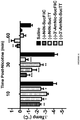
- the purpose of this example is to demonstrate the antagonism of nicotine vaccines, as described above, against nicotine by measuring the latency of mouse paw withdrawal from a hot plate.
- mice Four test groups of mice were immunized with the four vaccines, respectively, and according to the immunization schedule as described above in Example 5. A fifth and vaccine-naive group of mice received saline injections during the immunization schedule. All five groups of mice were then administered nicotine and then assayed on a hot plate to measure the latency in paw withdrawal from the hot plate is measured.
- %MPE (test - baseline)/(cutoff-baseline) ⁇ 100, where "test” is the latency to respond after treatment; “baseline” is the latency to respond prior to treatment; and “cutoff” is the preset time at which the test was ended in the absence of a response.
- a baseline measure was obtained for each animal in the five groups prior to the immunization schedule above.
- Body temperatures of mice in the five groups described above in Example 7 were measured at 10 minutes, 30 minutes, and 60 minutes following administration of nicotine.
- the four tested nicotine vaccines antagonized the effect of nicotine by attenuating body temperature depression, relative to the saline control group that experienced the most pronounced depression of temperature. Results are summarized in Figure 6 .
Landscapes
- Chemical & Material Sciences (AREA)
- Health & Medical Sciences (AREA)
- Organic Chemistry (AREA)
- Life Sciences & Earth Sciences (AREA)
- General Health & Medical Sciences (AREA)
- Medicinal Chemistry (AREA)
- Immunology (AREA)
- Animal Behavior & Ethology (AREA)
- Pharmacology & Pharmacy (AREA)
- Veterinary Medicine (AREA)
- Public Health (AREA)
- Botany (AREA)
- Biochemistry (AREA)
- Proteomics, Peptides & Aminoacids (AREA)
- Molecular Biology (AREA)
- Genetics & Genomics (AREA)
- Biophysics (AREA)
- Microbiology (AREA)
- Epidemiology (AREA)
- Mycology (AREA)
- Addiction (AREA)
- Biomedical Technology (AREA)
- Psychiatry (AREA)
- Engineering & Computer Science (AREA)
- Bioinformatics & Cheminformatics (AREA)
- Neurology (AREA)
- General Chemical & Material Sciences (AREA)
- Nuclear Medicine, Radiotherapy & Molecular Imaging (AREA)
- Neurosurgery (AREA)
- Chemical Kinetics & Catalysis (AREA)
- Peptides Or Proteins (AREA)
- Medicines Containing Antibodies Or Antigens For Use As Internal Diagnostic Agents (AREA)
- Plural Heterocyclic Compounds (AREA)
- Pharmaceuticals Containing Other Organic And Inorganic Compounds (AREA)
Applications Claiming Priority (2)
| Application Number | Priority Date | Filing Date | Title |
|---|---|---|---|
| US201462000312P | 2014-05-19 | 2014-05-19 | |
| PCT/US2015/031583 WO2015179403A1 (en) | 2014-05-19 | 2015-05-19 | Enantiopure haptens for nicotine vaccine development |
Publications (3)
| Publication Number | Publication Date |
|---|---|
| EP3145920A1 EP3145920A1 (en) | 2017-03-29 |
| EP3145920A4 EP3145920A4 (en) | 2017-12-27 |
| EP3145920B1 true EP3145920B1 (en) | 2019-09-18 |
Family
ID=54554631
Family Applications (1)
| Application Number | Title | Priority Date | Filing Date |
|---|---|---|---|
| EP15796375.2A Active EP3145920B1 (en) | 2014-05-19 | 2015-05-19 | Enantiopure haptens for nicotine vaccine development |
Country Status (8)
| Country | Link |
|---|---|
| US (3) | US20170107275A1 (https=) |
| EP (1) | EP3145920B1 (https=) |
| JP (1) | JP6564396B2 (https=) |
| KR (1) | KR102435658B1 (https=) |
| CN (2) | CN110452217B (https=) |
| AU (1) | AU2015264325B2 (https=) |
| CA (1) | CA2949667C (https=) |
| WO (1) | WO2015179403A1 (https=) |
Families Citing this family (2)
| Publication number | Priority date | Publication date | Assignee | Title |
|---|---|---|---|---|
| US20170107275A1 (en) | 2014-05-19 | 2017-04-20 | The Scripps Research Institute | Enantiopure haptens for nicotine vaccine development |
| CN118161604B (zh) * | 2024-03-25 | 2025-01-14 | 海南大学 | 一种尼古丁蛋白缀合物、其制备方法及在疫苗中的应用 |
Family Cites Families (9)
| Publication number | Priority date | Publication date | Assignee | Title |
|---|---|---|---|---|
| US5876727A (en) * | 1995-03-31 | 1999-03-02 | Immulogic Pharmaceutical Corporation | Hapten-carrier conjugates for use in drug-abuse therapy and methods for preparation of same |
| SE9801923D0 (sv) * | 1998-05-29 | 1998-05-29 | Independent Pharmaceutical Ab | Nicotine vaccine |
| US6232082B1 (en) * | 1998-12-01 | 2001-05-15 | Nabi | Hapten-carrier conjugates for treating and preventing nicotine addiction |
| EP1963308A4 (en) * | 2005-11-28 | 2010-12-15 | Nabi Biopharmaceuticals | METHOD FOR PRODUCING A NICOTINE HAPTEN |
| WO2007100755A1 (en) * | 2006-02-27 | 2007-09-07 | Nabi Biopharmaceuticals | Method for decreasing the toxic effects of nicotine on fetuses in pregnant women |
| US7820826B2 (en) * | 2006-03-29 | 2010-10-26 | North Carolina State University | Synthesis and regioselective substitution of 6-halo-and 6-alkoxy nicotine derivatives |
| TWI578997B (zh) * | 2010-06-04 | 2017-04-21 | 輝瑞疫苗有限責任公司 | 用於預防或治療菸鹼成癮之共軛體 |
| US20170107275A1 (en) | 2014-05-19 | 2017-04-20 | The Scripps Research Institute | Enantiopure haptens for nicotine vaccine development |
| US9884114B2 (en) * | 2015-06-23 | 2018-02-06 | Arizona Board Of Regents On Behalf Of Arizona State University | Methods of rational nicotine hapten design and uses thereof |
-
2015
- 2015-05-19 US US15/311,322 patent/US20170107275A1/en not_active Abandoned
- 2015-05-19 KR KR1020167035358A patent/KR102435658B1/ko active Active
- 2015-05-19 JP JP2016568391A patent/JP6564396B2/ja not_active Expired - Fee Related
- 2015-05-19 CN CN201910630434.2A patent/CN110452217B/zh not_active Expired - Fee Related
- 2015-05-19 WO PCT/US2015/031583 patent/WO2015179403A1/en not_active Ceased
- 2015-05-19 AU AU2015264325A patent/AU2015264325B2/en not_active Expired - Fee Related
- 2015-05-19 EP EP15796375.2A patent/EP3145920B1/en active Active
- 2015-05-19 CA CA2949667A patent/CA2949667C/en active Active
- 2015-05-19 CN CN201580026158.9A patent/CN106458971A/zh active Pending
-
2017
- 2017-11-21 US US15/819,283 patent/US20180086820A1/en not_active Abandoned
-
2018
- 2018-12-10 US US16/215,296 patent/US10487141B2/en not_active Expired - Fee Related
Non-Patent Citations (1)
| Title |
|---|
| None * |
Also Published As
| Publication number | Publication date |
|---|---|
| CN110452217A (zh) | 2019-11-15 |
| KR102435658B1 (ko) | 2022-08-23 |
| JP6564396B2 (ja) | 2019-08-21 |
| EP3145920A1 (en) | 2017-03-29 |
| CN110452217B (zh) | 2022-12-27 |
| US20190119363A1 (en) | 2019-04-25 |
| US10487141B2 (en) | 2019-11-26 |
| CN106458971A (zh) | 2017-02-22 |
| JP2017515867A (ja) | 2017-06-15 |
| US20170107275A1 (en) | 2017-04-20 |
| CA2949667C (en) | 2022-05-03 |
| WO2015179403A1 (en) | 2015-11-26 |
| AU2015264325A1 (en) | 2016-12-01 |
| US20180086820A1 (en) | 2018-03-29 |
| CA2949667A1 (en) | 2015-11-26 |
| KR20170007810A (ko) | 2017-01-20 |
| EP3145920A4 (en) | 2017-12-27 |
| AU2015264325B2 (en) | 2019-02-14 |
Similar Documents
| Publication | Publication Date | Title |
|---|---|---|
| US6232082B1 (en) | Hapten-carrier conjugates for treating and preventing nicotine addiction | |
| KR101429413B1 (ko) | 니코틴 중독의 예방 또는 치료를 위한 접합체 | |
| Lockner et al. | A conjugate vaccine using enantiopure hapten imparts superior nicotine-binding capacity | |
| US10487141B2 (en) | Enantiopure haptens for nicotine vaccine development | |
| EP1849780A1 (en) | Vaccine against nicotine addiction | |
| HK1075824A (en) | Hapten-carrier conjugates for treating and preventing nicotine addiction | |
| HK1091415B (en) | Hapten-carrier conjugates for treating and preventing nicotine addiction |
Legal Events
| Date | Code | Title | Description |
|---|---|---|---|
| STAA | Information on the status of an ep patent application or granted ep patent |
Free format text: STATUS: THE INTERNATIONAL PUBLICATION HAS BEEN MADE |
|
| PUAI | Public reference made under article 153(3) epc to a published international application that has entered the european phase |
Free format text: ORIGINAL CODE: 0009012 |
|
| STAA | Information on the status of an ep patent application or granted ep patent |
Free format text: STATUS: REQUEST FOR EXAMINATION WAS MADE |
|
| 17P | Request for examination filed |
Effective date: 20161124 |
|
| AK | Designated contracting states |
Kind code of ref document: A1 Designated state(s): AL AT BE BG CH CY CZ DE DK EE ES FI FR GB GR HR HU IE IS IT LI LT LU LV MC MK MT NL NO PL PT RO RS SE SI SK SM TR |
|
| AX | Request for extension of the european patent |
Extension state: BA ME |
|
| DAV | Request for validation of the european patent (deleted) | ||
| DAX | Request for extension of the european patent (deleted) | ||
| A4 | Supplementary search report drawn up and despatched |
Effective date: 20171124 |
|
| RIC1 | Information provided on ipc code assigned before grant |
Ipc: C07K 16/16 20060101ALI20171120BHEP Ipc: A61K 39/385 20060101ALI20171120BHEP Ipc: C07D 401/04 20060101AFI20171120BHEP |
|
| STAA | Information on the status of an ep patent application or granted ep patent |
Free format text: STATUS: EXAMINATION IS IN PROGRESS |
|
| 17Q | First examination report despatched |
Effective date: 20180917 |
|
| GRAP | Despatch of communication of intention to grant a patent |
Free format text: ORIGINAL CODE: EPIDOSNIGR1 |
|
| STAA | Information on the status of an ep patent application or granted ep patent |
Free format text: STATUS: GRANT OF PATENT IS INTENDED |
|
| INTG | Intention to grant announced |
Effective date: 20190401 |
|
| GRAS | Grant fee paid |
Free format text: ORIGINAL CODE: EPIDOSNIGR3 |
|
| GRAA | (expected) grant |
Free format text: ORIGINAL CODE: 0009210 |
|
| STAA | Information on the status of an ep patent application or granted ep patent |
Free format text: STATUS: THE PATENT HAS BEEN GRANTED |
|
| AK | Designated contracting states |
Kind code of ref document: B1 Designated state(s): AL AT BE BG CH CY CZ DE DK EE ES FI FR GB GR HR HU IE IS IT LI LT LU LV MC MK MT NL NO PL PT RO RS SE SI SK SM TR |
|
| REG | Reference to a national code |
Ref country code: GB Ref legal event code: FG4D |
|
| REG | Reference to a national code |
Ref country code: CH Ref legal event code: EP |
|
| REG | Reference to a national code |
Ref country code: DE Ref legal event code: R096 Ref document number: 602015038342 Country of ref document: DE |
|
| REG | Reference to a national code |
Ref country code: AT Ref legal event code: REF Ref document number: 1181147 Country of ref document: AT Kind code of ref document: T Effective date: 20191015 |
|
| REG | Reference to a national code |
Ref country code: IE Ref legal event code: FG4D |
|
| REG | Reference to a national code |
Ref country code: NL Ref legal event code: MP Effective date: 20190918 |
|
| PG25 | Lapsed in a contracting state [announced via postgrant information from national office to epo] |
Ref country code: FI Free format text: LAPSE BECAUSE OF FAILURE TO SUBMIT A TRANSLATION OF THE DESCRIPTION OR TO PAY THE FEE WITHIN THE PRESCRIBED TIME-LIMIT Effective date: 20190918 Ref country code: NO Free format text: LAPSE BECAUSE OF FAILURE TO SUBMIT A TRANSLATION OF THE DESCRIPTION OR TO PAY THE FEE WITHIN THE PRESCRIBED TIME-LIMIT Effective date: 20191218 Ref country code: SE Free format text: LAPSE BECAUSE OF FAILURE TO SUBMIT A TRANSLATION OF THE DESCRIPTION OR TO PAY THE FEE WITHIN THE PRESCRIBED TIME-LIMIT Effective date: 20190918 Ref country code: BG Free format text: LAPSE BECAUSE OF FAILURE TO SUBMIT A TRANSLATION OF THE DESCRIPTION OR TO PAY THE FEE WITHIN THE PRESCRIBED TIME-LIMIT Effective date: 20191218 Ref country code: LT Free format text: LAPSE BECAUSE OF FAILURE TO SUBMIT A TRANSLATION OF THE DESCRIPTION OR TO PAY THE FEE WITHIN THE PRESCRIBED TIME-LIMIT Effective date: 20190918 Ref country code: HR Free format text: LAPSE BECAUSE OF FAILURE TO SUBMIT A TRANSLATION OF THE DESCRIPTION OR TO PAY THE FEE WITHIN THE PRESCRIBED TIME-LIMIT Effective date: 20190918 |
|
| REG | Reference to a national code |
Ref country code: LT Ref legal event code: MG4D |
|
| PG25 | Lapsed in a contracting state [announced via postgrant information from national office to epo] |
Ref country code: RS Free format text: LAPSE BECAUSE OF FAILURE TO SUBMIT A TRANSLATION OF THE DESCRIPTION OR TO PAY THE FEE WITHIN THE PRESCRIBED TIME-LIMIT Effective date: 20190918 Ref country code: GR Free format text: LAPSE BECAUSE OF FAILURE TO SUBMIT A TRANSLATION OF THE DESCRIPTION OR TO PAY THE FEE WITHIN THE PRESCRIBED TIME-LIMIT Effective date: 20191219 Ref country code: AL Free format text: LAPSE BECAUSE OF FAILURE TO SUBMIT A TRANSLATION OF THE DESCRIPTION OR TO PAY THE FEE WITHIN THE PRESCRIBED TIME-LIMIT Effective date: 20190918 Ref country code: LV Free format text: LAPSE BECAUSE OF FAILURE TO SUBMIT A TRANSLATION OF THE DESCRIPTION OR TO PAY THE FEE WITHIN THE PRESCRIBED TIME-LIMIT Effective date: 20190918 |
|
| REG | Reference to a national code |
Ref country code: AT Ref legal event code: MK05 Ref document number: 1181147 Country of ref document: AT Kind code of ref document: T Effective date: 20190918 |
|
| PG25 | Lapsed in a contracting state [announced via postgrant information from national office to epo] |
Ref country code: EE Free format text: LAPSE BECAUSE OF FAILURE TO SUBMIT A TRANSLATION OF THE DESCRIPTION OR TO PAY THE FEE WITHIN THE PRESCRIBED TIME-LIMIT Effective date: 20190918 Ref country code: PT Free format text: LAPSE BECAUSE OF FAILURE TO SUBMIT A TRANSLATION OF THE DESCRIPTION OR TO PAY THE FEE WITHIN THE PRESCRIBED TIME-LIMIT Effective date: 20200120 Ref country code: PL Free format text: LAPSE BECAUSE OF FAILURE TO SUBMIT A TRANSLATION OF THE DESCRIPTION OR TO PAY THE FEE WITHIN THE PRESCRIBED TIME-LIMIT Effective date: 20190918 Ref country code: ES Free format text: LAPSE BECAUSE OF FAILURE TO SUBMIT A TRANSLATION OF THE DESCRIPTION OR TO PAY THE FEE WITHIN THE PRESCRIBED TIME-LIMIT Effective date: 20190918 Ref country code: IT Free format text: LAPSE BECAUSE OF FAILURE TO SUBMIT A TRANSLATION OF THE DESCRIPTION OR TO PAY THE FEE WITHIN THE PRESCRIBED TIME-LIMIT Effective date: 20190918 Ref country code: RO Free format text: LAPSE BECAUSE OF FAILURE TO SUBMIT A TRANSLATION OF THE DESCRIPTION OR TO PAY THE FEE WITHIN THE PRESCRIBED TIME-LIMIT Effective date: 20190918 Ref country code: AT Free format text: LAPSE BECAUSE OF FAILURE TO SUBMIT A TRANSLATION OF THE DESCRIPTION OR TO PAY THE FEE WITHIN THE PRESCRIBED TIME-LIMIT Effective date: 20190918 Ref country code: NL Free format text: LAPSE BECAUSE OF FAILURE TO SUBMIT A TRANSLATION OF THE DESCRIPTION OR TO PAY THE FEE WITHIN THE PRESCRIBED TIME-LIMIT Effective date: 20190918 |
|
| PG25 | Lapsed in a contracting state [announced via postgrant information from national office to epo] |
Ref country code: SK Free format text: LAPSE BECAUSE OF FAILURE TO SUBMIT A TRANSLATION OF THE DESCRIPTION OR TO PAY THE FEE WITHIN THE PRESCRIBED TIME-LIMIT Effective date: 20190918 Ref country code: CZ Free format text: LAPSE BECAUSE OF FAILURE TO SUBMIT A TRANSLATION OF THE DESCRIPTION OR TO PAY THE FEE WITHIN THE PRESCRIBED TIME-LIMIT Effective date: 20190918 Ref country code: IS Free format text: LAPSE BECAUSE OF FAILURE TO SUBMIT A TRANSLATION OF THE DESCRIPTION OR TO PAY THE FEE WITHIN THE PRESCRIBED TIME-LIMIT Effective date: 20200224 Ref country code: SM Free format text: LAPSE BECAUSE OF FAILURE TO SUBMIT A TRANSLATION OF THE DESCRIPTION OR TO PAY THE FEE WITHIN THE PRESCRIBED TIME-LIMIT Effective date: 20190918 |
|
| REG | Reference to a national code |
Ref country code: DE Ref legal event code: R097 Ref document number: 602015038342 Country of ref document: DE |
|
| PLBE | No opposition filed within time limit |
Free format text: ORIGINAL CODE: 0009261 |
|
| STAA | Information on the status of an ep patent application or granted ep patent |
Free format text: STATUS: NO OPPOSITION FILED WITHIN TIME LIMIT |
|
| PG2D | Information on lapse in contracting state deleted |
Ref country code: IS |
|
| PG25 | Lapsed in a contracting state [announced via postgrant information from national office to epo] |
Ref country code: DK Free format text: LAPSE BECAUSE OF FAILURE TO SUBMIT A TRANSLATION OF THE DESCRIPTION OR TO PAY THE FEE WITHIN THE PRESCRIBED TIME-LIMIT Effective date: 20190918 Ref country code: IS Free format text: LAPSE BECAUSE OF FAILURE TO SUBMIT A TRANSLATION OF THE DESCRIPTION OR TO PAY THE FEE WITHIN THE PRESCRIBED TIME-LIMIT Effective date: 20200119 |
|
| 26N | No opposition filed |
Effective date: 20200619 |
|
| PG25 | Lapsed in a contracting state [announced via postgrant information from national office to epo] |
Ref country code: SI Free format text: LAPSE BECAUSE OF FAILURE TO SUBMIT A TRANSLATION OF THE DESCRIPTION OR TO PAY THE FEE WITHIN THE PRESCRIBED TIME-LIMIT Effective date: 20190918 |
|
| REG | Reference to a national code |
Ref country code: DE Ref legal event code: R082 Ref document number: 602015038342 Country of ref document: DE Representative=s name: VENNER SHIPLEY GERMANY LLP, DE Ref country code: DE Ref legal event code: R082 Ref document number: 602015038342 Country of ref document: DE Representative=s name: VENNER SHIPLEY LLP, DE |
|
| PG25 | Lapsed in a contracting state [announced via postgrant information from national office to epo] |
Ref country code: MC Free format text: LAPSE BECAUSE OF FAILURE TO SUBMIT A TRANSLATION OF THE DESCRIPTION OR TO PAY THE FEE WITHIN THE PRESCRIBED TIME-LIMIT Effective date: 20190918 Ref country code: LI Free format text: LAPSE BECAUSE OF NON-PAYMENT OF DUE FEES Effective date: 20200531 Ref country code: CH Free format text: LAPSE BECAUSE OF NON-PAYMENT OF DUE FEES Effective date: 20200531 |
|
| REG | Reference to a national code |
Ref country code: BE Ref legal event code: MM Effective date: 20200531 |
|
| GBPC | Gb: european patent ceased through non-payment of renewal fee |
Effective date: 20200519 |
|
| PG25 | Lapsed in a contracting state [announced via postgrant information from national office to epo] |
Ref country code: LU Free format text: LAPSE BECAUSE OF NON-PAYMENT OF DUE FEES Effective date: 20200519 |
|
| PG25 | Lapsed in a contracting state [announced via postgrant information from national office to epo] |
Ref country code: IE Free format text: LAPSE BECAUSE OF NON-PAYMENT OF DUE FEES Effective date: 20200519 Ref country code: GB Free format text: LAPSE BECAUSE OF NON-PAYMENT OF DUE FEES Effective date: 20200519 |
|
| PG25 | Lapsed in a contracting state [announced via postgrant information from national office to epo] |
Ref country code: BE Free format text: LAPSE BECAUSE OF NON-PAYMENT OF DUE FEES Effective date: 20200531 |
|
| PG25 | Lapsed in a contracting state [announced via postgrant information from national office to epo] |
Ref country code: TR Free format text: LAPSE BECAUSE OF FAILURE TO SUBMIT A TRANSLATION OF THE DESCRIPTION OR TO PAY THE FEE WITHIN THE PRESCRIBED TIME-LIMIT Effective date: 20190918 Ref country code: MT Free format text: LAPSE BECAUSE OF FAILURE TO SUBMIT A TRANSLATION OF THE DESCRIPTION OR TO PAY THE FEE WITHIN THE PRESCRIBED TIME-LIMIT Effective date: 20190918 Ref country code: CY Free format text: LAPSE BECAUSE OF FAILURE TO SUBMIT A TRANSLATION OF THE DESCRIPTION OR TO PAY THE FEE WITHIN THE PRESCRIBED TIME-LIMIT Effective date: 20190918 |
|
| PG25 | Lapsed in a contracting state [announced via postgrant information from national office to epo] |
Ref country code: MK Free format text: LAPSE BECAUSE OF FAILURE TO SUBMIT A TRANSLATION OF THE DESCRIPTION OR TO PAY THE FEE WITHIN THE PRESCRIBED TIME-LIMIT Effective date: 20190918 |
|
| PGFP | Annual fee paid to national office [announced via postgrant information from national office to epo] |
Ref country code: DE Payment date: 20220322 Year of fee payment: 8 |
|
| PGFP | Annual fee paid to national office [announced via postgrant information from national office to epo] |
Ref country code: FR Payment date: 20230309 Year of fee payment: 9 |
|
| REG | Reference to a national code |
Ref country code: DE Ref legal event code: R119 Ref document number: 602015038342 Country of ref document: DE |
|
| PG25 | Lapsed in a contracting state [announced via postgrant information from national office to epo] |
Ref country code: DE Free format text: LAPSE BECAUSE OF NON-PAYMENT OF DUE FEES Effective date: 20231201 |
|
| PG25 | Lapsed in a contracting state [announced via postgrant information from national office to epo] |
Ref country code: FR Free format text: LAPSE BECAUSE OF NON-PAYMENT OF DUE FEES Effective date: 20240531 |