EP3144144A1 - Slide member with coating film and method for forming coating film - Google Patents
Slide member with coating film and method for forming coating film Download PDFInfo
- Publication number
- EP3144144A1 EP3144144A1 EP15791918.4A EP15791918A EP3144144A1 EP 3144144 A1 EP3144144 A1 EP 3144144A1 EP 15791918 A EP15791918 A EP 15791918A EP 3144144 A1 EP3144144 A1 EP 3144144A1
- Authority
- EP
- European Patent Office
- Prior art keywords
- coating film
- sliding member
- solid lubricant
- composition
- layer
- Prior art date
- Legal status (The legal status is an assumption and is not a legal conclusion. Google has not performed a legal analysis and makes no representation as to the accuracy of the status listed.)
- Granted
Links
Images
Classifications
-
- F—MECHANICAL ENGINEERING; LIGHTING; HEATING; WEAPONS; BLASTING
- F16—ENGINEERING ELEMENTS AND UNITS; GENERAL MEASURES FOR PRODUCING AND MAINTAINING EFFECTIVE FUNCTIONING OF MACHINES OR INSTALLATIONS; THERMAL INSULATION IN GENERAL
- F16C—SHAFTS; FLEXIBLE SHAFTS; ELEMENTS OR CRANKSHAFT MECHANISMS; ROTARY BODIES OTHER THAN GEARING ELEMENTS; BEARINGS
- F16C33/00—Parts of bearings; Special methods for making bearings or parts thereof
- F16C33/02—Parts of sliding-contact bearings
- F16C33/04—Brasses; Bushes; Linings
- F16C33/20—Sliding surface consisting mainly of plastics
- F16C33/201—Composition of the plastic
-
- C—CHEMISTRY; METALLURGY
- C10—PETROLEUM, GAS OR COKE INDUSTRIES; TECHNICAL GASES CONTAINING CARBON MONOXIDE; FUELS; LUBRICANTS; PEAT
- C10M—LUBRICATING COMPOSITIONS; USE OF CHEMICAL SUBSTANCES EITHER ALONE OR AS LUBRICATING INGREDIENTS IN A LUBRICATING COMPOSITION
- C10M107/00—Lubricating compositions characterised by the base-material being a macromolecular compound
- C10M107/38—Lubricating compositions characterised by the base-material being a macromolecular compound containing halogen
-
- B—PERFORMING OPERATIONS; TRANSPORTING
- B05—SPRAYING OR ATOMISING IN GENERAL; APPLYING FLUENT MATERIALS TO SURFACES, IN GENERAL
- B05D—PROCESSES FOR APPLYING FLUENT MATERIALS TO SURFACES, IN GENERAL
- B05D1/00—Processes for applying liquids or other fluent materials
- B05D1/02—Processes for applying liquids or other fluent materials performed by spraying
-
- B—PERFORMING OPERATIONS; TRANSPORTING
- B05—SPRAYING OR ATOMISING IN GENERAL; APPLYING FLUENT MATERIALS TO SURFACES, IN GENERAL
- B05D—PROCESSES FOR APPLYING FLUENT MATERIALS TO SURFACES, IN GENERAL
- B05D1/00—Processes for applying liquids or other fluent materials
- B05D1/30—Processes for applying liquids or other fluent materials performed by gravity only, i.e. flow coating
-
- C—CHEMISTRY; METALLURGY
- C10—PETROLEUM, GAS OR COKE INDUSTRIES; TECHNICAL GASES CONTAINING CARBON MONOXIDE; FUELS; LUBRICANTS; PEAT
- C10M—LUBRICATING COMPOSITIONS; USE OF CHEMICAL SUBSTANCES EITHER ALONE OR AS LUBRICATING INGREDIENTS IN A LUBRICATING COMPOSITION
- C10M125/00—Lubricating compositions characterised by the additive being an inorganic material
- C10M125/02—Carbon; Graphite
-
- C—CHEMISTRY; METALLURGY
- C10—PETROLEUM, GAS OR COKE INDUSTRIES; TECHNICAL GASES CONTAINING CARBON MONOXIDE; FUELS; LUBRICANTS; PEAT
- C10M—LUBRICATING COMPOSITIONS; USE OF CHEMICAL SUBSTANCES EITHER ALONE OR AS LUBRICATING INGREDIENTS IN A LUBRICATING COMPOSITION
- C10M149/00—Lubricating compositions characterised by the additive being a macromolecular compound containing nitrogen
- C10M149/12—Macromolecular compounds obtained otherwise than by reactions only involving carbon-to-carbon unsaturated bonds
- C10M149/14—Macromolecular compounds obtained otherwise than by reactions only involving carbon-to-carbon unsaturated bonds a condensation reaction being involved
- C10M149/18—Polyamides
-
- F—MECHANICAL ENGINEERING; LIGHTING; HEATING; WEAPONS; BLASTING
- F16—ENGINEERING ELEMENTS AND UNITS; GENERAL MEASURES FOR PRODUCING AND MAINTAINING EFFECTIVE FUNCTIONING OF MACHINES OR INSTALLATIONS; THERMAL INSULATION IN GENERAL
- F16C—SHAFTS; FLEXIBLE SHAFTS; ELEMENTS OR CRANKSHAFT MECHANISMS; ROTARY BODIES OTHER THAN GEARING ELEMENTS; BEARINGS
- F16C33/00—Parts of bearings; Special methods for making bearings or parts thereof
- F16C33/02—Parts of sliding-contact bearings
- F16C33/04—Brasses; Bushes; Linings
- F16C33/20—Sliding surface consisting mainly of plastics
-
- F—MECHANICAL ENGINEERING; LIGHTING; HEATING; WEAPONS; BLASTING
- F16—ENGINEERING ELEMENTS AND UNITS; GENERAL MEASURES FOR PRODUCING AND MAINTAINING EFFECTIVE FUNCTIONING OF MACHINES OR INSTALLATIONS; THERMAL INSULATION IN GENERAL
- F16C—SHAFTS; FLEXIBLE SHAFTS; ELEMENTS OR CRANKSHAFT MECHANISMS; ROTARY BODIES OTHER THAN GEARING ELEMENTS; BEARINGS
- F16C33/00—Parts of bearings; Special methods for making bearings or parts thereof
- F16C33/02—Parts of sliding-contact bearings
- F16C33/04—Brasses; Bushes; Linings
- F16C33/20—Sliding surface consisting mainly of plastics
- F16C33/203—Multilayer structures, e.g. sleeves comprising a plastic lining
- F16C33/206—Multilayer structures, e.g. sleeves comprising a plastic lining with three layers
-
- C—CHEMISTRY; METALLURGY
- C10—PETROLEUM, GAS OR COKE INDUSTRIES; TECHNICAL GASES CONTAINING CARBON MONOXIDE; FUELS; LUBRICANTS; PEAT
- C10M—LUBRICATING COMPOSITIONS; USE OF CHEMICAL SUBSTANCES EITHER ALONE OR AS LUBRICATING INGREDIENTS IN A LUBRICATING COMPOSITION
- C10M2201/00—Inorganic compounds or elements as ingredients in lubricant compositions
- C10M2201/04—Elements
- C10M2201/041—Carbon; Graphite; Carbon black
-
- C—CHEMISTRY; METALLURGY
- C10—PETROLEUM, GAS OR COKE INDUSTRIES; TECHNICAL GASES CONTAINING CARBON MONOXIDE; FUELS; LUBRICANTS; PEAT
- C10M—LUBRICATING COMPOSITIONS; USE OF CHEMICAL SUBSTANCES EITHER ALONE OR AS LUBRICATING INGREDIENTS IN A LUBRICATING COMPOSITION
- C10M2213/00—Organic macromolecular compounds containing halogen as ingredients in lubricant compositions
- C10M2213/02—Organic macromolecular compounds containing halogen as ingredients in lubricant compositions obtained from monomers containing carbon, hydrogen and halogen only
- C10M2213/023—Organic macromolecular compounds containing halogen as ingredients in lubricant compositions obtained from monomers containing carbon, hydrogen and halogen only used as base material
-
- C—CHEMISTRY; METALLURGY
- C10—PETROLEUM, GAS OR COKE INDUSTRIES; TECHNICAL GASES CONTAINING CARBON MONOXIDE; FUELS; LUBRICANTS; PEAT
- C10M—LUBRICATING COMPOSITIONS; USE OF CHEMICAL SUBSTANCES EITHER ALONE OR AS LUBRICATING INGREDIENTS IN A LUBRICATING COMPOSITION
- C10M2217/00—Organic macromolecular compounds containing nitrogen as ingredients in lubricant compositions
- C10M2217/04—Macromolecular compounds from nitrogen-containing monomers obtained otherwise than by reactions only involving carbon-to-carbon unsaturated bonds
- C10M2217/044—Polyamides
-
- F—MECHANICAL ENGINEERING; LIGHTING; HEATING; WEAPONS; BLASTING
- F16—ENGINEERING ELEMENTS AND UNITS; GENERAL MEASURES FOR PRODUCING AND MAINTAINING EFFECTIVE FUNCTIONING OF MACHINES OR INSTALLATIONS; THERMAL INSULATION IN GENERAL
- F16C—SHAFTS; FLEXIBLE SHAFTS; ELEMENTS OR CRANKSHAFT MECHANISMS; ROTARY BODIES OTHER THAN GEARING ELEMENTS; BEARINGS
- F16C2202/00—Solid materials defined by their properties
- F16C2202/50—Lubricating properties
- F16C2202/52—Graphite
-
- F—MECHANICAL ENGINEERING; LIGHTING; HEATING; WEAPONS; BLASTING
- F16—ENGINEERING ELEMENTS AND UNITS; GENERAL MEASURES FOR PRODUCING AND MAINTAINING EFFECTIVE FUNCTIONING OF MACHINES OR INSTALLATIONS; THERMAL INSULATION IN GENERAL
- F16C—SHAFTS; FLEXIBLE SHAFTS; ELEMENTS OR CRANKSHAFT MECHANISMS; ROTARY BODIES OTHER THAN GEARING ELEMENTS; BEARINGS
- F16C2208/00—Plastics; Synthetic resins, e.g. rubbers
- F16C2208/02—Plastics; Synthetic resins, e.g. rubbers comprising fillers, fibres
-
- F—MECHANICAL ENGINEERING; LIGHTING; HEATING; WEAPONS; BLASTING
- F16—ENGINEERING ELEMENTS AND UNITS; GENERAL MEASURES FOR PRODUCING AND MAINTAINING EFFECTIVE FUNCTIONING OF MACHINES OR INSTALLATIONS; THERMAL INSULATION IN GENERAL
- F16C—SHAFTS; FLEXIBLE SHAFTS; ELEMENTS OR CRANKSHAFT MECHANISMS; ROTARY BODIES OTHER THAN GEARING ELEMENTS; BEARINGS
- F16C2208/00—Plastics; Synthetic resins, e.g. rubbers
- F16C2208/20—Thermoplastic resins
- F16C2208/40—Imides, e.g. polyimide [PI], polyetherimide [PEI]
- F16C2208/42—Polyamideimide [PAI]
-
- F—MECHANICAL ENGINEERING; LIGHTING; HEATING; WEAPONS; BLASTING
- F16—ENGINEERING ELEMENTS AND UNITS; GENERAL MEASURES FOR PRODUCING AND MAINTAINING EFFECTIVE FUNCTIONING OF MACHINES OR INSTALLATIONS; THERMAL INSULATION IN GENERAL
- F16C—SHAFTS; FLEXIBLE SHAFTS; ELEMENTS OR CRANKSHAFT MECHANISMS; ROTARY BODIES OTHER THAN GEARING ELEMENTS; BEARINGS
- F16C2300/00—Application independent of particular apparatuses
- F16C2300/02—General use or purpose, i.e. no use, purpose, special adaptation or modification indicated or a wide variety of uses mentioned
Definitions
- the present invention relates to a sliding member having a coating film and a method for forming a coating film, more specifically to a sliding member having a coating film and a method for forming a coating film which realizes both of lubricity of the coating film by using a solid lubricant and adhesiveness of the coating film to the ground by inclining a concentration of the solid lubricant in the coating film (gradient coating), and realizes simplification of the process.
- Patent Document 1 a composition for a sliding member in which polyamide-imide resin, polyamide resin, polyimide resin, epoxy resin or phenol resin is used as the binder resin, and further fluorinated polymer such as polytetrafluoroethylene (PTFE), etc.; molybdenum disulfide or tungsten disulfide is used as the solid lubricant.
- PTFE polytetrafluoroethylene
- Patent Document 2 A technique which uses graphite as the solid lubricant has been disclosed in Patent Document 2.
- Patent Document 3 it has been attempted to establish the function by markedly improve lubricity by using silicone oil, but there is a problem that adhesiveness of the coating film is lowered by using the liquid lubricant.
- PAI polyamide-imide
- PAI using a solid lubricant is coated thereon, but the following problems are involved.
- the first object of the present invention is to provide a sliding member having a coating film, which can realize both of improvement in lubricity of the coating film by using a solid lubricant, and improvement in adhesiveness of the coating film to the ground.
- the second object of the present invention is to provide a sliding member having a coating film, which can realize both of improvement in lubricity of the coating film by using a solid lubricant(s), and improvement in adhesiveness of the coating film to the ground, and to provide a method for forming a coating film which can realize simplification of the process.
- a sliding member having a coating film which can realize both of improvement in lubricity of the coating film by using a solid lubricant(s) and improvement in adhesiveness of the coating film to the ground can be provided.
- a method for forming a coating film which can provide a sliding member having a coating film which can realize both of improvement in lubricity of the coating film by using a solid lubricant(s) and improvement in adhesiveness of the coating film to the ground, and can realize simplification of the process can be provided.
- the sliding member having a coating film of the present invention comprises a plural number of coating film layers formed onto a surface of a sliding member using a composition for a sliding member which contains at least a binder resin and a solid lubricant(s), and a concentration of the solid lubricant(s) in the coating film layer at the side far from the surface of the sliding member is higher than a concentration of the solid lubricant(s) in the coating film layer at the side near to the surface of the sliding member.
- composition for a sliding member contains at least a binder resin and a solid lubricant(s).
- the binder resin is not particularly limited, and may be exemplified by, for example, polyamide-imide resin (PAI), polyamide resin (PA), polyimide resin (PI), epoxy resin and phenol resin, and one kind may be used by selecting from the above, or two or more kinds thereof may be used in combination.
- PAI polyamide-imide resin
- PA polyamide resin
- PI polyimide resin
- epoxy resin epoxy resin
- phenol resin epoxy resin and phenol resin
- the solid lubricant is not particularly limited, and may be exemplified by, for example, fluorine-containing polymer selected from polytetrafluoroethylene (PTFE), tetrafluoroethylene-perfluoroalkyl vinyl ether copolymer, tetrafluoroethylene-hexafluoropropylene copolymer, tetrafluoroethylene-ethylene copolymer, polyvinylidene fluoride and polychlorotrifluoroethylene; metal disulfide selected from molybdenum disulfide and tungsten disulfide; and graphite, and one kind may be used by selecting from the above, or two or more kinds thereof may be used in combination.
- fluorine-containing polymer selected from polytetrafluoroethylene (PTFE), tetrafluoroethylene-perfluoroalkyl vinyl ether copolymer, tetrafluoroethylene-hexafluoropropylene copolymer, te
- the sliding member having a coating film of the present invention has a constitution that a plural number of coating film layers are formed onto the surface of the sliding member using a composition(s) for a sliding member.
- the present invention has a characteristic in the point that a concentration of the solid lubricant(s) in the coating film layer at the side far from the surface of the sliding member is higher than a concentration of the solid lubricant(s) in the coating film layer at the side near to the surface of the sliding member.
- the plural number of the coating film layers are two layers, and a concentration of the solid lubricant(s) in the upper layer of the two-layered coating film layers is higher than a concentration of the solid lubricant(s) in the lower layer of the same.
- lubricity is improved since the concentration of the solid lubricant(s) of the coating film layer (the outermost surface layer which becomes a sliding surface; the upper layer) at the side far from the sliding member is high.
- a concentration of the coating film layer at the side near to the sliding member is low, i.e., the concentration of the solid lubricant(s) is low at the interface between the coating film layer and the sliding member (the ground) so that the coating film and the ground are firmly adhered.
- both of improvement in lubricity of the coating film and improvement in adhesiveness of the coating film to the ground have been realized by the difference (due to set up of the concentration gradient) in the concentrations of the solid lubricant(s) to be used.
- the compositions for a sliding member to be used for a plural number of the coating film layers are the same components.
- the same components mean that the compositions and the compounds constituting the compositions for a sliding member are the same.
- the resins selected as the binder resin are the same, these are the same components.
- the substances (compounds) selected as the solid lubricant(s) are the same, these are the same components.
- other additives are contained, if substances (compounds) to be used as the additive(s) are the same, these are the same components.
- compositions for a sliding member to be used for a plural number of the coating film layers are the same components, the following effects can be exhibited.
- peeling of the films between the upper layer and the lower layer can be prevented.
- the wet-on-wet coating mentioned later is employed, the upper layer and the lower layer are the same components and yet there is no interface, so that peeling of the films between the upper layer and the lower layer can be further prevented.
- compositions for a sliding member to be used for a plural number of the coating film layers have compatibility with each other, if the wet-on-wet coating mentioned later is employed, the interface between the upper layer and the lower layer can be eliminated, so that peeling of the films between the upper layer and the lower layer can be prevented.
- the method for forming a coating film of the present invention is suitable as a means for forming a coating film in the above-mentioned sliding member having a coating film.
- the method for forming a coating film of the present invention is incorporating a means of providing a concentration gradient of the solid lubricant(s) in a plural number of coating films, and a means of employing the wet-on-wet coating when a plural number of coating films are formed.
- a composition for a sliding member (1) containing at least a binder resin and a solid lubricant(s) is coated onto a sliding member to form a first coating film layer.
- a composition for a sliding member (2) containing at least a binder resin and a solid lubricant(s) is coated onto the first coating film layer without drying the first coating film layer to form a second coating film layer, and then, dried to form a coating film.
- the terms "without drying” mean a wet-on-wet coating, and no compulsory drying process is carried out after coating the lower layer and before coating the upper layer.
- the lower layer By allowing the lower layer to stand after its coating, it may be naturally dried in some cases, but such natural drying is not included in the compulsory drying process herein mentioned.
- a formulation ratio X of the solid lubricant(s) in the composition for a sliding member (1) of the first coating film layer is in the range of 5 wt% to 35 wt%
- a formulation ratio Y of the solid lubricant(s) in the composition for a sliding member (2) of the second coating film layer is in the range of 35 wt% to 65 wt%
- a total value (X+Y) of the formulation ratio of the solid lubricant(s) contained in the composition for a sliding member (1) and the composition for a sliding member (2) is 85 or less.
- concentration mentioned above is to show that a concentration of the solid lubricant(s) in the coating film is inclined to increase toward the outside (toward the upper layer from the lower layer).
- the wet-on-wet coating does not enter the drying process between the first coating film layer (the lower layer) coating and the second coating film layer (the upper layer) coating, so that the lower layer and the upper layer are mixed with each other at the interface thereof, delamination of the coating films between the lower layer and the upper layer can be prevented, and there is a merit that the equipments at the time of mass production can be simplified.
- the compositions for a sliding member with the same components are preferably coated.
- the upper layer and the lower layer are the same components and yet the interface can be eliminated, so that peeling of the films between the upper layer and the lower layer can be further prevented.
- the meaning of the same components herein mentioned is the same as the contents defined in the above explanation of the invention regarding the sliding member having a coating film.
- compositions for a sliding member to be used for a plural number of the coating film layers have compatibility with each other, the interface between the upper layer and the lower layer can be eliminated since the wet-on-wet coating is employed, so that there is an effect that peeling of the films between the upper layer and the lower layer can be prevented.
- the binder resin or the solid lubricant to be used for the composition for a sliding member may be used the above-mentioned resin.
- an amount the binder resin to be used in the composition of the upper layer is preferably in the range of 30% to 65% by weight, and an amount the binder resin to be used in the composition of the lower layer is preferably in the range of 65% to 95% by weight.
- the composition for a sliding member to be used in the method for forming a coating film of the present invention may contain a solvent to improve coating property.
- the solvent is not particularly limited, and may be mentioned N-methyl-2-pyrrolidone, N,N-dimethylformamide, xylene, methyl ethyl ketone and methyl isobutyl ketone. These solvents may be used singly, or two or more kinds in combination.
- composition for a sliding member may further contain a colorant, a defoaming agent, a surfactant or other additives within the range which does not impair the objects of the present invention. These additives may be used singly, or two or more kinds in combination.
- composition for a sliding member can be used by formulating predetermined amounts of the binder resin, the solid lubricant(s), the other additive(s) and the solvent, and mixing and dispersing these components using a stirrer such as a dissolver, or a ball mill, a sand mill, an agihomomixer, or optionally in combination thereof.
- a stirrer such as a dissolver, or a ball mill, a sand mill, an agihomomixer, or optionally in combination thereof.
- the composition for a sliding member is coated onto the sliding member, a plural number of the coating film layers are formed onto the surface of the sliding member, whereby the sliding member having a coating film can be obtained.
- the coating method to the sliding member is not particularly limited, and may be mentioned, for example, a spraying method, a dipping method, a flow coating method, a dispenser method and a spin coating method, preferably a spraying method.
- a viscosity of the coating composition can be adjusted by using a solvent at the time of producing the same or before coating.
- the second coating film layer is coated thereon without drying, and then, drying and baking are carried out.
- a multi-layered coating film is formed onto the surface of the sliding member.
- Drying is carried out at a temperature of 60°C to 120°C.
- a baking temperature when the film is baking after drying is preferably 150°C to 300°C, more preferably 180°C to 250°C.
- a film thickness of the whole layers after baking is preferably 10 ⁇ m to 80 ⁇ m, more preferably 20 ⁇ m to 40 ⁇ m.
- the sliding member After baking, the sliding member is cooled, and may be adjusted by polishing depending on the purposes.
- the technique of the present invention can be utilized for a compressor or an engine piston of an air conditioner, an internal combustion engine, a sliding bearing, a chain, an electromagnetic valve of a gas or a liquid, a plunger, a valve or the like.
- Binder resin Polyamide-imide (PAI) resin ("HPC-5012” available from Hitachi Chemical Co., Ltd.) 60 parts by weight
- Solid lubricant • Polytetrafluoroethylene (PTFE) ("Fluon L173J” available from Asahi Glass Co., Ltd.) 40 parts by weight
- Graphite (“HOP” available from Nippon Graphite Industries, Ltd.) 2 parts by weight
- Solvent :
- Binder resin Polyamide-imide (PAI) resin ("HPC-5012” available from Hitachi Chemical Co., Ltd.) 90 parts by weight
- Solid lubricant ⁇ Polytetrafluoroethylene (PTFE) ("Fluon L173J” available from Asahi Glass Co., Ltd.) 10 parts by weight
- ⁇ Graphite (“HOP” available from Nippon Graphite Industries, Ltd.) 2 parts by weight
- composition for a lower layer is prepared, and a compositional paint sufficiently mixed and dispersed by a ball mill is coated onto a sliding member test piece (Material; A6061 disc) by spray to form a lower layer.
- compositional paint at the lower layer side was so coated that the film thickness after baking became 12 to 18 ⁇ m.
- compositional paint at the upper layer side was so coated that the film thickness after baking became 12 ⁇ m to 18 ⁇ m. It was baked at 200°C to 230°C in matching with the binder. The total film thickness was made 25 ⁇ m to 35 ⁇ m.
- a sliding member having a coating film (a disc having a coating film) for tests was obtained as mentioned above.
- the mating ring material comprising a material of aluminum (A6061) with a size having an outer diameter ⁇ 25.6 mm, an inner diameter ⁇ 20 mm and a height of 40 mm was used.
- the ring was so polished that it has a roughness Rz [DIN] within the range of 1.0 ⁇ 0.5 ⁇ m.
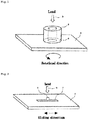
- the test method is so carried out that, as shown in Fig. 1 , first, a ring 2 is set on a test sliding surface 4 of a sliding member having a coating film (a disc having a coating film) 1 for the test.
- Test condition 1 shown in the following Table 1, a load 3 is applied to the ring from upward, and a side of the disc 1 is rotated with a peripheral speed of 120 mm/s. The test was carried out for 10 hours, a wear depth of the disc sliding surface 4 after the test was evaluated as a wear amount, and the results were shown in Table 3.
- Test condition 1 Test conditions Lubrication Drying state Load 1500N Speed 120 mm/s Time 10 hours
- the mating ball material comprising a material of SUS304 with a size of ⁇ 5 mm ball was used.
- the test method is so carried out that, as shown in Fig. 2 , first, a ball 6 is set on a test sliding portion 7 of a sliding member having a coating film (a disc having a coating film) 5 for the test.
- 2-layered coating film layer was formed to obtain sliding members having a coating film (a disc having a coating film) for the tests, evaluated in the same manner as mentioned above, and the results were shown in Table 3.
- Example 3 In the same manner as in Example 1 except for using the composition for the upper layer as shown in Table 3, a single-layered coating film was formed to obtain sliding members having a coating film (a disc having a coating film) for the tests, evaluated in the same manner as mentioned above, and the results were shown in Table 3.
- Example 3 In the same manner as in Example 1 except for changing the amounts of the components of the composition for the lower layer and the composition for the upper layer as shown in Table 3 without changing the components thereof, a sliding member having a coating film (a disc having a coating film) for the tests, onto which a 2-layered coating film layer had been formed, was obtained, evaluated in the same manner as mentioned above, and the results were shown in Table 3.
- both of lubricity and adhesiveness can be improved by making the concentration of the solid lubricant in the coating film layer at the side far from the surface of the sliding member higher than the concentration of the solid lubricant in the coating film layer at the side near to the surface of the sliding member (by inclining the concentration of the composition).
Landscapes
- Chemical & Material Sciences (AREA)
- Engineering & Computer Science (AREA)
- General Engineering & Computer Science (AREA)
- Mechanical Engineering (AREA)
- General Chemical & Material Sciences (AREA)
- Chemical Kinetics & Catalysis (AREA)
- Oil, Petroleum & Natural Gas (AREA)
- Organic Chemistry (AREA)
- Inorganic Chemistry (AREA)
- Lubricants (AREA)
- Application Of Or Painting With Fluid Materials (AREA)
- Laminated Bodies (AREA)
- Sliding-Contact Bearings (AREA)
Abstract
Description
- The present invention relates to a sliding member having a coating film and a method for forming a coating film, more specifically to a sliding member having a coating film and a method for forming a coating film which realizes both of lubricity of the coating film by using a solid lubricant and adhesiveness of the coating film to the ground by inclining a concentration of the solid lubricant in the coating film (gradient coating), and realizes simplification of the process.
- It has heretofore been disclosed in Patent Document 1 a composition for a sliding member in which polyamide-imide resin, polyamide resin, polyimide resin, epoxy resin or phenol resin is used as the binder resin, and further fluorinated polymer such as polytetrafluoroethylene (PTFE), etc.; molybdenum disulfide or tungsten disulfide is used as the solid lubricant. A technique which uses graphite as the solid lubricant has been disclosed in
Patent Document 2. - However, to give lubricity to the coating film by using the solid lubricant is inconsistent with adhesiveness of the coating film to the ground, and there is a problem that lubricity is to be improved, then, adhesiveness is necessarily lowered.
- When a formulation ratio of the solid lubricant is a little, lubricity is not sufficient and it is not suitable as a composition for a sliding member. To the contrary, when a formulation ratio of the solid lubricant is large, adhesiveness is lowered, and in particular, at the high load region, the coating film is easily peeled off from the ground.
- Depending on the uses, it has been attempted to establish the function by optimizing the amounts of these solid lubricants to take a balance between adhesiveness and lubricity, or to improve adhesiveness by modifying the ground using a primer treatment. However, in the former, there is a limit to be consistent, and in the latter, remarkable improvement in adhesiveness cannot be expected.
- To the contrary, in Patent Document 3, it has been attempted to establish the function by markedly improve lubricity by using silicone oil, but there is a problem that adhesiveness of the coating film is lowered by using the liquid lubricant.
- In Patent Document 4, PAI (polyamide-imide) is baked at a lower layer, and PAI using a solid lubricant is coated thereon, but the following problems are involved.
- (1) A drying process is necessary. A process must be added, so that it takes a cost as compared with the wet-on-wet coating.
- (2) The layers are completely separated between the lower layer and the upper layer, so that adhesiveness between the layers is lowered, or the solid lubricant is not contained in the lower layer portion, so that the upper layer is worn away then sliding property is lost.
- (3) There is no benefit by mixing due to compatibility of the upper layer and the lower layer.
- (4) When PAI is used in the lower layer alone in the wet-on-wet coating, difference in shrinkage between the lower layer and the upper layer is large, so that crack is easily generated at the coated surface.
-
- Patent Document 1:
JP-A-2007-031501 - Patent Document 2:
JP-A-2008-180138 - Patent Document 3:
JP-A-2013-234219 - Patent Document 4:
JP-A-2005-146366 - Thus, the first object of the present invention is to provide a sliding member having a coating film, which can realize both of improvement in lubricity of the coating film by using a solid lubricant, and improvement in adhesiveness of the coating film to the ground.
- In addition, the second object of the present invention is to provide a sliding member having a coating film, which can realize both of improvement in lubricity of the coating film by using a solid lubricant(s), and improvement in adhesiveness of the coating film to the ground, and to provide a method for forming a coating film which can realize simplification of the process.
- Also, the other objects of the present invention become clear by the following descriptions.
- The above-mentioned problems are solved by the following respective inventions.
- 1. A sliding member having a coating film which comprises a plural number of coating film layers onto a surface of the sliding member using a composition for a sliding member containing at least a binder resin and a solid lubricant(s), and a concentration of the solid lubricant(s) in the coating film layer at a side far from the surface of the sliding member is higher than a concentration of the solid lubricant(s) in coating film layer at a side near to the surface of the sliding member.
- 2. The sliding member having a coating film according to 1, wherein the plural number of coating film layers is two layers, and a concentration of the solid lubricant(s) in an upper layer of the two-layer coating film layers is higher than a concentration of the solid lubricant(s) in a lower layer.
- 3. The sliding member having a coating film according to 1 or 2, wherein components of compositions for a sliding member used for the plural number of the coating film layers are the same.
- 4. A method for forming a coating film which comprises coating a composition for a sliding member (1) containing at least a binder resin and a solid lubricant(s) onto a sliding member to form a first coating film layer, then, coating a composition for a sliding member (2) containing at least a binder resin and a solid lubricant(s) onto the first coating film layer without drying the first coating film layer to form a second coating film layer, and then, drying these to form a coating film, wherein an amount X of the solid lubricant(s) in the composition for a sliding member (1) of the first coating film layer is in a range of 5 wt% to 35 wt%, an amount Y of the solid lubricant(s) in the composition for a sliding member (2) of the second coating film layer is in a range of 35 wt% to 65 wt%, and a total value (X+Y) of the amounts of the solid lubricants contained in the composition for a sliding member (1) and the composition for a sliding member (2) is 85 or less.
- 5. The method for forming a coating film according to 4, wherein components of the compositions for a sliding member used for the first coating film layer and the second coating film layer are the same.
- 6. A sliding member having a coating film which is obtained by the method for forming a coating film according to 4 or 5.
- According to the present invention, a sliding member having a coating film which can realize both of improvement in lubricity of the coating film by using a solid lubricant(s) and improvement in adhesiveness of the coating film to the ground can be provided.
- Also, according to the present invention, a method for forming a coating film which can provide a sliding member having a coating film which can realize both of improvement in lubricity of the coating film by using a solid lubricant(s) and improvement in adhesiveness of the coating film to the ground, and can realize simplification of the process can be provided.
-
-
Fig. 1 is a drawing showing a testing apparatus. -
Fig. 2 is a drawing showing a testing apparatus. - In the following, the embodiments of the present invention are explained.
- The sliding member having a coating film of the present invention comprises a plural number of coating film layers formed onto a surface of a sliding member using a composition for a sliding member which contains at least a binder resin and a solid lubricant(s), and a concentration of the solid lubricant(s) in the coating film layer at the side far from the surface of the sliding member is higher than a concentration of the solid lubricant(s) in the coating film layer at the side near to the surface of the sliding member.
- The composition for a sliding member contains at least a binder resin and a solid lubricant(s).
- The binder resin is not particularly limited, and may be exemplified by, for example, polyamide-imide resin (PAI), polyamide resin (PA), polyimide resin (PI), epoxy resin and phenol resin, and one kind may be used by selecting from the above, or two or more kinds thereof may be used in combination.
- The solid lubricant is not particularly limited, and may be exemplified by, for example, fluorine-containing polymer selected from polytetrafluoroethylene (PTFE), tetrafluoroethylene-perfluoroalkyl vinyl ether copolymer, tetrafluoroethylene-hexafluoropropylene copolymer, tetrafluoroethylene-ethylene copolymer, polyvinylidene fluoride and polychlorotrifluoroethylene; metal disulfide selected from molybdenum disulfide and tungsten disulfide; and graphite, and one kind may be used by selecting from the above, or two or more kinds thereof may be used in combination.
- The sliding member having a coating film of the present invention has a constitution that a plural number of coating film layers are formed onto the surface of the sliding member using a composition(s) for a sliding member.
- The present invention has a characteristic in the point that a concentration of the solid lubricant(s) in the coating film layer at the side far from the surface of the sliding member is higher than a concentration of the solid lubricant(s) in the coating film layer at the side near to the surface of the sliding member.
- It is preferred that the plural number of the coating film layers are two layers, and a concentration of the solid lubricant(s) in the upper layer of the two-layered coating film layers is higher than a concentration of the solid lubricant(s) in the lower layer of the same.
- That is, lubricity is improved since the concentration of the solid lubricant(s) of the coating film layer (the outermost surface layer which becomes a sliding surface; the upper layer) at the side far from the sliding member is high.
- On the other hand, a concentration of the coating film layer at the side near to the sliding member is low, i.e., the concentration of the solid lubricant(s) is low at the interface between the coating film layer and the sliding member (the ground) so that the coating film and the ground are firmly adhered.
- In the present invention, both of improvement in lubricity of the coating film and improvement in adhesiveness of the coating film to the ground have been realized by the difference (due to set up of the concentration gradient) in the concentrations of the solid lubricant(s) to be used.
- In the present invention, it is preferred that the compositions for a sliding member to be used for a plural number of the coating film layers are the same components. Here, the same components mean that the compositions and the compounds constituting the compositions for a sliding member are the same. For example, if the resins selected as the binder resin are the same, these are the same components. Also, if the substances (compounds) selected as the solid lubricant(s) are the same, these are the same components. When other additives are contained, if substances (compounds) to be used as the additive(s) are the same, these are the same components.
- When the compositions for a sliding member to be used for a plural number of the coating film layers are the same components, the following effects can be exhibited. When two-layered coating film layers are formed, for example, peeling of the films between the upper layer and the lower layer can be prevented. With regard to this peeling of the films, when the wet-on-wet coating mentioned later is employed, the upper layer and the lower layer are the same components and yet there is no interface, so that peeling of the films between the upper layer and the lower layer can be further prevented.
- Also, when the compositions for a sliding member to be used for a plural number of the coating film layers have compatibility with each other, if the wet-on-wet coating mentioned later is employed, the interface between the upper layer and the lower layer can be eliminated, so that peeling of the films between the upper layer and the lower layer can be prevented.
- The method for forming a coating film of the present invention is suitable as a means for forming a coating film in the above-mentioned sliding member having a coating film.
- Specifically, the method for forming a coating film of the present invention is incorporating a means of providing a concentration gradient of the solid lubricant(s) in a plural number of coating films, and a means of employing the wet-on-wet coating when a plural number of coating films are formed.
- First, a composition for a sliding member (1) containing at least a binder resin and a solid lubricant(s) is coated onto a sliding member to form a first coating film layer.
- Next, a composition for a sliding member (2) containing at least a binder resin and a solid lubricant(s) is coated onto the first coating film layer without drying the first coating film layer to form a second coating film layer, and then, dried to form a coating film.
- Here, the terms "without drying" mean a wet-on-wet coating, and no compulsory drying process is carried out after coating the lower layer and before coating the upper layer. By allowing the lower layer to stand after its coating, it may be naturally dried in some cases, but such natural drying is not included in the compulsory drying process herein mentioned.
- Specific constitution of the concentration gradient is that a formulation ratio X of the solid lubricant(s) in the composition for a sliding member (1) of the first coating film layer is in the range of 5 wt% to 35 wt%, a formulation ratio Y of the solid lubricant(s) in the composition for a sliding member (2) of the second coating film layer is in the range of 35 wt% to 65 wt%, and a total value (X+Y) of the formulation ratio of the solid lubricant(s) contained in the composition for a sliding member (1) and the composition for a sliding member (2) is 85 or less.
- If the total value (X+Y) of the formulation ratio exceeds 85, fracture of the coating film is generated.
- The definition of the concentration mentioned above is to show that a concentration of the solid lubricant(s) in the coating film is inclined to increase toward the outside (toward the upper layer from the lower layer).
- The wet-on-wet coating does not enter the drying process between the first coating film layer (the lower layer) coating and the second coating film layer (the upper layer) coating, so that the lower layer and the upper layer are mixed with each other at the interface thereof, delamination of the coating films between the lower layer and the upper layer can be prevented, and there is a merit that the equipments at the time of mass production can be simplified.
- When two-layered constitution is employed by wet-on-wet coating of the compositions for a sliding member, the compositions for a sliding member with the same components are preferably coated. The upper layer and the lower layer are the same components and yet the interface can be eliminated, so that peeling of the films between the upper layer and the lower layer can be further prevented. The meaning of the same components herein mentioned is the same as the contents defined in the above explanation of the invention regarding the sliding member having a coating film.
- When the compositions for a sliding member to be used for a plural number of the coating film layers have compatibility with each other, the interface between the upper layer and the lower layer can be eliminated since the wet-on-wet coating is employed, so that there is an effect that peeling of the films between the upper layer and the lower layer can be prevented.
- The binder resin or the solid lubricant to be used for the composition for a sliding member may be used the above-mentioned resin.
- With regard to an amount of the binder resin, an amount the binder resin to be used in the composition of the upper layer is preferably in the range of 30% to 65% by weight, and an amount the binder resin to be used in the composition of the lower layer is preferably in the range of 65% to 95% by weight.
- The composition for a sliding member to be used in the method for forming a coating film of the present invention may contain a solvent to improve coating property. The solvent is not particularly limited, and may be mentioned N-methyl-2-pyrrolidone, N,N-dimethylformamide, xylene, methyl ethyl ketone and methyl isobutyl ketone. These solvents may be used singly, or two or more kinds in combination.
- The composition for a sliding member may further contain a colorant, a defoaming agent, a surfactant or other additives within the range which does not impair the objects of the present invention. These additives may be used singly, or two or more kinds in combination.
- The composition for a sliding member can be used by formulating predetermined amounts of the binder resin, the solid lubricant(s), the other additive(s) and the solvent, and mixing and dispersing these components using a stirrer such as a dissolver, or a ball mill, a sand mill, an agihomomixer, or optionally in combination thereof.
- The composition for a sliding member is coated onto the sliding member, a plural number of the coating film layers are formed onto the surface of the sliding member, whereby the sliding member having a coating film can be obtained.
- The coating method to the sliding member is not particularly limited, and may be mentioned, for example, a spraying method, a dipping method, a flow coating method, a dispenser method and a spin coating method, preferably a spraying method. Depending on the respective coating methods, a viscosity of the coating composition can be adjusted by using a solvent at the time of producing the same or before coating.
- After coating and forming the first coating film layer, the second coating film layer is coated thereon without drying, and then, drying and baking are carried out. Thus, a multi-layered coating film is formed onto the surface of the sliding member.
- Drying is carried out at a temperature of 60°C to 120°C.
- A baking temperature when the film is baking after drying is preferably 150°C to 300°C, more preferably 180°C to 250°C.
- A film thickness of the whole layers after baking is preferably 10 µm to 80 µm, more preferably 20 µm to 40 µm.
- After baking, the sliding member is cooled, and may be adjusted by polishing depending on the purposes.
- The technique of the present invention can be utilized for a compressor or an engine piston of an air conditioner, an internal combustion engine, a sliding bearing, a chain, an electromagnetic valve of a gas or a liquid, a plunger, a valve or the like.
- In the following, Examples of the present invention are explained. The present invention is not limited by such Examples.
-
(1) Binder resin:Polyamide-imide (PAI) resin ("HPC-5012" available from Hitachi Chemical Co., Ltd.) 60 parts by weight
(2) Solid lubricant:• Polytetrafluoroethylene (PTFE) ("Fluon L173J" available from Asahi Glass Co., Ltd.) 40 parts by weight • Graphite ("HOP" available from Nippon Graphite Industries, Ltd.) 2 parts by weight
(3) Solvent: - A mixed solvent of N-methyl-2-pyrrolidone and methyl isobutyl ketone
-
(1) Binder resin:Polyamide-imide (PAI) resin ("HPC-5012" available from Hitachi Chemical Co., Ltd.) 90 parts by weight
(2) Solid lubricant:▪ Polytetrafluoroethylene (PTFE) ("Fluon L173J" available from Asahi Glass Co., Ltd.) 10 parts by weight ▪ Graphite ("HOP" available from Nippon Graphite Industries, Ltd.) 2 parts by weight
(3) Solvent: - A mixed solvent of N-methyl-2-pyrrolidone and methyl isobutyl ketone
- The above-mentioned composition for a lower layer is prepared, and a compositional paint sufficiently mixed and dispersed by a ball mill is coated onto a sliding member test piece (Material; A6061 disc) by spray to form a lower layer.
- The compositional paint at the lower layer side was so coated that the film thickness after baking became 12 to 18 µm.
- Then, without subjecting to drying, a compositional paint at the upper layer side was so coated that the film thickness after baking became 12 µm to 18 µm. It was baked at 200°C to 230°C in matching with the binder. The total film thickness was made 25 µm to 35 µm.
- A sliding member having a coating film (a disc having a coating film) for tests was obtained as mentioned above.
- It was evaluated by using a Suzuki-type friction wear testing machine ("EFM-III-EN" manufactured by Orientec Co., Ltd.).
- The mating ring material comprising a material of aluminum (A6061) with a size having an outer diameter ϕ 25.6 mm, an inner diameter ϕ 20 mm and a height of 40 mm was used. The ring was so polished that it has a roughness Rz [DIN] within the range of 1.0±0.5 µm.
- The test method is so carried out that, as shown in
Fig. 1 , first, aring 2 is set on a test sliding surface 4 of a sliding member having a coating film (a disc having a coating film) 1 for the test. - According to Test condition 1 shown in the following Table 1, a load 3 is applied to the ring from upward, and a side of the disc 1 is rotated with a peripheral speed of 120 mm/s. The test was carried out for 10 hours, a wear depth of the disc sliding surface 4 after the test was evaluated as a wear amount, and the results were shown in Table 3.
[Table 1] (Test condition 1) Test conditions Lubrication Drying state Load 1500N Speed 120 mm/s Time 10 hours - It was evaluated by a ball on disc test using a surface property tester TYPE: 14FW (manufactured by Shinto Scientific Co., Ltd.). The mating ball material comprising a material of SUS304 with a size of ϕ 5 mm ball was used.
- The test method is so carried out that, as shown in
Fig. 2 , first, a ball 6 is set on a test sliding portion 7 of a sliding member having a coating film (a disc having a coating film) 5 for the test. - According to
Test condition 2 shown in the following Table 2, a load 8 is applied to the ball from upward, and the ball is reciprocally slid with a width of 10 mm and a speed of 40 mm/s for 400 times. - After the test, the state of the coating film at the slid surface was observed, and the presence or absence of peeling (fracture) was observed, which was evaluated as adhesiveness, and the results were shown in Table 3.
[Table 2] (Test condition 2) Test conditions Lubrication Drying state Load 9.8N Speed 40 mm/s Number of Times 400 times - In the same manner as in Example 1 except for changing the amounts of the components of the composition for the lower layer and the composition for the upper layer as shown in Table 3 without changing the components thereof, 2-layered coating film layer was formed to obtain sliding members having a coating film (a disc having a coating film) for the tests, evaluated in the same manner as mentioned above, and the results were shown in Table 3.
- In the same manner as in Example 1 except for using the composition for the upper layer as shown in Table 3, a single-layered coating film was formed to obtain sliding members having a coating film (a disc having a coating film) for the tests, evaluated in the same manner as mentioned above, and the results were shown in Table 3.
- In the same manner as in Example 1 except for changing the amounts of the components of the composition for the lower layer and the composition for the upper layer as shown in Table 3 without changing the components thereof, a sliding member having a coating film (a disc having a coating film) for the tests, onto which a 2-layered coating film layer had been formed, was obtained, evaluated in the same manner as mentioned above, and the results were shown in Table 3.


- It can be understood from Examples 1 to 4 that both of lubricity and adhesiveness can be improved by making the concentration of the solid lubricant in the coating film layer at the side far from the surface of the sliding member higher than the concentration of the solid lubricant in the coating film layer at the side near to the surface of the sliding member (by inclining the concentration of the composition).
- It can be understood from Comparative examples 1 to 3 that the friction coefficient becomes large and wear is also large since the ratio of the solid lubricant is a little, whereas adhesiveness is good.
- In Comparative examples 4 to 6, fracture of the coating film is generated since the ratio of the solid lubricant is much, whereas wear resistance is good.
- In Comparative example 7, fracture of the coating film is generated since the total ratio of the solid lubricants in the upper layer and the lower layer is much, whereas the friction coefficient and the wear amount are good.
Claims (5)
- A sliding member having a coating film which comprises a plural number of coating film layers onto a surface of the sliding member using a composition for a sliding member containing at least a binder resin and a solid lubricant, a concentration of the solid lubricant in the coating film layer at a side far from the surface of the sliding member is higher than a concentration of the solid lubricant in coating film layer at a side near to the surface of the sliding member, and compositions for sliding members used for a plural number of the coating film layers contain the same components, polyamide-imide resin is used as the binder resin, and polytetrafluoroethylene and graphite are used as the solid lubricant in combination.
- The sliding member having a coating film according to claim 1, wherein the plural number of coating film layers is two layers, and a concentration of the solid lubricant(s) in an upper layer of the two-layer coating film layers is higher than a concentration of the solid lubricant(s) in a lower layer.
- A film forming method which comprises coating a composition for a sliding member (1) containing at least polyamide-imide resin as a binder resin and polytetrafluoroethylene and graphite as solid lubricants onto a sliding member to form a first coating film layer, coating a composition for a sliding member (2) containing at least polyamide-imide resin as a binder resin and polytetrafluoroethylene and graphite as solid lubricants onto the first coating film layer without drying the first coating film layer to form a second coating film layer, and then, drying these to form a coating film, wherein an amount X of the solid lubricant in the composition for a sliding member (1) of the first coating film layer is in a range of 5 wt% to 35 wt%, an amount Y of the solid lubricant in the composition for a sliding member (2) of the second coating film layer is in a range of 35 wt% to 65 wt%, and a total value (X+Y) of the amounts of the solid lubricant contained in the composition for a sliding member (1) and the composition for a sliding member (2) is 85 or less.
- The method for forming a coating film according to claim 3, wherein components of the compositions for a sliding member used for the first coating film layer and the second coating film layer are the same.
- A sliding member having a coating film which is obtained by the method for forming a coating film according to claim 3 or 4.
Applications Claiming Priority (2)
| Application Number | Priority Date | Filing Date | Title |
|---|---|---|---|
| JP2014102341 | 2014-05-16 | ||
| PCT/JP2015/063026 WO2015174292A1 (en) | 2014-05-16 | 2015-04-30 | Slide member with coating film and method for forming coating film |
Publications (3)
| Publication Number | Publication Date |
|---|---|
| EP3144144A1 true EP3144144A1 (en) | 2017-03-22 |
| EP3144144A4 EP3144144A4 (en) | 2018-01-17 |
| EP3144144B1 EP3144144B1 (en) | 2020-08-12 |
Family
ID=54479833
Family Applications (1)
| Application Number | Title | Priority Date | Filing Date |
|---|---|---|---|
| EP15791918.4A Active EP3144144B1 (en) | 2014-05-16 | 2015-04-30 | Slide member with coating film and method for forming coating film |
Country Status (5)
| Country | Link |
|---|---|
| US (1) | US10760027B2 (en) |
| EP (1) | EP3144144B1 (en) |
| JP (1) | JP6650870B2 (en) |
| CN (1) | CN106457799A (en) |
| WO (1) | WO2015174292A1 (en) |
Cited By (2)
| Publication number | Priority date | Publication date | Assignee | Title |
|---|---|---|---|---|
| KR20210064312A (en) * | 2019-01-11 | 2021-06-02 | 엔오케이 크루버 가부시키가이샤 | Composition for sliding member and sliding member |
| WO2022272256A1 (en) * | 2021-06-23 | 2022-12-29 | Dupont Polymers, Inc. | Anti-friction composite material |
Families Citing this family (2)
| Publication number | Priority date | Publication date | Assignee | Title |
|---|---|---|---|---|
| JP2018021125A (en) * | 2016-08-04 | 2018-02-08 | 本田技研工業株式会社 | Lubricating film composition and wet sliding member |
| US11852194B2 (en) * | 2020-12-11 | 2023-12-26 | Saint-Gobain Performance Plastics Corporation | Solenoid low friction bearing liner |
Family Cites Families (20)
| Publication number | Priority date | Publication date | Assignee | Title |
|---|---|---|---|---|
| JPH0647760A (en) | 1992-07-28 | 1994-02-22 | Three Bond Co Ltd | Rubber molding method that imparts lubricity to the surface |
| JPH07189804A (en) * | 1993-12-27 | 1995-07-28 | Toyota Motor Corp | Internal combustion engine piston and method of manufacturing the same |
| JP3075117B2 (en) * | 1994-12-28 | 2000-08-07 | 日本鋼管株式会社 | Painted metal plate for sliding plate and method for producing the same |
| JPH10246149A (en) | 1997-03-04 | 1998-09-14 | Riken Corp | Sliding part coating material and piston ring |
| JP3738703B2 (en) * | 2001-05-01 | 2006-01-25 | 住友金属工業株式会社 | Threaded joints for steel pipes |
| US7344786B2 (en) * | 2001-10-29 | 2008-03-18 | Fujifilm Corporation | Magnetic recording medium including a smooth coating layer on one side of the support |
| BRPI0402257A (en) | 2003-06-19 | 2005-06-14 | Toyota Jidoshokki Kk | Coating composition for use on sliding members |
| JP2005146366A (en) * | 2003-11-17 | 2005-06-09 | Toyota Industries Corp | Sliding member |
| DE102005023457A1 (en) * | 2004-05-21 | 2005-12-15 | Kabushiki Kaisha Toyota Jidoshokki, Kariya | Sliding film, sliding member, lubricating film composition, sliding device, swash plate type compressor, method of forming a sliding film, and method of manufacturing a sliding member |
| JP2005337129A (en) * | 2004-05-27 | 2005-12-08 | Toyota Industries Corp | Sliding member and method of manufacturing sliding member |
| DE602005022751D1 (en) * | 2004-10-27 | 2010-09-16 | Toyota Jidoshokki Kk | SLIDING ELEMENT AND MANUFACTURING METHOD THEREFOR |
| JP2007031501A (en) | 2005-07-25 | 2007-02-08 | Nok Kluber Kk | Composition for sliding member |
| AT503986B1 (en) | 2006-08-02 | 2008-05-15 | Miba Gleitlager Gmbh | LAYER LAYER FOR A BEARING ELEMENT |
| JP2008180138A (en) | 2007-01-24 | 2008-08-07 | Toyota Industries Corp | Sliding member |
| AT505226B1 (en) | 2007-04-17 | 2012-04-15 | Miba Gleitlager Gmbh | SLABS AND STOCK ELEMENTS MANUFACTURED THEREFOR |
| EA020839B1 (en) * | 2008-03-13 | 2015-02-27 | Эвальд Деркен Аг | Method for adjusting the friction coefficient of a metallic workpiece |
| JP5248379B2 (en) | 2009-03-17 | 2013-07-31 | 日立オートモティブシステムズ株式会社 | Piston of internal combustion engine provided with multi-layer coating composition and surface treatment method of the piston |
| CN103415604A (en) | 2011-02-18 | 2013-11-27 | 大丰工业株式会社 | Sliding material composition and sliding member |
| JP6108284B2 (en) | 2012-05-07 | 2017-04-05 | Nokクリューバー株式会社 | Composition for sliding member |
| MX366221B (en) * | 2012-09-12 | 2019-07-03 | Nippon Steel Corp | Composition for use in forming solid coating film, and tubular threaded joint. |
-
2015
- 2015-04-30 WO PCT/JP2015/063026 patent/WO2015174292A1/en not_active Ceased
- 2015-04-30 EP EP15791918.4A patent/EP3144144B1/en active Active
- 2015-04-30 CN CN201580026584.2A patent/CN106457799A/en active Pending
- 2015-04-30 JP JP2016519210A patent/JP6650870B2/en active Active
- 2015-04-30 US US15/310,236 patent/US10760027B2/en active Active
Cited By (4)
| Publication number | Priority date | Publication date | Assignee | Title |
|---|---|---|---|---|
| KR20210064312A (en) * | 2019-01-11 | 2021-06-02 | 엔오케이 크루버 가부시키가이샤 | Composition for sliding member and sliding member |
| EP3910047A4 (en) * | 2019-01-11 | 2022-10-26 | NOK Klueber Co., Ltd. | COMPOSITION FOR SLIDING ELEMENT, AND SLIDING ELEMENT |
| US12129391B2 (en) | 2019-01-11 | 2024-10-29 | Nok Klueber Co., Ltd. | Composition for sliding member and sliding member |
| WO2022272256A1 (en) * | 2021-06-23 | 2022-12-29 | Dupont Polymers, Inc. | Anti-friction composite material |
Also Published As
| Publication number | Publication date |
|---|---|
| EP3144144A4 (en) | 2018-01-17 |
| US10760027B2 (en) | 2020-09-01 |
| US20170211006A1 (en) | 2017-07-27 |
| JP6650870B2 (en) | 2020-02-19 |
| JPWO2015174292A1 (en) | 2017-04-20 |
| EP3144144B1 (en) | 2020-08-12 |
| WO2015174292A1 (en) | 2015-11-19 |
| CN106457799A (en) | 2017-02-22 |
Similar Documents
| Publication | Publication Date | Title |
|---|---|---|
| JP4583750B2 (en) | Sliding material | |
| JP5060223B2 (en) | Piston for internal combustion engine | |
| US8883697B2 (en) | Wear resistant lubricious composite | |
| EP3144144B1 (en) | Slide member with coating film and method for forming coating film | |
| EP1894987B1 (en) | Double-layer lubrication coating composition, double-layer lubrication coating and piston having same coating | |
| US8939644B2 (en) | Swash plate and production method of the same | |
| US20160251589A1 (en) | Composition for lubricating film, sliding member using the composition for lubricating film, and method of manufacturing the composition for lubricating film | |
| EP2821443B1 (en) | Composition for a sliding member | |
| CN102459544A (en) | Film composition for sliding member | |
| CN107847965A (en) | For forming the composition of high release and low friction functional coating | |
| KR102582842B1 (en) | Composition for sliding members and sliding members | |
| JP4767234B2 (en) | Sliding coating structure | |
| JP6211924B2 (en) | Sliding resin composition | |
| JP5614760B2 (en) | Paint composition | |
| KR20160034625A (en) | Coating Material For Solid Lubrication | |
| WO2019097791A1 (en) | Sliding member and method for manufacturing same | |
| WO2020116390A1 (en) | Composition, film formed from the composition, sliding member having the film, and method for producing the same | |
| JP2006077836A (en) | Piston and resin paint composition | |
| JP2021527723A (en) | A composition, a coating film formed using the composition, a sliding member having the coating film, and a method for producing the same. | |
| JP2006225683A (en) | Magnesium sliding member |
Legal Events
| Date | Code | Title | Description |
|---|---|---|---|
| STAA | Information on the status of an ep patent application or granted ep patent |
Free format text: STATUS: THE INTERNATIONAL PUBLICATION HAS BEEN MADE |
|
| PUAI | Public reference made under article 153(3) epc to a published international application that has entered the european phase |
Free format text: ORIGINAL CODE: 0009012 |
|
| STAA | Information on the status of an ep patent application or granted ep patent |
Free format text: STATUS: REQUEST FOR EXAMINATION WAS MADE |
|
| 17P | Request for examination filed |
Effective date: 20161216 |
|
| AK | Designated contracting states |
Kind code of ref document: A1 Designated state(s): AL AT BE BG CH CY CZ DE DK EE ES FI FR GB GR HR HU IE IS IT LI LT LU LV MC MK MT NL NO PL PT RO RS SE SI SK SM TR |
|
| AX | Request for extension of the european patent |
Extension state: BA ME |
|
| DAV | Request for validation of the european patent (deleted) | ||
| DAX | Request for extension of the european patent (deleted) | ||
| A4 | Supplementary search report drawn up and despatched |
Effective date: 20171215 |
|
| RIC1 | Information provided on ipc code assigned before grant |
Ipc: B32B 27/18 20060101AFI20171211BHEP Ipc: B05D 1/36 20060101ALI20171211BHEP Ipc: B05D 5/08 20060101ALI20171211BHEP Ipc: F16C 33/20 20060101ALI20171211BHEP |
|
| STAA | Information on the status of an ep patent application or granted ep patent |
Free format text: STATUS: EXAMINATION IS IN PROGRESS |
|
| 17Q | First examination report despatched |
Effective date: 20190822 |
|
| GRAP | Despatch of communication of intention to grant a patent |
Free format text: ORIGINAL CODE: EPIDOSNIGR1 |
|
| STAA | Information on the status of an ep patent application or granted ep patent |
Free format text: STATUS: GRANT OF PATENT IS INTENDED |
|
| INTG | Intention to grant announced |
Effective date: 20200327 |
|
| GRAS | Grant fee paid |
Free format text: ORIGINAL CODE: EPIDOSNIGR3 |
|
| GRAA | (expected) grant |
Free format text: ORIGINAL CODE: 0009210 |
|
| STAA | Information on the status of an ep patent application or granted ep patent |
Free format text: STATUS: THE PATENT HAS BEEN GRANTED |
|
| AK | Designated contracting states |
Kind code of ref document: B1 Designated state(s): AL AT BE BG CH CY CZ DE DK EE ES FI FR GB GR HR HU IE IS IT LI LT LU LV MC MK MT NL NO PL PT RO RS SE SI SK SM TR |
|
| REG | Reference to a national code |
Ref country code: CH Ref legal event code: EP |
|
| REG | Reference to a national code |
Ref country code: IE Ref legal event code: FG4D |
|
| REG | Reference to a national code |
Ref country code: DE Ref legal event code: R096 Ref document number: 602015057418 Country of ref document: DE |
|
| REG | Reference to a national code |
Ref country code: AT Ref legal event code: REF Ref document number: 1301162 Country of ref document: AT Kind code of ref document: T Effective date: 20200915 |
|
| REG | Reference to a national code |
Ref country code: LT Ref legal event code: MG4D |
|
| REG | Reference to a national code |
Ref country code: NL Ref legal event code: MP Effective date: 20200812 |
|
| PG25 | Lapsed in a contracting state [announced via postgrant information from national office to epo] |
Ref country code: BG Free format text: LAPSE BECAUSE OF FAILURE TO SUBMIT A TRANSLATION OF THE DESCRIPTION OR TO PAY THE FEE WITHIN THE PRESCRIBED TIME-LIMIT Effective date: 20201112 Ref country code: LT Free format text: LAPSE BECAUSE OF FAILURE TO SUBMIT A TRANSLATION OF THE DESCRIPTION OR TO PAY THE FEE WITHIN THE PRESCRIBED TIME-LIMIT Effective date: 20200812 Ref country code: HR Free format text: LAPSE BECAUSE OF FAILURE TO SUBMIT A TRANSLATION OF THE DESCRIPTION OR TO PAY THE FEE WITHIN THE PRESCRIBED TIME-LIMIT Effective date: 20200812 Ref country code: NO Free format text: LAPSE BECAUSE OF FAILURE TO SUBMIT A TRANSLATION OF THE DESCRIPTION OR TO PAY THE FEE WITHIN THE PRESCRIBED TIME-LIMIT Effective date: 20201112 Ref country code: SE Free format text: LAPSE BECAUSE OF FAILURE TO SUBMIT A TRANSLATION OF THE DESCRIPTION OR TO PAY THE FEE WITHIN THE PRESCRIBED TIME-LIMIT Effective date: 20200812 Ref country code: GR Free format text: LAPSE BECAUSE OF FAILURE TO SUBMIT A TRANSLATION OF THE DESCRIPTION OR TO PAY THE FEE WITHIN THE PRESCRIBED TIME-LIMIT Effective date: 20201113 Ref country code: FI Free format text: LAPSE BECAUSE OF FAILURE TO SUBMIT A TRANSLATION OF THE DESCRIPTION OR TO PAY THE FEE WITHIN THE PRESCRIBED TIME-LIMIT Effective date: 20200812 |
|
| REG | Reference to a national code |
Ref country code: AT Ref legal event code: MK05 Ref document number: 1301162 Country of ref document: AT Kind code of ref document: T Effective date: 20200812 |
|
| PG25 | Lapsed in a contracting state [announced via postgrant information from national office to epo] |
Ref country code: RS Free format text: LAPSE BECAUSE OF FAILURE TO SUBMIT A TRANSLATION OF THE DESCRIPTION OR TO PAY THE FEE WITHIN THE PRESCRIBED TIME-LIMIT Effective date: 20200812 Ref country code: NL Free format text: LAPSE BECAUSE OF FAILURE TO SUBMIT A TRANSLATION OF THE DESCRIPTION OR TO PAY THE FEE WITHIN THE PRESCRIBED TIME-LIMIT Effective date: 20200812 Ref country code: PL Free format text: LAPSE BECAUSE OF FAILURE TO SUBMIT A TRANSLATION OF THE DESCRIPTION OR TO PAY THE FEE WITHIN THE PRESCRIBED TIME-LIMIT Effective date: 20200812 Ref country code: LV Free format text: LAPSE BECAUSE OF FAILURE TO SUBMIT A TRANSLATION OF THE DESCRIPTION OR TO PAY THE FEE WITHIN THE PRESCRIBED TIME-LIMIT Effective date: 20200812 Ref country code: IS Free format text: LAPSE BECAUSE OF FAILURE TO SUBMIT A TRANSLATION OF THE DESCRIPTION OR TO PAY THE FEE WITHIN THE PRESCRIBED TIME-LIMIT Effective date: 20201212 |
|
| PG25 | Lapsed in a contracting state [announced via postgrant information from national office to epo] |
Ref country code: EE Free format text: LAPSE BECAUSE OF FAILURE TO SUBMIT A TRANSLATION OF THE DESCRIPTION OR TO PAY THE FEE WITHIN THE PRESCRIBED TIME-LIMIT Effective date: 20200812 Ref country code: RO Free format text: LAPSE BECAUSE OF FAILURE TO SUBMIT A TRANSLATION OF THE DESCRIPTION OR TO PAY THE FEE WITHIN THE PRESCRIBED TIME-LIMIT Effective date: 20200812 Ref country code: SM Free format text: LAPSE BECAUSE OF FAILURE TO SUBMIT A TRANSLATION OF THE DESCRIPTION OR TO PAY THE FEE WITHIN THE PRESCRIBED TIME-LIMIT Effective date: 20200812 Ref country code: CZ Free format text: LAPSE BECAUSE OF FAILURE TO SUBMIT A TRANSLATION OF THE DESCRIPTION OR TO PAY THE FEE WITHIN THE PRESCRIBED TIME-LIMIT Effective date: 20200812 Ref country code: DK Free format text: LAPSE BECAUSE OF FAILURE TO SUBMIT A TRANSLATION OF THE DESCRIPTION OR TO PAY THE FEE WITHIN THE PRESCRIBED TIME-LIMIT Effective date: 20200812 |
|
| REG | Reference to a national code |
Ref country code: DE Ref legal event code: R097 Ref document number: 602015057418 Country of ref document: DE |
|
| PG25 | Lapsed in a contracting state [announced via postgrant information from national office to epo] |
Ref country code: AL Free format text: LAPSE BECAUSE OF FAILURE TO SUBMIT A TRANSLATION OF THE DESCRIPTION OR TO PAY THE FEE WITHIN THE PRESCRIBED TIME-LIMIT Effective date: 20200812 Ref country code: AT Free format text: LAPSE BECAUSE OF FAILURE TO SUBMIT A TRANSLATION OF THE DESCRIPTION OR TO PAY THE FEE WITHIN THE PRESCRIBED TIME-LIMIT Effective date: 20200812 Ref country code: ES Free format text: LAPSE BECAUSE OF FAILURE TO SUBMIT A TRANSLATION OF THE DESCRIPTION OR TO PAY THE FEE WITHIN THE PRESCRIBED TIME-LIMIT Effective date: 20200812 |
|
| PLBE | No opposition filed within time limit |
Free format text: ORIGINAL CODE: 0009261 |
|
| STAA | Information on the status of an ep patent application or granted ep patent |
Free format text: STATUS: NO OPPOSITION FILED WITHIN TIME LIMIT |
|
| PG25 | Lapsed in a contracting state [announced via postgrant information from national office to epo] |
Ref country code: SK Free format text: LAPSE BECAUSE OF FAILURE TO SUBMIT A TRANSLATION OF THE DESCRIPTION OR TO PAY THE FEE WITHIN THE PRESCRIBED TIME-LIMIT Effective date: 20200812 |
|
| 26N | No opposition filed |
Effective date: 20210514 |
|
| PG25 | Lapsed in a contracting state [announced via postgrant information from national office to epo] |
Ref country code: SI Free format text: LAPSE BECAUSE OF FAILURE TO SUBMIT A TRANSLATION OF THE DESCRIPTION OR TO PAY THE FEE WITHIN THE PRESCRIBED TIME-LIMIT Effective date: 20200812 |
|
| PG25 | Lapsed in a contracting state [announced via postgrant information from national office to epo] |
Ref country code: MC Free format text: LAPSE BECAUSE OF FAILURE TO SUBMIT A TRANSLATION OF THE DESCRIPTION OR TO PAY THE FEE WITHIN THE PRESCRIBED TIME-LIMIT Effective date: 20200812 |
|
| GBPC | Gb: european patent ceased through non-payment of renewal fee |
Effective date: 20210430 |
|
| PG25 | Lapsed in a contracting state [announced via postgrant information from national office to epo] |
Ref country code: LU Free format text: LAPSE BECAUSE OF NON-PAYMENT OF DUE FEES Effective date: 20210430 |
|
| REG | Reference to a national code |
Ref country code: BE Ref legal event code: MM Effective date: 20210430 |
|
| PG25 | Lapsed in a contracting state [announced via postgrant information from national office to epo] |
Ref country code: GB Free format text: LAPSE BECAUSE OF NON-PAYMENT OF DUE FEES Effective date: 20210430 Ref country code: CH Free format text: LAPSE BECAUSE OF NON-PAYMENT OF DUE FEES Effective date: 20210430 Ref country code: LI Free format text: LAPSE BECAUSE OF NON-PAYMENT OF DUE FEES Effective date: 20210430 |
|
| PG25 | Lapsed in a contracting state [announced via postgrant information from national office to epo] |
Ref country code: IE Free format text: LAPSE BECAUSE OF NON-PAYMENT OF DUE FEES Effective date: 20210430 |
|
| PG25 | Lapsed in a contracting state [announced via postgrant information from national office to epo] |
Ref country code: IS Free format text: LAPSE BECAUSE OF FAILURE TO SUBMIT A TRANSLATION OF THE DESCRIPTION OR TO PAY THE FEE WITHIN THE PRESCRIBED TIME-LIMIT Effective date: 20201212 |
|
| PG25 | Lapsed in a contracting state [announced via postgrant information from national office to epo] |
Ref country code: BE Free format text: LAPSE BECAUSE OF NON-PAYMENT OF DUE FEES Effective date: 20210430 |
|
| PG25 | Lapsed in a contracting state [announced via postgrant information from national office to epo] |
Ref country code: PT Free format text: LAPSE BECAUSE OF FAILURE TO SUBMIT A TRANSLATION OF THE DESCRIPTION OR TO PAY THE FEE WITHIN THE PRESCRIBED TIME-LIMIT Effective date: 20201214 |
|
| PG25 | Lapsed in a contracting state [announced via postgrant information from national office to epo] |
Ref country code: HU Free format text: LAPSE BECAUSE OF FAILURE TO SUBMIT A TRANSLATION OF THE DESCRIPTION OR TO PAY THE FEE WITHIN THE PRESCRIBED TIME-LIMIT; INVALID AB INITIO Effective date: 20150430 |
|
| PG25 | Lapsed in a contracting state [announced via postgrant information from national office to epo] |
Ref country code: CY Free format text: LAPSE BECAUSE OF FAILURE TO SUBMIT A TRANSLATION OF THE DESCRIPTION OR TO PAY THE FEE WITHIN THE PRESCRIBED TIME-LIMIT Effective date: 20200812 |
|
| PG25 | Lapsed in a contracting state [announced via postgrant information from national office to epo] |
Ref country code: MK Free format text: LAPSE BECAUSE OF FAILURE TO SUBMIT A TRANSLATION OF THE DESCRIPTION OR TO PAY THE FEE WITHIN THE PRESCRIBED TIME-LIMIT Effective date: 20200812 |
|
| PG25 | Lapsed in a contracting state [announced via postgrant information from national office to epo] |
Ref country code: TR Free format text: LAPSE BECAUSE OF FAILURE TO SUBMIT A TRANSLATION OF THE DESCRIPTION OR TO PAY THE FEE WITHIN THE PRESCRIBED TIME-LIMIT Effective date: 20200812 |
|
| PG25 | Lapsed in a contracting state [announced via postgrant information from national office to epo] |
Ref country code: MT Free format text: LAPSE BECAUSE OF FAILURE TO SUBMIT A TRANSLATION OF THE DESCRIPTION OR TO PAY THE FEE WITHIN THE PRESCRIBED TIME-LIMIT Effective date: 20200812 |
|
| PGFP | Annual fee paid to national office [announced via postgrant information from national office to epo] |
Ref country code: DE Payment date: 20250305 Year of fee payment: 11 |
|
| PGFP | Annual fee paid to national office [announced via postgrant information from national office to epo] |
Ref country code: IT Payment date: 20260320 Year of fee payment: 12 |
|
| PGFP | Annual fee paid to national office [announced via postgrant information from national office to epo] |
Ref country code: FR Payment date: 20260309 Year of fee payment: 12 |