EP3138871A1 - Polyester film and method for manufacturing same - Google Patents
Polyester film and method for manufacturing same Download PDFInfo
- Publication number
- EP3138871A1 EP3138871A1 EP15785260.9A EP15785260A EP3138871A1 EP 3138871 A1 EP3138871 A1 EP 3138871A1 EP 15785260 A EP15785260 A EP 15785260A EP 3138871 A1 EP3138871 A1 EP 3138871A1
- Authority
- EP
- European Patent Office
- Prior art keywords
- polyester film
- particles
- group
- coating layer
- coating composition
- Prior art date
- Legal status (The legal status is an assumption and is not a legal conclusion. Google has not performed a legal analysis and makes no representation as to the accuracy of the status listed.)
- Granted
Links
Images





Classifications
-
- C—CHEMISTRY; METALLURGY
- C08—ORGANIC MACROMOLECULAR COMPOUNDS; THEIR PREPARATION OR CHEMICAL WORKING-UP; COMPOSITIONS BASED THEREON
- C08K—Use of inorganic or non-macromolecular organic substances as compounding ingredients
- C08K3/00—Use of inorganic substances as compounding ingredients
- C08K3/34—Silicon-containing compounds
- C08K3/36—Silica
-
- B—PERFORMING OPERATIONS; TRANSPORTING
- B05—SPRAYING OR ATOMISING IN GENERAL; APPLYING FLUENT MATERIALS TO SURFACES, IN GENERAL
- B05D—PROCESSES FOR APPLYING FLUENT MATERIALS TO SURFACES, IN GENERAL
- B05D3/00—Pretreatment of surfaces to which liquids or other fluent materials are to be applied; After-treatment of applied coatings, e.g. intermediate treating of an applied coating preparatory to subsequent applications of liquids or other fluent materials
- B05D3/12—Pretreatment of surfaces to which liquids or other fluent materials are to be applied; After-treatment of applied coatings, e.g. intermediate treating of an applied coating preparatory to subsequent applications of liquids or other fluent materials by mechanical means
-
- B—PERFORMING OPERATIONS; TRANSPORTING
- B05—SPRAYING OR ATOMISING IN GENERAL; APPLYING FLUENT MATERIALS TO SURFACES, IN GENERAL
- B05D—PROCESSES FOR APPLYING FLUENT MATERIALS TO SURFACES, IN GENERAL
- B05D7/00—Processes, other than flocking, specially adapted for applying liquids or other fluent materials to particular surfaces or for applying particular liquids or other fluent materials
- B05D7/02—Processes, other than flocking, specially adapted for applying liquids or other fluent materials to particular surfaces or for applying particular liquids or other fluent materials to macromolecular substances, e.g. rubber
- B05D7/04—Processes, other than flocking, specially adapted for applying liquids or other fluent materials to particular surfaces or for applying particular liquids or other fluent materials to macromolecular substances, e.g. rubber to surfaces of films or sheets
-
- B—PERFORMING OPERATIONS; TRANSPORTING
- B05—SPRAYING OR ATOMISING IN GENERAL; APPLYING FLUENT MATERIALS TO SURFACES, IN GENERAL
- B05D—PROCESSES FOR APPLYING FLUENT MATERIALS TO SURFACES, IN GENERAL
- B05D7/00—Processes, other than flocking, specially adapted for applying liquids or other fluent materials to particular surfaces or for applying particular liquids or other fluent materials
- B05D7/24—Processes, other than flocking, specially adapted for applying liquids or other fluent materials to particular surfaces or for applying particular liquids or other fluent materials for applying particular liquids or other fluent materials
-
- B—PERFORMING OPERATIONS; TRANSPORTING
- B29—WORKING OF PLASTICS; WORKING OF SUBSTANCES IN A PLASTIC STATE IN GENERAL
- B29C—SHAPING OR JOINING OF PLASTICS; SHAPING OF MATERIAL IN A PLASTIC STATE, NOT OTHERWISE PROVIDED FOR; AFTER-TREATMENT OF THE SHAPED PRODUCTS, e.g. REPAIRING
- B29C48/00—Extrusion moulding, i.e. expressing the moulding material through a die or nozzle which imparts the desired form; Apparatus therefor
- B29C48/001—Combinations of extrusion moulding with other shaping operations
- B29C48/0018—Combinations of extrusion moulding with other shaping operations combined with shaping by orienting, stretching or shrinking, e.g. film blowing
-
- B—PERFORMING OPERATIONS; TRANSPORTING
- B29—WORKING OF PLASTICS; WORKING OF SUBSTANCES IN A PLASTIC STATE IN GENERAL
- B29C—SHAPING OR JOINING OF PLASTICS; SHAPING OF MATERIAL IN A PLASTIC STATE, NOT OTHERWISE PROVIDED FOR; AFTER-TREATMENT OF THE SHAPED PRODUCTS, e.g. REPAIRING
- B29C48/00—Extrusion moulding, i.e. expressing the moulding material through a die or nozzle which imparts the desired form; Apparatus therefor
- B29C48/022—Extrusion moulding, i.e. expressing the moulding material through a die or nozzle which imparts the desired form; Apparatus therefor characterised by the choice of material
-
- B—PERFORMING OPERATIONS; TRANSPORTING
- B29—WORKING OF PLASTICS; WORKING OF SUBSTANCES IN A PLASTIC STATE IN GENERAL
- B29C—SHAPING OR JOINING OF PLASTICS; SHAPING OF MATERIAL IN A PLASTIC STATE, NOT OTHERWISE PROVIDED FOR; AFTER-TREATMENT OF THE SHAPED PRODUCTS, e.g. REPAIRING
- B29C48/00—Extrusion moulding, i.e. expressing the moulding material through a die or nozzle which imparts the desired form; Apparatus therefor
- B29C48/03—Extrusion moulding, i.e. expressing the moulding material through a die or nozzle which imparts the desired form; Apparatus therefor characterised by the shape of the extruded material at extrusion
- B29C48/07—Flat, e.g. panels
- B29C48/08—Flat, e.g. panels flexible, e.g. films
-
- B—PERFORMING OPERATIONS; TRANSPORTING
- B29—WORKING OF PLASTICS; WORKING OF SUBSTANCES IN A PLASTIC STATE IN GENERAL
- B29C—SHAPING OR JOINING OF PLASTICS; SHAPING OF MATERIAL IN A PLASTIC STATE, NOT OTHERWISE PROVIDED FOR; AFTER-TREATMENT OF THE SHAPED PRODUCTS, e.g. REPAIRING
- B29C55/00—Shaping by stretching, e.g. drawing through a die; Apparatus therefor
- B29C55/005—Shaping by stretching, e.g. drawing through a die; Apparatus therefor characterised by the choice of materials
-
- B—PERFORMING OPERATIONS; TRANSPORTING
- B29—WORKING OF PLASTICS; WORKING OF SUBSTANCES IN A PLASTIC STATE IN GENERAL
- B29C—SHAPING OR JOINING OF PLASTICS; SHAPING OF MATERIAL IN A PLASTIC STATE, NOT OTHERWISE PROVIDED FOR; AFTER-TREATMENT OF THE SHAPED PRODUCTS, e.g. REPAIRING
- B29C55/00—Shaping by stretching, e.g. drawing through a die; Apparatus therefor
- B29C55/02—Shaping by stretching, e.g. drawing through a die; Apparatus therefor of plates or sheets
- B29C55/10—Shaping by stretching, e.g. drawing through a die; Apparatus therefor of plates or sheets multiaxial
- B29C55/12—Shaping by stretching, e.g. drawing through a die; Apparatus therefor of plates or sheets multiaxial biaxial
- B29C55/14—Shaping by stretching, e.g. drawing through a die; Apparatus therefor of plates or sheets multiaxial biaxial successively
- B29C55/143—Shaping by stretching, e.g. drawing through a die; Apparatus therefor of plates or sheets multiaxial biaxial successively firstly parallel to the direction of feed and then transversely thereto
-
- C—CHEMISTRY; METALLURGY
- C08—ORGANIC MACROMOLECULAR COMPOUNDS; THEIR PREPARATION OR CHEMICAL WORKING-UP; COMPOSITIONS BASED THEREON
- C08J—WORKING-UP; GENERAL PROCESSES OF COMPOUNDING; AFTER-TREATMENT NOT COVERED BY SUBCLASSES C08B, C08C, C08F, C08G or C08H
- C08J5/00—Manufacture of articles or shaped materials containing macromolecular substances
- C08J5/18—Manufacture of films or sheets
-
- C—CHEMISTRY; METALLURGY
- C08—ORGANIC MACROMOLECULAR COMPOUNDS; THEIR PREPARATION OR CHEMICAL WORKING-UP; COMPOSITIONS BASED THEREON
- C08J—WORKING-UP; GENERAL PROCESSES OF COMPOUNDING; AFTER-TREATMENT NOT COVERED BY SUBCLASSES C08B, C08C, C08F, C08G or C08H
- C08J7/00—Chemical treatment or coating of shaped articles made of macromolecular substances
- C08J7/04—Coating
- C08J7/0427—Coating with only one layer of a composition containing a polymer binder
-
- C—CHEMISTRY; METALLURGY
- C08—ORGANIC MACROMOLECULAR COMPOUNDS; THEIR PREPARATION OR CHEMICAL WORKING-UP; COMPOSITIONS BASED THEREON
- C08J—WORKING-UP; GENERAL PROCESSES OF COMPOUNDING; AFTER-TREATMENT NOT COVERED BY SUBCLASSES C08B, C08C, C08F, C08G or C08H
- C08J7/00—Chemical treatment or coating of shaped articles made of macromolecular substances
- C08J7/04—Coating
- C08J7/043—Improving the adhesiveness of the coatings per se, e.g. forming primers
-
- C—CHEMISTRY; METALLURGY
- C08—ORGANIC MACROMOLECULAR COMPOUNDS; THEIR PREPARATION OR CHEMICAL WORKING-UP; COMPOSITIONS BASED THEREON
- C08J—WORKING-UP; GENERAL PROCESSES OF COMPOUNDING; AFTER-TREATMENT NOT COVERED BY SUBCLASSES C08B, C08C, C08F, C08G or C08H
- C08J7/00—Chemical treatment or coating of shaped articles made of macromolecular substances
- C08J7/04—Coating
- C08J7/046—Forming abrasion-resistant coatings; Forming surface-hardening coatings
-
- C—CHEMISTRY; METALLURGY
- C08—ORGANIC MACROMOLECULAR COMPOUNDS; THEIR PREPARATION OR CHEMICAL WORKING-UP; COMPOSITIONS BASED THEREON
- C08J—WORKING-UP; GENERAL PROCESSES OF COMPOUNDING; AFTER-TREATMENT NOT COVERED BY SUBCLASSES C08B, C08C, C08F, C08G or C08H
- C08J7/00—Chemical treatment or coating of shaped articles made of macromolecular substances
- C08J7/04—Coating
- C08J7/06—Coating with compositions not containing macromolecular substances
- C08J7/065—Low-molecular-weight organic substances, e.g. absorption of additives in the surface of the article
-
- C—CHEMISTRY; METALLURGY
- C08—ORGANIC MACROMOLECULAR COMPOUNDS; THEIR PREPARATION OR CHEMICAL WORKING-UP; COMPOSITIONS BASED THEREON
- C08K—Use of inorganic or non-macromolecular organic substances as compounding ingredients
- C08K5/00—Use of organic ingredients
- C08K5/54—Silicon-containing compounds
- C08K5/544—Silicon-containing compounds containing nitrogen
-
- C—CHEMISTRY; METALLURGY
- C08—ORGANIC MACROMOLECULAR COMPOUNDS; THEIR PREPARATION OR CHEMICAL WORKING-UP; COMPOSITIONS BASED THEREON
- C08K—Use of inorganic or non-macromolecular organic substances as compounding ingredients
- C08K5/00—Use of organic ingredients
- C08K5/54—Silicon-containing compounds
- C08K5/548—Silicon-containing compounds containing sulfur
-
- C—CHEMISTRY; METALLURGY
- C09—DYES; PAINTS; POLISHES; NATURAL RESINS; ADHESIVES; COMPOSITIONS NOT OTHERWISE PROVIDED FOR; APPLICATIONS OF MATERIALS NOT OTHERWISE PROVIDED FOR
- C09D—COATING COMPOSITIONS, e.g. PAINTS, VARNISHES OR LACQUERS; FILLING PASTES; CHEMICAL PAINT OR INK REMOVERS; INKS; CORRECTING FLUIDS; WOODSTAINS; PASTES OR SOLIDS FOR COLOURING OR PRINTING; USE OF MATERIALS THEREFOR
- C09D1/00—Coating compositions, e.g. paints, varnishes or lacquers, based on inorganic substances
-
- C—CHEMISTRY; METALLURGY
- C09—DYES; PAINTS; POLISHES; NATURAL RESINS; ADHESIVES; COMPOSITIONS NOT OTHERWISE PROVIDED FOR; APPLICATIONS OF MATERIALS NOT OTHERWISE PROVIDED FOR
- C09D—COATING COMPOSITIONS, e.g. PAINTS, VARNISHES OR LACQUERS; FILLING PASTES; CHEMICAL PAINT OR INK REMOVERS; INKS; CORRECTING FLUIDS; WOODSTAINS; PASTES OR SOLIDS FOR COLOURING OR PRINTING; USE OF MATERIALS THEREFOR
- C09D5/00—Coating compositions, e.g. paints, varnishes or lacquers, characterised by their physical nature or the effects produced; Filling pastes
- C09D5/02—Emulsion paints including aerosols
-
- C—CHEMISTRY; METALLURGY
- C09—DYES; PAINTS; POLISHES; NATURAL RESINS; ADHESIVES; COMPOSITIONS NOT OTHERWISE PROVIDED FOR; APPLICATIONS OF MATERIALS NOT OTHERWISE PROVIDED FOR
- C09D—COATING COMPOSITIONS, e.g. PAINTS, VARNISHES OR LACQUERS; FILLING PASTES; CHEMICAL PAINT OR INK REMOVERS; INKS; CORRECTING FLUIDS; WOODSTAINS; PASTES OR SOLIDS FOR COLOURING OR PRINTING; USE OF MATERIALS THEREFOR
- C09D7/00—Features of coating compositions, not provided for in group C09D5/00; Processes for incorporating ingredients in coating compositions
- C09D7/40—Additives
- C09D7/60—Additives non-macromolecular
- C09D7/61—Additives non-macromolecular inorganic
-
- C—CHEMISTRY; METALLURGY
- C09—DYES; PAINTS; POLISHES; NATURAL RESINS; ADHESIVES; COMPOSITIONS NOT OTHERWISE PROVIDED FOR; APPLICATIONS OF MATERIALS NOT OTHERWISE PROVIDED FOR
- C09D—COATING COMPOSITIONS, e.g. PAINTS, VARNISHES OR LACQUERS; FILLING PASTES; CHEMICAL PAINT OR INK REMOVERS; INKS; CORRECTING FLUIDS; WOODSTAINS; PASTES OR SOLIDS FOR COLOURING OR PRINTING; USE OF MATERIALS THEREFOR
- C09D7/00—Features of coating compositions, not provided for in group C09D5/00; Processes for incorporating ingredients in coating compositions
- C09D7/40—Additives
- C09D7/60—Additives non-macromolecular
- C09D7/63—Additives non-macromolecular organic
-
- C—CHEMISTRY; METALLURGY
- C09—DYES; PAINTS; POLISHES; NATURAL RESINS; ADHESIVES; COMPOSITIONS NOT OTHERWISE PROVIDED FOR; APPLICATIONS OF MATERIALS NOT OTHERWISE PROVIDED FOR
- C09D—COATING COMPOSITIONS, e.g. PAINTS, VARNISHES OR LACQUERS; FILLING PASTES; CHEMICAL PAINT OR INK REMOVERS; INKS; CORRECTING FLUIDS; WOODSTAINS; PASTES OR SOLIDS FOR COLOURING OR PRINTING; USE OF MATERIALS THEREFOR
- C09D7/00—Features of coating compositions, not provided for in group C09D5/00; Processes for incorporating ingredients in coating compositions
- C09D7/40—Additives
- C09D7/66—Additives characterised by particle size
- C09D7/67—Particle size smaller than 100 nm
-
- C—CHEMISTRY; METALLURGY
- C09—DYES; PAINTS; POLISHES; NATURAL RESINS; ADHESIVES; COMPOSITIONS NOT OTHERWISE PROVIDED FOR; APPLICATIONS OF MATERIALS NOT OTHERWISE PROVIDED FOR
- C09D—COATING COMPOSITIONS, e.g. PAINTS, VARNISHES OR LACQUERS; FILLING PASTES; CHEMICAL PAINT OR INK REMOVERS; INKS; CORRECTING FLUIDS; WOODSTAINS; PASTES OR SOLIDS FOR COLOURING OR PRINTING; USE OF MATERIALS THEREFOR
- C09D7/00—Features of coating compositions, not provided for in group C09D5/00; Processes for incorporating ingredients in coating compositions
- C09D7/40—Additives
- C09D7/66—Additives characterised by particle size
- C09D7/68—Particle size between 100-1000 nm
-
- B—PERFORMING OPERATIONS; TRANSPORTING
- B05—SPRAYING OR ATOMISING IN GENERAL; APPLYING FLUENT MATERIALS TO SURFACES, IN GENERAL
- B05D—PROCESSES FOR APPLYING FLUENT MATERIALS TO SURFACES, IN GENERAL
- B05D2201/00—Polymeric substrate or laminate
- B05D2201/02—Polymeric substrate
-
- B—PERFORMING OPERATIONS; TRANSPORTING
- B05—SPRAYING OR ATOMISING IN GENERAL; APPLYING FLUENT MATERIALS TO SURFACES, IN GENERAL
- B05D—PROCESSES FOR APPLYING FLUENT MATERIALS TO SURFACES, IN GENERAL
- B05D2401/00—Form of the coating product, e.g. solution, water dispersion, powders or the like
- B05D2401/10—Organic solvent
-
- B—PERFORMING OPERATIONS; TRANSPORTING
- B05—SPRAYING OR ATOMISING IN GENERAL; APPLYING FLUENT MATERIALS TO SURFACES, IN GENERAL
- B05D—PROCESSES FOR APPLYING FLUENT MATERIALS TO SURFACES, IN GENERAL
- B05D2401/00—Form of the coating product, e.g. solution, water dispersion, powders or the like
- B05D2401/20—Aqueous dispersion or solution
-
- B—PERFORMING OPERATIONS; TRANSPORTING
- B05—SPRAYING OR ATOMISING IN GENERAL; APPLYING FLUENT MATERIALS TO SURFACES, IN GENERAL
- B05D—PROCESSES FOR APPLYING FLUENT MATERIALS TO SURFACES, IN GENERAL
- B05D2401/00—Form of the coating product, e.g. solution, water dispersion, powders or the like
- B05D2401/20—Aqueous dispersion or solution
- B05D2401/21—Mixture of organic solvent and water
-
- B—PERFORMING OPERATIONS; TRANSPORTING
- B29—WORKING OF PLASTICS; WORKING OF SUBSTANCES IN A PLASTIC STATE IN GENERAL
- B29C—SHAPING OR JOINING OF PLASTICS; SHAPING OF MATERIAL IN A PLASTIC STATE, NOT OTHERWISE PROVIDED FOR; AFTER-TREATMENT OF THE SHAPED PRODUCTS, e.g. REPAIRING
- B29C48/00—Extrusion moulding, i.e. expressing the moulding material through a die or nozzle which imparts the desired form; Apparatus therefor
-
- B—PERFORMING OPERATIONS; TRANSPORTING
- B29—WORKING OF PLASTICS; WORKING OF SUBSTANCES IN A PLASTIC STATE IN GENERAL
- B29C—SHAPING OR JOINING OF PLASTICS; SHAPING OF MATERIAL IN A PLASTIC STATE, NOT OTHERWISE PROVIDED FOR; AFTER-TREATMENT OF THE SHAPED PRODUCTS, e.g. REPAIRING
- B29C48/00—Extrusion moulding, i.e. expressing the moulding material through a die or nozzle which imparts the desired form; Apparatus therefor
- B29C48/001—Combinations of extrusion moulding with other shaping operations
-
- B—PERFORMING OPERATIONS; TRANSPORTING
- B29—WORKING OF PLASTICS; WORKING OF SUBSTANCES IN A PLASTIC STATE IN GENERAL
- B29K—INDEXING SCHEME ASSOCIATED WITH SUBCLASSES B29B, B29C OR B29D, RELATING TO MOULDING MATERIALS OR TO MATERIALS FOR MOULDS, REINFORCEMENTS, FILLERS OR PREFORMED PARTS, e.g. INSERTS
- B29K2067/00—Use of polyesters or derivatives thereof, as moulding material
-
- B—PERFORMING OPERATIONS; TRANSPORTING
- B29—WORKING OF PLASTICS; WORKING OF SUBSTANCES IN A PLASTIC STATE IN GENERAL
- B29K—INDEXING SCHEME ASSOCIATED WITH SUBCLASSES B29B, B29C OR B29D, RELATING TO MOULDING MATERIALS OR TO MATERIALS FOR MOULDS, REINFORCEMENTS, FILLERS OR PREFORMED PARTS, e.g. INSERTS
- B29K2067/00—Use of polyesters or derivatives thereof, as moulding material
- B29K2067/003—PET, i.e. poylethylene terephthalate
-
- B—PERFORMING OPERATIONS; TRANSPORTING
- B29—WORKING OF PLASTICS; WORKING OF SUBSTANCES IN A PLASTIC STATE IN GENERAL
- B29K—INDEXING SCHEME ASSOCIATED WITH SUBCLASSES B29B, B29C OR B29D, RELATING TO MOULDING MATERIALS OR TO MATERIALS FOR MOULDS, REINFORCEMENTS, FILLERS OR PREFORMED PARTS, e.g. INSERTS
- B29K2105/00—Condition, form or state of moulded material or of the material to be shaped
- B29K2105/06—Condition, form or state of moulded material or of the material to be shaped containing reinforcements, fillers or inserts
- B29K2105/16—Fillers
- B29K2105/162—Nanoparticles
-
- B—PERFORMING OPERATIONS; TRANSPORTING
- B32—LAYERED PRODUCTS
- B32B—LAYERED PRODUCTS, i.e. PRODUCTS BUILT-UP OF STRATA OF FLAT OR NON-FLAT, e.g. CELLULAR OR HONEYCOMB, FORM
- B32B2264/00—Composition or properties of particles which form a particulate layer or are present as additives
- B32B2264/10—Inorganic particles
-
- B—PERFORMING OPERATIONS; TRANSPORTING
- B32—LAYERED PRODUCTS
- B32B—LAYERED PRODUCTS, i.e. PRODUCTS BUILT-UP OF STRATA OF FLAT OR NON-FLAT, e.g. CELLULAR OR HONEYCOMB, FORM
- B32B2264/00—Composition or properties of particles which form a particulate layer or are present as additives
- B32B2264/10—Inorganic particles
- B32B2264/102—Oxide or hydroxide
-
- B—PERFORMING OPERATIONS; TRANSPORTING
- B32—LAYERED PRODUCTS
- B32B—LAYERED PRODUCTS, i.e. PRODUCTS BUILT-UP OF STRATA OF FLAT OR NON-FLAT, e.g. CELLULAR OR HONEYCOMB, FORM
- B32B2307/00—Properties of the layers or laminate
- B32B2307/70—Other properties
- B32B2307/748—Releasability
-
- B—PERFORMING OPERATIONS; TRANSPORTING
- B32—LAYERED PRODUCTS
- B32B—LAYERED PRODUCTS, i.e. PRODUCTS BUILT-UP OF STRATA OF FLAT OR NON-FLAT, e.g. CELLULAR OR HONEYCOMB, FORM
- B32B2367/00—Polyesters, e.g. PET, i.e. polyethylene terephthalate
-
- B—PERFORMING OPERATIONS; TRANSPORTING
- B32—LAYERED PRODUCTS
- B32B—LAYERED PRODUCTS, i.e. PRODUCTS BUILT-UP OF STRATA OF FLAT OR NON-FLAT, e.g. CELLULAR OR HONEYCOMB, FORM
- B32B5/00—Layered products characterised by the non- homogeneity or physical structure, i.e. comprising a fibrous, filamentary, particulate or foam layer; Layered products characterised by having a layer differing constitutionally or physically in different parts
- B32B5/16—Layered products characterised by the non- homogeneity or physical structure, i.e. comprising a fibrous, filamentary, particulate or foam layer; Layered products characterised by having a layer differing constitutionally or physically in different parts characterised by features of a layer formed of particles, e.g. chips, powder or granules
-
- C—CHEMISTRY; METALLURGY
- C08—ORGANIC MACROMOLECULAR COMPOUNDS; THEIR PREPARATION OR CHEMICAL WORKING-UP; COMPOSITIONS BASED THEREON
- C08J—WORKING-UP; GENERAL PROCESSES OF COMPOUNDING; AFTER-TREATMENT NOT COVERED BY SUBCLASSES C08B, C08C, C08F, C08G or C08H
- C08J2367/00—Characterised by the use of polyesters obtained by reactions forming a carboxylic ester link in the main chain; Derivatives of such polymers
- C08J2367/02—Polyesters derived from dicarboxylic acids and dihydroxy compounds
-
- C—CHEMISTRY; METALLURGY
- C08—ORGANIC MACROMOLECULAR COMPOUNDS; THEIR PREPARATION OR CHEMICAL WORKING-UP; COMPOSITIONS BASED THEREON
- C08J—WORKING-UP; GENERAL PROCESSES OF COMPOUNDING; AFTER-TREATMENT NOT COVERED BY SUBCLASSES C08B, C08C, C08F, C08G or C08H
- C08J7/00—Chemical treatment or coating of shaped articles made of macromolecular substances
-
- C—CHEMISTRY; METALLURGY
- C08—ORGANIC MACROMOLECULAR COMPOUNDS; THEIR PREPARATION OR CHEMICAL WORKING-UP; COMPOSITIONS BASED THEREON
- C08J—WORKING-UP; GENERAL PROCESSES OF COMPOUNDING; AFTER-TREATMENT NOT COVERED BY SUBCLASSES C08B, C08C, C08F, C08G or C08H
- C08J7/00—Chemical treatment or coating of shaped articles made of macromolecular substances
- C08J7/04—Coating
- C08J7/06—Coating with compositions not containing macromolecular substances
-
- C—CHEMISTRY; METALLURGY
- C08—ORGANIC MACROMOLECULAR COMPOUNDS; THEIR PREPARATION OR CHEMICAL WORKING-UP; COMPOSITIONS BASED THEREON
- C08J—WORKING-UP; GENERAL PROCESSES OF COMPOUNDING; AFTER-TREATMENT NOT COVERED BY SUBCLASSES C08B, C08C, C08F, C08G or C08H
- C08J7/00—Chemical treatment or coating of shaped articles made of macromolecular substances
- C08J7/08—Heat treatment
-
- C—CHEMISTRY; METALLURGY
- C08—ORGANIC MACROMOLECULAR COMPOUNDS; THEIR PREPARATION OR CHEMICAL WORKING-UP; COMPOSITIONS BASED THEREON
- C08K—Use of inorganic or non-macromolecular organic substances as compounding ingredients
- C08K3/00—Use of inorganic substances as compounding ingredients
- C08K3/18—Oxygen-containing compounds, e.g. metal carbonyls
- C08K3/20—Oxides; Hydroxides
- C08K3/22—Oxides; Hydroxides of metals
- C08K2003/2227—Oxides; Hydroxides of metals of aluminium
-
- C—CHEMISTRY; METALLURGY
- C08—ORGANIC MACROMOLECULAR COMPOUNDS; THEIR PREPARATION OR CHEMICAL WORKING-UP; COMPOSITIONS BASED THEREON
- C08K—Use of inorganic or non-macromolecular organic substances as compounding ingredients
- C08K3/00—Use of inorganic substances as compounding ingredients
- C08K3/18—Oxygen-containing compounds, e.g. metal carbonyls
- C08K3/20—Oxides; Hydroxides
- C08K3/22—Oxides; Hydroxides of metals
- C08K2003/2237—Oxides; Hydroxides of metals of titanium
-
- C—CHEMISTRY; METALLURGY
- C08—ORGANIC MACROMOLECULAR COMPOUNDS; THEIR PREPARATION OR CHEMICAL WORKING-UP; COMPOSITIONS BASED THEREON
- C08K—Use of inorganic or non-macromolecular organic substances as compounding ingredients
- C08K3/00—Use of inorganic substances as compounding ingredients
- C08K3/18—Oxygen-containing compounds, e.g. metal carbonyls
- C08K3/20—Oxides; Hydroxides
- C08K3/22—Oxides; Hydroxides of metals
- C08K2003/2237—Oxides; Hydroxides of metals of titanium
- C08K2003/2241—Titanium dioxide
-
- C—CHEMISTRY; METALLURGY
- C08—ORGANIC MACROMOLECULAR COMPOUNDS; THEIR PREPARATION OR CHEMICAL WORKING-UP; COMPOSITIONS BASED THEREON
- C08K—Use of inorganic or non-macromolecular organic substances as compounding ingredients
- C08K3/00—Use of inorganic substances as compounding ingredients
- C08K3/18—Oxygen-containing compounds, e.g. metal carbonyls
- C08K3/20—Oxides; Hydroxides
- C08K3/22—Oxides; Hydroxides of metals
- C08K2003/2244—Oxides; Hydroxides of metals of zirconium
-
- C—CHEMISTRY; METALLURGY
- C08—ORGANIC MACROMOLECULAR COMPOUNDS; THEIR PREPARATION OR CHEMICAL WORKING-UP; COMPOSITIONS BASED THEREON
- C08K—Use of inorganic or non-macromolecular organic substances as compounding ingredients
- C08K3/00—Use of inorganic substances as compounding ingredients
- C08K3/01—Use of inorganic substances as compounding ingredients characterized by their specific function
- C08K3/013—Fillers, pigments or reinforcing additives
-
- C—CHEMISTRY; METALLURGY
- C08—ORGANIC MACROMOLECULAR COMPOUNDS; THEIR PREPARATION OR CHEMICAL WORKING-UP; COMPOSITIONS BASED THEREON
- C08K—Use of inorganic or non-macromolecular organic substances as compounding ingredients
- C08K3/00—Use of inorganic substances as compounding ingredients
- C08K3/18—Oxygen-containing compounds, e.g. metal carbonyls
- C08K3/20—Oxides; Hydroxides
-
- C—CHEMISTRY; METALLURGY
- C08—ORGANIC MACROMOLECULAR COMPOUNDS; THEIR PREPARATION OR CHEMICAL WORKING-UP; COMPOSITIONS BASED THEREON
- C08K—Use of inorganic or non-macromolecular organic substances as compounding ingredients
- C08K3/00—Use of inorganic substances as compounding ingredients
- C08K3/18—Oxygen-containing compounds, e.g. metal carbonyls
- C08K3/20—Oxides; Hydroxides
- C08K3/22—Oxides; Hydroxides of metals
-
- C—CHEMISTRY; METALLURGY
- C08—ORGANIC MACROMOLECULAR COMPOUNDS; THEIR PREPARATION OR CHEMICAL WORKING-UP; COMPOSITIONS BASED THEREON
- C08K—Use of inorganic or non-macromolecular organic substances as compounding ingredients
- C08K5/00—Use of organic ingredients
- C08K5/54—Silicon-containing compounds
- C08K5/5406—Silicon-containing compounds containing elements other than oxygen or nitrogen
-
- C—CHEMISTRY; METALLURGY
- C08—ORGANIC MACROMOLECULAR COMPOUNDS; THEIR PREPARATION OR CHEMICAL WORKING-UP; COMPOSITIONS BASED THEREON
- C08K—Use of inorganic or non-macromolecular organic substances as compounding ingredients
- C08K5/00—Use of organic ingredients
- C08K5/54—Silicon-containing compounds
- C08K5/541—Silicon-containing compounds containing oxygen
-
- C—CHEMISTRY; METALLURGY
- C08—ORGANIC MACROMOLECULAR COMPOUNDS; THEIR PREPARATION OR CHEMICAL WORKING-UP; COMPOSITIONS BASED THEREON
- C08K—Use of inorganic or non-macromolecular organic substances as compounding ingredients
- C08K5/00—Use of organic ingredients
- C08K5/54—Silicon-containing compounds
- C08K5/541—Silicon-containing compounds containing oxygen
- C08K5/5415—Silicon-containing compounds containing oxygen containing at least one Si—O bond
-
- C—CHEMISTRY; METALLURGY
- C08—ORGANIC MACROMOLECULAR COMPOUNDS; THEIR PREPARATION OR CHEMICAL WORKING-UP; COMPOSITIONS BASED THEREON
- C08K—Use of inorganic or non-macromolecular organic substances as compounding ingredients
- C08K5/00—Use of organic ingredients
- C08K5/54—Silicon-containing compounds
- C08K5/541—Silicon-containing compounds containing oxygen
- C08K5/5415—Silicon-containing compounds containing oxygen containing at least one Si—O bond
- C08K5/5419—Silicon-containing compounds containing oxygen containing at least one Si—O bond containing at least one Si—C bond
-
- C—CHEMISTRY; METALLURGY
- C08—ORGANIC MACROMOLECULAR COMPOUNDS; THEIR PREPARATION OR CHEMICAL WORKING-UP; COMPOSITIONS BASED THEREON
- C08K—Use of inorganic or non-macromolecular organic substances as compounding ingredients
- C08K5/00—Use of organic ingredients
- C08K5/54—Silicon-containing compounds
- C08K5/541—Silicon-containing compounds containing oxygen
- C08K5/5425—Silicon-containing compounds containing oxygen containing at least one C=C bond
-
- C—CHEMISTRY; METALLURGY
- C08—ORGANIC MACROMOLECULAR COMPOUNDS; THEIR PREPARATION OR CHEMICAL WORKING-UP; COMPOSITIONS BASED THEREON
- C08K—Use of inorganic or non-macromolecular organic substances as compounding ingredients
- C08K5/00—Use of organic ingredients
- C08K5/54—Silicon-containing compounds
- C08K5/541—Silicon-containing compounds containing oxygen
- C08K5/5435—Silicon-containing compounds containing oxygen containing oxygen in a ring
-
- C—CHEMISTRY; METALLURGY
- C09—DYES; PAINTS; POLISHES; NATURAL RESINS; ADHESIVES; COMPOSITIONS NOT OTHERWISE PROVIDED FOR; APPLICATIONS OF MATERIALS NOT OTHERWISE PROVIDED FOR
- C09D—COATING COMPOSITIONS, e.g. PAINTS, VARNISHES OR LACQUERS; FILLING PASTES; CHEMICAL PAINT OR INK REMOVERS; INKS; CORRECTING FLUIDS; WOODSTAINS; PASTES OR SOLIDS FOR COLOURING OR PRINTING; USE OF MATERIALS THEREFOR
- C09D7/00—Features of coating compositions, not provided for in group C09D5/00; Processes for incorporating ingredients in coating compositions
- C09D7/20—Diluents or solvents
-
- C—CHEMISTRY; METALLURGY
- C09—DYES; PAINTS; POLISHES; NATURAL RESINS; ADHESIVES; COMPOSITIONS NOT OTHERWISE PROVIDED FOR; APPLICATIONS OF MATERIALS NOT OTHERWISE PROVIDED FOR
- C09D—COATING COMPOSITIONS, e.g. PAINTS, VARNISHES OR LACQUERS; FILLING PASTES; CHEMICAL PAINT OR INK REMOVERS; INKS; CORRECTING FLUIDS; WOODSTAINS; PASTES OR SOLIDS FOR COLOURING OR PRINTING; USE OF MATERIALS THEREFOR
- C09D7/00—Features of coating compositions, not provided for in group C09D5/00; Processes for incorporating ingredients in coating compositions
- C09D7/40—Additives
-
- Y—GENERAL TAGGING OF NEW TECHNOLOGICAL DEVELOPMENTS; GENERAL TAGGING OF CROSS-SECTIONAL TECHNOLOGIES SPANNING OVER SEVERAL SECTIONS OF THE IPC; TECHNICAL SUBJECTS COVERED BY FORMER USPC CROSS-REFERENCE ART COLLECTIONS [XRACs] AND DIGESTS
- Y10—TECHNICAL SUBJECTS COVERED BY FORMER USPC
- Y10T—TECHNICAL SUBJECTS COVERED BY FORMER US CLASSIFICATION
- Y10T428/00—Stock material or miscellaneous articles
- Y10T428/24—Structurally defined web or sheet [e.g., overall dimension, etc.]
- Y10T428/24942—Structurally defined web or sheet [e.g., overall dimension, etc.] including components having same physical characteristic in differing degree
- Y10T428/2495—Thickness [relative or absolute]
-
- Y—GENERAL TAGGING OF NEW TECHNOLOGICAL DEVELOPMENTS; GENERAL TAGGING OF CROSS-SECTIONAL TECHNOLOGIES SPANNING OVER SEVERAL SECTIONS OF THE IPC; TECHNICAL SUBJECTS COVERED BY FORMER USPC CROSS-REFERENCE ART COLLECTIONS [XRACs] AND DIGESTS
- Y10—TECHNICAL SUBJECTS COVERED BY FORMER USPC
- Y10T—TECHNICAL SUBJECTS COVERED BY FORMER US CLASSIFICATION
- Y10T428/00—Stock material or miscellaneous articles
- Y10T428/24—Structurally defined web or sheet [e.g., overall dimension, etc.]
- Y10T428/24942—Structurally defined web or sheet [e.g., overall dimension, etc.] including components having same physical characteristic in differing degree
- Y10T428/2495—Thickness [relative or absolute]
- Y10T428/24967—Absolute thicknesses specified
-
- Y—GENERAL TAGGING OF NEW TECHNOLOGICAL DEVELOPMENTS; GENERAL TAGGING OF CROSS-SECTIONAL TECHNOLOGIES SPANNING OVER SEVERAL SECTIONS OF THE IPC; TECHNICAL SUBJECTS COVERED BY FORMER USPC CROSS-REFERENCE ART COLLECTIONS [XRACs] AND DIGESTS
- Y10—TECHNICAL SUBJECTS COVERED BY FORMER USPC
- Y10T—TECHNICAL SUBJECTS COVERED BY FORMER US CLASSIFICATION
- Y10T428/00—Stock material or miscellaneous articles
- Y10T428/25—Web or sheet containing structurally defined element or component and including a second component containing structurally defined particles
- Y10T428/256—Heavy metal or aluminum or compound thereof
-
- Y—GENERAL TAGGING OF NEW TECHNOLOGICAL DEVELOPMENTS; GENERAL TAGGING OF CROSS-SECTIONAL TECHNOLOGIES SPANNING OVER SEVERAL SECTIONS OF THE IPC; TECHNICAL SUBJECTS COVERED BY FORMER USPC CROSS-REFERENCE ART COLLECTIONS [XRACs] AND DIGESTS
- Y10—TECHNICAL SUBJECTS COVERED BY FORMER USPC
- Y10T—TECHNICAL SUBJECTS COVERED BY FORMER US CLASSIFICATION
- Y10T428/00—Stock material or miscellaneous articles
- Y10T428/25—Web or sheet containing structurally defined element or component and including a second component containing structurally defined particles
- Y10T428/256—Heavy metal or aluminum or compound thereof
- Y10T428/257—Iron oxide or aluminum oxide
-
- Y—GENERAL TAGGING OF NEW TECHNOLOGICAL DEVELOPMENTS; GENERAL TAGGING OF CROSS-SECTIONAL TECHNOLOGIES SPANNING OVER SEVERAL SECTIONS OF THE IPC; TECHNICAL SUBJECTS COVERED BY FORMER USPC CROSS-REFERENCE ART COLLECTIONS [XRACs] AND DIGESTS
- Y10—TECHNICAL SUBJECTS COVERED BY FORMER USPC
- Y10T—TECHNICAL SUBJECTS COVERED BY FORMER US CLASSIFICATION
- Y10T428/00—Stock material or miscellaneous articles
- Y10T428/25—Web or sheet containing structurally defined element or component and including a second component containing structurally defined particles
- Y10T428/259—Silicic material
-
- Y—GENERAL TAGGING OF NEW TECHNOLOGICAL DEVELOPMENTS; GENERAL TAGGING OF CROSS-SECTIONAL TECHNOLOGIES SPANNING OVER SEVERAL SECTIONS OF THE IPC; TECHNICAL SUBJECTS COVERED BY FORMER USPC CROSS-REFERENCE ART COLLECTIONS [XRACs] AND DIGESTS
- Y10—TECHNICAL SUBJECTS COVERED BY FORMER USPC
- Y10T—TECHNICAL SUBJECTS COVERED BY FORMER US CLASSIFICATION
- Y10T428/00—Stock material or miscellaneous articles
- Y10T428/26—Web or sheet containing structurally defined element or component, the element or component having a specified physical dimension
- Y10T428/263—Coating layer not in excess of 5 mils thick or equivalent
- Y10T428/264—Up to 3 mils
-
- Y—GENERAL TAGGING OF NEW TECHNOLOGICAL DEVELOPMENTS; GENERAL TAGGING OF CROSS-SECTIONAL TECHNOLOGIES SPANNING OVER SEVERAL SECTIONS OF THE IPC; TECHNICAL SUBJECTS COVERED BY FORMER USPC CROSS-REFERENCE ART COLLECTIONS [XRACs] AND DIGESTS
- Y10—TECHNICAL SUBJECTS COVERED BY FORMER USPC
- Y10T—TECHNICAL SUBJECTS COVERED BY FORMER US CLASSIFICATION
- Y10T428/00—Stock material or miscellaneous articles
- Y10T428/26—Web or sheet containing structurally defined element or component, the element or component having a specified physical dimension
- Y10T428/266—Web or sheet containing structurally defined element or component, the element or component having a specified physical dimension of base or substrate
-
- Y—GENERAL TAGGING OF NEW TECHNOLOGICAL DEVELOPMENTS; GENERAL TAGGING OF CROSS-SECTIONAL TECHNOLOGIES SPANNING OVER SEVERAL SECTIONS OF THE IPC; TECHNICAL SUBJECTS COVERED BY FORMER USPC CROSS-REFERENCE ART COLLECTIONS [XRACs] AND DIGESTS
- Y10—TECHNICAL SUBJECTS COVERED BY FORMER USPC
- Y10T—TECHNICAL SUBJECTS COVERED BY FORMER US CLASSIFICATION
- Y10T428/00—Stock material or miscellaneous articles
- Y10T428/28—Web or sheet containing structurally defined element or component and having an adhesive outermost layer
- Y10T428/2839—Web or sheet containing structurally defined element or component and having an adhesive outermost layer with release or antistick coating
-
- Y—GENERAL TAGGING OF NEW TECHNOLOGICAL DEVELOPMENTS; GENERAL TAGGING OF CROSS-SECTIONAL TECHNOLOGIES SPANNING OVER SEVERAL SECTIONS OF THE IPC; TECHNICAL SUBJECTS COVERED BY FORMER USPC CROSS-REFERENCE ART COLLECTIONS [XRACs] AND DIGESTS
- Y10—TECHNICAL SUBJECTS COVERED BY FORMER USPC
- Y10T—TECHNICAL SUBJECTS COVERED BY FORMER US CLASSIFICATION
- Y10T428/00—Stock material or miscellaneous articles
- Y10T428/31504—Composite [nonstructural laminate]
- Y10T428/31786—Of polyester [e.g., alkyd, etc.]
Definitions
- the present invention relates to a transfer polyester film and a method for manufacturing the same. More particularly, the present invention relates to a transfer polyester film and a method for manufacturing the same, wherein the transfer polyester film has a coating layer with an excellent releasing property so that at the time of forming a hard coating layer in order to impart a surface gloss to an interior product, the transfer polyester film may be attached to a surface of the hard coating layer so as to allow the surface of the hard coating layer to be smoothly formed in a step of coating and curing a hard coating solution and may be easily removed after completely curing the hard coating layer.
- a hard coating layer is formed on a printing layer by coating a UV curable resin in order to impart a gloss to the printing layer.
- the hard coating layer is formed by a method of applying the UV curable resin, completely curing the hard coating layer through a UV curing process in a state in which a transfer film is laminated thereon, and removing the transfer film, in order to allow the interior product to have a uniform and smooth surface.
- the used transfer film should have an excellent releasing property from the hard coating layer and be easily laminated and removed.
- An embodiment of the present invention is directed to providing a polyester film for a transfer film capable of being laminated on a hard coating layer at the time of forming the hard coating layer in order to impart surface gloss to an interior product to thereby allow the surface of the hard coating layer to be smoothly formed and having an excellent releasing property so as to be easily removed after completely curing the hard coating layer.
- Another embodiment of the present invention is directed to providing a polyester film including a coating layer containing particles in order to allow a surface of a hard coating layer to be smoothly formed and have an excellent releasing property, and having an excellent dispersion property of the particles in the coating layer.
- a polyester film includes: a base layer made of a polyester resin; and a coating layer stacked on one surface or both surfaces of the base layer,
- the coating layer is formed using an aqueous coating composition containing a silane coupling agent represented by the following Chemical Formula 1 and particles.
- X is a straight-chain, branched-chain, or cyclic C 1 -C 12 hydrocarbon group having one or at least two functional groups selected from a vinyl group, an epoxy group, an amino group, a methacrylic group, an acrylic group, and a mercapto group, and R 1 to R 3 are each independently C 1 -C 5 alkyl.
- a manufacturing method of a polyester film includes:
- X is a straight-chain, branched-chain, or cyclic C 1 -C 12 hydrocarbon group having one or at least two functional groups selected from a vinyl group, an epoxy group, an amino group, a methacrylic group, an acrylic group, and a mercapto group, and R 1 to R 3 are each independently C 1 -C 5 alkyl.
- the polyester film according to the present invention may have an excellent transferring property and releasing property to thereby be easily laminated and removed at the time of being used as a transfer film, and form a uniform and smooth coating layer.
- the present inventors found that in the case of forming a coating layer by an in-line coating method using the silane coupling agent, an adhesion property with the polyester base layer and surface smoothness were excellent, and aggregation of the particles was prevented, such that the coating layer was suitable for manufacturing a desired polyester film for a transfer film, thereby completing the present invention.
- a film having an excellent releasing property may be provided by adjusting a pH of the composition to prevent aggregation of the particles and by adding particles under an environment in which the pH was adjusted to prevent aggregation of the particles, thereby completing the present invention.
- any silane coupling agent may be used without limitation as long as hydrolysis and a condensation reaction may be carried out, and it has a functional group serving as an anchor capable of being linked to used particles, more particularly, the inorganic particles.
- a polyester film includes a base layer made of a polyester resin and a coating layer stacked on one surface or both surfaces of the base layer, wherein the coating layer is formed by coating and drying an aqueous coating composition containing a silane coupling agent represented by the following Chemical Formula 1 and particles.
- X is a straight-chain, branched-chain, or cyclic C 1 -C 12 hydrocarbon group having one or at least two functional groups selected from a vinyl group, an epoxy group, an amino group, a methacrylic group, an acrylic group, and a mercapto group, and R 1 to R 3 are each independently C 1 -C 5 alkyl.
- the coating layer may contain 10 to 90 wt% of the particles.
- the particles may have an average particle size of 10 to 200nm and be any one or at least two inorganic particles selected from silica, alumina, zirconia, and titania particles.
- the silane coupling agent represented by Chemical Formula 1 may be any one or at least two selected from the group consisting of [3-(2-aminoethylamino)propyl]trimethoxysilane, N-(2-aminoethyl-3-aminopropyl)triethoxysilane, vinyltrimethoxysilane, vinyltriethoxysilane, 3-acryloxypropyltrimethoxysilane, 3-acryloxypropyltriethoxysilane, 3-(meth)acryloxypropyltrimethoxysilane, 3-(meth)acryloxypropyltriethoxysilane, 3-(meth)acryloxypropyltripropoxysilane, 3-aminopropyltrimethoxysilane, and 3-aminopropyltriethoxysilane, but is not necessarily limited thereto.
- the aqueous coating composition may contain an alcohol based solvent or water for performing hydrolysis or a condensation reaction.
- the aqueous coating composition when a pH of the particle is alkaline, may contain a pH adjusting agent for adjusting a pH of the entire composition to 8 or more, and when the pH of the particle is acidic, the aqueous coating composition may contain a pH adjusting agent for adjusting the pH of the entire composition to 5 or less.
- the coating layer may be coated by an in-line coating method.
- the coating layer may have a dried coating thickness of 10 to 500nm, but is not limited thereto.
- the polyester film may have an entire thickness of 12 to 250 ⁇ m, but is not limited thereto.
- a manufacturing method of a polyester film includes:
- X is a straight-chain, branched-chain, or cyclic C 1 -C 12 hydrocarbon group having one or at least two functional groups selected from a vinyl group, an epoxy group, an amino group, a methacrylic group, an acrylic group, and a mercapto group, and R 1 to R 3 are each independently C 1 -C 5 alkyl.
- the present invention is characterized in that the coating layer for imparting a transferring property and a releasing property to one surface or both surfaces of the polyester film is formed by the in-line coating method.
- an object of the present inventors is to provide a polyester film capable of implementing excellent resistance against water and a solvent in addition to a thin coating thickness and strong adhesion force of the coating layer to the polyester film by coating the aqueous coating composition for forming a coating layer dried and cured in a stretching process using the in-line coating method.
- the base layer may be a film made of the polyester resin.
- the base layer may be made of polyethylene terephthalate or polyethylene naphthalate. More preferably, when polyethylene terephthalate having an intrinsic viscosity of 0.6 to 0.7 is used, weather resistance and hydrolysis resistance thereof may be more excellent.
- the polyester film may have a thickness of 12 to 250 ⁇ m. In the case in which the thickness is in the above-mentioned range, excellent productivity and various stacking structures may be implemented. More preferably, in the case in which an ultra-transparent polyester film having slight roughness, more specifically, a surface roughness of 10nm or less is used, the roughness is not transferred to the coating layer.
- an adhesion property may be imparted by performing corona treatment on a surface opposite to a surface of the polyester film corresponding to the base layer on which the coating layer is formed or using a different adhesive composition.
- the coating layer which is formed by coating and drying the aqueous coating composition containing the silane coupling agent represented by the following Chemical Formula 1 and the particles, may be formed by the in-line coating method.
- X is the straight-chain, branched-chain, or cyclic C 1 -C 12 hydrocarbon group having one or at least two functional groups selected from the vinyl group, the epoxy group, the amino group, the methacrylic group, the acrylic group, and the mercapto group and R 1 to R 3 are each independently C 1 -C 5 alkyl.
- the particles may be inorganic particles.
- the particles may be any one or at least two selected from the group consisting of silica, alumina, zirconia, and titania particles, but are not necessarily limited thereto.
- An average particle size of the particles is not particularly limited, but may be in a range of 10 to 200nm, more preferably 50 to 200nm, which is preferable in that the coating layer suitable for being used as a transfer film may be formed, and the coating layer may be formed by the in-line coating method.
- the particles may be contained in the coating layer at a content of 10 to 90 wt%, more preferably 20 to 50 wt%, and the other ingredients may be composed of the silane coupling agent and an additive.
- the content of the particles is less than 10 wt%, the surface roughness is significantly low, such that a winding defect and a blocking problem may occur, and in the case in which the content is more than 90 wt%, haze may be rapidly increased, or aggregation of the particles may be generated.
- X is a functional group chemically binding to organic materials such as various synthetic resins, or the like
- an alkoxy moiety represented by OR1 to OR3 is a functional group chemically binding to inorganic materials such as glass, metals, or the like.
- a reaction mechanism of the silane coupling agent represented by Chemical Formula 1 will be described.
- An alkoxysilyl group (Si-OR) of the silane coupling agent is hydrolyzed by water or moisture to thereby be converted into a silanol group (Si-OH), and this silanol group and a surface of an inorganic material form a Si-O-M bond (M means in organic material) by a condensation reaction.
- X which is another functional group, binds to or is compatibilized with an organic material to thereby chemically bind the inorganic material and the organic material to each other.
- the aqueous coating composition may contain the alcohol based solvent or water for performing hydrolysis or the condensation reaction, and preferably, the case of using water is advantageous for being applied to the in-line coating process.
- the alcohol based solvent a quick drying solvent having good volatility such as isopropanol, N-propanol, or the like, may be used.
- the alkyl includes both of the straight-chain and branched-chain alkyls, and more specifically, in Chemical Formula 1, R 1 to R 3 may be each independently ethyl or methyl.
- the silane coupling agent represented by Chemical Formula 1 may be any one or at least two selected from the group consisting of [3-(2-aminoethylamino)propyl]trimethoxysilane, N-(2-aminoethyl-3-aminopropyl)triethoxysilane, vinyltrimethoxysilane, vinyltriethoxysilane, 3-acryloxypropyltrimethoxysilane, 3-acryloxypropyltriethoxysilane, 3-(meth)acryloxypropyltrimethoxysilane, 3-(meth)acryloxypropyltriethoxysilane, 3-(meth)acryloxypropyltripropoxysilane, 3-aminopropyltrimethoxysilane, and 3-aminopropyltriethoxysilane, but is not necessarily limited thereto.
- the present invention it is possible to attach the inorganic particles to the base layer made of the polyester resin using the silane coupling agent, and to implement an excellent releasing property from an adhered surface to which the polyester film according to the present invention will be adhered. That is, in the case of coating the inorganic particles on the base layer using a binder resin, an adhesion property between the binder resin and the adhered surface to which the film will be adhered, more specifically, a hard coating layer is strong, such that the releasing property may be deteriorated, but in the polyester film according to the present invention, the releasing property may be further improved by using the silane coupling agent.
- the coating layer is formed using the aqueous coating composition containing the silane coupling agent, the inorganic particles, and water by the in-line coating method, such that the adhesion property to the polyester base layer may be excellent, and a significantly thin coating layer may be formed.
- dispersibility between the silane coupling agent and the inorganic particles may be further improved by adjusting the pH of the aqueous coating composition, such that the inorganic particles may be uniformly dispersed in the coating layer. Dispersibility is improved, which is preferable in that the releasing property may be further improved. Therefore, in the polyester film according to the present invention, the coating layer stacked on one surface or both surfaces of the base layer made of the polyester resin is formed using the aqueous coating composition containing the silane coupling agent represented by Chemical Formula 1 and the particles, but a pH difference between the particles and the aqueous coating composition may be less than 3, more preferably, less than 2.
- the particles are purchased in a form of a dispersion solution containing the particles, but as a result of study of the present inventors, it was found that dispersibility of a particle dispersion solution may be further improved by adding a pH adjusting agent at the time of preparing the aqueous coating composition. Further, it was found that in the case of injecting the particles when an acidic or alkaline environment is stably formed after adjusting a pH of a composition added at the time of preparing the aqueous coating composition in accordance with a pH of the particle dispersion solution, the dispersibility of the particles may be further improved. In this case, an excellent releasing property as well as the transferring property may be implemented by a combination with other ingredients, and a surface may become uniform and smooth.
- the aqueous coating composition when the pH of the particle is alkaline, contains a pH adjusting agent for adjusting a pH of the entire composition to 8 or more, and when the pH of the particle is acidic, the aqueous coating composition contains a pH adjusting agent for adjusting the pH of the entire composition to 5 or less. Since a pH of the silane coupling agent represented by Chemical Formula 1 is strongly alkaline, only when a pH until just before the particles are injected in a preparation procedure of the composition is adjusted to be acidic or alkaline environment, the composition having excellent dispersibility of the particles may be prepared, and the roughness of the coating layer may be decreased.
- a tetraalkyl ammonium salt may be used as the pH adjusting agent in order to adjust the pH to 8 or more.
- tetramethyl ammonium hydroxide, tetraethyl ammonium hydroxide, or the like may be used, but the pH adjusting agent is not limited thereto.
- the pH of the particles is acidic, formic acid, sulfuric acid, nitric acid, hydrochloric acid, citric acid, maleic acid, malic acid, lactic acid, oxalic acid, phthalic acid, succinic acid, or the like, may be used as the pH adjusting agent in order to adjust the pH of the entire composition to 5 or less, but the pH adjusting agent is not limited thereto.
- the aqueous coating composition may further contain additives such as a wetting agent, a slip agent, a UV stabilizer, a dispersant, or the like.
- the coating layer may be coated by the in-line coating method to thereby have a dried coating thickness of 10 to 500nm, but is not limited thereto.
- a slip property may not be implemented, and in the case in which the dried coating thickness is more than 500nm, blocking between the films may be generated.
- the aqueous coating composition may contain 0.1 to 0.5 wt% of the silence coupling agent, 0.001 to 0.1 wt% of the particles, 0.1 to 2 wt% of the wetting agent, and the rest water.
- the pH adjusting agent may be further contained in order to make the same pH environment as that of the particles so that the particles may be uniformly dispersed.
- the silane coupling agent is used at a content of 0.1 to 0.5 wt% in the entire aqueous coating composition, and in the case in which the content is less than 0.1 wt%, it is impossible to fix the particles, and in the case in which the content is more than 0.5 wt%, coating appearance may not be excellent.
- the particles are used at a content of 0.001 to 0.1 wt% in the entire aqueous coating composition, and in the case in which the content is less than 0.001 wt%, the slip property may be deteriorated and a blocking problem may occur, and in the case in which the content is more than 0.1 wt%, haze may be rapidly increased.
- the wetting agent is used to allow emulsion to be uniformly coated on the polyester film, and one selected from polyethylene glycol, polyethylene ester, modified silicon, fluorine mixtures, and the like, is used, which is preferable in view of significantly improving a coating property. Further, in view of an excellent adhesion property, it is preferable that the wetting agent is used at a content of 0.1 to 2 wt% in the entire aqueous coating composition.
- the pH adjusting agent which is used to improve dispersibility of the particles in the aqueous coating composition, may be used at a content for making the same pH environment as that of the particles.
- the present invention provides a manufacturing method of a polyester film including:
- X is a straight-chain, branched-chain, or cyclic C 1 -C 12 hydrocarbon group having one or at least two functional groups selected from a vinyl group, an epoxy group, an amino group, a methacrylic group, an acrylic group, and a mercapto group, and R 1 to R 3 are each independently C 1 -C 5 alkyl.
- the manufacturing method of a polyester film may further include, after step d), performing corona treatment on a surface opposite to a surface of the polyester film on which a coating layer is formed.
- the corona treatment is to further improve a printing property and any corona treatment method may be used as long as it is generally used in the art.
- Step a) is a process of melt-extruding the resin from a cylinder to manufacture the sheet through a T-die in order to manufacture the polyester film.
- Step b) is a process of bi-axially stretching the polyester sheet in order to manufacture the polyester film, and the stretching in the machine direction may be preferably performed using at least one roller.
- the coating layer is formed by an in-line coating method.
- water dispersion emulsion may be preferably used so as to be used in the in-line coating.
- a configuration of the aqueous coating composition for forming the coating layer may be the same as described above, and preferably, the aqueous coating composition may be coated so that a dried coating thickness after stretching becomes 10 to 500nm at the time of coating.
- the coated film may be stretched in the transverse direction. In this case, it is preferable that the stretching in the transverse direction is performed using a tenter. In this case, a stretching rate may be three to four times.
- a heat-setting temperature may be 225 to 235°C.
- Measurement device Nippon Denshoku Kogyo Co. LTD., NDH-5000, ASTM mode(ASTM D-1003)
- Measuring method After measuring haze of a coating sample three times, and an average value was calculated.
- Crude liquid stability was evaluated by testing whether or not a crude liquid was changed or aggregation of particles was generated when the crude liquid was kept at room temperature and humidity for 12 hours or more on the scene.
- SEM scanning electron microscope
- a coating appearance level was evaluated under a fluorescent lamp by the naked eyes.
- silica particles Nalco-2329, solid content: 40 wt%, particle size: 80nm, pH: 8.2 to 8.6 were added and uniformly dispersed in a state in which an alkaline environment was stably formed by mixing 0.23 wt% of a silane coupling agent (Dow Corning Korea Ltd., Z-6020, solid content: 1 wt%), 1 wt% of a wetting agent (3M Ltd., FC-4432, solid content: 10 wt%), 0.05 wt% of tetraethyl ammonium hydroxide as a pH adjusting agent, and 98.62 wt% of water with each other and adjusting a pH to 10.
- a silane coupling agent Dow Corning Korea Ltd., Z-6020, solid content: 1 wt%)
- a wetting agent 3M Ltd., FC-4432, solid content: 10 wt%
- 0.05 wt% of tetraethyl ammonium hydroxide
- the manufactured polyethylene terephthalate sheet was stretched 3.5 times in the machine direction (MD) at 110 °C and cooled at room temperature.
- the stretched sheet was preheated, dried, and then stretched 3.5 times in a transverse direction (TD) at 140 °C.
- TD transverse direction
- the thermally treated film was relaxed by 10% in the machine and transverse directions to be heat-set at 200 °C, thereby manufacturing a bi-axially stretched film including a coating layer formed on one surface thereof and having a thickness of 100 ⁇ m.
- the coating layer had a dried coating thickness of 75nm after stretching.
- Table 1 The physical properties of the film obtained as described above were shown in the following Table 1.
- silica particles (AcenanoChem, AS-80K, solid content: 20 wt%, particle size: 80nm, pH: 10 to 11.5) were added and uniformly dispersed in a state in which an alkaline environment was stably formed by mixing 0.23 wt% of a silane coupling agent (Dow Corning Korea Ltd., Z-6020, solid content: 1 wt%), 1 wt% of a wetting agent (3M Ltd., FC-4432, solid content: 10 wt%), 0.05 wt% of tetraethyl ammonium hydroxide as a pH adjusting agent, and 98.62 wt% of water with each other and adjusting a pH to 10.
- a silane coupling agent Dow Corning Korea Ltd., Z-6020, solid content: 1 wt%)
- a wetting agent 3M Ltd., FC-4432, solid content: 10 wt%
- the manufactured polyethylene terephthalate sheet was stretched 3.5 times in the machine direction (MD) at 110 °C and cooled at room temperature.
- the stretched sheet was preheated, dried, and then stretched 3.5 times in a transverse direction (TD) at 140 °C.
- TD transverse direction
- the thermally treated film was relaxed by 10% in the machine and transverse directions to be heat-set at 200 °C, thereby manufacturing a bi-axially stretched film including a coating layer formed on one surface thereof and having a thickness of 100 ⁇ m.
- the coating layer had a dried coating thickness of 75nm after stretching.
- Table 1 The physical properties of the film obtained as described above were shown in the following Table 1.
- silica particles (Nissan, ST-YL, solid content: 38.2 wt%, particle size: 50 to 80nm, pH: 9.6) were added and uniformly dispersed in a state in which an alkaline environment was stably formed by mixing 0.23 wt% of a silane coupling agent (Dow Corning Korea Ltd., Z-6020, solid content: 1 wt%), 1 wt% of a wetting agent (3M Ltd., FC-4432, solid content: 10 wt%), 0.05 wt% of tetraethyl ammonium hydroxide as a pH adjusting agent, and 98.62 wt% of water with each other and adjusting a pH to 10.
- a silane coupling agent Dow Corning Korea Ltd., Z-6020, solid content: 1 wt%)
- a wetting agent 3M Ltd., FC-4432, solid content: 10 wt%
- the manufactured polyethylene terephthalate sheet was stretched 3.5 times in the machine direction (MD) at 110 °C and cooled at room temperature.
- the stretched sheet was preheated, dried, and then stretched 3.5 times in a transverse direction (TD) at 140 °C.
- TD transverse direction
- the thermally treated film was relaxed by 10% in the machine and transverse directions to be heat-set at 200 °C, thereby manufacturing a bi-axially stretched film including a coating layer formed on one surface thereof and having a thickness of 100 ⁇ m.
- the coating layer had a dried coating thickness of 75nm after stretching.
- Table 1 The physical properties of the film obtained as described above were shown in the following Table 1.
- silica particles (Nissan, ST-ZL, solid content: 38.7 wt%, particle size: 70 to 100nm, pH: 9.3) were added and uniformly dispersed in a state in which an alkaline environment was stably formed by 0.23 wt% of a silane coupling agent (Dow Corning Korea Ltd., Z-6020, solid content: 1 wt%), 1 wt% of a wetting agent (3M Ltd., FC-4432, solid content: 10 wt%), 0.05 wt% of tetraethyl ammonium hydroxide as a pH adjusting agent, and 98.62 wt% of water with each other and adjusting a pH to 10.
- a silane coupling agent Dow Corning Korea Ltd., Z-6020, solid content: 1 wt%)
- a wetting agent (3M Ltd., FC-4432, solid content: 10 wt%)
- the manufactured polyethylene terephthalate sheet was stretched 3.5 times in a machine direction (MD) at 110 °C and cooled at room temperature.
- MD machine direction
- TD transverse direction
- the thermally treated film was relaxed by 10% in the machine and transverse directions to be heat-set at 200 °C, thereby manufacturing a bi-axially stretched film including a coating layer formed on one surface thereof and having a thickness of 100 ⁇ m.
- the coating layer had a dried coating thickness of 75nm after stretching.
- silica particles (Nissan, ST-AK-YL, solid content: 30 to 31 wt%, particle size: 50 to 80nm, pH: 3 to 5) were added and uniformly dispersed in a state in which an acidic environment was stably formed by mixing 0.23 wt% of a silane coupling agent (Dow Corning Korea Ltd., Z-6020, solid content: 1 wt%), 1 wt% of a wetting agent (3M Ltd., FC-4432, solid content: 10 wt%), 0.05 wt% of formic acid as a pH adjusting agent, and 98.62 wt% of water with each other and adjusting a pH to 4.
- a silane coupling agent Dow Corning Korea Ltd., Z-6020, solid content: 1 wt%)
- a wetting agent 3M Ltd., FC-4432, solid content: 10 wt%
- 0.05 wt% of formic acid as a pH adjusting agent 98.62 wt
- the manufactured polyethylene terephthalate sheet was stretched 3.5 times in a machine direction (MD) at 110 °C and cooled at room temperature.
- MD machine direction
- TD transverse direction
- the thermally treated film was relaxed by 10% in the machine and transverse directions to be heat-set at 200 °C, thereby manufacturing a bi-axially stretched film including a coating layer formed on one surface thereof and having a thickness of 100 ⁇ m.
- the coating layer had a dried coating thickness of 75nm after stretching.
- Table 1 The physical properties of the film obtained as described above were shown in the following Table 1.
- silica particles (Nissan, ST-AK-YL, solid content: 30 to 31 wt%, particle size: 50 to 80nm, pH: 3 to 5) were added and uniformly dispersed in a state in which an alkaline environment was stably formed by mixing 0.23 wt% of a silane coupling agent (Dow Corning Korea Ltd., Z-6020, solid content: 1 wt%), 1 wt% of a wetting agent (3M Ltd., FC-4432, solid content: 10 wt%), 0.05 wt% of tetraethyl ammonium hydroxide as a pH adjusting agent, and 98.62 wt% of water with each other and adjusting a pH to 10.
- a silane coupling agent Dow Corning Korea Ltd., Z-6020, solid content: 1 wt%)
- a wetting agent (3M Ltd., FC-4432, solid content: 10 wt%)
- the manufactured polyethylene terephthalate sheet was stretched 3.5 times in a machine direction (MD) at 110 °C and cooled at room temperature.
- MD machine direction
- TD transverse direction
- the thermally treated film was relaxed by 10% in the machine and transverse directions to be heat-set at 200 °C, thereby manufacturing a bi-axially stretched film including a coating layer formed on one surface thereof and having a thickness of 100 ⁇ m.
- the coating layer had a dried coating thickness of 75nm after stretching.
- silane coupling agent Dow Corning Korea Ltd., Z-6020, solid content: 1 wt%)
- 1 wt% of a wetting agent 3M Ltd., FC-4432, solid content: 10 wt%)
- 98.67 wt% of water were mixed with each other, when a pH was 8, 0.1 wt% of silica particles (Nissan, ST-AK-YL, solid content: 30 to 31 wt%, particle size: 50 to 80nm, pH: 3 to 5) were added and uniformly dispersed.
- the manufactured polyethylene terephthalate sheet was stretched 3.5 times in a machine direction (MD) at 110 °C and cooled at room temperature.
- MD machine direction
- TD transverse direction
- the thermally treated film was relaxed by 10% in the machine and transverse directions to be heat-set at 200 °C, thereby manufacturing a bi-axially stretched film including a coating layer formed on one surface thereof and having a thickness of 100 ⁇ m.
- the coating layer had a dried coating thickness of 75nm after stretching.
- Table 1 The physical properties of the film obtained as described above were shown in the following Table 1.
- silica particles Nalco-2329, solid content: 40 wt%, particle size: 80nm, pH: 8.2 to 8.6 were added and uniformly dispersed in a state in which an acidic environment was stably formed by mixing 0.23 wt% of a silane coupling agent (Dow Corning Korea Ltd., Z-6020, solid content: 1 wt%), 1 wt% of a wetting agent (3M Ltd., FC-4432, solid content: 10 wt%), 0.05 wt% of formic acid as a pH adjusting agent, and 98.62 wt% of water with each other and adjusting a pH to 4.
- a silane coupling agent Dow Corning Korea Ltd., Z-6020, solid content: 1 wt%)
- a wetting agent 3M Ltd., FC-4432, solid content: 10 wt%
- 0.05 wt% of formic acid as a pH adjusting agent 98.62 wt% of water with each other and adjusting
- the manufactured polyethylene terephthalate sheet was stretched 3.5 times in a machine direction (MD) at 110 °C and cooled at room temperature.
- MD machine direction
- TD transverse direction
- the thermally treated film was relaxed by 10% in the machine and transverse directions to be heat-set at 200 °C, thereby manufacturing a bi-axially stretched film including a coating layer formed on one surface thereof and having a thickness of 100 ⁇ m.
- the coating layer had a dried coating thickness of 75nm after stretching.
- a urethane binder (DKS, H-3, solid content: 1 wt%), 1 wt% of a wetting agent (3M Ltd., FC-4432, solid content: 10 wt%), and 94.9 wt% of water were mixed with each other, 0.1 wt% of silica particles (Nissan, ST-AK-YL, solid content: 30 to 31 wt%, particle size: 50 to 80nm, pH: 3 to 5) were added and uniformly dispersed.
- the manufactured polyethylene terephthalate sheet was stretched 3.5 times in a machine direction (MD) at 110 °C and cooled at room temperature.
- MD machine direction
- TD transverse direction
- the thermally treated film was relaxed by 10% in the machine and transverse directions to be heat-set at 200 °C, thereby manufacturing a bi-axially stretched film including a coating layer formed on one surface thereof and having a thickness of 100 ⁇ m.
- the coating layer had a dried coating thickness of 90nm after stretching.
- the manufactured polyethylene terephthalate sheet was stretched 3.5 times in a machine direction (MD) at 110 °C and cooled at room temperature.
- MD machine direction
- TD transverse direction
- the thermally treated film was relaxed by 10% in the machine and transverse directions to be heat-set at 200 °C, thereby manufacturing a bi-axially stretched film including a coating layer formed on one surface thereof and having a thickness of 100 ⁇ m.
- the coating layer had a dried coating thickness of 90nm after stretching.
- Table 1 The physical properties of the film obtained as described above were shown in the following Table 1.
- Comparative Examples 4 and 5 corresponding to the cases in which the urethane binder or acrylic binder was applied instead of the silane coupling agent, a degree of dispersion of the particles was good, but the coating thickness was increased by 20% as compared to the cases of using the silane coupling agent, such that the haze was high, the releasing property was decreased, and adhesion force was rather generated.
Landscapes
- Chemical & Material Sciences (AREA)
- Engineering & Computer Science (AREA)
- Organic Chemistry (AREA)
- Polymers & Plastics (AREA)
- Chemical Kinetics & Catalysis (AREA)
- Medicinal Chemistry (AREA)
- Health & Medical Sciences (AREA)
- Wood Science & Technology (AREA)
- Life Sciences & Earth Sciences (AREA)
- Materials Engineering (AREA)
- Mechanical Engineering (AREA)
- Inorganic Chemistry (AREA)
- Nanotechnology (AREA)
- Manufacturing & Machinery (AREA)
- Dispersion Chemistry (AREA)
- Laminated Bodies (AREA)
- Coating Of Shaped Articles Made Of Macromolecular Substances (AREA)
- Paints Or Removers (AREA)
- Application Of Or Painting With Fluid Materials (AREA)
Abstract
Description
- The present invention relates to a transfer polyester film and a method for manufacturing the same. More particularly, the present invention relates to a transfer polyester film and a method for manufacturing the same, wherein the transfer polyester film has a coating layer with an excellent releasing property so that at the time of forming a hard coating layer in order to impart a surface gloss to an interior product, the transfer polyester film may be attached to a surface of the hard coating layer so as to allow the surface of the hard coating layer to be smoothly formed in a step of coating and curing a hard coating solution and may be easily removed after completely curing the hard coating layer.
- Recently, in interior products such as furniture, a floor sheet, or the like, a hard coating layer is formed on a printing layer by coating a UV curable resin in order to impart a gloss to the printing layer.
- The hard coating layer is formed by a method of applying the UV curable resin, completely curing the hard coating layer through a UV curing process in a state in which a transfer film is laminated thereon, and removing the transfer film, in order to allow the interior product to have a uniform and smooth surface.
- In this case, the used transfer film should have an excellent releasing property from the hard coating layer and be easily laminated and removed.
- An embodiment of the present invention is directed to providing a polyester film for a transfer film capable of being laminated on a hard coating layer at the time of forming the hard coating layer in order to impart surface gloss to an interior product to thereby allow the surface of the hard coating layer to be smoothly formed and having an excellent releasing property so as to be easily removed after completely curing the hard coating layer.
- Another embodiment of the present invention is directed to providing a polyester film including a coating layer containing particles in order to allow a surface of a hard coating layer to be smoothly formed and have an excellent releasing property, and having an excellent dispersion property of the particles in the coating layer.
- In one general aspect, a polyester film includes: a base layer made of a polyester resin; and a coating layer stacked on one surface or both surfaces of the base layer,
- wherein the coating layer is formed using an aqueous coating composition containing a silane coupling agent represented by the following Chemical Formula 1 and particles.

- In Chemical Formula 1, X is a straight-chain, branched-chain, or cyclic C1-C12 hydrocarbon group having one or at least two functional groups selected from a vinyl group, an epoxy group, an amino group, a methacrylic group, an acrylic group, and a mercapto group, and R1 to R3 are each independently C1-C5 alkyl.
- In another general aspect, a manufacturing method of a polyester film includes:
- a) melt-extruding a polyester resin to manufacture a polyester sheet;
- b) stretching the polyester sheet in a machine direction;
- c) coating an aqueous coating composition containing a silane coupling agent represented by the following Chemical Formula 1 and particles on one surface or both surfaces of the polyester film stretched in the machine direction and stretching the coated polyester film in a transverse direction; and
- d) heat-setting the bi-axially stretched polyester film.
- In Chemical Formula 1, X is a straight-chain, branched-chain, or cyclic C1-C12 hydrocarbon group having one or at least two functional groups selected from a vinyl group, an epoxy group, an amino group, a methacrylic group, an acrylic group, and a mercapto group, and R1 to R3 are each independently C1-C5 alkyl.
- The polyester film according to the present invention may have an excellent transferring property and releasing property to thereby be easily laminated and removed at the time of being used as a transfer film, and form a uniform and smooth coating layer.
- Hereinafter, exemplary embodiments will be provided in order to describe the present invention in more detail. However, the present invention is not limited to the exemplary embodiments.
- In the case of using a polymer binder resin and inorganic particles at the time of forming a coating layer having a releasing property, there are problems in that even though a solid content is low, the transferring is not completely performed, and the binder resin has a high adhesion property with a hard coating layer, such that the releasing property may be deteriorated. Therefore, the present inventors have conducted studies in order to solve these problems, and as a result, the present inventors found that a coating layer having an excellent releasing property may be formed by binding particles using a silane coupling agent instead of the polymer binder resin and forming an organic-inorganic hybrid with a polyester base layer, thereby completing the present invention.
- In addition, the present inventors found that in the case of forming a coating layer by an in-line coating method using the silane coupling agent, an adhesion property with the polyester base layer and surface smoothness were excellent, and aggregation of the particles was prevented, such that the coating layer was suitable for manufacturing a desired polyester film for a transfer film, thereby completing the present invention.
- In addition, the present inventors found that at the time of manufacturing a film using an aqueous composition so that the composition may be in-line coated, a film having an excellent releasing property may be provided by adjusting a pH of the composition to prevent aggregation of the particles and by adding particles under an environment in which the pH was adjusted to prevent aggregation of the particles, thereby completing the present invention.
- In one aspect of the present invention, any silane coupling agent may be used without limitation as long as hydrolysis and a condensation reaction may be carried out, and it has a functional group serving as an anchor capable of being linked to used particles, more particularly, the inorganic particles.
- In more detail, according to an aspect of the present invention, a polyester film includes a base layer made of a polyester resin and a coating layer stacked on one surface or both surfaces of the base layer,
wherein the coating layer is formed by coating and drying an aqueous coating composition containing a silane coupling agent represented by the following Chemical Formula 1 and particles.
- In Chemical Formula 1, X is a straight-chain, branched-chain, or cyclic C1-C12 hydrocarbon group having one or at least two functional groups selected from a vinyl group, an epoxy group, an amino group, a methacrylic group, an acrylic group, and a mercapto group, and R1 to R3 are each independently C1-C5 alkyl.
- In one aspect of the present invention, the coating layer may contain 10 to 90 wt% of the particles.
- In one aspect of the present invention, the particles may have an average particle size of 10 to 200nm and be any one or at least two inorganic particles selected from silica, alumina, zirconia, and titania particles.
- In one aspect of the present invention, the silane coupling agent represented by Chemical Formula 1 may be any one or at least two selected from the group consisting of [3-(2-aminoethylamino)propyl]trimethoxysilane, N-(2-aminoethyl-3-aminopropyl)triethoxysilane, vinyltrimethoxysilane, vinyltriethoxysilane, 3-acryloxypropyltrimethoxysilane, 3-acryloxypropyltriethoxysilane, 3-(meth)acryloxypropyltrimethoxysilane, 3-(meth)acryloxypropyltriethoxysilane, 3-(meth)acryloxypropyltripropoxysilane, 3-aminopropyltrimethoxysilane, and 3-aminopropyltriethoxysilane, but is not necessarily limited thereto.
- In one aspect of the present invention, the aqueous coating composition may contain an alcohol based solvent or water for performing hydrolysis or a condensation reaction.
- In one aspect of the present invention, when a pH of the particle is alkaline, the aqueous coating composition may contain a pH adjusting agent for adjusting a pH of the entire composition to 8 or more, and when the pH of the particle is acidic, the aqueous coating composition may contain a pH adjusting agent for adjusting the pH of the entire composition to 5 or less.
- In one aspect of the present invention, the coating layer may be coated by an in-line coating method.
- In one aspect of the present invention, the coating layer may have a dried coating thickness of 10 to 500nm, but is not limited thereto.
- In one aspect of the present invention, the polyester film may have an entire thickness of 12 to 250 µm, but is not limited thereto.
- Further, according to another aspect of the present invention, a manufacturing method of a polyester film includes:
- a) melt-extruding a polyester resin to manufacture a polyester sheet;
- b) stretching the polyester sheet in a machine direction;
- c) coating an aqueous coating composition containing a silane coupling agent represented by the following Chemical Formula 1 and particles on one surface or both surfaces of the polyester film stretched in the machine direction and stretching the coated polyester film in a transverse direction; and
- d) heat-setting the bi-axially stretched polyester film.
- In Chemical Formula 1, X is a straight-chain, branched-chain, or cyclic C1-C12 hydrocarbon group having one or at least two functional groups selected from a vinyl group, an epoxy group, an amino group, a methacrylic group, an acrylic group, and a mercapto group, and R1 to R3 are each independently C1-C5 alkyl.
- Hereinafter, an aspect of the present invention will be described in detail.
- The present invention is characterized in that the coating layer for imparting a transferring property and a releasing property to one surface or both surfaces of the polyester film is formed by the in-line coating method.
- In the case in which the coating layer is formed on the polyester film by an off-line coating method, a process is added, and a coating thickness becomes thickened, such that cost may be increased as compared to the in-line coating method. Therefore, an object of the present inventors is to provide a polyester film capable of implementing excellent resistance against water and a solvent in addition to a thin coating thickness and strong adhesion force of the coating layer to the polyester film by coating the aqueous coating composition for forming a coating layer dried and cured in a stretching process using the in-line coating method.
- In the present invention, the base layer may be a film made of the polyester resin. In more detail, the base layer may be made of polyethylene terephthalate or polyethylene naphthalate. More preferably, when polyethylene terephthalate having an intrinsic viscosity of 0.6 to 0.7 is used, weather resistance and hydrolysis resistance thereof may be more excellent. In addition, the polyester film may have a thickness of 12 to 250 µm. In the case in which the thickness is in the above-mentioned range, excellent productivity and various stacking structures may be implemented. More preferably, in the case in which an ultra-transparent polyester film having slight roughness, more specifically, a surface roughness of 10nm or less is used, the roughness is not transferred to the coating layer.
- In addition, an adhesion property may be imparted by performing corona treatment on a surface opposite to a surface of the polyester film corresponding to the base layer on which the coating layer is formed or using a different adhesive composition.
- In the present invention, the coating layer, which is formed by coating and drying the aqueous coating composition containing the silane coupling agent represented by the following Chemical Formula 1 and the particles, may be formed by the in-line coating method.

- In Chemical Formula 1, X is the straight-chain, branched-chain, or cyclic C1-C12 hydrocarbon group having one or at least two functional groups selected from the vinyl group, the epoxy group, the amino group, the methacrylic group, the acrylic group, and the mercapto group and R1 to R3 are each independently C1-C5 alkyl.
- In one aspect of the present invention, the particles may be inorganic particles. In detail, the particles may be any one or at least two selected from the group consisting of silica, alumina, zirconia, and titania particles, but are not necessarily limited thereto. An average particle size of the particles is not particularly limited, but may be in a range of 10 to 200nm, more preferably 50 to 200nm, which is preferable in that the coating layer suitable for being used as a transfer film may be formed, and the coating layer may be formed by the in-line coating method.
- The particles may be contained in the coating layer at a content of 10 to 90 wt%, more preferably 20 to 50 wt%, and the other ingredients may be composed of the silane coupling agent and an additive. In the case in which the content of the particles is less than 10 wt%, the surface roughness is significantly low, such that a winding defect and a blocking problem may occur, and in the case in which the content is more than 90 wt%, haze may be rapidly increased, or aggregation of the particles may be generated.
- In Chemical Formula 1, X is a functional group chemically binding to organic materials such as various synthetic resins, or the like, and an alkoxy moiety represented by OR1 to OR3 is a functional group chemically binding to inorganic materials such as glass, metals, or the like.
- A reaction mechanism of the silane coupling agent represented by Chemical Formula 1 will be described. An alkoxysilyl group (Si-OR) of the silane coupling agent is hydrolyzed by water or moisture to thereby be converted into a silanol group (Si-OH), and this silanol group and a surface of an inorganic material form a Si-O-M bond (M means in organic material) by a condensation reaction. X, which is another functional group, binds to or is compatibilized with an organic material to thereby chemically bind the inorganic material and the organic material to each other.
- That is, the aqueous coating composition may contain the alcohol based solvent or water for performing hydrolysis or the condensation reaction, and preferably, the case of using water is advantageous for being applied to the in-line coating process. In the case of using the alcohol based solvent, a quick drying solvent having good volatility such as isopropanol, N-propanol, or the like, may be used.
- The alkyl includes both of the straight-chain and branched-chain alkyls, and more specifically, in Chemical Formula 1, R1 to R3 may be each independently ethyl or methyl.
- In more detail, the silane coupling agent represented by Chemical Formula 1 may be any one or at least two selected from the group consisting of [3-(2-aminoethylamino)propyl]trimethoxysilane, N-(2-aminoethyl-3-aminopropyl)triethoxysilane, vinyltrimethoxysilane, vinyltriethoxysilane, 3-acryloxypropyltrimethoxysilane, 3-acryloxypropyltriethoxysilane, 3-(meth)acryloxypropyltrimethoxysilane, 3-(meth)acryloxypropyltriethoxysilane, 3-(meth)acryloxypropyltripropoxysilane, 3-aminopropyltrimethoxysilane, and 3-aminopropyltriethoxysilane, but is not necessarily limited thereto.
- According to the present invention, it is possible to attach the inorganic particles to the base layer made of the polyester resin using the silane coupling agent, and to implement an excellent releasing property from an adhered surface to which the polyester film according to the present invention will be adhered. That is, in the case of coating the inorganic particles on the base layer using a binder resin, an adhesion property between the binder resin and the adhered surface to which the film will be adhered, more specifically, a hard coating layer is strong, such that the releasing property may be deteriorated, but in the polyester film according to the present invention, the releasing property may be further improved by using the silane coupling agent.
- Further, the coating layer is formed using the aqueous coating composition containing the silane coupling agent, the inorganic particles, and water by the in-line coating method, such that the adhesion property to the polyester base layer may be excellent, and a significantly thin coating layer may be formed.
- In this case, dispersibility between the silane coupling agent and the inorganic particles may be further improved by adjusting the pH of the aqueous coating composition, such that the inorganic particles may be uniformly dispersed in the coating layer. Dispersibility is improved, which is preferable in that the releasing property may be further improved. Therefore, in the polyester film according to the present invention, the coating layer stacked on one surface or both surfaces of the base layer made of the polyester resin is formed using the aqueous coating composition containing the silane coupling agent represented by Chemical Formula 1 and the particles, but a pH difference between the particles and the aqueous coating composition may be less than 3, more preferably, less than 2.
- In general, the particles are purchased in a form of a dispersion solution containing the particles, but as a result of study of the present inventors, it was found that dispersibility of a particle dispersion solution may be further improved by adding a pH adjusting agent at the time of preparing the aqueous coating composition. Further, it was found that in the case of injecting the particles when an acidic or alkaline environment is stably formed after adjusting a pH of a composition added at the time of preparing the aqueous coating composition in accordance with a pH of the particle dispersion solution, the dispersibility of the particles may be further improved. In this case, an excellent releasing property as well as the transferring property may be implemented by a combination with other ingredients, and a surface may become uniform and smooth.
- In detail, it is preferable that when the pH of the particle is alkaline, the aqueous coating composition contains a pH adjusting agent for adjusting a pH of the entire composition to 8 or more, and when the pH of the particle is acidic, the aqueous coating composition contains a pH adjusting agent for adjusting the pH of the entire composition to 5 or less. Since a pH of the silane coupling agent represented by Chemical Formula 1 is strongly alkaline, only when a pH until just before the particles are injected in a preparation procedure of the composition is adjusted to be acidic or alkaline environment, the composition having excellent dispersibility of the particles may be prepared, and the roughness of the coating layer may be decreased.
- More specifically, in the case in which the pH of the particles used in the aqueous coating composition is alkaline, a tetraalkyl ammonium salt may be used as the pH adjusting agent in order to adjust the pH to 8 or more. For example, tetramethyl ammonium hydroxide, tetraethyl ammonium hydroxide, or the like, may be used, but the pH adjusting agent is not limited thereto.
- Further, in the case in which the pH of the particles is acidic, formic acid, sulfuric acid, nitric acid, hydrochloric acid, citric acid, maleic acid, malic acid, lactic acid, oxalic acid, phthalic acid, succinic acid, or the like, may be used as the pH adjusting agent in order to adjust the pH of the entire composition to 5 or less, but the pH adjusting agent is not limited thereto.
- In addition, if necessary, the aqueous coating composition may further contain additives such as a wetting agent, a slip agent, a UV stabilizer, a dispersant, or the like.
- The coating layer may be coated by the in-line coating method to thereby have a dried coating thickness of 10 to 500nm, but is not limited thereto. In the case in which the dried coating thickness is less than 10nm, a slip property may not be implemented, and in the case in which the dried coating thickness is more than 500nm, blocking between the films may be generated.
- In more detail, the aqueous coating composition may contain 0.1 to 0.5 wt% of the silence coupling agent, 0.001 to 0.1 wt% of the particles, 0.1 to 2 wt% of the wetting agent, and the rest water. In addition, if necessary, the pH adjusting agent may be further contained in order to make the same pH environment as that of the particles so that the particles may be uniformly dispersed.
- It is preferable that the silane coupling agent is used at a content of 0.1 to 0.5 wt% in the entire aqueous coating composition, and in the case in which the content is less than 0.1 wt%, it is impossible to fix the particles, and in the case in which the content is more than 0.5 wt%, coating appearance may not be excellent.
- It is preferable that the particles are used at a content of 0.001 to 0.1 wt% in the entire aqueous coating composition, and in the case in which the content is less than 0.001 wt%, the slip property may be deteriorated and a blocking problem may occur, and in the case in which the content is more than 0.1 wt%, haze may be rapidly increased.
- The wetting agent is used to allow emulsion to be uniformly coated on the polyester film, and one selected from polyethylene glycol, polyethylene ester, modified silicon, fluorine mixtures, and the like, is used, which is preferable in view of significantly improving a coating property. Further, in view of an excellent adhesion property, it is preferable that the wetting agent is used at a content of 0.1 to 2 wt% in the entire aqueous coating composition.
- The pH adjusting agent, which is used to improve dispersibility of the particles in the aqueous coating composition, may be used at a content for making the same pH environment as that of the particles.
- In addition, the present invention provides a manufacturing method of a polyester film including:
- a) melt-extruding a polyester resin to manufacture a polyester sheet;
- b) stretching the polyester sheet in a machine direction;
- c) coating an aqueous coating composition containing a silane coupling agent represented by the following Chemical Formula 1 and particles on one surface or both surfaces of the polyester film stretched in the machine direction and stretching the coated polyester film in a transverse direction; and
- d) heat-setting the bi-axially stretched polyester film.
- In Chemical Formula 1, X is a straight-chain, branched-chain, or cyclic C1-C12 hydrocarbon group having one or at least two functional groups selected from a vinyl group, an epoxy group, an amino group, a methacrylic group, an acrylic group, and a mercapto group, and R1 to R3 are each independently C1-C5 alkyl.
- Further, the manufacturing method of a polyester film may further include, after step d), performing corona treatment on a surface opposite to a surface of the polyester film on which a coating layer is formed. The corona treatment is to further improve a printing property and any corona treatment method may be used as long as it is generally used in the art.
- Step a) is a process of melt-extruding the resin from a cylinder to manufacture the sheet through a T-die in order to manufacture the polyester film.
- Step b) is a process of bi-axially stretching the polyester sheet in order to manufacture the polyester film, and the stretching in the machine direction may be preferably performed using at least one roller.
- Next, in step c), the coating layer is formed by an in-line coating method. In this case, water dispersion emulsion may be preferably used so as to be used in the in-line coating. In this case, a configuration of the aqueous coating composition for forming the coating layer may be the same as described above, and preferably, the aqueous coating composition may be coated so that a dried coating thickness after stretching becomes 10 to 500nm at the time of coating. After the coating layer is formed by coating the aqueous coating composition, the coated film may be stretched in the transverse direction. In this case, it is preferable that the stretching in the transverse direction is performed using a tenter. In this case, a stretching rate may be three to four times.
- Then, water used in the coating layer is removed, the coating layer is cured, and a drying and heat-setting process is performed in order to prevent the film from being shrunk. At this time, a heat-setting temperature may be 225 to 235°C.
- Hereinafter, Examples will be provided in order to describe the present invention in more detail. However, the present invention is not limited to the following Examples.
- Physical properties in the present invention were measured as follows.
- Measuring method: After measuring haze of a coating sample three times, and an average value was calculated.
- Crude liquid stability was evaluated by testing whether or not a crude liquid was changed or aggregation of particles was generated when the crude liquid was kept at room temperature and humidity for 12 hours or more on the scene.
- ○: Coating appearance and dispersibility of the particles were similar before and after keeping the crude liquid
- ×: There was changes in coating appearance and dispersibility of the particles before and after keeping the crude liquid
- Dispersibility of the particles in the coating layer was evaluated by measuring the number of aggregated particles (N number (N=5)) using a scanning electron microscope (SEM). At the time of confirming the aggregated particles at a magnification of 10,000-fold by the naked eyes, the case in which the number of aggregated particles having a particle size of 300nm was 5 or more was evaluated to have generated aggregated particles, and the case in which the number of aggregated particles was less than 5 was evaluated to have not generated aggregated particles. Here, in the case in which the number of aggregated particles having a particle size of 300nm was 5 or more, dispersibility was not good. In this case, a releasing property may be deteriorated.
- After an acrylic hard coating composition was applied onto a polyvinyl chloride film, in a state in which films manufactured in Examples and Comparative Examples were stacked and compressed thereon, the hard coating layer was formed by curing the hard coating composition. Then, the films manufactured in Examples and Comparative Examples were removed, thereby evaluating the releasing property as follows.
- ○: The film was cleanly delaminated without a reaction with the hard coating composition
- ×: The film was reacted with the hard coating composition to thereby be adhered thereto instead of being laminated
- A coating appearance level was evaluated under a fluorescent lamp by the naked eyes.
- ○: There was no pinhole and a coating surface was clean
- ×: There was pinholes and the coating surface was entirely opaque
- After writing words on a coating surface using a Name pen, a 3M tape was attached thereon, and rubbing was performed thereon two times using a rubber roll (2kg). Then, after 1 minute, the 3M tape was removed, and an ink adhesion property was evaluated.
- In this case, the case in which ink was transferred to the 3M tape was evaluated as good, and the case in which the ink was not transferred was evaluated as poor.
- 0.1 wt% of silica particles (Nalco, Nalco-2329, solid content: 40 wt%, particle size: 80nm, pH: 8.2 to 8.6) were added and uniformly dispersed in a state in which an alkaline environment was stably formed by mixing 0.23 wt% of a silane coupling agent (Dow Corning Korea Ltd., Z-6020, solid content: 1 wt%), 1 wt% of a wetting agent (3M Ltd., FC-4432, solid content: 10 wt%), 0.05 wt% of tetraethyl ammonium hydroxide as a pH adjusting agent, and 98.62 wt% of water with each other and adjusting a pH to 10.
- After a polyethylene terephthalate chip from which moisture was removed to have a content of 100ppm or less was injected into a melt-extruder and melted, the resultant was rapidly cooled and solidified by a casting drum having a surface temperature of 20°C while being extruded through a T-die, thereby manufacturing a polyethylene terephthalate sheet having a thickness of 2000 µm.
- The manufactured polyethylene terephthalate sheet was stretched 3.5 times in the machine direction (MD) at 110 °C and cooled at room temperature. Next, after the aqueous coating composition 1 was coated on one surface of the sheet by a bar coating method, the stretched sheet was preheated, dried, and then stretched 3.5 times in a transverse direction (TD) at 140 °C. Then, after thermal treatment was performed in a 5-stage tenter at 235 °C, the thermally treated film was relaxed by 10% in the machine and transverse directions to be heat-set at 200 °C, thereby manufacturing a bi-axially stretched film including a coating layer formed on one surface thereof and having a thickness of 100 µm. The coating layer had a dried coating thickness of 75nm after stretching. The physical properties of the film obtained as described above were shown in the following Table 1.
- 0.1 wt% of silica particles (AcenanoChem, AS-80K, solid content: 20 wt%, particle size: 80nm, pH: 10 to 11.5) were added and uniformly dispersed in a state in which an alkaline environment was stably formed by mixing 0.23 wt% of a silane coupling agent (Dow Corning Korea Ltd., Z-6020, solid content: 1 wt%), 1 wt% of a wetting agent (3M Ltd., FC-4432, solid content: 10 wt%), 0.05 wt% of tetraethyl ammonium hydroxide as a pH adjusting agent, and 98.62 wt% of water with each other and adjusting a pH to 10.
- After a polyethylene terephthalate chip from which moisture was removed to have content of 100ppm or less was injected into a melt-extruder and melted, the resultant was rapidly cooled and solidified by a casting drum having a surface temperature of 20 °C while being extruded through a T-die, thereby manufacturing a polyethylene terephthalate sheet having a thickness of 2000 µm.
- The manufactured polyethylene terephthalate sheet was stretched 3.5 times in the machine direction (MD) at 110 °C and cooled at room temperature. Next, after the aqueous coating composition 2 was coated on one surface of the sheet by a bar coating method, the stretched sheet was preheated, dried, and then stretched 3.5 times in a transverse direction (TD) at 140 °C. Then, after thermal treatment was performed in a 5-stage tenter at 235 °C, the thermally treated film was relaxed by 10% in the machine and transverse directions to be heat-set at 200 °C, thereby manufacturing a bi-axially stretched film including a coating layer formed on one surface thereof and having a thickness of 100 µm. The coating layer had a dried coating thickness of 75nm after stretching. The physical properties of the film obtained as described above were shown in the following Table 1.
- 0.1 wt% of silica particles (Nissan, ST-YL, solid content: 38.2 wt%, particle size: 50 to 80nm, pH: 9.6) were added and uniformly dispersed in a state in which an alkaline environment was stably formed by mixing 0.23 wt% of a silane coupling agent (Dow Corning Korea Ltd., Z-6020, solid content: 1 wt%), 1 wt% of a wetting agent (3M Ltd., FC-4432, solid content: 10 wt%), 0.05 wt% of tetraethyl ammonium hydroxide as a pH adjusting agent, and 98.62 wt% of water with each other and adjusting a pH to 10.
- After a polyethylene terephthalate chip from which moisture was removed to have content of 100ppm or less was injected into a melt-extruder and melted, the resultant was rapidly cooled and solidified by a casting drum having a surface temperature of 20 °C while being extruded through a T-die, thereby manufacturing a polyethylene terephthalate sheet having a thickness of 2000 µm.
- The manufactured polyethylene terephthalate sheet was stretched 3.5 times in the machine direction (MD) at 110 °C and cooled at room temperature. Next, after the aqueous coating composition 3 was coated on one surface of the sheet by a bar coating method, the stretched sheet was preheated, dried, and then stretched 3.5 times in a transverse direction (TD) at 140 °C. Then, after thermal treatment was performed in a 5-stage tenter at 235 °C, the thermally treated film was relaxed by 10% in the machine and transverse directions to be heat-set at 200 °C, thereby manufacturing a bi-axially stretched film including a coating layer formed on one surface thereof and having a thickness of 100 µm. The coating layer had a dried coating thickness of 75nm after stretching. The physical properties of the film obtained as described above were shown in the following Table 1.
- 0.1 wt% of silica particles (Nissan, ST-ZL, solid content: 38.7 wt%, particle size: 70 to 100nm, pH: 9.3) were added and uniformly dispersed in a state in which an alkaline environment was stably formed by 0.23 wt% of a silane coupling agent (Dow Corning Korea Ltd., Z-6020, solid content: 1 wt%), 1 wt% of a wetting agent (3M Ltd., FC-4432, solid content: 10 wt%), 0.05 wt% of tetraethyl ammonium hydroxide as a pH adjusting agent, and 98.62 wt% of water with each other and adjusting a pH to 10.
- After a polyethylene terephthalate chip from which moisture was removed to have content of 100ppm or less was injected into a melt-extruder and melted, the resultant was rapidly cooled and solidified by a casting drum having a surface temperature of 20 °C while being extruded through a T-die, thereby manufacturing a polyethylene terephthalate sheet having a thickness of 2000 µm.
- The manufactured polyethylene terephthalate sheet was stretched 3.5 times in a machine direction (MD) at 110 °C and cooled at room temperature. Next, after the aqueous coating composition 4 was coated on one surface of the sheet by a bar coating method, the stretched sheet was preheated, dried, and then stretched 3.5 times in a transverse direction (TD) at 140 °C. Then, after thermal treatment was performed in a 5-stage tenter at 235 °C, the thermally treated film was relaxed by 10% in the machine and transverse directions to be heat-set at 200 °C, thereby manufacturing a bi-axially stretched film including a coating layer formed on one surface thereof and having a thickness of 100 µm. The coating layer had a dried coating thickness of 75nm after stretching. The physical properties of the film obtained as described above were shown in the following Table 1.
- 0.1 wt% of silica particles (Nissan, ST-AK-YL, solid content: 30 to 31 wt%, particle size: 50 to 80nm, pH: 3 to 5) were added and uniformly dispersed in a state in which an acidic environment was stably formed by mixing 0.23 wt% of a silane coupling agent (Dow Corning Korea Ltd., Z-6020, solid content: 1 wt%), 1 wt% of a wetting agent (3M Ltd., FC-4432, solid content: 10 wt%), 0.05 wt% of formic acid as a pH adjusting agent, and 98.62 wt% of water with each other and adjusting a pH to 4.
- After a polyethylene terephthalate chip from which moisture was removed to have content of 100ppm or less was injected into a melt-extruder and melted, the resultant was rapidly cooled and solidified by a casting drum having a surface temperature of 20 °C while being extruded through a T-die, thereby manufacturing a polyethylene terephthalate sheet having a thickness of 2000 µm.
- The manufactured polyethylene terephthalate sheet was stretched 3.5 times in a machine direction (MD) at 110 °C and cooled at room temperature. Next, after the aqueous coating composition 5 was coated on one surface of the sheet by a bar coating method, the stretched sheet was preheated, dried, and then stretched 3.5 times in a transverse direction (TD) at 140 °C. Then, after thermal treatment was performed in a 5-stage tenter at 235 °C, the thermally treated film was relaxed by 10% in the machine and transverse directions to be heat-set at 200 °C, thereby manufacturing a bi-axially stretched film including a coating layer formed on one surface thereof and having a thickness of 100 µm. The coating layer had a dried coating thickness of 75nm after stretching. The physical properties of the film obtained as described above were shown in the following Table 1.
- 0.1 wt% of silica particles (Nissan, ST-AK-YL, solid content: 30 to 31 wt%, particle size: 50 to 80nm, pH: 3 to 5) were added and uniformly dispersed in a state in which an alkaline environment was stably formed by mixing 0.23 wt% of a silane coupling agent (Dow Corning Korea Ltd., Z-6020, solid content: 1 wt%), 1 wt% of a wetting agent (3M Ltd., FC-4432, solid content: 10 wt%), 0.05 wt% of tetraethyl ammonium hydroxide as a pH adjusting agent, and 98.62 wt% of water with each other and adjusting a pH to 10.
- After a polyethylene terephthalate chip from which moisture was removed to have content of 100ppm or less was injected into a melt-extruder and melted, the resultant was rapidly cooled and solidified by a casting drum having a surface temperature of 20 °C while being extruded through a T-die, thereby manufacturing a polyethylene terephthalate sheet having a thickness of 2000 µm.
- The manufactured polyethylene terephthalate sheet was stretched 3.5 times in a machine direction (MD) at 110 °C and cooled at room temperature. Next, after the aqueous coating composition 6 was coated on one surface of the sheet by a bar coating method, the stretched sheet was preheated, dried, and then stretched 3.5 times in a transverse direction (TD) at 140 °C. Then, after thermal treatment was performed in a 5-stage tenter at 235 °C, the thermally treated film was relaxed by 10% in the machine and transverse directions to be heat-set at 200 °C, thereby manufacturing a bi-axially stretched film including a coating layer formed on one surface thereof and having a thickness of 100 µm. The coating layer had a dried coating thickness of 75nm after stretching. The physical properties of the film obtained as described above were shown in the following Table 1.
- After 0.23 wt% of a silane coupling agent (Dow Corning Korea Ltd., Z-6020, solid content: 1 wt%), 1 wt% of a wetting agent (3M Ltd., FC-4432, solid content: 10 wt%), and 98.67 wt% of water were mixed with each other, when a pH was 8, 0.1 wt% of silica particles (Nissan, ST-AK-YL, solid content: 30 to 31 wt%, particle size: 50 to 80nm, pH: 3 to 5) were added and uniformly dispersed.
- After a polyethylene terephthalate chip from which moisture was removed to have content of 100ppm or less was injected into a melt-extruder and melted, the resultant was rapidly cooled and solidified by a casting drum having a surface temperature of 20 °C while being extruded through a T-die, thereby manufacturing a polyethylene terephthalate sheet having a thickness of 2000 µm.
- The manufactured polyethylene terephthalate sheet was stretched 3.5 times in a machine direction (MD) at 110 °C and cooled at room temperature. Next, after the aqueous coating composition 7 was coated on one surface of the sheet by a bar coating method, the stretched sheet was preheated, dried, and then stretched 3.5 times in a transverse direction (TD) at 140 °C. Then, after thermal treatment was performed in a 5-stage tenter at 235 °C, the thermally treated film was relaxed by 10% in the machine and transverse directions to be heat-set at 200 °C, thereby manufacturing a bi-axially stretched film including a coating layer formed on one surface thereof and having a thickness of 100 µm. The coating layer had a dried coating thickness of 75nm after stretching. The physical properties of the film obtained as described above were shown in the following Table 1.
- 0.1 wt% of silica particles (Nalco, Nalco-2329, solid content: 40 wt%, particle size: 80nm, pH: 8.2 to 8.6) were added and uniformly dispersed in a state in which an acidic environment was stably formed by mixing 0.23 wt% of a silane coupling agent (Dow Corning Korea Ltd., Z-6020, solid content: 1 wt%), 1 wt% of a wetting agent (3M Ltd., FC-4432, solid content: 10 wt%), 0.05 wt% of formic acid as a pH adjusting agent, and 98.62 wt% of water with each other and adjusting a pH to 4.
- After a polyethylene terephthalate chip from which moisture was removed to have content of 100ppm or less was injected into a melt-extruder and melted, the resultant was rapidly cooled and solidified by a casting drum having a surface temperature of 20 °C while being extruded through a T-die, thereby manufacturing a polyethylene terephthalate sheet having a thickness of 2000 µm.
- The manufactured polyethylene terephthalate sheet was stretched 3.5 times in a machine direction (MD) at 110 °C and cooled at room temperature. Next, after the aqueous coating composition 8 was coated on one surface of the sheet by a bar coating method, the stretched sheet was preheated, dried, and then stretched 3.5 times in a transverse direction (TD) at 140 °C. Then, after thermal treatment was performed in a 5-stage tenter at 235 °C, the thermally treated film was relaxed by 10% in the machine and transverse directions to be heat-set at 200 °C, thereby manufacturing a bi-axially stretched film including a coating layer formed on one surface thereof and having a thickness of 100 µm. The coating layer had a dried coating thickness of 75nm after stretching. The physical properties of the film obtained as described above were shown in the following Table 1.
- After 4 wt% of a urethane binder (DKS, H-3, solid content: 1 wt%), 1 wt% of a wetting agent (3M Ltd., FC-4432, solid content: 10 wt%), and 94.9 wt% of water were mixed with each other, 0.1 wt% of silica particles (Nissan, ST-AK-YL, solid content: 30 to 31 wt%, particle size: 50 to 80nm, pH: 3 to 5) were added and uniformly dispersed.
- After a polyethylene terephthalate chip from which moisture was removed to have content of 100ppm or less was injected into a melt-extruder and melted, the resultant was rapidly cooled and solidified by a casting drum having a surface temperature of 20 °C while being extruded through a T-die, thereby manufacturing a polyethylene terephthalate sheet having a thickness of 2000 µm.
- The manufactured polyethylene terephthalate sheet was stretched 3.5 times in a machine direction (MD) at 110 °C and cooled at room temperature. Next, after the aqueous coating composition 9 was coated on one surface of the sheet by a bar coating method, the stretched sheet was preheated, dried, and then stretched 3.5 times in a transverse direction (TD) at 140 °C. Then, after thermal treatment was performed in a 5-stage tenter at 235 °C, the thermally treated film was relaxed by 10% in the machine and transverse directions to be heat-set at 200 °C, thereby manufacturing a bi-axially stretched film including a coating layer formed on one surface thereof and having a thickness of 100 µm. The coating layer had a dried coating thickness of 90nm after stretching.
- The physical properties of the film obtained as described above were shown in the following Table 1.
- After 2.27 wt% of an acrylic binder (Rohm&Haas, P-3208, solid content: 1 wt%), 1 wt% of a wetting agent (3M Ltd., FC-4432, solid content: 10 wt%), and 96.63 wt% of water were mixed with each other, 0.1 wt% of silica particles (Nissan, ST-AK-YL, solid content: 30 to 31 wt%, particle size: 50 to 80nm, pH: 3 to 5) were added and uniformly dispersed.
- After a polyethylene terephthalate chip from which moisture was removed to have content of 100ppm or less was injected into a melt-extruder and melted, the resultant was rapidly cooled and solidified by a casting drum having a surface temperature of 20 °C while being extruded through a T-die, thereby manufacturing a polyethylene terephthalate sheet having a thickness of 2000 µm.
- The manufactured polyethylene terephthalate sheet was stretched 3.5 times in a machine direction (MD) at 110 °C and cooled at room temperature. Next, after the aqueous coating composition 10 was coated on one surface of the sheet by a bar coating method, the stretched sheet was preheated, dried, and then stretched 3.5 times in a transverse direction (TD) at 140 °C. Then, after thermal treatment was performed in a 5-stage tenter at 235 °C, the thermally treated film was relaxed by 10% in the machine and transverse directions to be heat-set at 200 °C, thereby manufacturing a bi-axially stretched film including a coating layer formed on one surface thereof and having a thickness of 100 µm. The coating layer had a dried coating thickness of 90nm after stretching. The physical properties of the film obtained as described above were shown in the following Table 1.


- As shown in Table 1, in Comparative Examples 1 to 3, the pH of the aqueous coating composition was different from the pH of the particles, such that aggregation of the particles was generated. On the contrary, it was confirmed that in Examples 1 to 5, aggregation of the particles was not generated by adjusting the pH of the aqueous coating composition and the pH of the particles to be equal to each other, and the releasing property was also excellent. Meanwhile, it was confirmed that in Comparative Examples 4 and 5 corresponding to the cases in which the urethane binder or acrylic binder was applied instead of the silane coupling agent, a degree of dispersion of the particles was good, but the coating thickness was increased by 20% as compared to the cases of using the silane coupling agent, such that the haze was high, the releasing property was decreased, and adhesion force was rather generated.
- Hereinabove, although the present invention is described by exemplary embodiments, they are provided only for assisting in the entire understanding of the present invention. Therefore, the present invention is not limited to the exemplary embodiments. Various modifications and changes may be made by those skilled in the art to which the present invention pertains from this description.
- Therefore, the spirit of the present invention should not be limited to the above-described exemplary embodiments, and the following claims as well as all modified equally or equivalently to the claims are intended to fall within the scope and spirit of the invention.


Claims (16)
- A polyester film comprising:a base layer made of a polyester resin; anda coating layer stacked on one surface or both surfaces of the base layer,wherein the coating layer is formed by coating and drying an aqueous coating composition containing a silane coupling agent represented by the following Chemical Formula 1 and particles, anda pH difference between the aqueous coating composition and the particles is less than 3.In Chemical Formula 1, X is a straight-chain, branched-chain, or cyclic C1-C12 hydrocarbon group having one or at least two functional groups selected from a vinyl group, an epoxy group, an amino group, a methacrylic group, an acrylic group, and a mercapto group, and R1 to R3 are each independently C1-C5 alkyl.)
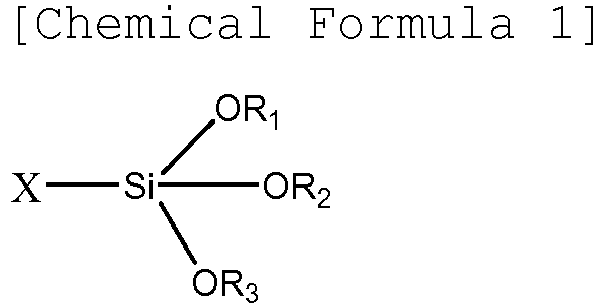
- The polyester film of claim 1, wherein the coating layer contains 10 to 90 wt% of the particles.
- The polyester film of claim 1, wherein the particles have an average particle size of 10 to 200nm and are any one or at least two inorganic particles selected from the group consisting of silica, alumina, zirconia, and titania particles.
- The polyester film of claim 1, wherein the silane coupling agent represented by Chemical Formula 1 is any one or at least two selected from the group consisting of [3-(2-aminoethylamino)propyl]trimethoxysilane, N-(2-aminoethyl-3-aminopropyl)triethoxysilane, vinyltrimethoxysilane, vinyltriethoxysilane, 3-acryloxypropyltrimethoxysilane, 3-acryloxypropyltriethoxysilane, 3-(meth)acryloxypropyltrimethoxysilane, 3-(meth)acryloxypropyltriethoxysilane, 3-(meth)acryloxypropyltripropoxysilane, 3-aminopropyltrimethoxysilane, and 3-aminopropyltriethoxysilane.
- The polyester film of claim 1, wherein the aqueous coating composition further contains an alcohol based solvent or water.
- The polyester film of claim 1, wherein when a pH of the particle is alkaline, the aqueous coating composition contains a pH adjusting agent for adjusting a pH of the entire composition to 8 or more, and when the pH of the particle is acidic, the aqueous coating composition contains a pH adjusting agent for adjusting the pH of the entire composition to 5 or less.
- The polyester film of claim 1, wherein the coating layer is formed by an in-line coating method.
- The polyester film of claim 1, wherein the coating layer has a dried coating thickness of 10 to 500nm.
- The polyester film of claim 1, wherein the polyester film has an entire thickness of 12 to 250 µm.
- The polyester film of claim 1, wherein the polyester film, the number of aggregated particles having a particle size of 300nm or more is less than 5.
- A manufacturing method of a polyester film, the manufacturing method comprising:a) melt-extruding a polyester resin to manufacture a polyester sheet;b) stretching the polyester sheet in a machine direction;c) coating an aqueous coating composition containing a silane coupling agent represented by the following Chemical Formula 1 and particles on one surface or both surfaces of the polyester film stretched in the machine direction and stretching the coated polyester film in a transverse direction; andd) heat-setting the bi-axially stretched polyester film.(In Chemical Formula 1, X is a straight-chain, branched-chain, or cyclic C1-C12 hydrocarbon group having one or at least two functional groups selected from a vinyl group, an epoxy group, an amino group, a methacrylic group, an acrylic group, and a mercapto group, and R1 to R3 are each independently C1-C5 alkyl.)
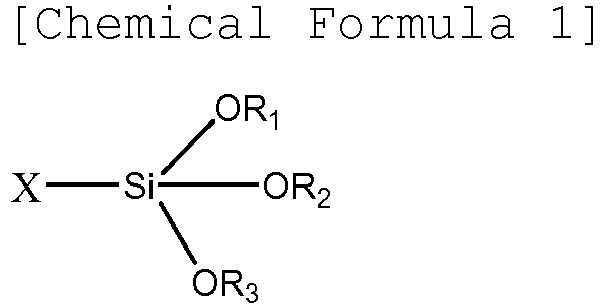
- The manufacturing method of claim 11, wherein the particles have an average particle size of 10 to 200nm and are any one or at least two inorganic particles selected from the group consisting of silica, alumina, zirconia, and titania particles.
- The manufacturing method of claim 11, wherein the silane coupling agent represented by Chemical Formula 1 is any one or at least two selected from the group consisting of [3-(2-aminoethylamino)propyl]trimethoxysilane, N-(2-aminoethyl-3-aminopropyl)triethoxysilane, vinyltrimethoxysilane, vinyltriethoxysilane, 3-acryloxypropyltrimethoxysilane, 3-acryloxypropyltriethoxysilane, 3-(meth)acryloxypropyltrimethoxysilane, 3-(meth)acryloxypropyltriethoxysilane, 3-(meth)acryloxypropyltripropoxysilane, 3-aminopropyltrimethoxysilane, and 3-aminopropyltriethoxysilane.
- The manufacturing method of claim 11, wherein the aqueous coating composition further contains an alcohol based solvent or water.
- The manufacturing method of claim 11, wherein when a pH of the particle is alkaline, the aqueous coating composition contains a pH adjusting agent for adjusting a pH of the entire composition to 8 or more, and when the pH of the particle is acidic, the aqueous coating composition contains a pH adjusting agent for adjusting the pH of the entire composition to 5 or less, but
a pH difference between the aqueous coating solution and the particles is less than 3. - The manufacturing method of claim 11, wherein in the polyester film, the number of aggregated particles having a particle size of 300nm or more is less than 5.
Applications Claiming Priority (3)
| Application Number | Priority Date | Filing Date | Title |
|---|---|---|---|
| KR20140052185 | 2014-04-30 | ||
| KR1020150058906A KR102249481B1 (en) | 2014-04-30 | 2015-04-27 | Polyester film and manufacturing method thereof |
| PCT/KR2015/004277 WO2015167235A1 (en) | 2014-04-30 | 2015-04-29 | Polyester film and method for manufacturing same |
Publications (3)
| Publication Number | Publication Date |
|---|---|
| EP3138871A1 true EP3138871A1 (en) | 2017-03-08 |
| EP3138871A4 EP3138871A4 (en) | 2018-01-03 |
| EP3138871B1 EP3138871B1 (en) | 2021-11-17 |
Family
ID=54605039
Family Applications (1)
| Application Number | Title | Priority Date | Filing Date |
|---|---|---|---|
| EP15785260.9A Active EP3138871B1 (en) | 2014-04-30 | 2015-04-29 | Polyester film and method for manufacturing same |
Country Status (5)
| Country | Link |
|---|---|
| US (1) | US10563031B2 (en) |
| EP (1) | EP3138871B1 (en) |
| KR (1) | KR102249481B1 (en) |
| CN (1) | CN106232695B (en) |
| TW (1) | TWI569971B (en) |
Cited By (1)
| Publication number | Priority date | Publication date | Assignee | Title |
|---|---|---|---|---|
| WO2021214198A1 (en) * | 2020-04-23 | 2021-10-28 | Essilor International | Water based anti-abrasion coating |
Families Citing this family (1)
| Publication number | Priority date | Publication date | Assignee | Title |
|---|---|---|---|---|
| KR102501654B1 (en) * | 2021-01-26 | 2023-02-20 | 도레이첨단소재 주식회사 | Hydrophilic polyester film and manufacturing method thereof |
Family Cites Families (43)
| Publication number | Priority date | Publication date | Assignee | Title |
|---|---|---|---|---|
| US4277287A (en) * | 1978-11-30 | 1981-07-07 | General Electric Company | Silicone resin coating composition |
| US4348431A (en) * | 1981-02-19 | 1982-09-07 | General Electric Company | Process for coating plastic films |
| US4539351A (en) * | 1982-01-27 | 1985-09-03 | General Electric Company | Silicone resin coating composition with improved shelf life |
| US4624870A (en) * | 1984-11-14 | 1986-11-25 | General Electric Company | Sodium free silicone resin coating compositions |
| US4650889A (en) * | 1985-11-29 | 1987-03-17 | Dow Corning Corporation | Silane coupling agents |
| GB8529970D0 (en) * | 1985-12-05 | 1986-01-15 | Unilever Plc | Spheroidal silica |
| US5236622A (en) * | 1986-03-07 | 1993-08-17 | Nippon Shokubai Kagaku Kogyo Co., Ltd. | Process for producing a monodispersed glycol suspension of fine inorganic oxide particles having excellent dispersion stability |
| US5304324A (en) * | 1986-03-07 | 1994-04-19 | Nippon Shokubai Kagaku Kogyo Co., Ltd. | Monodispersed glycol suspension of fine inorganic oxide particles having excellent dispersion stability |
| US4898786A (en) * | 1988-06-15 | 1990-02-06 | Hoechst Celanese Coproration | Polyester film primed with an aminofunctional silane, and film laminates thereof |
| US5064722A (en) * | 1988-06-15 | 1991-11-12 | Hoechst Celanese Corporation | In-line aminosilane coated polyester film for glazing products |
| US5082738A (en) * | 1988-06-15 | 1992-01-21 | Hoechst Celanese Corporation | Polyester film primed with an aminofunctional silane, and film laminates thereof |
| US5234870A (en) * | 1988-07-21 | 1993-08-10 | Nippon Shokubai Kagaku Kogyo Co., Ltd. | Zirconia sol and method for production thereof |
| US5022944A (en) * | 1988-09-06 | 1991-06-11 | Hoechst Celanese Corporation | In-line extrusion coatable polyester film having an aminofunctional silane primer |
| US4939035A (en) * | 1988-09-06 | 1990-07-03 | Hoechst Celanese Corporation | Extrusion coatable polyester film having an aminofunctional silane primer, and extrusion coated laminates thereof |
| US4954396A (en) * | 1988-09-06 | 1990-09-04 | Hoechst Celanese Corporation | Polyester film coated in-line with an silane |
| US6265029B1 (en) * | 1995-05-04 | 2001-07-24 | William Lewis | Low-cost, user-friendly hardcoating solution, process and coating |
| JPH09323392A (en) * | 1996-06-05 | 1997-12-16 | Teijin Ltd | Silicone easily-adhesive film and method for producing the same |
| US5948546A (en) * | 1996-10-11 | 1999-09-07 | Air Products And Chemicals, Inc. | Flexible laminates bonded with water-based laminating vehicles and laminating adhesives |
| US6589650B1 (en) * | 2000-08-07 | 2003-07-08 | 3M Innovative Properties Company | Microscope cover slip materials |
| US6245833B1 (en) * | 1998-05-04 | 2001-06-12 | 3M Innovative Properties | Ceramer composition incorporating fluoro/silane component and having abrasion and stain resistant characteristics |
| US6132861A (en) * | 1998-05-04 | 2000-10-17 | 3M Innovatives Properties Company | Retroreflective articles including a cured ceramer composite coating having a combination of excellent abrasion, dew and stain resistant characteristics |
| US6238798B1 (en) * | 1999-02-22 | 2001-05-29 | 3M Innovative Properties Company | Ceramer composition and composite comprising free radically curable fluorochemical component |
| WO2002020181A1 (en) * | 2000-09-07 | 2002-03-14 | Mitsubishi Polyester Film, Llc | In-line ultraviolet curable coating process and products produced thereby |
| US7087672B2 (en) * | 2002-05-08 | 2006-08-08 | E. I. Du Pont De Nemours And Company | Non-yellowing polyester coating composition |
| KR100785230B1 (en) | 2002-08-30 | 2007-12-11 | 도레이새한 주식회사 | Biaxially oriented polyester film with excellent transparency |
| US7544726B2 (en) * | 2002-10-14 | 2009-06-09 | Akzo Nobel N.V. | Colloidal silica composition |
| PL202648B1 (en) * | 2002-10-14 | 2009-07-31 | Akzo Nobel Nv | Aqueous silica dispersion |
| US20060167126A1 (en) * | 2002-11-13 | 2006-07-27 | Denki Kagaku Kogyo Kabushiki Kaisha | Ultraviolet-curable antistatic hard coating resin composition |
| US7153588B2 (en) * | 2003-05-30 | 2006-12-26 | 3M Innovative Properties Company | UV resistant naphthalate polyester articles |
| DE10326815A1 (en) * | 2003-06-13 | 2004-12-30 | Institut für Neue Materialien Gemeinnützige GmbH | Anti-adhesive high-temperature coatings |
| WO2006057382A1 (en) * | 2004-11-29 | 2006-06-01 | Toyo Boseki Kabushiki Kaisha | Laminated thermoplastic resin film and laminated thermoplstic resin film roll |
| KR20080084347A (en) * | 2007-03-16 | 2008-09-19 | 도레이새한 주식회사 | Polyester film for polarizing plate |
| EP2107086B1 (en) * | 2008-04-02 | 2012-05-02 | Evonik Degussa GmbH | Dispersion containing hydrophobic silicon dioxide particles |
| CN104098935A (en) * | 2008-05-16 | 2014-10-15 | 3M创新有限公司 | Silicon dioxide coating for improving hydrophilcity/transmissivity |
| JP5591530B2 (en) * | 2009-06-24 | 2014-09-17 | 日揮触媒化成株式会社 | Method for producing silica-based fine particle dispersed sol, silica-based fine particle dispersed sol, coating composition containing the dispersed sol, curable coating film, and substrate with curable coating film |
| JP5646855B2 (en) * | 2010-02-01 | 2014-12-24 | 日東電工株式会社 | Silicone resin composition |
| TW201245357A (en) * | 2011-03-25 | 2012-11-16 | Nuplex Resins Bv | Waterborne coating composition |
| CA2850960A1 (en) * | 2011-12-09 | 2013-06-13 | Cpfilms Inc. | Modified release coatings for optically clear film |
| KR101385400B1 (en) * | 2012-06-27 | 2014-04-14 | 롯데케미칼 주식회사 | Binder resin free-typed coating composition and polyester film |
| US20150177433A1 (en) * | 2012-07-13 | 2015-06-25 | Konica Minolta, Inc. | Infrared shielding film |
| KR101428859B1 (en) | 2012-09-27 | 2014-08-14 | 롯데케미칼 주식회사 | Coating composition for adhesive polyester film with excellent surface smoothness and polyester film using same |
| KR20140042418A (en) | 2012-09-28 | 2014-04-07 | 코오롱인더스트리 주식회사 | Polyester film |
| KR101914477B1 (en) * | 2012-09-28 | 2018-11-05 | 코오롱인더스트리 주식회사 | Polyester laminated film |
-
2015
- 2015-04-27 KR KR1020150058906A patent/KR102249481B1/en active Active
- 2015-04-29 TW TW104113619A patent/TWI569971B/en active
- 2015-04-29 US US15/305,695 patent/US10563031B2/en active Active
- 2015-04-29 CN CN201580021716.2A patent/CN106232695B/en active Active
- 2015-04-29 EP EP15785260.9A patent/EP3138871B1/en active Active
Cited By (1)
| Publication number | Priority date | Publication date | Assignee | Title |
|---|---|---|---|---|
| WO2021214198A1 (en) * | 2020-04-23 | 2021-10-28 | Essilor International | Water based anti-abrasion coating |
Also Published As
| Publication number | Publication date |
|---|---|
| CN106232695B (en) | 2019-10-15 |
| CN106232695A (en) | 2016-12-14 |
| TW201545883A (en) | 2015-12-16 |
| TWI569971B (en) | 2017-02-11 |
| EP3138871B1 (en) | 2021-11-17 |
| US20170044339A1 (en) | 2017-02-16 |
| US10563031B2 (en) | 2020-02-18 |
| EP3138871A4 (en) | 2018-01-03 |
| KR102249481B1 (en) | 2021-05-07 |
| KR20150125595A (en) | 2015-11-09 |
Similar Documents
| Publication | Publication Date | Title |
|---|---|---|
| RU2516109C2 (en) | Sandwiched surface coat with barrier ply | |
| WO1998051490A1 (en) | Release film | |
| JPH05245922A (en) | Method for producing releasable polyester film | |
| WO2011105441A1 (en) | Biaxially oriented polyester film and release film comprising same | |
| CN102666095A (en) | Resin substrate with hard coat and process for production thereof | |
| CN106376237A (en) | Aqueous composition, hard coat film, laminated film, transparent conductive film, and touch panel | |
| JP2012071433A (en) | Release film | |
| CN113444276A (en) | Release film and method for producing same | |
| JP6010381B2 (en) | Release film | |
| EP3138871B1 (en) | Polyester film and method for manufacturing same | |
| JPH0583074B2 (en) | ||
| JP6164791B2 (en) | Polyester film for double-sided pressure-sensitive adhesive sheets | |
| KR101049527B1 (en) | Release Film | |
| EP2634209A1 (en) | Polyester film having coating layer | |
| JP2012137567A (en) | Release polyester film for polarizing plate | |
| TWI848977B (en) | Resin film and method for producing the same | |
| KR101818135B1 (en) | Antifouling coating composition | |
| KR100728661B1 (en) | Antistatic water dispersion coating solution and antistatic polyester film prepared using the same | |
| KR20170019675A (en) | Polyester film and manufacturing method thereof | |
| JP2011201254A (en) | Antistatic releasable polyester film | |
| JP5041695B2 (en) | Antistatic film-forming composition | |
| JP2003226838A (en) | Surface treatment agent | |
| JPH0753750A (en) | Release film | |
| JP2015027735A (en) | Mold release polyester film | |
| JP2001002940A (en) | Coloring resin composition, molded product thereof, and method for producing molded product |
Legal Events
| Date | Code | Title | Description |
|---|---|---|---|
| STAA | Information on the status of an ep patent application or granted ep patent |
Free format text: STATUS: THE INTERNATIONAL PUBLICATION HAS BEEN MADE |
|
| PUAI | Public reference made under article 153(3) epc to a published international application that has entered the european phase |
Free format text: ORIGINAL CODE: 0009012 |
|
| STAA | Information on the status of an ep patent application or granted ep patent |
Free format text: STATUS: REQUEST FOR EXAMINATION WAS MADE |
|
| 17P | Request for examination filed |
Effective date: 20161018 |
|
| AK | Designated contracting states |
Kind code of ref document: A1 Designated state(s): AL AT BE BG CH CY CZ DE DK EE ES FI FR GB GR HR HU IE IS IT LI LT LU LV MC MK MT NL NO PL PT RO RS SE SI SK SM TR |
|
| AX | Request for extension of the european patent |
Extension state: BA ME |
|
| DAV | Request for validation of the european patent (deleted) | ||
| DAX | Request for extension of the european patent (deleted) | ||
| A4 | Supplementary search report drawn up and despatched |
Effective date: 20171205 |
|
| RIC1 | Information provided on ipc code assigned before grant |
Ipc: B29K 67/00 20060101ALI20171129BHEP Ipc: B05D 7/04 20060101ALI20171129BHEP Ipc: C08K 9/06 20060101ALI20171129BHEP Ipc: B29C 47/00 20060101ALI20171129BHEP Ipc: C08J 5/18 20060101ALI20171129BHEP Ipc: C09D 1/00 20060101ALI20171129BHEP Ipc: B29C 55/00 20060101ALI20171129BHEP Ipc: C08K 3/22 20060101ALI20171129BHEP Ipc: B29C 55/14 20060101ALI20171129BHEP Ipc: C09D 5/02 20060101ALI20171129BHEP Ipc: C09D 7/12 00000000ALI20171129BHEP Ipc: B29K 105/16 20060101ALI20171129BHEP Ipc: C08K 3/36 20060101ALI20171129BHEP Ipc: C08J 7/04 20060101AFI20171129BHEP Ipc: B05D 7/24 20060101ALI20171129BHEP Ipc: B29C 55/02 20060101ALI20171129BHEP Ipc: C08K 5/5415 20060101ALI20171129BHEP Ipc: C08J 7/06 20060101ALI20171129BHEP Ipc: B05D 3/12 20060101ALI20171129BHEP |
|
| RIC1 | Information provided on ipc code assigned before grant |
Ipc: C08J 7/06 20060101ALI20171129BHEP Ipc: C08K 9/06 20060101ALI20171129BHEP Ipc: C09D 7/12 20060101ALI20171129BHEP Ipc: B29C 55/00 20060101ALI20171129BHEP Ipc: C09D 5/02 20060101ALI20171129BHEP Ipc: B05D 3/12 20060101ALI20171129BHEP Ipc: B29C 55/02 20060101ALI20171129BHEP Ipc: B29K 67/00 20060101ALI20171129BHEP Ipc: C08K 3/36 20060101ALI20171129BHEP Ipc: B29K 105/16 20060101ALI20171129BHEP Ipc: C08J 7/04 20060101AFI20171129BHEP Ipc: C08K 3/22 20060101ALI20171129BHEP Ipc: B05D 7/24 20060101ALI20171129BHEP Ipc: B29C 55/14 20060101ALI20171129BHEP Ipc: B29C 47/00 20060101ALI20171129BHEP Ipc: C09D 1/00 20060101ALI20171129BHEP Ipc: C08K 5/5415 20060101ALI20171129BHEP Ipc: B05D 7/04 20060101ALI20171129BHEP Ipc: C08J 5/18 20060101ALI20171129BHEP |
|
| RAP1 | Party data changed (applicant data changed or rights of an application transferred) |
Owner name: KOLON INDUSTRIES, INC. |
|
| REG | Reference to a national code |
Ref country code: DE Ref legal event code: R079 Ref document number: 602015075101 Country of ref document: DE Free format text: PREVIOUS MAIN CLASS: C08J0007040000 Ipc: C09D0005020000 |
|
| GRAC | Information related to communication of intention to grant a patent modified |
Free format text: ORIGINAL CODE: EPIDOSCIGR1 |
|
| STAA | Information on the status of an ep patent application or granted ep patent |
Free format text: STATUS: GRANT OF PATENT IS INTENDED |
|
| RIC1 | Information provided on ipc code assigned before grant |
Ipc: B29C 55/00 20060101ALI20210115BHEP Ipc: C09D 7/40 20180101ALI20210115BHEP Ipc: B29C 55/14 20060101ALI20210115BHEP Ipc: C09D 7/63 20180101ALI20210115BHEP Ipc: B29K 67/00 20060101ALI20210115BHEP Ipc: C08J 7/06 20060101ALI20210115BHEP Ipc: B29C 48/00 20190101ALI20210115BHEP Ipc: C08J 7/04 20200101ALI20210115BHEP Ipc: B29C 48/02 20190101ALI20210115BHEP Ipc: C09D 1/00 20060101ALI20210115BHEP Ipc: B29C 48/08 20190101ALI20210115BHEP Ipc: C09D 7/61 20180101ALI20210115BHEP Ipc: B29K 105/16 20060101ALI20210115BHEP Ipc: C09D 5/02 20060101AFI20210115BHEP |
|
| GRAP | Despatch of communication of intention to grant a patent |
Free format text: ORIGINAL CODE: EPIDOSNIGR1 |
|
| GRAJ | Information related to disapproval of communication of intention to grant by the applicant or resumption of examination proceedings by the epo deleted |
Free format text: ORIGINAL CODE: EPIDOSDIGR1 |
|
| GRAP | Despatch of communication of intention to grant a patent |
Free format text: ORIGINAL CODE: EPIDOSNIGR1 |
|
| GRAJ | Information related to disapproval of communication of intention to grant by the applicant or resumption of examination proceedings by the epo deleted |
Free format text: ORIGINAL CODE: EPIDOSDIGR1 |
|
| INTG | Intention to grant announced |
Effective date: 20210215 |
|
| RIN1 | Information on inventor provided before grant (corrected) |
Inventor name: CHO, EUN HYE Inventor name: PARK, JAE BONG Inventor name: BAEK, SANG-HYUN |
|
| GRAP | Despatch of communication of intention to grant a patent |
Free format text: ORIGINAL CODE: EPIDOSNIGR1 |
|
| INTG | Intention to grant announced |
Effective date: 20210222 |
|
| GRAJ | Information related to disapproval of communication of intention to grant by the applicant or resumption of examination proceedings by the epo deleted |
Free format text: ORIGINAL CODE: EPIDOSDIGR1 |
|
| STAA | Information on the status of an ep patent application or granted ep patent |
Free format text: STATUS: REQUEST FOR EXAMINATION WAS MADE |
|
| INTG | Intention to grant announced |
Effective date: 20210305 |
|
| INTG | Intention to grant announced |
Effective date: 20210316 |
|
| INTG | Intention to grant announced |
Effective date: 20210325 |
|
| INTC | Intention to grant announced (deleted) | ||
| GRAP | Despatch of communication of intention to grant a patent |
Free format text: ORIGINAL CODE: EPIDOSNIGR1 |
|
| STAA | Information on the status of an ep patent application or granted ep patent |
Free format text: STATUS: GRANT OF PATENT IS INTENDED |
|
| INTG | Intention to grant announced |
Effective date: 20210614 |
|
| GRAS | Grant fee paid |
Free format text: ORIGINAL CODE: EPIDOSNIGR3 |
|
| GRAA | (expected) grant |
Free format text: ORIGINAL CODE: 0009210 |
|
| STAA | Information on the status of an ep patent application or granted ep patent |
Free format text: STATUS: THE PATENT HAS BEEN GRANTED |
|
| AK | Designated contracting states |
Kind code of ref document: B1 Designated state(s): AL AT BE BG CH CY CZ DE DK EE ES FI FR GB GR HR HU IE IS IT LI LT LU LV MC MK MT NL NO PL PT RO RS SE SI SK SM TR |
|
| REG | Reference to a national code |
Ref country code: GB Ref legal event code: FG4D |
|
| REG | Reference to a national code |
Ref country code: IE Ref legal event code: FG4D |
|
| REG | Reference to a national code |
Ref country code: DE Ref legal event code: R096 Ref document number: 602015075101 Country of ref document: DE |
|
| REG | Reference to a national code |
Ref country code: AT Ref legal event code: REF Ref document number: 1448042 Country of ref document: AT Kind code of ref document: T Effective date: 20211215 |
|
| REG | Reference to a national code |
Ref country code: LT Ref legal event code: MG9D |
|
| REG | Reference to a national code |
Ref country code: NL Ref legal event code: MP Effective date: 20211117 |
|
| REG | Reference to a national code |
Ref country code: AT Ref legal event code: MK05 Ref document number: 1448042 Country of ref document: AT Kind code of ref document: T Effective date: 20211117 |
|
| PG25 | Lapsed in a contracting state [announced via postgrant information from national office to epo] |
Ref country code: RS Free format text: LAPSE BECAUSE OF FAILURE TO SUBMIT A TRANSLATION OF THE DESCRIPTION OR TO PAY THE FEE WITHIN THE PRESCRIBED TIME-LIMIT Effective date: 20211117 Ref country code: LT Free format text: LAPSE BECAUSE OF FAILURE TO SUBMIT A TRANSLATION OF THE DESCRIPTION OR TO PAY THE FEE WITHIN THE PRESCRIBED TIME-LIMIT Effective date: 20211117 Ref country code: FI Free format text: LAPSE BECAUSE OF FAILURE TO SUBMIT A TRANSLATION OF THE DESCRIPTION OR TO PAY THE FEE WITHIN THE PRESCRIBED TIME-LIMIT Effective date: 20211117 Ref country code: BG Free format text: LAPSE BECAUSE OF FAILURE TO SUBMIT A TRANSLATION OF THE DESCRIPTION OR TO PAY THE FEE WITHIN THE PRESCRIBED TIME-LIMIT Effective date: 20220217 Ref country code: AT Free format text: LAPSE BECAUSE OF FAILURE TO SUBMIT A TRANSLATION OF THE DESCRIPTION OR TO PAY THE FEE WITHIN THE PRESCRIBED TIME-LIMIT Effective date: 20211117 |
|
| PG25 | Lapsed in a contracting state [announced via postgrant information from national office to epo] |
Ref country code: IS Free format text: LAPSE BECAUSE OF FAILURE TO SUBMIT A TRANSLATION OF THE DESCRIPTION OR TO PAY THE FEE WITHIN THE PRESCRIBED TIME-LIMIT Effective date: 20220317 Ref country code: SE Free format text: LAPSE BECAUSE OF FAILURE TO SUBMIT A TRANSLATION OF THE DESCRIPTION OR TO PAY THE FEE WITHIN THE PRESCRIBED TIME-LIMIT Effective date: 20211117 Ref country code: PT Free format text: LAPSE BECAUSE OF FAILURE TO SUBMIT A TRANSLATION OF THE DESCRIPTION OR TO PAY THE FEE WITHIN THE PRESCRIBED TIME-LIMIT Effective date: 20220317 Ref country code: PL Free format text: LAPSE BECAUSE OF FAILURE TO SUBMIT A TRANSLATION OF THE DESCRIPTION OR TO PAY THE FEE WITHIN THE PRESCRIBED TIME-LIMIT Effective date: 20211117 Ref country code: NO Free format text: LAPSE BECAUSE OF FAILURE TO SUBMIT A TRANSLATION OF THE DESCRIPTION OR TO PAY THE FEE WITHIN THE PRESCRIBED TIME-LIMIT Effective date: 20220217 Ref country code: NL Free format text: LAPSE BECAUSE OF FAILURE TO SUBMIT A TRANSLATION OF THE DESCRIPTION OR TO PAY THE FEE WITHIN THE PRESCRIBED TIME-LIMIT Effective date: 20211117 Ref country code: LV Free format text: LAPSE BECAUSE OF FAILURE TO SUBMIT A TRANSLATION OF THE DESCRIPTION OR TO PAY THE FEE WITHIN THE PRESCRIBED TIME-LIMIT Effective date: 20211117 Ref country code: HR Free format text: LAPSE BECAUSE OF FAILURE TO SUBMIT A TRANSLATION OF THE DESCRIPTION OR TO PAY THE FEE WITHIN THE PRESCRIBED TIME-LIMIT Effective date: 20211117 Ref country code: GR Free format text: LAPSE BECAUSE OF FAILURE TO SUBMIT A TRANSLATION OF THE DESCRIPTION OR TO PAY THE FEE WITHIN THE PRESCRIBED TIME-LIMIT Effective date: 20220218 Ref country code: ES Free format text: LAPSE BECAUSE OF FAILURE TO SUBMIT A TRANSLATION OF THE DESCRIPTION OR TO PAY THE FEE WITHIN THE PRESCRIBED TIME-LIMIT Effective date: 20211117 |
|
| PG25 | Lapsed in a contracting state [announced via postgrant information from national office to epo] |
Ref country code: SM Free format text: LAPSE BECAUSE OF FAILURE TO SUBMIT A TRANSLATION OF THE DESCRIPTION OR TO PAY THE FEE WITHIN THE PRESCRIBED TIME-LIMIT Effective date: 20211117 Ref country code: SK Free format text: LAPSE BECAUSE OF FAILURE TO SUBMIT A TRANSLATION OF THE DESCRIPTION OR TO PAY THE FEE WITHIN THE PRESCRIBED TIME-LIMIT Effective date: 20211117 Ref country code: RO Free format text: LAPSE BECAUSE OF FAILURE TO SUBMIT A TRANSLATION OF THE DESCRIPTION OR TO PAY THE FEE WITHIN THE PRESCRIBED TIME-LIMIT Effective date: 20211117 Ref country code: EE Free format text: LAPSE BECAUSE OF FAILURE TO SUBMIT A TRANSLATION OF THE DESCRIPTION OR TO PAY THE FEE WITHIN THE PRESCRIBED TIME-LIMIT Effective date: 20211117 Ref country code: DK Free format text: LAPSE BECAUSE OF FAILURE TO SUBMIT A TRANSLATION OF THE DESCRIPTION OR TO PAY THE FEE WITHIN THE PRESCRIBED TIME-LIMIT Effective date: 20211117 Ref country code: CZ Free format text: LAPSE BECAUSE OF FAILURE TO SUBMIT A TRANSLATION OF THE DESCRIPTION OR TO PAY THE FEE WITHIN THE PRESCRIBED TIME-LIMIT Effective date: 20211117 |
|
| REG | Reference to a national code |
Ref country code: DE Ref legal event code: R097 Ref document number: 602015075101 Country of ref document: DE |
|
| PLBE | No opposition filed within time limit |
Free format text: ORIGINAL CODE: 0009261 |
|
| STAA | Information on the status of an ep patent application or granted ep patent |
Free format text: STATUS: NO OPPOSITION FILED WITHIN TIME LIMIT |
|
| 26N | No opposition filed |
Effective date: 20220818 |
|
| PG25 | Lapsed in a contracting state [announced via postgrant information from national office to epo] |
Ref country code: AL Free format text: LAPSE BECAUSE OF FAILURE TO SUBMIT A TRANSLATION OF THE DESCRIPTION OR TO PAY THE FEE WITHIN THE PRESCRIBED TIME-LIMIT Effective date: 20211117 |
|
| PG25 | Lapsed in a contracting state [announced via postgrant information from national office to epo] |
Ref country code: SI Free format text: LAPSE BECAUSE OF FAILURE TO SUBMIT A TRANSLATION OF THE DESCRIPTION OR TO PAY THE FEE WITHIN THE PRESCRIBED TIME-LIMIT Effective date: 20211117 |
|
| REG | Reference to a national code |
Ref country code: BE Ref legal event code: MM Effective date: 20220430 |
|
| PG25 | Lapsed in a contracting state [announced via postgrant information from national office to epo] |
Ref country code: MC Free format text: LAPSE BECAUSE OF FAILURE TO SUBMIT A TRANSLATION OF THE DESCRIPTION OR TO PAY THE FEE WITHIN THE PRESCRIBED TIME-LIMIT Effective date: 20211117 Ref country code: LU Free format text: LAPSE BECAUSE OF NON-PAYMENT OF DUE FEES Effective date: 20220429 |
|
| PG25 | Lapsed in a contracting state [announced via postgrant information from national office to epo] |
Ref country code: BE Free format text: LAPSE BECAUSE OF NON-PAYMENT OF DUE FEES Effective date: 20220430 |
|
| PG25 | Lapsed in a contracting state [announced via postgrant information from national office to epo] |
Ref country code: IE Free format text: LAPSE BECAUSE OF NON-PAYMENT OF DUE FEES Effective date: 20220429 |
|
| PG25 | Lapsed in a contracting state [announced via postgrant information from national office to epo] |
Ref country code: HU Free format text: LAPSE BECAUSE OF FAILURE TO SUBMIT A TRANSLATION OF THE DESCRIPTION OR TO PAY THE FEE WITHIN THE PRESCRIBED TIME-LIMIT; INVALID AB INITIO Effective date: 20150429 |
|
| PG25 | Lapsed in a contracting state [announced via postgrant information from national office to epo] |
Ref country code: MK Free format text: LAPSE BECAUSE OF FAILURE TO SUBMIT A TRANSLATION OF THE DESCRIPTION OR TO PAY THE FEE WITHIN THE PRESCRIBED TIME-LIMIT Effective date: 20211117 Ref country code: CY Free format text: LAPSE BECAUSE OF FAILURE TO SUBMIT A TRANSLATION OF THE DESCRIPTION OR TO PAY THE FEE WITHIN THE PRESCRIBED TIME-LIMIT Effective date: 20211117 |
|
| PG25 | Lapsed in a contracting state [announced via postgrant information from national office to epo] |
Ref country code: MT Free format text: LAPSE BECAUSE OF FAILURE TO SUBMIT A TRANSLATION OF THE DESCRIPTION OR TO PAY THE FEE WITHIN THE PRESCRIBED TIME-LIMIT Effective date: 20211117 |
|
| REG | Reference to a national code |
Ref country code: DE Ref legal event code: R081 Ref document number: 602015075101 Country of ref document: DE Owner name: SK MICROWORKS CO., LTD., JINCHEON, KR Free format text: FORMER OWNER: KOLON INDUSTRIES, INC., SEOUL, KR Ref country code: DE Ref legal event code: R081 Ref document number: 602015075101 Country of ref document: DE Owner name: MICROWORKS CO., LTD., JINCHEON-GUN, KR Free format text: FORMER OWNER: KOLON INDUSTRIES, INC., SEOUL, KR |
|
| REG | Reference to a national code |
Ref country code: GB Ref legal event code: 732E Free format text: REGISTERED BETWEEN 20250619 AND 20250625 |
|
| PG25 | Lapsed in a contracting state [announced via postgrant information from national office to epo] |
Ref country code: TR Free format text: LAPSE BECAUSE OF FAILURE TO SUBMIT A TRANSLATION OF THE DESCRIPTION OR TO PAY THE FEE WITHIN THE PRESCRIBED TIME-LIMIT Effective date: 20211117 |
|
| REG | Reference to a national code |
Ref country code: DE Ref legal event code: R081 Ref document number: 602015075101 Country of ref document: DE Owner name: MICROWORKS CO., LTD., JINCHEON-GUN, KR Free format text: FORMER OWNER: SK MICROWORKS CO., LTD., JINCHEON, CHUNGCHEONGBUK-DO, KR |
|
| REG | Reference to a national code |
Ref country code: CH Ref legal event code: R17 Free format text: ST27 STATUS EVENT CODE: U-0-0-R10-R17 (AS PROVIDED BY THE NATIONAL OFFICE) Effective date: 20260130 Ref country code: CH Ref legal event code: R18 Free format text: ST27 STATUS EVENT CODE: U-0-0-R10-R18 (AS PROVIDED BY THE NATIONAL OFFICE) Effective date: 20260130 |
|
| PGFP | Annual fee paid to national office [announced via postgrant information from national office to epo] |
Ref country code: GB Payment date: 20260324 Year of fee payment: 12 |
|
| PGFP | Annual fee paid to national office [announced via postgrant information from national office to epo] |
Ref country code: FR Payment date: 20260323 Year of fee payment: 12 |
|
| REG | Reference to a national code |
Ref country code: CH Ref legal event code: U11 Free format text: ST27 STATUS EVENT CODE: U-0-0-U10-U11 (AS PROVIDED BY THE NATIONAL OFFICE) Effective date: 20260501 |
|
| PGFP | Annual fee paid to national office [announced via postgrant information from national office to epo] |
Ref country code: IT Payment date: 20260326 Year of fee payment: 12 |
|
| PGFP | Annual fee paid to national office [announced via postgrant information from national office to epo] |
Ref country code: DE Payment date: 20260323 Year of fee payment: 12 |
|
| PGFP | Annual fee paid to national office [announced via postgrant information from national office to epo] |
Ref country code: CH Payment date: 20260501 Year of fee payment: 12 |