EP3134073B1 - Injizierbare und implantierbare trägersysteme auf basis von modifizierten poly(dikarbonsäure-polyol estern) zur kontrollierten wirkstofffreisetzung - Google Patents
Injizierbare und implantierbare trägersysteme auf basis von modifizierten poly(dikarbonsäure-polyol estern) zur kontrollierten wirkstofffreisetzung Download PDFInfo
- Publication number
- EP3134073B1 EP3134073B1 EP15775073.8A EP15775073A EP3134073B1 EP 3134073 B1 EP3134073 B1 EP 3134073B1 EP 15775073 A EP15775073 A EP 15775073A EP 3134073 B1 EP3134073 B1 EP 3134073B1
- Authority
- EP
- European Patent Office
- Prior art keywords
- agents
- acid
- carrier systems
- systems according
- hydroxyl groups
- Prior art date
- Legal status (The legal status is an assumption and is not a legal conclusion. Google has not performed a legal analysis and makes no representation as to the accuracy of the status listed.)
- Active
Links
Images


Classifications
-
- A—HUMAN NECESSITIES
- A61—MEDICAL OR VETERINARY SCIENCE; HYGIENE
- A61K—PREPARATIONS FOR MEDICAL, DENTAL OR TOILETRY PURPOSES
- A61K47/00—Medicinal preparations characterised by the non-active ingredients used, e.g. carriers or inert additives; Targeting or modifying agents chemically bound to the active ingredient
- A61K47/30—Macromolecular organic or inorganic compounds, e.g. inorganic polyphosphates
- A61K47/34—Macromolecular compounds obtained otherwise than by reactions only involving carbon-to-carbon unsaturated bonds, e.g. polyesters, polyamino acids, polysiloxanes, polyphosphazines, copolymers of polyalkylene glycol or poloxamers
-
- A—HUMAN NECESSITIES
- A61—MEDICAL OR VETERINARY SCIENCE; HYGIENE
- A61K—PREPARATIONS FOR MEDICAL, DENTAL OR TOILETRY PURPOSES
- A61K31/00—Medicinal preparations containing organic active ingredients
- A61K31/33—Heterocyclic compounds
- A61K31/395—Heterocyclic compounds having nitrogen as a ring hetero atom, e.g. guanethidine or rifamycins
- A61K31/435—Heterocyclic compounds having nitrogen as a ring hetero atom, e.g. guanethidine or rifamycins having six-membered rings with one nitrogen as the only ring hetero atom
- A61K31/44—Non condensed pyridines; Hydrogenated derivatives thereof
- A61K31/4422—1,4-Dihydropyridines, e.g. nifedipine, nicardipine
-
- A—HUMAN NECESSITIES
- A61—MEDICAL OR VETERINARY SCIENCE; HYGIENE
- A61K—PREPARATIONS FOR MEDICAL, DENTAL OR TOILETRY PURPOSES
- A61K31/00—Medicinal preparations containing organic active ingredients
- A61K31/56—Compounds containing cyclopenta[a]hydrophenanthrene ring systems; Derivatives thereof, e.g. steroids
- A61K31/57—Compounds containing cyclopenta[a]hydrophenanthrene ring systems; Derivatives thereof, e.g. steroids substituted in position 17 beta by a chain of two carbon atoms, e.g. pregnane or progesterone
- A61K31/573—Compounds containing cyclopenta[a]hydrophenanthrene ring systems; Derivatives thereof, e.g. steroids substituted in position 17 beta by a chain of two carbon atoms, e.g. pregnane or progesterone substituted in position 21, e.g. cortisone, dexamethasone, prednisone or aldosterone
-
- A—HUMAN NECESSITIES
- A61—MEDICAL OR VETERINARY SCIENCE; HYGIENE
- A61K—PREPARATIONS FOR MEDICAL, DENTAL OR TOILETRY PURPOSES
- A61K47/00—Medicinal preparations characterised by the non-active ingredients used, e.g. carriers or inert additives; Targeting or modifying agents chemically bound to the active ingredient
- A61K47/06—Organic compounds, e.g. natural or synthetic hydrocarbons, polyolefins, mineral oil, petrolatum or ozokerite
- A61K47/08—Organic compounds, e.g. natural or synthetic hydrocarbons, polyolefins, mineral oil, petrolatum or ozokerite containing oxygen, e.g. ethers, acetals, ketones, quinones, aldehydes, peroxides
- A61K47/10—Alcohols; Phenols; Salts thereof, e.g. glycerol; Polyethylene glycols [PEG]; Poloxamers; PEG/POE alkyl ethers
-
- A—HUMAN NECESSITIES
- A61—MEDICAL OR VETERINARY SCIENCE; HYGIENE
- A61K—PREPARATIONS FOR MEDICAL, DENTAL OR TOILETRY PURPOSES
- A61K9/00—Medicinal preparations characterised by special physical form
- A61K9/0012—Galenical forms characterised by the site of application
- A61K9/0019—Injectable compositions; Intramuscular, intravenous, arterial, subcutaneous administration; Compositions to be administered through the skin in an invasive manner
-
- A—HUMAN NECESSITIES
- A61—MEDICAL OR VETERINARY SCIENCE; HYGIENE
- A61K—PREPARATIONS FOR MEDICAL, DENTAL OR TOILETRY PURPOSES
- A61K9/00—Medicinal preparations characterised by special physical form
- A61K9/0012—Galenical forms characterised by the site of application
- A61K9/0019—Injectable compositions; Intramuscular, intravenous, arterial, subcutaneous administration; Compositions to be administered through the skin in an invasive manner
- A61K9/0024—Solid, semi-solid or solidifying implants, which are implanted or injected in body tissue
-
- A—HUMAN NECESSITIES
- A61—MEDICAL OR VETERINARY SCIENCE; HYGIENE
- A61K—PREPARATIONS FOR MEDICAL, DENTAL OR TOILETRY PURPOSES
- A61K9/00—Medicinal preparations characterised by special physical form
- A61K9/14—Particulate form, e.g. powders, Processes for size reducing of pure drugs or the resulting products, Pure drug nanoparticles
- A61K9/141—Intimate drug-carrier mixtures characterised by the carrier, e.g. ordered mixtures, adsorbates, solid solutions, eutectica, co-dried, co-solubilised, co-kneaded, co-milled, co-ground products, co-precipitates, co-evaporates, co-extrudates, co-melts; Drug nanoparticles with adsorbed surface modifiers
- A61K9/146—Intimate drug-carrier mixtures characterised by the carrier, e.g. ordered mixtures, adsorbates, solid solutions, eutectica, co-dried, co-solubilised, co-kneaded, co-milled, co-ground products, co-precipitates, co-evaporates, co-extrudates, co-melts; Drug nanoparticles with adsorbed surface modifiers with organic macromolecular compounds
-
- C—CHEMISTRY; METALLURGY
- C08—ORGANIC MACROMOLECULAR COMPOUNDS; THEIR PREPARATION OR CHEMICAL WORKING-UP; COMPOSITIONS BASED THEREON
- C08G—MACROMOLECULAR COMPOUNDS OBTAINED OTHERWISE THAN BY REACTIONS ONLY INVOLVING UNSATURATED CARBON-TO-CARBON BONDS
- C08G63/00—Macromolecular compounds obtained by reactions forming a carboxylic ester link in the main chain of the macromolecule
-
- C—CHEMISTRY; METALLURGY
- C08—ORGANIC MACROMOLECULAR COMPOUNDS; THEIR PREPARATION OR CHEMICAL WORKING-UP; COMPOSITIONS BASED THEREON
- C08G—MACROMOLECULAR COMPOUNDS OBTAINED OTHERWISE THAN BY REACTIONS ONLY INVOLVING UNSATURATED CARBON-TO-CARBON BONDS
- C08G63/00—Macromolecular compounds obtained by reactions forming a carboxylic ester link in the main chain of the macromolecule
- C08G63/91—Polymers modified by chemical after-treatment
- C08G63/914—Polymers modified by chemical after-treatment derived from polycarboxylic acids and polyhydroxy compounds
Definitions
- Carrier systems that release active ingredients in the body of animals or humans in a controlled manner are of great importance. Many highly effective active ingredients are characterized by low bioavailability after oral administration and a short half-life, which are caused by rapid excretion (elimination) or conversion (metabolism) of the active ingredient. The therapeutic use of such active ingredients is only possible with suitable drug carrier systems that are injected parenterally and release the active ingredients in a controlled manner. The time span of the active ingredient release depends on the indication. A release of a few hours, days, weeks or several months can be aimed for. Typical types of application are subcutaneous, intraperitoneal or intramuscular application.
- release systems are also used, for example, for local therapy in the brain, eye, ear, bone marrow and other organs.
- different release profiles e.g. continuous, pulsatile, can be aimed for.
- the drug carrier system should ensure a reproducible, controlled release of the active ingredient and be inert towards the body.
- Non-biodegradable materials have the disadvantage that they have to be removed from the body. Examples are the preparations Implanon ® (Organon) and Vantas ® (Orion Pharma), which have to be removed from the body after 3 years and 12 months respectively, and thus require surgical intervention.
- the main degradable materials used are polylactic acid and copolymers of lactic and glycolic acid. The monomers of these polymers are alpha-hydroxy acids.
- a disadvantage of these polymers is the complexity of polymer degradation. This is based on an autocatalytic hydrolysis, which can lead to release kinetics that are difficult to control and very acidic pH values (pH 2) /1, 2, 3/.
- the disadvantage is that the acidic microenvironment can decompose or inactivate active substances before they are released /4,5/.
- Most of the products on the market are either microparticles or preformed implants (Red List 2014, Rote Liste ® Service GmbH).
- Microparticles also called microcapsules or microspherules, are solid, mostly spherical particles with a typical size in the lower micrometer range.
- biodegradable microparticles are Enantone ® (Takeda), Sixantone ® (Takeda), Decapeptyl ® (Ferring), Sandostatin ® LAR ® - (Sandoz), Pamorelin ® LA 3.75mg (Ipsen Pharma), Uropeptyl ® Depot (Uropharm), Risperdal ® Consta ® (Janssen-Cilag).
- Enantone ® Takeda
- Sixantone ® Takeda
- Decapeptyl ® Frerring
- Pamorelin ® LA 3.75mg Ipsen Pharma
- Uropeptyl ® Depot Uropharm
- Risperdal ® Consta ® Janssen-Cilag
- Coacervation, spray drying or emulsion processes with solvent removal are mainly used /6/.
- the microparticles must be mixed with the dispersion medium before application, which is time-consuming and often problematic due to the poor wettability of the particles. Incomplete emptying of the syringe and clogging of the cannula are further problems when applying microparticles.
- the problem of residues of organic, mostly chlorinated solvents from the production process, as well as the complex production under aseptic conditions and difficult production on a large scale also limit this form of medication.
- preformed solid implants are the market products Zoladex ® (AstraZeneca), Profact ® Depot (Sanofi), Leuprone ® HEXAL ® (Hexal), Leupro-Sandoz ® (Sandoz), Ozurdex ® (Allergan Pharmaceuticals).
- Zoladex ® AstraZeneca
- Profact ® Depot Saofi
- Leuprone ® HEXAL ® Hexal
- Leupro-Sandoz ® Sandoz
- Ozurdex ® Allergan Pharmaceuticals.
- the problem with preformed solid implants is that a relatively large cannula must be used to insert the implant into the body, which is often perceived as a foreign body and can cause pain.
- thermogelling a low-viscosity liquid is injected into the body, which is converted into a depot (for example into a gel or a solid) in the body by a stimulus (trigger).
- the stimulus can be, for example, a solvent exchange, thermogelation or a chemical reaction (cross-linking) /7/.
- a cross-linking reaction is difficult to control in vivo and toxicity problems often occur with the cross-linking substances.
- the most important representatives of thermogelling systems are poloxamer-based systems, chitosan-containing preparations and low-molecular pegylated polylactides or pegylated poly(lactide-co-glycolides).
- thermogelling systems Disadvantages of the thermogelling systems mentioned are potential gelling before application, stability problems of the excipients, too rapid release and a lack of reproducibility of the release.
- a typical example is Eligard ® , which is sold in Germany by the company Astellas.
- the solvent used is N-methylpyrrollidone (NMP), in which the matrix-forming polymer is dissolved.
- NMP N-methylpyrrollidone
- the mutual mixing of the body's own water and NMP leads to reduced solubility and precipitation of the polymer.
- Disadvantages of this system are the problems of autocatalytic polymer degradation inherent in polylactides and poly(lactide-co-glycolides), which often result in release rates that are difficult to control and fluctuate.
- lipid-based approaches are also described in the literature as parenteral depot forms.
- active substance-containing molded bodies are produced by pressing or extruding solid lipids.
- Disadvantages of lipid systems based on glycerol fatty acid esters (mono-, di- or triglycerides) or waxes are the limited control of lipophilicity and the occurrence of several polymorphic forms.
- the complex polymorphic behavior influences both the reproducibility of the active substance loading and release as well as the degradability of the active substance carriers.
- the patent DE 000003780862 describes solid lipid tablets administered by implantation.
- the patent WO 2009/080275 describes solid lipid implants which are produced by extrusion.
- the EP 2 623 537 A1 discloses polycondensates obtainable by esterification of dicarboxylic acids with diols.
- the WO2009/148583 discloses biodegradable thermoplastic polymers based on polyesters from diols with dicarboxylic acids.
- EP1 374 860 A1 discloses polymer waxes whose backbone consists of polyester dicarboxylic acids with polyols.
- EP 1 270 024 A1 discloses medical devices consisting of polymer wax obtainable from dicarboxylic acids and polyols by esterification.
- the aim of the invention was to provide an alternative to the biodegradable polymers based on monomers with a hydroxycarboxylic acid structure that have been used clinically to date.
- the problem was solved according to the invention by linear polyesters, which are produced by esterification of dicarboxylic acids and polyhydric alcohols (diols, triols or higher-valent alcohols) ( Figure 1 ) .
- the free hydroxyl groups can be covalently chemically reacted either with active ingredients or with other excipients
- modified poly(dicarboxylic acid multiol esters) are suitable as injectable implants without further additives.
- the polymers can be injected directly without the use of an organic solvent.
- the invention relates to injectable carrier systems based on modified aliphatic polyesters for use in humans or animals with the aim of controlled release of a bioactive substance for therapeutic and/or diagnostic purposes, consisting of polymers whose basic structure is characterized by a comb-like structure of the structural elements (A), (B) and (C), the polymer backbone being formed by the structural elements (A) and (B), which consist of aliphatic dicarboxylic acids (A) and polyols (B) containing three or more OH groups, two hydroxyl groups of the polyol (B) being esterified with the dicarboxylic acids of the structural element (A) to form a linear polymer backbone, after formation of the polymer backbone consisting of the structural elements (A) and (B) and linked by ester bonds when using trio
- modified poly(dicarboxylic acid multiol esters) can be mixed with suitable biocompatible organic solvents and injected.
- Fatty acid modified poly(glycerol adipates) can be synthesized by the following or similar procedures /10-16/.
- Adipic acid is used as structural element (A) (dicarboxylic acid), and glycerol, which has three hydroxyl groups ( Figure 1 ).
- the polymer backbone polyglycerol adipate is produced, for example, by an enzymatic reaction of divinyl adipate or
- fatty acids used are lauric, stearic, behenic or oleic acid.
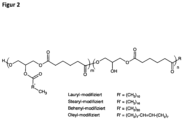
- the degree of substitution of the fatty acids is between 1% and 100% (based on the hydroxyl groups of the poly(glycerol adipate) ( Figure 2 ).
- the oleic and lauric acid-modified polymers have a liquid consistency at a temperature of 20°C (room temperature). Furthermore, the following are disclosed not according to the invention: stearic and behenic acid-modified polymers have a solid consistency at 20°C. They melt in the range of 30-45°C (stearyl-modified poly(glycerol adipate)) or between 50°C and 65°C (behenyl-modified poly(glycerol adipate)).
- an implantable molding can be obtained very easily by melting or extrusion processes.
- Lauric acid-modified poly(glycerol adipate) (esterification degree 25% based on free hydroxyl groups of the polyglycerol adipate) is injected through a 25 gauge needle in phosphate buffered saline (PBS, diluted 1:10).
- PBS phosphate buffered saline
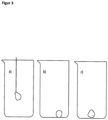
- a spherical depot is formed ( Figure 3 ).
- Lauric acid-modified poly(glycerol adipate) (esterification degree 95% based on free hydroxyl groups of the polyglycerol adipate) is injected through a 25 gauge needle in phosphate buffered saline (PBS, diluted 1:10). A spherical depot is formed.
- PBS phosphate buffered saline
- Oleic acid-modified poly(glycerol adipate) (esterification degree 15% based on free hydroxyl groups of the polyglycerol adipate) is injected through a 25 gauge needle in phosphate buffered saline (PBS, diluted 1:10). A spherical depot is formed.
- PBS phosphate buffered saline
- Oleic acid-modified poly(glycerol adipate) (esterification degree 92% based on free hydroxyl groups of poly(glycerol adipate)) is injected through a 25 gauge needle in phosphate buffered saline (PBS, diluted 1:10). A spherical depot is formed.
- PBS phosphate buffered saline
- Fatty acid-modified poly(glycerol sebacate) polymers are prepared analogously to the synthesis routes published in /10/.
- Sebacic acid is used as structural element (A) (dicarboxylic acid), and glycerol, which has three hydroxyl groups, is used as polyol (structural element (B)) ( Figure 1 ).
- the polymer backbone poly(glycerol sebacate) is produced, for example, by an enzymatic reaction of divinyl sebacate with glycerol in tetrahydrofuran or another suitable solvent /10/.
- fatty acids used are lauric, stearic, behenic or oleic acid. The degree of substitution of the fatty acids is between 1% and 100% (based on the hydroxyl groups of the poly(glycerol sebacate)
- the polymer backbone is produced from the polyol sorbitol and the dicarboxylic acid adipic acid in accordance with the published instructions for poly(glycerol adipate) and modified with stearic acid.
- a degree of esterification of 30% degree of esterification 30% based on free hydroxyl groups of the poly(sorbitol adipate)
- a polymer is formed that is solid at room temperature and melts at 43°C.
- An implantable molded article can be obtained very easily through melting or extrusion processes.
- the polymers were loaded with the fluorescent dye 1,1'-dioctadecyl-3,3,3',3'-tetramethylindocarbocyanine perchlorate (DII) (0.5-1% m/m) and 50 microliters were injected subcutaneously into SKH1 mice.
- DII 1,1'-dioctadecyl-3,3,3',3'-tetramethylindocarbocyanine perchlorate
- Dexamethasone is incorporated into fatty acid-modified poly(glycerol adipate) at a concentration of 10% m/m.
- the liquid polymers (lauryl- and oleyl-modified poly(glycerol adipate) can be incorporated at room temperature.
- the dexamethasone-loaded (lauryl- and oleyl-modified poly(glycerol adipate) polymers can be injected due to their liquid consistency.
- Dexamethasone is incorporated into fatty acid-modified poly(glycerol adipate) in a concentration of 20% m/m.
- the polymers that are solid at room temperature e.g. stearyl-modified and behenyl-modified poly(glycerol adipate)
- the active ingredient is incorporated homogeneously.
- a suitable molding e.g. flakes or rods
- Nifidipin is incorporated into stearyl-modified poly(sorbitol adipate) at a concentration of 10% m/m. To do this, the polymer is melted at 50 °C and the active ingredient is distributed homogeneously under protection from light. The melted polymer containing the active ingredient is brought to the desired size and shape by solidifying in a suitable mold.
- Stearyl-modified poly(glycerol adipate) is mixed with N- methylpyrrollidone (NMP) in a ratio of 1:1 (m/m).
- NMP N- methylpyrrollidone
- Leuproline acetate is homogeneously incorporated in a concentration of 5% (m/m).
- the preparation can be administered through a 25 gauge cannula and forms an implant in situ after contact with water or inside the body.
- Implant with covalently bound betulinic acid The polymer backbone made of poly(glycerol adipate) is synthesized according to the procedures described in the literature /10/. Instead of the fatty acids described in the literature /10/, the bioactive substance betulinic acid is covalently bound to the polymer backbone in an analogous reaction.
- the resulting betulinic acid poly(glycerol adipate) can either be converted into a desired implant shape by melting or be applied as an in situ implant using a biocompatible organic solvent (e.g. NMP).
- a biocompatible organic solvent e.g. NMP
Landscapes
- Health & Medical Sciences (AREA)
- Chemical & Material Sciences (AREA)
- Medicinal Chemistry (AREA)
- Life Sciences & Earth Sciences (AREA)
- Animal Behavior & Ethology (AREA)
- Veterinary Medicine (AREA)
- Public Health (AREA)
- General Health & Medical Sciences (AREA)
- Pharmacology & Pharmacy (AREA)
- Epidemiology (AREA)
- Engineering & Computer Science (AREA)
- Chemical Kinetics & Catalysis (AREA)
- General Chemical & Material Sciences (AREA)
- Bioinformatics & Cheminformatics (AREA)
- Dermatology (AREA)
- Organic Chemistry (AREA)
- Polymers & Plastics (AREA)
- Biomedical Technology (AREA)
- Neurosurgery (AREA)
- Proteomics, Peptides & Aminoacids (AREA)
- Inorganic Chemistry (AREA)
- Oil, Petroleum & Natural Gas (AREA)
- Medicinal Preparation (AREA)
Description
- Trägersysteme, welche Wirkstoffe im Körper von Tieren oder Menschen kontrolliert freisetzen, sind von großer Bedeutung. Viele hoch wirksame Wirkstoffe zeichnen sich durch eine geringe Bioverfügbarkeit nach oraler Gabe und eine kurze Halbwertszeit aus, welche durch eine schnelle Ausscheidung (Elimination) oder Umwandlung (Metabolismus) des Wirkstoffes bedingt sind. Eine therapeutische Nutzung solcher Wirkstoffe ist nur durch geeignete Wirkstoffträgersysteme möglich, welche parenteral injiziert werden und die Wirkstoffe zeitlich kontrolliert freisetzen. Die Zeitspanne der Wirkstofffreisetzung ist von der Indikation abhängig. So kann eine Freisetzung von wenigen Stunden, Tagen, Wochen oder mehreren Monaten angestrebt werden. Typische Applikationsarten sind die subkutane, intraperitoneale oder intramuskuläre Applikation. Weiterhin werden solche Freigabesysteme zum Beispiel auch zur lokalen Therapie im Hirn, Auge, Ohr, Knochenmark und anderen Organen eingesetzt. Je nach Indikation können unterschiedliche Freisetzungsprofile, z. B. kontinuierlich, pulsatil angestrebt werden. Dabei soll das Wirkstoffträgersystem eine reproduzierbare, kontrollierte Freisetzung des Wirkstoffes gewährleisten und sich gegenüber dem Körper inert verhalten.
- Gegenwärtig werden klinisch sowohl bioabbaubare als auch nicht abbaubare Trägermaterialien verwendet. Nichtbioabbaubare Materialien haben den Nachteil, dass sie aus dem Körper wieder entfernt werden müssen. Beispiele sind die Präparate Implanon® (Firma Organon) und Vantas® (Orion Pharma), welche nach 3 Jahren bzw. 12 Monaten aus dem Körper entfernt werden müssen und somit einen chirurgischen Eingriff erfordern. Als abbaubare Materialien werden hauptsächlich Polymilchsäure und Kopolymere aus Milch- und Glykolsäure genutzt. Die Monomere dieser Polymere sind alpha-Hydroxysäuren. Ein Nachteil dieser Polymere ist die Komplexität des Polymerabbaus. Dieser beruht auf einer autokatalytisch verlaufenden Hydrolyse, welche zu schwer steuerbaren Freisetzungskinetiken und sehr sauren pH-Werten (pH Wert 2) führen kann /1, 2, 3/. Nachteilig ist dabei, dass durch das saure Mikromilieu Wirkstoffe bereits vor ihrer Freisetzung zersetzt oder inaktiviert werden können /4,5/. Die meisten Marktpräparate sind entweder Mikropartikel oder vorgeformte Implantate (Rote Liste 2014, Rote Liste® Service GmbH).
- Mikropartikel, auch Mikrokapseln oder Mikrospherulen genannt, sind feste, meist sphärische Partikel mit einer typischen Größe im unteren Mikrometerbereich. Beispiele für bioabbaubare Mikropartikel sind Enantone® (Takeda), Sixantone® (Takeda), Decapeptyl® (Ferring), Sandostatin® LAR®- (Sandoz), Pamorelin® LA 3,75mg (Ipsen Pharma), Uropeptyl® Depot (Uropharm), Risperdal® Consta® (Janssen-Cilag). Die Herstellung von Mikropartikeln mit einer engen und reproduzierbaren Größenverteilung ist sehr anspruchsvoll und aufwendig. Hierbei werden hauptsächlich die Koazervation, Sprühtrocknung oder Emulsionsverfahren mit Lösungsmittelentfernung angewandt /6/. Weiterhin müssen die Mikropartikel vor der Applikation mit dem Dispersionsmedium vermischt werden, was aufgrund der schlechten Benetzbarkeit der Partikel zeitaufwendig und oft problematisch ist. Unvollständiges Entleeren der Spritze und ein Verstopfen der Kanüle stellen weitere Probleme bei der Applikation von Mikropartikeln dar. Auch die Rückstandsproblematik organischer, zumeist chlorierter Lösungsmittel aus dem Herstellungsprozess, sowie die aufwändige Herstellung unter aseptischen Bedingungen und eine schwierige Herstellung im großtechnischen Maßstab setzen dieser Arzneiform Grenzen.
- Beispiele für vorgeformte feste Implantate sind die Marktprodukte Zoladex® (AstraZeneca), Profact ® Depot (Sanofi), Leuprone® HEXAL® (Hexal), Leupro-Sandoz® (Sandoz), Ozurdex® (Allergan Pharmaceuticals). Bei den vorgeformten festen Implantaten besteht oft das Problem, dass eine relativ große Kanüle verwendet werden muss, um das Implantat, welches zudem oft als Fremdkörper empfunden wird und Schmerzen verursachen kann, in den Körper einzubringen.
- Neuere Entwicklungen beschreiben sogenannte "in situ Implantate". Hierbei wird eine niedrigviskose Flüssigkeit in den Körper gespritzt, welche sich im Körper durch einen Stimulus (Trigger) in ein Depot (zum Beispiel in ein Gel oder einen Festkörper) umwandelt. Als Stimulus kann zum Beispiel ein Lösungsmittelaustausch, eine Thermogelierung oder eine chemische Reaktion (Quervernetzung) dienen /7/. Eine Quervernetzungsreaktion ist in vivo schwer zu kontrollieren und es treten häufig Toxizitätsprobleme mit den quervernetzenden Substanzen auf. Als wichtigste Vertreter für thermogelierende Systeme sind poloxamerbasierende Systeme, chitosanhaltige Zubereitungen und niedermolekulare pegylierte Polylaktide bzw. pegylierte Poly(laktid-co-glykolide) zu nennen. Nachteile der genannten thermogelierenden Systeme sind eine potentielle Gelierung vor der Applikation, Stabilitätsprobleme der Hilfsstoffe, eine zu schnelle Freisetzung und mangelnde Reproduzierbarkeit der Freisetzung. Im Fall der Systeme, welche auf Lösungsmittelaustausch basieren, gibt es im Gegensatz zu den anderen in situ Systemen kommerzielle Produkte. Ein typisches Beispiel ist Eligard®, welches in Deutschland von der Firma Astellas vertrieben wird. Als Lösungsmittel wird N-Methylpyrrollidon (NMP) verwendet, in welchem das matrixbildende Polymer gelöst ist. Im Körper führt die gegenseitige Mischung von körpereigenem Wasser und NMP zur verminderten Löslichkeit und zum Präzipitieren des Polymers. Nachteile dieses Systems sind die den Polylaktiden und Poly(laktid-co-glycoliden) inherenten Probleme des autokatalytischen Polymerabbaus, welches oft schwer steuerbare und schwankende Freisetzungsraten bedingen.
- Die Verwendung injizierbarer Polymere auf Basis von Hydroxyestern wird in
WO 2007/012979 beschrieben. Nachteilig ist jedoch, dass eine kovalente Bindung des Wirkstoffes nur sehr eingeschränkt oder nicht ausreichend möglich ist, da nur die Endgruppen des Polymers modifiziert werden können. Weiterhin sind die im PatentWO 2007/012979 beschriebenen Polymere hinsichtlich ihrer Lipophilie nur sehr eingeschränkt steuerbar. Der Einsatz von bioabbaubaren Trägermaterialien, deren Lipophilie auf den Wirkstoff abgestimmt werden kann, wäre daher eine anzustrebende Zielsetzung. - Als Alternative zu polymerbasierten Systemen sind in der Literatur ebenfalls lipidbasierte Ansätze als parenterale Depotformen beschrieben. Hierbei werden durch Verpressen oder Extrusion von festen Lipiden wirkstoffhaltige Formkörper hergestellt. Nachteile von Lipidsystemen auf Basis von Glycerolfettsäureestern (Mono-, Di oder Triglyceride) oder Wachsen sind die eingeschränkte Steuerung der Lipophilie sowie das Auftreten von mehreren polymorphen Formen. Das komplexe polymorphe Verhalten beeinflusst sowohl die Reproduzierbarkeit der Wirkstoffbeladung und Wirkstofffreisetzung sowie die Abbaubarkeit der Wirkstoffträger. Das Patent
DE 000003780862 beschreibt feste Lipidkomprimate, die durch Implantation verabreicht werden. Das PatentWO 2009/080275 beschreibt feste Lipidimplantate, welche durch Extrusion hergestellt werden. - Weiterhin wird die Herstellung von Lipidkomprimaten und Lipidextrudaten im Patent
WO 2005/102284 beschrieben. DieEP 2 623 537 A1 offenbart Polykondensate erhältlich durch Veresterung von Dikarbonsäuren mit Diolen. DieWO2009/148583 offenbart bioabbaubare thermoplastische Polymere auf Basis von Polyestern aus Diolen mit Dikarbonsäuren. DieEP1 374 860 A1 offenbart Polymerwachse, deren Rückgrat Polyester aus Dikarbonsäuren mit Polyolen besteht. DieEP 1 270 024 A1 offenbart medizinische Hilfsmittel, die aus Polymerwachs bestehen, das aus Dikarbonsäuren und Polyolen durch Veresterung erhältlich ist. - Aufgabe der Erfindung war es, eine Alternative zu den bisher klinisch genutzten bioabbaubaren Polymeren auf Basis von Monomeren mit Hydroxykarbonsäurestruktur aufzuzeigen. Das Problem wurde erfindungsgemäß durch lineare Polyester gelöst, welche durch Veresterung von Dikarbonsäuren und mehrwertigen Alkoholen (Diole, Triole oder höherwertige Alkohole) entstehen (
Figur 1 ). - Werden als Alkoholkomponente Substanzen mit drei oder einer größeren Anzahl von Hydroxylgruppen genutzt, so sind bei geeigneter Synthesestrategie nach der Polymerisation im Polymerrückgrat freie Hydroxylgruppen verfügbar. Hierbei werden enzymatische Umsetzungen unter Verwendung divinylaktvierter Dikarbonsäuren bevorzugt, da durch diese definierte lineare Polymere mit definierten freien Hydroxylgruppen erhalten werden und eine Quervernetzung vermieden wird /8/.
- Die freien Hydroxylgruppen können entweder mit Wirkstoffen oder mit weiteren Hilfsstoffen kovalent chemisch umgesetzt werden
- Zur kovalenten Verknüpfung mit Wirkstoffen ist bisher wenig bekannt. Shafioul et al. publizierten die chemische Verknüpfung des Wirkstoffes Xanthorrhizol an Poly(dikarbonsäure-multiol ester) und seine enzymatische Freisetzung /9/. Hingegen wird eine Veresterung von Poly(dikarbonsäure-multiol estern) mit Fettsäuren mehrfach beschrieben /10-16/, wobei die Verwendung von fettsäuremodifzierten Poly(dikarbonsäure-multiol estern) zur Herstellung von wirkstoffhaltigen Mikro- und Nanopartikeln in vitro dargestellt wird. Die Herstellung von Mikro- und Nanopartikeln ist jedoch aufwendig und die Partikelgröße oft schwer kontrollierbar.
- Erfindungsgemäß wurde erstens gefunden, dass modifizierte Poly(dikarbonsäure-multiol ester) ohne weitere Zusätze als injizierbare Implantate geeignet sind. Hierbei können die Polymere ohne Verwendung eines organischen Lösungsmittels direkt injiziert werden. Die Erfindung betrifft injizierbare Trägersysteme auf Basis modifizierter aliphatischer Polyester zur Anwendung am Menschen oder am Tier mit dem Ziel der kontrollierten Freisetzung einer bioaktiven Substanz zu therapeutischen und / oder diagnostischen Zwecken bestehend aus Polymeren, deren Grundstruktur durch einen kammartigen Aufbau aus den Strukturelementen (A), (B) und (C) gekennzeichnet ist, wobei den Polymerrückgrad die Strukturelemente (A) und (B) bilden, welche aus aliphatischen Dikarbonsäuren (A) und aus Polyolen (B), die drei oder mehr OH-Gruppen enthalten, bestehen, wobei zwei Hydroxylgruppen des Polyols (B) mit den Dikarbonsäuren des Strukturelements (A) zu einem linearen Polymerrückgrat verestert sind, nach Ausbildung des aus den Strukturelementen (A) und (B) bestehenden und durch Esterbindungen verknüpften Polymerrückgrates bei Verwendung von Triolen und höherwertigen Polyolen im Strukturelement (B) noch eine (bei Triolen) oder mehrere (Anzahl der Hydroxylgruppen im Polyol > 3) freie Hydroxylgruppen vorhanden sind, die vollständig oder teilweise mit aliphatischen Fettsäuren und / oder bioaktiven Substanzen kovalent oder nicht kovalent verknüpft sind (Strukturelement (C)).
- Des Weiteren wurde zweitens gefunden, dass modifizierte Poly(dikarbonsäure-multiol ester) mit geeigneten biokompatiblen organischen Lösungsmitteln versetzt und injiziert werden können.
- Fettsäuremodifizierte Poly(glycerol-adipate) können durch folgendes oder ähnliche Verfahren synthetisiert werden /10-16/.
- Als Strukturelement (A) (Dikarbonsäure) wird Adipinsäure verwendet, als Polyol (Strukturelement (B)) dient Glycerol, welches drei Hydroxylgruppen besitzt (
Figur 1 ). Das Polymerrückgrad Polyglyceroladipat wird zum Beispiel durch eine enzymatische Reaktion von Divinyladipat oder - Dimethyladipat mit Glycerol in Tetrahydrofuran oder einem anders geeigneten Lösungsmittel durchgeführt /10/. Beispielhaft verwendete Fettsäuren sind Laurin-, Stearin-, Behen- oder Ölsäure. Der Substitutionsgrad der Fettsäuren beträgt zwischen 1% und 100 % (bezogen auf die nach Hydroxylgruppen des Poly(glycerol-adipats) (
Figur 2 ). - Die öl- und laurylsäuremodifizierten Polymere besitzen bei einer Temperatur von 20°C (Raumtemperatur) eine flüssige Konsistenz. Weiterhin werden nicht-erfindungsgemäss offenbart: stearin- und behensäuremodifizierten Polymere besitzen bei 20°C eine feste Konsistenz. Sie schmelzen im Bereich von 30-45 °C (stearylmodifiziertes Poly(glyceroladipat)) bzw. zwischen 50°C und 65°C (behenylmodifiziertes Poly(glyceroladipat)).
- Bei den behenyl- und stearylmoldifizierten Poylmeren kann durch Schmelz- oder Extrusionsprozesse sehr einfach ein implantierbarer Formling gewonnen werden.
- Laurylsäuremodifiziertes Poly(glyceroladipat) (Veresterungsgrad 25 % bezogen auf freie Hydroxylgruppen des Polyglycerinadipats) wird durch eine 25 Gauge Nadel in phosphatgepufferter Kochsalzlösung (PBS, 1:10 verdünnt) injiziert. Es bildet sich ein kugelförmiges Depot (
Figur 3 ). - Laurylsäuremodifiziertes Poly(glyceroladipat) (Veresterungsgrad 95 % bezogen auf freie Hydroxylgruppen des Polyglycerinadipats) wird durch eine 25 Gauge Nadel in phosphatgepufferter Kochsalzlösung (PBS, 1:10 verdünnt) injiziert. Es bildet sich ein kugelförmiges Depot.
- Ölsäuremodifiziertes Poly(glyceroladipat) (Veresterungsgrad 15 % bezogen auf freie Hydroxylgruppen des Polyglycerinadipats) wird durch eine 25 Gauge Nadel in phosphatgepufferter Kochsalzlösung (PBS, 1:10 verdünnt) injiziert. Es bildet sich ein kugelförmiges Depot.
- Ölsäuremodifiziertes Poly(glyceroladipat) (Veresterungsgrad 92 % bezogen auf freie Hydroxylgruppen des Poly(glycerinadipats)) wird durch eine 25 Gauge Nadel in phosphatgepufferter Kochsalzlösung (PBS, 1:10 verdünnt) injiziert. Es bildet sich ein kugelförmiges Depot.
- Fettsäuremodifizierte Poly(glycerol-sebacat) Polymere werden analog den in /10/ publizierten Synthesewegen hergestellt. Als Strukturelement (A) (Dikarbonsäure) wird Sebacinsäure verwendet, als Polyol (Strukturelement (B)) dient Glycerol, welches drei Hydroxylgruppen besitzt (
Figur 1 ). Das Polymerrückgrad Poly(glycerol-sebacat) wird zum Beispiel durch eine enzymatische Reaktion von Divinylsebacat mit Glycerol in Tetrahydrofuran oder einem anders geeigneten Lösungsmittel durchgeführt /10/. Beispielhaft verwendete Fettsäuren sind Laurin-, Stearin-, Behen- oder Ölsäure. Der Substitutionsgrad der Fettsäuren beträgt zwischen 1% und 100 % (bezogen auf die nach Hydroxylgruppen des Poly(glycerol-sebacat) - Das Polymerrückgrad wird aus dem Polyol Sorbitol und der Dikarbonsäure Adipinsäure analog den für Poly-(Glycerol-adipat) publizierten Vorschriften hergestellt und mit Stearinsäure modifiziert. Bei einem Veresterungsgrad von 30 % (Veresterungsgrad 30 % bezogen auf freie Hydroxylgruppen des Poly(sorbitol-adipats) entsteht ein bei Raumtemperatur festes Polymer, welches bei 43°C schmilzt.
- Durch Schmelz- oder Extrusionsprozesse kann sehr einfach ein implantierbarer Formling gewonnen werden.
- In vitro Freisetzung des Fluoreszenzfarbstoffes 1,1'-Dioctadecyl-3,3,3',3'-tetramethylindocarbocyanine perchlorate (DII): Laurylsubstituierte Poly(glycerol-adipat) Polymere wurden mit dem Fluoreszenzfarbstoff DII beladen (1% m/m) und 60 Mikroliter bei 37°C in vitro in PBS inkubiert.
- Die folgenden Kurven in
Figur 4 zeigen eine kontrollierte Freisetzung des Modellstoffes in vitro. Die Zahl hinter dem L symbolisiert den Substitutionsgrad der Laurinsäure bezogen auf freie Hydroxylgruppen des Poly(glycerin-adipats). - Die Polymere wurden mit dem Fluoreszenzfarbstoff 1,1'-Dioctadecyl-3,3,3',3'-tetramethylindocarbocyanine perchlorate (DII) (0,5-1 % m/m) beladen und 50 Mikroliter subkutan in SKH1-Mäuse injiziert .
- In vivo Fluoreszenzbilder von den DII beladenen laurylmodifizierten Poly(glycerol-adipat) Polymeren nach subkutaner Injektion (50 Mikroliter) in SKH1 Nacktmäusen belegten durch sichtbare Signale die in vivo Freisetzung. Der Substitutionsgrad der Laurinsäure betrug 95 % bzw. 25%.
- Die Ergebnisse zeigen eine kontrollierte in vivo Freisetzung über mehrere Wochen bis Monate. Hierbei wurde überraschenderweise gefunden, dass das lipophilere Implantat (Substitutionsgrad 95 % bezogen auf freie Hydroxylgruppen) rascher freisetzt als das niedrig substituierte Implantat (25 % bezogen auf freie Hydroxylgruppen). Die Ergebnisse belegen, dass die Freisetzung von Stoffen in vivo durch den Substitutionsgrad mit der Fettsäure gesteuert werden kann.
- Herstellung flüssiger Dexamethason-haltiger Implantate. Dexamethason wird in fettsäuremodifiziertes Poly(glycerol-adipat) in einer Konzentration von 10 % m/m eingearbeitet. Bei den flüssigen Polymeren (lauryl- und oleylmodifiziertes Poly(glycerol-adipat) kann die Einarbeitung bei Raumtemperatur erfolgen. Die dexamethasonbeladenen (lauryl- und oleylmodifiziertes Poly(glycerol-adipat) Polymere können aufgrund ihrer flüssigen Konsistenz injiziert werden.
- Herstellung fester Dexamethason-haltiger Implantate. Dexamethason wird in fettsäuremodifiziertes Poly(glycerol-adipat) in einer Konzenraton von 20 % m/m eingearbeitet. Die bei Raumtemperatur festen Polymere (z.B. stearylmodifiziertes und behenylmodifiziertes Poly(glycerol-adipat)) werden geschmolzen und der Wirkstoff wird homogen eingearbeitet. Durch Schmelzen und Erstarren, Verpressen oder Extrudieren kann bei den festen Polymeren ein geeigneter Formling (z.B. Blättchen oder Stäbchen) erhalten werden, welcher implantiert werden kann.
- Nifidipin wird in stearylmodifiziertes Poly(sorbitol-adipat) eingearbeitet in einer Konzentration von 10 % m/m eingearbeitet. Hierzu wird das Polymer bei 50 °C geschmolzen und der Wirkstoff unter Lichtschutz homogen verteilt. Das geschmolzene wirkstoffhaltige Polymer wird durch Erstarren in einer geeigneten Form in die gewünschte Größe und Form gebracht.
- Wirkstoffhaltiges in situ Implantat. Stearylmodifiziertes Poly(glycerol-adipat) wird mit N-Methylpyrrollidon (NMP) in einem Verhälntis von 1:1 (m/m) gemischt. Leuprolinacetat wird in einer Konzentration von 5 % (m/m) homogen eingearbeitet. Die Zubereitung kann durch eine 25 Gauge Kanüle verabreicht werden und bildet nach Kontakt mit Wasser oder im Körperinneren in situ ein Implantat aus.
- Implantat mit kovalent gebundener Betulinsäure. Das Polymerrückgrat aus Poly(glycerol-adipat) wird nach den in der Literatur beschriebenen Vorschriften synthetisiert /10/. Anstelle der in der Literatur /10/ beschriebenen Fettsäuren wird in einer analogen Reaktion die bioaktive Substanz Betulinsäure kovalent an das Polymerrückgrat geknüpft. Das entstandene Betulinsäure-Poly(glycerol-adipat) kann entweder durch Schmelzen in eine gewünschte Implantatform überführt werden oder mit Hilfe eines bioverträglichen organischen Lösungsmittels (z.B. NMP) als in situ Implantat appliziert werden.
-
- /1/ Mäder et al., Biomaterials, 17(4), 457-461 (1996)
- /2/ K Mäder, G Bacic, A Domb, O Elmalak, R Langer and HM Swartz. J Pharm Sei 86: 126, (1997).
- /3/ Liu und Schwendeman, Molecular Pharmaceutics, 9(5), 1342-1350(2012)
- /4/ A Lucke, J Kiermaier and A Göpferich. Pharm Res 19: 175, (2002).
- /5/ A Lucke and A Göpferich. Eur J Pharm Biopharm 55: 27, (2003).
- /6/ Beck-Broichsitter et al., Parenterale Depotarzneiformen-Mikropartikel, in: Innovative Arzneiformen, herausgegeben von Mäder und Weidenauer, Wissenschaftliche Verlagsgesellschaft Stuttgart, S. 235-262, (2010)
- /7/ S Kempe and K Mäder. J Control Release 161: 668, (2012)
- /8/ BJ Kline, EJ Beckman, AJ Russell. J Am Chem Soc 120: 9475 (1998)
- /9/ Shafioul, Azam Sharif Mohammed; Pyo, Jung In; Kim, Kwan Soo; Cheong, Chan Seong: Synthesis of poly (glycerol-co-dioate-co-butanedioate-co-xanthorrhizol) ester and a study of chain length effect on pendant group loading. Journal of Molecular Catalysis B: Enzymatic (2012), 84, 198-204., DOI:10.1016/j.molcatb.2012.05.022
- /10/ Naolou, T.; Weiss, V. M.; Conrad, D.; Busse, K.; Maeder, K.; Kressler, J.: Fatty acid modified poly(glycerol adipate) - polymeric analogues of glycerides. ACS Symposium Series(2013), 1135 (Tailored Polymer Architectures for Pharmaceutical and Biomedical Applications), 39-52, 14 pp., DOI:10.1021/bk-2013-1135.ch004
- /11/ Kressler, Joerg; Naolou, Toufik; Conrad, Delf; Busse, Karsten; Amado, Elkin; Weiss, Verena; Maeder, Karsten: Fatty acid modified poly(glycerol adipate)-polymeric analogues of glycerides. Polymer Preprints (American Chemical Society, Division of Polymer Chemistry) (2012), 53(1), 567-568.
- /12/ Weiss, Verena M.; Naolou, Toufik; Amado, Elkin; Busse, Karsten; Maeder, Karsten; Kressler, Joerg Formation of Structured Polygonal Nanoparticles by Phase-Separated Comb-Like Polymers. Macromolecular Rapid Communications(2012), 33(1), 35-40., DOI:10.1002/marc.201100565
- /13/ Orafai, Hossein; Kallinteri, Paraskevi; Garnett, Martin; Huggins, Sean; Hutcheon, Gillian; Pourcain, Cristopher Novel poly(glycerol-adipate) polymers used for nanoparticle making: a study of surface free energy. Iranian Journal of Pharmaceutical Research (2008), 7(1), 11-19
- /14/ Puri, Sanyogita; Kallinteri, Paraskevi; Higgins, Sean; Hutcheon, Gillian A.; Garnett, Martin C.: Drug incorporation and release of water soluble drugs from novel functionalized poly(glycerol adipate) nanoparticles. Journal of Controlled Release (2008), 125(1), 59-67
- /15/ Kallinteri, Paraskevi; Higgins, Sean; Hutcheon, Gillian A.; St. Pourcain, Christopher B.; Garnett, Martin C.: Novel Functionalized Biodegradable Polymers for Nanoparticle Drug Delivery Systems. Biomacromolecules (2005), 6(4), 1885-1894
- /16/
WO 2004096178 A1 20041111 - Garnett, Martin Charles; Hutcheon, Gillian; Higgins, Sean; Kallinteri, Paraskevi; St. Pourcain, Chris : Nano and microparticle drug delivery systems comprising polyesters containing aliphatic dicarboxylate residues and residues of aliphatic polyols -
-
Figur 1 :- Vereinfachte (links) und detailliertere (rechts) Grundstruktur von modifizierten Poly(dikarbonsäuremultiol estern).
- Strukturelement (A): Dikarbonsäure
- Strukturelement (B): Polyol (Diol, Triol oder höherwertiges Polyol)
- Strukturelement ©: kovalent gebundener Wirkstoff oder Hilfsstoff
- Der bioabbaubare Polymerrückgrad entsteht aus der Veresterung von Dikarbonsäuren (Strukturelement (A)) und Polyolen (Strukturelement (B)). Hierbei werden zwei Hydroxylgruppen des Polyols verestert. Bei höherwertigen Polyolen (Anzahl der Hydroxylgruppen größer / gleich drei) können die nach Bildung des Polymerrückgrates noch freien Hydroxylgruppen kovalent mit bioaktiven Substanzen oder Hilfsstoffen (z. B. Fettsäuren) teilweise oder vollständig kovalent verbunden werden (Strukturelement (C)).
-
Figur 2 :
Strukturbeispiele von fettsäuremodifizierten Poly(glycerol-adipat). Das Polymerrückgrat ist aus Poly(glyceroladipat) aufgebaut. Ein Teil der nach Bildung des Polymerrückgrates noch freien Hydroxylgruppen ist mit Fettsäuren (Laurinsäure, Stearinsäure, Behensäure, Ölsäure) verestert. -
Figur 3 :
Schematische Abbildung des Verhaltens von laurylsubstituierten Poly(gylceroladipat) Polymeren nach einer in vitro Injektion mit einer 25 Gauge Nadel in phosphatgepufferte Kochsalzlösung (PBS Puffer, pH 7,4 1:10 verdünnt mit bidestillierten Wasser). (a); nach einer Minute (b) und 6 Stunden (c) nach Injektion. Das Implantat sinkt nach Injektion zu Boden und bildet eine kugelähnliche Form aus. -
Figur 4 :
In vitro Zeitabhängigkeit der Fluoreszenzintensität von 1,1'-Dioctadecyl-3,3,3',3'-tetramethylindocarbocyanine perchlorate (DII) beladenen laurylsubstitutierten Poly(glyceroladipinsäure) Polymeren. Der Modellstoff wird in vitro kontrolliert über mehrere Wochen freigesetzt.
Claims (11)
- Injizierbare Trägersysteme auf Basis modifizierter aliphatischer Polyester zur Anwendung am Menschen oder am Tier mit dem Ziel der kontrollierten Freisetzung einer bioaktiven Substanz zu therapeutischen und / oder diagnostischen Zwecken bestehend aus Polymeren, deren Grundstruktur durch einen kammartigen Aufbau aus den Strukturelementen (A), (B) und (C) gekennzeichnet ist,wobei den Polymerrückgrad die Strukturelemente (A) und (B) bilden, welche aus aliphatischen Dikarbonsäuren (A) und aus Polyolen (B), die drei oder mehr OH-Gruppen enthalten, bestehen, wobeizwei Hydroxylgruppen des Polyols (B) mit den Dikarbonsäuren des Strukturelements (A) zu einem linearen Polymerrückgrat verestert sind, nach Ausbildung des aus den Strukturelementen (A) und (B) bestehenden und durch Esterbindungen verknüpften Polymerrückgrates bei Verwendung von Triolen und höherwertigen Polyolen im Strukturelement (B) noch eine (bei Triolen) oder mehrere (Anzahl der Hydroxylgruppen im Polyol > 3) freie Hydroxylgruppen vorhanden sind, die vollständig oder teilweise mit aliphatischen Fettsäuren und / oder bioaktiven Substanzen kovalent oder nicht kovalent verknüpft sind (Strukturelement (C)).
- Trägersysteme nach Anspruch 1 gekennzeichnet dadurch, dass die aliphatischen Dikarbonsäuren des Strukturelements (A) der folgenden allgemeinen Struktur

- Trägersysteme nach Anspruch 1 gekennzeichnet dadurch, dass das Polyolstrukturelement (B) aus einem Gemisch von Triolen und höherwertigen Polyolen bzw. Mischungen derselben bestehen kann.
- Trägersysteme nach Anspruch 1 und 3gekennzeichnet dadurch, dass als Polyole Glycerol, Erythritol, Xylitol, Mannitol, Sorbitol, Laktose, Sukrose (Saccharose), Trehalose, Glukose, Maltose, Isomalt und/oder Maltitol zur Anwendung kommen.
- Trägersysteme nach den Ansprüchen 1, 3 und 4 gekennzeichnet dadurch, dass das Polyol (B) mit weiteren Substanzen mittels des Strukturelementes (C) kovalent verknüpft ist, so dass eine kammartige Polymerstruktur entsteht, wobei der Verknüpfungsgrad zwischen 0,1 und 100 % der nach Bildung des Polymerrückgrates noch vorhandenen freien Hydroxylgruppen beträgt.
- Trägersysteme nach den Ansprüchen 1 bis 5 gekennzeichnet dadurch, dass das Strukturelement (C) eine Karbonsäure oder eine oder mehrere bioaktive Substanz/en ist, welche durch eine Esterbindung mit der Polyolstruktur (B) verknüpft ist, wobei die Fettsäure gesättigt oder ungesättigt ist und der Veresterungsgrad zwischen 0 (null) und 99,9 % der freien Hydroxylgruppen beträgt.
- Trägersysteme nach den Ansprüchen 1 bis 6 gekennzeichnet dadurch, dass die Anzahl der Kohlenstoffe der Karbonsäure zwischen 2 (zwei) und 22 (zweiundzwanzig) beträgt, insbesondere zwischen 8 (acht) und 22 (zweiundzwanzig) Kohlenstoffatomen, wie Caprylsäure (Oktansäure), Caprinsäure (Dekansäure), Laurinsäure (Dodekansäure), Myristinsäure (Tetradekansäure), Palmitinsäure (Hexadekansäure), Stearinsäure (Oktadekansäure), Ölsäure ((9Z)- Octadeca- 9- ensäure), Linolsäure ((9Z,12Z)-Octadeca- 9,12-diensäure), Linolensäure ((9Z,12Z,15Z- Octadeca- 9,12,15- triensäure).
- Trägersysteme gemäß der Ansprüche 1 bis 7, in denen die bioaktive Substanz/en eingearbeitet (nicht kovalent gebunden) oder kovalent gebunden enthalten ist, wobei im Fall einer Einarbeitung (nichtkovalente Bindung) die bioaktive Substanz/en gelöst, emulgiert oder suspendiert vorliegen und im Fall einer kovalenten Bindung die bioaktive Substanz/en durch eine chemische Reaktion einer in geeigneten funktionellen Gruppen der bioaktiven Substanz/en, z.B. einer Säuregruppierung, mit der im Strukturelement (B) vorhandenen freien Hydroxylgruppen kovalent durch eine Esterbindung an das polymere Trägermaterial gebunden ist.
- Trägersysteme nach Anspruch 8 gekennzeichnet dadurch, dass die enthaltenen bioaktiven Substanzen mit einem niederen, mittleren oder hohen Molekulargewicht hydrophiler, amphiphiler oder hydrophober Natur sind und gelöst, emulgiert oder suspendiert vorliegen.
- Trägersysteme nach Anspruch 8 und 9 gekennzeichnet dadurch, dass als bioaktive Substanzen Stoffe aus der Gruppe der Antibiotika, Antiinfektiva, Zytostatika oder andere antineoplastische Mittel und Protektiva, Lokalanästhetika, Analgetika, Neuropharmaka, Hormone, Immunmodulatoren, Imrnunsuppressiva, Antimykotika, Antiinflarnmatoria, Analgetika, Antihämorrhagika, Antifibrinolytika, Vitamine, Hämostatika, Antiphlogistika, Betarezeptoren- und Calciumkanalblocker, Corticokie, Entwöhnungsmittel/Mittel zur Behandlung von Suchterkrankungen, Fibrinolytika, Antihypoxämika, Herz-Kreislauf-Mittel, Antikoagulantia, Antiparasitäre Mittel, Antikariesmittel, Antiparodontosemittel, Ophthalmika, Otologika, Sexualhormone und ihre Hemmstoffe, Parkinsonmittel und andere Mittel gegen extrapyramidale Störungen, Psychopharmaka, Sera, Immunglobuline, Impfstoffe, Mineralstoffe, Thrombozytenaggregationshemmer, Tuberkulosemittel, Diuretika, Magen-Darm-Mittel, Antiadiposita, Analeptika, Antirheumatika, Antiallergika, Antianämika, Antiarrhythmika, Antidementiva, Antidiabetika, Antidota, Antiemetika, Antivertiginosa, Antiepileptika, Antihypertonika, Antihypoglykämika, Antihypotonika, Antitussiva, Expektorantia, Arteriosklerosemittel, Hemmstoffe des Renin-Angiotensin-Aldosteron-Systems, Broncholytika, Antiasthmatika und andere Mittel für den Respirationstrakt, Cholinergika, Antiseptika, Diagnostika und Mittel zur Diagnosevorbereitung, Diuretika, Enzyminhibitoren, Präparate bei Enzymmangel und Transportproteine, Geriatrika, Gichtmittel, Gynäkologika, Hepatika, Hypnotika, Sedativa, Hypophysen-, Hypothalamushormone, regulatorische Peptide und Analoga sowie ihre Hemmstoffe, Immunmodulatoren, Kardiaka, Koronarmittel, Lipidsenker, Lokalanästhetika, Magen-Darm-Mittel, Migränemittel, Muskelrelaxanzien und - Reversoren, Narkosemittel, Neuropathiepräparate und andere neurotrope Mittel, Osteoporosemittel/Calcium-/Knochenstoffwechselregulatoren, Schilddrüsentherapeutika, Spasmolytika und Anticholinergika, Umstimmungsmittel, Urologika und Mittel zur Behandlung der Hyperkalämie und Hyperphosphatämie, Venentherapeutika, Wund- und Narbenbehandlungsmittel zur Anwendung gelangen.
- Trägersysteme nach den Ansprüchen 1 bis 10 gekennzeichnet dadurch, dass die Konzentration von modifizierten Poly(dikarbonsäure-multiol estern) 0,1% bis 99,9999 % (m/m) beträgt.
Applications Claiming Priority (2)
| Application Number | Priority Date | Filing Date | Title |
|---|---|---|---|
| DE102014005782.8A DE102014005782A1 (de) | 2014-04-23 | 2014-04-23 | lnjizierbare und implantierbare Trägersysteme auf Basis von modifizierten Poly(dikarbonsäure-multiol estern) zur kontrollierten Wirkstofffreisetzung |
| PCT/DE2015/000204 WO2015161841A2 (de) | 2014-04-23 | 2015-04-22 | Injizierbare und implantierbare trägersysteme auf basis von modifizierten poly(dikarbonsäure-multiol estern) zur kontrollierten wirkstofffreisetzung |
Publications (2)
| Publication Number | Publication Date |
|---|---|
| EP3134073A2 EP3134073A2 (de) | 2017-03-01 |
| EP3134073B1 true EP3134073B1 (de) | 2024-10-16 |
Family
ID=54251896
Family Applications (1)
| Application Number | Title | Priority Date | Filing Date |
|---|---|---|---|
| EP15775073.8A Active EP3134073B1 (de) | 2014-04-23 | 2015-04-22 | Injizierbare und implantierbare trägersysteme auf basis von modifizierten poly(dikarbonsäure-polyol estern) zur kontrollierten wirkstofffreisetzung |
Country Status (4)
| Country | Link |
|---|---|
| US (1) | US20170151334A1 (de) |
| EP (1) | EP3134073B1 (de) |
| DE (2) | DE102014005782A1 (de) |
| WO (1) | WO2015161841A2 (de) |
Families Citing this family (1)
| Publication number | Priority date | Publication date | Assignee | Title |
|---|---|---|---|---|
| DE102016119102A1 (de) | 2016-10-07 | 2018-04-12 | Forschungszentrum Jülich GmbH | Translokation von synthetischen Polymeren durch Lipidmembrane |
Family Cites Families (14)
| Publication number | Priority date | Publication date | Assignee | Title |
|---|---|---|---|---|
| CA1257199A (en) | 1986-05-20 | 1989-07-11 | Paul Y. Wang | Preparation containing bioactive macromolecular substance for multi-months release in vivo |
| US20060280774A1 (en) * | 1995-06-02 | 2006-12-14 | Allergan, Inc. | Compositions and methods for treating glaucoma |
| DE10055742B4 (de) * | 2000-11-10 | 2006-05-11 | Schwarz Pharma Ag | Neue Polyester, Verfahren zu ihrer Herstellung und aus den Polyestern hergestellte Depot-Arzneiformen |
| US7030127B2 (en) * | 2001-06-29 | 2006-04-18 | Ethicon, Inc. | Composition and medical devices utilizing bioabsorbable polymeric waxes |
| US6860122B2 (en) | 2002-03-28 | 2005-03-01 | F&S, Llc | Fabric with pain-relieving characteristics and structures therefrom, and method |
| US7101566B2 (en) * | 2002-06-28 | 2006-09-05 | Ethicon, Inc. | Polymer coated microparticles for sustained release |
| WO2004096178A1 (en) * | 2003-05-02 | 2004-11-11 | The University Of Nottingham | Nano and microparticle drug delivery systems comprising polyesters containing aliphatic dicarboxylate residues and residues of aliphatic polyols |
| WO2005059003A1 (en) * | 2003-12-15 | 2005-06-30 | The Children's Hospital Of Philadelphia | Novel polyesters |
| KR100486028B1 (ko) | 2004-04-20 | 2005-05-03 | 주식회사 펩트론 | 단백질 함유 서방성 리피드 임플란트 및 이의 제조방법 |
| EP3339348B1 (de) | 2005-04-22 | 2019-12-04 | Université de Genève | Polylactidzusammensetzungen und verwendungen davon |
| ES2441550T3 (es) | 2007-12-21 | 2014-02-05 | Ludwig-Maximilians-Universität | Dispositivos extruidos con forma de varilla para la Iiberación controlada de sustancias biológicas a humanos y animales |
| US8524267B2 (en) * | 2008-04-18 | 2013-09-03 | Warsaw Orthopedic, Inc. | Dexamethasone formulations in a biodegradable material |
| WO2009148583A2 (en) * | 2008-06-03 | 2009-12-10 | Qlt Usa, Inc. | Method for improvement of octreotide bioavailability |
| EP2623537A1 (de) * | 2012-02-01 | 2013-08-07 | Nitto Europe N.V | Enzymkatalysierte Polykondensatverfahrensproduktion und Haftzusammensetzung |
-
2014
- 2014-04-23 DE DE102014005782.8A patent/DE102014005782A1/de not_active Withdrawn
-
2015
- 2015-04-22 US US15/305,595 patent/US20170151334A1/en not_active Abandoned
- 2015-04-22 EP EP15775073.8A patent/EP3134073B1/de active Active
- 2015-04-22 DE DE112015001952.9T patent/DE112015001952A5/de not_active Withdrawn
- 2015-04-22 WO PCT/DE2015/000204 patent/WO2015161841A2/de not_active Ceased
Also Published As
| Publication number | Publication date |
|---|---|
| WO2015161841A3 (de) | 2016-02-25 |
| DE112015001952A5 (de) | 2017-03-16 |
| US20170151334A1 (en) | 2017-06-01 |
| DE102014005782A1 (de) | 2015-10-29 |
| WO2015161841A2 (de) | 2015-10-29 |
| EP3134073A2 (de) | 2017-03-01 |
Similar Documents
| Publication | Publication Date | Title |
|---|---|---|
| DE69634277T2 (de) | Kontrolliertes zuführsystem mit einer flüssigkeit von hoher viskosität | |
| EP2244752B1 (de) | Niederviskos-flüssigpolymer-zuführungssystem | |
| DE60017956T2 (de) | Biodegradierbare polymerzusammensetzung | |
| DE60214173T2 (de) | Negativ geladenes amphiphiles blockcopolymer als arzneistoffträger und komplex davon mit postitiv geladenem arzneistoff | |
| KR101865689B1 (ko) | 부프레노르핀을 포함하는 주입가능한 유동성 조성물 | |
| DE69705746T2 (de) | Injizierbare depotgelzubereitung und herstellungsverfahren | |
| DE69932201T2 (de) | Emulsionen für in-situ Arzneistoffabgabesysteme | |
| DE69838750T2 (de) | Zeitverzögerte gelzusammensetzungen mit verlängerter wirkstoffverabreichung | |
| EP1317254B1 (de) | Retardpartikeldispersion | |
| Veziers et al. | Analysis of brain biocompatibility of drug-releasing biodegradable microspheres by scanning and transmission electron microscopy | |
| CN109310632A (zh) | 用于递送生物活性剂的可注射组合物 | |
| Lee et al. | Decanoic acid-modified glycol chitosan hydrogels containing tightly adsorbed palmityl-acylated exendin-4 as a long-acting sustained-release anti-diabetic system | |
| Panta et al. | Protein drug-loaded polymeric nanoparticles | |
| EP2821077A1 (de) | Lipid-Nanopartikel zur Wundheilung | |
| Verma | An insight into collagen-based nano biomaterials for drug delivery applications | |
| EP0996426B1 (de) | Multiphasensystem | |
| Vaisman et al. | Biocompatibility and safety evaluation of a ricinoleic acid‐based poly (ester‐anhydride) copolymer after implantation in rats | |
| Özen et al. | Biomedicine: electrospun nanofibrous hormonal therapies through skin/tissue—a review | |
| WO2015161841A2 (de) | Injizierbare und implantierbare trägersysteme auf basis von modifizierten poly(dikarbonsäure-multiol estern) zur kontrollierten wirkstofffreisetzung | |
| Zhang et al. | Therapeutic potential of natural polymer-based transdermal drug delivery system for musculoskeletal disorders | |
| Puri et al. | A prospective utilization of biodegradable polymers for controlled drug-delivery applications | |
| KR20160046570A (ko) | 염증성 또는 통증성 질환 치료를 위한 복합 약물 전달 제형 및 이것의 제조방법 | |
| EP1124538A2 (de) | Zusammensetzung für die parenterale applikation von wirkstoffen | |
| EP2552468A1 (de) | Implantatskanüle mit implantat und verfahren zum befestigen von implantaten in einer injektionskanüle | |
| ES2370377T3 (es) | Sistema de administración de un líquido polimérico de baja viscosidad. |
Legal Events
| Date | Code | Title | Description |
|---|---|---|---|
| STAA | Information on the status of an ep patent application or granted ep patent |
Free format text: STATUS: THE INTERNATIONAL PUBLICATION HAS BEEN MADE |
|
| PUAI | Public reference made under article 153(3) epc to a published international application that has entered the european phase |
Free format text: ORIGINAL CODE: 0009012 |
|
| STAA | Information on the status of an ep patent application or granted ep patent |
Free format text: STATUS: REQUEST FOR EXAMINATION WAS MADE |
|
| 17P | Request for examination filed |
Effective date: 20161116 |
|
| AK | Designated contracting states |
Kind code of ref document: A2 Designated state(s): AL AT BE BG CH CY CZ DE DK EE ES FI FR GB GR HR HU IE IS IT LI LT LU LV MC MK MT NL NO PL PT RO RS SE SI SK SM TR |
|
| AX | Request for extension of the european patent |
Extension state: BA ME |
|
| DAV | Request for validation of the european patent (deleted) | ||
| DAX | Request for extension of the european patent (deleted) | ||
| STAA | Information on the status of an ep patent application or granted ep patent |
Free format text: STATUS: EXAMINATION IS IN PROGRESS |
|
| 17Q | First examination report despatched |
Effective date: 20190906 |
|
| GRAP | Despatch of communication of intention to grant a patent |
Free format text: ORIGINAL CODE: EPIDOSNIGR1 |
|
| STAA | Information on the status of an ep patent application or granted ep patent |
Free format text: STATUS: GRANT OF PATENT IS INTENDED |
|
| RIC1 | Information provided on ipc code assigned before grant |
Ipc: A61K 47/34 20060101ALI20240426BHEP Ipc: C08G 63/91 20060101ALI20240426BHEP Ipc: A61K 9/14 20060101ALI20240426BHEP Ipc: A61K 31/573 20060101ALI20240426BHEP Ipc: A61K 31/4422 20060101ALI20240426BHEP Ipc: A61K 47/10 20060101ALI20240426BHEP Ipc: A61K 9/00 20060101AFI20240426BHEP |
|
| INTG | Intention to grant announced |
Effective date: 20240514 |
|
| GRAS | Grant fee paid |
Free format text: ORIGINAL CODE: EPIDOSNIGR3 |
|
| GRAA | (expected) grant |
Free format text: ORIGINAL CODE: 0009210 |
|
| STAA | Information on the status of an ep patent application or granted ep patent |
Free format text: STATUS: THE PATENT HAS BEEN GRANTED |
|
| AK | Designated contracting states |
Kind code of ref document: B1 Designated state(s): AL AT BE BG CH CY CZ DE DK EE ES FI FR GB GR HR HU IE IS IT LI LT LU LV MC MK MT NL NO PL PT RO RS SE SI SK SM TR |
|
| REG | Reference to a national code |
Ref country code: GB Ref legal event code: FG4D Free format text: NOT ENGLISH |
|
| REG | Reference to a national code |
Ref country code: CH Ref legal event code: EP |
|
| REG | Reference to a national code |
Ref country code: IE Ref legal event code: FG4D Free format text: LANGUAGE OF EP DOCUMENT: GERMAN |
|
| REG | Reference to a national code |
Ref country code: DE Ref legal event code: R096 Ref document number: 502015016959 Country of ref document: DE |
|
| REG | Reference to a national code |
Ref country code: LT Ref legal event code: MG9D |
|
| REG | Reference to a national code |
Ref country code: NL Ref legal event code: MP Effective date: 20241016 |
|
| PG25 | Lapsed in a contracting state [announced via postgrant information from national office to epo] |
Ref country code: NL Free format text: LAPSE BECAUSE OF FAILURE TO SUBMIT A TRANSLATION OF THE DESCRIPTION OR TO PAY THE FEE WITHIN THE PRESCRIBED TIME-LIMIT Effective date: 20241016 |
|
| PG25 | Lapsed in a contracting state [announced via postgrant information from national office to epo] |
Ref country code: NL Free format text: LAPSE BECAUSE OF FAILURE TO SUBMIT A TRANSLATION OF THE DESCRIPTION OR TO PAY THE FEE WITHIN THE PRESCRIBED TIME-LIMIT Effective date: 20241016 |
|
| PG25 | Lapsed in a contracting state [announced via postgrant information from national office to epo] |
Ref country code: HR Free format text: LAPSE BECAUSE OF FAILURE TO SUBMIT A TRANSLATION OF THE DESCRIPTION OR TO PAY THE FEE WITHIN THE PRESCRIBED TIME-LIMIT Effective date: 20241016 Ref country code: IS Free format text: LAPSE BECAUSE OF FAILURE TO SUBMIT A TRANSLATION OF THE DESCRIPTION OR TO PAY THE FEE WITHIN THE PRESCRIBED TIME-LIMIT Effective date: 20250216 Ref country code: PT Free format text: LAPSE BECAUSE OF FAILURE TO SUBMIT A TRANSLATION OF THE DESCRIPTION OR TO PAY THE FEE WITHIN THE PRESCRIBED TIME-LIMIT Effective date: 20250217 |
|
| PG25 | Lapsed in a contracting state [announced via postgrant information from national office to epo] |
Ref country code: FI Free format text: LAPSE BECAUSE OF FAILURE TO SUBMIT A TRANSLATION OF THE DESCRIPTION OR TO PAY THE FEE WITHIN THE PRESCRIBED TIME-LIMIT Effective date: 20241016 |
|
| PG25 | Lapsed in a contracting state [announced via postgrant information from national office to epo] |
Ref country code: BG Free format text: LAPSE BECAUSE OF FAILURE TO SUBMIT A TRANSLATION OF THE DESCRIPTION OR TO PAY THE FEE WITHIN THE PRESCRIBED TIME-LIMIT Effective date: 20241016 |
|
| PG25 | Lapsed in a contracting state [announced via postgrant information from national office to epo] |
Ref country code: ES Free format text: LAPSE BECAUSE OF FAILURE TO SUBMIT A TRANSLATION OF THE DESCRIPTION OR TO PAY THE FEE WITHIN THE PRESCRIBED TIME-LIMIT Effective date: 20241016 |
|
| PG25 | Lapsed in a contracting state [announced via postgrant information from national office to epo] |
Ref country code: NO Free format text: LAPSE BECAUSE OF FAILURE TO SUBMIT A TRANSLATION OF THE DESCRIPTION OR TO PAY THE FEE WITHIN THE PRESCRIBED TIME-LIMIT Effective date: 20250116 |
|
| PG25 | Lapsed in a contracting state [announced via postgrant information from national office to epo] |
Ref country code: GR Free format text: LAPSE BECAUSE OF FAILURE TO SUBMIT A TRANSLATION OF THE DESCRIPTION OR TO PAY THE FEE WITHIN THE PRESCRIBED TIME-LIMIT Effective date: 20250117 Ref country code: LV Free format text: LAPSE BECAUSE OF FAILURE TO SUBMIT A TRANSLATION OF THE DESCRIPTION OR TO PAY THE FEE WITHIN THE PRESCRIBED TIME-LIMIT Effective date: 20241016 |
|
| PG25 | Lapsed in a contracting state [announced via postgrant information from national office to epo] |
Ref country code: PL Free format text: LAPSE BECAUSE OF FAILURE TO SUBMIT A TRANSLATION OF THE DESCRIPTION OR TO PAY THE FEE WITHIN THE PRESCRIBED TIME-LIMIT Effective date: 20241016 |
|
| PG25 | Lapsed in a contracting state [announced via postgrant information from national office to epo] |
Ref country code: RS Free format text: LAPSE BECAUSE OF FAILURE TO SUBMIT A TRANSLATION OF THE DESCRIPTION OR TO PAY THE FEE WITHIN THE PRESCRIBED TIME-LIMIT Effective date: 20250116 |
|
| PG25 | Lapsed in a contracting state [announced via postgrant information from national office to epo] |
Ref country code: SM Free format text: LAPSE BECAUSE OF FAILURE TO SUBMIT A TRANSLATION OF THE DESCRIPTION OR TO PAY THE FEE WITHIN THE PRESCRIBED TIME-LIMIT Effective date: 20241016 |
|
| PGFP | Annual fee paid to national office [announced via postgrant information from national office to epo] |
Ref country code: DE Payment date: 20250404 Year of fee payment: 11 |
|
| PG25 | Lapsed in a contracting state [announced via postgrant information from national office to epo] |
Ref country code: DK Free format text: LAPSE BECAUSE OF FAILURE TO SUBMIT A TRANSLATION OF THE DESCRIPTION OR TO PAY THE FEE WITHIN THE PRESCRIBED TIME-LIMIT Effective date: 20241016 |
|
| PGFP | Annual fee paid to national office [announced via postgrant information from national office to epo] |
Ref country code: GB Payment date: 20250423 Year of fee payment: 11 |
|
| REG | Reference to a national code |
Ref country code: DE Ref legal event code: R097 Ref document number: 502015016959 Country of ref document: DE |
|
| PG25 | Lapsed in a contracting state [announced via postgrant information from national office to epo] |
Ref country code: EE Free format text: LAPSE BECAUSE OF FAILURE TO SUBMIT A TRANSLATION OF THE DESCRIPTION OR TO PAY THE FEE WITHIN THE PRESCRIBED TIME-LIMIT Effective date: 20241016 |
|
| PGFP | Annual fee paid to national office [announced via postgrant information from national office to epo] |
Ref country code: FR Payment date: 20250422 Year of fee payment: 11 |
|
| PGFP | Annual fee paid to national office [announced via postgrant information from national office to epo] |
Ref country code: CH Payment date: 20250501 Year of fee payment: 11 |
|
| PG25 | Lapsed in a contracting state [announced via postgrant information from national office to epo] |
Ref country code: RO Free format text: LAPSE BECAUSE OF FAILURE TO SUBMIT A TRANSLATION OF THE DESCRIPTION OR TO PAY THE FEE WITHIN THE PRESCRIBED TIME-LIMIT Effective date: 20241016 |
|
| PG25 | Lapsed in a contracting state [announced via postgrant information from national office to epo] |
Ref country code: SK Free format text: LAPSE BECAUSE OF FAILURE TO SUBMIT A TRANSLATION OF THE DESCRIPTION OR TO PAY THE FEE WITHIN THE PRESCRIBED TIME-LIMIT Effective date: 20241016 |
|
| PG25 | Lapsed in a contracting state [announced via postgrant information from national office to epo] |
Ref country code: CZ Free format text: LAPSE BECAUSE OF FAILURE TO SUBMIT A TRANSLATION OF THE DESCRIPTION OR TO PAY THE FEE WITHIN THE PRESCRIBED TIME-LIMIT Effective date: 20241016 |
|
| PG25 | Lapsed in a contracting state [announced via postgrant information from national office to epo] |
Ref country code: IT Free format text: LAPSE BECAUSE OF FAILURE TO SUBMIT A TRANSLATION OF THE DESCRIPTION OR TO PAY THE FEE WITHIN THE PRESCRIBED TIME-LIMIT Effective date: 20241016 |
|
| PLBE | No opposition filed within time limit |
Free format text: ORIGINAL CODE: 0009261 |
|
| STAA | Information on the status of an ep patent application or granted ep patent |
Free format text: STATUS: NO OPPOSITION FILED WITHIN TIME LIMIT |
|
| PG25 | Lapsed in a contracting state [announced via postgrant information from national office to epo] |
Ref country code: SE Free format text: LAPSE BECAUSE OF FAILURE TO SUBMIT A TRANSLATION OF THE DESCRIPTION OR TO PAY THE FEE WITHIN THE PRESCRIBED TIME-LIMIT Effective date: 20241016 |
|
| 26N | No opposition filed |
Effective date: 20250717 |
|
| PG25 | Lapsed in a contracting state [announced via postgrant information from national office to epo] |
Ref country code: LU Free format text: LAPSE BECAUSE OF NON-PAYMENT OF DUE FEES Effective date: 20250422 |
|
| PG25 | Lapsed in a contracting state [announced via postgrant information from national office to epo] |
Ref country code: MC Free format text: LAPSE BECAUSE OF FAILURE TO SUBMIT A TRANSLATION OF THE DESCRIPTION OR TO PAY THE FEE WITHIN THE PRESCRIBED TIME-LIMIT Effective date: 20241016 |
|
| REG | Reference to a national code |
Ref country code: BE Ref legal event code: MM Effective date: 20250430 |
|
| PG25 | Lapsed in a contracting state [announced via postgrant information from national office to epo] |
Ref country code: BE Free format text: LAPSE BECAUSE OF NON-PAYMENT OF DUE FEES Effective date: 20250430 |
|
| PG25 | Lapsed in a contracting state [announced via postgrant information from national office to epo] |
Ref country code: IE Free format text: LAPSE BECAUSE OF NON-PAYMENT OF DUE FEES Effective date: 20250422 |
|
| REG | Reference to a national code |
Ref country code: CH Ref legal event code: U11 Free format text: ST27 STATUS EVENT CODE: U-0-0-U10-U11 (AS PROVIDED BY THE NATIONAL OFFICE) Effective date: 20260501 |