EP3131024A1 - Schaltungsentwurfsvorrichtung und schaltungsentwurfsprogramm - Google Patents
Schaltungsentwurfsvorrichtung und schaltungsentwurfsprogramm Download PDFInfo
- Publication number
- EP3131024A1 EP3131024A1 EP14888845.6A EP14888845A EP3131024A1 EP 3131024 A1 EP3131024 A1 EP 3131024A1 EP 14888845 A EP14888845 A EP 14888845A EP 3131024 A1 EP3131024 A1 EP 3131024A1
- Authority
- EP
- European Patent Office
- Prior art keywords
- graph
- divided
- graphs
- error countermeasure
- circuit design
- Prior art date
- Legal status (The legal status is an assumption and is not a legal conclusion. Google has not performed a legal analysis and makes no representation as to the accuracy of the status listed.)
- Withdrawn
Links
Images













Classifications
-
- G—PHYSICS
- G06—COMPUTING OR CALCULATING; COUNTING
- G06F—ELECTRIC DIGITAL DATA PROCESSING
- G06F30/00—Computer-aided design [CAD]
- G06F30/30—Circuit design
- G06F30/36—Circuit design at the analogue level
- G06F30/373—Design optimisation
-
- G—PHYSICS
- G06—COMPUTING OR CALCULATING; COUNTING
- G06F—ELECTRIC DIGITAL DATA PROCESSING
- G06F30/00—Computer-aided design [CAD]
- G06F30/30—Circuit design
- G06F30/32—Circuit design at the digital level
- G06F30/33—Design verification, e.g. functional simulation or model checking
- G06F30/3308—Design verification, e.g. functional simulation or model checking using simulation
- G06F30/3312—Timing analysis
-
- G—PHYSICS
- G06—COMPUTING OR CALCULATING; COUNTING
- G06F—ELECTRIC DIGITAL DATA PROCESSING
- G06F30/00—Computer-aided design [CAD]
-
- G—PHYSICS
- G06—COMPUTING OR CALCULATING; COUNTING
- G06F—ELECTRIC DIGITAL DATA PROCESSING
- G06F30/00—Computer-aided design [CAD]
- G06F30/30—Circuit design
- G06F30/34—Circuit design for reconfigurable circuits, e.g. field programmable gate arrays [FPGA] or programmable logic devices [PLD]
-
- G—PHYSICS
- G06—COMPUTING OR CALCULATING; COUNTING
- G06F—ELECTRIC DIGITAL DATA PROCESSING
- G06F2119/00—Details relating to the type or aim of the analysis or the optimisation
- G06F2119/06—Power analysis or power optimisation
-
- G—PHYSICS
- G06—COMPUTING OR CALCULATING; COUNTING
- G06F—ELECTRIC DIGITAL DATA PROCESSING
- G06F2119/00—Details relating to the type or aim of the analysis or the optimisation
- G06F2119/12—Timing analysis or timing optimisation
Definitions
- the present invention relates to a technique for designing an integrated circuit.
- TMR triple modular redundancy
- the signal values of two logic circuits are compared thereby to detect an error of either of the signal values.
- Patent Literature 1 high-level synthesis
- RTL description including description of hardware such as arithmetic circuit or flip-flop is generated from operation description described in high-level language (such as SystemC) depending on a user-desired operation frequency.
- a circuit design device includes:
- control data flow graph it is possible to design an integrated circuit including an error countermeasure circuit and operating at a desired operation frequency.
- Fig. 1 is a functional structure diagram of a circuit design device 100 according to a first embodiment.
- circuit design device 100 The functional structure of the circuit design device 100 according to the first embodiment will be described with reference to Fig. 1 .
- the operation description file 191 is an electronic file denoting the operation description of the integrated circuit therein.
- the operation description denotes the operations of the integrated circuit in HDL (hardware description language).
- SystemC is an example of HDL and high-level language.
- the circuit design device 100 includes a binding unit 130, an RTL description output unit 131, and a device storage unit 190.
- the operation description input unit 110 acquires the operation description file 191.
- the CDFG generation unit 111 converts the operation description described in the operation description file 191 into CDFG (control data flow graph) thereby to generate a CDFG file 192.
- the scheduling unit 112 determines an execution order of each computation step included in the control data flow indicated by the CDFG based on the CDFG described in the CDFG file 192.
- the scheduling unit 112 then divides the CDFG described in the CDFG file 192 into a plurality of graphs.
- each graph acquired by dividing the CDFG by the scheduling unit 112 will be denoted as computation path graph (an example of divided graph) and a control data flow indicated by a computation path graph will be denoted as computation path (an example of division flow).
- CDFG file 192 processed by the scheduling unit 112 will be denoted as scheduled CDFG file 192.
- the delay time calculation unit 120 generates a delay time list 193 indicating a counter-error delay time of each computation path.
- the inserted graph selection unit 121 selects a computation path graph of a computation path for which the delay time does not exceed a target time from among a plurality of computation path graphs described in the scheduled CDFG file 192 based on the delay time list 193.
- the target time is calculated by dividing unit time by target frequency 181.
- the inserted graph selection unit 121 generates an inserted graph list 194 indicating an identifier of each selected inserted graph.
- the error countermeasure insertion unit 122 inserts an error countermeasure notation into each inserted graph based on the inserted graph list 194.
- the error countermeasure notation indicates an error countermeasure circuit for performing the error countermeasure step.
- the scheduled CDFG file 192 processed by the error countermeasure insertion unit 122 will be denoted as counter-error CDFG file 192.
- the binding unit 130 assigns hardware such as arithmetic circuit, flip-flop (FF) and error countermeasure circuit to each step included in the CDFG described in the counter-error CDFG file 192.
- hardware such as arithmetic circuit, flip-flop (FF) and error countermeasure circuit to each step included in the CDFG described in the counter-error CDFG file 192.
- the RTL description output unit 131 converts the CDFG described in the bound CDFG file 192 into RTL description thereby to generate the RTL description file 195.
- the device storage unit 190 stores data used, generated or input/output by the circuit design device 100.
- the device storage unit 190 stores the operation description file 191, the CDFG file 192, the delay time list 193, the inserted graph list 194, and the RTL description file 195 therein.
- the device storage unit 190 further stores the target frequency 181, a circuit library 182 (an example of execution time library), and an error countermeasure library 183.
- the target frequency 181 is a target value of the operation frequency of the integrated circuit.
- a target time may be stored instead of the target frequency 181.
- the circuit library 182 is an electronic file including a delay time per computation step.
- the error countermeasure library 183 is an electronic file including a delay time per error countermeasure circuit (step).
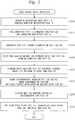
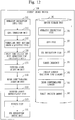
- Fig. 2 is a flowchart illustrating a flow of circuit design processing of the circuit design device 100 according to the first embodiment.
- circuit design processing of the circuit design device 100 according to the first embodiment will be described with reference to Fig. 2 .
- the operation description input unit 110 acquires the input operation description file 191.
- the processing proceeds to S111 after S110.
- the CDFG generation unit 111 converts the operation description of the integrated circuit described in the operation description file 191 into CDFG thereby to generate the CDFG file 192 denoting the CDFG therein.
- the CDFG includes CFG (control flow graph) and DFG (data flow graph).
- the CFG illustrates the processing branches such as if or while.
- the DFG illustrates a flow of data.
- the method for converting the operation description into CDFG may be the same method as performed in typical high-level synthesis.
- the processing proceeds to S 112 after S111.
- Fig. 3 is a diagram illustrating the CDFG file 192 according to the first embodiment by way of example.
- the CDFG file 192 according to the first embodiment will be described by way of example with reference to Fig. 3 .
- DFG is extracted from the CDFG indicated by the CDFG file 192. This is applicable to the following diagrams illustrating the CDFG file 192.
- the computation step includes the notations of the variable A, the variable B, the addition, and the variable D.
- the scheduling unit 112 performs the following scheduling on the CDFG file 192 based on the target frequency 181 and the circuit library 182.
- the scheduling unit 112 determines an execution order of each computation step included in the control data flow indicated by the CDFG based on the CDFG described in the CDFG file 192.
- the scheduling unit 112 then divides the CDFG described in the CDFG file 192 into a plurality of computation path graphs. For example, the CDFG is divided before (or after) each operator.
- a delay time of each computation path is a target time or less.
- the target time is calculated by dividing unit time (one second, for example) by the target frequency 181. Further, a delay time of each computation step included in the CDFG is indicated in the circuit library 182.
- the scheduling method (determining an execution order and dividing CDFG) may be the same method as performed in typical high-level synthesis.
- Fig. 4 is a diagram illustrating the scheduled CDFG file 192 according to the first embodiment by way of example.
- the scheduled CDFG file 192 according to the first embodiment will be described by way of example with reference to Fig. 4 .
- the scheduled CDFG file 192 includes a computation path identifier for identifying each computation path graph acquired by dividing the CDFG, and range information on a range of each computation path graph (in chained lines).
- a series of computation steps indicated between the two chained lines in the Figure is a computation path Pn.
- a flip-flop is inserted in the portion indicated by a chained line in the Figure.
- the computation path Pn is a computation step in which a value obtained by adding the value of the variable B to the value of the variable A is set for the variable D.
- the flip-flops are inserted before and after the computation path Pn.
- the delay time calculation unit 120 generates the delay time list 193 as follows based on the circuit library 182, the error countermeasure library 183, and the scheduled CDFG file 192.
- the delay time calculation unit 120 calculates a counter-error delay time of a computation path per computation path graph described in the scheduled CDFG file 192.
- the delay time calculation unit 120 generates the delay time list 193 indicating a counter-error delay time of each computation path.
- the delay time of each computation step included in the CDFG is indicated in the circuit library 182.
- the delay time of the error countermeasure step is indicated in the error countermeasure library 183.
- the designer may designate a type of the error countermeasure step (such as duplex, triple, or majority) for the circuit design device 100.
- a type of the error countermeasure step such as duplex, triple, or majority
- the error countermeasure library 183 indicates a delay time of the error countermeasure step per type of the error countermeasure step.
- the delay time calculation unit 120 then acquires a delay time of the error countermeasure step of a type designated by the designer from the error countermeasure library 183, and calculates a counter-error delay time by use of the acquired delay time.
- the processing proceeds to S 121 after S120.
- Fig. 5 is a diagram illustrating the circuit library 182 according to the first embodiment by way of example.
- circuit library 182 according to the first embodiment will be described by way of example with reference to Fig. 5 .
- the circuit library 182 includes a computation identifier for identifying a type of the computation step and a delay time of the computation step per type of the computation step.
- the circuit library 182 includes a delay time (Xns) of the addition step.
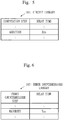
- Fig. 6 is a diagram illustrating the error countermeasure library 183 according to the first embodiment by way of example.
- the error countermeasure library 183 according to the first embodiment will be described by way of example with reference to Fig. 6 .
- the error countermeasure library 183 includes a delay time (Yns) of the majority step.
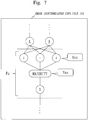
- Fig. 7 is a diagram illustrating the counter-error CDFG file 192 according to the first embodiment by way of example.
- the counter-error CDFG file 192 according to the first embodiment will be described by way of example with reference to Fig. 7 .
- the CDFG file 192 indicates a computation path Pn into which the notation of the majority step is inserted.
- the majority step is a step of selecting one computation result by majority when a plurality of different computation results are acquired.
- the majority step is an example of error countermeasure step.
- N is selected in the majority step.
- the computation path Pn includes the addition step and the majority step.
- Fig. 8 is a diagram illustrating the delay time list 193 according to the first embodiment by way of example.
- the delay time list 193 includes a computation path identifier for identifying a computation path graph and a counter-error delay time of the computation path per computation path graph.
- the inserted graph selection unit 121 generates the inserted graph list 194 as follows based on the target frequency 181 and the delay time list 193.
- the inserted graph selection unit 121 calculates a target time acquired by dividing unit time by the target frequency 181.
- the inserted graph selection unit 121 selects a computation path identifier associated with a delay time at the target time or less from among the computation path identifiers included in the delay time list 193.
- the computation path graph identified by the selected computation path identifier is an inserted path graph.
- the inserted graph selection unit 121 generates the inserted graph list 194 indicating each selected computation path identifier.
- the processing proceeds to S122 after S121.
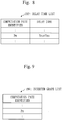
- Fig. 9 is a diagram illustrating the inserted graph list 194 according to the first embodiment by way of example.
- the inserted graph list 194 according to the first embodiment will be described by way of example with reference to Fig. 9 .
- the inserted graph list 194 includes the computation path identifier of each inserted path graph.
- the computation path graph Pn is an inserted path graph.
- the error countermeasure insertion unit 122 selects an inserted path graph identified by a computation path identifier from the scheduled CDFG file 192 per computation path identifier included in the inserted graph list 194.
- the error countermeasure insertion unit 122 then inserts an error countermeasure notation into each selected inserted path graph.
- Fig. 10 is a diagram illustrating the counter-error CDFG file 192 according to the first embodiment by way of example.
- the bound CDFG file 192 includes information on hardware assigned to each step.
- the binding (hardware assignment) method may be the same method as performed in typical high-level synthesis.
- the processing proceeds to S 131 after S130.
- the RTL description output unit 131 converts the CDFG described in the bound CDFG file 192 into RTL description thereby to generate the RTL description file 195 denoting the RTL description therein.
- the method for converting CDFG into RTL description may be the same method as performed in typical high-level synthesis.
- the circuit design processing is terminated after S 131.
- Fig. 11 is a diagram illustrating an example of hardware structure of the circuit design device 100 according to the first embodiment.
- the circuit design device 100 is a computer including a computation device 901, an auxiliary storage device 902, a main storage device 903, a communication device 904, and an I/O device 905.
- the computation device 901, the auxiliary storage device 902, the main storage device 903, the communication device 904, and the I/O device 905 are connected to a bus 909.
- the auxiliary storage device 902 is ROM (Read Only Memory), flash memory, or hard disk device, for example.
- the main storage device 903 is RAM (Random Access Memory), for example.
- a program which is typically stored in the auxiliary storage device 902, is loaded into the main storage device 903, read by the computation device 901, and executed by the computation device 901.
- the operating system is stored in the auxiliary storage device 902.
- Programs for realizing the functions each described as a "unit” is stored in the auxiliary storage device 902.
- the OS and the programs for realizing the functions each described as the "unit” are loaded into the main storage device 903 and are executed by the computation device 901.
- the "unit” may be replaced with "processing,” “step,” “program,” or “device.”
- an error countermeasure notation can be inserted into CDFG such that a delay time does not exceed the target time.
- Fig. 12 is a functional structure diagram of the circuit design device 100 according to a second embodiment.
- circuit design device 100 The functional structure of the circuit design device 100 according to the second embodiment will be described with reference to Fig. 12 .
- the circuit design device 100 includes an inserted amount determination unit 123 in addition to the functions according to the first embodiment (see Fig. 1 ).
- the inserted amount determination unit 123 determines whether the amount of inserted error countermeasure notations reaches the target inserted amount 184 based on the number of inserted graphs inserting an error countermeasure notation therein.
- the target inserted amount 184 is a rate of the number of inserted graphs relative to the total number of computation path graphs (which will be denoted as insertion rate).
- the number of inserted graphs is the number of inserted graphs inserting an error countermeasure notation therein.
- the target inserted amount 184 may be other than the insertion rate.
- the target inserted amount 184 may be the number of inserted graphs inserting an error countermeasure notation therein.
- Fig. 13 is a flowchart illustrating a flow of circuit design processing of the circuit design device 100 according to the second embodiment.
- circuit design processing of the circuit design device 100 according to the second embodiment will be described with reference to Fig. 13 .
- the operation description input unit 110 acquires the operation description file 191.
- the CDFG generation unit 111 generates the CDFG file 192 from the operation description file 191.
- the scheduling unit 112 performs scheduling on the CDFG file 192.
- S110 to S 112 are the same as in the first embodiment (see Fig. 2 ).
- the delay time calculation unit 120 selects one unselected computation path graph from the scheduled CDFG file 192.
- the delay time calculation unit 120 then calculates a delay time of the selected computation path graph.
- the delay time calculation method is the same as in the first embodiment (see S120 in Fig. 2 ).
- the processing proceeds to S201 after S200.
- the inserted graph selection unit 121 compares the delay time calculated in S200 with the target time.
- the error countermeasure insertion unit 122 inserts an error countermeasure notation into the computation path graph (inserted path graph) selected in S200.
- the processing proceeds to S203 after S202.
- the inserted amount determination unit 123 calculates the amount of inserted error countermeasure notations.
- the inserted amount determination unit 123 then compares the amount of inserted error countermeasure notations with the target inserted amount 184.
- the delay time calculation unit 120 determines whether a computation path graph not selected in S200 is present.
- the processing proceeds to S130.
- the inserted amount determination unit 123 may display a message that the amount of inserted error countermeasure notations does not reach the target inserted amount 184.
- the binding unit 130 binds the counter-error CDFG file 192.
- the RTL description output unit 131 generates the RTL description file 195 from the bound CDFG file 192.
- S130 and S 131 are the same as in the first embodiment (see Fig. 2 ).
- the circuit design processing is terminated after S131.
- an error countermeasure notation can be inserted up to the target inserted amount 184. Thereby, it is possible to prevent the error countermeasure notations from being inserted more than needed, to limit the number of error countermeasure circuits, and to prevent an increase in area of the integrated circuit.
- Fig. 14 is a functional structure diagram of the circuit design device 100 according to a third embodiment.
- circuit design device 100 The functional structure of the circuit design device 100 according to the third embodiment will be described with reference to Fig. 14 .
- the circuit design device 100 includes a re-divided graph selection unit 124 and a division portion selection unit 125 in addition to the functions described according to the second embodiment (see Fig. 12 ).
- the re-divided graph selection unit 124 selects a computation path graph not inserting an error countermeasure notation therein from the scheduled CDFG file 192.
- a computation path graph selected by the re-divided graph selection unit 124 will be denoted as re-divided graph.
- the division portion selection unit 125 selects a division portion from a re-divided graph.
- the scheduling unit 112 divides a re-divided graph based on a division portion.
- Each graph, which is acquired by dividing a re-divided graph, will be denoted as subdivided graph, and a computation path indicated by a subdivided graph will be denoted as subdivided path.
- the delay time calculation unit 120 calculates a counter-error delay time of a subdivided path per subdivided graph.
- the inserted graph selection unit 121 selects an inserted graph from a plurality of subdivided graphs.
- a subdivided graph selected as inserted graph will be denoted as inserted subdivided graph.
- the error countermeasure insertion unit 122 inserts an error countermeasure notation into each inserted subdivided graph.
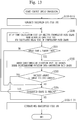
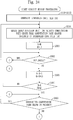
- Fig. 15 , Fig. 16 , and Fig. 17 are the flowcharts illustrating a flow of circuit design processing of the circuit design device 100 according to the third embodiment.
- circuit design processing of the circuit design device 100 according to the third embodiment will be described with reference to Fig. 15 to Fig. 17 .
- the re-divided graph selection unit 124 selects an unselected re-divided graph from the scheduled CDFG file 192.
- the re-divided graph selection unit 124 selects a computation path graph including a plurality of operators (a series of operators) arranged in series as re-divided graph from each computation path graph not inserting an error countermeasure notation therein.
- the processing proceeds to S211 after S210.
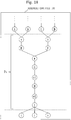
- Fig. 18 is a diagram illustrating the scheduled CDFG file 192 according to the third embodiment by way of example.
- the re-divided graph selection unit 124 selects a computation path graph Pa as unselected re-divided graph from the CDFG file 192 (see Fig. 18 ).
- the computation path graph Pa includes a plurality of operators (*, +1, +2) arranged in series.
- the division portion selection unit 125 selects a division portion from the re-divided graph selected in S210.
- the division portion selection unit 125 selects a division portion as follows from the re-divided graph Pa (see Fig. 18 ).
- the division portion selection unit 125 selects each operator (*, +1, +2) arranged in series as division portion.
- the division portion selection unit 125 selects an operator (*) using more variables than other operators as division portion from among the plurality of operators (*, +1, +2) arranged in series. That is, the division portion selection unit 125 selects a portion with more computation paths (including subdivided paths) as division portion. With the selection method, insertion efficiency of error countermeasure circuits is increased against an increase in latency (total steps required for computation).
- the division portion selection unit 125 selects an operator (+2) using more computation results than other operators as division portion from among the plurality of operators (*, +1, +2) arranged in series. That is, the division portion selection unit 125 selects a portion with more branches (fan-out) as division portion. With the selection method, an error countermeasure circuit is provided at a portion where a signal value is widely propagated, and thus the signal value of an error cannot be widely propagated.
- the processing proceeds to S212 after S211.
- the scheduling unit 112 divides the re-divided graph selected in S210 into a plurality of subdivided graphs based on the division portion selected in S211.
- a flip-flop is inserted between two subdivision paths arranged in series.
- the scheduling unit 112 divides the re-divided graph at each division portion immediately before (or after).
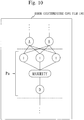
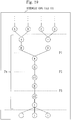
- Fig. 19 is a diagram illustrating the scheduled CDFG file 192 according to the third embodiment by way of example.
- the scheduling unit 112 divides the re-divided graph Pa (see Fig. 19 ) as follows.
- the scheduling unit 112 divides the re-divided graph Pa at the portion immediately before each operator (P1, P2, P3).
- the scheduling unit 112 divides the re-divided graph Pa at the portion (P1) immediately before the multiplication operator (*).
- the re-divided graph Pa is divided into three computation paths of A/B to E, C/D to F, and E/F to I.
- the re-divided graph Pa is branched into two computation paths of A/B/C/D to H and H to I. Therefore, the number of computation paths is larger for division at P1 than division at P3.
- the delay time calculation unit 120 then calculates a delay time of the selected subdivided graph.
- the delay time calculation method is the same as in the first embodiment (see S120 in Fig. 2 ).
- the inserted graph selection unit 121 compares the delay time calculated in S213 with the target time.
- the delay time calculation unit 120 determines whether a subdivided graph not selected in S213 is present.
- the re-divided graph selection unit 124 determines whether a re-divided graph not selected in S210 is present.
- the processing proceeds to S130.
- the inserted amount determination unit 123 may display a message that the amount of inserted error countermeasure notations does not reach the target inserted amount 184.
- S130 and S131 are the same as in the second embodiment (see Fig. 13 ).
- the circuit design processing is terminated after S131.
- an error countermeasure notation with the target inserted amount 184 can be inserted into the scheduled CDFG file 192 irrespective of the scheduled CDFG file 192.
- Fig. 20 is a functional structure diagram of the circuit design device 100 according to a fourth embodiment.
- circuit design device 100 The functional structure of the circuit design device 100 according to the fourth embodiment will be described with reference to Fig. 20 .
- the circuit design device 100 includes a graph group division unit 126 in addition to the functions described according to the first embodiment (see Fig. 1 ).
- the graph group division unit 126 divides a plurality of computation path graphs included in the CDFG indicated by the scheduled CDFG file 192 into a plurality of groups of path graphs.
- a group of path graphs is a plurality of consecutive computation path graphs (a series of computation path graphs).
- path graph quantity 185 The number of computation path graphs included in each group of path graphs will be denoted as path graph quantity 185.
- the delay time calculation unit 120 calculates a delay time per final path graph in each group of path graphs.
- the inserted graph selection unit 121 selects an inserted graph from the final path graph in each group of path graphs.
- Fig. 21 is a flowchart illustrating a flow of circuit design processing of the circuit design device 100 according to the fourth embodiment.
- circuit design processing of the circuit design device 100 according to the fourth embodiment will be described with reference to Fig. 21 .
- the circuit design processing includes S113 in addition to the processing described in the first embodiment (see Fig. 2 ).
- S110 to S 112 are the same as in the first embodiment.
- the graph group division unit 126 divides a plurality of computation path graphs included in the scheduled CDFG file 192 into a plurality of groups of path graphs based on the path graph quantity 185.
- the processing proceeds to S120 after S 113.
- the delay time calculation unit 120 generates the delay time list 193 based on the scheduled CDFG file 192 (similarly as in the first embodiment).
- the delay time calculation unit 120 calculates a delay time of the final computation path graph in each group of path graphs, not the delay times of all the computation path graphs. That is, the delay time list 193 indicates a delay time of the final computation path graph in each group of path graphs.
- the processing proceeds to S121 after S120.
- the inserted graph selection unit 121 generates the inserted graph list 194 based on the delay time list 193 (similarly as in the first embodiment).
- the processing proceeds to S122 after S121.
- the error countermeasure insertion unit 122 inserts an error countermeasure notation into each inserted graph based on the inserted graph list 194.
- the error countermeasure insertion unit 122 selects a group of path graphs including an inserted graph per inserted graph, and multiplexes a computation notation (such as operator) included in each computation path graph in each selected group of path graphs.
- the circuit design processing is terminated after S131.
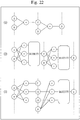
- Fig. 22 is an outline diagram of the error countermeasure insertion processing by the error countermeasure insertion unit 122 according to each embodiment.
- the error countermeasure insertion unit 122 inserts a majority circuit into both the first-half section and the second-half section.
- the error countermeasure insertion unit 122 further multiplexes an operator of each section.
- Fig. 23 is a functional structure diagram of the circuit design device 100 according to a fifth embodiment.
- circuit design device 100 The functional structure of the circuit design device 100 according to the fifth embodiment will be described with reference to Fig. 23 .
- the circuit design device 100 includes the graph group division unit 126 in addition to the functions described in the second embodiment (see Fig. 12 ).
- the function of the graph group division unit 126 is the same as in the fourth embodiment (see Fig. 20 ).
- the functions of the delay time calculation unit 120, the inserted graph selection unit 121, and the error countermeasure insertion units 122 are the same as in the fourth embodiment.
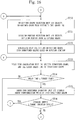
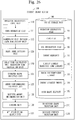
- Fig. 24 and Fig. 25 are the flowcharts illustrating a flow of circuit design processing of the circuit design device 100 according to the fifth embodiment.
- circuit design processing of the circuit design device 100 according to the fifth embodiment will be described with reference to Fig. 24 and Fig. 25 .
- S110 to S112 are the same as in the second embodiment (see Fig. 13 ).
- the graph group division unit 126 selects an unselected computation path graph not inserting an error countermeasure notation therein from the plurality of computation path graphs included in the scheduled CDFG file 192.
- the processing proceeds to S301 after S300.
- the graph group division unit 126 sets an initial value M for a variable N.
- the initial value M is the path graph quantity 185.
- the graph group division unit 126 subtracts 1 from the value of the variable N.
- the graph group division unit 126 determines whether the value of the variable N is 0.
- the graph group division unit 126 determines whether a computation path graph not selected in S300 is present.
- the delay time calculation unit 120 calculates a delay time of the final computation path graph included in the group of path graphs [N] determined in S302.
- the processing proceeds to S311 after S310.
- the inserted graph selection unit 121 compares the delay time calculated in S310 with the target time.
- the error countermeasure insertion unit 122 inserts an error countermeasure notation into the final computation path graph included in the group of path graphs [N] determined in S302.
- the error countermeasure insertion unit 122 multiplexes an operator included in each computation path graph in the group of path graphs [N].
- the inserted amount determination unit 123 calculates the amount of inserted error countermeasure notations, and compares the amount of inserted error countermeasure notations with the target inserted amount 184.
- the graph group division unit 126 may search a computation path while increasing N. In this case, the graph group division unit 126 sets 1 in N as the initial value in S301. Further, the graph group division unit 126 adds 1 to N in S303, and determines whether N is higher than M in S304.
- Fig. 26 is a diagram illustrating another example of functional structure of the circuit design device 100 according to the fifth embodiment.
- the circuit design device 100 includes the graph group division unit 126 in addition to the functions described in the third embodiment (see Fig. 14 ).
- the function of the graph group division unit 126 is the same as in the fourth embodiment (see Fig. 20 ).
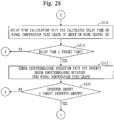
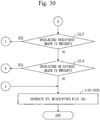
- Fig. 27 , Fig. 28 , Fig. 29 , and Fig. 30 are the flowcharts illustrating another example of circuit design processing of the circuit design device 100 according to the fifth embodiment.
- S302 when the group of path graphs [N] can be divided from the CDFG (YES), the processing proceeds to S310 (see Fig. 28 ).
- S310 to S313 are the same as in Fig. 25 .
- the circuit design processing is terminated after S131.
- the graph group division unit 126 may search a computation path while increasing N. That is, the graph group division unit 126 sets 1 in N as the initial value in S301, adds 1 to N in S303, and determines whether N is higher than M in S304.
- the circuit design device 100 may not include any of the components described according to each embodiment. Further, the circuit design device 100 may include a component not described according to each embodiment. Furthermore, the circuit design device 100 may be a combination of some or all of the components according to each embodiment.
- the processing procedure described in the flowcharts according to each embodiment is an example of method or program processing procedure according to each embodiment.
- the method and program according to each embodiment may be realized by a partially different processing procedure from the processing procedure described according to each embodiment.
- 100 Circuit design device, 110: Operation description input unit, 111: CDFG generation unit, 112: Scheduling unit, 120: Delay time calculation unit, 121: Inserted graph selection unit, 122: Error countermeasure insertion unit, 123: Inserted amount determination unit, 124: Re-divided graph selection unit, 125: Division portion selection unit, 126: Graph group division unit, 130: Binding unit, 131: RTL description output unit, 181: Target frequency, 182: Circuit library, 183: Error countermeasure library, 184: Target inserted amount, 185: Path graph quantity, 190: Device storage unit, 191: Operation description file, 192: CDFG file, 193: Delay time list, 194: Inserted graph list, 195: RTL description file, 901: Computation device, 902: Auxiliary storage device, 903: Main storage device, 904: Communication device, 905: I/O device, and 909: bus
Landscapes
- Engineering & Computer Science (AREA)
- Computer Hardware Design (AREA)
- Physics & Mathematics (AREA)
- Theoretical Computer Science (AREA)
- Evolutionary Computation (AREA)
- Geometry (AREA)
- General Engineering & Computer Science (AREA)
- General Physics & Mathematics (AREA)
- Design And Manufacture Of Integrated Circuits (AREA)
Applications Claiming Priority (1)
| Application Number | Priority Date | Filing Date | Title |
|---|---|---|---|
| PCT/JP2014/060073 WO2015155815A1 (ja) | 2014-04-07 | 2014-04-07 | 回路設計装置および回路設計プログラム |
Publications (1)
| Publication Number | Publication Date |
|---|---|
| EP3131024A1 true EP3131024A1 (de) | 2017-02-15 |
Family
ID=54287419
Family Applications (1)
| Application Number | Title | Priority Date | Filing Date |
|---|---|---|---|
| EP14888845.6A Withdrawn EP3131024A1 (de) | 2014-04-07 | 2014-04-07 | Schaltungsentwurfsvorrichtung und schaltungsentwurfsprogramm |
Country Status (4)
| Country | Link |
|---|---|
| US (1) | US20170068764A1 (de) |
| EP (1) | EP3131024A1 (de) |
| JP (1) | JP6173571B2 (de) |
| WO (1) | WO2015155815A1 (de) |
Families Citing this family (3)
| Publication number | Priority date | Publication date | Assignee | Title |
|---|---|---|---|---|
| JP6850395B2 (ja) * | 2018-03-05 | 2021-03-31 | 株式会社日立製作所 | 回路生成装置及びソフトウェア生成装置 |
| JP7184689B2 (ja) | 2019-03-26 | 2022-12-06 | ルネサスエレクトロニクス株式会社 | 高位合成方法、高位合成装置、及び高位合成システム |
| US12461889B2 (en) * | 2023-04-10 | 2025-11-04 | SambaNova Systems, Inc. | Intelligent graph execution and orchestration engine for a reconfigurable data processor |
-
2014
- 2014-04-07 US US15/122,758 patent/US20170068764A1/en not_active Abandoned
- 2014-04-07 WO PCT/JP2014/060073 patent/WO2015155815A1/ja not_active Ceased
- 2014-04-07 EP EP14888845.6A patent/EP3131024A1/de not_active Withdrawn
- 2014-04-07 JP JP2016512496A patent/JP6173571B2/ja not_active Expired - Fee Related
Also Published As
| Publication number | Publication date |
|---|---|
| WO2015155815A1 (ja) | 2015-10-15 |
| JPWO2015155815A1 (ja) | 2017-04-13 |
| JP6173571B2 (ja) | 2017-08-02 |
| US20170068764A1 (en) | 2017-03-09 |
Similar Documents
| Publication | Publication Date | Title |
|---|---|---|
| US11182132B1 (en) | Determining functional equivalence of configurations of a model | |
| Dao et al. | Efficient computation of ECO patch functions | |
| US9569575B2 (en) | Digital circuit design method and associated computer program product | |
| US9658834B2 (en) | Program visualization device, program visualization method, and program visualization program | |
| EP3131024A1 (de) | Schaltungsentwurfsvorrichtung und schaltungsentwurfsprogramm | |
| JPWO2018066073A1 (ja) | 情報処理装置、情報処理方法及び情報処理プログラム | |
| US20070168902A1 (en) | Method for high-level synthesis of semiconductor integrated circuit | |
| Kleinekathöfer et al. | Polynomial formal verification of floating point adders | |
| EP2891983A1 (de) | Softwareverifizierungsprogramm und softwareverifizierungssystem | |
| JP2011253253A (ja) | コンピュータ試験方法、コンピュータ試験装置およびコンピュータ試験プログラム | |
| EP3757836A1 (de) | Sicherheitsbewertungsserver und sicherheitsbewertungsverfahren | |
| US8813018B1 (en) | Method and apparatus for automatically configuring memory size | |
| US9594860B2 (en) | Analog mixed signal model equivalence checking | |
| WO2019142266A1 (ja) | テストケース生成装置、テストケース生成方法およびテストケース生成プログラム | |
| Possignolo et al. | SMatch: Structural matching for fast resynthesis in FPGAS | |
| US20150082278A1 (en) | Clone detection method and clone function commonalizing method | |
| US10666255B1 (en) | System and method for compacting X-pessimism fixes for gate-level logic simulation | |
| JP7400833B2 (ja) | トポロジー設計装置、トポロジー設計方法、及びプログラム | |
| Jo et al. | Debugging processors with advanced features by reprogramming LUTs on FPGA | |
| JP5321624B2 (ja) | 論理回路検証装置、論理回路検証方法およびプログラム | |
| US8484008B2 (en) | Methods and systems for performing timing sign-off of an integrated circuit design | |
| US9760403B2 (en) | Information processing system and method for distributing load over hardware processing and software processing | |
| CN108780470A (zh) | 用于创建分配列表的方法 | |
| US20140207434A1 (en) | Virtual model merging systems and methods | |
| US9069762B2 (en) | Equivalence classes over parameter state space |
Legal Events
| Date | Code | Title | Description |
|---|---|---|---|
| PUAI | Public reference made under article 153(3) epc to a published international application that has entered the european phase |
Free format text: ORIGINAL CODE: 0009012 |
|
| 17P | Request for examination filed |
Effective date: 20160920 |
|
| AK | Designated contracting states |
Kind code of ref document: A1 Designated state(s): AL AT BE BG CH CY CZ DE DK EE ES FI FR GB GR HR HU IE IS IT LI LT LU LV MC MK MT NL NO PL PT RO RS SE SI SK SM TR |
|
| AX | Request for extension of the european patent |
Extension state: BA ME |
|
| DAX | Request for extension of the european patent (deleted) | ||
| STAA | Information on the status of an ep patent application or granted ep patent |
Free format text: STATUS: THE APPLICATION HAS BEEN WITHDRAWN |
|
| 18W | Application withdrawn |
Effective date: 20171129 |