EP3129790B1 - Kinetische chlormessung - Google Patents
Kinetische chlormessung Download PDFInfo
- Publication number
- EP3129790B1 EP3129790B1 EP15716957.4A EP15716957A EP3129790B1 EP 3129790 B1 EP3129790 B1 EP 3129790B1 EP 15716957 A EP15716957 A EP 15716957A EP 3129790 B1 EP3129790 B1 EP 3129790B1
- Authority
- EP
- European Patent Office
- Prior art keywords
- concentration
- sample
- reagent
- time
- chlorine
- Prior art date
- Legal status (The legal status is an assumption and is not a legal conclusion. Google has not performed a legal analysis and makes no representation as to the accuracy of the status listed.)
- Active
Links
Images
Classifications
-
- G—PHYSICS
- G01—MEASURING; TESTING
- G01N—INVESTIGATING OR ANALYSING MATERIALS BY DETERMINING THEIR CHEMICAL OR PHYSICAL PROPERTIES
- G01N33/00—Investigating or analysing materials by specific methods not covered by groups G01N1/00 - G01N31/00
- G01N33/18—Water
- G01N33/182—Specific anions in water
-
- G—PHYSICS
- G01—MEASURING; TESTING
- G01N—INVESTIGATING OR ANALYSING MATERIALS BY DETERMINING THEIR CHEMICAL OR PHYSICAL PROPERTIES
- G01N33/00—Investigating or analysing materials by specific methods not covered by groups G01N1/00 - G01N31/00
- G01N33/48—Biological material, e.g. blood, urine; Haemocytometers
- G01N33/50—Chemical analysis of biological material, e.g. blood, urine; Testing involving biospecific ligand binding methods; Immunological testing
- G01N33/84—Chemical analysis of biological material, e.g. blood, urine; Testing involving biospecific ligand binding methods; Immunological testing involving inorganic compounds or pH
Definitions
- Chlorine usually is added to water as the gaseous form or as sodium or calcium hypochlorite. Chlorine gas rapidly hydrolyzes to hypochlorous acid according to the following equation: Cl 2 + H 2 O ⁇ HOCl + H + + Cl -
- aqueous solutions of sodium or calcium hypochlorite will hydrolyze according to: Ca(OCl) 2 + 2H 2 O ⁇ Ca 2+ + 2HOCl + 2OH - NaOCl + H 2 O ⁇ Na + + HOCl + OH -
- hypochlorous acid H + + OCl -
- hypochlorous acid is a weak acid and will disassociate according to: HOCl ⁇ H + + OCl - In waters with pH between 6.5 and 8.5, the reaction is incomplete and both species (HOCl and OCl - ) will be present. Hypochlorous acid is the more germicidal of the two.
- chlorine can react with a wide variety of compounds.
- nitrogenous compounds such as ammonia, nitrites and amino acids.
- Ammonia commonly present in natural waters, will react with hypochlorous acid or hypochlorite ion to form monochloramine, dichloramine and trichloramine, depending on several factors such as pH and temperature.
- breakpoint chlorination a continual addition of chlorine to the water up to the point where the chlorine requirement is met and all present ammonia is oxidized, so that only free chlorine remains. After the break point, free chlorine (hypochlorous acid plus hypochlorite) is the dominant disinfectant.
- the free chlorine residual may, for example, be adjusted to maintain a minimum level of 0.2 mg/L Cl 2 throughout the distribution system.
- the importance of break-point chlorination lies in the control of taste and odor and increased germicidal efficiency.
- the killing power of chlorine in excess of the breakpoint is 25 times higher than that before the breakpoint is reached.
- the presence of a free chlorine residual is an indicator of adequate disinfection.
- DPD N,N-diethyl-p-phenylenediamine
- Total chlorine is the total amount of chlorine in the water including the chlorine that has reacted with nitrogen compounds in the water.
- free chlorine reacts quickly with DPD indicator to produce a red color, whereas chloramines react more slowly. If a small amount of iodide ion is added, chloramines also react to produce color, yielding total chlorine concentration.
- Absorbance (for example, at 515 nm) may be spectrophotometrically measured and compared to a series of standards, using a graph or a regression analysis calculation to determine free and/or total chlorine concentration.
- additional reagents may be added to prevent reaction of interfering species, pre-determine the amounts of interfering species, or post-determine the amounts of interfering species.
- additional reagents can be toxic and/or expensive.
- NnN-diethyl-p-phenylenediamine (DPD) colorimetric method and/or an adapted indophenol method (Hach Monochlorf) are suitable for determining the concentration of monochloramine in drinking water.
- MIMS Membrane introduction mass spectrometry
- US 2014/083865 A1 discloses an electrochemical sensor for the detection of an analyte in a solution.
- the electrochemical sensor has an electrically non-conductive support; a plurality of electrodes on the support, each electrode formed from an electrode material and having a first surface and an opposite second surface, said first surface facing away from the support.
- the plurality of electrodes includes a reference electrode, a counter electrode, and a working electrode.
- the working electrode has a reagent composition containing a reagent for detecting an analyte applied directly to the second surface of the working electrode or dispersed throughout the electrode material of the working electrode.
- one aspect provides a method of determining a concentration of free chlorine in an aqueous sample, comprising: adding a reagent to the sample, the reagent being reactive with the free chlorine at a first kinetic rate and reactive with at least one chloramine at a second kinetic rate, the first kinetic rate being different from the second kinetic rate; measuring an absorbance response in the sample over time resulting from reaction of the free chlorine and the at least one chloramine with the reagent over time; and determining the concentration of the free chlorine in the sample based on a determined rate of change of the absorbance response over time.
- Another aspect provides a system of determining a concentration of free chlorine in an aqueous solution, comprising: a measuring system that measures an absorbance response over time resulting from reaction of the free chlorine and at least one chloramine with a reagent over time after the reagent is added to the solution, the reagent being reactive with the free chlorine at a first kinetic rate and reactive with the at least one chloramine at a second kinetic rate, the first kinetic rate being different from the second kinetic rate; and a processor system adapted to determine the concentration of the free chlorine in the solution based on a determined rate of change of the response over time.
- a further aspect provides a kit comprising: a reagent system comprising at least one of DPD (N,N-diethyl-p-phenylenediamine) and SBT ( N,N'- bis(2,4-di-sulfobenzyl) tolidine tetrasodium salt); a measuring system that measures an absorbance response over time resulting from reaction of the free chlorine and at least one chloramine with a reagent over time, the reagent being reactive with the free chlorine at a first kinetic rate and reactive with the at least one chloramine at a second kinetic rate, the first kinetic rate being different from the second kinetic rate; and a processor system adapted to determine the concentration of the free chlorine in the sample based on a determined rate of change of the measured absorbance response over time.
- DPD N,N-diethyl-p-phenylenediamine
- SBT N,N'- bis(2,4-di-sulfobenzyl) tolidine tetraso
- Quantifying the amount or concentration of an analyte is a common laboratory and field method.
- a reagent or reagent system (usually added stoichiometrically or in excess) reacts with the analyte to determine concentration.
- concentration By measuring a specific outcome of the reaction, the analyte concentration can be deduced.
- a measured response may, for example, include a colorimetric change, a pH change, a temperature change, an electrical property change, a spectrophotometric change, or precipitation.
- Quantification of analytes often has complications.
- the analyte to be quantified often exists in solution/mixture with other compounds that interfere with the analysis.
- time, temperature, pressure, or other physical parameters can cause complications.
- Interference is created when one or more species, in addition to the analyte, is/are present that react with the reagent in a manner to effect the measure response. In such situations, it can be very difficult or even impossible to accurately determine the concentration of the primary analyte.
- chloramines such as monochloramine act as interference when measuring free chlorine in DPD colorimetric detection.
- a common way of removing these interferences is by physically treating the analyte solution/mixture to purify it, and/or create conditions more suited for the analysis. For example, interfering analytes can sometimes be removed via distillation or selective reaction with a second reagent. In addition, temperature can often be used to negate time complications. These methods normally increase time and cost of the method, introduce complexities, or introduce toxic and/or expensive chemicals. In the case of DPD and SBT colorimetric detection, for example, sodium arsenite or thioacetamide may be added to reduce the effects of or prevent interference by monochloramine, but give rise to increased time, expense and toxicity.
- a concentration of at least a first chemical species (for example, free chlorine) in a mixture including the first chemical species and at least a second chemical species (for example, monochloramine) may be determined by adding a reagent to the mixture.
- the reagent is reactive with the first chemical species at a first kinetic rate and reactive with the second chemical species at a second kinetic rate, wherein the first kinetic rate is different from the second kinetic rate.
- the response resulting from reaction of the first chemical species and the second chemical species with the reagent is measured over time, and the concentration of the first chemical species in the mixture is determined based on a determined rate of change of the response over time.
- the rate of change of the response may be determined during a time period wherein substantially all of the first chemical species has reacted with the reagent.
- a time period may, for example, occur in the range of 5 seconds to two minutes (or, for example, 30 seconds to one minute) after a time T 0 which corresponds to a time after the reagent (for example, DPD or SBT) is added to the mixture.
- the time period for measurement was centered around 45 seconds after T 0 .
- the rate of change of the response during the time period is used to determine a response at a time T 0 , from which the concentration of the first chemical species is determined.
- the value of the response obtained at the To-intercept corresponds to the concentration of first chemical species (having the faster kinetic rate).
- the concentration of the second, more slowly reacting chemical species for example, monochloramine
- the rate of change of the response during the time period may be used to determine a correction factor related to the concentration of the second chemical species, and the concentration of the first chemical species may be determined using the correction factor.
- the correction factor may, for example, correspond to the contribution of the second chemical species to the measured response, and the contribution of the second chemical species may be determined from a model which may, for example, be experimentally determined.
- the model may provide the contribution or the concentration of the second chemical species as a function of the rate of change of the response during the time period. Temperature and reagent quantity may also be incorporated into the model.
- r p the rate of reaction
- [R1] and [reagent] are concentrations of R1 and the reagent in solution
- k is the rate constant which is a function of temperature and other reaction variables
- x and y are the orders of reaction for R1 and the reagent, respectively.
- the rate of reaction varies mainly with R1 concentration.
- r p is the rate of reaction
- [R1], [R2] and [reagent] are concentrations of the first chemical species
- k 1 and k 2 are the rate constants (which are functions of temperature and other variables)
- x1 and y1 are the orders of reaction for reaction of R1 with reagent respectively
- x2 and y2 are the orders of reaction for reaction of R2 and reagent respectively.
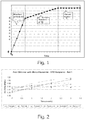
- the extent of reaction can be plotted as a response curve as illustrated in an idealized manner in Figure 1 , wherein the measured response (for example, absorbance) corresponds to and can quantify the extent of reaction.
- the response curve of Figure 1 can be divided into three sections or time periods. In a first section, between time T 0 and the first dashed line of Figure 1 , the measured response corresponds to the reaction of both R1 and R2.
- the measured response corresponds to the reaction of only R2 as substantially all of R1 (the species with the faster kinetic rate) has reacted.
- the third section to the right of the second dashed line in Figure 1 , a plateau region is reached, indicating completion of the reaction of R2 with the reagent.
- the slope of the response curve at any point in time corresponds to overall rate of reaction at that time.
- the response/reaction rate during the time period when the response corresponds to the reaction of monochloramine only can be used to determine the concentration of free chlorine as well as the concentration of monochloramine with increased accuracy as compared to previous methods.
- the methods hereof for determining two analyte concentrations can be extended to three or more analytes, when the response curves can be separated into distinct portions as described above.
- the standard for chlorine measurement in water is DPD (N,N-diethyl-p-phenylenediamine) colorimetric detection.
- DPD N,N-diethyl-p-phenylenediamine
- SBT N,N'- bis(2,4-di-sulfobenzyl)tolidine tetrasodium salt
- free chlorine reacts very quickly with DPD while other chlorine containing species such as chloramines react more slowly.
- the initial color change is used to calculate free chlorine concentration.
- Monochloramine can, for example, cause a 2.6 to 6.0% interference/error in free chlorine measurement depending on monochloramine concentration, temperature, mixing, and time factors. Monochloramine causes a gradual drift in absorbance measurement to higher readings. Thus, to minimize chloramine interference, the free chlorine measurement under current practice must be made as quickly as possible. However, it can be challenging to make the free chlorine reading before chloramine causes a significant error. To overcome the shortcomings of the DPD colorimetric test for free Cl determination, the rate of change of the measured DPD colorimetric response over time was investigated.
- samples including free chlorine in water with varying amount of monochloramine were prepared.
- Free chlorine was prepared as a dilute bleach solution.
- a solution of monochloramine was prepared by mixing 0.1 mL of an available ammonium chloride solution (0.153 g/mL) and 0.5 mL pH 8.3 buffer with 100 mL distilled water. A 0.5 mL aliquot of commercial bleach was then added slowly while stirring the solution.
- the DPD reagent used was available from Hach Company of Loveland, Colorado (HACH® Free Chlorine Test Kit (Cat No. 21055-69)). Solution volumes were measured using TenSette® pipets and micropipettes. Chlorine concentrations were determined using a HACH DR3800TM benchtop spectrometer (Model LPG424.99.0002).
- the Set 2 studies also included a seventh sample that contained no added free chlorine and 0.100 mL of the monochloramine solution.
- the sample cell was swirled to mix the solutions and one free chlorine powder pillow was added.
- a timer was started, the sample cell was placed in the spectrophotometer, and an initial chlorine concentration acquired. Additional chlorine concentrations were acquired at the one-minute mark, two-minute mark, and three-minute mark after the addition of the DPD reagent.
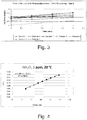
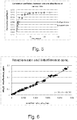
- Table 1 and Figure 2 set forth data of measured free chlorine concentration measured at 0 minutes, 1 minute, 2 minutes, and 3 minutes (from T 0 ) collected for the studies of Set 1, while Table 2 and Figure 3 set forth similar data collected for the studies of Set 2.
- Table 1. Chlorine concentrations (mg/L Cl 2 ) measured in Set 1. Sample 0 Minute 1 Minute 2 Minute 3 Minute 1 0.55 0.54 0.54 0.54 2 0.46 0.66 0.77 0.83 3 0.39 0.80 1.03 1.14 4 0.30 0.45 0.60 0.74 5 0.27 0.56 0.83 1.05 6 0.21 0.53 0.82 1.06 Table 2. Chlorine concentrations (mg/L Cl 2 ) measured in Set 2.
- the chlorine concentration was recorded at time intervals of 0 minutes ( ⁇ 10 seconds after DPD addition), 1 minute, 2 minutes, and 3 minutes after reagent addition (To). Once the series of samples had been measured, the water bath temperature was changed to 25°C and the measurement procedure was repeated. The temperature of the water bath was then set to 35°C for one additional measurement cycle.
- Table 5 Concentration values obtained with variable free chlorine and monochloramine. Volume Monochloramine Volume Free Chlorine Added Added Minute 0.00 mL 0.02 mL 0.04 mL 0.06 mL 0.08 mL 0.10 mL 0 0.01 0.38 0.73 1.09 1.40 1.75 0.00 mL 1 0.00 0.37 0.72 1.08 1.39 1.75 2 0.00 0.37 0.72 1.08 1.40 1.75 0 0.02 0.27 0.57 0.95 1.27 1.60 0.02 mL 1 0.02 0.29 0.59 0.97 1.29 1.61 2 0.04 0.33 0.62 1.01 1.32 1.64 0 0.02 0.21 0.52 0.84 1.20 1.53 0.04 mL 1 0.03 0.24 0.56 0.88 1.23 1.56 2 0.07 0.30 0.61 0.93 1.28 1.60 0 0.04 0.19 0.40 0.75 1.09 1.38 0.06 mL 1 0.07 0.25 0.47 0.83 1.15 1.43 2 0.14 0.33 0.56 0.93 1.23 1.51 0 0.04 0.11 0.32 0.63 0.99 1.
- Chlorine concentrations at minute zero were calculated using Equation 4 as set forth above.
- the calculated minute zero concentrations along with the measured minute zero concentrations and calculated difference between the two are given in Table 6 for the temperature studies and Table 7 for the variable free chlorine and monochloramine studies. Table 6. Calculated free chlorine concentration and difference for temperature evaluation.
- the calculated chlorine concentrations in Table 6 reveal that sample temperature (between 15 and 35°C) at the beginning of the evaluation did not have an effect on the values obtained. All of the calculated chlorine concentrations differed by less than 0.05 mg/L Cl 2 compared to the concentration values measured at time zero. Many of the calculated concentration values were less than the concentration value obtained at time 0. This was a result of some monochloramine reacting in the short time period from when the DPD reagent was added until the measurement was made. An attempt was made to keep this time interval less than 10 seconds. However, it is possible that some monochloramine had reacted during this short interval. There may also be some variation with the initial sample temperature but this variation was small compared to the temperature range evaluated.
- the above method of measuring free chlorine in the presence of monochloramine works for samples at typical temperatures and free chlorine concentrations across the method concentration range.
- the one-minute interval was initially selected as being a convenient time interval to wait after the addition of the DPD reagent and between the measurements. However, it may be possible to use a shorter time interval, such as 30 seconds, so that the entire measurement is completed in one minute rather than two minutes as set forth above.
- reaction kinetics methodology for measurement of free chlorine in the presence of chloramines for example, including monochloramine
- a reagent such as DPD at various temperatures
- reaction kinetics (temperature and concentration) of free chlorine and monochloramine were used to develop a method to correct for monochloramine interference during free chlorine measurement using, for example, the DPD colorimetric method.
- Monochloramine standards were made, including 0, 0.25, 1, 2, 3, and 4 mg/L.
- the pH of the samples ranged between 9.0-9.22.
- Standards were independently verified using a HACH brand DR6000 spectrophotometer available from Hach Company, Loveland, CO. In measurements using the instrument, 8 repetitions were performed for each standard sample. For each NH 2 Cl standard, the temperature was set to 5, 10, 20, 30, 40 and 50°C.
- the reaction rate can, for example, be calculated using a linear or polynomial curve fit of the reaction profile, absorbance vs. reaction time.
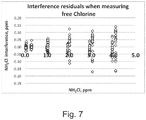
- a linear curve fit was used to derive reaction rate from the absorbance vs. reaction time data. Absorbance at different reaction times was correlated to the calculated reaction rate, and the correlation coefficients are shown in Figure 5 . The correlations were done at all the studied temperatures, but only the 20°C data is shown in Figure 5 .
- Reaction rate was calculated two ways (both using a linear curve fit): (1) using all the data; and (2) using 3 data points near 45 seconds.
- Figure 6 illustrates a linear regression of monochloramine interference concentrations (ppm) versus overall reaction rate at all temperatures studied.
- the reaction rate was calculated using three points close to 45 seconds reaction time as discussed above.
- the reaction rate measured at 45 seconds corresponds to the amount of monochloramine interference present in the sample.
- the amount of monochloramine determined via the measured reaction rate can be used as a calibration coefficient or correction factor when calculating free chlorine concentration.
- the amount of monochloramine can, for example, be subtracted from the reported free chlorine concentration (that is, amount of free chlorine + monochloramine interference concentration) to arrive at a compensated free chlorine concentration.
- free chlorine concentration is calculated by: 1) determining the presence of monochloramine using the rate and the reported free Cl concentration; 2) calculating calibration coefficients using, for example, the concentration at 45 seconds and reaction rate (as shown, for example, in Figure 6 ); 3) applying the calibration coefficients to the concentration at 45 seconds to get the interference value; and 4) subtracting the interference value from the reported free Cl value to get the compensated free Cl value.
- interference values are calculated from an experimentally determined equation of reaction rate vs. NH 2 Cl concentration and the calibration coefficients are the coefficients of that equation.
- interference value is calculated as a*rate +b, where a and b are the calibration coefficients, see figure 6 .
- Table 8 summarizes the results for monochloramine interference in free chlorine measurement before and after the correction, at all temperatures used in the studies.
- Figure 7 shows interference residuals after the monochloramine correction is applied (at all temperatures used in the studies). Ideally, the residuals should be close to zero after applying the monochloramine correction factor. In addition, the monochloramine interference values should be close to zero when there is no monochloramine in the sample.
- Table 8 Comparison of interference reporting before and after the correction algorithm is applied. monoCl conc. PPA reading, ppm ppm before correction after correction avg. std. dev. RSD, % avg. std. dev.
- the correction algorithm significantly minimizes the effect of monochloramine interference, in terms of both accuracy and precision.
- the poor accuracy before correction is a result of the interference reaction with DPD and the large spread in the data before correction is primarily from the temperature effect.
- the reaction rate which can be calculated from the reaction profile, absorbance vs. time, however, is a result of many factors, including temperature and monochloramine concentration.
- the reaction rate especially after a pre-determined period of reaction, is a good indicator of the amount of monochloramine interference when measuring free chlorine (wherein, the free chlorine reaction is substantially complete before the time period studied).
Landscapes
- Health & Medical Sciences (AREA)
- Life Sciences & Earth Sciences (AREA)
- Chemical & Material Sciences (AREA)
- Engineering & Computer Science (AREA)
- Immunology (AREA)
- Pathology (AREA)
- General Physics & Mathematics (AREA)
- General Health & Medical Sciences (AREA)
- Biochemistry (AREA)
- Food Science & Technology (AREA)
- Analytical Chemistry (AREA)
- Physics & Mathematics (AREA)
- Medicinal Chemistry (AREA)
- Biomedical Technology (AREA)
- Urology & Nephrology (AREA)
- Molecular Biology (AREA)
- Hematology (AREA)
- Microbiology (AREA)
- Cell Biology (AREA)
- Biotechnology (AREA)
- Inorganic Chemistry (AREA)
- Investigating Or Analyzing Non-Biological Materials By The Use Of Chemical Means (AREA)
- Investigating Or Analysing Materials By The Use Of Chemical Reactions (AREA)
Claims (15)
- Verfahren zum Bestimmen der Konzentration von freiem Chlor in einer wässrigen Probe, das Folgendes umfasst:Hinzufügen eines Reagens zu der Probe, wobei das Reagens mit dem freien Chlor bei einer ersten kinetischen Geschwindigkeit reagiert und mit mindestens einem Chloramin bei einer zweiten kinetischen Geschwindigkeit reagiert, wobei die erste kinetische Geschwindigkeit von der zweiten kinetischen Geschwindigkeit verschieden ist;Messen einer Absorptionsantwort in der Probe über einen Zeitraum, die aus der Reaktion des freien Chlors und des mindestens einen Chloramins mit dem Reagens über den Zeitraum resultiert; undBestimmen der Konzentration des freien Chlors in der Probe auf Grundlage der bestimmten Änderungsrate der Absorptionsantwort über den Zeitraum.
- Verfahren nach Anspruch 1, wobei die erste kinetische Geschwindigkeit schneller als die zweite kinetische Geschwindigkeit ist und die Änderungsrate der Absorptionsantwort während eines Zeitraums bestimmt wird, in dem das freie Chlor mit dem Reagens reagiert hat.
- Verfahren nach Anspruch 2, wobei eine erste Konzentration von Chlor zu einem Zeitpunkt T1 nach einem Zeitpunkt T0 bestimmt wird, der dem Zeitpunkt entspricht, an dem das Reagens zu der Probe hinzugefügt wird, und wenigstens eine zweite Konzentration von Chlor zu einem Zeitpunkt T2 nach dem Zeitpunkt T0 bestimmt wird, der später als Zeitpunkt T1 ist, und die Konzentration des freien Chlors zum Zeitpunkt T0 durch Extrapolation aus der ersten Chlorkonzentration und der mindestens zweiten Chlorkonzentration bestimmt wird.
- Verfahren nach Anspruch 3, wobei die Extrapolation eine lineare Extrapolation ist.
- Verfahren nach Anspruch 2, wobei die Änderungsrate der Antwort während des Zeitraums verwendet wird, um einen Korrekturfaktor zu bestimmen, der sich auf die Konzentration des mindestens einen Chloramins bezieht, und die Konzentration von freiem Chlor unter Verwendung des Korrekturfaktors bestimmt wird.
- Verfahren nach Anspruch 5, wobei der Korrekturfaktor dem Beitrag des mindestens einen Chloramins zur Absorptionsantwort entspricht, und der Beitrag des mindestens einen Chloramins zur Absorptionsantwort aus einem Modell des Beitrags des mindestens einen Chloramins zu der Absorptionsantwort als eine Funktion der Änderungsrate der Antwort während des Zeitraums bestimmt wird.
- Verfahren nach Anspruch 6, wobei das Modell die Auswirkung von mindestens der Temperatur und/oder der Reagensmenge einschließt.
- Verfahren nach Anspruch 6, wobei das Modell ein mathematisches Regressionsmodell ist, das eine Beziehung zwischen der Konzentration des mindestens einen Chloramins und der Änderungsrate der Antwort bereitstellt.
- Verfahren nach Anspruch 8, wobei der Korrekturfaktor unter Verwendung eines Prozessors bestimmt wird.
- Verfahren nach Anspruch 1, wobei das mindestens eine Chloramin Monochloramin umfasst.
- Verfahren nach Anspruch 10, wobei das Reagens mindestens eines von DPD (N,N-Diethyl-p-phenylendiamin) oder SBT (N,N'-Bis(2,4-dissulfobenzyl)tolidintetranatriumsalz) umfasst.
- Verfahren nach Anspruch 11, wobei das Reagens DPD umfasst.
- Verfahren nach einem der vorherigen Ansprüche, wobei der Zeitraum auftritt, nachdem im Wesentlichen das gesamte freie Chlor mit dem Reagens reagiert hat und bevor das Monochloramin im Wesentlichen vollständig reagiert hat.
- Verfahren nach Anspruch 13, wobei der Zeitraum zwischen etwa 5 Sekunden und 2 Minuten nach einem Zeitpunkt T0 liegt, bei dem das Reagens der Probe zugegeben wird.
- Verfahren nach Anspruch 13, wobei der Zeitraum zwischen etwa 30 Sekunden und 1 Minute nach einem Zeitpunkt T0 liegt, bei dem das Reagens der Probe zugegeben wird.
Applications Claiming Priority (2)
| Application Number | Priority Date | Filing Date | Title |
|---|---|---|---|
| US201461976623P | 2014-04-08 | 2014-04-08 | |
| PCT/US2015/024119 WO2015157088A1 (en) | 2014-04-08 | 2015-04-02 | Kinetic chlorine measurement |
Publications (2)
| Publication Number | Publication Date |
|---|---|
| EP3129790A1 EP3129790A1 (de) | 2017-02-15 |
| EP3129790B1 true EP3129790B1 (de) | 2018-02-28 |
Family
ID=52875813
Family Applications (1)
| Application Number | Title | Priority Date | Filing Date |
|---|---|---|---|
| EP15716957.4A Active EP3129790B1 (de) | 2014-04-08 | 2015-04-02 | Kinetische chlormessung |
Country Status (4)
| Country | Link |
|---|---|
| US (1) | US9746451B2 (de) |
| EP (1) | EP3129790B1 (de) |
| CN (1) | CN106415267B (de) |
| WO (1) | WO2015157088A1 (de) |
Families Citing this family (4)
| Publication number | Priority date | Publication date | Assignee | Title |
|---|---|---|---|---|
| EP3507599B1 (de) | 2016-08-30 | 2019-10-09 | Hach Company | Bestimmung von analyten unter verwendung elektrochemisch aktiver indikatorspezies als reagenzien |
| US11422093B2 (en) * | 2019-06-06 | 2022-08-23 | Hach Company | Ultra low range free chlorine measurement |
| US11549888B2 (en) * | 2019-10-03 | 2023-01-10 | Hach Company | Method for measuring monochloramine in seawater |
| GB2599115B (en) * | 2020-09-24 | 2025-03-05 | Palintest Ltd | Electrochemical sensor |
Family Cites Families (5)
| Publication number | Priority date | Publication date | Assignee | Title |
|---|---|---|---|---|
| CN2166443Y (zh) * | 1993-07-15 | 1994-05-25 | 中国科学院南京土壤研究所 | 水中游离氯的连续检测装置 |
| US20030077365A1 (en) * | 2001-06-28 | 2003-04-24 | Howarth Jonathan N. | Environmentally-friendly microbiological and microbiocidal control in aqueous systems |
| US6706194B2 (en) * | 2002-05-08 | 2004-03-16 | Meadwestvaco Corporation | Method for removal of chloramines from drinking water |
| EP2288914A4 (de) * | 2008-06-18 | 2015-08-26 | Hach Co | Erkennung von freiem chlor in wasser |
| WO2014047566A1 (en) * | 2012-09-21 | 2014-03-27 | Arch Chemicals, Inc. | Electrochemical sensors for testing water |
-
2015
- 2015-04-02 EP EP15716957.4A patent/EP3129790B1/de active Active
- 2015-04-02 US US14/677,718 patent/US9746451B2/en active Active
- 2015-04-02 WO PCT/US2015/024119 patent/WO2015157088A1/en not_active Ceased
- 2015-04-02 CN CN201580028501.3A patent/CN106415267B/zh active Active
Also Published As
| Publication number | Publication date |
|---|---|
| US20150285779A1 (en) | 2015-10-08 |
| EP3129790A1 (de) | 2017-02-15 |
| WO2015157088A1 (en) | 2015-10-15 |
| US9746451B2 (en) | 2017-08-29 |
| CN106415267B (zh) | 2018-11-06 |
| CN106415267A (zh) | 2017-02-15 |
Similar Documents
| Publication | Publication Date | Title |
|---|---|---|
| US8065906B2 (en) | Detection of free chlorine in water | |
| Adam et al. | Direct and sequential potentiometric determination of hypochlorite, chlorite, and chlorate ions when hypochlorite ion is present in large excess | |
| US6315950B1 (en) | Controlling chlorination of wastewater and chloramination of drinking water | |
| Pinkernell et al. | Methods for the photometric determination of reactive bromine and chlorine species with ABTS | |
| Lee et al. | Comparison of colorimetric and membrane introduction mass spectrometry techniques for chloramine analysis | |
| EP3129790B1 (de) | Kinetische chlormessung | |
| Liu et al. | Spectrophotometric determination of trace permanganate in water with N, N-diethyl-p-phenylenediamine (DPD) | |
| Hu et al. | Identification and quantification of chloramines, bromamines and bromochloramine by membrane introduction mass spectrometry (MIMS) | |
| Zhang et al. | Identification and quantification of ineffective chlorine by NaAsO2 selective quenching method during drinking water disinfection | |
| Baker et al. | Spectrophotometric determination of ammonia using ninhydrin assay and kinetic studies | |
| US12235255B2 (en) | Method of determining chemical oxygen demand (COD) for high chloride samples | |
| Tao et al. | Salicylate-spectrophotometric determination of inorganic monochloramine | |
| Waters et al. | Evaluation of different methods for determination of properties of chlorine-based sanitizers | |
| Miller et al. | Automated iodometric method for determination of trace chlorate ion using flow injection analysis | |
| JP2009122077A (ja) | 亜塩素酸イオンの測定方法 | |
| Harp | Specific determination of inorganic monochloramine in chlorinated wastewaters | |
| Engelhardt et al. | Chlorination, chloramination and chlorine measurement | |
| CN108351337B (zh) | 用于含水氯分析的储存稳定的标准物 | |
| Jolley et al. | Aqueous chemistry of chlorine: chemistry, analysis, and environmental fate of reactive oxidant species | |
| Tkácová et al. | Determination of chlorine dioxide and chlorite in water supply systems by verified methods | |
| Yu et al. | AN ENHANCED SPECTROPHOTOMETRIC METHOD FOR DETERMINATION OF HYDROGEN PEROXIDE DURING VACUUM ULTRAVIOLET PHOTOLYSIS OF WATER. | |
| Birnhack et al. | Accurate approach for determining fresh-water carbonate (H2CO3⁎) alkalinity, using a single H3PO4 titration point | |
| Körtvélyesi | Analytical methods for the measurement of chlorine dioxide and related oxychlorine species in aqueous solution | |
| Llmoni et al. | Determination of oxidants formed upon the disinfection of drinking water with chlorine dioxide | |
| Themelis et al. | Gas-diffusion flow injection assay for the selective determination of chlorine dioxide based on the fluorescence quenching of chromotropic acid |
Legal Events
| Date | Code | Title | Description |
|---|---|---|---|
| PUAI | Public reference made under article 153(3) epc to a published international application that has entered the european phase |
Free format text: ORIGINAL CODE: 0009012 |
|
| 17P | Request for examination filed |
Effective date: 20161017 |
|
| AK | Designated contracting states |
Kind code of ref document: A1 Designated state(s): AL AT BE BG CH CY CZ DE DK EE ES FI FR GB GR HR HU IE IS IT LI LT LU LV MC MK MT NL NO PL PT RO RS SE SI SK SM TR |
|
| AX | Request for extension of the european patent |
Extension state: BA ME |
|
| DAV | Request for validation of the european patent (deleted) | ||
| DAX | Request for extension of the european patent (deleted) | ||
| GRAP | Despatch of communication of intention to grant a patent |
Free format text: ORIGINAL CODE: EPIDOSNIGR1 |
|
| INTG | Intention to grant announced |
Effective date: 20170926 |
|
| GRAS | Grant fee paid |
Free format text: ORIGINAL CODE: EPIDOSNIGR3 |
|
| GRAA | (expected) grant |
Free format text: ORIGINAL CODE: 0009210 |
|
| AK | Designated contracting states |
Kind code of ref document: B1 Designated state(s): AL AT BE BG CH CY CZ DE DK EE ES FI FR GB GR HR HU IE IS IT LI LT LU LV MC MK MT NL NO PL PT RO RS SE SI SK SM TR |
|
| REG | Reference to a national code |
Ref country code: GB Ref legal event code: FG4D Ref country code: CH Ref legal event code: EP |
|
| REG | Reference to a national code |
Ref country code: AT Ref legal event code: REF Ref document number: 974712 Country of ref document: AT Kind code of ref document: T Effective date: 20180315 |
|
| REG | Reference to a national code |
Ref country code: IE Ref legal event code: FG4D |
|
| REG | Reference to a national code |
Ref country code: DE Ref legal event code: R096 Ref document number: 602015008412 Country of ref document: DE |
|
| REG | Reference to a national code |
Ref country code: FR Ref legal event code: PLFP Year of fee payment: 4 |
|
| REG | Reference to a national code |
Ref country code: NL Ref legal event code: MP Effective date: 20180228 |
|
| REG | Reference to a national code |
Ref country code: LT Ref legal event code: MG4D |
|
| REG | Reference to a national code |
Ref country code: AT Ref legal event code: MK05 Ref document number: 974712 Country of ref document: AT Kind code of ref document: T Effective date: 20180228 |
|
| PG25 | Lapsed in a contracting state [announced via postgrant information from national office to epo] |
Ref country code: FI Free format text: LAPSE BECAUSE OF FAILURE TO SUBMIT A TRANSLATION OF THE DESCRIPTION OR TO PAY THE FEE WITHIN THE PRESCRIBED TIME-LIMIT Effective date: 20180228 Ref country code: NO Free format text: LAPSE BECAUSE OF FAILURE TO SUBMIT A TRANSLATION OF THE DESCRIPTION OR TO PAY THE FEE WITHIN THE PRESCRIBED TIME-LIMIT Effective date: 20180528 Ref country code: HR Free format text: LAPSE BECAUSE OF FAILURE TO SUBMIT A TRANSLATION OF THE DESCRIPTION OR TO PAY THE FEE WITHIN THE PRESCRIBED TIME-LIMIT Effective date: 20180228 Ref country code: NL Free format text: LAPSE BECAUSE OF FAILURE TO SUBMIT A TRANSLATION OF THE DESCRIPTION OR TO PAY THE FEE WITHIN THE PRESCRIBED TIME-LIMIT Effective date: 20180228 Ref country code: CY Free format text: LAPSE BECAUSE OF FAILURE TO SUBMIT A TRANSLATION OF THE DESCRIPTION OR TO PAY THE FEE WITHIN THE PRESCRIBED TIME-LIMIT Effective date: 20180228 Ref country code: ES Free format text: LAPSE BECAUSE OF FAILURE TO SUBMIT A TRANSLATION OF THE DESCRIPTION OR TO PAY THE FEE WITHIN THE PRESCRIBED TIME-LIMIT Effective date: 20180228 Ref country code: LT Free format text: LAPSE BECAUSE OF FAILURE TO SUBMIT A TRANSLATION OF THE DESCRIPTION OR TO PAY THE FEE WITHIN THE PRESCRIBED TIME-LIMIT Effective date: 20180228 |
|
| PG25 | Lapsed in a contracting state [announced via postgrant information from national office to epo] |
Ref country code: GR Free format text: LAPSE BECAUSE OF FAILURE TO SUBMIT A TRANSLATION OF THE DESCRIPTION OR TO PAY THE FEE WITHIN THE PRESCRIBED TIME-LIMIT Effective date: 20180529 Ref country code: BG Free format text: LAPSE BECAUSE OF FAILURE TO SUBMIT A TRANSLATION OF THE DESCRIPTION OR TO PAY THE FEE WITHIN THE PRESCRIBED TIME-LIMIT Effective date: 20180528 Ref country code: RS Free format text: LAPSE BECAUSE OF FAILURE TO SUBMIT A TRANSLATION OF THE DESCRIPTION OR TO PAY THE FEE WITHIN THE PRESCRIBED TIME-LIMIT Effective date: 20180228 Ref country code: AT Free format text: LAPSE BECAUSE OF FAILURE TO SUBMIT A TRANSLATION OF THE DESCRIPTION OR TO PAY THE FEE WITHIN THE PRESCRIBED TIME-LIMIT Effective date: 20180228 Ref country code: LV Free format text: LAPSE BECAUSE OF FAILURE TO SUBMIT A TRANSLATION OF THE DESCRIPTION OR TO PAY THE FEE WITHIN THE PRESCRIBED TIME-LIMIT Effective date: 20180228 Ref country code: SE Free format text: LAPSE BECAUSE OF FAILURE TO SUBMIT A TRANSLATION OF THE DESCRIPTION OR TO PAY THE FEE WITHIN THE PRESCRIBED TIME-LIMIT Effective date: 20180228 |
|
| PG25 | Lapsed in a contracting state [announced via postgrant information from national office to epo] |
Ref country code: EE Free format text: LAPSE BECAUSE OF FAILURE TO SUBMIT A TRANSLATION OF THE DESCRIPTION OR TO PAY THE FEE WITHIN THE PRESCRIBED TIME-LIMIT Effective date: 20180228 Ref country code: PL Free format text: LAPSE BECAUSE OF FAILURE TO SUBMIT A TRANSLATION OF THE DESCRIPTION OR TO PAY THE FEE WITHIN THE PRESCRIBED TIME-LIMIT Effective date: 20180228 Ref country code: RO Free format text: LAPSE BECAUSE OF FAILURE TO SUBMIT A TRANSLATION OF THE DESCRIPTION OR TO PAY THE FEE WITHIN THE PRESCRIBED TIME-LIMIT Effective date: 20180228 Ref country code: IT Free format text: LAPSE BECAUSE OF FAILURE TO SUBMIT A TRANSLATION OF THE DESCRIPTION OR TO PAY THE FEE WITHIN THE PRESCRIBED TIME-LIMIT Effective date: 20180228 Ref country code: AL Free format text: LAPSE BECAUSE OF FAILURE TO SUBMIT A TRANSLATION OF THE DESCRIPTION OR TO PAY THE FEE WITHIN THE PRESCRIBED TIME-LIMIT Effective date: 20180228 |
|
| REG | Reference to a national code |
Ref country code: DE Ref legal event code: R097 Ref document number: 602015008412 Country of ref document: DE |
|
| PG25 | Lapsed in a contracting state [announced via postgrant information from national office to epo] |
Ref country code: MC Free format text: LAPSE BECAUSE OF FAILURE TO SUBMIT A TRANSLATION OF THE DESCRIPTION OR TO PAY THE FEE WITHIN THE PRESCRIBED TIME-LIMIT Effective date: 20180228 Ref country code: DK Free format text: LAPSE BECAUSE OF FAILURE TO SUBMIT A TRANSLATION OF THE DESCRIPTION OR TO PAY THE FEE WITHIN THE PRESCRIBED TIME-LIMIT Effective date: 20180228 Ref country code: SK Free format text: LAPSE BECAUSE OF FAILURE TO SUBMIT A TRANSLATION OF THE DESCRIPTION OR TO PAY THE FEE WITHIN THE PRESCRIBED TIME-LIMIT Effective date: 20180228 Ref country code: SM Free format text: LAPSE BECAUSE OF FAILURE TO SUBMIT A TRANSLATION OF THE DESCRIPTION OR TO PAY THE FEE WITHIN THE PRESCRIBED TIME-LIMIT Effective date: 20180228 Ref country code: CZ Free format text: LAPSE BECAUSE OF FAILURE TO SUBMIT A TRANSLATION OF THE DESCRIPTION OR TO PAY THE FEE WITHIN THE PRESCRIBED TIME-LIMIT Effective date: 20180228 |
|
| REG | Reference to a national code |
Ref country code: CH Ref legal event code: PL |
|
| REG | Reference to a national code |
Ref country code: BE Ref legal event code: MM Effective date: 20180430 |
|
| PLBE | No opposition filed within time limit |
Free format text: ORIGINAL CODE: 0009261 |
|
| STAA | Information on the status of an ep patent application or granted ep patent |
Free format text: STATUS: NO OPPOSITION FILED WITHIN TIME LIMIT |
|
| REG | Reference to a national code |
Ref country code: IE Ref legal event code: MM4A |
|
| PG25 | Lapsed in a contracting state [announced via postgrant information from national office to epo] |
Ref country code: LU Free format text: LAPSE BECAUSE OF NON-PAYMENT OF DUE FEES Effective date: 20180402 |
|
| 26N | No opposition filed |
Effective date: 20181129 |
|
| PG25 | Lapsed in a contracting state [announced via postgrant information from national office to epo] |
Ref country code: LI Free format text: LAPSE BECAUSE OF NON-PAYMENT OF DUE FEES Effective date: 20180430 Ref country code: CH Free format text: LAPSE BECAUSE OF NON-PAYMENT OF DUE FEES Effective date: 20180430 Ref country code: SI Free format text: LAPSE BECAUSE OF FAILURE TO SUBMIT A TRANSLATION OF THE DESCRIPTION OR TO PAY THE FEE WITHIN THE PRESCRIBED TIME-LIMIT Effective date: 20180228 Ref country code: BE Free format text: LAPSE BECAUSE OF NON-PAYMENT OF DUE FEES Effective date: 20180430 |
|
| PG25 | Lapsed in a contracting state [announced via postgrant information from national office to epo] |
Ref country code: IE Free format text: LAPSE BECAUSE OF NON-PAYMENT OF DUE FEES Effective date: 20180402 |
|
| PG25 | Lapsed in a contracting state [announced via postgrant information from national office to epo] |
Ref country code: MT Free format text: LAPSE BECAUSE OF NON-PAYMENT OF DUE FEES Effective date: 20180402 |
|
| PG25 | Lapsed in a contracting state [announced via postgrant information from national office to epo] |
Ref country code: TR Free format text: LAPSE BECAUSE OF FAILURE TO SUBMIT A TRANSLATION OF THE DESCRIPTION OR TO PAY THE FEE WITHIN THE PRESCRIBED TIME-LIMIT Effective date: 20180228 |
|
| PG25 | Lapsed in a contracting state [announced via postgrant information from national office to epo] |
Ref country code: PT Free format text: LAPSE BECAUSE OF FAILURE TO SUBMIT A TRANSLATION OF THE DESCRIPTION OR TO PAY THE FEE WITHIN THE PRESCRIBED TIME-LIMIT Effective date: 20180228 |
|
| PG25 | Lapsed in a contracting state [announced via postgrant information from national office to epo] |
Ref country code: MK Free format text: LAPSE BECAUSE OF NON-PAYMENT OF DUE FEES Effective date: 20180228 Ref country code: HU Free format text: LAPSE BECAUSE OF FAILURE TO SUBMIT A TRANSLATION OF THE DESCRIPTION OR TO PAY THE FEE WITHIN THE PRESCRIBED TIME-LIMIT; INVALID AB INITIO Effective date: 20150402 |
|
| PG25 | Lapsed in a contracting state [announced via postgrant information from national office to epo] |
Ref country code: IS Free format text: LAPSE BECAUSE OF FAILURE TO SUBMIT A TRANSLATION OF THE DESCRIPTION OR TO PAY THE FEE WITHIN THE PRESCRIBED TIME-LIMIT Effective date: 20180628 |
|
| P01 | Opt-out of the competence of the unified patent court (upc) registered |
Effective date: 20230528 |
|
| PGFP | Annual fee paid to national office [announced via postgrant information from national office to epo] |
Ref country code: DE Payment date: 20250422 Year of fee payment: 11 |
|
| PGFP | Annual fee paid to national office [announced via postgrant information from national office to epo] |
Ref country code: GB Payment date: 20250423 Year of fee payment: 11 |
|
| PGFP | Annual fee paid to national office [announced via postgrant information from national office to epo] |
Ref country code: FR Payment date: 20250425 Year of fee payment: 11 |