EP3124563A1 - Charge-transporting varnish - Google Patents
Charge-transporting varnish Download PDFInfo
- Publication number
- EP3124563A1 EP3124563A1 EP15767949.9A EP15767949A EP3124563A1 EP 3124563 A1 EP3124563 A1 EP 3124563A1 EP 15767949 A EP15767949 A EP 15767949A EP 3124563 A1 EP3124563 A1 EP 3124563A1
- Authority
- EP
- European Patent Office
- Prior art keywords
- carbon atoms
- group
- substituted
- charge
- formula
- Prior art date
- Legal status (The legal status is an assumption and is not a legal conclusion. Google has not performed a legal analysis and makes no representation as to the accuracy of the status listed.)
- Granted
Links
- 239000002966 varnish Substances 0.000 title claims abstract description 98
- -1 aryl aldehyde compound Chemical class 0.000 claims abstract description 96
- 229910052731 fluorine Inorganic materials 0.000 claims abstract description 87
- 150000001875 compounds Chemical class 0.000 claims abstract description 77
- 125000003118 aryl group Chemical group 0.000 claims abstract description 59
- 239000000126 substance Substances 0.000 claims abstract description 57
- 239000010409 thin film Substances 0.000 claims abstract description 50
- YCKRFDGAMUMZLT-UHFFFAOYSA-N Fluorine atom Chemical compound [F] YCKRFDGAMUMZLT-UHFFFAOYSA-N 0.000 claims abstract description 42
- 239000011737 fluorine Substances 0.000 claims abstract description 42
- RTZKZFJDLAIYFH-UHFFFAOYSA-N ether Substances CCOCC RTZKZFJDLAIYFH-UHFFFAOYSA-N 0.000 claims abstract description 38
- 229920000642 polymer Polymers 0.000 claims abstract description 34
- 125000003545 alkoxy group Chemical group 0.000 claims abstract description 23
- 239000011964 heteropoly acid Substances 0.000 claims abstract description 21
- 239000002019 doping agent Substances 0.000 claims abstract description 14
- 239000003960 organic solvent Substances 0.000 claims abstract description 11
- 125000005259 triarylamine group Chemical group 0.000 claims abstract description 10
- 125000002915 carbonyl group Chemical group [*:2]C([*:1])=O 0.000 claims abstract description 9
- 125000003983 fluorenyl group Chemical class C1(=CC=CC=2C3=CC=CC=C3CC12)* 0.000 claims abstract 4
- 125000004432 carbon atom Chemical group C* 0.000 claims description 277
- 125000000217 alkyl group Chemical group 0.000 claims description 111
- 125000004435 hydrogen atom Chemical group [H]* 0.000 claims description 67
- 238000000034 method Methods 0.000 claims description 61
- 125000000449 nitro group Chemical group [O-][N+](*)=O 0.000 claims description 58
- 125000004093 cyano group Chemical group *C#N 0.000 claims description 56
- 125000005843 halogen group Chemical group 0.000 claims description 52
- 125000000304 alkynyl group Chemical group 0.000 claims description 48
- 125000001153 fluoro group Chemical group F* 0.000 claims description 47
- 125000003342 alkenyl group Chemical group 0.000 claims description 46
- 239000002904 solvent Substances 0.000 claims description 32
- KWYHDKDOAIKMQN-UHFFFAOYSA-N N,N,N',N'-tetramethylethylenediamine Chemical compound CN(C)CCN(C)C KWYHDKDOAIKMQN-UHFFFAOYSA-N 0.000 claims description 30
- 239000000758 substrate Substances 0.000 claims description 25
- WKBOTKDWSSQWDR-UHFFFAOYSA-N Bromine atom Chemical group [Br] WKBOTKDWSSQWDR-UHFFFAOYSA-N 0.000 claims description 20
- 229910052801 chlorine Inorganic materials 0.000 claims description 20
- 125000001309 chloro group Chemical group Cl* 0.000 claims description 19
- 125000001072 heteroaryl group Chemical group 0.000 claims description 13
- ZCYVEMRRCGMTRW-UHFFFAOYSA-N 7553-56-2 Chemical group [I] ZCYVEMRRCGMTRW-UHFFFAOYSA-N 0.000 claims description 11
- 229910052740 iodine Inorganic materials 0.000 claims description 11
- IYDGMDWEHDFVQI-UHFFFAOYSA-N phosphoric acid;trioxotungsten Chemical compound O=[W](=O)=O.O=[W](=O)=O.O=[W](=O)=O.O=[W](=O)=O.O=[W](=O)=O.O=[W](=O)=O.O=[W](=O)=O.O=[W](=O)=O.O=[W](=O)=O.O=[W](=O)=O.O=[W](=O)=O.O=[W](=O)=O.OP(O)(O)=O IYDGMDWEHDFVQI-UHFFFAOYSA-N 0.000 claims description 11
- DCZNSJVFOQPSRV-UHFFFAOYSA-N n,n-diphenyl-4-[4-(n-phenylanilino)phenyl]aniline Chemical class C1=CC=CC=C1N(C=1C=CC(=CC=1)C=1C=CC(=CC=1)N(C=1C=CC=CC=1)C=1C=CC=CC=1)C1=CC=CC=C1 DCZNSJVFOQPSRV-UHFFFAOYSA-N 0.000 claims description 8
- IAYPIBMASNFSPL-UHFFFAOYSA-N Ethylene oxide Chemical group C1CO1 IAYPIBMASNFSPL-UHFFFAOYSA-N 0.000 claims description 6
- 125000002534 ethynyl group Chemical group [H]C#C* 0.000 claims description 6
- 125000000391 vinyl group Chemical group [H]C([*])=C([H])[H] 0.000 claims description 6
- 238000001704 evaporation Methods 0.000 claims description 2
- 125000006617 triphenylamine group Chemical group 0.000 claims description 2
- 239000010410 layer Substances 0.000 abstract description 42
- 239000002356 single layer Substances 0.000 abstract description 6
- 230000001747 exhibiting effect Effects 0.000 abstract 1
- 230000015572 biosynthetic process Effects 0.000 description 43
- 238000003786 synthesis reaction Methods 0.000 description 43
- NIXOWILDQLNWCW-UHFFFAOYSA-M Acrylate Chemical compound [O-]C(=O)C=C NIXOWILDQLNWCW-UHFFFAOYSA-M 0.000 description 28
- 239000010408 film Substances 0.000 description 21
- 125000006237 oxymethylenoxy group Chemical group [H]C([H])([*:1])[*:2] 0.000 description 20
- YXFVVABEGXRONW-UHFFFAOYSA-N Toluene Chemical compound CC1=CC=CC=C1 YXFVVABEGXRONW-UHFFFAOYSA-N 0.000 description 18
- 125000002496 methyl group Chemical group [H]C([H])([H])* 0.000 description 15
- 238000006243 chemical reaction Methods 0.000 description 14
- ZMXDDKWLCZADIW-UHFFFAOYSA-N N,N-Dimethylformamide Chemical compound CN(C)C=O ZMXDDKWLCZADIW-UHFFFAOYSA-N 0.000 description 13
- KDLHZDBZIXYQEI-UHFFFAOYSA-N Palladium Chemical compound [Pd] KDLHZDBZIXYQEI-UHFFFAOYSA-N 0.000 description 13
- 238000004519 manufacturing process Methods 0.000 description 13
- HEDRZPFGACZZDS-MICDWDOJSA-N Trichloro(2H)methane Chemical compound [2H]C(Cl)(Cl)Cl HEDRZPFGACZZDS-MICDWDOJSA-N 0.000 description 12
- 238000000576 coating method Methods 0.000 description 11
- 150000002220 fluorenes Chemical class 0.000 description 11
- 238000002347 injection Methods 0.000 description 11
- 239000007924 injection Substances 0.000 description 11
- 239000000463 material Substances 0.000 description 11
- VLKZOEOYAKHREP-UHFFFAOYSA-N n-Hexane Chemical compound CCCCCC VLKZOEOYAKHREP-UHFFFAOYSA-N 0.000 description 11
- WYURNTSHIVDZCO-UHFFFAOYSA-N Tetrahydrofuran Chemical compound C1CCOC1 WYURNTSHIVDZCO-UHFFFAOYSA-N 0.000 description 10
- 239000003054 catalyst Substances 0.000 description 10
- 125000001495 ethyl group Chemical group [H]C([H])([H])C([H])([H])* 0.000 description 10
- KJIFKLIQANRMOU-UHFFFAOYSA-N oxidanium;4-methylbenzenesulfonate Chemical compound O.CC1=CC=C(S(O)(=O)=O)C=C1 KJIFKLIQANRMOU-UHFFFAOYSA-N 0.000 description 10
- WEVYAHXRMPXWCK-UHFFFAOYSA-N Acetonitrile Chemical compound CC#N WEVYAHXRMPXWCK-UHFFFAOYSA-N 0.000 description 9
- XEKOWRVHYACXOJ-UHFFFAOYSA-N Ethyl acetate Chemical compound CCOC(C)=O XEKOWRVHYACXOJ-UHFFFAOYSA-N 0.000 description 9
- LYCAIKOWRPUZTN-UHFFFAOYSA-N Ethylene glycol Chemical compound OCCO LYCAIKOWRPUZTN-UHFFFAOYSA-N 0.000 description 9
- 239000003795 chemical substances by application Substances 0.000 description 9
- 230000002708 enhancing effect Effects 0.000 description 9
- 238000010438 heat treatment Methods 0.000 description 9
- 125000001424 substituent group Chemical group 0.000 description 9
- 238000006467 substitution reaction Methods 0.000 description 9
- IJGRMHOSHXDMSA-UHFFFAOYSA-N Atomic nitrogen Chemical compound N#N IJGRMHOSHXDMSA-UHFFFAOYSA-N 0.000 description 8
- YMWUJEATGCHHMB-UHFFFAOYSA-N Dichloromethane Chemical compound ClCCl YMWUJEATGCHHMB-UHFFFAOYSA-N 0.000 description 8
- BWHMMNNQKKPAPP-UHFFFAOYSA-L potassium carbonate Chemical compound [K+].[K+].[O-]C([O-])=O BWHMMNNQKKPAPP-UHFFFAOYSA-L 0.000 description 8
- 239000000243 solution Substances 0.000 description 8
- FDRNXKXKFNHNCA-UHFFFAOYSA-N 4-(4-anilinophenyl)-n-phenylaniline Chemical compound C=1C=C(C=2C=CC(NC=3C=CC=CC=3)=CC=2)C=CC=1NC1=CC=CC=C1 FDRNXKXKFNHNCA-UHFFFAOYSA-N 0.000 description 7
- 239000003377 acid catalyst Substances 0.000 description 7
- 125000004429 atom Chemical group 0.000 description 7
- 230000000052 comparative effect Effects 0.000 description 7
- 239000007788 liquid Substances 0.000 description 7
- 238000004895 liquid chromatography mass spectrometry Methods 0.000 description 7
- 239000007787 solid Substances 0.000 description 7
- 238000003756 stirring Methods 0.000 description 7
- 238000005160 1H NMR spectroscopy Methods 0.000 description 6
- UHOVQNZJYSORNB-UHFFFAOYSA-N Benzene Chemical compound C1=CC=CC=C1 UHOVQNZJYSORNB-UHFFFAOYSA-N 0.000 description 6
- HEDRZPFGACZZDS-UHFFFAOYSA-N Chloroform Chemical compound ClC(Cl)Cl HEDRZPFGACZZDS-UHFFFAOYSA-N 0.000 description 6
- OKKJLVBELUTLKV-UHFFFAOYSA-N Methanol Chemical compound OC OKKJLVBELUTLKV-UHFFFAOYSA-N 0.000 description 6
- SECXISVLQFMRJM-UHFFFAOYSA-N N-Methylpyrrolidone Chemical compound CN1CCCC1=O SECXISVLQFMRJM-UHFFFAOYSA-N 0.000 description 6
- 239000002253 acid Substances 0.000 description 6
- 229940125904 compound 1 Drugs 0.000 description 6
- 238000007789 sealing Methods 0.000 description 6
- TVIVIEFSHFOWTE-UHFFFAOYSA-K tri(quinolin-8-yloxy)alumane Chemical compound [Al+3].C1=CN=C2C([O-])=CC=CC2=C1.C1=CN=C2C([O-])=CC=CC2=C1.C1=CN=C2C([O-])=CC=CC2=C1 TVIVIEFSHFOWTE-UHFFFAOYSA-K 0.000 description 6
- 239000007983 Tris buffer Substances 0.000 description 5
- 238000001914 filtration Methods 0.000 description 5
- PQXKHYXIUOZZFA-UHFFFAOYSA-M lithium fluoride Chemical compound [Li+].[F-] PQXKHYXIUOZZFA-UHFFFAOYSA-M 0.000 description 5
- 238000005259 measurement Methods 0.000 description 5
- 238000002156 mixing Methods 0.000 description 5
- 229910052757 nitrogen Inorganic materials 0.000 description 5
- 125000001997 phenyl group Chemical group [H]C1=C([H])C([H])=C(*)C([H])=C1[H] 0.000 description 5
- 238000010992 reflux Methods 0.000 description 5
- YLQBMQCUIZJEEH-UHFFFAOYSA-N tetrahydrofuran Natural products C=1C=COC=1 YLQBMQCUIZJEEH-UHFFFAOYSA-N 0.000 description 5
- 238000007740 vapor deposition Methods 0.000 description 5
- BEOBZEOPTQQELP-UHFFFAOYSA-N 4-(trifluoromethyl)benzaldehyde Chemical compound FC(F)(F)C1=CC=C(C=O)C=C1 BEOBZEOPTQQELP-UHFFFAOYSA-N 0.000 description 4
- YEJRWHAVMIAJKC-UHFFFAOYSA-N 4-Butyrolactone Chemical compound O=C1CCCO1 YEJRWHAVMIAJKC-UHFFFAOYSA-N 0.000 description 4
- FXHOOIRPVKKKFG-UHFFFAOYSA-N N,N-Dimethylacetamide Chemical compound CN(C)C(C)=O FXHOOIRPVKKKFG-UHFFFAOYSA-N 0.000 description 4
- CTQNGGLPUBDAKN-UHFFFAOYSA-N O-Xylene Chemical compound CC1=CC=CC=C1C CTQNGGLPUBDAKN-UHFFFAOYSA-N 0.000 description 4
- 239000010405 anode material Substances 0.000 description 4
- 238000004140 cleaning Methods 0.000 description 4
- 238000005859 coupling reaction Methods 0.000 description 4
- 239000003480 eluent Substances 0.000 description 4
- YLQWCDOCJODRMT-UHFFFAOYSA-N fluoren-9-one Chemical compound C1=CC=C2C(=O)C3=CC=CC=C3C2=C1 YLQWCDOCJODRMT-UHFFFAOYSA-N 0.000 description 4
- 230000005525 hole transport Effects 0.000 description 4
- BDAGIHXWWSANSR-UHFFFAOYSA-N methanoic acid Natural products OC=O BDAGIHXWWSANSR-UHFFFAOYSA-N 0.000 description 4
- 229910000027 potassium carbonate Inorganic materials 0.000 description 4
- 239000000047 product Substances 0.000 description 4
- MFRIHAYPQRLWNB-UHFFFAOYSA-N sodium tert-butoxide Chemical compound [Na+].CC(C)(C)[O-] MFRIHAYPQRLWNB-UHFFFAOYSA-N 0.000 description 4
- 238000004528 spin coating Methods 0.000 description 4
- RYHBNJHYFVUHQT-UHFFFAOYSA-N 1,4-Dioxane Chemical compound C1COCCO1 RYHBNJHYFVUHQT-UHFFFAOYSA-N 0.000 description 3
- UHXOHPVVEHBKKT-UHFFFAOYSA-N 1-(2,2-diphenylethenyl)-4-[4-(2,2-diphenylethenyl)phenyl]benzene Chemical group C=1C=C(C=2C=CC(C=C(C=3C=CC=CC=3)C=3C=CC=CC=3)=CC=2)C=CC=1C=C(C=1C=CC=CC=1)C1=CC=CC=C1 UHXOHPVVEHBKKT-UHFFFAOYSA-N 0.000 description 3
- STTGYIUESPWXOW-UHFFFAOYSA-N 2,9-dimethyl-4,7-diphenyl-1,10-phenanthroline Chemical compound C=12C=CC3=C(C=4C=CC=CC=4)C=C(C)N=C3C2=NC(C)=CC=1C1=CC=CC=C1 STTGYIUESPWXOW-UHFFFAOYSA-N 0.000 description 3
- VQGHOUODWALEFC-UHFFFAOYSA-N 2-phenylpyridine Chemical compound C1=CC=CC=C1C1=CC=CC=N1 VQGHOUODWALEFC-UHFFFAOYSA-N 0.000 description 3
- 0 CC1=C**C=C1 Chemical compound CC1=C**C=C1 0.000 description 3
- MUBZPKHOEPUJKR-UHFFFAOYSA-N Oxalic acid Chemical compound OC(=O)C(O)=O MUBZPKHOEPUJKR-UHFFFAOYSA-N 0.000 description 3
- DNIAPMSPPWPWGF-UHFFFAOYSA-N Propylene glycol Chemical compound CC(O)CO DNIAPMSPPWPWGF-UHFFFAOYSA-N 0.000 description 3
- 150000001252 acrylic acid derivatives Chemical class 0.000 description 3
- 229910052782 aluminium Inorganic materials 0.000 description 3
- XAGFODPZIPBFFR-UHFFFAOYSA-N aluminium Chemical compound [Al] XAGFODPZIPBFFR-UHFFFAOYSA-N 0.000 description 3
- QVGXLLKOCUKJST-UHFFFAOYSA-N atomic oxygen Chemical compound [O] QVGXLLKOCUKJST-UHFFFAOYSA-N 0.000 description 3
- 238000009835 boiling Methods 0.000 description 3
- 239000011248 coating agent Substances 0.000 description 3
- 229940125782 compound 2 Drugs 0.000 description 3
- 238000006482 condensation reaction Methods 0.000 description 3
- 239000012043 crude product Substances 0.000 description 3
- MTHSVFCYNBDYFN-UHFFFAOYSA-N diethylene glycol Chemical compound OCCOCCO MTHSVFCYNBDYFN-UHFFFAOYSA-N 0.000 description 3
- 239000000706 filtrate Substances 0.000 description 3
- 239000011261 inert gas Substances 0.000 description 3
- 239000003446 ligand Substances 0.000 description 3
- 229910052751 metal Inorganic materials 0.000 description 3
- 239000002184 metal Substances 0.000 description 3
- 239000000203 mixture Substances 0.000 description 3
- 125000002347 octyl group Chemical group [H]C([*])([H])C([H])([H])C([H])([H])C([H])([H])C([H])([H])C([H])([H])C([H])([H])C([H])([H])[H] 0.000 description 3
- 239000001301 oxygen Substances 0.000 description 3
- 229910052760 oxygen Inorganic materials 0.000 description 3
- 229910052763 palladium Inorganic materials 0.000 description 3
- NFHFRUOZVGFOOS-UHFFFAOYSA-N palladium;triphenylphosphane Chemical compound [Pd].C1=CC=CC=C1P(C=1C=CC=CC=1)C1=CC=CC=C1.C1=CC=CC=C1P(C=1C=CC=CC=1)C1=CC=CC=C1.C1=CC=CC=C1P(C=1C=CC=CC=1)C1=CC=CC=C1.C1=CC=CC=C1P(C=1C=CC=CC=1)C1=CC=CC=C1 NFHFRUOZVGFOOS-UHFFFAOYSA-N 0.000 description 3
- WXZMFSXDPGVJKK-UHFFFAOYSA-N pentaerythritol Chemical compound OCC(CO)(CO)CO WXZMFSXDPGVJKK-UHFFFAOYSA-N 0.000 description 3
- 125000005010 perfluoroalkyl group Chemical group 0.000 description 3
- DHRLEVQXOMLTIM-UHFFFAOYSA-N phosphoric acid;trioxomolybdenum Chemical compound O=[Mo](=O)=O.O=[Mo](=O)=O.O=[Mo](=O)=O.O=[Mo](=O)=O.O=[Mo](=O)=O.O=[Mo](=O)=O.O=[Mo](=O)=O.O=[Mo](=O)=O.O=[Mo](=O)=O.O=[Mo](=O)=O.O=[Mo](=O)=O.O=[Mo](=O)=O.OP(O)(O)=O DHRLEVQXOMLTIM-UHFFFAOYSA-N 0.000 description 3
- 239000002861 polymer material Substances 0.000 description 3
- 125000002577 pseudohalo group Chemical group 0.000 description 3
- 238000010898 silica gel chromatography Methods 0.000 description 3
- 238000004381 surface treatment Methods 0.000 description 3
- 230000002194 synthesizing effect Effects 0.000 description 3
- 229940042055 systemic antimycotics triazole derivative Drugs 0.000 description 3
- 125000002023 trifluoromethyl group Chemical group FC(F)(F)* 0.000 description 3
- ODHXBMXNKOYIBV-UHFFFAOYSA-N triphenylamine Chemical compound C1=CC=CC=C1N(C=1C=CC=CC=1)C1=CC=CC=C1 ODHXBMXNKOYIBV-UHFFFAOYSA-N 0.000 description 3
- PUPZLCDOIYMWBV-UHFFFAOYSA-N (+/-)-1,3-Butanediol Chemical compound CC(O)CCO PUPZLCDOIYMWBV-UHFFFAOYSA-N 0.000 description 2
- 239000001211 (E)-4-phenylbut-3-en-2-one Substances 0.000 description 2
- CYSGHNMQYZDMIA-UHFFFAOYSA-N 1,3-Dimethyl-2-imidazolidinon Chemical compound CN1CCN(C)C1=O CYSGHNMQYZDMIA-UHFFFAOYSA-N 0.000 description 2
- LCCCTXULXHJDLA-UHFFFAOYSA-N 1-[2-(2-bromoethoxy)ethoxy]-2-methoxyethane Chemical compound COCCOCCOCCBr LCCCTXULXHJDLA-UHFFFAOYSA-N 0.000 description 2
- SVTBMSDMJJWYQN-UHFFFAOYSA-N 2-methylpentane-2,4-diol Chemical compound CC(O)CC(C)(C)O SVTBMSDMJJWYQN-UHFFFAOYSA-N 0.000 description 2
- MNOJRWOWILAHAV-UHFFFAOYSA-N 3-bromophenol Chemical compound OC1=CC=CC(Br)=C1 MNOJRWOWILAHAV-UHFFFAOYSA-N 0.000 description 2
- OSWFIVFLDKOXQC-UHFFFAOYSA-N 4-(3-methoxyphenyl)aniline Chemical compound COC1=CC=CC(C=2C=CC(N)=CC=2)=C1 OSWFIVFLDKOXQC-UHFFFAOYSA-N 0.000 description 2
- XKRFYHLGVUSROY-UHFFFAOYSA-N Argon Chemical compound [Ar] XKRFYHLGVUSROY-UHFFFAOYSA-N 0.000 description 2
- XTHFKEDIFFGKHM-UHFFFAOYSA-N Dimethoxyethane Chemical compound COCCOC XTHFKEDIFFGKHM-UHFFFAOYSA-N 0.000 description 2
- IAZDPXIOMUYVGZ-UHFFFAOYSA-N Dimethylsulphoxide Chemical compound CS(C)=O IAZDPXIOMUYVGZ-UHFFFAOYSA-N 0.000 description 2
- 239000004593 Epoxy Substances 0.000 description 2
- ZOKXTWBITQBERF-UHFFFAOYSA-N Molybdenum Chemical compound [Mo] ZOKXTWBITQBERF-UHFFFAOYSA-N 0.000 description 2
- URLKBWYHVLBVBO-UHFFFAOYSA-N Para-Xylene Chemical group CC1=CC=C(C)C=C1 URLKBWYHVLBVBO-UHFFFAOYSA-N 0.000 description 2
- OFBQJSOFQDEBGM-UHFFFAOYSA-N Pentane Chemical compound CCCCC OFBQJSOFQDEBGM-UHFFFAOYSA-N 0.000 description 2
- NBIIXXVUZAFLBC-UHFFFAOYSA-N Phosphoric acid Chemical compound OP(O)(O)=O NBIIXXVUZAFLBC-UHFFFAOYSA-N 0.000 description 2
- OAICVXFJPJFONN-UHFFFAOYSA-N Phosphorus Chemical compound [P] OAICVXFJPJFONN-UHFFFAOYSA-N 0.000 description 2
- QAOWNCQODCNURD-UHFFFAOYSA-N Sulfuric acid Chemical compound OS(O)(=O)=O QAOWNCQODCNURD-UHFFFAOYSA-N 0.000 description 2
- 150000007513 acids Chemical class 0.000 description 2
- 239000000853 adhesive Substances 0.000 description 2
- 230000001070 adhesive effect Effects 0.000 description 2
- 230000002411 adverse Effects 0.000 description 2
- 150000001338 aliphatic hydrocarbons Chemical class 0.000 description 2
- PNEYBMLMFCGWSK-UHFFFAOYSA-N aluminium oxide Inorganic materials [O-2].[O-2].[O-2].[Al+3].[Al+3] PNEYBMLMFCGWSK-UHFFFAOYSA-N 0.000 description 2
- 150000001408 amides Chemical class 0.000 description 2
- 150000004945 aromatic hydrocarbons Chemical class 0.000 description 2
- 239000012298 atmosphere Substances 0.000 description 2
- 229930008407 benzylideneacetone Natural products 0.000 description 2
- IISBACLAFKSPIT-UHFFFAOYSA-N bisphenol A Chemical compound C=1C=C(O)C=CC=1C(C)(C)C1=CC=C(O)C=C1 IISBACLAFKSPIT-UHFFFAOYSA-N 0.000 description 2
- PXKLMJQFEQBVLD-UHFFFAOYSA-N bisphenol F Chemical compound C1=CC(O)=CC=C1CC1=CC=C(O)C=C1 PXKLMJQFEQBVLD-UHFFFAOYSA-N 0.000 description 2
- 230000000903 blocking effect Effects 0.000 description 2
- 230000001680 brushing effect Effects 0.000 description 2
- WERYXYBDKMZEQL-UHFFFAOYSA-N butane-1,4-diol Chemical compound OCCCCO WERYXYBDKMZEQL-UHFFFAOYSA-N 0.000 description 2
- 229910052799 carbon Inorganic materials 0.000 description 2
- 239000010406 cathode material Substances 0.000 description 2
- 239000000460 chlorine Substances 0.000 description 2
- MVPPADPHJFYWMZ-UHFFFAOYSA-N chlorobenzene Chemical compound ClC1=CC=CC=C1 MVPPADPHJFYWMZ-UHFFFAOYSA-N 0.000 description 2
- 229940126214 compound 3 Drugs 0.000 description 2
- 229940125898 compound 5 Drugs 0.000 description 2
- 238000001816 cooling Methods 0.000 description 2
- 125000006165 cyclic alkyl group Chemical group 0.000 description 2
- 150000004292 cyclic ethers Chemical class 0.000 description 2
- HPXRVTGHNJAIIH-UHFFFAOYSA-N cyclohexanol Chemical compound OC1CCCCC1 HPXRVTGHNJAIIH-UHFFFAOYSA-N 0.000 description 2
- JHIVVAPYMSGYDF-UHFFFAOYSA-N cyclohexanone Chemical compound O=C1CCCCC1 JHIVVAPYMSGYDF-UHFFFAOYSA-N 0.000 description 2
- NNBZCPXTIHJBJL-UHFFFAOYSA-N decalin Chemical compound C1CCCC2CCCCC21 NNBZCPXTIHJBJL-UHFFFAOYSA-N 0.000 description 2
- DIOQZVSQGTUSAI-UHFFFAOYSA-N decane Chemical compound CCCCCCCCCC DIOQZVSQGTUSAI-UHFFFAOYSA-N 0.000 description 2
- SWXVUIWOUIDPGS-UHFFFAOYSA-N diacetone alcohol Chemical compound CC(=O)CC(C)(C)O SWXVUIWOUIDPGS-UHFFFAOYSA-N 0.000 description 2
- 125000004986 diarylamino group Chemical group 0.000 description 2
- 238000007598 dipping method Methods 0.000 description 2
- 238000004090 dissolution Methods 0.000 description 2
- XOJNEFQLMRCOMS-UHFFFAOYSA-N ditert-butyl(phenyl)phosphane Chemical compound CC(C)(C)P(C(C)(C)C)C1=CC=CC=C1 XOJNEFQLMRCOMS-UHFFFAOYSA-N 0.000 description 2
- 238000001035 drying Methods 0.000 description 2
- 230000000694 effects Effects 0.000 description 2
- LZCLXQDLBQLTDK-UHFFFAOYSA-N ethyl 2-hydroxypropanoate Chemical compound CCOC(=O)C(C)O LZCLXQDLBQLTDK-UHFFFAOYSA-N 0.000 description 2
- 238000011156 evaluation Methods 0.000 description 2
- 235000019253 formic acid Nutrition 0.000 description 2
- AOGQPLXWSUTHQB-UHFFFAOYSA-N hexyl acetate Chemical compound CCCCCCOC(C)=O AOGQPLXWSUTHQB-UHFFFAOYSA-N 0.000 description 2
- 239000012535 impurity Substances 0.000 description 2
- AMGQUBHHOARCQH-UHFFFAOYSA-N indium;oxotin Chemical compound [In].[Sn]=O AMGQUBHHOARCQH-UHFFFAOYSA-N 0.000 description 2
- 238000011835 investigation Methods 0.000 description 2
- ZFSLODLOARCGLH-UHFFFAOYSA-N isocyanuric acid Chemical compound OC1=NC(O)=NC(O)=N1 ZFSLODLOARCGLH-UHFFFAOYSA-N 0.000 description 2
- IVSZLXZYQVIEFR-UHFFFAOYSA-N m-xylene Chemical group CC1=CC=CC(C)=C1 IVSZLXZYQVIEFR-UHFFFAOYSA-N 0.000 description 2
- 229920002521 macromolecule Polymers 0.000 description 2
- 239000000395 magnesium oxide Substances 0.000 description 2
- CPLXHLVBOLITMK-UHFFFAOYSA-N magnesium oxide Inorganic materials [Mg]=O CPLXHLVBOLITMK-UHFFFAOYSA-N 0.000 description 2
- AXZKOIWUVFPNLO-UHFFFAOYSA-N magnesium;oxygen(2-) Chemical compound [O-2].[Mg+2] AXZKOIWUVFPNLO-UHFFFAOYSA-N 0.000 description 2
- 229910052750 molybdenum Inorganic materials 0.000 description 2
- 239000011733 molybdenum Substances 0.000 description 2
- LQNUZADURLCDLV-UHFFFAOYSA-N nitrobenzene Chemical compound [O-][N+](=O)C1=CC=CC=C1 LQNUZADURLCDLV-UHFFFAOYSA-N 0.000 description 2
- 125000004433 nitrogen atom Chemical group N* 0.000 description 2
- TVMXDCGIABBOFY-UHFFFAOYSA-N octane Chemical compound CCCCCCCC TVMXDCGIABBOFY-UHFFFAOYSA-N 0.000 description 2
- YJVFFLUZDVXJQI-UHFFFAOYSA-L palladium(ii) acetate Chemical compound [Pd+2].CC([O-])=O.CC([O-])=O YJVFFLUZDVXJQI-UHFFFAOYSA-L 0.000 description 2
- VLTRZXGMWDSKGL-UHFFFAOYSA-N perchloric acid Chemical compound OCl(=O)(=O)=O VLTRZXGMWDSKGL-UHFFFAOYSA-N 0.000 description 2
- 238000005191 phase separation Methods 0.000 description 2
- 229910052698 phosphorus Inorganic materials 0.000 description 2
- 239000011574 phosphorus Substances 0.000 description 2
- 229920002848 poly(3-alkoxythiophenes) Polymers 0.000 description 2
- 229920003227 poly(N-vinyl carbazole) Polymers 0.000 description 2
- 229920000123 polythiophene Polymers 0.000 description 2
- 239000000843 powder Substances 0.000 description 2
- 238000001556 precipitation Methods 0.000 description 2
- 238000005507 spraying Methods 0.000 description 2
- FVRNDBHWWSPNOM-UHFFFAOYSA-L strontium fluoride Chemical compound [F-].[F-].[Sr+2] FVRNDBHWWSPNOM-UHFFFAOYSA-L 0.000 description 2
- 229910001637 strontium fluoride Inorganic materials 0.000 description 2
- 239000000725 suspension Substances 0.000 description 2
- 238000010189 synthetic method Methods 0.000 description 2
- 125000000999 tert-butyl group Chemical group [H]C([H])([H])C(*)(C([H])([H])[H])C([H])([H])[H] 0.000 description 2
- VZGDMQKNWNREIO-UHFFFAOYSA-N tetrachloromethane Chemical compound ClC(Cl)(Cl)Cl VZGDMQKNWNREIO-UHFFFAOYSA-N 0.000 description 2
- JOXIMZWYDAKGHI-UHFFFAOYSA-N toluene-4-sulfonic acid Chemical compound CC1=CC=C(S(O)(=O)=O)C=C1 JOXIMZWYDAKGHI-UHFFFAOYSA-N 0.000 description 2
- BWHOZHOGCMHOBV-BQYQJAHWSA-N trans-benzylideneacetone Chemical compound CC(=O)\C=C\C1=CC=CC=C1 BWHOZHOGCMHOBV-BQYQJAHWSA-N 0.000 description 2
- 238000010023 transfer printing Methods 0.000 description 2
- ZIBGPFATKBEMQZ-UHFFFAOYSA-N triethylene glycol Chemical compound OCCOCCOCCO ZIBGPFATKBEMQZ-UHFFFAOYSA-N 0.000 description 2
- RIOQSEWOXXDEQQ-UHFFFAOYSA-N triphenylphosphine Chemical compound C1=CC=CC=C1P(C=1C=CC=CC=1)C1=CC=CC=C1 RIOQSEWOXXDEQQ-UHFFFAOYSA-N 0.000 description 2
- WFKWXMTUELFFGS-UHFFFAOYSA-N tungsten Chemical compound [W] WFKWXMTUELFFGS-UHFFFAOYSA-N 0.000 description 2
- 229910052721 tungsten Inorganic materials 0.000 description 2
- 239000010937 tungsten Substances 0.000 description 2
- XLYOFNOQVPJJNP-UHFFFAOYSA-N water Substances O XLYOFNOQVPJJNP-UHFFFAOYSA-N 0.000 description 2
- 239000008096 xylene Substances 0.000 description 2
- DCTMXCOHGKSXIZ-UHFFFAOYSA-N (R)-1,3-Octanediol Chemical compound CCCCCC(O)CCO DCTMXCOHGKSXIZ-UHFFFAOYSA-N 0.000 description 1
- KZPYGQFFRCFCPP-UHFFFAOYSA-N 1,1'-bis(diphenylphosphino)ferrocene Chemical compound [Fe+2].C1=CC=C[C-]1P(C=1C=CC=CC=1)C1=CC=CC=C1.C1=CC=C[C-]1P(C=1C=CC=CC=1)C1=CC=CC=C1 KZPYGQFFRCFCPP-UHFFFAOYSA-N 0.000 description 1
- AVQQQNCBBIEMEU-UHFFFAOYSA-N 1,1,3,3-tetramethylurea Chemical compound CN(C)C(=O)N(C)C AVQQQNCBBIEMEU-UHFFFAOYSA-N 0.000 description 1
- SCYULBFZEHDVBN-UHFFFAOYSA-N 1,1-Dichloroethane Chemical compound CC(Cl)Cl SCYULBFZEHDVBN-UHFFFAOYSA-N 0.000 description 1
- WSLDOOZREJYCGB-UHFFFAOYSA-N 1,2-Dichloroethane Chemical compound ClCCCl WSLDOOZREJYCGB-UHFFFAOYSA-N 0.000 description 1
- LZDKZFUFMNSQCJ-UHFFFAOYSA-N 1,2-diethoxyethane Chemical compound CCOCCOCC LZDKZFUFMNSQCJ-UHFFFAOYSA-N 0.000 description 1
- MNCMBBIFTVWHIP-UHFFFAOYSA-N 1-anthracen-9-yl-2,2,2-trifluoroethanone Chemical group C1=CC=C2C(C(=O)C(F)(F)F)=C(C=CC=C3)C3=CC2=C1 MNCMBBIFTVWHIP-UHFFFAOYSA-N 0.000 description 1
- RRQYJINTUHWNHW-UHFFFAOYSA-N 1-ethoxy-2-(2-ethoxyethoxy)ethane Chemical compound CCOCCOCCOCC RRQYJINTUHWNHW-UHFFFAOYSA-N 0.000 description 1
- ARXJGSRGQADJSQ-UHFFFAOYSA-N 1-methoxypropan-2-ol Chemical compound COCC(C)O ARXJGSRGQADJSQ-UHFFFAOYSA-N 0.000 description 1
- 125000006019 1-methyl-1-propenyl group Chemical group 0.000 description 1
- 125000006021 1-methyl-2-propenyl group Chemical group 0.000 description 1
- 125000006018 1-methyl-ethenyl group Chemical group 0.000 description 1
- 125000001637 1-naphthyl group Chemical group [H]C1=C([H])C([H])=C2C(*)=C([H])C([H])=C([H])C2=C1[H] 0.000 description 1
- 125000004206 2,2,2-trifluoroethyl group Chemical group [H]C([H])(*)C(F)(F)F 0.000 description 1
- IJQXJNFUDNCYAX-UHFFFAOYSA-N 2,2-bis(hydroxymethyl)propane-1,3-diol;ethane-1,2-diol Chemical compound OCCO.OCC(CO)(CO)CO IJQXJNFUDNCYAX-UHFFFAOYSA-N 0.000 description 1
- 125000004215 2,4-difluorophenyl group Chemical group [H]C1=C([H])C(*)=C(F)C([H])=C1F 0.000 description 1
- VXQBJTKSVGFQOL-UHFFFAOYSA-N 2-(2-butoxyethoxy)ethyl acetate Chemical compound CCCCOCCOCCOC(C)=O VXQBJTKSVGFQOL-UHFFFAOYSA-N 0.000 description 1
- FPZWZCWUIYYYBU-UHFFFAOYSA-N 2-(2-ethoxyethoxy)ethyl acetate Chemical compound CCOCCOCCOC(C)=O FPZWZCWUIYYYBU-UHFFFAOYSA-N 0.000 description 1
- SBASXUCJHJRPEV-UHFFFAOYSA-N 2-(2-methoxyethoxy)ethanol Chemical compound COCCOCCO SBASXUCJHJRPEV-UHFFFAOYSA-N 0.000 description 1
- PBKGNJXLJQARIN-UHFFFAOYSA-N 2-(2-methoxyethoxy)ethyl 4-methylbenzenesulfonate Chemical compound COCCOCCOS(=O)(=O)C1=CC=C(C)C=C1 PBKGNJXLJQARIN-UHFFFAOYSA-N 0.000 description 1
- WMYINDVYGQKYMI-UHFFFAOYSA-N 2-[2,2-bis(hydroxymethyl)butoxymethyl]-2-ethylpropane-1,3-diol Chemical compound CCC(CO)(CO)COCC(CC)(CO)CO WMYINDVYGQKYMI-UHFFFAOYSA-N 0.000 description 1
- LCZVSXRMYJUNFX-UHFFFAOYSA-N 2-[2-(2-hydroxypropoxy)propoxy]propan-1-ol Chemical compound CC(O)COC(C)COC(C)CO LCZVSXRMYJUNFX-UHFFFAOYSA-N 0.000 description 1
- IUDNRKGPFWUYIC-UHFFFAOYSA-N 2-[2-(2-methoxyethoxy)ethoxy]ethyl 4-methylbenzenesulfonate Chemical compound COCCOCCOCCOS(=O)(=O)C1=CC=C(C)C=C1 IUDNRKGPFWUYIC-UHFFFAOYSA-N 0.000 description 1
- YLYPIBBGWLKELC-RMKNXTFCSA-N 2-[2-[(e)-2-[4-(dimethylamino)phenyl]ethenyl]-6-methylpyran-4-ylidene]propanedinitrile Chemical compound C1=CC(N(C)C)=CC=C1\C=C\C1=CC(=C(C#N)C#N)C=C(C)O1 YLYPIBBGWLKELC-RMKNXTFCSA-N 0.000 description 1
- YCPMSWJCWKUXRH-UHFFFAOYSA-N 2-[4-[9-[4-(2-prop-2-enoyloxyethoxy)phenyl]fluoren-9-yl]phenoxy]ethyl prop-2-enoate Chemical compound C1=CC(OCCOC(=O)C=C)=CC=C1C1(C=2C=CC(OCCOC(=O)C=C)=CC=2)C2=CC=CC=C2C2=CC=CC=C21 YCPMSWJCWKUXRH-UHFFFAOYSA-N 0.000 description 1
- TXBCBTDQIULDIA-UHFFFAOYSA-N 2-[[3-hydroxy-2,2-bis(hydroxymethyl)propoxy]methyl]-2-(hydroxymethyl)propane-1,3-diol Chemical compound OCC(CO)(CO)COCC(CO)(CO)CO TXBCBTDQIULDIA-UHFFFAOYSA-N 0.000 description 1
- POAOYUHQDCAZBD-UHFFFAOYSA-N 2-butoxyethanol Chemical compound CCCCOCCO POAOYUHQDCAZBD-UHFFFAOYSA-N 0.000 description 1
- LBOWDTAJSXKQTL-UHFFFAOYSA-N 2-ethyl-2-(hydroxymethyl)propane-1,3-diol;propane-1,2-diol Chemical compound CC(O)CO.CCC(CO)(CO)CO LBOWDTAJSXKQTL-UHFFFAOYSA-N 0.000 description 1
- 125000002941 2-furyl group Chemical group O1C([*])=C([H])C([H])=C1[H] 0.000 description 1
- 125000006020 2-methyl-1-propenyl group Chemical group 0.000 description 1
- 125000001622 2-naphthyl group Chemical group [H]C1=C([H])C([H])=C2C([H])=C(*)C([H])=C([H])C2=C1[H] 0.000 description 1
- 125000004105 2-pyridyl group Chemical group N1=C([*])C([H])=C([H])C([H])=C1[H] 0.000 description 1
- 125000000175 2-thienyl group Chemical group S1C([*])=C([H])C([H])=C1[H] 0.000 description 1
- QCAHUFWKIQLBNB-UHFFFAOYSA-N 3-(3-methoxypropoxy)propan-1-ol Chemical compound COCCCOCCCO QCAHUFWKIQLBNB-UHFFFAOYSA-N 0.000 description 1
- 125000003682 3-furyl group Chemical group O1C([H])=C([*])C([H])=C1[H] 0.000 description 1
- 125000003349 3-pyridyl group Chemical group N1=C([H])C([*])=C([H])C([H])=C1[H] 0.000 description 1
- 125000001541 3-thienyl group Chemical group S1C([H])=C([*])C([H])=C1[H] 0.000 description 1
- WDBQJSCPCGTAFG-QHCPKHFHSA-N 4,4-difluoro-N-[(1S)-3-[4-(3-methyl-5-propan-2-yl-1,2,4-triazol-4-yl)piperidin-1-yl]-1-pyridin-3-ylpropyl]cyclohexane-1-carboxamide Chemical compound FC1(CCC(CC1)C(=O)N[C@@H](CCN1CCC(CC1)N1C(=NN=C1C)C(C)C)C=1C=NC=CC=1)F WDBQJSCPCGTAFG-QHCPKHFHSA-N 0.000 description 1
- BWGRDBSNKQABCB-UHFFFAOYSA-N 4,4-difluoro-N-[3-[3-(3-methyl-5-propan-2-yl-1,2,4-triazol-4-yl)-8-azabicyclo[3.2.1]octan-8-yl]-1-thiophen-2-ylpropyl]cyclohexane-1-carboxamide Chemical compound CC(C)C1=NN=C(C)N1C1CC2CCC(C1)N2CCC(NC(=O)C1CCC(F)(F)CC1)C1=CC=CS1 BWGRDBSNKQABCB-UHFFFAOYSA-N 0.000 description 1
- GZFGOTFRPZRKDS-UHFFFAOYSA-N 4-bromophenol Chemical compound OC1=CC=C(Br)C=C1 GZFGOTFRPZRKDS-UHFFFAOYSA-N 0.000 description 1
- 125000000339 4-pyridyl group Chemical group N1=C([H])C([H])=C([*])C([H])=C1[H] 0.000 description 1
- KDDQRKBRJSGMQE-UHFFFAOYSA-N 4-thiazolyl Chemical group [C]1=CSC=N1 KDDQRKBRJSGMQE-UHFFFAOYSA-N 0.000 description 1
- CWDWFSXUQODZGW-UHFFFAOYSA-N 5-thiazolyl Chemical group [C]1=CN=CS1 CWDWFSXUQODZGW-UHFFFAOYSA-N 0.000 description 1
- 229910001316 Ag alloy Inorganic materials 0.000 description 1
- 229910001148 Al-Li alloy Inorganic materials 0.000 description 1
- VHUUQVKOLVNVRT-UHFFFAOYSA-N Ammonium hydroxide Chemical compound [NH4+].[OH-] VHUUQVKOLVNVRT-UHFFFAOYSA-N 0.000 description 1
- ZAMOUSCENKQFHK-UHFFFAOYSA-N Chlorine atom Chemical compound [Cl] ZAMOUSCENKQFHK-UHFFFAOYSA-N 0.000 description 1
- RYGMFSIKBFXOCR-UHFFFAOYSA-N Copper Chemical compound [Cu] RYGMFSIKBFXOCR-UHFFFAOYSA-N 0.000 description 1
- ZAFNJMIOTHYJRJ-UHFFFAOYSA-N Diisopropyl ether Chemical compound CC(C)OC(C)C ZAFNJMIOTHYJRJ-UHFFFAOYSA-N 0.000 description 1
- LFQSCWFLJHTTHZ-UHFFFAOYSA-N Ethanol Chemical compound CCO LFQSCWFLJHTTHZ-UHFFFAOYSA-N 0.000 description 1
- JOYRKODLDBILNP-UHFFFAOYSA-N Ethyl urethane Chemical compound CCOC(N)=O JOYRKODLDBILNP-UHFFFAOYSA-N 0.000 description 1
- 229910052693 Europium Inorganic materials 0.000 description 1
- 229910003935 H3(PMo12O40) Inorganic materials 0.000 description 1
- 229910003937 H3(PW12O40) Inorganic materials 0.000 description 1
- DGAQECJNVWCQMB-PUAWFVPOSA-M Ilexoside XXIX Chemical compound C[C@@H]1CC[C@@]2(CC[C@@]3(C(=CC[C@H]4[C@]3(CC[C@@H]5[C@@]4(CC[C@@H](C5(C)C)OS(=O)(=O)[O-])C)C)[C@@H]2[C@]1(C)O)C)C(=O)O[C@H]6[C@@H]([C@H]([C@@H]([C@H](O6)CO)O)O)O.[Na+] DGAQECJNVWCQMB-PUAWFVPOSA-M 0.000 description 1
- WHXSMMKQMYFTQS-UHFFFAOYSA-N Lithium Chemical compound [Li] WHXSMMKQMYFTQS-UHFFFAOYSA-N 0.000 description 1
- NTIZESTWPVYFNL-UHFFFAOYSA-N Methyl isobutyl ketone Chemical compound CC(C)CC(C)=O NTIZESTWPVYFNL-UHFFFAOYSA-N 0.000 description 1
- UIHCLUNTQKBZGK-UHFFFAOYSA-N Methyl isobutyl ketone Natural products CCC(C)C(C)=O UIHCLUNTQKBZGK-UHFFFAOYSA-N 0.000 description 1
- BZLVMXJERCGZMT-UHFFFAOYSA-N Methyl tert-butyl ether Chemical compound COC(C)(C)C BZLVMXJERCGZMT-UHFFFAOYSA-N 0.000 description 1
- LFZAGIJXANFPFN-UHFFFAOYSA-N N-[3-[4-(3-methyl-5-propan-2-yl-1,2,4-triazol-4-yl)piperidin-1-yl]-1-thiophen-2-ylpropyl]acetamide Chemical compound C(C)(C)C1=NN=C(N1C1CCN(CC1)CCC(C=1SC=CC=1)NC(C)=O)C LFZAGIJXANFPFN-UHFFFAOYSA-N 0.000 description 1
- 238000005481 NMR spectroscopy Methods 0.000 description 1
- CBENFWSGALASAD-UHFFFAOYSA-N Ozone Chemical compound [O-][O+]=O CBENFWSGALASAD-UHFFFAOYSA-N 0.000 description 1
- 229910019142 PO4 Inorganic materials 0.000 description 1
- 229910002666 PdCl2 Inorganic materials 0.000 description 1
- 239000002202 Polyethylene glycol Substances 0.000 description 1
- ZLMJMSJWJFRBEC-UHFFFAOYSA-N Potassium Chemical compound [K] ZLMJMSJWJFRBEC-UHFFFAOYSA-N 0.000 description 1
- NRCMAYZCPIVABH-UHFFFAOYSA-N Quinacridone Chemical compound N1C2=CC=CC=C2C(=O)C2=C1C=C1C(=O)C3=CC=CC=C3NC1=C2 NRCMAYZCPIVABH-UHFFFAOYSA-N 0.000 description 1
- VYPSYNLAJGMNEJ-UHFFFAOYSA-N Silicium dioxide Chemical compound O=[Si]=O VYPSYNLAJGMNEJ-UHFFFAOYSA-N 0.000 description 1
- XUIMIQQOPSSXEZ-UHFFFAOYSA-N Silicon Chemical compound [Si] XUIMIQQOPSSXEZ-UHFFFAOYSA-N 0.000 description 1
- ZJCCRDAZUWHFQH-UHFFFAOYSA-N Trimethylolpropane Chemical compound CCC(CO)(CO)CO ZJCCRDAZUWHFQH-UHFFFAOYSA-N 0.000 description 1
- DGEZNRSVGBDHLK-UHFFFAOYSA-N [1,10]phenanthroline Chemical compound C1=CN=C2C3=NC=CC=C3C=CC2=C1 DGEZNRSVGBDHLK-UHFFFAOYSA-N 0.000 description 1
- JFBZPFYRPYOZCQ-UHFFFAOYSA-N [Li].[Al] Chemical compound [Li].[Al] JFBZPFYRPYOZCQ-UHFFFAOYSA-N 0.000 description 1
- CUJRVFIICFDLGR-UHFFFAOYSA-N acetylacetonate Chemical compound CC(=O)[CH-]C(C)=O CUJRVFIICFDLGR-UHFFFAOYSA-N 0.000 description 1
- 125000005278 alkyl sulfonyloxy group Chemical group 0.000 description 1
- HSFWRNGVRCDJHI-UHFFFAOYSA-N alpha-acetylene Natural products C#C HSFWRNGVRCDJHI-UHFFFAOYSA-N 0.000 description 1
- 229910000147 aluminium phosphate Inorganic materials 0.000 description 1
- REDXJYDRNCIFBQ-UHFFFAOYSA-N aluminium(3+) Chemical compound [Al+3] REDXJYDRNCIFBQ-UHFFFAOYSA-N 0.000 description 1
- QGZKDVFQNNGYKY-UHFFFAOYSA-N ammonia Natural products N QGZKDVFQNNGYKY-UHFFFAOYSA-N 0.000 description 1
- 238000000137 annealing Methods 0.000 description 1
- 125000002078 anthracen-1-yl group Chemical group [H]C1=C([H])C([H])=C2C([H])=C3C([*])=C([H])C([H])=C([H])C3=C([H])C2=C1[H] 0.000 description 1
- 125000000748 anthracen-2-yl group Chemical group [H]C1=C([H])C([H])=C2C([H])=C3C([H])=C([*])C([H])=C([H])C3=C([H])C2=C1[H] 0.000 description 1
- 229910052786 argon Inorganic materials 0.000 description 1
- 229910052785 arsenic Inorganic materials 0.000 description 1
- RQNWIZPPADIBDY-UHFFFAOYSA-N arsenic atom Chemical compound [As] RQNWIZPPADIBDY-UHFFFAOYSA-N 0.000 description 1
- 150000003935 benzaldehydes Chemical class 0.000 description 1
- HFACYLZERDEVSX-UHFFFAOYSA-N benzidine Chemical compound C1=CC(N)=CC=C1C1=CC=C(N)C=C1 HFACYLZERDEVSX-UHFFFAOYSA-N 0.000 description 1
- 150000003519 bicyclobutyls Chemical group 0.000 description 1
- 150000005350 bicyclononyls Chemical group 0.000 description 1
- YNHIGQDRGKUECZ-UHFFFAOYSA-L bis(triphenylphosphine)palladium(ii) dichloride Chemical compound [Cl-].[Cl-].[Pd+2].C1=CC=CC=C1P(C=1C=CC=CC=1)C1=CC=CC=C1.C1=CC=CC=C1P(C=1C=CC=CC=1)C1=CC=CC=C1 YNHIGQDRGKUECZ-UHFFFAOYSA-L 0.000 description 1
- GDTBXPJZTBHREO-UHFFFAOYSA-N bromine Substances BrBr GDTBXPJZTBHREO-UHFFFAOYSA-N 0.000 description 1
- 229910052794 bromium Inorganic materials 0.000 description 1
- ODWXUNBKCRECNW-UHFFFAOYSA-M bromocopper(1+) Chemical compound Br[Cu+] ODWXUNBKCRECNW-UHFFFAOYSA-M 0.000 description 1
- 239000000872 buffer Substances 0.000 description 1
- OWBTYPJTUOEWEK-UHFFFAOYSA-N butane-2,3-diol Chemical compound CC(O)C(C)O OWBTYPJTUOEWEK-UHFFFAOYSA-N 0.000 description 1
- KVNRLNFWIYMESJ-UHFFFAOYSA-N butyronitrile Chemical compound CCCC#N KVNRLNFWIYMESJ-UHFFFAOYSA-N 0.000 description 1
- 229910052792 caesium Inorganic materials 0.000 description 1
- TVFDJXOCXUVLDH-UHFFFAOYSA-N caesium atom Chemical compound [Cs] TVFDJXOCXUVLDH-UHFFFAOYSA-N 0.000 description 1
- 150000001735 carboxylic acids Chemical class 0.000 description 1
- 238000010549 co-Evaporation Methods 0.000 description 1
- 238000009833 condensation Methods 0.000 description 1
- 230000005494 condensation Effects 0.000 description 1
- 150000004696 coordination complex Chemical class 0.000 description 1
- 229910052802 copper Inorganic materials 0.000 description 1
- 239000010949 copper Substances 0.000 description 1
- ORTQZVOHEJQUHG-UHFFFAOYSA-L copper(II) chloride Chemical compound Cl[Cu]Cl ORTQZVOHEJQUHG-UHFFFAOYSA-L 0.000 description 1
- GBRBMTNGQBKBQE-UHFFFAOYSA-L copper;diiodide Chemical compound I[Cu]I GBRBMTNGQBKBQE-UHFFFAOYSA-L 0.000 description 1
- 229910052593 corundum Inorganic materials 0.000 description 1
- VBVAVBCYMYWNOU-UHFFFAOYSA-N coumarin 6 Chemical compound C1=CC=C2SC(C3=CC4=CC=C(C=C4OC3=O)N(CC)CC)=NC2=C1 VBVAVBCYMYWNOU-UHFFFAOYSA-N 0.000 description 1
- 125000001995 cyclobutyl group Chemical group [H]C1([H])C([H])([H])C([H])(*)C1([H])[H] 0.000 description 1
- 125000000582 cycloheptyl group Chemical group [H]C1([H])C([H])([H])C([H])([H])C([H])([H])C([H])(*)C([H])([H])C1([H])[H] 0.000 description 1
- ARUKYTASOALXFG-UHFFFAOYSA-N cycloheptylcycloheptane Chemical group C1CCCCCC1C1CCCCCC1 ARUKYTASOALXFG-UHFFFAOYSA-N 0.000 description 1
- 125000000113 cyclohexyl group Chemical group [H]C1([H])C([H])([H])C([H])([H])C([H])(*)C([H])([H])C1([H])[H] 0.000 description 1
- WVIIMZNLDWSIRH-UHFFFAOYSA-N cyclohexylcyclohexane Chemical group C1CCCCC1C1CCCCC1 WVIIMZNLDWSIRH-UHFFFAOYSA-N 0.000 description 1
- 125000006547 cyclononyl group Chemical group [H]C1([H])C([H])([H])C([H])([H])C([H])([H])C([H])([H])C([H])(*)C([H])([H])C([H])([H])C1([H])[H] 0.000 description 1
- 125000000640 cyclooctyl group Chemical group [H]C1([H])C([H])([H])C([H])([H])C([H])([H])C([H])(*)C([H])([H])C([H])([H])C1([H])[H] 0.000 description 1
- NLUNLVTVUDIHFE-UHFFFAOYSA-N cyclooctylcyclooctane Chemical group C1CCCCCCC1C1CCCCCCC1 NLUNLVTVUDIHFE-UHFFFAOYSA-N 0.000 description 1
- NXQGGXCHGDYOHB-UHFFFAOYSA-L cyclopenta-1,4-dien-1-yl(diphenyl)phosphane;dichloropalladium;iron(2+) Chemical compound [Fe+2].Cl[Pd]Cl.[CH-]1C=CC(P(C=2C=CC=CC=2)C=2C=CC=CC=2)=C1.[CH-]1C=CC(P(C=2C=CC=CC=2)C=2C=CC=CC=2)=C1 NXQGGXCHGDYOHB-UHFFFAOYSA-L 0.000 description 1
- 125000001511 cyclopentyl group Chemical group [H]C1([H])C([H])([H])C([H])([H])C([H])(*)C1([H])[H] 0.000 description 1
- MAWOHFOSAIXURX-UHFFFAOYSA-N cyclopentylcyclopentane Chemical group C1CCCC1C1CCCC1 MAWOHFOSAIXURX-UHFFFAOYSA-N 0.000 description 1
- 125000001559 cyclopropyl group Chemical group [H]C1([H])C([H])([H])C1([H])* 0.000 description 1
- MPHSOKLLUAJEGV-UHFFFAOYSA-N decane methanol Chemical compound CO.CCCCCCCCCC MPHSOKLLUAJEGV-UHFFFAOYSA-N 0.000 description 1
- 230000007423 decrease Effects 0.000 description 1
- 238000000151 deposition Methods 0.000 description 1
- 230000008021 deposition Effects 0.000 description 1
- 239000002274 desiccant Substances 0.000 description 1
- 239000003599 detergent Substances 0.000 description 1
- 229940019778 diethylene glycol diethyl ether Drugs 0.000 description 1
- XXJWXESWEXIICW-UHFFFAOYSA-N diethylene glycol monoethyl ether Chemical compound CCOCCOCCO XXJWXESWEXIICW-UHFFFAOYSA-N 0.000 description 1
- 229940075557 diethylene glycol monoethyl ether Drugs 0.000 description 1
- SBZXBUIDTXKZTM-UHFFFAOYSA-N diglyme Chemical compound COCCOCCOC SBZXBUIDTXKZTM-UHFFFAOYSA-N 0.000 description 1
- XUCJHNOBJLKZNU-UHFFFAOYSA-M dilithium;hydroxide Chemical compound [Li+].[Li+].[OH-] XUCJHNOBJLKZNU-UHFFFAOYSA-M 0.000 description 1
- SZXQTJUDPRGNJN-UHFFFAOYSA-N dipropylene glycol Chemical compound OCCCOCCCO SZXQTJUDPRGNJN-UHFFFAOYSA-N 0.000 description 1
- 239000006185 dispersion Substances 0.000 description 1
- 238000000921 elemental analysis Methods 0.000 description 1
- ZSBOTBREDQGUMM-UHFFFAOYSA-N ethane-1,2-diol;2-ethyl-2-(hydroxymethyl)propane-1,3-diol Chemical compound OCCO.CCC(CO)(CO)CO ZSBOTBREDQGUMM-UHFFFAOYSA-N 0.000 description 1
- 150000002170 ethers Chemical class 0.000 description 1
- 229940116333 ethyl lactate Drugs 0.000 description 1
- OGPBJKLSAFTDLK-UHFFFAOYSA-N europium atom Chemical compound [Eu] OGPBJKLSAFTDLK-UHFFFAOYSA-N 0.000 description 1
- GMFTYFSOONOZOH-MCTJRNESSA-K europium(3+) 1,10-phenanthroline (Z)-4,4,4-trifluoro-3-oxo-1-thiophen-2-ylbut-1-en-1-olate Chemical compound [Eu+3].[O-]\C(=C/C(=O)C(F)(F)F)c1cccs1.[O-]\C(=C/C(=O)C(F)(F)F)c1cccs1.[O-]\C(=C/C(=O)C(F)(F)F)c1cccs1.c1cnc2c(c1)ccc1cccnc21 GMFTYFSOONOZOH-MCTJRNESSA-K 0.000 description 1
- 238000011010 flushing procedure Methods 0.000 description 1
- 239000007789 gas Substances 0.000 description 1
- 239000011521 glass Substances 0.000 description 1
- 150000008282 halocarbons Chemical class 0.000 description 1
- 125000006343 heptafluoro propyl group Chemical group 0.000 description 1
- 125000005842 heteroatom Chemical group 0.000 description 1
- ACCCMOQWYVYDOT-UHFFFAOYSA-N hexane-1,1-diol Chemical compound CCCCCC(O)O ACCCMOQWYVYDOT-UHFFFAOYSA-N 0.000 description 1
- 229940051250 hexylene glycol Drugs 0.000 description 1
- 230000036571 hydration Effects 0.000 description 1
- 238000006703 hydration reaction Methods 0.000 description 1
- 229910052500 inorganic mineral Inorganic materials 0.000 description 1
- PNDPGZBMCMUPRI-UHFFFAOYSA-N iodine Chemical compound II PNDPGZBMCMUPRI-UHFFFAOYSA-N 0.000 description 1
- 230000001678 irradiating effect Effects 0.000 description 1
- 125000000959 isobutyl group Chemical group [H]C([H])([H])C([H])(C([H])([H])[H])C([H])([H])* 0.000 description 1
- IQPQWNKOIGAROB-UHFFFAOYSA-N isocyanate group Chemical group [N-]=C=O IQPQWNKOIGAROB-UHFFFAOYSA-N 0.000 description 1
- 125000001449 isopropyl group Chemical group [H]C([H])([H])C([H])(*)C([H])([H])[H] 0.000 description 1
- 150000002576 ketones Chemical class 0.000 description 1
- 150000003951 lactams Chemical class 0.000 description 1
- 150000002596 lactones Chemical class 0.000 description 1
- 229910052744 lithium Inorganic materials 0.000 description 1
- XIXADJRWDQXREU-UHFFFAOYSA-M lithium acetate Chemical compound [Li+].CC([O-])=O XIXADJRWDQXREU-UHFFFAOYSA-M 0.000 description 1
- 239000001989 lithium alloy Substances 0.000 description 1
- 229940031993 lithium benzoate Drugs 0.000 description 1
- LDJNSLOKTFFLSL-UHFFFAOYSA-M lithium;benzoate Chemical compound [Li+].[O-]C(=O)C1=CC=CC=C1 LDJNSLOKTFFLSL-UHFFFAOYSA-M 0.000 description 1
- ORUIBWPALBXDOA-UHFFFAOYSA-L magnesium fluoride Chemical compound [F-].[F-].[Mg+2] ORUIBWPALBXDOA-UHFFFAOYSA-L 0.000 description 1
- SJCKRGFTWFGHGZ-UHFFFAOYSA-N magnesium silver Chemical compound [Mg].[Ag] SJCKRGFTWFGHGZ-UHFFFAOYSA-N 0.000 description 1
- 238000002844 melting Methods 0.000 description 1
- 230000008018 melting Effects 0.000 description 1
- AUHZEENZYGFFBQ-UHFFFAOYSA-N mesitylene Substances CC1=CC(C)=CC(C)=C1 AUHZEENZYGFFBQ-UHFFFAOYSA-N 0.000 description 1
- 125000001827 mesitylenyl group Chemical group [H]C1=C(C(*)=C(C([H])=C1C([H])([H])[H])C([H])([H])[H])C([H])([H])[H] 0.000 description 1
- 150000002739 metals Chemical class 0.000 description 1
- 125000005948 methanesulfonyloxy group Chemical group 0.000 description 1
- 125000000956 methoxy group Chemical group [H]C([H])([H])O* 0.000 description 1
- 239000011707 mineral Substances 0.000 description 1
- 125000004108 n-butyl group Chemical group [H]C([H])([H])C([H])([H])C([H])([H])C([H])([H])* 0.000 description 1
- 125000003136 n-heptyl group Chemical group [H]C([H])([H])C([H])([H])C([H])([H])C([H])([H])C([H])([H])C([H])([H])C([H])([H])* 0.000 description 1
- 125000001280 n-hexyl group Chemical group C(CCCCC)* 0.000 description 1
- 125000000740 n-pentyl group Chemical group [H]C([H])([H])C([H])([H])C([H])([H])C([H])([H])C([H])([H])* 0.000 description 1
- 125000004123 n-propyl group Chemical group [H]C([H])([H])C([H])([H])C([H])([H])* 0.000 description 1
- SLCVBVWXLSEKPL-UHFFFAOYSA-N neopentyl glycol Chemical compound OCC(C)(C)CO SLCVBVWXLSEKPL-UHFFFAOYSA-N 0.000 description 1
- 150000002825 nitriles Chemical class 0.000 description 1
- 239000012299 nitrogen atmosphere Substances 0.000 description 1
- 125000005246 nonafluorobutyl group Chemical group FC(F)(F)C(F)(F)C(F)(F)C(F)(F)* 0.000 description 1
- 229940078552 o-xylene Drugs 0.000 description 1
- 239000005416 organic matter Substances 0.000 description 1
- 235000006408 oxalic acid Nutrition 0.000 description 1
- PIBWKRNGBLPSSY-UHFFFAOYSA-L palladium(II) chloride Chemical compound Cl[Pd]Cl PIBWKRNGBLPSSY-UHFFFAOYSA-L 0.000 description 1
- MXQOYLRVSVOCQT-UHFFFAOYSA-N palladium;tritert-butylphosphane Chemical compound [Pd].CC(C)(C)P(C(C)(C)C)C(C)(C)C.CC(C)(C)P(C(C)(C)C)C(C)(C)C MXQOYLRVSVOCQT-UHFFFAOYSA-N 0.000 description 1
- 125000006340 pentafluoro ethyl group Chemical group FC(F)(F)C(F)(F)* 0.000 description 1
- 125000000538 pentafluorophenyl group Chemical group FC1=C(F)C(F)=C(*)C(F)=C1F 0.000 description 1
- NBIIXXVUZAFLBC-UHFFFAOYSA-K phosphate Chemical compound [O-]P([O-])([O-])=O NBIIXXVUZAFLBC-UHFFFAOYSA-K 0.000 description 1
- 239000010452 phosphate Substances 0.000 description 1
- 238000009832 plasma treatment Methods 0.000 description 1
- 229920000553 poly(phenylenevinylene) Polymers 0.000 description 1
- 229920000767 polyaniline Polymers 0.000 description 1
- 238000012643 polycondensation polymerization Methods 0.000 description 1
- 229920000728 polyester Polymers 0.000 description 1
- 229920001223 polyethylene glycol Polymers 0.000 description 1
- 229920002098 polyfluorene Polymers 0.000 description 1
- 229920001451 polypropylene glycol Polymers 0.000 description 1
- 239000011148 porous material Substances 0.000 description 1
- 239000011591 potassium Substances 0.000 description 1
- 229910052700 potassium Inorganic materials 0.000 description 1
- 238000002360 preparation method Methods 0.000 description 1
- MILWSGRFEGYSGM-UHFFFAOYSA-N propane-1,2-diol;propane-1,2,3-triol Chemical compound CC(O)CO.OCC(O)CO MILWSGRFEGYSGM-UHFFFAOYSA-N 0.000 description 1
- FVSKHRXBFJPNKK-UHFFFAOYSA-N propionitrile Chemical compound CCC#N FVSKHRXBFJPNKK-UHFFFAOYSA-N 0.000 description 1
- LLHKCFNBLRBOGN-UHFFFAOYSA-N propylene glycol methyl ether acetate Chemical compound COCC(C)OC(C)=O LLHKCFNBLRBOGN-UHFFFAOYSA-N 0.000 description 1
- 238000004445 quantitative analysis Methods 0.000 description 1
- 239000011541 reaction mixture Substances 0.000 description 1
- 230000035484 reaction time Effects 0.000 description 1
- YYMBJDOZVAITBP-UHFFFAOYSA-N rubrene Chemical compound C1=CC=CC=C1C(C1=C(C=2C=CC=CC=2)C2=CC=CC=C2C(C=2C=CC=CC=2)=C11)=C(C=CC=C2)C2=C1C1=CC=CC=C1 YYMBJDOZVAITBP-UHFFFAOYSA-N 0.000 description 1
- 125000002914 sec-butyl group Chemical group [H]C([H])([H])C([H])([H])C([H])(*)C([H])([H])[H] 0.000 description 1
- CGFYHILWFSGVJS-UHFFFAOYSA-N silicic acid;trioxotungsten Chemical compound O[Si](O)(O)O.O=[W]1(=O)O[W](=O)(=O)O[W](=O)(=O)O1.O=[W]1(=O)O[W](=O)(=O)O[W](=O)(=O)O1.O=[W]1(=O)O[W](=O)(=O)O[W](=O)(=O)O1.O=[W]1(=O)O[W](=O)(=O)O[W](=O)(=O)O1 CGFYHILWFSGVJS-UHFFFAOYSA-N 0.000 description 1
- 229910052710 silicon Inorganic materials 0.000 description 1
- 239000010703 silicon Substances 0.000 description 1
- 150000003967 siloles Chemical class 0.000 description 1
- 239000011734 sodium Substances 0.000 description 1
- 229910052708 sodium Inorganic materials 0.000 description 1
- HXJUTPCZVOIRIF-UHFFFAOYSA-N sulfolane Chemical compound O=S1(=O)CCCC1 HXJUTPCZVOIRIF-UHFFFAOYSA-N 0.000 description 1
- 150000003460 sulfonic acids Chemical class 0.000 description 1
- 150000003462 sulfoxides Chemical class 0.000 description 1
- 238000012546 transfer Methods 0.000 description 1
- 229910052723 transition metal Inorganic materials 0.000 description 1
- 150000003624 transition metals Chemical class 0.000 description 1
- 125000005951 trifluoromethanesulfonyloxy group Chemical group 0.000 description 1
- 150000001651 triphenylamine derivatives Chemical class 0.000 description 1
- 238000001132 ultrasonic dispersion Methods 0.000 description 1
- 229920006305 unsaturated polyester Polymers 0.000 description 1
- 150000003672 ureas Chemical class 0.000 description 1
- LEONUFNNVUYDNQ-UHFFFAOYSA-N vanadium atom Chemical compound [V] LEONUFNNVUYDNQ-UHFFFAOYSA-N 0.000 description 1
- PXXNTAGJWPJAGM-UHFFFAOYSA-N vertaline Natural products C1C2C=3C=C(OC)C(OC)=CC=3OC(C=C3)=CC=C3CCC(=O)OC1CC1N2CCCC1 PXXNTAGJWPJAGM-UHFFFAOYSA-N 0.000 description 1
- 238000005406 washing Methods 0.000 description 1
- 239000003643 water by type Substances 0.000 description 1
- 229910001845 yogo sapphire Inorganic materials 0.000 description 1
- YVTHLONGBIQYBO-UHFFFAOYSA-N zinc indium(3+) oxygen(2-) Chemical compound [O--].[Zn++].[In+3] YVTHLONGBIQYBO-UHFFFAOYSA-N 0.000 description 1
- HTPBWAPZAJWXKY-UHFFFAOYSA-L zinc;quinolin-8-olate Chemical compound [Zn+2].C1=CN=C2C([O-])=CC=CC2=C1.C1=CN=C2C([O-])=CC=CC2=C1 HTPBWAPZAJWXKY-UHFFFAOYSA-L 0.000 description 1
- PAPBSGBWRJIAAV-UHFFFAOYSA-N ε-Caprolactone Chemical class O=C1CCCCCO1 PAPBSGBWRJIAAV-UHFFFAOYSA-N 0.000 description 1
Classifications
-
- C—CHEMISTRY; METALLURGY
- C08—ORGANIC MACROMOLECULAR COMPOUNDS; THEIR PREPARATION OR CHEMICAL WORKING-UP; COMPOSITIONS BASED THEREON
- C08G—MACROMOLECULAR COMPOUNDS OBTAINED OTHERWISE THAN BY REACTIONS ONLY INVOLVING UNSATURATED CARBON-TO-CARBON BONDS
- C08G16/00—Condensation polymers of aldehydes or ketones with monomers not provided for in the groups C08G4/00 - C08G14/00
- C08G16/02—Condensation polymers of aldehydes or ketones with monomers not provided for in the groups C08G4/00 - C08G14/00 of aldehydes
- C08G16/0212—Condensation polymers of aldehydes or ketones with monomers not provided for in the groups C08G4/00 - C08G14/00 of aldehydes with acyclic or carbocyclic organic compounds
- C08G16/0218—Condensation polymers of aldehydes or ketones with monomers not provided for in the groups C08G4/00 - C08G14/00 of aldehydes with acyclic or carbocyclic organic compounds containing atoms other than carbon and hydrogen
- C08G16/0231—Condensation polymers of aldehydes or ketones with monomers not provided for in the groups C08G4/00 - C08G14/00 of aldehydes with acyclic or carbocyclic organic compounds containing atoms other than carbon and hydrogen containing nitrogen
-
- C—CHEMISTRY; METALLURGY
- C08—ORGANIC MACROMOLECULAR COMPOUNDS; THEIR PREPARATION OR CHEMICAL WORKING-UP; COMPOSITIONS BASED THEREON
- C08G—MACROMOLECULAR COMPOUNDS OBTAINED OTHERWISE THAN BY REACTIONS ONLY INVOLVING UNSATURATED CARBON-TO-CARBON BONDS
- C08G16/00—Condensation polymers of aldehydes or ketones with monomers not provided for in the groups C08G4/00 - C08G14/00
- C08G16/06—Block or graft polymers prepared by polycondensation of aldehydes or ketones on to macromolecular compounds
-
- C—CHEMISTRY; METALLURGY
- C08—ORGANIC MACROMOLECULAR COMPOUNDS; THEIR PREPARATION OR CHEMICAL WORKING-UP; COMPOSITIONS BASED THEREON
- C08G—MACROMOLECULAR COMPOUNDS OBTAINED OTHERWISE THAN BY REACTIONS ONLY INVOLVING UNSATURATED CARBON-TO-CARBON BONDS
- C08G73/00—Macromolecular compounds obtained by reactions forming a linkage containing nitrogen with or without oxygen or carbon in the main chain of the macromolecule, not provided for in groups C08G12/00 - C08G71/00
- C08G73/02—Polyamines
- C08G73/026—Wholly aromatic polyamines
-
- C—CHEMISTRY; METALLURGY
- C08—ORGANIC MACROMOLECULAR COMPOUNDS; THEIR PREPARATION OR CHEMICAL WORKING-UP; COMPOSITIONS BASED THEREON
- C08K—Use of inorganic or non-macromolecular organic substances as compounding ingredients
- C08K3/00—Use of inorganic substances as compounding ingredients
- C08K3/18—Oxygen-containing compounds, e.g. metal carbonyls
- C08K3/24—Acids; Salts thereof
-
- C—CHEMISTRY; METALLURGY
- C09—DYES; PAINTS; POLISHES; NATURAL RESINS; ADHESIVES; COMPOSITIONS NOT OTHERWISE PROVIDED FOR; APPLICATIONS OF MATERIALS NOT OTHERWISE PROVIDED FOR
- C09D—COATING COMPOSITIONS, e.g. PAINTS, VARNISHES OR LACQUERS; FILLING PASTES; CHEMICAL PAINT OR INK REMOVERS; INKS; CORRECTING FLUIDS; WOODSTAINS; PASTES OR SOLIDS FOR COLOURING OR PRINTING; USE OF MATERIALS THEREFOR
- C09D161/00—Coating compositions based on condensation polymers of aldehydes or ketones; Coating compositions based on derivatives of such polymers
-
- C—CHEMISTRY; METALLURGY
- C09—DYES; PAINTS; POLISHES; NATURAL RESINS; ADHESIVES; COMPOSITIONS NOT OTHERWISE PROVIDED FOR; APPLICATIONS OF MATERIALS NOT OTHERWISE PROVIDED FOR
- C09D—COATING COMPOSITIONS, e.g. PAINTS, VARNISHES OR LACQUERS; FILLING PASTES; CHEMICAL PAINT OR INK REMOVERS; INKS; CORRECTING FLUIDS; WOODSTAINS; PASTES OR SOLIDS FOR COLOURING OR PRINTING; USE OF MATERIALS THEREFOR
- C09D179/00—Coating compositions based on macromolecular compounds obtained by reactions forming in the main chain of the macromolecule a linkage containing nitrogen, with or without oxygen, or carbon only, not provided for in groups C09D161/00 - C09D177/00
- C09D179/02—Polyamines
-
- C—CHEMISTRY; METALLURGY
- C09—DYES; PAINTS; POLISHES; NATURAL RESINS; ADHESIVES; COMPOSITIONS NOT OTHERWISE PROVIDED FOR; APPLICATIONS OF MATERIALS NOT OTHERWISE PROVIDED FOR
- C09D—COATING COMPOSITIONS, e.g. PAINTS, VARNISHES OR LACQUERS; FILLING PASTES; CHEMICAL PAINT OR INK REMOVERS; INKS; CORRECTING FLUIDS; WOODSTAINS; PASTES OR SOLIDS FOR COLOURING OR PRINTING; USE OF MATERIALS THEREFOR
- C09D5/00—Coating compositions, e.g. paints, varnishes or lacquers, characterised by their physical nature or the effects produced; Filling pastes
- C09D5/24—Electrically-conducting paints
-
- C—CHEMISTRY; METALLURGY
- C09—DYES; PAINTS; POLISHES; NATURAL RESINS; ADHESIVES; COMPOSITIONS NOT OTHERWISE PROVIDED FOR; APPLICATIONS OF MATERIALS NOT OTHERWISE PROVIDED FOR
- C09D—COATING COMPOSITIONS, e.g. PAINTS, VARNISHES OR LACQUERS; FILLING PASTES; CHEMICAL PAINT OR INK REMOVERS; INKS; CORRECTING FLUIDS; WOODSTAINS; PASTES OR SOLIDS FOR COLOURING OR PRINTING; USE OF MATERIALS THEREFOR
- C09D7/00—Features of coating compositions, not provided for in group C09D5/00; Processes for incorporating ingredients in coating compositions
- C09D7/40—Additives
-
- H—ELECTRICITY
- H10—SEMICONDUCTOR DEVICES; ELECTRIC SOLID-STATE DEVICES NOT OTHERWISE PROVIDED FOR
- H10K—ORGANIC ELECTRIC SOLID-STATE DEVICES
- H10K50/00—Organic light-emitting devices
- H10K50/10—OLEDs or polymer light-emitting diodes [PLED]
- H10K50/14—Carrier transporting layers
- H10K50/15—Hole transporting layers
-
- H—ELECTRICITY
- H10—SEMICONDUCTOR DEVICES; ELECTRIC SOLID-STATE DEVICES NOT OTHERWISE PROVIDED FOR
- H10K—ORGANIC ELECTRIC SOLID-STATE DEVICES
- H10K85/00—Organic materials used in the body or electrodes of devices covered by this subclass
- H10K85/10—Organic polymers or oligomers
- H10K85/111—Organic polymers or oligomers comprising aromatic, heteroaromatic, or aryl chains, e.g. polyaniline, polyphenylene or polyphenylene vinylene
Definitions
- the present invention relates to charge-transporting varnishes.
- organic electroluminescent (hereinafter referred to as organic EL) elements a charge-transporting thin film is used.
- Methods for forming the charge-transporting thin film are generally classified into dry process typified by the vapor deposition method and wet process represented by the spin coating method. These methods are appropriately used selectively, according to the area of the thin film to be formed and the solubility of the substance to be formed into the thin film in organic solvents.
- a layer called a hole injection layer and a layer called a hole transport layer are disposed between an anode and a light-emitting layer of an organic EL element, in this order from the anode side.
- the provision of these two layers makes it possible to enable efficient charge transfer, and to obtain an organic EL element which has high luminance characteristics (see, for example, Non-Patent Document 1).
- Non-Patent Document 1 Adachi C. et al., Jpn. J. Appl. Phys., vol. 27(2), 1988, pp. L269-271
- the present invention has been made in consideration of the above-mentioned circumstances. It is an object of the present invention to provide a charge-transporting varnish which gives a thin film capable of realizing an organic EL element having excellent luminance characteristics, even in the case where the thin film is used as a single layer between, and in contact with, an anode and a light-emitting layer.
- the present inventors made extensive and intensive investigations. As a result of their investigations, the inventors have found out that a thin film obtained from a charge-transporting varnish which contains a predetermined fluorine-containing charge-transporting substance, a predetermined non-fluorine-containing substance, and a dopant substance composed of a heteropoly-acid gives an organic EL element having excellent luminance characteristics, even in the case where the thin film is used as a single layer between, and in contact with, an anode and a light-emitting layer. On the basis of the finding, the inventors have completed the present invention.
- the present invention provides:
- the charge-transporting varnishes of the present invention are capable of giving an organic EL element having excellent luminance characteristics, even where a thin film is formed from the charge-transporting varnish as a single layer between, and in contact with, an anode and a light-emitting layer.
- the reason for this has not been elucidated, but is surmised as follows.
- the fluorine-containing charge-transporting substance is liable to migrate toward the front surface side (light-emitting layer side) of the thin film. Therefore, the fluorine-containing charge-transporting substance is predominantly present on the front surface side (light-emitting layer side) of the thin film, whereas the non-fluorine-containing charge-transporting substance is predominantly present on the back surface side (anode side) of the thin film.
- phase separation into a hole injection portion and a hole transport portion occurs within the single layer. Accordingly, the quantity or concentration of the hole-injecting component decreases, whereas the quantity or concentration of the hole-transporting component increases, along the direction from the anode toward the light-emitting layer. As a result of this, it is conjectured, the single layer functions as a hole injection and transport layer, like in the case where a hole injection layer and a hole transport layer are present.
- a functional multilayer film in an element can be converted to a single film. Accordingly, it is possible, through simplification of production process conditions, to contrive an enhanced yield and a lowered cost, or to make the element lighter in weight and compacter.
- the charge-transporting varnishes of the present invention enable a thin film excellent in charge-transporting properties to be produced with good reproducibility, even when wet processes capable of forming a film over a large area, such as the spin coating method and the slit coating method, are used. Therefore, the charge-transporting varnishes make it possible to sufficiently cope with the progress in the field of organic EL elements in recent years.
- the thin films obtained from the charge-transporting varnishes of the present invention can be used also as anti-static films, anode buffer layers in organic thin film solar cells, and the like.
- the charge-transporting varnish according to the present invention contains a fluorine-containing charge-transporting substance, a non-fluorine-containing charge-transporting substance, a dopant substance composed of a heteropoly-acid, and an organic solvent, characterized in that the fluorine-containing charge-transporting substance is a polymer which has a weight average molecular weight of 500 to 200,000 and which is obtained by condensing: at least one compound selected from triarylamine compounds and N,N,N',N'-tetraarylbenzidine compounds; an N,N,N',N'-tetraarylbenzidine compound having at least one aryl group substituted with an alkoxy group which may include an ether linkage; a fluorine-containing aryl aldehyde compound; and a fluorene derivative having a carbonyl group, and that the non-fluorine-containing charge-transporting substance is an oligoaniline compound.
- the fluorine-containing charge-transporting substance is
- a charge-transporting property is the same in meaning with a conductive property, and with a hole-transporting property.
- the charge-transporting substance may be a substance which itself has a charge-transporting property, or may be a substance which exhibits a charge-transporting property when used together with a dopant substance.
- the charge-transporting varnish may be a varnish which itself has a charge-transporting property, or may be a varnish a solid film obtained from which has a charge-transporting property.
- the triarylamine compounds used for producing the fluorine-containing charge-transporting substance are not particularly limited, but are preferably compounds represented by the formula (1).
- Ar 1 to Ar 3 each independently represent an aryl group which has 6 to 20 carbon atoms and may be substituted with Z 1 , provided that at least one of ring-forming carbon atoms in each of Ar 1 to Ar 3 is unsubstituted (namely, is accompanied by a hydrogen atom on the carbon atom), since the aryl group having 6 to 20 carbon atoms must have a portion which contributes to a condensation reaction with the aldehyde compound or the fluorene derivative.
- aryl group having 6 to 20 carbon atoms include phenyl, 1-naphthyl, 2-naphthyl, 1-anthryl, 2-anthryl, 9-anthryl, 1-phenanthryl, 2-phenanthryl, 3-phenanthryl, 4-phenanthryl, or 9-phenanthryl, among which preferred is a phenyl group which may be substituted with Z 1 .
- the substituent Z 1 represents a halogen atom, a nitro group, a cyano group, or an alkyl group having 1 to 20 carbon atoms, alkenyl group having 2 to 20 carbon atoms or alkynyl group having 2 to 20 carbon atoms which may be substituted with Z 5 , wherein Z 5 represents a halogen atom, a nitro group, or a cyano group.
- halogen atom examples include, fluorine atom, chlorine atom, bromine atom, or iodine atom.
- the alkyl group having 1 to 20 carbon atoms may be any of straight-chain, branched-chain and cyclic alkyl groups having 1 to 20 carbon atoms, examples of which include straight-chain or branched-chain alkyl groups having 1 to 20 carbon atoms such as methyl, ethyl, n-propyl, isopropyl, n-butyl, isobutyl, s-butyl, t-butyl, n-pentyl, n-hexyl, n-heptyl, n-octyl, n-nonyl, or n-decyl; and cyclic alkyl groups having 3 to 20 carbon atoms such as cyclopropyl, cyclobutyl, cyclopentyl, cyclohexyl, cycloheptyl, cyclooctyl, cyclononyl, cyclodecyl, bicyclobutyl
- alkenyl group having 2 to 20 carbon atoms include ethenyl, n-1-propenyl, n-2-propenyl, 1-methylethenyl, n-1-butenyl, n-2-butenyl, n-3-butenyl, 2-methyl 1-propenyl, 2-methyl 2-proponyl, 1-ethylethenyl, 1-methyl-1-propenyl, 1-methyl-2-propenyl, n-1-pentenyl, n-1-decenyl, or n-1-eicosenyl.
- alkynyl group having 2 to 20 carbon atoms include ethynyl, n-1-propynyl, n-2-propynyl, n-1-butynyl, n-2-butynyl, n-3-butynyl, 1-methyl-2-propynyl, n-1-pentynyl, n-2-pentynyl, n-3-pentynyl, n-4-pentynyl, 1-methyl-n-butynyl, 2-methyl-n-butynyl, 3-methyl-n-butynyl, 1,1-dimethyl-n-propynyl, n-1-hexynyl, n-1-decynyl, n-1-pentadecynyl, or n-1-eicosynyl.
- substituent Z 1 preferred as the substituent Z 1 are a halogen atom, a nitro group, a cyano group, and an alkyl group which has 1 to 20 carbon atoms and may be substituted with Z 5 , more preferred is the halogen atom and an alkyl group which has 1 to 4 carbon atoms and may be substituted with Z 5 , and the most suitable is the absence (namely, that the Ar 1 to Ar 3 are each an unsubstituted aryl group).
- substituent Z 5 preferred is a halogen atom, more preferred is a fluorine atom, and the most suitable is the absence (namely, non-substitution with Z 5 ).
- triarylamine compounds include, but are not limited to, triphenylamine derivatives represented by formula (7).
- R 11 to R 22 each independently represent a hydrogen atom, a halogen atom, a nitro group, a cyano group, or an alkyl group having 1 to 20 carbon atoms, alkenyl group having 2 to 20 carbon atoms or alkynyl group having 2 to 20 carbon atoms which may be substituted with Z 5 .
- examples of the halogen atom, the alkyl group, the alkenyl group, and the alkynyl group include the same atoms and groups as above-mentioned.
- R 11 to R 22 are the hydrogen atom, the halogen atoms, the nitro group, the cyano group, and the alkyl groups which have 1 to 20 carbon atoms and may be substituted with Z 5 , more preferred are the hydrogen atom, a fluorine atom, and an alkyl groups which have 1 to 4 carbon atoms and may be substituted with Z 5 , and the most suitable is that all the R 11 to R 22 are hydrogen atoms.
- N,N,N',N'-tetraarylbenzidine compounds are also not specifically restricted, but are preferably compounds represented by the formula (2).
- Ar 4 to Ar 7 each independently represent an aryl group which has 6 to 20 carbon atoms and may be substituted with Z 1 , provided that, in this case also, at least one of ring-forming carbon atoms in each of Ar 4 to Ar 7 is unsubstituted (namely, accompanied by a hydrogen atom on the carbon atom), since the aryl group having 6 to 20 carbon atoms must have a portion which contributes to a condensation reaction with the aldehyde compound or the fluorene derivative.
- examples of the aryl group include the same groups as mentioned above as examples in relation to the above formula (1); in this case also, the aryl group is preferably a phenyl group which may be substituted with Z 1 .
- examples of Z 1 include the same atoms and groups as mentioned above as examples in relation to the above formula (1), among which preferred are the halogen atoms, the nitro group, the cyano group, and the alkyl groups which have 1 to 20 carbon atoms and may be substituted with Z 5 , more preferred are the halogen atoms and alkyl groups which have 1 to 4 carbon atoms and may be substituted with Z 5 , and the most suitable is the absence (namely, that Ar 4 to Ar 7 are each an unsubstltuted aryl group), wherein preferred as the substituent Z 5 is a halogen atom, more preferred is a fluorine atom, and the most suitable is the absence (namely, non-substitution with Z 5 ).
- N,N,N',N'-tetraarylbenzidine compounds include, but are not limited to, N,N,N',N'-tetraphenylbenzidine compounds represented by formula (8).
- R 23 to R 38 each independently represent a hydrogen atom, a halogen atom, a nitro group, a cyano group, or an alkyl group having 1 to 20 carbon atoms, alkenyl group having 2 to 20 carbon atoms or alkynyl group having 2 to 20 carbon atoms which may be substituted with Z 5 .
- examples of the halogen atom, the alkyl group, the alkynyl group, the alkynyl group and Z 5 include the same atoms and groups as above-mentioned.
- R 23 to R 38 are the hydrogen atom, the halogen atoms, the nitro group, the cyano group, and the alkyl groups which have 1 to 20 carbon atoms and may be substituted with Z 5 , more preferred are the hydrogen atom, a fluorine atom, and alkyl groups which have 1 to 4 carbon atoms and may be substituted with Z 5 , and the most suitable is that all the R 23 to R 38 are hydrogen atoms.
- the alkoxy group which may include the ether linkage is not particularly limited, but is preferably an alkoxy group (substituent Z 2 ) which has 1 to 20 carbon atoms and may include the ether linkage; therefore, the N,N,N',N'-tetraarylbenzidine compound substituted with the alkoxy group is preferably any one represented by formula (3).
- Ar 8 to Ar 11 each independently represent an aryl group which has 6 to 20 carbon atoms and may be substituted with Z 2 .
- at least one of ring-forming carbon atoms in at least two of Ar 8 to Ar 11 is unsubstituted, and at least one of Ar 8 to Ar 11 is substituted with Z 2 , for the same reason as above-mentioned.
- examples of the aryl group having 6 to 20 carbon atoms include the same groups as above-mentioned, among which preferred is the phenyl group.
- Z 2 include OCH 3 , OCH 2 OCH 3 , OCH 2 OCH 2 CH 3 , OCH 2 O(CH 2 ) 2 CH 3 , OCH 2 OCH(CH 3 ) 2 , OCH 2 O(CH 2 ) 3 CH 3 , OCH 2 OCH 2 CH(CH 3 ) 2 , OCH 2 OC(CH 3 ) 3 , OCH 2 O(CH 2 ) 4 CH 3 , OCH 2 OCH(CH 3 ) (CH 2 ) 2 CH 3 , OCH 2 O(CH 2 ) 2 CH(CH 3 ) 2 , OCH 2 OCH(CH 3 )(CH 2 ) 3 CH 3 , OCH 2 O(CH 2 ) 5 CH 3 , OCH 2 OCH 2 CH(CH 3 )(CH 2 ) 2 CH 3 , OCH 2 O(CH 2 ) 2 CH(CH 3 )CH 2 CH 3 , OCH 2 O(CH 2 ) 3 CH(CH 2 ) 2 , OCH 2 O(CH 2 )
- the number of the alkoxy groups which may include the ether linkage may be at least one, but, from the viewpoint of enhancing solubility in organic solvents, luminance characteristics of the organic EL element obtained, and the like, the number is preferably at least two.
- the two alkoxy groups are preferably present in aryl groups on different nitrogen atoms; for example, N,N,N',N'-tetraphenylbenzidine compounds represented by formula (9-1) are preferable.
- Z 2 is an alkoxy group which has 1 to 20 carbon atoms and may include an ether linkage, specific examples of which include the groups mentioned above as examples. Particularly, preferred as Z 2 are straight-chain groups having 3 to 21 carbon atoms, and more preferred are straight-chain groups having 5 to 10 carbon atoms. Therefore, for example, N,N,N',N'-tetraphenylbenzidine compounds represented by formula (9-2) are preferable.
- r each independently represent an integer of 1 to 10, preferably an integer of 1 to 5.
- substitution position of Z 2 may be any position, but is preferably a meta-position or a para-position with respect to the nitrogen atom. More preferably, the two Z 2 groups are both at meta-positions or both at para-positions, as represented by formula (9'-1), formula (9'-2), formula (9"-1) and formula (9"-2). (In the formulas, Z 2 and letter r have the same meanings as above-mentioned.)
- N,N,N',N'-tetraphenylbenzidine compound include, but are not limited to, the compounds represented by formulas (10-1) to (10-8).
- the fluorine-containing aryl aldehyde compound is not particularly limited, but is preferably a compound represented by formula (4).
- Ar 12 represents an aryl group which has 6 to 20 carbon atoms and may be substituted with at least one Z 3 and which may be substituted with Z 4 , and examples of this aryl group include the same aryl groups as above-mentioned.
- the substituent Z 3 represents a fluorine atom, a fluorinated alkyl group having 1 to 20 carbon atoms, or a fluorinated aryl group having 6 to 20 carbon atoms;
- Z 4 represents a chlorine atom, a bromine atom, an iodine atom, a nitro group, a cyano group, or an alkyl group having 1 to 20 carbon atoms, alkenyl group having 2 to 20 carbon atoms or alkynyl group having 2 to 20 carbon atoms which may be substituted with Z 6
- Z 6 represents a chlorine atom, a bromine atom, an iodine atom; a nitro group, or a cyano group.
- fluorinated alkyl group having 1 to 20 carbon atoms and fluorinated aryl group having 6 to 20 carbon atoms include groups obtained by substituting with a fluorine atom at least one of the hydrogen atoms on the carbon atoms of the above-mentioned alkyl groups having 1 to 20 carbon atoms and aryl groups having 6 to 20 carbon atoms.
- alkyl group, alkenyl group and alkynyl group include the same alkyl, alkenyl and alkynyl groups as above-mentioned.
- Z 3 preferred as Z 3 are the fluorine atom and fluorinated alkyl groups having 1 to 10 carbon atoms, more preferred are the fluorine atom and fluorinated alkyl groups having 1 to 4 carbon atoms, and still more preferred are the fluorine atom and perfluoroalkyl groups having 1 to 4 carbon atoms.
- Z 4 alkyl groups which have 1 to 20 carbon atoms and may be substituted with Z 6
- alkyl groups which have 1 to 10 carbon atoms and may be substituted with Z 6 more preferred are alkyl groups which have 1 to 4 carbon atoms and may be substituted with Z 6
- further preferred is the absence (namely, non-substitution with Z 4 ).
- Z 6 is a chlorine atom or a bromine atom, and more preferred is the absence (namely, non-substitution with Z 6 ).
- fluorinated alkyl group examples include trifluoromethyl, pentafluoroethyl, 2,2,2-trifluoroethyl, heptafluoropropyl, 2,2,3,3,3-pentafluoropropoyl, 2,2,3,3-tetrafluoropropyl, 2,2,2-trifluoro-1-(trifluoromethyl)ethyl, nonafluorobutyl, 4,4,4-trifluorobutyl, undecafluoropentyl, 2,2,3,3,4,4,5,5,5-nonafluoropentyl, 2,2,3,3,4,4,5,5-octafluoropentyl, tridecafluorohexyl, 2,2,3,3,4,4,5,5,6,6,6-undecafluorohexyl, 2,2,3,3,4,4,5,5,6,6-decafluorohexyl, and 3,3,4,4,5,5,6,6,6-nonafluorohexyl.
- fluorinated aryl group examples include 4-fluoropohenyl, 2,3-difluorophenyl, 2,4-difluorophenyl, 2,5-difluoropohenyl, 2,6-difluorophenyl, pentafluorophenyl, 1-fluoro-2-naphthyl 1-fluoro-3-naphthyl, 1-fluoro-4-naphthyl, 1-fluoro-5-naphthyl, 1-fluoro-6-naphthyl, 1-fluoro-7-naphthyl, 1-fluoro-8-naphthyl, 2-fluoro-1-naphthyl, 2-fluoro-3-naphthyl, 2-fluoro-4-naphthyl, 2-fluoro-5-naphthyl, 2-fluoro-6-naphthyl, 2-fluoro-7-n-n
- aryl aldehyde compound examples include, but are not limited to, benzaldehyde derivatives represented by formula (11) or formula (12).
- R 39 represents a fluorine atom or a fluorinated alkyl group having 1 to 20 carbon atoms
- R 40 to R 43 each represent a hydrogen atom, a nitro group, a cyano group, or an alkyl group which has 1 to 20 carbon atoms and may be substituted with a nitro group or a cyano group.
- Examples of the fluorinated alkyl group and alkyl group include the same fluorinated alkyl groups and alkyl groups as above-mentioned.
- R 39 preferred as R 39 are the fluorine atom and fluorinated alkyl groups having 1 to 10 carbon atoms, more preferred are the fluorine atom and fluorinated alkyl groups having 1 to 4 carbon atoms, still more preferred are the fluorine atom and perfluoroalkyl groups having 1 to 4 carbon atoms, and further preferred are the fluorine atom and trifluoromethyl.
- R 40 to R 43 are the hydrogen atom and unsubstituted alkyl groups having 1 to 20 carbon atoms, more preferred are the hydrogen atom and unsubstituted alkyl groups having 1 to 10 carbon atoms, still more preferred are the hydrogen atom and unsubstituted alkyl groups having 1 to 4 carbon atoms, further preferred are the hydrogen atom and methyl, and the most preferred is that all the R 40 to R 43 are hydrogen atoms.
- R 44 to R 48 each independently represent a fluorine atom or a fluorinated alkyl group having 1 to 20 carbon atoms.
- Examples of the fluorinated alkyl group include the same fluorinated alkyl groups as above-mentioned.
- R 44 to R 48 are the fluorine atom and fluorinated alkyl group having 1 to 10 carbon atoms, more preferred are the fluorine atom and fluorinated alkyl group having 1 to 4 carbon atoms, still more preferred are the fluorine atom and perfluoroalkyl group having 1 to 4 carbon atoms, further preferred are the fluorine atom and trifluoromethyl, and the most suitable is that all the R 44 to R 48 are fluorine atoms.
- the fluorene derivative having the carbonyl group is not particularly limited, but is preferably a compound represented by formula (5) or formula (6).
- R 1 to R 8 each independently represent a hydrogen atom, a halogen atom, a nitro group, a cyano group, or an alkyl group having 1 to 20 carbon atoms, alkenyl group having 2 to 20 carbon atoms or alkynyl group having 2 to 20 carbon atoms which may be substituted with Z 5 .
- examples of the halogen atom, alkyl group, alkenyl group, alkynyl group and Z 5 include the same atoms and groups as above-mentioned.
- R 1 to R 8 are the hydrogen atom, the fluorine atom, and alkyl groups which have 1 to 10 carbon atoms and may be substituted with Z 5 , more preferred are the hydrogen atom, the fluorine atom, and alkyl groups having 1 to 4 carbon atoms, and the most suitable is that all the R 1 to R 8 are hydrogen atoms.
- R 1 to R 7 each independently represent a hydrogen atom, a halogen atom, a nitro group, a cyano group, or an alkyl group having 1 to 20 carbon atoms, alkenyl group having 2 to 20 carbon atoms or alkynyl group having 2 to 20 carbon atoms which may be substituted with Z 5
- R 9 and R 10 each independently represent a hydrogen atom, an alkyl group having 1 to 20 carbon atoms, (poly)ethylene oxide group having 2 to 20 carbon atoms, alkenyl group having 2 to 20 carbon atoms or alkynyl group having 2 to 20 carbon atoms which may be substituted with Z 5 , or an alkyl group which has 1 to 20 carbon atoms and may be substituted with an ethenyl group or an ethynyl group and which may be substituted with Z 5 .
- R 1 to R 7 are the hydrogen atom, a fluorine atom, and alkyl groups which have 1 to 10 carbon atoms and may be substituted with Z 5 , more preferred are the hydrogen atom, the fluorine atom and alkyl groups having 1 to 4 carbon atoms, and the most suitable is that all the R 1 to R 7 are hydrogen atoms.
- R 9 and R 10 are the hydrogen atom and alkyl groups having 1 to 10 carbon atoms or (poly)ethylene oxide groups having 2 to 10 carbon atoms which may be substituted with Z 5 , more preferred are the hydrogen atom and alkyl group having 1 to 10 carbon atoms, and the most suitable is that both the R 9 and R 10 are hydrogen atoms.
- substituent Z 5 is a halogen atom, more preferred is a fluorine atom, and the most suitable is the absence (namely, non-substitution with Z 5 ).
- the polymer of the triarylamine compound, the tetraarylbenzidine compound, the aryl aldehyde compound and the fluorene derivative as above-mentioned can be obtained by condensation polymerization in the presence of an acid catalyst.
- the tetraarylbenzidine compound having an alkoxy group, the aldehyde compound and the fluorene derivative can be used in a total amount of approximately 0.01 to 10 equivalents, preferably 0.05 to 5 equivalents, more preferably 0.1 to 3 equivalents, per equivalent of the aryl groups in the triarylamine compound or the tetraarylbenzidine compound.
- the fluorene derivative can be used in a proportion of approximately 0.1 to 20 equivalents, preferably 1 to 15 equivalents, more preferably 5 to 10 equivalents, based on one equivalent of the aldehyde compound.
- the tetraarylbenzidine compound having an alkoxy group can be used in a proportion of approximately 0.1 to 20 equivalents, preferably 1 to 15 equivalents, more preferably 5 to 10 equivalents, based on one equivalent of the aldehyde compound.
- the acid catalyst there can be used, for example, mineral acids such as sulfuric acid, phosphoric acid, or perchloric acid, organic sulfonic acids such as p-toluenesulfonic acid or p-toluenesulfonic acid monohydrate, and carboxylic acids such as formic acid or oxalic acid.
- mineral acids such as sulfuric acid, phosphoric acid, or perchloric acid
- organic sulfonic acids such as p-toluenesulfonic acid or p-toluenesulfonic acid monohydrate
- carboxylic acids such as formic acid or oxalic acid.
- the amount of the acid catalyst to be used is variously selected according to the kind of the acid catalyst. Normally, the acid catalyst is used in an amount of 0.001 to 10 equivalents, preferably 0.01 to 5 equivalents, more preferably 0.1 to 1 equivalent, based on one equivalent of the triarylamine compound or the tetraarylbenzidine compound.
- the reaction is normally conducted by use of a solvent.
- a solvent Any solvent that does not hinder the reaction can be used.
- the usable solvent include: cyclic ethers such as tetrahydrofuran or 1,4-dioxane; amides such as N,N-dimethylformamide (DMF), N,N-dimethylacetamide (DMAc), or N-methyl-2-pyrrolidone (NMP): ketones such as methyl isobutyl ketone or cyclohexanone; halogenated hydrocarbons such as methylene chloride, chloroform, 1,2-dichloroethane, or chlorobenzene; and aromatic hydrocarbons such as benzene, toluene, or xylene.
- these solvents may be used either singly or by mixing at least two of them.
- the cyclic ethers are preferable for use.
- the acid catalyst to be used is a liquid, like, for example, formic acid
- the acid catalyst can be made to play the role of a solvent.
- a reaction temperature at the time of condensation is normally 40 to 200°C.
- a reaction time, which is appropriately set according to the reaction temperature, is normally approximately 30 minutes to approximately 50 hours.
- the polymer obtained as above has a weight average molecular weight Mw of normally 500 to 200,000, preferably 1,000 to 200,000, more preferably 1,000 to 100,000, still more preferably 1,500 to 50,000, and further preferably 2,000 to 30,000.
- the N,N,N',N'-tetraarylbenzidine compound represented by the formula (3) or the like and used in the present invention can be synthesized by reacting benzidine or the diphenylbenzidine compound with the aryl compound having the alkoxy group which may include an ether linkage and having a halogen atom or a pseudo-halogen group by a known coupling reaction conducted using a transition metal catalyst such as a palladium catalyst.
- examples of the halogen atom include iodine, bromine, or chlorine
- examples of the pseudo-halogen include: (fluoro)alkylsulfonyloxy such as methanesulfonyloxy, trifluoromethanesulfonyloxy, or nonafluorobutanesulfonyloxy; and aromatic sulfonyloxy such as benzenesulfonyloxy or toluenesulfonyloxy.
- the N,N,N',N'-tetraphenylbenzidine compounds represented by the formula (9-1) can be obtained by bringing N,N'-diphenylbenzidine and a halogenated or pseudo-halogenated benzene compound represented by formula (14) into a coupling reaction in the presence of a catalyst.
- N,N,N',N'-tetraphenylbenzidine compounds represented by the formula (9-2) can be obtained by using a halogenated or pseudo-halogenated benzene compound represented by formula (14') as the halogenated or pseudo-halogenated benzene compound represented by the formula (14).
- Z 2 has the same meaning as above-mentioned.
- Hal represents a halogen atom or a pseudo-halogen group.
- Hal and letter r have the same meanings as above-mentioned.
- the catalyst to be used in the coupling reaction examples include metal complexes such as: copper catalysts such as copper chloride, copper bromide, or copper iodide; and palladium catalysts such as [1,1'-bis(diphenylphosphino)-ferrocene]palladium(II)dichloride (PdCl 2 (dppf)), tetrakis(triphenylphosphine)palladium(Pd(PPh 3 ) 4 ), bis(triphenylphosphine)dichloropalladium (Pd(PPh 3 ) 2 Cl 2 ), bis(benzylideneacetone)palladium (Pd(dba) 2 ), tris(benzylideneacetone)dipalladium (Pd 2 (dba) 3 ), bis(tri-t-butylphosphine)palladium (Pd(P-t-Bu 3 ) 2 ), or palladium acetate (Pd(OAc)
- These catalysts may be used either singly or in combination of at least two of them. In addition, these catalysts may be used together with a known appropriate ligand. Besides, a base such as t-butoxysodium may be used together with the catalyst.
- the catalyst can be used in an amount of 0.0001 to 0.5 mol, preferably approximately 0.001 to 0.1 mol, per mol of the halogenated or pseudo-halogenated benzene compound.
- the amount of the ligand used can be 0.5 to 50 equivalents, preferably 1 to 10 equivalents, based on the metal complex used.
- the charging ratio of the N,N'-diphenylbenzidine and the halogenated or pseudo-halogenated benzene compound represented by the formula (14) may be such that the total amount of "Hal" of the halogenated or pseudo-halogenated benzene compound is at least one equivalent, preferably approximately 1 to 1.2 equivalents, based on the total material amount of NH groups of the N,N'-diphenylbenzidine.
- the above-mentioned coupling reaction is normally conducted in a solvent.
- the solvent is not particularly limited so long as it exerts no adverse influence on the reaction.
- Specific examples of the usable solvent include aliphatic hydrocarbons (pentane, n-hexane, n-octane, n-decane, decalin, etc.), halogenated aliphatic hydrocarbon (chloroform, dichloromethane, dichloroethane, carbon tetrachloride, etc.), aromatic hydrocarbons (benzene, nitrobenzene, toluene, o-xylene, m-xylene, p-xylene, mesitylene, etc.), ethers (diethyl ether, diisopropyl ether, t-butyl methyl ether, tetrahydrofuran (THF), dioxane, 1,2-dimethoxyethane, 1,2-diethoxyethane, etc.
- a reaction temperature may be appropriately set within the range from the melting point to the boiling point of the solvent used. Particularly, the reaction temperature is preferably approximately 0 to approximately 200°C, more preferably 20 to 150°C.
- an after-treatment may be conducted according to a usual method, whereby the desired N,N,N',N'-tetraarylbenzidine compound can be obtained.
- an oligoaniline compound is used as a non-fluorine-containing charge-transporting substance, together with the above-mentioned fluorine-containing charge-transporting substance composed of a polymer.
- the oligoaniline compound is not specifically restricted, and can be selected from conventionally known oligoaniline compounds and used. In the present invention, however, it is preferable to use an oligoaniline compound represented by formula (13).
- R 49 to R 54 each independently represent a hydrogen atom, a halogen atom (exclusive of a fluorine atom), a nitro group, a cyano group, an alkyl group having 1 to 20 carbon atoms, alkenyl group having 2 to 20 carbon atoms or alkynyl group having 2 to 20 carbon atoms which may be substituted with Z 7 , an aryl group having 6 to 20 carbon atoms or heteroaryl group having 2 to 20 carbon atoms which may be substituted with Z 8 , -NHY 2 , -NY 3 Y 4 , -C(O)Y 5 , -OY 6 , -SY 7 , -SO 3 Y 8 , -C(O)OY 9 , -OC(O)Y 10 , -C(O)NHY 11 , or -C(O)NY 12 Y 13 group ; Y 2 to Y 13 each independently represent an alkyl group having 1 to 20 carbon atoms, al
- heteroaryl group having 2 to 20 carbon atoms examples include 2-thienyl, 3-thienyl, 2-furanyl, 3-furanyl, 2-oxazolyl, 4-oxazolyl, 5-oxazolyl, 3-isooxazolyl, 4-isooxazolyl, 5-isooxazolyl, 2-thiazolyl, 4-thiazolyl, 5-thiazolyl, 3-isothiazolyl, 4-isothiazolyl, 5-isothiazolyl, 2-imidazolyl, 4-imidazolyl, 2-pyridyl, 3-pyridyl, or 4-pyridyl.
- examples of the halogen atom, the alkyl group, the alkenyl group, the alkynyl group and the aryl group include the same atoms and groups as above-mentioned.
- X 1 is preferably -NY 1 - or the single bond.
- R 49 to R 52 are the hydrogen atom, a chlorine atom, a bromine atom, the nitro group, the alkyl groups which have 1 to 20 carbon atoms and may be substituted with Z 7 , and the aryl groups which have 6 to 10 carbon atoms and may be substituted with Z 8 , more preferred are the hydrogen atom and alkyl groups having 1 to 10 carbon atoms, and the most suitable is that all the R 49 to R 52 are hydrogen atoms.
- R 53 and R 54 are the hydrogen atom, a chlorine atom, a bromine atom, the nitro group, the alkyl groups which have 1 to 20 carbon atoms and may be substituted with Z 7 , aryl groups which have 6 to 10 carbon atoms and may be substituted with Z 8 , and the -NY 3 Y 4 groups which are aryl groups having 6 to 20 carbon atoms wherein Y 3 and Y 4 may be substituted with Z 8 , more preferred are the hydrogen atom and diarylamino groups having 12 to 24 carbon atoms, and still more preferred is that R 53 and R 54 are simultaneously hydrogen atoms or diphenylamino groups.
- R 55 and R 56 are the hydrogen atom, the alkyl groups which have 1 to 20 carbon atoms and may be substituted with Z 7 , and the aryl groups which have 6 to 10 carbon atoms and may be substituted with Z 8 , more preferred are the hydrogen atom and alkyl groups having 1 to 10 carbon atoms, and the most suitable is that both R 55 and R 56 are hydrogen atoms.
- Y 1 are the hydrogen atom and the alkyl groups which have 1 to 20 carbon atoms and may be substituted with Z 7 , more preferred are the hydrogen atom and methyl, and the most suitable is the hydrogen atom. Note that the plurality of Y 1 groups may be identical or different from one another.
- R 49 to R 52 are each the hydrogen atom or an alkyl group having 1 to 10 carbon atoms
- R 53 and R 54 are each the hydrogen atom or a diarylamino group having 12 to 24 carbon atoms
- X 1 is -NY 1 - or a single bond
- Y 1 is the hydrogen atom or methyl.
- all the R 49 to R 52 are hydrogen atoms
- R 53 and R 54 are simultaneously hydrogen atoms or diphenylamino groups
- X 1 is -NY 1 - or the single bond
- Y 1 is the hydrogen atom.
- substituent Z 7 are a chlorine atom, a bromine atom, the nitro group, the cyano group, and the aryl groups which have 6 to 20 carbon atoms and may be substituted with Z 9 , more preferred are the chlorine atom, the bromine atom, and a phenyl group which may be substituted with Z 9 , and the most suitable is the absence (namely, non-substitution with Z 7 ).
- substituent Z 8 are a chlorine atom, a bromine atom, the nitro group, the cyano group, and the alkyl groups which have 1 to 20 carbon atoms and may be substituted with Z 9 , more preferred are the chlorine atom, the bromine atom, and alkyl groups which have 1 to 4 carbon atoms and may be substituted with Z 9 , and the most suitable is the absence (namely, non-substitution with Z 8 ).
- Z 9 is a chlorine atom and a bromine atom, and the most suitable is the absence (namely, non-substitution with Z 9 ).
- m and n are each independently an integer of 1 to 10, satisfying m+n ⁇ 10. Taking into account the balance between the charge-transporting properties of the thin film obtained and the solubility of the oligoaniline compound, however, it is preferable that m and n satisfy 2 ⁇ m+n ⁇ 8, it is more preferable that m and n satisfy 2 ⁇ m+n s 6, and it is still more preferable that m and n satisfy 2 ⁇ m+n ⁇ 4.
- the molecular weight of the non-fluorine-containing oligoaniline compound is normally 300 to 5,000. From the viewpoint of enhancing the solubility, however, the molecular weight is preferably up to 4,000, more preferably up to 3,000, and still more preferably up to 2,000.
- the method for synthesizing the oligoaniline compounds to be used in the present invention is not particularly limited.
- Examples of the applicable synthesizing method include the methods described in Bulletin of Chemical Society of Japan, vol. 67, 1994, pp. 1749-1752 , Synthetic Metals, vol. 84, 1997, pp. 119-120 , or WO 2008/032617 , WO 2008/032616 , or WO 2008/129947 .
- oligoaniline compounds represented by the formula (13) include, but are not limited to, the compounds represented by the following formulas.
- the ratio of the amounts of the fluorine-containing charge-transporting substance and the non-fluorine-containing charge-transporting substance to be used is not particularly limited. From the viewpoint of enhancing the luminance characteristics of the organic EL element to be obtained, however, the weight ratio of the amount of the fluorine-containing charge-transporting substance to the amount of the non-fluorine-containing charge-transporting substance is preferably from approximately 0.1 to approximately 5, more preferably from approximately 0.5 to approximately 3, and still more preferably from approximately 0.5 to approximately 1.
- the charge-transporting varnish of the present invention further contains a heteropoly-acid as a dopant substance.
- the heteropoly-acid is a polyacid which has a structure including a hetero-atom located in the center of the molecule, represented typically by a Keggin type chemical structure of formula (A) or a Dawson type chemical structure of formula (B), and in which an isopoly acid as an oxyacid of vanadium (V), molybdenum (Mo), or tungsten (W) is condensed with an oxyacid of a different element.
- the oxyacid of the different element include oxyacids of silicon (Si), phosphorus (P), and arsenic (As).
- heteropoly-acid examples include phosphomolybdic acid, silicomolybdic acid, phosphotungstic acid, silicotungstic acid, or phosphotungstomolybdic acid, which may be used either singly or in combination of at least two of them.
- the heteropoly-acids to be used in the present invention are commercially available and can be synthesized by known methods.
- phosphomolybdic acid or phosphotungstic acid preferred is phosphomolybdic acid or phosphotungstic acid, and more preferred is phosphotungstic acid.
- the heteropoly-acid can be used in the present invention so long as the heteropoly-acid is obtained as a commercialized product or is synthesized appropriately according to a known synthetic method.
- phosphotungstic acid is generally represented by the chemical formula H 3 (PW 12 O 40 ) ⁇ nH 2 O
- phosphomolybdic acid is generally represented by the chemical formula H 3 (PMo 12 O 40 ) ⁇ nH 2 O.
- the heteropoly-acid can be used in the present invention so long as the heteropoly-acid is obtained as a commercialized product or is synthesized appropriately according to a known synthesizing method.
- the weight of the heteropoly-acid prescribed in the present invention does not mean the pure weight of phosphotungstic acid (phosphotungstic acid content) in the synthesized product or commercialized product, but means the total weight, in the state of including hydration water and other impurities, of the heteropoly-acid in the commercially available form and in the isolatable form according to the known synthetic method.
- the weight ratio of the amount of the heteropoly-acid, preferably phosphotungstic acid, to the amount of the oligoaniline compound is set in the range from approximately 2 to approximately 10, preferably from approximately 2.5 to approximately 9.0, whereby a charge-transporting thin film which gives a high luminance when used in an organic EL element can be obtained with good reproducibility.
- such a charge-transporting varnish ensures that the ratio of the weight (W D ) of the heteropoly-acid to the weight (W H ) of the oligoaniline compound satisfies 2 ⁇ W D /W H ⁇ 10, preferably 2.5 ⁇ W D /W H ⁇ 9.0.
- the charge-transporting varnish of the present invention may contain a curing agent, for the purpose of enhancing the solvent resistance of the thin film obtained from the varnish.
- Such a curing agent is not specifically restricted, and examples thereof include conventionally known various curing agents such as (meth)acrylate compounds, epoxy compounds, or compounds which have a blocked isocyanate group.
- various curing agents such as (meth)acrylate compounds, epoxy compounds, or compounds which have a blocked isocyanate group.
- acrylate-based curing agents such as (meth)acrylate compounds and compositions containing the same
- polyfunctional acrylate-based curing agents such as polyfunctional (meth)acrylate compounds and compositions containing the same.
- the acrylate-based curing agent include hexanediol di(meth)acrylate, neopentyl glycol di(meth)acrylate, triethylene glycol di(meth)acrylate, polyethylene glycol di(meth)acrylate, polypropylene glycol di(meth)acrylate, pentaerythritol di(meth)acrylate monostearate, bisphenol A ethylene glycol adduct (meth)aarylate, bisphenol F ethylene glycol adduct (meth)acrylate, tricyclo[5.2.1.0 2,6 ]decanemethanol di(meth)acrylate, trishydroxyethyl isocyanurate di(meth)acrylate, trimethylolpropane tri(meth)acrylate, trimethylolpropane ethylene glycol adduct tri(meth)acrylate, trimethylolpropane propylene glycol adduct tri(meth)acrylate, pentaerythri
- the amount of the curing agent to be used is arbitrarily set so long as it imparts the desired solvent resistance to the thin film obtained and it has no adverse influence on the intrinsic characteristics such as charge-transporting properties of the thin film.
- the weight ratio of the amount of the curing agent to the total amount of the fluorine-containing charge-transporting substance, the non-fluorine-containing charge-transporting substance and the dopant substance composed of the heteropoly-acid is preferably in the range from approximately 0.01 to approximately 10, more preferably from approximately 0.05 to approximately 5.0, and still more preferably from approximately 0.10 to approximately 2.0.
- a high-solvency solvent capable of favorably dissolving the charge-transporting substances and the dopant substance therein.
- a high-solvency solvent which can be used include such organic solvents as N,N-dimethylformamide, N,N-dimethylacetamide, N-methylpyrrolidone, 1,3-dimethyl-2-imidazolidinone, or diethylene glycol monomethyl ether. These solvents may be used either singly or by mixing at least two of them, the amount of which may be 5 to 100% by weight, based on the total amount of the solvents used in the varnish.
- both the charge-transporting substances and the dopant substance are completely dissolved or uniformly dispersed in the above-mentioned solvent.
- the charge-transporting varnish of the present invention can contain at least one high-viscosity organic solvent having a viscosity of 10 to 200 mPa ⁇ s, particularly 35 to 150 mPa ⁇ s at 25°C and a boiling point of 50 to 300°C, particularly 150 to 250°C at normal pressure (atmospheric pressure).
- a high-viscosity organic solvent having a viscosity of 10 to 200 mPa ⁇ s, particularly 35 to 150 mPa ⁇ s at 25°C and a boiling point of 50 to 300°C, particularly 150 to 250°C at normal pressure (atmospheric pressure).
- the high-viscosity organic solvent is not particularly limited, and examples thereof include cyclohexanol, ethylene glycol, 1,3-octylene glycol, diethylene glycol, dipropylene glycol, triethylene glycol, tripropylene glycol, 1,3-butanediol, 2,3-butanediol, 1,4-butanediol, propylene glycol, or hexylene glycol. These solvents may be used either singly or by mixing at least two of them.
- the proportion of the high-viscosity organic solvent added is preferably in such a range that solid precipitation does not occur.
- the proportion of the high-viscosity organic solvent added is preferably 5 to 80% by weight, provided that solid precipitation does not occur.
- solvents for the purpose of enhancing wettability with respect to a substrate, control of surface tension of the solvent, control of polarity, control of boiling point, etc., other solvents can also be mixed in a proportion of 1 to 90% by weight, preferably 1 to 50% by weight, based on the total amount of the solvents used in the varnish.
- solvents examples include, but are not limited to, ethylene glycol monobutyl ether, diethylene glycol diethyl ether, diethylene glycol dimethyl ether, diethylene glycol monoethyl ether acetate, diethylene glycol monobutyl ether acetate, dipropylene glycol monomethyl ether, propylene glycol monomethyl ether, propylene glycol monomethyl ether acetate, diethylene glycol monoethyl ether, diacetone alcohol, ⁇ -butyrolactone, ethyl lactate, or n-hexyl acetate.
- solvents can be used either singly or by mixing at least two of them.
- the viscosity of the varnish of the present invention is appropriately set according to the thickness or the like of the thin film to be produced and the concentration of solid components.
- the viscosity is normally 1 to 50 mPa ⁇ s at 25°C.
- the concentration of solid components of the charge-transporting varnish in the present invention is appropriately set taking into account the viscosity, surface tension and the like of the varnish, the thickness of the thin film to be produced, and the like.
- the concentration of solid components is approximately 0.1 to approximately 10.0% by weight, and, from the viewpoint of enhancing the coating properties of the varnish, the concentration is preferably 0.5 to 5.0% by weight, more preferably 1.0 to 3.0% by weight.
- the method of applying the varnish is not particularly limited, and examples thereof include a dipping method, a spin coating method, a slit coating method, a transfer printing method, a roll coating method, a brushing method, an ink jet method, or a spraying method. It is preferable to control the viscosity and surface tension of the varnish, according to the coating method (varnish-applying method).
- a braking atmosphere is also not specifically restricted. Not only in an atmospheric air but also in an inert gas such as nitrogen or in vacuum, it is possible to obtain a thin film which has a uniform film forming surface and charge-transporting properties. From the viewpoint of obtaining a thin film having a high charge-transporting property with good reproducibility, however, the baking atmosphere is preferably the atmospheric air.
- a baking temperature is appropriately set within the range of generally 100 to 260°C, taking into account the use of the thin film to be obtained, the degree of charge-transporting properties to be imparted to the thin film to be obtained, etc.
- the baking temperature is preferably approximately 140 to 250°C, more preferably approximately 150 to 230°C.
- the baking may be conducted by changing the temperature at at least two stages, for the purpose of realizing a more uniform film-forming property or causing a reaction to progress on the substrate.
- the heating may well be carried out by use of an appropriate apparatus such as, for example, a hot plate or an oven.
- the thickness of the charge-transporting thin film is not particularly limited. In the case where the charge-transporting thin film is used in an organic EL element, the thickness can be approximately 5 to 200 nm. From the viewpoint of enhancing the degree of phase separation of the two kinds of charge-transporting substances used in the present invention and thereby enhancing the luminance characteristics and lifetime characteristics of the organic EL element, however, the thickness is preferably 10 to 100 nm, more preferably 20 to 50 nm, and still more preferably 25 to 45 nm.
- Examples of a method for varying the film thickness include a method in which the concentration of solid components in the varnish is varied, and a method in which the quantity of the solution on the substrate at the time of coating is varied.
- examples of materials to be used and of a method to be used include, but are not limited to, the followings.
- Electrode substrates to be used are preferably cleaned beforehand by preliminarily washing with a detergent, an alcohol, pure water or the like.
- an anode substrate is preferably subjected to a surface treatment such as a ultraviolet (UV) ozone treatment, or an oxygen-plasma treatment immediately before use.
- UV ultraviolet
- oxygen-plasma treatment immediately before use. It is to be noted here, however, that such a surface treatment may not necessarily be carried out in the case where the anode material is composed mainly of an organic matter.
- One example of the method of producing an OLED element having a functional single film (hole injection and transport layer) composed of a thin film obtained from the charge-transporting varnish of the present invention is as follows.
- the charge-transporting varnish of the present invention is applied onto an anode substrate, and is baked by the above-mentioned method, to produce a functional single film on the electrode.
- This assembly is introduced into a vapor deposition apparatus, and then a light-emitting layer, an electron transport layer, an electron injection layer, and a cathode metal are sequentially vapor-deposited, to obtain an OLED element.
- a carrier blocking layer may be provided between arbitrary ones of the layers, for the purpose of controlling a light emission region.
- anode material examples include transparent electrodes typified by indium tin oxide (ITO) and indium zinc oxide (IZO).
- ITO indium tin oxide
- IZO indium zinc oxide
- the anode material has preferably been subjected to a flattening treatment beforehand.
- Polythiophene derivatives and polyaniline derivatives which have high charge-transporting properties can also be used.
- Examples of a material for forming the light-emitting layer include tris(8-quinolinolato)aluminum(III) (Alq 3 ), bis(8-quinolinolato)zinc(II) (Znq 2 ), bis(2-methyl-8-quinollnolato)(p-phenylphenolato)aluminum(III) (BAlq), and 4,4'-bis(2,2-diphenylvinyl)biphenyl (DPVBi).
- the light-emitting layer may be formed by co-evaporation of an electron-transporting material or a hole-transporting material together with a light-emitting dopant.
- Examples of the electron-transporting material include Alq 3 , BAlq, DPVBi, (2-(4-biphenyl)-5-(4-t-butylphenyl)-1,3,4-oxadiazole) (PBD), triazole derivatives (TAZ), bathocuproine (BCP), or silole derivatives.
- Examples of the light-emitting dopant include quinacridone, rubrene, Coumarin 540, 4-(dicyanomethylene)-2-methyl-6-(p-dimethylaminostyryl)-4H-pyran (DCM), tris(2-phenylpyridine)iridlum(III) (Ir(ppy) 3 ), or (1,10-phenanthroline)-tris(4,4,4-trifluoro-1-(2-thienyl)-butane-1,3-dionato)europium(III) (Eu(TTA) 3 phen).
- quinacridone quinacridone
- rubrene Coumarin 540
- DCM 4-(dicyanomethylene)-2-methyl-6-(p-dimethylaminostyryl)-4H-pyran
- DCM 4-(dicyanomethylene)-2-methyl-6-(p-dimethylaminostyryl)-4H-pyran
- DCM 4-(dicyanomethylene)-2-methyl-6-(p-di
- Examples of a material for forming the carrier blocking layer include PBD, TAZ, or BCP.
- Examples of a material for forming the electron injection layer include lithium oxide (Li 2 O), magnesium oxide (MgO), alumina (Al 2 O 3 ), lithium fluoride (LiF), magnesium fluoride (MgF 2 ), strontium fluoride (SrF 2 ), Liq, Li(acac), lithium acetate, or lithium benzoate.
- cathode material examples include aluminum, magnesium-silver alloys, aluminum-lithium alloys, lithium, sodium, potassium, or cesium.
- the method of producing a polymer light-emitting diode (PLED) element by use of the charge-transporting varnish of the present invention is not particularly limited, and examples thereof include the following method.
- a PLED element having a functional single film (hole injection and transport layer) composed of a thin film obtained from the charge-transporting varnish of the present invention can be produced by forming a light-emitting polymer layer, in place of the operation of carrying out vapor deposition to form the light-emitting layer, the electron transport layer, and the electron injection layer in the above-mentioned OLED element production.
- the charge-transporting varnish of the present invention is applied onto an anode substrate to form the functional single film by the above-mentioned method, then the light-emitting polymer layer is formed thereon, and, further, a cathode is vapor-deposited, to obtain the PLED element.
- the same materials as above-mentioned OLED element production can be used, and they can be subjected to the same cleaning treatment and surface treatment as above-mentioned OLED element production.
- Examples of the method for forming the light-emitting polymer layer include a method in which a light-emitting polymer material or an admixture thereof with a dopant substance is admixed with a solvent to dissolve or uniformly disperse the polymer material (and the dopant, if used) in the solvent, and the resulting solution is applied onto the functional single film, followed by baking to form the desired film.
- Examples of the light-emitting polymer material include polyfluorene derivatives such as poly(9,9-dialkylfluorenes) (PDAF), polyphenylenevinylene derivatives such as poly(2-methoxy-5-(2'-ethylhexoxy)-1,4-phenylenevinylene) (MEH-PPV), polythiophene derivatives such as poly(3-alkylthiophenes) (PAT), or polyvinylcarbazole (PVCz).
- PDAF polyfluorene derivatives such as poly(9,9-dialkylfluorenes)
- MH-PPV polyphenylenevinylene derivatives
- MEH-PPV poly(2-methoxy-5-(2'-ethylhexoxy)-1,4-phenylenevinylene)
- PAT poly(3-alkylthiophenes)
- PVCz polyvinylcarbazole
- Examples of the solvent include toluene, xylene, or chloroform.
- Examples of the method for dissolution or uniform dispersion include such a method as stirring, stirring with heating, or ultrasonic dispersion.
- the coating method is not particularly limited.
- examples of the coating method include an ink jet method, a spraying method, a dipping method, a spin coating method, a transfer printing method, a roll coating method, or a brushing method.
- the coating is preferably conducted in an inert gas such as nitrogen or argon.
- Examples of a baking method include a method of heating in an inert gas or in vacuum by use of an oven or a hot plate.
- the reaction mixture was diluted by addition of 12 mL of tetrahydrofuran, the admixture was added dropwise to methanol (100 mL)/28% aqueous ammonia (20 mL), followed by stirring for one hour.
- the precipitated powder was collected by filtration under reduced pressure, and was dissolved in 15 mL of toluene.
- the resulting solution was added dropwise to 120 mL of methanol, followed by stirring for one hour.
- the precipitated powder was collected by filtration under reduced pressure, and was vacuum dried to obtain 2.04 g of a polymer 1.
- a charge-transporting varnish was prepared by the same method as in Example 1, except that 90 mg of the polymer obtained in Synthesis Example 8 was used in place of the polymer 1.
- a charge-transporting varnish was prepared by the same method as in Example 1, except that 90 mg of the polymer 3 obtained in Synthesis Example 9 was used in place of the polymer 1.
- a charge-transporting varnish was prepared by the same method as in Example 1, except that 90 mg of the polymer 4 obtained in Synthesis Example 10 was used in place of the polymer 1.
- a charge-transporting varnish was prepared by the same method as in Example 1, except that the polymer 1 was not used and that the oligoaniline compound 1 and the phosphotungstic acid were used in amounts of 20 mg and 100 mg, respectively.
- a 25 mm ⁇ 25 mm ⁇ 0.7 (t) glass substrate provided on its surface with a pattern of indium tin oxide in a thickness of 150 nm (hereinafter referred to simply as ITO substrate) was used.
- the ITO substrate was used after impurities on the surface thereof were removed by an O 2 plasma cleaning apparatus (150 W, 30 seconds).
- the charge-transporting varnish A obtained in Example 1 was applied to the ITO substrate by use of a spin coater, followed by drying at 80°C for one minute and, further, baking at 230°C for 15 minutes, to form a 35 nm-thick uniform thin film on the ITO substrate.
- thin films of tris(8-quinolinolato)aluminum(III) (Alq 3 ), lithium fluoride, and aluminum were sequentially layered over the ITO substrate (having been provided thereon with the thin film) by use of a vapor deposition apparatus (vacuum degree 1.0 ⁇ 10 -5 Pa), to obtain an OLED element.
- the vapor deposition rate was 0.2 nm/second for Alq 3 and aluminum, and 0.02 nm/second for lithium fluoride.
- the thicknesses of the thin films were 40 nm, 0.5 nm, and 100 nm, respectively.
- the OLED element was sealed by use of sealing substrates, before evaluation of the characteristics.
- the sealing was conducted according to the following procedure.
- the organic EL element was placed between the sealing substrates, and the sealing substrates were laminated together using an adhesive (MORESCO MOITURE CUT WB90US(P), made by Moresco Corporation).
- a desiccant (HD-071010W-40, made by Dynic Corporation) was placed together with the OLED element inside the sealing substrates.
- the adhesive was cured by irradiating the laminated sealing substrates with UV light (wavelength: 365 nm, dosage: 6,000 mJ/cm 2 ), and annealing at 80°C for one hour.
- An OLED element was produced by the same method as in Example 5, except that the charge-transporting varnish B obtained in Example 2 was used in place of the charge-transporting varnish A.
- An OLED element was produced by the same method as in Example 5, except that the charge-transporting varnish C obtained in Example 3 was used in place of the charge-transporting varnish A.
- An OLED element was produced by the same method as in Example 5, except that the charge-transporting varnish D obtained in Example 4 was used in place of the charge-transporting varnish A.
- An OLED element was produced by the same method as in Example 5, except that the charge-transporting varnish E obtained in Comparative Example 1 was used in place of the charge-transporting varnish A.
Landscapes
- Chemical & Material Sciences (AREA)
- Organic Chemistry (AREA)
- Engineering & Computer Science (AREA)
- Materials Engineering (AREA)
- Chemical Kinetics & Catalysis (AREA)
- Life Sciences & Earth Sciences (AREA)
- Wood Science & Technology (AREA)
- Medicinal Chemistry (AREA)
- Health & Medical Sciences (AREA)
- Polymers & Plastics (AREA)
- Physics & Mathematics (AREA)
- Optics & Photonics (AREA)
- Electroluminescent Light Sources (AREA)
- Organic Low-Molecular-Weight Compounds And Preparation Thereof (AREA)
- Compositions Of Macromolecular Compounds (AREA)
- Phenolic Resins Or Amino Resins (AREA)
- Paints Or Removers (AREA)
- Conductive Materials (AREA)
Abstract
Description
- The present invention relates to charge-transporting varnishes.
- In organic electroluminescent (hereinafter referred to as organic EL) elements, a charge-transporting thin film is used.
- Methods for forming the charge-transporting thin film are generally classified into dry process typified by the vapor deposition method and wet process represented by the spin coating method. These methods are appropriately used selectively, according to the area of the thin film to be formed and the solubility of the substance to be formed into the thin film in organic solvents.
- In general, a layer called a hole injection layer and a layer called a hole transport layer are disposed between an anode and a light-emitting layer of an organic EL element, in this order from the anode side. The provision of these two layers makes it possible to enable efficient charge transfer, and to obtain an organic EL element which has high luminance characteristics (see, for example, Non-Patent Document 1).
- On the other hand, however, in the organic EL element production process, normally, there is a drawback that independent steps for forming each of these layers are needed.
- In the field of electronic devices in recent years, simplification of process and simplification of element structure have been demanded, for the purpose of producing the elements in high yield and efficiently.
- Particularly, when a functional multilayer film in which a plurality of layers in an element are formed in a multilayer form is replaced by a single film, not only the production process can be simplified but also the element structure can be directly simplified. In view of this, in the field of various electronic devices, there is a demand for a material from which a functional single film capable of substituting an existing functional multilayer film can be produced.
- Thus, in the field of organic EL, also, there has been an increasing demand for a material which enables conversion of a functional multilayer film, composed of a hole injection layer and a hole transport layer as in a general structure, into a single film.
- Non-Patent Document 1: Adachi C. et al., Jpn. J. Appl. Phys., vol. 27(2), 1988, pp. L269-271
- The present invention has been made in consideration of the above-mentioned circumstances. It is an object of the present invention to provide a charge-transporting varnish which gives a thin film capable of realizing an organic EL element having excellent luminance characteristics, even in the case where the thin film is used as a single layer between, and in contact with, an anode and a light-emitting layer.
- In order to achieve the above object, the present inventors made extensive and intensive investigations. As a result of their investigations, the inventors have found out that a thin film obtained from a charge-transporting varnish which contains a predetermined fluorine-containing charge-transporting substance, a predetermined non-fluorine-containing substance, and a dopant substance composed of a heteropoly-acid gives an organic EL element having excellent luminance characteristics, even in the case where the thin film is used as a single layer between, and in contact with, an anode and a light-emitting layer. On the basis of the finding, the inventors have completed the present invention.
- Specifically, the present invention provides:
- 1. A charge-transporting varnish including: a fluorine-containing charge-transporting substance; a non-fluorine-containing charge-transporting substance; a dopant substance composed of a heteropoly-acid; and an organic solvent,
wherein the fluorine-containing charge-transporting substance is a polymer which has a weight average molecular weight of 500 to 200,000 and which is obtained by condensing: at least one compound selected from triarylamine compounds and N,N,N',N'-tetraarylbenzidine compounds; an N,N,N',N'-tetraarylbenzidine compound having at least one aryl group substituted with an alkoxy group which may include an ether linkage; a fluorine-containing aryl aldehyde compound; and a fluorene derivative having a carbonyl group, and
the non-fluorine-containing charge-transporting substance is an oligoaniline compound. - 2. The charge-transporting varnish according to 1 above, wherein the fluorine-containing charge-transporting substance is a polymer obtained by condensing: at least one compound selected from triarylamine compounds represented by formula (1) and N,N,N',N'-tetraarylbenzidine compounds represented by formula (2); an N,N,N',N'-tetraarylbenzidine compound represented by formula (3); a fluorine-containing aryl aldehyde compound represented by formula (4); and a fluorene derivative having a carbonyl group that is represented by formula (5) or formula (6):

- wherein Ar1 to Ar7 each independently represent an aryl group which has 6 to 20 carbon atoms and may be substituted with Z1, provided that at least one of ring-forming carbon atoms in each of Ar1 to Ar3 is unsubstituted, and at least one of ring-forming carbon atoms in each of Ar4 to Ar7 is unsubstituted,
- Ar8 to Ar11 each independently represent an aryl group which has 6 to 20 carbon atoms and may be substituted with Z2, provided that at least one of ring-forming carbon atoms in at least two of Ar8 to Ar11 is unsubstituted, and at least one of Ar8 to Ar11 is substituted with Z2,
- Ar12 represents an aryl group which has 6 to 20 carbon atoms and is substituted with at least one Z3 and which may be substituted with Z4,
- R1 to R8 each independently represent a hydrogen atom, a halogen atom, a nitro group, a cyano group, or an alkyl group having 1 to 20 carbon atoms, alkenyl group having 2 to 20 carbon atoms or alkynyl group having 2 to 20 carbon atoms which may be substituted with Z5,
- R9 and R10 each independently represent a hydrogen atom, an alkyl group having 1 to 20 carbon atoms, (poly)ethylene oxide group having 2 to 20 carbon atoms, alkenyl group having 2 to 20 carbon atoms or alkynyl group having 2 to 20 carbon atoms which may be substituted with Z5, or an alkyl group which has 1 to 20 carbon atoms and is substituted with an ethenyl group or an ethynyl group and which may be substituted with Z5,
- Z1 represents a halogen atom, a nitro group, a cyano group, or an alkyl group having 1 to 20 carbon atoms, alkenyl group having 2 to 20 carbon atoms or alkynyl group having 2 to 20 carbon atoms which may be substituted with Z5,
- Z2 represents an alkoxy group which has 1 to 20 carbon atoms and may include an ether linkage,
- Z3 represents a fluorine atom, a fluorinated alkyl group having 1 to 20 carbon atoms, or a fluorinated aryl group having 6 to 20 carbon atoms,
- Z4 represents a chlorine atom, a bromine atom, an iodine atom, a nitro group, a cyano group, or an alkyl group having 1 to 20 carbon atoms, alkenyl group having 2 to 20 carbon atoms or alkynyl group having 2 to 20 carbon atoms which may be substituted with Z6,
- Z5 represents a halogen atom, a nitro group, or a cyano group, and
- Z6 represents a chlorine atom, a bromine atom, an iodine atom, a nitro group, or a cyano group.
- 3. The charge-transporting varnish according to 2 above, wherein the triarylamine compound is a triphenylamine derivative represented by formula (7):

- 4. The charge-transporting varnish according to 2 above, wherein the N,N,N',N'-tetraarylbenzidine compound represented by the formula (2) is represented by formula (8):

- 5. The charge-transporting varnish according to 2 above, wherein the N,N,N',N'-tetraarylbenzidine compound represented by the formula (3) is represented by formula (9-1):

- 6. The charge-transporting varnish according to 5 above, wherein the N,N,N',N' tetraarylbenzidine compound represented by the formula (3) is represented by formula (9-2):

- 7. The charge-transporting varnish according to 6 above, wherein the N,N,N',N'-tetraarylbenzidine compound represented by the formula (3) is represented by any one of formulas (10-1) to (10-8).

- 8. The charge-transporting varnish according to 7 above, wherein the N,N,N',N'-tetraarylbenzidine compound represented by the formula (3) is represented by the formula (10-7).
- 9. The charge-transporting varnish according to any one of 2 to 8 above, wherein the aryl aldehyde compound is represented by formula (11) or formula (12):

- wherein R39 represents a fluorine atom or a fluorinated alkyl group having 1 to 20 carbon atoms,
- R40 to R43 each independently represent a hydrogen atom, a nitro group, a cyano group, or an alkyl group which has 1 to 20 carbon atoms and may be substituted with a nitro group or a cyano group, and
- R44 to R48 each independently represent a fluorine atom or a fluorinated alkyl group having 1 to 20 carbon atoms.
- 10. The charge-transporting varnish according to any one of 1 to 9 above, wherein the oligoaniline compound is represented by formula (13);

- wherein R49 to R54 each independently represent a hydrogen atom, a halogen atom (exclusive of a fluorine atom), a nitro group, a cyano group, an alkyl group having 1 to 20 carbon atoms, alkenyl group having 2 to 20 carbon atoms or alkynyl group having 2 to 20 carbon atoms which may be substituted with Z7, an aryl group having 6 to 20 carbon atoms or heteroaryl group having 2 to 20 carbon atoms which may be substituted with Z8, a -NHY2, -NY3Y4, -C(O)Y5, -OY6, -SY7, -SO3Y8, -C(O)OY9, -OC(O)Y10, -C(O)NHY11, or -C(O)NY12Y13 group,
- Y2 to Y13 each independently represent an alkyl group having 1 to 20 carbon atoms, alkenyl group having 2 to 20 carbon atoms or alkynyl group having 2 to 20 carbon atoms which may be substituted with Z7, or an aryl group having 6 to 20 carbon atoms or heteroaryl group having 2 to 20 carbon atoms which may be substituted with Z8,
- X1 represents -NY1-, -O-, -S-, -(CR55R56)1- or a single bond, where R55 and R56 have the same meaning as the R49,
- letter 1 is an integer of 1 to 20,
- Y1 each independently represents a hydrogen atom, an alkyl group having 1 to 20 carbon atoms, alkenyl group having 2 to 20 carbon atoms or alkynyl group having 2 to 20 carbon atoms which may be substituted with Z7, or an aryl group having 6 to 20 carbon atoms or heteroaryl group having 2 to 20 carbon atoms which may be substituted with Z8,
- Z7 represents a halogen atom (exclusive of a fluorine atom), a nitro group, a cyano group, or an aryl group having 6 to 20 carbon atoms or heteroaryl group having 2 to 20 carbon atoms which may be substituted with Z9,
- Z8 represents a halogen atom (exclusive of a fluorine atom), a nitro group, a cyano group, or an alkyl group having 1 to 20 carbon atoms, alkenyl group having 2 to 20 carbon atoms or alkynyl group having 2 to 20 carbon atoms which may be substituted with Z9,
- Z9 represents a halogen atom (exclusive of a fluorine atom), a nitro group or a cyano group, and
- letters m and n are each independently an integer of 1 to 10, satisfying m+n ≤ 10.
- 11. The charge-transporting varnish according to any one of 1 to 10 above, wherein the heteropoly-acid is phosphotungstic acid.
- 12. A charge-transporting thin film produced by use of the charge-transporting varnish according to any one of 1 to 11 above.
- 13. An organic electroluminescent element including the charge-transporting thin film according to 12 above.
- 14. An organic electroluminescent element including at least an anode, a cathode, a light-emitting layer, and the charge-transporting thin film according to 12 above,
wherein the charge-transporting thin film is provided between, and in contact with, the anode and the light-emitting layer. - 15. A method of producing a charge-transporting thin film, characterized by applying the charge-transporting varnish according to any one of 1 to 11 above onto a substrate, and evaporating the solvent.
- 16. A method of producing an organic electroluminescent element, wherein the charge-transporting thin film according to 12 above is used.
- 17. A polymer which has a weight average molecular weight of 500 to 200,000 and which is obtained by condensing: at least one compound selected from triarylamine compounds represented by formula (1) and N,N,N',N'-tetraarylbenzidine compounds represented by formula (2); an N,N,N',N'-tetraarylbenzidine compound represented by formula (3); a fluorine-containing aryl aldehyde compound represented by formula (4); and a fluorene derivative having a carbonyl group that is represented by formula (5) or formula (6); and

- wherein Ar1 to Ar7 each independently represent an aryl group which has 6 to 20 carbon atoms and may be substituted with Z1, provided that at least one of ring-forming carbon atoms in each of Ar1 to Ar3 is unsubstituted, and at least one of ring-forming carbon atoms in each of Ar4 to Ar7 is unsubstituted,
- Ar8 to Ar11 each independently represent an aryl group which has 6 to 20 carbon atoms and may be substituted with Z2, provided that at least one of ring-forming carbon atoms in at least two of Ar8 to Ar11 is unsubstituted, and at least one of Ar8 to Ar11 is substituted with Z2,
- Ar12 represents an aryl group which has 6 to 20 carbon atoms and is substituted with at least one Z3 and which may be substituted with Z4,
- R1 to R8 each independently represent a hydrogen atom, a halogen atom, a nitro group, a cyano group, or an alkyl group having 1 to 20 carbon atoms, alkenyl group having 2 to 20 carbon atoms or alkynyl group having 2 to 20 carbon atoms which may be substituted with Z5,
- R9 and R10 each independently represent a hydrogen atom, an alkyl group having 1 to 20 carbon atoms, (poly)ethylene oxide group having 2 to 20 carbon atoms, alkenyl group having 2 to 20 carbon atoms or alkynyl group having 2 to 20 carbon atoms which may be substituted with Z5, or an alkyl group which has 1 to 20 carbon atoms and is substituted with an ethenyl group or an ethynyl group and which may be substituted with Z5,
- Z1 represents a halogen atom, a nitro group, a cyano group, or an alkyl group having 1 to 20 carbon atoms, alkenyl group having 2 to 20 carbon atoms or alkynyl group having 2 to 20 carbon atoms which may be substituted with Z5,
- Z2 represents an alkoxy group which has 1 to 20 carbon atoms and may include an ether linkage,
- Z3 represents a fluorine atom, a fluorinated alkyl group having 1 to 20 carbon atoms, or a fluorinated aryl group having 6 to 20 carbon atoms,
- Z4 represents a chlorine atom, a bromine atom, an iodine atom, a nitro group, a cyano group, or an alkyl group having 1 to 20 carbon atoms, alkenyl group having 2 to 20 carbon atoms or alkynyl group having 2 to 20 carbon atoms which may be substituted with Z6,
- Z5 represents a halogen atom, a nitro group, or a cyano group, and
- Z6 represents a chlorine atom, a bromine atom, an iodine atom, a nitro group, or a cyano group.
- 18. N,N,N',N'-tetraphenylbenzidine compounds represented by the formula (9-1):

- The charge-transporting varnishes of the present invention are capable of giving an organic EL element having excellent luminance characteristics, even where a thin film is formed from the charge-transporting varnish as a single layer between, and in contact with, an anode and a light-emitting layer. The reason for this has not been elucidated, but is surmised as follows. The fluorine-containing charge-transporting substance is liable to migrate toward the front surface side (light-emitting layer side) of the thin film. Therefore, the fluorine-containing charge-transporting substance is predominantly present on the front surface side (light-emitting layer side) of the thin film, whereas the non-fluorine-containing charge-transporting substance is predominantly present on the back surface side (anode side) of the thin film. Thus, phase separation into a hole injection portion and a hole transport portion occurs within the single layer. Accordingly, the quantity or concentration of the hole-injecting component decreases, whereas the quantity or concentration of the hole-transporting component increases, along the direction from the anode toward the light-emitting layer. As a result of this, it is conjectured, the single layer functions as a hole injection and transport layer, like in the case where a hole injection layer and a hole transport layer are present.
- By use of the charge-transporting varnishes of the present invention, a functional multilayer film in an element can be converted to a single film. Accordingly, it is possible, through simplification of production process conditions, to contrive an enhanced yield and a lowered cost, or to make the element lighter in weight and compacter.
- In addition, the charge-transporting varnishes of the present invention enable a thin film excellent in charge-transporting properties to be produced with good reproducibility, even when wet processes capable of forming a film over a large area, such as the spin coating method and the slit coating method, are used. Therefore, the charge-transporting varnishes make it possible to sufficiently cope with the progress in the field of organic EL elements in recent years.
- Further, the thin films obtained from the charge-transporting varnishes of the present invention can be used also as anti-static films, anode buffer layers in organic thin film solar cells, and the like.
- The present invention will be described more in detail below.
- The charge-transporting varnish according to the present invention contains a fluorine-containing charge-transporting substance, a non-fluorine-containing charge-transporting substance, a dopant substance composed of a heteropoly-acid, and an organic solvent, characterized in that the fluorine-containing charge-transporting substance is a polymer which has a weight average molecular weight of 500 to 200,000 and which is obtained by condensing: at least one compound selected from triarylamine compounds and N,N,N',N'-tetraarylbenzidine compounds; an N,N,N',N'-tetraarylbenzidine compound having at least one aryl group substituted with an alkoxy group which may include an ether linkage; a fluorine-containing aryl aldehyde compound; and a fluorene derivative having a carbonyl group, and that the non-fluorine-containing charge-transporting substance is an oligoaniline compound.
- In the present invention, a charge-transporting property is the same in meaning with a conductive property, and with a hole-transporting property. The charge-transporting substance may be a substance which itself has a charge-transporting property, or may be a substance which exhibits a charge-transporting property when used together with a dopant substance. The charge-transporting varnish may be a varnish which itself has a charge-transporting property, or may be a varnish a solid film obtained from which has a charge-transporting property.
- In the present invention, the triarylamine compounds used for producing the fluorine-containing charge-transporting substance are not particularly limited, but are preferably compounds represented by the formula (1).

- In the formula (1), Ar1 to Ar3 each independently represent an aryl group which has 6 to 20 carbon atoms and may be substituted with Z1, provided that at least one of ring-forming carbon atoms in each of Ar1 to Ar3 is unsubstituted (namely, is accompanied by a hydrogen atom on the carbon atom), since the aryl group having 6 to 20 carbon atoms must have a portion which contributes to a condensation reaction with the aldehyde compound or the fluorene derivative.
- Specific examples of the aryl group having 6 to 20 carbon atoms include phenyl, 1-naphthyl, 2-naphthyl, 1-anthryl, 2-anthryl, 9-anthryl, 1-phenanthryl, 2-phenanthryl, 3-phenanthryl, 4-phenanthryl, or 9-phenanthryl, among which preferred is a phenyl group which may be substituted with Z1.
- The substituent Z1 represents a halogen atom, a nitro group, a cyano group, or an alkyl group having 1 to 20 carbon atoms, alkenyl group having 2 to 20 carbon atoms or alkynyl group having 2 to 20 carbon atoms which may be substituted with Z5, wherein Z5 represents a halogen atom, a nitro group, or a cyano group.
- Examples of the halogen atom include, fluorine atom, chlorine atom, bromine atom, or iodine atom.
- The alkyl group having 1 to 20 carbon atoms may be any of straight-chain, branched-chain and cyclic alkyl groups having 1 to 20 carbon atoms, examples of which include straight-chain or branched-chain alkyl groups having 1 to 20 carbon atoms such as methyl, ethyl, n-propyl, isopropyl, n-butyl, isobutyl, s-butyl, t-butyl, n-pentyl, n-hexyl, n-heptyl, n-octyl, n-nonyl, or n-decyl; and cyclic alkyl groups having 3 to 20 carbon atoms such as cyclopropyl, cyclobutyl, cyclopentyl, cyclohexyl, cycloheptyl, cyclooctyl, cyclononyl, cyclodecyl, bicyclobutyl, bicyclopentyl, bicyclohexyl, bicycloheptyl, bicyclooctyl, bicyclononyl, or bicyclodecyl.
- Specific examples of the alkenyl group having 2 to 20 carbon atoms include ethenyl, n-1-propenyl, n-2-propenyl, 1-methylethenyl, n-1-butenyl, n-2-butenyl, n-3-butenyl, 2-methyl 1-propenyl, 2-methyl 2-proponyl, 1-ethylethenyl, 1-methyl-1-propenyl, 1-methyl-2-propenyl, n-1-pentenyl, n-1-decenyl, or n-1-eicosenyl.
- Specific examples of the alkynyl group having 2 to 20 carbon atoms include ethynyl, n-1-propynyl, n-2-propynyl, n-1-butynyl, n-2-butynyl, n-3-butynyl, 1-methyl-2-propynyl, n-1-pentynyl, n-2-pentynyl, n-3-pentynyl, n-4-pentynyl, 1-methyl-n-butynyl, 2-methyl-n-butynyl, 3-methyl-n-butynyl, 1,1-dimethyl-n-propynyl, n-1-hexynyl, n-1-decynyl, n-1-pentadecynyl, or n-1-eicosynyl.
- Among these, preferred as the substituent Z1 are a halogen atom, a nitro group, a cyano group, and an alkyl group which has 1 to 20 carbon atoms and may be substituted with Z5, more preferred is the halogen atom and an alkyl group which has 1 to 4 carbon atoms and may be substituted with Z5, and the most suitable is the absence (namely, that the Ar1 to Ar3 are each an unsubstituted aryl group).
- Besides, as the substituent Z5, preferred is a halogen atom, more preferred is a fluorine atom, and the most suitable is the absence (namely, non-substitution with Z5).
- Specific examples of the triarylamine compounds include, but are not limited to, triphenylamine derivatives represented by formula (7).

- In the formula (7), R11 to R22 each independently represent a hydrogen atom, a halogen atom, a nitro group, a cyano group, or an alkyl group having 1 to 20 carbon atoms, alkenyl group having 2 to 20 carbon atoms or alkynyl group having 2 to 20 carbon atoms which may be substituted with Z5. Here, examples of the halogen atom, the alkyl group, the alkenyl group, and the alkynyl group include the same atoms and groups as above-mentioned.
- Preferred as R11 to R22 are the hydrogen atom, the halogen atoms, the nitro group, the cyano group, and the alkyl groups which have 1 to 20 carbon atoms and may be substituted with Z5, more preferred are the hydrogen atom, a fluorine atom, and an alkyl groups which have 1 to 4 carbon atoms and may be substituted with Z5, and the most suitable is that all the R11 to R22 are hydrogen atoms.
- Besides, the N,N,N',N'-tetraarylbenzidine compounds are also not specifically restricted, but are preferably compounds represented by the formula (2).

- In the formula (2), Ar4 to Ar7 each independently represent an aryl group which has 6 to 20 carbon atoms and may be substituted with Z1, provided that, in this case also, at least one of ring-forming carbon atoms in each of Ar4 to Ar7 is unsubstituted (namely, accompanied by a hydrogen atom on the carbon atom), since the aryl group having 6 to 20 carbon atoms must have a portion which contributes to a condensation reaction with the aldehyde compound or the fluorene derivative.
- Note that examples of the aryl group include the same groups as mentioned above as examples in relation to the above formula (1); in this case also, the aryl group is preferably a phenyl group which may be substituted with Z1.
- In addition, examples of Z1 include the same atoms and groups as mentioned above as examples in relation to the above formula (1), among which preferred are the halogen atoms, the nitro group, the cyano group, and the alkyl groups which have 1 to 20 carbon atoms and may be substituted with Z5, more preferred are the halogen atoms and alkyl groups which have 1 to 4 carbon atoms and may be substituted with Z5, and the most suitable is the absence (namely, that Ar4 to Ar7 are each an unsubstltuted aryl group), wherein preferred as the substituent Z5 is a halogen atom, more preferred is a fluorine atom, and the most suitable is the absence (namely, non-substitution with Z5).
- Specific examples of the N,N,N',N'-tetraarylbenzidine compounds include, but are not limited to, N,N,N',N'-tetraphenylbenzidine compounds represented by formula (8).

- In the formula (8), R23 to R38 each independently represent a hydrogen atom, a halogen atom, a nitro group, a cyano group, or an alkyl group having 1 to 20 carbon atoms, alkenyl group having 2 to 20 carbon atoms or alkynyl group having 2 to 20 carbon atoms which may be substituted with Z5. Here, examples of the halogen atom, the alkyl group, the alkynyl group, the alkynyl group and Z5 include the same atoms and groups as above-mentioned.
- Preferred as R23 to R38 are the hydrogen atom, the halogen atoms, the nitro group, the cyano group, and the alkyl groups which have 1 to 20 carbon atoms and may be substituted with Z5, more preferred are the hydrogen atom, a fluorine atom, and alkyl groups which have 1 to 4 carbon atoms and may be substituted with Z5, and the most suitable is that all the R23 to R38 are hydrogen atoms.
- Besides, in the N,N,N',N'-tetraarylbenzidine compound having at least one aryl group substituted with an alkoxy group which may include an ether linkage, the alkoxy group which may include the ether linkage is not particularly limited, but is preferably an alkoxy group (substituent Z2) which has 1 to 20 carbon atoms and may include the ether linkage; therefore, the N,N,N',N'-tetraarylbenzidine compound substituted with the alkoxy group is preferably any one represented by formula (3).

- In the formula (3), Ar8 to Ar11 each independently represent an aryl group which has 6 to 20 carbon atoms and may be substituted with Z2. In this case, also, at least one of ring-forming carbon atoms in at least two of Ar8 to Ar11 is unsubstituted, and at least one of Ar8 to Ar11 is substituted with Z2, for the same reason as above-mentioned. Here, examples of the aryl group having 6 to 20 carbon atoms include the same groups as above-mentioned, among which preferred is the phenyl group.
- Specific examples of Z2 include OCH3, OCH2OCH3, OCH2OCH2CH3, OCH2O(CH2)2CH3, OCH2OCH(CH3)2, OCH2O(CH2)3CH3, OCH2OCH2CH(CH3)2, OCH2OC(CH3)3, OCH2O(CH2)4CH3, OCH2OCH(CH3) (CH2)2CH3, OCH2O(CH2)2CH(CH3)2, OCH2OCH(CH3)(CH2)3CH3, OCH2O(CH2)5CH3 , OCH2OCH2CH(CH3)(CH2)2CH3, OCH2O(CH2)2CH(CH3)CH2CH3, OCH2O(CH2)3CH(CH2)2, OCH2OC(CH3)2(CH2)2CH3, OCH2OCH(CH2CH3)(CH2)2CH3, OCH2OC(CH3)2CH(CH3)2, OCH2O(CH2)6CH3, OCH2O(CH2)7CH3, OCH2OCH2CH(CH2CH3)(CH2)3CH3, OCH2O(CH2)8CH3, OCH2O(CH2)9CH3, OCH2O(CH2)10CH3, OCH2O(CH2)11CH3, OCH2O(CH2)12CH3, OCH2O(CH2)13CH3, OCH2O(CH2)14CH3, OCH2O(CH2)15CH3, OCH2O(CH2)16CH3, OCH2O(CH2)17CH3, OCH2O(CH2)18CH3, OCH2CH2OCH3 , OCH2CH2OCH2CH3 , OCH2CH2O(CH2)2CH3, OCH2CH2OCH(CH3)2, OCH2CH2O(CH2)3CH3, OCH2CH2OCH2CH(CH3)2, CH2CH2OC(CH3)3, OCH2CH2O(CH2)4CH3, OCH2CH2OCH(CH3)(CH2)2CH3, OCH2CH2OCH2CH(CH3)2, OCH2CH2O(CH2)2CH(CH3)2, OCH2CH2OC(CH3)3, OCH2CH2OCH(CH3)(CH2)3CH3, OCH2CH2O(CH2) 5CH3, OCH2CH2OCH(CH3)(CH2)3CH3, OCH2CH2OCH2CH(CH2)(CH2)2CH3, OCH2CH2O(CH2)2CH(CH3)CH2CH3, OCH2CH2O(CH2)3CH(CH3)2, OCH2CH2OC(CH3)2(CH2)2CH3, OCH2CH2OCH(CH2CH3)(CH2)2CH3, OCH2CH2OC(CH3)2CH(CH3)2, OCH2CH2O(CH2)6CH3, OCH2CH2O(CH2)7CH3, OCH2CH2OCH2CH(CH2CH3)(CH2)3CH3, OCH2CH2O(CH2)8CH3, OCH2CH2O(CH2)9CH3, OCH2CH2O(CH2)10CH3, OCH2CH2O(CH2)11CH3, OCH2CH2O(CH2)12CH3, OCH2CH2O(CH2)3CH3, OCH2CH2O(CH2)14CH3, OCH2CH2O(CH2)15CH3, OCH2CH2O(CH2)16CH3, OCH2CH2O(CH2)17CH3, OCH2CH2CH2OCH3, OCH2CH2CH2OCH2CH3, OCH2CH2CH2O(CH2)2CH3, OCH2CH2CH2OCH(CH3)2, OCH2CH2CH2O(CH2)3CH3, OCH2CH2CH2OCH2CH(CH3)2, OCH2CH2CH2OC(CH3)3, OCH2CH2CH2O(CH2)4CH3, OCH2CH2CH2OCH(CH3)(CH2)2CH3, OCH2CH2CH2OCH2CH(CH3)2, OCH2CH2CH2O(CH2)2CH(CH3)2, OCH2CH2CH2OC(CH3)3, OCH2CH2CH2OCH(CH3) (CH2)3CH3, CH2CH2CH2O(CH2)5CH3, OCH2CH2CH2OCH(CH3)(CH2)3CH3, OCH2CH2CH2OCH2CH(CH3)(CH2)2CH3, OCH2CH2CH2O(CH2)2CH(CH3)CH2CH3, OCH2CH2CH2O(CH2)3CH (CH3)2, OCH2CH2CH2OC(CH3)2(CH2)2CH3, OCH2CH2CH2OCH(CH2CH3)(CH2)2CH3, OCH2CH2CH2OC(CH3)2CH(CH3)2, OCH2CH2CH2O(CH2)6CH3, OCH2CH2CH2O(CH2)7CH3, OCH2CH2CH2OCH2CH(CH2CH3)(CH2)3CH3, OCH2CH2OCH2CH2OCH3, OCH2CH2OCH2CH2OCH2CH2OCH3, OCH2CH2OCH2CH2OCH2CH2OCH2CH2OCH3, OCH2CH2OCH2CH2OCH2CH2OCH2CH2OCH2CH2OCH3, OCH2CH2OCH2CH2OCH2CH2OCH2CH2OCH2CH2OCH2CH2OCH3, OCH2CH2OCH2CH2OCH2CH2OCH2CH2OCH2CH2OCH2CH2OCH2CH2OCH3, OCH2CH2OCH2CH2OCH2CH2OCH2CH2OCH2CH2OCH2CH2OCH2CH2OCH2CH2OCH3, OCH2CH2CH2OCH2CH2CH2OCH3, OCH2CH2CH2OCH2CH2CH2OCH2CH2CH2OCH3, OCH2CH2CH2OCH2CH2CH2OCH2CH2CH2OCH2CH2CH2OCH3, CH2CH2CH2OCH2CH2CH2OCH2CH2CH2OCH2CH2CH2OCH2CH2CH2OCH3, OCH2CH2CH2OCH2CH2CH2OCH2CH2CH2OCH2CH2CH2OCH2CH2CH2OCH2CH2CH2OCH3, OCH2CH2CH2CH2OCH2CH2CH2CH2OCH2CH2CH2CH2OCH3, OCH2CH2CH2CH,OCH2CH2CH2CH2CH2CH2CH2CH2OCH2CH2CH2CH2OCH3, OCH2CH2OCH2CH2OCH2CH2OCH2CH2OCH2CH2OCH2CH2OCH2CH3, OCH2CH2OCH2CH2OCH2CH2OCH2CH2OCH2CH2OCH2CH2OCH2CH2OCH2CH3, OCH2CH2OCH2CH2OCH2CH2OCH2CH2OCH2CH2OCH2CH2OCH2CH2OCH2CH2OCH2CH3, OCH2CH2OCH2CH2OCH2CH3, OCH2CH2OCH2CH2OCH2CH2OCH2CH3, OCH2CH2CH2O(CH2)8CH3, OCH2CH2CH2O(CH2)9CH3, OCH2CH2CH2O(CH2)10CH3, OCH2CH2CH2O(CH2)11CH3, OCH2CH2CHO(CH2)12CH3, OCH2CH2CH2O(CH2)13CH3, OCH2CH2CH2O(CH2)14CH3, CH2CH2CH2O(CH2)15CH3, and OCH2CH2CH2O(CH2)16CH3 groups. Among these, preferred are alkoxy groups having 2 to 15 carbon atoms and including an ether linkage, and more preferred are alkoxy groups having 5 to 10 carbon atoms and including an ether linkage.
- The number of the alkoxy groups which may include the ether linkage may be at least one, but, from the viewpoint of enhancing solubility in organic solvents, luminance characteristics of the organic EL element obtained, and the like, the number is preferably at least two.
- Particularly, where the number is two, the two alkoxy groups are preferably present in aryl groups on different nitrogen atoms; for example, N,N,N',N'-tetraphenylbenzidine compounds represented by formula (9-1) are preferable.

- Here, Z2 is an alkoxy group which has 1 to 20 carbon atoms and may include an ether linkage, specific examples of which include the groups mentioned above as examples. Particularly, preferred as Z2 are straight-chain groups having 3 to 21 carbon atoms, and more preferred are straight-chain groups having 5 to 10 carbon atoms. Therefore, for example, N,N,N',N'-tetraphenylbenzidine compounds represented by formula (9-2) are preferable.

- The above letters r each independently represent an integer of 1 to 10, preferably an integer of 1 to 5.
- In addition, the substitution position of Z2 may be any position, but is preferably a meta-position or a para-position with respect to the nitrogen atom. More preferably, the two Z2 groups are both at meta-positions or both at para-positions, as represented by formula (9'-1), formula (9'-2), formula (9"-1) and formula (9"-2).

- Particularly preferable examples of the N,N,N',N'-tetraphenylbenzidine compound include, but are not limited to, the compounds represented by formulas (10-1) to (10-8).

- Further, the fluorine-containing aryl aldehyde compound is not particularly limited, but is preferably a compound represented by formula (4).

- In the formula (4), Ar12 represents an aryl group which has 6 to 20 carbon atoms and may be substituted with at least one Z3 and which may be substituted with Z4, and examples of this aryl group include the same aryl groups as above-mentioned.
- The substituent Z3 represents a fluorine atom, a fluorinated alkyl group having 1 to 20 carbon atoms, or a fluorinated aryl group having 6 to 20 carbon atoms; Z4 represents a chlorine atom, a bromine atom, an iodine atom, a nitro group, a cyano group, or an alkyl group having 1 to 20 carbon atoms, alkenyl group having 2 to 20 carbon atoms or alkynyl group having 2 to 20 carbon atoms which may be substituted with Z6, and Z6 represents a chlorine atom, a bromine atom, an iodine atom; a nitro group, or a cyano group.
- Examples of the fluorinated alkyl group having 1 to 20 carbon atoms and fluorinated aryl group having 6 to 20 carbon atoms include groups obtained by substituting with a fluorine atom at least one of the hydrogen atoms on the carbon atoms of the above-mentioned alkyl groups having 1 to 20 carbon atoms and aryl groups having 6 to 20 carbon atoms.
- Further, examples of the alkyl group, alkenyl group and alkynyl group include the same alkyl, alkenyl and alkynyl groups as above-mentioned.
- Among these, preferred as Z3 are the fluorine atom and fluorinated alkyl groups having 1 to 10 carbon atoms, more preferred are the fluorine atom and fluorinated alkyl groups having 1 to 4 carbon atoms, and still more preferred are the fluorine atom and perfluoroalkyl groups having 1 to 4 carbon atoms.
- In addition, preferred as Z4 are alkyl groups which have 1 to 20 carbon atoms and may be substituted with Z6, more preferred are alkyl groups which have 1 to 10 carbon atoms and may be substituted with Z6, still more preferred are alkyl groups which have 1 to 4 carbon atoms and may be substituted with Z6, and further preferred is the absence (namely, non-substitution with Z4).
- Besides, preferred as Z6 is a chlorine atom or a bromine atom, and more preferred is the absence (namely, non-substitution with Z6).
- Specific examples of the fluorinated alkyl group include trifluoromethyl, pentafluoroethyl, 2,2,2-trifluoroethyl, heptafluoropropyl, 2,2,3,3,3-pentafluoropropoyl, 2,2,3,3-tetrafluoropropyl, 2,2,2-trifluoro-1-(trifluoromethyl)ethyl, nonafluorobutyl, 4,4,4-trifluorobutyl, undecafluoropentyl, 2,2,3,3,4,4,5,5,5-nonafluoropentyl, 2,2,3,3,4,4,5,5-octafluoropentyl, tridecafluorohexyl, 2,2,3,3,4,4,5,5,6,6,6-undecafluorohexyl, 2,2,3,3,4,4,5,5,6,6-decafluorohexyl, and 3,3,4,4,5,5,6,6,6-nonafluorohexyl.
- Specific examples of the fluorinated aryl group include 4-fluoropohenyl, 2,3-difluorophenyl, 2,4-difluorophenyl, 2,5-difluoropohenyl, 2,6-difluorophenyl, pentafluorophenyl, 1-fluoro-2-naphthyl 1-fluoro-3-naphthyl, 1-fluoro-4-naphthyl, 1-fluoro-5-naphthyl, 1-fluoro-6-naphthyl, 1-fluoro-7-naphthyl, 1-fluoro-8-naphthyl, 2-fluoro-1-naphthyl, 2-fluoro-3-naphthyl, 2-fluoro-4-naphthyl, 2-fluoro-5-naphthyl, 2-fluoro-6-naphthyl, 2-fluoro-7-naphthyl, 2-fluoro-8-naphthyl, and perfluoronaphthyl.
- Specific examples of the aryl aldehyde compound include, but are not limited to, benzaldehyde derivatives represented by formula (11) or formula (12).

- In the formula (11), R39 represents a fluorine atom or a fluorinated alkyl group having 1 to 20 carbon atoms, and R40 to R43 each represent a hydrogen atom, a nitro group, a cyano group, or an alkyl group which has 1 to 20 carbon atoms and may be substituted with a nitro group or a cyano group. Examples of the fluorinated alkyl group and alkyl group include the same fluorinated alkyl groups and alkyl groups as above-mentioned.
- Among these, preferred as R39 are the fluorine atom and fluorinated alkyl groups having 1 to 10 carbon atoms, more preferred are the fluorine atom and fluorinated alkyl groups having 1 to 4 carbon atoms, still more preferred are the fluorine atom and perfluoroalkyl groups having 1 to 4 carbon atoms, and further preferred are the fluorine atom and trifluoromethyl.
- In addition, preferred as R40 to R43 are the hydrogen atom and unsubstituted alkyl groups having 1 to 20 carbon atoms, more preferred are the hydrogen atom and unsubstituted alkyl groups having 1 to 10 carbon atoms, still more preferred are the hydrogen atom and unsubstituted alkyl groups having 1 to 4 carbon atoms, further preferred are the hydrogen atom and methyl, and the most preferred is that all the R40 to R43 are hydrogen atoms.
- In the formula (12), R44 to R48 each independently represent a fluorine atom or a fluorinated alkyl group having 1 to 20 carbon atoms. Examples of the fluorinated alkyl group include the same fluorinated alkyl groups as above-mentioned.
- Among these, preferred as R44 to R48 are the fluorine atom and fluorinated alkyl group having 1 to 10 carbon atoms, more preferred are the fluorine atom and fluorinated alkyl group having 1 to 4 carbon atoms, still more preferred are the fluorine atom and perfluoroalkyl group having 1 to 4 carbon atoms, further preferred are the fluorine atom and trifluoromethyl, and the most suitable is that all the R44 to R48 are fluorine atoms.
- In addition, the fluorene derivative having the carbonyl group is not particularly limited, but is preferably a compound represented by formula (5) or formula (6).

- In the formula (5), R1 to R8 each independently represent a hydrogen atom, a halogen atom, a nitro group, a cyano group, or an alkyl group having 1 to 20 carbon atoms, alkenyl group having 2 to 20 carbon atoms or alkynyl group having 2 to 20 carbon atoms which may be substituted with Z5. Here, examples of the halogen atom, alkyl group, alkenyl group, alkynyl group and Z5 include the same atoms and groups as above-mentioned.
- Among these, preferred as R1 to R8 are the hydrogen atom, the fluorine atom, and alkyl groups which have 1 to 10 carbon atoms and may be substituted with Z5, more preferred are the hydrogen atom, the fluorine atom, and alkyl groups having 1 to 4 carbon atoms, and the most suitable is that all the R1 to R8 are hydrogen atoms.
- Besides, in the formula (6), R1 to R7 each independently represent a hydrogen atom, a halogen atom, a nitro group, a cyano group, or an alkyl group having 1 to 20 carbon atoms, alkenyl group having 2 to 20 carbon atoms or alkynyl group having 2 to 20 carbon atoms which may be substituted with Z5, R9 and R10 each independently represent a hydrogen atom, an alkyl group having 1 to 20 carbon atoms, (poly)ethylene oxide group having 2 to 20 carbon atoms, alkenyl group having 2 to 20 carbon atoms or alkynyl group having 2 to 20 carbon atoms which may be substituted with Z5, or an alkyl group which has 1 to 20 carbon atoms and may be substituted with an ethenyl group or an ethynyl group and which may be substituted with Z5. Here, examples of the halogen atom, alkyl group, alkenyl group, alkynyl group and Z5 include the same atoms and groups as above-mentioned.
- Among these, preferred as R1 to R7 are the hydrogen atom, a fluorine atom, and alkyl groups which have 1 to 10 carbon atoms and may be substituted with Z5, more preferred are the hydrogen atom, the fluorine atom and alkyl groups having 1 to 4 carbon atoms, and the most suitable is that all the R1 to R7 are hydrogen atoms.
- In addition, preferred as R9 and R10 are the hydrogen atom and alkyl groups having 1 to 10 carbon atoms or (poly)ethylene oxide groups having 2 to 10 carbon atoms which may be substituted with Z5, more preferred are the hydrogen atom and alkyl group having 1 to 10 carbon atoms, and the most suitable is that both the R9 and R10 are hydrogen atoms.
- Besides, preferred as the substituent Z5 is a halogen atom, more preferred is a fluorine atom, and the most suitable is the absence (namely, non-substitution with Z5).
- The polymer of the triarylamine compound, the tetraarylbenzidine compound, the aryl aldehyde compound and the fluorene derivative as above-mentioned can be obtained by condensation polymerization in the presence of an acid catalyst.
- In this reaction, the tetraarylbenzidine compound having an alkoxy group, the aldehyde compound and the fluorene derivative can be used in a total amount of approximately 0.01 to 10 equivalents, preferably 0.05 to 5 equivalents, more preferably 0.1 to 3 equivalents, per equivalent of the aryl groups in the triarylamine compound or the tetraarylbenzidine compound.
- In this case, as for the ratio of the amounts of the aldehyde compound and the fluorene derivative used, normally, the fluorene derivative can be used in a proportion of approximately 0.1 to 20 equivalents, preferably 1 to 15 equivalents, more preferably 5 to 10 equivalents, based on one equivalent of the aldehyde compound.
- Besides, as for the ratio of the amounts of the tetraarylbenzidine compound having an alkoxy group and the aldehyde compound used, normally, the tetraarylbenzidine compound having the alkoxy group can be used in a proportion of approximately 0.1 to 20 equivalents, preferably 1 to 15 equivalents, more preferably 5 to 10 equivalents, based on one equivalent of the aldehyde compound.
- As the acid catalyst, there can be used, for example, mineral acids such as sulfuric acid, phosphoric acid, or perchloric acid, organic sulfonic acids such as p-toluenesulfonic acid or p-toluenesulfonic acid monohydrate, and carboxylic acids such as formic acid or oxalic acid.
- The amount of the acid catalyst to be used is variously selected according to the kind of the acid catalyst. Normally, the acid catalyst is used in an amount of 0.001 to 10 equivalents, preferably 0.01 to 5 equivalents, more preferably 0.1 to 1 equivalent, based on one equivalent of the triarylamine compound or the tetraarylbenzidine compound.
- Although the above condensation reaction can be carried out in the absence of solvent, the reaction is normally conducted by use of a solvent. Any solvent that does not hinder the reaction can be used. Examples of the usable solvent include: cyclic ethers such as tetrahydrofuran or 1,4-dioxane; amides such as N,N-dimethylformamide (DMF), N,N-dimethylacetamide (DMAc), or N-methyl-2-pyrrolidone (NMP): ketones such as methyl isobutyl ketone or cyclohexanone; halogenated hydrocarbons such as methylene chloride, chloroform, 1,2-dichloroethane, or chlorobenzene; and aromatic hydrocarbons such as benzene, toluene, or xylene. These solvents may be used either singly or by mixing at least two of them. Particularly, the cyclic ethers are preferable for use.
- Besides, in the case where the acid catalyst to be used is a liquid, like, for example, formic acid, the acid catalyst can be made to play the role of a solvent.
- A reaction temperature at the time of condensation is normally 40 to 200°C. A reaction time, which is appropriately set according to the reaction temperature, is normally approximately 30 minutes to approximately 50 hours.
- The polymer obtained as above has a weight average molecular weight Mw of normally 500 to 200,000, preferably 1,000 to 200,000, more preferably 1,000 to 100,000, still more preferably 1,500 to 50,000, and further preferably 2,000 to 30,000.
- As will be illustrated in Synthesis Example 2 described later, the N,N,N',N'-tetraarylbenzidine compound represented by the formula (3) or the like and used in the present invention can be synthesized by reacting benzidine or the diphenylbenzidine compound with the aryl compound having the alkoxy group which may include an ether linkage and having a halogen atom or a pseudo-halogen group by a known coupling reaction conducted using a transition metal catalyst such as a palladium catalyst.
- Note that examples of the halogen atom include iodine, bromine, or chlorine, and examples of the pseudo-halogen include: (fluoro)alkylsulfonyloxy such as methanesulfonyloxy, trifluoromethanesulfonyloxy, or nonafluorobutanesulfonyloxy; and aromatic sulfonyloxy such as benzenesulfonyloxy or toluenesulfonyloxy.
- For example, the N,N,N',N'-tetraphenylbenzidine compounds represented by the formula (9-1) can be obtained by bringing N,N'-diphenylbenzidine and a halogenated or pseudo-halogenated benzene compound represented by formula (14) into a coupling reaction in the presence of a catalyst.
- In addition, the N,N,N',N'-tetraphenylbenzidine compounds represented by the formula (9-2) can be obtained by using a halogenated or pseudo-halogenated benzene compound represented by formula (14') as the halogenated or pseudo-halogenated benzene compound represented by the formula (14).


- Examples of the catalyst to be used in the coupling reaction include metal complexes such as: copper catalysts such as copper chloride, copper bromide, or copper iodide; and palladium catalysts such as [1,1'-bis(diphenylphosphino)-ferrocene]palladium(II)dichloride (PdCl2(dppf)), tetrakis(triphenylphosphine)palladium(Pd(PPh3)4), bis(triphenylphosphine)dichloropalladium (Pd(PPh3)2Cl2), bis(benzylideneacetone)palladium (Pd(dba)2), tris(benzylideneacetone)dipalladium (Pd2(dba)3), bis(tri-t-butylphosphine)palladium (Pd(P-t-Bu3)2), or palladium acetate (Pd(OAc)2).
- These catalysts may be used either singly or in combination of at least two of them. In addition, these catalysts may be used together with a known appropriate ligand. Besides, a base such as t-butoxysodium may be used together with the catalyst.
- The catalyst can be used in an amount of 0.0001 to 0.5 mol, preferably approximately 0.001 to 0.1 mol, per mol of the halogenated or pseudo-halogenated benzene compound.
- Besides, in the case where a ligand is used, the amount of the ligand used can be 0.5 to 50 equivalents, preferably 1 to 10 equivalents, based on the metal complex used.
- The charging ratio of the N,N'-diphenylbenzidine and the halogenated or pseudo-halogenated benzene compound represented by the formula (14) may be such that the total amount of "Hal" of the halogenated or pseudo-halogenated benzene compound is at least one equivalent, preferably approximately 1 to 1.2 equivalents, based on the total material amount of NH groups of the N,N'-diphenylbenzidine.
- The above-mentioned coupling reaction is normally conducted in a solvent. The solvent is not particularly limited so long as it exerts no adverse influence on the reaction. Specific examples of the usable solvent include aliphatic hydrocarbons (pentane, n-hexane, n-octane, n-decane, decalin, etc.), halogenated aliphatic hydrocarbon (chloroform, dichloromethane, dichloroethane, carbon tetrachloride, etc.), aromatic hydrocarbons (benzene, nitrobenzene, toluene, o-xylene, m-xylene, p-xylene, mesitylene, etc.), ethers (diethyl ether, diisopropyl ether, t-butyl methyl ether, tetrahydrofuran (THF), dioxane, 1,2-dimethoxyethane, 1,2-diethoxyethane, etc.), amides (N,N-dimethylformamide (DMF), N,N-dimethylacetamide, etc.), lactams and lactones (N-methylpyrrolidone, γ-butyrolactone, etc.), urea derivatives (N,N-dimethylimidazolidinone, tetramethylurea, etc.), sulfoxides (dimethyl sulfoxide, sulfolane, etc.), and nitriles (acetonitrile, propionitrile, butyronitrile, etc.). These solvents may be used either singly or by mixing at least two of them.
- A reaction temperature may be appropriately set within the range from the melting point to the boiling point of the solvent used. Particularly, the reaction temperature is preferably approximately 0 to approximately 200°C, more preferably 20 to 150°C.
- After the reaction is over, an after-treatment may be conducted according to a usual method, whereby the desired N,N,N',N'-tetraarylbenzidine compound can be obtained.
- In the charge-transporting varnish of the present invention, an oligoaniline compound is used as a non-fluorine-containing charge-transporting substance, together with the above-mentioned fluorine-containing charge-transporting substance composed of a polymer.
- The oligoaniline compound is not specifically restricted, and can be selected from conventionally known oligoaniline compounds and used. In the present invention, however, it is preferable to use an oligoaniline compound represented by formula (13).

- In the formula (13), R49 to R54 each independently represent a hydrogen atom, a halogen atom (exclusive of a fluorine atom), a nitro group, a cyano group, an alkyl group having 1 to 20 carbon atoms, alkenyl group having 2 to 20 carbon atoms or alkynyl group having 2 to 20 carbon atoms which may be substituted with Z7, an aryl group having 6 to 20 carbon atoms or heteroaryl group having 2 to 20 carbon atoms which may be substituted with Z8, -NHY2, -NY3Y4, -C(O)Y5, -OY6, -SY7, -SO3Y8, -C(O)OY9, -OC(O)Y10, -C(O)NHY11, or -C(O)NY12Y13 group ; Y2 to Y13 each independently represent an alkyl group having 1 to 20 carbon atoms, alkenyl group having 2 to 20 carbon atoms or alkynyl group having 2 to 20 carbon atoms which may be substituted with Z7, or an aryl group having 6 to 20 carbon atoms or heteroaryl group having 2 to 20 carbon atoms which may be substituted with Z8, X1 represents -NY1-, -O- , -S-, -(CR55R56)1- or a single bond; R55 and R56 have the same meaning as the R49; letter 1 is an integer of 1 to 20; Y1 each independently represents a hydrogen atom, an alkyl group having 1 to 20 carbon atoms, alkenyl group having 2 to 20 carbon atoms or alkynyl group having 2 to 20 carbon atoms which may be substituted with Z7, or an aryl group having 6 to 20 carbon atoms or heteroaryl group having 2 to 20 carbon atoms which may be substituted with Z8; Z7 represents a halogen atom (exclusive of a fluorine atom), a nitro group, a cyano group, or an aryl group having 6 to 20 carbon atoms or heteroaryl group having 2 to 20 carbon atoms which may be substituted with Z9; Z8 represents a halogen atom (exclusive of a fluorine atom), a nitro group, a cyano group, or an alkyl group having 1 to 20 carbon atoms, alkenyl group having 2 to 20 carbon atoms or alkynyl group having 2 to 20 carbon atoms which may be substituted with Z9; Z9 represents a halogen atom (exclusive of a fluorine atom), a nitro group, or a cyano group; m and n are each an integer of 1 to 10, satisfying m+n ≤ 10.
- Specific examples of the heteroaryl group having 2 to 20 carbon atoms include 2-thienyl, 3-thienyl, 2-furanyl, 3-furanyl, 2-oxazolyl, 4-oxazolyl, 5-oxazolyl, 3-isooxazolyl, 4-isooxazolyl, 5-isooxazolyl, 2-thiazolyl, 4-thiazolyl, 5-thiazolyl, 3-isothiazolyl, 4-isothiazolyl, 5-isothiazolyl, 2-imidazolyl, 4-imidazolyl, 2-pyridyl, 3-pyridyl, or 4-pyridyl.
- Further, examples of the halogen atom, the alkyl group, the alkenyl group, the alkynyl group and the aryl group include the same atoms and groups as above-mentioned.
- In the formula (13), X1 is preferably -NY1- or the single bond.
- Preferred as R49 to R52 are the hydrogen atom, a chlorine atom, a bromine atom, the nitro group, the alkyl groups which have 1 to 20 carbon atoms and may be substituted with Z7, and the aryl groups which have 6 to 10 carbon atoms and may be substituted with Z8, more preferred are the hydrogen atom and alkyl groups having 1 to 10 carbon atoms, and the most suitable is that all the R49 to R52 are hydrogen atoms.
- Preferred as R53 and R54 are the hydrogen atom, a chlorine atom, a bromine atom, the nitro group, the alkyl groups which have 1 to 20 carbon atoms and may be substituted with Z7, aryl groups which have 6 to 10 carbon atoms and may be substituted with Z8, and the -NY3Y4 groups which are aryl groups having 6 to 20 carbon atoms wherein Y3 and Y4 may be substituted with Z8, more preferred are the hydrogen atom and diarylamino groups having 12 to 24 carbon atoms, and still more preferred is that R53 and R54 are simultaneously hydrogen atoms or diphenylamino groups.
- Preferred as R55 and R56 are the hydrogen atom, the alkyl groups which have 1 to 20 carbon atoms and may be substituted with Z7, and the aryl groups which have 6 to 10 carbon atoms and may be substituted with Z8, more preferred are the hydrogen atom and alkyl groups having 1 to 10 carbon atoms, and the most suitable is that both R55 and R56 are hydrogen atoms.
- Preferred as Y1 are the hydrogen atom and the alkyl groups which have 1 to 20 carbon atoms and may be substituted with Z7, more preferred are the hydrogen atom and methyl, and the most suitable is the hydrogen atom. Note that the plurality of Y1 groups may be identical or different from one another.
- Particularly preferred is a combination wherein R49 to R52 are each the hydrogen atom or an alkyl group having 1 to 10 carbon atoms, R53 and R54 are each the hydrogen atom or a diarylamino group having 12 to 24 carbon atoms, X1 is -NY1- or a single bond, and Y1 is the hydrogen atom or methyl. More preferred is a combination wherein all the R49 to R52 are hydrogen atoms, R53 and R54 are simultaneously hydrogen atoms or diphenylamino groups, X1 is -NY1- or the single bond, and Y1 is the hydrogen atom.
- Note that in Y1 to Y13 and R49 to R56, preferred as the substituent Z7 are a chlorine atom, a bromine atom, the nitro group, the cyano group, and the aryl groups which have 6 to 20 carbon atoms and may be substituted with Z9, more preferred are the chlorine atom, the bromine atom, and a phenyl group which may be substituted with Z9, and the most suitable is the absence (namely, non-substitution with Z7).
- In addition, preferred as the substituent Z8 are a chlorine atom, a bromine atom, the nitro group, the cyano group, and the alkyl groups which have 1 to 20 carbon atoms and may be substituted with Z9, more preferred are the chlorine atom, the bromine atom, and alkyl groups which have 1 to 4 carbon atoms and may be substituted with Z9, and the most suitable is the absence (namely, non-substitution with Z8).
- Besides, preferred as Z9 is a chlorine atom and a bromine atom, and the most suitable is the absence (namely, non-substitution with Z9).
- In the formula (13), m and n are each independently an integer of 1 to 10, satisfying m+n ≤ 10. Taking into account the balance between the charge-transporting properties of the thin film obtained and the solubility of the oligoaniline compound, however, it is preferable that m and n satisfy 2 ≤ m+n ≤ 8, it is more preferable that m and n satisfy 2 ≤ m+n s 6, and it is still more preferable that m and n satisfy 2 ≤ m+n ≤ 4.
- The molecular weight of the non-fluorine-containing oligoaniline compound is normally 300 to 5,000. From the viewpoint of enhancing the solubility, however, the molecular weight is preferably up to 4,000, more preferably up to 3,000, and still more preferably up to 2,000.
- Note that the method for synthesizing the oligoaniline compounds to be used in the present invention is not particularly limited. Examples of the applicable synthesizing method include the methods described in Bulletin of Chemical Society of Japan, vol. 67, 1994, pp. 1749-1752, Synthetic Metals, vol. 84, 1997, pp. 119-120, or
WO 2008/032617 ,WO 2008/032616 , orWO 2008/129947 . - Specific examples of the oligoaniline compounds represented by the formula (13) include, but are not limited to, the compounds represented by the following formulas.


- In the charge-transporting varnish of the present invention, the ratio of the amounts of the fluorine-containing charge-transporting substance and the non-fluorine-containing charge-transporting substance to be used is not particularly limited. From the viewpoint of enhancing the luminance characteristics of the organic EL element to be obtained, however, the weight ratio of the amount of the fluorine-containing charge-transporting substance to the amount of the non-fluorine-containing charge-transporting substance is preferably from approximately 0.1 to approximately 5, more preferably from approximately 0.5 to approximately 3, and still more preferably from approximately 0.5 to approximately 1.
- The charge-transporting varnish of the present invention further contains a heteropoly-acid as a dopant substance.
- The heteropoly-acid is a polyacid which has a structure including a hetero-atom located in the center of the molecule, represented typically by a Keggin type chemical structure of formula (A) or a Dawson type chemical structure of formula (B), and in which an isopoly acid as an oxyacid of vanadium (V), molybdenum (Mo), or tungsten (W) is condensed with an oxyacid of a different element. Major examples of the oxyacid of the different element include oxyacids of silicon (Si), phosphorus (P), and arsenic (As).
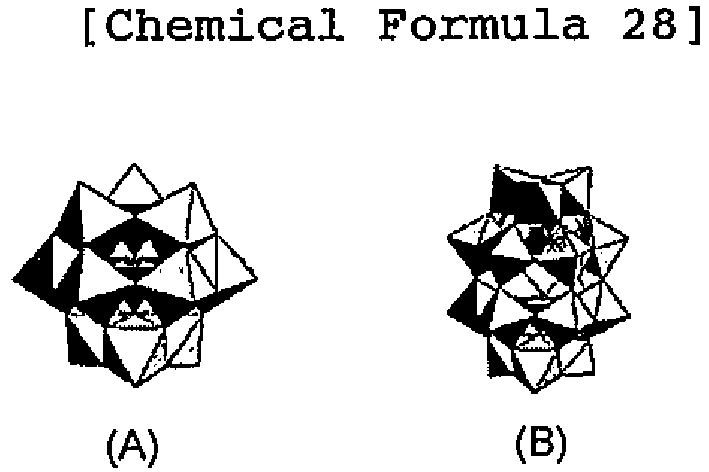
- Specific examples of the heteropoly-acid include phosphomolybdic acid, silicomolybdic acid, phosphotungstic acid, silicotungstic acid, or phosphotungstomolybdic acid, which may be used either singly or in combination of at least two of them. Note that the heteropoly-acids to be used in the present invention are commercially available and can be synthesized by known methods.
- In the present invention, from the viewpoint of enhancing the luminance characteristics of the organic EL element, preferred is phosphomolybdic acid or phosphotungstic acid, and more preferred is phosphotungstic acid.
- Note that in the present invention, even when a quantitative analysis such as elemental analysis shows that a heteropoly-acid has a larger or smaller number of atoms of an element as compared with a structure represented by the general formula for the acid, the heteropoly-acid can be used in the present invention so long as the heteropoly-acid is obtained as a commercialized product or is synthesized appropriately according to a known synthetic method.
- Specifically, for example, phosphotungstic acid is generally represented by the chemical formula H3(PW12O40)·nH2O, while phosphomolybdic acid is generally represented by the chemical formula H3(PMo12O40)·nH2O. Even when a heteropoly-acid has a structure such that the actual number of P (phosphorus), O (oxygen) or W (tungsten) or Mo (molybdenum) in the chemical formula is greater or smaller than the corresponding number in the general chemical formula, the heteropoly-acid can be used in the present invention so long as the heteropoly-acid is obtained as a commercialized product or is synthesized appropriately according to a known synthesizing method. In this case, the weight of the heteropoly-acid prescribed in the present invention does not mean the pure weight of phosphotungstic acid (phosphotungstic acid content) in the synthesized product or commercialized product, but means the total weight, in the state of including hydration water and other impurities, of the heteropoly-acid in the commercially available form and in the isolatable form according to the known synthetic method.
- In the present invention, the weight ratio of the amount of the heteropoly-acid, preferably phosphotungstic acid, to the amount of the oligoaniline compound is set in the range from approximately 2 to approximately 10, preferably from approximately 2.5 to approximately 9.0, whereby a charge-transporting thin film which gives a high luminance when used in an organic EL element can be obtained with good reproducibility.
- In other words, such a charge-transporting varnish ensures that the ratio of the weight (WD) of the heteropoly-acid to the weight (WH) of the oligoaniline compound satisfies 2 ≤ WD/WH ≤ 10, preferably 2.5 ≤ WD/WH ≤ 9.0.
- In addition, the charge-transporting varnish of the present invention may contain a curing agent, for the purpose of enhancing the solvent resistance of the thin film obtained from the varnish.
- Such a curing agent is not specifically restricted, and examples thereof include conventionally known various curing agents such as (meth)acrylate compounds, epoxy compounds, or compounds which have a blocked isocyanate group. Among these, preferred are acrylate-based curing agents such as (meth)acrylate compounds and compositions containing the same, and more preferred are polyfunctional acrylate-based curing agents such as polyfunctional (meth)acrylate compounds and compositions containing the same.
- Specific examples of the acrylate-based curing agent include hexanediol di(meth)acrylate, neopentyl glycol di(meth)acrylate, triethylene glycol di(meth)acrylate, polyethylene glycol di(meth)acrylate, polypropylene glycol di(meth)acrylate, pentaerythritol di(meth)acrylate monostearate, bisphenol A ethylene glycol adduct (meth)aarylate, bisphenol F ethylene glycol adduct (meth)acrylate, tricyclo[5.2.1.02,6]decanemethanol di(meth)acrylate, trishydroxyethyl isocyanurate di(meth)acrylate, trimethylolpropane tri(meth)acrylate, trimethylolpropane ethylene glycol adduct tri(meth)acrylate, trimethylolpropane propylene glycol adduct tri(meth)acrylate, pentaerythritol tri(meth)acrylate, tris(meth)acryloyloxyethyl phosphate, trishydroxyethyl isocyanurate tri(meth)acrylate, modified ε-caprolactone tri(meth)acrylate, trimethylolpropane ethoxy tri(meth)acrylate, glycerine propylene glycol adduct tris(meth)acrylate, pentaerythritol tetra(meth)acrylate, pentaerythritol ethylene glycol adduct tetra(meth)acrylate, ditrimethylolpropane tetra(meth)acrylate, dipentaerythritol hexapenta(meth)acrylate, dipentaerythritolmonohydroxypenta(meth)acrylate, urethane (meth)acrylate, epoxy (meth)acrylate, polyester (meth)acrylate, unsaturated polyester, 9,9-bis[4-(2-acryloyloxyethoxy)phenyl]fluorene, OGSOL EA-0200, OGSOL EA-F5003, OGSOL EA-F5503, and OGSOL EA-F5510 (made by Osaka Gas Chemicals Co., Ltd.), NK-ESTER A-BPEF, and NK-ESTER A-BPEF/PGMAC70 (made by Shin-Nakamura Chemical Co., Ltd.).
- In the case where a curing agent is used, the amount of the curing agent to be used is arbitrarily set so long as it imparts the desired solvent resistance to the thin film obtained and it has no adverse influence on the intrinsic characteristics such as charge-transporting properties of the thin film. The weight ratio of the amount of the curing agent to the total amount of the fluorine-containing charge-transporting substance, the non-fluorine-containing charge-transporting substance and the dopant substance composed of the heteropoly-acid is preferably in the range from approximately 0.01 to approximately 10, more preferably from approximately 0.05 to approximately 5.0, and still more preferably from approximately 0.10 to approximately 2.0.
- As the solvent to be used in preparing the charge-transporting varnish, there can be used a high-solvency solvent capable of favorably dissolving the charge-transporting substances and the dopant substance therein. Examples of such a high-solvency solvent which can be used include such organic solvents as N,N-dimethylformamide, N,N-dimethylacetamide, N-methylpyrrolidone, 1,3-dimethyl-2-imidazolidinone, or diethylene glycol monomethyl ether. These solvents may be used either singly or by mixing at least two of them, the amount of which may be 5 to 100% by weight, based on the total amount of the solvents used in the varnish.
- Note that it is preferable that both the charge-transporting substances and the dopant substance are completely dissolved or uniformly dispersed in the above-mentioned solvent.
- Besides, the charge-transporting varnish of the present invention can contain at least one high-viscosity organic solvent having a viscosity of 10 to 200 mPa·s, particularly 35 to 150 mPa·s at 25°C and a boiling point of 50 to 300°C, particularly 150 to 250°C at normal pressure (atmospheric pressure). The addition of such a solvent makes it easy to prepare a varnish which accords to the coating method used and which gives a highly flat thin film with good reproducibility.
- The high-viscosity organic solvent is not particularly limited, and examples thereof include cyclohexanol, ethylene glycol, 1,3-octylene glycol, diethylene glycol, dipropylene glycol, triethylene glycol, tripropylene glycol, 1,3-butanediol, 2,3-butanediol, 1,4-butanediol, propylene glycol, or hexylene glycol. These solvents may be used either singly or by mixing at least two of them.
- The proportion of the high-viscosity organic solvent added, based on the total amount of the solvents used in the varnish of the present invention, is preferably in such a range that solid precipitation does not occur. The proportion of the high-viscosity organic solvent added is preferably 5 to 80% by weight, provided that solid precipitation does not occur.
- Further, for the purpose of enhancing wettability with respect to a substrate, control of surface tension of the solvent, control of polarity, control of boiling point, etc., other solvents can also be mixed in a proportion of 1 to 90% by weight, preferably 1 to 50% by weight, based on the total amount of the solvents used in the varnish.
- Examples of such solvents include, but are not limited to, ethylene glycol monobutyl ether, diethylene glycol diethyl ether, diethylene glycol dimethyl ether, diethylene glycol monoethyl ether acetate, diethylene glycol monobutyl ether acetate, dipropylene glycol monomethyl ether, propylene glycol monomethyl ether, propylene glycol monomethyl ether acetate, diethylene glycol monoethyl ether, diacetone alcohol, γ-butyrolactone, ethyl lactate, or n-hexyl acetate. These solvents can be used either singly or by mixing at least two of them.
- The viscosity of the varnish of the present invention is appropriately set according to the thickness or the like of the thin film to be produced and the concentration of solid components. The viscosity is normally 1 to 50 mPa·s at 25°C.
- In addition, the concentration of solid components of the charge-transporting varnish in the present invention is appropriately set taking into account the viscosity, surface tension and the like of the varnish, the thickness of the thin film to be produced, and the like. Normally, the concentration of solid components is approximately 0.1 to approximately 10.0% by weight, and, from the viewpoint of enhancing the coating properties of the varnish, the concentration is preferably 0.5 to 5.0% by weight, more preferably 1.0 to 3.0% by weight.
- By applying the charge-transporting varnish of the present invention as above-described onto a substrate and baking the varnish, a charge-transporting thin film can be formed on the substrate.
- The method of applying the varnish is not particularly limited, and examples thereof include a dipping method, a spin coating method, a slit coating method, a transfer printing method, a roll coating method, a brushing method, an ink jet method, or a spraying method. It is preferable to control the viscosity and surface tension of the varnish, according to the coating method (varnish-applying method).
- Besides, in the case of using the varnish of the present invention, a braking atmosphere is also not specifically restricted. Not only in an atmospheric air but also in an inert gas such as nitrogen or in vacuum, it is possible to obtain a thin film which has a uniform film forming surface and charge-transporting properties. From the viewpoint of obtaining a thin film having a high charge-transporting property with good reproducibility, however, the baking atmosphere is preferably the atmospheric air.
- A baking temperature is appropriately set within the range of generally 100 to 260°C, taking into account the use of the thin film to be obtained, the degree of charge-transporting properties to be imparted to the thin film to be obtained, etc. In the case where the thin film is provided between, and in contact with, an anode and a light-emitting layer of an organic EL element and is used as a functional single film (hole injection and transport layer), the baking temperature is preferably approximately 140 to 250°C, more preferably approximately 150 to 230°C. In this case, the baking may be conducted by changing the temperature at at least two stages, for the purpose of realizing a more uniform film-forming property or causing a reaction to progress on the substrate. The heating may well be carried out by use of an appropriate apparatus such as, for example, a hot plate or an oven.
- The thickness of the charge-transporting thin film is not particularly limited. In the case where the charge-transporting thin film is used in an organic EL element, the thickness can be approximately 5 to 200 nm. From the viewpoint of enhancing the degree of phase separation of the two kinds of charge-transporting substances used in the present invention and thereby enhancing the luminance characteristics and lifetime characteristics of the organic EL element, however, the thickness is preferably 10 to 100 nm, more preferably 20 to 50 nm, and still more preferably 25 to 45 nm.
- Examples of a method for varying the film thickness include a method in which the concentration of solid components in the varnish is varied, and a method in which the quantity of the solution on the substrate at the time of coating is varied.
- In the case of producing an organic light-emitting diode (OLED) element by use of the charge-transporting varnish of the present invention, examples of materials to be used and of a method to be used include, but are not limited to, the followings.
- Electrode substrates to be used are preferably cleaned beforehand by preliminarily washing with a detergent, an alcohol, pure water or the like. For example, an anode substrate is preferably subjected to a surface treatment such as a ultraviolet (UV) ozone treatment, or an oxygen-plasma treatment immediately before use. It is to be noted here, however, that such a surface treatment may not necessarily be carried out in the case where the anode material is composed mainly of an organic matter.
- One example of the method of producing an OLED element having a functional single film (hole injection and transport layer) composed of a thin film obtained from the charge-transporting varnish of the present invention is as follows.
- The charge-transporting varnish of the present invention is applied onto an anode substrate, and is baked by the above-mentioned method, to produce a functional single film on the electrode. This assembly is introduced into a vapor deposition apparatus, and then a light-emitting layer, an electron transport layer, an electron injection layer, and a cathode metal are sequentially vapor-deposited, to obtain an OLED element. A carrier blocking layer may be provided between arbitrary ones of the layers, for the purpose of controlling a light emission region.
- Examples of the anode material include transparent electrodes typified by indium tin oxide (ITO) and indium zinc oxide (IZO). The anode material has preferably been subjected to a flattening treatment beforehand. Polythiophene derivatives and polyaniline derivatives which have high charge-transporting properties can also be used.
- Examples of a material for forming the light-emitting layer include tris(8-quinolinolato)aluminum(III) (Alq3), bis(8-quinolinolato)zinc(II) (Znq2), bis(2-methyl-8-quinollnolato)(p-phenylphenolato)aluminum(III) (BAlq), and 4,4'-bis(2,2-diphenylvinyl)biphenyl (DPVBi). The light-emitting layer may be formed by co-evaporation of an electron-transporting material or a hole-transporting material together with a light-emitting dopant.
- Examples of the electron-transporting material include Alq3, BAlq, DPVBi, (2-(4-biphenyl)-5-(4-t-butylphenyl)-1,3,4-oxadiazole) (PBD), triazole derivatives (TAZ), bathocuproine (BCP), or silole derivatives.
- Examples of the light-emitting dopant include quinacridone, rubrene, Coumarin 540, 4-(dicyanomethylene)-2-methyl-6-(p-dimethylaminostyryl)-4H-pyran (DCM), tris(2-phenylpyridine)iridlum(III) (Ir(ppy)3), or (1,10-phenanthroline)-tris(4,4,4-trifluoro-1-(2-thienyl)-butane-1,3-dionato)europium(III) (Eu(TTA)3phen).
- Examples of a material for forming the carrier blocking layer include PBD, TAZ, or BCP.
- Examples of a material for forming the electron injection layer include lithium oxide (Li2O), magnesium oxide (MgO), alumina (Al2O3), lithium fluoride (LiF), magnesium fluoride (MgF2), strontium fluoride (SrF2), Liq, Li(acac), lithium acetate, or lithium benzoate.
- Examples of the cathode material include aluminum, magnesium-silver alloys, aluminum-lithium alloys, lithium, sodium, potassium, or cesium.
- The method of producing a polymer light-emitting diode (PLED) element by use of the charge-transporting varnish of the present invention is not particularly limited, and examples thereof include the following method.
- A PLED element having a functional single film (hole injection and transport layer) composed of a thin film obtained from the charge-transporting varnish of the present invention can be produced by forming a light-emitting polymer layer, in place of the operation of carrying out vapor deposition to form the light-emitting layer, the electron transport layer, and the electron injection layer in the above-mentioned OLED element production.
- Specifically, the charge-transporting varnish of the present invention is applied onto an anode substrate to form the functional single film by the above-mentioned method, then the light-emitting polymer layer is formed thereon, and, further, a cathode is vapor-deposited, to obtain the PLED element.
- As the cathode and anode materials to be used, the same materials as above-mentioned OLED element production can be used, and they can be subjected to the same cleaning treatment and surface treatment as above-mentioned OLED element production.
- Examples of the method for forming the light-emitting polymer layer include a method in which a light-emitting polymer material or an admixture thereof with a dopant substance is admixed with a solvent to dissolve or uniformly disperse the polymer material (and the dopant, if used) in the solvent, and the resulting solution is applied onto the functional single film, followed by baking to form the desired film.
- Examples of the light-emitting polymer material include polyfluorene derivatives such as poly(9,9-dialkylfluorenes) (PDAF), polyphenylenevinylene derivatives such as poly(2-methoxy-5-(2'-ethylhexoxy)-1,4-phenylenevinylene) (MEH-PPV), polythiophene derivatives such as poly(3-alkylthiophenes) (PAT), or polyvinylcarbazole (PVCz).
- Examples of the solvent include toluene, xylene, or chloroform. Examples of the method for dissolution or uniform dispersion include such a method as stirring, stirring with heating, or ultrasonic dispersion.
- The coating method is not particularly limited. Examples of the coating method include an ink jet method, a spraying method, a dipping method, a spin coating method, a transfer printing method, a roll coating method, or a brushing method. Note that the coating is preferably conducted in an inert gas such as nitrogen or argon.
- Examples of a baking method include a method of heating in an inert gas or in vacuum by use of an oven or a hot plate.
- The present invention will be described more specifically below by illustrating Synthesis Examples, Examples and Comparative Examples, but the invention is not limited to the following Examples. Note that the apparatuses which were used are as follows.
- (1) NMR: ECX-300, made by JEOL Ltd.
- (2) LC/MS: ZQ 2000, made by Waters Corporation
- (3) Substrate cleaning:
- Substrate cleaning apparatus (vacuum plasma system),
- made by Choshu Industry Co., Ltd.
- (4) Application of varnish:
- Spin coater MS-A100, made by Mikasa Co., Ltd.
- (5) Film thickness measurement:
- Microfigure measuring instrument SURF-CORDER ET-4000,
- made by Kosaka Laboratory Ltd.
- (6) Polymer molecular weight measurement:
- Column: SHODEX GPC KF-803L + GPC KF-804L,
- made by Shimadzu Corporation, column temperature: 40°C,
- detector: UV detector (254 nm) and radioisotope (RI)
- detector, eluent: THF, column flow rate: 1.0 ml/minute
- (7) Production of EL element:
- Multifunction deposition apparatus system C-E2L1G1-N,
- made by Choshu Industry Co., Ltd.
- (8) Measurement of luminance, etc. of EL element:
- I-V-L measurement system, made by Tech World Inc.
-

- To 170 mL of an acetonitrile solution containing 8.65 g (50 mmol) of 3-bromophenol, were added 7.60 g (55 mmol) of potassium carbonate and 9,535 µL (55 mmol) of diethylene glycol 2-bromoethyl methyl ether, followed by stirring at room temperature for 18 hours and heating at reflux for seven hours. To the resulting suspension were added 1.50 g (10 mmol) of potassium carbonate and 1,900 µL (10 mmol) of diethylene glycol 2-bromoethyl methyl ether, followed by further heating at reflux for four hours. After the reaction was over, the insoluble matter was removed by filtration, and the filtrate was concentrated to obtain a crude product, which was purified by silica gel column chromatography (eluent: hexane/ethyl acetate), to obtain 16.13 g of a colorless liquid compound 1 (yield: 100%).
1H-NMR (300 MHz, CDCl3): - δ 3.38 (s, 3H), 3.53-3.58 (m, 2H), 3.64-3.75 (m, 6H), 3.84 (app t, J = 4.8 Hz, 2H), 4.11 (app t, J = 4.8 Hz, 2H), 6.83-6.87 (m, 1H), 7.05-7.16 (m, 3H).
-

- To 70 mL of a toluene suspension containing 4.88 g (14.5 mmol) of N,N'-diphenylbenzidine and 11.15 g (35 mmol) of the compound 1 obtained in Synthesis Example 1, were added 834 mg (1.5 mmol) of Pd(dba)2, 4.18 g (43.5 mmol) of t-BuONa, 841 mg (2.9 mmol) of [(t-Bu)3PH]BF4 and 30 mL of toluene, followed by flushing with nitrogen, and heating at reflux for three hours. After the reaction was over, celite filtration was conducted, and the filtrate was concentrated to obtain a crude product, which was purified by silica gel column chromatography (eluent: hexane/ethyl acetate), to obtain 12.06 g of a brown liquid compound 2 (yield: 100%).
1H-NMR (300 MHz, CDCl3): - δ 3.36 (s, 6H), 3.52-3.55 (m, 4H), 3.62-3.73 (m, 12H), 3.80 (app t, J = 4.8 Hz, 4H), 4.04 (app t, J = 4.8 Hz, 4H), 6.57-6.59 (m, 2H), 6.68-6.71 (m, 4H), 7.02 (app t, J = 7.2 Hz, 2H), 7.11-7.17 (m, 10H), 7.23-7.28 (m, 4H), 7.44 (d, J = 8.7 Hz, 4H).
-

- To 173 mL of an acetonitrile solution containing 8.65 g (50 mmol) of 4-bromophenol and 19.1 g (60 mmol) of 2-(2-(2-methoxyethoxy)ethoxy)ethyl p-toluenesulfonate synthesized by the method described in Macromolecules vol. 34, 2001, p.931, was added 8.29 g (60 mmol) of potassium carbonate, followed by heating at reflux for 23 hours. After the reaction was over, the insoluble matter was removed by filtration, and the filtrate was concentrated to obtain a crude product, which was purified by silica gel column chromatography [eluent: hexane/ethyl acetate (2/1 → 1/1 (v/v))], to obtain 15.24 g of a colorless liquid compound 3 (yield: 95%).
1H-NMR (300 MHz, CDCl3) : - δ 3.38 (s, 3H), 3.53-3.58 (m, 2H), 3.63-3.75 (m, 6H), 3.84 (app t, J = 4.8 Hz, 2H), 4.09 (app t, J = 4.8 Hz, 2H), 6.79 (d, J = 9.3 Hz, 2H), 7.35 (d, J = 9.0 Hz, 2H).
-

- Using 4.73 g (14.1 mmol) of N,N'-diphenylbenzidine, 10.77 g (33.7 mmol) of the compound 3 obtained in Synthesis Example 3, 808 mg (1.4 mmol) of Pd(dba)2, 4.05 g (42 mmol) of t-BuONa, and 670 µL (2.8, mmol) of di-t-butylphenylphosphine, synthesis was conducted by the same procedure as in Synthesis Example 2, to obtain 11.35 g of a brown liquid compound 4 (yield: 99%).
1H-NMR (300 MHz, CDCl3) : - δ 3.38 (s, 6H), 3.54-3.57 (m, 4H), 3.65-3.77 (m, 12H), 3.86 (app t, J = 4.8 Hz, 4H), 4.12 (app t, J = 4.8 Hz, 4H), 6.86 (d, J = 9.0 Hz, 4H), 6.96 (t, J = 7.2 Hz, 2H), 7.04-7.10 (m, 12H), 7.20-7.25 (m, 4H), 7.40 (d, J = 8.7 Hz, 4H).
-

- Using 1 g (5.8 mmol) of 3-bromophenol, 2.54 g (9.2 mmol) of 2-(2-methoxyethoxy)ethyl p-toluenesulfonate synthesized by the method described in Macromolecules vol. 34, 2001, p. 931, and 1.28 g (9.2 mmol) of potassium carbonate, synthesis was conducted by the same procedure as in Synthesis Example 3, to obtain 1.38 g of a colorless liquid compound 5 (yield: 87%).
1H-NMR (300 MHz, CDCl3) : - δ 3.39 (s, 3H), 3.56-3.59 (m, 2H), 3.70-3.74 (m, 2H), 3.85 (app t, J = 4.8 Hz, 2H), 4.12 (app t, J = 4.8 Hz, 2H), 6.84 (ddd, J = 1.5, 2.4, 7.8 Hz, 2H), 7.05-7.15 (m, 3H).
-

- Using 703 mg (2.1 mmol) of N,N'-diphenylbenzidine, 1.38 g (5 mmol) of the compound 5 obtained in Synthesis Example 5, 121 mg (0.21 mmol) of Pd(dba)2, 600 mg (6.3 mmol) of t-BuONa, and 100 µL (0.42 mmol) of di-t-butylphenylphosphine, synthesis was conducted by the same procedure as in Synthesis Example 2, to obtain 1.52 g of a brown liquid compound 6 (yield: 100%).
1H-NMR (300 MHz, CDCl3): - δ 3.37 (s, 6H), 3.54-3.57 (m, 4H), 3.67-3.70 (m, 4H), 3.80 (app t, J = 4.8 Hz, 4H), 4.05 (app t, J = 4.5 Hz, 4H), 6.56-6.59 (m, 2H), 6.68-6.71 (m, 4H), 7.02 (app t, J = 7.2 Hz, 2H), 7.10-7.17 (m, 10H), 7.23-7.28 (m, 4H), 7.44 (d, J = 8.7 Hz, 4H).
-

- 4 g of 1,4-dioxane was added to 0.96 g (3.9 mmol) of triphenylamine, 1.06 g (1.3 mmol) of the compound 2 obtained in Synthesis Example 2, 0.09 g (0.52 mmol) of 4-trifluoromethylbenzaldehyde, 0.84 g (4.68 mmol) of 9-fluorenone and 0.99 g (5.2 mmol) of p-toluenesulfonic acid monohydrate, followed by heating at reflux for eight hours and cooling to room temperature. After the cooling, the reaction mixture was diluted by addition of 12 mL of tetrahydrofuran, the admixture was added dropwise to methanol (100 mL)/28% aqueous ammonia (20 mL), followed by stirring for one hour. The precipitated powder was collected by filtration under reduced pressure, and was dissolved in 15 mL of toluene. The resulting solution was added dropwise to 120 mL of methanol, followed by stirring for one hour. The precipitated powder was collected by filtration under reduced pressure, and was vacuum dried to obtain 2.04 g of a polymer 1.
- Mw (GPC) = 3,400
- Mn (GPC) = 1,400
- Mw/Mn = 2.4
-

- Using 1.47 g (3.0 mmol) of N,N,N',N'-tetraphenylbenzidine, 0.81 g (1.0 mmol) of the compound 2 obtained in Synthesis Example 2, 0.14 g (0.8 mmol) of 4-trifluoromethylbenzaldehyde, 1.30 g (7.2 mmol) of 9-fluorenone and 0.76 g (4.0 mmol) of p-toluenesulfonic acid monohydrate, synthesis was conducted by the same procedure as in Synthesis Example 7, to obtain 2.18 g of a polymer 2.
- Mw (GPC) = 4,500
- Mn (GPC) = 2,900
- Mw/Mn = 1.6
-

- Using 0.59 g (2.4 mmol) of triphenylamine, 0.65 g (0.8 mmol) of the compound 4 obtained in Synthesis Example 4, 55.7 mg (0.32 mmol) of 4-trifluoromethylbenzaldehyde, 0.52 g (2.9 mmol) of 9-fluorenone and 0.61 g (3.2 mmol) of p-toluenesulfonic acid monohydrate, synthesis was conducted by the same procedure as in Synthesis Example 7, to obtain 1.24 g of a polymer 3.
- Mw (GPC) = 3,300
- Mn (GPC) = 2,200
- Mw/Mn = 1.6
-

- Using 0.59 g (2.4 mmol) of triphenylamine, 0.58 g (0.8 mmol) of the compound 6 obtained in Synthesis Example 6, 55.7 mg (0.32 mmol) of 4-trifluoromethylbenzaldehyde, 0.52 g (2.9 mmol) of 9-fluorenone and 0.49 g (2.6 mmol) of p-toluenesulfonic acid monohydrate, synthesis was conducted by the same procedure as in Synthesis Example 7, to obtain 1.20 g of a polymer 4.
- Mw (GPC) = 4,300
- Mn (GPC) = 2,200
- Mw/Mn = 2.0
- In a nitrogen circulation type glove box, 2.5 g of 1,3-dimethylimidazolidinone was added to a mixture of 90 mg of the polymer 1 obtained in Synthesis Example 7, 20 mg of an oligoaniline compound 1 synthesized according to the method described in
WO 2013/084664 and 100 mg of phosphotungstic acid (made by Kanto Chemical Co., Inc.), followed by stirring with heating at 50°C, to effect dissolution. To the resulting solution was added 2.5 g of cyclohexanol, followed by stirring, to obtain a green solution. The solution was filtered through a syringe filter having a pore diameter of 0.2 µm, to obtain a charge-transporting varnish A.
- A charge-transporting varnish was prepared by the same method as in Example 1, except that 90 mg of the polymer obtained in Synthesis Example 8 was used in place of the polymer 1.
- A charge-transporting varnish was prepared by the same method as in Example 1, except that 90 mg of the polymer 3 obtained in Synthesis Example 9 was used in place of the polymer 1.
- A charge-transporting varnish was prepared by the same method as in Example 1, except that 90 mg of the polymer 4 obtained in Synthesis Example 10 was used in place of the polymer 1.
- A charge-transporting varnish was prepared by the same method as in Example 1, except that the polymer 1 was not used and that the oligoaniline compound 1 and the phosphotungstic acid were used in amounts of 20 mg and 100 mg, respectively.
- As a substrate at the time of evaluating electrical characteristics, a 25 mm × 25 mm × 0.7 (t) glass substrate provided on its surface with a pattern of indium tin oxide in a thickness of 150 nm (hereinafter referred to simply as ITO substrate) was used. The ITO substrate was used after impurities on the surface thereof were removed by an O2 plasma cleaning apparatus (150 W, 30 seconds).
- The charge-transporting varnish A obtained in Example 1 was applied to the ITO substrate by use of a spin coater, followed by drying at 80°C for one minute and, further, baking at 230°C for 15 minutes, to form a 35 nm-thick uniform thin film on the ITO substrate.
- Next, thin films of tris(8-quinolinolato)aluminum(III) (Alq3), lithium fluoride, and aluminum were sequentially layered over the ITO substrate (having been provided thereon with the thin film) by use of a vapor deposition apparatus (vacuum degree 1.0×10⁻⁵ Pa), to obtain an OLED element. In this case, the vapor deposition rate was 0.2 nm/second for Alq3 and aluminum, and 0.02 nm/second for lithium fluoride. The thicknesses of the thin films were 40 nm, 0.5 nm, and 100 nm, respectively.
- Note that for preventing characteristics of the OLED element from being deteriorated under the influences of oxygen, moisture and the like in air, the OLED element was sealed by use of sealing substrates, before evaluation of the characteristics. The sealing was conducted according to the following procedure.
- In a nitrogen atmosphere having an oxygen concentration of up to 2 ppm and a dew point of up to -85°C, the organic EL element was placed between the sealing substrates, and the sealing substrates were laminated together using an adhesive (MORESCO MOITURE CUT WB90US(P), made by Moresco Corporation). In this case, a desiccant (HD-071010W-40, made by Dynic Corporation) was placed together with the OLED element inside the sealing substrates.
- The adhesive was cured by irradiating the laminated sealing substrates with UV light (wavelength: 365 nm, dosage: 6,000 mJ/cm2), and annealing at 80°C for one hour.
- An OLED element was produced by the same method as in Example 5, except that the charge-transporting varnish B obtained in Example 2 was used in place of the charge-transporting varnish A.
- An OLED element was produced by the same method as in Example 5, except that the charge-transporting varnish C obtained in Example 3 was used in place of the charge-transporting varnish A.
- An OLED element was produced by the same method as in Example 5, except that the charge-transporting varnish D obtained in Example 4 was used in place of the charge-transporting varnish A.
- An OLED element was produced by the same method as in Example 5, except that the charge-transporting varnish E obtained in Comparative Example 1 was used in place of the charge-transporting varnish A.
- The OLED elements obtained in Examples 5 to 8 and Comparative Example 2 were put to measurements of electrical characteristics. Current density, luminance and current efficiency at a driving voltage of 7 V are set forth in Table 1.
[Table 1] Current density (mA/cm2) Luminance (cd/m2) Current efficiency (cd/A) Example 5 798 15,100 1.9 Example 6 306 5,625 1.9 Example 7 491 4,365 0.9 Example 8 263 4,900 1.9 Comparative Example 2 3,425 611 0.0 - As depicted in Table 1, it was seen that in Comparative Example 2 wherein the charge-transporting varnish E containing none of the polymers 1 to 4 added thereto was used, the current density was conspicuously low, and the luminance was low as compared to the current density.
- Thus, it is seen that by addition of any one of the polymers 1 to 4 to the charge-transporting varnish, it is possible to enhance the current efficiency and luminance of the OLED element obtained.
Claims (18)
- A charge-transporting varnish comprising: a fluorine-containing charge-transporting substance; a non-fluorine-containing charge-transporting substance; a dopant substance composed of a heteropoly-acid; and an organic solvent,
wherein the fluorine-containing charge-transporting substance is a polymer which has a weight average molecular weight of 500 to 200,000 and which is obtained by condensing: at least one compound selected from triarylamine compounds and N,N,N',N'-tetraarylbenzidine compounds; an N,N,N',N'-tetraarylbenzidine compound having at least one aryl group substituted with an alkoxy group which may include an ether linkage; a fluorine-containing aryl aldehyde compound; and a fluorene derivative having a carbonyl group, and
the non-fluorine-containing charge-transporting substance is an oligoaniline compound. - The charge-transporting varnish according to claim 1, wherein the fluorine-containing charge-transporting substance is a polymer obtained by condensing: at least one compound selected from triarylamine compounds represented by formula (1) and N,N,N',N'-tetraarylbenzidine compounds represented by formula (2); an N,N,N',N'-tetraarylbenzidine compound represented by formula (3); a fluorine-containing aryl aldehyde compound represented by formula (4); and a fluorene derivative having a carbonyl group that is represented by formula (5) or formula (6):
 wherein Ar1 to Ar7 each independently represent an aryl group which has 6 to 20 carbon atoms and may be substituted with Z1, provided that at least one of ring-forming carbon atoms in each of Ar1 to Ar3 is unsubstituted, and at least one of ring-forming carbon atoms in each of Ar4 to Ar7 is unsubstituted,Ar8 to Ar11 each independently represent an aryl group which has 6 to 20 carbon atoms and may be substituted with Z2, provided that at least one of ring-forming carbon atoms in at least two of Ar8 to Ar11 is unsubstituted, and at least one of Ar8 to Ar11 is substituted with Z2,Ar12 represents an aryl group which has 6 to 20 carbon atoms and is substituted with at least one Z3 and which may be substituted with Z4,R1 to R8 each independently represent a hydrogen atom, a halogen atom, a nitro group, a cyano group, or an alkyl group having 1 to 20 carbon atoms, alkenyl group having 2 to 20 carbon atoms or alkynyl group having 2 to 20 carbon atoms which may be substituted with Z5,R9 and R10 each independently represent a hydrogen atom, an alkyl group having 1 to 20 carbon atoms, (poly)ethylene oxide group having 2 to 20 carbon atoms, alkenyl group having 2 to 20 carbon atoms or alkynyl group having 2 to 20 carbon atoms which may be substituted with Z5, or an alkyl group which has 1 to 20 carbon atoms and is substituted with an ethenyl group or an ethynyl group and which may be substituted with Z5,Z1 represents a halogen atom, a nitro group, a cyano group, or an alkyl group having 1 to 20 carbon atoms, alkenyl group having 2 to 20 carbon atoms or alkynyl group having 2 to 20 carbon atoms which may be substituted with Z5,Z2 represents an alkoxy group which has 1 to 20 carbon atoms and may include an ether linkage,Z3 represents a fluorine atom, a fluorinated alkyl group having 1 to 20 carbon atoms, or a fluorinated aryl group having 6 to 20 carbon atoms,Z4 represents a chlorine atom, a bromine atom, an iodine atom, a nitro group, a cyano group, or an alkyl group having 1 to 20 carbon atoms, alkenyl group having 2 to 20 carbon atoms or alkynyl group having 2 to 20 carbon atoms which may be substituted with Z6,Z5 represents a halogen atom, a nitro group, or a cyano group, andZ6 represents a chlorine atom, a bromine atom, an iodine atom, a nitro group, or a cyano group.
 - The charge-transporting varnish according to claim 2, wherein the triarylamine compound is a triphenylamine derivative represented by formula (7):

- The charge-transporting varnish according to claim 2, wherein the N,N,N',N'-tetraarylbenzidine compound represented by the formula (2) is represented by formula (8):

- The charge-transporting varnish according to claim 2, wherein the N,N,N',N'-tetraarylbenzidine compound represented by the formula (3) is represented by formula (9-1):

- The charge-transporting varnish according to claim 5, wherein the N,N,N',N'-tetraarylbenzidine compound represented by the formula (3) is represented by formula (9-2):

- The charge-transporting varnish according to claim 6, wherein the N,N,N',N'-tetraarylbenzidine compound represented by the formula (3) is represented by any one of formulas (10-1) to (10-8).
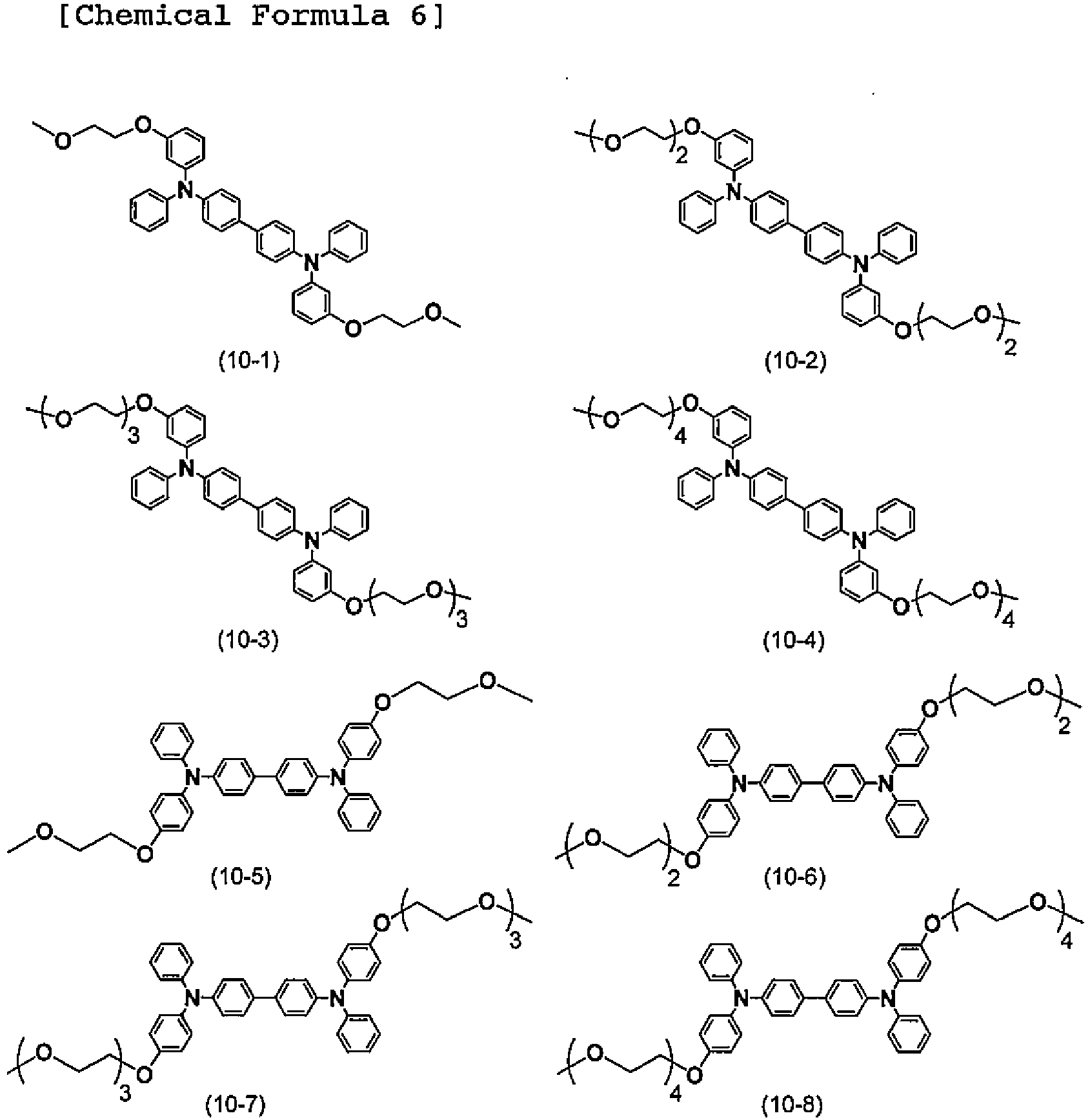
- The charge-transporting varnish according to claim 7, wherein the N,N,N',N'-tetraarylbenzidine compound represented by the formula (3) is represented by the formula (10-7).
- The charge-transporting varnish according to any one of claims 2 to 8, wherein the aryl aldehyde compound is represented by formula (11) or formula (12):
 wherein R39 represents a fluorine atom or a fluorinated alkyl group having 1 to 20 carbon atoms,R40 to R43 each independently represent a hydrogen atom, a nitro group, a cyano group, or an alkyl group which has 1 to 20 carbon atoms and may be substituted with a nitro group or a cyano group, andR44 to R48 each independently represent a fluorine atom or a fluorinated alkyl group having 1 to 20 carbon atoms.
 - The charge-transporting varnish according to any one of claims 1 to 9, wherein the oligoaniline compound is represented by formula (13);
 wherein R49 to R54 each independently represent a hydrogen atom, a halogen atom (exclusive of a fluorine atom), a nitro group, a cyano group, an alkyl group having 1 to 20 carbon atoms, alkenyl group having 2 to 20 carbon atoms or alkynyl group having 2 to 20 carbon atoms which may be substituted with Z7, an aryl group having 6 to 20 carbon atoms or heteroaryl group having 2 to 20 carbon atoms which may be substituted with Z8, a -NHY2, -NY3Y4, -C(O)Y5, -OY6, -SY7, -SO3Y8, -C(O)OY9, -OC(O)Y10, -C(O)NHY11, or -C(O)NY12Y13 group,Y2 to Y13 each independently represent an alkyl group having 1 to 20 carbon atoms, alkenyl group having 2 to 20 carbon atoms or alkynyl group having 2 to 20 carbon atoms which may be substituted with Z7, or an aryl group having 6 to 20 carbon atoms or heteroaryl group having 2 to 20 carbon atoms which may be substituted with Z8,X1 represents -NY1-, -O-, -S-, -(CR55R56)1- or a single bond, where R55 and R56 have the same meaning as the R49,letter 1 is an integer of 1 to 20,Y1 each independently represents a hydrogen atom, an alkyl group having 1 to 20 carbon atoms, alkenyl group having 2 to 20 carbon atoms or alkynyl group having 2 to 20 carbon atoms which may be substituted with Z7, or an aryl group having 6 to 20 carbon atoms or heteroaryl group having 2 to 20 carbon atoms which may be substituted with Z8,Z7 represents a halogen atom (exclusive of a fluorine atom), a nitro group, a cyano group, or an aryl group having 6 to 20 carbon atoms or heteroaryl group having 2 to 20 carbon atoms which may be substituted with Z9,Z8 represents a halogen atom (exclusive of a fluorine atom), a nitro group, a cyano group, or an alkyl group having 1 to 20 carbon atoms, alkenyl group having 2 to 20 carbon atoms or alkynyl group having 2 to 20 carbon atoms which may be substituted with Z9,Z9 represents a halogen atom (exclusive of a fluorine atom), a nitro group or a cyano group, andletters m and n are each independently an integer of 1 to 10, satisfying m+n ≤ 10.
 - The charge-transporting varnish according to any one of claims 1 to 10, wherein the heteropoly-acid is phosphotungstic acid.
- A charge-transporting thin film produced by use of the charge-transporting varnish according to any one of claims 1 to 11.
- An organic electroluminescent element comprising the charge-transporting thin film according to claim 12.
- An organic electroluminescent element comprising at least an anode, a cathode, a light-emitting layer, and the charge-transporting thin film according to claim 12,
wherein the charge-transporting thin film is provided between, and in contact with, the anode and the light-emitting layer. - A method of producing a charge-transporting thin film, characterized by applying the charge-transporting varnish according to any one of claims 1 to 11 onto a substrate, and evaporating the solvent.
- A method of producing an organic electroluminescent element, wherein the charge-transporting thin film according to claim 12 is used.
- A polymer which has a weight average molecular weight of 500 to 200,000 and which is obtained by condensing: at least one compound selected from triarylamine compounds represented by formula (1) and N,N,N',N'-tetraarylbenzidine compounds represented by formula (2); an N,N,N',N'-tetraarylbenzidine compound represented by formula (3); a fluorine-containing aryl aldehyde compound represented by formula (4); and a fluorene derivative having a carbonyl group that is represented by formula (5) or formula (6); and
 wherein Ar1 to Ar7 each independently represent an aryl group which has 6 to 20 carbon atoms and may be substituted with Z1, provided that at least one of ring-forming carbon atoms in each of Ar1 to Ar3 is unsubstituted, and at least one of ring-forming carbon atoms in each of Ar4 to Ar7 is unsubstituted,Ar8 to Ar11 each independently represent an aryl group which has 6 to 20 carbon atoms and may be substituted with Z2, provided that at least one of ring-forming carbon atoms in at least two of Ar8 to Ar11 is unsubstituted, and at least one of Ar8 to Ar11 is substituted with Z2,Ar12 represents an aryl group which has 6 to 20 carbon atoms and is substituted with at least one Z3 and which may be substituted with Z4,R1 to R8 each independently represent a hydrogen atom, a halogen atom, a nitro group, a cyano group, or an alkyl group having 1 to 20 carbon atoms, alkenyl group having 2 to 20 carbon atoms or alkynyl group having 2 to 20 carbon atoms which may be substituted with Z5,R9 and R10 each independently represent a hydrogen atom, an alkyl group having 1 to 20 carbon atoms, (poly)ethylene oxide group having 2 to 20 carbon atoms, alkenyl group having 2 to 20 carbon atoms or alkynyl group having 2 to 20 carbon atoms which may be substituted with Z5, or an alkyl group which has 1 to 20 carbon atoms and is substituted with an ethenyl group or an ethynyl group and which may be substituted with Z5,Z1 represents a halogen atom, a nitro group, a cyano group, or an alkyl group having 1 to 20 carbon atoms, alkenyl group having 2 to 20 carbon atoms or alkynyl group having 2 to 20 carbon atoms which may be substituted with Z5,Z2 represents an alkoxy group which has 1 to 20 carbon atoms and may include an ether linkage,Z3 represents a fluorine atom, a fluorinated alkyl group having 1 to 20 carbon atoms, or a fluorinated aryl group having 6 to 20 carbon atoms,Z4 represents a chlorine atom, a bromine atom, an iodine atom, a nitro group, a cyano group, or an alkyl group having 1 to 20 carbon atoms, alkenyl group having 2 to 20 carbon atoms or alkynyl group having 2 to 20 carbon atoms which may be substituted with Z6,Z5 represents a halogen atom, a nitro group, or a cyano group, andZ6 represents a chlorine atom, a bromine atom, an iodine atom, a nitro group, or a cyano group.
 - N,N,N',N'-tetraphenylbenzidine compounds represented by the formula (9-1):

Applications Claiming Priority (3)
| Application Number | Priority Date | Filing Date | Title |
|---|---|---|---|
| JP2014065278 | 2014-03-27 | ||
| JP2014141988 | 2014-07-10 | ||
| PCT/JP2015/058849 WO2015146957A1 (en) | 2014-03-27 | 2015-03-24 | Charge-transporting varnish |
Publications (3)
| Publication Number | Publication Date |
|---|---|
| EP3124563A1 true EP3124563A1 (en) | 2017-02-01 |
| EP3124563A4 EP3124563A4 (en) | 2018-01-03 |
| EP3124563B1 EP3124563B1 (en) | 2019-01-23 |
Family
ID=54195470
Family Applications (1)
| Application Number | Title | Priority Date | Filing Date |
|---|---|---|---|
| EP15767949.9A Ceased EP3124563B1 (en) | 2014-03-27 | 2015-03-24 | Charge-transporting varnish |
Country Status (6)
| Country | Link |
|---|---|
| EP (1) | EP3124563B1 (en) |
| JP (2) | JP6648692B2 (en) |
| KR (1) | KR102372211B1 (en) |
| CN (1) | CN106133075B (en) |
| TW (1) | TWI666278B (en) |
| WO (1) | WO2015146957A1 (en) |
Families Citing this family (5)
| Publication number | Priority date | Publication date | Assignee | Title |
|---|---|---|---|---|
| WO2017195559A1 (en) * | 2016-05-10 | 2017-11-16 | 日立化成株式会社 | Charge transport material, organic electronic element and organic electroluminescent element |
| JP7032740B2 (en) * | 2017-02-08 | 2022-03-09 | 国立大学法人山形大学 | Compositions and organic photoelectronic devices and methods for manufacturing them |
| US20200339825A1 (en) * | 2017-12-20 | 2020-10-29 | Nissan Chemical Corporation | Charge transporting varnish and charge transporting thin film |
| CN112789298B (en) * | 2018-09-28 | 2024-04-30 | 日产化学株式会社 | Polymers and their applications |
| WO2020122113A1 (en) * | 2018-12-13 | 2020-06-18 | 日産化学株式会社 | Charge-transporting varnish |
Family Cites Families (25)
| Publication number | Priority date | Publication date | Assignee | Title |
|---|---|---|---|---|
| JPS63223651A (en) * | 1987-03-12 | 1988-09-19 | Konica Corp | Electrophotographic sensitive body |
| JPH01257953A (en) * | 1988-04-08 | 1989-10-16 | Fuji Xerox Co Ltd | Electrophotographic sensitive body |
| JP2957286B2 (en) * | 1990-12-26 | 1999-10-04 | 三井化学株式会社 | Photoconductor |
| DE69231149T2 (en) * | 1991-12-30 | 2000-10-19 | Xerox Corp., Rochester | Single layer photoreceptor |
| JP3194657B2 (en) * | 1993-11-01 | 2001-07-30 | 松下電器産業株式会社 | EL device |
| WO1997033193A2 (en) * | 1996-02-23 | 1997-09-12 | The Dow Chemical Company | Cross-linkable or chain extendable polyarylpolyamines and films thereof |
| US6025102A (en) * | 1997-08-19 | 2000-02-15 | Xerox Corporation | Electrophotographic imaging member |
| JP4749591B2 (en) * | 2000-04-28 | 2011-08-17 | 東北パイオニア株式会社 | Organic electroluminescence device having liquid crystal display function and liquid crystal material |
| US20010048982A1 (en) * | 2000-04-28 | 2001-12-06 | Tohoku Pioneer Corporation | Organic electroluminescent display device and chemical compounds for liquid crystals |
| JP2002075644A (en) * | 2000-08-28 | 2002-03-15 | Fuji Xerox Co Ltd | Organic electroluminescent device |
| TW200415954A (en) * | 2002-11-07 | 2004-08-16 | Nissan Chemical Ind Ltd | Charge-transporting varnish |
| JP2004210693A (en) * | 2002-12-27 | 2004-07-29 | Nitto Denko Corp | Organic photoconductive compound and photorefractive material using the same |
| DE10340711A1 (en) * | 2003-09-04 | 2005-04-07 | Covion Organic Semiconductors Gmbh | Electronic device containing organic semiconductors |
| KR101267124B1 (en) * | 2005-02-07 | 2013-05-23 | 이데미쓰 고산 가부시키가이샤 | Aromatic amine derivative and organic electroluminescent device using same |
| JP4600116B2 (en) * | 2005-03-28 | 2010-12-15 | 富士ゼロックス株式会社 | Image forming apparatus, process cartridge, and image forming method |
| EP1905804B1 (en) * | 2005-06-03 | 2013-08-07 | Nissan Chemical Industries, Ltd. | Charge-transporting varnishes containing charge-transporting polymers and organic electroluminescent devices made by using the same |
| JP2007208102A (en) * | 2006-02-03 | 2007-08-16 | Konica Minolta Holdings Inc | Organic electroluminescence element, display device and lighting device |
| JP5298460B2 (en) * | 2006-06-08 | 2013-09-25 | コニカミノルタ株式会社 | Organic electroluminescence element, display device and lighting device |
| EP2042484B1 (en) * | 2006-07-18 | 2012-09-05 | Nissan Chemical Industries, Ltd. | Charge-transporting varnish |
| JP5470706B2 (en) * | 2007-01-25 | 2014-04-16 | 三菱化学株式会社 | Hole transport material, polymer compound obtained by polymerizing the hole transport material, composition for organic electroluminescence device, and organic electroluminescence device |
| WO2010041701A1 (en) * | 2008-10-09 | 2010-04-15 | 日産化学工業株式会社 | Charge-transporting varnishes |
| WO2010058777A1 (en) * | 2008-11-19 | 2010-05-27 | 日産化学工業株式会社 | Charge transporting material and charge transporting varnish |
| EP2355197B1 (en) * | 2008-11-19 | 2019-10-09 | Nissan Chemical Corporation | Charge-transporting material and charge-transporting varnish |
| JP2010225950A (en) * | 2009-03-25 | 2010-10-07 | Toyo Ink Mfg Co Ltd | Organic electroluminescence device using polymer |
| WO2014132917A1 (en) * | 2013-02-28 | 2014-09-04 | 日産化学工業株式会社 | Charge-transporting varnish |
-
2015
- 2015-03-24 WO PCT/JP2015/058849 patent/WO2015146957A1/en not_active Ceased
- 2015-03-24 CN CN201580016558.1A patent/CN106133075B/en active Active
- 2015-03-24 KR KR1020167029397A patent/KR102372211B1/en active Active
- 2015-03-24 JP JP2016510371A patent/JP6648692B2/en active Active
- 2015-03-24 EP EP15767949.9A patent/EP3124563B1/en not_active Ceased
- 2015-03-26 TW TW104109768A patent/TWI666278B/en active
-
2019
- 2019-11-12 JP JP2019204426A patent/JP6835183B2/en active Active
Also Published As
| Publication number | Publication date |
|---|---|
| CN106133075A (en) | 2016-11-16 |
| JPWO2015146957A1 (en) | 2017-04-13 |
| EP3124563A4 (en) | 2018-01-03 |
| JP6648692B2 (en) | 2020-02-14 |
| KR20160140762A (en) | 2016-12-07 |
| KR102372211B1 (en) | 2022-03-08 |
| WO2015146957A1 (en) | 2015-10-01 |
| TW201606004A (en) | 2016-02-16 |
| JP2020040962A (en) | 2020-03-19 |
| CN106133075B (en) | 2019-06-11 |
| EP3124563B1 (en) | 2019-01-23 |
| JP6835183B2 (en) | 2021-02-24 |
| TWI666278B (en) | 2019-07-21 |
Similar Documents
| Publication | Publication Date | Title |
|---|---|---|
| EP2963698B1 (en) | Charge-transporting varnish | |
| EP3168250B1 (en) | Fluorine-atom-containing polymer and use thereof | |
| JP6835183B2 (en) | N, N, N', N'-tetraphenylbenzidine compounds | |
| EP2950361B1 (en) | Charge-transporting varnish | |
| EP2963699A1 (en) | Charge-transporting varnish | |
| EP3054497B1 (en) | Charge-transporting varnish | |
| KR20150130432A (en) | Charge-transporting varnish | |
| EP3249710B1 (en) | Charge-transporting varnish, charge-transporting film, and organic electroluminescent element | |
| EP3101003B1 (en) | Aryl sulfonic acid compound and use thereof |
Legal Events
| Date | Code | Title | Description |
|---|---|---|---|
| PUAI | Public reference made under article 153(3) epc to a published international application that has entered the european phase |
Free format text: ORIGINAL CODE: 0009012 |
|
| 17P | Request for examination filed |
Effective date: 20161021 |
|
| AK | Designated contracting states |
Kind code of ref document: A1 Designated state(s): AL AT BE BG CH CY CZ DE DK EE ES FI FR GB GR HR HU IE IS IT LI LT LU LV MC MK MT NL NO PL PT RO RS SE SI SK SM TR |
|
| AX | Request for extension of the european patent |
Extension state: BA ME |
|
| DAV | Request for validation of the european patent (deleted) | ||
| DAX | Request for extension of the european patent (deleted) | ||
| A4 | Supplementary search report drawn up and despatched |
Effective date: 20171130 |
|
| RIC1 | Information provided on ipc code assigned before grant |
Ipc: C08L 79/00 20060101ALI20171124BHEP Ipc: H05B 33/10 20060101ALI20171124BHEP Ipc: H01B 1/06 20060101ALI20171124BHEP Ipc: C09D 5/22 20060101ALI20171124BHEP Ipc: C08L 61/20 20060101ALI20171124BHEP Ipc: C09D 7/12 00000000ALI20171124BHEP Ipc: C09D 161/00 20060101AFI20171124BHEP Ipc: C08K 3/24 20060101ALI20171124BHEP Ipc: C09K 11/06 20060101ALI20171124BHEP Ipc: C09D 127/12 20060101ALN20171124BHEP Ipc: H01L 51/50 20060101ALI20171124BHEP |
|
| GRAP | Despatch of communication of intention to grant a patent |
Free format text: ORIGINAL CODE: EPIDOSNIGR1 |
|
| RIC1 | Information provided on ipc code assigned before grant |
Ipc: C09D 5/22 20060101ALI20180703BHEP Ipc: H01L 51/50 20060101ALI20180703BHEP Ipc: H01B 1/06 20060101ALI20180703BHEP Ipc: C09D 127/12 20060101ALN20180703BHEP Ipc: H05B 33/10 20060101ALI20180703BHEP Ipc: C09D 161/00 20060101AFI20180703BHEP Ipc: C09D 7/65 20180101ALI20180703BHEP Ipc: C09K 11/06 20060101ALI20180703BHEP Ipc: C08K 3/24 20060101ALI20180703BHEP Ipc: C08L 61/20 20060101ALI20180703BHEP Ipc: C08L 79/00 20060101ALI20180703BHEP |
|
| INTG | Intention to grant announced |
Effective date: 20180809 |
|
| RAP1 | Party data changed (applicant data changed or rights of an application transferred) |
Owner name: NISSAN CHEMICAL CORPORATION |
|
| GRAS | Grant fee paid |
Free format text: ORIGINAL CODE: EPIDOSNIGR3 |
|
| GRAA | (expected) grant |
Free format text: ORIGINAL CODE: 0009210 |
|
| RBV | Designated contracting states (corrected) |
Designated state(s): DE NL |
|
| AK | Designated contracting states |
Kind code of ref document: B1 Designated state(s): DE NL |
|
| RIC2 | Information provided on ipc code assigned after grant |
Ipc: H05B 33/10 20060101ALI20180703BHEP Ipc: H01B 1/06 20060101ALI20180703BHEP Ipc: C09D 7/65 20180101ALI20180703BHEP Ipc: C08L 79/00 20060101ALI20180703BHEP Ipc: C08K 3/24 20060101ALI20180703BHEP Ipc: C09D 161/00 20060101AFI20180703BHEP Ipc: C09D 5/22 20060101ALI20180703BHEP Ipc: C08L 61/20 20060101ALI20180703BHEP Ipc: C09K 11/06 20060101ALI20180703BHEP Ipc: H01L 51/50 20060101ALI20180703BHEP Ipc: C09D 127/12 20060101ALN20180703BHEP |
|
| REG | Reference to a national code |
Ref country code: DE Ref legal event code: R096 Ref document number: 602015023707 Country of ref document: DE |
|
| REG | Reference to a national code |
Ref country code: NL Ref legal event code: FP |
|
| REG | Reference to a national code |
Ref country code: DE Ref legal event code: R097 Ref document number: 602015023707 Country of ref document: DE |
|
| PLBE | No opposition filed within time limit |
Free format text: ORIGINAL CODE: 0009261 |
|
| STAA | Information on the status of an ep patent application or granted ep patent |
Free format text: STATUS: NO OPPOSITION FILED WITHIN TIME LIMIT |
|
| 26N | No opposition filed |
Effective date: 20191024 |
|
| PGFP | Annual fee paid to national office [announced via postgrant information from national office to epo] |
Ref country code: NL Payment date: 20210225 Year of fee payment: 7 |
|
| PGFP | Annual fee paid to national office [announced via postgrant information from national office to epo] |
Ref country code: DE Payment date: 20210225 Year of fee payment: 7 |
|
| REG | Reference to a national code |
Ref country code: DE Ref legal event code: R119 Ref document number: 602015023707 Country of ref document: DE |
|
| REG | Reference to a national code |
Ref country code: NL Ref legal event code: MM Effective date: 20220401 |
|
| PG25 | Lapsed in a contracting state [announced via postgrant information from national office to epo] |
Ref country code: NL Free format text: LAPSE BECAUSE OF NON-PAYMENT OF DUE FEES Effective date: 20220401 Ref country code: DE Free format text: LAPSE BECAUSE OF NON-PAYMENT OF DUE FEES Effective date: 20221001 |