EP3120212B1 - Neuverteilung des gewichts einer computervorrichtung - Google Patents
Neuverteilung des gewichts einer computervorrichtung Download PDFInfo
- Publication number
- EP3120212B1 EP3120212B1 EP14886153.7A EP14886153A EP3120212B1 EP 3120212 B1 EP3120212 B1 EP 3120212B1 EP 14886153 A EP14886153 A EP 14886153A EP 3120212 B1 EP3120212 B1 EP 3120212B1
- Authority
- EP
- European Patent Office
- Prior art keywords
- fluid
- computing device
- cavity
- pipe
- channel
- Prior art date
- Legal status (The legal status is an assumption and is not a legal conclusion. Google has not performed a legal analysis and makes no representation as to the accuracy of the status listed.)
- Active
Links
Images



Classifications
-
- G—PHYSICS
- G06—COMPUTING OR CALCULATING; COUNTING
- G06F—ELECTRIC DIGITAL DATA PROCESSING
- G06F1/00—Details not covered by groups G06F3/00 - G06F13/00 and G06F21/00
- G06F1/16—Constructional details or arrangements
- G06F1/20—Cooling means
- G06F1/203—Cooling means for portable computers, e.g. for laptops
-
- G—PHYSICS
- G06—COMPUTING OR CALCULATING; COUNTING
- G06F—ELECTRIC DIGITAL DATA PROCESSING
- G06F1/00—Details not covered by groups G06F3/00 - G06F13/00 and G06F21/00
- G06F1/16—Constructional details or arrangements
- G06F1/1613—Constructional details or arrangements for portable computers
-
- G—PHYSICS
- G06—COMPUTING OR CALCULATING; COUNTING
- G06F—ELECTRIC DIGITAL DATA PROCESSING
- G06F1/00—Details not covered by groups G06F3/00 - G06F13/00 and G06F21/00
- G06F1/16—Constructional details or arrangements
- G06F1/1613—Constructional details or arrangements for portable computers
- G06F1/1633—Constructional details or arrangements of portable computers not specific to the type of enclosures covered by groups G06F1/1615 - G06F1/1626
- G06F1/1637—Details related to the display arrangement, including those related to the mounting of the display in the housing
- G06F1/1654—Details related to the display arrangement, including those related to the mounting of the display in the housing the display being detachable, e.g. for remote use
-
- G—PHYSICS
- G06—COMPUTING OR CALCULATING; COUNTING
- G06F—ELECTRIC DIGITAL DATA PROCESSING
- G06F1/00—Details not covered by groups G06F3/00 - G06F13/00 and G06F21/00
- G06F1/16—Constructional details or arrangements
- G06F1/1613—Constructional details or arrangements for portable computers
- G06F1/1633—Constructional details or arrangements of portable computers not specific to the type of enclosures covered by groups G06F1/1615 - G06F1/1626
- G06F1/1656—Details related to functional adaptations of the enclosure, e.g. to provide protection against EMI, shock, water, or to host detachable peripherals like a mouse or removable expansions units like PCMCIA cards, or to provide access to internal components for maintenance or to removable storage supports like CDs or DVDs, or to mechanically mount accessories
- G06F1/1658—Details related to functional adaptations of the enclosure, e.g. to provide protection against EMI, shock, water, or to host detachable peripherals like a mouse or removable expansions units like PCMCIA cards, or to provide access to internal components for maintenance or to removable storage supports like CDs or DVDs, or to mechanically mount accessories related to the mounting of internal components, e.g. disc drive or any other functional module
-
- G—PHYSICS
- G06—COMPUTING OR CALCULATING; COUNTING
- G06F—ELECTRIC DIGITAL DATA PROCESSING
- G06F1/00—Details not covered by groups G06F3/00 - G06F13/00 and G06F21/00
- G06F1/16—Constructional details or arrangements
- G06F1/1613—Constructional details or arrangements for portable computers
- G06F1/1633—Constructional details or arrangements of portable computers not specific to the type of enclosures covered by groups G06F1/1615 - G06F1/1626
- G06F1/1656—Details related to functional adaptations of the enclosure, e.g. to provide protection against EMI, shock, water, or to host detachable peripherals like a mouse or removable expansions units like PCMCIA cards, or to provide access to internal components for maintenance or to removable storage supports like CDs or DVDs, or to mechanically mount accessories
- G06F1/166—Details related to functional adaptations of the enclosure, e.g. to provide protection against EMI, shock, water, or to host detachable peripherals like a mouse or removable expansions units like PCMCIA cards, or to provide access to internal components for maintenance or to removable storage supports like CDs or DVDs, or to mechanically mount accessories related to integrated arrangements for adjusting the position of the main body with respect to the supporting surface, e.g. legs for adjusting the tilt angle
-
- G—PHYSICS
- G06—COMPUTING OR CALCULATING; COUNTING
- G06F—ELECTRIC DIGITAL DATA PROCESSING
- G06F1/00—Details not covered by groups G06F3/00 - G06F13/00 and G06F21/00
- G06F1/16—Constructional details or arrangements
- G06F1/1613—Constructional details or arrangements for portable computers
- G06F1/1633—Constructional details or arrangements of portable computers not specific to the type of enclosures covered by groups G06F1/1615 - G06F1/1626
- G06F1/1662—Details related to the integrated keyboard
- G06F1/1669—Detachable keyboards
-
- G—PHYSICS
- G06—COMPUTING OR CALCULATING; COUNTING
- G06F—ELECTRIC DIGITAL DATA PROCESSING
- G06F1/00—Details not covered by groups G06F3/00 - G06F13/00 and G06F21/00
- G06F1/16—Constructional details or arrangements
- G06F1/20—Cooling means
-
- G—PHYSICS
- G06—COMPUTING OR CALCULATING; COUNTING
- G06F—ELECTRIC DIGITAL DATA PROCESSING
- G06F1/00—Details not covered by groups G06F3/00 - G06F13/00 and G06F21/00
- G06F1/16—Constructional details or arrangements
- G06F1/20—Cooling means
- G06F1/206—Cooling means comprising thermal management
-
- G—PHYSICS
- G06—COMPUTING OR CALCULATING; COUNTING
- G06F—ELECTRIC DIGITAL DATA PROCESSING
- G06F2200/00—Indexing scheme relating to G06F1/04 - G06F1/32
- G06F2200/16—Indexing scheme relating to G06F1/16 - G06F1/18
- G06F2200/163—Indexing scheme relating to constructional details of the computer
- G06F2200/1637—Sensing arrangement for detection of housing movement or orientation, e.g. for controlling scrolling or cursor movement on the display of an handheld computer
Definitions
- Computing devices such as mobile computing devices include displays such as touch screens. Periodically, a user rotates the computing device to change the viewing orientation of and/or provide input to the display.
- an apparatus may comprise one or more heat-generating components, a housing forming a cavity including the one or more heat-generating components, and a self-pumping cooling fluid arranged in the cavity.
- the self-pumping cooling fluid may comprise a slurry of microencapsulated phase change material particles suspended in a working fluid and arranged to circulate throughout the cavity.
- Computing devices such as mobile computing devices include displays such as touch screens. Users may rotate the computing device to change the viewing orientation of and/or provide input to the display. Such movement may result in disturbing force movements, screen shakes, and an uneven weight balance of the computing devices. Thus, an experience of a user in holding and/or using the tablet computing device may be decreased.
- a tablet computing device includes a display, a display housing to support the display, electronic components, a fluid channel, and fluid.
- the display housing includes a plurality of sides and a housing cavity.
- the electronic components are disposed in the housing cavity.
- the electronic components enable operation of the tablet computing device.
- the fluid channel is disposed in the housing cavity.
- the fluid channel includes a plurality of channel sections. Each channel section corresponds to a respective side of the tablet computing device.
- the fluid is stored in the fluid channel to move between respective portions of the channel sections based on a rotation of the display housing to redistribute a weight of the tablet computing device.
- the redistribution of weight through movement of the fluid between respective portions of the channel sections in response to the rotation of the tablet computing device may reduce disturbing force movements, screen shakes, and uneven weight balance.
- the redistribution of weight through movement of the fluid may increase an experience of a user in holding and/or using the tablet computing device.
- FIG. 1 is a block diagram illustrating a tablet computing device according to an example.
- a tablet computing device 100 includes a display 10, a display housing 12 to support the display, electronic components 14, a fluid channel 15, and fluid 17.
- the display 10 may illustrate images, and the like.
- the display 10 may be an output device and an input device such as a touch screen,
- the display housing 12 may be connected to an exterior surface of and/or formed on the display housing 12.
- the display housing 12 includes a plurality of sides 11 such as walls and a housing cavity 13. In some examples, the plurality of sides 11 may form a perimeter of the display housing 12.
- the electronic components 14 are disposed within the housing cavity 13.
- the electronic components 14 are configured to enable operation of the tablet computing device 100. That is, the electronic components 14 enable functionality of the tablet computing device 100.
- the fluid channel 15 is disposed in the housing cavity 13.
- the fluid channel 15 includes a plurality of channel sections 16.
- Each channel section 16 corresponds to a respective side 11 of the tablet computing device 100.
- a respective channel section 16 corresponds to a respective side 11 of the tablet computing device 100.
- a respective channel section 16 may be adjacent to a corresponding side 11.
- a respective channel section 16 may not correspond to the respective sides 11.
- the fluid 17 stored in the fluid channel 15 moves between respective portions of channel sections 16 based on a rotation of the display housing 12 to redistribute a weight of the tablet computing device 100. That is, when fluid leaves a first region and arrives at a second region of the tablet computing device 100, the second region becomes heavier and the first region becomes lighter, for example, by the weight of the transported fluid.
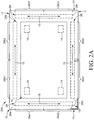
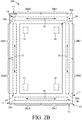
- FIGS. 2A and 2B are schematic views illustrating a tablet computing device in various orientations according to examples.
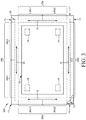
- FIG. 3 is a schematic view of the tablet computing device of FIG. 2A including a single pipe according to an example.
- FIG. 4 is a schematic view illustrating a pipe of the tablet computing device of FIG. 2A according to an example.
- the tablet computing device 200 may include the display 10, the display housing 12, the electronic components 14, the fluid channel 15, and the fluid 17 as previously discussed with respect to the tablet computing device 100 of FIG. 1 .
- the fluid 17 stored in the fluid channel 15 is configured to move between respective portions 26b1, 26b2, 26c1, 26c2, 26d1, 26d2, 26e1, and 26e2 of the channel sections 26b, 26c, 26d, and 26e (collectively 26) based on the rotation of the display housing 12 due to gravitational forces to redistribute the weight of the tablet computing device 200. That is, when the tablet computing device 200 is rotated by a user to change an orientation of the display 10, the fluid 17 impacted by gravity and guided by the fluid channel 15 may move between an upper portion upstream of a gravitational force and a lower portion downstream of the gravitational force for respective channel sections 26.
- the fluid channel 15 is configured to store the fluid 17 to distribute heat from the electronic components 14.
- heat generated from the electronic components 14 may raise the temperature of the display housing 12 and/or tablet computing device 200 that may be cooled by the fluid 17 absorbing heat and moving between respective portions 26b1. 26b2, 26c1, 26c2, 26d1, 26d2, 26e1, and 26e2 of the channel sections 26b, 26c, 26d, and 26e.
- the fluid 17 may be water, antifreeze, and the like. Thus, heat generated by the electronic components 14, and the like, may be dissipated.
- the tablet computing device 200 may also include at least one pipe 28 such as a single pipe or a plurality of pipes.
- the at least one pipe 28 may be formed of metal, and the like.
- the at least one pipe 28 may include a plurality of pipes.
- each pipe 28 may form a respective channel section 26b, 26c, 26d, and 26e of the fluid channel 15 as illustrated in FIGS. 2A-3 .
- Each pipe 28 may include a respective pipe cavity 29 having a respective cavity volume as illustrated in FIG. 4 .
- the fluid 17 disposed in the respective pipe cavities 29 may be water.
- each of the pipe cavities 29 occupies a volume less than the respective cavity volume of the respective pipe cavity 29 in order for the fluid 17 to move between respective portions 26b1, 26b2, 26c1, 26c2, 26d1, 26d2, 26e1, and 26e2.
- the pipes 28 may be arranged with respect to each other to form a rectangular shape.
- the at least one pipe 28 may include a single pipe as illustrated in FIG. 3 .
- the single pipe 28 may include a pipe cavity 29 therein having a single cavity volume to form the fluid channel 15 and store the fluid 17.
- the fluid 17 disposed in the pipe cavity 29 may be water.
- the water occupies a volume less than the single cavity volume of the pipe cavity 29 to enable space for the water to be able to move between respective portions 26b1, 26b2, 26c1, 26c2, 26d1, 26d2, 26e1, and 26e2 of the channel sections 26b, 26c, 26d, and 26e. That is, the fluid 17 may move to a non-occupied space in a gravitational direction and guided by the pipe 28.
- the single pipe 28 may be arranged to form a closed loop having a rectangular shape.
- a rectangular shape pipe arrangement may conform to a perimeter of the display housing 12 to enable the fluid 17 to flow in respective regions to more evenly distribute the weight thereof.
- FIG. 5 is a block diagram illustrating a hybrid notebook computing device according to an example.
- FIGS. 6A and 6B are schematic views illustrating the hybrid notebook computing device of FIG. 5 in an attached state and an unattached state, respectively, according to examples.
- a hybrid notebook computing device 500 includes a keyboard housing 52, a display housing 12 removably attached to the keyboard housing 52, electronic components 14, a fluid channel 15, and fluid 17.
- An attached state is when the display housing 12 is attached to the keyboard housing 12, for example, for the hybrid notebook computing device 500 to function as a notebook computer as illustrated in FIG. 6A .
- An unattached state is when the display housing 12 is unattached to the keyboard housing 52 as illustrated in FIG. 6B .
- the display 10 may function independently from the keyboard housing 52 as a tablet computing device.
- the keyboard housing 52 includes a keyboard 53.
- the display housing 12 includes a plurality of sides 11 and a housing cavity 13.
- the display 10 may be an output device and an input device such as a touch screen.
- the electronic components 14 are disposed in the housing cavity 13.
- the electronic components 14 enable operation of the display 10. That is, the electronic components 14 enable functionality of the hybrid notebook computing device 500.
- the fluid channel 15 is disposed in the housing cavity 13.
- the fluid channel 15 includes a plurality of channel sections 26b, 26c, 26d, and 26e.
- Each channel section 26b, 26c, 26d, and 26e corresponds to a respective side 11 of the display housing 12.
- a respective channel section 26b, 26c, 26d, and 26e corresponds to a respective side 11.
- a respective channel section 26b, 26c, 26d, and 26e may be adjacent to a corresponding side 11.
- the fluid 17 stored in the fluid channel 15 moves between respective portions 26b1, 26b2, 26c1, 26c2, 26d1, 26d2, 26e1, and 26e2 of the channel sections 26b, 26c, 26d, and 26e based on a rotation of the display housing 12.
- the fluid 17 impacted by gravity and guided by the fluid channel 15 may move. That is, the fluid 17 may move between an upper portion upstream of a gravitational force and a lower portion downstream of the gravitational force for each of the channel sections 26b, 26c, 26d, and 26e.
- the hybrid notebook computing device 500 may also include at least one pipe 28 including a pipe cavity 29 therein having a cavity volume to form the fluid channel 15 and store the fluid 17 to distribute heat from the electronic components 14.
- heat generated from the electronic components 14 may raise the temperature of the display housing 12 and/or hybrid notebook computing device 500 that may be cooled by the fluid moving between respective portions 26b1, 26b2, 26c1, 26c2, 26d1, 26d2, 26e1, and 26e2 of the channel sections 26b, 26c, 26d, and 26e.
- the fluid 17 stored in the fluid channel 15, such as water, may move between the respective portions 26b1, 26b2, 26c1, 26c2, 26d1, 26d2, 26e1, and 26e2 of the channel sections 26b, 26c, 26d, and 26e based on the rotation of the display housing 12 and gravitational forces. That is, the fluid 17 may move to a non-occupied space in a gravitational direction and guided by the respective pipe 28.
- FIG. 7 is a flowchart illustrating a method of operating a tablet computing device according to an example.
- the modules and/or assemblies implementing the method may be those described in relation to the tablet computing devices 100 and 200 of FIGS. 1-4 .
- a tablet computing device having a plurality of sides is held by a user.
- the tablet computing device 100 may be held by a user.
- the tablet computing device is rotated.
- a user may rotate the tablet computing device to change the viewing orientation of and/or provide input to the display.
- a fluid within a fluid channel having a plurality of channel sections corresponding to the plurality of sides of the tablet computing device, respectively, is moved between respective portions of the channel sections in response to a rotation of the tablet computing device and gravitational forces.
- a respective channel section corresponds to a respective side of the tablet computing device.
- a respective channel section may be adjacent to a corresponding side.
- heat from electronic components of the tablet computing device is distributed by the fluid in the fluid channel.
- heat generated from the electronic components may raise the temperature of the display housing and/or tablet computing device that may be cooled by the fluid absorbing heat and moving between respective portions of the channel sections.
- the fluid may be water, antifreeze, and the like.
- heat generated by the electronic components, and the like may be dissipated.
- each block may represent a module, segment, or portion of code that includes one or more executable instructions to implement the specified logical function(s).
- each block may represent a circuit or a number of interconnected circuits to implement the specified logical function(s).
- FIG. 7 illustrates a specific order of execution, the order of execution may differ from that which is depicted. For example, the order of execution of two or more blocks may be rearranged relative to the order illustrated. Also, two or more blocks illustrated in succession in FIG. 7 may be executed concurrently or with partial concurrence. All such variations are within the scope of the present disclosure,
Landscapes
- Engineering & Computer Science (AREA)
- Theoretical Computer Science (AREA)
- Computer Hardware Design (AREA)
- General Engineering & Computer Science (AREA)
- Human Computer Interaction (AREA)
- Physics & Mathematics (AREA)
- General Physics & Mathematics (AREA)
- Casings For Electric Apparatus (AREA)
Claims (13)
- Tablet-Computervorrichtung (100), Folgendes umfassend: eine Anzeige (10); und
ein Anzeigengehäuse (12) zum Halten der Anzeige (10), wobei das Anzeigengehäuse (12) mehrere Seiten (11) und einen Gehäusehohlraum (13) aufweist;
elektronische Komponenten (14), die in dem Gehäusehohlraum (13) angeordnet sind, wobei die elektronischen Komponenten (14) konfiguriert sind, einen Betrieb der Tablet-Computervorrichtung (100) zu ermöglichen;
einen Fluidkanal (15), der in dem Gehäusehohlraum (13) angeordnet ist, wobei der Fluidkanal (15) mehrere Kanalabschnitte (16) beinhaltet, in denen jeder Kanalabschnitt (16) einer jeweiligen Seite (11) der Tablet-Computervorrichtung (100) entspricht; und
ein Fluid (17), das in dem Fluidkanal (15) gespeichert ist, um sich zwischen jeweiligen Abschnitten der Kanalabschnitte (16) basierend auf einer Drehung des Anzeigegehäuses (12) zu bewegen, um ein Gewicht der Tablet-Computervorrichtung (100) umzuverteilen;
wobei die Tablet-Computervorrichtung (100) ferner Folgendes umfasst:ein einzelnes Rohr (28), das den Rohrhohlraum (29) beinhaltet, der ein einziges Hohlraumvolumen aufweist, um den Fluidkanal (15) auszubilden und das Fluid (17) zu speichern, wobei das Fluid (17) ein Volumen einnimmt, das geringer ist als das einzelne Hohlraumvolumen des Rohrhohlraums (29) odermehrere Rohre (28), wobei jedes Rohr (28) einen jeweiligen Rohrhohlraum (29) mit einem jeweiligen Hohlraumvolumen aufweist, wobei das Fluid (17) in jedem der jeweiligen Rohrhohlräume (29) gespeichert ist, wobei das Fluid (17) in jedem jeweiligen Rohrhohlraum (29) ein Volumen einnimmt, das geringer ist als das jeweilige Hohlraumvolumen des jeweiligen Rohrhohlraums (29). - Tablet-Computervorrichtung (100) nach Anspruch 1, wobei das in dem Fluidkanal (15) gespeicherte Fluid (17) konfiguriert ist, um sich basierend auf der Drehung des Anzeigegehäuses (12) zwischen den jeweiligen Abschnitten der Kanalabschnitte (16) aufgrund von Schwerkraft zu bewegen.
- Tablet-Computervorrichtung (100) nach Anspruch 1, wobei der Fluidkanal (15) konfiguriert ist, um das Fluid (17) zu speichern, um Wärme von den elektronischen Komponenten (14) zu verteilen.
- Tablet-Computervorrichtung (100) nach Anspruch 1, wobei das Fluid (17) Wasser ist.
- Tablet-Computervorrichtung (100) nach Anspruch 1, wobei das einzelne Rohr (28) angeordnet ist, um eine geschlossene Schleife mit einer rechteckigen Form auszubilden.
- Tablet-Computervorrichtung (100) nach Anspruch 1, wobei die Rohre (28) in Bezug aufeinander angeordnet sind, um eine rechteckige Form auszubilden.
- Tablet-Computervorrichtung (100) nach Anspruch 1, wobei das Fluid (17) Wasser ist.
- Hybrid-Notebook-Computervorrichtung (500), Folgendes umfassend:ein Tastaturgehäuse einschließlich einer Tastatur;ein Anzeigegehäuse (12), das entfernbar an dem Tastaturgehäuse befestigt ist, wobei das Anzeigegehäuse (12) mehrere Seiten (11) und einen Gehäusehohlraum (13) beinhaltet;eine Anzeige (10), die an dem Anzeigengehäuse (12) angeordnet ist;elektronische Komponenten (14), die in dem Gehäusehohlraum (13) angeordnet sind, wobei die elektronischen Komponenten (14) den Betrieb der Anzeige (10) ermöglichen;einen Fluidkanal (15), der in dem Gehäusehohlraum (13) angeordnet ist, wobei der Fluidkanal (15) mehrere Kanalabschnitte (26) beinhaltet, in denen jeder Kanalabschnitt (26) einer jeweiligen Seite (11) des Anzeigegehäuses (12) entspricht; undein Fluid (17), das in dem Fluidkanal (15) gespeichert ist, um sich zwischen jeweiligen Abschnitten der Kanalabschnitte (26) basierend auf einer Drehung des Anzeigegehäuses (12) zu bewegen, um ein Gewicht davon umzuverteilen;wobei die Hybrid-Notebook-Computervorrichtung (500) ferner Folgendes umfasst:ein einzelnes Rohr (28), das den Rohrhohlraum (29) beinhaltet, der ein einziges Hohlraumvolumen aufweist, um den Fluidkanal (15) auszubilden und das Fluid (17) zu speichern, wobei das Fluid (17) ein Volumen einnimmt, das geringer ist als das einzelne Hohlraumvolumen des Rohrhohlraums (29) odermehrere Rohre (28), wobei jedes Rohr (28) einen jeweiligen Rohrhohlraum (29) mit einem jeweiligen Hohlraumvolumen aufweist, wobei das Fluid (17) in jedem der jeweiligen Rohrhohlräume (29) gespeichert ist, wobei das Fluid (17) in jedem jeweiligen Rohrhohlraum (29) ein Volumen einnimmt, das geringer ist als das jeweilige Hohlraumvolumen des jeweiligen Rohrhohlraums (29).
- Hybrid-Notebook-Computervorrichtung (500) nach Anspruch 8, wobei das in dem Fluidkanal (15) gespeicherte Fluid (17) konfiguriert ist, um sich basierend auf der Drehung des Anzeigegehäuses (12) und Schwerkraft zwischen den jeweiligen Abschnitten der Kanalabschnitte (26) zu bewegen.
- Hybrid-Notebook-Computervorrichtung (500) nach Anspruch 8, wobei der Fluidkanal (15) konfiguriert ist, um das Fluid (17) zu speichern, um Wärme von den elektronischen Komponenten (14) zu verteilen.
- Hybrid-Notebook-Computervorrichtung (500) nach Anspruch 8, wobei das Fluid (17) Wasser ist.
- Verfahren zum Umverteilen eines Gewichts einer Computervorrichtung (100, 500), die mehrere Seiten (11) aufweist, beim Drehen der Computervorrichtung (100, 500), wobei das Verfahren Folgendes umfasst:Bewegen eines Fluids (17) innerhalb eines Fluidkanals (15) mit mehreren Kanalabschnitten (16, 26), die jeweilig den mehreren Seiten (11) der Computervorrichtung (100, 500) entsprechen, zwischen Abschnitten der Kanalabschnitte (16, 26) als Reaktion auf eine Drehung der Computervorrichtung (100, 500) und Schwerkraft;wobei die Computervorrichtung (100, 500) ferner Folgendes umfasst:ein einzelnes Rohr (28), das den Rohrhohlraum (29) beinhaltet, der ein einziges Hohlraumvolumen aufweist, um den Fluidkanal (15) auszubilden und das Fluid (17) zu speichern, wobei das Fluid (17) ein Volumen einnimmt, das geringer ist als das einzelne Hohlraumvolumen des Rohrhohlraums (29) odermehrere Rohre (28), wobei jedes Rohr (28) einen jeweiligen Rohrhohlraum (29) mit einem jeweiligen Hohlraumvolumen aufweist, wobei das Fluid (17) in jedem der jeweiligen Rohrhohlräume (29) gespeichert ist, wobei das Fluid (17) in jedem jeweiligen Rohrhohlraum (29) ein Volumen einnimmt, das geringer ist als das jeweilige Hohlraumvolumen des jeweiligen Rohrhohlraums (29).
- Verfahren nach Anspruch 12, Folgendes umfassend:
Verteilen von Wärme von elektronischen Komponenten (14) der Computervorrichtung (100, 500) durch das Fluid (17) in dem Fluidkanal (15).
Applications Claiming Priority (1)
| Application Number | Priority Date | Filing Date | Title |
|---|---|---|---|
| PCT/US2014/031335 WO2015142342A1 (en) | 2014-03-20 | 2014-03-20 | Redistribute weight of computing device |
Publications (4)
| Publication Number | Publication Date |
|---|---|
| EP3120212A1 EP3120212A1 (de) | 2017-01-25 |
| EP3120212A4 EP3120212A4 (de) | 2017-10-25 |
| EP3120212B1 true EP3120212B1 (de) | 2019-05-01 |
| EP3120212B8 EP3120212B8 (de) | 2019-06-19 |
Family
ID=54145104
Family Applications (1)
| Application Number | Title | Priority Date | Filing Date |
|---|---|---|---|
| EP14886153.7A Active EP3120212B8 (de) | 2014-03-20 | 2014-03-20 | Neuverteilung des gewichts einer computervorrichtung |
Country Status (4)
| Country | Link |
|---|---|
| US (1) | US9753507B2 (de) |
| EP (1) | EP3120212B8 (de) |
| CN (1) | CN106104409B (de) |
| WO (1) | WO2015142342A1 (de) |
Families Citing this family (1)
| Publication number | Priority date | Publication date | Assignee | Title |
|---|---|---|---|---|
| CN110209302B (zh) * | 2019-05-31 | 2024-02-20 | 武汉天马微电子有限公司 | 一种显示面板、显示装置和显示面板的使用方法 |
Family Cites Families (13)
| Publication number | Priority date | Publication date | Assignee | Title |
|---|---|---|---|---|
| US6295088B1 (en) | 1997-02-17 | 2001-09-25 | Nikon Corporation | Portable display device |
| US6900984B2 (en) | 2001-04-24 | 2005-05-31 | Apple Computer, Inc. | Computer component protection |
| JP2006057920A (ja) | 2004-08-20 | 2006-03-02 | Hitachi Ltd | 電子機器の液冷システム、及び、これを用いた電子機器 |
| CN2814669Y (zh) * | 2005-08-31 | 2006-09-06 | 英业达股份有限公司 | 散热装置 |
| TW200721822A (en) | 2005-11-23 | 2007-06-01 | Hannspree Inc | Display device with weight-balancing adjustment |
| JP2008269353A (ja) | 2007-04-20 | 2008-11-06 | Toshiba Corp | 電子機器 |
| JP2009097757A (ja) | 2007-10-15 | 2009-05-07 | Toshiba Corp | ループヒートパイプおよび電子機器 |
| DE112008003920B4 (de) * | 2008-06-27 | 2019-10-10 | Hewlett-Packard Development Company, L.P. | Ableiten von Wärme innerhalb von Gehäusen für elektrische Komponenten |
| TWI332816B (en) * | 2008-07-25 | 2010-11-01 | Htc Corp | Electronic device |
| US8695690B2 (en) | 2008-08-29 | 2014-04-15 | Apple Inc. | Methods for cooling electronic devices using flow sensors |
| TW201207585A (en) * | 2010-08-05 | 2012-02-16 | Chi Mei Comm Systems Inc | Mobile electronic device rocking system and method thereof |
| WO2013089678A1 (en) | 2011-12-13 | 2013-06-20 | Intel Corporation | Techniques for computing device cooling using a self-pumping fluid |
| JP2014132388A (ja) * | 2013-01-04 | 2014-07-17 | Sony Corp | 電子機器のフレーム構造 |
-
2014
- 2014-03-20 CN CN201480076888.5A patent/CN106104409B/zh not_active Expired - Fee Related
- 2014-03-20 US US15/115,502 patent/US9753507B2/en not_active Expired - Fee Related
- 2014-03-20 EP EP14886153.7A patent/EP3120212B8/de active Active
- 2014-03-20 WO PCT/US2014/031335 patent/WO2015142342A1/en not_active Ceased
Non-Patent Citations (1)
| Title |
|---|
| None * |
Also Published As
| Publication number | Publication date |
|---|---|
| CN106104409A (zh) | 2016-11-09 |
| EP3120212A4 (de) | 2017-10-25 |
| CN106104409B (zh) | 2019-03-08 |
| WO2015142342A1 (en) | 2015-09-24 |
| US20170147046A1 (en) | 2017-05-25 |
| US9753507B2 (en) | 2017-09-05 |
| EP3120212B8 (de) | 2019-06-19 |
| EP3120212A1 (de) | 2017-01-25 |
Similar Documents
| Publication | Publication Date | Title |
|---|---|---|
| Goldbaum et al. | Mass transport and turbulence in gravitationally unstable disk galaxies. II. the effects of star formation feedback | |
| CN104541227B (zh) | 热传递设备管理 | |
| Owen et al. | An efficient framework for fluid–structure interaction using the lattice Boltzmann method and immersed moving boundaries | |
| Ansola et al. | A simple evolutionary topology optimization procedure for compliant mechanism design | |
| van der Hoef et al. | Numerical simulation of dense gas-solid fluidized beds: a multiscale modeling strategy | |
| Lorén-Aguilar et al. | Toroidal vortices and the conglomeration of dust into rings in protoplanetary discs | |
| Liu et al. | Frictionless multiple impacts in multibody systems. ii. numerical algorithm and simulation results | |
| JP2013542512A5 (de) | ||
| Nakayama | Heat in computers: Applied heat transfer in information technology | |
| Teed et al. | Axisymmetric simulations of the convective overstability in protoplanetary discs | |
| Murdoch et al. | Granular shear flow in varying gravitational environments | |
| Syntelis et al. | Recurrent CME-like eruptions in emerging flux regions. I. On the mechanism of eruptions | |
| EP3994385B1 (de) | Mehrpositionsanzeige mit unfixiertem drehpunkt | |
| Samuel | A deformable particle-in-cell method for advective transport in geodynamic modelling | |
| Onishi et al. | Planetesimal formation by an axisymmetric radial bump of the column density of the gas in a protoplanetary disk | |
| WO2024205626A1 (en) | Real-time height field generation of a multi-phase fluid and granular substance mixture | |
| CN102768607A (zh) | 一种实现触控操作应用程序的方法及装置 | |
| US9753507B2 (en) | Redistribute weight of computing device | |
| Chen et al. | A coupled SDPH–FVM method for gas‐particle multiphase flow: Methodology | |
| CN201974731U (zh) | 平板电脑用旋转皮套 | |
| Wang et al. | On the implicit immersed boundary method in coupled discrete element and lattice Boltzmann method | |
| Natsui et al. | Capturing the non‐spherical shape of granular media and its trickle flow characteristics using fully‐Lagrangian method | |
| Saidi et al. | Numerical and experimental investigation of hydrodynamic characteristics of a slot‐rectangular spouted bed | |
| Demidova | Modelling the gas dynamics of protoplanetary disks by the SPH method | |
| Wildman et al. | A comparison of the predictions of a simple kinetic theory with experimental and numerical results for a vibrated granular bed consisting of nearly elastic particles of two sizes |
Legal Events
| Date | Code | Title | Description |
|---|---|---|---|
| PUAI | Public reference made under article 153(3) epc to a published international application that has entered the european phase |
Free format text: ORIGINAL CODE: 0009012 |
|
| STAA | Information on the status of an ep patent application or granted ep patent |
Free format text: STATUS: REQUEST FOR EXAMINATION WAS MADE |
|
| 17P | Request for examination filed |
Effective date: 20160902 |
|
| AK | Designated contracting states |
Kind code of ref document: A1 Designated state(s): AL AT BE BG CH CY CZ DE DK EE ES FI FR GB GR HR HU IE IS IT LI LT LU LV MC MK MT NL NO PL PT RO RS SE SI SK SM TR |
|
| AX | Request for extension of the european patent |
Extension state: BA ME |
|
| DAX | Request for extension of the european patent (deleted) | ||
| A4 | Supplementary search report drawn up and despatched |
Effective date: 20170926 |
|
| RIC1 | Information provided on ipc code assigned before grant |
Ipc: G06F 1/20 20060101ALI20170920BHEP Ipc: G06F 1/16 20060101AFI20170920BHEP |
|
| RIC1 | Information provided on ipc code assigned before grant |
Ipc: G06F 1/16 20060101AFI20181113BHEP Ipc: G06F 1/20 20060101ALI20181113BHEP |
|
| GRAP | Despatch of communication of intention to grant a patent |
Free format text: ORIGINAL CODE: EPIDOSNIGR1 |
|
| STAA | Information on the status of an ep patent application or granted ep patent |
Free format text: STATUS: GRANT OF PATENT IS INTENDED |
|
| INTG | Intention to grant announced |
Effective date: 20190102 |
|
| GRAS | Grant fee paid |
Free format text: ORIGINAL CODE: EPIDOSNIGR3 |
|
| GRAA | (expected) grant |
Free format text: ORIGINAL CODE: 0009210 |
|
| STAA | Information on the status of an ep patent application or granted ep patent |
Free format text: STATUS: THE PATENT HAS BEEN GRANTED |
|
| AK | Designated contracting states |
Kind code of ref document: B1 Designated state(s): AL AT BE BG CH CY CZ DE DK EE ES FI FR GB GR HR HU IE IS IT LI LT LU LV MC MK MT NL NO PL PT RO RS SE SI SK SM TR |
|
| REG | Reference to a national code |
Ref country code: GB Ref legal event code: FG4D |
|
| RAP2 | Party data changed (patent owner data changed or rights of a patent transferred) |
Owner name: HEWLETT-PACKARD DEVELOPMENT COMPANY, L.P. |
|
| REG | Reference to a national code |
Ref country code: CH Ref legal event code: EP Ref country code: AT Ref legal event code: REF Ref document number: 1127774 Country of ref document: AT Kind code of ref document: T Effective date: 20190515 |
|
| REG | Reference to a national code |
Ref country code: DE Ref legal event code: R096 Ref document number: 602014046031 Country of ref document: DE |
|
| REG | Reference to a national code |
Ref country code: IE Ref legal event code: FG4D |
|
| REG | Reference to a national code |
Ref country code: CH Ref legal event code: PK Free format text: BERICHTIGUNG B8 |
|
| REG | Reference to a national code |
Ref country code: NL Ref legal event code: MP Effective date: 20190501 |
|
| REG | Reference to a national code |
Ref country code: LT Ref legal event code: MG4D |
|
| PG25 | Lapsed in a contracting state [announced via postgrant information from national office to epo] |
Ref country code: ES Free format text: LAPSE BECAUSE OF FAILURE TO SUBMIT A TRANSLATION OF THE DESCRIPTION OR TO PAY THE FEE WITHIN THE PRESCRIBED TIME-LIMIT Effective date: 20190501 Ref country code: NL Free format text: LAPSE BECAUSE OF FAILURE TO SUBMIT A TRANSLATION OF THE DESCRIPTION OR TO PAY THE FEE WITHIN THE PRESCRIBED TIME-LIMIT Effective date: 20190501 Ref country code: LT Free format text: LAPSE BECAUSE OF FAILURE TO SUBMIT A TRANSLATION OF THE DESCRIPTION OR TO PAY THE FEE WITHIN THE PRESCRIBED TIME-LIMIT Effective date: 20190501 Ref country code: FI Free format text: LAPSE BECAUSE OF FAILURE TO SUBMIT A TRANSLATION OF THE DESCRIPTION OR TO PAY THE FEE WITHIN THE PRESCRIBED TIME-LIMIT Effective date: 20190501 Ref country code: HR Free format text: LAPSE BECAUSE OF FAILURE TO SUBMIT A TRANSLATION OF THE DESCRIPTION OR TO PAY THE FEE WITHIN THE PRESCRIBED TIME-LIMIT Effective date: 20190501 Ref country code: SE Free format text: LAPSE BECAUSE OF FAILURE TO SUBMIT A TRANSLATION OF THE DESCRIPTION OR TO PAY THE FEE WITHIN THE PRESCRIBED TIME-LIMIT Effective date: 20190501 Ref country code: NO Free format text: LAPSE BECAUSE OF FAILURE TO SUBMIT A TRANSLATION OF THE DESCRIPTION OR TO PAY THE FEE WITHIN THE PRESCRIBED TIME-LIMIT Effective date: 20190801 Ref country code: AL Free format text: LAPSE BECAUSE OF FAILURE TO SUBMIT A TRANSLATION OF THE DESCRIPTION OR TO PAY THE FEE WITHIN THE PRESCRIBED TIME-LIMIT Effective date: 20190501 Ref country code: PT Free format text: LAPSE BECAUSE OF FAILURE TO SUBMIT A TRANSLATION OF THE DESCRIPTION OR TO PAY THE FEE WITHIN THE PRESCRIBED TIME-LIMIT Effective date: 20190901 |
|
| PG25 | Lapsed in a contracting state [announced via postgrant information from national office to epo] |
Ref country code: RS Free format text: LAPSE BECAUSE OF FAILURE TO SUBMIT A TRANSLATION OF THE DESCRIPTION OR TO PAY THE FEE WITHIN THE PRESCRIBED TIME-LIMIT Effective date: 20190501 Ref country code: LV Free format text: LAPSE BECAUSE OF FAILURE TO SUBMIT A TRANSLATION OF THE DESCRIPTION OR TO PAY THE FEE WITHIN THE PRESCRIBED TIME-LIMIT Effective date: 20190501 Ref country code: GR Free format text: LAPSE BECAUSE OF FAILURE TO SUBMIT A TRANSLATION OF THE DESCRIPTION OR TO PAY THE FEE WITHIN THE PRESCRIBED TIME-LIMIT Effective date: 20190802 Ref country code: BG Free format text: LAPSE BECAUSE OF FAILURE TO SUBMIT A TRANSLATION OF THE DESCRIPTION OR TO PAY THE FEE WITHIN THE PRESCRIBED TIME-LIMIT Effective date: 20190801 |
|
| REG | Reference to a national code |
Ref country code: AT Ref legal event code: MK05 Ref document number: 1127774 Country of ref document: AT Kind code of ref document: T Effective date: 20190501 |
|
| PG25 | Lapsed in a contracting state [announced via postgrant information from national office to epo] |
Ref country code: IS Free format text: LAPSE BECAUSE OF FAILURE TO SUBMIT A TRANSLATION OF THE DESCRIPTION OR TO PAY THE FEE WITHIN THE PRESCRIBED TIME-LIMIT Effective date: 20190901 |
|
| PG25 | Lapsed in a contracting state [announced via postgrant information from national office to epo] |
Ref country code: CZ Free format text: LAPSE BECAUSE OF FAILURE TO SUBMIT A TRANSLATION OF THE DESCRIPTION OR TO PAY THE FEE WITHIN THE PRESCRIBED TIME-LIMIT Effective date: 20190501 Ref country code: EE Free format text: LAPSE BECAUSE OF FAILURE TO SUBMIT A TRANSLATION OF THE DESCRIPTION OR TO PAY THE FEE WITHIN THE PRESCRIBED TIME-LIMIT Effective date: 20190501 Ref country code: SK Free format text: LAPSE BECAUSE OF FAILURE TO SUBMIT A TRANSLATION OF THE DESCRIPTION OR TO PAY THE FEE WITHIN THE PRESCRIBED TIME-LIMIT Effective date: 20190501 Ref country code: RO Free format text: LAPSE BECAUSE OF FAILURE TO SUBMIT A TRANSLATION OF THE DESCRIPTION OR TO PAY THE FEE WITHIN THE PRESCRIBED TIME-LIMIT Effective date: 20190501 Ref country code: AT Free format text: LAPSE BECAUSE OF FAILURE TO SUBMIT A TRANSLATION OF THE DESCRIPTION OR TO PAY THE FEE WITHIN THE PRESCRIBED TIME-LIMIT Effective date: 20190501 Ref country code: DK Free format text: LAPSE BECAUSE OF FAILURE TO SUBMIT A TRANSLATION OF THE DESCRIPTION OR TO PAY THE FEE WITHIN THE PRESCRIBED TIME-LIMIT Effective date: 20190501 |
|
| REG | Reference to a national code |
Ref country code: DE Ref legal event code: R097 Ref document number: 602014046031 Country of ref document: DE |
|
| PG25 | Lapsed in a contracting state [announced via postgrant information from national office to epo] |
Ref country code: SM Free format text: LAPSE BECAUSE OF FAILURE TO SUBMIT A TRANSLATION OF THE DESCRIPTION OR TO PAY THE FEE WITHIN THE PRESCRIBED TIME-LIMIT Effective date: 20190501 Ref country code: IT Free format text: LAPSE BECAUSE OF FAILURE TO SUBMIT A TRANSLATION OF THE DESCRIPTION OR TO PAY THE FEE WITHIN THE PRESCRIBED TIME-LIMIT Effective date: 20190501 |
|
| PLBE | No opposition filed within time limit |
Free format text: ORIGINAL CODE: 0009261 |
|
| STAA | Information on the status of an ep patent application or granted ep patent |
Free format text: STATUS: NO OPPOSITION FILED WITHIN TIME LIMIT |
|
| PG25 | Lapsed in a contracting state [announced via postgrant information from national office to epo] |
Ref country code: TR Free format text: LAPSE BECAUSE OF FAILURE TO SUBMIT A TRANSLATION OF THE DESCRIPTION OR TO PAY THE FEE WITHIN THE PRESCRIBED TIME-LIMIT Effective date: 20190501 |
|
| 26N | No opposition filed |
Effective date: 20200204 |
|
| PG25 | Lapsed in a contracting state [announced via postgrant information from national office to epo] |
Ref country code: PL Free format text: LAPSE BECAUSE OF FAILURE TO SUBMIT A TRANSLATION OF THE DESCRIPTION OR TO PAY THE FEE WITHIN THE PRESCRIBED TIME-LIMIT Effective date: 20190501 |
|
| PGFP | Annual fee paid to national office [announced via postgrant information from national office to epo] |
Ref country code: GB Payment date: 20200221 Year of fee payment: 7 Ref country code: DE Payment date: 20200218 Year of fee payment: 7 |
|
| PG25 | Lapsed in a contracting state [announced via postgrant information from national office to epo] |
Ref country code: SI Free format text: LAPSE BECAUSE OF FAILURE TO SUBMIT A TRANSLATION OF THE DESCRIPTION OR TO PAY THE FEE WITHIN THE PRESCRIBED TIME-LIMIT Effective date: 20190501 |
|
| PG25 | Lapsed in a contracting state [announced via postgrant information from national office to epo] |
Ref country code: MC Free format text: LAPSE BECAUSE OF FAILURE TO SUBMIT A TRANSLATION OF THE DESCRIPTION OR TO PAY THE FEE WITHIN THE PRESCRIBED TIME-LIMIT Effective date: 20190501 |
|
| REG | Reference to a national code |
Ref country code: CH Ref legal event code: PL |
|
| REG | Reference to a national code |
Ref country code: BE Ref legal event code: MM Effective date: 20200331 |
|
| PG25 | Lapsed in a contracting state [announced via postgrant information from national office to epo] |
Ref country code: LU Free format text: LAPSE BECAUSE OF NON-PAYMENT OF DUE FEES Effective date: 20200320 |
|
| PG25 | Lapsed in a contracting state [announced via postgrant information from national office to epo] |
Ref country code: CH Free format text: LAPSE BECAUSE OF NON-PAYMENT OF DUE FEES Effective date: 20200331 Ref country code: LI Free format text: LAPSE BECAUSE OF NON-PAYMENT OF DUE FEES Effective date: 20200331 Ref country code: IE Free format text: LAPSE BECAUSE OF NON-PAYMENT OF DUE FEES Effective date: 20200320 Ref country code: FR Free format text: LAPSE BECAUSE OF NON-PAYMENT OF DUE FEES Effective date: 20200331 |
|
| PG25 | Lapsed in a contracting state [announced via postgrant information from national office to epo] |
Ref country code: BE Free format text: LAPSE BECAUSE OF NON-PAYMENT OF DUE FEES Effective date: 20200331 |
|
| REG | Reference to a national code |
Ref country code: DE Ref legal event code: R119 Ref document number: 602014046031 Country of ref document: DE |
|
| GBPC | Gb: european patent ceased through non-payment of renewal fee |
Effective date: 20210320 |
|
| PG25 | Lapsed in a contracting state [announced via postgrant information from national office to epo] |
Ref country code: DE Free format text: LAPSE BECAUSE OF NON-PAYMENT OF DUE FEES Effective date: 20211001 Ref country code: GB Free format text: LAPSE BECAUSE OF NON-PAYMENT OF DUE FEES Effective date: 20210320 |
|
| PG25 | Lapsed in a contracting state [announced via postgrant information from national office to epo] |
Ref country code: MT Free format text: LAPSE BECAUSE OF FAILURE TO SUBMIT A TRANSLATION OF THE DESCRIPTION OR TO PAY THE FEE WITHIN THE PRESCRIBED TIME-LIMIT Effective date: 20190501 Ref country code: CY Free format text: LAPSE BECAUSE OF FAILURE TO SUBMIT A TRANSLATION OF THE DESCRIPTION OR TO PAY THE FEE WITHIN THE PRESCRIBED TIME-LIMIT Effective date: 20190501 |
|
| PG25 | Lapsed in a contracting state [announced via postgrant information from national office to epo] |
Ref country code: MK Free format text: LAPSE BECAUSE OF FAILURE TO SUBMIT A TRANSLATION OF THE DESCRIPTION OR TO PAY THE FEE WITHIN THE PRESCRIBED TIME-LIMIT Effective date: 20190501 |