EP3116605B1 - Exercise equipment for the performance of hamstring eccentric and concentric exercises - Google Patents
Exercise equipment for the performance of hamstring eccentric and concentric exercises Download PDFInfo
- Publication number
- EP3116605B1 EP3116605B1 EP15718389.8A EP15718389A EP3116605B1 EP 3116605 B1 EP3116605 B1 EP 3116605B1 EP 15718389 A EP15718389 A EP 15718389A EP 3116605 B1 EP3116605 B1 EP 3116605B1
- Authority
- EP
- European Patent Office
- Prior art keywords
- main support
- support spar
- frame
- vertical bar
- length
- Prior art date
- Legal status (The legal status is an assumption and is not a legal conclusion. Google has not performed a legal analysis and makes no representation as to the accuracy of the status listed.)
- Not-in-force
Links
Images


Classifications
-
- A—HUMAN NECESSITIES
- A63—SPORTS; GAMES; AMUSEMENTS
- A63B—APPARATUS FOR PHYSICAL TRAINING, GYMNASTICS, SWIMMING, CLIMBING, OR FENCING; BALL GAMES; TRAINING EQUIPMENT
- A63B23/00—Exercising apparatus specially adapted for particular parts of the body
- A63B23/035—Exercising apparatus specially adapted for particular parts of the body for limbs, i.e. upper or lower limbs, e.g. simultaneously
- A63B23/04—Exercising apparatus specially adapted for particular parts of the body for limbs, i.e. upper or lower limbs, e.g. simultaneously for lower limbs
-
- A—HUMAN NECESSITIES
- A63—SPORTS; GAMES; AMUSEMENTS
- A63B—APPARATUS FOR PHYSICAL TRAINING, GYMNASTICS, SWIMMING, CLIMBING, OR FENCING; BALL GAMES; TRAINING EQUIPMENT
- A63B23/00—Exercising apparatus specially adapted for particular parts of the body
- A63B23/035—Exercising apparatus specially adapted for particular parts of the body for limbs, i.e. upper or lower limbs, e.g. simultaneously
- A63B23/04—Exercising apparatus specially adapted for particular parts of the body for limbs, i.e. upper or lower limbs, e.g. simultaneously for lower limbs
- A63B23/0494—Exercising apparatus specially adapted for particular parts of the body for limbs, i.e. upper or lower limbs, e.g. simultaneously for lower limbs primarily by articulating the knee joints
-
- A—HUMAN NECESSITIES
- A63—SPORTS; GAMES; AMUSEMENTS
- A63B—APPARATUS FOR PHYSICAL TRAINING, GYMNASTICS, SWIMMING, CLIMBING, OR FENCING; BALL GAMES; TRAINING EQUIPMENT
- A63B23/00—Exercising apparatus specially adapted for particular parts of the body
- A63B23/02—Exercising apparatus specially adapted for particular parts of the body for the abdomen, the spinal column or the torso muscles related to shoulders (e.g. chest muscles)
-
- A—HUMAN NECESSITIES
- A63—SPORTS; GAMES; AMUSEMENTS
- A63B—APPARATUS FOR PHYSICAL TRAINING, GYMNASTICS, SWIMMING, CLIMBING, OR FENCING; BALL GAMES; TRAINING EQUIPMENT
- A63B21/00—Exercising apparatus for developing or strengthening the muscles or joints of the body by working against a counterforce, with or without measuring devices
- A63B21/00047—Exercising devices not moving during use
-
- A—HUMAN NECESSITIES
- A63—SPORTS; GAMES; AMUSEMENTS
- A63B—APPARATUS FOR PHYSICAL TRAINING, GYMNASTICS, SWIMMING, CLIMBING, OR FENCING; BALL GAMES; TRAINING EQUIPMENT
- A63B21/00—Exercising apparatus for developing or strengthening the muscles or joints of the body by working against a counterforce, with or without measuring devices
- A63B21/06—User-manipulated weights
- A63B21/068—User-manipulated weights using user's body weight
-
- A—HUMAN NECESSITIES
- A63—SPORTS; GAMES; AMUSEMENTS
- A63B—APPARATUS FOR PHYSICAL TRAINING, GYMNASTICS, SWIMMING, CLIMBING, OR FENCING; BALL GAMES; TRAINING EQUIPMENT
- A63B21/00—Exercising apparatus for developing or strengthening the muscles or joints of the body by working against a counterforce, with or without measuring devices
- A63B21/40—Interfaces with the user related to strength training; Details thereof
- A63B21/4027—Specific exercise interfaces
- A63B21/4029—Benches specifically adapted for exercising
-
- A—HUMAN NECESSITIES
- A63—SPORTS; GAMES; AMUSEMENTS
- A63B—APPARATUS FOR PHYSICAL TRAINING, GYMNASTICS, SWIMMING, CLIMBING, OR FENCING; BALL GAMES; TRAINING EQUIPMENT
- A63B23/00—Exercising apparatus specially adapted for particular parts of the body
- A63B23/02—Exercising apparatus specially adapted for particular parts of the body for the abdomen, the spinal column or the torso muscles related to shoulders (e.g. chest muscles)
- A63B23/0205—Abdomen
- A63B23/0211—Abdomen moving torso with immobilized lower limbs
-
- A—HUMAN NECESSITIES
- A63—SPORTS; GAMES; AMUSEMENTS
- A63B—APPARATUS FOR PHYSICAL TRAINING, GYMNASTICS, SWIMMING, CLIMBING, OR FENCING; BALL GAMES; TRAINING EQUIPMENT
- A63B23/00—Exercising apparatus specially adapted for particular parts of the body
- A63B23/035—Exercising apparatus specially adapted for particular parts of the body for limbs, i.e. upper or lower limbs, e.g. simultaneously
-
- A—HUMAN NECESSITIES
- A63—SPORTS; GAMES; AMUSEMENTS
- A63B—APPARATUS FOR PHYSICAL TRAINING, GYMNASTICS, SWIMMING, CLIMBING, OR FENCING; BALL GAMES; TRAINING EQUIPMENT
- A63B23/00—Exercising apparatus specially adapted for particular parts of the body
- A63B23/035—Exercising apparatus specially adapted for particular parts of the body for limbs, i.e. upper or lower limbs, e.g. simultaneously
- A63B23/12—Exercising apparatus specially adapted for particular parts of the body for limbs, i.e. upper or lower limbs, e.g. simultaneously for upper limbs or related muscles, e.g. chest, upper back or shoulder muscles
- A63B23/1209—Involving a bending of elbow and shoulder joints simultaneously
- A63B23/1236—Push-ups in horizontal position, i.e. eccentric movement
-
- A—HUMAN NECESSITIES
- A63—SPORTS; GAMES; AMUSEMENTS
- A63B—APPARATUS FOR PHYSICAL TRAINING, GYMNASTICS, SWIMMING, CLIMBING, OR FENCING; BALL GAMES; TRAINING EQUIPMENT
- A63B69/00—Training appliances or apparatus for special sports
- A63B69/0057—Means for physically limiting movements of body parts
- A63B69/0062—Leg restraining devices
-
- A—HUMAN NECESSITIES
- A63—SPORTS; GAMES; AMUSEMENTS
- A63B—APPARATUS FOR PHYSICAL TRAINING, GYMNASTICS, SWIMMING, CLIMBING, OR FENCING; BALL GAMES; TRAINING EQUIPMENT
- A63B2208/00—Characteristics or parameters related to the user or player
- A63B2208/02—Characteristics or parameters related to the user or player posture
- A63B2208/0242—Lying down
- A63B2208/0247—Lying down with legs in a kneeled 90/90 position
-
- A—HUMAN NECESSITIES
- A63—SPORTS; GAMES; AMUSEMENTS
- A63B—APPARATUS FOR PHYSICAL TRAINING, GYMNASTICS, SWIMMING, CLIMBING, OR FENCING; BALL GAMES; TRAINING EQUIPMENT
- A63B2208/00—Characteristics or parameters related to the user or player
- A63B2208/02—Characteristics or parameters related to the user or player posture
- A63B2208/0242—Lying down
- A63B2208/0252—Lying down supine
-
- A—HUMAN NECESSITIES
- A63—SPORTS; GAMES; AMUSEMENTS
- A63B—APPARATUS FOR PHYSICAL TRAINING, GYMNASTICS, SWIMMING, CLIMBING, OR FENCING; BALL GAMES; TRAINING EQUIPMENT
- A63B2208/00—Characteristics or parameters related to the user or player
- A63B2208/02—Characteristics or parameters related to the user or player posture
- A63B2208/0242—Lying down
- A63B2208/0257—Lying down prone
-
- A—HUMAN NECESSITIES
- A63—SPORTS; GAMES; AMUSEMENTS
- A63B—APPARATUS FOR PHYSICAL TRAINING, GYMNASTICS, SWIMMING, CLIMBING, OR FENCING; BALL GAMES; TRAINING EQUIPMENT
- A63B2210/00—Space saving
- A63B2210/50—Size reducing arrangements for stowing or transport
-
- A—HUMAN NECESSITIES
- A63—SPORTS; GAMES; AMUSEMENTS
- A63B—APPARATUS FOR PHYSICAL TRAINING, GYMNASTICS, SWIMMING, CLIMBING, OR FENCING; BALL GAMES; TRAINING EQUIPMENT
- A63B2225/00—Miscellaneous features of sport apparatus, devices or equipment
- A63B2225/09—Adjustable dimensions
-
- A—HUMAN NECESSITIES
- A63—SPORTS; GAMES; AMUSEMENTS
- A63B—APPARATUS FOR PHYSICAL TRAINING, GYMNASTICS, SWIMMING, CLIMBING, OR FENCING; BALL GAMES; TRAINING EQUIPMENT
- A63B2225/00—Miscellaneous features of sport apparatus, devices or equipment
- A63B2225/09—Adjustable dimensions
- A63B2225/093—Height
Definitions
- the present invention relates to an apparatus for undertaking exercises for hamstring eccentric and concentric loading and in particular, but not limited to, exercises such as the Nordic Hamstring Exercise, the Russian Hamstring Exercise, Russian curls, and it also has applications for gluteal and hamstring raises.
- the apparatus can be utilised for sports training and preparation, injury recovery and rehabilitation, injury prevention and is also applicable for keep fit and for body toning.
- Eccentric and concentric exercises not only have a part to play in rehabilitation from injuries, but also to prevent hamstring injuries and other injuries from occurring in the first place.
- Eccentric contractions are also an essential element in the improvement of explosive power and elasticity which are core elements of sports and activities which require running and jumping. Eccentric muscle training creates a more solid muscle which acts as protection to the hamstring and in addition increases the amount of elastic energy available in the shortening cycle, as a form of contraction it creates greater force with the use of less energy than a concentric contraction.
- Eccentric contraction exercise also benefits in the treatment of Achilles tendonitis and as a form of exercise and recovery is a viable alternative in some instances to surgical intervention. There are in addition significant benefits to patients recovering from cruciate ligament injuries specifically anterior cruciate ligament injuries.
- the hamstring muscle function can be broken down into two main areas of functionality, these are initially when the leg hits the ground, they are the body's shock absorber and when the leg pushes away from the body they act as springs as they lengthen and provide enough energy to produce the thrust away from where the foot is placed.
- the prevalence of injuries to the hamstring occurs in greatest frequency in sports which involve bursts of speed for sprinting. The majority of these injuries occur during the final phase of the lengthening of the hamstring when the knees are being pumped high leading to the hamstring in colloquial terms being referred to as having been "pulled” as to the injured party it appears that they have pulled it or stretched it too far. This sensation is also felt when attempting to slow down or cease the run as your hamstring is absorbing all the energy of that effort.
- the two main exercises used in response which focus on eccentric loading in prehab and rehab are the Nordic Hamstring Exercise/Russian Hamstring Exercise and Seated Single leg curls.
- the lower impact simpler exercise to perform is the seated single leg curl as it does not require a partner and the repetition of the exercise can be undertaken without risk of additional injury which can occur from the assisted Nordic Hamstring exercise.
- the seated leg curly involves using a specific piece of gym equipment into which the person sits and sets the weight or resistance and begins by extending and then returning the leg against a pivoted weight. While this exercise is quite controlled it does however, require a large expensive piece of specialist machinery.
- the Nordic hamstring exercise is performed by kneeling with your feet side by side and held fixed in place by a partner, the person undertaking the exercise crosses their arms across their chest or lets their arms hang by their sides and lowers their body slowly towards the ground ensuring they keep a straight line from their shoulder to their knee. They extend slowly to the point of failure i.e. they lean forward and resist a falling motion using their hamstrings for as long as possible, as they progress they hold for 3-6 seconds then drop to the ground using their hands to break the fall. Return at your ease to the start position and repeat. This traditional process has the risk of causing additional injury to the participant of the exercise through planterflexion or dorsiflexion, i.e.
- This apparatus overcomes these issues with the traditional methods in that it removes the need for a partner to assist in the undertaking of the exercise and therefore the risks that that person brought to the exercise of inducing dorsiflexion or plantarflexion.
- the apparatus also enables participants to undertake the exercise regime without assistance thereby making it easier for the regime to be followed.
- the exercise aid can also be used for concentric exercises whereby the user can return from the lowered position using their hamstrings. This is carried out with the user in a press up position, with their feet firmly fixed in place with the foot anchor, the knees on the kneeling pad, performing an explosive push up and lifts themselves back to the upright position using their hamstrings.
- US 7,662,077 discloses apparatus for conditioning abdominal and back muscles.
- the invention provides for an exercise apparatus for the performance of hamstring eccentrics and/or concentrics comprising:
- the kneeling pad is of sufficient length to accommodate the lower legs of a user from the knee to the ankle.
- the pad may be cushioned for the comfort of the user.
- the foot anchor which is positioned at the upper end of the kneeling pad comprises a T-piece wherein a substantially horizontal length sits above a vertical member centrally positioned and extending downwards to the frame, the horizontal component is cushioned substantially along its length to accommodate the back of a user's ankles and has cushioning to protect the user's Achilles tendons.
- the foot anchor may be unitary with the frame or may be linked to the frame in such a manner as to allow height adjustability with respect to the kneeling pad.
- the frame which is made of a durable material for example, tubular or box steel, supports the keeling pad, the weight of the user and the foot anchor, the frame may be unitary or made from components which allow for height or length adjustment.
- the main support spar is tilted at between 8° and 12°.
- main support spar is tilted at 10°.
- the frame extends substantially beyond the lower extremity of the kneeling pad.
- the frame is length adjustable.
- the frame is collapsible for ease of storage or transport.
- the frame comprises lengths of tubular steel curved so as to provide two upper and two lower legs.
- side bars extend from the main spar to provide a platform specifically for the kneeling pad.
- the feet of the apparatus have high grip surfaces to ensure the stability of the apparatus in use on any floor.
- the apparatus is manufactured from suitably durable material to support the weight of any user while retaining a centre of gravity which resides within the foot print of the apparatus.
- tubular metal such as steel or aluminium may be used but other materials such as wood or reinforced plastic may also be envisaged.
- the advantages that the device has are that it allows the participant to undertake the exercise regime for eccentric and/or concentric workouts of the hamstring and gluteals without assistance from a third party; it is also lightweight and economical in size facilitating movement, transportation and storage.
- the device also has an adjustable leg restraint which facilitates a variety of sizes and shapes of user, ensuring that their legs are restrained appropriately.
- the main body of the device is so inclined as to ensure that the user does not hyperextend their knee and cause injury.
- the height of the upper end of the device above ground level in conjunction with the leg restraints means that collateral injuries which may otherwise occur when undertaking this exercise regime in the traditional form of dorsiflexion and planterflexion are avoided and thus the great advantages of this form of preventative and rehabilitative exercise are highlighted to their full potential to a greater number of people in a wider variety of situations and the disadvantages and risks previously associated with this form of exercise are ameliorated.
- the apparatus is raised from the ground and inclined from the higher point with a floor/leg/ankle anchor, to hold the leg in the place; this anchor is adjustable and therefore allows for a variation in the sizes of people who can undertake the exercise.
- the anchor is also cushioned to ensure no injury whilst utilising the device.
- the fact that the higher end of the device is raised from the floor ensures that the foot is allowed to hang comfortably in place and the overall shape and position of the foot ensures no risk of planterflexion or dorsiflexion.
- the device inclines from the higher end to facilitate the proper positioning of the body for hamstring eccentrics not only allowing the person to undertake the exercise but also ensuring that through the body positioning that they cannot hyperextend their knee, in addition to the benefits regarding planterflexion or dorsiflexion already outlined.
- This embodiment comprises in a main central support spar (1), which is attached to a smaller substantially vertical spar (5).
- Flat spars at either end of the frame (13 and 14) provide stability to the frame.
- the ends of each flat spar may be coated with a high grip material (10) to ensure stability of the apparatus in use.
- a kneeling pad (2) sits at the upper end of the main centre spar. The pad is supported by side spars (7) projecting from either side of the central main spar.
- an upper spar (6) sits telescopically in the upper end of the vertical spar (5) and to which are attached two side spars (3) which are sheathed with cylindrical cushions (4), thereby providing ankle restraints.
- a quick release bolt (9) in the main vertical spar (5) combined with complementary holes (15) in the inner spar (6) facilitate the height adjustability of the ankle restraints with respect to the kneeling pad.
- the vertical spar itself may be height adjustable so as to alter the angle, ⁇ , the main spar makes with respect to the horizontal.
- the main central spar may be formed from two lengths one of which fits telescopically into the other so as to allow length adjustability of the main spar for either convenience of use or storage.
- the vertical spar (5) may be affixed to the main spar (1) by means of a permanent hinge (11) and a releasable bolt (12), thereby allowing the apparatus to be stored more compactly ( figure 4b ).
- FIG. 5 shows a different embodiment of the invention, in this embodiment main support is provided by a pair of curved parallel bars (101). Spars (107) running between the two curved bars provide stability to the frame and support for the kneeling pad (2). The ends of the main spars are curved to provide feet (110) which may be coated with high grip material. A vertical spar (105) is attached to the uppermost of the cross spars (107) to provide a means of attachment for the ankle restraints, which are as described above.
- main support spars (111) may be shorter for ease of transport.
- Figures 7 and 8 indicate how concentric and eccentric exercise may be performed on the apparatus discussed above. It should be noted that the apparatus according to figure 6 is not suitable for concentric exercise, unless the legs beneath the ankle restraints are fixed to the ground. This is because concentric exercises require an apparatus with a centre of gravity in use which is further from the ankle restraints than is the case for eccentric exercises.
- All embodiments of the invention are characterised by the main frame defining an angle, ⁇ , with respect to the horizontal.
- This angle may range between 5° and 20°.
- the angle should be set at between 8° and 12°. More preferably, an angle of 10° is used.
- ⁇ may be set to a different angle, depending on the nature of the exercise to be performed.
- the angle, ⁇ is indicated for two different embodiments of the invention in figures 3a and 5a .
- the apparatus In use, the apparatus is subject to a certain degree of strain and a shifting centre of gravity. Accordingly, the apparatus is manufactured from suitably durable material to support the weight of any user while retaining a centre of gravity which resides within the foot print of the apparatus.
- suitably durable material such as steel or aluminium may be preferred, other materials such as wood or reinforced plastic may also be envisaged.
Landscapes
- Health & Medical Sciences (AREA)
- Orthopedic Medicine & Surgery (AREA)
- General Health & Medical Sciences (AREA)
- Physical Education & Sports Medicine (AREA)
- Life Sciences & Earth Sciences (AREA)
- Biophysics (AREA)
- Engineering & Computer Science (AREA)
- Biomedical Technology (AREA)
- Neurology (AREA)
- Pulmonology (AREA)
- Rehabilitation Tools (AREA)
- Orthopedics, Nursing, And Contraception (AREA)
Description
- The present invention relates to an apparatus for undertaking exercises for hamstring eccentric and concentric loading and in particular, but not limited to, exercises such as the Nordic Hamstring Exercise, the Russian Hamstring Exercise, Russian curls, and it also has applications for gluteal and hamstring raises. The apparatus can be utilised for sports training and preparation, injury recovery and rehabilitation, injury prevention and is also applicable for keep fit and for body toning.
- Eccentric and concentric exercises not only have a part to play in rehabilitation from injuries, but also to prevent hamstring injuries and other injuries from occurring in the first place.
- In muscular exercise there are three main types of muscle contraction. These contractions are concentric, eccentric and isometric. Concentric contraction is where the muscle is contracted, i.e. lifting a dumbbell, doing bench presses or arm or leg curls of many varieties. Eccentric contraction is the lengthening or stretching of a muscle and examples of this type of movement are lowering of the dumbbell or the lowering of the leg in a leg curl. The final type of muscular contraction is isometric, in this form of muscle usage there is no actual change in muscle length while the muscle is contracting, examples of when this occurs is when pushing against a wall or in the pause between eccentrics and concentric phases.
- There are a large variety of training programmes and methodologies available and varying coaching professionals and conditioning specialists use a variety of methodologies to eccentrically load in an attempt to improve performance and prevent injury. There is a large amount of investigative work which demonstrates how specific eccentric programmes can significantly reduce hamstring injuries and rehabilitate tendonitis. Eccentric contractions are also an essential element in the improvement of explosive power and elasticity which are core elements of sports and activities which require running and jumping. Eccentric muscle training creates a more solid muscle which acts as protection to the hamstring and in addition increases the amount of elastic energy available in the shortening cycle, as a form of contraction it creates greater force with the use of less energy than a concentric contraction.
- The use of eccentric training will provide greater protection from injury and re-injury for athletes undertaking these forms of exercises. Eccentric contraction exercise also benefits in the treatment of Achilles tendonitis and as a form of exercise and recovery is a viable alternative in some instances to surgical intervention. There are in addition significant benefits to patients recovering from cruciate ligament injuries specifically anterior cruciate ligament injuries.
- The hamstring muscle function can be broken down into two main areas of functionality, these are initially when the leg hits the ground, they are the body's shock absorber and when the leg pushes away from the body they act as springs as they lengthen and provide enough energy to produce the thrust away from where the foot is placed. The prevalence of injuries to the hamstring occurs in greatest frequency in sports which involve bursts of speed for sprinting. The majority of these injuries occur during the final phase of the lengthening of the hamstring when the knees are being pumped high leading to the hamstring in colloquial terms being referred to as having been "pulled" as to the injured party it appears that they have pulled it or stretched it too far. This sensation is also felt when attempting to slow down or cease the run as your hamstring is absorbing all the energy of that effort.
- Once a hamstring injury has occurred, the probability of re-occurrence and the persons' susceptibility to this form of injury is dramatically increased because of the formation of fibrous adhesions which have not healed properly. These adhesions accumulate due to inactivity, inflammation and overtraining and in addition to too many hard sessions in close proximity lead the hamstring to be weaker or to have a weakness. The combination of these adhesions and the weakness of the hamstring will be evident when the person wishes to increase their stride to the length they perceive they can or must and the hamstring is too weak to accommodate the requirement leading to a feeling of "tight" hamstrings and a feeling of weakness and achiness in the area. A common reaction to this is to have a day of rest or several days of rest which do not in fact assist as the muscle is not at the level of strength required for the effort required.
- The response to this is to pre habilitate (PREHAB) the injury with exercises and drills to prevent the injuries or if already injured to rehabilitate (REHAB) through a corresponding exercise programme. In this area eccentric loading is both used in the preventative exercises and the recovery exercises as the best targeted response to ensure the best results to both stages.
- Traditionally, the two main exercises used in response which focus on eccentric loading in prehab and rehab are the Nordic Hamstring Exercise/Russian Hamstring Exercise and Seated Single leg curls. At present the lower impact simpler exercise to perform is the seated single leg curl as it does not require a partner and the repetition of the exercise can be undertaken without risk of additional injury which can occur from the assisted Nordic Hamstring exercise. The seated leg curly involves using a specific piece of gym equipment into which the person sits and sets the weight or resistance and begins by extending and then returning the leg against a pivoted weight. While this exercise is quite controlled it does however, require a large expensive piece of specialist machinery.
- The Nordic hamstring exercise is performed by kneeling with your feet side by side and held fixed in place by a partner, the person undertaking the exercise crosses their arms across their chest or lets their arms hang by their sides and lowers their body slowly towards the ground ensuring they keep a straight line from their shoulder to their knee. They extend slowly to the point of failure i.e. they lean forward and resist a falling motion using their hamstrings for as long as possible, as they progress they hold for 3-6 seconds then drop to the ground using their hands to break the fall. Return at your ease to the start position and repeat. This traditional process has the risk of causing additional injury to the participant of the exercise through planterflexion or dorsiflexion, i.e. the bending of the foot too far back towards the gluteals or too far forward towards the shin or indeed inversion or eversion movements, in either direction. This risk exists because the force being exerted by the partner is uncontrolled and differs from person to person and will increase throughout the movement as the anchor person reacts to the increasing load being exerted depending on the phase of movement the person undertaking the test is currently in.
- This apparatus overcomes these issues with the traditional methods in that it removes the need for a partner to assist in the undertaking of the exercise and therefore the risks that that person brought to the exercise of inducing dorsiflexion or plantarflexion. The apparatus also enables participants to undertake the exercise regime without assistance thereby making it easier for the regime to be followed.
- The exercise aid can also be used for concentric exercises whereby the user can return from the lowered position using their hamstrings. This is carried out with the user in a press up position, with their feet firmly fixed in place with the foot anchor, the knees on the kneeling pad, performing an explosive push up and lifts themselves back to the upright position using their hamstrings.
-
US 7,662,077 discloses apparatus for conditioning abdominal and back muscles. -
US2006217249 A1 discloses all technical features of the preamble ofclaim 1. - Accordingly, the invention provides for an exercise apparatus for the performance of hamstring eccentrics and/or concentrics comprising:
- a) a collapsible frame comprising:
- i. a main support spar running centrally the length of the apparatus with an extended horizontal bar substantially perpendicular to the main support spar attached at its centre to the lower end of the main support spar, and
- ii. an extended vertical bar, substantially perpendicular both to the main support spar and to the horizontal bar, attached somewhere along its length to the upper end of the main support spar, so as to fix the main support spar in position, the vertical bar having a horizontal bar attached perpendicularly to its lower end, such that, in combination with the horizontal bar at the opposite end of the main support spar, a stable platform for the apparatus is formed;
- b) a kneeling pad fixed to the upper surface of the main support spar; and
- c) a foot anchor attached to the upper end of the vertical bar, proximal to the upper end of the kneeling pad, the foot anchor being linked to the frame in such a manner as to allow it to be height adjusted with respect to the kneeling pad;
- The kneeling pad is of sufficient length to accommodate the lower legs of a user from the knee to the ankle. The pad may be cushioned for the comfort of the user.
- The foot anchor, which is positioned at the upper end of the kneeling pad comprises a T-piece wherein a substantially horizontal length sits above a vertical member centrally positioned and extending downwards to the frame, the horizontal component is cushioned substantially along its length to accommodate the back of a user's ankles and has cushioning to protect the user's Achilles tendons. The foot anchor may be unitary with the frame or may be linked to the frame in such a manner as to allow height adjustability with respect to the kneeling pad.
- The frame which is made of a durable material for example, tubular or box steel, supports the keeling pad, the weight of the user and the foot anchor, the frame may be unitary or made from components which allow for height or length adjustment.
- In a preferred embodiment, the main support spar is tilted at between 8° and 12°.
- In a more preferred embodiment the main support spar is tilted at 10°.
- In one embodiment the frame extends substantially beyond the lower extremity of the kneeling pad.
- In another embodiment the frame is length adjustable.
- In a different embodiment the frame is collapsible for ease of storage or transport.
- In one embodiment the frame comprises lengths of tubular steel curved so as to provide two upper and two lower legs.
- In a further embodiment side bars extend from the main spar to provide a platform specifically for the kneeling pad.
- In one embodiment the feet of the apparatus have high grip surfaces to ensure the stability of the apparatus in use on any floor.
- The apparatus is manufactured from suitably durable material to support the weight of any user while retaining a centre of gravity which resides within the foot print of the apparatus. As such, tubular metal such as steel or aluminium may be used but other materials such as wood or reinforced plastic may also be envisaged.
- The advantages that the device has are that it allows the participant to undertake the exercise regime for eccentric and/or concentric workouts of the hamstring and gluteals without assistance from a third party; it is also lightweight and economical in size facilitating movement, transportation and storage. The device also has an adjustable leg restraint which facilitates a variety of sizes and shapes of user, ensuring that their legs are restrained appropriately. The main body of the device is so inclined as to ensure that the user does not hyperextend their knee and cause injury. The height of the upper end of the device above ground level in conjunction with the leg restraints means that collateral injuries which may otherwise occur when undertaking this exercise regime in the traditional form of dorsiflexion and planterflexion are avoided and thus the great advantages of this form of preventative and rehabilitative exercise are highlighted to their full potential to a greater number of people in a wider variety of situations and the disadvantages and risks previously associated with this form of exercise are ameliorated.
- The apparatus is raised from the ground and inclined from the higher point with a floor/leg/ankle anchor, to hold the leg in the place; this anchor is adjustable and therefore allows for a variation in the sizes of people who can undertake the exercise. The anchor is also cushioned to ensure no injury whilst utilising the device. The fact that the higher end of the device is raised from the floor ensures that the foot is allowed to hang comfortably in place and the overall shape and position of the foot ensures no risk of planterflexion or dorsiflexion. The device inclines from the higher end to facilitate the proper positioning of the body for hamstring eccentrics not only allowing the person to undertake the exercise but also ensuring that through the body positioning that they cannot hyperextend their knee, in addition to the benefits regarding planterflexion or dorsiflexion already outlined.
- The invention will be more clearly understood from the following description of an embodiment thereof, given by way of example only, with reference to the accompanying drawings, in which:
-
Figure 1 shows a 3 dimensional view of an embodiment of an invention in which a main central spar provides the main support for the device -
Figure 2 shows a 3 dimensional view of the same embodiment wherein the kneeling pad has been rendered transparent for clarity, and the ankle cushions have been removed. -
Figure 3 shows a 3 dimensional view of the upper portion of the device indicating the adjustability in height of the ankle restraints. -
Figure 3a shows a side elevation of the device, clearly showing the degree of inclination α. -
Figure 4a andb shows a stripped frame of the device (a) indicating how it may be compacted for storing and (b) shows the device compacted. -
Figure 5 shows a 3 dimensional view of another embodiment of the invention wherein the device is supported by two parallel curved tubular spars. -
Figure 5a shows a side elevation of this embodiment of the invention, where the device is supported by two parallel tubular spars, also clearly showing the degree of inclination of the device, α. -
Figure 6 shows a 3 dimensional view of a variant of the embodiment infigure 5 where in the support spars are shorter. -
Figure 7a, b and c shows the sequence for performing concentric hamstring exercises. -
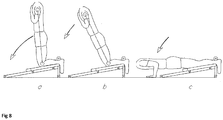
Figure 8a, b and c shows the sequence for performing eccentric hamstring exercises. - Referring now to the drawings and specifically
figures 1 and 2 an embodiment of the invention is illustrated in a 3 dimensional view. This embodiment comprises in a main central support spar (1), which is attached to a smaller substantially vertical spar (5). Flat spars at either end of the frame (13 and 14) provide stability to the frame. The ends of each flat spar may be coated with a high grip material (10) to ensure stability of the apparatus in use. A kneeling pad (2) sits at the upper end of the main centre spar. The pad is supported by side spars (7) projecting from either side of the central main spar. Referring tofigure 3 , an upper spar (6) sits telescopically in the upper end of the vertical spar (5) and to which are attached two side spars (3) which are sheathed with cylindrical cushions (4), thereby providing ankle restraints. A quick release bolt (9) in the main vertical spar (5) combined with complementary holes (15) in the inner spar (6) facilitate the height adjustability of the ankle restraints with respect to the kneeling pad. Optionally, the vertical spar itself may be height adjustable so as to alter the angle, α, the main spar makes with respect to the horizontal. - Referring now to
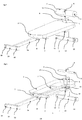
figure 4 , there is depicted a 3 dimensional view of a stripped frame according to a preferred embodiment (figure 4a ). In this embodiment, optionally, the main central spar may be formed from two lengths one of which fits telescopically into the other so as to allow length adjustability of the main spar for either convenience of use or storage. Also optionally, the vertical spar (5) may be affixed to the main spar (1) by means of a permanent hinge (11) and a releasable bolt (12), thereby allowing the apparatus to be stored more compactly (figure 4b ). -
Figure 5 shows a different embodiment of the invention, in this embodiment main support is provided by a pair of curved parallel bars (101). Spars (107) running between the two curved bars provide stability to the frame and support for the kneeling pad (2). The ends of the main spars are curved to provide feet (110) which may be coated with high grip material. A vertical spar (105) is attached to the uppermost of the cross spars (107) to provide a means of attachment for the ankle restraints, which are as described above. - Referring to
figure 6 , in another similar embodiment the main support spars (111) may be shorter for ease of transport. -
Figures 7 and8 indicate how concentric and eccentric exercise may be performed on the apparatus discussed above. It should be noted that the apparatus according tofigure 6 is not suitable for concentric exercise, unless the legs beneath the ankle restraints are fixed to the ground. This is because concentric exercises require an apparatus with a centre of gravity in use which is further from the ankle restraints than is the case for eccentric exercises. - All embodiments of the invention are characterised by the main frame defining an angle, α, with respect to the horizontal. For concentric and eccentric hamstring exercises, this is necessary to ensure that there is no risk of hyperextension of the knee. This angle may range between 5° and 20°. Preferably the angle should be set at between 8° and 12°. More preferably, an angle of 10° is used. For other forms of exercise, α may be set to a different angle, depending on the nature of the exercise to be performed. For clarity, the angle, α, is indicated for two different embodiments of the invention in
figures 3a and5a . - In use, the apparatus is subject to a certain degree of strain and a shifting centre of gravity. Accordingly, the apparatus is manufactured from suitably durable material to support the weight of any user while retaining a centre of gravity which resides within the foot print of the apparatus. As such, while tubular metal such as steel or aluminium may be preferred, other materials such as wood or reinforced plastic may also be envisaged.
Claims (14)
- An exercise apparatus for the performance of hamstring eccentrics and/or concentrics comprising:a) a collapsible frame comprising:i. a main support spar (1) running centrally the length of the apparatus with an extended horizontal bar (14) substantially perpendicular to the main support spar (1) attached at its centre to the lower end of the main support spar (1), andii. an extended vertical bar (5), substantially perpendicular both to the main support spar (1) and to the horizontal bar (14), attached somewhere along its length to the upper end of the main support spar (1), so as to fix the main support spar (1) in position, the vertical bar (5) having a horizontal bar (13) attached perpendicularly to its lower end, such that, in combination with the horizontal bar (14) at the opposite end of the main support spar (1), a stable platform for the apparatus is formed;the apparatus characterized byb) a kneeling pad (2) fixed to the upper surface of the main support spar (1); andc) a foot anchor (3,4,6) attached to the upper end of the vertical bar (5), proximal to the upper end of the kneeling pad (2), the foot anchor (3,4,6) being linked to the frame in such a manner as to allow it to be height adjusted with respect to the kneeling pad (2);wherein the main support spar (1) is fixable in an inclined position making an angle with respect to the horizontal which ranges between 5° to 20°.
- The apparatus according to claim 1, wherein the main support spar (1) is tilted between 8° and 12°.
- The apparatus according to claim 1 or 2, wherein the kneeling pad (2) is of sufficient length to accommodate the lower legs of a user from the knee to the ankle.
- The apparatus according to any of claims 1 to 3, wherein the foot anchor (3,4,6) comprises a T-piece wherein a substantially horizontal length (3) is centrally positioned above, and perpendicular to, a vertical member (6) extending downwards to the vertical bar (5) of the frame, the horizontal component (3) being cushioned (4) substantially along its length to accommodate the back of the user's ankles and to protect the user's Achilles tendons.
- The apparatus according to claim 4 wherein the foot anchor (3,4,6) is unitary with the frame.
- The apparatus according to claim 4, wherein the foot anchor (3,4,6) is mounted telescopically with respect to the vertical bar (5) of the frame.
- The apparatus according to claim 6, wherein the foot anchor comprises a rectangular hollow section, permanently affixed to the upper end of the vertical bar (5) of the frame; fixed to this hollow section, a spring loaded pull pin (9) connected to the base; inside this section, a smaller rectangular section (6) with a series of holes (15) to allow for foot anchor telescopic height adjustments with respect to the pull pin (9); connected to this smaller adjustable section at a right angle at its upper end, a hollow cylindrical tubular section (3), projecting outwards equally on opposite sides of the adjustable section (6), said cylindrical section (3) being covered along its exposed length with foam rollers (4), all exposed ends of the hollow sections being fitted with plastic caps.
- The apparatus according to any preceding claim wherein the frame extends substantially beyond the lower extremity of the kneeling pad (2).
- The apparatus according to any preceding claim wherein the frame is length adjustable.
- The apparatus according to claim 9, wherein the main support spar (1) is formed from two pieces, one fitting telescopically within the other, such that the main support spar (1) may be collapsed in length to facilitate ease of storage.
- The apparatus according to any preceding claim wherein the frame is height adjustable.
- The apparatus of any of claims 1 to 11 wherein side bars (7) extend from the main support spar (1) to provide a platform specifically for the kneeling pad (2).
- The apparatus according to any preceding claim, wherein the foot anchor (3,4,6) is fitted with a resistance spring.
- The apparatus according to any previous claim wherein the vertical bar (5) is connected to the main support spar (1) by means of a hinged connector (11) which may be releasably bolted (12) to secure the vertical bar (5) substantially perpendicular to the main support spar (1), and which when released allows the vertical bar (5) to fold in, parallel to the main support spar (1) so as to facilitate ease of storage.
Priority Applications (1)
| Application Number | Priority Date | Filing Date | Title |
|---|---|---|---|
| PL15718389T PL3116605T3 (en) | 2014-03-11 | 2015-03-09 | Exercise equipment for the performance of hamstring eccentric and concentric exercises |
Applications Claiming Priority (2)
| Application Number | Priority Date | Filing Date | Title |
|---|---|---|---|
| IE20140065A IE20140065A1 (en) | 2014-03-11 | 2014-03-11 | Exercise equipment for the performance of hamstring eccentric and concentric exercise |
| PCT/IE2015/000001 WO2015136512A1 (en) | 2014-03-11 | 2015-03-09 | Exercise equipment for the performance of hamstring eccentric and concentric exercises |
Publications (2)
| Publication Number | Publication Date |
|---|---|
| EP3116605A1 EP3116605A1 (en) | 2017-01-18 |
| EP3116605B1 true EP3116605B1 (en) | 2021-01-13 |
Family
ID=52998607
Family Applications (1)
| Application Number | Title | Priority Date | Filing Date |
|---|---|---|---|
| EP15718389.8A Not-in-force EP3116605B1 (en) | 2014-03-11 | 2015-03-09 | Exercise equipment for the performance of hamstring eccentric and concentric exercises |
Country Status (9)
| Country | Link |
|---|---|
| US (1) | US10426999B2 (en) |
| EP (1) | EP3116605B1 (en) |
| CA (1) | CA2979176C (en) |
| ES (1) | ES2864032T3 (en) |
| GB (1) | GB2528523B (en) |
| IE (1) | IE20140065A1 (en) |
| PL (1) | PL3116605T3 (en) |
| PT (1) | PT3116605T (en) |
| WO (1) | WO2015136512A1 (en) |
Families Citing this family (14)
| Publication number | Priority date | Publication date | Assignee | Title |
|---|---|---|---|---|
| US11135464B2 (en) * | 2017-10-18 | 2021-10-05 | Bootysprout, Inc. | Collapsible hip thrust exercise apparatus |
| USD886919S1 (en) * | 2018-02-18 | 2020-06-09 | Sean Gagnon | Exercise bench |
| CN108635762A (en) * | 2018-05-10 | 2018-10-12 | 北京东方明康医用设备股份有限公司 | A kind of core muscular strength biological feedback treatment system |
| USD998067S1 (en) * | 2019-08-07 | 2023-09-05 | Tengfei Zhang | Exercising apparatus |
| US11318347B2 (en) * | 2020-02-10 | 2022-05-03 | Venkatagireppa D N | VDN abdominal bench (exercise apparatus) |
| GB2613142B (en) * | 2021-10-13 | 2024-06-19 | Mcintyre Martin | Assessment of hamstring injury |
| US11779798B2 (en) * | 2021-12-23 | 2023-10-10 | Garrett Glenn Drumheller | Exercise systems and methods |
| CN114534188B (en) * | 2022-01-24 | 2023-03-03 | 厦门踏宇科技有限公司 | Leg rehabilitation training device |
| US12214247B2 (en) * | 2022-06-21 | 2025-02-04 | Stoik Innovations, Llc | Foldable exercise board with foot anchor |
| US12251600B2 (en) | 2022-11-03 | 2025-03-18 | Christopher Hicks | Adjustable, compact glute hamstring developer exercise device |
| US20240238638A1 (en) * | 2023-01-13 | 2024-07-18 | China 2 West Services Ltd. | Exercise equipment and related methods |
| US12420140B2 (en) | 2023-12-14 | 2025-09-23 | Life Fitness, Llc | Exercise apparatuses for leg strengthening |
| US12029934B1 (en) | 2023-12-16 | 2024-07-09 | Kyle Casillas | Nordic side-kick exercise apparatus |
| USD1107147S1 (en) | 2024-02-23 | 2025-12-23 | TBG Athletic Group LLC | Fitness bench |
Family Cites Families (31)
| Publication number | Priority date | Publication date | Assignee | Title |
|---|---|---|---|---|
| IT987930B (en) | 1972-11-02 | 1975-03-20 | Cecchettini Giancarlo | APPARATUS FOR GYMNASTICS |
| US4241915A (en) * | 1979-01-16 | 1980-12-30 | David Noble | Adjustable exercise apparatus |
| DE3533481A1 (en) | 1985-09-19 | 1987-03-26 | Leutheuser Heinz | Exercise apparatus |
| US5176603A (en) * | 1990-11-30 | 1993-01-05 | Emilie Conrad-Da'oud, Inc. | Exercise board |
| US5125884A (en) * | 1991-01-28 | 1992-06-30 | Weber Raymond P | Adjustable bench exercise apparatus |
| US5190513A (en) * | 1991-08-21 | 1993-03-02 | Pacific Fitness Corporation | Dual station exercise bench |
| USD339617S (en) * | 1991-10-16 | 1993-09-21 | Tooru Harashima | Physical exerciser |
| US5308306A (en) | 1992-12-18 | 1994-05-03 | Greenmaster Ind. Corp. | Abdomen exercising apparatus |
| USD370506S (en) * | 1995-02-03 | 1996-06-04 | Tunturi, Inc. | Abdominal exercise board |
| US5839998A (en) * | 1996-09-18 | 1998-11-24 | Wilkinson; William T. | Combination slant board and abdominal rocker |
| US5997450A (en) * | 1996-09-18 | 1999-12-07 | Wilkinson; William T. | Combination slant board and abdominal rocker |
| US5938571A (en) * | 1997-07-09 | 1999-08-17 | Stevens; Clive Graham | Folding exercise machine |
| US6123653A (en) * | 1999-01-13 | 2000-09-26 | Don Huang | Multifunctional situp exerciser |
| US6712743B2 (en) * | 2001-12-11 | 2004-03-30 | Ping Chen | Multi-functional exerciser |
| US7125371B2 (en) * | 2003-07-02 | 2006-10-24 | Alasdair David Henderson | Adjustable bodyweight exercise apparatus |
| US7775950B2 (en) * | 2004-02-24 | 2010-08-17 | Engineering Fitness International Corp. | Inclinable exercise device with abdominal crunch board and method |
| US7691042B2 (en) * | 2004-11-29 | 2010-04-06 | Raffaele Martini Pandozy | Abdominal exercising apparatus and method |
| US7322911B2 (en) * | 2005-03-05 | 2008-01-29 | Webber Randall T | Exercise bench |
| ITMI20050364U1 (en) * | 2005-10-18 | 2007-04-19 | Puntoshop S R L | GYMNASTIC TOOL |
| USD541893S1 (en) * | 2005-11-23 | 2007-05-01 | Webber Randall T | Inclined sit up bench |
| USD541357S1 (en) * | 2005-11-30 | 2007-04-24 | Webber Randall T | Folding exercise bench |
| USD541358S1 (en) * | 2005-12-02 | 2007-04-24 | Webber Randall T | Folding abdominal exercise bench |
| USD542868S1 (en) * | 2005-12-02 | 2007-05-15 | Webber Randall T | Folding exercise bench |
| US20070155602A1 (en) * | 2006-01-05 | 2007-07-05 | Huls John W | Sit-up exercise bench |
| US7662077B1 (en) | 2008-08-15 | 2010-02-16 | Ping Liu | Ab/back bench system |
| US20100255968A1 (en) * | 2009-04-07 | 2010-10-07 | Jiang rong-hua | Sit-Up Exercising Apparatus |
| US20110319237A1 (en) * | 2010-06-29 | 2011-12-29 | Anthony Jones | Abdominal squat machine |
| US8734307B2 (en) * | 2010-11-16 | 2014-05-27 | Chad Bathey | Core exercise device |
| US9211431B2 (en) * | 2012-08-30 | 2015-12-15 | Group X, LLC | Exercise machine |
| US20140194260A1 (en) * | 2013-01-04 | 2014-07-10 | Total Gym Global Corporation | Method of Using an Exercise Device Having an Adjustable Incline |
| US20150246263A1 (en) * | 2014-02-28 | 2015-09-03 | Total Gym Global Corp. | Functional body weight circuit training system and method of using exercise devices having a slidable incline |
-
2014
- 2014-03-11 IE IE20140065A patent/IE20140065A1/en not_active IP Right Cessation
-
2015
- 2015-03-09 EP EP15718389.8A patent/EP3116605B1/en not_active Not-in-force
- 2015-03-09 WO PCT/IE2015/000001 patent/WO2015136512A1/en not_active Ceased
- 2015-03-09 CA CA2979176A patent/CA2979176C/en active Active
- 2015-03-09 PL PL15718389T patent/PL3116605T3/en unknown
- 2015-03-09 PT PT157183898T patent/PT3116605T/en unknown
- 2015-03-09 ES ES15718389T patent/ES2864032T3/en active Active
- 2015-03-09 GB GB1503935.7A patent/GB2528523B/en not_active Expired - Fee Related
- 2015-03-09 US US15/124,806 patent/US10426999B2/en active Active
Non-Patent Citations (1)
| Title |
|---|
| None * |
Also Published As
| Publication number | Publication date |
|---|---|
| CA2979176C (en) | 2023-04-04 |
| US10426999B2 (en) | 2019-10-01 |
| CA2979176A1 (en) | 2015-09-17 |
| PT3116605T (en) | 2021-04-20 |
| EP3116605A1 (en) | 2017-01-18 |
| ES2864032T3 (en) | 2021-10-13 |
| WO2015136512A1 (en) | 2015-09-17 |
| US20170014681A1 (en) | 2017-01-19 |
| IE20140065A1 (en) | 2015-09-23 |
| GB201503935D0 (en) | 2015-04-22 |
| GB2528523B (en) | 2017-11-29 |
| GB2528523A (en) | 2016-01-27 |
| PL3116605T3 (en) | 2021-10-11 |
Similar Documents
| Publication | Publication Date | Title |
|---|---|---|
| CA2979176C (en) | Exercise equipment for the performance of hamstring eccentric and concentric exercises | |
| US9242139B2 (en) | Whole body exercise apparatus for use with elastic spherical ball | |
| US9168165B2 (en) | Squat and lunge training device | |
| US9669251B2 (en) | Exercise apparatus and method for using same | |
| CN102802741B (en) | Rotating Adjustable Fitness Equipment | |
| CN108883333B (en) | Rehabilitation device and its use for exercising the shoulder region | |
| US20140194260A1 (en) | Method of Using an Exercise Device Having an Adjustable Incline | |
| US7931575B2 (en) | Apparatus for performing body exercises | |
| MX2012013436A (en) | Change of direction machine and method of training therefor. | |
| US20110319237A1 (en) | Abdominal squat machine | |
| WO2020163293A1 (en) | Exercise equipment | |
| US20190217154A1 (en) | Portable stretching equipment | |
| US20160263425A1 (en) | Device for assisting with plank exercises | |
| US20130281272A1 (en) | Core exerciser | |
| JP2012192107A (en) | Muscular force training device | |
| US6746382B2 (en) | Quadricep isolation exercise apparatus | |
| RU2240851C1 (en) | Exercising apparatus for recovery of leg motional activity | |
| CN207024493U (en) | A kind of ankle exercise for power device | |
| RU102520U1 (en) | SPORTS SIMULATOR FOR THE DEVELOPMENT OF MUSCLES OF THE BACK AND HANDS | |
| KR200477862Y1 (en) | Adjustable Squart Exercise Device | |
| WO2016125134A1 (en) | Fitness Training Device for Practicing Squat Knees | |
| RU2252805C1 (en) | Device for training muscles | |
| WO2006117601A1 (en) | Gymnastic apparatus, particularly for exercising extensor muscles of inferior limbs thighs muscles and gluteus muscles | |
| Flanagan | Shoulder press from lunge position | |
| KR20190113310A (en) | Squat fitness equipment |
Legal Events
| Date | Code | Title | Description |
|---|---|---|---|
| STAA | Information on the status of an ep patent application or granted ep patent |
Free format text: STATUS: THE INTERNATIONAL PUBLICATION HAS BEEN MADE |
|
| PUAI | Public reference made under article 153(3) epc to a published international application that has entered the european phase |
Free format text: ORIGINAL CODE: 0009012 |
|
| STAA | Information on the status of an ep patent application or granted ep patent |
Free format text: STATUS: REQUEST FOR EXAMINATION WAS MADE |
|
| 17P | Request for examination filed |
Effective date: 20161011 |
|
| AK | Designated contracting states |
Kind code of ref document: A1 Designated state(s): AL AT BE BG CH CY CZ DE DK EE ES FI FR GB GR HR HU IE IS IT LI LT LU LV MC MK MT NL NO PL PT RO RS SE SI SK SM TR |
|
| AX | Request for extension of the european patent |
Extension state: BA ME |
|
| DAV | Request for validation of the european patent (deleted) | ||
| DAX | Request for extension of the european patent (deleted) | ||
| STAA | Information on the status of an ep patent application or granted ep patent |
Free format text: STATUS: EXAMINATION IS IN PROGRESS |
|
| 17Q | First examination report despatched |
Effective date: 20180712 |
|
| GRAP | Despatch of communication of intention to grant a patent |
Free format text: ORIGINAL CODE: EPIDOSNIGR1 |
|
| STAA | Information on the status of an ep patent application or granted ep patent |
Free format text: STATUS: GRANT OF PATENT IS INTENDED |
|
| INTG | Intention to grant announced |
Effective date: 20200730 |
|
| GRAS | Grant fee paid |
Free format text: ORIGINAL CODE: EPIDOSNIGR3 |
|
| GRAA | (expected) grant |
Free format text: ORIGINAL CODE: 0009210 |
|
| STAA | Information on the status of an ep patent application or granted ep patent |
Free format text: STATUS: THE PATENT HAS BEEN GRANTED |
|
| AK | Designated contracting states |
Kind code of ref document: B1 Designated state(s): AL AT BE BG CH CY CZ DE DK EE ES FI FR GB GR HR HU IE IS IT LI LT LU LV MC MK MT NL NO PL PT RO RS SE SI SK SM TR |
|
| REG | Reference to a national code |
Ref country code: GB Ref legal event code: FG4D |
|
| REG | Reference to a national code |
Ref country code: CH Ref legal event code: EP |
|
| REG | Reference to a national code |
Ref country code: IE Ref legal event code: FG4D |
|
| REG | Reference to a national code |
Ref country code: DE Ref legal event code: R096 Ref document number: 602015064701 Country of ref document: DE |
|
| REG | Reference to a national code |
Ref country code: AT Ref legal event code: REF Ref document number: 1354113 Country of ref document: AT Kind code of ref document: T Effective date: 20210215 |
|
| REG | Reference to a national code |
Ref country code: PT Ref legal event code: SC4A Ref document number: 3116605 Country of ref document: PT Date of ref document: 20210420 Kind code of ref document: T Free format text: AVAILABILITY OF NATIONAL TRANSLATION Effective date: 20210412 |
|
| REG | Reference to a national code |
Ref country code: NL Ref legal event code: FP |
|
| REG | Reference to a national code |
Ref country code: AT Ref legal event code: MK05 Ref document number: 1354113 Country of ref document: AT Kind code of ref document: T Effective date: 20210113 |
|
| REG | Reference to a national code |
Ref country code: LT Ref legal event code: MG9D |
|
| PG25 | Lapsed in a contracting state [announced via postgrant information from national office to epo] |
Ref country code: LT Free format text: LAPSE BECAUSE OF FAILURE TO SUBMIT A TRANSLATION OF THE DESCRIPTION OR TO PAY THE FEE WITHIN THE PRESCRIBED TIME-LIMIT Effective date: 20210113 Ref country code: BG Free format text: LAPSE BECAUSE OF FAILURE TO SUBMIT A TRANSLATION OF THE DESCRIPTION OR TO PAY THE FEE WITHIN THE PRESCRIBED TIME-LIMIT Effective date: 20210413 Ref country code: NO Free format text: LAPSE BECAUSE OF FAILURE TO SUBMIT A TRANSLATION OF THE DESCRIPTION OR TO PAY THE FEE WITHIN THE PRESCRIBED TIME-LIMIT Effective date: 20210413 Ref country code: GR Free format text: LAPSE BECAUSE OF FAILURE TO SUBMIT A TRANSLATION OF THE DESCRIPTION OR TO PAY THE FEE WITHIN THE PRESCRIBED TIME-LIMIT Effective date: 20210414 Ref country code: FI Free format text: LAPSE BECAUSE OF FAILURE TO SUBMIT A TRANSLATION OF THE DESCRIPTION OR TO PAY THE FEE WITHIN THE PRESCRIBED TIME-LIMIT Effective date: 20210113 Ref country code: HR Free format text: LAPSE BECAUSE OF FAILURE TO SUBMIT A TRANSLATION OF THE DESCRIPTION OR TO PAY THE FEE WITHIN THE PRESCRIBED TIME-LIMIT Effective date: 20210113 |
|
| PG25 | Lapsed in a contracting state [announced via postgrant information from national office to epo] |
Ref country code: LV Free format text: LAPSE BECAUSE OF FAILURE TO SUBMIT A TRANSLATION OF THE DESCRIPTION OR TO PAY THE FEE WITHIN THE PRESCRIBED TIME-LIMIT Effective date: 20210113 Ref country code: RS Free format text: LAPSE BECAUSE OF FAILURE TO SUBMIT A TRANSLATION OF THE DESCRIPTION OR TO PAY THE FEE WITHIN THE PRESCRIBED TIME-LIMIT Effective date: 20210113 Ref country code: AT Free format text: LAPSE BECAUSE OF FAILURE TO SUBMIT A TRANSLATION OF THE DESCRIPTION OR TO PAY THE FEE WITHIN THE PRESCRIBED TIME-LIMIT Effective date: 20210113 Ref country code: SE Free format text: LAPSE BECAUSE OF FAILURE TO SUBMIT A TRANSLATION OF THE DESCRIPTION OR TO PAY THE FEE WITHIN THE PRESCRIBED TIME-LIMIT Effective date: 20210113 |
|
| PG25 | Lapsed in a contracting state [announced via postgrant information from national office to epo] |
Ref country code: IS Free format text: LAPSE BECAUSE OF FAILURE TO SUBMIT A TRANSLATION OF THE DESCRIPTION OR TO PAY THE FEE WITHIN THE PRESCRIBED TIME-LIMIT Effective date: 20210513 |
|
| REG | Reference to a national code |
Ref country code: ES Ref legal event code: FG2A Ref document number: 2864032 Country of ref document: ES Kind code of ref document: T3 Effective date: 20211013 |
|
| REG | Reference to a national code |
Ref country code: DE Ref legal event code: R097 Ref document number: 602015064701 Country of ref document: DE |
|
| PG25 | Lapsed in a contracting state [announced via postgrant information from national office to epo] |
Ref country code: SM Free format text: LAPSE BECAUSE OF FAILURE TO SUBMIT A TRANSLATION OF THE DESCRIPTION OR TO PAY THE FEE WITHIN THE PRESCRIBED TIME-LIMIT Effective date: 20210113 Ref country code: MC Free format text: LAPSE BECAUSE OF FAILURE TO SUBMIT A TRANSLATION OF THE DESCRIPTION OR TO PAY THE FEE WITHIN THE PRESCRIBED TIME-LIMIT Effective date: 20210113 Ref country code: EE Free format text: LAPSE BECAUSE OF FAILURE TO SUBMIT A TRANSLATION OF THE DESCRIPTION OR TO PAY THE FEE WITHIN THE PRESCRIBED TIME-LIMIT Effective date: 20210113 Ref country code: CZ Free format text: LAPSE BECAUSE OF FAILURE TO SUBMIT A TRANSLATION OF THE DESCRIPTION OR TO PAY THE FEE WITHIN THE PRESCRIBED TIME-LIMIT Effective date: 20210113 |
|
| REG | Reference to a national code |
Ref country code: CH Ref legal event code: PL |
|
| PLBE | No opposition filed within time limit |
Free format text: ORIGINAL CODE: 0009261 |
|
| STAA | Information on the status of an ep patent application or granted ep patent |
Free format text: STATUS: NO OPPOSITION FILED WITHIN TIME LIMIT |
|
| PG25 | Lapsed in a contracting state [announced via postgrant information from national office to epo] |
Ref country code: SK Free format text: LAPSE BECAUSE OF FAILURE TO SUBMIT A TRANSLATION OF THE DESCRIPTION OR TO PAY THE FEE WITHIN THE PRESCRIBED TIME-LIMIT Effective date: 20210113 Ref country code: RO Free format text: LAPSE BECAUSE OF FAILURE TO SUBMIT A TRANSLATION OF THE DESCRIPTION OR TO PAY THE FEE WITHIN THE PRESCRIBED TIME-LIMIT Effective date: 20210113 Ref country code: DK Free format text: LAPSE BECAUSE OF FAILURE TO SUBMIT A TRANSLATION OF THE DESCRIPTION OR TO PAY THE FEE WITHIN THE PRESCRIBED TIME-LIMIT Effective date: 20210113 |
|
| 26N | No opposition filed |
Effective date: 20211014 |
|
| PG25 | Lapsed in a contracting state [announced via postgrant information from national office to epo] |
Ref country code: CH Free format text: LAPSE BECAUSE OF NON-PAYMENT OF DUE FEES Effective date: 20210331 Ref country code: AL Free format text: LAPSE BECAUSE OF FAILURE TO SUBMIT A TRANSLATION OF THE DESCRIPTION OR TO PAY THE FEE WITHIN THE PRESCRIBED TIME-LIMIT Effective date: 20210113 Ref country code: LI Free format text: LAPSE BECAUSE OF NON-PAYMENT OF DUE FEES Effective date: 20210331 Ref country code: LU Free format text: LAPSE BECAUSE OF NON-PAYMENT OF DUE FEES Effective date: 20210309 |
|
| PG25 | Lapsed in a contracting state [announced via postgrant information from national office to epo] |
Ref country code: SI Free format text: LAPSE BECAUSE OF FAILURE TO SUBMIT A TRANSLATION OF THE DESCRIPTION OR TO PAY THE FEE WITHIN THE PRESCRIBED TIME-LIMIT Effective date: 20210113 |
|
| REG | Reference to a national code |
Ref country code: FR Ref legal event code: PLFP Year of fee payment: 8 |
|
| PG25 | Lapsed in a contracting state [announced via postgrant information from national office to epo] |
Ref country code: IS Free format text: LAPSE BECAUSE OF FAILURE TO SUBMIT A TRANSLATION OF THE DESCRIPTION OR TO PAY THE FEE WITHIN THE PRESCRIBED TIME-LIMIT Effective date: 20210513 |
|
| PG25 | Lapsed in a contracting state [announced via postgrant information from national office to epo] |
Ref country code: HU Free format text: LAPSE BECAUSE OF FAILURE TO SUBMIT A TRANSLATION OF THE DESCRIPTION OR TO PAY THE FEE WITHIN THE PRESCRIBED TIME-LIMIT; INVALID AB INITIO Effective date: 20150309 |
|
| PGFP | Annual fee paid to national office [announced via postgrant information from national office to epo] |
Ref country code: PT Payment date: 20230309 Year of fee payment: 9 Ref country code: PL Payment date: 20230309 Year of fee payment: 9 |
|
| PG25 | Lapsed in a contracting state [announced via postgrant information from national office to epo] |
Ref country code: CY Free format text: LAPSE BECAUSE OF FAILURE TO SUBMIT A TRANSLATION OF THE DESCRIPTION OR TO PAY THE FEE WITHIN THE PRESCRIBED TIME-LIMIT Effective date: 20210113 |
|
| PGFP | Annual fee paid to national office [announced via postgrant information from national office to epo] |
Ref country code: NL Payment date: 20230926 Year of fee payment: 9 Ref country code: IE Payment date: 20230927 Year of fee payment: 9 Ref country code: GB Payment date: 20230927 Year of fee payment: 9 Ref country code: ES Payment date: 20230926 Year of fee payment: 9 |
|
| PGFP | Annual fee paid to national office [announced via postgrant information from national office to epo] |
Ref country code: FR Payment date: 20230927 Year of fee payment: 9 Ref country code: DE Payment date: 20230926 Year of fee payment: 9 Ref country code: BE Payment date: 20230926 Year of fee payment: 9 |
|
| PGFP | Annual fee paid to national office [announced via postgrant information from national office to epo] |
Ref country code: IT Payment date: 20230927 Year of fee payment: 9 |
|
| PG25 | Lapsed in a contracting state [announced via postgrant information from national office to epo] |
Ref country code: MK Free format text: LAPSE BECAUSE OF FAILURE TO SUBMIT A TRANSLATION OF THE DESCRIPTION OR TO PAY THE FEE WITHIN THE PRESCRIBED TIME-LIMIT Effective date: 20210113 |
|
| PG25 | Lapsed in a contracting state [announced via postgrant information from national office to epo] |
Ref country code: MT Free format text: LAPSE BECAUSE OF FAILURE TO SUBMIT A TRANSLATION OF THE DESCRIPTION OR TO PAY THE FEE WITHIN THE PRESCRIBED TIME-LIMIT Effective date: 20210113 |
|
| REG | Reference to a national code |
Ref country code: DE Ref legal event code: R119 Ref document number: 602015064701 Country of ref document: DE |
|
| PG25 | Lapsed in a contracting state [announced via postgrant information from national office to epo] |
Ref country code: PT Free format text: LAPSE BECAUSE OF NON-PAYMENT OF DUE FEES Effective date: 20240909 |
|
| PG25 | Lapsed in a contracting state [announced via postgrant information from national office to epo] |
Ref country code: PT Free format text: LAPSE BECAUSE OF NON-PAYMENT OF DUE FEES Effective date: 20240909 |
|
| REG | Reference to a national code |
Ref country code: NL Ref legal event code: MM Effective date: 20240401 |
|
| GBPC | Gb: european patent ceased through non-payment of renewal fee |
Effective date: 20240309 |
|
| PG25 | Lapsed in a contracting state [announced via postgrant information from national office to epo] |
Ref country code: NL Free format text: LAPSE BECAUSE OF NON-PAYMENT OF DUE FEES Effective date: 20240401 |
|
| REG | Reference to a national code |
Ref country code: BE Ref legal event code: MM Effective date: 20240331 |
|
| PG25 | Lapsed in a contracting state [announced via postgrant information from national office to epo] |
Ref country code: NL Free format text: LAPSE BECAUSE OF NON-PAYMENT OF DUE FEES Effective date: 20240401 |
|
| PG25 | Lapsed in a contracting state [announced via postgrant information from national office to epo] |
Ref country code: DE Free format text: LAPSE BECAUSE OF NON-PAYMENT OF DUE FEES Effective date: 20241001 |
|
| PG25 | Lapsed in a contracting state [announced via postgrant information from national office to epo] |
Ref country code: BE Free format text: LAPSE BECAUSE OF NON-PAYMENT OF DUE FEES Effective date: 20240331 |
|
| PG25 | Lapsed in a contracting state [announced via postgrant information from national office to epo] |
Ref country code: GB Free format text: LAPSE BECAUSE OF NON-PAYMENT OF DUE FEES Effective date: 20240309 |
|
| PG25 | Lapsed in a contracting state [announced via postgrant information from national office to epo] |
Ref country code: FR Free format text: LAPSE BECAUSE OF NON-PAYMENT OF DUE FEES Effective date: 20240331 |
|
| PG25 | Lapsed in a contracting state [announced via postgrant information from national office to epo] |
Ref country code: IE Free format text: LAPSE BECAUSE OF NON-PAYMENT OF DUE FEES Effective date: 20240309 |
|
| PG25 | Lapsed in a contracting state [announced via postgrant information from national office to epo] |
Ref country code: IE Free format text: LAPSE BECAUSE OF NON-PAYMENT OF DUE FEES Effective date: 20240309 Ref country code: GB Free format text: LAPSE BECAUSE OF NON-PAYMENT OF DUE FEES Effective date: 20240309 Ref country code: FR Free format text: LAPSE BECAUSE OF NON-PAYMENT OF DUE FEES Effective date: 20240331 Ref country code: DE Free format text: LAPSE BECAUSE OF NON-PAYMENT OF DUE FEES Effective date: 20241001 Ref country code: BE Free format text: LAPSE BECAUSE OF NON-PAYMENT OF DUE FEES Effective date: 20240331 |
|
| REG | Reference to a national code |
Ref country code: ES Ref legal event code: FD2A Effective date: 20250425 |
|
| PG25 | Lapsed in a contracting state [announced via postgrant information from national office to epo] |
Ref country code: IT Free format text: LAPSE BECAUSE OF NON-PAYMENT OF DUE FEES Effective date: 20240309 |
|
| PG25 | Lapsed in a contracting state [announced via postgrant information from national office to epo] |
Ref country code: ES Free format text: LAPSE BECAUSE OF NON-PAYMENT OF DUE FEES Effective date: 20240310 |
|
| PG25 | Lapsed in a contracting state [announced via postgrant information from national office to epo] |
Ref country code: PL Free format text: LAPSE BECAUSE OF NON-PAYMENT OF DUE FEES Effective date: 20240309 |
|
| PG25 | Lapsed in a contracting state [announced via postgrant information from national office to epo] |
Ref country code: TR Free format text: LAPSE BECAUSE OF FAILURE TO SUBMIT A TRANSLATION OF THE DESCRIPTION OR TO PAY THE FEE WITHIN THE PRESCRIBED TIME-LIMIT Effective date: 20210113 |