EP3105693B1 - Verfahren zum definieren einer selbstanordnenden einheit eines blockcopolymers - Google Patents
Verfahren zum definieren einer selbstanordnenden einheit eines blockcopolymers Download PDFInfo
- Publication number
- EP3105693B1 EP3105693B1 EP15704776.2A EP15704776A EP3105693B1 EP 3105693 B1 EP3105693 B1 EP 3105693B1 EP 15704776 A EP15704776 A EP 15704776A EP 3105693 B1 EP3105693 B1 EP 3105693B1
- Authority
- EP
- European Patent Office
- Prior art keywords
- outline
- points
- contour
- triangle
- self
- Prior art date
- Legal status (The legal status is an assumption and is not a legal conclusion. Google has not performed a legal analysis and makes no representation as to the accuracy of the status listed.)
- Active
Links
Images

Classifications
-
- G—PHYSICS
- G06—COMPUTING OR CALCULATING; COUNTING
- G06F—ELECTRIC DIGITAL DATA PROCESSING
- G06F16/00—Information retrieval; Database structures therefor; File system structures therefor
- G06F16/50—Information retrieval; Database structures therefor; File system structures therefor of still image data
- G06F16/51—Indexing; Data structures therefor; Storage structures
-
- G—PHYSICS
- G06—COMPUTING OR CALCULATING; COUNTING
- G06F—ELECTRIC DIGITAL DATA PROCESSING
- G06F17/00—Digital computing or data processing equipment or methods, specially adapted for specific functions
- G06F17/10—Complex mathematical operations
- G06F17/14—Fourier, Walsh or analogous domain transformations, e.g. Laplace, Hilbert, Karhunen-Loeve, transforms
- G06F17/141—Discrete Fourier transforms
-
- G—PHYSICS
- G06—COMPUTING OR CALCULATING; COUNTING
- G06T—IMAGE DATA PROCESSING OR GENERATION, IN GENERAL
- G06T7/00—Image analysis
- G06T7/0002—Inspection of images, e.g. flaw detection
- G06T7/0004—Industrial image inspection
- G06T7/001—Industrial image inspection using an image reference approach
-
- G—PHYSICS
- G06—COMPUTING OR CALCULATING; COUNTING
- G06V—IMAGE OR VIDEO RECOGNITION OR UNDERSTANDING
- G06V10/00—Arrangements for image or video recognition or understanding
- G06V10/40—Extraction of image or video features
- G06V10/46—Descriptors for shape, contour or point-related descriptors, e.g. scale invariant feature transform [SIFT] or bags of words [BoW]; Salient regional features
-
- G—PHYSICS
- G06—COMPUTING OR CALCULATING; COUNTING
- G06V—IMAGE OR VIDEO RECOGNITION OR UNDERSTANDING
- G06V20/00—Scenes; Scene-specific elements
- G06V20/60—Type of objects
- G06V20/69—Microscopic objects, e.g. biological cells or cellular parts
- G06V20/698—Matching; Classification
-
- G—PHYSICS
- G16—INFORMATION AND COMMUNICATION TECHNOLOGY [ICT] SPECIALLY ADAPTED FOR SPECIFIC APPLICATION FIELDS
- G16C—COMPUTATIONAL CHEMISTRY; CHEMOINFORMATICS; COMPUTATIONAL MATERIALS SCIENCE
- G16C20/00—Chemoinformatics, i.e. ICT specially adapted for the handling of physicochemical or structural data of chemical particles, elements, compounds or mixtures
- G16C20/70—Machine learning, data mining or chemometrics
-
- G—PHYSICS
- G16—INFORMATION AND COMMUNICATION TECHNOLOGY [ICT] SPECIALLY ADAPTED FOR SPECIFIC APPLICATION FIELDS
- G16C—COMPUTATIONAL CHEMISTRY; CHEMOINFORMATICS; COMPUTATIONAL MATERIALS SCIENCE
- G16C20/00—Chemoinformatics, i.e. ICT specially adapted for the handling of physicochemical or structural data of chemical particles, elements, compounds or mixtures
- G16C20/90—Programming languages; Computing architectures; Database systems; Data warehousing
Definitions
- a computer-implemented method for determining a self-assembling pattern of a confined block copolymer within a closed contour is provided.
- DSA Directed Self-assembly of Direct Block Copolymers
- the phase separation of Block Co-Polymers forms, by self-assembly, nano-domains in the form of cylinders, spheres or lamellae whose spatial scale varies by a few nanometers several tens of nanometers.
- the cylindrical domains are particularly suitable for producing vias in integrated circuits.
- the self-assembly of a BCP is inside a guide contour previously made on a surface.
- the strong lateral confinement induced by the walls of this guide contour predictably modifies the "natural" free-surface arrangement of the nano-domains (a hexagonal pattern in the case of cylindrical domains perpendicular to the substrate).
- a suitable guiding contour allows the realization of an arbitrary arrangement of nano-cylinders, which may correspond to a pattern of vias in an integrated circuit.
- the object of the invention is to remedy this drawback of the prior art by providing a method for determining a self-assembly pattern of a confined block copolymer within a closed contour that is faster than known methods while being sufficiently precise and predictive. More particularly, the invention aims to provide a sufficiently fast method to be used to determine such self-assembly patterns on the entire surface of an integrated circuit.
- this object is achieved by means of a method based on a simple geometrical transformation of a "reference" contour, located within a database stored in the memory of a computer. and identified as being closest to the guidance profile considered.
- Another object of the invention is a computer program product comprising program code instructions for performing the steps of such a method when said program is run on a computer.
- the block copolymer under consideration is of the cylindrical PS-b-PMMA type (that is to say forming by self-assembly the nano-cylinders).
- the invention can be applied to other types of block copolymers (diblocks, star triblocks or of linear structure, etc.) and to mixtures of such copolymers.
- There is also no restriction on the type of graphoepitaxy process used ("solvent annealing”, ie "solvent vapor annealing”, "grafting layer”, that is, say "graft layer” etc ).
- the Figure 1A illustrates a scanning electron microscopy image of a MAA self-assembly pattern of a block copolymer (PS-b-PMMA) confined by a closed trilobal shape CG closed contour.
- This pattern includes a first continuous phase (reference PH1 on the Figure 1B ) and a discrete second phase (reference PH2 on the Figure 1B ) formed by three cylinders (C1, C2 and C3 on the Figure 1B ).
- the image is scanned and acquired by a computer.
- the contour CG is sampled.
- the sampling is regular, that is to say with sampling points PE arranged substantially equidistant from each other along the contour.
- the points are ordered by traversing the contour in the trigonometrical direction.
- the boundaries of the cylindrical domains C1, C2 and C3 are also sampled, although this is not shown in the figure.
- a triangulation of the surface delimited by the contour CG (or, more exactly, by the discretized contour CG ') is defined by taking the sampling points E as vertices of the triangles.
- the reference T m on the Figure 1B identify one of these triangles.
- a plurality of discretized images of the type of Figure 1B are stored in the memory of the computer to form a database, or library. These images can correspond to real samples or can be obtained from high precision physical modeling algorithms.
- the Figures 2A to 2G show the images of such a database.
- the curvilinear distance between two sampling points is approximately the same for all the images of the database, and more precisely is between half and twice a reference length s 0 . More particularly, it can be imposed that the distance "s" between an arbitrary pair of adjacent sampling points satisfies the inequality
- the reference length is preferably of the same order of magnitude of the natural period L 0 of the copolymer, that is to say the distance between domains (for example cylindrical) in case of free self-assembly, not constrained by a guide contour, the copolymer.
- L 0 / 5 ⁇ s 0 ⁇ 5L 0 more particularly L 0 / 2 ⁇ s 0 ⁇ 2L 0 and more particularly L 0 / 2 ⁇ s 0 ⁇ L 0
- s 0 L 0 .
- the numbering of the sampling points is not arbitrary.
- a particular guide contour is previously centered so that its center of gravity "g" is placed at the origin of a Cartesian coordinate system. Then, the contour is sampled in the trigonometric direction.
- this triangulation is not, in general, a Delaunay triangulation, unless the polygon CG 'is convex. If the triangulation is not Delaunay, it is possible that triangles are superimposed, and that therefore a particular point of the MAA pattern is contained in several triangles. This does not matter for the implementation of the method of the invention.
- this contour (without the copolymer inside) must be sampled as explained above; the number N of contour sampling points must be the same as for at least part of the database. A triangulation of the surface delimited by this contour must also be determined in the same way as during the construction of said database.
- the contour thus determined will be called "reference contour” in the following.
- the contour thus determined will be called "reference contour” in the following.
- it is necessary to define a criterion of similarity between outlines.
- the discrete Fourier transform of a contour is calculated as explained above, by representing each sampling point by a complex number.
- the numbering of the sampling points must follow a criterion common to all contours (for example, but not limited to the one explained above) in order to make the quadratic distance thus calculated meaningful. It should be noted that information about contour rotation and origin of sampling is contained in the Fourier spectrum phase. They are therefore not taken into account when comparing the contours, which is desirable.
- the guide to be characterized is rotated so as to minimize the distance between the two sets of sampling points. This position can be obtained with a good approximation by applying an angle rotation equal to that formed by the vectors gc 1 and g ' c ' 1 where g 'is the center of gravity of the reference contour.
- This geometric transformation is based on the triangulations, and more precisely on the fact that each sampling point of the contour to be characterized is associated with ("is the image of") a respective sampling point of the reference contour, and each triangle of the triangulation of the surface delimited by the contour to be characterized is associated with a respective triangle of the triangulation of the surface delimited by the reference contour.
- each sampling point of the contour to be characterized is associated with ("is the image of") a respective sampling point of the reference contour
- each triangle of the triangulation of the surface delimited by the contour to be characterized is associated with a respective triangle of the triangulation of the surface delimited by the reference contour.
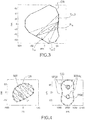
- the figure 3 shows a point P m situated inside a triangle T m forming part of the triangulation of the reference contour CR, as well as two additional triangles T m, 2 and T m, 3 .
- nbTri 3.
- the geometric transformation must be redefined. If we consider a point P of the motif of reference MR contained in nbTri triangles (a triangle T m belonging to the triangulation and nbTri-1 additional triangles), the image point will be in the triangle of the triangulation of the contour to be characterized associated with T m and its barycentric coordinates with respect to this triangle will be given by a weighted average of the barycentric coordinates in the different triangles of the reference contour. The weighting coefficients will typically be chosen such that the image of a point on the reference contour is on the contour to be characterized.
- the right part and the left part of the figure 4 show, respectively, a guide contour CG to be characterized and the corresponding reference contour CR, with the associated reference pattern MR.
- the boundaries of the two cylindrical domains contained in this pattern of MR reference are sampled; one of the sampling points is identified by the reference P.
- a geometric transformation as described above, with nbTri 3, was applied to find the image points of these sampling points inside the contour CG to characterize; for example, the reference PIM identifies the image point of the aforementioned point P.
- the reference MAAc identifies the calculated self-assembly pattern formed by all the image points of the sampling points of the boundaries of the cylindrical domains of the reference pattern.
- the relation between a point of the pattern of reference and its image point in the calculated self-assembly pattern may not be based on the barycentric coordinates of the points. It may be, more generally, any relationship resulting from a geometric transformation depending on the geometric transformation allowing to go from the reference contour to the guide contour considered.
Landscapes
- Engineering & Computer Science (AREA)
- Theoretical Computer Science (AREA)
- Physics & Mathematics (AREA)
- General Physics & Mathematics (AREA)
- Data Mining & Analysis (AREA)
- Software Systems (AREA)
- Databases & Information Systems (AREA)
- Mathematical Physics (AREA)
- Computer Vision & Pattern Recognition (AREA)
- Life Sciences & Earth Sciences (AREA)
- General Health & Medical Sciences (AREA)
- Multimedia (AREA)
- Health & Medical Sciences (AREA)
- General Engineering & Computer Science (AREA)
- Computing Systems (AREA)
- Pure & Applied Mathematics (AREA)
- Mathematical Optimization (AREA)
- Mathematical Analysis (AREA)
- Computational Mathematics (AREA)
- Crystallography & Structural Chemistry (AREA)
- Bioinformatics & Computational Biology (AREA)
- Bioinformatics & Cheminformatics (AREA)
- Chemical & Material Sciences (AREA)
- Artificial Intelligence (AREA)
- Evolutionary Computation (AREA)
- Medical Informatics (AREA)
- Molecular Biology (AREA)
- Biomedical Technology (AREA)
- Algebra (AREA)
- Discrete Mathematics (AREA)
- Quality & Reliability (AREA)
- Image Analysis (AREA)
- Exposure Of Semiconductors, Excluding Electron Or Ion Beam Exposure (AREA)
- Image Generation (AREA)
Claims (13)
- Verfahren zum Bestimmen eines Selbstanordnungsmotivs (MAA) eines Blockcopolymers, welches im Innern einer geschlossenen Kontur eingeschlossen ist, genannt Führungskontur (CG), wobei das Verfahren folgende durch einen Computer umgesetzte Schritte beinhaltet:a) Auswählen in einer Datenbank einer geschlossenen Kontur, genannt Referenzkontur (CR), welche sich der Führungskontur annähert, wobei ein Selbstanordnungsmotiv des Blockcopolymers, genannt Referenzmotiv (MR) mit der Referenzkontur assoziiert ist;b) Anwenden einer geometrischen Transformation auf eine Vielzahl von Punkten (P, Pm) des Referenzmotivs, um sie in jeweilige Punkte, genannt Bildpunkte (PIM), des zu bestimmenden Selbstanordnungsmotivs umzuwandeln, wobei die geometrische Transformation von einer geometrischen Transformation abhängt, welche es ermöglicht, von der Referenzkontur zur Führungskontur zu gelangen, wobei die Bildpunkte das Selbstanordnungsmotiv definieren.
- Verfahren nach Anspruch 1, bei welchem das Referenzmotiv mindestens eine erste Phase (PH1) und eine zweite (PH2) beinhaltet, wobei die Punkte des Referenzmotivs so gewählt werden, dass eine Grenze zwischen der ersten Phase und der zweiten Phase abgetastet wird.
- Verfahren nach einem der vorhergehenden Ansprüche, bei welchem die Datenbank eine Vielzahl von geschlossenen Konturen beinhaltet, welche mit einem Abtastverfahren abgetastet worden sind; wobei das Verfahren einen vorbereitenden Abtastschritt der Führungskontur nach demselben Abtastverfahren und mit einer gleichen Anzahl von Abtastpunkten (PE) wie mindestens einige der in der Datenbank enthaltenen geschlossenen Konturen beinhaltet.
- Verfahren nach Anspruch 3, bei welchem der krummlinige Abstand zwischen zwei solchen Abtastpunkten für alle in der Datenbank enthaltenen geschlossenen Konturen und für die Führungskontur zwischen der Hälfte und dem Doppelten einer vorbestimmten Länge s0 beträgt.
- Verfahren nach Anspruch 4, bei welchem die vorbestimmte Länge s0 so gestaltet ist, dass L0/5s0≤2L0 und vorzugsweise L0/2s0<2L0 und noch bevorzugterweise L0/5s0<L0, wobei L0 eine natürliche Periode des Blockcopolymers ist.
- Vorrichtung nach einem der Ansprüche 3 bis 5, bei welchem der Schritt a) Folgendes beinhaltet:a1) Auswählen der geschlossenen Konturen aus der Datenbank, welche ebenso viele Abtastpunkte wie die Führungskontur beinhalten; unda2) Wählen, aus den solchermaßen ausgewählten geschlossenen Konturen, derjenigen Kontur, welche ein Abstandskriterium abhängig von den Koordinaten der Abtastpunkte der geschlossenen Kontur und der Führungskontur minimiert.
- Verfahren nach Anspruch 6, bei welchem das Abstandskriterium ein quadratischer Abstand zwischen den komplexen Koeffizienten ist, welche mittels diskreter FourierTransformation zweier Vektoren von komplexen Zahlen erzielt wird, welche jeweils die Koordinaten der Abtastpunkte der geschlossenen Kontur und der Führungskontur darstellen.
- Verfahren nach einem der vorhergehenden Ansprüche, bei welchem die Datenbank für jede geschlossene Kontur genannte Kontur eine Gruppe von Daten beinhaltet, welche eine Triangulierung einer durch die Kontur begrenzten Fläche definiert, und bei welcher der Schritt b) Folgendes beinhaltet:b1) Bestimmen einer Triangulation einer durch die Führungskontur begrenzten Fläche, wobei jedes Dreieck (Tm) und jede Spitze der Triangulation mit einem jeweiligen Dreieck und einer jeweiligen Spitze der Triangulation der durch die Referenzkontur begrenzten Fläche assoziiert sind; undb2) für eine Vielzahl von Punkten des Referenzmotivs, von denen ein jeder in einem Dreieck der Triangulation der durch die Referenzkontur begrenzten Fläche enthalten ist, Bestimmen eines Bildpunktes, welcher in dem assoziierten Dreieck der Triangulation der durch die Führungskontur begrenzten Fläche enthalten ist.
- Verfahren nach Anspruch 8, bei welchem jeder Punkt des Referenzmotivs und dessen Bildpunkt in Bezug auf die Dreiecke, in welchen sie jeweils enthalten sind, dieselben baryzentrischen Koordinaten aufweisen.
- Verfahren nach Anspruch 8, bei welchem der Schritt b2) ebenfalls Folgendes beinhaltet:b2') für jeden oder für mindestens einen Punkt des Referenzmotivs, Konstruieren von mindestens einem zusätzlichen Dreieck (Tm,2;Tm,3), welches den Punkt (Pm) enthält und dessen Spitzen sich auf der Referenzkontur befinden;wobei der Bildpunkt des oder eines jeden Punktes des Referenzmotivs in Bezug auf das Dreieck, in dem es enthalten ist, baryzentrische Koordinaten aufweist, welche durch lineare Kombination der baryzentrischen Koordinaten des Punktes des Referenzmotivs in Bezug auf die Dreiecke, in denen es enthalten ist, erzielt werden.
- Verfahren nach einem der Ansprüche 8 bis 10, in Abhängigkeit von Anspruch 3, bei welchem die Triangulationen der Konturen durchgeführt werden, indem man als Spitzen mindestens einen Teil der Abtastpunkte verwendet.
- Verfahren nach einem der vorhergehenden Ansprüche, welches zudem folgenden Schritt beinhaltet:
c) Verwenden eines Algorithmus zur physischen Selbstanordnungs-Modellierung des Blockcopolymers zum Verfeinern des Selbstanordnungsmotivs, welches durch die Bildpunkte definiert wird, indem man die Bildpunkte als Initialisierungsdaten verwendet. - Computerprogrammprodukt, welches Programmecodeanweisungen zur Ausführung der Schritte eines Verfahrens nach einem der vorhergehenden Ansprüche beinhaltet, wenn das Programm auf einem Computer ausgeführt wird.
Applications Claiming Priority (2)
| Application Number | Priority Date | Filing Date | Title |
|---|---|---|---|
| FR1451085A FR3017475B1 (fr) | 2014-02-12 | 2014-02-12 | Procede de determination d'un motif d'auto-assemblage d'un copolymere a blocs |
| PCT/EP2015/052798 WO2015121269A1 (fr) | 2014-02-12 | 2015-02-10 | Procede de determination d'un motif d'auto-assemblage d'un copolymere a blocs |
Publications (2)
| Publication Number | Publication Date |
|---|---|
| EP3105693A1 EP3105693A1 (de) | 2016-12-21 |
| EP3105693B1 true EP3105693B1 (de) | 2019-07-10 |
Family
ID=51260955
Family Applications (1)
| Application Number | Title | Priority Date | Filing Date |
|---|---|---|---|
| EP15704776.2A Active EP3105693B1 (de) | 2014-02-12 | 2015-02-10 | Verfahren zum definieren einer selbstanordnenden einheit eines blockcopolymers |
Country Status (6)
| Country | Link |
|---|---|
| US (1) | US10255298B2 (de) |
| EP (1) | EP3105693B1 (de) |
| JP (1) | JP2017508286A (de) |
| KR (1) | KR20160123315A (de) |
| FR (1) | FR3017475B1 (de) |
| WO (1) | WO2015121269A1 (de) |
Families Citing this family (6)
| Publication number | Priority date | Publication date | Assignee | Title |
|---|---|---|---|---|
| FR3017475B1 (fr) * | 2014-02-12 | 2016-03-04 | Commissariat Energie Atomique | Procede de determination d'un motif d'auto-assemblage d'un copolymere a blocs |
| JP6562626B2 (ja) * | 2014-12-10 | 2019-08-21 | キヤノン株式会社 | 顕微鏡システム |
| CN106502202B (zh) * | 2017-01-06 | 2018-10-16 | 大连理工大学 | 一种球头铣刀与导向叶片接触区域的半解析建模方法 |
| US10312200B2 (en) * | 2017-07-27 | 2019-06-04 | International Business Machines Corporation | Integrated circuit security |
| CN111062982B (zh) * | 2019-12-10 | 2021-03-19 | 长江存储科技有限责任公司 | 一种图形分析方法、系统及存储介质 |
| CN116864040B (zh) * | 2023-05-22 | 2025-10-17 | 华南理工大学 | 基于粗粒化模拟技术的高分子纳米材料自组装交联过程自动化模拟方法 |
Family Cites Families (9)
| Publication number | Priority date | Publication date | Assignee | Title |
|---|---|---|---|---|
| AU2001275984A1 (en) * | 2000-07-20 | 2002-02-05 | President And Fellows Of Harvard College | Self-assembled electrical networks |
| US20140141211A1 (en) * | 2006-10-26 | 2014-05-22 | Si-Ping Han | Method for self-assembly of arbitrary metal patterns on DNA scaffolds |
| US8834956B2 (en) * | 2009-06-22 | 2014-09-16 | Micron Technology, Inc. | Methods of utilizing block copolymer to form patterns |
| US20120164389A1 (en) * | 2010-12-28 | 2012-06-28 | Yang Xiaomin | Imprint template fabrication and repair based on directed block copolymer assembly |
| TWI511084B (zh) * | 2012-01-20 | 2015-12-01 | Asml Netherlands Bv | 可自組聚合物及用於微影之方法 |
| JP5758363B2 (ja) * | 2012-09-07 | 2015-08-05 | 株式会社東芝 | パターン形成方法 |
| US20140357083A1 (en) * | 2013-05-31 | 2014-12-04 | Applied Materials, Inc. | Directed block copolymer self-assembly patterns for advanced photolithography applications |
| FR3017475B1 (fr) * | 2014-02-12 | 2016-03-04 | Commissariat Energie Atomique | Procede de determination d'un motif d'auto-assemblage d'un copolymere a blocs |
| KR101932799B1 (ko) * | 2015-02-17 | 2018-12-26 | 주식회사 엘지화학 | 블록 공중합체 자기 조립 패턴의 습식 식각 방법 |
-
2014
- 2014-02-12 FR FR1451085A patent/FR3017475B1/fr not_active Expired - Fee Related
-
2015
- 2015-02-10 JP JP2016551283A patent/JP2017508286A/ja active Pending
- 2015-02-10 US US15/114,514 patent/US10255298B2/en not_active Expired - Fee Related
- 2015-02-10 WO PCT/EP2015/052798 patent/WO2015121269A1/fr not_active Ceased
- 2015-02-10 KR KR1020167023672A patent/KR20160123315A/ko not_active Withdrawn
- 2015-02-10 EP EP15704776.2A patent/EP3105693B1/de active Active
Non-Patent Citations (1)
| Title |
|---|
| None * |
Also Published As
| Publication number | Publication date |
|---|---|
| US10255298B2 (en) | 2019-04-09 |
| WO2015121269A1 (fr) | 2015-08-20 |
| FR3017475A1 (fr) | 2015-08-14 |
| JP2017508286A (ja) | 2017-03-23 |
| FR3017475B1 (fr) | 2016-03-04 |
| EP3105693A1 (de) | 2016-12-21 |
| KR20160123315A (ko) | 2016-10-25 |
| US20160342592A1 (en) | 2016-11-24 |
Similar Documents
| Publication | Publication Date | Title |
|---|---|---|
| EP3105693A1 (de) | Verfahren zum definieren einer selbstanordnenden einheit eines blockcopolymers | |
| EP2318980B1 (de) | Verfahren zur bestimmung einer pseudoidentität auf der grundlage von eigenschaften von minutien und diesbezügliche einrichtung | |
| US11948281B2 (en) | Guided up-sampling for image inpainting | |
| EP0627693B1 (de) | Vorrichtung zur Segmentierung von aus Texturen bestehenden Bildern | |
| Grady | Minimal surfaces extend shortest path segmentation methods to 3D | |
| WO2012055748A1 (fr) | Methode de pre traitement d'une image tri dimensionnelle de la surface d'un pneumatique en vue de son utilisation pour l'inspection de ladite surface | |
| EP2081740B1 (de) | Verfahren und vorrichtung zur erfassung einer kollision zwischen zwei numerisch simulierten objekten | |
| FR2966956A1 (fr) | Methode de pre-traitement d'une image tri dimensionnelle de la surface d'un pneumatique a l'aide de deformations b-spline successives | |
| EP2212733B1 (de) | Verfahren und vorrichtung zur rekonstruktion der form eines objekts aus einer sequenz von schnittbildern dieses objekts | |
| CN114387208B (zh) | 基于上下文驱动的金字塔结构无监督配准系统及方法 | |
| EP3633544B1 (de) | Assoziationsverfahren von wichtigen elementen, die in einem video zu sehen sind | |
| CN117274072A (zh) | 一种基于二维多模态范围图像的点云去噪方法及装置 | |
| Rios et al. | Scalability of learning tasks on 3d cae models using point cloud autoencoders | |
| CN111524078A (zh) | 一种基于稠密网络的显微镜图像去模糊方法 | |
| EP2839410A1 (de) | Verfahren zur erkennung eines visuellen kontextes eines bildes und zugehörige vorrichtung | |
| CN114997378A (zh) | 归纳式图神经网络剪枝方法、系统、设备及存储介质 | |
| Kuang et al. | Light-curve calculations for triple microlensing systems | |
| EP2804175A1 (de) | Verfahren zur visuellen Spracherkennung durch Nachverfolgung der lokalen Deformationen einer Gesamtheit von wichtigen Referenzpunkten des Mundes des Sprechers | |
| FR3038254A1 (fr) | Dispositif de traitement de donnees pour fabrication additive | |
| EP2359339A1 (de) | Computerunterstütztes entwurfsverfahren zum erzeugen einer oberfläche in einem komplexen system | |
| FR2623642A1 (fr) | Procede de segmentation d'images angiographiques vasculaires par suivi vectoriel d'axes et detection de contours asservie | |
| EP3422387A1 (de) | Kalibrierung der kleinen elementarmotive in der elektronenstrahllithografie mit geformtem strahl | |
| EP2804129A1 (de) | Verfahren zur visuellen Spracherkennung mit Auswahl der Gruppen der aussagekräftigsten Referenzpunkte | |
| Chen | Random planar maps coupled to spin systems | |
| CN115965845B (zh) | 基于异源特征融合的图像生成方法、可读存储介质 |
Legal Events
| Date | Code | Title | Description |
|---|---|---|---|
| PUAI | Public reference made under article 153(3) epc to a published international application that has entered the european phase |
Free format text: ORIGINAL CODE: 0009012 |
|
| STAA | Information on the status of an ep patent application or granted ep patent |
Free format text: STATUS: REQUEST FOR EXAMINATION WAS MADE |
|
| 17P | Request for examination filed |
Effective date: 20160726 |
|
| AK | Designated contracting states |
Kind code of ref document: A1 Designated state(s): AL AT BE BG CH CY CZ DE DK EE ES FI FR GB GR HR HU IE IS IT LI LT LU LV MC MK MT NL NO PL PT RO RS SE SI SK SM TR |
|
| AX | Request for extension of the european patent |
Extension state: BA ME |
|
| DAX | Request for extension of the european patent (deleted) | ||
| STAA | Information on the status of an ep patent application or granted ep patent |
Free format text: STATUS: EXAMINATION IS IN PROGRESS |
|
| 17Q | First examination report despatched |
Effective date: 20180209 |
|
| RIC1 | Information provided on ipc code assigned before grant |
Ipc: G06F 17/14 20060101ALI20181115BHEP Ipc: G06K 9/62 20060101ALI20181115BHEP Ipc: G06K 9/00 20060101ALI20181115BHEP Ipc: G06F 17/30 20060101ALI20181115BHEP Ipc: G06K 9/48 20060101ALI20181115BHEP Ipc: G06T 7/00 20170101ALI20181115BHEP Ipc: G06F 19/00 20180101AFI20181115BHEP |
|
| REG | Reference to a national code |
Ref country code: DE Ref legal event code: R079 Ref document number: 602015033456 Country of ref document: DE Free format text: PREVIOUS MAIN CLASS: G06F0019000000 Ipc: G06K0009480000 |
|
| GRAP | Despatch of communication of intention to grant a patent |
Free format text: ORIGINAL CODE: EPIDOSNIGR1 |
|
| STAA | Information on the status of an ep patent application or granted ep patent |
Free format text: STATUS: GRANT OF PATENT IS INTENDED |
|
| INTG | Intention to grant announced |
Effective date: 20190225 |
|
| RIC1 | Information provided on ipc code assigned before grant |
Ipc: G06K 9/48 20060101AFI20190215BHEP Ipc: G06T 7/00 20170101ALI20190215BHEP Ipc: G06K 9/00 20060101ALI20190215BHEP Ipc: G06K 9/62 20060101ALI20190215BHEP Ipc: G06F 17/14 20060101ALI20190215BHEP |
|
| GRAS | Grant fee paid |
Free format text: ORIGINAL CODE: EPIDOSNIGR3 |
|
| GRAA | (expected) grant |
Free format text: ORIGINAL CODE: 0009210 |
|
| STAA | Information on the status of an ep patent application or granted ep patent |
Free format text: STATUS: THE PATENT HAS BEEN GRANTED |
|
| AK | Designated contracting states |
Kind code of ref document: B1 Designated state(s): AL AT BE BG CH CY CZ DE DK EE ES FI FR GB GR HR HU IE IS IT LI LT LU LV MC MK MT NL NO PL PT RO RS SE SI SK SM TR |
|
| REG | Reference to a national code |
Ref country code: GB Ref legal event code: FG4D Free format text: NOT ENGLISH |
|
| REG | Reference to a national code |
Ref country code: CH Ref legal event code: EP Ref country code: AT Ref legal event code: REF Ref document number: 1154332 Country of ref document: AT Kind code of ref document: T Effective date: 20190715 |
|
| REG | Reference to a national code |
Ref country code: DE Ref legal event code: R096 Ref document number: 602015033456 Country of ref document: DE |
|
| REG | Reference to a national code |
Ref country code: IE Ref legal event code: FG4D Free format text: LANGUAGE OF EP DOCUMENT: FRENCH |
|
| REG | Reference to a national code |
Ref country code: NL Ref legal event code: MP Effective date: 20190710 |
|
| REG | Reference to a national code |
Ref country code: LT Ref legal event code: MG4D |
|
| REG | Reference to a national code |
Ref country code: AT Ref legal event code: MK05 Ref document number: 1154332 Country of ref document: AT Kind code of ref document: T Effective date: 20190710 |
|
| PG25 | Lapsed in a contracting state [announced via postgrant information from national office to epo] |
Ref country code: FI Free format text: LAPSE BECAUSE OF FAILURE TO SUBMIT A TRANSLATION OF THE DESCRIPTION OR TO PAY THE FEE WITHIN THE PRESCRIBED TIME-LIMIT Effective date: 20190710 Ref country code: NO Free format text: LAPSE BECAUSE OF FAILURE TO SUBMIT A TRANSLATION OF THE DESCRIPTION OR TO PAY THE FEE WITHIN THE PRESCRIBED TIME-LIMIT Effective date: 20191010 Ref country code: PT Free format text: LAPSE BECAUSE OF FAILURE TO SUBMIT A TRANSLATION OF THE DESCRIPTION OR TO PAY THE FEE WITHIN THE PRESCRIBED TIME-LIMIT Effective date: 20191111 Ref country code: NL Free format text: LAPSE BECAUSE OF FAILURE TO SUBMIT A TRANSLATION OF THE DESCRIPTION OR TO PAY THE FEE WITHIN THE PRESCRIBED TIME-LIMIT Effective date: 20190710 Ref country code: AT Free format text: LAPSE BECAUSE OF FAILURE TO SUBMIT A TRANSLATION OF THE DESCRIPTION OR TO PAY THE FEE WITHIN THE PRESCRIBED TIME-LIMIT Effective date: 20190710 Ref country code: HR Free format text: LAPSE BECAUSE OF FAILURE TO SUBMIT A TRANSLATION OF THE DESCRIPTION OR TO PAY THE FEE WITHIN THE PRESCRIBED TIME-LIMIT Effective date: 20190710 Ref country code: BG Free format text: LAPSE BECAUSE OF FAILURE TO SUBMIT A TRANSLATION OF THE DESCRIPTION OR TO PAY THE FEE WITHIN THE PRESCRIBED TIME-LIMIT Effective date: 20191010 Ref country code: SE Free format text: LAPSE BECAUSE OF FAILURE TO SUBMIT A TRANSLATION OF THE DESCRIPTION OR TO PAY THE FEE WITHIN THE PRESCRIBED TIME-LIMIT Effective date: 20190710 Ref country code: LT Free format text: LAPSE BECAUSE OF FAILURE TO SUBMIT A TRANSLATION OF THE DESCRIPTION OR TO PAY THE FEE WITHIN THE PRESCRIBED TIME-LIMIT Effective date: 20190710 |
|
| PG25 | Lapsed in a contracting state [announced via postgrant information from national office to epo] |
Ref country code: AL Free format text: LAPSE BECAUSE OF FAILURE TO SUBMIT A TRANSLATION OF THE DESCRIPTION OR TO PAY THE FEE WITHIN THE PRESCRIBED TIME-LIMIT Effective date: 20190710 Ref country code: LV Free format text: LAPSE BECAUSE OF FAILURE TO SUBMIT A TRANSLATION OF THE DESCRIPTION OR TO PAY THE FEE WITHIN THE PRESCRIBED TIME-LIMIT Effective date: 20190710 Ref country code: RS Free format text: LAPSE BECAUSE OF FAILURE TO SUBMIT A TRANSLATION OF THE DESCRIPTION OR TO PAY THE FEE WITHIN THE PRESCRIBED TIME-LIMIT Effective date: 20190710 Ref country code: GR Free format text: LAPSE BECAUSE OF FAILURE TO SUBMIT A TRANSLATION OF THE DESCRIPTION OR TO PAY THE FEE WITHIN THE PRESCRIBED TIME-LIMIT Effective date: 20191011 Ref country code: IS Free format text: LAPSE BECAUSE OF FAILURE TO SUBMIT A TRANSLATION OF THE DESCRIPTION OR TO PAY THE FEE WITHIN THE PRESCRIBED TIME-LIMIT Effective date: 20191110 Ref country code: ES Free format text: LAPSE BECAUSE OF FAILURE TO SUBMIT A TRANSLATION OF THE DESCRIPTION OR TO PAY THE FEE WITHIN THE PRESCRIBED TIME-LIMIT Effective date: 20190710 |
|
| PG25 | Lapsed in a contracting state [announced via postgrant information from national office to epo] |
Ref country code: TR Free format text: LAPSE BECAUSE OF FAILURE TO SUBMIT A TRANSLATION OF THE DESCRIPTION OR TO PAY THE FEE WITHIN THE PRESCRIBED TIME-LIMIT Effective date: 20190710 |
|
| PG25 | Lapsed in a contracting state [announced via postgrant information from national office to epo] |
Ref country code: IT Free format text: LAPSE BECAUSE OF FAILURE TO SUBMIT A TRANSLATION OF THE DESCRIPTION OR TO PAY THE FEE WITHIN THE PRESCRIBED TIME-LIMIT Effective date: 20190710 Ref country code: RO Free format text: LAPSE BECAUSE OF FAILURE TO SUBMIT A TRANSLATION OF THE DESCRIPTION OR TO PAY THE FEE WITHIN THE PRESCRIBED TIME-LIMIT Effective date: 20190710 Ref country code: PL Free format text: LAPSE BECAUSE OF FAILURE TO SUBMIT A TRANSLATION OF THE DESCRIPTION OR TO PAY THE FEE WITHIN THE PRESCRIBED TIME-LIMIT Effective date: 20190710 Ref country code: DK Free format text: LAPSE BECAUSE OF FAILURE TO SUBMIT A TRANSLATION OF THE DESCRIPTION OR TO PAY THE FEE WITHIN THE PRESCRIBED TIME-LIMIT Effective date: 20190710 Ref country code: EE Free format text: LAPSE BECAUSE OF FAILURE TO SUBMIT A TRANSLATION OF THE DESCRIPTION OR TO PAY THE FEE WITHIN THE PRESCRIBED TIME-LIMIT Effective date: 20190710 |
|
| PG25 | Lapsed in a contracting state [announced via postgrant information from national office to epo] |
Ref country code: CZ Free format text: LAPSE BECAUSE OF FAILURE TO SUBMIT A TRANSLATION OF THE DESCRIPTION OR TO PAY THE FEE WITHIN THE PRESCRIBED TIME-LIMIT Effective date: 20190710 Ref country code: IS Free format text: LAPSE BECAUSE OF FAILURE TO SUBMIT A TRANSLATION OF THE DESCRIPTION OR TO PAY THE FEE WITHIN THE PRESCRIBED TIME-LIMIT Effective date: 20200224 Ref country code: SM Free format text: LAPSE BECAUSE OF FAILURE TO SUBMIT A TRANSLATION OF THE DESCRIPTION OR TO PAY THE FEE WITHIN THE PRESCRIBED TIME-LIMIT Effective date: 20190710 Ref country code: SK Free format text: LAPSE BECAUSE OF FAILURE TO SUBMIT A TRANSLATION OF THE DESCRIPTION OR TO PAY THE FEE WITHIN THE PRESCRIBED TIME-LIMIT Effective date: 20190710 |
|
| REG | Reference to a national code |
Ref country code: DE Ref legal event code: R097 Ref document number: 602015033456 Country of ref document: DE |
|
| PLBE | No opposition filed within time limit |
Free format text: ORIGINAL CODE: 0009261 |
|
| STAA | Information on the status of an ep patent application or granted ep patent |
Free format text: STATUS: NO OPPOSITION FILED WITHIN TIME LIMIT |
|
| PG2D | Information on lapse in contracting state deleted |
Ref country code: IS |
|
| 26N | No opposition filed |
Effective date: 20200603 |
|
| PG25 | Lapsed in a contracting state [announced via postgrant information from national office to epo] |
Ref country code: SI Free format text: LAPSE BECAUSE OF FAILURE TO SUBMIT A TRANSLATION OF THE DESCRIPTION OR TO PAY THE FEE WITHIN THE PRESCRIBED TIME-LIMIT Effective date: 20190710 |
|
| REG | Reference to a national code |
Ref country code: DE Ref legal event code: R119 Ref document number: 602015033456 Country of ref document: DE |
|
| REG | Reference to a national code |
Ref country code: CH Ref legal event code: PL |
|
| GBPC | Gb: european patent ceased through non-payment of renewal fee |
Effective date: 20200210 |
|
| REG | Reference to a national code |
Ref country code: BE Ref legal event code: MM Effective date: 20200229 |
|
| PG25 | Lapsed in a contracting state [announced via postgrant information from national office to epo] |
Ref country code: MC Free format text: LAPSE BECAUSE OF FAILURE TO SUBMIT A TRANSLATION OF THE DESCRIPTION OR TO PAY THE FEE WITHIN THE PRESCRIBED TIME-LIMIT Effective date: 20190710 Ref country code: LU Free format text: LAPSE BECAUSE OF NON-PAYMENT OF DUE FEES Effective date: 20200210 |
|
| PG25 | Lapsed in a contracting state [announced via postgrant information from national office to epo] |
Ref country code: LI Free format text: LAPSE BECAUSE OF NON-PAYMENT OF DUE FEES Effective date: 20200229 Ref country code: CH Free format text: LAPSE BECAUSE OF NON-PAYMENT OF DUE FEES Effective date: 20200229 |
|
| PG25 | Lapsed in a contracting state [announced via postgrant information from national office to epo] |
Ref country code: FR Free format text: LAPSE BECAUSE OF NON-PAYMENT OF DUE FEES Effective date: 20200229 Ref country code: IE Free format text: LAPSE BECAUSE OF NON-PAYMENT OF DUE FEES Effective date: 20200210 Ref country code: DE Free format text: LAPSE BECAUSE OF NON-PAYMENT OF DUE FEES Effective date: 20200901 Ref country code: GB Free format text: LAPSE BECAUSE OF NON-PAYMENT OF DUE FEES Effective date: 20200210 |
|
| PG25 | Lapsed in a contracting state [announced via postgrant information from national office to epo] |
Ref country code: BE Free format text: LAPSE BECAUSE OF NON-PAYMENT OF DUE FEES Effective date: 20200229 |
|
| PG25 | Lapsed in a contracting state [announced via postgrant information from national office to epo] |
Ref country code: MT Free format text: LAPSE BECAUSE OF FAILURE TO SUBMIT A TRANSLATION OF THE DESCRIPTION OR TO PAY THE FEE WITHIN THE PRESCRIBED TIME-LIMIT Effective date: 20190710 Ref country code: CY Free format text: LAPSE BECAUSE OF FAILURE TO SUBMIT A TRANSLATION OF THE DESCRIPTION OR TO PAY THE FEE WITHIN THE PRESCRIBED TIME-LIMIT Effective date: 20190710 |
|
| PG25 | Lapsed in a contracting state [announced via postgrant information from national office to epo] |
Ref country code: MK Free format text: LAPSE BECAUSE OF FAILURE TO SUBMIT A TRANSLATION OF THE DESCRIPTION OR TO PAY THE FEE WITHIN THE PRESCRIBED TIME-LIMIT Effective date: 20190710 |