EP3102933B1 - Kalibrierung von ultraschall-scannern - Google Patents
Kalibrierung von ultraschall-scannern Download PDFInfo
- Publication number
- EP3102933B1 EP3102933B1 EP15746390.2A EP15746390A EP3102933B1 EP 3102933 B1 EP3102933 B1 EP 3102933B1 EP 15746390 A EP15746390 A EP 15746390A EP 3102933 B1 EP3102933 B1 EP 3102933B1
- Authority
- EP
- European Patent Office
- Prior art keywords
- phi
- data
- scan
- transducer
- probe
- Prior art date
- Legal status (The legal status is an assumption and is not a legal conclusion. Google has not performed a legal analysis and makes no representation as to the accuracy of the status listed.)
- Not-in-force
Links
- 238000002604 ultrasonography Methods 0.000 title claims description 54
- 238000000034 method Methods 0.000 claims description 77
- 239000000523 sample Substances 0.000 description 89
- 230000033001 locomotion Effects 0.000 description 55
- 238000004422 calculation algorithm Methods 0.000 description 27
- 238000010304 firing Methods 0.000 description 27
- 230000007246 mechanism Effects 0.000 description 25
- 230000008569 process Effects 0.000 description 23
- 238000005259 measurement Methods 0.000 description 14
- 238000001514 detection method Methods 0.000 description 11
- 238000003384 imaging method Methods 0.000 description 10
- XLYOFNOQVPJJNP-UHFFFAOYSA-N water Substances O XLYOFNOQVPJJNP-UHFFFAOYSA-N 0.000 description 10
- 238000004891 communication Methods 0.000 description 8
- 238000012545 processing Methods 0.000 description 8
- 238000003860 storage Methods 0.000 description 8
- 238000013459 approach Methods 0.000 description 7
- 230000008901 benefit Effects 0.000 description 6
- 230000003287 optical effect Effects 0.000 description 5
- 238000013519 translation Methods 0.000 description 5
- 238000005516 engineering process Methods 0.000 description 4
- 238000012423 maintenance Methods 0.000 description 4
- 238000004088 simulation Methods 0.000 description 4
- 230000001360 synchronised effect Effects 0.000 description 4
- 230000001133 acceleration Effects 0.000 description 3
- 238000004364 calculation method Methods 0.000 description 3
- 238000013480 data collection Methods 0.000 description 3
- 210000001508 eye Anatomy 0.000 description 3
- 210000003689 pubic bone Anatomy 0.000 description 3
- 230000004075 alteration Effects 0.000 description 2
- 230000007812 deficiency Effects 0.000 description 2
- 238000006073 displacement reaction Methods 0.000 description 2
- 238000003754 machining Methods 0.000 description 2
- 238000013507 mapping Methods 0.000 description 2
- 230000035939 shock Effects 0.000 description 2
- 238000012360 testing method Methods 0.000 description 2
- 230000009466 transformation Effects 0.000 description 2
- 241001640117 Callaeum Species 0.000 description 1
- 230000002159 abnormal effect Effects 0.000 description 1
- 230000001154 acute effect Effects 0.000 description 1
- 210000005252 bulbus oculi Anatomy 0.000 description 1
- 230000001276 controlling effect Effects 0.000 description 1
- 230000008878 coupling Effects 0.000 description 1
- 238000010168 coupling process Methods 0.000 description 1
- 238000005859 coupling reaction Methods 0.000 description 1
- 238000010586 diagram Methods 0.000 description 1
- 230000002708 enhancing effect Effects 0.000 description 1
- 239000012530 fluid Substances 0.000 description 1
- 210000003128 head Anatomy 0.000 description 1
- 238000010348 incorporation Methods 0.000 description 1
- 238000005461 lubrication Methods 0.000 description 1
- 238000007726 management method Methods 0.000 description 1
- 230000005055 memory storage Effects 0.000 description 1
- 239000002184 metal Substances 0.000 description 1
- 239000002480 mineral oil Substances 0.000 description 1
- 235000010446 mineral oil Nutrition 0.000 description 1
- 238000012986 modification Methods 0.000 description 1
- 230000004048 modification Effects 0.000 description 1
- 238000005457 optimization Methods 0.000 description 1
- 239000004033 plastic Substances 0.000 description 1
- 230000002062 proliferating effect Effects 0.000 description 1
- 230000009467 reduction Effects 0.000 description 1
- 230000001105 regulatory effect Effects 0.000 description 1
- 230000004043 responsiveness Effects 0.000 description 1
- 238000005070 sampling Methods 0.000 description 1
- 239000004576 sand Substances 0.000 description 1
- 230000035945 sensitivity Effects 0.000 description 1
- 238000004904 shortening Methods 0.000 description 1
- 230000008054 signal transmission Effects 0.000 description 1
- 238000012144 step-by-step procedure Methods 0.000 description 1
- 230000001954 sterilising effect Effects 0.000 description 1
- 238000004659 sterilization and disinfection Methods 0.000 description 1
- 238000002627 tracheal intubation Methods 0.000 description 1
- 238000012549 training Methods 0.000 description 1
- 230000002463 transducing effect Effects 0.000 description 1
- 230000007723 transport mechanism Effects 0.000 description 1
- 230000000007 visual effect Effects 0.000 description 1
- 238000004804 winding Methods 0.000 description 1
Images














Classifications
-
- A—HUMAN NECESSITIES
- A61—MEDICAL OR VETERINARY SCIENCE; HYGIENE
- A61B—DIAGNOSIS; SURGERY; IDENTIFICATION
- A61B8/00—Diagnosis using ultrasonic, sonic or infrasonic waves
- A61B8/44—Constructional features of the ultrasonic, sonic or infrasonic diagnostic device
- A61B8/4444—Constructional features of the ultrasonic, sonic or infrasonic diagnostic device related to the probe
- A61B8/4461—Features of the scanning mechanism, e.g. for moving the transducer within the housing of the probe
- A61B8/4466—Features of the scanning mechanism, e.g. for moving the transducer within the housing of the probe involving deflection of the probe
-
- A—HUMAN NECESSITIES
- A61—MEDICAL OR VETERINARY SCIENCE; HYGIENE
- A61B—DIAGNOSIS; SURGERY; IDENTIFICATION
- A61B8/00—Diagnosis using ultrasonic, sonic or infrasonic waves
- A61B8/44—Constructional features of the ultrasonic, sonic or infrasonic diagnostic device
- A61B8/4483—Constructional features of the ultrasonic, sonic or infrasonic diagnostic device characterised by features of the ultrasound transducer
-
- A—HUMAN NECESSITIES
- A61—MEDICAL OR VETERINARY SCIENCE; HYGIENE
- A61B—DIAGNOSIS; SURGERY; IDENTIFICATION
- A61B8/00—Diagnosis using ultrasonic, sonic or infrasonic waves
- A61B8/48—Diagnostic techniques
- A61B8/483—Diagnostic techniques involving the acquisition of a 3D volume of data
-
- A—HUMAN NECESSITIES
- A61—MEDICAL OR VETERINARY SCIENCE; HYGIENE
- A61B—DIAGNOSIS; SURGERY; IDENTIFICATION
- A61B8/00—Diagnosis using ultrasonic, sonic or infrasonic waves
- A61B8/58—Testing, adjusting or calibrating the diagnostic device
-
- A—HUMAN NECESSITIES
- A61—MEDICAL OR VETERINARY SCIENCE; HYGIENE
- A61B—DIAGNOSIS; SURGERY; IDENTIFICATION
- A61B8/00—Diagnosis using ultrasonic, sonic or infrasonic waves
- A61B8/52—Devices using data or image processing specially adapted for diagnosis using ultrasonic, sonic or infrasonic waves
- A61B8/5207—Devices using data or image processing specially adapted for diagnosis using ultrasonic, sonic or infrasonic waves involving processing of raw data to produce diagnostic data, e.g. for generating an image
-
- A—HUMAN NECESSITIES
- A61—MEDICAL OR VETERINARY SCIENCE; HYGIENE
- A61B—DIAGNOSIS; SURGERY; IDENTIFICATION
- A61B8/00—Diagnosis using ultrasonic, sonic or infrasonic waves
- A61B8/52—Devices using data or image processing specially adapted for diagnosis using ultrasonic, sonic or infrasonic waves
- A61B8/5269—Devices using data or image processing specially adapted for diagnosis using ultrasonic, sonic or infrasonic waves involving detection or reduction of artifacts
-
- A—HUMAN NECESSITIES
- A61—MEDICAL OR VETERINARY SCIENCE; HYGIENE
- A61B—DIAGNOSIS; SURGERY; IDENTIFICATION
- A61B8/00—Diagnosis using ultrasonic, sonic or infrasonic waves
- A61B8/56—Details of data transmission or power supply
Definitions
- FIGS. 1-51 illustrate features according to one or more embodiments of the invention or related to the invention.
- Embodiments of the invention or related to the invention may be operational with numerous general purpose or special purpose computing system environments or configurations.
- Examples of well-known computing systems, environments, and/or configurations that may be suitable for use with the invention include, but are not limited to, electronic medical devices, personal computers, server computers, hand-held or laptop devices, multiprocessor systems, microprocessor-based systems, set top boxes, programmable consumer electronics, network PCs, minicomputers, mainframe computers, distributed computing environments that include any of the above systems or devices, and the like.
- Embodiments of the invention or related to the invention may be described in the general context of computer-executable instructions, such as program modules, being executed by a computer and/or by computer-readable media on which such instructions or modules can be stored.
- program modules include routines, programs, objects, components, data structures, etc. that perform particular tasks or implement particular abstract data types.
- the invention may also be practiced in distributed computing environments where tasks are performed by remote processing devices that are linked through a communications network.
- program modules may be located in both local and remote computer storage media including memory storage devices.
- Embodiments of the invention or related to the invention may include or be implemented in a variety of computer readable media.
- Computer readable media can be any available media that can be accessed by a computer and includes both volatile and nonvolatile media, removable and non-removable media.
- Computer readable media may comprise computer storage media and communication media.
- Computer storage media include volatile and nonvolatile, removable and non-removable media implemented in any method or technology for storage of information such as computer readable instructions, data structures, program modules or other data.
- Computer storage media includes, but is not limited to, RAM, ROM, EEPROM, flash memory or other memory technology, CD-ROM, digital versatile disks (DVD) or other optical disk storage, magnetic cassettes, magnetic tape, magnetic disk storage or other magnetic storage devices, or any other medium which can be used to store the desired information and which can accessed by computer.
- Communication media typically embodies computer readable instructions, data structures, program modules or other data in a modulated data signal such as a carrier wave or other transport mechanism and includes any information delivery media.
- modulated data signal means a signal that has one or more of its characteristics set or changed in such a manner as to encode information in the signal.
- communication media includes wired media such as a wired network or direct-wired connection, and wireless media such as acoustic, RF, infrared and other wireless media. Combinations of the any of the above should also be included within the scope of computer readable media.
- the combination of software or computer-executable instructions with a computer-readable medium results in the creation of a machine or apparatus.
- the execution of software or computer-executable instructions by a processing device results in the creation of a machine or apparatus, which may be distinguishable from the processing device, itself, according to an embodiment.
- a computer-readable medium is transformed by storing software or computer-executable instructions thereon.
- a processing device is transformed in the course of executing software or computer-executable instructions.
- a first set of data input to a processing device during, or otherwise in association with, the execution of software or computer-executable instructions by the processing device is transformed into a second set of data as a consequence of such execution.
- This second data set may subsequently be stored, displayed, or otherwise communicated.
- Such transformation may also be a consequence of, or otherwise involve, the physical alteration of, for example, the states of registers and/or counters associated with a processing device during execution of software or computer-executable instructions by the processing device.
- a process that is performed "automatically” may mean that the process is performed as a result of machine-executed instructions and does not, other than the establishment of user preferences, require manual effort.
- This invention disclosure discusses some potential optional advantage over the existing calibration method for certain types of ultrasonic scanner (which, in this document, may be referred to as the BladderScan product.
- An embodiment tries to solve three problems involved in the calibration process. First, the method detects the amount of misalignment between the transducer rotational and dome centers, which has been known to degrade the calibration results, and minimizes its negative impact on the calibration procedures. Second, the method tried to minimize the misalignment between image frames acquired by two-way scans caused by the gear backlash and/or machining errors. Third problem an embodiment tries to tackle is to enable the calibration without the use of water tank and external ultrasound target.
- An embodiment proposes optional advantages over the existing calibration method for such ultrasonic scanners.
- BladderScan product measures bladder volume by acquiring and analyzing three-dimensional (3D) cone-like ultrasound data.
- 3D three-dimensional
- One of the most important factors in influencing the accuracy of volume measurement results with BladderScan is the geometrical structure, which is determined by a set of calibration parameters, of the acquired 3D ultrasound data. It was found that the calculation of calibration parameters with the existing algorithm is sensitive to the amount of misalignment between the transducer rotational and dome centers caused by the assembly errors.
- the first problem that the proposed method proposes to solve is to detect the amount of misalignment between the rotational and dome centers and minimize its negative impact on the calibration process.
- the next-generation BladderScan product performs two-way scan, where a data frame can be acquired by either moving the motor in a clockwise or anticlockwise direction or in both directions in succession.
- two-way scan One of the advantages of two-way scan is that the frame rate of real-time B-mode is doubled compared to one-way scan given that the motor speed is the same for both cases. Also, the data acquisition time for 3D volume can be reduced by half.
- the data frames acquired by 2 different scans would not be automatically aligned with each other, leading to the misalignment of real-time B-mode imaging and the negative impact on the volume measurement accuracy. So the second problem an embodiment intends to solve is to align the ultrasound images acquired by two-way scans.
- the first approach i.e., Algorithm I
- Algorithm II deterministically calculates the amount of misalignment between the rotational and dome centers, estimates the Phi firing offset values for two-way scan, and detects the potential failure of a DCM.
- the second approach i.e., Algorithm II
- Algorithm II tries to solve the calibration parameters in a recursive optimization manner, where the optimal parameters are estimated by minimizing the difference between a sphere constructed by the calculated dome geometries and a perfect sphere.
- the third approach utilizes the cross-correlation in estimating the Phi offset and gear backlash values.
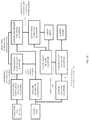
- Figure 1 shows the high-level block diagram of the proposed algorithm.
- the first step of the algorithm is to detect the distance between the rotational and dome centers (i.e., the amount of misalignment) of a BladderScan's data collection module (DCM). After detecting the misalignment as well as the corresponding plane with the maximum amount of misalignment, the algorithm rotates the Theta motor to the plane perpendicular to that plane. This process is more clearly illustrated in Fig. 2(a) , where the blue circle represents the dome (viewing from the top of the probe).
- DCM BladderScan's data collection module
- the proposed algorithm performs the calibration on the plane with the least amount of in-plane misalignment ( Fig. 2(b) ) so that the negative influence of the misalignment would be minimized.
- the algorithm determines the Phi firing offsets for forward and backward scans based on the symmetricity information of a data plane.
- the calibration algorithm commands the DCM to acquire a new set of 3D data, which is used for the detection of potential skewed spine of the DCM.
- the central scanlines from all data planes are compared in checking the similarity between them. If the difference between those scanlines is below a pre-defined cutoff value, then the calibration process succeeds. Otherwise, the calibration fails due to the severe skewness of the spine.
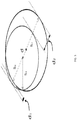
- FIG 3 gives the illustration of the misalignment detection algorithm.
- the blue circle represents the dome (viewing from the top of the probe) and the blue dot is the dome center.
- the red dot represents the rotational center and the red solid line stands for the first scanline in the first Theta plane.
- the length of the red solid line represents the distance between the rotational center and the wall of the dome.
- the red circle was formed by rotating the red solid line 360 degree around the rotational center (i.e., red dot).
- the red and blue circles should also be overlapped with each other. It means that the distance from the rotational center (i.e., red solid line) should be the same for all Theta planes. However, due to the misalignment between the rotational and dome centers, the red and blue circles would be no longer overlapped with each other as shown in Fig. 3 . The distance between the rotational center and the dome would be varied for different planes. In Fig. 3 , the shortest and longest distance between the rotational centers and the dome is denoted as S2 and S3, respectively.
- the distances S1, S2 and S3 can be estimated based on the reverberation patterns present in the reflected ultrasound echo as discussed in Algorithm II. However, the calculation is relatively sensitive to noise.
- disp(,) calculates the displacement between 2 signal and converts it to the distance, abs() obtains the absolute value, d1 and d2 represent the distance difference between S1 and S2 and between S1 and S3, respectively, and d is the amount of misalignment between the rotational and dome centers.
- the algorithm can command the DCM to rotate the Theta motor to the plane perpendicular to the one with maximum in-plane misalignment ( Fig. 2(a) ) and perform the rest of the calibration procedures.
- Step 2 Determination of forward scan Phi firing offset, which is the blind spot from home (vertical) to the angle at which data begins to be collected by the transducer
- the forward scan Phi firing offset value is to determine the first scanline (i.e., first ultrasound transmit) position during the forward scan in ensuring that the forward scan frame is symmetrical.
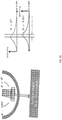
- the forward scan Phi firing offset value can be iteratively determined based on the symmetricity information of data frame as shown in Fig. 4 . Starting with a default Phi firing offset value, a forward scan data is acquired and the asymmetricity of the data is estimated. Based on the amount of asymmetricity, the Phi firing offset value is adjusted and updated, after which a forward scan data is acquired again with the updated Phi firing offset value. This procedure is repeated multiple times as shown in Fig. 4 until the blue dot curve crosses the zero value, suggesting that the optimal Phi firing offset value is found as the amount of data asymmetricity is minimal. And this forward scan Phi firing offset value can be saved as one of the scan parameters and also used for the rest of calibration process.
- the algorithm After ensuring that the forward scan frame is symmetrical, the algorithm tries to match the backward scan to the forward scan frame.
- the reason why the Phi firing offset for the backward scan frame is not determined through the same steps as shown in Fig. 4 is that there is potential gear backlash that would make the forward and backward scan frames misaligned with each other.
- different approach is used in determining the backward scan Phi firing offset value.
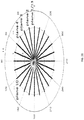
- the procedures that determine the Phi firing offset value for backward scan is shown in Fig. 5 .
- the blue color lines represent the scanlines from the forward scan and the red color lines the scanlines of the backward scan.
- the space interval between 2 consecutive scanlines is reasonably the same as the motor runs in a constant speed, so the alignment between the forward and backward scan planes would be achieved by aligning the last scanline of the forward and the first scanline of the backward scans.
- a much higher density of scanlines are formed by transmitting and receiving the ultrasound signal more frequently as shown in Fig. 5 .
- the ultrasound signature of each scanline would be varied between each other as the ultrasound signal is reflected back from different regions of dome while the motor moves.
- the correlation between them should be maximized.
- Step 4 Detection of skewed spine
- Fig. 6(b) One of the major sources contributing to the inaccurate bladder volume measurement is the skewed spine shown in Fig. 6(b) , where TXU stands for the transducer that moves in and out of the paper. It is optionally advantageous to detect the potential skewed spine in a DCM and preferably compensate the volume measurement inaccuracy.
- the calibration algorithm should notify customers about the failure of a DCM as shown in Fig. 1 .
- the gap size between the consecutive patterns is determined as the distance between the transducer and the dome surfaces.
- the location of a sample point that corresponds to the dome surface at each scan line, i.e., dome geometry can be estimated. This process can be repeated using various skew angle/offset values until we obtain dome geometry that is closest to a perfect sphere.
- the skew angle/offset value information that corresponds to the best matching dome geometry is used as calibration parameters.
- Step 1 Collect ultrasound data
- ultrasound data is collected in the air (i.e., without water tank and ultrasound target).
- Step 2 Estimate gap size between air scan patterns
- Gap size between the consecutive air scan reverberation patterns is proportional to the transducer-dome distance ( Fig. 10 ). Gap size can be detected in B-mode image by detecting air scan pattern. As a more advance method, dominant spatial frequency of the reverberation pattern can be detected to estimate gap size more accurately ( Fig. 11 ).
- 3D location of the transducer for each scan line can be derived from the Phi and the rotation information. Then, the location of a sample point that corresponds to the dome surface in each scanline can be estimated by using the gap size information at the scanline.
- An example of this dome geometry estimation results is shown in Fig. 12 .
- dome geometry can be estimated when transducer motion error exists. This dome geometry estimation process is repeated many times by varying transducer skew angles and offset values.
- Step 4 Select the best matching skew angle/offset values
- a best fitting sphere can be determined for each of the estimated dome geometries ( Fig. 13 ). Based on the assumption that dome shape is perfectly spherical, the dome geometry that resulted in the smallest deviation (e.g., mean squared error) from its fitting sphere is selected as the best matching case. The corresponding skew angle and offset values to the best matching case can be considered as the calibration result.
- One of the main purposes of the calibration process is to estimate appropriate phi offset and firing delay values to make the orientation of the B-mode image correct. This can be done by comparing a B-mode image with another one at the same scan plane after 180° theta rotation as shown in Fig. 14 . To increase the sensitivity of the off-angle detection, an intentional offset between phi rotation and dome center ( Fig. 9 ) would be desirable.
- Three-dimensional ultrasound has a limit in the achievable volume rate because of the delay times for sound wave travel and/or mechanical transducer motion.
- severe motion blur occurs if a probe does not stay still during scanning. For this reason, most bladder scanners do not provide real time imaging modality for probe aiming.
- Some recently introduced bladder scanners support real time B-mode by restricting the transducer motion within one plane for higher frame rates. This B-mode is useful, but still inconvenient because B-mode imaging plane is perpendicular to the plane of probe motion.
- embodiments related to this invention introduces real-time C-mode bladder imaging and two methods to implement it.
- the first method uses probe translation/rotation information derived from position sensors to compensate for probe motion.
- the other method uses a new user interface to make the user interpret the motion-blurred data more efficiently.
- Three-dimensional ultrasound has a limit in the achievable volume rate because of the delay times for sound wave travel.
- the limitation becomes stricter due to the additional delay for transducer motion, which is the case of the current ultrasound bladder scanners that typically require 2-3 seconds for volume scanning.
- probe motion by an operator could produce severe motion blur in the ultrasound data.
- the majority of the current ultrasound bladder scanners have not provided real time imaging modality. This caused inconvenience in aiming a probe.
- some new bladder scanners provide real time B-mode by restricting the transducer motion within one plane for higher frame rates, but the B-mode is still far from the ideal imaging modality for probe aiming because it provides only partial information on the bladder location and shape.
- B-mode is not easy to use because imaging plane is perpendicular to the plane of probe motion.
- C-mode is very intuitive because its imaging plane is parallel to the probe motion.
- C-mode is difficult to implement in real time with low volume rate probes because it requires full 3D volume data.
- An embodiment related to the present invention introduces new methods for real time C-mode bladder imaging as ideal probe aiming guides.
- the first method uses sensors, e.g., inertial measurement unit, magnetic and optical sensors, etc., that can be used for measuring/deriving probe location and orientation information in combination with ultrasound data.
- sensors e.g., inertial measurement unit, magnetic and optical sensors, etc.
- Summarized real time C-mode process with a position sensor is as follows:
- the second method does not use position sensor, but uses a new user interface (UI) utilizing the fact that human eye can perceive accurate object position by estimating its motion if the blurred object looks like a comet with tail.
- UI user interface
- This new UI can be implemented by making the bladder walls that correspond to the more recent data have a deeper color or lower transparency.
- this new C-mode still has motion blurs, it would provide all the information necessary for probe aiming.
- Step 1 Data acquisition
- IMU Inertial measurement unit
- An optical sensor with markers, a magnetic sensor with a transmitter, or any combinations of IMU, optical and magnetic sensors can be used for position tracking.
- Data buffer should be large enough to store data acquired for the most recent 1-5 seconds.
- Step 2 Bladder wall detection
- Sample points that correspond to the bladder wall are detected at each scan line from the ultrasound data acquired for the most recent 1-5 seconds. BVI9400 algorithm or any new algorithm can be used for this process. From the detection results, relative 3D location information of bladder wall sample points is derived. At this stage, bladder wall location is relative from the probe at each scan line, i.e., probe motion is not compensated and may have motion blur ( Fig. 17.2 ).
- Step 3 Probe location / orientation estimation
- probe location and orientation information is estimated at each scan line.
- Step 4 Probe motion compensation
- Relative bladder wall locations are converted into the absolute locations by compensating for the probe translation and rotation at each scan line (Fig. between 17.2 and 17.3).
- Step 5 Fine tuning of the motion compensation (optional)
- Output of the position/rotation sensor is not stable sometimes, especially with an IMU.
- a small offset in accelerometer output could cause several inches of error in the estimate translation value.
- an additional step to stabilize the motion compensation result would be desired.
- One of the possible approaches is estimating the sensor offset values to make the resulting bladder wall sample points to form a sphere-like shape (or, alternatively, as close as possible each other). If there is another sensor that can measure the location of the probe, e.g., optical sensors, it can be used to compensate for the accelerometer/gyroscope errors.
- Step 6 C-mode image generation
- an on-target indicator can be turned on ( Fig. 17.5 ). This on-target indicator can be also used for triggering bladder volume calculating process.
- Step 8 Probe motion detection (optional)
- accelerometer data can be used for detecting probe motion for the most recent 1-2 seconds. Based on this information, integrity of the most recent volume data can be checked, which means bladder volume calculation can be done using the data already in the data buffer. This enables a responsive bladder volume display.
- UI user interface
- Another example is hockey puck enhancement technology that looks like a comet with a tail ( Figure 19 ).
- the comet tail is a kind of motion blur, it does not confuse the object position, but rather helps in estimating the next position of the puck. This is because human visual system naturally perceives the direction and speed of the motion from the comet tail-like object shape.
- the new UI is basically similar with the 9x C-mode, i.e., plotting the location of the detected bladder wall locations on the x-y plane.
- the new UI displays the more recent data less transparently (or in a darker color, etc.) to make the bladder trajectory like a comet with a tail.
- human eye focuses on the "comet head” and naturally tracks its motion based on the shape of the comet tail ( Figure 20 ).
- this new C-mode looks different from the traditional C-mode, it provides all the necessary information for aiming in an intuitive way.
- Step 1 Data acquisition
- Ultrasound and probe position/rotation sensor data synchronized with each other in real time are acquired ( Figure 22.1 ).
- Data buffer should be large enough to store data acquired for the most recent 1-5 seconds.
- Step 2 Bladder wall detection
- Sample points that correspond to the bladder wall are detected at each scan line from the ultrasound data acquired for the most recent 1-5 seconds. BVI9400 algorithm or any new algorithm can be used for this process. Through this process, all the scan lines are classified into two groups; 1) scan lines that pass through the bladder and 2) the others ( Figure 22.2 ). Scan lines that pass through the pubic bone can be also detected in this procedure using the 9x or similar algorithm.
- Step 3 C-mode image generation
- Step 4 On-target indicator (Optional)
- an on-target indicator can be turned on ( Figure 22.4 ).
- the on-target indicator can be also used for triggering bladder volume calculating process.
- Typical ultrasound bladder scanners use a single-element transducer that moves mechanically in a dome-shaped probe head. For this type of devices, precise calibration of transducer motions is optionally advantageous for accurate volume measurement.
- An ultrasound target with a known shape, e.g., spiral or string, in water tank is typically used for this purpose.
- One of the problems of the typical calibration method is that there could be a parallax issue.
- An embodiment of the present invention solves this problem and provides other benefits including smaller calibration fixture and better reliability by utilizing intensity information of the beam reflected from a plate target, instead of using the spiral/string target location/shape information.
- An embodiment of the present invention provides a method for abnormal transducer motion detection of a mechanical three-dimensional one-channel ultrasound probe used for bladder volume measurement.
- This type of probe has a moving transducer in the dome-shaped probe head filled with coupling/lubrication fluid such as mineral oil.
- coupling/lubrication fluid such as mineral oil.
- transducer motion is characterized by rotations about two axes, phi and theta, as shown in Fig. 23 .
- transducer motions can be inaccurate for several reasons, e.g., skew angles of phi/theta rotation axes, gear backlash, wear and tear, etc., it needs to be precisely measured and calibrated for accurate volume measurement, which has been commonly done using an external calibration target, e.g., spiral or string, immersed in a water tank.
- Fig. 24(a) shows a probe with a crooked transducer.
- ultrasound beam does not go straight down unlike the intention of the device.
- typical calibration methods try to match the location of a calibration target on the two ultrasound images obtained before and after 180-deg rotation about the theta axis. If the transducer is not crooked as in Fig. 24(b) , the device can accurately find the phi angle that makes the beam go straight down.
- actual calibration result is still not accurate due to the parallax error as shown in Fig. 24(c) .
- an embodiment uses a reflective plate target, e.g., metal surface, instead of a typical string or spiral target.
- a reflective plate target e.g., metal surface
- an embodiment provides a more accurate way of doing calibration without any parallax problem, as well as other benefits like smaller fixture and better reliability.
- One of the main purposes of the calibration process is to estimate appropriate phi offset and firing delay values to make the orientation of the B-mode image correct. This can be done by comparing a beam peak intensity profiles with another one in the same scan plane after 180° theta rotation as shown in Fig. 25 .
- plate calibration fixture including probe holder can be made more easily with less precision compared to typical ones.
- Type II error While geometrical errors in the direction of phi motion (Type I error) can be compensated by adjusting phi offset / backlash, there is another type of error (Type II error) that is perpendicular to the scan plane. In reality, a geometrical error is likely to be a composition of these two different types of errors. The type II error is difficult to compensate physically by controlling the motor motion or firing delay, but information on the type II error can be used to detect a faulty probe or to compensate for bladder volume in software. With a plate target, the type II error can be estimated according to the following procedure:
- At least one scanline is perpendicular to the plate target. (This is because the plate can be thought as a tangent plane of the cone. The scanline that crosses the point of contact is perpendicular to the plate target. The number of scanlines could be increased by interpolation to get a better angular precision.) However, there could be an exceptional case where a hole, like an eye of hurricane, that none of the scanlines passes through exists due to the type II error. In this case, none of the scanlines could be perpendicular to the plate target. To avoid this situation, the plate target needs be tilted from the surface seen straight from the probe. For example, if expected maximum type II error is 5 degrees, the plate target should be tilted by at least 5 degrees.
- the scanline that is perpendicular to the plate target can be found by finding the scanline that has the largest peak intensity.
- the scan plane that contains the scanline should be perpendicular to the plate. In this scan plane, thanks to the perpendicularity, we can derive the relationship between the incidence angle (phi angle) and the peak intensity from the plate target.
- Step 1 we could make the first scan plane overlap the last scan plane with 180-deg theta angle difference in Step 1 for convenience. Or, the data used in the phi offset calibration can be used again if probe and plate target have not moved.
- a 13-plane peak intensity profile data were simulated using Matlab.
- the first plane overlaps the 13 th plane with 180-deg theta angle difference.
- plate target is intentionally skewed by 5 degrees towards southeast, and the probe has 3 degrees of phi offset and one degree of type II error.
- Figure 27 shows two intensity profiles in plane #1 and #13 (flipped for comparison).
- the 6-deg difference between the two peaks caused by the 3-deg phi offset is clearly observable in the figure.
- intensity profiles can be interpolated to improve the angular resolution. Note that peak intensities are different each other. This implies that type II error is not zero in this case. Backlash was not tested in this simulation, but it can be estimated using the same principal to the phi offset estimation.
- Figure 28 shows peak intensities of reflected beam at 1040 scanline locations (80 scanlines ⁇ 13 planes).
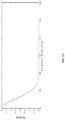
- the scanline with the maximum intensity is on the 10 th plane. So, we can assume that the 10 th plane is perpendicular to the plate target. (For better accuracy, we can actually interpolate the 10 th plane with the 11 th plane, to find the plane exactly perpendicular to the plate.) From the peak intensity profile in this plane, we can derive the relationship between the beam incidence angle and peak intensity as shown in Fig. 29 . This profile was smoothed with interpolation for better accuracy.
- An embodiment includes a reliable hemispheric scan mechanism for use in, for example, the Bladderscan and Aortascan product line.
- This mechanism was invented for the purpose of supporting and pointing directive sending and receiving devices in various desired directions, thus mapping out a two dimensional region of interest, within a hemispherical region.
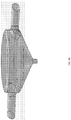
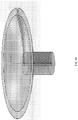
- An embodiment consists of three principal components, a spherical "eyeball” transducer holder with integral "latitude” gear teeth ( figure 35 ), a gimbal ring with integral "longitude” gear teeth ( figure 36 ) and a support frame with a longitude ring groove ( figure 37 ).
- the longitude motor (for clarity, not shown) is attached to the support frame and the latitude motor (for clarity, not shown) is attached to the gimbal ring.
- the inside surface of the gimbal ring is formed with a spherical contour.
- the transducer holder sphere is held in place within the gimbal ring component. It has an external surface with a spherical contour matching that of the gimbal ring.
- a directive transducer may be pointed in any desired direction within a hemispherical region.
- two motors independently and simultaneously move and position the inner transducer holder and the outer gimbal ring so as to point a transducer toward any latitude and longitude coordinate, within a hemispherical region, which the application requires.
- Hemispherical scan mechanisms typically use two motors and two associated gear mechanism in order to point a transducer device in various directions within a hemispherical region.
- Two common prior art mechanisms are the alt-azimuth mount often used to support telescopes ( figure 30 ) and the gimbal mount ( figure 31 ) often used to support compasses and gyroscopes.
- the alt-azimuth and gimbal mount have deficiencies which an embodiment circumvents.
- the prior art devices are large, delicate and complex. This makes them comparatively heavy, expensive, less reliable and less tolerant of damage through misuse.
- a computer CAD model of an embodiment has been created that allows examination of the relative motion of the various components, as they would move in actual use.
- An embodiment achieves the purpose of supporting and pointing directive sending and receiving devices in various desired directions, thus mapping out a two dimensional region of interest, within a hemispherical region.
- An embodiment of the scanning mechanism consists of five principal components, which when driven by a motor, move a directive transducer so as to point in many directions within a hemispherical region.
- the components are: a gimbal mount, with 1) inner ring and 2) outer shell, to support the transducer holder 3) a cup, with spiral grooves to guide the transducer pointing direction along a spiral path 4) a transducer holder, with a short pin extending down from the holder body that engages with a spiral groove in the grooved cup body to force pointing of the transducer along a defined spiral path 5) a slotted cup to move the spiral groove guided pin in a spiral direction 6) an optional shuttle feature (not shown in a figure) that allows the pin to cross spiral grooves at an acute angle without chance of changing direction at the groove intersections.
- motor torque is applied to a shaft that extends downward from the slotted cup component. This torque rotates the slotted cup.
- the captured pin feature extending downward from the bottom of the transducer holder, is forced to follow a spiral slot containing the captured pin.
- the transducing device is then necessarily pointed in a direction away from the pin and co-axial with its axis. In this manner, a spiral shaped scan path is traveled by any energy beam being sent and-or received by the transducer device mounted in or on the mechanism inner gimbal ring.
- Hemispherical scan mechanisms typically use two motors and two associated gear mechanism in order to point a transducer device in various directions within a hemispherical region.
- An embodiment not described in the prior literature, points a transducer mechanism in many directions covering a region of interest within a hemisphere, without using any gear mechanisms.
- the mechanism may require only one motor to scan many points, in two spatial co-ordinates, within a hemispherical region.
- the spiral path scan plan is useful because the method substantially shortens the angular path that the mechanism must traverse, in order to scan a grid of points, in a hemispherical region. Drastically shortening the angular scan path allows a much faster scan rate and-or a large reduction in mechanism power consumption.
- An additional novel aspect of an embodiment is the optional incorporation of a crisscrossed spiral groove feature.
- the crisscrossed groove allows the spiral transducer beam pointing path to spiral both outward, from the center region, and inward, from the perimeter region, without changing direction or speed of rotation of the rotating elements. This allows maintenance of a high angular scan speed, while simultaneously reducing drive power requirements.
- an embodiment has the following features distinguishable over hemispherical scanning mechanisms found in the prior art.
- a computer CAD model has been created that allows examination of the relative motion of the various components, as they would move in actual use.
- An embodiment is a single patient use disposable video laryngoscope blade that communicates wirelessly and displays images on a generic tablet computer (or other device) executing proprietary application software.
- This architecture could disrupt the laryngoscope product topology by reducing both the system capital cost and complexity of use and maintenance.
- the display component would not be a proprietary, dedicated device, but instead leverage existing generic mobile computing devices in the hospital environment. There is recent enabling regulatory precedent for a tablet to be treated as office equipment, and only the application software to be registered as a medical device.
- This architecture could disrupt the laryngoscope product topology by reducing both the system capital cost and complexity of use and maintenance.
Landscapes
- Health & Medical Sciences (AREA)
- Life Sciences & Earth Sciences (AREA)
- Biomedical Technology (AREA)
- Biophysics (AREA)
- Nuclear Medicine, Radiotherapy & Molecular Imaging (AREA)
- Pathology (AREA)
- Radiology & Medical Imaging (AREA)
- Engineering & Computer Science (AREA)
- Physics & Mathematics (AREA)
- Heart & Thoracic Surgery (AREA)
- Medical Informatics (AREA)
- Molecular Biology (AREA)
- Surgery (AREA)
- Animal Behavior & Ethology (AREA)
- General Health & Medical Sciences (AREA)
- Public Health (AREA)
- Veterinary Medicine (AREA)
- Gynecology & Obstetrics (AREA)
- Ultra Sonic Daignosis Equipment (AREA)
Claims (6)
- Verfahren zur Kalibrierung eines Ultraschall-Scanners mit einem Wandler, der sich um eine erste phi-Achse und eine zweite theta-Achse dreht, wobei die phi-Achse senkrecht zur theta-Achse angeordnet ist, wobei das Verfahren die folgenden Schritte umfasst:Sammeln von ersten Ziel-Ultraschalldaten in einer Abtastebene von einer Reflexionsplatte durch Drehen des Wandlers um die phi-Achse;Berechnen eines ersten phi-Winkels maximaler Peakintensität aus den ersten Daten;Drehen des Wandlers 180° um die theta-Achse;Sammeln von zweiten Ziel-Ultraschalldaten in der Abtastebene von der Reflexionsplatte durch Drehen des Wandlers um die phi-Achse;Berechnen eines zweiten phi-Winkels maximaler Peakintensität aus den zweiten Daten; undBestimmen einer Differenz zwischen dem ersten und dem zweiten phi-Winkel maximaler Peakintensität.
- Verfahren nach Anspruch 1, wobei das Ziel metallisch ist.
- Verfahren nach Anspruch 1, wobei erhobene Daten B-Modus-Daten sind.
- Verfahren zur Kalibrierung eines Ultraschall-Scanners mit einem Wandler, der sich um eine erste phi-Achse und eine zweite theta-Achse dreht, wobei die phi-Achse senkrecht zur theta-Achse angeordnet ist, wobei das Verfahren die folgenden Schritte umfasst:Sammeln von ersten Ziel-Ultraschalldaten in einer Abtastebene von einer Reflexionsplatte durch Drehen des Wandlers um die phi-Achse in eine erste Richtung;Berechnen eines phi-Winkels erster maximaler Peakintensität aus den ersten Daten;Sammeln von zweiten Ziel-Ultraschalldaten in der Abtastebene von der Reflexionsplatte durch Drehen des Wandlers um die phi-Achse in eine zweite Richtung, die der ersten Richtung entgegengesetzt ist;Berechnen eines zweiten phi-Winkels maximaler Peakintensität aus den zweiten Daten; undBestimmen einer Differenz zwischen dem ersten und dem zweiten phi-Winkel maximaler Peakintensität.
- Verfahren nach Anspruch 4, wobei das Ziel metallisch ist.
- Verfahren nach Anspruch 4, wobei erhobene Daten B-Modus-Daten sind.
Applications Claiming Priority (2)
| Application Number | Priority Date | Filing Date | Title |
|---|---|---|---|
| US201461936232P | 2014-02-05 | 2014-02-05 | |
| PCT/US2015/014664 WO2015120179A2 (en) | 2014-02-05 | 2015-02-05 | Ultrasonic data collection |
Publications (3)
| Publication Number | Publication Date |
|---|---|
| EP3102933A2 EP3102933A2 (de) | 2016-12-14 |
| EP3102933A4 EP3102933A4 (de) | 2017-10-11 |
| EP3102933B1 true EP3102933B1 (de) | 2018-11-28 |
Family
ID=53753815
Family Applications (1)
| Application Number | Title | Priority Date | Filing Date |
|---|---|---|---|
| EP15746390.2A Not-in-force EP3102933B1 (de) | 2014-02-05 | 2015-02-05 | Kalibrierung von ultraschall-scannern |
Country Status (6)
| Country | Link |
|---|---|
| US (1) | US10285668B2 (de) |
| EP (1) | EP3102933B1 (de) |
| JP (1) | JP6363229B2 (de) |
| CN (1) | CN107205719B (de) |
| CA (1) | CA2948279A1 (de) |
| WO (1) | WO2015120179A2 (de) |
Families Citing this family (6)
| Publication number | Priority date | Publication date | Assignee | Title |
|---|---|---|---|---|
| CA3089744C (en) * | 2018-02-23 | 2024-05-14 | Brainlab Ag | Image based ultrasound probe calibration |
| KR102493717B1 (ko) * | 2018-03-13 | 2023-01-30 | 베라톤 인코포레이티드 | 초음파 프로브를 사용한 일반화된 인터레이스 스캔 방법 |
| CN109157744B (zh) * | 2018-09-07 | 2022-05-20 | 中国医学科学院生物医学工程研究所 | 一种用于小动物经颅磁声刺激精准定位的超声换能器支架 |
| TWI691310B (zh) | 2019-01-04 | 2020-04-21 | 宏碁股份有限公司 | 超音波掃描方法與超音波掃描裝置 |
| CA3154396A1 (en) * | 2019-10-17 | 2021-04-22 | Monali PADWAL | Systems and methods for ultrasound scanning |
| IL274382A (en) * | 2020-05-01 | 2021-12-01 | Pulsenmore Ltd | A system and method for assisting an unskilled patient in performing ultrasound scans himself |
Family Cites Families (41)
| Publication number | Priority date | Publication date | Assignee | Title |
|---|---|---|---|---|
| US4476549A (en) | 1982-03-31 | 1984-10-09 | The United States Of America As Represented By The Secretary Of The Navy | Calibration method for acoustic scattering measurements using a spherical target |
| JP3708121B2 (ja) * | 1994-08-19 | 2005-10-19 | バイオセンス・インコーポレイテッド | 医療用機器の診断及び取扱いならびに映像システム |
| US5538004A (en) | 1995-02-28 | 1996-07-23 | Hewlett-Packard Company | Method and apparatus for tissue-centered scan conversion in an ultrasound imaging system |
| US5485845A (en) * | 1995-05-04 | 1996-01-23 | Hewlett Packard Company | Rotary encoder for intravascular ultrasound catheter |
| US5590658A (en) | 1995-06-29 | 1997-01-07 | Teratech Corporation | Portable ultrasound imaging system |
| KR0180056B1 (ko) | 1995-09-13 | 1999-04-01 | 이민화 | 휴대가능한 일체형 초음파진단기 |
| US5911691A (en) | 1996-05-21 | 1999-06-15 | Aloka Co., Ltd. | Ultrasound image processing apparatus and method of forming and displaying ultrasound images by the apparatus |
| JPH1057374A (ja) * | 1996-06-11 | 1998-03-03 | Olympus Optical Co Ltd | 超音波診断装置 |
| US6416475B1 (en) | 1996-06-28 | 2002-07-09 | Sonosite, Inc. | Ultrasonic signal processor for a hand held ultrasonic diagnostic instrument |
| US5699806A (en) * | 1996-10-01 | 1997-12-23 | Hewlett-Packard Company | Ultrasound system with nonuniform rotation corrector |
| US5928151A (en) | 1997-08-22 | 1999-07-27 | Acuson Corporation | Ultrasonic system and method for harmonic imaging in three dimensions |
| US5921934A (en) * | 1997-11-25 | 1999-07-13 | Scimed Life Systems, Inc. | Methods and apparatus for non-uniform rotation distortion detection in an intravascular ultrasound imaging system |
| IL122839A0 (en) | 1997-12-31 | 1998-08-16 | Ultra Guide Ltd | Calibration method and apparatus for calibrating position sensors on scanning transducers |
| US6099474A (en) | 1998-05-27 | 2000-08-08 | Solek; Roman | Ultrasound system for displaying real time simultaneous multiplane image |
| US6132379A (en) | 1998-11-04 | 2000-10-17 | Patacsil; Estelito G. | Method and apparatus for ultrasound guided intravenous cannulation |
| US6139496A (en) | 1999-04-30 | 2000-10-31 | Agilent Technologies, Inc. | Ultrasonic imaging system having isonification and display functions integrated in an easy-to-manipulate probe assembly |
| US20040015079A1 (en) | 1999-06-22 | 2004-01-22 | Teratech Corporation | Ultrasound probe with integrated electronics |
| US6306092B1 (en) | 1999-09-13 | 2001-10-23 | General Electric Company | Method and apparatus for calibrating rotational offsets in ultrasound transducer scans |
| US6543272B1 (en) | 2000-04-21 | 2003-04-08 | Insightec-Txsonics Ltd. | Systems and methods for testing and calibrating a focused ultrasound transducer array |
| JP4614548B2 (ja) | 2001-01-31 | 2011-01-19 | パナソニック株式会社 | 超音波診断装置 |
| DE10134259A1 (de) | 2001-07-18 | 2003-02-06 | Zf Lemfoerder Metallwaren Ag | Kugelgelenk mit integriertem Winkelsensor |
| US6709395B2 (en) * | 2002-06-25 | 2004-03-23 | Koninklijke Philips Electronics N.V. | System and method for electronically altering ultrasound scan line origin for a three-dimensional ultrasound system |
| US20050131302A1 (en) | 2003-12-16 | 2005-06-16 | Poland Mckee D. | Ultrasonic probe having a selector switch |
| US7867167B2 (en) | 2004-04-15 | 2011-01-11 | Johns Hopkins University | Ultrasound calibration and real-time quality assurance based on closed form formulation |
| JP4555619B2 (ja) * | 2004-06-28 | 2010-10-06 | アロカ株式会社 | 超音波診断装置 |
| JP4482388B2 (ja) * | 2004-07-21 | 2010-06-16 | アロカ株式会社 | 超音波探触子 |
| US10026338B2 (en) | 2004-11-30 | 2018-07-17 | The Regents Of The University Of California | Embedded motion sensing technology for integration within commercial ultrasound probes |
| US8213693B1 (en) | 2007-05-16 | 2012-07-03 | General Electric Company | System and method to track and navigate a tool through an imaged subject |
| US8357093B2 (en) | 2007-08-29 | 2013-01-22 | Siemens Medical Solutions Usa, Inc. | Medical diagnostic imaging with real-time scan conversion |
| US20110230766A1 (en) | 2008-10-09 | 2011-09-22 | Signostics Limited | Ultrasound imaging modality improvement |
| WO2010120907A2 (en) | 2009-04-14 | 2010-10-21 | Maui Imaging, Inc. | Multiple aperture ultrasound array alignment fixture |
| US8206307B2 (en) * | 2010-03-10 | 2012-06-26 | Dbmedx Inc. | Ultrasound imaging probe and method |
| AU2011213889B2 (en) | 2010-08-27 | 2016-02-18 | Signostics Limited | Method and apparatus for volume determination |
| US8876715B2 (en) * | 2010-11-19 | 2014-11-04 | General Electric Company | Method and system for correcting ultrasound data |
| WO2012148985A1 (en) | 2011-04-26 | 2012-11-01 | University Of Virginia Patent Foundation | Bone surface image reconstruction using ultrasound |
| US8887551B2 (en) | 2011-09-06 | 2014-11-18 | Trig Medical Ltd. | Calibration of instrument relative to ultrasonic probe |
| US9372593B2 (en) | 2011-11-29 | 2016-06-21 | Apple Inc. | Using a three-dimensional model to render a cursor |
| US8540583B2 (en) | 2011-12-30 | 2013-09-24 | Nike, Inc. | System for tracking a golf ball and displaying an enhanced image of the golf ball |
| BR112014015768A8 (pt) | 2011-12-30 | 2017-07-04 | Koninklijke Philips Nv | método de aperfeiçoamento de visualização da agulha na formação de imagem por ultrassom; aparelho para o aperfeiçoamento da visualização da agulha na formação de imagem por ultrassom; e sistema de formação de imagem por ultrassom |
| GB201200531D0 (en) | 2012-01-13 | 2012-02-29 | Airbus Operations Ltd | Calibration block and method |
| US8672851B1 (en) | 2012-11-13 | 2014-03-18 | dBMEDx INC | Ocular ultrasound based assessment device and related methods |
-
2015
- 2015-02-05 EP EP15746390.2A patent/EP3102933B1/de not_active Not-in-force
- 2015-02-05 JP JP2016568466A patent/JP6363229B2/ja not_active Expired - Fee Related
- 2015-02-05 WO PCT/US2015/014664 patent/WO2015120179A2/en not_active Ceased
- 2015-02-05 CN CN201580018442.1A patent/CN107205719B/zh not_active Expired - Fee Related
- 2015-02-05 CA CA2948279A patent/CA2948279A1/en active Pending
- 2015-02-05 US US14/615,245 patent/US10285668B2/en active Active
Non-Patent Citations (1)
| Title |
|---|
| None * |
Also Published As
| Publication number | Publication date |
|---|---|
| US10285668B2 (en) | 2019-05-14 |
| WO2015120179A2 (en) | 2015-08-13 |
| EP3102933A2 (de) | 2016-12-14 |
| CA2948279A1 (en) | 2015-08-13 |
| US20150216512A1 (en) | 2015-08-06 |
| CN107205719A (zh) | 2017-09-26 |
| EP3102933A4 (de) | 2017-10-11 |
| CN107205719B (zh) | 2021-07-30 |
| JP2017511737A (ja) | 2017-04-27 |
| JP6363229B2 (ja) | 2018-07-25 |
Similar Documents
| Publication | Publication Date | Title |
|---|---|---|
| EP3102933B1 (de) | Kalibrierung von ultraschall-scannern | |
| US9504445B2 (en) | Ultrasound imaging system and method for drift compensation | |
| US8655022B2 (en) | System and method for detecting position of underwater vehicle | |
| EP3478209B1 (de) | System zur verfolgung inertialer vorrichtungen und verfahren zum betrieb davon | |
| US20190219693A1 (en) | 3-D US Volume From 2-D Images From Freehand Rotation and/or Translation of Ultrasound Probe | |
| CN103908298B (zh) | 超声成像系统和方法 | |
| EP2458472B1 (de) | Ultraschallsystem zur Bereitstellung eines für die Haltung eines Benutzers optimierten Ultraschallbildes | |
| US20140128739A1 (en) | Ultrasound imaging system and method | |
| US20210208232A1 (en) | Position and orientation tracking system, apparatus and method | |
| US20230255589A1 (en) | Combining image based and inertial probe tracking | |
| EP3399327B1 (de) | Orientierungsabschätzung mit funkfrequenzidentifikations(rfid)-tags | |
| US20170325785A1 (en) | Real-Time Anatomically Based Deformation Mapping and Correction | |
| EP4459409A1 (de) | Positionierungssystem für chirurgische plattform sowie verfahren und vorrichtung zur bestimmung von haltungsinformationen | |
| US20200249341A1 (en) | Portable imager | |
| US8887551B2 (en) | Calibration of instrument relative to ultrasonic probe | |
| WO2019221746A1 (en) | Position and orientation tracking system, apparatus and method | |
| CN114533111A (zh) | 一种基于惯性导航系统的三维超声重建系统 | |
| US20120277588A1 (en) | Systems and methods for fusing sensor and image data for three-dimensional volume reconstruction | |
| US11819320B2 (en) | Method and system for determining orientation of capsule endoscope | |
| EP3515315B1 (de) | Ultraschallsonde, ultraschallbildgebungsvorrichtung, ultraschallbildgebungssystem und verfahren zur steuerung davon | |
| KR20130108771A (ko) | 3차원 위치/방향 추정 시스템의 보정 장치 및 방법 | |
| CN113260831A (zh) | 三维重建装置、三维重建系统、三维重建方法和三维重建程序 | |
| US20150182198A1 (en) | System and method for displaying ultrasound images | |
| JP2016086880A (ja) | 超音波画像表示装置及びその制御プログラム | |
| US11029153B2 (en) | Length measurement on an object by taking bearings on measuring points by means of a laser measuring module |
Legal Events
| Date | Code | Title | Description |
|---|---|---|---|
| PUAI | Public reference made under article 153(3) epc to a published international application that has entered the european phase |
Free format text: ORIGINAL CODE: 0009012 |
|
| STAA | Information on the status of an ep patent application or granted ep patent |
Free format text: STATUS: REQUEST FOR EXAMINATION WAS MADE |
|
| 17P | Request for examination filed |
Effective date: 20160823 |
|
| AK | Designated contracting states |
Kind code of ref document: A2 Designated state(s): AL AT BE BG CH CY CZ DE DK EE ES FI FR GB GR HR HU IE IS IT LI LT LU LV MC MK MT NL NO PL PT RO RS SE SI SK SM TR |
|
| AX | Request for extension of the european patent |
Extension state: BA ME |
|
| DAX | Request for extension of the european patent (deleted) | ||
| A4 | Supplementary search report drawn up and despatched |
Effective date: 20170911 |
|
| RIC1 | Information provided on ipc code assigned before grant |
Ipc: A61B 8/12 20060101ALI20170905BHEP Ipc: G01N 29/30 20060101AFI20170905BHEP |
|
| GRAP | Despatch of communication of intention to grant a patent |
Free format text: ORIGINAL CODE: EPIDOSNIGR1 |
|
| STAA | Information on the status of an ep patent application or granted ep patent |
Free format text: STATUS: GRANT OF PATENT IS INTENDED |
|
| INTG | Intention to grant announced |
Effective date: 20180601 |
|
| RIN1 | Information on inventor provided before grant (corrected) |
Inventor name: CAPRIO, MATTHEW Inventor name: GARRISON, ADAM SCOTT Inventor name: CHOI, JOON HWAN Inventor name: LUO, SI Inventor name: DUNNE, MAURICE Inventor name: HUNN, LAURENCE, NEIL Inventor name: NELSON, CRAIG, E. Inventor name: DUDYCHA, STEPHEN Inventor name: YUM, ANDREW |
|
| GRAS | Grant fee paid |
Free format text: ORIGINAL CODE: EPIDOSNIGR3 |
|
| GRAA | (expected) grant |
Free format text: ORIGINAL CODE: 0009210 |
|
| STAA | Information on the status of an ep patent application or granted ep patent |
Free format text: STATUS: THE PATENT HAS BEEN GRANTED |
|
| AK | Designated contracting states |
Kind code of ref document: B1 Designated state(s): AL AT BE BG CH CY CZ DE DK EE ES FI FR GB GR HR HU IE IS IT LI LT LU LV MC MK MT NL NO PL PT RO RS SE SI SK SM TR |
|
| REG | Reference to a national code |
Ref country code: CH Ref legal event code: EP |
|
| REG | Reference to a national code |
Ref country code: AT Ref legal event code: REF Ref document number: 1070826 Country of ref document: AT Kind code of ref document: T Effective date: 20181215 |
|
| REG | Reference to a national code |
Ref country code: DE Ref legal event code: R096 Ref document number: 602015020452 Country of ref document: DE |
|
| REG | Reference to a national code |
Ref country code: IE Ref legal event code: FG4D |
|
| REG | Reference to a national code |
Ref country code: NL Ref legal event code: FP |
|
| REG | Reference to a national code |
Ref country code: LT Ref legal event code: MG4D |
|
| REG | Reference to a national code |
Ref country code: AT Ref legal event code: MK05 Ref document number: 1070826 Country of ref document: AT Kind code of ref document: T Effective date: 20181128 |
|
| PG25 | Lapsed in a contracting state [announced via postgrant information from national office to epo] |
Ref country code: LV Free format text: LAPSE BECAUSE OF FAILURE TO SUBMIT A TRANSLATION OF THE DESCRIPTION OR TO PAY THE FEE WITHIN THE PRESCRIBED TIME-LIMIT Effective date: 20181128 Ref country code: AT Free format text: LAPSE BECAUSE OF FAILURE TO SUBMIT A TRANSLATION OF THE DESCRIPTION OR TO PAY THE FEE WITHIN THE PRESCRIBED TIME-LIMIT Effective date: 20181128 Ref country code: NO Free format text: LAPSE BECAUSE OF FAILURE TO SUBMIT A TRANSLATION OF THE DESCRIPTION OR TO PAY THE FEE WITHIN THE PRESCRIBED TIME-LIMIT Effective date: 20190228 Ref country code: FI Free format text: LAPSE BECAUSE OF FAILURE TO SUBMIT A TRANSLATION OF THE DESCRIPTION OR TO PAY THE FEE WITHIN THE PRESCRIBED TIME-LIMIT Effective date: 20181128 Ref country code: IS Free format text: LAPSE BECAUSE OF FAILURE TO SUBMIT A TRANSLATION OF THE DESCRIPTION OR TO PAY THE FEE WITHIN THE PRESCRIBED TIME-LIMIT Effective date: 20190328 Ref country code: BG Free format text: LAPSE BECAUSE OF FAILURE TO SUBMIT A TRANSLATION OF THE DESCRIPTION OR TO PAY THE FEE WITHIN THE PRESCRIBED TIME-LIMIT Effective date: 20190228 Ref country code: HR Free format text: LAPSE BECAUSE OF FAILURE TO SUBMIT A TRANSLATION OF THE DESCRIPTION OR TO PAY THE FEE WITHIN THE PRESCRIBED TIME-LIMIT Effective date: 20181128 Ref country code: ES Free format text: LAPSE BECAUSE OF FAILURE TO SUBMIT A TRANSLATION OF THE DESCRIPTION OR TO PAY THE FEE WITHIN THE PRESCRIBED TIME-LIMIT Effective date: 20181128 Ref country code: LT Free format text: LAPSE BECAUSE OF FAILURE TO SUBMIT A TRANSLATION OF THE DESCRIPTION OR TO PAY THE FEE WITHIN THE PRESCRIBED TIME-LIMIT Effective date: 20181128 |
|
| PG25 | Lapsed in a contracting state [announced via postgrant information from national office to epo] |
Ref country code: PT Free format text: LAPSE BECAUSE OF FAILURE TO SUBMIT A TRANSLATION OF THE DESCRIPTION OR TO PAY THE FEE WITHIN THE PRESCRIBED TIME-LIMIT Effective date: 20190328 Ref country code: AL Free format text: LAPSE BECAUSE OF FAILURE TO SUBMIT A TRANSLATION OF THE DESCRIPTION OR TO PAY THE FEE WITHIN THE PRESCRIBED TIME-LIMIT Effective date: 20181128 Ref country code: SE Free format text: LAPSE BECAUSE OF FAILURE TO SUBMIT A TRANSLATION OF THE DESCRIPTION OR TO PAY THE FEE WITHIN THE PRESCRIBED TIME-LIMIT Effective date: 20181128 Ref country code: GR Free format text: LAPSE BECAUSE OF FAILURE TO SUBMIT A TRANSLATION OF THE DESCRIPTION OR TO PAY THE FEE WITHIN THE PRESCRIBED TIME-LIMIT Effective date: 20190301 Ref country code: RS Free format text: LAPSE BECAUSE OF FAILURE TO SUBMIT A TRANSLATION OF THE DESCRIPTION OR TO PAY THE FEE WITHIN THE PRESCRIBED TIME-LIMIT Effective date: 20181128 |
|
| PG25 | Lapsed in a contracting state [announced via postgrant information from national office to epo] |
Ref country code: PL Free format text: LAPSE BECAUSE OF FAILURE TO SUBMIT A TRANSLATION OF THE DESCRIPTION OR TO PAY THE FEE WITHIN THE PRESCRIBED TIME-LIMIT Effective date: 20181128 Ref country code: IT Free format text: LAPSE BECAUSE OF FAILURE TO SUBMIT A TRANSLATION OF THE DESCRIPTION OR TO PAY THE FEE WITHIN THE PRESCRIBED TIME-LIMIT Effective date: 20181128 Ref country code: CZ Free format text: LAPSE BECAUSE OF FAILURE TO SUBMIT A TRANSLATION OF THE DESCRIPTION OR TO PAY THE FEE WITHIN THE PRESCRIBED TIME-LIMIT Effective date: 20181128 Ref country code: DK Free format text: LAPSE BECAUSE OF FAILURE TO SUBMIT A TRANSLATION OF THE DESCRIPTION OR TO PAY THE FEE WITHIN THE PRESCRIBED TIME-LIMIT Effective date: 20181128 |
|
| REG | Reference to a national code |
Ref country code: DE Ref legal event code: R097 Ref document number: 602015020452 Country of ref document: DE |
|
| PG25 | Lapsed in a contracting state [announced via postgrant information from national office to epo] |
Ref country code: RO Free format text: LAPSE BECAUSE OF FAILURE TO SUBMIT A TRANSLATION OF THE DESCRIPTION OR TO PAY THE FEE WITHIN THE PRESCRIBED TIME-LIMIT Effective date: 20181128 Ref country code: SK Free format text: LAPSE BECAUSE OF FAILURE TO SUBMIT A TRANSLATION OF THE DESCRIPTION OR TO PAY THE FEE WITHIN THE PRESCRIBED TIME-LIMIT Effective date: 20181128 Ref country code: EE Free format text: LAPSE BECAUSE OF FAILURE TO SUBMIT A TRANSLATION OF THE DESCRIPTION OR TO PAY THE FEE WITHIN THE PRESCRIBED TIME-LIMIT Effective date: 20181128 Ref country code: SM Free format text: LAPSE BECAUSE OF FAILURE TO SUBMIT A TRANSLATION OF THE DESCRIPTION OR TO PAY THE FEE WITHIN THE PRESCRIBED TIME-LIMIT Effective date: 20181128 |
|
| REG | Reference to a national code |
Ref country code: CH Ref legal event code: PL |
|
| PLBE | No opposition filed within time limit |
Free format text: ORIGINAL CODE: 0009261 |
|
| STAA | Information on the status of an ep patent application or granted ep patent |
Free format text: STATUS: NO OPPOSITION FILED WITHIN TIME LIMIT |
|
| PG25 | Lapsed in a contracting state [announced via postgrant information from national office to epo] |
Ref country code: LU Free format text: LAPSE BECAUSE OF NON-PAYMENT OF DUE FEES Effective date: 20190205 Ref country code: SI Free format text: LAPSE BECAUSE OF FAILURE TO SUBMIT A TRANSLATION OF THE DESCRIPTION OR TO PAY THE FEE WITHIN THE PRESCRIBED TIME-LIMIT Effective date: 20181128 Ref country code: MC Free format text: LAPSE BECAUSE OF FAILURE TO SUBMIT A TRANSLATION OF THE DESCRIPTION OR TO PAY THE FEE WITHIN THE PRESCRIBED TIME-LIMIT Effective date: 20181128 |
|
| 26N | No opposition filed |
Effective date: 20190829 |
|
| REG | Reference to a national code |
Ref country code: BE Ref legal event code: MM Effective date: 20190228 |
|
| REG | Reference to a national code |
Ref country code: IE Ref legal event code: MM4A |
|
| PG25 | Lapsed in a contracting state [announced via postgrant information from national office to epo] |
Ref country code: CH Free format text: LAPSE BECAUSE OF NON-PAYMENT OF DUE FEES Effective date: 20190228 Ref country code: LI Free format text: LAPSE BECAUSE OF NON-PAYMENT OF DUE FEES Effective date: 20190228 |
|
| PG25 | Lapsed in a contracting state [announced via postgrant information from national office to epo] |
Ref country code: IE Free format text: LAPSE BECAUSE OF NON-PAYMENT OF DUE FEES Effective date: 20190205 |
|
| PG25 | Lapsed in a contracting state [announced via postgrant information from national office to epo] |
Ref country code: BE Free format text: LAPSE BECAUSE OF NON-PAYMENT OF DUE FEES Effective date: 20190228 |
|
| PG25 | Lapsed in a contracting state [announced via postgrant information from national office to epo] |
Ref country code: TR Free format text: LAPSE BECAUSE OF FAILURE TO SUBMIT A TRANSLATION OF THE DESCRIPTION OR TO PAY THE FEE WITHIN THE PRESCRIBED TIME-LIMIT Effective date: 20181128 |
|
| PG25 | Lapsed in a contracting state [announced via postgrant information from national office to epo] |
Ref country code: MT Free format text: LAPSE BECAUSE OF NON-PAYMENT OF DUE FEES Effective date: 20190205 |
|
| PG25 | Lapsed in a contracting state [announced via postgrant information from national office to epo] |
Ref country code: CY Free format text: LAPSE BECAUSE OF FAILURE TO SUBMIT A TRANSLATION OF THE DESCRIPTION OR TO PAY THE FEE WITHIN THE PRESCRIBED TIME-LIMIT Effective date: 20181128 |
|
| PG25 | Lapsed in a contracting state [announced via postgrant information from national office to epo] |
Ref country code: HU Free format text: LAPSE BECAUSE OF FAILURE TO SUBMIT A TRANSLATION OF THE DESCRIPTION OR TO PAY THE FEE WITHIN THE PRESCRIBED TIME-LIMIT; INVALID AB INITIO Effective date: 20150205 |
|
| PGFP | Annual fee paid to national office [announced via postgrant information from national office to epo] |
Ref country code: GB Payment date: 20220221 Year of fee payment: 8 Ref country code: DE Payment date: 20220217 Year of fee payment: 8 |
|
| PGFP | Annual fee paid to national office [announced via postgrant information from national office to epo] |
Ref country code: NL Payment date: 20220216 Year of fee payment: 8 Ref country code: FR Payment date: 20220225 Year of fee payment: 8 |
|
| PG25 | Lapsed in a contracting state [announced via postgrant information from national office to epo] |
Ref country code: MK Free format text: LAPSE BECAUSE OF FAILURE TO SUBMIT A TRANSLATION OF THE DESCRIPTION OR TO PAY THE FEE WITHIN THE PRESCRIBED TIME-LIMIT Effective date: 20181128 |
|
| REG | Reference to a national code |
Ref country code: DE Ref legal event code: R119 Ref document number: 602015020452 Country of ref document: DE |
|
| REG | Reference to a national code |
Ref country code: NL Ref legal event code: MM Effective date: 20230301 |
|
| GBPC | Gb: european patent ceased through non-payment of renewal fee |
Effective date: 20230205 |
|
| PG25 | Lapsed in a contracting state [announced via postgrant information from national office to epo] |
Ref country code: NL Free format text: LAPSE BECAUSE OF NON-PAYMENT OF DUE FEES Effective date: 20230301 |
|
| PG25 | Lapsed in a contracting state [announced via postgrant information from national office to epo] |
Ref country code: GB Free format text: LAPSE BECAUSE OF NON-PAYMENT OF DUE FEES Effective date: 20230205 |
|
| PG25 | Lapsed in a contracting state [announced via postgrant information from national office to epo] |
Ref country code: GB Free format text: LAPSE BECAUSE OF NON-PAYMENT OF DUE FEES Effective date: 20230205 Ref country code: FR Free format text: LAPSE BECAUSE OF NON-PAYMENT OF DUE FEES Effective date: 20230228 Ref country code: DE Free format text: LAPSE BECAUSE OF NON-PAYMENT OF DUE FEES Effective date: 20230901 |