EP3099031A1 - Bereitstellungsdienste auf grundlage von live-streaming-daten - Google Patents
Bereitstellungsdienste auf grundlage von live-streaming-daten Download PDFInfo
- Publication number
- EP3099031A1 EP3099031A1 EP15305794.8A EP15305794A EP3099031A1 EP 3099031 A1 EP3099031 A1 EP 3099031A1 EP 15305794 A EP15305794 A EP 15305794A EP 3099031 A1 EP3099031 A1 EP 3099031A1
- Authority
- EP
- European Patent Office
- Prior art keywords
- obs
- stream processing
- service
- services
- cost
- Prior art date
- Legal status (The legal status is an assumption and is not a legal conclusion. Google has not performed a legal analysis and makes no representation as to the accuracy of the status listed.)
- Withdrawn
Links
- 238000012545 processing Methods 0.000 claims abstract description 70
- 238000000034 method Methods 0.000 claims abstract description 42
- 238000005265 energy consumption Methods 0.000 claims description 3
- 238000005259 measurement Methods 0.000 claims description 3
- 230000006870 function Effects 0.000 description 62
- 238000006467 substitution reaction Methods 0.000 description 38
- 238000013461 design Methods 0.000 description 8
- 230000006399 behavior Effects 0.000 description 6
- 230000014509 gene expression Effects 0.000 description 6
- 230000000875 corresponding effect Effects 0.000 description 5
- 230000004913 activation Effects 0.000 description 4
- 238000001994 activation Methods 0.000 description 4
- 238000004458 analytical method Methods 0.000 description 3
- 230000003542 behavioural effect Effects 0.000 description 3
- 230000009286 beneficial effect Effects 0.000 description 3
- 238000010586 diagram Methods 0.000 description 3
- 230000015654 memory Effects 0.000 description 3
- 238000005457 optimization Methods 0.000 description 3
- 230000008901 benefit Effects 0.000 description 2
- 238000004364 calculation method Methods 0.000 description 2
- 238000004891 communication Methods 0.000 description 2
- 238000010276 construction Methods 0.000 description 2
- 238000013500 data storage Methods 0.000 description 2
- 230000007246 mechanism Effects 0.000 description 2
- 238000013439 planning Methods 0.000 description 2
- 230000008569 process Effects 0.000 description 2
- 230000009467 reduction Effects 0.000 description 2
- 230000003213 activating effect Effects 0.000 description 1
- 230000003466 anti-cipated effect Effects 0.000 description 1
- 238000013459 approach Methods 0.000 description 1
- 230000008859 change Effects 0.000 description 1
- 238000012885 constant function Methods 0.000 description 1
- 230000002596 correlated effect Effects 0.000 description 1
- 230000009849 deactivation Effects 0.000 description 1
- 230000000694 effects Effects 0.000 description 1
- 238000005516 engineering process Methods 0.000 description 1
- 230000003993 interaction Effects 0.000 description 1
- 230000004807 localization Effects 0.000 description 1
- 238000010801 machine learning Methods 0.000 description 1
- 238000007726 management method Methods 0.000 description 1
- 238000012544 monitoring process Methods 0.000 description 1
- 230000001902 propagating effect Effects 0.000 description 1
- 230000000630 rising effect Effects 0.000 description 1
- 230000003068 static effect Effects 0.000 description 1
- 230000009897 systematic effect Effects 0.000 description 1
- 230000007704 transition Effects 0.000 description 1
- 238000012384 transportation and delivery Methods 0.000 description 1
- 230000000007 visual effect Effects 0.000 description 1
Images
Classifications
-
- H—ELECTRICITY
- H04—ELECTRIC COMMUNICATION TECHNIQUE
- H04L—TRANSMISSION OF DIGITAL INFORMATION, e.g. TELEGRAPHIC COMMUNICATION
- H04L65/00—Network arrangements, protocols or services for supporting real-time applications in data packet communication
- H04L65/80—Responding to QoS
-
- H—ELECTRICITY
- H04—ELECTRIC COMMUNICATION TECHNIQUE
- H04L—TRANSMISSION OF DIGITAL INFORMATION, e.g. TELEGRAPHIC COMMUNICATION
- H04L65/00—Network arrangements, protocols or services for supporting real-time applications in data packet communication
- H04L65/60—Network streaming of media packets
- H04L65/75—Media network packet handling
- H04L65/764—Media network packet handling at the destination
-
- H—ELECTRICITY
- H04—ELECTRIC COMMUNICATION TECHNIQUE
- H04L—TRANSMISSION OF DIGITAL INFORMATION, e.g. TELEGRAPHIC COMMUNICATION
- H04L67/00—Network arrangements or protocols for supporting network services or applications
- H04L67/01—Protocols
- H04L67/12—Protocols specially adapted for proprietary or special-purpose networking environments, e.g. medical networks, sensor networks, networks in vehicles or remote metering networks
-
- H—ELECTRICITY
- H04—ELECTRIC COMMUNICATION TECHNIQUE
- H04N—PICTORIAL COMMUNICATION, e.g. TELEVISION
- H04N21/00—Selective content distribution, e.g. interactive television or video on demand [VOD]
- H04N21/20—Servers specifically adapted for the distribution of content, e.g. VOD servers; Operations thereof
- H04N21/21—Server components or server architectures
- H04N21/218—Source of audio or video content, e.g. local disk arrays
- H04N21/2187—Live feed
Definitions
- the present invention relates to delivering a service.
- the present invention relates to delivering cloud-based services based on live streaming data.
- the invention provides a method for delivering at least one service, the method comprising the steps of:
- multiple stream processing services are available in a set. From this set, a stream processing service is selected based on a predetermined model. The effect is that based on the model, the delivering of the overall services can be optimized. In particular, some redundancies may be inherent to the overall set of stream sources, but they may not be considered in the service definitions. An example may be a known correlation between the source data, that can be modelled or is already known to a domain expert, but is not considered by a service designer. The invention allows to use the model to optimize the delivery of the service.
- the step of replacing comprises:
- a cost based optimization of the delivered services is preferred preferably when a large amount of live streaming data is to be processed. Thereby, to obtain certain information from the data, or to deliver a predetermined service, multiple processing services can be used. Selecting the most cost-effective service based on a model has shown to significantly improve service costs.
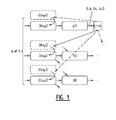
- these 'rules' are reflecting part of a predetermined world model, which is then included as a predetermined 'observation equivalence function', which by means of the Obs0-processed data stream can be used to predict (timeslots in which segment-wise) equivalence is known to exist between Obs functions (also referred to as 'stream processing services' in the present description), 'equivalence' meaning that the two different Obs functions provide the same stream of data as an output, given the (current) stream of input data.
- the controller decides that in which future time interval which Obs function will be selected for operation in each service.
- the controller will do a lookup or calculation of the Cost functions for each Obs (and time interval) and select the most optimal plan for a number of these future time intervals.
- the step of predicting comprises producing a tuple comprising a future timeslot and a preferred at least one stream processing services for delivering said at least one service during said future timeslot.
- multiple tuples are produces, relating to successive time intervals. Costs can be easily estimated in a time interval based on meta-information. By using time intervals, stream processing services can be assigned to a time interval and can be used in the time interval to optimize the service in terms of costs.
- resource reservations are made in the at least one processing components based on the produced tuple.
- processing can be further optimized by preventing processing hotspots or overload to happen.
- the at least one service relates to retrieving predetermined information from video segments and wherein the live streaming data relates to live video.
- the predetermined information is chosen from location of predetermined objects or persons and density of objects or persons in a predetermined location. Processing live video data to retrieve information from the data is an important example of the invention where costs can be significantly reduced by taking account of a predetermined set of rules.
- the at least one service relates to energy measurements and wherein the live streaming data relates to energy consumption related data.
- Energy consumption is another example of a domain where multiple streams of data can be analyzed to retrieve valuable information.
- the invention further relates to a computer readable storage medium comprising instructions, which, when executed cause a data processing apparatus to carry out the steps of the method of the invention.
- the present invention proposes to define in the platform a (segment-wise) observation function equivalence function which can be leveraged by the system for any services / service instances that use a related observation function during service execution.
- this world model preferably based on domain expert-provided knowledge, the system can stall or substitute parts of the services for obtaining a lower processing cost during particular time segments as dynamically determined by a, preferably more lightweight, meta-observation-based prediction function which leverages the world model knowledge.
- observation function equivalence can concern the equivalence of functions all at least partially equivalently capable to observe current or future states of a particular phenomenon according to a world model.
- This model can be provided by a domain expert directly or otherwise generated in the system.
- a typical example where this can be applied is the observation of subjects/objects moving in geographical space by means of sensors/cameras placed, possibly also moving, in that geographical space, but it needs to be stressed that the value of the invention goes well beyond this family of examples and is generically applicable to any stream processing system for which some behavior is known or derivable for the world external to the system.
- a (possibly load-balanced and/or distributed) infrastructure function authorized to control activation / deactivation or deployment / undeployment of at least one stream processing service of the set of stream processing services across the execution infrastructure (Ctrlr) can thus use the time intervals issued by p(Obs 0 (x)) for Obs k () to orchestrate substitutions of one or more running stream processing services (also referred to as observation functions) by Obs k () in the running services during those future intervals.
- p(Obs 0 ()) is configured to deliver such time intervals a sufficient time t 0 ahead and aims to predict relevant substitutions up to t 0 +1 ⁇ t Ctrlr ahead, according to the timing desired by Ctrlr to perform the updates.
- t 0 can be current time (i.e. t i on which p(Obs 0 (x i )) is calculated) or a future time, as required by Ctrlr (Ctrlr may require a provisioning time t 0 for doing the substitutions.
- Ctrlr can take into account (static or ad-hoc determined) cost estimates Cost[] for each Obs k () identified as a substitution candidate.
- Cost[] for each Obs k () identified as a substitution candidate As Ctrlr (by construction) keeps the overview of (dynamic) resource costs and current occupation, the combination of the live stream of tuples ⁇ l, k, [t m , t n ] and the cost estimates Cost[Obs k ()] for the execution during that same time interval allow Ctrlr to decide on the substitution for a desired time interval [t m , t n ] in the future, and Ctrlr can take decisions and make resource reservations accordingly.
- Obs 1 is taking all available camera streams in the city (in a particular sequence or partly or fully concurrently) and is doing the image recognition task needed for the service on all these streams, to eventually identify which streams show the vehicles with the requested property, displaying those as a service output.
- This is a naive, but illustrative example of Obs 1 () where it is obvious that a far better Obs 2 () can be devised which, using only a small subset of x, analyses only those streams of cameras that view part of the vicinity of the vehicle's current and shortly-anticipated position.
- Obs 0 () can thus suggest substitution of Obs 1 () by Obs k (), with Obs k () here being a single parameterized function for each k taking a different region of camera views as corresponding to different position regions a vehicle can be in.
- Obs 0 () may functionally overlap with the function it is hinting to substitute. The cost reduction in this case can still occur, as Obs 0 () may in this way be gradoally replaced by lower-cost functions Obs 0 () as a way of bootstrapping predictor process.
- Obs 0 () can at first equal Obs 1 () which consults all cameras, and can then gradually be substituted with Obs k () which also substitutes Obs 1 (), using a small selection of cameras.
- the substitution sequence in the set resulting in the minimum cost value is selected as the plan, and at least the first Obs k () in that sequence, i.e. for [t 0 , t q ], is effectively decided to be used in a substitution.
- a design option for the Ctrlr is to also follow the plan for part or all of the later substitutions in the plan without considering potential further input tuples from p(), or either redoing the calculation using any new tuple inputs that p() can timely provide for the remaining part of [t 0 , t 0 + ⁇ t Ctrlr ]. I.e. Ctrlr can be chosen to wait a time ⁇ t Plan ⁇ ⁇ t Ctrlr before re-evaluating the plan, using the current plan for substitution until ⁇ t Plan and only using further tuples provided by p() after that time.
- the cost minimization may also lead to the conclusion to keep using a valid Obs k () (or the default Obs k ()) for a longer time because short time segments may lead to cost increases Cost[Obs l ()] * (t q+1 - t q ) that are smaller than the D Obs-l + E Obs-k implied by and added to it.
- the cost minimization metric thus automatically covers this behaviour of avoiding "too quick or short to be economic" substitutions, and will identify the (part of) the sequence that does not substitute if possible in such case thanks to the inclusion of (k ⁇ l)*(D Obs-l + E Obs-k ) in the formula.
- a simplification of the procedure can be done by considering only the earliest substitution in step 2, i.e. for segment [t 0 , t 1 ] using only a single tuple ⁇ i, k, [t 0 , t 1 ] ⁇ from p() without considering any future substitution candidates yet, and so having also only single-substitution sequences in step 3.
- This allows considering a variable ⁇ t Ctrlr determined by t 1 as provided by p() in the tuple ⁇ i, k, [t 0 , t 1 ] ⁇ .
- design considerations for determining t 0 and ⁇ t Ctrlr are that t 0 is a real requirements imposed by the execution infrastructure, determined by the worst case time the system requires to do any provisioning for activating or deploying a new observation function (e.g. deploying code on a machine, or propagating routing policy setting over a set of routers in a network), while t 0 + ⁇ t Ctrlr needs to strike a balance between the predictive capacity of p(), the expected natural speed of status changes of the observed world phenomena, both suggesting possibly lower values for ⁇ t Ctrlr , and the optimization advantage of planning ahead in the Ctrlr, suggesting higher ⁇ t Ctrlr values.
- Obs k () do not need to be "pure” functions in the mathematical or functional programming sense, i.e. they may have internal state that needs to be "handed over” in some way from a substituted to a substituting Obs k ().
- all Obs k () functions may have an additional input in which a substituted Obs k () can pass its internal state to the substituting Obs k ().
- This can be done by means of a shared model among the collection of Obs k () instances of each type, e.g. formulated based on the input stream and output stream types already common to this function collection.
- the resource costs associated with this can be included in D Obs-k and E Obs-k . It is clear that these costs can be made smaller by considering minimal-state or even stateless, i.e. "pure" functions for Obs k ().
- the method proposed by this invention is beneficial in cases where the cost gain obtainable by the dynamic substitutions outweighs the additional cost introduced by the method itself.
- Obs 0 () can also be a subpart of Obs 1 (), or evolve from being identical to Obs 1 () into substitutions Obs 0' () for Obs 0 () that are subparts of Obs 1 ().
- An Obs k () at some stage used in the system as a substitution can be a constant function (i.e. producing a predetermined outcome regardless of the input x).
- This type of Obs k (), as well as other special-property Obs k () types may be known to predetermine the outcome of a function f() applied to the Obs k () outcome in a service, implying that when Obs k () is used as a substitution, also f() can be substituted by a function of lower cost.
- the substitution mechanism can thus include this by extending the substitution to f'(Obs k ()), where f'() is the corresponding lower cost equivalent of f().
- the Cost[] function can entail any kind of resource costs as used by the execution of the contained function expression. This may be processing costs, memory or storage lease costs, or costs of reserved paths through a network with QoS guarantees or more advanced flow control or SDN infrastructure.
- the Cost[] function even could also consider "infinitely high" cost outcomes, so as to express e.g. a case where an Obs 1 () cannot be calculated (i.e. at finite cost) in a time interval where required observation data is not available.
- An example in geo-tracking is e.g. that no cameras are available along parts of the predicted trajectory of a tracked subject, but alternative localization observation is available (or visa versa). On these parts of the trajectory the known unavailable observation method (in this case for physical world reason, but any cause is possible here) can be expressed to have a very high cost which excludes it automatically from selection.
- the invention can be implemented on many technologies, using many programming languages or executable representation for functions and services, with deployment or activation on many kinds of execution environment, such as general purpose computers, cloud infrastructure or communication networks.
- An embodiment can be implemented e.g. using a camera network, a video processing infrastructure and a general purpose event processing environment for realizing p() and Ctrlr, doing video observation/tracking of objects across the geographically spread camera network, using a lightweight p(Obs 0 ()) tracking and predicting object location, according to the parameters of a particular request (a pedestrian, a car or other vehicle type with a particular color, licence plate, etc.) corresponding to a targeted service instance.
- a particular request a pedestrian, a car or other vehicle type with a particular color, licence plate, etc.
- Obs k () instances as abstraction for particular configuration instances provisioning one or more particular flows or other (SDN or QoS) configuration in a network.
- a traffic jam may be observable in various ways (by video analysis, road car density sensing, car position/speed tracking, car break use monitoring, etc.).
- authorities may know as a 'rule' of the world that between particular hours the given road segment or crossroad is always in a traffic jam status.
- p(Obs 0 ()) can indicate during known traffic jam times the substitution of any traffic jam observation function by a lower-processing equivalent that directly outputs a traffic jam indication for any crossroads or road segments known to have that condition during particular time intervals, instead of doing more complicated observation analysis.
- the present invention is beneficial in cases where the cost gain obtainable by the dynamic substitutions outweighs the additional cost introduced by the method itself.
- An operator of a (cloud-based or other) service platform or network infrastructure can thus support services at a lower cost as indicated by the formula.
- the benefit lies in the method being able to a posteriori leverage world model knowledge upon an already supported (or even already running) range of services.
- program storage devices e.g., digital data storage media, which are machine or computer readable and encode machine-executable or computer-executable programs of instructions, wherein said instructions perform some or all of the steps of said above-described methods.
- the program storage devices may be, e.g., digital memories, magnetic storage media such as a magnetic disks and magnetic tapes, hard drives, or optically readable digital data storage media.
- the embodiments are also intended to cover computers programmed to perform said steps of the above-described methods.
- processors may be provided through the use of dedicated hardware as well as hardware capable of executing software in association with appropriate software.
- the functions may be provided by a single dedicated processor, by a single shared processor, or by a plurality of individual processors, some of which may be shared.
- explicit use of the term "processor” or “controller” should not be construed to refer exclusively to hardware capable of executing software, and may implicitly include, without limitation, digital signal processor (DSP) hardware, network processor, application specific integrated circuit (ASIC), field programmable gate array (FPGA), read only memory (ROM) for storing software, random access memory (RAM), and non volatile storage.
- DSP digital signal processor
- ASIC application specific integrated circuit
- FPGA field programmable gate array
- ROM read only memory
- RAM random access memory
- any switches shown in the FIGS. are conceptual only. Their function may be carried out through the operation of program logic, through dedicated logic, through the interaction of program control and dedicated logic, or even manually, the particular technique being selectable by the implementer as more specifically understood from the context.
- any block diagrams herein represent conceptual views of illustrative circuitry embodying the principles of the invention.
- any flow charts, flow diagrams, state transition diagrams, pseudo code, and the like represent various processes which may be substantially represented in computer readable medium and so executed by a computer or processor, whether or not such computer or processor is explicitly shown.
Landscapes
- Engineering & Computer Science (AREA)
- Multimedia (AREA)
- Signal Processing (AREA)
- Computer Networks & Wireless Communication (AREA)
- Health & Medical Sciences (AREA)
- Computing Systems (AREA)
- General Health & Medical Sciences (AREA)
- Medical Informatics (AREA)
- Databases & Information Systems (AREA)
- Management, Administration, Business Operations System, And Electronic Commerce (AREA)
Priority Applications (1)
| Application Number | Priority Date | Filing Date | Title |
|---|---|---|---|
| EP15305794.8A EP3099031A1 (de) | 2015-05-27 | 2015-05-27 | Bereitstellungsdienste auf grundlage von live-streaming-daten |
Applications Claiming Priority (1)
| Application Number | Priority Date | Filing Date | Title |
|---|---|---|---|
| EP15305794.8A EP3099031A1 (de) | 2015-05-27 | 2015-05-27 | Bereitstellungsdienste auf grundlage von live-streaming-daten |
Publications (1)
| Publication Number | Publication Date |
|---|---|
| EP3099031A1 true EP3099031A1 (de) | 2016-11-30 |
Family
ID=53396405
Family Applications (1)
| Application Number | Title | Priority Date | Filing Date |
|---|---|---|---|
| EP15305794.8A Withdrawn EP3099031A1 (de) | 2015-05-27 | 2015-05-27 | Bereitstellungsdienste auf grundlage von live-streaming-daten |
Country Status (1)
| Country | Link |
|---|---|
| EP (1) | EP3099031A1 (de) |
Citations (2)
| Publication number | Priority date | Publication date | Assignee | Title |
|---|---|---|---|---|
| WO2011076236A1 (en) * | 2009-12-23 | 2011-06-30 | Telefonaktiebolaget L M Ericsson (Publ) | Service selection for reduced composition cost |
| WO2014063086A2 (en) * | 2012-10-19 | 2014-04-24 | Microsoft Corporation | Energy management by dynamic functionality partitioning |
-
2015
- 2015-05-27 EP EP15305794.8A patent/EP3099031A1/de not_active Withdrawn
Patent Citations (2)
| Publication number | Priority date | Publication date | Assignee | Title |
|---|---|---|---|---|
| WO2011076236A1 (en) * | 2009-12-23 | 2011-06-30 | Telefonaktiebolaget L M Ericsson (Publ) | Service selection for reduced composition cost |
| WO2014063086A2 (en) * | 2012-10-19 | 2014-04-24 | Microsoft Corporation | Energy management by dynamic functionality partitioning |
Similar Documents
| Publication | Publication Date | Title |
|---|---|---|
| US10360800B2 (en) | Warning driver of intent of others | |
| Yap et al. | Identification and quantification of link vulnerability in multi-level public transport networks: a passenger perspective | |
| US8854219B2 (en) | System, method and program product for providing populace movement sensitive weather forecasts | |
| Li et al. | Modeling and implementation of adaptive transit signal priority on actuated control systems | |
| US10726725B2 (en) | Dynamically designing street-parking policies for events | |
| Murça et al. | Predicting and planning airport acceptance rates in metroplex systems for improved traffic flow management decision support | |
| JP7219353B2 (ja) | ワークフロー割当ての方法およびシステム | |
| CN111461384B (zh) | 对象流量预测方法、装置及设备 | |
| US10775178B2 (en) | Spatio-temporal re-routing of navigation | |
| US10304328B2 (en) | Diagnostic system, method, and recording medium for signalized transportation networks | |
| US11113965B2 (en) | System for optimising transient kerbside access | |
| WO2023045916A1 (en) | Ensuring proactive availability of vehicles for providing connected vehicle services | |
| Büchel et al. | What do we know when? modeling predictability of transit operations | |
| JP2013008135A (ja) | 渋滞予測装置および渋滞予測データ | |
| US20200218998A1 (en) | Identification of non-deterministic models of multiple decision makers | |
| Heckmann et al. | Stage prediction of traffic lights using machine learning | |
| Du et al. | Online stochastic routing incorporating real-time traffic information | |
| EP3099031A1 (de) | Bereitstellungsdienste auf grundlage von live-streaming-daten | |
| Rahimi Siegrist et al. | Modeling and quantifying interaction of information and capacity in public transport disruptions | |
| US12469151B2 (en) | Object trail analytics | |
| US11317244B1 (en) | System, method, and computer program for making travel route recommendations based on a network quality of service prediction | |
| CN113988401B (zh) | 出行时间预测方法、系统及存储介质 | |
| US10757623B2 (en) | Cognitive analysis of temporal obstructions | |
| Patel et al. | Exploring the Transformative Impact of IoT-Driven Innovations in Public Transportation Systems for Smart Mobility | |
| WO2013111510A1 (ja) | データ管理装置、データ管理方法およびデータ管理用プログラム |
Legal Events
| Date | Code | Title | Description |
|---|---|---|---|
| PUAI | Public reference made under article 153(3) epc to a published international application that has entered the european phase |
Free format text: ORIGINAL CODE: 0009012 |
|
| AK | Designated contracting states |
Kind code of ref document: A1 Designated state(s): AL AT BE BG CH CY CZ DE DK EE ES FI FR GB GR HR HU IE IS IT LI LT LU LV MC MK MT NL NO PL PT RO RS SE SI SK SM TR |
|
| AX | Request for extension of the european patent |
Extension state: BA ME |
|
| 17P | Request for examination filed |
Effective date: 20170530 |
|
| RBV | Designated contracting states (corrected) |
Designated state(s): AL AT BE BG CH CY CZ DE DK EE ES FI FR GB GR HR HU IE IS IT LI LT LU LV MC MK MT NL NO PL PT RO RS SE SI SK SM TR |
|
| RAP1 | Party data changed (applicant data changed or rights of an application transferred) |
Owner name: ALCATEL LUCENT |
|
| 17Q | First examination report despatched |
Effective date: 20181004 |
|
| STAA | Information on the status of an ep patent application or granted ep patent |
Free format text: STATUS: THE APPLICATION IS DEEMED TO BE WITHDRAWN |
|
| 18D | Application deemed to be withdrawn |
Effective date: 20190618 |