EP3094666B1 - Disintegratable porous organometaloxide material - Google Patents
Disintegratable porous organometaloxide material Download PDFInfo
- Publication number
- EP3094666B1 EP3094666B1 EP15700665.1A EP15700665A EP3094666B1 EP 3094666 B1 EP3094666 B1 EP 3094666B1 EP 15700665 A EP15700665 A EP 15700665A EP 3094666 B1 EP3094666 B1 EP 3094666B1
- Authority
- EP
- European Patent Office
- Prior art keywords
- framework
- organometaloxide
- moiety
- metal
- mesoporous
- Prior art date
- Legal status (The legal status is an assumption and is not a legal conclusion. Google has not performed a legal analysis and makes no representation as to the accuracy of the status listed.)
- Not-in-force
Links
- NSMIYDZNHPFLGG-INOXDZRUSA-N CC(C(C)(C)/C(/C)=N/N)/C(/C)=N/N Chemical compound CC(C(C)(C)/C(/C)=N/N)/C(/C)=N/N NSMIYDZNHPFLGG-INOXDZRUSA-N 0.000 description 1
Images


Classifications
-
- C—CHEMISTRY; METALLURGY
- C08—ORGANIC MACROMOLECULAR COMPOUNDS; THEIR PREPARATION OR CHEMICAL WORKING-UP; COMPOSITIONS BASED THEREON
- C08G—MACROMOLECULAR COMPOUNDS OBTAINED OTHERWISE THAN BY REACTIONS ONLY INVOLVING UNSATURATED CARBON-TO-CARBON BONDS
- C08G83/00—Macromolecular compounds not provided for in groups C08G2/00 - C08G81/00
- C08G83/001—Macromolecular compounds containing organic and inorganic sequences, e.g. organic polymers grafted onto silica
-
- A—HUMAN NECESSITIES
- A61—MEDICAL OR VETERINARY SCIENCE; HYGIENE
- A61K—PREPARATIONS FOR MEDICAL, DENTAL OR TOILETRY PURPOSES
- A61K31/00—Medicinal preparations containing organic active ingredients
- A61K31/33—Heterocyclic compounds
- A61K31/395—Heterocyclic compounds having nitrogen as a ring hetero atom, e.g. guanethidine or rifamycins
- A61K31/41—Heterocyclic compounds having nitrogen as a ring hetero atom, e.g. guanethidine or rifamycins having five-membered rings with two or more ring hetero atoms, at least one of which being nitrogen, e.g. tetrazole
- A61K31/4164—1,3-Diazoles
- A61K31/4188—1,3-Diazoles condensed with other heterocyclic ring systems, e.g. biotin, sorbinil
-
- A—HUMAN NECESSITIES
- A61—MEDICAL OR VETERINARY SCIENCE; HYGIENE
- A61K—PREPARATIONS FOR MEDICAL, DENTAL OR TOILETRY PURPOSES
- A61K49/00—Preparations for testing in vivo
- A61K49/001—Preparation for luminescence or biological staining
- A61K49/0063—Preparation for luminescence or biological staining characterised by a special physical or galenical form, e.g. emulsions, microspheres
- A61K49/0069—Preparation for luminescence or biological staining characterised by a special physical or galenical form, e.g. emulsions, microspheres the agent being in a particular physical galenical form
- A61K49/0089—Particulate, powder, adsorbate, bead, sphere
- A61K49/0091—Microparticle, microcapsule, microbubble, microsphere, microbead, i.e. having a size or diameter higher or equal to 1 micrometer
- A61K49/0093—Nanoparticle, nanocapsule, nanobubble, nanosphere, nanobead, i.e. having a size or diameter smaller than 1 micrometer, e.g. polymeric nanoparticle
-
- A—HUMAN NECESSITIES
- A61—MEDICAL OR VETERINARY SCIENCE; HYGIENE
- A61K—PREPARATIONS FOR MEDICAL, DENTAL OR TOILETRY PURPOSES
- A61K9/00—Medicinal preparations characterised by special physical form
- A61K9/48—Preparations in capsules, e.g. of gelatin, of chocolate
- A61K9/50—Microcapsules having a gas, liquid or semi-solid filling; Solid microparticles or pellets surrounded by a distinct coating layer, e.g. coated microspheres, coated drug crystals
- A61K9/51—Nanocapsules; Nanoparticles
- A61K9/5107—Excipients; Inactive ingredients
- A61K9/5115—Inorganic compounds
-
- A—HUMAN NECESSITIES
- A61—MEDICAL OR VETERINARY SCIENCE; HYGIENE
- A61K—PREPARATIONS FOR MEDICAL, DENTAL OR TOILETRY PURPOSES
- A61K9/00—Medicinal preparations characterised by special physical form
- A61K9/48—Preparations in capsules, e.g. of gelatin, of chocolate
- A61K9/50—Microcapsules having a gas, liquid or semi-solid filling; Solid microparticles or pellets surrounded by a distinct coating layer, e.g. coated microspheres, coated drug crystals
- A61K9/51—Nanocapsules; Nanoparticles
- A61K9/5192—Processes
-
- C—CHEMISTRY; METALLURGY
- C08—ORGANIC MACROMOLECULAR COMPOUNDS; THEIR PREPARATION OR CHEMICAL WORKING-UP; COMPOSITIONS BASED THEREON
- C08G—MACROMOLECULAR COMPOUNDS OBTAINED OTHERWISE THAN BY REACTIONS ONLY INVOLVING UNSATURATED CARBON-TO-CARBON BONDS
- C08G83/00—Macromolecular compounds not provided for in groups C08G2/00 - C08G81/00
- C08G83/008—Supramolecular polymers
-
- C—CHEMISTRY; METALLURGY
- C08—ORGANIC MACROMOLECULAR COMPOUNDS; THEIR PREPARATION OR CHEMICAL WORKING-UP; COMPOSITIONS BASED THEREON
- C08L—COMPOSITIONS OF MACROMOLECULAR COMPOUNDS
- C08L101/00—Compositions of unspecified macromolecular compounds
- C08L101/16—Compositions of unspecified macromolecular compounds the macromolecular compounds being biodegradable
Definitions
- the present invention relates to disintegratable porous organometaloxide materials, a method for producing the same, and uses thereof.
- Porous materials namely mesoporous, microporous, and macroporous materials, are interesting classes of materials useful for various applications.
- M41S or MCM-type having pore sizes 2-10 nm represented a paradigm shift in the synthesis of porous materials.
- the materials were prepared in a straightforward synthesis that involved the aqueous phase co-assembly and acid or base-catalyzed hydrolytic polycondensation of silicate-surfactant micelles followed by removal of the surfactant by thermal or chemical or photochemical post-treatment steps.
- This synthetic strategy created a silica replica of the templating micelles (a silicatropic mesophase) and represented a new way of creating silica-materials with crystalline mesoporosity, having a pore architecture (i.e., hexagonal, cubic, worm-hole) and pore dimensions (2-10 nm) that were predicted upon the structure and dimensions of the surfactant-directing micelle assembly.
- a pore architecture i.e., hexagonal, cubic, worm-hole
- pore dimensions 2-10 nm
- channel walls of all these MCM and SBA classes and structure types of periodic mesoporous silicas were glassy having just short range order, the channel walls lacked structurally well-defined silica sites like those found in zeolites (a class of solids defined as crystalline microporous aluminosilicates), and were found to be devoid of useful channel functionality for perceived applications that could benefit from the size and shape-controlled mesopores and specific adsorption properties of the materials.
- the mesopores in MCM41, MCM48 and SBA materials were monodispersed (single size) and the mesoporosity could be either periodic (hexagonal, cubic) or randomly organized (worm-hole), [3] the material behaved more or less like any other form of porous silica sol-gel type chemistry, exemplified by the well-known classes of materials called xerogels and aerogels, and that contained a random spatial distribution of different diameter mesopores in a glassy silica matrix.
- Ordered cubic periodic mesoporous organosilicas (PMOs) containing a high loading of disulfide groups was obtained by co-condensation of bis[3-(triethoxysilyl) propyl]disulfide (BTEPDS) and tetraethoxysilane (TEOS) using the cationic surfactant cetyltriethylammonium bromide (CTEABr) as the template under acidic conditions.
- BTEPDS bis[3-(triethoxysilyl) propyl]disulfide
- TEOS tetraethoxysilane
- CTEABr cetyltriethylammonium bromide
- MSNRs Functionalized mesoporous silica nanorods
- Thioether-bridged mesoporous materials were obtained by one-step co-condensation of 1,4-bis(triethoxysily)propane tetrasulfide (TESPTS) with tetramethoxysilane (TMOS) using cetyltrimethylammonimum bromide (CTAB) as the surfactant in basic conditions [8c].
- TSP 1,4-bis(triethoxysily)propane tetrasulfide
- TMOS tetramethoxysilane
- CTAB cetyltrimethylammonimum bromide
- Mesoporous silica nanoparticles with co-condensed Gd(III) chelates were produced by condensation two silyl-derived Gd complexes in order to enhance the MR contrast enhancing abilities of the material.
- a silyl-derived organic fluorophore and targeting agent were also grafted to the surface to allow for target-specific optical and MR imaging of cancer cells [8d].
- one objective of the present invention is to provide a new class of hybrid porous organometaloxide (HPO) materials characterized by a self-destructive behavior, in order to have better control of their fragmentation and dissolution, avoiding, or at least decreasing the risk of accumulation and facilitating elimination.
- HPO hybrid porous organometaloxide
- the present invention discloses nanoparticles of disintegrable mesoporous organometaloxide material having a particle diameter from 1 to 500 nm as disclosed in claims 1 to 8.
- the present invention discloses a method for preparing a material according to any of claims 1 to 8 as disclosed in claims 9 to 15.
- the present invention discloses a mesoporous organometaloxide material according to any one of claims 1 to 8 comprising in its pores or at its surface at least one pharmaceutically active principle, for use as medicament, or at least one marker, for use in medical imaging.
- the present invention discloses the use of a material according to any one of claims 1 to 8 in a cosmetic, catalytic, paint, ink, photovoltaic or optical coating composition.
- novel porous organometaloxide materials in the form of nanoparticles, whose framework contain metal adjacent sites covalently bound via a responsively cleavable linker having one of the following structures: *-R 1 -L-R 2 -*
- the present invention provides nanoparticles of a disintegrable mesoporous organometaloxide material having a particle diameter from 1 to 500 nm comprising a mesoporous three-dimensional Si-, Ti-, or Zr- based metaloxide framework of metal-oxygen bonds, wherein at least a subset of metal atoms in the material's framework are connected to at least another metal atom in the framework through a linker having one of the following structures: or wherein:
- the linker has the structure *-R 1 -L-R 2 -*
- the subset of metal atoms in the material's framework that are connected to the linker *-R 1 -L-R 2 -* represent at least 30% of the metal atoms present in the porous organometaloxide material of the invention.
- the porous organometaloxide material will be said to be "at least 30% doped”.
- x in the expression “x% doped” is calculated based on the % of metal centers in the porous organometaloxide material that comes from the starting material (X) 3 M 1 -R 1 -L-R 2 -M 2 (X) 3 used to synthesize the organometaloxide material according to the invention.
- This % doping also reflects the contents of responsively cleavable covalent bond L in the organometaloxide material. The higher the % doping, the higher the content of linker L in the porous organometaloxide, and the greater the ability of the resulting organometaloxide material to undergo complete structural breakdown, suitable for the intended applications.
- the subset of metal atoms in the material's framework that are connected to the linker *-R 1 -L-R 2 -* may range anywhere from 30% to 100% of the metal atoms present in the porous organometaloxide material of the invention.
- the subset of metal atoms in the material's framework that are connected to the linker *-R 1 -L-R 2 -* may range from 30% to 100%, from 30% to 90%, from 30% to 80%, from 30% to 70%, from 30% to 60%; from 30% to 50%, from 30% to 40%, of the metal atoms present in the porous organometaloxide material of the invention.
- the final % doping of the porous organometaloxide material will depend on the respective molar ratios of starting materials (X) 3 M 1 -R 1 -L-R 2 -M 2 (X) 3 and M(X A ) 4 used in the synthesis of the material (cf. section dealing with synthetic process, later in the present document).
- M(X A ) 4 used in the preparation of the material, a doping of 100% will be reached (i.e., only (X) 3 M 1 -R 1 -L-R 2 -M 2 (X) 3 is used as metal source).
- the subset of metal atoms in the material's framework that are connected to the linker *-R 1 -L-R 2 -* may be in the lower % range; for example from 30% to 35% , from 30% to 40%, from 30% to 45%, from 30% to 50%, of the metal atoms present in the porous organometaloxide material of the invention.
- the subset of metal atoms in the material's framework that are connected to the linker *-R 1 -L-R 2 -* may range from 30% to 40% , preferably about 30%.
- the subset of metal atoms in the material's framework that are connected to the linker *-R 1 -L-R 2 -* may be in the higher % range; for example from 55% to 60% , from 55% to 65%, from 55% to 70%, from 55% to 75%, from 55% to 80%, from 55% to 85%, from 55% to 90%, from 55% to 95%, from 55% to 100%, of the metal atoms present in the porous organometaloxide material of the invention.
- the metal is selected from Si-, Ti- or Zr, or mixture thereof
- the porous organometaloxide material according to the invention is a Si-, Ti- and/or Zr-based porous organometaloxide material.
- the expression "and/or" in this context means that the porous organometaloxide material may:
- the porous organometaloxide material according to the invention may be a Si-Ti mixed-metal organometaloxide material containing 0.1-50.0% Si and 0.1-50.0% Ti, the % sum of Si and Ti adding to 100% the number of available metal sites in the framework.
- the porous organometaloxide material according to the invention may be a Si-based porous organometaloxide material doped with 0.1 to 10.0% Ti (% based on the number of available metal sites in the framework).
- the porous organometaloxide material according to the invention may be a mixed metal, M-based porous organometaloxide material, where M may be Si or Ti, containing at least 80.0%, preferably at least 85.0%, preferably at least 90.0%, preferably at least 95.0%, preferably at least 95.5%, preferably at least 99.9% Si or Ti (% based on the number of available metal sites in the framework), the remaining metal sites being Si, Ti and/or Zr.
- M may be Si or Ti, containing at least 80.0%, preferably at least 85.0%, preferably at least 90.0%, preferably at least 95.0%, preferably at least 95.5%, preferably at least 99.9% Si or Ti (% based on the number of available metal sites in the framework), the remaining metal sites being Si, Ti and/or Zr.
- One advantageous aspect of this invention resides in the simple, yet compelling, underlying concept: namely a precursor having one of the following structures: (X) 3 M 1 -R 1 -L-R 2 -M 2 (X) 3 ; , wherein L, R 1 and R 2 are as defined above, and M 1 and M 2 independently represent Si, Ti or Zr, is chemically inserted within the framework of the porous organometaloxide material via sol-gel chemistry.
- said precursor (X) 3 M 1 -R 1 -L-R 2 -M 2 (X) 3 is introduced in the the porous organometaloxide material framework so that the subset of metal atoms in the material's framework that are connected to the linker *-R 1 -L-R 2 -*, represent at least 30% of the metal atoms present in the porous organometaloxide material of the invention.
- at least 30% of the metal centers in the porous organometaloxide material framework originates from the precursor (X) 3 M 1 -R 1 -L-R 2 -M 2 (X) 3 (i.e., M 1 and M 2 account for at least 30% of the metal center in the organometaloxide material).
- X may represent a hydrolysable or nonhydrolyzable group, provided that on each occurrence of M 1 and M 2 , at least one occurrence of X represents a hydrolysable group.
- X may be selected from a C1-6 alkoxy, C1-6 acyloxy, halogen or amino moiety.
- X when X represents a hydrolysable group, X may represent Cl, -OMe, -OEt, -OiPr or -O t Bu.
- X represents a nonhydrolyzable group, it may be selected from an optionally substituted C1-20 alkyl, C2-20 alkenyl or C2-20 alkynyl moiety, an optionally substituted C1-20 heteroalkyl, C2-20 heteroalkynyl or C2-20 heteroalkynyl moiety, or an optionally substituted phenyl moiety, wherein the substituents on the phenyl, alkyl, alkenyl, alkynyl, heteroalkyl, heteroalkenyl and heteroalkynyl moieties may be independently selected from halogen, -NO 2 , -CN, isocyano, C1-6 alkoxy, an oxirane/epoxyde moiety, -N(R) 2 wherein each occurrence of R is independently selected from H or C1-6 alkyl.
- the insertion of the responsively cleavable linker within the framework of the porous metaloxide is performed during the synthesis of the porous organometaloxide material itself, no additional step is required, if not the preparation of the required (X) 3 M 1 -R 1 -L-R 2 -M 2 (X) 3 precursor, which may also be carried out in situ. It is then important to choose the correct (X) 3 M 1 -R 1 -L-R 2 -M 2 (X) 3 precursor in order to obtain the desired self-destructive behavior in the final operational environment.
- the ratio (X) 3 M 1 -R 1 -L-R 2 -M 2 (X) 3 / M(X A ) 4 precursor used for the synthesis is also important, as it determines the % doping (and thus the ratio of responsively cleavable linker L within the material), and therefore the ability of the porous organometaloxide material to disintegrate upon application of a suitable stimulus.
- a minimum of 30 % of the whole metallic atoms present in the organometaloxide material should come from the (X) 3 M 1 -R 1 -L-R 2 -M 2 (X) 3 linker. Because (X) 3 M 1 -R 1 -L-R 2 -M 2 (X) 3 is bivalent (i.e., because this precursor contains two metal atoms per cleavable bond L), M1 and M2 represent 30% of the metal centers in the resulting organometaloxide material (i.e., 30% doping).
- Table 1A describes exemplary ratios of equivalents (X) 3 M 1 -R 1 -L-R 2 -M 2 (X) 3 / M(X A ) 4 to reach the desired % doping (which is at least 30%): Table 1A M(X A ) 4 (X) 3 M 1 -R 1 -L-R 2 - M 2 (X) 3 (X) 3 M 1 -R 1 - L- R 2 -M 2 (X) 3 % doping 0.70 eq. 0.30 eq. ⁇ 0.15 eq. # 30% 0.60 eq. 0.40 eq. ⁇ 0.20 eq. # 40% 0.50 eq. 0.50 eq. ⁇ 0.25 eq.
- the reaction conditions may be modulated, depending on the eq. ratios (X) 3 M 1 -R 1 -L-R 2 -M 2 (X) 3 / M(X A ) 4 used. From the general knowledge in the field of organometaloxide chemistry, the practitioner will readily know how to adjust suitable reaction conditions, for example the type of solvent used to effect the reaction depending on the respective solubilities of the selected (X) 3 M 1 -R 1 -L-R 2 -M 2 (X) 3 and M(X A ) 4 .
- nonhydrolyzable organic moiety is meant an organic moiety that is not cleaved from the metal M during the sol-gel process leading to the porous organometaloxide framework material.
- hydrolyzable group is meant a radical that is hydrolyzed (cleaved from the metal M) during the sol-gel process leading to the porous organometaloxide framework material.
- R 4 may be a C1-6 alkoxy, C1-6 acyloxy, halogen or amino group.
- R 3 may be an optionally substituted C1-20 alkyl, C2-20 alkenyl or C2-20 alkynyl moiety, an optionally substituted C1-20 heteroalkyl, C2-20 heteroalkynyl or C2-20 heteroalkynyl moiety, or an optionally substituted phenyl moiety.
- R 3 may bear a substituent that allows further functionalization of the organometaloxide material, or posses a functionality that imparts desired characteristics.
- the substituents on the phenyl, alkyl, alkenyl, alkynyl, heteroalkyl, heteroalkenyl and heteroalkynyl moieties may be independently selected from halogen, -NO 2 , -CN, isocyano, C1-6 alkoxy, an oxirane/epoxyde moiety, -N(R) 2 wherein each occurrence of R is independently selected from H or C1-6alkyl.
- Organic/inorganic hybrid Si-, Ti- and Zr-based porous organometaloxide framework materials are well-known in the literature, as well as methods for their preparation. (See for example, (a) for Si-based materials: [11]; (b) for Ti-based materials: [12]; (c) for Zr-based materials: [13]. These methods may be readily adapted to the present hybrid porous organometaloxide materials, by using a (X) 3 M 1 -R 1 -L-R 2 -M 2 (X) 3 precursor as defined above and herein, in the sol-gel synthetic process.
- the porous organometaloxide material according to the invention is in the form of nanoparticles having a diameter from 1 nm to 500 nm for conventional mesoporous hybrid or purely inorganic Si-, Ti- or Zr-based metaloxide framework materials.
- the mesoporous organometaloxide material is in the form of nanoparticles having a diameter from 1 to 500 nm, preferably from 1 to 250 nm, preferably from 1 to 100 nm, from 1 to 50 nm preferably from 1 to 20 nm.
- the porous organometaloxide material may be in the form of nanoparticles ranging from 20-100 nm in particle diameter, for example about 20 nm, for example about 100 nm.
- the diameter particle may be modulated depending on reaction condition parameters, such as reaction time, temperature of reaction, base used (ammonium hydroxide, NaOH, ...), amount of organic solvent used (e.g., EtOH).
- reaction condition parameters such as reaction time, temperature of reaction, base used (ammonium hydroxide, NaOH, ...), amount of organic solvent used (e.g., EtOH).
- the porous organometaloxide material may be in the form of nanoparticles dispersed in a solvent.
- the solvent may be that used in the synthesis of the material.
- the porous disintegratable organometaloxide materials of the invention preferably have pores from 1 to 50 nm. These pores may be well-ordered and of uniform size, but this is not a requirement of this invention. Naturally, when the porous organometaloxide material is in the form of nanoparticles, as described above, the pore size will be proportionally smaller than the particle size.
- the cleavage/degradation of the linker *-R 1 -L-R 2 -* can be triggered by any suitable means.
- it may be a change in pH (either an increase or a decrease), a change in redox potential, application of UV, visible or near infrared light, ultrasounds, electromagnetic radiation, a change in temperature, enzymatic cleavage, DNA binding, etc...
- Table 2 gives examples of cleavage/degradation triggering means for each of the aforementioned types of responsively cleavable linkers : Table 2 L Exemplary Triggers Disulfide Reducing agents (e.g., NaBH 4 , dithiothreitol (DTT), glutathione) Diselenide Reducing agents (e.g. thiols, metal complexes) Ester pH, enzymatic cleavage (e.g. esterase) [14] Amide Enzymatic cleavage (e.g. amidase) [15] Imine pH Acetal/ketal pH Anhydride pH Urea/thiourea Enzymatic cleavage (e.g.
- urease Hydrazone pH Oxyme pH Boronic acid (complexed with diols) pH, sugars Boronic esters pH, reducing agents (e.g., LiAlH 4 ) Carbohydrate pH, enzymatic cleavage (e.g. glycosidases) [17] Peptide (e.g., polylysine) Enzymatic cleavage (e.g. protease) [18] Polyethyleneglycol (PEG) Enzymatic cleavage (e.g. dehydrogenase) [19] Polylactide Enzymatic cleavage (e.g. esterase) [20] Polynucleotide (e.g., RNA or DNA) Enzymatic cleavage (e.g. nuclease, glycosidase) [21]
- the mesoporous organometaloxide material according to the invention comprises in its pores or at its surface at least one marker and/or cosmetically or pharmaceutically active principle.
- the marker may be selected from a contrast agent, a tracer, a radioactive marker, a fluorescent marker , a phosphorescent marker, a magnetic resonance imaging agent or a positron emission tomography agent, such as pyrene, rhodamine, IR783, Gd-EDTA or 64 Cu-EDTA.
- the marker may be any commercial dye.
- it may be a fluorescent molecule selected from rhodamines, fluorescein, luciferase, pyrene-containing markers, aminopyrrolidino-7-nitrobenzofurazan, or indocyanine green (ICG) for NIR emission.
- DHMO disintegratable mesoporous organometaloxide material(s)
- A, L R 1 and R 2 are as defined above, and M 1 and M 2 independently represent Si, Ti or Zr, has been chemically inserted via conventional sol-gel chemistry.
- DHMOs disintegratable hybrid mesoporous organometaloxide materials
- the method comprises the steps of:
- a minimum of 30% molar ratio (based on the metal centers) of (X) 3 M 1 -R 1 -L-R 2 -M 2 (X) 3 to 70% of M(X A ) 4 precursor may be used. Because (X) 3 M 1 -R 1 -L-R 2 -M 2 (X) 3 is bivalent (i.e., because this precursor contains two metal atoms per cleavable bond L), the ratio 0.15 eq (X) 3 M 1 -R 1 -L-R 2 -M 2 (X) 3 / 0.70 eq M(X A ) 4 means that M 1 and M 2 will represent 30% of the metal centers in the resulting organometaloxide material (i.e., 30% doping).
- (X) 3 M 1 -R 1 -L-R 2 -M 2 (X) 3 may be used as the only source of metal (i.e., no M(X A ) 4 is used).
- exemplary ratios of equivalents (X) 3 M 1 -R 1 -L-R 2 -M 2 (X) 3 / M(X A ) 4 to reach a variety of % doping ⁇ 30% see Table 1A.
- the supramolecular template may be made up of any suitable surfactant known in the art to be used in the preparation of porous organometaloxide materials.
- the supramolecular template may be formed of self-aggregated rod-shaped micelles of suitable ionic or non-ionic surfactant molecules.
- the disintegratable porous organometaloxide material according to the invention may have amorphous pore walls.
- the disintegratable porous organometaloxide material according to the invention may have crystalline pore walls.
- the disintegratable porous organometaloxide material according to the invention may have partially crystalline pore walls.
- the disintegratable porous organometaloxide material according to the invention may have periodically ordered pore walls.
- the pore walls of the disintegratable porous organometaloxide material according to the invention may be disordered.
- step b) the conditions are set up in order to have alkaline conditions and pH adjusting agent are used in order to modulate the pH to the desired value.
- pH-adjusting agent to work under alkaline conditions according to the present invention alkalis such as sodium hydroxide, ammonia can be mentioned.
- the pH of the reaction system may be preferably adjusted to 8 to 14, most preferably, 8 to 13.
- the removing step c) may be carried out using various methodologies depending on the type of responsively cleavable linker:
- refluxing in a solvent in which the template is soluble allows to remove said template, for example by extraction.
- a solvent like ethanol, methanol, toluene or any other suitable solvent may be used to remove the template.
- the metal (M, M 1 or M 2 , as defined above) may be Si.
- the responsively cleavable bond incorporated in the mesoporous material is selected from disulfide; directly in the mesoporous framework of the material, as shown as exemplary embodiment in Figure 1 .
- the resulting materials in the form of nanoparticles, are hence able to respond to a specific trigger (e.g., chemical, physical or enzymatic stimulation), by undergoing a structural breakdown.
- a specific trigger e.g., chemical, physical or enzymatic stimulation
- This property leads to an improved porous material with potential for multiple types of application, ranging from controlled release and uptake of chemicals and drugs, or bioassays, cosmetics, catalysis to name a few.
- the unusual behavior of the materials according to the invention confers them an enhanced biodegradability, reducing larger particles into smaller, more easily hydrolysable, and consequently less harmful fragments. This in turn reduces the persistence phenomenon of the materials in their working environment, consequently reducing accumulation risks, and purification/removal costs.
- the metal M may be Si and M(X A ) 4 may represent any Si source suitable for carrying out sol-gel silicon oxide framework synthesis, for example, colloidal silica, sodium silicate, silicon alkoxides, tetramethylammonium silicate and tetraethylorthosilicate (TEOS) and the like.
- M(X A ) 4 may represent a tetraalkoxysilanes such as tetramethoxysilane, tetraethoxysilane and tetrapropoxysilane, preferably tetraethoxysilane (TEOS).
- the silane precursor M(X A ) 4 may preferably contain an alkoxysilane having an organic functional group; in other word, at least one occurrence of X A may be substituted with a substituent bearing an organic functional group, such that it allows further functionalization.
- the alkoxysilane it is possible to form a silica framework out of alkoxysilyl groups while disposing organic functional groups on the surfaces of the materials. It is further possible to give suitable properties to the mesoporous silica particles by chemically modifying the organic functional group with other organic molecules or the like.
- the surfactant may be a cationic surfactant, an anionic surfactant, a non-ionic surfactant; preferably a cationic surfactant such as octadecyl trimethyl ammonium bromide, hexadecyl trimethyl ammonium bromide, tetradecyl trimethyl ammonium bromide, dodecyl trimethyl ammonium bromide, decyl trimethyl ammonium bromide, octyl trimethyl ammonium bromide, hexyl trimethyl ammonium bromide and other quaternary ammonium salt-type cationic surfactants.
- a cationic surfactant such as octadecyl trimethyl ammonium bromide, hexadecyl trimethyl ammonium bromide, tetradecyl trimethyl ammonium bromide, dodecyl trimethyl ammonium bromide, decyl trimethyl ammoni
- cetyltrimethylammonium bromide CTAB
- cetyltrimethylphosphonium cetyltrimethylphosphonium
- octadecyltrimethylphosphonium cetyltrimethylphosphonium
- benzyltrimethylammonium cetylpyridinium
- myristyltrimethylammonium decyltrimethylammonium
- dodecyltrimethylammonium dimethyldidodecylammonium
- pore swelling agents like 1,3,5-trimethylbenzene (TMB) and the like.
- a co-solvent preferably ethanol
- Other solvent such as methanol or DMF can be used.
- the aqueous solvent comprises an alcohol, such as methanol or ethanol.
- the silane precursor M(X A ) 4 may be TEOS and the surfactant/TEOS mole ratio can be varied to control the pore-volume fraction in the final material and to vary the pore structure. Also, it will be recognized by those skilled in the art that a much wider range of surfactant sizes and amounts in the family of small polyoxyethylene ethers may be possible with different solvent amounts.
- the size and shape of the pores may be controlled by varying the type, the quantity and concentration of surfactant in step a). It will be appreciated that the technique of adding a hydrophobic additive to enlarge mesopores when preparing a mesoporous material is disclosed in prior documents. [10] Thus, in certain embodiments, the method may comprise adding a hydrophobic additive to control the size of the mesopores.
- the mixing ratio of the silica precursors M(X A ) 4 and (X) 3 Si-R 1 -L-R 2 -Si(X) 3 to the surfactant is not particularly limited, but a molar ratio of 3 : 1 is preferred. If the amount of the surfactant is outside this range relative to the silica precursors, the structure of the product may be less regular, and it may be difficult to obtain mesoporous silica particles with a regular arrangement of mesopores. It is possible to easily obtain mesoporous silica particles with a regular arrangement of mesopores particularly when the molar percentage of linker is in the range but not limited to 10 and 50 % of overall silicon source.
- a minimum of 30% molar ratio (based on the metal centers) of (X) 3 M 1 -R 1 -L-R 2 -M 2 (X) 3 to 70% of M(X A ) 4 precursor may be used, to effect of minimum of 30% doping of the resulting organosilica material.
- (X) 3 Si-R 1 -L-R 2 -Si(X) 3 may be used as the only source of metal (i.e., no Si(X A ) 4 is used).
- exemplary ratios of equivalents (X) 3 Si-R 1 -L-R 2 -Si(X) 3 / Si(X A ) 4 to reach a variety of % doping ⁇ 30% see Table 1A.
- the precursor having the structure (X) 3 M-R 1 -L-R 2 -M(X) 3 may produced in situ.
- Scheme 1 a general synthetic approach for in situ generation of the precursor is depicted in Scheme 1 below:
- Table 2 Exemplary synthetic conditions for preparing porous organosiliconoxide materials
- Exemplary strategy Exemplary starting materials Suitable surfactant, TEOS, auxiliary solvent (e.g., EtOH, DMF, etc.) (X) 3 M 1 -R 1 -L-R 2 -M 2 (X) 3
- L -S-S- Commercially available linker.
- L -Se-Se- Synthesis of a diselenide functionalized with 2 functional groups (e.g. double bonds) reactable with a silane source (e.g. HSi(OEt) 3 ).
- Suitable surfactant, TEOS, auxiliary solvent e.g., EtOH, DMF, etc.
- auxiliary solvent e.g., EtOH, DMF, etc.
- Suitable surfactant, TEOS, auxiliary solvent e.g., EtOH, DMF, etc.
- X 3 M 1 -R 1 -L-R 2 -M 2 (X) 3
- Suitable surfactant, TEOS, auxiliary solvent e.g., EtOH, DMF, etc.
- L -Acetal/ketal Synthesis of acetals functionalized with 2 functional groups (e.g. double bonds) reactable with a silane source (e.g. HSi(OEt) 3 ).
- Suitable surfactant, TEOS, auxiliary solvent e.g., EtOH, DMF, etc.
- X 3 M 1 -R 1 -L-R 2 -M 2 (X) 3
- L -Anhydride Synthesis of an anhydride functionalized with 2 functional groups (e.g. double bonds) reactable with a silane source (e.g. HSi(OEt) 3 ).
- Suitable surfactant, TEOS, auxiliary solvent e.g., EtOH, DMF, etc.
- L -Urea/thiourea Condensation of an isocyanate (e.g.
- 3-(Triethoxysilyl)-propyl isocyanate) and an amino-derivatized silane e.g. APTES.
- Suitable surfactant, TEOS, auxiliary solvent e.g., EtOH, DMF, etc.
- L -Boronic acid derivatives Complexation with a tetraalcohol (i.e pentaerithritol) of a boronic acid possessing with 2 functional groups (e.g. double bonds) reactable with a silane source (e.g. HSi(OEt) 3 ).
- A Carbohydra tes Functionalization of the the monomers of a carbohydrate (e.g. amilose) with epoxy terminating silane derivative (i.e.
- A Peptides Functionalization of the monomers of a polypeptide (e.g. Poly-lysine) with an isocyanate terminating silane derivative (e.g. 3-(triethoxysilyl)-propyl isocyanate).
- A Biodegrada ble polymers Functionalization of the monomers of the extremities of a biodegradable polymer (e.g. PEG) with an epoxy terminating silane derivative (e.g. 3-glycidoxypropyl triethoxy silane)
- the step of preparing a porous framework material may include synthesizing the porous framework material by mixing the precursors ((X 3 Si)R1-L-R2(SiX 3 ); and Si(X A ) 4 ) of the framework material with a suitable supramolecular template under conditions suitable for self-assembly of the particulate constituent to form the framework material, and subsequent removing the supramolecular template.
- the framework material being an organometaloxide, which is mesoporous having a porosity containing both size regimes of pores.
- the metaloxide may be silica.
- the method for producing disintegratable porous silica materials of the present invention includes the following steps.
- the first step is a "surfactant micellar assembly step” wherein the surfactant serve as template for the porous organosiliconoxide material (step a)).
- the next step is a "organosiliconoxide covering step” comprising:
- the mixing ratio of the silica sources (X) 3 Si-R 1 -L-R 2 -Si(X) 3 / Si(X A ) 4 may be adjusted to control the desired % doping in the resulting porous organosiliconmetaloxide material.
- exemplary ratios of equivalents (X) 3 Si-R 1 -L-R 2 -Si(X) 3 / Si(X A ) 4 to reach a variety of % doping ⁇ 30% see Table 1A.
- the final step is a "removal step” of removing the surfactant template (step c)).
- the final step may be performed or not depending on the type/use of the surfactant.
- the disintegratable mesoporous organometaloxide material comprises in its pores or at its surface of at least one marker and/or cosmetically or pharmaceutically active principle.
- the surface of the porous silica material according to the invention may be functionalized with a surface agent, for example by using a function group-containing trialkoxysilane, such as a PEG group linked to a trialkoxysilane.
- marking of the porous silica material (for example for medical purposes) may be achieved by condensation of a marker-containing trialkoxysilane.
- the marker may be selected from a contrast agent, a tracer, a radioactive marker, any commercial dye, such as a fluorescent marker or a phosphorescent marker, a magnetic resonance imaging agent or a positron emission tomography agent, such as pyrene, rhodamine, IR783, Gd-EDTA or 64 Cu-EDTA.
- the marker may be a fluorescent molecule selected from rhodamines, fluorescein, luciferase, pyrene-containing markers, aminopyrrolidino-7-nitrobenzofurazan, or indocyanine green (ICG) for NIR emission.
- the term “surface agent” refers to a molecule that partly or totally covers the surface of the porous material, allowing the surface properties of the material to be modified, wherein the surface agent is at least one marker and/or cosmetically or pharmaceutically active principle; for example:
- a surface agent combining at least two of the abovementioned properties may be used.
- the organic surface agent may be chosen from:
- the surface agents are selected from a marker and/or cosmetically or pharmaceutically active principle.
- porous organometaloxide framework materials of the invention are useful for any known use of porous organometaloxide framework materials known in the art.
- the porous organometaloxide framework materials of the invention are particularly adapted for uses of this type of materials where the self-destructive behavior that characterizes the organometaloxide of the invention provides an advantage.
- the materials of the invention have the unexpected property of completely losing their structural integrity (disintegration) upon application of a suitable stimuli.
- the materials of the invention prove much more efficient in releasing and delivering compounds that they might be loaded with (e.g., therapeutically and/or cosmetically active principles, or other chemicals).
- release of the compounds trapped/encapsulated in the materials' porous framework occurs much more efficiently than with conventional porous organometaloxides known in the art.
- the framework metal is Si
- compositions comprising a disintegratable porous organometaloxide framework material according to the invention and any compound and/or additive suitable for any one or more of the material's intended use describe above.
- the process for preparing the porous organometaloxide materials according to the invention further comprises a step (d) of introducing, into the pores or at the surface of the porous organometaloxide materials, at least one molecule of interest, which is a cosmetically or pharmaceutically active principle and/or a marker. Any method known to those skilled in the art may be used to that end.
- the molecule of interest may be introduced, for example, into the porous organometaloxide materials of the present invention:
- the disintegratable porous organometaloxide framework material according to the invention is loaded with a pharmaceutically active principle and/or a marker, for example in its pores.
- compositions comprising any of the porous organometaloxide materials as described herein, and optionally comprise a pharmaceutically acceptable carrier, adjuvant or vehicle. In certain embodiments, these compositions optionally further comprise one or more additional therapeutic agents.
- the use of carriers and vectors for molecules of interest has become a major issue for the development of novel diagnostic methods or novel medicaments.
- the molecules of interest have characteristics that have an influence on the pharmacokinetics and biodistribution of these molecules and that are not always favorable or adaptable to the medium into which they are introduced. They are, for example, physicochemical characteristics, such as instability, a strong tendency toward crystallization, poor water solubility and/or biological characteristics such as toxicity, biodegradability, etc.
- the porous organometaloxide materials according to the invention may be used for that purpose, namely for drug delivery, and for improving the pharmacokinetic profile of drugs, for example in terms of escaping the immune system and/or uptake by certain organs, for example the liver or the kidney, thus avoiding their accumulation in these organs.
- porous organometaloxide materials for example in the form of nanoparticles for use as medicament and/or drug delivery/controlled release.
- the porous organometaloxide materials may comprise in their pores or at their surface at least one pharmaceutically active principle.
- porous organometaloxide materials for example in the form of nanoparticles
- the porous organometaloxide materials may comprise in their pores or at their surface at least one marker.
- a method for treating a condition or disease comprising administering to a subject in need thereof a disintegratable porous organometaloxide material according to the present invention, appropriately loaded on its surface or in its pore with a drug moiety adapted for such treatment.
- composition according to the invention may comprise a disintegratable porous organometaloxide framework material according to the invention loaded with a cosmetically active principle, for example in its pores.
- the invention provides the use of disintegratable porous organometaloxide framework material according to the invention in a cosmetic composition.
- the invention provides the use of disintegratable porous organometaloxide framework material according to the invention in catalysis.
- the invention provides the use of disintegratable porous organometaloxide framework material according to the invention in photovoltaics.
- the disintegratable porous organometaloxide materials according to the invention therefore can find applications in in vitro and in vivo diagnostics, therapy, in cosmetics, in drug delivery, and in any other application where a release can be envisaged.
- the present invention will now be exemplified using mesoporous organosilica as the porous framework material but it will be understood this is not meant to limit the invention to mesoporous organosilica porous frameworks.
- the tested particles will be tested in their triggered degradation ability, and evidence of the breakdown of the material will be given by demonstrating the structural/morphological transformations occurring in the responsively disintegratable particles during the triggered breakdown process.
- Example 1 according to the invention - Introducing an S-S bond in the framework of mesoporous silica nanoparticles (SNPs)
- Example 2 not according to the present invention - Introducing a small peptide in the framework of mesoporous silica nanoparticles
- CTAB 250 mg was dissolved in a solution of distilled water (110 mL), EtOH (10 mL) and NaOH (2M, 0.875 mL) that was heated to 80 °C and stirred vigorously. After complete solubilization of CTAB, TEOS (0.875 mL) and Bis-(triethoxy-silyl-propyl)-disulfide ("BTSPD", 0.390 mL) were added under vigorous stirring.
- BTSPD Bis-(triethoxy-silyl-propyl)-disulfide
- the solution was cooled to room temperature and the particles, recovered by centrifugation (20 minutes at 40 krcf), were then purified through a sequence of sonication/centrifugation cycles in EtOH.
- the particles were dissolved in acidic EtOH (100 mL, 30 mL of HCl) and refluxed o.n. The particles were hence purified by a sequence of sonication/centrifugation cycles in EtOH and finally dried under vacuum.
- the material was finally thoroughly characterized by means of XPS, TGA, SAXS, N2 adsorption, SEM and TEM analysis techniques.
- the solution containing the silane sources was added. After 6 h the solution was cooled to room temperature and the particles, recovered by centrifugation (20 minutes at 40 krcf where "rcf” stands for "relative centrifugal force"), were then purified through a sequence of sonication/centrifugation cycles in EtOH. To remove the surfactants from the pores, the particles were dissolved in acidic EtOH (100 mL, 30 mL of HCl) and refluxed o.n. The particles were hence purified by a sequence of sonication/centrifugation cycles in EtOH and finally dried under vacuum. The material was finally thoroughly characterized by means of XPS, TGA, SAXS, N2 adsorption, SEM and TEM analysis techniques. SEM, TEM and EDX characterization of the resulting particles is provided in Figure 18 .
- TMZ ⁇ ss-NPs encapsulation of Temozolomide within the pores of the ss-NPs was performed by wet extraction methodology. [22, Vallet-Regi et al., Chem. Mater. 2001, 13, 308 ] Specifically 30 mg of ss-NPs were dispersed in 9 mL of EtOH by sonication whilst 5 mg of TMZ were dissolved in 1 mL of EtOH. The latter solution was added to the dispersion and the whole introduced in a rotary shaker for 3 days.
- the mixture was then centrifuged (20 minutes at 40 krcf) and the supernatant removed, before adding to the pelleted particles fresh EtOH (10 mL).
- EtOH 10 mL
- the material was again purified by a sequence of sonication/centrifugation cycles in EtOH, and finally dried under vacuum.
- Rhodamine B doped NPs 2.5 mg of RITC were dissolved in EtOH (1.5 mL) before adding APTES (6 ⁇ L).
- CTAB 250 mg was dissolved in a solution of distilled water (120 mL) and NaOH (2M, 0.875 mL) that was heated to 80 °C and stirred vigorously.
- the RITC/APTES solution was stirred for 30 minutes before adding TEOS (1.25 mL). Once the temperature of the CTAB solution had stabilized, the solution containing the silanes was added. After 2 h the solution was cooled to r.t.
- the particles recovered by centrifugation (20 minutes at 40 krcf), were then purified through a sequence of sonication/centrifugation cycles in EtOH.
- the particles were dissolved in acidic EtOH (100 mL, 30 ⁇ L of HCl) and refluxed o.n. The particles were hence purified by a sequence of sonication/centrifugation cycles in EtOH and finally dried under vacuum.
- TMZ ⁇ NPs Rhodamine B doped NPs
- Cytotoxicity of temozolomide loaded ss-NPs Glioma C6 cells were seeded in glass cover slips in a 24-well cell culture plate at a density of 1.5 ⁇ 104 cells per well and allowed to grow 24 h. Next the media was removed and fresh media containing temozolomide loaded ss-NPs at different concentrations (20, and 50 ⁇ g/mL) was added to the cells and incubated for 3h at 37 °C in a humidified atmosphere with 5% CO2. Temozolomide loaded NPs were also incubated with the cells under the same conditions for comparison purposes. Control cells were treated with equivalets volumes of culture media.
- Example 6 Synthesis of ICG-tagged SS-doped SNPs (SS-doped SNPs tagged with fluorescent tag indocyanin green)
- Rhodamine B doped SS-doped SNPs functionalized with Indocyanine Green N-succinimidyl ester ICG-ss-NPs: 20 mg of ss-NPs were dispersed by sonication in DMSO (1 mL) and the solution diluted in toluene (4 mL).
- mice were injected with 0.5 mg of ssNPs (tagged with ICG and dispersed in 200 uL of PBS) by intravenous retro-orbital injection. After 3 h from the injection biodistribution was performed. Excretion was monitored up to 48 h, when no more emission was observed in the animals. The biodistribution results are shown on Figure 23 : from the examination of the organs the particle seems to accumulate mainly in the lungs and in the liver.
Landscapes
- Health & Medical Sciences (AREA)
- Chemical & Material Sciences (AREA)
- Medicinal Chemistry (AREA)
- Engineering & Computer Science (AREA)
- Chemical Kinetics & Catalysis (AREA)
- Polymers & Plastics (AREA)
- Organic Chemistry (AREA)
- Animal Behavior & Ethology (AREA)
- Public Health (AREA)
- Veterinary Medicine (AREA)
- Bioinformatics & Cheminformatics (AREA)
- General Health & Medical Sciences (AREA)
- Life Sciences & Earth Sciences (AREA)
- Epidemiology (AREA)
- Pharmacology & Pharmacy (AREA)
- Nanotechnology (AREA)
- Biomedical Technology (AREA)
- Inorganic Chemistry (AREA)
- Physics & Mathematics (AREA)
- Optics & Photonics (AREA)
- Medicinal Preparation (AREA)
- Medicines Containing Antibodies Or Antigens For Use As Internal Diagnostic Agents (AREA)
- Pharmaceuticals Containing Other Organic And Inorganic Compounds (AREA)
Description
- The present invention relates to disintegratable porous organometaloxide materials, a method for producing the same, and uses thereof.
- Porous materials, namely mesoporous, microporous, and macroporous materials, are interesting classes of materials useful for various applications. [1] The discovery, in 1992, of periodic mesoporous silica materials denoted M41S or MCM-type having pore sizes 2-10 nm represented a paradigm shift in the synthesis of porous materials.
The materials were prepared in a straightforward synthesis that involved the aqueous phase co-assembly and acid or base-catalyzed hydrolytic polycondensation of silicate-surfactant micelles followed by removal of the surfactant by thermal or chemical or photochemical post-treatment steps. This synthetic strategy created a silica replica of the templating micelles (a silicatropic mesophase) and represented a new way of creating silica-materials with crystalline mesoporosity, having a pore architecture (i.e., hexagonal, cubic, worm-hole) and pore dimensions (2-10 nm) that were predicted upon the structure and dimensions of the surfactant-directing micelle assembly. Using this synthetic approach the mesopore dimensions could be chemically controlled with angstrom precision. In an extension of this strategy researchers demonstrated that by using tri-block copolymer micelles, involving for example the co-assembly of a polypropylene oxide-β-polyethylene oxide-β-polypropylene oxide mesophase with silicate precursors, as a new and larger dimension templating mesophase, then the mesopore size range of the MCM41 class of periodic mesoporous silica materials, could be boosted to the upper mesoscale range of 10-30 nm to create a class of much larger mesopore silica materials, denoted as SBA periodic mesoporous silica. [2]
It is important to note that the channel walls of all these MCM and SBA classes and structure types of periodic mesoporous silicas were glassy having just short range order, the channel walls lacked structurally well-defined silica sites like those found in zeolites (a class of solids defined as crystalline microporous aluminosilicates), and were found to be devoid of useful channel functionality for perceived applications that could benefit from the size and shape-controlled mesopores and specific adsorption properties of the materials. In other words, while the mesopores in MCM41, MCM48 and SBA materials were monodispersed (single size) and the mesoporosity could be either periodic (hexagonal, cubic) or randomly organized (worm-hole), [3] the material behaved more or less like any other form of porous silica sol-gel type chemistry, exemplified by the well-known classes of materials called xerogels and aerogels, and that contained a random spatial distribution of different diameter mesopores in a glassy silica matrix. Hence the envisioned benefits of this new class of periodic mesoporous silica materials were never really realized in practice, and, to the best of our knowledge, no products or processes have emerged in more than 10 years since their discovery. Tremendous efforts have been devoted to overcome the functionality deficiency of the MCM41, MCM48 and SBA class of mesoporous silica materials by, incorporating other elements into the materials, creating entirely different compositions, crystallizing the constituents of the channel walls, by incorporating useful organic functionality into the materials. [4]
In the context of functionalization two main methods of integrating organic function into periodic mesoporous silica to create hybrid organic-functionalized mesoporous materials have been devised: - A) The first involving the grafting of organo-functionalized alkoxysilanes RSi(OR)3 to the external or internal surface silanol groups SiOH to give the desired organic-functionalized mesoporous materials; with "external" meaning the external wall of the particles and "internal" meaning the channel walls with the functionalization inside the channels. [5] The functional groups can therefore be covalently anchored after the formation of the mesoporous material or incorporated into the template to react inside the channels during the synthesis of the material. Whichever synthetic strategy is used to make these organo-functionalized mesoporous materials with organic groups terminally bound to the walls of the channels, the surfactant template can be removed from the material by thermal or chemical or photochemical post-treatment steps.
- B) Another way to functionalize the framework of the porous material involves the use of a silsesquioxane-type silica precursor (exemplified by (OR)3SiRSi(OR)3) in which the organic function R instead of being present as a terminally bonded group to the alkoxysilane is rather positioned as a "bridging group" between two alkoxysilyl groups.[6] The resulting templated material is called a periodic mesoporous organosilica (PMO) in which the bridging organic group R is exclusively integrated into the silica framework to create organosilica channel walls.
- Ordered cubic periodic mesoporous organosilicas (PMOs) containing a high loading of disulfide groups was obtained by co-condensation of bis[3-(triethoxysilyl) propyl]disulfide (BTEPDS) and tetraethoxysilane (TEOS) using the cationic surfactant cetyltriethylammonium bromide (CTEABr) as the template under acidic conditions. The materials thus obtained exhibited ordered and uniform mesopores up to 50 mol% of BTEPDS (based on silica) in the initial mixture [8a].
- Functionalized mesoporous silica nanorods (MSNRs) was obtained by a traditional co-condensation approach, in which bis[3-(triethoxysilyl)propyl]tetrasulfide (TESPT) was used [8b].
- Thioether-bridged mesoporous materials were obtained by one-step co-condensation of 1,4-bis(triethoxysily)propane tetrasulfide (TESPTS) with tetramethoxysilane (TMOS) using cetyltrimethylammonimum bromide (CTAB) as the surfactant in basic conditions [8c].
- Mesoporous silica nanoparticles with co-condensed Gd(III) chelates were produced by condensation two silyl-derived Gd complexes in order to enhance the MR contrast enhancing abilities of the material. A silyl-derived organic fluorophore and targeting agent were also grafted to the surface to allow for target-specific optical and MR imaging of cancer cells [8d].
- There is, however, still some doubt regarding the question of the degradability of this materials. In fact, once exploited the material for a predetermined purpose, degradation/breakdown of the material does not spontaneously occur, sometimes causing the instauration of accumulation issues (i.e. biomedical applications) or the performance of costly, and not always efficient purification procedures to remove the particles from their working environment.
It would be very advantageous to provide a method of producing an entirely new class of hybrid porous organometaloxide (HPO) materials that have all the desired attributes of the PMOs but are able to overcome the degradation issue mentioned above. Thus, one objective of the present invention is to provide a new class of hybrid porous organometaloxide (HPO) materials characterized by a self-destructive behavior, in order to have better control of their fragmentation and dissolution, avoiding, or at least decreasing the risk of accumulation and facilitating elimination. - In a first aspect the present invention discloses nanoparticles of disintegrable mesoporous organometaloxide material having a particle diameter from 1 to 500 nm as disclosed in
claims 1 to 8. - In a second aspect the present invention discloses a method for preparing a material according to any of
claims 1 to 8 as disclosed in claims 9 to 15. - In a further aspect the present invention discloses a mesoporous organometaloxide material according to any one of
claims 1 to 8 comprising in its pores or at its surface at least one pharmaceutically active principle, for use as medicament, or at least one marker, for use in medical imaging. - In a further aspect the present invention discloses the use of a material according to any one of
claims 1 to 8 in a cosmetic, catalytic, paint, ink, photovoltaic or optical coating composition. -
-
Figure 1 represents a schematic illustration of the desired structure of the disintegratable porous hybrid organometaloxide material according to the invention, showing the presence of responsively cleavable linkers within the material's framework. -
Figure 2 represents examples of possible responsively cleavable linkers to be incorporated into the porous organometaloxide framework. -
Figure 3 represents an exemplary tunable reaction procedure to produce the responsively disintegratable porous organometaloxide framework according to the invention. -
Figure 4 represents EDX spectra and map of the fluorescein-tagged SS-NPs prepared in Example 1. -
Figure 5 represents a TGA analysis of the SS-NPs of Example 1 before (black line) and after functionalization with fluorescein (grey line). In dashed lines the relative derivatives. -
Figure 6 represents an SEM image of SS-NPs of Example 1. -
Figure 7 represents TEM and HRTEM images of SS-NPs of Example 1. On the right image it is possible to notice the ordered channels. -
Figure 8 represents an SEM image of the reduced SS-NPs of Example 1. -
Figure 9 represents a TEM analysis of the SS-NPs of Example 1 treated with NaBH4. -
Figure 10 represents a HRTEM analysis of the reduced SS-NPs of Example 1. -
Figure 11 represents a DLS analysis of the SS-NPs of Example 1 before (dark grey line) and after degradation with NaBH4 (light grey line). -
Figure 12 represents absorption (dashed lines) and emission profiles (thick lines) of the SS-NPs of Example 1 before (dark grey line) and after (light grey line) reduction with NaBH4. -
Figure 13 represents an SAXS analysis of the SS-NPs of Example 1 before (dark grey line) and after (light grey line) reduction. -
Figure 14 represents confocal microscope images of the SS-NPs of Example 1 incubated in Hela cells for 4 hours, and 24 hours. After 1 day, degradation initiates and the particles seem to solubilize inside the biological environment. In the inset, Z-stack analysis of the internalized nanoparticles. -
Figure 15 represents a viability screening of the effect of the internalization of SS-NPs of Example 1 inside HeLa cells. -
Figure 16 represents images of the Rho-tagged Pep-SNPs of Example 2 before and after the addition of trypsin to the suspension. In the insets, images of the reaction environment, showing the precipitation of the material that interacted with the enzyme. -
Figure 17 Left: confocal microscope imaging of Hela cells incubated with the Rho-tagged SNPs of Example 2, taken after 48 hours incubation. In the inset: the Z-scan of the Rho-Pep-SNPs of Example 2 demonstrating their internalization. Right: highlight of cells in which the decomposition of the particles has started. -
Figure 18 represents SEM, TEM and EDX characterization of the rhodamine-tagged SS-doped SNPs of Example 4. a) SEM image of SS-doped SNPs. Scale bar = 500 nm. Inset: image of the SS-doped SNPs under Vis and UV illumination. b) TEM image of SS-doped SNPs with the corresponding EDX mapping investigation highligthing the presence of S throughout the whole particle structure. Scale bar = 20 nm. c) EDX survey analysis of the nanoparticle. -
Figure 19 represents a demonstration (UV, PL, TEM, DLS) of the breaking of the 100 nm SS-doped SNPs of Example 4 in presence of a reducing agent (DTT and GSH). a) DTT (5 mM) titration of SS-doped SNPs (0.1 mg/mL, PBS); b) TEM analysis of a suspension of SS-doped SNPs (0.1 mg/mL, PBS, 37 °C) undergoing GSH (10 mM) reduction (0 - 168 h). Scale bar = 50 nm. Observed structural breakdown within 7 days both in presence of the reducing agent, the reduced glutathione (GSH) in pseudo-physiological conditions (37 °C and PBS); c) PL emission intensity measured at different time points (0 - 168 h: black 0h, red 1h, blue 3h, magenta 6h, green 24h,navy 72h, violet 120h, wine 168 h) of the supernatant of centrifuged SS-doped SNPs (0.1 mg/mL, PBS, 37 °C;GSH 10 mM) presenting the broken fragments of the reduced particle; d) image under UV light of the supernatants of SS-doped SNPs and standard NPs before and after GSH reduction (10 mM in PBS, 1 day); e) Plot of the PL intensity vs. time of the supernatants of the centrifuged SS-doped SNPs suspensions (0.1 mg/mL, PBS, 37°C) in presence of: no GSH, 2 mM GSH, and 10 mM GSH (pink triangle, circle, square); NPs in presence of 10 mM GSH (grey triangle); f) DLS analysis of the supernatant of the of centrifuged dispersion of SS-doped SNPs (0.1 mg/mL, PBS;GSH 10 mM) stirred at 37 °C after 3, 5 and 7 days. -
Figure 20 represents a cytometry study of the uptake of the Rhodamine-tagged 100 nm SS-doped SNPs of Example 4 at two different concentrations: 50 µg/mL and 250 µg/mL. A) in primary cells and B) in Glioma C6 cells. The study shows that the uptake of the SS-doped SNPs is both concentration and time dependent: after 24h we have less particles than after 3h, but with the increase of the administered dose we register an increased uptake. In the figures, "ss-NP 50" refers to SS-doped SNPs at 50 µg/mL concentration, and "ss-NP 250" refers to SS-doped SNPs at 250 µg/mL concentration. -
Figure 21 represents a comparative cytometry study of the uptake of Rhodamine-tagged SS-doped SNPs of Example 4 as compared to standard organosilica nanoparticles (prepared from hydrolysis/condensation of TEOS), at two different concentrations: 50 µg/mL and 250 µg/mL. Uptake of the SS SNPs is significantly higher than the uptake of standard mesoporous silica nanoparticles, independently of the concentration. In the figure, "NP 50" and "NP 250" refer to standard mesoporous silica nanoparticles at 50 µg/mL concentration, and 250 µg/mL concentration, respectively. "ss-NP 50" and "ss-NP 250" refers to SS-doped SNPs at 50 µg/mL concentration, and "ss-NP 250" refer to SS-doped SNPs at 50 µg/mL concentration, and 250 µg/mL concentration, respectively. All particles are of comparable size: 100 nm. -
Figure 22 represents a cell viability screening of the comparative effect of the TMZ-loaded SS-doped SNPs of Example 5 inside Glioma C6 cells, as compared to mesoporous silica nanoparticles not containing S-S cleavable bonds (i.e., standard organosilica nanoparticles prepared from hydrolysis/condensation of TEOS). The results clearly show enhanced efficacy when the TMZ is administrered loaded in SS-doped SNPs according to the invention. In the figure, "NP" refers to standard mesoporous silica nanoparticles, while "ssNP" refer to SS-doped SNPs according to the invention. -
Figure 23 represents biodistribution assessment of ICG-tagged SS-doped SNPs of Example 6 in mice, (results relative to a non injected mouse) performed 3 h after the retro-orbital injection of 0.5 mg of particles in 200 microL of PBS. -
Figure 24 reports the excretion results of Example 6. - To facilitate an understanding of the present invention, a number of terms and phrases are defined below:
- In general, the term "substituted" whether preceded by the term "optionally" or not, and substituents contained in formulae of this invention, refer to the replacement of hydrogen radicals in a given structure with the radical of a specified substituent. When more than one position in any given structure may be substituted with more than one substituent selected from a specified group, the substituent may be either the same or different at every position. As used herein, the term "substituted" is contemplated to include all permissible substituents of organic compounds.
- As used herein, the term "alkyl", refers to straight and branched alkyl groups. An analogous convention applies to other generic terms such as "alkenyl", "alkynyl" and the like. In certain embodiments, as used herein, "lower alkyl" is used to indicate those alkyl groups (substituted, unsubstituted, branched or unbranched) having about 1-6 carbon atoms. Illustrative alkyl groups include, but are not limited to, for example, methyl, ethyl, n-propyl, isopropyl, allyl, n-butyl, sec-butyl, isobutyl, tert-butyl, n-pentyl, sec-pentyl, isopentyl, tert-pentyl, n-hexyl, sec-hexyl, moieties and the like, which again, may bear one or more substituents. Alkenyl groups include, but are not limited to, for example, ethenyl, propenyl, butenyl, 1-methyl-2-buten-1-yl, and the like. Representative alkynyl groups include, but are not limited to, ethynyl, 2-propynyl (propargyl), 1-propynyl and the like.
- The term "C1-xalkylenyl", as used herein, refers to a linear or branched saturated divalent radical consisting solely of carbon and hydrogen atoms, having from one to x carbon atoms, having a free valence "-" at both ends of the radical. Likewise, the term "C1-xheteroalkylenyl", as used herein, refers to a linear or branched saturated divalent C1-xalkylenyl radical as defined above, comprising at least one heteroatom selected from O, N, or S, and having a free valence "-" at both ends of the radical. When the C1-xalkylenyl or C1-xheteroalkylenyl is optionally substituted, at least one of the H atoms may be replaced by a substituent such as halogen or - OR where R may represent C1-6alkyl.
- The term "ethenylenyl", as used herein, refers to the divalent radical -CH=CH-. When the ethylenyl is optionally substituted, one or both the H atoms may be replaced by a substituent such as halogen or -OR where R may represent C1-6alkyl.
- In general, the term "aromatic moiety" or "aryl", as used herein, refers to stable substituted or unsubstituted unsaturated mono- or polycyclic hydrocarbon moieties having preferably 3-14 carbon atoms, comprising at least one ring satisfying the Hackle rule for aromaticity. Examples of aromatic moieties include, but are not limited to, phenyl, indanyl, indenyl, naphthyl, phenanthryl and anthracyl.
- The term "halogen" as used herein refers to an atom selected from fluorine, chlorine, bromine and iodine.
- As used herein, the term "independently" refers to the fact that the substituents, atoms or moieties to which these terms refer, are selected from the list of variables independently from each other (i.e., they may be identical or the same).
- As used herein, the term "template" or "supramolecular template" refers to a self-aggregation of ionic or non-ionic molecules or polymers that have a structure directing function for another molecule or polymer.
- As used herein, the term "and/or" means any one of the items, any combination of the items, or all of the items with which this term is associated.
- As used herein, the term "about" can refer to a variation of ±5%, ±10%,±20%, or ±25%, of the value specified. For example, "about 50" percent can in some embodiments carry a variation from 45 to 55 percent. For integer ranges, the term "about" can include one or two integers greater than and/or less than a recited integer. Unless indicated otherwise herein, the term "about" is intended to include values, e.g., weight percents, proximate to the recited range that are equivalent in terms of the functionality of the individual ingredient, the composition, or the embodiment.
- As will be understood by the skilled artisan, all numbers, including those expressing quantities of ingredients, properties such as molecular weight, reaction conditions, and so forth, are approximations and are understood as being optionally modified in all instances by the term "about." These values can vary depending upon the desired properties sought to be obtained by those skilled in the art utilizing the teachings of the descriptions herein. It is also understood that such values inherently contain variability necessarily resulting from the standard deviations found in their respective testing measurements.
- As will be understood by one skilled in the art, for any and all purposes, particularly in terms of providing a written description, all ranges recited herein also encompass any and all possible subranges and combinations of subranges thereof, as well as the individual values making up the range, particularly integer values. A recited range (e.g., weight percents or carbon groups) includes each specific value, integer, decimal, or identity within the range. Any listed range can be easily recognized as sufficiently describing and enabling the same range being broken down into at least equal halves, thirds, quarters, fifths, or tenths. As a non-limiting example, each range discussed herein can be readily broken down into a lower third, middle third and upper third, etc.
- As will also be understood by one skilled in the art, all language such as "up to," "at least," "greater than," "less than," "more than," "or more," and the like, include the number recited and such terms refer to ranges that can be subsequently broken down into subranges as discussed above. In the same manner, all ratios recited herein also include all subratios falling within the broader ratio. Accordingly, specific values recited for radicals, substituents, and ranges, are for illustration only; they do not exclude other defined values or other values within defined ranges for radicals and substituents.
One skilled in the art will also readily recognize that where members are grouped together in a common manner, such as in a Markush group, the invention encompasses not only the entire group listed as a whole, but each member of the group individually and all possible subgroups of the main group. Additionally, for all purposes, the invention encompasses not only the main group, but also the main group absent one or more of the group members. The invention therefore envisages the explicit exclusion of any one or more of members of a recited group. Accordingly, provisos may apply to any of the disclosed categories or embodiments whereby any one or more of the recited elements, species, or embodiments, may be excluded from such categories or embodiments, for example, as used in an explicit negative limitation. - An "effective amount" refers to an amount effective to treat a disease, disorder, and/or condition, or to bring about a recited effect. For example, an amount effective can be an amount effective to reduce the progression or severity of the condition or symptoms being treated. Determination of a therapeutically effective amount is well within the capacity of persons skilled in the art. The term "effective amount" is intended to include an amount of a compound described herein, or an amount of a combination of compounds described herein, e.g., that is effective to treat or prevent a disease or disorder, or to treat the symptoms of the disease or disorder, in a host. Thus, an "effective amount" generally means an amount that provides the desired effect.
- The terms "treating", "treat" and "treatment" include (i) preventing a disease, pathologic or medical condition from occurring (e.g., prophylaxis); (ii) inhibiting the disease, pathologic or medical condition or arresting its development; (iii) relieving the disease, pathologic or medical condition; and/or (iv) diminishing symptoms associated with the disease, pathologic or medical condition. Thus, the terms "treat", "treatment", and "treating" extend to prophylaxis and include prevent, prevention, preventing, lowering, stopping or reversing the progression or severity of the condition or symptoms being treated. As such, the term "treatment" includes medical, therapeutic, and/or prophylactic administration, as appropriate.
- The term "responsively disintegratable" refers to the property of a material or particle that undergoes degradation (i.e., breakdown of the structural integrity of the material or particle) triggered by a particular signal. The signal can be, for example, a change in pH (either an increase or decrease), a change in redox potential, the presence of UV, visible or near infrared light, ultrasounds, electromagnetic radiation, an enzymatic cleavage, a change in temperature, etc.
- The term "responsively cleavable", when referring to a chemical bond, polymer fragment or linking group, refers to a covalent bond, polymer fragment or linking group that is cleaved upon application of one of the aforementioned particular signals. Generally speaking, the presence of a responsively cleavable bond, polymer fragment or linker moiety within a porous organometaloxide material of the invention, confers to the material its disintegratable properties (the property of structurally breaking down upon application of a specific signal/stimulus, akin to "self-destructive" behavior). According to the present invention the responsively cleavable refers to a responsively covalent bond selected from disulfide.
- As used herein, the term "periodic mesoporous" refers to having an ordered arrangement of pores in terms of translation symmetry with a diameter between 2 nm and 50 nm.
- As used herein, the term "mesoporous" refers to having pores with a diameter between 2 nm and 50 nm.
- As used herein, the term "macroporous" refers to having pores with a diameter between about 50 and about 1,000 nm.
- As used herein, the term "mesoporous-macroporous" refers to having two different kinds of pores one of which is between about 2 nm and 50 nm and the other of which is between about 50 nm and about 1,000 nm in the structure.
As used herein, the term "surfactant or block copolymer mesostructure" refers to an ordered supramolecular assembly of surfactant or block copolymer molecule micelles, with translation symmetry between about 2 and about 50 nm. - According to the present invention, the term "porous framework material" refers to a mesoporous material in which a (X3M1)R1-L-R2(M2X3)-type responsively cleavable linker is inserted , wherein L represents a responsively cleavable covalent bond selected from disulfide.
- According to the present invention, the term "linker" refers to a responsively cleavable moiety *-R1-L-R2-*, inserted into the organometaloxide framework by reaction of a (X)3M1-R1-L-R2-M2(X)3 precursor,
by sol-gel chemistry (hydrolysis or condensation), with the linker being bound to the framework via two or more metal atoms in the framework. In other words, at least one X on each occurrence of M1 and M2 on the precursor is hydrolyzed to lead to formation of the metaloxide framework. - According to the present invention, the term "cleavable" refers both to the reversible/biodegradable nature of the *-R1-L-R2-*,
linker, as defined herein, triggering the decomposition/disintegration of the bulk hybrid porous material. As such, according to the present invention, L represens a responsively cleavable covalent bond selected from disulfide. - As used herein, the term "dynamic covalent bond" refers to any covalent chemical bond possessing the capacity to be formed and broken under equilibrium control. In this sense, they can be intended as "reversible" covalent bonds. [9]
- As used herein, the term "biological polymer" or "biopolymer" refers to polymers produced by living organisms, or synthetic mimics of those. There are three main classes of biopolymers, classified according to the monomeric units used and the structure of the biopolymer formed: polynucleotides (RNA and DNA), which are long polymers composed of 13 or more nucleotide monomers; polypeptides, which are short polymers of amino acids; and polysaccharides, which are often linear bonded polymeric carbohydrate structures.
- As used herein, the term "biodegradable polymer" refers to synthetic polymers, which can undergo chemical dissolution by biological means (bacteria, enzymes, etc.)
- As used herein the term "organometaloxide" refers to a compound, which contains at least a metal-carbon bond.
- As used herein the term "metaloxide" generally refers to metal oxide derivatives, such as silicon oxide derivatives but it could be generalized to other metal oxides, e.g. titanium oxide and zirconium oxide.
- As noted above, there has been increasing interest in recent years in the development porous organometaloxide materials with better degradability.
In this context, there is provided herein novel porous organometaloxide materials, in the form of nanoparticles, whose framework contain metal adjacent sites covalently bound via a responsively cleavable linker having one of the following structures:
*-R1-L-R2-*
- wherein each occurrence of * denotes a point of attachment to a metal atom in the material's framework;
- L represents a responsively cleavable covalent bond selected from disulfide,
- and R1 and R2 independently represent an optionally substituted CI-20 alkylenyl moiety, an optionally substituted CI-20 heteroalkylenyl, an optionally substituted ethylenyl moiety , - C≡C- or an optionally substituted phenyl moiety, wherein the CI-20 alkylenyl moiety, CI-20 heteroalkylenyl, or ethylenyl moiety may bear one or more substituents selected from halogen or -OR where R may represent H or C1-6 alkyl, and the phenyl moiety may bear one or more substituents independently selected from halogen, C1-6 alkyl, NO2, -CN, isocyano, -ORp, -N(Rp)2, wherein each occurrence of Rp independently represents H or C1-6 alkyl.
- In a first aspect the present invention provides nanoparticles of a disintegrable mesoporous organometaloxide material having a particle diameter from 1 to 500 nm comprising a mesoporous three-dimensional Si-, Ti-, or Zr- based metaloxide framework of metal-oxygen bonds, wherein at least a subset of metal atoms in the material's framework are connected to at least another metal atom in the framework through a linker having one of the following structures:

- each occurrence of * denotes a point of attachment to a metal atom in the material's framework;
- L represents a responsively cleavable covalent bond selected from disulfide ; and
- R1 and R2 independently represent an optionally substituted C1-20 alkylenyl moiety, an optionally substituted C1-20 heteroalkylenyl moiety, an optionally substituted ethylenyl moiety, -C≡C- or an optionally substituted phenyl moiety, wherein the C1-20 alkylenyl, C1-20 heteroalkylenyl or ethylenyl moiety may bear one or more substituents selected from halogen or -OR where R may represent H or C1-6 alkyl, and the phenyl moiety may bear one or more substituents independently selected from halogen, C1-6 alkyl, -NO2, -CN, isocyano, -ORp, - N(Rp)2 wherein each occurrence of Rp independently represents H or C1-6 alkyl, wherein the disintegratable mesoporous organometaloxide material comprises in its pores or at its surface at least one marker and/or cosmetically or pharmaceutically active principle.
- Advantageously, when the linker has the structure *-R1-L-R2-*, the subset of metal atoms in the material's framework that are connected to the linker *-R1-L-R2-*, represent at least 30% of the metal atoms present in the porous organometaloxide material of the invention.
- In the present document, the porous organometaloxide material will be said to be "at least 30% doped". As used herein, "x" in the expression "x% doped" is calculated based on the % of metal centers in the porous organometaloxide material that comes from the starting material (X)3M1-R1-L-R2-M2(X)3 used to synthesize the organometaloxide material according to the invention. This % doping also reflects the contents of responsively cleavable covalent bond L in the organometaloxide material. The higher the % doping, the higher the content of linker L in the porous organometaloxide, and the greater the ability of the resulting organometaloxide material to undergo complete structural breakdown, suitable for the intended applications.
- Advantageously, the subset of metal atoms in the material's framework that are connected to the linker *-R1-L-R2-*, may range anywhere from 30% to 100% of the metal atoms present in the porous organometaloxide material of the invention. For example, the subset of metal atoms in the material's framework that are connected to the linker *-R1-L-R2-*, may range from 30% to 100%, from 30% to 90%, from 30% to 80%, from 30% to 70%, from 30% to 60%; from 30% to 50%, from 30% to 40%, of the metal atoms present in the porous organometaloxide material of the invention. The final % doping of the porous organometaloxide material will depend on the respective molar ratios of starting materials (X)3M1-R1-L-R2-M2(X)3 and M(XA)4 used in the synthesis of the material (cf. section dealing with synthetic process, later in the present document). When no M(XA)4 is used in the preparation of the material, a doping of 100% will be reached (i.e., only (X)3M1-R1-L-R2-M2(X)3 is used as metal source).
- Advantageously, for a slower and more controlled desintagrability/degradability of the porous organometaloxide material, the subset of metal atoms in the material's framework that are connected to the linker *-R1-L-R2-*, may be in the lower % range; for example from 30% to 35% , from 30% to 40%, from 30% to 45%, from 30% to 50%, of the metal atoms present in the porous organometaloxide material of the invention. Advantageously, the subset of metal atoms in the material's framework that are connected to the linker *-R1-L-R2-*, may range from 30% to 40% , preferably about 30%.
- Advantageously, for a faster desintagrability/degradability of the porous organometaloxide material, the subset of metal atoms in the material's framework that are connected to the linker *-R1-L-R2-*, may be in the higher % range; for example from 55% to 60% , from 55% to 65%, from 55% to 70%, from 55% to 75%, from 55% to 80%, from 55% to 85%, from 55% to 90%, from 55% to 95%, from 55% to 100%, of the metal atoms present in the porous organometaloxide material of the invention.
- Advantageously, the metal is selected from Si-, Ti- or Zr, or mixture thereof, and the porous organometaloxide material according to the invention is a Si-, Ti- and/or Zr-based porous organometaloxide material. The expression "and/or" in this context means that the porous organometaloxide material may:
- contain Si only as metal,
- contain Ti only as metal,
- contain Zr only as metal, or
- be a mixed-metal organometaloxide material containing any combination of at least two of Si, Ti or Zr as metal(s) in the framework. Advantageously, the porous organometaloxide material according to the invention may:
- contain 90.0-100% Si as metal (% based on the number of available metal sites in the framework), the remaining metal sites may be Ti or Zr;
- contain 90.0-100% Ti as metal (% based on the number of available metal sites in the framework), the remaining metal sites may be Ti or Zr; or
- contain 90.0-100% Zr as metal (% based on the number of available metal sites in the framework), the remaining metal sites may be Ti or Zr.
- Advantageously, the porous organometaloxide material according to the invention may be a Si-Ti mixed-metal organometaloxide material containing 0.1-50.0% Si and 0.1-50.0% Ti, the % sum of Si and Ti adding to 100% the number of available metal sites in the framework. For example, the porous organometaloxide material according to the invention may be a Si-based porous organometaloxide material doped with 0.1 to 10.0% Ti (% based on the number of available metal sites in the framework).
- Advantageously, the porous organometaloxide material according to the invention may be a mixed metal, M-based porous organometaloxide material, where M may be Si or Ti,, containing at least 80.0%, preferably at least 85.0%, preferably at least 90.0%, preferably at least 95.0%, preferably at least 95.5%, preferably at least 99.9% Si or Ti (% based on the number of available metal sites in the framework), the remaining metal sites being Si, Ti and/or Zr.
- One advantageous aspect of this invention resides in the simple, yet compelling, underlying concept: namely a precursor having one of the following structures:
(X)3M1-R1-L-R2-M2(X)3;

- In the above, X may represent a hydrolysable or nonhydrolyzable group, provided that on each occurrence of M1 and M2, at least one occurrence of X represents a hydrolysable group.
When X represents a hydrolysable group, it may be selected from a C1-6 alkoxy, C1-6 acyloxy, halogen or amino moiety. Advantageously, when X represents a hydrolysable group, X may represent Cl, -OMe, -OEt, -OiPr or -OtBu. - When X represents a nonhydrolyzable group, it may be selected from an optionally substituted C1-20 alkyl, C2-20 alkenyl or C2-20 alkynyl moiety, an optionally substituted C1-20 heteroalkyl, C2-20 heteroalkynyl or C2-20 heteroalkynyl moiety, or an optionally substituted phenyl moiety, wherein the substituents on the phenyl, alkyl, alkenyl, alkynyl, heteroalkyl, heteroalkenyl and heteroalkynyl moieties may be independently selected from halogen, -NO2, -CN, isocyano, C1-6 alkoxy, an oxirane/epoxyde moiety, -N(R)2 wherein each occurrence of R is independently selected from H or C1-6 alkyl.
- Advantageously, when X represents a nonhydrolyzable group, X may represent C1-6 alkyl or C2-6 alkenyl; preferably -Me, -Et or -CH=CH2; most preferably -Me or -Et.
- The insertion of the responsively cleavable linker within the framework of the porous metaloxide is performed during the synthesis of the porous organometaloxide material itself, no additional step is required, if not the
preparation of the required (X)3M1-R1-L-R2-M2(X)3 precursor, which may also be carried out in situ. It is then important to choose the correct (X)3M1-R1-L-R2-M2(X)3
precursor in order to obtain the desired self-destructive behavior in the final operational environment. - In the case of organometaloxide material containing the linker *-R1-L-R2-*, the ratio (X)3M1-R1-L-R2-M2(X)3/ M(XA)4 precursor used for the synthesis is also important, as it determines the % doping (and thus the ratio of responsively cleavable linker L within the material), and therefore the ability of the porous organometaloxide material to disintegrate upon application of a suitable stimulus. Advantageously, in the case of organometaloxide material containing the linker *-R1-L-R2-*, a minimum of 30 % of the whole metallic atoms present in the organometaloxide material should come from the (X)3M1-R1-L-R2-M2(X)3 linker. Because (X)3M1-R1-L-R2-M2(X)3 is bivalent (i.e., because this precursor contains two metal atoms per cleavable bond L), M1 and M2 represent 30% of the metal centers in the resulting organometaloxide material (i.e., 30% doping). This corresponds to 15% molar ratio if the responsively cleavable moiety of the linker is taken in account (L), as for each M1 and M2 set only one L is associated. For a doping of 100%, (X)3M1-R1-L-R2-M2(X)3 may be used as the exclusive source of metal (i.e., no M(XA)4 is used).
- The following Table 1A describes exemplary ratios of equivalents (X)3M1-R1-L-R2-M2(X)3/ M(XA)4 to reach the desired % doping (which is at least 30%):
Table 1A M(XA)4 (X)3 M1 -R1-L-R2-M2 (X)3 (X)3M1-R1-L-R2-M2(X)3 % doping 0.70 eq. 0.30 eq.≠ 0.15 eq. # 30% 0.60 eq. 0.40 eq. ≠ 0.20 eq. # 40% 0.50 eq. 0.50 eq. ≠ 0.25 eq. # 50% 0.40 eq. 0.60 eq. ≠ 0.30 eq. # 60% 0.30 eq. 0.70 eq. ≠ 0.35 eq. # 70% 0.20 eq. 0.80 eq. ≠ 0.40 eq. # 80% 0.10 eq. 0.90 eq. ≠ 0.45 eq. # 90% - 1 eq. ≠ 0.5 eq. # 100% ≠ equivalents expressed in terms of metal atoms (M1 and M2) introduced by the bivalent starting material (X)3M1-R1-L-R2-M2(X)3 in the final organometaloxide material.
# equivalents expressed in terms of responsively cleavable bond L introduced by the bivalent starting material (X)3M1-R1-L-R2-M2(X)3 in the final organometaloxide material. - The reaction conditions may be modulated, depending on the eq. ratios (X)3M1-R1-L-R2-M2(X)3 / M(XA)4 used. From the general knowledge in the field of organometaloxide chemistry, the practitioner will readily know how to adjust suitable reaction conditions, for example the type of solvent used to effect the reaction depending on the respective solubilities of the selected (X)3M1-R1-L-R2-M2(X)3 and M(XA)4.
- However, other organic moieties may be introduced in the porous organometaloxide material by conventional sol-gel chemistry methods known in the art. For example, the use of a R3-M(R4)3 precursor, wherein M is Si, Ti or Zr; R3 is a nonhydrolyzable organic moiety bound to M via a carbon atom, and each occurrence of R4 is independently a hydrolysable group. By "nonhydrolyzable organic moiety" is meant an organic moiety that is not cleaved from the metal M during the sol-gel process leading to the porous organometaloxide framework material. Conversely, by "hydrolyzable group" is meant a radical that is hydrolyzed (cleaved from the metal M) during the sol-gel process leading to the porous organometaloxide framework material. Typically, R4 may be a C1-6 alkoxy, C1-6 acyloxy, halogen or amino group. R3 may be an optionally substituted C1-20 alkyl, C2-20 alkenyl or C2-20 alkynyl moiety, an optionally substituted C1-20 heteroalkyl, C2-20 heteroalkynyl or C2-20 heteroalkynyl moiety, or an optionally substituted phenyl moiety. Advantageously, R3 may bear a substituent that allows further functionalization of the organometaloxide material, or posses a functionality that imparts desired characteristics. For example, the substituents on the phenyl, alkyl, alkenyl, alkynyl, heteroalkyl, heteroalkenyl and heteroalkynyl moieties may be independently selected from halogen, -NO2, -CN, isocyano, C1-6 alkoxy, an oxirane/epoxyde moiety, -N(R)2 wherein each occurrence of R is independently selected from H or C1-6alkyl. Organic/inorganic hybrid Si-, Ti- and Zr-based porous organometaloxide framework materials are well-known in the literature, as well as methods for their preparation. (See for example, (a) for Si-based materials: [11]; (b) for Ti-based materials: [12]; (c) for Zr-based materials: [13]. These methods may be readily adapted to the present hybrid porous organometaloxide materials, by using a (X)3M1-R1-L-R2-M2(X)3 precursor as defined above and herein, in the sol-gel synthetic process.
- The porous organometaloxide material according to the invention is in the form of nanoparticles having a diameter from 1 nm to 500 nm for conventional mesoporous hybrid or purely inorganic Si-, Ti- or Zr-based metaloxide framework materials. The mesoporous organometaloxide material is in the form of nanoparticles having a diameter from 1 to 500 nm, preferably from 1 to 250 nm, preferably from 1 to 100 nm, from 1 to 50 nm preferably from 1 to 20 nm. Advantageously, the porous organometaloxide material may be in the form of nanoparticles ranging from 20-100 nm in particle diameter, for example about 20 nm, for example about 100 nm. The diameter particle may be modulated depending on reaction condition parameters, such as reaction time, temperature of reaction, base used (ammonium hydroxide, NaOH, ...), amount of organic solvent used (e.g., EtOH). The practitioner can adapt knowledge from general synthetic methods for mesoporous organometaloxide chemistry to fine tune the proper reaction conditions amenable to the desired particle diameter.
- Advantageously, the porous organometaloxide material may be in the form of nanoparticles dispersed in a solvent. The solvent may be that used in the synthesis of the material.
- Advantageously, the porous disintegratable organometaloxide materials of the invention preferably have pores from 1 to 50 nm. These pores may be well-ordered and of uniform size, but this is not a requirement of this invention. Naturally, when the porous organometaloxide material is in the form of nanoparticles, as described above, the pore size will be proportionally smaller than the particle size.
- Advantageously, the cleavage/degradation of the linker *-R1-L-R2-* can be triggered by any suitable means. For example, it may be a change in pH (either an increase or a decrease), a change in redox potential, application of UV, visible or near infrared light, ultrasounds, electromagnetic radiation, a change in temperature, enzymatic cleavage, DNA binding, etc... The following Table 2 gives examples of cleavage/degradation triggering means for each of the aforementioned types of responsively cleavable linkers :
Table 2 L Exemplary Triggers Disulfide Reducing agents (e.g., NaBH4, dithiothreitol (DTT), glutathione) Diselenide Reducing agents (e.g. thiols, metal complexes) Ester pH, enzymatic cleavage (e.g. esterase) [14] Amide Enzymatic cleavage (e.g. amidase) [15] Imine pH Acetal/ketal pH Anhydride pH Urea/thiourea Enzymatic cleavage (e.g. urease) [16] Hydrazone pH Oxyme pH Boronic acid (complexed with diols) pH, sugars Boronic esters pH, reducing agents (e.g., LiAlH4) Carbohydrate pH, enzymatic cleavage (e.g. glycosidases) [17] Peptide (e.g., polylysine) Enzymatic cleavage (e.g. protease) [18] Polyethyleneglycol (PEG) Enzymatic cleavage (e.g. dehydrogenase) [19] Polylactide Enzymatic cleavage (e.g. esterase) [20] Polynucleotide (e.g., RNA or DNA) Enzymatic cleavage (e.g. nuclease, glycosidase) [21] - The mesoporous organometaloxide material according to the invention comprises in its pores or at its surface at least one marker and/or cosmetically or pharmaceutically active principle. Advantageously, the marker may be selected from a contrast agent, a tracer, a radioactive marker, a fluorescent marker , a phosphorescent marker, a magnetic resonance imaging agent or a positron emission tomography agent, such as pyrene, rhodamine, IR783, Gd-EDTA or 64Cu-EDTA.
- Advantageously, the marker may be any commercial dye. For example it may be a fluorescent molecule selected from rhodamines, fluorescein, luciferase, pyrene-containing markers, aminopyrrolidino-7-nitrobenzofurazan, or indocyanine green (ICG) for NIR emission.
- In a second aspect of the present invention it is disclosed a method for preparing
the disintegratable mesoporous organometaloxide material(s) (DHMO)s of any one ofclaims 1 to 8. - According to this method a precursor having one of the following structures:
(X)3M1-R1-L-R2-M2(X)3.
, wherein A, L R1 and R2 are as defined above, and M1 and M2 independently represent Si, Ti or Zr, has been chemically inserted via conventional sol-gel chemistry. The unusual combination of inorganic and organic chemical structure with this scale of porosity and surfaces, together with the enhanced degradability. - Thus, in one aspect, there is provided a method of synthesizing disintegratable hybrid mesoporous organometaloxide materials (DHMOs) by covalently introducing a preselected precursor (general structure
(X)3M1-R1-L-R2-M2(X)3
) with a responsively cleavable linker, as defined herein, in the framework of the porous material itself. As such, the resulting DHMOs have a porous framework and present controlled self-destructive behavior in the environment where it is intended to perform its activity. The controlled self-destructive behavior is a property that provides numerous avenues of important applications for such porous systems, ranging from medical to cosmetics to catalysis and purification. - The practitioner has a well-established literature of porous organometaloxide materials chemistry to draw upon, in combination with the information contained herein, for guidance on synthetic strategies, protecting groups, and other materials and methods useful for the synthesis of the disintegratable materials of this invention.
- According to the second aspect of the present invention the method comprises the steps of:
- a) Producing a supramolecular template by mixing a suitable surfactant and an aqueous solvent;
- b) Adding a mixture of a precursor M(XA)4 and a selected precursor
having the structure: (X)3M1-R1-L-R2-M2(X)3
in an aqueous solvent under alkaline conditions; thereby coating the supramolecular template with an organometaloxide sol-gel mixture obtained by hydrolysis-condensation of metal alkoxide; and - c) Removing the supramolecular template; thereby producing a porous organometaloxide material comprising a porous three-dimensional framework of metal-oxygen bonds, wherein at least a subset of metal atoms in the material's framework are connected to at least another metal atom in the framework through a linker having one of the following structures:
*-R1-L-R2-*
wherein:- each occurrence of * denotes a point of attachment to a metal atom in the material's framework;
- L represents a responsively cleavable covalent bond selected from disulfide;
- M and each occurrence of M1 and M2 independently represents a metal selected from Si, Ti and Zr;
- each occurrence of X and XA independently represents a hydrolysable or nonhydrolyzable group, provided that on each occurrence of M1 and M2, at least one occurrence of X represents a hydrolysable group and at least two occurrences of XA in the precursor M(XA)4 independently represent a hydrolysable group; wherein (i) when X or XA represents a nonhydrolyzable group, it may be selected from an optionally substituted C1-20 alkyl, C2-20 alkenyl or C2-20 alkynyl moiety, an optionally substituted C1-20 heteroalkyl, C2-20 heteroalkynyl or C2-20 heteroalkynyl moiety, or an optionally substituted phenyl moiety, wherein the substituents on the phenyl, alkyl, alkenyl, alkynyl, heteroalkyl, heteroalkenyl and heteroalkynyl moieties may be independently selected from halogen, -NO2, -CN, isocyano, Cl-6 alkoxy, an oxirane/epoxyde moiety, -N(R)2 wherein each occurrence of R is independently selected from H or C1-6 alkyl; and (ii) when X or XA represents a hydrolysable group, it may be selected from a C1-6 alkoxy, C1-6 acyloxy, halogen or amino moiety; and
- R1 and R2 independently represent an optionally substituted C1-20alkylenyl moiety, an optionally substituted C1-20heteroalkylenyl moiety, an optionally substituted ethylenyl moiety, -C=C- or an optionally substituted phenyl moiety, wherein the C1-20alkylenyl, C1-20heteroalkylenyl or ethylenyl moiety may bear one or more substituents selected from halogen or -OR where R may represent H or C1-6alkyl, and the phenyl moiety may bear one or more substituents independently selected from halogen, C1-6alkyl, -NO2, -CN, isocyano, -ORp, -N(Rp)2 wherein each occurrence of Rp independently represents H or C1 -6alkyl, wherein the method further comprises a step (d) of introducing into the pores or at the surface of the mesoporous organometaloxide material at least one marker and/or cosmetically or pharmaceutically active principle.
- Advantageously, a minimum of 30% molar ratio (based on the metal centers) of (X)3M1-R1-L-R2-M2(X)3 to 70% of M(XA)4 precursor may be used. Because (X)3M1-R1-L-R2-M2(X)3 is bivalent (i.e., because this precursor contains two metal atoms per cleavable bond L), the ratio 0.15 eq (X)3M1-R1-L-R2-M2(X)3 / 0.70 eq M(XA)4 means that M1 and M2 will represent 30% of the metal centers in the resulting organometaloxide material (i.e., 30% doping). For a doping of 100%, (X)3M1-R1-L-R2-M2(X)3 may be used as the only source of metal (i.e., no M(XA)4 is used). For exemplary ratios of equivalents (X)3M1-R1-L-R2-M2(X)3 / M(XA)4 to reach a variety of % doping ≥30%, see Table 1A.
- Advantageously, for the method of the present invention the supramolecular template may be made up of any suitable surfactant known in the art to be used in the preparation of porous organometaloxide materials. For example, in a non-limiting exemplary embodiment, the supramolecular template may be formed of self-aggregated rod-shaped micelles of suitable ionic or non-ionic surfactant molecules.
- Advantageously, the disintegratable porous organometaloxide material according to the invention may have amorphous pore walls. Advantageously, the disintegratable porous organometaloxide material according to the invention may have crystalline pore walls. Advantageously, the disintegratable porous organometaloxide material according to the invention may have partially crystalline pore walls. Advantageously, the disintegratable porous organometaloxide material according to the invention may have periodically ordered pore walls. Advantageously, the pore walls of the disintegratable porous organometaloxide material according to the invention may be disordered.
- In step b) the conditions are set up in order to have alkaline conditions and pH adjusting agent are used in order to modulate the pH to the desired value. As pH-adjusting agent to work under alkaline conditions according to the present invention alkalis such as sodium hydroxide, ammonia can be mentioned.
- Advantageously, in the case of disintegratable mesoporous silicon oxide materials according to the present invention, the pH of the reaction system may be preferably adjusted to 8 to 14, most preferably, 8 to 13. Advantageously , in the method of the present invention the removing step c) may be carried out using various methodologies depending on the type of responsively cleavable linker:
- thermal removal usually means heating in air or oxygen to oxidatively remove said template containing organic-functionalized porous materials from the material obtained in step b), under conditions that do not destroy said terminal organic function.
- Photochemical removal usually means irradiating said template containing organic-functionalized porous materials with ultraviolet light in air or oxygen to photooxidatively remove said template from the material obtained in step b), under irradiation conditions that do not destroy said terminal organic function.
- Chemical removal usually means reacting said template containing organic-functionalized porous materials with a reagent that serves to chemically remove said template from the material obtained in step b), under conditions that do not destroy said terminal organic function.
- Advantageously, refluxing in a solvent in which the template is soluble allows to remove said template, for example by extraction. For example, a solvent like ethanol, methanol, toluene or any other suitable solvent may be used to remove the template.
- Embodiments related to organosilica, and particularly mesoporous organosilica, as the porous framework material but it will be described in more details.
- What follows deals with specific embodiments drawn to disintegratable porous organosilane materials, but the teachings are readily applicable to Ti- and Zr-based materials according to the present invention.
- Advantageously, the metal (M, M1 or M2, as defined above) may be Si.
- Thus, there is provided a synthetic strategy for creating a new class of disintegratable hybrid mesoporous organometaloxide materials, exemplified but not limited to hybrid mesoporous organosilicas. According to the present invention the responsively cleavable bond incorporated in the mesoporous material is selected from disulfide; directly in the mesoporous framework of the material, as shown as exemplary embodiment in
Figure 1 . - The resulting materials, in the form of nanoparticles, are hence able to respond to a specific trigger (e.g., chemical, physical or enzymatic stimulation), by undergoing a structural breakdown. This property leads to an improved porous material with potential for multiple types of application, ranging from controlled release and uptake of chemicals and drugs, or bioassays, cosmetics, catalysis to name a few. Indeed, the unusual behavior of the materials according to the invention confers them an enhanced biodegradability, reducing larger particles into smaller, more easily hydrolysable, and consequently less harmful fragments. This in turn reduces the persistence phenomenon of the materials in their working environment, consequently reducing accumulation risks, and purification/removal costs.
- Advantageously, the metal M may be Si and M(XA)4 may represent any Si source suitable for carrying out sol-gel silicon oxide framework synthesis, for example, colloidal silica, sodium silicate, silicon alkoxides, tetramethylammonium silicate and tetraethylorthosilicate (TEOS) and the like. Advantageously, M(XA)4 may represent a tetraalkoxysilanes such as tetramethoxysilane, tetraethoxysilane and tetrapropoxysilane, preferably tetraethoxysilane (TEOS).
- Advantageously, the silane precursor M(XA)4 may preferably contain an alkoxysilane having an organic functional group; in other word, at least one occurrence of XA may be substituted with a substituent bearing an organic functional group, such that it allows further functionalization. Using the alkoxysilane, it is possible to form a silica framework out of alkoxysilyl groups while disposing organic functional groups on the surfaces of the materials. It is further possible to give suitable properties to the mesoporous silica particles by chemically modifying the organic functional group with other organic molecules or the like.
- Functionalized organosilane chemistry is well known, and the reader may refer to the following citations for illustrative synthetic guidance that may be readily adapted in the context of the present invention: [6]
- Advantageously, the surfactant may be a cationic surfactant, an anionic surfactant, a non-ionic surfactant; preferably a cationic surfactant such as octadecyl trimethyl ammonium bromide, hexadecyl trimethyl ammonium bromide, tetradecyl trimethyl ammonium bromide, dodecyl trimethyl ammonium bromide, decyl trimethyl ammonium bromide, octyl trimethyl ammonium bromide, hexyl trimethyl ammonium bromide and other quaternary ammonium salt-type cationic surfactants. There can also be mentioned, for example, cetyltrimethylammonium bromide (CTAB), cetyltrimethylphosphonium, octadecyltrimethylphosphonium, benzyltrimethylammonium, cetylpyridinium, myristyltrimethylammonium, decyltrimethylammonium, dodecyltrimethylammonium, dimethyldidodecylammonium, pore swelling agents like 1,3,5-trimethylbenzene (TMB) and the like.
- Because certain silane precursors Si(XA)4 like TEOS are not soluble in water alone, a co-solvent, preferably ethanol, may be added. Other solvent such as methanol or DMF can be used. Advantageously, the aqueous solvent comprises an alcohol, such as methanol or ethanol.
- Advantageously, the silane precursor M(XA)4 may be TEOS and the surfactant/TEOS mole ratio can be varied to control the pore-volume fraction in the final material and to vary the pore structure. Also, it will be recognized by those skilled in the art that a much wider range of surfactant sizes and amounts in the family of small polyoxyethylene ethers may be possible with different solvent amounts.
- The size and shape of the pores may be controlled by varying the type, the quantity and concentration of surfactant in step a). It will be appreciated that the technique of adding a hydrophobic additive to enlarge mesopores when preparing a mesoporous material is disclosed in prior documents. [10] Thus, in certain embodiments, the method may comprise adding a hydrophobic additive to control the size of the mesopores.
- The mixing ratio of the silica precursors M(XA)4 and (X)3Si-R1-L-R2-Si(X)3 to the surfactant is not particularly limited, but a molar ratio of 3 : 1 is preferred. If the amount of the surfactant is outside this range relative to the silica precursors, the structure of the product may be less regular, and it may be difficult to obtain mesoporous silica particles with a regular arrangement of mesopores. It is possible to easily obtain mesoporous silica particles with a regular arrangement of mesopores particularly when the molar percentage of linker is in the range but not limited to 10 and 50 % of overall silicon source.
- As described above, advantageously, a minimum of 30% molar ratio (based on the metal centers) of (X)3M1-R1-L-R2-M2(X)3 to 70% of M(XA)4 precursor may be used, to effect of minimum of 30% doping of the resulting organosilica material. For a doping of 100%, (X)3Si-R1-L-R2-Si(X)3 may be used as the only source of metal (i.e., no Si(XA)4 is used). For exemplary ratios of equivalents (X)3Si-R1-L-R2-Si(X)3 / Si(XA)4 to reach a variety of % doping ≥30%, see Table 1A.
- Advantageously, the precursor having the structure (X)3M-R1-L-R2-M(X)3 may produced in situ. For example, a general synthetic approach for in situ generation of the precursor is depicted in
Scheme 1 below:Table 2: Exemplary synthetic conditions for preparing porous organosiliconoxide materials Exemplary Sol-gel conditions Responsively cleavable Linker Exemplary Strategy Exemplary starting materials Suitable surfactant, TEOS, auxiliary solvent (e.g., EtOH, DMF, etc.) (X)3M1-R1-L-R2-M2(X)3 According to the invention L=-S-S- Commercially available linker. 
Suitable surfactant, TEOS, auxiliary solvent (e.g., EtOH, DMF, etc.) (X)3M1-R1-L-R2-M2(X)3 Not according to the invention L=-Se-Se- Synthesis of a diselenide functionalized with 2 functional groups (e.g. double bonds) reactable with a silane source (e.g. HSi(OEt)3). 
Suitable surfactant, TEOS, auxiliary solvent (e.g., EtOH, DMF, etc.) (X)3M1-R1-L-R2-M2(X)3 Not according to the invention L=--C(=O)O- Synthesis of an ester functionalized with 2 functional groups (e.g. double bonds) reactable with a silane source (e.g. HSi(OEt)3). 
Suitable surfactant, TEOS, auxiliary solvent (e.g., EtOH, DMF, etc.) (X)3M1-R1-L-R2-M2(X)3 Not according to the invention L=-C(=O)NH- Bis-carboxylic acid molecule derivatized with a silane source (e.g. APTES). 
Suitable surfactant, TEOS, auxiliary solvent (e.g., EtOH, DMF, etc.) (X)2M1-R1-L-R2-M2(X)3 Not according to the invention L=--N=CH- Condensation of an aldehyde (e.g. 4-(triethoxysilyl)but anal) and an amino-derivatized silane (APTES). 
Suitable surfactant, TEOS, auxiliary solvent (e.g., EtOH, DMF, etc.) (X)3M1-R1-L-R2-M2(X)3 Not according to the invention L=-Acetal/ketal Synthesis of acetals functionalized with 2 functional groups (e.g. double bonds) reactable with a silane source (e.g. HSi(OEt)3). 
Suitable surfactant, TEOS, auxiliary solvent (e.g., EtOH, DMF, etc.) (X)3M1-R1-L-R2-M2(X)3 Not according to the invention L=-Anhydride Synthesis of an anhydride functionalized with 2 functional groups (e.g. double bonds) reactable with a silane source (e.g. HSi(OEt)3). 
Suitable surfactant, TEOS, auxiliary solvent (e.g., EtOH, DMF, etc.) (X)3M1-R1-L-R2-M2(X)3 Not according to the invention L=-Urea/thiourea Condensation of an isocyanate (e.g. 3-(Triethoxysilyl)-propyl isocyanate) and an amino-derivatized silane (e.g. APTES). 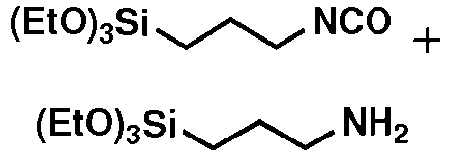
Suitable surfactant, TEOS, auxiliary solvent (e.g., EtOH, DMF, etc.) (X)3M1-R1-L-R2-M2(X)3 Not according to the invention L=--N-N=CH- Functionalization of an hydrazone with a silane derivative (e.g. 3-(triethoxysilyl)-propyl isocyanate). 
Suitable surfactant, TEOS, auxiliary solvent (e.g., EtOH, DMF, etc.) (X)3M1-R1-L-R2-M2(X)3 Not according to the invention L=--O-N=CH- Functionalization of an oxyme with a silane derivative (e.g. 3-(triethoxysilyl)-propyl chloride). 
Suitable surfactant, TEOS, auxiliary solvent (e.g., EtOH, DMF, etc.) (X)3M1-R1-L-R2-M2(X)3 Not according to the invention L=-Boronic acid derivatives Complexation with a tetraalcohol (i.e pentaerithritol) of a boronic acid possessing with 2 functional groups (e.g. double bonds) reactable with a silane source (e.g. HSi(OEt)3). 

Not according to the invention A=Carbohydra tes Functionalization of the the monomers of a carbohydrate (e.g. amilose) with epoxy terminating silane derivative (i.e. 3-glycidoxypropyl triethoxy silane). 

Not according to the invention A=Peptides Functionalization of the monomers of a polypeptide (e.g. Poly-lysine) with an isocyanate terminating silane derivative (e.g. 3-(triethoxysilyl)-propyl isocyanate). 

Not according to the invention A=Biodegrada ble polymers Functionalization of the monomers of the extremities of a biodegradable polymer (e.g. PEG) with an epoxy terminating silane derivative (e.g. 3-glycidoxypropyl triethoxy silane) 

- In this aspect of the invention the step of preparing a porous framework material may include synthesizing the porous framework material by mixing the precursors ((X3Si)R1-L-R2(SiX3); and Si(XA)4) of the framework material with a suitable supramolecular template under conditions suitable for self-assembly of the particulate constituent to form the framework material, and subsequent removing the supramolecular template. The framework material being an organometaloxide, which is mesoporous
having a porosity containing both size regimes of pores. The metaloxide may be silica. - The method for producing disintegratable porous silica materials of the present invention includes the following steps. The first step is a "surfactant micellar assembly step" wherein the surfactant serve as template for the porous organosiliconoxide material (step a)). The next step is a "organosiliconoxide covering step" comprising:
- Method 1: adding a silica source Si(XA)4 to the surfactant template,
together with a suitable precursor (X)3M1-R1-L-R2-M2(X)3
(where M=M1=M2=Si), to thereby cover the surface (periphery) of the surfactant template with organosiliconmetaloxide (step b)); or - Method 2: adding a suitable precursor (X)3M1-R1-L-R2-M2(X)3;
(where M1=M2=Si), to the surfactant template, to thereby cover the surface (periphery) of the surfactant template with organosiliconmetaloxide (step b)). - As discussed before, for
method 1, advantageously, the mixing ratio of the
silica sources (X)3Si-R1-L-R2-Si(X)3/ Si(XA)4
may be adjusted to control the desired % doping in the resulting porous organosiliconmetaloxide material. For exemplary ratios of equivalents (X)3Si-R1-L-R2-Si(X)3 / Si(XA)4 to reach a variety of % doping ≥30%, see Table 1A. - The final step is a "removal step" of removing the surfactant template (step c)). The final step may be performed or not depending on the type/use of the surfactant.
- According to the present invention the disintegratable mesoporous organometaloxide material comprises in its pores or at its surface of at least one marker and/or cosmetically or pharmaceutically active principle. The surface of the porous silica material according to the invention may be functionalized with a surface agent, for example by using a function group-containing trialkoxysilane, such as a PEG group linked to a trialkoxysilane. Likewise, marking of the porous silica material (for example for medical purposes) may be achieved by condensation of a marker-containing trialkoxysilane. The marker may be selected from a contrast agent, a tracer, a radioactive marker, any commercial dye, such as a fluorescent marker or a phosphorescent marker, a magnetic resonance imaging agent or a positron emission tomography agent, such as pyrene, rhodamine, IR783, Gd-EDTA or 64Cu-EDTA. The marker may be a fluorescent molecule selected from rhodamines, fluorescein, luciferase, pyrene-containing markers, aminopyrrolidino-7-nitrobenzofurazan, or indocyanine green (ICG) for NIR emission.
- As used herein, the term "surface agent" refers to a molecule that partly or totally covers the surface of the porous material, allowing the surface properties of the material to be modified, wherein the surface agent is at least one marker and/or cosmetically or pharmaceutically active principle; for example:
- modifying its biodistribution, for example to avoid its recognition by the reticulo-endothelial system ("furtiveness"), and/or
- giving it advantageous bioadhesion properties during oral, ocular or nasal administration, and/or
- enabling it to specifically target certain sick organs/tissues, etc.
- According to the invention, several surface agents may be used to combine the abovementioned properties. For example, a surface agent combining at least two of the abovementioned properties may be used. For example, the organic surface agent may be chosen from:
- an oligosaccharide, for instance cyclodextrins,
- a polysaccharide, for instance chitosan, dextran, fucoidan, alginate, pectin, amylose, starch, cellulose or xylan,
- a glycosaminoglycan, for instance hyaluronic acid or heparin,
- a polymer, for instance polyethylene glycol (PEG), polyvinyl alcohol or polyethyleneimine,
- a surfactant, such as pluronic or lecithin,
- vitamins, such as biotin,
- coenzymes, such as lipoic acid,
- antibodies or antibody fragments,
- amino acids or peptides.
- According to the present invention the surface agents are selected from a marker and/or cosmetically or pharmaceutically active principle.
- The porous organometaloxide framework materials of the invention are useful for any known use of porous organometaloxide framework materials known in the art. The porous organometaloxide framework materials of the invention are particularly adapted for uses of this type of materials where the self-destructive behavior that characterizes the organometaloxide of the invention provides an advantage. In particular, in contrast to conventional porous organometaloxide framework materials known in the art, the materials of the invention have the unexpected property of completely losing their structural integrity (disintegration) upon application of a suitable stimuli. Owing to the intrinsic porosity combined to their disintegratable properties, the materials of the invention prove much more efficient in releasing and delivering compounds that they might be loaded with (e.g., therapeutically and/or cosmetically active principles, or other chemicals). In other words, release of the compounds trapped/encapsulated in the materials' porous framework occurs much more efficiently than with conventional porous organometaloxides known in the art. For biomedical applications (e.g., when the framework metal is Si), this means less bio-accumulation, better elimination, and less toxicity.
These uses include: - Biomedical applications, including controlled drug release and uptake, and their use in sensing, diagnostics and bioassays. See for example
WO2005087369 ,WO2011124739 ,WO2009024635 ,us2013195963 ,us20100278931 - Cosmetics
WO 2010030252 ,JP 2002348380 WO 2010030252 - Catalysis
KR 2013113770 - Photovoltaics
WO 2013154964 ,US 20130269782 - Inks/ Paints additive
WO2011119265 A1 ,US4877451 A - Optical coating
WO 2012022983 A1 - Anti-microbial
WO2006120135 A1 - Accordingly, there is provided compositions comprising a disintegratable porous organometaloxide framework material according to the invention and any compound and/or additive suitable for any one or more of the material's intended use describe above.
- Thus, for applications that involve a disintegratable porous organometaloxide framework material according to the invention loaded with a marker and/or cosmetically or pharmaceutically active principle , the process for preparing the porous organometaloxide materials according to the invention further comprises a step (d) of introducing, into the pores or at the surface of the porous organometaloxide materials, at least one molecule of interest, which is a cosmetically or pharmaceutically active principle and/or a marker. Any method known to those skilled in the art may be used to that end. The molecule of interest may be introduced, for example, into the porous organometaloxide materials of the present invention:
- via impregnation, by immersing the material in a solution of the molecule of interest;
- by sublimation of the molecule of interest, and the gas is then adsorbed by the material; or
- via rotary roll milling, which consists in mechanically mixing the material and the molecule of interest.
- According to the invention the disintegratable porous organometaloxide framework material according to the invention is loaded with a pharmaceutically active principle and/or a marker, for example in its pores.
- In another aspect of the present invention, pharmaceutically acceptable compositions are provided, wherein these compositions comprise any of the porous organometaloxide materials as described herein, and optionally comprise a pharmaceutically acceptable carrier, adjuvant or vehicle. In certain embodiments, these compositions optionally further comprise one or more additional therapeutic agents.
- The use of carriers and vectors for molecules of interest, especially molecules with a therapeutic effect or markers, has become a major issue for the development of novel diagnostic methods or novel medicaments. Specifically, the molecules of interest have characteristics that have an influence on the pharmacokinetics and biodistribution of these molecules and that are not always favorable or adaptable to the medium into which they are introduced. They are, for example, physicochemical characteristics, such as instability, a strong tendency toward crystallization, poor water solubility and/or biological characteristics such as toxicity, biodegradability, etc.
- The porous organometaloxide materials according to the invention may be used for that purpose, namely for drug delivery, and for improving the pharmacokinetic profile of drugs, for example in terms of escaping the immune system and/or uptake by certain organs, for example the liver or the kidney, thus avoiding their accumulation in these organs.
- There is thus provided porous organometaloxide materials (for example in the form of nanoparticles) for use as medicament and/or drug delivery/controlled release. For example, the porous organometaloxide materials may comprise in their pores or at their surface at least one pharmaceutically active principle. There is also provided porous organometaloxide materials (for example in the form of nanoparticles), for use in medical imaging. For example, the porous organometaloxide materials may comprise in their pores or at their surface at least one marker. There is also provided a method for treating a condition or disease comprising administering to a subject in need thereof a disintegratable porous organometaloxide material according to the present invention, appropriately loaded on its surface or in its pore with a drug moiety adapted for such treatment.
- Likewise, for cosmetic applications, a composition according to the invention may comprise a disintegratable porous organometaloxide framework material according to the invention loaded with a cosmetically active principle, for example in its pores.
- In another aspect, the invention provides the use of disintegratable porous organometaloxide framework material according to the invention in a cosmetic composition.
- In another aspect, the invention provides the use of disintegratable porous organometaloxide framework material according to the invention in catalysis.
- In another aspect, the invention provides the use of disintegratable porous organometaloxide framework material according to the invention in photovoltaics.
- The disintegratable porous organometaloxide materials according to the invention therefore can find applications in in vitro and in vivo diagnostics, therapy, in cosmetics, in drug delivery, and in any other application where a release can be envisaged.
- Other advantages may also emerge to those skilled in the art upon reading the examples below, with reference to the attached figures, which are provided as nonlimiting illustrations.
- The representative examples that follow are intended to help illustrate the invention, and are not intended to, nor should they be construed to, limit the scope of the invention. Indeed, various modifications of the invention and many further embodiments thereof, in addition to those shown and described herein, will become apparent to those skilled in the art from the full contents of this document, including the examples which follow and the references to the scientific and patent literature cited herein. It should further be appreciated that the contents of those cited references are incorporated to help illustrate the state of the art.
- The following examples contain important additional information, exemplification and guidance that can be adapted to the practice of this invention in its various embodiments and the equivalents thereof.
- The compounds of this invention and their preparation can be understood further by the examples that illustrate some of the processes by which these compounds are prepared or used. It will be appreciated, however, that these examples do not limit the invention. Variations of the invention, now known or further developed, are considered to fall within the scope of the present invention as described herein and as hereinafter claimed.
- The present invention will now be exemplified using mesoporous organosilica as the porous framework material but it will be understood this is not meant to limit the invention to mesoporous organosilica porous frameworks.
The tested particles will be tested in their triggered degradation ability, and evidence of the breakdown of the material will be given by demonstrating the structural/morphological transformations occurring in the responsively disintegratable particles during the triggered breakdown process. -
- Synthesis of 20 nm average diameter S-S doped SNPs: CTAB (145 mg) was added to a mixture of 72 ml of H2O, 3 ml of EtOH, and 0,6 ml of a 28 wt% ammonia solution. The reaction mixture was stirred at 50°C for 1 h before the addition of 1,25 ml of a 0.88 M ethanolic solution of: the disulfide silane (bis(3-triethoxysilylpropyl)disulfide, 30% in molar ratio with respect to the Si centers), phosphonated silane (3-(trihydroxysilyl)propyl methylphosphonate monosodium salt, 3%); and Tetraethyl orthosilicate (TEOS) (67% in molar ratio with respect to the Si centers). The above reaction mixture was continuously stirred for 24 h at 70°C. The Cetyltrimethylammonium bromide (CTAB) mesoporous template was then removed by stirring the sample in acidic ethanol (50 ml) at 90 °C for 12 h. The resulting solid was recovered by centrifugation, washed with water and ethanol several times, and finally preserved in water as a suspension.
- Fluorescein-tagging of SS doped SNPs (SS-NPs): the S-S doped SNPs were dispersed in 20 ml of toluene, before adding to the suspension a solution of fluorescein isothiocyanate (FITC) and (3-aminopropyl)-triethoxysilane (APTES) in ethanol, characterized by a concentration of 0.5 mmol per mg of NPs to be functionalized. The suspension was then heated at reflux for 14 h. The resulting solid was recovered by centrifugation, washed with toluene, water and ethanol several times, and finally preserved in water.
- Chemical biodegradability test: reduction of the S-S bond was performed with NaBH4, being an efficient and irreversible reducing agent, not forming residual by-products, which might hamper visual evaluation of the efficacy of the reduction. In a typical reduction experiment, NaBH4 (1 mg) was added to a stable suspension of the luminescent SS-NPs in MeOH (1 mg/ml). After 6 hours, the reaction was quenched by addition of a small amount of water (0.1 ml) to deactivate unreacted NaBH4.
-
- Characterization of the composition of the nanoparticle was firstly performed by means of electron diffraction X-ray spectroscopy (EDX) and thermogravimetric analysis (TGA), in order to confirm the presence of the linker in the structure of the particle (
Fig. 4-5 ). The EDX spectrum and EDX map shown inFig. 4 reports the presence of the signal of S in the material, clearly confirming the introduction of the disulfide bridge in the SS-NPs' structure. - The presence of the organic fragments was further sustained by thermogravimetric analysis. From the TGA plot it resulted possible to detect the content of organic material in the NPs, characterized by a lower decomposition temperature compared to the silica framework. Indeed, as demonstrated in
Fig. 4 , the pristine SS doped NPs are characterized by a percentage weight loss of 23% at 350 °C. This data corresponds to a presence of disulfide bridging ligand. For the fluorescein functionalized SS-NPs a weight loss of 30% was instead recorded at 350 °C, due to the further functionalization with the dye. - Scanning Electron Microscopy (SEM), Transmission Electron Microscopy (TEM) and high resolution Transmission Electron Microscopy (HRTEM) were used to confirm the nanoparticle morphology of the synthesized responsively disintegratable material, as well as the presence of the porous framework (
FIG. 6-7 ). It was hence determined that the average diameter of the particles results around 20 nm. After the chemical degradation, the porous structure was lost, and only small particle fragments, or amorphous silica was detected in the sample (FIG 8-10 ). - Important evidence of the degradation in solution came from Dynamic light scattering (DLS) analysis (
figure 11 ). As can be clearly seen the initial size of the nanoparticles (19 nm ± 10) is completely changed after the reduction reaction and the particles size is reduced to 5 nm ± 3. - Absorption (UV-Vis) and emission properties of the SS-NPs were evaluated before and after their reduction (
figure 12 ). Regarding the absorption properties, after the reduction, the broken particles' suspension presents a much lower degree of scattering, due to the reduced size of the particles. Also the luminescence of the reduced material increases considerably, indicating a lower quenching occurring from the particles, again attributable to the smaller size of the reduced material. - Small angle X-ray scattering (SAXS) analysis confirmed the HRTEM results, indicating that the synthesized responsively disintegratable SS-NPs indeed present a mesoporous network, which is partially lost after the breaking experiment.
- The cell up-take of SS-NPs was tested with Hela cells. As depicted in
figure 14 , the results show that the NPs are internalized by the cells. The NPs have been labeled with a green fluorescent dye and therefore the localization of the porous particles and the dye will be the same if the particles are not degraded. Indeed this is the case for the first 4 hours (figure 14 left). However after longer time incubation the fluorescein seems to diffuse inside the cell, suggesting the occurring decomposition of the particles in the cellular environment and the spreading of the small resulting pieces all over the cytoplasm (figure 14 right). To prove that the fragments are not toxic viability tests have been performed on the cell monitoring their death after 4, 24 and 48 hours. The results shown infigure 15 do not show any mortality of the cells. -
- Synthesis of trilysine-doped mesoporous silica nanoparticles (Pep-SNPs): CTAB was dissolved in a mixture of H2O and 28 wt% ammonia solution (amount depending on the requested morphology). The reaction mixture was stirred at 50 °C for 1 h before the addition of a solution of Tri-lysine (LLL), containing 6 mg of the peptide, 27 µl of 3-(Triethoxysilyl)propyl isocyanate (NCO-PTES), 15 µl of TEA in 1 ml of DMF. The above described reaction mixture was hence stirred for an additional 2 h at 50 °C. The CTAB mesoporous template was removed by stirring the sample in ethanol (50 ml) at 50 °C for 6 h. The resulting solid was recovered by centrifugation, washed with water and ethanol several times, and finally preserved in water as a suspension.
- Rhodamine-tagging of the Pep-SNPs: the peptide doped NPs were dispersed in 50 ml of EtOH, before adding to the suspension a solution of rhodamine B isothiocyanate (RITC) in EtOH, characterized by a concentration of 0.5 mmol per mg of NPs to be functionalized. The suspension was then heated at reflux for 14 h. The resulting solid was recovered by centrifugation, washed with ethanol and water several times, and finally conserved in water.
- Biodegradability test: destruction of the Rho-tagged Pep-SNPs was performed upon exposure of the particles to an enzyme (trypsin), able to attack and destroy the peptide fragment introduced in the framework of the material. Specifically, in a typical experiment, trypsin (50 µl) was added to a stable suspension of the luminescent Pep-SNPs (0.1 mg/ml) in a 1 w% dispersion of poly-lysine in water, and the mixture incubated at 37.5 °C for 3 days.
- To prove that the degradation can also enzymatically triggered a small peptide was introduced in the framework of mesoporous silica nanoparticles. The results clearly indicated that also in this case a full breaking of the silica is observed and the supported experiments are reported below.
- Scanning electron microscopy (SEM) images of Pep-SNPs before and after exposure to the trypsin enzyme highlight a difference in the morphology of the material. In fact, the typical annular morphology of the particles is lost, and mainly amorphous silica is detected.
- The cell up-take of Rho-tagged Pep-SNPs was also tested with Hela cells. As depicted in
Figure 17 , preliminary results show that the NPs are up-taken by the cells (average viability of 95%). Also, even more relevantly for the biodegradability issue, whilst at the beginning the NPs enter the cell as small agglomerates, with time the rhodamine seems to diffuse, suggesting, once again, the occurring decomposition of the NPs. - Synthesis of mixed Si-Ti mesoporous nanoparticles (STNPs): 1 g of Pluronic P123 surfactant was dissolved in 25g of EtOH. The mixture was stirred at 40°C for 1 hour before the addition of 5 mL ethanol solution of 1.04 g of TEOS and 2.37 g of bis(triethoxysilyl-propyl)disulfide and 1.42 g of titanium isopropoxyde (TIPO). After several minutes, 1.89 g of concentrated HCl was added to the solution. The above reaction mixture was continuously stirred for an additional 1 h and transferred to petri dish. The mother gel was then kept in the oven for 4 days at 35°C. The surfactant template was removed by Soxhlet extraction techniques.
-
- Characterization of the composition of the materials was firstly performed by means of small angle x-ray scattering (SAXS), electron diffraction X-ray spectroscopy (EDX) and thermogravimetric analysis (TGA), in order to confirm the presence of the linker in the structure of the materials.
- The presence of the organic fragments was further sustained by thermogravimetric analysis. From the TGA plot it resulted possible to detect the content of organic material in the materials, characterized by a lower decomposition temperature compared to the inorganic framework.
- Scanning Electron Microscopy (SEM), Transmission Electron Microscopy (TEM) and high resolution Transmission Electron Microscopy (HRTEM) were used to confirm the morphology of the synthesized responsively disintegratable material, as well as the presence of the porous framework.
- Synthesis of SS-doped SNPs (100 nm average diameter): CTAB (250 mg) was dissolved in a solution of distilled water (110 mL), EtOH (10 mL) and NaOH (2M, 0.875 mL) that was heated to 80 °C and stirred vigorously. After complete solubilization of CTAB, TEOS (0.875 mL) and Bis-(triethoxy-silyl-propyl)-disulfide ("BTSPD", 0.390 mL) were added under vigorous stirring. After 6 h the solution was cooled to room temperature and the particles, recovered by centrifugation (20 minutes at 40 krcf), were then purified through a sequence of sonication/centrifugation cycles in EtOH. To remove the surfactants from the pores, the particles were dissolved in acidic EtOH (100 mL, 30 mL of HCl) and refluxed o.n. The particles were hence purified by a sequence of sonication/centrifugation cycles in EtOH and finally dried under vacuum. The material was finally thoroughly characterized by means of XPS, TGA, SAXS, N2 adsorption, SEM and TEM analysis techniques.
- Synthesis of S-S doped SNPs (100 nm average diameter): 2.5 mg of rhodamine B isothiocyanate (RITC) were dissolved in EtOH (5 mL) before adding APTES (6 mL). In another flask CTAB (250 mg) was dissolved in a solution of distilled water (110 mL), EtOH (10 mL) and NaOH (2M, 0.875 mL) that was heated to 80°C and stirred vigorously. The RITC/APTES solution was stirred for 30 minutes before adding TEOS (0.875 mL) and Bis-(triethoxy-silyl-propyl)-disulfide ("BTSPD", 0.390 mL). Once the temperature of the CTAB solution had stabilized, the solution containing the silane sources was added. After 6 h the solution was cooled to room temperature and the particles, recovered by centrifugation (20 minutes at 40 krcf where "rcf" stands for "relative centrifugal force"), were then purified through a sequence of sonication/centrifugation cycles in EtOH. To remove the surfactants from the pores, the particles were dissolved in acidic EtOH (100 mL, 30 mL of HCl) and refluxed o.n. The particles were hence purified by a sequence of sonication/centrifugation cycles in EtOH and finally dried under vacuum. The material was finally thoroughly characterized by means of XPS, TGA, SAXS, N2 adsorption, SEM and TEM analysis techniques. SEM, TEM and EDX characterization of the resulting particles is provided in
Figure 18 . - Encapsulation of Temozolomide in the Rhodamine B doped SS-doped SNPs (TMZ⊙ss-NPs): encapsulation of temozolomide (TMZ) within the pores of the ss-NPs was performed by wet extraction methodology. [22, Vallet-Regi et al., Chem. Mater. 2001, 13, 308] Specifically 30 mg of ss-NPs were dispersed in 9 mL of EtOH by sonication whilst 5 mg of TMZ were dissolved in 1 mL of EtOH. The latter solution was added to the dispersion and the whole introduced in a rotary shaker for 3 days. The mixture was then centrifuged (20 minutes at 40 krcf) and the supernatant removed, before adding to the pelleted particles fresh EtOH (10 mL). The material was again purified by a sequence of sonication/centrifugation cycles in EtOH, and finally dried under vacuum.
- Synthesis of Rhodamine B doped NPs: 2.5 mg of RITC were dissolved in EtOH (1.5 mL) before adding APTES (6 µL). In another flask CTAB (250 mg) was dissolved in a solution of distilled water (120 mL) and NaOH (2M, 0.875 mL) that was heated to 80 °C and stirred vigorously. The RITC/APTES solution was stirred for 30 minutes before adding TEOS (1.25 mL). Once the temperature of the CTAB solution had stabilized, the solution containing the silanes was added. After 2 h the solution was cooled to r.t. and the particles, recovered by centrifugation (20 minutes at 40 krcf), were then purified through a sequence of sonication/centrifugation cycles in EtOH. To remove the surfactants from the pores, the particles were dissolved in acidic EtOH (100 mL, 30 µL of HCl) and refluxed o.n. The particles were hence purified by a sequence of sonication/centrifugation cycles in EtOH and finally dried under vacuum.
- Encapsulation of Temozolomide in the Rhodamine B doped NPs (TMZ⊙NPs): encapsulation of temozolomide (TMZ) within the pores of the NPs was performed by wet extraction methodology[22]. Specifically 30 mg of NPs were dispersed in 9 mL of EtOH by sonication whilst 5 mg of TMZ were dissolved in 1 mL of EtOH. The latter solution was added to the dispersion and the whole introduced in a rotary shaker for 3 days. The mixture was then centrifuged (20 minutes at 40 krcf) and the supernatant removed, before adding to the pelleted particles fresh EtOH (10 mL). The material was again purified by a sequence of sonication/centrifugation cycles in EtOH, and finally dried under vacuum.
- Cytotoxicity of temozolomide loaded ss-NPs: Glioma C6 cells were seeded in glass cover slips in a 24-well cell culture plate at a density of 1.5 × 10⁴ cells per well and allowed to grow 24 h. Next the media was removed and fresh media containing temozolomide loaded ss-NPs at different concentrations (20, and 50 µg/mL) was added to the cells and incubated for 3h at 37 °C in a humidified atmosphere with 5% CO2. Temozolomide loaded NPs were also incubated with the cells under the same conditions for comparison purposes. Control cells were treated with equivalets volumes of culture media. After 3 h the cells were trypsinated, centrifuged for 3 min at 1000 rpm and the resultant pellet was resuspended in 500 mL of culture media for further analysis. Cell viability was measured using CASY® Cell Counter and Analyzer.
- Synthesis of Rhodamine B doped SS-doped SNPs functionalized with Indocyanine Green N-succinimidyl ester (ICG-ss-NPs): 20 mg of ss-NPs were dispersed by sonication in DMSO (1 mL) and the solution diluted in toluene (4 mL). In a separate flask, ICG-NHS (0.1 mg) and 3-aminopropyldimethylmethoxysilane (3 µL) were stirred for 2 h in DMSO (1 mL) at r.t..[23, Lu et al., Small 2010, 16, 1794] This solution was hence added to the NPs suspension and the whole kept stirring at r.t. for further 20 h. The mixture was then centrifuged (20 minutes at 40 krcf) and the supernatant removed, before adding to the pelleted particles fresh EtOH (10 mL). The particles were hence purified by a sequence of sonication/centrifugation cycles in EtOH and finally dried under vacuum.
- Mice were injected with 0.5 mg of ssNPs (tagged with ICG and dispersed in 200 uL of PBS) by intravenous retro-orbital injection. After 3 h from the injection biodistribution was performed. Excretion was monitored up to 48 h, when no more emission was observed in the animals.
The biodistribution results are shown onFigure 23 : from the examination of the organs the particle seems to accumulate mainly in the lungs and in the liver. - The excretion results are shown on
Figure 24 : absence of specific emission already after 2 days. - While we have described a number of embodiments of this invention, it is apparent that our basic examples may be altered to provide other embodiments that utilize the catalysts and methods of this invention. Therefore, it will be appreciated that the scope of this invention is to be defined by the appended claims rather than by the specific embodiments that have been represented by way of example.
-
- [1] a) M. E. Davis, Nature, 2002, 417, 813; b) U. Ciesla, F. Schuth, Micropor. Mesopor. Mat. 1999, 27, 131.
- [2] D. Zhao, J. Feng, Q. Huo, N. Melosh, G. H. Fredrickson, B. F. Chmelka, G. D. Stucky, Science, 1998, 279, 548.
- [3] T. Linssen, K. Cassiers, P. Cool, E. F. Vansant, Adv. Coll. Interf. Sci. 2003, 103, 121.
- [4] T. Asefa, G. A. Ozin, H. Grondey, M. Kruk, M. Jaroniec, Studies Surf. Sci. Catal. 2002, 141, 1.
- [5] a) D. S. Shephard, W. Zhou, T. Maschmeyer, J. M. Matters, C. L. Roper, S. Parsons, B. F. G. Johnson, M. J. Duer, Angew. Chem., Int. Ed. 1998, 37, 2719; b) F. de Juan, E. Ruiz-Hitzky, Adv. Mater. 2000, 12, 430; c) K. Cheng, C. C. Landry, J. Am. Chem. Soc. 2007, 129, 9674.
- [6] K. J. Shea, D. A. Loy, Chem. Mater. 2001, 13, 3306.
- [7] S. Inagaki, S. Guan, T. Ohsuna, O. Terasaki, Nature, 2002, 416, 304.
- [8] V. Valtchev, L. Tosheva, Chem. Rev., 2013, 113, 6734.
- [8a] Po-Jui Chiu, et al., New Journal of Chemistry, 2011, 35, 489.
- [8b] Xi Chen, et al., Frontiers of Material Science; Selected Publications from Chinese Universities, 2012, 6, 278.
- [8c] J. Liu, et al., Advanced Functional Materials, 2005, 15, 1297.
- [8d] Taylor-Pashow Kathryn M. L., et al., Nanomaterials, 2012, 2, 1.
- [9] S. J. Rowan, S. J. Cantrill, G. R. L. Cousins, J. K. M. Sanders, J. F. Stoddart, Angew. Chem. Int. Ed., 2002, 41, 898.
- [10] M. Kruk, Acc. Chem. Res., 2012, 45, 1678.
- [11] F. Hoffmann, M. Cornelius, J. Morell, M. Fröba, Angew. Chem. Int. Ed. 2006, 45, 3216 - 3251.
- [12] S. V. M. de Moraes, J. B. Passos, P. Schossler, E. B. Caramão, C. C. Moro, T. M. H. Costa, E. V. Benvenutti, Talanta, 2003, 59, 1039.
- [13] M. He, J. Bu, X. Yuan, Integrated Optics: Devices, Materials, and Technologies X. Edited by Sidorin, Yakov; Waechter, Christoph A. Proceedings of the SPIE, 2006, 6123, 130.
- [14] M. Graffner-Nordberg, K. Sjödin, A. Tunek, A. Hallberg, Chem. Pharm. Bull., 1998, 46, 591.
- [15] M. Kobayashi, Y. Fujiwara, M. Goda, H. Komeda, S. Shimizu, PNAS, 1997,94, 11986.
- [16] C. Lopreore, L. D. Byers, Arch. Biochem. Biophys., 1998, 349, 299.
- [17] E. Khalikova, P. Susi, T. Korpela, Microbiol. Mol. Biol. Rev., 2005, 69, 306.
- [18] R. Weissleder, C.-H. Tung, U. Mahmood, A. Bogdanov Jr., Nat. Biotech., 1999, 17, 375.
- [19] M. Yamashita, A. Tani, F. Kawai, Appl. Microbiol. Biotechnol., 2004, 66, 174.
- [20] S. H. Lee, W. S. Song, Text. Res. J., 2013, 83, 229.
- [21] P. D. Hsu, D. A. Scott, J. Weinstein, F. A. Ran, S. Konermann, V. Agarwala, Y. Li, E. J. Fine, X. Wu, O. Shalem, T. J Cradick, L. A. Marraffini, G. Bao, F. Zhang, Nat. Biotech., 2013, 31, 827; M. Furutani, K. Ito, Y. Oku, Y. Takeda, K. Igarashi, Microbiol. Immunol., 1990, 34, 387.
- [22] Vallet-Regi et al., Chem. Mater. 2001, 13, 308.
- [23] Lu et al., Small 2010, 16, 1794.
The ease of functionalization and the versatile morphology manipulation of the PMOs allowed the development of several hybrids, which can likely be exploited to advantage in a number of application areas including but not limited to controlled release of chemicals and drugs, chemical sensing, bioassays, catalysis and separations, to name a few. [8]
Claims (18)
- Nanoparticles of disintegratable mesoporous organometaloxide material having a particle diameter from 1 to 500 nm and comprising a mesoporous three-dimensional Si-, Ti- or Zr-based metaloxide framework of metal-oxygen bonds, wherein at least a subset of metal atoms in the material's framework are connected to at least another metal atom in the framework through a linker having one of the following structures:
*-R1-L-R2-*,
wherein:each occurrence of * denotes a point of attachment to a metal atom in the material's framework;L represents a responsively cleavable covalent bond selected from disulfide, andR1 and R2 independently represent an optionally substituted Cl-20alkylenyl moiety, an optionally substituted Cl-20heteroalkylenyl moiety, an optionally substituted ethylenyl moiety, -C≡C- or an optionally substituted phenyl moiety, wherein the C1-20alkylenyl, C1-20heteroalkylenyl or ethylenyl moiety may bear one or more substituents selected from halogen or -OR where R may represent H or C1-6alkyl, and the phenyl moiety may bear one or more substituents independently selected from halogen, Cl-6alkyl, -NO2, -CN, isocyano, -ORp, -N(Rp)2 wherein each occurrence of Rp independently represents H or C1-6alkyl,wherein the disintegratable mesoporous organometaloxide material comprises in its pores or at its surface at least one marker and/or cosmetically or pharmaceutically active principle. - The material of claim 1, wherein the subset of metal atoms in the material's framework that are connected to the linker *-R1-L-R2-*, represent at least 30% of the metal atoms present in the mesoporous organometaloxide material.
- The material of claim 1 or 2, wherein the metal is selected from Si, Ti or Zr, or any combination of at least two of these metals.
- The material of any one of claims 1 to 3, wherein the material contains 90.0-100% Si, 90.0-100% Ti or 90.0-100% Zr as metal, wherein the % are based on the number of available metal sites in the framework.
- The material of any one of claims 1 to 3, wherein the disintegratable mesoporous organometaloxide material is a Si-Ti mixed-metal organometaloxide material containing 0.1-50.0% Si and 0.1-50.0% Ti, the % sum of Si and Ti adding to 100% the number of available metal sites in the framework.
- The material of any one of claims 1 to 3, wherein in the linker *-R1-L-R2-*, R1 and R2 are identical, and each represent -CH2-, -(CH2)2-, -(CH2)3-, - (CH2)4-, or phenyl.
- The material of any one of claims 1 to 6 having a particle diameter from 20 nm to 500 nm.
- The material of any one of claims 1 to 6 having a particle diameter from 20 nm to 100 nm.
- A method for preparing a material according to any one of claims 1 to 8, comprising steps of:a) Producing a supramolecular template by mixing a suitable surfactant and an aqueous solvent;b) Adding a mixture of a precursor M(XA)4 and a selected precursor having the structure:
(X)3M1-R1-L-R2-M2(X)3;
in an aqueous solvent under alkaline conditions; thereby coating the supramolecular template with an organometaloxide sol-gel mixture obtained by hydrolysis-condensation of metal alkoxide; andc) Removing the supramolecular template; thereby producing porous organometaloxide nanoparticles comprising a mesoporous three-dimensional framework of metal-oxygen bonds, wherein at least a subset of metal atoms in the material's framework are connected to at least another metal atom in the framework through a linker having one of the following structures:
*-R1-L-R2-*,
wherein:each occurrence of * denotes a point of attachment to a metal atom in the material's framework;M and each occurrence of M1 and M2 independently represents a metal selected from Si, Ti and Zr;each occurrence of X and XA independently represents a hydrolysable or nonhydrolyzable group, provided that on each occurrence of M1 and M2, at least one occurrence of X represents a hydrolysable group and at least two occurrences of XA in the precursor M(XA)4 independently represent a hydrolysable group; wherein (i) when X or XA represents a nonhydrolyzable group, it may be selected from an optionally substituted C1-20alkyl, C2-20alkenyl or C2-20alkynyl moiety, an optionally substituted C1-20heteroalkyl, C2-20heteroalkynyl or C2-20heteroalkynyl moiety, or an optionally substituted phenyl moiety, wherein the substituents on the phenyl, alkyl, alkenyl, alkynyl, heteroalkyl, heteroalkenyl and heteroalkynyl moieties may be independently selected from halogen, -NO2, -CN, isocyano, C1-6alkoxy, an oxirane/epoxyde moiety, -N(R)2 wherein each occurrence of R is independently selected from H or C1-6alkyl; and (ii) when X or XA represents a hydrolysable group, it may be selected from a C1-6alkoxy, C1-6acyloxy, halogen or amino moiety;L represents a responsively cleavable covalent bond selected from disulfide; andR1 and R2 independently represent an optionally substituted C1-20alkylenyl moiety, an optionally substituted C1-20heteroalkylenyl moiety, an optionally substituted ethylenyl moiety, -C≡C- or an optionally substituted phenyl moiety, wherein the C1-20alkylenyl, C1-20heteroalkylenyl or ethylenyl moiety may bear one or more substituents selected from halogen or -OR where R may represent H or C1-6alkyl, and the phenyl moiety may bear one or more substituents independently selected from halogen, C1-6alkyl, -NO2, -CN, isocyano, -ORp, -N(Rp)2 wherein each occurrence of Rp independently represents H or C1-6alkyl,wherein the method further comprises a step (d) of introducing into the pores or at the surface of the mesoporous organometaloxide material at least one marker and/or cosmetically or pharmaceutically active principle. - The method of claim 9, wherein the ratio of equivalents (X)3M1-R1-L-R2-M2(X)3/M(XA)4 is one listed in the table below:
M(XA)4 (X)3 M1 -R1-L-R2-M2 (X)3 (X)3M1-R1-L-R2-M2(X)3 % doping 0.70 eq. 0.30 eq. 
0.15 eq. 
30% 0.60 eq. 0.40 eq. 0.20 eq. 40% 0.50 eq. 0.50 eq. 0.25 eq. 50% 0.40 eq. 0.60 eq. 0.30 eq. 60% 0.30 eq. 0.70 eq. 0.35 eq. 70% 0.20 eq. 0.80 eq. 0.40 eq. 80% 0.10 eq. 0.90 eq. 0.45 eq. 90% - 1 eq. 0.5 eq. 100% equivalents expressed in terms of metal atoms (M1 and M2) introduced by the bivalent starting material (X)3M1-R1-L-R2-M2(X)3 in the final organometaloxide material.
equivalents expressed in terms of responsively cleavable bond L introduced by the bivalent starting material (X)3M1-R1-L-R2-M2(X)3 in the final organometaloxide material. - The method of any one of claims 9 to 10 , wherein the metal is Si.
- The method of any one of claims 9 to 10, wherein the metal is Si and M(XA)4 represents a tetraalkoxysilane such as tetramethoxysilane, tetraethoxysilane and tetrapropoxysilane, preferably tetraethoxysilane (TEOS).
- The method of any one of claims 9 to 12 , wherein the surfactant is a cationic surfactant, an anionic surfactant, a non-ionic surfactant; preferably a cationic surfactant such as octadecyl trimethyl ammonium bromide, hexadecyl trimethyl ammonium bromide, tetradecyl trimethyl ammonium bromide, dodecyl trimethyl ammonium bromide, decyl trimethyl ammonium bromide, octyl trimethyl ammonium bromide, hexyl trimethyl ammonium bromide and other quaternary ammonium salt-type cationic surfactants.
- The method of any one of claims 11 to 13, wherein the aqueous solvent comprises an alcohol, such as methanol or ethanol.
- The method of any one of claims 9, 10 and 11 to 14, wherein the precursor having the structure (X)3M-R1-L-R2-M(X)3 is produced in situ.
- Mesoporous organometaloxide material according to any one of claims 1 to 8, comprising in its pores or at its surface at least one pharmaceutically active principle, for use as medicament.
- Mesoporous organometaloxide material according to any one of claims 1 to 8, comprising in its pores or at its surface at least one marker, for use in medical imaging.
- Use of a material according to any one of claims 1 to 8 in a cosmetic, catalytic, paint, ink, photovoltaic or optical coating composition.
Priority Applications (2)
| Application Number | Priority Date | Filing Date | Title |
|---|---|---|---|
| EP20197286.6A EP3786214A1 (en) | 2014-01-14 | 2015-01-14 | Disintegratable porous organometaloxide material |
| EP15700665.1A EP3094666B1 (en) | 2014-01-14 | 2015-01-14 | Disintegratable porous organometaloxide material |
Applications Claiming Priority (3)
| Application Number | Priority Date | Filing Date | Title |
|---|---|---|---|
| EP14151167.5A EP2894186A1 (en) | 2014-01-14 | 2014-01-14 | Disintegrable porous organometaloxide material |
| PCT/EP2015/050605 WO2015107087A1 (en) | 2014-01-14 | 2015-01-14 | Disintegratable porous organometaloxide material |
| EP15700665.1A EP3094666B1 (en) | 2014-01-14 | 2015-01-14 | Disintegratable porous organometaloxide material |
Related Child Applications (1)
| Application Number | Title | Priority Date | Filing Date |
|---|---|---|---|
| EP20197286.6A Division EP3786214A1 (en) | 2014-01-14 | 2015-01-14 | Disintegratable porous organometaloxide material |
Publications (2)
| Publication Number | Publication Date |
|---|---|
| EP3094666A1 EP3094666A1 (en) | 2016-11-23 |
| EP3094666B1 true EP3094666B1 (en) | 2020-09-23 |
Family
ID=50023418
Family Applications (3)
| Application Number | Title | Priority Date | Filing Date |
|---|---|---|---|
| EP14151167.5A Withdrawn EP2894186A1 (en) | 2014-01-14 | 2014-01-14 | Disintegrable porous organometaloxide material |
| EP15700665.1A Not-in-force EP3094666B1 (en) | 2014-01-14 | 2015-01-14 | Disintegratable porous organometaloxide material |
| EP20197286.6A Withdrawn EP3786214A1 (en) | 2014-01-14 | 2015-01-14 | Disintegratable porous organometaloxide material |
Family Applications Before (1)
| Application Number | Title | Priority Date | Filing Date |
|---|---|---|---|
| EP14151167.5A Withdrawn EP2894186A1 (en) | 2014-01-14 | 2014-01-14 | Disintegrable porous organometaloxide material |
Family Applications After (1)
| Application Number | Title | Priority Date | Filing Date |
|---|---|---|---|
| EP20197286.6A Withdrawn EP3786214A1 (en) | 2014-01-14 | 2015-01-14 | Disintegratable porous organometaloxide material |
Country Status (4)
| Country | Link |
|---|---|
| US (2) | US10450423B2 (en) |
| EP (3) | EP2894186A1 (en) |
| CN (1) | CN105916914A (en) |
| WO (1) | WO2015107087A1 (en) |
Families Citing this family (11)
| Publication number | Priority date | Publication date | Assignee | Title |
|---|---|---|---|---|
| US11133390B2 (en) * | 2013-03-15 | 2021-09-28 | The Boeing Company | Low temperature, thin film crystallization method and products prepared therefrom |
| CN105330794B (en) * | 2015-12-01 | 2018-01-30 | 西北师范大学 | Amphipathic nature block polymer and its preparation and application with active-passive dual-target antitumor activity |
| WO2018134268A1 (en) | 2017-01-17 | 2018-07-26 | Université De Strasbourg | Injectable hydrogels and uses thereof |
| WO2018162676A1 (en) * | 2017-03-08 | 2018-09-13 | Université De Strasbourg | DISINTEGRATABLE POROUS ORGANOSILICA OR ORGANOMETALOXIDE NANOPARTICLES AND USES THEREOF AS VEHICLE FOR CONTROLLED DELIVERY OF siRNA |
| US11814527B2 (en) * | 2017-04-27 | 2023-11-14 | Trustees Of Dartmouth College | Three-dimensional printing with supramolecular templated hydrogels |
| EP3681934A1 (en) | 2017-09-15 | 2020-07-22 | Université de Strasbourg | Injectable hybrid alginate hydrogels and uses thereof |
| EP3470371A1 (en) | 2017-10-16 | 2019-04-17 | Université de Strasbourg | Method of controlling the morphology of mesoporous silica particles |
| CN108862289B (en) * | 2018-07-26 | 2021-10-15 | 南京邮电大学 | A kind of mesoporous silica nanoparticles with small particle size and large pore size and preparation method thereof |
| CN110432264A (en) * | 2019-08-07 | 2019-11-12 | 华南农业大学 | Drug-loaded nano-microspheres, sustained-release drug deworming pet collar and preparation method thereof |
| CN112442232B (en) * | 2019-09-03 | 2021-11-05 | 中国科学院化学研究所 | Nano material composite polymer powder and preparation method thereof |
| CN110746809B (en) * | 2019-10-15 | 2021-04-30 | 东营施普瑞石油工程技术有限公司 | A kind of redox responsive intelligent corrosion inhibitor, preparation method and application thereof |
Citations (2)
| Publication number | Priority date | Publication date | Assignee | Title |
|---|---|---|---|---|
| WO2003102001A1 (en) * | 2002-05-31 | 2003-12-11 | Mcmaster University | Polyol-modified silanes as precursors for silica |
| US20060223965A1 (en) * | 2005-03-31 | 2006-10-05 | Aspen Aerogels Inc. | High strength organic-inorganic hybrid gel materials |
Family Cites Families (14)
| Publication number | Priority date | Publication date | Assignee | Title |
|---|---|---|---|---|
| US4877451A (en) | 1988-08-17 | 1989-10-31 | Xerox Corporation | Ink jet inks containing colored silica particles |
| TWI246924B (en) | 2001-02-23 | 2006-01-11 | Kose Corp | Porous titanium oxide, organic polyorganosiloxane hybridized powder and titanium oxide, silicon oxide composite unit and matched cosmetic material thereof |
| WO2005087369A1 (en) | 2004-03-16 | 2005-09-22 | The Governing Council Of The University Of Toronto | Hybrid porous organic-metal oxide materials |
| WO2006120135A1 (en) | 2005-05-10 | 2006-11-16 | Ciba Specialty Chemicals Holding Inc. | Antimicrobial porous silicon oxide particles |
| CN100998951A (en) * | 2006-12-30 | 2007-07-18 | 上海师范大学 | Three-dimensional meso-hole structure non-homogeneous organic metal compound-silicon hydrid catalyst and its preparation method and application |
| ES2316292B1 (en) | 2007-08-01 | 2010-02-05 | Consejo Superior De Investigaciones Cientificas | ORGANIC-INORGANIC HYBRID MATERIAL FOR STORAGE AND RELEASE OF ACTIVE PRINCIPLES. |
| SI22859A (en) | 2008-09-09 | 2010-03-31 | Kemijski@inštitut | Sterically stabilised dispersion of hybrid inorganic-organic material in oil as preparation for protection from uv rays and procedure of preparation |
| AU2010246067B2 (en) | 2009-05-04 | 2016-07-07 | Eyepoint Pharmaceuticals Us, Inc. | Porous silicon drug-eluting particles |
| CA2792151C (en) | 2010-03-26 | 2016-07-05 | Benjamin Moore & Co. | Hybrid organic-inorganic nanocomposites |
| ES2366841B1 (en) | 2010-04-06 | 2013-01-24 | Consejo Superior De Investigaciones Cientificas (Csic) (45%) | SILICAN NANOPARTICLES FOR INTRACELLULAR DISSEMINATION OF LITTLE SOLUBLE BIOACTIVE AGENTS |
| GB201014024D0 (en) | 2010-08-20 | 2010-10-06 | Oxford Energy Technologies Ltd | Optical coating |
| US8926994B2 (en) | 2011-12-07 | 2015-01-06 | The Methodist Hospital Research Institute | Mesoporous silicon particles for the presentation of tumor antigens and adjuvant for anti-cancer immunity |
| KR101446327B1 (en) | 2012-04-06 | 2014-10-07 | 한국과학기술원 | Hydrid Photocatalyst Nanoparticle with Improved Photoactivity and Method for Preparing the Same |
| US9508944B2 (en) | 2012-04-11 | 2016-11-29 | The Boeing Company | Composite organic-inorganic energy harvesting devices and methods |
-
2014
- 2014-01-14 EP EP14151167.5A patent/EP2894186A1/en not_active Withdrawn
-
2015
- 2015-01-14 US US15/111,506 patent/US10450423B2/en not_active Expired - Fee Related
- 2015-01-14 WO PCT/EP2015/050605 patent/WO2015107087A1/en not_active Ceased
- 2015-01-14 CN CN201580004650.6A patent/CN105916914A/en active Pending
- 2015-01-14 EP EP15700665.1A patent/EP3094666B1/en not_active Not-in-force
- 2015-01-14 EP EP20197286.6A patent/EP3786214A1/en not_active Withdrawn
-
2019
- 2019-08-01 US US16/529,172 patent/US20200010623A1/en not_active Abandoned
Patent Citations (2)
| Publication number | Priority date | Publication date | Assignee | Title |
|---|---|---|---|---|
| WO2003102001A1 (en) * | 2002-05-31 | 2003-12-11 | Mcmaster University | Polyol-modified silanes as precursors for silica |
| US20060223965A1 (en) * | 2005-03-31 | 2006-10-05 | Aspen Aerogels Inc. | High strength organic-inorganic hybrid gel materials |
Non-Patent Citations (13)
| Title |
|---|
| ANNE FLORE GRANDSIRE ET AL: "Palladium supported on polyether-functionalized mesoporous silica. Synthesis and application as catalyst for Heck coupling reaction", APPLIED ORGANOMETALLIC CHEMISTRY, vol. 24, no. 3, 1 March 2010 (2010-03-01), GB, pages 179 - 183, XP055379079, ISSN: 0268-2605, DOI: 10.1002/aoc.1566 * |
| CHIHIRO URATA ET AL: "Preparation of mesostructured silica-micelle hybrids and their conversion to mesoporous silica modified controllably with immobilized hydrophobic blocks by using triethoxysilyl-terminated PEO-PPO-PEO triblock copolymer", JOURNAL OF MATERIALS CHEMISTRY, vol. 21, no. 11, 1 January 2011 (2011-01-01), GB, pages 3711, XP055379083, ISSN: 0959-9428, DOI: 10.1039/c0jm03540h * |
| DEBRAJ CHANDRA ET AL: "Highly Luminescent Organic-Inorganic Hybrid Mesoporous Silicas Containing Tunable Chemosensor inside the Pore Wall", CHEMISTRY OF MATERIALS, vol. 19, no. 22, 1 October 2007 (2007-10-01), US, pages 5347 - 5354, XP055379189, ISSN: 0897-4756, DOI: 10.1021/cm701918t * |
| EUN-BUM CHO ET AL: "Multifunctional periodic mesoporous organosilicas with bridging groups formed via dynamic covalent chemistry", CHEMICAL COMMUNICATIONS - CHEMCOM., vol. 46, no. 25, 1 January 2010 (2010-01-01), pages 4568, XP055378955, ISSN: 1359-7345, DOI: 10.1039/c0cc00704h * |
| J. LIU ET AL: "Hydrothermally Stable Thioether-Bridged Mesoporous Materials with Void Defects in the Pore Walls", ADVANCED FUNCTIONAL MATERIALS, vol. 15, no. 8, 1 August 2005 (2005-08-01), DE, pages 1297 - 1302, XP055379119, ISSN: 1616-301X, DOI: 10.1002/adfm.200500122 * |
| MAXIMILIAN CORNELIUS ET AL: "Systematic extension of the length of the organic conjugated [pi]-system of mesoporous silica-based organic-inorganic hybrid materials", JOURNAL OF MATERIALS CHEMISTRY, vol. 18, no. 22, 1 January 2008 (2008-01-01), GB, pages 2587, XP055379319, ISSN: 0959-9428, DOI: 10.1039/b801034j * |
| MICHAEL A. BROOK ET AL: "Sugar-modified silanes: precursors for silica monoliths", JOURNAL OF MATERIALS CHEMISTRY, vol. 14, no. 9, 1 January 2004 (2004-01-01), GB, pages 1469 - 1479, XP055439519, ISSN: 0959-9428, DOI: 10.1039/B401278J * |
| OC HEE ET AL: "Electronic Supplementary Information (ESI) for Multifunctional Periodic Mesoporous Organosilicas with Bridging Groups Formed via Dynamic Covalent Chemistry", CHEMICAL COMMUNICATIONS THIS JOURNAL IS THE ROYAL SOCIETY OF CHEMISTRY, 1 January 2010 (2010-01-01), XP055378954, Retrieved from the Internet <URL:http://www.rsc.org/suppdata/cc/c0/c0cc00704h/c0cc00704h.pdf> * |
| PO-JUI CHIU ET AL: "Synthesis and characterization of cubic periodic mesoporous organosilicas with a high loading of disulfide groups", NEW JOURNAL OF CHEMISTRY, vol. 35, no. 2, 1 January 2011 (2011-01-01), GB, pages 489, XP055378999, ISSN: 1144-0546, DOI: 10.1039/c0nj00839g * |
| SEDA KARAYUNLU BOZBAS ET AL: "Novel inorganic-organic hybrid polymers to remove heavy metals from aqueous solution", DESALINATION AND WATER TREATMENT : SCIENCE AND ENGINEERING ; DWT, vol. 51, no. 37-39, 1 November 2013 (2013-11-01), UK, pages 7208 - 7215, XP055379281, ISSN: 1944-3994, DOI: 10.1080/19443994.2013.793500 * |
| TAYLOR-PASHOW KATHRYN M L ET AL: "Mesoporous silica nanoparticles with co-condensed gadolinium chelates for multimodal imaging", vol. 2, 27 December 2012 (2012-12-27), pages 1 - 14, XP008171254, ISSN: 2079-4991, Retrieved from the Internet <URL:http://www.mdpi.com/search?q=mesoporous&journal=nanomaterials&volume=&authors=taylor-pashow§ion=&issue=&article_type=&special_issue=&page=&search=Search> DOI: 10.3390/NANO201000110.3390/NANO2010001 * |
| XI CHEN ET AL: "Synthesis of novel thiol-functionalized mesoporous silica nanorods and their sorbent properties on heavy metals", FRONTIERS OF MATERIALS SCIENCE ; SELECTED PUBLICATIONS FROM CHINESE UNIVERSITIES, SP HIGHER EDUCATION PRESS, HEIDELBERG, vol. 6, no. 3, 6 August 2012 (2012-08-06), pages 278 - 282, XP035107484, ISSN: 2095-0268, DOI: 10.1007/S11706-012-0174-4 * |
| XIAOPING HU ET AL: "Proposed Oxidative Metabolic Pathway for Polypropylene Glycol in Sphingobium sp. Strain PW-1", BIOSCIENCE BIOTECHNOLOGY BIOCHEMISTRY., vol. 72, no. 4, 23 April 2008 (2008-04-23), TOKYO, JAPAN, pages 1115 - 1118, XP055379235, ISSN: 0916-8451, DOI: 10.1271/bbb.70749 * |
Also Published As
| Publication number | Publication date |
|---|---|
| WO2015107087A1 (en) | 2015-07-23 |
| US20160333145A1 (en) | 2016-11-17 |
| EP3094666A1 (en) | 2016-11-23 |
| EP3786214A1 (en) | 2021-03-03 |
| CN105916914A (en) | 2016-08-31 |
| EP2894186A1 (en) | 2015-07-15 |
| US20200010623A1 (en) | 2020-01-09 |
| US10450423B2 (en) | 2019-10-22 |
Similar Documents
| Publication | Publication Date | Title |
|---|---|---|
| US10450423B2 (en) | Disintegratable porous organometaloxyde material | |
| Pandey et al. | Sol–gel derived organic–inorganic hybrid materials: synthesis, characterizations and applications | |
| Bhattarai et al. | Enhanced gene and siRNA delivery by polycation-modified mesoporous silica nanoparticles loaded with chloroquine | |
| Cheng et al. | TPGS‐functionalized polydopamine‐modified mesoporous silica as drug nanocarriers for enhanced lung cancer chemotherapy against multidrug resistance | |
| Wani et al. | Surface functionalization of mesoporous silica nanoparticles controls loading and release behavior of mitoxantrone | |
| Xie et al. | A multifunctional mesoporous silica nanocomposite for targeted delivery, controlled release of doxorubicin and bioimaging | |
| Croissant et al. | Biodegradable oxamide‐phenylene‐based mesoporous organosilica nanoparticles with unprecedented drug payloads for delivery in cells | |
| Zhao et al. | PEGylated mesoporous silica as a redox-responsive drug delivery system for loading thiol-containing drugs | |
| Das et al. | Synthesis and physicochemical characterization of mesoporous SiO2 nanoparticles | |
| Chen et al. | Dual-pH-sensitive mesoporous silica nanoparticle-based drug delivery system for tumor-triggered intracellular drug release | |
| CN107835696A (en) | Ultra-small nanoparticles and methods of making and using them | |
| Wang et al. | Mesoporous silica nanoparticles with lactose-mediated targeting effect to deliver platinum (iv) prodrug for liver cancer therapy | |
| EP3154521B1 (en) | Disintegratable core/shell silica particles for encapsulating and releasing bioactive macromolecules | |
| Gautam et al. | Aerosol technique-based carbon-encapsulated hollow mesoporous silica nanoparticles for synergistic chemo-photothermal therapy | |
| CN107865972B (en) | Preparation method and application of multifunctional membrane-controlled targeting nano-carrier with tracing and targeting drug delivery functions | |
| Katana et al. | Self-assembly of protamine biomacromolecule on halloysite nanotubes for immobilization of superoxide dismutase enzyme | |
| TWI400088B (en) | The synthesis of a new-type chitosan-based hybrid macromolecule and a method for producing or using themacromolecule | |
| Morales et al. | New Drug‐Structure‐Directing Agent Concept: Inherent Pharmacological Activity Combined with Templating Solid and Hollow‐Shell Mesostructured Silica Nanoparticles | |
| Radhakrishnan et al. | Mesoporous silica–chondroitin sulphate hybrid nanoparticles for targeted and bio-responsive drug delivery | |
| Soares et al. | Carrageenan–Silica Hybrid Nanoparticles Prepared by a Non‐Emulsion Method | |
| WO2018162676A1 (en) | DISINTEGRATABLE POROUS ORGANOSILICA OR ORGANOMETALOXIDE NANOPARTICLES AND USES THEREOF AS VEHICLE FOR CONTROLLED DELIVERY OF siRNA | |
| Park et al. | Mesoporous silica nanoparticles functionalized with a redox-responsive biopolymer | |
| Nechikkattu et al. | Zwitterionic functionalised mesoporous silica nanoparticles for alendronate release | |
| Mahmoodi et al. | Co‐condensation synthesis of well‐defined mesoporous silica nanoparticles: effect of surface chemical modification on plasmid DNA condensation and transfection | |
| Almatroudi | Advances in Mesoporous Silica and Hybrid Nanoparticles for Drug Delivery: Synthesis, Functionalization, and Biomedical Applications |
Legal Events
| Date | Code | Title | Description |
|---|---|---|---|
| PUAI | Public reference made under article 153(3) epc to a published international application that has entered the european phase |
Free format text: ORIGINAL CODE: 0009012 |
|
| 17P | Request for examination filed |
Effective date: 20160630 |
|
| AK | Designated contracting states |
Kind code of ref document: A1 Designated state(s): AL AT BE BG CH CY CZ DE DK EE ES FI FR GB GR HR HU IE IS IT LI LT LU LV MC MK MT NL NO PL PT RO RS SE SI SK SM TR |
|
| AX | Request for extension of the european patent |
Extension state: BA ME |
|
| RIN1 | Information on inventor provided before grant (corrected) |
Inventor name: DE COLA, LUISA Inventor name: MAGGINI, LAURA Inventor name: PRASETYANTO, EKO ADI |
|
| RIN1 | Information on inventor provided before grant (corrected) |
Inventor name: MAGGINI, LAURA Inventor name: PRASETYANTO, EKO ADI Inventor name: DE COLA, LUISA |
|
| DAX | Request for extension of the european patent (deleted) | ||
| STAA | Information on the status of an ep patent application or granted ep patent |
Free format text: STATUS: EXAMINATION IS IN PROGRESS |
|
| 17Q | First examination report despatched |
Effective date: 20170614 |
|
| GRAP | Despatch of communication of intention to grant a patent |
Free format text: ORIGINAL CODE: EPIDOSNIGR1 |
|
| STAA | Information on the status of an ep patent application or granted ep patent |
Free format text: STATUS: GRANT OF PATENT IS INTENDED |
|
| INTG | Intention to grant announced |
Effective date: 20200402 |
|
| GRAS | Grant fee paid |
Free format text: ORIGINAL CODE: EPIDOSNIGR3 |
|
| GRAA | (expected) grant |
Free format text: ORIGINAL CODE: 0009210 |
|
| STAA | Information on the status of an ep patent application or granted ep patent |
Free format text: STATUS: THE PATENT HAS BEEN GRANTED |
|
| AK | Designated contracting states |
Kind code of ref document: B1 Designated state(s): AL AT BE BG CH CY CZ DE DK EE ES FI FR GB GR HR HU IE IS IT LI LT LU LV MC MK MT NL NO PL PT RO RS SE SI SK SM TR |
|
| REG | Reference to a national code |
Ref country code: GB Ref legal event code: FG4D |
|
| REG | Reference to a national code |
Ref country code: CH Ref legal event code: EP |
|
| REG | Reference to a national code |
Ref country code: IE Ref legal event code: FG4D |
|
| REG | Reference to a national code |
Ref country code: AT Ref legal event code: REF Ref document number: 1316346 Country of ref document: AT Kind code of ref document: T Effective date: 20201015 Ref country code: DE Ref legal event code: R096 Ref document number: 602015059454 Country of ref document: DE |
|
| PG25 | Lapsed in a contracting state [announced via postgrant information from national office to epo] |
Ref country code: FI Free format text: LAPSE BECAUSE OF FAILURE TO SUBMIT A TRANSLATION OF THE DESCRIPTION OR TO PAY THE FEE WITHIN THE PRESCRIBED TIME-LIMIT Effective date: 20200923 Ref country code: BG Free format text: LAPSE BECAUSE OF FAILURE TO SUBMIT A TRANSLATION OF THE DESCRIPTION OR TO PAY THE FEE WITHIN THE PRESCRIBED TIME-LIMIT Effective date: 20201223 Ref country code: NO Free format text: LAPSE BECAUSE OF FAILURE TO SUBMIT A TRANSLATION OF THE DESCRIPTION OR TO PAY THE FEE WITHIN THE PRESCRIBED TIME-LIMIT Effective date: 20201223 Ref country code: HR Free format text: LAPSE BECAUSE OF FAILURE TO SUBMIT A TRANSLATION OF THE DESCRIPTION OR TO PAY THE FEE WITHIN THE PRESCRIBED TIME-LIMIT Effective date: 20200923 Ref country code: GR Free format text: LAPSE BECAUSE OF FAILURE TO SUBMIT A TRANSLATION OF THE DESCRIPTION OR TO PAY THE FEE WITHIN THE PRESCRIBED TIME-LIMIT Effective date: 20201224 Ref country code: SE Free format text: LAPSE BECAUSE OF FAILURE TO SUBMIT A TRANSLATION OF THE DESCRIPTION OR TO PAY THE FEE WITHIN THE PRESCRIBED TIME-LIMIT Effective date: 20200923 |
|
| REG | Reference to a national code |
Ref country code: AT Ref legal event code: MK05 Ref document number: 1316346 Country of ref document: AT Kind code of ref document: T Effective date: 20200923 |
|
| PG25 | Lapsed in a contracting state [announced via postgrant information from national office to epo] |
Ref country code: RS Free format text: LAPSE BECAUSE OF FAILURE TO SUBMIT A TRANSLATION OF THE DESCRIPTION OR TO PAY THE FEE WITHIN THE PRESCRIBED TIME-LIMIT Effective date: 20200923 Ref country code: LV Free format text: LAPSE BECAUSE OF FAILURE TO SUBMIT A TRANSLATION OF THE DESCRIPTION OR TO PAY THE FEE WITHIN THE PRESCRIBED TIME-LIMIT Effective date: 20200923 |
|
| REG | Reference to a national code |
Ref country code: NL Ref legal event code: MP Effective date: 20200923 |
|
| REG | Reference to a national code |
Ref country code: LT Ref legal event code: MG4D |
|
| PG25 | Lapsed in a contracting state [announced via postgrant information from national office to epo] |
Ref country code: NL Free format text: LAPSE BECAUSE OF FAILURE TO SUBMIT A TRANSLATION OF THE DESCRIPTION OR TO PAY THE FEE WITHIN THE PRESCRIBED TIME-LIMIT Effective date: 20200923 Ref country code: LT Free format text: LAPSE BECAUSE OF FAILURE TO SUBMIT A TRANSLATION OF THE DESCRIPTION OR TO PAY THE FEE WITHIN THE PRESCRIBED TIME-LIMIT Effective date: 20200923 Ref country code: PT Free format text: LAPSE BECAUSE OF FAILURE TO SUBMIT A TRANSLATION OF THE DESCRIPTION OR TO PAY THE FEE WITHIN THE PRESCRIBED TIME-LIMIT Effective date: 20210125 Ref country code: EE Free format text: LAPSE BECAUSE OF FAILURE TO SUBMIT A TRANSLATION OF THE DESCRIPTION OR TO PAY THE FEE WITHIN THE PRESCRIBED TIME-LIMIT Effective date: 20200923 Ref country code: RO Free format text: LAPSE BECAUSE OF FAILURE TO SUBMIT A TRANSLATION OF THE DESCRIPTION OR TO PAY THE FEE WITHIN THE PRESCRIBED TIME-LIMIT Effective date: 20200923 Ref country code: SM Free format text: LAPSE BECAUSE OF FAILURE TO SUBMIT A TRANSLATION OF THE DESCRIPTION OR TO PAY THE FEE WITHIN THE PRESCRIBED TIME-LIMIT Effective date: 20200923 Ref country code: CZ Free format text: LAPSE BECAUSE OF FAILURE TO SUBMIT A TRANSLATION OF THE DESCRIPTION OR TO PAY THE FEE WITHIN THE PRESCRIBED TIME-LIMIT Effective date: 20200923 |
|
| PGFP | Annual fee paid to national office [announced via postgrant information from national office to epo] |
Ref country code: FR Payment date: 20210105 Year of fee payment: 7 |
|
| PG25 | Lapsed in a contracting state [announced via postgrant information from national office to epo] |
Ref country code: ES Free format text: LAPSE BECAUSE OF FAILURE TO SUBMIT A TRANSLATION OF THE DESCRIPTION OR TO PAY THE FEE WITHIN THE PRESCRIBED TIME-LIMIT Effective date: 20200923 Ref country code: AT Free format text: LAPSE BECAUSE OF FAILURE TO SUBMIT A TRANSLATION OF THE DESCRIPTION OR TO PAY THE FEE WITHIN THE PRESCRIBED TIME-LIMIT Effective date: 20200923 Ref country code: AL Free format text: LAPSE BECAUSE OF FAILURE TO SUBMIT A TRANSLATION OF THE DESCRIPTION OR TO PAY THE FEE WITHIN THE PRESCRIBED TIME-LIMIT Effective date: 20200923 Ref country code: PL Free format text: LAPSE BECAUSE OF FAILURE TO SUBMIT A TRANSLATION OF THE DESCRIPTION OR TO PAY THE FEE WITHIN THE PRESCRIBED TIME-LIMIT Effective date: 20200923 Ref country code: IS Free format text: LAPSE BECAUSE OF FAILURE TO SUBMIT A TRANSLATION OF THE DESCRIPTION OR TO PAY THE FEE WITHIN THE PRESCRIBED TIME-LIMIT Effective date: 20210123 |
|
| PGFP | Annual fee paid to national office [announced via postgrant information from national office to epo] |
Ref country code: GB Payment date: 20210105 Year of fee payment: 7 Ref country code: DE Payment date: 20210210 Year of fee payment: 7 |
|
| REG | Reference to a national code |
Ref country code: DE Ref legal event code: R097 Ref document number: 602015059454 Country of ref document: DE |
|
| PG25 | Lapsed in a contracting state [announced via postgrant information from national office to epo] |
Ref country code: SK Free format text: LAPSE BECAUSE OF FAILURE TO SUBMIT A TRANSLATION OF THE DESCRIPTION OR TO PAY THE FEE WITHIN THE PRESCRIBED TIME-LIMIT Effective date: 20200923 |
|
| PLBE | No opposition filed within time limit |
Free format text: ORIGINAL CODE: 0009261 |
|
| STAA | Information on the status of an ep patent application or granted ep patent |
Free format text: STATUS: NO OPPOSITION FILED WITHIN TIME LIMIT |
|
| PG25 | Lapsed in a contracting state [announced via postgrant information from national office to epo] |
Ref country code: SI Free format text: LAPSE BECAUSE OF FAILURE TO SUBMIT A TRANSLATION OF THE DESCRIPTION OR TO PAY THE FEE WITHIN THE PRESCRIBED TIME-LIMIT Effective date: 20200923 Ref country code: DK Free format text: LAPSE BECAUSE OF FAILURE TO SUBMIT A TRANSLATION OF THE DESCRIPTION OR TO PAY THE FEE WITHIN THE PRESCRIBED TIME-LIMIT Effective date: 20200923 Ref country code: MC Free format text: LAPSE BECAUSE OF FAILURE TO SUBMIT A TRANSLATION OF THE DESCRIPTION OR TO PAY THE FEE WITHIN THE PRESCRIBED TIME-LIMIT Effective date: 20200923 |
|
| REG | Reference to a national code |
Ref country code: CH Ref legal event code: PL |
|
| 26N | No opposition filed |
Effective date: 20210624 |
|
| PG25 | Lapsed in a contracting state [announced via postgrant information from national office to epo] |
Ref country code: LU Free format text: LAPSE BECAUSE OF NON-PAYMENT OF DUE FEES Effective date: 20210114 |
|
| REG | Reference to a national code |
Ref country code: BE Ref legal event code: MM Effective date: 20210131 |
|
| PG25 | Lapsed in a contracting state [announced via postgrant information from national office to epo] |
Ref country code: IT Free format text: LAPSE BECAUSE OF FAILURE TO SUBMIT A TRANSLATION OF THE DESCRIPTION OR TO PAY THE FEE WITHIN THE PRESCRIBED TIME-LIMIT Effective date: 20200923 |
|
| PG25 | Lapsed in a contracting state [announced via postgrant information from national office to epo] |
Ref country code: CH Free format text: LAPSE BECAUSE OF NON-PAYMENT OF DUE FEES Effective date: 20210131 Ref country code: LI Free format text: LAPSE BECAUSE OF NON-PAYMENT OF DUE FEES Effective date: 20210131 |
|
| PG25 | Lapsed in a contracting state [announced via postgrant information from national office to epo] |
Ref country code: IE Free format text: LAPSE BECAUSE OF NON-PAYMENT OF DUE FEES Effective date: 20210114 |
|
| PG25 | Lapsed in a contracting state [announced via postgrant information from national office to epo] |
Ref country code: BE Free format text: LAPSE BECAUSE OF NON-PAYMENT OF DUE FEES Effective date: 20210131 |
|
| REG | Reference to a national code |
Ref country code: DE Ref legal event code: R119 Ref document number: 602015059454 Country of ref document: DE |
|
| GBPC | Gb: european patent ceased through non-payment of renewal fee |
Effective date: 20220114 |
|
| PG25 | Lapsed in a contracting state [announced via postgrant information from national office to epo] |
Ref country code: GB Free format text: LAPSE BECAUSE OF NON-PAYMENT OF DUE FEES Effective date: 20220114 Ref country code: DE Free format text: LAPSE BECAUSE OF NON-PAYMENT OF DUE FEES Effective date: 20220802 |
|
| PG25 | Lapsed in a contracting state [announced via postgrant information from national office to epo] |
Ref country code: FR Free format text: LAPSE BECAUSE OF NON-PAYMENT OF DUE FEES Effective date: 20220131 |
|
| PG25 | Lapsed in a contracting state [announced via postgrant information from national office to epo] |
Ref country code: HU Free format text: LAPSE BECAUSE OF FAILURE TO SUBMIT A TRANSLATION OF THE DESCRIPTION OR TO PAY THE FEE WITHIN THE PRESCRIBED TIME-LIMIT; INVALID AB INITIO Effective date: 20150114 |
|
| PG25 | Lapsed in a contracting state [announced via postgrant information from national office to epo] |
Ref country code: CY Free format text: LAPSE BECAUSE OF FAILURE TO SUBMIT A TRANSLATION OF THE DESCRIPTION OR TO PAY THE FEE WITHIN THE PRESCRIBED TIME-LIMIT Effective date: 20200923 |
|
| PG25 | Lapsed in a contracting state [announced via postgrant information from national office to epo] |
Ref country code: MK Free format text: LAPSE BECAUSE OF FAILURE TO SUBMIT A TRANSLATION OF THE DESCRIPTION OR TO PAY THE FEE WITHIN THE PRESCRIBED TIME-LIMIT Effective date: 20200923 |
|
| PG25 | Lapsed in a contracting state [announced via postgrant information from national office to epo] |
Ref country code: MT Free format text: LAPSE BECAUSE OF FAILURE TO SUBMIT A TRANSLATION OF THE DESCRIPTION OR TO PAY THE FEE WITHIN THE PRESCRIBED TIME-LIMIT Effective date: 20200923 |
|
| PG25 | Lapsed in a contracting state [announced via postgrant information from national office to epo] |
Ref country code: TR Free format text: LAPSE BECAUSE OF FAILURE TO SUBMIT A TRANSLATION OF THE DESCRIPTION OR TO PAY THE FEE WITHIN THE PRESCRIBED TIME-LIMIT Effective date: 20200923 |