EP3089074B1 - Hyperspectral demixing using foveated compressive projections - Google Patents
Hyperspectral demixing using foveated compressive projections Download PDFInfo
- Publication number
- EP3089074B1 EP3089074B1 EP16162300.4A EP16162300A EP3089074B1 EP 3089074 B1 EP3089074 B1 EP 3089074B1 EP 16162300 A EP16162300 A EP 16162300A EP 3089074 B1 EP3089074 B1 EP 3089074B1
- Authority
- EP
- European Patent Office
- Prior art keywords
- spectral
- spectroscopic data
- foveated
- demixing
- empirical
- Prior art date
- Legal status (The legal status is an assumption and is not a legal conclusion. Google has not performed a legal analysis and makes no representation as to the accuracy of the status listed.)
- Active
Links
Images


Classifications
-
- G—PHYSICS
- G06—COMPUTING OR CALCULATING; COUNTING
- G06V—IMAGE OR VIDEO RECOGNITION OR UNDERSTANDING
- G06V20/00—Scenes; Scene-specific elements
- G06V20/60—Type of objects
- G06V20/69—Microscopic objects, e.g. biological cells or cellular parts
-
- G—PHYSICS
- G01—MEASURING; TESTING
- G01J—MEASUREMENT OF INTENSITY, VELOCITY, SPECTRAL CONTENT, POLARISATION, PHASE OR PULSE CHARACTERISTICS OF INFRARED, VISIBLE OR ULTRAVIOLET LIGHT; COLORIMETRY; RADIATION PYROMETRY
- G01J3/00—Spectrometry; Spectrophotometry; Monochromators; Measuring colours
- G01J3/28—Investigating the spectrum
- G01J3/2823—Imaging spectrometer
-
- G—PHYSICS
- G06—COMPUTING OR CALCULATING; COUNTING
- G06F—ELECTRIC DIGITAL DATA PROCESSING
- G06F18/00—Pattern recognition
- G06F18/20—Analysing
- G06F18/23—Clustering techniques
- G06F18/231—Hierarchical techniques, i.e. dividing or merging pattern sets so as to obtain a dendrogram
-
- G—PHYSICS
- G06—COMPUTING OR CALCULATING; COUNTING
- G06V—IMAGE OR VIDEO RECOGNITION OR UNDERSTANDING
- G06V10/00—Arrangements for image or video recognition or understanding
- G06V10/70—Arrangements for image or video recognition or understanding using pattern recognition or machine learning
- G06V10/762—Arrangements for image or video recognition or understanding using pattern recognition or machine learning using clustering, e.g. of similar faces in social networks
- G06V10/7625—Hierarchical techniques, i.e. dividing or merging patterns to obtain a tree-like representation; Dendograms
-
- G—PHYSICS
- G01—MEASURING; TESTING
- G01J—MEASUREMENT OF INTENSITY, VELOCITY, SPECTRAL CONTENT, POLARISATION, PHASE OR PULSE CHARACTERISTICS OF INFRARED, VISIBLE OR ULTRAVIOLET LIGHT; COLORIMETRY; RADIATION PYROMETRY
- G01J3/00—Spectrometry; Spectrophotometry; Monochromators; Measuring colours
- G01J3/28—Investigating the spectrum
- G01J2003/283—Investigating the spectrum computer-interfaced
-
- G—PHYSICS
- G06—COMPUTING OR CALCULATING; COUNTING
- G06V—IMAGE OR VIDEO RECOGNITION OR UNDERSTANDING
- G06V10/00—Arrangements for image or video recognition or understanding
- G06V10/40—Extraction of image or video features
- G06V10/58—Extraction of image or video features relating to hyperspectral data
Definitions
- the present disclosure relates generally to hyperspectral imaging and spectroscopy.
- Hyperspectral cameras image a scene in both spatial and spectral dimensions. Unlike conventional color cameras, which have three broad overlapping color channels over the visible band, hyperspectral cameras have hundreds or thousands of narrow contiguous wavelength channels over the range from visible to long-wave infrared. Hyperspectral cameras may capture images that include millions of pixels, each pixel representing a reflected spectrum.
- Hyperspectral imaging has become a core area in the geoscience and remote sensing community.
- new applications in object detection, road surface analysis, autonomous navigation, and automatic target recognition are being explored as the size, weight, power requirements, and cost of hyperspectral imaging cameras are reduced.
- the spectral demixing problem in hyperspectral data analysis is central to determining the composition of material mixtures based on a reflectivity spectrum.
- a measured reflectivity spectrum is normally composed of a mixture of spectra arising from different pure materials, or "endmembers", in the material mixture.
- Spectral demixing is the process of identifying the endmembers in the material mixture and estimating their abundances.
- a method of spectral demixing includes obtaining empirical spectroscopic data representing a plurality of frequencies of electromagnetic energy that has interacted with a specimen, accessing a computer readable representation of a hierarchal spectral cluster tree representing a spectral library, demixing, with data on each of a plurality of levels of the hierarchal spectral cluster tree, foveated spectroscopic data derived from the empirical spectroscopic data, identifying at least one node in the hierarchal spectral cluster tree as corresponding to the empirical spectroscopic data, and outputting an endmember abundance assessment of the specimen corresponding to at least the at least one node.
- the demixing foveated spectroscopic data comprises performing foveated compressive projection and/or the demixing foveated spectroscopic data comprises sparse reconstruction.
- the empirical spectroscopic data may represent a plurality of frequencies of electromagnetic energy reflected off of the specimen.
- the empirical spectroscopic data may represent a pixel.
- the hierarchal spectral cluster tree may include a plurality of levels includes at least one terminal level including nodes representing individual endmembers.
- the hierarchal spectral cluster tree may include a plurality of prototype nodes, where a respective prototype node may represent a plurality of endmembers.
- the method may include hierarchical clustering the spectral library.
- the method may include using the endmember abundance assessment for at least one of geospatial analysis, target recognition, surveillance, chemical identification, remote sensing, and combinations thereof.
- the outputting may include causing a display in a human readable format.
- a system for spectral demixing includes an interface configured to obtain empirical spectroscopic data representing a plurality of frequencies of electromagnetic energy that has interacted with a specimen, at least one electronic processor communicatively coupled to a computer readable representation of a hierarchal spectral cluster tree representing a spectral library, at least one electronic processor configured to demix, with data on each of a plurality of levels of the hierarchal spectral cluster tree, foveated spectroscopic data derived from the empirical spectroscopic data, at least one electronic processor configured to identify at least one node in the hierarchal spectral cluster tree as corresponding to the empirical spectroscopic data, and at least one electronic processor configured to output an endmember abundance assessment of the specimen corresponding to at least the at least one node.
- the at least one electronic processor configured to demix foveated spectroscopic data is further configured to perform foveated compressive projection and/or the at least one electronic processor configured to demix foveated spectroscopic data is further configured
- the empirical spectroscopic data may represent a plurality of frequencies of electromagnetic energy reflected off of the specimen.
- the empirical spectroscopic data may represent a pixel.
- the hierarchal spectral cluster tree may include a plurality of levels including at least one terminal level including nodes representing individual endmembers.
- the hierarchal spectral cluster tree may include a plurality of prototype nodes, where a respective prototype node represents a plurality of endmembers.
- the system may include at least one electronic processor configured to hierarchically cluster the spectral library.
- the system may include at least one electronic processor configured to provide the endmember abundance assessment for at least one of geospatial analysis, target recognition, surveillance, chemical identification, remote sensing, and combinations thereof.
- the at least one electronic processor configured to output may be further configured to cause a display in a human readable format.
- Some examples utilize foveated compressive projection for performing hyperspectral demixing based on a variable resolution, or "foveated", representation of a spectral library of representations of spectra of many different materials organized as a hierarchical tree, combined with nonlinear-compressive-sensing-based sparsity maximization and oversampling.
- Foveated compressive projection allows endmembers to be determined with high accuracy, robustness against noise, and computational efficiency.
- some examples described herein can measure the abundances of endmembers in a hyperspectral mixture without assuming a pure material pixel exists in the data for each endmember and without human guidance, which makes it suitable for automated hyperspectral analysis applications.
- Some examples enable the use of very large spectral libraries and do not require estimation (e.g., by a human) of endmembers from the input data.
- some examples described herein use foveated projections, over-sampling, and a treeorganized multi-resolution spectral library to improve the accuracy and noise robustness of the demixing.
- the combination of tree-based clustering of the spectral library with foveation enables endmembers to be identified very quickly by moving down the best matching branch at each level. This greatly reduces the number of spectral prototypes that have to be examined to make a match, which reduces computational complexity. Reduced computational complexity, in turn, provides for faster processing time for the demixing operation, reduced computer hardware requirements, and reduced power consumption. Further, unlike some prior art demixing approaches, the computational complexity of foveated compressive projection is logarithmic in the size of the spectral library. In addition, in some examples the resolution of the demixing process in abundance space increases as the processing continues. Therefore, if a coarse classification of the mixture components is sufficient, then the processing can be halted before reaching the bottom of the tree (i.e., the terminal tree level), thereby further reducing processing time.
- Fig. 1 schematically depicts example spectra for pure materials and a mixture.
- spectrum graph 102 depicts measured relative intensities of a number of wavelengths of electromagnetic energy.
- the measurements may represent a single pixel from an image taken by a hyperspectral camera consisting of thousands or millions (or more) of pixels.
- materials have characteristic reflectivity variations across wavelengths, which can be used for remote measurement of a scene's composition.
- a pixel will cover an area with multiple materials or endmembers, which results in an additive mixture of spectra.
- the objective of the hyperspectral demixing problem is to estimate the endmember abundances from a single measured mixture of spectra.
- Graph 104 graphically depicts a number of spectra that, when additively combined, form the spectrum of a material sample as depicted in graph 102. Thus, graph 104 depicts hyperspectral demixing applied to the sample's spectrum depicted in graph 102.
- Fig. 2 schematically depicts a spectral library in two ways.
- Fig. 2 depicts an example spectral library in terms of shading as an indication of amplitude in matrix 202 and in terms of component spectra 204.
- the measured spectrum vector x for a pixel can be modeled as a linear mixture of N endmember (pure material) spectra contained in a spectral library represented by matrix ⁇ .
- a discussion of the hyperspectral mixing problem in terms of such a spectral library follows.
- the hyperspectral demixing problem can be formalized in part using Equation 1, by way of non-limiting example, below.
- Equation 1 the symbol x represents a measured Q x1 spectrum vector, the symbol ⁇ represents the Nx1 endmember abundance vector to be solved for, and the symbol ⁇ represents a spectral library formalized in matrix form.
- x is modeled as a mixture of endmembers with mixing coefficients from ⁇ .
- a goal of hyperspectral demixing is to estimate ⁇ , given x and ⁇ .
- the hyperspectral demixing problem is made difficult by the need to have a large spectral library, the similarity of many spectra, and noise in the measured spectrum.
- the number of different materials covered by a pixel is usually small, so ⁇ may be sparse and the number K of nonzero ⁇ elements may be small relative to N . This means a least squares solution using a pseudo-inverse of ⁇ will have many false detections and low accuracy.
- Compressive sensing has been developed as a method for reducing the number of physical sensors or pixels needed in a camera or other sensing hardware without reducing the output data resolution by taking advantage of sparsity in the physical signal being sensed in some representation domain. In other words, it utilizes the sparse structure of the signal. To date, its usage in hyperspectral imaging has been limited to the design and construction of new optical hardware with reduced sensor counts.
- technology from the field of compressive sensing is used to improve sparsity-based demixing by reducing the mutual coherence of ⁇ using a known M ⁇ Q random measurement matrix A that multiplies x to form an M ⁇ 1 measurement vector y .
- Compressive sensing techniques can then be used to estimate ⁇ using the L1 norm and least squares error minimization according to, by way of non-limiting example, Equations 2 and 3 below.
- Compressive sensing techniques have shown that a lower bound for the number of measurements M needed to estimate ⁇ is given by Equation (4), for example, below.
- Equation 4 the term K represents the number of nonzero elements in the N x1 vector ⁇ (a measure of sparsity), ⁇ is a small constant, and the mutual coherence function ⁇ is specified by Equation 5, by way of non-limiting example, below.
- ⁇ A ⁇ N max i , j ⁇ A i , ⁇ j ⁇
- Equation 5 the term
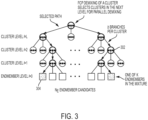
- Fig. 3 schematically depicts a spectral library arranged as a hierarchal spectral cluster tree according to some examples.
- each cluster e.g., 302
- b 3 branches.
- the branching may be different for each cluster and will depend on the library structure. The more independent or less overlapping the paths, the more parallelization is possible for implementations.
- Each cluster above the final level represents a spectral prototype.
- a cluster at Level L is composed of subclusters from Level L -1.
- Each prototype cluster can be an average (e.g., mean or median) of its constituent subclusters.
- clusters are formed as convex hulls enclosing their constituent subclusters. Other clustering algorithms may be employed in the alternative.
- the mixture spectrum is modeled with increasing accuracy along each tree branch.
- reducing the mutual coherence ⁇ in order to reduce the bound on M can be achieved not only by reducing ⁇ A i , ⁇ j > through proper choice of A for a given ⁇ , but also by reducing N , the size of the abundance vector ⁇ .
- Pursuing this approach naively would reduce the number of endmembers in the spectral library.
- N can be reduced without reducing the number of endmembers that can be detected.
- some examples proceed down the levels of a hierarchal spectral cluster tree and perform demixing and identification of cluster prototypes at each level using foveated compressive projections and sparse reconstruction methods, e.g., according to Equations 2-5.
- the identification of subcluster prototypes in a cluster at one level as corresponding to a measured spectrum determines which branches of the tree to proceed down to perform the next level of demixing. This process may continue until the bottom endmember level of the tree (e.g., the level of the "leaves") is reached, or until sufficient accuracy is obtained.
- proceeding to terminal nodes will result in following K tree branches, where K is the number of endmembers in the mixture.
- Using a hierarchal spectral cluster tree as depicted in Fig. 3 has many advantages.
- the computational complexity for solving the hyperspectral demixing problem using such a tree is logarithmic in the spectral library size N , due to the tree search structure. Proceeding down the tree and solving smaller demixing problems at each level is orders of magnitude less complex than solving a single large demixing problem without foveation.
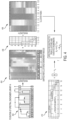
- Fig. 4 depicts an example usage of a foveation matrix according to some examples.
- F C (410) operates on the abundance vector ⁇ (412) to form ⁇ c and reduce its size from N ⁇ 1 to N C ⁇ 1 by grouping and adding rows.
- F C T (406) performs a similar operation on the columns of the endmember library ⁇ (404), forming ⁇ C (408) and reducing its size from Q ⁇ N to Q ⁇ N C .
- the form of F (406, 410) and value of N C is determined using hierarchical tree clustering of ⁇ , as illustrated by the dendrogram 402, which groups endmembers into clusters and clusters into bigger clusters on higher levels of the tree.
- Each cluster in a level is represented by a prototype spectrum, which may be an average or other function of the spectra in the cluster.
- the prototypes form the columns of ⁇ C .
- Each level of clustering is represented by its own ⁇ C and ⁇ c . In general, any known clustering technique may be used.
- a hyperspectral demixing process includes proceeding down the levels of the tree and performing demixing and identification of cluster prototypes at each level using compressive projections and sparse reconstruction methods.
- the identification of prototypes in the mixture at one level determines which branches of the tree to proceed down to perform the next level of demixing.
- the resolution of the spectral mixture model in endmember space increases at each lower level, but the resolution in wavelength stays constant. It is possible that more than one cluster will be selected in a level, depending on the similarity of the endmember spectra in the mixture. This will lead to more than one demixing process in each of the subsequent levels.
- the process may proceed with increasing mixture modeling accuracy until the bottom endmember level of the tree is reached.
- This multiresolution process can be stopped before the bottom is reached if high discrimination between endmembers is not required and identification of endmember classes or categories is sufficient, which will further reduce the computational complexity.
- the computational complexity of proceeding down the tree and solving small demixing problems at each level is logarithmic in the spectral library size and orders of magnitude less than solving a single large demixing problem without foveation.
- y c is the measured projection vector and ⁇ represents sensor noise.
- M C ⁇ ⁇ C 2 A ⁇ C K log N C ⁇ C A , ⁇ F C N C max i , j ⁇ A i , ⁇ F C ⁇
- Equation 10 makes use of the observation depicted by Equation 11, below.
- foveation can be used not only to reduce N , but also to increase the range of M over which the foveated compressive projection reconstruction is stable.
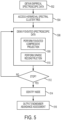
- Fig. 5 is a flow diagram illustrating a method according to some examples. The method of Fig. 5 may be implemented all or partially in a properly configured computing apparatus.
- the method obtains empirical spectroscopic data.
- the spectroscopic data may be obtained, by way of non-limiting examples, by measurement using appropriate sensors and optical elements, by retrieval from electronic storage (e.g., of previously measured data), or by acquisition over an electronic network (e.g., of previously measured data).
- the method may obtain the data by electronic transmission, for example.
- the spectroscopic data may have been previously acquired by any conventional technique for acquiring spectroscopic data, e.g., using appropriate sensors coupled to classical Newtonian optics, such as a microscope, telescope, or other optical lens arrangement.
- the spectroscopic data may represent a plurality of frequencies and associated amplitudes, which may be relative. More particularly, the spectroscopic data may represent measured electromagnetic energy that has been reflected by, fluoresced from, or undergone any other type of interaction with a specimen suitable for spectroscopy purposes.
- the method accesses a hierarchal spectral cluster tree.
- the accessing may be accessing electronically, and the hierarchal spectral cluster tree may represent a spectral library of stored spectra for many different materials, as described in detail herein in reference to Figs. 2-4 , for example.
- the method performs demixing of foveated spectroscopic data at at least one level of the hierarchal spectral cluster tree.
- the techniques of this block may be performed as described herein in reference to Figs. 3 and 4 , for example.
- the actions of block 506 include foveated compressive projection and/or sparse reconstruction as described in detail herein, e.g., in reference to Figs. 3 and 4 .
- the method determines whether to stop traversing the branches of the hierarchal spectral cluster tree. According to some examples, the method may terminate on or before one or more branches of the hierarchal spectral cluster tree are traversed to the end (leaf) nodes. Alternately, or in addition, the method may terminate prior to the level of the leaf nodes if a user determines that the current results are sufficiently accurate. If the method continues at block 512, control passes back to block 506. Otherwise, control passes to block 514.
- the method identifies at least one node in the hierarchal spectral cluster tree.
- the identified node may correspond to the closest matching node traversed by the method at this point.
- the method outputs an endmember abundance assessment.
- the endmember abundance assessment may be based on the identified node of block 514.
- the endmember abundance assessment may be in human-readable format, e.g., with spectra replaced by chemical descriptions.
- the output may be in any of a variety of forms, e.g., output to a computer monitor, output to a video processor, output to a targeting mechanism, etc.
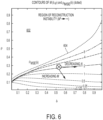
- Fig. 6 illustrates the effects of foveation on compressive sensing reconstruction stability and accuracy according to some examples.
- Fig. 6 shows contours of the minimax noise sensitivity M *( ⁇ , ⁇ ) in the ( ⁇ , ⁇ ) phase plane 602.
- M* should not be confused with the number of measurements M .
- the demixing noise or error is equal to M * times the noise in the measured mixture.
- Dotted curve 604 marks the phase boundary ( ⁇ , ⁇ MSE ( ⁇ )). Above this curve, M* ( ⁇ , ⁇ ) approaches infinity and reconstruction (e.g., demixing) will fail.
- the colored lines represent contour lines of M* ( ⁇ , ⁇ ) .
- Increasing the number of projections (measurements) M reduces ⁇ and increases ⁇ , which improves the demixing accuracy by moving the previous operating point down the gradient of M *.
- Foveation provides an additional degree of freedom for shifting the operating point in phase space in order to, e.g., ensure the stability of the demixing.
- some examples cluster spectra in the library ⁇ according to similarity using hierarchical tree clustering and perform a multi-resolution tree-based search to find the endmember abundances using a separate sparse reconstruction step at each level of the tree. Since N is reduced at each level, the reconstruction accuracy is improved at each level. The total number of operations across the levels will be much smaller and the final accuracy higher than would be the case if a single reconstruction with large N that searches across all endmember simultaneously were performed. This observation is illustrated using an example demixing problem as shown and described in reference to Figs. 7-10 below.
- the computations complexity of some examples will, in general, depend in part on the form of the library tree and how the endmembers are clustered.
- the computational complexity according to some examples is logarithmic in the size N E of the spectral library ⁇ .
- N E b L
- the complexity of examples employing foveated compressive projection is O(LK 2 b 2 ) and the complexity of compressive sensing is O(K b 2L ).
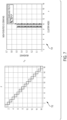
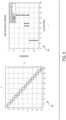
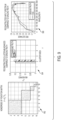
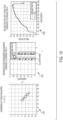
- Figs. 7-10 depict various test cases comparing prior art techniques to various examples. These figures utilize data represented by Fig. 2 .
- the abundances ⁇ were estimated using publicly available compressive sensing code.
- Fig. 7 the compressive sensing result for F equal to the N x N identity matrix (702), i.e., with no foveation, are shown.
- M 13 projections with 5% noise
- compressive sensing (704) had an error of 6.31%, while the pseudo-inverse error was 634%.
- the pseudo-inverse generated false alarms or nonzero values for endmembers not in the mixture.
- Compressive sensing without foveation had no false alarms.
- the MATLAB's CoSamp running time was 7.5 msec.
- Fig. 8 depicts results for an input spectrum consisting of endmembers not in the library.
- F (802) is the identity matrix because there is no foveation.
- the measurement noise value was 5%.
- the compressive sensing residual was 10.1, an indication that compressive sensing could not converge due to the spectrum not being in the library. Thus, when the input spectrum consisted of endmembers not in the library, this could be detected from the large value of the residual error in reconstructing the measured spectrum 804.
- Fig. 9 depicts example results 904, 906 for foveation in Cluster Level 1.
- Foveated compressive sensing successfully detected that the mixture endmembers are in Cluster 2 with zero abundances for the other clusters.
- the foveated compressive sensing error was 6.0% while the pseudo-inverse error was 115%.
- F (902) was used to foveate on the Cluster 2 that was determined in Cluster Level 1 to contain the mixture endmembers.
- Foveated compressive sensing successfully detected the correct two endmembers in the second cluster with zero abundances for the other three endmembers in the cluster.
- the pseudo-inverse generated nonzero abundances (false alarms) for all five endmembers.
- the foveated compressive sensing error was 5.9% while the pseudo-inverse error was 143%.
- Fig. 10 depicts the same test case as in Fig. 9 , but with F (1002) modified to foveate on the second cluster with higher resolution. Results 1004, 1006 are depicted.
- Cluster 2 was determined to contain the endmembers in Cluster Level 1.
- Foveated compressive projection successfully demixed the two endmembers in Cluster 2 with no false alarms.
- the foveated compressive projection error was 0.16%, while the pseudo-inverse error was 143%. Note the improved accuracy of reconstruction relative to Cluster Level 1 in Fig. 9 .
- Table below summarizes the results for the test problem described herein in reference to Figs. 7-10 .
- Foveated compressive projection achieved noise-limited accuracy in determining the mixture endmember abundances and in accurately modeling the input spectrum.
- the foveated compressive projection demixing error was reduced by 2.25 times and the number of operations was reduced by 3.85 times relative to compressive sensing.
- the foveated compressive projection demixing error of 0.16% was virtually equal to the oracle demixer, which had pre-knowledge of which endmembers are in the data and simply did a least squares fit to determine their abundances.
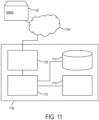
- Fig. 11 depicts a system according to some examples.
- apparatus 1106 can include a processor 1110 coupled to a random access memory operating under control of or in conjunction with an operating system.
- the processor 1110 in examples can be incorporated in one or more servers, clusters, or other computers or hardware resources, or can be implemented using cloud-based resources.
- Processor 1110 can communicate with the data store 1112, such as a database stored on a local hard drive or drive array, to access or store data.
- Processor 1110 can further communicate with a network interface 1108, such as an Ethernet or wireless data connection, which in turn communicates with the one or more networks 1104, such as the Internet or other public or private networks, via which spectroscopic data can be obtained from spectroscopic data acquisition device 1102.
- Device 1102 may be, for example, a spectroscope, a stand-off detector, a targeting system, or a remote or local persistent or dynamic storage device.
- Processor 1110 is further coupled to math co-processor 1114, which can parallelize operations as described herein.
- Processor 1110 can, in general, be programmed or configured to execute control logic and control demixing operations. Other configurations of apparatus 1106, associated network connections, and other hardware, software, and resources are possible.
- Hierarchical clustering may be performed on the spectral library, and the resulting tree may be organized into a decision tree with multiple levels. Each cluster in a level may represent subcluster prototypes from the previous layer. The same clustering may be performed on both the library and the mixture endmember abundances using foveation operators F C T and F C .
- Foveated compressive projection and sparse reconstruction may be performed at each level of the tree to reconstruct and model the mixture spectrum with increasing accuracy as the tree is traversed from top to bottom until the endmembers and their abundances are determined. Oversampling, or using a larger number of projections than there are members of the cluster, may increase the accuracy of the demixing in the presence of noise.
- the prototypes selected at each level may determine how the tree is traversed in order to determine the endmembers in the mixture and their abundances.
- the tree clustering and foveation greatly reduces the overall computational complexity and improves scaling for large libraries by using multiple small sparse reconstructions arranged in a decision tree instead of performing one large reconstruction.
- examples are not limited to specific spectra of portions of the spectrum. Thus, some examples perform spectral demixing using foveated compressive projections. Some examples perform hyperspectral demixing using foveated compressive projections.
- the computer program can exist in a variety of forms, both active and inactive.
- the computer program can exist as one or more software programs, software modules, or both, that can be comprised of program instructions in source code, object code, executable code or other formats, firmware program(s), or hardware description language (HDL) files.
- Any of the above can be embodied on a computer readable medium, which can include computer readable storage devices and media in compressed or uncompressed form.
- Exemplary computer readable storage devices and media include conventional computer system RAM (random access memory), ROM (read-only memory), EPROM (erasable, programmable ROM), EEPROM (electrically erasable, programmable ROM), and magnetic or optical disks or tapes.
- RAM random access memory
- ROM read-only memory
- EPROM erasable, programmable ROM
- EEPROM electrically erasable, programmable ROM
Landscapes
- Engineering & Computer Science (AREA)
- Theoretical Computer Science (AREA)
- Physics & Mathematics (AREA)
- General Physics & Mathematics (AREA)
- Data Mining & Analysis (AREA)
- Artificial Intelligence (AREA)
- Evolutionary Computation (AREA)
- General Health & Medical Sciences (AREA)
- Health & Medical Sciences (AREA)
- Life Sciences & Earth Sciences (AREA)
- Multimedia (AREA)
- Computer Vision & Pattern Recognition (AREA)
- Spectroscopy & Molecular Physics (AREA)
- Computing Systems (AREA)
- Software Systems (AREA)
- Biomedical Technology (AREA)
- Molecular Biology (AREA)
- Databases & Information Systems (AREA)
- Medical Informatics (AREA)
- Bioinformatics & Cheminformatics (AREA)
- Bioinformatics & Computational Biology (AREA)
- Evolutionary Biology (AREA)
- General Engineering & Computer Science (AREA)
- Investigating Or Analysing Materials By Optical Means (AREA)
Priority Applications (1)
| Application Number | Priority Date | Filing Date | Title |
|---|---|---|---|
| EP21181003.1A EP3907658B1 (en) | 2015-04-22 | 2016-03-24 | Hyperspectral demixing using foveated compressive projections |
Applications Claiming Priority (1)
| Application Number | Priority Date | Filing Date | Title |
|---|---|---|---|
| US14/693,401 US10094713B2 (en) | 2015-04-22 | 2015-04-22 | Hyperspectral demixing using foveated compressive projections |
Related Child Applications (2)
| Application Number | Title | Priority Date | Filing Date |
|---|---|---|---|
| EP21181003.1A Division EP3907658B1 (en) | 2015-04-22 | 2016-03-24 | Hyperspectral demixing using foveated compressive projections |
| EP21181003.1A Division-Into EP3907658B1 (en) | 2015-04-22 | 2016-03-24 | Hyperspectral demixing using foveated compressive projections |
Publications (2)
| Publication Number | Publication Date |
|---|---|
| EP3089074A1 EP3089074A1 (en) | 2016-11-02 |
| EP3089074B1 true EP3089074B1 (en) | 2023-06-07 |
Family
ID=55637244
Family Applications (2)
| Application Number | Title | Priority Date | Filing Date |
|---|---|---|---|
| EP16162300.4A Active EP3089074B1 (en) | 2015-04-22 | 2016-03-24 | Hyperspectral demixing using foveated compressive projections |
| EP21181003.1A Active EP3907658B1 (en) | 2015-04-22 | 2016-03-24 | Hyperspectral demixing using foveated compressive projections |
Family Applications After (1)
| Application Number | Title | Priority Date | Filing Date |
|---|---|---|---|
| EP21181003.1A Active EP3907658B1 (en) | 2015-04-22 | 2016-03-24 | Hyperspectral demixing using foveated compressive projections |
Country Status (3)
| Country | Link |
|---|---|
| US (1) | US10094713B2 (enExample) |
| EP (2) | EP3089074B1 (enExample) |
| JP (1) | JP6636845B2 (enExample) |
Families Citing this family (27)
| Publication number | Priority date | Publication date | Assignee | Title |
|---|---|---|---|---|
| JP2014532873A (ja) | 2011-11-03 | 2014-12-08 | ベリフード リミテッド | エンドユーザ食品分析のための低費用分光分析システム |
| CN105593651B (zh) | 2013-08-02 | 2019-06-07 | 威利食品有限公司 | 光谱测定系统和方法、光谱设备和系统 |
| JP2017505901A (ja) | 2014-01-03 | 2017-02-23 | ベリフード, リミテッドVerifood, Ltd. | 分光システム、方法、および用途 |
| WO2016063284A2 (en) | 2014-10-23 | 2016-04-28 | Verifood, Ltd. | Accessories for handheld spectrometer |
| WO2016125165A2 (en) | 2015-02-05 | 2016-08-11 | Verifood, Ltd. | Spectrometry system with visible aiming beam |
| WO2016125164A2 (en) | 2015-02-05 | 2016-08-11 | Verifood, Ltd. | Spectrometry system applications |
| WO2016162865A1 (en) | 2015-04-07 | 2016-10-13 | Verifood, Ltd. | Detector for spectrometry system |
| US10066990B2 (en) | 2015-07-09 | 2018-09-04 | Verifood, Ltd. | Spatially variable filter systems and methods |
| US10203246B2 (en) | 2015-11-20 | 2019-02-12 | Verifood, Ltd. | Systems and methods for calibration of a handheld spectrometer |
| US10268914B1 (en) * | 2016-01-07 | 2019-04-23 | Hrl Laboratories, Llc | Blind sensing for hyperspectral surveillance |
| US10254215B2 (en) | 2016-04-07 | 2019-04-09 | Verifood, Ltd. | Spectrometry system applications |
| EP3488204A4 (en) | 2016-07-20 | 2020-07-22 | Verifood Ltd. | ACCESSORIES FOR HANDLABLE SPECTROMETERS |
| US10791933B2 (en) | 2016-07-27 | 2020-10-06 | Verifood, Ltd. | Spectrometry systems, methods, and applications |
| CN106875413B (zh) * | 2017-02-13 | 2019-05-17 | 华东师范大学 | 一种基于高光谱成像的粘连红细胞自动计数方法 |
| US11456059B2 (en) * | 2017-08-22 | 2022-09-27 | Geospatial Technology Associates Llc | System, apparatus and method for hierarchical identification, multi-tier target library processing, and two-stage identification |
| JP7018297B2 (ja) * | 2017-11-16 | 2022-02-10 | 日本電子株式会社 | スペクトル解析装置及び方法 |
| US20200364835A1 (en) * | 2018-01-31 | 2020-11-19 | Nec Corporation | Image processing device, image processing method and storage medium |
| CN108917930B (zh) * | 2018-06-21 | 2019-09-20 | 中国科学院西安光学精密机械研究所 | 基于光谱成像技术的高光谱解混光学实现方法 |
| EP3864384A4 (en) | 2018-10-08 | 2022-06-29 | Verifood Ltd. | Accessories for optical spectrometers |
| CN109785305B (zh) * | 2018-12-28 | 2021-01-12 | 国网浙江省电力有限公司嘉兴供电公司 | 一种端元可变的高光谱图像光谱混合分析方法及装置 |
| US11676367B1 (en) * | 2019-02-07 | 2023-06-13 | Hrl Laboratories, Llc | System and method for anomaly detection using anomaly cueing |
| KR102172914B1 (ko) * | 2019-06-07 | 2020-11-03 | 한국생산기술연구원 | 라만 스펙트럼 식별 고속 탐색 방법 및 장치 |
| KR102837402B1 (ko) * | 2019-07-28 | 2025-07-23 | 구글 엘엘씨 | 포비에이티드 메시들로 몰입형 비디오 콘텐츠를 렌더링하기 위한 방법들, 시스템들, 및 매체들 |
| GB202001065D0 (en) * | 2020-01-24 | 2020-03-11 | Secr Defence | Computer implemented method of spectral un-mixing |
| JP7828141B2 (ja) * | 2021-04-30 | 2026-03-11 | 株式会社キーエンス | 分析装置、分析方法、分析プログラムおよび記憶媒体 |
| CN115170960B (zh) * | 2022-07-01 | 2025-12-30 | 南京理工大学 | 可学习隐式变量迭代展开网络的高光谱稀疏解混方法 |
| US20240273678A1 (en) * | 2023-01-30 | 2024-08-15 | The Research Foundation For The State University Of New York | Unmixing image data |
Family Cites Families (4)
| Publication number | Priority date | Publication date | Assignee | Title |
|---|---|---|---|---|
| CA2429327A1 (en) * | 2000-11-16 | 2003-04-17 | Ciphergen Biosystems, Inc. | Method for analyzing mass spectra |
| US20110052019A1 (en) * | 2009-09-03 | 2011-03-03 | Green Vision Systems Ltd. | Analyzing Objects Via Hyper-Spectral Imaging and Analysis |
| US8429153B2 (en) * | 2010-06-25 | 2013-04-23 | The United States Of America As Represented By The Secretary Of The Army | Method and apparatus for classifying known specimens and media using spectral properties and identifying unknown specimens and media |
| WO2014203151A1 (en) * | 2013-06-18 | 2014-12-24 | Ramot At Tel-Aviv University Ltd. | Apparatus and method for snapshot spectral imaging |
-
2015
- 2015-04-22 US US14/693,401 patent/US10094713B2/en active Active
-
2016
- 2016-03-24 EP EP16162300.4A patent/EP3089074B1/en active Active
- 2016-03-24 EP EP21181003.1A patent/EP3907658B1/en active Active
- 2016-04-14 JP JP2016080785A patent/JP6636845B2/ja active Active
Also Published As
| Publication number | Publication date |
|---|---|
| JP6636845B2 (ja) | 2020-01-29 |
| JP2016224031A (ja) | 2016-12-28 |
| EP3907658B1 (en) | 2025-11-12 |
| EP3089074A1 (en) | 2016-11-02 |
| US10094713B2 (en) | 2018-10-09 |
| EP3907658A1 (en) | 2021-11-10 |
| US20160313184A1 (en) | 2016-10-27 |
Similar Documents
| Publication | Publication Date | Title |
|---|---|---|
| EP3089074B1 (en) | Hyperspectral demixing using foveated compressive projections | |
| Lo | Target detection algorithms in hyperspectral imaging based on discriminant analysis | |
| Wei et al. | Bayesian fusion of multi-band images | |
| Liu et al. | Spatial-spectral kernel sparse representation for hyperspectral image classification | |
| Bioucas-Dias et al. | Hyperspectral unmixing overview: Geometrical, statistical, and sparse regression-based approaches | |
| Roscher et al. | Detection of disease symptoms on hyperspectral 3D plant models | |
| CN115661069B (zh) | 一种高光谱异常检测方法及计算机装置 | |
| Drumetz et al. | Variability of the endmembers in spectral unmixing: Recent advances | |
| Vargas et al. | Spectral image fusion from compressive measurements using spectral unmixing and a sparse representation of abundance maps | |
| KR101750520B1 (ko) | 표적신호 분리를 이용하여 탐지성능이 향상된 초분광 영상의 표적물질 탐지방법 | |
| Vargas et al. | A low-rank model for compressive spectral image classification | |
| Camps-Valls et al. | Introduction to the issue on advances in remote sensing image processing | |
| Benfenati et al. | Early stopping strategies in Deep Image Prior: A. Benfenati et al. | |
| Pant et al. | Hyperspectral Anomaly Detection Methods: A Survey and Comparative Study | |
| EP3318932B1 (en) | System and method for the removal of twin-image artifact in lens free imaging | |
| Wickramathilaka et al. | Endmember abundance prediction in hyperspectral unmixing: The impact of endmember extraction algorithms and self-attention in autoencoders | |
| Halimi et al. | Robust unmixing algorithms for hyperspectral imagery | |
| Kishore et al. | Hyperspectral imaging technique for plant leaf identification | |
| Dong et al. | Symmetric information–theoretic metric learning for target detection in hyperspectral imagery | |
| Chetia | Hyperspectral unmixing for highly correlated endmembers using scaled endmembers and abundance sparsity constraint nmf | |
| Dinh et al. | Statistical Tests for Hyperspectral Coded Data Unsupervised Classification | |
| Ertürk et al. | Hyperspectral change detection by sparse unmixing with dictionary pruning | |
| Meerdink et al. | Developing spectral libraries using multiple target multiple instance adaptive cosine/coherence estimator | |
| Alfaro-Mejía et al. | An Elliptic Kernel Unsupervised Autoencoder-Graph Convolutional Network Ensemble Model for Hyperspectral Unmixing | |
| Ammanouil et al. | GLUP: Yet another algorithm for blind unmixing of hyperspectral data |
Legal Events
| Date | Code | Title | Description |
|---|---|---|---|
| PUAI | Public reference made under article 153(3) epc to a published international application that has entered the european phase |
Free format text: ORIGINAL CODE: 0009012 |
|
| 17P | Request for examination filed |
Effective date: 20160324 |
|
| AK | Designated contracting states |
Kind code of ref document: A1 Designated state(s): AL AT BE BG CH CY CZ DE DK EE ES FI FR GB GR HR HU IE IS IT LI LT LU LV MC MK MT NL NO PL PT RO RS SE SI SK SM TR |
|
| AX | Request for extension of the european patent |
Extension state: BA ME |
|
| GRAP | Despatch of communication of intention to grant a patent |
Free format text: ORIGINAL CODE: EPIDOSNIGR1 |
|
| STAA | Information on the status of an ep patent application or granted ep patent |
Free format text: STATUS: GRANT OF PATENT IS INTENDED |
|
| INTG | Intention to grant announced |
Effective date: 20210129 |
|
| RAP1 | Party data changed (applicant data changed or rights of an application transferred) |
Owner name: THE BOEING COMPANY |
|
| RIN1 | Information on inventor provided before grant (corrected) |
Inventor name: OWECHKO, YURI |
|
| GRAJ | Information related to disapproval of communication of intention to grant by the applicant or resumption of examination proceedings by the epo deleted |
Free format text: ORIGINAL CODE: EPIDOSDIGR1 |
|
| STAA | Information on the status of an ep patent application or granted ep patent |
Free format text: STATUS: REQUEST FOR EXAMINATION WAS MADE |
|
| STAA | Information on the status of an ep patent application or granted ep patent |
Free format text: STATUS: EXAMINATION IS IN PROGRESS |
|
| INTC | Intention to grant announced (deleted) | ||
| 17Q | First examination report despatched |
Effective date: 20210601 |
|
| REG | Reference to a national code |
Ref country code: DE Ref legal event code: R079 Ref document number: 602016079797 Country of ref document: DE Free format text: PREVIOUS MAIN CLASS: G06K0009000000 Ipc: G06V0010762000 Ref country code: DE Ref legal event code: R079 Free format text: PREVIOUS MAIN CLASS: G06K0009000000 Ipc: G06V0010762000 |
|
| GRAP | Despatch of communication of intention to grant a patent |
Free format text: ORIGINAL CODE: EPIDOSNIGR1 |
|
| STAA | Information on the status of an ep patent application or granted ep patent |
Free format text: STATUS: GRANT OF PATENT IS INTENDED |
|
| RIC1 | Information provided on ipc code assigned before grant |
Ipc: G06K 9/62 20060101ALI20221219BHEP Ipc: G06V 20/69 20220101ALI20221219BHEP Ipc: G06V 10/762 20220101AFI20221219BHEP |
|
| INTG | Intention to grant announced |
Effective date: 20230119 |
|
| RIC1 | Information provided on ipc code assigned before grant |
Ipc: G06F 18/231 20230101ALI20230112BHEP Ipc: G06V 10/58 20220101ALI20230112BHEP Ipc: G06V 20/69 20220101ALI20230112BHEP Ipc: G06V 10/762 20220101AFI20230112BHEP |
|
| RAP3 | Party data changed (applicant data changed or rights of an application transferred) |
Owner name: THE BOEING COMPANY |
|
| GRAS | Grant fee paid |
Free format text: ORIGINAL CODE: EPIDOSNIGR3 |
|
| GRAA | (expected) grant |
Free format text: ORIGINAL CODE: 0009210 |
|
| STAA | Information on the status of an ep patent application or granted ep patent |
Free format text: STATUS: THE PATENT HAS BEEN GRANTED |
|
| AK | Designated contracting states |
Kind code of ref document: B1 Designated state(s): AL AT BE BG CH CY CZ DE DK EE ES FI FR GB GR HR HU IE IS IT LI LT LU LV MC MK MT NL NO PL PT RO RS SE SI SK SM TR |
|
| REG | Reference to a national code |
Ref country code: GB Ref legal event code: FG4D |
|
| REG | Reference to a national code |
Ref country code: CH Ref legal event code: EP Ref country code: AT Ref legal event code: REF Ref document number: 1577289 Country of ref document: AT Kind code of ref document: T Effective date: 20230615 |
|
| REG | Reference to a national code |
Ref country code: DE Ref legal event code: R096 Ref document number: 602016079797 Country of ref document: DE |
|
| P01 | Opt-out of the competence of the unified patent court (upc) registered |
Effective date: 20230519 |
|
| REG | Reference to a national code |
Ref country code: LT Ref legal event code: MG9D |
|
| REG | Reference to a national code |
Ref country code: NL Ref legal event code: MP Effective date: 20230607 |
|
| PG25 | Lapsed in a contracting state [announced via postgrant information from national office to epo] |
Ref country code: SE Free format text: LAPSE BECAUSE OF FAILURE TO SUBMIT A TRANSLATION OF THE DESCRIPTION OR TO PAY THE FEE WITHIN THE PRESCRIBED TIME-LIMIT Effective date: 20230607 Ref country code: NO Free format text: LAPSE BECAUSE OF FAILURE TO SUBMIT A TRANSLATION OF THE DESCRIPTION OR TO PAY THE FEE WITHIN THE PRESCRIBED TIME-LIMIT Effective date: 20230907 Ref country code: ES Free format text: LAPSE BECAUSE OF FAILURE TO SUBMIT A TRANSLATION OF THE DESCRIPTION OR TO PAY THE FEE WITHIN THE PRESCRIBED TIME-LIMIT Effective date: 20230607 |
|
| REG | Reference to a national code |
Ref country code: AT Ref legal event code: MK05 Ref document number: 1577289 Country of ref document: AT Kind code of ref document: T Effective date: 20230607 |
|
| PG25 | Lapsed in a contracting state [announced via postgrant information from national office to epo] |
Ref country code: RS Free format text: LAPSE BECAUSE OF FAILURE TO SUBMIT A TRANSLATION OF THE DESCRIPTION OR TO PAY THE FEE WITHIN THE PRESCRIBED TIME-LIMIT Effective date: 20230607 Ref country code: NL Free format text: LAPSE BECAUSE OF FAILURE TO SUBMIT A TRANSLATION OF THE DESCRIPTION OR TO PAY THE FEE WITHIN THE PRESCRIBED TIME-LIMIT Effective date: 20230607 Ref country code: LV Free format text: LAPSE BECAUSE OF FAILURE TO SUBMIT A TRANSLATION OF THE DESCRIPTION OR TO PAY THE FEE WITHIN THE PRESCRIBED TIME-LIMIT Effective date: 20230607 Ref country code: LT Free format text: LAPSE BECAUSE OF FAILURE TO SUBMIT A TRANSLATION OF THE DESCRIPTION OR TO PAY THE FEE WITHIN THE PRESCRIBED TIME-LIMIT Effective date: 20230607 Ref country code: HR Free format text: LAPSE BECAUSE OF FAILURE TO SUBMIT A TRANSLATION OF THE DESCRIPTION OR TO PAY THE FEE WITHIN THE PRESCRIBED TIME-LIMIT Effective date: 20230607 Ref country code: GR Free format text: LAPSE BECAUSE OF FAILURE TO SUBMIT A TRANSLATION OF THE DESCRIPTION OR TO PAY THE FEE WITHIN THE PRESCRIBED TIME-LIMIT Effective date: 20230908 |
|
| PG25 | Lapsed in a contracting state [announced via postgrant information from national office to epo] |
Ref country code: FI Free format text: LAPSE BECAUSE OF FAILURE TO SUBMIT A TRANSLATION OF THE DESCRIPTION OR TO PAY THE FEE WITHIN THE PRESCRIBED TIME-LIMIT Effective date: 20230607 |
|
| PG25 | Lapsed in a contracting state [announced via postgrant information from national office to epo] |
Ref country code: SK Free format text: LAPSE BECAUSE OF FAILURE TO SUBMIT A TRANSLATION OF THE DESCRIPTION OR TO PAY THE FEE WITHIN THE PRESCRIBED TIME-LIMIT Effective date: 20230607 |
|
| PG25 | Lapsed in a contracting state [announced via postgrant information from national office to epo] |
Ref country code: IS Free format text: LAPSE BECAUSE OF FAILURE TO SUBMIT A TRANSLATION OF THE DESCRIPTION OR TO PAY THE FEE WITHIN THE PRESCRIBED TIME-LIMIT Effective date: 20231007 |
|
| PG25 | Lapsed in a contracting state [announced via postgrant information from national office to epo] |
Ref country code: SM Free format text: LAPSE BECAUSE OF FAILURE TO SUBMIT A TRANSLATION OF THE DESCRIPTION OR TO PAY THE FEE WITHIN THE PRESCRIBED TIME-LIMIT Effective date: 20230607 Ref country code: SK Free format text: LAPSE BECAUSE OF FAILURE TO SUBMIT A TRANSLATION OF THE DESCRIPTION OR TO PAY THE FEE WITHIN THE PRESCRIBED TIME-LIMIT Effective date: 20230607 Ref country code: RO Free format text: LAPSE BECAUSE OF FAILURE TO SUBMIT A TRANSLATION OF THE DESCRIPTION OR TO PAY THE FEE WITHIN THE PRESCRIBED TIME-LIMIT Effective date: 20230607 Ref country code: PT Free format text: LAPSE BECAUSE OF FAILURE TO SUBMIT A TRANSLATION OF THE DESCRIPTION OR TO PAY THE FEE WITHIN THE PRESCRIBED TIME-LIMIT Effective date: 20231009 Ref country code: IS Free format text: LAPSE BECAUSE OF FAILURE TO SUBMIT A TRANSLATION OF THE DESCRIPTION OR TO PAY THE FEE WITHIN THE PRESCRIBED TIME-LIMIT Effective date: 20231007 Ref country code: EE Free format text: LAPSE BECAUSE OF FAILURE TO SUBMIT A TRANSLATION OF THE DESCRIPTION OR TO PAY THE FEE WITHIN THE PRESCRIBED TIME-LIMIT Effective date: 20230607 Ref country code: CZ Free format text: LAPSE BECAUSE OF FAILURE TO SUBMIT A TRANSLATION OF THE DESCRIPTION OR TO PAY THE FEE WITHIN THE PRESCRIBED TIME-LIMIT Effective date: 20230607 Ref country code: AT Free format text: LAPSE BECAUSE OF FAILURE TO SUBMIT A TRANSLATION OF THE DESCRIPTION OR TO PAY THE FEE WITHIN THE PRESCRIBED TIME-LIMIT Effective date: 20230607 |
|
| PG25 | Lapsed in a contracting state [announced via postgrant information from national office to epo] |
Ref country code: PL Free format text: LAPSE BECAUSE OF FAILURE TO SUBMIT A TRANSLATION OF THE DESCRIPTION OR TO PAY THE FEE WITHIN THE PRESCRIBED TIME-LIMIT Effective date: 20230607 |
|
| REG | Reference to a national code |
Ref country code: DE Ref legal event code: R097 Ref document number: 602016079797 Country of ref document: DE |
|
| PLBE | No opposition filed within time limit |
Free format text: ORIGINAL CODE: 0009261 |
|
| STAA | Information on the status of an ep patent application or granted ep patent |
Free format text: STATUS: NO OPPOSITION FILED WITHIN TIME LIMIT |
|
| PG25 | Lapsed in a contracting state [announced via postgrant information from national office to epo] |
Ref country code: DK Free format text: LAPSE BECAUSE OF FAILURE TO SUBMIT A TRANSLATION OF THE DESCRIPTION OR TO PAY THE FEE WITHIN THE PRESCRIBED TIME-LIMIT Effective date: 20230607 |
|
| PG25 | Lapsed in a contracting state [announced via postgrant information from national office to epo] |
Ref country code: SI Free format text: LAPSE BECAUSE OF FAILURE TO SUBMIT A TRANSLATION OF THE DESCRIPTION OR TO PAY THE FEE WITHIN THE PRESCRIBED TIME-LIMIT Effective date: 20230607 |
|
| 26N | No opposition filed |
Effective date: 20240308 |
|
| PG25 | Lapsed in a contracting state [announced via postgrant information from national office to epo] |
Ref country code: SI Free format text: LAPSE BECAUSE OF FAILURE TO SUBMIT A TRANSLATION OF THE DESCRIPTION OR TO PAY THE FEE WITHIN THE PRESCRIBED TIME-LIMIT Effective date: 20230607 Ref country code: IT Free format text: LAPSE BECAUSE OF FAILURE TO SUBMIT A TRANSLATION OF THE DESCRIPTION OR TO PAY THE FEE WITHIN THE PRESCRIBED TIME-LIMIT Effective date: 20230607 |
|
| REG | Reference to a national code |
Ref country code: CH Ref legal event code: PL |
|
| PG25 | Lapsed in a contracting state [announced via postgrant information from national office to epo] |
Ref country code: BG Free format text: LAPSE BECAUSE OF FAILURE TO SUBMIT A TRANSLATION OF THE DESCRIPTION OR TO PAY THE FEE WITHIN THE PRESCRIBED TIME-LIMIT Effective date: 20230607 |
|
| PG25 | Lapsed in a contracting state [announced via postgrant information from national office to epo] |
Ref country code: LU Free format text: LAPSE BECAUSE OF NON-PAYMENT OF DUE FEES Effective date: 20240324 |
|
| PG25 | Lapsed in a contracting state [announced via postgrant information from national office to epo] |
Ref country code: MC Free format text: LAPSE BECAUSE OF FAILURE TO SUBMIT A TRANSLATION OF THE DESCRIPTION OR TO PAY THE FEE WITHIN THE PRESCRIBED TIME-LIMIT Effective date: 20230607 |
|
| PG25 | Lapsed in a contracting state [announced via postgrant information from national office to epo] |
Ref country code: MC Free format text: LAPSE BECAUSE OF FAILURE TO SUBMIT A TRANSLATION OF THE DESCRIPTION OR TO PAY THE FEE WITHIN THE PRESCRIBED TIME-LIMIT Effective date: 20230607 Ref country code: BG Free format text: LAPSE BECAUSE OF FAILURE TO SUBMIT A TRANSLATION OF THE DESCRIPTION OR TO PAY THE FEE WITHIN THE PRESCRIBED TIME-LIMIT Effective date: 20230607 Ref country code: LU Free format text: LAPSE BECAUSE OF NON-PAYMENT OF DUE FEES Effective date: 20240324 |
|
| REG | Reference to a national code |
Ref country code: BE Ref legal event code: MM Effective date: 20240331 |
|
| PG25 | Lapsed in a contracting state [announced via postgrant information from national office to epo] |
Ref country code: BE Free format text: LAPSE BECAUSE OF NON-PAYMENT OF DUE FEES Effective date: 20240331 |
|
| PG25 | Lapsed in a contracting state [announced via postgrant information from national office to epo] |
Ref country code: IE Free format text: LAPSE BECAUSE OF NON-PAYMENT OF DUE FEES Effective date: 20240324 |
|
| PG25 | Lapsed in a contracting state [announced via postgrant information from national office to epo] |
Ref country code: IE Free format text: LAPSE BECAUSE OF NON-PAYMENT OF DUE FEES Effective date: 20240324 Ref country code: BE Free format text: LAPSE BECAUSE OF NON-PAYMENT OF DUE FEES Effective date: 20240331 Ref country code: CH Free format text: LAPSE BECAUSE OF NON-PAYMENT OF DUE FEES Effective date: 20240331 |
|
| PGFP | Annual fee paid to national office [announced via postgrant information from national office to epo] |
Ref country code: DE Payment date: 20250327 Year of fee payment: 10 |
|
| PGFP | Annual fee paid to national office [announced via postgrant information from national office to epo] |
Ref country code: FR Payment date: 20250325 Year of fee payment: 10 |
|
| PGFP | Annual fee paid to national office [announced via postgrant information from national office to epo] |
Ref country code: GB Payment date: 20250327 Year of fee payment: 10 |
|
| PG25 | Lapsed in a contracting state [announced via postgrant information from national office to epo] |
Ref country code: CY Free format text: LAPSE BECAUSE OF FAILURE TO SUBMIT A TRANSLATION OF THE DESCRIPTION OR TO PAY THE FEE WITHIN THE PRESCRIBED TIME-LIMIT; INVALID AB INITIO Effective date: 20160324 |
|
| PG25 | Lapsed in a contracting state [announced via postgrant information from national office to epo] |
Ref country code: HU Free format text: LAPSE BECAUSE OF FAILURE TO SUBMIT A TRANSLATION OF THE DESCRIPTION OR TO PAY THE FEE WITHIN THE PRESCRIBED TIME-LIMIT; INVALID AB INITIO Effective date: 20160324 |
|
| PG25 | Lapsed in a contracting state [announced via postgrant information from national office to epo] |
Ref country code: TR Free format text: LAPSE BECAUSE OF FAILURE TO SUBMIT A TRANSLATION OF THE DESCRIPTION OR TO PAY THE FEE WITHIN THE PRESCRIBED TIME-LIMIT Effective date: 20230607 |