EP3087449B1 - Rotatorisch-zu-translatorisch-rastgelenk - Google Patents
Rotatorisch-zu-translatorisch-rastgelenk Download PDFInfo
- Publication number
- EP3087449B1 EP3087449B1 EP14874271.1A EP14874271A EP3087449B1 EP 3087449 B1 EP3087449 B1 EP 3087449B1 EP 14874271 A EP14874271 A EP 14874271A EP 3087449 B1 EP3087449 B1 EP 3087449B1
- Authority
- EP
- European Patent Office
- Prior art keywords
- locking
- sliding component
- component
- shaft
- hinge
- Prior art date
- Legal status (The legal status is an assumption and is not a legal conclusion. Google has not performed a legal analysis and makes no representation as to the accuracy of the status listed.)
- Active
Links
Images




Classifications
-
- E—FIXED CONSTRUCTIONS
- E05—LOCKS; KEYS; WINDOW OR DOOR FITTINGS; SAFES
- E05D—HINGES OR SUSPENSION DEVICES FOR DOORS, WINDOWS OR WINGS
- E05D11/00—Additional features or accessories of hinges
- E05D11/10—Devices for preventing movement between relatively-movable hinge parts
- E05D11/1007—Devices for preventing movement between relatively-movable hinge parts with positive locking
-
- G—PHYSICS
- G06—COMPUTING OR CALCULATING; COUNTING
- G06F—ELECTRIC DIGITAL DATA PROCESSING
- G06F1/00—Details not covered by groups G06F3/00 - G06F13/00 and G06F21/00
- G06F1/16—Constructional details or arrangements
- G06F1/1613—Constructional details or arrangements for portable computers
- G06F1/1633—Constructional details or arrangements of portable computers not specific to the type of enclosures covered by groups G06F1/1615 - G06F1/1626
- G06F1/1675—Miscellaneous details related to the relative movement between the different enclosures or enclosure parts
- G06F1/1681—Details related solely to hinges
-
- G—PHYSICS
- G06—COMPUTING OR CALCULATING; COUNTING
- G06F—ELECTRIC DIGITAL DATA PROCESSING
- G06F1/00—Details not covered by groups G06F3/00 - G06F13/00 and G06F21/00
- G06F1/16—Constructional details or arrangements
- G06F1/1613—Constructional details or arrangements for portable computers
- G06F1/1633—Constructional details or arrangements of portable computers not specific to the type of enclosures covered by groups G06F1/1615 - G06F1/1626
- G06F1/1675—Miscellaneous details related to the relative movement between the different enclosures or enclosure parts
- G06F1/1679—Miscellaneous details related to the relative movement between the different enclosures or enclosure parts for locking or maintaining the movable parts of the enclosure in a fixed position, e.g. latching mechanism at the edge of the display in a laptop or for the screen protective cover of a PDA
-
- Y—GENERAL TAGGING OF NEW TECHNOLOGICAL DEVELOPMENTS; GENERAL TAGGING OF CROSS-SECTIONAL TECHNOLOGIES SPANNING OVER SEVERAL SECTIONS OF THE IPC; TECHNICAL SUBJECTS COVERED BY FORMER USPC CROSS-REFERENCE ART COLLECTIONS [XRACs] AND DIGESTS
- Y10—TECHNICAL SUBJECTS COVERED BY FORMER USPC
- Y10T—TECHNICAL SUBJECTS COVERED BY FORMER US CLASSIFICATION
- Y10T29/00—Metal working
- Y10T29/24—Hinge making or assembling
Definitions
- This disclosure relates generally to techniques for hinge systems of a computing device. Specifically, this disclosure relates to a hinge having a rotational shaft that results in translational movement of a sliding component.
- Computing devices may include certain hinges to enable a user to adjust an angle of a component based on a given situation. With the fast growth of computing devices, lighter, thinner computing devices are increasingly preferred by users.
- a computing device may include a portable All-in-One (AIO) wherein the display and the processing components are located within the same housing.
- a hinge may enable a user to adjust the angle of the display to achieve a desired viewing angle.
- the present disclosure relates generally to techniques for implementing a hinge of a computing device wherein rotational movement is converted to translational movement of components that may be held in place and released from a held position using a locking mechanism.
- a hinge may enable a user to adjust the angle of the display to achieve a desired viewing angle.
- the embodiments described herein include a locking mechanism to inhibit movement of the hinge.
- the locking mechanism is self-locking wherein the locking mechanism inhibits translational movement of the sliding component such that the locking mechanism applies increasing pressure to the sliding component based on an increasing force of movement associated with the sliding component.
- Fig. 1A is an illustration of a front view of a computing device including a self-locking hinge.
- the computing device 100 may be any type of computing device comprising a desktop computer, a All-In-One (AIO) computer, a laptop computer, a tablet computer, a mobile phone, and the like.
- the computing device includes a self-locking hinge 102.
- the self-locking hinge converts rotational movement into translational movement as well as providing a self-locking feature.
- Fig. 1B is an illustration of a side view of a computing device having legs coupled to a self-locking hinge.
- the computing device 100 may include a stand 104.
- the stand may also be designed to additionally act as a handle.
- the stand 104 may be rotational as indicated by the arrow 106.
- the stand 104 may be legs configured to rotate about an axis defined by a rotational shaft of the self-locking hinge. As discussed in more detail below, rotation of the stand 104 may result in rotation of a shaft of the self-locking hinge 102, as well as translational movement of sliding components of the self-locking hinge 102.
- Fig. 2 is an illustration of rotational movement of legs of the computing device.
- the stand 104 is in an extended position enabling the computing device 100 to be in an upright position.
- the stand 104 is rotated, as indicated by the arrow 206, to be substantially perpendicular to a back side of the computing device 100.
- the stand 104 is rotated to a closed position in which the stand 104 is substantially parallel to the back side of the computing device.
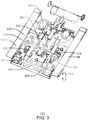
- Fig. 3 is an illustration of a perspective view of a self-locking hinge of the computing device. As illustrated in Fig. 3 , the stand 104 is in a closed position. In embodiments, the closed position is when the stand 104 is substantially parallel to a plane defined by a back plate, generally indicated at 302.
- a self-locking hinge 300 may include a shaft 304. As discussed above, the hinge 300 may be self-locking such that a locking mechanism applies increasing pressure to sliding component 306, 308 based on an increasing force of movement associated with the sliding component 306, 308.
- the hinge 300 includes the backing plate 302, the shaft 300, a shaft 304, and a plurality of sliding components 306, 308.
- the shaft 304 may be coupled to the sliding components 306, 308 as indicated by 307, 309.
- the coupling components at 307, 309 may include ridges that can be engaged by the shaft 304 by ridges on the shaft 304.
- the ridges of the coupling components 307, 309 when in contact with the ridges of the shaft 304 may move the sliding components in opposite directions. Rotational movement, as indicated at 310, results in translational movement of the sliding components 306, 308, as indicated at 312 and 314.
- the self-locking hinge 300 may include a locking mechanism having locking components indicated at 316 and 318. As illustrated in Fig. 3 , the locking components 316, 318 may define an opening through which the sliding components 306 and 308 may respectively move. As discussed in more detail below, the locking components 316 and 318 may inhibit movement of the sliding components 306 and 308. As illustrated in Fig. 3 , levers 320 and 322 may be used to reduce the amount of force that is required to release the locking components 316 and 318.
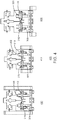
- Fig. 4 is an illustration of a self-locking hinge wherein rotational movement of the shaft results in translational movement of sliding components.
- the locking components 316, 318 are not perpendicular to the sliding components 306, 308.
- the sliding components 306, 308 are inhibited from movement due to frictional forces occurring between the locking components 316, 318 and the sliding components 306, 308, respectively.
- the locking components 316, 318 are more perpendicular to the sliding components 306, 308 in comparison to the position 402, resulting in relatively less inhibition of movement of the sliding components 306, 308.
- locking components 316, 318 are more perpendicular to the sliding components 306, 308 in comparison to the position 402, and 404, resulting in relatively less inhibition of movement of the sliding components 306, 308.
- the translational movement of the sliding components 306, 308 in Fig. 3 and 4 may be one embodiment of translational movement that results from rotational movement of the shaft 304. Other embodiments are possible wherein rotational movement results in translational movement of sliding components in a self-locking mechanism.
- Fig. 5 is an example illustration of a self-locking hinge wherein cables couple the shaft to the sliding components.
- the self-locking hinge 500 includes a rotational shaft 502, a backing plate 504, sliding components 506 and 508, and locking components 510 and 512.
- the shaft 502 is coupled to the sliding components 506, 508 by cables, indicated at 514.
- Rotational movement in the shaft, as indicated at 516, results in translational movement of the sliding components 506, 508, each in an opposite direction from one another.
- the translational movement of the sliding components 506, 508 is a plane parallel to the backing plate 504. Similar to the self-locking hinge 300 discussed in relation to Fig. 3 , locking components 508, 510 inhibit movement of the sliding components 506, 508 due to a force of friction respectively between the locking components 508, 510, and the sliding components 506, 508.
- the self-locking hinge 500 includes a spring 522.
- the spring 522 is configured to apply pressure to at least one of the locking components, such as locking component 510.
- the spring 522 may apply pressure to create friction between the locking component 510 and the sliding component 506.
- the self-locking hinge 500 may include multiple springs, such as a spring to apply pressure against the locking component 512.
- the force of friction may be configured to be less than a force exerted by a user when rotating the shaft 502 by movement of a stand (not shown) configured to be coupled to the shaft 502 as the fastening holes 518, 520 defined by the shaft 502.
- the force of friction may be overcome mechanically, such as when a user adjusts an angle of a computing device by manual force, or electromechanically, wherein a user may initiate an electronic motor to adjust an angle of the computing device.
- the self-locking hinge 500 includes a tensioner 524.
- the tensioner 524 is a tensioning mechanism configured to reduce flexes in the self-locking hinge between the cables 514, the sliders 506, 508, and the shaft 518.
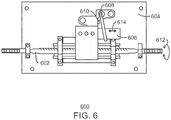
- Fig. 6 is an example illustration of a self-locking hinge wherein rotational movement of the shaft results in translational movement of the sliding component parallel to the shaft.
- the self-locking hinge 600 includes a shaft, 602, a backing plate 604, a sliding component 606, a locking component 608, and a spring 610. Rotation in the shaft 602, indicated by the arrow 612, may result in translational movement of the sliding component 606 as indicated by the arrow 614. Similar to the embodiments discussed above, the locking component 608 may inhibit movement of the sliding component 606 when the sliding component 606 is disposed at a non-perpendicular angle with respect to the sliding component 608.
- the spring 610 may apply pressure to the locking component 608 such that a non-perpendicular angle of the locking component 608 may be achieved. As discussed above, rotational movement of the shaft 602 results in translational movement of the sliding component 606 in the plane of the backing plate 604.
- Fig. 7 is a block diagram illustrating a method for forming a hinge of a computing device.
- the method 700 may include forming, at block 702, a shaft to move rotationally.
- the rotational movement of the shaft may enable a stand to swivel about an axis defined by the shaft, and about the back side of a computing device, such as an All-In-One (AIO) computing device.
- AIO All-In-One
- a sliding component is formed.
- the sliding component is to move translationally as a result of rotational movement of the shaft.
- the method 700 may also include forming, at block 706, a locking mechanism.
- the locking mechanism may include a locking component defining an opening, wherein the sliding component is to move translationally through the opening.
- the locking mechanism may include a spring to apply pressure to the locking component; wherein movement of the sliding component is inhibited by the pressure applied to the locking component.
- the techniques described herein include a method of forming a hinge for a computing device.
- the method includes forming a shaft to move rotationally and a sliding means, such as a sliding component, to move translationally as a result of the movement of the shaft.
- the method may also include forming a locking means.
- the locking means may be a locking mechanism used to inhibit translational movement of the sliding means.
- the hinge may be formed of a material of relative high hardness. In some scenarios, the hinge is formed through a mechanical, chemical, or metallurgical means to increase a hardness of the hinge.
- the locking means includes a locking component.
- the locking component may have an opening wherein the sliding means can translationally move through the opening.
- the locking means includes a spring to apply pressure to the locking component. In some scenarios, the movement of the sliding means is inhibited by the pressure applied to the locking component.
- the embodiments described herein include a hinge for a computing device.
- the hinge includes a shaft to move rotationally and a sliding means, such as a sliding component, to move translationally as a result of the movement of the shaft.
- the hinge may also include a locking means.
- the locking means may be a locking mechanism used to inhibit translational movement of the sliding means.
- the locking means includes a locking component.
- the locking component may have an opening wherein the sliding means can translationally move through the opening.
- the locking means includes a spring to apply pressure to the locking component. In some scenarios, the movement of the sliding means is inhibited by the pressure applied to the locking component. In one scenario, the movement of the sliding means is relatively uninhibited by the locking means when the locking component is perpendicular to the sliding means in comparison to when the locking component is not perpendicular to the sliding means.
- the hinge may also include a backplate to couple the shaft to a backside of the computing device.
- the translational movement of the sliding means is in the plane of the backplate.
- the embodiments described herein include a hinge system for a computing device.
- the hinge system includes a backplate coupled to a backside of a display of the computing device.
- the hinge system also includes a shaft to move rotationally and a sliding component move translationally as a result of the movement of the shaft.
- the sliding component is to move translationally in a plane defined by the backplate.
- the hinge system may also include a locking mechanism.
- the locking means may be a locking mechanism used to inhibit translational movement of the sliding component.
- the locking mechanism includes a locking component.
- the locking component may have an opening wherein the sliding component can translationally move through the opening.
- the locking mechanism includes a spring to apply pressure to the locking component.
- the movement of the sliding component is inhibited by the pressure applied to the locking component.
- the movement of the sliding component is relatively uninhibited by the locking mechanism when the locking component is perpendicular to the sliding component in comparison to when the locking component is not perpendicular to the sliding component.
- An embodiment is an implementation or example.
- Reference in the specification to "an embodiment,” “one embodiment,” “some embodiments,” “various embodiments,” or “other embodiments” means that a particular feature, structure, or characteristic described in connection with the embodiments is included in at least some embodiments, but not necessarily all embodiments, of the present techniques.
- the various appearances of "an embodiment,” “one embodiment,” or “some embodiments” are not necessarily all referring to the same embodiments.
- the elements in some cases may each have a same reference number or a different reference number to suggest that the elements represented could be different and/or similar.
- an element may be flexible enough to have different implementations and work with some or all of the systems shown or described herein.
- the various elements shown in the figures may be the same or different. Which one is referred to as a first element and which is called a second element is arbitrary.
Landscapes
- Engineering & Computer Science (AREA)
- Computer Hardware Design (AREA)
- Theoretical Computer Science (AREA)
- Human Computer Interaction (AREA)
- Physics & Mathematics (AREA)
- General Engineering & Computer Science (AREA)
- General Physics & Mathematics (AREA)
- Mechanical Engineering (AREA)
- Pivots And Pivotal Connections (AREA)
- Telephone Set Structure (AREA)
- Casings For Electric Apparatus (AREA)
Claims (12)
- Verfahren (700) zum Ausbilden eines Scharniers für eine Rechenvorrichtung, Folgendes umfassend: Ausbilden (702) einer Welle, die sich rotatorisch bewegt; Ausbilden (704) einer Schiebekomponente, die sich als Reaktion auf die Drehbewegung der Welle translatorisch bewegt; und
Ausbilden (706) eines Verriegelungsmechanismus, wobei der Verriegelungsmechanismus dazu eingerichtet ist, die translatorische Bewegung der Schiebekomponente über Verriegelungskomponenten, die dazu ausgelegt sind, eine Kraft auf die Schiebekomponente aufzubringen, zu verhindern,
dadurch gekennzeichnet, dass der Verriegelungsmechanismus derart selbstverriegelnd ist, dass der Verriegelungsmechanismus auf Grundlage einer zunehmenden Reibungskraft zwischen der Schiebekomponente und dem Verriegelungsmechanismus zunehmenden Druck auf die Schiebekomponente aufbringt, wobei die Verriegelungskomponente (316, 318) eine Öffnung definiert, wobei sich die Schiebekomponente (306, 308) translatorisch durch die Öffnung bewegt; und der Verriegelungsmechanismus ferner eine Feder (522) umfasst, um einen Druck auf die Verriegelungskomponente aufzubringen, wobei die Bewegung der Schiebekomponente durch den auf die Verriegelungskomponente aufgebrachten Druck verhindert wird, was zu einem erhöhten Druck auf die Schiebekomponente führt. - Verfahren (700) nach Anspruch 1, wobei das Scharnier aus einem Material mit einer großen Härte ausgebildet ist oder durch mechanische, chemische oder metallurgische Einrichtungen ausgebildet ist, um die Härte des Scharniers zu erhöhen.
- Verfahren (700) nach Anspruch 1 oder 2, wobei die Bewegung der Schiebekomponente durch den Verriegelungsmechanismus relativ ungehindert ist, wenn sich die Verriegelungskomponente senkrecht zur Schiebekomponente befindet, im Vergleich zu, wenn sich die Verriegelungskomponente nicht senkrecht zur Schiebekomponente befindet.
- Verfahren (700) nach einer Kombination der Ansprüche 1-3, das Ausbilden einer Rückplatte umfassend, um die Welle mit einer Rückseite einer Rechenvorrichtung zu koppeln, wobei die translatorische Bewegung der Schiebekomponente in der Ebene der Rückplatte liegt.
- Verfahren (700) nach einer Kombination der Ansprüche 1-4, wobei die Welle mit Schenkeln der Rechenvorrichtung zu koppeln ist, sodass die Drehung der Schenkel zu einer rotatorischen Bewegung der Welle, einer translatorischen Bewegung der Schiebekomponente und einer rotatorischen Bewegung der Rückplatte führt.
- Verfahren (700) nach einer Kombination der Ansprüche 1-5, wobei die Rechenvorrichtung eine All-in-One(AIO)-Rechenvorrichtung ist.
- Verfahren (700) nach einer Kombination der Ansprüche 1-6, wobei die Schiebekomponente derart mit der Welle gekoppelt ist, dass die Drehbewegung der Welle zu einer translatorischen Bewegung der Schiebekomponente führt.
- Scharnier (300) für eine Rechenvorrichtung, Folgendes umfassend:eine Welle (304), die dazu ausgelegt ist, sich rotatorisch zu bewegen;eine Schiebekomponente (306, 308), die dazu ausgelegt ist, sich als Reaktion auf die Drehbewegung der Welle translatorisch zu bewegen; undeinen Verriegelungsmechanismus, wobei der Verriegelungsmechanismus dazu eingerichtet ist, die translatorische Bewegung der Schiebekomponente über eine Verriegelungskomponente (316, 318), die dazu ausgelegt ist, eine Kraft auf die Schiebekomponente aufzubringen, zu verhindern,dadurch gekennzeichnet, dass der Verriegelungsmechanismus derart selbstverriegelnd ist, dass der Verriegelungsmechanismus dazu ausgelegt ist, auf Grundlage einer zunehmenden Reibungskraft zwischen der Schiebekomponente und dem Verriegelungsmechanismus zunehmenden Druck auf die Schiebekomponente aufzubringen, wobei die Verriegelungskomponente (316, 318) eine Öffnung definiert, wobei die Schiebekomponente (306, 308) dazu ausgelegt ist, sich translatorisch durch die Öffnung zu bewegen; unddas Scharnier ferner eine Feder (522) umfasst, die dazu ausgelegt ist, einen Druck auf die Verriegelungskomponente aufzubringen, wobei die Bewegung der Schiebekomponente durch den auf die Verriegelungskomponente aufgebrachten Druck verhindert wird, was zu einem erhöhten Druck auf die Schiebekomponente führt.
- Scharnier (300) nach Anspruch 8, wobei die Bewegung der Schiebekomponente (306, 308) durch den Verriegelungsmechanismus relativ ungehindert ist, wenn sich die Verriegelungskomponente (316, 318) senkrecht zur Schiebekomponente befindet, im Vergleich zu, wenn sich die Verriegelungskomponente nicht senkrecht zur Schiebekomponente befindet.
- Scharnier (300) nach Anspruch 8 oder 9, eine Rückplatte (302) umfassend, die dazu ausgelegt ist, die Welle (304) mit einer Rückseite der Rechenvorrichtung zu koppeln, wobei die translatorische Bewegung der Schiebekomponente (306, 308) in der Ebene der Rückplatte liegt.
- Scharnier (300) nach einer Kombination der Ansprüche 8-10, Schenkel der Rechenvorrichtung umfassend, wobei die Welle (304) dazu ausgelegt ist, mit den Schenkeln gekoppelt zu werden, sodass die Drehung der Schenkel zu einer rotatorischen Bewegung der Welle, einer translatorischen Bewegung der Schiebekomponente (306, 308) und einer rotatorischen Bewegung der Rückplatte führt.
- Scharnier (300) nach einer Kombination der Ansprüche 8-11, wobei die Rechenvorrichtung eine All-in-One(AIO)-Rechenvorrichtung ist.
Applications Claiming Priority (2)
| Application Number | Priority Date | Filing Date | Title |
|---|---|---|---|
| US14/141,196 US9551177B2 (en) | 2013-12-26 | 2013-12-26 | Rotational to translational locking hinge |
| PCT/US2014/067076 WO2015099928A1 (en) | 2013-12-26 | 2014-11-24 | Rotational to translational locking hinge |
Publications (3)
| Publication Number | Publication Date |
|---|---|
| EP3087449A1 EP3087449A1 (de) | 2016-11-02 |
| EP3087449A4 EP3087449A4 (de) | 2017-09-13 |
| EP3087449B1 true EP3087449B1 (de) | 2020-12-30 |
Family
ID=53479501
Family Applications (1)
| Application Number | Title | Priority Date | Filing Date |
|---|---|---|---|
| EP14874271.1A Active EP3087449B1 (de) | 2013-12-26 | 2014-11-24 | Rotatorisch-zu-translatorisch-rastgelenk |
Country Status (5)
| Country | Link |
|---|---|
| US (1) | US9551177B2 (de) |
| EP (1) | EP3087449B1 (de) |
| KR (1) | KR101812617B1 (de) |
| CN (1) | CN105765480B (de) |
| WO (1) | WO2015099928A1 (de) |
Families Citing this family (9)
| Publication number | Priority date | Publication date | Assignee | Title |
|---|---|---|---|---|
| US20150277506A1 (en) | 2014-03-29 | 2015-10-01 | Bok Eng Cheah | Micro-hinge for an electronic device |
| US10501973B2 (en) | 2016-06-14 | 2019-12-10 | Microsoft Technology Licensing, Llc | Hinge with free-stop function |
| US9840861B1 (en) * | 2016-06-14 | 2017-12-12 | Microsoft Technology Licensing, Llc | Hinged device with snap open lock |
| US10301858B2 (en) * | 2016-06-14 | 2019-05-28 | Microsoft Technology Licensing, Llc | Hinge mechanism |
| US10061359B2 (en) | 2016-07-28 | 2018-08-28 | Microsoft Technology Licensing, Llc | Hinged device with living hinge |
| US10228732B2 (en) | 2017-05-19 | 2019-03-12 | Microsoft Technology Licensing, Llc | Hinge with variable sliding friction |
| US10545540B2 (en) | 2017-07-06 | 2020-01-28 | Microsoft Technology Licensing, Llc | Systems and methods of longitudinal torsional resistance in a hinge |
| CN111609029B (zh) * | 2020-05-22 | 2021-05-04 | 深圳市柔宇科技有限公司 | 一种折叠装置及柔性电子设备 |
| CN113466071B (zh) * | 2021-05-28 | 2023-01-24 | 昆明华城兴建材有限公司 | 一种水泥板的硬度检测装置 |
Family Cites Families (30)
| Publication number | Priority date | Publication date | Assignee | Title |
|---|---|---|---|---|
| US1357740A (en) * | 1917-12-14 | 1920-11-02 | Stephan Jacob | Furniture |
| JP2937687B2 (ja) * | 1993-04-26 | 1999-08-23 | 米沢日本電気株式会社 | 可動型スタンド装置 |
| US6053589A (en) * | 1998-09-10 | 2000-04-25 | Inventec Corp. | Automatic inclination device for a portable computer |
| TWI241141B (en) * | 2003-11-03 | 2005-10-01 | Coretronic Corp | Display stand |
| JP4402448B2 (ja) * | 2003-12-24 | 2010-01-20 | 株式会社新鋭産業 | ディスプレイモニター用スタンド |
| CN100544563C (zh) | 2004-12-30 | 2009-09-23 | 深圳富泰宏精密工业有限公司 | 铰链结构 |
| JP3112838U (ja) * | 2005-05-26 | 2005-08-25 | 船井電機株式会社 | ディスプレイ装置 |
| KR100662454B1 (ko) * | 2005-07-29 | 2007-01-02 | 엘지전자 주식회사 | 평판형 영상표시기를 위한 스탠드 구조 |
| KR20070084650A (ko) * | 2006-02-21 | 2007-08-27 | 삼성전자주식회사 | 디스플레이장치용 스탠드 및 이를 갖는 디스플레이장치 |
| KR101253569B1 (ko) * | 2006-05-09 | 2013-04-11 | 삼성전자주식회사 | 디스플레이장치용 지지장치 |
| KR100710313B1 (ko) * | 2006-05-26 | 2007-04-23 | 엘지전자 주식회사 | 영상표시장치 |
| KR100710314B1 (ko) * | 2006-06-01 | 2007-04-23 | 엘지전자 주식회사 | 모니터 스탠드 |
| KR100793754B1 (ko) * | 2006-07-07 | 2008-01-10 | 엘지전자 주식회사 | 영상표시장치 |
| CN101101019B (zh) | 2006-07-07 | 2010-12-29 | 深圳富泰宏精密工业有限公司 | 铰链机构及应用该铰链机构的便携式电子装置 |
| CN101338781B (zh) * | 2007-07-06 | 2011-03-30 | 深圳富泰宏精密工业有限公司 | 铰链结构及应用该铰链结构的便携式电子装置 |
| CN101487558B (zh) * | 2008-01-16 | 2012-01-25 | 鸿富锦精密工业(深圳)有限公司 | 升降机构 |
| CN101498396B (zh) * | 2008-01-30 | 2011-07-27 | 鸿富锦精密工业(深圳)有限公司 | 升降机构 |
| WO2010026806A1 (ja) * | 2008-09-02 | 2010-03-11 | キャタピラージャパン株式会社 | ヒンジおよびドア装置 |
| US7922133B2 (en) * | 2008-09-12 | 2011-04-12 | Shin Zu Shing Co., Ltd. | Flat panel display support |
| KR101408951B1 (ko) * | 2009-01-07 | 2014-06-17 | 삼성전자주식회사 | 스탠드 장치 |
| WO2010094083A1 (en) * | 2009-02-20 | 2010-08-26 | Gryffin Epss Pty Ltd | An adjustable hinge |
| US8402609B2 (en) | 2009-12-31 | 2013-03-26 | Shin Zu Shing Co., Ltd. | Self-lock hinge |
| US8226054B2 (en) * | 2010-10-18 | 2012-07-24 | Syncmold Enterprise Corp. | Display frame and support unit thereof |
| CN102954100A (zh) * | 2011-08-18 | 2013-03-06 | 深圳富泰宏精密工业有限公司 | 便携式电子装置及其旋转组件 |
| TWI485345B (zh) * | 2011-09-20 | 2015-05-21 | Compal Electronics Inc | 顯示器支撐架 |
| US8891232B2 (en) * | 2011-09-23 | 2014-11-18 | Htc Corporation | Support stand and standable hand-held device |
| US8897033B2 (en) * | 2012-04-25 | 2014-11-25 | Motorola Mobility Llc | Modular kickstand mechanism |
| TWI502142B (zh) * | 2012-05-17 | 2015-10-01 | Wistron Corp | 易於拆裝之樞軸機構及其電子裝置 |
| CN104541224B (zh) * | 2012-10-31 | 2019-09-06 | 惠普发展公司,有限责任合伙企业 | 柔性构件面板支架 |
| US9856079B2 (en) * | 2013-04-09 | 2018-01-02 | Grigooris MANSSOURIAN | Retainer mechanism |
-
2013
- 2013-12-26 US US14/141,196 patent/US9551177B2/en not_active Expired - Fee Related
-
2014
- 2014-11-24 EP EP14874271.1A patent/EP3087449B1/de active Active
- 2014-11-24 WO PCT/US2014/067076 patent/WO2015099928A1/en not_active Ceased
- 2014-11-24 CN CN201480064655.3A patent/CN105765480B/zh active Active
- 2014-11-24 KR KR1020167013918A patent/KR101812617B1/ko active Active
Non-Patent Citations (1)
| Title |
|---|
| None * |
Also Published As
| Publication number | Publication date |
|---|---|
| EP3087449A1 (de) | 2016-11-02 |
| WO2015099928A1 (en) | 2015-07-02 |
| US9551177B2 (en) | 2017-01-24 |
| CN105765480A (zh) | 2016-07-13 |
| KR101812617B1 (ko) | 2017-12-27 |
| US20150184438A1 (en) | 2015-07-02 |
| KR20160075733A (ko) | 2016-06-29 |
| CN105765480B (zh) | 2019-07-02 |
| EP3087449A4 (de) | 2017-09-13 |
Similar Documents
| Publication | Publication Date | Title |
|---|---|---|
| EP3087449B1 (de) | Rotatorisch-zu-translatorisch-rastgelenk | |
| US9696754B2 (en) | Hinge having multiple degrees of freedom | |
| US9939851B2 (en) | Electronic device and hinge thereof | |
| US10000955B2 (en) | Biaxial hinge and terminal device using the same | |
| CN101725624B (zh) | 铰链结构 | |
| US10716228B2 (en) | Support mechanism and mobile terminal | |
| US10606322B2 (en) | Multistage friction hinge | |
| US9857831B2 (en) | Flexible hinges for computing devices | |
| US8947871B2 (en) | Portable electronic device and slide rail device | |
| EP3516477B1 (de) | Mehrachsiges scharnier | |
| US9230606B2 (en) | Mounting apparatus assembly | |
| EP2490094B1 (de) | Scharnier, das Spannungen absorbieren kann | |
| US8988863B2 (en) | Portable electronic device | |
| EP2940366B1 (de) | Anzeigevorrichtungshalter | |
| US8576558B2 (en) | Mounting apparatus with rotating member for retaining and buffering data storage device | |
| BR112016026241B1 (pt) | Articulação de fricção e estrutura de apoio rotativa para computadores tablet | |
| US8964381B2 (en) | Electronic device locking/unlocking mechanism | |
| CN102118937A (zh) | 便携式电子设备 | |
| CN101684840A (zh) | 磁性铰链结构 | |
| US9863574B2 (en) | Supporting structure and display device using the same | |
| CN101660566A (zh) | 铰链结构 | |
| US8891248B2 (en) | Angle-adjustable support with pivot mechanism | |
| US20190108860A1 (en) | Tool-less mounting apparatus for hard disk drive and storage device using the same | |
| US20140021727A1 (en) | Opening-aid locking/unlocking mechanism of electronic device | |
| US20140319017A1 (en) | Mounting apparatus for storage devices |
Legal Events
| Date | Code | Title | Description |
|---|---|---|---|
| PUAI | Public reference made under article 153(3) epc to a published international application that has entered the european phase |
Free format text: ORIGINAL CODE: 0009012 |
|
| 17P | Request for examination filed |
Effective date: 20160520 |
|
| AK | Designated contracting states |
Kind code of ref document: A1 Designated state(s): AL AT BE BG CH CY CZ DE DK EE ES FI FR GB GR HR HU IE IS IT LI LT LU LV MC MK MT NL NO PL PT RO RS SE SI SK SM TR |
|
| AX | Request for extension of the european patent |
Extension state: BA ME |
|
| DAX | Request for extension of the european patent (deleted) | ||
| A4 | Supplementary search report drawn up and despatched |
Effective date: 20170811 |
|
| RIC1 | Information provided on ipc code assigned before grant |
Ipc: G06F 1/16 20060101AFI20170807BHEP |
|
| STAA | Information on the status of an ep patent application or granted ep patent |
Free format text: STATUS: EXAMINATION IS IN PROGRESS |
|
| 17Q | First examination report despatched |
Effective date: 20200117 |
|
| GRAP | Despatch of communication of intention to grant a patent |
Free format text: ORIGINAL CODE: EPIDOSNIGR1 |
|
| STAA | Information on the status of an ep patent application or granted ep patent |
Free format text: STATUS: GRANT OF PATENT IS INTENDED |
|
| INTG | Intention to grant announced |
Effective date: 20200720 |
|
| GRAS | Grant fee paid |
Free format text: ORIGINAL CODE: EPIDOSNIGR3 |
|
| GRAA | (expected) grant |
Free format text: ORIGINAL CODE: 0009210 |
|
| STAA | Information on the status of an ep patent application or granted ep patent |
Free format text: STATUS: THE PATENT HAS BEEN GRANTED |
|
| AK | Designated contracting states |
Kind code of ref document: B1 Designated state(s): AL AT BE BG CH CY CZ DE DK EE ES FI FR GB GR HR HU IE IS IT LI LT LU LV MC MK MT NL NO PL PT RO RS SE SI SK SM TR |
|
| REG | Reference to a national code |
Ref country code: GB Ref legal event code: FG4D |
|
| REG | Reference to a national code |
Ref country code: DE Ref legal event code: R096 Ref document number: 602014073887 Country of ref document: DE |
|
| REG | Reference to a national code |
Ref country code: AT Ref legal event code: REF Ref document number: 1350571 Country of ref document: AT Kind code of ref document: T Effective date: 20210115 |
|
| REG | Reference to a national code |
Ref country code: IE Ref legal event code: FG4D |
|
| REG | Reference to a national code |
Ref country code: NL Ref legal event code: FP |
|
| PG25 | Lapsed in a contracting state [announced via postgrant information from national office to epo] |
Ref country code: NO Free format text: LAPSE BECAUSE OF FAILURE TO SUBMIT A TRANSLATION OF THE DESCRIPTION OR TO PAY THE FEE WITHIN THE PRESCRIBED TIME-LIMIT Effective date: 20210330 Ref country code: FI Free format text: LAPSE BECAUSE OF FAILURE TO SUBMIT A TRANSLATION OF THE DESCRIPTION OR TO PAY THE FEE WITHIN THE PRESCRIBED TIME-LIMIT Effective date: 20201230 Ref country code: RS Free format text: LAPSE BECAUSE OF FAILURE TO SUBMIT A TRANSLATION OF THE DESCRIPTION OR TO PAY THE FEE WITHIN THE PRESCRIBED TIME-LIMIT Effective date: 20201230 Ref country code: GR Free format text: LAPSE BECAUSE OF FAILURE TO SUBMIT A TRANSLATION OF THE DESCRIPTION OR TO PAY THE FEE WITHIN THE PRESCRIBED TIME-LIMIT Effective date: 20210331 |
|
| REG | Reference to a national code |
Ref country code: AT Ref legal event code: MK05 Ref document number: 1350571 Country of ref document: AT Kind code of ref document: T Effective date: 20201230 |
|
| PG25 | Lapsed in a contracting state [announced via postgrant information from national office to epo] |
Ref country code: BG Free format text: LAPSE BECAUSE OF FAILURE TO SUBMIT A TRANSLATION OF THE DESCRIPTION OR TO PAY THE FEE WITHIN THE PRESCRIBED TIME-LIMIT Effective date: 20210330 Ref country code: LV Free format text: LAPSE BECAUSE OF FAILURE TO SUBMIT A TRANSLATION OF THE DESCRIPTION OR TO PAY THE FEE WITHIN THE PRESCRIBED TIME-LIMIT Effective date: 20201230 Ref country code: SE Free format text: LAPSE BECAUSE OF FAILURE TO SUBMIT A TRANSLATION OF THE DESCRIPTION OR TO PAY THE FEE WITHIN THE PRESCRIBED TIME-LIMIT Effective date: 20201230 |
|
| PG25 | Lapsed in a contracting state [announced via postgrant information from national office to epo] |
Ref country code: HR Free format text: LAPSE BECAUSE OF FAILURE TO SUBMIT A TRANSLATION OF THE DESCRIPTION OR TO PAY THE FEE WITHIN THE PRESCRIBED TIME-LIMIT Effective date: 20201230 |
|
| REG | Reference to a national code |
Ref country code: LT Ref legal event code: MG9D |
|
| PG25 | Lapsed in a contracting state [announced via postgrant information from national office to epo] |
Ref country code: LT Free format text: LAPSE BECAUSE OF FAILURE TO SUBMIT A TRANSLATION OF THE DESCRIPTION OR TO PAY THE FEE WITHIN THE PRESCRIBED TIME-LIMIT Effective date: 20201230 Ref country code: PT Free format text: LAPSE BECAUSE OF FAILURE TO SUBMIT A TRANSLATION OF THE DESCRIPTION OR TO PAY THE FEE WITHIN THE PRESCRIBED TIME-LIMIT Effective date: 20210430 Ref country code: RO Free format text: LAPSE BECAUSE OF FAILURE TO SUBMIT A TRANSLATION OF THE DESCRIPTION OR TO PAY THE FEE WITHIN THE PRESCRIBED TIME-LIMIT Effective date: 20201230 Ref country code: SK Free format text: LAPSE BECAUSE OF FAILURE TO SUBMIT A TRANSLATION OF THE DESCRIPTION OR TO PAY THE FEE WITHIN THE PRESCRIBED TIME-LIMIT Effective date: 20201230 Ref country code: CZ Free format text: LAPSE BECAUSE OF FAILURE TO SUBMIT A TRANSLATION OF THE DESCRIPTION OR TO PAY THE FEE WITHIN THE PRESCRIBED TIME-LIMIT Effective date: 20201230 Ref country code: EE Free format text: LAPSE BECAUSE OF FAILURE TO SUBMIT A TRANSLATION OF THE DESCRIPTION OR TO PAY THE FEE WITHIN THE PRESCRIBED TIME-LIMIT Effective date: 20201230 |
|
| PG25 | Lapsed in a contracting state [announced via postgrant information from national office to epo] |
Ref country code: PL Free format text: LAPSE BECAUSE OF FAILURE TO SUBMIT A TRANSLATION OF THE DESCRIPTION OR TO PAY THE FEE WITHIN THE PRESCRIBED TIME-LIMIT Effective date: 20201230 Ref country code: AT Free format text: LAPSE BECAUSE OF FAILURE TO SUBMIT A TRANSLATION OF THE DESCRIPTION OR TO PAY THE FEE WITHIN THE PRESCRIBED TIME-LIMIT Effective date: 20201230 |
|
| PG25 | Lapsed in a contracting state [announced via postgrant information from national office to epo] |
Ref country code: IS Free format text: LAPSE BECAUSE OF FAILURE TO SUBMIT A TRANSLATION OF THE DESCRIPTION OR TO PAY THE FEE WITHIN THE PRESCRIBED TIME-LIMIT Effective date: 20210430 |
|
| REG | Reference to a national code |
Ref country code: DE Ref legal event code: R097 Ref document number: 602014073887 Country of ref document: DE |
|
| PG25 | Lapsed in a contracting state [announced via postgrant information from national office to epo] |
Ref country code: AL Free format text: LAPSE BECAUSE OF FAILURE TO SUBMIT A TRANSLATION OF THE DESCRIPTION OR TO PAY THE FEE WITHIN THE PRESCRIBED TIME-LIMIT Effective date: 20201230 Ref country code: IT Free format text: LAPSE BECAUSE OF FAILURE TO SUBMIT A TRANSLATION OF THE DESCRIPTION OR TO PAY THE FEE WITHIN THE PRESCRIBED TIME-LIMIT Effective date: 20201230 |
|
| PLBE | No opposition filed within time limit |
Free format text: ORIGINAL CODE: 0009261 |
|
| STAA | Information on the status of an ep patent application or granted ep patent |
Free format text: STATUS: NO OPPOSITION FILED WITHIN TIME LIMIT |
|
| PG25 | Lapsed in a contracting state [announced via postgrant information from national office to epo] |
Ref country code: DK Free format text: LAPSE BECAUSE OF FAILURE TO SUBMIT A TRANSLATION OF THE DESCRIPTION OR TO PAY THE FEE WITHIN THE PRESCRIBED TIME-LIMIT Effective date: 20201230 Ref country code: ES Free format text: LAPSE BECAUSE OF FAILURE TO SUBMIT A TRANSLATION OF THE DESCRIPTION OR TO PAY THE FEE WITHIN THE PRESCRIBED TIME-LIMIT Effective date: 20201230 |
|
| 26N | No opposition filed |
Effective date: 20211001 |
|
| PG25 | Lapsed in a contracting state [announced via postgrant information from national office to epo] |
Ref country code: SI Free format text: LAPSE BECAUSE OF FAILURE TO SUBMIT A TRANSLATION OF THE DESCRIPTION OR TO PAY THE FEE WITHIN THE PRESCRIBED TIME-LIMIT Effective date: 20201230 |
|
| PG25 | Lapsed in a contracting state [announced via postgrant information from national office to epo] |
Ref country code: IS Free format text: LAPSE BECAUSE OF FAILURE TO SUBMIT A TRANSLATION OF THE DESCRIPTION OR TO PAY THE FEE WITHIN THE PRESCRIBED TIME-LIMIT Effective date: 20210430 |
|
| PG25 | Lapsed in a contracting state [announced via postgrant information from national office to epo] |
Ref country code: MC Free format text: LAPSE BECAUSE OF FAILURE TO SUBMIT A TRANSLATION OF THE DESCRIPTION OR TO PAY THE FEE WITHIN THE PRESCRIBED TIME-LIMIT Effective date: 20201230 |
|
| REG | Reference to a national code |
Ref country code: CH Ref legal event code: PL |
|
| PG25 | Lapsed in a contracting state [announced via postgrant information from national office to epo] |
Ref country code: LU Free format text: LAPSE BECAUSE OF NON-PAYMENT OF DUE FEES Effective date: 20211124 Ref country code: BE Free format text: LAPSE BECAUSE OF NON-PAYMENT OF DUE FEES Effective date: 20211130 |
|
| REG | Reference to a national code |
Ref country code: BE Ref legal event code: MM Effective date: 20211130 |
|
| PG25 | Lapsed in a contracting state [announced via postgrant information from national office to epo] |
Ref country code: LI Free format text: LAPSE BECAUSE OF NON-PAYMENT OF DUE FEES Effective date: 20211130 Ref country code: CH Free format text: LAPSE BECAUSE OF NON-PAYMENT OF DUE FEES Effective date: 20211130 |
|
| PG25 | Lapsed in a contracting state [announced via postgrant information from national office to epo] |
Ref country code: IE Free format text: LAPSE BECAUSE OF NON-PAYMENT OF DUE FEES Effective date: 20211124 |
|
| PG25 | Lapsed in a contracting state [announced via postgrant information from national office to epo] |
Ref country code: HU Free format text: LAPSE BECAUSE OF FAILURE TO SUBMIT A TRANSLATION OF THE DESCRIPTION OR TO PAY THE FEE WITHIN THE PRESCRIBED TIME-LIMIT; INVALID AB INITIO Effective date: 20141124 |
|
| P01 | Opt-out of the competence of the unified patent court (upc) registered |
Effective date: 20230518 |
|
| PG25 | Lapsed in a contracting state [announced via postgrant information from national office to epo] |
Ref country code: CY Free format text: LAPSE BECAUSE OF FAILURE TO SUBMIT A TRANSLATION OF THE DESCRIPTION OR TO PAY THE FEE WITHIN THE PRESCRIBED TIME-LIMIT Effective date: 20201230 |
|
| PG25 | Lapsed in a contracting state [announced via postgrant information from national office to epo] |
Ref country code: SM Free format text: LAPSE BECAUSE OF FAILURE TO SUBMIT A TRANSLATION OF THE DESCRIPTION OR TO PAY THE FEE WITHIN THE PRESCRIBED TIME-LIMIT Effective date: 20201230 |
|
| PG25 | Lapsed in a contracting state [announced via postgrant information from national office to epo] |
Ref country code: MK Free format text: LAPSE BECAUSE OF FAILURE TO SUBMIT A TRANSLATION OF THE DESCRIPTION OR TO PAY THE FEE WITHIN THE PRESCRIBED TIME-LIMIT Effective date: 20201230 |
|
| PG25 | Lapsed in a contracting state [announced via postgrant information from national office to epo] |
Ref country code: TR Free format text: LAPSE BECAUSE OF FAILURE TO SUBMIT A TRANSLATION OF THE DESCRIPTION OR TO PAY THE FEE WITHIN THE PRESCRIBED TIME-LIMIT Effective date: 20201230 |
|
| PG25 | Lapsed in a contracting state [announced via postgrant information from national office to epo] |
Ref country code: MT Free format text: LAPSE BECAUSE OF FAILURE TO SUBMIT A TRANSLATION OF THE DESCRIPTION OR TO PAY THE FEE WITHIN THE PRESCRIBED TIME-LIMIT Effective date: 20201230 |
|
| PGFP | Annual fee paid to national office [announced via postgrant information from national office to epo] |
Ref country code: NL Payment date: 20241024 Year of fee payment: 11 |
|
| PGFP | Annual fee paid to national office [announced via postgrant information from national office to epo] |
Ref country code: GB Payment date: 20241017 Year of fee payment: 11 |
|
| PGFP | Annual fee paid to national office [announced via postgrant information from national office to epo] |
Ref country code: FR Payment date: 20241021 Year of fee payment: 11 |
|
| PGFP | Annual fee paid to national office [announced via postgrant information from national office to epo] |
Ref country code: DE Payment date: 20250930 Year of fee payment: 12 |