EP3087203B1 - Genetic markers associated with suicide risk and methods of use thereof - Google Patents
Genetic markers associated with suicide risk and methods of use thereof Download PDFInfo
- Publication number
- EP3087203B1 EP3087203B1 EP14873830.5A EP14873830A EP3087203B1 EP 3087203 B1 EP3087203 B1 EP 3087203B1 EP 14873830 A EP14873830 A EP 14873830A EP 3087203 B1 EP3087203 B1 EP 3087203B1
- Authority
- EP
- European Patent Office
- Prior art keywords
- subject
- seq
- suicide
- marker
- allele
- Prior art date
- Legal status (The legal status is an assumption and is not a legal conclusion. Google has not performed a legal analysis and makes no representation as to the accuracy of the status listed.)
- Not-in-force
Links
Images
Classifications
-
- C—CHEMISTRY; METALLURGY
- C12—BIOCHEMISTRY; BEER; SPIRITS; WINE; VINEGAR; MICROBIOLOGY; ENZYMOLOGY; MUTATION OR GENETIC ENGINEERING
- C12Q—MEASURING OR TESTING PROCESSES INVOLVING ENZYMES, NUCLEIC ACIDS OR MICROORGANISMS; COMPOSITIONS OR TEST PAPERS THEREFOR; PROCESSES OF PREPARING SUCH COMPOSITIONS; CONDITION-RESPONSIVE CONTROL IN MICROBIOLOGICAL OR ENZYMOLOGICAL PROCESSES
- C12Q1/00—Measuring or testing processes involving enzymes, nucleic acids or microorganisms; Compositions therefor; Processes of preparing such compositions
- C12Q1/68—Measuring or testing processes involving enzymes, nucleic acids or microorganisms; Compositions therefor; Processes of preparing such compositions involving nucleic acids
- C12Q1/6876—Nucleic acid products used in the analysis of nucleic acids, e.g. primers or probes
- C12Q1/6883—Nucleic acid products used in the analysis of nucleic acids, e.g. primers or probes for diseases caused by alterations of genetic material
-
- A—HUMAN NECESSITIES
- A61—MEDICAL OR VETERINARY SCIENCE; HYGIENE
- A61P—SPECIFIC THERAPEUTIC ACTIVITY OF CHEMICAL COMPOUNDS OR MEDICINAL PREPARATIONS
- A61P25/00—Drugs for disorders of the nervous system
- A61P25/08—Antiepileptics; Anticonvulsants
-
- A—HUMAN NECESSITIES
- A61—MEDICAL OR VETERINARY SCIENCE; HYGIENE
- A61P—SPECIFIC THERAPEUTIC ACTIVITY OF CHEMICAL COMPOUNDS OR MEDICINAL PREPARATIONS
- A61P25/00—Drugs for disorders of the nervous system
- A61P25/18—Antipsychotics, i.e. neuroleptics; Drugs for mania or schizophrenia
-
- A—HUMAN NECESSITIES
- A61—MEDICAL OR VETERINARY SCIENCE; HYGIENE
- A61P—SPECIFIC THERAPEUTIC ACTIVITY OF CHEMICAL COMPOUNDS OR MEDICINAL PREPARATIONS
- A61P25/00—Drugs for disorders of the nervous system
- A61P25/22—Anxiolytics
-
- A—HUMAN NECESSITIES
- A61—MEDICAL OR VETERINARY SCIENCE; HYGIENE
- A61P—SPECIFIC THERAPEUTIC ACTIVITY OF CHEMICAL COMPOUNDS OR MEDICINAL PREPARATIONS
- A61P25/00—Drugs for disorders of the nervous system
- A61P25/24—Antidepressants
-
- G—PHYSICS
- G16—INFORMATION AND COMMUNICATION TECHNOLOGY [ICT] SPECIALLY ADAPTED FOR SPECIFIC APPLICATION FIELDS
- G16B—BIOINFORMATICS, i.e. INFORMATION AND COMMUNICATION TECHNOLOGY [ICT] SPECIALLY ADAPTED FOR GENETIC OR PROTEIN-RELATED DATA PROCESSING IN COMPUTATIONAL MOLECULAR BIOLOGY
- G16B30/00—ICT specially adapted for sequence analysis involving nucleotides or amino acids
-
- G—PHYSICS
- G16—INFORMATION AND COMMUNICATION TECHNOLOGY [ICT] SPECIALLY ADAPTED FOR SPECIFIC APPLICATION FIELDS
- G16B—BIOINFORMATICS, i.e. INFORMATION AND COMMUNICATION TECHNOLOGY [ICT] SPECIALLY ADAPTED FOR GENETIC OR PROTEIN-RELATED DATA PROCESSING IN COMPUTATIONAL MOLECULAR BIOLOGY
- G16B30/00—ICT specially adapted for sequence analysis involving nucleotides or amino acids
- G16B30/10—Sequence alignment; Homology search
-
- G—PHYSICS
- G16—INFORMATION AND COMMUNICATION TECHNOLOGY [ICT] SPECIALLY ADAPTED FOR SPECIFIC APPLICATION FIELDS
- G16C—COMPUTATIONAL CHEMISTRY; CHEMOINFORMATICS; COMPUTATIONAL MATERIALS SCIENCE
- G16C99/00—Subject matter not provided for in other groups of this subclass
-
- G—PHYSICS
- G16—INFORMATION AND COMMUNICATION TECHNOLOGY [ICT] SPECIALLY ADAPTED FOR SPECIFIC APPLICATION FIELDS
- G16H—HEALTHCARE INFORMATICS, i.e. INFORMATION AND COMMUNICATION TECHNOLOGY [ICT] SPECIALLY ADAPTED FOR THE HANDLING OR PROCESSING OF MEDICAL OR HEALTHCARE DATA
- G16H50/00—ICT specially adapted for medical diagnosis, medical simulation or medical data mining; ICT specially adapted for detecting, monitoring or modelling epidemics or pandemics
- G16H50/30—ICT specially adapted for medical diagnosis, medical simulation or medical data mining; ICT specially adapted for detecting, monitoring or modelling epidemics or pandemics for calculating health indices; for individual health risk assessment
-
- C—CHEMISTRY; METALLURGY
- C12—BIOCHEMISTRY; BEER; SPIRITS; WINE; VINEGAR; MICROBIOLOGY; ENZYMOLOGY; MUTATION OR GENETIC ENGINEERING
- C12Q—MEASURING OR TESTING PROCESSES INVOLVING ENZYMES, NUCLEIC ACIDS OR MICROORGANISMS; COMPOSITIONS OR TEST PAPERS THEREFOR; PROCESSES OF PREPARING SUCH COMPOSITIONS; CONDITION-RESPONSIVE CONTROL IN MICROBIOLOGICAL OR ENZYMOLOGICAL PROCESSES
- C12Q2600/00—Oligonucleotides characterized by their use
- C12Q2600/156—Polymorphic or mutational markers
-
- Y—GENERAL TAGGING OF NEW TECHNOLOGICAL DEVELOPMENTS; GENERAL TAGGING OF CROSS-SECTIONAL TECHNOLOGIES SPANNING OVER SEVERAL SECTIONS OF THE IPC; TECHNICAL SUBJECTS COVERED BY FORMER USPC CROSS-REFERENCE ART COLLECTIONS [XRACs] AND DIGESTS
- Y02—TECHNOLOGIES OR APPLICATIONS FOR MITIGATION OR ADAPTATION AGAINST CLIMATE CHANGE
- Y02A—TECHNOLOGIES FOR ADAPTATION TO CLIMATE CHANGE
- Y02A90/00—Technologies having an indirect contribution to adaptation to climate change
- Y02A90/10—Information and communication technologies [ICT] supporting adaptation to climate change, e.g. for weather forecasting or climate simulation
Definitions
- the present invention relates to risk markers for suicide. More specifically, the present invention relates to genetic markers associated with suicide risk.
- Suicide has a prominent genetic component (reviewed in 3). Suicide attempts tend to occur more often within families (Johnson et al. 1998: Brent et al. 2002). Greater concordance was observed between monozygotic twins than between dizygotic twins (4, 5). The concordant phenotype includes both completed and attempted suicides (4). A review of twin studies estimated the heritability of suicidal behavior to be up to 55% (6).
- WTCCC, UCL WTCCC, UCL
- the most significantly associated marker was rs300774 in an intergenic region at chromosomal region 2p25. which contains the SH3YUL, ACPL, and FAML50B genes.
- the association finding was supported by post-mortem prefrontal cortical gene expression analysis, where suicide completers were found to have significantly higher ACP1 expression than non-suicide victims (12).
- the strongest association signal from another GWAS of suicide attempt on the bipolar disorder came from the intergenic chromosome 10 marker rs1466846; this finding was not replicated in the replication sample (GAIN, TGEN, German) (10).
- a GWAS on suicidality scores which are derived from the SCAN interview, was conducted with a major depression sample from the RADIANT study (II).
- the suicidality score captures suicide severity from suicide ideation to attempt.
- the most significant findings from the RADIANT sample failed to replicate in the German replication sample.
- EP 2 166 112 A1 relates to a method of diagnosing a predisposition for or the occurrence of treatment emergent suicidal ideation in an individual, the method comprising determining the presence or absence of one or more SNPs.
- the present invention relates to risk markers for suicide. More specifically, the present invention relates to genetic risk markers for suicide and use thereof.
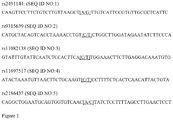
- the invention provides a method of identifying a subject at risk for suicide comprising identifying in a biological sample obtained from the subject one or more genetic markers associated with suicide, at least one marker being defined by rs2491144 (SEQ ID NO:1), wherein the presence of the G allele in marker rs2491144 identifies the subject is at increased risk for suicide, wherein the subject is a subject which has already been diagnosed with a mental illness or a subject which already exhibits one or more clinical symptoms of a mental illness.
- the invention also provides a computer readable medium containing executable instructions that when executed cause one or a plurality of processors to receive a subject's genotype for one or more genetic markers associated with suicide, at least one marker being defined by rs2491144 (SEQ ID NO:1), and, optionally, one or more additional markers selected from the group consisting of rs9315639 (SEQ ID NO:2), rs11082138 (SEQ ID NO:3), rs11697517 (SEQ ID NO:4), and rs2186437 (SEQ ID NO:5); identify the presence of the G allele in marker rs2491144 (SEQ ID NO:1), and, optionally, the C allele in marker rs9315639 (SEQ ID NO:2), the C allele in marker rs11082138 (SEQ ID NO:3), the T allele in marker rs11697517 (SEQ ID NO:4), and C allele in marker rs2186437 (SEQ ID NO:5)
- a method of identifying a subject at risk for suicide comprising identifying in a biological sample from the subject one or more genetic markers associated with suicide, at least one marker being defined by rs2491144 (SEQ ID NO:1), wherein the presence of the G allele in marker rs2491144 identifies the subject is at increased risk for suicide.
- the biological sample is a sample from blood, saliva. spinal fluid, brain biopsy, cultured cells obtained from the subject, stool, urine, autopsy samples, or frozen sections taken for histological purposes.
- the step of identifying in a biological sample from the subject one or more genetic markers associated with suicide comprises PCR analysis, sequencing, 5'exonuciease fluorescence assay, probe hybridization or a combination thereof.
- the subject is a subject diagnosed with a mental illness.
- the mental illness is selected from the group consisting of depression, schizophrenia, schizoaffective disorder, bipolar disorder, personality disorder, seasonal affective disorder, anxiety disorder, and post traumatic stress disorder.
- a method as described above and herein further comprising receiving, in a computer system, the subject's genotype for the one or more genetic markers associated with suicide and the identifying step is performed by the computer system.
- a computer readable medium containing executable instructions that when executed cause one or a plurality of processors to receive a subject's genotype for one or more genetic markers associated with suicide selected from the group consisting of rs2491144 (SEQ ID NO:1), rs9315639 (SEQ ID NO:2). rsl11082138 (SEQ IDNO:3). rs11697517 (SEQ ID NO:4), and rs2186437 (SEQ ID NO:5); identify the presence of any of the G allele in marker rs2491144 (SEQ ID NO:1), the C allele in marker rs9315639 (SEQ ID NO:2).
- a method for reducing the risk of suicide in a subject identified as being at increased risk for suicide comprising one or more of
- treating the subject with medication comprises administering one or more antipsychotics, mood stabilizers. antidepressants, anticonvulsants, antianxiolytics, or any combination thereof.
- the medication comprises clozapine, lithium, or ketamine.
- the non-medicinal therapy comprises electroconvulsive or electroshock therapy, magnetic seizure therapy, transcranial magnetic stimulation, cognitive behavioral therapy, dialectical behavioral therapy, risk dissipation group therapy, deep brain stimulation, or a combination thereof.
- testing or screening the subject for mental illness or one or more symptoms associated with suicide or mental illness comprises testing or screening the subject for depression, schizophrenia, schizoaffective disorder, bipolar disorder, obsessive compulsive disorder, personality disorder.
- seasonal affective disorder addiction, drug abuse, alcoholism, problem gambling, increased anxiety, anxiety disorder, feelings of worthlessness, psychotic symptoms, delusions, hallucinations, agitation, restlessness, irritability, aggression or anger.
- kit as defined above and herein comprising,
- the present disclosure provides a method of identifying a subject that is at risk for suicide comprising, testing a biological sample comprising genomic DNA of the subject to determine if the genomic DNA comprises one or more polymorphic markers associated with suicide defined by 1) rs2491144 (SEQ ID NO:1) or a fragment thereof comprising the polymorphic site, or a nucleotide sequence which is the complement of SEQ ID NO:1 or the fragment thereof comprising the polymorphic site; 2) rs9315639 (SEQ ID NO:2) or a fragment thereof comprising the polymorphic site, or a nucleotide sequence which is the complement of rs9315639 (SEQ ID NO:2) or a fragment thereof comprising the polymorphic site; 3) rs11082138 (SEQ ID NO:3) or a fragment thereof comprising the polymorphic site, or a nucleotide sequence which is the complement of rs11082138 (SEQ ID NO:3) or a fragment thereof comprising the polymorphic site; rs116975
- the fragments of the markers are at least 7 consecutive nucleotides.
- the fragments of the markers are at least 7 consecutive nucleotides. for example 7. 8, 9, 10, 11, 12, 13, 14, 15, 16, 17, 18, 19, 20, 21, 22, 23, 24, 25, 26, 27, 28, 29, 30, 31, 32, 33, 34, 35, 36, 37, 38, 39, 40, 41, 42, 43, 44, 45, 46, 47, 48, 49, or 50 consecutive nucleotides of the markers described in SEQ ID NO:1-5 or the complement thereof.
- the present disclosure also provides a method of identifying a subject that is at risk for suicide comprising, testing a biological sample comprising genomic DNA of the subject to determine if the genomic DNA comprises one or more polymorphic markers associated with suicide defined by rs2491144 (SEQ ID NO:1). rs9315639 (SEQ ID NO:2), rs11082138 (SEQ ID NO:3), rs11697517 (SEQ ID NO:4).
- rs2186437 (SEQ ID NO:5) or a combination thereof, wherein the presence of the G allele in marker rs2491144 identifies the subject is at increased risk for suicide, the presence of the C allele in marker rs9315639 identifies the subject is at increased risk for suicide, the presence of the C allele in marker rs11082138 identifies the subject is at increased risk for suicide, the presence or the T allele in marker rs11697517 identifies the subject is at increased risk for suicide, and; the presence of the C allele in marker rs2186437 identifies the subject is at increased risk for suicide.
- the marker is rs2491144.
- the one or more markers is rs2491144 and at least one of rs9315639, rs11082138, rs11697517, and rs2186437.
- the marker is rs2491 144 and this marker is employed in combination with one or more additional genetic markers that are known in the art to be predictive of suicide risk and/or mental illness.
- the method may be practiced as described above, but the testing a biological sample comprises testing the biological sample for genomic DNA of the subject to determine if the genomic DNA comprises one or more markers comprising the polymorphism that exhibits between 90% and 100% sequence identity to the markers described, for example, but not limited to 90%, 91%, 92%, 93%, 94%, 95%, 96%. 97%. 98%, 99%, 99.5%, 99.9% or 100% sequence identity with SEQ ID NO:1, SEQ ID NO:2. SEQ ID NO:3. SEQ ID NO:4, or SEQ ID: NO:5, or a fragment thereof and wherein the sequence also comprises the respective polymorphisms as shown above in underlined brackets.
- the first nucleotide shown in SEQ ID NO:1 is a "C".
- the present invention is meant to include a sequence that is substantially identical to SEQ ID NO:I but that comprises a different nucleotide, for example, a "G" at position number 1, as the variant nucleotide sequence exhibits more than 90% sequence identity with SEQ ID NO:1 and comprises the polymorphism shown in underlined brackets.
- oligonucleotide alignment algorithms may be used, for example, but not limited to a BLAST (GenBank URL: www.ncbi.nlm.nih.gov/cgi-bin/BLAST/, using default parameters: Program: blastn: Database: nr; Expect 10; filter: default: Alignment: pairwise; Query genetic Codes: Standard(I)), BLAST2 (EMBL URL: http://www.embl-heidelberg.de/Services/ index.html using default parameters: Matrix BLOSDM62: Filter: default, echofilter: on.
- BLAST GeneBank URL: www.ncbi.nlm.nih.gov/cgi-bin/BLAST/, using default parameters: Program: blastn: Database: nr; Expect 10; filter: default: Alignment: pairwise; Query genetic Codes: Standard(I)
- BLAST2 EMBL URL: http://www.embl-heidelberg.de/Services/ index.html using
- hybridize to each other under moderately stringent. or preferably stringent conditions Hybridization to filter-bound sequences under moderately stringent conditions may, for example, be performed in 0.5 M NaHPO 4 , 7% sodium dodecyl sulfate (SDS), 1 mM EDTA at 65°C, and washing in 0.2 x SSC/0.1% SDS at 42°C for at least 1 hour (see Ausubel, et al. (eds), 1989, Current Protocols in Molecular Biology. Vol. 1. Green Publishing Associates, Inc., and John Wiley & Sons. Inc., New York, at p. 2.10.3 ).
- hybridization to filter-bound sequences under stringent conditions may, for example, be performed in 0.5 M NaHPO 4 , 7% SDS, 1 mM EDTA at 65°C. and washing in 0.1 x SSC/0.1% SDS at 68° C for at least 1 hour.
- Hybridization conditions may be modified in accordance with known methods depending on the sequence of interest (see Tijssen, 1993, Laboratory Techniques in Biochemistry and Molecular Biology -- Hybridization with Nucleic Acid Probes, Part 1, Chapter 2 "Overview of principles of hybridization and the strategy of nucleic acid probe assays". Elsevier, New York ).
- stringent conditions are selected to be about 5°C lower than the thermal melting point for the specific sequence at a defined ionic strength and pH.
- the method as described herein may be employed to identify, treat or treat preventatively a subject that is at risk for suicide wherein at the time of testing or screening the subject appears healthy.
- This information may be important when testing/screening subjects that have a familial history of suicide or suicide attempts or mental illness, for example, but not limited to bipolar disease, schizophrenia or another mental illness, even though at the time of testing/screening, the subject may have little or no symptoms of disease or has not exhibited symptoms associated with suicide.
- Knowledge that the subject has one or more genetic markers associated with a higher risk of suicide may be useful in many ways, for example, by implementing proactive measures to reduce suicide risk at the earliest time possible or developing treatment regimens if for example, the subject later develops a mental illness such as, without limitation, bipolar disease, schizophrenia or another mental illness and requires treatment.
- the present disclosure also contemplates a method as described above that further comprises one or more steps to reduce the subject's risk of suicide.
- steps may comprise, but are not limited to treating the subject with medication such as, for example one or more antipsychotics, including typical and atypical antipsychotics, mood stabilizers, antidepressants, anticonvulsants, or other type(s) of medication, for example, but not wishing to be limiting, lithium, clozapine or ketamine.
- antipsychotics or “antipsychotic medication” it is meant any drug, pharmaceutical, natural product, composition or the like that may be employed to prevent and/or treat psychosis, schizophrenia, schizoaffective disorder, disruptive behavior, disorganized thinking, symptoms of mania, or any combination thereof in a subject.
- Antipsychotic medication may comprise, but is not limited to, drugs that affect dopamine signaling, for example, drugs that bind reversibly or irreversibly to one or more dopamine receptors, drugs that act as competitive or non-competitive inhibitors to downregulate dopamine receptor signaling, or that block the dopamine D2 receptor (see for example Seeman et al, 1976 and Seeman et al, 2005).
- antipsychotic drugs comprise clozapine, olanzapine, trifluoperazine; thioridazine, haloperidol, haloperidol decanoate, thiothixene, chlorpromazine, fluphenazine, loxapine, perphenazine, perphenazine decanoate, perphenazine-amitriptyline, acetophenazine, molindone, mesoridazine, fluphenazine decanoate, methotrimeprazine, risperidone, aripiprazole or a combination thereof.
- the antipsychotic drug comprises clozapine or a combination therapy comprising clozapine.
- the subject may also be treated with one or more non-medicinal therapies alone or in combination with treatment with medication.
- non-medicinat therapies include, but are not limited to electroconvulsive therapy or electroshock therapy, transcranial magnetic stimulation, cognitive behavioral therapy, dialectical behavioral therapy, risk dissipation group therapy or a combination thereof.
- the subject may be subjected to monitoring, for example more frequent or intensive monitoring by a physician, clinician, health care provider or family member.
- the subject may be subjected to counseling by a physician, psychologist, health care provider or the like.
- the method also contemplates embodiments wherein the subject is further tested or screened for one or more mental illnesses or one or more symptoms that are associated with mental illness or suicide.
- mental illnesses may include, but are not limited to depression, schizophrenia, schizoaffective disorder, bipolar disorder, obsessive compulsive disorder, personality disorder, seasonal affective disorder, mood disorder, post traumatic stress disorder, addiction, drug abuse, alcoholism, problem gambling and the like.
- Symptoms that are associated with mental illness are well known in the art and may be obtained from psychiatric diagnostic manuals known in the art, for example the Diagnostic and Statistical Manual of Mental Disorders (DSM IV) and the like.
- DSM IV Diagnostic and Statistical Manual of Mental Disorders
- Symptoms that can be associated with suicide include, among others, increased anxiety, feelings of worthlessness, psychotic symptoms, delusions, hallucinations, agitation, restlessness, irritability, aggression or anger.
- the subject that is tested may comprise an individual that has been diagnosed with a mental illness or exhibits one or more symptoms of a mental illness such as, without limitation, depression, bipolar symptoms, psychotic symptoms, schizophrenia symptoms, schizoaffective disorder symptoms or a combination thereof, for example, but not limited to as described in DSM-IV.
- Psychotic symptoms may comprise positive symptoms such as, but not limited to distortions or exaggerations of inferential thinking (i.e. delusions), perception (i.e. hallucinations), language and communication (disorganised speech) and behavior (grossly disorganized or catatonic behavior) or any combination thereof.
- the positive symptoms may comprise distinct dimensions, for example, psychotic dimensions including, but not limited to delusions and hallucinations and disorganization dimensions including, but not limited to disorganized speech and behavior.
- the symptoms may comprise one or more negative symptoms, for example, but not limited to symptoms that reflect a diminution or loss of normal function.
- the subject may exhibit a combination of both positive and negative symptoms.
- the subject that is tested has been diagnosed or is suspected of having bipolar disorder, schizophrenia or schizoaffective disorder.
- the method described above also contemplates testing the biological sample comprising DNA or a second biological sample obtained from the subject for one or more additional genetic markers, nucleotide sequences, proteins, metabolites or any combination thereof.
- the same or a different biological sample from the subject may be tested for other genetic markers known in the art that are associated with suicide ideation or mental illness including, but not limited to bipolar disease, schizophrenia, schizoaffective disorder and the like.
- the subject also may be tested for markers that predict drug treatment outcome or that assist in determining drug treatment.
- the subject may be tested to determine the presence of alcohol or drugs in blood or to determine the level of alcohol or drugs in blood, as it is known that alcohol and drug use may be contributing factors to suicidal tendencies and may also interact with drug treatment regimens.
- the method as described herein also contemplates removing or reducing access to compounds, compositions, articles or cues such as alcohol, drugs and the like which may increase suicide risk.
- the present disclosure provides:
- the method as described herein may further comprise selecting a subject that is diagnosed with a mental illness or that exhibits one or more symptoms associated with suicide or mental illness and obtaining the biological sample from the subject.
- tissue sample may be used for genotyping the polymorphisms in SEQ ID NO:1-5, including but not limited to, blood, saliva, spinal fluid, brain biopsy, cultured cells obtained from the subject, stool, urine, autopsy samples, or frozen sections taken for histological purposes.
- blood is obtained from a subject for assaying with respect to above mentioned polymorphisms.
- venous blood is obtained from a subject using standard venipuncture techniques.
- Polymorphisms may be genotyped using conventional techniques. For example, PCR using primers incorporating fluorescent probes is one suitable technique. Further, but not wishing to be considered limiting, primers having appropriate sequences upstream and downstream of the polymorphic site may be used to amplify the nucleotide regions comprising the polymorphisms.
- Single nucleotide polymorphism (SNP) analysis is useful for detecting differences between alleles of a gene or nucleotide sequence.
- SNP single nucleotide polymorphism
- various methods exist in the art for genotyping nucleotide sequences including, but not limited to 5'exonuclease assays, nucleotide sequencing, probe hybridization and the like. All such methods are meant to be encompassed herein.
- various real-time PCR methods that can be used to detect SNPs, including, e.g., Taqman or molecular beacon-based assays ( U.S. Pat. Nos.
- SNP detection methods are known in the art, including, without limitation, DNA sequencing, sequencing by hybridization, dot blotting, and oligonucleotide array (DNA Chip) hybridization analysis.
- Applied Biosystems, Inc has developed several aspects of SNP genotyping technology.
- PCR amplification of a desired SNP region is conducted using targeting primers, including two allele-specific fluorogenic probes, each consisting of a different fluorescent reporter dye and a fluorescent quencher.
- targeting primers including two allele-specific fluorogenic probes, each consisting of a different fluorescent reporter dye and a fluorescent quencher.
- FRET fluorescence resonance energy transfer
- the 5' nuclease activity of Taq digests the allele-specific probe bound to the region of the SNP, releasing the fluorescent dye from the quencher and allowing generation of a fluorescence signal.
- the presence of a particular allele at the polymorphic site is determined in relation to the adjacent nucleotide sequence upstream and downstream from the polymorphic site, for example, but not limited to, about 3, 4. 5, 6, 7, 8, 9, 10, 11, 12, 13, 14 or 15 nucleotides upstream and/or about 3, 4, 5, 6, 7, 8, 9, 10, 11, 12, 13, 14 or 15 nucleotides downstream of the polymorphic site.
- the present disclosure also contemplates that the presence of a particular allele may be determined in relation to the nucleotide sequence comprising about 20, 25, 30, 50 or more nucleotides upstream (or any number therein between) and about 20, 25, 30, 50 and/or more nucleotides downstream (or any number therein between) of the polymorphic site as provided by SEQ ID NOs: 1-5, respectively.
- the term "and/or" is used to specifically indicate that the number of continuous upstream and downstream nucleotides does not need to be the same.
- DNA may be extracted using a non-enzymatic high-salt procedure. Alternatively, the DNA may be analyzed in situ.
- RNAs that are produced may be isolated and analyzed by well-known methods known in the art and is meant to be encompassed by the method of the present disclosure as described herein.
- kits com prising are also provided by the present disclosure.
- Example GBP 334 bipolar disorder patients
- SCAN Schedules for Clinical Assessment in Neuropsychiatry
- Genotyping Sample GBP was genotyped with the Illumina Sentrix Human Hap550 Bead chip (Illumina Inc., San Diego. CA, USA) mostly at lllumina Inc. (San Diego. CA. USA), with 290 subjects being genotyped at the Genome Quebec facility (Montreal, Quebec, Canada).
- rs2491144 on chromosome 1 We found rs2491144 on chromosome 1 to be associated with suicide severity in the GBP sample (p ⁇ 0,05: Table 1). We also found positive findings in the GBP sample with a number of other markers: rs93 15639 on chromosome 13. rs11082138 on chromosome 18. and rs11697517 on chromosome 20. and rs2186437 on chromosome 21.
- rs2491144 is mapped to the 3' region of SDC3 coding for the syndecan 3 protein, which is highly expressed in neural cells 18). and maybe important in brain development (19). Studies on mice deficient in sdc3 indicated a role of this protein in long-term potentiation and hippocampal memory (20).
- the rs9315639 marker is mapped to the STOML3 stomatin (EPB72)-like 3 gene, which appears to be important for mechanoreceptor mediated signal transduction in sensory neurons (21).
- the rs2186437 marker is located approximately 1.4Mb 3' of the amyloid beta (A4) precursor protein-coding gene APP. which has been implicated in Alzheimer's disease.
Landscapes
- Health & Medical Sciences (AREA)
- Life Sciences & Earth Sciences (AREA)
- Chemical & Material Sciences (AREA)
- Engineering & Computer Science (AREA)
- Proteomics, Peptides & Aminoacids (AREA)
- Organic Chemistry (AREA)
- Bioinformatics & Cheminformatics (AREA)
- General Health & Medical Sciences (AREA)
- Analytical Chemistry (AREA)
- Physics & Mathematics (AREA)
- Medical Informatics (AREA)
- Public Health (AREA)
- Wood Science & Technology (AREA)
- Genetics & Genomics (AREA)
- Zoology (AREA)
- Biophysics (AREA)
- Biotechnology (AREA)
- Pathology (AREA)
- Biomedical Technology (AREA)
- Theoretical Computer Science (AREA)
- Bioinformatics & Computational Biology (AREA)
- Microbiology (AREA)
- Immunology (AREA)
- General Engineering & Computer Science (AREA)
- Biochemistry (AREA)
- Molecular Biology (AREA)
- Spectroscopy & Molecular Physics (AREA)
- Evolutionary Biology (AREA)
- Veterinary Medicine (AREA)
- Neurology (AREA)
- Pharmacology & Pharmacy (AREA)
- Nuclear Medicine, Radiotherapy & Molecular Imaging (AREA)
- Medicinal Chemistry (AREA)
- General Chemical & Material Sciences (AREA)
- Chemical Kinetics & Catalysis (AREA)
- Animal Behavior & Ethology (AREA)
- Neurosurgery (AREA)
- Primary Health Care (AREA)
- Databases & Information Systems (AREA)
- Epidemiology (AREA)
Applications Claiming Priority (2)
| Application Number | Priority Date | Filing Date | Title |
|---|---|---|---|
| US201361920332P | 2013-12-23 | 2013-12-23 | |
| PCT/CA2014/051257 WO2015095967A1 (en) | 2013-12-23 | 2014-12-23 | Genetic markers associated with suicide risk and methods of use thereof |
Publications (3)
| Publication Number | Publication Date |
|---|---|
| EP3087203A1 EP3087203A1 (en) | 2016-11-02 |
| EP3087203A4 EP3087203A4 (en) | 2017-09-20 |
| EP3087203B1 true EP3087203B1 (en) | 2019-09-11 |
Family
ID=53477254
Family Applications (1)
| Application Number | Title | Priority Date | Filing Date |
|---|---|---|---|
| EP14873830.5A Not-in-force EP3087203B1 (en) | 2013-12-23 | 2014-12-23 | Genetic markers associated with suicide risk and methods of use thereof |
Country Status (10)
| Country | Link |
|---|---|
| US (1) | US10435748B2 (https=) |
| EP (1) | EP3087203B1 (https=) |
| JP (1) | JP6679486B2 (https=) |
| KR (1) | KR20160111925A (https=) |
| CN (1) | CN106062213A (https=) |
| AU (1) | AU2014373588B2 (https=) |
| CA (1) | CA2934815C (https=) |
| IL (1) | IL246417B (https=) |
| SG (1) | SG11201605150YA (https=) |
| WO (1) | WO2015095967A1 (https=) |
Families Citing this family (6)
| Publication number | Priority date | Publication date | Assignee | Title |
|---|---|---|---|---|
| CA2891830A1 (en) | 2015-05-15 | 2016-11-15 | Centre For Addiction And Mental Health | Genetic markers for suicide risk and related methods |
| US20170312289A1 (en) * | 2016-04-29 | 2017-11-02 | Supernus Pharmaceuticals, Inc. | Methods, system, and kit for monitoring, diagnosing, and treating impulsive aggression |
| CN108531569B (zh) * | 2017-03-03 | 2021-05-07 | 上海伯豪医学检验所有限公司 | 用于强迫症与精神分裂症、抑郁症甄别的基因标志物及其应用 |
| CN108148905A (zh) * | 2018-02-13 | 2018-06-12 | 广州市番禺区中心医院(广州市番禺区人民医院、广州市番禺区心血管疾病研究所) | 一段可作为抑郁症标记物的序列 |
| EP3975190A4 (en) * | 2019-05-23 | 2023-05-03 | Ulsan National Institute of Science and Technology (UNIST) | METHOD OF DISCOVERING A MARKER FOR PREDICTING RISK OF DEPRESSION OR SUICIDE USING MULTIOMICS ANALYSIS, MARKERS FOR PREDICTING RISK OF DEPRESSION OR SUICIDE AND METHODS OF PREDICTING RISK OF DEPRESSION OR SUICIDE USING MULTIOMICS ANALYSIS |
| WO2024215722A1 (en) * | 2023-04-10 | 2024-10-17 | Board Of Regents, The University Of Texas System | Methods and compositions for diagnosing and treating depression and suicide risk |
Family Cites Families (5)
| Publication number | Priority date | Publication date | Assignee | Title |
|---|---|---|---|---|
| USH2191H1 (en) | 2000-10-24 | 2007-06-05 | Snp Consortium | Identification and mapping of single nucleotide polymorphisms in the human genome |
| US7361468B2 (en) | 2004-07-02 | 2008-04-22 | Affymetrix, Inc. | Methods for genotyping polymorphisms in humans |
| EP2166112B1 (en) * | 2008-09-18 | 2013-06-05 | Max-Planck-Gesellschaft zur Förderung der Wissenschaften e.V. | Means and methods for diagnosing predisposition for treatment emergent suicidal ideation |
| CA2736936A1 (en) * | 2008-09-18 | 2010-03-25 | Andreas Menke | Means and methods for diagnosing predisposition for treatment emergent suicidal ideation (tesi) |
| KR101249635B1 (ko) * | 2010-10-13 | 2013-04-01 | 서울대학교산학협력단 | 양극성 장애 진단용 egr2 유전자 snp, 그를 포함하는 마이크로어레이 및 키트 |
-
2014
- 2014-12-23 JP JP2016542129A patent/JP6679486B2/ja active Active
- 2014-12-23 CA CA2934815A patent/CA2934815C/en active Active
- 2014-12-23 CN CN201480076117.6A patent/CN106062213A/zh active Pending
- 2014-12-23 WO PCT/CA2014/051257 patent/WO2015095967A1/en not_active Ceased
- 2014-12-23 KR KR1020167019492A patent/KR20160111925A/ko not_active Withdrawn
- 2014-12-23 US US15/107,437 patent/US10435748B2/en active Active
- 2014-12-23 EP EP14873830.5A patent/EP3087203B1/en not_active Not-in-force
- 2014-12-23 SG SG11201605150YA patent/SG11201605150YA/en unknown
- 2014-12-23 AU AU2014373588A patent/AU2014373588B2/en not_active Ceased
-
2016
- 2016-06-23 IL IL246417A patent/IL246417B/en active IP Right Grant
Non-Patent Citations (1)
| Title |
|---|
| None * |
Also Published As
| Publication number | Publication date |
|---|---|
| IL246417B (en) | 2020-08-31 |
| EP3087203A4 (en) | 2017-09-20 |
| US20170002412A1 (en) | 2017-01-05 |
| JP2017503493A (ja) | 2017-02-02 |
| CA2934815C (en) | 2022-01-04 |
| IL246417A0 (en) | 2016-08-31 |
| US10435748B2 (en) | 2019-10-08 |
| CA2934815A1 (en) | 2015-07-02 |
| SG11201605150YA (en) | 2016-07-28 |
| CN106062213A (zh) | 2016-10-26 |
| EP3087203A1 (en) | 2016-11-02 |
| AU2014373588A1 (en) | 2016-07-21 |
| JP6679486B2 (ja) | 2020-04-15 |
| WO2015095967A1 (en) | 2015-07-02 |
| AU2014373588B2 (en) | 2021-04-01 |
| KR20160111925A (ko) | 2016-09-27 |
Similar Documents
| Publication | Publication Date | Title |
|---|---|---|
| Smith et al. | Multiple regulatory variants modulate expression of 5-hydroxytryptamine 2A receptors in human cortex | |
| EP3087203B1 (en) | Genetic markers associated with suicide risk and methods of use thereof | |
| Morris et al. | No evidence for association of the dysbindin gene [DTNBP1] with schizophrenia in an Irish population-based study | |
| Wong et al. | Association between schizophrenia and the syntaxin 1A gene | |
| KR102158716B1 (ko) | Arhgap32 유전자의 단일염기다형성을 포함하는 뇌동맥류 진단용 snp 마커 | |
| Cossée et al. | Exonic microdeletions in the X-linked PQBP1 gene in mentally retarded patients: a pathogenic mutation and in-frame deletions of uncertain effect | |
| US10301678B2 (en) | Genetic markers for antipsychotic induced weight gain and methods for use thereof | |
| KR102158713B1 (ko) | Gba 유전자의 단일염기다형성을 포함하는 뇌동맥류 진단용 snp 마커 | |
| KR102158721B1 (ko) | Rnf144a 유전자의 단일염기다형성을 포함하는 뇌동맥류 진단용 snp 마커 | |
| AU2014336928A1 (en) | Genetic markers for antipsychotic induced weight gain and methods for use thereof | |
| US20230220472A1 (en) | Deterimining risk of spontaneous coronary artery dissection and myocardial infarction and sysems and methods of use thereof | |
| US20100129805A1 (en) | Slc1a1 antipsychotic drug response markers | |
| JP6788879B2 (ja) | 末梢動脈疾患検査方法及び検査用試薬 | |
| KR102158725B1 (ko) | Mink1 유전자의 단일염기다형성을 포함하는 뇌동맥류 진단용 snp 마커 | |
| KR102158723B1 (ko) | Spcs3 유전자의 단일염기다형성을 포함하는 뇌동맥류 진단용 snp 마커 | |
| KR102158719B1 (ko) | Loc102724084 유전자의 단일염기다형성을 포함하는 뇌동맥류 진단용 snp 마커 | |
| KR102158720B1 (ko) | Lrrc3 유전자의 단일염기다형성을 포함하는 뇌동맥류 진단용 snp 마커 | |
| KR102158722B1 (ko) | Flj45964 유전자의 단일염기다형성을 포함하는 뇌동맥류 진단용 snp 마커 | |
| KR102158714B1 (ko) | Tcf24 유전자의 단일염기다형성을 포함하는 뇌동맥류 진단용 snp 마커 | |
| KR20260039156A (ko) | 뇌전증 진단용 조성물 | |
| Bergen et al. | Summaries from the XVIII World Congress of Psychiatric Genetics, Athens, Greece, 3–7 October 2010 | |
| KR20250053768A (ko) | 회전근개 파열 예측 또는 진단용 조성물, 키트 및 이를 이용한 진단 방법 | |
| Toncheva | Rare chromosomal deletions and duplications increase risk of schizophrenia | |
| HK1224705B (en) | Genetic markers for antipsychotic induced weight gain and methods for use thereof | |
| HK1224705A1 (en) | Genetic markers for antipsychotic induced weight gain and methods for use thereof |
Legal Events
| Date | Code | Title | Description |
|---|---|---|---|
| PUAI | Public reference made under article 153(3) epc to a published international application that has entered the european phase |
Free format text: ORIGINAL CODE: 0009012 |
|
| 17P | Request for examination filed |
Effective date: 20160701 |
|
| AK | Designated contracting states |
Kind code of ref document: A1 Designated state(s): AL AT BE BG CH CY CZ DE DK EE ES FI FR GB GR HR HU IE IS IT LI LT LU LV MC MK MT NL NO PL PT RO RS SE SI SK SM TR |
|
| AX | Request for extension of the european patent |
Extension state: BA ME |
|
| DAX | Request for extension of the european patent (deleted) | ||
| RIC1 | Information provided on ipc code assigned before grant |
Ipc: C12Q 1/68 20060101AFI20170509BHEP Ipc: G06F 19/18 20110101ALI20170509BHEP Ipc: C07H 21/04 20060101ALI20170509BHEP Ipc: C40B 30/04 20060101ALI20170509BHEP Ipc: C40B 40/06 20060101ALI20170509BHEP |
|
| A4 | Supplementary search report drawn up and despatched |
Effective date: 20170823 |
|
| RIC1 | Information provided on ipc code assigned before grant |
Ipc: C12Q 1/68 20060101AFI20170817BHEP Ipc: C40B 30/04 20060101ALI20170817BHEP Ipc: G06F 19/18 20110101ALI20170817BHEP Ipc: C40B 40/06 20060101ALI20170817BHEP Ipc: C07H 21/04 20060101ALI20170817BHEP |
|
| STAA | Information on the status of an ep patent application or granted ep patent |
Free format text: STATUS: EXAMINATION IS IN PROGRESS |
|
| 17Q | First examination report despatched |
Effective date: 20180725 |
|
| REG | Reference to a national code |
Ref country code: DE Ref legal event code: R079 Ref document number: 602014053649 Country of ref document: DE Free format text: PREVIOUS MAIN CLASS: C12Q0001680000 Ipc: C12Q0001688300 |
|
| GRAP | Despatch of communication of intention to grant a patent |
Free format text: ORIGINAL CODE: EPIDOSNIGR1 |
|
| STAA | Information on the status of an ep patent application or granted ep patent |
Free format text: STATUS: GRANT OF PATENT IS INTENDED |
|
| RIC1 | Information provided on ipc code assigned before grant |
Ipc: C12Q 1/6883 20180101AFI20190315BHEP |
|
| INTG | Intention to grant announced |
Effective date: 20190412 |
|
| GRAS | Grant fee paid |
Free format text: ORIGINAL CODE: EPIDOSNIGR3 |
|
| GRAA | (expected) grant |
Free format text: ORIGINAL CODE: 0009210 |
|
| STAA | Information on the status of an ep patent application or granted ep patent |
Free format text: STATUS: THE PATENT HAS BEEN GRANTED |
|
| AK | Designated contracting states |
Kind code of ref document: B1 Designated state(s): AL AT BE BG CH CY CZ DE DK EE ES FI FR GB GR HR HU IE IS IT LI LT LU LV MC MK MT NL NO PL PT RO RS SE SI SK SM TR |
|
| REG | Reference to a national code |
Ref country code: GB Ref legal event code: FG4D |
|
| REG | Reference to a national code |
Ref country code: CH Ref legal event code: EP |
|
| REG | Reference to a national code |
Ref country code: AT Ref legal event code: REF Ref document number: 1178510 Country of ref document: AT Kind code of ref document: T Effective date: 20190915 |
|
| REG | Reference to a national code |
Ref country code: DE Ref legal event code: R096 Ref document number: 602014053649 Country of ref document: DE Ref country code: IE Ref legal event code: FG4D |
|
| REG | Reference to a national code |
Ref country code: NL Ref legal event code: FP |
|
| REG | Reference to a national code |
Ref country code: LT Ref legal event code: MG4D |
|
| PG25 | Lapsed in a contracting state [announced via postgrant information from national office to epo] |
Ref country code: FI Free format text: LAPSE BECAUSE OF FAILURE TO SUBMIT A TRANSLATION OF THE DESCRIPTION OR TO PAY THE FEE WITHIN THE PRESCRIBED TIME-LIMIT Effective date: 20190911 Ref country code: HR Free format text: LAPSE BECAUSE OF FAILURE TO SUBMIT A TRANSLATION OF THE DESCRIPTION OR TO PAY THE FEE WITHIN THE PRESCRIBED TIME-LIMIT Effective date: 20190911 Ref country code: LT Free format text: LAPSE BECAUSE OF FAILURE TO SUBMIT A TRANSLATION OF THE DESCRIPTION OR TO PAY THE FEE WITHIN THE PRESCRIBED TIME-LIMIT Effective date: 20190911 Ref country code: NO Free format text: LAPSE BECAUSE OF FAILURE TO SUBMIT A TRANSLATION OF THE DESCRIPTION OR TO PAY THE FEE WITHIN THE PRESCRIBED TIME-LIMIT Effective date: 20191211 Ref country code: BG Free format text: LAPSE BECAUSE OF FAILURE TO SUBMIT A TRANSLATION OF THE DESCRIPTION OR TO PAY THE FEE WITHIN THE PRESCRIBED TIME-LIMIT Effective date: 20191211 Ref country code: SE Free format text: LAPSE BECAUSE OF FAILURE TO SUBMIT A TRANSLATION OF THE DESCRIPTION OR TO PAY THE FEE WITHIN THE PRESCRIBED TIME-LIMIT Effective date: 20190911 |
|
| PG25 | Lapsed in a contracting state [announced via postgrant information from national office to epo] |
Ref country code: ES Free format text: LAPSE BECAUSE OF FAILURE TO SUBMIT A TRANSLATION OF THE DESCRIPTION OR TO PAY THE FEE WITHIN THE PRESCRIBED TIME-LIMIT Effective date: 20190911 Ref country code: GR Free format text: LAPSE BECAUSE OF FAILURE TO SUBMIT A TRANSLATION OF THE DESCRIPTION OR TO PAY THE FEE WITHIN THE PRESCRIBED TIME-LIMIT Effective date: 20191212 Ref country code: RS Free format text: LAPSE BECAUSE OF FAILURE TO SUBMIT A TRANSLATION OF THE DESCRIPTION OR TO PAY THE FEE WITHIN THE PRESCRIBED TIME-LIMIT Effective date: 20190911 Ref country code: LV Free format text: LAPSE BECAUSE OF FAILURE TO SUBMIT A TRANSLATION OF THE DESCRIPTION OR TO PAY THE FEE WITHIN THE PRESCRIBED TIME-LIMIT Effective date: 20190911 Ref country code: AL Free format text: LAPSE BECAUSE OF FAILURE TO SUBMIT A TRANSLATION OF THE DESCRIPTION OR TO PAY THE FEE WITHIN THE PRESCRIBED TIME-LIMIT Effective date: 20190911 |
|
| REG | Reference to a national code |
Ref country code: AT Ref legal event code: MK05 Ref document number: 1178510 Country of ref document: AT Kind code of ref document: T Effective date: 20190911 |
|
| PG25 | Lapsed in a contracting state [announced via postgrant information from national office to epo] |
Ref country code: PL Free format text: LAPSE BECAUSE OF FAILURE TO SUBMIT A TRANSLATION OF THE DESCRIPTION OR TO PAY THE FEE WITHIN THE PRESCRIBED TIME-LIMIT Effective date: 20190911 Ref country code: RO Free format text: LAPSE BECAUSE OF FAILURE TO SUBMIT A TRANSLATION OF THE DESCRIPTION OR TO PAY THE FEE WITHIN THE PRESCRIBED TIME-LIMIT Effective date: 20190911 Ref country code: IT Free format text: LAPSE BECAUSE OF FAILURE TO SUBMIT A TRANSLATION OF THE DESCRIPTION OR TO PAY THE FEE WITHIN THE PRESCRIBED TIME-LIMIT Effective date: 20190911 Ref country code: EE Free format text: LAPSE BECAUSE OF FAILURE TO SUBMIT A TRANSLATION OF THE DESCRIPTION OR TO PAY THE FEE WITHIN THE PRESCRIBED TIME-LIMIT Effective date: 20190911 Ref country code: AT Free format text: LAPSE BECAUSE OF FAILURE TO SUBMIT A TRANSLATION OF THE DESCRIPTION OR TO PAY THE FEE WITHIN THE PRESCRIBED TIME-LIMIT Effective date: 20190911 Ref country code: PT Free format text: LAPSE BECAUSE OF FAILURE TO SUBMIT A TRANSLATION OF THE DESCRIPTION OR TO PAY THE FEE WITHIN THE PRESCRIBED TIME-LIMIT Effective date: 20200113 |
|
| PG25 | Lapsed in a contracting state [announced via postgrant information from national office to epo] |
Ref country code: SM Free format text: LAPSE BECAUSE OF FAILURE TO SUBMIT A TRANSLATION OF THE DESCRIPTION OR TO PAY THE FEE WITHIN THE PRESCRIBED TIME-LIMIT Effective date: 20190911 Ref country code: IS Free format text: LAPSE BECAUSE OF FAILURE TO SUBMIT A TRANSLATION OF THE DESCRIPTION OR TO PAY THE FEE WITHIN THE PRESCRIBED TIME-LIMIT Effective date: 20200224 Ref country code: SK Free format text: LAPSE BECAUSE OF FAILURE TO SUBMIT A TRANSLATION OF THE DESCRIPTION OR TO PAY THE FEE WITHIN THE PRESCRIBED TIME-LIMIT Effective date: 20190911 Ref country code: CZ Free format text: LAPSE BECAUSE OF FAILURE TO SUBMIT A TRANSLATION OF THE DESCRIPTION OR TO PAY THE FEE WITHIN THE PRESCRIBED TIME-LIMIT Effective date: 20190911 |
|
| REG | Reference to a national code |
Ref country code: DE Ref legal event code: R097 Ref document number: 602014053649 Country of ref document: DE |
|
| PLBE | No opposition filed within time limit |
Free format text: ORIGINAL CODE: 0009261 |
|
| STAA | Information on the status of an ep patent application or granted ep patent |
Free format text: STATUS: NO OPPOSITION FILED WITHIN TIME LIMIT |
|
| PG2D | Information on lapse in contracting state deleted |
Ref country code: IS |
|
| PG25 | Lapsed in a contracting state [announced via postgrant information from national office to epo] |
Ref country code: DK Free format text: LAPSE BECAUSE OF FAILURE TO SUBMIT A TRANSLATION OF THE DESCRIPTION OR TO PAY THE FEE WITHIN THE PRESCRIBED TIME-LIMIT Effective date: 20190911 Ref country code: IS Free format text: LAPSE BECAUSE OF FAILURE TO SUBMIT A TRANSLATION OF THE DESCRIPTION OR TO PAY THE FEE WITHIN THE PRESCRIBED TIME-LIMIT Effective date: 20200112 |
|
| REG | Reference to a national code |
Ref country code: CH Ref legal event code: PL |
|
| 26N | No opposition filed |
Effective date: 20200615 |
|
| REG | Reference to a national code |
Ref country code: BE Ref legal event code: MM Effective date: 20191231 |
|
| PG25 | Lapsed in a contracting state [announced via postgrant information from national office to epo] |
Ref country code: SI Free format text: LAPSE BECAUSE OF FAILURE TO SUBMIT A TRANSLATION OF THE DESCRIPTION OR TO PAY THE FEE WITHIN THE PRESCRIBED TIME-LIMIT Effective date: 20190911 Ref country code: MC Free format text: LAPSE BECAUSE OF FAILURE TO SUBMIT A TRANSLATION OF THE DESCRIPTION OR TO PAY THE FEE WITHIN THE PRESCRIBED TIME-LIMIT Effective date: 20190911 |
|
| PG25 | Lapsed in a contracting state [announced via postgrant information from national office to epo] |
Ref country code: IE Free format text: LAPSE BECAUSE OF NON-PAYMENT OF DUE FEES Effective date: 20191223 Ref country code: LU Free format text: LAPSE BECAUSE OF NON-PAYMENT OF DUE FEES Effective date: 20191223 |
|
| PG25 | Lapsed in a contracting state [announced via postgrant information from national office to epo] |
Ref country code: CH Free format text: LAPSE BECAUSE OF NON-PAYMENT OF DUE FEES Effective date: 20191231 Ref country code: BE Free format text: LAPSE BECAUSE OF NON-PAYMENT OF DUE FEES Effective date: 20191231 Ref country code: LI Free format text: LAPSE BECAUSE OF NON-PAYMENT OF DUE FEES Effective date: 20191231 |
|
| REG | Reference to a national code |
Ref country code: DE Ref legal event code: R082 Ref document number: 602014053649 Country of ref document: DE Representative=s name: HL KEMPNER PATENTANWALT, RECHTSANWALT, SOLICIT, DE |
|
| PGFP | Annual fee paid to national office [announced via postgrant information from national office to epo] |
Ref country code: GB Payment date: 20201223 Year of fee payment: 7 Ref country code: FR Payment date: 20201222 Year of fee payment: 7 |
|
| PGFP | Annual fee paid to national office [announced via postgrant information from national office to epo] |
Ref country code: NL Payment date: 20201223 Year of fee payment: 7 |
|
| PG25 | Lapsed in a contracting state [announced via postgrant information from national office to epo] |
Ref country code: CY Free format text: LAPSE BECAUSE OF FAILURE TO SUBMIT A TRANSLATION OF THE DESCRIPTION OR TO PAY THE FEE WITHIN THE PRESCRIBED TIME-LIMIT Effective date: 20190911 |
|
| PGFP | Annual fee paid to national office [announced via postgrant information from national office to epo] |
Ref country code: DE Payment date: 20201222 Year of fee payment: 7 |
|
| PG25 | Lapsed in a contracting state [announced via postgrant information from national office to epo] |
Ref country code: MT Free format text: LAPSE BECAUSE OF FAILURE TO SUBMIT A TRANSLATION OF THE DESCRIPTION OR TO PAY THE FEE WITHIN THE PRESCRIBED TIME-LIMIT Effective date: 20190911 Ref country code: HU Free format text: LAPSE BECAUSE OF FAILURE TO SUBMIT A TRANSLATION OF THE DESCRIPTION OR TO PAY THE FEE WITHIN THE PRESCRIBED TIME-LIMIT; INVALID AB INITIO Effective date: 20141223 |
|
| PG25 | Lapsed in a contracting state [announced via postgrant information from national office to epo] |
Ref country code: TR Free format text: LAPSE BECAUSE OF FAILURE TO SUBMIT A TRANSLATION OF THE DESCRIPTION OR TO PAY THE FEE WITHIN THE PRESCRIBED TIME-LIMIT Effective date: 20190911 |
|
| PG25 | Lapsed in a contracting state [announced via postgrant information from national office to epo] |
Ref country code: MK Free format text: LAPSE BECAUSE OF FAILURE TO SUBMIT A TRANSLATION OF THE DESCRIPTION OR TO PAY THE FEE WITHIN THE PRESCRIBED TIME-LIMIT Effective date: 20190911 |
|
| REG | Reference to a national code |
Ref country code: DE Ref legal event code: R119 Ref document number: 602014053649 Country of ref document: DE |
|
| REG | Reference to a national code |
Ref country code: NL Ref legal event code: MM Effective date: 20220101 |
|
| GBPC | Gb: european patent ceased through non-payment of renewal fee |
Effective date: 20211223 |
|
| PG25 | Lapsed in a contracting state [announced via postgrant information from national office to epo] |
Ref country code: NL Free format text: LAPSE BECAUSE OF NON-PAYMENT OF DUE FEES Effective date: 20220101 |
|
| PG25 | Lapsed in a contracting state [announced via postgrant information from national office to epo] |
Ref country code: GB Free format text: LAPSE BECAUSE OF NON-PAYMENT OF DUE FEES Effective date: 20211223 Ref country code: DE Free format text: LAPSE BECAUSE OF NON-PAYMENT OF DUE FEES Effective date: 20220701 |
|
| PG25 | Lapsed in a contracting state [announced via postgrant information from national office to epo] |
Ref country code: FR Free format text: LAPSE BECAUSE OF NON-PAYMENT OF DUE FEES Effective date: 20211231 |