EP3082151B1 - Massenspektrometer und verfahren zur massenbestimmung mit ionenmobilitätsmessungen - Google Patents
Massenspektrometer und verfahren zur massenbestimmung mit ionenmobilitätsmessungen Download PDFInfo
- Publication number
- EP3082151B1 EP3082151B1 EP16165255.7A EP16165255A EP3082151B1 EP 3082151 B1 EP3082151 B1 EP 3082151B1 EP 16165255 A EP16165255 A EP 16165255A EP 3082151 B1 EP3082151 B1 EP 3082151B1
- Authority
- EP
- European Patent Office
- Prior art keywords
- ion
- drift
- gases
- mass
- analyte
- Prior art date
- Legal status (The legal status is an assumption and is not a legal conclusion. Google has not performed a legal analysis and makes no representation as to the accuracy of the status listed.)
- Not-in-force
Links
Images
Classifications
-
- G—PHYSICS
- G01—MEASURING; TESTING
- G01N—INVESTIGATING OR ANALYSING MATERIALS BY DETERMINING THEIR CHEMICAL OR PHYSICAL PROPERTIES
- G01N27/00—Investigating or analysing materials by the use of electric, electrochemical, or magnetic means
- G01N27/62—Investigating or analysing materials by the use of electric, electrochemical, or magnetic means by investigating the ionisation of gases, e.g. aerosols; by investigating electric discharges, e.g. emission of cathode
- G01N27/622—Ion mobility spectrometry
- G01N27/623—Ion mobility spectrometry combined with mass spectrometry
-
- H—ELECTRICITY
- H01—ELECTRIC ELEMENTS
- H01J—ELECTRIC DISCHARGE TUBES OR DISCHARGE LAMPS
- H01J49/00—Particle spectrometers or separator tubes
- H01J49/0027—Methods for using particle spectrometers
-
- H—ELECTRICITY
- H01—ELECTRIC ELEMENTS
- H01J—ELECTRIC DISCHARGE TUBES OR DISCHARGE LAMPS
- H01J49/00—Particle spectrometers or separator tubes
- H01J49/26—Mass spectrometers or separator tubes
-
- H—ELECTRICITY
- H01—ELECTRIC ELEMENTS
- H01J—ELECTRIC DISCHARGE TUBES OR DISCHARGE LAMPS
- H01J49/00—Particle spectrometers or separator tubes
- H01J49/004—Combinations of spectrometers, tandem spectrometers, e.g. MS/MS, MSn
Definitions
- the present invention relates generally to mass spectrometers and in particular to a mass spectrometer that may be operated at higher pressures.
- the present invention provides a method of mass spectrometry comprising:
- the present invention recognises that by determining the ion mobilities of the same analyte ion in three different drift gases, the mass of the analyte can be determined without having to know the specific properties of the analyte ion (such as ion radius or properties related to analyte structure and charge distribution).
- This method of mass spectrometry is based on ion mobility spectrometry and so can be performed at relatively high pressures, eliminating the requirement for expensive and bulky vacuum pumps.
- analyte ion' may relate to an ion population containing or consisting of a single type of analyte ion (i.e. a single molecular species) or may relate to an ion population containing or consisting of multiple isomers.
- the only variables in the algorithm or relationship other than said mass may be variables representative of the ion mobilities of the analyte ion through the three different drift gases; or the only variables in the algorithm or relationship other than said mass may be variables representative of the ion mobilities of the analyte ion through the three different drift gases and physicochemical properties of the three different drift gases; and the method may comprise using the measured ion mobilities, said physicochemical properties of the first, second and third drift gases, and said algorithm or relationship to determine the mass of the analyte ion.
- the method may comprise measuring the ion mobilities through said three gases of at least four different mass standard ions of known mass, and using these measured ion mobilities and known masses to derive said algorithm or relationship.
- the present invention also provides a method of mass spectrometry comprising:
- the method may comprise determining the mass of the analyte ion by introducing the measured values of the ion mobilities (K n ) into the first equation; introducing known values, or measuring and introducing values, of P ij , R ij , q, N n , T n and M n into the first equation; and solving the first equation for the mass of the analyte ion.
- the polarizability of one, two or three of the three different drift gases may be known or may be measured according to the present invention.
- the three gases have different polarizabilities.
- the effective radius of the drift gas molecule or atom for each of the three different drift gases may be known or may be measured according to embodiments of the present invention.
- the charge q of the analyte ion may be known or may be measured according to embodiments of the present invention. Alternatively, the value of q may be assumed to have a fixed value (e.g. one), or masses may be provided for a range of possible charge states.
- the number density N n of one, two or three of the drift gases may be known or may be measured according to embodiments of the present invention.
- the temperature T n of one, two or three of the drift gases may be known or may be measured according to embodiments of the present invention.
- the mass of said drift gas molecule or atom for one, two or three of the drift gases may be known or may be measured according to embodiments of the present invention.
- the at least one of said drift gases may be a substantially pure gas, rather than a composition of different gases.
- the analyte ion may be an unknown analyte ion.
- One, two or three of said drift gases may be maintained substantially at atmospheric pressure; or one, two or three of said drift gases may be maintained at a pressure selected from the group consisting of: (i) > 0.0001 mbar; (ii) > 0.001 mbar; (iii) > 0.01 mbar; (iv) > 0.1 mbar; (v) > 1 mbar; (vi) > 10 mbar; (vii) > 100 mbar; (viii) > 1000 mbar; (ix) 0.0001-0.001 mbar; (x) 0.001-0.01 mbar; (xi) 0.01-0.1 mbar; (xii) 0.1-1 mbar; (xiii) 1-10 mbar; (xiv) 10-100 mbar; and (xv) 100-1000 mbar.
- the step of measuring the ion mobilities of the analyte ion through the different drift gases may comprise measuring the drift time of the analyte ion through each of the three different drift gases.
- the ion mobility through any one of the gases may be determined as the length of drift gas that the ion is urged through, divided by the product of the drift time along said length and the electric field strength of the electric field maintained along said length.
- the ion mobility through any one of the gases may be determined by making measurements of drift time at several voltages and measuring the gradient of a best fit straight line relating inverse voltage to drift time.
- the analyte ion may be an ion of a peptide or drug.
- the relationship or first equation may be derived by, or said method may comprise deriving said relationship or first equation by:
- the method may comprise empirically testing at least one of the drift gases using an analyte ion of known mass to determine if the at least one gas exhibits said relationship.
- the three different drift gases may be selected from the list consisting of: noble gases; H 2 ; O 2 ; N 2 ; CO 2 ; Xe; and SF 6 .
- the step of measuring the ion mobilities of the analyte ion through the three different drift gases may comprise: providing each of the different gases in a different drift region; maintaining an electric field along each drift region; pulsing the analyte ion into each drift region; and detecting the drift time of the analyte ion through each drift region.
- the method may comprise pulsing the analyte ion into the three different drift regions simultaneously.
- the ions may be pulsed into the drift regions simultaneously using the same voltage pulse source.
- the step of measuring the ion mobilities of the analyte ion through the different drift gases may comprise: (i) providing a drift region; (ii) maintaining an electric field along the drift region; (iii) pulsing the analyte ion into the drift region; (iv) detecting the drift time of the analyte ion through the drift region; (v) changing the type of gas or gas composition in the drift region to a second gas or gas composition; and (vi) repeating steps (iii) and (iv); and optionally further comprising: (vii) changing the type of gas or gas composition in the drift region to a third gas or gas composition; and (viii) repeating steps (iii) and (iv).
- the method may further comprise identifying the analyte ion from the ion mass or a combination of the ion mass and one or more of the ion mobility measurements.
- the method may comprise calibrating the mass spectrometer by subjecting one or more type of analyte ion of known mass to the method.
- the above described methods may be performed on reference ions so as to calibrate or control the spectrometer during environmental changes, such as to compensate for pressure and/or temperature and/or voltage variations, thereby enabling mass measurements with improved accuracy.
- the simultaneous equations may be solved so as to determine properties of the analyte ion in addition to mass, such as ion radius rand polarizability coefficient ⁇ .
- properties other than or in addition to mass and mobility may be used to filter a library, for example, when searching and/or comparing with theoretical values. For example, these properties may be used when searching and/or filtering data in a database in order to identify the analyte ion.
- the separation power of the instrument in the ideal case may be the same as that of a mobility spectrometer, i.e. typically 50 - 100 ⁇ / ⁇ in terms of cross-section.
- the step of measuring the ion mobilities may comprise measuring the ion mobilities of the same type of analyte ion through three different drift gases; and the relationship may be a first equation, wherein said first equation has been derived by, or said method comprises deriving said first equation by: (a) providing separate equations for the ion mobility (K n ) of the analyte ion through each of said three different gases in which the ion mobility (K n ) is proportional to the collisional cross-section ( ⁇ n ) of the analyte ion in each drift gas (n); (b) providing a separate equation for the collisional cross-section ( ⁇ n ) of the analyte ion in each of said three different gases in which the collisional cross-section is a function of at least one parameter relating to a property of the drift gas, and is a function of at least two parameters relating to properties of the analyte ion; (c) substituting the term for the collision
- the present invention provides a method of mass spectrometry comprising:
- the analyte ion may be an unknown analyte ion.
- One, two or three of said drift gases may be maintained substantially at atmospheric pressure; or one, two or three of said drift gases may be maintained at a pressure selected from the group consisting of: (i) > 0.0001 mbar; (ii) > 0.001 mbar; (iii) > 0.01 mbar; (iv) > 0.1 mbar; (v) > 1 mbar; (vi) > 10 mbar; (vii) > 100 mbar; (viii) > 1000 mbar; (ix) 0.0001-0.001 mbar; (x) 0.001-0.01 mbar; (xi) 0.01-0.1 mbar; (xii) 0.1-1 mbar; (xiii) 1-10 mbar; (xiv) 10-100 mbar; and (xv) 100-1000 mbar.
- the step of measuring the ion mobilities of the analyte ion through the three different drift gases may comprise measuring the drift time of the analyte ion through each of said three different drift gases.
- the ion mobility through any one of the gases may be determined as the length of drift gas that the ion is urged through, divided by the product of the drift time along said length and the electric field strength of the electric field maintained along said length.
- the step of measuring the ion mobilities of the analyte ion through the three different drift gases may comprise making measurements of drift time at several voltages and measuring the gradient of a best fit straight line relating inverse voltage to drift time.
- the analyte ion may be an ion of a peptide or a small drug molecule.
- the three different gases may be selected from the list consisting of: noble gases; H 2 ; O 2 ; N 2 ; CO 2 ; Xe; and SF 6 .
- the step of measuring the ion mobilities of the analyte ion through the three different drift gases may comprise: providing each of the different gases in a different drift region; maintaining an electric field along each drift region; pulsing the analyte ion into each drift region; and detecting the drift time of the analyte ion through each drift region.
- measurements of drift time may be made at several voltages, and the gradient of a best fit straight line relating inverse voltage to drift time determined.
- the method may comprise pulsing the analyte ion into the three different drift regions simultaneously.
- the ions may be pulsed into the drift regions simultaneously using the same voltage pulse source.
- the step of measuring the ion mobilities of the analyte ion through the different drift gases may comprise: (i) providing a drift region; (ii) maintaining an electric field along the drift region; (iii) pulsing the analyte ion into the drift region; (iv) detecting the drift time of the analyte ion through the drift region; (v) changing the type of gas or gas composition in the drift region to a second gas or gas composition; and (vi) repeating steps (iii) and (iv); and may optionally further comprise: (vii) changing the type of gas or gas composition in the drift region to a third gas or gas composition; and (vi) repeating steps (iii) and (iv).
- the method may further comprise identifying the analyte ion from the ion mass.
- the method may comprise calibrating the mass spectrometer by subjecting one or more types of analyte ion of known mass to the method.
- the above described methods may be performed on reference ions so as to calibrate or control the spectrometer during environmental changes, such as to compensate for pressure and/or temperature and/or voltage variations, thereby providing mass measurements with improved accuracy.
- the optional features described in relation to any one of the first, second and third aspects of the present invention may be optional features of any one of the first, second or third aspect of the present invention.
- the optional features described in relation to the second aspect of the invention may be optional features of the first or third aspect of the invention.
- the present invention also provides a mass spectrometer arranged and configured to perform any of the methods described herein.
- the present invention provides a mass spectrometer comprising:
- the present invention provides a mass spectrometer comprising:
- the spectrometer may have input means for introducing values of the polarizabilities of the drift gases, the radii of the molecules or atoms of the drift gases, N n , T n and M n into the first equation.
- the spectrometer may be configured to determine the charge q of the analyte ion or have input means for introducing the value of q.
- the value of q may be assumed to have a fixed value (e.g. one), or masses may be provided for a range of possible charge states.
- the processor may be programmed or configured to solve the first equation for the mass of the analyte ion.
- the present invention provides a mass spectrometer comprising:
- the spectrometer described herein may comprise:
- the spectrometer may comprise either:
- the mass spectrometer may comprise a device arranged and adapted to supply an AC or RF voltage to the electrodes.
- the AC or RF voltage may have an amplitude selected from the group consisting of: (i) ⁇ 50 V peak to peak; (ii) 50-100 V peak to peak; (iii) 100-150 V peak to peak; (iv) 150-200 V peak to peak; (v) 200-250 V peak to peak; (vi) 250-300 V peak to peak; (vii) 300-350 V peak to peak; (viii) 350-400 V peak to peak; (ix) 400-450 V peak to peak; (x) 450-500 V peak to peak; and (xi) > 500 V peak to peak.
- the AC or RF voltage may have a frequency selected from the group consisting of: (i) ⁇ 100 kHz; (ii) 100-200 kHz; (iii) 200-300 kHz; (iv) 300-400 kHz; (v) 400-500 kHz; (vi) 0.5-1.0 MHz; (vii) 1.0-1.5 MHz; (viii) 1.5-2.0 MHz; (ix) 2.0-2.5 MHz; (x) 2.5-3.0 MHz; (xi) 3.0-3.5 MHz; (xii) 3.5-4.0 MHz; (xiii) 4.0-4.5 MHz; (xiv) 4.5-5.0 MHz; (xv) 5.0-5.5 MHz; (xvi) 5.5-6.0 MHz; (xvii) 6.0-6.5 MHz; (xviii) 6.5-7.0 MHz; (xix) 7.0-7.5 MHz; (xx) 7.5-8.0 MHz; (xxi) 8.0-8.5 MHz; (xxii) 8.5-9
- the mass spectrometer may comprise a chromatography or other separation device upstream of an ion source.
- the chromatography separation device comprises a liquid chromatography or gas chromatography device.
- the separation device may comprise: (i) a Capillary Electrophoresis (“CE”) separation device; (ii) a Capillary Electrochromatography (“CEC”) separation device; (iii) a substantially rigid ceramic-based multilayer microfluidic substrate (“ceramic tile”) separation device; or (iv) a supercritical fluid chromatography separation device.
- the ion guide is may be maintained at a pressure selected from the group consisting of: (i) ⁇ 0.0001 mbar; (ii) 0.0001-0.001 mbar; (iii) 0.001-0.01 mbar; (iv) 0.01-0.1 mbar; (v) 0.1-1 mbar; (vi) 1-10 mbar; (vii) 10-100 mbar; (viii) 100-1000 mbar; and (ix) > 1000 mbar.
- Embodiments of the present invention determine the mass of an analyte ion by measuring the ion mobility of the ion through three different gases.
- Low electric field ion mobility spectrometry operates on the principle that the velocity of an ion moving through a drift gas is proportional to the electric field applied across the drift gas, with the coefficient of proportionality K being the ion mobility of the ion.
- K a the mobility of an ion through that gas
- ⁇ a the collision cross-section of the ion
- the ion mobility K a of an ion in drift gas 'a' can be determined by directly measuring the drift time t a of the ion through a length L of the gas whilst an electric field E is applied across the length L.
- the ion mobility may be determined by making measurements of drift time at several voltages (and therefore electric field strengths) and measuring the gradient of a best fit straight line that relates inverse voltage to drift time. For more details see, for example, Mason, E. A.; McDaniel, E. W. Transport Properties of Ions in Gases; Wiley: New York, 1988 .
- equation 4 above includes parameters relating to the analyte ion
- the inventors have recognised that the relationship may be used in determining the mass of an analyte ion from ion mobility measurements of the analyte ion, without prior knowledge of any properties of the analyte ion.
- the inventors have recognised that the mass of an analyte can be determined from ion mobility measurements of the analyte ion in three different gases (gases a, b, c). Equations corresponding to equations 1-4 above also apply for each of gases b and c.
- Equation (1) Three equations for the collision cross-section in the three drift gases ( ⁇ a , ⁇ b , ⁇ c ) can be derived from equation (1) above.
- the values of ion mobility in each gas (K a , K b , K c ) can be experimentally determined without prior knowledge of the analyte ion, as described above in relation to equation 3.
- the collisional cross-section ( ⁇ a ) for drift gas 'a' is given by equation 4 above.
- Corresponding equations apply for the collisional cross-section ( ⁇ b ) of the analyte ion in drift gas 'b' and the collisional cross-section ( ⁇ c ) of the analyte ion in drift gas 'c'.
- Substituting the expressions for ( ⁇ a , ⁇ b , ⁇ c ) corresponding to equation 4 into the expressions for ( ⁇ a , ⁇ b , ⁇ c ) derived from equation 1 yields three simultaneous equations.
- the properties of the drift gases are known and hence the polarizability of each drift gas is known. Polarizabilities for most commonly available gases are available in standard references, e.g. the CRC Handbook of Chemistry and Physics.
- the three simultaneous equations include three unknowns, each unknown relating to the analyte. The three unknowns are the analyte radius r, the polarizability coefficient ⁇ and the analyte mass m. Solving the simultaneous equations so as to eliminate r and ⁇ yields an implicit equation for the unknown mass, m of the analyte ion, which depends only on known parameters.
- the mass of the analyte m is present in the reduced mass terms ( ⁇ a , ⁇ b , ⁇ c ) in equation 5 above (also see equation 2 above).
- Each of the reduced mass terms is raised to the power of minus 1/4.
- This weak dependence means that mass is not well constrained, in general, and that it is preferred to choose drift gases that maximise the resolution of the instrument over a desired analyte mass range. It is generally beneficial to choose gases with as wide a range of polarizabilties as possible. It is also necessary to chooses drift gases that exhibit, at least approximately, the relationship described by equation 4 above for the analyte or analytes of interest. This may be tested empirically by performing the method of the invention using analyte ions having known masses and determining if the experimentally determined masses match the known masses.
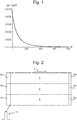
- Fig. 1 shows how the square of the derivative of the solution of equation 5 with respect to analyte mass varies as a function of analyte mass when the three different drift gases are H 2 , Xe and SF 6 . This shows that when the absolute value of this gradient is high, the solution is more tolerant to measurement uncertainties, and mass measurement is therefore more precise.
- Fig. 2 shows a schematic of the analyser for performing the above method.
- the analyser comprises three different drift tubes 2,4,6 that are filled with the different drift gases H 2 , Xe and SF 6 .
- An ion introduction port 8a-8c is provided at one end of each drift tube 2,4,6 for introducing the analyte sample ions into the drift tube 2,4,6.
- An ion detector 10a-10c is provided at the other end of each drift tube 2,4,6 for detecting the analyte ions.
- An electric field 12 is maintained along each drift tube 2,4,6 so as to drive the analyte ions through the drift tube 2,4,6.
- analyte ions are pulsed into each of the three different drift tubes 2,4,6 by a gate pulse 14.
- the ions are then driven through the drift gas in each drift tube 2,4,6 by the electric field 12 that is maintained along the drift tube 2,4,6.
- the ions are then detected at the exit of each drift tube 2,4,6 by the detector 10a-10c so as to determine the duration of time taken for the analyte ions to pass through each drift tube 2,4,6.
- the same type of analyte ion takes different times to pass through the different drift tubes 2,4,6, as the drift tubes 2,4,6 contain different drift gases.
- the ion mobilities of the same analyte ion in the different gases are then determined according to equation 3 above.
- the ion mobilities may be determined by making a range of drift time measurements at different drift tube voltages. As the properties of the drift gases are known, equation 5 above may then be used to determine the mass of the analyte ion.
- the analyser in Fig. 2 may have a common power supply for simultaneously pulsing ions into the different drift tubes 2,4,6.
- the drift tubes 2,4,6 may be mechanically integrated so as to minimize cost.
- each drift gas has been assumed for simplicity that the pressure and temperature, and therefore the number density N, of each drift gas is the same. However, it is contemplated herein that the temperatures and/or pressures of the different drift gases may be different.
- drift length L through the different drift gases and the electric field strength E across the different drift gases have been assumed to be the same, it is contemplated that the drift length and/or electric field strength may be different in the different gases.
- drift tubes that contain different drift gases
- gas composition in said one or two tubes may be changed with time so as to provide the three different gas compositions necessary.
- more than three different drift gas compositions may be provides for additional specificity. For example, at least four drift tubes containing different drift gases may be used.
- equation 5 can be written in the form: ⁇ + ⁇ a ⁇ a 1 / 4 K a + ⁇ b ⁇ b 1 / 4 K b + ⁇ c ⁇ c 1 / 4 K c
- ⁇ , ⁇ a , ⁇ b , and ⁇ c may be treated as unknown parameters to be calibrated using mass standards. In this case at least four mass standards would be required, although more than four mass standards could be used if available.
- K a , K b and K c are the three mobility measurements
- m is the analyte mass
- ⁇ 1 , ⁇ 2 ... ⁇ n are n calibration parameters to be determined.
- equation (10) may be solved either analytically or numerically for mass m given three mobility measurements.
- the explicit function F can be replaced by a machine learning algorithm that is trained to calculate mass using a sufficiently large calibration dataset.
- drift tube ion mobility spectrometers have been described above in which ions are driven through the gas by a static potential gradient, it is alternatively contemplated that ions may be driven through the gas by one or more potential barriers or wells that travel along the drift region. Alternatively, it is contemplated that the ions may be separated by high-field asymmetric waveform ion mobility spectrometry (FAIMS), rather than the drift ion mobility separation described above.
- FIMS high-field asymmetric waveform ion mobility spectrometry
Landscapes
- Physics & Mathematics (AREA)
- Chemical & Material Sciences (AREA)
- Spectroscopy & Molecular Physics (AREA)
- Health & Medical Sciences (AREA)
- Life Sciences & Earth Sciences (AREA)
- Analytical Chemistry (AREA)
- Chemical Kinetics & Catalysis (AREA)
- Electrochemistry (AREA)
- Biochemistry (AREA)
- General Health & Medical Sciences (AREA)
- General Physics & Mathematics (AREA)
- Immunology (AREA)
- Pathology (AREA)
- Molecular Biology (AREA)
- Other Investigation Or Analysis Of Materials By Electrical Means (AREA)
Claims (15)
- Verfahren für eine Massenspektrometrie, umfassend:Messen der Ionenmobilitäten eines Analytions durch unterschiedliche erste, zweite und dritte Driftgase, und gekennzeichnet durch:Bereitstellen eines Algorithmus oder einer Beziehung, die sich auf die Ionenmobilitäten eines Analytions durch drei Gase unterschiedlicher Polarisierbarkeit in Bezug zur Masse des Analytions bezieht; undVerwenden der gemessenen Ionenmobilitäten und des Algorithmus oder der Beziehung, um die Masse des Analytions zu ermitteln.
- Verfahren nach Anspruch 1, wobei die einzigen Variablen in dem Algorithmus oder der Beziehung, die sich nicht auf die Masse beziehen, Variablen sind, welche die Ionenmobilitäten des Analytions durch die drei unterschiedlichen Driftgase darstellen; oder
wobei die einzigen Variablen in dem Algorithmus oder der Beziehung, die sich nicht auf die Masse beziehen, Variablen sind, welche die Ionenmobilitäten des Analytions durch die drei unterschiedlichen Driftgase und die physikalisch-chemischen Eigenschaften der drei unterschiedlichen Driftgase darstellen; und wobei das Verfahren ein Verwenden der gemessenen Ionenmobilitäten, der physikalisch-chemischen Eigenschaften des ersten, zweiten und dritten Driftgases und des Algorithmus oder der Beziehung verwendet, um die Masse des Analytions zu ermitteln. - Verfahren nach Anspruch 1 oder 2, das außerdem ein Messen der Ionenmobilitäten durch die drei Gase von mindestens vier verschiedenen Massenstandardionen mit einer bekannten Masse und ein Verwenden dieser gemessenen Ionenmobilitäten und bekannten Massen umfasst, um den Algorithmus oder die Beziehung abzuleiten.
- Verfahren nach Anspruch 1, umfassend:Messen der Ionenmobilitäten der gleichen Analytionenart durch drei unterschiedliche Driftgase (a, b, c); undVerwenden der gemessenen Ionenmobilitäten, um die Masse des Analytions aus der folgenden ersten Gleichung zu ermitteln:

wobei für jedes Paar "i" und "j" der Driftgase Rij der Radius eines Driftgasmoleküls oder -atoms für das Driftgas "i" minus dem Radius eines Driftgasmoleküls oder -atoms für das Driftgas "j" ist;
wobei für jedes gegebene der Driftgase n, die Quantität
wobei q die Ladung des Analytions ist, Nn die Anzahldichte des Driftgases n ist, Kn die Ionenmobilität des Analytions durch das Driftgas n ist, k die Boltzmann-Konstante ist und Tn die Temperatur des Driftgases n ist; und
wobei für jedes gegebene der Driftgase n, die verringerte Masse
- Verfahren nach Anspruch 4, das ein Ermitteln der Masse des Analytions umfasst, indem die gemessenen Werte der Ionenmobilitäten (Kn) in die erste Gleichung eingefügt werden; ein Einfügen bekannter Werte; oder ein Messen und ein Einfügen der Werte von Pij, Rij, q, Nn, Tn und Mn in die erste Gleichung; und ein Lösen der ersten Gleichung für die Masse des Analytions umfasst.
- Verfahren nach einem der vorhergehenden Ansprüche, wobei der Schritt des Messens der Ionenmobilitäten des Analytions durch die unterschiedlichen Driftgase ein Messen der Driftzeit des Analytions durch jedes der drei Driftgase umfasst.
- Verfahren nach einem der vorhergehenden Ansprüche, wobei die Beziehung oder erste Gleichung abgeleitet wird durch, oder wobei das Verfahren ein Ableiten der Beziehung oder der ersten Gleichung umfasst durch:(a) Bereitstellen einer Gleichung für die Ionenmobilität Kn des Analytions durch jedes der drei unterschiedlichen Gase, wobei die Gleichung die folgende Form aufweist:
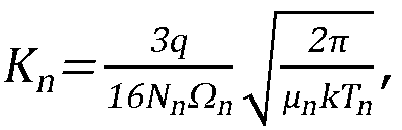 (b) Bereitstellen einer Gleichung für den Stoßquerschnitt des Analytions in jedem der drei unterschiedlichen Gase, wobei die Gleichung die folgende Form aufweist: Ωn = π(Rn + r + ΦPη)2, wobei Rn der Radius eines Driftgasmoleküls oder -atoms in einem gegebenen Driftgas (n) ist, r der Radius des Analytions ist, Φ der Polarisierbarkeitskoeffizient ist und Pn die Polarisierbarkeit eines gegebenen Driftgases (n) ist;(c) Ersetzen des Terms für den Stoßquerschnitt aus Schritt (b) für jedes der drei unterschiedlichen Driftgase in seiner entsprechenden Ionenmobilitätsgleichung aus Schritt (a), wodurch drei simultane Gleichungen für die drei unterschiedlichen Gase bereitgestellt werden, aus denen die Variable Ωn entfernt wurde; undd) Lösen oder Kombinieren der drei simultanen Gleichungen, um Φ und r zu entfernen und um die erste Gleichung bereitzustellen.
 - Verfahren nach einem der vorhergehenden Ansprüche, wobei jedes der drei Driftgase die Beziehung Ωn = π(Rn + r + ΦPn)2 zeigt, wobei Rn der Radius eines Driftgasmoleküls oder -atoms in einem gegebenen Driftgas (n) ist, r der Radius des Analytions ist, Φ der Polarisierbarkeitskoeffizient ist und Pn die Polarisierbarkeit eines gegebenen Driftgases (n) ist.
- Verfahren nach einem der vorhergehenden Ansprüche, wobei die drei unterschiedlichen Driftgase aus einer Liste ausgewählt werden, die besteht aus: Edelgasen; H2; O2; N2; CO2; Xe und SF6.
- Verfahren nach einem der vorhergehenden Ansprüche, wobei der Schritt des Messens der Ionenmobilitäten des Analytions durch die drei unterschiedlichen Driftgase umfasst:Bereitstellen jedes der unterschiedlichen Gase in einem unterschiedlichen Driftgebiet (2, 4, 6);Beibehalten eines elektrischen Felds (12) entlang jedes Driftgebiets (2, 4, 6);Pulsieren des Analytions in jedes Driftgebiet (2, 4, 6); undErfassen der Driftzeit des Analytions durch jedes Driftgebiet (2, 4, 6).
- Verfahren nach Anspruch 10, das ein simultanes Pulsieren des Analytions in die drei Driftgebiete (2, 4, 6) umfasst.
- Verfahren nach einem der Ansprüche 1 bis 9, wobei der Schritt des Messens der Ionenmobilitäten des Analytions durch die unterschiedlichen Driftgase umfasst:(i) Bereitstellen eines Driftgebiets;(ii) Beibehalten eines elektrischen Felds entlang des Driftgebiets;(iii) Pulsieren des Analytions in das Driftgebiet;(iv) Erfassen der Driftzeit des Analytions durch das Driftgebiet;(v) Ändern der Gasart oder der Gaszusammensetzung in dem Driftgebiet in ein zweites Gas oder eine zweite Gaszusammensetzung; und(vi) Wiederholen der Schritte (iii) und (iv); und optional außerdem umfassend:(vii) Ändern der Gasart oder der Gaszusammensetzung in dem Driftgebiet in ein drittes Gas oder eine dritte Gaszusammensetzung; und(viii) Wiederholen der Schritte (iii) und (iv).
- Verfahren nach einem der vorhergehenden Ansprüche, das außerdem ein Identifizieren des Analytions aus der Ionenmasse umfasst.
- Verfahren nach Anspruch 1, umfassend:Messen der Ionenmobilitäten der gleichen Analytionenart durch drei unterschiedliche Driftgase; und gekennzeichnet durch:Verwenden der gemessenen Ionenmobilitäten, um die Masse des Analytions aus einer ersten Gleichung zu ermitteln, wobei die erste Gleichung abgeleitet wird durch, oder wobei das Verfahren ein Ableiten ersten Gleichung umfasst durch:(a) Bereitstellen getrennter Gleichungen für die Ionenmobilität (Kn) das Analytions durch jedes der drei unterschiedlichen Gase, in denen die Ionenmobilität (Kn) proportional zu dem Stoßquerschnitt (Ωn) des Analytions in jedem Driftgas (n) ist;(b) Bereitstellen einer getrennten Gleichung für den Stoßquerschnitt (Ωn) des Analytions in jedem der drei unterschiedlichen Gase, in welcher der Stoßquerschnitt eine Funktion mindestens eines Parameters ist, der sich auf eine Eigenschaft des Driftgases bezieht, und eine Funktion von zwei Parametern ist, die sich auf die Eigenschaften des Analytions beziehen;(c) Ersetzen des Terms für den Stoßquerschnitt (Ωn) aus Schritt (b) für jedes der drei unterschiedlichen Driftgase in seiner entsprechenden Ionenmobilitätsgleichung aus Schritt (a), wodurch drei simultane Gleichungen für die drei unterschiedlichen Gase bereitgestellt werden, aus denen die Stoßquerschnittsvariable (Ωn) entfernt wurde; undd) Lösen oder Kombinieren der drei simultanen Gleichungen, um die mindestens zwei Parameter zu entfernen, die sich auf die Eigenschaften des Analytions beziehen, und um die erste Gleichung bereitzustellen; und(e) Ermitteln der Masse des Analytions, indem die gemessenen Werte der Ionenmobilitäten und die Werte der Parameter, die sich auf die Eigenschaften der Driftgase beziehen, in die erste Gleichung so eingefügt werden, dass die Masse des Analytions die einzige unbekannte Variable ist, und Lösen der ersten Gleichung für die Masse des Analytions.
- Massenspektrometer, der geeignet und konfiguriert ist, um das Verfahren nach einem der vorhergehenden Ansprüche auszuführen.
Applications Claiming Priority (1)
| Application Number | Priority Date | Filing Date | Title |
|---|---|---|---|
| GBGB1506330.8A GB201506330D0 (en) | 2015-04-14 | 2015-04-14 | Mass determination using ion mobility measurements |
Publications (2)
| Publication Number | Publication Date |
|---|---|
| EP3082151A1 EP3082151A1 (de) | 2016-10-19 |
| EP3082151B1 true EP3082151B1 (de) | 2018-02-28 |
Family
ID=53333770
Family Applications (1)
| Application Number | Title | Priority Date | Filing Date |
|---|---|---|---|
| EP16165255.7A Not-in-force EP3082151B1 (de) | 2015-04-14 | 2016-04-14 | Massenspektrometer und verfahren zur massenbestimmung mit ionenmobilitätsmessungen |
Country Status (3)
| Country | Link |
|---|---|
| US (1) | US9983172B2 (de) |
| EP (1) | EP3082151B1 (de) |
| GB (2) | GB201506330D0 (de) |
Families Citing this family (3)
| Publication number | Priority date | Publication date | Assignee | Title |
|---|---|---|---|---|
| GB201711795D0 (en) | 2017-07-21 | 2017-09-06 | Micromass Ltd | Mobility and mass measurement using time - varying electric fields |
| US11043370B2 (en) | 2018-07-20 | 2021-06-22 | Battelle Memorial Institute | Device and system for selective ionization and analyte detection and method of using the same |
| US10670561B2 (en) | 2018-07-20 | 2020-06-02 | Battelle Memorial Institute | Device and system for selective ionization and analyte detection and method of using the same |
Family Cites Families (11)
| Publication number | Priority date | Publication date | Assignee | Title |
|---|---|---|---|---|
| US6960761B2 (en) * | 1997-06-02 | 2005-11-01 | Advanced Research & Technology Institute | Instrument for separating ions in time as functions of preselected ion mobility and ion mass |
| US6323482B1 (en) * | 1997-06-02 | 2001-11-27 | Advanced Research And Technology Institute, Inc. | Ion mobility and mass spectrometer |
| GB0025016D0 (en) | 2000-10-12 | 2000-11-29 | Micromass Ltd | Method nad apparatus for mass spectrometry |
| US8884221B2 (en) | 2006-01-05 | 2014-11-11 | Excellims Corporation | High performance ion mobility spectrometer apparatus and methods |
| JP5193880B2 (ja) * | 2006-01-02 | 2013-05-08 | エクセリムス コーポレイション | 多次元イオン移動度分光測定の装置と方法 |
| US20100224770A1 (en) * | 2009-03-06 | 2010-09-09 | Ensco, Inc. | Method for configuring an ion mobility spectrometer system |
| WO2011017409A1 (en) | 2009-08-05 | 2011-02-10 | Indiana University Research And Technology Corporation | Apparatus for determining masses at high pressure |
| GB2509412B (en) * | 2012-02-21 | 2016-06-01 | Thermo Fisher Scient (Bremen) Gmbh | Apparatus and methods for ion mobility spectrometry |
| CN106030754B (zh) * | 2014-02-14 | 2017-12-01 | 佛罗里达州立大学研究基金会 | 用于求解动量转移截面的近似算法 |
| DE112015001169T5 (de) * | 2014-03-10 | 2016-12-22 | Micromass Uk Limited | Bestätigung unter Verwendung einer Mehrzahl von Kollisionsquerschnitts-("CCS")-Messungen |
| US9607817B1 (en) * | 2015-09-11 | 2017-03-28 | Thermo Finnigan Llc | Systems and methods for ion separation |
-
2015
- 2015-04-14 GB GBGB1506330.8A patent/GB201506330D0/en not_active Ceased
-
2016
- 2016-04-14 EP EP16165255.7A patent/EP3082151B1/de not_active Not-in-force
- 2016-04-14 GB GB1606520.3A patent/GB2539538B/en not_active Expired - Fee Related
- 2016-04-14 US US15/098,927 patent/US9983172B2/en active Active
Non-Patent Citations (1)
| Title |
|---|
| None * |
Also Published As
| Publication number | Publication date |
|---|---|
| US9983172B2 (en) | 2018-05-29 |
| US20160305908A1 (en) | 2016-10-20 |
| EP3082151A1 (de) | 2016-10-19 |
| GB201506330D0 (en) | 2015-05-27 |
| GB2539538B (en) | 2017-06-07 |
| GB2539538A (en) | 2016-12-21 |
Similar Documents
| Publication | Publication Date | Title |
|---|---|---|
| EP3655987B1 (de) | Mobilitäts- und massenmessung mit zeitveränderlichen elektrischen feldern | |
| US12217952B2 (en) | Mass correction | |
| US10079136B2 (en) | Self-calibration of spectra using differences in molecular weight from known charge states | |
| US20170131238A1 (en) | Confirmation Using Multiple Collision Cross Section ("CCS") Measurements | |
| US10727040B2 (en) | Ion profiling with a scanning quadrupole mass filter | |
| EP3082151B1 (de) | Massenspektrometer und verfahren zur massenbestimmung mit ionenmobilitätsmessungen | |
| EP3519805B1 (de) | Mobilitätsanalysator nach trennung und verfahren zur bestimmung von ionenkollisionsquerschnitten | |
| US10943776B2 (en) | Monitoring ion mobility spectrometry environment for improved collision cross section accuracy and precision | |
| US10041907B2 (en) | Accurate mobility chromatograms | |
| GB2534627A (en) | Accurate mobility chromatograms | |
| GB2539871A (en) | A method of mass spectrometry |
Legal Events
| Date | Code | Title | Description |
|---|---|---|---|
| PUAI | Public reference made under article 153(3) epc to a published international application that has entered the european phase |
Free format text: ORIGINAL CODE: 0009012 |
|
| AK | Designated contracting states |
Kind code of ref document: A1 Designated state(s): AL AT BE BG CH CY CZ DE DK EE ES FI FR GB GR HR HU IE IS IT LI LT LU LV MC MK MT NL NO PL PT RO RS SE SI SK SM TR |
|
| AX | Request for extension of the european patent |
Extension state: BA ME |
|
| STAA | Information on the status of an ep patent application or granted ep patent |
Free format text: STATUS: REQUEST FOR EXAMINATION WAS MADE |
|
| 17P | Request for examination filed |
Effective date: 20170413 |
|
| RBV | Designated contracting states (corrected) |
Designated state(s): AL AT BE BG CH CY CZ DE DK EE ES FI FR GB GR HR HU IE IS IT LI LT LU LV MC MK MT NL NO PL PT RO RS SE SI SK SM TR |
|
| GRAP | Despatch of communication of intention to grant a patent |
Free format text: ORIGINAL CODE: EPIDOSNIGR1 |
|
| STAA | Information on the status of an ep patent application or granted ep patent |
Free format text: STATUS: GRANT OF PATENT IS INTENDED |
|
| INTG | Intention to grant announced |
Effective date: 20170901 |
|
| RBV | Designated contracting states (corrected) |
Designated state(s): AL AT BE BG CH CY CZ DE DK EE ES FI FR GR HR HU IE IS IT LI LT LU LV MC MK MT NL NO PL PT RO RS SE SI SK SM TR |
|
| GRAS | Grant fee paid |
Free format text: ORIGINAL CODE: EPIDOSNIGR3 |
|
| GRAA | (expected) grant |
Free format text: ORIGINAL CODE: 0009210 |
|
| STAA | Information on the status of an ep patent application or granted ep patent |
Free format text: STATUS: THE PATENT HAS BEEN GRANTED |
|
| AK | Designated contracting states |
Kind code of ref document: B1 Designated state(s): AL AT BE BG CH CY CZ DE DK EE ES FI FR GR HR HU IE IS IT LI LT LU LV MC MK MT NL NO PL PT RO RS SE SI SK SM TR |
|
| REG | Reference to a national code |
Ref country code: CH Ref legal event code: EP |
|
| REG | Reference to a national code |
Ref country code: AT Ref legal event code: REF Ref document number: 975005 Country of ref document: AT Kind code of ref document: T Effective date: 20180315 |
|
| REG | Reference to a national code |
Ref country code: IE Ref legal event code: FG4D |
|
| REG | Reference to a national code |
Ref country code: DE Ref legal event code: R096 Ref document number: 602016001687 Country of ref document: DE |
|
| REG | Reference to a national code |
Ref country code: NL Ref legal event code: MP Effective date: 20180228 |
|
| REG | Reference to a national code |
Ref country code: LT Ref legal event code: MG4D |
|
| REG | Reference to a national code |
Ref country code: AT Ref legal event code: MK05 Ref document number: 975005 Country of ref document: AT Kind code of ref document: T Effective date: 20180228 |
|
| PG25 | Lapsed in a contracting state [announced via postgrant information from national office to epo] |
Ref country code: ES Free format text: LAPSE BECAUSE OF FAILURE TO SUBMIT A TRANSLATION OF THE DESCRIPTION OR TO PAY THE FEE WITHIN THE PRESCRIBED TIME-LIMIT Effective date: 20180228 Ref country code: NL Free format text: LAPSE BECAUSE OF FAILURE TO SUBMIT A TRANSLATION OF THE DESCRIPTION OR TO PAY THE FEE WITHIN THE PRESCRIBED TIME-LIMIT Effective date: 20180228 Ref country code: LT Free format text: LAPSE BECAUSE OF FAILURE TO SUBMIT A TRANSLATION OF THE DESCRIPTION OR TO PAY THE FEE WITHIN THE PRESCRIBED TIME-LIMIT Effective date: 20180228 Ref country code: HR Free format text: LAPSE BECAUSE OF FAILURE TO SUBMIT A TRANSLATION OF THE DESCRIPTION OR TO PAY THE FEE WITHIN THE PRESCRIBED TIME-LIMIT Effective date: 20180228 Ref country code: FI Free format text: LAPSE BECAUSE OF FAILURE TO SUBMIT A TRANSLATION OF THE DESCRIPTION OR TO PAY THE FEE WITHIN THE PRESCRIBED TIME-LIMIT Effective date: 20180228 Ref country code: NO Free format text: LAPSE BECAUSE OF FAILURE TO SUBMIT A TRANSLATION OF THE DESCRIPTION OR TO PAY THE FEE WITHIN THE PRESCRIBED TIME-LIMIT Effective date: 20180528 Ref country code: CY Free format text: LAPSE BECAUSE OF FAILURE TO SUBMIT A TRANSLATION OF THE DESCRIPTION OR TO PAY THE FEE WITHIN THE PRESCRIBED TIME-LIMIT Effective date: 20180228 |
|
| PG25 | Lapsed in a contracting state [announced via postgrant information from national office to epo] |
Ref country code: SE Free format text: LAPSE BECAUSE OF FAILURE TO SUBMIT A TRANSLATION OF THE DESCRIPTION OR TO PAY THE FEE WITHIN THE PRESCRIBED TIME-LIMIT Effective date: 20180228 Ref country code: LV Free format text: LAPSE BECAUSE OF FAILURE TO SUBMIT A TRANSLATION OF THE DESCRIPTION OR TO PAY THE FEE WITHIN THE PRESCRIBED TIME-LIMIT Effective date: 20180228 Ref country code: GR Free format text: LAPSE BECAUSE OF FAILURE TO SUBMIT A TRANSLATION OF THE DESCRIPTION OR TO PAY THE FEE WITHIN THE PRESCRIBED TIME-LIMIT Effective date: 20180529 Ref country code: BG Free format text: LAPSE BECAUSE OF FAILURE TO SUBMIT A TRANSLATION OF THE DESCRIPTION OR TO PAY THE FEE WITHIN THE PRESCRIBED TIME-LIMIT Effective date: 20180528 Ref country code: RS Free format text: LAPSE BECAUSE OF FAILURE TO SUBMIT A TRANSLATION OF THE DESCRIPTION OR TO PAY THE FEE WITHIN THE PRESCRIBED TIME-LIMIT Effective date: 20180228 Ref country code: AT Free format text: LAPSE BECAUSE OF FAILURE TO SUBMIT A TRANSLATION OF THE DESCRIPTION OR TO PAY THE FEE WITHIN THE PRESCRIBED TIME-LIMIT Effective date: 20180228 |
|
| PG25 | Lapsed in a contracting state [announced via postgrant information from national office to epo] |
Ref country code: IT Free format text: LAPSE BECAUSE OF FAILURE TO SUBMIT A TRANSLATION OF THE DESCRIPTION OR TO PAY THE FEE WITHIN THE PRESCRIBED TIME-LIMIT Effective date: 20180228 Ref country code: AL Free format text: LAPSE BECAUSE OF FAILURE TO SUBMIT A TRANSLATION OF THE DESCRIPTION OR TO PAY THE FEE WITHIN THE PRESCRIBED TIME-LIMIT Effective date: 20180228 Ref country code: EE Free format text: LAPSE BECAUSE OF FAILURE TO SUBMIT A TRANSLATION OF THE DESCRIPTION OR TO PAY THE FEE WITHIN THE PRESCRIBED TIME-LIMIT Effective date: 20180228 Ref country code: PL Free format text: LAPSE BECAUSE OF FAILURE TO SUBMIT A TRANSLATION OF THE DESCRIPTION OR TO PAY THE FEE WITHIN THE PRESCRIBED TIME-LIMIT Effective date: 20180228 Ref country code: RO Free format text: LAPSE BECAUSE OF FAILURE TO SUBMIT A TRANSLATION OF THE DESCRIPTION OR TO PAY THE FEE WITHIN THE PRESCRIBED TIME-LIMIT Effective date: 20180228 |
|
| REG | Reference to a national code |
Ref country code: DE Ref legal event code: R097 Ref document number: 602016001687 Country of ref document: DE |
|
| PG25 | Lapsed in a contracting state [announced via postgrant information from national office to epo] |
Ref country code: SM Free format text: LAPSE BECAUSE OF FAILURE TO SUBMIT A TRANSLATION OF THE DESCRIPTION OR TO PAY THE FEE WITHIN THE PRESCRIBED TIME-LIMIT Effective date: 20180228 Ref country code: CZ Free format text: LAPSE BECAUSE OF FAILURE TO SUBMIT A TRANSLATION OF THE DESCRIPTION OR TO PAY THE FEE WITHIN THE PRESCRIBED TIME-LIMIT Effective date: 20180228 Ref country code: SK Free format text: LAPSE BECAUSE OF FAILURE TO SUBMIT A TRANSLATION OF THE DESCRIPTION OR TO PAY THE FEE WITHIN THE PRESCRIBED TIME-LIMIT Effective date: 20180228 Ref country code: MC Free format text: LAPSE BECAUSE OF FAILURE TO SUBMIT A TRANSLATION OF THE DESCRIPTION OR TO PAY THE FEE WITHIN THE PRESCRIBED TIME-LIMIT Effective date: 20180228 Ref country code: DK Free format text: LAPSE BECAUSE OF FAILURE TO SUBMIT A TRANSLATION OF THE DESCRIPTION OR TO PAY THE FEE WITHIN THE PRESCRIBED TIME-LIMIT Effective date: 20180228 |
|
| REG | Reference to a national code |
Ref country code: BE Ref legal event code: MM Effective date: 20180430 |
|
| PLBE | No opposition filed within time limit |
Free format text: ORIGINAL CODE: 0009261 |
|
| STAA | Information on the status of an ep patent application or granted ep patent |
Free format text: STATUS: NO OPPOSITION FILED WITHIN TIME LIMIT |
|
| REG | Reference to a national code |
Ref country code: IE Ref legal event code: MM4A |
|
| PG25 | Lapsed in a contracting state [announced via postgrant information from national office to epo] |
Ref country code: LU Free format text: LAPSE BECAUSE OF NON-PAYMENT OF DUE FEES Effective date: 20180414 |
|
| 26N | No opposition filed |
Effective date: 20181129 |
|
| PG25 | Lapsed in a contracting state [announced via postgrant information from national office to epo] |
Ref country code: BE Free format text: LAPSE BECAUSE OF NON-PAYMENT OF DUE FEES Effective date: 20180430 Ref country code: SI Free format text: LAPSE BECAUSE OF FAILURE TO SUBMIT A TRANSLATION OF THE DESCRIPTION OR TO PAY THE FEE WITHIN THE PRESCRIBED TIME-LIMIT Effective date: 20180228 |
|
| PG25 | Lapsed in a contracting state [announced via postgrant information from national office to epo] |
Ref country code: IE Free format text: LAPSE BECAUSE OF NON-PAYMENT OF DUE FEES Effective date: 20180414 Ref country code: FR Free format text: LAPSE BECAUSE OF NON-PAYMENT OF DUE FEES Effective date: 20180428 |
|
| REG | Reference to a national code |
Ref country code: CH Ref legal event code: PL |
|
| PG25 | Lapsed in a contracting state [announced via postgrant information from national office to epo] |
Ref country code: MT Free format text: LAPSE BECAUSE OF NON-PAYMENT OF DUE FEES Effective date: 20180414 Ref country code: LI Free format text: LAPSE BECAUSE OF NON-PAYMENT OF DUE FEES Effective date: 20190430 Ref country code: CH Free format text: LAPSE BECAUSE OF NON-PAYMENT OF DUE FEES Effective date: 20190430 |
|
| PG25 | Lapsed in a contracting state [announced via postgrant information from national office to epo] |
Ref country code: TR Free format text: LAPSE BECAUSE OF FAILURE TO SUBMIT A TRANSLATION OF THE DESCRIPTION OR TO PAY THE FEE WITHIN THE PRESCRIBED TIME-LIMIT Effective date: 20180228 |
|
| PG25 | Lapsed in a contracting state [announced via postgrant information from national office to epo] |
Ref country code: PT Free format text: LAPSE BECAUSE OF FAILURE TO SUBMIT A TRANSLATION OF THE DESCRIPTION OR TO PAY THE FEE WITHIN THE PRESCRIBED TIME-LIMIT Effective date: 20180228 |
|
| PG25 | Lapsed in a contracting state [announced via postgrant information from national office to epo] |
Ref country code: MK Free format text: LAPSE BECAUSE OF NON-PAYMENT OF DUE FEES Effective date: 20180228 Ref country code: HU Free format text: LAPSE BECAUSE OF FAILURE TO SUBMIT A TRANSLATION OF THE DESCRIPTION OR TO PAY THE FEE WITHIN THE PRESCRIBED TIME-LIMIT; INVALID AB INITIO Effective date: 20160414 |
|
| PG25 | Lapsed in a contracting state [announced via postgrant information from national office to epo] |
Ref country code: IS Free format text: LAPSE BECAUSE OF FAILURE TO SUBMIT A TRANSLATION OF THE DESCRIPTION OR TO PAY THE FEE WITHIN THE PRESCRIBED TIME-LIMIT Effective date: 20180628 |
|
| P01 | Opt-out of the competence of the unified patent court (upc) registered |
Effective date: 20230506 |
|
| PGFP | Annual fee paid to national office [announced via postgrant information from national office to epo] |
Ref country code: DE Payment date: 20230321 Year of fee payment: 8 |
|
| REG | Reference to a national code |
Ref country code: DE Ref legal event code: R119 Ref document number: 602016001687 Country of ref document: DE |
|
| PG25 | Lapsed in a contracting state [announced via postgrant information from national office to epo] |
Ref country code: DE Free format text: LAPSE BECAUSE OF NON-PAYMENT OF DUE FEES Effective date: 20241105 |
|
| PG25 | Lapsed in a contracting state [announced via postgrant information from national office to epo] |
Ref country code: DE Free format text: LAPSE BECAUSE OF NON-PAYMENT OF DUE FEES Effective date: 20241105 |