EP3079564B1 - Verfahren zur auswertung von mindestens einem klinischen gesichtszeichen - Google Patents
Verfahren zur auswertung von mindestens einem klinischen gesichtszeichen Download PDFInfo
- Publication number
- EP3079564B1 EP3079564B1 EP14830629.3A EP14830629A EP3079564B1 EP 3079564 B1 EP3079564 B1 EP 3079564B1 EP 14830629 A EP14830629 A EP 14830629A EP 3079564 B1 EP3079564 B1 EP 3079564B1
- Authority
- EP
- European Patent Office
- Prior art keywords
- images
- sounds
- clinical sign
- sequence
- facial
- Prior art date
- Legal status (The legal status is an assumption and is not a legal conclusion. Google has not performed a legal analysis and makes no representation as to the accuracy of the status listed.)
- Active
Links
Images
Classifications
-
- A—HUMAN NECESSITIES
- A61—MEDICAL OR VETERINARY SCIENCE; HYGIENE
- A61B—DIAGNOSIS; SURGERY; IDENTIFICATION
- A61B5/00—Measuring for diagnostic purposes; Identification of persons
- A61B5/44—Detecting, measuring or recording for evaluating the integumentary system, e.g. skin, hair or nails
- A61B5/441—Skin evaluation, e.g. for skin disorder diagnosis
- A61B5/442—Evaluating skin mechanical properties, e.g. elasticity, hardness, texture, wrinkle assessment
-
- A—HUMAN NECESSITIES
- A61—MEDICAL OR VETERINARY SCIENCE; HYGIENE
- A61B—DIAGNOSIS; SURGERY; IDENTIFICATION
- A61B5/00—Measuring for diagnostic purposes; Identification of persons
- A61B5/0059—Measuring for diagnostic purposes; Identification of persons using light, e.g. diagnosis by transillumination, diascopy, fluorescence
- A61B5/0077—Devices for viewing the surface of the body, e.g. camera, magnifying lens
-
- A—HUMAN NECESSITIES
- A61—MEDICAL OR VETERINARY SCIENCE; HYGIENE
- A61B—DIAGNOSIS; SURGERY; IDENTIFICATION
- A61B5/00—Measuring for diagnostic purposes; Identification of persons
- A61B5/48—Other medical applications
- A61B5/4803—Speech analysis specially adapted for diagnostic purposes
-
- G—PHYSICS
- G06—COMPUTING OR CALCULATING; COUNTING
- G06F—ELECTRIC DIGITAL DATA PROCESSING
- G06F3/00—Input arrangements for transferring data to be processed into a form capable of being handled by the computer; Output arrangements for transferring data from processing unit to output unit, e.g. interface arrangements
- G06F3/16—Sound input; Sound output
- G06F3/167—Audio in a user interface, e.g. using voice commands for navigating, audio feedback
-
- G—PHYSICS
- G06—COMPUTING OR CALCULATING; COUNTING
- G06V—IMAGE OR VIDEO RECOGNITION OR UNDERSTANDING
- G06V40/00—Recognition of biometric, human-related or animal-related patterns in image or video data
- G06V40/10—Human or animal bodies, e.g. vehicle occupants or pedestrians; Body parts, e.g. hands
- G06V40/16—Human faces, e.g. facial parts, sketches or expressions
- G06V40/161—Detection; Localisation; Normalisation
- G06V40/166—Detection; Localisation; Normalisation using acquisition arrangements
-
- G—PHYSICS
- G06—COMPUTING OR CALCULATING; COUNTING
- G06V—IMAGE OR VIDEO RECOGNITION OR UNDERSTANDING
- G06V40/00—Recognition of biometric, human-related or animal-related patterns in image or video data
- G06V40/10—Human or animal bodies, e.g. vehicle occupants or pedestrians; Body parts, e.g. hands
- G06V40/16—Human faces, e.g. facial parts, sketches or expressions
- G06V40/168—Feature extraction; Face representation
- G06V40/171—Local features and components; Facial parts ; Occluding parts, e.g. glasses; Geometrical relationships
-
- G—PHYSICS
- G06—COMPUTING OR CALCULATING; COUNTING
- G06V—IMAGE OR VIDEO RECOGNITION OR UNDERSTANDING
- G06V40/00—Recognition of biometric, human-related or animal-related patterns in image or video data
- G06V40/10—Human or animal bodies, e.g. vehicle occupants or pedestrians; Body parts, e.g. hands
- G06V40/16—Human faces, e.g. facial parts, sketches or expressions
- G06V40/172—Classification, e.g. identification
Definitions
- the present invention relates to the evaluation of characteristics of body type, and more specifically face type, and the evaluation of products for making up or changing the appearance of the face.
- facial clinical signs also called appearance characteristics
- wrinkles in particular under-eye wrinkles, crows' feet wrinkles, the nasolabial fold, the forehead, the corners of the lips, the upper lip, etc.
- the invention aims to answer this need or these needs and achieves this through a process without a therapeutic target that evaluates at least one facial clinical sign, in particular wrinkles or fine lines on a part of the face, and/or evaluates a make-up, including the steps consisting of:
- Image extraction is automatic, resulting from an analysis of the sound emitted, to automatically recognize it.
- Extracting an image is understood to mean that the image is identified in the sequence with a view to subsequent treatment; the image may remain in the sequence and be identified for example by a time stamp or an order number in the sequence.
- the image is not necessary duplicated or transferred into another electronic file.
- the sequence is preferably a digitized sequence, in any format suited to reading by a multimedia content reader, for example an HD video format. It may be advantageous to display the images extracted, so that the person can see them. When the evaluation is made at a point of sale, this can also make it easier to advise the person.
- the invention can account for the fact that when a face moves the facial features, wrinkles or fine lines change and/or flex and appear differently for each person. These facial deformation modes that are not perceptible on a simple static image become perceptible due to this process. Accordingly, it allows precise evaluation of clinical signs of ageing for facial skin in particular.
- the invention can also show the first signs of ageing, for example for Asian or Caucasian women between 30 and 40 years old, which appear only when the face is animated, when the person is going to talk.
- the evaluation can be standardized and automated.
- At least one sound to be reproduced can be displayed in front of the person filmed, for example a phrase, scansion, word, phoneme, chosen for example as a function of the language that the person speaks, which can for example be French, English, Spanish, Japanese, Chinese or Korean.
- This display can be on the same device as the one that films, which can allow the image displayed to be known as a function of time in the sequence, and can facilitate the location of the image or images of interest in the sequence.
- the sound is diffused using a speaker for example, then repeated by the person.
- the person is filmed at the same time as the sound is recorded, to generate the sequence with a video track and an audio track.
- the person may be asked to pronounce the same sounds several times, but within sound sequences where the sounds are not in the same order. This can make differences related to different facial deformation modes appear, according to the order in which the sounds are emitted.
- the images extracted may be compared with reference images.
- this comparison is made automatically, through image processing.
- Any process that can compare images may be used, for example a process called fuzzy logic.
- a recognition for characteristic features on an image can also be used.
- the program may have to learn at first so that it knows what score the different images correspond to. Then the program knows how to attribute a score to any new image itself.
- a neural network can be used.
- the previously cited reference images may be images from an evaluation atlas, or from data generated from such images.
- the atlas' images are for example images of people presenting different grades of a given clinical sign, for example a given facial region that appears more and more wrinkled.
- the sequence that is treated may include images relating to any clinical sign at all that is revealed when the person speaks, for example the presence of wrinkles or fine lines in the corners of the lips, under the eye, on the upper lip, crows' feet, and/or the nasolabial fold.
- the sequence preferably includes images of the entire face, the face being preferably filmed with sufficient resolution to be able to subsequently extract images of regions of interest that only represent a fraction of the camera's field of view. Colorimetry correction may be applied.
- the evaluation of the clinical sign or signs from the image or images extracted occurs automatically, by comparison with reference data.
- the image or images extracted are, at least for some, automatically cropped as a function of the clinical sign to be evaluated, and preferably enlarged.
- the sound or sounds in the sequence may include predefined phonemes, chosen for example as a function of the language that the person speaks, for example vowels, semi-consonants or consonants.
- the images corresponding to several predefined sounds respectively are extracted, in particular the previously cited sounds "A”, “E”, “O”, “OUI”, “STI”, “ART”, “TO”.
- the selection of the image or images to be extracted from the sequence may occur by voice recognition applied to the soundtrack of the sequence and/or by spectral analysis of the sounds collected. Another possible selection is images for which a specific frequency exceeds a predefined amplitude.
- a score associated with a clinical sign can automatically be generated as a result of the evaluation of this clinical sign.
- the images may be acquired by a device held by the person being evaluated or placed in front of him/her, in particular a tablet, smart phone or computer.
- the person downloads an application onto his or her smartphone, for example iPhone or Android smartphone, tablet, or PC.
- the application Once the application is launched, it displays sounds to be reproduced on the monitor while it records the images and sounds.
- the user can then film him or herself while pronouncing the predefined sounds.
- the sequence thus acquired is then treated as indicated above to produce an evaluation result.
- the treatment may take place locally, through the application itself, or as a variant on a remote server, or partially locally and partially at the remote server.
- the acquisition may occur simultaneously with several cameras.
- the evaluation may take place in a home or at a point of sale.
- the acquisition of the sequence of images occurs at an acquisition frequency greater than or equal to 50, preferably 100, images per second.
- the camera resolution is preferably greater than or equal to 720 lines.
- a self-assessment score can be collected by the person for said clinical sign and/or an evaluation score is collected by a panel of experts for said clinical sign.
- the invention also relates to a non-therapeutic process to demonstrate the effect of a cosmetic treatment on the face, in particular the application of an anti-wrinkle or make-up product, including the steps consisting in:
- the cosmetic treatment consists for example in applying a skincare or anti-wrinkle product to the skin, in particular in the area affected by the evaluation.
- the person evaluated can see him or herself automatically prescribed a product as a function of the scores determined, as a preventive measure or to reduce the severity of a sign.
- the product prescribed may be a personalized formulation, with for example an active ingredient assay that depends on the score or scores determined.
- the invention further relates to a computer program product including instructions that, when executed on a device that has a processor, a monitor, a speaker, a camera and a microphone, lead the device to:
- the instructions may if need be allow prior selection of the sound or sounds that must be recognized by the device.
- the instructions may also lead the device to propose that the user chooses one or more clinical signs to evaluate; in this case, as a function of the sign or signs selected, the predefined sound or sounds that the person must pronounce for the evaluation may differ.
- the instructions may lead the device to analyse the sound emitted with a view to recognizing it, in particular by a voice recognition technique.
- the images extracted are then those for which the predefined sound is automatically recognized, within the corresponding audio track.
- the instructions may also lead the device to process the resulting image or images extracted to generate at least one representative score of the severity of the clinical sign and/or to send the image or images to a remote server that in return delivers said score.
- the instructions may also control a device that makes an automatic assay for active ingredient in a treatment, in particular an anti-wrinkle treatment, as a function of said score.
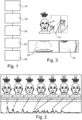
- An example of the process according to the invention may use, as illustrated in figure 1 , different steps 10 to 50, which are taken for example using a computer equipped with a camera and a monitor.
- the camera is preferably calibrated colorimetrically, by placing a calibrator whose colorimetric components are known in the camera's field of view.
- a video sequence is acquired using the camera. While this sequence is being acquired, the sounds that the person being filmed must reproduce are for example displayed on the monitor. As a variant, nothing is displayed while the sequence is being acquired, and the person knows for example in advance which sounds he or she must pronounce.
- step 20 the image sequence is analysed in step 20.
- This analysis may be as post-processing, or as a variant, while the sequence is being recorded, on the images already acquired, if the processor is powerful enough to do this.
- the treatment aims to identify in the sequence the image or images that correspond to the emission by the person of predefined sounds.
- the soundtrack is analysed and the instants where the predefined sounds are emitted are identified, using for example spectral analysis, where each sound has its own spectral fingerprint that is to be identified in the soundtrack.
- the spectral fingerprint can be obtained by Fourier transformation.
- Voice recognition software can also be used.
- the publications " Voice Activity Detection Based on Wavelet Packet Transform in Communication Nonlinear Channel", R. Chiodi and D. Massicotte, SPACOMM, Colmar, France, 2009 and " La reconnaissance matters de sources sonores dans l' structural” [Automatic recognition of noise sources in the environment], Defreville, B. Bloquet, S., Filippi, G., and Aujard, C. 10ème Con provide English d'Acoustique [10th French Acoustical Conference], Lyons 12-16 April 2010 , describe examples of voice recognition processes.
- the person being filmed pronounces an entire phrase comprising the words OUIstiti, smARTies, etc. and thereby successively emits the sounds "A”, “E”, “O”, “OUI”, “STI”, “ART”, “TO”.
- the images that are selected as corresponding to the emission of these sounds are represented on this figure under each sound, along with the sound's spectral fingerprint and the time stamp.
- each image extracted that corresponds to a predefined sound can be processed with a view to evaluating one or more clinical signs.
- the processing in step 30 may include the extraction of areas of interest in the image, for example by recognizing characteristic features in the image, such as the presence of eyes, nose or lips. From this sub-images can be generated that cover more specifically the areas of interest containing the clinical sign or signs that the evaluation targets. As illustrated in figure 3 , for example from a complete image of the face corresponding to the emission of a particular sound, respective sub-images 31 to 33 of the corners of the lips, the upper lip and the under-eye area can be extracted.
- These sub-images may be enlarged, if need be, to make wrinkles or fine lines appear more clearly. It is also desirable to adjust the colorimetry if necessary, to remove the influence of tanning, for example.
- step 40 a treatment is carried out in step 40 to compare these images to reference images, with a view to attributing a grade to the clinical sign supposed to appear on the image.
- This treatment may involve any algorithm that can compare the degree to which two images resemble each other, i.e. the image whose reference grade needs to be allocated, and the images illustrating the different grades.
- a reference database can be used that gives the scores for a large number of different people, for ethnicity for example.
- step 50 a score and/or any useful information related to the clinical sign whose severity was evaluated can be displayed.
- the score is for example displayed on the monitor.
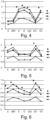
- a curve can also be displayed that makes the score for the clinical sign appear as a function of facial deformations related to the sounds pronounced. Accordingly, information on the dynamics of the sign's change for a moving face are available; this can provide additional useful information, in combination if need be with other dynamic change in other clinical signs, to attribute to the person for example an apparent age or an apparent level of fatigue.
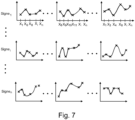
- progression curves and 2D-matrices of the curves can be generated automatically for the score for sounds X1, X6, X8, etc., sounds X8, X4, X10, X4, etc., sounds X1, X3, X4, X8, etc.
- Each of these sequences of sounds emitted by the person to be evaluated will have been chosen to maximize some deformation modes or to be able to reconstruct a given phrase.
- spectra can be treated by 2D or 3D wavelets related to the person's perception or consumers' perception, for a set of clinical signs, collected by video quizzes for different phrases or sounds.
- the sub-image treatment processing can also be completed if need be by more conventional analysis such as detection of skin dyschromia or pore size evaluation.
- Figures 5 and 6 relate to the evaluation of the severity of the nasolabial fold and under-eye wrinkles respectively.
- 2D matrices of time curves can be generated that represent the progression in different scores as a function of the sounds emitted over time for various clinical signs.
- the perception associated for each person evaluated can be determined, for example in terms of apparent fatigue, apparent age, attractiveness, radiance, etc.
- Multi-scale wavelets can be used to perform these multi-scale treatment analyses, for example.
- the person to be evaluated can be filmed in profile with a view to evaluating other clinical signs such as ptosis, for example.
- the images may also be acquired, if need be, in relief using at least two cameras.
- the images may also be acquired with projection of fringes of light on the face to further measure relief or better visualize skin movements.
- the images can be acquired with white light or under an illuminant that has the purpose of more easily showing certain facial deformations when the sounds are emitted.
- these images may be averaged before the treatment that will attribute a score.
- the person for whom evaluation is sought pronounces one or more phrases where the content is not known in advance; in this case the process seeks to recognize by voice recognition whether certain sounds have been produced, and in the affirmative selects the corresponding images then evaluates the clinical signs.
- Another possible plan is to select a set of sounds for the person to pronounce for which evaluation is desired as a function of the sex, apparent age, ethnicity, so that he or she can be led to pronounce sounds that better show the clinical signs for which evaluation is desired.
- image extraction be automatic after the automatic detection of the sound emitted, which is thus recognized by the program being executed, the image extraction may occur without automatic recognition of the sound emitted, taking the hypothesis that on the images of the sequence having a predefined temporal position on the sequence the person is emitting the sound, for example because this is displayed on the monitor and the person must emit the sound when it is displayed.
- the invention may be used on bare skin, before or after a skincare treatment such as an anti-wrinkle treatment.
- the invention may also be used on made up skin, for example by applying a foundation or a patch to correct a flaw, for example to change the shape of the expression.
Landscapes
- Health & Medical Sciences (AREA)
- Engineering & Computer Science (AREA)
- Life Sciences & Earth Sciences (AREA)
- General Health & Medical Sciences (AREA)
- Physics & Mathematics (AREA)
- Public Health (AREA)
- Medical Informatics (AREA)
- Veterinary Medicine (AREA)
- Animal Behavior & Ethology (AREA)
- Surgery (AREA)
- Molecular Biology (AREA)
- Biophysics (AREA)
- Pathology (AREA)
- Biomedical Technology (AREA)
- Heart & Thoracic Surgery (AREA)
- Theoretical Computer Science (AREA)
- Oral & Maxillofacial Surgery (AREA)
- Multimedia (AREA)
- General Physics & Mathematics (AREA)
- Human Computer Interaction (AREA)
- Audiology, Speech & Language Pathology (AREA)
- Dermatology (AREA)
- General Engineering & Computer Science (AREA)
- Computer Vision & Pattern Recognition (AREA)
- Measurement Of The Respiration, Hearing Ability, Form, And Blood Characteristics Of Living Organisms (AREA)
- Image Analysis (AREA)
- Image Processing (AREA)
- Management, Administration, Business Operations System, And Electronic Commerce (AREA)
Claims (12)
- Verfahren ohne eine therapeutisches Ziel, das mindestens ein klinisches Gesichtszeichen auswertet und/oder Make-up auswertet und insbesondere Falten oder feine Linien in einem Teil des Gesichts auswertet, umfassend:- aus einer Sequenz von Gesichtsbildern einer Person, die unter Verwendung einer Kamera und eines Mikrofons gefilmt wird, während sie mindestens einen Laut ausspricht, Extrahieren aus der Sequenz, unter Verwendung eines Prozessors, von einem Bild oder mehreren Bildern, die mit dem Aussprechen von mindestens einem vordefinierten Laut zusammenfallen,- Auswerten, aus dem resultierenden Bild oder den resultierenden Bildern, die extrahiert wurden,unter Verwendung des Prozessors, von mindestens einem klinischen Gesichtszeichen, das auf dem Bild oder den extrahierten Bildern erscheint, wobei als Ergebnis der Auswertung dieses klinischen Zeichens automatisch ein Punktwert für den Schweregrad, der diesem klinischen Zeichen zugeordnet ist, erzeugt wird, und/oderAuswerten, unter Verwendung des Prozessors, des Halts eines Make-ups und seiner Auswirkung auf das Aussehen des Gesichts bei Verformungen des Gesichts und/oder der Make-up-Sichtbarkeit in Abhängigkeit von Verformungen des Gesichts, wobei das extrahierte Bild oder die extrahierten Bilder mit Referenzbildern für die Auswertung verglichen werden, wobei dieser Vergleich automatisch durch Bildverarbeitung vorgenommen wird.
- Verfahren nach Anspruch 1, wobei die Bildextraktion automatisch erfolgt und sich aus einer Analyse des ausgesprochenen Lauts ergibt.
- Verfahren nach Anspruch 1 oder 2, wobei mindestens ein wiederzugebender Laut unter Verwendung eines vor der gefilmten Person befindlichen Monitors angezeigt wird.
- Verfahren nach einem der Ansprüche 1 bis 3, wobei eine Kurve des Punktwerts des klinischen Zeichens in Abhängigkeit von Verformungen des Gesichts im Zusammenhang mit den ausgesprochenen Lauten unter Verwendung des Monitors angezeigt wird.
- Verfahren nach einem der vorangehenden Ansprüche, wobei die Sequenz Bilder über das Vorhandensein von Falten oder feinen Linien an den Mundwinkeln, unter dem Auge, an der Oberlippe, von Krähenfüßen und/oder an der Nasolabialfalte umfasst, wobei die Sequenz vorzugsweise Bilder des gesamten Gesichts beinhaltet.
- Verfahren nach einem der vorhergehenden Ansprüche, wobei das extrahierte Bild oder die extrahierten Bilder zumindest teilweise automatisch in Abhängigkeit von dem auszuwertenden klinischen Zeichen zugeschnitten und vorzugsweise vergrößert werden.
- Verfahren nach einem der vorhergehenden Ansprüche, wobei die Sequenz von Bildern mehrere unterschiedliche, von der Person nacheinander ausgesprochene Laute umfasst, insbesondere mindestens fünf unterschiedliche Laute, insbesondere ausgewählt aus "A", "E", "O", "OUI", "STI", "ART" und "TO", und in denen die Bilder extrahiert werden, die jeweils mehreren vordefinierten Lauten entsprechen, insbesondere den zuvor genannten Lauten "A", "E", "O", "OUI", "STI", "ART" und "TO", wobei der Laut oder die Laute der Sequenz vorzugsweise Phoneme beinhalten.
- Verfahren nach einem der vorhergehenden Ansprüche, wobei die Auswahl des zu extrahierenden Bildes oder der zu extrahierenden Bilder durch Spracherkennung erfolgt, die auf die Tonspur der Sequenz angewendet wird, und/oder durch Spektralanalyse der erfassten Laute.
- Verfahren nach einem der vorhergehenden Ansprüche, wobei die Bilder mit einer von die Person, für die die Auswertung erstellt wird, gehaltenen oder vor ihr platzierten Vorrichtung aufgenommen werden, insbesondere einem Tablet, Smartphone oder Computer, und wobei die Aufnahme der Bilder der Sequenz mit einer Aufnahmefrequenz größer oder gleich 50, vorzugsweise 100, Bildern pro Sekunde erfolgt.
- Verfahren nach Anspruch 1, wobei in Abhängigkeit von der Reihenfolge, in der die Laute ausgesprochen werden, mehrere Kurven für den Verlauf der Auswertung für ein bestimmtes klinisches Zeichen erzeugt werden.
- Verfahren nach Anspruch 6, wobei parallel zur automatischen Auswertung des klinischen Zeichens eine Selbstbewertungspunktzahl von der Person für das klinische Zeichen und/oder eine Bewertungspunktzahl von einem Expertengremium für das klinische Zeichen erfasst wird.
- Nicht-therapeutisches Verfahren zum Nachweis der Wirkung einer kosmetischen Behandlung für das Gesicht, insbesondere die Anwendung eines Anti-Falten- oder Make-up-Produkts, umfassend:- Durchführen einer ersten Auswertung von mindestens einem klinischen Gesichtszeichen unter Verwendung des in einem der Ansprüche 1 bis 11 definierten Verfahrens,- Durchführen einer erneuten Auswertung, insbesondere nach einer kosmetischen Gesichtsbehandlung,- Vergleichen der Auswertungen,- Erzeugen einer repräsentativen Information über die Wirksamkeit der Behandlung aus dem Vergleich von Auswertungen und/oder einer repräsentativen Informationen über die Veränderung des Make-ups zwischen den Auswertungen.
Applications Claiming Priority (2)
| Application Number | Priority Date | Filing Date | Title |
|---|---|---|---|
| FR1362468A FR3014675A1 (fr) | 2013-12-12 | 2013-12-12 | Procede d'evaluation d'au moins un signe clinique du visage |
| PCT/IB2014/066803 WO2015087274A1 (en) | 2013-12-12 | 2014-12-11 | Process for evaluation of at least one facial clinical sign |
Publications (3)
| Publication Number | Publication Date |
|---|---|
| EP3079564A1 EP3079564A1 (de) | 2016-10-19 |
| EP3079564C0 EP3079564C0 (de) | 2024-03-20 |
| EP3079564B1 true EP3079564B1 (de) | 2024-03-20 |
Family
ID=50289917
Family Applications (1)
| Application Number | Title | Priority Date | Filing Date |
|---|---|---|---|
| EP14830629.3A Active EP3079564B1 (de) | 2013-12-12 | 2014-12-11 | Verfahren zur auswertung von mindestens einem klinischen gesichtszeichen |
Country Status (7)
| Country | Link |
|---|---|
| US (1) | US9955909B2 (de) |
| EP (1) | EP3079564B1 (de) |
| JP (1) | JP2017502732A (de) |
| CN (1) | CN105813548B (de) |
| ES (1) | ES2977724T3 (de) |
| FR (1) | FR3014675A1 (de) |
| WO (1) | WO2015087274A1 (de) |
Families Citing this family (17)
| Publication number | Priority date | Publication date | Assignee | Title |
|---|---|---|---|---|
| US9122919B2 (en) | 2013-03-15 | 2015-09-01 | Skin Republic, Inc. | Systems and methods for specifying and formulating customized topical agents |
| FR3061583B1 (fr) * | 2017-01-04 | 2020-12-04 | Oreal | Dispositif d'acquisition d'une video d'alterations cutanees, systeme de caracterisation et procede de caracterisation associes |
| CN111031846B (zh) | 2017-03-07 | 2024-03-08 | 资生堂株式会社 | 用于调整定制外用剂的系统和方法 |
| CN109034399A (zh) * | 2017-06-09 | 2018-12-18 | 丽宝大数据股份有限公司 | 保养评估方法及其电子装置 |
| US10726301B2 (en) * | 2017-06-29 | 2020-07-28 | The Procter & Gamble Company | Method for treating a surface |
| US11953479B2 (en) | 2017-10-06 | 2024-04-09 | The Research Foundation For The State University Of New York | Selective optical aqueous and non-aqueous detection of free sulfites |
| WO2019074909A1 (en) | 2017-10-09 | 2019-04-18 | Noxell Corporation | PLATFORM FOR CREATING BEAUTY PRODUCTS |
| JP7183005B2 (ja) * | 2017-12-01 | 2022-12-05 | ポーラ化成工業株式会社 | 肌解析方法及び肌解析システム |
| FR3082113A1 (fr) | 2018-06-08 | 2019-12-13 | L'oreal | Dispositif d’injection cosmetique assiste par camera |
| US11676157B2 (en) | 2018-07-13 | 2023-06-13 | Shiseido Company, Limited | System and method for adjusting custom topical agents |
| CN111199171B (zh) * | 2018-11-19 | 2022-09-23 | 荣耀终端有限公司 | 一种皱纹检测方法和终端设备 |
| EP3699811A1 (de) | 2019-02-21 | 2020-08-26 | L'oreal | Maschinenimplementierter kosmetischer assistent zur vorhersage der gesichtsalterung |
| CN114174783B (zh) | 2019-04-09 | 2024-10-18 | 资生堂株式会社 | 用于创建具有改进的图像捕获的局部制剂的系统和方法 |
| FR3125407A1 (fr) * | 2021-07-23 | 2023-01-27 | L'oreal | Prédiction de résultats de traitement de vieillissement sur la base d’un âgéotype |
| US12290375B2 (en) | 2021-04-30 | 2025-05-06 | L'oreal | Predicting aging treatment outcomes based on a skin ageotype |
| FR3137481B1 (fr) * | 2022-07-04 | 2024-08-09 | Abbi | Procédé d’analyse cosmétique d’un visage |
| WO2024021000A1 (en) * | 2022-07-29 | 2024-02-01 | L'oreal | System and method for evaluating dynamic wrinkles on keratin material of a user to be tested |
Citations (2)
| Publication number | Priority date | Publication date | Assignee | Title |
|---|---|---|---|---|
| US20040215066A1 (en) * | 2003-04-23 | 2004-10-28 | Kelly Huang | Method of measuring the efficacy of a skin treatment program |
| WO2006113409A2 (en) * | 2005-04-13 | 2006-10-26 | Pixel Instruments, Corp. | Method, system, and program product for measuring audio video synchronization using lip and teeth charateristics |
Family Cites Families (15)
| Publication number | Priority date | Publication date | Assignee | Title |
|---|---|---|---|---|
| US5546145A (en) * | 1994-08-30 | 1996-08-13 | Eastman Kodak Company | Camera on-board voice recognition |
| US5734794A (en) * | 1995-06-22 | 1998-03-31 | White; Tom H. | Method and system for voice-activated cell animation |
| US6721001B1 (en) * | 1998-12-16 | 2004-04-13 | International Business Machines Corporation | Digital camera with voice recognition annotation |
| FR2818529A1 (fr) | 2000-12-21 | 2002-06-28 | Oreal | Procede pour determiner un degre d'une caracteristique de la typologie corporelle |
| US6761697B2 (en) * | 2001-10-01 | 2004-07-13 | L'oreal Sa | Methods and systems for predicting and/or tracking changes in external body conditions |
| US7324668B2 (en) * | 2001-10-01 | 2008-01-29 | L'oreal S.A. | Feature extraction in beauty analysis |
| US7023454B1 (en) * | 2003-07-07 | 2006-04-04 | Knight Andrew F | Method and apparatus for creating a virtual video of an object |
| JP4056443B2 (ja) | 2003-08-21 | 2008-03-05 | Necフィールディング株式会社 | 健康診断システムおよびプログラム |
| CA2700583A1 (en) | 2006-10-11 | 2008-05-29 | Jerzy Gebicki | Nicotinamide compositions for treatment of skin diseases and disorders |
| JP2009061178A (ja) | 2007-09-07 | 2009-03-26 | Noritsu Koki Co Ltd | 顔撮影装置及び顔撮影方法 |
| FR2935593B1 (fr) | 2008-09-08 | 2011-11-11 | Oreal | Procede d'evaluation du relachement cutane |
| JP2012010955A (ja) * | 2010-06-30 | 2012-01-19 | Terumo Corp | 健康状態監視装置 |
| EP2503545A1 (de) * | 2011-03-21 | 2012-09-26 | Sony Ericsson Mobile Communications AB | Anordnung und Verfahren im Zusammenhang mit Tonerkennung |
| WO2013001835A1 (ja) * | 2011-06-30 | 2013-01-03 | パナソニック株式会社 | 不快音圧決定システム、その方法およびそのプログラム、補聴器調整システムおよび不快音圧決定装置 |
| JP5657494B2 (ja) * | 2011-09-22 | 2015-01-21 | 富士フイルム株式会社 | シワ検出方法、シワ検出装置およびシワ検出プログラム、並びに、シワ評価方法、シワ評価装置およびシワ評価プログラム |
-
2013
- 2013-12-12 FR FR1362468A patent/FR3014675A1/fr not_active Ceased
-
2014
- 2014-12-11 CN CN201480067743.9A patent/CN105813548B/zh active Active
- 2014-12-11 US US15/104,011 patent/US9955909B2/en not_active Expired - Fee Related
- 2014-12-11 WO PCT/IB2014/066803 patent/WO2015087274A1/en not_active Ceased
- 2014-12-11 JP JP2016538578A patent/JP2017502732A/ja active Pending
- 2014-12-11 ES ES14830629T patent/ES2977724T3/es active Active
- 2014-12-11 EP EP14830629.3A patent/EP3079564B1/de active Active
Patent Citations (2)
| Publication number | Priority date | Publication date | Assignee | Title |
|---|---|---|---|---|
| US20040215066A1 (en) * | 2003-04-23 | 2004-10-28 | Kelly Huang | Method of measuring the efficacy of a skin treatment program |
| WO2006113409A2 (en) * | 2005-04-13 | 2006-10-26 | Pixel Instruments, Corp. | Method, system, and program product for measuring audio video synchronization using lip and teeth charateristics |
Also Published As
| Publication number | Publication date |
|---|---|
| EP3079564A1 (de) | 2016-10-19 |
| EP3079564C0 (de) | 2024-03-20 |
| JP2017502732A (ja) | 2017-01-26 |
| CN105813548A (zh) | 2016-07-27 |
| US9955909B2 (en) | 2018-05-01 |
| ES2977724T3 (es) | 2024-08-29 |
| FR3014675A1 (fr) | 2015-06-19 |
| CN105813548B (zh) | 2020-04-24 |
| WO2015087274A1 (en) | 2015-06-18 |
| US20170020436A1 (en) | 2017-01-26 |
Similar Documents
| Publication | Publication Date | Title |
|---|---|---|
| EP3079564B1 (de) | Verfahren zur auswertung von mindestens einem klinischen gesichtszeichen | |
| Mesbah et al. | Lip reading with Hahn convolutional neural networks | |
| CN106503646B (zh) | 多模态情感辨识系统及方法 | |
| US9548048B1 (en) | On-the-fly speech learning and computer model generation using audio-visual synchronization | |
| EP3198589B1 (de) | Verfahren und vorrichtung zur synthetisierung der stimme auf basis von gesichtsstrukturen | |
| CN109685713B (zh) | 化妆模拟控制方法、装置、计算机设备及存储介质 | |
| CN111814520A (zh) | 肤质检测方法、肤质等级分类方法及肤质检测装置 | |
| EP3635621A1 (de) | System und verfahren zur bildanonymisierung | |
| CN109145871B (zh) | 心理行为识别方法、装置与存储介质 | |
| CN109657554A (zh) | 一种基于微表情的图像识别方法、装置以及相关设备 | |
| KR102284096B1 (ko) | 중요도 맵을 이용한 지능형 주관적 화질 평가 시스템, 방법, 및 상기 방법을 실행시키기 위한 컴퓨터 판독 가능한 프로그램을 기록한 기록 매체 | |
| KR101743763B1 (ko) | 감성 아바타 이모티콘 기반의 스마트 러닝 학습 제공 방법, 그리고 이를 구현하기 위한 스마트 러닝 학습 단말장치 | |
| CN110428364B (zh) | 帕金森声纹语谱图样本扩充方法、装置及计算机存储介质 | |
| CN108920490A (zh) | 辅助化妆的实现方法、装置、电子设备以及存储介质 | |
| WO2019142127A1 (en) | Method and system of creating multiple expression emoticons | |
| CN109409199B (zh) | 微表情训练方法、装置、存储介质及电子设备 | |
| CN118784896A (zh) | 多模态文本生成方法、装置、电子设备及存储介质 | |
| Reda et al. | Svbicomm: sign-voice bidirectional communication system for normal,“deaf/dumb” and blind people based on machine learning | |
| Harwahyu et al. | Implementation of Color-blind Aid System. | |
| KR101480816B1 (ko) | 입술 영상에서 추출된 다수의 입술 움직임 특징을 이용한 시각적 음성인식 시스템 | |
| Suresh et al. | Computer-aided interpreter for hearing and speech impaired | |
| US20240265533A1 (en) | Computer-based body part analysis methods and systems | |
| US11442981B2 (en) | Information providing device, information providing method, and recording medium with combined images corresponding to selected genre | |
| Varshney et al. | Hindi viseme recognition using subspace DCT features | |
| Pao et al. | Automatic visual feature extraction for Mandarin audio-visual speech recognition |
Legal Events
| Date | Code | Title | Description |
|---|---|---|---|
| PUAI | Public reference made under article 153(3) epc to a published international application that has entered the european phase |
Free format text: ORIGINAL CODE: 0009012 |
|
| 17P | Request for examination filed |
Effective date: 20160530 |
|
| AK | Designated contracting states |
Kind code of ref document: A1 Designated state(s): AL AT BE BG CH CY CZ DE DK EE ES FI FR GB GR HR HU IE IS IT LI LT LU LV MC MK MT NL NO PL PT RO RS SE SI SK SM TR |
|
| AX | Request for extension of the european patent |
Extension state: BA ME |
|
| DAX | Request for extension of the european patent (deleted) | ||
| STAA | Information on the status of an ep patent application or granted ep patent |
Free format text: STATUS: EXAMINATION IS IN PROGRESS |
|
| 17Q | First examination report despatched |
Effective date: 20190628 |
|
| RAP3 | Party data changed (applicant data changed or rights of an application transferred) |
Owner name: L'OREAL |
|
| GRAP | Despatch of communication of intention to grant a patent |
Free format text: ORIGINAL CODE: EPIDOSNIGR1 |
|
| STAA | Information on the status of an ep patent application or granted ep patent |
Free format text: STATUS: GRANT OF PATENT IS INTENDED |
|
| INTG | Intention to grant announced |
Effective date: 20231222 |
|
| GRAS | Grant fee paid |
Free format text: ORIGINAL CODE: EPIDOSNIGR3 |
|
| GRAA | (expected) grant |
Free format text: ORIGINAL CODE: 0009210 |
|
| STAA | Information on the status of an ep patent application or granted ep patent |
Free format text: STATUS: THE PATENT HAS BEEN GRANTED |
|
| AK | Designated contracting states |
Kind code of ref document: B1 Designated state(s): AL AT BE BG CH CY CZ DE DK EE ES FI FR GB GR HR HU IE IS IT LI LT LU LV MC MK MT NL NO PL PT RO RS SE SI SK SM TR |
|
| REG | Reference to a national code |
Ref country code: GB Ref legal event code: FG4D |
|
| REG | Reference to a national code |
Ref country code: CH Ref legal event code: EP |
|
| REG | Reference to a national code |
Ref country code: DE Ref legal event code: R096 Ref document number: 602014089743 Country of ref document: DE |
|
| REG | Reference to a national code |
Ref country code: IE Ref legal event code: FG4D |
|
| U01 | Request for unitary effect filed |
Effective date: 20240412 |
|
| U07 | Unitary effect registered |
Designated state(s): AT BE BG DE DK EE FI FR IT LT LU LV MT NL PT SE SI Effective date: 20240419 |
|
| PG25 | Lapsed in a contracting state [announced via postgrant information from national office to epo] |
Ref country code: GR Free format text: LAPSE BECAUSE OF FAILURE TO SUBMIT A TRANSLATION OF THE DESCRIPTION OR TO PAY THE FEE WITHIN THE PRESCRIBED TIME-LIMIT Effective date: 20240621 |
|
| PG25 | Lapsed in a contracting state [announced via postgrant information from national office to epo] |
Ref country code: RS Free format text: LAPSE BECAUSE OF FAILURE TO SUBMIT A TRANSLATION OF THE DESCRIPTION OR TO PAY THE FEE WITHIN THE PRESCRIBED TIME-LIMIT Effective date: 20240620 Ref country code: HR Free format text: LAPSE BECAUSE OF FAILURE TO SUBMIT A TRANSLATION OF THE DESCRIPTION OR TO PAY THE FEE WITHIN THE PRESCRIBED TIME-LIMIT Effective date: 20240320 |
|
| PG25 | Lapsed in a contracting state [announced via postgrant information from national office to epo] |
Ref country code: RS Free format text: LAPSE BECAUSE OF FAILURE TO SUBMIT A TRANSLATION OF THE DESCRIPTION OR TO PAY THE FEE WITHIN THE PRESCRIBED TIME-LIMIT Effective date: 20240620 Ref country code: NO Free format text: LAPSE BECAUSE OF FAILURE TO SUBMIT A TRANSLATION OF THE DESCRIPTION OR TO PAY THE FEE WITHIN THE PRESCRIBED TIME-LIMIT Effective date: 20240620 Ref country code: HR Free format text: LAPSE BECAUSE OF FAILURE TO SUBMIT A TRANSLATION OF THE DESCRIPTION OR TO PAY THE FEE WITHIN THE PRESCRIBED TIME-LIMIT Effective date: 20240320 Ref country code: GR Free format text: LAPSE BECAUSE OF FAILURE TO SUBMIT A TRANSLATION OF THE DESCRIPTION OR TO PAY THE FEE WITHIN THE PRESCRIBED TIME-LIMIT Effective date: 20240621 |
|
| REG | Reference to a national code |
Ref country code: ES Ref legal event code: FG2A Ref document number: 2977724 Country of ref document: ES Kind code of ref document: T3 Effective date: 20240829 |
|
| PG25 | Lapsed in a contracting state [announced via postgrant information from national office to epo] |
Ref country code: IS Free format text: LAPSE BECAUSE OF FAILURE TO SUBMIT A TRANSLATION OF THE DESCRIPTION OR TO PAY THE FEE WITHIN THE PRESCRIBED TIME-LIMIT Effective date: 20240720 |
|
| PG25 | Lapsed in a contracting state [announced via postgrant information from national office to epo] |
Ref country code: SM Free format text: LAPSE BECAUSE OF FAILURE TO SUBMIT A TRANSLATION OF THE DESCRIPTION OR TO PAY THE FEE WITHIN THE PRESCRIBED TIME-LIMIT Effective date: 20240320 |
|
| PG25 | Lapsed in a contracting state [announced via postgrant information from national office to epo] |
Ref country code: CZ Free format text: LAPSE BECAUSE OF FAILURE TO SUBMIT A TRANSLATION OF THE DESCRIPTION OR TO PAY THE FEE WITHIN THE PRESCRIBED TIME-LIMIT Effective date: 20240320 |
|
| PG25 | Lapsed in a contracting state [announced via postgrant information from national office to epo] |
Ref country code: PL Free format text: LAPSE BECAUSE OF FAILURE TO SUBMIT A TRANSLATION OF THE DESCRIPTION OR TO PAY THE FEE WITHIN THE PRESCRIBED TIME-LIMIT Effective date: 20240320 |
|
| PG25 | Lapsed in a contracting state [announced via postgrant information from national office to epo] |
Ref country code: SK Free format text: LAPSE BECAUSE OF FAILURE TO SUBMIT A TRANSLATION OF THE DESCRIPTION OR TO PAY THE FEE WITHIN THE PRESCRIBED TIME-LIMIT Effective date: 20240320 |
|
| PG25 | Lapsed in a contracting state [announced via postgrant information from national office to epo] |
Ref country code: SM Free format text: LAPSE BECAUSE OF FAILURE TO SUBMIT A TRANSLATION OF THE DESCRIPTION OR TO PAY THE FEE WITHIN THE PRESCRIBED TIME-LIMIT Effective date: 20240320 Ref country code: SK Free format text: LAPSE BECAUSE OF FAILURE TO SUBMIT A TRANSLATION OF THE DESCRIPTION OR TO PAY THE FEE WITHIN THE PRESCRIBED TIME-LIMIT Effective date: 20240320 Ref country code: RO Free format text: LAPSE BECAUSE OF FAILURE TO SUBMIT A TRANSLATION OF THE DESCRIPTION OR TO PAY THE FEE WITHIN THE PRESCRIBED TIME-LIMIT Effective date: 20240320 Ref country code: PL Free format text: LAPSE BECAUSE OF FAILURE TO SUBMIT A TRANSLATION OF THE DESCRIPTION OR TO PAY THE FEE WITHIN THE PRESCRIBED TIME-LIMIT Effective date: 20240320 Ref country code: IS Free format text: LAPSE BECAUSE OF FAILURE TO SUBMIT A TRANSLATION OF THE DESCRIPTION OR TO PAY THE FEE WITHIN THE PRESCRIBED TIME-LIMIT Effective date: 20240720 Ref country code: CZ Free format text: LAPSE BECAUSE OF FAILURE TO SUBMIT A TRANSLATION OF THE DESCRIPTION OR TO PAY THE FEE WITHIN THE PRESCRIBED TIME-LIMIT Effective date: 20240320 |
|
| U20 | Renewal fee for the european patent with unitary effect paid |
Year of fee payment: 11 Effective date: 20241107 |
|
| REG | Reference to a national code |
Ref country code: DE Ref legal event code: R097 Ref document number: 602014089743 Country of ref document: DE |
|
| PGFP | Annual fee paid to national office [announced via postgrant information from national office to epo] |
Ref country code: GB Payment date: 20241001 Year of fee payment: 11 |
|
| PLBE | No opposition filed within time limit |
Free format text: ORIGINAL CODE: 0009261 |
|
| STAA | Information on the status of an ep patent application or granted ep patent |
Free format text: STATUS: NO OPPOSITION FILED WITHIN TIME LIMIT |
|
| 26N | No opposition filed |
Effective date: 20241223 |
|
| PGFP | Annual fee paid to national office [announced via postgrant information from national office to epo] |
Ref country code: ES Payment date: 20250115 Year of fee payment: 11 |
|
| PG25 | Lapsed in a contracting state [announced via postgrant information from national office to epo] |
Ref country code: MC Free format text: LAPSE BECAUSE OF FAILURE TO SUBMIT A TRANSLATION OF THE DESCRIPTION OR TO PAY THE FEE WITHIN THE PRESCRIBED TIME-LIMIT Effective date: 20240320 |
|
| REG | Reference to a national code |
Ref country code: CH Ref legal event code: PL |
|
| U1N | Appointed representative for the unitary patent procedure changed after the registration of the unitary effect |
Representative=s name: IPSILON; FR |
|
| PG25 | Lapsed in a contracting state [announced via postgrant information from national office to epo] |
Ref country code: CH Free format text: LAPSE BECAUSE OF NON-PAYMENT OF DUE FEES Effective date: 20241231 |
|
| PG25 | Lapsed in a contracting state [announced via postgrant information from national office to epo] |
Ref country code: IE Free format text: LAPSE BECAUSE OF NON-PAYMENT OF DUE FEES Effective date: 20241211 |