EP3078635B1 - Reducing expansion forces created by ammonia storage materials - Google Patents
Reducing expansion forces created by ammonia storage materials Download PDFInfo
- Publication number
- EP3078635B1 EP3078635B1 EP15001018.9A EP15001018A EP3078635B1 EP 3078635 B1 EP3078635 B1 EP 3078635B1 EP 15001018 A EP15001018 A EP 15001018A EP 3078635 B1 EP3078635 B1 EP 3078635B1
- Authority
- EP
- European Patent Office
- Prior art keywords
- mat
- sat
- limit
- ammonia
- saturation
- Prior art date
- Legal status (The legal status is an assumption and is not a legal conclusion. Google has not performed a legal analysis and makes no representation as to the accuracy of the status listed.)
- Not-in-force
Links
Images


Classifications
-
- C—CHEMISTRY; METALLURGY
- C01—INORGANIC CHEMISTRY
- C01C—AMMONIA; CYANOGEN; COMPOUNDS THEREOF
- C01C1/00—Ammonia; Compounds thereof
- C01C1/003—Storage or handling of ammonia
- C01C1/006—Storage or handling of ammonia making use of solid ammonia storage materials, e.g. complex ammine salts
-
- B—PERFORMING OPERATIONS; TRANSPORTING
- B01—PHYSICAL OR CHEMICAL PROCESSES OR APPARATUS IN GENERAL
- B01D—SEPARATION
- B01D53/00—Separation of gases or vapours; Recovering vapours of volatile solvents from gases; Chemical or biological purification of waste gases, e.g. engine exhaust gases, smoke, fumes, flue gases, aerosols
- B01D53/02—Separation of gases or vapours; Recovering vapours of volatile solvents from gases; Chemical or biological purification of waste gases, e.g. engine exhaust gases, smoke, fumes, flue gases, aerosols by adsorption, e.g. preparative gas chromatography
- B01D53/04—Separation of gases or vapours; Recovering vapours of volatile solvents from gases; Chemical or biological purification of waste gases, e.g. engine exhaust gases, smoke, fumes, flue gases, aerosols by adsorption, e.g. preparative gas chromatography with stationary adsorbents
-
- B—PERFORMING OPERATIONS; TRANSPORTING
- B01—PHYSICAL OR CHEMICAL PROCESSES OR APPARATUS IN GENERAL
- B01J—CHEMICAL OR PHYSICAL PROCESSES, e.g. CATALYSIS OR COLLOID CHEMISTRY; THEIR RELEVANT APPARATUS
- B01J20/00—Solid sorbent compositions or filter aid compositions; Sorbents for chromatography; Processes for preparing, regenerating or reactivating thereof
- B01J20/02—Solid sorbent compositions or filter aid compositions; Sorbents for chromatography; Processes for preparing, regenerating or reactivating thereof comprising inorganic material
-
- B—PERFORMING OPERATIONS; TRANSPORTING
- B01—PHYSICAL OR CHEMICAL PROCESSES OR APPARATUS IN GENERAL
- B01J—CHEMICAL OR PHYSICAL PROCESSES, e.g. CATALYSIS OR COLLOID CHEMISTRY; THEIR RELEVANT APPARATUS
- B01J20/00—Solid sorbent compositions or filter aid compositions; Sorbents for chromatography; Processes for preparing, regenerating or reactivating thereof
- B01J20/02—Solid sorbent compositions or filter aid compositions; Sorbents for chromatography; Processes for preparing, regenerating or reactivating thereof comprising inorganic material
- B01J20/04—Solid sorbent compositions or filter aid compositions; Sorbents for chromatography; Processes for preparing, regenerating or reactivating thereof comprising inorganic material comprising compounds of alkali metals, alkaline earth metals or magnesium
- B01J20/046—Solid sorbent compositions or filter aid compositions; Sorbents for chromatography; Processes for preparing, regenerating or reactivating thereof comprising inorganic material comprising compounds of alkali metals, alkaline earth metals or magnesium containing halogens, e.g. halides
-
- B—PERFORMING OPERATIONS; TRANSPORTING
- B01—PHYSICAL OR CHEMICAL PROCESSES OR APPARATUS IN GENERAL
- B01J—CHEMICAL OR PHYSICAL PROCESSES, e.g. CATALYSIS OR COLLOID CHEMISTRY; THEIR RELEVANT APPARATUS
- B01J20/00—Solid sorbent compositions or filter aid compositions; Sorbents for chromatography; Processes for preparing, regenerating or reactivating thereof
- B01J20/30—Processes for preparing, regenerating, or reactivating
- B01J20/34—Regenerating or reactivating
-
- B—PERFORMING OPERATIONS; TRANSPORTING
- B01—PHYSICAL OR CHEMICAL PROCESSES OR APPARATUS IN GENERAL
- B01J—CHEMICAL OR PHYSICAL PROCESSES, e.g. CATALYSIS OR COLLOID CHEMISTRY; THEIR RELEVANT APPARATUS
- B01J20/00—Solid sorbent compositions or filter aid compositions; Sorbents for chromatography; Processes for preparing, regenerating or reactivating thereof
- B01J20/30—Processes for preparing, regenerating, or reactivating
- B01J20/34—Regenerating or reactivating
- B01J20/3433—Regenerating or reactivating of sorbents or filter aids other than those covered by B01J20/3408 - B01J20/3425
-
- B—PERFORMING OPERATIONS; TRANSPORTING
- B01—PHYSICAL OR CHEMICAL PROCESSES OR APPARATUS IN GENERAL
- B01J—CHEMICAL OR PHYSICAL PROCESSES, e.g. CATALYSIS OR COLLOID CHEMISTRY; THEIR RELEVANT APPARATUS
- B01J20/00—Solid sorbent compositions or filter aid compositions; Sorbents for chromatography; Processes for preparing, regenerating or reactivating thereof
- B01J20/30—Processes for preparing, regenerating, or reactivating
- B01J20/34—Regenerating or reactivating
- B01J20/3491—Regenerating or reactivating by pressure treatment
-
- C—CHEMISTRY; METALLURGY
- C01—INORGANIC CHEMISTRY
- C01C—AMMONIA; CYANOGEN; COMPOUNDS THEREOF
- C01C1/00—Ammonia; Compounds thereof
-
- F—MECHANICAL ENGINEERING; LIGHTING; HEATING; WEAPONS; BLASTING
- F17—STORING OR DISTRIBUTING GASES OR LIQUIDS
- F17C—VESSELS FOR CONTAINING OR STORING COMPRESSED, LIQUEFIED OR SOLIDIFIED GASES; FIXED-CAPACITY GAS-HOLDERS; FILLING VESSELS WITH, OR DISCHARGING FROM VESSELS, COMPRESSED, LIQUEFIED, OR SOLIDIFIED GASES
- F17C11/00—Use of gas-solvents or gas-sorbents in vessels
-
- G—PHYSICS
- G01—MEASURING; TESTING
- G01N—INVESTIGATING OR ANALYSING MATERIALS BY DETERMINING THEIR CHEMICAL OR PHYSICAL PROPERTIES
- G01N3/00—Investigating strength properties of solid materials by application of mechanical stress
Definitions
- the present invention relates to ammonia storage in a solid ammonia storage material and specifically to a method for controlling the magnitude of mechanical forces exerted by a solid ammonia storage material on walls of a container holding the storage material.
- Anhydrous ammonia is a widely used chemical with many applications.
- One example is the use as reductant for selective catalytic reduction (SCR) of NOx in exhaust gas from combustion processes.
- Metal ammine salts are materials capable of reversible ammonia absorption/desorption, which can be used as solid storage medium for ammonia (see e.g. WO 2006/012903 A2 ).
- the material is delivered in metal containers (or so-called cartridges) to be integrated in a specific and well-defined packaging or installation volume on a vehicle and then the ammonia is gradually released for NOx reduction ( EP 2181963 A1 ).
- Metal ammine complexes have been studied in the past years and it has turned out to be a challenging class of material. It requires in some cases additives or internal metal foil structure to get the proper heat transfer and it is a known fact that the salt crystal lattice can expand by e.g. a factor of four when absorbing ammonia.
- WO 2014/023841 A1 describes a unit for storing gas by absorption or adsorption with a storage element having a compressible element in contact with the storage element designed to deform under the action of loads applied by the storage element during phases of storing and releasing gas from storage
- US 2011/0284121 A1 describes a method for saturating or re-saturating ammonia storage capable of reversibly absorbing and desorbing ammonia in one or more storage containers, wherein said material is partly or fully depleted of ammonia.
- US 2013/0209316 A1 describes a method for estimating the degree of saturation of a reversible solid ammonia storage material in a storage unit.
- the method comprises:
- a method (not claimed) of designing a container for accommodating solid ammonia storage material where a process temperature for ammonia saturation/resaturation T SAT and a target density of the storage material, D MAT are fixed, and the outcome of the design method is a container design capable of withstanding a resulting exerted pressure from the material, P MAT , or force F MAT , upon ammonia saturation/resaturation.
- a known relation between D MAT , T SAT , and P MAT , or F MAT is used to establish a value of P MAT , or F MAT , and this value is used for the design of the container such that its mechanical strength measured in terms of a hydraulic-limit parameter P LIMIT , or F LIMIT , under which walls of the container do not undergo plastic deformation, or do not undergo deformation of more than 110%, 120%, 150%, or 200% of a deformation at a yield point of the container walls, is equal to or exceeds the value of P MAT , or F MAT .
- a container filled with a solid ammonia storage material with a storage density, D MAT , capable of desorbing and absorbing/reabsorbing ammonia, has a mechanical strength corresponding to a limit-pressure parameter, P LIMIT , or limit-force parameter F LIMIT , at which pressure, or force, inside the container the container does not undergo plastic deformation, or do not undergo deformation of more than 110%, 120%, 150%, or 200% of a deformation at a yield point of the container walls.
- the storage material in the container is filled with ammonia by a saturation/re-saturation process in which the saturation/resaturation of the storage material is performed with the storage material inside the container at a process temperature, T SAT , fulfilling the condition T SAT ⁇ T SATMIN .
- T SATMIN is a minimum temperature of the saturation/resaturation process where P MAT , or F MAT , exerted by the storage material is kept below the limit for the mechanical strength in terms of P LIMIT , or F LIMIT , of the container.
- a correlation between a temperature for ammonia saturation/resaturation process, T SAT , of an ammonia storage material and the hydraulic pressure, P MAT , or equivalent mechanical force, F MAT , generated by the storage material during saturation/resaturation at said temperature T SAT , is used to influence the level of force or pressure exerted by the storage material by carrying out the saturation/resaturation at a temperature where the resulting pressure, P MAT , or force, F MAT , exerted by the storage material is kept below a limit under which the container does not undergo plastic deformation, or does not undergo deformation of more than 110%, 120%, 150%, or 200% of a deformation at a yield point of the container walls.
- pressure and force are linked in the normal mechanical way; i.e. pressure is force exerted per unit area.
- this aspect is utilized in an innovative and constructive manner to achieve the target of the invention: a method for obtaining a robust, durable product having attractive properties and cost for the customer.
- this aspect is applied to achieve a combination of a durable ammonia storage cartridge with attractive properties and a cost-effective refill process.
- the method comprises reducing expansion forces of solid ammonia storage metal ammine complexes capable of reversibly absorbing and desorbing ammonia when confined in one or more metal containers, wherein said material, when undergoing saturation or resaturation with ammonia, is kept at process conditions that reduces the magnitude of the expansion forces to a level that eliminates or reduces deformation of the metal container itself that encapsulates the material.
- the determination of T SATMIN uses the correlation between T SAT and P MAT , or F MAT , and also includes a correlation with the density of the ammonia storage material D MAT where D MAT is calculated based on the ammonia storage material being fully saturated with ammonia.
- a liquid cooling media is used during saturation/restauration, and there is an upper limit on T SAT , for practical reasons, defined by the boiling point of the cooling media (T CMBP , cooling media boiling point) such that T CMBP ⁇ T SAT ⁇ T SATMIN .
- T CMBP is about 100° C.
- the ammonia storage material is cooled during the saturation/resaturation process by a gaseous cooling media.
- the saturation/resaturation process at the temperature T SAT fulfills the condition T CMBP ⁇ T SAT ⁇ T SATMIN , where T CMBP is an upper limit on the temperature at which the saturation/resaturation process is performed cooled by the gaseous cooling media. For example, also in that case T CMBP may be about 100° C.
- the method is based on a mechanical strength (P LIMIT , F LIMIT ) being derived from official legislation targets, such as the target included in the United Nations standardization document ST/SG/AC.10/C.3/88, 12 December 2013, "Report of the Sub-Committee of Experts on the Transport of Dangerous Goods on its forty-fourth session", Chapter 3.3 , according to which each receptacle containing adsorbed or absorbed ammonia shall be able to withstand the pressure generated at 85° C with a volumetric expansion no greater than 0.1 %, wherein the pressure at a temperature of 85° C is less than 12 bar.
- the ammonia storage container has a mechanical strength which enables the container to withstand the pressure generated by desorbed ammonia at 85° C with a volumetric expansion no greater than 0.1 volume-%.
- P LIMIT or F LIMIT , and subsequently T SATMIN , are determined from:
- the procedure of determining T SATMIN includes an experimental mapping procedure in which experimental data points are obtained to establish an empirical relationship or correlation between the dependent variable P MAT , and the independent variable T SAT .
- the mapping procedure comprises:
- the procedure of determining T SATMIN includes an experimental mapping procedure in which experimental data points are obtained to establish an empirical relationship or correlation between the dependent variable P MAT , or F MAT , and the independent variables T SAT and D MAT .
- the mapping procedure comprises:
- the procedure of determining T SATMIN is done by creating the relationship between P MAT , or F MAT , and T SAT , and optionally D MAT via computer simulations using parameters describing the ammonia storage material, ammonia itself and the material in saturated form. Said parameters describe the state of the material in saturated and unsaturated form, the influence of these parameters as a function of temperature and with input of density of the material the model can estimate or predict the level of the dependant variable, P MAT , (or F MAT ) based on the input variables like density, material parameters and saturation temperature.
- P MAT or F MAT
- Such a computer model can be structured in different ways and an example is to use traditional finite element method (FEM) simulation.
- FEM finite element method
- the ammonia gas pressure, P SAT needs to be at least high enough to give a gradient corresponding to at least 10° C difference relative to the equilibrium temperature of the storage material when exposed to the pressure P SAT .
- the process condition, T SAT , and target density of the storage material, D MAT may initially be fixed, e.g. by existing hardware requirements; the outcome is a container design capable of withstanding the resulting exerted pressure, or force, from the material, P MAT , or F MAT , upon ammonia saturation/resaturation:
- the container for storing a solid ammonia storage material with a storage density, D MAT , capable of desorbing and (re)absorbing ammonia may have a mechanical strength corresponding to a limit-pressure parameter, P LIMIT , or limit-force parameter F LIMIT , at which pressure, or force, inside the container the container does not undergo plastic deformation, or does not undergo deformation of more than 110%, 120%, 150%, or 200% of the deformation at the yield point of the container walls.
- the storage material in the container has been filled with ammonia by a saturation/re-saturation process in which the saturation/resaturation of the storage material has been performed with the storage material inside the container at a process temperature, T SAT , fulfilling the condition T SAT ⁇ T SATMIN , where T SATMIN is the minimum temperature of a saturation/resaturation process where P MAT , or F MAT , exerted by the storage material is kept below the limit for the mechanical strength in terms of P LIMIT , or F LIMIT , of the container.
- the correlation or relation between a temperature for ammonia saturation/resaturation process, T SAT , and - optionally - also the storage density, D MAT , of an ammonia storage material, and the hydraulic pressure, P MAT , or equivalent mechanical force, F MAT , generated by the storage material during saturation/resaturation at said temperature T SAT , is used for the design or manufacture of containers storing a material capable of ammonia absorption, more specifically , to influence the level of force or pressure exerted by the storage material by carrying out the saturation/resaturation at a temperature where the resulting pressure, P MAT , or force, F MAT , exerted by the storage material is kept below a limit under which the container does not undergo plastic deformation, or does not undergo deformation of more than 110%, 120%, 150%, or 200% of the deformation at the yield point of the container walls;.
- the methods described herein are also advantageous for preparing the initial product, i.e. a container/cartridge which is charged with ammonia by in-situ saturation of storage material.
- the present invention enables simplified production of an in-situ saturated cartridge where not-yet-saturated storage material is placed inside the cartridge prior to a first saturation and is saturated for the first time inside the (metal) cartridge shell.
- T SAT The temperature level, is determined by the temperature of the cooling media since the cartridges generate heat when ammonia is absorbing. Choosing different cooling media is possible while still fulfilling the T SATMIN .
- Fig. 1 shows the material expansion pressure, P MAT , during ammonia saturation plotted against the cooling medium temperature, T SAT , during saturation of a material sample kept in a container capable of monitoring the expansion pressure.
- the mechanical pressure exerted by the material depends strongly on temperature, T SAT .
- the measurements are done for same sample but varying ammonia gas saturation pressures P SAT . This shows that the effect of P MAT is strongly an effect of temperature and not the ammonia gas pressure.
- Fig. 1 shows data points and an empirical correlation (based on the data points) between the temperature T SAT for the ammonia saturation/resaturation process of the storage material, and the hydraulic pressure P MAT (the equivalent mechanical force F MAT could be used in an equivalent manner) generated by the storage material during saturation/resaturation at said temperature T SAT .
- the temperature T SAT at which the saturation/resaturation is performed may be predetermined and fixed.
- the correlation of the type shown in Fig. 1 and described above is used for the design of a cartridge for the solid ammonia storage material capable of withstanding a resulting exerted pressure from the material, P MAT , or force F MAT .
- the relation between T SAT , and P MAT , or F MAT is used to find the value of P MAT , or F MAT , that corresponds to the given value of T SAT .
- P MAT , or F MAT is then used for the design of the cartridge such that the cartridge's mechanical strength measured in terms of a hydraulic-limit parameter P LIMIT , or F LIMIT , under which walls of the cartridge do not undergo plastic deformation, or do not undergo deformation of more than 110%, 120%, 150%, or 200% of the deformation at the yield point of the container walls, is equal to or exceeds the value of P MAT , or F MAT .
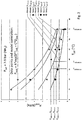
- Fig 2 shows data points and a resulting empirical model correlation between P MAT and T SAT similar to Fig. 1 , however for different ammonia-storage-material densities D MAT , with D MAT being a parameter in the representation of P MAT as a function of T SAT of Fig. 2 for four different levels of D MAT , labeled as "A" to "D" (A ⁇ 1.0 g/cm 3 , B ⁇ 1.13 g/cm 3 , C ⁇ 1.25 g/cm 3 and D ⁇ 1.3 g/cm 3 ).
- the ammonia storage material in degassed form is SrCl2, and Sr(NH 3 ) 8 Cl 2 in fully saturated form.
- the density is calculated when the material is in its saturated form. For each density level there is a strong correlation with T SAT .
- Three illustrations, labelled as P LIMIT-1 , P LIMIT-2 , and P LIMIT-3 are made, where a certain P LIMIT-3 is linked to another density D MAT than that of P LIMIT-1 and P LIMIT-2 , and as a result the required saturation temperature, T SATMIN , is located on the X-axis.
- T SAT has to be equal to - or larger - than T SATMIN , i.e. T SAT ⁇ T SATMIN .
- the temperature T SAT at which method is performed may be predetermined and fixed. If one of various available target densities D MAT of ammonia-storage material in the cartridge is also given, the correlation of the type shown in Fig. 2 and described above is used for the design of a cartridge for the solid ammonia storage material capable of withstanding a resulting exerted pressure from the material, P MAT , or force F MAT .
- the relation between T SAT , D MAT , and P MAT , or F MAT is used to find the value of P MAT , or F MAT , that corresponds to the given values of T SAT and D MAT .
- the determined value of P MAT , or F MAT is then used for the design of the cartridge such that the cartridge's mechanical strength measured in terms of a hydraulic-limit parameter P LIMIT , or F LIMIT , under which walls of the cartridge do not undergo plastic deformation, or do not undergo deformation of more than 110%, 120%, 150%, or 200% of the deformation at the yield point of the container walls, is equal to or exceeds the value of P MAT , or F MAT .
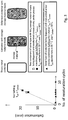
- Fig. 3 shows proof of the features of the present invention. Data are shown for cartridges undergoing consecutive cycles of NH 3 -degassing and NH3-resaturation.
- the tested cartridges are cylindrical and made of aluminum.
- the ammonia-storage-material density is approx. 1.13 g/cm 3 in this example, which is supposed to correspond to D MAT-A in Fig. 2 .
- T SATMIN at approx. 38°C.
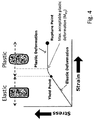
- Figure 4 shows an exemplary illustration of the relationship between strain (deformation) and stress on a metal member, e.g. a container.
- Plastic deformation also referred to as "inelastic deformation”
- the material deforms (strains) because of the stress (created by F MAT , or P MAT ).
- T SAT > T SATMIN the stress created by the material is reduced and the container remains in the area of elastic deformation.
- the relation between stress and strain is nearly linear while in the plastic-deformation regime the strain-stress relation becomes nearly flat (meaning that the material continues to deform even if the stress is not increased).
- the transition between the linear and the flat relation typically has a continuously changing slope; i.e. the change is slope is not abrupt but extends over a finite strain range.
- the "yield point" is defined to be the stress at which a material begins to deform plastically; more specifically, the yield point is typically just before the transition from the linear to the flat part of the relation (when looking into the direction of increasing strain).
- the limit for the mechanical strength of the container in terms of the pressure, P LIMIT , or the force, F LIMIT is defined to be the pressure, or the force, in the container's interior volume under which the walls of container do not undergo plastic deformation; i.e. there is no deformation beyond the yield point.
- a small degree of plastic deformation is acceptable; i.e. a strain beyond the yield point in the transition to the flat plastic-deformation regime before it becomes completely flat.
- the mechanical strength of the container in terms of the pressure, P LIMIT , or the force, F LIMIT is defined to be the pressure, or force, that causes no deformation beyond a point in the transition region of the stress-strain diagram which is referred to as "maximum acceptable plastic deformation", or "M PD ".
- the point M PD is defined as the maximum degree of plastic deformation that is acceptable for a certain container after which is does no longer fit into the physical application for which it is intended.
- M PD in this case at a strain of 200% of the strain at the yield point would be at maximum 1 mm, and the resulting maximum diameter would be 101 mm.
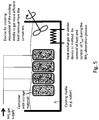
- FIG. 5 shows an example of resaturation of a plurality of containers filled inside with storage ammonia material of the sort described above.
- the storage containers are immersed in a trough filled with cooling media (e.g. cold water), and are thus cooled by the cooling media.
- the temperature of the cooling media is controlled with a suitable device for control of the temperature of the media to reach a targeted saturation temperature T SAT , e.g. a sensor for measuring the cooling-media temperature and a feed-back controller comparing the measured temperature with a target temperature and adjusting the temperature, or the flow, of the cooling media to counteract any difference between the measured and the target temperature.
- T SAT targeted saturation temperature
- Common methods for creating movement of the cooling media to increase heat transfer from the container undergoing saturation can be applied, such as actively creating circulation of the cooling media in the trough by means of a pump or propeller.
- Ammonia is supplied as pressurized gas to the inside of the storage containers.
- Figure 6 shows a diagram of a simulation method to estimate or predict the relationship between T SAT , D MAT and the resulting pressure P MAT (or F MAT ).
- Relevant parameters describing ammonia and the ammonia storage material (with/without ammonia absorbed), referred to as "Thermodynamic input", and independent variables as well as the density, D MAT of the ammonia storage material are fed to a computer model such as a Finite Element Method (FEM) simulation.
- FEM Finite Element Method
- T SATMIN a minimum temperature T SATMIN to be identified of the saturation/resaturation process where P MAT (or F MAT ) exerted by the storage material is kept below the limit for the mechanical strength in terms of P LIMIT , or F LIMIT , of the container.
- EXAMPLE 1 Procedure for determining forces from saturation at various temperatures, and finding a minimum saturation temperature T SATMIN for a given cartridge
- the closed-off reactor was evacuated to remove ambient air and then subjected to a pressure of ammonia gas.
- the uptake of ammonia was followed by weighing the reactor and it was in this way ensured that the SrCl 2 was completely saturated by ammonia.
- the force of the saturating SrCl 2 acting one end of the reactor was measured using a load cell.
- the temperature of the reactor walls were actively controlled using Peltier-elements.
- the reactor was heated and the pressure at the outlet fixed to just above ambient pressure to degas ammonia from the reactor.
- the material was degassed for a fixed time before a pressure of ammonia was applied again to resaturate the material. In this way a sample could be recycled several times and the force measurement could be conducted for several temperature points.
- Suitable ammonia storage materials are CaCl2, BaCl2 or any other metal ammine complex in pure form or as a mixture of salts.
- the typical formula for metal ammine complexes is: M(NH 3 ) X H Y where M is a metal ion, X is the coordination number for ammonia (from 0 up to 8 or even 12 in some salts), H is a halide (e.g. chloride ion) and Y is the number of halide ions in the complex.
- M is a metal ion
- X is the coordination number for ammonia (from 0 up to 8 or even 12 in some salts)
- H is a halide (e.g. chloride ion)
- Y is the number of halide ions in the complex.
- SrCl2 and CaCl2 salts absorb 8 ammonia molecules (Sr(NH 3 ) 8 Cl 2 or Ca(NH 3 ) 8 Cl 2 .
- EXAMPLE 2 Finding a metal wall thickness based on a fixed saturation, temperature, and storage-material density.
- a refill process has been established to refill cartridges at a temperature of 20° C.
- the cartridge is cylindrical, with an outer diameter of 178 mm due to requirements of available space on certain vehicles on the market. It is decided to make the cartridge from a deep-drawn aluminum-alloy casing. After deep-drawing, the aluminum alloy has a yield strength of 170 MPa; the "yield strength", or “yield point” is defined to be the stress at which a material begins to deform plastically. Prior to the yield point the material will deform elastically and will return to its original shape when the applied stress is removed. Once the yield point is passed, some fraction of the deformation will be permanent and non-reversible.
- allowable pressure can be calculated using the ASME code and design by rule method. Given a design temperature, allowable stress (from vessel material), vessel radius (from volume) and wall thickness, the following formulas provide the maximum allowable pressure.
- the allowable pressure based on given vessel material and geometry is calculated for a thin walled deep drawn cylindrical aluminum shell.
- E 1
Landscapes
- Chemical & Material Sciences (AREA)
- Organic Chemistry (AREA)
- Analytical Chemistry (AREA)
- Chemical Kinetics & Catalysis (AREA)
- Inorganic Chemistry (AREA)
- Engineering & Computer Science (AREA)
- Mechanical Engineering (AREA)
- General Engineering & Computer Science (AREA)
- Physics & Mathematics (AREA)
- Oil, Petroleum & Natural Gas (AREA)
- General Chemical & Material Sciences (AREA)
- Health & Medical Sciences (AREA)
- Life Sciences & Earth Sciences (AREA)
- Biochemistry (AREA)
- General Health & Medical Sciences (AREA)
- General Physics & Mathematics (AREA)
- Immunology (AREA)
- Pathology (AREA)
- Filling Or Discharging Of Gas Storage Vessels (AREA)
- Exhaust Gas After Treatment (AREA)
Description
- The present invention relates to ammonia storage in a solid ammonia storage material and specifically to a method for controlling the magnitude of mechanical forces exerted by a solid ammonia storage material on walls of a container holding the storage material.
- Anhydrous ammonia is a widely used chemical with many applications. One example is the use as reductant for selective catalytic reduction (SCR) of NOx in exhaust gas from combustion processes.
- For most end-user applications, and in particular in automotive applications, the storage of ammonia as pure, pressurized anhydrous ammonia in a pressure vessel is too hazardous. A storage method involving absorption of molecular ammonia in a solid material kept in a closed metal container can circumvent the safety hazard and enable the use of gaseous ammonia in any mobile or de-central application. In emissions technology, the use of direct ammonia gas dosing from cartridges/containers holding solid storage materials gives much better DeNOx potential via SCR catalysts than the conventional use of urea dissolved in water (for example, 32.5% urea dissolved in water, marketed under the trade name AdBlue®)- in particular for vehicles driving in cities with relatively low exhaust temperature.
- Metal ammine salts are materials capable of reversible ammonia absorption/desorption, which can be used as solid storage medium for ammonia (see e.g.
WO 2006/012903 A2 ). The material is delivered in metal containers (or so-called cartridges) to be integrated in a specific and well-defined packaging or installation volume on a vehicle and then the ammonia is gradually released for NOx reduction (EP 2181963 A1 ). - When such cartridges holding metal ammine complexes are used on a vehicle, they gradually become depleted of ammonia and degassed salt material remain in the metal cartridge. Cartridges must be saturated (resaturated) with ammonia in order to be used again. One-time-use of such a unit is too expensive and not a sustainable solution.
- An industrially relevant application requires therefore that the cartridge holding the ammonia storage material can be saturated/resaturated many times. Comparing with - as example - propane bottles for barbeques, a customer does not buy a new propane tank (e.g. 80 Euro price) each time - but rather buys a tank a first time and then gets a refilled unit subsequently (10-15 Euro price).
- Metal ammine complexes have been studied in the past years and it has turned out to be a challenging class of material. It requires in some cases additives or internal metal foil structure to get the proper heat transfer and it is a known fact that the salt crystal lattice can expand by e.g. a factor of four when absorbing ammonia.
- Saturation or resaturation of depleted ammonia storage material in a metal container cannot be done practically on the vehicle since it takes much more than just a few minutes to resaturate (removal of absorption heat by cooling may take several hours) and it requires anhydrous ammonia available next to the vehicle. Consequently, the depleted cartridge must be resaturated before next use. To minimize the cost for the end-user, the saturation/resaturation process must be efficient and, even more importantly, allow for the cartridge/unit to be used many times.
- Like in the case of recharging of electrical batteries, an important aspect of a process for cartridge refilling is avoiding degradation of the unit that over time would render the cartridge unusable. An observed physical effect that has a big impact on the cartridge durability is the expansion of the salt during saturation/resaturation. This expansion, which is also mentioned in
WO 2010/025947 A1 , leads to high mechanical forces which in turn may deform the metal wall of the cartridges or damage an internal structure for improving the heat transfer. Over several refilling/degassing cycles the shape or performance of the cartridge may degrade to a level where the cartridge will become unusable and the deformation will lead to no longer fitting in the volume or installation space intended for the cartridge. These expansion forces may to some extent be mitigated by making the cartridge wall very thick or significantly reducing the targeted storage density of the material (e.g. to less than 50% or 75% of the theoretical max. density). Thick-walled cartridges become both expensive and heavy while a significant reduction in the targeted storage density (reduced salt loading per unit volume) makes the cartridge industrially unattractive as an ammonia carrying unit because of poor utilization of the overall volume on the vehicle. - Consequently, a solution is needed that enables a combination of three industrially important parameters: high storage density, low weight and high durability (low cost-of-ownership). Unless all three are proven for an ammonia storage product, it is difficult to find a relevant place on the market that allows capturing the huge environmental benefits of being able to dose ammonia gas directly for optimal SCR NOx reduction.
-
WO 2014/023841 A1 describes a unit for storing gas by absorption or adsorption with a storage element having a compressible element in contact with the storage element designed to deform under the action of loads applied by the storage element during phases of storing and releasing gas from storage -
US 2011/0284121 A1 describes a method for saturating or re-saturating ammonia storage capable of reversibly absorbing and desorbing ammonia in one or more storage containers, wherein said material is partly or fully depleted of ammonia.US 2013/0209316 A1 describes a method for estimating the degree of saturation of a reversible solid ammonia storage material in a storage unit. - A method is provided for controlling the magnitude of mechanical forces exerted by a solid ammonia storage material on walls of a container holding the storage material inside its interior volume when the storage material is undergoing saturation/resaturation with ammonia inside said storage container according to
claim 1. The method comprises: - a. determining a limit for the mechanical strength of the container in terms of a hydraulic pressure, hereinafter PLIMIT, or a hydraulic force, hereinafter FLIMIT, in its interior volume under which the walls of container do not undergo plastic deformation, or do not undergo deformation of more than 110%, 120%, 150%, or 200% of a deformation at a yield point of the container walls;
- b. using a relationship, between
- i. a temperature for ammonia saturation/resaturation process of the storage material, hereinafter TSAT, and
- ii. the hydraulic pressure PMAT, or equivalent mechanical force FMAT generated by the storage material during saturation/resaturation at said temperature TSAT,
- A method (not claimed) of designing a container for accommodating solid ammonia storage material where a process temperature for ammonia saturation/resaturation TSAT and a target density of the storage material, DMAT are fixed, and the outcome of the design method is a container design capable of withstanding a resulting exerted pressure from the material, PMAT, or force FMAT, upon ammonia saturation/resaturation. A known relation between DMAT, TSAT, and PMAT, or FMAT, is used to establish a value of PMAT, or FMAT, and this value is used for the design of the container such that its mechanical strength measured in terms of a hydraulic-limit parameter PLIMIT, or FLIMIT, under which walls of the container do not undergo plastic deformation, or do not undergo deformation of more than 110%, 120%,
150%, or 200% of a deformation at a yield point of the container walls, is equal to or exceeds the value of PMAT, or FMAT. - A container filled with a solid ammonia storage material with a storage density, DMAT, capable of desorbing and absorbing/reabsorbing ammonia, has a mechanical strength corresponding to a limit-pressure parameter, PLIMIT, or limit-force parameter FLIMIT, at which pressure, or force, inside the container the container does not undergo plastic deformation, or do not undergo deformation of more than 110%, 120%, 150%, or 200% of a deformation at a yield point of the container walls. The storage material in the container is filled with ammonia by a saturation/re-saturation process in which the saturation/resaturation of the storage material is performed with the storage material inside the container at a process temperature, TSAT, fulfilling the condition TSAT ≥ TSATMIN. TSATMIN is a minimum temperature of the saturation/resaturation process where PMAT, or FMAT, exerted by the storage material is kept below the limit for the mechanical strength in terms of PLIMIT, or FLIMIT, of the container.
- A correlation between a temperature for ammonia saturation/resaturation process, TSAT, of an ammonia storage material and the hydraulic pressure, PMAT, or equivalent mechanical force, FMAT, generated by the storage material during saturation/resaturation at said temperature TSAT, is used to influence the level of force or pressure exerted by the storage material by carrying out the saturation/resaturation at a temperature where the resulting pressure, PMAT, or force, FMAT, exerted by the storage material is kept below a limit under which the container does not undergo plastic deformation, or does not undergo deformation of more than 110%, 120%, 150%, or 200% of a deformation at a yield point of the container walls.
- Features of the invention presented herein are inherent in the methods disclosed or will become apparent to those skilled in the art from the following detailed description of embodiments and its accompanying drawings.
- It is noted that pressure and force are linked in the normal mechanical way; i.e. pressure is force exerted per unit area.
- It has been discovered that the forces created by crystal expansion and thus the mechanical forces of metal ammine complexes while absorbing/reabsorbing ammonia can be described conceptually as a hydraulic pressure exerted by a fluid. More importantly - and the key to the current invention - it has been discovered that this mechanical force, FMAT, or the equivalent hydraulic pressure, PMAT, is strongly correlated with the temperature level of the ammonia storage material during its saturation or resaturation. It is observed that when saturation/resaturation temperature is increased then PMAT is reduced.
- In addition, there is link between the forces (or pressure) and the density of material, DMAT, in the unit holding or confining the ammonia storage material. An increase in density - all other parameters kept identical - leads to a potential for higher force.
- Although a conclusive scientific explanation is not yet available, a qualitative reasoning behind the discovery of the present invention is the following: Materials such as butter are very stiff at low temperature but become softer when the temperature is increased. When the material is softer it is difficult to have long-distance forces created by the material. If a fork is pushed towards soft (warm) butter, it enters the butter relatively easily. If the butter is very cold, the fork can hardly enter the butter and the push on the fork towards the butter rather results in moving the butter. This analogy can be used for explaining the present discovery. When the material is warm, the local expansion forces of the crystal structure when it absorbs ammonia are not transferred over long length scale (centimeters) but rather dissipated locally in the material at much smaller length scale. With a stiffer material - i.e. at lower temperatures - the forces can have long-scale effects and thereby exert the forces (or a corresponding pressure) at a high level on the walls of the container.
- In the present description, this aspect is utilized in an innovative and constructive manner to achieve the target of the invention: a method for obtaining a robust, durable product having attractive properties and cost for the customer.
- It is noticed from the results shown from the present invention that suitable levels of reduced material forces (pressure) are typically seen at saturation temperatures, TSAT, above room temperature. Since the resaturation (or saturation) process needs active cooling in order to make a fast and efficient saturation process, one would normally use the approach of "as cold as possible" to speed up the refilling process. Contrary to this intuitive approach, the method of the present invention has its most attractive features when cooling is done with warm fluid.
- In the present description this aspect is applied to achieve a combination of a durable ammonia storage cartridge with attractive properties and a cost-effective refill process.
- When the ammonia storage material is undergoing saturation/resaturation with ammonia inside said storage container, the method comprises reducing expansion forces of solid ammonia storage metal ammine complexes capable of reversibly absorbing and desorbing ammonia when confined in one or more metal containers, wherein said material, when undergoing saturation or resaturation with ammonia, is kept at process conditions that reduces the magnitude of the expansion forces to a level that eliminates or reduces deformation of the metal container itself that encapsulates the material.
- In some embodiments, the determination of TSATMIN uses the correlation between TSAT and PMAT, or FMAT, and also includes a correlation with the density of the ammonia storage material DMAT where DMAT is calculated based on the ammonia storage material being fully saturated with ammonia.
- In some embodiments a liquid cooling media is used during saturation/restauration, and there is an upper limit on TSAT, for practical reasons, defined by the boiling point of the cooling media (TCMBP, cooling media boiling point) such that TCMBP ≥ TSAT ≥ TSATMIN. For example, TCMBP is about 100° C.
- In other embodiments the ammonia storage material is cooled during the saturation/resaturation process by a gaseous cooling media. The saturation/resaturation process at the temperature TSAT fulfills the condition TCMBP ≥ TSAT ≥ TSATMIN, where TCMBP is an upper limit on the temperature at which the saturation/resaturation process is performed cooled by the gaseous cooling media. For example, also in that case TCMBP may be about 100° C.
- In some embodiments the method is based on a mechanical strength (PLIMIT, FLIMIT) being derived from official legislation targets, such as the target included in the United Nations standardization document ST/SG/AC.10/C.3/88, 12 December 2013, "Report of the Sub-Committee of Experts on the Transport of Dangerous Goods on its forty-fourth session", Chapter 3.3, according to which each receptacle containing adsorbed or absorbed ammonia shall be able to withstand the pressure generated at 85° C with a volumetric expansion no greater than 0.1 %, wherein the pressure at a temperature of 85° C is less than 12 bar. Hence, in some of these embodiments the ammonia storage container has a mechanical strength which enables the container to withstand the pressure generated by desorbed ammonia at 85° C with a volumetric expansion no greater than 0.1 volume-%.
- In some embodiments, PLIMIT, or FLIMIT, and subsequently TSATMIN, are determined from:
- a. having an existing container design available,
- b. knowing from the existing design the value of PLIMIT, or FLIMIT, or using (i) standard mechanical engineering practice, (i) hydraulic pressure measurements, or (iii) mechanical simulations to identity the value of PLIMIT, or FLIMIT,
- c. using the known or identified PLIMIT, or FLIMIT, to determine the loading density DMAT and saturation/resaturation condition TSAT ≥ TSATMIN, or TCMBP ≥ TSAT ≥ TSATMIN, to prevent PMAT, or FMAT, from exceeding PLIMIT, or FLIMIT.
- In some embodiments the procedure of determining TSATMIN includes an experimental mapping procedure in which experimental data points are obtained to establish an empirical relationship or correlation between the dependent variable PMAT, and the independent variable TSAT. The mapping procedure comprises:
- a. preparing at least one sample of ammonia storage material;
- b. carrying out ammonia desorption and resaturation experiments in a sample holder capable of measuring PMAT exerted by the material on the walls of the sample holder when it the material is undergoing saturation/re-saturation, said procedure being carried out at different temperature levels TSAT;
- c. using the experimental data points to generate a function or interpolation formula PMAT = f(TSAT), or FMAT = f(TSAT).
- Alternatively, in some embodiments in which different densities DMAT are taken into account, the procedure of determining TSATMIN includes an experimental mapping procedure in which experimental data points are obtained to establish an empirical relationship or correlation between the dependent variable PMAT, or FMAT, and the independent variables TSAT and DMAT. The mapping procedure comprises:
- a. preparing at least one sample of ammonia storage material with known density DMAT;
- b. carrying out ammonia desorption and resaturation experiments in a sample holder capable of measuring PMAT exerted by the material on the walls of the sample holder when it the material is undergoing saturation/re-saturation, said procedure being carried out at different temperature levels TSAT;
- c. using the experimental data points to generate a function or interpolation formula PMAT = f(TSAT, DMAT), or FMAT = f(TSAT, DMAT) in the case where samples with different densities DMAT are measured.
- In a variant of the embodiments mentioned above the procedure of determining TSATMIN is done by creating the relationship between PMAT, or FMAT, and TSAT, and optionally DMAT via computer simulations using parameters describing the ammonia storage material, ammonia itself and the material in saturated form. Said parameters describe the state of the material in saturated and unsaturated form, the influence of these parameters as a function of temperature and with input of density of the material the model can estimate or predict the level of the dependant variable, PMAT, (or FMAT) based on the input variables like density, material parameters and saturation temperature. Such a computer model can be structured in different ways and an example is to use traditional finite element method (FEM) simulation.
- It may be advantageous to increase the temperature TSAT significantly above TSATMIN to make up for a relatively weak cartridge design, or where a high density is attractive, or in the case where the duration of the saturation process is of less or no importance.
- Even if very high reduction of forces can be obtained at temperatures above 60-80° C it may be advantageous to keep a lower temperature (closer to TSATMIN) where the reduction of forces is sufficient thereby allowing a better thermal gradient between storage material absorbing ammonia when subjected to the pressure PSAT to decrease the process duration. Typically, the ammonia gas pressure, PSAT, needs to be at least high enough to give a gradient corresponding to at least 10° C difference relative to the equilibrium temperature of the storage material when exposed to the pressure PSAT. Example: At 55° C the equilibrium desorption pressure of ammonia from the solid storage material is approx. 2.5 bar (for SrCl2) and using PSAT = 2.5 bar would give an absorption rate equal to zero since there is no driving force for absorption and thereby no heat to be removed.
- The process condition, TSAT, and target density of the storage material, DMAT, may initially be fixed, e.g. by existing hardware requirements; the outcome is a container design capable of withstanding the resulting exerted pressure, or force, from the material, PMAT, or FMAT, upon ammonia saturation/resaturation:
- a. knowing the temperature TSAT and the target density of the storage material, DMAT;
- b. using a known relation between DMAT, TSAT, and PMAT, or FMAT, to establish a value of PMAT, or FMAT, and use this value for the design of the container such that its mechanical strength measured in terms of a hydraulic-limit parameter PLIMIT, or FLIMIT, under which walls of the container do not undergo plastic deformation, or do not undergo deformation of more than 110%, 120%, 150%, or 200% of the deformation at the yield point of the container walls, is equal to or exceeds the value of PMAT, or FMAT.
- The container for storing a solid ammonia storage material with a storage density, DMAT, capable of desorbing and (re)absorbing ammonia, may have a mechanical strength corresponding to a limit-pressure parameter, PLIMIT, or limit-force parameter FLIMIT, at which pressure, or force, inside the container the container does not undergo plastic deformation, or does not undergo deformation of more than 110%, 120%, 150%, or 200% of the deformation at the yield point of the container walls. The storage material in the container has been filled with ammonia by a saturation/re-saturation process in which the saturation/resaturation of the storage material has been performed with the storage material inside the container at a process temperature, TSAT, fulfilling the condition TSAT ≥ TSATMIN, where TSATMIN is the minimum temperature of a saturation/resaturation process where PMAT, or FMAT, exerted by the storage material is kept below the limit for the mechanical strength in terms of PLIMIT, or FLIMIT, of the container.
- The correlation or relation between a temperature for ammonia saturation/resaturation process, TSAT, and - optionally - also the storage density, DMAT, of an ammonia storage material, and the hydraulic pressure, PMAT, or equivalent mechanical force, FMAT, generated by the storage material during saturation/resaturation at said temperature TSAT, is used for the design or manufacture of containers storing a material capable of ammonia absorption, more specifically , to influence the level of force or pressure exerted by the storage material by carrying out the saturation/resaturation at a temperature where the resulting pressure, PMAT, or force, FMAT, exerted by the storage material is kept below a limit under which the container does not undergo plastic deformation, or does not undergo deformation of more than 110%, 120%, 150%, or 200% of the deformation at the yield point of the container walls;.
- It is noted that the methods described herein are also advantageous for preparing the initial product, i.e. a container/cartridge which is charged with ammonia by in-situ saturation of storage material. By avoiding all the complicated process conditions mentioned in
WO 2010/025947 A1 , the present invention enables simplified production of an in-situ saturated cartridge where not-yet-saturated storage material is placed inside the cartridge prior to a first saturation and is saturated for the first time inside the (metal) cartridge shell. - Exemplary embodiments are now described, also with reference to the accompanying drawings, wherein
- Fig. 1
- shows the material expansion pressure, PMAT, during ammonia saturation plotted against the cooling medium temperature, TSAT;
- Fig 2
- shows data points and a resulting model correlation between PMAT and different combinations of TSAT and DMAT;
- Fig. 3
- shows the normalized deformation of an ammonia storage container versus the number of resaturation cycles;
- Fig. 4
- shows an illustration of elastic and plastic deformation;
- Fig. 5
- shows an example of a process for resaturation storage material with ammonia inside containers with appropriate control of TSAT:
- Fig. 6
- shows an example of a computer-simulation method to establish a relationship between PMAT, or FMAT, and TSAT and, if applicable, DMAT, to determine TSATMIN.
- The temperature level, TSAT, is determined by the temperature of the cooling media since the cartridges generate heat when ammonia is absorbing. Choosing different cooling media is possible while still fulfilling the TSATMIN.
-
Fig. 1 shows the material expansion pressure, PMAT, during ammonia saturation plotted against the cooling medium temperature, TSAT, during saturation of a material sample kept in a container capable of monitoring the expansion pressure. The mechanical pressure exerted by the material depends strongly on temperature, TSAT. The measurements are done for same sample but varying ammonia gas saturation pressures PSAT. This shows that the effect of PMAT is strongly an effect of temperature and not the ammonia gas pressure. - Hence,
Fig. 1 shows data points and an empirical correlation (based on the data points) between the temperature TSAT for the ammonia saturation/resaturation process of the storage material, and the hydraulic pressure PMAT (the equivalent mechanical force FMAT could be used in an equivalent manner) generated by the storage material during saturation/resaturation at said temperature TSAT. - With a given limit for the mechanical strength of the given cartridge in terms of PLIMIT, or FLIMIT, under which the walls of cartridge do not undergo plastic deformation, or do not undergo deformation of more than 110%, 120%, 150%, or 200% of the deformation at the yield point of the container walls, a correlation of this type is used to identify a minimum temperature TSATMIN of the saturation/resaturation process where PMAT, or FMAT, exerted by the storage material is kept below the limit for the mechanical strength, of the cartridge. Having found TSATMIN the saturation/resaturation process is carried out at a temperature TSAT fulfilling the condition TSAT ≥ TSATMIN.
- Alternatively, the temperature TSAT at which the saturation/resaturation is performed may be predetermined and fixed. In this case the correlation of the type shown in
Fig. 1 and described above is used for the design of a cartridge for the solid ammonia storage material capable of withstanding a resulting exerted pressure from the material, PMAT, or force FMAT. The relation between TSAT, and PMAT, or FMAT, is used to find the value of PMAT, or FMAT, that corresponds to the given value of TSAT. This found value of PMAT, or FMAT is then used for the design of the cartridge such that the cartridge's mechanical strength measured in terms of a hydraulic-limit parameter PLIMIT, or FLIMIT, under which walls of the cartridge do not undergo plastic deformation, or do not undergo deformation of more than 110%, 120%, 150%, or 200% of the deformation at the yield point of the container walls, is equal to or exceeds the value of PMAT, or FMAT. -
Fig 2 shows data points and a resulting empirical model correlation between PMAT and TSAT similar toFig. 1 , however for different ammonia-storage-material densities DMAT, with DMAT being a parameter in the representation of PMAT as a function of TSAT ofFig. 2 for four different levels of DMAT, labeled as "A" to "D" (A≈1.0 g/cm3, B≈1.13 g/cm3, C≈1.25 g/cm3 and D≈1.3 g/cm3). The ammonia storage material in degassed form is SrCl2, and Sr(NH3)8Cl2 in fully saturated form. As a reference point, the density is calculated when the material is in its saturated form. For each density level there is a strong correlation with TSAT. The model equation best describing the experimental model data done on small material samples is of the form PMAT = A*exp(B*TSAT + C*DMAT), but any kind of mathematical representation giving a good data representation is envisaged. Three illustrations, labelled as PLIMIT-1, PLIMIT-2, and PLIMIT-3, are made, where a certain PLIMIT-3 is linked to another density DMAT than that of PLIMIT-1 and PLIMIT-2, and as a result the required saturation temperature, TSATMIN, is located on the X-axis. To ensure that PMAT is not exceeding PLIMIT it can be seen that TSAT has to be equal to - or larger - than TSATMIN, i.e. TSAT ≥ TSATMIN. - With a given limit for the mechanical strength of the given cartridge in terms of PLIMIT, or FLIMIT, under which the walls of cartridge do not undergo plastic deformation, or do not undergo deformation of more than 110%, 120%, 150%, or 200% of the deformation at the yield point of the container walls, and a given target density DMAT of ammonia-storage material in the cartridge, a correlation of this type is used to identify a minimum temperature TSATMIN of the saturation/resaturation process where PMAT, or FMAT, exerted by the storage material is kept below the limit for the mechanical strength, of the cartridge. Having found TSATMIN for the given PLIMIT and DMAT the saturation/resaturation process is carried out at a temperature TSAT fulfilling the condition TSAT ≥ TSATMIN.
- Alternatively, the temperature TSAT at which method is performed may be predetermined and fixed. If one of various available target densities DMAT of ammonia-storage material in the cartridge is also given, the correlation of the type shown in
Fig. 2 and described above is used for the design of a cartridge for the solid ammonia storage material capable of withstanding a resulting exerted pressure from the material, PMAT, or force FMAT. The relation between TSAT, DMAT, and PMAT, or FMAT, is used to find the value of PMAT, or FMAT, that corresponds to the given values of TSAT and DMAT. The determined value of PMAT, or FMAT, is then used for the design of the cartridge such that the cartridge's mechanical strength measured in terms of a hydraulic-limit parameter PLIMIT, or FLIMIT, under which walls of the cartridge do not undergo plastic deformation, or do not undergo deformation of more than 110%, 120%, 150%, or 200% of the deformation at the yield point of the container walls, is equal to or exceeds the value of PMAT, or FMAT. -
Fig. 3 shows proof of the features of the present invention. Data are shown for cartridges undergoing consecutive cycles of NH3-degassing and NH3-resaturation. In this example, the tested cartridges are cylindrical and made of aluminum. In the specific design used in these cartridges, the end-caps represent the weakest point and are made to be able to withstand at least 1.7 MPa gas pressure without plastic deformation (i.e. PLIMIT=1.7 MPa), corresponding to PLIMIT-2 ofFig. 2 . The ammonia-storage-material density is approx. 1.13 g/cm3 in this example, which is supposed to correspond to DMAT-A inFig. 2 . Then it can be seen fromfigure 2 that the analysis gives TSATMIN at approx. 38°C. In the conventional resaturation process the ammonia gas pressure was approx. 7-8 bar, and a cooling media of water was kept at about 20 C (TSAT ≈ 20°C) to have fast cooling by removal of ammonia absorption heat from the cartridge, i.e. below TSATMIN (= 38°C). It is observed from the testing that even when these units are consistently operated at much lower pressure than PLIMIT=1.7 MPa (desorption pressure for degassing: 2-4 bar; corresponding to 0.2 - 0.4 MPa; saturation pressure = 7-8 bar, corresponding to 0.7 - 0.8 MPa), the cartridge deforms inelastically even after only a few saturation cycles, and the cartridges can no longer be used even before reaching, e.g., ten refills since they do no longer fit in the installation volume. This is shown for two different units of same type. - Applying the method of the present invention to this example (viz. to a cartridge of the same type filled with the same storage material with the same density, i.e. the same TSATMIN) the following has been found: The same test has been carried out, however with the cooling media kept at about 55 C (TSAT ≈ 55°C), i.e. above TSATMIN ≈ 38°C). The lower part of the graph on
figure 3 shows degassing/refill cycles when the process and design constraint according to the method of the present invention is fulfilled. It is seen that fulfilling the saturation process condition (triangles) eliminates the massive plastic deformation observed after few cycles with the conventional method (the hollow and filled square points). -
Figure 4 shows an exemplary illustration of the relationship between strain (deformation) and stress on a metal member, e.g. a container. Plastic deformation (also referred to as "inelastic deformation") of a container occurs when the stress created by the material gives a strain on the container wall that exceeds the level at the so-called yield point: The material deforms (strains) because of the stress (created by FMAT, or PMAT). When TSAT > TSATMIN, the stress created by the material is reduced and the container remains in the area of elastic deformation. - As schematically shown in
Fig. 4 , in the elastic-deformation regime the relation between stress and strain is nearly linear while in the plastic-deformation regime the strain-stress relation becomes nearly flat (meaning that the material continues to deform even if the stress is not increased). The transition between the linear and the flat relation typically has a continuously changing slope; i.e. the change is slope is not abrupt but extends over a finite strain range. The "yield point" is defined to be the stress at which a material begins to deform plastically; more specifically, the yield point is typically just before the transition from the linear to the flat part of the relation (when looking into the direction of increasing strain). - In some embodiments described herein the limit for the mechanical strength of the container in terms of the pressure, PLIMIT, or the force, FLIMIT, is defined to be the pressure, or the force, in the container's interior volume under which the walls of container do not undergo plastic deformation; i.e. there is no deformation beyond the yield point.
- In other embodiments, however, a small degree of plastic deformation is acceptable; i.e. a strain beyond the yield point in the transition to the flat plastic-deformation regime before it becomes completely flat. In these embodiments the mechanical strength of the container in terms of the pressure, PLIMIT, or the force, FLIMIT, is defined to be the pressure, or force, that causes no deformation beyond a point in the transition region of the stress-strain diagram which is referred to as "maximum acceptable plastic deformation", or "MPD". The point MPD is defined as the maximum degree of plastic deformation that is acceptable for a certain container after which is does no longer fit into the physical application for which it is intended. Ideally, there is no plastic deformation (as indicated in the pervious paragraph) but in some special circumstances a minor degree of plastic deformation can be accepted; in such cases the parameter MPD can be 110, 120, 150, or 200% of the strain (= deformation) at the yield point. For example, if a sample container of diameter 100mm can elastically deform by 0.5mm just below the yield point (which means that it would there still return to normal shape), then MPD in this case at a strain of 200% of the strain at the yield point would be at maximum 1 mm, and the resulting maximum diameter would be 101 mm.
-
Figure 5 shows an example of resaturation of a plurality of containers filled inside with storage ammonia material of the sort described above. The storage containers are immersed in a trough filled with cooling media (e.g. cold water), and are thus cooled by the cooling media. The temperature of the cooling media is controlled with a suitable device for control of the temperature of the media to reach a targeted saturation temperature TSAT, e.g. a sensor for measuring the cooling-media temperature and a feed-back controller comparing the measured temperature with a target temperature and adjusting the temperature, or the flow, of the cooling media to counteract any difference between the measured and the target temperature. Common methods for creating movement of the cooling media to increase heat transfer from the container undergoing saturation can be applied, such as actively creating circulation of the cooling media in the trough by means of a pump or propeller. Ammonia is supplied as pressurized gas to the inside of the storage containers. -
Figure 6 shows a diagram of a simulation method to estimate or predict the relationship between TSAT, DMAT and the resulting pressure PMAT (or FMAT). Relevant parameters describing ammonia and the ammonia storage material (with/without ammonia absorbed), referred to as "Thermodynamic input", and independent variables as well as the density, DMAT of the ammonia storage material are fed to a computer model such as a Finite Element Method (FEM) simulation. For example, the computer model outputs PMAT (or FMAT) as a function of TSAT and given DMAT. This enables a minimum temperature TSATMIN to be identified of the saturation/resaturation process where PMAT (or FMAT) exerted by the storage material is kept below the limit for the mechanical strength in terms of PLIMIT, or FLIMIT, of the container. - In order to determine the relation between temperature, material density and saturation forces from ammonia storage material several experiments were conducted following a general procedure:
A predetermined mass of dry SrCl2 powder was loaded in a reactor volume, which was then closed. The mass of SrCl2 was determined to yield a certain density, DMAT, after saturation of SrCl2 with ammonia. It was determined by multiplying the density by the volume of the reactor and dividing by the molar mass of fully saturated Sr(NH3)8Cl2 and multiplying by the molar mass of SrCl2. - The closed-off reactor was evacuated to remove ambient air and then subjected to a pressure of ammonia gas. The uptake of ammonia was followed by weighing the reactor and it was in this way ensured that the SrCl2 was completely saturated by ammonia. During the uptake the force of the saturating SrCl2 acting one end of the reactor was measured using a load cell. The temperature of the reactor walls were actively controlled using Peltier-elements.
- After complete saturation the reactor was heated and the pressure at the outlet fixed to just above ambient pressure to degas ammonia from the reactor. The material was degassed for a fixed time before a pressure of ammonia was applied again to resaturate the material. In this way a sample could be recycled several times and the force measurement could be conducted for several temperature points.
- To create the full map of the force for various temperatures and densities the reactor was loaded several times with various mass of SrCl2 each cycled at various temperature points.
- This procedure could be made for any relevant material capable of absorbing ammonia reversibly. Other examples of suitable ammonia storage materials are CaCl2, BaCl2 or any other metal ammine complex in pure form or as a mixture of salts. The typical formula for metal ammine complexes is: M(NH3)XHY where M is a metal ion, X is the coordination number for ammonia (from 0 up to 8 or even 12 in some salts), H is a halide (e.g. chloride ion) and Y is the number of halide ions in the complex. In saturated form the SrCl2 and CaCl2 salts absorb 8 ammonia molecules (Sr(NH3)8Cl2 or Ca(NH3)8Cl2.
- With a given limit for the mechanical strength of the given cartridge in terms of PLIMIT, or FLIMIT, under which the walls of cartridge do not undergo plastic deformation, or do not undergo deformation of more than 110%, 120%, 150%, or 200% of the deformation at the yield point of the container walls, and a given target density DMAT of ammonia-storage material in the cartridge, a relation of this type is used to identify a minimum temperature TSATMIN of the saturation/resaturation process where PMAT, or FMAT, exerted by the storage material is kept below the limit for the mechanical strength, of the cartridge. Having found TSATMIN for the given PLIMIT and DMAT the saturation/resaturation process is carried out at a temperature TSAT fulfilling the condition TSAT ≥ TSATMIN.
- A refill process has been established to refill cartridges at a temperature of 20° C. The ammonia storage material density given is 1175 g/cm3, which gives a material pressure PMAT = 3.2 MPa. The cartridge is cylindrical, with an outer diameter of 178 mm due to requirements of available space on certain vehicles on the market. It is decided to make the cartridge from a deep-drawn aluminum-alloy casing. After deep-drawing, the aluminum alloy has a yield strength of 170 MPa; the "yield strength", or "yield point" is defined to be the stress at which a material begins to deform plastically. Prior to the yield point the material will deform elastically and will return to its original shape when the applied stress is removed. Once the yield point is passed, some fraction of the deformation will be permanent and non-reversible.
- The minimum shell thickness of the cylinder can now be determined by the thin-walled assumption:

- Given a certain design pressure and design temperature, the allowable stress (from vessel material) and required vessel radius (from volume), a common approach is the design by a rule method, following design rules such as the ASME Boiler and Pressure Vessel Code; ASME
Section VIII Division 1. - The ASME design code gives for a thin walled design R/t >= 10 (R = vessel radius, t = wall thickness) the following design formulas for cylindrical shell minimum wall thickness requirement.
- Considering circumferential stress:
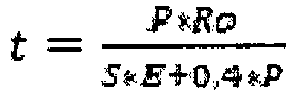
- Considering longitudinal stress:

- t = Wall thickness (in.)
- P = Design pressure (psi)
- Ro = Outside radius (in.)
- S = Allowable stress (psi)
- E = Weld joint efficiency factor
- Similarly the allowable pressure can be calculated using the ASME code and design by rule method. Given a design temperature, allowable stress (from vessel material), vessel radius (from volume) and wall thickness, the following formulas provide the maximum allowable pressure.
- Considering circumferential stress:
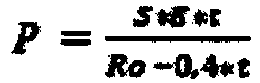
- Considering longitudinal stress:

- By way of example, the allowable pressure based on given vessel material and geometry is calculated for a thin walled deep drawn cylindrical aluminum shell.
t = 3 mm = 0.118 in
Ro = 98 mm = 3.504 in
S = 133.3 MPa = 16437.6 psi (based on yield strength of Aluminum alloy at 170 MPa, and a safety factor of normally 1.5 according to ASME code)
E = 1
Allowable pressure based on circumferential stress:

- Taking the lowest value from the calculations above gives allowable pressure 3.9 MPa.
- Furthermore, there is, as mentioned above, a design safety factor of 1.5 in the calculation. This leads to an allowable pressure PLIMIT of 3.9 MPa / 1.5 =2.6 MPa. Using the correlation of
figure 2 for a density of DMAT-C a value of the minimum temperature TSATMIN at which the saturation/resaturation process is to be carried of approx. 40 °C for this specific value of DMAT is obtained.
Claims (13)
- A method for controlling the magnitude of mechanical forces exerted by a solid ammonia storage material on walls of a container holding the storage material inside its interior volume when the storage material is undergoing saturation/resaturation with ammonia inside said storage container, said method comprising:a. determining a limit for the mechanical strength of the container in terms of a hydraulic pressure, hereinafter PLIMIT, or a hydraulic force, hereinafter FLIMIT, in its interior volume under which the walls of container do not undergo plastic deformation, or do not undergo deformation of more than 200% of a deformation at a yield point of the container walls;b. using a relationship betweeni. a temperature for ammonia saturation/resaturation process of the storage material, hereinafter TSAT, andii. the hydraulic pressure PMAT, or equivalent mechanical force FMAT generated by the storage material during saturation/resaturation at said temperature TSAT,to identify a minimum temperature, hereinafter TSATMIN, of the saturation/resaturation process where PMAT, or FMAT, exerted by the storage material is kept below the limit for the mechanical strength in terms of PLIMIT, or FLIMIT, of the container by carrying out the saturation/resaturation process at the temperature TSAT fulfilling the condition of TSAT ≥ TSATMIN, the relationship being established by an experimental mapping procedure in which experimental data points are obtained, or via computer simulations.
- The method according to claim 1 wherein the storage material has a density, hereinafter DMAT, in wherein in the determination of TSATMIN, besides using the relationship between TSAT and PMAT; or FMAT, also a relationship with the density DMAT of the storage material is taken into account, as a higher density DMAT generally leads to higher mechanical forces exerted by the solid ammonia storage material on the walls of the container, where DMAT refers to the density of the ammonia storage material being fully saturated with ammonia.
- The method according to claim 1 or 2 wherein the ammonia storage material is cooled during the saturation/resaturation process by a liquid cooling media having a boiling point, and wherein the saturation/resaturation process at the temperature TSAT fulfills the condition TCMBP ≥ TSAT ≥ TSATMIN, where TCMBP is the boiling point of the cooling media.
- The method according to claim 1 or 2 wherein the ammonia storage material is cooled during the saturation/resaturation process by a gaseous cooling media, and wherein the saturation/resaturation process at the temperature TSAT fulfills the condition TCMBP ≥ TSAT ≥ TSATMIN, where TCMBP is an upper limit on the temperature at which the saturation/resaturation process is performed cooled by the gaseous cooling media.
- The method according to claim 3 or 4 wherein TCMBP is 100° C.
- The method according to any one of claims 1 to 5 wherein the container has a mechanical strength which enables the container to withstand the pressure generated by desorbed ammonia at 85° C with a volumetric expansion no greater than 0.1 volume-%.
- The method according to claim 6, wherein the pressure generated by desorbed ammonia from the storage material at 85° C is 12 bar.
- The method according to any one of claims 2 to 7 where PLIMIT, or FLIMIT, and subsequently TSATMIN are determined from:a. having an existing container design available,b. knowing from the existing design the value of PLIMIT, or FLIMIT, or using (i) standard mechanical engineering practice, (ii) hydraulic pressure measurements, or (iii) mechanical simulations to identity the value of PLIMIT, or FLIMIT, andc. using the known or identified PLIMIT, or FLIMIT, to determine the loading density DMAT and the saturation/resaturation condition TSAT ≥ TSATMIN, or TCMBP ≥ TSAT ≥ TSATMIN, to prevent PMAT, or FMAT, from exceeding PLIMIT, or FLIMIT.
- The method according to any one of claims 1 to 8 where the procedure of determining TSATMIN includes the experimental mapping procedure in which experimental data points are obtained to establish empirically the relationship between the dependent variable PMAT, and the independent variable TSAT, said procedure comprisinga. preparing at least one sample of ammonia storage material;b. carrying out ammonia desorption and resaturation experiments in a sample holder capable of measuring PMAT exerted by the material on the walls of the sample holder when the material is undergoing saturation/re-saturation, said procedure being carried out at different temperature levels TSAT;c. using the experimental data points to generate a function or interpolation formula PMAT = f(TSAT), or FMAT = f(TSAT).
- The method according to any one of claims 2 to 8 where the procedure of determining TSATMIN includes the experimental mapping procedure in which experimental data points are obtained to establish empirically the relationship between the dependent variable PMAT, or FMAT, and the independent variables TSAT and DMAT, said procedure comprising:a. preparing at least one sample of ammonia storage material with known density DMAT;b. carrying out ammonia desorption and resaturation experiments in a sample holder capable of measuring PMAT exerted by the material on the walls of the sample holder when it the material is undergoing saturation/re-saturation, said procedure being carried out at different temperature levels TSAT;c. using the experimental data points to generate a function or interpolation formula PMAT = f(TSAT, DMAT), or FMAT = f(TSAT, DMAT) in the case where samples with different densities DMAT are measured.
- The method according to any one of claims 1 to 10 where the procedure of determining TSATMIN is done by creating the relationship between PMAT, or FMAT, and TSAT via computer simulations using parameters describing the ammonia storage material, ammonia itself, and the storage material in saturated form.
- The method according to any one of claims 2 to 10 where the procedure of determining TSATMIN is done by creating the relationship between PMAT, or FMAT, and TSAT and DMAT via computer simulations using parameters describing the ammonia storage material, ammonia itself, and the storage material in saturated form.
- The method according to any one of claims 1 to 12 where the limit for the mechanical strength of the container in terms of the hydraulic pressure PLIMIT or the hydraulic force FLIMIT in its interior volume is the limit under which the walls of container do not undergo deformation of more than 110%, 120%, or 150% of the deformation at the yield point of the container walls.
Priority Applications (10)
| Application Number | Priority Date | Filing Date | Title |
|---|---|---|---|
| EP15001018.9A EP3078635B1 (en) | 2015-04-09 | 2015-04-09 | Reducing expansion forces created by ammonia storage materials |
| ES15001018T ES2705079T3 (en) | 2015-04-09 | 2015-04-09 | Reduction of expansion forces created by ammonia storage materials |
| CN201510334108.9A CN106195626B (en) | 2015-04-09 | 2015-06-16 | Ammonia storage material force control method, container design and manufacturing method and application |
| US15/564,530 US20180079652A1 (en) | 2015-04-09 | 2016-04-07 | Method for reducing forces (hot fill/re-fill) |
| EP16717098.4A EP3280680A1 (en) | 2015-04-09 | 2016-04-07 | Reducing expansion forces created by ammonia storage materials |
| KR1020177032384A KR20170136589A (en) | 2015-04-09 | 2016-04-07 | Reduction of expansion force produced by ammonia storage material |
| JP2017552866A JP6703005B2 (en) | 2015-04-09 | 2016-04-07 | Reduced expansive force produced by ammonia storage materials |
| RU2017136255A RU2721007C2 (en) | 2015-04-09 | 2016-04-07 | Reduced expansion forces created by materials for storage of ammonia |
| PCT/EP2016/000573 WO2016162123A1 (en) | 2015-04-09 | 2016-04-07 | Reducing expansion forces created by ammonia storage materials |
| BR112017020890-3A BR112017020890A2 (en) | 2015-04-09 | 2016-04-07 | reduction of expansion forces created by ammonia storage materials |
Applications Claiming Priority (1)
| Application Number | Priority Date | Filing Date | Title |
|---|---|---|---|
| EP15001018.9A EP3078635B1 (en) | 2015-04-09 | 2015-04-09 | Reducing expansion forces created by ammonia storage materials |
Publications (2)
| Publication Number | Publication Date |
|---|---|
| EP3078635A1 EP3078635A1 (en) | 2016-10-12 |
| EP3078635B1 true EP3078635B1 (en) | 2018-10-31 |
Family
ID=52997799
Family Applications (2)
| Application Number | Title | Priority Date | Filing Date |
|---|---|---|---|
| EP15001018.9A Not-in-force EP3078635B1 (en) | 2015-04-09 | 2015-04-09 | Reducing expansion forces created by ammonia storage materials |
| EP16717098.4A Withdrawn EP3280680A1 (en) | 2015-04-09 | 2016-04-07 | Reducing expansion forces created by ammonia storage materials |
Family Applications After (1)
| Application Number | Title | Priority Date | Filing Date |
|---|---|---|---|
| EP16717098.4A Withdrawn EP3280680A1 (en) | 2015-04-09 | 2016-04-07 | Reducing expansion forces created by ammonia storage materials |
Country Status (9)
| Country | Link |
|---|---|
| US (1) | US20180079652A1 (en) |
| EP (2) | EP3078635B1 (en) |
| JP (1) | JP6703005B2 (en) |
| KR (1) | KR20170136589A (en) |
| CN (1) | CN106195626B (en) |
| BR (1) | BR112017020890A2 (en) |
| ES (1) | ES2705079T3 (en) |
| RU (1) | RU2721007C2 (en) |
| WO (1) | WO2016162123A1 (en) |
Families Citing this family (1)
| Publication number | Priority date | Publication date | Assignee | Title |
|---|---|---|---|---|
| US9914645B2 (en) | 2013-11-07 | 2018-03-13 | Regents Of The University Of Minnesota | Process for making ammonia |
Family Cites Families (13)
| Publication number | Priority date | Publication date | Assignee | Title |
|---|---|---|---|---|
| US7213395B2 (en) * | 2004-07-14 | 2007-05-08 | Eaton Corporation | Hybrid catalyst system for exhaust emissions reduction |
| CN101076495B (en) * | 2004-08-03 | 2010-06-16 | 氨合物公司 | Solid materials for storage and delivery of ammonia |
| KR20070057143A (en) | 2004-08-03 | 2007-06-04 | 아미넥스 에이/에스 | Solid Ammonia Storage and Transport Material |
| KR20070100786A (en) * | 2005-02-03 | 2007-10-11 | 아미넥스 에이/에스 | High density storage of ammonia |
| US8680006B2 (en) | 2008-09-08 | 2014-03-25 | Amminex Emissions Technology A/S | Saturation of ammonia storage materials in containers |
| EP2181963B1 (en) | 2008-10-06 | 2018-12-12 | Amminex Emissions Technology A/S | Release of stored ammonia at start-up |
| CA2775021A1 (en) * | 2009-09-30 | 2011-04-07 | Amminex A/S | Connected heat conducting structures in solid ammonia storage systems |
| EP2361883A1 (en) * | 2010-02-25 | 2011-08-31 | Amminex A/S | Method for determining the degree of saturation of solid ammonia storage materials in containers |
| CN101832167B (en) * | 2010-05-07 | 2012-07-11 | 东风汽车有限公司 | Ammonia adsorption control method in SCR (Selective catalytic reduction) catalyst |
| EP2388058A1 (en) * | 2010-05-19 | 2011-11-23 | Amminex A/S | Method and device for re-saturation of ammonia storage material in containers |
| JP5625627B2 (en) * | 2010-08-30 | 2014-11-19 | 株式会社豊田中央研究所 | Ammonia storage device and selective catalytic reduction system |
| EP2522823B1 (en) * | 2011-05-13 | 2014-04-23 | Aaqius & Aaqius S.A. | Device for measuring an amount of a reducing agent, preferably NH3, contained in a tank |
| IN2015DN00921A (en) * | 2012-08-09 | 2015-06-12 | Aaqius & Aaqius Sa |
-
2015
- 2015-04-09 ES ES15001018T patent/ES2705079T3/en active Active
- 2015-04-09 EP EP15001018.9A patent/EP3078635B1/en not_active Not-in-force
- 2015-06-16 CN CN201510334108.9A patent/CN106195626B/en not_active Expired - Fee Related
-
2016
- 2016-04-07 EP EP16717098.4A patent/EP3280680A1/en not_active Withdrawn
- 2016-04-07 KR KR1020177032384A patent/KR20170136589A/en not_active Withdrawn
- 2016-04-07 JP JP2017552866A patent/JP6703005B2/en not_active Expired - Fee Related
- 2016-04-07 BR BR112017020890-3A patent/BR112017020890A2/en not_active Application Discontinuation
- 2016-04-07 US US15/564,530 patent/US20180079652A1/en not_active Abandoned
- 2016-04-07 WO PCT/EP2016/000573 patent/WO2016162123A1/en not_active Ceased
- 2016-04-07 RU RU2017136255A patent/RU2721007C2/en not_active IP Right Cessation
Non-Patent Citations (1)
| Title |
|---|
| None * |
Also Published As
| Publication number | Publication date |
|---|---|
| EP3078635A1 (en) | 2016-10-12 |
| JP2018518435A (en) | 2018-07-12 |
| CN106195626B (en) | 2020-06-26 |
| EP3280680A1 (en) | 2018-02-14 |
| JP6703005B2 (en) | 2020-06-03 |
| BR112017020890A2 (en) | 2018-07-10 |
| KR20170136589A (en) | 2017-12-11 |
| ES2705079T3 (en) | 2019-03-21 |
| CN106195626A (en) | 2016-12-07 |
| US20180079652A1 (en) | 2018-03-22 |
| RU2721007C2 (en) | 2020-05-15 |
| RU2017136255A (en) | 2019-05-13 |
| RU2017136255A3 (en) | 2019-09-06 |
| WO2016162123A1 (en) | 2016-10-13 |
Similar Documents
| Publication | Publication Date | Title |
|---|---|---|
| Nam et al. | Three-dimensional modeling and simulation of hydrogen absorption in metal hydride hydrogen storage vessels | |
| EP2571598B1 (en) | Method for saturating and re-saturating ammonia storage material in containers | |
| US8834603B2 (en) | Method for determining the degree of saturation of solid ammonia storage materials in containers | |
| Kyoung et al. | Three-dimensional modeling and simulation of hydrogen desorption in metal hydride hydrogen storage vessels | |
| Visaria et al. | Experimental investigation and theoretical modeling of dehydriding process in high-pressure metal hydride hydrogen storage systems | |
| EP2236784A1 (en) | Improved method for storing and delivering ammonia from solid storage materials using a vacuum pump | |
| Shkolin et al. | Experimental study and numerical modeling: Methane adsorption in microporous carbon adsorbent over the subcritical and supercritical temperature regions | |
| US8473226B2 (en) | Method of determining the filling level of a solid ammonia storage medium in an ammonia storage container | |
| US20160201854A1 (en) | Device and method for indicating a fill level of a sorption store | |
| Belusko et al. | Effectiveness of direct contact PCM thermal storage with a gas as the heat transfer fluid | |
| Mat et al. | Investigation of three‐dimensional heat and mass transfer in a metal hydride reactor | |
| Visaria et al. | Enhanced heat exchanger design for hydrogen storage using high-pressure metal hydride–Part 2. Experimental results | |
| Visaria et al. | Coiled-tube heat exchanger for High-Pressure Metal Hydride hydrogen storage systems–Part 1. Experimental study | |
| EP3078635B1 (en) | Reducing expansion forces created by ammonia storage materials | |
| Karabanova et al. | Intrinsic kinetics in local modelling of thermochemical heat storage systems | |
| Visaria et al. | Coiled-tube heat exchanger for high-pressure metal hydride hydrogen storage systems–Part 2. Computational model | |
| US20180320574A1 (en) | Method for activating/deactivating a biological catalyst used in a conversion system on board a vehicle | |
| Gkanas et al. | Parametric Study on the Heat Management of Metal Hydride Tanks for Sustainable Building Applications | |
| Gezerman | Industrial-scale purging of ammonia by using nitrogen before environmental discharge | |
| Silin et al. | A case study of a hydride container performance applying non dimensional parameters | |
| Mathew | Application of multiphase heat transfer for efficient hydrogen | |
| Castrillo et al. | Design of a metal hydride | |
| LESMANA et al. | 4-2-1 Development of Innovative Metal Hydride Container for Hydrogen Storage Based on Triply Periodic Minimal Surface Structure | |
| Fopah Lele et al. | Modeling approach of thermal decomposition of salt-hydrates for heat storage systems | |
| KR101268371B1 (en) | Metal hydride tank system and simplified numerical modeling method for metal hydride tank design using the same |
Legal Events
| Date | Code | Title | Description |
|---|---|---|---|
| PUAI | Public reference made under article 153(3) epc to a published international application that has entered the european phase |
Free format text: ORIGINAL CODE: 0009012 |
|
| AK | Designated contracting states |
Kind code of ref document: A1 Designated state(s): AL AT BE BG CH CY CZ DE DK EE ES FI FR GB GR HR HU IE IS IT LI LT LU LV MC MK MT NL NO PL PT RO RS SE SI SK SM TR |
|
| AX | Request for extension of the european patent |
Extension state: BA ME |
|
| STAA | Information on the status of an ep patent application or granted ep patent |
Free format text: STATUS: REQUEST FOR EXAMINATION WAS MADE |
|
| 17P | Request for examination filed |
Effective date: 20170412 |
|
| RBV | Designated contracting states (corrected) |
Designated state(s): AL AT BE BG CH CY CZ DE DK EE ES FI FR GB GR HR HU IE IS IT LI LT LU LV MC MK MT NL NO PL PT RO RS SE SI SK SM TR |
|
| GRAP | Despatch of communication of intention to grant a patent |
Free format text: ORIGINAL CODE: EPIDOSNIGR1 |
|
| STAA | Information on the status of an ep patent application or granted ep patent |
Free format text: STATUS: GRANT OF PATENT IS INTENDED |
|
| INTG | Intention to grant announced |
Effective date: 20180426 |
|
| GRAS | Grant fee paid |
Free format text: ORIGINAL CODE: EPIDOSNIGR3 |
|
| GRAJ | Information related to disapproval of communication of intention to grant by the applicant or resumption of examination proceedings by the epo deleted |
Free format text: ORIGINAL CODE: EPIDOSDIGR1 |
|
| GRAL | Information related to payment of fee for publishing/printing deleted |
Free format text: ORIGINAL CODE: EPIDOSDIGR3 |
|
| STAA | Information on the status of an ep patent application or granted ep patent |
Free format text: STATUS: REQUEST FOR EXAMINATION WAS MADE |
|
| GRAR | Information related to intention to grant a patent recorded |
Free format text: ORIGINAL CODE: EPIDOSNIGR71 |
|
| STAA | Information on the status of an ep patent application or granted ep patent |
Free format text: STATUS: GRANT OF PATENT IS INTENDED |
|
| GRAA | (expected) grant |
Free format text: ORIGINAL CODE: 0009210 |
|
| STAA | Information on the status of an ep patent application or granted ep patent |
Free format text: STATUS: THE PATENT HAS BEEN GRANTED |
|
| INTC | Intention to grant announced (deleted) | ||
| AK | Designated contracting states |
Kind code of ref document: B1 Designated state(s): AL AT BE BG CH CY CZ DE DK EE ES FI FR GB GR HR HU IE IS IT LI LT LU LV MC MK MT NL NO PL PT RO RS SE SI SK SM TR |
|
| INTG | Intention to grant announced |
Effective date: 20180924 |
|
| REG | Reference to a national code |
Ref country code: CH Ref legal event code: EP Ref country code: GB Ref legal event code: FG4D |
|
| REG | Reference to a national code |
Ref country code: AT Ref legal event code: REF Ref document number: 1059156 Country of ref document: AT Kind code of ref document: T Effective date: 20181115 |
|
| REG | Reference to a national code |
Ref country code: DE Ref legal event code: R096 Ref document number: 602015018925 Country of ref document: DE |
|
| REG | Reference to a national code |
Ref country code: IE Ref legal event code: FG4D |
|
| REG | Reference to a national code |
Ref country code: NL Ref legal event code: MP Effective date: 20181031 |
|
| REG | Reference to a national code |
Ref country code: LT Ref legal event code: MG4D |
|
| REG | Reference to a national code |
Ref country code: ES Ref legal event code: FG2A Ref document number: 2705079 Country of ref document: ES Kind code of ref document: T3 Effective date: 20190321 |
|
| REG | Reference to a national code |
Ref country code: AT Ref legal event code: MK05 Ref document number: 1059156 Country of ref document: AT Kind code of ref document: T Effective date: 20181031 |
|
| PG25 | Lapsed in a contracting state [announced via postgrant information from national office to epo] |
Ref country code: BG Free format text: LAPSE BECAUSE OF FAILURE TO SUBMIT A TRANSLATION OF THE DESCRIPTION OR TO PAY THE FEE WITHIN THE PRESCRIBED TIME-LIMIT Effective date: 20190131 Ref country code: FI Free format text: LAPSE BECAUSE OF FAILURE TO SUBMIT A TRANSLATION OF THE DESCRIPTION OR TO PAY THE FEE WITHIN THE PRESCRIBED TIME-LIMIT Effective date: 20181031 Ref country code: PL Free format text: LAPSE BECAUSE OF FAILURE TO SUBMIT A TRANSLATION OF THE DESCRIPTION OR TO PAY THE FEE WITHIN THE PRESCRIBED TIME-LIMIT Effective date: 20181031 Ref country code: HR Free format text: LAPSE BECAUSE OF FAILURE TO SUBMIT A TRANSLATION OF THE DESCRIPTION OR TO PAY THE FEE WITHIN THE PRESCRIBED TIME-LIMIT Effective date: 20181031 Ref country code: LV Free format text: LAPSE BECAUSE OF FAILURE TO SUBMIT A TRANSLATION OF THE DESCRIPTION OR TO PAY THE FEE WITHIN THE PRESCRIBED TIME-LIMIT Effective date: 20181031 Ref country code: IS Free format text: LAPSE BECAUSE OF FAILURE TO SUBMIT A TRANSLATION OF THE DESCRIPTION OR TO PAY THE FEE WITHIN THE PRESCRIBED TIME-LIMIT Effective date: 20190228 Ref country code: LT Free format text: LAPSE BECAUSE OF FAILURE TO SUBMIT A TRANSLATION OF THE DESCRIPTION OR TO PAY THE FEE WITHIN THE PRESCRIBED TIME-LIMIT Effective date: 20181031 Ref country code: NO Free format text: LAPSE BECAUSE OF FAILURE TO SUBMIT A TRANSLATION OF THE DESCRIPTION OR TO PAY THE FEE WITHIN THE PRESCRIBED TIME-LIMIT Effective date: 20190131 Ref country code: AT Free format text: LAPSE BECAUSE OF FAILURE TO SUBMIT A TRANSLATION OF THE DESCRIPTION OR TO PAY THE FEE WITHIN THE PRESCRIBED TIME-LIMIT Effective date: 20181031 |
|
| PG25 | Lapsed in a contracting state [announced via postgrant information from national office to epo] |
Ref country code: PT Free format text: LAPSE BECAUSE OF FAILURE TO SUBMIT A TRANSLATION OF THE DESCRIPTION OR TO PAY THE FEE WITHIN THE PRESCRIBED TIME-LIMIT Effective date: 20190301 Ref country code: RS Free format text: LAPSE BECAUSE OF FAILURE TO SUBMIT A TRANSLATION OF THE DESCRIPTION OR TO PAY THE FEE WITHIN THE PRESCRIBED TIME-LIMIT Effective date: 20181031 Ref country code: GR Free format text: LAPSE BECAUSE OF FAILURE TO SUBMIT A TRANSLATION OF THE DESCRIPTION OR TO PAY THE FEE WITHIN THE PRESCRIBED TIME-LIMIT Effective date: 20190201 Ref country code: NL Free format text: LAPSE BECAUSE OF FAILURE TO SUBMIT A TRANSLATION OF THE DESCRIPTION OR TO PAY THE FEE WITHIN THE PRESCRIBED TIME-LIMIT Effective date: 20181031 Ref country code: AL Free format text: LAPSE BECAUSE OF FAILURE TO SUBMIT A TRANSLATION OF THE DESCRIPTION OR TO PAY THE FEE WITHIN THE PRESCRIBED TIME-LIMIT Effective date: 20181031 Ref country code: SE Free format text: LAPSE BECAUSE OF FAILURE TO SUBMIT A TRANSLATION OF THE DESCRIPTION OR TO PAY THE FEE WITHIN THE PRESCRIBED TIME-LIMIT Effective date: 20181031 |
|
| PG25 | Lapsed in a contracting state [announced via postgrant information from national office to epo] |
Ref country code: CZ Free format text: LAPSE BECAUSE OF FAILURE TO SUBMIT A TRANSLATION OF THE DESCRIPTION OR TO PAY THE FEE WITHIN THE PRESCRIBED TIME-LIMIT Effective date: 20181031 Ref country code: DK Free format text: LAPSE BECAUSE OF FAILURE TO SUBMIT A TRANSLATION OF THE DESCRIPTION OR TO PAY THE FEE WITHIN THE PRESCRIBED TIME-LIMIT Effective date: 20181031 |
|
| REG | Reference to a national code |
Ref country code: DE Ref legal event code: R097 Ref document number: 602015018925 Country of ref document: DE |
|
| PG25 | Lapsed in a contracting state [announced via postgrant information from national office to epo] |
Ref country code: SK Free format text: LAPSE BECAUSE OF FAILURE TO SUBMIT A TRANSLATION OF THE DESCRIPTION OR TO PAY THE FEE WITHIN THE PRESCRIBED TIME-LIMIT Effective date: 20181031 Ref country code: RO Free format text: LAPSE BECAUSE OF FAILURE TO SUBMIT A TRANSLATION OF THE DESCRIPTION OR TO PAY THE FEE WITHIN THE PRESCRIBED TIME-LIMIT Effective date: 20181031 Ref country code: SM Free format text: LAPSE BECAUSE OF FAILURE TO SUBMIT A TRANSLATION OF THE DESCRIPTION OR TO PAY THE FEE WITHIN THE PRESCRIBED TIME-LIMIT Effective date: 20181031 Ref country code: EE Free format text: LAPSE BECAUSE OF FAILURE TO SUBMIT A TRANSLATION OF THE DESCRIPTION OR TO PAY THE FEE WITHIN THE PRESCRIBED TIME-LIMIT Effective date: 20181031 |
|
| PLBE | No opposition filed within time limit |
Free format text: ORIGINAL CODE: 0009261 |
|
| STAA | Information on the status of an ep patent application or granted ep patent |
Free format text: STATUS: NO OPPOSITION FILED WITHIN TIME LIMIT |
|
| 26N | No opposition filed |
Effective date: 20190801 |
|
| PG25 | Lapsed in a contracting state [announced via postgrant information from national office to epo] |
Ref country code: SI Free format text: LAPSE BECAUSE OF FAILURE TO SUBMIT A TRANSLATION OF THE DESCRIPTION OR TO PAY THE FEE WITHIN THE PRESCRIBED TIME-LIMIT Effective date: 20181031 |
|
| REG | Reference to a national code |
Ref country code: CH Ref legal event code: PL |
|
| REG | Reference to a national code |
Ref country code: BE Ref legal event code: MM Effective date: 20190430 |
|
| PG25 | Lapsed in a contracting state [announced via postgrant information from national office to epo] |
Ref country code: LU Free format text: LAPSE BECAUSE OF NON-PAYMENT OF DUE FEES Effective date: 20190409 Ref country code: MC Free format text: LAPSE BECAUSE OF FAILURE TO SUBMIT A TRANSLATION OF THE DESCRIPTION OR TO PAY THE FEE WITHIN THE PRESCRIBED TIME-LIMIT Effective date: 20181031 |
|
| PG25 | Lapsed in a contracting state [announced via postgrant information from national office to epo] |
Ref country code: LI Free format text: LAPSE BECAUSE OF NON-PAYMENT OF DUE FEES Effective date: 20190430 Ref country code: CH Free format text: LAPSE BECAUSE OF NON-PAYMENT OF DUE FEES Effective date: 20190430 |
|
| PG25 | Lapsed in a contracting state [announced via postgrant information from national office to epo] |
Ref country code: BE Free format text: LAPSE BECAUSE OF NON-PAYMENT OF DUE FEES Effective date: 20190430 |
|
| PG25 | Lapsed in a contracting state [announced via postgrant information from national office to epo] |
Ref country code: TR Free format text: LAPSE BECAUSE OF FAILURE TO SUBMIT A TRANSLATION OF THE DESCRIPTION OR TO PAY THE FEE WITHIN THE PRESCRIBED TIME-LIMIT Effective date: 20181031 |
|
| PG25 | Lapsed in a contracting state [announced via postgrant information from national office to epo] |
Ref country code: IE Free format text: LAPSE BECAUSE OF NON-PAYMENT OF DUE FEES Effective date: 20190409 |
|
| PGFP | Annual fee paid to national office [announced via postgrant information from national office to epo] |
Ref country code: DE Payment date: 20200429 Year of fee payment: 6 Ref country code: FR Payment date: 20200427 Year of fee payment: 6 Ref country code: ES Payment date: 20200504 Year of fee payment: 6 |
|
| PGFP | Annual fee paid to national office [announced via postgrant information from national office to epo] |
Ref country code: GB Payment date: 20200427 Year of fee payment: 6 Ref country code: IT Payment date: 20200423 Year of fee payment: 6 |
|
| PG25 | Lapsed in a contracting state [announced via postgrant information from national office to epo] |
Ref country code: CY Free format text: LAPSE BECAUSE OF FAILURE TO SUBMIT A TRANSLATION OF THE DESCRIPTION OR TO PAY THE FEE WITHIN THE PRESCRIBED TIME-LIMIT Effective date: 20181031 |
|
| PG25 | Lapsed in a contracting state [announced via postgrant information from national office to epo] |
Ref country code: HU Free format text: LAPSE BECAUSE OF FAILURE TO SUBMIT A TRANSLATION OF THE DESCRIPTION OR TO PAY THE FEE WITHIN THE PRESCRIBED TIME-LIMIT; INVALID AB INITIO Effective date: 20150409 Ref country code: MT Free format text: LAPSE BECAUSE OF FAILURE TO SUBMIT A TRANSLATION OF THE DESCRIPTION OR TO PAY THE FEE WITHIN THE PRESCRIBED TIME-LIMIT Effective date: 20181031 |
|
| REG | Reference to a national code |
Ref country code: DE Ref legal event code: R119 Ref document number: 602015018925 Country of ref document: DE |
|
| GBPC | Gb: european patent ceased through non-payment of renewal fee |
Effective date: 20210409 |
|
| PG25 | Lapsed in a contracting state [announced via postgrant information from national office to epo] |
Ref country code: DE Free format text: LAPSE BECAUSE OF NON-PAYMENT OF DUE FEES Effective date: 20211103 Ref country code: FR Free format text: LAPSE BECAUSE OF NON-PAYMENT OF DUE FEES Effective date: 20210430 Ref country code: GB Free format text: LAPSE BECAUSE OF NON-PAYMENT OF DUE FEES Effective date: 20210409 |
|
| PG25 | Lapsed in a contracting state [announced via postgrant information from national office to epo] |
Ref country code: MK Free format text: LAPSE BECAUSE OF FAILURE TO SUBMIT A TRANSLATION OF THE DESCRIPTION OR TO PAY THE FEE WITHIN THE PRESCRIBED TIME-LIMIT Effective date: 20181031 |
|
| REG | Reference to a national code |
Ref country code: ES Ref legal event code: FD2A Effective date: 20220701 |
|
| PG25 | Lapsed in a contracting state [announced via postgrant information from national office to epo] |
Ref country code: ES Free format text: LAPSE BECAUSE OF NON-PAYMENT OF DUE FEES Effective date: 20210410 |
|
| PG25 | Lapsed in a contracting state [announced via postgrant information from national office to epo] |
Ref country code: IT Free format text: LAPSE BECAUSE OF NON-PAYMENT OF DUE FEES Effective date: 20200409 |
|
| PG25 | Lapsed in a contracting state [announced via postgrant information from national office to epo] |
Ref country code: IT Free format text: LAPSE BECAUSE OF NON-PAYMENT OF DUE FEES Effective date: 20210409 |