EP3073709B1 - Zugriff auf dienst des internets der dinge - Google Patents
Zugriff auf dienst des internets der dinge Download PDFInfo
- Publication number
- EP3073709B1 EP3073709B1 EP16153890.5A EP16153890A EP3073709B1 EP 3073709 B1 EP3073709 B1 EP 3073709B1 EP 16153890 A EP16153890 A EP 16153890A EP 3073709 B1 EP3073709 B1 EP 3073709B1
- Authority
- EP
- European Patent Office
- Prior art keywords
- service
- mobile device
- iot
- module
- iot devices
- Prior art date
- Legal status (The legal status is an assumption and is not a legal conclusion. Google has not performed a legal analysis and makes no representation as to the accuracy of the status listed.)
- Active
Links
Images

Classifications
-
- H—ELECTRICITY
- H04—ELECTRIC COMMUNICATION TECHNIQUE
- H04L—TRANSMISSION OF DIGITAL INFORMATION, e.g. TELEGRAPHIC COMMUNICATION
- H04L67/00—Network arrangements or protocols for supporting network services or applications
- H04L67/01—Protocols
- H04L67/12—Protocols specially adapted for proprietary or special-purpose networking environments, e.g. medical networks, sensor networks, networks in vehicles or remote metering networks
- H04L67/125—Protocols specially adapted for proprietary or special-purpose networking environments, e.g. medical networks, sensor networks, networks in vehicles or remote metering networks involving control of end-device applications over a network
-
- H—ELECTRICITY
- H04—ELECTRIC COMMUNICATION TECHNIQUE
- H04L—TRANSMISSION OF DIGITAL INFORMATION, e.g. TELEGRAPHIC COMMUNICATION
- H04L67/00—Network arrangements or protocols for supporting network services or applications
- H04L67/50—Network services
- H04L67/51—Discovery or management thereof, e.g. service location protocol [SLP] or web services
-
- H—ELECTRICITY
- H04—ELECTRIC COMMUNICATION TECHNIQUE
- H04W—WIRELESS COMMUNICATION NETWORKS
- H04W48/00—Access restriction; Network selection; Access point selection
- H04W48/08—Access restriction or access information delivery, e.g. discovery data delivery
- H04W48/10—Access restriction or access information delivery, e.g. discovery data delivery using broadcasted information
-
- H—ELECTRICITY
- H04—ELECTRIC COMMUNICATION TECHNIQUE
- H04W—WIRELESS COMMUNICATION NETWORKS
- H04W48/00—Access restriction; Network selection; Access point selection
- H04W48/16—Discovering, processing access restriction or access information
-
- H—ELECTRICITY
- H04—ELECTRIC COMMUNICATION TECHNIQUE
- H04W—WIRELESS COMMUNICATION NETWORKS
- H04W8/00—Network data management
- H04W8/005—Discovery of network devices, e.g. terminals
-
- H—ELECTRICITY
- H04—ELECTRIC COMMUNICATION TECHNIQUE
- H04W—WIRELESS COMMUNICATION NETWORKS
- H04W4/00—Services specially adapted for wireless communication networks; Facilities therefor
- H04W4/70—Services for machine-to-machine communication [M2M] or machine type communication [MTC]
Definitions
- the present disclosure relates to the field of Internet of Things (“IoT”), and in particular, to apparatuses, methods and storage media associated with discovering and utilizing services provided by IoT devices.
- IoT Internet of Things
- IoT Internet of Things
- An object, device, sensor, or “thing” also referred to as an "IoT device”
- IoT devices are deployed in homes, offices, manufacturing facilities, the natural environment, and inside biotic organisms.
- IoT devices are developing and deploying IoT devices at an increasing rate in order to fulfill an increasing demand to track data and/or obtain services using one or more IoT devices.
- manufacturers and/or service providers develop and deploy various IoT devices, interoperability between different IoT devices also increases because many IoT devices require a proprietary interface and/or a proprietary application in order for users to access the functionality and/or services provided by the different IoT devices.
- IoT devices due to the widespread use of IoT devices, users may come into contact with one or more IoT devices without realizing that they have in fact come into contact with the one or more IoT devices. Therefore, many users are unable to utilize the services provided by the IoT devices they encounter.
- a user In order to utilize the services provided by IoT devices, a user usually has to be aware of the existence of the IoT devices surrounding the user.
- IoT devices In addition to requiring prior knowledge of IoT devices, because competing interfaces and/or applications may be required to access IoT devices, it may be difficult for many users to utilize services that require multiple IoT devices developed by different manufacturers and/or deployed by difference service providers.
- US2014/007325A1 describes that an information providing method using a mobile terminal is provided.
- the method includes placing the mobile terminal within a communication range of a sensor based Bluetooth Low Energy (BLE) device previously registered in the mobile terminal, receiving identification information and sensing information detected by the sensor based BLE device from the sensor based BLE device, extracting notification information corresponding to the received identification information of the sensor based BLE device, comparing a previously set reference sensing information included in the extracted notification information and the received sensing information, and outputting a notification message included in the notification information based on the comparison of the previously set reference sensing information and the received sensing information.
- BLE Bluetooth Low Energy
- GS1 Object Name Service (ONS), Version 2.0.1 Ratified Standard, Issue 2 January 31, 2013 , describes that it is a document that gives an overview of Object Name Service (ONS) and specifies how ONS uses the Domain Name System (DNS) infrastructure and implementation. It is described that the document is a formal specification of an implementation of the Dynamic Delegation Discovery System (DDDS) algorithm to locate authoritative meta data and services associated with a given GS1 identification key. It is described that the target audience is all interested parties who seek to have a technical overview of ONS and particularly to developers that will be implementing ONS resolution systems for applications.
- DDDS Dynamic Delegation Discovery System
- US2014/108943A1 describes a method for browsing Internet of things (IoT) and an apparatus using the same.
- IoT Internet of things
- the browser receives information on IoT devices and displays the IoT devices on a map in the form of an icon. Accordingly, the browser displays the IoT devices on the map in the form of an icon, and provides various IoT services, so that the user can easily search for many IoT devices, connect them and receive services.
- EP2787447A1 describes a method and system for providing a Network-based User Interface (NUI).
- the method for providing the NUI includes: selecting one from among devices connected to a network; acquiring a UI regarding the selected device through the network; and interacting with the device by using the acquired UI. Accordingly, the user terminal can acquire the UI regarding the device connected to the network through the network and interact with the device, so that the user can easily manipulate the device at a remote distance and can easily grasp the statue of the device.
- a mobile device as defined in appended claim 1.
- a computer-implemented method as defined in appended claim 7.
- the phrase “A and/or B” means (A), (B), or (A and B).
- the phrase “A, B, and/or C” means (A), (B), (C), (A and B), (A and C), (B and C), or (A, B and C).
- the phrase “at least one of A and B” means (A), (B), or (A and B).
- logic and “module” may refer to, be part of, or include an Application Specific Integrated Circuit (ASIC), an electronic circuit, a processor (shared, dedicated, or group) and/or memory (shared, dedicated, or group) that execute one or more software or firmware programs, a combinational logic circuit, and/or other suitable components that provide the described functionality.
- ASIC Application Specific Integrated Circuit
- processor shared, dedicated, or group
- memory shared, dedicated, or group
- example embodiments may be described as a process depicted as a flowchart, a flow diagram, a data flow diagram, a structure diagram, or a block diagram. Although a flowchart may describe the operations as a sequential process, many of the operations may be performed in parallel, concurrently, or simultaneously. In addition, the order of the operations may be re-arranged.
- a process may be terminated when its operations are completed, but may also have additional steps not included in the figure(s).
- a process may correspond to a method, a function, a procedure, a subroutine, a subprogram, and the like. When a process corresponds to a function, its termination may correspond to a return of the function to the calling function and/or the main function.
- memory may represent one or more hardware devices for storing data, including random access memory (RAM), magnetic RAM, core memory, read only memory (ROM), magnetic disk storage mediums, optical storage mediums, flash memory devices and/or other machine readable mediums for storing data.
- RAM random access memory
- ROM read only memory
- computer-readable medium may include, but is not limited to, memory, portable or fixed storage devices, optical storage devices, wireless channels, and various other mediums capable of storing, containing or carrying instruction(s) and/or data.
- example embodiments may be implemented by hardware, software, firmware, middleware, microcode, hardware description languages, or any combination thereof.
- the program code or code segments to perform the necessary tasks may be stored in a machine or computer readable medium.
- a code segment may represent a procedure, a function, a subprogram, a program, a routine, a subroutine, a module, program code, a software package, a class, or any combination of instructions, data structures, program statements, and the like.
- mobile device may be considered synonymous to, and may hereafter be occasionally referred to, as a client, mobile, mobile unit, mobile terminal, mobile station, mobile user, user equipment (UE), user terminal, subscriber, user, remote station, access agent, user agent, receiver, etc., and may describe a remote user of network resources in a communications network.
- mobile device may include any type of wireless device such as consumer electronics devices, smart phones, tablet personal computers, wearable computing devices, personal digital assistants (PDAs), laptop computers, and/or any other like physical computing device that is able to connect to a communications network.
- PDAs personal digital assistants
- network element may be considered synonymous to and/or referred to as a networked computer, networking hardware, network equipment, router, switch, hub, bridge, gateway, and/or other like device.
- network element may describe a physical computing device of a wired or wireless communication network that is configured to host a client device and the like.
- network element may describe equipment that provides radio baseband functions for data and/or voice connectivity between a network and one or more users.
- Example embodiments disclosed herein provide systems and methods for determining whether one or more "Internet of Things” (IoT) devices are proximate to and/or in a region surrounding a mobile device; determining one or more services provided by the IoT devices surrounding the mobile device; and enabling the mobile device to access the one or more services provided by the IoT devices.
- IoT devices objects, sensors, or other like devices that are part of the IoT may be referred to as “IoT devices”, “smart objects”, “smart devices”, and the like.
- the IoT is a network of objects that are embedded with hardware and software components that enable the objects to communicate over a communications network (e.g., the Internet). Because the IoT devices are enabled to communicate over a network, the IoT devices may exchange event-based data with service providers in order to enhance or complement the services provided by the service providers.
- IoT devices are typically able to transmit data autonomously or with little to no user intervention. Because the IoT devices require little to no user intervention to operate, users may not be aware of the IoT devices they come into contact with in a given environment. Thus, the users of mobile devices are typically unable to control or otherwise access the services provided by the IoT devices that the user may encounter. Accordingly, example embodiments provide methods and systems for discovering the services provided by IoT devices surrounding a mobile device and allowing the mobile device to access desired service provided by the IoT devices surrounding the mobile device.
- the services provided by IoT devices may include capturing various types of data and/or controlling one or more physical devices.
- the example embodiments provided herein allow a mobile device to access the captured data and/or control the one or more physical devices.
- a service may utilize multiple IoT devices. Accordingly, when a user of a mobile device selects a service, multiple IoT devices may be physically altered in order to provide the service.
- a "temperature control" service may include controlling a thermostat, opening/closing windows, opening/closing air duct vents, changing level of blinds based on the time of day, etc.
- a single IoT device may be used by multiple services.
- an IoT device that opens/closes a window may be used for both a temperature control service and a home security service.
- the services may utilize multiple IoT devices that are provided by different vendors/manufacturers/service providers.
- each IoT device may be utilized by multiple services that are provided by different service providers.
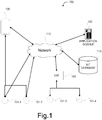
- FIG. 1 shows a communications network 100 in accordance with various embodiments.
- communications network 100 may include IoT devices 101-1 to 101-4 (collectively referred to as "IoT devices 101"), gateway (GW) 103, mobile device 105, network 110, IoT database 115, and application server 120.
- IoT devices 101 may be any object, device, sensor, or “thing” that is embedded with hardware and/or software components that enable the object, device, sensor, or “thing” to communicate with another device (e.g., mobile device 105, application server 120, another IoT device 101, etc.) over a network (e.g., network 110) with little or no user intervention.
- IoT devices 101 may include a transmitter/receiver (or alternatively, a transceiver), one or more memory devices, and/or one or more processors.
- IoT devices 101 may be embedded with or otherwise include a transmitter or other like device that broadcasts an identification signal.
- the identification signal may be a radio-based signal, such as a Wi-Fi signal, Bluetooth Low Energy (BLE) signal, an active radio-frequency identification (RFID) signal, an infrared signal, and the like.
- the identification signal may comprise one or more data packets or data frames, where the data packets or data frames include a unique identifier associated with the IoT device 101 transmitting the identification signal.
- the unique identifier (or alternatively, "identifier” or “identification information”) may include a universally unique identifier (UUID), an electronic product code (EPC), a media access control address (MAC address), an Internet Protocol (IP) address, an Apache QPID address, and/or any other like identification information.
- IoT devices 101 may be any type of sensor, meter, or other like device that can capture and/or record data associated with an event.
- IoT devices 101 may be biotic sensors and/or devices, such as monitoring implants, biosensors, biochips, and the like.
- IoT devices 101 may be abiotic sensors and/or devices, such as autonomous sensors and/or meters, Machine Type Communications (MTC) devices, machine to machine (M2M) devices, and the like.
- An event may be any occurrence of an action, such as a temperature change, an electrical output, a change in water usage, an inventory level/amount change, a heart rate, a glucose level, a state/position/orientation change of a device, and the like.
- an event may be detected by one or more IoT devices based on sensor outputs, timer values, user actions, messages from an a computing device, and the like.
- the captured data may be relayed through the network 110 and reported to a service provider (e.g., an operator of the application server 120), a mobile device 105, and/or another one of the IoT devices 101.
- the service provider, a user of the mobile device or the mobile device itself, and/or IoT device may take an appropriate action based on a notification of the event to (e.g., reduce or increase temperature, restock inventory items, reduce/increase an activity level, reduce/increase sugar intake, and the like).
- an IoT device 101 may connect with or otherwise communicate with the mobile device 105 via a direct wireless connection.
- the data associated with an event may be reported to the mobile device 105 without being relayed through the network 110.
- the IoT devices 101 may be configured to report data on a period or cyclical basis, or based on a desired event that is captured and recorded by an IoT device 101.
- the IoT devices 101 may include one or more electro-mechanical components which allow the IoT device 101 to change its state, position, and/or orientation.
- electro-mechanical components may include one or more motors, actuators, wheels, thrusters, propellers, claws, clamps, hooks, and/or other like electro-mechanical components.
- the IoT devices 101 may be configured to change its state, position, and/or orientation based on one or more captured events and/or instructions or control signals received from a service provider (e.g., an operator of the application server 120) and/or mobile device 105.
- a service provider e.g., an operator of the application server 120
- an operator may receive, from one or more IoT devices 101, data associated with a captured event and physically control the IoT device 101 by transmitting instructions or other like control signals to the IoT device 101.
- the security camera may change its position and/or orientation based on instructions from a human operator and/or based on a moving object detected by the security camera.
- the actuator may change its state (e.g., fully open, fully closed, or partially open/closed) based on instructions from a mobile device.
- a performance of one or more actions e.g., the collection/reporting of data, altering a state, position, and/or orientation, etc.
- the IoT devices 101 may be grouped according to functions that they may perform, where one or more of the functions are associated with one or more services.
- GW 103 may be a network element configured to provide communication services to IoT devices (e.g., IoT devices 101) and/or mobile devices (e.g., mobile device 105) operating within a computer network (e.g., an enterprise private network, virtual private network, local area network (LAN), a virtual local area network (VLAN), and/or any other like computer network).
- the GW 103 may be a wired or wireless access point, a router, a switch, a hub, and/or any other like network device that allows computing devices to connect to a network.
- the GW 103 may include one or more processors, a network interface, one or more transmitters/receivers connected to one or more antennas, and a computer readable medium.
- the one or more transmitters/receivers may be configured to transmit/receive data signals to/from one or more IoT devices 101 and/or mobile device 105.
- the GW 103 may process and/or route data packets according to one or more communications protocols, such as Ethernet, Point-to-Point Protocol (PPP), High Level Data Link Control (HDLC), Internet Protocol version 4 (IPv4), Internet Protocol version 6 (IPv6), and/or any other like protocols.
- PPP Point-to-Point Protocol
- HDMI High Level Data Link Control
- IPv4 Internet Protocol version 4
- IPv6 Internet Protocol version 6
- the GW 103 may employ one or more network interfaces in order to allow IoT devices 101 and/or mobile device 105 to connect to network 110, such as Ethernet, Fibre Channel, G.hn or ITU-T, 802.11 or Wi-Fi, Bluetooth, and/or any other like network connection interfaces.
- network 110 such as Ethernet, Fibre Channel, G.hn or ITU-T, 802.11 or Wi-Fi, Bluetooth, and/or any other like network connection interfaces.
- the GW 103 may act as a central hub for one or more IoT devices 101 (e.g., IoT device 101-3 and IoT device 101-4 as shown in FIG. 1 ).
- IoT devices 101 e.g., IoT device 101-3 and IoT device 101-4 as shown in FIG. 1 .
- GW 103 may be a part of a private IoT network that is operated by a single service provider, IoT device manufacturer, and/or any other like entity.
- GW 103 may connect the IoT devices 101 in the private IoT network to the network 110 and/or mobile device 105. As shown in FIG.
- GW 105 is connected to IoT devices 101-3 and 101-4, and thus, GW 103 may enable IoT devices 101-3 and 101-4 to provide services to mobile device 105 via network 110.
- mobile device 105 may directly connect with GW 103, such that GW 103 may enable IoT devices 101-3 and 101-4 to provide services to mobile device 105 via the direct connection.
- Mobile device 105 may be a physical hardware device that is capable of running one or more applications.
- Mobile device 105 may include a transmitter/receiver (or alternatively, a transceiver), memory, one or more processors, and/or other like components.
- Mobile device 105 may be configured to send/receive data to/from a network element (e.g., IoT database 115, application server 120, etc.) via a network (e.g., network 110).
- a network element e.g., IoT database 115, application server 120, etc.
- Mobile device 105 may be designed to sequentially and automatically carry out a sequence of arithmetic or logical operations; equipped to record/store digital data on a machine readable medium; and transmit and receive digital data via network 110.
- Mobile device 105 may be a wireless cellular phone, a smartphone, a laptop personal computer (PCs), a tablet PC, a wearable computing device, a handheld messaging device, a personal data assistant, an electronic book reader, an augmented reality head-mounted (or helmet-mounted) display device, and/or any other physical or logical device capable of recording, storing, and/or transferring digital data via a network element.
- Mobile device 105 may communicate over the network 110 in accordance with one or more wireless communications protocols and/or one or more cellular phone communications protocols.
- mobile device 105 may be configured to operate in accordance with the Global System for Mobile Communications (GSM), Enhanced Data GSM Environment (EDGE), wideband code division multiple access (WCDMA), code division multiple access (CDMA), time division multiple access (TDMA), Bluetooth, Wireless Fidelity (Wi-Fi) such as the Institute of Electrical and Electronics Engineers (IEEE) 802.11a, IEEE 802.11b, IEEE 802.11g, IEEE 802.11ac, and/or IEEE 802.11n, voice over Internet Protocol (VoIP), Wi-MAX, Long Term Evolution (LTE), and/or any other "wireless" communication protocols, including RF-based, optical, and so forth.
- GSM Global System for Mobile Communications
- EDGE Enhanced Data GSM Environment
- WCDMA wideband code division multiple access
- CDMA code division multiple access
- TDMA time division multiple access
- Wi-Fi such as the Institute of Electrical and Electronics Engineers (IEEE) 802.11a, IEEE 802.11b, IEEE 802.11g, IEEE 8
- Mobile device 105 may be equipped with location (or alternatively “geolocation”), positioning, and/or navigation circuitry, such as a Global Positioning System (“GPS”) receiver, as well as software to convert received GPS signals into a location and/or position (within some margin of error).
- GPS Global Positioning System
- alternate positioning systems may be employed, such as wireless network signal-strength-based indoor positioning system (IPS), hybrid systems combining global and local positioning systems, and/or other like positioning and/or location detection systems.
- IPS wireless network signal-strength-based indoor positioning system
- IPS wireless network signal-strength-based indoor positioning system
- IPS wireless network signal-strength-based indoor positioning system
- hybrid systems combining global and local positioning systems
- geolocation and/or positioning information may come from other sources including an IP address, Wi-Fi and/or Bluetooth MAC address, radio-frequency identification (“RFID”), Wi-Fi connection location, GSM/CDMA cell IDs, and the like.
- RFID radio-frequency identification
- Mobile device 105 may include an accelerometer, gyroscope, gravimeter, and/or another like device that is configured to measure and/or detect a motion, an acceleration, and/or an orientation of the mobile device 105.
- the mobile device 105 may be configured to determine a magnitude and direction of an acceleration and/or motion of the mobile device 105, and convert the acceleration and/or motion of the mobile device 105 into position and/or orientation information.
- Mobile device 105 may be configured to run, execute, or otherwise operate one or more applications.
- the applications may include native applications, web applications, and hybrid applications.
- the native applications may be used for operating the mobile device 105, such as using a camera or other like image sensor of the mobile device 105, GPS functionality of the mobile device 105, an accelerometer of the mobile device 105, cellular phone functionality of the mobile device 105, and other like functions of the mobile device 105.
- Native applications may be platform or operating system (OS) specific. Native applications may be developed for a specific platform using platform-specific development tools, programming languages, and the like. Such platform-specific development tools and/or programming languages may be provided by a platform vendor.
- OS operating system
- Native applications may be pre-installed on mobile device 105 during manufacturing, or provided to the mobile device 105 by an application server (e.g., application server 120) via a network (e.g. network 110).
- Web applications are applications that load into a web browser of the mobile device 105.
- the web applications may be websites that are designed or customized to run on a mobile device by taking into account various mobile device parameters, such as resource availability, display size, touchscreen input, and the like. In this way, web applications may provide an experience that is similar to a native application within a web browser.
- Web applications may be any server-side application that is developed with any server-side development tools and/or programming languages, such as PHP, Node.js, ASP.NET, and/or any other like technology that renders HTML.
- Hybrid applications may be a hybrid between native applications and web applications.
- Hybrid applications may be a standalone, skeletons, or other like application containers that may load a website within the application container.
- Hybrid applications may be written using website development tools and/or programming languages, such as HTML5, CSS, JavaScript, and the like.
- Hybrid applications use browser engine of the mobile device 105, without using a web browser of the mobile device 105, to render a website's services locally.
- Hybrid applications may also access mobile device capabilities that are not accessible in web applications, such as the accelerometer, camera, local storage, and the like.
- mobile device 105 may be configured to detect and capture one or more signals being broadcast by a smart object (e.g., IoT devices 101) and/or a network element (e.g., a GW 103, etc.).
- a smart object e.g., IoT devices 101
- a network element e.g., a GW 103, etc.
- mobile device 105 may be configured to perform BLE proximity sensing.
- the mobile device 105 may scan a region or area surrounding the mobile device 105 to detect an IoT device 101 broadcasting and/or transmitting a Bluetooth low energy signal that includes a unique identifier.
- the mobile device 105 may scan for IoT devices 101 tagged or otherwise embedded with a RFID device (also referred to as a "RFID tag").
- RFID device also referred to as a "RFID tag”
- the mobile device 105 may scan a region or area surrounding the mobile device 105 to detect RFID tagged IoT devices 101, which broadcast and/or transmit RF signals that include identification information.
- the mobile device 105 may be configured to obtain a signal from a network element, such as a router or other like device acting as a central hub for a network of IoT devices 101.
- Network 110 may be any network that allows computers to exchange data.
- Network 110 may include one or more network elements (not shown) capable of physically or logically connecting computers.
- the network 110 may include any appropriate network, including an intranet, the Internet, a cellular network, a local area network (LAN), a personal network or any other such network or combination thereof. Components used for such a system can depend at least in part upon the type of network and/or environment selected. Protocols and components for communicating via such a network are well known and will not be discussed herein in detail. Communication over the network may be enabled by wired or wireless connections, and combinations thereof.
- IoT database 115 may be a hardware device or system for storing IoT information for a plurality of IoT devices.
- IoT database 115 may include one or more relational database management systems (RDBMS) one or more object database management systems (ODBMS), a column-oriented DBMS, correlation database DBMS, and the like.
- RDBMS relational database management systems
- ODBMS object database management systems
- the IoT database 115 may be stored on or otherwise associated with one or more data storage devices. These data storage devices may include at least one of a primary storage device, a secondary storage device, a tertiary storage device, a non-linear storage device, and/or other like data storage devices.
- IoT database 115 may be associated with one or more network elements that enable one or more clients (e.g., mobile device 105) to query the IoT database 115 and/or store IoT device information in the IoT database 115.
- IoT database 115 may include one or more virtual machines, such that the physical data storage devices containing the IoT database 115 may be logically divided into multiple virtual data storage devices and/or databases.
- the IoT database 115 may reside on one physical hardware data storage device.
- the IoT database 115 may be the Object Naming Service (ONS), which provides product descriptions (i.e., indicators) for IoT devices that are embedded with RFID tags.
- ONS Object Naming Service
- the ONS may be a system of network elements that may include one or more systems and/or applications for discovering information about an IoT device and related services using identification information.
- ONS may be the system currently operated by the GS1's EPCglobal Network in conjunction with the Massachusetts Institute of Technology's Auto-ID Labs.
- IoT database 115 may provide descriptions or indicators of IoT devices in response to receiving a query that includes an Electronic Product Code (EPC).
- EPC Electronic Product Code
- the ONS may use the Domain Name System (DNS) in order to obtain indicators using an EPC identifier, where the EPC may provide similar functionality as a Uniform Resource Identifier (URI).
- DNS Domain Name System
- the EPC contained in the RFID tag signal may be passed through the one or more modules included in the mobile device 105 (as described with regard to FIGS. 2-3 ), which may then be used by the mobile device 105 to query the ONS to find an indicator associated with the EPC extracted from the RFID tag signal.
- the ONS may determine a location (i.e., a database associated with an EPC Information Service) where the indicator may be stored and point the mobile device 105 to the location where the indicator is stored.
- the mobile device 105 may obtain the indicator from the specified location, and the description of the properties of the IoT device 101 may be rendered in a browser of the mobile device 105 and/or forwarded to a service provider.
- the indicator returned by the ONS has Physical Markup Language (PML) format, which describes IoT device information, such as a product name, product description, a creation/manufacturing date, an expiration date, the product's current location and/or position, the product's current temperature, etc.
- PML Physical Markup Language
- a services category may be added to the existing PML for each IoT device within the ONS directory.
- the services category may describe a service name and/or type, a service provider, a service description, privacy information, and/or any other like description of a service provided by an IoT device.
- the IoT database 115 may store service information in association with an IoT device's identifier, where the existing IoT device information and environment information is returned from the ONS and the service information may be returned from the IoT database 115.
- the IoT database 115 may include one or more systems and/or applications for storing all relevant information about IoT devices 101 (e.g., identifiers, indicators, etc.) and providing the relevant information to mobile device 105 in response to a database query.
- the various modules included in the mobile device 105 may obtain identifiers that are in different formats, convert the identifiers into a desired format (e.g., into an EPC), and use the converted identifier to obtain the service information from the IoT database 115 as described previously.
- Application server 120 may be a hardware computing device that may include one or more systems and/or applications for providing one or more services.
- Application server 120 may include a processor, memory or computer readable storage medium, and a network interface. Additionally, application server 120 may be a single physical hardware device, or application server 120 may be physically or logically connected with other network devices, such that the application server 120 may reside on one or more physical hardware devices. Furthermore, application server 120 may be connected to, or otherwise associated with one or more data storage devices (not shown).
- the application server 120 may be any device capable of receiving and responding to requests from one or more client devices (e.g., mobile device 105) across a computer network (e.g., network 110) to provide one or more services.
- client devices e.g., mobile device 105
- a computer network e.g., network 110
- the application server 120 may provide IoT device control services, and may be able to generate content such as text, graphics, audio and/or video to be transferred to a viewer, which may be served to the viewer by a Web server (not shown) in the form of HTML, XML, and/or any other appropriate structured language.
- the handling of all requests and responses, (e.g., requests for item information and the information provided in response) as well as the delivery of content between the mobile device 105 and/or the IoT devices 101 and the application server 120 may be handled by the Web server (not shown).
- the application server 120 may not be required and the applications and software components discussed herein may be executed on any appropriate device or host machine.
- the application server 120 may include an operating system that may provide executable program instructions for the general administration and operation of application server 120, and may include a computer-readable medium storing instructions that, when executed by a processor of the application server 120, may allow the application server 120 to perform its intended functions.
- Suitable implementations for the operating system and general functionality of the servers are known or commercially available, and are readily implemented by persons having ordinary skill in the art, particularly in light of the disclosure herein.
- the application server 120 may be associated with a service provider (hereinafter referred to as "service provider 120").
- Service provider 120 may be an entity that provides computer based services to one or more clients.
- a service may be any operation or collection of operations that perform a function.
- the services may include monitoring and/or analyzing event-based data, and/or accessing and/or controlling one or more IoT devices 101.
- the service provider 120 may provide the means for users to utilize one or more IoT devices 101.
- the service provider 120 may develop and distribute one or more applications that allow mobile device 105 to access one or more IoT devices 101 that have a same or similar service type.
- service provider 120 may be a home security service that develops and distributes a mobile application that enable mobile device 105 to control IoT devices 101 having a "home security" service type, such as security cameras and/or other like sensors, door and window locks, a security alarm system, and the like.
- a home security service type such as security cameras and/or other like sensors, door and window locks, a security alarm system, and the like.
- the service provider 120 may develop a mobile application that utilizes IoT devices 101 that are manufactured by a single manufacturer, while in other embodiments the service provider 120 may develop an application that utilizes IoT devices 101 that are manufactured by multiple different manufacturers.
- the mobile application may interact with the various modules of the example embodiments in order to utilize the IoT devices of different manufacturers. In this way, the example embodiments may act as an intermediary between the competing device interfaces and/or applications that may be required to access IoT devices produced by different manufacturers.
- IoT devices 101 only four IoT devices 101, one GW 103, one mobile device 105, a single IoT database 115, and a single application server 120 are present.
- any number of IoT devices, any number of gateways, any number of mobile devices, any number of servers, and/or any number of databases may be present.
- application server 120 and/or one or more databases may be virtual machines, and/or they may be provided as part of a cloud computing service.
- application server 120 and one or more databases may reside on one physical hardware device, and/or may be otherwise fully integrated with one another.
- an independent service may be developed to provide the same or similar services as the IoT database 115, which may be used to obtain the service information as described previously.
- the depiction of the illustrative communications network 100 in FIG. 1 should be taken as being illustrative in nature, and not limited to the scope of the disclosure.
- FIG. 2 illustrates the components of the mobile device 105, in accordance with various example embodiments.
- mobile device 105 may include processor 210, bus 220, network interface 230, transmitter 240, receiver 250, and memory 255.
- mobile device 105 may include many more components than those shown in FIG. 2 , such as a display device (e.g., a touchscreen), an input device (e.g., a physical keyboard), one or more image sensors, a transmitter/receiver (or alternatively, a transceiver), a mobile video card and/or graphics processing unit (GPU), and other like components.
- a display device e.g., a touchscreen
- an input device e.g., a physical keyboard
- one or more image sensors e.g., a transmitter/receiver (or alternatively, a transceiver), a mobile video card and/or graphics processing unit (GPU), and other like components.
- GPU graphics processing unit
- Memory 255 may be a hardware device configured to store an operating system 260 and program code for one or more software components, such as operation adjustment routine 300 and/or one or more mobile applications.
- Memory 255 may be a computer readable storage medium that generally includes a random access memory (RAM), read only memory (ROM), a flash memory device, a solid state disk (SSD), a secure digital (SD) card, and/or other like storage media capable of storing and recording data.
- the program code and/or software components may also be loaded from a separate computer readable storage medium into memory 255 using a drive mechanism (not shown).
- Such separate computer readable storage medium may include a memory card, memory stick, removable flash drive, sim card, and/or other like computer readable storage medium (not shown).
- software components may be loaded into memory 255 via network interface 230, rather than via a computer readable storage medium.
- memory 255 may include operating system 260, IoT service detection application 300, and application 265.
- Operating system 260 may manage computer hardware and software resources and provide common services for computer programs.
- Operating system 260 may include one or more drivers, such as a display driver, camera driver, audio drivers, and/or any other like drivers that provide an interface to hardware devices thereby enabling operating system 260, IoT service detection application 300, and application 265 to access hardware functions without needing to know the details of the hardware itself.
- the operating system 260 may be a general purpose operating system or an operating system specifically written for and tailored to the mobile device 105.
- Application 265 may be a collection of software modules and/or program code that enables the mobile device 105 to access or control one or more services provided by one or more IoT devices 101.
- Application 265 may be a native application, a web application, or a hybrid application.
- service provider 120 may develop the application 265 to utilize one or more IoT devices 101 regardless of a manufacturer or service provider who develops or deploys the IoT devices 101.
- IoT service detection application 300 may be a collection of software modules and/or program code that enables the mobile device 105 to operate according to the various example embodiments as discussed with regard to FIGS. 3-4 .
- Processor 210 may be configured to carry out instructions of a computer program by performing the basic arithmetical, logical, and input/output operations of the system.
- the processor 210 may include a single-core processor, a dual-core processor, a triple-core processor, a quad-core processor, etc.
- the processor 210 may perform a variety of functions for the mobile device 105 and may process data by executing program code, one or more software modules, firmware, middleware, microcode, hardware description languages, and/or any other like set of instructions stored in the memory 255.
- the program code may be provided to processor 210 by memory 255 via bus 220, one or more drive mechanisms (not shown), and/or via network interface 230.
- the program code and/or software components may be executed by the processor 210.
- the processor 210 may cause mobile device 105 to perform the various operations and functions delineated by the program code.
- the mobile device 105 may include various modules configured to operate (through hardware and/or software) to obtain one or more services provided by one or more IoT devices 101 as described herein.
- the IoT service detection application 300 may include various modules that may be loaded into the processor 210.
- the various modules may include a detection module 305, a service identification module 310, a service notification module 325, a service access module 330, a conversion module 315, and a lookup module 320 (as discussed with regard to FIG. 3 ).
- the processor 210 may be configured to cause mobile device 105 to detect a plurality of IoT devices 101; obtain an identifier for each of the plurality of IoT devices 101 based on the detection; obtain an indicator for each of the plurality of IoT devices 101 based at least in part on a corresponding one of the obtained identifiers; generate a notification that indicates a plurality of services available to the mobile device 105 based on each of the obtained indicators; and enable the mobile device 105 to access a service of the plurality of services by allowing the mobile device 105 to utilize at least a set of the plurality of IoT devices 101 required to provide the service.
- modules While specific modules are described herein, it should be recognized that, in various embodiments, various modules may be combined, separated into separate modules, and/or omitted. Additionally, in various embodiments, one or more modules may be implemented on separate devices, in separate locations, or distributed, individually or in sets, across multiple processors, devices, locations, and/or in cloud-computing implementations.
- Bus 220 may be configured to enable the communication and data transfer between the components of mobile device 105.
- Bus 220 may comprise a high-speed serial bus, parallel bus, internal universal serial bus (USB), Front-Side-Bus (FSB), and/or other suitable communication technology for transferring data between components within mobile device 105 and/or between mobile device 105 and other like devices.
- USB internal universal serial bus
- FAB Front-Side-Bus
- Network interface 230 may be a computer hardware component that connects mobile device 105 to a computer network (e.g., network 110).
- Network interface 230 may connect mobile device 105 to a computer network via a wired or wireless connection.
- Network interface 230 may operate in conjunction with a wireless transmitter/receiver and/or transceiver (not shown) that is configured to operate in accordance with one or more wireless standards.
- the network interface 230 may also include one or more virtual network interfaces configured to operate with application 265 and/or other like mobile applications.
- Transmitter 240 may be any type of hardware device that generates or otherwise produces radio waves in order to communicate with one or more other devices.
- the transmitter 240 may be coupled with an antenna (not shown) in order to transmit data to one or more other devices.
- the transmitter 240 may be configured to receive digital data from one or more components of mobile device 105 via bus 220, and convert the received digital data into an analog signal for transmission over an air interface.
- Receiver 245 may be any type of hardware device that can receive and convert a signal from a modulated radio wave into usable information, such as digital data.
- the receiver 245 may be coupled with the antenna (not shown) in order to capture radio waves.
- the receiver 245 may be configured to send digital data converted from a captured radio wave to one or more other components of mobile device 105 via bus 220.
- mobile device 105 may include a transceiver (not shown) instead of transmitter 240 and receiver 245, where the transceiver is a single component configured to provide the functionality of transmitter 240 and receiver 245 as discussed
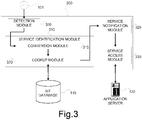
- FIG. 3 illustrates example logical components and interaction points of the IoT service detection application 300, in accordance with various embodiments.
- the IoT service detection application 300 may, in various embodiments, be configured to perform various techniques described herein, including detection of one or more IoT devices 101 and enabling the mobile device 105 to access or control one or more services provided by the one or more IoT device 101.
- IoT service detection application 300 may include detection module 305, service identification module 310, service notification module 325, and service access module 330.
- the service identification module 310 may include conversion module 315 and a lookup module 320.
- the detection module 305 may be configured to detect a plurality of IoT devices 101.
- each of the IoT devices 101 may broadcast a radio-based signal, such as a Wi-Fi signal, a BLE signal, an active RFID signal, an infrared signal, and the like.
- the radio-based signal may be broadcast by GW 103 or another like network element acting as a central hub for a network of IoT devices 101.
- the detection module 305 may scan a region that surrounds the mobile device for the signals being broadcast by the IoT devices 101 and/or GW 103. In such embodiments, the detection module 305 may utilize the receiver 245 in order to obtain the broadcasted signals.
- the detection module 305 may be configured to obtain all of the signals being broadcast in a given area or region, regardless of the signal type and/or the manufacturer or service provider who developed the IoT device 101 and/or GW 103. In some embodiments, the detection module 305 may be configured to obtain only certain selected types of signals being broadcast in a given area or region, where the selection of signal types is based on one or more user preferences or settings indicating one or more desired service providers or manufacturers that a user of the mobile device 105 wishes to utilize.
- the detection module 305 may provide the received signals to the service identification module 310.
- the service identification module 310 may be configured to obtain an identifier for each of the plurality of IoT devices 101 from the received signals. In various embodiments, the service identification module 310 may be configured to extract the identifier for each of the plurality of IoT devices from a corresponding one of the plurality of signals in order to obtain the identifier. For example, IoT devices 101 that broadcast a Wi-Fi signal, the service identification module 310 may extract a source MAC address from one or more data packets of the Wi-Fi signal. By way of another example, if an IoT device 101 broadcasts a BLE beacon signal, the service identification module 310 may extract a UUID from one or more data packets of the BLE beacon signal.
- the service identification module 310 may extract an EPC from one or more data packets of the active RFID tag signal. Methods for extracting identification information from data packets are generally well-known, and thus, a further detailed description of these methods is omitted. As shown, the service identification module 310 may include conversion module 315 and lookup module 320. The service identification module 310 may use the conversion module 315 and the lookup module 320 to obtain an indicator for each of the IoT devices 101 based at least in part on a corresponding one of the obtained identifiers.
- the conversion module 315 may be configured to determine whether a format of each obtained identifier is a desired format, and convert the format of the obtained identifiers into the desired format when the format of the obtained identifiers are determined to not be the desired format.
- the ONS may be used to obtain Physical Markup Language (PML) files that describe IoT devices 101, if IoT device 101-1 broadcasts a BLE beacon signal, the service identification module 310 may extract a UUID from one or more data packets of the BLE beacon signal.
- the conversion module 315 may determine that the UUID is not in the EPC format that is required to obtain PML files from the ONS.
- PML Physical Markup Language
- the conversion module 315 may then convert the UUID into an EPC and provide the converted EPC to the lookup module 320 to query the ONS.
- the service identification module 310 may extract an EPC from one or more data packets of the RFID tag signal.
- the conversion module 315 may determine that the EPC is the desired format for obtaining PML files from the ONS.
- the conversion module 315 may then provide the extracted EPC to the lookup module 320 to query the ONS.
- the conversion module 315 may "rearrange" the information contained in an identifier having an undesired format and place the information in an order delineated by the desired format. Continuing with the aforementioned example, if IoT device 101-1 broadcasts a BLE beacon signal, the conversion module 315 may extract identifying information from the data packets included in the BLE beacon signal, such as a manufacturer name, device type, serial number, and the like. The conversion module 315 may then construct an EPC URI using the extracted identifying information.
- the lookup module 320 may be configured to query a remote database (e.g. IoT database 115) using the obtained identifiers.
- a remote database e.g. IoT database 115
- the lookup modules 320 may query the ONS database using a pure identity EPC URI, an EPC tag URI, etc. It should be noted that the example embodiments are not limited to using EPC URIs to query the ONS, and according to various example embodiments, the lookup module 320 may use any type of identifier that can be used to request information from IoT database 115.
- an indicator may be a file, record, or other like resource for storing information that provides a description of one or more properties of an IoT device 101.
- an indicator may be a markup language file, such as PML, Extensible Markup Language (XML), Hypertext Markup Language (HTML), Extensible HTML (XHTML), and the like.
- PML Extensible Markup Language
- HTML Hypertext Markup Language
- XHTML Extensible HTML
- an indicator may use any type of markup language or computer programing language that can describe one or more properties of an IoT device 101.
- the properties described by an indicator may be based on the language that is implemented for the indicator.
- the indicators may be in the PML format, and a PML associated with an IoT device 101 may describe the properties of that IoT device 101, such as a device type, location, deployment environment information, dimensions, device manufacturer and/or device owner, device materials, a name and location of a device being monitored, access permissions, etc.
- a services category may be added to the existing PML for each IoT device 101.
- the services category may describe a service name and/or type, a service provider, a service description, privacy information, and/or any other like description of a service provided by an IoT device 101.
- the service notification module 325 may be configured to generate a notification that indicates a plurality of services available to the mobile device 105 based on each of the obtained indicators.
- the notification may be any form of communication that lets the mobile device 105 know of one or more services based on one or more IoT devices 101 that are proximate to the mobile device 105.
- the notification may include a list of one or more services available to the mobile terminal based on each of the obtained indicators.
- the service notification module 325 may populate the list using the services described in the services category of each obtained PML file.
- the generation of the notification may be initiated based on the mobile device 105 detecting the presence of one or more IoT devices 101 in the vicinity of the mobile device 105.
- the list of services may be populated and/or filtered based on one or more user preferences that are set in advance by the mobile device 105.
- the user preferences may indicate one or more services that a user of the mobile device 105 wishes to access or control.
- the service notification module 325 may provide a user of the mobile device 105 with one or more graphical control elements that enable the user to select one or more service types as preferred or favorite service types.
- the service notification module 325 may use or discover user preferences from one or more other applications running on the mobile device 105.
- the user preferences may be in the form of a privacy policy that indicates desired service types and/or undesired service types.
- the desired service types may indicate a type of service that the user of the mobile device 105 desires to access or control
- the undesired service types may indicate a type of service that the user of the mobile device 105 considers to be privacy-invasive or otherwise does not wish to access.
- the service notification module 325 may filter the list of services according to the privacy policy, such that the services having the desired service type are distinguished from services of the plurality of services having the undesired service type.
- the undesired service types may be listed in a section of the list of services than the desired service types, each of the listed services may be labeled as desired services or undesired services, the undesired services may be displayed in a different color, font, font size, etc. than the desired services, and the like. In this way, the undesired service types may serve as an alert or other like notification that one or more IoT devices 101 are collecting data the user of the mobile device 105 may consider invasive.
- the list of services may also be populated and/or filtered according to contextual information associated with the mobile device 105.
- the contextual information of the mobile device 105 may include a position of the mobile device 105, an orientation of the mobile device 105, a movement velocity of the mobile device 105, a date and time that the IoT device 101 are detected by the mobile device 105, a date and time that the list of services is generated by the mobile device 105, and/or any other like contextual information associated with the mobile device 105.
- the list may not be populated with the services associated with the one or more IoT devices 101.
- the mobile device 105 is traveling past one or more IoT devices 101 below the threshold velocity, such as if the user of the mobile terminal 105 is walking past the IoT devices 101 on foot, the list may be populated with the services associated with the one or more IoT devices 101.
- the threshold velocity may be determined based on one or more design choices or empirical studies.
- the list of services may also be populated and/or filtered based on a distance between a position of the mobile device 105 and a position of each of the services.
- the position of a service may be based on a distance between the position of the mobile device 105 and a position of each of the IoT devices 101 that are required to provide the service.
- the user may select one or more of the listed services in order to access one or more desired services by controlling the one or more IoT devices 101 required to provide the selected service.
- the service notification module 325 may provide the selection to the service access module 330 in order to access the selected service.
- the service access module 330 may be configured to enable the mobile device 105 to access a service by allowing the mobile device 105 to utilize the IoT devices 101 required to provide the service.
- a service provider 120 may develop an application 265 that allows the mobile device 105 to access or control one or more IoT devices 101 in order to obtain a service.
- the service access module 330 may determine whether such the application 265 is stored in a memory associated with the mobile device 105, such as memory 255, a removable memory stick or memory card, a cloud storage system associated with the mobile device 105, and the like.
- the service access module 330 may invoked and cause the application 265 to be executed, thereby enabling the mobile device 105 to access the desired service. If the service access module 330 determines that the application 265 does not reside on a memory associated with the mobile device 105, the service access module 330 may obtain the application 265 from the application server 120. Once the application 265 is obtained from the application server 120, the service access module 330 may cause the application 265 to be executed to enable access to the service.
- the IoT service detection application 300 comprises each of the detection module 305, the service identification module 310, the conversion module 315, the lookup module 320, the service notification module 325, and the service access module 330.
- additional modules may be present and/or the aforementioned modules may be combined of divided into other logical components.
- one or more of the modules shown in FIG. 3 may be provided as part of a cloud computing service such that one or more physical hardware devices may provide the same or similar functionality as the one or more of the modules shown in FIG. 3 .
- the detection module 305 could be implemented by a server, where the mobile device 105 may provide detection data (e.g., Wi-Fi environment data, etc.) to the server so that the server may determine one or more IoT devices 101 that are proximate to the mobile device 105 from the detection data.
- detection data e.g., Wi-Fi environment data, etc.
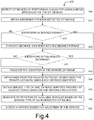
- FIG. 4 is a flowchart illustrating an example process 400 of the IoT service detection application 300, in accordance with various embodiments.
- the operations of process 400 will be described as being performed by the mobile device 105, which is described with respect to FIGS. 1-3 .
- the mobile device 105 may operate the process 400 as described below. While particular examples and orders of operations are illustrated in FIG. 4 , in various embodiments, these operations may be re-ordered, broken into additional operations, combined, and/or omitted altogether.
- the mobile device 105 may detect one or more IoT devices 101 by performing a scan for signals being broadcast by the IoT devices 101 in a region surrounding the mobile device 105. As discussed previously, the mobile device 105 may scan for, and obtain the signals being broadcast by the IoT devices 101 according to known methods.
- the mobile device 105 may obtain an identifier for each detected IoT device 101.
- the signals being broadcast by the IoT devices 101 may comprise a series of data packets, where at least one data packet contains an identifier or other like identification information associated with a corresponding one of the IoT devices 101.
- the mobile device 105 may extract the identifier from one or more data packets of the broadcasted signal according to know methods.
- the mobile device 105 may determine whether the obtained identifiers are in a desired format. If at operation 415, the mobile device 105 may determine that the obtained identifiers are not in the desired format, then the mobile device 105 proceeds to operation 420 to convert the obtained identifiers into the desired format. At operation 420, the mobile device 105 may convert the obtained identifiers into the desired format.
- the desired format may be the EPC format. In such embodiments, the mobile device 105 may determine whether or not an identifier is in the EPC format, and convert the non-EPC identifiers into the EPC format. Referring back to operation 415, if the mobile device 105 determines that the obtained identifiers are in the desired format, then the mobile device 105 may proceed to operation 425 to determine whether the obtained identifier is located within the remote database.
- the mobile device 105 may determine whether the obtained identifiers are within a remote database (e.g., IoT database 115) that stores identifiers in association with indicators or other like service information. According to various embodiments, the mobile device 105 may use the obtained identifiers to query the IoT database 115. The determination as to whether the obtained identifiers are located within the IoT database 115 may be based on whether the remote database returns an indicator or not. For example, in embodiments where the IoT database 115 utilizes the ONS, the mobile device 105 may use an EPC URI to query the ONS.
- a remote database e.g., IoT database 115
- the mobile device 105 may determine that the EPC is registered with the ONS. However, if the ONS does not return a PML in response to the EPC URI, then the mobile device 105 may determine that the EPC is not registered with the ONS.
- the mobile device 105 may proceed to operation 430 to register the identifier in the IoT database 115.
- Operation 430 may be used when a new IoT device 101 is deployed to a given environment, and the new IoT device 101 needs to be registered to the IoT database 115 using an IoT device identifier.
- the data packets included in the signals that are broadcast by the IoT devices 101 may include an identifier or other like identifying information, such as a device name (e.g., serial number), device type, position information, and any information that may be indicative of a service provided by an IoT device 101.
- the mobile device 105 may generate an indicator, such as a new PML, using the extracted information.
- the mobile device 105 may obtain the identifying information from a manufacturer or service provider that deployed the new IoT device 101.
- the mobile device 105 may generate the indicator using the identifying information obtained from the manufacturer or service provider.
- the mobile device 105 may send a request to the application server 120 requesting that the indicator be generated for the new IoT device 101 by the service provider 120.
- the mobile device 105 may transmit a request to the IoT database 115 to store the generated indicator in association with a new identifier.
- operations 425 and 430 are optional implementations, and thus, in various embodiments operations 425 and 430 are omitted from the process 400.
- the mobile device 105 may proceed to operation 435 to obtain an indicator for each detected IoT device 101 from the remote database using each obtained identifier.
- the mobile device 105 may obtain an indicator for each detected IoT device 101 from the IoT database 115 using each obtained identifier.
- the mobile device 105 may use an EPC URI to query the ONS.
- the ONS returns a PML associated with the EPC URI.
- the PML may be altered to include a services category, which may describe one or more service types associated with an IoT device 101.
- the service types may indicate one or more services that an IoT device 101 may provide.
- the mobile device 105 may obtain a service type of one or more services provided by each IoT device 101 from the obtained indicators (e.g., from the altered PML).
- the mobile device 105 may generate a notification of the available services based on the service types of each detected IoT device 101.
- the notification may be a list of available services, which may include one or more of the service types included in the obtained identifiers.
- the mobile device 105 may include (or exclude) one or more services in list based on one or more user preferences set by the mobile device 105, contextual information associated with the mobile device 105, a distance between the mobile device 105 and each of the IoT devices 101, and the like.
- the list of services may include one or more graphical control elements that enable a user of the mobile device 105 to select one of the listed services.
- the mobile device 105 may access a service of the available services. As discussed previously, in response to a selection of a desired service from the list of services, the mobile device 105 may obtain and execute an application that is required for obtaining the selected service.
Landscapes
- Engineering & Computer Science (AREA)
- Computer Networks & Wireless Communication (AREA)
- Signal Processing (AREA)
- Computer Security & Cryptography (AREA)
- Health & Medical Sciences (AREA)
- Computing Systems (AREA)
- General Health & Medical Sciences (AREA)
- Medical Informatics (AREA)
- Databases & Information Systems (AREA)
- Telephonic Communication Services (AREA)
- Mobile Radio Communication Systems (AREA)
- Telephone Function (AREA)
Claims (9)
- Mobile Vorrichtung (105), die Folgendes umfasst:mindestens einen Prozessor (210);ein Detektionsmodul (305), um auf dem mindestens einen Prozessor zu arbeiten, um mehrere Internet-der-Dinge-Vorrichtungen, "IoT-Vorrichtungen", (101) zu detektieren;ein Dienstidentifizierungsmodul (310), das konfiguriert ist, auf dem mindestens einen Prozessor zu arbeiten, um auf der Grundlage der Detektion eine Kennung für jede der mehreren IoT-Vorrichtungen zu erhalten und zumindest teilweise auf der Grundlage einer entsprechenden der erhaltenen Kennungen ein Kennzeichen für jede der mehreren IoT-Vorrichtungen zu erhalten, wobei jedes Kennzeichen eine Dienstart einer entsprechenden der mehreren IoT-Vorrichtungen angibt und wobei jedes der Kennzeichen ferner eine Umgebung, in der eine IoT-Vorrichtung eingesetzt wird, und mindestens ein Kriterium zur Nutzung einer IoT-Vorrichtung angibt, wobei das Dienstidentifizierungsmodul (310) ein Nachschlagemodul (320) enthält, das konfiguriert ist, unter Verwendung der erhaltenen Kennungen eine entfernte Datenbank (115) abzufragen, in der Kennungen in Zuordnung zu Kennzeichen gespeichert sind, und wobei das Nachschlagemodul konfiguriert ist, als Antwort auf die Abfrage ein Kennzeichen von der entfernten Datenbank zu empfangen, wobei das Nachschlagemodul (320) konfiguriert ist zumBestimmen, ob jede erhaltene Kennung in der entfernten Datenbank (115) registriert ist, wobei auf der Grundlage davon, ob als Antwort auf die Abfrage ein Kennzeichen, das der erhaltenen Kennung zugeordnet ist, von der Datenbank empfangen wird, eine Bestimmung vorgenommen werden kann, ob eine erhaltene Kennung in der entfernten Datenbank angeordnet ist; undRegistrieren einiger der erhaltenen Kennungen in der entfernten Datenbank, wenn bestimmt wird, dass die einigen der erhaltenen Kennungen nicht in der entfernten Datenbank registriert sind; wobei dann, wenn bestimmt wird, dass eine erhaltene Kennung für eine IoT-Vorrichtung nicht in der entfernten Datenbank registriert ist, die mobile Vorrichtung konfiguriert ist, eine Anfrage an einen Dienstanbieter zu senden, ein Kennzeichen für die IoT-Vorrichtung zu erzeugen und dieses in Zuordnung zu der erhaltenen Kennung für die IoT-Vorrichtung in der entfernten Datenbank zu speichern;ein Dienstbenachrichtigungsmodul (325), das konfiguriert ist, auf dem mindestens einen Prozessor zu arbeiten, um eine Benachrichtigung zu erzeugen, die mehrere Dienste angibt, die auf der Grundlage von jedem der erhaltenen Kennzeichen für die mobile Vorrichtung verfügbar sind, wobei die Benachrichtigung eine Liste der mehreren Dienste enthält, die auf der Grundlage von jedem der erhaltenen Kennzeichen für das mobile Endgerät verfügbar sind; undein Dienstzugriffsmodul (330), das konfiguriert ist, auf dem mindestens einen Prozessor zu arbeiten, um zu ermöglichen, dass die mobile Vorrichtung auf einen Dienst der mehreren Dienste zugreift, wobei das Zugreifen die Nutzung einer Gruppe der mehreren IoT-Vorrichtungen enthält, die erforderlich sind, um den Dienst bereitzustellen, und das Dienstzugriffsmodul konfiguriert ist, als Antwort auf eine Auswahl des Dienstes aus der Liste auf den Dienst zuzugreifen;wobei die mobile Vorrichtung ein nichtflüchtiges, computerlesbares Medium enthält und das Dienstzugriffsmodul ferner konfiguriert ist zumBestimmen als Antwort auf die Auswahl des Dienstes aus der Liste, ob das nichtflüchtige, computerlesbare Medium eine Anwendung enthält, die eingesetzt werden soll, um auf den Dienst zuzugreifen;Erhalten der Anwendung, wenn bestimmt wird, dass das nichtflüchtige, computerlesbare Medium die Anwendung nicht enthält; undAusführen der Anwendung, wenn bestimmt wird, dass das nichtflüchtige, computerlesbare Medium die Anwendung enthält, derart, dass ermöglicht wird, dass die mobile Vorrichtung auf den mindestens einen Dienst zuzugreifen kann.
- Mobile Vorrichtung nach Anspruch 1, wobei
das Detektionsmodul (305) konfiguriert ist, einen Bereich, der die mobile Vorrichtung umgibt, nach mehreren Signalen abzutasten, wobei jedes der mehreren Signale durch eine entsprechende der mehreren IoT-Vorrichtungen (101) rundgesendet wurde, und konfiguriert ist, die mehreren Signale zu erhalten, um die mehreren IoT-Vorrichtungen zu detektieren; und
das Dienstidentifizierungsmodul (310) konfiguriert ist, die Kennung für jede der mehreren IoT-Vorrichtungen aus einem entsprechenden der mehreren Signale zu extrahieren, um die Kennung zu erhalten. - Mobile Vorrichtung nach einem der Ansprüche 1 und 2, wobei das Dienstidentifizierungsmodul (310) Folgendes umfasst:
ein Umsetzungsmodul (315), das konfiguriert ist zu bestimmen, ob ein Format von jeder erhaltenen Kennung ein gewünschtes Format ist, und das Format von einigen der erhaltenen Kennungen in das gewünschte Format umzusetzen, wenn bestimmt wird, dass das Format der einigen der erhaltenen Kennungen nicht das gewünschte Format ist. - Mobile Vorrichtung nach Anspruch 1, wobei das Dienstbenachrichtigungsmodul konfiguriert ist:
die Liste gemäß mindestens einer Anwenderbevorzugung, die durch die mobile Vorrichtung eingestellt ist, und Kontextinformationen, die der mobilen Vorrichtung zugeordnet sind, zu filtern, wobei die Kontextinformationen eine Position der mobilen Vorrichtung und/oder eine Ausrichtung der mobilen Vorrichtung und/oder eine Bewegungsgeschwindigkeit der mobilen Vorrichtung und/oder Datum und Zeit, zu der die Liste der Dienste erzeugt worden ist, enthalten. - Mobile Vorrichtung nach einem der Ansprüche 1 und 4, wobei das Dienstbenachrichtigungsmodul konfiguriert ist:
die Liste auf der Grundlage eines Abstands zwischen einer Position der mobilen Vorrichtung und einer Position von jedem der mehreren Dienste zu filtern, wobei die Position von jedem der mehreren Dienste auf einem Abstand zwischen der Position der mobilen Vorrichtung und einer Position von jeder der mehreren IoT-Vorrichtungen, die erforderlich sind, um jeden Dienst der mehreren Dienste bereitzustellen, basiert. - Mobile Vorrichtung nach einem der Ansprüche 4 bis 5, wobei eine Datenschutzrichtlinie eine gewünschte Dienstart und/oder eine nicht gewünschte Dienstart angibt, wobei die gewünschte Dienstart einen Dienst angibt, auf den ein Anwender der mobilen Vorrichtung zugreifen möchte, wobei die nicht gewünschte Dienstart einen Dienst angibt, auf den der Anwender der mobilen Vorrichtung nicht zugreifen möchte, und das Dienstbenachrichtigungsmodul konfiguriert ist zum
Filtern der Liste gemäß der Datenschutzrichtlinie, derart, dass die Dienste der mehreren Dienste, die die gewünschte Dienstart aufweisen, von den Diensten der mehreren Dienste, die die nicht gewünschte Dienstart aufweisen, unterschieden werden. - Computerimplementiertes Verfahren zum Ermöglichen, dass eine mobile Vorrichtung auf einen Dienst zugreift, der durch mindestens eine Internet-der-Dinge-Vorrichtung, "IoT-Vorrichtung", von mehreren IoT-Vorrichtungen bereitgestellt wird, wobei die mobile Vorrichtung mindestens einen Prozessor, ein Detektionsmodul, ein Dienstidentifizierungsmodul und ein Dienstzugriffsmodul umfasst, wobei das Verfahren Folgendes umfasst:Detektieren der mehreren IoT-Vorrichtungen durch das Detektionsmodul, das auf dem mindestens einen Prozessor der mobilen Vorrichtung arbeitet;Erhalten einer Kennung für jede der mehreren IoT-Vorrichtungen auf der Grundlage der Detektion durch das Dienstidentifizierungsmodul, das auf dem mindestens einen Prozessor der mobilen Vorrichtung arbeitet;Erhalten eines Kennzeichens für jede der mehreren IoT-Vorrichtungen zumindest teilweise auf der Grundlage einer entsprechenden der erhaltenen Kennungen durch das Dienstidentifizierungsmodul, das auf dem mindestens einen Prozessor der mobilen Vorrichtung arbeitet, wobei jedes Kennzeichen eine Dienstart einer entsprechenden der mehreren IoT-Vorrichtungen angibt und wobei jedes der Kennzeichen ferner eine Umgebung, in der eine IoT-Vorrichtung eingesetzt wird, und mindestens ein Kriterium zur Nutzung einer IoT-Vorrichtung angibt, wobei das Dienstidentifizierungsmodul (310) ein Nachschlagemodul (320) enthält und das Verfahren ferner Folgendes umfasst:Abfragen einer entfernten Datenbank (115), in der Kennungen in Zuordnung mit Kennzeichen gespeichert sind, unter Verwendung der erhaltenen Kennungen durch das Nachschlagemodul (320) und als Antwort auf die Abfrage Empfangen eines Kennzeichens von der entfernten Datenbank durch das Nachschlagemodul (320),Bestimmen, ob jede erhaltene Kennung in der entfernten Datenbank (115) registriert ist, durch das Nachschlagemodul (320), und wobei auf der Grundlage davon, ob als Antwort auf die Abfrage ein Kennzeichen, das der erhaltenen Kennung zugeordnet ist, von der entfernten Datenbank empfangen wird, eine Bestimmung vorgenommen werden kann, ob eine erhaltene Kennung in der entfernten Datenbank angeordnet ist; undRegistrieren einiger der erhaltenen Kennungen in der entfernten Datenbank durch das Nachschlagemodul, wenn bestimmt wird, dass die einigen der erhaltenen Kennungen nicht in der entfernten Datenbank registriert sind; und wobei dann, wenn bestimmt wird, dass eine erhaltene Kennung für eine IoT-Vorrichtung nicht in der entfernten Datenbank registriert ist, durch die mobile Vorrichtung eine Anfrage an einen Dienstanbieter gesendet wird, ein Kennzeichen für die IoT-Vorrichtung zu erzeugen und dieses in Zuordnung zu der erhaltenen Kennung für die IoT-Vorrichtung in der entfernten Datenbank zu speichern;Erzeugen einer Benachrichtigung, die mehrere Dienste angibt, die auf der Grundlage von jedem der erhaltenen Kennzeichen für die mobile Vorrichtung verfügbar sind, durch die mobile Vorrichtung, wobei die Benachrichtigung eine Liste der mehreren Dienste enthält, die auf der Grundlage von jedem der erhaltenen Kennzeichen für das mobile Endgerät verfügbar sind;Ermöglichen durch das Dienstzugriffsmodul, das auf dem mindestens einen Prozessor der mobilen Vorrichtung arbeitet, dass die mobile Vorrichtung auf einen Dienst der mehreren Dienste zugreift, wobei das Zugreifen die Nutzung einer Gruppe der mehreren IoT-Vorrichtungen, die erforderlich sind, den Dienst bereitzustellen, und das Zugreifen auf den Dienst durch das Dienstzugriffsmodul als Antwort auf eine Auswahl des Dienstes aus der Liste enthält;wobei die mobile Vorrichtung ein nichtflüchtiges, computerlesbares Medium enthält und das Verfahren ferner Folgendes umfasst:Bestimmen durch das Dienstzugriffsmodul, ob das nichtflüchtige, computerlesbare Medium eine Anwendung enthält, die eingesetzt werden soll, um auf den Dienst zuzugreifen;Erhalten der Anwendung durch das Dienstzugriffsmodul, wenn bestimmt wird, dass das nichtflüchtige, computerlesbare Medium die Anwendung nicht enthält; undAusführen der Anwendung durch das Dienstzugriffsmodul, wenn bestimmt wird, dass das nichtflüchtige, computerlesbare Medium die Anwendung enthält, derart, dass ermöglicht wird, dass die mobile Vorrichtung auf den mindestens einen Dienst zugreift.
- Verfahren nach Anspruch 7, wobei das Detektieren Folgendes umfasst:Abtasten eines Bereichs, der die mobile Vorrichtung umgibt, nach mehreren Signalen, wobei jedes der mehreren Signale durch eine entsprechende der mehreren IoT-Vorrichtungen rundgesendet wurde;Erhalten der mehreren Signale; undExtrahieren der Kennung für jede der mehreren IoT-Vorrichtungen aus einem entsprechenden der mehreren Signale, um die Kennung zu erhalten.
- Verfahren nach einem der Ansprüche 7 und 8, wobei das Erhalten der Kennung für jede der mehreren IoT-Vorrichtungen Folgendes umfasst:Bestimmen, ob ein Format von jeder erhaltenen Kennung ein gewünschtes Format ist;Umsetzen des Formats von einigen der erhaltenen Kennungen in das gewünschte Format, wenn bestimmt wird, dass das Format der einigen der erhaltenen Kennungen nicht das gewünschte Format ist; undAbfragen einer entfernten Datenbank unter Verwendung der erhaltenen Kennungen.
Applications Claiming Priority (1)
| Application Number | Priority Date | Filing Date | Title |
|---|---|---|---|
| US14/668,051 US10673959B2 (en) | 2015-03-25 | 2015-03-25 | Accessing service of Internet of Things |
Publications (2)
| Publication Number | Publication Date |
|---|---|
| EP3073709A1 EP3073709A1 (de) | 2016-09-28 |
| EP3073709B1 true EP3073709B1 (de) | 2019-08-14 |
Family
ID=55443051
Family Applications (1)
| Application Number | Title | Priority Date | Filing Date |
|---|---|---|---|
| EP16153890.5A Active EP3073709B1 (de) | 2015-03-25 | 2016-02-02 | Zugriff auf dienst des internets der dinge |
Country Status (2)
| Country | Link |
|---|---|
| US (5) | US10673959B2 (de) |
| EP (1) | EP3073709B1 (de) |
Cited By (1)
| Publication number | Priority date | Publication date | Assignee | Title |
|---|---|---|---|---|
| EP4177682A1 (de) * | 2021-11-04 | 2023-05-10 | Geberit International AG | Sanitärsystem |
Families Citing this family (49)
| Publication number | Priority date | Publication date | Assignee | Title |
|---|---|---|---|---|
| US10673959B2 (en) * | 2015-03-25 | 2020-06-02 | Intel Corporation | Accessing service of Internet of Things |
| US10420151B2 (en) * | 2015-03-30 | 2019-09-17 | Afero, Inc. | Apparatus and method for intermediary device data collection |
| US20160357764A1 (en) * | 2015-06-02 | 2016-12-08 | Quixey, Inc. | Generating Search Results based on Proximate Computing Devices |
| US20170026307A1 (en) * | 2015-07-20 | 2017-01-26 | Netgear, Inc. | System And Method For Remote Managing Applications In A Network Appliance |
| US9959558B2 (en) * | 2015-08-18 | 2018-05-01 | Samsung Electronics Co., Ltd. | Application cards as advertisements |
| US9948572B2 (en) * | 2015-10-28 | 2018-04-17 | Verizon Patent And Licensing Inc. | Internet of things application framework |
| US10270881B2 (en) * | 2015-11-19 | 2019-04-23 | Adobe Inc. | Real-world user profiles via the internet of things |
| US10848944B2 (en) * | 2015-11-24 | 2020-11-24 | Verizon Patent And Licensing Inc. | Internet of things communication unification and verification |
| EP3179338B1 (de) * | 2015-12-11 | 2021-07-14 | Tata Consultancy Services Ltd. | Auf hybrider realität basierte objektinteraktion und steuerung |
| US10791446B2 (en) * | 2015-12-14 | 2020-09-29 | Afero, Inc. | System and method for an Internet of Things (IoT) gas pump or charging station implementation |
| KR102418668B1 (ko) * | 2015-12-15 | 2022-07-12 | 삼성전자 주식회사 | 전자장치, 사물인터넷 환경을 위한 시스템 및 그들의 제어방법 |
| US10187787B2 (en) * | 2015-12-18 | 2019-01-22 | Korea Advanced Institute Of Science And Technology | Beacon device using GS1 code, operating method thereof and service providing method using the same |
| US11095727B2 (en) * | 2015-12-22 | 2021-08-17 | Samsung Electronics Co., Ltd. | Electronic device and server for providing service related to internet of things device |
| US11368435B2 (en) * | 2016-01-29 | 2022-06-21 | Mcafee, Llc | Beacon cloud reputation service |
| CN105827691B (zh) * | 2016-03-08 | 2019-08-13 | 中国联合网络通信集团有限公司 | 物联网设备控制方法及装置 |
| US11514069B1 (en) * | 2016-06-10 | 2022-11-29 | Amazon Technologies, Inc. | Aggregation of contextual data and internet of things (IoT) device data |
| US11256828B1 (en) | 2016-07-05 | 2022-02-22 | Wells Fargo Bank, N.A. | Method and apparatus for controlling IoT devices by agent device |
| US9781603B1 (en) * | 2016-10-20 | 2017-10-03 | Fortress Cyber Security, LLC | Combined network and physical security appliance |
| US10778775B2 (en) * | 2016-10-25 | 2020-09-15 | Cisco Technology, Inc. | Control of network connected devices |
| WO2018097572A1 (ko) * | 2016-11-23 | 2018-05-31 | 부산대학교 산학협력단 | 사물인터넷 자원 관리 시스템 및 방법 |
| CN106789904B (zh) * | 2016-11-23 | 2019-10-25 | 北京邮电大学 | 物联网入侵检测方法及装置 |
| KR102608996B1 (ko) * | 2016-12-16 | 2023-11-30 | 삼성전자주식회사 | 탐색 대상 기기의 위치를 판단하기 위한 단말 장치, 전자 장치 및 제어 방법 |
| US10762072B2 (en) | 2017-01-30 | 2020-09-01 | International Business Machines Corporation | Processing messages of a plurality of devices |
| US10601664B2 (en) | 2017-04-28 | 2020-03-24 | Cisco Technology, Inc. | Dynamic network and security policy for IoT devices |
| US11204815B2 (en) * | 2017-05-09 | 2021-12-21 | Microsoft Technology Licensing, Llc | Creation of modular applications with corresponding twins in the cloud |
| US10448238B2 (en) * | 2017-06-07 | 2019-10-15 | Noodle Technology Inc. | Delay tolerant decentralized network |
| US11315554B2 (en) * | 2017-06-30 | 2022-04-26 | Google Llc | Methods, systems, and media for connecting an IoT device to a call |
| EP3646161A1 (de) | 2017-06-30 | 2020-05-06 | Google LLC | Verfahren, systeme und medien für sprachbasierte rufoperationen |
| US11074335B2 (en) | 2017-09-21 | 2021-07-27 | Samsung Electronics Co., Ltd. | Method for operating an internet-of-things system |
| US10469600B2 (en) * | 2017-11-14 | 2019-11-05 | Dell Products, L.P. | Local Proxy for service discovery |
| US11647090B2 (en) * | 2018-01-15 | 2023-05-09 | Korea Advanced Institute Of Science And Technology | Spatio-cohesive service discovery and dynamic service handover for distributed IoT environments |
| US10902422B2 (en) * | 2018-02-05 | 2021-01-26 | Wayne Fueling Systems Llc | Methods and devices for mobile payment transactions with a product dispenser |
| US11450102B2 (en) | 2018-03-02 | 2022-09-20 | Purdue Research Foundation | System and method for spatially mapping smart objects within augmented reality scenes |
| US12550208B2 (en) * | 2018-06-21 | 2026-02-10 | Universal Electronics Inc. | Method and apparatus for home monitoring and control system setup |
| WO2020043713A1 (en) * | 2018-08-30 | 2020-03-05 | Signify Holding B.V. | A method of configuring a device that is to be added to a wireless network system |
| US11122411B2 (en) | 2018-09-14 | 2021-09-14 | RaGaPa Inc. | Distributed, crowdsourced internet of things (IoT) discovery and identification using block chain |
| MY199407A (en) * | 2018-10-15 | 2023-10-25 | Mimos Berhad | System for enabling edge processing at non-communication edge devices and method thereof |
| CN111294401B (zh) * | 2020-02-10 | 2022-04-01 | 泰华智慧产业集团股份有限公司 | 一种物联网设备接入方法及装置 |
| CN111315035B (zh) * | 2020-02-24 | 2023-11-10 | 华为技术有限公司 | WiFi网络连接方法及设备 |
| WO2021237688A1 (en) | 2020-05-29 | 2021-12-02 | British Telecommunications Public Limited Company | Ris-assisted wireless communications |
| GB2596334A (en) * | 2020-06-25 | 2021-12-29 | British Telecomm | User device configuration |
| US12219000B1 (en) * | 2021-06-30 | 2025-02-04 | Amazon Technologies, Inc. | Hierarchical universal device identifier |
| US20230063944A1 (en) * | 2021-08-29 | 2023-03-02 | Yu Jiang Tham | Two-way control of iot devices using ar camera |
| US11954774B2 (en) | 2021-08-29 | 2024-04-09 | Snap Inc. | Building augmented reality experiences with IoT devices |
| US12175746B2 (en) | 2021-08-29 | 2024-12-24 | Snap Inc. | Controlling IoT devices through AR object interaction |
| US11941231B2 (en) | 2021-08-29 | 2024-03-26 | Snap Inc. | Camera interfaces to interact with IoT devices |
| CN114553948B (zh) * | 2022-02-11 | 2024-11-29 | 支付宝(杭州)信息技术有限公司 | 服务处理方法及装置 |
| WO2025101015A1 (ko) * | 2023-11-09 | 2025-05-15 | 엘지전자 주식회사 | 적어도 하나의 가전 기기의 어플리케이션을 설치하여 가전 기기의 동작을 제어하는 가상 현실 기기와 방법, 및 이를 위한 시스템 |
| US20260128968A1 (en) * | 2024-11-06 | 2026-05-07 | Dark Mentor LLC | System for bluetooth device indentification and process therefor |
Citations (2)
| Publication number | Priority date | Publication date | Assignee | Title |
|---|---|---|---|---|
| US20140108943A1 (en) * | 2012-10-16 | 2014-04-17 | Korea Electronics Technology Institute | Method for browsing internet of things and apparatus using the same |
| EP2787447A1 (de) * | 2011-12-02 | 2014-10-08 | Korea Electronics Technology Institute | Verfahren und system zur nui-bereitstellung |
Family Cites Families (34)
| Publication number | Priority date | Publication date | Assignee | Title |
|---|---|---|---|---|
| US6843415B2 (en) * | 2002-01-11 | 2005-01-18 | Sap Atkiengesellschaft | Event-based communication in a distributed item tracking system |
| US20080154656A1 (en) * | 2005-02-17 | 2008-06-26 | Kail Kevin J | Data Collection System with Document Production Capability |
| US9231904B2 (en) * | 2006-09-25 | 2016-01-05 | Weaved, Inc. | Deploying and managing networked devices |
| CN102238203A (zh) * | 2010-04-23 | 2011-11-09 | 中兴通讯股份有限公司 | 一种实现物联网业务的方法及系统 |
| US20140280723A1 (en) * | 2013-03-13 | 2014-09-18 | Keertikiran Gokul | System, method and apparatus for managing services and applications |
| KR101373612B1 (ko) * | 2011-11-24 | 2014-03-13 | 전자부품연구원 | Nui 제공 방법 및 시스템 |
| KR101392868B1 (ko) * | 2012-07-11 | 2014-05-09 | 전자부품연구원 | 사물 인터넷 서비스 제공방법 |
| WO2014032049A2 (en) * | 2012-08-24 | 2014-02-27 | Environmental Systems Research Institute, Inc. | Systems and methods for managing location data and providing a privacy framework |
| US9357336B2 (en) * | 2012-12-03 | 2016-05-31 | Samsung Electronics Co., Ltd. | Information providing method and mobile terminal therefor |
| US9680726B2 (en) | 2013-02-25 | 2017-06-13 | Qualcomm Incorporated | Adaptive and extensible universal schema for heterogeneous internet of things (IOT) devices |
| US9413827B2 (en) * | 2013-02-25 | 2016-08-09 | Qualcomm Incorporated | Context aware actions among heterogeneous internet of things (IOT) devices |
| US20140244001A1 (en) | 2013-02-25 | 2014-08-28 | Qualcomm Incorporated | Controlling many different devices from a smart controller |
| JP6193479B2 (ja) * | 2013-05-06 | 2017-09-06 | コンヴィーダ ワイヤレス, エルエルシー | モノのインターネット(iot)適応サービス |
| US10491686B2 (en) * | 2013-05-06 | 2019-11-26 | Convida Wireless, Llc | Intelligent negotiation service for internet of things |
| US10447554B2 (en) * | 2013-06-26 | 2019-10-15 | Qualcomm Incorporated | User presence based control of remote communication with Internet of Things (IoT) devices |
| US9871865B2 (en) * | 2013-07-11 | 2018-01-16 | Neura, Inc. | Physical environment profiling through internet of things integration platform |
| US10075500B2 (en) * | 2013-08-22 | 2018-09-11 | Korea Advanced Institute Of Science And Technology | Service method and system using instance interface of virtualization object in internet of things environment |
| CN103491145B (zh) * | 2013-09-09 | 2015-05-20 | 中国科学院计算机网络信息中心 | 一种物联网异构标识解析方法与系统 |
| WO2015061675A1 (en) * | 2013-10-24 | 2015-04-30 | Convida Wireless, Llc | Service coverage management systems and methods |
| US9774982B2 (en) * | 2013-10-30 | 2017-09-26 | AT&T Intellectual Propetry I, L.P. | Long term evolution machine to machine privacy protection |
| KR101560470B1 (ko) * | 2014-01-07 | 2015-10-16 | 한국과학기술원 | 스마트 연결 장치 및 스마트 연결 장치를 활용하여 IoT 장치를 제어하기 위한 방법 |
| CA2939136A1 (en) * | 2014-02-14 | 2015-08-20 | Intertrust Technologies Corporation | Network security systems and methods |
| US20170072329A1 (en) * | 2014-03-09 | 2017-03-16 | Seebo Interactive, Ltd. | A Dynamic Notification System Via A Product |
| US9916839B1 (en) * | 2014-03-27 | 2018-03-13 | Amazon Technologies, Inc. | Shared audio functionality based on device grouping |
| US10248399B2 (en) * | 2014-05-28 | 2019-04-02 | Samsung Electronics Co., Ltd | Apparatus and method for controlling Internet of Things devices |
| KR102141362B1 (ko) * | 2014-06-27 | 2020-08-05 | 삼성전자 주식회사 | 위치 정보에 기반한 정보 공유 방법 및 장치 |
| KR102122487B1 (ko) * | 2014-07-14 | 2020-06-12 | 삼성전자주식회사 | 다수의 전자 장치들의 기능 실행 방법 및 장치 |
| JP6510030B2 (ja) * | 2014-07-31 | 2019-05-08 | コンヴィーダ ワイヤレス, エルエルシー | モノのインターネット(IoT)におけるデバイス場所登録のためのサーバ |
| KR101605968B1 (ko) * | 2014-10-08 | 2016-03-24 | 한국과학기술원 | 가상 객체의 동적 인스턴스 호스팅 서비스 변경 방법 및 시스템 |
| US10149335B2 (en) * | 2014-11-10 | 2018-12-04 | Qualcomm Incorporated | Connectivity module for internet of things (IOT) devices |
| CN104503688B (zh) * | 2014-12-31 | 2018-03-02 | 小米科技有限责任公司 | 智能硬件设备的控制实现方法及装置 |
| US10951712B2 (en) * | 2015-01-05 | 2021-03-16 | iDevices, LLC | IoT communications bridging power switch |
| US9933768B2 (en) * | 2015-01-06 | 2018-04-03 | Afero, Inc. | System and method for implementing internet of things (IOT) remote control applications |
| US10673959B2 (en) * | 2015-03-25 | 2020-06-02 | Intel Corporation | Accessing service of Internet of Things |
-
2015
- 2015-03-25 US US14/668,051 patent/US10673959B2/en active Active
-
2016
- 2016-02-02 EP EP16153890.5A patent/EP3073709B1/de active Active
-
2020
- 2020-06-01 US US16/889,098 patent/US11272016B2/en active Active
-
2022
- 2022-03-04 US US17/686,848 patent/US12113868B2/en active Active
-
2024
- 2024-09-06 US US18/827,048 patent/US20250220087A1/en active Pending
-
2025
- 2025-09-26 US US19/342,077 patent/US20260025439A1/en active Pending
Patent Citations (2)
| Publication number | Priority date | Publication date | Assignee | Title |
|---|---|---|---|---|
| EP2787447A1 (de) * | 2011-12-02 | 2014-10-08 | Korea Electronics Technology Institute | Verfahren und system zur nui-bereitstellung |
| US20140108943A1 (en) * | 2012-10-16 | 2014-04-17 | Korea Electronics Technology Institute | Method for browsing internet of things and apparatus using the same |
Cited By (1)
| Publication number | Priority date | Publication date | Assignee | Title |
|---|---|---|---|---|
| EP4177682A1 (de) * | 2021-11-04 | 2023-05-10 | Geberit International AG | Sanitärsystem |
Also Published As
| Publication number | Publication date |
|---|---|
| EP3073709A1 (de) | 2016-09-28 |
| US20210120090A1 (en) | 2021-04-22 |
| US10673959B2 (en) | 2020-06-02 |
| US20250220087A1 (en) | 2025-07-03 |
| US12113868B2 (en) | 2024-10-08 |
| US20220368772A1 (en) | 2022-11-17 |
| US11272016B2 (en) | 2022-03-08 |
| US20260025439A1 (en) | 2026-01-22 |
| US20160285979A1 (en) | 2016-09-29 |
Similar Documents
| Publication | Publication Date | Title |
|---|---|---|
| US12113868B2 (en) | Accessing service of internet of things | |
| US20230275956A1 (en) | Lightweight iot information model | |
| EP3026979B1 (de) | Elektronische vorrichtung, verfahren zur übertragung von informationen und nichttransitorisches computeraufzeichnungsmedium | |
| US10387510B2 (en) | Content search method and electronic device implementing same | |
| US20250193288A1 (en) | Enhanced restful operations | |
| US11153376B2 (en) | Systems and methods for an internet of things computing shell | |
| CN114721846B (zh) | 用于在服务层处使能数据分析服务的方法 | |
| EP2756657B1 (de) | System zur dynamischen dienstzusammenarbeit durch identifikation und kontext mehrerer heterogener vorrichtungen | |
| CN106538042A (zh) | 订户标识模块管理方法和支持该方法的电子设备 | |
| US12278874B2 (en) | Cross-domain discovery between service layer systems and web of things systems | |
| US20200186985A1 (en) | Method and apparatus for pairing iot devices and iot service in heterogeneous iot ecosystem | |
| WO2019055760A1 (en) | SERVICE LAYER MESSAGE MODELS IN A COMMUNICATION NETWORK | |
| Perera et al. | Context-aware dynamic discovery and configuration of ‘things’ in smart environments | |
| KR102046730B1 (ko) | 서비스 요소들 | |
| EP2798879B1 (de) | Alternative sichtbare darstellungen | |
| WO2019144213A1 (en) | Facilitating invocation of a service hosted at a proximate electronic device from a mobile software application | |
| Hang et al. | Design and implementation of IoT interworking of anchor service provider and mobius platform using RESTful API |
Legal Events
| Date | Code | Title | Description |
|---|---|---|---|
| PUAI | Public reference made under article 153(3) epc to a published international application that has entered the european phase |
Free format text: ORIGINAL CODE: 0009012 |
|
| 17P | Request for examination filed |
Effective date: 20160202 |
|
| AK | Designated contracting states |
Kind code of ref document: A1 Designated state(s): AL AT BE BG CH CY CZ DE DK EE ES FI FR GB GR HR HU IE IS IT LI LT LU LV MC MK MT NL NO PL PT RO RS SE SI SK SM TR |
|
| AX | Request for extension of the european patent |
Extension state: BA ME |
|
| RIN1 | Information on inventor provided before grant (corrected) |
Inventor name: WANG, EDWARD Inventor name: CHOW, RICHARD |
|
| STAA | Information on the status of an ep patent application or granted ep patent |
Free format text: STATUS: EXAMINATION IS IN PROGRESS |
|
| 17Q | First examination report despatched |
Effective date: 20170706 |
|
| GRAP | Despatch of communication of intention to grant a patent |
Free format text: ORIGINAL CODE: EPIDOSNIGR1 |
|
| RIC1 | Information provided on ipc code assigned before grant |
Ipc: H04L 29/08 20060101AFI20190213BHEP |
|
| STAA | Information on the status of an ep patent application or granted ep patent |
Free format text: STATUS: GRANT OF PATENT IS INTENDED |
|
| INTG | Intention to grant announced |
Effective date: 20190321 |
|
| GRAS | Grant fee paid |
Free format text: ORIGINAL CODE: EPIDOSNIGR3 |
|
| GRAA | (expected) grant |
Free format text: ORIGINAL CODE: 0009210 |
|
| STAA | Information on the status of an ep patent application or granted ep patent |
Free format text: STATUS: THE PATENT HAS BEEN GRANTED |
|
| AK | Designated contracting states |
Kind code of ref document: B1 Designated state(s): AL AT BE BG CH CY CZ DE DK EE ES FI FR GB GR HR HU IE IS IT LI LT LU LV MC MK MT NL NO PL PT RO RS SE SI SK SM TR |
|
| REG | Reference to a national code |
Ref country code: GB Ref legal event code: FG4D |
|
| REG | Reference to a national code |
Ref country code: CH Ref legal event code: EP Ref country code: AT Ref legal event code: REF Ref document number: 1168388 Country of ref document: AT Kind code of ref document: T Effective date: 20190815 |
|
| REG | Reference to a national code |
Ref country code: IE Ref legal event code: FG4D |
|
| REG | Reference to a national code |
Ref country code: DE Ref legal event code: R096 Ref document number: 602016018427 Country of ref document: DE |
|
| REG | Reference to a national code |
Ref country code: NL Ref legal event code: FP |
|
| REG | Reference to a national code |
Ref country code: LT Ref legal event code: MG4D |
|
| PG25 | Lapsed in a contracting state [announced via postgrant information from national office to epo] |
Ref country code: FI Free format text: LAPSE BECAUSE OF FAILURE TO SUBMIT A TRANSLATION OF THE DESCRIPTION OR TO PAY THE FEE WITHIN THE PRESCRIBED TIME-LIMIT Effective date: 20190814 Ref country code: PT Free format text: LAPSE BECAUSE OF FAILURE TO SUBMIT A TRANSLATION OF THE DESCRIPTION OR TO PAY THE FEE WITHIN THE PRESCRIBED TIME-LIMIT Effective date: 20191216 Ref country code: HR Free format text: LAPSE BECAUSE OF FAILURE TO SUBMIT A TRANSLATION OF THE DESCRIPTION OR TO PAY THE FEE WITHIN THE PRESCRIBED TIME-LIMIT Effective date: 20190814 Ref country code: BG Free format text: LAPSE BECAUSE OF FAILURE TO SUBMIT A TRANSLATION OF THE DESCRIPTION OR TO PAY THE FEE WITHIN THE PRESCRIBED TIME-LIMIT Effective date: 20191114 Ref country code: NO Free format text: LAPSE BECAUSE OF FAILURE TO SUBMIT A TRANSLATION OF THE DESCRIPTION OR TO PAY THE FEE WITHIN THE PRESCRIBED TIME-LIMIT Effective date: 20191114 Ref country code: SE Free format text: LAPSE BECAUSE OF FAILURE TO SUBMIT A TRANSLATION OF THE DESCRIPTION OR TO PAY THE FEE WITHIN THE PRESCRIBED TIME-LIMIT Effective date: 20190814 Ref country code: LT Free format text: LAPSE BECAUSE OF FAILURE TO SUBMIT A TRANSLATION OF THE DESCRIPTION OR TO PAY THE FEE WITHIN THE PRESCRIBED TIME-LIMIT Effective date: 20190814 |
|
| REG | Reference to a national code |
Ref country code: AT Ref legal event code: MK05 Ref document number: 1168388 Country of ref document: AT Kind code of ref document: T Effective date: 20190814 |
|
| PG25 | Lapsed in a contracting state [announced via postgrant information from national office to epo] |
Ref country code: ES Free format text: LAPSE BECAUSE OF FAILURE TO SUBMIT A TRANSLATION OF THE DESCRIPTION OR TO PAY THE FEE WITHIN THE PRESCRIBED TIME-LIMIT Effective date: 20190814 Ref country code: GR Free format text: LAPSE BECAUSE OF FAILURE TO SUBMIT A TRANSLATION OF THE DESCRIPTION OR TO PAY THE FEE WITHIN THE PRESCRIBED TIME-LIMIT Effective date: 20191115 Ref country code: LV Free format text: LAPSE BECAUSE OF FAILURE TO SUBMIT A TRANSLATION OF THE DESCRIPTION OR TO PAY THE FEE WITHIN THE PRESCRIBED TIME-LIMIT Effective date: 20190814 Ref country code: AL Free format text: LAPSE BECAUSE OF FAILURE TO SUBMIT A TRANSLATION OF THE DESCRIPTION OR TO PAY THE FEE WITHIN THE PRESCRIBED TIME-LIMIT Effective date: 20190814 Ref country code: IS Free format text: LAPSE BECAUSE OF FAILURE TO SUBMIT A TRANSLATION OF THE DESCRIPTION OR TO PAY THE FEE WITHIN THE PRESCRIBED TIME-LIMIT Effective date: 20191214 Ref country code: RS Free format text: LAPSE BECAUSE OF FAILURE TO SUBMIT A TRANSLATION OF THE DESCRIPTION OR TO PAY THE FEE WITHIN THE PRESCRIBED TIME-LIMIT Effective date: 20190814 |
|
| PG25 | Lapsed in a contracting state [announced via postgrant information from national office to epo] |
Ref country code: TR Free format text: LAPSE BECAUSE OF FAILURE TO SUBMIT A TRANSLATION OF THE DESCRIPTION OR TO PAY THE FEE WITHIN THE PRESCRIBED TIME-LIMIT Effective date: 20190814 |
|
| PG25 | Lapsed in a contracting state [announced via postgrant information from national office to epo] |
Ref country code: EE Free format text: LAPSE BECAUSE OF FAILURE TO SUBMIT A TRANSLATION OF THE DESCRIPTION OR TO PAY THE FEE WITHIN THE PRESCRIBED TIME-LIMIT Effective date: 20190814 Ref country code: PL Free format text: LAPSE BECAUSE OF FAILURE TO SUBMIT A TRANSLATION OF THE DESCRIPTION OR TO PAY THE FEE WITHIN THE PRESCRIBED TIME-LIMIT Effective date: 20190814 Ref country code: IT Free format text: LAPSE BECAUSE OF FAILURE TO SUBMIT A TRANSLATION OF THE DESCRIPTION OR TO PAY THE FEE WITHIN THE PRESCRIBED TIME-LIMIT Effective date: 20190814 Ref country code: AT Free format text: LAPSE BECAUSE OF FAILURE TO SUBMIT A TRANSLATION OF THE DESCRIPTION OR TO PAY THE FEE WITHIN THE PRESCRIBED TIME-LIMIT Effective date: 20190814 Ref country code: RO Free format text: LAPSE BECAUSE OF FAILURE TO SUBMIT A TRANSLATION OF THE DESCRIPTION OR TO PAY THE FEE WITHIN THE PRESCRIBED TIME-LIMIT Effective date: 20190814 Ref country code: DK Free format text: LAPSE BECAUSE OF FAILURE TO SUBMIT A TRANSLATION OF THE DESCRIPTION OR TO PAY THE FEE WITHIN THE PRESCRIBED TIME-LIMIT Effective date: 20190814 |
|
| PG25 | Lapsed in a contracting state [announced via postgrant information from national office to epo] |
Ref country code: SK Free format text: LAPSE BECAUSE OF FAILURE TO SUBMIT A TRANSLATION OF THE DESCRIPTION OR TO PAY THE FEE WITHIN THE PRESCRIBED TIME-LIMIT Effective date: 20190814 Ref country code: SM Free format text: LAPSE BECAUSE OF FAILURE TO SUBMIT A TRANSLATION OF THE DESCRIPTION OR TO PAY THE FEE WITHIN THE PRESCRIBED TIME-LIMIT Effective date: 20190814 Ref country code: IS Free format text: LAPSE BECAUSE OF FAILURE TO SUBMIT A TRANSLATION OF THE DESCRIPTION OR TO PAY THE FEE WITHIN THE PRESCRIBED TIME-LIMIT Effective date: 20200224 Ref country code: CZ Free format text: LAPSE BECAUSE OF FAILURE TO SUBMIT A TRANSLATION OF THE DESCRIPTION OR TO PAY THE FEE WITHIN THE PRESCRIBED TIME-LIMIT Effective date: 20190814 |
|
| REG | Reference to a national code |
Ref country code: DE Ref legal event code: R097 Ref document number: 602016018427 Country of ref document: DE |
|
| PLBE | No opposition filed within time limit |
Free format text: ORIGINAL CODE: 0009261 |
|
| STAA | Information on the status of an ep patent application or granted ep patent |
Free format text: STATUS: NO OPPOSITION FILED WITHIN TIME LIMIT |
|
| PG2D | Information on lapse in contracting state deleted |
Ref country code: IS |
|
| 26N | No opposition filed |
Effective date: 20200603 |
|
| PG25 | Lapsed in a contracting state [announced via postgrant information from national office to epo] |
Ref country code: SI Free format text: LAPSE BECAUSE OF FAILURE TO SUBMIT A TRANSLATION OF THE DESCRIPTION OR TO PAY THE FEE WITHIN THE PRESCRIBED TIME-LIMIT Effective date: 20190814 |
|
| REG | Reference to a national code |
Ref country code: CH Ref legal event code: PL |
|
| REG | Reference to a national code |
Ref country code: BE Ref legal event code: MM Effective date: 20200229 |
|
| PG25 | Lapsed in a contracting state [announced via postgrant information from national office to epo] |
Ref country code: LU Free format text: LAPSE BECAUSE OF NON-PAYMENT OF DUE FEES Effective date: 20200202 Ref country code: MC Free format text: LAPSE BECAUSE OF FAILURE TO SUBMIT A TRANSLATION OF THE DESCRIPTION OR TO PAY THE FEE WITHIN THE PRESCRIBED TIME-LIMIT Effective date: 20190814 |
|
| PG25 | Lapsed in a contracting state [announced via postgrant information from national office to epo] |
Ref country code: CH Free format text: LAPSE BECAUSE OF NON-PAYMENT OF DUE FEES Effective date: 20200229 Ref country code: LI Free format text: LAPSE BECAUSE OF NON-PAYMENT OF DUE FEES Effective date: 20200229 |
|
| PG25 | Lapsed in a contracting state [announced via postgrant information from national office to epo] |
Ref country code: IE Free format text: LAPSE BECAUSE OF NON-PAYMENT OF DUE FEES Effective date: 20200202 |
|
| PG25 | Lapsed in a contracting state [announced via postgrant information from national office to epo] |
Ref country code: BE Free format text: LAPSE BECAUSE OF NON-PAYMENT OF DUE FEES Effective date: 20200229 |
|
| REG | Reference to a national code |
Ref country code: DE Ref legal event code: R079 Ref document number: 602016018427 Country of ref document: DE Free format text: PREVIOUS MAIN CLASS: H04L0029080000 Ipc: H04L0065000000 |
|
| PG25 | Lapsed in a contracting state [announced via postgrant information from national office to epo] |
Ref country code: MT Free format text: LAPSE BECAUSE OF FAILURE TO SUBMIT A TRANSLATION OF THE DESCRIPTION OR TO PAY THE FEE WITHIN THE PRESCRIBED TIME-LIMIT Effective date: 20190814 Ref country code: CY Free format text: LAPSE BECAUSE OF FAILURE TO SUBMIT A TRANSLATION OF THE DESCRIPTION OR TO PAY THE FEE WITHIN THE PRESCRIBED TIME-LIMIT Effective date: 20190814 |
|
| PG25 | Lapsed in a contracting state [announced via postgrant information from national office to epo] |
Ref country code: MK Free format text: LAPSE BECAUSE OF FAILURE TO SUBMIT A TRANSLATION OF THE DESCRIPTION OR TO PAY THE FEE WITHIN THE PRESCRIBED TIME-LIMIT Effective date: 20190814 |
|
| P01 | Opt-out of the competence of the unified patent court (upc) registered |
Effective date: 20230518 |
|
| PGFP | Annual fee paid to national office [announced via postgrant information from national office to epo] |
Ref country code: NL Payment date: 20260128 Year of fee payment: 11 |
|
| PGFP | Annual fee paid to national office [announced via postgrant information from national office to epo] |
Ref country code: GB Payment date: 20260128 Year of fee payment: 11 |
|
| PGFP | Annual fee paid to national office [announced via postgrant information from national office to epo] |
Ref country code: DE Payment date: 20251224 Year of fee payment: 11 |
|
| PGFP | Annual fee paid to national office [announced via postgrant information from national office to epo] |
Ref country code: FR Payment date: 20260121 Year of fee payment: 11 |