EP3063110B1 - Silica-forming articles having engineered surfaces to enhance resistance to creep sliding under high-temperature loading - Google Patents
Silica-forming articles having engineered surfaces to enhance resistance to creep sliding under high-temperature loading Download PDFInfo
- Publication number
- EP3063110B1 EP3063110B1 EP14843190.1A EP14843190A EP3063110B1 EP 3063110 B1 EP3063110 B1 EP 3063110B1 EP 14843190 A EP14843190 A EP 14843190A EP 3063110 B1 EP3063110 B1 EP 3063110B1
- Authority
- EP
- European Patent Office
- Prior art keywords
- silicon
- article
- bondcoat
- ridges
- containing region
- Prior art date
- Legal status (The legal status is an assumption and is not a legal conclusion. Google has not performed a legal analysis and makes no representation as to the accuracy of the status listed.)
- Active
Links
Images



Classifications
-
- C—CHEMISTRY; METALLURGY
- C04—CEMENTS; CONCRETE; ARTIFICIAL STONE; CERAMICS; REFRACTORIES
- C04B—LIME, MAGNESIA; SLAG; CEMENTS; COMPOSITIONS THEREOF, e.g. MORTARS, CONCRETE OR LIKE BUILDING MATERIALS; ARTIFICIAL STONE; CERAMICS; REFRACTORIES; TREATMENT OF NATURAL STONE
- C04B41/00—After-treatment of mortars, concrete, artificial stone or ceramics; Treatment of natural stone
- C04B41/009—After-treatment of mortars, concrete, artificial stone or ceramics; Treatment of natural stone characterised by the material treated
-
- C—CHEMISTRY; METALLURGY
- C04—CEMENTS; CONCRETE; ARTIFICIAL STONE; CERAMICS; REFRACTORIES
- C04B—LIME, MAGNESIA; SLAG; CEMENTS; COMPOSITIONS THEREOF, e.g. MORTARS, CONCRETE OR LIKE BUILDING MATERIALS; ARTIFICIAL STONE; CERAMICS; REFRACTORIES; TREATMENT OF NATURAL STONE
- C04B41/00—After-treatment of mortars, concrete, artificial stone or ceramics; Treatment of natural stone
- C04B41/45—Coating or impregnating, e.g. injection in masonry, partial coating of green or fired ceramics, organic coating compositions for adhering together two concrete elements
- C04B41/52—Multiple coating or impregnating multiple coating or impregnating with the same composition or with compositions only differing in the concentration of the constituents, is classified as single coating or impregnation
-
- C—CHEMISTRY; METALLURGY
- C04—CEMENTS; CONCRETE; ARTIFICIAL STONE; CERAMICS; REFRACTORIES
- C04B—LIME, MAGNESIA; SLAG; CEMENTS; COMPOSITIONS THEREOF, e.g. MORTARS, CONCRETE OR LIKE BUILDING MATERIALS; ARTIFICIAL STONE; CERAMICS; REFRACTORIES; TREATMENT OF NATURAL STONE
- C04B41/00—After-treatment of mortars, concrete, artificial stone or ceramics; Treatment of natural stone
- C04B41/80—After-treatment of mortars, concrete, artificial stone or ceramics; Treatment of natural stone of only ceramics
- C04B41/81—Coating or impregnation
- C04B41/89—Coating or impregnation for obtaining at least two superposed coatings having different compositions
-
- F—MECHANICAL ENGINEERING; LIGHTING; HEATING; WEAPONS; BLASTING
- F01—MACHINES OR ENGINES IN GENERAL; ENGINE PLANTS IN GENERAL; STEAM ENGINES
- F01D—NON-POSITIVE DISPLACEMENT MACHINES OR ENGINES, e.g. STEAM TURBINES
- F01D5/00—Blades; Blade-carrying members; Heating, heat-insulating, cooling or antivibration means on the blades or the members
- F01D5/12—Blades
- F01D5/28—Selecting particular materials; Particular measures relating thereto; Measures against erosion or corrosion
- F01D5/288—Protective coatings for blades
-
- F—MECHANICAL ENGINEERING; LIGHTING; HEATING; WEAPONS; BLASTING
- F05—INDEXING SCHEMES RELATING TO ENGINES OR PUMPS IN VARIOUS SUBCLASSES OF CLASSES F01-F04
- F05D—INDEXING SCHEME FOR ASPECTS RELATING TO NON-POSITIVE-DISPLACEMENT MACHINES OR ENGINES, GAS-TURBINES OR JET-PROPULSION PLANTS
- F05D2250/00—Geometry
- F05D2250/10—Two-dimensional
- F05D2250/18—Two-dimensional patterned
- F05D2250/181—Two-dimensional patterned ridged
-
- Y—GENERAL TAGGING OF NEW TECHNOLOGICAL DEVELOPMENTS; GENERAL TAGGING OF CROSS-SECTIONAL TECHNOLOGIES SPANNING OVER SEVERAL SECTIONS OF THE IPC; TECHNICAL SUBJECTS COVERED BY FORMER USPC CROSS-REFERENCE ART COLLECTIONS [XRACs] AND DIGESTS
- Y10—TECHNICAL SUBJECTS COVERED BY FORMER USPC
- Y10T—TECHNICAL SUBJECTS COVERED BY FORMER US CLASSIFICATION
- Y10T428/00—Stock material or miscellaneous articles
- Y10T428/24—Structurally defined web or sheet [e.g., overall dimension, etc.]
- Y10T428/24479—Structurally defined web or sheet [e.g., overall dimension, etc.] including variation in thickness
- Y10T428/24521—Structurally defined web or sheet [e.g., overall dimension, etc.] including variation in thickness with component conforming to contour of nonplanar surface
- Y10T428/24537—Parallel ribs and/or grooves
Definitions
- the present technology generally relates to coating systems and methods suitable for protecting components exposed to high-temperature environments, such as the hostile thermal environment of a turbine engine. More particularly, this technology is directed to an Environmental Barrier Coating (EBC) on a silicon-containing region of a component and to the incorporation of surface features in the silicon-containing region to inhibit creep displacement of the EBC when subjected to shear loading at elevated temperatures.
- EBC Environmental Barrier Coating
- Ceramic composite materials are currently being considered for such high temperature applications as combustor liners, vanes, shrouds, blades, and other hot section components of turbine engines.
- Some examples of ceramic composite materials include silicon-based composites, for example, composite materials in which silicon, silicon carbide (SiC), silicon nitride (Si 3 N 4 ), and/or a silicide serves as a reinforcement phase and/or a matrix phase.
- a protective coating is beneficial or required for a Si-containing material.
- Such coatings should provide environmental protection by inhibiting the major mechanism for degradation of Si-containing materials in a water-containing environment, namely, the formation of volatile silicon hydroxide (for example, Si(OH) 4 ) products.
- a coating system having these functions will be referred to below as an environmental barrier coating(EBC) system.
- Desirable properties for the coating material include a coefficient of thermal expansion (CTE) compatible with the Si-containing substrate material, low permeability for oxidants, low thermal conductivity, stability and chemical compatibility with the Si-containing material.
- CTE coefficient of thermal expansion
- the silicon content of a silicon-containing bondcoat reacts with oxygen at high temperatures to form predominantly an amorphous silica (Si02) scale, though a fraction of the oxide product may be crystalline silica or oxides of other constituents of the bondcoat and/or EBC.
- the amorphous silica product exhibits low oxygen permeability.
- the silica product that thermally grows on the bondcoat is able to form a protective barrier layer.
- the amorphous silica product that forms on a silicon-containing bondcoat in service has a relatively low viscosity and consequently a high creep rate under shear loading.
- High shear loads e.g. from about 0.1 to 10 MPa
- g forces e.g. from about 10,000 to about 100,000 g's
- Such shear loading may cause creep displacements of the EBC relative to the bondcoat and substrate which can result in severe EBC damage and loss of EBC protection of the underlying substrate.
- WO 2012/122373 A discloses a system that may include a blade track or blade shroud and a gas turbine blade that includes a blade tip.
- the blade track or blade shroud may include a substrate and an abradable layer formed over the substrate.
- the present invention is directed to an article as defined in claim 1.
- the silicon-containing region By interlocking the silicon-containing region with an initial layer of the environmental barrier coating system, displacement of the EBC attributable to creep of the constituent layer, for example, a silica layer that thermally grows on the silicon-containing region or layer, can be substantially inhibited, thereby promoting the structural integrity of the environmental barrier coating system and its ability to protect the article in high temperature applications.
- the technology is applicable to use with known environmental barrier coating materials and the interlocking features can be produced using various processes.
- the present technology is generally applicable to components that operate within environments characterized by relatively high temperatures, stresses, and oxidation.
- Notable examples of such components include high and low pressure turbine vanes (nozzles) and blades (buckets), shrouds, combustor liners, augmentor hardware, and other hot section components of turbine engines, though the technology has application to other components.
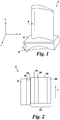
- an article or component 2 may include an Environmental Barrier Coating (EBC) system 22 to protect the article or component when operated in a high-temperature, chemically reactive environment.
- the component 2 may include a substrate 4, for example an airfoil section, extending from a platform 6.
- the platform 6 may include a mounting and securing structure 8 configured to mount and secure the component to a rotating element, such as a rotor (not shown).
- the substrate 4 may include a silicon containing region.
- silicon-containing materials include those with a silicon carbide, silicon nitride, a silicide (for example, a refractory metal or transition metal silicide, including, but not limited to, for example Mo, Nb, or W silicides) and/or silicon as a matrix or second phase.
- a silicide for example, a refractory metal or transition metal silicide, including, but not limited to, for example Mo, Nb, or W silicides
- CMC ceramic matrix composites
- the EBC system 22 of FIG. 2 represents one of a variety of different EBC systems shown as being directly applied to a surface of the substrate 4.
- a silicon-containing bondcoat is disclosed in, for example, U.S. 6,299,988 .
- the bondcoat 10 is further represented as bonding a first EBC layer 14 to the substrate 4, and optionally at least one additional layer 16, 18, 20 of the EBC system 22.
- the EBC system 22 provides environmental protection to the underlying substrate 4. It may also reduce the operating temperature of the component 2, thereby enabling the component 2 to operate at higher gas temperatures than otherwise possible. While FIG.
- the component 2 represents the component 2 as including the silicon-containing bondcoat 10, in which case the first EBC layer 14 is deposited directly on a silicon-containing surface region formed by the bondcoat 10, the technology is also applicable to a component 2 that does not include a bondcoat 10 as described herein, in which case the first EBC layer 14 may be deposited directly on a silicon-containing surface region formed by the substrate 4. It should be appreciated that a constituent layer 12, or a portion of the constituent layer 12, described in more detail below, may be present prior to application of the first EBC layer 14.
- the EBC system 22 may serve to resist recession by chemical reaction of the bondcoat 10 and/or substrate 4 with water vapor, provide a temperature gradient to reduce the operating temperature of the component 2, or both.
- Suitable EBC systems usable with the present technology include, but are not limited to, those disclosed in, for example, U.S. 6,296,941 and U.S. 6,410,148 .
- the EBC system 22 may perform a multitude of sealing, reaction barrier, recession resistance, and/or thermal barrier functions.
- each of the bondcoat 10 and substrate 4 may define a surface region of the component 2 that contains silicon.
- the bondcoat 10 may comprise or consist essentially of elemental silicon.
- the bondcoat 10 may contain silicon carbide, silicon nitride, metal silicides, elemental silicon, silicon alloys, or mixtures thereof.
- Bondcoat 10 may further contain oxide phases, such as silica, rare earth silicates, rare earth aluminosilicates, and/or alkaline earth aluminosilicates.
- oxide phases such as silica, rare earth silicates, rare earth aluminosilicates, and/or alkaline earth aluminosilicates.
- the silicon of the bondcoat 10 reacts with oxygen at elevated temperatures to thermally grow the constituent layer 12 of predominantly amorphous silica (SiO 2 ) on its surface, as schematically represented in FIG. 2 .
- the resulting thermally grown oxide of amorphous silica exhibits low oxygen permeability.
- the constituent layer 12 is able to deter permeation of oxygen into the bondcoat 10 and substrate 4.
- some of the amorphous silica may crystallize into crystalline silica and additional impurity elements and second phases can be incorporated therein.
- the first layer 14 of the EBC system 22 can be deposited directly on a silicon-containing surface region of the component 2 defined by the substrate 4, in which case the substrate 4 is formed to have a composition whose silicon content is sufficient to react with oxygen at elevated temperatures and form a silica-rich constituent layer 12 described above.
- this layer may be a predominantly amorphous silica product, a silica-rich glass, or a multi-phase mixture wherein at least one of the phases is silica-rich.
- the remaining disclosure will make reference to embodiments that include the bondcoat 10 as represented in FIG. 2 , though the disclosure should be understood to equally apply to a constituent layer 12 that forms on the surface of the substrate 4.
- the constituent layer 12 that forms on the silicon-containing bondcoat 10 or another silicon-containing surface region, such as the substrate 4, during high temperature service may grow to thicknesses of up to about 50 ⁇ m or more, depending on the application.
- the constituent layer 12 may have a relatively low viscosity and consequently a high creep rate under shear loading ⁇ that can be imposed by g forces that occur during rotation of components, such as blades (buckets) of turbine engines.
- g forces that occur during rotation of components, such as blades (buckets) of turbine engines.
- displacements of the overlying EBC system 22 relative to the substrate 4 can exceed 100 mm over 25,000 hours service at about 1315°C (about 2400°F). Such large creep displacements can result in severe damage to the EBC system 22 and direct loss of environmental protection of the underlying substrate 4.
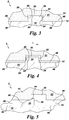
- creep of the constituent layer 12 that forms on the silicon-containing bondcoat 10 may be inhibited by providing the surface of the bondcoat 10 with surfaces or features 24 configured to mitigate creep of the constituent layer 12.
- the surface features may take the form of ridges 24 that are formed by processes described in co-pending, commonly assigned U.S. Application with US Publication No. 2015/0118444 entitled, "METHODS OF MANUFACTURING SILICA-FORMING ARTICLES HAVING ENGINEERED SURFACES TO ENHANCE RESISTANCE TO CREEP SLIDING UNDER HIGH-TEMPERATURE LOADING".
- Each ridge 24 may include a leading edge 26 that forms a leading edge channel 28 between the first layer 14 of the EBC system 22 and the ridge 24. It should be appreciated that the terms “leading” and “trailing” are for illustrative purposes only to describe the relative relationships of the edges with respect to a direction in which a shear loading ⁇ may be applied to the EBC system 22, for example by rotation of the article 2.
- Each ridge 24 may also include a trailing edge 34 that defines a trailing edge channel 32 between the first layer 14 of the EBC system 22 and the ridge 24.
- Each ridge 24 may further include a top edge 44 that defines a channel 30 between the ridge 24 and the first layer 14 of the EBC system 22. It should be appreciated that the use of the term “top” is for illustrative purposes only and is not intended to connote any particular orientation of the edge 44 with respect to the substrate 4 or the component or article 2.
- the formation or growth of the constituent layer 12 forms a channel 48 between the bondcoat 10 and the first layer 14 of the EBC system 22.
- the channel 48 may include the leading edge channel 28 and the trailing edge channel 32 formed between the leading edge 26 and the trailing edge 34 of the ridge 24, respectively, and the first layer 14 of the EBC system 22.
- the channel 48 may further include the connecting channel 30 extending from the leading edge channel 28 to the trailing edge channel 32 that is defined between the top surface 44 of the ridge 24 and the first layer 14 of the EBC system 22.
- a shear loading ⁇ to the article 2, e.g. by rotation of the component 2, may cause a viscous shear of the constituent layer 12, which may be an amorphous silica product, a silica-rich glass, or a multi-phase mixture wherein one of the phases is silica-rich glass.
- the viscous shear of the constituent layer 12 results in a flow of the constituent layer 12 along the channel 48, 28, 30, 32 and accelerated oxidation of the leading edge 26 of the ridge 24.
- the oxidized leading edge 50 of the ridge 24 and the first layer 14 of the EBC system 22 may nearly contact after operation and narrow the channel to limit the creep of the EBC system 22.
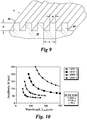
- the ridge 24 of the bondcoat 10 may have a height, or amplitude, H and a wavelength L. Although only one ridge is shown in FIG. 6 , referring to FIG. 9 it should be appreciated that the bondcoat 10 may include ridges 24 of height H and wavelength L in a direction substantially perpendicular to the axis of rotation/acceleration to mitigate creep sliding of the EBC system 22 over the bondcoat 10 and/or substrate 4. As discussed further, the dimensions of the ridges are determined to provide sufficient sliding resistance as required to complete a service interval (e.g. 25,000 hours) for a spinning component.
- a service interval e.g. 25,000 hours
- the constituent layer 12 may have a thickness h that varies from a leading edge thickness h lead to a trailing edge thickness h trail .
- the thickness h con of the constituent layer 12 will vary during use of the component as the bondcoat 10 continues to oxidize during operation of the turbine.
- the flow of the constituent layer 12 during operation may be modeled using an analytical model or Finite Element Analysis (FEA).
- FEA Finite Element Analysis
- a balancing of forces relates channel pressures to the applied shear stress
- the Poiseuille flow relates the channel flow velocities to the channel pressures.
- the principle of volume conservation relates channel flow velocities to a sliding velocity of the EBC system 22. These principles provide the relationship between the sliding velocity and the applied shear stress.
- the sliding displacement s of the EBC system 22 becomes oxidation-rate limited as opposed to Si02 creep-rate limited and the sliding closely tracks about half the difference in oxide thicknesses on the ridge walls.
- FIG. 10 the creep of the EBC system as a result of shear on the constituent layer requires both the amplitude and wavelength of the surface features 24 to meet a minimum requirement.
- the engineered surface of the bondcoat 10 may include a plurality of ridges 24 that are provided substantially perpendicular to the direction of shear loading ⁇ .
- the ridges 24 have a wavelength L and a span W that defines a ⁇ of W/L.
- the ⁇ is from about 0.1 to about 0.9, for example from about 0.2 to about 0.8, for example about 0.4 to about 0.6.
- the ridges 24 are shown as being generally square in cross section and extending substantially perpendicular to the shear loading direction (i.e. in a substantially chordwise direction), it should be appreciated that the engineered surfaces, i.e. ridges 24, may have other cross sectional shapes, e.g.
- the examples show the features 24 perpendicular to the shear stress, the features ay be provided at an angle to the shear loading direction, e.g. up to about 45° to the shear loading direction.
- the engineered surfaces are shown as periodic and continuous, the surfaces may be non-periodic and/or non-continuous. It should further be appreciated that the engineered surfaces may be provided as sets of intersecting surfaces, e.g. diamond shaped, that may be up to 45°.
- FIGS. 3-7 and 9 schematically illustrate the engineered surfaces according to the present technology.
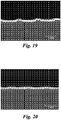
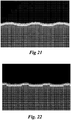
- FIGS. 11-22 illustrate actual engineered surfaces according to the present technology formed according to the processes disclosed in co-pending, commonly assigned U.S. Application with US Publication No. 2015/0118444 entitled, "METHODS OF MANUFACTURING SILICA-FORMING ARTICLES HAVING ENGINEERED SURFACES TO ENHANCE RESISTANCE TO CREEP SLIDING UNDER HIGH-TEMPERATURE LOADING".
- the ridges 24 have a height of from about 10 to about 250 ⁇ m, for example about 50 to about 200 ⁇ m, for example about 75 to about 1250 ⁇ m, for example about 100 ⁇ m.
- the ridges 24 have a wavelength L of from about 20 to about 10,000 ⁇ m and particularly about 50 to about 2,000 ⁇ m, or for example about 250 to about 1,000 ⁇ m.
- the constituent layer thickness h con may be from about 4 to about 40 ⁇ m.
Landscapes
- Chemical & Material Sciences (AREA)
- Engineering & Computer Science (AREA)
- Ceramic Engineering (AREA)
- Materials Engineering (AREA)
- Structural Engineering (AREA)
- Organic Chemistry (AREA)
- Turbine Rotor Nozzle Sealing (AREA)
- Inorganic Chemistry (AREA)
- Laminated Bodies (AREA)
- Chemical Kinetics & Catalysis (AREA)
- Thermal Sciences (AREA)
- Manufacturing & Machinery (AREA)
- Physics & Mathematics (AREA)
- Aiming, Guidance, Guns With A Light Source, Armor, Camouflage, And Targets (AREA)
- Cold Cathode And The Manufacture (AREA)
- Other Surface Treatments For Metallic Materials (AREA)
Applications Claiming Priority (2)
| Application Number | Priority Date | Filing Date | Title |
|---|---|---|---|
| US14/068,693 US9561986B2 (en) | 2013-10-31 | 2013-10-31 | Silica-forming articles having engineered surfaces to enhance resistance to creep sliding under high-temperature loading |
| PCT/US2014/051574 WO2015073082A2 (en) | 2013-10-31 | 2014-08-19 | Silica-forming articles having engineered surfaces to enhance resistance to creep sliding under high-temperature loading |
Publications (2)
| Publication Number | Publication Date |
|---|---|
| EP3063110A2 EP3063110A2 (en) | 2016-09-07 |
| EP3063110B1 true EP3063110B1 (en) | 2020-01-01 |
Family
ID=52630476
Family Applications (1)
| Application Number | Title | Priority Date | Filing Date |
|---|---|---|---|
| EP14843190.1A Active EP3063110B1 (en) | 2013-10-31 | 2014-08-19 | Silica-forming articles having engineered surfaces to enhance resistance to creep sliding under high-temperature loading |
Country Status (7)
| Country | Link |
|---|---|
| US (1) | US9561986B2 (enExample) |
| EP (1) | EP3063110B1 (enExample) |
| JP (1) | JP6821431B2 (enExample) |
| CN (1) | CN105683132A (enExample) |
| BR (1) | BR112016008443A8 (enExample) |
| CA (1) | CA2928352C (enExample) |
| WO (1) | WO2015073082A2 (enExample) |
Families Citing this family (4)
| Publication number | Priority date | Publication date | Assignee | Title |
|---|---|---|---|---|
| US10995624B2 (en) * | 2016-08-01 | 2021-05-04 | General Electric Company | Article for high temperature service |
| US20180106154A1 (en) * | 2016-10-13 | 2018-04-19 | General Electric Company | Contoured bondcoat for environmental barrier coatings and methods for making contoured bondcoats for environmental barrier coatings |
| US11773734B2 (en) * | 2017-09-07 | 2023-10-03 | General Electric Company | Liquid bond coatings for barrier coatings |
| US10544699B2 (en) * | 2017-12-19 | 2020-01-28 | Rolls-Royce Corporation | System and method for minimizing the turbine blade to vane platform overlap gap |
Family Cites Families (26)
| Publication number | Priority date | Publication date | Assignee | Title |
|---|---|---|---|---|
| CZ300909B6 (cs) | 1998-02-28 | 2009-09-09 | General Electric Company | Vícevrstvový vazební povlak pro povlakový systém tepelné ochranné bariéry a zpusob jeho vytvorení |
| US6200691B1 (en) * | 1998-04-20 | 2001-03-13 | Colorado School Of Mines | Oxidation resistance coating system for refractory metals |
| US6299988B1 (en) * | 1998-04-27 | 2001-10-09 | General Electric Company | Ceramic with preferential oxygen reactive layer |
| US6242050B1 (en) | 1998-11-24 | 2001-06-05 | General Electric Company | Method for producing a roughened bond coat using a slurry |
| US6264766B1 (en) | 1998-11-24 | 2001-07-24 | General Electric Company | Roughened bond coats for a thermal barrier coating system and method for producing |
| US6296941B1 (en) | 1999-04-15 | 2001-10-02 | General Electric Company | Silicon based substrate with yttrium silicate environmental/thermal barrier layer |
| US6410148B1 (en) | 1999-04-15 | 2002-06-25 | General Electric Co. | Silicon based substrate with environmental/ thermal barrier layer |
| US6544665B2 (en) | 2001-01-18 | 2003-04-08 | General Electric Company | Thermally-stabilized thermal barrier coating |
| US6726444B2 (en) | 2002-03-18 | 2004-04-27 | General Electric Company | Hybrid high temperature articles and method of making |
| US6682820B1 (en) * | 2002-10-31 | 2004-01-27 | Saint-Gobain Ceramics & Plastics, Inc. | Recession resistant coated ceramic part |
| US7056574B2 (en) | 2003-05-22 | 2006-06-06 | United Technologies Corporation | Bond layer for silicon containing substrate |
| US6902836B2 (en) | 2003-05-22 | 2005-06-07 | United Technologies Corporation | Environmental barrier coating for silicon based substrates such as silicon nitride |
| US7150921B2 (en) | 2004-05-18 | 2006-12-19 | General Electric Company | Bi-layer HVOF coating with controlled porosity for use in thermal barrier coatings |
| US7763356B2 (en) | 2006-03-13 | 2010-07-27 | United Technologies Corporation | Bond coating and thermal barrier compositions, processes for applying both, and their coated articles |
| US7927714B2 (en) | 2008-08-20 | 2011-04-19 | The Trustees Of Princeton University | Barium-doped bond coat for thermal barrier coatings |
| US7704596B2 (en) | 2008-09-23 | 2010-04-27 | Siemens Energy, Inc. | Subsurface inclusion of fugitive objects and methodology for strengthening a surface bond in a hybrid ceramic matrix composite structure |
| US8470460B2 (en) * | 2008-11-25 | 2013-06-25 | Rolls-Royce Corporation | Multilayer thermal barrier coatings |
| CA2750822A1 (en) | 2009-01-28 | 2010-10-28 | Applied Thin Films Inc. | High temperature stable amorphous silica-rich aluminosilicates |
| US7955568B2 (en) | 2009-03-19 | 2011-06-07 | The Boeing Company | Chemical reaction-based thermal management system and method |
| US8673400B2 (en) * | 2009-07-31 | 2014-03-18 | General Electric Company | Methods of improving surface roughness of an environmental barrier coating and components comprising environmental barrier coatings having improved surface roughness |
| US20110033284A1 (en) | 2009-08-04 | 2011-02-10 | United Technologies Corporation | Structurally diverse thermal barrier coatings |
| EP2524069B1 (en) | 2010-01-11 | 2018-03-07 | Rolls-Royce Corporation | Features for mitigating thermal or mechanical stress on an environmental barrier coating |
| EP2683844B1 (en) | 2011-03-09 | 2019-05-08 | Rolls-Royce Corporation | Abradable layer |
| US9771811B2 (en) | 2012-01-11 | 2017-09-26 | General Electric Company | Continuous fiber reinforced mesh bond coat for environmental barrier coating system |
| US20130177439A1 (en) * | 2012-01-11 | 2013-07-11 | General Electric Company | Creep resistant coating for ceramic turbine blades |
| US9428650B2 (en) | 2012-12-11 | 2016-08-30 | General Electric Company | Environmental barrier coatings and methods therefor |
-
2013
- 2013-10-31 US US14/068,693 patent/US9561986B2/en active Active
-
2014
- 2014-08-19 CN CN201480059905.4A patent/CN105683132A/zh active Pending
- 2014-08-19 JP JP2016526267A patent/JP6821431B2/ja active Active
- 2014-08-19 BR BR112016008443A patent/BR112016008443A8/pt not_active Application Discontinuation
- 2014-08-19 WO PCT/US2014/051574 patent/WO2015073082A2/en not_active Ceased
- 2014-08-19 EP EP14843190.1A patent/EP3063110B1/en active Active
- 2014-08-19 CA CA2928352A patent/CA2928352C/en active Active
Non-Patent Citations (1)
| Title |
|---|
| None * |
Also Published As
| Publication number | Publication date |
|---|---|
| CA2928352A1 (en) | 2015-05-21 |
| JP2016538216A (ja) | 2016-12-08 |
| EP3063110A2 (en) | 2016-09-07 |
| WO2015073082A2 (en) | 2015-05-21 |
| WO2015073082A3 (en) | 2015-07-02 |
| BR112016008443A8 (pt) | 2020-03-10 |
| US9561986B2 (en) | 2017-02-07 |
| CN105683132A (zh) | 2016-06-15 |
| US20150118443A1 (en) | 2015-04-30 |
| CA2928352C (en) | 2020-06-16 |
| JP6821431B2 (ja) | 2021-01-27 |
Similar Documents
| Publication | Publication Date | Title |
|---|---|---|
| EP3063109B1 (en) | Methods of manufacturing silica-forming articles having engineered surfaces to enhance resistance to creep sliding under high-temperature loading | |
| CN104838039B (zh) | 环境阻障涂层及其方法 | |
| JP6727191B2 (ja) | 高温供用物品 | |
| EP2202212B1 (en) | Components Comprising CMAS mitigation compositions | |
| EP2698452B1 (en) | Creep-resistant environmental barrier coatings | |
| EP2503027A1 (en) | Hot corrosion-resistant coatings and components protected therewith | |
| EP3309136A1 (en) | Method of forming an article and mask for use in the method | |
| JP2006028015A (ja) | 環境障壁被覆膜系を含む物品、及びその製造方法 | |
| CN109422533B (zh) | 基材表面上的涂层体系、经涂覆的部件、及涂层形成方法 | |
| EP1734025B1 (en) | Thermal/Environmental barrier coating system for silicon-containing materials | |
| EP2698451A2 (en) | Cavitation-resistant environmental barrier coating | |
| JP2013142386A (ja) | 耐環境コーティングのクリープ劣化を阻止し、食い止めるための複合ボンドコート | |
| CA2928352C (en) | Silica-forming articles having engineered surfaces to enhance resistance to creep sliding under high-temperature loading | |
| EP4223726B1 (en) | Bond coat including metal oxides and oxygen getters | |
| CN109422290B (zh) | 用于涂层的化合物、含铝钽酸铪、及含铝和铒的钽酸铪 | |
| CN109469517B (zh) | 经涂布的部件和涡轮部件、及其形成方法 |
Legal Events
| Date | Code | Title | Description |
|---|---|---|---|
| PUAI | Public reference made under article 153(3) epc to a published international application that has entered the european phase |
Free format text: ORIGINAL CODE: 0009012 |
|
| 17P | Request for examination filed |
Effective date: 20160531 |
|
| AK | Designated contracting states |
Kind code of ref document: A2 Designated state(s): AL AT BE BG CH CY CZ DE DK EE ES FI FR GB GR HR HU IE IS IT LI LT LU LV MC MK MT NL NO PL PT RO RS SE SI SK SM TR |
|
| AX | Request for extension of the european patent |
Extension state: BA ME |
|
| DAX | Request for extension of the european patent (deleted) | ||
| STAA | Information on the status of an ep patent application or granted ep patent |
Free format text: STATUS: EXAMINATION IS IN PROGRESS |
|
| 17Q | First examination report despatched |
Effective date: 20190124 |
|
| GRAP | Despatch of communication of intention to grant a patent |
Free format text: ORIGINAL CODE: EPIDOSNIGR1 |
|
| STAA | Information on the status of an ep patent application or granted ep patent |
Free format text: STATUS: GRANT OF PATENT IS INTENDED |
|
| INTG | Intention to grant announced |
Effective date: 20190725 |
|
| GRAS | Grant fee paid |
Free format text: ORIGINAL CODE: EPIDOSNIGR3 |
|
| GRAA | (expected) grant |
Free format text: ORIGINAL CODE: 0009210 |
|
| STAA | Information on the status of an ep patent application or granted ep patent |
Free format text: STATUS: THE PATENT HAS BEEN GRANTED |
|
| AK | Designated contracting states |
Kind code of ref document: B1 Designated state(s): AL AT BE BG CH CY CZ DE DK EE ES FI FR GB GR HR HU IE IS IT LI LT LU LV MC MK MT NL NO PL PT RO RS SE SI SK SM TR |
|
| REG | Reference to a national code |
Ref country code: GB Ref legal event code: FG4D |
|
| REG | Reference to a national code |
Ref country code: CH Ref legal event code: EP Ref country code: AT Ref legal event code: REF Ref document number: 1219604 Country of ref document: AT Kind code of ref document: T Effective date: 20200115 |
|
| REG | Reference to a national code |
Ref country code: IE Ref legal event code: FG4D |
|
| REG | Reference to a national code |
Ref country code: DE Ref legal event code: R096 Ref document number: 602014059458 Country of ref document: DE |
|
| REG | Reference to a national code |
Ref country code: NL Ref legal event code: MP Effective date: 20200101 |
|
| REG | Reference to a national code |
Ref country code: LT Ref legal event code: MG4D |
|
| PG25 | Lapsed in a contracting state [announced via postgrant information from national office to epo] |
Ref country code: LT Free format text: LAPSE BECAUSE OF FAILURE TO SUBMIT A TRANSLATION OF THE DESCRIPTION OR TO PAY THE FEE WITHIN THE PRESCRIBED TIME-LIMIT Effective date: 20200101 Ref country code: NL Free format text: LAPSE BECAUSE OF FAILURE TO SUBMIT A TRANSLATION OF THE DESCRIPTION OR TO PAY THE FEE WITHIN THE PRESCRIBED TIME-LIMIT Effective date: 20200101 Ref country code: NO Free format text: LAPSE BECAUSE OF FAILURE TO SUBMIT A TRANSLATION OF THE DESCRIPTION OR TO PAY THE FEE WITHIN THE PRESCRIBED TIME-LIMIT Effective date: 20200401 Ref country code: PT Free format text: LAPSE BECAUSE OF FAILURE TO SUBMIT A TRANSLATION OF THE DESCRIPTION OR TO PAY THE FEE WITHIN THE PRESCRIBED TIME-LIMIT Effective date: 20200527 Ref country code: CZ Free format text: LAPSE BECAUSE OF FAILURE TO SUBMIT A TRANSLATION OF THE DESCRIPTION OR TO PAY THE FEE WITHIN THE PRESCRIBED TIME-LIMIT Effective date: 20200101 Ref country code: FI Free format text: LAPSE BECAUSE OF FAILURE TO SUBMIT A TRANSLATION OF THE DESCRIPTION OR TO PAY THE FEE WITHIN THE PRESCRIBED TIME-LIMIT Effective date: 20200101 Ref country code: RS Free format text: LAPSE BECAUSE OF FAILURE TO SUBMIT A TRANSLATION OF THE DESCRIPTION OR TO PAY THE FEE WITHIN THE PRESCRIBED TIME-LIMIT Effective date: 20200101 |
|
| PG25 | Lapsed in a contracting state [announced via postgrant information from national office to epo] |
Ref country code: HR Free format text: LAPSE BECAUSE OF FAILURE TO SUBMIT A TRANSLATION OF THE DESCRIPTION OR TO PAY THE FEE WITHIN THE PRESCRIBED TIME-LIMIT Effective date: 20200101 Ref country code: SE Free format text: LAPSE BECAUSE OF FAILURE TO SUBMIT A TRANSLATION OF THE DESCRIPTION OR TO PAY THE FEE WITHIN THE PRESCRIBED TIME-LIMIT Effective date: 20200101 Ref country code: LV Free format text: LAPSE BECAUSE OF FAILURE TO SUBMIT A TRANSLATION OF THE DESCRIPTION OR TO PAY THE FEE WITHIN THE PRESCRIBED TIME-LIMIT Effective date: 20200101 Ref country code: GR Free format text: LAPSE BECAUSE OF FAILURE TO SUBMIT A TRANSLATION OF THE DESCRIPTION OR TO PAY THE FEE WITHIN THE PRESCRIBED TIME-LIMIT Effective date: 20200402 Ref country code: IS Free format text: LAPSE BECAUSE OF FAILURE TO SUBMIT A TRANSLATION OF THE DESCRIPTION OR TO PAY THE FEE WITHIN THE PRESCRIBED TIME-LIMIT Effective date: 20200501 Ref country code: BG Free format text: LAPSE BECAUSE OF FAILURE TO SUBMIT A TRANSLATION OF THE DESCRIPTION OR TO PAY THE FEE WITHIN THE PRESCRIBED TIME-LIMIT Effective date: 20200401 |
|
| REG | Reference to a national code |
Ref country code: DE Ref legal event code: R026 Ref document number: 602014059458 Country of ref document: DE |
|
| PLBI | Opposition filed |
Free format text: ORIGINAL CODE: 0009260 |
|
| PLAX | Notice of opposition and request to file observation + time limit sent |
Free format text: ORIGINAL CODE: EPIDOSNOBS2 |
|
| PG25 | Lapsed in a contracting state [announced via postgrant information from national office to epo] |
Ref country code: RO Free format text: LAPSE BECAUSE OF FAILURE TO SUBMIT A TRANSLATION OF THE DESCRIPTION OR TO PAY THE FEE WITHIN THE PRESCRIBED TIME-LIMIT Effective date: 20200101 Ref country code: SM Free format text: LAPSE BECAUSE OF FAILURE TO SUBMIT A TRANSLATION OF THE DESCRIPTION OR TO PAY THE FEE WITHIN THE PRESCRIBED TIME-LIMIT Effective date: 20200101 Ref country code: EE Free format text: LAPSE BECAUSE OF FAILURE TO SUBMIT A TRANSLATION OF THE DESCRIPTION OR TO PAY THE FEE WITHIN THE PRESCRIBED TIME-LIMIT Effective date: 20200101 Ref country code: ES Free format text: LAPSE BECAUSE OF FAILURE TO SUBMIT A TRANSLATION OF THE DESCRIPTION OR TO PAY THE FEE WITHIN THE PRESCRIBED TIME-LIMIT Effective date: 20200101 Ref country code: DK Free format text: LAPSE BECAUSE OF FAILURE TO SUBMIT A TRANSLATION OF THE DESCRIPTION OR TO PAY THE FEE WITHIN THE PRESCRIBED TIME-LIMIT Effective date: 20200101 Ref country code: SK Free format text: LAPSE BECAUSE OF FAILURE TO SUBMIT A TRANSLATION OF THE DESCRIPTION OR TO PAY THE FEE WITHIN THE PRESCRIBED TIME-LIMIT Effective date: 20200101 |
|
| 26 | Opposition filed |
Opponent name: RAYTHEON TECHNOLOGIES CORPORATION Effective date: 20201001 |
|
| REG | Reference to a national code |
Ref country code: AT Ref legal event code: MK05 Ref document number: 1219604 Country of ref document: AT Kind code of ref document: T Effective date: 20200101 |
|
| PG25 | Lapsed in a contracting state [announced via postgrant information from national office to epo] |
Ref country code: AT Free format text: LAPSE BECAUSE OF FAILURE TO SUBMIT A TRANSLATION OF THE DESCRIPTION OR TO PAY THE FEE WITHIN THE PRESCRIBED TIME-LIMIT Effective date: 20200101 Ref country code: IT Free format text: LAPSE BECAUSE OF FAILURE TO SUBMIT A TRANSLATION OF THE DESCRIPTION OR TO PAY THE FEE WITHIN THE PRESCRIBED TIME-LIMIT Effective date: 20200101 |
|
| PG25 | Lapsed in a contracting state [announced via postgrant information from national office to epo] |
Ref country code: PL Free format text: LAPSE BECAUSE OF FAILURE TO SUBMIT A TRANSLATION OF THE DESCRIPTION OR TO PAY THE FEE WITHIN THE PRESCRIBED TIME-LIMIT Effective date: 20200101 Ref country code: SI Free format text: LAPSE BECAUSE OF FAILURE TO SUBMIT A TRANSLATION OF THE DESCRIPTION OR TO PAY THE FEE WITHIN THE PRESCRIBED TIME-LIMIT Effective date: 20200101 |
|
| PLBB | Reply of patent proprietor to notice(s) of opposition received |
Free format text: ORIGINAL CODE: EPIDOSNOBS3 |
|
| PG25 | Lapsed in a contracting state [announced via postgrant information from national office to epo] |
Ref country code: MC Free format text: LAPSE BECAUSE OF FAILURE TO SUBMIT A TRANSLATION OF THE DESCRIPTION OR TO PAY THE FEE WITHIN THE PRESCRIBED TIME-LIMIT Effective date: 20200101 |
|
| REG | Reference to a national code |
Ref country code: CH Ref legal event code: PL |
|
| PG25 | Lapsed in a contracting state [announced via postgrant information from national office to epo] |
Ref country code: CH Free format text: LAPSE BECAUSE OF NON-PAYMENT OF DUE FEES Effective date: 20200831 Ref country code: LI Free format text: LAPSE BECAUSE OF NON-PAYMENT OF DUE FEES Effective date: 20200831 Ref country code: LU Free format text: LAPSE BECAUSE OF NON-PAYMENT OF DUE FEES Effective date: 20200819 |
|
| REG | Reference to a national code |
Ref country code: BE Ref legal event code: MM Effective date: 20200831 |
|
| PG25 | Lapsed in a contracting state [announced via postgrant information from national office to epo] |
Ref country code: BE Free format text: LAPSE BECAUSE OF NON-PAYMENT OF DUE FEES Effective date: 20200831 Ref country code: IE Free format text: LAPSE BECAUSE OF NON-PAYMENT OF DUE FEES Effective date: 20200819 |
|
| PLCK | Communication despatched that opposition was rejected |
Free format text: ORIGINAL CODE: EPIDOSNREJ1 |
|
| PG25 | Lapsed in a contracting state [announced via postgrant information from national office to epo] |
Ref country code: TR Free format text: LAPSE BECAUSE OF FAILURE TO SUBMIT A TRANSLATION OF THE DESCRIPTION OR TO PAY THE FEE WITHIN THE PRESCRIBED TIME-LIMIT Effective date: 20200101 Ref country code: MT Free format text: LAPSE BECAUSE OF FAILURE TO SUBMIT A TRANSLATION OF THE DESCRIPTION OR TO PAY THE FEE WITHIN THE PRESCRIBED TIME-LIMIT Effective date: 20200101 Ref country code: CY Free format text: LAPSE BECAUSE OF FAILURE TO SUBMIT A TRANSLATION OF THE DESCRIPTION OR TO PAY THE FEE WITHIN THE PRESCRIBED TIME-LIMIT Effective date: 20200101 |
|
| PG25 | Lapsed in a contracting state [announced via postgrant information from national office to epo] |
Ref country code: MK Free format text: LAPSE BECAUSE OF FAILURE TO SUBMIT A TRANSLATION OF THE DESCRIPTION OR TO PAY THE FEE WITHIN THE PRESCRIBED TIME-LIMIT Effective date: 20200101 Ref country code: AL Free format text: LAPSE BECAUSE OF FAILURE TO SUBMIT A TRANSLATION OF THE DESCRIPTION OR TO PAY THE FEE WITHIN THE PRESCRIBED TIME-LIMIT Effective date: 20200101 |
|
| APBM | Appeal reference recorded |
Free format text: ORIGINAL CODE: EPIDOSNREFNO |
|
| APBP | Date of receipt of notice of appeal recorded |
Free format text: ORIGINAL CODE: EPIDOSNNOA2O |
|
| APAH | Appeal reference modified |
Free format text: ORIGINAL CODE: EPIDOSCREFNO |
|
| REG | Reference to a national code |
Ref country code: DE Ref legal event code: R100 Ref document number: 602014059458 Country of ref document: DE |
|
| APBU | Appeal procedure closed |
Free format text: ORIGINAL CODE: EPIDOSNNOA9O |
|
| PLBN | Opposition rejected |
Free format text: ORIGINAL CODE: 0009273 |
|
| STAA | Information on the status of an ep patent application or granted ep patent |
Free format text: STATUS: OPPOSITION REJECTED |
|
| 27O | Opposition rejected |
Effective date: 20220922 |
|
| P01 | Opt-out of the competence of the unified patent court (upc) registered |
Effective date: 20230414 |
|
| PGFP | Annual fee paid to national office [announced via postgrant information from national office to epo] |
Ref country code: DE Payment date: 20250724 Year of fee payment: 12 |
|
| PGFP | Annual fee paid to national office [announced via postgrant information from national office to epo] |
Ref country code: GB Payment date: 20250725 Year of fee payment: 12 |
|
| PGFP | Annual fee paid to national office [announced via postgrant information from national office to epo] |
Ref country code: FR Payment date: 20250725 Year of fee payment: 12 |