EP3056989A2 - Übertragung von applikationen - Google Patents
Übertragung von applikationen Download PDFInfo
- Publication number
- EP3056989A2 EP3056989A2 EP16155450.6A EP16155450A EP3056989A2 EP 3056989 A2 EP3056989 A2 EP 3056989A2 EP 16155450 A EP16155450 A EP 16155450A EP 3056989 A2 EP3056989 A2 EP 3056989A2
- Authority
- EP
- European Patent Office
- Prior art keywords
- applications
- list
- platform
- synchronization server
- mobile terminal
- Prior art date
- Legal status (The legal status is an assumption and is not a legal conclusion. Google has not performed a legal analysis and makes no representation as to the accuracy of the status listed.)
- Granted
Links
Images

Classifications
-
- G—PHYSICS
- G06—COMPUTING OR CALCULATING; COUNTING
- G06F—ELECTRIC DIGITAL DATA PROCESSING
- G06F8/00—Arrangements for software engineering
- G06F8/60—Software deployment
- G06F8/61—Installation
- G06F8/64—Retargetable
-
- G—PHYSICS
- G06—COMPUTING OR CALCULATING; COUNTING
- G06F—ELECTRIC DIGITAL DATA PROCESSING
- G06F8/00—Arrangements for software engineering
- G06F8/70—Software maintenance or management
- G06F8/76—Adapting program code to run in a different environment; Porting
-
- G—PHYSICS
- G06—COMPUTING OR CALCULATING; COUNTING
- G06F—ELECTRIC DIGITAL DATA PROCESSING
- G06F9/00—Arrangements for program control, e.g. control units
- G06F9/06—Arrangements for program control, e.g. control units using stored programs, i.e. using an internal store of processing equipment to receive or retain programs
- G06F9/46—Multiprogramming arrangements
- G06F9/48—Program initiating; Program switching, e.g. by interrupt
- G06F9/4806—Task transfer initiation or dispatching
- G06F9/4843—Task transfer initiation or dispatching by program, e.g. task dispatcher, supervisor, operating system
- G06F9/485—Task life-cycle, e.g. stopping, restarting, resuming execution
- G06F9/4856—Task life-cycle, e.g. stopping, restarting, resuming execution resumption being on a different machine, e.g. task migration, virtual machine migration
-
- H—ELECTRICITY
- H04—ELECTRIC COMMUNICATION TECHNIQUE
- H04W—WIRELESS COMMUNICATION NETWORKS
- H04W4/00—Services specially adapted for wireless communication networks; Facilities therefor
- H04W4/50—Service provisioning or reconfiguring
-
- H—ELECTRICITY
- H04—ELECTRIC COMMUNICATION TECHNIQUE
- H04W—WIRELESS COMMUNICATION NETWORKS
- H04W4/00—Services specially adapted for wireless communication networks; Facilities therefor
- H04W4/60—Subscription-based services using application servers or record carriers, e.g. SIM application toolkits
Definitions
- the invention relates to a method for transmitting applications (apps) which are stored on a first mobile terminal, usually a smartphone, to a second mobile terminal or a smartphone, wherein the applications stored on the first mobile terminal of a first platform, in particular a manufacturer-specific online portal.
- the invention also relates to a system for implementing the method.
- apps enjoy great popularity nowadays.
- apps are loaded by the user onto the smartphone from the corresponding platform and enable the user to select an offered icon for the execution of various functionalities.
- the bandwidth of such apps ranges from simplest tools and fun applications to complex computer games and user programs.
- Many apps also enable efficient use of certain web applications or provide easy access to informational services.
- each smartphone becomes an individually designed tool that not only presents the user with a high material value but also a corresponding ideal value.
- Android apps are not known to run on iOS and vice versa, as each app is programmed specifically for a specific operating system. It's the same it is not possible to transfer the apps running on a first mobile terminal with the first operating system to the second mobile terminal with the second operating system. With a change in the operating system, the user therefore runs the risk that his expensive-bought and laboriously maintained collection of apps will be lost.
- the core of the invention lies in the synchronization server which is installed at a central location in a communication network, in particular the Internet, and can be reached via a corresponding client application (synchronization client) located in the respective terminal.
- the synchronization server In response to a request made by the client application via the communication network, the synchronization server automatically searches for equivalents (equivalents) of the applications to be transferred for equivalents (equivalents) of these applications (apps) to be transferred on other platforms. If he has found correspondences of the apps, he stores this information, for example in the form of a transmission list, in order to make them available to the second mobile terminal.
- the first mobile terminal first connects to the synchronization server and sends it information relating to those applications for which a transfer to another terminal is desired. Based on this information, the central synchronization server searches on at least one second platform for correspondences of the desired applications. He stores the applications found, for example, in the transmission list in connection with the apps or in connection with links to the apps. The transmission list can then be transmitted to the second mobile terminal at a later time.
- the synchronization server can use the name and / or the author of the app as a specific characteristic as a criterion.
- the synchronization server searches on the other platforms for apps that provide at least similar functionality.
- similar applications can be offered for transmission as equivalents.
- the specific characteristic is thus the functionality that can be determined, for example, by means of function-specific search terms, such as "weather”, “traffic”, "refueling” or the like, within the framework of a categorization or in the accompanying information of the apps.
- the most popular apps offered by the platform may be proposed. It makes sense to alert the user to the lack of an identical app and to propose the similar app along with the conditions for downloading. After the user has been informed, he can decide for himself if he wants to install the app.
- the method proceeds in the following steps: First, an original app list of the applications running on the terminal is created by the synchronization client. In this case, it is advantageous to associate the apps in the app list with their platform-specific identification and / or name, or another characterizing parameter.
- the creation of this app list can be done automatically. But it is also possible that the user creates or edit them by editing. For a user account, several such app lists can be generated periodically or on user request.
- the app list is sent to the synchronization server, which then makes it the basis of its search. It may be advantageous if the user selects which app list he wants to use. If in doubt, the last one created will be used.
- the App List synchronization server As a next step, the App List synchronization server generates a unique App List ID (App List ID) and sends it back to the client application. Since the App List ID is unique, it can be used for later transfers.
- the app list ID may also be associated with a date and / or ordinal digit.
- the synchronization server searches for identical or similar equivalents of the applications based on specific characteristics in the submitted app list. He can enter the correspondences, for example, on the basis of address data directly at the appropriate place in the app list or create another, the original list associated list. Based on the previously transmitted list identification, a client application can request the synchronization server to transmit the app list or the associated list. The information contained in the transmitted lists allows the immediate retrieval of applications via a second device. The equivalents of the apps are then transmitted from the respective distribution platform to the client application and are then available to the terminal.
- App Lists can be private or public.
- the app list ID can be shared with other users so that they can also install the appropriate apps.
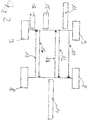
- the system shown comprises a first smartphone 1 and a second smartphone 2, which are both assigned to the same user.
- the first smartphone 1 with the Android® operating system has a large number of applications (apps) installed, which the user wants to transfer to his new Apple® Smartphone 2 with the iOS® operating system.
- apps applications
- For the transmission is on both smartphones 1 and 2, a corresponding software, the so-called synchronization client, provided.
- a mobile network 3 both smartphones 1 and 2 each have access to the Internet 4.
- each synchronization client can connect to a corresponding synchronization server 5, which also gains access to various sales platforms for applications via the Internet.
- the synchronization server 5 has access to a platform for Android® 6 and one for iOS® 7.
- FIG. 2 the sequence according to the invention of the transmission of apps, thus the app synchronization, is symbolized by the first smartphone to the second smartphone by means of the synchronization server function 8.
- a synchronization client 9 is present on the smartphone in each case.
- the communication steps illustrated in the diagram by means of arrows take place between the synchronization client 9 and the synchronization server function 8 in chronological order downwards with the following sequence of steps:
- the synchronization client 9 sends a message to the synchronization server 8 with the request to register. On the part of the synchronization server 8, an account assigned to the user is then generated.
- the synchronization client 9 examines "his" smartphone for the presence of apps and enters the found apps together with their platform-specific identifier in an app list.
- the identifier is a "package name", in case iOS an "App ID” and in the case of the operating system Windows® a "Globally Unique Identifier (GUID)".
- GUID Globally Unique Identifier
- the synchronization client 9 creates an app list containing Android® apps.
- step 12 he sends the thus-created app list to the synchronization server 8, which generates a unique app list ID (app list ID) for this app list and sends it back to the synchronization client 9 in step 13.
- step 14 the synchronization server 8 goes through the Android® apps contained in the app list and uses specific characteristics to search for equivalents or the corresponding counterparts of these apps, for example in the iOS® platform 7. If he can not find identical apps there, he can offer users similar apps, ie applications that offer almost identical functionality. The found identical and / or similar apps he deposits under their respective identifier in the app list or another associated list.
- This list generated by the synchronization server 8 is clearly related to the original app list via the app list ID.
- the same app can be stored for different operating systems, so that later can be selected depending on the operating system of the new smartphone.
- step 15 the user activates his new smartphone and initiates a transmission.
- the sync client 9 also installed on the new smartphone sends in step 16 the accessible to him, for example, entered by the user unique app list ID along with information about the operating system now used by the new smartphone to the synchronization server 8.
- This sends the prepared List of apps found for the new operating system in step 17 to the synchronization client 9, which can then download the apps from the corresponding platform (step 18).
Landscapes
- Engineering & Computer Science (AREA)
- Software Systems (AREA)
- Theoretical Computer Science (AREA)
- General Engineering & Computer Science (AREA)
- Physics & Mathematics (AREA)
- General Physics & Mathematics (AREA)
- Computer Networks & Wireless Communication (AREA)
- Signal Processing (AREA)
- Information Transfer Between Computers (AREA)
- Mobile Radio Communication Systems (AREA)
Abstract
Description
- Die Erfindung betrifft ein Verfahren zur Übertragung von Applikationen (Apps), die auf einem ersten mobilen Endgerät, meist einem Smartphone, gespeichert sind, auf ein zweites mobiles Endgerät respektive ein Smartphone, wobei die auf dem ersten mobilen Endgerät gespeicherten Applikationen einer ersten Plattform, insbesondere einem herstellerspezifischen Online-Portal, zuzuordnen sind. Die Erfindung betrifft auch ein System zur Umsetzung des Verfahrens.
- Derartige Applikationen (im Folgenden auch "Apps") erfreuen sich heutzutage großer Beliebtheit. Sie werden vom Nutzer je nach Betriebssystem von der entsprechenden Plattform auf sein Smartphone geladen und befähigen dieses über die Auswahl eines dargebotenen Icons zur Ausführung unterschiedlichster Funktionalitäten. Dabei reicht die Bandbreite solcher Apps von einfachsten Werkzeugen und Spaßanwendungen bis hin zu komplexen Computerspielen und Anwenderprogrammen. Viele Apps ermöglichen auch eine effiziente Nutzung bestimmter Webanwendungen oder verschaffen einen einfachen Zugang zu Informationsangeboten. Durch die Bestückung mit Apps wird jedes Smartphone zu einem individuell konzipierten Hilfsmittel, das für den Nutzer nicht nur einen hohen materiellen sondern auch einen entsprechend ideellen Wert darstellt.
- Wenn der Nutzer sich ein neues Smartphone zulegt und dieses entsprechend dem alten mit denselben Apps, die auch käuflich erwerben musste, einrichten will, dann ist das meist kein Problem, zumindest solange er sich auf derselben Plattform befindet. Besonders weit verbreitet sind Plattformen, zu denen Endgeräte mit einem Android Betriebssystem Zugang haben, und solche, zu denen iOS Apple® Geräte Zugang haben.
- Bekanntermaßen laufen Android-Apps aber nicht auf iOS und umgekehrt, da jede App speziell für ein bestimmtes Betriebssystem programmiert ist. Entsprechend ist es auch nicht möglich, die Apps, die auf einem ersten mobilen Endgerät mit dem ersten Betriebssystem laufen, auf das zweite mobile Endgerät mit dem zweiten Betriebssystem zu übertragen. Mit einem Wechsel des Betriebssystems geht der Nutzer daher das Risiko ein, dass seine teuer erkaufte und mühevoll gepflegte Sammlung von Apps verloren geht.
- Es ist nunmehr Aufgabe der vorliegenden Erfindung, eine Möglichkeit zu schaffen, Applikationen auf einfache Weise und unabhängig von dem jeweiligen Betriebssystem von einem ersten mobilen Endgerät auf ein zweites mobiles Endgerät zu übertragen.
- Diese Aufgaben werden gelöst durch ein Verfahren nach Anspruch 1 und ein System nach Anspruch 6. bevorzugte Ausgestaltungen ergeben sich aus den jeweiligen Unteransprüchen.
- Anspruchsgemäß liegt der Kern der Erfindung in dem Synchronisationsserver, der an zentraler Stelle in einem Kommunikationsnetz, insbesondere dem Internet, installiert und über eine entsprechende im jeweiligen Endgerät befindliche Client-Applikation (Synchronisationsclient) erreichbar ist. Auf eine über das Kommunikationsnetz geführte Anfrage seitens der Client-Applikation sucht der Synchronisationsserver automatisch anhand spezifischer Charakteristika der zu übertragenden Applikationen nach Entsprechungen (Pendants) dieser zu übertragenden Applikationen (Apps) auf anderen Plattformen. Wenn er Entsprechungen der Apps gefunden hat, speichert er diese Information beispielsweise in Form einer Übertragungsliste, um diese dem zweiten mobilen Endgerät zur Verfügung stellen zu können.
- Zur Umsetzung des Verfahrens verbindet sich das erste mobile Endgerät erfindungsgemäß zunächst mit dem Synchronisationsserver und sendet diesem eine Information bezüglich derjenigen Applikationen zu, für die eine Übertragung auf ein anderes Endgerät gewünscht wird. Auf Grundlage dieser Informationen sucht der zentrale Synchronisationsserver auf mindestens einer zweiten Plattform nach Entsprechungen der gewünschten Applikationen. Die gefundenen Applikationen speichert er beispielsweise in der Übertragungsliste in Verbindung mit den Apps oder in Verbindung mit Links zu den Apps. Die Übertragungsliste kann dann zu einem späteren Zeitpunkt auf das zweite mobile Endgerät übertragen werden.
- Bekanntermaßen gibt es von vielen Apps mehrere Versionen. Insbesondere ist meist eine Version der App vorhanden, die für die eine Plattform, wie Android®, programmiert ist und mindestens eine andere Version, die für eine andere Plattform, insbesondere iOS®, programmiert ist. Beide Versionen der Apps gleichen sich in spezifischen Charakteristika insbesondere in Ihrem Namen, ihrem Icon, in der Menüführung und der Funktionalität identisch. Wegen dieser Identität ist es besonders vorteilhaft, wenn bei der Suche nach Entsprechungen auf den anderen Plattformen solche identischen Apps gefunden und zur Übertragung bereit gehalten werden. Bei der Suche nach identischen Entsprechungen der Apps kann der Synchronisationsserver als spezifisches Charakteristikum den Namen und/oder den Autor der App als Kriterium nutzen.
- Es ist auch möglich, dass auf den anderen Plattformen keine identischen Apps zu finden sind. In diesem Fall kann es vorteilhaft sein, wenn der Synchronisationsserver auf den anderen Plattformen nach Apps sucht, die zumindest ähnliche Funktionalitäten bereit stellen. In dem Falle können als Entsprechungen solche in ihrer Funktionalität ähnlichen Applikationen zur Übertragung angeboten werden. Das spezifische Charakteristikum ist somit die Funktionalität, die sich beispielsweise anhand von funktionsspezifischen Suchbegriffen, wie "Wetter", "Verkehr", "Tanken" o.ä., im Rahmen einer Kategorisierung oder in der Begleitinformation der Apps ermitteln lässt. Insbesondere können als Alternativen die populärsten Apps vorgeschlagen werden, die von der Plattform angeboten werden. Dabei ist es sinnvoll, den Nutzer auf das Fehlen einer identischen App hinzuweisen und ihm die ähnliche App zusammen mit den Bedingungen für das Herunterladen vorzuschlagen. Nachdem der Nutzer darauf hingewiesen wurde, kann er selber entscheiden, ob er die App installieren möchte.
- Um das Verfahren zu initiieren, ist es vorteilhaft, wenn der Nutzer sich im System insbesondere beim Synchronisationsserver registriert. Eine solche Registrierung ist nicht unbedingt notwendig, wenn zwischen dem Nutzer und dem System eine individuelle ID zur Identifikation von Listen (Listen-ID) vereinbart wurde, die nur dem Nutzer bekannt ist und die er für spätere Zugänge bewahrt.
- In einer vorteilhaften Ausführungsform läuft das Verfahren in folgenden Schritten ab: Zunächst wird seitens des Synchronisationsclients eine originale App-Liste der auf dem Endgerät laufenden Applikationen angelegt. Dabei ist es vorteilhaft, die Apps in der App-Liste mit ihrer plattformspezifischen Identifikation und/oder dem Namen, respektive einem anderen charakterisierenden Parameter, in Verbindung zu bringen. Die Erstellung dieser App-Liste kann automatisch erfolgen. Es ist aber auch möglich, dass der Nutzer sie durch Editieren selber erstellt oder bearbeiten. Für einen Nutzer-Account können mehrere solcher App-Listen periodisch oder auf Nutzeranfrage generiert werden. Die App-Liste wird dem Synchronisationsserver zugesandt, der sie dann zur Grundlage seiner Suche macht. Dabei kann es vorteilhaft sein, wenn der Nutzer auswählt, welche App-Liste er nutzen möchte. Im Zweifel wird die zuletzt erstellte verwendet.
- Als nächsten Schritt erzeugt der Synchronisationsserver für die App-Liste eine eindeutige App-Listen-Identifikation (App-Listen-ID) und sendet diese der Client-Applikation zurück. Da die App-Listen-ID einzigartig ist, kann sie für spätere Übertragungen genutzt werden. Der App-Listen-ID können auch ein Datum und/oder eine Ordnungsziffer zugeordnet sein.
- Der Synchronisationsserver sucht anhand der in der übermittelten App-Liste befindlichen Informationen auf der Grundlage spezifischer Charakteristika nach identischen oder ähnlichen Entsprechungen der Applikationen. Die Entsprechungen kann er beispielsweise anhand von Adressdaten direkt an entsprechender Stelle in die App-Liste eintragen oder eine weitere, der Originalliste zugeordnete Liste, erstellen. Anhand der vormals übermittelten Listen-Identifikation kann eine Client-Applikation den Synchronisationsserver auffordern, die App-Liste oder die zugeordnete Liste zu übertragen. Die in den übertragenen Listen enthaltene Information ermöglicht den unmittelbaren Abruf der Applikationen über ein zweites Gerät. Die Entsprechungen der Apps werden dann von der jeweiligen Vertriebsplattform an die Client-Applikation übertragen und stehen dann dem Endgerät zur Verfügung.
- App-Listen können privat oder öffentlich sein. Bei einer öffentlichen App-Listen kann die App-Listen-ID mit anderen Nutzern geteilt werden, so dass diese die entsprechenden Apps ebenfalls installieren können.
- Die Erfindung wird nachfolgend anhand der Figuren näher erläutert. Es zeigen:
- Figur 1
- ein System zur Umsetzung der Erfindung und
- Figur 2
- ein Ablaufdiagramm der erfindungsgemäßen Vorgehensweise
- Das in
Figur 1 gezeigte System umfasst ein erstes Smartphone 1 und ein zweites Smartphone 2, die beide demselben Nutzer zuzuordnen sind. Auf dem ersten Smartphone 1 mit dem Betriebssystem Android® sind eine Vielzahl von Applikationen (Apps) installiert, die der Nutzer auf sein neues Apple® Smartphone 2 mit dem Betriebssystem iOS® übertragen will. Für die Übertragung ist auf beiden Smartphones 1 und 2 eine entsprechende Software, der sogenannte Synchronisationsclient, vorgesehen. Über ein Mobilfunknetz 3 haben beide Smartphones 1 und 2 jeweils einen Zugang zum Internet 4. - Über das Internet 4 kann sich jeder Synchronisationsclient mit einem entsprechenden Synchronisationsserver 5 verbinden, der sich ebenfalls über das Internet Zugang zu verschiedenen Vertriebsplattformen für Applikationen verschafft. Im vorliegenden Fall hat der Synchronisationsserver 5 Zugriff auf eine Plattform für Android® 6 und eine für iOS® 7.
- In
Figur 2 ist der erfindungsgemäße Ablauf der Übertragung von Apps, mithin die App-Synchronisation, von dem ersten Smartphone zu dem zweiten Smartphone vermittels der Synchronisationsserver-Funktion 8 symbolisiert. Wie dargelegt, ist auf den Smartphone jeweils ein Synchronisationsclient 9 vorhanden. Die in dem Diagramm anhand von Pfeilen dargestellten Kommunikationsschritte erfolgen zwischen dem Synchronisationsclient 9 und der der Synchronisationsserver-Funktion 8 in zeitlicher Abfolge nach unten mit folgender Schrittfolge: - Im ersten Schritt 10 schickt der Synchronisationsclient 9 eine Mitteilung an den Synchronisationsserver 8 mit der Aufforderung eine Registrierung vorzunehmen. Seitens des Synchronisationsservers 8 wird daraufhin ein dem Nutzer zugeordneter Account generiert. Um die Übertragung einleiten zu können, untersucht der Synchronisationsclient 9 "sein" Smartphone auf das Vorliegen von Apps und trägt die gefundenen Apps zusammen mit ihrem plattformspezifischen Identifizierer in eine App-Liste ein. Im Falle von Android® ist der Identifizierer ein "package name", im Falle von iOS eine "App ID" und im Falle von dem Betriebssystem Windows® ein "Globally Unique Identifier (GUID)". Im vorliegenden Beispiel erstellt der Synchronisationsclient 9 eine App-Liste enthaltend Android® Apps.
- Die solchermaßen erstellte App-Liste sendet er in Schritt 12 an den Synchronisationsserver 8, der für diese App-Liste eine eindeutige App-Listen-Identifikation (App-Listen-ID) generiert und diese in Schritt 13 zurück an den Synchronisationsclient 9 sendet.
- Nun geht der Synchronisationsserver 8 in Schritt 14 die in der App-Liste enthaltenen Android®-Apps durch und sucht anhand spezifischer Charakteristika Entsprechungen respektive die entsprechenden Pendants dieser Apps beispielsweise in der iOS® Plattform 7. Falls er dort keine identischen Apps findet, kann er dem Nutzer ähnliche Apps anbieten, also Applikationen, die eine nahezu identische Funktionalität bieten. Die gefundenen identischen und/oder ähnlichen Apps legt er unter ihrem jeweiligen Identifizierer in der App-Liste oder einer weiteren zugeordneten Liste ab.
- Diese vom Synchronisationsserver 8 generierte Liste steht über die App-Listen-ID in eindeutigen Zusammenhang mit der ursprünglichen App-Liste. In der Liste kann dieselbe App jeweils für verschiedene Betriebssysteme hinterlegt werden, so dass später je nach Betriebssystem des neuen Smartphones ausgewählt werden kann.
- In Schritt 15 nimmt der Nutzer sein neues Smartphone in Betrieb und initiiert eine Übertragung. Dazu sendet der auch auf dem neuen Smartphone installierte Synchronisationsclient 9 in Schritt 16 die ihm zugängliche, weil beispielsweise vom Nutzer eingegebene eindeutige App-Listen-ID zusammen mit einer Information über das nunmehr vom neuen Smartphone verwendete Betriebssystem an den Synchronisationsserver 8. Dieser schickt die vorbereitete Liste der für das neue Betriebssystem gefundenen Apps in Schritt 17 an den Synchronisationsclient 9, der die Apps dann von der entsprechenden Plattform herunter laden kann (Schritt 18).
-
- 1
- erstes Smartphone
- 2
- zweites Smartphone
- 3
- Mobilfunknetz
- 4
- Internet
- 5
- Synchronisationsserver
- 6
- Plattform für Android®
- 7
- Plattform für iOS®
- 8
- Synchronisationsserver-Funktion (
Figur 2 ) - 9
- Synchronisationsclient (
Figur 2 ) - 10-17
- einzelne Verfahrensschritte
Claims (6)
- Verfahren zur Übertragung von Applikationen, die auf einem ersten mobilen Endgerät (1) gespeichert sind, auf ein zweites mobiles Endgerät (2), wobei die auf dem ersten mobilen Endgerät (1) gespeicherten Applikationen einer ersten Plattform zuzuordnen sind,
dadurch gekennzeichnet,
dass das erste mobile Endgerät (1) mit einem Synchronisationsserver (5) verbunden wird und dem zentralen Synchronisationsserver (5) vom mobilen Endgerät (1) eine Information bezüglich der zu übertragenden Applikationen zugesendet wird,
dass der zentrale Synchronisationsserver (5) anhand spezifischer Charakteristika der zu übertragenden Applikationen auf mindestens einer zweiten Plattform nach Entsprechungen der zu übertragenden Applikationen sucht,
dass die gefundenen Entsprechungen der zu übertragenden Applikationen in einer Übertragungsliste aufgelistet werden und
dass die Übertragungsliste dem zweiten Endgerät (2) übermittelt wird. - Verfahren nach Anspruch 1,
dadurch gekennzeichnet,
dass als Entsprechungen identische Applikationen der zweiten Plattform anhand identischer spezifischer Charakteristika gesucht und aufgelistet werden. - Verfahren nach Anspruch 1,
dadurch gekennzeichnet,
dass als Entsprechungen in ihrer Funktionalität ähnliche Applikationen der zweiten Plattform, insbesondere anhand von funktionsspezifischen Suchbegriffen, gesucht und aufgelistet werden. - Verfahren nach Anspruch 1,
dadurch gekennzeichnet,
dass die gespeicherten Applikationen von einer auf dem ersten Endgerät (1) laufenden Client-Applikation (Synchronisationsclient) (9) zu einer App-Liste zusammengestellt und jeweils mit ihrer plattformspezifischen Identifikation versehen werden,
dass die App-Liste dem Synchronisationsserver (5) zugesandt wird,
dass der Synchronisationsserver (5) für die App-Liste eine eindeutige Listen-Identifikation (App-Listen-ID) erzeugt und diese der Client-Applikation (9) zurück sendet,
dass der Synchronisationsserver (5) anhand der App-Liste und spezifischer Charakteristika nach Entsprechungen der Apps sucht, diese in die App-Liste oder eine der weitere der App-Liste zugeordnete Liste einträgt,
dass der Synchronisationsserver (5) die App-Liste oder die weitere Liste nach Aufforderung anhand der Listen-Identifikation an eine Client-Applikation des zweiten Endgerätes (2) sendet und
dass die Entsprechungen von der zweiten Vertriebsplattform an die Client-Applikation (9) des zweiten Endgerätes (2) übertragen werden. - Verfahren nach einem der vorherigen Ansprüche,
dadurch gekennzeichnet,
dass der zentrale Synchronisationsserver (5) auf allen zur Verfügung stehenden Plattformen nach Entsprechungen sucht und die gefundenen Entsprechungen zusammen mit der Information der jeweiligen Plattform in die App-Liste oder in die weitere Liste einträgt. - System zur Umsetzung des Verfahrens nach einem der vorherigen Ansprüche aufweisend zwei mobile Endgeräte (1,2) wobei auf einem ersten der beiden mobilen Endgeräte (1) Applikationen einer ersten Plattform installiert sind,
gekennzeichnet durch
einen dem ersten mobilen Endgerät (1) über ein Kommunikationsnetz (3) in Verbindung stehenden Synchronisationsserver (5), der geeignet ist zur Suche nach auf einer zweiten Plattform befindlichen Entsprechungen der auf dem ersten mobilen Endgerät (1) installierten Applikationen und der geeignet ist zur Übertragung von Information bezüglich der gefundenen Entsprechungen auf ein zweites mobiles Endgerät.
Applications Claiming Priority (1)
| Application Number | Priority Date | Filing Date | Title |
|---|---|---|---|
| DE102015102016 | 2015-02-12 |
Publications (3)
| Publication Number | Publication Date |
|---|---|
| EP3056989A2 true EP3056989A2 (de) | 2016-08-17 |
| EP3056989A3 EP3056989A3 (de) | 2016-11-09 |
| EP3056989B1 EP3056989B1 (de) | 2018-08-29 |
Family
ID=55409711
Family Applications (1)
| Application Number | Title | Priority Date | Filing Date |
|---|---|---|---|
| EP16155450.6A Active EP3056989B1 (de) | 2015-02-12 | 2016-02-12 | Übertragung von applikationen |
Country Status (1)
| Country | Link |
|---|---|
| EP (1) | EP3056989B1 (de) |
Family Cites Families (3)
| Publication number | Priority date | Publication date | Assignee | Title |
|---|---|---|---|---|
| US5951639A (en) * | 1996-02-14 | 1999-09-14 | Powertv, Inc. | Multicast downloading of software and data modules and their compatibility requirements |
| US6496979B1 (en) * | 1997-10-24 | 2002-12-17 | Microsoft Corporation | System and method for managing application installation for a mobile device |
| JP2013254303A (ja) * | 2012-06-06 | 2013-12-19 | Sony Corp | 情報処理装置、情報処理方法およびプログラム |
-
2016
- 2016-02-12 EP EP16155450.6A patent/EP3056989B1/de active Active
Non-Patent Citations (1)
| Title |
|---|
| None |
Also Published As
| Publication number | Publication date |
|---|---|
| EP3056989A3 (de) | 2016-11-09 |
| EP3056989B1 (de) | 2018-08-29 |
Similar Documents
| Publication | Publication Date | Title |
|---|---|---|
| DE60006096T2 (de) | Verfahren zum herunterladen von software | |
| DE69933312T2 (de) | Auswahlsteuerung eines gateway-unterstützungsknotens | |
| DE69735426T2 (de) | Nachrichtenübertragung in netzwerken bestehend aus unternetzwerken mit verschiedenen namensraümen | |
| DE602004001010T2 (de) | Verfahren und System um auf peer to peer Netzen zuzugreifen | |
| DE602005004214T2 (de) | Kommunikationssystem and Verfahren zur Aktualisierung von Software in einem Endbenutzergerät | |
| DE10297351T5 (de) | Verfahren und Vorrichtung für eine Autokonfiguration für optimale Multimedialeistung | |
| DE112008001729T5 (de) | Systeme und Verfahren zum Schieben von Nachrichten auf Mobilendgeräte | |
| DE10116640A1 (de) | Auf URL beruhende Token für schwierige Verteilungen, die einen serverseitigen Cookiebehälter benutzen | |
| DE10159931A1 (de) | Verfahren zum Zugriff auf Informationen und/oder Dienste eines verteilten Automatisierungssystems | |
| DE10048653A1 (de) | Digitales Verzeichnis zur Verwendung in einem Kommunikationssystem | |
| WO2019096840A1 (de) | Verfahren und system zum aktualisieren einer fahrzeugsoftware | |
| DE10238546A1 (de) | Verfahren zur Bereitstellung von Ressourcen in Kommunikations-Netzwerken | |
| DE102007013014A1 (de) | Verfahren zur Online-Distribution von DRM-Nutzinhalten | |
| DE102014220069A1 (de) | Vorrichtung zum verbinden von mobilgeräten | |
| EP3056989B1 (de) | Übertragung von applikationen | |
| DE102008039427B4 (de) | Parametrisierbare Auswahl eines Kommunikationssystems auf Basis von Namenauflösungsmechanismen | |
| DE10210783B4 (de) | Verfahren zum Anbieten von Dienstleistungen | |
| DE60010350T2 (de) | Verfahren zur behandlung von dienstscripten in einem kommunikationsnetz | |
| EP2096537B1 (de) | Verfahren, Anordnung und Datenverarbeitungsgerät zur Bereitstellung und Verteilung von Software | |
| DE60202858T2 (de) | Installation von softwareanwendungen in einem endgerät | |
| DE102006015057B4 (de) | Benutzerschnittstelle zur Herstellung einer Kommunikations-Verbindung | |
| EP2480019A1 (de) | Bereitstellen eines vorbestimmten Inhalts über ein offenes Funknetz | |
| WO2003036995A2 (de) | Verfahren zur durchführung von augenblicklichem nachrichtenverkehr (instant messaging) mit paketvermittelten daten | |
| EP1943775A1 (de) | Verfahren zum betreiben eines mobilen endgerätes in einem kommunikationsnetz, mobiles endgerät und netzknoten | |
| EP3276996A1 (de) | Weiterleitungsserver |
Legal Events
| Date | Code | Title | Description |
|---|---|---|---|
| PUAI | Public reference made under article 153(3) epc to a published international application that has entered the european phase |
Free format text: ORIGINAL CODE: 0009012 |
|
| AK | Designated contracting states |
Kind code of ref document: A2 Designated state(s): AL AT BE BG CH CY CZ DE DK EE ES FI FR GB GR HR HU IE IS IT LI LT LU LV MC MK MT NL NO PL PT RO RS SE SI SK SM TR |
|
| AX | Request for extension of the european patent |
Extension state: BA ME |
|
| PUAL | Search report despatched |
Free format text: ORIGINAL CODE: 0009013 |
|
| AK | Designated contracting states |
Kind code of ref document: A3 Designated state(s): AL AT BE BG CH CY CZ DE DK EE ES FI FR GB GR HR HU IE IS IT LI LT LU LV MC MK MT NL NO PL PT RO RS SE SI SK SM TR |
|
| AX | Request for extension of the european patent |
Extension state: BA ME |
|
| RIC1 | Information provided on ipc code assigned before grant |
Ipc: G06F 9/44 20060101ALI20161003BHEP Ipc: G06F 9/48 20060101ALI20161003BHEP Ipc: G06F 9/445 20060101AFI20161003BHEP Ipc: H04W 4/00 20090101ALI20161003BHEP |
|
| STAA | Information on the status of an ep patent application or granted ep patent |
Free format text: STATUS: REQUEST FOR EXAMINATION WAS MADE |
|
| 17P | Request for examination filed |
Effective date: 20170210 |
|
| RBV | Designated contracting states (corrected) |
Designated state(s): AL AT BE BG CH CY CZ DE DK EE ES FI FR GB GR HR HU IE IS IT LI LT LU LV MC MK MT NL NO PL PT RO RS SE SI SK SM TR |
|
| STAA | Information on the status of an ep patent application or granted ep patent |
Free format text: STATUS: EXAMINATION IS IN PROGRESS |
|
| 17Q | First examination report despatched |
Effective date: 20170420 |
|
| REG | Reference to a national code |
Ref country code: DE Ref legal event code: R079 Ref document number: 502016001778 Country of ref document: DE Free format text: PREVIOUS MAIN CLASS: G06F0009445000 Ipc: G06F0008760000 |
|
| GRAP | Despatch of communication of intention to grant a patent |
Free format text: ORIGINAL CODE: EPIDOSNIGR1 |
|
| STAA | Information on the status of an ep patent application or granted ep patent |
Free format text: STATUS: GRANT OF PATENT IS INTENDED |
|
| RIC1 | Information provided on ipc code assigned before grant |
Ipc: H04W 4/50 20180101ALI20180412BHEP Ipc: G06F 9/48 20060101ALI20180412BHEP Ipc: H04W 4/60 20180101ALI20180412BHEP Ipc: G06F 8/61 20180101ALI20180412BHEP Ipc: G06F 8/76 20180101AFI20180412BHEP |
|
| INTG | Intention to grant announced |
Effective date: 20180514 |
|
| GRAS | Grant fee paid |
Free format text: ORIGINAL CODE: EPIDOSNIGR3 |
|
| GRAA | (expected) grant |
Free format text: ORIGINAL CODE: 0009210 |
|
| STAA | Information on the status of an ep patent application or granted ep patent |
Free format text: STATUS: THE PATENT HAS BEEN GRANTED |
|
| AK | Designated contracting states |
Kind code of ref document: B1 Designated state(s): AL AT BE BG CH CY CZ DE DK EE ES FI FR GB GR HR HU IE IS IT LI LT LU LV MC MK MT NL NO PL PT RO RS SE SI SK SM TR |
|
| REG | Reference to a national code |
Ref country code: GB Ref legal event code: FG4D Free format text: NOT ENGLISH |
|
| REG | Reference to a national code |
Ref country code: CH Ref legal event code: EP |
|
| REG | Reference to a national code |
Ref country code: AT Ref legal event code: REF Ref document number: 1035929 Country of ref document: AT Kind code of ref document: T Effective date: 20180915 |
|
| REG | Reference to a national code |
Ref country code: IE Ref legal event code: FG4D Free format text: LANGUAGE OF EP DOCUMENT: GERMAN |
|
| REG | Reference to a national code |
Ref country code: DE Ref legal event code: R096 Ref document number: 502016001778 Country of ref document: DE |
|
| REG | Reference to a national code |
Ref country code: NL Ref legal event code: MP Effective date: 20180829 |
|
| REG | Reference to a national code |
Ref country code: LT Ref legal event code: MG4D |
|
| PG25 | Lapsed in a contracting state [announced via postgrant information from national office to epo] |
Ref country code: FI Free format text: LAPSE BECAUSE OF FAILURE TO SUBMIT A TRANSLATION OF THE DESCRIPTION OR TO PAY THE FEE WITHIN THE PRESCRIBED TIME-LIMIT Effective date: 20180829 Ref country code: GR Free format text: LAPSE BECAUSE OF FAILURE TO SUBMIT A TRANSLATION OF THE DESCRIPTION OR TO PAY THE FEE WITHIN THE PRESCRIBED TIME-LIMIT Effective date: 20181130 Ref country code: IS Free format text: LAPSE BECAUSE OF FAILURE TO SUBMIT A TRANSLATION OF THE DESCRIPTION OR TO PAY THE FEE WITHIN THE PRESCRIBED TIME-LIMIT Effective date: 20181229 Ref country code: SE Free format text: LAPSE BECAUSE OF FAILURE TO SUBMIT A TRANSLATION OF THE DESCRIPTION OR TO PAY THE FEE WITHIN THE PRESCRIBED TIME-LIMIT Effective date: 20180829 Ref country code: BG Free format text: LAPSE BECAUSE OF FAILURE TO SUBMIT A TRANSLATION OF THE DESCRIPTION OR TO PAY THE FEE WITHIN THE PRESCRIBED TIME-LIMIT Effective date: 20181129 Ref country code: NL Free format text: LAPSE BECAUSE OF FAILURE TO SUBMIT A TRANSLATION OF THE DESCRIPTION OR TO PAY THE FEE WITHIN THE PRESCRIBED TIME-LIMIT Effective date: 20180829 Ref country code: NO Free format text: LAPSE BECAUSE OF FAILURE TO SUBMIT A TRANSLATION OF THE DESCRIPTION OR TO PAY THE FEE WITHIN THE PRESCRIBED TIME-LIMIT Effective date: 20181129 Ref country code: RS Free format text: LAPSE BECAUSE OF FAILURE TO SUBMIT A TRANSLATION OF THE DESCRIPTION OR TO PAY THE FEE WITHIN THE PRESCRIBED TIME-LIMIT Effective date: 20180829 Ref country code: LT Free format text: LAPSE BECAUSE OF FAILURE TO SUBMIT A TRANSLATION OF THE DESCRIPTION OR TO PAY THE FEE WITHIN THE PRESCRIBED TIME-LIMIT Effective date: 20180829 |
|
| PG25 | Lapsed in a contracting state [announced via postgrant information from national office to epo] |
Ref country code: AL Free format text: LAPSE BECAUSE OF FAILURE TO SUBMIT A TRANSLATION OF THE DESCRIPTION OR TO PAY THE FEE WITHIN THE PRESCRIBED TIME-LIMIT Effective date: 20180829 Ref country code: LV Free format text: LAPSE BECAUSE OF FAILURE TO SUBMIT A TRANSLATION OF THE DESCRIPTION OR TO PAY THE FEE WITHIN THE PRESCRIBED TIME-LIMIT Effective date: 20180829 Ref country code: HR Free format text: LAPSE BECAUSE OF FAILURE TO SUBMIT A TRANSLATION OF THE DESCRIPTION OR TO PAY THE FEE WITHIN THE PRESCRIBED TIME-LIMIT Effective date: 20180829 |
|
| PG25 | Lapsed in a contracting state [announced via postgrant information from national office to epo] |
Ref country code: ES Free format text: LAPSE BECAUSE OF FAILURE TO SUBMIT A TRANSLATION OF THE DESCRIPTION OR TO PAY THE FEE WITHIN THE PRESCRIBED TIME-LIMIT Effective date: 20180829 Ref country code: PL Free format text: LAPSE BECAUSE OF FAILURE TO SUBMIT A TRANSLATION OF THE DESCRIPTION OR TO PAY THE FEE WITHIN THE PRESCRIBED TIME-LIMIT Effective date: 20180829 Ref country code: IT Free format text: LAPSE BECAUSE OF FAILURE TO SUBMIT A TRANSLATION OF THE DESCRIPTION OR TO PAY THE FEE WITHIN THE PRESCRIBED TIME-LIMIT Effective date: 20180829 Ref country code: EE Free format text: LAPSE BECAUSE OF FAILURE TO SUBMIT A TRANSLATION OF THE DESCRIPTION OR TO PAY THE FEE WITHIN THE PRESCRIBED TIME-LIMIT Effective date: 20180829 Ref country code: CZ Free format text: LAPSE BECAUSE OF FAILURE TO SUBMIT A TRANSLATION OF THE DESCRIPTION OR TO PAY THE FEE WITHIN THE PRESCRIBED TIME-LIMIT Effective date: 20180829 Ref country code: RO Free format text: LAPSE BECAUSE OF FAILURE TO SUBMIT A TRANSLATION OF THE DESCRIPTION OR TO PAY THE FEE WITHIN THE PRESCRIBED TIME-LIMIT Effective date: 20180829 |
|
| PG25 | Lapsed in a contracting state [announced via postgrant information from national office to epo] |
Ref country code: DK Free format text: LAPSE BECAUSE OF FAILURE TO SUBMIT A TRANSLATION OF THE DESCRIPTION OR TO PAY THE FEE WITHIN THE PRESCRIBED TIME-LIMIT Effective date: 20180829 Ref country code: SM Free format text: LAPSE BECAUSE OF FAILURE TO SUBMIT A TRANSLATION OF THE DESCRIPTION OR TO PAY THE FEE WITHIN THE PRESCRIBED TIME-LIMIT Effective date: 20180829 Ref country code: SK Free format text: LAPSE BECAUSE OF FAILURE TO SUBMIT A TRANSLATION OF THE DESCRIPTION OR TO PAY THE FEE WITHIN THE PRESCRIBED TIME-LIMIT Effective date: 20180829 |
|
| REG | Reference to a national code |
Ref country code: DE Ref legal event code: R097 Ref document number: 502016001778 Country of ref document: DE |
|
| PLBE | No opposition filed within time limit |
Free format text: ORIGINAL CODE: 0009261 |
|
| STAA | Information on the status of an ep patent application or granted ep patent |
Free format text: STATUS: NO OPPOSITION FILED WITHIN TIME LIMIT |
|
| 26N | No opposition filed |
Effective date: 20190531 |
|
| PG25 | Lapsed in a contracting state [announced via postgrant information from national office to epo] |
Ref country code: SI Free format text: LAPSE BECAUSE OF FAILURE TO SUBMIT A TRANSLATION OF THE DESCRIPTION OR TO PAY THE FEE WITHIN THE PRESCRIBED TIME-LIMIT Effective date: 20180829 |
|
| REG | Reference to a national code |
Ref country code: CH Ref legal event code: PL |
|
| PG25 | Lapsed in a contracting state [announced via postgrant information from national office to epo] |
Ref country code: MC Free format text: LAPSE BECAUSE OF FAILURE TO SUBMIT A TRANSLATION OF THE DESCRIPTION OR TO PAY THE FEE WITHIN THE PRESCRIBED TIME-LIMIT Effective date: 20180829 Ref country code: LU Free format text: LAPSE BECAUSE OF NON-PAYMENT OF DUE FEES Effective date: 20190212 |
|
| REG | Reference to a national code |
Ref country code: BE Ref legal event code: MM Effective date: 20190228 |
|
| REG | Reference to a national code |
Ref country code: IE Ref legal event code: MM4A |
|
| PG25 | Lapsed in a contracting state [announced via postgrant information from national office to epo] |
Ref country code: CH Free format text: LAPSE BECAUSE OF NON-PAYMENT OF DUE FEES Effective date: 20190228 Ref country code: LI Free format text: LAPSE BECAUSE OF NON-PAYMENT OF DUE FEES Effective date: 20190228 |
|
| PG25 | Lapsed in a contracting state [announced via postgrant information from national office to epo] |
Ref country code: IE Free format text: LAPSE BECAUSE OF NON-PAYMENT OF DUE FEES Effective date: 20190212 |
|
| PG25 | Lapsed in a contracting state [announced via postgrant information from national office to epo] |
Ref country code: BE Free format text: LAPSE BECAUSE OF NON-PAYMENT OF DUE FEES Effective date: 20190228 |
|
| PG25 | Lapsed in a contracting state [announced via postgrant information from national office to epo] |
Ref country code: TR Free format text: LAPSE BECAUSE OF FAILURE TO SUBMIT A TRANSLATION OF THE DESCRIPTION OR TO PAY THE FEE WITHIN THE PRESCRIBED TIME-LIMIT Effective date: 20180829 |
|
| PG25 | Lapsed in a contracting state [announced via postgrant information from national office to epo] |
Ref country code: MT Free format text: LAPSE BECAUSE OF FAILURE TO SUBMIT A TRANSLATION OF THE DESCRIPTION OR TO PAY THE FEE WITHIN THE PRESCRIBED TIME-LIMIT Effective date: 20180829 Ref country code: PT Free format text: LAPSE BECAUSE OF FAILURE TO SUBMIT A TRANSLATION OF THE DESCRIPTION OR TO PAY THE FEE WITHIN THE PRESCRIBED TIME-LIMIT Effective date: 20181229 |
|
| PG25 | Lapsed in a contracting state [announced via postgrant information from national office to epo] |
Ref country code: CY Free format text: LAPSE BECAUSE OF FAILURE TO SUBMIT A TRANSLATION OF THE DESCRIPTION OR TO PAY THE FEE WITHIN THE PRESCRIBED TIME-LIMIT Effective date: 20180829 |
|
| PG25 | Lapsed in a contracting state [announced via postgrant information from national office to epo] |
Ref country code: HU Free format text: LAPSE BECAUSE OF FAILURE TO SUBMIT A TRANSLATION OF THE DESCRIPTION OR TO PAY THE FEE WITHIN THE PRESCRIBED TIME-LIMIT; INVALID AB INITIO Effective date: 20160212 |
|
| REG | Reference to a national code |
Ref country code: AT Ref legal event code: MM01 Ref document number: 1035929 Country of ref document: AT Kind code of ref document: T Effective date: 20210212 |
|
| PG25 | Lapsed in a contracting state [announced via postgrant information from national office to epo] |
Ref country code: AT Free format text: LAPSE BECAUSE OF NON-PAYMENT OF DUE FEES Effective date: 20210212 |
|
| PG25 | Lapsed in a contracting state [announced via postgrant information from national office to epo] |
Ref country code: MK Free format text: LAPSE BECAUSE OF FAILURE TO SUBMIT A TRANSLATION OF THE DESCRIPTION OR TO PAY THE FEE WITHIN THE PRESCRIBED TIME-LIMIT Effective date: 20180829 |
|
| PGFP | Annual fee paid to national office [announced via postgrant information from national office to epo] |
Ref country code: GB Payment date: 20260219 Year of fee payment: 11 |
|
| PGFP | Annual fee paid to national office [announced via postgrant information from national office to epo] |
Ref country code: DE Payment date: 20260217 Year of fee payment: 11 |
|
| PGFP | Annual fee paid to national office [announced via postgrant information from national office to epo] |
Ref country code: FR Payment date: 20260219 Year of fee payment: 11 |