EP3048883B1 - Pestizidzusammensetzung und -verfahren - Google Patents
Pestizidzusammensetzung und -verfahren Download PDFInfo
- Publication number
- EP3048883B1 EP3048883B1 EP14777005.1A EP14777005A EP3048883B1 EP 3048883 B1 EP3048883 B1 EP 3048883B1 EP 14777005 A EP14777005 A EP 14777005A EP 3048883 B1 EP3048883 B1 EP 3048883B1
- Authority
- EP
- European Patent Office
- Prior art keywords
- mfc
- pesticide
- glyphosate
- composition
- inhibitors
- Prior art date
- Legal status (The legal status is an assumption and is not a legal conclusion. Google has not performed a legal analysis and makes no representation as to the accuracy of the status listed.)
- Active
Links
Images

Classifications
-
- A—HUMAN NECESSITIES
- A01—AGRICULTURE; FORESTRY; ANIMAL HUSBANDRY; HUNTING; TRAPPING; FISHING
- A01N—PRESERVATION OF BODIES OF HUMANS OR ANIMALS OR PLANTS OR PARTS THEREOF; BIOCIDES, e.g. AS DISINFECTANTS, AS PESTICIDES OR AS HERBICIDES; PEST REPELLANTS OR ATTRACTANTS; PLANT GROWTH REGULATORS
- A01N57/00—Biocides, pest repellants or attractants, or plant growth regulators containing organic phosphorus compounds
- A01N57/18—Biocides, pest repellants or attractants, or plant growth regulators containing organic phosphorus compounds having phosphorus-to-carbon bonds
- A01N57/20—Biocides, pest repellants or attractants, or plant growth regulators containing organic phosphorus compounds having phosphorus-to-carbon bonds containing acyclic or cycloaliphatic radicals
-
- A—HUMAN NECESSITIES
- A01—AGRICULTURE; FORESTRY; ANIMAL HUSBANDRY; HUNTING; TRAPPING; FISHING
- A01N—PRESERVATION OF BODIES OF HUMANS OR ANIMALS OR PLANTS OR PARTS THEREOF; BIOCIDES, e.g. AS DISINFECTANTS, AS PESTICIDES OR AS HERBICIDES; PEST REPELLANTS OR ATTRACTANTS; PLANT GROWTH REGULATORS
- A01N25/00—Biocides, pest repellants or attractants, or plant growth regulators, characterised by their forms, or by their non-active ingredients or by their methods of application, e.g. seed treatment or sequential application; Substances for reducing the noxious effect of the active ingredients to organisms other than pests
- A01N25/08—Biocides, pest repellants or attractants, or plant growth regulators, characterised by their forms, or by their non-active ingredients or by their methods of application, e.g. seed treatment or sequential application; Substances for reducing the noxious effect of the active ingredients to organisms other than pests containing solids as carriers or diluents
- A01N25/10—Macromolecular compounds
-
- A—HUMAN NECESSITIES
- A01—AGRICULTURE; FORESTRY; ANIMAL HUSBANDRY; HUNTING; TRAPPING; FISHING
- A01N—PRESERVATION OF BODIES OF HUMANS OR ANIMALS OR PLANTS OR PARTS THEREOF; BIOCIDES, e.g. AS DISINFECTANTS, AS PESTICIDES OR AS HERBICIDES; PEST REPELLANTS OR ATTRACTANTS; PLANT GROWTH REGULATORS
- A01N47/00—Biocides, pest repellants or attractants, or plant growth regulators containing organic compounds containing a carbon atom not being member of a ring and having no bond to a carbon or hydrogen atom, e.g. derivatives of carbonic acid
- A01N47/08—Biocides, pest repellants or attractants, or plant growth regulators containing organic compounds containing a carbon atom not being member of a ring and having no bond to a carbon or hydrogen atom, e.g. derivatives of carbonic acid the carbon atom having one or more single bonds to nitrogen atoms
- A01N47/28—Ureas or thioureas containing the groups >N—CO—N< or >N—CS—N<
- A01N47/36—Ureas or thioureas containing the groups >N—CO—N< or >N—CS—N< containing the group >N—CO—N< directly attached to at least one heterocyclic ring; Thio analogues thereof
Definitions
- the present invention relates to a pesticide composition comprising a pesticide compound and an adjuvant. More particularly, the present invention relates to such a composition comprising unmodified microfibrillated cellulose (MFC). The present invention also relates to the use of such a pesticide composition for controlling undesired plant growth, undesired attack by insects or mites, fungi, and/or for regulating the growth of plants.
- MFC microfibrillated cellulose
- Pesticides like herbicides, insecticides and fungicides are widely used in the agricultural industry. There are only a few large agrochemical companies that still develop new pesticides; other agrochemical companies mostly produce generic pesticides. Developing new pesticides can be time consuming and expensive and it can be difficult to get the new pesticides approved for use. Therefore, there is an increasing interest in the development and use of adjuvants in the agrochemical industry.
- An adjuvant for agrochemicals is a compound that enhances the biological activity of the active ingredient (pesticide). Adjuvants can improve the biological activity of the pesticides by for example reducing spray drift, increasing the wetting of the plant surface or enhancing the uptake of the pesticide into the plant leaves.
- MFC microfibrillated cellulose
- US 2007/197779 discloses a method to produce formulations of bacterial cellulose that exhibit improved viscosity-modifying properties particularly with low energy applied to effectuate viscosity changes. Such a method includes the co-precipitation with a water-soluble co-agent that permits precipitation in the presence of excess alcohol to form an insoluble fiber that can be utilized as a thickener or suspension aid without the need to introduce high energy mixing.
- WO 2013/009235 discloses barriers for use in the area of controlled release.
- the barriers contain microfibrillated cellulose (MFC) or nanocrystalline cellulose as the insoluble component. These barriers may also contain a hydrophilic agent, a water-soluble polymer such as hydroxypropyl methyl cellulose (HPMC), in different concentrations to control the water permeability and diffusion properties of the barriers.
- MFC microfibrillated cellulose
- HPMC hydroxypropyl methyl cellulose
- the barriers may form films and surround e.g. tablets or capsules, and may be used for controlled release of active agents, drugs, pesticides, herbicides and other molecules.
- Derivatized microfibrillated cellulose that comprises cationic substituents is described in WO 01/66600 A1 . This document disclsoes that the derivatized cationic MFC might be used in soil treatment and for controlled, sustained or delayed release of agricultural materials.
- the present invention is directed to a pesticide composition
- a pesticide composition comprising at least one unmodified microfibrillated cellulose (being an adjuvant).
- the amount of the microfibrillated cellulose is 0.5% by weight or less.
- the amount of the microfibrillated cellulose is from 0.001 - 0.4% by weight, preferably 0.0025% - 0.3%, more preferably 0.005% -0.2%, and most preferably 0.01%-0.1%.
- the microfibrillated cellulose is present in an amount of from 0.001 % - 0.4% by weight, preferably 0.0025% - 0.2%, more preferably 0.01%-0.1%.
- the pesticide is a herbicide, insecticide, growth regulator and/or fungicide.
- the pesticide may be present as a lipophilic pesticide, it is preferred that the pesticide is a hydrophilic pesticide.
- hydrophilic as used in accordance with the present invention is the term adopted by the IUPAC Compendium of Chemical Terminology, i.e. relates to "the capacity of a molecular entity or of a substituent to interact with polar solvents, in particular with water, or with other polar entities".
- the pesticide is a herbicide, in particular a hydrophilic herbicide, selected from the groups consisting of Acetyl CoA carboxylase inhibitors, Acetolacetate synthase and/or Acetohydroxy acid synthase inhibitors, Photosystem II inhibitors, Photosystem I inhibitors, Carotenoid biosynthesis inhibitors, Enolpyruvyl shikimate-3-phosphate synthase inhibitors, Glutamine synthase inhibitors and/or Synthetic auxins.
- a herbicide in particular a hydrophilic herbicide, selected from the groups consisting of Acetyl CoA carboxylase inhibitors, Acetolacetate synthase and/or Acetohydroxy acid synthase inhibitors, Photosystem II inhibitors, Photosystem I inhibitors, Carotenoid biosynthesis inhibitors, Enolpyruvyl shikimate-3-phosphate synthase inhibitors, Glutamine synthase inhibitors and/or Synthetic auxins.
- the pesticide is an insecticide selected from the group consisting of Organophosphates.
- the pesticide is a growth regulator selected from the group of Gibberellin biosynthesis inhibitors.
- the pesticide is a herbicide and the herbicide is glyphosate.
- the present invention relates to a method for preparing a pesticide composition according to the present invention, comprising the mixing of at least one unmodified microfibrillated cellulose, and at least one pesticide compound.
- the present invention relates to a use of unmodified microfibrillated cellulose as an adjuvant, in particular as an adjuvant in a pesticide composition.
- the present invention relates to a use of unmodified microfibrillated cellulose as a humectant for pesticide spray solutions.
- Microfibrillated cellulose as used within the claimed composition and in the meaning of the present invention relates to cellulose fibers of various origins.
- MFC according to the present invention relates to cellulose in fiber form that has been subjected to a mechanical treatment in order to increase the fibers' specific surface and to reduce their size in terms of cross-section and of length, wherein said size reduction leads to a fiber diameter in the nanometer range and a fiber length in the micrometer range.
- MFC is prepared from cellulose fibers which are defibrillated using high pressure or high mechanical force. Due to its large surface area and a high aspect ratio (length to width ratio), microfibrillated cellulose is believed to have a good ability to form rigid networks. The large surface area of the MFC and the high amount of accessible hydroxyl groups results in the MFC typically having high water holding capacity.
- the term MFC in accordance with the present invention, encompasses a single kind of microfibrillated cellulose as well as a mixture of structurally different microfibrillated celluloses.
- microfibrillated cellulose in accordance with the present invention is unmodified with respect to its functional group
- Microfibrillated cellulose is described, among others in US 4 481 077 , US 4 374 702 and US 4 341 807 .
- MFC in accordance with "Turbak” is produced by passing a liquid suspension of cellulose through a small diameter orifice in which the suspension is subjected to a large pressure drop and a high velocity shearing action followed by a high velocity decelerating impact, and repeating the passage of said suspension through the orifice until the cellulose suspension becomes a substantially stable suspension. The process converts the cellulose into microfibrillated cellulose without substantial chemical change of the cellulose starting material.
- the raw material for the cellulose microfibrils may be any cellulosic material, in particular wood, annual plants, cotton, flax, straw, ramie, bagasse (from sugar cane), certain algae, jute, sugar beet, citrus fruits, waste from the food processing industry or energy crops or cellulose of bacterial origin or from animal origin, e.g. from tunicates.
- the microfibrillated cellulose in accordance with the present invention may be produced according to any process known in the art.
- said method comprises at least one mechanical step and at least one homogenizing step.
- the mechanical pretreatment step preferably is or comprises a refining step.
- the method can also comprise a chemical pretreatment step.
- Such pretreatment step might be oxidation of the C6 hydroxyl groups on the surface of the microfibrils to carboxylic acids.
- the negative charges of the carboxylic groups cause repulsion between the microfibrills which aids the defibrillation of the cellulose.
- the purpose of the mechanical pretreatment step in accordance with the present process for manufacturing MFC is to "beat" the cellulose pulp in order to increase the accessibility of the cell walls, i.e. increase the surface area and therefore to increase the water retention value.
- one or two rotating disk(s) is/are employed, i.e. the cellulose pulp slurry is subjected to shear forces.
- enzymatic (pre)treatment of the cellulose pulp is an optional additional step that may be preferred for some applications.
- the microfibrillated cellulose preferably has a high aspect ratio, which corresponds to the ratio of the length of the microfibril bundle to its diameter (L/D).
- the pulp slurry is preferably passed through a homogenizer (a high-pressure homogenizer or a low-pressure homogenizer) and subjected to a pressure drop by forcing the pulp slurry between opposing surfaces, preferably orifices.
- a homogenizer a high-pressure homogenizer or a low-pressure homogenizer
- orifice means an opening or a nozzle or a valve contained in a homogenizer suitable for homogenizing cellulose.
- the microfibrillated cellulose (MFC) according to the present invention can be subjected to at least one dewatering and/or drying step.
- the at least one drying step is preferably selected from freeze-, spray-, roller-drying; drying in a convection oven, flash drying or the like.
- None dried microfibrillated cellulose may also be used and the microfibrillated cellulose used in the present invention might have a dry content ranging from 0.1%-100% before it is added to the composition.
- the pesticide composition of the present invention comprises a pesticide compound, microfibrillated cellulose as an adjuvant, and may comprise other substances and adjuvants in addition to the microfibrillated cellulose.
- the term "pesticide” refers to at least one active compound selected from the groups of herbicides, insecticides, fungicides, nematicides and/or growth regulators.
- the pesticide is a herbicide, fungicide, insecticide or a growth regulator. More preferably the pesticide is a herbicide.
- the subject invention works in a particularly advantageous manner for hydrophilic pesticides, but may also be used for pesticides with intermediate lipophilicity and for hydrophobic pesticides.
- the pesticide is a herbicide selected from the following herbicide classes and compounds, which all are considered to be hydrophilic: Acetyl CoA carboxylase (ACCase) inhibitors such as Quizalofop-P-ethyl, Acetolactate synthase (ALS) inhibitors or Acetohydroxy acid synthase (AHAS) inhibitors such as Nicosulfuron, Photosystem II inhibitors such as Bentazon, Photosystem I inhibitors such as Diquat and Paraquat, Carotenoid biosynthesis inhibitors such as Amitrole and Mesotrione, Enolpyruvyl shikimate-3-phostphate (EPSP) synthase inhibitors such as Glyphosate, Synthetic auxins such as 2,4-D (acid and salts), Dicamba, MCPA (acid and salts) and fluoroxypyr and/ or Glutamine synthase inhibitors like Glufosinate.
- ACCase Acetyl CoA carboxylase
- the pesticide is a growth regulator selected from the class of Gibberellin biosynthesis inhibitors such as Daminozide and Chloromequat.
- the pesticide is an insecticide selected from the class of Organophosphates, such as Acephate.
- the pesticide is a fungicide, and preferably comprises Copper sulphate.
- the pesticide amount used in the pesticide composition of the present invention can vary in a broad range and is dependent on various factors such as the type of pesticide, climate conditions, fungal, insect or plant species to be controlled and so on.
- an adjuvant is a substance without significant pesticide properties, added to a agricultural composition to aid or modify the activity of this chemical" where the function of the adjuvant can be emission reduction, wetting of the target plant, make-up of the drop deposit (for example humectancy and solubility), increased uptake of the pesticide into the target, improved rainfastness, reduced antagonist effect, overcoming compatibility problems and / or foam reduction.
- the function of the adjuvant (MFC) described in the present invention is to help increasing the uptake of the pesticide and/or to modify of the make-up of the drop deposit (for example by means of increased humectancy).
- MFC acts as a humectant, keeping water in the drop deposit longer and thereby increasing the time the pesticide is available for affecting the target pest. This is particularly advantageous for hydrophilic pesticides.
- MFC affects the actual penetration of the plant leaf, possibly by attracting water from the interior of the leaf to the surface of the plant leaf resulting in a change in the properties of the plant leaf surface. This is important for hydrophilic herbicides as it can be difficult for the hydrophilic herbicides (for example Glyphosate) to penetrate the lipophilic surface of the plant leaves.
- microfibrillated cellulose in accordance with the present invention as used as an adjuvant in pesticide compositions may either be included in the pesticide formulation (built-in adjuvant) or added to the tank-mix by the farmer (tank-mix adjuvant).
- the MFC acts as a humectant for pesticide spray solutions.
- MFC was found to have a surprisingly high effect on the activity of the herbicide Glyphosate on several plant species using low concentrations of the MFC.
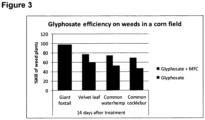
- the effect of MFC on the herbicide Glyphosate was tested under "real life” growth conditions on a corn crop test plot in the state of Iowa in the US. MFC was then tested in combination with the commercially available Glyphosate formulation Roundup powermax ® . It was observed that MFC also has a significant effect on Glyphosate efficiency under "real life” field conditions.
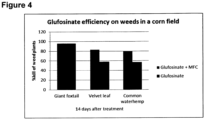
- MFC also has a surprisingly high effect on the activity of the herbicide Glufosinate, as also tested on a corn field test plot in the State of Iowa.
- the pesticides were applied at a dosages that are below the fully effective dosage, as it is then easier to identify the adjuvant effects.
- the efficacy of the MFC on pesticide uptake was determined by harvesting the aerial parts of the plants several weeks after treatment and determining the fresh weight. Within the following examples, all percentages stated refer to wt-%.
- the efficacy of MFC on pesticide uptake was evaluated by the %kill of the weeds (100% meaning a 100% kill and no weeds left in the field).
- Black night shade (SOLNI), winter wheat (Triticum aestivum, cv. Rektor) and wild oat (Avena Fatua, L, (AVEFA)) were grown in a growth chamber under 14 h of light, at 19/14 ( ⁇ 0.5) °C (day/night) temperature, and in 70-80% (day/night) relative humidity.
- Light was provided by high-pressure sodium lamps (SON-T), high-pressure mercury lamps (HPI) and fluorescent tubes to give 250 pmol m -2 s -1 at leaf level.
- the seedlings were grown in 12cm-diam. plastic pots filled with a mixture of sand and humic potting soil (1:4 by volume).
- the pots were placed on subirrigation matting, which was wetted daily with nutrient solution. After emergence the seedlings were thinned to 1 (Black night shade), 5 (Wild oat) or 6 (wheat) plants per pot. Black night shade was treated at the 4-leaf stage, wheat and wild oat was treated at the 3-leaf stage. The fresh weights of the plants were measured 14 days after treatment (Black night shade) or 21 days after treatment (wheat and wild oat).
- the pesticide solutions were applied with an air-pressured laboratory track sprayer having Teejet TP8003E nozzles and delivering 200 L/ha at 303 kPa.
- the pesticide solutions were applied with a Bacman hand sprayer with a TT nozzle at an operating pressure of 40 PSI and a ground speed of 3 MPH.
- the glyphosate product MON 8717 (480 g/L a.e. IPA salt or 2.84 M without additions) was used to prepare the herbicide solutions.
- a sub-optimal rate of herbicide was used, giving in theory a 0-20% growth reduction without adjuvant. This enables an easier evaluation of differences between formulations/adjuvants.
- glyphosate was applied at a concentration of 0.6 mM (equivalent to 20.3 g a.e./ha at 200 L/ha), and in wheat at a concentration of 2.4 mM (equivalent to 81.2 g a.e./ha at 200 L/ha). Nicosulfuron (sulfonyl urea DPX U-9360-77) was also used at a sub-optimal rate at a concentration of 6 g ai/ha.
- the Glyphosate in the Roundup powermax ® formulation was applied at a rate of 7.26 fluid ounces per acre (FL Oz/A).
- the Glufosinate in the commercially available Liberty ® formulation was applied at a rate of 9.57 fluid ounces per acre (FL Oz/Acre).
- example 1 demonstrates that MFC has a remarkably high effect on Glyphosate uptake on Black nightshade.
- MFC has a significant effect on glyphosate uptake even at surprisingly low concentrations.
- the fresh weight was reduced by 75% compared to the fresh weight of the plant treated with Glyphosate alone (example 8).
- the effect of MFC on Glyphosate uptake at 0.01% concentration is comparable to the effect of the commercially available tallow amine ethoxylate based adjuvant Agnique ® GPU at 0.01% concentration (example 7).
- the tallow amine ethoxylate based adjuvants are one of the most efficient adjuvants for enhancing Glyphosate performance that are known today.
- the results from examples 1 to 8 are also illustrated in Figure 1 .
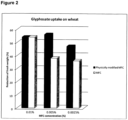
- Examples 9 to 15 show that MFC and physically modified MFC also had a high effect on increasing the efficiency of Glyphosate on winter wheat (Table 2). MFC was most effective at 0.01% concentration while the surface modified MFC was efficient down to a 0.0025% concentration. The results from examples 9 to 15 are also illustrated in Figure 2 .
Landscapes
- Life Sciences & Earth Sciences (AREA)
- General Health & Medical Sciences (AREA)
- Health & Medical Sciences (AREA)
- Wood Science & Technology (AREA)
- Pest Control & Pesticides (AREA)
- Plant Pathology (AREA)
- Engineering & Computer Science (AREA)
- Dentistry (AREA)
- Agronomy & Crop Science (AREA)
- Zoology (AREA)
- Environmental Sciences (AREA)
- Toxicology (AREA)
- Agricultural Chemicals And Associated Chemicals (AREA)
Claims (9)
- Pestizidzusammensetzung, welche aufweist:i) mindestens eine Pestizidverbindung undii) mindestens ein Hilfsmittel, das eine mikrofibrillierte Cellulose (MFC) aufweist,wobei die MFC eine unmodifizierte MFC ist, wobei die Menge der mikrofibrillierten Cellulose 0,5 Gewichtsprozent oder weniger beträgt,dadurch gekennzeichnet, dass die MFC in der Pestizidzusammensetzung als ein eingebautes Adjuvans enthalten ist oder einer Tankmischung als Tankmischungsadjuvans zugesetzt wird.
- Zusammensetzung nach einem der vorhergehenden Ansprüche, wobei die Menge der mikrofibrillierten Cellulose 0,001 bis 0,4 Gewichtsprozent, bevorzugt 0,0025 bis 0,3 Gewichtsprozent, besonders bevorzugt 0,005 bis 0,2 Gewichtsprozent und am meisten bevorzugt 0,005 bis 0,1 Gewichtsprozent beträgt.
- Zusammensetzung nach einem der vorhergehenden Ansprüche, wobei das Pestizid ein Herbizid, ein Insektizid, ein Wachstumsregulator und/oder ein Fungizid ist.
- Zusammensetzung nach einem der vorhergehenden Ansprüche, wobei das Pestizid ein Herbizid ist, das aus den Gruppen ausgewählt worden ist, die Acetyl-CoA-Carboxylase-Inhibitoren, Acetolacetat-Synthase- und/oder Acetohydroxysäure-Synthase-Inhibitoren, Photosystem-II-Inhibitoren, Photosystem-I-Inhibitoren, Carotinoid-Biosynthese-Inhibitoren, Enolpyruvyl-Shikimat-3-Phosphat-Synthase-Inhibitoren, Glutamin-Synthase-Inhibitoren und/oder synthetische Auxine umfassen.
- Zusammensetzung nach einem der vorhergehenden Ansprüche, wobei das Pestizid ein Insektizid ist, das aus der Gruppe der Organophosphate ausgewählt worden ist.
- Zusammensetzung nach einem der vorhergehenden Ansprüche, wobei das Pestizid ein Wachstumsregulator ist, das aus der Gruppe der Gibberellin-Biosynthese-Inhibitoren ausgewählt worden ist.
- Zusammensetzung nach Anspruch 4, wobei das Herbizid ein Glyphosat ist.
- Verfahren zur Herstellung einer Pestizidzusammensetzung nach einem der vorhergehenden Ansprüche, welches ein Mischen mindestens einer unmodifizierten mikrofibrillierten Cellulose und mindestens einer Pestizidverbindung umfasst.
- Verwendung von unmodifizierter mikrofibrillierter Cellulose als ein Feuchthaltemittel für Pestizid-Sprühlösungen.
Priority Applications (2)
| Application Number | Priority Date | Filing Date | Title |
|---|---|---|---|
| EP14777005.1A EP3048883B1 (de) | 2013-09-26 | 2014-09-25 | Pestizidzusammensetzung und -verfahren |
| EP24201865.3A EP4458153A3 (de) | 2013-09-26 | 2014-09-25 | Pestizidzusammensetzung und verfahren |
Applications Claiming Priority (3)
| Application Number | Priority Date | Filing Date | Title |
|---|---|---|---|
| EP13004675 | 2013-09-26 | ||
| PCT/EP2014/002605 WO2015043750A1 (en) | 2013-09-26 | 2014-09-25 | Pesticide composition and method |
| EP14777005.1A EP3048883B1 (de) | 2013-09-26 | 2014-09-25 | Pestizidzusammensetzung und -verfahren |
Related Child Applications (2)
| Application Number | Title | Priority Date | Filing Date |
|---|---|---|---|
| EP24201865.3A Division EP4458153A3 (de) | 2013-09-26 | 2014-09-25 | Pestizidzusammensetzung und verfahren |
| EP24201865.3A Division-Into EP4458153A3 (de) | 2013-09-26 | 2014-09-25 | Pestizidzusammensetzung und verfahren |
Publications (3)
| Publication Number | Publication Date |
|---|---|
| EP3048883A1 EP3048883A1 (de) | 2016-08-03 |
| EP3048883C0 EP3048883C0 (de) | 2024-11-20 |
| EP3048883B1 true EP3048883B1 (de) | 2024-11-20 |
Family
ID=49253072
Family Applications (2)
| Application Number | Title | Priority Date | Filing Date |
|---|---|---|---|
| EP14777005.1A Active EP3048883B1 (de) | 2013-09-26 | 2014-09-25 | Pestizidzusammensetzung und -verfahren |
| EP24201865.3A Pending EP4458153A3 (de) | 2013-09-26 | 2014-09-25 | Pestizidzusammensetzung und verfahren |
Family Applications After (1)
| Application Number | Title | Priority Date | Filing Date |
|---|---|---|---|
| EP24201865.3A Pending EP4458153A3 (de) | 2013-09-26 | 2014-09-25 | Pestizidzusammensetzung und verfahren |
Country Status (7)
| Country | Link |
|---|---|
| US (3) | US20160227782A1 (de) |
| EP (2) | EP3048883B1 (de) |
| BR (1) | BR112016006824A2 (de) |
| CA (1) | CA2925489C (de) |
| ES (1) | ES3005582T3 (de) |
| PL (1) | PL3048883T3 (de) |
| WO (1) | WO2015043750A1 (de) |
Families Citing this family (5)
| Publication number | Priority date | Publication date | Assignee | Title |
|---|---|---|---|---|
| CA2925489C (en) | 2013-09-26 | 2022-08-23 | Hans Henrik Oevreboe | A pesticide composition comprising microfibrillated cellulose |
| US20170273298A1 (en) * | 2014-09-25 | 2017-09-28 | Borregaard As | Pesticide compositions and use thereof |
| CN111629592A (zh) | 2017-08-17 | 2020-09-04 | 拜耳作物科学有限合伙公司 | 液体肥料分散性组合物及其方法 |
| US12168852B2 (en) | 2018-12-20 | 2024-12-17 | Borregaard As | Process and system for increasing the solids content of microfibrillated cellulose |
| US11358905B2 (en) * | 2019-01-25 | 2022-06-14 | Amvac Chemical Corporation | Microfibrillated cellulose as rheology modifier in high ionic strength agricultural formulations |
Citations (1)
| Publication number | Priority date | Publication date | Assignee | Title |
|---|---|---|---|---|
| WO2000047628A2 (en) * | 1999-02-10 | 2000-08-17 | Hercules Incorporated | Derivatized microfibrillar polysaccharide |
Family Cites Families (16)
| Publication number | Priority date | Publication date | Assignee | Title |
|---|---|---|---|---|
| US4374702A (en) | 1979-12-26 | 1983-02-22 | International Telephone And Telegraph Corporation | Microfibrillated cellulose |
| US4341807A (en) | 1980-10-31 | 1982-07-27 | International Telephone And Telegraph Corporation | Food products containing microfibrillated cellulose |
| US4481077A (en) | 1983-03-28 | 1984-11-06 | International Telephone And Telegraph Corporation | Process for preparing microfibrillated cellulose |
| ZA899861B (en) * | 1988-12-27 | 1990-12-28 | Monsanto Co | Compositions containing a mixture of herbicides |
| FR2730252B1 (fr) | 1995-02-08 | 1997-04-18 | Generale Sucriere Sa | Cellulose microfibrillee et son procede d'obtention a partir de pulpe de vegetaux a parois primaires, notamment a partir de pulpe de betteraves sucrieres. |
| WO1999040153A1 (en) * | 1998-02-06 | 1999-08-12 | Monsanto Company | Acid-stable and cationic-compatible cellulose compositions and methods of preparation |
| MXPA02008773A (es) * | 2000-03-09 | 2003-02-12 | Hercules Inc | Celulosa microfibrilar. estabilizada.. |
| JP4768630B2 (ja) * | 2003-12-05 | 2011-09-07 | シンジェンタ パーティシペーションズ アクチェンゲゼルシャフト | 水性殺虫製剤のための腐食抑制剤 |
| US8053216B2 (en) * | 2005-05-23 | 2011-11-08 | Cp Kelco U.S., Inc. | Bacterial cellulose-containing formulations |
| AU2007212781B2 (en) | 2006-02-08 | 2011-01-27 | Stfi-Packforsk Ab | Method for the manufacturing of microfibrillated cellulose |
| BRPI0912933B1 (pt) * | 2008-08-19 | 2016-11-08 | Akzo Nobel Nv | formulação de glifosato espessada, e, método de espessamento de uma formulação de glifosato |
| EP2408857B1 (de) | 2009-03-20 | 2018-01-10 | Borregaard AS | Cellulosemikrofibrillen als antischaummittel |
| WO2013009253A1 (en) * | 2011-07-08 | 2013-01-17 | Chalmers Tekniska Högskola Aktiebolag | Microfibrillated cellulose films for controlled release of active agents |
| UY34687A (es) * | 2012-03-21 | 2013-09-30 | Basf Se | Adyuvantes de mezcla en tanque de glifosato que comprenden una base seleccionada de un carbonato y/o un fosfato |
| KR20150021554A (ko) | 2012-06-06 | 2015-03-02 | 다우 아그로사이언시즈 엘엘씨 | 고강도 제초제 현탁액 농축물 |
| CA2925489C (en) | 2013-09-26 | 2022-08-23 | Hans Henrik Oevreboe | A pesticide composition comprising microfibrillated cellulose |
-
2014
- 2014-09-25 CA CA2925489A patent/CA2925489C/en active Active
- 2014-09-25 PL PL14777005.1T patent/PL3048883T3/pl unknown
- 2014-09-25 ES ES14777005T patent/ES3005582T3/es active Active
- 2014-09-25 WO PCT/EP2014/002605 patent/WO2015043750A1/en not_active Ceased
- 2014-09-25 BR BR112016006824A patent/BR112016006824A2/pt not_active Application Discontinuation
- 2014-09-25 EP EP14777005.1A patent/EP3048883B1/de active Active
- 2014-09-25 EP EP24201865.3A patent/EP4458153A3/de active Pending
- 2014-09-25 US US15/024,276 patent/US20160227782A1/en not_active Abandoned
-
2019
- 2019-05-10 US US16/408,974 patent/US20190281832A1/en not_active Abandoned
-
2021
- 2021-09-02 US US17/465,736 patent/US20220053765A1/en not_active Abandoned
Patent Citations (1)
| Publication number | Priority date | Publication date | Assignee | Title |
|---|---|---|---|---|
| WO2000047628A2 (en) * | 1999-02-10 | 2000-08-17 | Hercules Incorporated | Derivatized microfibrillar polysaccharide |
Also Published As
| Publication number | Publication date |
|---|---|
| US20160227782A1 (en) | 2016-08-11 |
| CA2925489A1 (en) | 2015-04-02 |
| EP4458153A3 (de) | 2025-01-08 |
| WO2015043750A1 (en) | 2015-04-02 |
| US20190281832A1 (en) | 2019-09-19 |
| CA2925489C (en) | 2022-08-23 |
| PL3048883T3 (pl) | 2025-03-31 |
| EP4458153A2 (de) | 2024-11-06 |
| ES3005582T3 (en) | 2025-03-14 |
| BR112016006824A2 (pt) | 2017-08-01 |
| US20220053765A1 (en) | 2022-02-24 |
| EP3048883A1 (de) | 2016-08-03 |
| EP3048883C0 (de) | 2024-11-20 |
Similar Documents
| Publication | Publication Date | Title |
|---|---|---|
| US20220053765A1 (en) | Microfibrillated cellulose comprised in pesticide compositions | |
| JP7072154B2 (ja) | 肥料農薬製剤 | |
| CN110139560A (zh) | 降漂佐剂组合物及其使用方法 | |
| UA124753C2 (uk) | Композиція для укріплення рослин, живлення та захисту рослин | |
| CA2960168C (en) | Pesticide compositions comprising microfibrillated cellulose | |
| RU2526393C2 (ru) | Агрохимические композиции на основе масла с повышенной вязкостью | |
| BR102016005469A2 (pt) | Adjuvant composition for derivative reduction in the application of agrochemical products and use of adjuvant composition for derivative reduction in the application of agrochemical products | |
| Hu et al. | Tank-mix adjuvants enhance pesticide efficacy by improving physicochemical properties and spraying characteristics for application to cotton with unmanned aerial vehicles | |
| Prasad | Effects of nonylphenol adjuvant on macrophytes | |
| US20230413808A1 (en) | Bioactive complexes | |
| US11968976B2 (en) | Hydrogels as carriers of active ingredients and methods of producing the same | |
| JP7724154B2 (ja) | 農薬およびその使用方法 | |
| US20250324968A1 (en) | Phthalimide fungicide composition | |
| WO1980002360A1 (en) | Engineering improved chemical performance in plants | |
| CN116349701A (zh) | 一种生物农药制剂及其制备方法与应用 | |
| CN1481683A (zh) | 一种除草剂组合物 | |
| CN110621156B (zh) | N-烷基葡糖酰胺用于在施用含草胺膦的植物处理剂时减少漂移的用途 | |
| CN106359419A (zh) | 一种含氯虫苯甲酰胺咯菌腈吡唑醚菌酯的组合物、悬浮种衣剂及其制备方法 | |
| CN112841214B (zh) | 一种植物源增效草铵膦水剂及其制备方法与应用 | |
| RU2843554C1 (ru) | Фунгицидная композиция на основе элементарной серы для применения в растениеводстве и способ ее получения | |
| RU2733295C1 (ru) | Пестицидное средство длительного действия для грунтового применения | |
| CN114794105B (zh) | 蒈烷-3,4-二醇在作为或制备除草剂方面的应用 | |
| JP2000204007A (ja) | シアナミド水溶液 | |
| Campos et al. | Mechanistic Aspects and Effects of Selected Tank-Mix Partners on Herbicidal Activity of a Novel Fatty Acid Ester. Plants 2022, 11, 279 | |
| WO2025217346A1 (en) | Compositions and methods for crop-protection and uses thereof |
Legal Events
| Date | Code | Title | Description |
|---|---|---|---|
| PUAI | Public reference made under article 153(3) epc to a published international application that has entered the european phase |
Free format text: ORIGINAL CODE: 0009012 |
|
| 17P | Request for examination filed |
Effective date: 20160407 |
|
| AK | Designated contracting states |
Kind code of ref document: A1 Designated state(s): AL AT BE BG CH CY CZ DE DK EE ES FI FR GB GR HR HU IE IS IT LI LT LU LV MC MK MT NL NO PL PT RO RS SE SI SK SM TR |
|
| AX | Request for extension of the european patent |
Extension state: BA ME |
|
| DAX | Request for extension of the european patent (deleted) | ||
| STAA | Information on the status of an ep patent application or granted ep patent |
Free format text: STATUS: EXAMINATION IS IN PROGRESS |
|
| 17Q | First examination report despatched |
Effective date: 20180125 |
|
| TPAC | Observations filed by third parties |
Free format text: ORIGINAL CODE: EPIDOSNTIPA |
|
| GRAP | Despatch of communication of intention to grant a patent |
Free format text: ORIGINAL CODE: EPIDOSNIGR1 |
|
| STAA | Information on the status of an ep patent application or granted ep patent |
Free format text: STATUS: GRANT OF PATENT IS INTENDED |
|
| INTG | Intention to grant announced |
Effective date: 20240709 |
|
| TPAC | Observations filed by third parties |
Free format text: ORIGINAL CODE: EPIDOSNTIPA |
|
| GRAJ | Information related to disapproval of communication of intention to grant by the applicant or resumption of examination proceedings by the epo deleted |
Free format text: ORIGINAL CODE: EPIDOSDIGR1 |
|
| STAA | Information on the status of an ep patent application or granted ep patent |
Free format text: STATUS: EXAMINATION IS IN PROGRESS |
|
| GRAS | Grant fee paid |
Free format text: ORIGINAL CODE: EPIDOSNIGR3 |
|
| STAA | Information on the status of an ep patent application or granted ep patent |
Free format text: STATUS: GRANT OF PATENT IS INTENDED |
|
| INTC | Intention to grant announced (deleted) | ||
| GRAP | Despatch of communication of intention to grant a patent |
Free format text: ORIGINAL CODE: EPIDOSNIGR1 |
|
| GRAA | (expected) grant |
Free format text: ORIGINAL CODE: 0009210 |
|
| STAA | Information on the status of an ep patent application or granted ep patent |
Free format text: STATUS: THE PATENT HAS BEEN GRANTED |
|
| INTG | Intention to grant announced |
Effective date: 20241004 |
|
| AK | Designated contracting states |
Kind code of ref document: B1 Designated state(s): AL AT BE BG CH CY CZ DE DK EE ES FI FR GB GR HR HU IE IS IT LI LT LU LV MC MK MT NL NO PL PT RO RS SE SI SK SM TR |
|
| REG | Reference to a national code |
Ref country code: GB Ref legal event code: FG4D |
|
| REG | Reference to a national code |
Ref country code: CH Ref legal event code: EP |
|
| REG | Reference to a national code |
Ref country code: DE Ref legal event code: R096 Ref document number: 602014091206 Country of ref document: DE |
|
| REG | Reference to a national code |
Ref country code: IE Ref legal event code: FG4D |
|
| U01 | Request for unitary effect filed |
Effective date: 20241120 |
|
| U07 | Unitary effect registered |
Designated state(s): AT BE BG DE DK EE FI FR IT LT LU LV MT NL PT RO SE SI Effective date: 20241126 |
|
| REG | Reference to a national code |
Ref country code: ES Ref legal event code: FG2A Ref document number: 3005582 Country of ref document: ES Kind code of ref document: T3 Effective date: 20250314 |
|
| PG25 | Lapsed in a contracting state [announced via postgrant information from national office to epo] |
Ref country code: HR Free format text: LAPSE BECAUSE OF FAILURE TO SUBMIT A TRANSLATION OF THE DESCRIPTION OR TO PAY THE FEE WITHIN THE PRESCRIBED TIME-LIMIT Effective date: 20241120 Ref country code: IS Free format text: LAPSE BECAUSE OF FAILURE TO SUBMIT A TRANSLATION OF THE DESCRIPTION OR TO PAY THE FEE WITHIN THE PRESCRIBED TIME-LIMIT Effective date: 20250320 |
|
| PG25 | Lapsed in a contracting state [announced via postgrant information from national office to epo] |
Ref country code: NO Free format text: LAPSE BECAUSE OF FAILURE TO SUBMIT A TRANSLATION OF THE DESCRIPTION OR TO PAY THE FEE WITHIN THE PRESCRIBED TIME-LIMIT Effective date: 20250220 |
|
| PG25 | Lapsed in a contracting state [announced via postgrant information from national office to epo] |
Ref country code: GR Free format text: LAPSE BECAUSE OF FAILURE TO SUBMIT A TRANSLATION OF THE DESCRIPTION OR TO PAY THE FEE WITHIN THE PRESCRIBED TIME-LIMIT Effective date: 20250221 |
|
| PG25 | Lapsed in a contracting state [announced via postgrant information from national office to epo] |
Ref country code: RS Free format text: LAPSE BECAUSE OF FAILURE TO SUBMIT A TRANSLATION OF THE DESCRIPTION OR TO PAY THE FEE WITHIN THE PRESCRIBED TIME-LIMIT Effective date: 20250220 |
|
| PG25 | Lapsed in a contracting state [announced via postgrant information from national office to epo] |
Ref country code: SM Free format text: LAPSE BECAUSE OF FAILURE TO SUBMIT A TRANSLATION OF THE DESCRIPTION OR TO PAY THE FEE WITHIN THE PRESCRIBED TIME-LIMIT Effective date: 20241120 |
|
| PG25 | Lapsed in a contracting state [announced via postgrant information from national office to epo] |
Ref country code: SK Free format text: LAPSE BECAUSE OF FAILURE TO SUBMIT A TRANSLATION OF THE DESCRIPTION OR TO PAY THE FEE WITHIN THE PRESCRIBED TIME-LIMIT Effective date: 20241120 |
|
| PG25 | Lapsed in a contracting state [announced via postgrant information from national office to epo] |
Ref country code: CZ Free format text: LAPSE BECAUSE OF FAILURE TO SUBMIT A TRANSLATION OF THE DESCRIPTION OR TO PAY THE FEE WITHIN THE PRESCRIBED TIME-LIMIT Effective date: 20241120 |
|
| PLBE | No opposition filed within time limit |
Free format text: ORIGINAL CODE: 0009261 |
|
| STAA | Information on the status of an ep patent application or granted ep patent |
Free format text: STATUS: NO OPPOSITION FILED WITHIN TIME LIMIT |
|
| PGFP | Annual fee paid to national office [announced via postgrant information from national office to epo] |
Ref country code: PL Payment date: 20250911 Year of fee payment: 12 |
|
| PGFP | Annual fee paid to national office [announced via postgrant information from national office to epo] |
Ref country code: GB Payment date: 20250923 Year of fee payment: 12 |
|
| 26N | No opposition filed |
Effective date: 20250821 |
|
| U20 | Renewal fee for the european patent with unitary effect paid |
Year of fee payment: 12 Effective date: 20250923 |