EP3046170A1 - Positive electrode material for sodium ion secondary batteries - Google Patents
Positive electrode material for sodium ion secondary batteries Download PDFInfo
- Publication number
- EP3046170A1 EP3046170A1 EP14844027.4A EP14844027A EP3046170A1 EP 3046170 A1 EP3046170 A1 EP 3046170A1 EP 14844027 A EP14844027 A EP 14844027A EP 3046170 A1 EP3046170 A1 EP 3046170A1
- Authority
- EP
- European Patent Office
- Prior art keywords
- positive electrode
- ion secondary
- secondary battery
- sodium ion
- active material
- Prior art date
- Legal status (The legal status is an assumption and is not a legal conclusion. Google has not performed a legal analysis and makes no representation as to the accuracy of the status listed.)
- Granted
Links
Images


Classifications
-
- H—ELECTRICITY
- H01—ELECTRIC ELEMENTS
- H01M—PROCESSES OR MEANS, e.g. BATTERIES, FOR THE DIRECT CONVERSION OF CHEMICAL ENERGY INTO ELECTRICAL ENERGY
- H01M4/00—Electrodes
- H01M4/02—Electrodes composed of, or comprising, active material
- H01M4/36—Selection of substances as active materials, active masses, active liquids
- H01M4/58—Selection of substances as active materials, active masses, active liquids of inorganic compounds other than oxides or hydroxides, e.g. sulfides, selenides, tellurides, halogenides or LiCoFy; of polyanionic structures, e.g. phosphates, silicates or borates
- H01M4/5825—Oxygenated metallic salts or polyanionic structures, e.g. borates, phosphates, silicates, olivines
-
- C—CHEMISTRY; METALLURGY
- C01—INORGANIC CHEMISTRY
- C01G—COMPOUNDS CONTAINING METALS NOT COVERED BY SUBCLASSES C01D OR C01F
- C01G1/00—Methods of preparing compounds of metals not covered by subclasses C01B, C01C, C01D, or C01F, in general
- C01G1/10—Sulfates
-
- C—CHEMISTRY; METALLURGY
- C01—INORGANIC CHEMISTRY
- C01G—COMPOUNDS CONTAINING METALS NOT COVERED BY SUBCLASSES C01D OR C01F
- C01G45/00—Compounds of manganese
- C01G45/20—Compounds containing manganese, with or without oxygen or hydrogen, and containing one or more other elements
- C01G45/22—Compounds containing manganese, with or without oxygen or hydrogen, and containing two or more other elements
-
- C—CHEMISTRY; METALLURGY
- C01—INORGANIC CHEMISTRY
- C01G—COMPOUNDS CONTAINING METALS NOT COVERED BY SUBCLASSES C01D OR C01F
- C01G49/00—Compounds of iron
- C01G49/009—Compounds containing iron, with or without oxygen or hydrogen, and containing two or more other elements
-
- C—CHEMISTRY; METALLURGY
- C01—INORGANIC CHEMISTRY
- C01G—COMPOUNDS CONTAINING METALS NOT COVERED BY SUBCLASSES C01D OR C01F
- C01G51/00—Compounds of cobalt
- C01G51/80—Compounds containing cobalt, with or without oxygen or hydrogen, and containing one or more other elements
- C01G51/82—Compounds containing cobalt, with or without oxygen or hydrogen, and containing two or more other elements
-
- H—ELECTRICITY
- H01—ELECTRIC ELEMENTS
- H01M—PROCESSES OR MEANS, e.g. BATTERIES, FOR THE DIRECT CONVERSION OF CHEMICAL ENERGY INTO ELECTRICAL ENERGY
- H01M10/00—Secondary cells; Manufacture thereof
- H01M10/05—Accumulators with non-aqueous electrolyte
- H01M10/054—Accumulators with insertion or intercalation of metals other than lithium, e.g. with magnesium or aluminium
-
- H—ELECTRICITY
- H01—ELECTRIC ELEMENTS
- H01M—PROCESSES OR MEANS, e.g. BATTERIES, FOR THE DIRECT CONVERSION OF CHEMICAL ENERGY INTO ELECTRICAL ENERGY
- H01M4/00—Electrodes
- H01M4/02—Electrodes composed of, or comprising, active material
- H01M4/13—Electrodes for accumulators with non-aqueous electrolyte, e.g. for lithium-accumulators; Processes of manufacture thereof
- H01M4/136—Electrodes based on inorganic compounds other than oxides or hydroxides, e.g. sulfides, selenides, tellurides, halogenides or LiCoFy
-
- H—ELECTRICITY
- H01—ELECTRIC ELEMENTS
- H01M—PROCESSES OR MEANS, e.g. BATTERIES, FOR THE DIRECT CONVERSION OF CHEMICAL ENERGY INTO ELECTRICAL ENERGY
- H01M4/00—Electrodes
- H01M4/02—Electrodes composed of, or comprising, active material
- H01M4/36—Selection of substances as active materials, active masses, active liquids
- H01M4/362—Composites
- H01M4/366—Composites as layered products
-
- H—ELECTRICITY
- H01—ELECTRIC ELEMENTS
- H01M—PROCESSES OR MEANS, e.g. BATTERIES, FOR THE DIRECT CONVERSION OF CHEMICAL ENERGY INTO ELECTRICAL ENERGY
- H01M4/00—Electrodes
- H01M4/02—Electrodes composed of, or comprising, active material
- H01M4/36—Selection of substances as active materials, active masses, active liquids
- H01M4/58—Selection of substances as active materials, active masses, active liquids of inorganic compounds other than oxides or hydroxides, e.g. sulfides, selenides, tellurides, halogenides or LiCoFy; of polyanionic structures, e.g. phosphates, silicates or borates
- H01M4/583—Carbonaceous material, e.g. graphite-intercalation compounds or CFx
- H01M4/587—Carbonaceous material, e.g. graphite-intercalation compounds or CFx for inserting or intercalating light metals
-
- H—ELECTRICITY
- H01—ELECTRIC ELEMENTS
- H01M—PROCESSES OR MEANS, e.g. BATTERIES, FOR THE DIRECT CONVERSION OF CHEMICAL ENERGY INTO ELECTRICAL ENERGY
- H01M4/00—Electrodes
- H01M4/02—Electrodes composed of, or comprising, active material
- H01M4/62—Selection of inactive substances as ingredients for active masses, e.g. binders, fillers
- H01M4/621—Binders
- H01M4/622—Binders being polymers
- H01M4/623—Binders being polymers fluorinated polymers
-
- H—ELECTRICITY
- H01—ELECTRIC ELEMENTS
- H01M—PROCESSES OR MEANS, e.g. BATTERIES, FOR THE DIRECT CONVERSION OF CHEMICAL ENERGY INTO ELECTRICAL ENERGY
- H01M4/00—Electrodes
- H01M4/02—Electrodes composed of, or comprising, active material
- H01M4/62—Selection of inactive substances as ingredients for active masses, e.g. binders, fillers
- H01M4/624—Electric conductive fillers
- H01M4/625—Carbon or graphite
-
- C—CHEMISTRY; METALLURGY
- C01—INORGANIC CHEMISTRY
- C01P—INDEXING SCHEME RELATING TO STRUCTURAL AND PHYSICAL ASPECTS OF SOLID INORGANIC COMPOUNDS
- C01P2002/00—Crystal-structural characteristics
- C01P2002/70—Crystal-structural characteristics defined by measured X-ray, neutron or electron diffraction data
- C01P2002/72—Crystal-structural characteristics defined by measured X-ray, neutron or electron diffraction data by d-values or two theta-values, e.g. as X-ray diagram
-
- C—CHEMISTRY; METALLURGY
- C01—INORGANIC CHEMISTRY
- C01P—INDEXING SCHEME RELATING TO STRUCTURAL AND PHYSICAL ASPECTS OF SOLID INORGANIC COMPOUNDS
- C01P2006/00—Physical properties of inorganic compounds
- C01P2006/40—Electric properties
-
- H—ELECTRICITY
- H01—ELECTRIC ELEMENTS
- H01M—PROCESSES OR MEANS, e.g. BATTERIES, FOR THE DIRECT CONVERSION OF CHEMICAL ENERGY INTO ELECTRICAL ENERGY
- H01M4/00—Electrodes
- H01M4/02—Electrodes composed of, or comprising, active material
- H01M2004/026—Electrodes composed of, or comprising, active material characterised by the polarity
- H01M2004/028—Positive electrodes
-
- Y—GENERAL TAGGING OF NEW TECHNOLOGICAL DEVELOPMENTS; GENERAL TAGGING OF CROSS-SECTIONAL TECHNOLOGIES SPANNING OVER SEVERAL SECTIONS OF THE IPC; TECHNICAL SUBJECTS COVERED BY FORMER USPC CROSS-REFERENCE ART COLLECTIONS [XRACs] AND DIGESTS
- Y02—TECHNOLOGIES OR APPLICATIONS FOR MITIGATION OR ADAPTATION AGAINST CLIMATE CHANGE
- Y02E—REDUCTION OF GREENHOUSE GAS [GHG] EMISSIONS, RELATED TO ENERGY GENERATION, TRANSMISSION OR DISTRIBUTION
- Y02E60/00—Enabling technologies; Technologies with a potential or indirect contribution to GHG emissions mitigation
- Y02E60/10—Energy storage using batteries
Definitions
- the present invention relates to a positive electrode material for a sodium ion secondary battery that has high redox potential, and a sodium ion secondary battery in which that material is used as a positive electrode active material.
- Lithium ion secondary batteries have conventionally been used as main electrical storage devices in various fields including mobile telephones, notebook PCs, and electric automobiles, but secondary batteries that can be manufactured at lower cost have recently come to be in demand. There has accordingly been a proliferation of studies on next-generation secondary batteries having high energy densities that exceed those of lithium ion secondary batteries, and various attempts have been made.
- a positive electrode active material for a sodium ion secondary battery must be a supply source of sodium ions, and must be a compound that includes sodium as a constituent element.
- Composite oxides indicated by the compositional formula NaMO 2 (M: transition metal element) have been examined to date as such positive electrode active materials (for example, Patent Reference 1), but adequate performance for practice has yet to be obtained. For example, a problem has been presented in that when Fe is used as the transition metal M, the reversible capacitance was small, and the redox potential was low; i.e., 2.5 to 3.0 V, when Mn was introduced for stabilization.
- Patent Reference 1 Japanese Laid-Open Patent Application 2009-129741
- an object of the present invention is to provide a novel positive electrode material for sodium ion secondary battery that is inexpensive and has high redox potential, and a sodium ion secondary battery in which that material is used as a positive electrode active material.
- the present inventors carried out thoroughgoing studies in order to achieve the above object, and newly discovered as a result that a sulfate containing sodium and a transition metal in a proper ratio as constituent elements is usable for a positive electrode active material, and that high redox potential is obtained and rapid charging and discharging can be adequately accommodated by using the material, and that discovery led to the completion of the present invention.
- the present invention provides in one aspect:
- the present invention provides:
- the positive electrode material of the present invention is different from the nasicon-type M 2 (SO 4 ) 3 , being a conventional positive electrode material, in that the material of the present invention contains sodium ions in its structure, and therefore there is an advantage that the material can serve the function of a supply source of sodium ions when a material other than Na metal is used in the negative electrode.
- the material of the present invention differs from the nasicon-type M 2 (SO 4 ) 3 also in crystal structure, in that the degree of freedom of movement of sodium ions in the crystal is improved by a crystal structure, that is, an alluaudite-type crystal structure, in which two MO 6 units in the structure share ridge lines to form a dimer, and as a result the distance between M metals decreases and a higher redox potential than of nasicon-type is obtained.
- the positive electrode active material of the present invention can be produced by low-temperature synthesis from inexpensive sulfates, and therefore production at low cost with little energy consumption is possible.
- low cost and high environmental harmony can be assured when Fe is used as the transition metal element.
- the present invention provides a positive electrode active material that has high density combining low cost and environmental harmony and can also accommodate rapid charging and discharging, and the invention is extremely useful in making sodium ion secondary batteries practical.
- the positive electrode active material for a sodium ion secondary battery according to the present invention is characterized by containing a sulfate that contains sodium and a transition metal as constituent elements and is represented by the compositional formula Na m M n (SO 4 ) 3 .
- M represents a transition metal element
- m is 2 ⁇ 2x (where x satisfies 0 ⁇ x ⁇ 0.5); and n is 2 ⁇ y (where x satisfies 0 ⁇ y ⁇ 0.5).
- the positive electrode active material is a single-electron reaction material that is in principle capable of insertion and removal of one equivalent amount of sodium ions, as indicated by the reaction formula: 2Na + + 2e - + M 2 (SO 4 ) 3 ⁇ Na 2 M 2 (SO 4 ) 3
- a very high rcdox potential can be obtained by a dielectric effect in which the M-O bond is endowed with an ion-binding property by the strong covalent bond of the S-O bond in "SO 4 .”
- the sulfate of compositional formula Na m M n (SO 4 ) 3 used in the present invention is characterized by a crystal structure, an "alluaudite-type crystal structure," in which two MO 6 units in the structure share ridge line to form a dimer.
- an "alluaudite-type crystal structure” in which two MO 6 units in the structure share ridge line to form a dimer.
- the degree of freedom of movement of sodium ions in the crystal is improved by the alluaudite-type crystal structure forming a dimer as above, and a higher redox potential than that of nasicon-type salt is exhibited by shortening of the distance between M units (when Me is Fe, the distance between Fe-Fe becomes 3.2 ⁇ ).
- M is a transition metal element, preferably a period 4 transition metal element selected from the group consisting of Sc, T, V, Cr, Mn, Fe, Co, Ni, and Cu, or a period 5 transition metal element selected from the group consisting of Y, Zr, Nb, Mo, Tc, Ru, Rh, and Pd.
- M is more preferably Fe (iron), for reasons including that iron is inexpensive and easy to acquire and also that iron has a small environmental load. Ag of period 5 also can be used as a dopant with the metal M.
- M is 2 ⁇ 2x and n is 2 ⁇ y.
- there is a great composition of transition metal (M-rich) that is, m is 2 - 2x and n is 2 + y.
- x can be an optional decimal number of 0.5 or lower, specifically, 0 ⁇ x ⁇ 0.5. Preferably, 0 ⁇ x ⁇ 0.3. Optionally, an embodiment in which x is 0 or 0.5 maybe excluded depending on the case.
- y can be an optional decimal number of 0.5 or lower, specifically, 0 ⁇ y ⁇ 0.5. Preferably, 0 ⁇ y ⁇ 0.3. Optionally, an embodiment in which y is 0 or 0.5 maybe excluded depending on the case.
- the Na m M n (SO 4 ) 3 can be produced by a solid phase method, which is a well-known means in the technical field.
- the object material is synthesized by mixing powder-form raw materials in a predetermined ratio and then subjecting to heating treatment.
- the object material can be synthesized by mixing Na 2 SO 4 and MSO 4 as raw materials in a proper ratio and subjecting to thermal treatment.
- the object material can be produced also by mixing these raw materials using a ball mill, or the like, without heating.
- the Na m M n (SO 4 ) 3 used as the positive electrode active material of the present invention can be in particle form, and the particle size thereof is preferably a diameter of 5 ⁇ m or smaller, more preferably a diameter of 2 ⁇ m or smaller.
- the positive electrode used in the sodium ion secondary battery of the present invention is configured using the above positive electrode active material, and may contain only that active material, and may additionally contain at least one of a well-known electroconductive material and a binder in order to improve the rate characteristics of the electrode, and the like. These contents can be supported on an electrode collector to produce the electrode.
- electroconductive materials examples include carbon materials, metal fibers and other electrically conductive fibers, copper, silver, nickel, aluminum, and other metal powders, and polyphenylene derivatives and other organic electroconductive materials.
- Carbon materials that can be used include graphite, soft carbon, hard carbon, carbon black, ketjen black, acetylene black, graphite, activated carbon, carbon nanotubes, and carbon fiber.
- mesoporous carbon obtained by calcining synthetic resin having aromatic rings, petroleum pitch, or the like. Acetylene black is preferred from the viewpoint of the height of electrical conductivity during use as an electrode.
- the electrode When the electrode is to contain an electroconductive material, the electrode can be prepared by pulverizing and mixing this material with the positive electrode active material. Such pulverizing and mixing are not particularly limited, but these can be performed by vibration mill, jet mill, ball mill, or other pulverizing machine.
- the positive electrode active material when an electroconductive material is to be contained in the positive electrode, can be covered by the electroconductive material.
- a method for such covering is a method in which a powder of the positive electrode active material is immersed in a liquid containing the electroconductive material or a precursor of the electroconductive material, and this is then subjected to thermal treatment whereby the electroconductive material is deposited on the powder surface of the active material.
- a method can be used, in which a powder of the positive electrode active material is mobilized in a vapor phase containing the electroconductive material or a precursor of the electroconductive material, and is then subjected to thermal treatment as needed.
- Electroconductive materials that can be used for the covering include carbon, graphite, vapor-phase-deposited carbon fiber, carbon nanotubes, iron phosphide, electrically conductive oxides, and electrically conductive polymers (polypyrrole, polyacrylonitrile, and the like), but are not limited to these.
- binders include polyvinylidene fluoride (PVDF), polytetrafluoroethylene (PTFE), ethylene tetrafluoroethylene (ETFE), and other fluororesins, or polyethylene, polypropylene, and the like.
- PVDF polyvinylidene fluoride
- PTFE polytetrafluoroethylene
- ETFE ethylene tetrafluoroethylene
- the negative electrode collector is not particularly limited provided that the material is electrically conductive, but rod-form, sheetform, foil-form, net-form, and other materials consisting mainly of copper, nickel, aluminum, stainless steel, and the like, can be used.
- Electrode collector Al, Ni, Cu, stainless steel, or the like, can be used as the electrode collector.
- Methods for supporting the electrode mixture on the electrode collector include a method of molding under pressure, or a method of forming a paste using an organic solvent, or the like, applying on the electrode collector, and fixing by drying and pressing, or the like.
- a slurry containing the electrode active material, electroconductive material, binder, and organic solvent is prepared.
- Negative electrodes that can be used in the sodium ion secondary battery of the present invention include electrodes containing a negative electrode active material capable of storing and releasing sodium ions electrochemically.
- Such negative electrode active material can be a well-known negative electrode active material for sodium ion secondary batteries, examples including hard carbon, soft carbon, carbon black, ketjen black, acetylene black, activated carbon, carbon nanotubes, carbon fiber, amorphous carbon, and other carbon materials.
- Also usable are sodium ion metals, or alloys, metal oxides, and metal nitrides containing a sodium ion element.
- hard carbon or another carbon material having a disordered structure is preferred as the negative electrode active material.
- the negative electrode may contain only the negative electrode active material, and may contain at least one of an electroconductive material and a binder in addition to the negative electrode active material, and may be in a form in which the contents are adhered as a negative electrode mixture on a negative electrode collector.
- a negative electrode active material when the negative electrode active material is in oil form, a negative electrode containing only the negative electrode active material can be made. Meanwhile, when the negative electrode active material is in powder form, a negative electrode having the negative electrode active material and a binder can be made.
- the method used for forming the negative electrode using a powder-form negative electrode active material can be a doctor blade method, molding by crimping press, or the like.
- the electroconductive material, binder, and electrode collector used can be the same as those for the positive electrode described above.
- the electrolytic solution used in the sodium ion secondary battery of the present invention is not particularly limited provided that the solution contains a sodium salt as an electrolyte.
- sodium salts containing this electrolyte include NaClO 4 , NaPF 6 , NaBF 4 , NaNO 3 , NaOH, NaCl, NaCF 3 SO 3 , NaN(SO 2 CF 3 ) 2 , Na 2 SO 4 , and Na 2 S. These sodium salts can be used each singly, but can also be used in combinations of two or more.
- solvents in the electrolytic solutions include propylene carbonate (PC), ethylene carbonate (EC), dimethyl carbonate (DMC), diethyl carbonate (DEC), ethyl methyl carbonate, 4-trifluoromethyl-1,3-dioxolan-2-one, 1,2-di(methoxycarbonyloxy)ethane, and other carbonates; 1,2-dimethoxyethane, 1,3-dimethoxypropane, pentafluoropropyl methyl ether, 2,2,3,3-tetrafluoropropyl drifluoromethyl ether, tetrahydrofuran, 2-methyl tetrahydrofuran, and other ethers; methyl formate, methyl acetate, ⁇ -butyrolactone, and other esters; acetonitrile, butyronitrile, and other nitriles; N,N-dimethylformamide, N,N-dimethylacetoamide, and other amides; 3-
- a solid electrolyte can be used instead of the electrolytic solution.
- solid electrolytes include polyethylene oxide-based polymer compounds, polymer compounds containing at Least one kind of polyorganosiloxane chain or polyoxyalkylene chain, and other polymer electrolytes.
- an electrolyte in the form of a non-aqueous solution obtained by adding a polymer to the above electrolytic solution and gelling is also usable.
- the solid electrolyte may serve the function of a separator to be described, and a separator may not be required in that case.
- the electrolytic solution can contain other ingredients as needed for the purpose of improving the function thereof.
- other ingredients include conventionally well-known overcharge inhibitors, dehydrating agents, deoxidizing agents, and characteristics improvement aids for improving capacity retention characteristics after high-temperature storage or cycle characteristics.
- overcharge inhibitors examples include biphenyl, alkylbiphenyl, terphenyl, partially hydrogenated terphenyl, cyclohexylbenzene, t-butylbenzene, t-amylbenzene, diphenyl ether, dibenzofuran, and other aromatic compounds; 2-fluorobiphenyl, o-cyclohexyl fluorobenzene, p-cyclohexyl fluorobenzene, and other partial fluorides of aromatic compounds; and 2,4-difluoroanisol, 2,5-difluoroanisol, 2,6-difluoroanisol, and other fluoride-containing anisol compounds.
- One kind of overcharge inhibitor may be used singly, and two or more kinds may be used together.
- the overcharge inhibitor content of the electrolytic solution is preferably 0.01 to 5 mass%.
- the overcharge inhibitor content of the electrolytic solution be 0.1 mass% or higher, suppression of bursting and igniting of the secondary battery by overcharging becomes easier, and the secondary battery can be used more stably.
- dehydrating agents examples include molecular sieves, mirabilite, magnesium sulfate, calcium hydride, sodium hydride, potassium hydride, and lithium aluminum hydride.
- the solvent used in the electrolytic solution of the present invention can also be refined after being dehydrated with the aforementioned dehydrating agent. Also, a solvent subjected only to dehydration by the aforementioned dehydrating agent without being refined may be used.
- Examples of a characteristics improvement aid for improving capacity retention characteristics after high-temperature storage or cycle characteristics include succinic anhydride, glutaric anhydride, maleic anhydride, citraconic anhydride, glutaconic anhydride, itaconic anhydride, diglycolic anhydride, cyclohexane dicarboxylic anhydride, cyclopentane tetracarboxylic dianhydride, phenylsuccinic anhydride, and other carboxylic anhydrides; ethylene sulfite, 1,3-propanesultone, 1,4-butanesultone, methyl methanesulfonate, busulfan, sulfolane, sulfolene, dimethyl sulfone, diphenyl sulfone, methylphenyl sulfone, dibutyl disulfide, dicyclohexyl disulfide, tetramethylthiuram monosulfide, N,N dimethyl me
- the separator used in the sodium ion secondary battery of the present invention is not particularly limited provided that the separator has a function of electrically separating the positive electrode layer and the negative electrode layer, but examples include porous sheets, nonwoven cloths, glass fiber nonwoven cloths, other nonwoven cloths, and other porous insulating materials containing polyethylene (PE), polypropylene (PP), polyester, cellulose, polyamide, or other resins.
- PE polyethylene
- PP polypropylene
- the shape of the sodium ion secondary battery of the present invention is not particularly limited provided that the positive electrode, negative electrode, and electrolytic solution can be housed; e.g., cylindrical, coin, flat plate, and laminated configurations may be adopted.
- the sodium ion secondary battery of the present invention is ideal for use as a secondary battery, but use as a primary battery is not excluded.
- sulfate compound 1 A mixture of Na 2 SO 4 (Wako Pure Chemical Industries, 99%) and FeSO 4 in a molar ratio of 1.3:2 as a starting material was reacted according to the procedure below, and a sulfate Na m Fe n (SO 4 ) 3 (hereinafter referred to as "sulfate compound 1"), being an object material, was synthesized.
- sulfate compound 1 sulfate compound 1
- Commercial FeSO 4 ⁇ 7H 2 O was heated for 5 hours at 180°C under reduced pressure, and further heated for 5 hours at 225°C, and anhydrous FeSO 4 was obtained.
- This raw material mixture was mixed for 1 hr with a ball mill, and then fired for 12 hours at 350°C under a steady stream of argon, and a sulfate compound 1 was obtained by solid phase synthesis. Also, it was confirmed that the object material is also obtained merely by mixing the raw material mixture for 1 to 4 hours in air with a ball mill instead of the above method. Because a SO 4 -containing compound generally tends to be easily pyrolyzed, use of the latter non-heating synthesis method is advantageous.
- a sulfate being an object material (hereinafter referred to as "sulfate compound 2”) was synthesized by the same method with a molar ratio of 1.2:2 in the Na 2 SO 4 /FeSO 4 mixture.
- sulfates were likewise synthesized, changing the molar ratios of Na 2 SO 4 and FeSO 4 (m:n) to 2:2, 2.2:1.9, 2.4:1.8, 2.5:1.75, 2.6:1.7, and 2.8:1.6, respectively.
- Fe was changed to other metals, and Na 2 CO 2 (SO 4 ) 3 and Na 2 Mn 2 (SO 4 ) were obtained.
- FIG. 1 and FIG. 2 show the results of powder X-ray diffractometry (XRD) of the obtained sulfate compounds 1 and 2, respectively.
- XRD powder X-ray diffractometry
- FIG. 3 shows the results of measurement of XRD of sulfates obtained further changing the molar ratios of the mixtures of Na 2 SO 4 and FeSO 4 so that m:n ranged from 2:2 to 2.8:1.6 as above. Formation of sulfate compounds was confirmed by the peaks in FIG. 3 .
- 80 wt% of the sulfate compound 1 or 2 as active material, 10 wt% of carbon black (ketjen black, Lion Corporation, ECP) as electroconductive material, and 10 wt% of polytetrafluoroethylene (PTFE) as a binder were mixed in a mortar, and electrodes were created. These were crimped on top of Al mesh as a collector and were used as electrodes.
- a beaker-type three-electrode cell using the positive electrode film created in example 1 for the active electrode and metal sodium for a counter electrode and a reference electrode was created in an argon-filled glove box, and the cell was subjected to constant-current charge-discharge cycle measurement.
- the electrolytic solution used was propylene carbonate (PC) containing 1 M NaClO 4 as electrolyte (without additives).
- the voltage range was 1.5 to 4.2 V, C/10 rate, and the measurement temperature was 25°C.
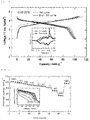
- the charge-discharge curve (chronopotentiometry) obtained at a C/10 rate using the sulfate compound 1 as the positive electrode active material is indicated by the broken line in FIG. 4 .
- a discharge capacity of 90 mAh/g or higher being equivalent to about 75% of the theoretical capacity of 120.24 mAh/g was confirmed.
- the results when using the sulfate compound 2 as the positive electrode active material likewise are indicated by the solid line in FIG. 4 .
- FIG. 5 shows the results of having actually measured the charge-discharge curves in five cycles with respect to the sulfate compound 1. As a result, because the curves are nearly the same after two cycles, very reversible charging and discharging without degradation of cycling was confirmed. Also, because there was little hysteresis of the curves during charging and discharging and there was almost no irreversible capacity, it was confirmed that there was very high charging and discharging efficiency.
- FIG. 6 shows the results of having measured the discharge capacity at various rates in a range of 1/20 C to 20 C with respect to the sulfate compound 1 (in order to confirm reversibility, the measurement has been performed again at 1/20 C after cycle of 22). From the results in the drawings, it was confirmed that an adequate value of discharge capacity was maintained without so much decrease even when the rate became high, and that nearly the same discharge capacity as at the start was maintained even when the rate was returned again to 1/20 C. This shows that the positive electrode having the sulfate compound 1 can function adequately even under rapid charging and discharging conditions of several minutes or lower.
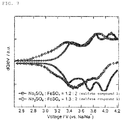
- FIG. 7 shows a dQ/dV curve converted on the basis of the amount of change of voltage in the charge-discharge curve in FIG. 4 . From FIG. 7 , it was confirmed that the redox potential when having used the sulfate compound 1 was about 3.6 6 V. Likewise, it was confirmed that the redox potential when having used the sulfate compound 2 was about 3.75 V. That redox potential is significantly higher than existing positive electrode materials using transition metals, and is the highest potential generation in the group of positive electrode active materials using iron as the core transition metal.
Landscapes
- Chemical & Material Sciences (AREA)
- Organic Chemistry (AREA)
- Chemical Kinetics & Catalysis (AREA)
- Electrochemistry (AREA)
- General Chemical & Material Sciences (AREA)
- Inorganic Chemistry (AREA)
- Engineering & Computer Science (AREA)
- Materials Engineering (AREA)
- Composite Materials (AREA)
- Manufacturing & Machinery (AREA)
- Crystallography & Structural Chemistry (AREA)
- Secondary Cells (AREA)
- Battery Electrode And Active Subsutance (AREA)
Description
- The present invention relates to a positive electrode material for a sodium ion secondary battery that has high redox potential, and a sodium ion secondary battery in which that material is used as a positive electrode active material.
- Lithium ion secondary batteries have conventionally been used as main electrical storage devices in various fields including mobile telephones, notebook PCs, and electric automobiles, but secondary batteries that can be manufactured at lower cost have recently come to be in demand. There has accordingly been a proliferation of studies on next-generation secondary batteries having high energy densities that exceed those of lithium ion secondary batteries, and various attempts have been made. Sodium ion secondary batteries, which constitute one such attempt, use sodium, which is an abundant resource that is less expensive than lithium; therefore, the cost can be brought dramatically lower than that of lithium ion secondary batteries, and application in particular to large-scale electrical devices and other uses is expected.
- However, the energy density of sodium ion secondary batteries is no greater than that of lithium ion secondary batteries, and increase their level of performance, a demand to develop a new positive electrode active material having high redox potential has arisen. A positive electrode active material for a sodium ion secondary battery must be a supply source of sodium ions, and must be a compound that includes sodium as a constituent element. Composite oxides indicated by the compositional formula NaMO2 (M: transition metal element) have been examined to date as such positive electrode active materials (for example, Patent Reference 1), but adequate performance for practice has yet to be obtained. For example, a problem has been presented in that when Fe is used as the transition metal M, the reversible capacitance was small, and the redox potential was low; i.e., 2.5 to 3.0 V, when Mn was introduced for stabilization.
- Patent Reference 1: Japanese Laid-Open Patent Application
2009-129741 - Therefore, an object of the present invention is to provide a novel positive electrode material for sodium ion secondary battery that is inexpensive and has high redox potential, and a sodium ion secondary battery in which that material is used as a positive electrode active material.
- The present inventors carried out thoroughgoing studies in order to achieve the above object, and newly discovered as a result that a sulfate containing sodium and a transition metal in a proper ratio as constituent elements is usable for a positive electrode active material, and that high redox potential is obtained and rapid charging and discharging can be adequately accommodated by using the material, and that discovery led to the completion of the present invention.
- That is, the present invention provides in one aspect:
- (1) a positive electrode active material for a sodium ion secondary battery, characterized by containing a sulfate represented by NamMn(SO4)3 (wherein, M represents a transition metal element; m is 2 ± 2x (where x satisfies 0 ≤ x ≤ 0.5); and n is 2 ± y (where y satisfies 0 ≤ y ≤ 0.5);
- (2) the positive electrode active material for a sodium ion secondary battery according to (1) above, wherein m is 2 + 2x (where x satisfies 0 ≤ x ≤ 0.5); and n is 2 - y (where y satisfies 0 ≤ y ≤ 0.5);
- (3) the positive electrode active material for a sodium ion secondary battery according to (1) or (2) above, wherein said sulfate has a crystal structure in which MO6 forms octahedra and has mutually shared ridge lines;
- (4) the positive electrode active material for a sodium ion secondary battery according to any of (1) to (3) above, wherein said transition metal element is a
period 4 transition metal element selected from the group consisting of Sc, T, V, Cr, Mn, Fe, Co, Ni, and Cu, or aperiod 5 transition metal element selected from the group consisting of Y, Zr, Nb, Mo, Tc, Ru, Rh, and Pd; - (5) the positive electrode active material for a sodium ion secondary battery according to (4) above, wherein said transition metal element is Fe; and
- (6) the positive electrode active material for a sodium ion secondary battery according to any of (1) to (5) above, wherein said sulfate is a particle having a diameter of 5 µm or smaller.
- In another aspect, the present invention provides:
- (7) a sodium ion secondary battery comprising a positive electrode containing the positive electrode active material according to any of (1) to (6) above, and a negative electrode containing a negative electrode active material capable of storing and releasing sodium ions;
- (8) the sodium ion secondary battery according to (7) above, wherein said positive electrode further contains an electroconductive material or a binder;
- (9) the sodium ion secondary battery according to (8) above, wherein said positive electrode active material is covered by said electroconductive material;
- (10) the sodium ion secondary battery according to (8) or (9) above, wherein said electroconductive material is a carbon material selected from the group consisting of graphite, soft carbon, hard carbon, carbon black, ketjen black, acetylene black, graphite, activated carbon, carbon nanotubes, carbon fiber, and mesoporous carbon;
- (11) the sodium ion secondary battery according to (8) above, wherein said binder is a thermoplastic resin selected from the group consisting of polyvinylidene fluoride (PVDF), polytetrafluoroethylene (PTFE), ethylene tetrafluoroethylene (ETFE), polyvinyl acetate, polyamide (PA), polyimide (PI), polyethylene, and polypropylene; and
- (12) the sodium ion secondary battery according to any of (7) to (11) above, wherein said negative electrode active material is a carbon material, metal sodium, sodium alloy, or sodium metal oxide.
- According to the present invention, there can be constructed a positive electrode for sodium ion secondary battery that has high redox potential and can also accommodate rapid charging and discharging. That redox potential could not be obtained with conventional positive electrode materials using transition metal elements. In particular, the positive electrode material of the present invention is different from the nasicon-type M2(SO4)3, being a conventional positive electrode material, in that the material of the present invention contains sodium ions in its structure, and therefore there is an advantage that the material can serve the function of a supply source of sodium ions when a material other than Na metal is used in the negative electrode. The material of the present invention differs from the nasicon-type M2(SO4)3 also in crystal structure, in that the degree of freedom of movement of sodium ions in the crystal is improved by a crystal structure, that is, an alluaudite-type crystal structure, in which two MO6 units in the structure share ridge lines to form a dimer, and as a result the distance between M metals decreases and a higher redox potential than of nasicon-type is obtained.
- Furthermore, the positive electrode active material of the present invention can be produced by low-temperature synthesis from inexpensive sulfates, and therefore production at low cost with little energy consumption is possible. In particular, low cost and high environmental harmony can be assured when Fe is used as the transition metal element. Accordingly, the present invention provides a positive electrode active material that has high density combining low cost and environmental harmony and can also accommodate rapid charging and discharging, and the invention is extremely useful in making sodium ion secondary batteries practical.
-
- [
FIG. 1] FIG. 1 is a graph showing the X-ray diffraction pattern of thesulfate compound 1 of the present invention. - [
FIG. 2] FIG. 2 is a graph showing the X-ray diffraction pattern of thesulfate compound 2 of the present invention. - [
FIG. 3 ]FIG. 2 is a graph showing the X-ray diffraction patterns of various compounds having different m:n ratios in the sulfate compound NamFen(SO4)3 of the present invention. - [
FIG. 4] FIG. 4 is a graph comparing the charge-discharge curves when thesulfate compounds - [
FIG. 5] FIG. 5 is a graph showing the charge-discharge curves in 1 to 5 cycles when thesulfate compound 1 of the present invention was used as a positive electrode active material. - [
FIG. 6] FIG. 6 is a graph showing a comparison of rate characteristics when thesulfate compound 1 of the present invention was used as a positive electrode active material. - [
FIG. 7] FIG. 7 is a graph showing the dQ/dV curves when thesulfate compounds - Embodiments of the present invention are described below. The scope of the present invention is not constrained by these descriptions, and the present invention can be carried out with appropriate modifications, even beyond the examples illustrated below, within a scope that does not compromise the main point of the present invention.
- The positive electrode active material for a sodium ion secondary battery according to the present invention is characterized by containing a sulfate that contains sodium and a transition metal as constituent elements and is represented by the compositional formula NamMn(SO4)3.
- In the formula, M represents a transition metal element; m is 2 ± 2x (where x satisfies 0 ≤ x ≤ 0.5); and n is 2 ± y (where x satisfies 0 ≤ y ≤ 0.5). Accordingly, the ratio of sodium:transition metal M: (SO4) in the sulfate is proximal to 2:2:3, that is, (2 ± 2x) : (2 ± y) :3 (accordingly, this becomes 2:2:3 when x = y = 0).
- The positive electrode active material is a single-electron reaction material that is in principle capable of insertion and removal of one equivalent amount of sodium ions, as indicated by the reaction formula:
2Na+ + 2e- + M2(SO4)3 ⇔ Na2M2(SO4)3
Here, it is believed that a very high rcdox potential can be obtained by a dielectric effect in which the M-O bond is endowed with an ion-binding property by the strong covalent bond of the S-O bond in "SO4." - The sulfate of compositional formula NamMn (SO4)3 used in the present invention is characterized by a crystal structure, an "alluaudite-type crystal structure," in which two MO6 units in the structure share ridge line to form a dimer. By containing such alluaudite-type crystal structure, the crystal structure is greatly different from the conventional nasicon-type M2(SO4)3, in which MO6 octahedra and SO4 tetrahedra are arranged three-dimensionally with vertex sharing. In the sulfate used in the present invention, the degree of freedom of movement of sodium ions in the crystal is improved by the alluaudite-type crystal structure forming a dimer as above, and a higher redox potential than that of nasicon-type salt is exhibited by shortening of the distance between M units (when Me is Fe, the distance between Fe-Fe becomes 3.2 À).
- In the above formula, M is a transition metal element, preferably a
period 4 transition metal element selected from the group consisting of Sc, T, V, Cr, Mn, Fe, Co, Ni, and Cu, or aperiod 5 transition metal element selected from the group consisting of Y, Zr, Nb, Mo, Tc, Ru, Rh, and Pd. M is more preferably Fe (iron), for reasons including that iron is inexpensive and easy to acquire and also that iron has a small environmental load. Ag ofperiod 5 also can be used as a dopant with the metal M. - In the above compositional formula, M is 2 ± 2x and n is 2 ± y. Preferably, there is possible an embodiment in which there is a great composition of sodium (Na-rich), that is, m is 2 + 2x and n is 2 y. Alternatively, there is possible an embodiment in which there is a great composition of transition metal (M-rich), that is, m is 2 - 2x and n is 2 + y.
- x can be an optional decimal number of 0.5 or lower, specifically, 0 ≤ x ≤ 0.5. Preferably, 0 ≤ x ≤ 0.3. Optionally, an embodiment in which x is 0 or 0.5 maybe excluded depending on the case.
- y can be an optional decimal number of 0.5 or lower, specifically, 0 ≤ y ≤ 0.5. Preferably, 0 ≤ y ≤ 0.3. Optionally, an embodiment in which y is 0 or 0.5 maybe excluded depending on the case.
- The NamMn(SO4)3 can be produced by a solid phase method, which is a well-known means in the technical field. In the solid phase method, the object material is synthesized by mixing powder-form raw materials in a predetermined ratio and then subjecting to heating treatment. In the present invention, for example, the object material can be synthesized by mixing Na2SO4 and MSO4 as raw materials in a proper ratio and subjecting to thermal treatment. Alternatively , depending on the case, the object material can be produced also by mixing these raw materials using a ball mill, or the like, without heating.
- The NamMn(SO4)3 used as the positive electrode active material of the present invention can be in particle form, and the particle size thereof is preferably a diameter of 5 µm or smaller, more preferably a diameter of 2 µm or smaller.
- The positive electrode used in the sodium ion secondary battery of the present invention is configured using the above positive electrode active material, and may contain only that active material, and may additionally contain at least one of a well-known electroconductive material and a binder in order to improve the rate characteristics of the electrode, and the like. These contents can be supported on an electrode collector to produce the electrode.
- Examples of electroconductive materials that can be used include carbon materials, metal fibers and other electrically conductive fibers, copper, silver, nickel, aluminum, and other metal powders, and polyphenylene derivatives and other organic electroconductive materials. Carbon materials that can be used include graphite, soft carbon, hard carbon, carbon black, ketjen black, acetylene black, graphite, activated carbon, carbon nanotubes, and carbon fiber. Also usable material is mesoporous carbon obtained by calcining synthetic resin having aromatic rings, petroleum pitch, or the like. Acetylene black is preferred from the viewpoint of the height of electrical conductivity during use as an electrode.
- When the electrode is to contain an electroconductive material, the electrode can be prepared by pulverizing and mixing this material with the positive electrode active material. Such pulverizing and mixing are not particularly limited, but these can be performed by vibration mill, jet mill, ball mill, or other pulverizing machine.
- Also, in a preferred embodiment, when an electroconductive material is to be contained in the positive electrode, the positive electrode active material can be covered by the electroconductive material. A method for such covering is a method in which a powder of the positive electrode active material is immersed in a liquid containing the electroconductive material or a precursor of the electroconductive material, and this is then subjected to thermal treatment whereby the electroconductive material is deposited on the powder surface of the active material. Or, a method can be used, in which a powder of the positive electrode active material is mobilized in a vapor phase containing the electroconductive material or a precursor of the electroconductive material, and is then subjected to thermal treatment as needed. By covering the positive electrode active material with the electroconductive material, any reduction in capacity when large current is applied will be minimized, which is beneficial in increasing load characteristics.
- Electroconductive materials that can be used for the covering include carbon, graphite, vapor-phase-deposited carbon fiber, carbon nanotubes, iron phosphide, electrically conductive oxides, and electrically conductive polymers (polypyrrole, polyacrylonitrile, and the like), but are not limited to these.
- Examples of binders include polyvinylidene fluoride (PVDF), polytetrafluoroethylene (PTFE), ethylene tetrafluoroethylene (ETFE), and other fluororesins, or polyethylene, polypropylene, and the like. The negative electrode collector is not particularly limited provided that the material is electrically conductive, but rod-form, sheetform, foil-form, net-form, and other materials consisting mainly of copper, nickel, aluminum, stainless steel, and the like, can be used.
- Al, Ni, Cu, stainless steel, or the like, can be used as the electrode collector. Methods for supporting the electrode mixture on the electrode collector include a method of molding under pressure, or a method of forming a paste using an organic solvent, or the like, applying on the electrode collector, and fixing by drying and pressing, or the like. When forming a paste, a slurry containing the electrode active material, electroconductive material, binder, and organic solvent is prepared.
- Negative electrodes that can be used in the sodium ion secondary battery of the present invention include electrodes containing a negative electrode active material capable of storing and releasing sodium ions electrochemically. Such negative electrode active material can be a well-known negative electrode active material for sodium ion secondary batteries, examples including hard carbon, soft carbon, carbon black, ketjen black, acetylene black, activated carbon, carbon nanotubes, carbon fiber, amorphous carbon, and other carbon materials. Also usable are sodium ion metals, or alloys, metal oxides, and metal nitrides containing a sodium ion element.
- Of these, hard carbon or another carbon material having a disordered structure is preferred as the negative electrode active material.
- The negative electrode may contain only the negative electrode active material, and may contain at least one of an electroconductive material and a binder in addition to the negative electrode active material, and may be in a form in which the contents are adhered as a negative electrode mixture on a negative electrode collector. For example, when the negative electrode active material is in oil form, a negative electrode containing only the negative electrode active material can be made. Meanwhile, when the negative electrode active material is in powder form, a negative electrode having the negative electrode active material and a binder can be made. The method used for forming the negative electrode using a powder-form negative electrode active material can be a doctor blade method, molding by crimping press, or the like.
- The electroconductive material, binder, and electrode collector used can be the same as those for the positive electrode described above.
- The electrolytic solution used in the sodium ion secondary battery of the present invention is not particularly limited provided that the solution contains a sodium salt as an electrolyte. Examples of sodium salts containing this electrolyte include NaClO4, NaPF6, NaBF4, NaNO3, NaOH, NaCl, NaCF3SO3, NaN(SO2CF3)2, Na2SO4, and Na2S. These sodium salts can be used each singly, but can also be used in combinations of two or more.
- Examples of solvents in the electrolytic solutions include propylene carbonate (PC), ethylene carbonate (EC), dimethyl carbonate (DMC), diethyl carbonate (DEC), ethyl methyl carbonate, 4-trifluoromethyl-1,3-dioxolan-2-one, 1,2-di(methoxycarbonyloxy)ethane, and other carbonates; 1,2-dimethoxyethane, 1,3-dimethoxypropane, pentafluoropropyl methyl ether, 2,2,3,3-tetrafluoropropyl drifluoromethyl ether, tetrahydrofuran, 2-methyl tetrahydrofuran, and other ethers; methyl formate, methyl acetate, γ-butyrolactone, and other esters; acetonitrile, butyronitrile, and other nitriles; N,N-dimethylformamide, N,N-dimethylacetoamide, and other amides; 3-methyl-2-oxazolidone and other carbamates; sulfolane, dimethyl sulfoxide, 1,3-propanesultone, and other sulfur-containing compounds; or solvents in which fluorine substituents are introduced in the above organic solvents. On kind of these may be used singly, and two or more kinds may be used in combination. However, the solvents are not limited to these.
- A solid electrolyte can be used instead of the electrolytic solution. Examples of solid electrolytes include polyethylene oxide-based polymer compounds, polymer compounds containing at Least one kind of polyorganosiloxane chain or polyoxyalkylene chain, and other polymer electrolytes. Also usable is an electrolyte in the form of a non-aqueous solution obtained by adding a polymer to the above electrolytic solution and gelling. When a solid electrolyte is used in the sodium ion secondary battery of the present invention, the solid electrolyte may serve the function of a separator to be described, and a separator may not be required in that case.
- Also, the electrolytic solution can contain other ingredients as needed for the purpose of improving the function thereof. Examples of other ingredients include conventionally well-known overcharge inhibitors, dehydrating agents, deoxidizing agents, and characteristics improvement aids for improving capacity retention characteristics after high-temperature storage or cycle characteristics.
- Examples of overcharge inhibitors include biphenyl, alkylbiphenyl, terphenyl, partially hydrogenated terphenyl, cyclohexylbenzene, t-butylbenzene, t-amylbenzene, diphenyl ether, dibenzofuran, and other aromatic compounds; 2-fluorobiphenyl, o-cyclohexyl fluorobenzene, p-cyclohexyl fluorobenzene, and other partial fluorides of aromatic compounds; and 2,4-difluoroanisol, 2,5-difluoroanisol, 2,6-difluoroanisol, and other fluoride-containing anisol compounds. One kind of overcharge inhibitor may be used singly, and two or more kinds may be used together.
- When the electrolytic solution contains an overcharge inhibitor, the overcharge inhibitor content of the electrolytic solution is preferably 0.01 to 5 mass%. By having the overcharge inhibitor content of the electrolytic solution be 0.1 mass% or higher, suppression of bursting and igniting of the secondary battery by overcharging becomes easier, and the secondary battery can be used more stably.
- Examples of dehydrating agents include molecular sieves, mirabilite, magnesium sulfate, calcium hydride, sodium hydride, potassium hydride, and lithium aluminum hydride. The solvent used in the electrolytic solution of the present invention can also be refined after being dehydrated with the aforementioned dehydrating agent. Also, a solvent subjected only to dehydration by the aforementioned dehydrating agent without being refined may be used.
- Examples of a characteristics improvement aid for improving capacity retention characteristics after high-temperature storage or cycle characteristics include succinic anhydride, glutaric anhydride, maleic anhydride, citraconic anhydride, glutaconic anhydride, itaconic anhydride, diglycolic anhydride, cyclohexane dicarboxylic anhydride, cyclopentane tetracarboxylic dianhydride, phenylsuccinic anhydride, and other carboxylic anhydrides; ethylene sulfite, 1,3-propanesultone, 1,4-butanesultone, methyl methanesulfonate, busulfan, sulfolane, sulfolene, dimethyl sulfone, diphenyl sulfone, methylphenyl sulfone, dibutyl disulfide, dicyclohexyl disulfide, tetramethylthiuram monosulfide, N,N dimethyl methanesulfamide, N,N-diethyl methanesulfamide, and other sulfur-containing compounds; 1-methyl-2-pyrrolydinone, 1-methyl-2-piperidone, 3 methyl-2-oxazolidinone, 1,3-dimethyl-2-imidazolidinone, N-methylsuccimide, and other nitrogen-containing compounds; heptane, octane, cyclopentane, and other hydrocarbon compounds; and fluoroethylene carbonate (FEC), fluorobenzene, difluorobenzene, hexafluorobenzene, benzotrifluoride, and other fluorine-containing aromatic compounds. One kind of these characteristics improvement aids may be used singly, and two or more kinds may be used together. When the electrolytic solution contains a characteristics improvement aid, the content of the characteristics improvement aid in the electrolytic solution is preferably 0.01 to 5 mass%.
- The separator used in the sodium ion secondary battery of the present invention is not particularly limited provided that the separator has a function of electrically separating the positive electrode layer and the negative electrode layer, but examples include porous sheets, nonwoven cloths, glass fiber nonwoven cloths, other nonwoven cloths, and other porous insulating materials containing polyethylene (PE), polypropylene (PP), polyester, cellulose, polyamide, or other resins.
- The shape of the sodium ion secondary battery of the present invention is not particularly limited provided that the positive electrode, negative electrode, and electrolytic solution can be housed; e.g., cylindrical, coin, flat plate, and laminated configurations may be adopted.
- The sodium ion secondary battery of the present invention is ideal for use as a secondary battery, but use as a primary battery is not excluded.
- The present invention is described in further detail below using examples, but the present invention is not limited to these examples.
- A mixture of Na2SO4 (Wako Pure Chemical Industries, 99%) and FeSO4 in a molar ratio of 1.3:2 as a starting material was reacted according to the procedure below, and a sulfate NamFen(SO4)3 (hereinafter referred to as "
sulfate compound 1"), being an object material, was synthesized. Commercial FeSO4·7H2O was heated for 5 hours at 180°C under reduced pressure, and further heated for 5 hours at 225°C, and anhydrous FeSO4 was obtained. This raw material mixture was mixed for 1 hr with a ball mill, and then fired for 12 hours at 350°C under a steady stream of argon, and asulfate compound 1 was obtained by solid phase synthesis. Also, it was confirmed that the object material is also obtained merely by mixing the raw material mixture for 1 to 4 hours in air with a ball mill instead of the above method. Because a SO4-containing compound generally tends to be easily pyrolyzed, use of the latter non-heating synthesis method is advantageous. A sulfate being an object material (hereinafter referred to as "sulfate compound 2") was synthesized by the same method with a molar ratio of 1.2:2 in the Na2SO4/FeSO4 mixture. Also, sulfates were likewise synthesized, changing the molar ratios of Na2SO4 and FeSO4 (m:n) to 2:2, 2.2:1.9, 2.4:1.8, 2.5:1.75, 2.6:1.7, and 2.8:1.6, respectively. Fe was changed to other metals, and Na2CO2 (SO4)3 and Na2Mn2(SO4) were obtained. -
FIG. 1 and FIG. 2 show the results of powder X-ray diffractometry (XRD) of the obtainedsulfate compounds FIG. 1 and FIG. 2 were returned as diffraction peaks indicating the composition of the sulfate compound. - Also,
FIG. 3 shows the results of measurement of XRD of sulfates obtained further changing the molar ratios of the mixtures of Na2SO4 and FeSO4 so that m:n ranged from 2:2 to 2.8:1.6 as above. Formation of sulfate compounds was confirmed by the peaks inFIG. 3 . - 80 wt% of the
sulfate compound - A beaker-type three-electrode cell using the positive electrode film created in example 1 for the active electrode and metal sodium for a counter electrode and a reference electrode was created in an argon-filled glove box, and the cell was subjected to constant-current charge-discharge cycle measurement. The electrolytic solution used was propylene carbonate (PC) containing 1 M NaClO4 as electrolyte (without additives). The voltage range was 1.5 to 4.2 V, C/10 rate, and the measurement temperature was 25°C.
- The charge-discharge curve (chronopotentiometry) obtained at a C/10 rate using the
sulfate compound 1 as the positive electrode active material is indicated by the broken line inFIG. 4 . As a result, a discharge capacity of 90 mAh/g or higher, being equivalent to about 75% of the theoretical capacity of 120.24 mAh/g was confirmed. The results when using thesulfate compound 2 as the positive electrode active material likewise are indicated by the solid line inFIG. 4 . A discharge capacity of 100 mAh/g or higher, being equivalent to about 83% of the theoretical capacity of 120.24 mAh/g was confirmed. - Because a gentle voltage slope is observed in a range 4.2 V to 3.5 V in both
sulfate compounds FIG. 5 shows the results of having actually measured the charge-discharge curves in five cycles with respect to thesulfate compound 1. As a result, because the curves are nearly the same after two cycles, very reversible charging and discharging without degradation of cycling was confirmed. Also, because there was little hysteresis of the curves during charging and discharging and there was almost no irreversible capacity, it was confirmed that there was very high charging and discharging efficiency. - Also,
FIG. 6 shows the results of having measured the discharge capacity at various rates in a range of 1/20 C to 20 C with respect to the sulfate compound 1 (in order to confirm reversibility, the measurement has been performed again at 1/20 C after cycle of 22). From the results in the drawings, it was confirmed that an adequate value of discharge capacity was maintained without so much decrease even when the rate became high, and that nearly the same discharge capacity as at the start was maintained even when the rate was returned again to 1/20 C. This shows that the positive electrode having thesulfate compound 1 can function adequately even under rapid charging and discharging conditions of several minutes or lower. -
FIG. 7 shows a dQ/dV curve converted on the basis of the amount of change of voltage in the charge-discharge curve inFIG. 4 . FromFIG. 7 , it was confirmed that the redox potential when having used thesulfate compound 1 was about 3.6 6 V. Likewise, it was confirmed that the redox potential when having used thesulfate compound 2 was about 3.75 V. That redox potential is significantly higher than existing positive electrode materials using transition metals, and is the highest potential generation in the group of positive electrode active materials using iron as the core transition metal. - Also, it was shown from the above examples that when NamFen(SO4)3 was used as the positive electrode active material for the sodium ion battery, an energy density equal to or higher than that of lithium ion batteries was ensured, as was interchangeability. In addition, it was shown that the battery reaction progresses at an extremely high speed, and rapid charging and discharging in several minutes or lower is accommodated. These results prove that reversible charging and discharging and high redox potential are obtained by the positive electrode active material of the present invention, and that the positive electrode active material is ideal for sodium ion secondary batteries.
- Specific embodiments of the present invention were described in detail above, but these are merely for illustrative purposes, and do not limit the claims. A variety of modifications of the specific embodiments illustrated above are also included in the inventions stated in the claims.
Claims (12)
- A positive electrode active material for a sodium ion secondary battery, characterized by containing a sulfate represented by:
NamMn(SO4)3
(wherein M represents a transition metal element; m is 2 ± 2x (where x satisfies 0 ≤ x ≤ 0.5); and n is 2 ± y (where y satisfies 0 ≤ y ≤ 0.5). - The positive electrode active material for a sodium ion secondary battery according to claim 1, wherein m is 2 + 2x (where x satisfies 0 ≤ x ≤ 0.5); and n is 2 - y (where y satisfies 0 ≤ y ≤ 0.5).
- The positive electrode active material for a sodium ion secondary battery according to claim 1 or 2, wherein said sulfate has a crystal structure in which MO6 forms octahedra and has mutually shared ridge lines.
- The positive electrode active material for a sodium ion secondary battery according to any of claims 1 to 3, wherein said transition metal element is a period 4 transition metal element selected from the group consisting of Sc, T, V, Cr, Mn, Fe, Co, Ni, and Cu, or a period 5 transition metal element selected from the group consisting of Y, Zr, Nb, Mo, Tc, Ru, Rh, and Pd.
- The positive electrode active material for a sodium ion secondary battery according to claim 4, wherein said transition metal element is Fe.
- The positive electrode active material for a sodium ion secondary battery according to any of claims 1 to 5, wherein said sulfate is a particle having a diameter of 5 µm or smaller.
- A sodium ion secondary battery comprising a positive electrode containing the positive electrode active material according to any of claims 1 to 6, and a negative electrode containing a negative electrode active material capable of storing and releasing sodium ions.
- The sodium ion secondary battery according to claim 7, wherein said positive electrode further contains an electroconductive material or a binder.
- The sodium ion secondary battery according to claim 8, wherein said positive electrode active material is covered by said electroconductive material.
- The sodium ion secondary battery according to claim 8 or 9, wherein said electroconductive material is a carbon material selected from the group consisting of graphite, soft carbon, hard carbon, carbon black, ketjen black, acetylene black, graphite, activated carbon, carbon nanotubes, carbon fiber, and mesoporous carbon.
- The sodium ion secondary battery according to claim 8, wherein said binder is a thermoplastic resin selected from the group consisting of polyvinylidene fluoride (PVDF), polytetrafluoroethylene (PTFE), ethylene tetrafluoroethylene (ETFE), polyvinyl acetate, polyamide (PA), polyimide (PI), polyethylene, and polypropylene.
- The sodium ion secondary battery according to any of claims 7 to 11, wherein said negative electrode active material is a carbon material, metallic sodium, sodium alloy, or sodium metal oxide.
Applications Claiming Priority (4)
| Application Number | Priority Date | Filing Date | Title |
|---|---|---|---|
| JP2013187914 | 2013-09-11 | ||
| JP2014055748 | 2014-03-19 | ||
| JP2014098660 | 2014-05-12 | ||
| PCT/JP2014/073162 WO2015037489A1 (en) | 2013-09-11 | 2014-09-03 | Positive electrode material for sodium ion secondary batteries |
Publications (3)
| Publication Number | Publication Date |
|---|---|
| EP3046170A1 true EP3046170A1 (en) | 2016-07-20 |
| EP3046170A4 EP3046170A4 (en) | 2017-06-28 |
| EP3046170B1 EP3046170B1 (en) | 2018-11-07 |
Family
ID=52665596
Family Applications (1)
| Application Number | Title | Priority Date | Filing Date |
|---|---|---|---|
| EP14844027.4A Active EP3046170B1 (en) | 2013-09-11 | 2014-09-03 | Positive electrode material for sodium ion secondary batteries |
Country Status (7)
| Country | Link |
|---|---|
| US (1) | US20160226069A1 (en) |
| EP (1) | EP3046170B1 (en) |
| JP (1) | JP6423794B2 (en) |
| KR (1) | KR102301853B1 (en) |
| CN (1) | CN105556717B (en) |
| TW (1) | TWI633697B (en) |
| WO (1) | WO2015037489A1 (en) |
Families Citing this family (15)
| Publication number | Priority date | Publication date | Assignee | Title |
|---|---|---|---|---|
| JP2015115283A (en) * | 2013-12-13 | 2015-06-22 | 日本電信電話株式会社 | Sodium secondary battery and method for producing positive electrode material used in the sodium secondary battery |
| JP6741390B2 (en) * | 2014-04-25 | 2020-08-19 | 住友大阪セメント株式会社 | Positive electrode material, paste and sodium ion battery |
| GB201414959D0 (en) * | 2014-08-22 | 2014-10-08 | Faradion Ltd | Sodium-ion energy storage devices |
| US10637059B2 (en) * | 2015-06-19 | 2020-04-28 | Centre National De La Recherche Scientifique | Method for producing a positive electrode composite material for Na ion battery |
| WO2017113234A1 (en) * | 2015-12-30 | 2017-07-06 | 深圳先进技术研究院 | Novel sodium-ion battery and method for preparing same |
| WO2017119171A1 (en) * | 2016-01-06 | 2017-07-13 | ソニー株式会社 | Nonaqueous secondary battery, and positive electrode active material for nonaqueous secondary batteries and method for producing same |
| CN109155402B (en) * | 2016-05-12 | 2023-04-28 | 艾利电力能源有限公司 | Positive electrode for nonaqueous electrolyte secondary battery and nonaqueous electrolyte secondary battery |
| US10707531B1 (en) | 2016-09-27 | 2020-07-07 | New Dominion Enterprises Inc. | All-inorganic solvents for electrolytes |
| CN108288730A (en) * | 2017-01-09 | 2018-07-17 | 中国科学院物理研究所 | Inhibit the nonaqueous electrolytic solution and its preparation method and application of sodium-ion battery flatulence |
| CN107171021A (en) * | 2017-06-13 | 2017-09-15 | 中国电子新能源(武汉)研究院有限责任公司 | A kind of sodium-ion battery electrolyte and sodium-ion battery |
| WO2019051662A1 (en) * | 2017-09-13 | 2019-03-21 | 辽宁宏成供电有限公司 | Novel high-potential multilayer-carbon coated polyanionic sodium ion battery cathode material and preparation method therefor |
| CN113381016B (en) * | 2020-12-15 | 2022-08-02 | 中南林业科技大学 | Biomass hard carbon negative electrode material for sodium ion battery and preparation method and application thereof |
| CN113036219A (en) * | 2021-03-05 | 2021-06-25 | 星恒电源股份有限公司 | Electrolyte and sodium ion battery with high and low temperature performance |
| CN115385380B (en) * | 2022-06-16 | 2024-04-12 | 深圳珈钠能源科技有限公司 | Preparation method of positive electrode material for sodium ion battery |
| CN116435487B (en) * | 2023-04-28 | 2024-01-19 | 深圳先进技术研究院 | Preparation method and application of NaxFe3-0.5x(SO4)3@C cathode material |
Family Cites Families (12)
| Publication number | Priority date | Publication date | Assignee | Title |
|---|---|---|---|---|
| CA2175856C (en) * | 1995-05-18 | 2000-01-18 | Hajime Arai | A method for producing positive electrode material and lithium batteries incorporating this material |
| US5908716A (en) * | 1997-04-15 | 1999-06-01 | Valence Technology, Inc. | Lithium--containing sulfates, method of preparation and uses thereof |
| CN102505042A (en) | 2001-01-31 | 2012-06-20 | 旭化成制药株式会社 | Compositions for assaying glycoprotein |
| WO2002097907A2 (en) * | 2001-04-06 | 2002-12-05 | Valence Technology, Inc. | Sodium ion batteries |
| JP2009129741A (en) | 2007-11-26 | 2009-06-11 | Kyushu Univ | Sodium ion secondary battery and negative electrode active material used therefor |
| JP5460979B2 (en) * | 2008-07-09 | 2014-04-02 | 住友化学株式会社 | Transition metal phosphate, positive electrode for sodium secondary battery using the same, and secondary battery using the positive electrode |
| US8795889B2 (en) * | 2008-07-09 | 2014-08-05 | Sumitomo Chemical Company, Limited | Transition metal phosphate, production process thereof, positive electrode, and sodium secondary battery |
| EP2349924B1 (en) * | 2008-10-23 | 2017-02-08 | Centre National De La Recherche Scientifique | Fluorosulphates useful as electrode materials |
| JP2011165392A (en) * | 2010-02-05 | 2011-08-25 | Equos Research Co Ltd | Positive electrode active material, manufacturing method of positive electrode active material, and alkaline metal ion battery |
| CN103098286A (en) * | 2010-09-07 | 2013-05-08 | 住友化学株式会社 | Battery assembly |
| GB201201717D0 (en) * | 2012-02-01 | 2012-03-14 | Faradion Ltd | Sulfate electrodes |
| FR2987498B1 (en) * | 2012-02-29 | 2017-08-11 | Univ Picardie | SULFATES USEFUL AS ELECTRODE MATERIALS |
-
2014
- 2014-09-03 WO PCT/JP2014/073162 patent/WO2015037489A1/en not_active Ceased
- 2014-09-03 EP EP14844027.4A patent/EP3046170B1/en active Active
- 2014-09-03 CN CN201480049838.8A patent/CN105556717B/en active Active
- 2014-09-03 US US14/916,532 patent/US20160226069A1/en not_active Abandoned
- 2014-09-03 JP JP2015536541A patent/JP6423794B2/en active Active
- 2014-09-03 KR KR1020167004949A patent/KR102301853B1/en active Active
- 2014-09-10 TW TW103131282A patent/TWI633697B/en active
Also Published As
| Publication number | Publication date |
|---|---|
| CN105556717B (en) | 2018-11-02 |
| JP6423794B2 (en) | 2018-11-14 |
| TWI633697B (en) | 2018-08-21 |
| KR20160055793A (en) | 2016-05-18 |
| CN105556717A (en) | 2016-05-04 |
| WO2015037489A1 (en) | 2015-03-19 |
| EP3046170B1 (en) | 2018-11-07 |
| KR102301853B1 (en) | 2021-09-13 |
| EP3046170A4 (en) | 2017-06-28 |
| JPWO2015037489A1 (en) | 2017-03-02 |
| US20160226069A1 (en) | 2016-08-04 |
| TW201519495A (en) | 2015-05-16 |
Similar Documents
| Publication | Publication Date | Title |
|---|---|---|
| EP3046170B1 (en) | Positive electrode material for sodium ion secondary batteries | |
| Chen et al. | Optimization strategies toward functional sodium‐ion batteries | |
| Patra et al. | Moderately concentrated electrolyte improves solid–electrolyte interphase and sodium storage performance of hard carbon | |
| US9537139B2 (en) | Negative electrode for non-aqueous secondary battery, and a non-aqueous secondary battery | |
| JP6156939B2 (en) | Lithium ion secondary battery | |
| US10566625B2 (en) | Electrode active material, electrode for electricity storage device, electricity storage device, and method for producing electrode active material | |
| JP5205923B2 (en) | Non-aqueous electrolyte secondary battery electrode material, non-aqueous electrolyte secondary battery electrode, and non-aqueous electrolyte secondary battery using the same | |
| JP2017076739A (en) | Method for producing electrode material for electrochemical capacitor containing layered compound | |
| JP2010287496A (en) | Negative electrode material for nonaqueous electrolyte secondary battery, negative electrode for nonaqueous electrolyte secondary battery, and nonaqueous electrolyte secondary battery using the same | |
| JP5031065B2 (en) | Lithium ion secondary battery | |
| CN102714298A (en) | Electrode for magnesium secondary battery and magnesium secondary battery including same | |
| JP2016063171A (en) | Electrode material including layer compound | |
| JP7742307B2 (en) | Electrode materials comprising layered potassium metal oxides, electrodes comprising the electrode materials, and uses of the electrode materials in electrochemistry | |
| Fan et al. | Electrodeposition of three-dimensional macro-/mesoporous Co3O4 nanosheet arrays as for ultrahigh rate lithium-ion battery | |
| JPWO2015080102A1 (en) | Secondary battery electrolyte and secondary battery using the same | |
| JP2017045538A (en) | Positive electrode material for secondary battery containing silicate | |
| JP5523506B2 (en) | Method for producing lithium ion secondary battery | |
| KR101300107B1 (en) | Negative electrode for secondary battery, method for preparing thereof and secondary battery comprising the same | |
| JP2020047523A (en) | Electrode active material, power storage device, and method for producing electrode active material | |
| JP2019133837A (en) | Secondary battery with electrolyte including nonpolar solvent | |
| Zhao et al. | Ca2+ and PVP Modified VO2 Electrode Materials for High-Capacity and Temperature-Adaptative Zn-Ion Batteries | |
| Uke et al. | Nanowires for metal-ion batteries | |
| JP6831180B2 (en) | Power storage device and its manufacturing method | |
| JP2015057755A (en) | Negative electrode active material for sodium ion battery and sodium ion battery | |
| JP2020149941A (en) | Power storage device |
Legal Events
| Date | Code | Title | Description |
|---|---|---|---|
| PUAI | Public reference made under article 153(3) epc to a published international application that has entered the european phase |
Free format text: ORIGINAL CODE: 0009012 |
|
| 17P | Request for examination filed |
Effective date: 20160331 |
|
| AK | Designated contracting states |
Kind code of ref document: A1 Designated state(s): AL AT BE BG CH CY CZ DE DK EE ES FI FR GB GR HR HU IE IS IT LI LT LU LV MC MK MT NL NO PL PT RO RS SE SI SK SM TR |
|
| AX | Request for extension of the european patent |
Extension state: BA ME |
|
| RIN1 | Information on inventor provided before grant (corrected) |
Inventor name: NISHIMURA SHIN-ICHI Inventor name: YAMADA ATSUO Inventor name: BARPANDA, PRABEER Inventor name: OYAMA GOSUKE |
|
| DAX | Request for extension of the european patent (deleted) | ||
| RIC1 | Information provided on ipc code assigned before grant |
Ipc: H01M 4/136 20100101ALI20170518BHEP Ipc: H01M 4/587 20100101ALI20170518BHEP Ipc: H01M 4/62 20060101ALI20170518BHEP Ipc: H01M 4/58 20100101AFI20170518BHEP Ipc: H01M 4/40 20060101ALI20170518BHEP Ipc: H01M 4/48 20100101ALI20170518BHEP Ipc: H01M 10/054 20100101ALI20170518BHEP |
|
| A4 | Supplementary search report drawn up and despatched |
Effective date: 20170529 |
|
| GRAP | Despatch of communication of intention to grant a patent |
Free format text: ORIGINAL CODE: EPIDOSNIGR1 |
|
| STAA | Information on the status of an ep patent application or granted ep patent |
Free format text: STATUS: GRANT OF PATENT IS INTENDED |
|
| INTG | Intention to grant announced |
Effective date: 20180426 |
|
| RIN1 | Information on inventor provided before grant (corrected) |
Inventor name: BARPANDA, PRABEER Inventor name: YAMADA ATSUO Inventor name: NISHIMURA SHIN-ICHI Inventor name: OYAMA GOSUKE |
|
| GRAS | Grant fee paid |
Free format text: ORIGINAL CODE: EPIDOSNIGR3 |
|
| GRAA | (expected) grant |
Free format text: ORIGINAL CODE: 0009210 |
|
| STAA | Information on the status of an ep patent application or granted ep patent |
Free format text: STATUS: THE PATENT HAS BEEN GRANTED |
|
| AK | Designated contracting states |
Kind code of ref document: B1 Designated state(s): AL AT BE BG CH CY CZ DE DK EE ES FI FR GB GR HR HU IE IS IT LI LT LU LV MC MK MT NL NO PL PT RO RS SE SI SK SM TR |
|
| REG | Reference to a national code |
Ref country code: GB Ref legal event code: FG4D |
|
| REG | Reference to a national code |
Ref country code: CH Ref legal event code: EP Ref country code: AT Ref legal event code: REF Ref document number: 1063159 Country of ref document: AT Kind code of ref document: T Effective date: 20181115 |
|
| REG | Reference to a national code |
Ref country code: DE Ref legal event code: R096 Ref document number: 602014035745 Country of ref document: DE |
|
| REG | Reference to a national code |
Ref country code: IE Ref legal event code: FG4D |
|
| REG | Reference to a national code |
Ref country code: NL Ref legal event code: MP Effective date: 20181107 |
|
| REG | Reference to a national code |
Ref country code: LT Ref legal event code: MG4D |
|
| REG | Reference to a national code |
Ref country code: AT Ref legal event code: MK05 Ref document number: 1063159 Country of ref document: AT Kind code of ref document: T Effective date: 20181107 |
|
| PG25 | Lapsed in a contracting state [announced via postgrant information from national office to epo] |
Ref country code: LV Free format text: LAPSE BECAUSE OF FAILURE TO SUBMIT A TRANSLATION OF THE DESCRIPTION OR TO PAY THE FEE WITHIN THE PRESCRIBED TIME-LIMIT Effective date: 20181107 Ref country code: AT Free format text: LAPSE BECAUSE OF FAILURE TO SUBMIT A TRANSLATION OF THE DESCRIPTION OR TO PAY THE FEE WITHIN THE PRESCRIBED TIME-LIMIT Effective date: 20181107 Ref country code: NO Free format text: LAPSE BECAUSE OF FAILURE TO SUBMIT A TRANSLATION OF THE DESCRIPTION OR TO PAY THE FEE WITHIN THE PRESCRIBED TIME-LIMIT Effective date: 20190207 Ref country code: LT Free format text: LAPSE BECAUSE OF FAILURE TO SUBMIT A TRANSLATION OF THE DESCRIPTION OR TO PAY THE FEE WITHIN THE PRESCRIBED TIME-LIMIT Effective date: 20181107 Ref country code: BG Free format text: LAPSE BECAUSE OF FAILURE TO SUBMIT A TRANSLATION OF THE DESCRIPTION OR TO PAY THE FEE WITHIN THE PRESCRIBED TIME-LIMIT Effective date: 20190207 Ref country code: HR Free format text: LAPSE BECAUSE OF FAILURE TO SUBMIT A TRANSLATION OF THE DESCRIPTION OR TO PAY THE FEE WITHIN THE PRESCRIBED TIME-LIMIT Effective date: 20181107 Ref country code: ES Free format text: LAPSE BECAUSE OF FAILURE TO SUBMIT A TRANSLATION OF THE DESCRIPTION OR TO PAY THE FEE WITHIN THE PRESCRIBED TIME-LIMIT Effective date: 20181107 Ref country code: IS Free format text: LAPSE BECAUSE OF FAILURE TO SUBMIT A TRANSLATION OF THE DESCRIPTION OR TO PAY THE FEE WITHIN THE PRESCRIBED TIME-LIMIT Effective date: 20190307 Ref country code: FI Free format text: LAPSE BECAUSE OF FAILURE TO SUBMIT A TRANSLATION OF THE DESCRIPTION OR TO PAY THE FEE WITHIN THE PRESCRIBED TIME-LIMIT Effective date: 20181107 |
|
| PG25 | Lapsed in a contracting state [announced via postgrant information from national office to epo] |
Ref country code: GR Free format text: LAPSE BECAUSE OF FAILURE TO SUBMIT A TRANSLATION OF THE DESCRIPTION OR TO PAY THE FEE WITHIN THE PRESCRIBED TIME-LIMIT Effective date: 20190208 Ref country code: SE Free format text: LAPSE BECAUSE OF FAILURE TO SUBMIT A TRANSLATION OF THE DESCRIPTION OR TO PAY THE FEE WITHIN THE PRESCRIBED TIME-LIMIT Effective date: 20181107 Ref country code: RS Free format text: LAPSE BECAUSE OF FAILURE TO SUBMIT A TRANSLATION OF THE DESCRIPTION OR TO PAY THE FEE WITHIN THE PRESCRIBED TIME-LIMIT Effective date: 20181107 Ref country code: PT Free format text: LAPSE BECAUSE OF FAILURE TO SUBMIT A TRANSLATION OF THE DESCRIPTION OR TO PAY THE FEE WITHIN THE PRESCRIBED TIME-LIMIT Effective date: 20190307 Ref country code: AL Free format text: LAPSE BECAUSE OF FAILURE TO SUBMIT A TRANSLATION OF THE DESCRIPTION OR TO PAY THE FEE WITHIN THE PRESCRIBED TIME-LIMIT Effective date: 20181107 Ref country code: NL Free format text: LAPSE BECAUSE OF FAILURE TO SUBMIT A TRANSLATION OF THE DESCRIPTION OR TO PAY THE FEE WITHIN THE PRESCRIBED TIME-LIMIT Effective date: 20181107 |
|
| PG25 | Lapsed in a contracting state [announced via postgrant information from national office to epo] |
Ref country code: DK Free format text: LAPSE BECAUSE OF FAILURE TO SUBMIT A TRANSLATION OF THE DESCRIPTION OR TO PAY THE FEE WITHIN THE PRESCRIBED TIME-LIMIT Effective date: 20181107 Ref country code: IT Free format text: LAPSE BECAUSE OF FAILURE TO SUBMIT A TRANSLATION OF THE DESCRIPTION OR TO PAY THE FEE WITHIN THE PRESCRIBED TIME-LIMIT Effective date: 20181107 Ref country code: CZ Free format text: LAPSE BECAUSE OF FAILURE TO SUBMIT A TRANSLATION OF THE DESCRIPTION OR TO PAY THE FEE WITHIN THE PRESCRIBED TIME-LIMIT Effective date: 20181107 Ref country code: PL Free format text: LAPSE BECAUSE OF FAILURE TO SUBMIT A TRANSLATION OF THE DESCRIPTION OR TO PAY THE FEE WITHIN THE PRESCRIBED TIME-LIMIT Effective date: 20181107 |
|
| REG | Reference to a national code |
Ref country code: DE Ref legal event code: R097 Ref document number: 602014035745 Country of ref document: DE |
|
| PG25 | Lapsed in a contracting state [announced via postgrant information from national office to epo] |
Ref country code: SK Free format text: LAPSE BECAUSE OF FAILURE TO SUBMIT A TRANSLATION OF THE DESCRIPTION OR TO PAY THE FEE WITHIN THE PRESCRIBED TIME-LIMIT Effective date: 20181107 Ref country code: RO Free format text: LAPSE BECAUSE OF FAILURE TO SUBMIT A TRANSLATION OF THE DESCRIPTION OR TO PAY THE FEE WITHIN THE PRESCRIBED TIME-LIMIT Effective date: 20181107 Ref country code: SM Free format text: LAPSE BECAUSE OF FAILURE TO SUBMIT A TRANSLATION OF THE DESCRIPTION OR TO PAY THE FEE WITHIN THE PRESCRIBED TIME-LIMIT Effective date: 20181107 Ref country code: EE Free format text: LAPSE BECAUSE OF FAILURE TO SUBMIT A TRANSLATION OF THE DESCRIPTION OR TO PAY THE FEE WITHIN THE PRESCRIBED TIME-LIMIT Effective date: 20181107 |
|
| PLBE | No opposition filed within time limit |
Free format text: ORIGINAL CODE: 0009261 |
|
| STAA | Information on the status of an ep patent application or granted ep patent |
Free format text: STATUS: NO OPPOSITION FILED WITHIN TIME LIMIT |
|
| 26N | No opposition filed |
Effective date: 20190808 |
|
| PG25 | Lapsed in a contracting state [announced via postgrant information from national office to epo] |
Ref country code: SI Free format text: LAPSE BECAUSE OF FAILURE TO SUBMIT A TRANSLATION OF THE DESCRIPTION OR TO PAY THE FEE WITHIN THE PRESCRIBED TIME-LIMIT Effective date: 20181107 |
|
| PG25 | Lapsed in a contracting state [announced via postgrant information from national office to epo] |
Ref country code: TR Free format text: LAPSE BECAUSE OF FAILURE TO SUBMIT A TRANSLATION OF THE DESCRIPTION OR TO PAY THE FEE WITHIN THE PRESCRIBED TIME-LIMIT Effective date: 20181107 |
|
| PG25 | Lapsed in a contracting state [announced via postgrant information from national office to epo] |
Ref country code: MC Free format text: LAPSE BECAUSE OF FAILURE TO SUBMIT A TRANSLATION OF THE DESCRIPTION OR TO PAY THE FEE WITHIN THE PRESCRIBED TIME-LIMIT Effective date: 20181107 |
|
| REG | Reference to a national code |
Ref country code: CH Ref legal event code: PL |
|
| PG25 | Lapsed in a contracting state [announced via postgrant information from national office to epo] |
Ref country code: LU Free format text: LAPSE BECAUSE OF NON-PAYMENT OF DUE FEES Effective date: 20190903 Ref country code: CH Free format text: LAPSE BECAUSE OF NON-PAYMENT OF DUE FEES Effective date: 20190930 Ref country code: IE Free format text: LAPSE BECAUSE OF NON-PAYMENT OF DUE FEES Effective date: 20190903 Ref country code: LI Free format text: LAPSE BECAUSE OF NON-PAYMENT OF DUE FEES Effective date: 20190930 |
|
| REG | Reference to a national code |
Ref country code: BE Ref legal event code: MM Effective date: 20190930 |
|
| PG25 | Lapsed in a contracting state [announced via postgrant information from national office to epo] |
Ref country code: BE Free format text: LAPSE BECAUSE OF NON-PAYMENT OF DUE FEES Effective date: 20190930 |
|
| GBPC | Gb: european patent ceased through non-payment of renewal fee |
Effective date: 20190903 |
|
| PG25 | Lapsed in a contracting state [announced via postgrant information from national office to epo] |
Ref country code: FR Free format text: LAPSE BECAUSE OF NON-PAYMENT OF DUE FEES Effective date: 20190930 Ref country code: GB Free format text: LAPSE BECAUSE OF NON-PAYMENT OF DUE FEES Effective date: 20190903 |
|
| PG25 | Lapsed in a contracting state [announced via postgrant information from national office to epo] |
Ref country code: CY Free format text: LAPSE BECAUSE OF FAILURE TO SUBMIT A TRANSLATION OF THE DESCRIPTION OR TO PAY THE FEE WITHIN THE PRESCRIBED TIME-LIMIT Effective date: 20181107 |
|
| PG25 | Lapsed in a contracting state [announced via postgrant information from national office to epo] |
Ref country code: HU Free format text: LAPSE BECAUSE OF FAILURE TO SUBMIT A TRANSLATION OF THE DESCRIPTION OR TO PAY THE FEE WITHIN THE PRESCRIBED TIME-LIMIT; INVALID AB INITIO Effective date: 20140903 Ref country code: MT Free format text: LAPSE BECAUSE OF FAILURE TO SUBMIT A TRANSLATION OF THE DESCRIPTION OR TO PAY THE FEE WITHIN THE PRESCRIBED TIME-LIMIT Effective date: 20181107 |
|
| PG25 | Lapsed in a contracting state [announced via postgrant information from national office to epo] |
Ref country code: MK Free format text: LAPSE BECAUSE OF FAILURE TO SUBMIT A TRANSLATION OF THE DESCRIPTION OR TO PAY THE FEE WITHIN THE PRESCRIBED TIME-LIMIT Effective date: 20181107 |
|
| PGFP | Annual fee paid to national office [announced via postgrant information from national office to epo] |
Ref country code: DE Payment date: 20250923 Year of fee payment: 12 |