EP3045206B1 - Polycyclic carbamoylpyridone derivative having hiv integrase inhibitory activity - Google Patents
Polycyclic carbamoylpyridone derivative having hiv integrase inhibitory activity Download PDFInfo
- Publication number
- EP3045206B1 EP3045206B1 EP16154531.4A EP16154531A EP3045206B1 EP 3045206 B1 EP3045206 B1 EP 3045206B1 EP 16154531 A EP16154531 A EP 16154531A EP 3045206 B1 EP3045206 B1 EP 3045206B1
- Authority
- EP
- European Patent Office
- Prior art keywords
- methyl
- dioxo
- hydroxy
- nmr
- difluorophenyl
- Prior art date
- Legal status (The legal status is an assumption and is not a legal conclusion. Google has not performed a legal analysis and makes no representation as to the accuracy of the status listed.)
- Active
Links
- 0 CC(C(C1=O)=C(*)N(C(*)(*)C2C(*C3=O)CCCCCCC2)C3=C1O)=O Chemical compound CC(C(C1=O)=C(*)N(C(*)(*)C2C(*C3=O)CCCCCCC2)C3=C1O)=O 0.000 description 4
- TWZHWCDBCHCEMT-YOEHRIQHSA-N OC1=C(C(N2[C@@H](C3)N(CCC4)[C@@H]4CC2)=O)N3C=C(C(NCc(c(F)c2)ccc2F)=O)C1=O Chemical compound OC1=C(C(N2[C@@H](C3)N(CCC4)[C@@H]4CC2)=O)N3C=C(C(NCc(c(F)c2)ccc2F)=O)C1=O TWZHWCDBCHCEMT-YOEHRIQHSA-N 0.000 description 2
- PKJCAXDZKRQIRQ-NDXORKPFSA-N CC(C)CN(C[C@H]1[C@@H]2CCC1)[C@H](CN(C=C(C(NCc(ccc(F)c1)c1F)=O)C1=O)C3=C1O)N2C3=O Chemical compound CC(C)CN(C[C@H]1[C@@H]2CCC1)[C@H](CN(C=C(C(NCc(ccc(F)c1)c1F)=O)C1=O)C3=C1O)N2C3=O PKJCAXDZKRQIRQ-NDXORKPFSA-N 0.000 description 1
- ALUCCWDRSYBWPS-PBHICJAKSA-N CC(C)C[C@H](CO[C@H]1CN(C=C(C(NCc(ccc(F)c2)c2F)=O)C2=O)C3=C2O)N1C3=O Chemical compound CC(C)C[C@H](CO[C@H]1CN(C=C(C(NCc(ccc(F)c2)c2F)=O)C2=O)C3=C2O)N1C3=O ALUCCWDRSYBWPS-PBHICJAKSA-N 0.000 description 1
- UTBZIBNYDQIJMT-AVRDEDQJSA-N CC(NCCNC[C@H](CCCC1)[C@H]1N(CCN(C=C(C(NCc(ccc(F)c1)c1F)=O)C1=O)C2=C1O)C2=O)=O Chemical compound CC(NCCNC[C@H](CCCC1)[C@H]1N(CCN(C=C(C(NCc(ccc(F)c1)c1F)=O)C1=O)C2=C1O)C2=O)=O UTBZIBNYDQIJMT-AVRDEDQJSA-N 0.000 description 1
- FFXNXURTPLAOLK-DHFSANGXSA-N COC[C@@H]([C@H](c1ccccc1)OC1CN(C=C(C(NCc(c(F)c2)ccc2F)=O)C2=O)C3=C2O)N1C3=O Chemical compound COC[C@@H]([C@H](c1ccccc1)OC1CN(C=C(C(NCc(c(F)c2)ccc2F)=O)C2=O)C3=C2O)N1C3=O FFXNXURTPLAOLK-DHFSANGXSA-N 0.000 description 1
- XDUJEHNMHAPLSI-YTJLLHSVSA-N C[C@@H](CCN(Cc1ncc[s]1)C1CN(C=C(C(NCc(ccc(F)c2)c2F)=O)C2=O)C3=C2O)N1C3=O Chemical compound C[C@@H](CCN(Cc1ncc[s]1)C1CN(C=C(C(NCc(ccc(F)c2)c2F)=O)C2=O)C3=C2O)N1C3=O XDUJEHNMHAPLSI-YTJLLHSVSA-N 0.000 description 1
- JFLVVCGMJYMWML-WDSKDSINSA-N N[C@@H]1[C@H](CO)CCC1 Chemical compound N[C@@H]1[C@H](CO)CCC1 JFLVVCGMJYMWML-WDSKDSINSA-N 0.000 description 1
- AVIRVVYJYKTDEX-YESZJQIVSA-N OC1=C(C(N2[C@H](C3)N[C@@H]4[C@@H]2CCCC4)=O)N3C=C(C(NCc(ccc(F)c2)c2F)=O)C1=O Chemical compound OC1=C(C(N2[C@H](C3)N[C@@H]4[C@@H]2CCCC4)=O)N3C=C(C(NCc(ccc(F)c2)c2F)=O)C1=O AVIRVVYJYKTDEX-YESZJQIVSA-N 0.000 description 1
- GNORKMHQHAUHJF-ITIDOPETSA-N OC1=C(C(N2[C@H]3c4ccccc4C[C@H]3OC2C2)=O)N2C=C(C(NCc(c(F)c2)ccc2F)=O)C1=O Chemical compound OC1=C(C(N2[C@H]3c4ccccc4C[C@H]3OC2C2)=O)N2C=C(C(NCc(c(F)c2)ccc2F)=O)C1=O GNORKMHQHAUHJF-ITIDOPETSA-N 0.000 description 1
- TUBHMQLHDDHKCJ-CJNGLKHVSA-M [O-]C1=C(C(N2[C@@H](C3)N(CCC4)[C@H]4C2)=O)N3C=C(C(NCc(c(F)c2)ccc2F)=O)C1=O Chemical compound [O-]C1=C(C(N2[C@@H](C3)N(CCC4)[C@H]4C2)=O)N3C=C(C(NCc(c(F)c2)ccc2F)=O)C1=O TUBHMQLHDDHKCJ-CJNGLKHVSA-M 0.000 description 1
Classifications
-
- C—CHEMISTRY; METALLURGY
- C07—ORGANIC CHEMISTRY
- C07D—HETEROCYCLIC COMPOUNDS
- C07D498/00—Heterocyclic compounds containing in the condensed system at least one hetero ring having nitrogen and oxygen atoms as the only ring hetero atoms
- C07D498/12—Heterocyclic compounds containing in the condensed system at least one hetero ring having nitrogen and oxygen atoms as the only ring hetero atoms in which the condensed system contains three hetero rings
- C07D498/14—Ortho-condensed systems
-
- A—HUMAN NECESSITIES
- A61—MEDICAL OR VETERINARY SCIENCE; HYGIENE
- A61K—PREPARATIONS FOR MEDICAL, DENTAL OR TOILETRY PURPOSES
- A61K31/00—Medicinal preparations containing organic active ingredients
- A61K31/33—Heterocyclic compounds
- A61K31/395—Heterocyclic compounds having nitrogen as a ring hetero atom, e.g. guanethidine or rifamycins
- A61K31/495—Heterocyclic compounds having nitrogen as a ring hetero atom, e.g. guanethidine or rifamycins having six-membered rings with two or more nitrogen atoms as the only ring heteroatoms, e.g. piperazine or tetrazines
- A61K31/4985—Pyrazines or piperazines ortho- or peri-condensed with heterocyclic ring systems
-
- A—HUMAN NECESSITIES
- A61—MEDICAL OR VETERINARY SCIENCE; HYGIENE
- A61K—PREPARATIONS FOR MEDICAL, DENTAL OR TOILETRY PURPOSES
- A61K31/00—Medicinal preparations containing organic active ingredients
- A61K31/33—Heterocyclic compounds
- A61K31/395—Heterocyclic compounds having nitrogen as a ring hetero atom, e.g. guanethidine or rifamycins
- A61K31/495—Heterocyclic compounds having nitrogen as a ring hetero atom, e.g. guanethidine or rifamycins having six-membered rings with two or more nitrogen atoms as the only ring heteroatoms, e.g. piperazine or tetrazines
- A61K31/505—Pyrimidines; Hydrogenated pyrimidines, e.g. trimethoprim
- A61K31/519—Pyrimidines; Hydrogenated pyrimidines, e.g. trimethoprim ortho- or peri-condensed with heterocyclic rings
-
- A—HUMAN NECESSITIES
- A61—MEDICAL OR VETERINARY SCIENCE; HYGIENE
- A61K—PREPARATIONS FOR MEDICAL, DENTAL OR TOILETRY PURPOSES
- A61K31/00—Medicinal preparations containing organic active ingredients
- A61K31/33—Heterocyclic compounds
- A61K31/395—Heterocyclic compounds having nitrogen as a ring hetero atom, e.g. guanethidine or rifamycins
- A61K31/535—Heterocyclic compounds having nitrogen as a ring hetero atom, e.g. guanethidine or rifamycins having six-membered rings with at least one nitrogen and one oxygen as the ring hetero atoms, e.g. 1,2-oxazines
- A61K31/5365—Heterocyclic compounds having nitrogen as a ring hetero atom, e.g. guanethidine or rifamycins having six-membered rings with at least one nitrogen and one oxygen as the ring hetero atoms, e.g. 1,2-oxazines ortho- or peri-condensed with heterocyclic ring systems
-
- A—HUMAN NECESSITIES
- A61—MEDICAL OR VETERINARY SCIENCE; HYGIENE
- A61K—PREPARATIONS FOR MEDICAL, DENTAL OR TOILETRY PURPOSES
- A61K31/00—Medicinal preparations containing organic active ingredients
- A61K31/33—Heterocyclic compounds
- A61K31/395—Heterocyclic compounds having nitrogen as a ring hetero atom, e.g. guanethidine or rifamycins
- A61K31/55—Heterocyclic compounds having nitrogen as a ring hetero atom, e.g. guanethidine or rifamycins having seven-membered rings, e.g. azelastine, pentylenetetrazole
- A61K31/551—Heterocyclic compounds having nitrogen as a ring hetero atom, e.g. guanethidine or rifamycins having seven-membered rings, e.g. azelastine, pentylenetetrazole having two nitrogen atoms, e.g. dilazep
-
- A—HUMAN NECESSITIES
- A61—MEDICAL OR VETERINARY SCIENCE; HYGIENE
- A61K—PREPARATIONS FOR MEDICAL, DENTAL OR TOILETRY PURPOSES
- A61K45/00—Medicinal preparations containing active ingredients not provided for in groups A61K31/00 - A61K41/00
- A61K45/06—Mixtures of active ingredients without chemical characterisation, e.g. antiphlogistics and cardiaca
-
- A—HUMAN NECESSITIES
- A61—MEDICAL OR VETERINARY SCIENCE; HYGIENE
- A61K—PREPARATIONS FOR MEDICAL, DENTAL OR TOILETRY PURPOSES
- A61K9/00—Medicinal preparations characterised by special physical form
- A61K9/0012—Galenical forms characterised by the site of application
- A61K9/0053—Mouth and digestive tract, i.e. intraoral and peroral administration
-
- A—HUMAN NECESSITIES
- A61—MEDICAL OR VETERINARY SCIENCE; HYGIENE
- A61K—PREPARATIONS FOR MEDICAL, DENTAL OR TOILETRY PURPOSES
- A61K9/00—Medicinal preparations characterised by special physical form
- A61K9/20—Pills, tablets, discs, rods
-
- A—HUMAN NECESSITIES
- A61—MEDICAL OR VETERINARY SCIENCE; HYGIENE
- A61P—SPECIFIC THERAPEUTIC ACTIVITY OF CHEMICAL COMPOUNDS OR MEDICINAL PREPARATIONS
- A61P31/00—Antiinfectives, i.e. antibiotics, antiseptics, chemotherapeutics
-
- A—HUMAN NECESSITIES
- A61—MEDICAL OR VETERINARY SCIENCE; HYGIENE
- A61P—SPECIFIC THERAPEUTIC ACTIVITY OF CHEMICAL COMPOUNDS OR MEDICINAL PREPARATIONS
- A61P31/00—Antiinfectives, i.e. antibiotics, antiseptics, chemotherapeutics
- A61P31/12—Antivirals
-
- A—HUMAN NECESSITIES
- A61—MEDICAL OR VETERINARY SCIENCE; HYGIENE
- A61P—SPECIFIC THERAPEUTIC ACTIVITY OF CHEMICAL COMPOUNDS OR MEDICINAL PREPARATIONS
- A61P31/00—Antiinfectives, i.e. antibiotics, antiseptics, chemotherapeutics
- A61P31/12—Antivirals
- A61P31/14—Antivirals for RNA viruses
- A61P31/18—Antivirals for RNA viruses for HIV
-
- A—HUMAN NECESSITIES
- A61—MEDICAL OR VETERINARY SCIENCE; HYGIENE
- A61P—SPECIFIC THERAPEUTIC ACTIVITY OF CHEMICAL COMPOUNDS OR MEDICINAL PREPARATIONS
- A61P37/00—Drugs for immunological or allergic disorders
- A61P37/02—Immunomodulators
-
- A—HUMAN NECESSITIES
- A61—MEDICAL OR VETERINARY SCIENCE; HYGIENE
- A61P—SPECIFIC THERAPEUTIC ACTIVITY OF CHEMICAL COMPOUNDS OR MEDICINAL PREPARATIONS
- A61P43/00—Drugs for specific purposes, not provided for in groups A61P1/00-A61P41/00
-
- C—CHEMISTRY; METALLURGY
- C07—ORGANIC CHEMISTRY
- C07D—HETEROCYCLIC COMPOUNDS
- C07D471/00—Heterocyclic compounds containing nitrogen atoms as the only ring hetero atoms in the condensed system, at least one ring being a six-membered ring with one nitrogen atom, not provided for by groups C07D451/00 - C07D463/00
- C07D471/02—Heterocyclic compounds containing nitrogen atoms as the only ring hetero atoms in the condensed system, at least one ring being a six-membered ring with one nitrogen atom, not provided for by groups C07D451/00 - C07D463/00 in which the condensed system contains two hetero rings
- C07D471/04—Ortho-condensed systems
-
- C—CHEMISTRY; METALLURGY
- C07—ORGANIC CHEMISTRY
- C07D—HETEROCYCLIC COMPOUNDS
- C07D471/00—Heterocyclic compounds containing nitrogen atoms as the only ring hetero atoms in the condensed system, at least one ring being a six-membered ring with one nitrogen atom, not provided for by groups C07D451/00 - C07D463/00
- C07D471/12—Heterocyclic compounds containing nitrogen atoms as the only ring hetero atoms in the condensed system, at least one ring being a six-membered ring with one nitrogen atom, not provided for by groups C07D451/00 - C07D463/00 in which the condensed system contains three hetero rings
- C07D471/14—Ortho-condensed systems
-
- C—CHEMISTRY; METALLURGY
- C07—ORGANIC CHEMISTRY
- C07D—HETEROCYCLIC COMPOUNDS
- C07D471/00—Heterocyclic compounds containing nitrogen atoms as the only ring hetero atoms in the condensed system, at least one ring being a six-membered ring with one nitrogen atom, not provided for by groups C07D451/00 - C07D463/00
- C07D471/22—Heterocyclic compounds containing nitrogen atoms as the only ring hetero atoms in the condensed system, at least one ring being a six-membered ring with one nitrogen atom, not provided for by groups C07D451/00 - C07D463/00 in which the condensed systems contains four or more hetero rings
-
- C—CHEMISTRY; METALLURGY
- C07—ORGANIC CHEMISTRY
- C07D—HETEROCYCLIC COMPOUNDS
- C07D498/00—Heterocyclic compounds containing in the condensed system at least one hetero ring having nitrogen and oxygen atoms as the only ring hetero atoms
- C07D498/02—Heterocyclic compounds containing in the condensed system at least one hetero ring having nitrogen and oxygen atoms as the only ring hetero atoms in which the condensed system contains two hetero rings
- C07D498/04—Ortho-condensed systems
-
- C—CHEMISTRY; METALLURGY
- C07—ORGANIC CHEMISTRY
- C07D—HETEROCYCLIC COMPOUNDS
- C07D498/00—Heterocyclic compounds containing in the condensed system at least one hetero ring having nitrogen and oxygen atoms as the only ring hetero atoms
- C07D498/12—Heterocyclic compounds containing in the condensed system at least one hetero ring having nitrogen and oxygen atoms as the only ring hetero atoms in which the condensed system contains three hetero rings
- C07D498/20—Spiro-condensed systems
-
- C—CHEMISTRY; METALLURGY
- C07—ORGANIC CHEMISTRY
- C07D—HETEROCYCLIC COMPOUNDS
- C07D498/00—Heterocyclic compounds containing in the condensed system at least one hetero ring having nitrogen and oxygen atoms as the only ring hetero atoms
- C07D498/22—Heterocyclic compounds containing in the condensed system at least one hetero ring having nitrogen and oxygen atoms as the only ring hetero atoms in which the condensed system contains four or more hetero rings
Definitions
- the present invention relates to novel compounds possessing an antiviral activity, in detail polycyclic carbamoylpyridone derivatives possessing an inhibitory activity against HIV integrase and a pharmaceutical composition containing the same, especially an anti-HIV agent.
- HIV human immunodeficiency virus
- AIDS acquired immunodeficiency syndrome
- the therapeutic agent for AIDS is mainly selected from a group of reverse transcriptase inhibitors (e.g., AZT, 3TC) and protease inhibitors (e.g., Indinavir), but they are proved to be accompanied by side effects such as nephropathy and the emergence of resistant viruses.
- AZT reverse transcriptase inhibitors
- Indinavir protease inhibitors
- the development of anti-HIV agents having the other mechanism of action has been desired.
- Reverse transcriptase inhibitors and protease inhibitors are clinically used as an anti-HIV agent, however agents having the same mechanism of action often exhibit cross-resistance or only an additional activity. Therefore, anti-HIV agents having the other mechanism of action are desired.
- an HIV integrase inhibitor has been focused on as an anti-HIV agent having a novel mechanism of action (Ref: Patent Documents 1 and 2) .
- an anti-HIV agent having such a mechanism of action known are carbamoyl-substituted hydroxypyrimidinone derivative (Ref: Patent Documents 3 and 4) and carbamoyl-substituted hydroxypyrrolidione derivative (Ref: Patent Document 5).
- Patent Document 6 Example 8
- carbamoylpyridone derivatives include 5-alkoxypyridine-3-carboxamide derivatives and ⁇ -pyrone-3-carboxamide derivatives, which are a plant growth inhibitor or herbicide (Ref: Patent Documents 7-9).
- HIV integrase inhibitors include N-containing condensed cyclic compounds (Ref: Patent Document 10).
- the structure of the compounds of the invention have at least the following characteristics.
- D1 ( WO 2004/058757 ) and D2 ( WO 2004/024078 ) disclose similar compounds. Specifically, D1 and D2 disclose halophenyl-substituted carbamoyl pyridone derivatives as integrase inhibitors. However, in contrast to the compounds of the invention, the compounds disclosed in D1 and D2 do not contain a third heterocyclic ring fused to the carbamoyl pyridone scaffold.
- the present inventors have intensively studied to find that a novel polycyclic carbamoylpyridone derivative possesses a potent HIV integrase inhibitory activity.
- a compound of the present invention and a pharmaceutical composition containing the same are useful as an antiviral agent, an antiretroviral agent, an anti-HIV agent, an anti-HTLV-1 (Human T cell leukemia virus type 1) agent, an anti-FIV (Feline immunodeficiency virus) agent or an anti-SIV (Simian immunodeficiency virus) agent, especially an anti-HIV agent or anti-AIDS agent, to accomplish the present invention shown below.
- the present invention further provides a pharmaceutical composition containing any of the compounds shown above, a pharmaceutically acceptable salt or a solvate thereof, especially an anti-HIV agent.
- the present invention compounds possess an integrase inhibitory activity and/or a cell-growth inhibitory activity against virus, especially HIV. Accordingly, they are useful for the prevention or treatment of various diseases mediated by integrase or virus infection diseases (e.g., AIDS).
- integrase or virus infection diseases e.g., AIDS
- C1 to C3 alkyl means a straight or branched C1 to C3 alkyl, more preferred is methyl, ethyl or n-propyl.
- R preferably locates at the 4-position and optional another position of the benzene ring.
- R 20 to R 25 each is preferably hydrogen.
- R 26 is preferably hydrogen or C1-3 alkyl.
- the structure of compound (I-1-1) has at least the following characteristics.
- the present invention provides a pharmaceutically acceptable salt or a solvate of compound (I-1-1). All theoretically possible tautomer, geometrical isomer, optically active compound, and racemate thereof are within the scope of the invention.
- salts of a compound of the present invention include, as basic salts, for example, alkali metal salts such as sodium or potassium salts; alkaline-earth metal salts such as calcium or magnesium salts; ammonium salts; aliphatic amine salts such as trimethylamine, triethylamine, dicyclohexylamine, ethanolamine, diethanolamine, triethanolamine or procaine salts; aralkyl amine salts such as N, N-dibenzylethylenediamine salts; heterocyclic aromatic amine salts such as pyridin salts, picoline salts, quinoline salts or isoquinoline salts; quaternary ammonium salts such as tetramethylammonium salts, tetraethylammonium salts, benzyltrimethylammonium salts, benzyltriethylammonium salts, benzyltributylammonium salts, methyltriocty,
- Acid salts include, for example, mineral acid salts such as hydrochloride, sulfates salts, nitrate salts, phosphates salts, carbonates salts, hydrogencarbonates or perchlorate; organic acid salts such as acetates, propionates, lactates, maleates, fumarates, tararic acid salts, malates, citrates salts, ascorbates, formic acid; sulfonates such as methanesulfonates, isethionates, benzenesulfonates, or p-toluenesulfonates; and acidic amino acid salts such as aspartates or glutamates.
- mineral acid salts such as hydrochloride, sulfates salts, nitrate salts, phosphates salts, carbonates salts, hydrogencarbonates or perchlorate
- organic acid salts such as acetates, propionates, lactates, maleates, fumarates, tararic acid
- Solvates of a compound of the present invention include alcholates and hydrates.
- L 1 is a leaving group (e.g.; halogen); P 1 and P 2 are a hydroxy protecting group; P 3 is a carboxy protecting group (e.g.: lower alkyl); R a and R b are hydrogen or a substituent on an amino group; R 2 -X is CH 2 PhR m ).
- Examples of a hydroxy protecting group (P 1 , P 2 ) include acyl (e.g.: acetyl, pivaloyl, benzoyl), aralkyl (e.g.: benzyl), lower alkyl (e.g.: methyl), alkoxyalkyl (e.g.: methoxymethyl, methoxyethyl), lower alkylsulfonyl (e.g.: methanesulfonyl), arylsulfonyl (e.g.: benzenesulfonyl, toluenesulfonyl), alkoxycarbonyl (e.g.: methoxycarbonyl) and the like.
- acyl e.g.: acetyl, pivaloyl, benzoyl
- aralkyl e.g.: benzyl
- lower alkyl e.g.: methyl
- alkoxyalkyl e.
- lower alkyl e.g.; methyl, ethyl
- aralkyl e.g.: benzyl
- the present step is a reaction for condensing a compound (II) and a compound (III) to synthesize a compound (IV).
- the reaction may be performed according to the condition for a reaction of amidating carboxylic acid which is generally performed.
- a compound (II) may be reacted as it is, or may be reacted after converted into corresponding acid chloride or active ester.
- the reaction is performed in a suitable solvent in the presence of a condensing agent.
- dicyclohexylcarbodiimide 1-ethyl-3-(3-dimethylaminopropyl)carbodiimide hydrochloride and the like may be used.
- a reagent such as 1-hydroxybenzotriazole and N-hydroxysuccinimide, or a base such as triethylamine, N-methylmorpholine, and pyridine may be added.
- a reaction temperature is 0 to 150°C, preferably room temperature to 70°C.
- reaction solvent a non-protonic solvent can be broadly used, and tetrahydrofuran (THF), 1,4-dioxane, dimethylformamide (DMF), methylene chloride, chloroform and the like are preferable.
- a reaction time is a few minutes to a few tens hours, preferably 9 to 17 hours.
- the present step is a reaction for introducing a protected hydroxy group (OP 1 ) into a compound (IV) to produce a compound (V).
- the reaction may be performed according to the condition for an alkoxylating reaction which is generally performed.
- a compound (V) in which P 1 is methyl can be synthesized by reacting a compound (IV) with metal alkoxide (e.g.: sodium methoxide).
- metal alkoxide e.g.: sodium methoxide
- a reaction temperature is 0 to 200°C, preferably 80 to 120°C.
- reaction solvent alcohol, dimethylformamide (DMF), and dimethyl sulfoxide (DMSO) are exemplified.
- a reaction time is a few minutes to a few tens hours, preferably 5 to 10 hours.
- the present step is a reaction for protecting a hydroxy group of a compound (V) to produce a compound (VI).
- the reaction may be performed according to the condition for a reaction of protecting a hydroxy group which is generally performed. For example, by using diisopropyl azodicarboxylate or diethyl azodicarboxylate together with an alcohol and various phosphines, a compound (VI) in which P 2 is alkyl can be synthesized.
- a reaction temperature is 0 to 100°C, preferably 0°C to room temperature.
- reaction solvent THF, toluene, dichloromethane and the like are exemplified.
- a reaction time is a few minutes to a few tens hours, preferably 1 to 3 hours.
- the present step is a reaction of oxidizing a nitrogen atom of a compoung (VI) to produce a compound (VII).
- the reaction may be performed according to the condition for an oxidation reaction using an oxidizing agent which is generally performed.
- a reaction temperature is 0 to 100°C, preferably under ice-cooling to room temperature.
- reaction solvent chloroform, methylene chloride, acetic acid and the like are exemplified.
- an oxidizing agent examples include metachloroperbenzoic acid, hydrogen peroxide and the like.
- a reaction time is a few minutes to a few tens hours, preferably 1 to 5 hours.
- the present step is a reaction for hydroxylating a methyl group of a compound (VII).
- reaction temperature 0 to 150°C, preferably 120 to 140°C
- this may be hydrolyzed (e.g.: treatment with a base (e.g.: alkali metal hydroxide)).
- a reaction time is a few minutes to a few tens hours, preferably 0.5 to 2 hours for acetoxylation, and 0.5 to 1 hour for hydrolysis.
- the present step is a reaction for oxidizing a hydroxy group of a compound (VIII) to synthesize a compound (IX).
- a reaction temperature is 0 to 150°C, preferably room temperature to 70°C.
- reaction solvent chloroform and the like are exemplified.
- dimethyl sulfoxide As an oxidizing agent, dimethyl sulfoxide and the like are exemplified.
- a reaction time is a few minutes to a few tens hours, preferably 0.1 to 1 hour.
- the present step is a reaction for oxidizing a formyl group of a compound (IX) to synthesize a compound (X).
- a reaction temperature is 0 to 150°C, preferably under ice-cooling to room temperature.
- reaction solvent an alcohol and the like are exemplified.
- potassium hydroxide and iodine are exemplified.
- a reaction time is a few minutes to a few tens hours, preferably 0.5 to 3 hours.
- the present step is a reaction for deprotecting an OP 2 part of a compound (X) to synthesize a compound (XI).
- the reaction may be performed according to the condition for a reaction of deprotecting a hydroxy protecting group which is generally performed.
- a reaction temperature is 0 to 150°C, preferably under ice-cooling to room temperature.
- reaction solvent acetonitrile, methylene chloride, THF and the like are exemplified.
- a reaction time is a few minutes to a few tens hours, preferably 1 to 3 hours.
- the present step is a reaction for deprotecting an OP 1 part of a compound (XI) to synthesize a compound (I-A).
- the reaction may be treated preferably with a Lewis acid (e.g.: aluminum chloride).
- a reaction temperature is 0 to 150°C, preferably 10 to 50°C.
- reaction solvent methylene chloride, THF and the like are exemplified.
- a reaction time is a few minutes to a few tens hours, preferably 1 to 3 hours.
- the present step is a reaction for deprotecting an ester part (COOP 3 ) of a compound (X) to synthesize carboxylic acid (XII).
- COOP 3 ester part
- XII carboxylic acid
- hydrolysis with an alkali e.g.: NaOH
- an alkali e.g.: NaOH
- a reaction temperature is 0 to 150°C, preferably 10 to 50°C.
- reaction solvent methanol, water and the like are exemplified.
- a reaction time is a few minutes to a few tens hours, preferably a few minutes to 2 hours.
- Carboxylic acid (XII) can be converted into various derivatives (e.g.; amide).
- the present step is a reaction for reacting a compound (XII) with various amines to synthesize a compound (XIII).
- the reaction may be performed according to the condition for a reaction of amidating carboxylic acid which is generally performed and, for example, the reaction may be performed as in the first step.
- a reaction temperature is 0 to 150°C, preferably room temperature to 70°C.
- reaction solvent a non-protonic solvent can be broadly used, and tetrahydrofuran (THF), 1,4-dioxane, dimethylformamide (DMF), methylene chloride, chloroform and the like are preferable.
- a reaction time is a few minutes to a few tens hours, preferably a few minutes to 3 hours.
- An amide part of the resulting compound (XIII) may be further chemically modified (e.g.: N-alkylation).
- the present step is a reaction for deprotecting OP 1 and OP 2 parts of a compound (XIII) to synthesize a compound (I-B).
- the reaction may be performed according to the condition for a reaction of deprotecting a hydroxy protecting group which is generally performed.
- a reaction temperature is 0 to 200°C, preferably 150 to 180 degree.
- a reaction time is a few minutes to a few tens hours, preferably 1 to 5 minutes.
- the present step is a reaction for deprotecting an ester part (COOP 3 ) of a compound (XI) to synthesize carboxylic acid (XIV).
- COOP 3 ester part
- XIV carboxylic acid
- hydrolysis with an alkali e.g.: lithium hydroxide
- an alkali e.g.: lithium hydroxide
- a reaction temperature is 0 to 150°C, preferably 10 to 50°C.
- reaction solvent methanol, water and the like are exemplified.
- a reaction time is a few minutes to a few tens hours, preferably a few minutes to 3 hours.
- the present step is a reaction for deprotecting an OP 1 part of a compound (XIV) to synthesize a compound (I-C).
- the reaction may be treated preferably with a Lewis acid (e.g.: boron tribromide).
- a reaction temperature is 0 to 150°C, preferably under ice-cooling to room temperature.
- reaction solvent dichloromethane and the like are exemplified.
- a reaction time is a few minutes to a few tens hours, preferably a few minutes to 5 hours.
- the monocyclic carbamoylpyridone derivative obtained above is derived into a bicyclic compound by the following method.
- R 4 is hydrogen, optionally substituted lower alkyl, optionally substituted cycloalkyl, optionally substituted cycloalkyl lower alkyl, optionally substituted lower alkenyl, optionally substituted lower alkoxy, optionally substituted aryl, optionally substituted aryl lower alkyl, optionally substituted aryloxy, optionally substituted heterocyclic group, optionally substituted heterocycle lower alkyl, optionally substituted heterocycleoxy, hydroxy, optionally substituted amino, optionally substituted phosphoric acid residue, aryl substituted with optionally substituted phosphoric acid residue, aralkyl substituted with optionally substituted phosphoric acid residue, hydroxy substituted with optionally substituted phosphoric acid residue, amino substituted with optionally substituted phosphoric acid residue or lower alkyl substituted with optionally substituted phosphoric acid residue (the lower alkyl may be intervened by a hetero
- the present step is a reaction for reacting the compound (XI) or a compound (XI') which is a tautomer thereof with an allyl compound to synthesize a compound (XV).
- a compound (XI') can be synthesized, for example, according to the method of Example A-1.
- the reaction is performed preferably in the presence of a base (e.g.: cesium carbonate).
- a base e.g.: cesium carbonate
- a reaction temperature is 0 to 100°C, preferably 10 to 40°C.
- reaction solvent dimethylformamide and the like are exemplified.
- a reaction time is a few minutes to a few tens hours, preferably 1 to 10 hours.
- the present step is a reaction for oxidizing a compound (XV) to synthesize a compound (XVI).
- a compound (XV) As an oxidizing agent, osmium tetraoxide and alkali metal osmium tetraoxide (e.g.:K 2 OsO 4 ) are exemplified.
- a reaction temperaturwe is 0 to 100°C, preferably 10 to 40°C.
- reaction solvent 1,4-dioxane, tetrahydrofuran and the like are exemplified.
- a reaction time is a few minutes to a few tens hours, preferably 1 to 5 hours.
- the present step is a reaction for reacting a compound (XVI) with amine (XVII) to perform dehydration condensation to synthesize a compound (XVIII).
- a reaction temperature is 0 to 200°C, preferably 140 to 180°C.
- reaction solvent methylene chloride, acetonitrile and the like are exemplified.
- a reaction time is a few minutes to a few tens hours, preferably 0.5 to 1.5 hours.
- the present step is a reaction for deprotecting a compound (XVIII) preferably with an acid to synthesize a compound (XIX), and may be performed according to the condition for a conventional reaction of deprotecting a protected hydroxy group.
- a reaction temperature is 0 to 200°C.
- a reaction time is a few minutes to a few tens hours, preferably 15 minutes to 1 hour.
- the present step is a reaction for reducing a compound (XVIII) to synthesize a compound (XX).
- H 2 /Pd • C and the like are exemplified.
- a reaction temperatuer is 0 to 100°C, preferably 10 to 30°C.
- a reaction time is a few minutes to a few tens hours, preferably 5 to 20 hours.
- the intermediate (XVIII) may be also synthesized by a method shown below.
- the present step is a reaction for reacting a compound (XIV) with a compound (XXI) to synthesize a compound (XXII).
- the present reaction may be performed according to the condition for a conventional amidation reaction.
- a reaction temperature is 0 to 100°C, preferably 0 to 50°C.
- reaction solvent dimethylformamide, methylene chloride, tetrahydrofuran and the like are exemplified.
- a reaction time is a few minutes to a few tens hours, preferably 1 to 10 hours.
- the present step is a reaction for reacting a compound (XXII) with an acid to perform deprotection and intramolecular ring closure, to synthesize a compound (XXIII).
- the present reaction may be performed according to the condition for a conventional reaction of deprotecting acetal.
- a reaction temperature is 0 to 100°C, preferably room temperature to 80°C.
- reaction solvent dioxane, tetrahydrofuran and the like are exemplified.
- a reaction time is a few minutes to a few tens hours, preferably 0.5 to 1 hour.
- hydrochloric acid As an acid, hydrochloric acid, and paratoluenesulfonic acid are exemplified.
- the present step is a reaction for dehydrating a compound (XXIII) to synthesize a compound (XXIV).
- the present reaction may be peformed according to the condition for a conventional dehydration reaction.
- a reaction temperature is 0 to 100°C, preferably room temperature to 80°C.
- reaction solvent acetonitrile, methylene chloride and the like are exemplified.
- a reaction time is a few minutes to a few tens hours, preferably 1 to 5 hours.
- R 15 to R 19 are each independently hydrogen or a group selected from hydrogen, optionally substituted lower alkyl, optionally substituted cycloalkyl, optionally substituted cycloalkyl lower alkyl, optionally substituted lower alkenyl, optionally substituted lower alkoxy, optionally substituted lower alkenyloxy, optionally substituted aryl, optionally substituted aryl lower alkyl, optionally substituted aryloxy, optionally substituted heterocycle, optionally substituted heterocycle lower alkyl, optionally substituted heterocycleoxy, hydroxy, optionally substituted amino, optionally substituted lower alkylcarbonyl, optionally substituted cycloalkylcarbonyl, optionally substituted cycloalkyl lower alkylcarbonyl, optionally substituted lower alkoxycarbonyl, optionally substituted arylcarbonyl, optionally substituted aryl lower alkylcarbonyl, optionally substituted aryl oxycarbonyl, optionally substituted heterocyclecarbonyl, optionally substitute
- the present step is a reaction for reacting a compound (XVI) with amine (XXIV) to perform dehydration condensation to synthesize a compound (XXV) according to the seventeenth step or a method of synthesizing a compound 17-1.
- a reaction catalyst an acid (e.g.: acetic acid) is added, and a microwave reaction apparatus is used.
- a reaction temperature is 0 to 200°C, preferably 140 to 180°C.
- reaction solvent methylene chloride, acetonitrile and the like are exemplified.
- a reaction time is a few minutes to a few tens hours, preferably 0.5 to 1.5 hours.
- the present step is a reaction for deprotecting a compound (XXV) preferably with an acid to synthesize a compound (XXVI) according to the eighteenth step, and may be performed according to the condition for a conventional reaction of deprotecting a protected hydroxy group.
- a reaction temprature is 0 to 200°C.
- a reaction time is a few minutes to a few tens hours, preferably 15 minutes to 1 hour.
- the present step is a reaction for reacting a compound (XIV) with a compound (XXIV) to synthesize a compound (XXVII) according to the twentieth step.
- the present reaction may be performed according to the condition for a conventional amidation reaction.
- a reaction temperature is 0 to 100°C, preferably 0 to 50°C.
- reaction solvent dimethylformamide, methylene chloride, tetrahydrofuran and the like are exemplified.
- a reaction time is a few minutes to a few tens hours, preferably 1 to 10 hours.
- the present step is a reaction for reacting a compound (XXVII) or a tautomer thereof with an allyl compound to synthesize a compound (XXVIII) according to the fifteenth step.
- a reaction is performed preferably in the presence of a base (e.g.: cesium carbonate).
- a base e.g.: cesium carbonate
- a reaction temperature is 0 to 100°C, preferably 10 to 40°C.
- reaction solvent dimethylformamide and the like are exemplified.
- a reaction time is a few minutes to a few tens hours, preferably 1 to 10 hours.
- the present step is a reaction for oxidizing a compound (XXVIII) to synthesize a compound (XXIX) according to the sixteenth step.
- osmium tetraoxide and alkali metal osmium tetraoxide e.g.: K 2 OsO 4
- K 2 OsO 4 alkali metal osmium tetraoxide
- a reaction temperature is 0 to 100°C, preferably 10 to 40°C.
- a reaction time is a few minutes to a few tens hours, preferablky 1 to 5 hours.
- the present step is a reaction for dehydration-condensing a compound (XXIX) to synthesize a compound (XXX) according to the seventeenth step or a method of synthesizing a compound 17-1.
- a reaction catalyst an acid (e.g.: acetic acid) is added, and a microwave reaction apparatus is used.
- a reaction temperature is 0 to 200°C, preferably 140 to 180°C.
- reaction solvent methylene chloride, acetonitrile and the like are exemplified.
- a reaction time is a few minutes to a few tens hours, preferably 0.5 to 1.5 hours.
- the present step is a reaction for deprotecting a compound (XXX) preferably with an acid to synthesize a compound (XXXI) according to the eighteenth step, and may be peformed according to the condition for a conventional reaction of deprotecting a protected hydroxy group.
- a reaction temperature is 0 to 200°C.
- a reaction time is a few minutes to a few tens hours, preferably 15 minutes to 1 hour.
- a compound (I-3) in which Z is NR 19 can be synthesized according to the following reaction scheme, according to Process 4.
- R 19 is as defined above.
- a compound (XIV-16) is obtained by reacting a compound (XIV) with an amine reagent, according to the thirty-fifth step.
- a compound (XIV-17) is obtained by subjecting a compound (XIV-16) to a general acetal deprotecting reaction according to the forty-fourth step.
- a compound (XIV-18) is obtained (D ring formation) by deprotecting a P 1 part of a compound (XIV-14) according to the thirty-eighth step.
- P 1 is a hydroxyl-protecting group; the other symbols are as defined above.
- R e is one or two halogen
- R z is C 1-8 alkyl, C 6-14 arylC 1-8 alkyl, C 6-14 aryl, or alkoxy
- P 1 is C 6-14 arylC 1-8 alkyl
- R e is one or two halogen
- R z is C 1-8 alkyl, C 6-14 arylC 1-8 alkyl, C 6-14 aryl, or alkoxy
- P 1 is C 6-14 arylC 1-8 alkyl
- R e is one or two halogen; and P 1 is C 6-14 arylC 1-8 alkyl;
- R e is one or two halogen; and P 1 is C 6-14 arylC 1-8 alkyl;
- R e is one or two halogen; and P 1 is C 6-14 arylC 1-8 alkyl;
- R e is one or two halogen; and P 1 is C 6-14 arylC 1-8 alkyl;
- R e is one or two halogen; and P 1 is C 6-14 arylC 1-8 alkyl;
- R e is one or two halogen; and P 1 is C 6-14 arylC 1-8 alkyl;
- R e is one or two halogen;
- R z is C 1-8 alkyl;
- R z1 is hydrogen, C 3-6 cycloalkyl, , heterocycle, or C 1-8 alkyl optionally substituted with hydroxy, C 3-6 cycloalkyl, alkoxy, heterocycle, heteroaryl, C 6-14 aryl, or amino, wherein said amino may be optionally substituted with -C(O)C 1-8 alkyl or C 1-8 alkyl;
- R e is one or two halogen;
- R z is C 1-8 alkyl;
- R z1 is hydrogen, C 3-6 cycloalkyl, , heterocycle, or C 1-8 alkyl optionally substituted with hydroxy, C 3-6 cycloalkyl, alkoxy, heterocycle, heteroaryl, C 6-14 aryl, or amino, wherein said amino may be optionally substituted with -C(O)C 1-8 alkyl or C 1-8 alkyl; and
- P 1 is C 6-14 arylC 1-8 alkyl;
- R e is one or two halogen
- R z1 is hydrogen, C 3-6 cycloalkyl, , heterocycle, or C 1-8 alkyl optionally substituted with hydroxy, C 3-6 cycloalkyl, alkoxy, heterocycle, heteroaryl, C 6-14 aryl, or amino, wherein said amino may be optionally substituted with -C(O)C 1-8 alkyl or C 1-8 alkyl;and P 1 is C 6-14 arylC 1-8 alkyl;
- R e is one or two halogen
- R z1 is hydrogen, C 3-6 cycloalkyl, , heterocycle, or C 1-8 alkyl optionally substituted with hydroxy, C 3-6 cycloalkyl, alkoxy, heterocycle, heteroaryl, C 6-14 aryl, or amino, wherein said amino may be optionally substituted with -C(O)C 1-8 alkyl or C 1-8 alkyl; and P 1 is C 6-14 arylC 1-8 alkyl;
- R e is halogen
- P 1 is C 6-14 arylC 1-8 alkyl
- compound (I-20a), (I-20b), (I-21a), (I-21b), (I-22a), (I-22b), (I-23a), (I-23b), (I-24a), (I-24b), (I-25), (I-26), or (I-27), can be prepared by condensing a compound of the formula: wherein R e is one or two halogen; and R 50 is C 1-8 alkyl; with each amine shown below, respectively: wherein R z is C 1-8 alkyl, C 6-14 arylC 1-8 alkyl, C 6-14 aryl, or alkoxy; wherein R z is C 1-8 alkyl, C 6-14 arylC 1-8 alkyl, C 6-14 aryl, or alkoxy; wherein R z is C 1-8 alkyl; R z1 is hydrogen, C 3-6 cycloalkyl, , heterocycle, or C 1-8 alkyl optionally substituted with hydroxy, C 3-6 cycloalky
- solvent examples include halocarbons such as dichloromethane, dichloroethane, and acetic acid.
- the reaction temperature is preferably, 0 to 200 °C, more preferably, 50 to 170°C.
- the reaction time is usually several minutes to several hours.
- the present compound obtained above may be further chemically modified to synthesize another compound.
- a reactive functional group e.g.: OH, COOH, NH 2
- the group may be protected before the reaction and may be deprotected after the reaction, if desired.
- the present compound is useful, for example, as a drug such as an anti-virus drug.
- the present compound has the remarkable inhibitory action on integrase of a virus. Therefore, the present compound can be expected to have the preventive or therapeutic effect for various diseases derived from a virus which produces at least integrase, and is grown at infection in an animal cell, and is useful as an integrase inhibiting agent for retrovirus (e.g. HIV-1, HIV-2, HTLV-1, SIV, FIV etc.), and is useful as an anti-HIV drug etc.
- retrovirus e.g. HIV-1, HIV-2, HTLV-1, SIV, FIV etc.
- the present compound may be used in joint use therapy by combining an anti-HIV drug having the different action methanism such as a reverse trascriptase inhibiter and/or a protease inhibiting agent.
- an integrase inhibiter is not marketed, and it is useful to use in joint use therapy by combining the present compound with a reverse transcriptase inhibiter and/or a protease inhibiter.
- the above use includes not only use as a medical mixture for anti-HIV, but also use as a joint use agent for increasing the anti-HIV activity of other anti-HIV drug such as cocktail therapy.
- the present compound can be used in order to prevent infection with a retrovirus vector from spreading into a tissue other than an objective tissue, upon use of a retrovirus vector based on HIV or MLV in the field of gene therapy.
- a retrovirus vector based on HIV or MLV in the field of gene therapy.
- the present compound is administered in advance, extra infection can be prevented in a body.
- the present compound can be administered orally or parenterally.
- the present compound can be also used as a conventional preparation, for example, as any dosage form of a solid agent such as tablets, powders, granules, capsules and the like; an aqueous agent; an oily suspension; or a liquid agent such as syrup and elixir.
- the present compound can be used as an aqueous or oily suspension injectable, or a nasal drop.
- conventional excipients, binders, lubricants, aqueous solvents, oily solvents, emulsifiers, suspending agents, preservatives, stabilizers and the like may be arbitrarily used.
- an anti-HIV-drug particularly, an oral agent is preferable.
- a preparation of the present invention is prepared by combining (e.g. mixing) a therapeutically effective amount of the present compound with a pharmaceutically acceptable carrier or diluent.
- a dose of the present invention is different depeniding on an administration method, an age, a weight and condition of a patient, and a kind of a disease and, usually, in the case of oral administraton, about 0.05mg to 3000mg, preferably about 0.1mg to 1000mg may be administered per adult a day, if necessary, by dividing the dose.
- about 0.01mg to 1000mg, preferably about 0.05mg to 500mg is administered per adult a day.
- Example compounds F-2 to F-63 were synthesized.
- Example compound H-2 was synthesized according to the same manner as that of Example H-1.
- Example compound I-2 was synthesized.
- Example compounds Y-1 to Y-18 were synthesized.
- 3-Amino-2-methyl-propan-1-ol, and 4-Amino-butan-2-ol were prepared according to the method of Russell A. Barrow (J. Am. Chem. Soc. 1995, 117, 2479-2490 ).
- 3-Amino-butan-1-ol were prepared according to the method of P. Besse (Tetrahedron Asymmetry 10(1999) 2213-2224 ).
- 1-Amino-pentan-3-ol, 1-Amino-4-methyl-pentan-3-ol, 4-Amino-1-methoxy-butan-2-ol, and 3-Amino-1-phenyl-propan-1-ol were prepared according to the method described in the following literatures, U.S. Pat. Appl. Publ., 2004133029, 08 Jul 2004 , PCT Int. Appl., 2002012173, 14 Feb 2002 .
- This material was hydrogenated in a second step as described in example Z-2 to give (4a S ,13a R )- N -[(4-fluorophenyl)methyl]-10-hydroxy-9,11-dioxo-2,3,4a,5,9,11,13,13a-oct ahydro-1 H- pyrido[1,2- a ]pyrrolo[1',2':3,4]imidazo[1,2- d ]pyrazine-8-carboxamide (21 mg, 42%) as a white solid.
- This material was hydrogenated in a second step as described in example Z-2 to give (3 S ,11a R )- N -[(2,4-Difluorophenyl)methyl]-6-hydroxy-5,7-dioxo-3-(phenylmethyl)-2,3,5, 7,11,11a-hexahydro[1,3]oxazolo[3,2- a ]pyrido[1,2- d ]pyrazine-8-carboxamide. (25 mg, 75%) as a white solid.
- This material was hydrogenated in a second step as described in example Z-2 to give (3a S ,13a S - N- [(4-Fluorophenyl)methyl]-8-hydroxy-7,9-dioxo-1,2,3,3a,4,5,7,9,13,13a-de cahydropyrido[1',2':4,5]pyrazino[1,2- a ]pyrrolo[1,2- c ]pyrimidine-10-carboxamide. (63 mg, 88%) as a white solid.
- This material was hydrogenated in a second step as described in example Z-1 to give (3 S ,11a R )- N -[(2,4-Difluorophenyl)methyl]-6-hydroxy-3-[(1 S )-1-methylpropyl]-5,7-dioxo -2,3,5,7,11,11a-hexahydro[1,3]oxazolo[3,2- a ]pyrido[1,2- d ]pyrazine-8-carboxamide (376 mg, 99%) as a coarse white solid.
- This material (360 mg, 0.81 mmol) was treated with sodium hydroxide (0.81 mL, 1.0 M, 0.81 mmol) in ethanol (15 mL) as described in example Z-1 to provide its corresponding sodium salt (384 mg, 99%) as a white solid.
- This material was hydrogenated in a second step as described in example Z-1 to give 3 S ,11a R )- N -[(2,4-Difluorophenyl)methyl]-6-hydroxy-3-methyl-5,7-dioxo-2,3,5,7,11,11a-hexahydro[1,3]oxazolo[3,2- a ]pyrido[1,2- d ]pyrazine-8-carboxamide (386 mg, 94%) as a tinted white solid.
- This material was hydrogenated in a second step as described in example Z-2 to give (3 S ,11a R )- N -[(4-Fluorophenyl)methyl]-6-hydroxy-3-methyl-5,7-dioxo-2,3,5,7,11,11a-he xahydro[1,3]oxazolo[3,2- a ]pyrido[1,2- d ]pyrazine-8-carboxamide (80 mg, 99%) as a white solid.
- This material was hydrogenated in a second step as described in example Z-2 to give (3 S ,11a R )- N- [(2,4-Difluorophenyl)methyl]-3-(1,1-dimethylethyl)-6-hydroxy-5,7-dioxo-2 ,3,5,7,11,11a-hexahydro[1,3]oxazolo[3,2- a ]pyrido[1,2- d ]pyrazine-8-carboxamide (33 mg, 99%) as a tinted white solid.
- This material was hydrogenated in a second step as described in example Z-2 to give (3 S ,11a R )-3-(1,1-Dimethylethyl)- N -[(4-fluorophenyl)methyl]-6-hydroxy-5,7-dioxo-2,3,5, 7,11,11a-hexahydro[1,3]oxazolo[3,2- a ]pyrido[1,2- d ]pyrazine-8-carboxamide (32 mg, 97%) as a tinted white solid.
- This material was hydrogenated in a second step as described in example Z-2 to give (3 S ,11a R )- N- [(2,4-Difluorophenyl)methyl]-6-hydroxy-5,7-dioxo-3-phenyl-2,3,5,7,11,11a -hexahydro[1,3]oxazolo[3,2- a ]pyrido[1,2- d ]pyrazine-8-carboxamide (33 mg, 99%) as a tinted white solid.
- This material was hydrogenated in a second step as described in example Z-2 to give (3 S ,11a R )- N -[(2,4-Difluorophenyl)methyl]-6-hydroxy-3-(hydroxymethyl)-5,7-dioxo-2,3, 5,7,11,11a-hexahydro[1,3]oxazolo[3,2- a ]pyrido[1,2- d ]pyrazine-8-carboxamide (37 mg, 87%) as a tinted white solid.
- This material was hydrogenated in a second step as described in example Z-2 to give (2 S ,3 R )- N -[(2,4-difluorophenyl)methyl]-6-hydroxy-3-methyl-5,7-dioxo-2-phenyl-2,3,5,7, 11,11a-hexahydro[1,3]oxazolo[3,2- a ]pyrido[1,2- d ]pyrazine-8-carboxamide (25 mg, 91%) as a white solid.
- This material is a single diastereomer (>6:1 diastereomeric ratio but unconfirmed relative stereochemistry at the aminal center).
- This material was hydrogenated in a second step as described in example Z-2 to give (3 R ,11a S )- N -[(2,4-Difluorophenyl)methyl]-6-hydroxy-5,7-dioxo-3-(phenylmethyl)-2,3,5, 7,11,11a-hexahydro[1,3]oxazolo[3,2-a]pyrido[1,2- d ]pyrazine-8-carboxamide (24 mg, 98%) as a white solid.
- This material was hydrogenated in a second step as described in example Z-2 to give (3 R ,11a S - N -[(2,4-Difluorophenyl)methyl]-6-hydroxy-3-(2-methylpropyl)-5,7-dioxo-2,3, 5,7,11,11a-hexahydro[1,3]oxazolo[3,2- a ]pyrido[1,2- d ]pyrazine-8-carboxamide (32 mg, 90%) as a white solid.
- This material was hydrogenated in a second step as described in example Z-2 to give (2 S ,3 S - N -[(2,4-Difluorophenyl)methyl]-6-hydroxy-3-[(methyloxy)methyl]-5,7-dioxo-2-p henyl-2,3,5,7,11,11a-hexahydro[1,3]oxazolo[3,2-a]pyrido[1,2- d ]pyrazine-8-carboxamide (25 mg, 64% for 2 steps) as a white solid.
- This material is a single diastereomer (>6:1 diastereomeric ratio but unconfirmed relative stereochemistry at the aminal center).
- This material was hydrogenated in a second step as described in example Z-2 to give (3 S ,11a R )-3-(cyclohexylmethyl)- N- [(2,4-difluorophenyl)methyl]-6-hydroxy-5,7-dioxo-2, 3,5,7,11,11a-hexahydro[1,3]oxazolo[3,2- a ]pyrido[1,2- d ]pyrazine-8-carboxamide (25 mg, 99%) as a white solid.
- This material was hydrogenated in a second step as described in example Z-1 to give (3 S ,11a R )- N -[(2,4-difluorophenyl)methyl]-6-hydroxy-3-(1-methylethyl)-5,7-dioxo-2,3,5, 7,11,11a-hexahydro[1,3]oxazolo[3,2- a ]pyrido[1,2-d]pyrazine-8-carboxamide (34 mg, 99%) as a white solid.
- This material was hydrogenated in a second step as described in example Z-1 to give (5a R ,14a S ]- N -[(2,4-difluorophenyl)methyl]-12-hydroxy-11,13-dioxo-5a,6a,7,11,13,14a-hexahydro-5 H -indeno[1',2':4,5][1,3]oxazolo[3,2- a ]pyrido[1,2- d ]pyrazine-10-carboxamid e (45 mg, 97%) as a white solid.
- This material was hydrogenated in a second step as described in example Z-1 to give (3 R ,11a S )- N- [(2,4-Difluorophenyl)methyl]-6-hydroxy-3-(1-methylethyl)-5,7-dioxo-2,3,5, 7,11,11a-hexahydro[1,3]oxazolo[3,2-a]pyrido[1,2-d]pyrazine-8-carboxamide (32 mg, 94%) as a white solid.
- reaction was quenched by the addition of Na 2 S 2 O 3 (aq) and sodium bicarbonate.
- the layers were separated and the organic layer washed with brine.
- the aqueous layer was extracted with dichloromethane and the combined organics dried over Na 2 SO 4 .
- This material was hydrogenated in a second step as described in example Z-1 to give (3 S ,11a R )- N -[(2,4-Difluorophenyl)methyl]-6-hydroxy-3-[2-(methylsulfonyl)ethyl]-5,7-di oxo-2,3,5,7,11,11a-hexahydro[1,3]oxazolo[3,2- a ]pyrido[1,2- d ]pyrazine-8-carboxamide (22 mg, 99%) as a white solid.
- This material was hydrogenated in a second step as described in example Z-1 to give (3 S ,11a R )- N -[(2,4-Difluorophenyl)methyl]-6-hydroxy-3-(1 H -indol-3-ylmethyl)-5,7-dioxo -2,3,5,7,11,11a-hexahydro[1,3]oxazolo[3,2-a]pyrido[1,2-d]pyrazine-8-carboxamide (29 mg, 95%) as a white solid.
- This material was hydrogenated in a second step as described in example Z-2 to give (3 R ,11a S )- N -[(2,4-Difluorophenyl)methyl]-3-ethyl-6-hydroxy-5,7-dioxo-2,3,5,7,11,11a-h exahydro[1,3]oxazolo[3,2- a ]pyrido[1,2- d ]pyrazine-8-carboxamide (30 mg, 91%) as a white solid.
- This material was hydrogenated in a second step as described in example Z-2 to give (3 S ,11a R )- N- [(2,4-difluorophenyl)methyl]-3-ethyl-6-hydroxy-5,7-dioxo-2,3,5,7,11,11a-h exahydro[1,3]oxazolo[3,2- a ]pyrido[1,2- d ]pyrazine-8-carboxamide (37 mg, 99%) as a tinted white solid.
- This material was hydrogenated in a second step as described in example Z-2 to give (3 S ,11a R )-3-butyl- N- [(2,4-difluorophenyl)methyl]-6-hydroxy-5,7-dioxo-2,3,5,7,11,11a-h exahydro[1,3]oxazolo[3,2- a ]pyrido[1,2- d ]pyrazine-8-carboxamide (33 mg, 92%) as a tinted white solid.
- This material was debenzylated in a second step in a manner similar to Z-26 to give (4 S ,12a S )- N -[(4-fluorophenyl)methyl]-7-hydroxy-4-methyl-6,8-dioxo-1-(tetrahydro-2 H- thiopyran-4-yl)-1,2,3,4,6,8,12,12a-octahydropyrido[1',2':4,5]pyrazino[1,2- a ]pyrimidine-9-carboxamide (8 mg, 59%) as an off-white solid.
- This material was hydrogenated in a second step as described in example Z-2 to give (4 S ,12a, S )- N- [(4-fluorophenyl)methyl]-7-hydroxy-1,4-bis(2-methylpropyl)-6,8-dioxo-1,2, 3,4,6,8,12,12a-octahydropyrido[1',2':4,5]pyrazino[1,2- a ]pyrimidine-9-carboxamide (5 mg, 78%) as an off-white solid.
- the present invention further includes the following compounds.
- the HIV integrase inhibitory activity was investigated based on the following assay method.
- Streptavidin (manufactured by Vector Laboratories) was dissolved in a 0.1M carbonate buffer solution (composition: 90 mM Na 2 CO 3 , 10 mM NaHCO 3 ) to a concentration of 40 ⁇ g/ml. Each 50 ⁇ l of this solution was added to a well of an immunoplate (manufactured by NUNC), this is allowed to stand at 4°C overnight to adsorb.
- a 0.1M carbonate buffer solution composition: 90 mM Na 2 CO 3 , 10 mM NaHCO 3
- each well was washed with a phosphate buffer (composition: 13.7 mM NaCl, 0.27 mM KCl, 0.43 mM Na 2 HPO 4 , 0.14 mM KH 2 PO 4 ) two times, and 300 ⁇ l of a phosphate buffer containing 1 % skim milk to block it for 30 minutes. Further, each well was washed with a phosphate buffer two times, 50 ⁇ l of a substrate DNA solution (2 pmol/ ⁇ l) was added to adsorb at room temperature for 30 minutes while shaking, and this was washed with a phosphate buffer two times and, then, distilled water once.
- a phosphate buffer composition: 13.7 mM NaCl, 0.27 mM KCl, 0.43 mM Na 2 HPO 4 , 0.14 mM KH 2 PO 4
- each well prepared as described above were added 12 ⁇ l of a buffer (composition: 150 mM MOPS (pH7.2), 75 mM MnCl 2 , 50 mM 2-mercaptoethanol, 25% glycerol, 500 ⁇ g/ml bovine serum albumin-fraction V), and 51 ⁇ l of a reaction solution prepared from 39 ⁇ l of distilled water. Then, 9 ⁇ l of an integrase solution (30 pmol) was added, and the mixture was mixed well.
- a buffer composition: 150 mM MOPS (pH7.2), 75 mM MnCl 2 , 50 mM 2-mercaptoethanol, 25% glycerol, 500 ⁇ g/ml bovine serum albumin-fraction V
- NC negative control
- reaction solution was discarded, followed by washing with 250 ⁇ l of a washing buffer (composition: 150 mM MOPS (pH7.2), 50 mM 2-mercaptoethanol, 25% glycerol, 500 ⁇ g/ml bovine serum albumin-fraction V) three times.
- a washing buffer composition: 150 mM MOPS (pH7.2), 50 mM 2-mercaptoethanol, 25% glycerol, 500 ⁇ g/ml bovine serum albumin-fraction V
- the present compound showed the strong integrase inhibitory activity against HIV.
- a derivative of 293T cells expressing an attachment factor to improve adherence to plastic were used for the assay.
- a VSV-g pseudotyped HIV vector that expresses luciferase (herein referred to as PHIV) was produced by transfection of cells with the pGJ3-Luci vector plasmid ( Jármy, G. et al., J. Medical Virology, 64:223-231, 2001 ) and pVSV-g (Clontech). Cells were mixed with the PHIV vector and then mixed with serially diluted compounds. After incubation at 37°C and 5% CO 2 for two days, the plates were read by using Steady Glo luciferase assay reagent (Promega) as recommended by the manufacturer.
- active ingredient means the present compound, a tautomer thereof, a pharmaceutically acceptable thereof, or a solvate thereof.
- a hard gelatin capsule is prepared using the following ingredients: dose (mg/capsule) Active ingredient 250 Starch (dried) 200 Magnesium stearate 10 Total 460mg
- a tablet is prepared using the following ingredients: dose (mg/tablet) Active ingredient 250 Cellulose (microcrystalline) 400 Silicon dioxide (fumed) 10 Stearic acid 5 Total 665mg Ingredients are mixed, and compressed to obtain tablets, each weighing 665 mg.
Landscapes
- Chemical & Material Sciences (AREA)
- Health & Medical Sciences (AREA)
- Organic Chemistry (AREA)
- Life Sciences & Earth Sciences (AREA)
- Public Health (AREA)
- Animal Behavior & Ethology (AREA)
- General Health & Medical Sciences (AREA)
- Veterinary Medicine (AREA)
- Pharmacology & Pharmacy (AREA)
- Medicinal Chemistry (AREA)
- Epidemiology (AREA)
- Nuclear Medicine, Radiotherapy & Molecular Imaging (AREA)
- Chemical Kinetics & Catalysis (AREA)
- General Chemical & Material Sciences (AREA)
- Oncology (AREA)
- Communicable Diseases (AREA)
- Virology (AREA)
- Bioinformatics & Cheminformatics (AREA)
- Immunology (AREA)
- Engineering & Computer Science (AREA)
- Physiology (AREA)
- Nutrition Science (AREA)
- AIDS & HIV (AREA)
- Tropical Medicine & Parasitology (AREA)
- Molecular Biology (AREA)
- Pharmaceuticals Containing Other Organic And Inorganic Compounds (AREA)
- Nitrogen And Oxygen Or Sulfur-Condensed Heterocyclic Ring Systems (AREA)
- Nitrogen Condensed Heterocyclic Rings (AREA)
- Medicines That Contain Protein Lipid Enzymes And Other Medicines (AREA)
- Acyclic And Carbocyclic Compounds In Medicinal Compositions (AREA)
Description
- The present invention relates to novel compounds possessing an antiviral activity, in detail polycyclic carbamoylpyridone derivatives possessing an inhibitory activity against HIV integrase and a pharmaceutical composition containing the same, especially an anti-HIV agent.
- Among viruses, human immunodeficiency virus (HIV), a kind of retrovirus, is known to cause acquired immunodeficiency syndrome (AIDS). The therapeutic agent for AIDS is mainly selected from a group of reverse transcriptase inhibitors (e.g., AZT, 3TC) and protease inhibitors (e.g., Indinavir), but they are proved to be accompanied by side effects such as nephropathy and the emergence of resistant viruses. Thus, the development of anti-HIV agents having the other mechanism of action has been desired.
- On the other hand, a combination therapy is reported to be efficient in treatment for AIDS because of the frequent emergence of the resistant mutant. Reverse transcriptase inhibitors and protease inhibitors are clinically used as an anti-HIV agent, however agents having the same mechanism of action often exhibit cross-resistance or only an additional activity. Therefore, anti-HIV agents having the other mechanism of action are desired.
- Under the circumstances above, an HIV integrase inhibitor has been focused on as an anti-HIV agent having a novel mechanism of action (Ref: Patent Documents 1 and 2) . As an anti-HIV agent having such a mechanism of action, known are carbamoyl-substituted hydroxypyrimidinone derivative (Ref: Patent Documents 3 and 4) and carbamoyl-substituted hydroxypyrrolidione derivative (Ref: Patent Document 5). Further, a patent application concerning carbamoyl-substituted hydroxypyridone derivative has been filed (Ref: Patent Document 6, Example 8).
- Other known carbamoylpyridone derivatives include 5-alkoxypyridine-3-carboxamide derivatives and γ-pyrone-3-carboxamide derivatives, which are a plant growth inhibitor or herbicide (Ref: Patent Documents 7-9).
- Other HIV integrase inhibitors include N-containing condensed cyclic compounds (Ref: Patent Document 10).
- [Patent Document 1]
WO03/0166275 - [Patent Document 2]
WO2004/024693 - [Patent Document 3]
WO03/035076 - [Patent Document 4]
WO03/035076 - [Patent Document 5]
WO2004/004657 - [Patent Document 6]
JP Patent Application 2003-32772 - [Patent Document 7]
JP Patent Publication 1990-108668 - [Patent Document 8]
JP Patent Publication 1990-108683 - [Patent Document 9]
JP Patent Publication 1990-96506 - [Patent Document 10]
WO2005/016927 - The structure of the compounds of the invention have at least the following characteristics.
- (1) The main structure, condensed heterocycle, is substituted with oxo (=O), hydroxyl (OH) and oxo.
- (2) A substituted carbamoyl group (-CONHCH2PhRm) is attached to the position neighboring to the oxo group on the condensed hereocycle.
- D1 (
WO 2004/058757 ) and D2 (WO 2004/024078 ) disclose similar compounds. Specifically, D1 and D2 disclose halophenyl-substituted carbamoyl pyridone derivatives as integrase inhibitors. However, in contrast to the compounds of the invention, the compounds disclosed in D1 and D2 do not contain a third heterocyclic ring fused to the carbamoyl pyridone scaffold. - The development of a novel integrase inhibitor has been desired.
- The present inventors have intensively studied to find that a novel polycyclic carbamoylpyridone derivative possesses a potent HIV integrase inhibitory activity.
- Moreover, the present inventors have discovered that a compound of the present invention and a pharmaceutical composition containing the same are useful as an antiviral agent, an antiretroviral agent, an anti-HIV agent, an anti-HTLV-1 (Human T cell leukemia virus type 1) agent, an anti-FIV (Feline immunodeficiency virus) agent or an anti-SIV (Simian immunodeficiency virus) agent, especially an anti-HIV agent or anti-AIDS agent, to accomplish the present invention shown below.
- (1) A compound of the formula:

- A ring is
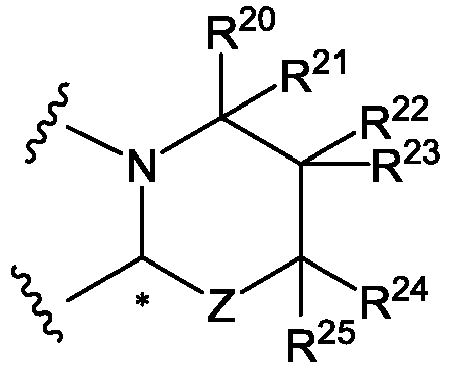
Z = O or NR26 (A-1);
R20 to R26 are each independently H or C1-C3 alkyl; - the stereochemistry of an asymmetric carbon represented by * shows R- or S-configuration, or a mixture thereof;
- R14 and RX are hydrogen;
- R3 is hydrogen;
- R1 is hydrogen;
- R is halogen; and
- m is an integer of 0 to 3;
- A ring is
- (2) Also provided herein is a compound according to the above (1), pharmaceutically acceptable salt, or solvate thereof, wherein one of R20 to R25 is C1 to C3 alkyl and the others are hydrogens.
- (3) A compound according to the above (1) or (2) wherein the pharmaceutically acceptable salt is a sodium salt.
- (4) A pharmaceutical composition comprising a compound according to any one of the above (1) to (3), or a pharmaceutically acceptable salt, or solvate thereof.
- (5) A pharmaceutical composition according to the above (4), which is an anti-HIV agent.
- The present invention further provides a pharmaceutical composition containing any of the compounds shown above, a pharmaceutically acceptable salt or a solvate thereof, especially an anti-HIV agent.
- The present invention compounds possess an integrase inhibitory activity and/or a cell-growth inhibitory activity against virus, especially HIV. Accordingly, they are useful for the prevention or treatment of various diseases mediated by integrase or virus infection diseases (e.g., AIDS).
- "C1 to C3 alkyl" means a straight or branched C1 to C3 alkyl, more preferred is methyl, ethyl or n-propyl.
- R preferably locates at the 4-position and optional another position of the benzene ring.
- In one embodiment, R20 to R25 each is preferably hydrogen.
- In one embodiment, R26 is preferably hydrogen or C1-3 alkyl. The structure of compound (I-1-1) has at least the following characteristics.
- (1) The main structure, condensed heterocycle, is substituted with oxo (=O), hydroxyl (OH) and oxo.
- (2) A substituted carbamoyl group (-CONHCH2PhRm) is attached to the position neighboring to the oxo group on the condensed hereocycle. The above structure contributes to a remarkably potent integrase inhibitory activity and/or cell-growth inhibitory activity against virus including HIV. In contrast, the structures of the other parts of the compounds disclosed herein, such as ring A may be of variety, while maintaining integrase inhibitory activity.
- The present invention provides a pharmaceutically acceptable salt or a solvate of compound (I-1-1). All theoretically possible tautomer, geometrical isomer, optically active compound, and racemate thereof are within the scope of the invention.
- Pharmaceutically acceptable salts of a compound of the present invention include, as basic salts, for example, alkali metal salts such as sodium or potassium salts; alkaline-earth metal salts such as calcium or magnesium salts; ammonium salts; aliphatic amine salts such as trimethylamine, triethylamine, dicyclohexylamine, ethanolamine, diethanolamine, triethanolamine or procaine salts; aralkyl amine salts such as N, N-dibenzylethylenediamine salts; heterocyclic aromatic amine salts such as pyridin salts, picoline salts, quinoline salts or isoquinoline salts; quaternary ammonium salts such as tetramethylammonium salts, tetraethylammonium salts, benzyltrimethylammonium salts, benzyltriethylammonium salts, benzyltributylammonium salts, methyltrioctylammonium salts or tetrabutylammonium salts; and basic amino acid salts such as arginine salts or lysine salts. Acid salts include, for example, mineral acid salts such as hydrochloride, sulfates salts, nitrate salts, phosphates salts, carbonates salts, hydrogencarbonates or perchlorate; organic acid salts such as acetates, propionates, lactates, maleates, fumarates, tararic acid salts, malates, citrates salts, ascorbates, formic acid; sulfonates such as methanesulfonates, isethionates, benzenesulfonates, or p-toluenesulfonates; and acidic amino acid salts such as aspartates or glutamates.
- Solvates of a compound of the present invention include alcholates and hydrates.
- A general process for producing compounds such as those now claimed will be exemplified below.
-

- Examples of a hydroxy protecting group (P1, P2) include acyl (e.g.: acetyl, pivaloyl, benzoyl), aralkyl (e.g.: benzyl), lower alkyl (e.g.: methyl), alkoxyalkyl (e.g.: methoxymethyl, methoxyethyl), lower alkylsulfonyl (e.g.: methanesulfonyl), arylsulfonyl (e.g.: benzenesulfonyl, toluenesulfonyl), alkoxycarbonyl (e.g.: methoxycarbonyl) and the like.
- As a carboxy protecting group (P3), lower alkyl (e.g.; methyl, ethyl), and aralkyl (e.g.: benzyl) are exemplified.
- The present step is a reaction for condensing a compound (II) and a compound (III) to synthesize a compound (IV). The reaction may be performed according to the condition for a reaction of amidating carboxylic acid which is generally performed. A compound (II) may be reacted as it is, or may be reacted after converted into corresponding acid chloride or active ester. Preferably, the reaction is performed in a suitable solvent in the presence of a condensing agent.
- As a condensing agent, dicyclohexylcarbodiimide, 1-ethyl-3-(3-dimethylaminopropyl)carbodiimide hydrochloride and the like may be used. If necessary, a reagent such as 1-hydroxybenzotriazole and N-hydroxysuccinimide, or a base such as triethylamine, N-methylmorpholine, and pyridine may be added.
- A reaction temperature is 0 to 150°C, preferably room temperature to 70°C.
- As a reaction solvent, a non-protonic solvent can be broadly used, and tetrahydrofuran (THF), 1,4-dioxane, dimethylformamide (DMF), methylene chloride, chloroform and the like are preferable.
- A reaction time is a few minutes to a few tens hours, preferably 9 to 17 hours.
- The present step is a reaction for introducing a protected hydroxy group (OP1) into a compound (IV) to produce a compound (V). The reaction may be performed according to the condition for an alkoxylating reaction which is generally performed.
- For example, a compound (V) in which P1 is methyl can be synthesized by reacting a compound (IV) with metal alkoxide (e.g.: sodium methoxide).
- A reaction temperature is 0 to 200°C, preferably 80 to 120°C.
- As a reaction solvent, alcohol, dimethylformamide (DMF), and dimethyl sulfoxide (DMSO) are exemplified.
- A reaction time is a few minutes to a few tens hours, preferably 5 to 10 hours.
- The present step is a reaction for protecting a hydroxy group of a compound (V) to produce a compound (VI). The reaction may be performed according to the condition for a reaction of protecting a hydroxy group which is generally performed. For example, by using diisopropyl azodicarboxylate or diethyl azodicarboxylate together with an alcohol and various phosphines, a compound (VI) in which P2 is alkyl can be synthesized.
- A reaction temperature is 0 to 100°C, preferably 0°C to room temperature.
- As a reaction solvent, THF, toluene, dichloromethane and the like are exemplified.
- A reaction time is a few minutes to a few tens hours, preferably 1 to 3 hours.
- The present step is a reaction of oxidizing a nitrogen atom of a compoung (VI) to produce a compound (VII). The reaction may be performed according to the condition for an oxidation reaction using an oxidizing agent which is generally performed.
- A reaction temperature is 0 to 100°C, preferably under ice-cooling to room temperature.
- As a reaction solvent, chloroform, methylene chloride, acetic acid and the like are exemplified.
- Examples of an oxidizing agent include metachloroperbenzoic acid, hydrogen peroxide and the like.
- A reaction time is a few minutes to a few tens hours, preferably 1 to 5 hours.
- The present step is a reaction for hydroxylating a methyl group of a compound (VII). Preferably, after acetoxylation by a reaction with acetic anhydride (reaction temperature: 0 to 150°C, preferably 120 to 140°C), this may be hydrolyzed (e.g.: treatment with a base (e.g.: alkali metal hydroxide)).
- A reaction time is a few minutes to a few tens hours, preferably 0.5 to 2 hours for acetoxylation, and 0.5 to 1 hour for hydrolysis.
- The present step is a reaction for oxidizing a hydroxy group of a compound (VIII) to synthesize a compound (IX).
- A reaction temperature is 0 to 150°C, preferably room temperature to 70°C.
- As a reaction solvent, chloroform and the like are exemplified.
- As an oxidizing agent, dimethyl sulfoxide and the like are exemplified.
- A reaction time is a few minutes to a few tens hours, preferably 0.1 to 1 hour.
- The present step is a reaction for oxidizing a formyl group of a compound (IX) to synthesize a compound (X).
- A reaction temperature is 0 to 150°C, preferably under ice-cooling to room temperature.
- As a reaction solvent, an alcohol and the like are exemplified.
- As an oxidizing agent, potassium hydroxide and iodine are exemplified.
- A reaction time is a few minutes to a few tens hours, preferably 0.5 to 3 hours.
- The present step is a reaction for deprotecting an OP2 part of a compound (X) to synthesize a compound (XI). The reaction may be performed according to the condition for a reaction of deprotecting a hydroxy protecting group which is generally performed.
- A reaction temperature is 0 to 150°C, preferably under ice-cooling to room temperature.
- As a reaction solvent, acetonitrile, methylene chloride, THF and the like are exemplified.
- A reaction time is a few minutes to a few tens hours, preferably 1 to 3 hours.
- The present step is a reaction for deprotecting an OP1 part of a compound (XI) to synthesize a compound (I-A). The reaction may be treated preferably with a Lewis acid (e.g.: aluminum chloride).
- A reaction temperature is 0 to 150°C, preferably 10 to 50°C.
- As a reaction solvent, methylene chloride, THF and the like are exemplified.
- A reaction time is a few minutes to a few tens hours, preferably 1 to 3 hours.
- The present step is a reaction for deprotecting an ester part (COOP3) of a compound (X) to synthesize carboxylic acid (XII). Preferably, hydrolysis with an alkali (e.g.: NaOH) may be performed.
- A reaction temperature is 0 to 150°C, preferably 10 to 50°C.
- As a reaction solvent, methanol, water and the like are exemplified.
- A reaction time is a few minutes to a few tens hours, preferably a few minutes to 2 hours.
- Carboxylic acid (XII) can be converted into various derivatives (e.g.; amide).
- The present step is a reaction for reacting a compound (XII) with various amines to synthesize a compound (XIII). The reaction may be performed according to the condition for a reaction of amidating carboxylic acid which is generally performed and, for example, the reaction may be performed as in the first step.
- A reaction temperature is 0 to 150°C, preferably room temperature to 70°C.
- As a reaction solvent, a non-protonic solvent can be broadly used, and tetrahydrofuran (THF), 1,4-dioxane, dimethylformamide (DMF), methylene chloride, chloroform and the like are preferable.
- A reaction time is a few minutes to a few tens hours, preferably a few minutes to 3 hours.
- An amide part of the resulting compound (XIII) may be further chemically modified (e.g.: N-alkylation).
- The present step is a reaction for deprotecting OP1 and OP2 parts of a compound (XIII) to synthesize a compound (I-B). The reaction may be performed according to the condition for a reaction of deprotecting a hydroxy protecting group which is generally performed.
- For example, when pyridine hydrochloride is used, a reaction temperature is 0 to 200°C, preferably 150 to 180 degree.
- A reaction time is a few minutes to a few tens hours, preferably 1 to 5 minutes.
- The present step is a reaction for deprotecting an ester part (COOP3) of a compound (XI) to synthesize carboxylic acid (XIV). Preferably, hydrolysis with an alkali (e.g.: lithium hydroxide) may be performed.
- A reaction temperature is 0 to 150°C, preferably 10 to 50°C.
- As a reaction solvent, methanol, water and the like are exemplified.
- A reaction time is a few minutes to a few tens hours, preferably a few minutes to 3 hours.
- The present step is a reaction for deprotecting an OP1 part of a compound (XIV) to synthesize a compound (I-C). The reaction may be treated preferably with a Lewis acid (e.g.: boron tribromide).
- A reaction temperature is 0 to 150°C, preferably under ice-cooling to room temperature.
- As a reaction solvent, dichloromethane and the like are exemplified.
- A reaction time is a few minutes to a few tens hours, preferably a few minutes to 5 hours.
- The monocyclic carbamoylpyridone derivative obtained above is derived into a bicyclic compound by the following method.
-


- The present step is a reaction for reacting the compound (XI) or a compound (XI') which is a tautomer thereof with an allyl compound to synthesize a compound (XV). A compound (XI') can be synthesized, for example, according to the method of Example A-1.
- The reaction is performed preferably in the presence of a base (e.g.: cesium carbonate).
- A reaction temperature is 0 to 100°C, preferably 10 to 40°C.
- As a reaction solvent, dimethylformamide and the like are exemplified.
- A reaction time is a few minutes to a few tens hours, preferably 1 to 10 hours.
- The present step is a reaction for oxidizing a compound (XV) to synthesize a compound (XVI). As an oxidizing agent, osmium tetraoxide and alkali metal osmium tetraoxide (e.g.:K2OsO4) are exemplified.
- A reaction temperaturwe is 0 to 100°C, preferably 10 to 40°C.
- As a reaction solvent, 1,4-dioxane, tetrahydrofuran and the like are exemplified.
- A reaction time is a few minutes to a few tens hours, preferably 1 to 5 hours.
- The present step is a reaction for reacting a compound (XVI) with amine (XVII) to perform dehydration condensation to synthesize a compound (XVIII).
- A reaction temperature is 0 to 200°C, preferably 140 to 180°C.
- As a reaction solvent, methylene chloride, acetonitrile and the like are exemplified.
- A reaction time is a few minutes to a few tens hours, preferably 0.5 to 1.5 hours.
- The present step is a reaction for deprotecting a compound (XVIII) preferably with an acid to synthesize a compound (XIX), and may be performed according to the condition for a conventional reaction of deprotecting a protected hydroxy group.
- A reaction temperature is 0 to 200°C.
- As an acid, pyridine hydrochloride, trifluoroacetic acid and the like are exemplified.
- As a reaction solvent, the acid and trimethylsilyl iodide are exemplified.
- A reaction time is a few minutes to a few tens hours, preferably 15 minutes to 1 hour.
- The present step is a reaction for reducing a compound (XVIII) to synthesize a compound (XX).
- As a reducing agent, H2/Pd • C and the like are exemplified.
- A reaction temperatuer is 0 to 100°C, preferably 10 to 30°C.
- As a reaction sovelnt, dimethylformamide, methanol, tetrahydrofuran and the like are exemplified.
- A reaction time is a few minutes to a few tens hours, preferably 5 to 20 hours.
- The intermediate (XVIII) may be also synthesized by a method shown below.

- The present step is a reaction for reacting a compound (XIV) with a compound (XXI) to synthesize a compound (XXII). The present reaction may be performed according to the condition for a conventional amidation reaction.
- A reaction temperature is 0 to 100°C, preferably 0 to 50°C.
- As a reaction solvent, dimethylformamide, methylene chloride, tetrahydrofuran and the like are exemplified.
- A reaction time is a few minutes to a few tens hours, preferably 1 to 10 hours.
- The present step is a reaction for reacting a compound (XXII) with an acid to perform deprotection and intramolecular ring closure, to synthesize a compound (XXIII). The present reaction may be performed according to the condition for a conventional reaction of deprotecting acetal.
- A reaction temperature is 0 to 100°C, preferably room temperature to 80°C.
- As a reaction solvent, dioxane, tetrahydrofuran and the like are exemplified.
- A reaction time is a few minutes to a few tens hours, preferably 0.5 to 1 hour.
- As an acid, hydrochloric acid, and paratoluenesulfonic acid are exemplified.
- The present step is a reaction for dehydrating a compound (XXIII) to synthesize a compound (XXIV). The present reaction may be peformed according to the condition for a conventional dehydration reaction.
- A reaction temperature is 0 to 100°C, preferably room temperature to 80°C.
- As a reaction solvent, acetonitrile, methylene chloride and the like are exemplified.
- A reaction time is a few minutes to a few tens hours, preferably 1 to 5 hours.
-

- The present step is a reaction for reacting a compound (XVI) with amine (XXIV) to perform dehydration condensation to synthesize a compound (XXV) according to the seventeenth step or a method of synthesizing a compound 17-1. Preferably, as a reaction catalyst, an acid (e.g.: acetic acid) is added, and a microwave reaction apparatus is used.
- A reaction temperature is 0 to 200°C, preferably 140 to 180°C.
- As a reaction solvent, methylene chloride, acetonitrile and the like are exemplified.
- A reaction time is a few minutes to a few tens hours, preferably 0.5 to 1.5 hours.
- The present step is a reaction for deprotecting a compound (XXV) preferably with an acid to synthesize a compound (XXVI) according to the eighteenth step, and may be performed according to the condition for a conventional reaction of deprotecting a protected hydroxy group.
- A reaction temprature is 0 to 200°C.
- As an acid, pyridine hydrochloride, trifluoroacetic acid and the like are exemplified.
- As a reaction solvent, the aforementioned acid and trimethylsilyl iodide are exemplified.
- A reaction time is a few minutes to a few tens hours, preferably 15 minutes to 1 hour.
-


- The present step is a reaction for reacting a compound (XIV) with a compound (XXIV) to synthesize a compound (XXVII) according to the twentieth step. The present reaction may be performed according to the condition for a conventional amidation reaction.
- A reaction temperature is 0 to 100°C, preferably 0 to 50°C.
- As a reaction solvent, dimethylformamide, methylene chloride, tetrahydrofuran and the like are exemplified.
- A reaction time is a few minutes to a few tens hours, preferably 1 to 10 hours.
- The present step is a reaction for reacting a compound (XXVII) or a tautomer thereof with an allyl compound to synthesize a compound (XXVIII) according to the fifteenth step.
- A reaction is performed preferably in the presence of a base (e.g.: cesium carbonate).
- A reaction temperature is 0 to 100°C, preferably 10 to 40°C.
- As a reaction solvent, dimethylformamide and the like are exemplified.
- A reaction time is a few minutes to a few tens hours, preferably 1 to 10 hours.
- The present step is a reaction for oxidizing a compound (XXVIII) to synthesize a compound (XXIX) according to the sixteenth step.
- As an oxidizing agent, osmium tetraoxide and alkali metal osmium tetraoxide (e.g.: K2OsO4) are exemplified.
- A reaction temperature is 0 to 100°C, preferably 10 to 40°C.
- As a reaction solvent 1,4-dioxane, tetrahydrofuran and the like are exemplified.
- A reaction time is a few minutes to a few tens hours, preferablky 1 to 5 hours.
- The present step is a reaction for dehydration-condensing a compound (XXIX) to synthesize a compound (XXX) according to the seventeenth step or a method of synthesizing a compound 17-1. Preferably, as a reaction catalyst, an acid (e.g.: acetic acid) is added, and a microwave reaction apparatus is used.
- A reaction temperature is 0 to 200°C, preferably 140 to 180°C.
- As a reaction solvent, methylene chloride, acetonitrile and the like are exemplified.
- A reaction time is a few minutes to a few tens hours, preferably 0.5 to 1.5 hours.
- The present step is a reaction for deprotecting a compound (XXX) preferably with an acid to synthesize a compound (XXXI) according to the eighteenth step, and may be peformed according to the condition for a conventional reaction of deprotecting a protected hydroxy group.
- A reaction temperature is 0 to 200°C.
- As an acid, pyridine hydrochloride, trifluoroacetic acid and the like are exemplified.
- As a reaction solvent, the aforementioned acid and trimethylsilyl iodide are exemplified.
- A reaction time is a few minutes to a few tens hours, preferably 15 minutes to 1 hour.
- A compound (I-3) in which Z is NR19 can be synthesized according to the following reaction scheme, according to Process 4.


-


- A compound (XIV-16) is obtained by reacting a compound (XIV) with an amine reagent, according to the thirty-fifth step.
- A compound (XIV-17) is obtained by subjecting a compound (XIV-16) to a general acetal deprotecting reaction according to the forty-fourth step.
- A compound (XIV-18) is obtained (D ring formation) by deprotecting a P1 part of a compound (XIV-14) according to the thirty-eighth step.
- Various intermediates (I-P) are shown below..
- In the following, P1 is a hydroxyl-protecting group; the other symbols are as defined above.
- Preferred compounds are shown below. Each P1 is a hydroxyl-protecting group, such as C6-14arylC1-8alkyl (e.g., benzyl (=Bn)).
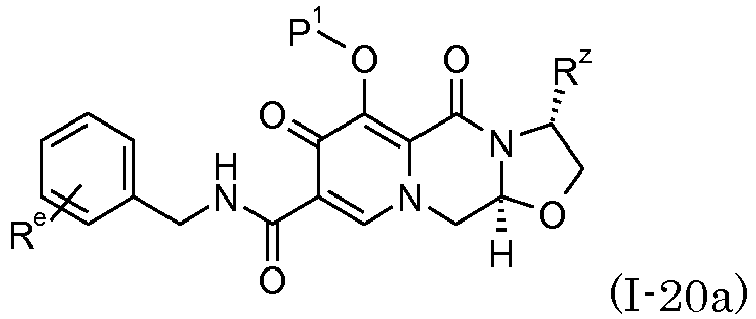
- Preferably, wherein Re is one or two halogen; Rz is C1-8alkyl, C6-14arylC1-8alkyl, C6-14aryl, or alkoxy; and P1 is C6-14arylC1-8alkyl;

- Preferably, wherein Re is one or two halogen; Rz is C1-8alkyl, C6-14arylC1-8alkyl, C6-14aryl, or alkoxy; and P1 is C6-14arylC1-8alkyl;
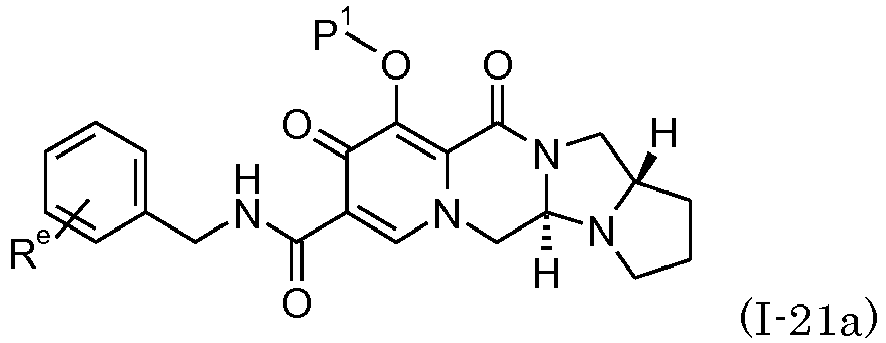
- Preferably, wherein Re is one or two halogen; and P1 is C6-14arylC1-8alkyl;

- Preferably, wherein Re is one or two halogen; and P1 is C6-14arylC1-8alkyl;

- Preferably, wherein Re is one or two halogen; and P1 is C6-14arylC1-8alkyl;

- Preferably, wherein Re is one or two halogen; and P1 is C6-14arylC1-8alkyl;
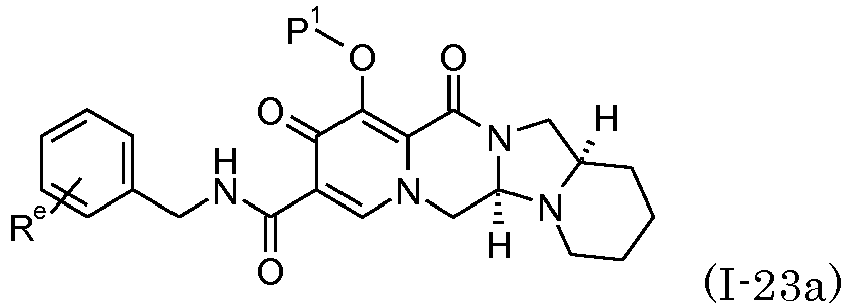
- Preferably, wherein Re is one or two halogen; and P1 is C6-14arylC1-8alkyl;

- Preferably, wherein Re is one or two halogen; and P1 is C6-14arylC1-8alkyl;

- Preferably, wherein Re is one or two halogen; Rz is C1-8alkyl; Rz1 is hydrogen, C3-6cycloalkyl, , heterocycle, or C1-8alkyl optionally substituted with hydroxy, C3-6cycloalkyl, alkoxy, heterocycle, heteroaryl, C6-14aryl, or amino, wherein said amino may be optionally substituted with -C(O)C1-8alkyl or C1-8alkyl;
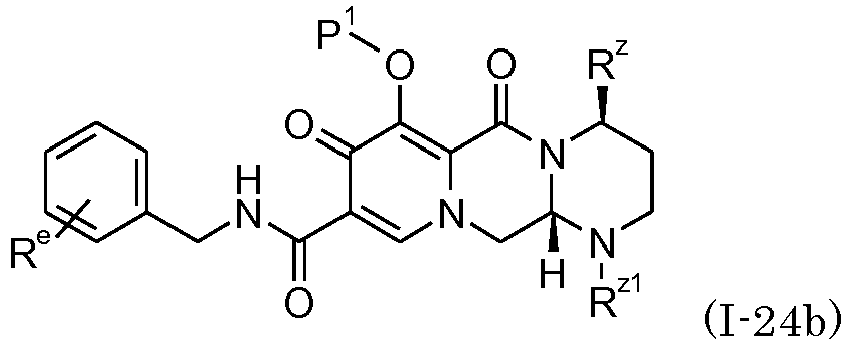
- Preferably, wherein Re is one or two halogen; Rz is C1-8alkyl; Rz1 is hydrogen, C3-6cycloalkyl, , heterocycle, or C1-8alkyl optionally substituted with hydroxy, C3-6cycloalkyl, alkoxy, heterocycle, heteroaryl, C6-14aryl, or amino, wherein said amino may be optionally substituted with -C(O)C1-8alkyl or C1-8alkyl; and P1 is C6-14arylC1-8alkyl;

- Preferably, wherein Re is one or two halogen; Rz1 is hydrogen, C3-6cycloalkyl, , heterocycle, or C1-8alkyl optionally substituted with hydroxy, C3-6cycloalkyl, alkoxy, heterocycle, heteroaryl, C6-14aryl, or amino, wherein said amino may be optionally substituted with -C(O)C1-8alkyl or C1-8alkyl;and P1 is C6-14arylC1-8alkyl;

- Preferably, wherein Re is one or two halogen; Rz1 is hydrogen, C3-6cycloalkyl, , heterocycle, or C1-8alkyl optionally substituted with hydroxy, C3-6cycloalkyl, alkoxy, heterocycle, heteroaryl, C6-14aryl, or amino, wherein said amino may be optionally substituted with -C(O)C1-8alkyl or C1-8alkyl; and P1 is C6-14arylC1-8alkyl;

- Preferably, wherein Re is halogen; and P1 is C6-14arylC1-8alkyl;
- The above intermediates, compound (I-20a), (I-20b), (I-21a), (I-21b), (I-22a), (I-22b), (I-23a), (I-23b), (I-24a), (I-24b), (I-25), (I-26), or (I-27), can be prepared by condensing a compound of the formula:

with each amine shown below, respectively:


- The condition for the above condensation is illustrated below for example.
- Examples of the solvent include halocarbons such as dichloromethane, dichloroethane, and acetic acid.
- The reaction temperature is preferably, 0 to 200 °C, more preferably, 50 to 170°C.
- The reaction time is usually several minutes to several hours.
- The above intermediates, compound (I-20a), (I-20b), (I-21a), (I-21b), (I-22a), (I-22b), (I-23a), (I-23b), (I-24a), (I-24b), (I-25), (I-26), or (I-27), can be deprotected to give each corresponding deprotected compound wherein P1 is hydrogen, or its pharmaceutically acceptable salt, which are encompassed within the scope of compound (I) of the present invention.
- In addition, the present compound obtained above may be further chemically modified to synthesize another compound. In addition, when there is a reactive functional group (e.g.: OH, COOH, NH2) on a side chain part etc. in the above reaction, the group may be protected before the reaction and may be deprotected after the reaction, if desired.
- The present compound is useful, for example, as a drug such as an anti-virus drug. The present compound has the remarkable inhibitory action on integrase of a virus. Therefore, the present compound can be expected to have the preventive or therapeutic effect for various diseases derived from a virus which produces at least integrase, and is grown at infection in an animal cell, and is useful as an integrase inhibiting agent for retrovirus (e.g. HIV-1, HIV-2, HTLV-1, SIV, FIV etc.), and is useful as an anti-HIV drug etc.
- In addition, the present compound may be used in joint use therapy by combining an anti-HIV drug having the different action methanism such as a reverse trascriptase inhibiter and/or a protease inhibiting agent. Particularly, currently, an integrase inhibiter is not marketed, and it is useful to use in joint use therapy by combining the present compound with a reverse transcriptase inhibiter and/or a protease inhibiter.
- Further, the above use includes not only use as a medical mixture for anti-HIV, but also use as a joint use agent for increasing the anti-HIV activity of other anti-HIV drug such as cocktail therapy.
- In addition, the present compound can be used in order to prevent infection with a retrovirus vector from spreading into a tissue other than an objective tissue, upon use of a retrovirus vector based on HIV or MLV in the field of gene therapy. Particularly, when a cell is infected with a vector in vitro, and the cell is returned into a body, if the present compound is administered in advance, extra infection can be prevented in a body.
- The present compound can be administered orally or parenterally. In the case of oral administration, the present compound can be also used as a conventional preparation, for example, as any dosage form of a solid agent such as tablets, powders, granules, capsules and the like; an aqueous agent; an oily suspension; or a liquid agent such as syrup and elixir. In the case of parenteral administration, the present compound can be used as an aqueous or oily suspension injectable, or a nasal drop. Upon preparation of it, conventional excipients, binders, lubricants, aqueous solvents, oily solvents, emulsifiers, suspending agents, preservatives, stabilizers and the like may be arbitrarily used. As an anti-HIV-drug, particularly, an oral agent is preferable. A preparation of the present invention is prepared by combining (e.g. mixing) a therapeutically effective amount of the present compound with a pharmaceutically acceptable carrier or diluent.
- A dose of the present invention is different depeniding on an administration method, an age, a weight and condition of a patient, and a kind of a disease and, usually, in the case of oral administraton, about 0.05mg to 3000mg, preferably about 0.1mg to 1000mg may be administered per adult a day, if necessary, by dividing the dose. In addition, in the case of parenteral administration, about 0.01mg to 1000mg, preferably about 0.05mg to 500mg is administered per adult a day.
- Examples are shown below. Examples corresponding to compounds which are no longer claimed are included as reference Examples.
-

- 1) Mantol 1 (189g, 1.5mol) was dissolved in dimethylformamide (1890ml), and benzyl bromide (184ml, 1.5mol) was added. After the solution was stirred at 80°C for 15 minutes, potassium carbonate (228g, 1.65mol) was added, and the mixture was stirred for 1 hour. After the reaction solution was cooled to room temperature, an inorganic salt was filtered, and the filtrate was distilled off under reduced pressure. To the again precipitated inorganic salt was added tetrahydrofuran (1000ml), this was filtered, and the filtrate was distilled off under reduced pressure to obtain the crude product (329g, >100%) of 3-benzyloxy-2-methyl-pyran-4-one 2 as a brown oil.
NMR (CDCl3)δ: 2.09(3H, s), 5.15(2H, s), 6.36(1H, d, J=5.6Hz), 7.29-7.41(5H, m), 7.60(1H, d, J=5.6Hz). - 2) The compound 2 (162.2g, 750mmol) was dissolved in ethanol (487ml), and aqueous ammonia (28%, 974ml) and a 6N aqueous sodium hydroxide solution (150ml, 900mmol) were added. After the reaction solution was stirred at 90 °C for 1 hour, this was cooled to under ice-cooling, and ammonium chloride (58g, 1080mmol) was added. To the reaction solution was added chloroform, this was extracted, and the organic layer was washed with an aqueous saturated sodium bicarbonate solution, and dried with anhydrous sodium sulfate. The solvent was distilled off under reduced pressure, isopropyl alcohol and diethyl ether were added to the residue, and precipitated crystals were filtered to obtain 3-benzyloxy-2-methyl-1H-pyridine-4-one 3 (69.1g, 43%) as a pale yellow crystal.
NMR (DMSO-d6)δ: 2.05(3H, s), 5.04(2H, s), 6.14(1H, d, J=7.0Hz), 7.31-7.42(5H, m), 7.46(1H, d, J=7.2Hz), 11.29(1H, brs). - 3) The above compound 3 (129g, 599mmol) was suspended in acetonitrile (1300ml), and N-bromosuccinic acid imide (117g, 659mmol) was added, followed by stirring at room temperature for 90 minutes. Precipitated crystals were filtered, and washed with acetonitrile and diethyl ether to obtain 3-benzyloxy-5-bromo-2-methyl-pyridine-4-ol 4(154g, 88%) as a colorless crystal.
NMR (DMSO-d6)δ: 2.06(3H, s), 5.04(2H, s), 7.32-7.42(5H, m), 8.03(1H, d, J=5.5Hz), 11.82(1H, brs). - 4) To a solution of the compound 4 (88g, 300mmol), palladium acetate (13.4g, 60mmol) and 1,3-bis(diphenylphosphino)propane (30.8g, 516mmol) in dimethylformamide (660ml) were added methanol (264ml) and triethylamine (210ml, 1.5mol) at room temperature. The interior of a reaction vessel was replaced with carbon monoxide, and the material was stirred at room temperature for 30 minutes, and stirred at 80 degree for 18 hours. A vessel to which ethyl acetate (1500ml), an aqueous saturated ammonium chloride solution (1500ml) and water (1500ml) had been added was stirred under ice-cooling, and the reaction solution was added thereto. Precipitates were filtered, and washed with water (300ml), ethyl acetate (300ml) and diethyl ether (300ml) to obtain 5-benzyloxy-4-hydroxy-6-methyl-nicotinic acid methyl ester 5 (44.9g, 55%) as a colorless crystal.
NMR (DMSO-d6)δ: 2.06(3H, s), 3.72(3H, s), 5.02(2H, s), 7.33-7.42(5H, m), 8.07(1H, s). - 5) After a solution of the compound 5 (19.1g, 70mmol) in acetic anhydride (134ml) was stirred at 130 °C for 40 minutes, the solvent was distilled off under reduced pressure to obtain 4-acetoxy-5-benzyloxy-6-methyl-nicotinic acid methyl ester 6 (19.9g, 90%) as a flesh colored crystal.
NMR (CDCl3)δ: 2.29(3H, s), 2.52(3H, s), 3.89(3H, s), 4.98(2H, s), 7.36-7.41(5H, m), 8.85(1H, s). - 6) To a solution of the compound 6 (46.2g, 147mmol) in chloroform (370ml) was added metachloroperbenzoic acid (65%) (42.8g, 161mmol) in portions under ice-cooling, and this was stirred at room temperature for 90 minutes. To the reaction solution was added a 10% aqueous potassium carbonate solution, and this was stirred for 10 minutes, followed by extraction with chloroform. The organic layer was washed with successively with a 10% aqueous potassium carbonate solution, an aqueous saturated ammonium chloride solution, and an aqueous saturated sodium chloride solution, and dried with anhydrous sodium sulfate. The solvent was distilled off under reduced pressure, and the residue was washed with diisopropyl ether to obtain 4-acetoxy-5-benzyloxy-6-methyl-1-oxy-nicotinic acid methyl ester 7 (42.6g, 87%) as a colorless crystal.
NMR (CDCl3)δ: 2.30(3H, s), 2.41(3H, s), 3.90(3H, s), 5.02(2H, s), 7.37-7.39(5H, m), 8.70(1H, s). - 7) To acetic anhydride (500ml) which had been heated to stir at 130 °C was added the compound 7 (42.6g, 129mmol) over 2 mintues, and this was stirred for 20 minutes. The sovent was distilled off under reduced pressure to obtain 4-acetoxy-6-acetoxymethyl-5-benzyloxy-nicotinic acid methyl ester 8 (49.6g, >100%) as a black oil.
NMR (CDCl3)δ: 2.10(3H, s), 2.28(3H, s), 3.91(3H, s), 5.07(2H, s), 5.20(2H, s), 7.35-7.41(5H, m), 8.94(1H, s). - 8) To a solution of the compound 8 (46.8g, 125mmol) in methanol (140ml) was added a 2N aqueous sodium hydroxide solution (376ml) under ice-cooling, and this was stirred at 50 °C for 40 minutes. To the reaction solution were added diethyl ether and 2N hydrochloric acid under ice-cooling, and precipitated crystals were filtered. Resulting crystals were washed with water and diethyl ether to obtain 5-benzyloxy-4-hydroxy-6-hydroxymethyl-nicotinic acid 9 (23.3g, 68%) as a colorless crystal.
NMR (DMSO-d6)δ: 4.49(2H, s), 5.19(2H, s), 5.85(1H, brs), 7.14-7.20(2H, m), 7.33-7.43(7H, m), 8.30(1H, s), 10.73(1H, t, J=5.8Hz), 11.96(1H, brs). - 9) To a solution of the compound 9 (131g, 475mmol), 1-(3-dimethylaminopropyl)-3-ethylcarbodiimide hydrochloride (219g, 1140mmol) and 1-hydroxybenzotriazole (128g, 950mmol) in dimethylformamide (1300ml) was added 4-fluorobenzylamine (109ml, 950mmol), and this was stirred at 80°C for 1.5 hours. After the reaction solution was cooled to room temperature, hydrochloric acid was added, followed by extraction with ethyl acetate. The extract was washed with a 5% aqueous potassium carbonate solution, an aqueous saturated ammonium chloride solution, and an aqueous saturated sodium chloride solution, and dried with anhydrous sodium sulfate. The solvent was distilled off under reduced pressure to obtain a mixture (175g) of 10 and 11. the resulting mixture was dissolved in acetic acid (1050ml) and water (1050ml), and zinc (31.1g, 475mmol) was added, followed by heating to reflux for 1 hour. After the reaction solution was cooled to room tempreture, a 10% aqueous potassium carbonate solution was added, followed by extraction with ethyl acetate. The extract was washed with an aqueous saturated ammonium chloride solution, and an aqueous saturated sodium chloride solution, and dried with anhydrous sodium sulfate. After the solvent was distilled off under reduced pressure, this was washed with diethyl ether to obtain 5-benzyloxy-N-(4-fluoro-benzyl)-4-hydroxy-6-hydroxymethyl-nicotinic acid amide 10 (107g, 59%) as a colorless crystal.
NMR (DMSO-d6)δ: 4.45(2H, d, J=4.3Hz), 4.52(2H, d, J=5.8Hz), 5.09(2H, s), 6.01(1H, brs), 7.36-7.43(5H, m), 8.31(1H, s), 12.63(1H, brs). - 10) After manganese dioxide (49g) was added to a suspension of the compound 10 (9.8g, 25.6mmol) in chloroform (490ml), the mixture was stirred at room temperature for 1 hour. After the reaction solution was stirred at 60 °C for 20 minutes, Celite filtration was performed, and this was washed with chloroform heated at 50 °C. The filtrate was distilled off under reduced pressure to obtain 5-benzyloxy-N-(4-fluoro-benzyl)-6-formyl-4-hydroxy-nicotinic acid amide 12 (8.2g, 84%) as a pale yellow crystal.
NMR (DMSO-d6)δ: 4.53(2H, d, J=5.8Hz), 5.38 (2H, s), 7.15-7.21(2H, m), 7.35-7.46(7H, m), 8.33(1H, s), 9.90(1H, s), 10.35(1H, t, J=5.8Hz), 12.49(1H, brs). - 11) To an aqueous solution (105ml) of sodium chlorite (7.13g, 78.8mmol), and sulfamic acid (7.65g, 78.8mmol) was added a solution of the compound 12 (15.0g, 39.4mmol) in tetrahydrofuran (630ml) under ice-coling, and the mixture was stirred at room temperature for 1 hour. After water (2500ml) was added to the reaction solution, precipitated crystals were filtered. Washing with diethyl ether afforded 3-benzyloxy-5-(4-fluoro-benzylcarbamoyl)-4-hydroxy-pyridine-2-carboxylic acid 13 (14.0g, 90%) as a colorless crystal.
NMR (DMSO-d6)δ: 4.52(2H, d, J=5.8Hz), 5.13 (2H, s), 7.14-7.19(2H, m), 7.31-7.40(5H, m), 7.47-7.49(2H, m), 8.31(1H, d, J=4.5Hz), 10.44(1H, t, J=5.9Hz), 12.47(1H, brs). - 12) A solution of the compound 13 (198mg, 0.500mmol), 1-(3-dimethylaminopropyl)-3-ethylcarbodiimide hydrochloride (115mg, 0.600mmol) and 1-hydroxybenzotriazole (81mg, 0.600mmol) in dimethylformamide (3ml) was stirred at room temperature for 1.5 hours. Then, methanol (3ml) and triethylamine (153ul, 1.10mmol) were added, and the mixture was heated to reflux for 1.5 hours. The reaction solution was diluted with ethyl acetate, washed with an aqueous saturated sodium bicarbonate solution, a 10% aqueous citric acid solution, and an aqueous saturated sodium chloride solution, and dried with anhydrous sodium sulfate. The solvent was distilled off under reduced pressure, and the residue was washed with diethyl ether to obtain 3-benzyloxy-5-(4-fluoro-benzylcarbamoyl)-4-hydroxy-pyridine-2-carboxylic acid methyl ester 14 (141mg, 69%) as a colorless crystal.
NMR (DMSO-d6)δ: 3.85(3H, s), 4.52(2H, d, J=6.0Hz), 5.15(2H, s), 7.13-7.21(2H, m), 7.31-7.47(7H, m), 8.33(1H, s), 10.41(1H, t, J=6.0Hz), 12.59(1H, brs). - 13) After 3-bromopropene (2.15ml, 24.8mmol) was added to a solution of the compound 14 (6.79g, 16.5mmol), and cesium carbonate (8.09g, 24.8mmol) in dimethylformamide (54ml), the mixture was stirred at room temperature for 4.5 hours. To the reaction solution was added an aqueous ammonium chloride solution, and this was extracted with ethyl acetate, washed with water and an aqueous saturated sodium chloride solution, and dried with anhydrous sodium sulfate. The solvent was distilled off under reduced pressure, and the residue was washed with diethyl ether to obtain 1-allyl-3-benzyloxy-5-(4-fluoro-benzylcarbamoyl)-4-oxo-1,4-dihydro-pyridine-2-carboxy lic acid methyl ester 15 (6.15g, 83%) as a colorless crystal.
NMR (CDCl3) δ: 3.76(3H, s), 4.54(2H, d, J=6.0Hz), 4.60(2H, d, J=6.0Hz), 5.20-5.37(2H, m), 5.25(2H, s), 5.80-5.93(1H, m), 6.98-7.04(2H, m), 7.31-7.35(7H, m), 8.45(1H, s), 10.41(1H, m). - 14) To a solution of the compound 15 (7.6g, 16.9mmol) in 1,4-dioxane (228ml) was added an aqueous solution (38ml) of potassium osmate dihydrate (372mg, 1.01mmol), and sodium metaperiodate (14.5g, 67.6mmol) was further added, followed by stirring at room temperature for 2 hours. The reaction solution was added to a vessel to which ethyl acetate (300ml) and water (300ml) had been added, while stirring. The organic layer was washed with water, a 5% aqueous sodium hydrogen sulfite solution and an aqueous saturated sodium chloride solution, and dried with anhydrous sodium sulfate. The solvent was distilled off under reduced pressure, and the residue was washed with diethyl ether to obtain 3-benzyloxy-5-(4-fluoro-benzylcarbamoyl)-4-oxo-1-(2-oxo-ethyl)-1,4-dihydro-pyridine-2 -carboxylic acid methyl ester 16 (5.39g, 71%) as a colorless crystal.
NMR (CDCl3)δ: 3.74(3H, s), 4.60(2H, d, J=5.9Hz), 4.87(2H, s), 5.27(2H, s), 6.98-7.04(2H, m), 7.30-7.40(7H, m), 8.39(1H, s), 9.58(1H, s), 10.38(1H, s). - 15) To a solution of the compound 16 (400mg, 0.884mmol) in methylene chloride (12ml) were added 2-methoxyethylamine (77ul, 0.884mmol) and acetic acid (18ul), and the mixture was stirred at room temperature for 5 minutes. Thereafter, the reaction was performed at 140 °C for 30 minutes in a microwave reaction apparatus. The solvent was distilled off under reduced pressure, the residue was subjected to silica gel column chromatography, and fractions eluting with toluene-acetone were concentrated under reduced pressure to obtain 9-benzyloxy-2-(2-methy-ethyl)-1,8-dioxo-1,8-dihydro-2H-pyrid[1,2-a]pyrazine-7-carbox ylic acid 4-fluoro-benzylamide 17-1 (226mg, 54%) as a yellow solid.
NMR (CDCl3)δ: 3.35(3H, s), 3.65(2H, t, J=5.1Hz), 3.97(2H, t, J=4.5Hz), 4.63(2H, d, J=5.7Hz), 5.28(2H, s), 6.56(2H, m), 7.01(2H, t, J=8.7Hz), 7.38-7.30(5H, m), 7.65(2H, d, J=6.6Hz), 10.63(1H, s). - 16) To the compound 17-1 (140mg, 0.293mmol) was added trifluoroacetic acid (1.4ml) under ice-cooling, and the mixture was stirred at 0 °C for 5 minutes and, then, at room temperature for 1.5 hours. The solvent was distilled off under reduced pressure, and this was diluted with chloroform, and added to ice water. This was washed with an aqueous saturated sodium bicarbonate solution, a 10% aqueous citric acid solution and water, and dried with anhydrous sodium sulfate. The solvent was distilled off under reduced pressure, and the residue was recrystallized with methylene chloride-ethanol to obtain Example A-1 (89mg, 79%) as a yellow crystal. melting point: 223-224 °C
NMR (DMSO-d6)δ: 3.25(3H, s), 3.58(2H, t, J=5.4Hz), 3.92(2H, t, J=5.1Hz), 4.53(2H, d, J=5.7Hz), 6.87(1H, d, 6.3Hz), 7.14(2H, t, J=9.0Hz), 7.33-7.38(2H, m), 7.47(1H, d, J=6.0Hz), 8.77(1H, s), 10.56(1H, t, J=6.0Hz), 12.00(1H, brs). - 17) The compound 17-1 (157mg, 0.329mmol) was dissolved in dimethylformamide (18ml) and methanol (1ml), 10% palladium-carbon powder (31mg) was added, and the mixture was stirred at room temperature for 20 hours under the hydrogen atmosphere. The reaction solution was filtered with Celite, and the filtrate was concentrated under reduced pressure. The residue was dissolved in chloroform, this was filtered with Celite again, and the filtrate was concentrated under reduced pressure. The residue was recrystallized with methylene chloride-methanol to obtain Example B-1 (66mg, 52%) as a browm crystal.
melting point: 197-199 °C
NMR (DMSO-d6)δ:3.27(3H, s), 3.55(2H, t, J=5.1Hz), 3.68(2H, t, J=5.1Hz), 3.79(2H, s), 4.36(2H, s), 4.51(2H, d, J=5.7Hz), 7.15(2H, t, J=8.7Hz), 7.32-7.37(2H, m), 8.38(1H, s), 10.46(1H, t, J=5.4Hz), 12.41(1H, s). -

- 1) A compound 33 was synthesized using 1-aminomethylcyclopentanol hydroxyethylamine according to the method of synthesizing a compound 17-1.
1H-NMR (CDCl3)δ: 1.30-1.80(10H, m), 3.47(1H, d, J=11.4Hz), 3.61(1H, d, J=11.4Hz), 3.80-3.95(1H, m), 4.30(1H, dd, J=14.7, 3.0Hz), 4.60(2H, d, J=5.7Hz), 5.17-5.23(2H, m), 5.39(1H, d, J=9.9Hz), 6.95-7.10(2H, m), 7.20-7.40(5H, m), 7.58(2H, d, J=7.2Hz), 8.41(1H, s), 10.40(1H, s). - 2) A compound 33-2 was synthesized using hydroxyethylamine according to the similar method.
Compound 33-2) 5-Benzyloxy-4,6-dioxo-2,3,4,6,9,9a-hexahydro-1-oxa-3a,8a-diaza-cyclopenta[b]naphtha lene-7-carboxylic acid 4-fluorobenzylamide
1H-NMR (DMSO-d6)δ: 3.48-3.58(1H, m), 3.73-3.86(1H, m), 3.97-4.10(2H, m), 4.20-4.30(1H, m), 4.46-4.60(2H, m), 4.85(1H, dd, J=12.3, 3.5Hz), 5.40(1H, d, J=10.2Hz), 5.18(1H, d, J=10.2Hz), 5.28(1H, dd, J=10.2, 3.2Hz), 7.10-7.20(2H, m), 7.23-7.40(5H, m), 7.50-7.73(2H, m), 8.60(1H, s), 10.22(1H, m). - 3) Example C-1 was synthesized using a compound 33, according to the method of synthesizing Example A-1.
Melting point: >300°C
1H-NMR (DMSO-d6)δ: 1.10-1.60(10H, m), 3.25(1H, d, J=11.4Hz), 3.37(1H, d, J=11.4Hz), 3.76(1H, t, J=10.5Hz), 4.30(2H, d, J=5.8Hz), 4.66(1H, dd, J=12.2, 3.8Hz), 5.22(1H, dd, J=3.8, 10.4Hz), 6.90-6.96(2H, m), 7.10-7.15(2H, m), 8.25(1H, s), 10.10(1H, brs), 11.32(1H, brs). - The following compounds were synthesized using the similar method.
- Melting point: 272-274 °C
1H-NMR (DMSO-d6)δ: 3.59-3.67(1H, m), 3.72-3.81(1H, m), 3.98-4.10(2H, m), 4.27-4.35(1H, m), 4.52(2H, d, J=7.2Hz), 4.92(1H, dd, J=12.3, 12.3Hz), 5.27(1H, dd, J=3.6, 9.9Hz), 7.11-7.20(2H, m), 7.30-7.40(2H, m), 8.49(1H, s), 10.32(1H, t, J=5.6Hz), 11.53(1H, s). - melting point: 259 °C
1H-NMR (DMSO-d6)δ: 1.60-1.67(1H, m), 1.72-1.85(1H, m), 3.25(1H, td, J=12.8, 3.5Hz), 3.86-3.93(1H, m), 4.06(1H, dd, J=11.4, 4.2Hz), 4.44-4.57(5H, m), 5.28(1H, t, J=3.8Hz), 7.13-7.18(2H, m), 7.33-7.37(2H, m), 8.51(1H, s), 10.36(1H, t, J=6.0Hz), 12.47(1H, s). - melting point: 232-234°C
NMR (DMSO-d6)δ: 1.03(3H, d, 6.6Hz), 1.14(3H, d, 6.6Hz), 2.79-3.66(5H, m), 3.82(1H, t, 10.8Hz), 4.51(3H, m), 4.90(1H, m), 7.15(2H, t, 9.0Hz), 7.34(2H, m), 8.45(1H, s), 10.39(1H, t, 5.4Hz), 11.60(1H, s). - melting point: 256-258 °C
NMR (DMSO-d6)δ: 3.00-3.55(5H, m), 3.96(1H, t, 11.4Hz), 4.52(2H, d, 11.7Hz), 4.76(2H, m), 7.16(2H, t, 8.7Hz), 7.35(2H, m), 8.48(1H, s), 10.42(1H, t, 5.4Hz), 11.91(1H, s). - melting point: 255°C
NMR (DMSO-d6)δ: 1.60(1H, s), 2.75-3.16(4H, m), 4.52(2H, d, 6.0Hz), 4.13-4.68(4H, m), 7.16(2H, 9.0Hz, t), 7.34(2H, m), 10.42(1H, s), 10.44(1H, 6.0Hz, t), 12.81(1H, s). - melting point: 186-187 °C
NMR (DMSO-d6)δ: 0.97(6H, t, 7.2Hz), 2.42-2.91(10H, m), 3.44-3.87(5H, m), 4.23(1H, m), 4.51(2H, d, 5.7Hz), 5.00(1H, m), 7.16(2H, t, 9.0Hz), 7.33-7.37(2H, m), 8.43(1H, s), 10.39(1H, t, 5.7Hz), 11.81(1H, s). - melting point: 242-244 °C
NMR (DMSO-d6)δ: 1.40-2.00(4H, m), 3.20-3.30(1H, m), 3.66-3.77(2H, m), 4.14-4.23(1H, m), 4.38-4.41(1H, m), 4.52(2H, d, 6.3Hz), 4.58-4.63(1H, m), 5.34(1H, brs), 7.15(2H, t, 9.0Hz), 7.33-7.37(2H, m), 8.50(1H, s), 10.39(1H, brs), 12.14(1H, s). - NMR (DMSO-d6)δ: 1.58-1.80(1H, m), 2.70-3.60(7H, m), 4.40-4.54(6H, m), 4.77-4.82(1H, m), 7.15(2H, t, 9.0Hz), 7.33-7.38(2H, m), 8.52(1H, s), 10.43(1H, brs), 12.57(1H, s).
- melting point: 256°C
NMR (DMSO-d6)δ: 1.47-1.77(4H, m), 2.69-2.81(2H, m), 3.34-3.41(1H, m), 4.08-4.12(1H, m), 4.26-4.40(2H, m), 4.52(2H, d, J=6.0Hz), 7.15(2H, t, 8.8Hz), 7.33-7.36(2H, m), 8.43(1H, s), 10.46(1H, t, J=6.0Hz), 12.68(1H, s). - melting point: 147°C
NMR (DMSO-d6)δ: 1.56-1.74(2H, m), 2.53-2.58(1H, m), 2.66-3.10(4H, m), 3.18(3H, s), 3.41-3.39(2H, m), 4.37-4.52(5H, m), 4.73-4.80(1H, m), 7.15(2H, t, 8.8Hz), 7.33-7.37(2H, m), 8.56(1H, s), 10.40(1H, t, J=6.0Hz), 12.62(1H, s). - melting point: 151 °C
NMR (DMSO-d6)δ: 1.02(6H, dd, J=4.0, 6.0Hz), 1.56-1.67(2H, m), 2.53-2.58(1H, m), 2.74-3.04(4H, m), 3.18(3H, s), 3.41-3.52(3H, m), 4.41-4.59(5H, m), 4.79-4.83(1H, m), 7.15(2H, t, 8.8Hz), 7.34-7.36(2H, m), 8.58(1H, s), 10.40(1H, t, J=6.0Hz), 12.56(1H, s). - melting point: 275-277 °C
NMR (DMSO-d6)δ: 2.97(3H, s), 3.01(3H, s), 3.00-3.18(3H, m), 4.45-4.56(5H, m), 5.16(1H, s), 7.15(2H, t, J=9Hz), 7.35(2H, dd, J=5.4Hz, 8.7Hz), 8.51(1H, s), 10.36(1H, t, J=5.7Hz), 12.4(1H, s). - melting point: 275-277 °C
NMR (DMSO-d6)δ: 1.22-1.70(2H, m), 2.50-3.02(3H, m), 4.45(4H, m), 4.52(2H, s), 4.78(1H, d, J=13.2Hz), 7.16(2H, t, J=8.7Hz), 7.35(2H, dd, J=5.7Hz, 8.4Hz), 8.62(1H, s), 10.52(1H, s), 12.55(1H, s). - melting point: 220 °C
NMR (DMSO-d6)δ: 0.94(6H, d, J=9.6Hz), 1.53-1.67(2H, m), 2.92-3.30(3H, m), 4.32-4.40(4H, m), 4.52(2H, d, J=5.7Hz), 4.89(1H, d, J=14.1Hz), 7.16(2H, t, J=9.0Hz), 7.35(2H, dd, J=6.3Hz, 9.0Hz), 8.61(1H, s), 10.46(1H, s), 12.55(1H, s). - melting point: 280 °C
NMR (DMSO-d6)δ: 0.87(3H, s), 0.93(3H, s), 2.59-3.15(6H, m), 4.09-4.57(6H, m), 7.14(2H, d, J=9.0Hz), 7.34(2H, dd, J=5.4Hz, 8.4Hz), 8.42(1H, s), 10.46(1H, s), 12.77(1H, s). - melting point: 140 °C
NMR (DMSO-d6)δ: 1.60(2H, m), 2.91-3.62(13H, m), 4.41(2H, m), 4.51(2H, d, J=4.8Hz), 4.80(2H, m), 7.15(2H, t, J=8.7Hz), 7.34(2H, m), 8.44(1H, s), 10.43(1H, s), 12.54(1H, s). - melting point: 177-178 °C
NMR (DMSO-d6)δ: 1.74(3H, s), 1.49-2.98(9H, m), 3.60(1H, s), 4.25-4.65(7H, m), 7.14(2H, t, J=8.4Hz), 7.34(2H, m), 7.71(1H, s), 8.26(1H, s), 10.60(1H, s). - melting point: 190 °C
NMR (DMSO-d6)δ: 1.60(2H, m), 2.76(3H, s), 2.83(3H, s), 2.90-3.59(5H, s), 4.40(2H, m), 4.51(2H, d, 5.7Hz), 4.80(1H, d, d=14.4Hz), 4.98(1H, s), 7.16(2H, t, J=8.4Hz), 7.34(2H, m), 8.54(1H, s), 10.42(1H, s). - melting point: 176 °C
NMR (DMSO-d6)δ: 1.54-1.75(4H, m), 2.80(3H, s), 2.30-3.04(8H, m), 4.45(2H, m), 4.52(2H, d, J=5.6Hz), 4.75(1H, d, J=13.2Hz), 6.91(1H, t, J=5.6Hz), 7.16(2H, t, J=8.8Hz), 7.36(2H, m), 8.61(1H, s), 10.41(1H, t, J=5.6Hz), 12.58(1H, s). - NMR (CDCl3)δ: 1.27(3H, d, J=6.0Hz), 1.55-1.78(2H, m), 3.11(1H, td, J=12.9, 3.7Hz), 3.89-4.00(1H, m), 4.16(1H, dd, J=13.8, 3.9Hz), 4.34(1H, dd, J=13.8, 3.9Hz), 4.60(2H, d, J=6.0Hz), 4.71(1H, ddd, J=13.5, 4.8, 1.8Hz), 5.08(1H, t, J=3.9Hz), 6.96-7.04(2H, m), 7.26-7.35(2H, m), 8.32(1H, s), 10.41(1H, br s), 12.41(1H, br s).
-

- 1) According to the method of synthesizing a compound 17-1, the crude purified product (503mg) of a compound 48 was obtained at a yield of 82% from a compound 16 (600mg).
- 2) To a solution of a compound 48 (100mg, 0.22mmol), isobutylaldehyde (39µl, 0.432mmol) and acetic acid (25µl, 0.432mmol) in dichloromethane (4ml) was added sodium triacetoxyborohydride (92mg, 0.432mmol) under ice-cooling, and the mixture was stirred at room temperature for 2 hours. Further, isobutylaldehyde (20µl) and sodium triacetoxyborohydride (46mg) were added, and the mixture was stirred for 30 minutes. To the reaction solution was added water, this was extracted with chloroform, and the organic layer was washed with an aqueous saturated sodium bicarbonate solution. After dring, the solvent was distilled off under reduced pressure, and this was purified by silica gel column chromatography. A compound 49 (87mg) was obtained as a colorless crystal at a yield of 78%.
1H-NMR (CDCl3)δ: 0.96(3H, d, J=6.6Hz), 0.97(3H, d, J=6.3Hz), 1.72-1.86(1H, m), 2.25-2.41(2H, m), 2.47-2.58(1H, m), 3.39-3.46(1H, m), 3.69-3.76(2H, m), 3.85-3.93(1H, m), 4.06(1H, dd, J=9.9, 2.7Hz), 4.16-4.22(1H, m), 4.57(1H, dd, J=15.3, 5.1Hz), 4.64(1H, dd, J=14.7, 5.1Hz), 5.20(1H, d, J=9.9Hz), 5.38(1H, d, J=9.9Hz), 6.96-7.05(2H, m), 7.28-7.36(5H, m), 7.58-7.62(2H, m), 8.40(1H, s), 10.44(1H, br s). - 3) According to the method of a step 17) of Example B-1, a compound F-1 (43mg) was obtained at a yield of 64% from a compound 49 (81mg).
1H-NMR (DMSO-d6)δ: 0.90(3H, d, J=6.4Hz), 0.91(3H, d, J=6.0Hz), 1.75-1.84(1H, m), 2.24-2.39(1H, m), 2.39-2.54(2H, m), 3.36-3.43(1H, m), 3.52-3.60(1H, m), 3.67-3.73(1H, m), 3.81-3.88(1H, m), 4.19-4.23(1H, m), 4.52(2H, d, J=6.0Hz), 4.94-4.99(1H, m), 7.12-7.20(2H, m), 7.32-7.38(2H, m), 8.45(1H, s), 10.37(1H, t, J=2.0Hz), 11.74(1H, s). - According to the same manner as that of Example F-1, the following Example compounds F-2 to F-63 were synthesized.
- melting point: 146-148 °C
1H-NMR (DMSO-d6)δ: 0.63(3H, d, J=6.6Hz), 0.79(3H, d, J=6.6Hz), 1.56-1.66(2H, m), 1.67-1.75(1H, m), 1.94-1.99(1H, m), 2.41-2.54(2H, m), 2.96-3.06(2H, m), 4.41-4.59(5H, m), 4.76-4.81(1H, m), 7.14-7.21(2H, m), 7.33-7.38(2H, m), 8.61(1H, s), 10.40(1H, d, J=5.8Hz), 12.56(1H, s). - melting point: 182-184 °C
NMR (DMSO-d6)δ: 0.06(2H, m), 0.43(2H, d, 8.4Hz), 0.80(1H, m), 1.66(2H, m), 2.28-3.30(4H, m), 4.40-4.50(4H, m), 4.52(2H, d, 6.0Hz), 4.78(2H, m), 7.15(2H, t, 8.7Hz), 7.34(2H, m), 8.55(1H, s), 10.47(1H, s), 12.55(1H, s). - melting point: 184-185 °C°C
NMR (DMSO-d6)δ: 0.88-2.10(1H, m), 2.60(2H, m), 2.95-3.28(2H, m), 4.38-4.53(6H, m), 4.82(1H, m), 7.15(2H, t, 9.0Hz), 7.34(2H, m), 8.57(1H, s), 10.42(1H, s), 12.45(1H, s). - (DMSO-d6)δ: 1.51-1.56(1H, m), 1.69-1.74(1H, m), 2.42(3H, s), 2.55-2.62(1H, m), 2.80-2.84(1H, m), 3.00-3.08(1H, m), 3.32-3.36(1H, m), 3.93(1H, d, J=13.6Hz), 4.45-4.53(4H, m), 4.58(1H, s), 4.83(1H, d, J=15.2Hz), 7.11-7.19(6H, m), 7.33-7.40(2H, m), 8.34(1H, s), 10.38(1H, t, J=6.0Hz), 12.58(1H, s).
- (DMSO-d6)δ: 1.56-1.59(2H, m), 1.88(3H, s), 2.37-2.45(1H, m), 2.76-2.80(1H, m), 3.00-3.06(2H, m), 3.64(3H, s), 3.87(1H, d, J=13.2Hz), 4.40-4.55(5H, m), 4.97(1H, d, J=14.4Hz), 7.13-7.19(2H, m), 7.33-7.38(2H, m), 8.56(1H, s), 10.39(1H, t, J=6.0Hz), 12.46(1H, s).
- (DMSO-d6)δ: 1.52-1.57(1H, m), 1.70-1.80(1H, m), 2.60-2.68(1H, m), 2.84-2.90(1H, m), 3.01-3.09(1H, m), 3.36(1H, d, J=14.0Hz), 3.61(3H, s), 3.91(1H, d, J=14.0Hz), 4.45-4.52(4H, m), 4.58(1H, s), 4.76(1H, d, J=14.8Hz), 6.68-6.73(2H, m), 6.77(1H, d, J=7.6Hz), 7.13-7.19(3H, m), 7.33-7.38(2H, m), 8.17(1H, s), 10.38(1H, t, J=6.0Hz), 12.57(1H, s).
- (DMSO-d6)δ: 1.54-1.58(1H, m), 1.74-1.80(1H, m), 2.67-1.74(1H, m), 2.83-2.87(1H, m), 3.05-3.12(1H, m), 3.18(3H, s), 3.52(1H, d, J=14.8Hz), 4.09(1H, d, J=14.8Hz), 4.46-4.52(4H, m), 4.67(1H, s), 4.73(1H, d, J=14.8Hz), 7.12-7.18(2H, m), 7.32-7.36(2H, m), 7.46(2H, m), 7.80(2H, d, J=8.0Hz), 8.17(1H, s), 10.37(1H, t, J=5.8Hz), 12.59(1H, s).
- (DMSO-d6)δ: 1.51-1.56(1H, m), 1.71-1.77(1H, m), 2.58-2.66(1H, m), 2.80-2.86(1H, m), 3.01-3.09(1H, m), 3.38(1H, d, J=13.6Hz), 3.78(3H, s), 3.87(1H, d, J=13.6Hz), 4.45-4.52(4H, m), 4.60(1H, s), 4.82(1H, d, J=13.6Hz), 6.71(1H, d, J=8.6Hz), 7.12-7.19(2H, m), 7.33-7.38(2H, m), 7.49(1H, d, J=8.6Hz), 7.98(1H, s), 8.30(1H, s), 10.37(1H, t, J=6.0Hz), 12.58(1H, s).
- (DMSO-d6)δ: 0.64(3H, d, J=6.4Hz), 0.82(3H, d, J=6.8Hz), 0.90(3H, s), 0.91(3H, s), 1.59-1.67(1H, m), 1.92-1.97(1H, m), 2.11-2.15(1H, m), 2.51-2.57(1H, m), 2.67(1H, d, J=12.0Hz), 2.77(1H, d, J=12.8Hz), 4.13(1H, s), 4.21(1H, d, J=12.8Hz), 4.47-4.59(3H, s), 4.80(1H, dd, J=14.4, 2.8Hz), 7.14-7.19(2H, m), 7.34-7.38(2H, m), 8.66(1H, s), 10.41(1H, t, J=6.0Hz), 12.44(1H, s).
- (DMSO-d6)δ: 0.89(6H, s), 2.14-2.18(1H, m), 2.24(3H, s), 2.54-2.58(1H, m), 2.74-2.78(1H, s), 3.88(1H, s), 4.21(1H, d, J=13.2Hz), 4.45-4.53(3H, m), 4.72-4.76(1H, m), 7.13-7.19(2H, m), 7.33-7.38(2H, m), 8.64(1H, s), 10.40(1H, t, J=6.0Hz), 12.46(1H, s).
- (CDCl3)δ: 1.23(3H, t, J=7.1Hz), 1.70-1.79(1H, m), 1.86-2.00(1H, m), 2.17-2.34(2H, m), 2.46-2.57(1H, m), 2.61-2.77(2H, m), 2.85-2.92(1H, m), 3.13-3.18(1H, m), 4.13(2H, q, J=7.1Hz), 4.27-4.34(2H, m), 4.57-4.63(3H, m), 4.66-4.73(1H, m), 6.95-7.03(2H, m), 7.29-7.36(2H, m), 8.36(1H, s), 10.48(1H, t, J=4.8Hz), 12.50(1H, s).
- (CDCl3)δ:1.62-1.82(3H, m), 1.83-2.00(1H, m), 2.10-2.35(2H, m), 2.57-2.65(2H, m), 2.75-2.95(2H, m), 2.92(3H, s), 2.96(3H, s), 3.07-3.14(1H, m), 4.23-4.30(2H, m), 4.60(2H, d, J=6.0Hz), 4.68(1H, dd, J=13.2, 4.5Hz), 5.12(1H, d, J=12.6Hz), 6.95-7.02(2H, m), 7.28-7.35(2H, m), 8.42(1H, s), 1054(1H, t, J=5.4Hz), 12.51(1H, s).
- (CDCl3)δ: 1.61-1.83(3H, m), 1.84-2.00(1H, m), 2.12-2.23(1H, m), 2.25-2.36(1H, m), 2.56-2.64(2H, m), 2.75-2.95(2H, m), 3.09-3.15(1H, m), 3.37(2H, t, J=4.8Hz), 3.61-3.66(6H, m), 4.26-4.32(2H, m), 4.59(2H, d, J=5.7Hz), 4.68(1H, dd, J=13.2, 4.5Hz), 4.95-5.01(1H, m), 6.95-7.03(2H, m), 7.28-7.35(2H, m), 8.40(1H, s), 10.52(1H, t, J=5.7Hz), 12.51(1H, s).
- melting point: 252-253°C
(DMSO-d6)δ: 1.56-1.75(2H, m), 2.22(3H, s), 2.50-2.55(1H, m), 2.90-3.10(2H, m), 4.17(1H, brs), 4.39-4.42(2H, m), 4.52(2H, d, J=6.0Hz), 4.74-4.78(1H, m), 7.13-7.17(2H, m), 7.33-7.37(2H, m), 8.61(1H, s), 10.40(1H, t, J=6.0Hz), 12.54(1H, s). - melting point: 242-243°C
(DMSO-d6)δ: 1.52-1.73(2H, m), 2.59-2.62(1H, m), 2.87-3.03(2H, m), 3.52(1H, d, J=13.6Hz), 3.90(1H, d, J=14.4Hz), 4.40-4.56(5H, m), 4.83-4.90(1H, m), 6.92(1H, d, J=5.2Hz), 7.13-7.17(2H, m), 7.28-7.37(3H, m), 7.42-7.44(1H, m), 8.46(1H, s), 10.39(1H, t, J=6.0Hz), 12.58(1H, s). - melting point 214-215°C
(DMSO-d6)δ: 1.54-1.72(2H, m), 2.75-2.81(1H, m), 2.95-3.07(2H, m), 3.80(1H, d, J=16.0Hz), 4.37(1H, d, J=16.4Hz), 4.44-4.51(4H, m), 4.69(1H, brs), 4.89-4.93(1H, m), 7.13-7.17(2H, m), 7.32-7.35(2H, m), 7.55(1H, d, J=3.2Hz), 7.69(1H, d, J=3.2Hz), 8.37(1H, s), 10.36(1H, t, J=6.0Hz), 12.50(1H, s). - melting point: 162-164°C
(DMSO-d6)δ: 1.50-1.82(4H, m), 2.27(3H, s), 2.32-2.44(3H, m), 2.60-2.82(2H, m), 3.00-3.14(2H, m), 4.37-4.59(5H, m), 4.75-4.79(1H, m), 7.13-7.17(2H, m), 7.33-7.35(2H, m), 8.60(1H, s), 10.40(1H, t, J=6.0Hz), 12.57(1H, s). - melting point: 180-183°C
(DMSO-d6)δ: 1.52-1.76(2H, m), 2.62-2.80(2H, m), 3.01-3.07(1H, m), 3.42(1H, d, J=15.2Hz), 4.05(1H, d, J=15.2Hz), 4.49-4.50(4H, m), 4.64(1H, brs), 4.78-4.81(1H, m), 7.12-7.21(4H, m), 7.32-7.36(2H, m), 8.33(1H, s), 8.42(2H, d, J=4.4Hz), 10.39(1H, t, J=6.0Hz), 12.55(1H, s). - melting point: 201-202°C
(DMSO-d6)δ: 0.56-0.59(1H, m), 0.87-0.84(1H, m), 1.02-1.13(3H, m), 1.23-1.29(1H, m), 1.49-1.70(6H, m), 1.92-1.97(1H, m), 2.52-2.55(1H, m), 2.96-3.03(2H, m), 4.40-4.43(3H, m), 4.52(2H, d, J=6.0Hz), 4.73-4.77(1H, m), 7.12-7.16(2H, m), 7.32-7.36(2H, m), 8.59(1H, s), 10.40(1H, t, J=5.2Hz), 12.58(1H, s). - melting point: 216-219°C
(DMSO-d6)δ: 1.52-1.76(2H, m), 2.66-2.80(1H, m), 2.90-3.07(2H, m), 3.67(1H, d, J=15.2Hz), 4.01(1H, d, J=13.2Hz), 4.37-4.97(4H, m), 4.62(1H, brs), 4.85-4.88(1H, m), 7.07-7.25(4H, m), 7.33-7.36(2H, m), 7.64-7.68(1H, m), 8.26(1H, s), 8.45(1H, s), 10.36(1H, t, J=6.0Hz), 12.57(1H, s). - melting point: 137-140°C
(DMSO-d6)δ: 0.62(3H, t, J=7.2Hz), 0.77(3H, t, J=7.2Hz), 0.99-1.30(5H, m), 1.57-1.71(2H, m), 1.97-2.02(1H, m), 2.44-2.58(2H, m), 3.02-3.32(2H, m), 4.34-4.57(5H, m), 4.78-4.82(1H, m), 7.13-7.17(2H, m), 7.32-7.36(2H, m), 8.60(1H, s), 10.39(1H, t, J=5.2Hz), 12.54(1H, s). - melting point: 254-256°C
(DMSO-d6)δ: 1.55-1.68(2H, m), 2.28-2.39(8H, m), 2.59-2.65(1H, m), 2.82-3.09(3H, m), 3.33-3.58(5H, m), 4.34-4.50(3H, m), 4.52(2H, d, J=5.2Hz), 4.79-4.84(1H, m), 7.12-7.17(2H, m), 7.32-7.36(2H, m), 8.52(1H, s), 10.45(1H, t, J=5.2Hz), 12.55(1H, s). - melting point: 255°C
(DMSO-d6)δ: 1.48-1.55(1H, m), 1.67-1.80(3H, m), 2.29(3H, s), 2.75-2.80(2H, m), 3.23-3.31(1H, m), 4.07-4.09(1H, m), 4.36-4.40(1H, m), 4.45-4.59(3H, m), 4.68-4.69(1H, m), 7.13-7.17(2H, m), 7.30-7.37(2H, m), 8.50(1H, s), 10.42(1H, t, J=6.0Hz), 12.42(1H, s). - melting point: 221-223°C
DMSO-d6)δ: 0.81(3H, d, J=6.8Hz), 0.84(3H, d, J=6.4Hz), 1.45-1.78(5H, m), 2.36-2.54(2H, m), 2.27-2.93(2H, m), 3.17-3.23(1H, m), 4.03-4.06(1H, m), 4.32-4.56(4H, m), 4.82-4.85(1H, m), 7.13-7.17(2H, m), 7.30-7.37(2H, m), 8.48(1H, s), 10.42(1H, t, J=6.0Hz), 12.53(1H, s). - melting point: 213°C
DMSO-d6)δ: 0.15-0.26(2H, m), 0.46-0.48(2H, m), 0.86-1.06(1H, m), 1.45-1.75(4H, m), 2.45-2.65(1H, m), 2.68-2.83(1H, m), 2.91-2.98(2H, m), 3.17-3.26(1H, m), 4.08-4.14(1H, m), 4.43-4.45(2H, m), 4.54(2H, d, J=5.6Hz), 4.89-4.91(1H, m), 7.15-7.19(2H, m), 7.35-7.39(2H, m), 8.50(1H, s), 10.47(1H, t, J=6.0Hz), 12.52(1H, s). - melting point: 193-197°C
DMSO-d6)δ: 1.67(2H, m), 2.61(1H, s), 2.93(2H, m), 3.75(1H, d, J=14.8Hz), 3.84(1H, d, J=14.8Hz), 4.34-4.47(3H, m), 4.52(2H, d, J=6.0Hz), 4.96(1H, d, J=14.8Hz), 6.36(2H, s), 7.16(2H, t, J=8.8Hz), 7.35(2H, m), 7.59(1H, s), 8.97(1H, s), 10.43(1H, s), 12.51(1H, s). - melting point: 221-223°C
DMSO-d6)δ: 1.55-1.99(2H, m), 2.87(6H, s), 2.87-3.06(4H, m), 3.80(1H, d, J=14.0Hz), 4.50(5H, m), 4.83(1H, d, J=14.0Hz), 6.58(2H, d, J=9.6Hz), 6.98(2H, d, J=8.8Hz), 7.15(2H, t, J=8.8Hz), 7.35(2H, m), 8.31(1H, s), 10.39(1H, s), 12.58(1H, s). - melting point: 273-277°C
DMSO-d6)δ: 1.52-1.70(2H, m), 2.63-3.04(3H, m), 3.50(1H, d, J=14.8Hz), 4.10(1H, d, J=14.8Hz), 4.54(5H, m), 4.79(1H, d, J=14.8Hz), 7.14(2H, t, J=8.8Hz), 7.33(2H, m), 7.55(2H, d, J=6.8Hz), 7.61(2H, d, J=8.0Hz), 8.22(1H, s), 10.40(1H, s), 12.56(1H, s). - melting point: 210-212°C
DMSO-d6)δ: 1.51-1.76(2H, m), 2.63(1H, t, J=12.8Hz), 2.80(1H, d, J=12.0Hz), 3.07(1H, t, J=12.8Hz), 3.44(1H, d, J=13.2Hz), 4.00(1H, d, 14.0Hz), 4.47(4H, m), 4.62(1H, s), 4.84(1H, d, J=14.0Hz), 7.16(2H, t, J=8.8Hz), 7.33(2H, m), 7.58(1H, d, J=7.6Hz), 8.30(1H, s), 8.45(2H, s), 10.41(1H, s), 12.57(1H, s). - melting point: 213-215°C
DMSO-d6)δ:1.58(2H, 2H), 2.55-3.09(3H, m), 3.45(1H, d, J=12.4Hz), 4.16(1H, d, J=12.4Hz), 4.40-4.58(4H, m), 5.12(1H, d, J=14.4Hz), 7.15-7.38(7H, m), 8.66(1H, s), 10.41(1H, t, J=6.4Hz), 12.46(1H, s). - melting point: 191-193°C
NMR (DMSO-d6)δ:1.50-1.77(2H, m), 2.58-3.06(3H, m), 3.68(3H, s), 3.88(1H, d, J=13.6Hz), 4.41-4.55(4H, m), 4.80(2H, d, J=14.4Hz), 6.80(2H, d, J=8.8Hz), 7.09(2H, d, J=8.4Hz), 7.15(2H, t, J=8.8Hz), 7.35(2H, m), 8.28(1H, s), 10.48(1H, s), 12.58(1H, s). - melting point: 275-277°C
NMR (DMSO-d6)δ:1.58-1.88(2H, m), 2.51-3.14(3H, m), 3.33-4.10(3H, m), 4.51(2H, m), 4.73(1H, m), 7.15(2H, m), 7.34(2H, m), 7.82-7.93(4H, m), 10.31(1H, s), 12.57(1H, s). - melting point: 182°C
NMR (DMSO-d6)δ: 1.04(6H, t, J=6.8Hz), 1.50-1.69(2H, m), 2.55-3.05(3H, m), 3.26(4H, q, J=7.2Hz), 3.80(1H, d, J=13.6Hz), 4.44-4.57(4H, m), 4.91(1H, d, J=12.4Hz), 6.52(2H, d, J=8.8Hz), 6.94(2H, d, J=8.4Hz), 7.15(2H, t, J=8.4Hz), 7.35(2H, m), 8.46(1H, s), 10.41(1H, s), 12.60(1H, s). - melting point: 175-177°C
NMR (DMSO-d6)δ: 1.35(3H, s), 1.51(3H, d, J=6.0Hz), 1.52-1.69(3H, m), 2.60-3.15(3H, m), 4.31-4.52(5H, m), 4.67-4.76(1H, m), 5.30-5.40(1H, m), 7.15(2H, t, J=8.4Hz), 7.28-43(2H, m), 8.46(1H, s), 10.39(1H, brs), 12.60(1H, s). - NMR (DMSO-d6)δ: 0.63-0.68(2H, m), 1.57-1.82(3H, m), 2.11-2.49(10H, m), 2.98-3.11(2H, m), 4.41-4.54(5H, m), 4.73-4.80(1H, m), 7.14-7.18(2H, m), 7.31-7.38(2H, m), 8.58(1H, s), 10.40(1H, s), 12.57(1H, s).
- melting point: 175-177°C
NMR (DMSO-d6)δ: 1.19-1.36(2H, m), 1.57-1.70(2H, m), 2.23-2.30(1H, m), 2.51-2.69(2H, m), 2.97-3.04(2H, m), 4.42-4.54(5H, m), 4.78(1H, d, J=14.0Hz), 7.13-7.17(2H, m), 7.33-7.36(2H, m), 8.63(1H, s), 10.39(1H, t, J=6.0Hz), 12.56(1H, s). - melting point: 221°C
NMR (DMSO-d6)δ: 0.94(3H, t, J=6.8Hz), 1.56-1.71(2H, m), 2.45-2.50(1H, m), 2.59-2.76(2H, m), 2.96-3.03(2H, m), 4.40-4.44(3H, m), 4.52(2H, d, J=6.0Hz), 4.77-4.82(1H, m), 7.14-7.18(2H, m), 7.34-7.38(2H, m), 8.62(1H, s), 10.41(1H, t, J=6.0Hz), 12.59(1H, s). - melting point: 244-246°C
NMR (DMSO-d6)δ: 1.54-1.61(1H, m), 1.67-1.76(1H, m), 2.22(3H, s), 2.50-2.56(1H, m), 2.91-3.02(2H, m), 4.18(1H, s), 4.38-4.45(2H, m), 4.52(2H, d, J=6.0Hz), 4.76(1H, d, J=14.4Hz), 7.13-7.18(2H, m), 7.34-7.37(2H, m), 8.61(1H, s), 10.40(1H, t, J=6.0Hz), 12.54(1H, s). - melting point: 220°C
NMR (DMSO-d6)δ: 1.53-1.62(2H, m), 1.67-1.75(1H, m), 2.07-2.18(2H, m), 2.40-2.47(1H, m), 2.64-2.78(2H, m), 2.96-3.04(2H, m), 4.42-4.49(2H, m), 4.53(2H, d, J=5.2Hz), 4.74(1H, d, J=12.8Hz), 7.13-7.17(2H, m), 7.33-7.37(2H, m), 8.61(1H, s), 10.40(1H, t, J=6.0Hz), 12.57(1H, s). - melting point: 151°C
NMR (DMSO-d6)δ: 0.78(6H, dd, J=7.6, 16.2Hz), 1.21-1.28(2H, m), 1.41-1.48(1H, m), 1.56-1.71(2H, m), 2.22-2.31(1H, m), 2.51-2.59(1H, m), 2.66-2.73(1H, m), 2.96-3.05(2H, m), 4.41-4.55(5H, m), 4.80(1H, d, J=13.2Hz), 7.13-7.18(2H, m), 7.33-7.37(2H, m), 8.64(1H, s), 10.40(1H, t, J=6.0Hz), 12.57(1H, s). - melting point: 180-182°C
NMR (DMSO-d6)δ: 0.62(3H, d, J=6.0Hz), 0.78(3H, d, J=6.4Hz), 1.55-1.69(3H, m), 1.93-1.99(1H, m), 2.97-3.08(2H, m), 4.39-4.46(3H, m), 4.59-4.64(2H, m), 4.75-4.81(1H, m), 7.16-7.23(1H, m), 7.27-7.34(1H, m), 7.47-7.53(1H, m), 8.59(1H, s), 10.44(1H, s), 12.57(1H, s). - melting point: 189-192°C
NMR (DMSO-d6)δ: 0.00-0.10(2H, m), 0.35-0.41(2H, m), 0.70-0.77(1H, m), 1.57-1.69(2H, m), 2.52-2.65(1H, m), 2.67-2.85(1H, m), 2.91-2.99(1H, m), 4.30-4.41(2H, m), 4.48-4.52(2H, m), 4.71-4.80(1H, m), 7.06-7.10(1H, m), 7.18-7.22(1H, m), 7.36-7.40(1H, m), 8.52(1H, s), 10.30(1H, s), 12.26(1H, s). - melting point: 190-192°C
NMR (DMSO-d6)δ: 1.56-1.68(2H, m), 2.54-2.63(1H, m), 2.89-2.99(2H, m), 3.80(2H, dd, J=18.4, 33.2Hz), 4.37-4.51(3H, m), 4.62(2H, d, J=6.0Hz), 4.97(1H, d, J=15.2Hz), 6.39(2H, s), 7.18-7.22(1H, m), 7.31-7.34(1H, m), 7.48-7.51(1H, m), 7.58(1H, s), 8.64(1H, s), 10.45(1H, t, J=6.0Hz), s). - melting point: 217-219°C
NMR (DMSO-d6)δ: 1.59-1.74(2H, m), 2.76-2.83(1H, m), 2.97-3.08(2H, m), 3.90(1H, d, J=16.0Hz), 4.36(1H, d, J=16.0Hz), 4.45-4.69(5H, m), 4.89(1H, d, J=14.8Hz), 7.18-7.22(1H, m), 7.28-7.31(1H, m), 7.47-7.53(1H, m), 7.54(1H, d, J=3.2Hz), 7.68(1H, d, J=3.2Hz), 8.34(1H, s), 10.40(1H, d, J=6.0Hz), 12.52(1H, s). - melting point: 190-193°C
NMR (DMSO-d6)δ: 1.54-1.61(1H, m), 1.69-1.75(1H, m), 2.66-2.74(1H, m), 2.91-3.08(2H, m), 3.68(1H, d, J=14.4Hz), 4.02(1H, d, J=14.8Hz), 4.40-4.67(5H, m), 4.85(1H, d, J=12.4Hz), 7.16-7.35(3H, m), 7.46-7.52(1H, m), 7.61-7.69(1H, m), 8.20(1H, s), 8.43-8.47(1H, m), 10.41(1H, d, J=6.0Hz), 12.58(1H, s). - melting point: 194°C
NMR (DMSO-d6)δ: 0.62(3H, d, J=6.4Hz), 0.78(3H, d, J=6.4Hz), 1.55-1.69(3H, m), 1.93-1.99(1H, m), 2.97-3.08(2H, m), 4.39-4.46(3H, m), 4.50-4.59(2H, m), 4.77(1H, d, J=14.4Hz), 7.03-7.09(1H, m), 7.20-7.28(1H, m), 7.36-7.43(1H, m), 8.59(1H, s), 10.39(1H, s), 12.56(1H, s). - melting point: 169-171°C
NMR (DMSO-d6)δ: 0.00-0.10(2H, m), 0.42-0.44(2H, m), 0.77-0.81(1H, m), 1.59-1.74(2H, m), 2.27-2.32(1H, m), 2.62-2.72(1H, m), 3.05-3.12(1H, m), 4.30-4.58(5H, m), 4.69(1H, d, J=14.8Hz), 7.03-7.11(1H, m), 7.22-7.26(1H, m), 7.37-7.40(1H, m), 8.62(1H, s), 10.40(1H, t, J=6.0Hz), 12.57(1H, s). - melting point: 186-188°C
NMR (DMSO-d6)δ: 1.55-1.68(2H, m), 2.55-2.64(1H, m), 2.88-2.99(2H, m), 3.80(2H, dd, J=15.6, 34.8Hz), 4.36-4.56(5H, m), 4.97(1H, d, J=16.0Hz), 6.39(2H, s), 7.05-7.08(1H, m), 7.21-7.26(1H, m), 7.37-7.44(1H, m), 7.58(1H, s), 8.64(1H, s), 10.38(1H, t, J=5.6Hz), 12.53(1H, s). - melting point: 168-170°C
NMR (DMSO-d6)δ: 1.59-1.74(2H, m), 2.76-2.83(1H, m), 2.97-3.08(2H, m), 3.89(1H, d, J=16.4Hz), 4.36(1H, d, J=16.0Hz), 4.44-4.55(4H, m), 4.69(1H, s), 4.89(1H, d, J=14.8Hz), 7.03-7.09(1H, m), 7.20-7.27(1H, m), 7.34-7.41(1H, m), 7.54(1H, d, J=3.2Hz), 7.68(1H, d, J=3.2Hz), 8.34(1H, s), 10.35(1H, d, J=6.0Hz), 12.50(1H, s). - melting point: 200-203°C
NMR (DMSO-d6)δ: 1.54-1.61(1H, m), 1.69-1.78(1H, m), 2.71-2.79(1H, m), 2.91-3.09 (2H, m), 3.72(1H, d, J=14.4Hz), 4.07(1H, d, J=14.4Hz), 4.44-4.54(4H, m), 4.70(1H, s), 4.82(1H, d, J=14.4Hz), 7.04-7.10(1H, m), 7.21-7.42(4H, m), 7.74-7.80(1H, m), 8.17(1H, s), 8.47-8.49(1H, m), 10.35(1H, d, J=6.0Hz), 12.57(1H, s). - melting point: 230-231°C
NMR (DMSO-d6)δ: 1.47-1.53(1H, m), 1.62-1.78(3H, m), 2.29(3H, s), 2.77-2.81 (2H, m), 4.05-4.10(1H, m), 4.35-4.40(1H, m), 4.54-4.64(3H, m), 4.70(1H, s), 7.18-7.22(1H, m), 7.30-7.34(1H, m), 7.47-7.52(H, m), 8.49(1H, s), 10.47(1H, d, J=6.0Hz), 12.44(1H, s). - melting point: 215-216°C
NMR (DMSO-d6)δ: 0.83(6H, dd, J=6.8, 13.6Hz), 1.45-1.80(5H, m), 2.36-2.41(1H, m), 2.77-2.93(2H, m), 3.17-3.24(1H, m), 4.02-4.09(1H, m), 4.32-4.40(2H, m), 4.61(2H, d, J=5.6Hz), 4.82-4.84(1H, m), 7.18-7.22(1H, m), 7.30-7.33(1H, m), 7.48-7.51(1H, m), 8.47(1H, s), 10.48(1H, t, J=6.0Hz), s). - melting point: 212°C
NMR (DMSO-d6)δ: 0.00-0.10(2H, m), 0.40-45(2H, m), 0.80-0.87(1H, m), 1.45-1.77(3H, m), 2.64-2.69(1H, m), 2.85-2.95(2H, m), 3.13-3.20(1H, m), 4.03-4.09(1H, m), 4.36-4.40(2H, m), 4.59(2H, d, J=5.6Hz), 4.84-4.86(1H, m), 7.16-7.20(1H, m), 7.28-7.32(1H, m), 7.46-7.50(1H, m), 8.45(1H, s), 10.46(1H, t, J=6.0Hz), 12.50(1H, s). - Melting point: 189-190°C
NMR (DMSO-d6)δ: 1.48-1.63(3H, m), 1.70-1.77(1H, m), 2.79-2.83(2H, m), 3.90(2H, dd, J=14.8, 39.6Hz), 4.05-4.11(1H, m), 4.40-4.51(2H, m), 4.61(2H, d, J=5.6Hz), 4.89-4.91(1H, m), 6.30-6.33(1H, m), 6.38-6.40(1H, m), 7.18-7.22(1H, m), 7.30-7.34(1H, m), 7.48-7.53(1H, m), 7.57(1H, s), 8.45(1H, s), 10.45(1H, t, J=6.0Hz), 12.44(1H, s). - melting point: 241°C
NMR (DMSO-d6)δ: 1.47-1.53(1H, m), 1.62-1.78(3H, m), 2.29(3H, s), 2.77-2.81 (2H, m), 4.05-4.10(1H, m), 4.35-4.40(1H, m), 4.53-4.61(3H, m), 4.69(1H, s), 7.03-7.08(1H, m), 7.20-7.27(1H, m), 7.37-7.43(1H, m), 8.49(1H, s), 10.42(1H, d, J=6.0Hz), 12.43(1H, s). - melting point: 203°C
NMR (DMSO-d6)δ: 0.82(6H, dd, J=6.4, 13.2Hz), 1.45-1.80(5H, m), 2.36-2.42(1H, m), 2.77-2.93(2H, m), 3.15-3.23(1H, m), 4.02-4.08(1H, m), 4.32-4.41(2H, m), 4.54(2H, d, J=5.6Hz), 4.82-4.84(1H, m), 7.02-7.09(1H, m), 7.20-7.27(1H, m), 7.36-7.43(1H, m), 8.47(1H, s), 10.41(1H, t, J=6.0Hz), 12.54(1H, s). - melting point: 182-183°C
NMR (DMSO-d6)δ: 0.00-0.10(2H, m), 0.40-45(2H, m), 0.80-0.87(1H, m), 1.43-1.77(3H, m), 2.60-2.69(1H, m), 2.85-2.95(2H, m), 3.11-3.19(1H, m), 4.00-4.06(1H, m), 4.36-4.40(2H, m), 4.51(2H, d, J=5.6Hz), 4.83-4.87(1H, m), 7.00-7.07(1H, m), 7.16-7.23(1H, m), 7.34-7.38(1H, m), 8.44(1H, s), 10.39(1H, t, J=6.0Hz), 12.47(1H, s). - melting point: 171-173°C
NMR (DMSO-d6)δ: 1.47-1.64(3H, m), 1.70-1.77(1H, m), 2.79-2.83(2H, m), 3.90(2H, dd, J=15.6, 39.6Hz), 4.05-4.11(1H, m), 4.41-4.57(4H, m), 4.90-4.92(1H, m), 6.30-6.33(1H, m), 6.38-6.40(1H, m), 7.03-7.09(1H, m), 7.20-7.27(1H, m), 7.37-7.45(1H, m), 7.57(1H, s), 8.44(1H, s), 10.41(1H, t, J=6.0Hz), 12.43(1H, s). - melting point: 276°C
NMR (DMSO-d6)δ: 1.60-1.68(1H, m), 1.77-1.84(1H, m), 3.85-3.93 (1H, m), 4.03-4.07(1H, m), 4.43-4.62(5H, m), 5.28(1H, s), 7.17-7.22(1H, m), 7.29-7.34(1H, m), 7.47-7.52(1H, m), 8.49(1H, s), 10.41(1H, d, J=6.0Hz), 12.48(1H, s). - melting point: 258°C
NMR (DMSO-d6)δ: 1.60-1.69(1H, m), 1.77-1.85(1H, m), 3.86-3.92 (1H, m), 4.04-4.08(1H, m), 4.43-4.55(5H, m), 5.28(1H, s), 7.03-7.09(1H, m), 7.21-7.27(1H, m), 7.36-7.43(1H, m), 8.50(1H, s), 10.35(1H, d, J=6.0Hz), 12.47(1H, s). - melting point: 193°C
NMR (DMSO-d6)δ: 1.53-1.73(2H, m), 2.51-2.58(1H, m), 2.71-2.78(1H, m), 2.81-2.87 (1H, m), 2.95-3.08(2H, m), 3.17(3H, s), 4.40-4.52(3H, m), 4.62(1H, d, J=5.6Hz), 4.78(1H, d, J=14.4Hz), 7.18-7.22(1H, m), 7.30-7.34(1H, m), 7.47-7.52(1H, m), 8.55(1H, s), 10.45(1H, d, J=6.0Hz), 12.59(1H, s). - melting point: 166-168°C
NMR (DMSO-d6)δ: 1.55-1.72(2H, m), 2.51-2.58(1H, m), 2.70-2.77(1H, m), 2.80-2.87 (1H, m), 2.97-3.07(2H, m), 3.18(3H, s), 4.39-4.52(3H, m), 4.54(1H, d, J=5.2Hz), 4.78(1H, d, J=13.6Hz), 7.03-7.09(1H, m), 7.20-7.27(1H, m), 7.37-7.43(1H, m), 8.55(1H, s), 10.40(1H, d, J=6.0Hz), 12.58(1H, s). - (DMSO-d6)δ: 1.55-1.59(1H, m), 1.64-1.70(1H, m), 2.58-2.66(1H, m), 2.87-2.95(2H, m), 3.67(1H, d, J=15.2Hz), 3.73(1H, d, J=15.2Hz), 4.34(1H, s), 4.38-4.43(1H, m), 4.47-4.54(3H, m), 5.05(1H, d, J=14.0Hz), 7.00(1H, s), 7.13-7.19(2H, m), 7.33-7.38(1H, m), 7.59(1H, s), 8.55(1H, s), 10.41(1H, t, J=5.6Hz), 11.95(1H br s), 12.59(1H, s).
-


- 1) To a solution of a compound 48 (120mg, 0.26 mmol) in methylene chloride (1.2 ml) were added triethylamine (43 µl, 0.31 mmol), acetic anhydride (29 µl, 0.31 mmol), and 4-dimethylaminopyridine (cat.) at room temperature, and the mixture was stirred for 30 minutes. Further, triethylamine (18 µl, 0.13 mmol) and acetic anhydride (12 µl, 0.13 mmol) were added, and the mixture was stirred for 4 hours. 2N hydrochloric acid was added, this was extracted with chloroform, and the organic layer was washed with water, dried with sodium sulfate, and concentrated under reduced pressure. Diisopropyl ether was added to crystallize the material, which was filtered to obtain 53 (112 mg) as a pale orange crystal at a yield of 86 %.
- 2) An Example compound H-1 (71 mg) was obtained at a yield of 82 % from a compound 53 (106 mg), according to the method of Example B-1 17).
melting point 290°C
NMR (DMSO-d6)δ: 2.08(3H, s), 3.44-4.21(5H, m), 4.51(2H, d, 5.7Hz), 4.93(1H, m), 5.46-5.62(1H, m), 7.15(2H, t, 9.0Hz), 7.34(2H, m), 8.49(1H, s), 10.40(1H, t, 5.7Hz), 11.48(1H, s). - An Example compound H-2 was synthesized according to the same manner as that of Example H-1.
- melting point: 290°C
NMR (DMSO-d6)δ: 1.95(2H, m), 2.14(3H, s), 2.85(2H, m), 4.45(4H, m), 4.51(2H, d, 5.7Hz), 5.99(1H, s), 7.15(2H, t, 9.0Hz), 7.34(2H, m), 8.37(1H, s), 10.46(1H, s), 12.28(1H, s). -

- 1) To a solution of a compound 48 (140 mg, 0.30 mmol) in pyridine (1.4 ml) were added methanesulfonyl chloride (28 µl, 0.36 mmol), and 4-dimethylaminopyridine (cat.) at room temperature, and the mixture was stirred for 3 hours. After 2N hydrochloric acid was added, this was extracted with ethyl acetate, and the organic layer was washed with water, dried with sodium sulfate, and concentrated under reduced pressure. Diisopropylether was added to crystallize the material, which was filtered to obtain 54 (127 mg) as a pale orange crystal at a yield of 78 %.
- 2) According to the method of Example B-1 17), an Example compound I-1 (21 mg) was obtained at a yield of 21 % from a compound 54 (123 mg).
melting point: 260°C
NMR (DMSO-d6)δ: 3.16(3H, s), 3.30-4.15(5H, m), 4.45(2H, d, 5.7Hz), 4.27(2H, m), 5.36(1H, m), 7.14(2H, t, 8.7Hz), 7.33(2H, m), 8.22(1H, s), 10.53(1H, s). - According to the same manner as that of Example I-1, an Example compound I-2 was synthesized.
- melting point: 257-259°C
NMR (DMSO-d6)δ: 1.80-1.96(2H, m), 3.02-3.58(2H, m), 3.16(3H, s), 4.76(2H, m), 5.56(1H, s), 7.16(2H, t, 9.0Hz), 7.35(2H, m), 8.36(1H, s), 10.39(1H, s). -

- 1) According to the method of synthesizing a compound 66, a compound 62 (278 mg, 57%) was obtained from a compound 13 (357 mg).
- 2) According to the method of synthesizing a compound 57, a compound 63 (202 mg, 79 %) was obtained from a compound 62 (278 mg).
- 3) To a solution of a compound 63 (200 mg, 0.403 mmol) in chloroform (2 ml) were added dimethyl sulfoxide (286 µl, 4.03 mmol), and triethylamine (337 µl, 2.42 mmol), the mixture was stirred for 10 minutes under ice-cooling, a sulfur trioxide-pyridine complex (321 mg, 2.02 mmol) was added, and the mixture was stirred at room temperature for 2 hours. To the reaction solution was added water (3 ml), and chloroform was distilled off under reduced pressure, followed by extraction with ethyl acetate. The organic layer was washed with water, dried with anhydrous sodium sulfate, and the solvent was distilled off under reduced pressure. The crystalline residue was washed with ethyl acetate to obtain a compound 64 (60 mg) at a yield of 30 %.
- 4) Using a compound 64, and according to the method of synthesizing Example A-1, an Example compound L-1 was synthesized.
- NMR (DMSO-d6)δ: 2.98-3.10(1H, m), 3.38-3.60(2H, m), 3.80-4.20(5H, m), 4.40-4.55(2H, m), 5.48(1H, brs), 5.85(1H, s), 7.15(2H, t, J=8.4Hz), 7.33-7.37(2H, m), 8.45(1H, s), 8.60(1H, s), 10.27-10.42(1H, m), 12.61(1H, brs).
-

- 1) According to the method of synthesizing a compound 21, a compound 65 (207 mg) was obtained at a yield of 24 % from a compound 13 (250 mg).
- 2) According to the method of synthesizing a compound 64, a compound 66 (313 mg, 67 %) was obtained from a compound 65 (470 mg).
- 3) After trifluoroacetic acid (10 ml) was added to a compound 66 (100 mg, 0.020 mmol), the mixture was stirred at 75°C for 4 hours. The solvent was distilled off under reduced pressure, and this was diluted with chloroform, and added to ice water. This was washed with an aqueous saturated sodium bicarbonate solution, a 10 % aqueous citric acid solution, and water, and dried with anhydrous sodium sulfate, and the solvent was distilled off under reduced pressure. The residue was subjected to silica gel column chromatography, and fractions eluted with chloroform-methanol were concentrated under reduced pressure, and recrystallized with ethyl acetate-diisopropyl ether to obtain an Example compound M-1 (23 mg, 16 %).
melting point 281-283°C
NMR (DMSO-d6)δ: 1.43-1.52(2H, m), 1.62-1.83(3H, m), 2.04-2.18(1H, m), 2.23-2.35(1H, m), 4.08-4.16(1H, m), 4.48-4.53(2H, m), 5.58-5.61(1H, m), 7.11-7.20(2H, m), 7.30-7.38(2H, m), 8.29(1H, s), 10.30-10.36(1H, m), 12.78(1H, brs). -

- 1) Selenium dioxide (666mg, 6.0mmol) was added to the solution of compound 2 (216mg, 1.0mmol) in bromobenzene (2ml). Then the mixture was heated up to 160°C, and stirred for 16h. After celite filtration the solvent was evaporate. The precipitate was purified by silicagel column chromatography, and fractions eluting with n-hexan/EtOAc were concentrated under reduced pressure to obtain compound 100 (164mg, 71%) as a yellow oil.
1H-NMR (CDCl3)δ: 5.52(1H, s), 6.50(1H, d, J=6.0Hz), 7.36(5H, m), 7.74(1H, d, J=6.3Hz), 9.88(1H, s). - 2) Sulfamic acid (1.50g, 15.4mmol)) and NaClO2 (1.05g, 11.6mmol) was added to the solution of compound 100 (2.54g, 11.0mmol) in acetone (20ml) and water (30ml). Then the mixture was stirred for 3h. The solvent was evaporated under reduced pressure to obtain compound 101 (2.18mg, 80%) as a white solid.
1H-NMR (DMSO-d6)δ: 5.11(2H, s), 6.55(1H, d, J=5.4Hz), 7.32-7.46(5H, m), 8.21(1H, d, J=5.7Hz). - 3) (R)-2-N-BOC-aminomethyl pyrrolidine (391mg, 1.95mmol) was added to the solution of compound 101 (400mg, 1.62mmol), 1-(3-dimethylaminopropyl)-3-ethylcarbodiimide hydrochloride (373mg, 1.95mmol), and 1-hydroxybenzotriazole (219mg, 1.62mmol) in THF (6ml). After sttiring for 16h NaHCO3 aqueous solution was added to the mixture. The mixture was extracted with EtOAc, which was washed with NH4Cl aqueous solution and brine. The organic phase was dried over MgSO4. After a filtration the solvent was removed under reduced pressure to obtain compound 102 (694mg, 100%) as a white solid.
1H-NMR (CDCl3)δ: 1.46(9H, s), 1.56-2.14(4H, m), 3.29(4H, m), 4.18(1H, m), 5.24(1H, s), 5.27(1H, s), 6.46(1H, d, J=5.7Hz), 7.35(5H, m), 7.69(1H, d, J=5.7Hz). - 4) The solution of compound 102 (694mg, 1.95mmol) in HCl/EtOAc (4mol/l, 8ml) was stirred for 30 min. The soluvant was removed under reduced pressur, diluted with EtOH (16ml) then. A saturated NaHCO3 aqueous solution was added to the solution to control pH at 9. The mixture was strred at 50 °C for 2h, then diluted with water. The mixture was extracted with CHCl3, washed with brine, and dried over MgSO4. The solvent was removed under reduced pressure to obtain compound 103 (413mg, 68%) as a yellow solid.
1H-NMR (CDCl3)δ: 1.54-2.22(4H, m), 3.60(2H, m), 3.80(1H, t, J=12.0Hz), 4.18(1H, d, J=12.0Hz), 5.15(1H, d, J=9.9Hz), 5.35(1H, d, J=9.9Hz), 6.71(1H, d, J=5.4Hz), 7.33(3H, m), 7.50(1H, d, J=5.1Hz), 7.63(2H, d, J=7.2Hz). - 5) NaOAc (118mg, 1.44mmol) and bromine (0.234ml, 2.62mmol) were added to the solution of compound 103 (408mg, 1.31mmol) in acetic acid (8ml), stirred for 30 min then. An aqueous solution of NaOH (2M) was added to the mixture, and extracted with CH2Cl2, washed with brine, and dried over Na2SO4. The solvent was removed under reduced pressure to give compound 104 (390mg, 77%) as a white solid.
1H-NMR (CDCl3)δ: 1.55-2.19(4H, m), 3.55-4.02(5H, m), 5.12(1H, d, J=9.6Hz), 5.35(1H, d, J=9.9Hz), 7.29-7.38(3H, m), 7.61(1H, s), 7.67(2H, d, J=6.6Hz). - 6) Tetrakis triphenylphosphine paradium (0) (77mg, 0.067mmol) and N,N-diisopropylethylamine (0.29ml, 1.67mmol) were added to the solution of compound 104 (130mg, 0,334mmol) in DMSO (2.6ml). the mixture was stirred under CO atmosphere for 2h at 80°C. The reaction mixture was diluted with a saturated NH4Cl aqueous solution, extracted with EtOAc then. And the organic phase was washed with brine, and dried over Na2SO4. The precipitate was purified by silicagel column chromatography, and fractions eluting with MeOH/EtOAc were concentrated under reduced pressure to obtain compound 105 (115mg, 75%) as a white oil.
1H-NMR (CDCl3)δ: 1.56-2.33(4H, m), 3.66(2H, m), 3.90(2H, m), 4.19(1H, s), 4.66(2H, m), 5.20(1H, d, J=9.9Hz), 5.37(1H, d, J=9.9Hz), 7.00(2H, t, J=8.7Hz), 7.33(5H, m), 7.61(2H, m), 8.39(1H, m), 10.50(1H, s). - 7) A mixture of compound 105 (111mg, 0.241mmol) and paradium-carbon (10%, 22mg) in THF (8ml) and MeOH (2ml) was stirred under hydrogen atmosphere for 3h. After celite filteration the solvent was removed under reduced pressure to give the example X-1 (57mg, 64%) as a white solid.
Melting point: 274°C
1H-NMR (DMSO-d6)δ:1.56-2.25(4H, m), 3.48-3.65(2H, m), 4.01(2H, m), 4.51(2H, d, J=5.7Hz), 4.71(1H, d, J=9.9Hz), 7.14(2H, t, J=9.0Hz), 7.33(2H, dd, J=5.7, 8.7Hz), 8.41(1H, s), 10.44(1H, t, J=6.0Hz), 12.18(1H, s). - The following compounds were synthesized using the similar method.
- Melting point: 300°C
1H-NMR (DMSO-d6)δ: 1.03-2.20(4H, m), 3.39-3.66(2H, m), 4.02(2H, m), 4.54(2H, d, J=6.0Hz), 4.71(1H, d, J=9.9Hz), 7.06(1H, m), 7.23(1H, m), 7.38(1H, m), 8.41(1H, s), 10.43(1H, t, J=6.0Hz), 12.19(1H, s). - Melting point: 304°C
1H-NMR (DMSO-d6)δ: 3.44-3.66(2H, m), 4.01(2H, m), 4.61(2H, d, J=5.4Hz), 4.70(1H, d, J=9.0Hz), 7.20(1H, m), 7.31(1H, m), 7.49(1H, m), 8.41(1H, s), 10.49(1H, t, J=5.7Hz), 12.20(1H, s). - Melting point: 259°C
1H-NMR (DMSO-d6)6:1.33-1.79(6H, m), 2.51(1H, m), 3.88(1H, m), 4.12(1H, dd, J=9.3, 14.1Hz), 4.38(1H, d, J=12.9Hz), 4.53(3H, m), 7.16(2H, t, J=9.0Hz), 7.34(2H, dd, J=5.7, 8.7Hz), 8.39(1H, s), 10.44(1H, t, J=6.3Hz), 12.84(1H, s). - According to the same manner as that of Example C-21, the following Example compounds Y-1 to Y-18 were synthesized.
- 1H-NMR (CDCl3)δ:0.90(3H, d, J=6.9Hz), 2.00-2.10(1H, m), 2.70(1H, dd, J=11.6, 13.4Hz), 3.41(1H, dd, J=11.2, 12.9Hz), 4.05-4.45(2H, m), 4.30-4.38(1H, dd, J=4.0, 14.1Hz), 4.63(2H, d, J=5.9Hz), 4.65-4.75(1H, m), 4.98(1H, t, J=3.7Hz), 6.80-6.84(2H, m), 7.32-7.40(1H, m), 8.31(1H, s), 10.38(1H, brs), 12.37(1H, s).
- 1H-NMR (CDCl3)δ:1.42(3H, d, J=7.0Hz), 1.56(1H, dd, J=2.0, 14.0Hz), 2.19-2.30(1H, m), 4.02(1H, d, J=2.2Hz), 4.05(1H, t, J=2.3Hz), 4.12(1H, dd, J=6.0, 13.6Hz), 4.27(1H, dd, J=4.2, 13.4Hz), 4.64(2H, d, J=5.9Hz), 4.95-5.05(1H, m), 5.26(2H, d, J=4.1, 5.8Hz), 6.75-6.85(2H, m), 7.30-7.40(1H, m), 8.30(1H, s), 10.38(1H, brs), 12.45(1H, s).
- 1H-NMR (CDCl3)δ: 1.60-1.80(2H, m), 3.09-3.21(1H, m), 3.37(3H, s), 3.35-3.50(2H, m), 4.00-4.11(1H, m), 4.24(1H, d, J=13.1Hz), 4.36(1H, d, J=10.1Hz), 4.64(1H, d, J=5.9Hz), 4.70-4.80(1H, m), 5.12(1H, s), 6.75-6.85(2H, m), 7.30-7.40(1H, m), 8.30(1H, s), 10.38(1H, brs), 12.33(1H, brs).
- 1H-NMR (DMSO-d6)δ: 1.00-1.85(9H, m), 2.90(1H, t, J=4.2Hz), 4.36(1H, dd, J=4.2, 12.9Hz), 4.44-4.57(4H, m), 5.32(1H, t, J=3.9Hz), 7.03-7.09(1H, m), 7.20-7.27(1H, m), 7.35-7.43(1H, m), 8.49(1H, s), 10.34(1H, brs).
- 1H-NMR (DMSO-d6)δ: 0.87(3H, d, J=5.4Hz), 1.40-1.51(3H, m), 1.75(1H, d, J=10.8Hz), 3.22(1H, t, J=10.2Hz), 3.73-3.78(1H, m), 4.41-4.57(4h, m), 5.29(1H, s), 7.03-7.07(1H, m), 7.21-7.26(1H, m), 7.37-7.42(1H, m), 8.50(1H, s), 10.34(1H, brs), 12.48(1H, s).
- 1H-NMR (CDCl3)δ: 1.70-1.82(1H, m), 1.98(1H, d, J=9.6Hz), 3.49(1H, t, J=9.6Hz), 4.54-4.68(5H, m), 4.98(1H, d, J=8.7Hz), 5.51(1H, s), 7.04-7.08(1H, m), 7.21-7.42(7H, m), 8.50(1H, s), 10.38(1H, s), 12.45(1H, s).
- 1H-NMR (DMSO-d6)δ: 0.86(6H, dd, J=4.8, 13.5Hz), 1.41-1.49(1H, m), 1.57-1.69(1H, m), 1.72-1.78(1H, m), 3.20(1H, t, J=8.4Hz), 3.52-3.59(1H, m), 4.41-4.46(5H, m), 5.29(1H, s), 7.01-7.08(1H, m), 7.21-7.26(1H, m), 7.37-7.43(1H, m), 8.50(1H, s), 10.35(1H, brs), 12.48(1H, s).
- 1H-NMR (DMSO-d6)δ: 0.81(3H,d, J=6.6Hz), 1.84-1.93(1H, m), 2.86(1H, t, J=12.5Hz), 3.48(1H, t, J=11.1Hz), 3.97-4.03(1H, m), 4.41-4.60(3H, m), 4.52(2H, d, J=5.9Hz), 5.20(1H, t, J=3.8Hz), 7.12-7.20(2H, m), 7.32-7.38(2H, m), 8.52(1H, s), 10.36(1H, t, J=5.9Hz), 12.45(1H, s).
- 1H-NMR (DMSO-d6)δ: 1.14(3H, d, J=6.0Hz), 1.38(1H, m), 1.75(1H, d, J=13.8Hz), 3.18-3.29(1H, m), 3.95-4.06(1H, m), 4.42-4.58(3H, m), 4.54(2H, d, J=5.7Hz), 5.30(1H, t, J=3.9Hz), 7.03-7.10(1H, m), 7.20-7.29(1H, m), 7.35-7.44(1H, m), 8.50(1H, s), 10.35(1H, t, J=5.7Hz), 12.48(1H, s).
- 1H-NMR (DMSO-d6)δ: 1.15(3H, d, J=6.0Hz), 1.35-1.50(1H, m), 1.75(1H, d, J=12.9Hz), 3.23(1H, td, J=13.0, 2.8Hz), 3.95-4.03(1H, m),4.41-4.59(3H, m), 4.52(2H, d, J=6.0Hz), 5.30(1H, t, J=3.9Hz), 7.12-7.19(2H, m), 7.32-7.38(2H, m), 8.52(1H, s), 10.36(1H, t, J=6.0Hz), 12.48(1H, s).
- Corresponding amino-alcohol derivatives used in syntheses of Y-1 to Y-18 were prepared as optically pure version using methods similar to those described in the following reports.
- 3-Amino-2-methyl-propan-1-ol, and 4-Amino-butan-2-ol were prepared according to the method of Russell A. Barrow (J. Am. Chem. Soc. 1995, 117, 2479-2490).
3-Amino-butan-1-ol were prepared according to the method of P. Besse (Tetrahedron Asymmetry 10(1999) 2213-2224).
1-Amino-pentan-3-ol, 1-Amino-4-methyl-pentan-3-ol, 4-Amino-1-methoxy-butan-2-ol, and 3-Amino-1-phenyl-propan-1-ol were prepared according to the method described in the following literatures,U.S. Pat. Appl. Publ., 2004133029, 08 Jul 2004 ,PCT Int. Appl., 2002012173, 14 Feb 2002 . - All examples below consist of >95% ee and >6:1 diastereomeric purity unless indicated otherwise. The compounds shown in table ZZ consist of mixtures of diastereomers at the depicted stereocenter in ratios of 1:1 to >10:1. Stereocenters that were formed during the process' below have been assigned using NMR techniques well know in the art (1D and 2D method) and/or using vibrational circular dichroism techniques. Stereochemical assignment determinatons were performed on representative examples and closely related compounds were assigned by analogy in some cases. The schemes below are meant to be general guidance to how examples were synthesized. It will be possible that one skilled in the art may rearrange the order of steps or change substituents to apply the method described below and in the examples to construct compounds of the general formula. Additional methods known to those skilled in the art or commonly present in the literature may also be applied to perform similar transformations and arriving at the same compounds of the general formula or amino alcohol and diamine precursors.


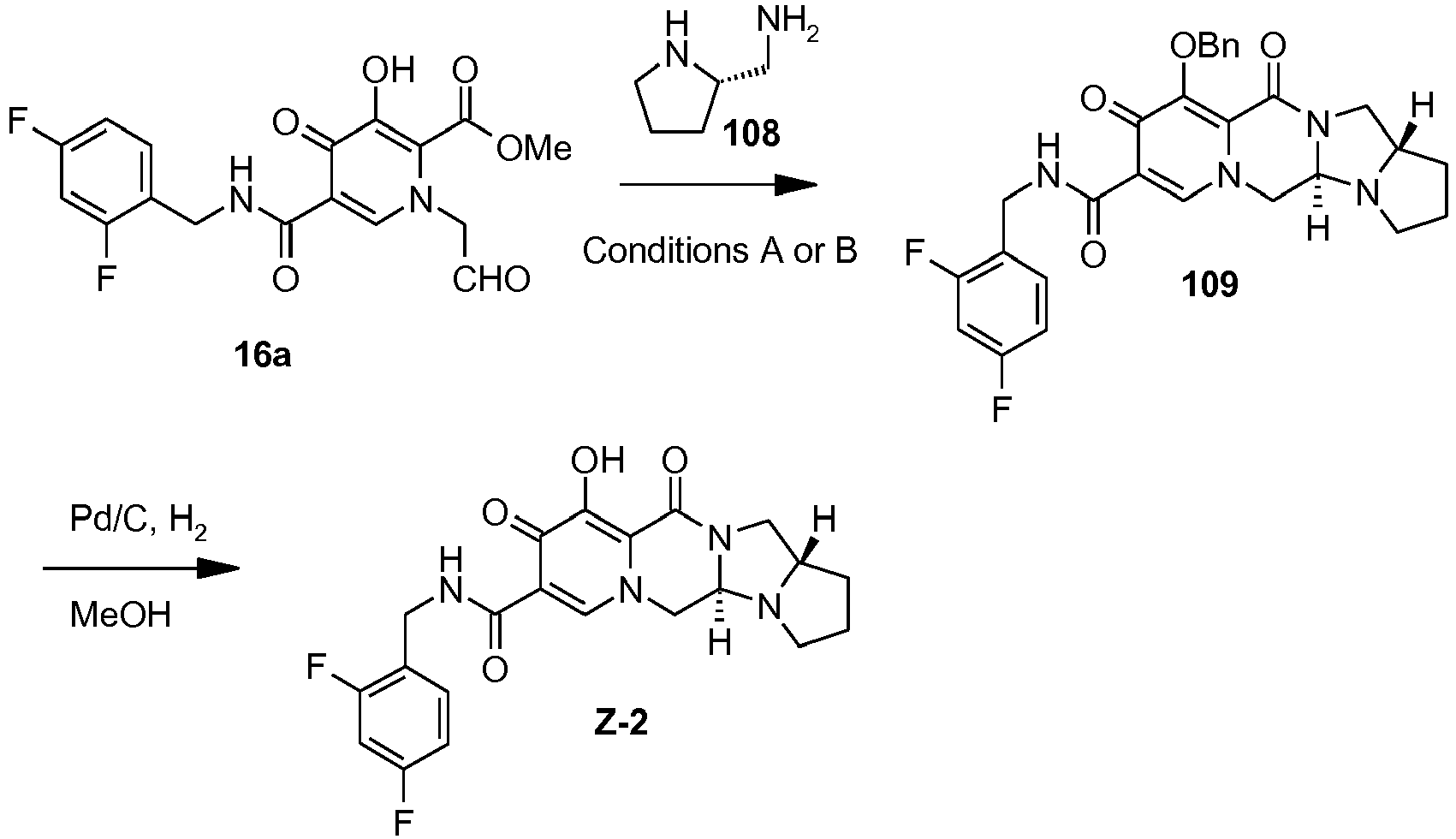
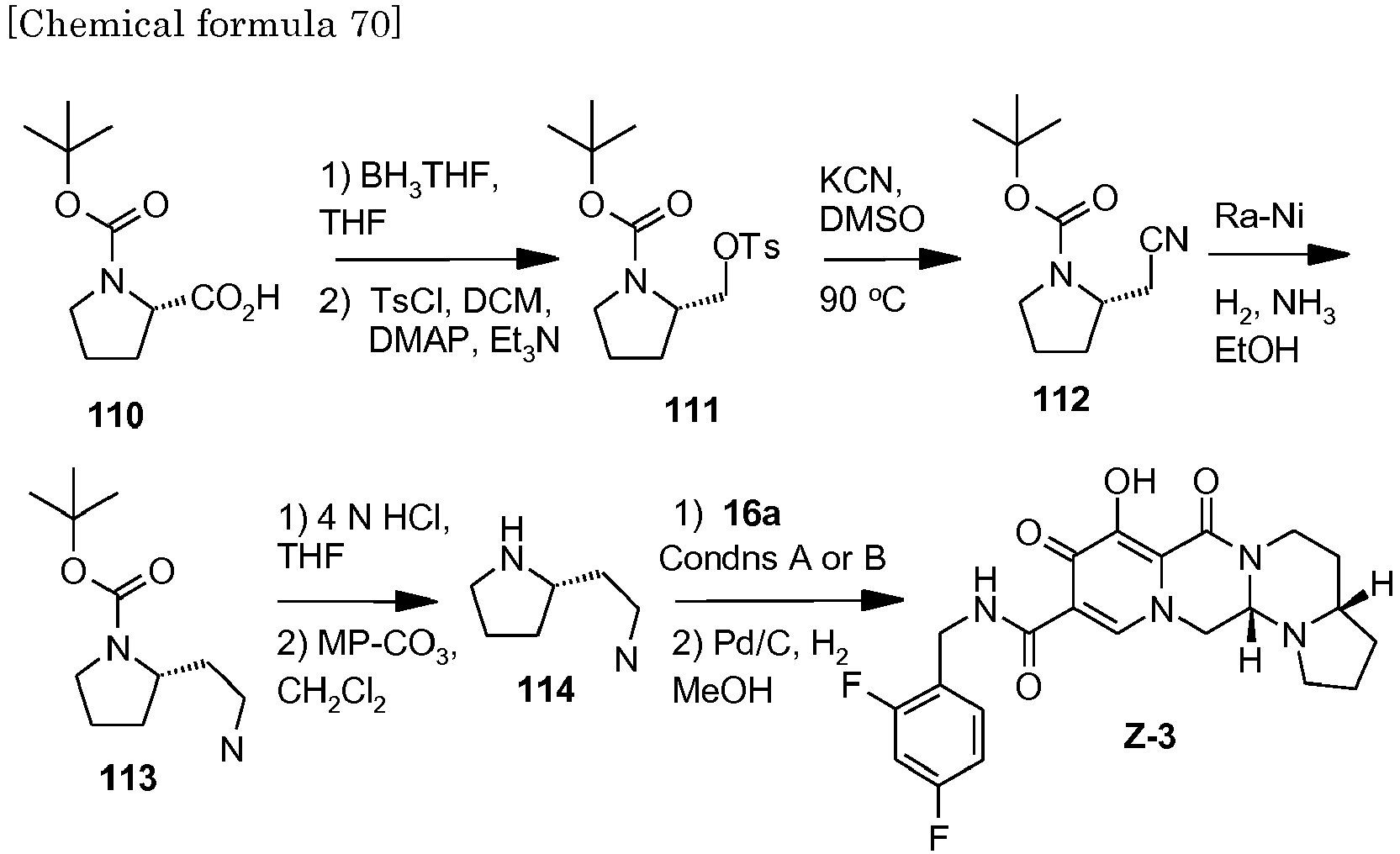



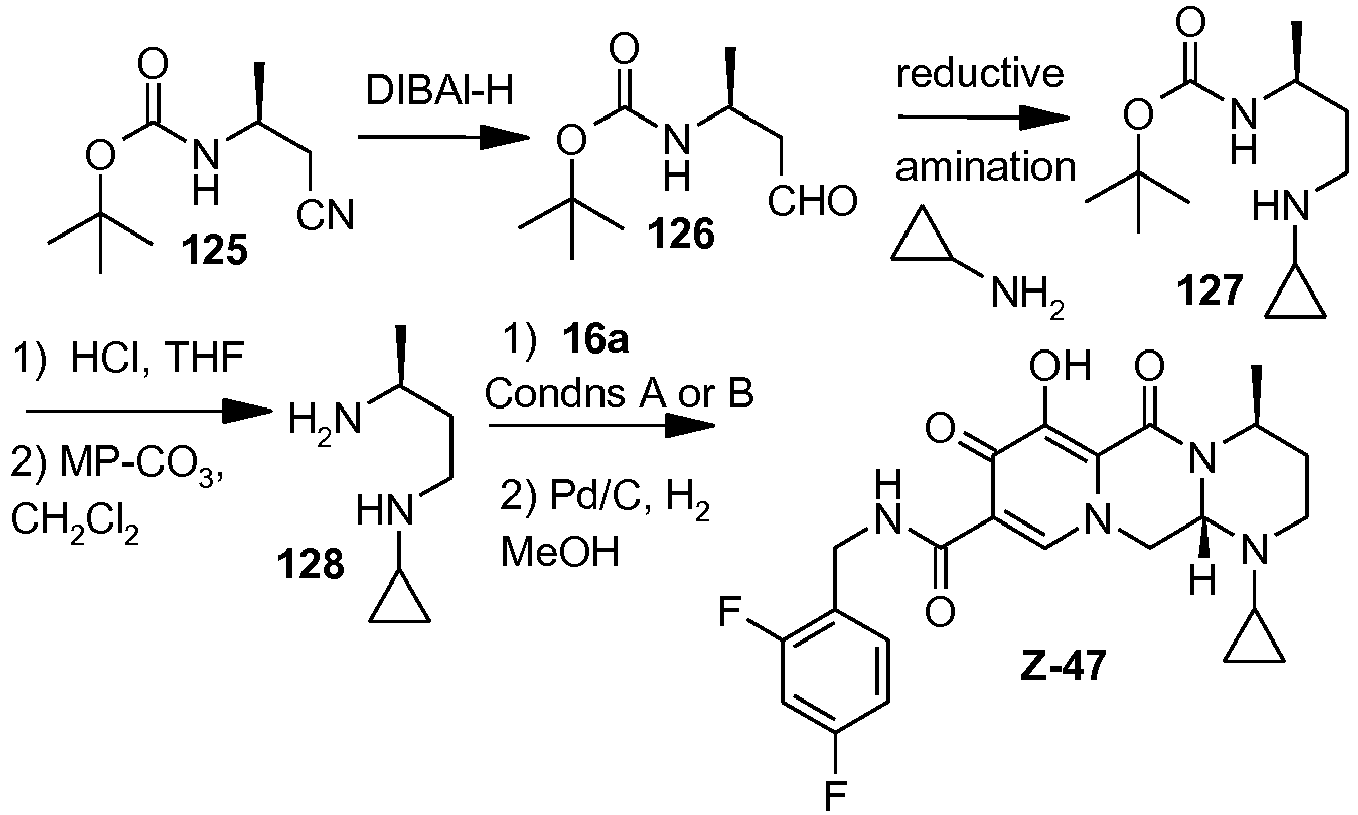


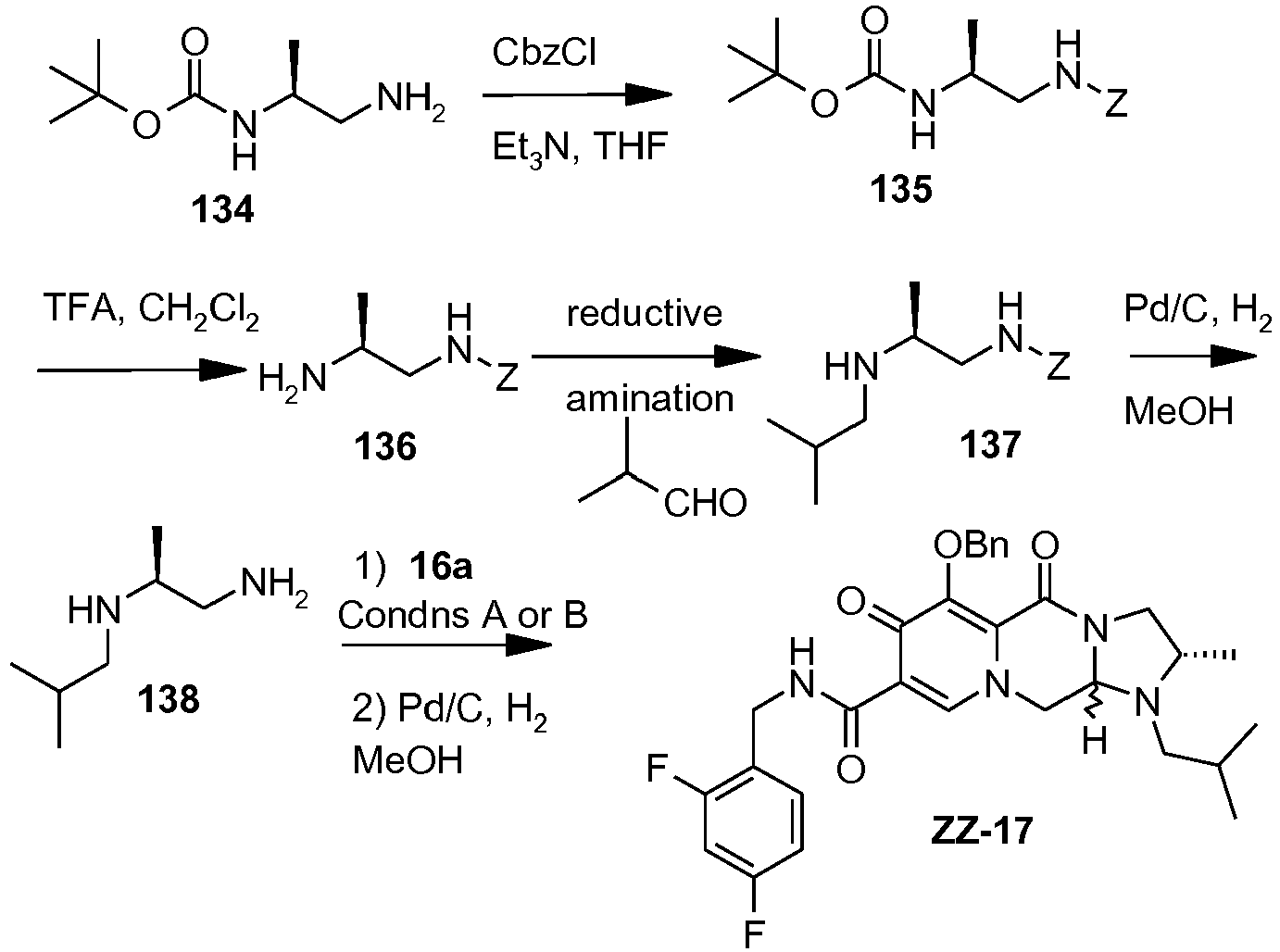


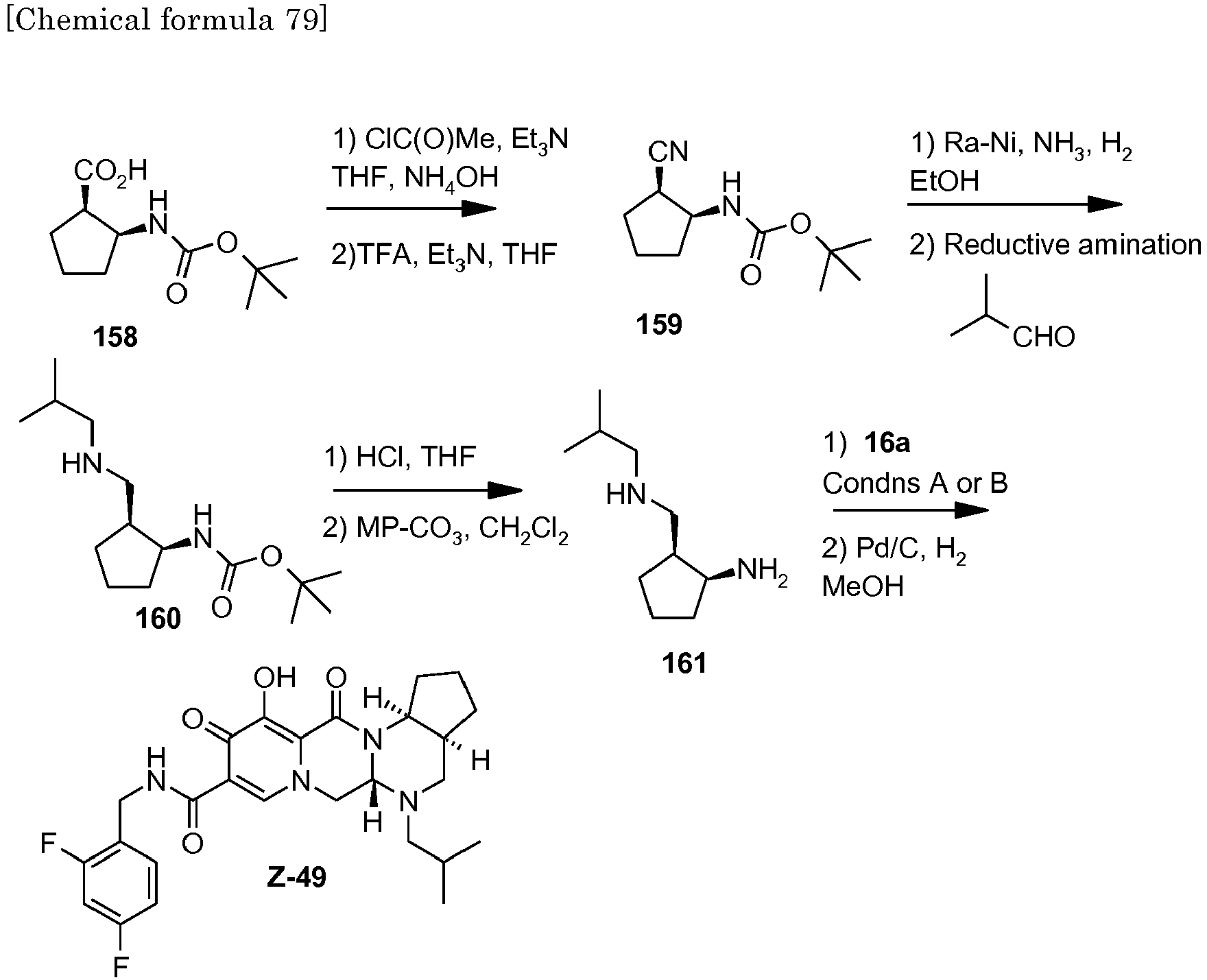


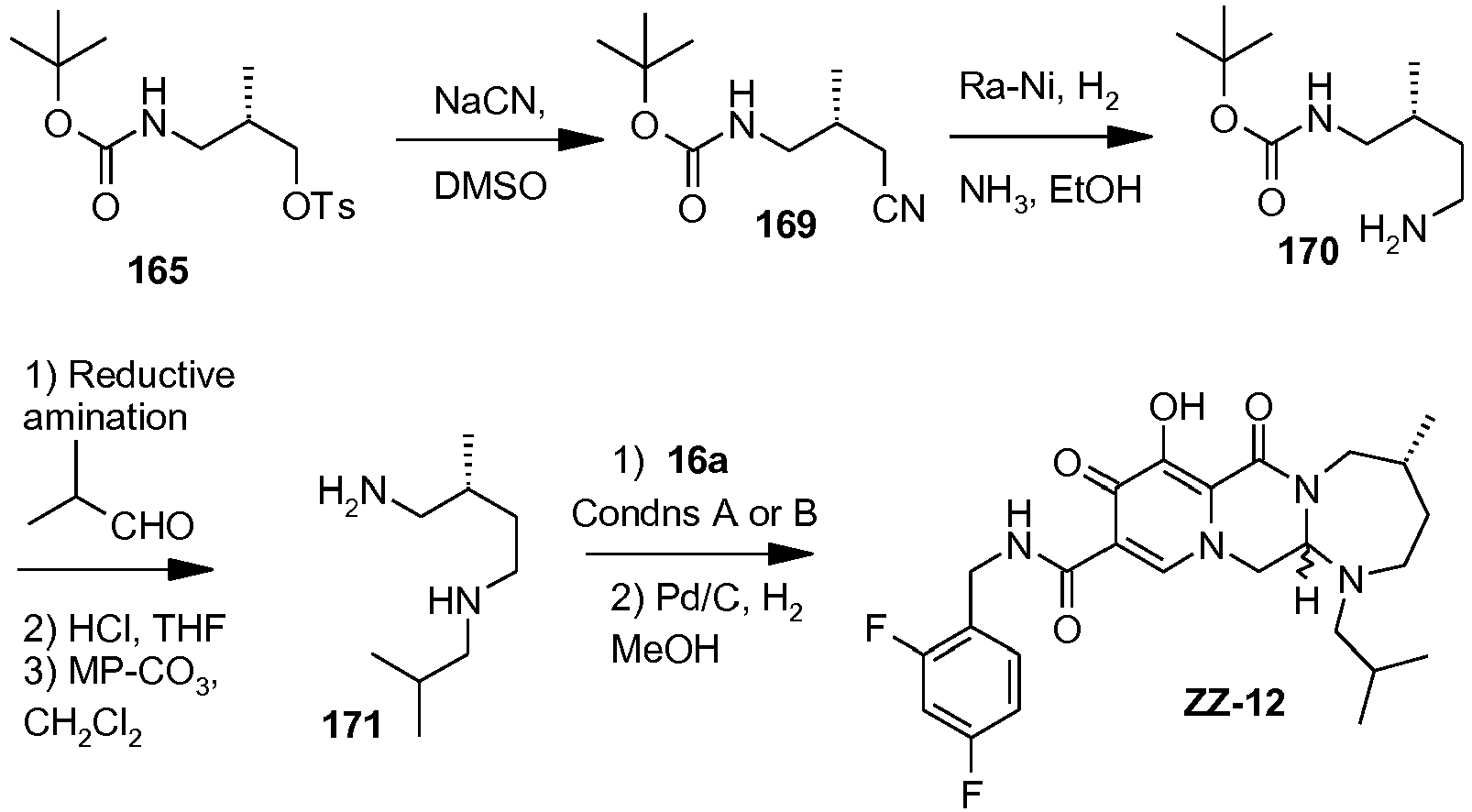

-

- a) (3R,11aS)-N-[(2,4-Difluorophenyl)methyl]-3-methyl-5,7-dioxo-6-[(phenylmethyl)oxy] -2, 3,5,7,11,11a-hexahydro[1,3]oxazolo[3,2-a]pyrido[1,2-d]pyrazine-8-carboxamide. To a solution of 16a (409 mg, 0.87 mmol) in dichloroethane (20 mL) was added (2R)-2-amino-1-propanol (0.14 mL, 1.74 mmol) and 10 drops of glacial acetic acid. The resultant solution was heated at reflux for 2 h. Upon cooling, Celite was added to the mixture and the solvents removed in vacuo and the material was purified via silica gel chromatography (2% CH3OH/CH2Cl2 gradient elution) to give (3R,11aS)-N-[(2,4-difluorophenyl)methyl]-3-methyl-5,7-dioxo-6-[(phenylmethyl)oxy]-2, 3,5,7,11,11a-hexahydro[1,3]oxazolo[3,2-a]pyrido[1,2-d]pyrazine-8-carboxamide (396 mg, 92%) as a glass. 1H NMR (CDCl3) δ 10.38 (m, 1 H), 8.42 (s, 1 H), 7.54-7.53 (m, 2 H), 7.37-7.24 (m, 4 H), 6.83-6.76 (m, 2 H), 5.40 (d, J = 10.0 Hz, 1 H), 5.22 (d, J = 10.0 Hz, 1 H), 5.16 (dd, J = 9.6, 6.0 Hz, 1 H), 4.62 (m, 2 H), 4.41 (m, 1 H), 4.33-4.30 (m, 2 H), 3.84 (dd, J = 12.0, 10.0 Hz, 1 H), 3.63 (dd, J = 8.4, 7.2 Hz, 1 H), 1.37 (d, J = 6.0 Hz, 3H); ES+ MS: 496 (M+1).
- b) (3R,11aS)-N[(2,4-Difluorophenyl)methyl]-6-hydroxy-3-methyl-5,7-dioxo-2,3,5,7,11,11a -hexahydro[1,3]oxazolo[3,2-a]pyrido[1,2-d]pyrazine-8-carboxamide sodium salt. To a solution of
(3R,11aS]-N-[(2,4-difluorophenyl)methyl]-3-methyl-5,7-dioxo-6-[(phenylmethyl)oxy]-2, 3,5,7,11,11a-hexahydro[1,3]oxazolo[3,2-a]pyrido[1,2-d]pyrazine-8-carboxamide (396 mg, 0.80 mmol) in methanol (30 mL) was added 10% Pd/C (25 mg). Hydrogen was bubbled through the reaction mixture via a balloon for 2 h. The resultant mixture was filtered through Celite with methanol and dichloromethane. The filtrate was concentrated in vacuo to give
(3R,11aS)-N-[(2,4-difluorophenyl)methyl]-6-hydroxy-3-methyl-5,7-dioxo-2,3,5,7,11,11a-hexahydro[1,3]oxazolo[3,2-a]pyrido[1,2-d]pyrazine-8-carboxamide as a pink tinted white solid (278 mg, 86%). 1H NMR (CDCl3) δ 11.47 (m, 1 H), 10.29 (m, 1 H), 8.32 (s, 1 H), 7.36 (m, 1 H), 6.82 (m, 2 H), 5.31 (dd, J = 9.6, 3.6 Hz, 1 H), 4.65 (m, 2 H), 4.47-4.38 (m, 3 H), 3.93 (dd, J = 12.0, 10.0 Hz, 1 H), 3.75 (m, 1 H), 1.49 (d, J = 5.6 Hz, 3 H); ES+ MS: 406 (M+1). The above material (278 mg, 0.66 mmol) was taken up in ethanol (10 mL) and treated with 1 N sodium hydroxide (aq) (0.66 mL, 0.66 mmol). The resulting suspension was stirred at room temperature for 30 min. Ether was added and the liquids were collected to provide the sodium salt of the title compound as a white powder (291 mg, 99%). 1H NMR (DMSO-d6 ) δ 10.68 (m, 1 H), 7.90 (s, 1 H), 7.35 (m, 1 H), 7.20 (m, 1 H), 7.01 (m, 1 H), 5.20 (m, 1 H), 4.58 (m, 1 H), 4.49 (m, 2 H), 4.22 (m, 2 H), 3.74 (dd, J = 11.2, 10.4 Hz, 1 H), 3.58 (m, 1 H), 1.25 (d, J= 4.4 Hz, 3 H). -
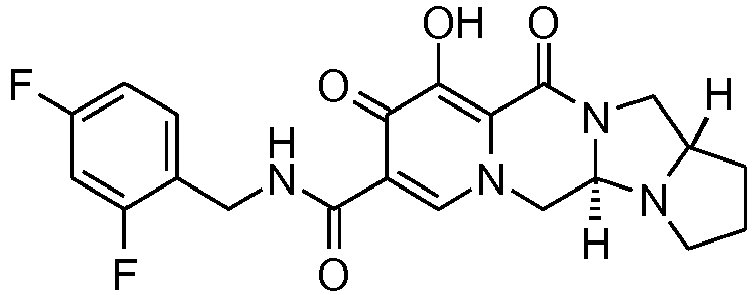
- a) (4aR,13aS)-N-[(2,4-Difluorophenyl)methyl]-9,11-dioxo-10-[(phenylmethyl)oxy]-2,3,4a,5 ,9,11,13,13a-octahydro-1H-pyrido[1,2-a]pyrrolo[1',2':3,4]imidazo[1,2-d]pyrazine-8-carb oxamide. A solution of 16a (24 mg, 0.05 mmol), [(2S)-2-pyrrolidinylmethyl]amine (0.1 mL) and 2 drops of glacial acetic acid were heated under microwave conditions at 140 °C for 10 min. Upon cooling, Celite was added to the mixture and the solvents removed in vacuo and the material was purified via silica gel chromatography (2% CH3OH/CH2Cl2 gradient elution) to give (4aR,13aS)-N-[(2,4-difluorophenyl)methyl]-9,11-dioxo-10-[(phenylmethyl)oxy]-2,3,4a,5, 9,11,13,13a-octahydro-1H-pyrido[1,2-a]pyrrolo[1',2':3,4]imidazo[1,2-d]pyrazine-8-carbo xamide (19 mg, 71%) as a white solid. 1H NMR (CDCl3) δ 10.41 (m, 1 H), 8.38 (s, 1 H), 7.56 (m, 2 H), 7.38-7.24 (m, 4 H), 6.80 (m, 2 H), 5.38 (d, J = 9.6 Hz, 1 H), 5.10 (d, J = 10.0 Hz, 1 H), 4.62 (m, 2 H), 4.40 (m, 1 H), 4.25 (dd, J = 12.0, 6.8 Hz, 1 H), 4.10 (d, J = 12.8 Hz, 1 H), 3.83 (m, 1 H), 3.71 (m, 1 H), 3.14-3.04 (m, 2 H), 2.78 (m, 1 H), 2.11-1.58 (m, 4 H); ES+ MS: 521 (M+1).
- b) (4aR,13aS)-N-[(2,4-Difluorophenyl)methyl]-10-hydroxy-9,11-dioxo-2,3,4a,5,9,11,13,13a -octahydro-1H-pyrido[1,2-a]pyrrolo[1',2':3,4]imidazo[1,2-d]pyrazine-8-carboxamide. To a solution of (4aR,13aS)-N-[(2,4-difluorophenyl)methyl]-9,11-dioxo-10-[(phenylmethyl)oxy]-2,3,4a,5, 9,11,13,13a-octahydro-1H-pyrido[1,2-a]pyrrolo[1',2':3,4]imidazo[1,2-d]pyrazine-8-carbo xamide (19 mg, 0.04 mmol) in methanol (8 mL) was added 10% Pd/C (10 mg).
- Hydrogen was bubbled through the reaction mixture via a balloon for 2 h. The resultant mixture was filtered through Celite with methanol and dichloromethane. The filtrate was concentrated in vacuo to give the title compound (6 mg, 38%) as a white solid. 1H NMR (CDCl3) δ 11.73 (m, 1 H), 10.36 (m, 1 H), 8.31 (s, 1 H), 7.33 (m, 1 H), 6.78 (m, 2 H), 4.62 (m, 2 H), 4.50 (m, 1 H), 4.27-4.19 (m, 2 H), 3.87-3.77 (m, 2 H), 3.16-3.08 (m, 2 H), 2.83 (m, 1 H), 2.11-1.65 (m, 4 H); ES+ MS: 431 (M+1).
-

- a) N-BOC-(26)-2-(Hydroxymethyl)-1-pyrrolidine. To a solution of N-BOC-L-proline (4.17 g, 19.4 mmol) in THF (40 mL) at 0 °C was added BH3-THF (21.4 mL, 1 M in THF, 21.4 mmol) dropwise. The bath was removed and the resultant solution stirred at room temperature for 2 h. Methanol was added to quench the mixture and the solvents were removed in vacuo. The residue was taken up in ethyl acetate and washed with sodium bicarbonate and brine. The aqueous layers were extracted twice with ethyl acetate. The combined organics were dried over Na2SO4, filtered and concentrated to give N-BOC-(2,S)-2-(hydroxymethyl)-1-pyrrolidine (3.82 g, 98%) as a clear oil. This material was used without further purification. 1H NMR (CDCl3) δ 3.94 (m, 1 H), 3.62 (dd, J = 11.2, 3.2 Hz, 1 H), 3.56 (dd, J = 10.8, 7.2 Hz, 1 H), 3.44 (m, 1 H), 3.29 (m, 1 H), 2.62 (br, 1 H), 1.98 (m, 1 H), 1.85-1.72 (m, 2 H), 1.58 (m, 1 H).
- b) N-BOC-(2S)-2-({[(4-Methylphenyl)sulfonyl]oxy}methyl)-1-pyrrolidine. To a cold (0 °C) solution of N-BOC-(2S)-2-(hydroxymethyl)-1-pyrrolidine (350 mg, 1.74 mmol) in dichloromethane (20 mL) was added triethylamine (0.29 mL, 2.08 mmol), and toluenesulfonyl chloride (398 mg, 2.08 mmol). N,N-demethylaminopyridine (70 mg) was added and the resultant solution was allowed to warm to rt as the bath warmed and stirred for 4 h. Water was added and the layers separated. The aqueous layer was washed with sodium bicarbonate and then with brine. The combined organics were dried over Na2SO4, filtered and concentrated followed by flash chromatography purification to give-N-BOC-(2S)-2-({[(4-methylphenyl)sulfonyl]oxy}methyl)-1-pyrrolidine (460 mg, 75%) as a clear oil. 1H NMR exists as rotomers (CDCl3) δ 7.77 (d, 2 H), 7.33 (m, 2 H), 4.08 (m, 1 H), 3.97-3.88 (m, 1 H), 3.35-3.25 (m, 2 H), 2.43 (s, 3 H), 1.95-1.79 (m, 4 H), 1.40 and 1.35 (s, 9 H rotomeric BOC t-butyl).
- c) N-BOC-(26)-2-Cyano-1-pyrrolidine. A mixture of-N-BOC-(2S)-2-({[(4-methylphenyl)sulfonyl]oxy}methyl)-1-pyrrolidine (460 mg, 1.29 mmol) and KCN (256 mg, 3.88 mmol) were heated at 90 °C in DMSO (10 mL) for 6.5 h. The mixture was cooled to room temperature and EtOAc and water were added. The organics were washed with water twice and then with brine. The aqueous layers were extracted with EtOAc and the combined organics dried over Na2SO4, filtered and concentrated followed by flash chromatography purification to give N-BOC-(2S)-2-cyano-1-pyrrolidine (179 mg, 66%) as an oil. 1H NMR exists as rotomers (CDCl3) δ 3.99 (m, 1 H), 3.43-3.37 (m, 2 H), 2.83-2.51 (m, 2 H), 2.17-1.83 (m, 4 H), 1.46 and 1.44 (s, 9 H rotomeric BOC t-butyl).
- d) N-BOC-(2S)-2-(2-Aminoethyl)-1-pyrrolidine. A solution of N-BOC-(2S)-2-cyano-1-pyrrolidine (179 mg, 0.85 mmol) in ethanol saturated with anhydrous ammonia was treated with Raney-Ni (1 mL of 50% aq. Suspension) and 50 psi of H2 overnight. The mixture was filtered through Celite and the filtrate was concentrated in vacuo. The residue was purified by flash chromatography (10% CH3OH/CH2Cl2 with 1% NH4OH gradient elution) through a short plug of silica gel to give - N-BOC-(2S)-2-(2-aminoethyl)-1-pyrrolidine (90 mg, 50%) as a clear oil. 1H NMR exists as rotomers (CDCl3) δ 3.88-3.77 (m, 1 H), 3.33-3.24 (m, 2 H), 2.66 (m, 2 H), 1.89-1.54 (m, 6 H), 1.40 (s, 9 H).
- e) {2-[(2S)-2-Pyrrolidinyl]ethyl}amine. A solution of-N-BOC-(2S)-2-(2-aminoethyl)-1-pyrrolidine (90 mg, 0.42 mmol) in THF (6 mL) was treated with 4 N HCl (aq) (2 mL) and stirred at room temperature for 3 h. The mixture was concentrated in vacuo to give the title compound as its HCl salt. A portion of this material (40 mg) was dissolved in methanol and treated with solid supported carbonate resin (MP-Carbonate, Argonaut Technologies) to freebase the amines. After 30 minutes, the solution was filtered through a fritted tube and the solvents removed carefully in vacuo to give {2-[(2S)-2-pyrrolidinyl]ethyl}amine (30 mg) as its free base. 1H NMR (CDCl3) δ 3.06 (m, 1 H), 2.94 (m, 1 H), 2.83 (m, 1 H), 2.79-2.69 (m, 2 H), 1.90-1.56 (m, 6 H).
- f) (3aS,13a,S)-N-[(2,4-Difluorophenyl)methyl]-7,9-dioxo-8-[(phenylmethyl)oxy]-1,2,3,3a,4, 5,7,9,13,13a-decahydropyrido[1',2':4,5]pyrazino[1,2-a]pyrrolo[1,2-c]pyrimidine-10-carb oxamide. A solution of 16a (30 mg, 0.06 mmol), {2-[(2S)-2-pyrrolidinyl]ethyl}amine (30 mg, 0.26mmol) and 2 drops of glacial acetic acid were heated under microwave conditions at 140 °C for 10 min. Upon cooling, Celite was added to the mixture and the solvents removed in vacuo and the material was purified via silica gel chromatography (2% CH3OH/CH2Cl2 gradient elution) to give (3aS,13aS)-N-[(2,4-Difluorophenyl)methyl]-7,9-dioxo-8-[(phenylmethyl)oxy]-1,2,3,3a,4, 5,7,9,13,13a-decahydropyrido[1',2':4,5]pyrazino[1,2-a]pyrrolo[1,2-c]pyrimidine-10-carb oxamide. (25 mg, 74%) as a film. 1H NMR (CDCl3) δ 10.44 (m, 1 H), 8.32 (s, 1 H), 7.59 (m, 2 H), 7.38-7.24 (m, 4 H), 6.80 (m, 2 H), 5.28-5.22 (m, 2 H), 4.67 (dd, J= 13.6, 2.8 Hz, 1 H), 4.62 (m, 2 H), 4.26 (m, 1 H), 4.11-4.03 (m, 2 H), 2.91 (m, 1 H), 2.81 (m, 1 H), 2.37 (m, 1 H), 2.24 (m, 1 H), 1.92 (m, 1 H), 1.82-1.76 (m, 3 H), 1.52-1.38 (m, 2 H); ES+ MS: 535 (M+1).
- g) (3aS,13aS)-N-[(2,4-Difluorophenyl)methyl]-8-hydroxy-7,9-dioxo-1,2,3,3a,4,5,7,9,13,13a -decahydropyrido[1',2':4,5]pyrazino[1,2-a]pyrrolo[1,2-c]pyrimidine-10-carboxamide. To a solution of (3aS,13aS]-N-[(2,4-difluorophenyl)methyl]-7,9-dioxo-8-[(phenylmethyl)oxy]-1,2,3,3a,4, 5,7,9,13,13a-decahydropyrido[1',2':4,5]pyrazino[1,2-a]pyrrolo[1,2-c]pyrimidine-10-carb oxamide (25 mg, 0.05 mmol) in methanol (8 mL) was added 10% Pd/C (10 mg). Hydrogen was bubbled through the reaction mixture via a balloon for 18 h. The resultant mixture was filtered through Celite with methanol and dichloromethane. The filtrate was concentrated in vacuo to give the title compound (14 mg, 67%) as a white solid. 1H NMR (CDCl3) δ 12.53 (br, 1 H), 10.44 (s, 1 H), 8.29 (s, 1 H), 7.34 (m, 1 H), 6.78 (m, 2 H), 4.71-4.58 (m, 3 H), 4.29-4.14 (m, 3 H), 2.99 (m, 1 H), 2.88 (m, 1 H), 2.44 (m, 1 H), 2.30 (m, 1 H), 1.97-1.38 (m, 6 H); ES+ MS: 445 (M+1).
-

- a) [(2R)-2-Pyrrolidinylmethyl]amine. To a solution of N-BOC-(2R)-2-(aminomethyl)-1-pyrrolidine (1.37 g, 6.85 mmol) in THF (20 mL) was added 4 N HCl (aq) (8 mL). The resultant solution was stirred at room temperature overnight. The solvents were removed in vacuo and the residue was treated with MP-carbonate resin in methanol and dichloromethane. After 1 h, the resin was removed via filtration through a fritted tube and the volatiles were removed carefully in vacuo to produce the free based amine (760 mg crude >100%) as a oil. This material was used without further purification. 1H NMR (CDCl3) δ 3.13 (m, 1 H), 2.92 (m, 1 H), 2.82-2.62 (m, 5 H), 1.88-1.30 (m, 4 H).
- b) (4aS,13aR)-N-[(2,4-Difluorophenyl)methyl]-9,11-dioxo-10-[(phenylmethyl)oxy]-2,3,4a,5 ,9,11,13,13a-octahydro-1H-pyrido[1,2-a]pyrrolo[1',2':3,4]imidazo[1,2-d]pyrazine-8-carb oxamide. In a similar manner as described in example Z-2 from 16a (435 mg, 0.93 mmol) and [(2R)-2-pyrrolidinylmethyl]amine (200 mg, 2.0 mmol) in 1,2-dichloroethane (20 mL) and 15 drops of glacial acetic acid was obtained (4aS,13aR)-N-[(2,4-difluorophenyl)methyl]-9,11-dioxo-10-[(phenylmethyl)oxy]-2,3,4a,5, 9,11,13,13a-octahydro-1H-pyrido[1,2-a]pyrrolo[1',2':3,4]imidazo[1,2-d]pyrazine-8-carbo xamide (321 mg, 67%) as a white solid. 1H NMR (CDCl3) δ 10.41 (m, 1 H), 8.35 (s, 1 H), 7.56 (m, 2 H), 7.55-7.24 (m, 4 H), 6.80 (m, 2 H), 5.35 (d, J = 10.0 Hz, 1 H), 5.13 (d, J = 10.0 Hz, 1 H), 4.60 (m, 2 H), 4.38 (dd, J = 10.4, 3.2 Hz, 1 H), 4.21 (dd, J = 12.0, 6.8 Hz, 1 H), 4.04 (dd, J = 12.4, 2.8 Hz, 1 H), 3.77 (apparent t, J = 11.6 Hz, 1 H), 3.68 (m, 1 H), 3.11-3.00 (m, 2 H), 2.75 (m, 1 H), 2.08-1.84 (m, 3 H), 1.65 (m, 1 H); ES+ MS: 521 (M+1).
- c) (4aS,13aR)-N[(2,4-Difluorophenyl)methyl]-10-hydroxy-9,11-dioxo-2,3,4a,5,9,11,13,13a -octahydro-1H-pyrido[1,2-a]pyrrolo[1',2':3,4]imidazo[1,2-d]pyrazine-8-carboxamide. In a similar manner as described in example Z-2 from (4aS,13aR)-N-[(2,4-difluorophenyl)methyl]-9,11-dioxo-10-[(phenylmethyl)oxy]-2,3,4a,5, 9,11,13,13a-octahydro-1H-pyrido[1,2-a]pyrrolo[1',2':3,4]imidazo[1,2-d]pyrazine-8-carbo xamide (518 mg, 0.99 mmol) and 10% Pd/C (35 mg) in methanol (40 mL) was obtained (4aS,13aR)-N[(2,4-Difluorophenyl)methyl]-10-hydroxy-9,11-dioxo-2,3,4a,5,9,11,13,13a -octahydro-1H-pyrido[1,2-a]pyrrolo[1',2':3,4]imidazo[1,2-d]pyrazine-8-carboxamide (430 mg, 99%) as a white solid. 1H NMR (CDCl3) δ 11.73 (m, 1 H), 10.36 (m, 1 H), 8.32 (s, 1 H), 7.35 (m, 1 H), 6.79 (m, 2 H), 4.64 (m, 2 H), 4.54 (dd, J= 10.8, 4.0 Hz, 1 H), 4.28-4.19 (m, 2 H), 3.90-3.79 (m, 2 H), 3.18-3.10 (m, 2 H), 2.84 (m, 1 H), 2.14-1.92 (m, 3 H), 1.72 (m, 1 H).
- d) (4aS,13aR)-N[(2,4-Difluorophenyl)methyl]-10-hydroxy-9,11-dioxo-2,3,4a,5,9,11,13,13a -octahydro-1H-pyrido[1,2-a]pyrrolo[1',2':3,4]imidazo[1,2-d]pyrazine-8-carboxamide sodium salt. In a similar manner as described in example Z-1 from (4aS,13aR)-N[(2,4-Difluorophenyl)methyl]-10-hydroxy-9,11-dioxo-2,3,4a,5,9,11,13,13a -octahydro-1H-pyrido[1,2-a]pyrrolo[1',2':3,4]imidazol[1,2-d]pyrazine-8-carboxamide (430 mg, 1.0 mmol) and sodium hydroxide (1.0 mL, 1.0 M aq, 1.0 mmol) in 20 mL of ethanol was formed the corresponding sodium salt (425 mg, 94%) as a white solid.
1H NMR (D2O) δ 7.85 (s, 1 H), 7.23 (m, 1 H), 6.82 (m, 2 H), 4.51-4.46 (m, 3 H), 4.28 (m, 1 H),3.95 (m, 1 H), 3.84 (m, 1 H), 3.62 (m, 1 H), 3.16 (m, 1 H), 2.89 (m, 1 H), 2.84 (m, 1H), 1.90 (m, 2 H), 1.73 (m, 1 H), 1.60 (m, 1 H). ES+ MS: 431 (M+1). -

- The title compound was made in two steps using a similar process to that described in example Z-2. 16 (60 mg, 0.13 mmol) and [(2R)-2-pyrolidinylmethyl]amine (100 mg, 1.0 mmol) were reacted in dichloromethane (2 mL) with acetic acid to give (4aS,13aR)-N-[(4-fluorophenyl)methyl]-9,11-dioxo-10-[(phenylmethyl)oxy]-2,3,4a,5,9,1 1,13,13a-octahydro-1H-pyrido[1,2-a]pyrrolo[1',2':3,4]imidazo[1,2-d]pyrazine-8-carboxa mide (60 mg, 91%). This material was hydrogenated in a second step as described in example Z-2 to give (4aS,13aR)-N-[(4-fluorophenyl)methyl]-10-hydroxy-9,11-dioxo-2,3,4a,5,9,11,13,13a-oct ahydro-1H-pyrido[1,2-a]pyrrolo[1',2':3,4]imidazo[1,2-d]pyrazine-8-carboxamide (21 mg, 42%) as a white solid. 1H NMR (CDCl3) δ 11.72 (m, 1 H), 1.37 (m, 1 H), 8.33 (s, 1 H), 7.29 (m, 2 H), 6.97 (m, 2 H), 4.57 (m, 2 H), 4.52 (m, 1 H), 4.24-4.19 (m, 2 H), 3.87-3.76 (m, 2 H), 3.14-3.07 (m, 2 H), 2.82 (m, 1 H), 2.11-1.89 (m, 3 H), 1.68 (m, 1 H); ES+ MS: 413 (M+1).
-

- The title compound was made in two steps using a similar process to that described in example Z-2. 16a (37 mg, 0.08 mmol) and (2S)-2-amino-3-phenyl-1-propanol (35 mg, 0.24 mmol) were reacted in dichloromethane (2 mL) with acetic acid to give (3S,11aR)-N-[(2,4-difluorophenyl)methyl]5,7-dioxo-3-(phenylmethyl)-6-[(phenylmethy )oxy]-2,3,5,7,11,11a-hexahydro[1,3]oxazolo[3,2-a]pyrido[1,2-d]pyrazine-8-carboxamide (41 mg, 91%). This material was hydrogenated in a second step as described in example Z-2 to give (3S,11aR)-N-[(2,4-Difluorophenyl)methyl]-6-hydroxy-5,7-dioxo-3-(phenylmethyl)-2,3,5, 7,11,11a-hexahydro[1,3]oxazolo[3,2-a]pyrido[1,2-d]pyrazine-8-carboxamide. (25 mg, 75%) as a white solid. 1H NMR (CDCl3) δ 11.47 (br, 1 H), 10.28 (m, 1 H), 8.35 (m, 1 H), 7.37-7.26 (m, 4 H), 7.18 (m, 2 H), 6.79 (m, 2 H), 5.03 (m, 1 H), 4.64-4.61 (m, 3 H), 4.40 (m, 1 H), 4.23 (apparent t, J = 7.2 Hz, 1 H), 3.96 (dd, J = 8.8, 6.4 Hz, 1 H), 3.88 (apparent t, J = 11.2 Hz, 1 H), 3.37 (dd, J = 13.6, 3.2 Hz, 1 H), 2.99 (dd, J = 13.2 8.8 Hz, 1 H); ES+ MS: 482 (M+1).
-

- The title compound was made in two steps using a similar process to that described in example Z-2. 16 (84 mg, 0.13 mmol) and {2-[(2S)-2-Pyrrolidinyl]ethyl}amine (150 mg, 1.3 mmol) were reacted in dichloromethane (2 mL) with acetic acid to give (3aS,13aS)-N-[(4-fluorophenyl)methyl]-7,9-dioxo-8-[(phenylmethyl)oxy]-1,2,3,3,4,5,7, 9,13,13a-decahydropyrido[1',2':4,5]pyrazino[1,2-a]pyrrolo[1,2-c]pyrimidine-10-carboxa mide (86 mg, 90%). This material was hydrogenated in a second step as described in example Z-2 to give (3aS,13aS-N-[(4-Fluorophenyl)methyl]-8-hydroxy-7,9-dioxo-1,2,3,3a,4,5,7,9,13,13a-de cahydropyrido[1',2':4,5]pyrazino[1,2-a]pyrrolo[1,2-c]pyrimidine-10-carboxamide. (63 mg, 88%) as a white solid. 1H NMR (CDCl3/CD3OD) δ 10.45 (m, 1 H), 8.23 (s, 1 H), 7.35 (m, 2 H), 6.94 (t, J= 8.8 Hz, 2 H), 4.63 (m, 1 H), 4.58-4.48 (m, 2 H), 4.33 (dd, J= 13.6, 3.6 Hz, 1 H), 4.21 (m, 1 H), 4.11 (m, 1 H), 2.98 (m, 1 H), 2.85 (td, J= 13.2, 3.2 Hz, 1 H), 2.41 (m, 1 H), 2.29 (m, 1 H), 1.92 (m, 1 H), 1.83-1.75 (m, 3 H), 1.54-1.35 (m, 2 H); ES+ MS: 427 (M+1).
-
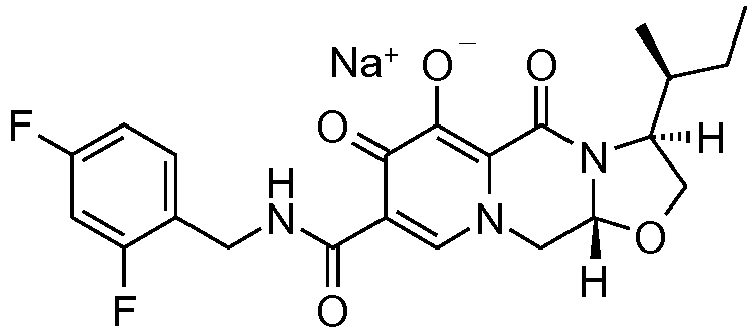
- The title compound was made in two steps using a similar process to that described in example Z-1. 16a (417 mg, 0.89 mmol) and L-isoleucinol (259 mg, 2.21 mmol) were reacted in 1,2-dichloroethane (40 mL) with acetic acid to give (3S,11aR)-N-[(2,4-difluorophenyl)methyl]-3-[(1S)-1-methylpropyl]-5,7-dioxo-6-[(phenyl methyl)oxy]-2,3,5,7,11,11a-hexahydro[1,3]oxazolo[3,2-a]pyrido[1,2-d]pyrazine-8-carbox amide (426 mg, 90%). This material was hydrogenated in a second step as described in example Z-1 to give (3S,11aR)-N-[(2,4-Difluorophenyl)methyl]-6-hydroxy-3-[(1S)-1-methylpropyl]-5,7-dioxo -2,3,5,7,11,11a-hexahydro[1,3]oxazolo[3,2-a]pyrido[1,2-d]pyrazine-8-carboxamide (376 mg, 99%) as a coarse white solid. 1H NMR (CDCl3) δ 11.43 (br, 1 H), 10.27 (br, 1 H), 8.32 (s, 1 H), 7.33 (m, 1 H), 6.79 (m, 2 H), 5.26 (dd, J = 9.6, 4.0 Hz, 1 H), 4.62 (m, 2 H), 4.42-4.35 (m, 2 H), 4.19 (dd, J = 8.8, 7.2 Hz, 1 H), 4.01 (dd, J = 8.8, 5.6 Hz, 1 H), 3.86 (dd, J= 12.0, 10.0 Hz, 1 H), 2.27 (m, 1 H), 1.40 (m, 1 H), 1.15 (m, 1 H), 0.97 (t, J = 7.2 hz, 3 H), 0.91 (d, J = 6.8 Hz, 3 H); ES+ MS: 448 (M+1). This material (360 mg, 0.81 mmol) was treated with sodium hydroxide (0.81 mL, 1.0 M, 0.81 mmol) in ethanol (15 mL) as described in example Z-1 to provide its corresponding sodium salt (384 mg, 99%) as a white solid. 1H NMR (DMSO-d6 ) δ 10.82 (m, 1 H), 7.80 (m, 1 H), 7.33 (m, 1 H), 7.18 (m, 1 H), 7.00 (m, 1 H), 5.14 (m, 1 H), 4.47 (d, J= 5.6 Hz, 2 H), 4.31 (m, 1 H), 4.18 (m, 1 H), 3.96 (m, 1 H), 3.84 (m, 1 H), 3.71 (m, 1 H), 3.40 (m, 1 H), 1.88 (m, 1 H), 1.36 (m, 1 H), 1.04 (m, 1 H), 0.85 (t, J = 7.2 Hz, 3 H), 0.80 (d, J = 6.8 Hz, 3 H); ES+ MS: 448 (M+1).
-
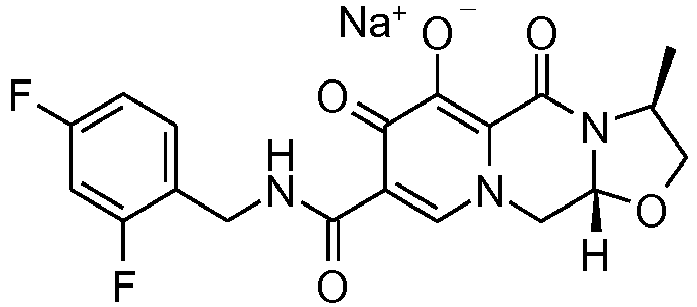
- The title compound was made in two steps using a similar process to that described in example Z-1. 16a (510 mg, 1.08 mmol) and (2S)-2-amino-1-propanol (0.17 mL, 2.17 mmol) were reacted in 1,2-dichloroethane (20 mL) with acetic acid to give (3S,11aR)-N-[(2,4-difluorophenyl)methyl]-3-methyl-5,7-dioxo-6-[(phenylmethyl)oxy]-2, 3,5,7,11,11a-hexahydro[1,3]oxazolo[3,2-a]pyrido[1,2-d]pyrazine-8-carboxamide (500 mg, 93%). This material was hydrogenated in a second step as described in example Z-1 to give 3S,11aR)-N-[(2,4-Difluorophenyl)methyl]-6-hydroxy-3-methyl-5,7-dioxo-2,3,5,7,11,11a-hexahydro[1,3]oxazolo[3,2-a]pyrido[1,2-d]pyrazine-8-carboxamide (386 mg, 94%) as a tinted white solid. 1H NMR (CDCl3) δ 11.46 (m, 1 H), 10.28 (m, 1 H), 8.32 (s, 1 H), 7.35 (m, 1 H), 6.80 (m, 2 H), 5.30 (dd, J = 10.0, 4.0 Hz, 1 H), 4.63 (m, 2 H), 4.48-4.37 (m, 3 H), 3.91 (dd, J = 12.0, 10.0 Hz, 1 H), 3.73 (m, 1 H), 1.48 (d, J = 6.0 Hz, 3 H); ES+ MS: 406 (M+1). This material (385 mg, 0.95 mmol) was treated with sodium hydroxide (0.95 mL, 1.0 M, 0.95 mmol) in ethanol (15 mL) as described in example Z-1 to provide its corresponding sodium salt (381 mg, 94%) as a white solid. 1H NMR (DMSO-d6 ) δ 10.66 (m, 1 H), 7.93 (s, 1 H), 7.33 (m, 1 H), 7.20 (m, 1 H), 7.01 (m, 1 H), 5.19 (m, 1 H), 4.59 (m, 1 H), 4.48 (m, 2 H), 4.22 (m, 2 H), 3.75 (m, 1 H), 3.57 (m, 1 H), 1.24 (d, J = 5.6 Hz, 3 H).
-

- The title compound was made in two steps using a similar process to that described in example Z-2. 16 (100 mg, 0.22 mmol) and (2S)-2-amino-1-propanol (0.10 mL, 1.28 mmol) were reacted in dichloromethane (2 mL) with acetic acid to give (3S,11aR)-N-[(4-fluorophenyl)methyl]-3-methyl-5,7-dioxo-6-[(phenylmethyl)oxy]-2,3,5, 7,11,11a-hexahydro[1,3]oxazolo[3,2-a]pyrido[1,2-d]pyrazine-8-carboxamide (100 mg, 95%). This material was hydrogenated in a second step as described in example Z-2 to give (3S,11aR)-N-[(4-Fluorophenyl)methyl]-6-hydroxy-3-methyl-5,7-dioxo-2,3,5,7,11,11a-he xahydro[1,3]oxazolo[3,2-a]pyrido[1,2-d]pyrazine-8-carboxamide (80 mg, 99%) as a white solid. 1H NMR (CDCl3) δ 11.43 (br, 1 H), 10.28 (br, 1 H), 8.35 (s, 1 H), 7.28 (m, 2 H), 6.97 (m, 2 H), 5.29 (m, 1 H), 4.55-4.38 (m, 5 H), 3.89 (apparent t, J = 10.8 Hz, 1 H), 3.70 (m, 1 H), 1.45 (d, J = 5.6 Hz, 3 H); ES- MS: 386 (M-1).
-
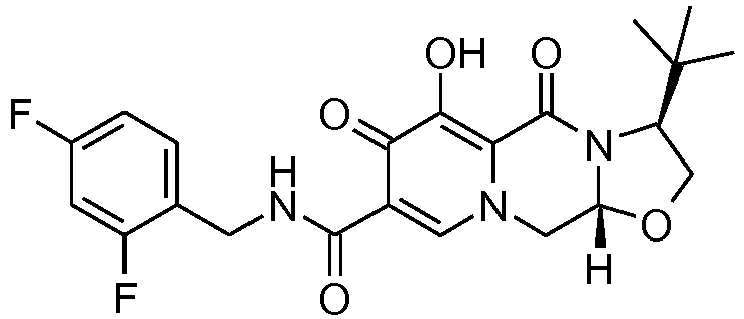
- The title compound was made in two steps using a similar process to that described in example Z-2. 16a (41 mg, 0.09 mmol) and freebased L-tert-leucinol (59 mg, 0.50 mmol) were reacted in dichloromethane (2 mL) with acetic acid to give (3S,11aR)-N-[(2,4-difluorophenyl)methyl]-3-(1,1-dimethylethyl)-5,7-dioxo-6-[(phenylm ethyl)oxy]-2,3,5,7,11,11a-hexahydro[1,3]oxazolo[3,2-a]pyrido[1,2-d]pyrazine-8-carboxa mide (40 mg, 86%). This material was hydrogenated in a second step as described in example Z-2 to give (3S,11aR)-N-[(2,4-Difluorophenyl)methyl]-3-(1,1-dimethylethyl)-6-hydroxy-5,7-dioxo-2 ,3,5,7,11,11a-hexahydro[1,3]oxazolo[3,2-a]pyrido[1,2-d]pyrazine-8-carboxamide (33 mg, 99%) as a tinted white solid. 1H NMR (CDCl3) δ 10.29 (s, 1 H), 8.37 (s, 1 H), 7.34 (m, 1 H), 6.79 (m, 2 H), 5.43 (m, 1 H), 4.62 (m, 2 H), 4.36 (m, 2 H), 4.21 (m, 1 H), 3.99 (, 1 H), 3.81 (m, 1 H), 1.03 (s, 9 H); ES+ MS: 448 (M+1).
-

- The title compound was made in two steps using a similar process to that described in example Z-2. 16 (41 mg, 0.09 mmol) and freebased L-tert-leucinol (59 mg, 0.50 mmol) were reacted in dichloromethane (2 mL) with acetic acid to give (3S,11aR)-3-(1,1-dimethylethyl)-N-[(4-fluorophenyl)methyl]-5,7-dioxo-6-[(phenylmethy l)oxy]-2,3,5,7,11,11a-hexahydro[1,3]oxazolo[3,2-a]pyrido[1,2-d]pyrazine-8-carboxamide (40 mg, 85%). This material was hydrogenated in a second step as described in example Z-2 to give (3S,11aR)-3-(1,1-Dimethylethyl)-N-[(4-fluorophenyl)methyl]-6-hydroxy-5,7-dioxo-2,3,5, 7,11,11a-hexahydro[1,3]oxazolo[3,2-a]pyrido[1,2-d]pyrazine-8-carboxamide (32 mg, 97%) as a tinted white solid. 1H NMR (CDCl3) δ 11.15 (br, 1 H), 10.32 (s, 1 H), 8.38 (s, 1 H), 7.29 (m, 2 H), 6.98 (m, 2 H), 5.43 (m, 1 H), 4.58 (m, 2 H), 4.36 (m, 2 H), 4.21 (m, 1 H), 3.99 (, 1 H), 3.79 (m, 1 H), 1.02 (s, 9 H); ES+ MS: 430 (M+1).
-

- The title compound was made in two steps using a similar process to that described in example Z-2. 16a (33 mg, 0.07 mmol) and L-phenylglycinol (19 mg, 0.14 mmol) were reacted in dichloromethane (2 mL) with acetic acid to give (3S,11aR)-N-[(4-fluorophenyl)methyl]-5,7-dioxo-3-phenyl-6-[(phenylmethyl)oxy]-2,3,5, 7,11,11a-hexahydro[1,3]oxazoloo[3,2-a]pyrido[1,2-d]pyrazine-8-carboxamide (37 mg, 95%). This material was hydrogenated in a second step as described in example Z-2 to give (3S,11aR)-N-[(2,4-Difluorophenyl)methyl]-6-hydroxy-5,7-dioxo-3-phenyl-2,3,5,7,11,11a -hexahydro[1,3]oxazolo[3,2-a]pyrido[1,2-d]pyrazine-8-carboxamide (33 mg, 99%) as a tinted white solid. 1H NMR (CDCl3) δ 11.23 (br, 1 H), 10.27 (s, 1 H), 8.39 (s, 1 H), 7.43-7.32 (m, 6 H), 6.80 (m, 2 H), 5.58 (d, J = 6.8 Hz, 1 H), 5.37 (apparent t, J = 6.8 Hz, 1 H), 4.67-4.62 (m, 3 H), 4.54 (d, J = 10.4 Hz, 1 H), 4.11 (m, 1 H), 4.01 (m, 1 H); ES+ MS: 468 (M+1).
-

- The title compound was made in two steps using a similar process to that described in example Z-2. 16a (50 mg, 0.10 mmol) and (2R)-2-amino-3-[(phenylmethyl)oxy]-1-propanol (0.1 mL) were reacted in dichloromethane (2 mL) with acetic acid to give (3S,11aR)-N-[(2,4-difluorophenyl)methyl]-5,7-dioxo-6-[(phenylmethyl)oxy]-3-{[(phenyl methyl)oxy]methyl}-2,3,5,7,11,11a-hexahydro[1,3]oxazolo[3,2-a]pyrido[1,2-d]pyrazine-8-carboxamide (61 mg, 99%). This material was hydrogenated in a second step as described in example Z-2 to give (3S,11aR)-N-[(2,4-Difluorophenyl)methyl]-6-hydroxy-3-(hydroxymethyl)-5,7-dioxo-2,3, 5,7,11,11a-hexahydro[1,3]oxazolo[3,2-a]pyrido[1,2-d]pyrazine-8-carboxamide (37 mg, 87%) as a tinted white solid. 1H NMR (CDCl3/CD3OD) δ 8.23 (s, 1 H), 7.32 (m, 1 H), 6.79 (m, 2 H), 5.31 (d, J = 7.6 Hz, 1 H), 4.56 (s, 2 H), 4.42-4.36 (m, 3 H), 4.17-4.11 (m, 2 H), 3.85 (m, 1 H), 3.62 (d, J = 11.2 Hz, 1 H).
-

- The title compound was made in two steps using a similar process to that described in example Z-2. 16a (25 mg, 0.05 mmol) and (1S,2R)-(+)-norephedrine (0.1 mL) were reacted in dichloromethane (2 mL) with acetic acid to give (2S,3R)-N-[(2,4-difluorophenyl)methyl]-3-methyl-5,7-dioxo-2-phenyl-6-[(phenylmethyl) oxy]-2,3,5,7,11,11a-hexahydro[1,3]oxazolo[3,2-a]pyrido[1,2-d]pyrazine-8-carboxamide (30 mg, 99%). This material was hydrogenated in a second step as described in example Z-2 to give (2S,3R)-N-[(2,4-difluorophenyl)methyl]-6-hydroxy-3-methyl-5,7-dioxo-2-phenyl-2,3,5,7, 11,11a-hexahydro[1,3]oxazolo[3,2-a]pyrido[1,2-d]pyrazine-8-carboxamide (25 mg, 91%) as a white solid. This material is a single diastereomer (>6:1 diastereomeric ratio but unconfirmed relative stereochemistry at the aminal center). 1H NMR (CDCl3/CD3OD) δ 10.28 (m, 1 H), 8.38 (s, 1 H), 7.10-7.30 (m, 6 H), 6.78 (m, 2 H), 5.70 (d, J = 7.6 Hz, 1 H), 5.36 (d, J = 5.2 Hz, 1 H), 4.82 (m, 1 H), 4.61 (m, 2 H), 4.47 (d, J = 10.4 Hz, 1 H), 4.00 (apparent t, J = 10.4 Hz, 1 H), 0.94 (d, J = 6.4 Hz, 3 H); ES+ MS: 482 (M+1).
-

- The title compound was made in two steps using a similar process to that described in example Z-2. 16a (34 mg, 0.07 mmol) and (2R)-2-amino-3-phenyl-1-propanol (D-phenylalaninol) (50 mg, 0.33 mmol) were reacted in dichloromethane (2 mL) with acetic acid to give (3R,11aS)-N-[(2,4-difluorophenyl)methyl]-5,7-dioxo-3-(phenylmethyl)-6-[(phenylmethy l)oxy]-2,3,5,7,11,11a-hexahydro[1,3]oxazolo[3,2-a]pyrido[1,2-d]pyrazine-8-carboxamide (29 mg, 70%). This material was hydrogenated in a second step as described in example Z-2 to give (3R,11aS)-N-[(2,4-Difluorophenyl)methyl]-6-hydroxy-5,7-dioxo-3-(phenylmethyl)-2,3,5, 7,11,11a-hexahydro[1,3]oxazolo[3,2-a]pyrido[1,2-d]pyrazine-8-carboxamide (24 mg, 98%) as a white solid. 1H NMR (CDCl3) δ 11.46 (br, 1 H), 10.27 (m, 1 H), 8.33 (m, 1 H), 7.32-7.16 (m, 6 H), 6.78 (m, 2 H), 5.02 (m, 1 H), 4.61 (m, 3 H), 4.39 (m, 1 H), 4.22 (m, 1 H), 3.95 (m, 1 H), 3.87 (m, 1 H), 3.36 (m, 1 H), 2.97 (dd, J = 13.2 8.8 Hz, 1 H); ES+ MS: 482 (M+1).
-

- The title compound was made in two steps using a similar process to that described in example Z-2. 16a (32 mg, 0.07 mmol) and (2R)-2-amino-4-methyl-1-pentanol (0.1 mL) were reacted in dichloromethane (2 mL) with acetic acid to give (3R,11aS-N-[(2,4-difluorophenyl)methyl]-3-(2-methylpropyl)-5,7-dioxo-6-[(phenylmeth yl)oxy]-2,3,5,7,11,11a-hexahydro[1,3]oxazolo[3,2-a]pyrido[1,2-d]pyrazine-8-carboxamid e (43 mg, 99%). This material was hydrogenated in a second step as described in example Z-2 to give (3R,11aS-N-[(2,4-Difluorophenyl)methyl]-6-hydroxy-3-(2-methylpropyl)-5,7-dioxo-2,3, 5,7,11,11a-hexahydro[1,3]oxazolo[3,2-a]pyrido[1,2-d]pyrazine-8-carboxamide (32 mg, 90%) as a white solid. 1H NMR (CDCl3) δ 11.47 (br, 1 H), 10.29 (m, 1 H), 8.35 (s, 1 H), 7.39 (m, 1 H), 6.80 (m, 2 H), 5.31 (m, 1 H), 4.62 (m, 2 H), 4.44 (m, 2 H), 4.37 (m, 1 H), 3.88 (m, 1 H), 3.84 (dd, J = 8.0, 5.6 Hz, 1 H), 2.04 (m, 1 H), 1.62 (m, 1 H), 1.41 (m, 1 H), 1.00 (d, J = 5.6 Hz, 3 H), 0.99 (d, J = 6.0 Hz, 3 H); ES+ MS: 448 (M+1).
-
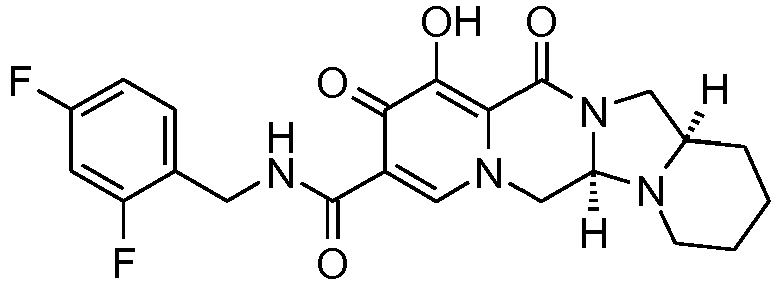
- a) 1,1-Dimethylethyl (2R)-2-(aminocarbonyl)-1-piperidinecarboxylate. To a cold (0 °C) solution of (2R)-1-{[(1,1-dimethylethyl)oxy]carbonyl}-2-piperidinecarboxylic acid (1.0 g, 4.36 mmol) in THF (20 mL) was added triethylamine (0.60 mL, 4.36 mmol) followed by slow addition of methyl chloroformate (0.34 mL, 4.36 mmol). After a few minutes a suspension had formed. To this mixture was added concentrated NH4OH (1.5 mL) and the solution was allowed to warm to rt as the bath warmed and stirred for a total of 4 h. The mixture was concentrated in vacuo and the residue was taken up in EtOAc. The organic layer was washed with citric acid, bicard and then brine, dried over Na2SO4. Filtration and concentration gave 1,1-dimethylethyl (2R)-2-(aminocarbonyl)-1-piperidinecarboxylate (1.0 g, 99%). 1H NMR (CDCl3) δ 6.03 (br, 1 H), 5.45 (br, 1 H), 4.77 (br, 1 H), 4.06 (br, 1 H), 2.82 (m, 1 H), 2.29 (m, 1 H), 1.67-1.43 (m, 13 H).
- b) 1,1-Dimethylethyl (2R)-2-cyano-1-piperidinecarboxylate. To a cold (0 °C) solution of 1,1-dimethylethyl (2R)-2-(aminocarbonyl)-1-piperidinecarboxylate (269 mg, 1.17 mmol) in THF (10 mL) was added triethylamine (0.33 mL, 2.34 mmol) and then trifluoroacetic anhydride (0.17 mL, 1.17 mmol). The mixture was stirred at 0 °c for 1 h and concentrated in vacuo. The residue was taken up in EtOAc and washed successively with sodium bicarbonate, 0.5 N HCl and brine. The organics were dried over Na2SO4, filtered and concentrated to give 1,1-dimethylethyl (2R)-2-cyano-1-piperidinecarboxylate (255 mg, 99%) as a crystalline solid upon standing. 1H NMR (CDCl3) δ 5.23 (br, 1 H), 4.05 (br, 1 H), 2.93 (br, 1 H), 1.93-1.39 (m, 6 H), 1.46 (s, 9 H).
- c) 1,1-Dimethylethyl (2R)-2-(aminomethyl)-1-piperidinecarboxylate. An ammonia saturated ethanol solution of 1,1-dimethylethyl (2R)-2-cyano-1-piperidinecarboxylate (255 mg, 1.19 mmol) was reduced with Raney-Ni in a similar manner to that described in example Z-3 to give after filtration through a short plug of silica, 1,1-dimethylethyl (2R)-2-(aminomethyl)-1-piperidinecarboxylate (236 mg, 91%), as an oil. 1H NMR (CDCl3/CD3OD) δ 4.15 (br, 1 H), 3.97 (m, 1 h), 2.96 (m, 1 H), 2.75-2.69 (m, 2 H), 2.23-2.08 (m, 3 H), 1.59-1.55 (m, 3 H), 1.43 (s, 9 H).
- d) [(2R)-2-Piperidinylmethyl]amine bis HCl salt. A solution of 1,1-dimethylethyl (2R)-2-(aminomethyl)-1-piperidinecarboxylate (236 mg, 1.08 mmol) in THF (10 mL) was treated with 4 N HCl (3 mL) as described in example Z-3 to give the bis HCl salt of [(2R)-2-Piperidinylmethyl]amine. 1H NMR (DMSO-d6 ) δ 9.67 (br, 1 H), 9.48 (br, 1 H), 8.48 (br, 2 H), 3.70 (br, 2 H), 3.20 (m, 1 H), 3.04 (m, 1 H), 2.86 (m, 1 H), 1.89-1.41 (m, 6 H).
- e) (5aR,14aR)-N-[(2,4-Difluorophenyl)methyl]-11-hydroxy-10,12-dioxo-1,2,3,4,5a,6,10,12, 14,14a-decahydropyrido[1,2-a]pyrido[1',2':3,4]imidazo[1,2-d]pyrazine-9-carboxamide. The title compound was made in two steps using a similar process to that described in example Z-2. 16a (50 mg, 0.11 mmol) and [(2R)-2-Piperidinylmethyl]amine (150 mg, 1.31 mmol) (free based using carbonate resin as described in example Z-3) were reacted in dichloromethane (2 mL) with acetic acid to give (5aR,14aR)-N-[(2,4-difluorophenyl)methyl]-10,12-dioxo-11-[(phenylmethyl)oxy]-1,2,3,4 ,5a,6,10,12,14,14a-decahydropyrido[1,2-a]pyrido[1',2':3,4]imidazo[1,2-d]pyrazine-9-car boxamide (50 mg, 88%). This material was hydrogenated in a second step as described in example Z-2 to give (5aR,14aR)-N-[(2,4-difluorophenyl)methyl]-11-hydroxy-10,12-dioxo-1,2,3,4,5a,6,10,12, 14,14a-decahydropyrido[1,2-a]pyrido[1',2':3,4]imidazo[1,2-d]pyrazine-9-carboxamide (11 mg, 44%) as a white solid. 1H NMR (CD3OD/CDCl3) δ 10.46 (m, 1 H), 8.32 (s, 1 H), 7.31 (m, 1 H), 6.80 (m, 2 H), 4.64-4.52 (m, 3 H), 4.14 (dd, J = 10.4, 2.8 Hz, 1 H), 3.91-3.82 (m, 2 H), 3.19 (apparent t, J = 10.8 Hz, 1 H), 3.08 (d, J = 10.4 Hz, 1 H), 2.50 (m, 1 H), 2.27 (m, 1 H), 1.99-1.30 m, 6 H); ES+ MS: 445 (M+1).
-

- The title compound was made in two steps using a similar process to that described in example Z-2. 16a (36 mg, 0.07 mmol) and (2R)-2-amino-4-methyl-1-pentanol (0.1 mL) were reacted in dichloromethane (2 mL) with acetic acid to give (2S,3S-N-[(2,4-difluorophenyl)methyl]-3-[(methyloxy)methyl]-5,7-dioxo-2-phenyl-6-[(p henylmethyl)oxy]-2,3,5,7,11,11a-hexahydro[1,3]oxazolo[3,2-a]pyrido[1,2-d]pyrazine-8-c arboxamide. This material was hydrogenated in a second step as described in example Z-2 to give (2S,3S-N-[(2,4-Difluorophenyl)methyl]-6-hydroxy-3-[(methyloxy)methyl]-5,7-dioxo-2-p henyl-2,3,5,7,11,11a-hexahydro[1,3]oxazolo[3,2-a]pyrido[1,2-d]pyrazine-8-carboxamide (25 mg, 64% for 2 steps) as a white solid. This material is a single diastereomer (>6:1 diastereomeric ratio but unconfirmed relative stereochemistry at the aminal center). 1H NMR (CDCl3) δ 11.48 (br, 1 H), 10.30 (m, 1 H), 8.39 (s, 1 H), 7.39-7.24 (m, 6 H), 6.78 (m, 2 H), 5.46 (dd, J = 10.0, 3.6 Hz, 1 H), 5.33 (d, J = 7.2 Hz, 1 H), 4.63 (m, 2 H), 4.54 (dd, J = 12.4, 4.0 Hz, 1 H), 4.19 (m, 1 H), 4.12 (dd, J = 10.4, 3.2 Hz, 1 H), 4.06 (m, 1 H), 3.55 (dd, J = 10.4, 1.6 Hz, 1 H), 3.40 (s, 3 H); ES+ MS: 512 (M+1).
-

- The title compound was made in two steps using a similar process to that described in example Z-2. 16a (36 mg, 0.08 mmol) and (2S)-2-amino-3-cyclohexyl-1-propanol (30 mg, 0.19 mmol) were reacted in dichloromethane (2 mL) with acetic acid to give (3S,11aR)-3-(cyclohexylmethyl)-N-[(2,4-difluorophenyl)methyl]-5,7-dioxo-6-[(phenylme thyl)oxy]-2,3,5,7,11,11a-hexahydro[1,3]oxazolo[3,2-a]pyrido[1,2-d]pyrazine-8-carboxa mide (27 mg, 61%). This material was hydrogenated in a second step as described in example Z-2 to give (3S,11aR)-3-(cyclohexylmethyl)-N-[(2,4-difluorophenyl)methyl]-6-hydroxy-5,7-dioxo-2, 3,5,7,11,11a-hexahydro[1,3]oxazolo[3,2-a]pyrido[1,2-d]pyrazine-8-carboxamide (25 mg, 99%) as a white solid. 1H NMR (CDCl3) δ 11.48 (br, 1 H), 10.28 (s, 1 H), 8.33 (s, 1 H), 7.33 (m, 1 H), 6.78 (m, 2 H), 5.29 (m, 1 H), 4.61 (m, 2 H), 4.47-4.33 (m, 3 H), 3.87-3.81 (m, 2 H), 2.05 (m, 1 H), 1.75-1.64 (m, 6 H), 1.39 (m, 1 H), 1.25-1.14 (m, 3 H), 1.02-0.97 (m, 2 H); ES+ MS: 488 (M+1).
-

- The title compound was made in two steps using a similar process to that described in example Z-1. 16a (42 mg, 0.09 mmol) and (2S)-2-amino-3-methyl-1-butanol (0.1 mL) were reacted in 1,2-dichloroethane (8 mL) with acetic acid to give (3S,11aR)-N-[(2,4-difluorophenyl)methyl]-3-(1-methylethyl)-5,7-dioxo-6-[(phenylmethy l)oxy]-2,3,5,7,11,11a-hexahydro[1,3]oxazolo[3,2-a]pyrido[1,2-d]pyrazine-8-carboxamide (40 mg, 86%). This material was hydrogenated in a second step as described in example Z-1 to give (3S,11aR)-N-[(2,4-difluorophenyl)methyl]-6-hydroxy-3-(1-methylethyl)-5,7-dioxo-2,3,5, 7,11,11a-hexahydro[1,3]oxazolo[3,2-a]pyrido[1,2-d]pyrazine-8-carboxamide (34 mg, 99%) as a white solid. 1H NMR (CDCl3) δ 10.29 (br, 1 H), 8.36 (s, 1 H), 7.33 (m, 1 H), 6.79 (m, 2 H), 5.29 (d, J = 6.4 Hz, 1 H), 4.61 (m, 2 H), 4.44 (d, J = 9.6 Hz, 1 H), 4.34 (m, 1 H), 4.17 (m, 1 H), 4.02 (dd, J = 8.4, 5.2 Hz, 1 H), 3.86 (m, 1 H), 2.37 (m, 1 H), 0.97 (m, 6 H); ES+ MS: 434 (M+1).
-

- The title compound was made in two steps using a similar process to that described in example Z-1. 16a (42 mg, 0.09 mmol) and (1S,2R)-1-amino-2,3-dihydro-1H-inden-2-ol (100 mg, 0.67 mmol) were reacted in 1,2-dichloroethane (5 mL) with acetic acid to give (5aR,14aS]-N-[(2,4-difluorophenyl)methyl]-11,13-dioxo-12-[(phenylmethyl)oxy]-5a,6a,7 ,11,13,14a-hexahydro-5H-indeno[1',2':4,5][1,3]oxazolo[3,2-a]pyrido[1,2-d]pyrazine-10-c arboxamide (55 mg, 99%). This material was hydrogenated in a second step as described in example Z-1 to give (5aR,14aS]-N-[(2,4-difluorophenyl)methyl]-12-hydroxy-11,13-dioxo-5a,6a,7,11,13,14a-hexahydro-5H-indeno[1',2':4,5][1,3]oxazolo[3,2-a]pyrido[1,2-d]pyrazine-10-carboxamid e (45 mg, 97%) as a white solid. 1H NMR (CDCl3) δ 10.28 (m, 1 H), 8.33 (s, 1 H), 7.69 (d, J = 7.2 Hz, 1 H), 7.34-7.19 (m, 4 H), 6.78 (m, 2 H), 5.96 (d, J = 6.0 Hz, 1 H), 5.32 (m, 1 H), 5.22 (m, 1 H), 4.60 (m, 2 H), 4.45 (d, J = 9.2 Hz, 1 H), 3.96 (apparent t, J = 10.8 Hz, 1 H), 3.40 (dd, J = 18.0, 6.8 Hz, 1 H), 3.24 (d, J = 17.6 Hz, 1 H);); ES+ MS: 480 (M+1).
-
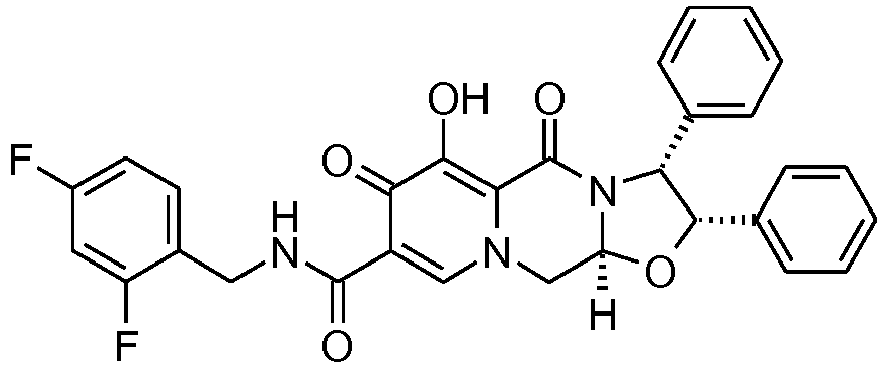

- The title compounds were made in two steps using a similar process to that described in example Z-1. 16a (40 mg, 0.09 mmol) and (1S,2R)-2-amino-1,2-diphenylethanol (50 mg, 0.23 mmol) were reacted in 1,2-dichloroethane (5 mL) with acetic acid to give (2S,3R,11aS]-N-[(2,4-difluorophenyl)methyl]-5,7-dioxo-2,3-diphenyl-6-[(phenylmethyl) oxy]-2,3,5,7,11,11a-hexahydro[1,3]oxazolo[3,2-a]pyrido[1,2-d]pyrazine-8-carboxamide (34 mg, 63%) and (2S,3R,11aR)-N-[(2,4-difluorophenyl)methyl]-5,7-dioxo-2,3-diphenyl-6-[(phenylmethyl) oxy]-2,3,5,7,11,11a-hexahydro[1,3]oxazolo[3,2-a]pyrido[1,2-d]pyrazine-8-carboxamide (13 mg, 24%). These materials were hydrogenated in a second step as described in example Z-1 to give (2S,3R,11aS)-N-[(2,4-Difluorophenyl)methyl]-6-hydroxy-5,7-dioxo-2,3-diphenyl-2,3,5,7, 11,11a-hexahydro[1,3]oxazolo[3,2-a]pyrido[1,2-d]pyrazine-8-carboxamide (example Z-23, 29 mg, 99%) as a white solid and (2S,3R,11aR)-N-[(2,4-difluorophenyl)methyl]-6-hydroxy-5,7-dioxo-2,3-diphenyl-2,3,5,7, 11,11a-hexahydro[1,3]oxazolo[3,2-a]pyrido[1,2-d]pyrazine-8-carboxamide (example Z-24, 10 mg, 89%) as a white solid respectively. For example Z-23: 1H NMR (DMSO-d6 ) δ 10.29 (t, J = 5.6 Hz, 1 H), 8.55 (s, 1 H), 7.38 (m, 1 H), 7.22 (m, 1 H), 7.11-6.95 (m, 11 H), 6.16 (dd, J = 10.4, 3.6 Hz, 1 H), 5.71 (m, 2 H), 4.90 (m, 1 H), 4.54 (m, 2 H), 4.38 (t, J = 11.2 Hz, 1 H); ES+ MS: 544 (M+1). For example Z-24: 1H NMR (CDCl3) δ 11.64 (br, 1 H), 10.30 (s, 1 H), 8.45 (s, 1 H), 7.34 (m, 1 H), 7.01-6.90 (m, 10 H), 6.80 (m, 2 H), 5.56 (m, 2 H), 5.42 (d, J = 6.4 Hz, 1 H), 4.73 (m, 1 H), 4.63 (m, 2 H), 4.49 (m, 1 H); ES+ MS: 544 (M+1).
-

- The title compound was made in two steps using a similar process to that described in example Z-1. 16a (40 mg, 0.09 mmol) and (2R)-2-amino-3-methyl-1-butanol (0.1 mL) were reacted in 1,2-dichloroethane (8 mL) with acetic acid to give (3R,11a,S)-N-[(2,4-difluorophenyl)methyl]-3-(1-methylethyl)-5,7-dioxo-6-[(phenylmethy l)oxy]-2,3,5,7,11,11a-hexahydro[1,3]oxazolo[3,2-a]pyrido[1,2-d]pyrazine-8-carboxamide (41 mg, 92%). This material was hydrogenated in a second step as described in example Z-1 to give (3R,11aS)-N-[(2,4-Difluorophenyl)methyl]-6-hydroxy-3-(1-methylethyl)-5,7-dioxo-2,3,5, 7,11,11a-hexahydro[1,3]oxazolo[3,2-a]pyrido[1,2-d]pyrazine-8-carboxamide (32 mg, 94%) as a white solid. 1H NMR (CDCl3) δ 11.42 (br, 1 H), 10.27 (br, 1 H), 8.34 (s, 1 H), 7.31 (m, 1 H), 6.78 (m, 2 H), 5.28 (d, J = 6.0 Hz, 1 H), 4.60 (m, 2 H), 4.42 (m, 1 H), 4.33 (m, 1 H), 4.16 (m, 1 H), 4.01 (dd, J = 8.8, 5.2 Hz, 1 H), 3.85 (m, 1 H), 2.37 (m, 1 H), 0.97 (d, J = 6.8 Hz, 3 H), 0.95 (d, J = 6.4 Hz, 3 H); ES+ MS: 434 (M+1).
-

- The title compound was made in two steps using a similar process to that described in example Z-1. 16a (43 mg, 0.09 mmol) and (2S)-2-amino-4-(methylthio)-1-butanol (0.1 mL) were reacted in 1,2-dichloroethane (5 mL) with acetic acid to give (3S,11aR)-N-[(2,4-difluorophenyl)methyl]-3-[2-(methylthio)ethyl]-5,7-dioxo-6-[(phenyl methyl)oxyl-2,3,5,7,11,11a-hexahydro[1,3]oxazolo[3,2-a]pyrido[1,2-d]pyrazine-8-carbox amide (41 mg, 81%). This material (20 mg, 0.04 mmol) was treated with trifluoroacetic acid (1 mL) in dichloromethane (3 mL) at 0 °C to rt over 6 h. The mixture was concentrated in vacuo and subjected to reverse phase preparative HPLC purification to provide (3S,11aR)-N-[(2,4-Difluorophenyl)methyl]-6-hydroxy-3-[2-(methylthio)ethyl]-5,7-dioxo-2,3,5,7,11,11a-hexahydro[1,3]oxazolo[3,2-a]pyrido[1,2-d]pyrazine-8-carboxamide (12 mg, 72%) as a white solid. 1H NMR (CDCl3) δ 11.35 (br, 1 H), 10.25 (s, 1 H), 8.34 (s, 1 H), 7.33 (m, 1 H), 6.79 (m, 2 H), 5.32 (m, 1 H), 4.62-4.53 (m, 3 H), 4.43-4.39 (m, 2 H), 3.91-3.87 (m, 2 H), 2.63-2.53 (m, 2 H), 2.39 (m, 1 H), 2.12 (s, 3 H), 1.89 (m, 1 H); ES+ MS: 466 (M+1).
-

- To a solution of (3S,11aR)-N-[(2,4-difluorophenyl)methyl]-3-[2-(methylthio)ethyl]-5,7-dioxo-6-[(phenyl methyl)oxyl-2,3,5,7,11,11a-hexhydro[1,3]oxazolo[3,2-a]pyrido[1,2-d]pyrazine-8-carbox amide (20 mg, 0.04 mmol) in dichloromethane (5 mL) at 0 °C was added m-CPBA (20 mg, 70%, 0.082 mmol). The resultant solution was allowed to warm as the bath warmed and stirred a total of 3 h. The reaction was quenched by the addition of Na2S2O3 (aq) and sodium bicarbonate. The layers were separated and the organic layer washed with brine. The aqueous layer was extracted with dichloromethane and the combined organics dried over Na2SO4. Filtration and concentration provided (3S,11aR)-N-[(2,4-difluorophenyl)methyl]-3-[2-ethylsulfonyl)ethyl]-5,7-oxo-6-[(phe nylmethyl)oxy]-2,3,5,7,11,11a-hexahydro[1,3]oxazolo[3,2-a]pyrido[1,2-d]pyrazine-8-car boxamide (26 mg, 99%) as a white solid. This material was hydrogenated in a second step as described in example Z-1 to give (3S,11aR)-N-[(2,4-Difluorophenyl)methyl]-6-hydroxy-3-[2-(methylsulfonyl)ethyl]-5,7-di oxo-2,3,5,7,11,11a-hexahydro[1,3]oxazolo[3,2-a]pyrido[1,2-d]pyrazine-8-carboxamide (22 mg, 99%) as a white solid. 1H NMR (CDCl3) δ 11.00 (br, 1 H), 10.16 (s, 1 H), 8.33 (s, 1 H), 7.36 (m, 1 H), 6.81 (m, 2 H), 5.42 (m, 1 H), 4.62 (m, 3 H), 4.41 (m,2 H), 3.93 (m, 2 H), 3.31 (m, 2 H), 2.98 (s, 3 H), 2.40 (m, 1 H), 2.28 (m, 1 H); ES+ MS: 498 (M+1).
-

- The title compound was made in two steps using a similar process to that described in example Z-1. 16a (43 mg, 0.09 mmol) and (2S)-2-amino-3-(1H-indol-3-yl)-1-propanol (100 mg, 0.52 mmol) were reacted in 1,2-dichloroethane (5 mL) with acetic acid to give (3S,11aR)-N-[(2,4-difluorophenyl)methyl]-3-(1H-indol-3-ylmethyl)-5,7-dioxo-6-[(phenyl methyl)oxy]-2,3,5,7,11,11a-hexhydro[1,3]oxazolo[3,2-a]pyrido[1,2-d]pyrazine-8-carbox amide (36 mg, 64%). This material was hydrogenated in a second step as described in example Z-1 to give (3S,11aR)-N-[(2,4-Difluorophenyl)methyl]-6-hydroxy-3-(1H-indol-3-ylmethyl)-5,7-dioxo -2,3,5,7,11,11a-hexahydro[1,3]oxazolo[3,2-a]pyrido[1,2-d]pyrazine-8-carboxamide (29 mg, 95%) as a white solid. 1H NMR (CDCl3/CD3OD) δ 10.34 (m, 1 H), 8.98 (br, 1 H), 8.24 (s, 1 H), 7.58 (d, J = 8.0 Hz, 1 H), 7.32 (m, 2 H), 7.15-7.01 (m, 3 H), 6.78 (m, 2 H), 4.94 (d, J = 6.8 Hz, 1 H), 4.71 (d, J = 5.6 Hz, 1 H), 4.59 (m, 2 H), 4.35 (d, J = 10.4 Hz, 1 H), 4.22 (m, 1 H), 3.99 (m, 1 H), 3.81 (m, 1 H), 3.40 (dd, J = 13.6, 11.6 Hz, 1 H), 3.18 (dd, J = 14.0, 8.4 Hz, 1 H); ES+ MS: 521 (M+1).
-

- a) (2R)-2-({[(1,1-Dimethylethyl)oxy]carbonyl}amino)propyl methanesulfonate. To a stirred solution of 1,1-dimethylethyl [(1R)-2-hydroxy-1-methylethyl]carbamate (5.00 g, 28.5 mmol) and triethylamine (5.92 mL, 42.9 mmol) in CH2Cl2 (30 mL) cooled to 0 °C and under a nitrogen atmosphere was added dropwise a solution of methanesulfonyl chloride (2.43 mL, 31.5 mmol) in CH2Cl2 (25 mL). Stirring was continued for 20 minutes at 0 °C, after which time the reaction was judged complete by TLC analysis (1:1 hexanes/EtOAc). The solution was poured into water and the layers were separated. The organic phase was washed with 0.1 N HCl and then with 5% NaHCO3, dried over Na2SO4, filtered and concentrated to give (2R)-2-({[(1,1-dimethylethyl)oxy]carbonyl}amino)propyl methanesulfonate (7.08 g, 98%) as a white solid. 1H NMR (400 MHz, CDCl3) δ 1.23 (d, J = 6.8 Hz, 3H), 1.44 (s, 9H), 3.03 (s, 3H), 3.97 (m, 1H), 4.15 (dd, J = 4.2, 9.8 Hz, 1H), 4.21 (m, 1H), 4.61 (br s, 1H).
- b) 1,1-Dimethylethyl [(1R)-2-cyano-1-methylethyl]carbamate. To a stirred solution of (2R)-2-({[(1,1-dimethylethyl)oxy]carbonyl}amino)propyl methanesulfonate (7.08 g, 27.9 mmol) in DMSO (50 mL) was added NaCN (3.78 g, 84.0 mmol). The solution was stirred at 70 °C for 2 hours, over which time the formation of a precipitate was observed. After cooling at room temperature, water was added and the mixture was extracted with Et2O. The ethereal layers were washed with a brine solution, dried over Na2SO4, filtered and concentrated to give 1,1-dimethylethyl [(1R)-2-cyano-1-methylethyl]carbamate (3.81 g, 73%) as a pale yellow solid. 1H NMR (400 MHz, CDCl3) δ 1.30 (d, J = 6.8 Hz, 3H), 1.42 (s, 9H), 2.51 (dd, J = 3.8, 16.6 Hz, 1H), 2.73 (m, 1H), 3.93 (m, 1H), 4.63 (br s, 1H).
- c) 1,1-Dimethylethyl [(1R)-3-amino-1-methylpropyl]carbamate. A solution of 1,1-dimethylethyl [(1R)-2-cyano-1-methylethyl]carbamate (1.30 g, 7.1 mmol) in ethanol saturated with anhydrous ammonia was treated with Raney-Ni (1.5 mL of 50% aq. Suspension) and 55 psi of H2 overnight. The mixture was filtered through Celite and the filtrate was concentrated in vacuo. The residue was purified by flash chromatography (80:19:1 CH2Cl2/MeOH/NH4OH (37%) gradient elution) through a short plug of silica gel to give 1,1-dimethylethyl [(1R)-3-amino-1-methylpropyl]carbamate (1.37 g, 100%) as a clear oil that solidified. 1H NMR (400 MHz, CDCl3) δ 1.14 (d, J = 6.8 Hz, 3H), 1.43-1.62 (m, 13H), 2.76 (m, 2H), 3.77 (m, 1H), 4.57 (m, 1H).
- d) 1,1-Dimethylethyl {(1R)-1-methyl-3-[(2-methylpropyl)amino]propyl}carbamate. 1,1-dimethylethyl [(1R)-3-amino-1-methylpropyl]carbamate (0.320 g, 1.70 mmol), isobutyraldehyde (150 µL, 1.62 mmol), and sodium triacetoxyborohydride (0.512 g, 2.42 mmol) were stirred in anhydrous dichloroethane (10 mL) at ambient temperature overnight. The reaction was quenched by the addition of saturated NaHCO3 and then extracted with dichloromethane. The combined extracts were washed with water, dried over Na2SO4, filtered and concentrated. The residue was purified by flash chromatography (80:19:1 CH2Cl2/MeOH/NH4OH (37%) gradient elution) through a short plug of silica gel to afford 1,1-dimethylethyl {(1R)-1-methyl-3-[(2-methylpropyl)amino]propyl}carbamate (0.158 g, 40%) as a clear oil. 1H NMR (400 MHz, CDCl3) δ 0.90 (d, J = 6.4 Hz, 6H), 1.13 (d, J = 6.4 Hz, 3H), 1.42-1.51 (m, 11H), 1.67-1.75 (m, 2H), 2.33-2.42 (m, 2H), 2.58-2.72 (m, 2H), 3.72 (m, 1H), 5.20 (m, 1H).
- e) [(3R)-3-Aminobutyl](2-methylpropyl)amine. An ice cold solution of 1,1-dimethylethyl {(1R)-1-methyl-3-[(2-methylpropyl)amino]propyl}carbamate (0.158 g, 0.65 mmol) in THF (8 mL) was treated with 4 NHCl (aq) (2 mL) and then stirred at room temperature for 2 h. The mixture was concentrated in vacuo to give [(3R)-3-aminobutyl](2-methylpropyl)amine dihydrochloride. The HCl salt was then dissolved in dichloromethane and a minimal amount of methanol and treated with solid supported carbonate resin (MP-Carbonate, Argonaut Technologies). After 30 minutes, the solution was filtered through a fritted tube and the solvents removed carefully in vacuo to give [(3R)-3-aminobutyl](2-methylpropyl)amine (65 mg). 1H NMR (400 MHz, CDCl3) δ 0.88 (d, J = 6.0 Hz, 6H), 1.06 (d, J = 5.6 Hz, 3H), 1.23-1.53 (m, 5H), 1.71-1.74 (m, 1H), 2.39 (m, 2H), 2.65 (m, 2H), 2.97 (m, 1H).
- f) (4R,12aR)-N-[(4-Fluorophenyl)methyl]-7-hydroxy-4-methyl-1-(2-methylpropyl)-6,8-dio xo-1,2,3,4,6,8,12,12a-octahydropyrido[1',2':4,5]pyrazino[1,2-a]pyrimidine-9-carboxami de. The title compound was made in two steps using a similar process to that described in example Z-2. 16 (40 mg, 0.09 mmol) and [(3R)-3-aminobutyl](2-methylpropyl)amine (65 mg, 0.45 mmol) were reacted in dichloromethane (2 mL) with acetic acid to give (4R,12aR)-N-[(4-fluorophenyl)methyl]-4-methyl-1-(2-methylpropyl)-6,8-dioxo-7-[(phen ylmethyl)oxy]-1,2,3,4,6,8,12,12a-octahydropyrido[1',2':4,5]pyrazino[1,2-a]pyrimidine-9 -carboxamide (29 mg, 60%). This material was hydrogenated in a second step as described in example Z-2 to give (4R,12aR)-N-[(4-fluorophenyl)methyl]-7-hydroxy-4-methyl-1-(2-methylpropyl)-6,8-diox o-1,2,3,4,6,8,12,12a-octahydropyrido[1',2':4,5]pyrazino[1,2-a]pyrimidine-9-carboxamid e (18 mg, 75%) as a tan solid. 1H NMR (400 MHz, CDCl3) δ 0.77 (d, J = 6.4 Hz, 3H), 0.84 (d, J = 6.4 Hz, 3H), 1.32 (d, J = 7.2 Hz), 1.45-1.49 (m, 1H), 1.57-1.67 (m, 1H), 2.03-2.12 (m, 2H), 2.21-2.27 (m, 1H), 2.73-2.79 (m, 1H), 2.87-2.92 (m, 1H), 4.16-4.24 (m, 2H), 4.45 (s, 1H), 4.54-4.64 (m, 2H), 4.96-4.99 (m, 1H), 6.96-7.00 (m, 2H), 7.29-7.32 (m, 2H), 8.27 (s, 1H), 10.46 (s, 1H), 12.55 (s, 1H); ES+ MS: 456 (M+1).
-

- a) [(3R)-3-Aminobutyl](1-methylethyl)amine. The free diamine was prepared in a similar manner as described in example Z-29. 1H NMR (400 MHz, CDCl3) δ 1.04 (d, J = 6.4 Hz, 6H), 1.06 (d, J = 6.4 Hz, 3H), 1.41-1.58 (m, 5H), 2.62-2.66 (m, 2H), 2.74-2.80 (m, 1H), 2.92-3.00 (m, 1H).
- b) (4R,12aR)-N-[(4-Fluorophenyl)methyl]-7-hydroxy-4-methyl-1-(1-methylethyl)-6,8-diox o-1,2,3,4,6,8,12,12a-octahydropyrido[1',2':4,5]pyrazino[1,2-a]pyrimidine-9-carboxamid e. The title compound was made in two steps using a similar process to that described in example Z-2. 16 (40 mg, 0.088 mmol) and [(3R)-3-aminobutyl](1-methylethyl)amine (78 mg, 0.60 mmol) were reacted in dichloromethane (2 mL) with acetic acid to give (4R,12aR)-N-[(4-fluorophenyl)methyl]-4-methyl-1-(1-methylethyl)-6,8-dioxo-7-[(phenyl methyl)oxy]-1,2,3,4,6,8,12,12a-octahydropyrido[1',2':4,5]pyrazino[1,2-a]pyrimidine-9-c arboxamide (26 mg, 56%). This material was hydrogenated in a second step as described in example Z-2 to give (4R,12aR)-N-[(4-fluorophenyl)methyl]-7-hydroxy-4-methyl-1-(1-methylethyl)-6,8-dioxo -1,2,3,4,6,8,12,12a-octahydropyrido[1',2':4,5]pyrazino[1,2-a]pyrimidine-9-carboxamide (21 mg, 90%) as an off-white solid. 1H NMR (400 MHz, CDCl3) δ 1.01 (d, J = 5.6 Hz, 3H), 1.06 (d, J = 6.0 Hz, 3H), 1.31 (d, J = 6.8 Hz, 3H), 1.57 (m, 1H), 1.98 (m, 1H), 2.70-2.82 (m, 2H), 3.15 (m, 1H), 4.15-4.19 (m, 1H), 4.30 (m, 1H), 4.48 (s, 1H), 4.54-4.59 (m, 2H), 4.97 (m, 1H), 6.98 (m, 2H), 7.29-7.32 (m, 2H), 8.27 (s, 1H), 10.49 (s, 1H), 12.52 (s, 1H).
-

- a) 1,1-Dimethylethyl [(1S)-2-cyano-1-methylethyl]carbamate. The nitrile was prepared in two steps using a modified procedure as described in example Z-29. To a stirred solution of (2S)-2-({[(1,1-dimethylethyl)oxy]carbonyl}amino)propyl methanesulfonate (8.40 g, 33.2 mmol) in DMSO (50 mL) and KCN (6.51 g, 100.0 mmol) cooled to 0 °C was added 18-crown-6 (9.05 g, 34.3 mmol). The solution was allowed to warm to room temperature and then heated to 70 °C for 1 hour. After cooling at room temperature, water was added and the mixture was extracted with Et2O. The ethereal layers were washed with a brine solution, dried over Na2SO4, filtered and concentrated to give 1,1-dimethylethyl [(1S)-2-cyano-1-methylethyl]carbamate (5.37 g, 88%) as a pale yellow solid. 1H NMR (400 MHz, CDCl3) δ 1.32 (d, J = 6.8 Hz, 3H), 1.44 (s, 9H), 2.52 (dd, J = 4.0, 16.4 Hz, 1H), 2.74 (m, 1H), 3.95 (m, 1H), 4.65 (br s, 1H).
- b) [(3S)-3-Aminobutyl](2-methylpropyl)amine dihydrochloride was prepared in a similar manner as described in example Z-29. 1H NMR (400 MHz, CDCl3/CD3OD) δ 0.99 (m, 6H), 1.34 (m, 3H), 2.13-2.27 (m, 3H), 2.76 (m, 2H), 3.07 (m, 2H), 3.47 (m, 1H), 8.22 (m, 1 H), 8.83 (m, <1 H).
- c) (4S,12aS)-N-[(2,4-Difluorophenyl)methyl]-7-hydroxy-4-methyl-1-(2-methylpropyl)-6,8-dioxo-1,2,3,4,6,8,12,12a-octahydropyrido[1',2':4,5]pyrazino[1,2-a]pyrimidine-9-carboxa mide. The title compound was made in two steps using a similar process to that described in example Z-2. 16a (80 mg, 0.17 mmol) and free based [(3S)-3-aminobutyl](2-methylpropyl)amine (107 mg, 0.74 mmol) were reacted in dichloromethane (2 mL) with acetic acid to give (4S,12aS)-N-[(2,4-difluorophenyl)methyl]-4-methyl-1-(2-methylpropyl)-6,8-dioxo-7-[(p henylmethyl)oxy]-1,2,3,4,6,8,12,12a-octahydropyrido[1',2':4,5]pyrazino[1,2-a]pyrimidi ne-9-carboxamide (76 mg, 76%) as a film. This material was hydrogenated in a second step as described in example Z-2 to give
(4S,12aS)-N-[(2,4-difluorophenyl)methyl]-7-hydroxy-4-methyl-1-(2-methylpropyl)-6,8-dioxo-1,2,3,4,6,8,12,12a-octahydropyrido[1',2':4,5]pyrazino[1,2-a]pyrimidine-9-carboxa mide (39 mg, 80%) as an off-white solid. 1H NMR (400 MHz, CDCl3) δ 0.76 (d, J = 6.4 Hz, 3H), 0.84 (d, J = 6.4 Hz, 3H), 1.32 (d, J = 7.2 Hz, 3H), 1.45-1.50 (m, 1H), 1.60-1.69 (m, 1H), 2.03-2.12 (m, 2H), 2.21-2.27 (m, 1H), 2.73-2.79 (m, 1H), 2.87-2.93 (m, 1H), 4.16-4.25 (m, 2H), 4.45 (s, 1H), 4.57-4.68 (m, 2H), 4.96-5.01 (m, 1H), 6.75-6.82 (m, 2H), 7.32-7.38 (m, 1H), 8.26 (s, 1H), 10.45 (s, 1H), 12.56 (s, 1H); ES+ MS: 475 (M+1). -

- a) 1,1-Dimethylethyl {(1S)-3-[(cyclopropylmethyl)amino]-1-methylpropyl}carbamate. The protected diamine was prepared using a modified procedure as described in example Z-29. 1,1-dimethylethyl [(1S)-3-amino-1-methylpropyl]carbamate (0.293 g, 1.56 mmol), cyclopropane carboxaldehyde (96 µL, 1.30 mmol), and sodium triacetoxyborohydride (0.439 g, 2.07 mmol) were stirred in a 1:1 mixture of anhydrous dichloroethane and tetrahydrofuran (10 mL) at ambient temperature overnight. The reaction was quenched by the addition of saturated NaHCO3 and then extracted with EtOAc. The combined extracts were washed with saturated NaHCO3, then a solution of brine, dried over Na2SO4, filtered and concentrated. The residue was purified by flash chromatography (80:19:1 CH2Cl2/MeOH/NH4OH (37%) gradient elution) through a short plug of silica gel to afford 1,1-dimethylethyl {(1S)-3-[(cyclopropylmethyl)amino]-1-methylpropyl}carbamate (76 mg, 26%) as a clear oil. 1H NMR (400 MHz, CDCl3) δ 0.09-0.13 (m, 2H), 0.44-0.49 (m, 2H), 0.92-0.95 (m, 1H), 1.14 (d, J = 6.4 Hz, 3H), 1.43-1.70 (m, 12H), 2.38-2.50 (m, 2H), 2.62-2.73 (m, 2H), 3.74 (m, 1H), 4.88 (m, 1H).
- b) [(3S)-3-Aminobutyl](cyclopropylmethyl)amine dihydrochloride was prepared in a similar manner as described in example Z-29. 1H NMR (400 MHz, CDCl3/CD3OD) δ 0.40 (m, 2H), 0.64 (m, 2H), 1.15 (m, 1H), 1.34 (m, 3H), 2.12-2.25 (m, 2H), 2.82 (m, 2H), 3.08 (m, 2H), 3.47 (m, 1H), 8.25 (br, < 1H), 9.04 (br, < 1H).
- c) (4S,12aS)-1-(Cyclopropylmethyl)-N-[(2,4-difluorophenyl)methyl]-7-hydroxy-4-methyl-6 ,8-dioxo-1,2,3,4,6,8,12,12a-octahydropyrido[1',2':4,5]pyrazino[1,2-a]pyrimidine-9-carbo xamide. The title compound was made in two steps using a similar process to that described in example Z-2. 16a (50 mg, 0.106 mmol) and free based [(3S)-3-aminobutyl](cyclopropylmethyl)amine (44 mg, 0.31 mmol) were reacted in dichloromethane (2 mL) with acetic acid to give (4S,12aS)-1-(cyclopropylmethyl)-N-[(2,4-difluorophenyl)methyl]-4-methyl-6,8-dioxo-7-[ (phenylmethyl)oxy]-1,2,3,4,6,8,12,12a-octahydropyrido[1',2':4,5]pyrazino[1,2-a]pyrimi dine-9-carboxamide (50 mg, 83%) as a film. This material was hydrogenated in a second step as described in example Z-2 to give (4S,12aS)-1-(cyclopropylmethyl)-N-[(2,4-difluorophenyl)methyl]-7-hydroxy-4-methyl-6, 8-dioxo-1,2,3,4,6,8,12,12a-octahydropyrido[1',2':4,5]pyrazino[1,2-a]pyrimidine-9-carbo xamide (23 mg, 56%) as an off-white solid. 1H NMR (400 MHz, CDCl3) δ 0.11 (m, 2H), 0.56-0.59 (m, 2H), 0.77 (m, 1H), 1.34 (d, J = 7.2 Hz, 3H), 1.46-1.50 (m, 1H), 2.04-2.13 (m, 1H), 2.30-2.34 (m, 1H), 2.46-2.51 (m, 1H), 2.90-2.96 (m, 1H), 3.16-3.19 (m, 1H), 4.21-4.30 (m, 2H), 4.51 (s, 1H), 4.58-4.67 (m, 2H), 5.00-5.05 (m, 1H), 6.75-6.82 (m, 2H), 7.31-7.37 (m, 1H), 8.28 (s, 1H), 10.46 (s, 1H), 12.55 (br, 1H); ES+ MS: 473 (M+1).
-

- a) [(3S)-3-Aminobutyl](2-furanylmethyl)amine dihydrochloride was prepared in a similar manner as described in example Z-32. 1H NMR (400 MHz, CDCl3/CD3OD) δ 1.27 (d, J = 6.4 Hz, 3H), 1.96-2.05 (m, 1H), 2.14-2.19 (m, 1H), 3.00-3.04 (m, 2H), 3.38-3.39 (m, 1H), 4.11-4.18 (m, 2H), 6.34 (m, 1H), 6.59 (m, 1H), 7.40 (m, 1H), 8.18 (br, <1 H), 9.41 (br, < 1 H).
- b) (4S,12aS)-N-[(2,4-Difluorophenyl)methyl]-1-(2-furanylmethyl)-7-hydroxy-4-methyl-6,8 -dioxo-1,2,3,4,6,8,12,12a-octahydropyrido[1',2':4,5]pyrazino[1,2-a]pyrimidine-9-carbox amide. The title compound was made in two steps using a similar process to that described in example Z-2. 16a (36 mg, 0.076 mmol) and free based [(3S)-3-aminobutyl](2-furanylmethyl)amine (70 mg, 0.42 mmol) were reacted in dichloromethane (2 mL) with acetic acid to give (4S,12aS)-N-[(2,4-difluorophenyl)methyl]-1-(2-furanylmethyl)-4-methyl-6,8-dioxo-7-[(p henylmethyl)oxy]-1,2,3,4,6,8,12,12a-octahydropyrido[1',2':4,5]pyrazino[1,2-a]pyrimidi ne-9-carboxamide (32 mg, 70%) as a film. This material was hydrogenated in a second step as described in example Z-2 to give (4S,12aS)-N-[(2,4-difluorophenyl)methyl]-1-(2-furanylmethyl)-7-hydroxy-4-methyl-6,8-dioxo-1,2,3,4,6,8,12,12a-octahydropyrido[1',2':4,5]pyrazino[1,2-a]pyrimidine-9-carboxa mide (20 mg, 76%), as an off-white solid. 1H NMR (400 MHz, CDCl3) δ 1.24 (d, J = 6.8 Hz, 3H), 1.45-1.49 (m, 1H), 2.04-2.13 (m, 1H), 2.77-2.82 (m, 1H), 2.94-3.01 (m, 1H), 3.65 (d, J = 15.6 Hz, 1H), 3.89 (d, J = 16.0 Hz, 1H), 4.27-4.31 (m, 1H), 4.39-4.41 (m, 1H), 4.49-4.53 (m, 1H), 4.58-4.66 (m, 1H), 4.98-5.03 (m, 1H), 6.24 (m, 1H), 6.36 (m, 1H), 6.75-6.82 (m, 2H), 7.31-7.39 (m, 1H), 7.40 (m, 1H), 8.26 (s, 1H), 10.47 (m, 1H), 12.50 (br, 1H); ES+ MS: 499 (M+1).
-
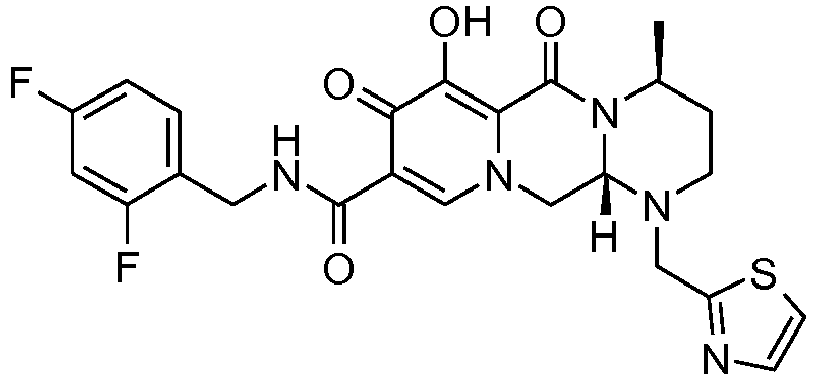
- a) [(3S)-3-Aminobutyl](1,3-thiazol-2-ylmethyl)amine dihydrochloride was prepared in a similar manner as described in example Z-32. 1H NMR (400 MHz, CDCl3/CD3-OD) δ 1.28 (d, J = 6.4 Hz, 3H), 2.05 (m, 1H), 2.17 (m, 1H), 3.20 (m, 2H), 3.39 (m, 1H), 4.51-4.58 (m, 2H), 7.52 (d, 1H), 7.82 (d, 1H).
- b) (4S,12aS)-N-[(2,4-Difluorophenyl)methyl]-7-hydroxy-4-methyl-6,8-dioxo-1-(1,3-thiazol-2-ylmethyl)-1,2,3,4,6,8,12,12a-octahydropyrido[1',2':4,5]pyrazino[1,2-a]pyrimidine-9-c arboxamide. The title compound was made in two steps using a similar process to that described in example Z-2. 16a (35 mg, 0.074 mmol) and free based
[(3S)-3-aminobutyl](1,3-thiazol-2-ylmethyl)amine were reacted in dichloromethane (2 mL) with acetic acid to give
(4S,12aS)-N-[(2,4-difluorophenyl)methyl]-4-methyl-6,8-dioxo-7-[(phenylmethyl)oxy]-1-(1,3-thiazol-2-ylmethyl)-1,2,3,4,6,8,12,12a-octahydropyrido[1',2':4,5]pyrazino[1,2-a]pyr imidine-9-carboxamide (36 mg, 80%) as a film. This material was debenzylated in a second step to in a manner similar to Z-26 to give (4S,12aS)-N-[(2,4-difluorophenyl)methyl]-7-hydroxy-4-methyl-6,8-dioxo-1-(1,3-thiazol-2-ylmethyl)-1,2,3,4,6,8,12,12a-octahydropyrido[1',2':4,5]pyrazino[1,2-a]pyrimidine-9-c arboxamide (18 mg, 60%) as an off-white solid. 1H NMR (400 MHz, CDCl3) δ 1.30 (d, J = 7.2 Hz. 3H), 1.49-1.53 (m, 1H), 2.12-2.18 (m, 1H), 2.93-2.96 (m, 1H), 3.07-3.13 (m, 1H), 3.99-4.03 (m, 1H), 4.13-4.17 (m, 1H), 4.24-4.27 (m, 1H), 4.57-4.61 (m, 3H), 5.03-5.06 (m, 1H), 6.75-6.82 (m, 2H), 7.26 (m, 1H), 7.31-7.37 (m, 2H), 7.76 (m, 1H), 7.94 (m, 1H), 10.40 (m, 1H), 12.48 (m, 1H); ES+ MS: 516 (M+1). -
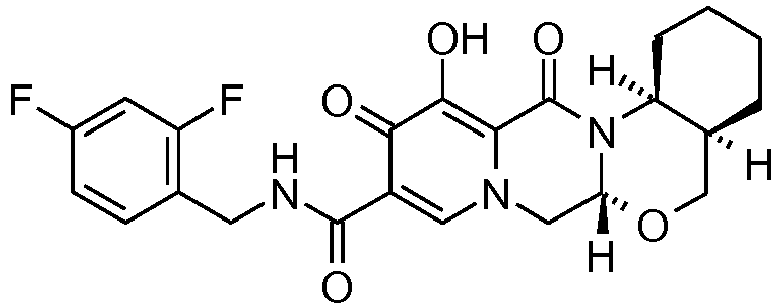
- a) racemic-(4aR,6aR,14aS)-N-[(2,4-Difluorophenyl)methyl]-11,13-dioxo-12-[(phe nylmethyl)oxy]-1,3,4,4a,5,6a,7,11,13,14a-decahydro-2H-pyrido[1',2':4,5]pyrazino[1,2-a] [3,1]benzoxazine-10-carboxamide. racemic-cis-2-Hydroxymethyl-1-cyclohexylamine hydrochloride (24 mg, 0.186 mmol) was dissolved in a dichloromethane solution containing a small amount of methanol (to dissolve) and excess MP-Carbonate (Argonaut Technologies) was added, the mixture was stirred for 30 minutes, and the MP-Carbonate was removed by filtration. The free amine solution was transferred to a microwave vessel containing 16a (29 mg, 0.0617 mmol). One drop of glacial acetic acid was added and the solution was heated for 10 minutes at 140 °C. The resultant solution was absorbed on celite and the material was purified by silica gel chromatography (0-12% methanol/dichloromethane gradient elution) to yield the desired product as a white solid (18 mg, 53%). 1H NMR (CDCl3) δ 10.40 (m, 1 H), 8.35 (s, 1 H), 7.60 (m, 2 H), 7.34-7.26 (m, 4 H), 6.80 (m, 2 H), 5.35-5.23 (m, 2 H), 5.13 (m, 1 H), 4.77 (m, 1 H), 4.70 (m, 2 H), 4.22 (dd, J = 13.2, 3.2 Hz, 1 H), 4.07 (dd, J = 13.2, 6.4, 1 H), 3.96 (m, 1 H), 3.76 (dd, J = 11.2, 4.4, 1 H), 2.22 (m, 1 H), 1.84 (m, 1 H), 1.74-1.40 (m, 6 H), 1.17 (m, 1 H); ES+ MS: 550 (M +1).
- b) racemic-(4aR,6aR,14aS)-N-[(2,4-Difluorophenyl)methyl]-12-hydroxy-11,13-dioxo-1,3,4, 4a,5,6a,7,11,13,14a-decahydro-2H-pyrido[1',2':4,5]pyrazino[1,2-a][3,1]benzoxazine-10-carboxamide. racemic-(4aR,6aR,14aS)-N-[(2,4-Difluorophenyl)methyl]-11,13-dioxo-12-[(phenylmethy l)oxy]-1,3,4,4a,5,6a,7,11,13,14a-decahydro-2H-pyrido[1',2':4,5]pyrazino[1,2-a][3,1]benz oxazine-10-carboxamide (13 mg, 0.0236 mmol) was dissolved in tetrahydrofuran and 10 w.t.% Pd/C (13 mg) was added. Hydrogen was passed through the solution several times and the mixture was stirred at 1 atm hydrogen for 18 hours until the reaction was determined complete by TLC (5% methanol/dichloromethane). The mixture was filtered through Celtite, eluting with methanol/chloroform and the filtrate was concentrated under reduced pressure and purified by HPLC to yield the title compound (7.3 mg, 73%) 1H NMR (CDCl3) δ 12.45 (m, 1 H), 10.38 (s, 1 H), 8.30 (s, 1 H), 7.32 (m, 1 H), 6.83-6.76 (m, 2 H), 5.23 (m, 1 H), 4.75 (m, 1 H), 4.63 (m, 2 H), 4.26 (m, 1 H), 4.12-4.01 (m, 2 H), 3.83 (m, 1 H), 2.30 (m, 1 H), 1.91 (m, 1 H), 1.80 (m, 1 H), 1.67-1.40 (m, 5 H), 1.20 (m, 1 H); ES+ MS: 460 (M +1).
-

- a) racemic-(4aR,6aR,14aS)-N-[(4-Fluorophenyl)methyl]-11,13-dioxo-12-[(phenyl methyl)oxy]-1,3,4,4a,5,6a,7,11,13,14a-decahydro-2H-pyrido[1',2':4,5]pyrazino[1,2-a][3, 1]benzoxazine-10-carboxamide. In a manner similar to that described in example Z-35, from racemic-cis-2-Hydroxymethyl-1-cyclohexylamine hydrochloride (50 mg, 0.303 mmol) and 16 (45 mg, 0.0995 mmol) was prepared
racemic-(4aR,6aR,14aS)-N-[(4-fluorophenyl)methyl]-11,13-dioxo-12-[(phenylmethyl)ox y]-1,3,4,4a,5,6a,7,11,13,14a-decahydro-2H-pyrido[1',2':4,5]pyrazino[1,2-a][3,1]benzoxa zine-10-carboxamide (48 mg, 91%) as a white solid. 1H NMR (CDCl3) δ 10.42 (m, 1 H), 8.37 (s, 1 H), 7.59 (m, 2 H), 7.38-7.24 (m, 5 H), 6.98 (m, 2 H), 5.26-5.18 (m, 2 H), 5.07 (m, 1 H), 4.74 (m, 1 H), 4.62-4.51(m, 2 H), 4.20 (dd, J = 13.6, 4 Hz, 1 H), 4.04 (m, 1 H), 3.91 (m, 1 H), 3.71 (dd, J = 11.3, 4.8 Hz, 1 H), 2.18 (m, 1 H), 1.82 (m, 1 H), 1.73-1.63 (m, 2 H), 1.62-1.56 (m, 2 H), 1.48 (, 1 H), 1.38 (m, 1 H), 1.14 (m, 1 H); ES+ MS: 532 (M +1). - b) racemic-(4aR,6aR,14aS)-N-[(4-Fluorophenyl)methyl]-12-hydroxy-11,13-dioxo-1,3,4,4a, 5,6a,7,11,13,14a-decahydro-2H-pyrido[1',2':4,5]pyrazino[1,2-a][3,1]benzoxazine-10-car boxamide. In a manner similar to that described in example Z-37, from racemic-(4aR,6aR,14aS)-N-[(4-fluorophenyl)methyl]-11,13-dioxo-12-[(phenylmethyl)ox y]-1,3,4,4a,5,6a,7,11,13,14a-decahydro-2H-pyrido[1',2':4,5]pyrazino[1,2-a][3,1]benzoxa zine-10-carboxamide (37 mg, 0.0696 mmol) and 10 w.t. % Pd/C (3 mg) was prepared the title compound (18 mg, 58%) as a white solid after purification by HPLC. 1H NMR (CDCl3) δ 12.47 (s, 1 H), 10.39 (m, 1 H), 8.32 (s, 1 H), 7.30 (m, 2 H), 6.98 (m, 2 H), 5.22 (m, 1 H), 4.74 (m, 1 H), 4.58 (m, 2 H), 4.28 (dd, J = 13.2, 4 Hz, 1 H), 4.12-3.98 (m, 2 H), 3.81 (dd, J= 11.6, 4.8 Hz, 1 H), 2.29 (m, 1 H), 1.91-1.19 (m, 8 H); ES+ MS: 442 (M +1).
-

- a) racemic-(3S,4aR,6aR,14aS)-N-[(2,4-Difluorophenyl)methyl]-11,13-dioxo-3-phe nyl-12-[(phenylmethyl)oxy]-1,3,4,4a,5,6a,7,11,13,14a-decahydro-2H-pyrido[1',2':4,5]py razino[1,2-a][3,1]benzoxazine-10-carboxamide. In a manner similar to that described in example Z-35, from racemic-[(1R,2S,5S)-2-amino-5-phenylcyclohexyl]methanol hydrochloride (32 mg, 0.160 mmol) and 16a (30 mg, 0.064 mmol) was prepared racemic-(3S,4aR,6aR,14aS)-N-[(2,4-difluorophenyl)methyl]-11,13-dioxo-3-phenyl-12-[( phenylmethyl)oxy]-1,3,4,4a,5,6a,7,11,13,14a-decahydro-2H-pyrido[1',2':4,5]pyrazino[1, 2-a][3,1]benzoxazine-10-carboxamide (35 mg, 88%) as a white solid. 1H NMR (CDCl3) δ 10.41 (m, 1 H), 8.38 (s, 1 H), 7.66 (m, 2 H), 7.40-7.26 (m, 6 H), 6.81 (m. 3 H), 5.32-5.25 (m, 2 H), 5.17 (m, 1 H), 4.89 (m, 1 H), 4.66-4.62 (m, 2 H), 4.26 (dd, J = 13.6, 4 Hz, 1 H), 4.13-4.04 (m, 2 H), 3.85 (dd, J = 11.2, 4.4 Hz, 1 H), 2.56 (m, 1 H), 2.37 (m, 1 H), 2.03-1.64 (m, 6 H); ES+ MS: 626 (M +1).
- b) racemic-(3S,4aR,6aR,14aS)-N-[(2,4-Difluorophenyl)methyl]-12-hydroxy-11,13-dioxo-3-phenyl-1,3,4,4a,5,6a,7,11,13,14a-decahydro-2H-pyrido[l',2':4,5]pyrazino[1,2-a][3,1]ben zoxazine-10-carboxamide. racemic-(3S,4aR,6aR,14aS)-N-[(2,4-Difluorophenyl)methyl]-11,13-dioxo-3-phenyl-12-[( phenylmethyl)oxy]-1,3,4,4a,5,6a,7,11,13,14a-decahydro-2H-pyrido[1',2':4,5]pyrazino[1, 2-a][3,1]benzoxazine-10-carboxamide (27 mg, 0.0432 mmol) was suspended in methanol, 10 w.t. % Pd/C (3 mg) was added and hydrogen was bubbled through the system several times until the reaction was determined complete by TLC (5% methanol/dichloromethane). The suspension was filtered through Celite eluting with methanol/chloroform and the filtrate was concentrated under reduced pressure and purified by HPLC to give the title compound (13 mg, 57%) as a white solid. 1H NMR (CDCl3) δ 12.40 (br s, 1 H), 10.37 (m, 1 H), 8.32 (s, 1 H), 7.37-7.28 (m, 3 H), 7.24-7.15 (m, 4 H), 6.79 (m, 2 H), 5.78 (br s, 1 H), 4.85 (m, 1 H), 4.62 (m, 2 H), 4.29 (m, 1 H), 4.16-4.09 (m, 2 H), 3.92 (dd, J= 11.6, 4.8 Hz, 1 H), 2.58 (m, 1 H), 2.46 (m, 1 H), 2.07-1.64 (m, 7 H); ES+ MS: 536 (M +1).
-

- a) racemic-1,1-Dimethylethyl [(1S,2R)-2-(hydroxymethyl)cyclohexyl]carbamate. racemic-[(1R,2S,5S)-2-Amino-5-phenylcyclohexyl]methanol hydrochloride (800 mg, 4.82 mmol) was dissolved in MeOH (40 mL) and bis(1,1-dimethylethyl) dicarbonate (1.16 g, 5.30 mmol) and triethylamine (4 mL, 28.92 mmol) were added and the mixture was stirred 18 hours at ambient temperature. The solvents were removed under reduced pressure, ethyl acetate and aqueous saturated sodium bicarbonate were added and the product was extracted with ethyl acetate. The combined organics were dried over sodium sulfate and the solvents were removed under reduced pressure. Purification by silica gel chromatography (9:1 hexanes: ethyl acetate to ethyl acetate gradient elution) gave 1,1-dimethylethyl racemic-[(1S,2R)-2-(hydroxymethyl)cyclohexyl]carbamate (934 mg, 85%) as a white solid. 1H NMR (CDCl3) δ 4.87 (m, 1H), 4.03-3.95 (m, 2 H), 3.26 (m, 1 H), 3.15 (m, 1 H), 1.73-1.48 (m, 5 H), 1.38 (s, 9 H). 1.27-1.15 (m, 3 H), 0.887 (m, 1 H).
- b) racemic-1,1-Dimethylethyl [(1S,2R)-2-Formylcyclohexyl]carbamate. To a solution of dimethylsulfoxide (0.2 mL, 2.88 mmol) in dichloromethane (3 mL) at -78 °C was added oxalyl chloride (0.72 mL, 1.44 mmol) dropwise. The mixture was stirred 10 minutes and racemic-1,1-dimethylethyl [(1S,2R)-2-(hydroxymethyl)cyclohexyl]carbamate (220 mg, 0.961 mmol) in dichlormethane was added dropwise and stirred 10 minutes. Triethylamine (0.53 mL, 3.84 mmol) was added slowly and the reaction was stirred at -78 °C for one hour and allowed to warm to ambient temperature. Water was added and product was extracted with dichloromethane. The combined organics were washed with brine and dried over sodium sulfate. Removal of solvents under reduced pressure afforded racemic-1,1-dimethylethyl [(1S,2R)-2-formylcyclohexyl]carbamate (223 mg, quantitative) as a yellow oil. 1H NMR (CDCl3) δ 9.61 (s, 1 H), 5.19 (m, 1 H), 3.88 (m, 1 H), 2.61 (m, 1 H), 1.85 (m, 1 H), 1.63-1.49 (m, 4 H), 1.37-1.16 (m, 12 H).
- c) racemic-1,1-dimethylethyl ((1S,2S)-2-{[(2-Methylpropyl)amino]methyl} cyclohexyl)carbamate. racemic-1,1-Dimethylethyl [(1S,2R)-2-formylcyclohexyl]carbamate (223 mg, 0.982 mmol) was dissolved in dichloroethane and 2-methylpropyl)amine (0.15 mL, 1.47 mmol) and sodium triacetoxyborohydride (290 mg, 1.37 mmol) were added and the reaction was stirred at ambient temperature for 18 hours. Aqueous sodium bicarbonate was added and the product was extracted with dichloromethane. The combined extracts were dried over sodium sulfate and the solvents were removed under reduced pressure. Purification by silica gel chromatography (dichloromethane to 1% ammonium hydroxide 19% methanol 80% dichloromethane gradient elution) afforded racemic-1,1-dimethylethyl ((1S,2S)-2-{[(2-methylpropyl)amino]methyl}cyclohexyl)carbamate (112 mg, 40%) as a clear colorless oil. 1H NMR (CDCl3) δ 6.06 (br s, 1 H), 3.76 (br s, 1 H), 2.63 (m, 1 H), 2.43-2.37 (m, 2 H), 2.25 (m, 1 H), 1.81 (m, 1 H), 1.71-1.59 (m, 3 H), 1.44-1.32 (m, 14 H), 1.27-1.19 (m, 2 H), 0.866 (m, 6 H).
- d) racemic(1S,2S)-2-{[(2-Methylpropyl)amino]methyl}cyclohexanamine hydrochloride.
In a manner similar to that describe in example Z-3, step e, from racemic-1,1-dimethylethyl ((1S,2S)-2-{[(2-methylpropyl)amino]methyl} cyclohexyl)carbamate (112 mg, 0.394 mmol) was prepared
(1S,2S)-2-{[(2-methylpropyl)amino]methyl}cyclohexanamine hydrochloride (130 mg, > 100%) as a white solid. 1H NMR (methanol-d 4/CDCl3) δ 8.68-8.28 (m, 1 H), 3.62 (br s, 1 H), 3.26 (m, 1 H), 2.83-2.78 (m, 3 H), 2.54 (br s, 1 H), 2.12 (m, 1 H), 1.82-1.66 (m, 3 H), 1.53-1.39 (m, 5 H), 0.96 (m, 6 H). 0.766 (m, 1 H). - e) racemic-(4aS,6aS,14aS)-N-[(2,4-Difluorophenyl)methyl]-6-(2-methylpropyl)-11 ,13-dioxo-12-[(phenylmethyl)oxy]-1,2,3,4,4a,5,6,6a,7,11,13,14a-dodecahydropyrido[1',2' :4,5] pyrazino[1,2-a]quinazoline-10-carboxamide. In a manner similar to that described in Z-35, from
racemic-(1S,2S)-2-{[(2-methylpropyl)amino]methyl}cyclohexanamine hydrochloride (130 mg, 0.508 mmol) and 16a (55 mg, 0.117 mmol) was prepared
racemic-(4aS,6aS,14aS)-N-[(2,4-difluorophenyl)methyl]-6-(2-methylpropyl)-11,13-diox o-12-[(phenylmethyl)oxy]-1,2,3,4,4a,5,6,6a,7,11,13,14a-dodecahydropyrido[1',2':4,5] pyrazino[1,2-a]quinazoline-10-carboxamide (44 mg, 62%) with a 12: 1 d.r. 1H NMR (CDCl3) δ 10.46 (m, 1H), 8.33 (s, 1 H), 7.59 (m, 2 H), 7.37-7.24 (m, 4 H), 6.79 (m, 2 H), 5.30-5.23 (m, 2 H), 4.75-4.56 (m, 3 H), 4.23-4.09 (m, 3 H), 2.69-2.66 (m, 2 H), 2.21-1.98 (m, 3 H), 1.80 (m, 1 H), 1.71-1.33 (m, 6 H), 1.26-1.19 (m, 2 H), 0.810 (m, 3 H), 0.720 (m, 3 H); ES+ MS: 605 (M +1). - f) racemic-(4aS,6aS,14aS)-N-[(2,4-Difluorophenyl)methyl]-12-hydroxy-6-(2-meth ylpropyl)-11,13-dioxo-1,2,3,4,4a,5,6,6a,7,11,13,14a-dodecahydropyrido[1',2':4,5]pyrazin o[1,2-a]quinazoline-10-carboxamide. In a manner similar to that described in example Z-37, from racemic-(4aS,6aS,14aS)-N-[(2,4-difluorophenyl)methyl]-6-(2-methylpropyl)-11,13-diox o-12-[(phenylmethyl)oxy]-1,2,3,4,4a,5,6,6a,7,11,13,14a-dodecahydropyrido[1',2':4,5] pyrazino[1,2-a]quinazoline-10-carboxamide (39 mg, 0.064 mmol) and 10 w.t. % Pd/C (7 mg) was prepared racemic-(4aS,6aS,14aS)-N-[(2,4-difluorophenyl)methyl]-12-hydroxy-6-(2-methylpropyl) -11,13-dioxo-1,2,3,4,4a,5,6,6a,7,11,13,14a-dodecahydropyrido[1',2':4,5]pyrazino[1,2-a]q uinazoline-10-carboxamide (36 mg, > 100%) as a tan solid. 1H NMR (CDCl3) δ 12.60 (br s, 1 H), 10.43 (br s, 1 H), 8.25 (s, 1 H), 7.35 (m, 1 H), 6.78 (m, 2 H), 4.77 (m, 1 H), 4.63 (m, 2 H), 4.49 (br s, 1 H), 4.30-4.13 (m, 2 H), 3.63-3.40 (m, 2 H), 2.88-2.71 (m, 2 H), 2.32-2.21 (m, 2 H), 2.05 (m, 1 H), 1.88-1.11 (m, 7 H), 0.830 (m, 3 H), 0.760 (m, 3 H); AP+ MS: 515 (M +1).
- g) Sodium racemic-(4aS,6aS,14aS)-10-({[(2,4-Difluorophenyl)methyl]aminolcarbonyl)-6-(2-methyl propyl)-11,13-dioxo-1,2,3,4,4a,5,6,6a,7,11,13,14a-dodecahydropyrido[1',2':4,5]pyrazino[ 1,2-a]quinazolin-12-olate. In a manner similar to that described in example Z-1, from racemic-(4aS,6aS,14aS)-N-[(2,4-difluorophenyl)methyl]-12-hydroxy-6-(2-methylpropyl) -11,13-dioxo-1,2,3,4,4a,5,6,6a,7,11,13,14a-dodecahydropyrido[1',2':4,5]pyrazino[1,2-a]q uinazoline-10-carboxamide (37 mg, 0.071 mmol) and 1 N sodium hydroxide (0.07 mL) the title compound was prepared as a yellow solid (26 mg, 68 %). 1H NMR (DMSO-d6 ) δ 10.73 (m, 1 H), 7.94 (s, 1 H), 7.32 (m, 1 H), 7.19 (m, 1 H), 7.00 (m, 1 H), 4.59-4.41 (m, 3 H), 4.28 (m, 2 H), 4.14 (br s, 1 H), 2.63-2.60 (m, 2 H), 1.98-1.61 (m, 5 H), 1.48-1.36 (m, 4 H), 0.997 (m, 3 H), 0.760 (m, 3 H), 0.660 (m, 2 H); AP+ MS: 515 (M +1 of free acid).
-

- a) (6aR,7aS,11aS)-N-[(2,4-Difluorophenyl)methyl]-2,13-dioxo-1-[(phenylmethyl)o xy]-2,6a,7,7a,8,9,10,11,11a,13-decahydro-6H-pyrido [1',2':4,5] pyrazino[1,2-a] benzimidazole-3-carboxamide and (6aS,7aS,11aS)-N-[(2,4-difluorophenyl)methyl]-2,13-dioxo-1-[(phenylmethyl)oxy]-2,6a, 7,7a,8,9,10,11,11a,13-decahydro-6H-pyrido[1',2':4,5]pyrazino[1,2-a]benzimidazole-3-ca rboxamide. In a manner similar to that described in example Z-2, from [(1S,2S)-2-aminocyclohexyl]amine (122 mg, 1.07 mmol) and 16a (200 mg, 0.426 mmol) was prepared (6aR,7aS,11aS)-N-[(2,4-difluorophenyl)methyl]-2,13-dioxo-1-[(phenylmethyl)oxy]-2,6a, 7,7a,8,9,10,11,11a,13-decahydro-6H-pyrido [1',2':4,5] pyrazino[1,2-a] benzimidazole-3-carboxamide (58 mg) and (6aS,7aS,11aS)-N-[(2,4-difluorophenyl)methyl]-2,13-dioxo-1-[(phenylmethyl)oxy]-2,6a, 7,7a,8,9,10,11,11a,13-decahydro-6H-pyrido[1',2':4,5]pyrazino[1,2-a]benzimidazole-3-ca rboxamide (10.6 mg) after separation of the diastereomers using silica gel chromatography (0-12% methanol/dichloromethane). (6aR,7aS,11aS)-N-[(2,4-difluorophenyl)methyl]-2,13-dioxo-1-[(phenylmethyl)oxy]-2,6a, 7,7a,8,9,10,11,11a,13-decahydro-6H-pyrido [1',2':4,5] pyrazino[1,2-a] benzimidazole-3-carboxamide (major): 1H NMR (CDCl3) δ 10.40 (m, 1 H), 8.33 (s, 1 H), 7.57 (m, 2 H), 7.40-7.25 (m, 4 H), 6.81 (m, 2 H), 5.32 (d, J = 10 Hz, 1 H), 5.13 (d, J = 10 Hz, 1 H), 4.64-4.58 (m, 3 H), 4.21 (dd, J = 12.4, 3.2 Hz, 1 H), 3.79 (m, 1 H), 3.04 (m, 1 H), 2.73 (m, 1 H), 2.53 (m, 1 H), 2.01-1.79 (m, 4 H), 1.36-1.24 (m, 4 H); ES+ MS: 535 (M +1). (6aS,7aS,11aS)-N-[(2,4-difluorophenyl)methyl]-2,13-dioxo-1-[(phenylmethyl)oxy]-2,6a, 7,7a,8,9,10,11,11a,13-decahydro-6H-pyrido[1',2':4,5]pyrazino[1,2-a]benzimidazole-3-ca rboxamide (minor diastereomer): 1H NMR (CDCl3) δ 10.33 (m, 1 H), 8.28 (s, 1 H), 7.61 (m, 2 H), 7.39-7.28 (m, 3 H), 6.79 (m, 2 H), 5.29 (d, J = 9.6 Hz, 1 H), 5.05 (d, J = 9.6 Hz, 1 H), 4.84 (m, 1 H), 4.60 (m, 2 H), 3.90-3.84 (m, 2 H), 3.07 (m, 1 H), 2.75 (m, 1 H), 2.49 (m, 1 H), 2.07 (m, 1 H), 1.90-1.51 (m, 4 H), 1.33-1.19 (m, 4 H); MS data matches that of its diastereomer.
- b) (For example Z-39). (6aR,7aS,11aS)-N-[(2,4-Difluorophenyl)methyl]-1-hydroxy-2,13-dioxo-2,6a,7,7a,8,9,10, 11,11a,13-decahydro-6H-pyrido[1',2':4,5]pyrazino[1,2-a]benzimidazole-3-carboxamide. In a manner similar to that described in example Z-37, from the minor diastereomer prepared in step a (6aS,7aS,11aS)-N-[(2,4-difluorophenyl)methyl]-2,13-dioxo-1-[(phenylmethyl)oxy]-2,6a, 7,7a,8,9,10,11,11a,13-decahydro-6H-pyrido[1',2':4,5]pyrazino[1,2-a]benzimidazole-3-ca rboxamide (7 mg, 0.0131 mmol) and 10 w.t. % Pd/C (catalytic amount) was prepared (6aR,7aS,11aS)-N-[(2,4-difluorophenyl)methyl]-1-hydroxy-2,13-dioxo-2,6a,7,7a,8,9,10, 11,11a,13-decahydro-6H-pyrido[1',2':4,5]pyrazino[1,2-a]benzimidazole-3-carboxamide (2.8 mg, 48%) after purification by HPLC. 1H NMR (CDCl3) δ 12.15 (br s, 1 H), 10.42 (br s, 1 H), 8.31 (s, 1 H), 7.36 (m, 1 H), 6.80 (m, 2 H), 5.01 (m, 1 H), 4.63 (m, 2 H), 4.16 (m, 1 H), 3.96 (m, 1H), 3.06-2.93 (m, 2 H), 2.61 (m, 1 H), 2.18 (m, 1 H), 1.93 (m, 1 H), 1.60-1.13 (m, 4 H), 0.893-0.840 (m, 2 H); ES+ MS: 445 (M +1).
- c) (For example Z-40). (6aS,7aS,11aS)-N-[(2,4-Difluorophenyl)methyl]-1-hydroxy-2,13-dioxo-2,6a,7,7a,8,9,10, 11,11a,13-decahydro-6H-pyrido[1',2':4,5]pyrazino[1,2-a]benzimidazole-3-carboxamide. In a manner similar to that described in example Z-37, from the major diastereomer (30 mg, 0.0561 mmol) prepared in step a and 10 w.t. % Pd/C (catalytic amount), (6aS,7aS,11aS)-N-[(2,4-Difluorophenyl)methyl]-1-hydroxy-2,13-dioxo-2,6a,7,7a,8,9,10, 11,11a,13-decahydro-6H-pyrido[1',2':4,5]pyrazino[1,2-a]benzimidazole-3-carboxamide was prepared as a white solid (15 mg, 60%) after purification by HPLC. 1H NMR (methanol-d 4/CDCl3) δ 10.41 (m, 1 H), 8.25 (s, 1 H), 7.30 (m, 1 H), 6.77 (m, 2 H), 4.77 (m, 1 H), 4.57 (m, 2 H), 4.45 (m, 1 H), 3.91 (m, 1 H), 3.12 (m, 1 H), 2.67 (m, 1 H), 2.12 (m, 1 H), 1.87-1.84 (m, 2 H), 1.47-1.33 (m, 4 H); ES+ MS: 445 (M +1).
-

- a) (5aS,14aS)-N-[(2,4-Difluorophenyl)methyl]-10,12-dioxo-11-[(phenylmethyl)oxyl-1,2,3,4 ,5a,6,10,12,14,14a-decahydropyrido[1,2-a]pyrido[1',2':3,4]imidazo[1,2-d]pyrazine-9-car boxamide. In a manner similar to that described in example Z-18, from 16a (50 mg, 0.108 mmol) and [(2S)-2-piperidinylmethyl]amine hydrochloride (50 mg, 0.269 mmol, made in a similar manner as described in example Z-18) was prepared (5aS,14aS)-N-[(2,4-difluorophenyl)methyl]-10,12-dioxo-11-[(phenylmethyl)oxy]-1,2,3,4, 5a,6,10,12,14,14a-decahydropyrido[1,2-a]pyrido[1',2':3,4]imidazo[1,2-d]pyrazine-9-car boxamide (40 mg, 78 %). 1H NMR (CDCl3) δ 10.43 (m, 1 H), 8.38 (s, 1 H), 7.59 (m, 2 H), 7.59-7.25 (m, 4 H), 6.81 (m, 2 H), 5.38 (d, J = 10 Hz, 1 H), 5.19 (d, J = 10 Hz, 1 H), 4.65-4.62 (m, 2 H), 4.20 (dd, J = 12, 2.8 Hz, 1 H), 4.00 (dd, J = 12.4, 2.8 Hz, 1 H), 3.85 (m, 1 H), 3.74 (m, 1 H), 3.27 (m, 1 H), 2.99 (m, 1 H), 2.43 (m, 1 H), 2.24 (m, 1 H), 1.94-1.87 (m, 2 H), 1.77-1.58 (m, 2 H), 1.39-1.24 (m, 2 H); ES+ MS: 535 (M +1).
- b) (5aS,14aS)-N-[(2,4-Difluorophenyl)methyl]-11-hydroxy-10,12-dioxo-1,2,3,4,5a,6,10,12, 14,14a-decahydropyrido[1,2-a]pyrido[1',2':3,4]imidazo[1,2-d]pyrazine-9-carboxamide. In a manner similar to that described in example Z-37, from (5aS,14aS)-N-[(2,4-difluorophenyl)methyl]-10,12-dioxo-11-[(phenylmethyl)oxy]-1,2,3,4, 5a,6,10,12,14,14a-decahydropyrido[1,2-a]pyrido[1',2':3,4]imidazo[1,2-d]pyrazine-9-car boxamide (18 mg, 0.0337 mmol) and 10 w.t.% Pd/C (catalytic amount) was prepared the title compound as a white solid (13 mg, 87%) after purification by HPLC. 1H NMR (CDCl3) δ 11.71 (br s, 1 H), 10.36 (br s, 1 H), 8.31 (s, 1 H), 7.34 (m, 1 H), 6.78 (m, 2 H), 4.64-4.57 (m, 2 H), 4.28 (m, 1 H), 4.12 (m, 1 H), 3.92-3.89 (m, 2 H), 3.22 (m, 1 H), 3.04 (m, 1 H), 2.49 (m, 1 H), 2.28 (m, 1 H), 1.97-1.89 (m, 2 H), 1.78 (m, 1 H), 1.66-1.60 (m, 2 H), 1.43-1.36 (m, 2 H); ES+ MS: 445 (M +1).
-

- a) Phenylmethyl (2R)-2-(hydroxymethyl)-1-piperidinecarboxylate. In a manner similar to that described in example Z-3a, from (2R)-1-{[(phenylmethyl)oxy]carbonyl}-2-piperidinecarboxylic acid (4.93 g, 18.75 mmol) was prepared phenylmethyl (2R)-2-(hydroxymethyl)-1-piperidinecarboxylate (2.24 g, 48%) as an oil that solidified upon standing to a white solid. 1H NMR (CDCl3) δ 7.36-7.26 (m, 5 H), 5.18-5.10 (m, 2 H), 4.37 (m, 1 H), 4.03 (m, 1 H), 3.84 (, m, 1 H), 3.63 (m, 1 H), 2.96 (br s, 1 H), 1.71-1.42 (m, 6 H).
- b) Phenylmethyl (2R)-2-(cyanomethyl)-1-piperidinecarboxylate. In a manner similar to that described in example Z-3b, from phenylmethyl (2R)-2-(hydroxymethyl)-1-piperidinecarboxylate (1.09g, 4.38 mmol) was prepared phenylmethyl (2R)-2-({[(4-methylphenyl)sulfonyl]oxy}methyl)-1-piperidinecarboxylate (1.05g, 59% impure with uncharacterized byproduct) as a clear colorless oil after purification using silica gel chromatography (10-100% ethyl acetate-hexanes). It is necessary to use this material in the next step as soon as possible or yields deteriorate dramatically. In a manner similar to that described in example Z-3c, from phenylmethyl (2R)-2-({[(4-methylphenyl)sulfonyl]oxy}methyl)-1-piperidinecarboxylate (1.05 g, 2.61 mmol) and sodium cyanide (383 mg, 7.82 mmol) was prepared phenylmethyl (2R)-2-(cyanomethyl)-1-piperidinecarboxylate (171 mg, 25 %) as a yellow oil. 1H NMR (CDCl3) δ 7.35-7.29 (m, 5 H), 5.13 (s, 2 H), 4.65 (m, 1 H), 4.10 (m, 1 H), 2.96 (m, 1 H), 2.60 (m, 2 H), 1.82-1.67 (m, 4 H), 1.54-1.39 (m, 2 H).
- d) Phenylmethyl (2R)-2-(2-aminoethyl)-1-piperidinecarboxylate. In a manner similar to that described in example Z-3d, from phenylmethyl (2R)-2-(cyanomethyl)-1-piperidinecarboxylate (171 mg, 0.663 mmol) was prepared phenylmethyl (2R)-2-(2-aminoethyl)-1-piperidinecarboxylate (119 mg, 68%) as a clear colorless residue. 1H NMR (CDCl3) δ 7.32-7.25 (m, 5 H), 5.08 (m, 2 H), 4.39 (br s, 1 H), 4.01 (br s, 1 H), 2.78 (m, 1 H), 2.60-2.56 (m, 2 H), 1.95-1.86 (m, 3 H), 1.63-1.35 (m, 6 H).
- e) {2-[(2R)-2-Piperidinyl]ethyl}amine. Phenylmethyl (2R)-2-(2-aminoethyl)-1-piperidinecarboxylate (119 mg, 0.454 mmol) was dissolved in methanol and 10 w.t.% Pd/C (120 mg) was added. Hydrogen was bubbled through the solution for 15 minutes and the reaction was stirred under 1 atm hydrogen for 18 hours until determined complete by TLC (1% ammonium hydroxide 19% methanol 80% dichloromethane). The suspension was filtered through Celite eluting with methanol and the filtrate was carefully concentrated under reduce pressure to yield a clear colorless liquid (58 mg, quantitative). 1H NMR (CDCl3) δ 2.99 (m, 1 H), 2.71-2.66 (m, 2 H), 2.57-2.48 (m, 2 H), 1.72 (m, 1 H), 1.61-1.52 (m, 2 H), 1.48-1.42 (m, 2 H), 1.35-1.25 (m, 2 H), 1.05 (m, 1 H).
- f) (4aR,4aR)-N-[(2,4-Difluorophenyl)methyl]-8,10-dioxo-9-[(phenylmethyl)oxy]-2,3,4,4a,5,6,8,10,14,14a-decahydro-1H-pyrido[1,2-c]pyrido[1',2':4,5]pyrazino[1,2-a]pyri midine-11-carboxamide. In a manner similar to that described in example Z-35, from 16a (50 mg, 0.106 mmol) and {2-[(2R)-2-piperidinyl]ethyl}amine (58 mg, 0.454 mmol) was prepared (4aR,14aR)-N-[(2,4-difluorophenyl)methyl]-8,10-dioxo-9-[(phenylmethyl)oxy]-2,3,4,4a, 5,6,8,10,14,14a-decahydro-1H-pyrido[1,2-c]pyrido[1',2':4,5]pyrazino[1,2-a]pyrimidine-1 1-carboxamide (47 mg, 81%). 1H NMR (CDCl3) δ 10.50 (br s, 1 H), 8.33 (s, 1 H), 7.60 (s, 2 H), 7.38-7.24 (m, 4 H), 6.80 (m, 2 H), 5.29-5.22 (m, 2 H), 4.66-4.56 (m, 3 H), 4.30 (m, 1 H), 4.19 (m, 1 H), 3.78 (br s, 1 H), 2.86-2.80 (m, 2 H), 2.18 (br s, 1 H), 1.94 (m, 1 H), 1.68-1.36 (m, 6 H), 1.23 (br s, 2 H); ES+ MS: 549 (M +1).
- g) (4aR,14aR)-N-[(2,4-Difluorophenyl)methyl]-9-hydroxy-8,10-dioxo-2,3,4,4a,5,6, 8,10,14,14a-decahydro-1H-pyrido[1,2-c]pyrido[1',2':4,5] pyrazino[1,2-a]pyrimidine-11-c arboxamide. In a manner similar to that described in example Z-37, from (4aR,14aR)-N-[(2,4-difluorophenyl)methyl]-8,10-dioxo-9-[(phenylmethyl)oxy]-2,3,4,4a, 5,6,8,10,14,14a-decahydro-1H-pyrido[1,2-c]pyrido[1',2':4,5]pyrazino[1,2-a]pyrimidine-1 1-carboxamide (47 mg, 0.0857 mmol) and a catalytic amount of 10 w.t.% Pd/C was prepared the title compound as a white solid (19 mg, 54%) after purification by HPLC. 1H NMR (CDCl3) δ 10.49 (m, 1 H), 8.29 (s, 1 H), 7.34 (m, 1 H), 6.79 (m, 2 H), 4.67-4.56 (m, 3 H), 4.41 (m, 1 H), 4.20 (m, 1 H), 3.93 (s, 1 H), 2.94-2.87 (m, 2 H), 2.28 (br s, 1 H), 2.01 (m, 1 H), 1.68-1.54 (m, 4 H), 1.44 (m, 1 H), 1.29-1.23 (m, 3 H), 0.850 (m, 1 H); ES+ MS: 459 (M +1).
-
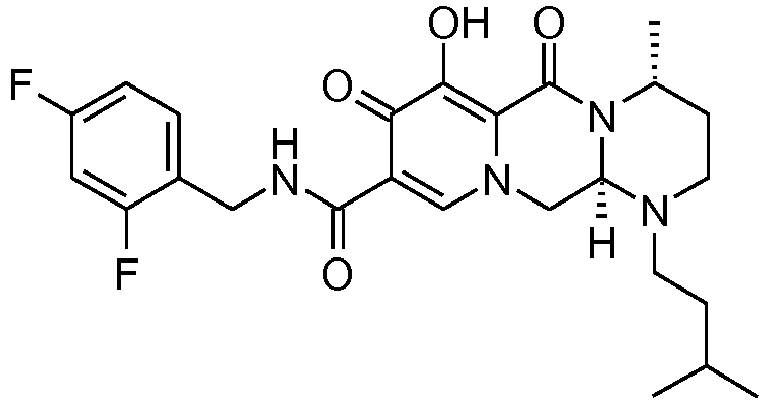
- a) [(3R)-3-Ainobutyl](3-methylbutyl)amine dihydrochloride was prepared in a similar manner as described in example Z-32. 1H NMR (400 MHz, CDCl3/CD3OD) δ 0.87 (d, J = 5.2 Hz, 6H), 1.32 (m, 3H), 1.61 (m, 3H), 2.10-2.20 (m, 2H), 2.90-3.04 (m, 4H), 3.45 (m, 1H), 8.23 (br, < 1 H), 8.96 (br, < 1 H)._
- b) (4R,12aR)-N-[(2,4-Dfluorophenyl)methyl]-7-hydroxy-4-methyl-1-(3-methylbutyl)-6,8-di oxo-1,2,3,4,6,8,12,12a-octahydropyrido[1',2':4,5]pyrazino[1,2-a]pyrimidine-9-carboxam ide. The title compound was made in two steps using a similar process to that described in example Z-2. 16a (40 mg, 0.085 mmol) and free [(3R)-3-aminobutyl](3-methylbutyl)amine (46 mg, 0.35 mmol) were reacted in dichloromethane (2 mL) with acetic acid to give (4R,12aR)-N-[(2,4-difluorophenyl)methyl]-4-methyl-1-(3-methylbutyl)-6,8-dioxo-7-[(ph enylmethyl)oxy]-1,2,3,4,6,8,12,12a-octahydropyrido[1',2':4,5]pyrazino[1,2-a]pyrimidine -9-carboxamide (44 mg, 90%) as a film. This material was hydrogenated in a second step as described in example Z-2 to give
(4R,12aR)-N-[(2,4-difluorophenyl)methyl]-7-hydroxy-4-methyl-1-(3-methylbutyl)-6,8-d ioxo-1,2,3,4,6,8,12,12a-octahydropyrido[1',2':4,5]pyrazino[1,2-a]pyrimidine-9-carboxa mide (11 mg, 30%) as an off-white solid. 1H NMR (400 MHz, CDCl3) δ 0.84 (d, J = 6.8 Hz, 3H), 0.86 (d, J = 6.8 Hz, 3H), 1.24-1.36 (m, 5H), 1.47-1.53 (m, 2H), 2.02-2.11 (m, 1H), 2.36-2.43 (m, 1H), 2.54-2.61 (m, 1H), 2.77-2.92 (m, 2H), 4.16-4.26 (m, 2H), 4.44 (m, 1H), 4.62-4.64 (m, 2H), 4.95-5.02 (m, 1H), 6.75-6.81 (m, 2H), 7.31-7.37 (m, 1H), 8.27 (s, 1H), 10.43 (m, 1H), 12.54 (s, 1H); ES+ MS: 489 (M+1). -

- a) [(3S)-3-Aminobutyl](1-methylethyl)amine dihydrochloride was prepared in a similar manner as described in example Z-29. 1H NMR (400 MHz, CDCl3/CD3OD) δ 1.20-1.25 (m, 9H), 1.93-2.02 (m, 2H), 2.92 (m, 2H), 3.20-3.29 (m, 2H), 8.04 (br, < 1 H), 8.64 (br, < 1 H).
- b) (4S,12aS)-N-[(2,4-Difluorophenyl)methyl]-7-hydroxy-4-methyl-1-(1-methylethyl)-6,8-di oxo-1,2,3,4,6,8,12,12a-octahydropyrido[1',2':4,5]pyrazino[1,2-a]pyrimidine-9-carboxam ide. The title compound was made in two steps using a similar process to that described in example Z-2. 16a (60 mg, 0.13 mmol) and free based
[(3S)-3-aminobutyl](1-methylethyl)amine (55 mg, 0.42 mmol) were reacted in dichloromethane (2 mL) with acetic acid to give
(4S,12aS)-N-[(2,4-difluorophenyl)methyl]-4-methyl-1-(1-methylethyl)-6,8-dioxo-7-[(phe nylmethyl)oxy]-1,2,3,4,6,8,12,12a-octahydropyrido[1',2':4,5]pyrazino[1,2-a]pyrimidine-9-carboxamide (40 mg, 57%) as a film. This material was hydrogenated in a second step as described in example Z-2 to give (4S,12aS)-N-[(2,4-difluorophenyl)methyl]-7-hydroxy-4-methyl-1-(1-methylethyl)-6,8-di oxo-1,2,3,4,6,8,12,12a-octahydropyrido[1',2':4,5]pyrazino[1,2-a]pyrimidine-9-carboxam ide (17 mg, 50%) as an off-white solid. 1H NMR (400 MHz, CDCl3) δ 1.02 (d, J = 6.4 Hz, 3H), 1.07 (d, J = 6.4 Hz, 3H), 1.33 (d, J = 7.2 Hz, 3H), 1.55-1.58 (m, 1H), 1.94-2.03 (m, 1H), 2.70-2.77 (m, 1H), 2.81-2.86 (m, 1H), 3.11-3.18 (m, 1H), 4.17 (dd, J= 3.0, 13.8 Hz, 1H), 4.32 (dd, J = 3.2, 14.0 Hz, 1H), 4.48 (m, 1H), 4.59-4.69 (m, 2H), 4.97-5.00 (m, 1H), 6.77-6.83 (m, 2H), 7.33-7.39 (m, 1H), 8.28 (s, 1H), 10.50 (m, 1H), 12.55 (s, 1H); ES+ MS: 461 (M+1). -

- a) [(3S)-3-Aminobutyl](3-methylbutyl)amine dihydrochloride was prepared in a similar manner as described in example Z-32. 1H NMR (400 MHz, CDCl3/CD3OD) δ 0.86 (d, J = 5.6 Hz, 6H), 1.27 (d, J = 6.0 Hz, 3H), 1.58 (m, 3H), 2.03-2.14 (m, 2H), 2.87-2.99 (m, 4H), 3.38 (m, 1H), 8.15 (br, < 1 H), 8.87 (br, < 1 H).
- b) (4S,12aS)-N-[(2,4-Difluorophenyl)methyl]-7-hydroxy-4-methyl-1-(3-methylbutyl)-6,8-d ioxo-1,2,3,4,6,8,12,12a-octahydropyrido[1',2':4,5]pyrazino[1,2-a]pyrimidine-9-carboxa mide. The title compound was made in two steps using a similar process to that described in example Z-2. 16a (0.100 g, 0.21 mmol) and free based
[(3S)-3-aminobutyl](3-methylbutyl)amine (0.104 g, 0.66 mmol) were reacted in dichloromethane (2 mL) with acetic acid to give
(4S,12aS)-N-[(2,4-difluorophenyl)methyl]-4-methyl-1-(3-methylbutyl)-6,8-dioxo-7-[(ph enylmethyl)oxy]-1,2,3,4,6,8,12,12a-octahydropyrido[1',2':4,5]pyrazino[1,2-a]pyrimidine -9-carboxamide (88 mg, 72%) as a film. This material was hydrogenated in a second step as described in example Z-2 to give
(4S,12aS)-N-[(2,4-difluorophenyl)methyl]-7-hydroxy-4-methyl-1-(3-methylbutyl)-6,8-di oxo-1,2,3,4,6,8,12,12a-octahydropyrido[1',2':4,5]pyrazino[1,2-a]pyrimidine-9-carboxam ide (55 mg, 74%). 1H NMR (400 MHz, CDCl3) δ 0.84 (d, J = 6.4 Hz, 3H), 0.85 (d, J = 6.4 Hz, 3H), 1.24-1.37 (m, 5H), 1.45-1.53 (m, 2H), 2.02-2.11 (m, 1H), 2.37-2.44 (m, 1H), 2.56-2.63 (m, 1H), 2.80-2.92 (m, 2H), 4.22-4.29 (m, 2H), 4.45 (s, 1H), 4.62-4.63 (m, 2H), 4.97-5.00 (m, 1H), 6.75-6.82 (m, 2H), 7.31-7.37 (m, 1H), 8.37 (s, 1H), 10.48 (m, 1H), 12.53 (br, 1H); ES+ MS: 489 (M+1). -

- a) 1,1-Dimethylethyl {(1S)-1-methyl-3-[(3-pyridinylmethyl)amino]propyl}carbamate. The protected diamine was prepared using a modified procedure as described in example Z-32. A solution of 1,1-dimethylethyl
[(1S)-3-amino-1-methylpropyl]carbamate (0.296 g, 1.6 mmol) and 3-pyridinecarboxaldehyde (120 µL, 1.3 mmol) in a 1:1 mixture of anhydrous dichloroethane and tetrahydrofuran (10 mL) was treated with acetic acid (374 µL, 6.6 mmol) and stirred for 30 minutes. Sodium triacetoxyborohydride (0.444 g, 2.1 mmol) was added and the solution was stirred for 2 hours. The resultant was subjected to a workup and purification procedure as described in example Z-32 to give
1,1-dimethylethyl {(1S)-1-methyl-3-[(3-pyridinylmethyl)amino]propyl}carbamate (0.245 g, 66%) as a clear oil. 1H NMR (400 MHz, CDCl3) δ 1.12 (d, J = 6.4 Hz, 3H), 1.42 (s, 9H), 1.46-1.54 (m, 1H), 1.68 (m, 1H), 2.61-2.75 (m, 2H), 3.73- 3.80 (m, 3H), 4.86 (m, 1H), 7.22-7.24 (m, 1H), 7.68 (d, J = 8.0 Hz, 1H), 8.48 (m, 1H), 8.53 (m, 1H). - b) [(3S)-3-Aminobutyl](3-pyridinylmethyl)amine dihydrochloride was prepared in a similar manner as described in example Z-29.
- c) (4S,12aS)-N-[(2,4-Difluorophenyl)methyl]-7-hydroxy-4-methyl-6,8-dioxo-1-(3-pyridinyl methyl)-1,2,3,4,6,8,12,12a-octahydropyrido[1',2':4,5]pyrazino[1,2-a]pyrimidine-9-carbo xamide. The title compound was made in two steps using a similar process to that described in example Z-2. 16a (60 mg, 0.13 mmol) and free based
[(3S)-3-aminobutyl](3-pyridinylmethyl)amine (83 mg, 0.47 mmol) were reacted in dichloromethane (2 mL) with acetic acid to give
(4S,12aS)-N-[(2,4-difluorophenyl)methyl]-4-methyl-6,8-dioxo-7-[(phenylmethyl)oxy]-1-(3-pyridinylmethyl)-1,2,3,4,6,8,12,12a-octahydropyrido[1',2':4,5]pyrazino[1,2-a]pyrimi dine-9-carboxamide (72 mg, 95%) as a film. This material was hydrogenated in a second step as described in example Z-2 to give
(4S,12aS)-N-[(2,4-difluorophenyl)methyl]-7-hydroxy-4-methyl-6,8-dioxo-1-(3-pyridinyl methyl)-1,2,3,4,6,8,12,12a-octahydropyrido[1',2':4,5]pyrazino[1,2-a]pyrimidine-9-carbo xamide (34 mg, 56%) as an off-white solid. 1H NMR (400 MHz, CDCl3) δ 1.37 (d, J = 6.8 Hz, 3H), 1.43-1.47 (m, 1H), 2.12 (m, 1H), 2.60-2.92 (m, 2H), 3.53 (d, J = 14.0 Hz, 1H). 3.82 (d, J = 14.4 Hz, 1H), 4.23-4.31 (m, 2H), 4.55-4.64 (m, 3H), 5.06-5.11 (m, 1H), 6.75-6.82 (m, 2H), 7.20-7.23 (m, 1H), 7.31-7.36 (m, 1H), 7.50 (m, 1H), 7.92 (s, 1H), 8.48 (s, 1H), 10.39 (m, 1H), 12.5 (br, 1H); ES+ MS: 510 (M+1). -

- a) 1,1-Dimethylethyl [(1S)-1-methyl-3-oxopropyl]carbamate. To a stirred solution of 1,1-dimethylethyl [(1S)-2-cyano-1-methylethyl]carbamate (0.656 g, 3.56 mmol) in anhydrous ether cooled to -40 °C was added dropwise a 1.0 M solution of diisobutylaluminum hydride in hexanes (14.2 mL, 14.2 mmol) over 20 minutes. Stirring was continued at this temperature for an additional 20 minutes. The yellow solution was quenched with Rochelle's salt and the resultant stirred at room temperature for 1 hour. The solids were filtered off through celite and rinsed with EtOAc. The organics were washed with brine, concentrated, and flash chromatographed (10-100% EtOAc/hexanes) to give 1,1-dimethylethyl [(1S)-1-methyl-3-oxopropyl]carbamate (0.193 g, 30 %) as a clear oil. 1H NMR (400 MHz, CDCl3) δ 1.22 (d, J = 6.8 Hz, 3H), 1.41 (s, 9H), 2.53-2.65 (m, 2H), 4.08-4.13 (m, 1H), 4.63 (m, 1H), 9.74-9.75 (m, 1H).
- b) 1,1-Dimethylethyl [(1S)-3-(cyclopropylamino)-1-methylpropyl]carbamate. The protected diamine was prepared using a modified procedure as described in example Z-32. A solution of 1,1-dimethylethyl [(1S)-1-methyl-3-oxopropyl]carbamate (0.178 g, 0.95 mmol) and cyclopropylamine (197 µL, 2.85 mmol) in anhydrous dichloroethane (10 mL) was treated with acetic acid (272 µL, 4.8 mmol) and stirred for 30 minutes. Sodium triacetoxyborohydride (0.444 g, 2.1 mmol) was added and the solution was stirred for 20 hours. The resultant was subjected to a workup and purification procedure as described in example Z-32 to give 1,1-dimethylethyl [(1S)-3-(cyclopropylamino)-1-methylpropyl]carbamate (0.136 g, 63%) as a clear oil. 1H NMR (400 MHz, CDCl3) δ 0.32-0.42 (m, 4H), 1.12 (d, J= 6.8 Hz, 3H), 1.39-1.51 (m, 10H), 1.58-1.92 (m, 2H), 2.05-2.10 (m, 1H), 2.67-2.80 (m, 2H), 3.71 (m, 1H), 4.78 (m, 1H).
- c) [(3S)-3-Aminobutyl]cyclopropylamine dihydrochloride was prepared in a similar manner as described in example Z-29. 1H NMR (400 MHz, CDCl3/CD3OD) δ 0.70-0.75 (m, 2H), 0.90-0.94 (m, 2H), 1.18 (d, J= 6.8 Hz, 3H), 1.84-1.94 (m, 1H), 1.97-2.05 (m, 1H), 2.49-2.54 (m, 1H), 2.99-3.04 (m, 2H), 3.23-3.28 (m, 1H).
- d) (4S,12aS)-1-Cyclopropyl-N-[(2,4-difluorophenyl)methyl]-7-hydroxy-4-methyl-6,8-dioxo-1,2,3,4,6,8,12,12a-octahydropyrido[1',2':4,5]pyrazino[1,2-a]pyrimidine-9-carboxamide. The title compound was made in two steps using a similar process to that described in example Z-2. 16a (80 mg, 0.17 mmol) and free based
[(3S)-3-aminobutyl]cyclopropylamine (75 mg, 0.59 mmol) were reacted in dichloromethane (2 mL) with acetic acid to give
(4S,12aS)-1-cyclopropyl-N-[(2,4-difluorophenyl)methyl]-4-methyl-6,8-dioxo-7-[(phenyl methyl)oxy]-1,2,3,4,6,8,12,12a-octahydropyrido[1',2':4,5]pyrazino[1,2-a]pyrimidine-9-c arboxamide (74 mg, 80%) as a film. This material was hydrogenated in a second step as described in example Z-2 to give (4S,12aS)-1-cyclopropyl-N-[(2,4-difluorophenyl)methyl]-7-hydroxy-4-methyl-6,8-dioxo-1,2,3,4,6,8,12,12a-octahydropyrido[1',2':4,5]pyrazino[1,2-a]pyrimidine-9-carboxamide (32 mg, 52%) as an off-white solid. 1H NMR (400 MHz, CDCl3) δ 0.37-0.54 (m, 3H), 0.64-0.70 (m, 1H), 1.35 (d, J = 7.2 Hz, 3H), 1.45-1.49 (m, 1H), 1.76-1.80 (m, 1H), 2.03-2.12 (m, 1H), 2.86-2.93 (m, 1H), 2.99-3.04 (m, 1H), 4.30 (dd, J = 4.0, 13.6 Hz, 1H), 4.49-4.67 (m, 4H), 5.00-5.07 (m, 1H), 6.75-6.82 (m, 2H), 7.32-7.36 (m, 1H), 8.28 (s, 1H), 10.49 (m, 1H), 12.53 (s, 1H); ES+ MS: 459 (M+1). -

- a) [(3S)-3-Aminobutyl][2-(methyloxy)ethyl]amine dihydrochloride. The protected diamine, 1,1-dimethylethyl ((1S)-1-methyl-3-{[2-(methyloxy)ethyl]amino}propyl)carbamate was prepared in a similar manner as described in example Z-47. Subsequently, [(3S)-3-aminobutyl][2-(methyloxy)ethyl]amine dihydrochloride was prepared in a similar manner as described in example Z-29. 1H NMR (400 MHz, CDCl3/CD3OD) δ 1.21 (d, J = 5.6 Hz, 3H), 1.93 (m, 1H), 2.04 (m, 1H), 2.98-3.05 (m, 4H), 3.22 (m, 2H), 3.26-3.31 (m, 4H), 8.06 (br, < 1 H), 8.81 (br, < 1 H).
- b) (4S,12aS)-N-[(2,4-Difluorophenyl)methyl]-7-hydroxy-4-methyl-1-[2-(methyloxy)ethyl]-6,8-dioxo-1,2,3,4,6,8,12,12a-octahydropyrido[1',2':4,5]pyrazino[1,2-a]pyrimidine-9-carb oxamide. The title compound was made in two steps using a similar process to that described in example Z-2. 16a (60 mg, 0.13 mmol) and free based [(3S)-3-aminobutyl][2-(methyloxy)ethyl]amine (53 mg, 0.37 mmol) were reacted in dichloromethane (2 mL) with acetic acid to give (4S,12aS)-N-[(2,4-difluorophenyl)methyl]-4-methyl-1-[2-(methyloxy)ethyl]-6,8-dioxo-7-[(phenylmethyl)oxy]-1,2,3,4,6,8,12,12a-octahydropyrido[1',2':4,5]pyrazino[1,2-a]pyrimi dine-9-carboxamide (47 mg, 63%) as a film. This material was hydrogenated in a second step as described in example Z-2 to give (4S,12aS)-N-[(2,4-difluorophenyl)methyl]-7-hydroxy-4-methyl-1-[2-(methyloxy)ethyl]-6 ,8-dioxo-1,2,3,4,6,8,12,12a-octahydropyrido[1',2':4,5]pyrazino[1,2-a]pyrimidine-9-carbo xamide (38 mg, 97%) as an off-white solid. 1H NMR (400 MHz, CDCl3) δ 1.34 (d, J = 7.2 Hz, 3H), 1.49 (m, 1H), 2.03-2.12 (m, 1H), 2.67-2.70 (m, 1H), 2.81-2.92 (m, 2H), 3.06-3.15 (m, 1H), 3.30-3.37 (m, 4H), 3.58-3.63 (m, 1H), 4.20 (dd, J = 3.4, 14.2 Hz, 1H), 4.50-4.59 (m, 1H), 4.62-4.65 (m, 3H), 5.00-5.03 (m, 1H), 6.75-6.81 (m, 2H), 7.31-7.37 (m, 1H), 8.27 (s, 1H), 10.46 (s, 1H), 12.54 (s, 1H); ES+ MS: 477 (M+1).
-

- a) racemic-(1S,2S)-2-{[(2-Methylpropyl)amino]methyl}cyclopentanamine hydrochloride.
In a manner similar to example Z-18a-c, from racemic-(1R,2S)-2-({[(1,1-dimethylethyl)oxy]carbonyl}amino)cyclopentanecarboxylic acid (255 mg, 1.11 mmol) was prepared racemic-1,1-dimethylethyl [(1S,2S)-2-(aminomethyl)cyclopentyl]carbamate (153 mg, 64 % over 3 steps) as a white green residue. Reductive amination with isobutyraldehyde followed by deprotection as described in Z-38 steps c and d respectively, gave racemic-(1S,2S)-2-{[(2-methylpropyl)amino]methyl}cyclopentanamine hydrochloride (105 mg, 39% over 5 steps from amino acid). 1H NMR (methanol-d 4/CDCl3) 8.90 (br s, <1 H), 8.64 (br s, <1 H), 8.28 (m, 1 H), 3.97 (br s, 1 H), 3.37 (m, 1 H), 2.83-2.69 (m, 3 H), 2.18-1.69 (m, 7 H), 0.996 (m, 6 H). - b) racemic-(3aS,5aS,13aS)-N-[(2,4-Difluorophenyl)methyl]-11-hydroxy-5-(2-meth ylpropyl)-10,12-dioxo-2,3,3a,4,5,5a,6,10,12,13a-decahydro-1H-cyclopenta[e]pyrido[1',2' :4,5]pyrazino[1,2-a]pyrimidine-9-carboxamide. In a manner similar to that described in example Z-35, from racemic-(1S,2S)-2-{[(2-methylpropyl)amino]methyl}cyclopentanamine hydrochloride 105 mg, 0.434 mmol) and 16a (56 mg, 0.119 mmol) was prepared racemic-(3aS,5aS,13aS)-N-[(2,4-difluorophenyl)methyl]-5-(2-methylpropyl)-10,12-diox o-11-[(phenylmethyl)oxy]-2,3,3a,4,5,5a,6,10,12,13a-decahydro-1H-cyclopenta[e]pyrido[ 1',2':4,5]pyrazino[1,2-a]pyrimidine-9-carboxamide (52 mg, 74%). This material was deprotected in a second step similar to the procedure described in example Z-37. Thus, from racemic-(3aS,5aS,13aS)-N-[(2,4-difluorophenyl)methyl]-5-(2-methylpropyl)-10,12-diox o-11-[(phenylmethyl)oxy]-2,3,3a,4,5,5a,6,10,12,13a-decahydro-1H-cyclopenta[e]pyrido[ 1',2':4,5]pyrazino[1,2-a]pyrimidine-9-carboxamide (48 mg, 0.081 mmol) and 10% Pd/C (catalytic amount), the title compound was prepared as a white solid after purification by HPLC (30 mg, 75%). 1H NMR (CDCl3) 12.59 (s, 1 H), 10.42 (s, 1 H), 828 (s, 1 H), 7.34 (m, 1 H), 6.79 (m, 2 H), 4.83 (s, 1 H), 4.63-4.58 (m, 3 H), 4.29 (m, 1 H), 4.14 (m, 1 H), 2.91 (m, 1 H), 2.46-2.32 (m, 3 H), 2.15-2.09 (m, 2 H), 1.85-1.61 (m, 5 H), 1.39 (m, 1 H), 0.88 (m, 6 H); ES+ MS: 501 (M +1).
-

- The title compound was made in two steps using a similar process to that described in example Z-2. 16a (40 mg, 0.09 mmol) and (2R)-2-amino-1-butanol (0.02 mL, 0.21 mmol) were reacted in dichloromethane (2 mL) with acetic acid to give (3R,11aS)-N-[(2,4-difluorophenyl)methyl]-3-ethyl-5,7-dioxo-6-[(phenylmethyl)oxy]-2,3, 5,7,11,11a-hexahydro[1,3]oxazolo[3,2-a]pyrido[1,2-d]pyrazine-8-carboxamide (40 mg, 93%). This material was hydrogenated in a second step as described in example Z-2 to give (3R,11aS)-N-[(2,4-Difluorophenyl)methyl]-3-ethyl-6-hydroxy-5,7-dioxo-2,3,5,7,11,11a-h exahydro[1,3]oxazolo[3,2-a]pyrido[1,2-d]pyrazine-8-carboxamide (30 mg, 91%) as a white solid. 1H NMR (CDCl3) δ 11.49 (br, 1 H), 10.28 (m, 1 H), 8.35 (s, 1 H), 7.34 (m, 1 H), 6.79 (m, 2), 5.30 (m, 1 H), 4.62 (m, 2 H), 4.45-4.32 (m, 3 H), 3.93-3.86 (m, 2 H), 2.11 (m, 1 H), 1.65 (m, 1 H), 0.98 (t, J= 7.6 Hz, 3 H); ES+ MS: 420 (M +1).
-

- a) racemic-1,1-Dimethylethyl [(1S,2R)-2-formylcyclohexyl]carbamate. An alternative procedure from the one given in example Z-38b follows: To a solution of Dess-Martin Periodane (564 mg, 1.33 mmol) in dichloromethane was added racemic-1,1-dimethylethyl [(1S,2R)-2-(hydroxymethyl)cyclohexyl]carbamate (305 mg, 1.33 mmol, see example Z-38a) dropwise as a solution in dichloromethane. The reaction was stirred 1 hour at ambient temperature until judged complete by TLC (1:1 hexanes: ethyl acetate KMnO4 stain). The reaction was quenched with aqueous sodium bicarbonate and sodium thiosulfate solutions, extracted with dichloromethane, and the combined organics were dried over sodium sulfate. Silica gel chromatography (0-50% ethyl acetate/ hexanes gradient elution) gave racemic-1,1-dimethylethyl [(1S,2R)-2-formylcyclohexyl]carbamate (280, 93%). See example Z-38b for NMR data.
- b) racemic-{[(1S,2S)-2-Aminocyclohexyl]methyl}[2'(4-morpholinyl)ethyl]amine hydrochloride. In a manner similar to that described in example Z-38c-d from racemic-1,1-dimethylethyl [(1S,2R)-2-formylcyclohexyl]carbamate (78 mg, 0.344 mmol, prepared using the procedure from example Z-38b) and [2-(4-morpholinyl)ethyl]amine (67 mg, 0.515 mmol) was prepared racemic-{[(1S,2S)-2-aminocyclohexyl]methyl}[2-(4-morpholinyl)ethyl]amine hydrochloride (95 mg, 78% over 2 steps) as a white solid. 1H NMR (methanol-d 4/CDCl3) 8.18 (br s, 1 H), 3.84-3.493 (m. 11 H), 3.19-3.119 (m, 5 H), 2.42 (m, 1 H), 2.11 (br s, 2 H), 1.87-1.17 (m, 10 H).
- c) racemic-4aS,6aS,14aS)-N-[(2,4-Difluorophenyl)methyl]-12-hydroxy-6-[2-(4-mo rpholinyl)ethyl]-11,13-dioxo-1,2,3,4,4a,5,6,6a,7,11,13,14a-dodecahydropyrido[1',2':4,5] pyrazino[1,2-a]quinazoline-10-carboxamide. In a manner similar to that described in example Z-35, from racemic-{[(1S,2S)-2-aminocyclohexyl]methyl}[2-(4-morpholinyl)ethyl]amine hydrochloride (95 mg, 0.272 mmol) and 16a (45 mg, 0.0957 mmol) was prepared racemic-(4aS,6aS,14aS)-N-[(2,4-difluorophenyl)methyl]-6-[2-(4-morpholinyl)ethyl]-11, 13-dioxo-12-[(phenylmethyl)oxy]-1,2,3,4,4a,5,6,6a,7,11,13,14a-dodecahydropyrido[1',2': 4,5]pyrazino[1,2-a]quinazoline-10-carboxamide (27 mg, 43%). This material was deprotected in a second step similar to the procedure described in example Z-37. From racemic-(4aS,6aS,14aS)-N-[(2,4-difluorophenyl)methyl]-6-[2-(4-morpholinyl)ethyl]-11, 13-dioxo-12-[(phenylmethyl)oxy]-1,2,3,4,4a,5,6,6a,7,11,13,14a-dodecahydropyrido[1',2': 4,5]pyrazino[1,2-a]quinazoline-10-carboxamide (27 mg, 0.0408 mmol) and 10% Pd/C (1 mg) the title compound was prepared as a white solid after purification by HPLC. 1H NMR (CDCl3) 12.30 (br s, <1 H), 10.41 (br s, 1 H), 8.29 (s, 1 H), 7.34 (m, 2 H), 6.78 (m, 2 H), 4.76 (m, 1 H), 4.62-4.54 (m, 3 H), 4.29 (m, 2 H), 3.65 (m, 4 H), 3.01 (m, 1 H), 2.76 (m, 2 H), 2.58-2.42 (m, 7 H), 2.21 (m, 1 H), 1.89-1.23 (m, 8 H); ES+ MS: 572 (M +1).
-

- a) racemic-1,1-Dimethylethyl [(1S,2R)-2-(hydroxymethyl)cyclopentyl]carbamate. racemic-(1R,2S)-2-({[(1,1-Dimethylethyl)oxy]carbonyl}amino)cyclopentanecarboxylic acid (22 mg, 0.096 mmol) was dissolved in tetrahydrofuran and placed in an ice-water bath. Triethylamine was added, followed by the slow addition of methyl chloroformate. The reaction was stirred ten minutes in the ice-bath and sodium borohydride was added. Methanol was then added slowly and stirring was continued for two hours while the ice-bath expired. 1 M Potassium hydrogen sulfate was added, the reaction was partially concentrated, and product was extracted with dichloromethane. The combined organics were washed with sodium bicarbonate, brine, and dried over sodium sulfate. Removal of solvents under reduced pressure afforded racemic-1,1-dimethylethyl [(1S,2R)-2-(hydroxymethyl)cyclopentyl]carbamate (25 mg, >100%). 1H NMR (CDCl3) 4.50 (br s, 1 H), 4.06 (m, 1 H), 3.54 (m. 1 H), 3.37 (m, 1 H), 2.09 (m, 1 H), 1.96 (m, 1 H), 1.64 (m, 3 H), 1.52 (m, 1 H), 1.43 (s, 9 H), 1.11 (m, 2 H).
- b) racemic-[(1R,2S)-2-Aminocyclopentyl]methanol hydrochloride. In a manner similar to that described in example, from racemic-1,1-dimethylethyl [(1S,2R)-2-(hydroxymethyl)cyclopentyl]carbamate and 4 N HCl was prepared racemic-[(1R,2S)-2-aminocyclopentyl]methanol hydrochloride (20 mg, quantitative). 1H NMR (methanol-d4-CDCl3) 7.76 (br s, <1 H), 3.73 (m, 1 H), 3.61- 3.28 (m, 3 H), 2.27 (br s, 1 H), 2.01 (m, 2.01 (m, 1 H), 1.74-1.70 (m, 2 H), 1.56-1.42 (m, 2 H), 1.16 (br s, 1 H), 1.05 (br s, 1 H).
- c) racemic-(3aR,13aS)-N-[(2,4-Difluorophenyl)methyl]-11-hydroxy-10,12-dioxo-1, 2,3,3a,4,5a,6,10,12,13a-decahydrocyclopenta[d]pyrido[1',2':4,5]pyrazino[2,1-b][1,3]oxa zine-9-carboxamide. In a manner similar to that described in example Z-35, from racemic-[(1R,2S)-2-aminocyclopentyl]methanol hydrochloride (20 mg, 0.132 mmol) and 16a (24 mg, 0.051 mmol) was prepared racemic-(3aR,13aS)-N-[(2,4-difluorophenyl)methyl]-10,12-dioxo-11-[(phenylmethyl)oxy ]-1,2,3,3a,4,5a,6,10,12,13a-decahydrocyclopenta[d]pyrido[1',2':4,5]pyrazino[2,1-b][1,3] oxazine-9-carboxamide (7 mg, 26 %) as a white solid. This material was deprotected in a second step similar to the procedure described in example Z-37. Thus, from racemic-(3aR,13aS)-N-[(2,4-difluorophenyl)methyl]-10,12-dioxo-11-[(phenylmethyl)oxy ]-1,2,3,3a,4,5a,6,10,12,13a-decahydrocyclopenta[d]pyrido[1',2':4,5]pyrazino[2,1-b][1,3] oxazine-9-carboxamide (7 mg, 0.012 mmol) and 10% Pd/C (1 mg), racemic-(3aR,13aS)-N-[(2,4-difluorophenyl)methyl]-11-hydroxy-10,12-dioxo-1,2,3,3a,4, 5a,6,10,12,13a-decahydrocyclopenta[d]pyrido[1',2':4,5]pyrazino[2,1-b][1,3]oxazine-9-ca rboxamide (4 mg, 72%) white solid. 1H NMR (CDCl3) 12.20 (br s, 1 H), 10.37 (br s, 1 H), 8.31 (s, 1 H), 7.35 (m, 1 H), 6.80 (m, 2 H), 5.16 (m, 1 H), 4.77 (m, 1 H), 4.64 (m, 2 H), 4.28 (m, 1 H), 4.09 (m, 1 H), 3.97 (m, 1 H), 3.45 (m, 1 H), 2.49-2.20 (m, 2 H), 1.89-1.58 (m, 4 H), 0.936-0.840 (m, 1 H); ES+ MS: 446 (M +1).
-

- a) racemic-{[(1S,2S)-2-Aminocyclohexyl]methyl}methylamine hydrochloride. In a manner similar to that described in example Z-38c-d from racemic-1,1-dimethylethyl [(1S,2R)-2-formylcyclohexyl]carbamate (0.410 mmol) and methyl amine (0.5 mL of a 2 M tetrahydrofuran solution) was prepared racemic-{[(1S,2S)-2-aminocyclohexyl]methyl}methylamine hydrochloride in two steps as a white solid (46 mg, 53% 2 steps). 1H NMR (methanol-d 4/CDCl3) 9.05 (br s,<1 H), 8.72 (br s, < 1 H), 8.24 (br s, 1 H), 3.34 (m, 1 H), 3.29 (m, 1 H), 2.85 (br s, 1H), 2.66 (br s, 4 H), 2.38 (br s, 1 H), 2.07-1.83 (m, 2 H), 1.67-1.14 (m, 6 H).
- b) racemic-(4aS,6aS,14aS)-N-[(2,4-Difluorophenyl)methyl]-12-hydroxy-6-methyl-11,13-dioxo-1,2,3,4,4a,5,6,6a,7,11,13,14a-dodecahydropyrido[1',2':4,5]pyrazino[1,2-a]q uinazoline-10-carboxamide. In a manner similar to that described in example Z-35, from racemic-{[(1S,2S)-2-aminocyclohexyl]methyl}methylamine hydrochloride (46 mg, 0.215 mmol) and 16a (35 mg, 0.0744 mmol) was prepared racemic-(4aS,6aS,14aS)-N-[(2,4-difluorophenyl)methyl]-6-methyl-11,13-dioxo-12-[(phe nylmethyl)oxy]-1,2,3,4,4a,5,6,6a,7,11,13,14a-dodecahydropyrido[1',2':4,5]pyrazino[1,2-a]quinazoline-10-carboxamide(17 mg, 41%) as a white solid. This material was deprotected in s second step similar to the procedure described in example Z-37.
- Thus, from racemic-(4aS,6aS,14aS)-N-[(2,4-difluorophenyl)methyl]-6-methyl-11,13-dioxo-12-[(phe nylmethyl)oxy]-1,2,3,4,4a,5,6,6a,7,11,13,14a-dodecahydropyrido[1',2':4,5]pyrazino[1,2-a]quinazoline-10-carboxamide (17 mg, 0.0302 mmol) and 10% Pd/C (1 mg) was prepared the title compound as a white solid (9 mg, 64%). 1H NMR (CDCl3) 10.44 (m, 1 H), 8.29 (s, 1 H), 7.34 (m, 1 H), 6.79 (m, 2 H), 4.78 (m, 1 H), 4.62 (br s, 2 H), 4.29 (br s, 2 H), 3.41 (s, 1 H), 2.92 (m, 1 H), 2.66 (m, 1 H), 2.35-2.25 (m, 4 H), 1.90-1.74 (m, 2 H), 1.67-1.24 (m, 6 H); ES+ MS: 473(M +1).
-
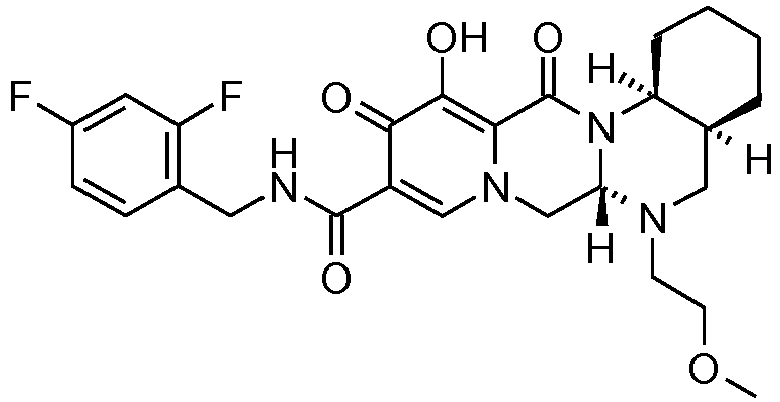
- a) racemic-{[(1S,2S)-2-Aminocyclohexyl]methyl}[2-(methyloxy) ethyl] amine hydrochloride.
In a manner similar to that described in example Z-38c-d from racemic-1,1-dimethylethyl [(1S,2R)-2-formylcyclohexyl]carbamate (93 mg, 0.410 mmol) and [2-(methyloxy)ethyl]amine (0.05 mL, 0.615 mmol) was prepared in two steps racemic-{[(1S,2S)-2-aminocyclohexyl]methyl}[2-(methyloxy)ethyl]amine hydrochloride (63 mg, 60% 2 steps) as a white solid. 1H NMR (methanol-d 4/CDCl3) 9.02 (br s, <1 H), 8.78 (br s, <1, H), 8.29 (br s, 1 H), 3.69 (br s, 2 H), 3.46)s, 3 H), 3.36-3.18 (m, 4 H), 2.97 (br s, 1 H), 2.46 (br s, 1 H), 1.86-1.40 (m, 8 H). - b) racemic-4aS,6aS,14aS)-N-[(2,4-Difluorophenyl)methyl]-12-hydroxy-6-[2-(meth yloxy)ethyl]-11,13-dioxo-1,2,3,4,4a,5,6,6a,7,11,13,14a-dodecahydropyrido[1',2':4,5]pyra zino[1,2-a]quinazoline-10-carboxamide. In a manner similar to that described in example Z-35, from racemic-{[(1S,2S)-2-aminocyclohexyl]methyl}[2-(methyloxy)ethyl]amine hydrochloride (63mg. 0.244 mmol) and 16a (40 mg, 0.0851 mmol) was prepared racemic-(4aS,6aS,14aS)-N-[(2,4-difluorophenyl)methyl]-6-[2-(methyloxy)ethyl]-11,13-d ioxo-12-[(phenylmethyl)oxy]-1,2,3,4,4a,5,6,6a,7,11,13,14a-dodecahydropyrido[1',2':4,5] pyrazino[1,2-a]quinazoline-10-carboxamide (44 mg, 81%) as a white solid. This material was deprotected in a second step similar to the procedure described in example Z-37. Thus, from racemic-(4aS,6aS,14aS)-N-[(2,4-difluorophenyl)methyl]-6-[2-(methyloxy)ethyl]-11,13-dioxo-12-[ (phenylmethyl)oxy]-1,2,3,4,4a,5,6,6a,7,11,13,14a-dodecahydropyrido[1',2':4,5]pyrazino [1,2-a]quinazoline-10-carboxamide (44 mg, 0.0726mmol) and 10% Pd/C (1 mg) the title compound was prepared as a white solid (37 mg, quantitative). 1H NMR (CDCl3) 12.60 (br s, 1 H), 10.47 (m, 1 H), 8.28 (s, 1 H), 7.34 (m, 1 H), 6.79 (m, 2 H), 4.81 (m, 1 H), 4.64 (m 3 H), 4.51 (m, 1 H), 4.26 (m, 1 H), 3.63 (m, 1 H), 3.31 (s, 3 H), 3.19 (m, 1 H), 2.86 (m, 1 H), 2.67 (2m, 2 H), 2.21 (m, 1 H), 1.91-1.78 (m, 2 H), 1.671.52 (m, 4 H), 1.46-1.24 (m, 3 H); ES+ MS: 517 (M +1).
-

- a) racemic-N-[2-({[(1S,2S)-2-Aminocyclohexyl]methyl}amino)ethyl]acetamide hydrochloride. In a manner similar to that described in example Z-38c-d from racemic-1,1-dimethylethyl [(1S,2R)-2-formylcyclohexyl]carbamate (93 mg, 0.41 mmol) and N-(2-aminoethyl)acetamide (63 mg, 0.615 mmol), racemic-N-[2-({[(1S,2S)-2-aminocyclohexyl]methyl}amino)ethyl]acetamide hydrochloride was prepared in two steps as a white solid (82 mg), 71% 2 steps). 1H NMR (methanol-d 4/CDCl3) 8.86 (br s, 1 H), 8.29 (br s, 1 H), 3.62-3.51 (m, 3 H), 3.40-3.28 (m, 4 H), 3.22-2.93 (m, 3 H), 2.47 (m, 1 H), 2.08-2.06 (m, 4 H), 1.83-1.75 (m, 2 H), 1.56-1.44 (m, 3 H), 1.23 (m, 1 H).
- b) racemic-4aS,6aS,14aS)-6-[2-(Acetylamino)ethyl]-N-[(2,4-difluorophenyl)methy l]-12-hydroxy-11,13-dioxo-1,2,3,4,4a,5,6,6a,7,11,13,14a-dodecahydropyrido[1',2':4,5]pyr azino[1,2-a]quinazoline-10-carboxamide. In a manner similar to that described in example Z-35, from
racemic-N-[2-({[(1S,2S)-2-aminocyclohexyl]methyl}amino)ethyl]acetamide hydrochloride (82 mg, 0.349 mmol) and 16a (50 mg, 0.106 mmol) was prepared the title compound (24 mg, 36%). This material was deprotected in a second step similar to the procedure described in example Z-37. Thus, from racemic-(4aS,6aS,14aS)-6-[2-(acetylamino)ethyl]-N-[(2,4-difluorophenyl)methyl]-11,13-dioxo-1 2-[(phenylmethyl)oxy]-1,2,3,4,4a,5,6,6a,7,11,13,14a-dodecahydropyrido[1',2':4,5]pyrazi no[1,2-a]quinazoline-10-carboxamide (24 mg, 0.0379 mmol) and 10% Pd/C (1 mg) was prepared the title compound as a white solid after purification by HPLC. 1H NMR (CDCl3) 12.59 (s, 1 H), 10.44 (s, 1 H), 8.35 (s, 1 H), 7.32 (m, 1 H), 6.79 (m, 2 H), 5.86 (s, 1 H), 4.78 (m, 1 H), 4.61-4.50 (m, 3 H), 4.30 (m, 1 H), 3.35 (m, 1 H), 3.18 (m, 1 H), 2.96 (m, 1 H), 2.76 (m, 2 H), 2.48 (m, 1 H), 2.19 (m, 1 H), 1.89-1.23 (m, 12 H); ES+ MS: 544 (M +1). -

- The title compound was made in two steps using a similar process to that described in example Z-2. 16a (40 mg, 0.09 mmol) and (2S)-2-amino-1-butanol (0.1 mL) were reacted in dichloromethane (2 mL) with acetic acid to give (3S,11aR)-N-[(2,4-difluorophenyl)methyl]-3-ethyl-5,7-dioxo-6-[(phenylmethyl)oxy]-2,3, 5,7,11,11a-hexahydro[1,3]oxazolo[3,2-a]pyrido[1,2-d]pyrazine-8-carboxamide (39 mg, 90%). This material was hydrogenated in a second step as described in example Z-2 to give (3S,11aR)-N-[(2,4-difluorophenyl)methyl]-3-ethyl-6-hydroxy-5,7-dioxo-2,3,5,7,11,11a-h exahydro[1,3]oxazolo[3,2-a]pyrido[1,2-d]pyrazine-8-carboxamide (37 mg, 99%) as a tinted white solid. 1H NMR (CDCl3) δ 11.47 (br, 1 H), 10.26 (m, 1 H), 8.35 (s, 1 H), 7.32 (m, 1 H), 6.77 (m, 2), 5.29 (m, 1 H), 4.60 (m, 2 H), 4.47-4.32 (m, 3 H), 3.93-3.85 (m, 2 H), 2.08 (m, 1 H), 1.68 (m, 1 H), 0.95 (t, J = 7.6 Hz, 3 H); ES+ MS: 420 (M +1).
-
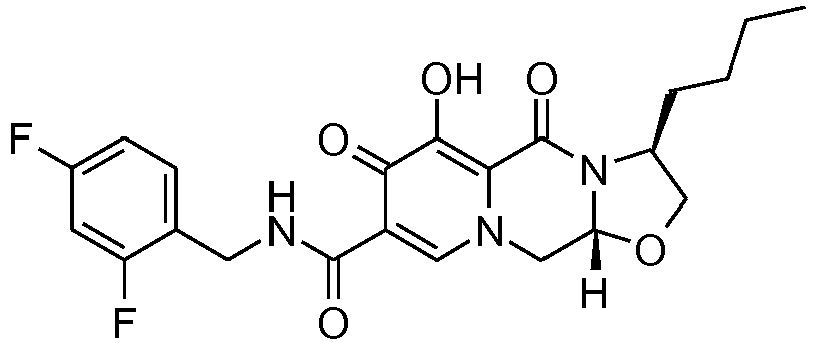
- The title compound was made in two steps using a similar process to that described in example Z-2. 16a (40 mg, 0.09 mmol) and (2S)-2-amino-1-hexanol (100 mg) were reacted in dichloromethane (2 mL) with acetic acid to give (3S,11aR)-3-butyl-N-[(2,4-difluorophenyl)methyl]-5,7-dioxo-6-[(phenylmethyl)oxy]-2,3, 5,7,11,11a-hexahydro[1,3]oxazolo[3,2-a]pyrido[1,2-d]pyrazine-8-carboxamide (43 mg, 94%). This material was hydrogenated in a second step as described in example Z-2 to give (3S,11aR)-3-butyl-N-[(2,4-difluorophenyl)methyl]-6-hydroxy-5,7-dioxo-2,3,5,7,11,11a-h exahydro[1,3]oxazolo[3,2-a]pyrido[1,2-d]pyrazine-8-carboxamide (33 mg, 92%) as a tinted white solid. 1H NMR (CDCl3) δ 11.48 (br, 1 H), 10.27 (br, 1 H), 8.36 (br, 1 H), 7.31 (m, 1 H), 6.77 (m, 2), 5.28 (m, 1 H), 4.59-4.36 (m, 5 H), 3.83 (m, 2 H), 2.08 (m, 1 H), 1.58 (m, 1 H), 1.39-1.23 (m, 4 H), 0.90 (t, J = 6.8 Hz, 3 H); ES+ MS: 448 (M+1).
-

- The title compound was made in two steps using a similar process to that described in example Z-2. 16a (40 mg, 0.09 mmol) and 4-[(2S)-2-amino-3-hydroxypropyl]phenol (43 mg, 0.21 mmol) were reacted in dichloromethane (2 mL) with acetic acid to give (3S,11aR)-N-[(2,4-difluorophenyl)methyl]-3-[(4-hydroxyphenyl)methyl]-5,7-dioxo-6-[(p henylmethyl)oxy]-2,3,5,7,11,11a-hexahydro[1,3]oxazolo[3,2-a]pyrido[1,2-d]pyrazine-8-c arboxamide (10 mg, 20%). This material was hydrogenated in a second step as described in example Z-2 and purified via preparative HPLC to give (3S,11aR)-N-[(2,4-difluorophenyl)methyl]-6-hydroxy-3-[(4-hydroxyphenyl)methyl]-5,7-dioxo-2,3,5,7,11,11a-hexahydro[1,3]oxazolo[3,2-a]pyrido[1,2-d]pyrazine-8-carboxamide (7 mg, 63%) as a white solid. 1H NMR (CD3OD) δ 10.43 (m, 1 H), 8.34 (s, 1 H), 7.33 (m, 1 H), 7.00 (d, J = 8.4 Hz, 2 H), 6.82 (m, 2 H), 6.71 (d, J = 8.4 Hz, 2 H), 5.05 (m, 1 H), 4.67-4.57 (m, 4 H), 4.21 (dd, J = 8.8, 7.2 Hz, 1 H), 3.94 (dd, J = 8.8, 6.4 Hz, 1 H), 3.21 (dd, J = 13.2, 3.2 Hz, 1 H), 2.90 (dd, J = 13.6, 8.8 Hz, 1 H); ES+ MS: 498 (M+1).
-

- a) [(3S)-3-Aminobutyl]cyclobutylamine dihydrochloride was prepared in a similar manner as described in example Z-47. 1H NMR (400 MHz, CDCl3/CD3OD) δ 1.23 (d, J= 6.4 Hz, 3H), 1.69-2.26 (m, 8H), 2.83 (m, 2H), 3.31-3.33 (m, 1H), 3.55 (m, 1H), 8.08 (br, <1H), 9.07 (br, <1H).
- b) (4S,12aS)-1-Cyclobutyl-N-[(2,4-difluorophenyl)methyl]-7-hydroxy-4-methyl-6,8-dioxo-1 ,2,3,4,6,8,12,12a-octahydropyrido[1',2':4,5]pyrazino[1,2-a]pyrimidine-9-carboxamide. The title compound was made in two steps using a similar process to that described in example Z-2. 16a (80 mg, 0.17 mmol) and free based [(3S)-3-aminobutyl]cyclobutylamine (96 mg, 0.68 mmol) were reacted in dichloromethane (2 mL) with acetic acid to give (4S,12aS)-1-cyclobutyl-N-[(2,4-difluorophenyl)methyl]-4-methyl-6,8-dioxo-7-[(phenylm ethyl)oxy]-1,2,3,4,6,8,12,12a-octahydropyrido[1',2':4,5]pyrazino[1,2-a]pyrimidine-9-car boxamide (68 mg, 70%) as a film. This material was hydrogenated in a second step as described in example Z-2 to give (4S,12aS)-1-cyclobutyl-N-[(2,4-difluorophenyl)methyl]-7-hydroxy-4-methyl-6,8-dioxo-1 ,2,3,4,6,8,12,12a-octahydropyrido[1',2':4,5]pyrazino[1,2-a]pyrimidine-9-carboxamide (57 mg, 100%) as an off-white solid. 1H NMR (400 MHz, CDCl3) δ 1.31 (d, J = 6.8 Hz, 3H), 1.46-1.70 (m, 4H), 1.91-2.12 (m, 4H), 2.52 (m, 1H), 2.90-2.93 (m, 1H), 3.06 (m, 1H), 4.16-4.29 (m, 3H), 4.57-4.66 (m, 2H), 4.99-5.05 (m, 1H), 6.75-6.82 (m, 2H), 7.32-7.38 (m, 1H), 8.20 (s, 1H), 10.44 (s, 1H), 12.51 (s, 1H); ES+ MS: 473 (M+1).
-

- a) [(3S)-3-Aminobutyl]tetrahydro-2H-thiopyran-4-ylamine dihydrochloride was prepared in a similar manner as described in example Z-47. 1H NMR (400 MHz, CDCl3/CD3OD) δ 1.21 (d, J = 6.4 Hz , 3H), 1.65-1.75 (m, 2H), 1.90-2.10 (m, 2H), 2.35 (m, 2H), 2.56-2.61 (m, 4H), 2.92-2.98 (m, 3H), 3.27-3.31 (m, 1H), 8.05 (br, <1H), 8.90 (br, <1H).
- b) (4S,12aS)-N-[(2,4-difluorophenyl)methyl]-7-hydroxy-4-methyl-6,8-dioxo-1-(tetrahydro-2H-thiopyran-4-yl)-1,2,3,4,6,8,12,12a-octahydropyrido[1',2':4,5]pyrazino[1,2-a]pyrimid ine-9-carboxamide. The title compound was made in two steps using a similar process to that described in example Z-2. 16a (80 mg, 0.17 mmol) and free based [(3S)-3-aminobutyl]tetrahydro-2H-thiopyran-4-ylamine (108 mg, 0.58 mmol) were reacted in dichloromethane (2 mL) with acetic acid to give (4S,12aS)-N-[(2,4-difluorophenyl)methyl]-4-methyl-6,8-dioxo-7-[(phenylmethyl)oxy]-1-(tetrahydro-2H-thiopyran-4-yl)-1,2,3,4,6,8,12,12a-octahydropyrido[1',2':4,5]pyrazino[1, 2-a]pyrimidine-9-carboxamide (56 mg, 54%) as a film. This material was debenzylated in a second step to in a manner similar to Z-26 to give
(4S,12a,S)-N-[(2,4-difluorophenyl)methyl]-7-hydroxy-4-methyl-6,8-dioxo-1-(tetrahydro-2H-thiopyran-4-yl)-1,2,3,4,6,8,12,12a-octahydropyrido[1',2':4,5]pyrazino[1,2-a]pyrimid ine-9-carboxamide (56 mg, >100%) as an off-white solid. 1H NMR (400 MHz, CDCl3) δ 1.30 (d, J = 6.8 Hz , 3H), 1.54-1.58 (m, 1H), 1.72-1.82 (m, 3H), 1.97-2.11 (m, 2H), 2.60-2.76 (5H), 2.86 (m, 2H), 4.17-4.30 (m, 2H), 4.62-4.66 (m, 3H), 4.92-4.96 (m, 1H), 6.75-6.82 (m, 2H), 7.32-7.38 (m, 1H), 8.31 (s, 1H), 10.46 (s, 1H), 12.48 (s, 1H); ES+ MS: 519 (M+1). -

- a) [(3S)-3-Amino-5-methylhexyl](2-methylpropyl)amine dihydrochloride was prepared in a similar manner as described in example Z-32. 1H NMR (400 MHz, CDCl3/CD3OD) δ 0.87 (d, J = 6.4 Hz ,6H), 0.97 (d, J = 6.8 Hz , 6H), 1.34-1.41 (m, 1H), 1.45-1.52 (m, 1H), 1.58-1.66 (m, 1H), 2.01-2.13 (m, 2H), 2.72-2.73 (m, 2H), 3.03-3.06 (m, 2H), 3.29 (m, 2H), 8.07 (br, <1H), 8.71 (br, <1H).
- b) (4S,12aS)-N-[(2,4-Difluorophenyl)methyl]-7-hydroxy-1,4-bis(2-methylpropyl)-6,8-dioxo -1,2,3,4,6,8,12,12a-octahydropyrido[1',2':4,5]pyrazino[1,2-a]pyrimidine-9-carboxamide. The title compound was made in two steps using a similar process to that described in example Z-2. 16a (80 mg, 0.17 mmol) and free based
[(3S)-3-amino-5-methylhexyl](2-methylpropyl)amine (117 mg, 0.63 mmol) were reacted in dichloromethane (2 mL) with acetic acid to give
(4S,12aS)-N-[(2,4-difluorophenyl)methyl]-1,4-bis(2-methylpropyl)-6,8-dioxo-7-[(phenyl methyl)oxy]-1,2,3,4,6,8,12,12a-octahydropyrido[1',2':4,5]pyrazino[1,2-a]pyrimidine-9-c arboxamide (68 mg, 66%) as a film. This material was hydrogenated in a second step as described in example Z-2 to give (4S,12aS)-N-[(2,4-difluorophenyl)methyl]-7-hydroxy-1,4-bis(2-methylpropyl)-6,8-dioxo-1,2,3,4,6,8,12,12a-octahydropyrido[1',2':4,5]pyrazino[1,2-a]pyrimidine-9-carboxamide (56 mg, 97%) as an off-white solid. 1H NMR (400 MHz, CDCl3) δ 0.74 (d, J = 6.4 Hz, 3H), 0.84 (d, J = 6.4 Hz, 3H), 0.97-1.00 (m, 6H), 1.37-1.83 (m, 5H), 2.03-2.12 (m, 2H), 2.21-2.28 (m, 1H), 2.77 (m, 1H), 2.90-2.93 (m, 1H), 4.19-4.40 (m, 3H), 4.59-4.70 (m, 2H), 4.96-4.97 (m, 1H), 6.77-6.83 (m, 2H), 7.33-7.39 (m, 1H), 8.28 (s, 1H), 10.47 (s, 1H), 12.59 (br, 1H); ES+ MS: 517 (M+1). -
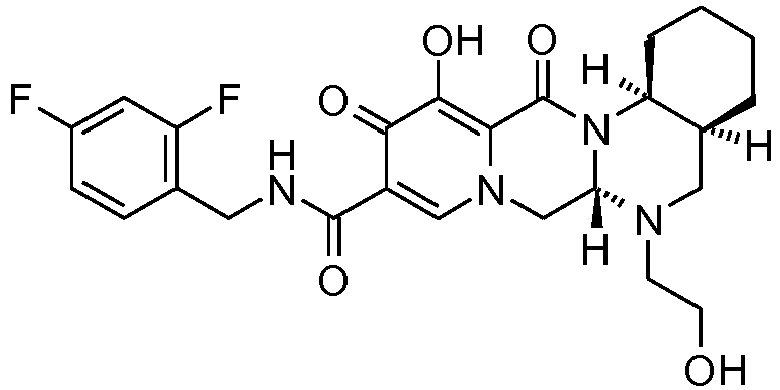
- a) racemic-2-({[(1S,2S)-2-Aminocyclohexyl]methyl}amino)ethanol hydrochloride. In a manner similar to that described in example Z-55a, from
racemic-1,1-dimethylethyl [(1S,2R)-2-formylcyclohexyl]carbamate (112 mg, 0.497 mmol) and 2-aminoethanol (0.04 mLm 0.746 mmol) was prepared
racemic-2-({[(1S,2S)-2-aminocyclohexyl]methyl}amino)ethanol bis-hydrochloride in two steps (102 mg, 84% over 2 steps). 1H NMR (methanol-d 4/CDCl3) 8.81-8.40 (m, < 2 H), 8.16 (br s, 1 H), 4.02-3.93 (m, 2 H), 3.80 (br s, 2 H), 3.53 (m, 1 H), 3.36-2.93 (m, 6 H), 2.41 (br s, 1 H), 2.05 (m, 1 H), 1.75-1.41 (m, 4 H). - b) racemic-(4aS,6aS,14aS)-N-[(2,4-Difluorophenyl)methyl]-12-hydroxy-6-(2-hydr oxyethyl)-11,13-dioxo-1,2,3,4,4a,5,6,6a,7,11,13,14a-dodecahydropyrido[1',2':4,5]pyrazi no[1,2-a]quinazoline-10-carboxamide. In a manner similar to that described in example Z-35, from 16a (45 mg, 0.0957 mmol) and
racemic-2-({[(1S,2S)-2-aminocyclohexyl]methyl}amino)ethanol hydrochloride (102 mg, 0.418 mmol) was prepared
racemic-(4aS,6aS,14aS)-N-[(2,4-difluorophenyl)methyl]-6-(2-hydroxyethyl)-11,13-dioxo -12-[(phenylmethyl)oxy]-1,2,3,4,4a,5,6,6a,7,11,13,14a-dodecahydropyrido[1',2':4,5]pyra zino[1,2-a]quinazoline-10-carboxamide (7 mg, 12 %) as a white solid after silica gel chromatography (1-12% methanol/dichloromethane gradient elution). This material was deprotected in a second step similar to the procedure described in example Z-37. Thus, from
racemic-(4aS,6aS,14aS)-N-[(2,4-difluorophenyl)methyl]-6-(2-hydroxyethyl)-11,13-dioxo -12-[(phenylmethyl)oxy]-1,2,3,4,4a,5,6,6a,7,11,13,14a-dodecahydropyrido[1',2':4,5]pyra zino[1,2-a]quinazoline-10-carboxamide (7 mg, 0.0118 mmol) the title compound was prepared after purification by HPLC (3 mg, 50 %). 1H NMR (CDCl3) 12.57 (br s, 1 H), 10.45 (m, 1 H), 8.29 (s, 1 H), 7.34 (m, 1 H), 6.78 (m, 2 H), 4.80 (m, 1 H), 4.71 (s, 1 H), 4.62 (m, 2 H), 4.44 (m, 1 H), 4.33 (m, 1 H), 3.75 (m, 1 H), 3.62-3.20 (m, 3 H), 3.13 (m, 1 H), 2.74-2.71 (m, 2 H), 2.24 (m, 1 H), 1.90-137 (m, 12 H), 1.27-1.23 (m, 3 H)1.12 (m, 1 H); ES+ MS: 503 (M +1). -

- a) racemic-(1S,2S)-2-[(Cyclopropylamino)methyl]cyclohexanamine hydrochloride. In a manner similar to that described in example Z-55a, from
racemic-1,1-dimethylethyl[(1S,2R)-2-formylcyclohexyl]carbamate (112 mg, 0.497 mmol) and cyclopropylamine (0.05 mL, 0.746 mmol) was prepared
racemic-(1S,2S)-2-[(cyclopropylamino)methyl]cyclohexanamine bis hydrochloride salt in two steps (102 mg, 86% over 2 steps). This material was used without further purification. 1H NMR (methanol-d 4/CDCl3) 8.31 (br s, 1 H), 3.75 (br s, 1 H), 3.54 (m, 1 H), 2.96 (m, 1 H), 2.71 (m, 1 H), 2.27 (m, 1 H), 1.94 (m, 1 H), 1.76-1.15 (m, 8 H), 0.88-0.78 (m, 3 H). - b) racemic-(4aS,6aS,14aS)-6-Cyclopropyl-N-[(2,4-difluorophenyl)methyl]-12-hyd roxy-11,13-dioxo-1,2,3,4,4a,5,6,6a,7,11,13,14a-dodecahydropyrido[1',2':4,5]pyrazino[1, 2-a]quinazoline-10-carboxamide. In a manner similar to that described in example Z-35, from 16a (45 mg, 0.0957 mmol) and racemic-(1S,2S)-2-[(cyclopropylamino)methyl]cyclohexanamine hydrochloride (102 mg, 0.425 mmol) was prepared
racemic-(4aS,6aS,14aS)-6-cyclopropyl-N-[(2,4-difluorophenyl)methyl]-11,13-dioxo-12-[( phenylmethyl)oxy]-1,2,3,4,4a,5,6,6a,7,11,13,14a-dodecahydropyrido[1',2':4,5]pyrazino[ 1,2-a]quinazoline-10-carboxamide as a white solid after silica gel chromatography (1-12% methanol/dichloromethane gradient elution). This material was deprotected in a second step similar to the procedure described in example Z-37. Thus, from
racemic-(4aS,6aS,14aS)-6-cyclopropyl-N-[(2,4-difluorophenyl)methyl]-11,13-dioxo-12-[( phenylmethyl)oxy]-1,2,3,4,4a,5,6,6a,7,11,13,14a-dodecahydropyrido[1',2':4,5]pyrazino[ 1,2-a]quinazoline-10-carboxamide (56 mg, 0.0949 mmol) the title compound was prepared as a white solid (41 mg, 81%). 1H NMR (CDCl3) 12.10 (br s, < 1 H), 10.45 (m, 1 H), 8.27 (s, 1 H), 7.33 (m, 1 H), 6.88 (m, 2 H), 4.77 (m, 1 H), 4.61-4.49 (m, 4 H), 4.33 (m, 1 H), 2.94 (m, 1 H), 2.79 (m, 1 H), 2.17 (m, 1 H), 1.86-0.86 (m, 10 H), 0.658 (m, 1 H), 0.499-0.32 (m, 2 H); ES+ MS: 499 (M +1). -

- a) racemic-(1S,2S)-2-({[2-(1-Pyrrolidinyl)ethyl] amino}methyl)cyclohexanamine hydrochloride. In a manner similar to that described in example Z-55a, from racemic-1,1-dimethylethyl [(1S,2R)-2-formylcyclohexyl]carbamate (112 mg, 0.497 mmol) and 2-(1-pyrrolidinyl)ethanamine (0.09 mL, 0.746 mmol) was prepared racemic-(1S,2S)-2-({[2-(1-pyrrolidinyl)ethyl]amino}methyl)cyclohexanamine (88 mg, 60% 2 steps) as the bis hydrochloride salt in two steps as a white solid. 1H NMR (methanol-d 4/CDCl3) 9.68 (br s, < 1 H), 9.24 (br s, < 1 H), 8.25 (br s, 1 H), 3.75- 3.04 (m, 11 H), 2.37 (br s, 1 H), 2.06-1.20 (m, 12 H).
- b) racemic-(4aS,6aS,14aS)-N-[(2,4-Difluorophenyl)methyl]-12-hydroxy-11,13-dio xo-6-[2-(1-pyrrolidinyl)ethyl]-1,2,3,4,4a,5,6,6a,7,11,13,14a-dodecahydropyrido[1',2':4,5] pyrazino[1,2-a]quinazoline-10-carboxamide formic acid salt. In a manner similar to that described in example Z-35, from 16a (30 mg, 0.0638 mmol) and racemic-(1S,2S)-2-({[2-(1-pyrrolidinyl)ethyl]amino}methyl)cyclohexanamine hydrochloride (88 mg, 0.296 mmol) was prepared racemic-(4aS,6aS,14aS)-N-[(2,4-difluorophenyl)methyl]-11,13-dioxo-12-[(phenylmethyl )oxy]-6-[2-(1-pyrrolidinyl)ethyl]-1,2,3,4,4a,5,6,6a,7,11,13,14a-dodecahydropyrido[1',2': 4,5]pyrazino[1,2-a]quinazoline-10-carboxamide as a white solid (31 mg, 76%) after silica gel chromatography (1-12% methanol/dichloromethane gradient elution). This material was deprotected in a second step similar to the procedure described in example Z-37. Thus, from racemic-(4aS,6aS,14aS)-N-[(2,4-difluorophenyl)methyl]-11,13-dioxo-12-[(phenylmethyl )oxy]-6-[2-(1-pyrrolidinyl)ethyl]-1,2,3,4,4a,5,6,6a,7,11,13,14a-dodecahydropyrido[1',2': 4,5]pyrazino[1,2-a]quinazoline-10-carboxamide (31 mg, 0.048 mmol) the title compound was prepared as a yellow solid after purification by HPLC (18 mg, 66%). 1H NMR (CDCl3) 10.39 (br s, 1 H), 8.56 (br s, 1 H), 8.39 (br s, 1 H), 7.34 (m, 1 H), 6.78 (m, 2 H), 4.76-4.40 (m, 6 H), 3.26-2.89 (m, 7 H), 2.73 (m, 1 H), 2.15 (m, 1 H), 2.02-1.18 (m, 14 H); ES+ MS: 556 (M +1).
-

- a) {2-[(2S)-2-Piperidinyl]ethyl}amine. This compound was prepared in a similar manner as its enantiomer described in example Z-42a.
- b) (4aS,14aS)-N-[(2,4-Difluorophenyl)methyl]-9-hydroxy-8,10-dioxo-2,3,4,4a,5,6, 8,10,14,14a-decahydro-1H-pyrido[1,2-c]pyrido[1',2':4,5]pyrazino[1,2-a]pyrimidine-11-c arboxamide. In a manner similar to that described in example Z-35, from {2-[(2S)-2-piperidinyl]ethyl}amine (28 mg, 0.218 mmol) and 16a (30 mg, 0.0638 mmol) was prepared (4aS,14aS)-N-[(2,4-difluorophenyl)methyl]-8,10-dioxo-9-[(phenylmethyl)oxy]-2,3,4,4a,5 ,6,8,10,14,14a-decahydro-1H-pyrido[1,2-c]pyrido[1',2':4,5]pyrazino[1,2-a]pyrimidine-11 -carboxamide (29 mg, 82%). This material was deprotected in a second step similar to that described in example Z-37 to give the title compound as a white solid (26 mg, quantitative). 1H NMR (CDCl3) δ 12.44 (br s, 1 H), 10.48 (s, 1 H), 8.26 (s, 1 H), 7.35 (m, 1 H), 6.80 (m, 2 H), 4.68-4.57 (m, 2 H), 4.38 (m, 1 H), 4.20 (m, 1 H), 3.93 (s, 1H), 3.63-3.39 (m, 2 H), 2.91 (m, 2 H), 2.29 (br s, 1 H), 2.02 (m, 1 H), 1.69-1.45 (m, 4 H), 1.30-1.24 (m, 2 H), 1.12 (br s, 1 H); ES+ MS: 459 (M+1).
-

- a) [(3S)-3-Aminobutyl][2-(methyloxy)ethyl]amine bis hydrochloride. In a manner similar to that described in example Z-47, from 1,1-dimethylethyl [(1S)-1-methyl-3-oxopropyl]carbamate (76 mg, 0.406 mmol) and 2-(methyloxy)ethyl]amine (0.05 mL, 0.609 mmol) was prepared [(3S)-3-aminobutyl][2-(methyloxy)ethyl]amine as the bis hydrochloride salt in two steps (19 mg, quantitative). 1H NMR (methanol-d 4/CDCl3) δ 9.02 (< 1 H), 8.24 (< 1 H), 3.68 (br s, 2 H), 3.49 (br s, 1 H), 3.34 (br s, 4 H), 3.15 (br s, 4 H), 2.26-2.11 (m, 2 H), 1.35 (br s, 3 H).
- b) (4S,12aS)-N-[(4-Fluorophenyl)methyl]-7-hydroxy-4-methyl-1-[2-(methyloxy)et hyl]-6,8-dioxo-1,2,3,4,6,8,12,12a-octahydropyrido[1',2':4,5]pyrazino[1,2-a]pyrimidine-9 -carboxamide. In a manner similar to that described in example Z-35, from 16 (15 mg, 0.034 mmol) and [(3S)-3-Aminobutyl][2-(methyloxy)ethyl]amine bis hydrochloride (19 mg, 0.087 mmol), (4S,12aS)-N-[(4-fluorophenyl)methyl]-4-methyl-1-[2-(methyloxy)ethyl]-6,8-dioxo-7-[(ph enylmethyl)oxy]-1,2,3,4,6,8,12,12a-octahydropyrido[1',2':4,5]pyrazino[1,2-a]pyrimidine -9-carboxamide was prepared as a white solid after silica gel chromatography (1-12% methanol/dichloromethane). This material was deprotected in a second step similar to that described in example Z-37 to give the title compound as a yellow solid (9 mg, 60 %, 2 steps). 1H NMR (CDCl3) δ 12.56 (s, 1 H), 10.51 (m, 1 H), 8.29 (s, 1 H), 7.32 (m, 2 H), 6.98 (m, 2 H), 5.03 (m, 1 H), 4.65-4.59 (m, 2 H), 4.53 (m, 1 H), 4.21 (m, 1 H), 3.61-3.40 (m, 2 H), 3.34-3.13 (m, 3 H), 3.08 (m, 1 H), 2.94-2.84 (m, 2 H), 2.68 (m, 1 H), 2.07 (m, 1 H), 1.50 (m, 1 H), 1.35 (d, J = 7.2 Hz, 3 H), 1.14 (m, 1 H); ES+ MS: 459 (M+1).
-
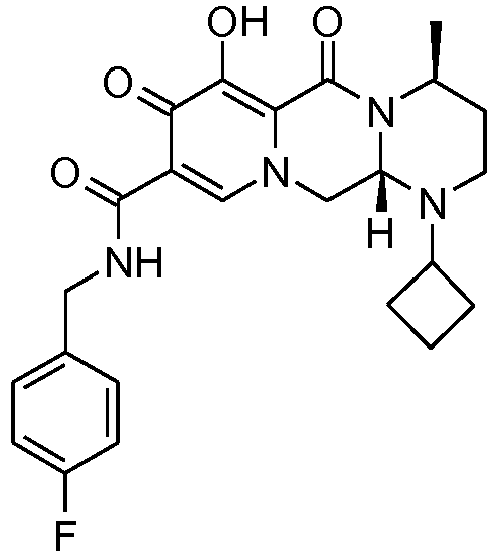
- a) [(3S)-3-Aminobutyl]cyclobutylamine bis-hydrochloride. In a manner similar to that described in example Z-47, from 1,1-dimethylethyl [(1S)-1-methyl-3-oxopropyl]carbamate (76 mg, 0.406 mmol) and cyclobutylamine (0.05 mL, 0.609 mmol) was prepared [(3S)-3-Aminobutyl]cyclobutylamine bis-hydrochloride in two steps (23 mg, 27%). 1H NMR (methanol-d 4/CDCl3) δ 8.86 (s, < 1 H), 7.97 (s, < 1 H), 3.46 (m, 1 H), 3.21 (m, 1 H), 2.74 (m, 2 H), 2.14-2.08 (m, 4 H), 1.94-1.62 (m, 5 H), 1.13 (d, J = 6 Hz, 1 H).
- b) (4S,12aS)-1-Cyclobutyl-N-[(4-fluorophenyl)methyl]-7-hydroxy-4-methyl-6,8-di oxo-1,2,3,4,6,8,12,12a-octahydropyrido[1',2':4,5]pyrazino[1,2-a]pyrimidine-9-carboxam ide. In a similar manner to that described in example Z-35a, from 16 (18 mg, 0.39 mmol) and [(3S)-3-Aminobutyl]cyclobutylamine bis-hydrochloride (23 mg, 0.107 mmol), (4S,12aS)-1-cyclobutyl-N-[(4-fluorophenyl)methyl]-4-methyl-6,8-dioxo-7-[(phenylmeth yl)oxy]-1,2,3,4,6,8,12,12a-octahydropyrido[1',2':4,5]pyrazino[1,2-a]pyrimidine-9-carbox amide was prepared as a white solid. This material was deprotected in a second step similar to that described in example Z-37 to give the title compound as a white solid after purification by HPLC (4.5 mg, 25 % 2 steps). 1H NMR (CDCl3) δ 12.54 (s, 1 H), 10.48 (s, 1 H), 8.20 (s, 1 H). 7.31 (m, 2 H), 6.98 (m, 2 H), 5.02 (m, 1 H), 4.61-4.57 (m, 2 H), 4.26-4.14 (m, 3 H), 3.05 (m, 1 H), 2.90 (m, 1 H), 2.49 (m, 1 H), 2.12 (m, 1 H), 2.05-1.87 (m, 3 H), 1.84-1.61 (m, 3 H), 1.46 (m, 1 H), 1.32 (m, 3 H); ES+ MS: 455 (M+1).
-

- a) [(3S)-3-Aminobutyl](2-methylpropyl)amine bis-hydrochloride. In a manner similar to that described in example Z-47, this compound was prepared from 1,1-dimethylethyl [(1S)-1-methyl-3-oxopropyl]carbamate (76 mg, 0.406 mmol) and (2-methylpropyl)amine (0.06 mL, 0.609 mmol) in two steps as the bis-hydrochloride salt (22 mg, 25 %). 1H NMR (methanol-d 4/CDCl3) δ 3.25 (br s, 1 H), 2.91 (br s, 2 H), 2.64 (m, 2 H), 2.02-1.93 (m, 3 H), 1.17 (m, 3 H), 0.88 (m, 6 H).
- b) (4S,12aS)-N-[(4-Fluorophenyl)methyl]-7-hydroxy-4-methyl-1-(2-methylpropyl) -6,8-dioxo-1,2,3,4,6,8,12,12a-octahydropyrido[1',2':4,5]pyrazino[1,2-a]pyrimidine-9-car boxamide. In a similar manner to that described in example Z-35, from 16 (16 mg, 0.035 mmol) and [(3S)-3-Aminobutyl](2-methylpropyl)amine bis-hydrochloride (20 mg, 0.0925 mmol), (4S,12aS)-N-[(4-fluorophenyl)methyl]-4-methyl-1-(2-methylpropyl)-6,8-dioxo-7-[(pheny lmethyl)oxy]-1,2,3,4,6,8,12,12a-octahydropyrido[1',2':4,5]pyrazino[1,2-a]pyrimidine-9-carboxamide was prepared as a white solid. This material was deprotected in a second step similar to that described in example Z-37 to give the title compound as a tan solid (13 mg, 68% 2 steps). 1H NMR (CDCl3) δ 12.57 (s, 1 H), 10.46 (s, 1 H), 8.27 (s, 1 H), 7.32 (m, 2 H), 6.99 (m, 2 H), 4.98 (m, 1 H), 4.63-4.54 (m, 2 H), 4.45 (m, 1 H),4.26-4.16 (m, 2 H), 2.91 (m, 1 H), 2.77 (m, 1 H), 2.24 (m, 1 H), 2.14-2.03 (m, 2 H), 1.63 (m, 1 H), 1.48 (m, 1 H), 1.33 (m, 3 H), 1.09 (m, 1 H), 0.850 (m, 3 H), 0.789 (m, 3 H); ES+ MS: 457 (M+1).
-

- a) [(3S)-3-Aminobutyl]methylamine bis-hydrochloride. In a manner similar to that described in example Z-47, this compound was prepared from 1,1-dimethylethyl [(1S)-1-methyl-3-oxopropyl]carbamate (76 mg, 0.409 mmol) and excess methylamine (2 M in tetrhydrofuran) in two steps as the bis hydrochloride salt (17% 2 steps). 1H NMR (methanol-d 4/CDCl3) δ 3.16 (m, 1 H), 3.08 (s, 2 H), 2.83 (m, 2 H), 2.45 (s, 3 H), 1.88 (m, 1 H), 1.75 (m, 1 H), 1.09 (m, 3 H).
- b) (4S,12aS)-N-[(4-Fluorophenyl)methyl]-7-hydroxy-1,4-dimethyl-6,8-dioxo-1,2,3, 4,6,8,12,12a-octahydropyrido[1',2':4,5]pyrazino[1,2-a]pyrimidine-9-carboxamide. In a similar manner to that described in example Z-35, from 16 (18 mg, 0.0398 mmol) and [(3S)-3-aminobutyl]methylamine bis-hydrochloride (19 mg, 0.109 mmol,
(4S,12aS)-N-[(4-fluorophenyl)methyl]-1,4-dimethyl-6,8-dioxo-7-[(phenylmethyl)oxy]-1, 2,3,4,6,8,12,12a-octahydropyrido[1',2':4,5]pyrazino[1,2-a]pyrimidine-9-carboxamide was prepared as a white solid. This material was deprotected in a second step similar to that described in example Z-37 to give the title compound as a tan solid (7 mg, 44% 2 steps). 1H NMR (CDCl3) δ 12.53 (s, 1 H), 10.47 (s, 1 H), 8.29 (s, 1 H), 7.32 (m, 2 H), 6.99 (m, 2 H), 5.04 (1 H), 4.60 (m, 2 H), 4.23 (s, 3 H), 2.83-2.80 (m, 2 H), 2.32 (s, 3 H), 2.13 (m, 1 H), 1.48 (m, 1 H), 1.34 (m, 3 H); ES+ MS: 415 (M+1). -

- The title compound was made in two steps using a similar process to that described in example Z-2. 16 (25 mg, 0.055 mmol) and free based [(3S)-3-aminobutyl]tetrahydro-2H-thiopyran-4-ylamine (48 mg, 0.26 mmol) were reacted in dichloromethane (2 mL) with acetic acid to give (4S,12aS)-N-[(4-fluorophenyl)methyl]-4-methyl-6,8-dioxo-7-[(phenylmethyl)oxy]-1-(tet rahydro-2H-thiopyran-4-yl)-1,2,3,4,6,8,12,12a-octahydropyrido[1',2':4,5]pyrazino[1,2-a ]pyrimidine-9-carboxamide (16 mg, 49%) as a film. This material was debenzylated in a second step in a manner similar to Z-26 to give (4S,12aS)-N-[(4-fluorophenyl)methyl]-7-hydroxy-4-methyl-6,8-dioxo-1-(tetrahydro-2H-thiopyran-4-yl)-1,2,3,4,6,8,12,12a-octahydropyrido[1',2':4,5]pyrazino[1,2-a]pyrimidine-9-carboxamide (8 mg, 59%) as an off-white solid. 1H NMR (400 MHz, CDCl3) δ 1.30 (d, J = 7.2 Hz, 3H), 1.53-1.58 (m, 1H), 1.72-2.10 (m, 5H), 2.56-2.76 (m, 5H), 2.84-2.87 (m, 2H), 4.18 (dd, J = 2.8, 14.0 Hz, 1H), 4.26 (dd, J = 3.4, 14.2 Hz, 1H), 4.92-4.97 (m, 1H), 6.96-7.00 (m, 2H), 7.29-7.36 (m, 2H), 8.31 (s, 1H), 10.48 (m, 1H), 12.48 (br, 1H); ES+ MS: 501 (M+1).
-

- a) [(3S)-3-Aminobutyl]methylamine dihydrochloride was prepared in a similar manner as described in example Z-47. 1H NMR (400 MHz, CDCl3) δ 1.18 (d, J = 6.8 Hz, 3H), 1.82-1.91 (m, 1H), 1.94-2.03 (m, 1H), 2.53 (s, 3H), 2.89-2.93 (m, 2H), 3.22-3.30 (m, 1H), 8.02 (br, <1H), 8.81 (br, <1H).
- b) (4S,12aS)-N-[(2,4-Difluorophenyl)methyl]-7-hydroxy-1,4-dimethyl-6,8-dioxo-1,2,3,4,6,8 ,12,12a-octahydropyrido[1',2':4,5]pyrazino[1,2-a]pyrimidine-9-carboxamide. The title compound was made in two steps using a similar process to that described in example Z-2. 16a (40 mg, 0.085 mmol) and free based [(3S)-3-aminobutyl]methylamine (24 mg, 0.23 mmol) were reacted in dichloromethane (2 mL) with acetic acid to give (4S,12aS)-N-[(2,4-difluorophenyl)methyl]-1,4-dimethyl-6,8-dioxo-7-[(phenylmethyl)oxy ]-1,2,3,4,6,8,12,12a-octahydropyrido[1',2':4,5]pyrazino[1,2-a]pyrimidine-9-carboxamide (39 mg, 89%) as a film. This material was hydrogenated in a second step as described in example Z-2 to give (4S,12aS)-N-[(2,4-difluorophenyl)methyl]-7-hydroxy-1,4-dimethyl-6,8-dioxo-1,2,3,4,6,8 ,12,12a-octahydropyrido[1',2':4,5]pyrazino[1,2-a]pyrimidine-9-carboxamide (32 mg, 97%) as an off-white solid. 1H NMR (400 MHz, CDCl3) δ 1.33 (d, J = 6.4 Hz, 3H), 1.46-1.50 (m, 1H), 2.12-2.14 (m, 1H), 2.32 (s, 3H), 2.83 (m, 2H), 4.24 (m, 3H), 4.62 (m, 2H), 5.02 (m, 1H), 6.77-6.79 (m, 2H), 7.33 (m, 1H), 8.30 (s, 1H), 10.43 (s, 1H), 12.50 (br, 1H); ES+ MS: 433 (M+1).
-
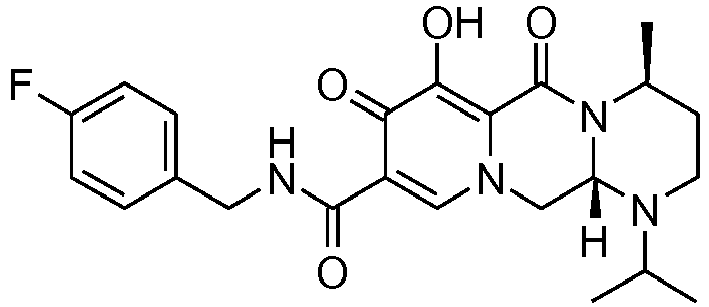
- The title compound was made in two steps using a similar process to that described in example Z-2. 16 (27 mg, 0.060 mmol) and free based [(3S)-3-aminobutyl](1-methylethyl)amine (67 mg, 0.51 mmol) were reacted in dichloromethane (2 mL) with acetic acid to give (4S,12a,S)-N-[(4-fluorophenyl)methyl]-4-methyl-1-(1-methylethyl)-6,8-dioxo-7-[(phenyl methyl)oxy]-1,2,3,4,6,8,12,12a-octahydropyrido[1',2':4,5]pyrazino[1,2-a]pyrimidine-9-c arboxamide (18 mg, 56%) as a film. This material was hydrogenated in a second step as described in example Z-2 to give (4S,12aS)-N-[(4-fluorophenyl)methyl]-7-hydroxy-4-methyl-1-(1-methylethyl)-6,8-dioxo-1,2,3,4,6,8,12,12a-octahydropyrido[1',2':4,5]pyrazino[1,2-a]pyrimidine-9-carboxamide (15 mg, >100%) as an off-white solid. 1H NMR (400 MHz, CDCl3) δ 1.02 (d, J = 6.4 Hz, 3H), 1.07 (d, J = 6.4 Hz, 3H), 1.32 (d, J = 6.8 Hz, 3H), 1.54-1.58 (m, 1H), 1.94-2.03 (m, 1H), 2.71-2.76 (m, 1H), 2.82-2.88 (m, 1H), 3.13-3.16 (m, 1H), 4.16-4.19 (m, 1H), 4.30-4.33 (m, 1H), 4.48 (m, 1H), 4.55-4.65 (m, 2H), 4.97-5.00 (m, 1H), 6.97-7.01 (m, 2H), 7.30-7.34 (m, 2H), 8.28 (s, 1H), 10.51 (m, 1H), 12.55 (s, 1H); ES+ MS: 443 (M+1).
-

- The title compound was made in two steps using a similar process to that described in example Z-2. 16 (25 mg, 0.055 mmol) and free based [(3S)-3-amino-5-methylhexyl](2-methylpropyl)amine (21 mg, 0.11 mmol) were reacted in dichloromethane (2 mL) with acetic acid to give (4S,12a,S)-N-[(4-fluorophenyl)methyl]-1,4-bis(2-methylpropyl)-6,8-dioxo-7-[(phenylmet hyl)oxy]-1,2,3,4,6,8,12,12a-octahydropyrido[1',2':4,5]pyrazino[1,2-a]pyrimidine-9-carbo xamide (8 mg, 25%) as a film. This material was hydrogenated in a second step as described in example Z-2 to give (4S,12a,S)-N-[(4-fluorophenyl)methyl]-7-hydroxy-1,4-bis(2-methylpropyl)-6,8-dioxo-1,2, 3,4,6,8,12,12a-octahydropyrido[1',2':4,5]pyrazino[1,2-a]pyrimidine-9-carboxamide (5 mg, 78%) as an off-white solid. 1H NMR (400 MHz, CDCl3) δ 0.74 (d, J = 6.4 Hz, 3H), 0.84 (d, J = 6.4 Hz, 3H), 0.97-1.00 (m, 6H), 1.37-1.66 (m, 5H), 1.75-1.82 (m, 1H), 2.05-2.09 (m, 2H), 2.21-2.26 (m, 1H), 2.72-2.79 (m, 1H), 2.87-2.93 (m, 1H), 4.16-4.26 (m, 2H), 4.38 (m, 1H), 4.55-4.66 (m, 2H), 4.93-4.99 (m, 1H), 6.97-7.02 (m, 2H), 7.31-7.34 (m, 2H), 8.27 (s, 1H), 10.49 (m, 1H), 12.61 (s, 1H); ES+ MS: 499 (M+1).
- Examples in table below were isolated as a mixture of diastereomers ranging from 1:1 to >10:1 ratios of stereoisomers at the center indicated as undefined. Characterization data reported herein consists of observed mass spectral signals for molecular ions (M+1) of the compounds using electrospray ionization methods in the positive mode using LC/MS techniques well known in the field. Reported retention times refer to observed UV peaks confirmed by NMR methods for the examples below using the following gradient on a phenomenex C18 reverse phase HPLC column (150 mmX4.6 mm 5 micron). Solvent A = water w/ 0.1% formic acid, solvent B = acetonitrile w/ 0.1% formic acid. Gradient = 10%B for 1 min, gradient from 10% to 90% B from 1 to 9 min, ramping to 100% B at 9.01 min and holding at 100% B for 2 min. In several cases the diastereomers were not separable by the standard HPLC conditions reported above and thus reported as a single retention time.
[Table A] Example No. Structure Observed LC/MS or HPLC data ZZ-1 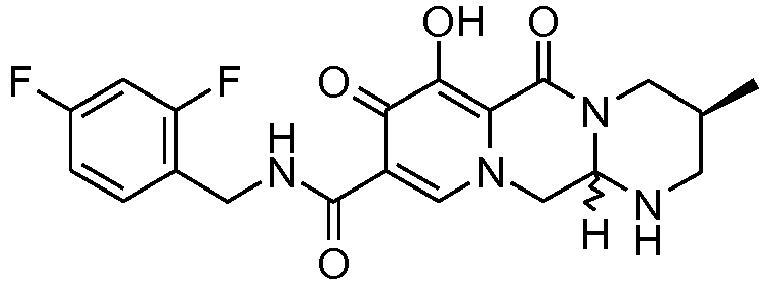
ES+ MS: 419 (M +1) ZZ-2 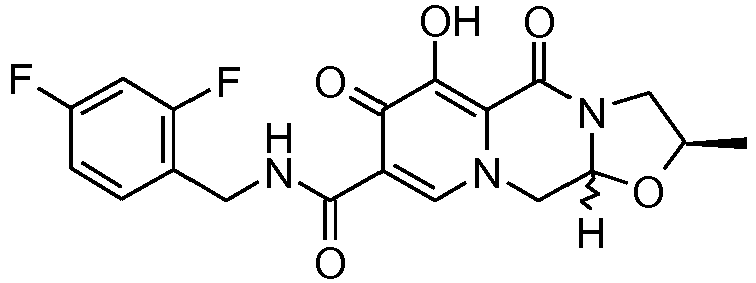
ES+ MS: 406 (M +1) ZZ-3 
ES+ MS: 509 (M +1) ZZ-4 
ES+ MS: 429 (M +1) ZZ-5 
ES+ MS: 415 (M +1) ZZ-6 
ES+ MS: 491 (M +1) ZZ-7 
ES+ MS: 509 (M +1) ZZ-8 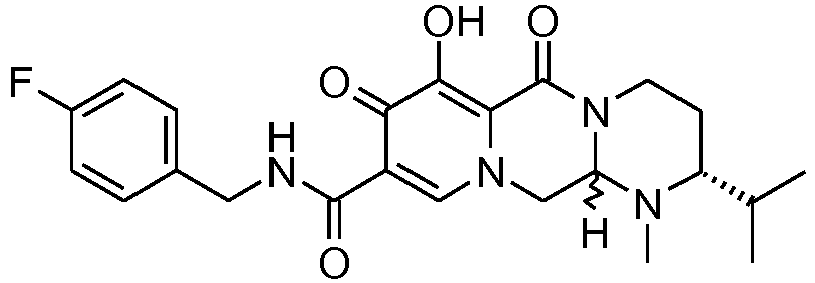
ES+ MS: 443 (M +1) ZZ-9 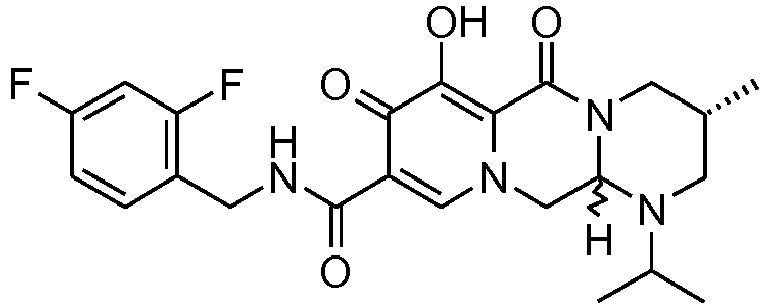
ES+ MS: 461 (M +1) ZZ-10 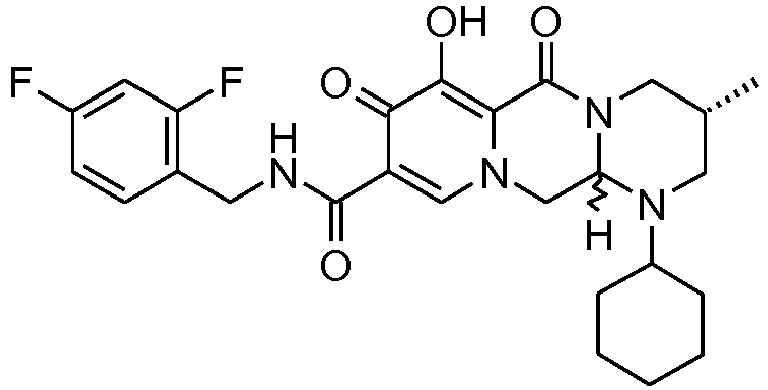
ES+ MS: 501 (M +1) ZZ-11 
ES+ MS: 475 (M +1) ZZ-12 
ES+ MS: 489 (M +1) ZZ-13 
ES+ MS: 460 (M +1) ZZ-14 
ES+ MS: 442 (M +1) ZZ-15 
ES+ MS: 489 (M +1) ZZ-16 
8.174 & 8.295 min. ZZ-17 
ES+ MS: 461 (M +1) ZZ-18 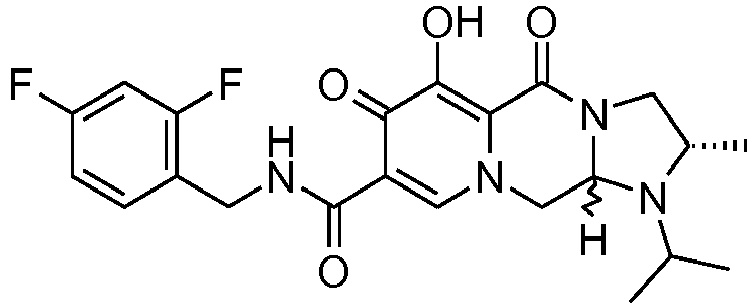
ES+ MS: 447 (M +1) ZZ-19 
ES+ MS: 446 (M +1) ZZ-20 
ES+ MS: 432 (M +1) ZZ-21 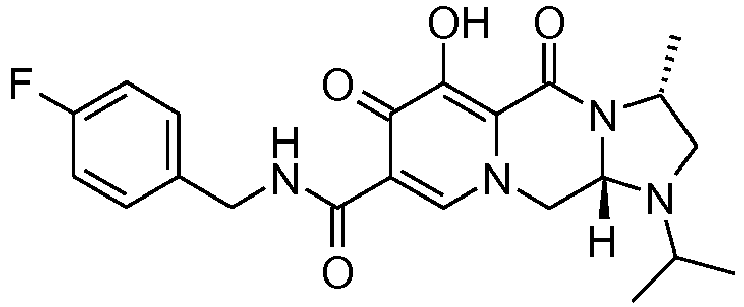
7.368 min ZZ-22 
7.150 min ZZ-23 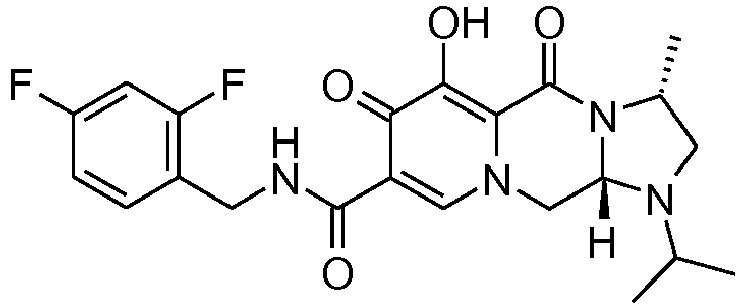
ES+ MS: 447 (M +1) ZZ-24 
ES+ MS: 447 (M +1) - The present invention further includes the following compounds.

[Table B] No (R) m Ra 1 4 - F - CH3 2 4 - F -CH(CH3)2 3 4 - F -CH2CH2OCH3 4 2, 4 - F - CH3 5 2, 4 - F -CH(CH3)2 6 2, 4 - F -CH2CH2OCH3 7 2 - F, 3 - Cl - CH3 8 2 - F, 3 - Cl -CH(CH3)2 9 2 - F, 3 - Cl -CH2CH2OCH3 - The HIV integrase inhibitory activity was investigated based on the following assay method.
- By the same method as that described in Experimental Example 1 of
WO 2004/024693 , a substrate DNA solution (2 pmol/µl) and a target DNA solution (5 pmol/µl) were prepared. After each target DNA solution was once boiled, a temperature was slowly lowered to anneal complementary chains, which was used. Each sequence of a substrate DNA and a target DNA is as described in the same Experimental Example. - Streptavidin (manufactured by Vector Laboratories) was dissolved in a 0.1M carbonate buffer solution (composition: 90 mM Na2CO3, 10 mM NaHCO3) to a concentration of 40 µg/ml. Each 50 µl of this solution was added to a well of an immunoplate (manufactured by NUNC), this is allowed to stand at 4°C overnight to adsorb. Then, each well was washed with a phosphate buffer (composition: 13.7 mM NaCl, 0.27 mM KCl, 0.43 mM Na2HPO4, 0.14 mM KH2PO4) two times, and 300 µl of a phosphate buffer containing 1 % skim milk to block it for 30 minutes. Further, each well was washed with a phosphate buffer two times, 50 µl of a substrate DNA solution (2 pmol/µl) was added to adsorb at room temperature for 30 minutes while shaking, and this was washed with a phosphate buffer two times and, then, distilled water once.
- Then, to each well prepared as described above were added 12 µl of a buffer (composition: 150 mM MOPS (pH7.2), 75 mM MnCl2, 50 mM 2-mercaptoethanol, 25% glycerol, 500 µg/ml bovine serum albumin-fraction V), and 51 µl of a reaction solution prepared from 39 µl of distilled water. Then, 9 µl of an integrase solution (30 pmol) was added, and the mixture was mixed well. To a well as a negative control (NC) was added 9 µl of a diluting solution (composition: 20 mM MOPS (pH7.2), 400 mM potassium glutamete, 1 mM EDTA, 0.1% NP-40, 20% glycerol, 1 mM DTT, 4 M urea), and this was mixed well using a plate mixer.
- After the plate was incubated at 30°C for 60 minutes, the reaction solution was discarded, followed by washing with 250 µl of a washing buffer (composition: 150 mM MOPS (pH7.2), 50 mM 2-mercaptoethanol, 25% glycerol, 500 µg/ml bovine serum albumin-fraction V) three times.
- Then, to each well were added 12 µl of a buffer (composition: 150 mM MOPS (pH7.2), 75 mM MgCl2, 50 mM 2-mercaptoethanol, 25% glycerol, 500 µg/ml bovine serum albumin-fraction V), and 53 µl of a reaction solution prepared from 41 µl of distilled water. Further, 6 µl of a solution of a test compound in DMSO was added to each well, and 6 µl of DMSO was added to a well as a positive control (PC), followed by mixing well using a plate mixer. After the plate was incubated at 30°C for 30 minutes, 1 µl of a target DNA (5 pmol/µl) was added, and this was mixed well using a plate mixer.
- After each plate was incubated at 30°C for 10 minutes, the reaction solution was discarded, followed by washing with a phosphate buffer two times. Then, an anti-digoxigenin antibody labeled with alkaline phosphatase (sheep Fab fragment:
- manufactured by Boehringer) was diluted 2000-fold with an antibody diluting solution, 100 µl of the diluent was added to bind at 30°C for 1 hour, and this was washed successively with a phosphate buffer containing 0.05 % Tween20 two times, and a phosphate buffer once. Then, 150 µl of an alkaline phosphatase coloring buffer (composition: 10 mM paranitrophenyl phosphate (manufactured by Vector Laboratories), 5 mM MgCl2, 100 mM NaCl, 100 mM Tris-HCl (pH 9.5)) was added to react at 30°C for 2 hours, 50 µl of a 1N NaOH solution was added to stop the reaction, an absorbance (OD405 nm) of each well was measured, and an inhibition rate (IC50) was obtained according to the following calculation equation.

- C abs.; absorbance of well of compound
- NC abs.: absorbance of NC
- PC abs.: absorbance of PC
- Results are shown below.
[Table 1] Example No. Integrase inhibitory activity (IC50, ng/ml) C-2 3.3 F-2 3.8 H-2 3.2 - The present compound showed the strong integrase inhibitory activity against HIV.
- A derivative of 293T cells expressing an attachment factor to improve adherence to plastic were used for the assay. A VSV-g pseudotyped HIV vector that expresses luciferase (herein referred to as PHIV) was produced by transfection of cells with the pGJ3-Luci vector plasmid (Jármy, G. et al., J. Medical Virology, 64:223-231, 2001) and pVSV-g (Clontech). Cells were mixed with the PHIV vector and then mixed with serially diluted compounds. After incubation at 37°C and 5% CO2 for two days, the plates were read by using Steady Glo luciferase assay reagent (Promega) as recommended by the manufacturer. To assess non-HIV specific inhibition, a similar assay was performed, except that cell/PHIV vector mixture was replaced by cells which had been previously transduced and constitutively expressed luciferase.
[Table 2] Example number PHIV IC50 *=<10 nM, **=10-100 nM, ***>100 nM 
* Z-1 
* Z-2 
* Z-3 
* Z-4 
* Z-5 
* Z-6 
* Z-7 
** Z-8 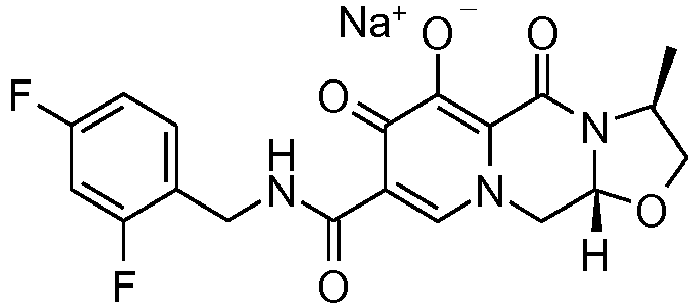
* Z-9 
* Z-10 
* Z-11 
* Z-12 
** Z-13 
** Z-14 
* Z-15 
* Z-16 
* Z-17 
* Z-18 
* Z-19 
** Z-20 
* Z-21 
* Z-22 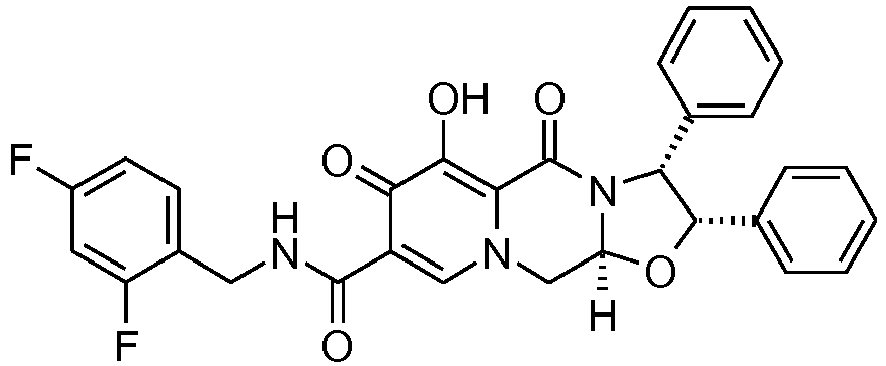
* Z-23 
* Z-24 
* Z-25 
* Z-26 
*** Z-27 
* Z-28 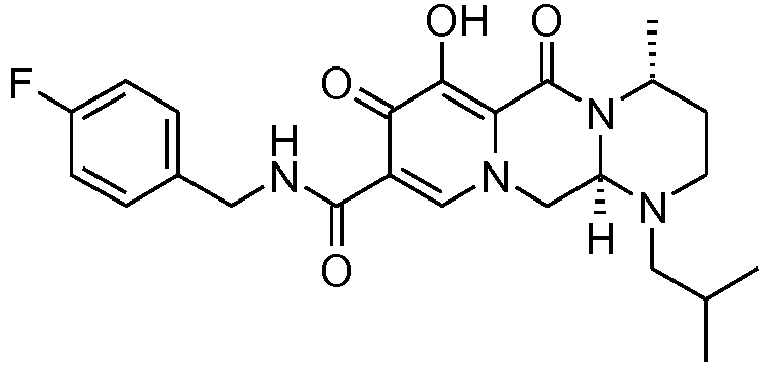
* Z-29 
* Z-30 
* Z-31 
* Z-32 
* Z-33 
* Z-34 
* Z-35 
* Z-36 
* Z-37 
** Z-38 
* Z-39 
* Z-40 
* Z-41 
* Z-42 
* Z-43 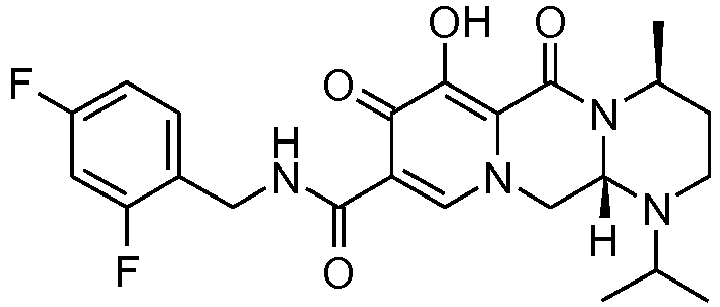
* Z-44 
* Z-45 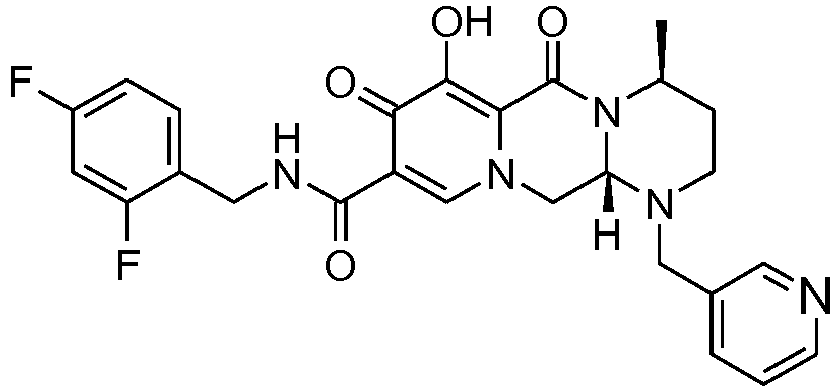
* Z-46 
* Z-47 
* Z-48 
* Z-49 
* Z-50 
* Z-51 
* Z-52 
* Z-53 
* Z-54 
** Z-55 
* Z-59 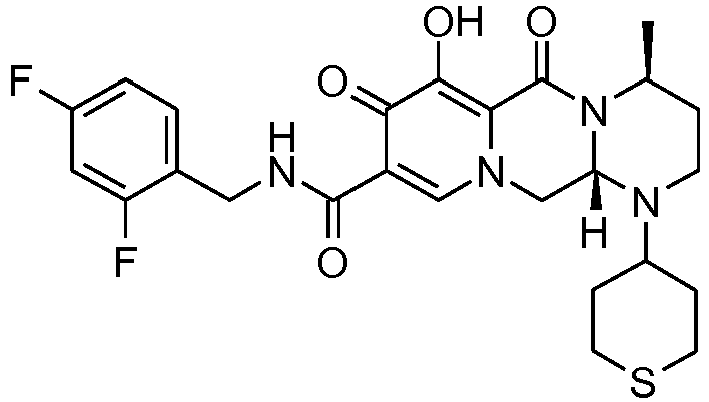
* Z-60 - A term "active ingredient" means the present compound, a tautomer thereof, a pharmaceutically acceptable thereof, or a solvate thereof.
- A hard gelatin capsule is prepared using the following ingredients:
dose (mg/capsule) Active ingredient 250 Starch (dried) 200 Magnesium stearate 10 Total 460mg - A tablet is prepared using the following ingredients:
dose (mg/tablet) Active ingredient 250 Cellulose (microcrystalline) 400 Silicon dioxide (fumed) 10 Stearic acid 5 Total 665mg
Claims (10)
- A compound of the formula:
 A ring is
Z = O or NR26 (A-1);
R20 to R26 are each independently H or C1-C3 alkyl;the stereochemistry of an asymmetric carbon represented by * shows R- or S-configuration, or a mixture thereof;R14 and RX are hydrogen;R3 is hydrogen;R1 is hydrogen;R is halogen; andm is an integer of 0 to 3;or a pharmaceutically acceptable salt, or solvate thereof. - A compound according to claim 1 wherein one of R20 to R25 is C1 to C3 alkyl and the others are hydrogens.
- A compound according to claim 1 or claim 2 selected from:(4R,12aR)-N-[(4-Fluorophenyl)methyl]-7-hydroxy-4-methyl-1-(1-methylethyl)-6,8-dioxo-1,2,3,4,6,8,12,12a-octahydropyrido[1',2':4,5]pyrazino[1,2-a]pyrimidine-9-carboxamide;(4S,12aS)-N-[(2,4-Difluorophenyl)methyl]-7-hydroxy-4-methyl-1-(1-methylethyl)-6,8-dioxo-1,2,3,4,6,8,12,12a-octahydropyrido[1',2':4,5]pyrazino[1,2-a]pyrimidine-9-carboxamide;(4S,12aS)-N-[(4-Fluorophenyl)methyl]-7-hydroxy-1,4-dimethyl-6,8-dioxo-1,2,3,4,6,8,12,12a-octahydropyrido[1',2':4,5]pyrazino[1,2-a]pyrimidine-9-carboxamide;(4S,12aS)-N-[(2,4-Difluorophenyl)methyl]-7-hydroxy-1,4-dimethyl-6,8-dioxo-1,2,3,4,6,8,12,12a-octahydropyrido[1',2':4,5]pyrazino[1,2-a]pyrimidine-9-carboxamide;(4S,12aS)-N-[(4-Fluorophenyl)methyl]-7-hydroxy-4-methyl-1-(1-methylethyl)-6,8-dioxo-1,2,3,4,6,8,12,12a-octahydropyrido[1',2':4,5]pyrazino[1,2-a]pyrimidine-9-carboxamide;(2R,9aS)-5-Hydroxy-2-methyl-6,10-dioxo-3,4,6,9,9a,10-hexahydro-2H-1-oxa-4a, 8a-diaza-anthracene-7-carboxylic acid 4-fluoro-benzylamide;enantiomers thereof; diastereomers thereof; mixtures of enantiomers thereof; mixtures of diastereomers thereof; mixtures of enantiomers and diastereomers thereof; and pharmaceutically acceptable salts thereof.
- A compound according to claim 1 or claim 2 which is (4S,9aR)-5-Hydroxy-4-methyl-6,10-dioxo-3,4,6,9,9a,10-hexahydro-2H-1-oxa-4a, 8a-diaza-anthracene-7-carboxylic acid 2,4,-difluoro-benzylamide or a pharmaceutically acceptable salt thereof.
- A compound according to claim 3 or 4 wherein the pharmaceutically acceptable salt is a sodium salt.
- A pharmaceutical composition comprising a compound according to any one of Claims 1 to 5, or a pharmaceutically acceptable salt, or solvate thereof.
- A compound, salt or solvate as defined in any one of claims 1 to 5 for use in a method of treatment of the human or animal body by therapy.
- A compound, salt or solvate as defined in any one of claims 1 to 5 for use as an antiviral agent.
- A compound, salt or solvate as defined in any one of claims 1 to 5 for use as an anti-HIV agent.
- A compound, salt or solvate as defined in any one of claims 1 to 5 for use in joint anti-HIV therapy with an additional therapeutic agent selected from reverse transcriptase inhibitors and protease inhibitors.
Priority Applications (13)
| Application Number | Priority Date | Filing Date | Title |
|---|---|---|---|
| EP17156762.1A EP3187225B1 (en) | 2005-04-28 | 2006-04-28 | Polycyclic carbamoylpyridone derivative having hiv integrase inhibitory activity |
| EP17156763.9A EP3187226A1 (en) | 2005-04-28 | 2006-04-28 | Polycyclic carbamoylpyridone derivative having hiv integrase inhibitory activity |
| EP17195280.7A EP3284520B1 (en) | 2005-04-28 | 2006-04-28 | Polycyclic carbamoylpyridone derivative having hiv integrase inhibitory activity |
| DK17156762.1T DK3187225T3 (en) | 2005-04-28 | 2006-04-28 | POLYCYCLIC CARBAMOYLPYRIDONE DERIVATIVE WITH HIV INTEGRATION INHIBITIVE ACTIVITY |
| EP17195276.5A EP3284519A1 (en) | 2005-04-28 | 2006-04-28 | Polycyclic carbamoylpyridone derivative having hiv integrase inhibitory activity |
| PL16154531T PL3045206T3 (en) | 2005-04-28 | 2006-04-28 | Polycyclic carbamoylpyridone derivative having hiv integrase inhibitory activity |
| DK17195280.7T DK3284520T3 (en) | 2005-04-28 | 2006-04-28 | POLYCYCLIC CARBAMOYL PYRIDONE DERIVATIVES WITH HIV INTEGRASE INHIBITIVE ACTIVITY |
| PL17195280T PL3284520T3 (en) | 2005-04-28 | 2006-04-28 | Polycyclic carbamoylpyridone derivative having hiv integrase inhibitory activity |
| EP18166621.5A EP3372281B1 (en) | 2005-04-28 | 2006-04-28 | Polycyclic carbamoylpyridone derivative having hiv integrase inhibitory activity |
| PL18166621T PL3372281T3 (en) | 2005-04-28 | 2006-04-28 | Polycyclic carbamoylpyridone derivative having hiv integrase inhibitory activity |
| SI200632268T SI3045206T1 (en) | 2005-04-28 | 2006-04-28 | Polycyclic carbamoylpyridone derivative having hiv integrase inhibitory activity |
| CY20191100891T CY1122052T1 (en) | 2005-04-28 | 2019-08-20 | POLYCYCLIC CARBAMOYLPYRIDONE DERIVATIVE HAVING HIV INTEGRASE [INTEGRATION] INHIBITORY ACTIVITY |
| CY20211100866T CY1124601T1 (en) | 2005-04-28 | 2021-10-06 | POLYCYCLIC CARBAMOYLPYRIDONE DERIVATIVE HAVING HIV INTEGRASE [INTEGRATION] INHIBITORY ACTIVITY |
Applications Claiming Priority (5)
| Application Number | Priority Date | Filing Date | Title |
|---|---|---|---|
| JP2005131161 | 2005-04-28 | ||
| JP2005312076 | 2005-10-27 | ||
| EP06758843.4A EP1874117B8 (en) | 2005-04-28 | 2006-04-28 | Polycyclic carbamoylpyridone derivative having hiv integrase inhibitory activity |
| PCT/US2006/016604 WO2006116764A1 (en) | 2005-04-28 | 2006-04-28 | Polycyclic carbamoylpyridone derivative having hiv integrase inhibitory activity |
| EP12159079.8A EP2527007B1 (en) | 2005-04-28 | 2006-04-28 | Polycyclic carbamoylpyridone derivative having HIV integrase inhibitory activity |
Related Parent Applications (3)
| Application Number | Title | Priority Date | Filing Date |
|---|---|---|---|
| EP06758843.4A Division EP1874117B8 (en) | 2005-04-28 | 2006-04-28 | Polycyclic carbamoylpyridone derivative having hiv integrase inhibitory activity |
| EP12159079.8A Division-Into EP2527007B1 (en) | 2005-04-28 | 2006-04-28 | Polycyclic carbamoylpyridone derivative having HIV integrase inhibitory activity |
| EP12159079.8A Division EP2527007B1 (en) | 2005-04-28 | 2006-04-28 | Polycyclic carbamoylpyridone derivative having HIV integrase inhibitory activity |
Related Child Applications (10)
| Application Number | Title | Priority Date | Filing Date |
|---|---|---|---|
| EP18166621.5A Division-Into EP3372281B1 (en) | 2005-04-28 | 2006-04-28 | Polycyclic carbamoylpyridone derivative having hiv integrase inhibitory activity |
| EP18166621.5A Division EP3372281B1 (en) | 2005-04-28 | 2006-04-28 | Polycyclic carbamoylpyridone derivative having hiv integrase inhibitory activity |
| EP17195280.7A Division-Into EP3284520B1 (en) | 2005-04-28 | 2006-04-28 | Polycyclic carbamoylpyridone derivative having hiv integrase inhibitory activity |
| EP17195280.7A Division EP3284520B1 (en) | 2005-04-28 | 2006-04-28 | Polycyclic carbamoylpyridone derivative having hiv integrase inhibitory activity |
| EP17156763.9A Division-Into EP3187226A1 (en) | 2005-04-28 | 2006-04-28 | Polycyclic carbamoylpyridone derivative having hiv integrase inhibitory activity |
| EP17156763.9A Division EP3187226A1 (en) | 2005-04-28 | 2006-04-28 | Polycyclic carbamoylpyridone derivative having hiv integrase inhibitory activity |
| EP17156762.1A Division EP3187225B1 (en) | 2005-04-28 | 2006-04-28 | Polycyclic carbamoylpyridone derivative having hiv integrase inhibitory activity |
| EP17156762.1A Division-Into EP3187225B1 (en) | 2005-04-28 | 2006-04-28 | Polycyclic carbamoylpyridone derivative having hiv integrase inhibitory activity |
| EP17195276.5A Division EP3284519A1 (en) | 2005-04-28 | 2006-04-28 | Polycyclic carbamoylpyridone derivative having hiv integrase inhibitory activity |
| EP17195276.5A Division-Into EP3284519A1 (en) | 2005-04-28 | 2006-04-28 | Polycyclic carbamoylpyridone derivative having hiv integrase inhibitory activity |
Publications (3)
| Publication Number | Publication Date |
|---|---|
| EP3045206A1 EP3045206A1 (en) | 2016-07-20 |
| EP3045206B1 true EP3045206B1 (en) | 2018-03-28 |
| EP3045206B2 EP3045206B2 (en) | 2023-02-15 |
Family
ID=37215098
Family Applications (9)
| Application Number | Title | Priority Date | Filing Date |
|---|---|---|---|
| EP12159082.2A Active EP2465580B1 (en) | 2005-04-28 | 2006-04-28 | Polycyclic carbamoylpyridone derivatives having hiv integrase inhibitory activity |
| EP06758843.4A Active EP1874117B8 (en) | 2005-04-28 | 2006-04-28 | Polycyclic carbamoylpyridone derivative having hiv integrase inhibitory activity |
| EP18166621.5A Active EP3372281B1 (en) | 2005-04-28 | 2006-04-28 | Polycyclic carbamoylpyridone derivative having hiv integrase inhibitory activity |
| EP16154531.4A Active EP3045206B2 (en) | 2005-04-28 | 2006-04-28 | Polycyclic carbamoylpyridone derivative having hiv integrase inhibitory activity |
| EP17195276.5A Withdrawn EP3284519A1 (en) | 2005-04-28 | 2006-04-28 | Polycyclic carbamoylpyridone derivative having hiv integrase inhibitory activity |
| EP17156762.1A Not-in-force EP3187225B1 (en) | 2005-04-28 | 2006-04-28 | Polycyclic carbamoylpyridone derivative having hiv integrase inhibitory activity |
| EP12159079.8A Active EP2527007B1 (en) | 2005-04-28 | 2006-04-28 | Polycyclic carbamoylpyridone derivative having HIV integrase inhibitory activity |
| EP17156763.9A Withdrawn EP3187226A1 (en) | 2005-04-28 | 2006-04-28 | Polycyclic carbamoylpyridone derivative having hiv integrase inhibitory activity |
| EP17195280.7A Active EP3284520B1 (en) | 2005-04-28 | 2006-04-28 | Polycyclic carbamoylpyridone derivative having hiv integrase inhibitory activity |
Family Applications Before (3)
| Application Number | Title | Priority Date | Filing Date |
|---|---|---|---|
| EP12159082.2A Active EP2465580B1 (en) | 2005-04-28 | 2006-04-28 | Polycyclic carbamoylpyridone derivatives having hiv integrase inhibitory activity |
| EP06758843.4A Active EP1874117B8 (en) | 2005-04-28 | 2006-04-28 | Polycyclic carbamoylpyridone derivative having hiv integrase inhibitory activity |
| EP18166621.5A Active EP3372281B1 (en) | 2005-04-28 | 2006-04-28 | Polycyclic carbamoylpyridone derivative having hiv integrase inhibitory activity |
Family Applications After (5)
| Application Number | Title | Priority Date | Filing Date |
|---|---|---|---|
| EP17195276.5A Withdrawn EP3284519A1 (en) | 2005-04-28 | 2006-04-28 | Polycyclic carbamoylpyridone derivative having hiv integrase inhibitory activity |
| EP17156762.1A Not-in-force EP3187225B1 (en) | 2005-04-28 | 2006-04-28 | Polycyclic carbamoylpyridone derivative having hiv integrase inhibitory activity |
| EP12159079.8A Active EP2527007B1 (en) | 2005-04-28 | 2006-04-28 | Polycyclic carbamoylpyridone derivative having HIV integrase inhibitory activity |
| EP17156763.9A Withdrawn EP3187226A1 (en) | 2005-04-28 | 2006-04-28 | Polycyclic carbamoylpyridone derivative having hiv integrase inhibitory activity |
| EP17195280.7A Active EP3284520B1 (en) | 2005-04-28 | 2006-04-28 | Polycyclic carbamoylpyridone derivative having hiv integrase inhibitory activity |
Country Status (29)
| Country | Link |
|---|---|
| US (22) | US8129385B2 (en) |
| EP (9) | EP2465580B1 (en) |
| JP (2) | JP4295353B2 (en) |
| KR (4) | KR101580310B1 (en) |
| AU (1) | AU2006239177B8 (en) |
| BR (1) | BRPI0610030B8 (en) |
| CA (1) | CA2606282C (en) |
| CY (7) | CY1115151T1 (en) |
| DK (6) | DK3372281T3 (en) |
| EA (1) | EA014162B1 (en) |
| ES (7) | ES2446324T3 (en) |
| FI (1) | FIC20210017I1 (en) |
| FR (1) | FR14C0041I2 (en) |
| HK (2) | HK1249742A1 (en) |
| HU (6) | HUE037795T2 (en) |
| IL (4) | IL186555A (en) |
| LT (5) | LT3284520T (en) |
| LU (2) | LU92446I2 (en) |
| MA (1) | MA29460B1 (en) |
| MX (2) | MX302718B (en) |
| NL (2) | NL300676I2 (en) |
| NO (5) | NO339525B1 (en) |
| NZ (1) | NZ562339A (en) |
| PL (5) | PL3372281T3 (en) |
| PT (5) | PT1874117E (en) |
| SI (6) | SI2465580T1 (en) |
| TW (1) | TWI378931B (en) |
| VN (1) | VN34404A1 (en) |
| WO (1) | WO2006116764A1 (en) |
Families Citing this family (152)
| Publication number | Priority date | Publication date | Assignee | Title |
|---|---|---|---|---|
| JP5384793B2 (en) | 2003-12-24 | 2014-01-08 | バイオウタ サイエンティフィック マネジメント プロプライエタリー リミテッド | Polycyclic drugs for the treatment of respiratory syncytial virus infection |
| US7273859B2 (en) * | 2004-05-12 | 2007-09-25 | Bristol-Myers Squibb Company | HIV integrase inhibitors: cyclic pyrimidinone compounds |
| KR101580310B1 (en) | 2005-04-28 | 2016-01-04 | 비이브 헬쓰케어 컴퍼니 | Polycyclic carbamoylpyridone derivative having hiv integrase inhibitory activity |
| CA2607151C (en) | 2005-05-10 | 2012-06-19 | Merck & Co., Inc. | Hiv integrase inhibitors |
| JP5094725B2 (en) | 2005-10-04 | 2012-12-12 | イステイチユート・デイ・リチエルケ・デイ・ビオロジア・モレコラーレ・ピ・アンジエレツテイ・エツセ・エルレ・エルレ | HIV integrase inhibitor |
| CA2626956A1 (en) | 2005-10-27 | 2007-05-03 | Shionogi & Co., Ltd. | Polycyclic carbamoylpyridone derivative having hiv integrase inhibitory activity |
| TWI423972B (en) | 2006-09-28 | 2014-01-21 | Biota Scient Management | Polycyclic agents for the treatment of respiratory syncytial virus infections |
| CA2705312C (en) | 2007-11-15 | 2013-06-25 | Boehringer Ingelheim International Gmbh | Inhibitors of human immunodeficiency virus replication |
| US8377960B2 (en) | 2007-11-15 | 2013-02-19 | Gilead Sciences, Inc. | Inhibitors of human immunodeficiency virus replication |
| NZ585226A (en) | 2007-11-16 | 2012-08-31 | Gilead Sciences Inc | Inhibitors of human immunodeficiency virus replication |
| KR101700267B1 (en) * | 2008-07-25 | 2017-01-26 | 비이브 헬쓰케어 컴퍼니 | Chemical compounds |
| ES2395705T3 (en) * | 2008-07-25 | 2013-02-14 | Glaxosmithkline Llc | Chemical compounds |
| WO2010011815A1 (en) * | 2008-07-25 | 2010-01-28 | Smithkline Beecham Corporation | Chemical compounds |
| SI2320908T1 (en) * | 2008-07-25 | 2014-05-30 | Viiv Healthcare Company | Dolutegravir Prodrugs |
| WO2010011818A1 (en) * | 2008-07-25 | 2010-01-28 | Smithkline Beecham Corporation | Chemical compounds |
| CN107011260A (en) * | 2008-12-11 | 2017-08-04 | 盐野义制药株式会社 | The method and intermediate of carbamyl pyridone hiv integrase inhibitor |
| AU2014277831C1 (en) * | 2008-12-11 | 2022-10-06 | Shionogi & Co. Ltd. | Synthesis of carbamoylpyridone hiv integrase inhibitors and intermediates |
| CN102245182B (en) * | 2008-12-11 | 2014-07-23 | 盐野义制药株式会社 | Synthesis of carbamoylpyridone HIV integrase inhibitors and intermediates |
| EP2370419B1 (en) * | 2008-12-11 | 2017-09-27 | Shionogi&Co., Ltd. | Maltol ether processes and intermediates |
| TWI518084B (en) | 2009-03-26 | 2016-01-21 | 鹽野義製藥股份有限公司 | Process for pyrone and pyridone derivatives |
| RS57244B1 (en) * | 2009-06-15 | 2018-07-31 | Shionogi & Co | Substituted polycyclic carbamoylpyridone derivative |
| WO2011011483A1 (en) * | 2009-07-22 | 2011-01-27 | Glaxosmithkline Llc | Chemical compounds |
| CA2777664C (en) | 2009-10-13 | 2014-06-10 | Johannes Wilhelmus J. Thuring | Macrocyclic integrase inhibitors |
| BR112012018670A2 (en) * | 2010-01-27 | 2018-02-06 | Glaxosmithkline Llc | combination, use of a compound, pharmaceutical composition, and patient pack |
| AU2014202405B2 (en) * | 2010-01-27 | 2016-02-25 | Viiv Healthcare Company | Antiviral therapy |
| AU2014202404C1 (en) * | 2010-01-27 | 2022-06-23 | Viiv Healthcare Company | Antiviral therapy |
| TWI508968B (en) | 2010-02-08 | 2015-11-21 | Biota Scient Management | Compounds for treating respiratory syncytial virus infections |
| AR080314A1 (en) * | 2010-02-26 | 2012-03-28 | Japan Tobacco Inc | DERIVED FROM 1,3,4,8-TETRAHIDRO-2H-PIRIDO (1,2-A) PIRAZINE AND ITS USE AS AN INTEGRATED HIV INHIBITOR |
| TWI582097B (en) * | 2010-03-23 | 2017-05-11 | Viiv醫療保健公司 | Process for preparing carbamoylpyridone derivatives and intermediates |
| CN102958935B (en) | 2010-04-02 | 2015-12-09 | 爱尔兰詹森科学公司 | Large ring integrase inhibitor |
| JP5766690B2 (en) * | 2010-04-12 | 2015-08-19 | 塩野義製薬株式会社 | Pyridone derivatives having integrase inhibitory activity |
| WO2012006104A2 (en) | 2010-06-28 | 2012-01-12 | Academia Sinica, Taiwan | Compounds and methods for treating tuberculosis infection |
| PT3127908T (en) | 2010-08-05 | 2019-02-04 | Shionogi & Co | Process for preparing compound having hiv integrase inhibitory activity |
| TWI577377B (en) * | 2010-09-16 | 2017-04-11 | Viiv醫療保健公司 | Pharmaceutical composition |
| RS57490B1 (en) * | 2010-09-24 | 2018-10-31 | Shionogi & Co | Substituted polycyclic carbamoyl pyridone derivative prodrug |
| US8796303B2 (en) | 2010-11-26 | 2014-08-05 | Biota Scientific Management Pty Ltd. | Imidazo[2,1-G][1,7]naphthyridines for treating respiratory syncytial virus infections |
| US20140213553A1 (en) * | 2011-05-03 | 2014-07-31 | Concert Pharmaceuticals Inc. | Carbamoylpyridone derivatives |
| WO2013038407A1 (en) | 2011-09-14 | 2013-03-21 | Mapi Pharma Ltd. | Amorphous form of dolutegravir |
| KR20140090197A (en) * | 2011-10-12 | 2014-07-16 | 시오노기세야쿠 가부시키가이샤 | Polycyclic pyridone derivative having integrase-inhibiting activity |
| JP6242810B2 (en) | 2011-12-28 | 2017-12-06 | グローバル・ブラッド・セラピューティクス・インコーポレイテッドGlobal Blood Therapeutics,Inc. | Substituted benzaldehyde compounds and their use in increasing tissue oxygenation |
| HK1203412A1 (en) | 2011-12-28 | 2015-10-30 | Global Blood Therapeutics, Inc. | Substituted heteroaryl aldehyde compounds and methods for their use in increasing tissue oxygenation |
| EP2931730B1 (en) * | 2012-12-17 | 2019-08-07 | Merck Sharp & Dohme Corp. | 4-pyridinonetriazine derivatives as hiv integrase inhibitors |
| NZ709260A (en) * | 2012-12-21 | 2016-07-29 | Gilead Sciences Inc | Polycyclic-carbamoylpyridone compounds and their pharmaceutical use |
| TW201431859A (en) | 2012-12-27 | 2014-08-16 | Japan Tobacco Inc | Substituted spiropyrido [1,2-a] pyrazine derivative and pharmaceutical use of the same as HIV integrate inhibitor |
| EP2767272A1 (en) | 2013-02-18 | 2014-08-20 | Ratiopharm GmbH | Solid pharmaceutical dosage form of dolutegravir |
| US9480655B2 (en) | 2013-02-18 | 2016-11-01 | Ratiopharm Gmbh | Solid pharmaceutical dosage form of dolutegravir |
| US9573965B2 (en) | 2013-02-19 | 2017-02-21 | Aurobindo Pharma Ltd | Process for the preparation of Dolutegravir |
| WO2014150276A1 (en) | 2013-03-15 | 2014-09-25 | Global Blood Therapeutics, Inc. | Compounds and uses thereof for the modulation of hemoglobin |
| US8952171B2 (en) | 2013-03-15 | 2015-02-10 | Global Blood Therapeutics, Inc. | Compounds and uses thereof for the modulation of hemoglobin |
| US9604999B2 (en) | 2013-03-15 | 2017-03-28 | Global Blood Therapeutics, Inc. | Compounds and uses thereof for the modulation of hemoglobin |
| SG11201507453VA (en) | 2013-03-15 | 2015-10-29 | Global Blood Therapeutics Inc | Compounds and uses thereof for the modulation of hemoglobin |
| PE20161035A1 (en) | 2013-03-15 | 2016-11-13 | Global Blood Therapeutics Inc | COMPOUNDS AND USES OF THESE FOR THE MODULATION OF HEMOGLOBIN |
| US9422279B2 (en) | 2013-03-15 | 2016-08-23 | Global Blood Therapeutics, Inc. | Compounds and uses thereof for the modulation of hemoglobin |
| US20140274961A1 (en) | 2013-03-15 | 2014-09-18 | Global Blood Therapeutics, Inc. | Compounds and uses thereof for the modulation of hemoglobin |
| US10100043B2 (en) | 2013-03-15 | 2018-10-16 | Global Blood Therapeutics, Inc. | Substituted aldehyde compounds and methods for their use in increasing tissue oxygenation |
| US9802900B2 (en) | 2013-03-15 | 2017-10-31 | Global Blood Therapeutics, Inc. | Bicyclic heteroaryl compounds and uses thereof for the modulation of hemoglobin |
| US10266551B2 (en) | 2013-03-15 | 2019-04-23 | Global Blood Therapeutics, Inc. | Compounds and uses thereof for the modulation of hemoglobin |
| US9458139B2 (en) | 2013-03-15 | 2016-10-04 | Global Blood Therapeutics, Inc. | Compounds and uses thereof for the modulation of hemoglobin |
| EP2986291B1 (en) | 2013-04-16 | 2020-05-27 | Merck Sharp & Dohme Corp. | 4-pyridone derivative compounds and uses thereof as hiv integrase inhibitors |
| WO2014200880A1 (en) * | 2013-06-13 | 2014-12-18 | Merck Sharp & Dohme Corp. | Fused tricyclic heterocyclic compounds as hiv integrase inhibitors |
| EP3016935B1 (en) * | 2013-07-04 | 2018-09-05 | Hetero Research Foundation | Process for the preparation of intermediate of dolutegravir |
| NO2865735T3 (en) | 2013-07-12 | 2018-07-21 | ||
| ES2859102T3 (en) | 2013-07-12 | 2021-10-01 | Gilead Sciences Inc | Polycyclic carbamoylpyridone compounds and their use for treating HIV infections |
| US9856270B2 (en) | 2013-07-17 | 2018-01-02 | Ratiopharm Gmbh | Dolutegravir salts |
| WO2015019310A1 (en) | 2013-08-07 | 2015-02-12 | Mylan Laboratories Ltd | Process for the preparation of dolute-gravir and intermediates thereof |
| WO2015039348A1 (en) * | 2013-09-23 | 2015-03-26 | Merck Sharp & Dohme Corp. | Tetracyclic heterocycle compounds useful as hiv integrase inhibitors |
| JP6081662B2 (en) * | 2013-09-27 | 2017-02-15 | メルク・シャープ・アンド・ドーム・コーポレーションMerck Sharp & Dohme Corp. | Substituted quinolidine derivatives useful as HIV integrase inhibitors |
| EA201992707A1 (en) | 2013-11-18 | 2020-06-30 | Глобал Блад Терапьютикс, Инк. | COMPOUNDS AND THEIR APPLICATIONS FOR HEMOGLOBIN MODULATION |
| WO2015092752A1 (en) | 2013-12-20 | 2015-06-25 | Mylan Laboratories Ltd. | Novel crystalline form of dolutegravir sodium |
| WO2015089847A1 (en) * | 2013-12-20 | 2015-06-25 | Merck Sharp & Dohme Corp. | Spirocyclic heterocycle compounds useful as hiv integrase inhibitors |
| WO2015108945A2 (en) | 2014-01-14 | 2015-07-23 | Board Of Regents Of The University Of Nebraska | Compositions and methods for the delivery of therapeutics |
| WO2015110897A2 (en) | 2014-01-21 | 2015-07-30 | Laurus Labs Private Limited | Novel process for the preparation of dolutegravir and pharmaceutically acceptable salts thereof |
| HRP20210388T4 (en) | 2014-02-07 | 2024-10-11 | Global Blood Therapeutics, Inc. | Crystalline polymorph of the free base of 2-hydroxy-6-((2-(1-isopropyl-1h-pyrazol-5-yl)pyridin-3-yl)methoxy)benzaldehyde |
| WO2015138933A1 (en) | 2014-03-13 | 2015-09-17 | Assia Chemical Industries Ltd. | Solid state forms of dolutegravir sodium |
| CN106831819B (en) * | 2014-03-19 | 2019-01-04 | 杭州普晒医药科技有限公司 | The crystal form and preparation method thereof of De Luogewei sodium salt |
| IN2014MU00916A (en) | 2014-03-20 | 2015-09-25 | Cipla Ltd | |
| WO2015177537A1 (en) * | 2014-05-20 | 2015-11-26 | Cipla Limited | Process for preparing polycyclic carbamoyl pyridone derivatives and intermediates thereof |
| NO2717902T3 (en) * | 2014-06-20 | 2018-06-23 | ||
| TWI677489B (en) * | 2014-06-20 | 2019-11-21 | 美商基利科學股份有限公司 | Synthesis of polycyclic-carbamoylpyridone compounds |
| TW201613936A (en) * | 2014-06-20 | 2016-04-16 | Gilead Sciences Inc | Crystalline forms of(2R,5S,13aR)-8-hydroxy-7,9-dioxo-n-(2,4,6-trifluorobenzyl)-2,3,4,5,7,9,13,13a-octahydro-2,5-methanopyrido[1',2':4,5]pyrazino[2,1-b][1,3]oxazepine-10-carboxamide |
| WO2016027879A1 (en) * | 2014-08-22 | 2016-02-25 | 塩野義製薬株式会社 | Polycyclic pyridone derivative having integrase-inhibiting activity |
| WO2016057866A1 (en) | 2014-10-09 | 2016-04-14 | Board Of Regents Of The University Of Nebraska | Compositions and methods for the delivery of therapeutics |
| WO2016092527A1 (en) * | 2014-12-12 | 2016-06-16 | Sun Pharmaceutical Industries Limited | A process for the preparation of dolutegravir |
| TWI695003B (en) | 2014-12-23 | 2020-06-01 | 美商基利科學股份有限公司 | Polycyclic-carbamoylpyridone compounds and their pharmaceutical use |
| EP3045461A1 (en) | 2015-01-16 | 2016-07-20 | LEK Pharmaceuticals d.d. | Processes for preparing dolutegravir and analogues thereof |
| CN107531614B (en) | 2015-02-06 | 2020-04-10 | 迈兰实验室有限公司 | Preparation method of delogevir |
| CZ201599A3 (en) | 2015-02-13 | 2016-08-24 | Zentiva, K.S. | Solid forms of dolutegravir salts and process for preparing thereof |
| US10081647B2 (en) * | 2015-03-26 | 2018-09-25 | Merck Sharp & Dohme Corp. | Phosphate substituted quinolizine derivatives useful as HIV integrase inhibitors |
| MA41841A (en) | 2015-03-30 | 2018-02-06 | Global Blood Therapeutics Inc | ALDEHYDE COMPOUNDS FOR THE TREATMENT OF PULMONARY FIBROSIS, HYPOXIA, AND AUTOIMMUNE AND CONNECTIVE TISSUE DISEASES |
| SI3466490T1 (en) | 2015-04-02 | 2020-12-31 | Gilead Sciences, Inc. | Polycyclic-carbamoylpyridone compounds and their pharmaceutical use |
| EP4219508B1 (en) * | 2015-04-28 | 2024-06-05 | Shionogi & Co., Ltd | Substituted polycyclic pyridone derivative and prodrug thereof |
| WO2016187788A1 (en) | 2015-05-25 | 2016-12-01 | Merck Sharp & Dohme Corp. | Fused tricyclic heterocyclic compounds useful for treating hiv infection |
| CZ2015537A3 (en) | 2015-08-04 | 2017-02-15 | Zentiva, K.S. | Solid forms of the amorphous dolutegravir |
| ES2969437T3 (en) | 2015-08-19 | 2024-05-20 | Laurus Labs Ltd | Novel polymorphs of dolutegravir and its salts |
| CN113546052A (en) | 2015-11-09 | 2021-10-26 | 吉利德科学公司 | Therapeutic compositions for the treatment of human immunodeficiency virus |
| EP3377066B1 (en) | 2015-11-17 | 2021-04-07 | Merck Sharp & Dohme Corp. | Amido-substituted pyridotriazine derivatives useful as hiv integrase inhibitors |
| SG11201804647TA (en) | 2015-12-04 | 2018-06-28 | Global Blood Therapeutics Inc | Dosing regimens for 2-hydroxy-6-((2-(1-isopropyl-1h-pyrazol-5-yl)pyridin-3-yl)methoxy)benzaldehyde |
| WO2017106071A1 (en) | 2015-12-15 | 2017-06-22 | Merck Sharp & Dohme Corp. | Spirocyclic quinolizine derivatives useful as hiv integrase inhibitors |
| US10696636B2 (en) | 2015-12-21 | 2020-06-30 | Lupin Limited | Process for the preparation of HIV integrase inhibitors |
| TWI663160B (en) | 2016-05-12 | 2019-06-21 | 全球血液治療公司 | Process for synthesizing 2-hydroxy-6-((2-(1-isopropyl-1h-pyrazol-5-yl)-pyridin-3-yl)methoxy)benzaldehyde |
| WO2017208105A1 (en) | 2016-05-30 | 2017-12-07 | Lupin Limited | Novel crystalline form of dolutegravir sodium |
| EP4527463A3 (en) * | 2016-06-23 | 2025-06-25 | VIIV Healthcare Company | Compositions and methods for the delivery of therapeutics |
| BR112019002120A2 (en) | 2016-08-08 | 2019-05-14 | Hetero Labs Limited | antiretroviral composition of various classes |
| BR112019002132A2 (en) | 2016-08-08 | 2019-05-14 | Hetero Labs Limited | antiretroviral compositions |
| JP2019527738A (en) * | 2016-08-12 | 2019-10-03 | ナンジン ゲイター メディテック カンパニー, リミテッドNanjing Gator Meditech Company, Ltd. | Protein kinase regulator |
| WO2018042332A1 (en) | 2016-08-31 | 2018-03-08 | Glaxosmithkline Intellectual Property (No.2) Limited | Combinations and uses and treatments thereof |
| US20190216725A1 (en) * | 2016-09-21 | 2019-07-18 | Merck Shapr & Dohme Corp. | Drug delivery system for the delivery of integrase inhibitors |
| TW202332423A (en) | 2016-10-12 | 2023-08-16 | 美商全球血液治療公司 | Tablets comprising 2-hydroxy-6-((2-(1-isopropyl-1h-pyrazol-5-yl)pyridin-3-yl)methoxy)benzaldehyde |
| JOP20190130A1 (en) * | 2016-12-02 | 2019-06-02 | Merck Sharp & Dohme | Tetracyclic heterocyclic compounds useful as integrated enzyme inhibitors for human immunodeficiency virus (HIV) |
| RU2749043C2 (en) | 2016-12-02 | 2021-06-03 | Мерк Шарп И Доум Корп. | Tricyclic heterocyclic compounds useful as hiv integrase inhibitors |
| WO2018109786A1 (en) | 2016-12-16 | 2018-06-21 | Cipla Limited | Novel polymoprphs and salts of polycyclic carbamoyl pyridone derivatives |
| EP3573984A4 (en) | 2017-01-26 | 2020-07-29 | Merck Sharp & Dohme Corp. | SUBSTITUTED CHINOLIZIN DERIVATIVES USEFUL AS HIV INTEGRASE INHIBITORS |
| CN110582504A (en) | 2017-02-16 | 2019-12-17 | 桑多斯股份公司 | Crystalline form of cabotevir sodium |
| EP3363802B1 (en) * | 2017-02-16 | 2019-11-20 | Sandoz AG | Crystalline form of cabotegravir sodium |
| WO2019016679A1 (en) * | 2017-07-18 | 2019-01-24 | Viiv Healthcare Company | COMBINATION THERAPY |
| EP3654980A1 (en) | 2017-07-21 | 2020-05-27 | VIIV Healthcare Company | Regimens for treating hib infections and aids |
| WO2019048808A1 (en) | 2017-09-07 | 2019-03-14 | Cipla Limited | New polymorphs of dolutegravir sodium |
| CA3078442A1 (en) | 2017-10-06 | 2019-04-11 | Shionogi & Co., Ltd. | Stereoselective process for preparing substituted polycyclic pyridone derivatives |
| US11839623B2 (en) | 2018-01-12 | 2023-12-12 | Board Of Regents Of The University Of Nebraska | Antiviral prodrugs and formulations thereof |
| WO2019159199A1 (en) | 2018-02-16 | 2019-08-22 | Cipla Limited | Continues flow process for the preparation of active pharmaceutical ingredients - polycyclic carbamoyl pyridone derivatives and intermediates thereof |
| US11458136B2 (en) | 2018-04-09 | 2022-10-04 | Board Of Regents Of The University Of Nebraska | Antiviral prodrugs and formulations thereof |
| CN110526930B (en) | 2018-05-23 | 2022-06-03 | 莫云芬 | anti-HIV (human immunodeficiency virus) sulfur-containing polycyclic-hydroxypyridone formamide analogue and application thereof |
| SG11202011386QA (en) | 2018-05-31 | 2020-12-30 | Shionogi & Co | Polycyclic pyridone derivative |
| IL313474A (en) | 2018-05-31 | 2024-08-01 | Shionogi & Co | Consequences of polycyclic carbamoylpyridone |
| TWI880373B (en) * | 2018-05-31 | 2025-04-11 | 日商鹽野義製藥股份有限公司 | Polycyclic pyridotriazine derivative |
| WO2020012408A2 (en) | 2018-07-12 | 2020-01-16 | Laurus Labs Limited | A process for purification of protected polycyclic carbamoylpyridone derivatives |
| ES2966707T3 (en) | 2018-10-01 | 2024-04-23 | Global Blood Therapeutics Inc | Hemoglobin modulators for the treatment of sickle cell disease |
| ES2970251T3 (en) | 2018-10-22 | 2024-05-27 | Univ Nebraska | Antiviral prodrugs and nanoformulations thereof |
| CN120535538A (en) | 2018-11-29 | 2025-08-26 | 内布拉斯加大学董事会 | Antiviral prodrugs and their nanoformulations |
| HUE059677T2 (en) | 2019-03-22 | 2022-12-28 | Gilead Sciences Inc | Bridged tricyclic carbamoylpyridone compounds and their pharmaceutical application |
| RU2717101C1 (en) | 2019-06-03 | 2020-03-18 | Андрей Александрович Иващенко | Anellated 9-hydroxy-1,8-dioxo-1,3,4,8-tetrahydro-2h-pyrido[1,2-a]pyrazine-7-carboxamides - integrase inhibitors, methods for preparing and using thereof |
| US20200398978A1 (en) | 2019-06-20 | 2020-12-24 | Bell Helicopter Textron Inc. | Low-drag rotor blade extension |
| US11248005B2 (en) | 2019-07-08 | 2022-02-15 | Lupin Limited | Process for preparation of intermediates used for the synthesis of HIV integrase inhibitor |
| WO2021107066A1 (en) | 2019-11-28 | 2021-06-03 | 塩野義製薬株式会社 | Prophylactic and therapeutic pharmaceutical agent for hiv infectious diseases characterized by comprising combination of integrase inhibitor and anti-hiv agent |
| AU2020402659A1 (en) | 2019-12-09 | 2022-06-02 | Viiv Healthcare Company | Pharmaceutical compositions comprising cabotegravir |
| CR20220418A (en) * | 2020-02-24 | 2022-10-10 | Gilead Sciences Inc | Tetracyclic compounds for treating hiv infection |
| WO2025068743A1 (en) | 2023-09-27 | 2025-04-03 | ViiV Healthcare UK (No.3) Limited | Pharmaceutical composition of cabotegravir |
| WO2021209563A1 (en) | 2020-04-16 | 2021-10-21 | Som Innovation Biotech, S.A. | Compounds for use in the treatment of viral infections by respiratory syndrome-related coronavirus |
| JP2023539344A (en) | 2020-09-01 | 2023-09-13 | ヴィーブ、ヘルスケア、カンパニー | Combination of cabotegravir and levonorgestrel |
| JP7691494B2 (en) | 2020-09-30 | 2025-06-11 | ギリアード サイエンシーズ, インコーポレイテッド | Bridged tricyclic carbamoylpyridone compounds and uses thereof |
| WO2022079739A1 (en) | 2020-10-14 | 2022-04-21 | Cipla Limited | Fixed dose compositions of cabotegravir and rilpivirine |
| US20250296988A1 (en) | 2020-12-07 | 2025-09-25 | Viiv Healthcare Company | Combination therapy |
| LT4196479T (en) | 2021-01-19 | 2023-12-11 | Gilead Sciences, Inc. | Substituted pyridotriazine compounds and uses thereof |
| TW202313623A (en) * | 2021-06-03 | 2023-04-01 | 大陸商江蘇恆瑞醫藥股份有限公司 | Pyridone compound with integrase inhibitory activity and medicinal uses thereof |
| CN114230579A (en) * | 2021-11-12 | 2022-03-25 | 南京艾迪医药科技有限公司 | Polycyclic carbamoylpyridone derivatives, process for their preparation and pharmaceutical compositions containing them |
| JP2024542776A (en) | 2021-12-03 | 2024-11-15 | ヴィーブ、ヘルスケア、カンパニー | Method for synthesizing (R)-3-aminobutan-1-ol |
| TWI843506B (en) | 2022-04-06 | 2024-05-21 | 美商基利科學股份有限公司 | Bridged tricyclic carbamoylpyridone compounds and uses thereof |
| AU2024209826A1 (en) * | 2023-01-18 | 2025-07-10 | Ascletis BioScience Co., Ltd | Integrase inhibitor and use thereof |
| US20250099464A1 (en) | 2023-09-27 | 2025-03-27 | ViiV Healthcare UK (No.3) Limited | Pharmaceutical compositions |
| WO2025128496A1 (en) | 2023-12-12 | 2025-06-19 | Viiv Healthcare Company | Crystalline form |
| WO2025128498A1 (en) | 2023-12-12 | 2025-06-19 | Viiv Healthcare Company | Pharmaceutical compositions |
| WO2025181723A1 (en) | 2024-03-01 | 2025-09-04 | ViiV Healthcare UK (No.3) Limited | Dosing regimen |
Citations (4)
| Publication number | Priority date | Publication date | Assignee | Title |
|---|---|---|---|---|
| WO2005016927A1 (en) | 2003-08-13 | 2005-02-24 | Japan Tobacco Inc. | Nitrogenous condensed-ring compound and use thereof as hiv integrase inhibitor |
| JP2005131161A (en) | 2003-10-31 | 2005-05-26 | Olympus Corp | Endoscope |
| WO2005092099A1 (en) | 2004-03-09 | 2005-10-06 | Merck & Co., Inc. | Hiv integrase inhibitors |
| JP2005312076A (en) | 2005-05-26 | 2005-11-04 | Olympus Corp | Electronic imaging apparatus |
Family Cites Families (31)
| Publication number | Priority date | Publication date | Assignee | Title |
|---|---|---|---|---|
| US3959316A (en) * | 1972-03-13 | 1976-05-25 | Snam Progetti S.P.A. | Procedure for propylene oxide synthesis |
| JPH0296506A (en) | 1988-09-30 | 1990-04-09 | Daicel Chem Ind Ltd | Herbicide composition |
| JP2551472B2 (en) | 1988-10-18 | 1996-11-06 | ダイセル化学工業株式会社 | 5-Alkoxy-γ-pyrone-3-carboxamide derivative, method for producing the same, and plant growth inhibitor |
| JP2533796B2 (en) | 1988-10-18 | 1996-09-11 | ダイセル化学工業株式会社 | 5-Alkoxypyridine-3-carboxamide derivative, method for producing the same, and plant growth inhibitor |
| RU2220960C2 (en) | 1997-12-22 | 2004-01-10 | Фармация Энд Апджон Компани | 4-hydroxy-3-quinolinecarboxamides and hydrazides, pharmaceutical composition and treatment method based on thereof |
| US20040039060A1 (en) † | 2000-06-14 | 2004-02-26 | Ryuichi Kiyama | Inhibitor for enzyme having two divalent metal ions as active centers |
| US6580562B2 (en) | 2000-07-24 | 2003-06-17 | Yazaki Corporation | On-vehicle display unit |
| US6384263B1 (en) | 2000-08-04 | 2002-05-07 | E. I. Du Pont De Nemours And Company | Process for making 3-hydroxyalkanelnitriles and conversion of the 3-hydroxyalkanelnitrile to an hydroxyaminoalkane |
| ES2287170T3 (en) | 2000-10-12 | 2007-12-16 | MERCK & CO., INC. | AZA- AND POLIAZA-NAFTALENIL-CARBOXAMIDAS UTILIES AS INHIBITORS OF INTEGRATED HIV. |
| JP2003032772A (en) | 2001-07-12 | 2003-01-31 | Foster Electric Co Ltd | Earphone |
| DE15187654T1 (en) | 2001-08-10 | 2016-12-01 | Shionogi & Co., Ltd | Antiviral agent |
| US7169780B2 (en) | 2001-10-26 | 2007-01-30 | Istitute Di Ricerche Di Biologia Molecolare P. Angeletti S.P.A. | N-substituted hydroxypyrimidinone carboxamide inhibitors of HIV integrase |
| AU2002334205B2 (en) | 2001-10-26 | 2007-07-05 | Istituto Di Ricerche Di Biologia Molecolara P. Angeletti Spa | Dihydroxypyrimidine carboxamide inhibitors of HIV integrase |
| US7279487B2 (en) | 2002-01-17 | 2007-10-09 | Merck & Co., Inc. | Hydroxynaphthyridinone carboxamides useful as HIV integrase inhibitors |
| WO2004004657A2 (en) | 2002-07-09 | 2004-01-15 | Bristol-Myers Squibb Company | Hiv integrase inhibitors |
| JP3908248B2 (en) | 2002-08-13 | 2007-04-25 | 塩野義製薬株式会社 | Heterocyclic compounds having HIV integrase inhibitory activity |
| EP1549315A4 (en) | 2002-09-11 | 2007-05-23 | Merck & Co Inc | 1,6-DIONED DIHYDROXYPYRIDOPYRAZINE COMPOUNDS USEFUL AS INHIBITORS OF HIV INTEGRASE |
| AU2003292436B2 (en) | 2002-12-27 | 2009-07-30 | Msd Italia S.R.L. | Tetrahydro-4H-pyrido[1,2-A]pyrimidines and related compounds useful as HIV integrase inhibitors |
| US6960680B2 (en) | 2003-01-08 | 2005-11-01 | Rhodia Chirex, Inc. | Manufacture of water-soluble β-hydroxynitriles |
| JP2004244320A (en) | 2003-02-10 | 2004-09-02 | Shionogi & Co Ltd | Nitrogen-containing heterocyclic antiviral agent |
| WO2004101512A2 (en) | 2003-05-13 | 2004-11-25 | Smithkline Beecham Corporation | Naphthyridine integrase inhibitors |
| WO2005015927A1 (en) * | 2003-08-12 | 2005-02-17 | Rachel Beijer | Scheduled message service |
| AU2005211733A1 (en) | 2004-02-11 | 2005-08-25 | Shionogi & Co., Ltd | HIV integrase inhibitors |
| WO2005087766A1 (en) | 2004-03-09 | 2005-09-22 | Istituto Di Ricerche Di Biologia Molecolare P Angeletti Spa | Hiv integrase inhibitors |
| ES2529038T3 (en) | 2004-05-07 | 2015-02-16 | Merck Sharp & Dohme Corp. | HIV integrase inhibitors |
| WO2006066414A1 (en) | 2004-12-23 | 2006-06-29 | Virochem Pharma Inc. | Hydroxydihydropyridopy razine-1,8-diones and methods for inhibiting hiv integrase |
| EP1852434B1 (en) | 2005-02-21 | 2011-07-13 | Shionogi Co., Ltd. | Bicyclic carbamoylpyridone derivative having hiv integrase inhibiting activity |
| EP1866313A1 (en) | 2005-03-31 | 2007-12-19 | Istituto di Richerche di Biologia Molecolare P. Angeletti S.p.A. | Hiv integrase inhibitors |
| KR101580310B1 (en) * | 2005-04-28 | 2016-01-04 | 비이브 헬쓰케어 컴퍼니 | Polycyclic carbamoylpyridone derivative having hiv integrase inhibitory activity |
| EP1910363A4 (en) | 2005-08-04 | 2010-05-26 | Glaxosmithkline Llc | Hiv integrase inhibitors |
| CA2626956A1 (en) | 2005-10-27 | 2007-05-03 | Shionogi & Co., Ltd. | Polycyclic carbamoylpyridone derivative having hiv integrase inhibitory activity |
-
2006
- 2006-04-28 KR KR1020147017235A patent/KR101580310B1/en active Active
- 2006-04-28 PT PT67588434T patent/PT1874117E/en unknown
- 2006-04-28 EA EA200702080A patent/EA014162B1/en active Protection Beyond IP Right Term
- 2006-04-28 ES ES12159082.2T patent/ES2446324T3/en active Active
- 2006-04-28 DK DK18166621.5T patent/DK3372281T3/en active
- 2006-04-28 SI SI200631747T patent/SI2465580T1/en unknown
- 2006-04-28 ES ES17156762T patent/ES2906792T3/en active Active
- 2006-04-28 DK DK17156762.1T patent/DK3187225T3/en active
- 2006-04-28 PL PL18166621T patent/PL3372281T3/en unknown
- 2006-04-28 EP EP12159082.2A patent/EP2465580B1/en active Active
- 2006-04-28 PL PL16154531T patent/PL3045206T3/en unknown
- 2006-04-28 EP EP06758843.4A patent/EP1874117B8/en active Active
- 2006-04-28 ES ES16154531T patent/ES2667868T5/en active Active
- 2006-04-28 HU HUE16154531A patent/HUE037795T2/en unknown
- 2006-04-28 JP JP2008509227A patent/JP4295353B2/en active Active
- 2006-04-28 VN VN201300151A patent/VN34404A1/en unknown
- 2006-04-28 ES ES18166621T patent/ES2892304T3/en active Active
- 2006-04-28 HU HUE17195280 patent/HUE044978T2/en unknown
- 2006-04-28 EP EP18166621.5A patent/EP3372281B1/en active Active
- 2006-04-28 ES ES17195280T patent/ES2743531T3/en active Active
- 2006-04-28 HU HUE18166621A patent/HUE056603T2/en unknown
- 2006-04-28 SI SI200632344T patent/SI3284520T1/en unknown
- 2006-04-28 SI SI200632418T patent/SI3187225T1/en unknown
- 2006-04-28 DK DK16154531.4T patent/DK3045206T3/en active
- 2006-04-28 EP EP16154531.4A patent/EP3045206B2/en active Active
- 2006-04-28 DK DK12159082.2T patent/DK2465580T3/en active
- 2006-04-28 DK DK06758843.4T patent/DK1874117T3/en active
- 2006-04-28 PL PL06758843T patent/PL1874117T3/en unknown
- 2006-04-28 LT LTEP17195280.7T patent/LT3284520T/en unknown
- 2006-04-28 ES ES06758843.4T patent/ES2437268T3/en active Active
- 2006-04-28 CA CA2606282A patent/CA2606282C/en active Active
- 2006-04-28 PT PT17195280T patent/PT3284520T/en unknown
- 2006-04-28 WO PCT/US2006/016604 patent/WO2006116764A1/en not_active Ceased
- 2006-04-28 BR BRPI0610030A patent/BRPI0610030B8/en active IP Right Grant
- 2006-04-28 PT PT121590822T patent/PT2465580E/en unknown
- 2006-04-28 SI SI200631703T patent/SI1874117T1/en unknown
- 2006-04-28 EP EP17195276.5A patent/EP3284519A1/en not_active Withdrawn
- 2006-04-28 PT PT181666215T patent/PT3372281T/en unknown
- 2006-04-28 ES ES12159079.8T patent/ES2567197T3/en active Active
- 2006-04-28 KR KR1020137028203A patent/KR101504998B1/en active Active
- 2006-04-28 SI SI200632268T patent/SI3045206T1/en unknown
- 2006-04-28 US US11/919,386 patent/US8129385B2/en active Active
- 2006-04-28 TW TW095115285A patent/TWI378931B/en active
- 2006-04-28 LT LTEP16154531.4T patent/LT3045206T/en unknown
- 2006-04-28 DK DK17195280.7T patent/DK3284520T3/en active
- 2006-04-28 NZ NZ562339A patent/NZ562339A/en unknown
- 2006-04-28 SI SI200632410T patent/SI3372281T1/en unknown
- 2006-04-28 EP EP17156762.1A patent/EP3187225B1/en not_active Not-in-force
- 2006-04-28 PL PL17195280T patent/PL3284520T3/en unknown
- 2006-04-28 EP EP12159079.8A patent/EP2527007B1/en active Active
- 2006-04-28 PL PL12159082T patent/PL2465580T3/en unknown
- 2006-04-28 AU AU2006239177A patent/AU2006239177B8/en active Active
- 2006-04-28 KR KR1020157036007A patent/KR101848819B1/en active Active
- 2006-04-28 EP EP17156763.9A patent/EP3187226A1/en not_active Withdrawn
- 2006-04-28 MX MX2007013351A patent/MX302718B/en active IP Right Grant
- 2006-04-28 PT PT161545314T patent/PT3045206T/en unknown
- 2006-04-28 KR KR1020077027734A patent/KR101363875B1/en active Active
- 2006-04-28 EP EP17195280.7A patent/EP3284520B1/en active Active
- 2006-04-28 LT LTEP18166621.5T patent/LT3372281T/en unknown
-
2007
- 2007-10-10 NO NO20075165A patent/NO339525B1/en active Protection Beyond IP Right Term
- 2007-10-10 IL IL186555A patent/IL186555A/en active IP Right Grant
- 2007-10-25 MX MX2011010484A patent/MX312216B/en unknown
- 2007-11-20 MA MA30388A patent/MA29460B1/en unknown
-
2008
- 2008-10-08 JP JP2008261344A patent/JP2009079058A/en active Pending
-
2011
- 2011-10-23 IL IL215788A patent/IL215788A0/en unknown
-
2012
- 2012-01-18 US US13/352,686 patent/US8410103B2/en active Active
-
2013
- 2013-02-08 US US13/763,174 patent/US8778943B2/en active Active
- 2013-03-14 IL IL225206A patent/IL225206A/en active IP Right Grant
- 2013-03-14 IL IL225207A patent/IL225207A/en active IP Right Review Request
- 2013-11-27 CY CY20131101061T patent/CY1115151T1/en unknown
-
2014
- 2014-03-13 CY CY20141100201T patent/CY1116331T1/en unknown
- 2014-03-14 US US14/211,364 patent/US9051337B2/en active Active
- 2014-05-07 LU LU92446C patent/LU92446I2/en unknown
- 2014-05-19 FR FR14C0041C patent/FR14C0041I2/en active Active
- 2014-06-17 LT LTPA2014021C patent/LTC1874117I2/en unknown
- 2014-06-25 CY CY2014024C patent/CY2014024I2/en unknown
- 2014-07-03 NL NL300676C patent/NL300676I2/nl unknown
- 2014-07-09 HU HUS1400039C patent/HUS1400039I1/en unknown
-
2015
- 2015-04-30 US US14/700,679 patent/US9273065B2/en active Active
-
2016
- 2016-01-20 US US15/001,336 patent/US20160137666A1/en not_active Abandoned
- 2016-03-31 US US15/086,616 patent/US20160207939A1/en not_active Abandoned
- 2016-06-29 US US15/196,245 patent/US20160304535A1/en not_active Abandoned
- 2016-08-18 NO NO20161315A patent/NO340111B1/en active Protection Beyond IP Right Term
- 2016-10-11 US US15/290,094 patent/US20170029438A1/en not_active Abandoned
-
2017
- 2017-02-08 US US15/427,184 patent/US20170145033A1/en not_active Abandoned
- 2017-03-27 NO NO2017010C patent/NO2017010I2/en unknown
- 2017-04-10 US US15/482,896 patent/US20170209454A1/en not_active Abandoned
- 2017-04-27 US US15/498,667 patent/US20170224694A1/en not_active Abandoned
- 2017-04-27 US US15/498,684 patent/US20170224695A1/en not_active Abandoned
- 2017-05-17 US US15/597,343 patent/US20170253616A1/en not_active Abandoned
- 2017-05-18 US US15/598,655 patent/US20170260203A1/en not_active Abandoned
- 2017-05-18 US US15/598,671 patent/US20170267693A1/en not_active Abandoned
- 2017-09-07 US US15/697,847 patent/US20170369509A1/en not_active Abandoned
-
2018
- 2018-06-19 CY CY20181100633T patent/CY1120345T1/en unknown
- 2018-07-16 HK HK18109159.8A patent/HK1249742A1/en unknown
- 2018-08-16 HK HK18110519.1A patent/HK1251191A1/en unknown
-
2019
- 2019-01-10 US US16/244,441 patent/US20190152990A1/en not_active Abandoned
- 2019-05-01 US US16/400,373 patent/US10927129B2/en active Active
- 2019-08-20 CY CY20191100891T patent/CY1122052T1/en unknown
-
2020
- 2020-07-09 US US16/924,390 patent/US11267823B2/en active Active
-
2021
- 2021-05-10 NO NO2021018C patent/NO2021018I1/en unknown
- 2021-05-26 CY CY2021016C patent/CY2021016I2/en unknown
- 2021-06-08 NL NL301109C patent/NL301109I1/en unknown
- 2021-06-10 FI FIC20210017C patent/FIC20210017I1/en unknown
- 2021-06-14 HU HUS2100022C patent/HUS2100022I1/en unknown
- 2021-06-14 HU HUS2100023C patent/HUS2100023I1/en unknown
- 2021-06-15 LU LU00210C patent/LUC00210I2/en unknown
- 2021-06-16 LT LTPA2021512C patent/LTC2465580I2/lt unknown
- 2021-10-06 CY CY20211100866T patent/CY1124601T1/en unknown
-
2022
- 2022-01-27 US US17/586,006 patent/US20220213121A1/en not_active Abandoned
-
2023
- 2023-11-08 NO NO2023042C patent/NO2023042I1/en unknown
-
2024
- 2024-04-09 US US18/630,561 patent/US20240279238A1/en active Pending
Patent Citations (4)
| Publication number | Priority date | Publication date | Assignee | Title |
|---|---|---|---|---|
| WO2005016927A1 (en) | 2003-08-13 | 2005-02-24 | Japan Tobacco Inc. | Nitrogenous condensed-ring compound and use thereof as hiv integrase inhibitor |
| JP2005131161A (en) | 2003-10-31 | 2005-05-26 | Olympus Corp | Endoscope |
| WO2005092099A1 (en) | 2004-03-09 | 2005-10-06 | Merck & Co., Inc. | Hiv integrase inhibitors |
| JP2005312076A (en) | 2005-05-26 | 2005-11-04 | Olympus Corp | Electronic imaging apparatus |
Non-Patent Citations (3)
| Title |
|---|
| BARRECA ET AL.: "Efficient 3D database screening for novel HIV-1 in inhibitors", J. CHEM. INF. COMPUT. SCI., vol. 44, 2004, pages 1450 - 1455, XP002558279 |
| HAZUDA ET AL.: "Inhibitors of strand transfer that prevent integration and inhibit HIV - 1 replication in cells", SCIENCE, vol. 287, 2000, pages 646 - 650, XP002175834 |
| POMMIER ET AL.: "Integrase inhibitors to treat HIV/AIDS", NAT. REV. DRUG DISCOV., vol. 4, 2005, pages 236 - 248, XP002364769 |
Also Published As
Similar Documents
| Publication | Publication Date | Title |
|---|---|---|
| EP3045206B1 (en) | Polycyclic carbamoylpyridone derivative having hiv integrase inhibitory activity | |
| HK1230121B (en) | Polycyclic carbamoylpyridone derivative having hiv integrase inhibitory activity | |
| HK1230121A1 (en) | Polycyclic carbamoylpyridone derivative having hiv integrase inhibitory activity | |
| HK1178473A (en) | Polycyclic carbamoylpyridone derivative having hiv integrase inhibitory activity |
Legal Events
| Date | Code | Title | Description |
|---|---|---|---|
| PUAI | Public reference made under article 153(3) epc to a published international application that has entered the european phase |
Free format text: ORIGINAL CODE: 0009012 |
|
| AC | Divisional application: reference to earlier application |
Ref document number: 2527007 Country of ref document: EP Kind code of ref document: P Ref document number: 1874117 Country of ref document: EP Kind code of ref document: P |
|
| AK | Designated contracting states |
Kind code of ref document: A1 Designated state(s): AT BE BG CH CY CZ DE DK EE ES FI FR GB GR HU IE IS IT LI LT LU LV MC NL PL PT RO SE SI SK TR |
|
| RIN1 | Information on inventor provided before grant (corrected) |
Inventor name: TAISHI, TERUHIKO Inventor name: TAODA, YOSHIYUKI Inventor name: KAWASUJI, TAKASHI Inventor name: JOHNS, BRIAN ALVIN |
|
| TPAC | Observations filed by third parties |
Free format text: ORIGINAL CODE: EPIDOSNTIPA |
|
| STAA | Information on the status of an ep patent application or granted ep patent |
Free format text: STATUS: REQUEST FOR EXAMINATION WAS MADE |
|
| 17P | Request for examination filed |
Effective date: 20170119 |
|
| RBV | Designated contracting states (corrected) |
Designated state(s): AT BE BG CH CY CZ DE DK EE ES FI FR GB GR HU IE IS IT LI LT LU LV MC NL PL PT RO SE SI SK TR |
|
| STAA | Information on the status of an ep patent application or granted ep patent |
Free format text: STATUS: EXAMINATION IS IN PROGRESS |
|
| 17Q | First examination report despatched |
Effective date: 20170628 |
|
| RAP1 | Party data changed (applicant data changed or rights of an application transferred) |
Owner name: SHIONOGI & CO., LTD Owner name: VIIV HEALTHCARE COMPANY |
|
| REG | Reference to a national code |
Ref country code: HK Ref legal event code: DE Ref document number: 1230121 Country of ref document: HK |
|
| GRAP | Despatch of communication of intention to grant a patent |
Free format text: ORIGINAL CODE: EPIDOSNIGR1 |
|
| STAA | Information on the status of an ep patent application or granted ep patent |
Free format text: STATUS: GRANT OF PATENT IS INTENDED |
|
| GRAS | Grant fee paid |
Free format text: ORIGINAL CODE: EPIDOSNIGR3 |
|
| GRAA | (expected) grant |
Free format text: ORIGINAL CODE: 0009210 |
|
| STAA | Information on the status of an ep patent application or granted ep patent |
Free format text: STATUS: THE PATENT HAS BEEN GRANTED |
|
| INTG | Intention to grant announced |
Effective date: 20180214 |
|
| RIN1 | Information on inventor provided before grant (corrected) |
Inventor name: TAISHI, TERUHIKO Inventor name: JOHNS, BRIAN ALVIN Inventor name: KAWASUJI, TAKASHI Inventor name: TAODA, YOSHIYUKI |
|
| AC | Divisional application: reference to earlier application |
Ref document number: 1874117 Country of ref document: EP Kind code of ref document: P Ref document number: 2527007 Country of ref document: EP Kind code of ref document: P |
|
| AK | Designated contracting states |
Kind code of ref document: B1 Designated state(s): AT BE BG CH CY CZ DE DK EE ES FI FR GB GR HU IE IS IT LI LT LU LV MC NL PL PT RO SE SI SK TR |
|
| REG | Reference to a national code |
Ref country code: GB Ref legal event code: FG4D |
|
| REG | Reference to a national code |
Ref country code: CH Ref legal event code: EP |
|
| REG | Reference to a national code |
Ref country code: AT Ref legal event code: REF Ref document number: 982860 Country of ref document: AT Kind code of ref document: T Effective date: 20180415 |
|
| REG | Reference to a national code |
Ref country code: FR Ref legal event code: PLFP Year of fee payment: 13 |
|
| REG | Reference to a national code |
Ref country code: NL Ref legal event code: FP Ref country code: IE Ref legal event code: FG4D |
|
| REG | Reference to a national code |
Ref country code: DE Ref legal event code: R096 Ref document number: 602006055036 Country of ref document: DE |
|
| REG | Reference to a national code |
Ref country code: ES Ref legal event code: FG2A Ref document number: 2667868 Country of ref document: ES Kind code of ref document: T3 Effective date: 20180514 |
|
| REG | Reference to a national code |
Ref country code: CH Ref legal event code: NV Representative=s name: PATENTANWAELTE SCHAAD, BALASS, MENZL AND PARTN, CH |
|
| REG | Reference to a national code |
Ref country code: DK Ref legal event code: T3 Effective date: 20180517 |
|
| REG | Reference to a national code |
Ref country code: RO Ref legal event code: EPE |
|
| REG | Reference to a national code |
Ref country code: GB Ref legal event code: 732E Free format text: REGISTERED BETWEEN 20180531 AND 20180606 |
|
| REG | Reference to a national code |
Ref country code: SE Ref legal event code: TRGR |
|
| REG | Reference to a national code |
Ref country code: PT Ref legal event code: SC4A Ref document number: 3045206 Country of ref document: PT Date of ref document: 20180705 Kind code of ref document: T Free format text: AVAILABILITY OF NATIONAL TRANSLATION Effective date: 20180628 |
|
| REG | Reference to a national code |
Ref country code: EE Ref legal event code: FG4A Ref document number: E015614 Country of ref document: EE Effective date: 20180613 |
|
| REG | Reference to a national code |
Ref country code: HK Ref legal event code: GR Ref document number: 1230121 Country of ref document: HK |
|
| REG | Reference to a national code |
Ref country code: HU Ref legal event code: AG4A Ref document number: E037795 Country of ref document: HU |
|
| REG | Reference to a national code |
Ref country code: GR Ref legal event code: EP Ref document number: 20180401588 Country of ref document: GR Effective date: 20181031 |
|
| REG | Reference to a national code |
Ref country code: DE Ref legal event code: R026 Ref document number: 602006055036 Country of ref document: DE |
|
| PLBI | Opposition filed |
Free format text: ORIGINAL CODE: 0009260 |
|
| PLAX | Notice of opposition and request to file observation + time limit sent |
Free format text: ORIGINAL CODE: EPIDOSNOBS2 |
|
| 26 | Opposition filed |
Opponent name: GILEAD SCIENCES, INC. Effective date: 20181206 |
|
| PLBB | Reply of patent proprietor to notice(s) of opposition received |
Free format text: ORIGINAL CODE: EPIDOSNOBS3 |
|
| REG | Reference to a national code |
Ref country code: GB Ref legal event code: S72Z Free format text: COUNTERCLAIM LODGED; COUNTERCLAIM FOR REVOCATION LODGED AT THE PATENTS COURT ON 24 JANUARY 2020 (HP-2019-000049) |
|
| REG | Reference to a national code |
Ref country code: AT Ref legal event code: UEP Ref document number: 982860 Country of ref document: AT Kind code of ref document: T Effective date: 20180328 |
|
| APBM | Appeal reference recorded |
Free format text: ORIGINAL CODE: EPIDOSNREFNO |
|
| APBP | Date of receipt of notice of appeal recorded |
Free format text: ORIGINAL CODE: EPIDOSNNOA2O |
|
| APAH | Appeal reference modified |
Free format text: ORIGINAL CODE: EPIDOSCREFNO |
|
| APBM | Appeal reference recorded |
Free format text: ORIGINAL CODE: EPIDOSNREFNO |
|
| APBP | Date of receipt of notice of appeal recorded |
Free format text: ORIGINAL CODE: EPIDOSNNOA2O |
|
| APBQ | Date of receipt of statement of grounds of appeal recorded |
Free format text: ORIGINAL CODE: EPIDOSNNOA3O |
|
| APBQ | Date of receipt of statement of grounds of appeal recorded |
Free format text: ORIGINAL CODE: EPIDOSNNOA3O |
|
| PLAB | Opposition data, opponent's data or that of the opponent's representative modified |
Free format text: ORIGINAL CODE: 0009299OPPO |
|
| REG | Reference to a national code |
Ref country code: GB Ref legal event code: S75Z Free format text: APPLICATION OPEN FOR OPPOSITION; PATENT NUMBER: EP3045206PATENT COURT ACTION NUMBER: HP-2019-000049TITLE OF PATENT: POLYCYCLIC CARBAMOYLPYRIDONE DERIVATIVE HAVING HIV INTEGRASE INHIBITORY ACTIVITYINTERNATIONAL CLASSIFICATION: A61PNAME OF PROPRIETOR: VIIV HEALTHCARE COMPANY & SHIONOGI & CO., LTD,PROPRIETOR'S ADDRESS FOR SERVICE:LINKLATERS LLP ONE SILK STREETLONDONEC2Y 8HQ UNITED KINGDOMTHESE AMENDMENTS MAY BE VIEWED ON OUR WEBSITE AND HAVE BEEN OFFERED ON A CONDITIONAL BASIS. IF YOU WISH TO FILE OPPOSITION AGAINST THESE AMENDMENTS, THEN THIS SHOULD BE FILED BY EMAIL AND SENT TO LITIGATIONAMEND@IPO.GOV.UK. |
|
| R26 | Opposition filed (corrected) |
Opponent name: GILEAD SCIENCES, INC. Effective date: 20181206 |
|
| REG | Reference to a national code |
Ref country code: IE Ref legal event code: DD9A |
|
| APAL | Date of receipt of statement of grounds of an appeal modified |
Free format text: ORIGINAL CODE: EPIDOSCNOA3O |
|
| PLBP | Opposition withdrawn |
Free format text: ORIGINAL CODE: 0009264 |
|
| APAH | Appeal reference modified |
Free format text: ORIGINAL CODE: EPIDOSCREFNO |
|
| APBU | Appeal procedure closed |
Free format text: ORIGINAL CODE: EPIDOSNNOA9O |
|
| PUAH | Patent maintained in amended form |
Free format text: ORIGINAL CODE: 0009272 |
|
| STAA | Information on the status of an ep patent application or granted ep patent |
Free format text: STATUS: PATENT MAINTAINED AS AMENDED |
|
| 27A | Patent maintained in amended form |
Effective date: 20230215 |
|
| AK | Designated contracting states |
Kind code of ref document: B2 Designated state(s): AT BE BG CH CY CZ DE DK EE ES FI FR GB GR HU IE IS IT LI LT LU LV MC NL PL PT RO SE SI SK TR |
|
| REG | Reference to a national code |
Ref country code: DE Ref legal event code: R102 Ref document number: 602006055036 Country of ref document: DE |
|
| REG | Reference to a national code |
Ref country code: HK Ref legal event code: AM43 Ref document number: 1230121 Country of ref document: HK |
|
| REG | Reference to a national code |
Ref country code: NL Ref legal event code: FP |
|
| PGFP | Annual fee paid to national office [announced via postgrant information from national office to epo] |
Ref country code: DK Payment date: 20230321 Year of fee payment: 18 Ref country code: CZ Payment date: 20230323 Year of fee payment: 18 |
|
| PGFP | Annual fee paid to national office [announced via postgrant information from national office to epo] |
Ref country code: SK Payment date: 20230323 Year of fee payment: 18 Ref country code: SE Payment date: 20230327 Year of fee payment: 18 Ref country code: GR Payment date: 20230322 Year of fee payment: 18 |
|
| REG | Reference to a national code |
Ref country code: ES Ref legal event code: DC2A Ref document number: 2667868 Country of ref document: ES Kind code of ref document: T5 Effective date: 20230601 |
|
| P01 | Opt-out of the competence of the unified patent court (upc) registered |
Effective date: 20230331 |
|
| REG | Reference to a national code |
Ref country code: AT Ref legal event code: MK05 Ref document number: 982860 Country of ref document: AT Kind code of ref document: T Effective date: 20180328 |
|
| PG25 | Lapsed in a contracting state [announced via postgrant information from national office to epo] |
Ref country code: CZ Free format text: LAPSE BECAUSE OF FAILURE TO SUBMIT A TRANSLATION OF THE DESCRIPTION OR TO PAY THE FEE WITHIN THE PRESCRIBED TIME-LIMIT Effective date: 20180328 Ref country code: AT Free format text: LAPSE BECAUSE OF FAILURE TO SUBMIT A TRANSLATION OF THE DESCRIPTION OR TO PAY THE FEE WITHIN THE PRESCRIBED TIME-LIMIT Effective date: 20180328 |
|
| PGFP | Annual fee paid to national office [announced via postgrant information from national office to epo] |
Ref country code: BG Payment date: 20230405 Year of fee payment: 18 |
|
| REG | Reference to a national code |
Ref country code: SE Ref legal event code: NAV |
|
| PG25 | Lapsed in a contracting state [announced via postgrant information from national office to epo] |
Ref country code: SK Free format text: LAPSE BECAUSE OF FAILURE TO SUBMIT A TRANSLATION OF THE DESCRIPTION OR TO PAY THE FEE WITHIN THE PRESCRIBED TIME-LIMIT Effective date: 20230215 Ref country code: GR Free format text: LAPSE BECAUSE OF FAILURE TO SUBMIT A TRANSLATION OF THE DESCRIPTION OR TO PAY THE FEE WITHIN THE PRESCRIBED TIME-LIMIT Effective date: 20230516 |
|
| PGFP | Annual fee paid to national office [announced via postgrant information from national office to epo] |
Ref country code: AT Payment date: 20230322 Year of fee payment: 18 |
|
| PG25 | Lapsed in a contracting state [announced via postgrant information from national office to epo] |
Ref country code: DK Free format text: LAPSE BECAUSE OF FAILURE TO SUBMIT A TRANSLATION OF THE DESCRIPTION OR TO PAY THE FEE WITHIN THE PRESCRIBED TIME-LIMIT Effective date: 20230215 |
|
| PGFP | Annual fee paid to national office [announced via postgrant information from national office to epo] |
Ref country code: IS Payment date: 20240320 Year of fee payment: 19 |
|
| PGFP | Annual fee paid to national office [announced via postgrant information from national office to epo] |
Ref country code: LT Payment date: 20240321 Year of fee payment: 19 |
|
| PGFP | Annual fee paid to national office [announced via postgrant information from national office to epo] |
Ref country code: LU Payment date: 20240320 Year of fee payment: 19 Ref country code: IE Payment date: 20240322 Year of fee payment: 19 |
|
| PGFP | Annual fee paid to national office [announced via postgrant information from national office to epo] |
Ref country code: MC Payment date: 20240325 Year of fee payment: 19 |
|
| PGFP | Annual fee paid to national office [announced via postgrant information from national office to epo] |
Ref country code: FI Payment date: 20240320 Year of fee payment: 19 Ref country code: EE Payment date: 20240321 Year of fee payment: 19 |
|
| PGFP | Annual fee paid to national office [announced via postgrant information from national office to epo] |
Ref country code: TR Payment date: 20240327 Year of fee payment: 19 Ref country code: LV Payment date: 20240320 Year of fee payment: 19 |
|
| PGFP | Annual fee paid to national office [announced via postgrant information from national office to epo] |
Ref country code: RO Payment date: 20240416 Year of fee payment: 19 Ref country code: CY Payment date: 20240321 Year of fee payment: 19 Ref country code: SI Payment date: 20240328 Year of fee payment: 19 |
|
| PGFP | Annual fee paid to national office [announced via postgrant information from national office to epo] |
Ref country code: HU Payment date: 20240327 Year of fee payment: 19 |
|
| PGFP | Annual fee paid to national office [announced via postgrant information from national office to epo] |
Ref country code: PT Payment date: 20250324 Year of fee payment: 20 |
|
| PGFP | Annual fee paid to national office [announced via postgrant information from national office to epo] |
Ref country code: NL Payment date: 20250319 Year of fee payment: 20 |
|
| PGFP | Annual fee paid to national office [announced via postgrant information from national office to epo] |
Ref country code: BE Payment date: 20250319 Year of fee payment: 20 |
|
| PGFP | Annual fee paid to national office [announced via postgrant information from national office to epo] |
Ref country code: FR Payment date: 20250319 Year of fee payment: 20 |
|
| PGFP | Annual fee paid to national office [announced via postgrant information from national office to epo] |
Ref country code: IT Payment date: 20250319 Year of fee payment: 20 Ref country code: GB Payment date: 20250319 Year of fee payment: 20 |
|
| REG | Reference to a national code |
Ref country code: GB Ref legal event code: S72Z Free format text: COUNTERCLAIM FOR REVOCATION DISCONTINUED; COUNTERCLAIM FOR REVOCATION LODGED AT THE PATENTS COURT ON 24 JANUARY 2020 (HP-2019-000049) HAS BEEN DISCONTINUED, IN PURSUANT TO THE CONSENT ORDER DATED 4 FEBRUARY 2022. |
|
| PGFP | Annual fee paid to national office [announced via postgrant information from national office to epo] |
Ref country code: PL Payment date: 20230329 Year of fee payment: 18 Ref country code: DE Payment date: 20250319 Year of fee payment: 20 |
|
| PGFP | Annual fee paid to national office [announced via postgrant information from national office to epo] |
Ref country code: ES Payment date: 20250502 Year of fee payment: 20 |
|
| PGFP | Annual fee paid to national office [announced via postgrant information from national office to epo] |
Ref country code: CH Payment date: 20250501 Year of fee payment: 20 |
|
| PG25 | Lapsed in a contracting state [announced via postgrant information from national office to epo] |
Ref country code: PL Free format text: LAPSE BECAUSE OF NON-PAYMENT OF DUE FEES Effective date: 20240428 |
|
| PG25 | Lapsed in a contracting state [announced via postgrant information from national office to epo] |
Ref country code: BG Free format text: LAPSE BECAUSE OF NON-PAYMENT OF DUE FEES Effective date: 20240428 |
|
| REG | Reference to a national code |
Ref country code: LT Ref legal event code: MM4D Effective date: 20250428 |