EP3041575B1 - Medical apparatus - Google Patents
Medical apparatus Download PDFInfo
- Publication number
- EP3041575B1 EP3041575B1 EP14758632.5A EP14758632A EP3041575B1 EP 3041575 B1 EP3041575 B1 EP 3041575B1 EP 14758632 A EP14758632 A EP 14758632A EP 3041575 B1 EP3041575 B1 EP 3041575B1
- Authority
- EP
- European Patent Office
- Prior art keywords
- luminous intensity
- light
- eye
- radiation
- medical apparatus
- Prior art date
- Legal status (The legal status is an assumption and is not a legal conclusion. Google has not performed a legal analysis and makes no representation as to the accuracy of the status listed.)
- Active
Links
Images
Classifications
-
- A—HUMAN NECESSITIES
- A61—MEDICAL OR VETERINARY SCIENCE; HYGIENE
- A61N—ELECTROTHERAPY; MAGNETOTHERAPY; RADIATION THERAPY; ULTRASOUND THERAPY
- A61N5/00—Radiation therapy
- A61N5/06—Radiation therapy using light
- A61N5/0613—Apparatus adapted for a specific treatment
- A61N5/0622—Optical stimulation for exciting neural tissue
-
- A—HUMAN NECESSITIES
- A61—MEDICAL OR VETERINARY SCIENCE; HYGIENE
- A61N—ELECTROTHERAPY; MAGNETOTHERAPY; RADIATION THERAPY; ULTRASOUND THERAPY
- A61N5/00—Radiation therapy
- A61N5/06—Radiation therapy using light
- A61N2005/0626—Monitoring, verifying, controlling systems and methods
- A61N2005/0627—Dose monitoring systems and methods
-
- A—HUMAN NECESSITIES
- A61—MEDICAL OR VETERINARY SCIENCE; HYGIENE
- A61N—ELECTROTHERAPY; MAGNETOTHERAPY; RADIATION THERAPY; ULTRASOUND THERAPY
- A61N5/00—Radiation therapy
- A61N5/06—Radiation therapy using light
- A61N2005/0635—Radiation therapy using light characterised by the body area to be irradiated
- A61N2005/0643—Applicators, probes irradiating specific body areas in close proximity
- A61N2005/0645—Applicators worn by the patient
- A61N2005/0647—Applicators worn by the patient the applicator adapted to be worn on the head
- A61N2005/0648—Applicators worn by the patient the applicator adapted to be worn on the head the light being directed to the eyes
-
- A—HUMAN NECESSITIES
- A61—MEDICAL OR VETERINARY SCIENCE; HYGIENE
- A61N—ELECTROTHERAPY; MAGNETOTHERAPY; RADIATION THERAPY; ULTRASOUND THERAPY
- A61N5/00—Radiation therapy
- A61N5/06—Radiation therapy using light
- A61N2005/065—Light sources therefor
- A61N2005/0651—Diodes
- A61N2005/0652—Arrays of diodes
-
- A—HUMAN NECESSITIES
- A61—MEDICAL OR VETERINARY SCIENCE; HYGIENE
- A61N—ELECTROTHERAPY; MAGNETOTHERAPY; RADIATION THERAPY; ULTRASOUND THERAPY
- A61N5/00—Radiation therapy
- A61N5/06—Radiation therapy using light
- A61N2005/065—Light sources therefor
- A61N2005/0651—Diodes
- A61N2005/0653—Organic light emitting diodes
-
- A—HUMAN NECESSITIES
- A61—MEDICAL OR VETERINARY SCIENCE; HYGIENE
- A61N—ELECTROTHERAPY; MAGNETOTHERAPY; RADIATION THERAPY; ULTRASOUND THERAPY
- A61N5/00—Radiation therapy
- A61N5/06—Radiation therapy using light
- A61N2005/065—Light sources therefor
- A61N2005/0656—Chemical light sources
-
- A—HUMAN NECESSITIES
- A61—MEDICAL OR VETERINARY SCIENCE; HYGIENE
- A61N—ELECTROTHERAPY; MAGNETOTHERAPY; RADIATION THERAPY; ULTRASOUND THERAPY
- A61N5/00—Radiation therapy
- A61N5/06—Radiation therapy using light
- A61N2005/0658—Radiation therapy using light characterised by the wavelength of light used
- A61N2005/0662—Visible light
-
- A—HUMAN NECESSITIES
- A61—MEDICAL OR VETERINARY SCIENCE; HYGIENE
- A61N—ELECTROTHERAPY; MAGNETOTHERAPY; RADIATION THERAPY; ULTRASOUND THERAPY
- A61N5/00—Radiation therapy
- A61N5/06—Radiation therapy using light
- A61N2005/0664—Details
- A61N2005/0667—Filters
Definitions
- the present invention relates to a medical apparatus.
- the present invention relates to a facial mask or other apparatus for directing radiation into a patient's eyes.
- Phototherapy has been used for various therapeutic and cosmetic purposes. It generally involves the use of specific wavelengths of light radiation being administered to a patient. Phototherapy may be used to treat chronic infections such as hepatitis (A, B or C), bacterial infections, wounds, precancer conditions, seasonal affective disorder (SAD), various dermatological and cosmetic purposes such as skin rejuvenation, and various eye diseases such as diabetic macular edema, retinopathy of prematurity, wet or dry age-related macular degeneration (AMD) and diabetic retinopathy, for example.
- ASD age-related macular degeneration
- Diabetic retinopathy is a condition in which damage to the retina in the eye occurs and is caused by diabetes. More specifically, diabetic retinopathy is the result of microvascular retinal changes where hyperglycemia-induced intramural pericyte death and thickening of the basement membrane cause damage to the wall of blood vessels in the eye. This damage changes the formation of the blood-retinal barrier and also makes the retinal blood vessels become more permeable. Small blood vessels, such as those in the eye, are particularly vulnerable to poor blood sugar control. An overaccumulation of glucose and/or fructose damages the blood vessels in the retina. Damaged blood vessels are likely to leak fluid and lipids onto the macula.
- Age-related macular degeneration is a condition that affects the central vision of the eye.
- AMD Age-related macular degeneration
- blood vessels begin to grow underneath the macula. These blood vessels often grow abnormally and ultimately lead to broken blood vessels and blood and protein leakage beneath the macula. Bleeding, leaking and scarring from these blood vessels eventually cause irreversible damage to the photoreceptors and therefore rapid loss of vision if left untreated. Damaged blood vessels also result in reduced oxygen supply to the retina. This can cause over expression of vascular endothelial growth factor (VEGF).
- VEGF vascular endothelial growth factor
- VEGF is part of a system that restores oxygen supply to tissues when the blood circulation is inadequate by stimulating vasculogenesis (new vessel formation) and angiogenesis (proliferation and migration of vessel cells). As such, new blood vessels are formed and these can then also be subject to damage as described above. Left untreated, diabetic retinopathy and wet AMD are therefore likely to continue to worsen and lead to impaired vision
- Rods, cones and photosensitive retinal ganglion cells contain (long (r), medium (g) and short (b) wavelength).
- Rods and cones are responsible for vision, and each type responds to a particular range of wavelengths, with rods being substantially more sensitive to low light levels than cones, but cones being better adapted to brighter light.
- Vision in low light levels where the rods are the dominant photoreceptor is known as Scotopic vision (10 -6 - 10 -2 cd/m 2 ), and the range of vision in which cones are primarily active is known as Photopic vision (1-10 6 cd/m 2 ).
- the borderline between the two is referred to as Mesopic vision (10 -2 - 1 cd/m 2 ). Colour is perceived by comparison between the response rates of different cell types. pRGCs are not involved in vision but are thought to be important in sleep cycles, melatonin generation and pupillary response.
- the light sources may be electroluminescent emitters, light emitting devices (LEDs), light emitting cells (LECs), light emitting electrochemical cells (LEECs), or organic light emitting devices (OLEDs), for example, and are arranged to emit light towards the eye area.
- the radiation acts to stimulate the rods of the eye leading to hyperpolarization and desensitization of the rod cells, which lowers their metabolic rates and hence results in a drop in oxygen consumption in the retina.
- WO2011/135362 , WO2012/025398 and WO2012/025399 disclose various radiation treatment apparatuses for directing electromagnetic radiation towards a patient.
- Arden et al discloses a clinical study of patients with mild non-proliferative diabetic retinopathy or early, untreated non-sight-threatening diabetic macular oedema, wearing masks to illuminate the eyelid of one closed eye with 505 nm light. They concluded that sleeping in a dim light that can keep rods light adapted may reverse the changes of diabetic macular oedema, due to a decrease in dark-adaptation-associated oxygen consumption.
- a medical apparatus for reducing vascular endothelial growth factor expression comprising:
- a method of manufacturing a medical device for reducing vascular endothelial growth factor expression comprising:
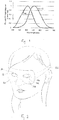
- Fig. 1 illustrates the general response of rods and cones to light across a spectrum of wavelengths.
- Fig. 1 illustrates the probability that a rod (curve 10) or cone (curve 12) will respond to the absorption of a photon of a particular wavelength by that cell.
- These curves are known in the art as the scotopic and photopic luminosity functions (curves 10 and 12 respectively).
- the rods are mainly responsive to light in the scotopic wavelength range (about 400 nm to 610 nm), and are most responsive to light at about 500 nm wavelength.
- Cones 12 are mainly responsive to light in the photopic wavelength range (about 475 nm to 650 nm), and are most responsive to light with a wavelength of about 575 nm.
- the inventors have realised that the response of both the rods and the cones to a specific wavelength of light should be considered when devising a light emitting apparatus.
- the rods and cones have different probabilities of responding to incident light, and that response, if any, is different between rods and cones. For example, a rod is much more likely than a cone to respond to photon of 450 nm wavelength. A photon at 550 nm wavelength, however, is more likely to stimulate a cone than a rod.
- the response of the rods and cones should be taken into consideration when measuring the brightness of light of relevance to the human eye, when devising a light emitting apparatus.
- the luminous intensity of light is measured in Candelas (Cd) and is defined as the power emitted by a light source in a particular direction weighted by the appropriate luminosity function (scotopic or photopic).
- the radiant intensity of that light source is multiplied by the value of the photopic luminosity function at that wavelength and finally multiplied by an additional constant factor, 683.002.
- the radiant intensity of that light source is multiplied by the value of the scotopic luminosity function at that wavelength and finally multiplied by an additional constant factor, 1700.
- the constant factors are required for historical reasons based on an 'old' definition of the Candela, which will be known to those skilled in the art, and will not be discussed in detail.
- light sources are not monochromatic, and as such have a range of emission wavelengths.
- the emission spectrum of the light source can be defined as a function of wavelength I e ( ⁇ ).
- I p photopic luminous intensity
- I p 683 . 002 ⁇ ⁇ min ⁇ max y p ⁇ I e ⁇ d ⁇
- y p ( ⁇ ) is the photopic luminosity function (curve 12 as shown in Fig. 1 )
- ⁇ min and ⁇ max are the minimum and maximum wavelengths emitted by the light source.
- a light source can be directed towards the eye of a patient.
- Fig. 2 illustrates an example of a radiation treatment apparatus, which is a facial mask 20 suitable for securing one or more light emitting source 30, 32 in position in use.
- the light emitting source may be an OLED array, for example.
- the facial mask 20 includes supporting regions 22, 24 to be located adjacent to the eyes of a patient, the supporting regions 22, 24 each supporting a respective light emitting source source. Of course, if only one eye is to be treated only one light source is required.
- the supporting regions 22, 24 are positioned to match the spacing between a patient's eyes.
- This spacing may be the average spacing between eyes, or 'tailor made' to fit the requirements of the particular patient, or the supports may be adjustable regions that are moveable between predetermined limits.
- a securing strap 26, secures the apparatus to the patient's head.
- the light sources are powered by at least one battery housed in or secured to the body 28 or the strap 26 of the mask. It will be appreciated that alternatively an external battery or power supply may also be used.
- the light reaching the eye should have certain specific properties.
- the present inventors have found that providing a radiation treatment apparatus (for example as described above), in which light having a ratio I s :I p of 1.85:1 is emitted provides an improved treatment efficiency and reduces the disturbance of sleep in the majority of patients compared to known devices.
- I s :I p of the light source is 2:1 or greater.
- I s :I p of the light source is 2.5:1 or greater. More aptly, I s :I p of the light source is 3:1 or greater. More aptly, I s :I p of the light source is 4:1 or greater.
- I s :I p of the light source is 5:1 or greater. More aptly, I s :I p of the light source is 7.5:1 or greater. More aptly, I s :I p of the light source is 10:1 or greater.
- the inventors have found that it is advantageous to maximise the scoptopic luminous intensity of the light source and minimise the photopic luminous intensity of the light source. This is because, light in the scotopic range stimulates the rods, thereby reducing oxygen demand, reducing VEGF expression, and ultimately reducing the risk of damaged blood vessels and possibly allowing existing blood vessels to repair. Also, because damage to blood vessels in the eye occurs mainly during dark conditions when the patient is asleep, then radiation treatment should occur when the patient is asleep. Therefore, since light in the photopic range is likely to wake a patient, or disturb their sleep, this type of light should be minimised.
- the ratio of the scotopic luminous intensity and photopic luminous intensity, I s :I p , of the light source should be carefully considered.
- Various facial masks for emitting light radiation towards the eyes are known per se. These types of facial mask are provided with a radiation source for emitting electromagnetic radiation to the eye. To customise the light received by the eye, the radiation source itself can be devised accordingly, or a filter or other means may be used to modify the electromagnetic radiation prior to reaching the eye.
- Electroluminescent devices for example LEDs and OLEDs produce spectra that are related to the emission material and the optical properties of layers containing various emitting and charge transport materials.
- Fig. 4 illustrates an example of a light emitting source having a I s :I p ratio around 1.85:1 suitable for use in a medical apparatus (where the I s value is more specifically around 1.83 to 1.87).
- the light emitting source is an OLED stack including: a first layer 42 of Indium Tin Oxide deposited onto a glass substrate 41, a second layer 44 of NPD (N,N'-Di-[(1-naphthyl)-N,N'-diphenyl]-1,1'-biphenyl)-4,4'-diamine) of thickness 160 nm; a third layer 46 of an 80:20 ratio of TPBi:lr(ppy)3 (where TPBi is 1,3,5-Tris(1-phenyl-1H-benzimidazol-2-yl)benzene and Ir(ppy)3 is Tris[2-phenylpyridinato-C2,N]iridium(III)) having a thickness of 110nm
- the stack is formed by vapour deposition of each layer in a manner known to those skilled in the art.
- a voltage is applied, the light is emitted in the direction of the first layer, into the glass substrate 41 and beyond (as shown by the wavy arrows).
- the emitting materials may include fluorescent or phosphorescent materials.
- Additional layers e.g. hole blocking, electron blocking and transport layers, may further be used to increase the efficiency of the device and/or tune the spectra of the radiation emitted.
- a further example of a suitable polymer OLED is a solution processed device including: a first layer of a PEDOT:PSS (poly(3,4-ethylenedioxythiophene) poly(styrenesulfonate)) having a thickness of 60 nm (we note that the thickness of this layer may depend on the specific PEDOT type and so could be between 30 to 90 nm); a second layer of SPG-01T (which is a copolymer poly-spiro-bifluorene available from Merck) having a thickness of 80nm; a third layer of LiF having a thickness of 2 nm; and an fourth layer of Al having a thickness of 100 nm.
- PEDOT:PSS poly(3,4-ethylenedioxythiophene) poly(styrenesulfonate)
- SPG-01T which is a copolymer poly-spiro-bifluorene available from Merck
- Such an OLED would have an I s :I p ratio of 2.5:1 (where the I s value is more specifically around 2.48 to 2.52).
- the method of depositing each layer in the stack was spin coating, though deposition methods of such solution processed devices may alternatively include gravure printing, slot die coating, wire bar coating, or aerosol/spray coating, for example.
- a further example of a suitable polymer OLED is a solution processed device including: a first layer of Indium Tin Oxide deposited onto a glass substrate a second layer of a PEDOT:PSS (poly(3,4-ethylenedioxythiophene) poly(styrenesulfonate)) having a thickness of 60 nm (we note that the thickness of this layer may depend on the specific PEDOT type and so could be between 30 to 120 nm); a third layer of SPG-01T (which is a copolymer poly-spiro-bifluorene available from Merck) having a thickness of 80 nm; a fourth layer of LiF having a thickness of 2 nm; and a fifth layer of Al having a thickness of 100 nm.
- a PEDOT:PSS poly(3,4-ethylenedioxythiophene) poly(styrenesulfonate)
- SPG-01T which is a copolymer poly-spiro-bifluoren
- Such an OLED would have an I s :I p ratio of 2.5:1 (where the I s value is more specifically around 2.48 to 2.52).
- the method of depositing the PEDOT:PSS and SPG-01T layers in the stack was spin coating, though deposition methods of such solution processed devices may alternatively include gravure printing, slot die coating, wire bar coating, or aerosol/spray coating, for example.
- the method of depositing the LiF and Al layers was thermal evaporation but it may also be by alternative deposition methods such as sputtering.
- an LED such as an Indium Gallium Nitride (InGaN) LED where the peak wavelength of the LED is controlled by the ratio between InN and GaN in the emissive layer may be used.
- Such an LED is grown on a substrate layer such as sapphire or silicon carbide using known epitaxy processes, and the ratio between InN and GaN controlled in this way.
- a wide range of peak wavelengths can be produced in this method from the near ultra violet (0.02InN/0.98GaN) through blues (0.3In/0.7Ga) through to reds for higher ratios.
- Such a device could be used to provide a I s :I p ratio of 4.5:1 (where the I s value is more specifically around 4.48 to 4.52).
- a ratio, I s :I p of 2:1 or greater may be obtained by using a generic device (eg. a known OLED, LED, electroluminescent source or fluorescent source), having an emission spectrum across a broad range of wavelengths, in combination with one or more optical filters.
- a generic device eg. a known OLED, LED, electroluminescent source or fluorescent source
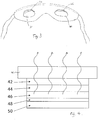
- Fig. 3 illustrates an example of a radiation treatment apparatus (as described above) provided with generic OLED arrays 34, 36 in the eye regions, and optical filters 38, 40 located over the OLED arrays on the inner side of the apparatus (the eye facing side of the apparatus).
- a suitable notch filter would be a 500 nm notch filter which has a full width at half maximum of 10 nm.
- These filters are constructed through the evaporative deposition of materials with high and low refractive indices (for example Ta 2 O 5 and SiO 2 respectively) and are commercially available. They may be used with any light source.
- Such a filter as described above would provide a resultant light having a ratio of 7.5:1 (where the I s value is more specifically around 7.48 to 7.52).
- a further example of a notch filter centered at 492 nm with a full width at half maximum of 10 nm would provide a resultant light having a ratio of 10:1 (where the I s value is more specifically around 9.98 to 10.02).
- the filter acts to filter the wavelengths of light that reach the eyes.
- a filter should block unwanted wavelengths of light, for example in the photopic range, and transmit required wavelengths, for example in the scotopic range. In this way the ratio I s :I p can be changed to 2:1 or greater.
- Suitable filters include absorption filters (which absorb unwanted light), dichroic or interference filters (which reflect unwanted light), bandpass filters (which only transmit a certain wavelength band), longpass and shortpass filters (which transmit long and short wavelengths), monochromatic filters (only transmitting one wavelength) and guided-mode resonance filters. These filters are well known to those skilled in the art and will not be described in detail.
- the radiometric spectrum should be measured with a calibrated instrument capable of measuring radiometric spectra as a function of wavelength, such as a spectrometer or spectroradiometer. A full radiometric spectrum should be taken, and then the ratio calculated by application of the above-described formulae to the results.
- An advantage of the ratios of scotopic to photopic brightness as demonstrated above is that the oxygen consumption of the retina is reduced as far as possible without interrupting normal sleep patterns.
- the devices above also avoid significant quantities of light below 470 nm (aptly with less than 3% of the total light emitted less than 470 nm). Substantial accumulated exposure to light with wavelengths of 470 nm or less may result in damage to the eye.
- a purpose of the apparatus is to treat the degeneration of the retina, a reduction in light levels below 470 nm is good.
- point sources such as LEDs may be emitted into a waveguide, which can side-scatter light into the eye.
- the medical apparatus may include a stand or handle with a radiation source for emitting electromagnetic radiation towards one or both eyes of a patient disposed on it, to form a lamp or torch or similar object, to conveniently and comfortably direct light towards the patient.
- the medical apparatus may contain a controller or other control mechanism, to control the dosage of radiation administered to the patient.
- the apparatus may include features such as a timer and/or sensors that detect when the patient is present or wearing the device.
- the dose may be administered such that the patient receives radiation for the entire sleeping period, or a period of, for example, between 1 hours and 8 hours within their overall sleeping period.
- the medical apparatus may have a user interface for enabling a patient or caregiver the capability to define the dosage period and/or dosage level, etc.
- the form factor of the facial mask is such that it can easily and comfortably be worn during sleep.
- the overall wavelength range and brightness of the total light for applying to a patient's eye(s) has been carefully tailored to suit the requirements of the retinal cells.
- the oxygen consumption of the eye may be reduced, thereby helping damaged blood vessels to be minimised or avoided in diabetic retinopathy or wet AMD patients.
Landscapes
- Health & Medical Sciences (AREA)
- Engineering & Computer Science (AREA)
- Biomedical Technology (AREA)
- Life Sciences & Earth Sciences (AREA)
- Pathology (AREA)
- Neurosurgery (AREA)
- Biophysics (AREA)
- Nuclear Medicine, Radiotherapy & Molecular Imaging (AREA)
- Radiology & Medical Imaging (AREA)
- Animal Behavior & Ethology (AREA)
- General Health & Medical Sciences (AREA)
- Public Health (AREA)
- Veterinary Medicine (AREA)
- Radiation-Therapy Devices (AREA)
Priority Applications (2)
| Application Number | Priority Date | Filing Date | Title |
|---|---|---|---|
| SI201430938T SI3041575T1 (sl) | 2013-09-05 | 2014-08-29 | Medicinska naprava |
| PL14758632T PL3041575T3 (pl) | 2013-09-05 | 2014-08-29 | Urządzenie medyczne |
Applications Claiming Priority (2)
| Application Number | Priority Date | Filing Date | Title |
|---|---|---|---|
| GBGB1315836.5A GB201315836D0 (en) | 2013-09-05 | 2013-09-05 | Medical apparatus and method |
| PCT/GB2014/052627 WO2015033114A1 (en) | 2013-09-05 | 2014-08-29 | Medical apparatus and method |
Publications (2)
| Publication Number | Publication Date |
|---|---|
| EP3041575A1 EP3041575A1 (en) | 2016-07-13 |
| EP3041575B1 true EP3041575B1 (en) | 2018-08-08 |
Family
ID=49486795
Family Applications (1)
| Application Number | Title | Priority Date | Filing Date |
|---|---|---|---|
| EP14758632.5A Active EP3041575B1 (en) | 2013-09-05 | 2014-08-29 | Medical apparatus |
Country Status (19)
| Country | Link |
|---|---|
| US (2) | US10888709B2 (enExample) |
| EP (1) | EP3041575B1 (enExample) |
| JP (1) | JP6473754B2 (enExample) |
| KR (1) | KR102508596B1 (enExample) |
| CN (1) | CN105682737B (enExample) |
| AU (1) | AU2014316860B2 (enExample) |
| BR (1) | BR112016004943B1 (enExample) |
| CA (1) | CA2959869C (enExample) |
| DK (1) | DK3041575T3 (enExample) |
| ES (1) | ES2694111T3 (enExample) |
| GB (1) | GB201315836D0 (enExample) |
| MX (1) | MX360241B (enExample) |
| PL (1) | PL3041575T3 (enExample) |
| PT (1) | PT3041575T (enExample) |
| SG (1) | SG11201601684PA (enExample) |
| SI (1) | SI3041575T1 (enExample) |
| TR (1) | TR201816306T4 (enExample) |
| TW (1) | TWI673081B (enExample) |
| WO (1) | WO2015033114A1 (enExample) |
Families Citing this family (9)
| Publication number | Priority date | Publication date | Assignee | Title |
|---|---|---|---|---|
| GB201315836D0 (en) * | 2013-09-05 | 2013-10-23 | Polyphotonix Ltd | Medical apparatus and method |
| US10512534B2 (en) * | 2016-10-03 | 2019-12-24 | California Institute Of Technology | Radioluminescent phototherapy eye device |
| EP3746178B1 (en) | 2018-01-31 | 2024-10-16 | California Institute of Technology | Controllable ocular phototherapy |
| EP3542857A1 (en) * | 2018-03-19 | 2019-09-25 | Rucker, Frances Joan | Balanced cone excitation for controlling refractive error and ocular growth to inhibit development of myopia |
| US11253722B2 (en) * | 2018-10-30 | 2022-02-22 | Multi Radiance Medical | Photobiomodulation therapy to treat a degenerative condition of the retina and/or the optic nerve |
| US11666485B2 (en) * | 2019-03-01 | 2023-06-06 | LumosTech, Inc. | Adjustable mask |
| CN114870275A (zh) * | 2022-05-24 | 2022-08-09 | 深圳市雏鹰视界健康科技有限公司 | 一种眼部智能生物视光仪和眼睛训练方法 |
| GB2701613A (en) * | 2024-06-07 | 2026-05-06 | Polyphotonix Ltd | a kit of parts,medicament and method |
| CN120000146B (zh) * | 2024-09-27 | 2025-10-17 | 中国人民解放军空军军医大学 | 一种快速中间视觉暗适应功能检查方法 |
Citations (1)
| Publication number | Priority date | Publication date | Assignee | Title |
|---|---|---|---|---|
| WO2011141840A1 (en) * | 2010-05-14 | 2011-11-17 | Koninklijke Philips Electronics N.V. | Efficient circadian and related system modulation with a sleep mask |
Family Cites Families (23)
| Publication number | Priority date | Publication date | Assignee | Title |
|---|---|---|---|---|
| DE3044184A1 (de) * | 1980-11-24 | 1982-06-16 | Mutzhas Maximilian F | Vorrichtung zur phototherapeutischen behandlung der hyperbilirubinaemie |
| US5015924A (en) * | 1989-04-14 | 1991-05-14 | The United States Of America As Represented By The United States Department Of Energy | Pupillary efficient lighting system |
| US7678140B2 (en) | 2000-05-10 | 2010-03-16 | George Brainard | Photoreceptor system for melatonin regulation and phototherapy |
| US7015636B2 (en) * | 2002-10-23 | 2006-03-21 | Charles Bolta | Balanced blue spectrum therapy lighting |
| US20040225340A1 (en) | 2003-03-10 | 2004-11-11 | Evans James W. | Light/breath/meditation device |
| EP1624932A4 (en) | 2003-05-01 | 2010-02-10 | Flinders Technologies Pty Ltd | APPARATUS FOR ADMINISTERING LIGHT STIMULATION |
| US20050278003A1 (en) | 2004-05-12 | 2005-12-15 | Harold Feldman | Electroluminescent light therapy devices |
| US20100081185A1 (en) | 2004-08-17 | 2010-04-01 | Mcdaniel David H | System and method for photodynamic cell therapy |
| JP2008237618A (ja) * | 2007-03-27 | 2008-10-09 | Toin Gakuen | 光力学的治療用光照射装置 |
| RU2491105C2 (ru) | 2007-05-31 | 2013-08-27 | Конинклейке Филипс Электроникс, Н.В. | Способ и система для предоставления световых и физиологических раздражителей |
| ATE535754T1 (de) * | 2007-07-26 | 2011-12-15 | Innolumis Public Lighting B V | STRAßENBELEUCHTUNGSANORDNUNG |
| JP2010162214A (ja) * | 2009-01-16 | 2010-07-29 | Kagoshima Univ | 光照射装置 |
| EP2411862A4 (en) * | 2009-03-25 | 2014-07-16 | High Performance Optics Inc | PHOTOCHROME OPHTHALMIC SYSTEMS FOR THE SELECTIVE FILTRATION OF SPECIFIC BLUE WAVELENGTH LENGTHS |
| BRPI1007738A2 (pt) * | 2009-04-24 | 2016-12-27 | Koninkl Philips Electronics Nv | sistema configurado para prover terapia luminosa a um indivíduo |
| GB201007256D0 (en) | 2010-04-30 | 2010-06-16 | Polyphotonix Ltd | Radiation treatment apparatus |
| JP6088424B2 (ja) * | 2010-05-14 | 2017-03-01 | コーニンクレッカ フィリップス エヌ ヴェKoninklijke Philips N.V. | 電磁放射の2以上の波長帯域を用いて被験者に光線治療を施すシステム |
| EP2422845B1 (en) | 2010-08-24 | 2013-04-24 | Polyphotonix Limited | Lightguide phototherapy apparatus |
| EP2422844A1 (en) | 2010-08-24 | 2012-02-29 | Polyphotonix Limited | Wearable phototherapy device |
| GB201104369D0 (en) * | 2011-03-15 | 2011-04-27 | English Stuart G | Light treatment cartridge |
| US20140187998A1 (en) * | 2011-06-14 | 2014-07-03 | The Regents Of The University Of California | Devices and treatment methods for vascular eye diseases |
| JP5882486B2 (ja) | 2011-10-19 | 2016-03-09 | イリデックス コーポレイション | 格子パターンレーザ治療及び方法 |
| US20140257439A1 (en) * | 2013-03-06 | 2014-09-11 | Verilux, Inc. | Adjustable therapeutic lights |
| GB201315836D0 (en) * | 2013-09-05 | 2013-10-23 | Polyphotonix Ltd | Medical apparatus and method |
-
2013
- 2013-09-05 GB GBGB1315836.5A patent/GB201315836D0/en not_active Ceased
-
2014
- 2014-08-29 WO PCT/GB2014/052627 patent/WO2015033114A1/en not_active Ceased
- 2014-08-29 TR TR2018/16306T patent/TR201816306T4/tr unknown
- 2014-08-29 PT PT14758632T patent/PT3041575T/pt unknown
- 2014-08-29 CN CN201480060273.3A patent/CN105682737B/zh active Active
- 2014-08-29 EP EP14758632.5A patent/EP3041575B1/en active Active
- 2014-08-29 SI SI201430938T patent/SI3041575T1/sl unknown
- 2014-08-29 PL PL14758632T patent/PL3041575T3/pl unknown
- 2014-08-29 ES ES14758632.5T patent/ES2694111T3/es active Active
- 2014-08-29 SG SG11201601684PA patent/SG11201601684PA/en unknown
- 2014-08-29 AU AU2014316860A patent/AU2014316860B2/en active Active
- 2014-08-29 US US14/916,863 patent/US10888709B2/en active Active
- 2014-08-29 KR KR1020167009030A patent/KR102508596B1/ko active Active
- 2014-08-29 BR BR112016004943-8A patent/BR112016004943B1/pt active IP Right Grant
- 2014-08-29 DK DK14758632.5T patent/DK3041575T3/en active
- 2014-08-29 JP JP2016539631A patent/JP6473754B2/ja active Active
- 2014-08-29 CA CA2959869A patent/CA2959869C/en active Active
- 2014-08-29 MX MX2016002874A patent/MX360241B/es active IP Right Grant
- 2014-09-02 TW TW103130235A patent/TWI673081B/zh active
-
2020
- 2020-07-13 US US16/927,072 patent/US11654296B2/en active Active
Patent Citations (1)
| Publication number | Priority date | Publication date | Assignee | Title |
|---|---|---|---|---|
| WO2011141840A1 (en) * | 2010-05-14 | 2011-11-17 | Koninklijke Philips Electronics N.V. | Efficient circadian and related system modulation with a sleep mask |
Also Published As
| Publication number | Publication date |
|---|---|
| SI3041575T1 (sl) | 2018-12-31 |
| ES2694111T3 (es) | 2018-12-18 |
| TWI673081B (zh) | 2019-10-01 |
| CN105682737B (zh) | 2018-05-08 |
| AU2014316860B2 (en) | 2019-05-16 |
| AU2014316860A1 (en) | 2016-04-28 |
| JP2016529056A (ja) | 2016-09-23 |
| SG11201601684PA (en) | 2016-04-28 |
| CA2959869C (en) | 2021-12-28 |
| BR112016004943A2 (pt) | 2017-08-01 |
| EP3041575A1 (en) | 2016-07-13 |
| CA2959869A1 (en) | 2015-03-12 |
| CN105682737A (zh) | 2016-06-15 |
| GB201315836D0 (en) | 2013-10-23 |
| DK3041575T3 (en) | 2018-11-26 |
| KR20160064126A (ko) | 2016-06-07 |
| US20160220841A1 (en) | 2016-08-04 |
| MX360241B (es) | 2018-10-26 |
| PT3041575T (pt) | 2018-11-20 |
| JP6473754B2 (ja) | 2019-02-20 |
| TW201513911A (zh) | 2015-04-16 |
| US11654296B2 (en) | 2023-05-23 |
| TR201816306T4 (tr) | 2018-11-21 |
| BR112016004943B1 (pt) | 2021-08-17 |
| PL3041575T3 (pl) | 2019-03-29 |
| US20200346031A1 (en) | 2020-11-05 |
| US10888709B2 (en) | 2021-01-12 |
| KR102508596B1 (ko) | 2023-03-10 |
| MX2016002874A (es) | 2016-06-22 |
| WO2015033114A1 (en) | 2015-03-12 |
Similar Documents
| Publication | Publication Date | Title |
|---|---|---|
| US11654296B2 (en) | Medical apparatus and method | |
| US9385337B2 (en) | Nanocrystals on fibers | |
| KR20110118646A (ko) | 유기 발광 다이오드 광선치료 조명 시스템 | |
| US20160008625A1 (en) | Medical apparatus, system and method | |
| US20220233878A1 (en) | Light source for eye therapy and light emitting device having the same | |
| JP2012514498A5 (enExample) | ||
| WO2012110178A1 (en) | Device and method for treatment of cells and cell tissue | |
| WO2011110277A1 (en) | Fibers in therapy and cosmetics | |
| US20210001145A1 (en) | Controlling myopia in humans | |
| JP2018134406A (ja) | 運動関連の神経疾患を治療する、および/または診断するための発光装置 | |
| US12377286B2 (en) | Anti-infective and therapeutic electromagnetic emission methods and devices | |
| US20240359031A1 (en) | Light Emitting Opthalmic Lens | |
| CN112206422B (zh) | 光源于抑制褪黑激素分泌的方法与照明装置 | |
| Jung et al. | Transparent White OLED‐Based Brain Stimulation With Invisible Flicker and Photobiological Safety Evaluation | |
| WO2025144794A1 (en) | Anti-infective and therapeutic electromagnetic emission methods and devices |
Legal Events
| Date | Code | Title | Description |
|---|---|---|---|
| PUAI | Public reference made under article 153(3) epc to a published international application that has entered the european phase |
Free format text: ORIGINAL CODE: 0009012 |
|
| 17P | Request for examination filed |
Effective date: 20160404 |
|
| AK | Designated contracting states |
Kind code of ref document: A1 Designated state(s): AL AT BE BG CH CY CZ DE DK EE ES FI FR GB GR HR HU IE IS IT LI LT LU LV MC MK MT NL NO PL PT RO RS SE SI SK SM TR |
|
| AX | Request for extension of the european patent |
Extension state: BA ME |
|
| DAX | Request for extension of the european patent (deleted) | ||
| STAA | Information on the status of an ep patent application or granted ep patent |
Free format text: STATUS: EXAMINATION IS IN PROGRESS |
|
| 17Q | First examination report despatched |
Effective date: 20170407 |
|
| GRAP | Despatch of communication of intention to grant a patent |
Free format text: ORIGINAL CODE: EPIDOSNIGR1 |
|
| STAA | Information on the status of an ep patent application or granted ep patent |
Free format text: STATUS: GRANT OF PATENT IS INTENDED |
|
| INTG | Intention to grant announced |
Effective date: 20180226 |
|
| GRAJ | Information related to disapproval of communication of intention to grant by the applicant or resumption of examination proceedings by the epo deleted |
Free format text: ORIGINAL CODE: EPIDOSDIGR1 |
|
| STAA | Information on the status of an ep patent application or granted ep patent |
Free format text: STATUS: EXAMINATION IS IN PROGRESS |
|
| GRAR | Information related to intention to grant a patent recorded |
Free format text: ORIGINAL CODE: EPIDOSNIGR71 |
|
| GRAS | Grant fee paid |
Free format text: ORIGINAL CODE: EPIDOSNIGR3 |
|
| STAA | Information on the status of an ep patent application or granted ep patent |
Free format text: STATUS: GRANT OF PATENT IS INTENDED |
|
| GRAA | (expected) grant |
Free format text: ORIGINAL CODE: 0009210 |
|
| STAA | Information on the status of an ep patent application or granted ep patent |
Free format text: STATUS: THE PATENT HAS BEEN GRANTED |
|
| INTC | Intention to grant announced (deleted) | ||
| AK | Designated contracting states |
Kind code of ref document: B1 Designated state(s): AL AT BE BG CH CY CZ DE DK EE ES FI FR GB GR HR HU IE IS IT LI LT LU LV MC MK MT NL NO PL PT RO RS SE SI SK SM TR |
|
| INTG | Intention to grant announced |
Effective date: 20180629 |
|
| REG | Reference to a national code |
Ref country code: GB Ref legal event code: FG4D |
|
| REG | Reference to a national code |
Ref country code: AT Ref legal event code: REF Ref document number: 1026302 Country of ref document: AT Kind code of ref document: T Effective date: 20180815 Ref country code: CH Ref legal event code: EP |
|
| REG | Reference to a national code |
Ref country code: IE Ref legal event code: FG4D |
|
| REG | Reference to a national code |
Ref country code: DE Ref legal event code: R096 Ref document number: 602014030036 Country of ref document: DE |
|
| REG | Reference to a national code |
Ref country code: FR Ref legal event code: PLFP Year of fee payment: 5 |
|
| REG | Reference to a national code |
Ref country code: CH Ref legal event code: NV Representative=s name: TR-IP CONSULTING LLC, CH |
|
| REG | Reference to a national code |
Ref country code: PT Ref legal event code: SC4A Ref document number: 3041575 Country of ref document: PT Date of ref document: 20181120 Kind code of ref document: T Free format text: AVAILABILITY OF NATIONAL TRANSLATION Effective date: 20181105 |
|
| REG | Reference to a national code |
Ref country code: NL Ref legal event code: FP |
|
| REG | Reference to a national code |
Ref country code: DK Ref legal event code: T3 Effective date: 20181122 |
|
| REG | Reference to a national code |
Ref country code: SE Ref legal event code: TRGR |
|
| REG | Reference to a national code |
Ref country code: ES Ref legal event code: FG2A Ref document number: 2694111 Country of ref document: ES Kind code of ref document: T3 Effective date: 20181218 |
|
| REG | Reference to a national code |
Ref country code: LT Ref legal event code: MG4D |
|
| REG | Reference to a national code |
Ref country code: NO Ref legal event code: T2 Effective date: 20180808 |
|
| PG25 | Lapsed in a contracting state [announced via postgrant information from national office to epo] |
Ref country code: BG Free format text: LAPSE BECAUSE OF FAILURE TO SUBMIT A TRANSLATION OF THE DESCRIPTION OR TO PAY THE FEE WITHIN THE PRESCRIBED TIME-LIMIT Effective date: 20181108 Ref country code: LT Free format text: LAPSE BECAUSE OF FAILURE TO SUBMIT A TRANSLATION OF THE DESCRIPTION OR TO PAY THE FEE WITHIN THE PRESCRIBED TIME-LIMIT Effective date: 20180808 Ref country code: FI Free format text: LAPSE BECAUSE OF FAILURE TO SUBMIT A TRANSLATION OF THE DESCRIPTION OR TO PAY THE FEE WITHIN THE PRESCRIBED TIME-LIMIT Effective date: 20180808 Ref country code: IS Free format text: LAPSE BECAUSE OF FAILURE TO SUBMIT A TRANSLATION OF THE DESCRIPTION OR TO PAY THE FEE WITHIN THE PRESCRIBED TIME-LIMIT Effective date: 20181208 Ref country code: GR Free format text: LAPSE BECAUSE OF FAILURE TO SUBMIT A TRANSLATION OF THE DESCRIPTION OR TO PAY THE FEE WITHIN THE PRESCRIBED TIME-LIMIT Effective date: 20181109 Ref country code: RS Free format text: LAPSE BECAUSE OF FAILURE TO SUBMIT A TRANSLATION OF THE DESCRIPTION OR TO PAY THE FEE WITHIN THE PRESCRIBED TIME-LIMIT Effective date: 20180808 |
|
| PG25 | Lapsed in a contracting state [announced via postgrant information from national office to epo] |
Ref country code: HR Free format text: LAPSE BECAUSE OF FAILURE TO SUBMIT A TRANSLATION OF THE DESCRIPTION OR TO PAY THE FEE WITHIN THE PRESCRIBED TIME-LIMIT Effective date: 20180808 Ref country code: AL Free format text: LAPSE BECAUSE OF FAILURE TO SUBMIT A TRANSLATION OF THE DESCRIPTION OR TO PAY THE FEE WITHIN THE PRESCRIBED TIME-LIMIT Effective date: 20180808 Ref country code: LV Free format text: LAPSE BECAUSE OF FAILURE TO SUBMIT A TRANSLATION OF THE DESCRIPTION OR TO PAY THE FEE WITHIN THE PRESCRIBED TIME-LIMIT Effective date: 20180808 |
|
| PG25 | Lapsed in a contracting state [announced via postgrant information from national office to epo] |
Ref country code: LU Free format text: LAPSE BECAUSE OF NON-PAYMENT OF DUE FEES Effective date: 20180829 Ref country code: EE Free format text: LAPSE BECAUSE OF FAILURE TO SUBMIT A TRANSLATION OF THE DESCRIPTION OR TO PAY THE FEE WITHIN THE PRESCRIBED TIME-LIMIT Effective date: 20180808 Ref country code: RO Free format text: LAPSE BECAUSE OF FAILURE TO SUBMIT A TRANSLATION OF THE DESCRIPTION OR TO PAY THE FEE WITHIN THE PRESCRIBED TIME-LIMIT Effective date: 20180808 |
|
| REG | Reference to a national code |
Ref country code: DE Ref legal event code: R097 Ref document number: 602014030036 Country of ref document: DE |
|
| PG25 | Lapsed in a contracting state [announced via postgrant information from national office to epo] |
Ref country code: SM Free format text: LAPSE BECAUSE OF FAILURE TO SUBMIT A TRANSLATION OF THE DESCRIPTION OR TO PAY THE FEE WITHIN THE PRESCRIBED TIME-LIMIT Effective date: 20180808 Ref country code: SK Free format text: LAPSE BECAUSE OF FAILURE TO SUBMIT A TRANSLATION OF THE DESCRIPTION OR TO PAY THE FEE WITHIN THE PRESCRIBED TIME-LIMIT Effective date: 20180808 |
|
| PLBE | No opposition filed within time limit |
Free format text: ORIGINAL CODE: 0009261 |
|
| STAA | Information on the status of an ep patent application or granted ep patent |
Free format text: STATUS: NO OPPOSITION FILED WITHIN TIME LIMIT |
|
| PG25 | Lapsed in a contracting state [announced via postgrant information from national office to epo] |
Ref country code: MC Free format text: LAPSE BECAUSE OF FAILURE TO SUBMIT A TRANSLATION OF THE DESCRIPTION OR TO PAY THE FEE WITHIN THE PRESCRIBED TIME-LIMIT Effective date: 20180808 |
|
| 26N | No opposition filed |
Effective date: 20190509 |
|
| PG25 | Lapsed in a contracting state [announced via postgrant information from national office to epo] |
Ref country code: MT Free format text: LAPSE BECAUSE OF NON-PAYMENT OF DUE FEES Effective date: 20180829 |
|
| REG | Reference to a national code |
Ref country code: CH Ref legal event code: PCAR Free format text: NEW ADDRESS: ROUTE DU COUTSET 18, 1485 NUVILLY (CH) |
|
| PG25 | Lapsed in a contracting state [announced via postgrant information from national office to epo] |
Ref country code: MK Free format text: LAPSE BECAUSE OF NON-PAYMENT OF DUE FEES Effective date: 20180808 Ref country code: CY Free format text: LAPSE BECAUSE OF FAILURE TO SUBMIT A TRANSLATION OF THE DESCRIPTION OR TO PAY THE FEE WITHIN THE PRESCRIBED TIME-LIMIT Effective date: 20180808 Ref country code: HU Free format text: LAPSE BECAUSE OF FAILURE TO SUBMIT A TRANSLATION OF THE DESCRIPTION OR TO PAY THE FEE WITHIN THE PRESCRIBED TIME-LIMIT; INVALID AB INITIO Effective date: 20140829 |
|
| REG | Reference to a national code |
Ref country code: AT Ref legal event code: UEP Ref document number: 1026302 Country of ref document: AT Kind code of ref document: T Effective date: 20180808 |
|
| PGFP | Annual fee paid to national office [announced via postgrant information from national office to epo] |
Ref country code: SI Payment date: 20220829 Year of fee payment: 9 |
|
| PG25 | Lapsed in a contracting state [announced via postgrant information from national office to epo] |
Ref country code: SI Free format text: LAPSE BECAUSE OF NON-PAYMENT OF DUE FEES Effective date: 20230830 |
|
| PG25 | Lapsed in a contracting state [announced via postgrant information from national office to epo] |
Ref country code: SI Free format text: LAPSE BECAUSE OF NON-PAYMENT OF DUE FEES Effective date: 20230830 |
|
| REG | Reference to a national code |
Ref country code: SI Ref legal event code: KO00 Effective date: 20240520 |
|
| REG | Reference to a national code |
Ref country code: CH Ref legal event code: U11 Free format text: ST27 STATUS EVENT CODE: U-0-0-U10-U11 (AS PROVIDED BY THE NATIONAL OFFICE) Effective date: 20260227 |
|
| PGFP | Annual fee paid to national office [announced via postgrant information from national office to epo] |
Ref country code: NL Payment date: 20260227 Year of fee payment: 12 |
|
| PGFP | Annual fee paid to national office [announced via postgrant information from national office to epo] |
Ref country code: SE Payment date: 20260227 Year of fee payment: 12 |
|
| PGFP | Annual fee paid to national office [announced via postgrant information from national office to epo] |
Ref country code: GB Payment date: 20260227 Year of fee payment: 12 |
|
| PGFP | Annual fee paid to national office [announced via postgrant information from national office to epo] |
Ref country code: ES Payment date: 20260227 Year of fee payment: 12 |
|
| PGFP | Annual fee paid to national office [announced via postgrant information from national office to epo] |
Ref country code: DE Payment date: 20260227 Year of fee payment: 12 Ref country code: DK Payment date: 20260227 Year of fee payment: 12 Ref country code: NO Payment date: 20260303 Year of fee payment: 12 Ref country code: IE Payment date: 20260227 Year of fee payment: 12 |
|
| PGFP | Annual fee paid to national office [announced via postgrant information from national office to epo] |
Ref country code: AT Payment date: 20260227 Year of fee payment: 12 |
|
| PGFP | Annual fee paid to national office [announced via postgrant information from national office to epo] |
Ref country code: BE Payment date: 20260227 Year of fee payment: 12 Ref country code: IT Payment date: 20260227 Year of fee payment: 12 |
|
| PGFP | Annual fee paid to national office [announced via postgrant information from national office to epo] |
Ref country code: FR Payment date: 20260227 Year of fee payment: 12 |
|
| PGFP | Annual fee paid to national office [announced via postgrant information from national office to epo] |
Ref country code: TR Payment date: 20260227 Year of fee payment: 12 |
|
| PGFP | Annual fee paid to national office [announced via postgrant information from national office to epo] |
Ref country code: CH Payment date: 20260227 Year of fee payment: 12 Ref country code: CZ Payment date: 20260227 Year of fee payment: 12 Ref country code: PT Payment date: 20260227 Year of fee payment: 12 |
|
| PGFP | Annual fee paid to national office [announced via postgrant information from national office to epo] |
Ref country code: PL Payment date: 20260227 Year of fee payment: 12 |