EP3035546A1 - Verarbeitungsverfahren in einem telekommunikationssystem, und entsprechendes drahtloses telekommunikationsmodul - Google Patents
Verarbeitungsverfahren in einem telekommunikationssystem, und entsprechendes drahtloses telekommunikationsmodul Download PDFInfo
- Publication number
- EP3035546A1 EP3035546A1 EP15199819.2A EP15199819A EP3035546A1 EP 3035546 A1 EP3035546 A1 EP 3035546A1 EP 15199819 A EP15199819 A EP 15199819A EP 3035546 A1 EP3035546 A1 EP 3035546A1
- Authority
- EP
- European Patent Office
- Prior art keywords
- signal
- module
- wireless
- calculation block
- automatic gain
- Prior art date
- Legal status (The legal status is an assumption and is not a legal conclusion. Google has not performed a legal analysis and makes no representation as to the accuracy of the status listed.)
- Granted
Links
Images

Classifications
-
- H—ELECTRICITY
- H04—ELECTRIC COMMUNICATION TECHNIQUE
- H04B—TRANSMISSION
- H04B1/00—Details of transmission systems, not covered by a single one of groups H04B3/00 - H04B13/00; Details of transmission systems not characterised by the medium used for transmission
- H04B1/06—Receivers
- H04B1/10—Means associated with receiver for limiting or suppressing noise or interference
- H04B1/109—Means associated with receiver for limiting or suppressing noise or interference by improving strong signal performance of the receiver when strong unwanted signals are present at the receiver input
Definitions
- the present invention relates to a method of processing in a telecommunication system comprising a first wireless telecommunication module according to a first wireless telecommunication protocol, said first module being adapted to receive a signal comprising at least a first signal according to the first protocol on a wireless transmission channel and comprising an automatic gain calculation block which determines a current gain value as a function of the signal received in said wireless transmission channel and an amplifier adapted to amplify said received first signal according to said current value gain determined according to said received signal.
- document WO 01/06669 A1 a method implemented at a receiver and a transceiver and of anticipating the intervals during which the transceiver is active to desensitize the receiver during said intervals.
- the ATC transponders in English "Air Traffic Control" on board the aircraft are used to communicate the position, altitude and / or identity of the aircraft.
- This communication may be a response generated by the ATC following the reception of a poll transmitted by a secondary radar.
- This secondary radar is associated with a primary radar which only detects the position of the aircraft in distance and azimuth via the reception of an echo.
- TCAS Traffic Collision Avoidance System
- the second harmonic of an ATC response is centered on a frequency Fr h2 , equal to 2180 MHz and has a power level of the order of a few watts.
- the Applicant wishes to provide the aircraft with mobile telecommunications means, for example of LTE type, which receive the fluxes from the ground transmitter using a radio frequency band which contains this second harmonic.
- reception capacity of these LTE telecommunications means embedded in an aircraft is heavily impacted during the transmission of ATC responses by the transponder also embedded in the aircraft, because the pulse trains blind and invalid, because of the mechanism adaptive gain of these telecommunications means, the reception, and for a very long time including the time of de-sensitization and re-sensitization of the receiver which is necessary for it to regain the gain allowing it to treat again correctly received LTE signals.
- the gain decreases sharply and throughout the re-sensitization period, the gain is insufficient to properly process the LTE signal.
- the invention proposes a method of treatment in a telecommunication system of the aforementioned type, characterized in that the telecommunication system comprising a second wireless telecommunication module adapted to intermittently transmit second signals. on the wireless communication channel according to a second communication protocol, each second signal being of duration less than T max , the method comprises a step according to which when a second signal is determined, by the automatic gain calculation block, as present in the signal received by the first module in said wireless transmission channel, a current gain value is then determined by the automatic gain calculation block independently of the power of said second signal.
- the proposed solution makes it possible to reduce the drawbacks of the prior art, in particular to limit the impact of the emission of the second signals on the reception of the first signal on said channel.
- the present invention proposes a wireless telecommunication module according to a first wireless telecommunication protocol, adapted to receive, on a wireless transmission channel, a signal comprising at least a first signal according to the first protocol and comprising an automatic gain calculation block adapted to determine a gain value as a function of the signal received in said wireless transmission channel and an amplifier adapted to amplify said received signal according to a gain value determined by the automatic calculation block gain; said wireless telecommunication module being intended for a telecommunication system comprising another wireless telecommunication module adapted to intermittently transmit second signals over the wireless communication channel according to a second communication protocol, each second signal being of duration less than T max , said wireless telecommunication module according to a first wireless telecommunication protocol being characterized in that the automatic gain calculation block is adapted for, when determining that a second signal is present in the received signal, determining a current value gain independently of the power of said second signal.
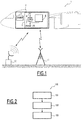
- the figure 1 is a view of a wireless telecommunication system 2 in one embodiment of the invention.
- the wireless telecommunication system 2 is embedded in an aircraft 1.
- the wireless telecommunication system 2 comprises a transponder 3 and an LTE transceiver 4.
- the transponder 3 is adapted to receive interrogation messages from a remote equipment 12 (for example a secondary radar on the ground or a transponder on board another aircraft etc.).
- a remote equipment 12 for example a secondary radar on the ground or a transponder on board another aircraft etc.
- interrogation messages require the provision, by the transponder 3, of characteristics of the aircraft 1 such as the identity of the aircraft and / or its current altitude and / or position and / or a code indicating its operational situation. (Radio failure, hijacking, etc.) and include at least one respective interrogation code indicating which of these characteristics is required (or which of these characteristics are required) in accordance with one of the three ATC modes: A, C or S.
- the transponder 3 is adapted to prepare and transmit an ATC response message to the interrogation message.
- the content of an ATC response message includes the characteristic (s) of the aircraft 1 required in the interrogation message.
- the second harmonic of an ATC response message is centered on a frequency Fr h2 , equal to 2180 MHz and spreads on about 10 MHz.
- the power level of this second harmonic is typically a few watts.
- the transceiver LTE 4 is adapted to transmit or receive, respectively, data from, respectively, at least one base station 11, type eNode B, arranged on the ground and radio range of the transmitter -receiver LTE 4.
- LTE Long Term Evolution
- the receiving band of the transceiver 4 is the band B rec , which is the band [2170 MHz, 2185 MHz] in this case.
- the LTE transceiver 4 comprises an antenna 6 for receiving LTE signals in said band.
- the LTE transceiver 4 comprises a reception circuit of the signals received via the antenna 6 and corresponding to the band B rec , said receiving circuit comprising an amplifier stage 7 and a block 8 of automatic gain control.
- the antenna 6 receives a current signal in the band B rec and supplies, after filtering the signals in this band, this current signal received at the amplifier 7.
- the LTE transceiver 4 further comprises an LTE signal transmission circuit (not shown).
- the amplifier stage 7, for example of the low noise amplifier type, called LNA (of the English “Low Noise Amplifier”), is adapted to amplify the current signal supplied to it by the antenna 6 by multiplying it by a gain the value of which is provided by the block 8 of automatic gain control.
- LNA low noise amplifier type
- This amplified signal supplied by the amplifier stage 7 is then subjected to processing implemented by the receiver circuit of the transceiver 4, including baseband conversion, baseband processing, and then LTE demodulation. .
- the amplified signal is also provided at the input of the automatic gain control block 8.
- the automatic gain control block 8 is adapted to determine, as a function of the signal recently received in the band B rec (typically the signal received last is the whole of the signal received and supplied by the antenna 6 from a time window of duration T 0 ending at the current instant considered t, with T 0 set according to the embodiment), the current value of the gain to be applied by the amplifier 7 on the received current signal.
- this adaptive gain is to obtain at the output of the amplifier stage 7 a substantially constant amplitude signal equal to a target amplitude value (typically the gain is low when the power of the LTE signal received last is large, and the gain is strong when the power of the LTE signal received recently is low: the gain is a decreasing power of the power of the LTE signal lately received).
- a target amplitude value typically the gain is low when the power of the LTE signal received last is large, and the gain is strong when the power of the LTE signal received recently is low: the gain is a decreasing power of the power of the LTE signal lately received.
- the automatic gain control block 8 is adapted to determine a current value of gain, as a function of the signal recently received and supplied by the antenna 6, independently of the power of an ATC response message. transmitted by the transponder 3 when determined by the block 8, such an ATC response message is part of the current signal received.
- the transceiver 4 is adapted to implement the set of steps 100 comprising the steps 101, 102, 103.
- the current signal, named S (t), received by the antenna 6 in the band B rec is supplied at time t to the amplifier stage 7.
- the amplifier stage 7 amplifies the received current signal S (t) by the current value supplied by the automatic gain control block 8 and supplies the amplified signal, named S a (t), in parallel with the part of the reception circuit responsible for LTE demodulation and block 8 of automatic gain control.
- the automatic gain control block 8 determines a present value of gain as a function of the received signal (ie as a function of S a (t)).
- the automatic gain control block 8 determines a present value of gain independent of the power of this ATC response message.
- the automatic gain control block 8 delivers to the amplifier stage 7 this current discounted value of determined gain.
- transceiver 4 shown in FIG. figure 3 .
- the transceiver 4 comprises the antenna 6, the amplifier stage 7, an analog-digital converter 20, a digital frequency down-converter 21, also called DDC 21 (in English "Digital Down Concerter”) and the block 8 automatic gain control.
- the automatic gain control block 8 comprises an envelope detector 9, a calculation block 10, a digital-analog converter 22 and a gain calculation controller 25.
- the gain calculation controller 25 comprises, in the case considered, a low-pass filter 11, a subtractor 12, a hysteresis comparator 13 and a delay device 14.
- This processing makes it possible to eliminate from the signal taken into account for the adaptation of the gain components of duration equal to or less than T max .
- step 102 the following substeps take place during step 102.
- the signal received by the antenna, which is then applied bandpass bandpass filtering band B rec is supplied to the amplifier stage 7.
- the amplifier stage 7 applies to the signal that it receives as input the current gain then calculated by block 8 of automatic gain control.
- the signal thus amplified is digitized by the analog-digital converter 20, lowered in frequency by the DDC 21, and is then sent from a part to the demodulation device LTE, on the other hand to the block 8 automatic gain control.
- the envelope of the input signal is detected by the envelope detector 9. And this signal from the envelope detector 9 is sent, on the one hand, to the calculation block 10, on the other hand to the gain calculation controller 25 (point A).
- the subtractor 12 makes the difference between the amplitude of the signal entering at point A and the amplitude of the average value of said signal (received at point B), average value obtained by passing said signal in the low-pass filter 11 of the frequency of cut much lower than the inverse of the desired reaction time for the gain calculation controller 25 (typically in the case considered, the cutoff frequency is chosen to be equal to 800 Hz).
- the difference (obtained at point C) between the incoming signal and its mean value is then applied to the positive input of the amplitude comparator 13 at hysteresis.
- On the negative input of the comparator 13 is applied a high threshold value.
- the effect of the hysteresis comparator 13 results in the fact that the crossing of the high threshold by the signal applied to the positive input will result in a high switching of the comparator output if this threshold crossing corresponds to an increase of the amplitude of the signal.
- the low switching of the comparator output will occur if the signal applied to the positive input takes a zero value and if this threshold crossing corresponds to a decrease in the amplitude of the signal.
- the output of the comparator 13 (point D) is applied, on the one hand, to the triggering input of the delay device 14 and, on the other hand, to the reset input of this delay device 14.
- the passage of the low state in the high state (rising edge) on the triggering input of the delay device 14 triggers the activation of a control signal (point E) during a delay slightly greater than the duration of the longest bursts of the ATC signal (which are here 120 ⁇ s).
- the transition from the high state to the low state (falling edge) on the reset input of the delay device 14 interrupts the activation of a control signal that has previously been triggered (point E).
- a sharp increase in the signal at the input of the device (point A) will therefore trigger activation of the control signal (point E) for a duration of 120 ⁇ s.
- the end of the timer interrupts the activation of the control signal.
- a return to the initial amplitude of the signal interrupts the activation of the control signal (in the case, for example, of a return to the initial amplitude after a strong increase of the signal during a duration of 25 ⁇ s).
- the activation of the control signal requires the gain calculation block 10 to keep the gain supplied to the amplifier stage 7 (point F) constant, and of value equal to the value of this gain present at the moment of the triggering of the activation of the control signal.
- the interruption of the control signal enables the gain calculation block 10 to update the gain as a function of the value of the signal present on its input (the gain then determined being a decreasing function of the power of the present signal so as to obtain output of the amplifier 7 a signal of constant amplitude).
- a sharp increase of the signal at the point A will therefore result in a corresponding variation of the gain applied by the amplifier stage 7 (point F) only if the new value of the input signal lasts more than 120 ⁇ s.
- a "moderate” increase or a decrease in the signal at point A will result in a variation of the gain applied by the amplifier stage 7 as if the gain calculation controller 25 were absent (the latter is transparent to the "natural" evolutions of the LTE signal ).
- reaction time of the automatic gain control block 8 on the appearance of a high power signal in the band B rec is brief (de-sensitization), but the re-sensitization time is longer (several ms) so as not to erase the envelope modulation of the received signal.
- the automatic gain control block 8 is adapted to operate according to two alternative modes of operation: the nominal operating mode and the auxiliary operating mode.
- the switchover to the auxiliary operating mode is triggered by the reception by the automatic gain control block 8 of a notification sent by the transponder 3 to the block 8 via a communication bus indicating the imminent dispatch of an ATC response message by the transponder 3.
- the duration T train of the response message that will be sent (this duration depending on the corresponding interrogation message) is indicated in the notification.
- said automatic gain control block 8 determines, in step 102, the current value of gain G as a function of the power of the signal recently received in said wireless transmission channel, ie as a function of S (t- ⁇ ) for any ⁇ between 0 and T 0 .
- the automatic gain control block determines a current gain value G (t) according to a gain calculated by the automatic gain control block 8 beforehand. to switch to the auxiliary operating mode (or a predetermined value, corresponding for example to an average gain of an LTE signal received without the presence of an ATC response).
- the automatic gain control block 8 is adapted to switch to the auxiliary operating mode just before an ATC pulse train is emitted by the transponder 3, to remain in this auxiliary operating mode during a TEMP time delay and to switch from the auxiliary operating mode to the nominal operating mode after the TEMP timer.
- the value of the delay TEMP is chosen at least equal to the duration of transmission of said pulse train.
- TEMP is taken equal to the duration of transmission of said pulse train T train (equal to 25 or 120 ⁇ s depending on the type of response) or equal to the maximum duration T max . Or else TEMP is taken equal to the sum of T train (or T max ) and T 0 .
- the invention makes it possible to reduce the drawbacks of the prior art, in particular to limit the impact of the transponder response message pulses on the LTE communications to a level corresponding substantially to the actual duration of transmission of the response messages.
- the transceiver LTE 4 and / or the eNode B 11 it will be detected by the transceiver LTE 4 and / or the eNode B 11, if data transmitted by the eNode B 11 have not been received by the LTE 4 transceiver, thanks to LTE protocol reliability algorithms.
- the transmission errors due to the missing data are corrected by the transceiver 4 by means of redundancies in the received data (and without resorting to retransmissions) or the missing data are retransmitted.
- Such algorithms are for example the algorithms H-ARQ (in English “Hybrid Automatic Repeat reQuest”) and RLC (in English “Radio Link Control”) in particular.
- H-ARQ in particular acts in 1 to 2 milliseconds, which makes it possible to strongly limit the consequences of a blindness and to make the latter imperceptible for LTE communications of data or speech type.
- a harmonic of the main signal transmitted by the transponder and the reception band of the LTE transceiver included the same channel; the invention can of course be used in a case where the main signal itself emitted by the transponder and the LTE module receiving band share the same channel.
- the invention has been described above with respect to a transponder and an LTE transceiver.
- the transponder and the LTE transceiver are, one and / or the other, replaced by any other type of radio frequency equipment using a common radio frequency channel.
- the duration of the messages could take two alternative values; in other embodiments, the duration of the messages may take any number of values.
- the automatic gain control is performed on the signal after amplification. In another embodiment, it is realized on the signal before amplification.
Landscapes
- Engineering & Computer Science (AREA)
- Computer Networks & Wireless Communication (AREA)
- Signal Processing (AREA)
- Circuits Of Receivers In General (AREA)
Applications Claiming Priority (1)
| Application Number | Priority Date | Filing Date | Title |
|---|---|---|---|
| FR1402856A FR3030159B1 (fr) | 2014-12-15 | 2014-12-15 | Procede de traitement dans un systeme de telecommunication et module de telecommunication sans fils associe |
Publications (2)
| Publication Number | Publication Date |
|---|---|
| EP3035546A1 true EP3035546A1 (de) | 2016-06-22 |
| EP3035546B1 EP3035546B1 (de) | 2018-10-31 |
Family
ID=53039467
Family Applications (1)
| Application Number | Title | Priority Date | Filing Date |
|---|---|---|---|
| EP15199819.2A Active EP3035546B1 (de) | 2014-12-15 | 2015-12-14 | Verarbeitungsverfahren in einem telekommunikationssystem, und entsprechendes drahtloses telekommunikationsmodul |
Country Status (2)
| Country | Link |
|---|---|
| EP (1) | EP3035546B1 (de) |
| FR (1) | FR3030159B1 (de) |
Cited By (3)
| Publication number | Priority date | Publication date | Assignee | Title |
|---|---|---|---|---|
| WO2018220323A1 (fr) * | 2017-06-01 | 2018-12-06 | Continental Automotive France | Procédé de suppression des interférences électromagnétiques dans un signal radio modulé en amplitude, notamment reçu dans un véhicule électrique ou hybride |
| GB2585210A (en) * | 2019-07-02 | 2021-01-06 | Thales Holdings Uk Plc | Pulsed interference reduction employing intelligent blanking |
| US11152967B2 (en) | 2018-08-24 | 2021-10-19 | Thales Holdings Uk Plc | Cancellation of interference and harmonics |
Citations (3)
| Publication number | Priority date | Publication date | Assignee | Title |
|---|---|---|---|---|
| WO2001006669A1 (en) | 1999-07-14 | 2001-01-25 | Ericsson, Inc. | Systems and methods for maintaining operation of a receiver co-located with a transmitter and susceptible to interference therefrom by desensitization of the receiver |
| US20040239559A1 (en) | 2003-06-02 | 2004-12-02 | King Thomas M. | Detection and reduction of periodic jamming signals in GPS receivers and methods therefor |
| US20070064835A1 (en) | 2005-09-19 | 2007-03-22 | Nokia Corporation | Interoperability improvement in terminals having a transmitter interfering with a receiver |
-
2014
- 2014-12-15 FR FR1402856A patent/FR3030159B1/fr not_active Expired - Fee Related
-
2015
- 2015-12-14 EP EP15199819.2A patent/EP3035546B1/de active Active
Patent Citations (3)
| Publication number | Priority date | Publication date | Assignee | Title |
|---|---|---|---|---|
| WO2001006669A1 (en) | 1999-07-14 | 2001-01-25 | Ericsson, Inc. | Systems and methods for maintaining operation of a receiver co-located with a transmitter and susceptible to interference therefrom by desensitization of the receiver |
| US20040239559A1 (en) | 2003-06-02 | 2004-12-02 | King Thomas M. | Detection and reduction of periodic jamming signals in GPS receivers and methods therefor |
| US20070064835A1 (en) | 2005-09-19 | 2007-03-22 | Nokia Corporation | Interoperability improvement in terminals having a transmitter interfering with a receiver |
Cited By (6)
| Publication number | Priority date | Publication date | Assignee | Title |
|---|---|---|---|---|
| WO2018220323A1 (fr) * | 2017-06-01 | 2018-12-06 | Continental Automotive France | Procédé de suppression des interférences électromagnétiques dans un signal radio modulé en amplitude, notamment reçu dans un véhicule électrique ou hybride |
| FR3067191A1 (fr) * | 2017-06-01 | 2018-12-07 | Continental Automotive France | Procede de suppression des interferences electromagnetiques dans un signal radio module en amplitude, notamment recu dans un vehicule electrique ou hybride |
| US10567019B2 (en) | 2017-06-01 | 2020-02-18 | Continental Automotive France | Method for suppressing electromagnetic interference in an amplitude modulated radio signal, in particular received in an electric or hybrid vehicle |
| US11152967B2 (en) | 2018-08-24 | 2021-10-19 | Thales Holdings Uk Plc | Cancellation of interference and harmonics |
| GB2585210A (en) * | 2019-07-02 | 2021-01-06 | Thales Holdings Uk Plc | Pulsed interference reduction employing intelligent blanking |
| GB2585210B (en) * | 2019-07-02 | 2021-06-30 | Thales Holdings Uk Plc | Pulsed interference reduction employing intelligent blanking |
Also Published As
| Publication number | Publication date |
|---|---|
| FR3030159A1 (fr) | 2016-06-17 |
| FR3030159B1 (fr) | 2018-02-02 |
| EP3035546B1 (de) | 2018-10-31 |
Similar Documents
| Publication | Publication Date | Title |
|---|---|---|
| EP3779500B1 (de) | Frequenzrampenumkehr zur interferenzabschwächung | |
| CN111225450B (zh) | 适用于卫星通信的随机接入方法和装置 | |
| EP3035546B1 (de) | Verarbeitungsverfahren in einem telekommunikationssystem, und entsprechendes drahtloses telekommunikationsmodul | |
| US10348344B2 (en) | Noise distribution shaping for signals, particularly CDMA signals, with mitigation of artifact signals | |
| EP1463954A1 (de) | Einrichtung und verfahren zur unterdrückung gepulster drahtloser signale | |
| EP2388758A1 (de) | Satellitentelekommunikationssystem, das über einen Trennmechanismus von Nachrichten verfügt, die von einer Vielzahl von Sendern ausgestrahlt werden | |
| JP2001237846A (ja) | 通信方法ならびに同方法を用いた通信システム | |
| EP2996260B1 (de) | Verarbeitungsverfahren in einem telekommunikationssystem, entsprechendes computerprogramm und entsprechendes telekommunikationssystem | |
| GB2585210A (en) | Pulsed interference reduction employing intelligent blanking | |
| EP2717503B1 (de) | Übertragungsverfahren mit Anpassungsverfahren der Kodiermodi und dynamischer Modulationsspanne | |
| EP1559192B1 (de) | Verfahren und einrichtung zum trainieren einer hf-verstärkerlinearisierungseinrichtung und mobiles endgerät damit | |
| EP3337045B1 (de) | Überwachung des spektrums einer hf-feld-impulsemission durch impulsformung | |
| EP4016118B1 (de) | Verfahren zur verarbeitung eines durch ein radarsignal gestörten funksignals | |
| EP4079005B1 (de) | Vorrichtung und verfahren zum minimieren der latenzzeit in einem v2x-kommunikationsnetz | |
| US20130100868A1 (en) | Phase coherent radio | |
| EP2941067A1 (de) | Frequenzschätzer für luftfahrt-kommunikation | |
| FR2627035A1 (fr) | Dispositif de detection et d'alerte d'occurrence de brouillage, notamment pour satellite-relais geostationnaire | |
| EP1427156B1 (de) | Verfahren und Empfänger zur Burstdetektion | |
| Dan et al. | A novel presence detector for burst signals based on the fluctuation of the correlation function | |
| WO2022246380A1 (en) | Wide-band automated gain control for bursty frames | |
| FR2573542A1 (fr) | Dispositif de regeneration d'onde radar pour balise repondeuse | |
| WO2020120445A1 (fr) | Procédé d'estimation de la distance séparant un dispositif d'authentification d'un véhicule automobile | |
| BE894768A (fr) | Systeme pour la transmission preferentielle de telegrammes d'ordres pourvus chacun d'une adresse en multiplexage par repartition dans le temps sur une frequence porteuse | |
| EP2486422A1 (de) | Verfahren zur überwachung eines an elektromagnetische kopplungen gebundenen interrogators mit einem übertragungsendgerät |
Legal Events
| Date | Code | Title | Description |
|---|---|---|---|
| PUAI | Public reference made under article 153(3) epc to a published international application that has entered the european phase |
Free format text: ORIGINAL CODE: 0009012 |
|
| AK | Designated contracting states |
Kind code of ref document: A1 Designated state(s): AL AT BE BG CH CY CZ DE DK EE ES FI FR GB GR HR HU IE IS IT LI LT LU LV MC MK MT NL NO PL PT RO RS SE SI SK SM TR |
|
| AX | Request for extension of the european patent |
Extension state: BA ME |
|
| 17P | Request for examination filed |
Effective date: 20161216 |
|
| RBV | Designated contracting states (corrected) |
Designated state(s): AL AT BE BG CH CY CZ DE DK EE ES FI FR GB GR HR HU IE IS IT LI LT LU LV MC MK MT NL NO PL PT RO RS SE SI SK SM TR |
|
| GRAP | Despatch of communication of intention to grant a patent |
Free format text: ORIGINAL CODE: EPIDOSNIGR1 |
|
| INTG | Intention to grant announced |
Effective date: 20180525 |
|
| RIN1 | Information on inventor provided before grant (corrected) |
Inventor name: SOULIE, ANTOINE Inventor name: PIPON, FRANCOIS Inventor name: TURPIN, FRANCOIS |
|
| GRAS | Grant fee paid |
Free format text: ORIGINAL CODE: EPIDOSNIGR3 |
|
| GRAA | (expected) grant |
Free format text: ORIGINAL CODE: 0009210 |
|
| AK | Designated contracting states |
Kind code of ref document: B1 Designated state(s): AL AT BE BG CH CY CZ DE DK EE ES FI FR GB GR HR HU IE IS IT LI LT LU LV MC MK MT NL NO PL PT RO RS SE SI SK SM TR |
|
| REG | Reference to a national code |
Ref country code: CH Ref legal event code: EP Ref country code: GB Ref legal event code: FG4D Free format text: NOT ENGLISH |
|
| REG | Reference to a national code |
Ref country code: AT Ref legal event code: REF Ref document number: 1060627 Country of ref document: AT Kind code of ref document: T Effective date: 20181115 |
|
| REG | Reference to a national code |
Ref country code: DE Ref legal event code: R096 Ref document number: 602015019021 Country of ref document: DE |
|
| REG | Reference to a national code |
Ref country code: IE Ref legal event code: FG4D Free format text: LANGUAGE OF EP DOCUMENT: FRENCH |
|
| REG | Reference to a national code |
Ref country code: NL Ref legal event code: MP Effective date: 20181031 |
|
| REG | Reference to a national code |
Ref country code: LT Ref legal event code: MG4D |
|
| REG | Reference to a national code |
Ref country code: AT Ref legal event code: MK05 Ref document number: 1060627 Country of ref document: AT Kind code of ref document: T Effective date: 20181031 |
|
| PG25 | Lapsed in a contracting state [announced via postgrant information from national office to epo] |
Ref country code: AT Free format text: LAPSE BECAUSE OF FAILURE TO SUBMIT A TRANSLATION OF THE DESCRIPTION OR TO PAY THE FEE WITHIN THE PRESCRIBED TIME-LIMIT Effective date: 20181031 Ref country code: LV Free format text: LAPSE BECAUSE OF FAILURE TO SUBMIT A TRANSLATION OF THE DESCRIPTION OR TO PAY THE FEE WITHIN THE PRESCRIBED TIME-LIMIT Effective date: 20181031 Ref country code: PL Free format text: LAPSE BECAUSE OF FAILURE TO SUBMIT A TRANSLATION OF THE DESCRIPTION OR TO PAY THE FEE WITHIN THE PRESCRIBED TIME-LIMIT Effective date: 20181031 Ref country code: IS Free format text: LAPSE BECAUSE OF FAILURE TO SUBMIT A TRANSLATION OF THE DESCRIPTION OR TO PAY THE FEE WITHIN THE PRESCRIBED TIME-LIMIT Effective date: 20190228 Ref country code: HR Free format text: LAPSE BECAUSE OF FAILURE TO SUBMIT A TRANSLATION OF THE DESCRIPTION OR TO PAY THE FEE WITHIN THE PRESCRIBED TIME-LIMIT Effective date: 20181031 Ref country code: BG Free format text: LAPSE BECAUSE OF FAILURE TO SUBMIT A TRANSLATION OF THE DESCRIPTION OR TO PAY THE FEE WITHIN THE PRESCRIBED TIME-LIMIT Effective date: 20190131 Ref country code: NO Free format text: LAPSE BECAUSE OF FAILURE TO SUBMIT A TRANSLATION OF THE DESCRIPTION OR TO PAY THE FEE WITHIN THE PRESCRIBED TIME-LIMIT Effective date: 20190131 Ref country code: ES Free format text: LAPSE BECAUSE OF FAILURE TO SUBMIT A TRANSLATION OF THE DESCRIPTION OR TO PAY THE FEE WITHIN THE PRESCRIBED TIME-LIMIT Effective date: 20181031 Ref country code: LT Free format text: LAPSE BECAUSE OF FAILURE TO SUBMIT A TRANSLATION OF THE DESCRIPTION OR TO PAY THE FEE WITHIN THE PRESCRIBED TIME-LIMIT Effective date: 20181031 Ref country code: FI Free format text: LAPSE BECAUSE OF FAILURE TO SUBMIT A TRANSLATION OF THE DESCRIPTION OR TO PAY THE FEE WITHIN THE PRESCRIBED TIME-LIMIT Effective date: 20181031 |
|
| PG25 | Lapsed in a contracting state [announced via postgrant information from national office to epo] |
Ref country code: PT Free format text: LAPSE BECAUSE OF FAILURE TO SUBMIT A TRANSLATION OF THE DESCRIPTION OR TO PAY THE FEE WITHIN THE PRESCRIBED TIME-LIMIT Effective date: 20190301 Ref country code: SE Free format text: LAPSE BECAUSE OF FAILURE TO SUBMIT A TRANSLATION OF THE DESCRIPTION OR TO PAY THE FEE WITHIN THE PRESCRIBED TIME-LIMIT Effective date: 20181031 Ref country code: RS Free format text: LAPSE BECAUSE OF FAILURE TO SUBMIT A TRANSLATION OF THE DESCRIPTION OR TO PAY THE FEE WITHIN THE PRESCRIBED TIME-LIMIT Effective date: 20181031 Ref country code: GR Free format text: LAPSE BECAUSE OF FAILURE TO SUBMIT A TRANSLATION OF THE DESCRIPTION OR TO PAY THE FEE WITHIN THE PRESCRIBED TIME-LIMIT Effective date: 20190201 Ref country code: AL Free format text: LAPSE BECAUSE OF FAILURE TO SUBMIT A TRANSLATION OF THE DESCRIPTION OR TO PAY THE FEE WITHIN THE PRESCRIBED TIME-LIMIT Effective date: 20181031 Ref country code: NL Free format text: LAPSE BECAUSE OF FAILURE TO SUBMIT A TRANSLATION OF THE DESCRIPTION OR TO PAY THE FEE WITHIN THE PRESCRIBED TIME-LIMIT Effective date: 20181031 |
|
| PG25 | Lapsed in a contracting state [announced via postgrant information from national office to epo] |
Ref country code: DK Free format text: LAPSE BECAUSE OF FAILURE TO SUBMIT A TRANSLATION OF THE DESCRIPTION OR TO PAY THE FEE WITHIN THE PRESCRIBED TIME-LIMIT Effective date: 20181031 Ref country code: IT Free format text: LAPSE BECAUSE OF FAILURE TO SUBMIT A TRANSLATION OF THE DESCRIPTION OR TO PAY THE FEE WITHIN THE PRESCRIBED TIME-LIMIT Effective date: 20181031 Ref country code: CZ Free format text: LAPSE BECAUSE OF FAILURE TO SUBMIT A TRANSLATION OF THE DESCRIPTION OR TO PAY THE FEE WITHIN THE PRESCRIBED TIME-LIMIT Effective date: 20181031 |
|
| REG | Reference to a national code |
Ref country code: CH Ref legal event code: PL |
|
| REG | Reference to a national code |
Ref country code: DE Ref legal event code: R097 Ref document number: 602015019021 Country of ref document: DE |
|
| PG25 | Lapsed in a contracting state [announced via postgrant information from national office to epo] |
Ref country code: LU Free format text: LAPSE BECAUSE OF NON-PAYMENT OF DUE FEES Effective date: 20181214 Ref country code: RO Free format text: LAPSE BECAUSE OF FAILURE TO SUBMIT A TRANSLATION OF THE DESCRIPTION OR TO PAY THE FEE WITHIN THE PRESCRIBED TIME-LIMIT Effective date: 20181031 Ref country code: SM Free format text: LAPSE BECAUSE OF FAILURE TO SUBMIT A TRANSLATION OF THE DESCRIPTION OR TO PAY THE FEE WITHIN THE PRESCRIBED TIME-LIMIT Effective date: 20181031 Ref country code: EE Free format text: LAPSE BECAUSE OF FAILURE TO SUBMIT A TRANSLATION OF THE DESCRIPTION OR TO PAY THE FEE WITHIN THE PRESCRIBED TIME-LIMIT Effective date: 20181031 Ref country code: MC Free format text: LAPSE BECAUSE OF FAILURE TO SUBMIT A TRANSLATION OF THE DESCRIPTION OR TO PAY THE FEE WITHIN THE PRESCRIBED TIME-LIMIT Effective date: 20181031 Ref country code: SK Free format text: LAPSE BECAUSE OF FAILURE TO SUBMIT A TRANSLATION OF THE DESCRIPTION OR TO PAY THE FEE WITHIN THE PRESCRIBED TIME-LIMIT Effective date: 20181031 |
|
| PLBE | No opposition filed within time limit |
Free format text: ORIGINAL CODE: 0009261 |
|
| STAA | Information on the status of an ep patent application or granted ep patent |
Free format text: STATUS: NO OPPOSITION FILED WITHIN TIME LIMIT |
|
| REG | Reference to a national code |
Ref country code: IE Ref legal event code: MM4A |
|
| REG | Reference to a national code |
Ref country code: BE Ref legal event code: MM Effective date: 20181231 |
|
| 26N | No opposition filed |
Effective date: 20190801 |
|
| PG25 | Lapsed in a contracting state [announced via postgrant information from national office to epo] |
Ref country code: SI Free format text: LAPSE BECAUSE OF FAILURE TO SUBMIT A TRANSLATION OF THE DESCRIPTION OR TO PAY THE FEE WITHIN THE PRESCRIBED TIME-LIMIT Effective date: 20181031 Ref country code: IE Free format text: LAPSE BECAUSE OF NON-PAYMENT OF DUE FEES Effective date: 20181214 |
|
| PG25 | Lapsed in a contracting state [announced via postgrant information from national office to epo] |
Ref country code: BE Free format text: LAPSE BECAUSE OF NON-PAYMENT OF DUE FEES Effective date: 20181231 |
|
| PG25 | Lapsed in a contracting state [announced via postgrant information from national office to epo] |
Ref country code: CH Free format text: LAPSE BECAUSE OF NON-PAYMENT OF DUE FEES Effective date: 20181231 Ref country code: LI Free format text: LAPSE BECAUSE OF NON-PAYMENT OF DUE FEES Effective date: 20181231 |
|
| PG25 | Lapsed in a contracting state [announced via postgrant information from national office to epo] |
Ref country code: MT Free format text: LAPSE BECAUSE OF FAILURE TO SUBMIT A TRANSLATION OF THE DESCRIPTION OR TO PAY THE FEE WITHIN THE PRESCRIBED TIME-LIMIT Effective date: 20181031 |
|
| PG25 | Lapsed in a contracting state [announced via postgrant information from national office to epo] |
Ref country code: TR Free format text: LAPSE BECAUSE OF FAILURE TO SUBMIT A TRANSLATION OF THE DESCRIPTION OR TO PAY THE FEE WITHIN THE PRESCRIBED TIME-LIMIT Effective date: 20181031 |
|
| PG25 | Lapsed in a contracting state [announced via postgrant information from national office to epo] |
Ref country code: CY Free format text: LAPSE BECAUSE OF FAILURE TO SUBMIT A TRANSLATION OF THE DESCRIPTION OR TO PAY THE FEE WITHIN THE PRESCRIBED TIME-LIMIT Effective date: 20181031 Ref country code: MK Free format text: LAPSE BECAUSE OF NON-PAYMENT OF DUE FEES Effective date: 20181031 Ref country code: HU Free format text: LAPSE BECAUSE OF FAILURE TO SUBMIT A TRANSLATION OF THE DESCRIPTION OR TO PAY THE FEE WITHIN THE PRESCRIBED TIME-LIMIT; INVALID AB INITIO Effective date: 20151214 |
|
| P01 | Opt-out of the competence of the unified patent court (upc) registered |
Effective date: 20230516 |
|
| PGFP | Annual fee paid to national office [announced via postgrant information from national office to epo] |
Ref country code: GB Payment date: 20251229 Year of fee payment: 11 |
|
| PGFP | Annual fee paid to national office [announced via postgrant information from national office to epo] |
Ref country code: FR Payment date: 20251230 Year of fee payment: 11 |
|
| PGFP | Annual fee paid to national office [announced via postgrant information from national office to epo] |
Ref country code: DE Payment date: 20251231 Year of fee payment: 11 |