EP3035431A1 - Brennstoffzellenmodul und verfahren zum betrieb eines brennstoffzellenmoduls - Google Patents
Brennstoffzellenmodul und verfahren zum betrieb eines brennstoffzellenmoduls Download PDFInfo
- Publication number
- EP3035431A1 EP3035431A1 EP15193503.8A EP15193503A EP3035431A1 EP 3035431 A1 EP3035431 A1 EP 3035431A1 EP 15193503 A EP15193503 A EP 15193503A EP 3035431 A1 EP3035431 A1 EP 3035431A1
- Authority
- EP
- European Patent Office
- Prior art keywords
- air
- cell stack
- fuel cell
- cell module
- fuel cells
- Prior art date
- Legal status (The legal status is an assumption and is not a legal conclusion. Google has not performed a legal analysis and makes no representation as to the accuracy of the status listed.)
- Granted
Links
Images

Classifications
-
- H—ELECTRICITY
- H01—ELECTRIC ELEMENTS
- H01M—PROCESSES OR MEANS, e.g. BATTERIES, FOR THE DIRECT CONVERSION OF CHEMICAL ENERGY INTO ELECTRICAL ENERGY
- H01M8/00—Fuel cells; Manufacture thereof
- H01M8/04—Auxiliary arrangements, e.g. for control of pressure or for circulation of fluids
- H01M8/04007—Auxiliary arrangements, e.g. for control of pressure or for circulation of fluids related to heat exchange
- H01M8/04014—Heat exchange using gaseous fluids; Heat exchange by combustion of reactants
-
- H—ELECTRICITY
- H01—ELECTRIC ELEMENTS
- H01M—PROCESSES OR MEANS, e.g. BATTERIES, FOR THE DIRECT CONVERSION OF CHEMICAL ENERGY INTO ELECTRICAL ENERGY
- H01M8/00—Fuel cells; Manufacture thereof
- H01M8/04—Auxiliary arrangements, e.g. for control of pressure or for circulation of fluids
- H01M8/04007—Auxiliary arrangements, e.g. for control of pressure or for circulation of fluids related to heat exchange
- H01M8/04067—Heat exchange or temperature measuring elements, thermal insulation, e.g. heat pipes, heat pumps, fins
-
- H—ELECTRICITY
- H01—ELECTRIC ELEMENTS
- H01M—PROCESSES OR MEANS, e.g. BATTERIES, FOR THE DIRECT CONVERSION OF CHEMICAL ENERGY INTO ELECTRICAL ENERGY
- H01M8/00—Fuel cells; Manufacture thereof
- H01M8/04—Auxiliary arrangements, e.g. for control of pressure or for circulation of fluids
- H01M8/04007—Auxiliary arrangements, e.g. for control of pressure or for circulation of fluids related to heat exchange
- H01M8/04067—Heat exchange or temperature measuring elements, thermal insulation, e.g. heat pipes, heat pumps, fins
- H01M8/04074—Heat exchange unit structures specially adapted for fuel cell
-
- H—ELECTRICITY
- H01—ELECTRIC ELEMENTS
- H01M—PROCESSES OR MEANS, e.g. BATTERIES, FOR THE DIRECT CONVERSION OF CHEMICAL ENERGY INTO ELECTRICAL ENERGY
- H01M8/00—Fuel cells; Manufacture thereof
- H01M8/04—Auxiliary arrangements, e.g. for control of pressure or for circulation of fluids
- H01M8/04082—Arrangements for control of reactant parameters, e.g. pressure or concentration
- H01M8/04201—Reactant storage and supply, e.g. means for feeding, pipes
-
- H—ELECTRICITY
- H01—ELECTRIC ELEMENTS
- H01M—PROCESSES OR MEANS, e.g. BATTERIES, FOR THE DIRECT CONVERSION OF CHEMICAL ENERGY INTO ELECTRICAL ENERGY
- H01M8/00—Fuel cells; Manufacture thereof
- H01M8/24—Grouping of fuel cells, e.g. stacking of fuel cells
-
- H—ELECTRICITY
- H01—ELECTRIC ELEMENTS
- H01M—PROCESSES OR MEANS, e.g. BATTERIES, FOR THE DIRECT CONVERSION OF CHEMICAL ENERGY INTO ELECTRICAL ENERGY
- H01M8/00—Fuel cells; Manufacture thereof
- H01M8/24—Grouping of fuel cells, e.g. stacking of fuel cells
- H01M8/2465—Details of groupings of fuel cells
- H01M8/247—Arrangements for tightening a stack, for accommodation of a stack in a tank or for assembling different tanks
- H01M8/2475—Enclosures, casings or containers of fuel cell stacks
-
- H—ELECTRICITY
- H01—ELECTRIC ELEMENTS
- H01M—PROCESSES OR MEANS, e.g. BATTERIES, FOR THE DIRECT CONVERSION OF CHEMICAL ENERGY INTO ELECTRICAL ENERGY
- H01M8/00—Fuel cells; Manufacture thereof
- H01M8/10—Fuel cells with solid electrolytes
- H01M8/12—Fuel cells with solid electrolytes operating at high temperature, e.g. with stabilised ZrO2 electrolyte
- H01M2008/1293—Fuel cells with solid oxide electrolytes
-
- H—ELECTRICITY
- H01—ELECTRIC ELEMENTS
- H01M—PROCESSES OR MEANS, e.g. BATTERIES, FOR THE DIRECT CONVERSION OF CHEMICAL ENERGY INTO ELECTRICAL ENERGY
- H01M8/00—Fuel cells; Manufacture thereof
- H01M8/06—Combination of fuel cells with means for production of reactants or for treatment of residues
- H01M8/0606—Combination of fuel cells with means for production of reactants or for treatment of residues with means for production of gaseous reactants
- H01M8/0612—Combination of fuel cells with means for production of reactants or for treatment of residues with means for production of gaseous reactants from carbon-containing material
- H01M8/0625—Combination of fuel cells with means for production of reactants or for treatment of residues with means for production of gaseous reactants from carbon-containing material in a modular combined reactor/fuel cell structure
-
- H—ELECTRICITY
- H01—ELECTRIC ELEMENTS
- H01M—PROCESSES OR MEANS, e.g. BATTERIES, FOR THE DIRECT CONVERSION OF CHEMICAL ENERGY INTO ELECTRICAL ENERGY
- H01M8/00—Fuel cells; Manufacture thereof
- H01M8/24—Grouping of fuel cells, e.g. stacking of fuel cells
- H01M8/241—Grouping of fuel cells, e.g. stacking of fuel cells with solid or matrix-supported electrolytes
- H01M8/2425—High-temperature cells with solid electrolytes
-
- Y—GENERAL TAGGING OF NEW TECHNOLOGICAL DEVELOPMENTS; GENERAL TAGGING OF CROSS-SECTIONAL TECHNOLOGIES SPANNING OVER SEVERAL SECTIONS OF THE IPC; TECHNICAL SUBJECTS COVERED BY FORMER USPC CROSS-REFERENCE ART COLLECTIONS [XRACs] AND DIGESTS
- Y02—TECHNOLOGIES OR APPLICATIONS FOR MITIGATION OR ADAPTATION AGAINST CLIMATE CHANGE
- Y02E—REDUCTION OF GREENHOUSE GAS [GHG] EMISSIONS, RELATED TO ENERGY GENERATION, TRANSMISSION OR DISTRIBUTION
- Y02E60/00—Enabling technologies; Technologies with a potential or indirect contribution to GHG emissions mitigation
- Y02E60/30—Hydrogen technology
- Y02E60/50—Fuel cells
Definitions
- the invention relates to a fuel cell module according to the preamble of claim 1 and a method for operating a fuel cell module according to the preamble of claim 15.
- Fuel cells allow the use of energy of a fuel through energy conversion.
- both electrical energy that is generated due to electrochemical processes, as well as thermal energy, which is obtained in the form of hot exhaust gases of the processes can be used.
- gaseous streams of two educts are passed through the cells separately.
- the first educt in the form of ambient air or briefly air contains oxidizing components, the second reactant reducing components.
- a methane-containing combustion gas eg natural gas
- the second educt will be referred to as combustion gas or natural gas, which is to be understood as meaning other suitable gases with reducing components.
- Each fuel cell comprises two parts, namely a so-called PEN element (called PEN for short) and a disk-shaped interconnector.
- the interconnector separates the air from the process gas in a cell stack of several fuel cells.
- the interconnector for guiding the media on a so-called air side air interconnector channels and on a so-called gas side process gas interconnector channels.
- the supplied air serves not only as Conceptsedukt, but in particular also for cooling the fuel cells and thus to dissipate heat from the fuel cell.
- a fuel cell module usually has a plurality of fuel cells, which are arranged in a so-called cell stack. The individual fuel cells are then stacked in an axial direction and are supplied together with natural gas and air.
- Such a fuel cell module and a method for operating such a fuel cell module for example, in the EP 1 864 347 B1 described.
- the EP 0 580 918 A1 also describes such a fuel cell module.
- the cell stack is uniformly supplied air over its entire height / axial direction, whereby a uniform cooling of the individual fuel cells is achieved.
- the EP 2 775 557 A1 describes a fuel cell module in which the fuel cells in the middle of the cell stack are cooled more strongly than the fuel cells located further out. This is achieved in that the air is first passed through the cell stack prior to distribution to the individual fuel cells and thus before reaching an air distribution space in cooling contact with the in the middle of the cell stack arranged fuel cell comes. Thus, on the one hand, these fuel cells are always cooled with the entire supplied air and, on the other hand, the air is heated, so that only more preheated air can be supplied to the further outer fuel cells.
- the fuel cell module has arranged in a cell stack fuel cells, which is supplied by means of an air supply system via an air distribution space air for operating or cooling.
- the air is not only used for cooling, but also supplies the oxygen for the electrochemical processes taking place in the fuel cells and thus for the operation of the fuel cells.
- the resulting air flow can be referred to as primary air flow.
- the fuel cells are stacked in an axial direction.
- the air supply system is designed so that in the axial direction results in an unevenly strong cooling of the fuel cell by the supplied air.
- the air supply system is arranged completely radially outside the cell stack. This ensures that the air does not come into cooling contact with the fuel cells before entering the air distribution space but only after leaving the air distribution space. This advantageously makes it possible for cool, that is not already heated by the fuel cells, to be conducted to all fuel cells of the cell stack. This allows a very accurate and targeted metering of the cooling of the individual fuel cells and thus a particularly uniform temperature distribution within the cell stack.
- radial or radial direction is to be understood in this context perpendicular to said axial direction.
- the arrangement “outside” refers to an axis in the axial direction that passes through the centroids surfaces in the radial direction of the individual fuel cells. In the case of disc-shaped fuel cells, said axis thus extends through its center points and, in the case of rectangular or square fuel cells, through the intersections of its diagonals.
- the need for cooling by the supplied air of the individual fuel cells is significantly dependent on their position in the cell stack in the axial direction. Differences arise in particular due to different heat dissipation due to radiation, convection and heat conduction to other components which are arranged in mechanical contact or in visual contact with the fuel cells. For example, heat dissipation by the above effects is higher in a fuel cell disposed at one end of the cell stack than in a fuel cell disposed at the center of the cell stack. This also differentiates the cooling requirements of the individual fuel cells.
- the cooling by the supplied air can be regarded as an active cooling and the heat loss by radiation, convection and heat conduction as a passive cooling.
- Fuel cells Due to the different degrees of cooling in the axial direction, these different requirements for active cooling can be taken into account and very small temperature differences in the axial direction of the cells within the cell stack can be achieved.
- Fuel cells have their optimum efficiency and their optimum aging behavior in a certain temperature range of, for example, 800 ° to 850 ° C. Due to the low temperature differences, the individual elements of the fuel cell module can be coordinated so that all fuel cells of the cell stack are operated in the optimum temperature range. Thus, each fuel cell and thus also the entire fuel cell module has a very high efficiency and a very good aging behavior. In addition, then expand all fuel cells and associated component due to their almost the same temperature almost equally strong and there are only very low voltages due to different thermal expansions of the individual components.
- the fuel cells are in particular designed as high-temperature fuel cells of the SOFC type ("solid oxide fuel cell”).
- SOFC solid oxide fuel cell
- ambient air is used as the air, which can also be filtered before being fed to the cell stack.
- the axial direction is usually aligned perpendicular to the ground.
- the different degrees of cooling is achieved in that the cell stack in the axial direction has a total axial extent s_total and the air supply system is designed so that the air is supplied into the air distribution space only in a feed region having an axial extent s_part in the axial direction that is less than the total axial extent s_total of the cell stack.
- the temperature distribution in the axial direction and thus the efficiency and aging of the fuel cell can be positively influenced.
- the supplied air is then distributed, in particular in the axial direction, so that all the fuel cells, that is to say those which are arranged outside the supply area in the axial direction, are supplied with air.
- the air supply system is in particular designed so that the cooling of the fuel cells in the entire feed in the axial direction is the same or at least can be considered as equal.
- the air distribution space over the total axial expansion air is supplied in a primary air flow and the different degrees of cooling in the axial direction by differently executed through holes, for example through holes for air with different diameters, is achieved.
- through holes for air with different diameters For example, at the ends of the cell stack passage openings with a smaller diameter may be provided as through holes in the middle of the cell stack.
- the air supply system is designed so that the air is supplied only in a feed region having an axial dimension s_part in the axial direction, which is smaller than the total axial extent s_total of the cell stack, and in addition the through holes within the feed region differ in the axial direction, so for example through holes have different diameters.
- the through holes may also differ in a direction transverse to the axial direction.
- the axial extent s_part of the feed area is at most 80%, in particular at most 70% and especially at most 50% of the total axial extent s_total of the cell stack.
- the air distribution space has a first residual area with an axial extent s_rest1, in which no air is supplied, and the first remaining area is arranged at a first end of the cell stack.
- the first end of the cell stack can be arranged either at the top or bottom of the cell stack. This ensures that in a residual area at the top or bottom of the cell stack no air in the primary air flow is passed to the cell stack for cooling.
- the air distribution space is designed so that nevertheless the required air for the electrochemical reaction reaches all the fuel cells, that is to say also the fuel cells arranged in the remaining region. This distribution of air occurs in the air distribution space after the air has exited the air supply system.
- the air distribution space has a second residual area with an axial extent s_rest2, in which no air is supplied.
- the second remaining region is arranged at a first end opposite the second end of the cell stack. This ensures that in the remaining areas at the top and bottom of the cell stack no air is passed in a primary air stream for cooling on the cell stack.
- the increased radiation, convection and heat conduction at both ends of the cell stack can be taken into account and especially small temperature differences in the axial direction of the cell stack can be made possible.
- first and the second residual region have different axial expansions s_rest1, s_rest2 at the two ends of the cell stack. Due to the different axial expansions, a different need for active cooling at the two ends of the cell stack can be taken into account. The different need for active cooling may be due, for example, to differently designed insulations at the two ends or various adjacent components.
- the first residual region and, if present, the second residual region have, in particular, axial expansions s_rest1, s_rest2 which amount to at least 10%, in particular at least 15% and especially at least 25% of the total axial extent s_total of the cell stack.
- the fuel cells on an interconnector and a PEN element are formed with air interconnector ducts for a flow of air.
- the air enters the air interconnector channels via an inlet.
- An overall cross-sectional area of the air interconnect ducts at the inlet is not identical for all fuel cells of the cell stack. The greater the said total cross-sectional area, the more air flows from the air distribution space into the air interconnector channels and the stronger the active cooling of the fuel cells by the air flowing through.
- the total cross-sectional areas can be selected to be greater, especially in areas with an increased need for active cooling, than in areas with a lower requirement for active cooling.
- the total cross-sectional areas are thus smaller, especially in the area of the two ends of the cell stack, than in a central area.
- a different degrees of cooling can be achieved by the supplied air.
- this may be provided only in an axially limited feed region or even in a feed region extending over the total axial extent.
- the total cross-sectional areas can in particular be formed by different heights of the air interconnector channels in the axial direction.
- the heights of the air interconnector channels may be, for example, between 0.7 and 2.0 mm.
- the air supply system is designed so that the air is passed directly to a standing in a heat exchange with the cell stack component in particular an exhaust duct for discharging exhaust gas of the fuel cell.
- Said component and in particular the exhaust duct are arranged on the cell stack.
- the named component can additionally fulfill another function or else be present only for cooling the fuel cells.
- a radiation exchange then the fuel cells located further inside are cooled. Investigations have shown that this allows a particularly effective cooling.
- direct air directly to the component, in particular to the exhaust duct is to be understood in particular as meaning that the air is not preheated prior to conduction to the component and, in particular, to the exhaust duct, but rather to the component as low as possible is directed in particular to the exhaust passage. This allows a simple air flow, which allows a simple and thus cost air supply system.
- the fuel cells have, in particular transversely to the axial direction, a round outer contour, on which four, in particular exactly four, exhaust gas channels are arranged.
- the four exhaust ducts are distributed in particular uniformly around the outer circumference of the fuel cells.
- the cell stack is arranged in an insulating sheath, which has passage openings in the feed region. Since the fuel cells in operation in particular temperatures of about 750 ° C, insulation against the environment and thus an insulating sheath is mandatory.
- This insulating sheath is in particular made of a ceramic material in which through holes can be easily and inexpensively introduced. The described construction thus enables a cost-effective air supply system.
- the passage openings in particular all have the same diameter. However, the diameters may also differ in the axial direction and / or transversely to the axial direction. This would allow certain parts of the cell stack to be cooled more or less strongly.
- At least one passage opening is assigned to each exhaust gas channel at an axial position of the feed region.
- the Insulating sheath thus has at each axial position either no through-hole or at most, in particular just as many through holes as the number of exhaust channels. Thus, very few through holes are necessary, which allows a cost-insulating sleeve.
- a supply element with a supply space is arranged on the insulation cover so that the passage openings are connected to the supply space.
- the supply element has an axial extent s_ver which is smaller than the total axial extent s_total of the cell stack. Thus, only a small amount of material is necessary for the supply element, which allows a cost-effective supply element.
- the insulating sheath has a round outer contour and the supply element is arranged annularly around the insulating sheath. This allows a simple and inexpensive construction of the fuel cell module and also a compact design.
- the supply element has in particular only one air connection piece. This allows a particularly simple and inexpensive construction of the fuel cell module.
- the above object is also achieved by a method of operating a fuel cell module, wherein the fuel cell module has fuel cells arranged in a cell stack and an air supply system for supplying air for cooling the fuel cells, and the fuel cells are stacked in an axial direction, the fuel cells become axial unevenly cooled.
- the air supply system is arranged completely radially outside the cell stack. The air is thus supplied in particular from the radial outside the air distribution space and then the fuel cells.
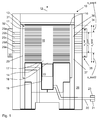
- a fuel cell module 10 has a plurality of fuel cells 11 which are stacked on each other in an axial direction 12 and thus form a cell stack 13.
- the individual fuel cells 11 have a disc-shaped basic shape with a circular cross-section (see Fig. 2 ) and thus transversely or perpendicular to the axial direction 12, a round outer contour, so that the cell stack 13 has a cylindrical basic shape.
- the arrow indicating the axial direction 12 extends through the center points of the disk-shaped fuel cells 11.
- the fuel cells may also have a different cross-section, such as elliptical, rectangular or square.
- the fuel cells 11 have centrally an inner opening 14 in the axial direction 12 (see Fig. 2 ), so that in the cell stack 13, a cylindrical distribution channel 15 is formed, from which each fuel cell 11 process gas for the taking place in the fuel cell 11 electrochemical reaction can be supplied.
- the process gas can also be supplied in another way, for example from the outside.
- the cell stack 13 is closed at the top by an upper current collector 16.
- the upper current collector 16 has a basic shape identical to the fuel cells 11, but has no inner opening.
- the upper current collector 16 forms the anode of the cell stack 13 generated voltage. He has an electrical connection, not shown, via which an electrical contact can be realized.
- the cell stack 13 is closed down by a lower current collector 17, which forms the cathode of the voltage generated by the cell stack 13.
- the lower current collector 17 likewise has a basic shape identical to the fuel cells 11 and has a circular inner opening 18.
- the lower current collector 17 is welded to a hollow cylindrical sleeve 19, which is connected to a gas supply line 20, to which a gas connection 21 is arranged.
- the gas connection 21 the gas supply line 20, the sleeve 19 and the inner opening 18 of the lower current collector 17, it is thus possible to supply natural gas as combustion gas to the distribution channel 15 of the cell stack 13.
- a reformer 22 is arranged, in which the methane contained in the supplied natural gas is converted before being fed into the distribution channel 15 in hydrogen and carbon monoxide, that is, the so-called process gas.
- the current collector 17, the sleeve 19, the gas supply line 20 and the gas connection 21 are made of an electrically conductive material in the form of steel, so that the gas connection 21 is electrically conductively connected to the current collector 17.
- a non-illustrated electrical connection 23 is arranged, via which an electrical connection to the lower current collector 17 can be made.
- the necessary for the taking place in the fuel cell 11 electrochemical reaction air is supplied to the cell stack 13 via an air distribution space (31) from the outside. This is based on Fig. 2 explained. Equally distributed on a round outer contour 24 of the cell stack 13 and thus the fuel cell 11 are four identical exhaust gas channels 25 are arranged. Between the exhaust channels 25, gaps 26 result, via which the fuel cells 11 air can be supplied.
- the fuel cells 11 have air guide elements 27 which extend from the gaps 26 in the direction of the distribution channel 15. With the air guide elements 27 are air Interkonnektorkanäle 40 formed (see Fig. 3 ).
- the insulating sheath 28 is made of a ceramic material and has from the outside inwardly leading through holes 29 a, wherein in the sectional plane of the Fig. 2 four through holes 29a are arranged. Via the passage openings 29a, air can be supplied from an externally formed supply space 30 into the air distribution space 31 formed between the cell stack 13 and the insulation sheath 28.
- the passage openings 29 a are arranged so that they direct the air directly to the exhaust gas channels 25. The supply of air to the air distribution space takes place in a so-called primary air flow.
- the air then flows mainly in the circumferential direction along the exhaust passages 25 to the gaps 26 described above, and then as described in the direction of the distribution channel 15 to flow.
- the supplied air thus cools the exhaust ducts 25, which then cool the cell stack 13 via radiation exchange.
- the air also flows partially in the axial direction, so as to reach the fuel cell 11, at the axial position not directly a through hole is arranged. Since a pressure loss when flowing into the fuel cells 11 is relatively large, the air is distributed in the axial direction of the distribution space 31 so that all the fuel cells 11 are supplied evenly with air.
- the distribution of the air within the air distribution space 31 is referred to as a secondary air flow.
- the supply space 30 is bounded by a supply element 32 to the outside.
- the supply element 32 is arranged in a circle around the insulation cover 28 around.
- the supply chamber 30 air is supplied only via an air connection pipe 33. These are the necessary air for operation and cooling. As much air is supplied via the air connection piece 33 that a quasi-constant pressure is formed in the supply space 30.
- the supply element 32 has an axial extent s_ver in the axial direction 12, which is smaller than a total axial extent s_total the cell stack 13.
- a total axial extent s_total the cell stack 13 Under the axial extent s_total the cell stack 13 is the distance in the axial direction 12 between an upper side of the lower current collector 17 and a Bottom of the upper current collector 16 understood.
- Air is supplied to the air distribution space 31 only in a feed region 34 which has an axial extent s_part in the axial direction 12 which is less than the total axial extent s_total of the cell stack 13 and also the axial extent s_ver of the supply element 32.
- the passage openings 29a, 29b, 29c, 29d, 29e arranged on a total of five planes perpendicular to the axial direction 12.
- each exhaust passage 25 exactly one through hole 29a, 29b, 29c, 29d, 29e is assigned.
- the axial extent s_part of the feed region 34 should be understood to mean the distance in the axial direction 12 between a lower edge of the lowermost through openings 29e and an upper edge of the uppermost through openings 29a.
- the supply element 32, the passage openings 29a, 29b, 29c, 29d, 29e and the air distribution space 31 thus form an air supply system 35.
- the air supply system 35 is thus arranged completely radially outside the cell stack 13.
- the described embodiment of the feed region 34 results in an unevenly strong cooling of the cell stack 13 and thus of the fuel cells 11 in the axial direction 12.
- the passage openings 29a, 29b, 29c, 29d, 29e all have an identical diameter. However, it is also possible for the through openings 29a, 29b, 29c, 29d, 29e to have a different diameter in the different planes or even within one plane.
- Fig. 1 When in the Fig. 1 It may also be at most 80%, in particular at most 70% or at most 50% of the total axial extent s_total of the cell stack 13.
- the feed region 34 is arranged in the axial direction 12 such that in the region of the upper current collector 16, which forms a first end of the cell stack 13, a first residual region 36 with an axial extent s_rest1 is formed, at which no air is supplied.
- the axial extent s_rest1 is approximately 20% of the total axial extent s_total of the cell stack 13.
- the feed region 34 is also arranged in the axial direction 12 in such a way that in the region of the lower current collector 17, which forms a second end of the cell stack 13, a second residual region 37 with an axial extent s_rest2 is formed, at which no air is supplied.
- the axial extent s_rest2 is approximately 26% of the total axial extent s_total of the cell stack 13 and is thus greater than the axial extent s_rest1 of the first residual range. But it is also possible that s_rest1 is greater than s_rest2.
- the first residual region 36 and the second residual region 37 have axial expansions s_rest1, s_rest2 which amount to at least 10%, in particular at least 15% and especially at least 25% of the total axial extent s_total of the cell stack 13.
- FIG. 3 is a side view of a section of the cell stack 13 shown in a side view.
- An interconnector 41 is arranged in the axial direction 12 between two PEN elements 42, 43.
- the interconnector 41 also has a disc-shaped basic shape and has on its underside two rectangular cross-section air guide elements 27 which are arranged transversely to the axial direction 12 adjacent to each other. Together with the downwardly adjoining PEN module 43, air interconnector channels 40 are thereby formed in each case on both sides of the air guide elements 27, which have a height h in the axial direction which results from the axial extent of the air guide elements 27.
- the supplied air flows via inlets 44 into the air interconnector channels 40.
- the interconnectors 41 and in particular the height of the air interconnector channels 40 of the individual fuel cells 11 can always be the same or different. If the interconnectors 41 of all fuel cells 11 of the cell stack are identical, an overall cross-sectional area of the air interconnector channels 40 of all the fuel cells 11 of the cell stack 13 is identical. If the interconnectors 41 differ in particular in height h, then the total cross-sectional area of the air interconnector channels 40 of all fuel cells 11 of the cell stack 13 is not identical.
Landscapes
- Engineering & Computer Science (AREA)
- Chemical & Material Sciences (AREA)
- Life Sciences & Earth Sciences (AREA)
- Manufacturing & Machinery (AREA)
- Sustainable Development (AREA)
- Sustainable Energy (AREA)
- Chemical Kinetics & Catalysis (AREA)
- Electrochemistry (AREA)
- General Chemical & Material Sciences (AREA)
- Combustion & Propulsion (AREA)
- Fuel Cell (AREA)
Abstract
Description
- Die Erfindung betrifft ein Brennstoffzellenmodul gemäss dem Oberbegriff des Anspruchs 1 und ein Verfahren zum Betrieb eines Brennstoffzellenmoduls gemäss dem Oberbegriff des Anspruchs 15.
- Brennstoffzellen ermöglichen eine Nutzung von Energie eines Brennstoffs durch Energieumwandlung. Dabei können sowohl elektrische Energie, die aufgrund elektrochemischer Prozesse erzeugt wird, als auch thermische Energie, die in Form von heissen Abgasen der Prozesse anfällt, genutzt werden. Es werden dazu gasförmige Ströme zweier Edukte getrennt durch die Zellen geführt. Das erste Edukt in Form von Umgebungsluft oder kurz Luft, enthält oxidierende Komponenten, das zweite Edukt reduzierende Komponenten. Als zweites Edukt wird insbesondere ein Methan enthaltendes Verbrennungsgas (z. B. Erdgas) verwendet, das vor dem Eintritt in die Zellen durch einen Reformer geführt und dort in die reduzierenden Komponenten Wasserstoff und Kohlenmonoxid, das so genannte Prozessgas umgewandelt wird. Im Folgenden wird das zweite Edukt als Verbrennungsgas oder Erdgas bezeichnet, worunter auch andere geeignete Gase mit reduzierenden Komponenten verstanden werden sollen.
- Jede Brennstoffzelle umfasst zwei Teile, nämlich ein sogenanntes PEN-Element (kurz PEN genannt) und einen scheibenförmigen Interkonnektor. Das PEN-Element, das aus mindestens drei Schichten, nämlich P (Katode = positive Elektrode), E (Elektrolyt) und N (Anode) besteht, ist ein elektrochemisch aktives Element, mit dem die elektrochemischen Reaktionen durchführbar sind (bei 700 - 900 °C); es hat die Form einer dünnen, beispielsweise kreisförmigen Scheibe, die aus einem schichtförmigen Feststoffelektrolyten und zwei durch Beschichten aufgebrachten Elektroden, P bzw. N, besteht.
- Der Interkonnektor trennt bei einem Zellenstapel aus mehreren Brennstoffzellen die Luft vom Prozessgas. Dafür weist der Interkonnektor zur Führung der Medien auf einer so genannten Luftseite Luft-Interkonnektorkanäle und auf einer so genannten Gasseite Prozessgas-Interkonnektorkanale auf.
- Die zugeführte Luft dient nicht nur als Reaktionsedukt, sondern insbesondere auch zur Kühlung der Brennstoffzellen und damit zur Abfuhr von Wärme von den Brennstoffzellen.
- Ein Brennstoffzellenmodul weist meist mehrere Brennstoffzellen auf, die in einem so genannten Zellenstapel angeordnet sind. Die einzelnen Brennstoffzellen sind dann in einer Axialrichtung gestapelt und werden gemeinsam mit Erdgas und Luft versorgt. Ein derartiges Brennstoffzellenmodul sowie ein Verfahren zum Betrieb eines solchen Brennstoffzellenmoduls werden beispielsweise in der
EP 1 864 347 B1 beschrieben. - Die
EP 0 580 918 A1 beschreibt ebenfalls ein derartiges Brennstoffzellemodul. Dem Zellestapel wird dabei über seine komplette Höhe/Axialrichtung gleichmässig Luft zugeführt, womit eine gleichmässige Kühlung der einzelnen Brennstoffzellen erreicht wird. - Untersuchungen der Anmelderin haben gezeigt, dass eine Temperaturverteilung in Axialrichtung des Zellenstapels sowohl Auswirkungen auf den Wirkungsgrad des Brennstoffzellenmoduls, als auch auf eine gleichmässige Alterung der einzelnen Brennstoffzellen hat.
- Die
EP 2 775 557 A1 beschreibt ein Brennstoffzellenmodul, bei dem die Brennstoffzellen in der Mitte des Zellenstapels stärker gekühlt werden, als die weiter aussen liegenden Brennstoffzellen. Dies wird dadurch erreicht, dass die Luft vor dem Verteilen auf die einzelnen Brennstoffzellen zunächst durch den Zellenstapel geführt wird und damit bereits vor dem Erreichen eines Luftverteilraums in Kühlkontakt mit den in der Mitte des Zellenstapels angeordneten Brennstoffzellen kommt. Damit werden zum einen diese Brennstoffzellen immer mit der gesamten zugeführten Luft gekühlt und zum anderen wird die Luft dabei erwärmt, so dass den weiter aussen liegenden Brennstoffzellen nur vorgewärmte Luft zugeführt werden kann. - Es ist damit insbesondere die Aufgabe der Erfindung, ein Brennstoffzellenmodul und ein Verfahren zum Betrieb eines Brennstoffzellenmoduls vorzuschlagen, welche einen hohen Wirkungsgrad und/oder eine gleichmässige Alterung der Brennstoffzellen ermöglichen. Erfindungsgemäß wird diese Aufgabe mit einem Brennstoffzellenmodul mit den Merkmalen des Anspruchs 1 und ein Verfahren zum Betrieb eines Brennstoffzellenmoduls mit den Merkmalen des Anspruchs 15 gelöst.
- Das Brennstoffzellenmodul verfügt über in einem Zellenstapel angeordnete Brennstoffzellen, denen mittels eines Luftzuführsystems über einen Luftverteilraum Luft zum Betreiben oder Kühlen zugeführt wird. Die Luft dient insbesondere nicht nur zum Kühlen, sondern liefert auch den Sauerstoff für die in den Brennstoffzellen stattfindenden elektrochemischen Prozesse und damit zum Betrieb der Brennstoffzellen. Der dabei entstehende Luftstrom kann dabei als Primärluftstrom bezeichnet werden. Die Brennstoffzellen sind in einer Axialrichtung gestapelt. Das Luftzuführsystem ist so ausgeführt, dass sich in Axialrichtung eine ungleichmässig starke Kühlung der Brennstoffzellendurch durch die zugeführte Luft ergibt.
- Erfindungsgemäss ist das Luftzuführsystem vollständig radial ausserhalb des Zellenstapels angeordnet. Damit wird erreicht, dass die Luft nicht schon vor dem Eintritt in den Luftverteilraums sondern erst nach Verlassen des Luftverteilraums in Kühlkontakt mit den Brennstoffzellen kommt. Damit wird vorteilhaft ermöglicht, dass kühle, also nicht bereits durch die Brennstoffzellen erwärmte Luft an alle Brennstoffzellen des Zellenstapels geleitet werden kann. Dies ermöglicht eine sehr genaue und gezielte Dosierung der Kühlung der einzelnen Brennstoffzellen und damit eine besonders gleichmässige Temperaturverteilung innerhalb des Zellenstapels.
- Unter "radial" oder radialer Richtung soll in diesem Zusammenhang senkrecht zur genannten Axialrichtung verstanden werden. Die Anordnung "ausserhalb" bezieht sich auf eine Achse in Axialrichtung, die durch die Flächenschwerpunkte Oberflächen in radialer Richtung der einzelnen Brennstoffzellen verläuft. Bei scheibenförmigen Brennstoffzellen verläuft die genannte Achse damit durch ihre Mittelpunkte und bei rechteckigen oder quadratischen Brennstoffzellen durch die Schnittpunkte ihrer Diagonalen.
- Der Bedarf an Kühlung durch die zugeführte Luft der einzelnen Brennstoffzellen ist massgeblich von ihrer Position im Zellenstapel in Axialrichtung abhängig. Unterschiede ergeben sich insbesondere auf Grund unterschiedlicher Wärmeabfuhr auf Grund von Strahlung, Konvektion und Wärmeleitung an andere Bauteile, die in mechanischem Kontakt oder in Sichtkontakt zu den Brennstoffzellen angeordnet sind. Beispielsweise ist die Wärmeabfuhr durch die genannten Effekte bei einer Brennstoffzelle, die an einem Ende des Zellenstapels angeordnet ist, höher wie bei einer Brennstoffzelle, die in der Mitte des Zellenstapels angeordnet ist. Damit unterscheidet sich auch der Kühlbedarf der einzelnen Brennstoffzellen. Die Kühlung durch die zugeführte Luft kann dabei als eine aktive Kühlung und der Wärmeverlust durch Strahlung, Konvektion und Wärmeleitung als eine passive Kühlung angesehen werden.
- Durch die unterschiedlich starke Kühlung in Axialrichtung kann diesen unterschiedlichen Bedarfen an aktiver Kühlung Rechnung getragen werden und sehr geringe Temperaturunterschiede in Axialrichtung der Zellen innerhalb des Zellenstapels erreicht werden. Brennstoffzellen haben in einem bestimmten Temperaturbereich von beispielsweise 800 - 850 °C ihren optimalen Wirkungsgrad und ihr optimales Alterungsverhalten. Durch die geringen Temperaturunterschiede können die einzelnen Elemente des Brennstoffzellenmoduls so aufeinander abgestimmt werden, dass alle Brennstoffzellen des Zellenstapels im optimalen Temperaturbereich betrieben werden. Damit weist jede Brennstoffzelle und damit auch das gesamte Brennstoffzellenmodul einen sehr hohen Wirkungsgrad und ein sehr gutes Alterungsverhalten auf. Ausserdem dehnen sich dann alle Brennstoffzellen und damit verbundenen Bauteil auf Grund ihrer nahezu gleichen Temperatur nahezu gleich stark aus und es entstehen nur sehr geringe Spannungen auf Grund von unterschiedlichen Wärmeausdehnungen der einzelnen Bauteile.
- Die Brennstoffzellen sind insbesondere als Hochtemperatur-Brennstoffzellen des SOFC-Typs ("Solid Oxid Fuel Cell") ausgeführt. Als Luft wird insbesondere Umgebungsluft verwendet, die auch vor der Zuführung zum Zellenstapel gefiltert werden kann. Im Betriebszustand des Brennstoffzellenmoduls ist die Axialrichtung üblicherweise senkrecht zum Erdboden ausgerichtet. Wenn im Folgenden von "oben" und "unten" die Rede ist, so bezieht sich das auf die beschriebene Ausrichtung des Brennstoffzellenmoduls im Betriebszustand.
- In Ausgestaltung der Erfindung wird die unterschiedlich starke Kühlung dadurch erreicht, dass der Zellenstapel in Axialrichtung eine Gesamt-Axialausdehnung s_total aufweist und das Luftzuführsystem so ausgeführt ist, dass die Luft in den Luftverteilraum nur in einem Zuführbereich zugeführt wird, der eine Axialausdehnung s_part in Axialrichtung aufweist, die kleiner als die Gesamt-Axialausdehnung s_total des Zellenstapels ist. Damit kann die Temperaturverteilung in Axialrichtung und damit der Wirkungsgrad und die Alterung der Brennstoffzellen positiv beeinflusst werden. Innerhalb des Luftverteilraums verteilt sich dann die zugeführte Luft insbesondere in Axialrichtung, so dass alle Brennstoffzellen, also auch die in Axialrichtung ausserhalb des Zuführbereichs angeordnet sind, mit Luft versorgt werden. Damit ergibt sich im Luftverteilraum eine Luftverteilung, die als Sekundärluftstrom bezeichnet werden kann. Das Luftzuführsystem ist dabei insbesondere so ausgeführt, dass die Kühlung der Brennstoffzellen im gesamten Zuführbereich in Axialrichtung gleich stark ist oder zumindest als gleich stark angesehen werden kann.
- Es ist aber auch möglich, dass dem Luftverteilraum über die Gesamt-Axialausdehnung Luft in einem Primärluftstrom zugeführt wird und die unterschiedlich starke Kühlung in Axialrichtung durch unterschiedlich ausgeführte Durchgangsöffnungen, beispielsweise Durchgangsöffnungen für Luft mit unterschiedlichen Durchmessern, erreicht wird. Beispielsweise können an den Enden des Zellenstapels Durchgangsöffnungen mit einem kleineren Durchmesser als Durchgangsöffnungen in der Mitte des Zellenstapels vorgesehen sein.
- Es ist auch möglich, dass das Luftzuführsystem so ausgeführt ist, dass die Luft nur in einem Zuführbereich zugeführt wird, der eine Axialausdehnung s_part in Axialrichtung aufweist, die kleiner als die Gesamt-Axialausdehnung s_total des Zellenstapels ist, und sich zusätzlich die Durchgangsöffnungen innerhalb des Zuführbereichs in Axialrichtung unterscheiden, also beispielsweise Durchgangsöffnungen unterschiedliche Durchmesser aufweisen.
- Ausserdem können sich die Durchgangsöffnungen auch in einer Richtung quer zur Axialrichtung unterscheiden.
- In Ausgestaltung der Erfindung beträgt die Axialausdehnung s_part des Zuführbereichs höchstens 80 %, insbesondere höchstens 70 % und speziell höchstens 50 % der Gesamt-Axialausdehnung s_total des Zellenstapels.
- In Ausgestaltung der Erfindung weist der Luftverteilraum einen ersten Restbereich mit einer Axialausdehnung s_rest1 auf, in dem keine Luft zugeführt wird, und der erste Restbereich ist an einem ersten Ende des Zellenstapels angeordnet. Das erste Ende des Zellenstapels kann dabei entweder oben oder unten am Zellenstapel angeordnet sein. Damit wird erreicht, dass in einem Restbereich am oberen oder unteren Ende des Zellestapels keine Luft im Primärluftstrom zum Kühlen auf den Zellenstapel geleitet wird. Der Luftverteilraum ist aber wie oben beschrieben so ausgeführt, das dennoch die erforderliche Luft für die elektrochemische Reaktion an alle Brennstoffzellen, also auch an die im Restbereich angeordneten Brennstoffzellen gelangt. Diese Verteilung der Luft erfolgt im Luftverteilraum, nachdem die Luft aus dem Luftzuführsystem ausgetreten ist.
- Damit lässt sich eine besonders gleichmässige Temperaturverteilung in Axialrichtung des Zellenstapels erreichen, da an einem Ende des Zellenstapels insbesondere über Strahlung, Konvektion und Wärmeleitung mehr Wärme abgeführt wird wie an den weiter innen liegenden Bereichen des Zellenstapels. Wenn auch am Ende des Zellenstapels ebenso stark wie in den weiter innen liegenden Bereiche gekühlt werden würde, wäre die Temperatur der am Ende angeordneten Brennstoffzellen deutlich geringer als der weiter innen angeordneten Brennstoffzellen. Damit lassen sich besonders geringe Temperaturunterschiede in Axialrichtung der Zellen innerhalb des Zellenstapels erreichen.
- In Ausgestaltung der Erfindung weist der Luftverteilraum einen zweiten Restbereich mit einer Axialausdehnung s_rest2 auf, in dem keine Luft zugeführt wird. Der zweite Restbereich ist dabei an einem dem ersten Ende gegenüber liegenden zweiten Ende des Zellenstapels angeordnet. Damit wird erreicht, dass in Restbereichen am oberen und unteren Ende des Zellestapels keine Luft in einem Primärluftstrom zum Kühlen auf den Zellestapel geleitet wird. Damit kann die erhöhte Strahlung, Konvektion und Wärmeleitung an beiden Enden des Zellenstapels berücksichtigt werden und besonders kleine Temperaturunterschiede in Axialrichtung des Zellenstapels ermöglicht werden.
- Es ist insbesondere vorteilhaft, wenn der erste und der zweite Restbereich an den beiden Enden des Zellenstapels unterschiedliche Axialausdehnungen s_rest1, s_rest2 aufweisen. Durch die unterschiedlichen Axialausdehnungen kann einem unterschiedlichen Bedarf an aktiver Kühlung an den beiden Enden des Zellenstapels Rechnung getragen werden. Der unterschiedliche Bedarf an aktiver Kühlung kann beispielsweise von unterschiedlich ausgeführten Isolationen an den beiden Ende oder verschiedenen angrenzenden Bauteilen herrühren.
- Der erste Restbereich und sofern vorhanden der zweite Restbereich weisen insbesondere Axialausdehnungen s_rest1, s_rest2 auf, die mindestens 10 %, insbesondere mindestens 15 % und speziell mindestens 25% der Gesamt-Axialausdehnung s_total des Zellenstapels betragen.
- In Ausgestaltung der Erfindung weisen die Brennstoffzellen einen Interkonnektor und ein PEN-Element auf. Zwischen dem Interkonnektor und dem PEN-Element sind Luft-Interkonnektorkanäle für eine Durchströmung mit Luft ausgebildet. Die Luft strömt über einen Einlass in die Luft-Interkonnektorkanäle ein. Eine Gesamtquerschnittsfläche der Luft-Interkonnektorkanäle am Einlass ist nicht bei allen Brennstoffzellen des Zellenstapels identisch. Je grösser die genannte Gesamtquerschnittsfläche ist, desto mehr Luft strömt vom Luftverteilraum in die Luft-Interkonnektorkanäle und desto stärker ist die aktive Kühlung der Brennstoffzellen durch die durchströmende Luft. Die Gesamtquerschnittsflächen können insbesondere in den Bereichen mit einem erhöhten Bedarf an aktiver Kühlung grösser gewählt werden als in Bereichen mit niedrigerem Bedarf an aktiver Kühlung. Die Gesamtquerschnittsflächen sind damit insbesondere im Bereich der beiden Enden des Zellenstapels geringer als in einem mittleren Bereich. Damit kann eine unterschiedlich starke Kühlung durch die zugeführte Luft erreicht werden. Dies kann zusätzlich zur beschriebenen Zuführung der Luft nur in einem axial begrenzten Zuführbereich oder auch bei einem sich über die Gesamt-Axialausdehnung erstreckenden Zuführbereich vorgesehen sein.
- Die Gesamtquerschnittsflächen können insbesondere durch unterschiedliche Höhen der Luft-Interkonnektorkanäle in axialer Richtung gebildet werden. Die Höhen der Luft-Interkonnektorkanäle können beispielsweise zwischen 0,7 und 2,0 mm betragen.
- Es ist auch möglich, dass sich Gesamtquerschnittsflächen von Prozessgas-Interkonnektorkanälen unterscheiden.
- In Ausgestaltung der Erfindung ist das Luftzuführsystem so ausgeführt, dass die Luft direkt auf ein in einem Wärmeaustausch mit dem Zellenstapel stehendes Bauteil insbesondere einen Abgaskanal zum Abführen von Abgas der Brennstoffzellen geleitet wird. Das genannte Bauteil und insbesondere der Abgaskanal sind am Zellenstapel angeordnet. Das genannte Bauteil kann zusätzlich eine andere Funktion erfüllen oder auch nur für Kühlung der Brennstoffzellen vorhanden sein. Über den genannten Wärmeaustausch, insbesondere einen Strahlungsaustausch werden dann die weiter innen liegenden Brennstoffzellen gekühlt. Untersuchungen haben ergeben, dass dies eine besonders effektive Kühlung ermöglicht. Unter "Luft direkt auf das Bauteil, insbesondere auf den Abgaskanal leiten" soll in diesem Zusammenhang insbesondere verstanden werden, dass die Luft vor dem Leiten auf das Bauteil und insbesondere auf den Abgaskanal nicht vorgewärmt wird, sondern mit einer möglichst niedrigen Temperatur auf das Bauteil und insbesondere auf den Abgaskanal geleitet wird. Dies ermöglicht eine einfache Luftführung, was ein einfaches und damit kostengünstiges Luftzufuhrsystem ermöglicht.
- Die Brennstoffzellen weisen insbesondere quer zur Axialrichtung eine runde Aussenkontur auf, an der vier, insbesondere genau vier Abgaskanäle angeordnet sind. Die vier Abgaskanäle sind insbesondere gleichmässig um den Aussenumfang der Brennstoffzellen verteilt. Damit kann ein kompakter Aufbau des Brennstoffzellenmoduls und ein gleichmässiger Temperaturverlauf quer zur Axialrichtung erreicht werden. Die Luft strömt nach dem Auftreffen auf die Abgaskanäle aussen und hautsächlich quer zur Axialrichtung an ihnen entlang und wird dann zwischen den Abgaskanälen den Brennstoffzellen für die elektrochemische Reaktion zugeführt.
- In Ausgestaltung der Erfindung ist der Zellenstapel in einer Isolationshülle angeordnet, welche im Zuführbereich Durchgangsöffnungen aufweist. Da die Brennstoffzellen im Betrieb insbesondere Temperaturen von über 750°C aufweisen, ist eine Isolation gegenüber der Umwelt und damit eine Isolationshülle zwingend erforderlich. Diese Isolationshülle ist insbesondere aus einem Keramikmaterial hergestellt, in das einfach und kostengünstig Durchgangsöffnungen eingebracht werden können. Durch den beschriebenen Aufbau wird damit ein kostengünstiges Luftzuführsystem ermöglicht. Die Durchgangsöffnungen haben insbesondere alle den gleichen Durchmesser. Die Durchmesser können sich aber auch in Axialrichtung und/oder quer zur Axialrichtung unterscheiden. Damit könnten bestimmte Stellen des Zellenstapels stärker oder weniger stark gekühlt werden.
- In Ausgestaltung der Erfindung ist an einer Axialposition des Zuführbereichs jedem Abgaskanal höchstens eine Durchgangsöffnung zugeordnet. Die Isolationshülle weist damit an jeder Axialposition entweder keine Durchgangsöffnung oder höchstens, insbesondere genau so viele Durchgangsöffnungen auf wie die Anzahl der Abgaskanäle. Damit sind besonders wenige Durchgangsöffnungen notwendig, was eine kostengünstige Isolationshülle ermöglicht.
- In Ausgestaltung der Erfindung ist an der Isolationshülle ein Versorgungselement mit einem Versorgungsraum so angeordnet, dass die Durchgangsöffnungen mit dem Versorgungsraum verbunden sind. Das Versorgungselement weist eine Axialausdehnung s_ver auf, die kleiner als die Gesamt-Axialausdehnung s_total des Zellenstapels ist. Damit ist für das Versorgungselement nur ein geringer Materialaufwand notwendig, was ein kostengünstiges Versorgungselement ermöglicht.
- Die Isolationshülle weist insbesondere eine runde Aussenkontur auf und das Versorgungselement ist ringförmig um die Isolationshülle herum angeordnet. Dies ermöglicht einen einfachen und kostengünstigen Aufbau des Brennstoffzellenmoduls und ausserdem eine kompakte Ausführung.
- Das Versorgungselement weist insbesondere nur einen Luftanschlussstutzen auf. Dies ermöglicht einen besonders einfachen und kostengünstigen Aufbau des Brennstoffzellenmoduls.
- Die oben genannte Aufgabe wird auch von einem Verfahren zum Betrieb eines Brennstoffzellenmoduls gelöst, wobei das Brennstoffzellenmodul über in einem Zellenstapel angeordnete Brennstoffzellen und ein Luftzuführsystem zur Zuführung von Luft zum Kühlen der Brennstoffzellen verfügt und die Brennstoffzellen in einer Axialrichtung gestapelt sind, werden die Brennstoffzellen in Axialrichtung ungleichmässig stark gekühlt. Erfindungsgemäss ist das Luftzuführsystem vollständig radial ausserhalb des Zellenstapels angeordnet. Die Luft wird damit insbesondere von radial aussen dem Luftverteilraum und dann den Brennstoffzellen zugeführt.
- Weitere Vorteile, Merkmale und Einzelheiten der Erfindung ergeben sich anhand der nachfolgenden Beschreibung von Ausführungsbeispielen sowie anhand der Zeichnungen, in welchen gleiche oder funktionsgleiche Elemente mit identischen Bezugszeichen versehen sind.
- Dabei zeigen:
- Fig. 1
- ein Brennstoffzellenmodul in einem Längsschnitt ,
- Fig. 2
- das Brennstoffzellenmodul in einem Querschnitt und
- Fig. 3
- einen Ausschnitt eines Zellenstapels in einer Seitenansicht in einer sehr vereinfachten Darstellung.
- Gemäss
Fig. 1 weist ein Brennstoffzellenmodul 10 mehrere Brennstoffzellen 11 auf, die in einer Axialrichtung 12 aufeinander gestapelt sind und so einen Zellenstapel 13 bilden. Die einzelnen Brennstoffzellen 11 weisen eine scheibenförmige Grundform mit einem kreisrunden Querschnitt (sieheFig. 2 ) und damit quer bzw. senkrecht zur Axialrichtung 12 eine runde Aussenkontur auf, so dass der Zellenstapel 13 eine zylinderförmige Grundform aufweist. Der die Axialrichtung 12 anzeigende Pfeil verläuft durch die Mittelpunkte der scheibenförmigen Brennstoffzellen 11. Die Brennstoffzellen können aber auch einen anderen Querschnitt, wie beispielsweise ellispsenförmig, rechteckig oder quadratisch aufweisen. - Die Brennstoffzellen 11 weisen mittig eine Innenöffnung 14 in Axialrichtung 12 auf (siehe
Fig. 2 ), so dass sich im Zellenstapel 13 ein zylinderförmiger Verteilkanal 15 ausbildet, von dem aus jeder Brennstoffzelle 11 Prozessgas für die in den Brennstoffzellen 11 stattfindende elektrochemische Reaktion zugeführt werden kann. Das Prozessgas kann auch auf eine andere Weise, beispielsweise von aussen zugeführt werden. - Der Zellenstapel 13 wird nach oben von einem oberen Stromsammler 16 abgeschlossen. Der obere Stromsammler 16 hat eine mit den Brennstoffzellen 11 identische Grundform, weist aber keine Innenöffnung auf. Der obere Stromsammler 16 bildet die Anode der vom Zellenstapel 13 erzeugten Spannung. Er verfügt über einen nicht dargestellten elektrischen Anschluss, über den eine elektrische Kontaktierung realisiert werden kann.
- Der Zellenstapel 13 wird nach unten von einem unteren Stromsammler 17 abgeschlossen, der die Kathode der vom Zellenstapel 13 erzeugten Spannung bildet. Der untere Stromsammler 17 hat ebenfalls eine mit den Brennstoffzellen 11 identische Grundform und weist eine kreisrunde Innenöffnung 18 auf. Der untere Stromsammler 17 ist mit einer hohlzylinderförmigen Hülse 19 verschweisst, welche mit einer Gaszuführleitung 20 verbunden ist, an der ein Gasanschluss 21 angeordnet ist. Über den Gasanschluss 21, die Gaszuführleitung 20, die Hülse 19 und die Innenöffnung 18 des unteren Stromsammlers 17 kann damit Erdgas als Verbrennungsgas dem Verteilkanal 15 des Zellenstapels 13 zugeführt werden. In der Hülse 19 ist ein Reformer 22 angeordnet, in dem das im zugeführten Erdgas enthaltene Methan vor der Zuführung in den Verteilkanal 15 in Wasserstoff und Kohlenmonoxid, also das so genannte Prozessgas umgewandelt wird. Der Stromsammler 17, die Hülse 19, die Gaszuführleitung 20 und der Gasanschluss 21 sind aus einem elektrisch leitenden Material in Form von Stahl ausgeführt, so dass der Gasanschluss 21 mit dem Stromsammler 17 elektrisch leitend verbunden ist. Am Gasanschluss 21 ist ein nicht näher dargestellter elektrischer Anschluss 23 angeordnet, über welchen eine elektrische Verbindung zum unteren Stromsammler 17 hergestellt werden kann.
- Die für die in den Brennstoffzellen 11 stattfindende elektrochemische Reaktion notwenige Luft wird dem Zellenstapel 13 über einen Luftverteilraum (31) von aussen zugeführt. Dies wird anhand von
Fig. 2 erläutert. Gleichmässig an einer runden Aussenkontur 24 des Zellenstapels 13 und damit der Brennstoffzellen 11 verteilt sind vier identische Abgaskanäle 25 angeordnet. Zwischen den Abgaskanälen 25 ergeben sich Lücken 26, über die den Brennstoffzellen 11 Luft zugeführt werden kann. Die Brennstoffzellen 11 verfügen über Luftleitelemente 27, die von den Lücken 26 in Richtung Verteilkanal 15 verlaufen. Mit den Luftleitelementen 27 werden Luft-Interkonnektorkanäle 40 gebildet (sieheFig. 3 ). Damit kann Luft ausgehend von den Lücken 26 über die Luftleitelemente 27 in Richtung Verteilkanal 15 strömen und von dort wieder nach aussen, wobei die elektrochemische Reaktion mit dem Wasserstoff und dem Kohlenmonoxid stattfinden kann. Die Abgase der elektrochemischen Reaktion, sowie noch nicht reagierte Bestandteile gelangen in die Abgaskanäle 25, in denen auch eine so genannte Nachverbrennung, also eine Oxidation des nicht reagierten Wasserstoffs und des Kohlenmonoxids stattfindet. Über die Abgaskanäle 25 wird das Abgas auf nicht näher dargestellte Weise abgeführt. - Um den Zellenstapel 13 herum ist eine hohlzylinderförmige Isolationshülle 28 angeordnet. Die Isolationshülle 28 ist aus einem keramischen Material ausgeführt und weist von aussen nach innen führende Durchgangsöffnungen 29a auf, wobei in der Schnittebene der
Fig. 2 vier Durchgangsöffnungen 29a angeordnet sind. Über die Durchgangsöffnungen 29a kann Luft aus einem aussen ausgebildeten Versorgungsraum 30 in den zwischen Zellenstapel 13 und Isolationshülle 28 ausgebildeten Luftverteilraum 31 zugeführt werden. Die Durchgangsöffnungen 29a sind dabei so angeordnet, dass sie die Luft direkt auf die Abgaskanäle 25 leiten. Die Zuführung der Luft zum Luftverteilraum erfolgt in einem so genannten Primärluftstrom. Die Luft strömt dann hauptsächlich in Umfangsrichtung an den Abgaskanälen 25 entlang zu den oben beschriebenen Lücken 26, um dann wie beschrieben in Richtung Verteilkanal 15 zu strömen. Die zugeführte Luft kühlt damit die Abgaskanäle 25, welche dann über Strahlungsaustausch den Zellenstapel 13 kühlen. Die Luft strömt auch teilweise in Axialrichtung, um so auch zu den Brennstoffzellen 11 zu gelangen, an deren Axialposition nicht direkt eine Durchgangsöffnung angeordnet ist. Da ein Druckverlust beim Strömen in die Brennstoffzellen 11 hinein vergleichsweise gross ist, verteilt sich die Luft in axialer Richtung des Verteilraums 31 so, dass alle Brennstoffzellen 11 gleichmässig mit Luft versorgt werden. Die Verteilung der Luft innerhalb des Luftverteilraums 31 wird dabei als Sekundärluftströmung bezeichnet. - Der Versorgungsraum 30 wird von einem Versorgungselement 32 nach aussen begrenzt. Das Versorgungselement 32 ist kreisförmig um die Isolationshülle 28 herum angeordnet. Dem Versorgungsraum 30 wird nur über einen Luftanschlussstutzen 33 Luft zugeführt. Dabei handelt es sich um die für den Betrieb und die Kühlung notwendige Luft. Über den Luftanschlussstutzen 33 wird so viel Luft zugeführt, dass sich im Versorgungsraum 30 ein quasi konstanter Druck ausbildet.
- Wie in
Fig. 1 dargestellt, weist das Versorgungselement 32 eine Axialausdehnung s_ver in Axialrichtung 12 auf, die kleiner ist als eine Gesamt-Axialausdehnung s_total des Zellenstapels 13. Unter der Axialausdehnung s_total des Zellenstapels 13 wird dabei der Abstand in Axialrichtung 12 zwischen einer Oberseite des unteren Stromsammlers 17 und einer Unterseite des oberen Stromsammlers 16 verstanden. - Dem Luftverteilraum 31 wird nur in einem Zuführbereich 34 Luft zugeführt, der eine Axialausdehnung s_part in Axialrichtung 12 aufweist, die geringer als die Gesamt-Axialausdehnung s_total des Zellenstapels 13 und auch der Axialausdehnung s_ver des Versorgungselements 32 ist. Dazu weist die Isolationshülle 28 in Axialrichtung 12 auf die Axialausdehnung s_part des Zuführbereichs 34 verteilt jeweils vier Durchgangsöffnungen 29a, 29b, 29c, 29d, 29e auf, die gleich wie die in
Fig. 2 dargestellten Durchgangsöffnungen 29a angeordnet sind. Damit sind die Durchgangsöffnungen 29a, 29b, 29c, 29d, 29e auf insgesamt fünf Ebenen senkrecht zur Axialrichtung 12 angeordnet. Ausserdem ergibt sich damit, dass an einer Axialposition des Zuführbereichs 34 jedem Abgaskanal 25 genau eine Durchgangsöffnung 29a, 29b, 29c, 29d, 29e zugeordnet ist. Unter der Axialausdehnung s_part des Zuführbereichs 34 soll dabei der Abstand in Axialrichtung 12 zwischen einer Unterkante der untersten Durchgangsöffnungen 29e und einer Oberkante der obersten Durchgangsöffnungen 29a verstanden werden. - Das Versorgungselement 32, die Durchgangsöffnungen 29a, 29b, 29c, 29d, 29e und der Luftverteilraum 31 bilden damit ein Luftzuführsystem 35. Das Luftzuführsystem 35 ist also vollständig radial ausserhalb des Zellenstapels 13 angeordnet. Durch die beschriebene Ausführung des Zuführbereichs 34 ergibt sich in Axialrichtung 12 eine ungleichmässig starke Kühlung des Zellenstapels 13 und damit der Brennstoffzellen 11.
- Die Durchgangsöffnungen 29a, 29b, 29c, 29d, 29e weisen alle einen identischen Durchmesser auf. Es ist aber auch möglich, dass die Durchgangsöffnungen 29a, 29b, 29c, 29d, 29e in den verschiedenen Ebenen oder auch innerhalb einer Ebene einen unterschiedlichen Durchmesser aufweisen.
- Beim in der
Fig. 1 dargestellten Brennstoffzellenmodul 10 beträgt die Axialausdehnung s_part des Zuführbereichs 34 ca. 55 % der Gesamt-Axialausdehnung s_total des Zellenstapels 13. Er kann aber auch höchstens 80 %, insbesondere höchstens 70 % oder höchstens 50 % der Gesamt-Axialausdehnung s_total des Zellenstapels 13 betragen. - Der Zuführbereich 34 ist in Axialrichtung 12 so angeordnet, dass sich im Bereich des oberen Stromsammlers 16, welcher ein erstes Ende des Zellenstapels 13 bildet, ein erster Restbereich 36 mit einer Axialausdehnung s_rest1 ausbildet, an dem keine Luft zugeführt wird. Die Axialausdehnung s_rest1 beträgt ca. 20 % der der Gesamt-Axialausdehnung s_total des Zellenstapels 13.
- Der Zuführbereich 34 ist in Axialrichtung 12 ausserdem so angeordnet, dass sich im Bereich des unteren Stromsammlers 17, welcher ein zweites Ende des Zellenstapels 13 bildet, ein zweiter Restbereich 37 mit einer Axialausdehnung s_rest2 ausbildet, an dem keine Luft zugeführt wird. Die Axialausdehnung s_rest2 beträgt ca. 26 % der der Gesamt-Axialausdehnung s_total des Zellenstapels 13 und ist damit grösser als die Axialausdehnung s_rest1 des ersten Restbereichs. Es ist aber auch möglich, dass s_rest1 grösser ist als s_rest2.
- Der erste Restbereich 36 und der zweite Restbereich 37 weisen Axialausdehnungen s_rest1, s_rest2 auf, die mindestens 10 %, insbesondere mindestens 15 % und speziell mindestens 25% der Gesamt-Axialausdehnung s_total des Zellenstapels 13 betragen.
- In
Fig. 3 ist eine Seitenansicht eines Ausschnitts des Zellenstapels 13 in einer Seitenansicht dargestellt. Ein Interkonnektor 41 ist in Axialrichtung 12 zwischen zwei PEN-Elementen 42, 43 angeordnet. Der Interkonnektor 41 weist ebenfalls eine scheibenförmige Grundform auf und verfügt an seiner Unterseite über zwei im Querschnitt rechteckige Luftleitelemente 27, die quer zur Axialrichtung 12 nebeneinander angeordnet sind. Zusammen mit dem sich nach unten angrenzenden PEN-Modul 43 werden dadurch jeweils auf beiden Seiten der Luftleitelemente 27 Luft-Interkonnektorkanäle 40 gebildet, die eine Höhe h in Axialrichtung aufweisen, die sich aus der axialen Ausdehnung der Luftleitelemente 27 ergibt. Die zugeführte Luft strömt über Einlässe 44 in die Luft-Interkonnektorkanäle 40 ein. Die Interkonnektoren 41 und insbesondere die Höhe der Luft-Interkonnektorkanäle 40 der einzelnen Brennstoffzellen 11 können dabei immer gleich oder unterschiedlich sein. Wenn die Interkonnektoren 41 aller Brennstoffzellen 11 des Zellenstapels gleich ausgeführt sind, so ist auch eine Gesamtquerschnittsfläche der Luft-Interkonnektorkanäle 40 aller Brennstoffzellen 11 des Zellenstapels 13 identisch. Unterscheiden sich die Interkonnektoren 41 insbesondere in der Höhe h, so ist die Gesamtquerschnittsfläche der Luft-Interkonnektorkanäle 40 aller Brennstoffzellen 11 des Zellenstapels 13 nicht identisch.
Claims (15)
- Brennstoffzellenmodul mit- in einem Zellenstapel (13) angeordneten Brennstoffzellen (11) und- einem Luftzuführsystem (35) zur Zuführung von Luft in einen Luftverteilraum (31) zum Betreiben oder Kühlen der Brennstoffzellen (11),wobei die Brennstoffzellen (11) in einer Axialrichtung (12) gestapelt sind,
wobei
das Luftzuführsystem (35) so ausgeführt ist, dass sich in Axialrichtung (12) eine ungleichmässig starke Kühlung durch die zugeführte Luft der Brennstoffzellen (11) ergibt
dadurch gekennzeichnet, dass
das Luftzuführsystem (35) vollständig radial ausserhalb des Zellenstapels (13) angeordnet ist. - Brennstoffzellenmodul nach Anspruch 1,
dadurch gekennzeichnet, dass
der Zellenstapel (13) in Axialrichtung (12) eine Gesamt-Axialausdehnung s_total aufweist und das Luftzuführsystem (35) so ausgeführt ist, dass die Luft in den Luftverteilraum (31) nur in einem Zuführbereich (34) zugeführt wird, der eine Axialausdehnung s_part in Axialrichtung (12) aufweist, die kleiner als die Gesamt-Axialausdehnung s_total des Zellenstapels (13) ist. - Brennstoffzellenmodul nach Anspruch 2,
dadurch gekennzeichnet, dass
die Axialausdehnung s_part des Zuführbereichs (34) höchstens 80 %, insbesondere höchstens 70 % und speziell höchstens 50 % der Gesamt-Axialausdehnung s_total des Zellenstapels (13) beträgt. - Brennstoffzellenmodul nach Anspruch 2 oder 3,
dadurch gekennzeichnet, dass
der Luftverteilraum (31) einen ersten Restbereich (36) mit einer Axialausdehnung s_rest1 aufweist, in dem keine Luft zugeführt wird, und der erste Restbereich (36) an einem ersten Ende (16) des Zellenstapels (13) angeordnet ist. - Brennstoffzellenmodul nach Anspruch 4,
dadurch gekennzeichnet, dass
der Luftverteilraum (31) einen zweiten Restbereich (37) mit einer Axialausdehnung s_rest2 aufweist, in dem keine Luft zugeführt wird, und der zweite Restbereich (37) an einem dem ersten Ende (16) gegenüber liegenden zweiten Ende (17) des Zellenstapels (13) angeordnet ist. - Brennstoffzellenmodul nach Anspruch 5,
dadurch gekennzeichnet, dass
der erste und der zweite Restbereich (36, 37) unterschiedliche Axialausdehnungen s_rest1, s_rest2 aufweisen. - Brennstoffzellenmodul nach einem der Ansprüche 1 bis 6,
dadurch gekennzeichnet, dass die Brennstoffzellen (11) einen Interkonnektor (41) und ein PEN-Element (42, 43) aufweisen und Luft-Interkonnektorkanäle (40) zwischen dem Interkonnektor (41) und dem PEN-Element (42, 43) für eine Durchströmung von Luft vorgesehen sind und Gesamtquerschnittsflächen an Einlässen (44) der Luft-Interkonnektorkanäle (40) nicht bei allen Brennstoffzellen (11) des Zellenstapels (13) identisch sind. - Brennstoffzellenmodul nach einem der Ansprüche 1 bis 7,
dadurch gekennzeichnet, dass
das Luftzuführsystem (35) so ausgeführt ist, dass die Luft direkt auf ein in einem Wärmeaustausch mit dem Zellenstapel (13) stehendes Bauteil insbesondere einen Abgaskanal (25) zum Abführen von Abgas der Brennstoffzellen (11) geleitet wird. - Brennstoffzellenmodul nach Anspruch 8,
dadurch gekennzeichnet, dass
die Brennstoffzellen (11) quer zur Axialrichtung (12) eine runde Aussenkontur (24) aufweisen und an der Aussenkontur (24) vier Abgaskanäle (25) angeordnet sind. - Brennstoffzellenmodul nach einem der Ansprüche 1 bis 9,
dadurch gekennzeichnet, dass
der Zellenstapel (13) in einer Isolationshülle (28) angeordnet ist, welche im Zuführbereich (34) Durchgangsöffnungen (29a, 29b, 29c, 29d, 29e) aufweist. - Brennstoffzellenmodul nach Anspruch 9 und 10,
dadurch gekennzeichnet, dass
an einer Axialposition des Zuführbereichs (34) jedem Abgaskanal (25) höchstens eine Durchgangsöffnung (29a, 29b, 29c, 29d, 29e) zugeordnet ist. - Brennstoffzellenmodul nach Anspruch 11,
dadurch gekennzeichnet, dass
an der Isolationshülle (28) ein Versorgungselement (32) mit einem Versorgungsraum (30) so angeordnet ist, dass die Durchgangsöffnungen (29a, 29b, 29c, 29d, 29e) mit dem Versorgungsraum (30) verbunden sind und das Versorgungselement (32) eine Axialausdehnung s_ver aufweist, die kleiner als die Gesamt-Axialausdehnung s_total des Zellenstapels (13) ist. - Brennstoffzellenmodul nach Anspruch 12,
dadurch gekennzeichnet, dass
die Isolationshülle (28) eine runde Aussenkontur aufweist und das Versorgungselement (32) ringförmig um die Isolationshülle (28) herum angeordnet ist. - Brennstoffzellenmodul nach Anspruch 12 oder 13,
dadurch gekennzeichnet, dass
das Versorgungselement (32) nur einen Luftanschlussstutzen (33) aufweist. - Verfahren zum Betrieb eines Brennstoffzellenmoduls mit- in einem Zellenstapel (13) angeordneten Brennstoffzellen (11) und- einem Luftzuführsystem (35) zur Zuführung von Luft in einen Luftverteilraum (31) zum Betreiben oder Kühlen der Brennstoffzellen (11),wobei die Brennstoffzellen (11) in einer Axialrichtung (12) gestapelt, wobei die Brennstoffzellen (11) in Axialrichtung (12) ungleichmässig stark gekühlt werden
dadurch gekennzeichnet, dass
das Luftzuführsystem (35) vollständig radial ausserhalb des Zellenstapels (13) angeordnet ist.
Priority Applications (1)
| Application Number | Priority Date | Filing Date | Title |
|---|---|---|---|
| EP15193503.8A EP3035431B1 (de) | 2014-12-19 | 2015-11-06 | Brennstoffzellenmodul und verfahren zum betrieb eines brennstoffzellenmoduls |
Applications Claiming Priority (2)
| Application Number | Priority Date | Filing Date | Title |
|---|---|---|---|
| EP14199227 | 2014-12-19 | ||
| EP15193503.8A EP3035431B1 (de) | 2014-12-19 | 2015-11-06 | Brennstoffzellenmodul und verfahren zum betrieb eines brennstoffzellenmoduls |
Publications (2)
| Publication Number | Publication Date |
|---|---|
| EP3035431A1 true EP3035431A1 (de) | 2016-06-22 |
| EP3035431B1 EP3035431B1 (de) | 2019-04-24 |
Family
ID=52344963
Family Applications (1)
| Application Number | Title | Priority Date | Filing Date |
|---|---|---|---|
| EP15193503.8A Not-in-force EP3035431B1 (de) | 2014-12-19 | 2015-11-06 | Brennstoffzellenmodul und verfahren zum betrieb eines brennstoffzellenmoduls |
Country Status (3)
| Country | Link |
|---|---|
| US (1) | US11069906B2 (de) |
| EP (1) | EP3035431B1 (de) |
| JP (1) | JP6855163B2 (de) |
Families Citing this family (1)
| Publication number | Priority date | Publication date | Assignee | Title |
|---|---|---|---|---|
| EP4250409A1 (de) | 2022-03-23 | 2023-09-27 | tmax Holding GmbH | Anordnung zum kühlen und/ oder belüften von brennstoffzellen |
Citations (5)
| Publication number | Priority date | Publication date | Assignee | Title |
|---|---|---|---|---|
| EP0580918A1 (de) | 1992-07-27 | 1994-02-02 | Sulzer Innotec Ag | Vorrichtung mit Hochtemperatur-Brennstoffzellen |
| JP2008108722A (ja) * | 2006-09-27 | 2008-05-08 | Kyocera Corp | 燃料電池セルスタックおよび燃料電池 |
| EP1864347B1 (de) | 2005-03-21 | 2009-11-25 | Sulzer Hexis AG | Anlage mit hochtemperatur-brennstoffzellen und einer multikomponenten-hülle zu einem zellenstappel |
| US20100015503A1 (en) * | 2007-02-01 | 2010-01-21 | Tatsuya Yaguchi | Fuel cell |
| EP2775557A1 (de) | 2011-11-02 | 2014-09-10 | NGK Sparkplug Co., Ltd. | Brennstoffzelle |
Family Cites Families (16)
| Publication number | Priority date | Publication date | Assignee | Title |
|---|---|---|---|---|
| US6083636A (en) * | 1994-08-08 | 2000-07-04 | Ztek Corporation | Fuel cell stacks for ultra-high efficiency power systems |
| AUPN173595A0 (en) * | 1995-03-15 | 1995-04-06 | Ceramic Fuel Cells Limited | Fuel cell interconnect device |
| JPH08306381A (ja) | 1995-05-09 | 1996-11-22 | Fuji Electric Co Ltd | 積層型燃料電池 |
| EP0926755B1 (de) | 1997-11-25 | 2002-06-05 | Sulzer Hexis AG | Brennstoffzellenmodul mit integrierter Zusatzheizung |
| US6808834B2 (en) * | 2000-01-19 | 2004-10-26 | Manhattan Scientifics, Inc. | Fuel cell stack with cooling fins and use of expanded graphite in fuel cells |
| JP3925171B2 (ja) * | 2000-12-28 | 2007-06-06 | 三菱マテリアル株式会社 | 燃料電池モジュール |
| JP4136497B2 (ja) | 2002-07-02 | 2008-08-20 | トヨタ自動車株式会社 | 水蒸気混合装置および燃料改質装置 |
| JP4513281B2 (ja) | 2002-08-19 | 2010-07-28 | 三菱マテリアル株式会社 | 燃料電池 |
| JP4389493B2 (ja) * | 2003-06-11 | 2009-12-24 | 三菱マテリアル株式会社 | 燃料電池 |
| JP4470497B2 (ja) | 2004-01-16 | 2010-06-02 | 三菱マテリアル株式会社 | 燃料電池 |
| JP4907894B2 (ja) | 2004-04-27 | 2012-04-04 | パナソニック株式会社 | 燃料電池スタック |
| JP2006086018A (ja) | 2004-09-16 | 2006-03-30 | Mitsubishi Materials Corp | 固体酸化物形燃料電池 |
| WO2008041593A1 (en) * | 2006-09-27 | 2008-04-10 | Kyocera Corporation | Fuel battery cell stack and fuel battery |
| KR101065378B1 (ko) | 2009-08-17 | 2011-09-16 | 삼성에스디아이 주식회사 | 연료전지 스택 및 이를 이용한 연료전지 시스템 |
| US8911914B2 (en) | 2011-01-28 | 2014-12-16 | Fuelcell Energy, Inc. | Manifold assembly for controlling gas flow and flow distribution in a fuel cell stack |
| KR20130057706A (ko) * | 2011-11-24 | 2013-06-03 | 삼성에스디아이 주식회사 | 분배기 및 이를 구비한 연료전지 모듈 |
-
2015
- 2015-11-06 EP EP15193503.8A patent/EP3035431B1/de not_active Not-in-force
- 2015-12-04 US US14/959,452 patent/US11069906B2/en not_active Expired - Fee Related
- 2015-12-04 JP JP2015237720A patent/JP6855163B2/ja not_active Expired - Fee Related
Patent Citations (5)
| Publication number | Priority date | Publication date | Assignee | Title |
|---|---|---|---|---|
| EP0580918A1 (de) | 1992-07-27 | 1994-02-02 | Sulzer Innotec Ag | Vorrichtung mit Hochtemperatur-Brennstoffzellen |
| EP1864347B1 (de) | 2005-03-21 | 2009-11-25 | Sulzer Hexis AG | Anlage mit hochtemperatur-brennstoffzellen und einer multikomponenten-hülle zu einem zellenstappel |
| JP2008108722A (ja) * | 2006-09-27 | 2008-05-08 | Kyocera Corp | 燃料電池セルスタックおよび燃料電池 |
| US20100015503A1 (en) * | 2007-02-01 | 2010-01-21 | Tatsuya Yaguchi | Fuel cell |
| EP2775557A1 (de) | 2011-11-02 | 2014-09-10 | NGK Sparkplug Co., Ltd. | Brennstoffzelle |
Also Published As
| Publication number | Publication date |
|---|---|
| JP6855163B2 (ja) | 2021-04-07 |
| JP2016119298A (ja) | 2016-06-30 |
| US11069906B2 (en) | 2021-07-20 |
| EP3035431B1 (de) | 2019-04-24 |
| US20160181632A1 (en) | 2016-06-23 |
Similar Documents
| Publication | Publication Date | Title |
|---|---|---|
| EP2111668A2 (de) | Medienversorgungsplatte fur einen brennstoffzellenstapel | |
| WO2010054647A2 (de) | Brennstoffzelle ohne bipolarplatten | |
| CH682270A5 (de) | ||
| EP0580918B1 (de) | Vorrichtung mit Hochtemperatur-Brennstoffzellen | |
| EP3476000B1 (de) | Vorrichtung zur energieumwandlung, insbesondere brennstoffzelle oder elektrolyseur | |
| DE112004002358B4 (de) | Feststoffoxid-Brennstoffzelle | |
| DE102014202215A1 (de) | Brennstoffzellenstapel sowie Verfahren zu seiner Montage | |
| WO2015155125A1 (de) | Bipolarplatte und brennstoffzelle | |
| DE4308780C1 (de) | Anordnung zum Anschließen von Stapeln von Hochtemperaturbrennstoffzellen | |
| EP3035431B1 (de) | Brennstoffzellenmodul und verfahren zum betrieb eines brennstoffzellenmoduls | |
| EP3035430B1 (de) | Brennstoffzellenmodul | |
| DE102019208893B4 (de) | Brennstoffzellensystem | |
| DE102015200427A1 (de) | Brennstoffzellensystem mit mehreren Brennstoffzellenstapeln | |
| EP0870343A1 (de) | Brennstoffzelleneinrichtung mit röhrenförmigen hochtemperatur-brennstoffzellen | |
| AT503314B1 (de) | Rohr- oder stabförmige brennstoffzelle, brennstoffzellensäule und brennstoffzellenstapelanordnung | |
| DE102014217050A1 (de) | Bipolarplatte und Brennstoffzelle | |
| DE102018010056A1 (de) | Brennstoffzellenstapel aus elner Vielzahl von Einzelzellen | |
| AT526855A4 (de) | Medienverteilervorrichtung für Brennstoffzellen | |
| AT521519B1 (de) | Brennstoffzellensystem | |
| DE102012012255A1 (de) | Brennstoffzellensystem, insbesondere für ein Fahrzeug | |
| DE10207864B4 (de) | Rohrförmige Brennstoffzelle | |
| EP0947026A1 (de) | Brennstoffzellenmodul mit einer gasversorgungseinrichtung | |
| DE102016225441B4 (de) | Brennstoffzellenstapel | |
| EP2372825B1 (de) | Brennstoffzellenmodul | |
| DE102004048526A1 (de) | Brennstoffzellen-System |
Legal Events
| Date | Code | Title | Description |
|---|---|---|---|
| PUAI | Public reference made under article 153(3) epc to a published international application that has entered the european phase |
Free format text: ORIGINAL CODE: 0009012 |
|
| AK | Designated contracting states |
Kind code of ref document: A1 Designated state(s): AL AT BE BG CH CY CZ DE DK EE ES FI FR GB GR HR HU IE IS IT LI LT LU LV MC MK MT NL NO PL PT RO RS SE SI SK SM TR |
|
| AX | Request for extension of the european patent |
Extension state: BA ME |
|
| STAA | Information on the status of an ep patent application or granted ep patent |
Free format text: STATUS: REQUEST FOR EXAMINATION WAS MADE |
|
| 17P | Request for examination filed |
Effective date: 20161222 |
|
| RBV | Designated contracting states (corrected) |
Designated state(s): AL AT BE BG CH CY CZ DE DK EE ES FI FR GB GR HR HU IE IS IT LI LT LU LV MC MK MT NL NO PL PT RO RS SE SI SK SM TR |
|
| STAA | Information on the status of an ep patent application or granted ep patent |
Free format text: STATUS: EXAMINATION IS IN PROGRESS |
|
| 17Q | First examination report despatched |
Effective date: 20170720 |
|
| GRAP | Despatch of communication of intention to grant a patent |
Free format text: ORIGINAL CODE: EPIDOSNIGR1 |
|
| STAA | Information on the status of an ep patent application or granted ep patent |
Free format text: STATUS: GRANT OF PATENT IS INTENDED |
|
| RIC1 | Information provided on ipc code assigned before grant |
Ipc: H01M 8/2425 20160101ALN20181112BHEP Ipc: H01M 8/12 20160101ALN20181112BHEP Ipc: H01M 8/04014 20160101ALI20181112BHEP Ipc: H01M 8/04082 20160101ALI20181112BHEP Ipc: H01M 8/2475 20160101AFI20181112BHEP Ipc: H01M 8/04007 20160101ALI20181112BHEP Ipc: H01M 8/0612 20160101ALN20181112BHEP Ipc: H01M 8/124 20160101ALN20181112BHEP |
|
| INTG | Intention to grant announced |
Effective date: 20181129 |
|
| RIC1 | Information provided on ipc code assigned before grant |
Ipc: H01M 8/12 20160101ALN20181119BHEP Ipc: H01M 8/0612 20160101ALN20181119BHEP Ipc: H01M 8/124 20160101ALN20181119BHEP Ipc: H01M 8/2425 20160101ALN20181119BHEP Ipc: H01M 8/04007 20160101ALI20181119BHEP Ipc: H01M 8/04082 20160101ALI20181119BHEP Ipc: H01M 8/04014 20160101ALI20181119BHEP Ipc: H01M 8/2475 20160101AFI20181119BHEP |
|
| GRAS | Grant fee paid |
Free format text: ORIGINAL CODE: EPIDOSNIGR3 |
|
| GRAA | (expected) grant |
Free format text: ORIGINAL CODE: 0009210 |
|
| STAA | Information on the status of an ep patent application or granted ep patent |
Free format text: STATUS: THE PATENT HAS BEEN GRANTED |
|
| AK | Designated contracting states |
Kind code of ref document: B1 Designated state(s): AL AT BE BG CH CY CZ DE DK EE ES FI FR GB GR HR HU IE IS IT LI LT LU LV MC MK MT NL NO PL PT RO RS SE SI SK SM TR |
|
| REG | Reference to a national code |
Ref country code: GB Ref legal event code: FG4D Free format text: NOT ENGLISH |
|
| REG | Reference to a national code |
Ref country code: CH Ref legal event code: EP |
|
| REG | Reference to a national code |
Ref country code: AT Ref legal event code: REF Ref document number: 1125214 Country of ref document: AT Kind code of ref document: T Effective date: 20190515 Ref country code: IE Ref legal event code: FG4D Free format text: LANGUAGE OF EP DOCUMENT: GERMAN |
|
| REG | Reference to a national code |
Ref country code: DE Ref legal event code: R096 Ref document number: 502015008787 Country of ref document: DE |
|
| REG | Reference to a national code |
Ref country code: NL Ref legal event code: MP Effective date: 20190424 |
|
| REG | Reference to a national code |
Ref country code: LT Ref legal event code: MG4D |
|
| PG25 | Lapsed in a contracting state [announced via postgrant information from national office to epo] |
Ref country code: NL Free format text: LAPSE BECAUSE OF FAILURE TO SUBMIT A TRANSLATION OF THE DESCRIPTION OR TO PAY THE FEE WITHIN THE PRESCRIBED TIME-LIMIT Effective date: 20190424 |
|
| PG25 | Lapsed in a contracting state [announced via postgrant information from national office to epo] |
Ref country code: LT Free format text: LAPSE BECAUSE OF FAILURE TO SUBMIT A TRANSLATION OF THE DESCRIPTION OR TO PAY THE FEE WITHIN THE PRESCRIBED TIME-LIMIT Effective date: 20190424 Ref country code: HR Free format text: LAPSE BECAUSE OF FAILURE TO SUBMIT A TRANSLATION OF THE DESCRIPTION OR TO PAY THE FEE WITHIN THE PRESCRIBED TIME-LIMIT Effective date: 20190424 Ref country code: NO Free format text: LAPSE BECAUSE OF FAILURE TO SUBMIT A TRANSLATION OF THE DESCRIPTION OR TO PAY THE FEE WITHIN THE PRESCRIBED TIME-LIMIT Effective date: 20190724 Ref country code: PT Free format text: LAPSE BECAUSE OF FAILURE TO SUBMIT A TRANSLATION OF THE DESCRIPTION OR TO PAY THE FEE WITHIN THE PRESCRIBED TIME-LIMIT Effective date: 20190824 Ref country code: SE Free format text: LAPSE BECAUSE OF FAILURE TO SUBMIT A TRANSLATION OF THE DESCRIPTION OR TO PAY THE FEE WITHIN THE PRESCRIBED TIME-LIMIT Effective date: 20190424 Ref country code: AL Free format text: LAPSE BECAUSE OF FAILURE TO SUBMIT A TRANSLATION OF THE DESCRIPTION OR TO PAY THE FEE WITHIN THE PRESCRIBED TIME-LIMIT Effective date: 20190424 Ref country code: FI Free format text: LAPSE BECAUSE OF FAILURE TO SUBMIT A TRANSLATION OF THE DESCRIPTION OR TO PAY THE FEE WITHIN THE PRESCRIBED TIME-LIMIT Effective date: 20190424 Ref country code: ES Free format text: LAPSE BECAUSE OF FAILURE TO SUBMIT A TRANSLATION OF THE DESCRIPTION OR TO PAY THE FEE WITHIN THE PRESCRIBED TIME-LIMIT Effective date: 20190424 |
|
| PG25 | Lapsed in a contracting state [announced via postgrant information from national office to epo] |
Ref country code: BG Free format text: LAPSE BECAUSE OF FAILURE TO SUBMIT A TRANSLATION OF THE DESCRIPTION OR TO PAY THE FEE WITHIN THE PRESCRIBED TIME-LIMIT Effective date: 20190724 Ref country code: LV Free format text: LAPSE BECAUSE OF FAILURE TO SUBMIT A TRANSLATION OF THE DESCRIPTION OR TO PAY THE FEE WITHIN THE PRESCRIBED TIME-LIMIT Effective date: 20190424 Ref country code: RS Free format text: LAPSE BECAUSE OF FAILURE TO SUBMIT A TRANSLATION OF THE DESCRIPTION OR TO PAY THE FEE WITHIN THE PRESCRIBED TIME-LIMIT Effective date: 20190424 Ref country code: PL Free format text: LAPSE BECAUSE OF FAILURE TO SUBMIT A TRANSLATION OF THE DESCRIPTION OR TO PAY THE FEE WITHIN THE PRESCRIBED TIME-LIMIT Effective date: 20190424 Ref country code: GR Free format text: LAPSE BECAUSE OF FAILURE TO SUBMIT A TRANSLATION OF THE DESCRIPTION OR TO PAY THE FEE WITHIN THE PRESCRIBED TIME-LIMIT Effective date: 20190725 |
|
| PG25 | Lapsed in a contracting state [announced via postgrant information from national office to epo] |
Ref country code: IS Free format text: LAPSE BECAUSE OF FAILURE TO SUBMIT A TRANSLATION OF THE DESCRIPTION OR TO PAY THE FEE WITHIN THE PRESCRIBED TIME-LIMIT Effective date: 20190824 |
|
| REG | Reference to a national code |
Ref country code: DE Ref legal event code: R097 Ref document number: 502015008787 Country of ref document: DE |
|
| PG25 | Lapsed in a contracting state [announced via postgrant information from national office to epo] |
Ref country code: RO Free format text: LAPSE BECAUSE OF FAILURE TO SUBMIT A TRANSLATION OF THE DESCRIPTION OR TO PAY THE FEE WITHIN THE PRESCRIBED TIME-LIMIT Effective date: 20190424 Ref country code: DK Free format text: LAPSE BECAUSE OF FAILURE TO SUBMIT A TRANSLATION OF THE DESCRIPTION OR TO PAY THE FEE WITHIN THE PRESCRIBED TIME-LIMIT Effective date: 20190424 Ref country code: EE Free format text: LAPSE BECAUSE OF FAILURE TO SUBMIT A TRANSLATION OF THE DESCRIPTION OR TO PAY THE FEE WITHIN THE PRESCRIBED TIME-LIMIT Effective date: 20190424 Ref country code: CZ Free format text: LAPSE BECAUSE OF FAILURE TO SUBMIT A TRANSLATION OF THE DESCRIPTION OR TO PAY THE FEE WITHIN THE PRESCRIBED TIME-LIMIT Effective date: 20190424 Ref country code: SK Free format text: LAPSE BECAUSE OF FAILURE TO SUBMIT A TRANSLATION OF THE DESCRIPTION OR TO PAY THE FEE WITHIN THE PRESCRIBED TIME-LIMIT Effective date: 20190424 |
|
| PG25 | Lapsed in a contracting state [announced via postgrant information from national office to epo] |
Ref country code: SM Free format text: LAPSE BECAUSE OF FAILURE TO SUBMIT A TRANSLATION OF THE DESCRIPTION OR TO PAY THE FEE WITHIN THE PRESCRIBED TIME-LIMIT Effective date: 20190424 |
|
| PLBE | No opposition filed within time limit |
Free format text: ORIGINAL CODE: 0009261 |
|
| STAA | Information on the status of an ep patent application or granted ep patent |
Free format text: STATUS: NO OPPOSITION FILED WITHIN TIME LIMIT |
|
| PG25 | Lapsed in a contracting state [announced via postgrant information from national office to epo] |
Ref country code: TR Free format text: LAPSE BECAUSE OF FAILURE TO SUBMIT A TRANSLATION OF THE DESCRIPTION OR TO PAY THE FEE WITHIN THE PRESCRIBED TIME-LIMIT Effective date: 20190424 |
|
| 26N | No opposition filed |
Effective date: 20200127 |
|
| PG25 | Lapsed in a contracting state [announced via postgrant information from national office to epo] |
Ref country code: SI Free format text: LAPSE BECAUSE OF FAILURE TO SUBMIT A TRANSLATION OF THE DESCRIPTION OR TO PAY THE FEE WITHIN THE PRESCRIBED TIME-LIMIT Effective date: 20190424 |
|
| REG | Reference to a national code |
Ref country code: CH Ref legal event code: PL |
|
| PG25 | Lapsed in a contracting state [announced via postgrant information from national office to epo] |
Ref country code: CH Free format text: LAPSE BECAUSE OF NON-PAYMENT OF DUE FEES Effective date: 20191130 Ref country code: LI Free format text: LAPSE BECAUSE OF NON-PAYMENT OF DUE FEES Effective date: 20191130 Ref country code: LU Free format text: LAPSE BECAUSE OF NON-PAYMENT OF DUE FEES Effective date: 20191106 Ref country code: MC Free format text: LAPSE BECAUSE OF FAILURE TO SUBMIT A TRANSLATION OF THE DESCRIPTION OR TO PAY THE FEE WITHIN THE PRESCRIBED TIME-LIMIT Effective date: 20190424 |
|
| REG | Reference to a national code |
Ref country code: BE Ref legal event code: MM Effective date: 20191130 |
|
| PG25 | Lapsed in a contracting state [announced via postgrant information from national office to epo] |
Ref country code: IE Free format text: LAPSE BECAUSE OF NON-PAYMENT OF DUE FEES Effective date: 20191106 |
|
| PG25 | Lapsed in a contracting state [announced via postgrant information from national office to epo] |
Ref country code: BE Free format text: LAPSE BECAUSE OF NON-PAYMENT OF DUE FEES Effective date: 20191130 |
|
| PG25 | Lapsed in a contracting state [announced via postgrant information from national office to epo] |
Ref country code: CY Free format text: LAPSE BECAUSE OF FAILURE TO SUBMIT A TRANSLATION OF THE DESCRIPTION OR TO PAY THE FEE WITHIN THE PRESCRIBED TIME-LIMIT Effective date: 20190424 |
|
| PG25 | Lapsed in a contracting state [announced via postgrant information from national office to epo] |
Ref country code: MT Free format text: LAPSE BECAUSE OF FAILURE TO SUBMIT A TRANSLATION OF THE DESCRIPTION OR TO PAY THE FEE WITHIN THE PRESCRIBED TIME-LIMIT Effective date: 20190424 Ref country code: HU Free format text: LAPSE BECAUSE OF FAILURE TO SUBMIT A TRANSLATION OF THE DESCRIPTION OR TO PAY THE FEE WITHIN THE PRESCRIBED TIME-LIMIT; INVALID AB INITIO Effective date: 20151106 |
|
| REG | Reference to a national code |
Ref country code: AT Ref legal event code: MM01 Ref document number: 1125214 Country of ref document: AT Kind code of ref document: T Effective date: 20201106 |
|
| PG25 | Lapsed in a contracting state [announced via postgrant information from national office to epo] |
Ref country code: AT Free format text: LAPSE BECAUSE OF NON-PAYMENT OF DUE FEES Effective date: 20201106 |
|
| PGFP | Annual fee paid to national office [announced via postgrant information from national office to epo] |
Ref country code: FR Payment date: 20211122 Year of fee payment: 7 Ref country code: GB Payment date: 20211119 Year of fee payment: 7 Ref country code: DE Payment date: 20211118 Year of fee payment: 7 |
|
| PGFP | Annual fee paid to national office [announced via postgrant information from national office to epo] |
Ref country code: IT Payment date: 20211119 Year of fee payment: 7 |
|
| PG25 | Lapsed in a contracting state [announced via postgrant information from national office to epo] |
Ref country code: MK Free format text: LAPSE BECAUSE OF FAILURE TO SUBMIT A TRANSLATION OF THE DESCRIPTION OR TO PAY THE FEE WITHIN THE PRESCRIBED TIME-LIMIT Effective date: 20190424 |
|
| REG | Reference to a national code |
Ref country code: DE Ref legal event code: R119 Ref document number: 502015008787 Country of ref document: DE |
|
| GBPC | Gb: european patent ceased through non-payment of renewal fee |
Effective date: 20221106 |
|
| PG25 | Lapsed in a contracting state [announced via postgrant information from national office to epo] |
Ref country code: IT Free format text: LAPSE BECAUSE OF NON-PAYMENT OF DUE FEES Effective date: 20221106 Ref country code: GB Free format text: LAPSE BECAUSE OF NON-PAYMENT OF DUE FEES Effective date: 20221106 Ref country code: DE Free format text: LAPSE BECAUSE OF NON-PAYMENT OF DUE FEES Effective date: 20230601 |
|
| PG25 | Lapsed in a contracting state [announced via postgrant information from national office to epo] |
Ref country code: FR Free format text: LAPSE BECAUSE OF NON-PAYMENT OF DUE FEES Effective date: 20221130 |