EP3034638A1 - MEDICAL Ti-Ni ALLOY - Google Patents
MEDICAL Ti-Ni ALLOY Download PDFInfo
- Publication number
- EP3034638A1 EP3034638A1 EP14835886.4A EP14835886A EP3034638A1 EP 3034638 A1 EP3034638 A1 EP 3034638A1 EP 14835886 A EP14835886 A EP 14835886A EP 3034638 A1 EP3034638 A1 EP 3034638A1
- Authority
- EP
- European Patent Office
- Prior art keywords
- medical
- shape memory
- alloy
- memory alloy
- treatment
- Prior art date
- Legal status (The legal status is an assumption and is not a legal conclusion. Google has not performed a legal analysis and makes no representation as to the accuracy of the status listed.)
- Withdrawn
Links
Images
Classifications
-
- A—HUMAN NECESSITIES
- A61—MEDICAL OR VETERINARY SCIENCE; HYGIENE
- A61L—METHODS OR APPARATUS FOR STERILISING MATERIALS OR OBJECTS IN GENERAL; DISINFECTION, STERILISATION OR DEODORISATION OF AIR; CHEMICAL ASPECTS OF BANDAGES, DRESSINGS, ABSORBENT PADS OR SURGICAL ARTICLES; MATERIALS FOR BANDAGES, DRESSINGS, ABSORBENT PADS OR SURGICAL ARTICLES
- A61L31/00—Materials for other surgical articles, e.g. stents, stent-grafts, shunts, surgical drapes, guide wires, materials for adhesion prevention, occluding devices, surgical gloves, tissue fixation devices
- A61L31/02—Inorganic materials
- A61L31/022—Metals or alloys
-
- A—HUMAN NECESSITIES
- A61—MEDICAL OR VETERINARY SCIENCE; HYGIENE
- A61F—FILTERS IMPLANTABLE INTO BLOOD VESSELS; PROSTHESES; DEVICES PROVIDING PATENCY TO, OR PREVENTING COLLAPSING OF, TUBULAR STRUCTURES OF THE BODY, e.g. STENTS; ORTHOPAEDIC, NURSING OR CONTRACEPTIVE DEVICES; FOMENTATION; TREATMENT OR PROTECTION OF EYES OR EARS; BANDAGES, DRESSINGS OR ABSORBENT PADS; FIRST-AID KITS
- A61F2/00—Filters implantable into blood vessels; Prostheses, i.e. artificial substitutes or replacements for parts of the body; Appliances for connecting them with the body; Devices providing patency to, or preventing collapsing of, tubular structures of the body, e.g. stents
- A61F2/82—Devices providing patency to, or preventing collapsing of, tubular structures of the body, e.g. stents
-
- A—HUMAN NECESSITIES
- A61—MEDICAL OR VETERINARY SCIENCE; HYGIENE
- A61L—METHODS OR APPARATUS FOR STERILISING MATERIALS OR OBJECTS IN GENERAL; DISINFECTION, STERILISATION OR DEODORISATION OF AIR; CHEMICAL ASPECTS OF BANDAGES, DRESSINGS, ABSORBENT PADS OR SURGICAL ARTICLES; MATERIALS FOR BANDAGES, DRESSINGS, ABSORBENT PADS OR SURGICAL ARTICLES
- A61L29/00—Materials for catheters, medical tubing, cannulae, or endoscopes or for coating catheters
- A61L29/02—Inorganic materials
-
- A—HUMAN NECESSITIES
- A61—MEDICAL OR VETERINARY SCIENCE; HYGIENE
- A61M—DEVICES FOR INTRODUCING MEDIA INTO, OR ONTO, THE BODY; DEVICES FOR TRANSDUCING BODY MEDIA OR FOR TAKING MEDIA FROM THE BODY; DEVICES FOR PRODUCING OR ENDING SLEEP OR STUPOR
- A61M25/00—Catheters; Hollow probes
-
- A—HUMAN NECESSITIES
- A61—MEDICAL OR VETERINARY SCIENCE; HYGIENE
- A61M—DEVICES FOR INTRODUCING MEDIA INTO, OR ONTO, THE BODY; DEVICES FOR TRANSDUCING BODY MEDIA OR FOR TAKING MEDIA FROM THE BODY; DEVICES FOR PRODUCING OR ENDING SLEEP OR STUPOR
- A61M25/00—Catheters; Hollow probes
- A61M25/01—Introducing, guiding, advancing, emplacing or holding catheters
- A61M25/09—Guide wires
-
- C—CHEMISTRY; METALLURGY
- C22—METALLURGY; FERROUS OR NON-FERROUS ALLOYS; TREATMENT OF ALLOYS OR NON-FERROUS METALS
- C22C—ALLOYS
- C22C19/00—Alloys based on nickel or cobalt
- C22C19/007—Alloys based on nickel or cobalt with a light metal (alkali metal Li, Na, K, Rb, Cs; earth alkali metal Be, Mg, Ca, Sr, Ba, Al Ga, Ge, Ti) or B, Si, Zr, Hf, Sc, Y, lanthanides, actinides, as the next major constituent
-
- C—CHEMISTRY; METALLURGY
- C22—METALLURGY; FERROUS OR NON-FERROUS ALLOYS; TREATMENT OF ALLOYS OR NON-FERROUS METALS
- C22C—ALLOYS
- C22C19/00—Alloys based on nickel or cobalt
- C22C19/03—Alloys based on nickel or cobalt based on nickel
-
- C—CHEMISTRY; METALLURGY
- C22—METALLURGY; FERROUS OR NON-FERROUS ALLOYS; TREATMENT OF ALLOYS OR NON-FERROUS METALS
- C22F—CHANGING THE PHYSICAL STRUCTURE OF NON-FERROUS METALS AND NON-FERROUS ALLOYS
- C22F1/00—Changing the physical structure of non-ferrous metals or alloys by heat treatment or by hot or cold working
- C22F1/006—Resulting in heat recoverable alloys with a memory effect
-
- C—CHEMISTRY; METALLURGY
- C22—METALLURGY; FERROUS OR NON-FERROUS ALLOYS; TREATMENT OF ALLOYS OR NON-FERROUS METALS
- C22F—CHANGING THE PHYSICAL STRUCTURE OF NON-FERROUS METALS AND NON-FERROUS ALLOYS
- C22F1/00—Changing the physical structure of non-ferrous metals or alloys by heat treatment or by hot or cold working
- C22F1/10—Changing the physical structure of non-ferrous metals or alloys by heat treatment or by hot or cold working of nickel or cobalt or alloys based thereon
-
- C—CHEMISTRY; METALLURGY
- C22—METALLURGY; FERROUS OR NON-FERROUS ALLOYS; TREATMENT OF ALLOYS OR NON-FERROUS METALS
- C22F—CHANGING THE PHYSICAL STRUCTURE OF NON-FERROUS METALS AND NON-FERROUS ALLOYS
- C22F1/00—Changing the physical structure of non-ferrous metals or alloys by heat treatment or by hot or cold working
- C22F1/16—Changing the physical structure of non-ferrous metals or alloys by heat treatment or by hot or cold working of other metals or alloys based thereon
- C22F1/18—High-melting or refractory metals or alloys based thereon
- C22F1/183—High-melting or refractory metals or alloys based thereon of titanium or alloys based thereon
-
- A—HUMAN NECESSITIES
- A61—MEDICAL OR VETERINARY SCIENCE; HYGIENE
- A61L—METHODS OR APPARATUS FOR STERILISING MATERIALS OR OBJECTS IN GENERAL; DISINFECTION, STERILISATION OR DEODORISATION OF AIR; CHEMICAL ASPECTS OF BANDAGES, DRESSINGS, ABSORBENT PADS OR SURGICAL ARTICLES; MATERIALS FOR BANDAGES, DRESSINGS, ABSORBENT PADS OR SURGICAL ARTICLES
- A61L2400/00—Materials characterised by their function or physical properties
- A61L2400/16—Materials with shape-memory or superelastic properties
Definitions
- the present invention relates to a medical alloy which can be used in a human body, and a medical catheterization device including the medical alloy.
- An endovascular treatment which is also referred to as a catheter treatment, involves inserting a tube called a catheter into an affected area through a blood vessel at a groin or wrist to perform percutaneous transluminal angioplasty.
- a catheter treatment involves inserting a tube called a catheter into an affected area through a blood vessel at a groin or wrist to perform percutaneous transluminal angioplasty.
- this medical technology is rapidly advancing as less-invasive medical treatments become popular in view of reducing patient burden.
- Main devices for the catheter treatment are a guide wire, a catheter and a stent.
- a guide wire is first inserted into the body, and serves as a guide for introducing a catheter into an affected area.
- the main required functions are the softness of a front end part for not causing damage to a blood vessel, the pushability of a base part to allow passage through a curved blood vessel and the shape restorability after passing a branched blood vessel.
- a core may be a stainless steel wire subjected to severe plastic deformation or a superelastic Ti-Ni alloy. Stainless steel is better in terms of stiffness/pushability while a Ti-Ni alloy is better in terms of softness/restorability.
- a guide wire with a hybrid core including a base part of stainless steel and a front end part of a Ti-Ni alloy has been used for medical use.
- a catheter is a tube for delivering a medical liquid and device required to diagnose/treat an affected area. Pressure resistance to flush of a medical liquid against blood flow and plasticity for not causing damage to a blood vessel wall are required as its functions.
- a relatively thick-walled tube is used as a core in which stainless steel wires are woven (braided) into a relatively soft resin such as polyester.
- a metal tube is preferred in view of obtaining a pressure-resistant catheter with a small diameter and a thinner wall while a superelastic Ti-Ni alloy having high plasticity is suitable in view of functionality.
- Patent Documents 1 to 2 are Ni-rich Ti-Ni-alloy (Ti-51 at% Ni) tubes which can readily show superelasticity at a body temperature.
- problems remain to be solved such as ensuring softness for passing through a branched blood vessel, formation of a knife-edged fracture surface upon fracture and the like. Therefore, it is not yet available commercially.
- a stent is a mesh-like metal pipe to be indwelled inside the body in order to prevent restenosis after expanding a narrowed segment of a blood vessel and the like.
- a collapsed stent accommodated in a front end part of a catheter is first introduced to a narrowed segment, and then operated to be released from the catheter and expanded to engage against the inner wall of a lumen such as a blood vessel.
- a narrowed segment in the coronary artery which may cause myocardial infarction and the like can be expanded according to the vasodilation procedure through inflating a balloon placed in the storage inner wall of a stent.
- This is called a balloon expandable type, in which stainless steel and a cobalt-chromium alloy are used as a metal therein.
- Patent Document 3 in which Palmaz yielded the first practical application in the world in 1988, and subsequent documents in which balloon-expandable types were put into practical use.
- a self-expandable stent which can spontaneously restore the shape immediately after released from a catheter, is used for expanding a narrowed segment in the carotid artery which may trigger cerebral infarction.
- a metal therein used is a superelastic Ti-Ni alloy material having excellent spring properties.
- Shape memory alloys including a Ti-Ni alloy are well known to show significant shape memory effects associated with reverse transformation of the martensitic transformation. Further, they are also well known to show good superelasticity associated with the stress-induced martensitic transformation caused by deformation after reverse transformation. These functionalities are manifested in connection with temperature cycles of cooling/heating, and the shape recovery temperatures in the case of heating are classified into the starting temperature (the As temperature) and the finish temperature (the Af temperature). The functionality manifestation of superelasticity finishes at a temperature of the Af temperature or above.
- Ti-Ni alloys are increasing not only in the medical field related to the present application but also in a wide range of fields such as appliance, automobile, clothes and construction. Moreover, many of the technologies related to Ti-Ni-alloys have matured to the point of the establishment of standard engineering specifications, and are utilized for describing important specifications. As an example, the scope of Ti-Ni alloys is defined as Ni: 53.5 to 57.5 mass% (48.5 to 52.5 mol%) alloys according to JIS H-7101 "Wires, tapes and tubings of Ti-Ni shape memory alloy". (Nonpatent Document 1)
- Ni-rich Ti-Ni alloys are well known to generate precipitates of TiNi 3 , Ti 3 Ni 4 and the like when aging treatment is performed, affecting transformation properties and mechanical properties of an element.
- the transformation temperature of a Ti-51 at% Ni alloy material subjected to aging treatment is shifted to the side of higher temperature because the concentration of Ni in a matrix is decreased due to the generation of excessive Ni precipitates.
- the Af temperature of a TiNi single phase is 0°C or less when solution treatment is performed whereas the Af temperature increases to approximately 25°C when aging is performed at 500°C for 2 hours.
- the mechanical properties thereof are improved, showing good superelasticity (excellent in repetition with less significant hysteresis).
- Nonpatent Document 2 a case in which the aging temperature is less than approximately 400°C has not been particularly described.
- a Ti-Ni alloy used for a catheterization device typically has an Ni-rich composition and is limited to the Ti-51 at% Ni alloy.
- a core preferably includes a material having a shape recovery temperature equal to or lower than the body temperature when solution treatment is performed.
- the aforementioned alloy which can maintain the manifestation of superelasticity at the body temperature regardless of heat treatment conditions, is widely used as a base material of the above device, and used in virtually every commercial product currently available for practical use.
- a guide wire includes a solid wire material as its core, which can be manufactured in the same way as common steel materials according to a method selected from many alternatives such as severe plastic deformation and straightening. Properties required for a given application can optionally be provided.
- a front end part which needs to be flexible not causing damage to a blood vessel, relies on taper processing mainly by grinding and etching.
- the strength of the front end part decreases as the cross sectional area decreases. This brings an issue of fracture.
- a front end part pressed into a ribbon-like shape, in which the cross sectional area is not decreased has been proposed, but it differs from a non-directional circular cross section having directional softness. Softness is preferably assured in a straight cross section.
- the cores of catheters and stents are commonly a hollow pipe, and the straightness thereof is essential for manufacturing the devices. Heat straightening is often performed at a temperature near the recrystallization temperature after severe plastic deformation. In that case, it is essentially inevitable that a material which shows superelasticity at the body temperature is limited to the Ti-51 at% Ni alloy. Further, in the case of a catheter, mechanical strength can be controlled by cold working and heat treatment after heat straightening, but disadvantageously, it is susceptible to self-collapsing when U- and V-shape bending deformation upon passing through a curved blood vessel and when pressed and crushed. A breakage surface thereof tends to show a knife-like fracture surface. This trend is particularly significant for the Ti-51 at% Ni alloy.
- a stent core widely used for practical use as a superelastic material also includes an Ni-rich Ti-Ni alloy (for example; Ti-51 at% Ni), and is subjected to aging treatment at 400 to 500°C after cold working. This is responsible for the functional manifestation of superelasticity with various characteristics, and satisfies the basic requirements for generating precipitates of Ti 2 Ni 3 and the like.
- repetition fatigue remains problematic as compared with a Ti-Ni single phase material subjected to solution treatment although relatively high yield strength is maintained.
- An objective of the present invention is to provide a medical alloy usable for cores of catheters and guide wires in which both strength and plasticity at the body temperature are maintained. That is, provided is a breakage-safe core allowing easy passage through a curved blood vessel and a narrowed segment and having bending restorability after passage, which is less susceptible for breakage even bent in U- and V-shape manners, and tends not to form a knife-like fracture surface. Moreover, another objective is to provide a stent core for a stent which is excellent in breakage-safety after indwelled inside the body, sustained high expandability for indwelling and sheath accomodability and operatability.
- the present inventors further found that the above problems could be solved by providing a core element largely including a Ti-Ni single phase to reduce the influences of precipitates. Then the present invention has been completed.
- the present invention superelasticity can be manifested at the body temperature under conditions where precipitates are not formed even in a case where aging treatment is performed.
- One embodiment of the present invention is a Ti-Ni alloy subjected to thermomechanical treatment in which precipitates such as Ti 3 Ni 4 are not easily formed, or a Ti-Ni alloy having a composition of Ti-50.0 to 50.5 at% Ni.
- the Ti-Ni alloy according to the present invention is a material having an Af temperature of more than 37°C due to solution treatment of a TiNi single phase.
- the alloy according to the present invention can provide a medical Ti-Ni shape memory alloy with a core superelastic at the body temperature, and a medical device such as a catheter made use of the above alloy.
- the above alloy and medical device have the following advantages as compared with the conventional products: formation of a knife-edged fracture surface can be avoided when bending and braking; a strength at initial deformation can optionally be provided; and the like.
- a catheter, a guide wire in which a part of the device shows superelasticity at the body temperature, and another part shows shape memory at the body temperature can be obtained.
- the front end part of the device or a portion thereof may have a relatively low stiffness (less than 300 MPa) and can easily be reformed.
- the base or a portion thereof may have a relatively high stiffness (500 MPa or more).
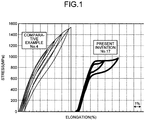
- Fig. 1 illustrates examples of tensile tests for Ti-Ni alloys. Illustrated are results from tensile tests in Comparative Example No.4 and Example 17 of the present invention in Table 1. The present invention shows superelasticity with a yield plateau whereas Comparative Example does not show clear yield.
- a Ti-Ni alloy largely including a TiNi single phase in which precipitation of compositions other than that is restrained is used as a core that is superelastic at the body temperature.
- the present inventors found that the mechanical properties of a Ti-Ni alloy having a composition of Ti-50.0 to 50.5 at% Ni were extremely dependent on a heat treatment temperature, and the strength at initial deformation (for example, at 2% stretching) necessary for a catheterization device could optionally be provided. Further, the present inventors found that a core which was excellent in shape straightness, high radial force and sheath accomodability and operatability could be obtained by subjecting a TiNi single phase element to processing strain and relaxation treatment sufficient to achieve superelasticity with a yield plateau at the body temperature regardless of Ti-Ni alloy compositions.
- solution treatment refers to a heat treatment in which an alloy is heated to a specific temperature, and quenched from a state in which alloy elements are in solid solution, and then a high temperature composition is directly brought to ordinary temperature.
- solution treatment for transforming a Ti-Ni alloy into a TiNi single phase a temperature of around 800°C is sufficient for the aforementioned heating temperature.
- aging treatment refers to a heat treatment in which an alloy is again heated after solution treatment. Depending on heating conditions and the composition of an alloy, precipitates may be formed in the alloy, allowing the mechanical properties thereof to be altered.
- aging treatment is preferably performed under conditions of at less than 400°C and for relatively a short time (in the present Example, 30 minutes or less), but the conditions are not limited to these in a case where the composition of a Ti-Ni alloy is Ti-50.0 to 50.5 at% Ni.
- restraining precipitation of a composition into a TiNi phase means reducing generation of precipitates of TiNi 3 , Ti 3 Ni 4 and the like in the core of an alloy, and also means obtaining a state close to a TiNi single phase.
- Treatments required to achieve these include, for example, making Ti-Ni alloy with a composition within a range of Ti-50.0 to 50.5 at% Ni and performing aging treatment on a under temperature conditions of less than 400°C after solution treatment; and the like.
- the body temperature refers to body temperatures of homeothermal animals such as birds and mammals, and in particular preferably the body temperature of humans.
- the range of the temperature can be any within a range of body temperatures which these animals can usually have. For example, it is preferably within a range of from 35°C to 42°C, and more preferably the temperature is 37°C.
- Table 1 shows transformation profiles and trial manufacture conditions of each wire of Ti-51 at% Ni, Ti-50.5 at% Ni and Ti-50 at% Ni, and the results therefrom.
- Each transformation temperature shown in Table 1 results from DSC (differential scanning calorimetry) measurements after performing heat treatment at 800°C where a TiNi single phase is obtained.
- the Af temperature of the Ti-51 at% alloy from Comparative Examples was found to be-15°C, which is below the body temperature while those of Ti-50.5 at% Ni and Ti-50 at% Ni alloys from Examples of the present invention were found to be 48°C and 105°C, respectively, which are above the body temperature.
- trial wires were subjected to tensile treatment at 200°C to 600°C.
- Comparative Example 1 has inferior durability due to the absence of transition as compared with other Comparative Examples and Examples of the present invention. Therefore, it is not suitable for medical use although bending fracture (formation of a knife-edged fracture surface) is less significant.
- Examples 5 to 16 of the present invention show superior processability, and thus suitable straight wires can be obtained by performing a treatment such as straightening treatment at 200°C after cold working.
- a treatment such as straightening treatment at 200°C after cold working.
- a variety of superelasticity at 37°C profiles, selections of shape memory and tensile strengths can be selected depending on conditions of the heat treatment.
- these trends are significant for the equiatomic composition Ti-50 at% Ni alloy.
- fracture/formation of a knife-edged fracture surface when bending are not observed or less significant for all test pieces, showing remarkable difference from Comparative Examples. Further, No.
- Finishing treatment for the materials in the table is cold working of approximately 30%.
- End part processing of a trial core means a treatment for reducing a diameter in order to obtain the plasticity of the front end part of a guide wire.
- breakage represents a fracture profile upon V-bend press-crushing
- end part reshaping represents a reforming profile without superelasticity.
- a shape memory alloy for medical use can be obtained in which both strength and plasticity at the body temperature are maintained.
- the present invention can provide a catheter, guide wire and the like including the above alloy, characterized in that, the formation of a knife-edged fracture surface can be avoided when bending and breaking, and a strength at initial deformation can optionally be provided.
Landscapes
- Chemical & Material Sciences (AREA)
- Health & Medical Sciences (AREA)
- Engineering & Computer Science (AREA)
- Metallurgy (AREA)
- Organic Chemistry (AREA)
- Materials Engineering (AREA)
- Mechanical Engineering (AREA)
- Life Sciences & Earth Sciences (AREA)
- Animal Behavior & Ethology (AREA)
- General Health & Medical Sciences (AREA)
- Public Health (AREA)
- Veterinary Medicine (AREA)
- Thermal Sciences (AREA)
- Crystallography & Structural Chemistry (AREA)
- Physics & Mathematics (AREA)
- Heart & Thoracic Surgery (AREA)
- Biomedical Technology (AREA)
- Inorganic Chemistry (AREA)
- Epidemiology (AREA)
- Vascular Medicine (AREA)
- Anesthesiology (AREA)
- Hematology (AREA)
- Pulmonology (AREA)
- Biophysics (AREA)
- Surgery (AREA)
- Cardiology (AREA)
- Oral & Maxillofacial Surgery (AREA)
- Transplantation (AREA)
- Materials For Medical Uses (AREA)
- Media Introduction/Drainage Providing Device (AREA)
Abstract
Description
- The present invention relates to a medical alloy which can be used in a human body, and a medical catheterization device including the medical alloy.
- An endovascular treatment, which is also referred to as a catheter treatment, involves inserting a tube called a catheter into an affected area through a blood vessel at a groin or wrist to perform percutaneous transluminal angioplasty. In recent years, this medical technology is rapidly advancing as less-invasive medical treatments become popular in view of reducing patient burden.
- Main devices for the catheter treatment are a guide wire, a catheter and a stent.
- A guide wire is first inserted into the body, and serves as a guide for introducing a catheter into an affected area. The main required functions are the softness of a front end part for not causing damage to a blood vessel, the pushability of a base part to allow passage through a curved blood vessel and the shape restorability after passing a branched blood vessel. A core may be a stainless steel wire subjected to severe plastic deformation or a superelastic Ti-Ni alloy. Stainless steel is better in terms of stiffness/pushability while a Ti-Ni alloy is better in terms of softness/restorability. In recent years, a guide wire with a hybrid core including a base part of stainless steel and a front end part of a Ti-Ni alloy has been used for medical use.
- A catheter is a tube for delivering a medical liquid and device required to diagnose/treat an affected area. Pressure resistance to flush of a medical liquid against blood flow and plasticity for not causing damage to a blood vessel wall are required as its functions. A relatively thick-walled tube is used as a core in which stainless steel wires are woven (braided) into a relatively soft resin such as polyester. However, a metal tube is preferred in view of obtaining a pressure-resistant catheter with a small diameter and a thinner wall while a superelastic Ti-Ni alloy having high plasticity is suitable in view of functionality. The present inventors conducted studies for aiming practical use of a catheter including a Ni-rich Ti-Ni-alloy (Ti-51 at% Ni) tube which can readily show superelasticity at a body temperature. However, problems remain to be solved such as ensuring softness for passing through a branched blood vessel, formation of a knife-edged fracture surface upon fracture and the like. Therefore, it is not yet available commercially. (
Patent Documents 1 to 2) - A stent is a mesh-like metal pipe to be indwelled inside the body in order to prevent restenosis after expanding a narrowed segment of a blood vessel and the like. A collapsed stent accommodated in a front end part of a catheter is first introduced to a narrowed segment, and then operated to be released from the catheter and expanded to engage against the inner wall of a lumen such as a blood vessel.
- A narrowed segment in the coronary artery which may cause myocardial infarction and the like can be expanded according to the vasodilation procedure through inflating a balloon placed in the storage inner wall of a stent. This is called a balloon expandable type, in which stainless steel and a cobalt-chromium alloy are used as a metal therein. There are a large number of prior literatures, including Patent Document 3 in which Palmaz yielded the first practical application in the world in 1988, and subsequent documents in which balloon-expandable types were put into practical use. Meanwhile, a self-expandable stent, which can spontaneously restore the shape immediately after released from a catheter, is used for expanding a narrowed segment in the carotid artery which may trigger cerebral infarction. For a metal therein, used is a superelastic Ti-Ni alloy material having excellent spring properties. (Patent Documents 3 to 8)
- Shape memory alloys including a Ti-Ni alloy are well known to show significant shape memory effects associated with reverse transformation of the martensitic transformation. Further, they are also well known to show good superelasticity associated with the stress-induced martensitic transformation caused by deformation after reverse transformation. These functionalities are manifested in connection with temperature cycles of cooling/heating, and the shape recovery temperatures in the case of heating are classified into the starting temperature (the As temperature) and the finish temperature (the Af temperature). The functionality manifestation of superelasticity finishes at a temperature of the Af temperature or above. Among many shape memory alloys, Ti-Ni alloys and Ti-Ni-X alloys (X = V, Cr, Co, Nb, Cu and the like) in particular can show significant superelasticity of this type. The practical uses of Ti-Ni alloys are increasing not only in the medical field related to the present application but also in a wide range of fields such as appliance, automobile, clothes and construction. Moreover, many of the technologies related to Ti-Ni-alloys have matured to the point of the establishment of standard engineering specifications, and are utilized for describing important specifications. As an example, the scope of Ti-Ni alloys is defined as Ni: 53.5 to 57.5 mass% (48.5 to 52.5 mol%) alloys according to JIS H-7101 "Wires, tapes and tubings of Ti-Ni shape memory alloy". (Nonpatent Document 1)
- Further, Ni-rich Ti-Ni alloys are well known to generate precipitates of TiNi3, Ti3Ni4 and the like when aging treatment is performed, affecting transformation properties and mechanical properties of an element. For example, the transformation temperature of a Ti-51 at% Ni alloy material subjected to aging treatment is shifted to the side of higher temperature because the concentration of Ni in a matrix is decreased due to the generation of excessive Ni precipitates. The Af temperature of a TiNi single phase is 0°C or less when solution treatment is performed whereas the Af temperature increases to approximately 25°C when aging is performed at 500°C for 2 hours. In this regard, the mechanical properties thereof are improved, showing good superelasticity (excellent in repetition with less significant hysteresis). It is known that precipitation of TiNi3, Ti3Ni4 and the like in a Ti-Ni alloy occurs in a case where the concentration of Ni is 50.5 at% or more, and the aging temperature is approximately 400°C or more (Nonpatent Document 2). However, a case in which the aging temperature is less than approximately 400°C has not been particularly described.
- A Ti-Ni alloy used for a catheterization device typically has an Ni-rich composition and is limited to the Ti-51 at% Ni alloy. In view of the necessity of superelasticity well manifested at the room temperature and body temperature, a core preferably includes a material having a shape recovery temperature equal to or lower than the body temperature when solution treatment is performed. The aforementioned alloy, which can maintain the manifestation of superelasticity at the body temperature regardless of heat treatment conditions, is widely used as a base material of the above device, and used in virtually every commercial product currently available for practical use.
- A guide wire includes a solid wire material as its core, which can be manufactured in the same way as common steel materials according to a method selected from many alternatives such as severe plastic deformation and straightening. Properties required for a given application can optionally be provided. However, a front end part, which needs to be flexible not causing damage to a blood vessel, relies on taper processing mainly by grinding and etching. However, the strength of the front end part decreases as the cross sectional area decreases. This brings an issue of fracture. For this reason, a front end part pressed into a ribbon-like shape, in which the cross sectional area is not decreased, has been proposed, but it differs from a non-directional circular cross section having directional softness. Softness is preferably assured in a straight cross section.
- The cores of catheters and stents are commonly a hollow pipe, and the straightness thereof is essential for manufacturing the devices. Heat straightening is often performed at a temperature near the recrystallization temperature after severe plastic deformation. In that case, it is essentially inevitable that a material which shows superelasticity at the body temperature is limited to the Ti-51 at% Ni alloy. Further, in the case of a catheter, mechanical strength can be controlled by cold working and heat treatment after heat straightening, but disadvantageously, it is susceptible to self-collapsing when U- and V-shape bending deformation upon passing through a curved blood vessel and when pressed and crushed. A breakage surface thereof tends to show a knife-like fracture surface. This trend is particularly significant for the Ti-51 at% Ni alloy.
- Furthermore, a stent core widely used for practical use as a superelastic material also includes an Ni-rich Ti-Ni alloy (for example; Ti-51 at% Ni), and is subjected to aging treatment at 400 to 500°C after cold working. This is responsible for the functional manifestation of superelasticity with various characteristics, and satisfies the basic requirements for generating precipitates of Ti2Ni3 and the like. However, repetition fatigue remains problematic as compared with a Ti-Ni single phase material subjected to solution treatment although relatively high yield strength is maintained.
-
- Patent Document 1: Japanese Patent Application Laid-Open No.
H2-144074 - Patent Document 2: Japanese Patent Application Laid-Open No.
H4-28375 - Patent Document 3:
US Patent No. 4733665 - Patent Document 4: Japanese Patent Application Laid-Open No.
H06-054913 - Patent Document 5: Japanese Patent Application Laid-Open No.
H08-000738 - Patent Document 6: Japanese Patent Application Laid-Open No.
H11-99207 - Patent Documents 7: Japanese Patent Application Laid-Open No.
2005-245848 - Patent Documents 8: Japanese Patent Application Laid-Open No.
2006-325613 -
- Nonpatent Document 1: JIS H-7101
- Nonpatent document 2: Kazuhiro Otsuka, "Martensitic transformation and shape memory effects of alloys" Uchida Rokakuho Publishing Co., Ltd., (2012), p194
- An objective of the present invention is to provide a medical alloy usable for cores of catheters and guide wires in which both strength and plasticity at the body temperature are maintained. That is, provided is a breakage-safe core allowing easy passage through a curved blood vessel and a narrowed segment and having bending restorability after passage, which is less susceptible for breakage even bent in U- and V-shape manners, and tends not to form a knife-like fracture surface. Moreover, another objective is to provide a stent core for a stent which is excellent in breakage-safety after indwelled inside the body, sustained high expandability for indwelling and sheath accomodability and operatability.
- The present investors found that precipitates, which otherwise favorably affect mechanical properties of an alloy, were actually responsible for breakage/formation of a knife-edged fracture surface in a medical device such as a catheterization device. The present inventors further found that the above problems could be solved by providing a core element largely including a Ti-Ni single phase to reduce the influences of precipitates. Then the present invention has been completed.
- That is, according to the present invention, superelasticity can be manifested at the body temperature under conditions where precipitates are not formed even in a case where aging treatment is performed. One embodiment of the present invention is a Ti-Ni alloy subjected to thermomechanical treatment in which precipitates such as Ti3Ni4 are not easily formed, or a Ti-Ni alloy having a composition of Ti-50.0 to 50.5 at% Ni. Further, the Ti-Ni alloy according to the present invention is a material having an Af temperature of more than 37°C due to solution treatment of a TiNi single phase.
- The alloy according to the present invention can provide a medical Ti-Ni shape memory alloy with a core superelastic at the body temperature, and a medical device such as a catheter made use of the above alloy. The above alloy and medical device have the following advantages as compared with the conventional products: formation of a knife-edged fracture surface can be avoided when bending and braking; a strength at initial deformation can optionally be provided; and the like.
- Moreover, according to the present invention, a catheter, a guide wire in which a part of the device shows superelasticity at the body temperature, and another part shows shape memory at the body temperature can be obtained. Further, the front end part of the device or a portion thereof may have a relatively low stiffness (less than 300 MPa) and can easily be reformed. In addition, the base or a portion thereof may have a relatively high stiffness (500 MPa or more).
-
Fig. 1 illustrates examples of tensile tests for Ti-Ni alloys. Illustrated are results from tensile tests in Comparative Example No.4 and Example 17 of the present invention in Table 1. The present invention shows superelasticity with a yield plateau whereas Comparative Example does not show clear yield. - According to the present invention, a Ti-Ni alloy largely including a TiNi single phase in which precipitation of compositions other than that is restrained is used as a core that is superelastic at the body temperature. As shown in Nonpatent Document 2, Ti3Ni4 precipitates in a Ti-Ni alloy in a case where the concentration of Ni is more than 50.5 at%, and the aging temperature is approximately 400°C or more. Therefore, the key to the present invention is to form a core outside the above conditions.
- Therefore, in order to obtain a Ti-Ni alloy largely including a TiNi single phase, it is specifically necessary that various processing treatments are performed on a composition of a Ti-Ni alloy in a range of Ti-50.0 to 50.5 at% Ni, or aging treatment after solution treatment of a Ti-Ni alloy is performed at less than 400°C.
- Further, the present inventors found that the mechanical properties of a Ti-Ni alloy having a composition of Ti-50.0 to 50.5 at% Ni were extremely dependent on a heat treatment temperature, and the strength at initial deformation (for example, at 2% stretching) necessary for a catheterization device could optionally be provided. Further, the present inventors found that a core which was excellent in shape straightness, high radial force and sheath accomodability and operatability could be obtained by subjecting a TiNi single phase element to processing strain and relaxation treatment sufficient to achieve superelasticity with a yield plateau at the body temperature regardless of Ti-Ni alloy compositions.
- In the present invention, solution treatment refers to a heat treatment in which an alloy is heated to a specific temperature, and quenched from a state in which alloy elements are in solid solution, and then a high temperature composition is directly brought to ordinary temperature. In solution treatment for transforming a Ti-Ni alloy into a TiNi single phase, a temperature of around 800°C is sufficient for the aforementioned heating temperature.
- In the present invention, aging treatment refers to a heat treatment in which an alloy is again heated after solution treatment. Depending on heating conditions and the composition of an alloy, precipitates may be formed in the alloy, allowing the mechanical properties thereof to be altered. In the present invention, aging treatment is preferably performed under conditions of at less than 400°C and for relatively a short time (in the present Example, 30 minutes or less), but the conditions are not limited to these in a case where the composition of a Ti-Ni alloy is Ti-50.0 to 50.5 at% Ni.
- In the present invention, restraining precipitation of a composition into a TiNi phase means reducing generation of precipitates of TiNi3, Ti3Ni4 and the like in the core of an alloy, and also means obtaining a state close to a TiNi single phase. Treatments required to achieve these include, for example, making Ti-Ni alloy with a composition within a range of Ti-50.0 to 50.5 at% Ni and performing aging treatment on a under temperature conditions of less than 400°C after solution treatment; and the like.
- In the present invention, the body temperature refers to body temperatures of homeothermal animals such as birds and mammals, and in particular preferably the body temperature of humans. The range of the temperature can be any within a range of body temperatures which these animals can usually have. For example, it is preferably within a range of from 35°C to 42°C, and more preferably the temperature is 37°C.
- Table 1 shows transformation profiles and trial manufacture conditions of each wire of Ti-51 at% Ni, Ti-50.5 at% Ni and Ti-50 at% Ni, and the results therefrom.
- Each transformation temperature shown in Table 1 results from DSC (differential scanning calorimetry) measurements after performing heat treatment at 800°C where a TiNi single phase is obtained. The Af temperature of the Ti-51 at% alloy from Comparative Examples was found to be-15°C, which is below the body temperature while those of Ti-50.5 at% Ni and Ti-50 at% Ni alloys from Examples of the present invention were found to be 48°C and 105°C, respectively, which are above the body temperature.
- Since straightness is necessary for use in devices, trial wires were subjected to tensile treatment at 200°C to 600°C.
- Comparative Examples 1, 2, 3 and 4 all show good superelasticity at the body temperature, but a straight wire for use in devices is not obtained unless the treatment temperature is near recrystallization, and variations in tensile strength (ε = 2%) were less significant under the treatment conditions. This means that stable superelasticity can easily be obtained regardless of manufacturing methods, but options for properties are limited, and the strength is dictated by selection of a wire cross section.
- The table shows that bending fracture is significant for Comparative Examples 2, 3 and 4, showing that they are not suitable for medical use. Further, not shown in the table, Comparative Example 1 has inferior durability due to the absence of transition as compared with other Comparative Examples and Examples of the present invention. Therefore, it is not suitable for medical use although bending fracture (formation of a knife-edged fracture surface) is less significant.
- In contrast, Examples 5 to 16 of the present invention show superior processability, and thus suitable straight wires can be obtained by performing a treatment such as straightening treatment at 200°C after cold working. Further, in terms of properties, a variety of superelasticity at 37°C profiles, selections of shape memory and tensile strengths can be selected depending on conditions of the heat treatment. Moreover, these trends are significant for the equiatomic composition Ti-50 at% Ni alloy. Furthermore, fracture/formation of a knife-edged fracture surface when bending are not observed or less significant for all test pieces, showing remarkable difference from Comparative Examples. Further, No. 17 and 18 according to the present invention, which are products obtained by subjecting the Ti-51 at% Ni alloy from Comparative Example to SW (swaging) processing where straightness can be obtained relatively easily, satisfy requirements of the present invention such as finishing shapes and strength.
Table 1 Evaluation results of trial Ti-Ni-allov wires Trial wire Property No Alloy Processing rate Tension treatment (Aging treatment) 37°C profile Yield plateau Straightening Bending fracture Tensile strength MPa (ε 2%) Comparative Examples 1 Ti-51 at% Ni Af: -15°C (Solution treatment) 30% Die processing 600°C/5 min Super elastic Good Good Less significant** 500 2 400°C/10 min Super elastic Good Good Significant 500 3 300°C/30 min Super elastic Bad Bad Significant 600 4 200°C/30 min Super elastic Bad Bad Significant 800 5 Ti-50.5 at% Ni Af: 48°C (Solution treatment) 30% Die processing 600°C/5 min Shape memory - Good Less significant 300 6 400°C/10 min Super elastic Good Good Less significant 320 7 300°C/30 min Super elastic Good Good Less significant 320 8 200°C/30 min Super elastic Bad Good Less significant 500 Examples of Present Invention 9 40% Die processing 500°C/5 min Shape memory - Good Less significant 150 10 400°C/10 min Shape memory - Good Less significant 200 11 Ti-50 at% Ni Af: 105°C (Solution treatment) 300°C/30 min Super elastic Good Good Less significant 350 12 200°C/30 min Super elastic Bad Δ* Less significant 600 13 60% Die processing 600°C/5 min Shape memory - Good Less significant 150 14 400°C/10 min Shape memory - Good Less significant 300 15 300°C/30 min Super elastic Good Good Less significant 600 16 200°C/30 min Super elastic Bad Δ* Less significant 1000 Present Invention 17 Ti-51 at% Ni Af:-15°C (Solution treatment) 40% SW processing 350°C/1 min Super elastic Good Good Less significant 900 18 300°C/30 min Super elastic Good Good Less significant 900 Δ* Depends on the finishing shape.
** Durability was inferior due to the absence of transition. - Basic functional tests were performed on guide wires and catheters including alloys shown in Table 1. The results are shown in Table 2.
- Finishing treatment for the materials in the table is cold working of approximately 30%. End part processing of a trial core means a treatment for reducing a diameter in order to obtain the plasticity of the front end part of a guide wire. Moreover, in the property evaluation, breakage represents a fracture profile upon V-bend press-crushing, and end part reshaping represents a reforming profile without superelasticity.
Table 2 Evaluation of trial cores for guide wire and catheter No Alloy Trial Core Property Material Base part treatment End part treatment End part processing Base Part EndPart Function Breakage Plasticity Reshaping Comparative Example 17 Ti-51 at% Ni φ 0.5 mm Wire 400°C 400°C φ 0.1 Super elastic Significant Bad X 18 Ti-51 at% Ni φ0.5 mm Wire 400°C 600°C - Super elastic Significant Bad Bad 19 Ti-51 at% Ni φ1.0 mm Tube 400°C 400°C - Super elastic Significant Bad Bad Present Invention 20 Ti-50.5 at% Ni φ0.5 mm Wire 300°C 600°C 0.1 Super elastic Less significant Good Δ* 21 Ti-50 at% Ni φ0.5 mm Wire 300°C 600°C φ 0.2 Super elastic Less significant Good Good 22 Ti-50 at% Ni φ1.0 mm Tube 300°C 600°C - Super elastic Less significant Good Good Δ* Characteristics of spring somewhat remain. - Basic functional tests were performed on stents including alloys shown in Table 1.
- The results are shown in Table 3. Finishing treatment for the materials in the table is cold working of approximately 30%. A trial core was obtained by performing an expanding/shape-fixing treatment in which a raw tube with a diameter of 2 mm was processed into a body-indwelled diameter of 10 mm. The term "sequential expansion" in the property items means a stepwise treatment from φ 2 to φ 10 considering the risk of fracture and completed after about 5 steps for Comparative Examples while completed after about 2 to 3 steps for Examples of the present invention. Further, the presence or absence of shape memory properties at the end part intended whether stimulation of the inner wall of a blood vessel by the end part of an indwelled stent, due to partial superelastic loss, is reduced or whether delivery properties are enhanced.
Table 3 Evaluation results of stent No. Alloy Trial Core Property Material φ 10 expanding treatment Sequential expansion φ2 →φ10 Property Base part End part Base part End part Comparative Example 17 Ti-51 at% Ni φ2.0 mm Slotted tube 400°C 400°C 5 Super elastic Super elastic 18 Ti-51 at% Ni φ2.0 mm Slotted tube 400°C 600°C 5 Super elastic Super elastic 19 Ti-50.5 at% Ni φ2.0 mm Slotted tube 400°C 400°C 3 Super elastic Super elastic Present Invention 20 Ti-50.5 at% Ni φ2.0 mm Slotted tube 300°C 600°C 3 Super elastic Shape memory 21 Ti-50 at% Ni φ2.0 mm Slotted tube 300°C 400°C 2 Super elastic Shape memory 22 Ti-50 at% Ni φ 2.0 mm Slotted tube 300°C 600°C 2 Super elastic Shape memory - According to the present invention, a shape memory alloy for medical use can be obtained in which both strength and plasticity at the body temperature are maintained. Further, the present invention can provide a catheter, guide wire and the like including the above alloy, characterized in that, the formation of a knife-edged fracture surface can be avoided when bending and breaking, and a strength at initial deformation can optionally be provided.
Claims (10)
- A medical Ti-Ni shape memory alloy, wherein precipitation of a composition other than TiNi into a TiNi phase is restrained.
- A medical Ti-Ni shape memory alloy, wherein precipitation of a composition other than TiNi into a TiNi phase after aging treatment is restrained.
- The medical Ti-Ni shape memory alloy according to claim 1 or 2, wherein the aging treatment is performed under temperature conditions of below 400°C after solution treatment.
- The medical Ti-Ni shape memory alloy according to any one of claims 1 to 3, wherein the medical Ti-Ni shape memory alloy shows a shape-recovery finish temperature of higher than 37°C by performing the solution treatment.
- The medical Ti-Ni shape memory alloy according to any one of claims 1 to 4, wherein the medical Ti-Ni shape memory alloy is processed by performing structure control so that the medical Ti-Ni shape memory alloy has superelasticity at a body temperature.
- The medical Ti-Ni shape memory alloy according to any one of claims 1 to 5, wherein a composition of Ti and Ni is Ti-50.0 to 50.5 at% Ni.
- The medical Ti-Ni shape memory alloy according to any one of claims 1 to 6, wherein the medical Ti-Ni shape memory alloy has superelasticity with a yield plateau at the body temperature.
- The medical Ti-Ni shape memory alloy according to any one of claims 1 to 7, wherein the medical Ti-Ni shape memory alloy is processed by performing different heat treatments on different parts so that the medical Ti-Ni shape memory alloy includes a part having superelasticity at the body temperature and a part having shape memory at the body temperature.
- A medical device for endovascular treatment, manufactured by using the medical Ti-Ni shape memory alloy according to any one of claims 1 to 8.
- A guide wire, catheter, or stent, manufactured by using the medical Ti-Ni shape memory alloy according to any one of claims 1 to 8.
Applications Claiming Priority (2)
| Application Number | Priority Date | Filing Date | Title |
|---|---|---|---|
| JP2013177285A JP2015036455A (en) | 2013-08-12 | 2013-08-12 | Ti-Ni alloy for medical use |
| PCT/JP2014/071338 WO2015022969A1 (en) | 2013-08-12 | 2014-08-12 | MEDICAL Ti-Ni ALLOY |
Publications (2)
| Publication Number | Publication Date |
|---|---|
| EP3034638A1 true EP3034638A1 (en) | 2016-06-22 |
| EP3034638A4 EP3034638A4 (en) | 2017-03-15 |
Family
ID=52468354
Family Applications (1)
| Application Number | Title | Priority Date | Filing Date |
|---|---|---|---|
| EP14835886.4A Withdrawn EP3034638A4 (en) | 2013-08-12 | 2014-08-12 | MEDICAL Ti-Ni ALLOY |
Country Status (4)
| Country | Link |
|---|---|
| US (1) | US20160243289A1 (en) |
| EP (1) | EP3034638A4 (en) |
| JP (1) | JP2015036455A (en) |
| WO (1) | WO2015022969A1 (en) |
Families Citing this family (3)
| Publication number | Priority date | Publication date | Assignee | Title |
|---|---|---|---|---|
| CH704235B1 (en) * | 2010-12-16 | 2015-09-30 | Fkg Dentaire Sa | The endodontic instrument for root canal bore of a tooth. |
| EP3529390B1 (en) * | 2016-10-21 | 2023-07-05 | Confluent Medical Technologies, Inc. | Materials having superelastic properties including related methods of fabrication and design for medical devices |
| CN113559333B (en) * | 2021-06-07 | 2022-11-08 | 中国科学院金属研究所 | Medical nickel-titanium alloy with high anticoagulation function without surface treatment |
Family Cites Families (19)
| Publication number | Priority date | Publication date | Assignee | Title |
|---|---|---|---|---|
| JPS58151445A (en) * | 1982-02-27 | 1983-09-08 | Tohoku Metal Ind Ltd | Titanium-nickel alloy having reversible shape storage effect and its manufacture |
| JPS60141852A (en) * | 1983-12-28 | 1985-07-26 | Hitachi Metals Ltd | Manufacture of shape memory alloy |
| JPS6184361A (en) * | 1984-09-29 | 1986-04-28 | Tohoku Metal Ind Ltd | Manufacture of pseudoelastic spring |
| US4733665C2 (en) | 1985-11-07 | 2002-01-29 | Expandable Grafts Partnership | Expandable intraluminal graft and method and apparatus for implanting an expandable intraluminal graft |
| JP2767261B2 (en) | 1988-11-25 | 1998-06-18 | 三菱電線工業株式会社 | catheter |
| JP2557276B2 (en) | 1990-05-24 | 1996-11-27 | 日本ゼオン株式会社 | Medical tube |
| JP3214733B2 (en) | 1992-08-07 | 2001-10-02 | エスエムエー メディカル インコーポレーテッド | Urethral stent |
| JP3566986B2 (en) | 1994-06-17 | 2004-09-15 | テルモ株式会社 | Method for producing stent for indwelling in vivo |
| JPH099207A (en) | 1995-06-20 | 1997-01-10 | Mitsubishi Electric Corp | Image playback device |
| JP2799992B2 (en) * | 1996-12-13 | 1998-09-21 | 株式会社トーキン | Shape memory alloy wire for clothing |
| US20010035236A1 (en) * | 1998-03-16 | 2001-11-01 | Akira Ishida | Shape memory alloy with ductility and a making process of the same |
| FR2786790B1 (en) * | 1998-12-04 | 2001-02-23 | Ecole Polytech | LASER PROCESSING OF AN OBJECT OF SHAPE MEMORY MATERIAL |
| US6375458B1 (en) * | 1999-05-17 | 2002-04-23 | Memry Corporation | Medical instruments and devices and parts thereof using shape memory alloys |
| JP2003089834A (en) * | 2001-09-19 | 2003-03-28 | Furukawa Electric Co Ltd:The | High rigidity Ni-Ti alloy with reversible deformation |
| JP2005000357A (en) * | 2003-06-11 | 2005-01-06 | Nec Tokin Corp | Catheter |
| JP4351560B2 (en) | 2004-03-05 | 2009-10-28 | Necトーキン株式会社 | Balloon expandable superelastic stent |
| JP5143342B2 (en) | 2005-05-23 | 2013-02-13 | Necトーキン株式会社 | Autonomous functional stent |
| JP5927405B2 (en) * | 2008-09-19 | 2016-06-01 | フォート ウェイン メタルス リサーチ プロダクツ コーポレーション | Fatigue-resistant wire and manufacturing method thereof |
| US8475711B2 (en) * | 2010-08-12 | 2013-07-02 | Ati Properties, Inc. | Processing of nickel-titanium alloys |
-
2013
- 2013-08-12 JP JP2013177285A patent/JP2015036455A/en active Pending
-
2014
- 2014-08-12 EP EP14835886.4A patent/EP3034638A4/en not_active Withdrawn
- 2014-08-12 WO PCT/JP2014/071338 patent/WO2015022969A1/en not_active Ceased
-
2016
- 2016-02-11 US US15/041,197 patent/US20160243289A1/en not_active Abandoned
Also Published As
| Publication number | Publication date |
|---|---|
| EP3034638A4 (en) | 2017-03-15 |
| WO2015022969A1 (en) | 2015-02-19 |
| JP2015036455A (en) | 2015-02-23 |
| US20160243289A1 (en) | 2016-08-25 |
Similar Documents
| Publication | Publication Date | Title |
|---|---|---|
| US7128757B2 (en) | Radiopaque and MRI compatible nitinol alloys for medical devices | |
| US6855161B2 (en) | Radiopaque nitinol alloys for medical devices | |
| CN100502805C (en) | Balloon expandable superelastic stent and its manufacture method | |
| EP1545679B1 (en) | Radiopaque nitinol alloys for medical devices | |
| JP5972789B2 (en) | Stent manufacturing method | |
| US20070293939A1 (en) | Fatigue resistant endoprostheses | |
| WO2006104823A3 (en) | Method for producing strain induced austenite | |
| US20060086440A1 (en) | Nitinol alloy design for improved mechanical stability and broader superelastic operating window | |
| WO2000069359A1 (en) | Medical instruments and devices and parts thereof using shape memory alloys | |
| JP5089803B2 (en) | Core wire for guide wire and manufacturing method thereof | |
| US20160243289A1 (en) | MEDICAL Ti-Ni ALLOY | |
| JP6842125B2 (en) | Manufacturing method of superelastic seamless tube | |
| JP3725900B2 (en) | Guide wire with superelastic distal portion | |
| JP7726442B2 (en) | Superelastic stent and method for manufacturing the same, and alloy tube and method for manufacturing the same | |
| US8652199B2 (en) | Stent with autonomic function | |
| JP2016073589A (en) | Multi-function stent | |
| JP2013215487A (en) | Laser processing method with skewered tube and stent | |
| JP2014036817A (en) | Functional metal tube member and method for manufacturing the same | |
| JP2014058710A (en) | SHAPE MEMORY TREATMENT METHOD OF Ti-Ni SHAPE MEMORY ALLOY | |
| JP2016017226A (en) | Superelastic element | |
| JP2012000177A (en) | Stent and stent delivery catheter |
Legal Events
| Date | Code | Title | Description |
|---|---|---|---|
| PUAI | Public reference made under article 153(3) epc to a published international application that has entered the european phase |
Free format text: ORIGINAL CODE: 0009012 |
|
| 17P | Request for examination filed |
Effective date: 20160311 |
|
| AK | Designated contracting states |
Kind code of ref document: A1 Designated state(s): AL AT BE BG CH CY CZ DE DK EE ES FI FR GB GR HR HU IE IS IT LI LT LU LV MC MK MT NL NO PL PT RO RS SE SI SK SM TR |
|
| AX | Request for extension of the european patent |
Extension state: BA ME |
|
| RAP1 | Party data changed (applicant data changed or rights of an application transferred) |
Owner name: PIOLAX MEDICAL DEVICES, INC. Owner name: CLINO LTD. |
|
| RIN1 | Information on inventor provided before grant (corrected) |
Inventor name: UEGAKI MICHIHIRO Inventor name: YAMAUCHI KIYOSHI Inventor name: SUZUKI MASAO |
|
| DAX | Request for extension of the european patent (deleted) | ||
| A4 | Supplementary search report drawn up and despatched |
Effective date: 20170215 |
|
| RIC1 | Information provided on ipc code assigned before grant |
Ipc: C22F 1/00 20060101ALI20170209BHEP Ipc: C22C 19/00 20060101ALI20170209BHEP Ipc: A61L 29/02 20060101ALI20170209BHEP Ipc: A61L 29/00 20060101ALI20170209BHEP Ipc: C22C 19/03 20060101AFI20170209BHEP Ipc: A61L 31/02 20060101ALI20170209BHEP Ipc: A61M 25/00 20060101ALI20170209BHEP Ipc: A61M 25/14 20060101ALI20170209BHEP Ipc: C22F 1/10 20060101ALI20170209BHEP Ipc: A61L 31/00 20060101ALI20170209BHEP Ipc: A61F 2/82 20130101ALI20170209BHEP Ipc: A61M 25/09 20060101ALI20170209BHEP Ipc: C22F 1/18 20060101ALI20170209BHEP |
|
| 17Q | First examination report despatched |
Effective date: 20180920 |
|
| STAA | Information on the status of an ep patent application or granted ep patent |
Free format text: STATUS: THE APPLICATION HAS BEEN WITHDRAWN |
|
| 18W | Application withdrawn |
Effective date: 20181211 |