EP3031877A1 - Nitrile rubber/metal multilayer material for gasket - Google Patents
Nitrile rubber/metal multilayer material for gasket Download PDFInfo
- Publication number
- EP3031877A1 EP3031877A1 EP14848456.1A EP14848456A EP3031877A1 EP 3031877 A1 EP3031877 A1 EP 3031877A1 EP 14848456 A EP14848456 A EP 14848456A EP 3031877 A1 EP3031877 A1 EP 3031877A1
- Authority
- EP
- European Patent Office
- Prior art keywords
- nitrile rubber
- weight
- gasket material
- parts
- zirconium
- Prior art date
- Legal status (The legal status is an assumption and is not a legal conclusion. Google has not performed a legal analysis and makes no representation as to the accuracy of the status listed.)
- Ceased
Links
- 0 **Cc(cccc1)c1O Chemical compound **Cc(cccc1)c1O 0.000 description 1
- ISWSIDIOOBJBQZ-UHFFFAOYSA-N Oc1ccccc1 Chemical compound Oc1ccccc1 ISWSIDIOOBJBQZ-UHFFFAOYSA-N 0.000 description 1
Classifications
-
- C—CHEMISTRY; METALLURGY
- C23—COATING METALLIC MATERIAL; COATING MATERIAL WITH METALLIC MATERIAL; CHEMICAL SURFACE TREATMENT; DIFFUSION TREATMENT OF METALLIC MATERIAL; COATING BY VACUUM EVAPORATION, BY SPUTTERING, BY ION IMPLANTATION OR BY CHEMICAL VAPOUR DEPOSITION, IN GENERAL; INHIBITING CORROSION OF METALLIC MATERIAL OR INCRUSTATION IN GENERAL
- C23C—COATING METALLIC MATERIAL; COATING MATERIAL WITH METALLIC MATERIAL; SURFACE TREATMENT OF METALLIC MATERIAL BY DIFFUSION INTO THE SURFACE, BY CHEMICAL CONVERSION OR SUBSTITUTION; COATING BY VACUUM EVAPORATION, BY SPUTTERING, BY ION IMPLANTATION OR BY CHEMICAL VAPOUR DEPOSITION, IN GENERAL
- C23C22/00—Chemical surface treatment of metallic material by reaction of the surface with a reactive liquid, leaving reaction products of surface material in the coating, e.g. conversion coatings, passivation of metals
- C23C22/05—Chemical surface treatment of metallic material by reaction of the surface with a reactive liquid, leaving reaction products of surface material in the coating, e.g. conversion coatings, passivation of metals using aqueous solutions
- C23C22/60—Chemical surface treatment of metallic material by reaction of the surface with a reactive liquid, leaving reaction products of surface material in the coating, e.g. conversion coatings, passivation of metals using aqueous solutions using alkaline aqueous solutions with pH greater than 8
- C23C22/62—Treatment of iron or alloys based thereon
-
- B—PERFORMING OPERATIONS; TRANSPORTING
- B32—LAYERED PRODUCTS
- B32B—LAYERED PRODUCTS, i.e. PRODUCTS BUILT-UP OF STRATA OF FLAT OR NON-FLAT, e.g. CELLULAR OR HONEYCOMB, FORM
- B32B15/00—Layered products comprising a layer of metal
- B32B15/04—Layered products comprising a layer of metal comprising metal as the main or only constituent of a layer, which is next to another layer of the same or of a different material
- B32B15/06—Layered products comprising a layer of metal comprising metal as the main or only constituent of a layer, which is next to another layer of the same or of a different material of natural rubber or synthetic rubber
-
- B—PERFORMING OPERATIONS; TRANSPORTING
- B32—LAYERED PRODUCTS
- B32B—LAYERED PRODUCTS, i.e. PRODUCTS BUILT-UP OF STRATA OF FLAT OR NON-FLAT, e.g. CELLULAR OR HONEYCOMB, FORM
- B32B25/00—Layered products comprising a layer of natural or synthetic rubber
- B32B25/14—Layered products comprising a layer of natural or synthetic rubber comprising synthetic rubber copolymers
-
- B—PERFORMING OPERATIONS; TRANSPORTING
- B32—LAYERED PRODUCTS
- B32B—LAYERED PRODUCTS, i.e. PRODUCTS BUILT-UP OF STRATA OF FLAT OR NON-FLAT, e.g. CELLULAR OR HONEYCOMB, FORM
- B32B7/00—Layered products characterised by the relation between layers; Layered products characterised by the relative orientation of features between layers, or by the relative values of a measurable parameter between layers, i.e. products comprising layers having different physical, chemical or physicochemical properties; Layered products characterised by the interconnection of layers
- B32B7/04—Interconnection of layers
- B32B7/12—Interconnection of layers using interposed adhesives or interposed materials with bonding properties
-
- C—CHEMISTRY; METALLURGY
- C08—ORGANIC MACROMOLECULAR COMPOUNDS; THEIR PREPARATION OR CHEMICAL WORKING-UP; COMPOSITIONS BASED THEREON
- C08L—COMPOSITIONS OF MACROMOLECULAR COMPOUNDS
- C08L61/00—Compositions of condensation polymers of aldehydes or ketones; Compositions of derivatives of such polymers
- C08L61/04—Condensation polymers of aldehydes or ketones with phenols only
- C08L61/06—Condensation polymers of aldehydes or ketones with phenols only of aldehydes with phenols
-
- C—CHEMISTRY; METALLURGY
- C08—ORGANIC MACROMOLECULAR COMPOUNDS; THEIR PREPARATION OR CHEMICAL WORKING-UP; COMPOSITIONS BASED THEREON
- C08L—COMPOSITIONS OF MACROMOLECULAR COMPOUNDS
- C08L63/00—Compositions of epoxy resins; Compositions of derivatives of epoxy resins
-
- C—CHEMISTRY; METALLURGY
- C09—DYES; PAINTS; POLISHES; NATURAL RESINS; ADHESIVES; COMPOSITIONS NOT OTHERWISE PROVIDED FOR; APPLICATIONS OF MATERIALS NOT OTHERWISE PROVIDED FOR
- C09J—ADHESIVES; NON-MECHANICAL ASPECTS OF ADHESIVE PROCESSES IN GENERAL; ADHESIVE PROCESSES NOT PROVIDED FOR ELSEWHERE; USE OF MATERIALS AS ADHESIVES
- C09J161/00—Adhesives based on condensation polymers of aldehydes or ketones; Adhesives based on derivatives of such polymers
- C09J161/04—Condensation polymers of aldehydes or ketones with phenols only
- C09J161/06—Condensation polymers of aldehydes or ketones with phenols only of aldehydes with phenols
-
- C—CHEMISTRY; METALLURGY
- C09—DYES; PAINTS; POLISHES; NATURAL RESINS; ADHESIVES; COMPOSITIONS NOT OTHERWISE PROVIDED FOR; APPLICATIONS OF MATERIALS NOT OTHERWISE PROVIDED FOR
- C09J—ADHESIVES; NON-MECHANICAL ASPECTS OF ADHESIVE PROCESSES IN GENERAL; ADHESIVE PROCESSES NOT PROVIDED FOR ELSEWHERE; USE OF MATERIALS AS ADHESIVES
- C09J5/00—Adhesive processes in general; Adhesive processes not provided for elsewhere, e.g. relating to primers
- C09J5/02—Adhesive processes in general; Adhesive processes not provided for elsewhere, e.g. relating to primers involving pretreatment of the surfaces to be joined
-
- C—CHEMISTRY; METALLURGY
- C09—DYES; PAINTS; POLISHES; NATURAL RESINS; ADHESIVES; COMPOSITIONS NOT OTHERWISE PROVIDED FOR; APPLICATIONS OF MATERIALS NOT OTHERWISE PROVIDED FOR
- C09K—MATERIALS FOR MISCELLANEOUS APPLICATIONS, NOT PROVIDED FOR ELSEWHERE
- C09K3/00—Materials not provided for elsewhere
- C09K3/10—Materials in mouldable or extrudable form for sealing or packing joints or covers
- C09K3/1006—Materials in mouldable or extrudable form for sealing or packing joints or covers characterised by the chemical nature of one of its constituents
-
- F—MECHANICAL ENGINEERING; LIGHTING; HEATING; WEAPONS; BLASTING
- F16—ENGINEERING ELEMENTS AND UNITS; GENERAL MEASURES FOR PRODUCING AND MAINTAINING EFFECTIVE FUNCTIONING OF MACHINES OR INSTALLATIONS; THERMAL INSULATION IN GENERAL
- F16J—PISTONS; CYLINDERS; SEALINGS
- F16J15/00—Sealings
- F16J15/02—Sealings between relatively-stationary surfaces
- F16J15/06—Sealings between relatively-stationary surfaces with solid packing compressed between sealing surfaces
- F16J15/10—Sealings between relatively-stationary surfaces with solid packing compressed between sealing surfaces with non-metallic packing
- F16J15/102—Sealings between relatively-stationary surfaces with solid packing compressed between sealing surfaces with non-metallic packing characterised by material
-
- F—MECHANICAL ENGINEERING; LIGHTING; HEATING; WEAPONS; BLASTING
- F16—ENGINEERING ELEMENTS AND UNITS; GENERAL MEASURES FOR PRODUCING AND MAINTAINING EFFECTIVE FUNCTIONING OF MACHINES OR INSTALLATIONS; THERMAL INSULATION IN GENERAL
- F16J—PISTONS; CYLINDERS; SEALINGS
- F16J15/00—Sealings
- F16J15/02—Sealings between relatively-stationary surfaces
- F16J15/06—Sealings between relatively-stationary surfaces with solid packing compressed between sealing surfaces
- F16J15/10—Sealings between relatively-stationary surfaces with solid packing compressed between sealing surfaces with non-metallic packing
- F16J15/12—Sealings between relatively-stationary surfaces with solid packing compressed between sealing surfaces with non-metallic packing with metal reinforcement or covering
- F16J15/121—Sealings between relatively-stationary surfaces with solid packing compressed between sealing surfaces with non-metallic packing with metal reinforcement or covering with metal reinforcement
- F16J15/122—Sealings between relatively-stationary surfaces with solid packing compressed between sealing surfaces with non-metallic packing with metal reinforcement or covering with metal reinforcement generally parallel to the surfaces
-
- B—PERFORMING OPERATIONS; TRANSPORTING
- B32—LAYERED PRODUCTS
- B32B—LAYERED PRODUCTS, i.e. PRODUCTS BUILT-UP OF STRATA OF FLAT OR NON-FLAT, e.g. CELLULAR OR HONEYCOMB, FORM
- B32B2307/00—Properties of the layers or laminate
- B32B2307/30—Properties of the layers or laminate having particular thermal properties
- B32B2307/306—Resistant to heat
-
- B—PERFORMING OPERATIONS; TRANSPORTING
- B32—LAYERED PRODUCTS
- B32B—LAYERED PRODUCTS, i.e. PRODUCTS BUILT-UP OF STRATA OF FLAT OR NON-FLAT, e.g. CELLULAR OR HONEYCOMB, FORM
- B32B2581/00—Seals; Sealing equipment; Gaskets
-
- C—CHEMISTRY; METALLURGY
- C09—DYES; PAINTS; POLISHES; NATURAL RESINS; ADHESIVES; COMPOSITIONS NOT OTHERWISE PROVIDED FOR; APPLICATIONS OF MATERIALS NOT OTHERWISE PROVIDED FOR
- C09J—ADHESIVES; NON-MECHANICAL ASPECTS OF ADHESIVE PROCESSES IN GENERAL; ADHESIVE PROCESSES NOT PROVIDED FOR ELSEWHERE; USE OF MATERIALS AS ADHESIVES
- C09J2301/00—Additional features of adhesives in the form of films or foils
- C09J2301/30—Additional features of adhesives in the form of films or foils characterized by the chemical, physicochemical or physical properties of the adhesive or the carrier
- C09J2301/304—Additional features of adhesives in the form of films or foils characterized by the chemical, physicochemical or physical properties of the adhesive or the carrier the adhesive being heat-activatable, i.e. not tacky at temperatures inferior to 30°C
-
- C—CHEMISTRY; METALLURGY
- C09—DYES; PAINTS; POLISHES; NATURAL RESINS; ADHESIVES; COMPOSITIONS NOT OTHERWISE PROVIDED FOR; APPLICATIONS OF MATERIALS NOT OTHERWISE PROVIDED FOR
- C09J—ADHESIVES; NON-MECHANICAL ASPECTS OF ADHESIVE PROCESSES IN GENERAL; ADHESIVE PROCESSES NOT PROVIDED FOR ELSEWHERE; USE OF MATERIALS AS ADHESIVES
- C09J2301/00—Additional features of adhesives in the form of films or foils
- C09J2301/50—Additional features of adhesives in the form of films or foils characterized by process specific features
- C09J2301/504—Additional features of adhesives in the form of films or foils characterized by process specific features process of pretreatment for improving adhesion of rubber on metallic surfaces
-
- C—CHEMISTRY; METALLURGY
- C09—DYES; PAINTS; POLISHES; NATURAL RESINS; ADHESIVES; COMPOSITIONS NOT OTHERWISE PROVIDED FOR; APPLICATIONS OF MATERIALS NOT OTHERWISE PROVIDED FOR
- C09J—ADHESIVES; NON-MECHANICAL ASPECTS OF ADHESIVE PROCESSES IN GENERAL; ADHESIVE PROCESSES NOT PROVIDED FOR ELSEWHERE; USE OF MATERIALS AS ADHESIVES
- C09J2400/00—Presence of inorganic and organic materials
- C09J2400/10—Presence of inorganic materials
- C09J2400/16—Metal
- C09J2400/163—Metal in the substrate
-
- C—CHEMISTRY; METALLURGY
- C09—DYES; PAINTS; POLISHES; NATURAL RESINS; ADHESIVES; COMPOSITIONS NOT OTHERWISE PROVIDED FOR; APPLICATIONS OF MATERIALS NOT OTHERWISE PROVIDED FOR
- C09J—ADHESIVES; NON-MECHANICAL ASPECTS OF ADHESIVE PROCESSES IN GENERAL; ADHESIVE PROCESSES NOT PROVIDED FOR ELSEWHERE; USE OF MATERIALS AS ADHESIVES
- C09J2400/00—Presence of inorganic and organic materials
- C09J2400/10—Presence of inorganic materials
- C09J2400/16—Metal
- C09J2400/166—Metal in the pretreated surface to be joined
-
- C—CHEMISTRY; METALLURGY
- C09—DYES; PAINTS; POLISHES; NATURAL RESINS; ADHESIVES; COMPOSITIONS NOT OTHERWISE PROVIDED FOR; APPLICATIONS OF MATERIALS NOT OTHERWISE PROVIDED FOR
- C09J—ADHESIVES; NON-MECHANICAL ASPECTS OF ADHESIVE PROCESSES IN GENERAL; ADHESIVE PROCESSES NOT PROVIDED FOR ELSEWHERE; USE OF MATERIALS AS ADHESIVES
- C09J2409/00—Presence of diene rubber
- C09J2409/006—Presence of diene rubber in the substrate
-
- C—CHEMISTRY; METALLURGY
- C09—DYES; PAINTS; POLISHES; NATURAL RESINS; ADHESIVES; COMPOSITIONS NOT OTHERWISE PROVIDED FOR; APPLICATIONS OF MATERIALS NOT OTHERWISE PROVIDED FOR
- C09J—ADHESIVES; NON-MECHANICAL ASPECTS OF ADHESIVE PROCESSES IN GENERAL; ADHESIVE PROCESSES NOT PROVIDED FOR ELSEWHERE; USE OF MATERIALS AS ADHESIVES
- C09J2409/00—Presence of diene rubber
- C09J2409/008—Presence of diene rubber in the pretreated surface to be joined
-
- C—CHEMISTRY; METALLURGY
- C09—DYES; PAINTS; POLISHES; NATURAL RESINS; ADHESIVES; COMPOSITIONS NOT OTHERWISE PROVIDED FOR; APPLICATIONS OF MATERIALS NOT OTHERWISE PROVIDED FOR
- C09J—ADHESIVES; NON-MECHANICAL ASPECTS OF ADHESIVE PROCESSES IN GENERAL; ADHESIVE PROCESSES NOT PROVIDED FOR ELSEWHERE; USE OF MATERIALS AS ADHESIVES
- C09J2461/00—Presence of condensation polymers of aldehydes or ketones
-
- C—CHEMISTRY; METALLURGY
- C09—DYES; PAINTS; POLISHES; NATURAL RESINS; ADHESIVES; COMPOSITIONS NOT OTHERWISE PROVIDED FOR; APPLICATIONS OF MATERIALS NOT OTHERWISE PROVIDED FOR
- C09K—MATERIALS FOR MISCELLANEOUS APPLICATIONS, NOT PROVIDED FOR ELSEWHERE
- C09K2200/00—Chemical nature of materials in mouldable or extrudable form for sealing or packing joints or covers
- C09K2200/06—Macromolecular organic compounds, e.g. prepolymers
- C09K2200/0607—Rubber or rubber derivatives
- C09K2200/0612—Butadiene-acrylonitrile rubber
-
- F—MECHANICAL ENGINEERING; LIGHTING; HEATING; WEAPONS; BLASTING
- F16—ENGINEERING ELEMENTS AND UNITS; GENERAL MEASURES FOR PRODUCING AND MAINTAINING EFFECTIVE FUNCTIONING OF MACHINES OR INSTALLATIONS; THERMAL INSULATION IN GENERAL
- F16J—PISTONS; CYLINDERS; SEALINGS
- F16J15/00—Sealings
- F16J15/02—Sealings between relatively-stationary surfaces
- F16J15/06—Sealings between relatively-stationary surfaces with solid packing compressed between sealing surfaces
- F16J15/08—Sealings between relatively-stationary surfaces with solid packing compressed between sealing surfaces with exclusively metal packing
- F16J15/0818—Flat gaskets
- F16J2015/0856—Flat gaskets with a non-metallic coating or strip
Definitions
- the present invention relates to a nitrile rubber-metal laminated gasket material, and more particularly to a nitrile rubber-metal laminated gasket material that has excellent LLC resistance and heat resistance.
- nitrile rubber-metal laminated gaskets commercialized by surface-treating steel plates followed by vulcanization bonding of rubber via adhesives
- zinc phosphate treatment, iron phosphate treatment, or the like is mainly used as the surface treatment of, for example, cold rolled steel plates (SPCC) and cold rolled high strength steel plates (SPFC).
- SPCC cold rolled steel plates
- SPFC cold rolled high strength steel plates
- degreased steel plates are dipped in chemical liquid adjusted to be acidic, and insoluble coatings are formed on the steel plates, thereby ensuring rust prevention and adhesion with adhesives.
- Patent Document 1 As a metal surface-treating method that does not use zinc phosphate, iron phosphate, etc., a method using a surface treating agent containing silica, and titanium compound and zirconia compound derived from fluoride in an organic resin has been proposed (Patent Document 1). However, the method is not preferable in terms of facilities, since the surface treating agent contains fluorine, so that defluorination of wastewater becomes necessary.
- An object of the present invention is to provide a nitrile rubber-metal laminated gasket material that has excellent heat resistance and exhibits sufficient adhesion even after being dipped in or exposed to long life coolant (LLC) in an actual use environment as a gasket, even when it is a laminate of a metal plate, such as SPCC or SPFC, and nitrile rubber.
- LLC long life coolant
- the object of the present invention can be attained by a nitrile rubber-metal laminated gasket material comprising a surface-treating agent layer containing a zirconium-containing compound, a phosphorus-containing compound, and silica; a vulcanizing adhesive layer; and a nitrile rubber layer, which are sequentially laminated on a metal plate.
- the nitrile rubber-metal laminated gasket material of the present invention has excellent heat resistance and exhibits sufficient adhesion even after being dipped in or exposed to LLC.
- the metallic steel sheets for use in the present invention include sheets of iron, aluminum, copper, etc., or alloys thereof, etc., for example, cold rolled steel plates (SPCC) and cold rolled high strength steel plates (SPFC).
- SPCC cold rolled steel plates
- SPFC cold rolled high strength steel plates
- a surface treating agent layer containing a zirconium-containing compound, a phosphorus-containing compound, and silica is formed on the steel sheets.
- the element mass ratio of Zr element in the zirconium-containing compound to P element in the phosphorus-containing compound is 95:5 to 40:60, preferably 90:10 to 50:50; and the mass ratio of Zr element in the zirconium-containing compound to silica is 1:99 to 60:40, preferably 3:97 to 52:48.
- the amount of zirconium element relative to phosphorus element is greater than this range, the LLC resistance of a non-dipped portion is reduced in an LLC half-dipping test, which is described later.
- heat resistance is reduced.
- the zirconium-containing compound exists in the form of zirconium phosphate or zirconium oxide, and the compound existing in the form of zirconium phosphate is preferably used.
- the treatment liquid containing zirconium nitrate, zirconium acetate, zirconium sulfate, zirconium ammonium carbonate, zirconium oxide, or the like can be used as the component to form them.
- the treatment liquid containing zirconium ammonium carbonate is used.
- Phosphoric acid is used as the phosphorus-containing compound.
- the amount thereof to be added is adjusted so that the element mass ratio of zirconium (Zr) to phosphorus (P) is 95:5 to 40:60, preferably 90:10 to 50:50, as stated above.
- silica includes one prepared by dispersing dry process or wet process silica having a SiO 2 content of 85wt.% or more in an organic solvent or water, preferably one prepared by dispersing fine particles of anhydrous silica of high purity in an organic solvent or water to make it in a colloidal state, so-called colloidal silica, is used.
- colloidal silica one having an average particle size of 1-50nm, preferably 10-30nm, and dispersed in an organic solvent such as methanol, methyl ethyl ketone, methyl isobutyl ketone, etc. is used.
- methanol silica sol a product of Nissan Chemical Industries, Ltd.; dispersion having a solid matter concentration of 30wt.% in methanol
- Snowtex MEK-ST a product of the same company as above ; dispersion having a solid matter concentration of 30wt.% in methyl ethyl ketone
- Snowtex MIBK-ST a product of the same company as above ; dispersion having a solid matter concentration of 30wt.% in methyl isobutyl ketone
- the surface-treating agent can further contain an inorganic acid such as nitric acid and sulfuric acid, an organic acid such as formic acid and acetic acid, a nitrogen-containing alkaline compound, such as ammonium hydroxide (aqua ammonia), ethylenediamine, triethylenetetramine, morpholine and choline, or the like.
- an inorganic acid such as nitric acid and sulfuric acid
- an organic acid such as formic acid and acetic acid
- a nitrogen-containing alkaline compound such as ammonium hydroxide (aqua ammonia), ethylenediamine, triethylenetetramine, morpholine and choline, or the like.
- Patent Documents 2 and 3 the present applicant has proposed a nitrile rubber-metal laminate gasket material comprising a surface-treating agent layer containing elements of zirconium, phosphorus, and aluminum, a resin-based vulcanizing adhesive layer containing silica, and a nitrile rubber layer or hydrogenated nitrile rubber layer, which are sequentially laminated on a metallic steel plate.
- the surface-treating agent used in these inventions comprises Al element as an essential component, and silica is used as an essential component of the adhesive. In this respect, these inventions are different from the present invention.
- the surface-treating agent is applied as a liquid dissolved or dispersed the afore-mentioned components in water on steel sheet, preferably SPCC, SPFC steel sheet, degreased with alkali, or the like, to a coating weight on one side of about 10 to 1,000mg/m 2 , preferably about 100 to 500mg/m 2 by known coating method such as a spraying, dipping, brush coating and roll coating, followed by drying at room temperature, or with hot air, and baking at about 100 to 250°C for about 0.5 to 20 minutes.
- coating method such as a spraying, dipping, brush coating and roll coating, followed by drying at room temperature, or with hot air, and baking at about 100 to 250°C for about 0.5 to 20 minutes.
- a vulcanizing adhesive layer is formed using a thermosetting phenolic resin based adhesive composition or an adhesive composition comprising a combination of a thermosetting phenolic resin and a thermosetting resin, such as an epoxy resin.
- thermosetting phenol resin for use as a vulcanizing adhesive includes not only a novolak-type phenol resin, but also a resol-type phenol resin, a phenol resin having a dihydrobenzoxazine ring and these phenol resin can be used in combination. Further, these phenol resin can be used together with other thermosetting resin such as a novolak-type epoxy resin etc. including cresol novolak-type epoxy resin, a phenol novolak-type epoxy resin etc., or still further together with unvulcanized nitrilerubber or nitrile rubber compound.
- the novolak-type phenol resin for use in the present invention includes resin having a softening point of about 80 to 150°C, obtained by condensation reaction of phenols having 2 or 3 replaceable nuclear hydrogen atoms at o-position and/or p-position with respect to the phenolic hydroxyl group such as phenol, p-cresol, m-cresol, p-t-butylphenol, p-phenylphenol, bisphenol A, etc. or a mixture thereof with formaldehyde in the presence of an acidic catalyst such as hydrochloric acid, oxalic acid, etc.
- novolak-type phenol resins having a softening point of 100°C or higher, prepared from a mixture of m-cresol and p-cresol, and formaldehyde are used.
- the resol-type phenol resin for use in the present invention includes those obtained by conducting the afore-mentioned condensation reaction in the presence of an alkali catalyst such as sodium hydroxide, sodium carbonate, magnesium hydroxide, ammonia, etc.
- an alkali catalyst such as sodium hydroxide, sodium carbonate, magnesium hydroxide, ammonia, etc.
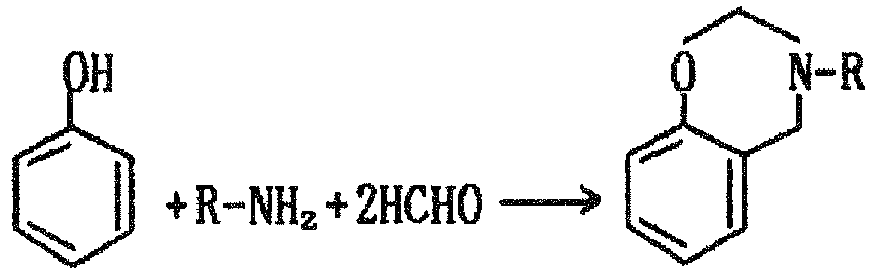
- thermosetting phenol resin having a dihydrobenzoxazine ring for use in the present invention includes any thermosetting phenol resins having a dihydrobenzoxazine ring and capable of curing by ring-opening reaction of dihydrobenzoxazine ring, for example, dihydro-2H-1,3-benzoxazine derivative can be synthesized from, e.g. a compound having a phenolic hydroxyl group, a primary amine, and folmaldehyde, as shown in the following reaction scheme (See Patent Document 4):
- the compound having a phenolic hydroxyl group must have a hydrogen atom bonded to at least one o-position with respect to the phenolic hydroxyl group of aromatic ring, and preferably polyfunctional phenols having a plurality of phenolic hydroxyl groups in the molecule can be used.
- phenols such as catechol, resorcinol, hydroquinone, etc., dihydroxynaphthalenes such as 1,5-dihydroxynaphthalene, 2,6-dihydroxynaphthalene, etc., bisphenols such as bisphenol A, bisphenol F, etc., phenol resins such as novolak-type or resol-type phenol resin, melaminephenol resin, alkylphenol resin, etc.
- the primary amine includes, for example, aromatic amines such as aniline, toluidine, etc. and aliphatic amines such as methylamine, ethylamine, etc.
- One mole each of a compound having a phenolic hydroxyl group and a primary amine, and at least 2 moles of formaldehyde are subjected to reaction in the presence of an oxalic acid catalyst or the like at a reaction temperature of about 70 to 130°C, preferably about 90 to 110°C for about 1/3 to 4 hours, followed by removal of the unreacted phenolic compound, primary amine, formaldehyde, etc. at not higher than 120°C under reduced pressure, thereby obtaining a thermosetting resin having a dihydrobenzoxazine ring.
- the resin component can generally be one comprising about 1 to 500 parts by weight, preferably about 10 to 100 parts by weight, of resol-type phenolic resin based on 100 parts by weight of novolak-type phenolic resin.
- the combined use with resol-type phenolic resin exhibits the effect of further improving water resistant adhesion; however, when the amount of resol-type phenolic resin is greater than this range, heat resistant adhesion is reduced.
- an epoxy resin When an epoxy resin is used in combination with a phenolic resin, the epoxy resin is used at a ratio of about 500 parts by weight or less, preferably about 20 to 200 parts by weight, based on 100 parts by weight of the phenolic resin.
- the combined use with an epoxy resin can further improve the initial adhesion; however, when the amount of epoxy resin is greater than this range, water resistance is reduced.
- a curing accelerator such as a tertiary amine based curing accelerator or imidazole based curing accelerator, can also be used at the same time.
- unvulcanized nitrile rubber or a compound thereof is used by being added at a ratio of about 1,000 parts by weight or less, preferably about 10 to 100 parts by weight, based on 100 parts by weight of novolak-type phenolic resin.
- the addition of nitrile rubber (compound) can further improve the heat resistant adhesion of the baking layer of the vulcanizing adhesive; however, when the amount of nitrile rubber (compound) is greater than this range, water resistant adhesion is reduced.
- the vulcanizing adhesive is prepared as an organic solvent solution having component concentration of about 0.1 to 10wt.%, using an alcohol-based organic solvent such as methanol, ethanol, isopropanol, etc., a ketone-based organic solvent such as acetone, methyl ethyl ketone, methyl isobutyl ketone, etc., or a mixture thereof, and applied with a coating weight on one side of about 50 to 2,000mg/m 2 in the same manner as in the case of the surface-treating agent, followed by drying at room temperature or with hot air, and baking at about 100 to 250°C for about 1 to 20 minutes.
- an alcohol-based organic solvent such as methanol, ethanol, isopropanol, etc.
- a ketone-based organic solvent such as acetone, methyl ethyl ketone, methyl isobutyl ketone, etc., or a mixture thereof
- nitrile rubber is applied on the resulting vulcanizing adhesive layer as an organic solvent solution thereof to form vulcanizate layers on both surfaces, each of which has a film thickness on one side of about 5 to 120 ⁇ m.
- the nitrile rubber may be one that satisfies the following conditions: a vulcanized product thereof has a hardness (durometer A) of 80 or more, and a compression set (100°C, 22 hours) of 50% or less. Further, hydrogenated nitrile rubber can also be used.
- the nitrile rubber can also be used as a compound comprising a sulfur based vulcanizing agent, such as sulfur or tetramethylthiurammonosulfide.
- a sulfur based vulcanizing agent such as sulfur or tetramethylthiurammonosulfide.
- the nitrile rubber is used as an unvulcanized nitrile rubber compound comprising an organic peroxide as a crosslinking agent.
- the formulation of such a peroxide-crosslinked unvulcanized nitrile rubber compound is shown, for example, in the following formulation example.
- NBR N-235S, produced by JSR Corporation 100 Parts by weight SRF carbon black 80 Parts by weight Calcium carbonate 80 Parts by weight Silica powder 20 Parts by weight Zinc oxide 5 Parts by weight Antioxidant (Nocrac 224, produced by Ouchi Shinko Chemical Industrial Co., Ltd.) 2 Parts by weight Triallyl isocyanurate 2 Parts by weight 1,3-bis(tert-butylperoxy)isopropyl benzene 2.5 Parts by weight Plasticizer (Vulkanol OT, produced by Bayer) 5 Parts by weight
- the coated unvulcanized rubber layers are dried at room temperature to about 100°C for about 1 to 15 minutes to evaporate off alcohols such as methanol, ethanol, etc., ketones such as methyl ethyl ketone, methyl isobutyl ketone, etc., aromatic hydrocarbons such as toluene, xylene, etc., or a mixture thereof, used as an organic solvent, followed by vulcanization by heating at about 150 to 230°C for about 0.5 to 30 minutes. The vulcanization is performed while pressurizing, if necessary.
- alcohols such as methanol, ethanol, etc., ketones such as methyl ethyl ketone, methyl isobutyl ketone, etc., aromatic hydrocarbons such as toluene, xylene, etc., or a mixture thereof.
- the vulcanized nitrile rubber layers desirably have a hardness (Durometer A) of 80 or more, and a compression set (100°C for 22 hours) of 50% or less from the viewpoint of use as gasket. In case sticking prevention is required, an anti-sticking agent can be applied to the surfaces.
- the anti-sticking agent is used to prevent sticking between rubbers themselves or between rubber and metal. Any anti-sticking agent can be used, so far as it can form a film layer on the vulcanized nitrile rubber layers, and includes, for example, silicone series, fluorine series, graphite series, wax series such as amides, paraffins, etc., polyolefin series, or polybutadiene series, and preferably an anti-sticking agent comprising a dispersion in an organic solvent of liquid 1,2-polybutadiene hydroxyl group-containing material, 1,2-polybutadiene isocyanate group-containing material, and polyolefin-based resin is used (Patent Document 5).
- a surface-treating agent comprising ammonium zirconium carbonate, phosphoric acid, and silica, the amounts of which were adjusted so that the mass ratio of zirconium, phosphorus, and silica (as SiO 2 ) in the film of the surface-treating agent satisfied the ratio shown in Table 1, was applied to an alkaline degreased cold rolled steel plate (SPCC-4D: thicknes of 0.2 mm) at a predetermined one side base weight, and dried at 200°C for 1 minute.
- the pH of the surface-treating agent was adjusted to 6 to 10 by using ammonium hydroxide.
- colloidal silica was used (average particle diameter: 10 to 15 nm).
- Silica in the following table shows its weight ratio as SiO 2 .
- a conventional treatment i.e., zinc phosphate treatment
- zinc phosphate treatment was also performed using zinc phosphate as a surface-treating agent M, shown below.
- the zinc phosphate treatment was performed using Palbond L3020 (produced by Nihon Parkerizing Co., Ltd.) so that the one side base weight was 2,500 mg/m 2 .
- Table 1 Component composition ratio of surface-treating agent layer Mass ratio One side base weight Zr : P Zr : silica Surface-treating agent Zr P silica Z P Zr silica (mg/m 2 ) [Zr : P] A (less Zr) 10.0 10.0 80.0 50.0 50.0 11.1 88.9 200 B (more Zr) 18.0 2.0 80.0 90.0 10.0 18.4 81.6 200 C (middle Zr) 14.0 6.0 80.0 70.0 30.0 14.9 85.1 200 [Zr: silica] D (less Zr) 3.3 1.4 95.2 70.0 30.0 3.4 96.6 200 E (more Zr) 42.7 18.3 39.0 70.0 30.0 52.2 47.8 200 [Base weight] F (less) 26.9 11.5 61.5 70.0 30.0 30.4 69.6 100 G (more) 26.9 11.5 61.5 70.0 30.0 30.4 69.6 500 H (less P) 19.2 0.8 80.0 96.0 4.0 19.2 80.8 200 I (n
- a vulcanizing adhesive A comprising the above components (shown as the solution amount in the case of a solution; the same shall apply hereinafter) was applied to the resulting surface-treating agent A ⁇ G and H ⁇ M coated steel sheet to a coating weight of 1,500mg/m 2 , followed by drying at room temperature and baking at 220°C for 5 minutes.
- a 25wt.% solution of nitrile rubber compound of the afore-mentioned Formulation Example in mixed solvents of toluene - methyl etyl ketone (weight ratio of 9:1 ; the afore-mentioned mixing ratio of the mixed solvent solution was also the same) was applied to the vulcanizing adhesive-coated steel sheet, followed by drying at 60°C for 15 minutes to form unvulcanized rubber layers to a thickness of 25 ⁇ m on one side, then by pressure vulcanization under the conditions of 220°C and 60kgf/cm 2 (5.88MPa) for 2 minutes, thereby obtaining a nitrile rubber-metal laminate gasket material.
- LLC half-dipping test Only half of the vertically lower portion of each gasket material was dipped in a 50 wt.% aqueous solution of LLC (JCC310, produced by Japan Chemical Industries Co., Ltd.) at 120°C for 48 hours. Then, a spiral scoring test was performed according to JIS K6894, in which a spiral with a radius of 4.5 mm was drawn 25 times on the sample surface. The half non-dipped portion and the half dipped portion were each evaluated by the following evaluation criteria (scores).
- LLC resistance test The gasket materials completely dipped in a 50 wt.% aqueous solution of LLC (JCC310) at 120°C for 500 hours were subjected to a lattice pattern tape peeling test according to JIS K5400, and the results were evaluated using the following scores:
- Heat resistance test The gasket materials were exposed in a thermostat at 120°C for 500 hours. After being allowed to stand, the gasket materials were subjected to the above lattice pattern tape peeling test, and the results were evaluated in the same manner as above.
- a vulcanizing adhesive B having the following composition was used in place of the vulcanizing adhesive A.
- Novolak-type phenolic resin 100 parts by weight Resol-type phenolic resin (30 wt.% methanol solution) 33 parts by weight Nirile rubber compound of the afore-mentioned 133 Parts by weight
- Formulation Example 25 wt.% toluene-methyl ethyl ketone mixed solvent solution
- Methyl ethyl ketone 2597 parts by weight
- a vulcanizing adhesive C having the following composition was used in place of the vulcanizing adhesive A.
- Novolak-type phenolic resin 100 parts by weight Resol-type phenolic resin (30 wt.% methanol solution) 333 parts by weight Nirile rubber compound of the afore-mentioned 133 Parts by weight
- Formulation Example 25 wt.% toluene-methyl ethyl ketone mixed solvent solution
- Vulcanizing adhesive D Resol-type phenolic resin (30 wt.% methanol solution) 100 parts by weight Nirile rubber compound of the afore-mentioned 96 Parts by weight Formulation Example (25 wt.% toluene-methyl ethyl ketone mixed solvent solution) Methyl ethyl ketone 884 parts by weight
- Vulcanizing adhesive E Resol-type phenolic resin (30 wt.% methanol solution) 100 parts by weight Thermosetting resin having a dihydrobenzoxazine ring (30 wt.% methyl ethyl ketone solution) 100 parts by weight Nirile rubber compound of the afore-mentioned 192 Parts by weight Formulation Example (25 wt.% toluene-methyl ethyl ketone
- Table 2 shows the results obtained in the above Examples and Comparative Examples.
- Table 2 LLC half-dilipping test Example Surface-treating agent Vulcanizing adhesive Half non-Dipped Portion Half Dipped Portion LLC Resistance Test Heat Resistance Test Ex. 1 A A 5 5 5 5 Ex. 2 B A 5 5 5 5 Ex. 3 C A 5 5 5 5 Ex. 4 D A 5 5 5 5 Ex. 5 E A 5 5 5 5 Ex. 6 F A 5 5 5 5 Ex. 7 G A 5 5 5 5 Comp Ex. 1 H A 3 5 5 5 Comp Ex. 2 I A 1 5 1 1 Comp Ex. 3 J A 1 5 3 3 Comp Ex. 4 K A 1 2 1 1 Comp Ex. 5 L A 2 5 5 5 Comp Ex. 6 M A 1 5 4 4 Ex. 8 A B 5 5 5 5 Ex.
- the nitrile rubber-metal laminated gasket material of the present invention has excellent heat resistance, and exhibits sufficient adhesion even after being dipped in or exposed to LLC. Due to these effects, the nitrile rubber-metal laminated gasket material of the present invention can be effectively used as a vehicle accessory, such as a car air conditioner compressor gasket, a water pump gasket, or like gasket for use in contact with coolants; an intake manifold gasket, a throttle body gasket, or like gasket in fuel piping systems; a cam cover gasket, a timing belt cover gasket, an oil pan gasket, an oil strainer gasket, an oil pump gasket, a heater pipe gasket, or like gasket used in engine systems; or a power steering gasket, a brake shim gasket, a transmission separator plate gasket, a transmission case gasket, or like vehicle components.
- a vehicle accessory such as a car air conditioner compressor gasket, a water pump gasket, or like gasket for use in contact with coolants;
Landscapes
- Chemical & Material Sciences (AREA)
- Engineering & Computer Science (AREA)
- Organic Chemistry (AREA)
- General Engineering & Computer Science (AREA)
- Chemical Kinetics & Catalysis (AREA)
- Mechanical Engineering (AREA)
- Medicinal Chemistry (AREA)
- Polymers & Plastics (AREA)
- Health & Medical Sciences (AREA)
- Materials Engineering (AREA)
- General Chemical & Material Sciences (AREA)
- Metallurgy (AREA)
- Laminated Bodies (AREA)
- Gasket Seals (AREA)
- Sealing Material Composition (AREA)
Abstract
Description
- The present invention relates to a nitrile rubber-metal laminated gasket material, and more particularly to a nitrile rubber-metal laminated gasket material that has excellent LLC resistance and heat resistance.
- For nitrile rubber-metal laminated gaskets commercialized by surface-treating steel plates followed by vulcanization bonding of rubber via adhesives, zinc phosphate treatment, iron phosphate treatment, or the like is mainly used as the surface treatment of, for example, cold rolled steel plates (SPCC) and cold rolled high strength steel plates (SPFC). In these treatments, degreased steel plates are dipped in chemical liquid adjusted to be acidic, and insoluble coatings are formed on the steel plates, thereby ensuring rust prevention and adhesion with adhesives.
- However, these treatments had the following problems: sludge (industrial waste) was generated at the stage of forming a film; it was necessary to always supply chemical agents because chemical components were reduced due to the reaction; and the cost was high.
- As a metal surface-treating method that does not use zinc phosphate, iron phosphate, etc., a method using a surface treating agent containing silica, and titanium compound and zirconia compound derived from fluoride in an organic resin has been proposed (Patent Document 1). However, the method is not preferable in terms of facilities, since the surface treating agent contains fluorine, so that defluorination of wastewater becomes necessary.
-
- Patent Document 1 :
JP-B-5050316 - Patent Document 2 :
JP-A-2006-218630 - Patent Document 3 :
JP-A-2008-75808 - Patent Document 4 :
JP-A-2004-83623 - Patent Document 5 :
JP-A-7-165953 - An object of the present invention is to provide a nitrile rubber-metal laminated gasket material that has excellent heat resistance and exhibits sufficient adhesion even after being dipped in or exposed to long life coolant (LLC) in an actual use environment as a gasket, even when it is a laminate of a metal plate, such as SPCC or SPFC, and nitrile rubber.
- The object of the present invention can be attained by a nitrile rubber-metal laminated gasket material comprising a surface-treating agent layer containing a zirconium-containing compound, a phosphorus-containing compound, and silica; a vulcanizing adhesive layer; and a nitrile rubber layer, which are sequentially laminated on a metal plate.
- The nitrile rubber-metal laminated gasket material of the present invention has excellent heat resistance and exhibits sufficient adhesion even after being dipped in or exposed to LLC.
- The metallic steel sheets for use in the present invention include sheets of iron, aluminum, copper, etc., or alloys thereof, etc., for example, cold rolled steel plates (SPCC) and cold rolled high strength steel plates (SPFC). A surface treating agent layer containing a zirconium-containing compound, a phosphorus-containing compound, and silica is formed on the steel sheets.
- In the surface-treating agent layer, the element mass ratio of Zr element in the zirconium-containing compound to P element in the phosphorus-containing compound is 95:5 to 40:60, preferably 90:10 to 50:50; and the mass ratio of Zr element in the zirconium-containing compound to silica is 1:99 to 60:40, preferably 3:97 to 52:48. When the amount of zirconium element relative to phosphorus element is greater than this range, the LLC resistance of a non-dipped portion is reduced in an LLC half-dipping test, which is described later. In contrast, when the amount of zirconium element relative to phosphorus element is less than this range, heat resistance is reduced. Moreover, when the amount of silica relative to zirconium element is greater than this range, the LLC resistance of the non-dipped portion is reduced in the LLC half-dipping test, which is described later, and heat resistance is reduced. In contrast, when the amount of silica relative to zirconium element is less than this range, adhesion is reduced, and the stability of the treatment liquid is lowered.
- In the film, the zirconium-containing compound exists in the form of zirconium phosphate or zirconium oxide, and the compound existing in the form of zirconium phosphate is preferably used. The treatment liquid containing zirconium nitrate, zirconium acetate, zirconium sulfate, zirconium ammonium carbonate, zirconium oxide, or the like can be used as the component to form them. Preferably, the treatment liquid containing zirconium ammonium carbonate is used.
- Phosphoric acid is used as the phosphorus-containing compound. The amount thereof to be added is adjusted so that the element mass ratio of zirconium (Zr) to phosphorus (P) is 95:5 to 40:60, preferably 90:10 to 50:50, as stated above.
- As the silica (silicon oxide), includes one prepared by dispersing dry process or wet process silica having a SiO2 content of 85wt.% or more in an organic solvent or water, preferably one prepared by dispersing fine particles of anhydrous silica of high purity in an organic solvent or water to make it in a colloidal state, so-called colloidal silica, is used. As the colloidal silica one having an average particle size of 1-50nm, preferably 10-30nm, and dispersed in an organic solvent such as methanol, methyl ethyl ketone, methyl isobutyl ketone, etc. is used. Commercially available products can be used, for example, methanol silica sol (a product of Nissan Chemical Industries, Ltd.; dispersion having a solid matter concentration of 30wt.% in methanol), Snowtex MEK-ST (a product of the same company as above ; dispersion having a solid matter concentration of 30wt.% in methyl ethyl ketone), Snowtex MIBK-ST (a product of the same company as above ; dispersion having a solid matter concentration of 30wt.% in methyl isobutyl ketone) etc.
- To enhance the effect of the surface-treating agent or ensure the solution stability, the surface-treating agent can further contain an inorganic acid such as nitric acid and sulfuric acid, an organic acid such as formic acid and acetic acid, a nitrogen-containing alkaline compound, such as ammonium hydroxide (aqua ammonia), ethylenediamine, triethylenetetramine, morpholine and choline, or the like.
- In Patent Documents 2 and 3, the present applicant has proposed a nitrile rubber-metal laminate gasket material comprising a surface-treating agent layer containing elements of zirconium, phosphorus, and aluminum, a resin-based vulcanizing adhesive layer containing silica, and a nitrile rubber layer or hydrogenated nitrile rubber layer, which are sequentially laminated on a metallic steel plate. However, the surface-treating agent used in these inventions comprises Al element as an essential component, and silica is used as an essential component of the adhesive. In this respect, these inventions are different from the present invention.
- The surface-treating agent is applied as a liquid dissolved or dispersed the afore-mentioned components in water on steel sheet, preferably SPCC, SPFC steel sheet, degreased with alkali, or the like, to a coating weight on one side of about 10 to 1,000mg/m2, preferably about 100 to 500mg/m2 by known coating method such as a spraying, dipping, brush coating and roll coating, followed by drying at room temperature, or with hot air, and baking at about 100 to 250°C for about 0.5 to 20 minutes.
- On the steel plate treated with the surface-treating agent, a vulcanizing adhesive layer is formed using a thermosetting phenolic resin based adhesive composition or an adhesive composition comprising a combination of a thermosetting phenolic resin and a thermosetting resin, such as an epoxy resin.
- The thermosetting phenol resin for use as a vulcanizing adhesive includes not only a novolak-type phenol resin, but also a resol-type phenol resin, a phenol resin having a dihydrobenzoxazine ring and these phenol resin can be used in combination. Further, these phenol resin can be used together with other thermosetting resin such as a novolak-type epoxy resin etc. including cresol novolak-type epoxy resin, a phenol novolak-type epoxy resin etc., or still further together with unvulcanized nitrilerubber or nitrile rubber compound.
- The novolak-type phenol resin for use in the present invention includes resin having a softening point of about 80 to 150°C, obtained by condensation reaction of phenols having 2 or 3 replaceable nuclear hydrogen atoms at o-position and/or p-position with respect to the phenolic hydroxyl group such as phenol, p-cresol, m-cresol, p-t-butylphenol, p-phenylphenol, bisphenol A, etc. or a mixture thereof with formaldehyde in the presence of an acidic catalyst such as hydrochloric acid, oxalic acid, etc. Preferably, novolak-type phenol resins having a softening point of 100°C or higher, prepared from a mixture of m-cresol and p-cresol, and formaldehyde are used.
- The resol-type phenol resin for use in the present invention includes those obtained by conducting the afore-mentioned condensation reaction in the presence of an alkali catalyst such as sodium hydroxide, sodium carbonate, magnesium hydroxide, ammonia, etc.
- The thermosetting phenol resin having a dihydrobenzoxazine ring for use in the present invention includes any thermosetting phenol resins having a dihydrobenzoxazine ring and capable of curing by ring-opening reaction of dihydrobenzoxazine ring, for example, dihydro-2H-1,3-benzoxazine derivative can be synthesized from, e.g. a compound having a phenolic hydroxyl group, a primary amine, and folmaldehyde, as shown in the following reaction scheme (See Patent Document 4):
- The compound having a phenolic hydroxyl group must have a hydrogen atom bonded to at least one o-position with respect to the phenolic hydroxyl group of aromatic ring, and preferably polyfunctional phenols having a plurality of phenolic hydroxyl groups in the molecule can be used. For example, phenols such as catechol, resorcinol, hydroquinone, etc., dihydroxynaphthalenes such as 1,5-dihydroxynaphthalene, 2,6-dihydroxynaphthalene, etc., bisphenols such as bisphenol A, bisphenol F, etc., phenol resins such as novolak-type or resol-type phenol resin, melaminephenol resin, alkylphenol resin, etc.
- The primary amine includes, for example, aromatic amines such as aniline, toluidine, etc. and aliphatic amines such as methylamine, ethylamine, etc.
- One mole each of a compound having a phenolic hydroxyl group and a primary amine, and at least 2 moles of formaldehyde are subjected to reaction in the presence of an oxalic acid catalyst or the like at a reaction temperature of about 70 to 130°C, preferably about 90 to 110°C for about 1/3 to 4 hours, followed by removal of the unreacted phenolic compound, primary amine, formaldehyde, etc. at not higher than 120°C under reduced pressure, thereby obtaining a thermosetting resin having a dihydrobenzoxazine ring.
- The resin component can generally be one comprising about 1 to 500 parts by weight, preferably about 10 to 100 parts by weight, of resol-type phenolic resin based on 100 parts by weight of novolak-type phenolic resin. The combined use with resol-type phenolic resin exhibits the effect of further improving water resistant adhesion; however, when the amount of resol-type phenolic resin is greater than this range, heat resistant adhesion is reduced.
- When an epoxy resin is used in combination with a phenolic resin, the epoxy resin is used at a ratio of about 500 parts by weight or less, preferably about 20 to 200 parts by weight, based on 100 parts by weight of the phenolic resin. The combined use with an epoxy resin can further improve the initial adhesion; however, when the amount of epoxy resin is greater than this range, water resistance is reduced. When an epoxy resin is used in combination, a curing accelerator, such as a tertiary amine based curing accelerator or imidazole based curing accelerator, can also be used at the same time.
- Moreover, unvulcanized nitrile rubber or a compound thereof is used by being added at a ratio of about 1,000 parts by weight or less, preferably about 10 to 100 parts by weight, based on 100 parts by weight of novolak-type phenolic resin. The addition of nitrile rubber (compound) can further improve the heat resistant adhesion of the baking layer of the vulcanizing adhesive; however, when the amount of nitrile rubber (compound) is greater than this range, water resistant adhesion is reduced.
- The vulcanizing adhesive is prepared as an organic solvent solution having component concentration of about 0.1 to 10wt.%, using an alcohol-based organic solvent such as methanol, ethanol, isopropanol, etc., a ketone-based organic solvent such as acetone, methyl ethyl ketone, methyl isobutyl ketone, etc., or a mixture thereof, and applied with a coating weight on one side of about 50 to 2,000mg/m2 in the same manner as in the case of the surface-treating agent, followed by drying at room temperature or with hot air, and baking at about 100 to 250°C for about 1 to 20 minutes.
- Then, unvulcanized nitrile rubber compound is applied on the resulting vulcanizing adhesive layer as an organic solvent solution thereof to form vulcanizate layers on both surfaces, each of which has a film thickness on one side of about 5 to 120µm. The nitrile rubber may be one that satisfies the following conditions: a vulcanized product thereof has a hardness (durometer A) of 80 or more, and a compression set (100°C, 22 hours) of 50% or less. Further, hydrogenated nitrile rubber can also be used. Although the formulation of the nitrile rubber does not cause any limitation, the nitrile rubber can also be used as a compound comprising a sulfur based vulcanizing agent, such as sulfur or tetramethylthiurammonosulfide. However, preferably, the nitrile rubber is used as an unvulcanized nitrile rubber compound comprising an organic peroxide as a crosslinking agent. The formulation of such a peroxide-crosslinked unvulcanized nitrile rubber compound is shown, for example, in the following formulation example.
(Formulation Example) NBR (N-235S, produced by JSR Corporation) 100 Parts by weight SRF carbon black 80 Parts by weight Calcium carbonate 80 Parts by weight Silica powder 20 Parts by weight Zinc oxide 5 Parts by weight Antioxidant (Nocrac 224, produced by Ouchi Shinko Chemical Industrial Co., Ltd.) 2 Parts by weight Triallyl isocyanurate 2 Parts by weight 1,3-bis(tert-butylperoxy)isopropyl benzene 2.5 Parts by weight Plasticizer (Vulkanol OT, produced by Bayer) 5 Parts by weight - The coated unvulcanized rubber layers are dried at room temperature to about 100°C for about 1 to 15 minutes to evaporate off alcohols such as methanol, ethanol, etc., ketones such as methyl ethyl ketone, methyl isobutyl ketone, etc., aromatic hydrocarbons such as toluene, xylene, etc., or a mixture thereof, used as an organic solvent, followed by vulcanization by heating at about 150 to 230°C for about 0.5 to 30 minutes. The vulcanization is performed while pressurizing, if necessary. The vulcanized nitrile rubber layers desirably have a hardness (Durometer A) of 80 or more, and a compression set (100°C for 22 hours) of 50% or less from the viewpoint of use as gasket. In case sticking prevention is required, an anti-sticking agent can be applied to the surfaces.
- The anti-sticking agent is used to prevent sticking between rubbers themselves or between rubber and metal. Any anti-sticking agent can be used, so far as it can form a film layer on the vulcanized nitrile rubber layers, and includes, for example, silicone series, fluorine series, graphite series, wax series such as amides, paraffins, etc., polyolefin series, or polybutadiene series, and preferably an anti-sticking agent comprising a dispersion in an organic solvent of liquid 1,2-polybutadiene hydroxyl group-containing material, 1,2-polybutadiene isocyanate group-containing material, and polyolefin-based resin is used (Patent Document 5).
- The following describes the present invention with reference to Examples.
- A surface-treating agent comprising ammonium zirconium carbonate, phosphoric acid, and silica, the amounts of which were adjusted so that the mass ratio of zirconium, phosphorus, and silica (as SiO2) in the film of the surface-treating agent satisfied the ratio shown in Table 1, was applied to an alkaline degreased cold rolled steel plate (SPCC-4D: thicknes of 0.2 mm) at a predetermined one side base weight, and dried at 200°C for 1 minute. The pH of the surface-treating agent was adjusted to 6 to 10 by using ammonium hydroxide. Here, as the silica, colloidal silica was used (average particle diameter: 10 to 15 nm). Silica in the following table shows its weight ratio as SiO2. Further, a conventional treatment, i.e., zinc phosphate treatment, was also performed using zinc phosphate as a surface-treating agent M, shown below. The zinc phosphate treatment was performed using Palbond L3020 (produced by Nihon Parkerizing Co., Ltd.) so that the one side base weight was 2,500 mg/m2.
Table 1 Component composition ratio of surface-treating agent layer Mass ratio One side base weight Zr : P Zr : silica Surface-treating agent Zr P silica Z P Zr silica (mg/m2) [Zr : P] A (less Zr) 10.0 10.0 80.0 50.0 50.0 11.1 88.9 200 B (more Zr) 18.0 2.0 80.0 90.0 10.0 18.4 81.6 200 C (middle Zr) 14.0 6.0 80.0 70.0 30.0 14.9 85.1 200 [Zr: silica] D (less Zr) 3.3 1.4 95.2 70.0 30.0 3.4 96.6 200 E (more Zr) 42.7 18.3 39.0 70.0 30.0 52.2 47.8 200 [Base weight] F (less) 26.9 11.5 61.5 70.0 30.0 30.4 69.6 100 G (more) 26.9 11.5 61.5 70.0 30.0 30.4 69.6 500 H (less P) 19.2 0.8 80.0 96.0 4.0 19.2 80.8 200 I (no Zr) 0.0 20.0 80.0 0.0 100.0 0.0 100.0 200 J (no P) 20.0 0.0 80.0 100.0 0.0 20.0 80.0 200 K (only silica) 0.0 0.0 100.0 0.0 0.0 0.0 100.0 200 L (excess Zr) 50.0 21.4 28.6 70.0 30.0 63.6 36.4 200 Novolak-type phenolic resin 100 parts by weight Resol-type phenolic resin (30 wt.% methanol solution) 150 parts by weight Nirile rubber compound of the afore-mentioned 133 Parts by weight Formulation Example (25 wt.% toluene-methyl ethyl ketone mixed solvent solution) Methyl ethyl ketone 3182 parts by weight - A vulcanizing adhesive A comprising the above components (shown as the solution amount in the case of a solution; the same shall apply hereinafter) was applied to the resulting surface-treating agent A∼G and H∼M coated steel sheet to a coating weight of 1,500mg/m2, followed by drying at room temperature and baking at 220°C for 5 minutes.
- A 25wt.% solution of nitrile rubber compound of the afore-mentioned Formulation Example in mixed solvents of toluene - methyl etyl ketone (weight ratio of 9:1 ; the afore-mentioned mixing ratio of the mixed solvent solution was also the same) was applied to the vulcanizing adhesive-coated steel sheet, followed by drying at 60°C for 15 minutes to form unvulcanized rubber layers to a thickness of 25µm on one side, then by pressure vulcanization under the conditions of 220°C and 60kgf/cm2 (5.88MPa) for 2 minutes, thereby obtaining a nitrile rubber-metal laminate gasket material.
- The thus obtained gasket material was subjected to the following tests.
- LLC half-dipping test: Only half of the vertically lower portion of each gasket material was dipped in a 50 wt.% aqueous solution of LLC (JCC310, produced by Japan Chemical Industries Co., Ltd.) at 120°C for 48 hours. Then, a spiral scoring test was performed according to JIS K6894, in which a spiral with a radius of 4.5 mm was drawn 25 times on the sample surface. The half non-dipped portion and the half dipped portion were each evaluated by the following evaluation criteria (scores).
- Score 5: The rubber layer completely remains
- Score 4: Part of the rubber layer is removed
- Score 3: About half of the rubber layer is removed
- Score 2: The rubber layer slightly remains
- Score 1: The rubber layer is completely removed
- LLC resistance test: The gasket materials completely dipped in a 50 wt.% aqueous solution of LLC (JCC310) at 120°C for 500 hours were subjected to a lattice pattern tape peeling test according to JIS K5400, and the results were evaluated using the following scores:
- Score 5: The cut edge is completely smooth, and no lattice is peeled
- Score 4: The coating film is slightly peeled at the intersection of the cut (peeled area ratio: less than 5%)
- Score 3: The coating film is peeled along the cut edge or at the intersection (peeled area ratio: 5 to less than 15%)
- Score 2: Part or the whole of the coating film is peeled along the cut edge (peeled area ratio: 15 to less than 35%)
- Score 1: Part or the whole of the coating film is peeled along the cut edge (peeled area ratio: 35% or more)
- Heat resistance test: The gasket materials were exposed in a thermostat at 120°C for 500 hours. After being allowed to stand, the gasket materials were subjected to the above lattice pattern tape peeling test, and the results were evaluated in the same manner as above.
- In Examples 1 to 7 and Comparative Examples 1 to 6, a vulcanizing adhesive B having the following composition was used in place of the vulcanizing adhesive A.
Novolak-type phenolic resin 100 parts by weight Resol-type phenolic resin (30 wt.% methanol solution) 33 parts by weight Nirile rubber compound of the afore-mentioned 133 Parts by weight Formulation Example (25 wt.% toluene-methyl ethyl ketone mixed solvent solution) Methyl ethyl ketone 2597 parts by weight - In Examples 1 to 7 and Comparative Examples 1 to 6, a vulcanizing adhesive C having the following composition was used in place of the vulcanizing adhesive A.
Novolak-type phenolic resin 100 parts by weight Resol-type phenolic resin (30 wt.% methanol solution) 333 parts by weight Nirile rubber compound of the afore-mentioned 133 Parts by weight Formulation Example (25 wt.% toluene-methyl ethyl ketone mixed solvent solution) Methyl ethyl ketone 4097 parts by weight - In Examples 3 (a surface-treating agent C was used), vulcanizing adhesives D-G having the following composition were used in place of the vulcanizing adhesive A.
Vulcanizing adhesive D: Resol-type phenolic resin (30 wt.% methanol solution) 100 parts by weight Nirile rubber compound of the afore-mentioned 96 Parts by weight Formulation Example (25 wt.% toluene-methyl ethyl ketone mixed solvent solution) Methyl ethyl ketone 884 parts by weight Vulcanizing adhesive E: Resol-type phenolic resin (30 wt.% methanol solution) 100 parts by weight Thermosetting resin having a dihydrobenzoxazine ring (30 wt.% methyl ethyl ketone solution) 100 parts by weight Nirile rubber compound of the afore-mentioned 192 Parts by weight Formulation Example (25 wt.% toluene-methyl ethyl ketone mixed solvent solution) Methyl ethyl ketone 1768 parts by weight Vulcanizing adhesive F: Resol-type phenol resin (30 wt.% methanol solution) 100 Parts by weight o-Cresol novolak-type epoxy resin (Epikote 180S, produced by Japan Epoxy Resin Co.) 18 Parts by weight 2-ethyl-4-methylimidazole 0.9 Parts by weight Nirile rubber compound of the afore-mentioned 96 Parts by weight Formulation Example (25 wt.% toluene-methyl ethyl ketone mixed solvent solution) Methyl ethyl ketone 763.1 Parts by weight Vulcanizing adhesive G: Resol-type phenolic resin (30 wt.% methanol solution) 100 parts by weight Thermosetting resin having a dihydrobenzoxazine ring (30 wt.% methyl ethyl ketone solution) 100 parts by weight o-Cresol novolak-type epoxy resin (Epikote 180S) 36 Parts by weight 2-ethyl-4-methylimidazole 1.8 Parts by weight Nirile rubber compound of the afore-mentioned 192 Parts by weight Formulation Example (25 wt.% toluene-methyl ethyl ketone mixed solvent solution) Methyl ethyl ketone 1508.2 Parts by weight - Table 2 below shows the results obtained in the above Examples and Comparative Examples.
Table 2 LLC half-dilipping test Example Surface-treating agent Vulcanizing adhesive Half non-Dipped Portion Half Dipped Portion LLC Resistance Test Heat Resistance Test Ex. 1 A A 5 5 5 5 Ex. 2 B A 5 5 5 5 Ex. 3 C A 5 5 5 5 Ex. 4 D A 5 5 5 5 Ex. 5 E A 5 5 5 5 Ex. 6 F A 5 5 5 5 Ex. 7 G A 5 5 5 5 Comp Ex. 1 H A 3 5 5 5 Comp Ex. 2 I A 1 5 1 1 Comp Ex. 3 J A 1 5 3 3 Comp Ex. 4 K A 1 2 1 1 Comp Ex. 5 L A 2 5 5 5 Comp Ex. 6 M A 1 5 4 4 Ex. 8 A B 5 5 5 5 Ex. 9 B B 5 5 5 5 Ex. 10 C B 5 5 5 5 Ex. 11 D B 5 5 5 5 Ex. 12 E B 5 5 5 5 Ex. 13 F B 5 5 5 5 Ex. 14 G B 5 5 5 5 Comp Ex. 7 H B 3 5 5 5 Comp Ex. 8 I B 1 5 1 1 Comp Ex. 9 J B 2 5 3 3 Comp Ex. 10 K B 1 2 1 1 Comp Ex. 11 L B 2 5 5 5 Comp Ex. 12 M B 2 5 4 4 Ex. 15 A C 5 5 5 5 Ex. 16 B C 5 5 5 5 Ex. 17 C C 5 5 5 5 Ex. 18 D C 5 5 5 5 Ex. 19 E C 5 5 5 5 Ex. 20 F C 5 5 5 5 Ex. 21 G C 5 5 5 5 Comp Ex. 13 H C 4 5 5 5 Comp Ex. 14 I C 2 5 1 1 Comp Ex. 15 J C 3 5 3 3 Comp Ex. 16 K C 2 2 1 1 Comp Ex. 17 L C 3 5 5 5 Comp Ex. 18 M C 3 5 4 4 Ex. 22 C D 5 5 5 5 Ex. 23 C E 5 5 5 5 Ex. 24 C F 5 5 5 5 Ex. 25 C G 5 5 5 5 - The nitrile rubber-metal laminated gasket material of the present invention has excellent heat resistance, and exhibits sufficient adhesion even after being dipped in or exposed to LLC. Due to these effects, the nitrile rubber-metal laminated gasket material of the present invention can be effectively used as a vehicle accessory, such as a car air conditioner compressor gasket, a water pump gasket, or like gasket for use in contact with coolants; an intake manifold gasket, a throttle body gasket, or like gasket in fuel piping systems; a cam cover gasket, a timing belt cover gasket, an oil pan gasket, an oil strainer gasket, an oil pump gasket, a heater pipe gasket, or like gasket used in engine systems; or a power steering gasket, a brake shim gasket, a transmission separator plate gasket, a transmission case gasket, or like vehicle components.
Claims (10)
- A nitrile rubber-metal laminated gasket material comprising a surface-treating agent layer containing a zirconium-containing compound, a phosphorus-containing compound, and silica; a vulcanizing adhesive layer; and a nitrile rubber layer, which are sequentially laminated on a metal plate.
- The nitrile rubber-metal laminated gasket material according to claim 1, wherein the surface-treating agent has the element mass ratio of Zr element in the zirconium-containing compound to P element in the phosphorus-containing compound of 95:5 to 40:60.
- The nitrile rubber-metal laminated gasket material according to claim 1 or 2, wherein the surface-treating agent has the mass ratio of Zr element in the zirconium-containing compound to silica of 1:99 to 60:40.
- The nitrile rubber-metal laminated gasket material according to claim 1, wherein the metal plate is alkaline degreased SPCC or SPFC.
- The nitrile rubber-metal laminated gasket material according to claim 1, wherein the vulcanizing adhesive is a thermosetting phenolic resin based vulcanizing adhesive.
- The nitrile rubber-metal laminated gasket material according to claim 5, wherein the phenolic resin is a combination of a novolak-type phenolic resin and a resol-type phenolic resin.
- The nitrile rubber-metal laminated gasket material according to claim 5, wherein a novolak-type epoxy resin is used in combination with the phenolic resin.
- The nitrile rubber-metal laminated gasket material according to claim 5, wherein the vulcanizing adhesive layer further contains unvulcanized nitrile rubber or a nitrile rubber compound.
- The nitrile rubber-metal laminated gasket material according to claim 1, wherein an anti-sticking agent layer is formed on the nitrile rubber layer.
- A metal plate having a surface-treating agent layer containing a zirconium-containing compound, a phosphorus-containing compound, and silica.
Applications Claiming Priority (2)
| Application Number | Priority Date | Filing Date | Title |
|---|---|---|---|
| JP2013197057 | 2013-09-24 | ||
| PCT/JP2014/066107 WO2015045513A1 (en) | 2013-09-24 | 2014-06-18 | Nitrile rubber/metal multilayer material for gasket |
Publications (2)
| Publication Number | Publication Date |
|---|---|
| EP3031877A1 true EP3031877A1 (en) | 2016-06-15 |
| EP3031877A4 EP3031877A4 (en) | 2017-03-29 |
Family
ID=52742671
Family Applications (1)
| Application Number | Title | Priority Date | Filing Date |
|---|---|---|---|
| EP14848456.1A Ceased EP3031877A4 (en) | 2013-09-24 | 2014-06-18 | Nitrile rubber/metal multilayer material for gasket |
Country Status (4)
| Country | Link |
|---|---|
| EP (1) | EP3031877A4 (en) |
| JP (1) | JP6103072B2 (en) |
| CN (1) | CN105531342B (en) |
| WO (1) | WO2015045513A1 (en) |
Cited By (2)
| Publication number | Priority date | Publication date | Assignee | Title |
|---|---|---|---|---|
| US20190028802A1 (en) * | 2017-07-20 | 2019-01-24 | Premium Loudspeakers (Hui Zhou) Co., Ltd. | Treble loudspeaker with improved mounting structure for phase plug |
| EP3932662A4 (en) * | 2019-02-27 | 2022-11-23 | Nichias Corporation | TRIM MATERIAL |
Families Citing this family (5)
| Publication number | Priority date | Publication date | Assignee | Title |
|---|---|---|---|---|
| JP6664308B2 (en) * | 2016-12-05 | 2020-03-13 | ニチアス株式会社 | Material for gasket |
| WO2019102864A1 (en) * | 2017-11-27 | 2019-05-31 | Nok株式会社 | Nbr composition |
| JP2019095064A (en) * | 2018-12-27 | 2019-06-20 | ニチアス株式会社 | Raw material for brake shim |
| JP7284379B2 (en) * | 2019-02-07 | 2023-05-31 | 日本製鉄株式会社 | Composite, its manufacturing method, and painted metal plate |
| JP7557942B2 (en) | 2020-01-09 | 2024-09-30 | 興国インテック株式会社 | Method for manufacturing metal or resin-rubber bonded body and dissolving solution used in said method |
Family Cites Families (15)
| Publication number | Priority date | Publication date | Assignee | Title |
|---|---|---|---|---|
| JPS63125298A (en) | 1985-04-16 | 1988-05-28 | 株式会社東芝 | Washing machine |
| JP3316993B2 (en) | 1993-12-10 | 2002-08-19 | エヌオーケー株式会社 | Surface treatment agent for vulcanized rubber |
| JP3951795B2 (en) * | 2002-05-10 | 2007-08-01 | 日新製鋼株式会社 | Surface-treated stainless steel sheet for rubber and rubber-coated stainless steel sheet |
| JP4192527B2 (en) | 2002-08-22 | 2008-12-10 | Nok株式会社 | Vulcanized adhesive composition |
| JP4566535B2 (en) * | 2002-09-13 | 2010-10-20 | ニチアス株式会社 | Gasket material |
| US7354047B2 (en) * | 2002-09-13 | 2008-04-08 | Nichias Corporation | Gasket material |
| JP2005179721A (en) * | 2003-12-18 | 2005-07-07 | Nippon Steel Corp | Surface-treated steel sheet with excellent heat resistance, lubricity and corrosion resistance |
| JP4483611B2 (en) | 2005-02-08 | 2010-06-16 | Nok株式会社 | Nitrile rubber-metal laminated gasket material |
| JP4749827B2 (en) * | 2005-10-19 | 2011-08-17 | ニチアス株式会社 | Gasket material |
| JP2007231061A (en) * | 2006-02-28 | 2007-09-13 | Nok Corp | Nbr composition |
| JP2008075808A (en) * | 2006-09-22 | 2008-04-03 | Nok Corp | Marine (hydrogenated) nitrile rubber-metal laminated gasket material |
| JP4878976B2 (en) * | 2006-09-29 | 2012-02-15 | ニチアス株式会社 | Gasket material and manufacturing method thereof |
| CN101983127B (en) * | 2008-04-04 | 2014-07-09 | Nok株式会社 | Fluororubber/metal layered gasket material |
| JP5494240B2 (en) * | 2010-05-28 | 2014-05-14 | Jfeスチール株式会社 | Electrical steel sheet with inorganic insulation coating |
| JP2012062565A (en) * | 2010-09-20 | 2012-03-29 | Jfe Steel Corp | Water-based surface treatment liquid for zinc-based plated steel sheet, and surface-treated zinc-based plated steel sheet |
-
2014
- 2014-06-18 EP EP14848456.1A patent/EP3031877A4/en not_active Ceased
- 2014-06-18 WO PCT/JP2014/066107 patent/WO2015045513A1/en not_active Ceased
- 2014-06-18 CN CN201480051526.0A patent/CN105531342B/en active Active
- 2014-06-18 JP JP2015538954A patent/JP6103072B2/en active Active
Cited By (3)
| Publication number | Priority date | Publication date | Assignee | Title |
|---|---|---|---|---|
| US20190028802A1 (en) * | 2017-07-20 | 2019-01-24 | Premium Loudspeakers (Hui Zhou) Co., Ltd. | Treble loudspeaker with improved mounting structure for phase plug |
| US10575088B2 (en) * | 2017-07-20 | 2020-02-25 | Tymphany Acoustic Technology (Huizhou) Co., Ltd. | Treble loudspeaker with improved mounting structure for phase plug |
| EP3932662A4 (en) * | 2019-02-27 | 2022-11-23 | Nichias Corporation | TRIM MATERIAL |
Also Published As
| Publication number | Publication date |
|---|---|
| CN105531342A (en) | 2016-04-27 |
| JPWO2015045513A1 (en) | 2017-03-09 |
| CN105531342B (en) | 2018-04-27 |
| JP6103072B2 (en) | 2017-03-29 |
| EP3031877A4 (en) | 2017-03-29 |
| WO2015045513A1 (en) | 2015-04-02 |
Similar Documents
| Publication | Publication Date | Title |
|---|---|---|
| EP2261029B1 (en) | Fluororubber/metal layered gasket material | |
| JP6103072B2 (en) | Nitrile rubber-metal laminated gasket material | |
| EP3015746B1 (en) | Rubber-metal laminated gasket material | |
| JP6934312B2 (en) | Rubber metal laminates and gaskets | |
| JP5971247B2 (en) | Gasket material | |
| JP4483610B2 (en) | Fluoro rubber-metal laminated gasket material | |
| EP3715408B1 (en) | Nbr composition for rubber laminated metal | |
| JP4483611B2 (en) | Nitrile rubber-metal laminated gasket material | |
| JP3407638B2 (en) | Rubber laminated metal plate | |
| JP2006218630A5 (en) | ||
| JP3514121B2 (en) | Manufacturing method of rubber laminated metal sheet | |
| JP3407651B2 (en) | Rubber laminated metal plate | |
| JP4407424B2 (en) | Fluoro rubber-metal laminated gasket material | |
| JP2008075808A (en) | Marine (hydrogenated) nitrile rubber-metal laminated gasket material | |
| JP3407639B2 (en) | Rubber laminated metal plate | |
| CN105637119A (en) | (nitrile rubber)-metal-laminated gasket material | |
| JP3867406B2 (en) | Vulcanized adhesive composition | |
| JP3407637B2 (en) | Rubber laminated metal plate | |
| JPH1177890A (en) | Rubber laminated metal panel | |
| JP2004277435A (en) | Vulcanizing adhesive composition | |
| JP2007038533A (en) | Rubber metal laminated product | |
| JP2008266355A (en) | Vulcanized adhesive composition | |
| JP2005028815A (en) | Stainless steel-nitrile rubber composite |
Legal Events
| Date | Code | Title | Description |
|---|---|---|---|
| PUAI | Public reference made under article 153(3) epc to a published international application that has entered the european phase |
Free format text: ORIGINAL CODE: 0009012 |
|
| 17P | Request for examination filed |
Effective date: 20160308 |
|
| AK | Designated contracting states |
Kind code of ref document: A1 Designated state(s): AL AT BE BG CH CY CZ DE DK EE ES FI FR GB GR HR HU IE IS IT LI LT LU LV MC MK MT NL NO PL PT RO RS SE SI SK SM TR |
|
| AX | Request for extension of the european patent |
Extension state: BA ME |
|
| DAX | Request for extension of the european patent (deleted) | ||
| A4 | Supplementary search report drawn up and despatched |
Effective date: 20170228 |
|
| RIC1 | Information provided on ipc code assigned before grant |
Ipc: C23C 22/68 20060101ALI20170222BHEP Ipc: B32B 1/08 20060101ALI20170222BHEP Ipc: F16J 15/12 20060101ALI20170222BHEP Ipc: C23C 22/60 20060101ALI20170222BHEP Ipc: C09K 3/10 20060101AFI20170222BHEP Ipc: F16J 15/08 20060101ALI20170222BHEP Ipc: C23C 22/12 20060101ALI20170222BHEP Ipc: B32B 15/06 20060101ALI20170222BHEP Ipc: C23C 22/62 20060101ALI20170222BHEP |
|
| STAA | Information on the status of an ep patent application or granted ep patent |
Free format text: STATUS: EXAMINATION IS IN PROGRESS |
|
| 17Q | First examination report despatched |
Effective date: 20200401 |
|
| REG | Reference to a national code |
Ref country code: DE Ref legal event code: R003 |
|
| STAA | Information on the status of an ep patent application or granted ep patent |
Free format text: STATUS: THE APPLICATION HAS BEEN REFUSED |
|
| 18R | Application refused |
Effective date: 20241202 |