EP3031859B1 - Epoxy resin composition and electronic component device - Google Patents
Epoxy resin composition and electronic component device Download PDFInfo
- Publication number
- EP3031859B1 EP3031859B1 EP13891005.4A EP13891005A EP3031859B1 EP 3031859 B1 EP3031859 B1 EP 3031859B1 EP 13891005 A EP13891005 A EP 13891005A EP 3031859 B1 EP3031859 B1 EP 3031859B1
- Authority
- EP
- European Patent Office
- Prior art keywords
- epoxy resin
- resin composition
- carboxylic acid
- compound
- electronic component
- Prior art date
- Legal status (The legal status is an assumption and is not a legal conclusion. Google has not performed a legal analysis and makes no representation as to the accuracy of the status listed.)
- Active
Links
- NMORCXNKIFYLMF-SNAWJCMRSA-N CC(C(F)(F)F)(C(F)(F)F)/C(/C)=C/C Chemical compound CC(C(F)(F)F)(C(F)(F)F)/C(/C)=C/C NMORCXNKIFYLMF-SNAWJCMRSA-N 0.000 description 1
- ZYDFHZMDDVNAJA-WUXMJOGZSA-N CC/C=C(\CC)/Oc1ccc(C)cc1 Chemical compound CC/C=C(\CC)/Oc1ccc(C)cc1 ZYDFHZMDDVNAJA-WUXMJOGZSA-N 0.000 description 1
- IWDCLRJOBJJRNH-UHFFFAOYSA-N Cc(cc1)ccc1O Chemical compound Cc(cc1)ccc1O IWDCLRJOBJJRNH-UHFFFAOYSA-N 0.000 description 1
Classifications
-
- C—CHEMISTRY; METALLURGY
- C08—ORGANIC MACROMOLECULAR COMPOUNDS; THEIR PREPARATION OR CHEMICAL WORKING-UP; COMPOSITIONS BASED THEREON
- C08K—Use of inorganic or non-macromolecular organic substances as compounding ingredients
- C08K5/00—Use of organic ingredients
- C08K5/04—Oxygen-containing compounds
- C08K5/13—Phenols; Phenolates
-
- C—CHEMISTRY; METALLURGY
- C08—ORGANIC MACROMOLECULAR COMPOUNDS; THEIR PREPARATION OR CHEMICAL WORKING-UP; COMPOSITIONS BASED THEREON
- C08G—MACROMOLECULAR COMPOUNDS OBTAINED OTHERWISE THAN BY REACTIONS ONLY INVOLVING UNSATURATED CARBON-TO-CARBON BONDS
- C08G59/00—Polycondensates containing more than one epoxy group per molecule; Macromolecules obtained by polymerising compounds containing more than one epoxy group per molecule using curing agents or catalysts which react with the epoxy groups
- C08G59/18—Macromolecules obtained by polymerising compounds containing more than one epoxy group per molecule using curing agents or catalysts which react with the epoxy groups ; e.g. general methods of curing
- C08G59/40—Macromolecules obtained by polymerising compounds containing more than one epoxy group per molecule using curing agents or catalysts which react with the epoxy groups ; e.g. general methods of curing characterised by the curing agents used
- C08G59/42—Polycarboxylic acids; Anhydrides, halides or low molecular weight esters thereof
- C08G59/4223—Polycarboxylic acids; Anhydrides, halides or low molecular weight esters thereof aromatic
-
- C—CHEMISTRY; METALLURGY
- C08—ORGANIC MACROMOLECULAR COMPOUNDS; THEIR PREPARATION OR CHEMICAL WORKING-UP; COMPOSITIONS BASED THEREON
- C08J—WORKING-UP; GENERAL PROCESSES OF COMPOUNDING; AFTER-TREATMENT NOT COVERED BY SUBCLASSES C08B, C08C, C08F, C08G or C08H
- C08J3/00—Processes of treating or compounding macromolecular substances
- C08J3/24—Crosslinking, e.g. vulcanising, of macromolecules
-
- C—CHEMISTRY; METALLURGY
- C08—ORGANIC MACROMOLECULAR COMPOUNDS; THEIR PREPARATION OR CHEMICAL WORKING-UP; COMPOSITIONS BASED THEREON
- C08K—Use of inorganic or non-macromolecular organic substances as compounding ingredients
- C08K5/00—Use of organic ingredients
- C08K5/04—Oxygen-containing compounds
- C08K5/09—Carboxylic acids; Metal salts thereof; Anhydrides thereof
-
- C—CHEMISTRY; METALLURGY
- C08—ORGANIC MACROMOLECULAR COMPOUNDS; THEIR PREPARATION OR CHEMICAL WORKING-UP; COMPOSITIONS BASED THEREON
- C08K—Use of inorganic or non-macromolecular organic substances as compounding ingredients
- C08K5/00—Use of organic ingredients
- C08K5/04—Oxygen-containing compounds
- C08K5/09—Carboxylic acids; Metal salts thereof; Anhydrides thereof
- C08K5/092—Polycarboxylic acids
-
- C—CHEMISTRY; METALLURGY
- C08—ORGANIC MACROMOLECULAR COMPOUNDS; THEIR PREPARATION OR CHEMICAL WORKING-UP; COMPOSITIONS BASED THEREON
- C08K—Use of inorganic or non-macromolecular organic substances as compounding ingredients
- C08K5/00—Use of organic ingredients
- C08K5/04—Oxygen-containing compounds
- C08K5/15—Heterocyclic compounds having oxygen in the ring
- C08K5/151—Heterocyclic compounds having oxygen in the ring having one oxygen atom in the ring
- C08K5/1535—Five-membered rings
- C08K5/1539—Cyclic anhydrides
-
- C—CHEMISTRY; METALLURGY
- C08—ORGANIC MACROMOLECULAR COMPOUNDS; THEIR PREPARATION OR CHEMICAL WORKING-UP; COMPOSITIONS BASED THEREON
- C08K—Use of inorganic or non-macromolecular organic substances as compounding ingredients
- C08K5/00—Use of organic ingredients
- C08K5/16—Nitrogen-containing compounds
- C08K5/17—Amines; Quaternary ammonium compounds
- C08K5/175—Amines; Quaternary ammonium compounds containing COOH-groups; Esters or salts thereof
-
- C—CHEMISTRY; METALLURGY
- C08—ORGANIC MACROMOLECULAR COMPOUNDS; THEIR PREPARATION OR CHEMICAL WORKING-UP; COMPOSITIONS BASED THEREON
- C08K—Use of inorganic or non-macromolecular organic substances as compounding ingredients
- C08K7/00—Use of ingredients characterised by shape
- C08K7/16—Solid spheres
- C08K7/18—Solid spheres inorganic
-
- C—CHEMISTRY; METALLURGY
- C08—ORGANIC MACROMOLECULAR COMPOUNDS; THEIR PREPARATION OR CHEMICAL WORKING-UP; COMPOSITIONS BASED THEREON
- C08L—COMPOSITIONS OF MACROMOLECULAR COMPOUNDS
- C08L63/00—Compositions of epoxy resins; Compositions of derivatives of epoxy resins
-
- C—CHEMISTRY; METALLURGY
- C08—ORGANIC MACROMOLECULAR COMPOUNDS; THEIR PREPARATION OR CHEMICAL WORKING-UP; COMPOSITIONS BASED THEREON
- C08L—COMPOSITIONS OF MACROMOLECULAR COMPOUNDS
- C08L83/00—Compositions of macromolecular compounds obtained by reactions forming in the main chain of the macromolecule a linkage containing silicon with or without sulfur, nitrogen, oxygen or carbon only; Compositions of derivatives of such polymers
- C08L83/04—Polysiloxanes
-
- H—ELECTRICITY
- H10—SEMICONDUCTOR DEVICES; ELECTRIC SOLID-STATE DEVICES NOT OTHERWISE PROVIDED FOR
- H10W—GENERIC PACKAGES, INTERCONNECTIONS, CONNECTORS OR OTHER CONSTRUCTIONAL DETAILS OF DEVICES COVERED BY CLASS H10
- H10W74/00—Encapsulations, e.g. protective coatings
- H10W74/10—Encapsulations, e.g. protective coatings characterised by their shape or disposition
- H10W74/111—Encapsulations, e.g. protective coatings characterised by their shape or disposition the semiconductor body being completely enclosed
-
- H—ELECTRICITY
- H10—SEMICONDUCTOR DEVICES; ELECTRIC SOLID-STATE DEVICES NOT OTHERWISE PROVIDED FOR
- H10W—GENERIC PACKAGES, INTERCONNECTIONS, CONNECTORS OR OTHER CONSTRUCTIONAL DETAILS OF DEVICES COVERED BY CLASS H10
- H10W74/00—Encapsulations, e.g. protective coatings
- H10W74/40—Encapsulations, e.g. protective coatings characterised by their materials
- H10W74/47—Encapsulations, e.g. protective coatings characterised by their materials comprising organic materials, e.g. plastics or resins
-
- H—ELECTRICITY
- H10—SEMICONDUCTOR DEVICES; ELECTRIC SOLID-STATE DEVICES NOT OTHERWISE PROVIDED FOR
- H10W—GENERIC PACKAGES, INTERCONNECTIONS, CONNECTORS OR OTHER CONSTRUCTIONAL DETAILS OF DEVICES COVERED BY CLASS H10
- H10W74/00—Encapsulations, e.g. protective coatings
- H10W74/40—Encapsulations, e.g. protective coatings characterised by their materials
- H10W74/47—Encapsulations, e.g. protective coatings characterised by their materials comprising organic materials, e.g. plastics or resins
- H10W74/473—Encapsulations, e.g. protective coatings characterised by their materials comprising organic materials, e.g. plastics or resins containing a filler
-
- H—ELECTRICITY
- H10—SEMICONDUCTOR DEVICES; ELECTRIC SOLID-STATE DEVICES NOT OTHERWISE PROVIDED FOR
- H10W—GENERIC PACKAGES, INTERCONNECTIONS, CONNECTORS OR OTHER CONSTRUCTIONAL DETAILS OF DEVICES COVERED BY CLASS H10
- H10W74/00—Encapsulations, e.g. protective coatings
- H10W74/40—Encapsulations, e.g. protective coatings characterised by their materials
- H10W74/47—Encapsulations, e.g. protective coatings characterised by their materials comprising organic materials, e.g. plastics or resins
- H10W74/476—Organic materials comprising silicon
-
- C—CHEMISTRY; METALLURGY
- C08—ORGANIC MACROMOLECULAR COMPOUNDS; THEIR PREPARATION OR CHEMICAL WORKING-UP; COMPOSITIONS BASED THEREON
- C08K—Use of inorganic or non-macromolecular organic substances as compounding ingredients
- C08K3/00—Use of inorganic substances as compounding ingredients
- C08K3/01—Use of inorganic substances as compounding ingredients characterized by their specific function
- C08K3/013—Fillers, pigments or reinforcing additives
-
- C—CHEMISTRY; METALLURGY
- C08—ORGANIC MACROMOLECULAR COMPOUNDS; THEIR PREPARATION OR CHEMICAL WORKING-UP; COMPOSITIONS BASED THEREON
- C08K—Use of inorganic or non-macromolecular organic substances as compounding ingredients
- C08K5/00—Use of organic ingredients
- C08K5/0008—Organic ingredients according to more than one of the "one dot" groups of C08K5/01 - C08K5/59
- C08K5/0025—Crosslinking or vulcanising agents; including accelerators
-
- C—CHEMISTRY; METALLURGY
- C08—ORGANIC MACROMOLECULAR COMPOUNDS; THEIR PREPARATION OR CHEMICAL WORKING-UP; COMPOSITIONS BASED THEREON
- C08L—COMPOSITIONS OF MACROMOLECULAR COMPOUNDS
- C08L2203/00—Applications
- C08L2203/16—Applications used for films
- C08L2203/162—Applications used for films sealable films
-
- C—CHEMISTRY; METALLURGY
- C08—ORGANIC MACROMOLECULAR COMPOUNDS; THEIR PREPARATION OR CHEMICAL WORKING-UP; COMPOSITIONS BASED THEREON
- C08L—COMPOSITIONS OF MACROMOLECULAR COMPOUNDS
- C08L2203/00—Applications
- C08L2203/20—Applications use in electrical or conductive gadgets
- C08L2203/206—Applications use in electrical or conductive gadgets use in coating or encapsulating of electronic parts
-
- C—CHEMISTRY; METALLURGY
- C08—ORGANIC MACROMOLECULAR COMPOUNDS; THEIR PREPARATION OR CHEMICAL WORKING-UP; COMPOSITIONS BASED THEREON
- C08L—COMPOSITIONS OF MACROMOLECULAR COMPOUNDS
- C08L2205/00—Polymer mixtures characterised by other features
- C08L2205/03—Polymer mixtures characterised by other features containing three or more polymers in a blend
-
- C—CHEMISTRY; METALLURGY
- C08—ORGANIC MACROMOLECULAR COMPOUNDS; THEIR PREPARATION OR CHEMICAL WORKING-UP; COMPOSITIONS BASED THEREON
- C08L—COMPOSITIONS OF MACROMOLECULAR COMPOUNDS
- C08L2205/00—Polymer mixtures characterised by other features
- C08L2205/03—Polymer mixtures characterised by other features containing three or more polymers in a blend
- C08L2205/035—Polymer mixtures characterised by other features containing three or more polymers in a blend containing four or more polymers in a blend
-
- C—CHEMISTRY; METALLURGY
- C08—ORGANIC MACROMOLECULAR COMPOUNDS; THEIR PREPARATION OR CHEMICAL WORKING-UP; COMPOSITIONS BASED THEREON
- C08L—COMPOSITIONS OF MACROMOLECULAR COMPOUNDS
- C08L2205/00—Polymer mixtures characterised by other features
- C08L2205/06—Polymer mixtures characterised by other features having improved processability or containing aids for moulding methods
Definitions
- the present invention relates to an epoxy resin composition and an electronic component device.
- Ceramic packages have a superior resistance to high-temperature and high-humidity environments and a superior mechanical strength, due to the material thereof being highly resistant with respect to heat and humidity, and are capable of providing highly reliable encapsulation.
- plastic packages which use a resin for encapsulation, have been becoming predominant.
- an epoxy resin composition has been suitably used due to its excellent heat resistance.
- power devices such as transistors, diodes and thyristors are used as semiconductor devices for high-power regulation. These power devices produce a large amount of heat upon being subjected to a high voltage. Therefore, the power devices are provided with a lead frame that exhibits excellent heat radiation, such as a nickel-plated lead frame or an aluminum lead frame.
- lead frames typically are less adhesive with respect to an encapsulating resin, as compared to a frame made of copper or an alloy such as 42 alloy.
- detachment from the encapsulating resin is likely to occur in a package. The detachment tends to decrease heat conductivity in the encapsulating resin and lower the reliability of the device.
- development of a resin composition for encapsulation which exhibits a favorable adhesion with respect to metallic materials that exhibit poor adhesion with respect to an encapsulating resin, has been demanded.
- JP-A Japanese Patent Application Laid-Open
- JP-A Japanese Patent Application Laid-Open
- JP-A silane coupling agent having an epoxy group
- silane coupling agent having a vinyl group see, for example, Japanese Patent Application Laid-Open ( JP-A) No. H03-119049 ).
- Document JP-A-63 22 56 16 discloses resin compositions for sealing semiconductors comprising cresol novolac resin, a curing agent and a compound having at least three hydroxyl groups in vicinal position in the benzene ring selected from among pyrogallol, gallic acid and an ester of gallic acid with a 6C or lower alcohol.
- the invention provides an epoxy resin composition that exhibits excellent adhesion with respect to metallic materials, and an electronic component device in which detachment of an encapsulating resin from a metallic material is suppressed.
- an epoxy resin composition that exhibits excellent adhesion with respect to metallic materials, and an electronic component device in which detachment of an encapsulating resin from a metallic material is suppressed, can be provided.
- process encompasses not only an individual process but also a process that is not clearly distinguished from another process, if a desired object of the process is achieved.
- the numerical range expressed as “from ... to " indicate a range including the values before and after the "to" as a minimum value and a maximum value.
- the content of the component refers to the total content of the substances, unless otherwise specified.
- layer as used herein encompasses configurations of partially formed shape, as viewed from the top, in addition to configurations of entirely formed shape.
- the epoxy resin composition of the invention includes an epoxy resin, a curing agent, a curing accelerator, an inorganic filler, and a carboxylic acid compound as defined in the claims.
- the epoxy resin composition of the invention exhibits excellent adhesion with respect to metallic materials by including the specific carboxylic acid compound.
- a presumed reason why the epoxy resin composition including the specific carboxylic acid compound exhibits excellent adhesion with respect to metallic materials is that a hydroxy group or a metal atom, or both, existing at a surface of a metallic material such as a lead frame, is chemically bonded with a carboxy group (including a carboxy group that is formed as a result of hydrolyzation of dehydrated and condensed carboxy groups) and a hydroxy group, of the specific carboxylic acid compound, i.e. gallic acid.
- a carboxy group including a carboxy group that is formed as a result of hydrolyzation of dehydrated and condensed carboxy groups
- the epoxy resin composition including said specific carboxylic acid compound, exhibits excellent adhesion with respect to metals that are low in adhesion with respect to an epoxy resin composition, such as nickel and aluminum.
- the composition also exhibits excellent adhesion with respect to other metals such as copper, gold, silver and palladium, and to a resist layer formed on a wiring board or the like.
- the epoxy resin composition of the invention includes a carboxylic acid compound is gallic acid (3,4,5-trihydroxybenzoic acid).
- the content of the specific carboxylic acid compound in the epoxy resin composition is not particularly limited. From the viewpoint of sufficiently improving the adhesion of the epoxy resin composition, the content of the specific carboxylic acid compound is preferably determined such that the value calculated by the following equation is 0.01 or more, preferably 0.2 or more, more preferably 0.4 or more, and still more preferably 0.8 or more. Mass of specific carboxylic acid compound / mass of epoxy resin + mass of curing agent + mass of curing accelerator ⁇ 100
- the content of the specific carboxylic acid compound is preferably determined such that the value calculated by the above equation is 30 or less, preferably 21 or less, more preferably 18 or less, and still more preferably 15 or less.
- the content of the specific carboxylic acid compound satisfies the conditions as described above, a favorable adhesion tends to be achieved while suppressing an increase in water absorption. As a result, reliability of the electronic component device tends to improve.
- Whether or not the specific carboxylic acid compound exists in the epoxy resin composition can be determined by, for example, nuclear magnetic resonance spectroscopy (NMR) or high-performance liquid chromatography (HPLC).
- the epoxy resin composition of the invention includes an epoxy resin.
- the epoxy resin to be used in the epoxy resin composition of the invention has a melting point or a softening point that is higher than room temperature (25°C).
- room temperature 25°C
- the epoxy resin that satisfies the condition as described above include triphenylmethane epoxy resin.
- BGA ball grid array
- the epoxy resin composition is used for encapsulating a ball grid array (BGA)
- BGA ball grid array
- the epoxy resin that is low in viscosity and water absorption examples of the epoxy resin that satisfies the condition as described above include biphenyl epoxy resins.
- the epoxy resin composition of the invention includes a curing agent.
- the type of the curing agent is not particularly limited, and can be selected depending on the intended use.
- the curing agent may be used singly, or in combination of two or more kinds thereof.
- Specific examples of the curing agent include polyfunctional phenolic resins such as dicyclopentadiene phenolic resin, phenol novolac resin, cresol novolac resin, phenol aralkyl resin, biphenyl phenolic resin, and triphenylmethane phenolic resin.
- the curing agent to be used in the epoxy resin composition of the invention preferably has a melting point or a softening point that is higher than room temperature (25°C).
- a curing agent that can allow the epoxy resin composition to have a Tg of 175°C or higher, after being cured.
- the curing agent that satisfies the condition as described above include triphenylmethane phenolic resin and phenol novolac resin.
- the ratio of the content of the epoxy resin to the content of the curing agent in the epoxy resin composition is preferably determined such that the content of the curing agent is sufficient to cure the epoxy resin. Specifically, in a case of using a phenolic resin as the curing agent, the ratio is preferably determined such that the hydroxy group equivalent in the phenolic resin per equivalent of epoxy group in the epoxy resin is from 0.6 to 1.5.
- the epoxy resin composition of the invention includes a curing accelerator.
- the type of the curing accelerator is not particularly limited, and can be selected depending on the intended use.
- the curing accelerator may be used singly, or in combination of two or more kinds thereof.
- Specific examples of the curing accelerator include an organophosphorus compound such as tetraphenylphosphonium tetraphenylborate and triphenylphosphine, an imidazole compound such as 2-methylimidazole and phenylimidazole, and a tertiary amine compound such as 1,8-diazabicyclo(5.4.0)undecene-7 (DBU) and 1,5-diazabicyclo(4.3.0)nonene-5 (DBN). From the viewpoint of curability and adhesion of the epoxy resin composition, an imidazole compound is preferred.
- the content of the curing accelerator in the epoxy resin composition is not particularly limited, and can be selected depending on the intended use. From the viewpoint of obtaining a sufficient effect of accelerating the curing, the content of the curing accelerator is preferably determined such that the mass of the curing accelerator, where the mass of the curing agent is 100, is preferably 0.001 or more, more preferably 0.01 or more. From the viewpoint of suppressing changes in color of a cured product of the epoxy resin composition, the mass of the curing accelerator, where the mass of the curing agent is 100, is preferably 15.0 or less, preferably 10.0 or less.
- the epoxy resin composition of the invention includes an inorganic filler.
- the type of the inorganic filler is not particularly limited, and can be selected depending on the intended use.
- the inorganic filler may be used singly, or in combination of two or more kinds thereof.
- the inorganic filler examples include a powder of quartz glass, talc, silica such as fused silica and crystalline silica, alumina, aluminum nitride, and silicon nitride.
- the inorganic filler to be used in the epoxy resin composition of the invention may be of any state, such as crushed, spherical, or triturated. From the viewpoint of reducing a coefficient of linear expansion of a cured product of the epoxy resin composition, a silica powder is preferred. From the viewpoint of increasing fillability and flowability, a fused silica powder is more preferred. Examples of the fused silica powder include a spherical fused silica powder and a crushed fused silica powder. From the viewpoint of flowability, a spherical fused silica powder is preferred.
- the average particle size of the inorganic filler is not particularly limited, and can be selected depending on the intended use.
- the average particle size of the inorganic filler can be in the range of from 1 ⁇ m to 50 ⁇ m, and is preferably in the range of from 2 ⁇ m to 40 ⁇ m.
- the "average particle size of inorganic filler" is defined as an average value determined by laser diffraction/scattering particle size distribution analysis.
- the average particle size can be determined with, for example, a laser diffraction/scattering particle size distribution analyzer (e.g., LA-920 from HORIBA, Ltd.) and a measurement sample that is randomly taken from the population.
- a laser diffraction/scattering particle size distribution analyzer e.g., LA-920 from HORIBA, Ltd.
- two or more inorganic fillers having different volume average particle sizes may be used in combination.
- an inorganic filler having a volume average particle size in the range of from 1 ⁇ m to 50 ⁇ m or in the range of from 2 ⁇ m to 40 ⁇ m and an inorganic filler having a volume average particle size in the range of from 0.5 ⁇ m to 2 ⁇ m may be used in combination.
- the mixing ratio of the inorganic fillers is not particularly limited, and can be selected depending on the intended use.
- the content of the inorganic filler in the epoxy resin composition is not particularly limited, and can be selected depending on the intended use. From the viewpoint of reducing the content of organic components in the epoxy resin composition to improve the flame resistance of a cured product, the content of the inorganic filler is preferably 50% by mass or more with respect to the total mass of the epoxy resin composition, more preferably 65% by mass or more. From the viewpoint of suppressing a reduction in flowability of the epoxy resin composition, the content of the inorganic filler is preferably 95% by mass or less with respect to the total mass of the epoxy resin composition, more preferably 92% by mass or less.
- the epoxy resin composition of the invention preferably includes a silicone compound.
- the silicone compound is a compound that may be used as a stress-reducing agent for the epoxy resin composition.
- adhesion of the epoxy resin composition tends to further improve.
- the silicone compound is a high molecular compound having, as a main backbone, a siloxane bond to which an organic group is bonded, and organic polysiloxane compounds that are commonly used can be used without any particular limitation.
- silicone compound examples include dimethylpolysiloxane, methylhydrogenpolysiloxane, both-end hydrogenmethylpolysiloxane, methylphenylpolysiloxane, alkyl-modified polysiloxane, amino-modified polysiloxane, carboxyl-modified polysiloxane, epoxy-modified polysiloxane, epoxy/polyether-modified polysiloxane, alcohol-modified polysiloxane, polyether-modified polysiloxane, higher fatty acid-modified polysiloxane, vinyl group-containing polysiloxane, alkyl/polyether-modified polysiloxane, alkyl/aralkyl/polyether-modified polysiloxane, fluorine-modified polysiloxane, mercapto-modified polysiloxane, chloroalkyl-modified polysiloxane, and (meth)acryloy
- the silicone compound may be used singly, or in combination of two or more kinds thereof.
- the silicone compound may be obtained as an industrial product or a reagent that is commercially available, or may be synthesized by a known method.
- the molecular weight of the silicone compound is not particularly limited, and can be selected depending on the intended use.
- the content of the silicone compound in the epoxy resin composition is not particularly limited, and can be selected depending on the intended use.
- the mass of the silicone compound, where the total mass of the epoxy resin, the curing agent and the curing accelerator is 100 is preferably 1.0 or more, more preferably 2.0 or more.
- the mass of the silicone compound, where the total mass of the epoxy resin, the curing agent, and the curing accelerator is 100 is preferably 20.0 or less, more preferably 15.0 or less.
- Whether or not the silicone compound exists in the epoxy resin composition can be determined by, for example, nuclear magnetic resonance spectroscopy (NMR) or a Fourier transform infrared spectroscopy (FT-IR).
- the epoxy resin composition of the invention may include components other than the components as described above, as necessary.
- Specific examples of the other components include a mold release agent, a stress-reducing agent other than the silicone compound, a flame retardant, a pigment, an ion-trapping agent, a coupling agent, and a heat stabilizer.
- the type of the mold release agent is not particularly limited, and can be selected depending on the intended use.
- examples of the mold release agent include a higher fatty acid, a higher fatty acid ester, and a higher fatty acid calcium. More specific examples include carnauba wax and polyethylene wax.
- the mold release agent may be used singly, or in combination of two or more kinds thereof.
- the type of the stress-reducing agent is not particularly limited, and can be selected depending on the intended use.
- the stress-reducing agent include a butadiene rubber such as a methyl acrylate-butadiene-styrene copolymer and a methyl methacrylate-butadiene-styrene copolymer, and the silicone compounds as described above.
- the stress-reducing agent may be used singly, or in combination of two or more kinds thereof.
- the inclusion of the stress-reducing agent tends to improve adhesiveness.
- inclusion of a silicone compound as a stress-reducing agent tends to improve both of low-stress properties and adhesion.
- the type of the flame retardant is not particularly limited, and can be selected depending on the intended use.
- Examples of the flame retardant include an organophosphorus compound, antimony oxide, and a metal hydroxide such as aluminum hydroxide and magnesium hydroxide.
- the flame retardant may be used singly, or in combination of two or more kinds thereof.
- the type of the pigment is not particularly limited, and can be selected depending on the intended use.
- Examples of the pigment include carbon black. The inclusion of carbon black tends to impart an electrostatic-eliminating effect.
- the pigment may be used singly, or in combination of two or more kinds thereof.
- the type of the ion-trapping agent is not particularly limited, and can be selected depending on the intended use.
- the inclusion of the ion-trapping agent tends to improve the reliability in terms of a moisture resistance reliability test.
- Examples of the ion-trapping agent include a hydrotalcite compound and bismuth hydroxide.
- the ion-trapping agent may be used singly, or in combination of two or more kinds thereof.
- the type of the coupling agent is not particularly limited, and can be selected depending on the intended use.
- Examples of the coupling agent include a silane coupling agent such as 3-mercaptopropyltrimethoxysilane and 3-glycidoxypropyltrimethoxysilane.
- the coupling agent may be used singly, or in combination of two or more kinds thereof.
- the type of the heat stabilizer is not particularly limited, and can be selected depending on the intended use.
- Examples of the heat stabilizer include a maleimide compound and a cyanate ester resin.
- the heat stabilizer may be used singly, or in combination of two or more kinds thereof.
- the maleimide compound refers to a compound having two or more maleimide groups in one molecule.
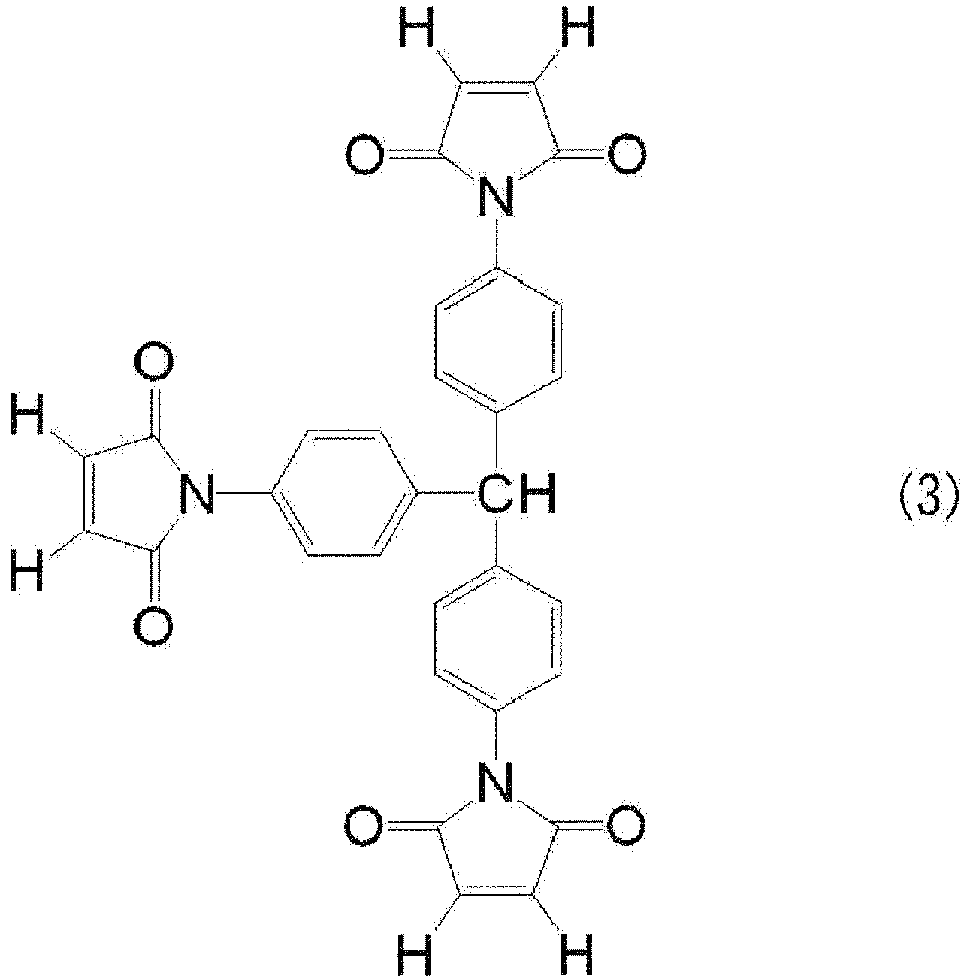
- Specific examples of the maleimide compound include a compound represented by the following Formulas (1) to (3).
- Ar represents a divalent group including an aromatic ring
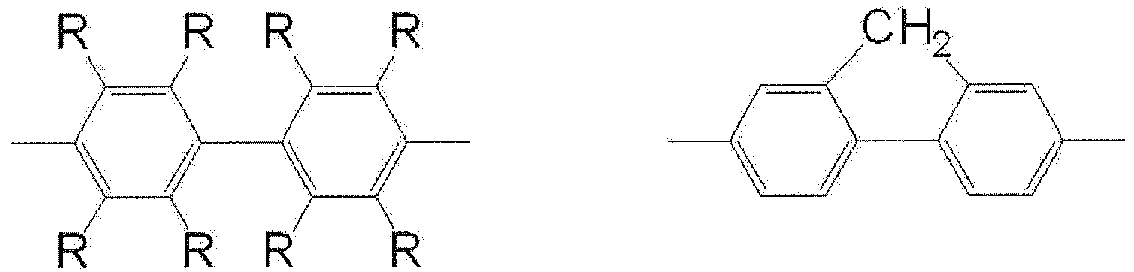
- R represents a hydrogen atom, an alkyl group having 1 to 4 carbon atoms, an alkoxy group having 1 to 4 carbon atoms, or -CF 3 .
- Specific examples of the structure of the divalent group represented by Ar include the following structures.
- n is 0 or a positive number.
- the cyanate ester resin is not particularly limited, and can be selected depending on the intended use.
- Specific examples of the cyanate ester resin include a cyanate ester resin having a novolac backbone, such as a phenol novolac cyanate ester and a cresol novolac cyanate esters (e.g., a cyanate ester resin represented by the following Formula (4)); a divalent cyanate ester resin such as bis(3,5-dimethyl-4-cyanatephenyl)methane, bis(4-cyanatephenyl)methane, bis(3-methyl-4-cyanatephenyl)methane, bis(3-ethyl 4-cyanatephenyl)methane, bis(4-cyanatephenyl)-1,1-ethane, bis(4-cyanatephenyl)-2,2-propane, di(4-cyanatephenyl) ether, di(4-cyanatephenyl) thioether, 4,4'- ⁇ 1,3-
- n is an integer from 2 to 10.
- the content of the heat stabilizer in the epoxy resin composition is not particularly limited, and can be selected depending on the intended use. Whether or not the heat stabilizer exists in the epoxy resin composition can be determined by, for example, nuclear magnetic resonance spectroscopy (NMR) or a Fourier transform infrared spectroscopy (FT-IR).
- NMR nuclear magnetic resonance spectroscopy
- FT-IR Fourier transform infrared spectroscopy
- the epoxy resin composition of the invention can be produced by, for example, a method as described below. Specifically, said specific carboxylic acid compound, said epoxy resin, a curing agent, a curing accelerator, an inorganic filler, and, if necessary, other components are mixed by an ordinary method, and blended with a powder mixer. Then, the blend is melt-kneaded while heating with, for example, a mixing roll or an extrusion kneader. Thereafter, the resultant is solidified by cooling at room temperature, thereby obtaining an epoxy resin composition.
- the epoxy resin composition may be crushed by a known means into a powder having a desired particle size, and the powder may be formed into tablets of a desired shape.
- the particle size of the powder and the size of the tablet are not particularly limited, and can be selected depending on the intended use.
- the electronic component device of the invention includes an electronic component and a cured product of the epoxy resin composition of the invention, and the cured product encapsulates the electronic component.
- the electronic component device of the invention has excellent reliability, because the electronic component is encapsulated with the epoxy resin composition of the invention.
- the epoxy resin composition of the invention exhibits excellent adhesion with respect to metallic materials. Therefore, the effect of the invention is more significant in a case in which an electronic component including a metallic material is encapsulated.
- the electronic component including a metallic material include electronic components that include a member that is made of metal or plated with metal. Specific examples thereof include a lead frame that is made of aluminum or has a surface treated by nickel electroplating or electroless nickel plating, to which conventional encapsulants could not exhibit sufficient adhesion.
- the method of encapsulating an electronic component with the epoxy resin composition of the invention is not particularly limited, and can be selected depending on the intended use.
- encapsulation can be performed by a known molding method such as transfer molding.
- the electronic component device include ICs, LSIs, and power devices.
- Components as described below were mixed at a ratio shown in Tables 1 to 4 (% by mass) at room temperature (25°C), and melt-kneaded with a roll kneader that was heated at from 80°C to 150°C. Then, the molten product was cooled to room temperature and an epoxy resin composition in a solid state was obtained. The epoxy resin composition was crushed to obtain a powder. The powder was formed into tablets having a truncated cone shape.
- a lead frame with electrolytic nickel plating (lead frame 1), a lead frame with electroless nickel plating (lead frame 2) and a lead frame made of aluminum (A6063) (lead frame 3) were cut into a size of approximately 8 mm x 8 mm to prepare a chip, respectively.
- the chip was sandwiched between a special mold, and the epoxy resin composition prepared in the Example or the Comparative Example was molded on the chip, thereby preparing a test piece.
- the molding was performed at a temperature of 175°C for 120 seconds, at a clamp pressure of 1962 MPa and a transfer pressure of 686.7 MPa. Further, post curing was performed by heating the test piece after the molding at 175°C for 5 hours.
- the shear adhesion (MPa) of the epoxy resin composition with respect to the chip was measured with a bond tester (Dage Japan Co.Ltd., Dage 4000).
- the temperature of the measurement table during the measurement was set at 25°C.
- the measurement was performed 6 times using 6 test pieces for each lead frame, respectively.
- the average values of the 6 measurements are shown in Tables 1 to 4.
- a test piece having a disc shape of 5 cm in diameter and 1 mm in thickness was prepared by molding the tablets of the epoxy resin compositions prepared in the Examples and the Comparative Examples with a pressing machine (Toho International Inc., TF15). The molding was performed at a temperature of 175°C for 120 seconds, at a clamp pressure of 1962 MPa and a transfer pressure of 686.7 MPa. Further, post curing was performed by heating the test piece after the molding at 175°C for 5 hours.
- test piece was dried in a drier at a temperature of 105°C for 1 hour, and the mass of the test piece when the temperature became room temperature (25°C) was measured (mass before the water absorption). Subsequently, the test piece was allowed to absorb water at a temperature of 121°C and a humidity of 100% for 48 hours, and the mass was measured (mass after the water absorption).
- the epoxy resin compositions prepared in Examples 13 to 36 and 42 to 47, in which a compound having a structure in which at least one carboxy group and at least one hydroxy group are bonded to a benzene ring is used exhibit superior results both in the adhesion with respect to a lead frame and the rate of change in water absorbency, among the specific carboxylic acid compounds. It is also found that the epoxy resin composition in which gallic acid is used exhibits significantly superior results both in the adhesion with respect to a lead frame and the rate of change in water absorbency. Further, it is found that the adhesion with respect to a lead frame can be further improved by adding a silicone compound, while suppressing the rate of change in water absorbency.
- the epoxy resin composition of Comparative Example 1 which does not include a specific carboxylic acid compound, does not exhibit adhesion with respect to any of lead frames 1 to 3.
- the epoxy resin compositions of Comparative Examples 2 to 4 which include a carboxylic acid ester instead of a specific carboxylic acid compound, do not exhibit sufficient adhesion with respect to a lead frame.
- the epoxy resin composition is suitable for encapsulation of a power device or the like, which uses a metallic material, and for production of a highly reliable semiconductor device.
Landscapes
- Chemical & Material Sciences (AREA)
- Health & Medical Sciences (AREA)
- Chemical Kinetics & Catalysis (AREA)
- Medicinal Chemistry (AREA)
- Polymers & Plastics (AREA)
- Organic Chemistry (AREA)
- Structures Or Materials For Encapsulating Or Coating Semiconductor Devices Or Solid State Devices (AREA)
- Epoxy Resins (AREA)
- Compositions Of Macromolecular Compounds (AREA)
Description
- The present invention relates to an epoxy resin composition and an electronic component device.
- Semiconductor elements such as transistors, integrated circuits (IC), and large scale integrations (LSI) are typically formed into a semiconductor device by encapsulating in a package such as a ceramic package or a plastic package. Ceramic packages have a superior resistance to high-temperature and high-humidity environments and a superior mechanical strength, due to the material thereof being highly resistant with respect to heat and humidity, and are capable of providing highly reliable encapsulation.
- However, ceramic packages have problems such as being relatively expensive in material costs and being less suitable for mass production. Therefore, plastic packages, which use a resin for encapsulation, have been becoming predominant. As for the material for encapsulation in plastic packages, an epoxy resin composition has been suitably used due to its excellent heat resistance.
- In the fields of automobiles, large home electronic appliances, industrial equipments and other industries, power devices such as transistors, diodes and thyristors are used as semiconductor devices for high-power regulation. These power devices produce a large amount of heat upon being subjected to a high voltage. Therefore, the power devices are provided with a lead frame that exhibits excellent heat radiation, such as a nickel-plated lead frame or an aluminum lead frame. However, these lead frames typically are less adhesive with respect to an encapsulating resin, as compared to a frame made of copper or an alloy such as 42 alloy. As a result, detachment from the encapsulating resin is likely to occur in a package. The detachment tends to decrease heat conductivity in the encapsulating resin and lower the reliability of the device. Against this background, development of a resin composition for encapsulation, which exhibits a favorable adhesion with respect to metallic materials that exhibit poor adhesion with respect to an encapsulating resin, has been demanded.
- As an attempt to improve the adhesion of an epoxy resin composition for encapsulating a semiconductor device (hereinafter, also referred to as an "epoxy resin composition") with respect to metallic materials, for example, Japanese Patent Application Laid-Open (
JP-A) No. 2002-206016 JP-A) No. H03-119049 JP-A-63 22 56 16 - However, in the fields of using metallic materials, such as power devices, there is a demand for an epoxy resin composition that exhibits further improved adhesion with respect to metallic materials, as compared to the epoxy resin compositions obtained by the methods as described above.
- In view of the above, the invention provides an epoxy resin composition that exhibits excellent adhesion with respect to metallic materials, and an electronic component device in which detachment of an encapsulating resin from a metallic material is suppressed.
- The method for solving the above problems is as described below.
- (1) An epoxy resin composition, comprising an epoxy resin, a curing agent, a curing accelerator, an inorganic filler, and a carboxylic acid compound that satisfies at least one selected from the group consisting of the following A, B, and C:
- A: having at least one carboxy group and at least one hydroxy group;
- B: having at least two carboxy groups; and
- C: having a structure in which two carboxy groups are condensed by dehydration, wherein the carboxylic acid compound comprises gallic acid, and wherein the epoxy resin comprises a resin selected from the group consisting of triphenylmethane epoxy resin, dicyclopentadiene epoxy resin, and biphenyl epoxy resin.
- (2) The epoxy resin composition according to (1), further comprising a silicone compound.
- (3) The epoxy resin composition according to (1) or (2), being in the form of a powder or a tablet.
- (4) An electronic component device, comprising:
- an electronic component; and
- a cured product of the epoxy resin composition according to any one of (1) to (3), the cured product encapsulating the electronic component.
- According to the invention, an epoxy resin composition that exhibits excellent adhesion with respect to metallic materials, and an electronic component device in which detachment of an encapsulating resin from a metallic material is suppressed, can be provided.
- The term "process" as used herein encompasses not only an individual process but also a process that is not clearly distinguished from another process, if a desired object of the process is achieved. The numerical range expressed as "from ... to ..." indicate a range including the values before and after the "to" as a minimum value and a maximum value. When there are plural substances that correspond to the same component, the content of the component refers to the total content of the substances, unless otherwise specified. The term "layer" as used herein encompasses configurations of partially formed shape, as viewed from the top, in addition to configurations of entirely formed shape.
- The epoxy resin composition of the invention includes an epoxy resin, a curing agent, a curing accelerator, an inorganic filler, and a carboxylic acid compound as defined in the claims.
- The epoxy resin composition of the invention exhibits excellent adhesion with respect to metallic materials by including the specific carboxylic acid compound.
- A presumed reason why the epoxy resin composition including the specific carboxylic acid compound exhibits excellent adhesion with respect to metallic materials is that a hydroxy group or a metal atom, or both, existing at a surface of a metallic material such as a lead frame, is chemically bonded with a carboxy group (including a carboxy group that is formed as a result of hydrolyzation of dehydrated and condensed carboxy groups) and a hydroxy group, of the specific carboxylic acid compound, i.e. gallic acid. As a result, it is presumed that the adhesion between the epoxy resin composition and the metallic material is enhanced and the adhesion is improved.
- The epoxy resin composition, including said specific carboxylic acid compound, exhibits excellent adhesion with respect to metals that are low in adhesion with respect to an epoxy resin composition, such as nickel and aluminum. The composition also exhibits excellent adhesion with respect to other metals such as copper, gold, silver and palladium, and to a resist layer formed on a wiring board or the like.
- The epoxy resin composition of the invention includes a carboxylic acid compound is gallic acid (3,4,5-trihydroxybenzoic acid).
- The content of the specific carboxylic acid compound in the epoxy resin composition is not particularly limited. From the viewpoint of sufficiently improving the adhesion of the epoxy resin composition, the content of the specific carboxylic acid compound is preferably determined such that the value calculated by the following equation is 0.01 or more, preferably 0.2 or more, more preferably 0.4 or more, and still more preferably 0.8 or more.

- From the viewpoint of suppressing an increase in water absorption of the epoxy resin composition, the content of the specific carboxylic acid compound is preferably determined such that the value calculated by the above equation is 30 or less, preferably 21 or less, more preferably 18 or less, and still more preferably 15 or less.
- When the content of the specific carboxylic acid compound satisfies the conditions as described above, a favorable adhesion tends to be achieved while suppressing an increase in water absorption. As a result, reliability of the electronic component device tends to improve. Whether or not the specific carboxylic acid compound exists in the epoxy resin composition can be determined by, for example, nuclear magnetic resonance spectroscopy (NMR) or high-performance liquid chromatography (HPLC).
- The epoxy resin composition of the invention includes an epoxy resin. The type of the epoxy resin dicyclopentadiene epoxy resin, biphenyl epoxy resin, and triphenylmethane epoxy resin.
- The epoxy resin to be used in the epoxy resin composition of the invention has a melting point or a softening point that is higher than room temperature (25°C). In a case in which the epoxy resin composition is used for encapsulating a power device, it is preferable to use an epoxy resin that can allow the epoxy resin composition to have a Tg of 175°C or higher, after being cured. Examples of the epoxy resin that satisfies the condition as described above include triphenylmethane epoxy resin. In a case in which the epoxy resin composition is used for encapsulating a ball grid array (BGA), it is preferable to use an epoxy resin that is low in viscosity and water absorption. Examples of the epoxy resin that satisfies the condition as described above include biphenyl epoxy resins.
- The epoxy resin composition of the invention includes a curing agent. The type of the curing agent is not particularly limited, and can be selected depending on the intended use. The curing agent may be used singly, or in combination of two or more kinds thereof. Specific examples of the curing agent include polyfunctional phenolic resins such as dicyclopentadiene phenolic resin, phenol novolac resin, cresol novolac resin, phenol aralkyl resin, biphenyl phenolic resin, and triphenylmethane phenolic resin.
- The curing agent to be used in the epoxy resin composition of the invention preferably has a melting point or a softening point that is higher than room temperature (25°C). In a case in which the epoxy resin composition is used for encapsulating a power device, it is preferable to use a curing agent that can allow the epoxy resin composition to have a Tg of 175°C or higher, after being cured. Examples of the curing agent that satisfies the condition as described above include triphenylmethane phenolic resin and phenol novolac resin.
- The ratio of the content of the epoxy resin to the content of the curing agent in the epoxy resin composition is preferably determined such that the content of the curing agent is sufficient to cure the epoxy resin. Specifically, in a case of using a phenolic resin as the curing agent, the ratio is preferably determined such that the hydroxy group equivalent in the phenolic resin per equivalent of epoxy group in the epoxy resin is from 0.6 to 1.5.
- The epoxy resin composition of the invention includes a curing accelerator. The type of the curing accelerator is not particularly limited, and can be selected depending on the intended use. The curing accelerator may be used singly, or in combination of two or more kinds thereof. Specific examples of the curing accelerator include an organophosphorus compound such as tetraphenylphosphonium tetraphenylborate and triphenylphosphine, an imidazole compound such as 2-methylimidazole and phenylimidazole, and a tertiary amine compound such as 1,8-diazabicyclo(5.4.0)undecene-7 (DBU) and 1,5-diazabicyclo(4.3.0)nonene-5 (DBN). From the viewpoint of curability and adhesion of the epoxy resin composition, an imidazole compound is preferred.
- The content of the curing accelerator in the epoxy resin composition is not particularly limited, and can be selected depending on the intended use. From the viewpoint of obtaining a sufficient effect of accelerating the curing, the content of the curing accelerator is preferably determined such that the mass of the curing accelerator, where the mass of the curing agent is 100, is preferably 0.001 or more, more preferably 0.01 or more. From the viewpoint of suppressing changes in color of a cured product of the epoxy resin composition, the mass of the curing accelerator, where the mass of the curing agent is 100, is preferably 15.0 or less, preferably 10.0 or less.
- The epoxy resin composition of the invention includes an inorganic filler. The type of the inorganic filler is not particularly limited, and can be selected depending on the intended use. The inorganic filler may be used singly, or in combination of two or more kinds thereof.
- Specific examples of the inorganic filler include a powder of quartz glass, talc, silica such as fused silica and crystalline silica, alumina, aluminum nitride, and silicon nitride. The inorganic filler to be used in the epoxy resin composition of the invention may be of any state, such as crushed, spherical, or triturated. From the viewpoint of reducing a coefficient of linear expansion of a cured product of the epoxy resin composition, a silica powder is preferred. From the viewpoint of increasing fillability and flowability, a fused silica powder is more preferred. Examples of the fused silica powder include a spherical fused silica powder and a crushed fused silica powder. From the viewpoint of flowability, a spherical fused silica powder is preferred.
- The average particle size of the inorganic filler is not particularly limited, and can be selected depending on the intended use. For example, the average particle size of the inorganic filler can be in the range of from 1 µm to 50 µm, and is preferably in the range of from 2 µm to 40 µm. As used herein, the "average particle size of inorganic filler" is defined as an average value determined by laser diffraction/scattering particle size distribution analysis. The average particle size can be determined with, for example, a laser diffraction/scattering particle size distribution analyzer (e.g., LA-920 from HORIBA, Ltd.) and a measurement sample that is randomly taken from the population.
- In the epoxy resin composition of the invention, two or more inorganic fillers having different volume average particle sizes may be used in combination. From the viewpoint of improving flowability, for example, an inorganic filler having a volume average particle size in the range of from 1 µm to 50 µm or in the range of from 2 µm to 40 µm and an inorganic filler having a volume average particle size in the range of from 0.5 µm to 2 µm may be used in combination. In a case in which two or more inorganic fillers having different volume average particle sizes are used in combination, the mixing ratio of the inorganic fillers is not particularly limited, and can be selected depending on the intended use.
- The content of the inorganic filler in the epoxy resin composition is not particularly limited, and can be selected depending on the intended use. From the viewpoint of reducing the content of organic components in the epoxy resin composition to improve the flame resistance of a cured product, the content of the inorganic filler is preferably 50% by mass or more with respect to the total mass of the epoxy resin composition, more preferably 65% by mass or more. From the viewpoint of suppressing a reduction in flowability of the epoxy resin composition, the content of the inorganic filler is preferably 95% by mass or less with respect to the total mass of the epoxy resin composition, more preferably 92% by mass or less.
- The epoxy resin composition of the invention preferably includes a silicone compound. The silicone compound is a compound that may be used as a stress-reducing agent for the epoxy resin composition. When the epoxy resin composition includes the specific carboxylic acid compound and the silicone compound, adhesion of the epoxy resin composition tends to further improve.
- The silicone compound is a high molecular compound having, as a main backbone, a siloxane bond to which an organic group is bonded, and organic polysiloxane compounds that are commonly used can be used without any particular limitation.
- Specific examples of the silicone compound include dimethylpolysiloxane, methylhydrogenpolysiloxane, both-end hydrogenmethylpolysiloxane, methylphenylpolysiloxane, alkyl-modified polysiloxane, amino-modified polysiloxane, carboxyl-modified polysiloxane, epoxy-modified polysiloxane, epoxy/polyether-modified polysiloxane, alcohol-modified polysiloxane, polyether-modified polysiloxane, higher fatty acid-modified polysiloxane, vinyl group-containing polysiloxane, alkyl/polyether-modified polysiloxane, alkyl/aralkyl/polyether-modified polysiloxane, fluorine-modified polysiloxane, mercapto-modified polysiloxane, chloroalkyl-modified polysiloxane, and (meth)acryloyl-modified polysiloxane. The silicone compound may be used singly, or in combination of two or more kinds thereof. The silicone compound may be obtained as an industrial product or a reagent that is commercially available, or may be synthesized by a known method. The molecular weight of the silicone compound is not particularly limited, and can be selected depending on the intended use.
- The content of the silicone compound in the epoxy resin composition is not particularly limited, and can be selected depending on the intended use. From the viewpoint of obtaining sufficiently low stress properties and sufficient adhesion, the mass of the silicone compound, where the total mass of the epoxy resin, the curing agent and the curing accelerator is 100, is preferably 1.0 or more, more preferably 2.0 or more. From the viewpoint of suppressing an increase in water absorption, the mass of the silicone compound, where the total mass of the epoxy resin, the curing agent, and the curing accelerator is 100, is preferably 20.0 or less, more preferably 15.0 or less. Whether or not the silicone compound exists in the epoxy resin composition can be determined by, for example, nuclear magnetic resonance spectroscopy (NMR) or a Fourier transform infrared spectroscopy (FT-IR).
- The epoxy resin composition of the invention may include components other than the components as described above, as necessary. Specific examples of the other components include a mold release agent, a stress-reducing agent other than the silicone compound, a flame retardant, a pigment, an ion-trapping agent, a coupling agent, and a heat stabilizer.
- The type of the mold release agent is not particularly limited, and can be selected depending on the intended use. Examples of the mold release agent include a higher fatty acid, a higher fatty acid ester, and a higher fatty acid calcium. More specific examples include carnauba wax and polyethylene wax. The mold release agent may be used singly, or in combination of two or more kinds thereof.
- The type of the stress-reducing agent is not particularly limited, and can be selected depending on the intended use. Examples of the stress-reducing agent include a butadiene rubber such as a methyl acrylate-butadiene-styrene copolymer and a methyl methacrylate-butadiene-styrene copolymer, and the silicone compounds as described above. The stress-reducing agent may be used singly, or in combination of two or more kinds thereof. The inclusion of the stress-reducing agent tends to improve adhesiveness. In particular, inclusion of a silicone compound as a stress-reducing agent tends to improve both of low-stress properties and adhesion.
- The type of the flame retardant is not particularly limited, and can be selected depending on the intended use. Examples of the flame retardant include an organophosphorus compound, antimony oxide, and a metal hydroxide such as aluminum hydroxide and magnesium hydroxide. The flame retardant may be used singly, or in combination of two or more kinds thereof.
- The type of the pigment is not particularly limited, and can be selected depending on the intended use. Examples of the pigment include carbon black. The inclusion of carbon black tends to impart an electrostatic-eliminating effect. The pigment may be used singly, or in combination of two or more kinds thereof.
- The type of the ion-trapping agent is not particularly limited, and can be selected depending on the intended use. The inclusion of the ion-trapping agent tends to improve the reliability in terms of a moisture resistance reliability test. Examples of the ion-trapping agent include a hydrotalcite compound and bismuth hydroxide. The ion-trapping agent may be used singly, or in combination of two or more kinds thereof.
- The type of the coupling agent is not particularly limited, and can be selected depending on the intended use. Examples of the coupling agent include a silane coupling agent such as 3-mercaptopropyltrimethoxysilane and 3-glycidoxypropyltrimethoxysilane. The coupling agent may be used singly, or in combination of two or more kinds thereof.
- The type of the heat stabilizer is not particularly limited, and can be selected depending on the intended use. Examples of the heat stabilizer include a maleimide compound and a cyanate ester resin. The heat stabilizer may be used singly, or in combination of two or more kinds thereof.
- In the invention, the maleimide compound refers to a compound having two or more maleimide groups in one molecule. Specific examples of the maleimide compound include a compound represented by the following Formulas (1) to (3).

- In Formula (1), Ar represents a divalent group including an aromatic ring, and R represents a hydrogen atom, an alkyl group having 1 to 4 carbon atoms, an alkoxy group having 1 to 4 carbon atoms, or -CF3. Specific examples of the structure of the divalent group represented by Ar include the following structures.



- In Formula (2), n is 0 or a positive number.
- The cyanate ester resin is not particularly limited, and can be selected depending on the intended use. Specific examples of the cyanate ester resin include a cyanate ester resin having a novolac backbone, such as a phenol novolac cyanate ester and a cresol novolac cyanate esters (e.g., a cyanate ester resin represented by the following Formula (4)); a divalent cyanate ester resin such as bis(3,5-dimethyl-4-cyanatephenyl)methane, bis(4-cyanatephenyl)methane, bis(3-methyl-4-cyanatephenyl)methane, bis(3-ethyl 4-cyanatephenyl)methane, bis(4-cyanatephenyl)-1,1-ethane,
bis(4-cyanatephenyl)-2,2-propane, di(4-cyanatephenyl) ether, di(4-cyanatephenyl) thioether, 4,4'-{1,3-phenylenebis(1-methylethylidene)}biphenyl cyanate, and
2,2-bis(4-cyanatephenyl)-1,1,1,3,3,3-hexafluoropropane; a trivalent cyanate ester resin, such as tris(4-cyanatephenyl)-1,1,1-ethane and
bis(3,5-dimethyl-4-cyanatephenyl)-4-cyanatephenyl-1,1,1-ethane; and a polyvalent cyanate ester oligomer resin, i.e., a partially trimerized compounds of the cyanate ester resin as described above. The cyanate ester resin may be in a state of a liquid or a solid, and can be selected depending on the intended use.
- In Formula (4), n is an integer from 2 to 10.
- The content of the heat stabilizer in the epoxy resin composition is not particularly limited, and can be selected depending on the intended use. Whether or not the heat stabilizer exists in the epoxy resin composition can be determined by, for example, nuclear magnetic resonance spectroscopy (NMR) or a Fourier transform infrared spectroscopy (FT-IR).
- The epoxy resin composition of the invention can be produced by, for example, a method as described below. Specifically, said specific carboxylic acid compound, said epoxy resin, a curing agent, a curing accelerator, an inorganic filler, and, if necessary, other components are mixed by an ordinary method, and blended with a powder mixer. Then, the blend is melt-kneaded while heating with, for example, a mixing roll or an extrusion kneader. Thereafter, the resultant is solidified by cooling at room temperature, thereby obtaining an epoxy resin composition. The epoxy resin composition may be crushed by a known means into a powder having a desired particle size, and the powder may be formed into tablets of a desired shape. The particle size of the powder and the size of the tablet are not particularly limited, and can be selected depending on the intended use.
- The electronic component device of the invention includes an electronic component and a cured product of the epoxy resin composition of the invention, and the cured product encapsulates the electronic component. The electronic component device of the invention has excellent reliability, because the electronic component is encapsulated with the epoxy resin composition of the invention.
- The epoxy resin composition of the invention exhibits excellent adhesion with respect to metallic materials. Therefore, the effect of the invention is more significant in a case in which an electronic component including a metallic material is encapsulated. Examples of the electronic component including a metallic material include electronic components that include a member that is made of metal or plated with metal. Specific examples thereof include a lead frame that is made of aluminum or has a surface treated by nickel electroplating or electroless nickel plating, to which conventional encapsulants could not exhibit sufficient adhesion.
- The method of encapsulating an electronic component with the epoxy resin composition of the invention is not particularly limited, and can be selected depending on the intended use. For example, encapsulation can be performed by a known molding method such as transfer molding. Examples of the electronic component device include ICs, LSIs, and power devices.
- In the following, the invention will be described with reference to the Examples. However, the invention is not limited thereto.
- Components as described below were mixed at a ratio shown in Tables 1 to 4 (% by mass) at room temperature (25°C), and melt-kneaded with a roll kneader that was heated at from 80°C to 150°C. Then, the molten product was cooled to room temperature and an epoxy resin composition in a solid state was obtained. The epoxy resin composition was crushed to obtain a powder. The powder was formed into tablets having a truncated cone shape.
-
- Specific carboxylic acid compound 1: trimellitic anhydride
- Specific carboxylic acid compound 2: oxalic acid
- Specific carboxylic acid compound 3: maleic acid
- Specific carboxylic acid compound 4: gallic acid (inventive)
- Specific carboxylic acid compound 5: 5-hydroxyisophthalic acid
- Specific carboxylic acid compound 6: 2-hydroxybenzoic acid
- Specific carboxylic acid compound 7: 3-hydroxybenzoic acid
- Specific carboxylic acid compound 8: 4-hydrozybenzoic acid
- Specific carboxylic acid compound 9: 2,4-dihydroxybenzoic acid
- Specific carboxylic acid compound 10: 2,5-dihydroxybenzoic acid
- Specific carboxylic acid compound 11: 2,6-dihydroxybenzoic acid
- Specific carboxylic acid compound 12: 3,4-dihydroxybenzoic acid
- Specific carboxylic acid compound 13: 3,5-dihydroxybenzoic acid
- Specific carboxylic acid compound 14: tartaric acid
- Specific carboxylic acid compound 15: citric acid
- Specific carboxylic acid compound 16: malic acid
- Specific carboxylic acid compound 17: N-(2-hydroxyethyl)iminodiacetic acid
- Specific carboxylic acid compound 18: N,N-di(2-hydroxyethyl)glycine
-
- Carboxylic acid ester 1: methyl gallate
- Carboxylic acid ester 2: ethyl gallate
- Carboxylic acid ester 3: propyl gallate
-
- Epoxy resin 1: triphenylmethane epoxy resin (epoxy equivalent: 169, melting point: 60°C)
- Epoxy resin 2: dicyclopentadiene epoxy resin (epoxy equivalent: 258, melting point: 60°C)
- Epoxy resin 3: cresol novolac epoxy resin (epoxy equivalent: 200, melting point: 65° C) (comparative)
- Epoxy resin 4: biphenyl epoxy resin (epoxy equivalent: 193, melting point: 105°C)
-
- Curing agent 1: phenol novolac resin (hydroxy group equivalent: 105, melting point: 83°C)
- Curing agent 2: phenol aralkyl resin (hydroxy group equivalent: 170, melting point: 62°C)
- Curing agent 3: triphenylmethane phenol resin (hydroxy group equivalent: 97, melting point: 111°C)
-
- Curing accelerator 1: 1,5-diazabicyclo[4.3.0]non-5-ene
- Curing accelerator 2: 2-phenyl-4-methyl-5-hydroxymethylimidazole
- Curing accelerator 3: tetraphenylphosphonium tetraphenylborate (Hokko Chemical Industry Co. Ltd., TPP-K)
-
- Silicone compound 1: epoxy/polyether-modified silicone oil (Dow Corning Toray Co., Ltd., SF8421EG)
- Silicone compound 2: epoxy/polyether-modified silicone oil (Dow Corning Toray Co., Ltd., BY16-876)
-
- Mold release agent 1: carnauba wax
- Mold release agent 2: oxidized polyethylene wax (acid value: 17)
- Carbon black
- Aluminum hydroxide
- (3-mercaptopropyl)trimethoxysilane
-
- Heat stabilizer 1: 2,2-bis[4-(4-aminophenoxy)phenyl]propane (Daiwakasei Industry Co., Ltd., BMI-4000)
- Heat stabilizer 2: maleimide compound of Formula (2) in which n is 0.35 (Daiwakasei Industry Co., Ltd., BMI-2300)
- Heat stabilizer 3: cyanate ester resin of Formula (4) in which n is 2 to 10 (Lonza Japan, PT-60)
- Heat stabilizer 4: bis(3,5-dimethyl-4-cyanatephenyl)methane (Lonza Japan, BA-3000)
- Adhesion with respect to a lead frame and water absorbency of the epoxy resin compositions prepared in the Examples and the Comparative Examples were measured and evaluated in accordance with the following methods. The results are shown in Tables 1 to 4.
- A lead frame with electrolytic nickel plating (lead frame 1), a lead frame with electroless nickel plating (lead frame 2) and a lead frame made of aluminum (A6063) (lead frame 3) were cut into a size of approximately 8 mm x 8 mm to prepare a chip, respectively. The chip was sandwiched between a special mold, and the epoxy resin composition prepared in the Example or the Comparative Example was molded on the chip, thereby preparing a test piece. The molding was performed at a temperature of 175°C for 120 seconds, at a clamp pressure of 1962 MPa and a transfer pressure of 686.7 MPa. Further, post curing was performed by heating the test piece after the molding at 175°C for 5 hours. Thereafter, the shear adhesion (MPa) of the epoxy resin composition with respect to the chip was measured with a bond tester (Dage Japan Co.Ltd., Dage 4000). The temperature of the measurement table during the measurement was set at 25°C. The measurement was performed 6 times using 6 test pieces for each lead frame, respectively. The average values of the 6 measurements are shown in Tables 1 to 4.
- A test piece having a disc shape of 5 cm in diameter and 1 mm in thickness was prepared by molding the tablets of the epoxy resin compositions prepared in the Examples and the Comparative Examples with a pressing machine (Toho International Inc., TF15). The molding was performed at a temperature of 175°C for 120 seconds, at a clamp pressure of 1962 MPa and a transfer pressure of 686.7 MPa. Further, post curing was performed by heating the test piece after the molding at 175°C for 5 hours.
- Thereafter, the test piece was dried in a drier at a temperature of 105°C for 1 hour, and the mass of the test piece when the temperature became room temperature (25°C) was measured (mass before the water absorption). Subsequently, the test piece was allowed to absorb water at a temperature of 121°C and a humidity of 100% for 48 hours, and the mass was measured (mass after the water absorption).
- The water absorbency (%) was calculated from the mass before the water absorption and the mass after the water absorption of the test piece, by the following formula. The results are shown in Tabled 1 to 4.

- The rate of change in water absorbency of the test piece was calculated by the following formula. The value is based on the water absorbency of the test piece prepared in Comparative Example 1, in which a specific carboxylic acid compound was not used.

Table 1 Examples 1 2 3 4 5 6 7 8 9 10 11 12 13 A 1 0.032 0.049 0.08 0.16 0.41 0.81 1.21 1.62 2.02 2.43 2 0.41 3 0.41 4 0.03 5 6 7 8 Specific carboxylic acid compound 9 10 11 12 13 14 15 16 17 18 Carboxylic acid ester 1 2 3 B Epoxy resin 1 9.676 9.666 9.65 9.61 9.43 9.20 8.98 8.75 8.52 8.30 9.43 9.43 9.68 2 3 4 C Curing agent 1 5.963 5.957 5.95 5.90 5.84 5.66 5.48 5.30 5.12 4.95 5.84 5.84 5.96 2 3 D Curing accelerator 1 0.157 0.157 0.16 0.16 0.16 0.16 0.16 0.16 0.16 0.16 0.16 0.16 0.16 2 3 E Silicone compound 1 2 F Inorganic filler 73.26 73.26 73.26 73.26 73.26 73.26 73.26 73.26 73.26 73.26 73.26 73.26 73.26 G Flame retardant 9.72 9.72 9.72 9.72 9.72 9.72 9.72 9.72 9.72 9.72 9.72 9.72 9.72 H Mold release agent 1 0.25 0.25 0.25 0.25 0.25 0.25 0.25 0.25 0.25 0.25 0.25 0.25 0.25 2 0.08 0.08 0.08 0.08 0.08 0.08 0.08 0.08 0.08 0.08 0.08 0.08 0.08 I Pigment 0.60 0.60 0.60 0.60 0.60 0.60 0.60 0.60 0.60 0.60 0.60 0.60 0.60 J Coupling agent 0.26 0.26 0.26 0.26 0.26 0.26 0.26 0.26 0.26 0.26 0.26 0.26 0.26 K Heat stabilizer 1 2 3 4 A/(B + C + D) × 100 0.21 0.31 0.51 1.03 2.63 5.39 8.31 11.40 14.67 18.13 2.63 2.63 0.21 Adhesion (lead frame) 1 1.9 2.0 2.3 3.0 5.2 9.3 9.5 11.2 12.1 15.0 4.0 2.2 1.5 2 1.5 1.5 2.0 2.3 5.2 6.7 7.6 10.0 9.8 11.0 3.9 2.0 1.3 3 2.8 3.5 4.0 4.7 5.0 8.6 9.8 10.2 12.0 13.5 3.5 2.8 3.2 Water absorbency (%) 0.72 0.81 0.86 0.89 0.98 1.01 1.03 1.05 1.06 1.14 1.15 1.15 0.71 Rate of change in water absorbency (%) 2.8 13.6 18.6 21.3 28.6 30.7 32.0 33.3 34.0 38.6 39.1 39.1 1.4 Table 2 Examples 14 15 16 17 18 19 20 21 22 23 24 25 26 27 A 1 2 3 4 0.08 0.16 0.41 0.41 0.41 0.41 1.21 1.21 1.62 2.43 0.41 0.41 0.41 0.41 5 6 7 8 Specific carboxylic acid compound 9 10 11 12 13 14 15 16 17 18 Carboxylic acid ester 1 2 3 B Epoxy resin 1 9.65 9.61 9.43 9.43 8.93 8.93 8.98 8.57 8.75 8.30 10.50 2 11.32 3 10.35 4 9.30 C Curing agent 1 5.95 5.90 5.84 5.84 5.53 5.53 5.48 5.08 5.30 4.95 4.80 3.50 2 5.37 3 4.68 D Curing accelerator 1 0.16 0.16 0.16 0.16 0.16 0.16 0.16 2 0.16 0.15 0.15 0.60 0.24 3 0.27 0.75 E Silicone compound 1 0.81 0.81 2 0.81 F Inorganic filler 73.26 73.26 73.26 73.26 73.26 73.26 73.26 73.26 73.26 73.26 73.26 73.26 73.26 73.26 G Flame retardant 9.72 9.72 9.72 9.72 9.72 9.72 9.72 9.72 9.72 9.72 9.72 9.72 9.72 9.72 H Mold release agent 1 0.25 0.25 0.25 0.25 0.25 0.25 0.25 0.25 0.25 0.25 0.25 0.25 0.25 0.25 2 0.08 0.08 0.08 0.08 0.08 0.08 0.08 0.08 0.08 0.08 0.08 0.08 0.08 0.08 I Pigment 0.60 0.60 0.60 0.60 0.60 0.60 0.60 0.60 0.60 0.60 0.60 0.60 0.60 0.60 J Coupling agent 0.26 0.26 0.26 0.26 0.26 0.26 0.26 0.26 0.26 0.26 0.26 0.26 0.26 0.26 K Heat stabilizer 1 2 3 4 A/(B + C + D) × 100 0.51 1.03 2.63 2.63 2.77 2.77 8.31 8.80 11.40 18.13 2.66 2.66 2.66 2.66 Adhesion (lead frame) 1 2.3 3.2 4.6 7.0 8.0 7.6 10.3 12.0 12.5 15.6 5.0 8.1 7.1 6.9 2 2.0 3.1 4.4 6.5 8.4 8.0 7.5 9.8 9.4 12.0 5.1 6.7 6.0 6.6 3 4.0 4.7 10.2 10.0 10.4 10.6 22.1 24.5 25.4 27.1 8.5 12.2 9.5 12.2 Water absorbency (%) 0.72 0.72 0.73 0.73 0.76 0.76 0.75 0.76 0.78 0.93 0.70 0.52 0.61 0.76 Rate of change in water absorbency (%) 2.2 2.8 3.6 3.6 7.4 7.4 6.7 8.0 10.3 24.7 0.0 -34.6 -14.8 7.9 Table 3 Examples 28 29 30 31 32 33 34 35 36 37 38 39 40 A 1 2 3 4 5 0.41 6 0.41 7 0.41 8 0.41 Specific carboxylic acid compound 9 0.41 10 0.41 11 0.41 12 0.41 13 0.41 14 0.16 15 0.16 16 0.16 17 0.16 18 Carboxylic acid ester 1 2 3 B Epoxy resin 1 9.43 9.43 9.43 9.43 9.43 9.43 9.43 9.43 9.43 9.61 9.61 9.61 9.61 2 3 4 C Curing agent 1 5.84 5.84 5.84 5.84 5.84 5.84 5.84 5.84 5.84 5.90 5.90 5.90 5.90 2 3 D Curing accelerator 1 0.16 0.16 0.16 0.16 0.16 0.16 0.16 0.16 0.16 0.16 0.16 0.16 0.16 2 3 E Silicon compound 1 2 F Inorganic filler 73.26 73.26 73.26 73.26 73.26 73.26 73.26 73.26 73.26 73.26 73.26 73.26 73.26 G Flame retardant 9.72 9.72 9.72 9.72 9.72 9.72 9.72 9.72 9.72 9.72 9.72 9.72 9.72 H Mold release agent 1 0.25 0.25 0.25 0.25 0.25 0.25 0.25 0.25 0.25 0.25 0.25 0.25 0.25 2 0.08 0.08 0.08 0.08 0.08 0.08 0.08 0.08 0.08 0.08 0.08 0.08 0.08 I Pigment 0.60 0.60 0.60 0.60 0.60 0.60 0.60 0.60 0.60 0.60 0.60 0.60 0.60 J Coupling agent 0.26 0.26 0.26 0.26 0.26 0.26 0.26 0.26 0.26 0.26 0.26 0.26 0.26 K Heat stabilizer 1 2 3 4 A/(B + C + D) × 100 2.63 2.63 2.63 2.63 2.63 2.63 2.63 2.63 2.63 1.03 1.03 1.03 1.03 Adhesion (lead frame) 1 4.2 3.0 0.0 3.3 4.0 3.9 3.7 3.4 3.8 5.0 4.1 6.8 4.5 2 3.5 2.6 2.2 3.0 3.2 2.8 3.1 3.1 2.9 5.1 7.1 7.5 6.9 3 2.5 2.0 1.9 2.3 3.2 2.0 2.7 1.8 2.0 6.0 4.6 6.3 7.0 Water absorbency (%) 0.80 0.74 0.72 0.72 0.71 0.75 0.75 0.75 0.73 0.98 0.99 0.98 0.93 Rate of change in water absorbency (%) 12.5 5.7 2.6 2.6 1.4 6.7 6.7 6.7 4.1 28.6 29.3 28.6 24.7 Table 4 Examples Comparative Examples 41 42 43 44 45 46 47 48 49 1 2 3 4 A 1 0.02 3.24 2 3 4 0.41 0.41 0.41 0.41 0.02 3.24 5 6 7 8 Specific carboxylic acid compound 9 10 11 12 13 14 15 16 17 18 0.16 Carboxylic acid ester 1 0.41 2 0.41 3 0.41 B Epoxy resin 1 9.61 4.72 4.72 4.72 4.72 9.67 7.84 9.67 7.84 9.72 9.43 9.43 9.43 2 3 4 C Curing agent 1 5.90 2.92 2.92 2.92 2.92 5.98 4.59 5.98 4.59 6.02 5.84 5.84 5.84 2 3 D Curing accelerator 1 0.16 0.16 0.16 0.16 0.16 0.09 0.16 0.16 0.16 2 0.08 0.08 0.08 0.08 3 E Silicone compound 1 2 F Inorganic filler 73.26 73.26 73.26 73.26 73.26 73.26 73.26 73.26 73.26 73.26 73.26 73.26 73.26 G Flame retardant 9.72 9.72 9.72 9.72 9.72 9.72 9.72 9.72 9.72 9.72 9.72 9.72 9.72 H Mold release agent 1 0.25 0.25 0.25 0.25 0.25 0.25 0.25 0.25 0.25 0.25 0.25 0.25 0.25 2 0.08 0.08 0.08 0.08 0.08 0.08 0.08 0.08 0.08 0.08 0.08 0.08 0.08 I Pigment 0.60 0.60 0.60 0.60 0.60 0.60 0.60 0.60 0.60 0.60 0.60 0.60 0.60 J Coupling agent 0.26 0.26 0.26 0.26 0.26 0.26 0.26 0.26 0.26 0.26 0.26 0.26 0.26 K Heat stabilizer 1 7.71 2 7.71 3 7.71 4 7.71 A/(B + C + D) × 100 1.03 5.25 5.25 5.25 5.25 0.10 25.73 0.10 25.73 0.00 2.63 2.63 2.63 Adhesion (lead frame) 1 6.1 5.0 4.9 7.0 8.2 0.6 16.2 0.8 10.2 0.0 0.1 0.1 0.1 2 7.0 4.8 5.0 6.9 7.0 0.6 15.0 0.7 10.3 0.0 0.0 0.0 0.0 3 8.1 11.0 10.5 13.0 15.2 1.2 27.5 0.8 12.0 0.0 1.0 0.9 0.3 Water absorbency (%) 0.97 0.68 0.70 0.65 0.64 0.71 1.16 0.74 1.20 0.70 0.71 0.72 0.72 Rate of change in water absorbency (%) 27.8 -2.9 0.0 -7.7 -9.4 1.4 39.7 5.4 41.7 Ref. 1.4 2.8 2.8 - From the measurement results as described above, it is found that the epoxy resin compositions prepared in the Examples according to the invention 13-23, 25-27 and 42-47 exhibit a high adhesion with respect to any of lead frames 1 to 3. The other Examples are comparative.
- The epoxy resin compositions prepared in Examples 13 to 36 and 42 to 47, in which a compound having a structure in which at least one carboxy group and at least one hydroxy group are bonded to a benzene ring is used, exhibit superior results both in the adhesion with respect to a lead frame and the rate of change in water absorbency, among the specific carboxylic acid compounds. It is also found that the epoxy resin composition in which gallic acid is used exhibits significantly superior results both in the adhesion with respect to a lead frame and the rate of change in water absorbency. Further, it is found that the adhesion with respect to a lead frame can be further improved by adding a silicone compound, while suppressing the rate of change in water absorbency.
- The epoxy resin composition of Comparative Example 1, which does not include a specific carboxylic acid compound, does not exhibit adhesion with respect to any of lead frames 1 to 3. The epoxy resin compositions of Comparative Examples 2 to 4, which include a carboxylic acid ester instead of a specific carboxylic acid compound, do not exhibit sufficient adhesion with respect to a lead frame.
- In view of the above, the epoxy resin composition is suitable for encapsulation of a power device or the like, which uses a metallic material, and for production of a highly reliable semiconductor device.
Claims (4)
- An epoxy resin composition, comprising an epoxy resin, a curing agent, a curing accelerator, an inorganic filler, and a carboxylic acid compound that satisfies at least one selected from the group consisting of the following A, B and C below:A: having at least one carboxy group and at least one hydroxy group;B: having at least two carboxy groups; andC: having a structure in which two carboxy groups are condensed by dehydration,wherein the carboxylic acid compound comprises gallic acid, and wherein the epoxy resin comprises a resin selected from the group consisting of triphenylmethane epoxy resin, dicyclopentadiene epoxy resin, and biphenyl epoxy resin.
- The epoxy resin composition according to claim 1, further comprising a silicone compound.
- The epoxy resin composition according to claim 1 or 2, being in the form of a powder or a tablet.
- An electronic component device, comprising:an electronic component; anda cured product of the epoxy resin composition according to any one of claims 1 to 3, the cured product encapsulating the electronic component.
Priority Applications (1)
| Application Number | Priority Date | Filing Date | Title |
|---|---|---|---|
| HUE13891005A HUE050051T2 (en) | 2013-08-05 | 2013-08-05 | Epoxy resin composition and electronic component device |
Applications Claiming Priority (1)
| Application Number | Priority Date | Filing Date | Title |
|---|---|---|---|
| PCT/JP2013/071185 WO2015019407A1 (en) | 2013-08-05 | 2013-08-05 | Epoxy resin composition and electronic component device |
Publications (3)
| Publication Number | Publication Date |
|---|---|
| EP3031859A1 EP3031859A1 (en) | 2016-06-15 |
| EP3031859A4 EP3031859A4 (en) | 2017-03-29 |
| EP3031859B1 true EP3031859B1 (en) | 2020-04-15 |
Family
ID=52460780
Family Applications (1)
| Application Number | Title | Priority Date | Filing Date |
|---|---|---|---|
| EP13891005.4A Active EP3031859B1 (en) | 2013-08-05 | 2013-08-05 | Epoxy resin composition and electronic component device |
Country Status (7)
| Country | Link |
|---|---|
| US (1) | US9796828B2 (en) |
| EP (1) | EP3031859B1 (en) |
| JP (1) | JPWO2015019407A1 (en) |
| KR (2) | KR102072060B1 (en) |
| CN (3) | CN107286580B (en) |
| HU (1) | HUE050051T2 (en) |
| WO (1) | WO2015019407A1 (en) |
Families Citing this family (10)
| Publication number | Priority date | Publication date | Assignee | Title |
|---|---|---|---|---|
| KR102322072B1 (en) * | 2015-04-30 | 2021-11-05 | 스미토모 베이클리트 컴퍼니 리미티드 | Resin composition for sealing and electronic component device |
| JP6537188B2 (en) * | 2016-02-19 | 2019-07-03 | 京セラ株式会社 | Molding material for sealing and electronic component device |
| CN105965710B (en) * | 2016-06-28 | 2019-03-22 | 常州大学 | A kind of preparation method and application of silicon rod gold steel wire cutting resin plate |
| US20190338171A1 (en) * | 2016-10-31 | 2019-11-07 | Sumitomo Bakelite Co., Ltd. | Thermally conductive paste and electronic device |
| JP7400473B2 (en) * | 2017-12-28 | 2023-12-19 | 株式会社レゾナック | Epoxy resin compositions for sealing ball grid array packages, cured epoxy resins, and electronic component devices |
| SG11202100277YA (en) * | 2018-08-10 | 2021-02-25 | Toray Industries | Polysiloxane-polyalkylene glycol block copolymer and method for producing same |
| JP7296578B2 (en) * | 2019-07-05 | 2023-06-23 | パナソニックIpマネジメント株式会社 | Semiconductor sealing composition and electronic component device |
| KR102522438B1 (en) * | 2021-05-14 | 2023-04-17 | 주식회사 케이씨씨 | Epoxy resin compositions |
| CN118525071A (en) * | 2021-12-24 | 2024-08-20 | 株式会社力森诺科 | Sealing material composition and electronic component device |
| CN117681455A (en) * | 2024-01-16 | 2024-03-12 | 上海熹贾精密技术有限公司 | A sealing component and its integrated vulcanization molding method |
Family Cites Families (18)
| Publication number | Priority date | Publication date | Assignee | Title |
|---|---|---|---|---|
| JPS63225616A (en) * | 1986-10-01 | 1988-09-20 | Toray Ind Inc | Resin composition for sealing semiconductor |
| JP2867471B2 (en) | 1989-10-02 | 1999-03-08 | 東レ株式会社 | Resin composition |
| JPH053269A (en) * | 1991-06-25 | 1993-01-08 | Sumitomo Bakelite Co Ltd | Resin composite |
| JPH07179570A (en) * | 1993-12-22 | 1995-07-18 | Sumitomo Chem Co Ltd | Thermosetting resin composition and electronic component |
| JPH0892355A (en) * | 1994-09-26 | 1996-04-09 | Sumitomo Bakelite Co Ltd | Resin composition |
| CN1244038A (en) * | 1998-08-04 | 2000-02-09 | 长兴化学工业股份有限公司 | Resin composition for semiconductor encapsulation |
| JP3868179B2 (en) * | 1999-08-02 | 2007-01-17 | 住友ベークライト株式会社 | Liquid encapsulating resin composition, semiconductor device manufacturing method, and semiconductor device |
| JP3803033B2 (en) | 2001-01-11 | 2006-08-02 | 日東電工株式会社 | Semiconductor sealing resin composition and semiconductor device using the same |
| JP3606253B2 (en) * | 2001-11-27 | 2005-01-05 | 松下電工株式会社 | Epoxy resin composition and semiconductor device |
| JP2005314567A (en) * | 2004-04-28 | 2005-11-10 | Sumitomo Bakelite Co Ltd | Epoxy resin composition and semiconductor device |
| JP2006036974A (en) * | 2004-07-28 | 2006-02-09 | Nitto Denko Corp | Epoxy resin composition for sealing semiconductor and semiconductor device by using the same |
| KR101481196B1 (en) * | 2007-06-22 | 2015-01-09 | 가부시키가이샤 아데카 | One-pack type cyanate/epoxy composite resin composition |
| CN102204420B (en) * | 2008-11-06 | 2013-11-13 | 住友电木株式会社 | Method for manufacturing electronic device and electronic device |
| JP2012067177A (en) * | 2010-09-22 | 2012-04-05 | Nippon Soda Co Ltd | Biphenyl type epoxy resin composition for sealing semiconductor containing inclusion complex |
| JP2013023661A (en) * | 2011-07-25 | 2013-02-04 | Nitto Denko Corp | Epoxy resin composition for sealing semiconductor and semiconductor device using the same |
| JP4993031B2 (en) * | 2011-10-11 | 2012-08-08 | 住友ベークライト株式会社 | Insulating resin composition for multilayer printed wiring board, insulating sheet with substrate, multilayer printed wiring board, and semiconductor device |
| JP6003053B2 (en) * | 2011-12-14 | 2016-10-05 | 日立化成株式会社 | Photosensitive resin composition for protective film of printed wiring board for semiconductor package and semiconductor package |
| JP2013159746A (en) * | 2012-02-07 | 2013-08-19 | Nitto Denko Corp | Epoxy resin composition for sealing electronic component and electronic component device using the same |
-
2013
- 2013-08-05 JP JP2015530574A patent/JPWO2015019407A1/en active Pending
- 2013-08-05 CN CN201710308045.9A patent/CN107286580B/en active Active
- 2013-08-05 KR KR1020167004162A patent/KR102072060B1/en active Active
- 2013-08-05 CN CN202110375282.3A patent/CN113088036A/en active Pending
- 2013-08-05 HU HUE13891005A patent/HUE050051T2/en unknown
- 2013-08-05 US US14/909,557 patent/US9796828B2/en active Active
- 2013-08-05 EP EP13891005.4A patent/EP3031859B1/en active Active
- 2013-08-05 WO PCT/JP2013/071185 patent/WO2015019407A1/en not_active Ceased
- 2013-08-05 CN CN201380078710.XA patent/CN105452372A/en active Pending
- 2013-08-05 KR KR1020207002303A patent/KR20200011601A/en not_active Ceased
Non-Patent Citations (1)
| Title |
|---|
| None * |
Also Published As
| Publication number | Publication date |
|---|---|
| HUE050051T2 (en) | 2020-11-30 |
| KR20160040218A (en) | 2016-04-12 |
| EP3031859A4 (en) | 2017-03-29 |
| US20160177055A1 (en) | 2016-06-23 |
| CN113088036A (en) | 2021-07-09 |
| CN105452372A (en) | 2016-03-30 |
| KR102072060B1 (en) | 2020-01-31 |
| KR20200011601A (en) | 2020-02-03 |
| JPWO2015019407A1 (en) | 2017-03-02 |
| EP3031859A1 (en) | 2016-06-15 |
| CN107286580A (en) | 2017-10-24 |
| WO2015019407A1 (en) | 2015-02-12 |
| US9796828B2 (en) | 2017-10-24 |
| CN107286580B (en) | 2020-09-15 |
Similar Documents
| Publication | Publication Date | Title |
|---|---|---|
| US9796828B2 (en) | Epoxy resin composition and electronic component device | |
| TWI417338B (en) | Epoxy resin composition for semiconductor sealing and semiconductor device | |
| EP3029083B1 (en) | Resin composition for semiconductor encapsulation and semiconductor encapsulation method using same | |
| TWI527854B (en) | Epoxy resin composition and semiconductor device | |
| EP2602289A2 (en) | Epoxy resin composition for electronic parts encapsulation and electronic parts-equipped device using the same | |
| JP2013159746A (en) | Epoxy resin composition for sealing electronic component and electronic component device using the same | |
| JP2017186568A (en) | Epoxy resin composition and electronic component device | |
| JP7501117B2 (en) | Flame-retardant resin composition and structure | |
| KR100201708B1 (en) | Epoxy Resin Compositions for Semiconductor Device Sealing | |
| KR100189095B1 (en) | Epoxy resin compositions for sealing semiconductor precisely | |
| JP4759994B2 (en) | Epoxy resin composition and semiconductor device | |
| JP7501116B2 (en) | Flame-retardant resin composition and structure | |
| EP4317237B1 (en) | Resin composition for encapsulating and electronic device using same | |
| KR20100072720A (en) | Epoxy resin composition for encapsulating semiconductor device and semiconductor device using the same | |
| KR20160056500A (en) | Epoxy resin composition for encapsulating semiconductor device and semiconductor device encapsulated by using the same | |
| JP2019151852A (en) | Epoxy resin composition for encapsulating electronic component, and electronic component device | |
| KR100671129B1 (en) | Epoxy Resin Compositions for Semiconductor Device Sealing | |
| JP3093051B2 (en) | Epoxy resin composition | |
| JP5055778B2 (en) | Epoxy resin composition, epoxy resin molding material and semiconductor device | |
| JP2004339292A (en) | Resin composition for sealing and semiconductor | |
| JP2016056379A (en) | Epoxy resin composition for electronic component sealing and electronic component device using the same | |
| JP3568654B2 (en) | Epoxy resin composition | |
| KR19990001511A (en) | Epoxy Resin Compositions for Semiconductor Device Sealing | |
| TWI745696B (en) | Epoxy resin composition and electronic component device | |
| JPH05160300A (en) | Epoxy resin composition |
Legal Events
| Date | Code | Title | Description |
|---|---|---|---|
| PUAI | Public reference made under article 153(3) epc to a published international application that has entered the european phase |
Free format text: ORIGINAL CODE: 0009012 |
|
| 17P | Request for examination filed |
Effective date: 20160223 |
|
| AK | Designated contracting states |
Kind code of ref document: A1 Designated state(s): AL AT BE BG CH CY CZ DE DK EE ES FI FR GB GR HR HU IE IS IT LI LT LU LV MC MK MT NL NO PL PT RO RS SE SI SK SM TR |
|
| AX | Request for extension of the european patent |
Extension state: BA ME |
|
| DAX | Request for extension of the european patent (deleted) | ||
| A4 | Supplementary search report drawn up and despatched |
Effective date: 20170228 |
|
| RIC1 | Information provided on ipc code assigned before grant |
Ipc: H01L 23/28 20060101ALI20170222BHEP Ipc: C08K 5/00 20060101ALI20170222BHEP Ipc: C08K 5/17 20060101ALI20170222BHEP Ipc: C08K 5/09 20060101ALI20170222BHEP Ipc: C08K 5/13 20060101ALI20170222BHEP Ipc: H01L 23/29 20060101ALI20170222BHEP Ipc: C08K 3/00 20060101ALI20170222BHEP Ipc: C08K 5/092 20060101ALI20170222BHEP Ipc: C08L 63/00 20060101AFI20170222BHEP |
|
| GRAP | Despatch of communication of intention to grant a patent |
Free format text: ORIGINAL CODE: EPIDOSNIGR1 |
|
| STAA | Information on the status of an ep patent application or granted ep patent |
Free format text: STATUS: GRANT OF PATENT IS INTENDED |
|
| INTG | Intention to grant announced |
Effective date: 20191105 |
|
| GRAS | Grant fee paid |
Free format text: ORIGINAL CODE: EPIDOSNIGR3 |
|
| GRAA | (expected) grant |
Free format text: ORIGINAL CODE: 0009210 |
|
| STAA | Information on the status of an ep patent application or granted ep patent |
Free format text: STATUS: THE PATENT HAS BEEN GRANTED |
|
| AK | Designated contracting states |
Kind code of ref document: B1 Designated state(s): AL AT BE BG CH CY CZ DE DK EE ES FI FR GB GR HR HU IE IS IT LI LT LU LV MC MK MT NL NO PL PT RO RS SE SI SK SM TR |
|
| REG | Reference to a national code |
Ref country code: CH Ref legal event code: EP |
|
| REG | Reference to a national code |
Ref country code: DE Ref legal event code: R096 Ref document number: 602013068060 Country of ref document: DE |
|
| REG | Reference to a national code |
Ref country code: IE Ref legal event code: FG4D |
|
| REG | Reference to a national code |
Ref country code: AT Ref legal event code: REF Ref document number: 1257249 Country of ref document: AT Kind code of ref document: T Effective date: 20200515 |
|
| REG | Reference to a national code |
Ref country code: NL Ref legal event code: MP Effective date: 20200415 |
|
| REG | Reference to a national code |
Ref country code: LT Ref legal event code: MG4D |
|
| PG25 | Lapsed in a contracting state [announced via postgrant information from national office to epo] |
Ref country code: LT Free format text: LAPSE BECAUSE OF FAILURE TO SUBMIT A TRANSLATION OF THE DESCRIPTION OR TO PAY THE FEE WITHIN THE PRESCRIBED TIME-LIMIT Effective date: 20200415 Ref country code: SE Free format text: LAPSE BECAUSE OF FAILURE TO SUBMIT A TRANSLATION OF THE DESCRIPTION OR TO PAY THE FEE WITHIN THE PRESCRIBED TIME-LIMIT Effective date: 20200415 Ref country code: PT Free format text: LAPSE BECAUSE OF FAILURE TO SUBMIT A TRANSLATION OF THE DESCRIPTION OR TO PAY THE FEE WITHIN THE PRESCRIBED TIME-LIMIT Effective date: 20200817 Ref country code: NL Free format text: LAPSE BECAUSE OF FAILURE TO SUBMIT A TRANSLATION OF THE DESCRIPTION OR TO PAY THE FEE WITHIN THE PRESCRIBED TIME-LIMIT Effective date: 20200415 Ref country code: GR Free format text: LAPSE BECAUSE OF FAILURE TO SUBMIT A TRANSLATION OF THE DESCRIPTION OR TO PAY THE FEE WITHIN THE PRESCRIBED TIME-LIMIT Effective date: 20200716 Ref country code: NO Free format text: LAPSE BECAUSE OF FAILURE TO SUBMIT A TRANSLATION OF THE DESCRIPTION OR TO PAY THE FEE WITHIN THE PRESCRIBED TIME-LIMIT Effective date: 20200715 Ref country code: IS Free format text: LAPSE BECAUSE OF FAILURE TO SUBMIT A TRANSLATION OF THE DESCRIPTION OR TO PAY THE FEE WITHIN THE PRESCRIBED TIME-LIMIT Effective date: 20200815 Ref country code: FI Free format text: LAPSE BECAUSE OF FAILURE TO SUBMIT A TRANSLATION OF THE DESCRIPTION OR TO PAY THE FEE WITHIN THE PRESCRIBED TIME-LIMIT Effective date: 20200415 |
|
| REG | Reference to a national code |
Ref country code: AT Ref legal event code: MK05 Ref document number: 1257249 Country of ref document: AT Kind code of ref document: T Effective date: 20200415 |
|
| PG25 | Lapsed in a contracting state [announced via postgrant information from national office to epo] |
Ref country code: LV Free format text: LAPSE BECAUSE OF FAILURE TO SUBMIT A TRANSLATION OF THE DESCRIPTION OR TO PAY THE FEE WITHIN THE PRESCRIBED TIME-LIMIT Effective date: 20200415 Ref country code: RS Free format text: LAPSE BECAUSE OF FAILURE TO SUBMIT A TRANSLATION OF THE DESCRIPTION OR TO PAY THE FEE WITHIN THE PRESCRIBED TIME-LIMIT Effective date: 20200415 Ref country code: HR Free format text: LAPSE BECAUSE OF FAILURE TO SUBMIT A TRANSLATION OF THE DESCRIPTION OR TO PAY THE FEE WITHIN THE PRESCRIBED TIME-LIMIT Effective date: 20200415 Ref country code: BG Free format text: LAPSE BECAUSE OF FAILURE TO SUBMIT A TRANSLATION OF THE DESCRIPTION OR TO PAY THE FEE WITHIN THE PRESCRIBED TIME-LIMIT Effective date: 20200715 |
|
| REG | Reference to a national code |
Ref country code: HU Ref legal event code: AG4A Ref document number: E050051 Country of ref document: HU |
|
| PG25 | Lapsed in a contracting state [announced via postgrant information from national office to epo] |
Ref country code: AL Free format text: LAPSE BECAUSE OF FAILURE TO SUBMIT A TRANSLATION OF THE DESCRIPTION OR TO PAY THE FEE WITHIN THE PRESCRIBED TIME-LIMIT Effective date: 20200415 |
|
| REG | Reference to a national code |
Ref country code: DE Ref legal event code: R097 Ref document number: 602013068060 Country of ref document: DE |
|
| PG25 | Lapsed in a contracting state [announced via postgrant information from national office to epo] |
Ref country code: CZ Free format text: LAPSE BECAUSE OF FAILURE TO SUBMIT A TRANSLATION OF THE DESCRIPTION OR TO PAY THE FEE WITHIN THE PRESCRIBED TIME-LIMIT Effective date: 20200415 Ref country code: ES Free format text: LAPSE BECAUSE OF FAILURE TO SUBMIT A TRANSLATION OF THE DESCRIPTION OR TO PAY THE FEE WITHIN THE PRESCRIBED TIME-LIMIT Effective date: 20200415 Ref country code: DK Free format text: LAPSE BECAUSE OF FAILURE TO SUBMIT A TRANSLATION OF THE DESCRIPTION OR TO PAY THE FEE WITHIN THE PRESCRIBED TIME-LIMIT Effective date: 20200415 Ref country code: RO Free format text: LAPSE BECAUSE OF FAILURE TO SUBMIT A TRANSLATION OF THE DESCRIPTION OR TO PAY THE FEE WITHIN THE PRESCRIBED TIME-LIMIT Effective date: 20200415 Ref country code: IT Free format text: LAPSE BECAUSE OF FAILURE TO SUBMIT A TRANSLATION OF THE DESCRIPTION OR TO PAY THE FEE WITHIN THE PRESCRIBED TIME-LIMIT Effective date: 20200415 Ref country code: SM Free format text: LAPSE BECAUSE OF FAILURE TO SUBMIT A TRANSLATION OF THE DESCRIPTION OR TO PAY THE FEE WITHIN THE PRESCRIBED TIME-LIMIT Effective date: 20200415 Ref country code: AT Free format text: LAPSE BECAUSE OF FAILURE TO SUBMIT A TRANSLATION OF THE DESCRIPTION OR TO PAY THE FEE WITHIN THE PRESCRIBED TIME-LIMIT Effective date: 20200415 Ref country code: EE Free format text: LAPSE BECAUSE OF FAILURE TO SUBMIT A TRANSLATION OF THE DESCRIPTION OR TO PAY THE FEE WITHIN THE PRESCRIBED TIME-LIMIT Effective date: 20200415 |
|
| PLBE | No opposition filed within time limit |
Free format text: ORIGINAL CODE: 0009261 |
|
| STAA | Information on the status of an ep patent application or granted ep patent |
Free format text: STATUS: NO OPPOSITION FILED WITHIN TIME LIMIT |
|
| PG25 | Lapsed in a contracting state [announced via postgrant information from national office to epo] |
Ref country code: PL Free format text: LAPSE BECAUSE OF FAILURE TO SUBMIT A TRANSLATION OF THE DESCRIPTION OR TO PAY THE FEE WITHIN THE PRESCRIBED TIME-LIMIT Effective date: 20200415 Ref country code: SK Free format text: LAPSE BECAUSE OF FAILURE TO SUBMIT A TRANSLATION OF THE DESCRIPTION OR TO PAY THE FEE WITHIN THE PRESCRIBED TIME-LIMIT Effective date: 20200415 |
|
| 26N | No opposition filed |
Effective date: 20210118 |
|
| PG25 | Lapsed in a contracting state [announced via postgrant information from national office to epo] |
Ref country code: MC Free format text: LAPSE BECAUSE OF FAILURE TO SUBMIT A TRANSLATION OF THE DESCRIPTION OR TO PAY THE FEE WITHIN THE PRESCRIBED TIME-LIMIT Effective date: 20200415 |
|
| REG | Reference to a national code |
Ref country code: CH Ref legal event code: PL |
|
| GBPC | Gb: european patent ceased through non-payment of renewal fee |
Effective date: 20200805 |
|
| PG25 | Lapsed in a contracting state [announced via postgrant information from national office to epo] |
Ref country code: LU Free format text: LAPSE BECAUSE OF NON-PAYMENT OF DUE FEES Effective date: 20200805 Ref country code: LI Free format text: LAPSE BECAUSE OF NON-PAYMENT OF DUE FEES Effective date: 20200831 Ref country code: CH Free format text: LAPSE BECAUSE OF NON-PAYMENT OF DUE FEES Effective date: 20200831 |
|
| REG | Reference to a national code |
Ref country code: BE Ref legal event code: MM Effective date: 20200831 |
|
| PG25 | Lapsed in a contracting state [announced via postgrant information from national office to epo] |
Ref country code: SI Free format text: LAPSE BECAUSE OF FAILURE TO SUBMIT A TRANSLATION OF THE DESCRIPTION OR TO PAY THE FEE WITHIN THE PRESCRIBED TIME-LIMIT Effective date: 20200415 |
|
| PG25 | Lapsed in a contracting state [announced via postgrant information from national office to epo] |
Ref country code: FR Free format text: LAPSE BECAUSE OF NON-PAYMENT OF DUE FEES Effective date: 20200831 |
|
| PG25 | Lapsed in a contracting state [announced via postgrant information from national office to epo] |
Ref country code: GB Free format text: LAPSE BECAUSE OF NON-PAYMENT OF DUE FEES Effective date: 20200805 Ref country code: IE Free format text: LAPSE BECAUSE OF NON-PAYMENT OF DUE FEES Effective date: 20200805 Ref country code: BE Free format text: LAPSE BECAUSE OF NON-PAYMENT OF DUE FEES Effective date: 20200831 |
|
| PG25 | Lapsed in a contracting state [announced via postgrant information from national office to epo] |
Ref country code: TR Free format text: LAPSE BECAUSE OF FAILURE TO SUBMIT A TRANSLATION OF THE DESCRIPTION OR TO PAY THE FEE WITHIN THE PRESCRIBED TIME-LIMIT Effective date: 20200415 Ref country code: MT Free format text: LAPSE BECAUSE OF FAILURE TO SUBMIT A TRANSLATION OF THE DESCRIPTION OR TO PAY THE FEE WITHIN THE PRESCRIBED TIME-LIMIT Effective date: 20200415 Ref country code: CY Free format text: LAPSE BECAUSE OF FAILURE TO SUBMIT A TRANSLATION OF THE DESCRIPTION OR TO PAY THE FEE WITHIN THE PRESCRIBED TIME-LIMIT Effective date: 20200415 |
|
| PG25 | Lapsed in a contracting state [announced via postgrant information from national office to epo] |
Ref country code: MK Free format text: LAPSE BECAUSE OF FAILURE TO SUBMIT A TRANSLATION OF THE DESCRIPTION OR TO PAY THE FEE WITHIN THE PRESCRIBED TIME-LIMIT Effective date: 20200415 |
|
| REG | Reference to a national code |
Ref country code: DE Ref legal event code: R081 Ref document number: 602013068060 Country of ref document: DE Owner name: RESONAC CORPORATION, JP Free format text: FORMER OWNER: SHOWA DENKO MATERIALS CO., LTD., TOKYO, JP Ref country code: DE Ref legal event code: R081 Ref document number: 602013068060 Country of ref document: DE Owner name: RESONAC CORPORATION, JP Free format text: FORMER OWNER: HITACHI CHEMICAL COMPANY, LTD., TOKYO, JP |
|
| REG | Reference to a national code |
Ref country code: HU Ref legal event code: HC9C Owner name: RESONAC CORPORATION, JP Free format text: FORMER OWNER(S): HITACHI CHEMICAL COMPANY, LTD., JP |
|
| REG | Reference to a national code |
Ref country code: HU Ref legal event code: HC9C Owner name: RESONAC CORPORATION, JP Free format text: FORMER OWNER(S): HITACHI CHEMICAL COMPANY, LTD., JP; RESONAC CORPORATION, JP |
|
| PGFP | Annual fee paid to national office [announced via postgrant information from national office to epo] |
Ref country code: HU Payment date: 20250728 Year of fee payment: 13 |
|
| PGFP | Annual fee paid to national office [announced via postgrant information from national office to epo] |
Ref country code: DE Payment date: 20250702 Year of fee payment: 13 |