EP3028332B1 - Materialprüfung von membranen für polymerelektrolytbrennstoffzellen - Google Patents
Materialprüfung von membranen für polymerelektrolytbrennstoffzellen Download PDFInfo
- Publication number
- EP3028332B1 EP3028332B1 EP14745067.0A EP14745067A EP3028332B1 EP 3028332 B1 EP3028332 B1 EP 3028332B1 EP 14745067 A EP14745067 A EP 14745067A EP 3028332 B1 EP3028332 B1 EP 3028332B1
- Authority
- EP
- European Patent Office
- Prior art keywords
- membrane
- domains
- fuel cell
- assessed
- examined
- Prior art date
- Legal status (The legal status is an assumption and is not a legal conclusion. Google has not performed a legal analysis and makes no representation as to the accuracy of the status listed.)
- Not-in-force
Links
Images


Classifications
-
- H—ELECTRICITY
- H01—ELECTRIC ELEMENTS
- H01M—PROCESSES OR MEANS, e.g. BATTERIES, FOR THE DIRECT CONVERSION OF CHEMICAL ENERGY INTO ELECTRICAL ENERGY
- H01M8/00—Fuel cells; Manufacture thereof
- H01M8/10—Fuel cells with solid electrolytes
- H01M8/1016—Fuel cells with solid electrolytes characterised by the electrolyte material
- H01M8/1018—Polymeric electrolyte materials
- H01M8/102—Polymeric electrolyte materials characterised by the chemical structure of the main chain of the ion-conducting polymer
- H01M8/1027—Polymeric electrolyte materials characterised by the chemical structure of the main chain of the ion-conducting polymer having carbon, oxygen and other atoms, e.g. sulfonated polyethersulfones [S-PES]
-
- G—PHYSICS
- G01—MEASURING; TESTING
- G01N—INVESTIGATING OR ANALYSING MATERIALS BY DETERMINING THEIR CHEMICAL OR PHYSICAL PROPERTIES
- G01N23/00—Investigating or analysing materials by the use of wave or particle radiation, e.g. X-rays or neutrons, not covered by groups G01N3/00 – G01N17/00, G01N21/00 or G01N22/00
- G01N23/20—Investigating or analysing materials by the use of wave or particle radiation, e.g. X-rays or neutrons, not covered by groups G01N3/00 – G01N17/00, G01N21/00 or G01N22/00 by using diffraction of the radiation by the materials, e.g. for investigating crystal structure; by using scattering of the radiation by the materials, e.g. for investigating non-crystalline materials; by using reflection of the radiation by the materials
- G01N23/201—Investigating or analysing materials by the use of wave or particle radiation, e.g. X-rays or neutrons, not covered by groups G01N3/00 – G01N17/00, G01N21/00 or G01N22/00 by using diffraction of the radiation by the materials, e.g. for investigating crystal structure; by using scattering of the radiation by the materials, e.g. for investigating non-crystalline materials; by using reflection of the radiation by the materials by measuring small-angle scattering
-
- G—PHYSICS
- G01—MEASURING; TESTING
- G01N—INVESTIGATING OR ANALYSING MATERIALS BY DETERMINING THEIR CHEMICAL OR PHYSICAL PROPERTIES
- G01N23/00—Investigating or analysing materials by the use of wave or particle radiation, e.g. X-rays or neutrons, not covered by groups G01N3/00 – G01N17/00, G01N21/00 or G01N22/00
- G01N23/20—Investigating or analysing materials by the use of wave or particle radiation, e.g. X-rays or neutrons, not covered by groups G01N3/00 – G01N17/00, G01N21/00 or G01N22/00 by using diffraction of the radiation by the materials, e.g. for investigating crystal structure; by using scattering of the radiation by the materials, e.g. for investigating non-crystalline materials; by using reflection of the radiation by the materials
- G01N23/201—Investigating or analysing materials by the use of wave or particle radiation, e.g. X-rays or neutrons, not covered by groups G01N3/00 – G01N17/00, G01N21/00 or G01N22/00 by using diffraction of the radiation by the materials, e.g. for investigating crystal structure; by using scattering of the radiation by the materials, e.g. for investigating non-crystalline materials; by using reflection of the radiation by the materials by measuring small-angle scattering
- G01N23/202—Investigating or analysing materials by the use of wave or particle radiation, e.g. X-rays or neutrons, not covered by groups G01N3/00 – G01N17/00, G01N21/00 or G01N22/00 by using diffraction of the radiation by the materials, e.g. for investigating crystal structure; by using scattering of the radiation by the materials, e.g. for investigating non-crystalline materials; by using reflection of the radiation by the materials by measuring small-angle scattering using neutrons
-
- H—ELECTRICITY
- H01—ELECTRIC ELEMENTS
- H01M—PROCESSES OR MEANS, e.g. BATTERIES, FOR THE DIRECT CONVERSION OF CHEMICAL ENERGY INTO ELECTRICAL ENERGY
- H01M8/00—Fuel cells; Manufacture thereof
- H01M8/10—Fuel cells with solid electrolytes
- H01M8/1016—Fuel cells with solid electrolytes characterised by the electrolyte material
- H01M8/1018—Polymeric electrolyte materials
- H01M8/102—Polymeric electrolyte materials characterised by the chemical structure of the main chain of the ion-conducting polymer
- H01M8/103—Polymeric electrolyte materials characterised by the chemical structure of the main chain of the ion-conducting polymer having nitrogen, e.g. sulfonated polybenzimidazoles [S-PBI], polybenzimidazoles with phosphoric acid, sulfonated polyamides [S-PA] or sulfonated polyphosphazenes [S-PPh]
-
- H—ELECTRICITY
- H01—ELECTRIC ELEMENTS
- H01M—PROCESSES OR MEANS, e.g. BATTERIES, FOR THE DIRECT CONVERSION OF CHEMICAL ENERGY INTO ELECTRICAL ENERGY
- H01M8/00—Fuel cells; Manufacture thereof
- H01M8/10—Fuel cells with solid electrolytes
- H01M8/1016—Fuel cells with solid electrolytes characterised by the electrolyte material
- H01M8/1018—Polymeric electrolyte materials
- H01M8/1041—Polymer electrolyte composites, mixtures or blends
- H01M8/1046—Mixtures of at least one polymer and at least one additive
- H01M8/1048—Ion-conducting additives, e.g. ion-conducting particles, heteropolyacids, metal phosphate or polybenzimidazole with phosphoric acid
-
- H—ELECTRICITY
- H01—ELECTRIC ELEMENTS
- H01M—PROCESSES OR MEANS, e.g. BATTERIES, FOR THE DIRECT CONVERSION OF CHEMICAL ENERGY INTO ELECTRICAL ENERGY
- H01M8/00—Fuel cells; Manufacture thereof
- H01M8/10—Fuel cells with solid electrolytes
- H01M8/1016—Fuel cells with solid electrolytes characterised by the electrolyte material
- H01M8/1018—Polymeric electrolyte materials
- H01M8/1067—Polymeric electrolyte materials characterised by their physical properties, e.g. porosity, ionic conductivity or thickness
-
- H—ELECTRICITY
- H01—ELECTRIC ELEMENTS
- H01M—PROCESSES OR MEANS, e.g. BATTERIES, FOR THE DIRECT CONVERSION OF CHEMICAL ENERGY INTO ELECTRICAL ENERGY
- H01M8/00—Fuel cells; Manufacture thereof
- H01M8/10—Fuel cells with solid electrolytes
- H01M8/1016—Fuel cells with solid electrolytes characterised by the electrolyte material
- H01M8/1018—Polymeric electrolyte materials
- H01M8/1069—Polymeric electrolyte materials characterised by the manufacturing processes
-
- G—PHYSICS
- G01—MEASURING; TESTING
- G01N—INVESTIGATING OR ANALYSING MATERIALS BY DETERMINING THEIR CHEMICAL OR PHYSICAL PROPERTIES
- G01N2223/00—Investigating materials by wave or particle radiation
- G01N2223/60—Specific applications or type of materials
- G01N2223/623—Specific applications or type of materials plastics
-
- Y—GENERAL TAGGING OF NEW TECHNOLOGICAL DEVELOPMENTS; GENERAL TAGGING OF CROSS-SECTIONAL TECHNOLOGIES SPANNING OVER SEVERAL SECTIONS OF THE IPC; TECHNICAL SUBJECTS COVERED BY FORMER USPC CROSS-REFERENCE ART COLLECTIONS [XRACs] AND DIGESTS
- Y02—TECHNOLOGIES OR APPLICATIONS FOR MITIGATION OR ADAPTATION AGAINST CLIMATE CHANGE
- Y02E—REDUCTION OF GREENHOUSE GAS [GHG] EMISSIONS, RELATED TO ENERGY GENERATION, TRANSMISSION OR DISTRIBUTION
- Y02E60/00—Enabling technologies; Technologies with a potential or indirect contribution to GHG emissions mitigation
- Y02E60/30—Hydrogen technology
- Y02E60/50—Fuel cells
-
- Y—GENERAL TAGGING OF NEW TECHNOLOGICAL DEVELOPMENTS; GENERAL TAGGING OF CROSS-SECTIONAL TECHNOLOGIES SPANNING OVER SEVERAL SECTIONS OF THE IPC; TECHNICAL SUBJECTS COVERED BY FORMER USPC CROSS-REFERENCE ART COLLECTIONS [XRACs] AND DIGESTS
- Y02—TECHNOLOGIES OR APPLICATIONS FOR MITIGATION OR ADAPTATION AGAINST CLIMATE CHANGE
- Y02P—CLIMATE CHANGE MITIGATION TECHNOLOGIES IN THE PRODUCTION OR PROCESSING OF GOODS
- Y02P70/00—Climate change mitigation technologies in the production process for final industrial or consumer products
- Y02P70/50—Manufacturing or production processes characterised by the final manufactured product
Definitions
- the invention relates to a method for the material testing of polymer membranes for use as a proton-conducting membrane in a fuel cell with the aim of predicting a long-term stability of the membrane.
- a polymer electrolyte fuel cell comprises an anode and a cathode which are separated by a proton-conducting polymer membrane.
- PFSA perfluorosulfonic acid
- a typical representative of this class of material is Nafion.
- PBI polybenzimidazoles
- HT-PEFCs high-temperature polymer electrolyte fuel cells
- the properties of the polymers change with respect to both the protonic conductivity and the mechanical properties as a function of acid loading. These properties dominate the performance and life of the fuel cell. Of two nominally identically manufactured batches of the same membrane material, one can be very useful for use in the fuel cell and the other completely useless. Thus, the production of the fuel cell is overall poorly reproducible.
- the membrane is examined for the presence of self-similar domains of polymer chains and considered to be suitable for use in the fuel cell, if such domains are present.
- Self-similarity means that when the magnification changes under which they are viewed, the domains have the same or similar structures as before the magnification change. The structures are thus nested within themselves and return in the magnification change.
- acid-loaded polymer membranes having the claimed structure are mechanically significantly more stable even at high temperatures and in an acidic environment than polymer membranes which do not have this structure.
- the domains may be fractal domains. They then consist of smaller copies of themselves.
- the membrane is examined for the presence of fractal domains of polymer chains and evaluated as suitable for use in the fuel cell, if such domains are present.
- the fractal dimension fdim indicates how these copies fill the space: If fdim is close to or equal to 2, the infinite number of copies of the structure in space fill an area. If fdim is close to or equal to 3, they will fill the whole room by volume. fdim indicates whether the self-similar structure of surface or spatial nature. If fdim is greater than 2, the structure has at least a spatial proportion, which in turn shows that the advantageous for the stability of the membrane cross-linking of the polymer domains is a spatial process within the membrane. In a particularly advantageous embodiment of the invention, therefore, the fractal dimension fdim of the domains is determined, and the membrane is considered suitable for use in the fuel cell when fdim is between 2 and 3.
- At least a portion of the fractal domains are mass fractals.
- Mass fractals in contrast to surface fractal structures, contain a three-dimensional network formed of branches and cross-links.
- the membrane is examined for the presence of domains of polymer chains which have a lateral extent between 1 nm and 2000 nm in at least one dimension. If these domains are present, the membrane is considered suitable for use in the fuel cell.
- the membrane is examined for the presence of domains of polymer chains which have a lateral extent between 1 nm and 50 nm in at least one dimension. If these domains are present, the membrane is considered suitable for use in the fuel cell.
- the correlation between the presence of the domains and the functioning of the membrane in the fuel cell was particularly pronounced when structures having an extension between 1 nm and 50 nm were considered.
- Fractal structures consist of smaller copies of themselves and therefore have an arbitrarily small fine structure independent of the viewing scale.
- a physical limit to the fine structure of the domains of polymer chains is set only by the size of the polymer segments of which the polymer chains are composed. The presence of structures with a size between 1 nm and 50 nm is very likely to suggest that they are fractal structures.
- the membrane is examined by transmission electron microscopy or scanning probe microscopy, and it is evaluated from the obtained images whether the domains are present.
- these techniques have a sufficient spatial resolution below the diffraction limit of classical light microscopy and, on the other hand, provide the structure information in directly interpretable form in the spatial domain.
- the membrane may be examined by atomic force microscopy (AFM) when the domain structure manifests itself in a difference in hardness of the membrane material.
- AFM atomic force microscopy
- a transmission electron microscope In particular, a cryo-transmission electron microscope is suitable.
- the membrane is irradiated with neutron or X-ray radiation and the intensity I (Q) of the scattered radiation is measured as a function of the wave vector Q.
- neutron or X-radiation having a wavelength between 1 and 20 ⁇ .
- Neutron radiation advantageously has a wavelength between 2 and 20 ⁇ .
- the neutrons can be, for example, thermal or cold neutrons.
- the intensity of the scattered radiation is measured at least for a wave vector between 0.1 and 0.15 ⁇ -1 and at least for a further wave vector below this range.
- the membrane is advantageously considered to be suitable for use in the fuel cell if the two measured intensities differ by at least a factor of 5 and / or at least a factor of 5 per 0.05 ⁇ -1 difference between the two wave vectors; otherwise it will be considered unfit.
- the vast majority of the membranes that fulfill this criterion have self-similar or fractal domains. This rough distinction on the basis of only two measuring points is therefore a quick test that separates the bulk of unsuitable membranes with little effort at measuring time. The membranes that pass this rapid test can then be examined in more detail.
- the advantageous structures are correlated with the behavior of the polymer membrane under small-angle scattering of neutron or X-ray radiation.
- the advantage This investigation is that it does not require any special preparation of the membrane.
- the membrane can be examined under exactly the same conditions that prevail during later use in the fuel cell. In particular, it can be studied in an acidic environment to detect only those structures that can withstand this environment. In practical experiments of the inventors held membranes that showed the claimed behavior, a high loading with phosphoric acid at temperatures around 160 ° C stood. On the other hand, membranes that did not show this behavior in low-angle scattering resolved.
- the membrane can already be tested for suitability before use in the fuel cell, so that the reproducibility of the production of polymer electrolyte fuel cells is increased overall.
- the membrane With neutron or X-ray scattering, the membrane can be examined in particular to see if domains with a certain lateral extent are present in at least one dimension or if they are self-similar.
- the small angle scattering makes the fractal dimension fdim of domains directly accessible.
- the scattering intensity I (Q) for small zero wave vectors Q increases linearly with slope fdim.
- the membrane can be examined with neutron or X-ray scattering both before, during and after the loading with phosphoric acid. In this way it can be diagnosed whether and, if appropriate, at what point in time an initially existing domain structure is impaired or destroyed by the loading process.
- the invention also relates to a process for producing a polymer membrane for use in a fuel cell.
- structures are introduced into the membrane, in the presence of which they are considered to be suitable for use in the fuel cell according to the method for material testing.
- the polymer membrane is proton conductive due to doping with a liquid electrolyte.
- the electrolyte may be an acidic electrolyte and here in particular phosphoric acid. If the membrane is tested in this acidic environment, in which it will also be in later use in the fuel cell, so this test promotes only structures that withstand this environment.
- the test method is advantageously carried out at a temperature between 100 ° C and 250 ° C, preferably between 120 ° C and 200 ° C. This corresponds to the range of operating temperatures for which polymer electrolyte fuel cells are typically designed. In this temperature range, the membrane has an optimal proton conductivity.
- FIG. 1 shows measurement results of a small-angle scattering experiment on a phosphoric acid-doped PBI membrane at the J-NSE instrument at the FRM II research reactor in Garching.
- the scattering intensity S (Q) is plotted over the magnitude of the wave vector (scattering vector) q.
- the measurement was carried out with polarization analysis, so that the incoherent scattering of protons ("incoh”, measuring points symbolized by hollow squares) and the coherent scattering at the structures of interest in the nm range (“coh”, measuring points symbolized by filled circles) are distinguishable from one another are.
- FIG. 2 shows measurement results obtained with the same apparatus on a nominally the same process and thus nominally in the FIG. 1 identical but derived from another production batch PBI membrane were added.
- the incoherent scattering of protons consistently shows the same intensity as in FIG. 1 , from which it can be seen that the layer thicknesses are the same.
- the coherent scattering intensity vanishes and therefore does not show an increase to small wave vectors (scattering vectors) q; thus, any structure on the length scale> 1 nm is missing.
- This membrane was subjected to the same test in a fuel cell as that in FIG. 1 characterized membrane. She broke up in this test.
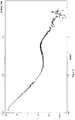
- FIG. 3 shows further measurement results that have been obtained with the KWS-2 small angle spreading system on the FRM II at the already in FIG. 1 characterized membrane were recorded. Plotted is the scattering intensity I in absolute units over the wave vector (scattering vector) q.
- the scattering intensity on a mass fractal increases to a maximum corresponding to I (Q) ⁇ Q-fdim.
- this increase appears linear with slope fdim.
- the cross-linking of the polymer domains thus has a spatial part. So it is not a surface effect, but continued throughout the thickness of the membrane.
- the cross-linked domains penetrate the membrane irregularly in three dimensions, thus ensuring the stability of the membrane.
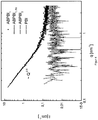
- FIG. 4 shows SAXS measurements on dry, ie not yet loaded with phosphoric acid, PBI and ABPMI membranes.
- the scattering intensity I is plotted twice logarithmically above the wave vector (scattering vector) q.
- the scattering intensity I is standardized in the interest of the comparability of measurements on different thickness samples on the sample thickness and therefore in the unit cm -1 indicated.
- the membrane designated ABPBI 1 shows the characteristic of fractal structures increase of scattering intensity for zero wave wave vectors. In the double logarithmic plot of FIG. 4 this increase appears to be linear with slope 2.6, which corresponds to the fractal dimension of the bulk fraction formed by the polymer domains.
Landscapes
- Chemical & Material Sciences (AREA)
- Life Sciences & Earth Sciences (AREA)
- Crystallography & Structural Chemistry (AREA)
- Engineering & Computer Science (AREA)
- Manufacturing & Machinery (AREA)
- Sustainable Development (AREA)
- Sustainable Energy (AREA)
- Chemical Kinetics & Catalysis (AREA)
- Electrochemistry (AREA)
- General Chemical & Material Sciences (AREA)
- Physics & Mathematics (AREA)
- Health & Medical Sciences (AREA)
- Analytical Chemistry (AREA)
- Biochemistry (AREA)
- General Health & Medical Sciences (AREA)
- General Physics & Mathematics (AREA)
- Immunology (AREA)
- Pathology (AREA)
- Composite Materials (AREA)
- Fuel Cell (AREA)
Description
- Die Erfindung betrifft ein Verfahren zur Materialprüfung von Polymermembranen für den Einsatz als protonenleitende Membran in einer Brennstoffzelle mit dem Ziel, eine Langzeitstabilität der Membran vorherzusagen.
- Eine Polymerelektrolytbrennstoffzelle umfasst eine Anode und eine Kathode, die durch eine protonenleitende Polymermembran voneinander getrennt sind. Im Temperaturbereich bis ca. 90 °C kommen meist PFSA (Perfluorosulfonic Acid) Membranen zum Einsatz. Ein typischer Vertreter dieser Materialklasse ist Nafion.
- Im höheren Temperaturbereich zwischen 120°C und 200°C werden typischerweise hochtemperaturstabile Polybenzimidazole (PBI) verwendet. Geeignete Vertreter dieser Klasse sind beispielsweise ABPBI = Poly(2,5-Benzimidazol) oder PBI = Poly (2'2-(m-Phenylen)-5'5-Bibenzimidazol). Diese werden typischerweise mit Phosphorsäure beladen, um die geforderte protonische Leitfähigkeit sicherzustellen.
- Diese Brennstoffzellen werden als Hochtemperatur-Polymerelektrolytbrennstoffzellen (HT-PEFCs) bezeichnet.
- Die Eigenschaften der Polymere ändern sich sowohl in Bezug auf die protonische Leitfähigkeit als auch die mechanischen Eigenschaften als Funktion der Säurebeladung. Diese Eigenschaften dominieren das Leistungsverhalten und die Lebensdauer der Brennstoffzellen. Von zwei nominell identisch gefertigten Chargen ein und desselben Membranmaterials kann die eine für den Einsatz in der Brennstoffzelle sehr gut brauchbar und die andere völlig unbrauchbar sein. Damit ist die Herstellung der Brennstoffzelle insgesamt nur schlecht reproduzierbar.
- Es ist daher die Aufgabe der Erfindung, ein Verfahren zur Verfügung zu stellen, mit dem Polymermembranen vor dem Einsatz in der Brennstoffzelle auf ihre Tauglichkeit überprüft werden können.
- Polymermembranen zur Verfügung zu stellen, das einen größeren Anteil an für den Einsatz in der Brennstoffzelle tauglichen Membranen liefert als die bisherigen Herstellungsverfahren. Diese Aufgabe wird erfindungsgemäß gelöst durch ein Materialprüfungsverfahren gemäß Hauptanspruch 1. Weitere vorteilhafte Ausgestaltungen ergeben sich jeweils aus den darauf rückbezogenen Unteransprüchen.
- Im Rahmen der Erfindung wurde ein Verfahren zur Materialprüfung einer Polymermembran für den Einsatz als protonenleitende Membran in einer Brennstoffzelle entwickelt.
- Erfindungsgemäß wird die Membran auf das Vorhandensein von selbstähnlichen Domänen von Polymerketten untersucht und als tauglich für den Einsatz in der Brennstoffzelle gewertet, wenn derartige Domänen vorhanden sind. Selbstähnlichkeit bedeutet, dass die Domänen bei einer Änderung der Vergrößerung, unter der sie betrachtet werden, dieselben oder ähnliche Strukturen aufweisen wie vor der Vergrößerungsänderung. Die Strukturen sind also in sich selbst verschachtelt und kehren bei der Vergrößerungsänderung wieder.
- Es wurde erkannt, dass diese Domänen ein Marker dafür sind, wie effektiv die Polymerketten miteinander vernetzt sind. Gerade beim Betrieb der Membran in einem sauren Milieu hängt ihre Stabilität von dieser Vernetzung ab. In einem sauren Milieu haben die einzelnen Polymerketten die Tendenz, sich so weit wie möglich voneinander zu entfernen. Wenn die Vernetzung der Polymerketten dem keine Grenze setzt, geht die Membran in dem sauren Milieu in Lösung.
- Daher sind mit Säure beladene Polymermembranen, die die beanspruchte Struktur aufweisen, auch bei hohen Temperaturen und in saurer Umgebung mechanisch deutlich stabiler als Polymermembranen, die diese Struktur nicht aufweisen.
- Die Domänen können insbesondere fraktale Domänen sein. Sie bestehen dann aus verkleinerten Kopien ihrer selbst. Vorteilhaft wird also die Membran auf das Vorhandensein fraktaler Domänen von Polymerketten untersucht und als tauglich für den Einsatz in der Brennstoffzelle gewertet, wenn derartige Domänen vorhanden sind.
- Die fraktale Dimension fdim gibt an, wie diese Kopien den Raum ausfüllen: Ist fdim nahe oder gleich 2, füllen die unendlich vielen Kopien der Struktur im Raum eine Fläche. Ist fdim nahe oder gleich 3, füllen sie den ganzen Raum volumenmäßig aus. fdim gibt also an, ob die selbstähnliche Struktur von flächiger oder von räumlicher Natur ist. Ist fdim größer als 2, hat die Struktur zumindest einen räumlichen Anteil, was wiederum zeigt, dass die für die Stabilität der Membran vorteilhafte Vernetzung der Polymerdomänen ein räumlicher Prozess innerhalb der Membran ist. In einer besonders vorteilhaften Ausgestaltung der Erfindung wird daher die fraktale Dimension fdim der Domänen bestimmt, und die Membran wird als tauglich für den Einsatz in der Brennstoffzelle gewertet, wenn fdim zwischen 2 und 3 liegt.
- Vorteilhaft handelt es sich bei mindestens einem Teil der fraktalen Domänen, bevorzugt bei im Wesentlichen allen Polymerdomänen, um Massenfraktale. Massenfraktale sind im Unterschied zu Oberflächenfraktalen Strukturen, die ein aus Verzweigungen und Querverbindungen gebildetes dreidimensionales Netzwerk enthalten.
- Vorteilhaft wird die Membran auf das Vorhandensein von Domänen von Polymerketten untersucht, die in mindestens einer Dimension eine laterale Ausdehnung zwischen 1 nm und 2000 nm aufweisen. Sind diese Domänen vorhanden, wird die Membran als tauglich für den Einsatz in der Brennstoffzelle gewertet.
- In einer besonders vorteilhaften Ausgestaltung der Erfindung wird die Membran auf das Vorhandensein von Domänen von Polymerketten untersucht, die in mindestens einer Dimension eine laterale Ausdehnung zwischen 1 nm und 50 nm aufweisen. Sind diese Domänen vorhanden, wird die Membran als tauglich für den Einsatz in der Brennstoffzelle gewertet. In den Versuchen der Erfinder war die Korrelation zwischen dem Vorhandensein der Domänen und dem Funktionieren der Membran in der Brennstoffzelle besonders ausgeprägt, wenn Strukturen mit einer Ausdehnung zwischen 1 nm und 50 nm betrachtet wurden. Fraktale Strukturen bestehen aus verkleinerten Kopien ihrer selbst und weisen daher unabhängig vom Betrachtungsmaßstab eine beliebig kleine Feinstruktur auf. Eine physikalische Grenze für die Feinstruktur der Domänen von Polymerketten wird lediglich durch die Größe der Polymersegmente gesetzt, aus denen die Polymerketten zusammengesetzt sind. Das Vorhandensein von Strukturen mit einer Ausdehnung zwischen 1 nm und 50 nm spricht mit hoher Wahrscheinlichkeit dafür, dass es sich um fraktale Strukturen handelt.
- Vorteilhaft wird die Membran mit Transmissionselektronenmikroskopie oder Rastersondenmikroskopie untersucht, und es wird aus den erhaltenen Bildern ausgewertet, ob die Domänen vorhanden sind. Diese Techniken besitzen zum Einen eine hinreichende Ortsauflösung unterhalb der Beugungsgrenze der klassischen Lichtmikroskopie und liefern zum Anderen die Strukturinformation in unmittelbar interpretierbarer Form im Ortsraum. Beispielsweise kann die Membran mit Rasterkraftmikroskopie (AFM) untersucht werden, wenn die Domänenstruktur sich in einem Härteunterschied des Membranmaterials manifestiert. Als Transmissionselektronenmikroskop ist insbesondere ein Cryo-Transmissionselektronenmikroskop geeignet.
- Es kann technisch anspruchsvoll sein, die Membran mit derartigen Methoden unter genau den gleichen Bedingungen zu untersuchen, die auch beim späteren Einsatz der Membran in einer Brennstoffzelle herrschen. Phosphorsäure etwa, mit der PFSA-Membranen dotiert sind, ist sehr stark ätzend. Wird die Membran im nicht dotierten Zustand untersucht, besteht ein Restrisiko, dass die zunächst vorhandenen Strukturen der späteren Beladung mit Phosphorsäure nicht standhalten, so dass die Membran fälschlicherweise als tauglich gewertet wird.
- Daher wird in einer besonders vorteilhaften Ausgestaltung der Erfindung die Membran mit Neutronen- oder Röntgenstrahlung bestrahlt und die Intensität I(Q) der gestreuten Strahlung als Funktion des Wellenvektors Q gemessen. Vorteilhaft wird hierbei Neutronen- oder Röntgenstrahlung mit einer Wellenlänge zwischen 1 und 20 Å gewählt. Neutronenstrahlung hat dabei vorteilhaft eine Wellenlänge zwischen 2 und 20 Å. Die Neutronen können beispielsweise thermische oder kalte Neutronen sein. Röntgenstrahlung kann vorteilhaft aus einer Cu-Ka Quelle mit λ =1.54 Å bezogen werden.
- Vorteilhaft wird die Intensität der gestreuten Strahlung wird mindestens für einen Wellenvektor zwischen 0.1 und 0.15 Å-1 sowie mindestens für einen weiteren Wellenvektor unterhalb dieses Bereiches gemessen. Dabei hängt der Wellenvektor q mit dem Streuwinkel θ durch die Bragg-Bedingung q=4π/λ * sin(θ/2) zusammen.
- Dabei wird die Membran vorteilhaft als tauglich für den Einsatz in der Brennstoffzelle gewertet, wenn sich die beiden gemessenen Intensitäten um mindestens einen Faktor 5 und/oder mindestens um einen Faktor 5 pro 0.05 Å-1 Differenz zwischen den beiden Wellenvektoren unterscheiden; andernfalls wird sie als untauglich gewertet. In den Versuchen der Erfinder hat sich gezeigt, dass der weitaus überwiegende Anteil der Membranen, der dieses Kriterium erfüllt, selbstähnliche bzw. fraktale Domänen aufweist. Diese grobe Unterscheidung an Hand nur zweier Messpunkte ist daher ein Schnelltest, der mit geringem Aufwand an Messzeit das Gros der untauglichen Membranen aussondert. Die Membranen, die diesen Schnelltest bestehen, können anschließend detaillierter untersucht werden.
- Vorteilhaft wird die Intensität der unter einem Winkel von bis zu θ=15 Grad gestreuten Strahlung gemessen (Kleinwinkelstreuung).
- Es wurde erkannt, dass die vorteilhaften Strukturen mit dem Verhalten der Polymermembran unter Kleinwinkelstreuung von Neutronen- oder Röntgenstrahlung korreliert sind. Der Vorteil dieser Untersuchung ist, dass sie keine spezielle Präparation der Membran erfordert. Die Membran kann unter genau den gleichen Bedingungen untersucht werden, die beim späteren Einsatz in der Brennstoffzelle herrschen. Insbesondere kann sie in einem sauren Milieu untersucht werden, um nur solche Strukturen zu erfassen, die diesem Milieu standhalten. In praktischen Versuchen der Erfinder hielten Membranen, die das beanspruchte Verhalten zeigten, einer hohen Beladung mit Phosphorsäure bei Temperaturen um 160 °C stand. Membranen, die dieses Verhalten in der Kleinwinkelstreuung nicht zeigten, lösten sich dagegen auf.
- Indem die Membran erfindungsgemäß bereits vor dem Einsatz in der Brennstoffzelle auf ihre Tauglichkeit überprüft werden kann, wird die Reproduzierbarkeit der Herstellung von Polymerelektrolytbrennstoffzellen insgesamt gesteigert.
- Mit Neutronen- oder Röntgenstreuung lässt sich die Membran insbesondere daraufhin untersuchen, ob Domänen mit einer bestimmten lateralen Ausdehnung in mindestens einer Dimension vorhanden sind oder ob diese selbstähnlich sind. Insbesondere macht die Kleinwinkelstreuung die fraktale Dimension fdim von Domänen einer direkten Messung zugänglich. In einer doppelt logarithmischen Auftragung der Streuintensität I(Q) über dem Wellenvektor Q steigt die Streuintensität I(Q) für kleine, gegen Null gehende Wellenvektoren Q linear an mit Steigung fdim.
- Weiterhin lässt sich die Membran mit Neutronen- oder Röntgenstreuung sowohl vor als auch während und nach der Beladung mit Phosphorsäure untersuchen. Auf diese Weise kann diagnostiziert werden, ob und ggfs. zu welchem Zeitpunkt eine zunächst vorhandene Domänenstruktur durch den Beladungsprozess verschlechtert oder zerstört wird.
- Aus der Erkenntnis der Erfinder, dass das Vorhandensein von Strukturen in den Membranen mit ihrer Eignung für den Einsatz in der Brennstoffzelle korreliert ist, lässt sich für die Herstellung von Membranen für diesen Einsatzzweck die Handlungsanweisung ableiten, diese Strukturen gezielt einzubringen. Daher bezieht sich die Erfindung auch auf ein Verfahren zur Herstellung einer Polymermembran für den Einsatz in einer Brennstoffzelle. Bei diesem Verfahren werden in die Membran Strukturen eingebracht, bei deren Vorhandensein sie gemäß dem Verfahren zur Materialprüfung als tauglich für den Einsatz in der Brennstoffzelle gewertet wird.
- Auf diese Weise ist der Anteil an für den Einsatz in der Brennstoffzelle brauchbaren Membranen, die das Verfahren liefert, gegenüber Herstellungsverfahren nach dem bisherigen Stand der Technik vorteilhaft erhöht. Damit ist die Ausschussrate deutlich vermindert.
- Vorteilhaft ist die Polymermembran auf Grund einer Dotierung mit einem flüssigen Elektrolyten protonenleitend. Dabei kann der Elektrolyt ein saurer Elektrolyt und hier insbesondere Phosphorsäure sein. Wird die Membran in diesem sauren Milieu geprüft, in dem sie sich auch beim späteren Einsatz in der Brennstoffzelle befinden wird, so fördert diese Prüfung nur Strukturen zu Tage, die diesem Milieu standhalten.
- Aus dem gleichen Grund wird das Prüfungsverfahren vorteilhaft bei einer Temperatur zwischen 100 °C und 250 °C, bevorzugt zwischen 120 °C und 200 °C, durchgeführt. Dies entspricht dem Bereich der Betriebstemperaturen, für die Polymerelektrolytbrennstoffzellen typischerweise ausgelegt sind. In diesem Temperaturbereich weist die Membran eine optimale Protonenleitfähigkeit auf.
- Vorteilhaft gehört das Polymer der Membran zur Familie der Polybenzimidazole. Geeignete Vertreter dieser Klasse sind beispielsweise ABPBI = Poly(2,5-Benzimidazol) oder PBI = Poly (2'2-(m-Phenylen)-5'5-Bibenzimidazol).
- Nachfolgend wird der Gegenstand der Erfindung anhand von Figuren erläutert, ohne dass der Gegenstand der Erfindung hierdurch beschränkt wird. Es ist gezeigt:
- Figur 1:
- Messung der Kleinwinkelstreuung an einer strukturierten Membran, die für den Einsatz in der Brennstoffzelle tauglich ist, mit dem J-NSE Instrument.
- Figur 2:
- Messung der Kleinwinkelstreuung in einer zur in
Figur 1 nominell identischen, aber anders hergestellten und daher unstrukturierten Membran. - Figur 3:
- Erneute Vermessung der in
Figur 1 charakterisierten Membran bei einer Temperatur von 150 °C mit dem KWS-2 bis hin zu noch kleineren Streuvektoren. - Figur 4:
- SAXS-Messungen an weiteren Membranen vor der Beladung mit Phosphorsäure.
-
Figur 1 zeigt Messergebnisse eines am J-NSE Instrument am FRM II Forschungsreaktor in Garching durchgeführten Kleinwinkelstreuexperiments an einer phosphorsäuredotierten PBI-Membran. Aufgetragen ist jeweils die Streuintensität S(Q) über dem Betrag des Wellenvektors (Streuvektors) q. Die Messung wurde mit Polarisationsanalyse durchgeführt, so dass die inkohärente Streuung an Protonen ("incoh", Messpunkte durch hohle Quadrate symbolisiert) und die kohärente Streuung an den interessierenden Strukturen im nm-Bereich ("coh", Messpunkte durch ausgefüllte Kreise symbolisiert) voneinander unterscheidbar sind. Der Anstieg zu kleinen Wellenvektoren q (entspricht großen Längenskalen d mit d=2π/q im Realraum, siehe obere waagerechte Skala) zeigt eindeutig eine Strukturierung auf einer Längenskala > 1 nm. Diese Membran hat sich beim Einsatz in der Brennstoffzelle bei einer Betriebstemperatur um 160 °C und hoher Beladung mit Phosphorsäure als tauglich und stabil erwiesen. -
Figur 2 zeigt Messergebnisse, die mit der gleichen Apparatur an einer nach dem nominell gleichen Prozess hergestellten und damit nominell zu der inFigur 1 identischen, aber aus einer anderen Produktionscharge stammenden PBI-Membran aufgenommen wurden. Die inkohärente Streuung an Protonen zeigt durchweg die gleiche Intensität wie inFigur 1 , woraus sich ablesen lässt, dass die Schichtdicken gleich sind. Die kohärente Streuintensität verschwindet und zeigt daher auch keinen Anstieg zu kleinen Wellenvektoren (Streuvektoren) q; somit fehlt jegliche Struktur auf der Längenskala > 1 nm. Diese Membran wurde dem gleichen Test in einer Brennstoffzelle unterzogen wie die inFigur 1 charakterisierte Membran. Sie löste sich bei diesem Test auf. -
Figur 3 zeigt weitere Messergebnisse, die mit der KWS-2 Kleinwinkelstreuanlage am FRM II an der bereits inFigur 1 charakterisierten Membran aufgenommen wurden. Aufgetragen ist die Streuintensität I in absoluten Einheiten über dem Wellenvektor (Streuvektor) q. Mit der KWS-2 Anlage sind Messungen bis hin zu deutlich kleineren Wellenvektoren q möglich, die Strukturen bis ca. 1000 nm Größe entsprechen. Die Messung wurde bei einer Temperatur von 150 °C durchgeführt. Die Struktur entspricht dichteren, u.U. auch teilkristallinen Domänen von Polymerketten. Bei q=0,06 1/Å (entspricht einer Längenskala von etwa 10 nm) ist noch ein breiter Peak zu erkennen, der mit steigender Temperatur ausgeprägter wird. Er geht auf den Kontrast zwischen Phosphorsäure und Polymer zurück. Es lassen sich durchgehende, kanalartige Bereiche erkennen, die mit Phosphorsäure belegt sind. Diese Bereiche sind wichtig dafür, dass der Strom die gesamte Dicke der Membran durchdringen kann, und damit wichtig für die Leitfähigkeit der Membran insgesamt. An der Position der Peaks auf der Wellenvektorachse lässt sich erkennen, dass diese Bereiche ca. 10 nm Ausdehnung haben. - Auch bei nominell identisch hergestellten ABPBI Membranen fanden sich je nach Produktionscharge im phosphorsäuredotierten Material (mit Neutronenkleinwinkelstreuung - SANS) sowie in der undotierten Membran (mit Röntgenkleinwinkelstreuung - SAXS) entweder Strukturen > 1 nm oder nicht, insbesondere mit fraktaler Dimension. Strukturen fanden sich bei denjenigen Membranen, die sich im Experiment als tauglich für den Einsatz in der Brennstoffzelle erwiesen haben. Bei denjenigen Membranen, die für diesen Einsatz untauglich waren, fehlten die fraktalen Strukturen.
- Für kleine, gegen Null gehende Wellenvektoren Q steigt die Streuintensität an einem Massenfraktal entsprechend I(Q)∼Q-fdim zu einem Maximum an. In der doppelt logarithmischen Auftragung in
Figur 3 erscheint dieser Anstieg linear mit Steigung fdim. Dies weist darauf hin, dass Membran Domänen von Polymerketten aufweist, die selbstähnlich sind mit einer fraktalen Dimension fdim größer als 2. Die Vernetzung der Polymerdomänen hat somit einen räumlichen Anteil. Sie ist also kein Oberflächeneffekt, sondern durch die ganze Dicke der Membran hindurch fortgesetzt. Die vernetzten Domänen durchdringen die Membran irregulär in drei Dimensionen und sorgen so für die Stabilität der Membran. -
Figur 4 zeigt SAXS-Messungen an trockenen, d.h. noch nicht mit Phosphorsäure beladenen, PBI- und ABPMI-Membranen. Die Streuintensität I ist doppelt logarithmisch über dem Wellenvektor (Streuvektor) q aufgetragen. Die Streuintensität I ist im Interesse der Vergleichbarkeit von Messungen an verschieden dicken Proben auf die Probendicke normiert und daher in der Einheit cm-1 angegeben. - Die mit ABPBI1 bezeichnete Membran zeigt den für fraktale Strukturen charakteristischen Anstieg der Streuintensität für gegen Null gehende Wellenvektoren. In der doppelt logarithmischen Auftragung von
Figur 4 erscheint dieser Anstieg linear mit Steigung 2.6, was der fraktalen Dimension des durch die Polymerdomänen gebildeten Massenfraktals entspricht.
Claims (9)
- Verfahren zur Materialprüfung einer Polymermembran für den Einsatz als protonenleitende Membran in einer Brennstoffzelle,
dadurch gekennzeichnet, dass
die Membran auf das Vorhandensein von selbstähnlichen Domänen von Polymerketten untersucht und als tauglich für den Einsatz in der Brennstoffzelle gewertet wird, wenn derartige Domänen vorhanden sind und die Membran mit Neutronen- oder Röntgenstrahlung bestrahlt und die Intensität I (Q) der gestreuten Strahlung als Funktion des Wellenvektors Q gemessen wird, wobei die Intensität der gestreuten Strahlung mindestens für einen Wellenvektor zwischen 1 nm-1 (0,1 Å-1) und 1,5 nm-1 (0,15 Å-1) sowie mindestens für einen weiteren Wellenvektor unterhalb dieses Bereiches gemessen wird. - Verfahren nach Anspruch 1,
dadurch gekennzeichnet, dass
die Membran auf das Vorhandensein fraktaler Domänen von Polymerketten untersucht und als tauglich für den Einsatz in der Brennstoffzelle gewertet wird, wenn derartige Domänen vorhanden sind. - Verfahren nach Anspruch 2,
dadurch gekennzeichnet, dass
die fraktale Dimension fdim der Domänen bestimmt wird und die Membran als tauglich für den Einsatz in der Brennstoffzelle gewertet wird, wenn fdim zwischen 2 und 3 liegt. - Verfahren nach einem der Ansprüche 1 bis 3,
dadurch gekennzeichnet, dass
die Membran auf das Vorhandensein von Domänen von Polymerketten untersucht wird, die in mindestens einer Dimension eine laterale Ausdehnung zwischen 1 nm und 2000 nm aufweisen, und dass sie bei Vorhandensein dieser Domänen als tauglich für den Einsatz in der Brennstoffzelle gewertet wird. - Verfahren nach Anspruch 4,
dadurch gekennzeichnet, dass
die Membran auf das Vorhandensein von Domänen von Polymerketten untersucht wird, die in mindestens einer Dimension eine laterale Ausdehnung zwischen 1 nm und 50 nm aufweisen, und dass sie bei Vorhandensein dieser Domänen als tauglich für den Einsatz in der Brennstoffzelle gewertet wird. - Verfahren nach einem der Ansprüche 1 bis 5,
dadurch gekennzeichnet, dass
die Membran mit Transmissionselektronenmikroskopie oder Rastersondenmikroskopie untersucht und aus den erhaltenen Bildern ausgewertet wird, ob die Domänen vorhanden sind. - Verfahren nach einem der vorherigen Ansprüche,
dadurch gekennzeichnet, dass
Neutronen- oder Röntgenstrahlung mit einer Wellenlänge zwischen 0.1 und 2 nm (1 und 20 Å) gewählt wird. - Verfahren nach einem der vorherigen Ansprüche,
dadurch gekennzeichnet, dass
die Membran als tauglich für den Einsatz in der Brennstoffzelle gewertet wird, wenn sich die beiden gemessenen Intensitäten um mindestens einen Faktor 5 und/oder mindestens um einen Faktor 5 pro 0,5 nm-1 (0.05 Å-1) Differenz zwischen den beiden Wellenvektoren unterscheiden. - Verfahren nach einem der vorherigen Ansprüche,
dadurch gekennzeichnet, dass
die Intensität der unter einem Winkel von bis zu θ=15 Grad gestreuten Strahlung gemessen wird.
Applications Claiming Priority (3)
| Application Number | Priority Date | Filing Date | Title |
|---|---|---|---|
| DE102013013006 | 2013-08-02 | ||
| DE201410000630 DE102014000630A1 (de) | 2013-08-02 | 2014-01-18 | Materialprüfung von Membranen für Polymerelektrolytbrennstoffzellen |
| PCT/DE2014/000340 WO2015014334A1 (de) | 2013-08-02 | 2014-07-05 | Materialprüfung von membranen für polymerelektrolytbrennstoffzellen |
Publications (2)
| Publication Number | Publication Date |
|---|---|
| EP3028332A1 EP3028332A1 (de) | 2016-06-08 |
| EP3028332B1 true EP3028332B1 (de) | 2017-10-04 |
Family
ID=51260540
Family Applications (1)
| Application Number | Title | Priority Date | Filing Date |
|---|---|---|---|
| EP14745067.0A Not-in-force EP3028332B1 (de) | 2013-08-02 | 2014-07-05 | Materialprüfung von membranen für polymerelektrolytbrennstoffzellen |
Country Status (3)
| Country | Link |
|---|---|
| EP (1) | EP3028332B1 (de) |
| DE (2) | DE102014000630A1 (de) |
| WO (1) | WO2015014334A1 (de) |
Family Cites Families (2)
| Publication number | Priority date | Publication date | Assignee | Title |
|---|---|---|---|---|
| DE10117687A1 (de) * | 2001-04-09 | 2002-10-17 | Celanese Ventures Gmbh | Protonenleitende Membran und deren Verwendung |
| US6989205B2 (en) * | 2002-10-31 | 2006-01-24 | Motorola, Inc. | Hydrophilic side-chain polymer electrolyte membranes |
-
2014
- 2014-01-18 DE DE201410000630 patent/DE102014000630A1/de not_active Withdrawn
- 2014-07-05 DE DE112014003557.2T patent/DE112014003557A5/de not_active Withdrawn
- 2014-07-05 WO PCT/DE2014/000340 patent/WO2015014334A1/de not_active Ceased
- 2014-07-05 EP EP14745067.0A patent/EP3028332B1/de not_active Not-in-force
Non-Patent Citations (1)
| Title |
|---|
| None * |
Also Published As
| Publication number | Publication date |
|---|---|
| DE102014000630A1 (de) | 2015-02-26 |
| EP3028332A1 (de) | 2016-06-08 |
| WO2015014334A1 (de) | 2015-02-05 |
| DE112014003557A5 (de) | 2016-04-14 |
Similar Documents
| Publication | Publication Date | Title |
|---|---|---|
| Shi et al. | Structure-transport relationship of perfluorosulfonic-acid membranes in different cationic forms | |
| Rubatat et al. | Evidence of elongated polymeric aggregates in Nafion | |
| Li et al. | Anisotropic diffusion and morphology in perfluorosulfonate ionomers investigated by NMR | |
| Liu et al. | High-resolution solid-state 13C NMR of fluoropolymers | |
| Wang et al. | Evaluation of the microstructure of dry and hydrated perfluorosulfonic acid ionomers: microscopy and simulations | |
| DE60114776T2 (de) | Verfahren zur herstellung einer polymerelektrolytmembran | |
| EP2301102B1 (de) | Verwendung eines protonenleitfähigkeitverleihenden materials bei der herstellung von brennstoffzellen | |
| Jiang et al. | Effect of additives on self-assembling behavior of Nafion in aqueous media | |
| Iojoiu et al. | Membrane and Active Layer Degradation Following PEMFC Steady-State Operation: II. Influence of Pt z+ on Membrane Properties | |
| DE10052242A1 (de) | Mit Säure dotierte, ein- oder mehrschichtige Kunststoffmembran mit Schichten aufweisend Polymerblends umfassend Polymere mit wiederkehrenden Azoleinheiten, Verfahren zur Herstellung solche Kunststoffmembranen sowie deren Verwendung | |
| WO2001064322A1 (de) | Neue blendpolymermembranen zum einsatz in brennstoffzellen | |
| DE10301810A1 (de) | Membran-Elektroden-Einheit, Polymermembranen für eine Membran-Elektroden-Einheit und Polymerelektrolyt-Brennstoffzellen sowie Verfahren zur Herstellung derselben | |
| DE112004000141B4 (de) | Verfahren zur Bestimmung einer Qualität eines Gasdiffusionsmediums | |
| DE112004000138B4 (de) | Qualitätskontrollverfahren für Gasdiffusionsmedien | |
| Ajith et al. | Proton conductivity in crosslinked hydrophilic ionic polymer system: Competitive hydration, crosslink heterogeneity, and ineffective domains | |
| Lawton et al. | Characterization of vanadium ion uptake in sulfonated diels alder poly (phenylene) membranes | |
| DE69014497T2 (de) | Poröses Material aus Polytetrafluoroethylenharz. | |
| Rosero-Navarro et al. | Protonic conductivity and viscoelastic behaviour of Nafion® membranes with periodic mesoporous organosilica fillers | |
| Chabot et al. | Tracking the evolution of ionomer film and catalyst material to unravel PEMFC performance degradation | |
| DE102021213762A1 (de) | Verfahren zur Erstellung von Datensätzen für die Bewertung zumindest eines Lebensdauerparameters einer Batteriezelle, Vorrichtung und Software hierfür. | |
| Ivanova et al. | Influence of morphology on physical properties of poly (2, 5-benzimidazole) membranes | |
| WO2015014334A1 (de) | Materialprüfung von membranen für polymerelektrolytbrennstoffzellen | |
| Maccarini et al. | Submicrometer 3D structural evidence of fuel cell membrane heterogeneous degradation | |
| Fu et al. | Fundamental studies on the intermediate layer of a bipolar membrane: Part II. Effect of bovine serum albumin (BSA) on water dissociation at the interface of a bipolar membrane | |
| DE102021204676A1 (de) | Elektrolytmembran mit verbesserter ionenleitfähigkeit und verfahren zur herstellung derselben |
Legal Events
| Date | Code | Title | Description |
|---|---|---|---|
| PUAI | Public reference made under article 153(3) epc to a published international application that has entered the european phase |
Free format text: ORIGINAL CODE: 0009012 |
|
| 17P | Request for examination filed |
Effective date: 20160113 |
|
| AK | Designated contracting states |
Kind code of ref document: A1 Designated state(s): AL AT BE BG CH CY CZ DE DK EE ES FI FR GB GR HR HU IE IS IT LI LT LU LV MC MK MT NL NO PL PT RO RS SE SI SK SM TR |
|
| AX | Request for extension of the european patent |
Extension state: BA ME |
|
| RIN1 | Information on inventor provided before grant (corrected) |
Inventor name: PYCKHOUT-HINTZEN, WIM Inventor name: LEHNERT, WERNER Inventor name: LUEKE, WIEBKE Inventor name: SZEKELY, NOEMI Inventor name: MONKENBUSCH, MICHAEL Inventor name: HOLDERER, OLAF Inventor name: IVANOVA, OXANA Inventor name: ZORN, REINER |
|
| DAX | Request for extension of the european patent (deleted) | ||
| REG | Reference to a national code |
Ref country code: DE Ref legal event code: R079 Ref document number: 502014005695 Country of ref document: DE Free format text: PREVIOUS MAIN CLASS: H01M0008100000 Ipc: G01N0023201000 |
|
| GRAP | Despatch of communication of intention to grant a patent |
Free format text: ORIGINAL CODE: EPIDOSNIGR1 |
|
| RIC1 | Information provided on ipc code assigned before grant |
Ipc: G01N 23/202 20060101ALI20170221BHEP Ipc: H01M 8/1048 20160101ALI20170221BHEP Ipc: H01M 8/103 20160101ALI20170221BHEP Ipc: H01M 8/1067 20160101ALI20170221BHEP Ipc: G01N 23/201 20060101AFI20170221BHEP Ipc: H01M 8/1027 20160101ALI20170221BHEP Ipc: H01M 8/1069 20160101ALI20170221BHEP |
|
| INTG | Intention to grant announced |
Effective date: 20170315 |
|
| GRAS | Grant fee paid |
Free format text: ORIGINAL CODE: EPIDOSNIGR3 |
|
| GRAA | (expected) grant |
Free format text: ORIGINAL CODE: 0009210 |
|
| AK | Designated contracting states |
Kind code of ref document: B1 Designated state(s): AL AT BE BG CH CY CZ DE DK EE ES FI FR GB GR HR HU IE IS IT LI LT LU LV MC MK MT NL NO PL PT RO RS SE SI SK SM TR |
|
| REG | Reference to a national code |
Ref country code: GB Ref legal event code: FG4D Free format text: NOT ENGLISH |
|
| REG | Reference to a national code |
Ref country code: CH Ref legal event code: EP |
|
| REG | Reference to a national code |
Ref country code: AT Ref legal event code: REF Ref document number: 934501 Country of ref document: AT Kind code of ref document: T Effective date: 20171015 |
|
| REG | Reference to a national code |
Ref country code: IE Ref legal event code: FG4D Free format text: LANGUAGE OF EP DOCUMENT: GERMAN |
|
| REG | Reference to a national code |
Ref country code: DE Ref legal event code: R096 Ref document number: 502014005695 Country of ref document: DE |
|
| REG | Reference to a national code |
Ref country code: NL Ref legal event code: MP Effective date: 20171004 |
|
| REG | Reference to a national code |
Ref country code: LT Ref legal event code: MG4D |
|
| PG25 | Lapsed in a contracting state [announced via postgrant information from national office to epo] |
Ref country code: NL Free format text: LAPSE BECAUSE OF FAILURE TO SUBMIT A TRANSLATION OF THE DESCRIPTION OR TO PAY THE FEE WITHIN THE PRESCRIBED TIME-LIMIT Effective date: 20171004 |
|
| PG25 | Lapsed in a contracting state [announced via postgrant information from national office to epo] |
Ref country code: LT Free format text: LAPSE BECAUSE OF FAILURE TO SUBMIT A TRANSLATION OF THE DESCRIPTION OR TO PAY THE FEE WITHIN THE PRESCRIBED TIME-LIMIT Effective date: 20171004 Ref country code: ES Free format text: LAPSE BECAUSE OF FAILURE TO SUBMIT A TRANSLATION OF THE DESCRIPTION OR TO PAY THE FEE WITHIN THE PRESCRIBED TIME-LIMIT Effective date: 20171004 Ref country code: SE Free format text: LAPSE BECAUSE OF FAILURE TO SUBMIT A TRANSLATION OF THE DESCRIPTION OR TO PAY THE FEE WITHIN THE PRESCRIBED TIME-LIMIT Effective date: 20171004 Ref country code: NO Free format text: LAPSE BECAUSE OF FAILURE TO SUBMIT A TRANSLATION OF THE DESCRIPTION OR TO PAY THE FEE WITHIN THE PRESCRIBED TIME-LIMIT Effective date: 20180104 Ref country code: FI Free format text: LAPSE BECAUSE OF FAILURE TO SUBMIT A TRANSLATION OF THE DESCRIPTION OR TO PAY THE FEE WITHIN THE PRESCRIBED TIME-LIMIT Effective date: 20171004 |
|
| PG25 | Lapsed in a contracting state [announced via postgrant information from national office to epo] |
Ref country code: GR Free format text: LAPSE BECAUSE OF FAILURE TO SUBMIT A TRANSLATION OF THE DESCRIPTION OR TO PAY THE FEE WITHIN THE PRESCRIBED TIME-LIMIT Effective date: 20180105 Ref country code: LV Free format text: LAPSE BECAUSE OF FAILURE TO SUBMIT A TRANSLATION OF THE DESCRIPTION OR TO PAY THE FEE WITHIN THE PRESCRIBED TIME-LIMIT Effective date: 20171004 Ref country code: BG Free format text: LAPSE BECAUSE OF FAILURE TO SUBMIT A TRANSLATION OF THE DESCRIPTION OR TO PAY THE FEE WITHIN THE PRESCRIBED TIME-LIMIT Effective date: 20180104 Ref country code: HR Free format text: LAPSE BECAUSE OF FAILURE TO SUBMIT A TRANSLATION OF THE DESCRIPTION OR TO PAY THE FEE WITHIN THE PRESCRIBED TIME-LIMIT Effective date: 20171004 Ref country code: RS Free format text: LAPSE BECAUSE OF FAILURE TO SUBMIT A TRANSLATION OF THE DESCRIPTION OR TO PAY THE FEE WITHIN THE PRESCRIBED TIME-LIMIT Effective date: 20171004 Ref country code: IS Free format text: LAPSE BECAUSE OF FAILURE TO SUBMIT A TRANSLATION OF THE DESCRIPTION OR TO PAY THE FEE WITHIN THE PRESCRIBED TIME-LIMIT Effective date: 20180204 |
|
| REG | Reference to a national code |
Ref country code: DE Ref legal event code: R097 Ref document number: 502014005695 Country of ref document: DE |
|
| REG | Reference to a national code |
Ref country code: FR Ref legal event code: PLFP Year of fee payment: 5 |
|
| PG25 | Lapsed in a contracting state [announced via postgrant information from national office to epo] |
Ref country code: EE Free format text: LAPSE BECAUSE OF FAILURE TO SUBMIT A TRANSLATION OF THE DESCRIPTION OR TO PAY THE FEE WITHIN THE PRESCRIBED TIME-LIMIT Effective date: 20171004 Ref country code: DK Free format text: LAPSE BECAUSE OF FAILURE TO SUBMIT A TRANSLATION OF THE DESCRIPTION OR TO PAY THE FEE WITHIN THE PRESCRIBED TIME-LIMIT Effective date: 20171004 Ref country code: CZ Free format text: LAPSE BECAUSE OF FAILURE TO SUBMIT A TRANSLATION OF THE DESCRIPTION OR TO PAY THE FEE WITHIN THE PRESCRIBED TIME-LIMIT Effective date: 20171004 Ref country code: SK Free format text: LAPSE BECAUSE OF FAILURE TO SUBMIT A TRANSLATION OF THE DESCRIPTION OR TO PAY THE FEE WITHIN THE PRESCRIBED TIME-LIMIT Effective date: 20171004 |
|
| PLBE | No opposition filed within time limit |
Free format text: ORIGINAL CODE: 0009261 |
|
| STAA | Information on the status of an ep patent application or granted ep patent |
Free format text: STATUS: NO OPPOSITION FILED WITHIN TIME LIMIT |
|
| PG25 | Lapsed in a contracting state [announced via postgrant information from national office to epo] |
Ref country code: SM Free format text: LAPSE BECAUSE OF FAILURE TO SUBMIT A TRANSLATION OF THE DESCRIPTION OR TO PAY THE FEE WITHIN THE PRESCRIBED TIME-LIMIT Effective date: 20171004 Ref country code: IT Free format text: LAPSE BECAUSE OF FAILURE TO SUBMIT A TRANSLATION OF THE DESCRIPTION OR TO PAY THE FEE WITHIN THE PRESCRIBED TIME-LIMIT Effective date: 20171004 Ref country code: RO Free format text: LAPSE BECAUSE OF FAILURE TO SUBMIT A TRANSLATION OF THE DESCRIPTION OR TO PAY THE FEE WITHIN THE PRESCRIBED TIME-LIMIT Effective date: 20171004 Ref country code: PL Free format text: LAPSE BECAUSE OF FAILURE TO SUBMIT A TRANSLATION OF THE DESCRIPTION OR TO PAY THE FEE WITHIN THE PRESCRIBED TIME-LIMIT Effective date: 20171004 |
|
| 26N | No opposition filed |
Effective date: 20180705 |
|
| PG25 | Lapsed in a contracting state [announced via postgrant information from national office to epo] |
Ref country code: MT Free format text: LAPSE BECAUSE OF FAILURE TO SUBMIT A TRANSLATION OF THE DESCRIPTION OR TO PAY THE FEE WITHIN THE PRESCRIBED TIME-LIMIT Effective date: 20171004 |
|
| PG25 | Lapsed in a contracting state [announced via postgrant information from national office to epo] |
Ref country code: SI Free format text: LAPSE BECAUSE OF FAILURE TO SUBMIT A TRANSLATION OF THE DESCRIPTION OR TO PAY THE FEE WITHIN THE PRESCRIBED TIME-LIMIT Effective date: 20171004 |
|
| PG25 | Lapsed in a contracting state [announced via postgrant information from national office to epo] |
Ref country code: MC Free format text: LAPSE BECAUSE OF FAILURE TO SUBMIT A TRANSLATION OF THE DESCRIPTION OR TO PAY THE FEE WITHIN THE PRESCRIBED TIME-LIMIT Effective date: 20171004 Ref country code: LU Free format text: LAPSE BECAUSE OF NON-PAYMENT OF DUE FEES Effective date: 20180705 |
|
| REG | Reference to a national code |
Ref country code: IE Ref legal event code: MM4A |
|
| PG25 | Lapsed in a contracting state [announced via postgrant information from national office to epo] |
Ref country code: IE Free format text: LAPSE BECAUSE OF NON-PAYMENT OF DUE FEES Effective date: 20180705 |
|
| PG25 | Lapsed in a contracting state [announced via postgrant information from national office to epo] |
Ref country code: TR Free format text: LAPSE BECAUSE OF FAILURE TO SUBMIT A TRANSLATION OF THE DESCRIPTION OR TO PAY THE FEE WITHIN THE PRESCRIBED TIME-LIMIT Effective date: 20171004 |
|
| PG25 | Lapsed in a contracting state [announced via postgrant information from national office to epo] |
Ref country code: PT Free format text: LAPSE BECAUSE OF FAILURE TO SUBMIT A TRANSLATION OF THE DESCRIPTION OR TO PAY THE FEE WITHIN THE PRESCRIBED TIME-LIMIT Effective date: 20171004 |
|
| PG25 | Lapsed in a contracting state [announced via postgrant information from national office to epo] |
Ref country code: MK Free format text: LAPSE BECAUSE OF NON-PAYMENT OF DUE FEES Effective date: 20171004 Ref country code: CY Free format text: LAPSE BECAUSE OF FAILURE TO SUBMIT A TRANSLATION OF THE DESCRIPTION OR TO PAY THE FEE WITHIN THE PRESCRIBED TIME-LIMIT Effective date: 20171004 Ref country code: HU Free format text: LAPSE BECAUSE OF FAILURE TO SUBMIT A TRANSLATION OF THE DESCRIPTION OR TO PAY THE FEE WITHIN THE PRESCRIBED TIME-LIMIT; INVALID AB INITIO Effective date: 20140705 |
|
| PG25 | Lapsed in a contracting state [announced via postgrant information from national office to epo] |
Ref country code: AL Free format text: LAPSE BECAUSE OF FAILURE TO SUBMIT A TRANSLATION OF THE DESCRIPTION OR TO PAY THE FEE WITHIN THE PRESCRIBED TIME-LIMIT Effective date: 20171004 |
|
| PGFP | Annual fee paid to national office [announced via postgrant information from national office to epo] |
Ref country code: AT Payment date: 20210720 Year of fee payment: 8 Ref country code: FR Payment date: 20210722 Year of fee payment: 8 |
|
| PGFP | Annual fee paid to national office [announced via postgrant information from national office to epo] |
Ref country code: CH Payment date: 20210723 Year of fee payment: 8 Ref country code: BE Payment date: 20210721 Year of fee payment: 8 Ref country code: GB Payment date: 20210722 Year of fee payment: 8 Ref country code: DE Payment date: 20210527 Year of fee payment: 8 |
|
| REG | Reference to a national code |
Ref country code: DE Ref legal event code: R119 Ref document number: 502014005695 Country of ref document: DE |
|
| REG | Reference to a national code |
Ref country code: CH Ref legal event code: PL |
|
| REG | Reference to a national code |
Ref country code: AT Ref legal event code: MM01 Ref document number: 934501 Country of ref document: AT Kind code of ref document: T Effective date: 20220705 |
|
| GBPC | Gb: european patent ceased through non-payment of renewal fee |
Effective date: 20220705 |
|
| REG | Reference to a national code |
Ref country code: BE Ref legal event code: MM Effective date: 20220731 |
|
| PG25 | Lapsed in a contracting state [announced via postgrant information from national office to epo] |
Ref country code: LI Free format text: LAPSE BECAUSE OF NON-PAYMENT OF DUE FEES Effective date: 20220731 Ref country code: FR Free format text: LAPSE BECAUSE OF NON-PAYMENT OF DUE FEES Effective date: 20220731 Ref country code: CH Free format text: LAPSE BECAUSE OF NON-PAYMENT OF DUE FEES Effective date: 20220731 Ref country code: AT Free format text: LAPSE BECAUSE OF NON-PAYMENT OF DUE FEES Effective date: 20220705 |
|
| PG25 | Lapsed in a contracting state [announced via postgrant information from national office to epo] |
Ref country code: GB Free format text: LAPSE BECAUSE OF NON-PAYMENT OF DUE FEES Effective date: 20220705 Ref country code: DE Free format text: LAPSE BECAUSE OF NON-PAYMENT OF DUE FEES Effective date: 20230201 Ref country code: BE Free format text: LAPSE BECAUSE OF NON-PAYMENT OF DUE FEES Effective date: 20220731 |