EP3028094B1 - Verfahren zur steuerung einer programmierbaren linsenvorrichtung - Google Patents
Verfahren zur steuerung einer programmierbaren linsenvorrichtung Download PDFInfo
- Publication number
- EP3028094B1 EP3028094B1 EP14744602.5A EP14744602A EP3028094B1 EP 3028094 B1 EP3028094 B1 EP 3028094B1 EP 14744602 A EP14744602 A EP 14744602A EP 3028094 B1 EP3028094 B1 EP 3028094B1
- Authority
- EP
- European Patent Office
- Prior art keywords
- optical function
- data
- wearer
- programmable
- optical
- Prior art date
- Legal status (The legal status is an assumption and is not a legal conclusion. Google has not performed a legal analysis and makes no representation as to the accuracy of the status listed.)
- Active
Links
Images


Classifications
-
- G—PHYSICS
- G02—OPTICS
- G02C—SPECTACLES; SUNGLASSES OR GOGGLES INSOFAR AS THEY HAVE THE SAME FEATURES AS SPECTACLES; CONTACT LENSES
- G02C7/00—Optical parts
- G02C7/02—Lenses; Lens systems ; Methods of designing lenses
- G02C7/08—Auxiliary lenses; Arrangements for varying focal length
- G02C7/081—Ophthalmic lenses with variable focal length
- G02C7/083—Electrooptic lenses
-
- G—PHYSICS
- G02—OPTICS
- G02C—SPECTACLES; SUNGLASSES OR GOGGLES INSOFAR AS THEY HAVE THE SAME FEATURES AS SPECTACLES; CONTACT LENSES
- G02C7/00—Optical parts
- G02C7/02—Lenses; Lens systems ; Methods of designing lenses
- G02C7/08—Auxiliary lenses; Arrangements for varying focal length
- G02C7/081—Ophthalmic lenses with variable focal length
-
- G—PHYSICS
- G02—OPTICS
- G02C—SPECTACLES; SUNGLASSES OR GOGGLES INSOFAR AS THEY HAVE THE SAME FEATURES AS SPECTACLES; CONTACT LENSES
- G02C7/00—Optical parts
- G02C7/02—Lenses; Lens systems ; Methods of designing lenses
- G02C7/024—Methods of designing ophthalmic lenses
- G02C7/027—Methods of designing ophthalmic lenses considering wearer's parameters
-
- G—PHYSICS
- G02—OPTICS
- G02B—OPTICAL ELEMENTS, SYSTEMS OR APPARATUS
- G02B27/00—Optical systems or apparatus not provided for by any of the groups G02B1/00 - G02B26/00, G02B30/00
- G02B27/01—Head-up displays
- G02B27/017—Head mounted
- G02B27/0172—Head mounted characterised by optical features
-
- G—PHYSICS
- G02—OPTICS
- G02C—SPECTACLES; SUNGLASSES OR GOGGLES INSOFAR AS THEY HAVE THE SAME FEATURES AS SPECTACLES; CONTACT LENSES
- G02C11/00—Non-optical adjuncts; Attachment thereof
- G02C11/10—Electronic devices other than hearing aids
-
- G—PHYSICS
- G02—OPTICS
- G02C—SPECTACLES; SUNGLASSES OR GOGGLES INSOFAR AS THEY HAVE THE SAME FEATURES AS SPECTACLES; CONTACT LENSES
- G02C7/00—Optical parts
- G02C7/02—Lenses; Lens systems ; Methods of designing lenses
- G02C7/06—Lenses; Lens systems ; Methods of designing lenses bifocal; multifocal ; progressive
- G02C7/061—Spectacle lenses with progressively varying focal power
-
- G—PHYSICS
- G02—OPTICS
- G02C—SPECTACLES; SUNGLASSES OR GOGGLES INSOFAR AS THEY HAVE THE SAME FEATURES AS SPECTACLES; CONTACT LENSES
- G02C7/00—Optical parts
- G02C7/02—Lenses; Lens systems ; Methods of designing lenses
- G02C7/06—Lenses; Lens systems ; Methods of designing lenses bifocal; multifocal ; progressive
- G02C7/061—Spectacle lenses with progressively varying focal power
- G02C7/063—Shape of the progressive surface
- G02C7/066—Shape, location or size of the viewing zones
-
- G—PHYSICS
- G02—OPTICS
- G02B—OPTICAL ELEMENTS, SYSTEMS OR APPARATUS
- G02B27/00—Optical systems or apparatus not provided for by any of the groups G02B1/00 - G02B26/00, G02B30/00
- G02B27/01—Head-up displays
- G02B27/0101—Head-up displays characterised by optical features
- G02B2027/014—Head-up displays characterised by optical features comprising information/image processing systems
-
- G—PHYSICS
- G02—OPTICS
- G02B—OPTICAL ELEMENTS, SYSTEMS OR APPARATUS
- G02B27/00—Optical systems or apparatus not provided for by any of the groups G02B1/00 - G02B26/00, G02B30/00
- G02B27/01—Head-up displays
- G02B27/017—Head mounted
- G02B2027/0178—Eyeglass type
Definitions
- the invention relates to a method of controlling a programmable lens device comprising a programmable lens and an optical function controller, the programmable lens having an optical function and extending between at least one eye of the wearer and the real world scene when the device is used by the wearer, and the optical function controller being arranged to control the optical function of the programmable lens.
- the invention further relates to a network system comprising at least a programmable lens and a distant entity, and to a computer program product comprising one or more stored sequences of instructions that are accessible to an optical function controller of a programmable lens device.
- an eyewear equipment wearer wishing to have an eyewear equipment goes to see an eye care practitioner.
- the eye care practitioner orders the eyewear equipment at a lens manufacturing lab, hereafter lab, by sending an order request to the lab.
- the lab receives the order request and sends it to a calculating entity that calculates based on the order request an optical lens design.
- the optical design determined is sent to the lab and the optical lenses are manufactured based on the calculated design.
- optical lenses are then sent to the eye care practitioner.
- the current optical lens delivering process presents some drawbacks.
- the optical requirements may be different depending on the viewing conditions and the activity of the wearer. For example, the optical requirements are different when the wearer is reading a book and when the wearer is looking at a landscape. Multifocal ophthalmic lenses have been develop to provide a single pair of ophthalmic lenses providing ophthalmic correction for near and far vision distances.
- the ophthalmic lens designers are known able to provide optical designs that are more and more specific to a type of activity and viewing conditions.
- An aim of the present invention is to propose a method of controlling a programmable lens device so as to adapt the programmable lens device to selected ophthalmic lens designs.
- the present invention relates to a method according to claim 1.
- the method according to the invention allows providing different optical lens designs to the wearer without having to change the equipment the user is wearing. Therefore, the wearer may have a single equipment comprising programmable lenses, the optical function of the programmable lenses being adapted based on the optical function data.
- the optical function data comprise a computer program adapted to be executed by the optical function controller and during the optical function modifying step the received computer program is executed by the optical function controller so as to modify the optical function of the programmable optical lens;
- the invention relates to a computer program product comprising one or more stored sequences of instructions that are accessible to a processor and which, when executed by the processor, causes the processor to carry out the steps of the method according to the invention.
- the invention relates to a program which makes a computer execute the method of the invention.
- the invention also relates to a computer-readable storage medium having a program recorded thereon; where the program makes the computer execute the method of the invention.
- Embodiments of the present invention may include apparatuses for performing the operations herein.
- This apparatus may be specially constructed for the desired purposes, or it may comprise a general purpose computer or a Field Programmable Gate Array (“FPGA”) or Digital Signal Processor (“DSP”) selectively activated or reconfigured by a computer program stored in the computer.
- FPGA Field Programmable Gate Array
- DSP Digital Signal Processor
- Such a computer program may be stored in a computer readable storage medium, such as, but is not limited to, any type of disk including floppy disks, optical disks, CD-ROMs, magnetic-optical disks, read-only memories (ROMs), random access memories (RAMs) electrically programmable read-only memories (EPROMs), electrically erasable and programmable read only memories (EEPROMs), magnetic or optical cards, or any other type of media suitable for storing electronic instructions, and capable of being coupled to a computer system bus.
- a computer readable storage medium such as, but is not limited to, any type of disk including floppy disks, optical disks, CD-ROMs, magnetic-optical disks, read-only memories (ROMs), random access memories (RAMs) electrically programmable read-only memories (EPROMs), electrically erasable and programmable read only memories (EEPROMs), magnetic or optical cards, or any other type of media suitable for storing electronic instructions, and capable of being coupled to a computer system bus.
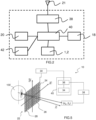
- the present invention relates to a method of controlling a programmable lens device, an example of programmable lens device is represented on figure 1 .
- the programmable lens device represented on figure 1 comprises a frame 3 and two programmable lenses, respectively denoted 1 and 2 for the right and left lens.
- the frame 3 holds the lenses 1 and 2 in relative fixed positions, and allows placing them is front of the eyes of the wearer in a manner which remains substantially constant during successive period of use.
- the lenses 1 and 2 can be permanently assembled into the frame 3 using one of the assembly methods known to opticians.
- the programmable lenses 1 and 3 are lenses whose optical function can be controlled by an optical function controller.
- the optical function corresponds to a function providing for each gaze direction the effect of the optical lens on the light ray passing through the optical lens.
- the optical function may comprise as dioptric function, light absorption, polarizing capability, reinforcement of contrast capacity, etc...
- the dioptric function corresponds to the optical lens power (mean power, astigmatism etc... ) as a function of the gaze direction.
- a progressive ophthalmic lens design results of an optimization of a progressive surface so as to restore a presbyope's ability to see clearly at all distances but also to optimally respect all physiological visual functions such as foveal vision, extra-foveal vision, binocular vision and to minimize unwanted astigmatisms.
- a progressive lens design comprises:
- optical characteristics are part of the "designs" defined and calculated by ophthalmic lens designers and that are provided with the progressive lenses.
- the lenses 1 and 2 comprise a set of cells juxtaposed parallel to a surface of each optical lens, forming so called pixelated optical elements.
- Such pixelated optical element can also have various optical functions, such as dioptric function, light absorption, polarizing capability, reinforcement of contrast capacity, etc...
- the dioptric function of the optical element can be characterized by an optical phase-shift distribution for a given monochromatic light wave which crosses the optical element.
- the transparent optical element has a surface which extends transversally compared to an optical axis. An average direction of propagation of the light wave can then be selected to be superimposed on this axis, and the optical phase-shift distribution can be given inside the surface element.
- optical phase-shift has discrete values which are carried out in point which constitute a sampling of the useable surface of the transparent optical element.
- optical phase-shift ⁇ cp for a monochromatic light wave is equal to the product of the double of number pi by the length of crossing L of each cell, and by the difference between the value n of refraction index of the transparent material which fills the cell and the value of the air refraction index and by the inverse wavelength ⁇ .
- a way of carrying out the transparent optical element can then consist in varying the refraction index value of fill material of the cells between different cells of the optical element. In this case, all the cells can have the same depth, which is measured according to the optical axis of the element.
- the programmable lens device may comprise a processing circuit comprising a processor 40.
- Processor 40 can comprise one or more microprocessors, microcontrollers, and other analog and/or digital circuit components configured to perform the functions described herein.
- Processor 40 may comprise one or more memories (e.g., random access memory, read only memory, flash, etc.) configured to store software applications provided during manufacture or subsequent to manufacture by the user or by a distributor of the programmable lens device and/or data, for example optical function data.
- memories e.g., random access memory, read only memory, flash, etc.
- processor 40 can comprise an optical function controller configured to run a variety of applications and a second, radio processor on a separate chip or as part of a dual-core chip with the optical function controller.
- the radio processor may be configured to operate communication functionality.
- Programmable lens device can be configured for cellular radio telephone communication, such as Code Division Multiple Access (CDMA), Global System for Mobile Communications (GSM), Third Generation (3G) systems such as Wide-Band CDMA (WCDMA), or other cellular radio telephone technologies.
- Device 10 can further be configured for data communication functionality, for example, via GSM with General Packet Radio Service (GPRS) systems (GSM/GPRS), CDMA/1XRTT systems, Enhanced Data Rates for Global Evolution (EDGE) systems, Evolution Data Only or Evolution Data Optimized (EV-DO), and/or other data communication technologies.
- GPRS General Packet Radio Service
- EDGE Enhanced Data Rates for Global Evolution
- EV-DO Evolution Data Only or Evolution Data Optimized
- the programmable lens device 10 comprises a receiver 38 which comprises analog and/or digital electrical components configured to receive and transmit wireless signals via antenna 22 to provide data communications with a fixed wireless access point, such as a cellular telephone tower, in conjunction with a network carrier, such as, Verizon Wireless, Sprint, etc.
- the programmable lens device 10 can further comprise circuitry to provide communication over a local area network, such as Ethernet or according to an IEEE 802.11x standard or a personal area network, such as a Bluetooth or infrared communication technology.
- the programmable lens device 10 may further comprise at least one input device 20.
- the input device 20 may be controlled by the wearer or correspond to measurements carried out by at least a sensor.
- input device may comprises a microphone (not represented) and configured to receive audio signals, such as voice signals, from a user or other person in the vicinity of programmable lens device 10, typically by way of spoken words.
- the microphone can be coupled to a speech recognition engine.
- the user may provide information concerning the viewing conditions or use the speech recognition engine to order a desired optical design.
- the input device 20 may comprise sensors, such as eye tracking devices providing gazing direction and/or gazing distance of the wearer, and/or a postural sensor adapted to determine postural information of the wearer, and/or a movement sensor adapted to determine movement information of the wearer, in particular of the head of the wearer.
- the input device 20 may comprise a scene camera configured to acquire images of the visual environment of the wearer.
- the programmable lens device 10 further comprises a memory 42 coupled to or as part of processor 40.
- Memory 42 may store a variety of data such as information, data, applications, computer program, files, calibration data, optical design data, etc... that may be used or accessed using the programmable lens device 10.
- user data comprising at least the wearer's ophthalmic prescription may be stored in the memory 42.
- the user data may comprise morphologic data relating to the morphology of the head of the wearer and/or viewing strategy data relating to the viewing strategy of the wearer and/or lens usage and/or wearer preferences and any other type of data that may be of interest when determining the optical function of the ophthalmic lenses.
- the method of the invention comprises:
- the programmable lens device is initialized based on user data.
- the user data comprise at least the wearer's prescription.
- the user data may comprise further data relating to the user and that may influence the optical function to be applied to the ophthalmic lens.
- the user data may comprise morphologic data relating to the wearer's head morphology, including for example pupillary distance that may have an influence on the position of the ophthalmic lenses when worn by the wearer.
- the user data may comprise viewing strategy of the wearer.
- the user data may comprise the head/eye movement coefficient providing an indication if the user is a head or eye mover.
- the user data may comprise information concerning the lens usage and more generally the preferences of the wearer.
- the user data may be stored in the memory 42 of the programmable lens device, for example after having been encrypted.
- the eye care professional may provide the user data in the memory 42 of the programmable lens device.
- the user data may be sent to a distance entity and stored in the distance entity.
- the user data may be identified using a user identifier stored in the memory 42 of the programmable lens device.
- the distance entity may process the user data either to customized the selection of the most appropriate computer program or to determine the most appropriate optical function data, for example the dioptric function data most appropriate to the user.
- the viewing condition data relate to the viewing condition of the wearer.
- the viewing condition data may relate to the gazing direction of the wearer obtained using an eye tracking device and can be coupled to the sighting distances.
- the sighting distance is the distance between the wearer and the object seen by the wearer.
- the viewing condition may further relate to the posture of the wearer using postural measuring device.
- the posture of the wearer may include the movements of the wearer.
- the viewing conditions may be determined using sensors adapted on the programmable lens device and/or may be provided by the wearer.
- the viewing conditions data are stored in the memory 42 of the programmable lens device 10 so as to be used to determine the optical design.
- the viewing conditions data may be sent to a distant entity, either to be stored or to be used to remotely determine the most appropriate optical design.
- the determination of the optical design may consist in a selection of an optical design in a data base of optical designs stored in the distant entity.
- the determination of the optical design may consist in a calculation, for example a optimization, of an optical design or a customization or adaptation of an existing optical design.
- activity data relating to the wearer's activity are received by the optical function controller.
- the activity data is determined using sensors provided on the programmable lens device.
- Such activity information may be stored in the memory or sent to a distant entity and associated with the user data using the user identifier.
- optical function data relating to the optical function of the programmable lens device is received by the optical function controller.
- the optical function data may comprise a computer program adapted to be executed by the optical function controller to modify the optical function of the programmable lens.
- the computer program may be selected among a list or in a database of computer programs based on the user data and/or the viewing data and/or the activity data.
- the optical function data are determined at the distant entity.
- the optical function data comprising the dioptric function to be applied to the programmable lens is received by the programmable lens device from the distant entity.
- the determination of the optical function data may comprise a selection of optical function data, for example dioptric function data, in a data base of optical functions, for example of dioptric functions, stored in the distant entity.
- the selection can be based on the user data and/or viewing condition data and/or activity data.
- the determination of the optical function data may comprise calculating or optimizing optical function data, for example dioptric function data, at the distant entity.
- the calculation or optimization can be based on the user data and/or viewing condition data and/or activity data.
- the dioptric function may correspond to a progressive multifocal dioptric function, according to such embodiment the optical function data comprise optical design data.
- the optical function data may be determined based on the user data, viewing conditions and their short to mid-term history and activity data. For example, based on all the available data the most appropriate optical function to be provided to the user of the programmable lens device is determined and sent to the optical function controller.
- the most appropriate optical design corresponding to the optical function data may be determining using a computer program stored in the memory 42 of the programmable lens device.
- the programmable lens device communicates with a distant entity, for example at a lens design providing side.
- the user data together with information identifying the type of programmable lens device are associated with an identifier and stored in the distance entity memory, for example in a data base.
- the programmable lens device sends viewing condition data and/or activity data to the distant entity.
- the viewing conditions data and/or activity data may be associated with an identifier of the user and/or the programmable lens device.
- the viewing conditions data and/or activity data are used by the lens designer to determine the best dioptric function, for example the best optical design, based on the different data received or to suggest to the user a change of dioptric function, for example of optical design.
- the activity data and optionally the user data and the viewing condition data are stored over time and based on the evolution over time of such data, a more appropriate optical function can be proposed to the wearer.
- the optical function of the programmable optical lenses is modified based on the optical function data.
- the optical function data comprise executable file, such as computer program
- the computer program is executed by the optical function controller so as to adapt the optical function, for example the dioptric function, of the programmable lens.
- the optical function controller adapts at least the dioptric function of the programmable lens based on the dioptric function data received from the distant entity.
- FIG. 5 An example a programmable lens device whose optical function can be modified is illustrated on Figure 5 .
- a given gaze direction corresponds to a couple ( ⁇ , ⁇ ). It is well-known by the man skilled in the art to define an optical function OF ( ⁇ , ⁇ ), adapted to correct visual defects of the wearer in this reference system of coordinates ( ⁇ , ⁇ ), i.e. according to each gaze direction of the wearer.
- the active system of vision 20 for an eye 100 of a wearer comprises a programmable ophthalmic lens 22.
- the active system of vision is adapted to be disposed in front of an eye of the wearer.
- the programmable ophthalmic lens comprises a transparent set 24 of electroactive cells juxtaposed parallel to a surface of the lens.
- the set of cells is suitable for providing an optical phase-shift distribution function with a substantially constant value within each cell.
- each cell 26 is filled with an active electro-material such that the refraction index can vary in each pixel independently from each other under the action of an electric field induced by individual electrodes 28.
- the device can be disposed on a face of the transparent set of electroactive cells facing the eye.
- the programmable lens device comprises a device 30 adapted to provide the adapted electric field.
- Figure 5 illustrates a pixelated lens having a plane surface. Nevertheless the surface can be unspecified. Indeed, it is well-known of the man skilled in the art methods to manufacture pixelated ophthalmic lenses having unspecified surfaces.
- the sot of cells is suitable for providing an optical phase-shift distribution function with a constant value within each cell.
- the active system of vision for an eye of a wearer comprises a receiver 38 adapted to receive, for example via an antenna, optical function data from a distance entity.
- the programmable lens device further comprises a processor 40 comprising an optical function controller 36 operatively connected to the transparent set of electro active cells and to the device.
- the optical function controller 36 is configured to receive electrical signals dependent on the received optical function data of the eye from the receiver 38.
- the method can be used to propose adapted optical design to the wearer based on the viewing condition and/or activity data.
- the wearer of the optical lens design goes to the see an eye care practitioner.
- the method of the invention allows the eye care practitioner to provide a pair of programmable lenses to the wearer.
- the wearer's prescription and eventually other parameters relating to the wearer, for example the wearer's morphology, are stored either locally in the memory of the programmable lens device or in a data base associated with a wearer identifier.
- the wearer may be provided with an identifier, for example a PIN, that allows him to identify on a distant entity.
- an identifier for example a PIN, that allows him to identify on a distant entity.
- the optical design of the programmable lens may be adjusted to provide an optical function most adapted for walking.
- the change of activity between walking outside and reading a book is provided either by the wearer or using the different sensor.
- An optical design providing a more adapted optical function can be proposed to the wearer.
- the more adapted optical design may be determined either by a computer program implemented in the programmable lens device or by a distant entity.
- the method of the invention may be used to propose to the wearer to try for a given period of time, for example 2 weeks, a new optical design. After the trial period the wearer may decide to buy the optical design or not.
- the programmable lens device further comprises a visual information display device arranged to display visual information over the real word scene viewed by the wearer through the programmable lens when the programmable lens device is used by the wearer.
- the programmable lens device further comprises a visual information display controller arranged to electronically control the display of the visual information.
- An example of display device is disclosed in WO2013/012554 .
- the display device disclosed in WO2013/012554 may be adapted to a programmable lenses device as represented on figure 1 .
- the method further comprises a display modifying step during which the displayed information is adapted based on the viewing condition data and/or the user data and/or the activity data and/or the optical function data.
- the display device may be turned off or used to provide useful information to the wearer.
- the wearer may input the information that he is about to drive his car from point A to point B.
- the optical function of the programmable lens device may be adapted so as to be particularly well adapted for driving conditions and the display device may be used to provide guiding directions for the wearer.
- the programmable lens device may further comprise a location determining application, as GPS application.
- GPS application can communicate with and provide the location of programmable lens device 10 at any given time.
- the programmable lens device 10 may employ one or more location determination techniques including, for example, Global Positioning System (GPS) techniques, Cell Global Identity (CGI) techniques, CGI including timing advance (TA) techniques, Enhanced Forward Link Trilateration (EFLT) techniques, Time Difference of Arrival (TDOA) techniques, Angle of Arrival (AOA) techniques, Advanced Forward Link Trilateration (AFTL) techniques, Observed Time Difference of Arrival (OTDOA) techniques, Enhanced Observed Time Difference (EOTD) techniques, Assisted GPS (AGPS) techniques, hybrid techniques (e.g., GPS/CGI, AGPS/CGI, GPS/AFTL or AGPS/AFTL for CDMA networks, GPS/EOTD or AGPS/EOTD for GSM/GPRS networks, GPS/OTDOA or AGPS/OTDOA for UMTS networks), triangulation techniques such
- the programmable lens device 10 may be arranged to operate in one or more location determination modes including, for example, a standalone mode, a mobile station (MS) assisted mode, and/or an MS-based mode.
- a standalone mode such as a standalone GPS mode
- the programmable lens device 10 may be arranged to autonomously determine its location without real-time network interaction or support.
- the programmable lens device 10 may be arranged to communicate over a radio access network (e.g., UMTS radio access network) with a location determination entity such as a location proxy server (LPS) and/or a mobile positioning center (MPC).
- a radio access network e.g., UMTS radio access network
- LPS location proxy server
- MPC mobile positioning center
- the invention further relates to a network system comprising at least a programmable lens device and a distant entity.
- the programmable lens device 10 and the distant entity SER are configured so as to communicate one with the other.
- the distant entity comprising storing means MEM adapted to store at least one computer program product comprising one or more stored sequences of instructions that when executed by the optical function controller of the programmable lens device, causes the optical function controller to adapt the optical function at least according to the wearer's ophthalmic prescription.
Landscapes
- Physics & Mathematics (AREA)
- Health & Medical Sciences (AREA)
- Ophthalmology & Optometry (AREA)
- General Physics & Mathematics (AREA)
- Optics & Photonics (AREA)
- General Health & Medical Sciences (AREA)
- Acoustics & Sound (AREA)
- Otolaryngology (AREA)
- Eyeglasses (AREA)
- Liquid Crystal (AREA)
- Programmable Controllers (AREA)
- Prostheses (AREA)
- Engineering & Computer Science (AREA)
- Automation & Control Theory (AREA)
- Optical Couplings Of Light Guides (AREA)
- Stored Programmes (AREA)
- User Interface Of Digital Computer (AREA)
Claims (11)
- Verfahren zur Steuerung einer programmierbaren ophthalmischen Linsenvorrichtung, die eine programmierbare ophthalmische Linse und eine optische Funktionssteuerung umfasst, wobei die programmierbare ophthalmische Linse eine optische Funktion aufweist und sich zwischen mindestens einem Auge des Trägers und der Szene der realen Welt erstreckt, wenn die Vorrichtung vom Träger getragen wird, und die optische Funktionssteuerung zum Steuern der optischen Funktion der programmierbaren ophthalmischen Linse ausgelegt ist,
wobei das Verfahren umfasst:- einen Aktivitätsdatenempfangsschritt (S3), während dessen Aktivitätsdaten in Bezug auf die Aktivität des Trägers durch die optische Funktionssteuerung empfangen und im Zeitablauf gespeichert werden, wobei die Aktivitätsdaten unter Verwendung von Sensoren auf der programmierbaren Linsenvorrichtung bestimmt werden,- einen Schritt zum Bestimmen optischer Funktionsdaten, während dessen optische Funktionsdaten basierend auf der Entwicklung der Aktivitätsdaten im Zeitablauf bestimmt werden, wobei die optischen Funktionsdaten zumindest dioptrische Funktionsdaten in Bezug auf eine dioptrische Funktion umfassen, die zumindest auf der an den Träger angepassten ophthalmischen Korrektur basieren, wobei die dioptrische Funktion sich auf das progressive multifokale optische Design bezieht, das für den Träger am besten geeignet ist,- einen Schritt zum Empfangen optischer Funktionsdaten (S4), während dessen optische Funktionsdaten in Bezug auf die optische Funktion der programmierbaren ophthalmischen Linse durch die optische Funktionssteuerung empfangen werden,- einen Schritt zum Modifizieren der optischen Funktion, während dessen die optische Funktion der programmierbaren elektronischen ophthalmischen Linsenvorrichtung von der optischen Funktionssteuerung basierend auf den optischen Funktionsdaten modifiziert wird. - Verfahren nach Anspruch 1, wobei die optischen Funktionsdaten ein Computerprogramm umfassen, das dazu ausgelegt ist, von der optischen Funktionssteuerung ausgeführt zu werden, und das empfangene Computerprogramm während des Schritts zum Modifizieren der optischen Funktion von der optischen Funktionssteuerung ausgeführt wird, um die optische Funktion der programmierbaren ophthalmischen Linse zu modifizieren.
- Verfahren nach einem der vorhergehenden Ansprüche, wobei das Verfahren ferner umfasst:- einen Betrachtungsbedingungsdaten-Empfangsschritt, während dessen Betrachtungsbedingungsdaten in Bezug auf die Betrachtungsbedingung des Trägers durch die optische Funktionssteuerung empfangen werden,und wobei die optische Funktion während des Schritts zum Modifizieren der optischen Funktion basierend auf den Betrachtungsbedingungsdaten modifiziert wird.
- Verfahren nach Anspruch 3, wobei die Betrachtungsbedingungen die Sichtweite des Trägers und/oder die Nähe der Objekte in der Umgebung des Trägers und/oder die Helligkeit der Umgebung des Trägers und/oder Elemente in Bezug auf die Haltung des Trägers umfassen.
- Verfahren nach einem der vorhergehenden Ansprüche, wobei das Verfahren ferner einen Initialisierungsschritt umfasst, während dessen die optische Funktion der programmierbaren ophthalmische Linsenvorrichtung basierend auf Benutzerdaten, die zumindest die augenärztliche Verschreibung des Trägers umfassen, initialisiert wird.
- Verfahren nach Anspruch 5, wobei die Benutzerdaten ferner morphologische Daten in Bezug auf die Morphologie des Kopfes des Trägers und/oder Betrachtungsstrategiedaten in Bezug auf die Betrachtungsstrategie des Trägers und/oder Nutzung der ophthalmischen Linse und/oder Trägerpräferenzen umfassen.
- Verfahren nach einem der vorhergehenden Ansprüche, wobei die optischen Funktionsdaten von einer entfernten Entität empfangen werden.
- Verfahren nach Anspruch 7, wobei die Betrachtungsbedingungsdaten und/oder die Aktivitätsdaten und/oder die Benutzerdaten an die entfernte Entität gesendet werden und die optischen Funktionsdaten basierend auf den Daten angepasst werden.
- Verfahren nach einem der vorhergehenden Ansprüche, wobei die Vorrichtung ferner eine Anzeigevorrichtung für visuelle Informationen umfasst, die dazu ausgelegt ist, visuelle Informationen über die Szene der realen Welt anzuzeigen, die vom Träger durch die programmierbare ophthalmische Linse betrachtet wird, wenn die programmierbare ophthalmische Linse vom Träger verwendet wird, undeine Steuerung der Anzeige für visuelle Informationen, die zum elektronischen Steuern der Anzeige der visuellen Informationen ausgelegt ist,und das Verfahren ferner einen Anzeigemodifikationsschritt umfasst, während dessen die angezeigten Informationen basierend auf den Betrachtungsbedingungsdaten und/oder den Benutzerdaten und/oder den Aktivitätsdaten und/oder den optischen Funktionsdaten angepasst werden.
- Programmierbare ophthalmische Linsenvorrichtung, umfassend eine programmierbare ophthalmische Linse, einen Sensor und eine optische Funktionssteuerung, wobei die ophthalmische Linse eine optische Funktion aufweist und sich zwischen mindestens einem Auge des Trägers und der Szene der realen Welt erstreckt, wenn die Vorrichtung vom Träger getragen wird, und die optische Funktionssteuerung zum Steuern der optischen Funktion der programmierbaren ophthalmischen Linse basierend auf einem Verfahren nach einem der Ansprüche 1 bis 9 ausgelegt ist.
- Computerprogrammprodukt, umfassend eine oder mehrere gespeicherte Sequenzen von Anweisungen, auf die eine optische Funktionssteuerung der programmierbaren ophthalmischen Linsenvorrichtung nach Anspruch 10 zugreifen kann, und die bei Ausführung durch die optische Funktionssteuerung die optische Funktionssteuerung zum Anpassen der optischen Funktion der programmierbaren elektronischen ophthalmischen Linsenvorrichtung gemäß einem Verfahren nach einem der Ansprüche 1 bis 9 veranlassen.
Priority Applications (1)
| Application Number | Priority Date | Filing Date | Title |
|---|---|---|---|
| EP14744602.5A EP3028094B1 (de) | 2013-08-02 | 2014-07-30 | Verfahren zur steuerung einer programmierbaren linsenvorrichtung |
Applications Claiming Priority (3)
| Application Number | Priority Date | Filing Date | Title |
|---|---|---|---|
| EP13306116.8A EP2833196B1 (de) | 2013-08-02 | 2013-08-02 | Verfahren zur Steuerung einer programmierbaren ophthalmischen Linsenvorrichtung |
| PCT/EP2014/066426 WO2015014911A1 (en) | 2013-08-02 | 2014-07-30 | A method of controlling a programmable lens device |
| EP14744602.5A EP3028094B1 (de) | 2013-08-02 | 2014-07-30 | Verfahren zur steuerung einer programmierbaren linsenvorrichtung |
Publications (2)
| Publication Number | Publication Date |
|---|---|
| EP3028094A1 EP3028094A1 (de) | 2016-06-08 |
| EP3028094B1 true EP3028094B1 (de) | 2024-01-03 |
Family
ID=48985707
Family Applications (3)
| Application Number | Title | Priority Date | Filing Date |
|---|---|---|---|
| EP13306116.8A Active EP2833196B1 (de) | 2013-08-02 | 2013-08-02 | Verfahren zur Steuerung einer programmierbaren ophthalmischen Linsenvorrichtung |
| EP14744602.5A Active EP3028094B1 (de) | 2013-08-02 | 2014-07-30 | Verfahren zur steuerung einer programmierbaren linsenvorrichtung |
| EP14747600.6A Active EP3028095B1 (de) | 2013-08-02 | 2014-07-30 | Verfahren zur steuerung einer programmierbaren linsenvorrichtung |
Family Applications Before (1)
| Application Number | Title | Priority Date | Filing Date |
|---|---|---|---|
| EP13306116.8A Active EP2833196B1 (de) | 2013-08-02 | 2013-08-02 | Verfahren zur Steuerung einer programmierbaren ophthalmischen Linsenvorrichtung |
Family Applications After (1)
| Application Number | Title | Priority Date | Filing Date |
|---|---|---|---|
| EP14747600.6A Active EP3028095B1 (de) | 2013-08-02 | 2014-07-30 | Verfahren zur steuerung einer programmierbaren linsenvorrichtung |
Country Status (8)
| Country | Link |
|---|---|
| US (2) | US9977259B2 (de) |
| EP (3) | EP2833196B1 (de) |
| JP (2) | JP2016525721A (de) |
| KR (3) | KR102486238B1 (de) |
| CN (3) | CN112835211B (de) |
| AU (2) | AU2014298460B2 (de) |
| ES (1) | ES2576489T3 (de) |
| WO (2) | WO2015014910A1 (de) |
Families Citing this family (18)
| Publication number | Priority date | Publication date | Assignee | Title |
|---|---|---|---|---|
| EP2833196B1 (de) * | 2013-08-02 | 2016-03-16 | ESSILOR INTERNATIONAL (Compagnie Générale d'Optique) | Verfahren zur Steuerung einer programmierbaren ophthalmischen Linsenvorrichtung |
| US10617342B2 (en) | 2014-09-05 | 2020-04-14 | Vision Service Plan | Systems, apparatus, and methods for using a wearable device to monitor operator alertness |
| US11918375B2 (en) | 2014-09-05 | 2024-03-05 | Beijing Zitiao Network Technology Co., Ltd. | Wearable environmental pollution monitor computer apparatus, systems, and related methods |
| US10448867B2 (en) * | 2014-09-05 | 2019-10-22 | Vision Service Plan | Wearable gait monitoring apparatus, systems, and related methods |
| US10215568B2 (en) | 2015-01-30 | 2019-02-26 | Vision Service Plan | Systems and methods for tracking motion, performance, and other data for an individual such as a winter sports athlete |
| EP3112927A1 (de) * | 2015-06-30 | 2017-01-04 | Essilor International (Compagnie Generale D'optique) | Auf einer brillenfassung befestigtes sichtüberwachungsmodul |
| EP3115831A1 (de) * | 2015-07-10 | 2017-01-11 | Essilor International (Compagnie Generale D'optique) | Verbundenes optisches element |
| WO2017042612A1 (en) * | 2015-09-12 | 2017-03-16 | Shamir Optical Industry Ltd. | Automatic eyewear measurement and specification |
| CA3012278C (en) | 2016-03-15 | 2024-05-14 | Essilor International | Method for determining an ophthalmic lens adapted to a locomotion parameter |
| EP3258308A1 (de) * | 2016-06-13 | 2017-12-20 | ESSILOR INTERNATIONAL (Compagnie Générale d'Optique) | Rahmen für eine kopfmontierte vorrichtung |
| FR3055709B1 (fr) * | 2016-09-05 | 2021-01-01 | Essilor Int | Methode de determination d'un equipement ophtalmique progressif de compensation visuelle personnalise pour un individu |
| CN107015378B (zh) | 2017-05-12 | 2019-12-06 | 北京小米移动软件有限公司 | 眼镜控制方法及装置 |
| EP3492965B1 (de) * | 2017-12-04 | 2026-02-18 | Essilor International | Optische vorrichtung und mittel zum nachweis von fahrbedingungen |
| KR101928694B1 (ko) * | 2018-03-05 | 2018-12-12 | 강정수 | 성형 줄눈재의 접합 구조 및 그 시공 방법 |
| CA3098241C (en) * | 2018-04-26 | 2025-04-01 | Essilor International | LENS ELEMENT |
| US10722128B2 (en) | 2018-08-01 | 2020-07-28 | Vision Service Plan | Heart rate detection system and method |
| EP3686767B1 (de) * | 2019-01-25 | 2024-05-22 | Essilor International | Verfahren, gerät und system zur identifizierung einer vorrichtung |
| EP4650860A1 (de) * | 2024-05-14 | 2025-11-19 | Essilor International | Okular für aufkommende presbyope |
Citations (1)
| Publication number | Priority date | Publication date | Assignee | Title |
|---|---|---|---|---|
| WO2008046858A1 (en) * | 2006-10-19 | 2008-04-24 | Essilor International (Compagnie Generale D'optique) | Electrically controllable optical component comprising an array of cells |
Family Cites Families (28)
| Publication number | Priority date | Publication date | Assignee | Title |
|---|---|---|---|---|
| JPS6338915A (ja) * | 1986-08-05 | 1988-02-19 | Canon Inc | 自動焦点眼鏡 |
| JP2998233B2 (ja) * | 1991-02-28 | 2000-01-11 | トヨタ自動車株式会社 | 可変焦点眼鏡 |
| US6857741B2 (en) * | 2002-01-16 | 2005-02-22 | E-Vision, Llc | Electro-active multi-focal spectacle lens |
| US6619799B1 (en) * | 1999-07-02 | 2003-09-16 | E-Vision, Llc | Optical lens system with electro-active lens having alterably different focal lengths |
| AUPQ591800A0 (en) * | 2000-02-25 | 2000-03-23 | Sola International Holdings Ltd | System for prescribing and/or dispensing ophthalmic lenses |
| JP2002214545A (ja) * | 2001-01-18 | 2002-07-31 | Olympus Optical Co Ltd | 光学装置 |
| AU2002330292B2 (en) * | 2001-01-17 | 2007-01-25 | E-Vision L.L.C. | Electro-optic lens with integrated components |
| EP1499230A4 (de) | 2002-04-25 | 2006-02-08 | E Vision Llc | Elektroaktive multifokale linse |
| CN1856728A (zh) * | 2003-08-15 | 2006-11-01 | 易维视公司 | 增强电活性透镜系统 |
| CA2535905A1 (en) * | 2003-08-15 | 2005-02-24 | E-Vision, Llc | Enhanced electro-active lens system |
| US7390088B2 (en) * | 2004-12-03 | 2008-06-24 | Searete Llc | Adjustable lens system with neural-based control |
| DE102005048212B4 (de) * | 2005-09-29 | 2020-06-18 | Carl Zeiss Vision Gmbh | Optisches Beobachtungsgerät und Verfahren zum gesteuerten Einstellen einer Brechkraft eines optischen Elements in einem optischen Beobachtungsgerät |
| FR2894687B1 (fr) * | 2005-12-13 | 2008-02-15 | Essilor Int | Procede de determination d'une lentille ophtalmique progressive |
| US8708484B2 (en) * | 2006-08-31 | 2014-04-29 | Nike, Inc. | Adjustable spectral transmittance eyewear |
| BRPI0908992A2 (pt) * | 2008-03-18 | 2015-11-24 | Pixeloptics Inc | dispositivo ótico eletro-ativo avançado |
| JP2009237226A (ja) * | 2008-03-27 | 2009-10-15 | Panasonic Corp | 電子眼鏡 |
| US9375886B2 (en) * | 2008-10-31 | 2016-06-28 | Johnson & Johnson Vision Care Inc. | Ophthalmic device with embedded microcontroller |
| FR2944609B1 (fr) * | 2009-04-17 | 2011-04-22 | Essilor Int | Procede de determination d'au moins un parametre geomerico-postural d'implantation d'une monture de lunettes de correction visuelle sur le visage d'un porteur dans sa posture anatomique |
| US8042941B2 (en) * | 2010-01-29 | 2011-10-25 | Indizen Optical Technologies, S.I. | Lens with continuous power gradation |
| JP5725646B2 (ja) * | 2010-03-10 | 2015-05-27 | ホーヤ レンズ マニュファクチャリング フィリピン インク | 累進屈折力レンズの設計方法、累進屈折力レンズ設計システム、および累進屈折力レンズの製造方法 |
| JP5648299B2 (ja) * | 2010-03-16 | 2015-01-07 | 株式会社ニコン | 眼鏡販売システム、レンズ企業端末、フレーム企業端末、眼鏡販売方法、および眼鏡販売プログラム |
| WO2011153112A2 (en) * | 2010-05-29 | 2011-12-08 | Wenyu Jiang | Systems, methods and apparatus for making and using eyeglasses with adaptive lens driven by gaze distance and low power gaze tracking |
| US8628193B2 (en) * | 2010-11-20 | 2014-01-14 | Yibin TIAN | Automatic accommodative spectacles using a scene analyzer and focusing elements |
| US8939579B2 (en) * | 2011-01-28 | 2015-01-27 | Light Prescriptions Innovators, Llc | Autofocusing eyewear, especially for presbyopia correction |
| US8508851B2 (en) * | 2011-07-20 | 2013-08-13 | Google Inc. | Compact see-through display system |
| WO2013049248A2 (en) * | 2011-09-26 | 2013-04-04 | Osterhout Group, Inc. | Video display modification based on sensor input for a see-through near-to-eye display |
| EP2793072B1 (de) * | 2011-12-16 | 2019-10-09 | Mitsui Chemicals, Inc. | Steuervorrichtung für linsen mit variablem fokus, steuerverfahren für linsen mit variablem fokus und elektronische brille |
| EP2833196B1 (de) * | 2013-08-02 | 2016-03-16 | ESSILOR INTERNATIONAL (Compagnie Générale d'Optique) | Verfahren zur Steuerung einer programmierbaren ophthalmischen Linsenvorrichtung |
-
2013
- 2013-08-02 EP EP13306116.8A patent/EP2833196B1/de active Active
- 2013-08-02 ES ES13306116.8T patent/ES2576489T3/es active Active
-
2014
- 2014-07-30 KR KR1020217014370A patent/KR102486238B1/ko active Active
- 2014-07-30 WO PCT/EP2014/066425 patent/WO2015014910A1/en not_active Ceased
- 2014-07-30 CN CN202110101072.5A patent/CN112835211B/zh active Active
- 2014-07-30 KR KR1020167002401A patent/KR102263495B1/ko active Active
- 2014-07-30 EP EP14744602.5A patent/EP3028094B1/de active Active
- 2014-07-30 WO PCT/EP2014/066426 patent/WO2015014911A1/en not_active Ceased
- 2014-07-30 EP EP14747600.6A patent/EP3028095B1/de active Active
- 2014-07-30 JP JP2016530524A patent/JP2016525721A/ja active Pending
- 2014-07-30 US US14/909,026 patent/US9977259B2/en active Active
- 2014-07-30 CN CN201480042893.4A patent/CN105452941B/zh active Active
- 2014-07-30 KR KR1020167002402A patent/KR20160040536A/ko not_active Ceased
- 2014-07-30 JP JP2016530525A patent/JP7023603B2/ja active Active
- 2014-07-30 AU AU2014298460A patent/AU2014298460B2/en not_active Ceased
- 2014-07-30 US US14/909,028 patent/US9658472B2/en active Active
- 2014-07-30 CN CN201480043672.9A patent/CN105452942A/zh active Pending
- 2014-07-30 AU AU2014298461A patent/AU2014298461B2/en not_active Ceased
Patent Citations (1)
| Publication number | Priority date | Publication date | Assignee | Title |
|---|---|---|---|---|
| WO2008046858A1 (en) * | 2006-10-19 | 2008-04-24 | Essilor International (Compagnie Generale D'optique) | Electrically controllable optical component comprising an array of cells |
Also Published As
Similar Documents
| Publication | Publication Date | Title |
|---|---|---|
| EP3028095B1 (de) | Verfahren zur steuerung einer programmierbaren linsenvorrichtung | |
| EP3108295B1 (de) | Verfahren zur optimierung einer optischen linseneinrichtung für einen träger | |
| KR102099800B1 (ko) | 아이웨어 장비의 적어도 일부를 제공하기 위한 방법 | |
| US11243401B2 (en) | Method for customizing a head mounted device adapted to generate a virtual image | |
| US10768452B2 (en) | Method for ordering an optical equipment | |
| IL260418B2 (en) | A method for determining a parameter of an optical device containing at least optical lenses | |
| US20160139428A1 (en) | Method For Optimizing A Measured Contour Of A Spectacle Frame | |
| BR112016002010B1 (pt) | Método e sistema de rede para controlar um dispositivo de lente programável | |
| BR112016001756B1 (pt) | Método e sistema de rede para controlar um dispositivo de lente programável |
Legal Events
| Date | Code | Title | Description |
|---|---|---|---|
| PUAI | Public reference made under article 153(3) epc to a published international application that has entered the european phase |
Free format text: ORIGINAL CODE: 0009012 |
|
| 17P | Request for examination filed |
Effective date: 20160211 |
|
| AK | Designated contracting states |
Kind code of ref document: A1 Designated state(s): AL AT BE BG CH CY CZ DE DK EE ES FI FR GB GR HR HU IE IS IT LI LT LU LV MC MK MT NL NO PL PT RO RS SE SI SK SM TR |
|
| AX | Request for extension of the european patent |
Extension state: BA ME |
|
| DAX | Request for extension of the european patent (deleted) | ||
| RIN1 | Information on inventor provided before grant (corrected) |
Inventor name: CALLIER, BENOIT Inventor name: ESCAICH, DAVID Inventor name: GUILLOUX, CYRIL Inventor name: YQUEL, VINCENT Inventor name: PERROT, STEPHANE Inventor name: CANO, JEAN-PAUL Inventor name: ARCHAMBEAU, SAMUEL Inventor name: BALLET, JEROME Inventor name: FAYOLLE, ROMAIN |
|
| STAA | Information on the status of an ep patent application or granted ep patent |
Free format text: STATUS: EXAMINATION IS IN PROGRESS |
|
| 17Q | First examination report despatched |
Effective date: 20170207 |
|
| RAP1 | Party data changed (applicant data changed or rights of an application transferred) |
Owner name: ESSILOR INTERNATIONAL |
|
| P01 | Opt-out of the competence of the unified patent court (upc) registered |
Effective date: 20230525 |
|
| GRAP | Despatch of communication of intention to grant a patent |
Free format text: ORIGINAL CODE: EPIDOSNIGR1 |
|
| STAA | Information on the status of an ep patent application or granted ep patent |
Free format text: STATUS: GRANT OF PATENT IS INTENDED |
|
| INTG | Intention to grant announced |
Effective date: 20230719 |
|
| GRAS | Grant fee paid |
Free format text: ORIGINAL CODE: EPIDOSNIGR3 |
|
| GRAA | (expected) grant |
Free format text: ORIGINAL CODE: 0009210 |
|
| STAA | Information on the status of an ep patent application or granted ep patent |
Free format text: STATUS: THE PATENT HAS BEEN GRANTED |
|
| AK | Designated contracting states |
Kind code of ref document: B1 Designated state(s): AL AT BE BG CH CY CZ DE DK EE ES FI FR GB GR HR HU IE IS IT LI LT LU LV MC MK MT NL NO PL PT RO RS SE SI SK SM TR |
|
| REG | Reference to a national code |
Ref country code: GB Ref legal event code: FG4D |
|
| REG | Reference to a national code |
Ref country code: CH Ref legal event code: EP |
|
| REG | Reference to a national code |
Ref country code: DE Ref legal event code: R096 Ref document number: 602014089257 Country of ref document: DE |
|
| REG | Reference to a national code |
Ref country code: IE Ref legal event code: FG4D |
|
| REG | Reference to a national code |
Ref country code: LT Ref legal event code: MG9D |
|
| PG25 | Lapsed in a contracting state [announced via postgrant information from national office to epo] |
Ref country code: ES Free format text: LAPSE BECAUSE OF FAILURE TO SUBMIT A TRANSLATION OF THE DESCRIPTION OR TO PAY THE FEE WITHIN THE PRESCRIBED TIME-LIMIT Effective date: 20240103 |
|
| PG25 | Lapsed in a contracting state [announced via postgrant information from national office to epo] |
Ref country code: ES Free format text: LAPSE BECAUSE OF FAILURE TO SUBMIT A TRANSLATION OF THE DESCRIPTION OR TO PAY THE FEE WITHIN THE PRESCRIBED TIME-LIMIT Effective date: 20240103 |
|
| REG | Reference to a national code |
Ref country code: NL Ref legal event code: MP Effective date: 20240103 |
|
| REG | Reference to a national code |
Ref country code: AT Ref legal event code: MK05 Ref document number: 1647405 Country of ref document: AT Kind code of ref document: T Effective date: 20240103 |
|
| PG25 | Lapsed in a contracting state [announced via postgrant information from national office to epo] |
Ref country code: NL Free format text: LAPSE BECAUSE OF FAILURE TO SUBMIT A TRANSLATION OF THE DESCRIPTION OR TO PAY THE FEE WITHIN THE PRESCRIBED TIME-LIMIT Effective date: 20240103 |
|
| PG25 | Lapsed in a contracting state [announced via postgrant information from national office to epo] |
Ref country code: NL Free format text: LAPSE BECAUSE OF FAILURE TO SUBMIT A TRANSLATION OF THE DESCRIPTION OR TO PAY THE FEE WITHIN THE PRESCRIBED TIME-LIMIT Effective date: 20240103 |
|
| PG25 | Lapsed in a contracting state [announced via postgrant information from national office to epo] |
Ref country code: IS Free format text: LAPSE BECAUSE OF FAILURE TO SUBMIT A TRANSLATION OF THE DESCRIPTION OR TO PAY THE FEE WITHIN THE PRESCRIBED TIME-LIMIT Effective date: 20240503 |
|
| PG25 | Lapsed in a contracting state [announced via postgrant information from national office to epo] |
Ref country code: LT Free format text: LAPSE BECAUSE OF FAILURE TO SUBMIT A TRANSLATION OF THE DESCRIPTION OR TO PAY THE FEE WITHIN THE PRESCRIBED TIME-LIMIT Effective date: 20240103 |
|
| PG25 | Lapsed in a contracting state [announced via postgrant information from national office to epo] |
Ref country code: GR Free format text: LAPSE BECAUSE OF FAILURE TO SUBMIT A TRANSLATION OF THE DESCRIPTION OR TO PAY THE FEE WITHIN THE PRESCRIBED TIME-LIMIT Effective date: 20240404 |
|
| PG25 | Lapsed in a contracting state [announced via postgrant information from national office to epo] |
Ref country code: RS Free format text: LAPSE BECAUSE OF FAILURE TO SUBMIT A TRANSLATION OF THE DESCRIPTION OR TO PAY THE FEE WITHIN THE PRESCRIBED TIME-LIMIT Effective date: 20240403 Ref country code: HR Free format text: LAPSE BECAUSE OF FAILURE TO SUBMIT A TRANSLATION OF THE DESCRIPTION OR TO PAY THE FEE WITHIN THE PRESCRIBED TIME-LIMIT Effective date: 20240103 |
|
| PG25 | Lapsed in a contracting state [announced via postgrant information from national office to epo] |
Ref country code: CZ Free format text: LAPSE BECAUSE OF FAILURE TO SUBMIT A TRANSLATION OF THE DESCRIPTION OR TO PAY THE FEE WITHIN THE PRESCRIBED TIME-LIMIT Effective date: 20240103 Ref country code: AT Free format text: LAPSE BECAUSE OF FAILURE TO SUBMIT A TRANSLATION OF THE DESCRIPTION OR TO PAY THE FEE WITHIN THE PRESCRIBED TIME-LIMIT Effective date: 20240103 |
|
| PG25 | Lapsed in a contracting state [announced via postgrant information from national office to epo] |
Ref country code: RS Free format text: LAPSE BECAUSE OF FAILURE TO SUBMIT A TRANSLATION OF THE DESCRIPTION OR TO PAY THE FEE WITHIN THE PRESCRIBED TIME-LIMIT Effective date: 20240403 Ref country code: NO Free format text: LAPSE BECAUSE OF FAILURE TO SUBMIT A TRANSLATION OF THE DESCRIPTION OR TO PAY THE FEE WITHIN THE PRESCRIBED TIME-LIMIT Effective date: 20240403 Ref country code: LT Free format text: LAPSE BECAUSE OF FAILURE TO SUBMIT A TRANSLATION OF THE DESCRIPTION OR TO PAY THE FEE WITHIN THE PRESCRIBED TIME-LIMIT Effective date: 20240103 Ref country code: IS Free format text: LAPSE BECAUSE OF FAILURE TO SUBMIT A TRANSLATION OF THE DESCRIPTION OR TO PAY THE FEE WITHIN THE PRESCRIBED TIME-LIMIT Effective date: 20240503 Ref country code: HR Free format text: LAPSE BECAUSE OF FAILURE TO SUBMIT A TRANSLATION OF THE DESCRIPTION OR TO PAY THE FEE WITHIN THE PRESCRIBED TIME-LIMIT Effective date: 20240103 Ref country code: GR Free format text: LAPSE BECAUSE OF FAILURE TO SUBMIT A TRANSLATION OF THE DESCRIPTION OR TO PAY THE FEE WITHIN THE PRESCRIBED TIME-LIMIT Effective date: 20240404 Ref country code: CZ Free format text: LAPSE BECAUSE OF FAILURE TO SUBMIT A TRANSLATION OF THE DESCRIPTION OR TO PAY THE FEE WITHIN THE PRESCRIBED TIME-LIMIT Effective date: 20240103 Ref country code: BG Free format text: LAPSE BECAUSE OF FAILURE TO SUBMIT A TRANSLATION OF THE DESCRIPTION OR TO PAY THE FEE WITHIN THE PRESCRIBED TIME-LIMIT Effective date: 20240103 Ref country code: AT Free format text: LAPSE BECAUSE OF FAILURE TO SUBMIT A TRANSLATION OF THE DESCRIPTION OR TO PAY THE FEE WITHIN THE PRESCRIBED TIME-LIMIT Effective date: 20240103 |
|
| PG25 | Lapsed in a contracting state [announced via postgrant information from national office to epo] |
Ref country code: PT Free format text: LAPSE BECAUSE OF FAILURE TO SUBMIT A TRANSLATION OF THE DESCRIPTION OR TO PAY THE FEE WITHIN THE PRESCRIBED TIME-LIMIT Effective date: 20240503 Ref country code: PL Free format text: LAPSE BECAUSE OF FAILURE TO SUBMIT A TRANSLATION OF THE DESCRIPTION OR TO PAY THE FEE WITHIN THE PRESCRIBED TIME-LIMIT Effective date: 20240103 |
|
| PG25 | Lapsed in a contracting state [announced via postgrant information from national office to epo] |
Ref country code: SE Free format text: LAPSE BECAUSE OF FAILURE TO SUBMIT A TRANSLATION OF THE DESCRIPTION OR TO PAY THE FEE WITHIN THE PRESCRIBED TIME-LIMIT Effective date: 20240103 Ref country code: PT Free format text: LAPSE BECAUSE OF FAILURE TO SUBMIT A TRANSLATION OF THE DESCRIPTION OR TO PAY THE FEE WITHIN THE PRESCRIBED TIME-LIMIT Effective date: 20240503 Ref country code: PL Free format text: LAPSE BECAUSE OF FAILURE TO SUBMIT A TRANSLATION OF THE DESCRIPTION OR TO PAY THE FEE WITHIN THE PRESCRIBED TIME-LIMIT Effective date: 20240103 Ref country code: LV Free format text: LAPSE BECAUSE OF FAILURE TO SUBMIT A TRANSLATION OF THE DESCRIPTION OR TO PAY THE FEE WITHIN THE PRESCRIBED TIME-LIMIT Effective date: 20240103 |
|
| REG | Reference to a national code |
Ref country code: DE Ref legal event code: R097 Ref document number: 602014089257 Country of ref document: DE |
|
| PG25 | Lapsed in a contracting state [announced via postgrant information from national office to epo] |
Ref country code: DK Free format text: LAPSE BECAUSE OF FAILURE TO SUBMIT A TRANSLATION OF THE DESCRIPTION OR TO PAY THE FEE WITHIN THE PRESCRIBED TIME-LIMIT Effective date: 20240103 |
|
| PG25 | Lapsed in a contracting state [announced via postgrant information from national office to epo] |
Ref country code: SM Free format text: LAPSE BECAUSE OF FAILURE TO SUBMIT A TRANSLATION OF THE DESCRIPTION OR TO PAY THE FEE WITHIN THE PRESCRIBED TIME-LIMIT Effective date: 20240103 |
|
| PG25 | Lapsed in a contracting state [announced via postgrant information from national office to epo] |
Ref country code: EE Free format text: LAPSE BECAUSE OF FAILURE TO SUBMIT A TRANSLATION OF THE DESCRIPTION OR TO PAY THE FEE WITHIN THE PRESCRIBED TIME-LIMIT Effective date: 20240103 |
|
| PG25 | Lapsed in a contracting state [announced via postgrant information from national office to epo] |
Ref country code: SK Free format text: LAPSE BECAUSE OF FAILURE TO SUBMIT A TRANSLATION OF THE DESCRIPTION OR TO PAY THE FEE WITHIN THE PRESCRIBED TIME-LIMIT Effective date: 20240103 |
|
| PG25 | Lapsed in a contracting state [announced via postgrant information from national office to epo] |
Ref country code: SM Free format text: LAPSE BECAUSE OF FAILURE TO SUBMIT A TRANSLATION OF THE DESCRIPTION OR TO PAY THE FEE WITHIN THE PRESCRIBED TIME-LIMIT Effective date: 20240103 Ref country code: SK Free format text: LAPSE BECAUSE OF FAILURE TO SUBMIT A TRANSLATION OF THE DESCRIPTION OR TO PAY THE FEE WITHIN THE PRESCRIBED TIME-LIMIT Effective date: 20240103 Ref country code: RO Free format text: LAPSE BECAUSE OF FAILURE TO SUBMIT A TRANSLATION OF THE DESCRIPTION OR TO PAY THE FEE WITHIN THE PRESCRIBED TIME-LIMIT Effective date: 20240103 Ref country code: EE Free format text: LAPSE BECAUSE OF FAILURE TO SUBMIT A TRANSLATION OF THE DESCRIPTION OR TO PAY THE FEE WITHIN THE PRESCRIBED TIME-LIMIT Effective date: 20240103 Ref country code: DK Free format text: LAPSE BECAUSE OF FAILURE TO SUBMIT A TRANSLATION OF THE DESCRIPTION OR TO PAY THE FEE WITHIN THE PRESCRIBED TIME-LIMIT Effective date: 20240103 |
|
| PLBE | No opposition filed within time limit |
Free format text: ORIGINAL CODE: 0009261 |
|
| STAA | Information on the status of an ep patent application or granted ep patent |
Free format text: STATUS: NO OPPOSITION FILED WITHIN TIME LIMIT |
|
| PG25 | Lapsed in a contracting state [announced via postgrant information from national office to epo] |
Ref country code: IT Free format text: LAPSE BECAUSE OF FAILURE TO SUBMIT A TRANSLATION OF THE DESCRIPTION OR TO PAY THE FEE WITHIN THE PRESCRIBED TIME-LIMIT Effective date: 20240103 |
|
| 26N | No opposition filed |
Effective date: 20241007 |
|
| PG25 | Lapsed in a contracting state [announced via postgrant information from national office to epo] |
Ref country code: IT Free format text: LAPSE BECAUSE OF FAILURE TO SUBMIT A TRANSLATION OF THE DESCRIPTION OR TO PAY THE FEE WITHIN THE PRESCRIBED TIME-LIMIT Effective date: 20240103 |
|
| PG25 | Lapsed in a contracting state [announced via postgrant information from national office to epo] |
Ref country code: MC Free format text: LAPSE BECAUSE OF FAILURE TO SUBMIT A TRANSLATION OF THE DESCRIPTION OR TO PAY THE FEE WITHIN THE PRESCRIBED TIME-LIMIT Effective date: 20240103 |
|
| REG | Reference to a national code |
Ref country code: CH Ref legal event code: PL |
|
| PG25 | Lapsed in a contracting state [announced via postgrant information from national office to epo] |
Ref country code: LU Free format text: LAPSE BECAUSE OF NON-PAYMENT OF DUE FEES Effective date: 20240730 |
|
| PG25 | Lapsed in a contracting state [announced via postgrant information from national office to epo] |
Ref country code: LU Free format text: LAPSE BECAUSE OF NON-PAYMENT OF DUE FEES Effective date: 20240730 |
|
| PG25 | Lapsed in a contracting state [announced via postgrant information from national office to epo] |
Ref country code: SI Free format text: LAPSE BECAUSE OF FAILURE TO SUBMIT A TRANSLATION OF THE DESCRIPTION OR TO PAY THE FEE WITHIN THE PRESCRIBED TIME-LIMIT Effective date: 20240103 Ref country code: CH Free format text: LAPSE BECAUSE OF NON-PAYMENT OF DUE FEES Effective date: 20240731 Ref country code: BE Free format text: LAPSE BECAUSE OF NON-PAYMENT OF DUE FEES Effective date: 20240731 |
|
| REG | Reference to a national code |
Ref country code: BE Ref legal event code: MM Effective date: 20240731 |
|
| PG25 | Lapsed in a contracting state [announced via postgrant information from national office to epo] |
Ref country code: IE Free format text: LAPSE BECAUSE OF NON-PAYMENT OF DUE FEES Effective date: 20240730 |
|
| PG25 | Lapsed in a contracting state [announced via postgrant information from national office to epo] |
Ref country code: FI Free format text: LAPSE BECAUSE OF FAILURE TO SUBMIT A TRANSLATION OF THE DESCRIPTION OR TO PAY THE FEE WITHIN THE PRESCRIBED TIME-LIMIT Effective date: 20240103 |
|
| PGFP | Annual fee paid to national office [announced via postgrant information from national office to epo] |
Ref country code: DE Payment date: 20250729 Year of fee payment: 12 |
|
| PGFP | Annual fee paid to national office [announced via postgrant information from national office to epo] |
Ref country code: GB Payment date: 20250728 Year of fee payment: 12 |
|
| PGFP | Annual fee paid to national office [announced via postgrant information from national office to epo] |
Ref country code: FR Payment date: 20250728 Year of fee payment: 12 |
|
| PG25 | Lapsed in a contracting state [announced via postgrant information from national office to epo] |
Ref country code: CY Free format text: LAPSE BECAUSE OF FAILURE TO SUBMIT A TRANSLATION OF THE DESCRIPTION OR TO PAY THE FEE WITHIN THE PRESCRIBED TIME-LIMIT; INVALID AB INITIO Effective date: 20140730 |
|
| PG25 | Lapsed in a contracting state [announced via postgrant information from national office to epo] |
Ref country code: HU Free format text: LAPSE BECAUSE OF FAILURE TO SUBMIT A TRANSLATION OF THE DESCRIPTION OR TO PAY THE FEE WITHIN THE PRESCRIBED TIME-LIMIT; INVALID AB INITIO Effective date: 20140730 |