EP3027848B1 - Einführungsvorrichtung für eine gespulte rohrleitung mit hydraulischem antriebsschlupf-abschwächungszyklus - Google Patents
Einführungsvorrichtung für eine gespulte rohrleitung mit hydraulischem antriebsschlupf-abschwächungszyklus Download PDFInfo
- Publication number
- EP3027848B1 EP3027848B1 EP14752528.1A EP14752528A EP3027848B1 EP 3027848 B1 EP3027848 B1 EP 3027848B1 EP 14752528 A EP14752528 A EP 14752528A EP 3027848 B1 EP3027848 B1 EP 3027848B1
- Authority
- EP
- European Patent Office
- Prior art keywords
- hydraulic
- pressure
- coiled tubing
- timing
- circuit
- Prior art date
- Legal status (The legal status is an assumption and is not a legal conclusion. Google has not performed a legal analysis and makes no representation as to the accuracy of the status listed.)
- Active
Links
Images


Classifications
-
- E—FIXED CONSTRUCTIONS
- E21—EARTH OR ROCK DRILLING; MINING
- E21B—EARTH OR ROCK DRILLING; OBTAINING OIL, GAS, WATER, SOLUBLE OR MELTABLE MATERIALS OR A SLURRY OF MINERALS FROM WELLS
- E21B19/00—Handling rods, casings, tubes or the like outside the borehole, e.g. in the derrick; Apparatus for feeding the rods or cables
- E21B19/22—Handling reeled pipe or rod units, e.g. flexible drilling pipes
-
- E—FIXED CONSTRUCTIONS
- E21—EARTH OR ROCK DRILLING; MINING
- E21B—EARTH OR ROCK DRILLING; OBTAINING OIL, GAS, WATER, SOLUBLE OR MELTABLE MATERIALS OR A SLURRY OF MINERALS FROM WELLS
- E21B44/00—Automatic control systems specially adapted for drilling operations, i.e. self-operating systems which function to carry out or modify a drilling operation without intervention of a human operator, e.g. computer-controlled drilling systems; Systems specially adapted for monitoring a plurality of drilling variables or conditions
- E21B44/02—Automatic control of the tool feed
Definitions
- oiled tubing injectors are machines for running pipe into and out of well bores.
- the pipe is continuous, but injectors can also be used to raise and lower jointed pipe.
- Continuous pipe is generally referred to as coiled tubing since it is coiled onto a large reel when it is not in a well bore.
- the terms “tubing” and “pipe” are, when not modified by “continuous,” “coiled” or “jointed,” synonymous and encompass both continuous pipe, or coiled tubing, and jointed pipe.
- “Coiled tubing injector” and, shortened, “injector” refer to machines used for running any of these types of pipes or tubing.
- the name of the machine derives from the fact that it is typically used for coiled tubing and that, in pre-existing well bores, the pipe must be literally forced or "injected” into the well through a sliding seal to overcome the pressure of fluid within the well, until the weight of the pipe in the well exceeds the force produced by the pressure acting against the cross-sectional area of the pipe. However, once the weight of the pipe in the well overcomes the pressure, it must be supported by the injector. The process is reversed as the pipe is removed from the well.
- Coiled tubing is faster to run into and out of a well bore than conventional jointed or straight pipe and has traditionally been used primarily for circulating fluids into the well and other work over operations, but can be used for drilling.
- a turbine motor is suspended at the end of the tubing and is driven by mud or drilling fluid pumped down the tubing.
- Coiled tubing has also been used as permanent tubing in production wells. These new uses of coiled tubing have been made possible by larger diameters and stronger pipe.
- coiled tubing injectors examples include those shown and described in U.S. Pat. Nos. 5,309,990 , 6,059,029 , and 6,173,769 .
- a conventional coiled tubing injector has two continuous chains, though more than two can be used.
- the chains are mounted on sprockets to form elongated loops that counter rotate.
- a drive system applies torque to the sprockets to cause them to rotate, resulting in rotation of the chains.
- chains are arranged in opposing pairs, with the pipe being held between the chains.
- Grippers carried by each chain come together on opposite sides of the tubing and are pressed against the tubing. The injector thereby continuously grips a length of the tubing as it is being moved in and out of the well bore.
- the "grip zone” or “gripping zone” refers to the zone in which grippers come into contact with a length of tubing passing through the injector.
- each gripper has a cylindrical roller, or multiple rollers with the same axis of rotation, mounted to its back.
- the rollers roll along a continuous, planar surface formed by the skate as the grippers pass through the gripping zone.
- the skate can push the grippers against the tubing with force or pressure that is normal to the tubing.
- rollers are mounted on the skate, and the back of the grippers have a flat or planar surface that ride along the rollers. The axes of the rollers are co-planar, so that the rollers engage the back of the skates in the same plane, thus effectively presenting a planar rolling surface on which the grippers may roll.
- a coiled tubing injector applies a normal force to its grippers.
- the normal force creates through friction an axial force along the longitudinal axis of the tubing.
- the amount of traction between the grippers and the tubing is determined, at least in part, by the amount of this force.
- skates for opposing chains are typically pulled toward each other by a traction system comprising hydraulic pistons or a similar mechanism, thereby forcing the gripper elements against the tubing.
- skates are pushed toward each other.
- the force applied by the traction system to the chains, and thus to the tubing against which the chains are pressed, is adjustable to take into account different operating conditions.
- US 2012/0073833 discloses a coiled tubing injector comprising a pair of driven continuous chains each provided with a multiplicity of grippers for gripping a portion of a length of coiled tubing.
- each continuous chain is driven by a motor.
- the motors are powered hydraulically through a hydraulic circuit in parallel, such that if one chain starts slipping on the coiled tubing, resistance on the hydraulic circuit is decreased and the speed of the slipping continuous chain would increase.
- a system is employed comprising a timing motor mechanically coupled to and driven by each of the motors.
- the timing motors are arranged in series in a hydraulic circuit, such that if there is a sufficient difference in speed between the timing motors, it can be inferred one of the chains is slipping, whereupon the timing motors equalise their speeds as they are arranged in a series hydraulic circuit.
- US 5,850,874 discloses a coiled tubing injector comprising a pair of injector blocks each containing driven chains, each continuous chain arranged on upper and lower toothed wheels. Rams are used to move the injector blocks towards and away from coiled tubing to grip and release the coiled tubing.
- the system may be operated wherein the control unit inserts the tubing at a predetermined speed and maintains the radial pressure on the tubing within predetermined limits. If a slippage of the tubing through the injector head is detected, such as when it is determined that the actual speed of the tubing is greater than the speed of the injector head, then the control unit causes the RAMS to exert additional pressure on the tubing to provide greater gripping force to the blocks. If the slippage continues even after the gripping force has reached the maximum limit defined for the tubing and the back tension on the tubing is within a desired range, the control unit may be programmed to activate an alarm and/or to shut down the operation until the problem is resolved.
- the present invention also provides a method of controlling traction of a coiled tubing injector according to claim 12.
- Such a coiled tubing injector is capable of detecting chain slippage and increasing traction pressure in response to it without intervention of an operator. It can be used to particular advantage in situations in which the injector is located remotely from an operator, such as on top of a riser high above well, where an operator cannot easily see slippage starting or react to it quickly.
- the hydraulic timing circuit is comprised of a hydraulic timing motor coupled to each one of a coiled tubing injector's two or more chains.
- the hydraulic timing motors are connected in a hydraulic circuit so that pressure is generated within the circuit when the speed at which one of independently driving gripper chains turns one of the timing motors is at least a predetermined amount faster than the speed that another one of the independently driven chains turns the other timing motor.
- the pressure within the timing circuit when it reaches or exceeds a predetermined amount, is used as a signal to cause a traction system on the coiled tubing injector to increase traction force applied by the chain to the tubing.
- the pressure within the timing circuit can be used to shift or open the valve to increase hydraulic pressure supplied to the traction control system by, for example, connecting in a supply of hydraulic fluid under greater pressure.
- injector 100 is intended to be representative, non-limiting example of a coiled tubing injector for running coiled tubing and pipe into and out of well bores. It has two, counter rotating drive chains 102 and 104. Each of the chains carries a plurality of gripping elements or grippers 106. The chains are thus sometimes also referred to as gripper chains. Each of the grippers on a chain is shaped to conform to, or complement, the outer diameter or outer surface curvature of tubing 109 (not shown in FIGURE 1 ) that will be gripped. The grippers on the respective chains come together in an area referred to as a gripping zone. As the tubing 109 passes through the injector it enters the gripping zone.
- the grippers from each of the chains cooperate to grip the tubing and substantially encircle the tubing to prevent it from being deformed.
- the gripping zone is substantially straight, with the sections of the respective chains within the gripping zone extending straight and parallel to each other.
- the center axis of the tubing is coincident with a central axis of the gripping zone.
- chains 102 and 104 revolve generally within a common plane.
- Injectors may comprise more than two drive chains.
- a second pair of drive chains can be arranged in an opposing fashion within a plane that is ninety degrees to the other plane, so that four gripping elements come together to engage the tubing as it passes through the injector.
- each drive chain of an injector is mounted or supported on at least two sprockets, one at the top and the other at the bottom of the injector.
- the upper and lower sprockets are, in practice, typically comprised of two spaced-apart sprockets that rotate around a common axis. In the representative example of FIGURE 1 , only one of each pair of sprockets 108 and 110 is visible.
- the upper sprockets in this example of an injector are driven.
- the drive sprockets are connected to a drive axle or shaft that is rotated by a drive system. Only one shaft, referenced by number 112, for upper drive sprocket pair 108, is visible in FIGURE 1 .
- the lower sprockets which are not visible in the figures, except for the end of shafts 114 and 116 to which they are connected, are not driven in this representative injector. They are referred to as idler sprockets.
- the lower sprockets could, however, be driven, either in place of or in addition to, the upper sprockets.
- additional sprockets could be added to the injector for the purpose of driving each of the chains.
- the sprockets are supported by a frame generally indicated by the reference number 118.
- the shafts for the upper sprockets are held on opposite ends by bearings. These bearings are located within two bearing housings 120 for shaft 112 and two bearing housings 122 for the other shaft that is not visible.
- the shafts for the lower sprockets are also held on opposite ends by bearings, which are mounted within moveable carriers that slide within slots with the frame. Only two front side bearings 124 and 126 can be seen in the figures. Allowing the shafts of the lower sprockets to move up and down permits the chains to be placed under constant tension by hydraulic cylinders 128 and 130.
- the frame 118 in this particular example of an injector, takes the form of a box, which is formed from two, parallel plates, of which plate 132 is visible in the drawing, and two parallel side plates 134 and 136.
- the frame supports sprockets, chains, skates and other elements of the injector, including a drive system and brakes 138 and 140.
- Each brake is coupled to a separate one of the drive shafts, on which the upper sprockets are mounted.
- the brakes are typically automatically activated in the event of a loss of hydraulic pressure.
- a drive system for the injector is comprised of at least one motor, typically hydraulically driven, but electric motors are also used.
- Injector 100 has two motors 142 and 144, one for each of the gripper chains. More motors could be added for driving each chain, for example by connecting them to the same shaft, or by connecting them to a separate sprocket on which the chain is mounted.
- the output of each motor is coupled to the shaft of the drive sprocket for the chain being driven by the motor, the motor thereby also being coupled with the chain.
- Each motor is coupled either directly or indirectly, such as through an arrangement of gears, an example of which is a planetary gear box 146. However, only one motor can be used.
- a hydraulic motor it is supplied, when the injector is put into operation, with pressurized hydraulic fluid received over hydraulic lines connected with a power pack, the power pack comprising a hydraulic pump powered by, for example, a diesel engine.
- the same power pack can be used to operate other hydraulic circuits, including hydraulic cylinders for generating a traction force, as described below.
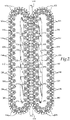
- coiled tubing injector 100 includes for each chain 102 and 104 a skate 146 and 148, respectively, for pressing gripping elements 106 within the gripping zone against tubing 109. Note that the skates are visible only FIGURE 2 .
- the skates apply a normal force to the gripping elements, which transfer that force to the tubing to generate frictional force (referred to as the gripping force) for holding the tubing as it passes through the gripping zone.
- the greater the normal force the greater the traction force.
- the normal force is generated in part by a plurality of hydraulic cylinders. Each of the hydraulic cylinders is connected at a discrete position along the length of the gripping zone.
- one or more hydraulic cylinders can be arranged to push or pull the skates toward each other.
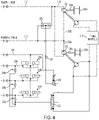
- FIGURES 3 and 4 are schematic diagrams of examples of representative embodiments of hydraulic circuits for use with the injectors such as the one shown in FIGURE 1 .
- drive motors 142 and 144 of FIGURE 1 correspond to hydraulic motors 202 and 204 in FIGURES 3 and 4 .
- the drive motors can be electric motors.
- Each drive motor has an output shaft 206a and 206b, respectively, coupled to a respective drive sprocket 208a and 208b.
- the drive motor may, optionally, be coupled through a gear box, such as a planetary gear box, and/or a brake.
- Each drive sprocket drives rotation of a different gripper chain (not shown).
- the circuit is driving two gripper chains.
- Pressurized hydraulic fluid from, for example, a power pack is supplied through supply line 210 (labelled "Power In”) to hydraulic drive motor 202, through branch 210a, and drive motor 204, through branch 210b.
- the hydraulic motors are connected to the return line 212 (labelled "Power Out”) through lines 212a and 212b, respectively.
- the drive motors are, thus, connected to the hydraulic power supply in parallel.
- Each of the timing motors 214 and 216 is coupled, respectively, to one of the two drive chains (not shown) so that it rotates at a speed that is in a fixed relationship to the rotational speed of the chain.
- each timing motor is connected, respectively, to the drive shafts of the respective one of the drive motors 202 and 204, as is shown in FIG. 1 .
- a timing motor could be indirectly connected or coupled, such as through gearing, to the drive motor or sprocket on which the chain is mounted.
- Each of the timing motors in this example, is comprised of a positive displacement hydraulic motor.
- the hydraulic timing motors 214 and 216 are connected in series in a closed circuit through a timing manifold 218.
- Each timing motor acts only to transfer force from one drive motor to the other when one is turning faster than the other.
- the timing manifold allows speed differences less than a predetermined amount between the motors to exist without building pressure within the circuit. Small differences between rotation speeds could be due to, for example, one gripping chain being slightly longer than the other. Such differences are insubstantial and do not indicate that, for example, one of the driven gripper chains is slipping on the tubing. In fact such differences may be desirable, as they accommodate, for example, slight difference in chain lengths and thus avoid tension that would otherwise have be relieved through slippage of one of the driven chains.
- the timing manifold allows a small, predetermined amount of hydraulic fluid to bleed across the circuit, thereby reducing pressure that would otherwise exist.
- the timing manifold is designed so that it is not able to relieve the pressure, and thus pressure will exist within the timing circuit. Pressure within the closed timing circuit acts to slow the faster turning timing motor, and thus also the drive motor to which it is connected, and speeds up the slower turning timing motor and the drive motor to which it is attached. If insubstantial speed difference between the independently driven chains is to be allowed, it is preferred to reduce or relieve pressure from within the circuit at those speed differences.
- the hydraulic timing circuit can be constructed without a timing manifold, or the timing manifold can be made adjustable and set to so that it does not reduce pressure within the circuit even at insubstantial speed differences.
- Pressure within the hydraulic timing circuit is, in the illustrated embodiment, also used to cause or to signal for an increase in the hydraulic pressure supplied to the coiled tubing injector's traction system, thus increasing the normal force applied the grippers on the chains.
- the exemplary embodiments of FIGURES 3 and 4 will tend to mitigate slippage, and enable the gripper to regain grip of the tubing in the event of an injector's traction system slipping
- the circuits of FIGURES 3 and 4 represent examples for making use of the pressure within the timing circuit as a control signal for changing or adjusting the hydraulic pressure being supplied to the traction system of a coiled tubing injector by a hydraulic traction pressure circuit, and thus adjusting the normal force being applied by the grippers.
- the two examples differ primarily in the source of a priority hydraulic pressure used for increasing the force supplied by the traction control circuit to the traction system, and thus of the grippers to the tubing.
- a priority pressure circuit is connected in parallel to the timing motors 214 and 216, and the timing manifold 218.
- the priority pressure circuit is comprised, in these examples, of directional valve 222.
- a pressure differential in the timing circuit in excess of a predetermined level causes directional valve 222 to shift, thereby connecting a source of priority hydraulic pressure to a hydraulic traction control circuit that controls the traction system.
- the traction system comprises three hydraulic cylinders 220a, 220b, and 220c that apply pressure to tubing being gripped by the traction system of the coiled tubing injector, the traction system being comprised of skates 146 and 148 of the representative injector illustrated by FIGURES 1 and 2 .
- the hydraulic traction pressure circuit is comprised of, in this example, the hydraulic cylinders and lines 224a, 224b, and 224c.
- the hydraulic traction pressure circuit supplies each hydraulic cylinder in parallel with hydraulic fluid at a predetermined set pressure.
- the pressure within the cylinders results in a normal force being applied to the tubing.
- the force causes skates 146 and 148 ( FIGURE 1 ) to move toward the tubing, resulting in a normal force being applied to the tubing by grippers on the gripper chaining moving along the skates.
- the drains of the cylinders are connected to a common drain line 226.
- the priority pressure circuit connects through check valves 228a, 228b, and 228c, respectively, to the traction control circuit to increase pressure to the priority pressure.
- the priority pressure is greater than the set pressure.
- the check valves prevent pressure from returning to the timing circuit and ensure that the traction circuits are isolated from each other. Traction pressure thus increases towards a maximum setting equal to the priority pressure while tubing is slipping, and otherwise remains at the set pressure.
- priority pressure is supplied through hydraulic line 230 by, for example, an injector-mounted hydraulic pressure supply.
- priority pressure is instead supplied from the main hydraulic power supply for the drive motors, which is through the circuit comprised of hydraulic lines 210 and 212.
- Shuttle valve 232 which is optional, transfers the higher of the two pressures on lines 210 and 212 to the directional valve 222 through a hydraulic line connecting the two.
- the line may, optionally include a manually operated valve 234 for disconnecting or turning off the main pressure supply to the priority pressure circuit.
- the hydraulic fluid from the shuttle valve may pass through a pressure reducing valve 236 to limit the supply pressure to the maximum traction force setting applied by the grippers.
- the pressurereducing valve is connected, in this example, to drain line 226.
Landscapes
- Engineering & Computer Science (AREA)
- Geology (AREA)
- Life Sciences & Earth Sciences (AREA)
- Mining & Mineral Resources (AREA)
- Physics & Mathematics (AREA)
- Environmental & Geological Engineering (AREA)
- Fluid Mechanics (AREA)
- General Life Sciences & Earth Sciences (AREA)
- Geochemistry & Mineralogy (AREA)
- Mechanical Engineering (AREA)
- Placing Or Removing Of Piles Or Sheet Piles, Or Accessories Thereof (AREA)
- Earth Drilling (AREA)
- Wind Motors (AREA)
- Fluid-Pressure Circuits (AREA)
Claims (20)
- Gewickeltes-Rohr-Einführvorrichtung (100), umfassend:wenigstens zwei Greiferketten (102, 104), die jeweils eine Vielzahl von Greifern (106) für das Greifen eines gewickelten Rohrs (109) in einer Greifzone zwischen den Ketten aufweisen,ein Antriebssystem, das einen hydraulischen Antriebsdruckkreis (224a, 224b, 224c) für das Erzeugen einer auf die wenigstens zwei Ketten ausgeübten Greifkraft umfasst,einen hydraulischen Zeitgeberkreis (214, 216, 218), der mit den wenigstens zwei Greiferketten gekoppelt ist, wobei der hydraulische Zeitgeberkreis ausgebildet ist für das Erfassen, dass eine Differenz zwischen den relativen Geschwindigkeiten der wenigstens zwei Greiferketten (102, 104) größer als eine vorbestimmte Größe ist, dadurch gekennzeichnet, dass ein Hydraulikdrucksignal durch den hydraulischen Zeitgeberkreis erzeugt wird, wenn die Differenz zwischen den relativen Geschwindigkeiten der wenigstens zwei Greiferketten größer als eine vorbestimmte Größe ist, woraufhin das Hydraulikdrucksignal ein Ventil (222) betätigt, um den zu dem hydraulischen Antriebsdruckkreis (224a, 224b, 224c) zugeführten Hydraulikdruck und dadurch die Greifkraft in Reaktion auf das Hydraulikdrucksignal zu erhöhen.
- Gewickeltes-Rohr-Einführvorrichtung nach Anspruch 1, wobei jede der wenigstens zwei Greiferketten (102, 104) unabhängig angetrieben wird.
- Gewickeltes-Rohr-Einführvorrichtung nach Anspruch 1 oder 2, wobei der hydraulische Zeitgeberkreis (214, 216, 218) einen Zeitgeberkreis mit wenigstens zwei hydraulischen Zeitgebermotoren (214, 216) umfasst, die jeweils mit einer separaten der wenigstens zwei Greiferketten (102, 104) gekoppelt sind, wobei die hydraulischen Zeitgebermotoren mit dem hydraulischen Zeitgeberkreis derart verbunden sind, dass sie einen Druck in dem hydraulischen Zeitgeberkreis erzeugen, wenn die Geschwindigkeit, mit der eine der wenigstens zwei Greiferketten einen der Zeitgebermotoren dreht, um wenigstens eine vorbestimmte Größe schneller ist als die Geschwindigkeit, mit der die andere der unabhängig angetriebenen Greiferketten den anderen Zeitgebermotor dreht.
- Gewickeltes-Rohr-Einführvorrichtung nach Anspruch 3, wobei die wenigstens zwei hydraulischen Zeitgebermotoren (214, 216) in Reihe in einem geschlossenen Kreis über einen Zeitgeberverteiler (218) verbunden sind, der Geschwindigkeitsdifferenzen zwischen den wenigstens zwei hydraulischen Zeitgebermotoren, die kleiner als eine vorbestimmte Größe sind, ohne einen Aufbau eines Drucks in dem hydraulischen Zeitgeberkreis zulässt, indem er erlaubt, dass eine kleine, vorbestimmte Menge eines Hydraulikfluids über die Schaltung abgelassen wird, um den Druck, der ansonsten vorhanden wäre, zu reduzieren.
- Gewickeltes-Rohr-Einführvorrichtung nach Anspruch 3 oder 4, wobei der Druck in dem Zeitgeberkreis als das Hydraulikdrucksignal verwendet wird.
- Gewickeltes-Rohr-Einführvorrichtung nach einem der vorstehenden Ansprüche, wobei während der Verwendung durch die Betätigung des Ventils (222) für das Erhöhen des zu dem hydraulischen Antriebsdruckkreis (224a, 224b, 224c) zugeführten Hydraulikdrucks eine Zufuhr eines Hydraulikfluids mit einem größeren Druck mit dem hydraulischen Antriebsdruckkreis verbunden wird.
- Gewickeltes-Rohr-Einführvorrichtung nach Anspruch 6, wobei die Zufuhr des Hydraulikfluids mit einem größeren Druck von einer an der Einführvorrichtung montierten Hydraulikdruckquelle erfolgt.
- Gewickeltes-Rohr-Einführvorrichtung nach Anspruch 6, wobei die Zufuhr des Hydraulikfluids mit einem größeren Druck von einer Haupthydraulikkraftquelle für einen oder mehrere hydraulische Antriebsmotoren (142, 144; 202, 204), die mit den wenigstens zwei Greiferketten (102, 104) gekoppelt sind, erfolgt.
- Gewickeltes-Rohr-Einführvorrichtung nach Anspruch 8, wobei die Haupthydraulikkraftquelle eine Krafteinführleitung (210), die ein Hydraulikfluid mit einem ersten Druck aufweist, eine Kraftausführleitung (212), die ein Hydraulikfluid mit einem zweiten Druck aufweist, und ein dazwischen angeordnetes Wechselventil (232) umfasst, sodass während der Verwendung das Hydraulikfluid mit dem höheren der ersten und zweiten Drücke zu dem Betätigungsventil (222) gerichtet wird.
- Gewickeltes-Rohr-Einführvorrichtung nach Anspruch 9, wobei das durch das Wechselventil (232) gerichtete Hydraulikfluid durch ein Druckreduktionsventil (236) hindurchgeht, bevor es das Betätigungsventil (222) erreicht.
- Gewickeltes-Rohr-Einführvorrichtung nach einem der vorstehenden Ansprüche, die weiterhin umfasst:eine Vielzahl von Skates (146, 148), und zwar jeweils eines für jeweils eine der wenigstens zwei Greiferketten (102, 104), für das Drücken der Vielzahl von Greifern (106) der Kette in der Greifzone zu dem gewickelten Rohr, undeine Vielzahl von Hydraulikzylindern (220a, 220b, 220c), die mit der Vielzahl von Skates an jeweils diskreten Positionen entlang der Länge der Greifzone gekoppelt sind, um eine normale Kraft über die Skates auf die Greifelemente auszuüben.
- Verfahren zum Steuern des Antriebs einer Gewickeltes-Rohr-Einführvorrichtung (100), wobei die Gewickeltes-Rohr-Einführvorrichtung wenigstens zwei Greiferketten (102, 104) umfasst, die jeweils eine Vielzahl von Greifern (106) für das Greifen eines gewickelten Rohrs (109) in einer Greifzone zwischen den Ketten aufweist, wobei das Verfahren umfasst:unabhängiges Antreiben jeder der Greiferketten (102, 104),Hindurchführen des gewickelten Rohrs zwischen den wenigstens zwei Greiferketten,Erzeugen, mittels eines hydraulischen Antriebsdruckkreises (224a, 224b, 224c) einer Greifkraft, und Ausüben der Greifkraft auf die wenigstens zwei Greiferketten.Erfassen, mittels eines hydraulischen Zeitgeberkreises (214, 216, 218), der mit jeder der Greiferketten gekoppelt ist, einer Differenz zwischen den relativen Geschwindigkeiten der wenigstens zwei Greiferketten, was angibt, dass eine Kette relativ zu dem gewickelten Rohr zu schlüpfen beginnt,gekennzeichnet durch:Erzeugen eines Hydraulikdrucksignals, wenn die Differenz erfasst wird,wobei das Hydraulikdrucksignal ein Ventil (222) betätigt,wobei die Betätigung des Ventils (222) eine Erhöhung des zu dem hydraulischen Antriebsdruckkreis (224a, 224b, 224c) zugeführten Hydraulikdrucks und dadurch eine Erhöhung der durch die wenigstens zwei Greiferketten (102, 104) auf das gewickelte Rohr ausgeübten Greifkraft in Reaktion auf das Hydraulikdrucksignal veranlasst.
- Verfahren nach Anspruch 12, wobei der hydraulische Zeitgeberkreis (214, 216, 218) wenigstens zwei hydraulische Zeitgebermotoren (214, 218) umfasst, die jeweils mit einer separaten der wenigstens zwei Greiferketten (102, 104) gekoppelt sind, wobei die hydraulischen Zeitgebermotoren gekoppelt sind, um einen Druck in dem hydraulischen Zeitgeberkreis zu erzeugen, wenn die Geschwindigkeit an einer der wenigstens zwei Greiferketten, die einen der Zeitgebermotoren dreht, wenigstens um eine vorbestimmte Größe schneller ist als die Geschwindigkeit der anderen der unabhängig angetriebenen Ketten, die den anderen Zeitgebermotor dreht.
- Verfahren nach Anspruch 13, wobei die wenigstens zwei hydraulischen Zeitgebermotoren (214, 218) in Reihe in einem geschlossenen Kreis über einen Zeitgeberverteiler (218) verbunden sind, der Geschwindigkeitsdifferenzen zwischen den wenigstens zwei hydraulischen Zeitgebermotoren, die kleiner als eine vorbestimmte Größe sind, ohne einen Aufbau eines Drucks in dem hydraulischen Zeitgeberkreis zulässt, indem er erlaubt, dass eine kleine, vorbestimmte Menge eines Hydraulikfluids über die Schaltung abgelassen wird, um den Druck, der ansonsten vorhanden wäre, zu reduzieren.
- Verfahren nach einem der Ansprüche 12 bis 14, wobei das Erhöhen der durch die wenigstens zwei Greiferketten (102, 104) auf das gewickelte Rohr ausgeübten Greifkraft in Reaktion auf das Hydraulikdrucksignal das Erhöhen des Drucks zu dem wenigstens einen Hydraulikzylinder (220a, 220b, 220c) zugeführten Hydraulikfluids und dadurch das Erzeugen der Greifkraft umfasst.
- Verfahren nach Anspruch 12 bis 15, wobei die Zufuhr des Hydraulikfluids mit einem größeren Druck von einer an der Einführvorrichtung montierten Hydraulikdruckquelle erfolgt.
- Verfahren nach Anspruch 16, wobei die Zufuhr des Hydraulikfluids mit einem größeren Druck von einer Haupthydraulikkraftquelle für einen oder mehrere hydraulische Antriebsmotoren (142, 144; 202, 204), die mit den wenigstens zwei Greiferketten (102, 104) gekoppelt sind, erfolgt.
- Verfahren nach Anspruch 17, wobei die Haupthydraulikquelle eine Krafteinführleitung (210), die ein Hydraulikfluid mit einem ersten Druck aufweist, eine Kraftausführleitung (212), die ein Hydraulikfluid mit einem zweiten Druck aufweist, und ein dazwischen angeordnetes Wechselventil (232) umfasst, wobei das Verfahren weiterhin einen Schritt zum Richten, durch das Wechselventil (232), des Hydraulikfluids mit dem höheren der ersten und zweiten Drücke zu dem Betätigungsventil (222) umfasst.
- Verfahren nach Anspruch 18, wobei das durch das Wechselventil (232) gerichtete Hydraulikfluid durch ein Druckreduktionsventil (236) hindurchgeht, bevor es das Betätigungsventil (222) erreicht.
- Verfahren nach einem der Ansprüche 12-19, wobei die Gewickeltes-Rohr-Einführvorrichtung umfasst:eine Vielzahl von Skates (146, 148), und zwar jeweils eines für jeweils eine der wenigstens zwei Greiferketten (102, 104), für das Drücken der Vielzahl von Greifelementen (106) der Kette in der Greifzone zu dem gewickelten Rohr, undeine Vielzahl von Hydraulikzylindern (220a, 220b, 220c), die mit der Vielzahl von Skates an jeweils diskreten Positionen entlang der Länge der Greifzone gekoppelt sind, um eine normale Kraft über die Skates auf die Greifelemente auszuüben.
Applications Claiming Priority (2)
| Application Number | Priority Date | Filing Date | Title |
|---|---|---|---|
| US201361861352P | 2013-08-01 | 2013-08-01 | |
| PCT/US2014/049493 WO2015017835A2 (en) | 2013-08-01 | 2014-08-01 | Coiled tubing injector with hydraulic traction slip mitigation circuit |
Publications (2)
| Publication Number | Publication Date |
|---|---|
| EP3027848A2 EP3027848A2 (de) | 2016-06-08 |
| EP3027848B1 true EP3027848B1 (de) | 2022-10-26 |
Family
ID=51355683
Family Applications (1)
| Application Number | Title | Priority Date | Filing Date |
|---|---|---|---|
| EP14752528.1A Active EP3027848B1 (de) | 2013-08-01 | 2014-08-01 | Einführungsvorrichtung für eine gespulte rohrleitung mit hydraulischem antriebsschlupf-abschwächungszyklus |
Country Status (5)
| Country | Link |
|---|---|
| US (1) | US10024123B2 (de) |
| EP (1) | EP3027848B1 (de) |
| CN (1) | CN105431611B (de) |
| CA (1) | CA2919175C (de) |
| WO (1) | WO2015017835A2 (de) |
Families Citing this family (42)
| Publication number | Priority date | Publication date | Assignee | Title |
|---|---|---|---|---|
| US10100639B2 (en) * | 2014-09-17 | 2018-10-16 | Premier Coil Solutions, Inc. | Methods and system for independently controlling injector head drive motor speeds |
| US10323471B2 (en) * | 2016-03-11 | 2019-06-18 | Baker Hughes, A Ge Company, Llc | Intelligent injector control system, coiled tubing unit having the same, and method |
| CN105840122B (zh) * | 2016-05-12 | 2017-12-08 | 山东科瑞机械制造有限公司 | 一种四马达交替驱动连续管注入头 |
| US11624326B2 (en) | 2017-05-21 | 2023-04-11 | Bj Energy Solutions, Llc | Methods and systems for supplying fuel to gas turbine engines |
| US11560845B2 (en) | 2019-05-15 | 2023-01-24 | Bj Energy Solutions, Llc | Mobile gas turbine inlet air conditioning system and associated methods |
| US11555756B2 (en) | 2019-09-13 | 2023-01-17 | Bj Energy Solutions, Llc | Fuel, communications, and power connection systems and related methods |
| CA3191280A1 (en) | 2019-09-13 | 2021-03-13 | Bj Energy Solutions, Llc | Methods and systems for supplying fuel to gas turbine engines |
| US10815764B1 (en) | 2019-09-13 | 2020-10-27 | Bj Energy Solutions, Llc | Methods and systems for operating a fleet of pumps |
| US12338772B2 (en) | 2019-09-13 | 2025-06-24 | Bj Energy Solutions, Llc | Systems, assemblies, and methods to enhance intake air flow to a gas turbine engine of a hydraulic fracturing unit |
| US10895202B1 (en) | 2019-09-13 | 2021-01-19 | Bj Energy Solutions, Llc | Direct drive unit removal system and associated methods |
| CA3092865C (en) | 2019-09-13 | 2023-07-04 | Bj Energy Solutions, Llc | Power sources and transmission networks for auxiliary equipment onboard hydraulic fracturing units and associated methods |
| US12065968B2 (en) | 2019-09-13 | 2024-08-20 | BJ Energy Solutions, Inc. | Systems and methods for hydraulic fracturing |
| CA3092859A1 (en) | 2019-09-13 | 2021-03-13 | Bj Energy Solutions, Llc | Fuel, communications, and power connection systems and related methods |
| US11015594B2 (en) | 2019-09-13 | 2021-05-25 | Bj Energy Solutions, Llc | Systems and method for use of single mass flywheel alongside torsional vibration damper assembly for single acting reciprocating pump |
| CA3092863C (en) | 2019-09-13 | 2023-07-18 | Bj Energy Solutions, Llc | Fuel, communications, and power connection systems and related methods |
| CA3092868A1 (en) | 2019-09-13 | 2021-03-13 | Bj Energy Solutions, Llc | Turbine engine exhaust duct system and methods for noise dampening and attenuation |
| US11002189B2 (en) | 2019-09-13 | 2021-05-11 | Bj Energy Solutions, Llc | Mobile gas turbine inlet air conditioning system and associated methods |
| US11708829B2 (en) | 2020-05-12 | 2023-07-25 | Bj Energy Solutions, Llc | Cover for fluid systems and related methods |
| US10968837B1 (en) | 2020-05-14 | 2021-04-06 | Bj Energy Solutions, Llc | Systems and methods utilizing turbine compressor discharge for hydrostatic manifold purge |
| US11428165B2 (en) | 2020-05-15 | 2022-08-30 | Bj Energy Solutions, Llc | Onboard heater of auxiliary systems using exhaust gases and associated methods |
| US11208880B2 (en) | 2020-05-28 | 2021-12-28 | Bj Energy Solutions, Llc | Bi-fuel reciprocating engine to power direct drive turbine fracturing pumps onboard auxiliary systems and related methods |
| US11208953B1 (en) | 2020-06-05 | 2021-12-28 | Bj Energy Solutions, Llc | Systems and methods to enhance intake air flow to a gas turbine engine of a hydraulic fracturing unit |
| US11109508B1 (en) | 2020-06-05 | 2021-08-31 | Bj Energy Solutions, Llc | Enclosure assembly for enhanced cooling of direct drive unit and related methods |
| US11066915B1 (en) | 2020-06-09 | 2021-07-20 | Bj Energy Solutions, Llc | Methods for detection and mitigation of well screen out |
| US11111768B1 (en) | 2020-06-09 | 2021-09-07 | Bj Energy Solutions, Llc | Drive equipment and methods for mobile fracturing transportation platforms |
| US10954770B1 (en) | 2020-06-09 | 2021-03-23 | Bj Energy Solutions, Llc | Systems and methods for exchanging fracturing components of a hydraulic fracturing unit |
| US11125066B1 (en) | 2020-06-22 | 2021-09-21 | Bj Energy Solutions, Llc | Systems and methods to operate a dual-shaft gas turbine engine for hydraulic fracturing |
| US11939853B2 (en) | 2020-06-22 | 2024-03-26 | Bj Energy Solutions, Llc | Systems and methods providing a configurable staged rate increase function to operate hydraulic fracturing units |
| US11028677B1 (en) | 2020-06-22 | 2021-06-08 | Bj Energy Solutions, Llc | Stage profiles for operations of hydraulic systems and associated methods |
| US11933153B2 (en) | 2020-06-22 | 2024-03-19 | Bj Energy Solutions, Llc | Systems and methods to operate hydraulic fracturing units using automatic flow rate and/or pressure control |
| US11466680B2 (en) | 2020-06-23 | 2022-10-11 | Bj Energy Solutions, Llc | Systems and methods of utilization of a hydraulic fracturing unit profile to operate hydraulic fracturing units |
| US11473413B2 (en) | 2020-06-23 | 2022-10-18 | Bj Energy Solutions, Llc | Systems and methods to autonomously operate hydraulic fracturing units |
| US11220895B1 (en) | 2020-06-24 | 2022-01-11 | Bj Energy Solutions, Llc | Automated diagnostics of electronic instrumentation in a system for fracturing a well and associated methods |
| US11149533B1 (en) | 2020-06-24 | 2021-10-19 | Bj Energy Solutions, Llc | Systems to monitor, detect, and/or intervene relative to cavitation and pulsation events during a hydraulic fracturing operation |
| US11193361B1 (en) | 2020-07-17 | 2021-12-07 | Bj Energy Solutions, Llc | Methods, systems, and devices to enhance fracturing fluid delivery to subsurface formations during high-pressure fracturing operations |
| US20220290514A1 (en) * | 2021-03-10 | 2022-09-15 | Premier Coil Solutions, Inc. | Automatic Coiled Tubing Injector Chain Management System |
| US11639654B2 (en) | 2021-05-24 | 2023-05-02 | Bj Energy Solutions, Llc | Hydraulic fracturing pumps to enhance flow of fracturing fluid into wellheads and related methods |
| CA3180024A1 (en) | 2021-10-25 | 2023-04-25 | Bj Energy Solutions, Llc | Systems and methods to reduce acoustic resonance or disrupt standing wave formation in a fluid manifold of a high-pressure fracturing system |
| US11566479B1 (en) * | 2021-11-03 | 2023-01-31 | Halliburton Energy Services, Inc. | Gripper control in a coiled tubing system |
| CN114212627A (zh) * | 2021-11-24 | 2022-03-22 | 山西江淮重工有限责任公司 | 一种井下管道收放装置 |
| US11661804B1 (en) | 2022-08-23 | 2023-05-30 | National Oilwell Varco, L.P. | Coiled tubing injector with reactive chain tension |
| WO2024182238A1 (en) * | 2023-02-27 | 2024-09-06 | Nabors Drilling Technologies Usa, Inc. | Wrench with self-intensifier |
Family Cites Families (11)
| Publication number | Priority date | Publication date | Assignee | Title |
|---|---|---|---|---|
| US3132622A (en) * | 1961-11-08 | 1964-05-12 | Tacoma Boatbuilding Co Inc | Two-sided hydraulic system |
| US3841407A (en) * | 1973-01-02 | 1974-10-15 | J Bozeman | Coil tubing unit |
| US5325668A (en) * | 1988-06-10 | 1994-07-05 | S.I.T.I. Societa Impianti Termoelettrici Industriali S.P.A. | Method and apparatus for hydraulic pressing |
| US5158781A (en) | 1989-03-02 | 1992-10-27 | The Conair Group, Inc. | Traction apparatus for tubular material |
| US5850874A (en) * | 1995-03-10 | 1998-12-22 | Burge; Philip | Drilling system with electrically controlled tubing injection system |
| US5775417A (en) * | 1997-03-24 | 1998-07-07 | Council; Malcolm N. | Coiled tubing handling apparatus |
| US6968905B2 (en) * | 2003-03-18 | 2005-11-29 | Schlumberger Technology Corporation | Distributed control system |
| US7150330B2 (en) | 2004-05-06 | 2006-12-19 | Halliburton Energy Services, Inc. | Hydraulic circuit and method for operating a gripping device |
| US8544536B2 (en) * | 2010-09-24 | 2013-10-01 | National Oilwell Varco, L.P. | Coiled tubing injector with limited slip chains |
| US8651190B2 (en) * | 2010-10-28 | 2014-02-18 | Hydril Usa Manufacturing Llc | Shear boost triggering and bottle reducing system and method |
| CN202832281U (zh) * | 2012-09-03 | 2013-03-27 | 中国石油天然气集团公司 | 一种液压可折叠式连续油管导向装置 |
-
2014
- 2014-08-01 CA CA2919175A patent/CA2919175C/en active Active
- 2014-08-01 US US14/908,272 patent/US10024123B2/en active Active
- 2014-08-01 CN CN201480043208.XA patent/CN105431611B/zh active Active
- 2014-08-01 EP EP14752528.1A patent/EP3027848B1/de active Active
- 2014-08-01 WO PCT/US2014/049493 patent/WO2015017835A2/en not_active Ceased
Also Published As
| Publication number | Publication date |
|---|---|
| US10024123B2 (en) | 2018-07-17 |
| CA2919175C (en) | 2021-03-09 |
| WO2015017835A2 (en) | 2015-02-05 |
| EP3027848A2 (de) | 2016-06-08 |
| WO2015017835A3 (en) | 2015-04-02 |
| CN105431611A (zh) | 2016-03-23 |
| CN105431611B (zh) | 2019-03-08 |
| US20160186509A1 (en) | 2016-06-30 |
| CA2919175A1 (en) | 2015-02-05 |
Similar Documents
| Publication | Publication Date | Title |
|---|---|---|
| EP3027848B1 (de) | Einführungsvorrichtung für eine gespulte rohrleitung mit hydraulischem antriebsschlupf-abschwächungszyklus | |
| US9151122B2 (en) | Coiled tubing injector with limited slip chains | |
| CA2818611C (en) | Coiled tubing injector with strain relief | |
| US4655291A (en) | Injector for coupled pipe | |
| US6059029A (en) | Coiled tubing injector | |
| EP2744969B1 (de) | Vorrichtung zur aktivierung von greifbacken in kontinuierlich umlaufenden drehmomentzangen zur verwendung während eines zugvorgangs und während der öffnung von schraubverbindungen | |
| US20030034162A1 (en) | Well string injection system and method | |
| US20150315858A1 (en) | Apparatus and method for connecting components | |
| US20050205267A1 (en) | Coil tubing injector for injecting tubings of various diameters | |
| CN214393944U (zh) | 一种用于市政管道施工的夹持装置 | |
| US3690534A (en) | Cable handling system | |
| CN103387161B (zh) | 一种蜗轮蜗杆驱动式滚筒装置 | |
| RU2632616C2 (ru) | Инжектор гибкой насосно-компрессорной трубы с разгрузкой натяжения | |
| CN204324782U (zh) | 钢丝绳绞车缠绳装置 | |
| CN206332380U (zh) | 履带式布缆机 | |
| CN201301190Y (zh) | 滚筒试井绞车的排线机构 | |
| CN201568041U (zh) | 一种连续油管作业机注入头与卷筒同步控制系统 | |
| CA2461977A1 (en) | Coil tubing injector for injecting tubings of various diameters | |
| RU2576544C2 (ru) | Способ и устройство для эксплуатации цепного привода |
Legal Events
| Date | Code | Title | Description |
|---|---|---|---|
| PUAI | Public reference made under article 153(3) epc to a published international application that has entered the european phase |
Free format text: ORIGINAL CODE: 0009012 |
|
| 17P | Request for examination filed |
Effective date: 20160126 |
|
| AK | Designated contracting states |
Kind code of ref document: A2 Designated state(s): AL AT BE BG CH CY CZ DE DK EE ES FI FR GB GR HR HU IE IS IT LI LT LU LV MC MK MT NL NO PL PT RO RS SE SI SK SM TR |
|
| AX | Request for extension of the european patent |
Extension state: BA ME |
|
| DAX | Request for extension of the european patent (deleted) | ||
| STAA | Information on the status of an ep patent application or granted ep patent |
Free format text: STATUS: EXAMINATION IS IN PROGRESS |
|
| 17Q | First examination report despatched |
Effective date: 20170713 |
|
| GRAP | Despatch of communication of intention to grant a patent |
Free format text: ORIGINAL CODE: EPIDOSNIGR1 |
|
| STAA | Information on the status of an ep patent application or granted ep patent |
Free format text: STATUS: GRANT OF PATENT IS INTENDED |
|
| INTG | Intention to grant announced |
Effective date: 20220629 |
|
| GRAS | Grant fee paid |
Free format text: ORIGINAL CODE: EPIDOSNIGR3 |
|
| GRAA | (expected) grant |
Free format text: ORIGINAL CODE: 0009210 |
|
| STAA | Information on the status of an ep patent application or granted ep patent |
Free format text: STATUS: THE PATENT HAS BEEN GRANTED |
|
| AK | Designated contracting states |
Kind code of ref document: B1 Designated state(s): AL AT BE BG CH CY CZ DE DK EE ES FI FR GB GR HR HU IE IS IT LI LT LU LV MC MK MT NL NO PL PT RO RS SE SI SK SM TR |
|
| REG | Reference to a national code |
Ref country code: GB Ref legal event code: FG4D |
|
| REG | Reference to a national code |
Ref country code: CH Ref legal event code: EP |
|
| REG | Reference to a national code |
Ref country code: DE Ref legal event code: R096 Ref document number: 602014085328 Country of ref document: DE |
|
| REG | Reference to a national code |
Ref country code: AT Ref legal event code: REF Ref document number: 1527158 Country of ref document: AT Kind code of ref document: T Effective date: 20221115 |
|
| REG | Reference to a national code |
Ref country code: IE Ref legal event code: FG4D |
|
| REG | Reference to a national code |
Ref country code: NO Ref legal event code: T2 Effective date: 20221026 |
|
| REG | Reference to a national code |
Ref country code: LT Ref legal event code: MG9D |
|
| REG | Reference to a national code |
Ref country code: NL Ref legal event code: MP Effective date: 20221026 |
|
| REG | Reference to a national code |
Ref country code: AT Ref legal event code: MK05 Ref document number: 1527158 Country of ref document: AT Kind code of ref document: T Effective date: 20221026 |
|
| PG25 | Lapsed in a contracting state [announced via postgrant information from national office to epo] |
Ref country code: NL Free format text: LAPSE BECAUSE OF FAILURE TO SUBMIT A TRANSLATION OF THE DESCRIPTION OR TO PAY THE FEE WITHIN THE PRESCRIBED TIME-LIMIT Effective date: 20221026 |
|
| PG25 | Lapsed in a contracting state [announced via postgrant information from national office to epo] |
Ref country code: SE Free format text: LAPSE BECAUSE OF FAILURE TO SUBMIT A TRANSLATION OF THE DESCRIPTION OR TO PAY THE FEE WITHIN THE PRESCRIBED TIME-LIMIT Effective date: 20221026 Ref country code: PT Free format text: LAPSE BECAUSE OF FAILURE TO SUBMIT A TRANSLATION OF THE DESCRIPTION OR TO PAY THE FEE WITHIN THE PRESCRIBED TIME-LIMIT Effective date: 20230227 Ref country code: LT Free format text: LAPSE BECAUSE OF FAILURE TO SUBMIT A TRANSLATION OF THE DESCRIPTION OR TO PAY THE FEE WITHIN THE PRESCRIBED TIME-LIMIT Effective date: 20221026 Ref country code: FI Free format text: LAPSE BECAUSE OF FAILURE TO SUBMIT A TRANSLATION OF THE DESCRIPTION OR TO PAY THE FEE WITHIN THE PRESCRIBED TIME-LIMIT Effective date: 20221026 Ref country code: ES Free format text: LAPSE BECAUSE OF FAILURE TO SUBMIT A TRANSLATION OF THE DESCRIPTION OR TO PAY THE FEE WITHIN THE PRESCRIBED TIME-LIMIT Effective date: 20221026 Ref country code: AT Free format text: LAPSE BECAUSE OF FAILURE TO SUBMIT A TRANSLATION OF THE DESCRIPTION OR TO PAY THE FEE WITHIN THE PRESCRIBED TIME-LIMIT Effective date: 20221026 |
|
| PG25 | Lapsed in a contracting state [announced via postgrant information from national office to epo] |
Ref country code: RS Free format text: LAPSE BECAUSE OF FAILURE TO SUBMIT A TRANSLATION OF THE DESCRIPTION OR TO PAY THE FEE WITHIN THE PRESCRIBED TIME-LIMIT Effective date: 20221026 Ref country code: PL Free format text: LAPSE BECAUSE OF FAILURE TO SUBMIT A TRANSLATION OF THE DESCRIPTION OR TO PAY THE FEE WITHIN THE PRESCRIBED TIME-LIMIT Effective date: 20221026 Ref country code: LV Free format text: LAPSE BECAUSE OF FAILURE TO SUBMIT A TRANSLATION OF THE DESCRIPTION OR TO PAY THE FEE WITHIN THE PRESCRIBED TIME-LIMIT Effective date: 20221026 Ref country code: IS Free format text: LAPSE BECAUSE OF FAILURE TO SUBMIT A TRANSLATION OF THE DESCRIPTION OR TO PAY THE FEE WITHIN THE PRESCRIBED TIME-LIMIT Effective date: 20230226 Ref country code: HR Free format text: LAPSE BECAUSE OF FAILURE TO SUBMIT A TRANSLATION OF THE DESCRIPTION OR TO PAY THE FEE WITHIN THE PRESCRIBED TIME-LIMIT Effective date: 20221026 Ref country code: GR Free format text: LAPSE BECAUSE OF FAILURE TO SUBMIT A TRANSLATION OF THE DESCRIPTION OR TO PAY THE FEE WITHIN THE PRESCRIBED TIME-LIMIT Effective date: 20230127 |
|
| P01 | Opt-out of the competence of the unified patent court (upc) registered |
Effective date: 20230530 |
|
| REG | Reference to a national code |
Ref country code: DE Ref legal event code: R097 Ref document number: 602014085328 Country of ref document: DE |
|
| PG25 | Lapsed in a contracting state [announced via postgrant information from national office to epo] |
Ref country code: SM Free format text: LAPSE BECAUSE OF FAILURE TO SUBMIT A TRANSLATION OF THE DESCRIPTION OR TO PAY THE FEE WITHIN THE PRESCRIBED TIME-LIMIT Effective date: 20221026 Ref country code: RO Free format text: LAPSE BECAUSE OF FAILURE TO SUBMIT A TRANSLATION OF THE DESCRIPTION OR TO PAY THE FEE WITHIN THE PRESCRIBED TIME-LIMIT Effective date: 20221026 Ref country code: EE Free format text: LAPSE BECAUSE OF FAILURE TO SUBMIT A TRANSLATION OF THE DESCRIPTION OR TO PAY THE FEE WITHIN THE PRESCRIBED TIME-LIMIT Effective date: 20221026 Ref country code: DK Free format text: LAPSE BECAUSE OF FAILURE TO SUBMIT A TRANSLATION OF THE DESCRIPTION OR TO PAY THE FEE WITHIN THE PRESCRIBED TIME-LIMIT Effective date: 20221026 Ref country code: CZ Free format text: LAPSE BECAUSE OF FAILURE TO SUBMIT A TRANSLATION OF THE DESCRIPTION OR TO PAY THE FEE WITHIN THE PRESCRIBED TIME-LIMIT Effective date: 20221026 |
|
| PG25 | Lapsed in a contracting state [announced via postgrant information from national office to epo] |
Ref country code: SK Free format text: LAPSE BECAUSE OF FAILURE TO SUBMIT A TRANSLATION OF THE DESCRIPTION OR TO PAY THE FEE WITHIN THE PRESCRIBED TIME-LIMIT Effective date: 20221026 Ref country code: AL Free format text: LAPSE BECAUSE OF FAILURE TO SUBMIT A TRANSLATION OF THE DESCRIPTION OR TO PAY THE FEE WITHIN THE PRESCRIBED TIME-LIMIT Effective date: 20221026 |
|
| PLBE | No opposition filed within time limit |
Free format text: ORIGINAL CODE: 0009261 |
|
| STAA | Information on the status of an ep patent application or granted ep patent |
Free format text: STATUS: NO OPPOSITION FILED WITHIN TIME LIMIT |
|
| 26N | No opposition filed |
Effective date: 20230727 |
|
| PG25 | Lapsed in a contracting state [announced via postgrant information from national office to epo] |
Ref country code: SI Free format text: LAPSE BECAUSE OF FAILURE TO SUBMIT A TRANSLATION OF THE DESCRIPTION OR TO PAY THE FEE WITHIN THE PRESCRIBED TIME-LIMIT Effective date: 20221026 |
|
| PG25 | Lapsed in a contracting state [announced via postgrant information from national office to epo] |
Ref country code: MC Free format text: LAPSE BECAUSE OF FAILURE TO SUBMIT A TRANSLATION OF THE DESCRIPTION OR TO PAY THE FEE WITHIN THE PRESCRIBED TIME-LIMIT Effective date: 20221026 |
|
| REG | Reference to a national code |
Ref country code: CH Ref legal event code: PL |
|
| PG25 | Lapsed in a contracting state [announced via postgrant information from national office to epo] |
Ref country code: MC Free format text: LAPSE BECAUSE OF FAILURE TO SUBMIT A TRANSLATION OF THE DESCRIPTION OR TO PAY THE FEE WITHIN THE PRESCRIBED TIME-LIMIT Effective date: 20221026 |
|
| PG25 | Lapsed in a contracting state [announced via postgrant information from national office to epo] |
Ref country code: LU Free format text: LAPSE BECAUSE OF NON-PAYMENT OF DUE FEES Effective date: 20230801 |
|
| PG25 | Lapsed in a contracting state [announced via postgrant information from national office to epo] |
Ref country code: LU Free format text: LAPSE BECAUSE OF NON-PAYMENT OF DUE FEES Effective date: 20230801 Ref country code: CH Free format text: LAPSE BECAUSE OF NON-PAYMENT OF DUE FEES Effective date: 20230831 |
|
| REG | Reference to a national code |
Ref country code: BE Ref legal event code: MM Effective date: 20230831 |
|
| REG | Reference to a national code |
Ref country code: IE Ref legal event code: MM4A |
|
| PG25 | Lapsed in a contracting state [announced via postgrant information from national office to epo] |
Ref country code: IT Free format text: LAPSE BECAUSE OF FAILURE TO SUBMIT A TRANSLATION OF THE DESCRIPTION OR TO PAY THE FEE WITHIN THE PRESCRIBED TIME-LIMIT Effective date: 20221026 |
|
| PG25 | Lapsed in a contracting state [announced via postgrant information from national office to epo] |
Ref country code: IE Free format text: LAPSE BECAUSE OF NON-PAYMENT OF DUE FEES Effective date: 20230801 |
|
| PG25 | Lapsed in a contracting state [announced via postgrant information from national office to epo] |
Ref country code: IE Free format text: LAPSE BECAUSE OF NON-PAYMENT OF DUE FEES Effective date: 20230801 Ref country code: FR Free format text: LAPSE BECAUSE OF NON-PAYMENT OF DUE FEES Effective date: 20230831 |
|
| PG25 | Lapsed in a contracting state [announced via postgrant information from national office to epo] |
Ref country code: BE Free format text: LAPSE BECAUSE OF NON-PAYMENT OF DUE FEES Effective date: 20230831 |
|
| PG25 | Lapsed in a contracting state [announced via postgrant information from national office to epo] |
Ref country code: BG Free format text: LAPSE BECAUSE OF FAILURE TO SUBMIT A TRANSLATION OF THE DESCRIPTION OR TO PAY THE FEE WITHIN THE PRESCRIBED TIME-LIMIT Effective date: 20221026 |
|
| PG25 | Lapsed in a contracting state [announced via postgrant information from national office to epo] |
Ref country code: BG Free format text: LAPSE BECAUSE OF FAILURE TO SUBMIT A TRANSLATION OF THE DESCRIPTION OR TO PAY THE FEE WITHIN THE PRESCRIBED TIME-LIMIT Effective date: 20221026 |
|
| PGFP | Annual fee paid to national office [announced via postgrant information from national office to epo] |
Ref country code: GB Payment date: 20250612 Year of fee payment: 12 |
|
| PG25 | Lapsed in a contracting state [announced via postgrant information from national office to epo] |
Ref country code: CY Free format text: LAPSE BECAUSE OF FAILURE TO SUBMIT A TRANSLATION OF THE DESCRIPTION OR TO PAY THE FEE WITHIN THE PRESCRIBED TIME-LIMIT; INVALID AB INITIO Effective date: 20140801 |
|
| PG25 | Lapsed in a contracting state [announced via postgrant information from national office to epo] |
Ref country code: HU Free format text: LAPSE BECAUSE OF FAILURE TO SUBMIT A TRANSLATION OF THE DESCRIPTION OR TO PAY THE FEE WITHIN THE PRESCRIBED TIME-LIMIT; INVALID AB INITIO Effective date: 20140801 |
|
| PGFP | Annual fee paid to national office [announced via postgrant information from national office to epo] |
Ref country code: DE Payment date: 20250604 Year of fee payment: 12 |
|
| PGFP | Annual fee paid to national office [announced via postgrant information from national office to epo] |
Ref country code: NO Payment date: 20250808 Year of fee payment: 12 |
|
| PG25 | Lapsed in a contracting state [announced via postgrant information from national office to epo] |
Ref country code: TR Free format text: LAPSE BECAUSE OF FAILURE TO SUBMIT A TRANSLATION OF THE DESCRIPTION OR TO PAY THE FEE WITHIN THE PRESCRIBED TIME-LIMIT Effective date: 20221026 |