EP3026048A1 - Hexahydrobenzofurane und Hexahydrochromene - Verfahren zur Herstellung und ihre Verwendung als Duftstoffe - Google Patents
Hexahydrobenzofurane und Hexahydrochromene - Verfahren zur Herstellung und ihre Verwendung als Duftstoffe Download PDFInfo
- Publication number
- EP3026048A1 EP3026048A1 EP14195235.8A EP14195235A EP3026048A1 EP 3026048 A1 EP3026048 A1 EP 3026048A1 EP 14195235 A EP14195235 A EP 14195235A EP 3026048 A1 EP3026048 A1 EP 3026048A1
- Authority
- EP
- European Patent Office
- Prior art keywords
- methyl
- oil
- ethyl
- compounds
- dimethyl
- Prior art date
- Legal status (The legal status is an assumption and is not a legal conclusion. Google has not performed a legal analysis and makes no representation as to the accuracy of the status listed.)
- Granted
Links
- 0 CC(CC(C(C)(C)*)=CC1)C1(O)OC* Chemical compound CC(CC(C(C)(C)*)=CC1)C1(O)OC* 0.000 description 1
Classifications
-
- C—CHEMISTRY; METALLURGY
- C07—ORGANIC CHEMISTRY
- C07D—HETEROCYCLIC COMPOUNDS
- C07D307/00—Heterocyclic compounds containing five-membered rings having one oxygen atom as the only ring hetero atom
- C07D307/77—Heterocyclic compounds containing five-membered rings having one oxygen atom as the only ring hetero atom ortho- or peri-condensed with carbocyclic rings or ring systems
- C07D307/78—Benzo [b] furans; Hydrogenated benzo [b] furans
- C07D307/79—Benzo [b] furans; Hydrogenated benzo [b] furans with only hydrogen atoms, hydrocarbon or substituted hydrocarbon radicals, directly attached to carbon atoms of the hetero ring
-
- C—CHEMISTRY; METALLURGY
- C07—ORGANIC CHEMISTRY
- C07D—HETEROCYCLIC COMPOUNDS
- C07D311/00—Heterocyclic compounds containing six-membered rings having one oxygen atom as the only hetero atom, condensed with other rings
- C07D311/02—Heterocyclic compounds containing six-membered rings having one oxygen atom as the only hetero atom, condensed with other rings ortho- or peri-condensed with carbocyclic rings or ring systems
- C07D311/74—Benzo[b]pyrans, hydrogenated in the carbocyclic ring
Definitions
- the present invention relates to new fragrances, processes for their preparation, perfumes and consumer goods containing these fragrances and their uses.
- amber or "amber” is one of the highly preferred odor notes in perfumes. It gives perfumes a special exclusivity and luxury. Amber was originally extracted from the intestinal tract of sperm whales, but today it is preferred to use amber fragrances from other sources. A disadvantage of many amber fragrances, is that their smell impression is only gradually perceived, which is why it is difficult to represent the Ambrageruch in the top note of a perfume.
- Woody odor notes are often used in perfumes and are among the very popular odor notes. Ambranotes, which also smell woody, are perceived as having a particularly high quality.
- the object of the invention was to provide novel compounds which do not have or mitigate the aforementioned disadvantages of the prior art.
- the object of the invention was to provide fragrances which can present the odor note "ambra" and / or woody and moreover have positive secondary properties.
- the substances according to the invention can be referred to as 5,7a-dialkyl-hexahydro-benzofurans or 6,8a-dialkyl-hexahydro-chromenes.
- the compounds according to the invention have an amber and / or woody odor note.
- they have a high stability and yield, a very good adhesion, a very large radiation power, a low odor threshold, a very good solubility and miscibility, a low tendency to react with other fragrances, a very good dermatological and toxicological compatibility and a very good biodegradability.
- Another advantage of the compounds according to the invention is their high intensity of fragrance with comparatively low dosage. This is of particular interest for reasons of environmental protection, as this can minimize the amount of substances released into the environment.
- the Ambranote is perceived particularly quickly, so that the compounds are suitable, for example, as a top note in a perfume oil.
- the compounds of the formula I themselves are very stable and also have a high stability under unfavorable conditions, such as high oxygen content, high content of oxidizing agents or reducing agents, high temperatures and under extreme pH conditions.
- the compounds according to the invention can be present as racemates or individual enantiomers.
- the molecular weight of the compounds according to the invention is preferably at least 180 and at most 238 g / mol.
- the compounds are characterized by the fact that they have a particularly complex, radiating and high-intensity ambiant air at low dosage. In addition, they have a woody fragrance, so that the most desirable combination of amber and wood notes is created.
- the invention relates to the compounds as such, individually or mixtures of the compounds of the invention.
- Another object of the invention relates to mixtures containing or consisting of one or more compounds of the invention (component a) and one or more solvents (component b) and optionally one or more fragrances (component c).
- the compounds of the invention are readily soluble in a variety of solvents.
- Preferred solvents which are particularly capable of dissolving the compounds according to the invention are selected from the group formed by ethanol, isopropanol, diethylene glycol monoethyl ether, glycerol, propylene glycol, 1,2-butylene glycol, dipropylene glycol, diethyl phthalate, triethyl citrate, isopropyl myristate and mixtures thereof.
- the proportion of the compounds of the invention (components a) in these mixtures is preferably 0.1 to 50 wt .-%, more preferably 0.5-15 wt .-% and particularly preferably 0.75 to 2 wt .-%, based on the total weight of the compounds of the invention (components a) and the solvent (components b). Mixtures of the components a, b and c remain homogeneous even at very cold temperatures. This is important in order to survive damage during winter transports.
- the invention relates to mixtures comprising or consisting of the compounds according to the invention (components a) and one or more perfume (s) (components c).
- the compounds of the invention are particularly good and soluble in a very wide concentration ratio in other fragrances and have a low reactivity with other fragrances.
- the compounds according to the invention have a rounding effect in these mixtures, harmonizing and improving the natural odor impression.
- the ratio of the total mass of the compounds according to the invention (components a) to the total mass of the other perfumes (components c) is preferably from 1: 999 to 999: 1, more preferably from 1:99 to 1: 1, particularly preferably from 1:99 to 1: 2, more preferably 1:90 to 1: 5 and more preferably 1:80 to 1:10.
- the invention relates to consumer goods including their precursors and intermediates containing the compounds of the invention or mixtures thereof with solvents or / and other perfumes.
- Consumer goods often contain a variety of different chemical compounds.
- the use of the compounds of the invention is particularly advantageous because of their low reactivity, so that neither the compounds of the invention nor the ingredients of consumer goods are adversely affected.
- the compounds of the present invention do not adversely affect the physical or physicochemical properties of the consumer products (eg, viscosity or pH) in the concentrations necessary to achieve the desired fragrance effect.
- the mass fraction of the compounds according to the invention in the consumer goods is preferably 0.0001 to 5 wt .-%, more preferably 0.001 to 2 wt .-% and particularly preferably 0.001 to 1%.
- Consumer goods within the meaning of the invention are, in particular, cosmetics, detergents and cleaners, fabric softeners, bleaching agents, disinfectants, fragrance release systems, sunscreens for the skin, hair care products and deodorants.
- consumer goods are acidic, alkaline and neutral detergents, such as e.g.
- Skin creams and lotions face creams and lotions, sunscreen creams and lotions, after-sun creams and lotions, hand creams and lotions, foot creams and lotions, depilatory creams and lotions, after-shaves, after-shave creams and Lotions, pre-shaves, tanning creams and lotions, hair care products such as Hair sprays, hair gels, hair lotions, hair rinses, permanent and semipermanent hair dyes, hair styling agents such as cold waving and hair straightening, hair lotions, hair creams and lotions, napkins, deodorants and antiperspirants such as hair wipes. Underarm sprays, roll-ons, deodorants, deodorants or decorative cosmetics such as make-up.
- Preservatives Preservatives, abrasives, anti-acne, anti-aging, anti-bacterial, anti-cellulite, anti-dandruff, anti-inflammatory, anti-irritant, anti-irritant, anti-microbial, antioxidant, astringent, are often included in consumer products.
- antiperspirants antiseptics, antistatics, binders, buffers, carrier materials, chelating agents, cell stimulants, cleansing agents, skin care agents, depilatory agents, surface-active substances, deodorizing agents, antiperspirants, emollients, emulsifiers, enzymes, essential oils, fibers, film formers, fixatives, foaming agents , Foam stabilizers, foaming inhibitors, foam boosters, fungicides, gelling agents, gelling agents, hair care products, hair styling agents, hair relaxers, moisturizers, moisturisers, moisturisers, bleaches resources, strengthening resources, stain removing agents, optical brightening agents, impregnating agents, antisoiling agents, anti-friction agents, lubricants, moisturizers, ointments, opacifiers, plasticizers, mordants, polish, brighteners, polymers, powders, proteins, lubricating agents, abrasives, slilcones, skin
- the invention also relates to the use of the substances according to the invention.
- the substances according to the invention can be used as fragrances, in particular for the production, for imparting, modifying or intensifying a amber-like and / or woody odor.
- the compounds according to the invention can particularly preferably be used for producing, for imparting, modifying or enhancing a amber-like and / or woody top note of a perfume oil.
- the compounds of the invention can be used to round off, harmonize and improve the naturalness of perfume oils and consumer products containing them.
- the compounds according to the invention or perfume oils containing them can be adsorbed on solids or used encapsulated in carriers (micro). These dosage forms can provide both for a fine distribution of the fragrances in the product as well as for a controlled release in the application.
- Such solids may be porous inorganic materials such as light sulfate, silica gels, zeolites, gypsum, clays, clay granules, aerated concrete, etc. or organic materials such as woods, cellulosic based materials, sugars or plastics such as PVC, polyvinyl acetates or polyurethanes.
- Encapsulation products may, for example, be spray-dried, as an inclusion complex or as an extrusion product.
- the microencapsulation of the perfume oils for example, by the so-called coacervation method using Capsule materials, for example made of polyurethane-like substances or soft gelatin.
- the spray-dried perfume oils can be prepared, for example, by spray-drying a perfume oil-containing emulsion or dispersion, it being possible to use as starches modified starches, proteins, dextrin and vegetable gums.
- Inclusion complexes can be prepared, for example, by introducing dispersions of the perfume oil and cyclodextrins or urea derivatives into a suitable solvent, for example water.
- Extrusion products can be made by fusing the perfume oils with a suitable waxy substance and by extrusion with subsequent solidification, optionally in a suitable solvent, for example isopropanol.
- adsorbates as well as the encapsulation products can be further optimized by so-called “coating” with suitable materials with a view to a more targeted release of fragrance, to which preferably waxy plastics such as e.g. Polyvinyl alcohol can be used.
- the compounds of formula II are either commercially available or can be obtained by synthesis. Several synthesis routes are possible for the preparation of the compounds of the formula II:
- the compounds of the formula I can alternatively be prepared by dehydration of compounds of the formula III
- R, R1 and X are selected analogously to the compound of the invention to be prepared.
- the compounds of the formula III are either commercially available or can be prepared by the synthesis route II.
- Preferred temperatures are 30 ° C to a maximum of 65 ° C, and more preferably 50-60 ° C.
- the invention also relates to a process for the perfuming of consumer goods comprising the addition of a compound of the invention or the invention Mixtures to consumer goods.
- the advantage of the compounds according to the invention or of the mixtures according to the invention in this process is that they can easily be incorporated into consumer goods.
- Example 5 AMBRETTOLIDE 15,000 15,000 Compound 2, 3, 4, 5, or 7 0,000 40,000 BASIL OIL COMORES TYPE E 10% DPG 2,000 2,000 BERGAMOT OIL 40,000 40,000 BOURGEONAL 10% DPG 5,000 5,000 CARDAMOM OIL 2,000 2,000 CASH MERANO 15,000 15,000 CINNAMON BARK OIL CEYLON 10% DPG 5,000 5,000 CLARY SAGE OIL 2,000 2,000 CORIANDER OIL 3,000 3,000 COUMARIN 16,000 16,000 Damascenone 2,000 2,000 DIHYDRO MYRCENOL 2,000 2,000 DIPROPYLENE GLYCOL 52,000 12,000 FIR BALSAM ABS.
Landscapes
- Chemical & Material Sciences (AREA)
- Organic Chemistry (AREA)
- Fats And Perfumes (AREA)
- Cosmetics (AREA)
Abstract

R1=-H, -methyl, ethyl, O-methyl oder O-ethyl und
X= -CH2- oder -CH2-CH2-,
deren Verwendung als Duftstoffe, bevorzugte Mischungen, Konsumgüter enthaltend diese Verbindungen und deren Herstellung.
Description
- Die vorliegende Erfindung betrifft neue Duftstoffe, Verfahren zu ihrer Herstellung, Parfüms und Konsumgüter enthaltend diese Duftstoffe sowie deren Verwendungen.
- In der Parfümindustrie sind eine Vielzahl verschiedenster Verbindungen bekannt, die zur Vermittlung eines Wohlgeruchs eingesetzt werden. Es besteht der stetige Bedarf nach neuartigen vorteilhaften Verbindungen, die neben ihren positiven und originellen geruchlichen Eigenschaften zusätzliche positive Sekundäreigenschaften besitzen.
- Bei der Suche nach geeigneten Verbindungen wird der Fachmann vor die schwierige Aufgabe gestellt, aus einer nahezu unendlich erscheinenden Anzahl möglicher Verbindungen, geeignete Duftstoffe auszuwählen. Dabei lässt sich nicht vorhersagen, ob unbekannte Verbindungen überhaupt einen Geruch aufweisen und ob dieser Geruch erwünschte oder unerwünschte geruchliche Eigenschaften aufweist. Beim Auffinden einer Verbindung mit positivem Geruch ist zudem sehr fraglich, um welchen Geruch es sich handelt und inwieweit die Verbindung auch über positive sekundäre Eigenschaften verfügt. Viele bisher bekannte Duftstoffe weisen zum Teil deutliche Nachteile auf, beispielsweise besitzen diese eine sehr beschränkte Stabilität und Ausgiebigkeit, ein geringes Haftungsvermögen, eine geringe Ausstrahlungskraft, eine schlechte Löslichkeit und müssen in hohen Dosierungen eingesetzt werden.
- An neue Duftstoffe werden sehr hohe Anforderungen gestellt. Sie sollten eine sehr gute biologische Abbaubarkeit aufweisen und dermatologisch sowie toxikologisch unbedenklich sein.
- Der Geruch "ambra" oder auch "amber" stellt eine der hochbevorzugten Geruchsnoten in Parfüms dar. Er verleiht Parfüms eine besondere Exklusivität und Luxuriosität. Ursprünglich wurde Amber aus dem Verdauungstrakt von Pottwalen gewonnen, heutzutage werden Ambra-Düfte aus anderen Quellen bevorzugt. Nachteilig an vielen Ambra-Duftstoffen, ist, dass ihr Geruchseindruck erst allmählich wahrgenommen wird, weshalb es schwer ist, den Ambrageruch in der Topnote eines Parfüms darzustellen.
- Holzige Geruchsnoten werden sehr oft in Parfüms verwendet und zählen zu den sehr beliebten Geruchsnoten. Ambranoten, die zudem auch holzig riechen werden als besonders hochwertig empfunden.
- Die Aufgabe der Erfindung bestand darin, neue Verbindungen zur Verfügung zu stellen, welche die eingangs genannten Nachteile des Standes der Technik nicht aufweisen oder abmildern. Insbesondere bestand die Aufgabe der Erfindung darin, Duftstoffe zur Verfügung zu stellen, welche die Geruchsnote "ambra" und / oder holzig darstellen können und darüber hinaus über positive sekundäre Eigenschaften verfügen.
- Die Aufgabe wird gelöst durch Verbindungen der Formel I:

- R = -methyl oder -ethyl
- R1= -H, -methyl, -ethyl, O-methyl oder O-ethyl und
- X= -CH2- oder -CH2-CH2-.
- Die erfindungsgemäßen Stoffe können als 5,7a-Dialkyl-hexahydro-benzofurane bzw. 6,8a-Dialkyl-hexahydro-chromene bezeichnet werden.
- Überraschend weisen die erfindungsgemäßen Verbindungen eine ambra-und/oder holzige Geruchsnote auf. Darüber hinaus weisen sie eine hohe Stabilität und Ausgiebigkeit, ein sehr gutes Haftungsvermögen, eine sehr große Ausstrahlungskraft, einen niedrigen Geruchsschwellenwert, eine sehr gute Löslichkeit und Mischbarkeit, eine geringe Neigung zu Reaktionen mit anderen Duftstoffen, eine sehr gute dermatologische und toxikologische Verträglichkeit sowie eine sehr gute biologische Abbaubarkeit auf.
Ein weiterer Vorteil der erfindungsgemäßen Verbindungen ist ihre hohe Duftintensität bei vergleichsweise geringer Dosierung. Dies ist aus Gründen der Umweltreinhaltung von besonderem Interesse, da hierdurch die Menge der in die Umwelt freigesetzten Stoffe minimal gehalten werden kann. Weiterhin wird die Ambranote besonders schnell wahrgenommen, so dass sich die Verbindungen beispielsweise als Topnote in einem Parfümöl eignen. - Die Verbindungen der Formel I selbst sind sehr stabil und weisen ebenso eine hohe Stabilität unter ungünstigen Bedingungen, wie hohem Sauerstoffgehalt, hohem Gehalt an Oxidationsmitteln oder Reduktionsmitteln, hohen Temperaturen und unter extremen pH-Bedingungen auf.
- Die erfindungsgemäßen Verbindungen können als Racemate oder einzelne Enantiomere vorliegen.
- Bevorzugt beträgt das Molgewicht der erfindungsgemäßen Verbindungen mindestens 180 und höchstens 238 g/mol.
- Weiter bevorzugte Verbindungen sind Verbindungen der Formel I, wobei die variablen Reste die folgende Bedeutung haben:
- R = -methyl oder -ethyl,
- R1= -H, -methyl, -ethyl, O-methyl oder O-ethyl und
- X= -CH2- oder -CH2-CH2-.
- Insbesondere bevorzugt sind diese konkreten Verbindungen:
Tabelle 1: Konkrete erfindungsgemäße Verbindungen sowie deren Geruchsbeschreibungen Verbindung Molgewicht Struktur Geruch 1 180 
ambra, holzig 2 194 
ambra, holzig 3 210 
ambra, holzig 4 208 
ambra, holzig 5 208 
ambra, holzig 6 194 
ambra, holzig 7 208 
ambra, holzig 8 194 
ambra, holzig - Die Verbindungen zeichnen sich dadurch aus, dass sie bei geringer Dosierung einen besonders komplexen, strahlenden und hochintensiven Ambraduft aufweisen. Darüber hinaus weisen sie einen holzigen Duft auf, so dass die besonders erwünschte Kombination aus Ambra- und Holznoten entsteht. Die Erfindung betrifft die Verbindungen als solche, einzeln oder auch Mischungen der erfindungsgemäßen Verbindungen.
- Ein weiterer Gegenstand der Erfindung betrifft Mischungen enthaltend oder bestehend aus einer oder mehreren erfindungsgemäßen Verbindungen (Komponente a) und einem oder mehreren Lösungsmitteln (Komponente b) sowie optional einem oder mehreren Duftstoffen (Komponente c). Die erfindungsgemäßen Verbindungen sind gut in den verschiedensten Lösungsmitteln löslich. Bevorzugte Lösungsmittel, welche die erfindungsgemäßen Verbindungen besonders gut zu lösen vermögen sind ausgewählt aus der Gruppe, die gebildet wird von Ethanol, Isopropanol, Diethylenglycolmonoethylether, Glycerin, Propylenglycol, 1,2-Butylenglycol, Dipropylenglycol, Diethylphthalat, Triethylcitrat, Isopropylmyristat sowie deren Mischungen. Der Anteil der erfindungsgemäßen Verbindungen (Komponenten a) in diesen Mischungen beträgt bevorzugt 0,1 bis 50 Gew.-%, weiter bevorzugt 0,5-15 Gew.-% und besonders bevorzugt 0,75 bis 2 Gew.-%, bezogen auf das Gesamtgewicht der erfindungsgemäßen Verbindungen (Komponenten a) und der Lösungsmittel (Komponenten b). Gemische aus den Komponenten a, b und c bleiben auch bei sehr kalten Temperaturen homogen. Dies ist wichtig, um etwa Transporte im Winter schadlos zu überstehen.
- Außerdem betrifft die Erfindung Mischungen enthaltend oder bestehend aus den erfindungsgemäßen Verbindungen (Komponenten a) und einem oder mehreren Duftstoff(en) (Komponenten c). Die erfindungsgemäßen Verbindungen sind besonders gut und in einem sehr weiten Konzentrationsverhältnis in anderen Duftstoffen löslich und weisen eine geringe Reaktivität mit anderen Duftstoffen auf. Die erfindungsgemäßen Verbindungen wirken in diesen Mischungen abrundend, harmonisierend und verbessern den natürlichen Geruchseindruck. Das Verhältnis aus der Gesamtmasse der erfindungsgemäßen Verbindungen (Komponenten a) zur Gesamtmasse der anderen Duftstoffe (Komponenten c) beträgt bevorzugt von 1:999 bis 999:1, weiter bevorzugt von 1:99 bis 1:1, insbesondere bevorzugt von 1:99 bis 1:2, weiter insbesondere bevorzugt 1:90 bis 1:5 und besonders bevorzugt von 1:80 bis 1:10.
- Beispiele für Duftstoffe, mit denen die erfindungsgemäßen Verbindungen vorteilhaft kombiniert werden können, finden sich z. B. in "S. Arctander, Perfume and Flavor Chemicals, Vol. I und II, Montclair, N. J., 1969, Selbstverlag" oder "H. Surburg und J. Panten, Common Fragrance and Flavor Materials, 5th ed., Wiley-VCH, Weinheim, 2006". Im Einzelnen seien genannt:
- Extrakte aus natürlichen Rohstoffen wie Etherische Öle, Concretes, Absolues, Resine, Resinoide, Balsame, Tinkturen wie z. B.
- Ambratinktur; Amyrisöl; Angelicasamenöl; Angelicawurzelöl; Anisöl; Baldrianöl; Basilikumöl; Baummoos -Absolue; Bayöl; Beifußöl; Benzoeresin; Bergamotteöl; Bienenwachs-Absolue; Birkenteeröl; Bittermandelöl; Bohnenkrautöl; Buccoblätteröl; Cabreuvaöl; Cadeöl; Calmusöl; Campheröl; Canangaöl; Cardamomenöl; Cascarillaöl; Cassiaöl; Cassie-Absolue; Castoreumabsolue; Cedernblätteröl; Cedernholzöl; Cistusöl; Citronellöl; Citronenöl; Copaivabalsam; Copaivabalsamöl; Corianderöl; Costuswurzelöl; Cuminöl; Cypressenöl; Davanaöl; Dillkrautöl; Dillsamenöl; Eau de brouts-Absolue; Eichenmoos-Absolue; Elemiöl; Estragonöl; Eucalyptuscitriodora-ÖI; Eucalyptusöl; Fenchelöl ; Fichtennadelöl; Galbanumöl; Galbanumresin; Geraniumöl; Grapefruitöl; Guajakholzöl; Gurjunbalsam; Gurjunbalsamöl; Helichrysum-Absolue; Helichrysumöl; Ingweröl; Iriswurzel-Absolue; Iriswurzelöl; Jasmin-Absolue; Kalmusöl; Kamillenöl blau; Kamillenöl römisch; Karottensamenöl; Kaskarillaöl; Kiefernadelöl; Krauseminzöl; Kümmelöl; Labdanumöl; Labdanum-Absolue; Labdanumresin; Lavandin-Absolue; Lavandinöl ; Lavendel-Absolue; Lavendelöl; Lemongrasöl; Liebstocköl; Limetteöl destilliert; Limetteöl gepreßt; Linaloeöl; Litsea-cubeba-Öl; Lorbeerblätteröl; Macisöl; Majoranöl; Mandarinenöl; Massoirindenöl; Mimosa-Absolue; Moschuskörneröl; Moschustinktur; Muskateller-Salbei-Öl; Muskatnußöl; Myrrhen-Absolue; Myrrhenöl; Myrtenöl; Nelkenblätteröl; Nelkenblütenöl; Neroliöl; Olibanum-Absolue; Olibanumöl; Opopanaxöl; Orangenblüten-Absolue; Orangenöl; Origanumöl; Palmarosaöl; Patchouliöl; Perillaöl; Perubalsamöl; Petersilienblätteröl; Petersiliensamenöl; Petitgrainöl; Pfefferminzöl; Pfefferöl; Pimentöl; Pineöl; Poleyöl; Rosen-Absolue; Rosenholzöl; Rosenöl; Rosmarinöl; Salbeiöl dalmatinisch; Salbeiöl spanisch; Sandelholzöl; Selleriesamenöl; Spiklavendelöl; Sternanisöl; Styraxöl; Tagetesöl; Tannennadelöl; Tea-tree-Öl; Terpentinöl; Thymianöl; Tolubalsam; Tonka-Absolue; Tuberosen-Absolue; Vanilleextrakt; Veilchenblätter-Absolue; Verbenaöl; Vetiveröl; Wacholderbeeröl; Weinhefenöl; Wermutöl; Wintergrünöl; Ylangöl; Ysopöl; Zibet-Absolue; Zimtblätteröl; Zimtrindenöl sowie Fraktionen davon, bzw. daraus isolierten Inhaltsstoffen;
- Einzel-Riechstoffe aus der Gruppe der Kohlenwasserstoffe, wie z.B. 3-Caren; α-Pinen; β-Pinen; α-Terpinen; γ-Terpinen; p-Cymol; Bisabolen; Camphen; Caryophyllen; Cedren; Farnesen; Limonen; Longifolen; Myrcen; Ocimen; Valencen; (E,Z)-1,3,5-Undecatrien; Styrol; Diphenylmethan;
- der aliphatischen Alkohole wie z.B. Hexanol; Octanol; 3-Octanol; 2,6-Dimethylheptanol; 2-Methyl-2-heptanol; 2-Methyl-2-octanol; (E)-2-Hexenol; (E)- und (Z)-3-Hexenol; 1-Octen-3-ol; Gemisch von 3,4,5,6,6-Pentamethyl-3/4-hepten-2-ol und 3,5,6,6-Tetramethyl-4-methyleneheptan-2-ol; (E,Z)-2,6-Nonadienol; 3,7-Dimethyl-7-methoxyoctan-2-ol; 9-Decenol; 10-Undecenol; 4-Methyl-3-decen-5-ol;
- der aliphatischen Aldehyde und deren Acetale wie z.B. Hexanal; Heptanal; Octanal; Nonanal; Decanal; Undecanal; Dodecanal; Tridecanal; 2-Methyloctanal; 2-Methylnonanal; (E)-2-Hexenal; (Z)-4-Heptenal; 2,6-Dimethyl-5-heptenal; 10-Undecenal; (E)-4-Decenal; 2-Dodecenal;2,6,10-Trimethyl-9-undecenal; 2,6,10-Trimethyl-5,9-undecadienal; Heptanaldiethylacetal; 1,1-Dimethoxy-2,2,5-trimethyl-4-hexen; Citronellyloxyacetaldehyd; 1-(1-Methoxy-propoxy)-(E/Z)-3-hexen;
- der aliphatischen Ketone und deren Oxime wie z.B. 2-Heptanon; 2-Octanon; 3-Octanon; 2-Nonanon; 5-Methyl-3-heptanon ; 5-Methyl-3-heptanonoxim; 2,4,4,7-Tetramethyl-6-octen-3-on; 6-Methyl-5-hepten-2-on;
- der aliphatischen schwefelhaltigen Verbindungen wie z.B. 3-Methylthio-hexanol; 3-Methylthiohexylacetat; 3-Mercaptohexanol; 3-Mercaptohexylacetat; 3-Mercaptohexylbutyrat; 3-Acetylthiohexylacetat; 1-Menthen-8-thiol;
- der aliphatischen Nitrile wie z.B. 2-Nonensäurenitril; 2-Undecensäurenitril; 2-Tridecensäurenitril; 3,12-Tridecadiensäurenitril; 3,7-Dimethyl-2,6-octadien-säurenitril; 3,7-Dimethyl-6-octensäurenitril;
- der Ester von aliphatischen Carbonsäuren wie z.B. (E)- und (Z)-3-Hexenylformiat; Ethylacetoacetat; Isoamylacetat; Hexylacetat; 3,5,5-Trimethylhexylacetat; 3-Methyl-2-butenylacetat; (E)-2-Hexenylacetat; (E)- und (Z)-3-Hexenylacetat; Octylacetat; 3-Octylacetat; 1-Octen-3-ylacetat; Ethylbutyrat; Butylbutyrat, ; Isoamylbutyrat; Hexylbutyrat; (E)- und (Z)-3-Hexenyl-isobutyrat; Hexylcrotonat; Ethylisovalerianat; Ethyl-2-methylpentanoat; Ethylhexanoat; Allylhexanoat; Ethylheptanoat; Allylheptanoat; Ethyloctanoat; Ethyl-(E,Z)-2,4-decadienoat; Methyl-2-octinat; Methyl-2-noninat; Allyl-2-isoamyloxyacetat; Methyl-3,7-dimethyl-2,6-octadienoat;4-Methyl-2-pentyl-crotonat;
- der acyclischen Terpenalkohole wie z. B. Citronellol; Geraniol; Nerol; Linalool; Lavadulol; Nerolidol; Farnesol; Tetrahydrolinalool; Tetrahydrogeraniol; 2,6-Dimethyl-7-octen-2-ol; 2,6-Dimethyloctan-2-ol; 2-Methyl-6-methylen-7-octen-2-ol; 2,6-Dimethyl-5,7-octadien-2-ol; 2,6-Dimethyl-3,5-octadien-2-ol; 3,7-Dimethyl-4,6-octadien-3-ol; 3,7-Dimethyl-1,5,7-octatrien-3-ol 2,6-Dimethyl-2,5,7-octatrien-1-ol; sowie deren Formiate, Acetate, Propionate, Isobutyrate, Butyrate, Isovalerianate, Pentanoate, Hexanoate, Crotonate, Tiglinate und 3-Methyl-2-butenoate;
- der acyclischen Terpenaldehyde und -ketone wie z. B. Geranial; Neral; Citronellal; 7-Hydroxy-3,7-dimethyloctanal; 7-Methoxy-3,7-dimethyloctanal; 2,6,10-Trimethyl-9-undecenal; Geranylaceton; sowie die Dimethyl- und Diethylacetale von Geranial, Neral, 7-Hydroxy-3,7-dimethyloctanal;
- der cyclischen Terpenalkohole wie z. B. Menthol; Isopulegol; alpha-Terpineol; Terpinenol-4; Menthan-8-ol; Menthan-1-ol; Menthan-7-ol; Borneol; Isoborneol; Linalooloxid; Nopol; Cedrol; Ambrinol; Vetiverol; Guajol; sowie deren Formiate, Acetate, Propionate, Isobutyrate, Butyrate, Isovalerianate, Pentanoate, Hexanoate, Crotonate, Tiglinate und 3-Methyl-2-butenoate;
- der cyclischen Terpenaldehyde und -ketone wie z. B. Menthon; Isomenthon ; 8-Mercaptomenthan-3-on ; Carvon; Campher; Fenchon; alpha-Ionon; beta-Ionon; alpha-n-Methylionon; beta-n-Methylionon; alpha-Isomethylionon; beta-Isomethylionon; alpha-Iron; alpha-Damascon; beta-Damascon; beta-Damascenon; delta-Damascon; gamma-Damascon; 1-(2,4,4-Trimethyl-2-cyclohexen-1-yl)-2-buten-1-on; 1,3,4,6,7,8a-Hexahydro-1,1,5,5-tetramethyl-2H-2,4a-methanonaphthalen-8(5H)-on;2-Methyl-4-(2,6,6-trimethyl-1-cyclohexen-1-yl)-2-butenal; Nootkaton ; Dihydronootkaton ; 4,6,8-Megastigmatrien-3-on; alpha-Sinensal ; beta-Sinensal ; acetyliertes Cedernholzöl (Methylcedrylketon);
- der cyclischen Alkohole wie z.B. 4-tert.-Butylcyclohexanol ; 3,3,5-Trimethylcyclohexanol; 3-Isocamphylcyclohexanol; 2,6,9-Trimethyl-Z2,Z5,E9-cyclododecatrien-1-ol; 2-Isobutyl-4-methyltetrahydro-2H-pyran-4-ol;
- der cycloaliphatischen Alkohole wie z.B. alpha,3,3-Trimethylcyclohexylmethanol;1-(4-Isopropylcyclohexyl)ethanol; 2-Methyl-4-(2,2,3-trimethyl-3-cyclopent-1-yl)butanol; 2-Methyl-4-(2,2,3-trimethyl-3-cyclopent-1-yl)-2-buten-1-ol; 2-Ethyl-4-(2,2,3-trimethyl-3-cyclopent-1-yl)-2-buten-1-ol; 3-Methyl-5-(2,2,3-trimethyl-3-cyclopent-1-yl)-pentan-2-ol; 3-Methyl-5-(2,2,3-trimethyl-3-cyclopent-1-yl)-4-penten-2-ol; 3,3-Dimethyl-5-(2,2,3-trimethyl-3-cyclopent-1-yl)-4-penten-2-ol; 1-(2,2,6-Trimethylcyclohexyl)pentan-3-ol; 1-(2,2,6-Trimethylcyclohexyl)hexan-3-ol;
- der cyclischen und cycloaliphatischen Ether wie z.B. Cineol; Cedrylmethylether; Cyclododecylmethylether;1,1-Dimethoxycyclododecan; (Ethoxymethoxy)cyclododecan; alpha-Cedrenepoxid; 3a,6,6,9a-Tetramethyldodecahydronaphtho[2,1-b]furan; 3a-Ethyl-6,6,9a-trimethyldodecahydronaphtho[2,1-b]furan; 1,5,9-Trimethyl-13-oxabicyclo[10.1.0]trideca-4,8-dien; Rosenoxid; 2-(2,4-Dimethyl-3-cyclohexen-1-yl)-5-methyl-5-(1-methylpropyl)-1,3-dioxan;
- der cyclischen und makrocyclischen Ketone wie z.B. 4-tert.-Butylcyclohexanon; 2,2,5-Trimethyl-5-pentylcyclopentanon; 2-Heptylcyclopentanon; 2-Pentylcyclopentanon; 2-Hydroxy-3-methyl-2-cyclopenten-1-on; 3-Methyl-cis-2-penten-1-yl-2-cyclopenten-1-on; 3-Methyl-2-pentyl-2-cyclopenten-1-on; 3-Methyl-4-cyclopentadecenon; 3-Methyl-5-cyclopentadecenon; 3-Methylcyclopentadecanon; 4-(1-Ethoxyvinyl)-3,3,5,5-tetramethylcyclohexanon; 4-tert.-Pentylcyclohexanon; 5-Cyclohexadecen-1-on; 6,7-Dihydro-1,1,2,3,3-pentamethyl-4(5H)-indanon; 8-Cyclohexadecen-1-on; 9-Cycloheptadecen-1-on; Cyclopentadecanon; Cyclohexadecanon;
- der cycloaliphatischen Aldehyde wie z.B. 2,4-Dimethyl-3-cyclohexencarbaldehyd; 2-Methyl-4-(2,2,6-trimethyl-cyclohexen-1-yl)-2-butenal; 4-(4-Hydroxy-4-methylpentyl)-3-cyclohexencarbaldehyd; 4-(4-Methyl-3-penten-1-yl)-3-cyclohexencarbaldehyd;
- der cycloaliphatischen Ketone wie z. B. 1-(3,3-Dimethylcyclohexyl)-4-penten-1-on; 2,2-Dimethyl-1-(2,4-dimethyl-3-cyclohexen-1-yl)-1-propanon; 1-(5,5-Dimethyl-1-cyclohexen-1-yl)-4-penten-1-on; 2,3,8,8-Tetramethyl-1,2,3,4,5,6,7,8-octahydro-2-naphtalenylmethylketon; Methyl-2,6,10-trimethyl-2,5,9-cyclododecatrienylketon; tert.-Butyl-(2,4-dimethyl-3-cyclohexen-1-yl)keton;
- der Ester cyclischer Alkohole wie z.B. 2-tert-Butylcyclohexylacetat; 4-tert-Butylcyclohexylacetat; 2-tert-Pentylcyclohexylacetat; 4-tert-Pentylcyclohexylacetat; 3,3,5-Trimethylcyclohexylacetat; Decahydro-2-naphthylacetat;2-Cyclopentylcyclopentylcrotonat; 3-Pentyltetrahydro-2H-pyran-4-ylacetat; Decahydro-2,5,5,8a-tetramethyl-2-naphthylacetat; 4,7-Methano-3a,4,5,6,7,7a-hexahydro-5, bzw. 6-indenylacetat; 4,7-Methano-3a,4,5,6,7,7a-hexahydro-5, bzw. 6-indenylpropionat; 4,7-Methano-3a,4,5,6,7,7a-hexahydro-5, bzw. 6-indenylisobutyrat; 4,7-Methanooctahydro-5, bzw. 6-indenylacetat;
- der Ester cycloaliphatischer Alkohole wie z.B.1-Cyclohexylethylcrotonat;
- der Ester cycloaliphatischer Carbonsäuren wie z. B. Allyl-3-cyclohexylpropionat; Allylcyclohexyloxyacetat; cis- und trans-Methyldihydrojasmonat; cis- und trans-Methyljasmonat; Methyl-2-hexyl-3-oxocyclopentancarboxylat; Ethyl-2-ethyl-6,6-dimethyl-2-cyclohexencarboxylat; Ethyl-2,3,6,6-tetramethyl-2-cyclohexencarboxylat; Ethyl-2-methyl-1,3-dioxolan-2-acetat;
- der araliphatischen Alkohole wie z.B. Benzylalkohol; 1-Phenylethylalkohol; 2-Phenylethylalkohol; 3-Phenylpropanol; 2-Phenylpropanol; 2-Phenoxyethanol; 2,2-Dimethyl-3-phenylpropanol; 2,2-Dimethyl-3-(3-methylphenyl)propanol; 1,1-Dimethyl-2-phenylethylalkohol; 1,1-Dimethyl-3-phenylpropanol; 1-Ethyl-1-methyl-3-phenylpropanol; 2-Methyl-5-phenylpentanol; 3-Methyl-5-phenylpentanol; 3-Phenyl-2-propen-1-ol; 4-Methoxybenzylalkohol; 1-(4-Isopropylphenyl)ethanol;
- der Ester von araliphatischen Alkoholen und aliphatischen Carbonsäuren wie z.B. Benzylacetat; Benzylpropionat; Benzylisobutyrat; Benzylisovalerianat; 2-Phenylethylacetat; 2-Phenylethylpropionat; 2-Phenylethylisobutyrat; 2-Phenylethylisovalerianat; 1-Phenylethylacetat; alpha-Trichlormethylbenzylacetat; alpha,alpha-Dimethylphenylethylacetat; alpha,alpha-Dimethylphenylethylbutyrat; Cinnamylacetat; 2-Phenoxyethylisobutyrat; 4-Methoxybenzylacetat;
- der araliphatischen Ether wie z.B. 2-Phenylethylmethylether; 2-Phenylethylisoamylether; 2-Phenylethyl-1-ethoxyethylether; Phenylacetaldehyddimethylacetal; Phenylacetaldehyddiethylacetal; Hydratropaaldehyddimethylacetal; Phenylacetaldehydglycerinacetal; 2,4,6-Trimethyl-4-phenyl-1,3-dioxan; 4,4a,5,9b-Tetrahydroindeno[1,2-d]-m-dioxin; 4,4a,5,9b-Tetrahydro-2,4-dimethylindeno[1,2-d]-m-dioxin;
- der aromatischen und araliphatischen Aldehyde wie z. B. Benzaldehyd; Phenylacetaldehyd; 3-Phenylpropanal; Hydratropaaldehyd; 4-Methylbenzaldehyd; 4-Methylphenylacetaldehyd; 3-(4-Ethylphenyl)-2,2-dimethylpropanal; 2-Methyl-3-(4-isopropylphenyl)propanal; 2-Methyl-3-(4-tert.-butylphenyl)propanal; 2-Methyl-3-(4-isobutylphenyl)propanal; 3-(4-tert.-Butylphenyl)propanal; Zimtaldehyd; alpha-Butylzimtaldehyd; alpha-Amylzimtaldehyd; alpha-Hexylzimtaldehyd; 3-Methyl-5-phenylpentanal; 4-Methoxybenzaldehyd; 4-Hydroxy-3-methoxybenzaldehyd; 4-Hydroxy-3-ethoxybenzaldehyd; 3,4-Methylendioxybenzaldehyd; 3,4-Dimethoxybenzaldehyd; 2-Methyl-3-(4-methoxyphenyl)propanal; 2-Methyl-3-(4-methylendioxyphenyl)propanal;
- der aromatischen und araliphatischen Ketone wie z.B. Acetophenon; 4-Methylacetophenon; 4-Methoxyacetophenon; 4-tert.-Butyl-2,6-dimethylacetophenon; 4-Phenyl-2-butanon; 4-(4-Hydroxyphenyl)-2-butanon; 1-(2-Naphthalenyl)ethanon;2-Benzofuranylethanon;(3-Methyl-2-benzofuranyl)ethanon; Benzophenon; 1,1,2,3,3,6-Hexamethyl-5-indanylmethylketon; 6-tert.-Butyl-1,1-dimethyl-4-indanylmethylketon; 1-[2,3-dihydro-1,1,2,6-tetramethyl-3-(1-methylethyl)-1 H-5-indenyl]ethanon; 5',6',7',8'-Tetrahydro-3',5',5',6',8',8'-hexamethyl-2-acetonaphthon;
- der aromatischen und araliphatischen Carbonsäuren und deren Ester wie z.B. Benzoesäure; Phenylessigsäure; Methylbenzoat; Ethylbenzoat; Hexylbenzoat; Benzyl-benzoat; Methylphenylacetat; Ethylphenylacetat; Geranylphenylacetat; Phenylethyl-phenylacetat; Methylcinnmat; Ethylcinnamat; Benzylcinnamat; Phenylethylcinnamat; Cinnamylcinnamat; Allylphenoxyacetat; Methylsalicylat; Isoamylsalicylat; Hexylsalicylat; Cyclohexylsalicylat; Cis-3-Hexenylsalicylat; Benzylsalicylat; Phenylethylsalicylat; Methyl-2,4-dihydroxy-3,6-dimethylbenzoat; Ethyl-3-phenylglycidat; Ethyl-3-methyl-3-phenylglycidat;
- der stickstoffhaltigen aromatischen Verbindungen wie z.B. 2,4,6-Trinitro-1,3-dimethyl-5-tert.-butylbenzol; 3,5-Dinitro-2,6-dimethyl-4-tert.-butylacetophenon; Zimtsäurenitril; 3-Methyl-5-phenyl-2-pentensäurenitril; 3-Methyl-5-phenylpentansäurenitril; Methylanthranilat; Methy-N-methylanthranilat; Schiff'sche Basen von Methylanthranilat mit 7-Hydroxy-3,7-dimethyloctanal, 2-Methyl-3-(4-tert.-butylphenyl)propanal oder 2,4-Dimethyl-3-cyclohexencarbaldehyd; 6-Isopropylchinolin; 6-Isobutylchinolin; 6-sec.-Butylchinolin;2-(3-Phenylpropyl)pyridin; Indol; Skatol; 2-Methoxy-3-isopropylpyrazin; 2-Isobutyl-3-methoxypyrazin;
- der Phenole, Phenylether und Phenylester wie z.B. Estragol; Anethol; Eugenol; Eugenylmethylether; Isoeugenol; Isoeugenylmethylether; Thymol; Carvacrol; Diphenylether; beta-Naphthylmethylether; beta-Naphthylethylether; beta-Naphthylisobutylether; 1,4-Dimethoxybenzol; Eugenylacetat; 2-Methoxy-4-methylphenol; 2-Ethoxy-5-(1-propenyl)phenol; p-Kresylphenylacetat;
- der heterocyclischen Verbindungen wie z.B. 2,5-Dimethyl-4-hydroxy-2H-furan-3-on; 2-Ethyl-4-hydroxy-5-methyl-2H-furan-3-on; 3-Hydroxy-2-methyl-4H-pyran-4-on; 2-Ethyl-3-hydroxy-4H-pyran-4-on;
- der Lactone wie z.B. 1,4-Octanolid; 3-Methyl-1,4-octanolid; 1,4-Nonanolid; 1,4-Decanolid; 8-Decen-1,4-olid; 1,4-Undecanolid; 1,4-Dodecanolid; 1,5-Decanolid; 1,5-Dodecanolid;4-Methyl-1,4-decanolid; 1,15-Pentadecanolid; cis- und trans-11-Pentadecen-1,15-olid; cis- und trans-12-Pentadecen-1,15-olid; 1,16-Hexadecanolid; 9-Hexadecen-1,16-olid; 10-Oxa-1,16-hexadecanolid; 11-Oxa-1,16-hexadecanolid; 12-Oxa-1,16-hexadecanolid; Ethylen-1,12-dodecandioat; Ethylen-1,13-tridecandioat; Cumarin; 2,3-Dihydrocumarin; Octahydrocumarin.
- Die Erfindung betrifft ebenso Mischungen, die erfindungsgemäße Verbindungen (Komponenten a), ein oder mehrere Lösungsmittel (Komponenten b) sowie optional einen oder mehrere Duftstoffe (Komponenten c) enthalten oder aus diesen bestehen. Insbesondere handelt es sich bei solchen Mischungen um Parfümöle, Parfüms, Parfüm-Extraits, Eau de Parfums, Eau de Toilettes, Rasierwässer, Eau de Colognes, Pre-shave-Produkte, Splash-Colognes. Die erfindungsgemäßen Verbindungen bilden dabei insbesondere die Topnote der Parfüms oder der Parfümöle. Zur Topnote eines Parfümöls gehören diejenigen Noten, deren Geruch besonders schnell wahrgenommen werden kann. Bezogen auf die Gesamtmasse der Komponenten a, b und c beträgt der Massenanteil der Komponenten a und c zusammen bevorzugt 0,1 bis 50 Gew.-%, wobei das Massenverhältnis der Komponenten a zu c im Bereich 1:90 bis 1:5 liegt.
- Ferner betrifft die Erfindung Konsumgüter einschließlich deren Vor- und Zwischenprodukte enthaltend die erfindungsgemäßen Verbindungen oder deren Mischungen mit Lösungsmitteln oder/und weiteren Duftstoffen. Konsumgüter enthalten oft eine Vielzahl unterschiedlicher chemischer Verbindungen. Der Einsatz der erfindungsgemäßen Verbindungen ist insbesondere vorteilhaft wegen deren geringer Reaktivität, so dass weder die erfindungsgemäßen Verbindungen noch die Inhaltsstoffe der Konsumgüter nachteilig verändert werden. Zudem beeinflussen die erfindungsgemäßen Verbindungen in den zur Erzielung der erwünschten Duftwirkung notwendigen Konzentrationen nicht nachteilig die physikalischen oder physikochemischen Eigenschaften der Konsumgüter (z.B. die Viskosität oder den pH-Wert). Der Massenanteil der erfindungsgemäßen Verbindungen in den Konsumgütern beträgt bevorzugt 0,0001 bis 5 Gew.-%, weiter bevorzugt 0,001 bis 2 Gew.-% und besonders bevorzugt 0,001 bis 1 %.
- Konsumgüter im Sinne der Erfindung sind insbesondere Kosmetika, Wasch- und Reinigungsmittel, Weichspüler, Bleichmittel, Desinfektionsmittel, Duftfreigabesysteme, Sonnenschutzmittel für die Haut, Haarpflegemittel und Deodorants. Besonders handelt es sich bei Konsumgütern um saure, alkalische und neutrale Reinigungsmittel, wie z.B. Fußbodenreiniger, Fensterglasreiniger, Geschirrspülmittel, Bad- und Sanitärreiniger, Scheuermilch, feste und flüssige WC-Reiniger, pulver- und schaumförmige Teppichreiniger, flüssige Waschmittel, pulverförmige Waschmittel, Wäschevorbehandlungsmittel wie Bleichmittel, Einweichmittel und Fleckenentferner, Wäscheweichspüler, Waschseifen, Waschtabletten, Desinfektionsmittel, Oberflächendesinfektionsmittel sowie Luftverbesserer in flüssiger, gelartiger oder auf einem festen Träger aufgebrachter Form einschließlich zur Beduftung von Toiletten, Aerosolsprays, Wachse und Polituren wie Möbelpolituren, Fußbodenwachse, Schuhcremes sowie Körperpflegemittel wie z.B. feste und flüssige Seifen, Duschgele, Shampoos, Rasierseifen, Rasierschäume, Badeöle, kosmetische Emulsionen vom Öl-in-Wasser-, vom Wasser-in-ÖI- und vom Wasser-in-Öl-in-Wasser-Typ wie z.B. Hautcremes- und -lotionen, Gesichtscremes und -lotionen, Sonnenschutzcremes- und -lotionen, After-sun-cremes und -lotionen, Handcremes und -lotionen, Fußcremes und -lotionen, Enthaarungscremes und -lotionen, After-Shaves, After Shave-Cremes und Lotionen, Pre-Shaves, Bräunungscremes und -lotionen, Haarpflegeprodukte wie z.B. Haarsprays, Haargele, Haarlotionen, Haarspülungen, permanente und semipermanente Haarfärbemittel, Haarverformungsmittel wie Kaltwellen und Haarglättungsmittel, Haarwässer, Haarcremes und -lotionen, Erfrischungstücher, Deodorantien und Antiperspirantien wie z.B. Achselsprays, Roll-ons, Deosticks, Deocremes oder Produkte der dekorativen Kosmetik wie zum Beispiel Make-Up.
- Bei den in Konsumgütern enthaltenen Stoffen handelt es sich oftmals um Konservierungsmittel, Abrasiva, Antiakne-Mittel, Mittel gegen Hautalterung, anitbakterielle Mittel, Anticellulitis-Mittel, Antischuppen-Mittel, entzündungshemmende Mittel, irritationsverhindernde Mittel, irritationshemmende Mittel, antimikrobielle Mittel, Antioxidantien, Adstringentien, schweisshemmende Mittel, antiseptische Mittel, Antistatika, Binder, Puffer, Trägermaterialien, Chelatbildnder, Zellstimulantien, reinigende Mittel, pflegende Mittel, Enthaarungsmittel, oberflächenaktive Substanzen, deodorierende Mittel, Antiperspirantien, Weichmacher, Emulgatoren, Enzyme, ätherische Öle, Fasern, Filmbildner, Fixateure, Schaumbildner, Schaumstabilisatoren, Substanzen zum Verhindern des Schäumens, Schaumbooster, Fungizide, gelierende Mittel, gelbildende Mittel, Haarpflegemittel, Haarverformungsmittel, Haarglättungsmittel, feuchtigkeitsspendende Mittel, anfeuchtende Substanzen, feuchthaltende Substanzen, bleichende Mittel, stärkende Mittel, fleckenentfernende Mittel, optisch aufhellende Mittel, imprägnierende Mittel, schmutzabweisende Mittel, reibungsverringernde Mittel, Gleitmittel, Feuchtigkeitscremes, Salben, Trübungsmittel, plastifizierende Mittel, deckfähige Mittel, Politur, Glanzmittel, Polymere, Pulver, Proteine, rückfettende Mittel, abschleifende Mittel, Slilcone, hautberuhigende Mittel, hautreinigende Mittel, hautpflegende Mittel, hautheilende Mittel, Hautaufhellungsmittel, hautschützende Mittel, hauterweichende Mittel, kühlende Mittel, hautkühlende Mittel, wärmende Mittel, hautwärmende Mittel, Stabilisatoren, UVabsorbierende Mittel, UV-Filter, Waschmittel, Weichspüler, suspendierende Mittel, Hautbräunungsmittel, Verdickungsmittel, Vitamine, Öle, Wachse, Fette, Phospholipide, gesättigte Fettsäuren, ein- oder mehrfach ungesättigte Fettsäuren, α-Hydroxysäuren, Polyhydroxyfettsäuren, Verflüssiger, Farbstoffe, farbschützende Mittel, Pigmente, Antikorrosiva, Aromen, Geschmackstoffe, Riechstoffe, Polyole, Tenside, Elektrolyte, organische Lösungsmittel oder Silikonderivate. Mit diesen Stoffen weisen die erfindungsgemäßen Verbindungen in Mischungen eine hohe Kompatibilität auf.
- Die Erfindung betrifft auch die Verwendung der erfindungsgemäßen Stoffe. Die erfindungsgemäßen Stoffe können als Duftstoffe verwendet werden, insbesondere zur Erzeugung, zum Vermitteln, Modifizieren oder Verstärken eines ambrartigen und / oder holzigen Geruches. Besonders bevorzugt können die erfindungsgemäßen Verbindungen verwendet werden zur Erzeugung, zum Vermitteln, Modifizieren oder Verstärken einer ambrartigen und / oder holzigen Topnote eines Parfümöls. Außerdem lassen sich die erfindungsgemäßen Verbindungen zur Abrundung, Harmonisierung und zur Verbesserung der Natürlichkeit von Parfümölen und diesen enthaltenden Konsumprodukten einsetzen.
- Neben dem Einsatz als Flüssigkeit in Lösungen oder in Emulsionen können die erfindungsgemäßen Verbindungen oder diese enthaltende Parfümöle an Feststoffen adsorbiert oder in Trägerstoffen (mikro)verkapselt eingesetzt werden. Diese Darreichungsformen können sowohl für eine feine Verteilung der Riechstoffe im Produkt als auch für eine kontrollierte Freisetzung bei der Anwendung sorgen. Derartige Feststoffe können poröse anorganische Materialien wie Leichtsulfat, Kieselgele, Zeolithe, Gipse, Tone, Tongranulate, Gasbeton usw. oder organische Materialien wie Hölzer, Cellulose-basierende Stoffe, Zucker oder Kunststoffe wie PVC, Polyvinylacetate oder Polyurethane sein. Verkapselungsprodukte können beispielsweise sprühgetrocknet, als Einschluß-Komplex oder als Extrusions-Produkt vorliegen. Die Mikroverkapselung der Parfümöle kann beispielsweise durch das sogenannte Koazervationsverfahren mit Hilfe von Kapselmaterialien z.B. aus polyurethanartigen Stoffen oder Weichgelatine erfolgen. Die sprühgetrockneten Parfümöle können beispielsweise durch Sprühtrocknung einer das Parfümöl enthaltenden Emulsion, bzw. Dispersion hergestellt werden, wobei als Trägerstoffe modifizierte Stärken, Proteine, Dextrin und pflanzliche Gummen verwendet werden können. Einschluß-Komplexe können z.B. durch Eintragen von Dispersionen von dem Parfümöl und Cyclodextrinen oder Harnstoffderivaten in ein geeignetes Lösungsmittel, z.B. Wasser, hergestellt werden. Extrusions-Produkte können durch Verschmelzen der Parfümöle mit einem geeigneten wachsartigen Stoff und durch Extrusion mit nachfolgender Erstarrung, ggf. in einem geeigneten Lösungsmittel, z.B. Isopropanol, erfolgen.
- Die Adsorbate als auch die Verkapselungsprodukte können durch sogenanntes "Coaten" mit geeigneten Materialien im Hinblick auf eine gezieltere Duftfreisetzung weiter optimiert werden, wozu vorzugsweise wachsartige Kunststoffe wie z.B. Polyvinylalkohol verwendet werden können.
- Die Erfindung betrifft auch Verfahren zur Herstellung der erfindungsgemäßen Verbindungen, wobei mehrere alternative Syntheserouten möglich sind. Ausgehend von Verbindungen der Formel II

- R = -methyl oder -ethyl
- R1 = -H, -methyl, -ethyl, O-methyl, O-ethyl
- X= -CH2- oder -CH2-CH2-
- Die Verbindungen der Formel II sind entweder kommerziell erhältlich oder können durch Synthese gewonnen werden. Es sind mehrere Syntheserouten zur Herstellung der Verbindungen der Formel II möglich:
-

-

- Die Verbindungen der Formel I lassen sich alternativ durch Dehydratisierung von Verbindungen der Formel III Herstellen:

- R, R1 und X werden dabei analog zur herzustellenden erfindungsgemäßen Verbindung gewählt. Die Verbindungen der Formel III sind entweder kommerziell erhältlich oder können durch die Syntheseroute II hergestellt werden.
-

- Es wurde festgestellt, dass die intramolekulare Cyclisierung von Verbindungen der Formel II oder/und die Dehydratisierung von Verbindungen der Formel III zu Verbindungen der Formel I besonders gut, d.h. insbesondere mit hoher Ausbeute und in einem kurzen Zeitraum, in Gegenwart von Sulfonsäure oder deren Derivaten abläuft. Bevorzugt sind Sulfonsäure und Sufonsäurehalogenide und insbesondere bevorzugt Sulfonsäure, Sulfonsäurechlorid, Toluolsulfonsäurechlorid, Benzolsulfonsäurechlorid sowie p- Toluolsulfonsäurechlorid. Weiterhin wirken sich die Gegenwart von Tris(dioxa-3,6-heptyl)amin oder/und die Verwendung von Toluol als Lösungsmittel positiv auf die Reaktionen aus. Bevorzugte Temperaturen sind 30°C bis maximal 65°C und besonders bevorzugt 50-60°C.
- Die Erfindung betrifft auch ein Verfahren zur Parfümierung von Konsumgütern umfassend das Hinzufügen einer erfindungsgemäßen Verbindung oder den erfindungsgemäßen Mischungen zu Konsumgütern. Der Vorteil der erfindungsgemäßen Verbindungen oder der erfindungsgemäßen Mischungen bei diesem Verfahren ist, dass sie sich leicht in Konsumgüter einarbeiten lassen.
- Herstellung von 5-tert-butyl-7a-methyl-3,3a,4,7-tetrahydro-2H-benzofuran (Verbindung 2) über die Syntheseroute Ia:

- 136 g (2mol) Natriumethylat in 800 g Ethanol abs. werden unter Rühren und Kühlen bei Raumtemperatur mit 260 g (2mol) Acetessigsäureethylester versetzt und 1h nachgerührt. Anschließend tropft man bei 0°C innerhalb von 5h unter Rühren und Kühlen 418 g (2mol) 2-(2-Bromethoxy)Tetrahydropyran zu. Man rührt noch 3h bei Raumtemperatur und 4 h unter Rückfluss nach. Danach filtriert man das ausgefallene NaBr ab und engt die Reaktionslösung ein. Der Rückstand wird in 800ml Methyl-tert.-Butylether aufgenommen und mit Wasser neutral gewaschen und eingeengt. Die Rohware wird an einer kleinen Kolonne destilliert. Ausbeute : 336,9 g (65,3% d. Th.) an Zwischenverbindung a.
- Zu einer gekühlten Suspension aus 23,2g Cu(I)J in 200ml THF abs, werden bei -5°C (2mol) Methylmagnesiumbromid in THF abs. getropft dann wird noch 1h bei gleicher Temperatur nachgerührt. Anschließend werden bei -20°C 168g (1mol) 3-Methylbut-2-enal in 200ml THF abs. zu getropft. Über Nacht wird bei gleicher Temperatur nachgerührt. Die Reaktionsmischung wird in 1l eiskalte, gesättigte Ammonium-chlorid-Lsg. gegeben und nach Abtrennung der wässrigen Phase noch 2mal mit je 150ml gesättigter Kochsalz-Lsg. neutral gewaschen. Nach Abdestillieren des Lösungsmittels wird der Rückstand an einer kleinen Kolonne destilliert. Ausbeute: 141,2g (70,6% d. Th.) 3,3-Dimethylbutanal.
- Zu 110g (1,1mol) Formaldehyd 30%ig und 3,5g Di-n-Butylamin wird bei 90°C 100g (1mol) 3,3-Dimethylbutanal getropft. Anschließend 3h bei gleicher Temperatur nachrühren. Die Abgekühlte Reaktionsmischung wird in 100ml Cyclohexan aufgenommen und 2mal mit je 75ml 5%iger Schwefelsäure bzw. 2mal mit je 75ml 5%iger Soda-Lsg. gewaschen. Nach Abdestillieren des Lösungsmittels wird der Rückstand an einer kleinen Kolonne destilliert. Ausbeute: 103,4g (92,3% d. Th.) an Zwischenverbindung b.
- Zu 88g (1,1mol) wässrigen NaOH 50%igen in 900ml Ethanol wird bei 0°C 258g (1mol) Zwischenverbindung a und anschließend 112g (1mol) Zwischenverbindung b getropft. Das Reaktionsgemisch wird 1 Stunde am Rückfluss erhitzt und anschließend das Lösungsmittel abdestilliert. Der Rückstand wird mit Wasser (300 ml) und MtBE (300 ml) versetzt und mit 20%iger wässriger Schwefelsäure neutralisiert die Phasen werden getrennt. Die organische Phase wird mit Soda-Lsg. neutral gewaschen und eingeengt. Die Rohware wird an einer kleinen Kolonne destilliert. Ausbeute : 154,3g (55,1% d. Th.) an Zwischenverbindung c.
- 140g (1mol) Zwischenverbindung c wird bei 160°C mit 10mol% Adipinsäure 5h gerührt. Das Reaktionsgemisch wird mit 300ml Wasser und 300ml MtBE versetzt. Die Phasen werden getrennt, die organische Phase wird mit Soda-Lsg. neutral gewaschen und eingeengt. Die Rohware wird an einer kleinen Kolonne destilliert. Ausbeute : 106,1g (75,8% d. Th.) an Zwischenverbindung d.
- Zu 0,3mol Methylmagnesiumbromid in THF abs. wird bei 0°C eine Lösung aus 70g (0,25mol) Zwischenverbindung d in 200ml THF abs. getropft. Anschließend 3h bei Raumtemperatur nachrühren. Die Reaktionsmischung wird in 250ml eiskalte, gesättigte Ammoniumchlorid-Lsg. gegeben und nach Abtrennung der wässrigen Phase noch 2mal mit je 50ml gesättigter Kochsalz-Lsg. neutral gewaschen. Nach Abdestillieren des Lösungsmittels wird der Rückstand an einer kleinen Kolonne destilliert. Ausbeute : 54,6g (73,8% d. Th.) an Zwischenverbindung e.
- 29,6g (0,1mol) Zwischenverbindung e in 200ml Methanol und 20g Molekularsieb wird über Nacht bei Raumtemperatur gerührt. Das Molekularsieb wird abfiltriert und mit Soda-Lsg. neutral gewaschen und eingeengt. Der Rückstand wird an einer kleinen Kolonne destilliert. Ausbeute : 17,2g (81,1% d. Th.) an Zwischenverbindung f.
- 10,6g (0,05mol) Zwischenverbindung f in 100ml Toluol und 10g NaOH 50%ig wird auf 60°C erwärmt. Anschließend wird unter Rühren bei 60°C 13g (0,7mol) Tosylchlorid in 30ml Toluol zu getropft und 4h bei gleicher Temperatur nachgerührt. Die Reaktionslösung wird mit 50ml Wasser versetzt und 2h unter Rückfluss gerührt. Danach die wässrige Phase abziehen, die organische Phase 2mal mit je 50ml Wasser waschen und die Toluolphase einengen. Der Rückstand wird an einer kleinen Kolonne destilliert. Ausbeute : 7,9g (81,4% d. Th.) an Verbindung 2.
-

-

- 262 g (814mmol) Phl(OAc)2 und 223 g (1,61mol) K2CO3 werden in einer Rührapparatur mit Septum Thermometer und Kühler unter N2 vorgelegt. Unter Rühren und Kühlen werden 800 ml 2-Jodethanol bei 0°C zugegeben. Anschließend werden nach 1h 80 g (740mmol) p-Kresol in 400ml 2-Jodethanol bei 0°C innerhalb von 1h zu getropft. Nach 12 h rühren bei Raumtemperatur wird mit 800ml gesättigter NaHCO3-Lösung vorsichtig versetzt. Die untere Phase wird mit 1 N Na2S2O3 (800 mL) und gesättigter NaHCO3 (800 mL) gewaschen. Überschüssiges 2-Jodethanol an einer kleinen Kolonne ab destilliert und über Kieselgel-Chromatographie gereinigt. Ausbeute : 63 g (30,6% d. Th.) an Verbindung b.
-
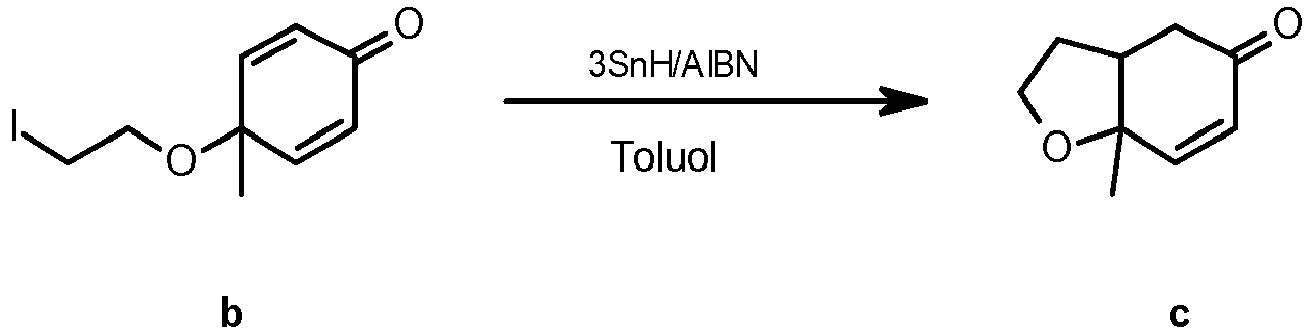
- Zu einer Mischung aus 30 g (216mmol) Verbindung b in 500ml Toluol werden bei Raumtemperatur unter Kühlen 7,09 g (43,2mmol) AIBN und 75.4 g Bu3SnH (259 mmol) in 500mlToluol gegeben. Die Reaktionslösung wird 6 h unter Rückfluss gerührt. Toluol wird an einer kleinen Kolonne ab destilliert und über Kieselgel-Chromatographie gereinigt. Ausbeute: 19,6 g (59,7% d. Th.) an Verbindung c.
-

- 36.0 g, (237 mmol) Verbindung c in 250ml Essigester werden unter Zusatz von 500mg Pd/C 5%ig bei 40 °C und 5 bar 4 h hydriert. Nach abfiltrieren des Katalysators und ab destillieren des Essigesters erhalt man 31,0 g Verbindung d (wird direkt in der nächsten Stufe eingesetzt).
-

- 45 g (292 mmol) Verbindung d in 250ml THF abs. werden unter Rühren und Kühlen innerhalb von 1 h bei -60°C mit 225ml (292mmol) tert.-Butyllithium in Heptan versetzt. Die Reaktionslösung wird anschließend 12 h Raumtemperatur gerührt. Die Reaktionslösung wird unter Rühren und Kühlen innerhalb von 1 h mit 130ml SOCl2 versetzt und 4 h bei Raumtemperatur nachgerührt. Die Reaktionslösung wird eingeengt und über Kieselgel-Chromatographie gereinigt. Ausbeute: 3,08g Verbindung f und 0,52g Verbindung 2.
- δ 5.46 (tt, J = 4.4, 1.0 Hz, 1 H), 3.82 (td, J = 8.2, 4.1 Hz, 1 H), 3.72 (td, J = 8.2, 6.6 Hz, 1 H), 2.25 - 2.20 (m, 1 H), 2.20 - 2.13 (m, 1H), 2.06 (dd, J = 6.1, 1.9 Hz, 1 H), 2.04 - 2.01 (m, 1 H), 2.00 (dddd, J = 5.5, 4.5, 2.8, 1.5 Hz, 1 H), 1.98 - 1.93 (m, 0H), 1.71 - 1.55 (m, 2H), 1.20 (s, 3H), 1.02 (s, 9H).
- δ 5.31 (ddd, J = 4.0, 1.7, 1.0 Hz, 1 H), 3.85 (td, J = 7.8, 4.8 Hz, 1 H), 3.71
- (td, J = 7.8, 6.7 Hz, 1 H), 2.42 (ddq, J = 9.1, 3.8, 2.0 Hz, 1 H), 2.24 (dq, J = 12.0, 7.6 Hz, 1 H), 2.15 - 2.01 (m, 1H), 1.94 (dddt, J = 16.8, 6.2, 4.9, 1.2 Hz, 1 H), 1.78 (ddd, J = 13.1, 6.1, 4.9 Hz, 1 H), 1.68 - 1.56 (m, 1 H), 1.51 (ddd, J = 13.4, 8.9, 4.9 Hz, 1 H), 1.21 (s, 3H), 1.02 (s, 9H).
-
Bsp.3 Bsp. 4 AMBERWOOD® F 7,000 7,000 AMBRETTOLIDE 6,000 6,000 Verbindung 1, 2, 6, od. 8 0,000 34,000 BHT IONOL 3,000 3,000 CASSIS BASE 345 BB 10,000 10,000 CITRONELLOL 950 10,000 10,000 CITRONELLYL ACETATE EXTRA 1,000 1,000 DAMASCENONE 10% DPG 5,000 5,000 DAMASCONE ALPHA 10% DPG 1,000 1,000 DIPROPYLENE GLYCOL 209,000 175,000 ETHYLENE BRASSYLATE 325,000 325,000 GERANIOL SUPER 20,000 20,000 GERANYL ACETATE PURE 1,000 1,000 HEDIONE 120,000 120,000 HEDIONE HC/30 30,000 30,000 HELIONAL 4,000 4,000 HEXENYL ACETATE CIS TRANS-3 10% DPG 3,000 3,000 HEXYL CINNAMIC ALDEHYDE ALPHA 20,000 20,000 HYDROXY CITRONELLAL 15,000 15,000 INDOLE FF 10% DPG 1,000 1,000 IONONE BETA 8,000 8,000 ISO E SUPER 100,000 100,000 LEMON OIL WINTER BERGAPTEN FREE 10,000 10,000 LINALOOL 5,000 5,000 LINALYL ACETATE 25,000 25,000 MAGNOLAN 20,000 20,000 MANDARIN OIL DIST. DECOL. 5,000 5,000 METHYL IONONE GAMMA PURE / IFF 1,000 1,000 METHYL OCTIN CARBONATE 1% DPG 5,000 5,000 NEROL 900 2,000 2,000 PHENYLETHYL ALCOHOL 20,000 20,000 ROSESSENCE 193E 3,000 3,000 VERTOCITRAL 10% DPG 5,000 5,000 -
Bsp. 5 Bsp. 6 AMBRETTOLIDE 15,000 15,000 Verbindung 2, 3, 4, 5, oder 7 0,000 40,000 BASIL OIL COMORES TYPE E 10% DPG 2,000 2,000 BERGAMOT OIL 40,000 40,000 BOURGEONAL 10% DPG 5,000 5,000 CARDAMOM OIL 2,000 2,000 CASHMERAN 15,000 15,000 CINNAMON BARK OIL CEYLON 10% DPG 5,000 5,000 CLARY SAGE OIL 2,000 2,000 CORIANDER OIL 3,000 3,000 COUMARIN 16,000 16,000 DAMASCENONE 2,000 2,000 DIHYDRO MYRCENOL 2,000 2,000 DIPROPYLENE GLYCOL 52,000 12,000 FIR BALSAM ABS. 10% DPG 5,000 5,000 FLOROSA 5,000 5,000 GALAXOLIDE 50% IN DPG 150,000 150,000 GERANIOL SUPER 3,000 3,000 GERANYL ACETATE 60 2,000 2,000 GLOBALIDE® 210,000 210,000 GUAIAC WOOD OIL 5,000 5,000 HEDIONE 30,000 30,000 HEDIONE HC/30 60,000 60,000 HEXENOL CIS-3 10% DPG 5,000 5,000 ISO E SUPER 130,000 130,000 ISOBUTYL QUINOLINE DL 100% 1% DPG 5,000 5,000 JAVANOL 3,000 3,000 LAVANDINOIL ABRIALIS NAT. 3,000 3,000 LEMON OIL WINTER ITALIE 15,000 15,000 LINALOOL 15,000 15,000 LINALYL ACETATE 25,000 25,000 METHYL IONONE GAMMA PURE/IFF 3,000 3,000 MUSCENONE 4,000 4,000 PATCHOULI OIL DECOL. 5,000 5,000 SANDALWOOD OIL EAST IND. 10% DPG 5,000 5,000 SANDRANOL® 10,000 10,000 TONALIDE 130,000 130,000 VANILLIN 3,000 3,000 VERTOCITRAL 10% DPG 5,000 5,000 VETIVER OIL HAITI 3,000 3,000
Claims (14)
- Verbindung der Formel I:
 R = -methyl oder -ethyl,R1= -H, -methyl, ethyl, O-methyl oder O-ethylX= -CH2- oder -CH2-CH2-.
 - Verbindung der Formel I nach Anspruch 1 mitR = -methyl oder ethylR1= -H, -methyl oder O-methyl undX= -CH2- oder -CH2-CH2-.
-

- Mischung enthaltenda) eine oder mehrere Verbindungen der Formel I nach einem der Ansprüche 1 bis 3b) ein oder mehrere Lösungsmittelc) sowie optional einen oder mehrere Duftstoffe.
- Mischung enthaltenda) eine oder mehrere Verbindungen der Formel I nach einem der Ansprüche 1 bis 3 undc) einen oder mehrere Duftstoffe.
- Konsumgüter enthaltend eine oder mehrere Verbindungen der Formel I nach einem der Ansprüche 1 bis 3.
- Konsumgüter enthaltend Mischungen nach Anspruch 4 oder 5.
- Verwendung einer oder mehrerer Verbindungen nach einem der Ansprüche 1 bis 3 als Duftstoffe.
- Verwendung nach Anspruch 8 zur Erzeugung, Vermittlung, Modifizierung oder Verstärkung eines ambrartigen und / oder holzigen Geruchs.
- Verfahren zur Herstellung von Verbindungen der Formel I nach Anspruch 1 umfassend
die Cyclisierung einer Verbindung der Formel II
 R = -methyl oder ethyl,R1 = -H, -methyl, ethyl, O-methyl, oder O-ethyl undX= -CH2- oder -CH2-CH2-.
 - Verfahren nach Anspruch 10 in Gegenwart von Sulfonsäure oder Sulfonsäurederivaten.
- Verfahren nach Anspruch 10 oder/und 11 in Gegenwart von Toluol.
- Verfahren nach Anspruch 10, 11 oder/und 12, wobei die Temperatur zwischen 30 und 60°C beträgt.
- Verfahren zur Parfümierung von Konsumgütern umfassend das Hinzufügen einer Verbindung der Formel I nach einem der Ansprüche 1 bis 3 oder einer Mischung nach einem der Ansprüche 4 oder 5 zu Konsumgütern.
Priority Applications (2)
| Application Number | Priority Date | Filing Date | Title |
|---|---|---|---|
| EP14195235.8A EP3026048B1 (de) | 2014-11-27 | 2014-11-27 | Hexahydrobenzofurane und Hexahydrochromene - Verfahren zur Herstellung und ihre Verwendung als Duftstoffe |
| PCT/EP2015/077500 WO2016083372A1 (de) | 2014-11-27 | 2015-11-24 | Hexahydrobenzofurane und hexahydrochromene - verfahren zur herstellung und ihre verwendung als duftstoffe |
Applications Claiming Priority (1)
| Application Number | Priority Date | Filing Date | Title |
|---|---|---|---|
| EP14195235.8A EP3026048B1 (de) | 2014-11-27 | 2014-11-27 | Hexahydrobenzofurane und Hexahydrochromene - Verfahren zur Herstellung und ihre Verwendung als Duftstoffe |
Publications (2)
| Publication Number | Publication Date |
|---|---|
| EP3026048A1 true EP3026048A1 (de) | 2016-06-01 |
| EP3026048B1 EP3026048B1 (de) | 2018-07-25 |
Family
ID=51982479
Family Applications (1)
| Application Number | Title | Priority Date | Filing Date |
|---|---|---|---|
| EP14195235.8A Active EP3026048B1 (de) | 2014-11-27 | 2014-11-27 | Hexahydrobenzofurane und Hexahydrochromene - Verfahren zur Herstellung und ihre Verwendung als Duftstoffe |
Country Status (2)
| Country | Link |
|---|---|
| EP (1) | EP3026048B1 (de) |
| WO (1) | WO2016083372A1 (de) |
Families Citing this family (1)
| Publication number | Priority date | Publication date | Assignee | Title |
|---|---|---|---|---|
| CN116018346B (zh) | 2020-09-18 | 2025-08-29 | 西姆莱斯有限公司 | Seco-龙涎缩醛 |
-
2014
- 2014-11-27 EP EP14195235.8A patent/EP3026048B1/de active Active
-
2015
- 2015-11-24 WO PCT/EP2015/077500 patent/WO2016083372A1/de not_active Ceased
Non-Patent Citations (3)
| Title |
|---|
| H. SURBURG; J. PANTEN: "Common Fragrance and Flavor Materials", 2006, WILEY-VCH |
| JOHANNES PANTEN ET AL: "Recent Results in the Search for New Molecules with Ambergris Odor", CHEMISTRY & BIODIVERSITY, vol. 11, no. 10, 20 October 2014 (2014-10-20), pages 1639 - 1650, XP055170604, ISSN: 1612-1872, DOI: 10.1002/cbdv.201400153 * |
| S. ARCTANDER: "Perfume and Flavor Chemicals", vol. I, 1969, SELBSTVERLAG |
Also Published As
| Publication number | Publication date |
|---|---|
| WO2016083372A1 (de) | 2016-06-02 |
| EP3026048B1 (de) | 2018-07-25 |
Similar Documents
| Publication | Publication Date | Title |
|---|---|---|
| EP2578671B1 (de) | Riechstoffe mit Maiglöckchennote | |
| EP1914231A2 (de) | 2-Methyl-2-alkenyl-substituierte 1,3-Dioxane als Riechstoffe | |
| DE10330865A1 (de) | 4,8-Dimethyl-7-nonen-2-on und 4,8-Dimethylnonan-2-on als Riechstoffe | |
| EP2848611B1 (de) | Octahydrobenzofurane und Octahydrochromene - Verfahren zur Herstellung und ihre Verwendung als Duftstoffe | |
| DE112007000301B4 (de) | Mischungen ungesättigter makrocyclischer Epoxide als Riechstoffe | |
| EP2072083B1 (de) | Verwendung von 2,4'-Dimethyl-propiophenon als Riechstoff | |
| EP2594626B1 (de) | Verwendung von Oxyacetaldehyden als Maiglöckchen-Riechstoffe | |
| WO2018233804A1 (de) | Neue ambra- und/oder indolartige riechstoffkompositionen | |
| EP2065360B1 (de) | Verwendung von 3-Methylbenzylisobutyrat als Riechstoff | |
| DE10333379A1 (de) | Acetale, ihre Verwendung als Reichstoffe und Verfahren zu ihrer Herstellung | |
| DE102005026801A1 (de) | Sandelriechstoffe | |
| DE102007055124A1 (de) | 7-(3-Methylbut-2-en-1-yl)-2H-1,5-benzodioxepin-3(4H)-on als Riechstoff | |
| EP3026048B1 (de) | Hexahydrobenzofurane und Hexahydrochromene - Verfahren zur Herstellung und ihre Verwendung als Duftstoffe | |
| EP1067126B1 (de) | Tetracyclische Acetale | |
| EP1797025B1 (de) | 4-isoamylcyclohexanol als riechstoff | |
| DE102008000275A1 (de) | Alkenacetale und ihre Verwendung als Riechstoffe | |
| EP3612620A1 (de) | 4-ethyl-octen-2/3-nitril als riechstoff | |
| CN114846002B (zh) | 取代的4-亚甲基-四氢吡喃、4-甲基-二氢吡喃和4-甲基-四氢吡喃及其作为芳香化学品的用途 | |
| EP3112448B1 (de) | Derivate des 1-(4-methylcyclohexyl)-ethanols | |
| EP3853199B1 (de) | 2-(5-isopropyl-2-methyl-cyclohex-2-en-1-yl-) acetaldehyd und 2-(6-isopropyl-3-methyl-cyclohex-2-en-1-yl-) acetaldehyd als neue riechstoffe | |
| DE102004029809A1 (de) | Verwendung eines Gemisches von cis- und trans-3-Methyl-gamma-decalacton sowie Riechstoffkompositionen und parfümierte Artikel umfassend ein solches Gemisch | |
| EP1648526B1 (de) | Cis-3,3,5-trimethylcyclohexylester | |
| EP3153494A1 (de) | Verwendung neuartiger gemische von (e/z)-cyclopentadecenon-isomeren, deren herstellung und deren verwendung als aromastoff | |
| EP1923389A1 (de) | 2-Isopropyl-5-methyloxepan und dessen Verwendung als Riechstoff | |
| DE102005033642A1 (de) | 4-Isomaylcyclohexanon als Riechstoff |
Legal Events
| Date | Code | Title | Description |
|---|---|---|---|
| PUAI | Public reference made under article 153(3) epc to a published international application that has entered the european phase |
Free format text: ORIGINAL CODE: 0009012 |
|
| AK | Designated contracting states |
Kind code of ref document: A1 Designated state(s): AL AT BE BG CH CY CZ DE DK EE ES FI FR GB GR HR HU IE IS IT LI LT LU LV MC MK MT NL NO PL PT RO RS SE SI SK SM TR |
|
| AX | Request for extension of the european patent |
Extension state: BA ME |
|
| 17P | Request for examination filed |
Effective date: 20161201 |
|
| RBV | Designated contracting states (corrected) |
Designated state(s): AL AT BE BG CH CY CZ DE DK EE ES FI FR GB GR HR HU IE IS IT LI LT LU LV MC MK MT NL NO PL PT RO RS SE SI SK SM TR |
|
| 17Q | First examination report despatched |
Effective date: 20170331 |
|
| GRAP | Despatch of communication of intention to grant a patent |
Free format text: ORIGINAL CODE: EPIDOSNIGR1 |
|
| INTG | Intention to grant announced |
Effective date: 20180315 |
|
| GRAS | Grant fee paid |
Free format text: ORIGINAL CODE: EPIDOSNIGR3 |
|
| GRAA | (expected) grant |
Free format text: ORIGINAL CODE: 0009210 |
|
| AK | Designated contracting states |
Kind code of ref document: B1 Designated state(s): AL AT BE BG CH CY CZ DE DK EE ES FI FR GB GR HR HU IE IS IT LI LT LU LV MC MK MT NL NO PL PT RO RS SE SI SK SM TR |
|
| REG | Reference to a national code |
Ref country code: GB Ref legal event code: FG4D Free format text: NOT ENGLISH |
|
| REG | Reference to a national code |
Ref country code: CH Ref legal event code: EP |
|
| REG | Reference to a national code |
Ref country code: AT Ref legal event code: REF Ref document number: 1021620 Country of ref document: AT Kind code of ref document: T Effective date: 20180815 |
|
| REG | Reference to a national code |
Ref country code: IE Ref legal event code: FG4D Free format text: LANGUAGE OF EP DOCUMENT: GERMAN |
|
| REG | Reference to a national code |
Ref country code: DE Ref legal event code: R096 Ref document number: 502014008946 Country of ref document: DE |
|
| REG | Reference to a national code |
Ref country code: NL Ref legal event code: MP Effective date: 20180725 |
|
| REG | Reference to a national code |
Ref country code: LT Ref legal event code: MG4D |
|
| PG25 | Lapsed in a contracting state [announced via postgrant information from national office to epo] |
Ref country code: NL Free format text: LAPSE BECAUSE OF FAILURE TO SUBMIT A TRANSLATION OF THE DESCRIPTION OR TO PAY THE FEE WITHIN THE PRESCRIBED TIME-LIMIT Effective date: 20180725 |
|
| PG25 | Lapsed in a contracting state [announced via postgrant information from national office to epo] |
Ref country code: PL Free format text: LAPSE BECAUSE OF FAILURE TO SUBMIT A TRANSLATION OF THE DESCRIPTION OR TO PAY THE FEE WITHIN THE PRESCRIBED TIME-LIMIT Effective date: 20180725 Ref country code: RS Free format text: LAPSE BECAUSE OF FAILURE TO SUBMIT A TRANSLATION OF THE DESCRIPTION OR TO PAY THE FEE WITHIN THE PRESCRIBED TIME-LIMIT Effective date: 20180725 Ref country code: LT Free format text: LAPSE BECAUSE OF FAILURE TO SUBMIT A TRANSLATION OF THE DESCRIPTION OR TO PAY THE FEE WITHIN THE PRESCRIBED TIME-LIMIT Effective date: 20180725 Ref country code: FI Free format text: LAPSE BECAUSE OF FAILURE TO SUBMIT A TRANSLATION OF THE DESCRIPTION OR TO PAY THE FEE WITHIN THE PRESCRIBED TIME-LIMIT Effective date: 20180725 Ref country code: SE Free format text: LAPSE BECAUSE OF FAILURE TO SUBMIT A TRANSLATION OF THE DESCRIPTION OR TO PAY THE FEE WITHIN THE PRESCRIBED TIME-LIMIT Effective date: 20180725 Ref country code: GR Free format text: LAPSE BECAUSE OF FAILURE TO SUBMIT A TRANSLATION OF THE DESCRIPTION OR TO PAY THE FEE WITHIN THE PRESCRIBED TIME-LIMIT Effective date: 20181026 Ref country code: NO Free format text: LAPSE BECAUSE OF FAILURE TO SUBMIT A TRANSLATION OF THE DESCRIPTION OR TO PAY THE FEE WITHIN THE PRESCRIBED TIME-LIMIT Effective date: 20181025 Ref country code: BG Free format text: LAPSE BECAUSE OF FAILURE TO SUBMIT A TRANSLATION OF THE DESCRIPTION OR TO PAY THE FEE WITHIN THE PRESCRIBED TIME-LIMIT Effective date: 20181025 Ref country code: IS Free format text: LAPSE BECAUSE OF FAILURE TO SUBMIT A TRANSLATION OF THE DESCRIPTION OR TO PAY THE FEE WITHIN THE PRESCRIBED TIME-LIMIT Effective date: 20181125 |
|
| PG25 | Lapsed in a contracting state [announced via postgrant information from national office to epo] |
Ref country code: HR Free format text: LAPSE BECAUSE OF FAILURE TO SUBMIT A TRANSLATION OF THE DESCRIPTION OR TO PAY THE FEE WITHIN THE PRESCRIBED TIME-LIMIT Effective date: 20180725 Ref country code: LV Free format text: LAPSE BECAUSE OF FAILURE TO SUBMIT A TRANSLATION OF THE DESCRIPTION OR TO PAY THE FEE WITHIN THE PRESCRIBED TIME-LIMIT Effective date: 20180725 Ref country code: AL Free format text: LAPSE BECAUSE OF FAILURE TO SUBMIT A TRANSLATION OF THE DESCRIPTION OR TO PAY THE FEE WITHIN THE PRESCRIBED TIME-LIMIT Effective date: 20180725 |
|
| REG | Reference to a national code |
Ref country code: DE Ref legal event code: R097 Ref document number: 502014008946 Country of ref document: DE |
|
| PG25 | Lapsed in a contracting state [announced via postgrant information from national office to epo] |
Ref country code: CZ Free format text: LAPSE BECAUSE OF FAILURE TO SUBMIT A TRANSLATION OF THE DESCRIPTION OR TO PAY THE FEE WITHIN THE PRESCRIBED TIME-LIMIT Effective date: 20180725 Ref country code: IT Free format text: LAPSE BECAUSE OF FAILURE TO SUBMIT A TRANSLATION OF THE DESCRIPTION OR TO PAY THE FEE WITHIN THE PRESCRIBED TIME-LIMIT Effective date: 20180725 Ref country code: ES Free format text: LAPSE BECAUSE OF FAILURE TO SUBMIT A TRANSLATION OF THE DESCRIPTION OR TO PAY THE FEE WITHIN THE PRESCRIBED TIME-LIMIT Effective date: 20180725 Ref country code: EE Free format text: LAPSE BECAUSE OF FAILURE TO SUBMIT A TRANSLATION OF THE DESCRIPTION OR TO PAY THE FEE WITHIN THE PRESCRIBED TIME-LIMIT Effective date: 20180725 Ref country code: RO Free format text: LAPSE BECAUSE OF FAILURE TO SUBMIT A TRANSLATION OF THE DESCRIPTION OR TO PAY THE FEE WITHIN THE PRESCRIBED TIME-LIMIT Effective date: 20180725 |
|
| PG25 | Lapsed in a contracting state [announced via postgrant information from national office to epo] |
Ref country code: SK Free format text: LAPSE BECAUSE OF FAILURE TO SUBMIT A TRANSLATION OF THE DESCRIPTION OR TO PAY THE FEE WITHIN THE PRESCRIBED TIME-LIMIT Effective date: 20180725 Ref country code: SM Free format text: LAPSE BECAUSE OF FAILURE TO SUBMIT A TRANSLATION OF THE DESCRIPTION OR TO PAY THE FEE WITHIN THE PRESCRIBED TIME-LIMIT Effective date: 20180725 Ref country code: DK Free format text: LAPSE BECAUSE OF FAILURE TO SUBMIT A TRANSLATION OF THE DESCRIPTION OR TO PAY THE FEE WITHIN THE PRESCRIBED TIME-LIMIT Effective date: 20180725 |
|
| PLBE | No opposition filed within time limit |
Free format text: ORIGINAL CODE: 0009261 |
|
| STAA | Information on the status of an ep patent application or granted ep patent |
Free format text: STATUS: NO OPPOSITION FILED WITHIN TIME LIMIT |
|
| REG | Reference to a national code |
Ref country code: CH Ref legal event code: PL |
|
| 26N | No opposition filed |
Effective date: 20190426 |
|
| PG25 | Lapsed in a contracting state [announced via postgrant information from national office to epo] |
Ref country code: LU Free format text: LAPSE BECAUSE OF NON-PAYMENT OF DUE FEES Effective date: 20181127 |
|
| REG | Reference to a national code |
Ref country code: BE Ref legal event code: MM Effective date: 20181130 |
|
| REG | Reference to a national code |
Ref country code: IE Ref legal event code: MM4A |
|
| PG25 | Lapsed in a contracting state [announced via postgrant information from national office to epo] |
Ref country code: LI Free format text: LAPSE BECAUSE OF NON-PAYMENT OF DUE FEES Effective date: 20181130 Ref country code: CH Free format text: LAPSE BECAUSE OF NON-PAYMENT OF DUE FEES Effective date: 20181130 Ref country code: SI Free format text: LAPSE BECAUSE OF FAILURE TO SUBMIT A TRANSLATION OF THE DESCRIPTION OR TO PAY THE FEE WITHIN THE PRESCRIBED TIME-LIMIT Effective date: 20180725 |
|
| PG25 | Lapsed in a contracting state [announced via postgrant information from national office to epo] |
Ref country code: IE Free format text: LAPSE BECAUSE OF NON-PAYMENT OF DUE FEES Effective date: 20181127 |
|
| PG25 | Lapsed in a contracting state [announced via postgrant information from national office to epo] |
Ref country code: BE Free format text: LAPSE BECAUSE OF NON-PAYMENT OF DUE FEES Effective date: 20181130 |
|
| PG25 | Lapsed in a contracting state [announced via postgrant information from national office to epo] |
Ref country code: MT Free format text: LAPSE BECAUSE OF FAILURE TO SUBMIT A TRANSLATION OF THE DESCRIPTION OR TO PAY THE FEE WITHIN THE PRESCRIBED TIME-LIMIT Effective date: 20180725 |
|
| PG25 | Lapsed in a contracting state [announced via postgrant information from national office to epo] |
Ref country code: TR Free format text: LAPSE BECAUSE OF FAILURE TO SUBMIT A TRANSLATION OF THE DESCRIPTION OR TO PAY THE FEE WITHIN THE PRESCRIBED TIME-LIMIT Effective date: 20180725 |
|
| PG25 | Lapsed in a contracting state [announced via postgrant information from national office to epo] |
Ref country code: PT Free format text: LAPSE BECAUSE OF FAILURE TO SUBMIT A TRANSLATION OF THE DESCRIPTION OR TO PAY THE FEE WITHIN THE PRESCRIBED TIME-LIMIT Effective date: 20180725 |
|
| PG25 | Lapsed in a contracting state [announced via postgrant information from national office to epo] |
Ref country code: MK Free format text: LAPSE BECAUSE OF NON-PAYMENT OF DUE FEES Effective date: 20180725 Ref country code: MC Free format text: LAPSE BECAUSE OF NON-PAYMENT OF DUE FEES Effective date: 20180725 Ref country code: HU Free format text: LAPSE BECAUSE OF FAILURE TO SUBMIT A TRANSLATION OF THE DESCRIPTION OR TO PAY THE FEE WITHIN THE PRESCRIBED TIME-LIMIT; INVALID AB INITIO Effective date: 20141127 Ref country code: CY Free format text: LAPSE BECAUSE OF FAILURE TO SUBMIT A TRANSLATION OF THE DESCRIPTION OR TO PAY THE FEE WITHIN THE PRESCRIBED TIME-LIMIT Effective date: 20180725 |
|
| REG | Reference to a national code |
Ref country code: AT Ref legal event code: MM01 Ref document number: 1021620 Country of ref document: AT Kind code of ref document: T Effective date: 20191127 |
|
| PG25 | Lapsed in a contracting state [announced via postgrant information from national office to epo] |
Ref country code: AT Free format text: LAPSE BECAUSE OF NON-PAYMENT OF DUE FEES Effective date: 20191127 |
|
| PGFP | Annual fee paid to national office [announced via postgrant information from national office to epo] |
Ref country code: DE Payment date: 20251118 Year of fee payment: 12 |
|
| PGFP | Annual fee paid to national office [announced via postgrant information from national office to epo] |
Ref country code: GB Payment date: 20251120 Year of fee payment: 12 |
|
| PGFP | Annual fee paid to national office [announced via postgrant information from national office to epo] |
Ref country code: FR Payment date: 20251120 Year of fee payment: 12 |