EP3024070A1 - Positive electrode active material for lithium secondary battery and lithium secondary battery including same - Google Patents
Positive electrode active material for lithium secondary battery and lithium secondary battery including same Download PDFInfo
- Publication number
- EP3024070A1 EP3024070A1 EP15775064.7A EP15775064A EP3024070A1 EP 3024070 A1 EP3024070 A1 EP 3024070A1 EP 15775064 A EP15775064 A EP 15775064A EP 3024070 A1 EP3024070 A1 EP 3024070A1
- Authority
- EP
- European Patent Office
- Prior art keywords
- secondary battery
- particles
- active material
- lithium secondary
- cathode active
- Prior art date
- Legal status (The legal status is an assumption and is not a legal conclusion. Google has not performed a legal analysis and makes no representation as to the accuracy of the status listed.)
- Granted
Links
Images


Classifications
-
- H—ELECTRICITY
- H01—ELECTRIC ELEMENTS
- H01M—PROCESSES OR MEANS, e.g. BATTERIES, FOR THE DIRECT CONVERSION OF CHEMICAL ENERGY INTO ELECTRICAL ENERGY
- H01M4/00—Electrodes
- H01M4/02—Electrodes composed of, or comprising, active material
- H01M4/36—Selection of substances as active materials, active masses, active liquids
- H01M4/362—Composites
- H01M4/366—Composites as layered products
-
- C—CHEMISTRY; METALLURGY
- C01—INORGANIC CHEMISTRY
- C01G—COMPOUNDS CONTAINING METALS NOT COVERED BY SUBCLASSES C01D OR C01F
- C01G53/00—Compounds of nickel
- C01G53/40—Complex oxides containing nickel and at least one other metal element
- C01G53/42—Complex oxides containing nickel and at least one other metal element containing alkali metals, e.g. LiNiO2
-
- C—CHEMISTRY; METALLURGY
- C01—INORGANIC CHEMISTRY
- C01G—COMPOUNDS CONTAINING METALS NOT COVERED BY SUBCLASSES C01D OR C01F
- C01G53/00—Compounds of nickel
- C01G53/40—Complex oxides containing nickel and at least one other metal element
- C01G53/42—Complex oxides containing nickel and at least one other metal element containing alkali metals, e.g. LiNiO2
- C01G53/44—Complex oxides containing nickel and at least one other metal element containing alkali metals, e.g. LiNiO2 containing manganese
- C01G53/50—Complex oxides containing nickel and at least one other metal element containing alkali metals, e.g. LiNiO2 containing manganese of the type (MnO2)n-, e.g. Li(NixMn1-x)O2 or Li(MyNixMn1-x-y)O2
-
- C—CHEMISTRY; METALLURGY
- C01—INORGANIC CHEMISTRY
- C01G—COMPOUNDS CONTAINING METALS NOT COVERED BY SUBCLASSES C01D OR C01F
- C01G53/00—Compounds of nickel
- C01G53/80—Compounds containing nickel, with or without oxygen or hydrogen, and containing one or more other elements
- C01G53/82—Compounds containing nickel, with or without oxygen or hydrogen, and containing two or more other elements
-
- H—ELECTRICITY
- H01—ELECTRIC ELEMENTS
- H01M—PROCESSES OR MEANS, e.g. BATTERIES, FOR THE DIRECT CONVERSION OF CHEMICAL ENERGY INTO ELECTRICAL ENERGY
- H01M10/00—Secondary cells; Manufacture thereof
- H01M10/05—Accumulators with non-aqueous electrolyte
- H01M10/052—Li-accumulators
- H01M10/0525—Rocking-chair batteries, i.e. batteries with lithium insertion or intercalation in both electrodes; Lithium-ion batteries
-
- H—ELECTRICITY
- H01—ELECTRIC ELEMENTS
- H01M—PROCESSES OR MEANS, e.g. BATTERIES, FOR THE DIRECT CONVERSION OF CHEMICAL ENERGY INTO ELECTRICAL ENERGY
- H01M4/00—Electrodes
- H01M4/02—Electrodes composed of, or comprising, active material
- H01M4/13—Electrodes for accumulators with non-aqueous electrolyte, e.g. for lithium-accumulators; Processes of manufacture thereof
- H01M4/131—Electrodes based on mixed oxides or hydroxides, or on mixtures of oxides or hydroxides, e.g. LiCoOx
-
- H—ELECTRICITY
- H01—ELECTRIC ELEMENTS
- H01M—PROCESSES OR MEANS, e.g. BATTERIES, FOR THE DIRECT CONVERSION OF CHEMICAL ENERGY INTO ELECTRICAL ENERGY
- H01M4/00—Electrodes
- H01M4/02—Electrodes composed of, or comprising, active material
- H01M4/13—Electrodes for accumulators with non-aqueous electrolyte, e.g. for lithium-accumulators; Processes of manufacture thereof
- H01M4/131—Electrodes based on mixed oxides or hydroxides, or on mixtures of oxides or hydroxides, e.g. LiCoOx
- H01M4/1315—Electrodes based on mixed oxides or hydroxides, or on mixtures of oxides or hydroxides, e.g. LiCoOx containing halogen atoms, e.g. LiCoOxFy
-
- H—ELECTRICITY
- H01—ELECTRIC ELEMENTS
- H01M—PROCESSES OR MEANS, e.g. BATTERIES, FOR THE DIRECT CONVERSION OF CHEMICAL ENERGY INTO ELECTRICAL ENERGY
- H01M4/00—Electrodes
- H01M4/02—Electrodes composed of, or comprising, active material
- H01M4/13—Electrodes for accumulators with non-aqueous electrolyte, e.g. for lithium-accumulators; Processes of manufacture thereof
- H01M4/136—Electrodes based on inorganic compounds other than oxides or hydroxides, e.g. sulfides, selenides, tellurides, halogenides or LiCoFy
-
- H—ELECTRICITY
- H01—ELECTRIC ELEMENTS
- H01M—PROCESSES OR MEANS, e.g. BATTERIES, FOR THE DIRECT CONVERSION OF CHEMICAL ENERGY INTO ELECTRICAL ENERGY
- H01M4/00—Electrodes
- H01M4/02—Electrodes composed of, or comprising, active material
- H01M4/36—Selection of substances as active materials, active masses, active liquids
- H01M4/48—Selection of substances as active materials, active masses, active liquids of inorganic oxides or hydroxides
- H01M4/50—Selection of substances as active materials, active masses, active liquids of inorganic oxides or hydroxides of manganese
- H01M4/505—Selection of substances as active materials, active masses, active liquids of inorganic oxides or hydroxides of manganese of mixed oxides or hydroxides containing manganese for inserting or intercalating light metals, e.g. LiMn2O4 or LiMn2OxFy
-
- H—ELECTRICITY
- H01—ELECTRIC ELEMENTS
- H01M—PROCESSES OR MEANS, e.g. BATTERIES, FOR THE DIRECT CONVERSION OF CHEMICAL ENERGY INTO ELECTRICAL ENERGY
- H01M4/00—Electrodes
- H01M4/02—Electrodes composed of, or comprising, active material
- H01M4/36—Selection of substances as active materials, active masses, active liquids
- H01M4/48—Selection of substances as active materials, active masses, active liquids of inorganic oxides or hydroxides
- H01M4/52—Selection of substances as active materials, active masses, active liquids of inorganic oxides or hydroxides of nickel, cobalt or iron
- H01M4/525—Selection of substances as active materials, active masses, active liquids of inorganic oxides or hydroxides of nickel, cobalt or iron of mixed oxides or hydroxides containing iron, cobalt or nickel for inserting or intercalating light metals, e.g. LiNiO2, LiCoO2 or LiCoOxFy
-
- H—ELECTRICITY
- H01—ELECTRIC ELEMENTS
- H01M—PROCESSES OR MEANS, e.g. BATTERIES, FOR THE DIRECT CONVERSION OF CHEMICAL ENERGY INTO ELECTRICAL ENERGY
- H01M4/00—Electrodes
- H01M4/02—Electrodes composed of, or comprising, active material
- H01M4/36—Selection of substances as active materials, active masses, active liquids
- H01M4/58—Selection of substances as active materials, active masses, active liquids of inorganic compounds other than oxides or hydroxides, e.g. sulfides, selenides, tellurides, halogenides or LiCoFy; of polyanionic structures, e.g. phosphates, silicates or borates
- H01M4/582—Halogenides
-
- H—ELECTRICITY
- H01—ELECTRIC ELEMENTS
- H01M—PROCESSES OR MEANS, e.g. BATTERIES, FOR THE DIRECT CONVERSION OF CHEMICAL ENERGY INTO ELECTRICAL ENERGY
- H01M4/00—Electrodes
- H01M4/02—Electrodes composed of, or comprising, active material
- H01M4/36—Selection of substances as active materials, active masses, active liquids
- H01M4/58—Selection of substances as active materials, active masses, active liquids of inorganic compounds other than oxides or hydroxides, e.g. sulfides, selenides, tellurides, halogenides or LiCoFy; of polyanionic structures, e.g. phosphates, silicates or borates
- H01M4/5825—Oxygenated metallic salts or polyanionic structures, e.g. borates, phosphates, silicates, olivines
-
- C—CHEMISTRY; METALLURGY
- C01—INORGANIC CHEMISTRY
- C01P—INDEXING SCHEME RELATING TO STRUCTURAL AND PHYSICAL ASPECTS OF SOLID INORGANIC COMPOUNDS
- C01P2002/00—Crystal-structural characteristics
- C01P2002/80—Crystal-structural characteristics defined by measured data other than those specified in group C01P2002/70
- C01P2002/85—Crystal-structural characteristics defined by measured data other than those specified in group C01P2002/70 by XPS, EDX or EDAX data
-
- C—CHEMISTRY; METALLURGY
- C01—INORGANIC CHEMISTRY
- C01P—INDEXING SCHEME RELATING TO STRUCTURAL AND PHYSICAL ASPECTS OF SOLID INORGANIC COMPOUNDS
- C01P2004/00—Particle morphology
- C01P2004/01—Particle morphology depicted by an image
- C01P2004/03—Particle morphology depicted by an image obtained by SEM
-
- C—CHEMISTRY; METALLURGY
- C01—INORGANIC CHEMISTRY
- C01P—INDEXING SCHEME RELATING TO STRUCTURAL AND PHYSICAL ASPECTS OF SOLID INORGANIC COMPOUNDS
- C01P2004/00—Particle morphology
- C01P2004/01—Particle morphology depicted by an image
- C01P2004/04—Particle morphology depicted by an image obtained by TEM, STEM, STM or AFM
-
- C—CHEMISTRY; METALLURGY
- C01—INORGANIC CHEMISTRY
- C01P—INDEXING SCHEME RELATING TO STRUCTURAL AND PHYSICAL ASPECTS OF SOLID INORGANIC COMPOUNDS
- C01P2004/00—Particle morphology
- C01P2004/80—Particles consisting of a mixture of two or more inorganic phases
- C01P2004/82—Particles consisting of a mixture of two or more inorganic phases two phases having the same anion, e.g. both oxidic phases
- C01P2004/84—Particles consisting of a mixture of two or more inorganic phases two phases having the same anion, e.g. both oxidic phases one phase coated with the other
-
- H—ELECTRICITY
- H01—ELECTRIC ELEMENTS
- H01M—PROCESSES OR MEANS, e.g. BATTERIES, FOR THE DIRECT CONVERSION OF CHEMICAL ENERGY INTO ELECTRICAL ENERGY
- H01M4/00—Electrodes
- H01M4/02—Electrodes composed of, or comprising, active material
- H01M2004/021—Physical characteristics, e.g. porosity, surface area
-
- H—ELECTRICITY
- H01—ELECTRIC ELEMENTS
- H01M—PROCESSES OR MEANS, e.g. BATTERIES, FOR THE DIRECT CONVERSION OF CHEMICAL ENERGY INTO ELECTRICAL ENERGY
- H01M4/00—Electrodes
- H01M4/02—Electrodes composed of, or comprising, active material
- H01M2004/026—Electrodes composed of, or comprising, active material characterised by the polarity
- H01M2004/028—Positive electrodes
-
- H—ELECTRICITY
- H01—ELECTRIC ELEMENTS
- H01M—PROCESSES OR MEANS, e.g. BATTERIES, FOR THE DIRECT CONVERSION OF CHEMICAL ENERGY INTO ELECTRICAL ENERGY
- H01M2220/00—Batteries for particular applications
- H01M2220/20—Batteries in motive systems, e.g. vehicle, ship, plane
-
- H—ELECTRICITY
- H01—ELECTRIC ELEMENTS
- H01M—PROCESSES OR MEANS, e.g. BATTERIES, FOR THE DIRECT CONVERSION OF CHEMICAL ENERGY INTO ELECTRICAL ENERGY
- H01M2220/00—Batteries for particular applications
- H01M2220/30—Batteries in portable systems, e.g. mobile phone, laptop
-
- Y—GENERAL TAGGING OF NEW TECHNOLOGICAL DEVELOPMENTS; GENERAL TAGGING OF CROSS-SECTIONAL TECHNOLOGIES SPANNING OVER SEVERAL SECTIONS OF THE IPC; TECHNICAL SUBJECTS COVERED BY FORMER USPC CROSS-REFERENCE ART COLLECTIONS [XRACs] AND DIGESTS
- Y02—TECHNOLOGIES OR APPLICATIONS FOR MITIGATION OR ADAPTATION AGAINST CLIMATE CHANGE
- Y02E—REDUCTION OF GREENHOUSE GAS [GHG] EMISSIONS, RELATED TO ENERGY GENERATION, TRANSMISSION OR DISTRIBUTION
- Y02E60/00—Enabling technologies; Technologies with a potential or indirect contribution to GHG emissions mitigation
- Y02E60/10—Energy storage using batteries
Definitions
- the present invention relates to an cathode active material for lithium secondary battery and a lithium secondary battery including the same, and more specifically, it relates to an cathode active material for lithium secondary battery which includes a concentration gradient layer having a controlled thickness and a shell layer on the periphery of the core layer of the cathode active material having a layered structure and in which the lithium ion diffusion paths in the primary particles and the secondary particles are formed to exhibit directivity in a specific direction, and a lithium secondary battery including the same.
- the effort to research and develop an electrochemical device has been gradually materialized as the application field of the energy storage technology has been expanded to a mobile phone, a camcorder, a notebook PC, and an electric vehicle.
- the electrochemical device is a field which attracts the most attention in this respect, and in particular, the development of a secondary battery capable of being charged and discharged is the focus of attention.
- the lithium ion battery developed in the early 1990s has been widely used as a power source of portable apparatuses since it was developed in 1991 as a small battery, a light-weight battery, and a large capacity battery.
- the lithium secondary battery is in the spotlight due to its advantages that the operating voltage is higher and the energy density is far greater as compared to batteries of prior art, such as a Ni-MH battery, a Ni-Cd battery, and a sulfuric acid-Pb battery which use an aqueous electrolytic solution.
- the lithium secondary battery is mainly adopted as a medium- or large-sized battery with an energy unit of kWh or more used for electric vehicles and energy storage, and an cathode active material which has a high capacity and is usable for a long period of time is desired for this purpose.
- a layered type cathode material among the cathode materials for lithium secondary battery can realize the highest capacity among the materials which are currently commercialized.
- LiCoO 2 that is frequently used in a small IT apparatus such as a smart phone in a medium- or large-sized battery is inhibited by the problems of safety, a low capacity, the economic efficiency due to a high cost and limited resource due to the reserves of cobalt metal of a main raw material as compared to other transition metals, the environmental regulations due to the environmental pollution, and the like.
- a number of researches on LiNiO 2 which has the same structure as LiCoO 2 have been carried out for the advantages that its price is relatively inexpensive and can have a high theoretical capacity of 200 mAh/g.
- LiNiO 2 has not been commercialized due to the problems such as poor stability and drastic deterioration in lifespan by structural instability generated when being produced.
- LiNi 1-x Co x Mn y O 2 (0 ⁇ y ⁇ 0.3) exhibits improved lifespan performance and thermal stability as compared to an existing material composed of only Ni and Co but still has problems to be solved, such as poor thermal stability and deterioration in lifespan performance as a Ni-based material.
- the cathode active material is synthesized so as to have different metal compositions in the inner layer and the outer layer, but the metal composition is not continuously and gradually changed in the cathode active material thus produced.
- the interface between the inner layer and the outer layer may act as a resistant component to lower the output and to deteriorate the lifespan performance when the cathode active material is used for a long period of time, and a difference in concentration gradient is not substantially generated at a high temperature for heat treatment of 850°C or higher due to the thermal diffusion of metal ions and thus the effect of performance improvement is insignificant.
- the present invention is made in order to solve the above problem, and an object thereof is to provide an cathode active material for lithium secondary battery having a new structure in which a concentration gradient layer having a controlled thickness is formed on the periphery of a core layer having a constant concentration of transition metal of the cathode active material having a layered structure.
- Another object of the present invention is to provide a lithium secondary battery including the cathode active material for lithium secondary battery of the present invention.
- the present invention provides an cathode active material for lithium secondary battery, which has a layered structure containing nickel, manganese, and cobalt, is second particles formed by aggregation of primary particles, and includes: a core layer having constant concentrations of nickel, manganese, and cobalt; a concentration gradient layer that is formed on the periphery of the core layer and has a concentration gradient of at least one of nickel, manganese, and cobalt; and a shell layer that is formed on the periphery of the concentration gradient layer and has constant concentrations of nickel, manganese, and cobalt, and in which a thickness of the concentration gradient layer is from 10 to 500 nm.
- FIG. 1 The structure of the cathode active material for lithium secondary battery according to the present invention is schematically illustrated in FIG. 1 .
- a thickness of the shell layer is from 10 to 200 nm.
- a lithium ion diffusion path in the primary particles is formed in a center direction of the secondary particles.
- the structures of the primary particles and secondary particles of the cathode active material for lithium secondary battery according to the present invention are illustrated as schematic diagrams in FIG. 2a and FIG. 2b , respectively.
- the lithium ion diffusion path in the primary particles of the cathode active material for lithium secondary battery according to the present invention namely the a-axis or b-axis in the layered structure is formed in a line and exhibits directivity in the center direction of the secondary particles.
- an aspect ratio of the primary particles is 1 or more and a lithium ion diffusion path in the primary particles is formed in a longitudinal direction of the particles.
- the lithium ion diffusion path is formed in the longitudinal direction, thus the lithium ion moves into the primary particles in the lateral direction having a relatively small area when the lithium ion moves into the primary particles of the cathode active material during charging and discharging, the collapse of the crystal structure due to continuous charging and discharging occurs in a relatively small area, and as a result, the structural stability is exhibited.
- the structural stability and stable lifespan characteristics are exhibited even in a case in which the thickness of the concentration gradient layer in the secondary particles is from 10 to 500 nm.
- an area occupied by primary particles having the aspect ratio of 1 or more and the lithium ion diffusion path in the particles formed in a longitudinal direction of the particles is 20% or more of a total area.
- the aspect ratio is defined as L/W (L: length, W: width) in a case in which the particles have a rectangular shape and it is defined as L/(W1 + W2)/2 in the case of having two lateral lengths of W1 and W2 as illustrated in FIG. 6 .
- an area occupied by primary particles having a lithium ion diffusion path directed toward a center direction of the secondary particles is 40% or more of a total area of the particles.
- a lithium ion diffusion path in the primary particles inclines by ⁇ 45° or less with respect to a center direction of the secondary particles.
- the lithium ion diffusion path in the primary particles is directed toward the center of the secondary particles, it is not mechanically arranged in the dead center direction of the secondary particles but has a degree of freedom in arrangement within ⁇ 45° in the center direction of the secondary particles.
- the primary particles is formed to exhibit directivity in a center direction of the entire particles, a lithium ion diffusion path in the primary particles is formed in a center direction of the entire particles, and thus a lithium ion diffusion path from a surface to a center of the secondary particles has a one-dimensional or two-dimensional tunnel structure.
- Such primary particles having different aspect ratios may have a needle shape, a plate shape, a rectangular shape, a slanted rectangular shape, or a circular column shape.
- the charge transfer resistance, diffusion, migration, and convection between the active material particles and the lithium ions or between the electrolytes are decreased by the lithium ion diffusion path formed as a one-dimensional tunnel structure of a linear path or a two-dimensional tunnel structure of a plane path, and thus the internal impedance of the battery can be significantly decreased.
- the secondary particles includes a core layer that is represented by the following Formula (1) and has a constant transition metal concentration; a concentration gradient layer that is formed on the periphery of the core layer and has a concentration gradient due to a continuously change in concentration of one or more transition metals; and a shell layer that is represented by the following Formula (2), is formed on the periphery of the concentration gradient layer, and has a constant transition metal concentration.
- Formula (1) Li x Ni 1-a-b-c Co a Mn b Me b O 2-y X y
- Me is at least one or more elements selected from the group consisting of Al, Mg, B, P, Ti, Si, Zr, Ba and any combination thereof, and X is at least one or more elements or molecules selected from the group consisting of anions of F, BO 3 , and PO 4 .
- a lithium ion diffusion path of primary particles of the concentration gradient layer is directed toward a center direction of the secondary particles.
- the present invention also provides a lithium secondary battery including the cathode active material for lithium secondary battery according to the present invention.
- the thickness of the concentration gradient layer is controlled and the lithium ion diffusion path in the primary particles is formed to exhibit directivity toward the center direction of the particles, thus the storage of the lithium ion into and release thereof from the primary particles are facilitated, and the capacity, output, and lifespan characteristics of the battery including the cathode active material for lithium secondary battery according to the present invention are significantly improved as a result.
- a 2.5 M aqueous solution of the first precursor prepared by mixing nickel sulfate, cobalt sulfate, and manganese sulfate at a molar ratio of 97 : 3 : 0 and a 28% aqueous ammonia solution were continuously introduced into the reactor at a rate of 2.2 L/hr and 0.15 L/hr, respectively.
- a 25% aqueous solution of sodium hydroxide was supplied thereto so that the pH was maintained at from 11.3 to 11.4.
- the impeller speed was adjusted to from 300 to 1000 rpm.
- the aqueous solution of the first precursor, ammonia, and the aqueous solution of sodium hydroxide were continuously introduced into the reactor in an amount of 27 L.
- a 2.5 M aqueous solution for forming the concentration gradient layer was prepared by mixing nickel sulfate, cobalt sulfate, and manganese sulfate at a molar ratio of 14 : 41 : 45 was introduced into a separate stirrer in which the volume of the 2.5 M aqueous solution of the first precursor prepared by mixing nickel sulfate, cobalt sulfate, and manganese sulfate at a molar ratio of 97 : 3 : 0 in the second step was fixed at 10 L other than the above reactor at a rate of 2.2 L/hr and stirred to prepare an aqueous solution of the second precursor for forming the concentration gradient layer, and the aqueous solution of the second precursor was introduced into the reactor at the same time.
- the aqueous solution for forming the concentration gradient layer was introduced into the batch reactor while mixing until the molar ratio of nickel sulfate, cobalt sulfate, and manganese sulfate in the aqueous solution of the second precursor became 60 : 20 : 20 of the concentration of the shell layer, the 28% aqueous ammonia solution was introduced at a rate of 0.08 L/hr, and the pH was maintained at from 11.3 to 11.4 by introducing the aqueous solution of sodium hydroxide.
- the amount of the aqueous solution of the second precursor, ammonia, and the aqueous solution of sodium hydroxide introduced at this time were 17 L.
- the aqueous solution of the third precursor for forming the shell layer which was prepared by mixing nickel sulfate, cobalt sulfate, and manganese sulfate at a molar ratio of 60 : 20 : 20 was introduced into the batch reactor until the volume became 5 L, and the precipitate of spherical nickel-manganese-cobalt composite hydroxide was collected from the reactor after the reaction was terminated.
- the composite metal hydroxide precipitated was filtered, washed with pure water, and then dried in a hot air dryer at 100°C for 12 hours, thereby obtaining a precursor powder in the form of a composite metal hydroxide having a continuous concentration gradient from (Ni 0.97 Co 0.03 )(OH) 2 of the core layer to (Ni 0.6 Co 0.2 Mn 0.2 ) (OH) 2 of the shell layer.
- the powder of an cathode active material was produced by the same method as in Example 1 except that the composition of the core layer was Li (Ni 0.97 Co 0.03 )O 2 , the composition of the shell layer was Li (Ni 0.5 Co 0.2 Mn 0.3 )O 2 , and the concentration gradient layer had a continuous and constant concentration gradient from Li (Ni 0.97 Co 0.03 )O 2 to Li (Ni 0.5 Co 0.2 Mn 0.3 )O 2 .
- the powder of an cathode active material was produced by the same method as in Example 1 except that the composition of the core layer was Li (Ni 0.97 Co 0.03 )O 2 , the composition of the shell layer was Li (Ni 0.4 Co 0.2 Mn 0.2 )O 2 , and the concentration gradient layer had a continuous and constant concentration gradient from Li (Ni 0.97 Co 0.03 )O 2 to Li (Ni 0.4 Co 0.2 Mn 0.2 )O 2 .
- the powder of an cathode active material was produced by the same method as in Example 1 except that the composition of the core layer was Li (Ni 0.90 Co 0.10 O 2 , the composition of the shell layer was Li(Ni 0.5 Mn 0.5 )O 2 , and the concentration gradient layer had a continuous and constant concentration gradient from Li (Ni 0.90 Co 0.10 )O 2 to Li(Ni 0.5 Mn 0.5 )O 2 .
- the powder of an cathode active material was produced by the same method as in Example 1 except that the composition of the core layer was Li (Ni 0.90 Co 0.10 )O 2 , the composition of the shell layer was Li (Ni 0.35 Co 0.15 Mn 0.50 ) O 2 , and the concentration gradient layer had a continuous and constant concentration gradient from Li (Ni 0.90 Co 0.10 )O 2 to Li (Ni 0.35 Co 0.15 Mn 0.50 )O 2 .
- the powder of an cathode active material was produced by the same method as in Example 1 except that the composition of the core layer was Li (Ni 0.90 Co 0.03 )O 2 , the composition of the shell layer was Li (Ni 0.30 Co 0.10 Mn 0.50 )O 2 , and the concentration gradient layer had a continuous and constant concentration gradient from Li (Ni 0.90 Co 0.10 )O 2 to Li (Ni 0.30 Co 0.10 Mn 0.50 )O 2 .
- a continuous reactor 100 L, CSTR reactor
- 60 L of distilled water and 1000 g of ammonia as a chelating agent were introduced and stirred at from 300 to 1000 rpm using the impeller while maintaining the internal temperature of the reactor at from 40 to 50°C.
- nitrogen gas was continuously supplied to the reactor at a flow rate of 3 L/min.
- a 1 M aqueous precursor solution prepared by mixing nickel sulfate, cobalt sulfate, and manganese sulfate at a molar ratio of 8 : 1 : 1 and a 28% aqueous ammonia solution were continuously introduced into the reactor at a rate of 3.25 L/hr and 0.15 L/hr, respectively.
- a 25% aqueous solution of sodium hydroxide was continuously supplied into the reactor at a rate of 0.8 L/hr so as to maintain the pH at from 11 to 12.
- the temperature of the reaction solution was maintained at 50 ⁇ 2°C.
- the composite metal hydroxide and lithium hydroxide (LiOH.H 2 O) were mixed together at a molar ratio of 1 : 1.00 to 1.10, then heated at a temperature rising rate of 2°C/min, then subjected to the heat treatment at 550°C for 10 hours, and then fired at from 700 to 1000°C for 20 hours, thereby obtaining the powder of an cathode active material.
- the cathode active material particles produced in Examples 1 to 6 and Comparative Example 1 are spherical secondary particles formed by aggregation of the primary particles.
- the aspect ratio of the primary particles is 1 or more, the primary particles grow in the longitudinal direction, namely the longer direction to exhibit directivity in the center direction of the particles, and thus the lithium conduction path from the surface to the center of the particles is formed as a one-dimensional or two-dimensional tunnel structure, but in the case of Comparative Example, the aspect ratio of the primary particles is much shorter than that in Examples, the particles are randomly formed, and thus directivity of the primary particles is not observed in the inside of the secondary particles.
- the shape and structure of the primary particles and the concentration of transition metal in the particles of Examples 2 and 3 were determined by TEM and EDX, and the results are illustrated in FIG. 5 and FIG. 6 , respectively.
- a concentration gradient layer and a shell layer are formed on the surface of the core layer of the particles produced in Examples 2 and 3 of the present invention, the primary particles are formed to exhibit directivity toward the center of the secondary particles, and the lithium ion conduction path in the primary particles is formed to be parallel to the center direction of the secondary particles.
- composition and particle size distribution of the lithium-metal composite oxide produced in Examples 1 to 6 and Comparative Example 1 were measured using a particle size analyzer, and the results are presented in the following Table 1.
- the intensity of the standard solution (three kinds) prepared using the standard solution (Inorganic Venture, 1000 mg/kg) was measured at the specific wavelength for each element of Li/Ni/Co/Mn using an inductively coupled plasma atomic emission spectrometer (ICP-AES, Perkin-Elmer 7300) to create a standard calibration curve, the pre-treated sample solution and the reference sample were then introduced into the apparatus, the intensity of each of them was measure, the actual intensity was calculated, and the concentration of each component was calculated with respect to the calibration curve created above and normalized so that the total sum became the theoretical value, thereby analyzing the composition of the lithium-metal composite oxide.
- ICP-AES inductively coupled plasma atomic emission spectrometer
- Example 1 Division Li/M BET Result of particle size ( ⁇ m) ratio m2/g D10 D50 D90
- Example 1 1.02 0.37 7.2 10.5 13.7
- Example 2 1.02 0.41 7.5 11.3 14.7
- Example 3 1.02 0.36 8.1 11.0 13.8
- Example 4 1.03 0.40 7.6 10.5 13.6
- Example 5 1.02 0.38 7.6 10.7 13.7
- Example 6 1.02 0.42 7.4 10.7 13.8 Comparative Example 1 1.02 0.47 7.1 10.7 14.4
- the cathode active materials produced in Examples 1 to 6 and Comparative Example 1, super-P as a conductive agent, and polyvinylidene fluoride (PVdF) as a binder were mixed together at a weight ratio of 92 : 5 : 3 to prepare a slurry.
- the slurry was uniformly coated on an aluminum foil having a thickness of 15 ⁇ m and vacuum-dried at 135°C to produce an cathode for lithium secondary battery.
- a coin battery was produced according to a usually known manufacturing process using the anode, a lithium foil as a counter electrode, a porous polyethylene film (Celgard 2300 manufactured by Celgard, LLC., thickness: 25 ⁇ m) as a separator, and a liquid electrolytic solution in which LiPF 6 was dissolved at a concentration of 1.15 M in a solvent prepared by mixing ethylene carbonate and ethylmethyl carbonate at a volume ratio of 3 : 7.
- Example 1 232.4 209.9 90.3% 87.0% 91.9%
- Example 2 223.4 201.1 90.0% 88.5% 92.3%
- Example 3 225.3 203.0 90.1% 87.8% 96.6%
- Example 4 213.7 194.9 91.2% 83.4% 94.6%
- Example 5 215.9 199.2 92.2% 84.3% 94.9%
- Example 6 209.6 192.8 92.0% 83.0% 95.7% Comparative Example 1 227.1 203.9 89.8% 82.5% 81.4%
- the cathode active material for lithium secondary battery according to the present invention is significantly useful in that the thickness of the concentration gradient layer is controlled and the lithium ion diffusion path in the primary particles is formed to exhibit directivity toward the center direction of the particles, thus the storage of the lithium ion into and release thereof from the primary particles are facilitated, and the capacity, output, and lifespan characteristics of the battery including the cathode active material for lithium secondary battery according to the present invention are significantly improved.
Landscapes
- Chemical & Material Sciences (AREA)
- Organic Chemistry (AREA)
- Inorganic Chemistry (AREA)
- Electrochemistry (AREA)
- General Chemical & Material Sciences (AREA)
- Chemical Kinetics & Catalysis (AREA)
- Engineering & Computer Science (AREA)
- Materials Engineering (AREA)
- Composite Materials (AREA)
- Manufacturing & Machinery (AREA)
- Crystallography & Structural Chemistry (AREA)
- Battery Electrode And Active Subsutance (AREA)
- Inorganic Compounds Of Heavy Metals (AREA)
Abstract
Description
- The present invention relates to an cathode active material for lithium secondary battery and a lithium secondary battery including the same, and more specifically, it relates to an cathode active material for lithium secondary battery which includes a concentration gradient layer having a controlled thickness and a shell layer on the periphery of the core layer of the cathode active material having a layered structure and in which the lithium ion diffusion paths in the primary particles and the secondary particles are formed to exhibit directivity in a specific direction, and a lithium secondary battery including the same.
- Recently, interest in the energy storage technology has been increased. The effort to research and develop an electrochemical device has been gradually materialized as the application field of the energy storage technology has been expanded to a mobile phone, a camcorder, a notebook PC, and an electric vehicle. The electrochemical device is a field which attracts the most attention in this respect, and in particular, the development of a secondary battery capable of being charged and discharged is the focus of attention.
- Among the secondary batteries which are currently applied, the lithium ion battery developed in the early 1990s has been widely used as a power source of portable apparatuses since it was developed in 1991 as a small battery, a light-weight battery, and a large capacity battery. The lithium secondary battery is in the spotlight due to its advantages that the operating voltage is higher and the energy density is far greater as compared to batteries of prior art, such as a Ni-MH battery, a Ni-Cd battery, and a sulfuric acid-Pb battery which use an aqueous electrolytic solution. In particular, the lithium secondary battery is mainly adopted as a medium- or large-sized battery with an energy unit of kWh or more used for electric vehicles and energy storage, and an cathode active material which has a high capacity and is usable for a long period of time is desired for this purpose.
- The full-scale commercialization of large capacity secondary batteries containing manganese spinel (LMO) and olivine-based cathode materials (LFP) which exhibit excellent thermal stability is inhibited due to a low energy density thereof, and thus the application of a layered type cathode material having a high capacity is increasingly required for an improvement in battery properties. A layered type cathode material among the cathode materials for lithium secondary battery can realize the highest capacity among the materials which are currently commercialized. The use of LiCoO2 that is frequently used in a small IT apparatus such as a smart phone in a medium- or large-sized battery is inhibited by the problems of safety, a low capacity, the economic efficiency due to a high cost and limited resource due to the reserves of cobalt metal of a main raw material as compared to other transition metals, the environmental regulations due to the environmental pollution, and the like. A number of researches on LiNiO2 which has the same structure as LiCoO2 have been carried out for the advantages that its price is relatively inexpensive and can have a high theoretical capacity of 200 mAh/g. However, LiNiO2 has not been commercialized due to the problems such as poor stability and drastic deterioration in lifespan by structural instability generated when being produced.
- In order to improve the disadvantages of LiNiO2, a part of nickel is substituted with a transition metal element so as to slightly shift the temperature at which the heat generation starts to a higher temperature or to prevent drastic heat generation, and other measures are attempted. The material, LiNi1-xCoxO2 (x = 0.1 to 0.3), obtained by substituting a part of nickel with cobalt exhibits relatively excellent charge and discharge characteristics and lifespan characteristics as compared to LiNiO2 but still does not exhibit sufficient lifespan performance. In addition, a number of technologies related to the composition and production of a Li-Ni-Mn-based composite oxide obtained by substituting a part of Ni with Mn which exhibits excellent thermal stability or a Li-Ni-Mn-Co-based composite oxide obtained by substituting a part of Ni with Mn and Co are known, and a new-concept cathode active material has been recently disclosed in Japanese Patent Application Laid-Open No.
2000-227858 - According to European Patent
0,918,041 orUS Patent 6,040,090 on the composition of a Li-Ni-Mn-Co-based composite oxide obtained by substituting Ni with Mn and Co, LiNi1-xCoxMnyO2 (0<y≤0.3) exhibits improved lifespan performance and thermal stability as compared to an existing material composed of only Ni and Co but still has problems to be solved, such as poor thermal stability and deterioration in lifespan performance as a Ni-based material. - In order to solve this disadvantage, a patent on a lithium transition metal oxide having a concentration gradient in the metal composition is proposed in Korea Patent Application No.
10-2005-7007548 - However, by this method, a high capacity can be realized as the cathode active material is synthesized so as to have different metal compositions in the inner layer and the outer layer, but the metal composition is not continuously and gradually changed in the cathode active material thus produced. In addition, the interface between the inner layer and the outer layer may act as a resistant component to lower the output and to deteriorate the lifespan performance when the cathode active material is used for a long period of time, and a difference in concentration gradient is not substantially generated at a high temperature for heat treatment of 850°C or higher due to the thermal diffusion of metal ions and thus the effect of performance improvement is insignificant.
-
- Patent Document 1: Japanese Patent Application Laid-Open No.
2000-227858 - Patent Document 2:
US Patent No. 6,040,090 - Patent Document 3: European Patent No.
0918041 - Patent Document 4: Korea Patent Application No.
10-2005-7007548 - The present invention is made in order to solve the above problem, and an object thereof is to provide an cathode active material for lithium secondary battery having a new structure in which a concentration gradient layer having a controlled thickness is formed on the periphery of a core layer having a constant concentration of transition metal of the cathode active material having a layered structure.
- Another object of the present invention is to provide a lithium secondary battery including the cathode active material for lithium secondary battery of the present invention.
- In order to achieve the above object, the present invention provides an cathode active material for lithium secondary battery, which has a layered structure containing nickel, manganese, and cobalt, is second particles formed by aggregation of primary particles, and includes: a core layer having constant concentrations of nickel, manganese, and cobalt; a concentration gradient layer that is formed on the periphery of the core layer and has a concentration gradient of at least one of nickel, manganese, and cobalt; and a shell layer that is formed on the periphery of the concentration gradient layer and has constant concentrations of nickel, manganese, and cobalt, and in which a thickness of the concentration gradient layer is from 10 to 500 nm.
- The structure of the cathode active material for lithium secondary battery according to the present invention is schematically illustrated in
FIG. 1 . - In the cathode active material for lithium secondary battery according to the present invention, a thickness of the shell layer is from 10 to 200 nm.
- In the cathode active material for lithium secondary battery according to the present invention, a lithium ion diffusion path in the primary particles is formed in a center direction of the secondary particles.
- The structures of the primary particles and secondary particles of the cathode active material for lithium secondary battery according to the present invention are illustrated as schematic diagrams in
FIG. 2a andFIG. 2b , respectively. As illustrated inFIG. 2a andFIG. 2b , the lithium ion diffusion path in the primary particles of the cathode active material for lithium secondary battery according to the present invention, namely the a-axis or b-axis in the layered structure is formed in a line and exhibits directivity in the center direction of the secondary particles. - In the cathode active material for lithium secondary battery according to the present invention, an aspect ratio of the primary particles is 1 or more and a lithium ion diffusion path in the primary particles is formed in a longitudinal direction of the particles. In other words, in the cathode active material for lithium secondary battery according to the present invention, the lithium ion diffusion path is formed in the longitudinal direction, thus the lithium ion moves into the primary particles in the lateral direction having a relatively small area when the lithium ion moves into the primary particles of the cathode active material during charging and discharging, the collapse of the crystal structure due to continuous charging and discharging occurs in a relatively small area, and as a result, the structural stability is exhibited. Hence, the structural stability and stable lifespan characteristics are exhibited even in a case in which the thickness of the concentration gradient layer in the secondary particles is from 10 to 500 nm.
- In the cathode active material for lithium secondary battery according to the present invention, an area occupied by primary particles having the aspect ratio of 1 or more and the lithium ion diffusion path in the particles formed in a longitudinal direction of the particles is 20% or more of a total area. In the cathode active material for lithium secondary battery according to the present invention, the aspect ratio is defined as L/W (L: length, W: width) in a case in which the particles have a rectangular shape and it is defined as L/(W1 + W2)/2 in the case of having two lateral lengths of W1 and W2 as illustrated in
FIG. 6 . - In the cathode active material for lithium secondary battery according to the present invention, an area occupied by primary particles having a lithium ion diffusion path directed toward a center direction of the secondary particles is 40% or more of a total area of the particles. In the cathode active material for lithium secondary battery according to the present invention, a lithium ion diffusion path in the primary particles inclines by ±45° or less with respect to a center direction of the secondary particles. In other words, in the cathode active material for lithium secondary battery according to the present invention, although the lithium ion diffusion path in the primary particles is directed toward the center of the secondary particles, it is not mechanically arranged in the dead center direction of the secondary particles but has a degree of freedom in arrangement within ±45° in the center direction of the secondary particles.
- In the cathode active material for lithium secondary battery according to the present invention, the primary particles is formed to exhibit directivity in a center direction of the entire particles, a lithium ion diffusion path in the primary particles is formed in a center direction of the entire particles, and thus a lithium ion diffusion path from a surface to a center of the secondary particles has a one-dimensional or two-dimensional tunnel structure.
- Such primary particles having different aspect ratios may have a needle shape, a plate shape, a rectangular shape, a slanted rectangular shape, or a circular column shape. By such a lithium ion diffusion path, not only the conduction velocity of the lithium ion is fast and the lithium ion conductivity is high but also the crystal structure hardly collapses despite repeated charging and discharging, and thus the cycle characteristics are improved.
- In addition, in the cathode active material for lithium secondary battery according to the present invention, the charge transfer resistance, diffusion, migration, and convection between the active material particles and the lithium ions or between the electrolytes are decreased by the lithium ion diffusion path formed as a one-dimensional tunnel structure of a linear path or a two-dimensional tunnel structure of a plane path, and thus the internal impedance of the battery can be significantly decreased.
- In the cathode active material for lithium secondary battery according to the present invention, the secondary particles includes a core layer that is represented by the following Formula (1) and has a constant transition metal concentration; a concentration gradient layer that is formed on the periphery of the core layer and has a concentration gradient due to a continuously change in concentration of one or more transition metals; and a shell layer that is represented by the following Formula (2), is formed on the periphery of the concentration gradient layer, and has a constant transition metal concentration.
<Formula 1> LixNi1-a-b-cCoaMnbMebO2-yXy
- (In Formula 1, 0.9≤x≤1.15, 0≤a≤0.10, 0≤b≤0.1, 0≤c≤0.1, 0≤y≤0.1, Me is at least one or more elements selected from the group consisting of Al, Mg, B, P, Ti, Si, Zr, Ba and any combination thereof, and X is at least one or more elements or molecules selected from the group consisting of anions of F, BO3, and PO4.)
<Formula 2> LixNi1-a-b-cCoaMnbMebO2-yXy
- (In Formula 2, 0.9≤x≤1.15, 0≤a≤0.35, 0≤b≤0.70, 0≤c≤0.20, 0≤y≤0.1, Me is at least one or more elements selected from the group consisting of Al, Mg, B, P, Ti, Si, Zr, Ba and any combination thereof, and X is at least one or more elements or molecules selected from the group consisting of anions of F, BO3, and PO4.)
- In the cathode active material for lithium secondary battery according to the present invention, a lithium ion diffusion path of primary particles of the concentration gradient layer is directed toward a center direction of the secondary particles.
- The present invention also provides a lithium secondary battery including the cathode active material for lithium secondary battery according to the present invention.
- In the cathode active material for lithium secondary battery according to the present invention, the thickness of the concentration gradient layer is controlled and the lithium ion diffusion path in the primary particles is formed to exhibit directivity toward the center direction of the particles, thus the storage of the lithium ion into and release thereof from the primary particles are facilitated, and the capacity, output, and lifespan characteristics of the battery including the cathode active material for lithium secondary battery according to the present invention are significantly improved as a result.
-
-
FIG. 1 schematically illustrates the structure of the cathode active material for lithium secondary battery according to the present invention. -
FIG. 2(a) is a schematic diagram illustrating the layered structure of the cathode active material for lithium secondary battery andFIG. 2(b) is a schematic diagram illustrating the shape of the particle cross-section and the lithium ion diffusion path of the primary particles. -
FIG. 3 andFIG. 4 illustrate SEM images of the cathode active material particles produced in Examples 1 to 6 and Comparative Example 1 of the present invention. -
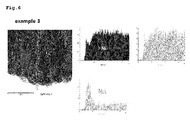
FIG. 5 andFIG. 6 illustrate the results of the internal structure and internal composition of the particles produced in Examples of the present invention measured by TEM and EDX. - Hereinafter, the present invention will be described in more detail with reference to Examples. However, the present invention is not limited by the following Examples.
- As the first step, 20 L of distilled water and 1000 g of ammonia as a chelating agent were introduced into a coprecipitation reactor (output of rotary motor: 80 W or more) having an internal volume of 100 L and stirred at from 300 to 1000 rpm using the impeller in the reactor while maintaining the internal temperature of the reactor at from 40 to 50°C.
- As the second step, a 2.5 M aqueous solution of the first precursor prepared by mixing nickel sulfate, cobalt sulfate, and manganese sulfate at a molar ratio of 97 : 3 : 0 and a 28% aqueous ammonia solution were continuously introduced into the reactor at a rate of 2.2 L/hr and 0.15 L/hr, respectively. In addition, in order to adjust the pH, a 25% aqueous solution of sodium hydroxide was supplied thereto so that the pH was maintained at from 11.3 to 11.4. The impeller speed was adjusted to from 300 to 1000 rpm. The aqueous solution of the first precursor, ammonia, and the aqueous solution of sodium hydroxide were continuously introduced into the reactor in an amount of 27 L.
- As the third step, a 2.5 M aqueous solution for forming the concentration gradient layer was prepared by mixing nickel sulfate, cobalt sulfate, and manganese sulfate at a molar ratio of 14 : 41 : 45 was introduced into a separate stirrer in which the volume of the 2.5 M aqueous solution of the first precursor prepared by mixing nickel sulfate, cobalt sulfate, and manganese sulfate at a molar ratio of 97 : 3 : 0 in the second step was fixed at 10 L other than the above reactor at a rate of 2.2 L/hr and stirred to prepare an aqueous solution of the second precursor for forming the concentration gradient layer, and the aqueous solution of the second precursor was introduced into the reactor at the same time. The aqueous solution for forming the concentration gradient layer was introduced into the batch reactor while mixing until the molar ratio of nickel sulfate, cobalt sulfate, and manganese sulfate in the aqueous solution of the second precursor became 60 : 20 : 20 of the concentration of the shell layer, the 28% aqueous ammonia solution was introduced at a rate of 0.08 L/hr, and the pH was maintained at from 11.3 to 11.4 by introducing the aqueous solution of sodium hydroxide. The amount of the aqueous solution of the second precursor, ammonia, and the aqueous solution of sodium hydroxide introduced at this time were 17 L.
- Next, as the fourth step, the aqueous solution of the third precursor for forming the shell layer which was prepared by mixing nickel sulfate, cobalt sulfate, and manganese sulfate at a molar ratio of 60 : 20 : 20 was introduced into the batch reactor until the volume became 5 L, and the precipitate of spherical nickel-manganese-cobalt composite hydroxide was collected from the reactor after the reaction was terminated.
- The composite metal hydroxide precipitated was filtered, washed with pure water, and then dried in a hot air dryer at 100°C for 12 hours, thereby obtaining a precursor powder in the form of a composite metal hydroxide having a continuous concentration gradient from (Ni0.97Co0.03)(OH)2 of the core layer to (Ni0.6Co0.2Mn0.2) (OH)2 of the shell layer.
- The powder of an cathode active material was produced by the same method as in Example 1 except that the composition of the core layer was Li (Ni0.97Co0.03)O2, the composition of the shell layer was Li (Ni0.5Co0.2Mn0.3)O2, and the concentration gradient layer had a continuous and constant concentration gradient from Li (Ni0.97Co0.03)O2 to Li (Ni0.5Co0.2Mn0.3)O2.
- The powder of an cathode active material was produced by the same method as in Example 1 except that the composition of the core layer was Li (Ni0.97Co0.03)O2, the composition of the shell layer was Li (Ni0.4Co0.2Mn0.2)O2, and the concentration gradient layer had a continuous and constant concentration gradient from Li (Ni0.97Co0.03)O2 to Li (Ni0.4Co0.2Mn0.2)O2.
- The powder of an cathode active material was produced by the same method as in Example 1 except that the composition of the core layer was Li (Ni0.90Co0.10O2, the composition of the shell layer was Li(Ni0.5Mn0.5)O2, and the concentration gradient layer had a continuous and constant concentration gradient from Li (Ni0.90Co0.10)O2 to Li(Ni0.5Mn0.5)O2.
- The powder of an cathode active material was produced by the same method as in Example 1 except that the composition of the core layer was Li (Ni0.90Co0.10)O2, the composition of the shell layer was Li (Ni0.35Co0.15Mn0.50) O2, and the concentration gradient layer had a continuous and constant concentration gradient from Li (Ni0.90Co0.10)O2 to Li (Ni0.35Co0.15Mn0.50)O2.
- The powder of an cathode active material was produced by the same method as in Example 1 except that the composition of the core layer was Li (Ni0.90Co0.03)O2, the composition of the shell layer was Li (Ni0.30Co0.10Mn0.50)O2, and the concentration gradient layer had a continuous and constant concentration gradient from Li (Ni0.90Co0.10)O2 to Li (Ni0.30Co0.10Mn0.50)O2.
- Into a continuous reactor (100 L, CSTR reactor), 60 L of distilled water and 1000 g of ammonia as a chelating agent were introduced and stirred at from 300 to 1000 rpm using the impeller while maintaining the internal temperature of the reactor at from 40 to 50°C. In addition, nitrogen gas was continuously supplied to the reactor at a flow rate of 3 L/min. Next, a 1 M aqueous precursor solution prepared by mixing nickel sulfate, cobalt sulfate, and manganese sulfate at a molar ratio of 8 : 1 : 1 and a 28% aqueous ammonia solution were continuously introduced into the reactor at a rate of 3.25 L/hr and 0.15 L/hr, respectively. In addition, in order to adjust the pH, a 25% aqueous solution of sodium hydroxide was continuously supplied into the reactor at a rate of 0.8 L/hr so as to maintain the pH at from 11 to 12. The temperature of the reaction solution was maintained at 50 ± 2°C.
- In 13 hours after the inside of the reactor reached a steady-state, the hydroxide particles discharged from the overflow pipe were continuously collected, washed with water, dried in a hot air dryer at 100°C for 12 hours, thereby obtaining a precursor powder in the form of a composite metal hydroxide having a composition of (Ni0.8Co0.1Mn0.1)(OH)2.
- The composite metal hydroxide and lithium hydroxide (LiOH.H2O) were mixed together at a molar ratio of 1 : 1.00 to 1.10, then heated at a temperature rising rate of 2°C/min, then subjected to the heat treatment at 550°C for 10 hours, and then fired at from 700 to 1000°C for 20 hours, thereby obtaining the powder of an cathode active material.
- SEM images of the particles and fracture surfaces of the cathode active materials produced in Examples 1 to 6 and Comparative Example 1 were taken and the results are illustrated in
FIG. 3 andFIG. 4 . - From
FIG. 3 , it can be seen that the cathode active material particles produced in Examples 1 to 6 and Comparative Example 1 are spherical secondary particles formed by aggregation of the primary particles. - From
FIG. 4 of SEM images of the fracture surfaces of the particles, it can be seen that, in the case of the particles produced in Examples 1 to 6 of the present invention, the aspect ratio of the primary particles is 1 or more, the primary particles grow in the longitudinal direction, namely the longer direction to exhibit directivity in the center direction of the particles, and thus the lithium conduction path from the surface to the center of the particles is formed as a one-dimensional or two-dimensional tunnel structure, but in the case of Comparative Example, the aspect ratio of the primary particles is much shorter than that in Examples, the particles are randomly formed, and thus directivity of the primary particles is not observed in the inside of the secondary particles. - The shape and structure of the primary particles and the concentration of transition metal in the particles of Examples 2 and 3 were determined by TEM and EDX, and the results are illustrated in
FIG. 5 andFIG. 6 , respectively. - From
FIG. 5 , it can be confirmed that a concentration gradient layer and a shell layer are formed on the surface of the core layer of the particles produced in Examples 2 and 3 of the present invention, the primary particles are formed to exhibit directivity toward the center of the secondary particles, and the lithium ion conduction path in the primary particles is formed to be parallel to the center direction of the secondary particles. - On the other hand, as illustrated in
FIG. 4 , it can be confirmed that the lithium ion conduction path is randomly formed without exhibiting directivity in the case of the particles produced in Comparative Example 1. - The composition and particle size distribution of the lithium-metal composite oxide produced in Examples 1 to 6 and Comparative Example 1 were measured using a particle size analyzer, and the results are presented in the following Table 1.
- For the composition analysis, a certain amount (about 2 g) of the lithium-metal composite oxide produced above was accurately weighed (0.1 mg unit) and then transferred to a Glass Beaker, aqua regia (HCl : HNO3 = 3 : 1) was added thereto, and the lithium-metal composite oxide was completely decomposed on a hot plate.
- The intensity of the standard solution (three kinds) prepared using the standard solution (Inorganic Venture, 1000 mg/kg) was measured at the specific wavelength for each element of Li/Ni/Co/Mn using an inductively coupled plasma atomic emission spectrometer (ICP-AES, Perkin-Elmer 7300) to create a standard calibration curve, the pre-treated sample solution and the reference sample were then introduced into the apparatus, the intensity of each of them was measure, the actual intensity was calculated, and the concentration of each component was calculated with respect to the calibration curve created above and normalized so that the total sum became the theoretical value, thereby analyzing the composition of the lithium-metal composite oxide.
[Table 1] Division Li/M BET Result of particle size (µm) ratio m2/g D10 D50 D90 Example 1 1.02 0.37 7.2 10.5 13.7 Example 2 1.02 0.41 7.5 11.3 14.7 Example 3 1.02 0.36 8.1 11.0 13.8 Example 4 1.03 0.40 7.6 10.5 13.6 Example 5 1.02 0.38 7.6 10.7 13.7 Example 6 1.02 0.42 7.4 10.7 13.8 Comparative Example 1 1.02 0.47 7.1 10.7 14.4 - The cathode active materials produced in Examples 1 to 6 and Comparative Example 1, super-P as a conductive agent, and polyvinylidene fluoride (PVdF) as a binder were mixed together at a weight ratio of 92 : 5 : 3 to prepare a slurry. The slurry was uniformly coated on an aluminum foil having a thickness of 15 µm and vacuum-dried at 135°C to produce an cathode for lithium secondary battery.
- A coin battery was produced according to a usually known manufacturing process using the anode, a lithium foil as a counter electrode, a porous polyethylene film (Celgard 2300 manufactured by Celgard, LLC., thickness: 25 µm) as a separator, and a liquid electrolytic solution in which LiPF6 was dissolved at a concentration of 1.15 M in a solvent prepared by mixing ethylene carbonate and ethylmethyl carbonate at a volume ratio of 3 : 7.
- The initial capacity, initial efficiency, rate characteristics, and lifespan characteristics of the batteries produced using the active materials produced in Examples 1 to 6 and Comparative Example were measured, and the results are presented in the following Table 2.
- From Table 2 below, it can be confirmed that the properties of the batteries including the active materials produced in Examples of the present invention are more significantly improved than those of the battery including the active material produced in Comparative Example.
[Table 2] Division Initial capacity (mAh/g) Initial efficiency Rate characteristics Lifespan performance Initial charge quantity Discharge quantity Eff. (2C/0.1C) At 100th cycle Example 1 232.4 209.9 90.3% 87.0% 91.9% Example 2 223.4 201.1 90.0% 88.5% 92.3% Example 3 225.3 203.0 90.1% 87.8% 96.6% Example 4 213.7 194.9 91.2% 83.4% 94.6% Example 5 215.9 199.2 92.2% 84.3% 94.9% Example 6 209.6 192.8 92.0% 83.0% 95.7% Comparative Example 1 227.1 203.9 89.8% 82.5% 81.4% - As described above, the cathode active material for lithium secondary battery according to the present invention is significantly useful in that the thickness of the concentration gradient layer is controlled and the lithium ion diffusion path in the primary particles is formed to exhibit directivity toward the center direction of the particles, thus the storage of the lithium ion into and release thereof from the primary particles are facilitated, and the capacity, output, and lifespan characteristics of the battery including the cathode active material for lithium secondary battery according to the present invention are significantly improved.
Claims (12)
- An cathode active material for lithium secondary battery, which has a layered structure containing nickel, manganese, and cobalt, is second particles formed by aggregation of primary particles, and comprises:a core layer having constant concentrations of nickel, manganese, and cobalt;a concentration gradient layer that is formed on the periphery of the core layer and has a concentration gradient of at least one of nickel, manganese, and cobalt; anda shell layer that is formed on the periphery of the concentration gradient layer and has constant concentrations of nickel, manganese, and cobalt, whereina thickness of the concentration gradient layer is from 10 to 500 nm.
- The cathode active material for lithium secondary battery according to claim 1, wherein a thickness of the shell layer is from 10 to 200 nm.
- The cathode active material for lithium secondary battery according to claim 1, wherein a lithium ion diffusion path in the primary particles is formed in a center direction of the secondary particles.
- The cathode active material for lithium secondary battery according to claim 1, wherein an aspect ratio of the primary particles is 1 or more and a lithium ion diffusion path in the primary particles is formed in a longitudinal direction of the particles.
- The cathode active material for lithium secondary battery according to claim 2, wherein an area occupied by primary particles having the aspect ratio of 1 or more and the lithium ion diffusion path in the particles formed in a longitudinal direction of the particles is 20% or more of a total area.
- The cathode active material for lithium secondary battery according to claim 1, wherein a lithium ion diffusion path in the primary particles inclines by ±45° or less with respect to a center direction of the secondary particles.
- The cathode active material for lithium secondary battery according to claim 1, wherein an area occupied by primary particles having a lithium ion diffusion path directed toward a center direction of the secondary particles is 40% or more of a total area of the particles.
- The cathode active material for lithium secondary battery according to claim 1, wherein the primary particles is formed to exhibit directivity in a center direction of the entire particles, a lithium ion diffusion path in the primary particles is formed in a center direction of the entire particles, and thus a lithium ion diffusion path from a surface to a center of the secondary particles has a one-dimensional or two-dimensional tunnel structure.
- The cathode active material for lithium secondary battery according to claim 1, wherein the core layer having constant concentrations of nickel, manganese, and cobalt is represented by the following Formula 1 and the shell layer is represented by the following Formula 2:
<Formula 1> LixNi1-a-b-cCoaMnbMecO2-yXy
(in Formula 2, 0.9≤x≤1.15, 0≤a≤0.35, 0≤b≤0.70, 0≤c≤0.20, 0≤y≤0.1, Me is at least one or more elements selected from the group consisting of Al, Mg, B, P, Ti, Si, Zr, Ba and any combination thereof, and X is at least one or more elements or molecules selected from the group consisting of anions of F, BO3, and PO4) and
<Formula 2> LixNi1-a-b-cCoaMnbMebO2-yXy
(in Formula 1, 0.9≤x≤1.15, 0≤a≤0.10, 0≤b≤0.1, 0≤c≤0.1, 0≤y≤0.1, Me is at least one or more elements selected from the group consisting of Al, Mg, B, P, Ti, Si, Zr, Ba and any combination thereof, and X is at least one or more elements or molecules selected from the group consisting of anions of F, BO3, and PO4). - The cathode active material for lithium secondary battery according to claim 1, wherein a lithium ion diffusion path of primary particles of the concentration gradient layer is directed toward a center direction of the secondary particles.
- The cathode active material for lithium secondary battery according to claim 1, wherein the primary particles have a needle shape, a plate shape, a rectangular shape, a slanted rectangular shape, or a circular column shape.
- A lithium secondary battery comprising the cathode active material for lithium secondary battery according to any one of claims 1 to 11.
Priority Applications (1)
| Application Number | Priority Date | Filing Date | Title |
|---|---|---|---|
| PL15775064T PL3024070T3 (en) | 2014-10-02 | 2015-01-21 | ACTIVE MATERIAL OF THE POSITIVE ELECTRODES FOR A LITHIUM RECHARGEABLE BATTERY AND CONTAINING A LITHIUM RECHARGEABLE BATTERY |
Applications Claiming Priority (2)
| Application Number | Priority Date | Filing Date | Title |
|---|---|---|---|
| KR1020140132750A KR101555594B1 (en) | 2014-10-02 | 2014-10-02 | Cathod active material for lithium rechargeable battery and lithium rechargeable battery comprising the same |
| PCT/KR2015/000648 WO2016052820A1 (en) | 2014-10-02 | 2015-01-21 | Positive electrode active material for lithium secondary battery and lithium secondary battery including same |
Publications (3)
| Publication Number | Publication Date |
|---|---|
| EP3024070A1 true EP3024070A1 (en) | 2016-05-25 |
| EP3024070A4 EP3024070A4 (en) | 2017-04-05 |
| EP3024070B1 EP3024070B1 (en) | 2020-11-04 |
Family
ID=54345214
Family Applications (1)
| Application Number | Title | Priority Date | Filing Date |
|---|---|---|---|
| EP15775064.7A Active EP3024070B1 (en) | 2014-10-02 | 2015-01-21 | Positive electrode active material for lithium secondary battery and lithium secondary battery including same |
Country Status (8)
| Country | Link |
|---|---|
| US (1) | US10522823B2 (en) |
| EP (1) | EP3024070B1 (en) |
| JP (4) | JP2017536686A (en) |
| KR (1) | KR101555594B1 (en) |
| CN (1) | CN105993090B (en) |
| HU (1) | HUE052913T2 (en) |
| PL (1) | PL3024070T3 (en) |
| WO (1) | WO2016052820A1 (en) |
Cited By (7)
| Publication number | Priority date | Publication date | Assignee | Title |
|---|---|---|---|---|
| EP3016183A2 (en) * | 2014-10-29 | 2016-05-04 | IUCF-HYU (Industry-University Cooperation Foundation Hanyang University) | Positive electrode active material and secondary battery comprising the same |
| EP3279979A1 (en) * | 2016-08-02 | 2018-02-07 | Ecopro Bm Co., Ltd. | Lithium complex oxide for lithium secondary battery positive active material and a method of preparing the same |
| EP3279978A1 (en) * | 2016-08-02 | 2018-02-07 | Ecopro Bm Co., Ltd. | Lithium complex oxide for lithium secondary battery positive active material and method of preparing the same |
| EP3386014A4 (en) * | 2015-11-30 | 2019-03-20 | LG Chem, Ltd. | CATHODE ACTIVE MATERIAL FOR ACCUMULATOR AND ACCUMULATOR COMPRISING THE SAME |
| EP3416218A4 (en) * | 2016-02-08 | 2019-10-23 | Murata Manufacturing Co., Ltd. | POSITIVE ELECTRODE MATERIAL FOR SECONDARY BATTERY, POSITIVE SECONDARY BATTERY ELECTRODE, SECONDARY BATTERY, BATTERY PACK, ELECTRIC VEHICLE, ELECTRIC POWER STORAGE SYSTEM, ELECTRIC TOOL, AND ELECTRONIC DEVICE |
| EP3550644A4 (en) * | 2016-12-05 | 2019-11-20 | Posco | POSITIVE ELECTRODE ACTIVE MATERIAL PRECURSOR AND PREPARATION METHOD THEREOF, POSITIVE ELECTRODE ACTIVE MATERIAL AND PREPARATION METHOD THEREOF, AND LITHIUM SECONDARY BATTERY COMPRISING POSITIVE ELECTRODE ACTIVE MATERIAL |
| EP4084144A4 (en) * | 2019-12-24 | 2024-03-13 | SM Lab Co., Ltd. | Positive electrode active material, method for preparing same, and lithium secondary battery comprising positive electrode comprising same |
Families Citing this family (54)
| Publication number | Priority date | Publication date | Assignee | Title |
|---|---|---|---|---|
| KR101555594B1 (en) * | 2014-10-02 | 2015-10-06 | 주식회사 에코프로 | Cathod active material for lithium rechargeable battery and lithium rechargeable battery comprising the same |
| JP6662001B2 (en) * | 2015-11-27 | 2020-03-11 | 住友金属鉱山株式会社 | Positive electrode active material for non-aqueous electrolyte secondary battery, method for producing the same, and method for producing coating liquid |
| US10903490B2 (en) * | 2016-08-02 | 2021-01-26 | Ecopro Bm Co., Ltd. | Lithium complex oxide for lithium secondary battery positive active material and method of preparing the same |
| PL3279977T3 (en) * | 2016-08-02 | 2020-08-24 | Ecopro Bm Co., Ltd. | Lithium complex oxide for lithium secondary battery positive active material and a method of preparing the same |
| KR101874340B1 (en) * | 2016-08-02 | 2018-07-05 | 주식회사 에코프로비엠 | Lithium complex oxide for lithium secondary battery positive active material and a method of preparing the same |
| CN110073527B (en) * | 2016-12-02 | 2023-07-14 | 三星Sdi株式会社 | Nickel active material precursor and preparation method thereof, nickel active material and lithium secondary battery |
| KR102172842B1 (en) | 2016-12-02 | 2020-11-02 | 삼성에스디아이 주식회사 | Nickel-based active material precursor for lithium secondary battery, preparing method thereof, nickel-based active material for lithium secondary battery formed thereof, and lithium secondary battery comprising positive electrode including the nickel-based active material |
| US11936041B2 (en) * | 2016-12-16 | 2024-03-19 | Sk On Co., Ltd. | Lithium secondary battery |
| KR101919531B1 (en) * | 2016-12-22 | 2018-11-16 | 주식회사 포스코 | Cathode active material, method for manufacturing the same, and lithium ion battery including the same |
| KR102117621B1 (en) * | 2016-12-28 | 2020-06-02 | 주식회사 엘지화학 | Positive electrode active material for lithium secondary battery, method for preparing the same, and lithium secondary battery including the same |
| US20190081322A1 (en) * | 2017-02-22 | 2019-03-14 | Lionano Inc. | Core-shell electroactive materials |
| US10431820B2 (en) * | 2017-07-10 | 2019-10-01 | Uchicago Argonne, Llc | High valent lithiated surface structures for lithium ion battery electrode materials |
| DE102017215146A1 (en) * | 2017-08-30 | 2019-02-28 | Bayerische Motoren Werke Aktiengesellschaft | POSITIVE ACTIVE MATERIAL FOR USE IN A SECONDARY LITHIUM ION CELL AND BATTERY |
| PL3486978T3 (en) * | 2017-11-15 | 2021-06-28 | Ecopro Bm Co., Ltd. | Cathode active material and preparation method thereof |
| JP6894419B2 (en) * | 2017-11-15 | 2021-06-30 | エコプロ ビーエム カンパニー リミテッドEcopro Bm Co., Ltd. | Positive electrode active material for secondary batteries and its manufacturing method |
| KR102130484B1 (en) * | 2017-11-15 | 2020-07-06 | 주식회사 에코프로비엠 | Cathode active material and manufacturing method thereof |
| KR102159243B1 (en) | 2017-11-22 | 2020-09-23 | 주식회사 에코프로비엠 | Cathode active material of lithium secondary battery |
| WO2019104544A1 (en) * | 2017-11-29 | 2019-06-06 | 厦门厦钨新能源材料有限公司 | Lithium ion battery cathode material, preparation method therefor, and lithium ion battery |
| KR102044320B1 (en) | 2017-12-26 | 2019-11-13 | 주식회사 포스코 | Grain oriented electrical steel sheet and method for refining magnetic domains therein |
| KR102313091B1 (en) | 2018-01-19 | 2021-10-18 | 주식회사 엘지화학 | Positive electrode active material for lithium secondary battery, preparing method of the same, positive electrode and lithium secondary battery including the same |
| WO2019163847A1 (en) * | 2018-02-22 | 2019-08-29 | 住友金属鉱山株式会社 | Metal composite hydroxide and method for producing same, positive electrode active substance for non-aqueous electrolyte secondary battery and method for producing same, and non-aqueous electrolyte secondary battery |
| WO2019187915A1 (en) * | 2018-03-28 | 2019-10-03 | 日本碍子株式会社 | Lithium secondary battery and card with built-in battery |
| JP6905148B2 (en) * | 2018-03-28 | 2021-07-21 | 日本碍子株式会社 | Lithium secondary battery and built-in battery card |
| WO2019238033A1 (en) * | 2018-06-11 | 2019-12-19 | Microvast Power Systems Co., Ltd. | Methods for preparing particle precursor, and particle precursor prepared thereby |
| KR102531434B1 (en) * | 2018-06-12 | 2023-05-12 | 에스케이온 주식회사 | Lithium Secondary Battery |
| JP7183814B2 (en) * | 2019-01-24 | 2022-12-06 | 住友金属鉱山株式会社 | Nickel-manganese-cobalt-containing composite hydroxide and manufacturing method thereof, positive electrode active material for lithium ion secondary battery and manufacturing method thereof, and lithium ion secondary battery |
| JP7183815B2 (en) * | 2019-01-24 | 2022-12-06 | 住友金属鉱山株式会社 | Nickel-manganese-cobalt-containing composite hydroxide and manufacturing method thereof, positive electrode active material for lithium ion secondary battery and manufacturing method thereof, and lithium ion secondary battery |
| JP7183812B2 (en) * | 2019-01-24 | 2022-12-06 | 住友金属鉱山株式会社 | Nickel-manganese-cobalt-containing composite hydroxide and manufacturing method thereof, positive electrode active material for lithium ion secondary battery and manufacturing method thereof, and lithium ion secondary battery |
| JP7183813B2 (en) * | 2019-01-24 | 2022-12-06 | 住友金属鉱山株式会社 | Nickel-manganese-cobalt-containing composite hydroxide and manufacturing method thereof, positive electrode active material for lithium ion secondary battery and manufacturing method thereof, and lithium ion secondary battery |
| WO2020175782A1 (en) * | 2019-02-28 | 2020-09-03 | 주식회사 에스엠랩 | Positive active material, method for manufacturing same and lithium secondary battery comprising positive electrode comprising positive active material |
| WO2020207901A1 (en) * | 2019-04-10 | 2020-10-15 | Basf Se | Process for precipitating a mixed hydroxide, and cathode active materials made from such hydroxide |
| US12431495B2 (en) | 2019-06-20 | 2025-09-30 | Iucf-Hyu (Industry-University Cooperation Foundation Hanyang University) | Positive electrode active material having surface portion doped with hetero elements, and method for producing same |
| CN110911664B (en) * | 2019-11-13 | 2022-02-01 | 北京理工大学 | High-nickel cathode material with composite surface layer and preparation method and application thereof |
| KR102144057B1 (en) * | 2019-12-24 | 2020-08-12 | 주식회사 에스엠랩 | A cathode active material, method of preparing the same, and lithium secondary battery comprising a cathode comprising the cathode active material |
| KR102144056B1 (en) * | 2019-12-24 | 2020-08-12 | 주식회사 에스엠랩 | A cathode active material, method of preparing the same, and lithium secondary battery comprising a cathode comprising the cathode active material |
| CN111193018B (en) * | 2020-01-11 | 2021-08-17 | 松山湖材料实验室 | Lithium battery positive electrode active material and preparation method and application thereof |
| EP4176476B1 (en) | 2020-07-06 | 2024-04-17 | Basf Se | Coated particulate electrode active materials |
| WO2022069913A1 (en) * | 2020-10-01 | 2022-04-07 | 日産自動車株式会社 | Secondary battery |
| KR20220055678A (en) * | 2020-10-27 | 2022-05-04 | 주식회사 에코프로비엠 | Positive electrode active material and lithium secondary battery comprising the same |
| KR102586106B1 (en) * | 2020-10-29 | 2023-10-05 | 삼성에스디아이 주식회사 | Positive active material for rechargeable lithium battery, method of preparing the same and rechargeable lithium battery including the same |
| CN114447328B (en) * | 2020-10-31 | 2024-05-14 | 华友新能源科技(衢州)有限公司 | Positive electrode material of monocrystalline outer layer coated oxide and preparation method thereof |
| KR102624905B1 (en) * | 2020-11-25 | 2024-01-12 | (주)포스코퓨처엠 | Oriented cathode active material for lithium secondary battery and method for manufacturing the same |
| CN116325224A (en) * | 2020-12-04 | 2023-06-23 | Ecopro Bm 有限公司 | Positive electrode active material for lithium secondary battery, preparation method thereof, and lithium secondary battery comprising same |
| WO2022126253A1 (en) * | 2020-12-14 | 2022-06-23 | HYDRO-QUéBEC | Electrode materials comprising a lamellar metal oxide coated with a tunnel-type metal oxide, electrodes comprising same and use thereof in electrochemistry |
| KR102906056B1 (en) * | 2021-06-01 | 2025-12-29 | 삼성에스디아이 주식회사 | Positive active material for rechargeable lithium battery, method of preparing the same and rechargeable lithium battery including the same |
| US20230059571A1 (en) * | 2021-08-18 | 2023-02-23 | Ford Global Technologies, Llc | Cathode material stabilization |
| EP4228029A4 (en) * | 2021-12-28 | 2024-02-14 | Contemporary Amperex Technology Co., Limited | Positive electrode material and preparation method therefor, and secondary battery having same |
| US12525607B2 (en) * | 2022-01-05 | 2026-01-13 | Ecopro Bm Co., Ltd. | Positive electrode active material and lithium secondary battery using the same |
| KR102857191B1 (en) * | 2022-10-14 | 2025-09-09 | 주식회사 에코프로비엠 | Positive electrode active material and lithium secondary battery comprising the same |
| CN119968717A (en) * | 2022-10-25 | 2025-05-09 | 尤米科尔公司 | Positive electrode active material and method for producing positive electrode active material |
| KR102683638B1 (en) * | 2022-12-23 | 2024-07-10 | (주)포스코퓨처엠 | Positive active material for rechargeable lithium battery, and rechargeable lithium battery including the same |
| KR102683637B1 (en) * | 2022-12-23 | 2024-07-10 | (주)포스코퓨처엠 | Positive active material for rechargeable lithium battery, and rechargeable lithium battery including the same |
| CN115959720B (en) * | 2023-03-17 | 2023-06-23 | 四川新能源汽车创新中心有限公司 | High nickel precursor material, high nickel positive electrode material and preparation method thereof |
| KR20250027985A (en) * | 2023-08-21 | 2025-02-28 | 포스코홀딩스 주식회사 | Cathode active material for lithium secondary battery, manufacturing method of the same and lithium secondary battery comprising the same |
Family Cites Families (16)
| Publication number | Priority date | Publication date | Assignee | Title |
|---|---|---|---|---|
| TW363940B (en) | 1996-08-12 | 1999-07-11 | Toda Kogyo Corp | A lithium-nickle-cobalt compound oxide, process thereof and anode active substance for storage battery |
| CA2234874C (en) | 1997-04-15 | 2009-06-30 | Sanyo Electric Co., Ltd. | Positive electrode material for use in non-aqueous electrolyte battery, process for preparing the same, and non-aqueous electrolyte battery |
| US6308252B1 (en) | 1999-02-04 | 2001-10-23 | Kabushiki Kaisha Toshiba | Processor method and apparatus for performing single operand operation and multiple parallel operand operation |
| JP4986098B2 (en) * | 2001-03-15 | 2012-07-25 | 日立金属株式会社 | Positive electrode for non-aqueous lithium secondary battery and non-aqueous lithium secondary battery using the same |
| WO2006070977A1 (en) * | 2004-12-31 | 2006-07-06 | Iucf-Hyu (Industry-University Cooperation Foundation Hanyang University) | Double-layer cathode active materials for lithium secondary batteries, method for preparing the active materials, and lithium secondary batteries using the active materials |
| KR100822012B1 (en) * | 2006-03-30 | 2008-04-14 | 한양대학교 산학협력단 | Cathode active material for lithium battery, manufacturing method thereof, and lithium secondary battery comprising same |
| KR101185366B1 (en) * | 2010-01-14 | 2012-09-24 | 주식회사 에코프로 | A method of preparing positive active material precursor and positive active material for lithium battery with concentration grandients using batch reactor |
| US8911902B2 (en) * | 2010-07-06 | 2014-12-16 | Samsung Sdi Co., Ltd. | Nickel-based positive electrode active material, method of preparing the same, and lithium battery using the nickel-based positive electrode active material |
| KR101316053B1 (en) * | 2011-04-26 | 2013-10-11 | 국립대학법인 울산과학기술대학교 산학협력단 | Positive active material for rechargeable lithium battery, method of preparing the same, and rechargeable lithium battery including the same |
| US9520593B2 (en) * | 2012-03-31 | 2016-12-13 | Iucf-Hyu (Industry-University Cooperation Foundation Hanyang University) | Method of preparing cathode active material precursor for lithium rechargeable battery, cathode active material precursor for lithium rechargeable battery prepared thereby, and cathode active material formed using the cathode active material precursor |
| KR20130138073A (en) * | 2012-06-08 | 2013-12-18 | 한양대학교 산학협력단 | Precursor for cathod active material of lithium secondary battery, cathode active materials made by the same, and lithium secondary battery containing the same |
| JP5798524B2 (en) * | 2012-06-26 | 2015-10-21 | シャープ株式会社 | Damper opening / closing mechanism and cooking device equipped with the same |
| EP2940761B1 (en) * | 2012-12-26 | 2019-12-18 | IUCF-HYU (Industry-University Cooperation Foundation Hanyang University) | Cathode active material for lithium secondary batteries |
| KR101970201B1 (en) | 2012-12-31 | 2019-04-19 | 주식회사 에코프로비엠 | Manufacturing method of cathod active material for lithium rechargeable battery and cathod active material made by the same |
| CN103943822B (en) * | 2014-05-13 | 2017-03-29 | 南通瑞翔新材料有限公司 | A kind of lithium rechargeable battery nickel-base anode active material and preparation method thereof |
| KR101555594B1 (en) * | 2014-10-02 | 2015-10-06 | 주식회사 에코프로 | Cathod active material for lithium rechargeable battery and lithium rechargeable battery comprising the same |
-
2014
- 2014-10-02 KR KR1020140132750A patent/KR101555594B1/en active Active
-
2015
- 2015-01-21 WO PCT/KR2015/000648 patent/WO2016052820A1/en not_active Ceased
- 2015-01-21 HU HUE15775064A patent/HUE052913T2/en unknown
- 2015-01-21 EP EP15775064.7A patent/EP3024070B1/en active Active
- 2015-01-21 PL PL15775064T patent/PL3024070T3/en unknown
- 2015-01-21 US US14/785,194 patent/US10522823B2/en active Active
- 2015-01-21 JP JP2017538151A patent/JP2017536686A/en not_active Withdrawn
- 2015-01-21 CN CN201580000637.3A patent/CN105993090B/en active Active
-
2020
- 2020-04-09 JP JP2020070536A patent/JP7412258B2/en active Active
-
2021
- 2021-09-13 JP JP2021148825A patent/JP7461914B2/en active Active
-
2023
- 2023-09-01 JP JP2023142063A patent/JP2023155469A/en active Pending
Cited By (12)
| Publication number | Priority date | Publication date | Assignee | Title |
|---|---|---|---|---|
| EP3016183A2 (en) * | 2014-10-29 | 2016-05-04 | IUCF-HYU (Industry-University Cooperation Foundation Hanyang University) | Positive electrode active material and secondary battery comprising the same |
| EP3386014A4 (en) * | 2015-11-30 | 2019-03-20 | LG Chem, Ltd. | CATHODE ACTIVE MATERIAL FOR ACCUMULATOR AND ACCUMULATOR COMPRISING THE SAME |
| US10763497B2 (en) | 2015-11-30 | 2020-09-01 | Lg Chem, Ltd. | Positive electrode active material for secondary battery, and secondary battery comprising the same |
| EP3416218A4 (en) * | 2016-02-08 | 2019-10-23 | Murata Manufacturing Co., Ltd. | POSITIVE ELECTRODE MATERIAL FOR SECONDARY BATTERY, POSITIVE SECONDARY BATTERY ELECTRODE, SECONDARY BATTERY, BATTERY PACK, ELECTRIC VEHICLE, ELECTRIC POWER STORAGE SYSTEM, ELECTRIC TOOL, AND ELECTRONIC DEVICE |
| US10522832B2 (en) | 2016-02-08 | 2019-12-31 | Murata Manufacturing Co., Ltd. | Secondary battery-use positive electrode active material, secondary battery-use positive electrode, secondary battery, battery pack, electric vehicle, electric power storage system, electric power tool, and electronic apparatus |
| EP3279979A1 (en) * | 2016-08-02 | 2018-02-07 | Ecopro Bm Co., Ltd. | Lithium complex oxide for lithium secondary battery positive active material and a method of preparing the same |
| EP3279978A1 (en) * | 2016-08-02 | 2018-02-07 | Ecopro Bm Co., Ltd. | Lithium complex oxide for lithium secondary battery positive active material and method of preparing the same |
| CN107681150A (en) * | 2016-08-02 | 2018-02-09 | Ecopro Bm有限公司 | Secondary lithium batteries lithium composite xoide and preparation method thereof |
| US11031596B2 (en) | 2016-08-02 | 2021-06-08 | Ecopro Bm Co., Ltd. | Lithium complex oxide for lithium secondary battery positive active material and method of preparing the same |
| US11710824B2 (en) | 2016-08-02 | 2023-07-25 | Ecopro Bm Co., Ltd. | Lithium complex oxide for lithium secondary battery positive active material and method of preparing the same |
| EP3550644A4 (en) * | 2016-12-05 | 2019-11-20 | Posco | POSITIVE ELECTRODE ACTIVE MATERIAL PRECURSOR AND PREPARATION METHOD THEREOF, POSITIVE ELECTRODE ACTIVE MATERIAL AND PREPARATION METHOD THEREOF, AND LITHIUM SECONDARY BATTERY COMPRISING POSITIVE ELECTRODE ACTIVE MATERIAL |
| EP4084144A4 (en) * | 2019-12-24 | 2024-03-13 | SM Lab Co., Ltd. | Positive electrode active material, method for preparing same, and lithium secondary battery comprising positive electrode comprising same |
Also Published As
| Publication number | Publication date |
|---|---|
| KR101555594B1 (en) | 2015-10-06 |
| JP7461914B2 (en) | 2024-04-04 |
| JP2017536686A (en) | 2017-12-07 |
| CN105993090A (en) | 2016-10-05 |
| HUE052913T2 (en) | 2021-05-28 |
| PL3024070T3 (en) | 2021-05-04 |
| US10522823B2 (en) | 2019-12-31 |
| CN105993090B (en) | 2021-04-30 |
| JP2023155469A (en) | 2023-10-20 |
| JP2022000856A (en) | 2022-01-04 |
| EP3024070B1 (en) | 2020-11-04 |
| JP7412258B2 (en) | 2024-01-12 |
| JP2020109772A (en) | 2020-07-16 |
| US20160359165A1 (en) | 2016-12-08 |
| EP3024070A4 (en) | 2017-04-05 |
| WO2016052820A1 (en) | 2016-04-07 |
Similar Documents
| Publication | Publication Date | Title |
|---|---|---|
| EP3024070B1 (en) | Positive electrode active material for lithium secondary battery and lithium secondary battery including same | |
| JP7565896B2 (en) | Positive electrode active material for lithium secondary batteries | |
| JP7121771B2 (en) | Positive electrode active material for lithium secondary battery and lithium secondary battery including the same | |
| EP3388394B1 (en) | Method for manufacturing positive electrode active material for secondary battery and positive electrode active material for secondary battery, manufactured according to same | |
| KR102553596B1 (en) | Nickel manganese-containing composite hydroxide and method for producing the same | |
| JP5880426B2 (en) | Nickel composite hydroxide, method for producing the same, and method for producing positive electrode active material | |
| Santhanam et al. | High rate cycling performance of Li1. 05Ni1/3Co1/3Mn1/3O2 materials prepared by sol–gel and co-precipitation methods for lithium-ion batteries | |
| KR101313575B1 (en) | Manufacturing method of positive active material precursor and lithium metal composite oxides for lithium secondary battery | |
| KR101166334B1 (en) | Manufacturing method of cathode active materials for secondary battery containing metal composite oxides and cathode active materials made by the same | |
| WO2015198711A1 (en) | Nickel compound hydroxide, method for producing same, cathode active material, method for producing same, and non-aqueous electrolyte secondary battery | |
| WO2015198710A1 (en) | Manganese-cobalt compound hydroxide, method for producing same, cathode active material, method for producing same, and non-aqueous electrolyte secondary battery | |
| CN107078294A (en) | Non-aqueous electrolyte secondary battery positive active material, its manufacture method and use its non-aqueous electrolyte secondary battery | |
| EP2784853A1 (en) | Lithium transistion metal titanate with a spinel structure, method for its manufacturing, its use, Li-ion cell and battery | |
| WO2015198676A1 (en) | Manganese composite hydroxide and method for producing same, positive electrode active material and method for producing same, and nonaqueous electrolyte secondary battery | |
| KR101554692B1 (en) | Precursor of positive active material, positive active material, method for manufacturing the same and lithium secondary battery using the same | |
| KR101632887B1 (en) | Cathode active material precursor for lithium rechargeable battery and preparation method thereof, cathode active material for lithium rechargeable battery and lithium rechargeable battery comprising the same | |
| KR101506680B1 (en) | Cathode active material for lithium secondary battery and manufacturing method of the same | |
| EP4550469A2 (en) | Positive electrode active material for secondary battery | |
| JP6020700B2 (en) | Positive electrode active material, method for producing the same, and non-aqueous electrolyte secondary battery |
Legal Events
| Date | Code | Title | Description |
|---|---|---|---|
| PUAI | Public reference made under article 153(3) epc to a published international application that has entered the european phase |
Free format text: ORIGINAL CODE: 0009012 |
|
| 17P | Request for examination filed |
Effective date: 20151013 |
|
| AK | Designated contracting states |
Kind code of ref document: A1 Designated state(s): AL AT BE BG CH CY CZ DE DK EE ES FI FR GB GR HR HU IE IS IT LI LT LU LV MC MK MT NL NO PL PT RO RS SE SI SK SM TR |
|
| AX | Request for extension of the european patent |
Extension state: BA ME |
|
| R17P | Request for examination filed (corrected) |
Effective date: 20151013 |
|
| RAP1 | Party data changed (applicant data changed or rights of an application transferred) |
Owner name: ECOPRO BM CO., LTD. |
|
| RIC1 | Information provided on ipc code assigned before grant |
Ipc: H01M 4/505 20100101ALI20170222BHEP Ipc: H01M 4/525 20100101AFI20170222BHEP Ipc: H01M 10/052 20100101ALI20170222BHEP Ipc: C01G 53/00 20060101ALI20170222BHEP |
|
| A4 | Supplementary search report drawn up and despatched |
Effective date: 20170302 |
|
| RIN1 | Information on inventor provided before grant (corrected) |
Inventor name: KIM, JIK SOO Inventor name: JUNG, JAE YONG Inventor name: YUN, JIN KYEONG Inventor name: JEON, SUK YONG Inventor name: SHIN, JONG SEUNG Inventor name: CHOI, MOON HO |
|
| DAX | Request for extension of the european patent (deleted) | ||
| STAA | Information on the status of an ep patent application or granted ep patent |
Free format text: STATUS: EXAMINATION IS IN PROGRESS |
|
| 17Q | First examination report despatched |
Effective date: 20180205 |
|
| GRAP | Despatch of communication of intention to grant a patent |
Free format text: ORIGINAL CODE: EPIDOSNIGR1 |
|
| STAA | Information on the status of an ep patent application or granted ep patent |
Free format text: STATUS: GRANT OF PATENT IS INTENDED |
|
| INTG | Intention to grant announced |
Effective date: 20200804 |
|
| GRAS | Grant fee paid |
Free format text: ORIGINAL CODE: EPIDOSNIGR3 |
|
| GRAA | (expected) grant |
Free format text: ORIGINAL CODE: 0009210 |
|
| STAA | Information on the status of an ep patent application or granted ep patent |
Free format text: STATUS: THE PATENT HAS BEEN GRANTED |
|
| AK | Designated contracting states |
Kind code of ref document: B1 Designated state(s): AL AT BE BG CH CY CZ DE DK EE ES FI FR GB GR HR HU IE IS IT LI LT LU LV MC MK MT NL NO PL PT RO RS SE SI SK SM TR |
|
| REG | Reference to a national code |
Ref country code: GB Ref legal event code: FG4D |
|
| REG | Reference to a national code |
Ref country code: CH Ref legal event code: EP |
|
| REG | Reference to a national code |
Ref country code: AT Ref legal event code: REF Ref document number: 1332001 Country of ref document: AT Kind code of ref document: T Effective date: 20201115 |
|
| REG | Reference to a national code |
Ref country code: IE Ref legal event code: FG4D |
|
| REG | Reference to a national code |
Ref country code: DE Ref legal event code: R096 Ref document number: 602015061539 Country of ref document: DE |
|
| REG | Reference to a national code |
Ref country code: SE Ref legal event code: TRGR |
|
| REG | Reference to a national code |
Ref country code: NL Ref legal event code: MP Effective date: 20201104 |
|
| REG | Reference to a national code |
Ref country code: AT Ref legal event code: MK05 Ref document number: 1332001 Country of ref document: AT Kind code of ref document: T Effective date: 20201104 |
|
| PG25 | Lapsed in a contracting state [announced via postgrant information from national office to epo] |
Ref country code: NO Free format text: LAPSE BECAUSE OF FAILURE TO SUBMIT A TRANSLATION OF THE DESCRIPTION OR TO PAY THE FEE WITHIN THE PRESCRIBED TIME-LIMIT Effective date: 20210204 Ref country code: FI Free format text: LAPSE BECAUSE OF FAILURE TO SUBMIT A TRANSLATION OF THE DESCRIPTION OR TO PAY THE FEE WITHIN THE PRESCRIBED TIME-LIMIT Effective date: 20201104 Ref country code: RS Free format text: LAPSE BECAUSE OF FAILURE TO SUBMIT A TRANSLATION OF THE DESCRIPTION OR TO PAY THE FEE WITHIN THE PRESCRIBED TIME-LIMIT Effective date: 20201104 Ref country code: PT Free format text: LAPSE BECAUSE OF FAILURE TO SUBMIT A TRANSLATION OF THE DESCRIPTION OR TO PAY THE FEE WITHIN THE PRESCRIBED TIME-LIMIT Effective date: 20210304 Ref country code: GR Free format text: LAPSE BECAUSE OF FAILURE TO SUBMIT A TRANSLATION OF THE DESCRIPTION OR TO PAY THE FEE WITHIN THE PRESCRIBED TIME-LIMIT Effective date: 20210205 |
|
| REG | Reference to a national code |
Ref country code: HU Ref legal event code: AG4A Ref document number: E052913 Country of ref document: HU |
|
| PG25 | Lapsed in a contracting state [announced via postgrant information from national office to epo] |
Ref country code: ES Free format text: LAPSE BECAUSE OF FAILURE TO SUBMIT A TRANSLATION OF THE DESCRIPTION OR TO PAY THE FEE WITHIN THE PRESCRIBED TIME-LIMIT Effective date: 20201104 Ref country code: AT Free format text: LAPSE BECAUSE OF FAILURE TO SUBMIT A TRANSLATION OF THE DESCRIPTION OR TO PAY THE FEE WITHIN THE PRESCRIBED TIME-LIMIT Effective date: 20201104 Ref country code: BG Free format text: LAPSE BECAUSE OF FAILURE TO SUBMIT A TRANSLATION OF THE DESCRIPTION OR TO PAY THE FEE WITHIN THE PRESCRIBED TIME-LIMIT Effective date: 20210204 Ref country code: IS Free format text: LAPSE BECAUSE OF FAILURE TO SUBMIT A TRANSLATION OF THE DESCRIPTION OR TO PAY THE FEE WITHIN THE PRESCRIBED TIME-LIMIT Effective date: 20210304 Ref country code: LV Free format text: LAPSE BECAUSE OF FAILURE TO SUBMIT A TRANSLATION OF THE DESCRIPTION OR TO PAY THE FEE WITHIN THE PRESCRIBED TIME-LIMIT Effective date: 20201104 |
|
| REG | Reference to a national code |
Ref country code: LT Ref legal event code: MG9D |
|
| PG25 | Lapsed in a contracting state [announced via postgrant information from national office to epo] |
Ref country code: HR Free format text: LAPSE BECAUSE OF FAILURE TO SUBMIT A TRANSLATION OF THE DESCRIPTION OR TO PAY THE FEE WITHIN THE PRESCRIBED TIME-LIMIT Effective date: 20201104 |
|
| PG25 | Lapsed in a contracting state [announced via postgrant information from national office to epo] |
Ref country code: CZ Free format text: LAPSE BECAUSE OF FAILURE TO SUBMIT A TRANSLATION OF THE DESCRIPTION OR TO PAY THE FEE WITHIN THE PRESCRIBED TIME-LIMIT Effective date: 20201104 Ref country code: EE Free format text: LAPSE BECAUSE OF FAILURE TO SUBMIT A TRANSLATION OF THE DESCRIPTION OR TO PAY THE FEE WITHIN THE PRESCRIBED TIME-LIMIT Effective date: 20201104 Ref country code: SM Free format text: LAPSE BECAUSE OF FAILURE TO SUBMIT A TRANSLATION OF THE DESCRIPTION OR TO PAY THE FEE WITHIN THE PRESCRIBED TIME-LIMIT Effective date: 20201104 Ref country code: LT Free format text: LAPSE BECAUSE OF FAILURE TO SUBMIT A TRANSLATION OF THE DESCRIPTION OR TO PAY THE FEE WITHIN THE PRESCRIBED TIME-LIMIT Effective date: 20201104 Ref country code: RO Free format text: LAPSE BECAUSE OF FAILURE TO SUBMIT A TRANSLATION OF THE DESCRIPTION OR TO PAY THE FEE WITHIN THE PRESCRIBED TIME-LIMIT Effective date: 20201104 Ref country code: SK Free format text: LAPSE BECAUSE OF FAILURE TO SUBMIT A TRANSLATION OF THE DESCRIPTION OR TO PAY THE FEE WITHIN THE PRESCRIBED TIME-LIMIT Effective date: 20201104 |
|
| REG | Reference to a national code |
Ref country code: DE Ref legal event code: R097 Ref document number: 602015061539 Country of ref document: DE |
|
| PG25 | Lapsed in a contracting state [announced via postgrant information from national office to epo] |
Ref country code: MC Free format text: LAPSE BECAUSE OF FAILURE TO SUBMIT A TRANSLATION OF THE DESCRIPTION OR TO PAY THE FEE WITHIN THE PRESCRIBED TIME-LIMIT Effective date: 20201104 Ref country code: DK Free format text: LAPSE BECAUSE OF FAILURE TO SUBMIT A TRANSLATION OF THE DESCRIPTION OR TO PAY THE FEE WITHIN THE PRESCRIBED TIME-LIMIT Effective date: 20201104 |
|
| REG | Reference to a national code |
Ref country code: CH Ref legal event code: PL |
|
| PLBE | No opposition filed within time limit |
Free format text: ORIGINAL CODE: 0009261 |
|
| STAA | Information on the status of an ep patent application or granted ep patent |
Free format text: STATUS: NO OPPOSITION FILED WITHIN TIME LIMIT |
|
| PG25 | Lapsed in a contracting state [announced via postgrant information from national office to epo] |
Ref country code: LU Free format text: LAPSE BECAUSE OF NON-PAYMENT OF DUE FEES Effective date: 20210121 |
|
| 26N | No opposition filed |
Effective date: 20210805 |
|
| PG25 | Lapsed in a contracting state [announced via postgrant information from national office to epo] |
Ref country code: NL Free format text: LAPSE BECAUSE OF FAILURE TO SUBMIT A TRANSLATION OF THE DESCRIPTION OR TO PAY THE FEE WITHIN THE PRESCRIBED TIME-LIMIT Effective date: 20201104 Ref country code: AL Free format text: LAPSE BECAUSE OF FAILURE TO SUBMIT A TRANSLATION OF THE DESCRIPTION OR TO PAY THE FEE WITHIN THE PRESCRIBED TIME-LIMIT Effective date: 20201104 Ref country code: IT Free format text: LAPSE BECAUSE OF FAILURE TO SUBMIT A TRANSLATION OF THE DESCRIPTION OR TO PAY THE FEE WITHIN THE PRESCRIBED TIME-LIMIT Effective date: 20201104 |
|
| PG25 | Lapsed in a contracting state [announced via postgrant information from national office to epo] |
Ref country code: CH Free format text: LAPSE BECAUSE OF NON-PAYMENT OF DUE FEES Effective date: 20210131 Ref country code: SI Free format text: LAPSE BECAUSE OF FAILURE TO SUBMIT A TRANSLATION OF THE DESCRIPTION OR TO PAY THE FEE WITHIN THE PRESCRIBED TIME-LIMIT Effective date: 20201104 Ref country code: LI Free format text: LAPSE BECAUSE OF NON-PAYMENT OF DUE FEES Effective date: 20210131 |
|
| PG25 | Lapsed in a contracting state [announced via postgrant information from national office to epo] |
Ref country code: IE Free format text: LAPSE BECAUSE OF NON-PAYMENT OF DUE FEES Effective date: 20210121 |
|
| PG25 | Lapsed in a contracting state [announced via postgrant information from national office to epo] |
Ref country code: IS Free format text: LAPSE BECAUSE OF FAILURE TO SUBMIT A TRANSLATION OF THE DESCRIPTION OR TO PAY THE FEE WITHIN THE PRESCRIBED TIME-LIMIT Effective date: 20210304 |
|
| P01 | Opt-out of the competence of the unified patent court (upc) registered |
Effective date: 20230403 |
|
| PG25 | Lapsed in a contracting state [announced via postgrant information from national office to epo] |
Ref country code: CY Free format text: LAPSE BECAUSE OF FAILURE TO SUBMIT A TRANSLATION OF THE DESCRIPTION OR TO PAY THE FEE WITHIN THE PRESCRIBED TIME-LIMIT Effective date: 20201104 |
|
| PG25 | Lapsed in a contracting state [announced via postgrant information from national office to epo] |
Ref country code: MK Free format text: LAPSE BECAUSE OF FAILURE TO SUBMIT A TRANSLATION OF THE DESCRIPTION OR TO PAY THE FEE WITHIN THE PRESCRIBED TIME-LIMIT Effective date: 20201104 |
|
| PG25 | Lapsed in a contracting state [announced via postgrant information from national office to epo] |
Ref country code: MT Free format text: LAPSE BECAUSE OF FAILURE TO SUBMIT A TRANSLATION OF THE DESCRIPTION OR TO PAY THE FEE WITHIN THE PRESCRIBED TIME-LIMIT Effective date: 20201104 |
|
| PG25 | Lapsed in a contracting state [announced via postgrant information from national office to epo] |
Ref country code: TR Free format text: LAPSE BECAUSE OF FAILURE TO SUBMIT A TRANSLATION OF THE DESCRIPTION OR TO PAY THE FEE WITHIN THE PRESCRIBED TIME-LIMIT Effective date: 20201104 |
|
| PGFP | Annual fee paid to national office [announced via postgrant information from national office to epo] |
Ref country code: HU Payment date: 20260123 Year of fee payment: 12 |
|
| PGFP | Annual fee paid to national office [announced via postgrant information from national office to epo] |
Ref country code: SE Payment date: 20260121 Year of fee payment: 12 |
|
| PGFP | Annual fee paid to national office [announced via postgrant information from national office to epo] |
Ref country code: GB Payment date: 20260123 Year of fee payment: 12 |
|
| PGFP | Annual fee paid to national office [announced via postgrant information from national office to epo] |
Ref country code: DE Payment date: 20260121 Year of fee payment: 12 |
|
| PGFP | Annual fee paid to national office [announced via postgrant information from national office to epo] |
Ref country code: BE Payment date: 20260121 Year of fee payment: 12 |
|
| PGFP | Annual fee paid to national office [announced via postgrant information from national office to epo] |
Ref country code: FR Payment date: 20260123 Year of fee payment: 12 |
|
| PGFP | Annual fee paid to national office [announced via postgrant information from national office to epo] |
Ref country code: PL Payment date: 20260108 Year of fee payment: 12 |