EP3021329A1 - Electrically conductive paste - Google Patents
Electrically conductive paste Download PDFInfo
- Publication number
- EP3021329A1 EP3021329A1 EP14823012.1A EP14823012A EP3021329A1 EP 3021329 A1 EP3021329 A1 EP 3021329A1 EP 14823012 A EP14823012 A EP 14823012A EP 3021329 A1 EP3021329 A1 EP 3021329A1
- Authority
- EP
- European Patent Office
- Prior art keywords
- electrically conductive
- rubber
- conductive paste
- group
- metal powder
- Prior art date
- Legal status (The legal status is an assumption and is not a legal conclusion. Google has not performed a legal analysis and makes no representation as to the accuracy of the status listed.)
- Granted
Links
- 229910052751 metal Inorganic materials 0.000 claims abstract description 91
- 239000002184 metal Substances 0.000 claims abstract description 91
- 229920001971 elastomer Polymers 0.000 claims abstract description 88
- 239000005060 rubber Substances 0.000 claims abstract description 80
- 239000000843 powder Substances 0.000 claims abstract description 64
- 239000012528 membrane Substances 0.000 claims abstract description 62
- 125000002560 nitrile group Chemical group 0.000 claims abstract description 56
- 239000002245 particle Substances 0.000 claims abstract description 40
- 239000011347 resin Substances 0.000 claims abstract description 39
- 229920005989 resin Polymers 0.000 claims abstract description 39
- 239000004020 conductor Substances 0.000 claims abstract description 38
- 125000003277 amino group Chemical group 0.000 claims abstract description 32
- 125000003396 thiol group Chemical group [H]S* 0.000 claims abstract description 32
- 239000011231 conductive filler Substances 0.000 claims abstract description 30
- 229910052717 sulfur Inorganic materials 0.000 claims abstract description 29
- 239000002070 nanowire Substances 0.000 claims abstract description 24
- 125000004434 sulfur atom Chemical group 0.000 claims abstract description 18
- 238000004381 surface treatment Methods 0.000 claims abstract description 12
- OKTJSMMVPCPJKN-UHFFFAOYSA-N Carbon Chemical compound [C] OKTJSMMVPCPJKN-UHFFFAOYSA-N 0.000 claims description 69
- 239000002041 carbon nanotube Substances 0.000 claims description 66
- 229910021393 carbon nanotube Inorganic materials 0.000 claims description 66
- 229910052709 silver Inorganic materials 0.000 claims description 30
- 239000004332 silver Substances 0.000 claims description 30
- 239000007787 solid Substances 0.000 claims description 23
- 150000001491 aromatic compounds Chemical class 0.000 claims description 20
- 239000000758 substrate Substances 0.000 claims description 20
- NLHHRLWOUZZQLW-UHFFFAOYSA-N Acrylonitrile Chemical compound C=CC#N NLHHRLWOUZZQLW-UHFFFAOYSA-N 0.000 claims description 16
- 238000013329 compounding Methods 0.000 claims description 14
- KAKZBPTYRLMSJV-UHFFFAOYSA-N Butadiene Chemical compound C=CC=C KAKZBPTYRLMSJV-UHFFFAOYSA-N 0.000 claims description 12
- 239000004744 fabric Substances 0.000 claims description 11
- RYGMFSIKBFXOCR-UHFFFAOYSA-N Copper Chemical compound [Cu] RYGMFSIKBFXOCR-UHFFFAOYSA-N 0.000 claims description 10
- 239000002082 metal nanoparticle Substances 0.000 claims description 10
- 229920001021 polysulfide Polymers 0.000 claims description 10
- 239000005077 polysulfide Substances 0.000 claims description 10
- 150000008117 polysulfides Polymers 0.000 claims description 10
- 229910052802 copper Inorganic materials 0.000 claims description 8
- 239000010949 copper Substances 0.000 claims description 8
- 229920002379 silicone rubber Polymers 0.000 claims description 8
- 239000004945 silicone rubber Substances 0.000 claims description 8
- 229920001577 copolymer Polymers 0.000 claims description 6
- 239000004721 Polyphenylene oxide Substances 0.000 claims description 4
- 239000002075 main ingredient Substances 0.000 claims description 4
- 229920000058 polyacrylate Polymers 0.000 claims description 4
- 229920000570 polyether Polymers 0.000 claims description 4
- 238000000034 method Methods 0.000 description 52
- BQCADISMDOOEFD-UHFFFAOYSA-N Silver Chemical compound [Ag] BQCADISMDOOEFD-UHFFFAOYSA-N 0.000 description 39
- 238000009835 boiling Methods 0.000 description 28
- NTXGQCSETZTARF-UHFFFAOYSA-N buta-1,3-diene;prop-2-enenitrile Chemical compound C=CC=C.C=CC#N NTXGQCSETZTARF-UHFFFAOYSA-N 0.000 description 17
- 239000000243 solution Substances 0.000 description 14
- 230000000052 comparative effect Effects 0.000 description 13
- 238000007639 printing Methods 0.000 description 13
- 239000006185 dispersion Substances 0.000 description 12
- 238000012360 testing method Methods 0.000 description 12
- NINIDFKCEFEMDL-UHFFFAOYSA-N Sulfur Chemical compound [S] NINIDFKCEFEMDL-UHFFFAOYSA-N 0.000 description 11
- 239000011593 sulfur Substances 0.000 description 11
- 125000003055 glycidyl group Chemical group C(C1CO1)* 0.000 description 10
- BASFCYQUMIYNBI-UHFFFAOYSA-N platinum Chemical compound [Pt] BASFCYQUMIYNBI-UHFFFAOYSA-N 0.000 description 9
- 239000000806 elastomer Substances 0.000 description 8
- 125000000524 functional group Chemical group 0.000 description 8
- 239000000126 substance Substances 0.000 description 8
- 229920000459 Nitrile rubber Polymers 0.000 description 7
- 239000004615 ingredient Substances 0.000 description 7
- 239000003960 organic solvent Substances 0.000 description 7
- 239000002904 solvent Substances 0.000 description 7
- DMYOHQBLOZMDLP-UHFFFAOYSA-N 1-[2-(2-hydroxy-3-piperidin-1-ylpropoxy)phenyl]-3-phenylpropan-1-one Chemical compound C1CCCCN1CC(O)COC1=CC=CC=C1C(=O)CCC1=CC=CC=C1 DMYOHQBLOZMDLP-UHFFFAOYSA-N 0.000 description 6
- 229920001079 Thiokol (polymer) Polymers 0.000 description 6
- 125000003178 carboxy group Chemical group [H]OC(*)=O 0.000 description 6
- 239000012847 fine chemical Substances 0.000 description 6
- 238000010438 heat treatment Methods 0.000 description 6
- 239000000463 material Substances 0.000 description 6
- 239000002105 nanoparticle Substances 0.000 description 6
- 238000002360 preparation method Methods 0.000 description 6
- 241000579895 Chlorostilbon Species 0.000 description 5
- PXHVJJICTQNCMI-UHFFFAOYSA-N Nickel Chemical compound [Ni] PXHVJJICTQNCMI-UHFFFAOYSA-N 0.000 description 5
- VYPSYNLAJGMNEJ-UHFFFAOYSA-N Silicium dioxide Chemical compound O=[Si]=O VYPSYNLAJGMNEJ-UHFFFAOYSA-N 0.000 description 5
- FOIXSVOLVBLSDH-UHFFFAOYSA-N Silver ion Chemical compound [Ag+] FOIXSVOLVBLSDH-UHFFFAOYSA-N 0.000 description 5
- 238000001035 drying Methods 0.000 description 5
- 239000010976 emerald Substances 0.000 description 5
- 229910052876 emerald Inorganic materials 0.000 description 5
- 238000005516 engineering process Methods 0.000 description 5
- PCHJSUWPFVWCPO-UHFFFAOYSA-N gold Chemical compound [Au] PCHJSUWPFVWCPO-UHFFFAOYSA-N 0.000 description 5
- 239000000203 mixture Substances 0.000 description 5
- 239000013500 performance material Substances 0.000 description 5
- LFQSCWFLJHTTHZ-UHFFFAOYSA-N Ethanol Chemical compound CCO LFQSCWFLJHTTHZ-UHFFFAOYSA-N 0.000 description 4
- KFZMGEQAYNKOFK-UHFFFAOYSA-N Isopropanol Chemical compound CC(C)O KFZMGEQAYNKOFK-UHFFFAOYSA-N 0.000 description 4
- 239000004809 Teflon Substances 0.000 description 4
- 229920006362 Teflon® Polymers 0.000 description 4
- WYURNTSHIVDZCO-UHFFFAOYSA-N Tetrahydrofuran Chemical compound C1CCOC1 WYURNTSHIVDZCO-UHFFFAOYSA-N 0.000 description 4
- -1 carbon lactam Chemical class 0.000 description 4
- 229910052737 gold Inorganic materials 0.000 description 4
- 239000010931 gold Substances 0.000 description 4
- 239000007788 liquid Substances 0.000 description 4
- 239000002048 multi walled nanotube Substances 0.000 description 4
- SGMHGVVTMOGJMX-UHFFFAOYSA-N n-naphthalen-2-yl-2-sulfanylacetamide Chemical compound C1=CC=CC2=CC(NC(=O)CS)=CC=C21 SGMHGVVTMOGJMX-UHFFFAOYSA-N 0.000 description 4
- 229910052697 platinum Inorganic materials 0.000 description 4
- 229920000642 polymer Polymers 0.000 description 4
- BJINVQNEBGOMCR-UHFFFAOYSA-N 2-(2-methoxyethoxy)ethyl acetate Chemical compound COCCOCCOC(C)=O BJINVQNEBGOMCR-UHFFFAOYSA-N 0.000 description 3
- LYCAIKOWRPUZTN-UHFFFAOYSA-N Ethylene glycol Chemical compound OCCO LYCAIKOWRPUZTN-UHFFFAOYSA-N 0.000 description 3
- KDLHZDBZIXYQEI-UHFFFAOYSA-N Palladium Chemical compound [Pd] KDLHZDBZIXYQEI-UHFFFAOYSA-N 0.000 description 3
- GWEVSGVZZGPLCZ-UHFFFAOYSA-N Titan oxide Chemical compound O=[Ti]=O GWEVSGVZZGPLCZ-UHFFFAOYSA-N 0.000 description 3
- YXFVVABEGXRONW-UHFFFAOYSA-N Toluene Chemical compound CC1=CC=CC=C1 YXFVVABEGXRONW-UHFFFAOYSA-N 0.000 description 3
- 239000012298 atmosphere Substances 0.000 description 3
- 239000010953 base metal Substances 0.000 description 3
- 239000003795 chemical substances by application Substances 0.000 description 3
- KRKNYBCHXYNGOX-UHFFFAOYSA-N citric acid Chemical compound OC(=O)CC(O)(C(O)=O)CC(O)=O KRKNYBCHXYNGOX-UHFFFAOYSA-N 0.000 description 3
- 239000002131 composite material Substances 0.000 description 3
- 150000001875 compounds Chemical class 0.000 description 3
- 230000007547 defect Effects 0.000 description 3
- MTHSVFCYNBDYFN-UHFFFAOYSA-N diethylene glycol Chemical compound OCCOCCO MTHSVFCYNBDYFN-UHFFFAOYSA-N 0.000 description 3
- 238000011156 evaluation Methods 0.000 description 3
- 239000011521 glass Substances 0.000 description 3
- 238000011835 investigation Methods 0.000 description 3
- NVSYANRBXPURRQ-UHFFFAOYSA-N naphthalen-1-ylmethanamine Chemical compound C1=CC=C2C(CN)=CC=CC2=C1 NVSYANRBXPURRQ-UHFFFAOYSA-N 0.000 description 3
- 229910000510 noble metal Inorganic materials 0.000 description 3
- 229920000728 polyester Polymers 0.000 description 3
- 229920001343 polytetrafluoroethylene Polymers 0.000 description 3
- 239000004810 polytetrafluoroethylene Substances 0.000 description 3
- 230000009467 reduction Effects 0.000 description 3
- 238000009210 therapy by ultrasound Methods 0.000 description 3
- RMVRSNDYEFQCLF-UHFFFAOYSA-N thiophenol Chemical compound SC1=CC=CC=C1 RMVRSNDYEFQCLF-UHFFFAOYSA-N 0.000 description 3
- RTCUCQWIICFPOD-UHFFFAOYSA-N 1-naphthalen-1-ylethanamine Chemical compound C1=CC=C2C(C(N)C)=CC=CC2=C1 RTCUCQWIICFPOD-UHFFFAOYSA-N 0.000 description 2
- RNFJDJUURJAICM-UHFFFAOYSA-N 2,2,4,4,6,6-hexaphenoxy-1,3,5-triaza-2$l^{5},4$l^{5},6$l^{5}-triphosphacyclohexa-1,3,5-triene Chemical compound N=1P(OC=2C=CC=CC=2)(OC=2C=CC=CC=2)=NP(OC=2C=CC=CC=2)(OC=2C=CC=CC=2)=NP=1(OC=1C=CC=CC=1)OC1=CC=CC=C1 RNFJDJUURJAICM-UHFFFAOYSA-N 0.000 description 2
- DNVXWIINBUTFEP-UHFFFAOYSA-N 2-[(2-phenylphenoxy)methyl]oxirane Chemical compound C1OC1COC1=CC=CC=C1C1=CC=CC=C1 DNVXWIINBUTFEP-UHFFFAOYSA-N 0.000 description 2
- OQRMWUNUKVUHQO-UHFFFAOYSA-N 2-naphthalen-1-ylacetonitrile Chemical compound C1=CC=C2C(CC#N)=CC=CC2=C1 OQRMWUNUKVUHQO-UHFFFAOYSA-N 0.000 description 2
- YEJRWHAVMIAJKC-UHFFFAOYSA-N 4-Butyrolactone Chemical compound O=C1CCCO1 YEJRWHAVMIAJKC-UHFFFAOYSA-N 0.000 description 2
- VTYYLEPIZMXCLO-UHFFFAOYSA-L Calcium carbonate Chemical compound [Ca+2].[O-]C([O-])=O VTYYLEPIZMXCLO-UHFFFAOYSA-L 0.000 description 2
- XEEYBQQBJWHFJM-UHFFFAOYSA-N Iron Chemical compound [Fe] XEEYBQQBJWHFJM-UHFFFAOYSA-N 0.000 description 2
- 239000002042 Silver nanowire Substances 0.000 description 2
- RTAQQCXQSZGOHL-UHFFFAOYSA-N Titanium Chemical class [Ti] RTAQQCXQSZGOHL-UHFFFAOYSA-N 0.000 description 2
- HCHKCACWOHOZIP-UHFFFAOYSA-N Zinc Chemical compound [Zn] HCHKCACWOHOZIP-UHFFFAOYSA-N 0.000 description 2
- XLOMVQKBTHCTTD-UHFFFAOYSA-N Zinc monoxide Chemical compound [Zn]=O XLOMVQKBTHCTTD-UHFFFAOYSA-N 0.000 description 2
- 239000002253 acid Substances 0.000 description 2
- 238000013459 approach Methods 0.000 description 2
- 239000000440 bentonite Substances 0.000 description 2
- 229910000278 bentonite Inorganic materials 0.000 description 2
- 235000012216 bentonite Nutrition 0.000 description 2
- SVPXDRXYRYOSEX-UHFFFAOYSA-N bentoquatam Chemical compound O.O=[Si]=O.O=[Al]O[Al]=O SVPXDRXYRYOSEX-UHFFFAOYSA-N 0.000 description 2
- WGQKYBSKWIADBV-UHFFFAOYSA-N benzylamine Chemical compound NCC1=CC=CC=C1 WGQKYBSKWIADBV-UHFFFAOYSA-N 0.000 description 2
- 239000011230 binding agent Substances 0.000 description 2
- 210000004027 cell Anatomy 0.000 description 2
- 238000006243 chemical reaction Methods 0.000 description 2
- JHIVVAPYMSGYDF-UHFFFAOYSA-N cyclohexanone Chemical compound O=C1CCCCC1 JHIVVAPYMSGYDF-UHFFFAOYSA-N 0.000 description 2
- 230000007423 decrease Effects 0.000 description 2
- 238000011161 development Methods 0.000 description 2
- 239000004205 dimethyl polysiloxane Substances 0.000 description 2
- LQZZUXJYWNFBMV-UHFFFAOYSA-N dodecan-1-ol Chemical compound CCCCCCCCCCCCO LQZZUXJYWNFBMV-UHFFFAOYSA-N 0.000 description 2
- 238000001914 filtration Methods 0.000 description 2
- 239000003063 flame retardant Substances 0.000 description 2
- 229910021389 graphene Inorganic materials 0.000 description 2
- 230000010354 integration Effects 0.000 description 2
- 230000003993 interaction Effects 0.000 description 2
- IQPQWNKOIGAROB-UHFFFAOYSA-N isocyanate group Chemical group [N-]=C=O IQPQWNKOIGAROB-UHFFFAOYSA-N 0.000 description 2
- HJOVHMDZYOCNQW-UHFFFAOYSA-N isophorone Chemical compound CC1=CC(=O)CC(C)(C)C1 HJOVHMDZYOCNQW-UHFFFAOYSA-N 0.000 description 2
- HQKMJHAJHXVSDF-UHFFFAOYSA-L magnesium stearate Chemical compound [Mg+2].CCCCCCCCCCCCCCCCCC([O-])=O.CCCCCCCCCCCCCCCCCC([O-])=O HQKMJHAJHXVSDF-UHFFFAOYSA-L 0.000 description 2
- 238000004519 manufacturing process Methods 0.000 description 2
- 239000002923 metal particle Substances 0.000 description 2
- 238000012986 modification Methods 0.000 description 2
- 230000004048 modification Effects 0.000 description 2
- 229910052759 nickel Inorganic materials 0.000 description 2
- 238000007645 offset printing Methods 0.000 description 2
- SUSQOBVLVYHIEX-UHFFFAOYSA-N phenylacetonitrile Chemical compound N#CCC1=CC=CC=C1 SUSQOBVLVYHIEX-UHFFFAOYSA-N 0.000 description 2
- 229920000435 poly(dimethylsiloxane) Polymers 0.000 description 2
- 229920002635 polyurethane Polymers 0.000 description 2
- 239000004814 polyurethane Substances 0.000 description 2
- 230000002829 reductive effect Effects 0.000 description 2
- 239000000377 silicon dioxide Substances 0.000 description 2
- SQGYOTSLMSWVJD-UHFFFAOYSA-N silver(1+) nitrate Chemical compound [Ag+].[O-]N(=O)=O SQGYOTSLMSWVJD-UHFFFAOYSA-N 0.000 description 2
- 239000000454 talc Substances 0.000 description 2
- 235000012222 talc Nutrition 0.000 description 2
- 229910052623 talc Inorganic materials 0.000 description 2
- YLQBMQCUIZJEEH-UHFFFAOYSA-N tetrahydrofuran Natural products C=1C=COC=1 YLQBMQCUIZJEEH-UHFFFAOYSA-N 0.000 description 2
- 238000005406 washing Methods 0.000 description 2
- 229910052725 zinc Inorganic materials 0.000 description 2
- 239000011701 zinc Substances 0.000 description 2
- KFUSXMDYOPXKKT-VIFPVBQESA-N (2s)-2-[(2-methylphenoxy)methyl]oxirane Chemical compound CC1=CC=CC=C1OC[C@H]1OC1 KFUSXMDYOPXKKT-VIFPVBQESA-N 0.000 description 1
- DAFHKNAQFPVRKR-UHFFFAOYSA-N (3-hydroxy-2,2,4-trimethylpentyl) 2-methylpropanoate Chemical compound CC(C)C(O)C(C)(C)COC(=O)C(C)C DAFHKNAQFPVRKR-UHFFFAOYSA-N 0.000 description 1
- BQCIDUSAKPWEOX-UHFFFAOYSA-N 1,1-Difluoroethene Chemical compound FC(F)=C BQCIDUSAKPWEOX-UHFFFAOYSA-N 0.000 description 1
- FQYVVSNFPLKMNU-UHFFFAOYSA-N 1,2-dipentylbenzene Chemical compound CCCCCC1=CC=CC=C1CCCCC FQYVVSNFPLKMNU-UHFFFAOYSA-N 0.000 description 1
- INZDTEICWPZYJM-UHFFFAOYSA-N 1-(chloromethyl)-4-[4-(chloromethyl)phenyl]benzene Chemical compound C1=CC(CCl)=CC=C1C1=CC=C(CCl)C=C1 INZDTEICWPZYJM-UHFFFAOYSA-N 0.000 description 1
- PRPINYUDVPFIRX-UHFFFAOYSA-N 1-naphthaleneacetic acid Chemical compound C1=CC=C2C(CC(=O)O)=CC=CC2=C1 PRPINYUDVPFIRX-UHFFFAOYSA-N 0.000 description 1
- 239000005971 1-naphthylacetic acid Substances 0.000 description 1
- QIJNJJZPYXGIQM-UHFFFAOYSA-N 1lambda4,2lambda4-dimolybdacyclopropa-1,2,3-triene Chemical compound [Mo]=C=[Mo] QIJNJJZPYXGIQM-UHFFFAOYSA-N 0.000 description 1
- VXQBJTKSVGFQOL-UHFFFAOYSA-N 2-(2-butoxyethoxy)ethyl acetate Chemical compound CCCCOCCOCCOC(C)=O VXQBJTKSVGFQOL-UHFFFAOYSA-N 0.000 description 1
- FPZWZCWUIYYYBU-UHFFFAOYSA-N 2-(2-ethoxyethoxy)ethyl acetate Chemical compound CCOCCOCCOC(C)=O FPZWZCWUIYYYBU-UHFFFAOYSA-N 0.000 description 1
- XXXFZKQPYACQLD-UHFFFAOYSA-N 2-(2-hydroxyethoxy)ethyl acetate Chemical compound CC(=O)OCCOCCO XXXFZKQPYACQLD-UHFFFAOYSA-N 0.000 description 1
- QYYCPWLLBSSFBW-UHFFFAOYSA-N 2-(naphthalen-1-yloxymethyl)oxirane Chemical compound C=1C=CC2=CC=CC=C2C=1OCC1CO1 QYYCPWLLBSSFBW-UHFFFAOYSA-N 0.000 description 1
- OVOUKWFJRHALDD-UHFFFAOYSA-N 2-[2-(2-acetyloxyethoxy)ethoxy]ethyl acetate Chemical compound CC(=O)OCCOCCOCCOC(C)=O OVOUKWFJRHALDD-UHFFFAOYSA-N 0.000 description 1
- COBPKKZHLDDMTB-UHFFFAOYSA-N 2-[2-(2-butoxyethoxy)ethoxy]ethanol Chemical compound CCCCOCCOCCOCCO COBPKKZHLDDMTB-UHFFFAOYSA-N 0.000 description 1
- WFSMVVDJSNMRAR-UHFFFAOYSA-N 2-[2-(2-ethoxyethoxy)ethoxy]ethanol Chemical compound CCOCCOCCOCCO WFSMVVDJSNMRAR-UHFFFAOYSA-N 0.000 description 1
- LCZVSXRMYJUNFX-UHFFFAOYSA-N 2-[2-(2-hydroxypropoxy)propoxy]propan-1-ol Chemical compound CC(O)COC(C)COC(C)CO LCZVSXRMYJUNFX-UHFFFAOYSA-N 0.000 description 1
- WAEVWDZKMBQDEJ-UHFFFAOYSA-N 2-[2-(2-methoxypropoxy)propoxy]propan-1-ol Chemical compound COC(C)COC(C)COC(C)CO WAEVWDZKMBQDEJ-UHFFFAOYSA-N 0.000 description 1
- MXVMODFDROLTFD-UHFFFAOYSA-N 2-[2-[2-(2-butoxyethoxy)ethoxy]ethoxy]ethanol Chemical compound CCCCOCCOCCOCCOCCO MXVMODFDROLTFD-UHFFFAOYSA-N 0.000 description 1
- VRVRGVPWCUEOGV-UHFFFAOYSA-N 2-aminothiophenol Chemical compound NC1=CC=CC=C1S VRVRGVPWCUEOGV-UHFFFAOYSA-N 0.000 description 1
- NQBXSWAWVZHKBZ-UHFFFAOYSA-N 2-butoxyethyl acetate Chemical compound CCCCOCCOC(C)=O NQBXSWAWVZHKBZ-UHFFFAOYSA-N 0.000 description 1
- SVONRAPFKPVNKG-UHFFFAOYSA-N 2-ethoxyethyl acetate Chemical compound CCOCCOC(C)=O SVONRAPFKPVNKG-UHFFFAOYSA-N 0.000 description 1
- CRWNQZTZTZWPOF-UHFFFAOYSA-N 2-methyl-4-phenylpyridine Chemical compound C1=NC(C)=CC(C=2C=CC=CC=2)=C1 CRWNQZTZTZWPOF-UHFFFAOYSA-N 0.000 description 1
- VIBOGIYPPWLDTI-UHFFFAOYSA-N 2-naphthylacetic acid Chemical compound C1=CC=CC2=CC(CC(=O)O)=CC=C21 VIBOGIYPPWLDTI-UHFFFAOYSA-N 0.000 description 1
- RZCJYMOBWVJQGV-UHFFFAOYSA-N 2-naphthyloxyacetic acid Chemical compound C1=CC=CC2=CC(OCC(=O)O)=CC=C21 RZCJYMOBWVJQGV-UHFFFAOYSA-N 0.000 description 1
- ZMRFRBHYXOQLDK-UHFFFAOYSA-N 2-phenylethanethiol Chemical compound SCCC1=CC=CC=C1 ZMRFRBHYXOQLDK-UHFFFAOYSA-N 0.000 description 1
- 239000005995 Aluminium silicate Substances 0.000 description 1
- JBRZTFJDHDCESZ-UHFFFAOYSA-N AsGa Chemical compound [As]#[Ga] JBRZTFJDHDCESZ-UHFFFAOYSA-N 0.000 description 1
- 229910052580 B4C Inorganic materials 0.000 description 1
- 229910052582 BN Inorganic materials 0.000 description 1
- PZNSFCLAULLKQX-UHFFFAOYSA-N Boron nitride Chemical compound N#B PZNSFCLAULLKQX-UHFFFAOYSA-N 0.000 description 1
- 229910001369 Brass Inorganic materials 0.000 description 1
- 239000005997 Calcium carbide Substances 0.000 description 1
- QPLDLSVMHZLSFG-UHFFFAOYSA-N Copper oxide Chemical compound [Cu]=O QPLDLSVMHZLSFG-UHFFFAOYSA-N 0.000 description 1
- 239000005751 Copper oxide Substances 0.000 description 1
- FYYHWMGAXLPEAU-UHFFFAOYSA-N Magnesium Chemical compound [Mg] FYYHWMGAXLPEAU-UHFFFAOYSA-N 0.000 description 1
- 229910039444 MoC Inorganic materials 0.000 description 1
- 239000002033 PVDF binder Substances 0.000 description 1
- FQYUMYWMJTYZTK-UHFFFAOYSA-N Phenyl glycidyl ether Chemical compound C1OC1COC1=CC=CC=C1 FQYUMYWMJTYZTK-UHFFFAOYSA-N 0.000 description 1
- 239000005062 Polybutadiene Substances 0.000 description 1
- 239000004698 Polyethylene Substances 0.000 description 1
- 239000004642 Polyimide Substances 0.000 description 1
- KJTLSVCANCCWHF-UHFFFAOYSA-N Ruthenium Chemical compound [Ru] KJTLSVCANCCWHF-UHFFFAOYSA-N 0.000 description 1
- ATJFFYVFTNAWJD-UHFFFAOYSA-N Tin Chemical compound [Sn] ATJFFYVFTNAWJD-UHFFFAOYSA-N 0.000 description 1
- NRTOMJZYCJJWKI-UHFFFAOYSA-N Titanium nitride Chemical compound [Ti]#N NRTOMJZYCJJWKI-UHFFFAOYSA-N 0.000 description 1
- ZJCCRDAZUWHFQH-UHFFFAOYSA-N Trimethylolpropane Chemical compound CCC(CO)(CO)CO ZJCCRDAZUWHFQH-UHFFFAOYSA-N 0.000 description 1
- 239000007983 Tris buffer Substances 0.000 description 1
- 229910026551 ZrC Inorganic materials 0.000 description 1
- OTCHGXYCWNXDOA-UHFFFAOYSA-N [C].[Zr] Chemical compound [C].[Zr] OTCHGXYCWNXDOA-UHFFFAOYSA-N 0.000 description 1
- SQWOCMZNVYUDSE-UHFFFAOYSA-N [Zr+4].[Zr+4].[Zr+4].[O-]B([O-])[O-].[O-]B([O-])[O-].[O-]B([O-])[O-].[O-]B([O-])[O-] Chemical compound [Zr+4].[Zr+4].[Zr+4].[O-]B([O-])[O-].[O-]B([O-])[O-].[O-]B([O-])[O-].[O-]B([O-])[O-] SQWOCMZNVYUDSE-UHFFFAOYSA-N 0.000 description 1
- 230000009471 action Effects 0.000 description 1
- 230000001070 adhesive effect Effects 0.000 description 1
- 239000000956 alloy Substances 0.000 description 1
- 229910045601 alloy Inorganic materials 0.000 description 1
- WUOACPNHFRMFPN-UHFFFAOYSA-N alpha-terpineol Chemical compound CC1=CCC(C(C)(C)O)CC1 WUOACPNHFRMFPN-UHFFFAOYSA-N 0.000 description 1
- XAGFODPZIPBFFR-UHFFFAOYSA-N aluminium Chemical compound [Al] XAGFODPZIPBFFR-UHFFFAOYSA-N 0.000 description 1
- 235000012211 aluminium silicate Nutrition 0.000 description 1
- CEGOLXSVJUTHNZ-UHFFFAOYSA-K aluminium tristearate Chemical compound [Al+3].CCCCCCCCCCCCCCCCCC([O-])=O.CCCCCCCCCCCCCCCCCC([O-])=O.CCCCCCCCCCCCCCCCCC([O-])=O CEGOLXSVJUTHNZ-UHFFFAOYSA-K 0.000 description 1
- 229940063655 aluminum stearate Drugs 0.000 description 1
- 239000012080 ambient air Substances 0.000 description 1
- 150000001412 amines Chemical class 0.000 description 1
- 239000002518 antifoaming agent Substances 0.000 description 1
- 239000003963 antioxidant agent Substances 0.000 description 1
- 230000003078 antioxidant effect Effects 0.000 description 1
- 238000003491 array Methods 0.000 description 1
- 238000000498 ball milling Methods 0.000 description 1
- 238000005452 bending Methods 0.000 description 1
- UENWRTRMUIOCKN-UHFFFAOYSA-N benzyl thiol Chemical compound SCC1=CC=CC=C1 UENWRTRMUIOCKN-UHFFFAOYSA-N 0.000 description 1
- 229910052797 bismuth Inorganic materials 0.000 description 1
- JCXGWMGPZLAOME-UHFFFAOYSA-N bismuth atom Chemical compound [Bi] JCXGWMGPZLAOME-UHFFFAOYSA-N 0.000 description 1
- INAHAJYZKVIDIZ-UHFFFAOYSA-N boron carbide Chemical compound B12B3B4C32B41 INAHAJYZKVIDIZ-UHFFFAOYSA-N 0.000 description 1
- 150000001642 boronic acid derivatives Chemical class 0.000 description 1
- 239000010951 brass Substances 0.000 description 1
- 229910052793 cadmium Inorganic materials 0.000 description 1
- BDOSMKKIYDKNTQ-UHFFFAOYSA-N cadmium atom Chemical compound [Cd] BDOSMKKIYDKNTQ-UHFFFAOYSA-N 0.000 description 1
- 229910000019 calcium carbonate Inorganic materials 0.000 description 1
- 235000010216 calcium carbonate Nutrition 0.000 description 1
- BRPQOXSCLDDYGP-UHFFFAOYSA-N calcium oxide Chemical compound [O-2].[Ca+2] BRPQOXSCLDDYGP-UHFFFAOYSA-N 0.000 description 1
- 239000000292 calcium oxide Substances 0.000 description 1
- ODINCKMPIJJUCX-UHFFFAOYSA-N calcium oxide Inorganic materials [Ca]=O ODINCKMPIJJUCX-UHFFFAOYSA-N 0.000 description 1
- CJZGTCYPCWQAJB-UHFFFAOYSA-L calcium stearate Chemical compound [Ca+2].CCCCCCCCCCCCCCCCCC([O-])=O.CCCCCCCCCCCCCCCCCC([O-])=O CJZGTCYPCWQAJB-UHFFFAOYSA-L 0.000 description 1
- 235000013539 calcium stearate Nutrition 0.000 description 1
- 239000008116 calcium stearate Substances 0.000 description 1
- AOWKSNWVBZGMTJ-UHFFFAOYSA-N calcium titanate Chemical compound [Ca+2].[O-][Ti]([O-])=O AOWKSNWVBZGMTJ-UHFFFAOYSA-N 0.000 description 1
- 229910052799 carbon Inorganic materials 0.000 description 1
- 230000008859 change Effects 0.000 description 1
- 238000006757 chemical reactions by type Methods 0.000 description 1
- UFGZSIPAQKLCGR-UHFFFAOYSA-N chromium carbide Chemical compound [Cr]#C[Cr]C#[Cr] UFGZSIPAQKLCGR-UHFFFAOYSA-N 0.000 description 1
- 238000000576 coating method Methods 0.000 description 1
- 229910017052 cobalt Inorganic materials 0.000 description 1
- 239000010941 cobalt Substances 0.000 description 1
- GUTLYIVDDKVIGB-UHFFFAOYSA-N cobalt atom Chemical compound [Co] GUTLYIVDDKVIGB-UHFFFAOYSA-N 0.000 description 1
- 239000008119 colloidal silica Substances 0.000 description 1
- 229910000431 copper oxide Inorganic materials 0.000 description 1
- 239000013078 crystal Substances 0.000 description 1
- SQIFACVGCPWBQZ-UHFFFAOYSA-N delta-terpineol Natural products CC(C)(O)C1CCC(=C)CC1 SQIFACVGCPWBQZ-UHFFFAOYSA-N 0.000 description 1
- 210000001787 dendrite Anatomy 0.000 description 1
- 229910003460 diamond Inorganic materials 0.000 description 1
- 239000010432 diamond Substances 0.000 description 1
- 239000000975 dye Substances 0.000 description 1
- 230000009881 electrostatic interaction Effects 0.000 description 1
- 230000002349 favourable effect Effects 0.000 description 1
- 238000011049 filling Methods 0.000 description 1
- 150000002222 fluorine compounds Chemical class 0.000 description 1
- 239000007789 gas Substances 0.000 description 1
- 239000003365 glass fiber Substances 0.000 description 1
- 230000005484 gravity Effects 0.000 description 1
- 238000007646 gravure printing Methods 0.000 description 1
- WHJFNYXPKGDKBB-UHFFFAOYSA-N hafnium;methane Chemical compound C.[Hf] WHJFNYXPKGDKBB-UHFFFAOYSA-N 0.000 description 1
- 229910052739 hydrogen Inorganic materials 0.000 description 1
- 239000001257 hydrogen Substances 0.000 description 1
- 230000007062 hydrolysis Effects 0.000 description 1
- 238000006460 hydrolysis reaction Methods 0.000 description 1
- 230000002209 hydrophobic effect Effects 0.000 description 1
- 125000002887 hydroxy group Chemical group [H]O* 0.000 description 1
- 230000006872 improvement Effects 0.000 description 1
- 239000011261 inert gas Substances 0.000 description 1
- 229910010272 inorganic material Inorganic materials 0.000 description 1
- 239000011147 inorganic material Substances 0.000 description 1
- 239000002608 ionic liquid Substances 0.000 description 1
- 229910052741 iridium Inorganic materials 0.000 description 1
- GKOZUEZYRPOHIO-UHFFFAOYSA-N iridium atom Chemical compound [Ir] GKOZUEZYRPOHIO-UHFFFAOYSA-N 0.000 description 1
- 229910052742 iron Inorganic materials 0.000 description 1
- NLYAJNPCOHFWQQ-UHFFFAOYSA-N kaolin Chemical compound O.O.O=[Al]O[Si](=O)O[Si](=O)O[Al]=O NLYAJNPCOHFWQQ-UHFFFAOYSA-N 0.000 description 1
- 229910052749 magnesium Inorganic materials 0.000 description 1
- 239000011777 magnesium Substances 0.000 description 1
- ORUIBWPALBXDOA-UHFFFAOYSA-L magnesium fluoride Chemical compound [F-].[F-].[Mg+2] ORUIBWPALBXDOA-UHFFFAOYSA-L 0.000 description 1
- 229910001635 magnesium fluoride Inorganic materials 0.000 description 1
- 239000000395 magnesium oxide Substances 0.000 description 1
- CPLXHLVBOLITMK-UHFFFAOYSA-N magnesium oxide Inorganic materials [Mg]=O CPLXHLVBOLITMK-UHFFFAOYSA-N 0.000 description 1
- 235000019359 magnesium stearate Nutrition 0.000 description 1
- AXZKOIWUVFPNLO-UHFFFAOYSA-N magnesium;oxygen(2-) Chemical compound [O-2].[Mg+2] AXZKOIWUVFPNLO-UHFFFAOYSA-N 0.000 description 1
- 238000005259 measurement Methods 0.000 description 1
- UNASZPQZIFZUSI-UHFFFAOYSA-N methylidyneniobium Chemical compound [Nb]#C UNASZPQZIFZUSI-UHFFFAOYSA-N 0.000 description 1
- NFFIWVVINABMKP-UHFFFAOYSA-N methylidynetantalum Chemical compound [Ta]#C NFFIWVVINABMKP-UHFFFAOYSA-N 0.000 description 1
- 239000010445 mica Substances 0.000 description 1
- 229910052618 mica group Inorganic materials 0.000 description 1
- CWQXQMHSOZUFJS-UHFFFAOYSA-N molybdenum disulfide Chemical compound S=[Mo]=S CWQXQMHSOZUFJS-UHFFFAOYSA-N 0.000 description 1
- 229910052982 molybdenum disulfide Inorganic materials 0.000 description 1
- 150000004767 nitrides Chemical class 0.000 description 1
- 239000003921 oil Substances 0.000 description 1
- 229910052762 osmium Inorganic materials 0.000 description 1
- SYQBFIAQOQZEGI-UHFFFAOYSA-N osmium atom Chemical compound [Os] SYQBFIAQOQZEGI-UHFFFAOYSA-N 0.000 description 1
- TWNQGVIAIRXVLR-UHFFFAOYSA-N oxo(oxoalumanyloxy)alumane Chemical compound O=[Al]O[Al]=O TWNQGVIAIRXVLR-UHFFFAOYSA-N 0.000 description 1
- 229910052763 palladium Inorganic materials 0.000 description 1
- 239000000123 paper Substances 0.000 description 1
- WXZMFSXDPGVJKK-UHFFFAOYSA-N pentaerythritol Chemical compound OCC(CO)(CO)CO WXZMFSXDPGVJKK-UHFFFAOYSA-N 0.000 description 1
- 239000003209 petroleum derivative Substances 0.000 description 1
- WVDDGKGOMKODPV-ZQBYOMGUSA-N phenyl(114C)methanol Chemical compound O[14CH2]C1=CC=CC=C1 WVDDGKGOMKODPV-ZQBYOMGUSA-N 0.000 description 1
- 229920002120 photoresistant polymer Polymers 0.000 description 1
- 239000000049 pigment Substances 0.000 description 1
- 239000004014 plasticizer Substances 0.000 description 1
- 238000007747 plating Methods 0.000 description 1
- 229920002857 polybutadiene Polymers 0.000 description 1
- 229920000573 polyethylene Polymers 0.000 description 1
- 229920001223 polyethylene glycol Polymers 0.000 description 1
- 229920000139 polyethylene terephthalate Polymers 0.000 description 1
- 239000005020 polyethylene terephthalate Substances 0.000 description 1
- 229920001721 polyimide Polymers 0.000 description 1
- 229920005862 polyol Polymers 0.000 description 1
- 150000003077 polyols Chemical class 0.000 description 1
- 229920000915 polyvinyl chloride Polymers 0.000 description 1
- 239000004800 polyvinyl chloride Substances 0.000 description 1
- 229920002981 polyvinylidene fluoride Polymers 0.000 description 1
- 239000011164 primary particle Substances 0.000 description 1
- 230000008569 process Effects 0.000 description 1
- LLHKCFNBLRBOGN-UHFFFAOYSA-N propylene glycol methyl ether acetate Chemical compound COCC(C)OC(C)=O LLHKCFNBLRBOGN-UHFFFAOYSA-N 0.000 description 1
- 238000000518 rheometry Methods 0.000 description 1
- 229910052703 rhodium Inorganic materials 0.000 description 1
- 239000010948 rhodium Substances 0.000 description 1
- MHOVAHRLVXNVSD-UHFFFAOYSA-N rhodium atom Chemical compound [Rh] MHOVAHRLVXNVSD-UHFFFAOYSA-N 0.000 description 1
- 238000005096 rolling process Methods 0.000 description 1
- 229910052707 ruthenium Inorganic materials 0.000 description 1
- 238000007650 screen-printing Methods 0.000 description 1
- 229910052710 silicon Inorganic materials 0.000 description 1
- 239000010703 silicon Substances 0.000 description 1
- 229910010271 silicon carbide Inorganic materials 0.000 description 1
- HBMJWWWQQXIZIP-UHFFFAOYSA-N silicon carbide Chemical compound [Si+]#[C-] HBMJWWWQQXIZIP-UHFFFAOYSA-N 0.000 description 1
- 229920002545 silicone oil Polymers 0.000 description 1
- 229910001961 silver nitrate Inorganic materials 0.000 description 1
- 239000000344 soap Substances 0.000 description 1
- VEALVRVVWBQVSL-UHFFFAOYSA-N strontium titanate Chemical compound [Sr+2].[O-][Ti]([O-])=O VEALVRVVWBQVSL-UHFFFAOYSA-N 0.000 description 1
- 229920000468 styrene butadiene styrene block copolymer Polymers 0.000 description 1
- 229920001935 styrene-ethylene-butadiene-styrene Polymers 0.000 description 1
- PXQLVRUNWNTZOS-UHFFFAOYSA-N sulfanyl Chemical class [SH] PXQLVRUNWNTZOS-UHFFFAOYSA-N 0.000 description 1
- 150000004763 sulfides Chemical class 0.000 description 1
- 238000001308 synthesis method Methods 0.000 description 1
- 229910003468 tantalcarbide Inorganic materials 0.000 description 1
- 229940116411 terpineol Drugs 0.000 description 1
- CLZWAWBPWVRRGI-UHFFFAOYSA-N tert-butyl 2-[2-[2-[2-[bis[2-[(2-methylpropan-2-yl)oxy]-2-oxoethyl]amino]-5-bromophenoxy]ethoxy]-4-methyl-n-[2-[(2-methylpropan-2-yl)oxy]-2-oxoethyl]anilino]acetate Chemical compound CC1=CC=C(N(CC(=O)OC(C)(C)C)CC(=O)OC(C)(C)C)C(OCCOC=2C(=CC=C(Br)C=2)N(CC(=O)OC(C)(C)C)CC(=O)OC(C)(C)C)=C1 CLZWAWBPWVRRGI-UHFFFAOYSA-N 0.000 description 1
- UWHCKJMYHZGTIT-UHFFFAOYSA-N tetraethylene glycol Chemical compound OCCOCCOCCOCCO UWHCKJMYHZGTIT-UHFFFAOYSA-N 0.000 description 1
- TXEYQDLBPFQVAA-UHFFFAOYSA-N tetrafluoromethane Chemical compound FC(F)(F)F TXEYQDLBPFQVAA-UHFFFAOYSA-N 0.000 description 1
- 239000004753 textile Substances 0.000 description 1
- 238000002560 therapeutic procedure Methods 0.000 description 1
- 230000009974 thixotropic effect Effects 0.000 description 1
- 239000011135 tin Substances 0.000 description 1
- 229910052718 tin Inorganic materials 0.000 description 1
- OGIDPMRJRNCKJF-UHFFFAOYSA-N titanium oxide Inorganic materials [Ti]=O OGIDPMRJRNCKJF-UHFFFAOYSA-N 0.000 description 1
- 229910003470 tongbaite Inorganic materials 0.000 description 1
- 238000012546 transfer Methods 0.000 description 1
- ZIBGPFATKBEMQZ-UHFFFAOYSA-N triethylene glycol Chemical compound OCCOCCOCCO ZIBGPFATKBEMQZ-UHFFFAOYSA-N 0.000 description 1
- JLGLQAWTXXGVEM-UHFFFAOYSA-N triethylene glycol monomethyl ether Chemical compound COCCOCCOCCO JLGLQAWTXXGVEM-UHFFFAOYSA-N 0.000 description 1
- MTPVUVINMAGMJL-UHFFFAOYSA-N trimethyl(1,1,2,2,2-pentafluoroethyl)silane Chemical compound C[Si](C)(C)C(F)(F)C(F)(F)F MTPVUVINMAGMJL-UHFFFAOYSA-N 0.000 description 1
- JQZIKLPHXXBMCA-UHFFFAOYSA-N triphenylmethanethiol Chemical compound C=1C=CC=CC=1C(C=1C=CC=CC=1)(S)C1=CC=CC=C1 JQZIKLPHXXBMCA-UHFFFAOYSA-N 0.000 description 1
- DSROZUMNVRXZNO-UHFFFAOYSA-K tris[(1-naphthalen-1-yl-3-phenylnaphthalen-2-yl)oxy]alumane Chemical compound C=1C=CC=CC=1C=1C=C2C=CC=CC2=C(C=2C3=CC=CC=C3C=CC=2)C=1O[Al](OC=1C(=C2C=CC=CC2=CC=1C=1C=CC=CC=1)C=1C2=CC=CC=C2C=CC=1)OC(C(=C1C=CC=CC1=C1)C=2C3=CC=CC=C3C=CC=2)=C1C1=CC=CC=C1 DSROZUMNVRXZNO-UHFFFAOYSA-K 0.000 description 1
- UONOETXJSWQNOL-UHFFFAOYSA-N tungsten carbide Chemical compound [W+]#[C-] UONOETXJSWQNOL-UHFFFAOYSA-N 0.000 description 1
- 239000006097 ultraviolet radiation absorber Substances 0.000 description 1
- 238000007740 vapor deposition Methods 0.000 description 1
- 230000004304 visual acuity Effects 0.000 description 1
- 239000011787 zinc oxide Substances 0.000 description 1
- XOOUIPVCVHRTMJ-UHFFFAOYSA-L zinc stearate Chemical compound [Zn+2].CCCCCCCCCCCCCCCCCC([O-])=O.CCCCCCCCCCCCCCCCCC([O-])=O XOOUIPVCVHRTMJ-UHFFFAOYSA-L 0.000 description 1
- ZVWKZXLXHLZXLS-UHFFFAOYSA-N zirconium nitride Chemical compound [Zr]#N ZVWKZXLXHLZXLS-UHFFFAOYSA-N 0.000 description 1
Classifications
-
- H—ELECTRICITY
- H01—ELECTRIC ELEMENTS
- H01B—CABLES; CONDUCTORS; INSULATORS; SELECTION OF MATERIALS FOR THEIR CONDUCTIVE, INSULATING OR DIELECTRIC PROPERTIES
- H01B1/00—Conductors or conductive bodies characterised by the conductive materials; Selection of materials as conductors
- H01B1/20—Conductive material dispersed in non-conductive organic material
- H01B1/22—Conductive material dispersed in non-conductive organic material the conductive material comprising metals or alloys
-
- C—CHEMISTRY; METALLURGY
- C08—ORGANIC MACROMOLECULAR COMPOUNDS; THEIR PREPARATION OR CHEMICAL WORKING-UP; COMPOSITIONS BASED THEREON
- C08K—Use of inorganic or non-macromolecular organic substances as compounding ingredients
- C08K3/00—Use of inorganic substances as compounding ingredients
- C08K3/02—Elements
- C08K3/08—Metals
-
- C—CHEMISTRY; METALLURGY
- C08—ORGANIC MACROMOLECULAR COMPOUNDS; THEIR PREPARATION OR CHEMICAL WORKING-UP; COMPOSITIONS BASED THEREON
- C08K—Use of inorganic or non-macromolecular organic substances as compounding ingredients
- C08K7/00—Use of ingredients characterised by shape
- C08K7/02—Fibres or whiskers
- C08K7/04—Fibres or whiskers inorganic
- C08K7/06—Elements
-
- C—CHEMISTRY; METALLURGY
- C08—ORGANIC MACROMOLECULAR COMPOUNDS; THEIR PREPARATION OR CHEMICAL WORKING-UP; COMPOSITIONS BASED THEREON
- C08K—Use of inorganic or non-macromolecular organic substances as compounding ingredients
- C08K9/00—Use of pretreated ingredients
- C08K9/04—Ingredients treated with organic substances
-
- C—CHEMISTRY; METALLURGY
- C08—ORGANIC MACROMOLECULAR COMPOUNDS; THEIR PREPARATION OR CHEMICAL WORKING-UP; COMPOSITIONS BASED THEREON
- C08L—COMPOSITIONS OF MACROMOLECULAR COMPOUNDS
- C08L21/00—Compositions of unspecified rubbers
-
- C—CHEMISTRY; METALLURGY
- C09—DYES; PAINTS; POLISHES; NATURAL RESINS; ADHESIVES; COMPOSITIONS NOT OTHERWISE PROVIDED FOR; APPLICATIONS OF MATERIALS NOT OTHERWISE PROVIDED FOR
- C09D—COATING COMPOSITIONS, e.g. PAINTS, VARNISHES OR LACQUERS; FILLING PASTES; CHEMICAL PAINT OR INK REMOVERS; INKS; CORRECTING FLUIDS; WOODSTAINS; PASTES OR SOLIDS FOR COLOURING OR PRINTING; USE OF MATERIALS THEREFOR
- C09D5/00—Coating compositions, e.g. paints, varnishes or lacquers, characterised by their physical nature or the effects produced; Filling pastes
- C09D5/24—Electrically-conducting paints
-
- H—ELECTRICITY
- H01—ELECTRIC ELEMENTS
- H01B—CABLES; CONDUCTORS; INSULATORS; SELECTION OF MATERIALS FOR THEIR CONDUCTIVE, INSULATING OR DIELECTRIC PROPERTIES
- H01B1/00—Conductors or conductive bodies characterised by the conductive materials; Selection of materials as conductors
- H01B1/20—Conductive material dispersed in non-conductive organic material
- H01B1/24—Conductive material dispersed in non-conductive organic material the conductive material comprising carbon-silicon compounds, carbon or silicon
-
- C—CHEMISTRY; METALLURGY
- C08—ORGANIC MACROMOLECULAR COMPOUNDS; THEIR PREPARATION OR CHEMICAL WORKING-UP; COMPOSITIONS BASED THEREON
- C08K—Use of inorganic or non-macromolecular organic substances as compounding ingredients
- C08K3/00—Use of inorganic substances as compounding ingredients
- C08K3/02—Elements
- C08K3/08—Metals
- C08K2003/0806—Silver
-
- C—CHEMISTRY; METALLURGY
- C08—ORGANIC MACROMOLECULAR COMPOUNDS; THEIR PREPARATION OR CHEMICAL WORKING-UP; COMPOSITIONS BASED THEREON
- C08K—Use of inorganic or non-macromolecular organic substances as compounding ingredients
- C08K3/00—Use of inorganic substances as compounding ingredients
- C08K3/02—Elements
- C08K3/08—Metals
- C08K2003/085—Copper
-
- C—CHEMISTRY; METALLURGY
- C08—ORGANIC MACROMOLECULAR COMPOUNDS; THEIR PREPARATION OR CHEMICAL WORKING-UP; COMPOSITIONS BASED THEREON
- C08K—Use of inorganic or non-macromolecular organic substances as compounding ingredients
- C08K2201/00—Specific properties of additives
- C08K2201/016—Additives defined by their aspect ratio
Definitions
- the present invention relates to an electrically conductive paste for preparing an electrically conductive membrane suitable for stretchable electrodes and wirings.
- Non-Patent Document 1 One is a method wherein a corrugated structure is constructed so as to make even fragile materials stretchable (see Non-Patent Document 1).
- a thin metal membrane is prepared on a silicone rubber by means of vapor deposition, metal plating, photoresist treatment, etc.
- a thin metal membrane shows stretchability of only a few percents, stretchability can be shown when the thin metal membrane is made in a zigzag shape, a continuous horseshoe shape or a corrugated shape, or when the thin metal membrane is made in a wrinkled shape or the like by forming the thin metal membrane on a previously stretched silicone rubber.
- Another approach is a composite material consisting of an electrically conductive material and an elastomer. Advantages of this material are excellent printing property and stretchability.
- a commercially available silver paste used for electrodes and wirings high amount of silver powder is filled in and compounded with a binder resin of high elasticity whereby flexibility is poor and elasticity is high. Upon stretching, cracks are generated and the electrical conductivity significantly lowers.
- rubber and elastomer as a binder for imparting the flexibility and also the investigations in silver flakes, carbon nanotube, metal nanowire, etc. which have large aspect ratio as a conductive material and high electrical conductivity for lowering the filling rate of a conductive material.
- Patent Document 1 There have been reported a combination of silver particles with silicone rubber (see Patent Document 1), a combination of silver particles with polyurethane (see Patent Document 2), a combination of carbon nanotube with ionic liquid and vinylidene fluoride (see Patent Documents 3 and 4), etc.
- Patent Document 2 a combination of silver particles with silicone rubber
- Patent Documents 3 and 4 a combination of carbon nanotube with ionic liquid and vinylidene fluoride
- the present invention has been achieved in view of the background of the prior art as such and its object is to provide an excellent electrically conductive paste which is applicable or printable and stretchable and which can realize an electrically conductive membrane having high electrical conductivity.
- the present inventors have carried out eager investigations for achieving such an object. As a result, they found that the above problems can be solved by the following means and achieved the present invention.
- the present invention comprises the following constitutions (1) to (12).
- metal powder (B1) and conductive material (metal nanowire) (B2) are uniformly dispersed in a stretchable resin (A) and, moreover, the metal powder (B1) and the conductive material (metal nanowire) (B2) exhibit good affinity. Accordingly, an electrically conductive membrane formed by the electrically conductive paste of the present invention is highly conductive for forming an effective electrically conductive network and, due to the high aspect ratio of the conductive material (metal nanowire) (B2), the electrically conductive network is not broken even upon being stretched whereby its high electrical conductivity can be maintained even upon being stretched.
- the first embodiment of the electrically conductive paste according to the present invention relates to an electrically conductive paste wherein a conductive filler (B) is uniformly dispersed in a resin (A), characterized in that the resin (A) is a rubber (A1) containing sulfur atom and/or a rubber (A2) containing nitrile group, and that the conductive filler (B) is metal powder (B1) having an average particle diameter of 0.5 to 10 ⁇ m and a conductive material (B2) having a group selected from mercapto group, amino group and nitrile group on its surface and having an aspect ratio of 10 to 10,000.
- a conductive filler (B) is uniformly dispersed in a resin (A), characterized in that the resin (A) is a rubber (A1) containing sulfur atom and/or a rubber (A2) containing nitrile group, and that the conductive filler (B) is metal powder (B1) having an average particle diameter of 0.5 to 10 ⁇ m and a conductive material
- the second embodiment of the electrically conductive paste according to the present invention relates to an electrically conductive paste wherein a conductive filler (B) is uniformly dispersed in a resin (A), characterized in that the resin (A) is a rubber (A1) containing sulfur atom and/or a rubber (A2) containing nitrile group, and that the conductive filler (B) is metal powder (B1) having an average particle diameter of 0.5 to 10 ⁇ m and a conductive material (B2) having been subjected to a surface treatment with a rubber containing sulfide bond and/or nitrile group and having an aspect ratio of 10 to 10,000.
- a conductive filler (B) is uniformly dispersed in a resin (A), characterized in that the resin (A) is a rubber (A1) containing sulfur atom and/or a rubber (A2) containing nitrile group, and that the conductive filler (B) is metal powder (B1) having an average particle diameter of 0.5 to 10 ⁇
- the third embodiment of the electrically conductive paste according to the present invention relates to an electrically conductive paste wherein a conductive filler (B) is uniformly dispersed in a resin (A), characterized in that the resin (A) is a rubber (A1) containing sulfur atom and/or a rubber (A2) containing nitrile group, and that the conductive filler (B) is metal powder (B1) having an average particle diameter of 0.5 to 10 ⁇ m and a metal nanowire (B2) having an aspect ratio of 10 to 5,000.
- the resin (A) is the rubber (A1) which contains sulfur atom, the rubber (A2) which contains nitrile group or a mixture of those (A) and (B).
- the resin (A) is demanded to have a good affinity to the conductive filler (B) (the metal powder (B1) and the conductive material (metal nanowire) (B2)).
- Sulfur corresponds to a soft base having a strong orbital interaction. Accordingly, sulfur exhibits a good compatibility with metal which is classified as a soft acid and shows a strong affinity thereto. It has been further known that nitrile group also has high affinity to metal.
- the conductive material (B2) itself is hardly dispersed due to its strong cohesive force and high aspect ratio, its dispersibility is enhanced when a group selected from mercapto group, amino group and nitrile group is introduced onto its surface.
- affinity to the metal powder (B1) also increases whereby an effective electrically conductive network can be formed together with the metal powder (B1).
- the conductive material (B2) itself its dispersibility is enhanced when its surface is treated with a rubber containing sulfide bond or nitrile group.
- metal nanowire (B2) itself is hardly dispersed due to its strong cohesive force and high aspect ratio, it is uniformly dispersed in a dispersing step because of its high affinity to the rubber (A1) containing sulfur atom or to the rubber (A2) containing nitrile group. Accordingly, the metal nanowire (B2) increases the affinity to the metal powder (B1) as well whereby it can form an effective electrically conductive network with the metal powders (B1).
- the electrically conductive paste of the present invention exhibits high electrical conductivity and stretchability and, due to the high aspect ratio of the conductive material (metal nanowire) (B2), it can maintain the high electrical conductivity even upon being stretched.
- the metal powder (B1) has an average particle diameter of 0. 5 to 10 ⁇ m and is selected from flaky metal powder, spherical metal powder or aggregated metal powder.
- the paste can also contain metal nanoparticles (B3) having an average particle diameter of 100 nm or less.
- the ingredients of the composition of the present invention can be dissolved or dispersed in a solvent, it can form a conductive membrane or a conductive pattern by means of a process such as application and printing.
- the rubber (A1) containing sulfur atom is a rubber or elastomer containing sulfur.
- the sulfur atom can be contained in a form such as sulfide bond or disulfide bond in the main chain of the polymer or as mercapto group in side chain or terminal.
- polysulfide rubber, polyether rubber, polyacrylate rubber or silicone rubber which contains mercapto group, sulfide bond or disulfide bond.
- Polysulfide rubber, polyether rubber, polyacrylate rubber or silicone rubber which contains mercapto group is particularly preferred.
- An especially preferred example is a liquid polysulfurated rubber and it is commercially available from Toray Fine Chemical under a trade name of "Thiokol LP". It is also possible that the rubber is compounded with a sulfur-containing compound such as pentaerythritol tetrakis-(S-mercaptobutyrate), trimethylolpropane tris(S-mercapto-butyrate), mercapto group-containing silicone oil, etc. Amount of the sulfur atom in the rubber (A1) is preferred to be 10 to 30% by weight.
- the rubber (A2) containing nitrile group is a rubber or elastomer containing nitrile group
- a preferred one is a rubber of a copolymer of acrylonitrile with butadiene.
- the rubber of a copolymer of acrylonitrile with butadiene is a copolymer of butadiene with acrylonitrile.
- amount of the bonding acrylonitrile in the rubber of a copolymer of acrylonitrile with butadiene is preferred to be 18 to 50% by weight and more preferred to be 28 to 41% by weight.
- the compounding amount of the resin (A) in the electrically conductive paste when its volume percentage in the solid content is small, electrical conductivity is enhanced while stretchability becomes poor. On the other hand, when its volume percentage is large, stretchability becomes better while electrical conductivity lowers. Accordingly, the compounding amount of the resin (A) in the solid content of the electrically conductive paste is 50 to 80% by volume and preferred to be 60 to 75% by volume. Incidentally, the volume percentage in the solid content can be determined in such a manner that mass of each solid content of each ingredient in the paste is measured, [(mass of each solid content) ⁇ (specific gravity of each solid content)] is calculated and the volume of solid content of each ingredient is calculated.
- the electrically conductive paste of the present invention may be compounded with other resin as far as it does not deteriorate the property as a stretchable electrically conductive membrane as well as the application property and the printing property.
- the conductive filler (B) is metal powder (B1) and conductive material (metal nanowire) (B2).
- the metal powder (B1) is used for imparting the electrical conductivity to the formed conductive membrane and conductive pattern.
- noble metal powder such as silver powder, gold powder, platinum powder or palladium powder and base metal powder such as copper powder, nickel powder, aluminum powder or brass powder are preferred.
- Other examples are plated powder wherein heterologous particles comprising base metal or inorganic substance such as silica is plated with noble metal such as silver, and base metal powder which is made into alloy using noble metal such as silver.
- noble metal powder such as silver powder, gold powder, platinum powder or palladium powder
- base metal powder such as copper powder, nickel powder, aluminum powder or brass powder
- plated powder wherein heterologous particles comprising base metal or inorganic substance such as silica is plated with noble metal such as silver, and base metal powder which is made into alloy using noble metal such as silver.
- noble metal powder may be used either solely or jointly.
- metal powder containing silver powder and/or copper powder as main ingredient (s) is particularly preferred in view of the easiness in preparing a coat having high electrical conductivity and also of the cost.
- Examples of the preferred form of the metal powder (B1) are known flakes, spheres, dendrites, aggregates (a shape wherein spherical primary particles are aggregated into three dimensional shape), etc. Among them, metal powder in flakes, spheres or aggregates is preferred.
- particle diameter of the metal powder (B1) is 0.5 to 10 ⁇ m in terms of an average particle diameter.
- the metal powder having an average particle diameter is more than 10 ⁇ m are used, the shape of the formed pattern is bad and there is a possibility that resolving power of the patterned fine lines lowers.
- an average particle diameter is less than 0.5 ⁇ m, there may be the case wherein the cohesive force of metal powder increases and the printing property becomes bad if large amount of the metal powder is compounded and, in addition, it is expensive and that is not preferred in view of the cost.
- Compounding amount of the metal powder (B1) in the electrically conductive paste is determined by taking electrical conductivity and stretchability into consideration. When its percentage by volume in the solid content is big, electrical conductivity becomes high but the amount of the rubber becomes small whereby stretchability becomes bad. When its percentage by volume in the solid content is small, stretchability becomes good but electrically conductive network is hardly formed whereby electrical conductivity becomes low. Accordingly, compounding amount of the metal powder (B1) in the solid content of the electrically conductive paste is 19 to 49% by volume and preferred to be 25 to 40% by volume.
- the conductive material (B2) has a group selected from mercapto group, amino group and nitrile group on its surface and has an aspect ratio of 10 to 10,000.
- a carbon nanotube is preferred.
- a carbon nanotube having a group selected from mercapto group, amino group and nitrile group on its surface is produced by a surface treatment of a carbon nanotube.
- the carbon nanotube there is no particular limitation for the carbon nanotube to be treated as far as it satisfies the aspect ratio of the above range.
- a carbon nanotube has a structure wherein two-dimensional graphene sheet is rolled in a tubular shape. Depending upon the layer numbers and the front end shape, it is divided into multi-wall type, single-wall type and horn type. In addition, depending upon the rolling method of the graphene sheet, it is divided into three types which are armchair type structure, zigzag type structure and chiral type structure. In the present invention, any of a multi-wall type, a single-wall type and a horn type may be used and any of the layer structures is acceptable.
- Diameter of a carbon nanotube is preferred to be 0.5 to 200 nm. When a carbon nanotube is used, its aspect ratio is preferred to be from 20 to 10,000 and more preferred to be from 50 to 1,000.
- Treating methods for introducing a functional group such as mercapto group, amino group or nitrile group onto surface of a carbon nanotube have been known already. For example, there have been reported a method wherein reaction is carried out and introduction is done by means of covalent bond, a method wherein hydrophobic interaction and/or hydrogen bond are/is utilized, a method wherein ⁇ -stacking is utilized and a method wherein electrostatic interaction is utilized. In any of those methods, mercapto group, amino group or nitrile group can be introduced onto the surface of a carbon nanotube.
- an aromatic compound results in ⁇ -stacking with graphite structure in a carbon nanotube and is selectively adhered onto surface of the carbon nanotube. Accordingly, when an aromatic compound having mercapto group, amino group or nitrile group is used, it is possible to introduce mercapto group, amino group or nitrile group onto surface of a carbon nanotube.
- the aromatic compound having mercapto group are benzyl mercaptan, benzenethiol, triphenylmethanethiol, aminothiophenol, 2-phenylethanethiol and 2-mercapto-N- (2-naphthyl)acetamide.
- aromatic compound having amino group examples include benzylamine, N-(1-naphthylmethyl)- amine and 1-(1-naphthyl)ethylamine.
- aromatic compound having nitrile group examples include phenylacetonitrile and 1-naphthylacetonitrile.
- a carbon nanotube is dispersed in a solution of an aromatic compound having a group selected from mercapto group, amino group and nitrile group, using an ultrasonic treating machine or the like, then the aromatic compound having mercapto group, amino group or nitrile group adheres onto surface of the dispersed carbon nanotube and, when this dispersion is filtered, there is prepared a carbon nanotube having mercapto group, amino group or nitrile group on its surface.
- The-conductive material (B2) or, particularly, a carbon nanotube having a group selected from mercapto group, amino group and nitrile group on its surface has high affinity to metal particles and also has good affinity to the resin (A) which is the rubber (A1) containing sulfur atom and/or the rubber (A2) containing nitrile group whereby it is uniformly dispersed and forms an effective electrically conductive network together with the metal powder (B1).
- the resin (A) which is the rubber (A1) containing sulfur atom and/or the rubber (A2) containing nitrile group whereby it is uniformly dispersed and forms an effective electrically conductive network together with the metal powder (B1).
- breakage of the electrically conductive network can be suppressed even upon being stretched whereby a decrease in electrical conductivity can be prevented.
- the conductive material (B2) having a group selected from mercapto group, amino group and nitrile group on its surface and having an aspect ratio of from 10 to 10,000 is usually expensive and, when it is compounded too much, a dispersion treatment becomes difficult. Therefore, the compounding amount of the conductive material (B2) in the solid content of the electrically conductive paste is 1 to 10% by volume and, preferably, it is 1.5 to 6% by volume.
- treating methods for introducing a functional group onto surface of a carbon nanotube have been known already. Therefore, when an aromatic compound having a functional group is used, it is possible to introduce the functional group onto the surface of a carbon nanotube.
- the functional group introduced onto the surface of a carbon nanotube is made to react with a rubber having a reactive group, it is possible to adhere the rubber onto the surface of a carbon nanotube.
- reaction type examples include a combination of glycidyl group with carboxyl group, a combination of glycidyl group with amino group, a combination of isocyanate group with hydroxyl group and a combination of isocyanate group with amino group.
- examples thereof are a method wherein a carbon nanotube having a glycidyl group-containing aromatic compound adhered onto surface thereof is made to react with an acrylonitrile butadiene oligomer having terminal amino group, a method wherein a carbon nanotube having a glycidyl group-containing aromatic compound adhered onto surface thereof is made to react with an acrylonitrile butadiene oligomer having terminal carboxyl group, a method wherein a carbon nanotube having a glycidyl group-containing aromatic compound adhered onto surface thereof is made to react with a polysulfide oligomer having terminal mercapto group, a method wherein a carbon nanotube having a carboxyl group-containing aromatic compound adhered onto surface thereof is made to react with an acrylonitrile butadiene oligomer having terminal glycidyl group and a method wherein a carbon nanotube having an amino group-containing aromatic compound adhered onto surface thereof is made to react with an
- Examples of the glycidyl group-containing aromatic compound are phenyl glycidyl ether, o-cresyl glycidyl ether, 1-(glycidyloxy)naphthalene and o-phenylphenyl glycidyl ether.
- Examples of the carboxyl group-containing aromatic compound are 1-naphthylacetic acid, 2-naphthylacetic acid and 2-naphthyloxyacetic acid.
- Examples of the amino group-containing aromatic compound are N-(1-naphthylmethyl)amine and 1-(1-naphthyl)ethylamine.
- HyproTM ATBN polymer manufactured by Emerald Performance Materials
- HyproTM CTBN polymer manufactured by Emerald Performance Materials
- HyproTM ETBN polymer manufactured by Emerald Performance Materials
- the polysulfide oligomer having terminal mercapto group there may be used "Thiokol LP" (manufactured by Toray Fine Chemical).
- a carbon nanotube when a carbon nanotube is dispersed in a solution of an aromatic compound having functional group using an ultrasonic treating machine or the like, the aromatic compound having functional group adheres onto surface of the dispersed carbon nanotube and, when this dispersion is filtered, there is prepared a carbon nanotube having functional group on its surface.
- the resulting carbon nanotube is dispersed once again in a solution of a terminal reactive rubber oligomer and the dispersion is made to react by heating to give a carbon nanotube wherein rubber is adhered onto the surface thereof.
- the conductive material (B2) which is subjected to a surface treatment with a rubber having sulfide bond and/or nitrile group and has an aspect ratio of from 10 to 10,000 is usually expensive and, when it is compounded too much, a dispersion treatment becomes difficult. Therefore, the compounding amount of the conductive material (B2) in the solid content of the electrically conductive paste is preferably 1 to 10% by volume and, particularly preferably, 1.5 to 6% by volume.
- metal nanowire (B2) its specific examples are iron, cobalt, nickel, copper, zinc, ruthenium, rhodium, palladium, silver, cadmium, osmium, iridium, platinum and gold and, in view of the electrical conductivity, copper, silver, platinum and gold are preferred, and silver and copper are particularly preferred.
- the shape of the metal nanowire (B2) there is no particular limitation as far as its aspect ratio is 10 or more. However, when the aspect ratio is too big, handling becomes difficult whereby the aspect ratio is 5, 000 or less and preferred to be 1,500 or less.
- Diameter of the metal nanowire (B2) is preferred to be 1 nm to 1 ⁇ m and more preferred to be 10 nm to 500 nm.
- Length of the metal nanowire (B2) is preferred to be 5 ⁇ m to 1 mm and more preferred to be 10 ⁇ m to 500 ⁇ m. When the length is too short, stretchability concerning electrical conductivity is inferior while, when it is too long, there is a possibility that handling becomes difficult and dispersion becomes difficult.
- the metal nanowire (B2) can be produced by a known synthesis method. For example, it can be produced by a method wherein silver nitrate is reduced in a solvent, or by a polyol reduction method wherein reduction is carried out together with heating in ethylene glycol, or by a method wherein reduction is carried out in citric acid.
- the metal nanowire (B2) forms an electrically conductive network together with the metal powder (B1). Due to its high aspect ratio, it has an action of preventing breakage of the electrically conductive network even upon being stretched. However, the metal nanowire (B2) is usually expensive and, when it is compounded too much, dispersion becomes difficult whereby it is preferred that the compounding amount is as little as possible.
- the amount in the solid content is 1 to 10% by volume and preferred to be 1.5 to 6% by volume.
- the electrically conductive paste of the present invention may be further compounded with metal nanoparticles (B3) as a conductive filler for a purpose of enhancement of electrical conductivity, improvement in printing property, etc. Since the metal nanoparticles (B3) have a function of giving the electrical conductivity between electrically conductive networks, enhancement of the electrical conductivity can be expected thereby. It is also possible to compound it for a purpose of rheology adjustment of the electrically conductive paste in order to improve the printing property. An average particle diameter of the metal nanoparticles (B3) is preferred to be 2 to 100 nm. To be more specific, there are exemplified silver, bismuth, platinum, gold, nickel, tin, copper and zinc. In view of the electrical conductivity, copper, silver, platinum and gold are preferred and the particles which contain silver and/or copper as main ingredient(s) are particularly preferred.
- metal nanoparticles (B3) are usually expensive as well, it is preferred to be compounded as in small amount as possible.
- Compounding amount of the metal nanoparticles (B3) in the solid content of the electrically conductive paste is preferred to be 0.5 to 5% by volume.
- An inorganic substance may be added to the electrically conductive paste of the present invention to the extent which does not deteriorate the electrical conductivity and the stretchability.
- the inorganic substance there may be used various kinds of carbide such as silicon carbide, boron carbide, titanium carbide, zirconium carbide, hafnium carbide, vanadium carbide, tantalum carbide, niobium carbide, tungsten carbide, chromium carbide, molybdenum carbide, calcium carbide and diamond carbon lactam; various kinds of nitrides such as boron nitride, titanium nitride and zirconium nitride; various kinds of borates such as zirconium borate; various kinds of oxides such as titanium oxide (titania), calcium oxide, magnesium oxide, zinc oxide, copper oxide, aluminum oxide, silica and colloidal silica; various kinds of titanate compounds such as calcium titanate, magnesium titanate and strontium titanate; sulfides such as mo
- thixotropic property imparting agent antifoaming agent, flame retardant, tackifier, preventing agent for hydrolysis, leveling agent, plasticizer, antioxidant, ultraviolet absorber, flame retardant, pigment or dye.
- an organic solvent used for the electrically conductive paste of the present invention its boiling point is preferred to be from 100°C to lower than 300°C and more preferred to be from 150°C to lower than 290°C.
- the boiling point of the organic solvent is too low, the solvent is evaporated in a paste producing step or in actual use of the paste whereby there is such a risk that the ratio of the ingredients constituting the electrically conductive paste is apt to change.
- the boiling point of the organic solvent is too high, there is a possibility that the solvent abundantly remains in the coat in case a low-temperature drying step is demanded (such as 150°C or lower) and there is a risk of causing the lowering of reliability of the coat.
- high-boiling solvent examples include cyclohexanone, toluene, isophorone, ⁇ -butyrolactone, benzyl alcohol, Solvesso 100, 150 and 200 (manufactured by Exxon Chemical), propylene glycol monomethyl ether acetate, terpineol, butyl glycol acetate, diamylbenzene (boiling point: 260 to 280°C), triamylbenzene (boiling point: 300 to 320°C), n-dodecanol (boiling point: 255 to 259°C), diethylene glycol (boiling point: 245°C), ethylene glycol monoethyl ether acetate (boiling point: 145°C), diethylene glycol monoethyl ether acetate (boiling point: 217°C), diethylene glycol monobutyl ether acetate (boiling point: 247°
- AF Solvent No. 4 (boiling point: 240 to 265°C), No. 5 (boiling point: 275 to 306°C), No. 6 (boiling point: 296 to 317°C), No. 7 (boiling point: 259 to 282°C), and No. 0 Solvent H (boiling point: 245 to 265°C) manufactured by Nippon Oil Corporation.
- the organic solvent as such is appropriately compounded so that the electrically conductive paste becomes a viscosity which is suitable for printing, etc.
- Amount of the organic solvent in the electrically conductive paste is determined, for example, by a dispersing method for a conductive filler and by viscosity of or a drying method for the electrically conductive paste suitable for a method of forming a conductive membrane.
- the electrically conductive paste of the present invention it is possible that the conductive filler is uniformly dispersed in the resin by using a known method for dispersing powder into liquid.
- a known method for dispersing powder into liquid An example is that metal powder, a dispersion of a conductive material (metal nanowire) having high aspect ratio and a resin solution are mixed and then subjected to ultrasonic method, mixer method, three-roll mill method, ball mill method or the like whereby uniform dispersion can be achieved.
- ultrasonic method mixer method, three-roll mill method, ball mill method or the like
- the electrically conductive paste of the present invention When the electrically conductive paste of the present invention is applied to or printed on a substrate to form a coat and then an organic solvent in the coat is evaporated and dried, an electrically conductive membrane or an electrically conductive pattern can be formed.
- the substrate to which the electrically conductive paste is applied a substrate having flexibility or stretchability is preferred depending upon the use so as to make the best use of stretchability of the conductive membrane.
- the flexible substrate are paper, fabric, polyethylene terephthalate, polyvinyl chloride, polyethylene and polyimide.
- the stretchable substrate are polyurethane, polydimethylsiloxane (PDMS), nitrile rubber, butadiene rubber, SBS elastomer and SEBS elastomer. It is preferred that the substrate as such can be creased and is stretchable in its planar direction. In view of such a point, a substrate comprising rubber or elastomer is preferred.
- the use of fabric as a substrate is a preferred embodiment and, although textile (cloth) may be used as a substrate, it is more preferred to use a knitted product (knit) as a substrate in view of its ability to impart stretchability.
- a step for applying the electrically conductive paste onto the substrate is not particularly limited and it may be carried out, for example, by means of a coating method, a printing method or a transfer method.
- the printing method examples thereof are a screen printing method, a lithographic offset printing method, an ink jet method, a flexographic printing method, a gravure printing method, a gravure offset printing method, a stamping method, a dispensing method and a squeegee printing.
- a step for heating the substrate applied with the electrically conductive paste may be carried out under ambient air, under vacuum atmosphere, under inert gas atmosphere, under reductive gas atmosphere, etc. Heating temperature is within a temperature range of 20 to 200°C and is selected by taking the demanded electrical conductivity, the heat resistance of a substrate, etc. into consideration. By the heating, an organic solvent is evaporated and, in some cases, a curing reaction proceeds under heating whereby electrical conductivity, close adhesive property and surface hardness of the electrically conductive membrane after the drying become good.
- Stretching rate necessary for the stretchable electrically conductive membrane varies depending upon the actual use and is not particularly limited. In the use such as wiring, antenna, electrode, etc. in the presumed field of healthcare, display, solar cell, PFID, etc., a stretching rate of 5% to about 80% is demanded.
- the specific resistance upon being stretched for example, to an extent of 80% is demanded to be 10-fold or less, preferably 5-fold or less, and more preferably 2-fold or less, as compared with the specific resistance in the natural state (upon stretching of 0%).
- Changes in the electrical conductivity when an operation wherein the conductive membrane is stretched to a predetermined rate followed by returning to the zero stress state is repeated are also important.
- the specific resistance after a 10% stretching is repeated for 1000 times is preferred to be 10-fold or less and more preferred to be 5-fold or less as compared with the specific resistance in the natural state (upon stretching of 0%).
- a multi-wall carbon nanotube (SWeNT MW 100, manufactured by SouthWest Nano Technologies; diameter: 6 to 9 nm; length: 5 ⁇ m; aspect ratio: 556 to 833) (50 mg) was added to 100 ml of 0.006 mol/l ethanolic solution of 2-mercapto-N-(2-naphthyl)acetamide and subjected to an ultrasonic treatment for 30 minutes. After filtering through a PTFE membrane, washing with ethanol was carried out for several times followed by drying to prepare a carbon nanotube (CNT-A) having mercapto group on its surface.
- CNT-A carbon nanotube having mercapto group on its surface.
- CNT-B carbon nanotube having amino group on its surface.
- CNT-C carbon nanotube having nitrile group on its surface.
- Resin was dissolved in diethylene glycol monomethyl ether acetate to prepare a solution.
- a liquid wherein silver particles (and silver nanoparticles if necessary) and an untreated carbon nanotube (untreated CNT) or a carbon nanotube (CNT-A to C) subjected to a surface treatment were uniformly dispersed was compounded so that each ingredient became the volume % in the solid content as mentioned in Tables 1 and 2, and was then kneaded using a three-roll mill to give an electrically conductive paste.
- the resulting paste was made into a membrane on a glass plate by a drop cast method and dried at 150°C for 30 minutes to prepare an electrically conductive membrane in a sheet form of 100 ⁇ m thickness.
- the electrically conductive paste prepared in Example 1A was made into a membrane on a 2 WAY knitted fabric by a drop cast method and dried at 120°C for 30 minutes to prepare an electrically conductive laminate wherein the electrically conductive membrane in a sheet form of 100 ⁇ m thickness was laminated on the fabric.
- this electrically conductive laminate was evaluated by naked eye, a uniform electrically conductive membrane having no defect such as crack was formed and detachment thereof from the substrate was not observed as well.
- Sheet resistance and membrane thickness of an electrically conductive membrane test piece in a natural state were measured to calculate the specific resistance.
- membrane thickness and sheet resistance were measured for four test pieces using a thickness gauge SMD-565L (manufactured by TECLOCK) and Loresta-GP MCP-T610 (manufactured by Mitsubishi Chemical Analytic), respectively and mean values thereof were used.
- L 0 is a distance between marked lines of a test piece and ⁇ L 0 is an increase in the distance between marked lines of a test piece.
- R 1000 is the specific resistance after repeating a 10% stretching for 1000 times and R 0 is the specific resistance in a natural state.
- the electrically conductive pastes of Examples 1A to 10A can maintain not only good electrical conductivity in a natural state but also high electrical conductivity even upon being stretched and, even after the repeated stretching, lowering in the electrical conductivity is small.
- the electrically conductive pastes of Comparative Examples 1A to 6A show high specific resistance as compared with Examples 1A to 10A or result in breakage by stretching whereby electrical conductivity lowers by a repeated stretching.
- a multi-wall carbon nanotube (SWeNT MW 100, manufactured by SouthWest Nano Technologies; diameter: 6 to 9 nm; length: 5 ⁇ m; aspect ratio: 556 to 833) (50 mg) was added to 100 ml of 0.006 mol/l ethanolic solution of o-phenylphenyl glycidyl ether and subjected to an ultrasonic treatment for 30 minutes. After filtering through a PTFE membrane, washing with ethanol was carried out for several times followed by drying to prepare a carbon nanotube having glycidyl group on its surface.
- the carbon nanotube was added to a solution of HyproTM 1300 ⁇ 16ATBN which is an acrylonitrile butadiene oligomer having terminal amino group (content of acrylonitrile: 18% by weight; amine equivalent: 900; manufactured by Emerald Performance Materials) in tetrahydrofuran and subjected to a dispersion treatment for 30 minutes using an ultrasonic treating machine. It was further heated at 60°C, subjected to an ultrasonic treatment for 1 hour, filtered through a PTFE membrane, washed for several times with tetrahydrofuran and dried to prepare a carbon nanotube (CNT-A) having an acrylonitrile butadiene oligomer on its surface.
- CNT-A carbon nanotube having an acrylonitrile butadiene oligomer on its surface.
- HyproTM 1300 ⁇ 8CTBN which is an acrylonitrile butadiene oligomer having terminal carboxyl group (content of acrylonitrile: 18% by weight; acid value: 29; molecular weight: 3550; manufactured by Emerald Performance Materials) was used instead of HyproTM 1300 ⁇ 16ATBN which is an acrylonitrile butadiene oligomer having terminal amino group to prepare a carbon nanotube (CNT-B) having acrylonitrile butadiene oligomer on its surface.
- CNT-B carbon nanotube
- CNT-C carbon nanotube
- Resin was dissolved in diethylene glycol monomethyl ether acetate to prepare a solution.
- a liquid wherein silver particles (and silver nanoparticles if necessary) and an untreated carbon nanotube (untreated CNT) or a carbon nanotube (CNT-A to C) subjected to a surface treatment were uniformly dispersed was compounded so that each ingredient became the volume % in the solid content as mentioned in Tables 3 and 4, and was then kneaded using a three-roll mill to give an electrically conductive paste.
- the resulting paste was made into a membrane on a glass plate by a drop cast method and dried at 150°C for 30 minutes to prepare an electrically conductive membrane in a sheet form of 100 ⁇ m thickness.
- the electrically conductive paste prepared in Example 1B was made into a membrane on a Teflon (registered trademark) sheet by a drop cast method and laminated with a 2 way knitted fabric. After being dried at 120°C for 30 minutes, the Teflon (registered trademark) sheet was detached to prepare an electrically conductive laminate wherein the electrically conductive membrane in a sheet form of 100 ⁇ m thickness was laminated on the fabric.
- this electrically conductive laminate was evaluated by naked eye, a uniform electrically conductive membrane having no defect such as crack was formed and detachment thereof from the substrate was not observed as well.
- Sheet resistance and membrane thickness of an electrically conductive membrane test piece in a natural state were measured to calculate the specific resistance.
- membrane thickness and sheet resistance were measured for four test pieces using a thickness gauge SMD-565L (manufactured by TECLOCK) and Loresta-GP MCP-T610 (manufactured by Mitsubishi Chemical Analytic), respectively and mean values thereof were used.
- L 0 is a distance between marked lines of a test piece and ⁇ L 0 is an increase in the distance between marked lines of a test piece.
- R 1000 is the specific resistance after repeating a 10% stretching for 1000 times and R 0 is the specific resistance in a natural state.
- the electrically conductive pastes of Examples 1B to 10B can maintain not only good electrical conductivity in a natural state but also high electrical conductivity even upon being stretched and, even after the repeated stretching, lowering in the electrical conductivity is small.
- the electrically conductive pastes of Comparative Examples 1B to 6B show high specific resistance as compared with Examples 1B to 10B or result in breakage by stretching whereby electrical conductivity lowers by a repeated stretching.
- Resin was dissolved in diethylene glycol monomethyl ether acetate to prepare a solution.
- an isopropanol solution wherein silver particles (and silver nanoparticles if necessary) and silver nanowire were uniformly dispersed was compounded so that each ingredient became the volume % in the solid content as mentioned in Tables 5 and 6, and was then kneaded using a three-roll mill to give an electrically conductive paste.
- the resulting paste was made into a membrane on a glass plate by a drop cast method and dried at 150°C for 30 minutes to prepare an electrically conductive membrane in a sheet form of 100 ⁇ m thickness.
- the electrically conductive paste prepared in Example 1C was made into a membrane on a Teflon (registered trademark) sheet by a drop cast method and laminated with a tubular knitted fabric. After being dried at 120°C for 30 minutes, the Teflon (registered trademark) sheet was detached to prepare an electrically conductive laminate wherein the electrically conductive membrane in a sheet form of 100 ⁇ m thickness was laminated on the fabric.
- this electrically conductive laminate was evaluated by naked eye, a uniform electrically conductive membrane having no defect such as crack was formed and detachment thereof from the substrate was not observed as well.
- Sheet resistance and membrane thickness of an electrically conductive membrane test piece in a natural state were measured to calculate the specific resistance.
- membrane thickness and sheet resistance were measured for four test pieces using a thickness gauge SMD-565L (manufactured by TECLOCK) and Loresta-GP MCP-T610 (manufactured by Mitsubishi Chemical Analytic), respectively and mean values thereof were used.
- L 0 is a distance between marked lines of a test piece and ⁇ L 0 is an increase in the distance between marked lines of a test piece.
- R 1000 is the specific resistance after repeating a 10% stretching for 1000 times and R 0 is the specific resistance in a natural state.
- the electrically conductive pastes of Examples 1C to 10C can maintain not only good electrical conductivity in a natural state but also high electrical conductivity even upon being stretched and, even after the repeated stretching, lowering in the electrical conductivity is small.
- the electrically conductive pastes of Comparative Examples 1C to 6C show high specific resistance as compared with Examples 1C to 10C or result in breakage by stretching whereby electrical conductivity lowers by a repeated stretching.
- the electrically conductive paste of the present invention has high electrical conductivity and stretchability, it can be advantageously used as electrodes, wirings, etc. for flexible displays, stretchable LED arrays, stretchable solar cells, stretchable antennas, stretchable batteries, actuators, healthcare devices or medical sensors, wearable computers, etc. wherein rubber or elastomer material is utilized.
Landscapes
- Chemical & Material Sciences (AREA)
- Organic Chemistry (AREA)
- Health & Medical Sciences (AREA)
- Chemical Kinetics & Catalysis (AREA)
- Medicinal Chemistry (AREA)
- Polymers & Plastics (AREA)
- Spectroscopy & Molecular Physics (AREA)
- Physics & Mathematics (AREA)
- Dispersion Chemistry (AREA)
- Life Sciences & Earth Sciences (AREA)
- Engineering & Computer Science (AREA)
- Materials Engineering (AREA)
- Wood Science & Technology (AREA)
- Conductive Materials (AREA)
- Laminated Bodies (AREA)
- Compositions Of Macromolecular Compounds (AREA)
Abstract
Description
- The present invention relates to an electrically conductive paste for preparing an electrically conductive membrane suitable for stretchable electrodes and wirings.
- Most of highly efficient electronics are basically in a rigid and planar shape and use a single crystal inorganic material such as silicon and gallium-arsenic. On the other hand, when a flexible substrate is used, resistance of the wiring against bending is demanded. Moreover, in the use such as actuator electrodes and skin sensors, an electrically conductive material showing high stretchability is demanded. When a membrane of a stretchable electrically conductive material is used for example, it is possible to develop a device which can closely attach to and adapt to human body which is flexible and curvilinear. Use of the device as such ranges from the measurement of electrophysiological signals to the delivery in advanced therapy as well as the interface between humans and machines. One of the solving methods in the development of stretchable electrically conductive materials is to use an organic electrically conductive material. Although the materials known up to now are flexible, they are not stretchable and they cannot cover curvilinear surfaces. Therefore, they are unreliable in their property and their integration into complicated integrated circuits. Membranes of other materials such as metal nanowire and carbon nanotube are favorable to some extent but they are unreliable and expensive whereby development thereof is difficult.
- As to approaches for developing a stretchable flexible wiring, two methods have been mainly reported.
- One is a method wherein a corrugated structure is constructed so as to make even fragile materials stretchable (see Non-Patent Document 1). In this method, a thin metal membrane is prepared on a silicone rubber by means of vapor deposition, metal plating, photoresist treatment, etc. Although a thin metal membrane shows stretchability of only a few percents, stretchability can be shown when the thin metal membrane is made in a zigzag shape, a continuous horseshoe shape or a corrugated shape, or when the thin metal membrane is made in a wrinkled shape or the like by forming the thin metal membrane on a previously stretched silicone rubber. However, in any of the above, electric conductivity lowers to an extent of two digits or more when the thin metal membrane is stretched by several tens percents. In addition, since silicone rubber has low surface energy, adhesion between the wiring and the substrate is weak whereby there is a disadvantage that detachment is apt to happen upon stretching. Accordingly, in this method, it is difficult to achieve both high electrical conductivity and high stretchability. Moreover, there is another problem that the manufacturing cost is high.
- Another approach is a composite material consisting of an electrically conductive material and an elastomer. Advantages of this material are excellent printing property and stretchability. In a commercially available silver paste used for electrodes and wirings, high amount of silver powder is filled in and compounded with a binder resin of high elasticity whereby flexibility is poor and elasticity is high. Upon stretching, cracks are generated and the electrical conductivity significantly lowers. In view of the above, there have been carried out the investigations in rubber and elastomer as a binder for imparting the flexibility and also the investigations in silver flakes, carbon nanotube, metal nanowire, etc. which have large aspect ratio as a conductive material and high electrical conductivity for lowering the filling rate of a conductive material. There have been reported a combination of silver particles with silicone rubber (see Patent Document 1), a combination of silver particles with polyurethane (see Patent Document 2), a combination of carbon nanotube with ionic liquid and vinylidene fluoride (see Patent Documents 3 and 4), etc. However, it is the current status that, even in those combinations, it is still difficult to achieve both high electrical conductivity and high stretchability. On the other hand, there has been reported a composite material which is printable, highly conductive and stretchable by means of a combination of silver particles in a micron size with polyvinylidene fluoride and carbon nanotube which has been subjected to a surface modification with self-organized silver nanoparticles (see Non-Patent Document 2). However, the surface modification of carbon nanotube with silver nanoparticles is not preferred because its manufacture is troublesome causing an increase in cost.
-
- Patent Document 1: Japanese Patent Application Laid-Open (
JP-A) No. 2007-173226 - Patent Document 2: Japanese Patent Application Laid-Open (
JP-A) No. 2012-54192 - Patent Document 3:
WO 2009/102077 - Patent Document 4: Japanese Patent Application Laid-Open (
JP-A) No. 2011-216562 -
- Non-Patent Document 1: Jong-Hyun Ahn and Jung Ho Je, "Stretchable electronics: materials, architectures and integrations "J. Phys. D: Appl. Phys. 45 (2012) 103001
- Non-Patent Document 2: Kyoung-Yong Chun, Youngseok Oh, Jonghyun Rho, Jong-Hyun Ahn, Young-Jin Kim, Hyouk Ryeol Choi and Seunghyun Baik, "Highly conductive, printable and stretchable composite films of carbon nanotubes and silver" Nature Nanotechnology, 5, 853 (2010)
- The present invention has been achieved in view of the background of the prior art as such and its object is to provide an excellent electrically conductive paste which is applicable or printable and stretchable and which can realize an electrically conductive membrane having high electrical conductivity.
- The present inventors have carried out eager investigations for achieving such an object. As a result, they found that the above problems can be solved by the following means and achieved the present invention.
- Thus, the present invention comprises the following constitutions (1) to (12).
- (1) An electrically conductive paste wherein a conductive filler (B) is uniformly dispersed in a resin (A), characterized in that the resin (A) is a rubber (A1) containing sulfur atom and/or a rubber (A2) containing nitrile group, that the conductive filler (B) is metal powder (B1) having an average particle diameter of 0.5 to 10 µm and a conductive material (B2) having a group selected from mercapto group, amino group and nitrile group on its surface and having an aspect ratio of 10 to 10,000, and that compounding amounts of the resin (A), the metal powder (B1) and the conductive material (B2) in the solid content of the electrically conductive paste are 50 to 80% by volume, 19 to 49% by volume and 1 to 10% by volume, respectively.
- (2) An electrically conductive paste wherein a conductive filler (B) is uniformly dispersed in a resin (A), characterized in that the resin (A) is a rubber (A1) containing sulfur atom and/or a rubber (A2) containing nitrile group, that the conductive filler (B) is metal powder (B1) having an average particle diameter of 0.5 to 10 µm and a conductive material (B2) having been subjected to a surface treatment with a rubber containing sulfide bond and/or nitrile group and having an aspect ratio of 10 to 10,000, and that compounding amounts of the resin (A), the metal powder (B1) and the conductive material (B2) in the solid content of the electrically conductive paste are 50 to 80% by volume, 19 to 49% by volume and 1 to 10% by volume, respectively.
- (3) An electrically conductive paste wherein a conductive filler (B) is uniformly dispersed in a resin (A), characterized in that the resin (A) is a rubber (A1) containing sulfur atom and/or a rubber (A2) containing nitrile group, that the conductive filler (B) is metal powder (B1) having an average particle diameter of 0.5 to 10 µm and a metal nanowire (B2) having an aspect ratio of 10 to 5,000, and that compounding amounts of the resin (A), the metal powder (B1) and the metal nanowire (B2) in the solid content of the electrically conductive paste are 50 to 80% by volume, 19 to 49% by volume and 1 to 10% by volume, respectively.
- (4) The electrically conductive paste according to any of (1) to (3), wherein the rubber (A1) containing sulfur atom is selected from polysulfide rubber, polyether rubber, polyacrylate rubber or silicone rubber containing mercapto group, sulfide bond or disulfide bond.
- (5) The electrically conductive paste according to any of (1) to (3), wherein the rubber (A2) containing nitrile group is a rubber of a copolymer of acrylonitrile with butadiene.
- (6) The electrically conductive paste according to any of (1) to (3), wherein the metal powder (B1) is flaky metal powder, spherical metal powder or aggregated metal powder.
- (7) The electrically conductive paste according to (1), wherein the conductive material (B2) is a carbon nanotube which has been subjected to a surface treatment with an aromatic compound containing mercapto group, amino group or nitrile group.
- (8) The electrically conductive paste according to (2), wherein the conductive material (B2) is a carbon nanotube which has been subjected to a surface treatment with a rubber containing sulfide bond and/or nitrile group.
- (9) The electrically conductive paste according to any of (1) to (3), wherein the paste further contains metal nanoparticles (B3) having an average particle diameter of 2 to 100 nm as the conductive filler.
- (10) The electrically conductive paste according to (9), wherein the metal powder (B1) and the metal nanoparticles (B3) contain silver and/or copper as main ingredients.
- (11) An electrically conductive membrane or an electrically conductive pattern, characterized in that it is prepared by using the electrically conductive paste mentioned in any of (1) to (10).
- (12) An electrically conductive laminate, characterized in that it is prepared by forming the electrically conductive membrane or the electrically conductive pattern mentioned in (11) on a fabric substrate.
- In accordance with the electrically conductive paste of the present invention, metal powder (B1) and conductive material (metal nanowire) (B2) are uniformly dispersed in a stretchable resin (A) and, moreover, the metal powder (B1) and the conductive material (metal nanowire) (B2) exhibit good affinity. Accordingly, an electrically conductive membrane formed by the electrically conductive paste of the present invention is highly conductive for forming an effective electrically conductive network and, due to the high aspect ratio of the conductive material (metal nanowire) (B2), the electrically conductive network is not broken even upon being stretched whereby its high electrical conductivity can be maintained even upon being stretched.
- As hereunder, the electrically conductive paste according to the embodiments of the present invention will be illustrated.
- The first embodiment of the electrically conductive paste according to the present invention relates to an electrically conductive paste wherein a conductive filler (B) is uniformly dispersed in a resin (A), characterized in that the resin (A) is a rubber (A1) containing sulfur atom and/or a rubber (A2) containing nitrile group, and that the conductive filler (B) is metal powder (B1) having an average particle diameter of 0.5 to 10 µm and a conductive material (B2) having a group selected from mercapto group, amino group and nitrile group on its surface and having an aspect ratio of 10 to 10,000.
- The second embodiment of the electrically conductive paste according to the present invention relates to an electrically conductive paste wherein a conductive filler (B) is uniformly dispersed in a resin (A), characterized in that the resin (A) is a rubber (A1) containing sulfur atom and/or a rubber (A2) containing nitrile group, and that the conductive filler (B) is metal powder (B1) having an average particle diameter of 0.5 to 10 µm and a conductive material (B2) having been subjected to a surface treatment with a rubber containing sulfide bond and/or nitrile group and having an aspect ratio of 10 to 10,000.
- The third embodiment of the electrically conductive paste according to the present invention relates to an electrically conductive paste wherein a conductive filler (B) is uniformly dispersed in a resin (A), characterized in that the resin (A) is a rubber (A1) containing sulfur atom and/or a rubber (A2) containing nitrile group, and that the conductive filler (B) is metal powder (B1) having an average particle diameter of 0.5 to 10 µm and a metal nanowire (B2) having an aspect ratio of 10 to 5,000.
- The resin (A) is the rubber (A1) which contains sulfur atom, the rubber (A2) which contains nitrile group or a mixture of those (A) and (B). In order to achieve a uniform dispersion of the conductive filler (B), the resin (A) is demanded to have a good affinity to the conductive filler (B) (the metal powder (B1) and the conductive material (metal nanowire) (B2)). Sulfur corresponds to a soft base having a strong orbital interaction. Accordingly, sulfur exhibits a good compatibility with metal which is classified as a soft acid and shows a strong affinity thereto. It has been further known that nitrile group also has high affinity to metal. Although the conductive material (B2) itself is hardly dispersed due to its strong cohesive force and high aspect ratio, its dispersibility is enhanced when a group selected from mercapto group, amino group and nitrile group is introduced onto its surface. In addition, due to the strong affinity of a group selected from mercapto group, amino group and nitrile group to metal particles, affinity to the metal powder (B1) also increases whereby an effective electrically conductive network can be formed together with the metal powder (B1). With regard to the conductive material (B2) itself, its dispersibility is enhanced when its surface is treated with a rubber containing sulfide bond or nitrile group. In addition, due to a strong affinity of sulfur and nitrile group to metal, affinity to metal powder (B1) is also enhanced whereby an effective electrically conductive network can be formed together with the metal powder (B1). Although the metal nanowire (B2) itself is hardly dispersed due to its strong cohesive force and high aspect ratio, it is uniformly dispersed in a dispersing step because of its high affinity to the rubber (A1) containing sulfur atom or to the rubber (A2) containing nitrile group. Accordingly, the metal nanowire (B2) increases the affinity to the metal powder (B1) as well whereby it can form an effective electrically conductive network with the metal powders (B1). As a result, the electrically conductive paste of the present invention exhibits high electrical conductivity and stretchability and, due to the high aspect ratio of the conductive material (metal nanowire) (B2), it can maintain the high electrical conductivity even upon being stretched. The metal powder (B1) has an average particle diameter of 0. 5 to 10 µm and is selected from flaky metal powder, spherical metal powder or aggregated metal powder. In addition thereto, the paste can also contain metal nanoparticles (B3) having an average particle diameter of 100 nm or less. Moreover, since the ingredients of the composition of the present invention can be dissolved or dispersed in a solvent, it can form a conductive membrane or a conductive pattern by means of a process such as application and printing.
- There is no particular limitation for the rubber (A1) containing sulfur atom as far as it is a rubber or elastomer containing sulfur. The sulfur atom can be contained in a form such as sulfide bond or disulfide bond in the main chain of the polymer or as mercapto group in side chain or terminal. To be more specific, there may be exemplified polysulfide rubber, polyether rubber, polyacrylate rubber or silicone rubber which contains mercapto group, sulfide bond or disulfide bond. Polysulfide rubber, polyether rubber, polyacrylate rubber or silicone rubber which contains mercapto group is particularly preferred. An especially preferred example is a liquid polysulfurated rubber and it is commercially available from Toray Fine Chemical under a trade name of "Thiokol LP". It is also possible that the rubber is compounded with a sulfur-containing compound such as pentaerythritol tetrakis-(S-mercaptobutyrate), trimethylolpropane tris(S-mercapto-butyrate), mercapto group-containing silicone oil, etc. Amount of the sulfur atom in the rubber (A1) is preferred to be 10 to 30% by weight.
- Although there is no particular limitation for the rubber (A2) containing nitrile group as far as it is a rubber or elastomer containing nitrile group, a preferred one is a rubber of a copolymer of acrylonitrile with butadiene. The rubber of a copolymer of acrylonitrile with butadiene is a copolymer of butadiene with acrylonitrile. When the amount of bonding acrylonitrile increases, affinity to metal increases but the rubber elasticity contributing to the stretchability rather decreases. Accordingly, amount of the bonding acrylonitrile in the rubber of a copolymer of acrylonitrile with butadiene is preferred to be 18 to 50% by weight and more preferred to be 28 to 41% by weight.
- With regard to the compounding amount of the resin (A) in the electrically conductive paste, when its volume percentage in the solid content is small, electrical conductivity is enhanced while stretchability becomes poor. On the other hand, when its volume percentage is large, stretchability becomes better while electrical conductivity lowers. Accordingly, the compounding amount of the resin (A) in the solid content of the electrically conductive paste is 50 to 80% by volume and preferred to be 60 to 75% by volume. Incidentally, the volume percentage in the solid content can be determined in such a manner that mass of each solid content of each ingredient in the paste is measured, [(mass of each solid content) ÷ (specific gravity of each solid content)] is calculated and the volume of solid content of each ingredient is calculated.
- The electrically conductive paste of the present invention may be compounded with other resin as far as it does not deteriorate the property as a stretchable electrically conductive membrane as well as the application property and the printing property.
- The conductive filler (B) is metal powder (B1) and conductive material (metal nanowire) (B2). The metal powder (B1) is used for imparting the electrical conductivity to the formed conductive membrane and conductive pattern.
- As to the metal powder (B1), noble metal powder such as silver powder, gold powder, platinum powder or palladium powder and base metal powder such as copper powder, nickel powder, aluminum powder or brass powder are preferred. Other examples are plated powder wherein heterologous particles comprising base metal or inorganic substance such as silica is plated with noble metal such as silver, and base metal powder which is made into alloy using noble metal such as silver. Each of those metal powders may be used either solely or jointly. Among them, metal powder containing silver powder and/or copper powder as main ingredient (s) (50% by weight or more) is particularly preferred in view of the easiness in preparing a coat having high electrical conductivity and also of the cost.
- Examples of the preferred form of the metal powder (B1) are known flakes, spheres, dendrites, aggregates (a shape wherein spherical primary particles are aggregated into three dimensional shape), etc. Among them, metal powder in flakes, spheres or aggregates is preferred.
- In view of giving the fine pattern property, particle diameter of the metal powder (B1) is 0.5 to 10 µm in terms of an average particle diameter. When the metal powder having an average particle diameter is more than 10 µm are used, the shape of the formed pattern is bad and there is a possibility that resolving power of the patterned fine lines lowers. When an average particle diameter is less than 0.5 µm, there may be the case wherein the cohesive force of metal powder increases and the printing property becomes bad if large amount of the metal powder is compounded and, in addition, it is expensive and that is not preferred in view of the cost.
- Compounding amount of the metal powder (B1) in the electrically conductive paste is determined by taking electrical conductivity and stretchability into consideration. When its percentage by volume in the solid content is big, electrical conductivity becomes high but the amount of the rubber becomes small whereby stretchability becomes bad. When its percentage by volume in the solid content is small, stretchability becomes good but electrically conductive network is hardly formed whereby electrical conductivity becomes low. Accordingly, compounding amount of the metal powder (B1) in the solid content of the electrically conductive paste is 19 to 49% by volume and preferred to be 25 to 40% by volume.
- The conductive material (B2) has a group selected from mercapto group, amino group and nitrile group on its surface and has an aspect ratio of 10 to 10,000. As to the conductive material (B2), a carbon nanotube is preferred. A carbon nanotube having a group selected from mercapto group, amino group and nitrile group on its surface is produced by a surface treatment of a carbon nanotube. There is no particular limitation for the carbon nanotube to be treated as far as it satisfies the aspect ratio of the above range.
- A carbon nanotube has a structure wherein two-dimensional graphene sheet is rolled in a tubular shape. Depending upon the layer numbers and the front end shape, it is divided into multi-wall type, single-wall type and horn type. In addition, depending upon the rolling method of the graphene sheet, it is divided into three types which are armchair type structure, zigzag type structure and chiral type structure. In the present invention, any of a multi-wall type, a single-wall type and a horn type may be used and any of the layer structures is acceptable.
- Diameter of a carbon nanotube is preferred to be 0.5 to 200 nm. When a carbon nanotube is used, its aspect ratio is preferred to be from 20 to 10,000 and more preferred to be from 50 to 1,000.
- Treating methods for introducing a functional group such as mercapto group, amino group or nitrile group onto surface of a carbon nanotube have been known already. For example, there have been reported a method wherein reaction is carried out and introduction is done by means of covalent bond, a method wherein hydrophobic interaction and/or hydrogen bond are/is utilized, a method wherein π-stacking is utilized and a method wherein electrostatic interaction is utilized. In any of those methods, mercapto group, amino group or nitrile group can be introduced onto the surface of a carbon nanotube. In the method wherein π-stacking is utilized, an aromatic compound results in π-stacking with graphite structure in a carbon nanotube and is selectively adhered onto surface of the carbon nanotube. Accordingly, when an aromatic compound having mercapto group, amino group or nitrile group is used, it is possible to introduce mercapto group, amino group or nitrile group onto surface of a carbon nanotube. Examples of the aromatic compound having mercapto group are benzyl mercaptan, benzenethiol, triphenylmethanethiol, aminothiophenol, 2-phenylethanethiol and 2-mercapto-N- (2-naphthyl)acetamide. Examples of the aromatic compound having amino group are benzylamine, N-(1-naphthylmethyl)- amine and 1-(1-naphthyl)ethylamine. Examples of the aromatic compound having nitrile group are phenylacetonitrile and 1-naphthylacetonitrile.
- To be more specific, when a carbon nanotube is dispersed in a solution of an aromatic compound having a group selected from mercapto group, amino group and nitrile group, using an ultrasonic treating machine or the like, then the aromatic compound having mercapto group, amino group or nitrile group adheres onto surface of the dispersed carbon nanotube and, when this dispersion is filtered, there is prepared a carbon nanotube having mercapto group, amino group or nitrile group on its surface.
- The-conductive material (B2) or, particularly, a carbon nanotube having a group selected from mercapto group, amino group and nitrile group on its surface has high affinity to metal particles and also has good affinity to the resin (A) which is the rubber (A1) containing sulfur atom and/or the rubber (A2) containing nitrile group whereby it is uniformly dispersed and forms an effective electrically conductive network together with the metal powder (B1). In addition, breakage of the electrically conductive network can be suppressed even upon being stretched whereby a decrease in electrical conductivity can be prevented.
- The conductive material (B2) having a group selected from mercapto group, amino group and nitrile group on its surface and having an aspect ratio of from 10 to 10,000 is usually expensive and, when it is compounded too much, a dispersion treatment becomes difficult. Therefore, the compounding amount of the conductive material (B2) in the solid content of the electrically conductive paste is 1 to 10% by volume and, preferably, it is 1.5 to 6% by volume.
- As mentioned already, treating methods for introducing a functional group onto surface of a carbon nanotube have been known already. Therefore, when an aromatic compound having a functional group is used, it is possible to introduce the functional group onto the surface of a carbon nanotube. When the functional group introduced onto the surface of a carbon nanotube is made to react with a rubber having a reactive group, it is possible to adhere the rubber onto the surface of a carbon nanotube.
- Examples of the reaction type are a combination of glycidyl group with carboxyl group, a combination of glycidyl group with amino group, a combination of isocyanate group with hydroxyl group and a combination of isocyanate group with amino group.
- . To be more specific, examples thereof are a method wherein a carbon nanotube having a glycidyl group-containing aromatic compound adhered onto surface thereof is made to react with an acrylonitrile butadiene oligomer having terminal amino group, a method wherein a carbon nanotube having a glycidyl group-containing aromatic compound adhered onto surface thereof is made to react with an acrylonitrile butadiene oligomer having terminal carboxyl group, a method wherein a carbon nanotube having a glycidyl group-containing aromatic compound adhered onto surface thereof is made to react with a polysulfide oligomer having terminal mercapto group, a method wherein a carbon nanotube having a carboxyl group-containing aromatic compound adhered onto surface thereof is made to react with an acrylonitrile butadiene oligomer having terminal glycidyl group and a method wherein a carbon nanotube having an amino group-containing aromatic compound adhered onto surface thereof is made to react with an acrylonitrile butadiene oligomer having terminal glycidyl group.
- Examples of the glycidyl group-containing aromatic compound are phenyl glycidyl ether, o-cresyl glycidyl ether, 1-(glycidyloxy)naphthalene and o-phenylphenyl glycidyl ether. Examples of the carboxyl group-containing aromatic compound are 1-naphthylacetic acid, 2-naphthylacetic acid and 2-naphthyloxyacetic acid. Examples of the amino group-containing aromatic compound are N-(1-naphthylmethyl)amine and 1-(1-naphthyl)ethylamine.
- As to the acrylonitrile butadiene oligomer having terminal amino group, there may be used Hypro™ ATBN polymer (manufactured by Emerald Performance Materials). As to the acrylonitrile butadiene oligomer having terminal carboxyl group, there may be used Hypro™ CTBN polymer (manufactured by Emerald Performance Materials). As to the acrylonitrile butadiene oligomer having terminal glycidyl group, there may be used Hypro™ ETBN polymer (manufactured by Emerald Performance Materials).
- As to the polysulfide oligomer having terminal mercapto group, there may be used "Thiokol LP" (manufactured by Toray Fine Chemical).
- To be more specific, when a carbon nanotube is dispersed in a solution of an aromatic compound having functional group using an ultrasonic treating machine or the like, the aromatic compound having functional group adheres onto surface of the dispersed carbon nanotube and, when this dispersion is filtered, there is prepared a carbon nanotube having functional group on its surface. The resulting carbon nanotube is dispersed once again in a solution of a terminal reactive rubber oligomer and the dispersion is made to react by heating to give a carbon nanotube wherein rubber is adhered onto the surface thereof.
- The conductive material (B2) which is subjected to a surface treatment with a rubber having sulfide bond and/or nitrile group and has an aspect ratio of from 10 to 10,000 is usually expensive and, when it is compounded too much, a dispersion treatment becomes difficult. Therefore, the compounding amount of the conductive material (B2) in the solid content of the electrically conductive paste is preferably 1 to 10% by volume and, particularly preferably, 1.5 to 6% by volume.
- As to the metal nanowire (B2), its specific examples are iron, cobalt, nickel, copper, zinc, ruthenium, rhodium, palladium, silver, cadmium, osmium, iridium, platinum and gold and, in view of the electrical conductivity, copper, silver, platinum and gold are preferred, and silver and copper are particularly preferred.
- As to the shape of the metal nanowire (B2), there is no particular limitation as far as its aspect ratio is 10 or more. However, when the aspect ratio is too big, handling becomes difficult whereby the aspect ratio is 5, 000 or less and preferred to be 1,500 or less.
- Diameter of the metal nanowire (B2) is preferred to be 1 nm to 1 µm and more preferred to be 10 nm to 500 nm. Length of the metal nanowire (B2) is preferred to be 5 µm to 1 mm and more preferred to be 10 µm to 500 µm. When the length is too short, stretchability concerning electrical conductivity is inferior while, when it is too long, there is a possibility that handling becomes difficult and dispersion becomes difficult.
- The metal nanowire (B2) can be produced by a known synthesis method. For example, it can be produced by a method wherein silver nitrate is reduced in a solvent, or by a polyol reduction method wherein reduction is carried out together with heating in ethylene glycol, or by a method wherein reduction is carried out in citric acid.
- The metal nanowire (B2) forms an electrically conductive network together with the metal powder (B1). Due to its high aspect ratio, it has an action of preventing breakage of the electrically conductive network even upon being stretched. However, the metal nanowire (B2) is usually expensive and, when it is compounded too much, dispersion becomes difficult whereby it is preferred that the compounding amount is as little as possible. The amount in the solid content is 1 to 10% by volume and preferred to be 1.5 to 6% by volume.
- The electrically conductive paste of the present invention may be further compounded with metal nanoparticles (B3) as a conductive filler for a purpose of enhancement of electrical conductivity, improvement in printing property, etc. Since the metal nanoparticles (B3) have a function of giving the electrical conductivity between electrically conductive networks, enhancement of the electrical conductivity can be expected thereby. It is also possible to compound it for a purpose of rheology adjustment of the electrically conductive paste in order to improve the printing property. An average particle diameter of the metal nanoparticles (B3) is preferred to be 2 to 100 nm. To be more specific, there are exemplified silver, bismuth, platinum, gold, nickel, tin, copper and zinc. In view of the electrical conductivity, copper, silver, platinum and gold are preferred and the particles which contain silver and/or copper as main ingredient(s) are particularly preferred.
- Since the metal nanoparticles (B3) are usually expensive as well, it is preferred to be compounded as in small amount as possible. Compounding amount of the metal nanoparticles (B3) in the solid content of the electrically conductive paste is preferred to be 0.5 to 5% by volume.
- An inorganic substance may be added to the electrically conductive paste of the present invention to the extent which does not deteriorate the electrical conductivity and the stretchability. As to the inorganic substance, there may be used various kinds of carbide such as silicon carbide, boron carbide, titanium carbide, zirconium carbide, hafnium carbide, vanadium carbide, tantalum carbide, niobium carbide, tungsten carbide, chromium carbide, molybdenum carbide, calcium carbide and diamond carbon lactam; various kinds of nitrides such as boron nitride, titanium nitride and zirconium nitride; various kinds of borates such as zirconium borate; various kinds of oxides such as titanium oxide (titania), calcium oxide, magnesium oxide, zinc oxide, copper oxide, aluminum oxide, silica and colloidal silica; various kinds of titanate compounds such as calcium titanate, magnesium titanate and strontium titanate; sulfides such as molybdenum disulfide; various kinds of fluorides such as magnesium fluoride and carbon fluoride; various kinds of metal soaps such as aluminum stearate, calcium stearate, zinc stearate and magnesium stearate; and others such as talcum, bentonite, talc, calcium carbonate, bentonite, kaolin, glass fiber and mica. When the inorganic substance as such is added, there may be the cases wherein printing property and heat resistance and, further, mechanical characteristics and durability for long time can be enhanced.
- It is also possible to compound with thixotropic property imparting agent, antifoaming agent, flame retardant, tackifier, preventing agent for hydrolysis, leveling agent, plasticizer, antioxidant, ultraviolet absorber, flame retardant, pigment or dye.
- As to an organic solvent used for the electrically conductive paste of the present invention, its boiling point is preferred to be from 100°C to lower than 300°C and more preferred to be from 150°C to lower than 290°C. When the boiling point of the organic solvent is too low, the solvent is evaporated in a paste producing step or in actual use of the paste whereby there is such a risk that the ratio of the ingredients constituting the electrically conductive paste is apt to change. On the other hand, when the boiling point of the organic solvent is too high, there is a possibility that the solvent abundantly remains in the coat in case a low-temperature drying step is demanded (such as 150°C or lower) and there is a risk of causing the lowering of reliability of the coat.
- Examples of the high-boiling solvent as such are cyclohexanone, toluene, isophorone, γ-butyrolactone, benzyl alcohol, Solvesso 100, 150 and 200 (manufactured by Exxon Chemical), propylene glycol monomethyl ether acetate, terpineol, butyl glycol acetate, diamylbenzene (boiling point: 260 to 280°C), triamylbenzene (boiling point: 300 to 320°C), n-dodecanol (boiling point: 255 to 259°C), diethylene glycol (boiling point: 245°C), ethylene glycol monoethyl ether acetate (boiling point: 145°C), diethylene glycol monoethyl ether acetate (boiling point: 217°C), diethylene glycol monobutyl ether acetate (boiling point: 247°C), diethylene glycol dibutyl ether (boiling point: 255°C), diethylene glycol monoacetate (boiling point: 250°C), triethylene glycol diacetate (boiling point: 300°C), triethylene glycol (boiling point: 276°C), triethylene glycol monomethyl ether (boiling point: 249°C), triethylene glycol monoethyl ether (boiling point: 256°C), triethylene glycol monobutyl ether (boiling point: 271°C), tetraethylene glycol (boiling point: 327°C), tetraethylene glycol monobutyl ether (boiling point: 304°C), tripropylene glycol (boiling point: 267°C), tripropylene glycol monomethyl ether (boiling point: 243°C) and 2,2,4-trimethyl-1,3-pentanediol monoisobutyrate (boiling point: 253°C). As to a petroleum hydrocarbon, there may be also exemplified AF Solvent No. 4 (boiling point: 240 to 265°C), No. 5 (boiling point: 275 to 306°C), No. 6 (boiling point: 296 to 317°C), No. 7 (boiling point: 259 to 282°C), and No. 0 Solvent H (boiling point: 245 to 265°C) manufactured by Nippon Oil Corporation. Upon necessity, two or more thereof may be compounded. The organic solvent as such is appropriately compounded so that the electrically conductive paste becomes a viscosity which is suitable for printing, etc.
- Amount of the organic solvent in the electrically conductive paste is determined, for example, by a dispersing method for a conductive filler and by viscosity of or a drying method for the electrically conductive paste suitable for a method of forming a conductive membrane. With regard to the electrically conductive paste of the present invention, it is possible that the conductive filler is uniformly dispersed in the resin by using a known method for dispersing powder into liquid. An example is that metal powder, a dispersion of a conductive material (metal nanowire) having high aspect ratio and a resin solution are mixed and then subjected to ultrasonic method, mixer method, three-roll mill method, ball mill method or the like whereby uniform dispersion can be achieved. With regard to those means, it is also possible that two or more thereof may be combined and used.
- When the electrically conductive paste of the present invention is applied to or printed on a substrate to form a coat and then an organic solvent in the coat is evaporated and dried, an electrically conductive membrane or an electrically conductive pattern can be formed.
- Although there is no particular limitation for the substrate to which the electrically conductive paste is applied, a substrate having flexibility or stretchability is preferred depending upon the use so as to make the best use of stretchability of the conductive membrane. Examples of the flexible substrate are paper, fabric, polyethylene terephthalate, polyvinyl chloride, polyethylene and polyimide. Examples of the stretchable substrate are polyurethane, polydimethylsiloxane (PDMS), nitrile rubber, butadiene rubber, SBS elastomer and SEBS elastomer. It is preferred that the substrate as such can be creased and is stretchable in its planar direction. In view of such a point, a substrate comprising rubber or elastomer is preferred. The use of fabric as a substrate is a preferred embodiment and, although textile (cloth) may be used as a substrate, it is more preferred to use a knitted product (knit) as a substrate in view of its ability to impart stretchability.
- A step for applying the electrically conductive paste onto the substrate is not particularly limited and it may be carried out, for example, by means of a coating method, a printing method or a transfer method. As to the printing method, examples thereof are a screen printing method, a lithographic offset printing method, an ink jet method, a flexographic printing method, a gravure printing method, a gravure offset printing method, a stamping method, a dispensing method and a squeegee printing.
- A step for heating the substrate applied with the electrically conductive paste may be carried out under ambient air, under vacuum atmosphere, under inert gas atmosphere, under reductive gas atmosphere, etc. Heating temperature is within a temperature range of 20 to 200°C and is selected by taking the demanded electrical conductivity, the heat resistance of a substrate, etc. into consideration. By the heating, an organic solvent is evaporated and, in some cases, a curing reaction proceeds under heating whereby electrical conductivity, close adhesive property and surface hardness of the electrically conductive membrane after the drying become good.
- Stretching rate necessary for the stretchable electrically conductive membrane varies depending upon the actual use and is not particularly limited. In the use such as wiring, antenna, electrode, etc. in the presumed field of healthcare, display, solar cell, PFID, etc., a stretching rate of 5% to about 80% is demanded. In a stretchable electrically conductive membrane prepared by applying or printing the electrically conductive paste of the present invention, the specific resistance upon being stretched, for example, to an extent of 80% is demanded to be 10-fold or less, preferably 5-fold or less, and more preferably 2-fold or less, as compared with the specific resistance in the natural state (upon stretching of 0%). Changes in the electrical conductivity when an operation wherein the conductive membrane is stretched to a predetermined rate followed by returning to the zero stress state is repeated are also important. For example, the specific resistance after a 10% stretching is repeated for 1000 times is preferred to be 10-fold or less and more preferred to be 5-fold or less as compared with the specific resistance in the natural state (upon stretching of 0%).
- The present invention will now be specifically illustrated by way of the following Examples and Comparative Examples although the present invention is not limited thereto.
- A multi-wall carbon nanotube (SWeNT MW 100, manufactured by SouthWest Nano Technologies; diameter: 6 to 9 nm; length: 5 µm; aspect ratio: 556 to 833) (50 mg) was added to 100 ml of 0.006 mol/l ethanolic solution of 2-mercapto-N-(2-naphthyl)acetamide and subjected to an ultrasonic treatment for 30 minutes. After filtering through a PTFE membrane, washing with ethanol was carried out for several times followed by drying to prepare a carbon nanotube (CNT-A) having mercapto group on its surface.
- The same operation as for CNT-A was carried out except that N- (1-naphthylmethyl)amine was used instead of 2-mercapto-N-(2-naphthyl)acetamide to prepare a carbon nanotube (CNT-B) having amino group on its surface.
- The same operation as for CNT-A was carried out except that 1-naphthylacetonitrile was used instead of 2-mercapto-N-(2-naphthyl)acetamide to prepare a carbon nanotube (CNT-C) having nitrile group on its surface.
- Resin was dissolved in diethylene glycol monomethyl ether acetate to prepare a solution. With this solution, a liquid wherein silver particles (and silver nanoparticles if necessary) and an untreated carbon nanotube (untreated CNT) or a carbon nanotube (CNT-A to C) subjected to a surface treatment were uniformly dispersed was compounded so that each ingredient became the volume % in the solid content as mentioned in Tables 1 and 2, and was then kneaded using a three-roll mill to give an electrically conductive paste. The resulting paste was made into a membrane on a glass plate by a drop cast method and dried at 150°C for 30 minutes to prepare an electrically conductive membrane in a sheet form of 100 µm thickness. Specific resistances of the electrically conductive membrane when the stretching rates were 0%, 20%, 50% and 80% were evaluated according to the method which will be mentioned later. Changing rate of specific resistance of the electrically conductive membrane after repeating a 10% stretching for 1,000 times was also evaluated. Compositions of electrically conductive pastes of Examples 1A to 10A and Comparative Examples 1A to 6A were mentioned in Tables 1 and 2 together with the evaluated results thereof.
- The electrically conductive paste prepared in Example 1A was made into a membrane on a 2 WAY knitted fabric by a drop cast method and dried at 120°C for 30 minutes to prepare an electrically conductive laminate wherein the electrically conductive membrane in a sheet form of 100 µm thickness was laminated on the fabric. When this electrically conductive laminate was evaluated by naked eye, a uniform electrically conductive membrane having no defect such as crack was formed and detachment thereof from the substrate was not observed as well.


- Details of 1) to 10) in Tables 1 and 2 are as follows.
- 1) Silver particle: Aggregated silver powder G-35 (average particle diameter: 5.9 µm; manufactured by DOWA Electronics)
- 2) Carbon nanotube having mercapto group on its surface
- 3) Carbon nanotube having amino group on its surface
- 4) Carbon nanotube having nitrile group on its surface
- 5) Untreated CNT: SWeNT MW100 (multi-wall carbon nanotube; diameter: 6 to 9 nm; length: 5 µm; aspect ratio: 556 to 833; manufactured by SouthWest Nano Technologies)
- 6) Silver nanoparticle: Silver nanoparticle dry powder 2 (average particle diameter: 60 nm; manufactured by DOWA Electronics)
- 7) Nitrile group-containing rubber A: Nipol 1042 (content of acrylonitrile: 33.3% by weight; manufactured by Nippon Zeon)
- 8) Nitrile group-containing rubber B: Nipol 1043 (content of acrylonitrile: 29.0% by weight; manufactured by Nippon Zeon)
- 9) Sulfur-containing rubber: Thiokol LP-23 (content of sulfur: 21.5% by weight; manufactured by Toray Fine Chemical)
- 10) Polyester: Vylon RV 630 (manufactured by Toyobo)
- Methods for evaluating the electrically conductive membranes of Examples 1A to 10A and Comparative Examples 1A to 6A are as follows.
- Sheet resistance and membrane thickness of an electrically conductive membrane test piece in a natural state (stretching rate: 0%) were measured to calculate the specific resistance. Specifically, membrane thickness and sheet resistance were measured for four test pieces using a thickness gauge SMD-565L (manufactured by TECLOCK) and Loresta-GP MCP-T610 (manufactured by Mitsubishi Chemical Analytic), respectively and mean values thereof were used.
- According to the same manner as in the natural state (stretching rate: 0%), specific resistances when the stretching rates were 20%, 50% and 80% were measured. Stretching rate was calculated according to the following formula.

- In the formula, L0 is a distance between marked lines of a test piece and ΔL0 is an increase in the distance between marked lines of a test piece.
- Specific resistance after a 10% stretching was repeated for 1000 times was also measured. Changing rate of the specific resistance was calculated according to the following formula.

- In the formula, R1000 is the specific resistance after repeating a 10% stretching for 1000 times and R0 is the specific resistance in a natural state.
- As will be apparent from the results of Tables 1 and 2, the electrically conductive pastes of Examples 1A to 10A can maintain not only good electrical conductivity in a natural state but also high electrical conductivity even upon being stretched and, even after the repeated stretching, lowering in the electrical conductivity is small. On the contrary, the electrically conductive pastes of Comparative Examples 1A to 6A show high specific resistance as compared with Examples 1A to 10A or result in breakage by stretching whereby electrical conductivity lowers by a repeated stretching.
- A multi-wall carbon nanotube (SWeNT MW 100, manufactured by SouthWest Nano Technologies; diameter: 6 to 9 nm; length: 5 µm; aspect ratio: 556 to 833) (50 mg) was added to 100 ml of 0.006 mol/l ethanolic solution of o-phenylphenyl glycidyl ether and subjected to an ultrasonic treatment for 30 minutes. After filtering through a PTFE membrane, washing with ethanol was carried out for several times followed by drying to prepare a carbon nanotube having glycidyl group on its surface.
- After that, the carbon nanotube was added to a solution of Hypro™ 1300 × 16ATBN which is an acrylonitrile butadiene oligomer having terminal amino group (content of acrylonitrile: 18% by weight; amine equivalent: 900; manufactured by Emerald Performance Materials) in tetrahydrofuran and subjected to a dispersion treatment for 30 minutes using an ultrasonic treating machine. It was further heated at 60°C, subjected to an ultrasonic treatment for 1 hour, filtered through a PTFE membrane, washed for several times with tetrahydrofuran and dried to prepare a carbon nanotube (CNT-A) having an acrylonitrile butadiene oligomer on its surface.
- The same operation as for CNT-A was carried out except that Hypro™ 1300 × 8CTBN which is an acrylonitrile butadiene oligomer having terminal carboxyl group (content of acrylonitrile: 18% by weight; acid value: 29; molecular weight: 3550; manufactured by Emerald Performance Materials)was used instead of Hypro™ 1300 × 16ATBN which is an acrylonitrile butadiene oligomer having terminal amino group to prepare a carbon nanotube (CNT-B) having acrylonitrile butadiene oligomer on its surface.
- The same operation as for CNT-A was carried out except that Thiokol LP-3 which is a polysulfide oligomer having terminal mercapto group (content of mercapto: 6.8% by weight; manufactured by Toray Fine Chemical) was used instead of Hypro™ 1300 × 16ATBN which is an acrylonitrile butadiene oligomer having terminal amino group to prepare a carbon nanotube (CNT-C) having polysulfide oligomer on its surface.
- Resin was dissolved in diethylene glycol monomethyl ether acetate to prepare a solution. With this solution, a liquid wherein silver particles (and silver nanoparticles if necessary) and an untreated carbon nanotube (untreated CNT) or a carbon nanotube (CNT-A to C) subjected to a surface treatment were uniformly dispersed was compounded so that each ingredient became the volume % in the solid content as mentioned in Tables 3 and 4, and was then kneaded using a three-roll mill to give an electrically conductive paste. The resulting paste was made into a membrane on a glass plate by a drop cast method and dried at 150°C for 30 minutes to prepare an electrically conductive membrane in a sheet form of 100 µm thickness. Specific resistances of the electrically conductive membrane when the stretching rates were 0%, 20%, 50% and 80% were evaluated according to the method which will be mentioned later. Changing rate of specific resistance of the electrically conductive membrane after repeating a 10% stretching for 1,000 times was also evaluated. Compositions of electrically conductive pastes of Examples 1B to 10B and Comparative Examples 1B to 6B were mentioned in Tables 3 and 4 together with the evaluated results thereof.
- The electrically conductive paste prepared in Example 1B was made into a membrane on a Teflon (registered trademark) sheet by a drop cast method and laminated with a 2 way knitted fabric. After being dried at 120°C for 30 minutes, the Teflon (registered trademark) sheet was detached to prepare an electrically conductive laminate wherein the electrically conductive membrane in a sheet form of 100 µm thickness was laminated on the fabric. When this electrically conductive laminate was evaluated by naked eye, a uniform electrically conductive membrane having no defect such as crack was formed and detachment thereof from the substrate was not observed as well.


- Details of 1) to 10) in Tables 3 and 4 are as follows.
- 1) Silver particle A: Aggregated silver powder G-35 (average particle diameter: 5.9 µm; manufactured by DOWA Electronics)
- 2) Carbon nanotube having acrylonitrile butadiene oligomer on its surface
- 3) Carbon nanotube having acrylonitrile butadiene oligomer on its surface
- 4) Carbon nanotube having polysulfide oligomer on its surface
- 5) Untreated CNT: SWeNT MW100 (multi-wall carbon nanotube; diameter: 6 to 9 nm; length: 5 µm; aspect ratio: 556 to 833; manufactured by SouthWest Nano Technologies)
- 6) Silver nanoparticle: Silver nanoparticle dry powder 2 (average particle diameter: 60 nm; manufactured by DOWA Electronics)
- 7) Nitrile group-containing rubber A: Nipol 1042 (content of acrylonitrile: 33.3% by weight; manufactured by Nippon Zeon)
- 8) Nitrile group-containing rubber B: Nipol 1043 (content of acrylonitrile: 29.0% by weight; manufactured by Nippon Zeon)
- 9) Sulfur-containing rubber: Thiokol LP-23 (content of sulfur: 21.5% by weight; manufactured by Toray Fine Chemical)
- 10) Polyester: Vylon RV 630 (manufactured by Toyobo)
- Methods for evaluating the electrically conductive membranes of Examples 1B to 10B and Comparative Examples 1B to 6B are as follows.
- Sheet resistance and membrane thickness of an electrically conductive membrane test piece in a natural state (stretching rate: 0%) were measured to calculate the specific resistance. Specifically, membrane thickness and sheet resistance were measured for four test pieces using a thickness gauge SMD-565L (manufactured by TECLOCK) and Loresta-GP MCP-T610 (manufactured by Mitsubishi Chemical Analytic), respectively and mean values thereof were used.
- According to the same manner as in the natural state (stretching rate: 0%), specific resistances when the stretching rates were 20%, 50% and 80% were measured. Stretching rate was calculated according to the following formula.

- In the formula, L0 is a distance between marked lines of a test piece and ΔL0 is an increase in the distance between marked lines of a test piece.
- Specific resistance after a 10% stretching was repeated for 1000 times was also measured. Changing rate of the specific resistance was calculated according to the following formula.

- In the formula, R1000 is the specific resistance after repeating a 10% stretching for 1000 times and R0 is the specific resistance in a natural state.
- As will be apparent from the results of Tables 3 and 4, the electrically conductive pastes of Examples 1B to 10B can maintain not only good electrical conductivity in a natural state but also high electrical conductivity even upon being stretched and, even after the repeated stretching, lowering in the electrical conductivity is small. On the contrary, the electrically conductive pastes of Comparative Examples 1B to 6B show high specific resistance as compared with Examples 1B to 10B or result in breakage by stretching whereby electrical conductivity lowers by a repeated stretching.
- Resin was dissolved in diethylene glycol monomethyl ether acetate to prepare a solution. With this solution, an isopropanol solution wherein silver particles (and silver nanoparticles if necessary) and silver nanowire were uniformly dispersed was compounded so that each ingredient became the volume % in the solid content as mentioned in Tables 5 and 6, and was then kneaded using a three-roll mill to give an electrically conductive paste. The resulting paste was made into a membrane on a glass plate by a drop cast method and dried at 150°C for 30 minutes to prepare an electrically conductive membrane in a sheet form of 100 µm thickness. Specific resistances of the electrically conductive membrane when the stretching rates were 0%, 20%, 50% and 80% were evaluated according to the method which will be mentioned later. Changing rate of specific resistance of the electrically conductive membrane after repeating a 10% stretching for 1,000 times was also evaluated. Compositions of electrically conductive pastes of Examples 1C to 10C and Comparative Examples 1C to 6C were mentioned in Tables 5 and 6 together with the evaluated results thereof.
- The electrically conductive paste prepared in Example 1C was made into a membrane on a Teflon (registered trademark) sheet by a drop cast method and laminated with a tubular knitted fabric. After being dried at 120°C for 30 minutes, the Teflon (registered trademark) sheet was detached to prepare an electrically conductive laminate wherein the electrically conductive membrane in a sheet form of 100 µm thickness was laminated on the fabric. When this electrically conductive laminate was evaluated by naked eye, a uniform electrically conductive membrane having no defect such as crack was formed and detachment thereof from the substrate was not observed as well.

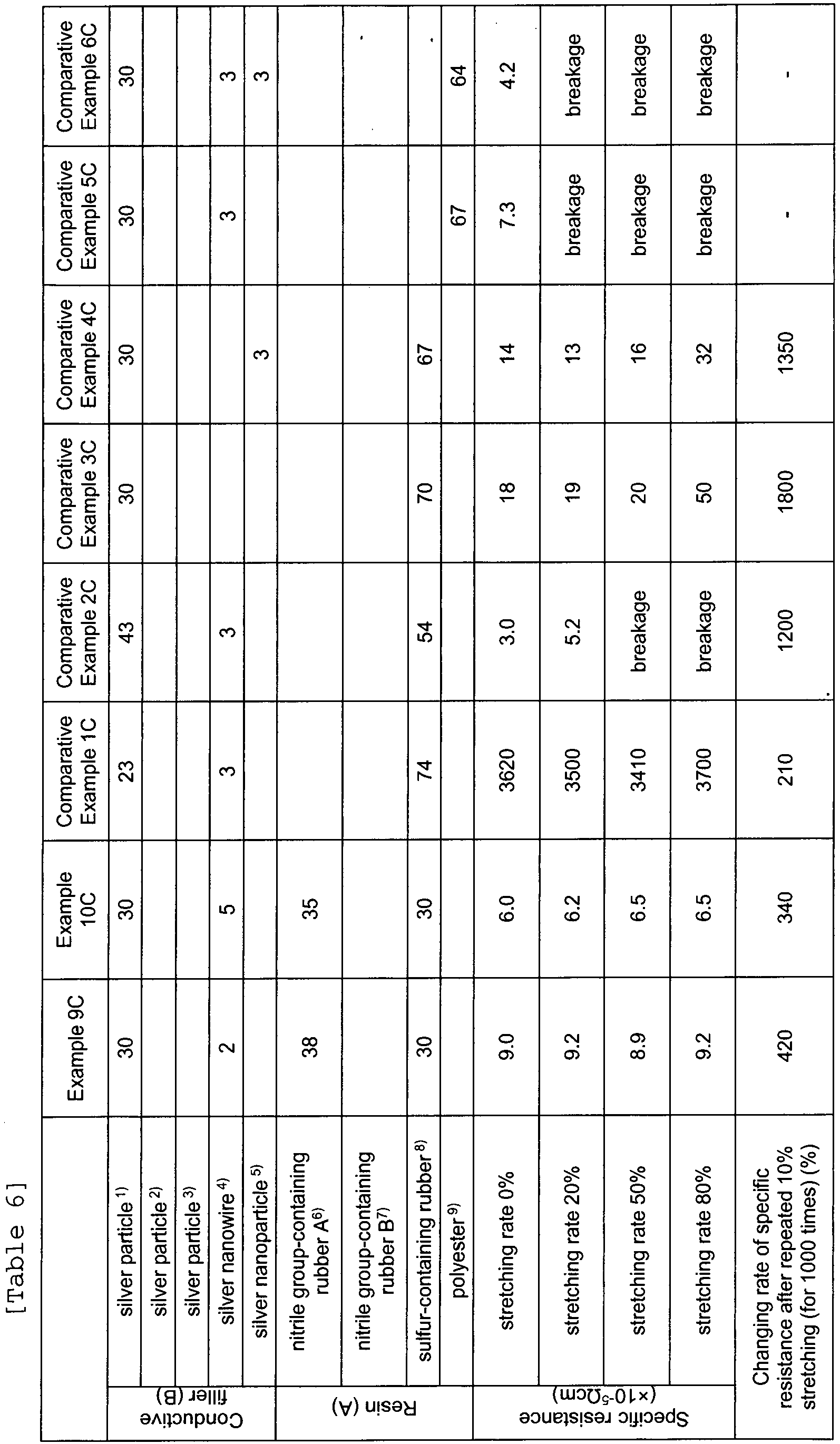
- Details of 1) to 9) in Tables 5 and 6 are as follows.
- 1) Silver particle A: Aggregated silver powder G-35 (average particle diameter: 5.9 µm; manufactured by DOWA Electronics)
- 2) Silver particles B: Flaky silver powder FA-D-7 (average particle diameter: 3 µm; manufactured by DOWA Electronics)
- 3) Silver particles C: Spherical silver powder AG5-7F (average particle diameter: 3 µm; manufactured by DOWA Electronics)
- 4) Silver nanowire: NanoMeet NM-SNW70 (diameter: 70 nm; length: 20 to 80 µm; aspect ratio: 286 to 1143; 2.5% by weight isopropanol dispersion; manufactured by Beijing NanoMeet Technology)
- 5) Silver nanoparticle: Silver nanoparticle dry powder 2 (average particle diameter: 60 nm; manufactured by DOWA Electronics)
- 6) Nitrile group-containing rubber A: Nipol 1042 (content of acrylonitrile: 33.3% by weight; manufactured by Nippon Zeon)
- 7) Nitrile group-containing rubber B: Nipol 1043 (content of acrylonitrile: 29.0% by weight; manufactured by Nippon Zeon)
- 8) Sulfur-containing rubber: Thiokol LP-23 (content of sulfur: 21.5% by weight; manufactured by Toray Fine Chemical)
- 9) Polyester: Vylon RV 630 (manufactured by Toyobo)
- Methods for evaluating the electrically conductive membranes of Examples 1C to 10C and Comparative Examples 1C to 6C are as follows.
- Sheet resistance and membrane thickness of an electrically conductive membrane test piece in a natural state (stretching rate: 0%) were measured to calculate the specific resistance. Specifically, membrane thickness and sheet resistance were measured for four test pieces using a thickness gauge SMD-565L (manufactured by TECLOCK) and Loresta-GP MCP-T610 (manufactured by Mitsubishi Chemical Analytic), respectively and mean values thereof were used.
- According to the same manner as in the natural state (stretching rate: 0%), specific resistances when the stretching rates were 20%, 50% and 80% were measured. Stretching rate was calculated according to the following formula.

- In the formula, L0 is a distance between marked lines of a test piece and ΔL0 is an increase in the distance between marked lines of a test piece.
- Specific resistance after a 10% stretching was repeated for 1000 times was also measured. Changing rate of the specific resistance was calculated according to the following formula.

- In the formula, R1000 is the specific resistance after repeating a 10% stretching for 1000 times and R0 is the specific resistance in a natural state.
- As will be apparent from the results of Tables 5 and 6, the electrically conductive pastes of Examples 1C to 10C can maintain not only good electrical conductivity in a natural state but also high electrical conductivity even upon being stretched and, even after the repeated stretching, lowering in the electrical conductivity is small. On the contrary, the electrically conductive pastes of Comparative Examples 1C to 6C show high specific resistance as compared with Examples 1C to 10C or result in breakage by stretching whereby electrical conductivity lowers by a repeated stretching.
- Since the electrically conductive paste of the present invention has high electrical conductivity and stretchability, it can be advantageously used as electrodes, wirings, etc. for flexible displays, stretchable LED arrays, stretchable solar cells, stretchable antennas, stretchable batteries, actuators, healthcare devices or medical sensors, wearable computers, etc. wherein rubber or elastomer material is utilized.
Claims (12)
- An electrically conductive paste wherein a conductive filler (B) is uniformly dispersed in a resin (A), characterized in that the resin (A) is a rubber (A1) containing sulfur atom and/or a rubber (A2) containing nitrile group, that the conductive filler (B) is metal powder (B1) having an average particle diameter of 0.5 to 10 µm and a conductive material (B2) having a group selected from mercapto group, amino group and nitrile group on its surface and having an aspect ratio of 10 to 10,000, and that compounding amounts of the resin (A), the metal powder (B1) and the conductive material (B2) in the solid content of the electrically conductive paste are 50 to 80% by volume, 19 to 49% by volume and 1 to 10% by volume, respectively.
- An electrically conductive paste wherein a conductive filler (B) is uniformly dispersed in a resin (A), characterized in that the resin (A) is a rubber (A1) containing sulfur atom and/or a rubber (A2) containing nitrile group, that the conductive filler (B) is metal powder (B1) having an average particle diameter of 0.5 to 10 µm and a conductive material (B2) having been subjected to a surface treatment with a rubber containing sulfide bond and/or nitrile group and having an aspect ratio of 10 to 10,000, and that compounding amounts of the resin (A), the metal powder (B1) and the conductive material (B2) in the solid content of the electrically conductive paste are 50 to 80% by volume, 19 to 49% by volume and 1 to 10% by volume, respectively.
- An electrically conductive paste wherein a conductive filler (B) is uniformly dispersed in a resin (A), characterized in that the resin (A) is a rubber (A1) containing sulfur atom and/or a rubber (A2) containing nitrile group, that the conductive filler (B) is metal powder (B1) having an average particle diameter of 0.5 to 10 µm and a metal nanowire (B2) having an aspect ratio of 10 to 5,000, and that compounding amounts of the resin (A), the metal powder (B1) and the metal nanowire (B2) in the solid content of the electrically conductive paste are 50 to 80% by volume, 19 to 49% by volume and 1 to 10% by volume, respectively.
- The electrically conductive paste according to any of claims 1 to 3, wherein the rubber (A1) containing sulfur atom is selected from polysulfide rubber, polyether rubber, polyacrylate rubber or silicone rubber containing mercapto group, sulfide bond or disulfide bond.
- The electrically conductive paste according to any of claims 1 to 3, wherein the rubber (A2) containing nitrile group is a rubber of a copolymer of acrylonitrile with butadiene.
- The electrically conductive paste according to any of claims 1 to 3, wherein the metal powder (B1) is flaky metal powder, spherical metal powder or aggregated metal powder.
- The electrically conductive paste according to claim 1, wherein the conductive material (B2) is a carbon nanotube which has been subjected to a surface treatment with an aromatic compound containing mercapto group, amino group or nitrile group.
- The electrically conductive paste according to claim 2, wherein the conductive material (B2) is a carbon nanotube which has been subjected to a surface treatment with a rubber containing sulfide bond and/or nitrile group.
- The electrically conductive paste according to any of claims 1 to 3, wherein the paste further contains metal nanoparticles (B3) having an average particle diameter of 2 to 100 nm as the conductive filler.
- The electrically conductive paste according to claim 9, wherein the metal powder (B1) and the metal nanoparticles (B3) contain silver and/or copper as main ingredients.
- An electrically conductive membrane or an electrically conductive pattern, characterized in that it is prepared by using the electrically conductive paste mentioned in any of claims 1 to 10.
- An electrically conductive laminate, characterized in that it is prepared by forming the electrically conductive membrane or the electrically conductive pattern mentioned in claim 11 on a fabric substrate.
Applications Claiming Priority (7)
| Application Number | Priority Date | Filing Date | Title |
|---|---|---|---|
| JP2013142356 | 2013-07-08 | ||
| JP2013143433 | 2013-07-09 | ||
| JP2013176200 | 2013-08-28 | ||
| JP2013234512 | 2013-11-13 | ||
| JP2013234511 | 2013-11-13 | ||
| JP2013237549 | 2013-11-18 | ||
| PCT/JP2014/067730 WO2015005204A1 (en) | 2013-07-08 | 2014-07-03 | Electrically conductive paste |
Publications (3)
| Publication Number | Publication Date |
|---|---|
| EP3021329A1 true EP3021329A1 (en) | 2016-05-18 |
| EP3021329A4 EP3021329A4 (en) | 2017-03-22 |
| EP3021329B1 EP3021329B1 (en) | 2017-09-06 |
Family
ID=52279889
Family Applications (1)
| Application Number | Title | Priority Date | Filing Date |
|---|---|---|---|
| EP14823012.1A Not-in-force EP3021329B1 (en) | 2013-07-08 | 2014-07-03 | Electrically conductive paste |
Country Status (6)
| Country | Link |
|---|---|
| US (1) | US9761349B2 (en) |
| EP (1) | EP3021329B1 (en) |
| JP (1) | JP6319085B2 (en) |
| KR (1) | KR101837316B1 (en) |
| CN (1) | CN105378854B (en) |
| WO (1) | WO2015005204A1 (en) |
Cited By (2)
| Publication number | Priority date | Publication date | Assignee | Title |
|---|---|---|---|---|
| DE102020106131A1 (en) | 2020-03-06 | 2021-09-09 | Carl Freudenberg Kg | Electrically conductive paste |
| EP3404670B1 (en) * | 2016-01-13 | 2023-03-08 | Toyobo Co., Ltd. | Stretchable conductor composition, paste for forming stretchable conductor, garment comprisiong wiring comprising stretchable conductor composition, and method for producing same |
Families Citing this family (40)
| Publication number | Priority date | Publication date | Assignee | Title |
|---|---|---|---|---|
| US10119045B2 (en) * | 2015-01-14 | 2018-11-06 | Toyobo Co., Ltd. | Electroconductive silver paste |
| JP6447150B2 (en) * | 2015-01-14 | 2019-01-09 | 東洋紡株式会社 | Glove-type input device |
| JP2016147249A (en) * | 2015-02-13 | 2016-08-18 | デクセリアルズ株式会社 | ELECTRODE AND ITS MANUFACTURING METHOD, TOUCH PANEL EQUIPPED WITH THE ELECTRODE |
| JP6660542B2 (en) * | 2015-11-30 | 2020-03-11 | タツタ電線株式会社 | Stretchable conductive film for textile |
| JP6859760B2 (en) * | 2016-03-08 | 2021-04-14 | 東洋紡株式会社 | Elastic conductor forming paste, elastic conductor sheet and probe for biometric information measurement |
| US11427689B2 (en) * | 2016-03-09 | 2022-08-30 | Toyobo Co., Ltd. | Stretchable conductor sheet and paste for forming stretchable conductor sheet |
| CN108778011B (en) * | 2016-03-16 | 2021-02-12 | 东洋纺株式会社 | wearable smart device |
| CN109478441A (en) * | 2016-06-16 | 2019-03-15 | 国立大学法人大阪大学 | Conductive composition |
| CN106205775A (en) * | 2016-07-23 | 2016-12-07 | 佛山市中彩科技有限公司 | A kind of UV conductive silver paste formula and preparation method thereof |
| TWI635512B (en) * | 2016-11-03 | 2018-09-11 | 聚陽實業股份有限公司 | Sensing material being touchable with organism, a unit being touchable with organism for sensing a vital parameter and method of manufacturing the same |
| JP6745706B2 (en) * | 2016-11-11 | 2020-08-26 | オリンパス株式会社 | Medical conductive anti-adhesion film and medical device |
| US11107601B2 (en) | 2016-12-14 | 2021-08-31 | Japan Science And Technology Agency | Elastic conductor, paste for forming elastic conductor, and method for producing elastic conductor |
| CN106594678B (en) * | 2016-12-25 | 2019-03-05 | 厦门大学 | A kind of transparent membrane LED dimmer preparation method of metal nanometer line |
| US20180255637A1 (en) * | 2017-03-01 | 2018-09-06 | Microsoft Technology Licensing, Llc | Printing electrically conductive ink on fabric |
| WO2018159374A1 (en) * | 2017-03-02 | 2018-09-07 | 東洋紡株式会社 | Electrically conductive paste, flexible wiring obtained using same, and garment-type electronic device having flexible wiring |
| KR102616622B1 (en) | 2017-06-19 | 2023-12-26 | 다이요 홀딩스 가부시키가이샤 | Conductive composition, conductor using the same, and laminated structure |
| CN107722826A (en) * | 2017-09-15 | 2018-02-23 | 原晋波 | A kind of preparation method of electrically-conducting paint |
| KR102283828B1 (en) * | 2017-09-28 | 2021-07-30 | 주식회사 소프트로닉스 | Method for manufacturing fiber based stretch sensor |
| JP7088204B2 (en) * | 2017-10-13 | 2022-06-21 | 東洋紡株式会社 | Manufacturing method of elastic laminated sheet |
| JP6521138B1 (en) * | 2018-04-19 | 2019-05-29 | 東洋インキScホールディングス株式会社 | CONDUCTIVE COMPOSITION FOR MOLDED FILM, MOLDED FILM, MOLDED BODY, AND METHOD FOR PRODUCING THE SAME |
| CN108690178B (en) * | 2018-05-30 | 2020-10-16 | 南京大学 | Preparation method of polysulfide polyurea with self-repairing function |
| WO2020084981A1 (en) | 2018-10-22 | 2020-04-30 | 東洋紡株式会社 | Method for manufacturing device connected body, and device connected body |
| CN109680579B (en) * | 2018-12-14 | 2020-10-09 | 华北水利水电大学 | A kind of high-strength fiber skeleton FRP non-magnetic metal composite road panel and preparation method thereof |
| TWI816005B (en) * | 2018-12-27 | 2023-09-21 | 日商東洋紡股份有限公司 | Conductive paste for forming elastic conductors, elastic conductor layer, manufacturing method of elastic conductor layer, elastic electrical wiring structure and biological information measurement device |
| CN109887673A (en) * | 2018-12-27 | 2019-06-14 | 深圳市欧科力科技有限公司 | A kind of preparation method of composite conductive ceramic slurry |
| WO2020240733A1 (en) * | 2019-05-29 | 2020-12-03 | 日本電信電話株式会社 | Conductive paste, conductive film, and method for producing conductive film |
| CN110415865B (en) * | 2019-07-29 | 2020-07-03 | 北京华纳高科科技有限公司 | Optically consistent transparent conductive film and preparation method thereof |
| WO2021109119A1 (en) * | 2019-12-06 | 2021-06-10 | 南昌欧菲显示科技有限公司 | Conductive film and preparation method therefor, conductive paste, touch panel and display device |
| JP7367586B2 (en) * | 2019-12-13 | 2023-10-24 | 東洋インキScホールディングス株式会社 | Conductive paste, conductive film, laminate and electronic device |
| CN113130113B (en) * | 2019-12-31 | 2022-10-28 | 财团法人工业技术研究院 | Conductive material composition and conductive material prepared from same |
| US11437162B2 (en) | 2019-12-31 | 2022-09-06 | Industrial Technology Research Institute | Conductive material composition and conductive material prepared therefrom |
| TWI738165B (en) * | 2019-12-31 | 2021-09-01 | 財團法人工業技術研究院 | Conductive material composition and conductive material prepared therefrom |
| US12293856B2 (en) * | 2020-06-15 | 2025-05-06 | The Texas A&M University System | Copper nanowires and their use in plastics to improve thermal and electrical conductivity |
| EP4214247A4 (en) * | 2020-09-15 | 2024-10-23 | E Ink Corporation | COMPOSITION WITH AN ADDITIVE HAVING A POLYCYCLIC AROMATIC GROUP |
| IL301953B2 (en) | 2020-11-20 | 2025-09-01 | Shinetsu Chemical Co | Phenol compound, conductive paste composition, method for producing conductive paste composition, conductive wire, and method for producing conductive wire |
| CN112531128B (en) * | 2020-11-26 | 2024-06-14 | 中国乐凯集团有限公司 | Scalable flexible OLED lighting device and preparation method thereof |
| TW202242913A (en) | 2021-04-23 | 2022-11-01 | 美商Ddp 特殊電子材料 Us 9有限責任公司 | Conductive composite film |
| JP7771535B2 (en) * | 2021-06-30 | 2025-11-18 | 三菱ケミカル株式会社 | Laminate and sensor |
| KR102665173B1 (en) * | 2021-10-20 | 2024-05-21 | 주식회사 지브이엘 | Conductive ink and method of manufacture |
| CN114103305B (en) * | 2021-11-04 | 2023-07-21 | 江苏耀鸿电子有限公司 | high-Tg high-heat-conductivity metal-based copper-clad plate and processing technology thereof |
Family Cites Families (20)
| Publication number | Priority date | Publication date | Assignee | Title |
|---|---|---|---|---|
| WO2004039893A1 (en) | 2002-11-01 | 2004-05-13 | Mitsubishi Rayon Co., Ltd. | Composition containing carbon nanotubes, composite having coating thereof and process for producing them |
| JP3913208B2 (en) * | 2002-11-01 | 2007-05-09 | 三菱レイヨン株式会社 | Carbon nanotube-containing composition, composite having coating film made thereof, and method for producing them |
| US7790063B2 (en) * | 2003-09-26 | 2010-09-07 | Hitachi Chemical Company, Ltd. | Mixed conductive power and use thereof |
| JP2006083249A (en) * | 2004-09-15 | 2006-03-30 | National Institute Of Advanced Industrial & Technology | Method for producing nanocarbon-containing rubber composition dispersion solution |
| FR2880353B1 (en) * | 2005-01-05 | 2008-05-23 | Arkema Sa | USE OF CARBON NANOTUBES FOR THE MANUFACTURE OF A CONDUCTIVE ORGANIC COMPOSITION AND APPLICATIONS THEREOF |
| JP2007173226A (en) * | 2005-11-28 | 2007-07-05 | Osaka Univ | Rubber material and method for producing rubber material |
| CN100373504C (en) * | 2006-04-26 | 2008-03-05 | 浙江大学 | Preparation method of conductive composite material added with silver nanowires |
| JP4771971B2 (en) * | 2007-02-09 | 2011-09-14 | 東海ゴム工業株式会社 | Flexible electrode and electronic device using the same |
| TWI556456B (en) | 2007-04-20 | 2016-11-01 | 坎畢歐科技公司 | Composite transparent conductor and method of forming same |
| JP2009144052A (en) * | 2007-12-14 | 2009-07-02 | Sumitomo Bakelite Co Ltd | Resin composition for printed circuit board, insulating layer with supporting substrate, laminate, and printed circuit board |
| JPWO2009102077A1 (en) | 2008-02-11 | 2011-06-16 | 国立大学法人 東京大学 | Carbon nanotube rubber composition, wiring, conductive paste, electronic circuit and method for producing the same |
| JP2010163568A (en) | 2009-01-16 | 2010-07-29 | Toray Ind Inc | Electroconductive composition and electroconductive composite |
| JP2010192296A (en) * | 2009-02-19 | 2010-09-02 | Tokai Rubber Ind Ltd | Conductive material |
| JP2010254744A (en) * | 2009-04-21 | 2010-11-11 | Fujikura Rubber Ltd | Rubber composition, electroconductive rubber layer containing the same, method for forming the layer, electric double layer capacitor equipped with the layer, and electroconductive laminate equipped with the layer |
| CN101629057A (en) * | 2009-08-22 | 2010-01-20 | 漳立冰 | Nano conductive adhesive and preparation method thereof |
| JP2011216562A (en) | 2010-03-31 | 2011-10-27 | Fujikura Ltd | Printed-wiring board and method of manufacturing the same |
| JP5570353B2 (en) | 2010-09-03 | 2014-08-13 | バイエル マテリアルサイエンス株式会社 | Conductive member having elastic wiring |
| JP2012166452A (en) * | 2011-02-14 | 2012-09-06 | Inoac Gijutsu Kenkyusho:Kk | Antistatic film |
| JP5718123B2 (en) * | 2011-03-30 | 2015-05-13 | 富士通株式会社 | RFID tag |
| CN102746808A (en) * | 2012-07-27 | 2012-10-24 | 清华大学深圳研究生院 | High-conductivity graphene conducting resin and preparation method thereof |
-
2014
- 2014-07-03 US US14/901,763 patent/US9761349B2/en not_active Expired - Fee Related
- 2014-07-03 EP EP14823012.1A patent/EP3021329B1/en not_active Not-in-force
- 2014-07-03 WO PCT/JP2014/067730 patent/WO2015005204A1/en not_active Ceased
- 2014-07-03 CN CN201480038711.6A patent/CN105378854B/en not_active Expired - Fee Related
- 2014-07-03 KR KR1020167002504A patent/KR101837316B1/en not_active Expired - Fee Related
- 2014-07-03 JP JP2014538026A patent/JP6319085B2/en not_active Expired - Fee Related
Non-Patent Citations (3)
| Title |
|---|
| No further relevant documents disclosed * |
| None * |
| See also references of WO2015005204A1 * |
Cited By (4)
| Publication number | Priority date | Publication date | Assignee | Title |
|---|---|---|---|---|
| EP3404670B1 (en) * | 2016-01-13 | 2023-03-08 | Toyobo Co., Ltd. | Stretchable conductor composition, paste for forming stretchable conductor, garment comprisiong wiring comprising stretchable conductor composition, and method for producing same |
| DE102020106131A1 (en) | 2020-03-06 | 2021-09-09 | Carl Freudenberg Kg | Electrically conductive paste |
| WO2021175976A1 (en) | 2020-03-06 | 2021-09-10 | Carl Freudenberg Kg | Electrically conductive paste |
| US11776707B2 (en) | 2020-03-06 | 2023-10-03 | Carl Freudenberg Kg | Electrically conductive paste |
Also Published As
| Publication number | Publication date |
|---|---|
| US9761349B2 (en) | 2017-09-12 |
| KR20160027090A (en) | 2016-03-09 |
| WO2015005204A1 (en) | 2015-01-15 |
| JPWO2015005204A1 (en) | 2017-03-02 |
| US20160372230A1 (en) | 2016-12-22 |
| CN105378854A (en) | 2016-03-02 |
| CN105378854B (en) | 2017-12-22 |
| EP3021329A4 (en) | 2017-03-22 |
| JP6319085B2 (en) | 2018-05-09 |
| EP3021329B1 (en) | 2017-09-06 |
| KR101837316B1 (en) | 2018-03-09 |
Similar Documents
| Publication | Publication Date | Title |
|---|---|---|
| EP3021329B1 (en) | Electrically conductive paste | |
| US10119045B2 (en) | Electroconductive silver paste | |
| JP6690528B2 (en) | Conductive film | |
| JP7081643B2 (en) | Conductive fabric | |
| TW201802828A (en) | Electrically conductive composition | |
| US20190023929A1 (en) | Piezoresistive ink, methods and uses thereof | |
| JP2015079724A (en) | Conductive paste | |
| Chae et al. | 3D-stacked carbon composites employing networked electrical intra-pathways for direct-printable, extremely stretchable conductors | |
| Kim et al. | Electrically conductive silicone-based nanocomposites incorporated with carbon nanotubes and silver nanowires for stretchable electrodes | |
| JP2015079725A (en) | Conductive paste | |
| KR102602253B1 (en) | Conductive polymer adhesive and manufacturing method thereof | |
| Wang et al. | Multi‐Dimensional Conductive Nanocomposites for Flexible Electronics | |
| Azam Ali et al. | Flexible Electrically Conductive | |
| Ali et al. | Flexible Electrically Conductive Elastomers |
Legal Events
| Date | Code | Title | Description |
|---|---|---|---|
| PUAI | Public reference made under article 153(3) epc to a published international application that has entered the european phase |
Free format text: ORIGINAL CODE: 0009012 |
|
| 17P | Request for examination filed |
Effective date: 20151223 |
|
| AK | Designated contracting states |
Kind code of ref document: A1 Designated state(s): AL AT BE BG CH CY CZ DE DK EE ES FI FR GB GR HR HU IE IS IT LI LT LU LV MC MK MT NL NO PL PT RO RS SE SI SK SM TR |
|
| AX | Request for extension of the european patent |
Extension state: BA ME |
|
| DAX | Request for extension of the european patent (deleted) | ||
| A4 | Supplementary search report drawn up and despatched |
Effective date: 20170217 |
|
| RIC1 | Information provided on ipc code assigned before grant |
Ipc: C08K 3/08 20060101ALI20170213BHEP Ipc: H01B 1/24 20060101ALI20170213BHEP Ipc: C08K 7/06 20060101ALI20170213BHEP Ipc: C08L 21/00 20060101ALI20170213BHEP Ipc: H01B 5/14 20060101ALI20170213BHEP Ipc: H01B 1/00 20060101ALI20170213BHEP Ipc: H01B 1/22 20060101AFI20170213BHEP Ipc: C08K 9/04 20060101ALI20170213BHEP Ipc: C09D 5/24 20060101ALI20170213BHEP |
|
| GRAP | Despatch of communication of intention to grant a patent |
Free format text: ORIGINAL CODE: EPIDOSNIGR1 |
|
| STAA | Information on the status of an ep patent application or granted ep patent |
Free format text: STATUS: GRANT OF PATENT IS INTENDED |
|
| INTG | Intention to grant announced |
Effective date: 20170421 |
|
| GRAS | Grant fee paid |
Free format text: ORIGINAL CODE: EPIDOSNIGR3 |
|
| GRAA | (expected) grant |
Free format text: ORIGINAL CODE: 0009210 |
|
| STAA | Information on the status of an ep patent application or granted ep patent |
Free format text: STATUS: THE PATENT HAS BEEN GRANTED |
|
| AK | Designated contracting states |
Kind code of ref document: B1 Designated state(s): AL AT BE BG CH CY CZ DE DK EE ES FI FR GB GR HR HU IE IS IT LI LT LU LV MC MK MT NL NO PL PT RO RS SE SI SK SM TR |
|
| REG | Reference to a national code |
Ref country code: GB Ref legal event code: FG4D |
|
| REG | Reference to a national code |
Ref country code: CH Ref legal event code: EP Ref country code: AT Ref legal event code: REF Ref document number: 926679 Country of ref document: AT Kind code of ref document: T Effective date: 20170915 |
|
| REG | Reference to a national code |
Ref country code: IE Ref legal event code: FG4D |
|
| REG | Reference to a national code |
Ref country code: DE Ref legal event code: R096 Ref document number: 602014014373 Country of ref document: DE |
|
| REG | Reference to a national code |
Ref country code: NL Ref legal event code: MP Effective date: 20170906 |
|
| REG | Reference to a national code |
Ref country code: LT Ref legal event code: MG4D |
|
| PG25 | Lapsed in a contracting state [announced via postgrant information from national office to epo] |
Ref country code: HR Free format text: LAPSE BECAUSE OF FAILURE TO SUBMIT A TRANSLATION OF THE DESCRIPTION OR TO PAY THE FEE WITHIN THE PRESCRIBED TIME-LIMIT Effective date: 20170906 Ref country code: FI Free format text: LAPSE BECAUSE OF FAILURE TO SUBMIT A TRANSLATION OF THE DESCRIPTION OR TO PAY THE FEE WITHIN THE PRESCRIBED TIME-LIMIT Effective date: 20170906 Ref country code: SE Free format text: LAPSE BECAUSE OF FAILURE TO SUBMIT A TRANSLATION OF THE DESCRIPTION OR TO PAY THE FEE WITHIN THE PRESCRIBED TIME-LIMIT Effective date: 20170906 Ref country code: NO Free format text: LAPSE BECAUSE OF FAILURE TO SUBMIT A TRANSLATION OF THE DESCRIPTION OR TO PAY THE FEE WITHIN THE PRESCRIBED TIME-LIMIT Effective date: 20171206 Ref country code: LT Free format text: LAPSE BECAUSE OF FAILURE TO SUBMIT A TRANSLATION OF THE DESCRIPTION OR TO PAY THE FEE WITHIN THE PRESCRIBED TIME-LIMIT Effective date: 20170906 |
|
| REG | Reference to a national code |
Ref country code: AT Ref legal event code: MK05 Ref document number: 926679 Country of ref document: AT Kind code of ref document: T Effective date: 20170906 |
|
| PG25 | Lapsed in a contracting state [announced via postgrant information from national office to epo] |
Ref country code: LV Free format text: LAPSE BECAUSE OF FAILURE TO SUBMIT A TRANSLATION OF THE DESCRIPTION OR TO PAY THE FEE WITHIN THE PRESCRIBED TIME-LIMIT Effective date: 20170906 Ref country code: RS Free format text: LAPSE BECAUSE OF FAILURE TO SUBMIT A TRANSLATION OF THE DESCRIPTION OR TO PAY THE FEE WITHIN THE PRESCRIBED TIME-LIMIT Effective date: 20170906 Ref country code: ES Free format text: LAPSE BECAUSE OF FAILURE TO SUBMIT A TRANSLATION OF THE DESCRIPTION OR TO PAY THE FEE WITHIN THE PRESCRIBED TIME-LIMIT Effective date: 20170906 Ref country code: GR Free format text: LAPSE BECAUSE OF FAILURE TO SUBMIT A TRANSLATION OF THE DESCRIPTION OR TO PAY THE FEE WITHIN THE PRESCRIBED TIME-LIMIT Effective date: 20171207 Ref country code: BG Free format text: LAPSE BECAUSE OF FAILURE TO SUBMIT A TRANSLATION OF THE DESCRIPTION OR TO PAY THE FEE WITHIN THE PRESCRIBED TIME-LIMIT Effective date: 20171206 |
|
| PG25 | Lapsed in a contracting state [announced via postgrant information from national office to epo] |
Ref country code: NL Free format text: LAPSE BECAUSE OF FAILURE TO SUBMIT A TRANSLATION OF THE DESCRIPTION OR TO PAY THE FEE WITHIN THE PRESCRIBED TIME-LIMIT Effective date: 20170906 |
|
| PG25 | Lapsed in a contracting state [announced via postgrant information from national office to epo] |
Ref country code: CZ Free format text: LAPSE BECAUSE OF FAILURE TO SUBMIT A TRANSLATION OF THE DESCRIPTION OR TO PAY THE FEE WITHIN THE PRESCRIBED TIME-LIMIT Effective date: 20170906 Ref country code: PL Free format text: LAPSE BECAUSE OF FAILURE TO SUBMIT A TRANSLATION OF THE DESCRIPTION OR TO PAY THE FEE WITHIN THE PRESCRIBED TIME-LIMIT Effective date: 20170906 Ref country code: RO Free format text: LAPSE BECAUSE OF FAILURE TO SUBMIT A TRANSLATION OF THE DESCRIPTION OR TO PAY THE FEE WITHIN THE PRESCRIBED TIME-LIMIT Effective date: 20170906 |
|
| PG25 | Lapsed in a contracting state [announced via postgrant information from national office to epo] |
Ref country code: AT Free format text: LAPSE BECAUSE OF FAILURE TO SUBMIT A TRANSLATION OF THE DESCRIPTION OR TO PAY THE FEE WITHIN THE PRESCRIBED TIME-LIMIT Effective date: 20170906 Ref country code: SM Free format text: LAPSE BECAUSE OF FAILURE TO SUBMIT A TRANSLATION OF THE DESCRIPTION OR TO PAY THE FEE WITHIN THE PRESCRIBED TIME-LIMIT Effective date: 20170906 Ref country code: EE Free format text: LAPSE BECAUSE OF FAILURE TO SUBMIT A TRANSLATION OF THE DESCRIPTION OR TO PAY THE FEE WITHIN THE PRESCRIBED TIME-LIMIT Effective date: 20170906 Ref country code: SK Free format text: LAPSE BECAUSE OF FAILURE TO SUBMIT A TRANSLATION OF THE DESCRIPTION OR TO PAY THE FEE WITHIN THE PRESCRIBED TIME-LIMIT Effective date: 20170906 Ref country code: IS Free format text: LAPSE BECAUSE OF FAILURE TO SUBMIT A TRANSLATION OF THE DESCRIPTION OR TO PAY THE FEE WITHIN THE PRESCRIBED TIME-LIMIT Effective date: 20180106 Ref country code: IT Free format text: LAPSE BECAUSE OF FAILURE TO SUBMIT A TRANSLATION OF THE DESCRIPTION OR TO PAY THE FEE WITHIN THE PRESCRIBED TIME-LIMIT Effective date: 20170906 |
|
| REG | Reference to a national code |
Ref country code: DE Ref legal event code: R097 Ref document number: 602014014373 Country of ref document: DE |
|
| REG | Reference to a national code |
Ref country code: FR Ref legal event code: PLFP Year of fee payment: 5 |
|
| PLBE | No opposition filed within time limit |
Free format text: ORIGINAL CODE: 0009261 |
|
| STAA | Information on the status of an ep patent application or granted ep patent |
Free format text: STATUS: NO OPPOSITION FILED WITHIN TIME LIMIT |
|
| PG25 | Lapsed in a contracting state [announced via postgrant information from national office to epo] |
Ref country code: DK Free format text: LAPSE BECAUSE OF FAILURE TO SUBMIT A TRANSLATION OF THE DESCRIPTION OR TO PAY THE FEE WITHIN THE PRESCRIBED TIME-LIMIT Effective date: 20170906 |
|
| 26N | No opposition filed |
Effective date: 20180607 |
|
| PG25 | Lapsed in a contracting state [announced via postgrant information from national office to epo] |
Ref country code: SI Free format text: LAPSE BECAUSE OF FAILURE TO SUBMIT A TRANSLATION OF THE DESCRIPTION OR TO PAY THE FEE WITHIN THE PRESCRIBED TIME-LIMIT Effective date: 20170906 |
|
| REG | Reference to a national code |
Ref country code: CH Ref legal event code: PL |
|
| PG25 | Lapsed in a contracting state [announced via postgrant information from national office to epo] |
Ref country code: LU Free format text: LAPSE BECAUSE OF NON-PAYMENT OF DUE FEES Effective date: 20180703 Ref country code: MC Free format text: LAPSE BECAUSE OF FAILURE TO SUBMIT A TRANSLATION OF THE DESCRIPTION OR TO PAY THE FEE WITHIN THE PRESCRIBED TIME-LIMIT Effective date: 20170906 |
|
| REG | Reference to a national code |
Ref country code: BE Ref legal event code: MM Effective date: 20180731 |
|
| REG | Reference to a national code |
Ref country code: IE Ref legal event code: MM4A |
|
| PG25 | Lapsed in a contracting state [announced via postgrant information from national office to epo] |
Ref country code: IE Free format text: LAPSE BECAUSE OF NON-PAYMENT OF DUE FEES Effective date: 20180703 Ref country code: CH Free format text: LAPSE BECAUSE OF NON-PAYMENT OF DUE FEES Effective date: 20180731 Ref country code: LI Free format text: LAPSE BECAUSE OF NON-PAYMENT OF DUE FEES Effective date: 20180731 |
|
| PG25 | Lapsed in a contracting state [announced via postgrant information from national office to epo] |
Ref country code: BE Free format text: LAPSE BECAUSE OF NON-PAYMENT OF DUE FEES Effective date: 20180731 |
|
| PG25 | Lapsed in a contracting state [announced via postgrant information from national office to epo] |
Ref country code: MT Free format text: LAPSE BECAUSE OF NON-PAYMENT OF DUE FEES Effective date: 20180703 |
|
| PG25 | Lapsed in a contracting state [announced via postgrant information from national office to epo] |
Ref country code: TR Free format text: LAPSE BECAUSE OF FAILURE TO SUBMIT A TRANSLATION OF THE DESCRIPTION OR TO PAY THE FEE WITHIN THE PRESCRIBED TIME-LIMIT Effective date: 20170906 |
|
| PG25 | Lapsed in a contracting state [announced via postgrant information from national office to epo] |
Ref country code: PT Free format text: LAPSE BECAUSE OF FAILURE TO SUBMIT A TRANSLATION OF THE DESCRIPTION OR TO PAY THE FEE WITHIN THE PRESCRIBED TIME-LIMIT Effective date: 20170906 |
|
| PG25 | Lapsed in a contracting state [announced via postgrant information from national office to epo] |
Ref country code: CY Free format text: LAPSE BECAUSE OF FAILURE TO SUBMIT A TRANSLATION OF THE DESCRIPTION OR TO PAY THE FEE WITHIN THE PRESCRIBED TIME-LIMIT Effective date: 20170906 Ref country code: MK Free format text: LAPSE BECAUSE OF NON-PAYMENT OF DUE FEES Effective date: 20170906 Ref country code: HU Free format text: LAPSE BECAUSE OF FAILURE TO SUBMIT A TRANSLATION OF THE DESCRIPTION OR TO PAY THE FEE WITHIN THE PRESCRIBED TIME-LIMIT; INVALID AB INITIO Effective date: 20140703 |
|
| PG25 | Lapsed in a contracting state [announced via postgrant information from national office to epo] |
Ref country code: AL Free format text: LAPSE BECAUSE OF FAILURE TO SUBMIT A TRANSLATION OF THE DESCRIPTION OR TO PAY THE FEE WITHIN THE PRESCRIBED TIME-LIMIT Effective date: 20170906 |
|
| PGFP | Annual fee paid to national office [announced via postgrant information from national office to epo] |
Ref country code: FR Payment date: 20210611 Year of fee payment: 8 |
|
| PGFP | Annual fee paid to national office [announced via postgrant information from national office to epo] |
Ref country code: GB Payment date: 20210609 Year of fee payment: 8 |
|
| PGFP | Annual fee paid to national office [announced via postgrant information from national office to epo] |
Ref country code: DE Payment date: 20210608 Year of fee payment: 8 |
|
| REG | Reference to a national code |
Ref country code: DE Ref legal event code: R119 Ref document number: 602014014373 Country of ref document: DE |
|
| GBPC | Gb: european patent ceased through non-payment of renewal fee |
Effective date: 20220703 |
|
| PG25 | Lapsed in a contracting state [announced via postgrant information from national office to epo] |
Ref country code: FR Free format text: LAPSE BECAUSE OF NON-PAYMENT OF DUE FEES Effective date: 20220731 |
|
| PG25 | Lapsed in a contracting state [announced via postgrant information from national office to epo] |
Ref country code: GB Free format text: LAPSE BECAUSE OF NON-PAYMENT OF DUE FEES Effective date: 20220703 Ref country code: DE Free format text: LAPSE BECAUSE OF NON-PAYMENT OF DUE FEES Effective date: 20230201 |