EP3014297B1 - Angle-resolving fmcw radar sensor - Google Patents
Angle-resolving fmcw radar sensor Download PDFInfo
- Publication number
- EP3014297B1 EP3014297B1 EP14724426.3A EP14724426A EP3014297B1 EP 3014297 B1 EP3014297 B1 EP 3014297B1 EP 14724426 A EP14724426 A EP 14724426A EP 3014297 B1 EP3014297 B1 EP 3014297B1
- Authority
- EP
- European Patent Office
- Prior art keywords
- radar
- antenna elements
- frequency
- transmitting
- radar sensor
- Prior art date
- Legal status (The legal status is an assumption and is not a legal conclusion. Google has not performed a legal analysis and makes no representation as to the accuracy of the status listed.)
- Active
Links
Images


Classifications
-
- G—PHYSICS
- G01—MEASURING; TESTING
- G01S—RADIO DIRECTION-FINDING; RADIO NAVIGATION; DETERMINING DISTANCE OR VELOCITY BY USE OF RADIO WAVES; LOCATING OR PRESENCE-DETECTING BY USE OF THE REFLECTION OR RERADIATION OF RADIO WAVES; ANALOGOUS ARRANGEMENTS USING OTHER WAVES
- G01S7/00—Details of systems according to groups G01S13/00, G01S15/00, G01S17/00
- G01S7/02—Details of systems according to groups G01S13/00, G01S15/00, G01S17/00 of systems according to group G01S13/00
- G01S7/35—Details of non-pulse systems
- G01S7/352—Receivers
-
- G—PHYSICS
- G01—MEASURING; TESTING
- G01S—RADIO DIRECTION-FINDING; RADIO NAVIGATION; DETERMINING DISTANCE OR VELOCITY BY USE OF RADIO WAVES; LOCATING OR PRESENCE-DETECTING BY USE OF THE REFLECTION OR RERADIATION OF RADIO WAVES; ANALOGOUS ARRANGEMENTS USING OTHER WAVES
- G01S13/00—Systems using the reflection or reradiation of radio waves, e.g. radar systems; Analogous systems using reflection or reradiation of waves whose nature or wavelength is irrelevant or unspecified
- G01S13/003—Bistatic radar systems; Multistatic radar systems
-
- G—PHYSICS
- G01—MEASURING; TESTING
- G01S—RADIO DIRECTION-FINDING; RADIO NAVIGATION; DETERMINING DISTANCE OR VELOCITY BY USE OF RADIO WAVES; LOCATING OR PRESENCE-DETECTING BY USE OF THE REFLECTION OR RERADIATION OF RADIO WAVES; ANALOGOUS ARRANGEMENTS USING OTHER WAVES
- G01S13/00—Systems using the reflection or reradiation of radio waves, e.g. radar systems; Analogous systems using reflection or reradiation of waves whose nature or wavelength is irrelevant or unspecified
- G01S13/02—Systems using reflection of radio waves, e.g. primary radar systems; Analogous systems
- G01S13/06—Systems determining position data of a target
- G01S13/42—Simultaneous measurement of distance and other co-ordinates
- G01S13/426—Scanning radar, e.g. 3D radar
-
- G—PHYSICS
- G01—MEASURING; TESTING
- G01S—RADIO DIRECTION-FINDING; RADIO NAVIGATION; DETERMINING DISTANCE OR VELOCITY BY USE OF RADIO WAVES; LOCATING OR PRESENCE-DETECTING BY USE OF THE REFLECTION OR RERADIATION OF RADIO WAVES; ANALOGOUS ARRANGEMENTS USING OTHER WAVES
- G01S13/00—Systems using the reflection or reradiation of radio waves, e.g. radar systems; Analogous systems using reflection or reradiation of waves whose nature or wavelength is irrelevant or unspecified
- G01S13/88—Radar or analogous systems specially adapted for specific applications
- G01S13/93—Radar or analogous systems specially adapted for specific applications for anti-collision purposes
- G01S13/931—Radar or analogous systems specially adapted for specific applications for anti-collision purposes of land vehicles
-
- H—ELECTRICITY
- H01—ELECTRIC ELEMENTS
- H01Q—ANTENNAS, i.e. RADIO AERIALS
- H01Q1/00—Details of, or arrangements associated with, antennas
- H01Q1/27—Adaptation for use in or on movable bodies
- H01Q1/32—Adaptation for use in or on road or rail vehicles
- H01Q1/3208—Adaptation for use in or on road or rail vehicles characterised by the application wherein the antenna is used
- H01Q1/3233—Adaptation for use in or on road or rail vehicles characterised by the application wherein the antenna is used particular used as part of a sensor or in a security system, e.g. for automotive radar, navigation systems
-
- H—ELECTRICITY
- H01—ELECTRIC ELEMENTS
- H01Q—ANTENNAS, i.e. RADIO AERIALS
- H01Q21/00—Antenna arrays or systems
- H01Q21/06—Arrays of individually energised antenna units similarly polarised and spaced apart
- H01Q21/22—Antenna units of the array energised non-uniformly in amplitude or phase, e.g. tapered array or binomial array
-
- H—ELECTRICITY
- H01—ELECTRIC ELEMENTS
- H01Q—ANTENNAS, i.e. RADIO AERIALS
- H01Q25/00—Antennas or antenna systems providing at least two radiating patterns
-
- H—ELECTRICITY
- H01—ELECTRIC ELEMENTS
- H01Q—ANTENNAS, i.e. RADIO AERIALS
- H01Q3/00—Arrangements for changing or varying the orientation or the shape of the directional pattern of the waves radiated from an antenna or antenna system
- H01Q3/24—Arrangements for changing or varying the orientation or the shape of the directional pattern of the waves radiated from an antenna or antenna system varying the orientation by switching energy from one active radiating element to another, e.g. for beam switching
- H01Q3/247—Arrangements for changing or varying the orientation or the shape of the directional pattern of the waves radiated from an antenna or antenna system varying the orientation by switching energy from one active radiating element to another, e.g. for beam switching by switching different parts of a primary active element
-
- H—ELECTRICITY
- H01—ELECTRIC ELEMENTS
- H01Q—ANTENNAS, i.e. RADIO AERIALS
- H01Q3/00—Arrangements for changing or varying the orientation or the shape of the directional pattern of the waves radiated from an antenna or antenna system
- H01Q3/26—Arrangements for changing or varying the orientation or the shape of the directional pattern of the waves radiated from an antenna or antenna system varying the relative phase or relative amplitude of energisation between two or more active radiating elements; varying the distribution of energy across a radiating aperture
- H01Q3/2605—Array of radiating elements provided with a feedback control over the element weights, e.g. adaptive arrays
Definitions
- the invention relates to an angle-resolving FMCW radar sensor, in particular for motor vehicles, with a plurality of antenna elements which are arranged in different positions in a direction in which the radar sensor is angle-resolving and which form at least three transmitting arrays and at least one receiving array, and with a control and Evaluation device that is designed for an operating mode in which the at least three transmission arrays periodically send signals whose frequency is modulated according to a sequence of modulation ramps, and in which radar echoes of the transmitted signals are received by several antenna elements of the at least one reception array and the angle of a located one Object is determined on the basis of amplitude and / or phase relationships between radar echoes, which correspond to different combinations of transmit and receive arrays.
- Radar sensors of this type are off WO 2012/041652 A1 .
- Radar sensors are used in motor vehicles, for example, to measure the distances, relative speeds and azimuth angles of vehicles or other objects located in the apron of their own vehicle.
- the individual antenna elements are then arranged, for example, at a distance from one another on a horizontal line, so that different azimuth angles of the located objects lead to differences in the run lengths which the radar signals have to travel from the object to the respective antenna element. These run length differences lead to corresponding differences in the phase of the signals that are received by the antenna elements and evaluated in the associated evaluation channels.
- the angle of incidence of the radar signal and thus the azimuth angle of the located object can then be determined by comparing the (complex) amplitudes received in the different channels with corresponding amplitudes in an antenna diagram.
- the aperture of the antenna should be as large as possible.
- the distances between the adjacent antenna elements are too large, ambiguities can occur in the angle measurement, since there are differences in the length of the run which are integral multiples of the wavelength ⁇ distinguish, maintains the same phase relationships between the received signals.
- a clear angle measurement can be achieved, for example, with a ULA structure (Uniform Linear Array), in which the antenna elements are arranged at intervals of ⁇ / 2.
- ULA structure Uniform Linear Array
- a greater angular resolution capability is achieved by not only working with several receiving antenna elements, but also with several transmitting antenna elements, different combinations of transmitting and receiving antenna elements being evaluated, for example in time division multiplexing or alternatively also in frequency multiplex or code multiplex.
- the varying positions of the transmitting antenna elements then lead to additional phase differences and thus to signals which are equivalent to signals that would be obtained with a configuration with a single transmitting antenna element and additional (virtual) receiving antenna elements. In this way, the aperture is enlarged virtually and thus the angular resolution is improved.
- the virtual antenna array is thinned out such that the individual antenna elements are at relatively large distances from one another.
- the uniqueness condition is no longer met, so that ambiguities and thus "jumping" angle measurements occur, in particular in the case of noisy radar echoes, ie if a radar target is tracked over a longer period of time, the azimuth angle measured changes suddenly ,
- the transmission frequency of a continuous radar signal is modulated in a ramp.
- a baseband signal is generated from a received signal by mixing with the transmitted signal and is then evaluated.
- Each radar object then appears in the frequency spectrum of the baseband signal in the form of a peak, the position of which depends on the Doppler shift and the transit time of the radar signals, so that the baseband signal obtained from a single frequency modulation ramp does not yet allow a definite determination of the relative speed and the distance. Rather, the frequency of a peak obtained only establishes a relationship between the speed (relative speed) and the distance in the form of a linear relationship. (The term "linear” is understood here so that the relationship referred to can include a linear factor and an additive term.)
- the FMCW method requires several frequency modulation ramps with different ramp slopes to identify several radar objects and estimate their relative speeds and distances. By comparing the different relationships obtained in the individual frequency ramps, the relative speed V and the distance D of a radar object can be calculated. This comparison is also called matching and corresponds to a search for intersections of straight lines in D-V space.
- the FMCW method is particularly efficient if only a few radar objects are detected.
- Radar sensors which operate according to the chirp sequence modulation method, in which the transmitted signal consists of a sequence of similar frequency-modulated signal pulses (chirps).
- the modulation pattern consequently does not consist of a single modulation ramp, but of a complete set of consecutive chirps.
- the center frequencies of the individual chirps increase or decrease evenly from chirp to chirp, so that the chirps in turn form a ramp which is referred to as a "slow ramp”, while the chirps are also referred to as “fast ramps”.
- This process is therefore also referred to as "multi-speed FMCW” (MSFMCW).
- the MSFMCW method allows a more precise measurement of the distances and relative speeds and is more robust, especially in cases where a large number of objects are located at the same time.
- the slow ramps naturally have a relatively long length. The time intervals between the individual measurements are therefore so large that the phase correlation between the signals necessary for the application of the MIMO principle is lost due to the inherent movement of the objects.
- the object of the invention is to provide a MIMO radar with improved measurement accuracy.
- a measuring cycle of the radar sensor comprises at least two periods, in each of which a switch is made between at least two combinations of transmit and receive arrays, and that the combinations of transmit and receive arrays involved for the at least one two periods are different from each other .
- the transmit array used is changed after each chirp within each period, for example within each slow modulation ramp.
- transmission takes place alternately with two different transmission arrays, with each chirp that was sent with an array being immediately retransmitted with the same frequency position and the same hub, but now with the other transmission array, before the next chirp with the first transmission array somewhat higher frequency is sent.
- a "transmit array” can consist of a single antenna element or a combination of several antenna elements. If the array has two adjacent antenna elements which are fed with signals of the same frequency, then the radar waves emitted by these two antenna elements overlap to form a signal with a changed phase position. This signal is equivalent to a signal that would be emitted from a point that lies between the two antenna elements. This point forms the so-called phase center of the two signals. Since this phase center is located at a location where there is no real antenna element, the excitation of two or more antenna elements results in additional (virtual) transmitting antenna elements which can be combined with the real receiving antenna elements and thus to fill up the virtual antenna array to lead. In this way, the configuration of a ULA structure comes closer and the likelihood of ambiguity decreases.
- the interconnection of two or more antenna elements also has the advantage that a higher transmission power is achieved and thus the range of the radar sensor is improved.
- the real antenna elements are arranged at non-uniform intervals, so that the antenna configuration has as few symmetries as possible, which contributes to the further suppression of ambiguities.
- virtual antenna positions which result from combinations of different transmitting and receiving elements, coincide locally.
- the radar sensor is preferably designed as a monostatic radar sensor, i.e. each antenna element can be used both as a transmitting element and as a receiving element.
- the cycle time i.e. the duration of a single measurement cycle, matches the period of the frequency modulation.
- a certain number of modulation patterns (slow ramps) are sent within a measurement cycle, and the received signals for all received modulation patterns are recorded and evaluated.
- the cycle time is therefore composed of the time required to send the modulation pattern and an additional computing time required by a processor to process the received signals and to calculate the distance and speed data.
- the cycle time should be as short as possible. Since the duration of the modulation pattern cannot be shortened for reasons of measurement accuracy, the cycle time can only be shortened by shortening the computing time. This requires the use of more powerful and therefore more expensive processors.
- the signals from at least one earlier measurement cycle can be used to compare the signal obtained for a modulation pattern in the current measurement cycle with the signal or signals obtained for other modulation patterns.
- the invention takes advantage of the fact that, due to the inertia of the motor vehicles involved, the speeds change only slightly from measurement cycle to measurement cycle, so that it is essentially only the distances that undergo a significant change from one measurement cycle to the next.
- the speed information is therefore not significantly falsified if data from one or more immediately preceding measurement cycles are used instead of the data from the current measurement cycle.
- M is the time required to send a single modulation pattern
- T is the computing time required to evaluate a single modulation pattern
- This shortening of the cycle time in turn means that the time interval between the different modulation patterns is correspondingly small, which further reduces the error in the speed data.
- the scope of the invention it is possible within the scope of the invention not only to switch between different transmission arrays, but also between different reception arrays. For this purpose, only additional antenna elements need to be provided, but no additional evaluation channels.
- the reception array is then changed by connecting a different selection of the transmission antennas to the evaluation channels.
- the virtual MIMO array can then be further enlarged and / or compressed by combining it with different transmission arrays.
- the in Fig. 1 The radar sensor shown has four antenna elements 10, 12, 14, 16, which together form a planar array antenna 18.
- the radar sensor is installed in a motor vehicle in such a way that the antenna elements 10 - 16 lie next to one another at the same height, so that an angular resolution capability of the radar sensor is achieved in the horizontal (in azimuth).
- radar beams are symbolically shown, which are received by the antenna elements at an azimuth angle 0.
- a high-frequency part 20 for controlling the antenna elements is formed, for example, by one or more MMICs (Monolithic Microwave Integrated Circuits) and comprises a switching network 22, via which the individual antenna elements can be selectively connected to a local oscillator 24, which generates the radar signal to be transmitted.
- the radar echoes received by the antenna elements 10 - 16 are each coupled out with the aid of a circulator 26 and fed to a mixer 28, where they are mixed with the transmission signal supplied by the oscillator 24.
- an intermediate frequency signal Zf 1 , Zf 2 , Zf 3 , Zf 4 is obtained for each of the antenna elements and is supplied to an electronic control and evaluation unit 30.
- the control and evaluation unit 30 contains a control part 32 which controls the function of the oscillator 24 and the switching network 22.
- the frequency of the transmission signal supplied by the oscillator 24 is periodically modulated in the form of a sequence of rising and / or falling frequency ramps.
- control and evaluation device 30 contains an evaluation part with a four-channel analog / digital converter 34, which digitizes the intermediate frequency signals Zf 1 - Zf 4 received from the four antenna elements and records them over the duration of a single frequency ramp.
- the time signals obtained in this way are then converted channel by channel in a transformation stage 36 by means of fast Fourier transformation into corresponding frequency spectra.
- frequency spectra each located object appears in the form of a peak, the frequency of which depends on the signal propagation time from the radar sensor to the object and back to the radar sensor, and due to the Doppler effect - depends on the relative speed of the object.
- the distance D and the relative speed V of the object in question can then be calculated from the frequency positions of two peaks that were obtained for the same object, but on frequency ramps with different slopes, for example a rising ramp and a falling ramp.
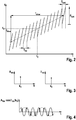
- Fig. 2 the frequency f of a transmission signal is shown over the time t, in the form of a sequence of (fast) frequency ramps (chirps), each of which has a stroke F fast and a time duration T almost .
- the individual frequency ramps follow one another with a time interval T r2r ("ramp-to-ramp").
- T r2r time interval
- the example shown is T almost equal to T r2r , so that the individual frequency ramps follow one another directly.
- Fig. 2 shows a general representation in which the center frequency of the individual frequency ramps changes in the course of the sequence.
- the center frequency of the fast ramps in turn describes a linear frequency ramp with the center frequency f 0 at time t 0 .
- the fast ramps of the sequence are identical, i.e. describe identical frequency profiles.
- Two or more different sequences of fast ramps are used in a measuring cycle, the fast ramps (chirps) each having the same frequency deviation F almost and the same ramp duration T almost and the same time interval T r2r between the ramps within the respective sequence.
- the at least two sequences within a measurement cycle can vary by different values of the amount and / or the sign of the frequency F, for example, almost the fast ramps, ramp different durations of the fast ramps, different Rampenwiederhol devis T r2r the fast ramps, different Center frequencies f 0 of the slow ramps, different number N slow of the fast ramps and / or different frequency sweeps F slow of the slow ramp.
- the frequency of the transmission signal is, for example, in the range of 76 GHz.
- the center frequency of the slow ramp can be 76 GHz.
- each fast ramp is subsequently assigned a partial signal with the duration T almost . It can be assumed that the signal transit time for a radar object in the detection range of the radar sensor system is short compared to the ramp duration T almost .
- a frequency spectrum of at least one partial signal is evaluated.
- the sub-signal of the baseband signal which corresponds to a fast ramp, is sampled, ie digitized, at a number N of almost equidistant times, and a frequency spectrum of the sub-signal is determined.
- the frequency spectrum is calculated, for example, by calculating a fast Fourier transform (FFT).
- FFT fast Fourier transform
- Fig. 3 schematically shows the amplitude A bb and the phase ⁇ bb of the signal obtained in polar coordinates plotted over the frequency bin k.
- a peak with the amplitude A bb (k o ) is obtained in the frequency bin k 0 , to which a corresponding phase ⁇ bb (k o ) is assigned.
- the frequency bin k o identifies the frequency position of the radar object in the relevant frequency spectrum of the partial signal.
- the frequency position of a peak assigned to a radar object is composed of a sum of two terms, of which the first term is proportional to the product of the distance D of the Radar object from the radar sensor and the ramp stroke F is almost and the second term is proportional to the product of the relative speed V of the radar object, the center frequency of the fast ramp and the ramp duration T is almost .
- This corresponds to the FMCW equation k O 2 / c D 0 . r F nearly + f 0 . r V 0 . r T nearly .
- the sequence of the fast ramps results in approximately the same frequency position of the peak, and in the following k 0 shall denote this mean frequency bin of the radar object over all fast ramps of the sequence.
- phase ⁇ bb (k o ) associated with the peak at the frequency position k 0 is particularly sensitive to changes in the distance of the radar object while passing through the sequence of fast ramps. A change in distance by half the wavelength of the radar signal already results in a phase shift by an entire period of the oscillation.
- Fig. 4 shows schematically with a solid line the temporal course of the real part of the spectrum corresponding to a harmonic oscillation A bb * cos ⁇ bb k O at the frequency position k 0 of the radar object in the frequency spectra during the course of the sequence of fast ramps.
- the harmonic oscillation shown in solid lines corresponds to a case without acceleration of the radar object.
- the wavelength is approximately 4 mm.
- the phase changes with a frequency of 12000 Hz.
- a peak corresponding to this frequency is expected in the frequency spectrum of the temporal course of the real part, the temporal course of the successive fast ramps corresponds; each ramp corresponds to a sample of the course over time. If the Nyquist-Shannon sampling theorem is violated by a sampling frequency of the phase changes that is too low, ie a ramp follow-up time T r2r , the frequency of the phase changes cannot be clearly determined.
- Fig. 4 schematically shows such a subsampling.
- the values of the real part at the middle times of the respective fast ramps are marked. It cannot be decided whether the true frequency of the phase changes is indicated by the curve drawn in solid lines or by the curve drawn in dashed lines. The frequency is therefore ambiguous.
- the frequency position of the harmonic oscillation corresponding to the phase change can be determined by subjecting the function, which indicates the phase ⁇ bb (r) measured for an object as a function of the ramp index r, to a Fourier transformation again.
- This frequency position can be indicated by its frequency bin I 0 and is approximately additively composed of a term proportional to the mean distance D and the ramp stroke F slow of the slow ramp and a term related to the mean relative speed V, the ramp duration T slow of the slow ramp and the center frequency f 0 is proportional to the slow ramp.
- I 0 2 / c D F slow + V T slow f O ,
- the determined frequency position thus results in a linear relationship between the relative speed and the distance of the radar object, which, however, is ambiguous with regard to the relative speed V and the distance D.
- This relationship represents a second piece of information about the relative speed and the distance of the radar object.
- F slow 0, the term “slow ramp” is used in the following; this has the slope 0 and gives second information only about the speed. With regard to the relative speed V, this is unambiguous except for integral multiples of the product of half the wavelength and the sampling frequency 1 / T r2r of the slow ramp.
- Fig. 5 shows by way of example the information about the relative speed V and the distance D resulting from the evaluation of the measurement signal for a sequence of frequency ramps.
- the determination of the relative speed and distance of the radar object can be made unambiguous by taking further first information about relative speed and distance and / or further second information about relative speed and optionally distance into account.
- Fig. 6 illustrates schematically a clear determination of relative speeds and distances of radar objects when using two different modulation patterns in each measurement cycle.
- these can be standing targets to which one's own motor vehicle is moving at a speed of 30 m / s.
- the linear relationships between V and D differ for the two modulation patterns.
- the first modulation pattern provides a family of parallel, falling lines, one line for each object.
- the second modulation pattern accordingly provides a family of rising straight lines.
- the second information about the speed V of the radar object determined from the two modulation patterns has different ambiguity ranges.
- Fig. 6 are the intersections of the straight lines as in Fig. 5 marked with circles.
- the signals obtained from the two modulation patterns are compared by looking for those values for the relative speed V and the distance D for which the straight line intersections provided by the two modulation patterns best match.
- the relative speed V -30 m / s is obtained for all objects.
- a cycle scheme is preferably used that in Fig. 7 is shown.
- the frequency f of the transmission signal is plotted against time t for two complete measuring cycles P.
- the frequency is modulated according to three different modulation patterns M 1 , M 2 and M 3 .
- Each modulation pattern is followed by a computing time interval of length T, within which the baseband signal obtained for the modulation pattern in question is evaluated.
- the results obtained for the last three modulation patterns are also compared within each computing time interval.
- this is symbolically represented for the computing time intervals in the second measuring cycle.
- This measuring cycle contains three sub-cycles Z 1 , Z 2 and Z 3 .
- sub-cycle Z 1 the result (the family of straight lines in the VD diagram) obtained for the modulation pattern M 1 in the current measurement cycle is compared with the results obtained for the modulation patterns M 2 and M 3 in the previous two Has received partial cycles (within the previous measuring cycle P). Through this comparison you get for each object has a unique pair of values for distance and relative speed that can be output at the end of this sub-cycle.
- sub-cycle Z 2 the result obtained for the modulation pattern M 2 in this sub-cycle is compared with the result for the immediately preceding modulation pattern M 1 and the preceding modulation pattern M 3 .
- the same procedure is followed for sub-cycle Z 3 .
- the different positions of the antenna elements 10-16 lead to the fact that the radar beams, which were emitted by one and the same antenna element, were reflected on the object and then received by the different antenna elements, cover different run lengths and therefore phase differences exhibit. that depend on the azimuth angle ⁇ of the object.
- the associated intermediate frequency signals Zf 1 - Zf 4 also have corresponding phase differences.
- the amplitudes (amounts) of the received signals also differ from antenna element to antenna element, likewise depending on the azimuth angle ⁇ .
- the dependence of the complex amplitudes, ie the absolute amounts and phases, of the received signals on the azimuth angle ⁇ can be stored in the control and evaluation unit 30 for each antenna element in the form of an antenna diagram.
- An angle estimator 38 compares the complex amplitudes obtained in the four receiving channels with the antenna diagrams for each located object (each peak in the frequency spectrum), so as to estimate the azimuth angle ⁇ of the object.
- the most likely value for the azimuth angle is assumed to be the value at which the measured It is best to correlate amplitudes with the values read in the antenna diagrams.
- the complex amplitudes in the four channels also depend on which of the four antenna elements 10, 12, 14, 16 is used as the transmission element.
- This control vector determines the phase relationships between the complex amplitudes of the signals received by the four antenna elements.
- the index ⁇ denotes the antenna element, and the sizes d r ⁇ indicate the positions of the antenna elements in the horizontal, based on any arbitrarily selected origin.
- the product vector has sixteen components, corresponding to sixteen positions of virtual antenna elements.
- the virtual antenna positions thus correspond to the sums that can be formed from the quantities d 1 - d 4 .
- the virtual array thus extends horizontally over a much larger span, that is, it has a larger aperture and thus leads to a higher angular resolution, since even small changes in the azimuth angle ⁇ lead to larger phase differences.
- the values d 1 - d 4 are chosen to be significantly larger than ⁇ / 2 in order to obtain the largest possible aperture, then due to the periodicity of the factor sin ( ⁇ ) Azimuth angles occur in individual cases in the components of the array vector, in which the antenna diagrams have similar complex amplitudes for all virtual antenna elements, so that the real azimuth angle of the object cannot be clearly determined.
- the virtual array is therefore preferably filled up by additional virtual elements.
- the switching network 22 is controlled in certain operating phases in such a way that two switches are closed simultaneously, that is to say two associated antenna elements 10, 12, 14, 16 are simultaneously fed with the same signal.
- the transmitted signals then overlap to form a signal whose wave pattern has approximately the shape as if it originated from a point in the middle between the relevant antenna elements.
- the antenna elements are fed together 10 and 12, one obtains in the control vector for the transmit array one additional component exp (2 ⁇ i ⁇ (d 2 / 2 ⁇ ) ⁇ sin ( ⁇ )) corresponding to an additional antenna element in the position of d 2/2.
- the four additional components, corresponding virtual elements results in the positions d 2/2, d 2/2 + d 2, d 2/2 + d 3 and d 2/2 + d. 4
- the antenna diagrams belonging to these virtual elements must also supply the complex amplitudes of the intermediate frequency signals Zf 1 -Zf 4 measured for the peak of the object. In this way, the additional elements help to avoid any ambiguity.
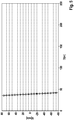
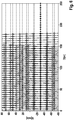
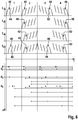
- the frequencies f 1 - f 4 of the signals transmitted by the antenna elements 10 - 16 are plotted as a function of the time t.
- a first period 1 only the antenna elements 10 and 16 are active and they send signals (frequencies f 1 and f 4 ) which consist of a rising slow frequency ramp 40, 42 with chirps 44, 46.
- the chirps 44 and 46 alternate with one another without to overlap each other in time. An overlay of the transmitted signals is avoided.
- the first chirp 46, which is transmitted with the antenna element 16 has the same frequency position and the same stroke as the first chirp 44, which is transmitted with the antenna element 10. So the two chirps are identical copies or repetitions. The same applies to each subsequent pair of chirps 44, 46.
- the sequences of chirps 44, 46 are generated in this example by the oscillator 24, which is alternately connected to the antenna elements 10 and 16 by the switching network 22.
- the frequency ramps 40, 42 are repeated.
- the switching network 22 now connects the oscillator to the two antenna elements 10 and 12 during the chirps 44 and to the two antenna elements 14 and 16 during the chirps 46, so that the transmit array in each case consists of a pair of adjacent antenna elements.
- slow frequency ramps 48, 50 falling with chirps 52, 54 are transmitted according to the same scheme. This completes a complete measurement cycle, which in this simplified example contains only two modulation patterns (a rising and a falling slow ramp).
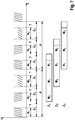
- the positions d of the transmitting antenna elements (bold angles) and the positions of the respective virtual antenna elements (thinner angles) are symbolically shown for each period.
- the virtual positions for the chirps 44 match the real positions.
- the positions are offset by d 4 , since the antenna element 16 transmits which is offset by this distance from the antenna element 10.
- the transmit array for the chirps 44 has the same effect as an array with a single antenna element at the position d 2/2
- the transmit array for the chirps 46 has the same effect as an array with a single antenna element in the Position (d 3 + d 4 ) / 2.
- the virtual positions in periods 3 and 4 also result in the same way.
- An antenna diagram can be created for each of the virtual arrays, which indicates the amplitude and / or phase relationships of the signals received in the four evaluation channels as a function of the assumed angle of incidence ⁇ of the radar echo.
- the azimuth angle of the located object i.e. the actual angle of incidence ⁇
- the assumed angle of incidence ⁇ will correspond to the assumed angle of incidence ⁇ for which there is the best match between the amplitude and / or phase relationships actually measured in the evaluation channels and the corresponding values in the antenna diagram.
- a DML function Deterministic Maximum Likelihood
- the function value of the DML function varies between 0 (no correlation) and 1 (complete agreement).
- the four in this example Evaluation channels of measured amplitudes and / or phases (complex amplitudes) can be understood as a four-component vector. Accordingly, the values in the antenna diagrams form a four-component vector for each angle of incidence ⁇ .
- the DML function can then be calculated by normalizing these two vectors to 1 and then forming the dot product or the amount of the dot product or the square of the amount. The maximum of the DML function then provides the best estimate for the azimuth angle of the object.
- the angle estimator 38 forms the four-component amplitude vector for each of the chirps 44, 52 and for each peak found therein (that is to say for each localized object) and calculates the DML function using the antenna diagrams for the virtual array that occurs in periods 1 and 3 is used.
- the DML function is calculated on the basis of the antenna diagrams for the virtual array that is used in periods 2 and 4.
- the diagram (c) in Fig. 9 shows the DML function, which corresponds to a combination (a weighted sum) of the diagrams (a) and (b).
- the diagram (a) is weighted twice, because in the associated switching states, two antenna elements (10 and 12 or 14 and 16) are sent simultaneously.
- other types of weighting and other forms of combination e.g. median are also conceivable.
Landscapes
- Engineering & Computer Science (AREA)
- Radar, Positioning & Navigation (AREA)
- Remote Sensing (AREA)
- Physics & Mathematics (AREA)
- Computer Networks & Wireless Communication (AREA)
- General Physics & Mathematics (AREA)
- Electromagnetism (AREA)
- Computer Security & Cryptography (AREA)
- Radar Systems Or Details Thereof (AREA)
Description
Die Erfindung betrifft einen winkelauflösenden FMCW-Radarsensor, insbesondere für Kraftfahrzeuge, mit mehreren Antennenelementen, die in einer Richtung, in welcher der Radarsensor winkelauflösend ist, in verschiedenen Positionen angeordnet sind und mindestens drei Sendearrays sowie mindestens ein Empfangsarray bilden, und mit einer Steuer- und Auswerteeinrichtung, die für eine Betriebsweise ausgelegt ist, bei der die mindestens drei Sendearrays periodisch Signale senden deren Frequenz gemäß einer Folge von Modulationsrampen moduliert ist, und bei der Radarechos der gesendeten Signale jeweils von mehreren Antennenelementen des mindestens einen Empfangsarrays empfangen werden und der Winkel eines georteten Objekts anhand von Amplituden- und/oder Phasenbeziehungen zwischen Radarechos bestimmt wird, die unterschiedlichen Kombinationen von Sende- und Empfangsarrays entsprechen.The invention relates to an angle-resolving FMCW radar sensor, in particular for motor vehicles, with a plurality of antenna elements which are arranged in different positions in a direction in which the radar sensor is angle-resolving and which form at least three transmitting arrays and at least one receiving array, and with a control and Evaluation device that is designed for an operating mode in which the at least three transmission arrays periodically send signals whose frequency is modulated according to a sequence of modulation ramps, and in which radar echoes of the transmitted signals are received by several antenna elements of the at least one reception array and the angle of a located one Object is determined on the basis of amplitude and / or phase relationships between radar echoes, which correspond to different combinations of transmit and receive arrays.
Radarsensoren dieser Art sind aus
Radarsensoren werden in Kraftfahrzeugen beispielsweise zur Messung der Abstände, Relativgeschwindigkeiten und Azimutwinkel von im Vorfeld des eigenen Fahrzeugs georteten Fahrzeugen oder sonstigen Objekten eingesetzt. Die einzelnen Antennenelemente sind dann beispielsweise in Abstand zueinander auf einer Horizontalen angeordnet, so dass unterschiedliche Azimutwinkel der georteten Objekte zu Differenzen in den Lauflängen führen, die die Radarsignale vom Objekt bis zum jeweiligen Antennenelement zurückzulegen haben. Diese Lauflängendifferenzen führen zu entsprechenden Unterschieden in der Phase der Signale, die von den Antennenelementen empfangen und in den zugehörigen Auswertungskanälen ausgewertet werden. Durch Abgleich der in den verschiedenen Kanälen empfangenen (komplexen) Amplituden mit entsprechenden Amplituden in einem Antennendiagramm lässt sich dann der Einfallswinkel des Radarsignals und damit der Azimutwinkel des georteten Objekts bestimmen.Radar sensors are used in motor vehicles, for example, to measure the distances, relative speeds and azimuth angles of vehicles or other objects located in the apron of their own vehicle. The individual antenna elements are then arranged, for example, at a distance from one another on a horizontal line, so that different azimuth angles of the located objects lead to differences in the run lengths which the radar signals have to travel from the object to the respective antenna element. These run length differences lead to corresponding differences in the phase of the signals that are received by the antenna elements and evaluated in the associated evaluation channels. The angle of incidence of the radar signal and thus the azimuth angle of the located object can then be determined by comparing the (complex) amplitudes received in the different channels with corresponding amplitudes in an antenna diagram.
Damit eine hohe Winkelauflösung erreicht wird, sollte die Apertur der Antenne möglichst groß sein. Wenn jedoch die Abstände zwischen den benachbarten Antennenelementen zu groß sind, können Mehrdeutigkeiten in der Winkelmessung auftreten, da man für Lauflängendifferenzen, die sich um ganzzahlige Vielfache der Wellenlänge λ unterscheiden, dieselben Phasenbeziehungen zwischen den empfangenen Signalen erhält. Eine eindeutige Winkelmessung lässt sich beispielsweise mit einer ULA-Struktur (Uniform Linear Array) erreichen, bei der die Antennenelemente in Abständen von λ/2 angeordnet sind. In diesem Fall nimmt jedoch mit zunehmender Apertur auch die Anzahl der Antennenelemente und damit auch die Anzahl der erforderlichen Auswertungskanäle zu, so dass entsprechend hohe Hardwarekosten entstehen.In order to achieve a high angular resolution, the aperture of the antenna should be as large as possible. However, if the distances between the adjacent antenna elements are too large, ambiguities can occur in the angle measurement, since there are differences in the length of the run which are integral multiples of the wavelength λ distinguish, maintains the same phase relationships between the received signals. A clear angle measurement can be achieved, for example, with a ULA structure (Uniform Linear Array), in which the antenna elements are arranged at intervals of λ / 2. In this case, however, the number of antenna elements and thus also the number of evaluation channels required increase with increasing aperture, so that correspondingly high hardware costs arise.
Bei einem MIMO-Radar (Multiple Input / Multiple Output) wird ein größeres Winkelauflösungsvermögen dadurch erreicht, dass man nicht nur mit mehreren empfangenden Antennenelementen arbeitet, sondern auch mit mehreren sendenden Antennenelementen, wobei unterschiedliche Kombinationen von sendenden und empfangenden Antennenelementen ausgewertet werden, beispielsweise im Zeitmultiplex oder wahlweise auch im Frequenzmultiplex oder Codemultiplex. Die variierenden Positionen der sendenden Antennenelemente führen dann zu zusätzlichen Phasendifferenzen und damit zu Signalen, die äquivalent sind zu Signalen, die man mit einer Konfiguration mit einem einzelnen sendenden Antennenelement und zusätzlichen (virtuellen) empfangenden Antennenelementen erhalten würde. Auf diese Weise wird die Apertur virtuell vergrößert und damit die Winkelauflösung verbessert.With a MIMO radar (multiple input / multiple output), a greater angular resolution capability is achieved by not only working with several receiving antenna elements, but also with several transmitting antenna elements, different combinations of transmitting and receiving antenna elements being evaluated, for example in time division multiplexing or alternatively also in frequency multiplex or code multiplex. The varying positions of the transmitting antenna elements then lead to additional phase differences and thus to signals which are equivalent to signals that would be obtained with a configuration with a single transmitting antenna element and additional (virtual) receiving antenna elements. In this way, the aperture is enlarged virtually and thus the angular resolution is improved.
Im Hinblick auf eine möglichst hohe Winkelauflösung ist es dabei vorteilhaft, wenn das virtuelle Antennenarray so ausgedünnt ist, dass die einzelnen Antennenelemente relativ große Abstände zueinander haben. Unter diesen Umständen ist jedoch die Eindeutigkeitsbedingung nicht mehr erfüllt, so dass es insbesondere bei verrauschten Radarechos zu Mehrdeutigkeiten und damit zu "springenden" Winkelmessungen kommt, d.h., wenn ein Radarziel über einen längeren Zeitraum verfolgt wird, kommt es gelegentlich zu sprunghaften Änderungen des gemessenen Azimutwinkels.With regard to the highest possible angular resolution, it is advantageous if the virtual antenna array is thinned out such that the individual antenna elements are at relatively large distances from one another. Under these circumstances, however, the uniqueness condition is no longer met, so that ambiguities and thus "jumping" angle measurements occur, in particular in the case of noisy radar echoes, ie if a radar target is tracked over a longer period of time, the azimuth angle measured changes suddenly ,
Bei einem FMCW-Radarsensor (Frequency Modulated Continuous Wave) wird die Sendefrequenz eines kontinuierlichen Radarsignals rampenförmig moduliert. Aus einem Empfangssignal wird durch Mischen mit dem Sendesignal ein Basisbandsignal erzeugt, welches dann ausgewertet wird.With an FMCW radar sensor (Frequency Modulated Continuous Wave), the transmission frequency of a continuous radar signal is modulated in a ramp. A baseband signal is generated from a received signal by mixing with the transmitted signal and is then evaluated.
Jedes Radarobjekt zeichnet sich dann im Frequenzspektrum des Basisbandsignals in der Form eines Peaks ab, dessen Lage von der Dopplerverschiebung und der Laufzeit der Radarsignale abhängig ist, so dass das aus dem einer einzelnen Frequenzmodulationsrampe gewonnene Basisbandsignal noch keine eindeutige Bestimmung der Relativgeschwindigkeit und des Abstands erlaubt. Vielmehr legt die Frequenz eines erhaltenen Peaks nur eine Beziehung zwischen der Geschwindigkeit (Relativgeschwindigkeit) und dem Abstand in Form eines linearen Zusammenhangs fest. (Der Begriff "linear" wird hier so verstanden, dass der dadurch bezeichnete Zusammenhang einen linearen Faktor und einen additiven Term umfassen kann.)Each radar object then appears in the frequency spectrum of the baseband signal in the form of a peak, the position of which depends on the Doppler shift and the transit time of the radar signals, so that the baseband signal obtained from a single frequency modulation ramp does not yet allow a definite determination of the relative speed and the distance. Rather, the frequency of a peak obtained only establishes a relationship between the speed (relative speed) and the distance in the form of a linear relationship. (The term "linear" is understood here so that the relationship referred to can include a linear factor and an additive term.)
Beim FMCW-Verfahren sind zur Identifizierung mehrerer Radarobjekte und Schätzung ihrer Relativgeschwindigkeiten und Abstände mehrere Frequenzmodulationsrampen mit unterschiedlichen Rampensteigungen erforderlich. Durch Abgleichen der unterschiedlichen, bei den einzelnen Frequenzrampen erhaltenen Beziehungen können die Relativgeschwindigkeit V und der Abstand D eines Radarobjektes berechnet werden. Dieser Abgleich wird auch als Matching bezeichnet und entspricht einer Suche von Schnittpunkten von Geraden im D-V-Raum. Das FMCW-Verfahren ist besonders effizient, wenn nur wenige Radarobjekte erfasst werden.The FMCW method requires several frequency modulation ramps with different ramp slopes to identify several radar objects and estimate their relative speeds and distances. By comparing the different relationships obtained in the individual frequency ramps, the relative speed V and the distance D of a radar object can be calculated. This comparison is also called matching and corresponds to a search for intersections of straight lines in D-V space. The FMCW method is particularly efficient if only a few radar objects are detected.
Es sind auch Radarsensoren bekannt, die nach dem Verfahren der Chirp-Sequence-Modulation arbeiten, bei dem das Sendesignal aus einer Folge gleichartiger, frequenzmodulierter Signalpulse (Chirps) besteht. Das Modulationsmuster besteht folglich nicht aus einer einzelnen Modulationsrampe, sondern aus einem kompletten Satz aufeinanderfolgender Chirps. Es handelt sich um ein Puls-Dopplerverfahren mit Pulskompression, bei dem zunächst eine Trennung der Radarobjekte nach ihren Entfernungen erfolgt und anschließend, anhand der Unterschiede von Phasenlagen zwischen den Reflexionen der einzelnen Signalpulse, Ortsveränderungen und damit Geschwindigkeiten der Radarobjekte ermittelt werden. Bei einem typischen Modulationsmuster nehmen die Mittenfrequenzen der einzelnen Chirps von Chirp zu Chirp gleichmäßig zu oder ab, so dass die Chirps ihrerseits eine Rampe bilden, die als "langsame Rampe" bezeichnet wird, während die Chirps auch als "schnelle Rampen" bezeichnet werden. Dieses Verfahren wird deshalb auch als "Multi-Speed-FMCW" (MSFMCW) bezeichnet.Radar sensors are also known which operate according to the chirp sequence modulation method, in which the transmitted signal consists of a sequence of similar frequency-modulated signal pulses (chirps). The modulation pattern consequently does not consist of a single modulation ramp, but of a complete set of consecutive chirps. It is a pulse-Doppler method with pulse compression, in which the radar objects are first separated according to their distances and then, based on the differences in phase positions between the reflections of the individual signal pulses, changes in location and thus speeds of the radar objects are determined. In a typical modulation pattern, the center frequencies of the individual chirps increase or decrease evenly from chirp to chirp, so that the chirps in turn form a ramp which is referred to as a "slow ramp", while the chirps are also referred to as "fast ramps". This process is therefore also referred to as "multi-speed FMCW" (MSFMCW).
Das MSFMCW-Verfahren erlaubt eine genauere Messung der Abstände und Relativgeschwindigkeiten und ist insbesondere in den Fällen robuster, in denen eine Vielzahl von Objekten gleichzeitig geortet werden. Allerdings haben die langsamen Rampen naturgemäß eine relativ große Länge. Die zeitlichen Abstände zwischen den einzelnen Messungen werden daher so groß, dass aufgrund der Eigenbewegung der Objekte die für die Anwendung des MIMO-Prinzips notwendige Phasenkorrelation zwischen den Signalen verloren geht.The MSFMCW method allows a more precise measurement of the distances and relative speeds and is more robust, especially in cases where a large number of objects are located at the same time. However, the slow ramps naturally have a relatively long length. The time intervals between the individual measurements are therefore so large that the phase correlation between the signals necessary for the application of the MIMO principle is lost due to the inherent movement of the objects.
Aufgabe der Erfindung ist es, ein MIMO-Radar mit verbesserter Messgenauigkeit zu schaffen.The object of the invention is to provide a MIMO radar with improved measurement accuracy.
Diese Aufgabe wird bei einem Radarsensor der eingangs genannten Art dadurch gelöst, ein Messzyklus des Radarsensors mindestens zwei Perioden umfasst, in denen jeweils zwischen mindestens zwei Kombinationen von Sende- und Empfangsarrays gewechselt wird, und dass die beteiligten Kombinationen von Sende- und Empfangsarrays für die mindestens zwei Perioden voneinander verschieden sind..In a radar sensor of the type mentioned at the outset, this object is achieved in that a measuring cycle of the radar sensor comprises at least two periods, in each of which a switch is made between at least two combinations of transmit and receive arrays, and that the combinations of transmit and receive arrays involved for the at least one two periods are different from each other ..
Die Verwendung von drei oder mehr unterschiedlichen Kombinationen von Sende- und Empfangsarrays ermöglicht eine größer (virtuelle) Apertur und/oder eine Auffüllung der Arrays, so dass die Genauigkeit und/oder die Eindeutigkeit der Winkelschätzung verbessert wird. Da jedoch innerhalb einer einzelnen Periode nicht alle möglichen Kombinationen ausgeschöpft werden, verkürzt sich der zeitliche Abstand, in dem die Radarechos der mit verschiedenen Sendearrays gesendeten Signale ausgewertet werden können. Dadurch verbessert sich die Kohärenz dieser Signale und damit die Messgenauigkeit.The use of three or more different combinations of transmitting and receiving arrays enables a larger (virtual) aperture and / or a filling of the arrays, so that the accuracy and / or the uniqueness of the angle estimate is improved. However, since not all possible combinations are exhausted within a single period, the time interval in which the radar echoes of the signals transmitted with different transmission arrays can be evaluated shortens. This improves the coherence of these signals and thus the measuring accuracy.
Vorteilhafte Ausgestaltungen und Weiterbildungen der Erfindung sind in den Unteransprüchen angegeben.Advantageous refinements and developments of the invention are specified in the subclaims.
In einer vorteilhaften Ausführungsform wird innerhalb jeder Periode, beispielsweise innerhalb jeder langsamen Modulationsrampe, nach jedem Chirp das verwendete Sendearray gewechselt. Beispielsweise wird abwechselnd mit zwei verschiedenen Sendearrays gesendet, wobei jeder Chirp, der mit einem Array gesendet wurde, unmittelbar danach mit identischer Frequenzlage und identischem Hub noch einmal gesendet wird, nun aber mit dem anderen Sendearray, bevor wieder mit dem ersten Sendearray der nächste Chirp mit etwas höherer Frequenz gesendet wird.In an advantageous embodiment, the transmit array used is changed after each chirp within each period, for example within each slow modulation ramp. For example, transmission takes place alternately with two different transmission arrays, with each chirp that was sent with an array being immediately retransmitted with the same frequency position and the same hub, but now with the other transmission array, before the next chirp with the first transmission array somewhat higher frequency is sent.
Ein "Sendearray" kann aus einem einzelnen Antennenelement oder aus einer Kombination mehrerer Antennenelemente bestehen. Wenn das Array zwei benachbarte Antennenelemente aufweist, die mit frequenzgleichen Signalen gespeist werden, so überlagern sich die von diesen beiden Antennenelementen emittierten Radarwellen zu einem Signal mit geänderter Phasenlage. Dieses Signal ist äquivalent zu einem Signal, das von einem Punkt emittiert würde, der zwischen den beiden Antennenelementen liegt. Dieser Punkt bildet das sogenannte Phasenzentrum der beiden Signale. Da dieses Phasenzentrum an einem Ort liegt, an dem sich kein reales Antennenelement befindet, erhält man durch die gemeinsame Erregung zweier oder mehrerer Antennenelemente zusätzliche (virtuelle) sendende Antennenelemente, die mit den realen empfangenden Antennenelementen kombiniert werden können und somit zu einer Auffüllung des virtuellen Antennenarrays führen. Auf diese Weise kommt die Konfiguration einer ULA-Struktur näher, und die Wahrscheinlichkeit von Mehrdeutigkeiten nimmt ab.A "transmit array" can consist of a single antenna element or a combination of several antenna elements. If the array has two adjacent antenna elements which are fed with signals of the same frequency, then the radar waves emitted by these two antenna elements overlap to form a signal with a changed phase position. This signal is equivalent to a signal that would be emitted from a point that lies between the two antenna elements. This point forms the so-called phase center of the two signals. Since this phase center is located at a location where there is no real antenna element, the excitation of two or more antenna elements results in additional (virtual) transmitting antenna elements which can be combined with the real receiving antenna elements and thus to fill up the virtual antenna array to lead. In this way, the configuration of a ULA structure comes closer and the likelihood of ambiguity decreases.
Das Zusammenschalten zweier oder mehrerer Antennenelemente hat zudem den Vorteil, dass eine höhere Sendeleistung erzielt wird und damit die Reichweite des Radarsensors verbessert wird.The interconnection of two or more antenna elements also has the advantage that a higher transmission power is achieved and thus the range of the radar sensor is improved.
In einer vorteilhaften Ausführungsform sind die realen Antennenelemente in ungleichmäßigen Abständen angeordnet, so dass die Antennenkonfiguration möglichst wenig Symmetrien aufweist, was zur weiteren Unterdrückung von Mehrdeutigkeiten beiträgt. Außerdem lässt sich dadurch vermeiden, dass virtuelle Antennenpositionen, die sich durch Kombinationen unterschiedlicher Sende- und Empfangselemente ergeben, örtlich zusammenfallen.In an advantageous embodiment, the real antenna elements are arranged at non-uniform intervals, so that the antenna configuration has as few symmetries as possible, which contributes to the further suppression of ambiguities. In addition, it can be avoided that virtual antenna positions, which result from combinations of different transmitting and receiving elements, coincide locally.
Der Radarsensor ist vorzugsweise als monostatischer Radarsensor ausgebildet, d.h., jedes Antennenelement kann sowohl als sendendes Element als auch empfangendes Element genutzt werden.The radar sensor is preferably designed as a monostatic radar sensor, i.e. each antenna element can be used both as a transmitting element and as a receiving element.
Wenn zwei oder mehr Antennenelemente mit einem frequenzgleichen Signal gespeist werden, müssen die Phasen und Amplituden, mit denen das Signal den beiden oder mehreren Elementen zugeführt wird, nicht notwendigerweise übereinstimmen. Dadurch ergibt sich gemäß einer Weiterbildung der Erfindung die Möglichkeit zu einer Strahlformung.If two or more antenna elements are fed with a signal of the same frequency, the phases and amplitudes with which the signal is supplied to the two or more elements do not necessarily have to match. According to a development of the invention, this results in the possibility of beam shaping.
Bei den heute üblichen FMCW-Verfahren stimmt die Zykluszeit, d.h., die Dauer eines einzelnen Messzyklus, mit der Periodendauer der Frequenzmodulation überein. Innerhalb eines Messzyklus wird eine bestimmte Anzahl von Modulationsmustern (langsamen Rampen) gesendet, und die empfangenen Signale für alle empfangenen Modulationsmuster werden aufgezeichnet und ausgewertet. Die Zykluszeit setzt sich deshalb zusammen aus der Zeit, die zum Senden der Modulationsmuster benötigt wird, und einer zusätzlichen Rechenzeit, die ein Prozessor zur Verarbeitung der empfangenen Signale und zur Berechnung der Abstands- und Geschwindigkeitsdaten benötigt.In today's FMCW methods, the cycle time, i.e. the duration of a single measurement cycle, matches the period of the frequency modulation. A certain number of modulation patterns (slow ramps) are sent within a measurement cycle, and the received signals for all received modulation patterns are recorded and evaluated. The cycle time is therefore composed of the time required to send the modulation pattern and an additional computing time required by a processor to process the received signals and to calculate the distance and speed data.
Bei sicherheitsrelevanten Assistenzfunktionen ist es jedoch wichtig, dass das Verkehrsgeschehen mit möglichst hoher zeitlicher Auflösung verfolgt werden kann Das heißt, die Zykluszeit sollte möglichst klein sein. Da sich die Dauer der Modulationsmuster aus Gründen der Messgenauigkeit nicht verkürzen lässt, kann eine Verkürzung der Zykluszeit nur durch eine Verkürzung der Rechenzeit erreicht werden. Das erfordert den Einsatz leistungsfähigerer und damit kostspieligerer Prozessoren.In the case of safety-related assistance functions, however, it is important that the traffic situation can be tracked with the highest possible temporal resolution. This means that the cycle time should be as short as possible. Since the duration of the modulation pattern cannot be shortened for reasons of measurement accuracy, the cycle time can only be shortened by shortening the computing time. This requires the use of more powerful and therefore more expensive processors.
Gemäß einer Weiterbildung der Erfindung kann man für den Abgleich des für ein Modulationsmuster im aktuellen Messzyklus erhaltenen Signals mit dem oder den für andere Modulationsmuster erhaltenen Signalen auf die Signale aus mindestens einem früheren Messzyklus zurückgreifen.According to a development of the invention, the signals from at least one earlier measurement cycle can be used to compare the signal obtained for a modulation pattern in the current measurement cycle with the signal or signals obtained for other modulation patterns.
Die Erfindung nutzt dabei den Umstand aus, dass sich aufgrund der Trägheit der beteiligten Kraftfahrzeuge die Geschwindigkeiten von Messzyklus zu Messzyklus nur wenig ändern, so dass es im wesentlichen nur die Abstände sind, die von einem Messzyklus zum nächsten eine signifikante Änderung erfahren. Die Geschwindigkeitsinformation wird deshalb nicht wesentlich verfälscht, wenn man statt der Daten aus dem aktuellen Messzyklus Daten aus einem oder mehreren unmittelbar vorangegangenen Messzyklen verwendet. Wenn mit N verschiedenen Modulationsmustern gearbeitet wird, M die zum Senden eines einzelnen Modulationsmusters benötigt Zeit ist und T die zur Auswertung eines einzelnen Modulationsmusters benötigte Rechenzeit ist, so ist bei dem herkömmlichen Verfahren die Zykluszeit Z gegeben durch: 
Bei dem erfindungsgemäßen Verfahren lässt sich dagegen die Zykluszeit verkürzen auf: 
Es ergibt sich also eine Verkürzung der Zykluszeit um (N-1)∗(M+T).The cycle time is thus shortened by (N-1) ∗ (M + T).
Diese Verkürzung der Zykluszeit hat wiederum zur Folge, dass auch der zeitliche Abstand zwischen den verschienen Modulationsmustern entsprechend klein ist, wodurch sich der Fehler in den Geschwindigkeitsdaten weiter verringert.This shortening of the cycle time in turn means that the time interval between the different modulation patterns is correspondingly small, which further reduces the error in the speed data.
Weiterhin ist es im Rahmen der Erfindung möglich, nicht nur zwischen verschiedenen Sendearrays umzuschalten, sondern auch zwischen verschiedenen Empfangsarrays. Dazu brauchen nur zusätzliche Antennenelemente vorgesehen zu werden aber keine zusätzlichen Auswertungskanäle. Der Wechsel des Empfangsarrays erfolgt dann dadurch, dass einen andere Auswahl der Sendeantennen mit den Auswertungskanälen verbunden wird. Durch die Kombination mit verschiedenen Sendearrays lässt sich dann das virtuelle MIMO-Array weiter vergrößern und/oder verdichten.Furthermore, it is possible within the scope of the invention not only to switch between different transmission arrays, but also between different reception arrays. For this purpose, only additional antenna elements need to be provided, but no additional evaluation channels. The reception array is then changed by connecting a different selection of the transmission antennas to the evaluation channels. The virtual MIMO array can then be further enlarged and / or compressed by combining it with different transmission arrays.
Im folgenden werden Ausführungsbeispiele der Erfindung anhand der Zeichnung näher erläutert.Exemplary embodiments of the invention are explained in more detail below with reference to the drawing.
Es zeigen:
- Fig. 1
- ein Blockdiagramm eines erfindungsgemäßen Radarsensors;
- Fig. 2
- eine schematische Darstellung einer Folge von Frequenzmodulationsrampen (Chirps) eines Sendesignals;
- Fig. 3
- eine schematische Darstellung von Amplitude und Phasenlage eines Peaks im Frequenzspektrum eines einzelnen Chirps;
- Fig. 4
- eine schematische Darstellung von Amplitudenwerten eines Peaks in den Frequenzspektren mehrerer Chirps;
- Fig. 5
- eine schematische Darstellung von Beziehungen zwischen Relativgeschwindigkeit V und Abstand D eines Radarobjektes aus einer Auswertung einer Folge von Chirps;
- Fig. 6
- eine schematische Darstellung zur Erläuterung eines Abgleichs unterschiedlicher ermittelter Beziehungen zwischen V und D aus Signalen, die zwei Folgen von Frequenzrampen zugeordnet sind;
- Fig. 7
- ein Beispiel eines Zyklusschemas für den erfindungsgemäßen Radarsensor;
- Fig. 8
- ein Diagramm zur Erläuterung der Funktionsweise des Radarsensors nach
Fig. 1 bis 6 ; und - Fig. 9
- Diagramme zur Erläuterung der Vorteile des Radarsensors.
- Fig. 1
- a block diagram of a radar sensor according to the invention;
- Fig. 2
- a schematic representation of a sequence of frequency modulation ramps (chirps) of a transmission signal;
- Fig. 3
- a schematic representation of the amplitude and phase of a peak in the frequency spectrum of a single chirp;
- Fig. 4
- a schematic representation of amplitude values of a peak in the frequency spectra of several chirps;
- Fig. 5
- a schematic representation of relationships between relative speed V and distance D of a radar object from an evaluation of a sequence of chirps;
- Fig. 6
- a schematic representation for explaining a comparison of different determined relationships between V and D from signals that are assigned to two sequences of frequency ramps;
- Fig. 7
- an example of a cycle scheme for the radar sensor according to the invention;
- Fig. 8
- a diagram to explain the operation of the radar sensor after
1 to 6 ; and - Fig. 9
- Diagrams to explain the advantages of the radar sensor.
Der in
Ein Hochfrequenzteil 20 zur Ansteuerung der Antennenelemente wird beispielsweise durch ein oder mehrere MMICs (Monolithic Microwave Integrated Circuits) gebildet und umfasst ein Schaltnetzwerk 22, über das die einzelnen Antennenelemente selektiv mit einem lokalen Oszillator 24 verbindbar sind, der das zu sendende Radarsignal erzeugt. Die von den Antennenelementen 10 - 16 empfangenen Radarechos werden jeweils mit Hilfe eines Zirkulators 26 ausgekoppelt und einem Mischer 28 zugeführt, wo sie mit dem vom Oszillator 24 gelieferten Sendesignal gemischt werden. Auf diese Weise erhält man für jedes der Antennenelemente ein Zwischenfrequenzsignal Zf1, Zf2, Zf3, Zf4, das einer elektronischen Steuer- und Auswerteeinheit 30 zugeführt wird.A high-
Die Steuer- und Auswerteeinheit 30 enthält einen Steuerungsteil 32, der die Funktion des Oszillators 24 und des Schaltnetzwerkes 22 steuert. Die Frequenz des vom Oszillator 24 gelieferten Sendesignals wird periodisch in Form einer Folge von steigenden und/oder fallenden Frequenzrampen moduliert.The control and evaluation unit 30 contains a
Weiterhin enthält die Steuer- und Auswerteeinrichtung 30 einen Auswerteteil mit einem vierkanaligen Analog/Digital-Wandler 34, der die von den vier Antennenelementen erhaltenen Zwischenfrequenzsignale Zf1 - Zf4 digitalisiert und jeweils über die Dauer einer einzelnen Frequenzrampe aufzeichnet. Die so erhaltenen Zeitsignale werden dann kanalweise in einer Transformationsstufe 36 durch Schnelle Fouriertransformation in entsprechende Frequenzspektren umgewandelt. In diesen Frequenzspektren zeichnet sich jedes geortete Objekt in der Form eines Peaks ab, dessen Frequenzlage von der Signallaufzeit vom Radarsensor zum Objekt und zurück zum Radarsensor sowie - aufgrund des Doppler-Effektes - von der Relativgeschwindigkeit des Objekts abhängig ist. Aus den Frequenzlagen zweier Peaks, die für dasselbe Objekt erhalten wurden, jedoch auf Frequenzrampen mit unterschiedlicher Steigung, beispielsweise einer steigenden Rampe und einer fallenden Rampe, lässt sich dann der Abstand D und die Relativgeschwindigkeit V des betreffenden Objektes berechnen.Furthermore, the control and evaluation device 30 contains an evaluation part with a four-channel analog /
Unter Bezugnahme auf
In
In dem Fall, dass die langsame Rampe den Frequenzhub 0 hat, sind die schnellen Rampen der Folge identisch, d.h. beschreiben identische Frequenzverläufe.In the event that the slow ramp has the
In einem Messzyklus werden zwei oder mehr sich unterscheidende Folgen von schnellen Rampen verwendet, wobei innerhalb der jeweiligen Folge die schnellen Rampen (Chirps) jeweils den gleichen Frequenzhub Ffast und die gleiche Rampendauer Tfast und denselben zeitlichen Abstand Tr2r zwischen den Rampen aufweisen. Die wenigstens zwei Folgen innerhalb eines Messzyklus können sich beispielsweise unterscheiden durch unterschiedliche Werte des Betrages und/oder des Vorzeichens des Frequenzhubes Ffast der schnellen Rampen, unterschiedliche Rampendauern der schnellen Rampen, unterschiedliche Rampenwiederholzeiten Tr2r der schnellen Rampen, unterschiedliche Mittenfrequenzen f0 der langsamen Rampen, unterschiedliche Anzahl Nslow der schnellen Rampen und/oder unterschiedliche Frequenzhübe Fslow der langsamen Rampe.Two or more different sequences of fast ramps are used in a measuring cycle, the fast ramps (chirps) each having the same frequency deviation F almost and the same ramp duration T almost and the same time interval T r2r between the ramps within the respective sequence. The at least two sequences within a measurement cycle can vary by different values of the amount and / or the sign of the frequency F, for example, almost the fast ramps, ramp different durations of the fast ramps, different Rampenwiederholzeiten T r2r the fast ramps, different Center frequencies f 0 of the slow ramps, different number N slow of the fast ramps and / or different frequency sweeps F slow of the slow ramp.
Im folgenden wird zunächst zur Vereinfachung der Darstellung die Auswertung des Messsignals für eine einzelne Folge von schnellen Rampen des Sendesignals erläutert.In order to simplify the representation, the evaluation of the measurement signal for a single sequence of fast ramps of the transmission signal is first explained below.
Die Frequenz des Sendesignals liegt beispielsweise im Bereich von 76 GHz. Beispielsweise kann die Mittenfrequenz der langsamen Rampe 76 GHz betragen.The frequency of the transmission signal is, for example, in the range of 76 GHz. For example, the center frequency of the slow ramp can be 76 GHz.
In dem vom Mischer 28 gelieferten Basisbandsignal ist jeder schnellen Rampe in der Folge ein Teilsignal mit der Dauer Tfast zugeordnet. Dabei kann davon ausgegangen werden, dass für ein Radarobjekt im Erfassungsbereich des Radarsensorsystems die Signallaufzeit klein gegenüber der Rampendauer Tfast ist.In the baseband signal supplied by the
In einem ersten Schritt der Auswertung wird ein Frequenzspektrum wenigstens eines Teilsignals ausgewertet. Das Teilsignal des Basisbandsignals, welches einer schnellen Rampe entspricht, wird an einer Anzahl Nfast äquidistanter Zeitpunkte abgetastet, also digitalisiert, und ein Frequenzspektrum des Teilsignals wird bestimmt. Das Frequenzspektrum wird beispielsweise durch Berechnen einer schnellen Fouriertransformation (FFT) berechnet.In a first step of the evaluation, a frequency spectrum of at least one partial signal is evaluated. The sub-signal of the baseband signal, which corresponds to a fast ramp, is sampled, ie digitized, at a number N of almost equidistant times, and a frequency spectrum of the sub-signal is determined. The frequency spectrum is calculated, for example, by calculating a fast Fourier transform (FFT).
Für ein von einem einzelnen Radarobjekt reflektiertes Signal wird beispielsweise im Frequenzbin k0 ein Peak mit der Amplitude Abb(ko) erhalten, dem eine entsprechende Phase χbb(ko) zugeordnet ist. Der Frequenzbin ko kennzeichnet dabei die Frequenzlage des Radarobjektes in dem betreffenden Frequenzspektrum des Teilsignals.For a signal reflected by an individual radar object, for example, a peak with the amplitude A bb (k o ) is obtained in the frequency bin k 0 , to which a corresponding phase χ bb (k o ) is assigned. The frequency bin k o identifies the frequency position of the radar object in the relevant frequency spectrum of the partial signal.
Bei einer linearen Frequenzmodulation des Sendesignals ist die Frequenzlage eines einem Radarobjekt zugeordneten Peaks aus einer Summe zweier Terme zusammengesetzt, von denen der erste Term proportional zum Produkt aus dem Abstand D des Radarobjekts vom Radarsensor und dem Rampenhub Ffast ist und der zweite Term proportional zum Produkt aus der Relativgeschwindigkeit V des Radarobjektes, der Mittenfrequenz der schnellen Rampe und der Rampendauer Tfast ist. Dies entspricht der FMCW-Gleichung 
Bei nicht zu hohen Relativgeschwindigkeiten V und Beschleunigungen eines Radarobjektes ergibt sich über die Folge der schnellen Rampen annähernd dieselbe Frequenzlage des Peaks, und im folgenden soll k0 diesen mittleren Frequenzbin des Radarobjektes über alle schnellen Rampen der Folge bezeichnen.If the relative speeds V and accelerations of a radar object are not too high, the sequence of the fast ramps results in approximately the same frequency position of the peak, and in the following k 0 shall denote this mean frequency bin of the radar object over all fast ramps of the sequence.
Die dem Peak zugeordnete Phase χbb(ko) bei der Frequenzlage k0 ist besonders empfindlich für Veränderungen des Abstandes des Radarobjektes während des Durchlaufens der Folge schneller Rampen. So ergibt eine Abstandsveränderung um die halbe Wellenlänge des Radarsignals bereits eine Phasenverschiebung um eine ganze Periode der Schwingung.The phase χ bb (k o ) associated with the peak at the frequency position k 0 is particularly sensitive to changes in the distance of the radar object while passing through the sequence of fast ramps. A change in distance by half the wavelength of the radar signal already results in a phase shift by an entire period of the oscillation.

Bei einer Radarsignalfrequenz von etwa 76 GHz ist die Wellenlänge etwa 4 mm. Bei einer Relativgeschwindigkeit von 86 km/h, entsprechend 24 m/sec, ändert sich die Phase somit mit einer Frequenz von 12000 Hz. Ein dieser Frequenz entsprechender Peak wird im Frequenzspektrum des zeitlichen Verlaufs des Realteils erwartet, wobei der zeitliche Verlauf den aufeinanderfolgenden schnellen Rampen entspricht; jede Rampe entspricht einem Abtastwert des zeitlichen Verlaufs. Wird durch eine zu niedrige Abtastfrequenz der Phasenänderungen, d.h. eine zu große Rampenfolgezeit Tr2r , das Nyquist-Shannon-Abtasttheorem verletzt, so kann die Frequenz der Phasenänderungen nicht eindeutig bestimmt werden.At a radar signal frequency of approximately 76 GHz, the wavelength is approximately 4 mm. At a relative speed of 86 km / h, corresponding to 24 m / sec, the phase changes with a frequency of 12000 Hz. A peak corresponding to this frequency is expected in the frequency spectrum of the temporal course of the real part, the temporal course of the successive fast ramps corresponds; each ramp corresponds to a sample of the course over time. If the Nyquist-Shannon sampling theorem is violated by a sampling frequency of the phase changes that is too low, ie a ramp follow-up time T r2r , the frequency of the phase changes cannot be clearly determined.
Die Frequenzlage der der Phasenänderung entsprechenden harmonischen Schwingung kann bestimmt werden, indem man die Funktion, die die für ein Objekt gemessene Phase χbb(r) als Funktion des Rampenindex r angibt, erneut einer FourierTransformation unterzieht. Diese Frequenzlage kann angegeben werden durch ihren Frequenzbin I0 und setzt sich näherungsweise additiv zusammen aus einem zum mittleren Abstand D und zum Rampenhub Fslow der langsamen Rampe proportionalen Term und einem Term, der zur mittleren Relativgeschwindigkeit V, der Rampendauer Tslow der langsamen Rampe und der Mittenfrequenz f0 der langsamen Rampe proportional ist. Dies entspricht wiederum einer FMCW-Gleichung für die langsame Rampe: 
Aus der ermittelten Frequenzlage ergibt sich somit im allgemeinen Fall, d.h. mit einem Rampenhub der langsamen Rampe Fslow ≠ 0, eine lineare Beziehung zwischen der Relativgeschwindigkeit und dem Abstand des Radarobjektes, die allerdings hinsichtlich der Relativgeschwindigkeit V und des Abstands D mehrdeutig ist. Diese Beziehung stellt eine zweite Information über die Relativgeschwindigkeit und den Abstand des Radarobjektes dar. Im speziellen Fall Fslow = 0 wird im folgenden dennoch von einer langsamen Rampe gesprochen; diese hat die Steigung 0 und ergibt zweite Information lediglich über die Geschwindigkeit. Diese ist hinsichtlich der Relativgeschwindigkeit V eindeutig bis auf ganzzahlige Vielfache des Produktes aus der halben Wellenlänge und der Abtastfrequenz 1/Tr2r der langsamen Rampe.In the general case, ie with a ramp stroke of the slow ramp F slow ≠ 0, the determined frequency position thus results in a linear relationship between the relative speed and the distance of the radar object, which, however, is ambiguous with regard to the relative speed V and the distance D. This relationship represents a second piece of information about the relative speed and the distance of the radar object. In the special case F slow = 0, the term “slow ramp” is used in the following; this has the
Aus der Auswertung eines Frequenzspektrums eines Teilsignals ergibt sich eine gegenüber der Vertikalen geneigte Gerade, entsprechend einer linearen Beziehung zwischen der Relativgeschwindigkeit V und dem Abstand D. Da der Rampenhub der langsamen Rampe Fslow = 0 beträgt, ergibt sich aus der Fourier-Analyse der Werte der Frequenzspektren der Teilsignale bei der Frequenzlage k0 des Radarobjektes ein mehrdeutiger Wert für die Relativgeschwindigkeit V, entsprechend den in konstantem Abstand zueinander liegenden, horizontalen, gestrichelt eingezeichneten Linien im Diagramm in
Eine Eindeutigkeit der Ermittlung von Relativgeschwindigkeit und Abstand des Radarobjekts kann hergestellt werden, indem weitere erste Information über Relativgeschwindigkeit und Abstand und/oder weitere zweite Information über Relativgeschwindigkeit und optional Abstand berücksichtigt wird.The determination of the relative speed and distance of the radar object can be made unambiguous by taking further first information about relative speed and distance and / or further second information about relative speed and optionally distance into account.
Die Parameter des ersten Modulationsmusters sind die folgenden: Ffast = 425 MHz, Tfast = 0,10 ms, Nfast = 1024, Fslow = 0, Tr2r = 0,10 ms, Nslow = 32, so dass sich Tslow = 3,2 ms ergibt.The parameters of the first modulation pattern are the following: F fast = 425 MHz, T fast = 0.10 ms, N fast = 1024, F slow = 0, T r2r = 0.10 ms, N slow = 32, so that T slow = 3.2 ms results.
Die Parameter des zweiten Modulationsmusters sind die folgenden: Ffast = -250 MHz, Tfast = 0,115 ms, Nfast = 512, Fslow = 0, Tr2r = 0,115 ms, Nslow = 32, so dass sich Tslow = 3,68 ms ergibt.The parameters of the second modulation pattern are the following: F fast = -250 MHz, T fast = 0.115 ms, N fast = 512, F slow = 0, T r2r = 0.115 ms, N slow = 32, so that T slow = 3 , 68 ms results.
Bei diesem Beispiel wird angenommen, dass eine Reihe von Radarobjekten bei einer Relativgeschwindigkeit von V = -30 m/s im Abstandsbereich von D = 5 m bis D = 250 m vorhanden sind, wobei die Radarobjekte jeweils einen Abstand von 5 m zueinander haben. Es kann sich beispielsweise um stehende Ziele handeln, auf die sich das eigene Kraftfahrzeug mit einer Geschwindigkeit von 30 m/s zu bewegt.In this example, it is assumed that a number of radar objects are present at a relative speed of V = -30 m / s in the distance range from D = 5 m to D = 250 m, the radar objects being at a distance of 5 m from one another. For example, these can be standing targets to which one's own motor vehicle is moving at a speed of 30 m / s.
Die linearen Beziehungen zwischen V und D unterscheiden sich für die beiden Modulationsmuster. Das erste Modulationsmuster liefert eine Schar paralleler, fallender Geraden, je eine Gerade für jedes Objekt. Entsprechend liefert das zweite Modulationsmuster liefert eine Schar steigender Geraden. Weiterhin haben die aus den beiden Modulationsmustern ermittelten zweiten Informationen über die Geschwindigkeit V des Radarobjektes verschiedene Mehrdeutigkeitsweiten.The linear relationships between V and D differ for the two modulation patterns. The first modulation pattern provides a family of parallel, falling lines, one line for each object. The second modulation pattern accordingly provides a family of rising straight lines. Furthermore, the second information about the speed V of the radar object determined from the two modulation patterns has different ambiguity ranges.
In
Die Kette der stehenden Radarobjekte bei einer Relativgeschwindigkeit von V = -30 m/s kann aufgelöst und bis zu einem Abstand von 150 m detektiert werden.The chain of standing radar objects at a relative speed of V = -30 m / s can be resolved and detected up to a distance of 150 m.
Um das Verfahren robuster gegenüber Situationen zu machen, in denen mehrere Objekte, die unterschiedliche Relativgeschwindigkeiten haben, gleichzeitig geortet werden, ist es zweckmäßig nicht nur mit zwei unterschiedlichen Modulationsmustern zu arbeiten, sondern mit mindestens drei unterschiedlichen Modulationsmustern je Messzyklus.In order to make the method more robust to situations in which several objects with different relative speeds are located at the same time, it is advisable not only to work with two different modulation patterns, but with at least three different modulation patterns per measurement cycle.
Um eine kürzere Zykluszeit zu erreichen, wird jedoch vorzugsweise mit einem Zyklusschema gearbeitet, dass in
Innerhalb jedes Rechenzeitintervalls erfolgt außerdem ein Abgleich der Ergebnisse, die man für die letzten drei Modulationsmuster erhalten hat. In
Auf diese Weise erhält man aktualisierte Werte für den Abstand und die Relativgeschwindigkeit jedes Objekts schon nach einer Zykluszeit, die sich nur aus der Dauer eines einzelnen Modulationsmusters und der Rechenzeit T zusammensetzt.In this way, updated values for the distance and the relative speed of each object are obtained after a cycle time which is composed only of the duration of a single modulation pattern and the computing time T.
Nachfolgend soll nun unter Bezugnahme auf
Wie in
Bei dem hier beschriebenen MIMO-Radar sind jedoch die komplexen Amplituden in den vier Kanälen auch davon abhängig, welches der vier Antennenelemente 10, 12, 14, 16 als Sendeelement benutzt wird. Beispielsweise erlaubt es das Schaltnetzwerk 22, eine erste Frequenzrampe oder Folge von Frequenzrampen mit dem Antennenelement 10 zu senden (das Sendearray besteht dann nur aus dem einzigen Antennenelement 10), dann auf das Antennenelement 12 umzuschalten und dann nacheinander auf die Antennenelemente 14 und 16, wonach ein neuer Zyklus beginnt. Auf diese Weise erhält man 4 x 4 = 16 verschiedene Konstellationen, die durch das folgende Signalmodell beschrieben werden können.In the MIMO radar described here, however, the complex amplitudes in the four channels also depend on which of the four
Für das planare lineare Antennenarray mit den Antennenelementen 10, 12, 14, 16 als Empfangsarray hat (unter der idealisierten Annahme isotroper Antennenelemente) der Steuerungsvektor arµ(θ) die folgenden Komponenten: 
Dieser Steuerungsvektor bestimmt die Phasenbeziehungen zwischen den komplexen Amplituden der Signale, die von den vier Antennenelementen empfangen werden. Der Index µ bezeichnet dabei das Antennenelement, und die Größen drµ geben die Positionen der Antennenelemente in der Horizontalen an, bezogen auf irgendeinen beliebig gewählten Ursprung.This control vector determines the phase relationships between the complex amplitudes of the signals received by the four antenna elements. The index µ denotes the antenna element, and the sizes d rµ indicate the positions of the antenna elements in the horizontal, based on any arbitrarily selected origin.
Entsprechend hat der Steuerungsvektor atν(θ) für das Empfangarray die Komponenten 
Bei dem in 

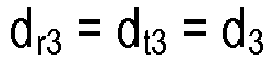

Für die Winkelschätzung wird nun nach dem MIMO-Prinzip der virtuelle Array-Vektor gebildet, indem das Kronecker-Produkt aus atν(θ) und arµ(θ) gebildet wird: 
Der Produktvektor hat sechzehn Komponenten, entsprechend sechzehn Positionen von virtuellen Antennenelementen. Die Komponenten des Vektors haben die Form 
Die virtuellen Antennenpositionen entsprechen somit den Summen, die sich aus den Größen d1 - d4 bilden lassen. Damit erstreckt sich das virtuelle Array in der Horizontalen über eine wesentlich größere Spanne, das heißt, es hat eine größere Apertur und führt damit zu einer höheren Winkelauflösung, da schon kleine Änderungen im Azimutwinkel θ zu größeren Phasenunterschieden führen.The virtual antenna positions thus correspond to the sums that can be formed from the quantities d 1 - d 4 . The virtual array thus extends horizontally over a much larger span, that is, it has a larger aperture and thus leads to a higher angular resolution, since even small changes in the azimuth angle θ lead to larger phase differences.
Wenn jedoch, um eine möglichst große Apertur zu erhalten, die Werte d1 - d4 deutlich größer gewählt werden als λ/2, so können aufgrund der Periodizität des Faktors sin(θ) in den Komponenten des Array-Vektors in einzelnen Fällen Azimutwinkel auftreten, bei denen die Antennendiagramme für alle virtuellen Antennenelemente ähnliche komplexe Amplituden aufweisen, so dass sich der wirkliche Azimutwinkel des Objekts nicht eindeutig bestimmen lässt.However, if the values d 1 - d 4 are chosen to be significantly larger than λ / 2 in order to obtain the largest possible aperture, then due to the periodicity of the factor sin (θ) Azimuth angles occur in individual cases in the components of the array vector, in which the antenna diagrams have similar complex amplitudes for all virtual antenna elements, so that the real azimuth angle of the object cannot be clearly determined.
Bevorzugt wird deshalb das virtuelle Array durch zusätzliche virtuelle Elemente aufgefüllt. Zu diesem Zweck wird das Schaltnetzwerk 22 in bestimmten Betriebsphasen so angesteuert, dass zwei Schalter gleichzeitig geschlossen sind, also zwei zugehörige Antennenelemente 10, 12, 14, 16 gleichzeitig mit demselben Signal gespeist werden. Die gesendeten Signale überlagern sich dann zu einem Signal, dessen Wellenmuster etwa die Form hat, als würde es von einem Punkt in der Mitte zwischen den betreffenden Antennenelementen ausgehen.The virtual array is therefore preferably filled up by additional virtual elements. For this purpose, the switching
Wenn beispielsweise die Antennenelemente 10 und 12 gemeinsam gespeist werden, erhält man im Steuerungsvektor für das Sendearray eine zusätzliche Komponente exp(2πi·(d2/2λ)·sin(θ)), entsprechend einem zusätzlichen Antennenelement in der Position d2/2. Im Vektor des virtuellen Arrays ergibt das vier zusätzliche Komponenten, entsprechend virtuellen Elementen bei den Positionen d2/2, d2/2+d2, d2/2+d3 und d2/2+d4. Für den wahren Azimutwinkel des Objekts müssen auch die Antennendiagramme, die zu diesen virtuellen Elementen gehören, die für den Peak des Objekts gemessenen komplexen Amplituden der Zwischenfrequenzsignale Zf1- Zf4 liefern. Auf diese Weise tragen die zusätzlichen Elemente dazu bei, etwaige Mehrdeutigkeiten zu vermeiden.For example, if the antenna elements are fed together 10 and 12, one obtains in the control vector for the transmit array one additional component exp (2πi · (d 2 / 2λ) · sin (θ)) corresponding to an additional antenna element in the position of d 2/2. In the vector of the virtual array, the four additional components, corresponding virtual elements results in the positions d 2/2, d 2/2 + d 2, d 2/2 + d 3 and d 2/2 + d. 4 For the true azimuth angle of the object, the antenna diagrams belonging to these virtual elements must also supply the complex amplitudes of the intermediate frequency signals Zf 1 -Zf 4 measured for the peak of the object. In this way, the additional elements help to avoid any ambiguity.
In der Praxis müssen nicht alle möglichen Kombinationen der Antennenelemente 10 - 16 als Sendearrays genutzt werden, sondern es wird vielmehr eine sinnvolle Auswahl getroffen. Ein Beispiel für eine mögliche Betriebsweise ist in Diagrammform in
Im oberen Teil des Diagramms sind die Frequenzen f1 - f4 der von den Antennenelementen 10 - 16 gesendeten Signale als Funktion der Zeit t aufgetragen. In einer ersten Periode 1 sind nur die Antennenelemente 10 und 16 aktiv, und sie senden Signale (Frequenzen f1 und f4) die aus einer steigenden langsamen Frequenzrampe 40, 42 mit Chirps 44, 46 bestehen. Dabei wechseln die Chirps 44 und 46 miteinander ab, ohne einander zeitlich zu überlappen. Eine Überlagerung der gesendeten Signale wird so vermieden. Der erste Chirp 46, der mit dem Antennenelement 16 gesendet wird, hat die gleiche Frequenzlage und den gleichen Hub wie der erste Chirp 44, der mit dem Antennenelement 10 gesendet wird. Die beiden Chirps sind also identische Kopien oder Wiederholungen. Dasselbe gilt auch für jedes nachfolgende Paar von Chirps 44, 46. Die Folgen der Chirps 44, 46 werden in diesem Beispiel vom Oszillator 24 erzeugt, der durch das Schaltnetzwerk 22 abwechselnd mit den Antennenelementen 10 und 16 verbunden wird.In the upper part of the diagram, the frequencies f 1 - f 4 of the signals transmitted by the antenna elements 10 - 16 are plotted as a function of the time t. In a
In einer zweiten Periode 2 werden die Frequenzrampen 40, 42 wiederholt. Das Schaltnetzwerk 22 verbindet den Oszillator nun jedoch während der Chirps 44 mit den beiden Antennenelementen 10 und 12 und während der Chirps 46 mit den beiden Antennenelementen 14 und 16, so dass das Sendearray jeweils aus einem Paar benachbarter Antennenelemente besteht.In a
In den Nachfolgenden Perioden 3 und 4 werden nach dem gleichen Schema fallende langsame Frequenzrampen 48, 50 mit Chirps 52, 54 gesendet. Damit ist ein vollständiger Messzyklus abgeschlossen, der in diesem vereinfachten Beispiel nur zwei Modulationsmuster (eine steigende und eine fallende langsame Rampe) enthält.In subsequent periods 3 and 4, slow frequency ramps 48, 50 falling with
Im unteren Teil des Diagramms sind für jede Periode symbolisch die Positionen d der sendenden Antennenelemente (fett gedruckte Winkel) sowie die Positionen der jeweiligen virtuellen Antennenelemente (dünnere Winkel) dargestellt. In der ersten Periode stimmen für die Chirps 44 die virtuellen Positionen mit den realen Positionen überein. Für die Chirps 46 sind die Positionen um d4 versetzt, da mit dem Antennenelement 16 gesendet wird, das um diese Distanz gegenüber dem Antennenelement 10 versetzt ist.In the lower part of the diagram, the positions d of the transmitting antenna elements (bold angles) and the positions of the respective virtual antenna elements (thinner angles) are symbolically shown for each period. In the first period, the virtual positions for the
In der nachfolgenden Periode 2 hat das Sendearray für die Chirps 44 die gleiche Wirkung wie ein Array mit einem einzigen Antennenelement bei der Position d2/2, und das Sendearray für die Chirps 46 hat die gleiche Wirkung wie ein Array mit einem einzigen Antennenelement bei der Position (d3+d4)/2. Auf die gleiche Weise ergeben sich auch die virtuellen Positionen in den Perioden 3 und 4.In the
In der äußersten rechten Spalte im unteren Teil des Diagramms in
Wenn die Antennenelemente 10 - 16 in gleichmäßigen Abständen angeordnet wären, so würden die Positionen einiger der virtuellen Antenneelemente zusammenfallen. Das wird jedoch in der gezeigten Ausführungsform dadurch vermieden, dass die Abstände zwischen den Antennenelementen ungleich sind: d4 - d3 > d3 - d2 > d2. In der Praxis haben sich die folgenden Werte bewährt (in Einheiten der Wellenlänge λ): 


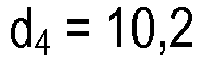
Für jedes der virtuellen Arrays lässt sich ein Antennendiagramm erstellen, das die Amplituden- und/oder Phasenbeziehungen der in den vier Auswertungskanälen empfangenen Signale in Abhängigkeit vom angenommenen Einfallswinkel θ des Radarechos angibt. Generell wird der Azimutwinkel des georteten Objekts, also der tatsächliche Einfallswinkel α, dem angenommenen Einfallswinkel θ entsprechen, für den sich die beste Übereinstimmung zwischen dem tatsächlich in den Auswertungskanälen gemessenen Amplituden- und/oder Phasenbeziehungen und den entsprechenden Werten im Antennendiagramm ergibt. Für die Auswertung lässt sich eine DML-Funktion (Deterministic Maximum Likelihood) berechnen, die die Korrelation zwischen den tatsächlich gemessenen Werten und den Werten im Antennendiagramm als Funktion des Einfallswinkels θ angibt. Der Funktionswert der DML-Funktion variiert zwischen 0 (keine Korrelation) und 1 (völlige Übereinstimmung). Die in den (in diesem Beispiel) vier Auswertungskanälen gemessenen Amplituden und/oder Phasen (komplexe Amplituden) kann man als vierkomponentigen Vektor auffassen. Entsprechend bilden auch die Werte in den Antennendiagrammen für jeden Einfallswinkel θ einen vierkomponentigen Vektor. Die DML-Funktion lässt sich dann berechnen, indem man diese beiden Vektoren jeweils auf 1 normiert und dann das Skalarprodukt oder den Betrag des Skalarprodukts bzw. das Betragsquadrat bildet. Das Maximum der DML-Funktion liefert dann den besten Schätzwert für den Azimutwinkel des Objekts.An antenna diagram can be created for each of the virtual arrays, which indicates the amplitude and / or phase relationships of the signals received in the four evaluation channels as a function of the assumed angle of incidence θ of the radar echo. In general, the azimuth angle of the located object, i.e. the actual angle of incidence α, will correspond to the assumed angle of incidence θ for which there is the best match between the amplitude and / or phase relationships actually measured in the evaluation channels and the corresponding values in the antenna diagram. For the evaluation, a DML function (Deterministic Maximum Likelihood) can be calculated, which indicates the correlation between the actually measured values and the values in the antenna diagram as a function of the angle of incidence θ. The function value of the DML function varies between 0 (no correlation) and 1 (complete agreement). The four in this example Evaluation channels of measured amplitudes and / or phases (complex amplitudes) can be understood as a four-component vector. Accordingly, the values in the antenna diagrams form a four-component vector for each angle of incidence θ. The DML function can then be calculated by normalizing these two vectors to 1 and then forming the dot product or the amount of the dot product or the square of the amount. The maximum of the DML function then provides the best estimate for the azimuth angle of the object.
Zur Bestimmung dieser Schätzwerte bildet der Winkelschätzer 38 für jeden der Chirps 44, 52 und für jeden darin gefunden Peak (also für jedes geortete Objekt) den vierkomponentigen Amplitudenvektor und berechnet die DML-Funktion anhand der Antennendiagramme für das virtuelle Array, das in den Perioden 1 und 3 benutzt wird. Entsprechend wird für die Chirps 46 und 54 die DML-Funktion anhand der Antennendiagramme für das virtuelle Array berechnet, das in den Perioden 2 und 4 benutzt wird.To determine these estimates, the
In
Das Diagramm (c) in
Man erkennt, dass in dieser Summe nur noch ein scharf ausgeprägtes Maximum bei θ = 0 vorhanden ist, während die übrigen Maxima so weit unterdrückt sind, dass sie auch unter Berücksichtigung des Rauschens nicht den Wert 1 erreichen.It can be seen that there is only a sharply defined maximum at θ = 0 in this sum, while the other maxima are suppressed to such an extent that they do not reach the
Für andere Werte des tatsächlichen Einfallswinkels α würde man andere (asymmetrische) DML-Funktionen erhalten, bei denen die Maxima an anderen Stellen liegen. Jede Funktion hätte dann ein Hauptmaximum an der Stelle θ = α.For other values of the actual angle of incidence α, one would obtain other (asymmetrical) DML functions in which the maxima are at different locations. Each function would then have a main maximum at θ = α.
Claims (7)
- Angle-resolving FMCW radar sensor having a plurality of antenna elements (10, 12, 14, 16) which are arranged at different positions in a direction in which the radar sensor is angle-resolving and form at least three transmitting arrays and at least one receiving array, wherein a transmitting array can consist of an individual antenna element or of a combination of a plurality of antenna elements, and having a control and evaluation device (30) which is designed for a method of operation in which the at least three transmitting arrays periodically transmit signals, the frequency of which is modulated according to a sequence of modulation ramps (44, 46; 52, 54), and in which radar echoes of the transmitted signals are respectively received by a plurality of antenna elements in the at least one receiving array and the angle (θ) of a located object is determined on the basis of amplitude and/or phase relationships between radar echoes corresponding to different combinations of transmitting and receiving arrays, characterized in that a measuring cycle (P) of the radar sensor comprises at least two periods (1, 2, 3, 4) in which there is respectively a change between at least two combinations of transmitting and receiving arrays and there is a change back in further periods, and in that the involved combinations of transmitting and receiving arrays differ from one another for the at least two periods.
- Radar sensor according to Claim 1, in which each period (1, 2, 3, 4) contains a sequence of modulation ramps (44, 46; 52, 54) and there is a changeover to a different transmitting array after each individual modulation ramp.
- Radar sensor according to Claim 1 or 2, in which there is alternately a changeover between two transmitting arrays within an individual period (1, 2, 3, 4) .
- Radar sensor according to one of the preceding claims, in which at least one of the transmitting arrays which is used for transmission in at least one period (1, 3) consists of an individual antenna element (10; 16) and at least one other transmitting array which is used for transmission in at least one period (2, 4) consists of at least two antenna elements (10, 12; 14, 16) which are simultaneously fed with signals of the same frequency.
- Radar sensor according to one of the preceding claims, in which each of the antenna elements (10, 12, 14, 16) can be optionally operated as part of a receiving array and as part of a transmitting array.
- Radar sensor according to one of the preceding claims, in which the antenna elements (10, 12, 14, 16) which can be operated as part of a transmitting array have different distances from neighbour to neighbour.
- Radar sensor according to one of the preceding claims, in which, in order to determine the distance (D) of a located object, differences in the phase angles of received radar echoes which belong to different modulation patterns (M1, M2, M3) are evaluated, and in which, in order to identify the radar echoes of a plurality of simultaneously located objects, the results obtained for a plurality of successive modulation patterns are compared with one another, wherein at least one of these modulation patterns respectively comes from a preceding measuring cycle (P).
Applications Claiming Priority (2)
| Application Number | Priority Date | Filing Date | Title |
|---|---|---|---|
| DE102013212090.7A DE102013212090A1 (en) | 2013-06-25 | 2013-06-25 | Angle-resolving FMCW radar sensor |
| PCT/EP2014/059851 WO2014206630A1 (en) | 2013-06-25 | 2014-05-14 | Angle-resolving fmcw radar sensor |
Publications (2)
| Publication Number | Publication Date |
|---|---|
| EP3014297A1 EP3014297A1 (en) | 2016-05-04 |
| EP3014297B1 true EP3014297B1 (en) | 2020-01-15 |
Family
ID=50732169
Family Applications (1)
| Application Number | Title | Priority Date | Filing Date |
|---|---|---|---|
| EP14724426.3A Active EP3014297B1 (en) | 2013-06-25 | 2014-05-14 | Angle-resolving fmcw radar sensor |
Country Status (6)
| Country | Link |
|---|---|
| US (1) | US10914818B2 (en) |
| EP (1) | EP3014297B1 (en) |
| JP (1) | JP6266103B2 (en) |
| CN (1) | CN105339806B (en) |
| DE (1) | DE102013212090A1 (en) |
| WO (1) | WO2014206630A1 (en) |
Cited By (2)
| Publication number | Priority date | Publication date | Assignee | Title |
|---|---|---|---|---|
| US20220003861A1 (en) * | 2018-11-19 | 2022-01-06 | Rheinmetall Waffe Munition Gmbh | Method for determining the position of an object, device for determining the position of an object, and system |
| DE102023207747A1 (en) | 2023-08-11 | 2025-02-13 | Robert Bosch Gesellschaft mit beschränkter Haftung | Hardware accelerator device, radar device and method for operating a radar device |
Families Citing this family (97)
| Publication number | Priority date | Publication date | Assignee | Title |
|---|---|---|---|---|
| US10656257B2 (en) | 2013-04-29 | 2020-05-19 | Greina Technologies, Inc. | Personal radar |
| DE102013209708A1 (en) * | 2013-05-24 | 2014-11-27 | Robert Bosch Gmbh | Method for operating a MIMO radar |
| JP6534808B2 (en) * | 2014-11-28 | 2019-06-26 | 株式会社デンソーテン | Radar apparatus and signal processing method |
| WO2017010111A1 (en) * | 2015-07-14 | 2017-01-19 | 三菱電機株式会社 | Transmission module, array antenna device provided with same, and transmission device |
| DE102015226443A1 (en) | 2015-12-22 | 2017-06-22 | Robert Bosch Gmbh | Radar sensor, corresponding operating method and vehicle |
| DE102016202936A1 (en) * | 2016-02-25 | 2017-08-31 | Robert Bosch Gmbh | Device for determining operating data for a radar sensor |
| DE102016203160A1 (en) * | 2016-02-29 | 2017-08-31 | Robert Bosch Gmbh | Radar system comprising an antenna arrangement for transmitting and receiving electromagnetic radiation |
| US10261179B2 (en) * | 2016-04-07 | 2019-04-16 | Uhnder, Inc. | Software defined automotive radar |
| US10627483B2 (en) | 2016-07-09 | 2020-04-21 | Texas Instruments Incorporated | Methods and apparatus for velocity detection in MIMO radar including velocity ambiguity resolution |
| FR3055049B1 (en) * | 2016-08-11 | 2018-07-27 | Thales | MULTI-RESOLUTION FMCW RADAR DETECTION METHOD AND RADAR USING SUCH A METHOD |
| FR3055424B1 (en) * | 2016-08-23 | 2019-01-25 | Thales | METHOD OF PROCESSING A SIGNAL FROM A COHERENT LIDAR AND ASSOCIATED LIDAR SYSTEM |
| DE102016218643A1 (en) * | 2016-09-28 | 2018-03-29 | Robert Bosch Gmbh | Method for evaluating radar radiation and radar apparatus |
| DE102016221947A1 (en) | 2016-11-09 | 2018-05-09 | Robert Bosch Gmbh | Radar sensor for motor vehicles |
| US10274594B2 (en) | 2016-12-06 | 2019-04-30 | GM Global Technology Operations LLC | Direct Doppler-free velocity measurement in linear frequency modulation radar |
| DE102016224900A1 (en) * | 2016-12-14 | 2018-06-14 | Robert Bosch Gmbh | MIMO radar sensor for motor vehicles |
| JP7182560B2 (en) * | 2017-01-04 | 2022-12-02 | アルプスアルパイン株式会社 | personal radar |
| DE102017200273A1 (en) | 2017-01-10 | 2018-07-12 | Audi Ag | Radar arrangement for a motor vehicle and motor vehicle |
| DE102017200317A1 (en) * | 2017-01-11 | 2018-07-12 | Robert Bosch Gmbh | Radar sensor and method for determining a relative speed of a radar target |
| DE102017200706A1 (en) * | 2017-01-18 | 2018-07-19 | Robert Bosch Gmbh | Multiple subsampled chirp sequence radar |
| KR101945795B1 (en) * | 2017-02-20 | 2019-02-11 | 국방과학연구소 | Open-ended and portable instrumentation radar system |
| US10473755B1 (en) * | 2017-02-21 | 2019-11-12 | National Technology & Engineering Solutions Of Sandia, Llc | Waveform warping for general frequency-modulated radar waveforms |
| US10677918B2 (en) | 2017-02-28 | 2020-06-09 | Analog Devices, Inc. | Systems and methods for improved angular resolution in multiple-input multiple-output (MIMO) radar |
| US11415664B2 (en) * | 2017-03-03 | 2022-08-16 | Iee International Electronics & Engineering S.A. | Method and system for obtaining an adaptive angle-doppler ambiguity function in MIMO radars |
| DE102017105783B4 (en) * | 2017-03-17 | 2020-06-10 | S.M.S Smart Microwave Sensors Gmbh | Method for determining a distance and a speed of an object |
| JP6945332B2 (en) * | 2017-04-20 | 2021-10-06 | 株式会社デンソーテン | Radar device and target detection method |
| DE102017209628A1 (en) * | 2017-06-08 | 2018-12-13 | Robert Bosch Gmbh | FMCW radar sensor for motor vehicles |
| DE102017211432A1 (en) * | 2017-07-05 | 2019-01-10 | Robert Bosch Gmbh | System for detecting a moving object |
| JP2019056670A (en) * | 2017-09-22 | 2019-04-11 | ミツミ電機株式会社 | Radar device |
| JP6494869B1 (en) * | 2017-10-24 | 2019-04-03 | 三菱電機株式会社 | Radar equipment |
| DE102017011879A1 (en) * | 2017-12-21 | 2019-06-27 | Metirionic Gmbh | Radio field based authentication of nodes within a radio link |
| DE102018200394A1 (en) * | 2018-01-11 | 2019-07-11 | Robert Bosch Gmbh | Radar system with integrated in a radar sensor head analysis unit |
| DE102018200765A1 (en) * | 2018-01-18 | 2019-07-18 | Robert Bosch Gmbh | FMCW radar sensor |
| DE102018200751A1 (en) * | 2018-01-18 | 2019-07-18 | Robert Bosch Gmbh | Radar apparatus and method for operating a radar apparatus |
| DE102018200752A1 (en) | 2018-01-18 | 2019-07-18 | Robert Bosch Gmbh | Method and device for evaluating an angular position of an object, and driver assistance system |
| DE102018201303A1 (en) | 2018-01-29 | 2019-08-01 | Robert Bosch Gmbh | Method and device for operating a plurality of sensors of a vehicle |
| DE102018202290A1 (en) * | 2018-02-15 | 2019-08-22 | Robert Bosch Gmbh | Angle estimation and ambiguity resolution of radar sensors for motor vehicles with large antenna array |
| DE102018202289A1 (en) * | 2018-02-15 | 2019-08-22 | Robert Bosch Gmbh | Angle-resolving broadband radar sensor for motor vehicles |
| GB201803239D0 (en) * | 2018-02-28 | 2018-04-11 | Secr Defence | A radio or sonic wave detector, transmitter, reciver and method thereof |
| DE102018203333A1 (en) * | 2018-03-06 | 2019-09-12 | Autocruise S.A.S | Method for unambiguously determining the speed of an object on a RADAR measuring system |
| DE102018207718A1 (en) * | 2018-05-17 | 2019-11-21 | Robert Bosch Gmbh | Method for phase calibration of high-frequency components of a radar sensor |
| DE102018208992A1 (en) * | 2018-06-07 | 2019-12-12 | Robert Bosch Gmbh | Radar Sensor System |
| EP3581962A1 (en) * | 2018-06-11 | 2019-12-18 | Hexagon Technology Center GmbH | Dual beam fmcw distance measuring method with compensation of a speed-dependent distance measuring fault |
| DE102018210083A1 (en) * | 2018-06-21 | 2019-12-24 | Robert Bosch Gmbh | Evaluation device and method for evaluating at least one radar sensor |
| DE102018210155A1 (en) * | 2018-06-21 | 2019-12-24 | Robert Bosch Gmbh | Method and device for evaluating radar signals |
| US11585889B2 (en) * | 2018-07-25 | 2023-02-21 | Qualcomm Incorporated | Methods for radar coexistence |
| DE102018214586A1 (en) * | 2018-08-29 | 2020-03-05 | Robert Bosch Gmbh | Device for receiving light for the detection of an object |
| DE102018214966A1 (en) * | 2018-09-04 | 2020-03-05 | Robert Bosch Gmbh | Radar sensor with angular resolution |
| US11092686B2 (en) * | 2018-09-19 | 2021-08-17 | Steradian Semiconductors Private Limited | Method, apparatus and device for doppler compensation in a time switched MIMO radar system |
| JP7266207B2 (en) * | 2018-09-28 | 2023-04-28 | パナソニックIpマネジメント株式会社 | Radar device and radar method |
| DE102018124503A1 (en) * | 2018-10-04 | 2020-04-09 | HELLA GmbH & Co. KGaA | Radar system for a vehicle |
| DE102018124582A1 (en) | 2018-10-05 | 2020-04-09 | HELLA GmbH & Co. KGaA | Procedure for detection in a radar system |
| JPWO2020075689A1 (en) * | 2018-10-12 | 2021-09-02 | 京セラ株式会社 | Electronic devices, control methods for electronic devices, and control programs for electronic devices |
| US11519996B2 (en) * | 2018-10-31 | 2022-12-06 | Cornell University | System and method for ultra-high-resolution ranging using RFID |
| WO2020090681A1 (en) * | 2018-11-02 | 2020-05-07 | 株式会社村田製作所 | Antenna device, mobile body, and target determination method |
| US11402483B2 (en) * | 2019-01-07 | 2022-08-02 | Niiva OpCo, LLC | Systems and methods to detect motion on sloped surfaces |
| KR102814886B1 (en) * | 2019-03-11 | 2025-05-30 | 주식회사 에이치엘클레무브 | Radar apparatus, antenna apparatus for radar apparatus and control method of radar apparatus |
| US11681017B2 (en) | 2019-03-12 | 2023-06-20 | Uhnder, Inc. | Method and apparatus for mitigation of low frequency noise in radar systems |
| US11650317B2 (en) | 2019-06-28 | 2023-05-16 | Silc Technologies, Inc. | Use of frequency offsets in generation of LIDAR data |
| US11360210B2 (en) * | 2019-07-02 | 2022-06-14 | Intel Corporation | Multi-mode multi-input multi-output (MIMO) radar sensors |
| CH716417A1 (en) | 2019-07-19 | 2021-01-29 | Geopraevent Ag | Radar device for detecting object movements. |
| CN110346764B (en) * | 2019-08-21 | 2022-03-29 | 上海无线电设备研究所 | MIMO radar target distance angle decoupling method |
| DE102019214164A1 (en) * | 2019-09-17 | 2021-03-18 | Robert Bosch Gmbh | Radar sensor for motor vehicles |
| CN112578341B (en) * | 2019-09-30 | 2025-01-03 | 深圳引望智能技术有限公司 | Signal sending method, signal processing method and device |
| DE102019220216A1 (en) * | 2019-12-19 | 2021-06-24 | Robert Bosch Gmbh | Method for scanning at least one object and system for scanning at least one object |
| CN112924961B (en) * | 2020-01-13 | 2023-03-28 | 上海交通大学 | Full-field vibration measurement method and system based on microwave sensing |
| WO2021144710A2 (en) | 2020-01-13 | 2021-07-22 | Uhnder, Inc. | Method and system for multi-chip operation of radar systems |
| CN115087884B (en) * | 2020-02-21 | 2024-12-31 | 三菱电机株式会社 | Radar device, observation object detection method, and vehicle-mounted device |
| DE102020202498A1 (en) * | 2020-02-27 | 2021-09-02 | Robert Bosch Gmbh | MIMO radar system |
| DE102020202499A1 (en) * | 2020-02-27 | 2021-09-02 | Robert Bosch Gesellschaft mit beschränkter Haftung | MIMO radar system |
| DE102020202500A1 (en) * | 2020-02-27 | 2021-09-02 | Robert Bosch Gesellschaft mit beschränkter Haftung | MIMO radar system |
| DE102020106276A1 (en) * | 2020-03-09 | 2021-09-09 | HELLA GmbH & Co. KGaA | Method for operating a radar system for a vehicle |
| DE102020109502A1 (en) * | 2020-04-06 | 2021-10-07 | HELLA GmbH & Co. KGaA | Method for determining an angle information |
| CN111526477B (en) * | 2020-04-23 | 2021-08-10 | 上海交通大学 | Radio positioning method and system based on starting angle |
| US11624826B2 (en) * | 2020-05-05 | 2023-04-11 | Silc Technologies, Inc. | Use of common chirp periods in generation of LIDAR data |
| WO2021240577A1 (en) * | 2020-05-25 | 2021-12-02 | 三菱電機株式会社 | Radar device |
| WO2021258292A1 (en) * | 2020-06-23 | 2021-12-30 | 华为技术有限公司 | Signal processing method and device, radar device and storage medium |
| US20220018934A1 (en) * | 2020-07-14 | 2022-01-20 | Keysight Technologies, Inc. | Coordinated mini-radar target simulators for improved accuracy and improved ghost cancellation |
| DE102020119936A1 (en) * | 2020-07-29 | 2022-02-03 | Valeo Schalter Und Sensoren Gmbh | Radar system, antenna array for a radar system, vehicle with at least one radar system and method for operating at least one radar system |
| CN112118530B (en) * | 2020-08-10 | 2022-08-16 | 苏州寻波科技有限公司 | Positioning system and method based on wifi channel state information |
| US11709247B2 (en) * | 2020-09-22 | 2023-07-25 | Ay Dee Kay Llc | Fast chirp synthesis via segmented frequency shifting |
| DE102020212476A1 (en) | 2020-10-02 | 2022-04-07 | Robert Bosch Gesellschaft mit beschränkter Haftung | Radar device and method for operating a radar device |
| EP4012443A1 (en) * | 2020-12-08 | 2022-06-15 | Veoneer Sweden AB | A vehicle radar system |
| CN116888498A (en) * | 2021-02-12 | 2023-10-13 | 西梅奥有限公司 | Radar systems and corresponding methods |
| EP4291924A1 (en) * | 2021-02-12 | 2023-12-20 | Symeo GmbH | Radar system and corresponding method |
| US12541009B2 (en) | 2021-06-17 | 2026-02-03 | Silc Technologies, Inc. | Scanning multiple LIDAR system output signals |
| TWI771103B (en) * | 2021-07-14 | 2022-07-11 | 立積電子股份有限公司 | Radar apparatus and signal receiving method thereof |
| US12411213B2 (en) | 2021-10-11 | 2025-09-09 | Silc Technologies, Inc. | Separation of light signals in a LIDAR system |
| US12498452B2 (en) | 2021-12-02 | 2025-12-16 | Robert Bosch Gmbh | Radar system with enhanced processing for increased contrast ratio, improved angular separability and accuracy, and elimination of ghost targets in a single-snapshot |
| DE102022200283A1 (en) | 2022-01-13 | 2023-07-13 | Robert Bosch Gesellschaft mit beschränkter Haftung | Radar system and method of operating a radar system |
| US12553995B2 (en) | 2022-02-14 | 2026-02-17 | Silc Technologies, Inc. | Data refinement in optical systems |
| JP7791032B2 (en) | 2022-04-07 | 2025-12-23 | 浜松ホトニクス株式会社 | distance measuring device |
| US12578443B2 (en) | 2022-04-23 | 2026-03-17 | Silc Technologies, Inc. | Data refinement in optical imaging systems |
| US12422618B2 (en) | 2022-10-13 | 2025-09-23 | Silc Technologies, Inc. | Buried taper with reflecting surface |
| US12578439B2 (en) | 2023-04-11 | 2026-03-17 | Silc Technologies, Inc. | Increasing resolution in imaging systems |
| US20250116755A1 (en) * | 2023-10-09 | 2025-04-10 | Nxp B.V. | Hybrid random time division multiplexing (rtdm) doppler division multiplexing (ddm) multiple-input multiple-output (mimo) radar system and method |
| DE102024124891A1 (en) * | 2024-08-30 | 2026-03-05 | Hensoldt Sensors Gmbh | CONTROL DEVICE, ANTENNA ARRAY AND METHOD FOR CONTROLLING AN ANTENNA ARRAY |
| JP7668606B1 (en) * | 2025-01-27 | 2025-04-25 | 株式会社Athena | Structure monitoring and inspection system, structure monitoring and inspection method, and computer program for monitoring and inspection of structure |
Family Cites Families (18)
| Publication number | Priority date | Publication date | Assignee | Title |
|---|---|---|---|---|
| JP2989428B2 (en) * | 1993-06-17 | 1999-12-13 | 本田技研工業株式会社 | Time-sharing FM radar system |
| JP3393204B2 (en) * | 1999-10-06 | 2003-04-07 | 株式会社ホンダエレシス | Multi-beam radar device |
| US6804312B1 (en) * | 2000-01-11 | 2004-10-12 | At&T Corp. | Methods and systems for spatial processing |
| US6750810B2 (en) * | 2001-12-18 | 2004-06-15 | Hitachi, Ltd. | Monopulse radar system |
| JP4067456B2 (en) * | 2003-06-09 | 2008-03-26 | 富士通テン株式会社 | Radar apparatus and signal processing control method thereof |
| US20050225481A1 (en) * | 2004-04-12 | 2005-10-13 | Bonthron Andrew J | Method and apparatus for automotive radar sensor |
| JP2006003303A (en) * | 2004-06-21 | 2006-01-05 | Fujitsu Ten Ltd | Radar device |
| JP4844566B2 (en) * | 2006-01-23 | 2011-12-28 | 株式会社村田製作所 | Radar equipment |
| WO2008053685A1 (en) * | 2006-11-01 | 2008-05-08 | Murata Manufacturing Co., Ltd. | Radar target detecting method and radar device using the target detection method |
| JP4910651B2 (en) | 2006-11-16 | 2012-04-04 | 株式会社デンソー | Communication integrated radar device, communication integrated radar system |
| DE102007043535A1 (en) * | 2007-09-12 | 2009-03-19 | Robert Bosch Gmbh | FMCW radar locating device and corresponding FMCW radar locating method |
| JP5470836B2 (en) * | 2008-12-19 | 2014-04-16 | 富士通株式会社 | Detecting and ranging apparatus and design method of detecting and ranging apparatus |
| KR101775572B1 (en) * | 2009-04-06 | 2017-09-06 | 콘티 테믹 마이크로일렉트로닉 게엠베하 | Radar system having arrangements and method for decoupling transmission and reception signals and suppression of interference radiation |
| JP2011064584A (en) | 2009-09-17 | 2011-03-31 | Denso Corp | Array antenna device and radar device |
| DE102010030289A1 (en) | 2010-06-21 | 2011-12-22 | Robert Bosch Gmbh | Radar sensor and method for operating a radar sensor |
| DE102010041755A1 (en) * | 2010-09-30 | 2012-04-05 | Siemens Aktiengesellschaft | radar system |
| DE102012212888A1 (en) * | 2012-07-23 | 2014-01-23 | Robert Bosch Gmbh | Detection of radar objects with a radar sensor of a motor vehicle |
| US9620856B2 (en) * | 2012-11-19 | 2017-04-11 | Raytheon Company | Beam broadening with large spoil factors |
-
2013
- 2013-06-25 DE DE102013212090.7A patent/DE102013212090A1/en not_active Withdrawn
-
2014
- 2014-05-14 EP EP14724426.3A patent/EP3014297B1/en active Active
- 2014-05-14 CN CN201480036459.5A patent/CN105339806B/en not_active Expired - Fee Related
- 2014-05-14 JP JP2016520324A patent/JP6266103B2/en not_active Expired - Fee Related
- 2014-05-14 WO PCT/EP2014/059851 patent/WO2014206630A1/en not_active Ceased
- 2014-05-14 US US14/900,688 patent/US10914818B2/en not_active Expired - Fee Related
Non-Patent Citations (1)
| Title |
|---|
| None * |
Cited By (3)
| Publication number | Priority date | Publication date | Assignee | Title |
|---|---|---|---|---|
| US20220003861A1 (en) * | 2018-11-19 | 2022-01-06 | Rheinmetall Waffe Munition Gmbh | Method for determining the position of an object, device for determining the position of an object, and system |
| US11762083B2 (en) * | 2018-11-19 | 2023-09-19 | Rheinmetall Waffe Munition Gmbh | Method for determining the position of an object, device for determining the position of an object, and system |
| DE102023207747A1 (en) | 2023-08-11 | 2025-02-13 | Robert Bosch Gesellschaft mit beschränkter Haftung | Hardware accelerator device, radar device and method for operating a radar device |
Also Published As
| Publication number | Publication date |
|---|---|
| JP2016525209A (en) | 2016-08-22 |
| CN105339806A (en) | 2016-02-17 |
| EP3014297A1 (en) | 2016-05-04 |
| DE102013212090A1 (en) | 2015-01-08 |
| US20160131742A1 (en) | 2016-05-12 |
| US10914818B2 (en) | 2021-02-09 |
| WO2014206630A1 (en) | 2014-12-31 |
| JP6266103B2 (en) | 2018-01-24 |
| CN105339806B (en) | 2019-03-01 |
Similar Documents
| Publication | Publication Date | Title |
|---|---|---|
| DE102013212090A1 (en) | Angle-resolving FMCW radar sensor | |
| EP2755045B1 (en) | Method for the cyclic measuring of distances and speeds of objects with an FMCW radar sensor | |
| DE102018127947B3 (en) | MIMO FMCW RADAR SYSTEM | |
| EP3004918B1 (en) | Interference cancellation in an fmcw radar | |
| DE102008014918B4 (en) | Method for detecting interference in a radar system and radar using the same | |
| EP2948789B1 (en) | Fmcw radar having distance-range graduation | |
| DE112007003175B4 (en) | Electronically scanning radar system | |
| EP3161513B1 (en) | Radar measurement method with different viewing ranges | |
| DE102013212079A1 (en) | Angle-resolving radar sensor | |
| EP3155444B1 (en) | Method for object location with an fmcw-radar | |
| EP3161510B1 (en) | Radar measuring method | |
| EP2659284B1 (en) | Radar sensor for vehicles | |
| EP2769236B1 (en) | Angle-resolving radar sensor | |
| DE102012212888A1 (en) | Detection of radar objects with a radar sensor of a motor vehicle | |
| DE102008014787A1 (en) | Interference occurrence detecting method for e.g. motor vehicle, involves identifying frequency component having intensity that is greater than intensity-threshold value and is outside of frequency range, as exception frequency component | |
| DE102014212284A1 (en) | MIMO radar measurement method | |
| DE102008054228A1 (en) | Vehicle-side direction detection device for accurately detecting target body directions regardless of the vehicle speed | |
| EP3752858A1 (en) | Angle-resolving broadband radar sensor for motor vehicles | |
| DE102007035368A1 (en) | radar device | |
| EP2417475A2 (en) | Radar system having arrangements and method for decoupling transmission and reception signals and suppression of interference radiation | |
| CH721644B1 (en) | Method for determining the position and degree of deformation of a surveillance object using a PMCW-MIMO based radar surveillance system. | |
| DE102021213495A1 (en) | radar measurement method | |
| DE102019219649A1 (en) | Cooperative radar sensor system with angle-resolving radar sensors | |
| DE102023205898A1 (en) | Radar sensor network and method for determining the relative speed of a radar target | |
| DE102023208722A1 (en) | Coherent lidar system for environmental detection with binary power modulation and low processing effort |
Legal Events
| Date | Code | Title | Description |
|---|---|---|---|
| PUAI | Public reference made under article 153(3) epc to a published international application that has entered the european phase |
Free format text: ORIGINAL CODE: 0009012 |
|
| 17P | Request for examination filed |
Effective date: 20160125 |
|
| AK | Designated contracting states |
Kind code of ref document: A1 Designated state(s): AL AT BE BG CH CY CZ DE DK EE ES FI FR GB GR HR HU IE IS IT LI LT LU LV MC MK MT NL NO PL PT RO RS SE SI SK SM TR |
|
| AX | Request for extension of the european patent |
Extension state: BA ME |
|
| DAX | Request for extension of the european patent (deleted) | ||
| STAA | Information on the status of an ep patent application or granted ep patent |
Free format text: STATUS: EXAMINATION IS IN PROGRESS |
|
| 17Q | First examination report despatched |
Effective date: 20180606 |
|
| GRAP | Despatch of communication of intention to grant a patent |
Free format text: ORIGINAL CODE: EPIDOSNIGR1 |
|
| STAA | Information on the status of an ep patent application or granted ep patent |
Free format text: STATUS: GRANT OF PATENT IS INTENDED |
|
| INTG | Intention to grant announced |
Effective date: 20191021 |
|
| GRAS | Grant fee paid |
Free format text: ORIGINAL CODE: EPIDOSNIGR3 |
|
| GRAA | (expected) grant |
Free format text: ORIGINAL CODE: 0009210 |
|
| STAA | Information on the status of an ep patent application or granted ep patent |
Free format text: STATUS: THE PATENT HAS BEEN GRANTED |
|
| AK | Designated contracting states |
Kind code of ref document: B1 Designated state(s): AL AT BE BG CH CY CZ DE DK EE ES FI FR GB GR HR HU IE IS IT LI LT LU LV MC MK MT NL NO PL PT RO RS SE SI SK SM TR |
|
| REG | Reference to a national code |
Ref country code: CH Ref legal event code: EP Ref country code: GB Ref legal event code: FG4D Free format text: NOT ENGLISH |
|
| REG | Reference to a national code |
Ref country code: IE Ref legal event code: FG4D Free format text: LANGUAGE OF EP DOCUMENT: GERMAN |
|
| REG | Reference to a national code |
Ref country code: DE Ref legal event code: R096 Ref document number: 502014013480 Country of ref document: DE |
|
| REG | Reference to a national code |
Ref country code: AT Ref legal event code: REF Ref document number: 1225624 Country of ref document: AT Kind code of ref document: T Effective date: 20200215 |
|
| RAP2 | Party data changed (patent owner data changed or rights of a patent transferred) |
Owner name: ROBERT BOSCH GMBH |
|
| REG | Reference to a national code |
Ref country code: SE Ref legal event code: TRGR |
|
| REG | Reference to a national code |
Ref country code: NL Ref legal event code: MP Effective date: 20200115 |
|
| REG | Reference to a national code |
Ref country code: LT Ref legal event code: MG4D |
|
| PG25 | Lapsed in a contracting state [announced via postgrant information from national office to epo] |
Ref country code: NL Free format text: LAPSE BECAUSE OF FAILURE TO SUBMIT A TRANSLATION OF THE DESCRIPTION OR TO PAY THE FEE WITHIN THE PRESCRIBED TIME-LIMIT Effective date: 20200115 Ref country code: FI Free format text: LAPSE BECAUSE OF FAILURE TO SUBMIT A TRANSLATION OF THE DESCRIPTION OR TO PAY THE FEE WITHIN THE PRESCRIBED TIME-LIMIT Effective date: 20200115 Ref country code: NO Free format text: LAPSE BECAUSE OF FAILURE TO SUBMIT A TRANSLATION OF THE DESCRIPTION OR TO PAY THE FEE WITHIN THE PRESCRIBED TIME-LIMIT Effective date: 20200415 Ref country code: PT Free format text: LAPSE BECAUSE OF FAILURE TO SUBMIT A TRANSLATION OF THE DESCRIPTION OR TO PAY THE FEE WITHIN THE PRESCRIBED TIME-LIMIT Effective date: 20200607 Ref country code: RS Free format text: LAPSE BECAUSE OF FAILURE TO SUBMIT A TRANSLATION OF THE DESCRIPTION OR TO PAY THE FEE WITHIN THE PRESCRIBED TIME-LIMIT Effective date: 20200115 |
|
| PG25 | Lapsed in a contracting state [announced via postgrant information from national office to epo] |
Ref country code: LV Free format text: LAPSE BECAUSE OF FAILURE TO SUBMIT A TRANSLATION OF THE DESCRIPTION OR TO PAY THE FEE WITHIN THE PRESCRIBED TIME-LIMIT Effective date: 20200115 Ref country code: HR Free format text: LAPSE BECAUSE OF FAILURE TO SUBMIT A TRANSLATION OF THE DESCRIPTION OR TO PAY THE FEE WITHIN THE PRESCRIBED TIME-LIMIT Effective date: 20200115 Ref country code: BG Free format text: LAPSE BECAUSE OF FAILURE TO SUBMIT A TRANSLATION OF THE DESCRIPTION OR TO PAY THE FEE WITHIN THE PRESCRIBED TIME-LIMIT Effective date: 20200415 Ref country code: GR Free format text: LAPSE BECAUSE OF FAILURE TO SUBMIT A TRANSLATION OF THE DESCRIPTION OR TO PAY THE FEE WITHIN THE PRESCRIBED TIME-LIMIT Effective date: 20200416 Ref country code: IS Free format text: LAPSE BECAUSE OF FAILURE TO SUBMIT A TRANSLATION OF THE DESCRIPTION OR TO PAY THE FEE WITHIN THE PRESCRIBED TIME-LIMIT Effective date: 20200515 |
|
| REG | Reference to a national code |
Ref country code: DE Ref legal event code: R097 Ref document number: 502014013480 Country of ref document: DE |
|
| PG25 | Lapsed in a contracting state [announced via postgrant information from national office to epo] |
Ref country code: EE Free format text: LAPSE BECAUSE OF FAILURE TO SUBMIT A TRANSLATION OF THE DESCRIPTION OR TO PAY THE FEE WITHIN THE PRESCRIBED TIME-LIMIT Effective date: 20200115 Ref country code: SM Free format text: LAPSE BECAUSE OF FAILURE TO SUBMIT A TRANSLATION OF THE DESCRIPTION OR TO PAY THE FEE WITHIN THE PRESCRIBED TIME-LIMIT Effective date: 20200115 Ref country code: CZ Free format text: LAPSE BECAUSE OF FAILURE TO SUBMIT A TRANSLATION OF THE DESCRIPTION OR TO PAY THE FEE WITHIN THE PRESCRIBED TIME-LIMIT Effective date: 20200115 Ref country code: LT Free format text: LAPSE BECAUSE OF FAILURE TO SUBMIT A TRANSLATION OF THE DESCRIPTION OR TO PAY THE FEE WITHIN THE PRESCRIBED TIME-LIMIT Effective date: 20200115 Ref country code: RO Free format text: LAPSE BECAUSE OF FAILURE TO SUBMIT A TRANSLATION OF THE DESCRIPTION OR TO PAY THE FEE WITHIN THE PRESCRIBED TIME-LIMIT Effective date: 20200115 Ref country code: ES Free format text: LAPSE BECAUSE OF FAILURE TO SUBMIT A TRANSLATION OF THE DESCRIPTION OR TO PAY THE FEE WITHIN THE PRESCRIBED TIME-LIMIT Effective date: 20200115 Ref country code: DK Free format text: LAPSE BECAUSE OF FAILURE TO SUBMIT A TRANSLATION OF THE DESCRIPTION OR TO PAY THE FEE WITHIN THE PRESCRIBED TIME-LIMIT Effective date: 20200115 Ref country code: SK Free format text: LAPSE BECAUSE OF FAILURE TO SUBMIT A TRANSLATION OF THE DESCRIPTION OR TO PAY THE FEE WITHIN THE PRESCRIBED TIME-LIMIT Effective date: 20200115 |
|
| PLBE | No opposition filed within time limit |
Free format text: ORIGINAL CODE: 0009261 |
|
| STAA | Information on the status of an ep patent application or granted ep patent |
Free format text: STATUS: NO OPPOSITION FILED WITHIN TIME LIMIT |
|
| 26N | No opposition filed |
Effective date: 20201016 |
|
| PG25 | Lapsed in a contracting state [announced via postgrant information from national office to epo] |
Ref country code: MC Free format text: LAPSE BECAUSE OF FAILURE TO SUBMIT A TRANSLATION OF THE DESCRIPTION OR TO PAY THE FEE WITHIN THE PRESCRIBED TIME-LIMIT Effective date: 20200115 Ref country code: CH Free format text: LAPSE BECAUSE OF NON-PAYMENT OF DUE FEES Effective date: 20200531 Ref country code: LI Free format text: LAPSE BECAUSE OF NON-PAYMENT OF DUE FEES Effective date: 20200531 Ref country code: IT Free format text: LAPSE BECAUSE OF FAILURE TO SUBMIT A TRANSLATION OF THE DESCRIPTION OR TO PAY THE FEE WITHIN THE PRESCRIBED TIME-LIMIT Effective date: 20200115 |
|
| PG25 | Lapsed in a contracting state [announced via postgrant information from national office to epo] |
Ref country code: SI Free format text: LAPSE BECAUSE OF FAILURE TO SUBMIT A TRANSLATION OF THE DESCRIPTION OR TO PAY THE FEE WITHIN THE PRESCRIBED TIME-LIMIT Effective date: 20200115 Ref country code: PL Free format text: LAPSE BECAUSE OF FAILURE TO SUBMIT A TRANSLATION OF THE DESCRIPTION OR TO PAY THE FEE WITHIN THE PRESCRIBED TIME-LIMIT Effective date: 20200115 |
|
| REG | Reference to a national code |
Ref country code: BE Ref legal event code: MM Effective date: 20200531 |
|
| PG25 | Lapsed in a contracting state [announced via postgrant information from national office to epo] |
Ref country code: LU Free format text: LAPSE BECAUSE OF NON-PAYMENT OF DUE FEES Effective date: 20200514 |
|
| PG25 | Lapsed in a contracting state [announced via postgrant information from national office to epo] |
Ref country code: IE Free format text: LAPSE BECAUSE OF NON-PAYMENT OF DUE FEES Effective date: 20200514 |
|
| PG25 | Lapsed in a contracting state [announced via postgrant information from national office to epo] |
Ref country code: BE Free format text: LAPSE BECAUSE OF NON-PAYMENT OF DUE FEES Effective date: 20200531 |
|
| REG | Reference to a national code |
Ref country code: AT Ref legal event code: MM01 Ref document number: 1225624 Country of ref document: AT Kind code of ref document: T Effective date: 20200514 |
|
| PGFP | Annual fee paid to national office [announced via postgrant information from national office to epo] |
Ref country code: FR Payment date: 20210525 Year of fee payment: 8 |
|
| PG25 | Lapsed in a contracting state [announced via postgrant information from national office to epo] |
Ref country code: AT Free format text: LAPSE BECAUSE OF NON-PAYMENT OF DUE FEES Effective date: 20200514 |
|
| PGFP | Annual fee paid to national office [announced via postgrant information from national office to epo] |
Ref country code: SE Payment date: 20210521 Year of fee payment: 8 Ref country code: GB Payment date: 20210525 Year of fee payment: 8 |
|
| PG25 | Lapsed in a contracting state [announced via postgrant information from national office to epo] |
Ref country code: TR Free format text: LAPSE BECAUSE OF FAILURE TO SUBMIT A TRANSLATION OF THE DESCRIPTION OR TO PAY THE FEE WITHIN THE PRESCRIBED TIME-LIMIT Effective date: 20200115 Ref country code: MT Free format text: LAPSE BECAUSE OF FAILURE TO SUBMIT A TRANSLATION OF THE DESCRIPTION OR TO PAY THE FEE WITHIN THE PRESCRIBED TIME-LIMIT Effective date: 20200115 Ref country code: CY Free format text: LAPSE BECAUSE OF FAILURE TO SUBMIT A TRANSLATION OF THE DESCRIPTION OR TO PAY THE FEE WITHIN THE PRESCRIBED TIME-LIMIT Effective date: 20200115 |
|
| PG25 | Lapsed in a contracting state [announced via postgrant information from national office to epo] |
Ref country code: MK Free format text: LAPSE BECAUSE OF FAILURE TO SUBMIT A TRANSLATION OF THE DESCRIPTION OR TO PAY THE FEE WITHIN THE PRESCRIBED TIME-LIMIT Effective date: 20200115 Ref country code: AL Free format text: LAPSE BECAUSE OF FAILURE TO SUBMIT A TRANSLATION OF THE DESCRIPTION OR TO PAY THE FEE WITHIN THE PRESCRIBED TIME-LIMIT Effective date: 20200115 |
|
| REG | Reference to a national code |
Ref country code: SE Ref legal event code: EUG |
|
| GBPC | Gb: european patent ceased through non-payment of renewal fee |
Effective date: 20220514 |
|
| PG25 | Lapsed in a contracting state [announced via postgrant information from national office to epo] |
Ref country code: SE Free format text: LAPSE BECAUSE OF NON-PAYMENT OF DUE FEES Effective date: 20220515 |
|
| PG25 | Lapsed in a contracting state [announced via postgrant information from national office to epo] |
Ref country code: FR Free format text: LAPSE BECAUSE OF NON-PAYMENT OF DUE FEES Effective date: 20220531 |
|
| PG25 | Lapsed in a contracting state [announced via postgrant information from national office to epo] |
Ref country code: GB Free format text: LAPSE BECAUSE OF NON-PAYMENT OF DUE FEES Effective date: 20220514 |
|
| PGFP | Annual fee paid to national office [announced via postgrant information from national office to epo] |
Ref country code: DE Payment date: 20250716 Year of fee payment: 12 |