EP3013452B1 - Flächiges medium mit einem anbindeelement - Google Patents
Flächiges medium mit einem anbindeelement Download PDFInfo
- Publication number
- EP3013452B1 EP3013452B1 EP14743989.7A EP14743989A EP3013452B1 EP 3013452 B1 EP3013452 B1 EP 3013452B1 EP 14743989 A EP14743989 A EP 14743989A EP 3013452 B1 EP3013452 B1 EP 3013452B1
- Authority
- EP
- European Patent Office
- Prior art keywords
- medium
- filter
- particle
- connecting element
- filter element
- Prior art date
- Legal status (The legal status is an assumption and is not a legal conclusion. Google has not performed a legal analysis and makes no representation as to the accuracy of the status listed.)
- Active
Links
- 239000006260 foam Substances 0.000 claims description 36
- 239000002245 particle Substances 0.000 claims description 30
- 239000004033 plastic Substances 0.000 claims description 6
- 229920003023 plastic Polymers 0.000 claims description 6
- 238000006243 chemical reaction Methods 0.000 claims description 2
- 239000000463 material Substances 0.000 claims 2
- 239000011324 bead Substances 0.000 description 8
- 239000004745 nonwoven fabric Substances 0.000 description 6
- 239000008187 granular material Substances 0.000 description 5
- OFBQJSOFQDEBGM-UHFFFAOYSA-N Pentane Chemical compound CCCCC OFBQJSOFQDEBGM-UHFFFAOYSA-N 0.000 description 4
- 238000004519 manufacturing process Methods 0.000 description 4
- 238000000465 moulding Methods 0.000 description 3
- -1 polyethylene Polymers 0.000 description 3
- OKTJSMMVPCPJKN-UHFFFAOYSA-N Carbon Chemical compound [C] OKTJSMMVPCPJKN-UHFFFAOYSA-N 0.000 description 2
- 239000004743 Polypropylene Substances 0.000 description 2
- VYPSYNLAJGMNEJ-UHFFFAOYSA-N Silicium dioxide Chemical compound O=[Si]=O VYPSYNLAJGMNEJ-UHFFFAOYSA-N 0.000 description 2
- 239000000853 adhesive Substances 0.000 description 2
- 230000001070 adhesive effect Effects 0.000 description 2
- 239000004744 fabric Substances 0.000 description 2
- 239000000835 fiber Substances 0.000 description 2
- 229920000642 polymer Polymers 0.000 description 2
- 229920001155 polypropylene Polymers 0.000 description 2
- 229920001169 thermoplastic Polymers 0.000 description 2
- 239000004416 thermosoftening plastic Substances 0.000 description 2
- 239000004698 Polyethylene Substances 0.000 description 1
- 239000004793 Polystyrene Substances 0.000 description 1
- 230000000274 adsorptive effect Effects 0.000 description 1
- 230000005540 biological transmission Effects 0.000 description 1
- 239000003086 colorant Substances 0.000 description 1
- 230000000295 complement effect Effects 0.000 description 1
- 238000010276 construction Methods 0.000 description 1
- 239000000499 gel Substances 0.000 description 1
- 238000001746 injection moulding Methods 0.000 description 1
- 238000009413 insulation Methods 0.000 description 1
- 239000007788 liquid Substances 0.000 description 1
- 238000000034 method Methods 0.000 description 1
- 235000019645 odor Nutrition 0.000 description 1
- 230000037074 physically active Effects 0.000 description 1
- 229920000573 polyethylene Polymers 0.000 description 1
- 229920002223 polystyrene Polymers 0.000 description 1
- 229920006327 polystyrene foam Polymers 0.000 description 1
- 229920002635 polyurethane Polymers 0.000 description 1
- 239000004814 polyurethane Substances 0.000 description 1
- 239000003380 propellant Substances 0.000 description 1
- 238000000926 separation method Methods 0.000 description 1
- 239000000377 silicon dioxide Substances 0.000 description 1
- 238000009987 spinning Methods 0.000 description 1
- 239000012815 thermoplastic material Substances 0.000 description 1
- 230000037303 wrinkles Effects 0.000 description 1
- 239000010457 zeolite Substances 0.000 description 1
Images


Classifications
-
- B—PERFORMING OPERATIONS; TRANSPORTING
- B01—PHYSICAL OR CHEMICAL PROCESSES OR APPARATUS IN GENERAL
- B01D—SEPARATION
- B01D46/00—Filters or filtering processes specially modified for separating dispersed particles from gases or vapours
- B01D46/0001—Making filtering elements
-
- B—PERFORMING OPERATIONS; TRANSPORTING
- B01—PHYSICAL OR CHEMICAL PROCESSES OR APPARATUS IN GENERAL
- B01D—SEPARATION
- B01D29/00—Filters with filtering elements stationary during filtration, e.g. pressure or suction filters, not covered by groups B01D24/00 - B01D27/00; Filtering elements therefor
- B01D29/01—Filters with filtering elements stationary during filtration, e.g. pressure or suction filters, not covered by groups B01D24/00 - B01D27/00; Filtering elements therefor with flat filtering elements
- B01D29/012—Making filtering elements
-
- B—PERFORMING OPERATIONS; TRANSPORTING
- B01—PHYSICAL OR CHEMICAL PROCESSES OR APPARATUS IN GENERAL
- B01D—SEPARATION
- B01D46/00—Filters or filtering processes specially modified for separating dispersed particles from gases or vapours
- B01D46/0002—Casings; Housings; Frame constructions
-
- B—PERFORMING OPERATIONS; TRANSPORTING
- B01—PHYSICAL OR CHEMICAL PROCESSES OR APPARATUS IN GENERAL
- B01D—SEPARATION
- B01D46/00—Filters or filtering processes specially modified for separating dispersed particles from gases or vapours
- B01D46/10—Particle separators, e.g. dust precipitators, using filter plates, sheets or pads having plane surfaces
-
- B—PERFORMING OPERATIONS; TRANSPORTING
- B01—PHYSICAL OR CHEMICAL PROCESSES OR APPARATUS IN GENERAL
- B01D—SEPARATION
- B01D46/00—Filters or filtering processes specially modified for separating dispersed particles from gases or vapours
- B01D46/52—Particle separators, e.g. dust precipitators, using filters embodying folded corrugated or wound sheet material
- B01D46/521—Particle separators, e.g. dust precipitators, using filters embodying folded corrugated or wound sheet material using folded, pleated material
-
- B—PERFORMING OPERATIONS; TRANSPORTING
- B01—PHYSICAL OR CHEMICAL PROCESSES OR APPARATUS IN GENERAL
- B01D—SEPARATION
- B01D2271/00—Sealings for filters specially adapted for separating dispersed particles from gases or vapours
- B01D2271/02—Gaskets, sealings
- B01D2271/025—Making of sealings
Definitions
- the invention relates to a filter element according to the preamble of patent claim 1.
- particle foams are also known from the prior art.
- Particle foams consist of foam beads made of thermoplastic materials. These usually have densities in the range of 15 to 80 kg / m 3 . Particle foams show good mechanical properties, high thermal insulation and are well suited for lightweight construction. The foam beads can be formed into shaped parts by means of steam.
- Foam beads for particle foams may for example consist of EPE (expanded polyethylene), EPP (expanded polypropylene) or of thermoplastics.
- a process for the production of moldings from particle foams is known from EP 1 299 219 B1 known. These moldings are connected to a cover layer of a polymer.
- DE 20 2005 019611 U1 discloses a filter element with pleated medium, which has a side strip of particle foam.
- the DE 2449330 discloses a filter with filter bags, the edges of which are sealed within a circumferential hollow frame by means of particle foam.
- the invention is therefore based on the object, such an arrangement of the type mentioned in such a way and to further that it has a low weight for low-cost manufacturing and is provided with stable and elastic attachment elements.
- attachment elements of particle foam have high elasticity. It has been recognized that such Anbindeopathy show very good structure-borne sound properties, namely because of their softness transport structure-borne noise bad. It has also been recognized that tethers of particulate foams are very light in weight, have a smooth surface, and impart a light weight to the entire assembly. Finally, it has been recognized that particle foams are easily reworkable. In that regard, an arrangement is given, which has a low weight for cost-effective production and is provided with stable and elastic tethering elements. The medium is pleated. As a result, the medium can form a bellows. The wrinkles increase the filter area per volume.
- An attachment element is designed as a frame which surrounds the medium all around.
- a frame can stabilize the medium, in particular a bellows.
- the frame may be formed as a molded part, which is designed to be complementary to a housing.
- the medium could be multi-layered and / or multi-layered.
- so-called combination filters can be generated, which adsorb particles and odors.
- the cohesive connection of the connecting element surprisingly also succeeds in multi-layered media. Therefore, combinations of sheet-like layers to fabrics for particle separation, such as combinations of papers, spinning and Stapelmaschinevliesen conceivable. It is also conceivable to produce adsorptive fabrics, for example to combine layers of activated carbon, zeolites, silica gels and / or chemically and / or physically active layers.
- the medium could be configured as a nonwoven fabric or have a nonwoven fabric.
- the arrangement can be used as a filter element.
- the medium could be designed as paper or have a paper. Papers are very well suited as a filter medium and can be connected with particle foams surprisingly good cohesive or non-positive.
- An attachment element could be designed as a seal. In this way, a medium, in particular a filter medium, against housing walls, in particular a filter housing, sealed.
- An attachment element could be designed as a flat side strip.
- glued side strips which usually consist of a nonwoven, can be saved. Adhesive connections that lead to poor leakage values can thus be avoided.
- conventional adhesive bonds can be dissolved at 100 ° C. particle foams On the other hand, they are much more temperature-resistant.
- Such a side strip preferably has a thickness of 3 mm.
- a filter element could comprise an arrangement of the type described here, wherein the medium is designed as a filter medium.
- Such filter elements show a very low weight and high stability.
- the filter elements can be used to filter engine intake, to filter indoor air, as an air filter and as a liquid filter.
- the filter elements can be used in motor vehicles.
- Particle foams can be used in different colors. Particle foams are easily recyclable together with the medium if the medium and the particle foam consist of the same polymer, for example polypropylene.
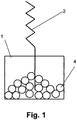
- Fig. 1 shows a tool 1 for producing an arrangement according to Fig. 1a , which comprises a flat medium 2, consisting of fibers, and a binding element 3 made of plastic, which is materially connected to the medium 2.
- the tether element 3 is and is made of a particle foam.
- foam beads 4 or granules are added, which are converted in a known manner to a tether element 3 of particle foam. During the conversion, the resulting particle foam enters into a cohesive connection with the medium 2.
- the medium 2 is designed as a nonwoven fabric. The medium 2 is pleated.
- Fig. 2 shows a filter element 5, comprising an arrangement of the type described above, wherein the medium 2 is designed as a filter medium.
- the medium 2 is designed as a nonwoven fabric.
- the medium 2 is pleated and forms a bellows.
- the tying element 3 is a flat side strip educated.
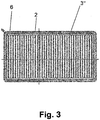
- Fig. 3 shows a substantially rectangular filter element 6, in which the attachment element 3 "is formed as a frame which surrounds the medium 2.
- the medium 2 is designed and folded as a filter medium.
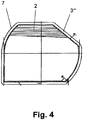
- Fig. 4 shows a further filter element 7, in which the attachment element 3 '"is formed as a frame which surrounds the medium around 2.
- the medium 2 is designed and folded as a filter medium.
Landscapes
- Chemical & Material Sciences (AREA)
- Chemical Kinetics & Catalysis (AREA)
- Filtering Materials (AREA)
- Filtering Of Dispersed Particles In Gases (AREA)
Description
- Die Erfindung betrifft ein Filterelement gemäß dem Oberbegriff des Patentanspruchs 1.
- Aus der
DE 199 58 344 A1 ist eine Anordnung bekannt, die ein flächiges Medium, bestehend aus Fasern, und ein Anbindeelement aus Kunststoff umfasst, welches mit dem Medium stoffschlüssig und/ oder kraftschlüssig verbunden ist. Bei dem Medium handelt es sich konkret um einen Faltenbalg aus Vliesstoff, der Kunststoff ist spritzgießbar. - Aus dem Stand der Technik sind neben spritzgießbaren Kunststoffen auch Partikelschäume bekannt. Partikelschäume bestehen aus Schaumperlen aus thermoplastischen Kunststoffen. Diese weisen üblicherweise Dichten im Bereich von 15 bis 80 kg/m3 auf. Partikelschäume zeigen gute mechanische Eigenschaften, eine hohe thermische Isolierfähigkeit und sind für Leichtbauten gut geeignet. Die Schaumperlen können mit Hilfe von Wasserdampf zu Formteilen geformt werden.
- Vor diesem Hintergrund ist konkret bekannt, Polystyrolgranulat, in welchem das Treibmittel Pentan einpolymerisiert ist, mit Temperaturen über 100°C zu behandeln. Während der Behandlung verdampft das Pentan und bläht das thermoplastische Granulat zu Polystyrol-Schaumperlen auf. Aus diesen Schaumperlen können dann in diskontinuierlich oder kontinuierlich arbeitenden Werkzeugen durch eine Heißdampfbehandlung Blöcke, Platten oder Formteile hergestellt werden. Schaumperlen für Partikelschäume können beispielsweise aus EPE (expandiertes Polyethylen), EPP (expandiertes Polypropylen) oder aus thermoplastischen Kunststoffen bestehen.
- Ein Verfahren zur Herstellung von Formteilen aus Partikelschäumen ist aus der
EP 1 299 219 B1 bekannt geworden. Diese Formteile werden mit einer Deckschicht aus einem Polymer verbunden. - Aus der
DE 10 2011 078 668 A1 ist bekannt geworden, eine spritzgusstechnisch gefertigte Hartschale stoffschlüssig mit einem Partikelschaum zu verbinden.DE 20 2005 019611 U1 offenbart ein Filterelement mit plissiertem Medium, welches einen Seitenstreifen aus Partikelschaum aufweist. DieDE 2449330 offenbart einen Filter mit Filterbeuteln, deren Ränder innerhalb eines umlaufenden Hohlrahmens mittels Partikelschaum abgedichtet sind. - Die eingangs erwähnten spritzgießbaren Kunststoffe sind nur unter Verwendung relativ teurer Werkzeuge verarbeitbar.
- Der Erfindung liegt daher die Aufgabe zugrunde, eine Anordnung der eingangs genannten Art derart auszugestalten und weiter zu bilden, dass diese nach kostengünstiger Fertigung ein geringes Gewicht aufweist und mit stabilen und elastischen Anbindeelementen versehen ist.
- Die vorliegende Erfindung löst die zuvor genannte Aufgabe durch die Merkmale des Patentanspruchs 1.
- Erfindungsgemäß ist zunächst erkannt worden, dass Anbindeelemente aus Partikelschaum eine hohe Elastizität aufweisen. Darauf ist erkannt worden, dass solche Anbindeelemente sehr gute Körperschalleigenschaften zeigen, nämlich aufgrund ihrer Weichheit Körperschall schlecht transportieren. Weiter ist erkannt worden, dass Anbindeelemente aus Partikelschäumen sehr leicht sind, eine glatte Oberfläche aufweisen und der gesamten Anordnung ein geringes Gewicht verleihen. Schließlich ist erkannt worden, dass Partikelschäume leicht nachbearbeitbar sind. Insoweit ist eine Anordnung angegeben, die nach kostengünstiger Fertigung ein geringes Gewicht aufweist und mit stabilen und elastischen Anbindeelementen versehen ist. Das Medium ist plissiert. Hierdurch kann das Medium einen Faltenbalg ausbilden. Durch die Falten wird die Filterfläche pro Volumen erhöht.
- Ein Anbindeelement ist als Rahmen ausgebildet, welcher das Medium ringsum umgibt. Ein Rahmen kann das Medium, insbesondere einen Faltenbalg, stabilisieren. Des Weiteren kann der Rahmen als Formteil ausgebildet sein, welches komplementär zu einem Gehäuse ausgebildet ist. Durch Verwendung eines Rahmens aus einem Partikelschaum können Werkzeugkosten für Spritzgießmaschinen eingespart werden. Überdies sind Rahmen aus Partikelschäumen leichter als spritzgegossene Rahmen und reduzieren Körperschallübertragungen. Außerdem kann auf umschäumte Rahmen aus Polyurethan verzichtet werden, welche relativ hohe Kosten verursachen und hohe Arbeitsschutzmaßnahmen erfordern.
- Folglich ist die eingangs genannte Aufgabe gelöst.
- Das Medium könnte mehrlagig und/ oder mehrschichtig ausgestaltet sein. Hierdurch können sogenannte Kombifilter erzeugt werden, die Partikel und Gerüche adsorbieren. Die stoffschlüssige Verbindung des Anbindeelements gelingt überraschenderweise auch bei mehrlagigen flächigen Medien. Daher sind Kombinationen aus flächigen Lagen zu Flächengebilden zur Partikelabscheidung, beispielsweise Kombinationen aus Papieren, Spinn- und Stapelfaservliesen, denkbar. Es ist auch denkbar, adsorptive Flächengebilde anzufertigen, beispielsweise Lagen aus Aktivkohle, Zeolithen, Silikagelen und/ oder chemisch und/ oder physikalisch wirksame Schichten zu kombinieren.
- Das Medium könnte als Vliesstoff ausgestaltet sein oder einen Vliesstoff aufweisen. Durch diese konkrete Ausgestaltung kann die Anordnung als Filterelement verwendet werden. Überraschend wurde erkannt, dass Partikelschäume relativ problemlos mit Vliesstoffen verbunden werden können, obwohl bei der Fertigung des Partikelschaums hohe Temperaturen auftreten können. Der Fachmann hätte erwartet, dass ein Vliesstoff bei diesen Temperaturen schmilzt und Schaden nimmt. Diese Vorurteile der Fachwelt wurden erfolgreich überwunden.
- Vor diesem Hintergrund könnte das Medium als Papier ausgestaltet sein oder ein Papier aufweisen. Papiere sind sehr gut als Filtermedium geeignet und können überraschend gut mit Partikelschäumen stoffschlüssig oder kraftschlüssig verbunden werden.
- Ein Anbindeelement könnte als Dichtung ausgebildet sein. Hierdurch kann ein Medium, insbesondere ein Filtermedium, gegen Gehäusewände, insbesondere eines Filtergehäuses, abgedichtet werden.
- Ein Anbindeelement könnte als flächiger Seitenstreifen ausgebildet sein. Durch diese Maßnahme können geklebte Seitenstreifen, welche üblicherweise aus einem Vliesstoff bestehen, eingespart werden. Klebeverbindungen, die zu schlechten Leckagewerten führen, können so vermieden werden. Außerdem können übliche Klebeverbindungen bei 100 °C gelöst werden. Partikelschäume sind hingegen weitaus temperaturbeständiger. Bevorzugt weist ein solcher Seitenstreifen eine Dicke von 3 mm auf.
- Ein Filterelement könnte eine Anordnung der hier beschriebenen Art umfassen, wobei das Medium als Filtermedium ausgestaltet ist. Solche Filterelemente zeigen ein sehr geringes Gewicht und eine hohe Stabilität. Die Filterelemente können zur Filterung von Motorzuluft, zur Filterung von Luft von Innenräumen, als Luftfilter und als Flüssigkeitsfilter verwendet werden. Die Filterelemente können in Kraftfahrzeugen verwendet werden.
- Partikelschäume können in unterschiedlichen Farben verwendet werden. Partikelschäume sind gemeinsam mit dem Medium leicht recyclebar, wenn das Medium und der Partikelschaum aus dem gleichen Polymer, beispielsweise Polypropylen, bestehen.
- In der Zeichnung zeigen
- Fig. 1
- ein Werkzeug, in welchem Granulat und/ oder Schaumperlen und ein flächiges Medium aufgenommen sind, wobei das Granulat bzw. die Schaumperlen derart behandelbar ist bzw. sind, dass das flächige Medium von einem Partikelschaum stoffschlüssig aufgenommen wird,
- Fig. 1a
- eine Anordnung, welche durch das Werkzeug gemäß
Fig. 1 hergestellt ist, - Fig. 2
- eine Schnittansicht eines Filterelements, an dessen Seiten Seitenstreifen und Dichtungen aus Partikelschaum angeordnet sind,
- Fig. 3
- eine Draufsicht auf ein rechteckiges Filterelement, dessen Faltenbalg von einem Rahmen aus Partikelschaum ringsum eingefasst ist, und
- Fig. 4
- eine Draufsicht auf ein unregelmäßig geformtes Filterelement, dessen Faltenbalg von einem Rahmen aus Partikelschaum ringsum eingefasst ist.
-
Fig. 1 zeigt ein Werkzeug 1 zur Herstellung einer Anordnung gemäßFig. 1a , welche ein flächiges Medium 2, bestehend aus Fasern, und ein Anbindeelement 3 aus Kunststoff umfasst, welches mit dem Medium 2 stoffschlüssig verbunden ist. Das Anbindeelement 3 wird und ist aus einem Partikelschaum gefertigt. - Im Werkzeug 1 sind Schaumperlen 4 oder Granulat aufgenommen, welche in bekannter Weise zu einem Anbindeelement 3 aus Partikelschaum umgewandelt werden. Während der Umwandlung geht der entstehende Partikelschaum eine stoffschlüssige Verbindung mit dem Medium 2 ein. Das Medium 2 ist als Vliesstoff ausgestaltet. Das Medium 2 ist plissiert.
-
Fig. 2 zeigt ein Filterelement 5, umfassend eine Anordnung der zuvor beschriebenen Art, wobei das Medium 2 als Filtermedium ausgestaltet ist. Das Medium 2 ist als Vliesstoff ausgestaltet. Das Medium 2 ist plissiert und bildet einen Faltenbalg. Das Anbindeelement 3 ist als flächiger Seitenstreifen ausgebildet. Es ist ein weiteres Anbindeelement 3' vorgesehen, welches als Dichtung ausgebildet ist. -
Fig. 3 zeigt ein im Wesentlichen rechteckiges Filterelement 6, bei welchem das Anbindeelement 3" als Rahmen ausgebildet ist, welcher das Medium 2 ringsum umgibt. Das Medium 2 ist als Filtermedium ausgestaltet und gefaltet. -
Fig. 4 zeigt ein weiteres Filterelement 7, bei welchem das Anbindeelement 3'" als Rahmen ausgebildet ist, welcher das Medium 2 ringsum umgibt. Das Medium 2 ist als Filtermedium ausgestaltet und gefaltet.
Claims (4)
- Filterelement (5), umfassend eine Anordnung, mit einem flächigen Medium (2) als Filtermedium, bestehend aus Fasern und mit einem Anbindeelement (3, 3', 3", 3"') aus Kunststoff, welches mit dem Medium (2) stoffschlüssig verbunden ist,
wobei das Anbindeelement (3, 3', 3", 3"') aus einem Partikelschaum gefertigt ist, wobei die stoffschlüssige Verbindung des Mediums (2) mit dem Anbindelement (3, 3', 3", 3"') während der Umwandlung des Partikelschaums erfolgt ist,
dadurch gekennzeichnet, dass
das Medium (2) plissiert ist und, dass das Anbindeelement (3", 3"') als Rahmen ausgebildet ist, welcher das Medium (2) ganz oder teilweise ringsum umgibt. - Filterelement nach Anspruch 1, dadurch gekennzeichnet, dass das Medium (2) mehrlagig und/ oder mehrschichtig ausgestaltet ist.
- Filterelement nach Anspruch 1 oder 2, dadurch gekennzeichnet, dass das Medium (2) als Vliesstoff ausgestaltet ist oder einen Vliesstoff aufweist.
- Filterelement nach einem der voranstehenden Ansprüche, dadurch gekennzeichnet, dass das Medium (2) als Papier ausgestaltet ist oder Papier aufweist.
Applications Claiming Priority (2)
| Application Number | Priority Date | Filing Date | Title |
|---|---|---|---|
| DE102013010777.6A DE102013010777A1 (de) | 2013-06-28 | 2013-06-28 | Flächiges Medium mit einem Anbindeelement |
| PCT/EP2014/001439 WO2014206522A1 (de) | 2013-06-28 | 2014-05-28 | Flächiges medium mit einem anbindeelement |
Publications (2)
| Publication Number | Publication Date |
|---|---|
| EP3013452A1 EP3013452A1 (de) | 2016-05-04 |
| EP3013452B1 true EP3013452B1 (de) | 2019-12-11 |
Family
ID=51225487
Family Applications (1)
| Application Number | Title | Priority Date | Filing Date |
|---|---|---|---|
| EP14743989.7A Active EP3013452B1 (de) | 2013-06-28 | 2014-05-28 | Flächiges medium mit einem anbindeelement |
Country Status (4)
| Country | Link |
|---|---|
| EP (1) | EP3013452B1 (de) |
| CN (1) | CN105339069B (de) |
| DE (1) | DE102013010777A1 (de) |
| WO (1) | WO2014206522A1 (de) |
Citations (1)
| Publication number | Priority date | Publication date | Assignee | Title |
|---|---|---|---|---|
| DE2449330A1 (de) * | 1974-10-17 | 1976-04-22 | Trox Gmbh Geb | Beutelfilter |
Family Cites Families (9)
| Publication number | Priority date | Publication date | Assignee | Title |
|---|---|---|---|---|
| DE19908486A1 (de) * | 1999-02-26 | 2000-08-31 | Wacker Polymer Systems Gmbh | Verfahren zur Kaschierung von textilen Flächengebilden auf expandierendem Partikelschaum oder geschäumte Formteile |
| DE19958344C2 (de) | 1999-12-03 | 2001-12-20 | Freudenberg Carl Fa | Werkzeug zur Herstellung einer Filterkassette mit Faltenbalg und Kunststoffrahmen |
| DE10033877A1 (de) | 2000-07-12 | 2002-03-14 | Fraunhofer Ges Forschung | Verfahren zur Herstellung von Formteilen aus Partikelschaum mit einer Deckschicht |
| DE10253825A1 (de) * | 2002-11-18 | 2004-05-27 | Fagerdala Deutschland Gmbh | Verfahren zur Herstellung eines Werkstoffverbundes |
| DE102004039312A1 (de) * | 2004-08-13 | 2006-03-16 | Avw Systemtechnik Gmbh | Verfahren und Vorrichtung zur Befestigung eines Kunststoffteils an einem Trägerteil |
| DE202005019611U1 (de) * | 2005-07-01 | 2006-02-23 | Helsa-Automotive Gmbh & Co. Kg | Filterelement mit einem zick-zack-förmig gefalteten plattenförmigen Faltenpack |
| DE102006007182A1 (de) * | 2006-02-15 | 2007-08-23 | Carl Freudenberg Kg | Filterelement und Anordnung |
| CN201470263U (zh) * | 2009-08-19 | 2010-05-19 | 长春科德宝·宝翎滤清器有限公司 | 一种滤芯 |
| DE102011078668A1 (de) | 2011-07-05 | 2013-01-10 | Ruch Novaplast Gmbh + Co. Kg | Verfahren zur Herstellung eines Werkstückes |
-
2013
- 2013-06-28 DE DE102013010777.6A patent/DE102013010777A1/de not_active Ceased
-
2014
- 2014-05-28 EP EP14743989.7A patent/EP3013452B1/de active Active
- 2014-05-28 WO PCT/EP2014/001439 patent/WO2014206522A1/de not_active Ceased
- 2014-05-28 CN CN201480036385.5A patent/CN105339069B/zh not_active Expired - Fee Related
Patent Citations (1)
| Publication number | Priority date | Publication date | Assignee | Title |
|---|---|---|---|---|
| DE2449330A1 (de) * | 1974-10-17 | 1976-04-22 | Trox Gmbh Geb | Beutelfilter |
Also Published As
| Publication number | Publication date |
|---|---|
| CN105339069B (zh) | 2018-08-31 |
| DE102013010777A1 (de) | 2014-12-31 |
| EP3013452A1 (de) | 2016-05-04 |
| CN105339069A (zh) | 2016-02-17 |
| WO2014206522A1 (de) | 2014-12-31 |
Similar Documents
| Publication | Publication Date | Title |
|---|---|---|
| EP3586939B1 (de) | Luftfilter für die innenraumluft von kabinen von fahrzeugen, land-, bau- und arbeitsmaschinen | |
| EP2507083B2 (de) | Filterelement und verfahren zum herstellen eines filterelements | |
| DE69010843T2 (de) | Sonnenblende und ihr Herstellungsverfahren. | |
| DE112014002458B4 (de) | Luftfilterelement für die Innenraumluft von Kabinen von Fahrzeugen, Land-, Bau- und Arbeitsmaschinen, Luftfiltersystem und Verfahren | |
| EP2135662B2 (de) | Komprimierbares Filterelement mit zueinander geneigten Endkappen | |
| EP2739469B1 (de) | Innenausstattungsteil aufweisend pflanzliche naturstoffe | |
| EP3471855B1 (de) | Filterelement, filteranordnung und verfahren | |
| DE4323136C2 (de) | Filtereinsatz für Luftfilter | |
| DE102016006073A1 (de) | Brennstoffzellen-Filterelement und Brennstoffzellen-Filtersystem mit einem Brennstoffzellen-Filterelement | |
| EP1984094B1 (de) | Verwendung eines filterelements | |
| EP0623377B1 (de) | Filterelement | |
| DE102016015062A1 (de) | Filterelement, insbesondere zur Gasfiltration | |
| DE102013010777A1 (de) | Flächiges Medium mit einem Anbindeelement | |
| DE102015014017A1 (de) | Partikelfilter sowie Verfahren zu dessen Herstellung | |
| EP4003570B1 (de) | Filterelement, innenraumluftfilter und herstellungsverfahren | |
| DE202006020359U1 (de) | Bauteil aus Verbundwerkstoff, beispielsweise eine Platte, mit einer bienenwabenartigen Zellstruktur | |
| DE29603564U1 (de) | Verbundwerkstoff | |
| DE20006192U1 (de) | Formteil | |
| DE102010047894A1 (de) | Filterelement und Verfahren zu dessen Herstellung | |
| EP1867378B1 (de) | Komprimierbares Filterelement | |
| EP1779916A1 (de) | Extrudierte Dichtung | |
| EP1289823A1 (de) | Aussen- oder innenausstattungsteil für kraftfahrzeuge | |
| DE102009034561A1 (de) | Filterelement | |
| EP2960108A1 (de) | Sitzbezug, fahrzeugsitz damit und verfahren zu deren herstellung | |
| DE102019102663A1 (de) | Aktivmaterialbehälter, insbesondere Trockenmittelbehälter, Batteriegehäuse und Verfahren zur Herstellung des Aktivmaterialbehälters |
Legal Events
| Date | Code | Title | Description |
|---|---|---|---|
| PUAI | Public reference made under article 153(3) epc to a published international application that has entered the european phase |
Free format text: ORIGINAL CODE: 0009012 |
|
| 17P | Request for examination filed |
Effective date: 20151104 |
|
| AK | Designated contracting states |
Kind code of ref document: A1 Designated state(s): AL AT BE BG CH CY CZ DE DK EE ES FI FR GB GR HR HU IE IS IT LI LT LU LV MC MK MT NL NO PL PT RO RS SE SI SK SM TR |
|
| AX | Request for extension of the european patent |
Extension state: BA ME |
|
| DAX | Request for extension of the european patent (deleted) | ||
| STAA | Information on the status of an ep patent application or granted ep patent |
Free format text: STATUS: EXAMINATION IS IN PROGRESS |
|
| 17Q | First examination report despatched |
Effective date: 20181105 |
|
| GRAP | Despatch of communication of intention to grant a patent |
Free format text: ORIGINAL CODE: EPIDOSNIGR1 |
|
| STAA | Information on the status of an ep patent application or granted ep patent |
Free format text: STATUS: GRANT OF PATENT IS INTENDED |
|
| INTG | Intention to grant announced |
Effective date: 20190717 |
|
| GRAS | Grant fee paid |
Free format text: ORIGINAL CODE: EPIDOSNIGR3 |
|
| GRAA | (expected) grant |
Free format text: ORIGINAL CODE: 0009210 |
|
| STAA | Information on the status of an ep patent application or granted ep patent |
Free format text: STATUS: THE PATENT HAS BEEN GRANTED |
|
| AK | Designated contracting states |
Kind code of ref document: B1 Designated state(s): AL AT BE BG CH CY CZ DE DK EE ES FI FR GB GR HR HU IE IS IT LI LT LU LV MC MK MT NL NO PL PT RO RS SE SI SK SM TR |
|
| REG | Reference to a national code |
Ref country code: GB Ref legal event code: FG4D Free format text: NOT ENGLISH |
|
| REG | Reference to a national code |
Ref country code: CH Ref legal event code: EP |
|
| REG | Reference to a national code |
Ref country code: AT Ref legal event code: REF Ref document number: 1211620 Country of ref document: AT Kind code of ref document: T Effective date: 20191215 |
|
| REG | Reference to a national code |
Ref country code: IE Ref legal event code: FG4D Free format text: LANGUAGE OF EP DOCUMENT: GERMAN |
|
| REG | Reference to a national code |
Ref country code: DE Ref legal event code: R096 Ref document number: 502014013238 Country of ref document: DE |
|
| REG | Reference to a national code |
Ref country code: NL Ref legal event code: MP Effective date: 20191211 |
|
| REG | Reference to a national code |
Ref country code: LT Ref legal event code: MG4D |
|
| PG25 | Lapsed in a contracting state [announced via postgrant information from national office to epo] |
Ref country code: LV Free format text: LAPSE BECAUSE OF FAILURE TO SUBMIT A TRANSLATION OF THE DESCRIPTION OR TO PAY THE FEE WITHIN THE PRESCRIBED TIME-LIMIT Effective date: 20191211 Ref country code: SE Free format text: LAPSE BECAUSE OF FAILURE TO SUBMIT A TRANSLATION OF THE DESCRIPTION OR TO PAY THE FEE WITHIN THE PRESCRIBED TIME-LIMIT Effective date: 20191211 Ref country code: GR Free format text: LAPSE BECAUSE OF FAILURE TO SUBMIT A TRANSLATION OF THE DESCRIPTION OR TO PAY THE FEE WITHIN THE PRESCRIBED TIME-LIMIT Effective date: 20200312 Ref country code: NO Free format text: LAPSE BECAUSE OF FAILURE TO SUBMIT A TRANSLATION OF THE DESCRIPTION OR TO PAY THE FEE WITHIN THE PRESCRIBED TIME-LIMIT Effective date: 20200311 Ref country code: FI Free format text: LAPSE BECAUSE OF FAILURE TO SUBMIT A TRANSLATION OF THE DESCRIPTION OR TO PAY THE FEE WITHIN THE PRESCRIBED TIME-LIMIT Effective date: 20191211 Ref country code: BG Free format text: LAPSE BECAUSE OF FAILURE TO SUBMIT A TRANSLATION OF THE DESCRIPTION OR TO PAY THE FEE WITHIN THE PRESCRIBED TIME-LIMIT Effective date: 20200311 Ref country code: LT Free format text: LAPSE BECAUSE OF FAILURE TO SUBMIT A TRANSLATION OF THE DESCRIPTION OR TO PAY THE FEE WITHIN THE PRESCRIBED TIME-LIMIT Effective date: 20191211 |
|
| PG25 | Lapsed in a contracting state [announced via postgrant information from national office to epo] |
Ref country code: RS Free format text: LAPSE BECAUSE OF FAILURE TO SUBMIT A TRANSLATION OF THE DESCRIPTION OR TO PAY THE FEE WITHIN THE PRESCRIBED TIME-LIMIT Effective date: 20191211 Ref country code: HR Free format text: LAPSE BECAUSE OF FAILURE TO SUBMIT A TRANSLATION OF THE DESCRIPTION OR TO PAY THE FEE WITHIN THE PRESCRIBED TIME-LIMIT Effective date: 20191211 |
|
| PG25 | Lapsed in a contracting state [announced via postgrant information from national office to epo] |
Ref country code: AL Free format text: LAPSE BECAUSE OF FAILURE TO SUBMIT A TRANSLATION OF THE DESCRIPTION OR TO PAY THE FEE WITHIN THE PRESCRIBED TIME-LIMIT Effective date: 20191211 |
|
| PG25 | Lapsed in a contracting state [announced via postgrant information from national office to epo] |
Ref country code: EE Free format text: LAPSE BECAUSE OF FAILURE TO SUBMIT A TRANSLATION OF THE DESCRIPTION OR TO PAY THE FEE WITHIN THE PRESCRIBED TIME-LIMIT Effective date: 20191211 Ref country code: PT Free format text: LAPSE BECAUSE OF FAILURE TO SUBMIT A TRANSLATION OF THE DESCRIPTION OR TO PAY THE FEE WITHIN THE PRESCRIBED TIME-LIMIT Effective date: 20200506 Ref country code: ES Free format text: LAPSE BECAUSE OF FAILURE TO SUBMIT A TRANSLATION OF THE DESCRIPTION OR TO PAY THE FEE WITHIN THE PRESCRIBED TIME-LIMIT Effective date: 20191211 Ref country code: CZ Free format text: LAPSE BECAUSE OF FAILURE TO SUBMIT A TRANSLATION OF THE DESCRIPTION OR TO PAY THE FEE WITHIN THE PRESCRIBED TIME-LIMIT Effective date: 20191211 Ref country code: NL Free format text: LAPSE BECAUSE OF FAILURE TO SUBMIT A TRANSLATION OF THE DESCRIPTION OR TO PAY THE FEE WITHIN THE PRESCRIBED TIME-LIMIT Effective date: 20191211 Ref country code: RO Free format text: LAPSE BECAUSE OF FAILURE TO SUBMIT A TRANSLATION OF THE DESCRIPTION OR TO PAY THE FEE WITHIN THE PRESCRIBED TIME-LIMIT Effective date: 20191211 |
|
| PGFP | Annual fee paid to national office [announced via postgrant information from national office to epo] |
Ref country code: DE Payment date: 20200526 Year of fee payment: 7 |
|
| PG25 | Lapsed in a contracting state [announced via postgrant information from national office to epo] |
Ref country code: SM Free format text: LAPSE BECAUSE OF FAILURE TO SUBMIT A TRANSLATION OF THE DESCRIPTION OR TO PAY THE FEE WITHIN THE PRESCRIBED TIME-LIMIT Effective date: 20191211 Ref country code: IS Free format text: LAPSE BECAUSE OF FAILURE TO SUBMIT A TRANSLATION OF THE DESCRIPTION OR TO PAY THE FEE WITHIN THE PRESCRIBED TIME-LIMIT Effective date: 20200411 Ref country code: SK Free format text: LAPSE BECAUSE OF FAILURE TO SUBMIT A TRANSLATION OF THE DESCRIPTION OR TO PAY THE FEE WITHIN THE PRESCRIBED TIME-LIMIT Effective date: 20191211 |
|
| REG | Reference to a national code |
Ref country code: DE Ref legal event code: R097 Ref document number: 502014013238 Country of ref document: DE |
|
| PLBE | No opposition filed within time limit |
Free format text: ORIGINAL CODE: 0009261 |
|
| STAA | Information on the status of an ep patent application or granted ep patent |
Free format text: STATUS: NO OPPOSITION FILED WITHIN TIME LIMIT |
|
| PG25 | Lapsed in a contracting state [announced via postgrant information from national office to epo] |
Ref country code: DK Free format text: LAPSE BECAUSE OF FAILURE TO SUBMIT A TRANSLATION OF THE DESCRIPTION OR TO PAY THE FEE WITHIN THE PRESCRIBED TIME-LIMIT Effective date: 20191211 |
|
| 26N | No opposition filed |
Effective date: 20200914 |
|
| PG25 | Lapsed in a contracting state [announced via postgrant information from national office to epo] |
Ref country code: SI Free format text: LAPSE BECAUSE OF FAILURE TO SUBMIT A TRANSLATION OF THE DESCRIPTION OR TO PAY THE FEE WITHIN THE PRESCRIBED TIME-LIMIT Effective date: 20191211 |
|
| PG25 | Lapsed in a contracting state [announced via postgrant information from national office to epo] |
Ref country code: MC Free format text: LAPSE BECAUSE OF FAILURE TO SUBMIT A TRANSLATION OF THE DESCRIPTION OR TO PAY THE FEE WITHIN THE PRESCRIBED TIME-LIMIT Effective date: 20191211 Ref country code: CH Free format text: LAPSE BECAUSE OF NON-PAYMENT OF DUE FEES Effective date: 20200531 Ref country code: IT Free format text: LAPSE BECAUSE OF FAILURE TO SUBMIT A TRANSLATION OF THE DESCRIPTION OR TO PAY THE FEE WITHIN THE PRESCRIBED TIME-LIMIT Effective date: 20191211 Ref country code: LI Free format text: LAPSE BECAUSE OF NON-PAYMENT OF DUE FEES Effective date: 20200531 |
|
| PG25 | Lapsed in a contracting state [announced via postgrant information from national office to epo] |
Ref country code: PL Free format text: LAPSE BECAUSE OF FAILURE TO SUBMIT A TRANSLATION OF THE DESCRIPTION OR TO PAY THE FEE WITHIN THE PRESCRIBED TIME-LIMIT Effective date: 20191211 |
|
| REG | Reference to a national code |
Ref country code: BE Ref legal event code: MM Effective date: 20200531 |
|
| GBPC | Gb: european patent ceased through non-payment of renewal fee |
Effective date: 20200528 |
|
| PG25 | Lapsed in a contracting state [announced via postgrant information from national office to epo] |
Ref country code: LU Free format text: LAPSE BECAUSE OF NON-PAYMENT OF DUE FEES Effective date: 20200528 |
|
| PG25 | Lapsed in a contracting state [announced via postgrant information from national office to epo] |
Ref country code: IE Free format text: LAPSE BECAUSE OF NON-PAYMENT OF DUE FEES Effective date: 20200528 Ref country code: GB Free format text: LAPSE BECAUSE OF NON-PAYMENT OF DUE FEES Effective date: 20200528 Ref country code: FR Free format text: LAPSE BECAUSE OF NON-PAYMENT OF DUE FEES Effective date: 20200531 |
|
| PG25 | Lapsed in a contracting state [announced via postgrant information from national office to epo] |
Ref country code: BE Free format text: LAPSE BECAUSE OF NON-PAYMENT OF DUE FEES Effective date: 20200531 |
|
| REG | Reference to a national code |
Ref country code: AT Ref legal event code: MM01 Ref document number: 1211620 Country of ref document: AT Kind code of ref document: T Effective date: 20200528 |
|
| PG25 | Lapsed in a contracting state [announced via postgrant information from national office to epo] |
Ref country code: AT Free format text: LAPSE BECAUSE OF NON-PAYMENT OF DUE FEES Effective date: 20200528 |
|
| REG | Reference to a national code |
Ref country code: DE Ref legal event code: R119 Ref document number: 502014013238 Country of ref document: DE |
|
| PG25 | Lapsed in a contracting state [announced via postgrant information from national office to epo] |
Ref country code: DE Free format text: LAPSE BECAUSE OF NON-PAYMENT OF DUE FEES Effective date: 20211201 |
|
| PG25 | Lapsed in a contracting state [announced via postgrant information from national office to epo] |
Ref country code: TR Free format text: LAPSE BECAUSE OF FAILURE TO SUBMIT A TRANSLATION OF THE DESCRIPTION OR TO PAY THE FEE WITHIN THE PRESCRIBED TIME-LIMIT Effective date: 20191211 Ref country code: MT Free format text: LAPSE BECAUSE OF FAILURE TO SUBMIT A TRANSLATION OF THE DESCRIPTION OR TO PAY THE FEE WITHIN THE PRESCRIBED TIME-LIMIT Effective date: 20191211 Ref country code: CY Free format text: LAPSE BECAUSE OF FAILURE TO SUBMIT A TRANSLATION OF THE DESCRIPTION OR TO PAY THE FEE WITHIN THE PRESCRIBED TIME-LIMIT Effective date: 20191211 |
|
| PG25 | Lapsed in a contracting state [announced via postgrant information from national office to epo] |
Ref country code: MK Free format text: LAPSE BECAUSE OF FAILURE TO SUBMIT A TRANSLATION OF THE DESCRIPTION OR TO PAY THE FEE WITHIN THE PRESCRIBED TIME-LIMIT Effective date: 20191211 |