EP3013313B1 - Nicht reizende und nicht bleichende lichtschutzzusammensetzungen - Google Patents
Nicht reizende und nicht bleichende lichtschutzzusammensetzungen Download PDFInfo
- Publication number
- EP3013313B1 EP3013313B1 EP14725296.9A EP14725296A EP3013313B1 EP 3013313 B1 EP3013313 B1 EP 3013313B1 EP 14725296 A EP14725296 A EP 14725296A EP 3013313 B1 EP3013313 B1 EP 3013313B1
- Authority
- EP
- European Patent Office
- Prior art keywords
- photoprotective composition
- photoprotective
- composition
- amount
- equal
- Prior art date
- Legal status (The legal status is an assumption and is not a legal conclusion. Google has not performed a legal analysis and makes no representation as to the accuracy of the status listed.)
- Active
Links
Images
Classifications
-
- A—HUMAN NECESSITIES
- A61—MEDICAL OR VETERINARY SCIENCE; HYGIENE
- A61Q—SPECIFIC USE OF COSMETICS OR SIMILAR TOILETRY PREPARATIONS
- A61Q17/00—Barrier preparations; Preparations brought into direct contact with the skin for affording protection against external influences, e.g. sunlight, X-rays or other harmful rays, corrosive materials, bacteria or insect stings
- A61Q17/04—Topical preparations for affording protection against sunlight or other radiation; Topical sun tanning preparations
-
- A—HUMAN NECESSITIES
- A61—MEDICAL OR VETERINARY SCIENCE; HYGIENE
- A61K—PREPARATIONS FOR MEDICAL, DENTAL OR TOILETRY PURPOSES
- A61K8/00—Cosmetics or similar toiletry preparations
- A61K8/18—Cosmetics or similar toiletry preparations characterised by the composition
- A61K8/30—Cosmetics or similar toiletry preparations characterised by the composition containing organic compounds
- A61K8/31—Hydrocarbons
-
- A—HUMAN NECESSITIES
- A61—MEDICAL OR VETERINARY SCIENCE; HYGIENE
- A61K—PREPARATIONS FOR MEDICAL, DENTAL OR TOILETRY PURPOSES
- A61K8/00—Cosmetics or similar toiletry preparations
- A61K8/18—Cosmetics or similar toiletry preparations characterised by the composition
- A61K8/30—Cosmetics or similar toiletry preparations characterised by the composition containing organic compounds
- A61K8/33—Cosmetics or similar toiletry preparations characterised by the composition containing organic compounds containing oxygen
- A61K8/37—Esters of carboxylic acids
-
- A—HUMAN NECESSITIES
- A61—MEDICAL OR VETERINARY SCIENCE; HYGIENE
- A61K—PREPARATIONS FOR MEDICAL, DENTAL OR TOILETRY PURPOSES
- A61K8/00—Cosmetics or similar toiletry preparations
- A61K8/18—Cosmetics or similar toiletry preparations characterised by the composition
- A61K8/30—Cosmetics or similar toiletry preparations characterised by the composition containing organic compounds
- A61K8/33—Cosmetics or similar toiletry preparations characterised by the composition containing organic compounds containing oxygen
- A61K8/37—Esters of carboxylic acids
- A61K8/375—Esters of carboxylic acids the alcohol moiety containing more than one hydroxy group
-
- A—HUMAN NECESSITIES
- A61—MEDICAL OR VETERINARY SCIENCE; HYGIENE
- A61K—PREPARATIONS FOR MEDICAL, DENTAL OR TOILETRY PURPOSES
- A61K8/00—Cosmetics or similar toiletry preparations
- A61K8/18—Cosmetics or similar toiletry preparations characterised by the composition
- A61K8/72—Cosmetics or similar toiletry preparations characterised by the composition containing organic macromolecular compounds
- A61K8/84—Cosmetics or similar toiletry preparations characterised by the composition containing organic macromolecular compounds obtained by reactions otherwise than those involving only carbon-carbon unsaturated bonds
- A61K8/85—Polyesters
-
- A—HUMAN NECESSITIES
- A61—MEDICAL OR VETERINARY SCIENCE; HYGIENE
- A61K—PREPARATIONS FOR MEDICAL, DENTAL OR TOILETRY PURPOSES
- A61K2800/00—Properties of cosmetic compositions or active ingredients thereof or formulation aids used therein and process related aspects
- A61K2800/20—Chemical, physico-chemical or functional or structural properties of the composition as a whole
- A61K2800/30—Characterized by the absence of a particular group of ingredients
- A61K2800/31—Anhydrous
Definitions
- the present invention relates to photoprotective compositions with additional mildness benefits, and more specifically, to clear, liquid, anhydrous based photoprotective compositions that are mild to both ocular and dermal regions of the body.
- the compositions of the invention are as defined in the set of claims.
- UV ultraviolet
- UVA ultraviolet
- UVB ultraviolet
- Sunscreens are applied to the skin to protect the skin from the sun's ultraviolet rays that can lead to erythema (sunburn).
- Sunlight or ultraviolet radiation in the UVB range has a wavelength of 290 nanometers to 320 nanometers and is known to be the primary cause of sunburn.
- Ultraviolet radiation at a wavelength of 320 nanometers to 400 nanometers known as UVA radiation, can cause tanning of the skin. However, in the process of doing so, the UVA rays can damage or harm the skin.
- Mintel (record ID 898928) discloses a spray sunblock spf 50 marketed as a tear-free sunblock that provides long lasting UVA/UVB protection. It is alcohol free but is an emulsion and comprises surfactants/emulsifiers, preservatives and silicone derivatives.
- Aerosol and bag on valve (“BOV”) spray-type lotions are growing segment in the photoprotection marketplace due to dispensing convenience and more effective coverage of hard to reach areas when self-applying photoprotection product.
- the only Tear Free/Sting Free photoprotective aerosol or BOV product available to the consumer is an opaque, water-based lotion spray that needs to be shaken before use, and the liquid sprays on as an unsightly white film on wet or dry skin.
- the present disclosure provides a photoprotective composition
- a photoprotective composition comprising at least one photoactive agent, at least one aliphatic hydrocarbon; and at least one ester.
- the compositions of the invention are as defined in the set of claims.
- the present disclosure provides for a photoprotective composition that provides any or all of the following characteristics, including without limitation: is a single phase, is homogenous, is substantially non-whitening, is substantially non-irritating, is anhydrous, is water-resistant, is a skin-protectant, is substantially free of preservatives, is substantially free of surfactants, is substantially free of alcohol, is substantially free of emulsifiers, is substantially free of silicone, and any combinations thereof.
- the compositions are in the form of a flowing liquid that can be dispensed from a bottle with a suitable closure, or in a spray format such as an aerosol or pump spray.
- the one or more photoactive agents are present in an amount about 0.1 wt. % to about 40 wt. %, based on the total weight of the composition.
- the at least one aliphatic hydrocarbon is present in an amount of less than about 75 wt. %.
- the at least one ester is present in an amount less than about 75%.
- the at least one aliphatic hydrocarbon is between about 10 wt. % and about 75 wt. %.
- the at least one ester is between about 20 wt. % and about 75 wt. %.
- the photoprotective composition is a single-phase.
- the photoprotective composition does not have separate phases that could comprise without limitation, a water phase, an emulsion phase, and/or an oil phase.
- the photoprotective composition is homogenous.
- the product does not require, shaking, agitation, or other physical movement in order to dispense the photoprotective composition from a container such that the photoprotective composition is of a substantially uniform consistency.
- the photoprotective composition is substantially non-whitening.
- the photoprotective composition is sufficiently translucent, transparent, clear, or any other adjective that describes a colorless or see-through substance.
- non-whitening is defined to include without limitation the aforementioned adjectives, such as, i.e., translucent, transparent, clear, colorless or see-through.
- the photoprotective composition is substantially non-whitening upon being dispensed from a container such that the photoprotective composition is substantially non-whitening when applied to a substrate, topically, to the dermis or skin, or any other surface.
- the photoprotective composition may also be substantially non-whitening after being topically applied and having sufficient time to dry.
- the photoprotective composition may also be substantially non-whitening when applied to substantially wet or substantially dry substrates, or combinations thereof.
- the photoprotective composition is anhydrous.
- the photoprotective composition is water-resistant.
- the photoprotective composition may be suitable for sustaining water-resistance for at least forty (40) minutes.
- the photoprotective composition may be suitable for sustaining water-resistance for at least eighty (80) minutes.
- the photoprotective composition may be suitable to sustain a suitable level of photoprotection, such as but not limited to photoprotection achieving an SPF of 15, 30, 50 and/or 50+, as demonstrated by any or all of the FDA critical wavelength method, the UVAPF method, and the ISO24443 method, for a period of at least forty (40), and/or at least eighty (80) minutes.
- the photoprotective composition is a skin-protectant.
- the photoprotective composition is able to achieve one or more of the aforementioned characteristics without resorting to other chemicals or substances.
- the photoprotective composition does not contain preservatives.
- the photoprotective composition of the present disclosure is free of preservatives or preservative-free.
- the photoprotective composition does not contain surfactants.
- the photoprotective composition of the present disclosure is free of surfactants or surfactant-free.
- the photoprotective composition does not contain alcohol.
- the photoprotective composition of the present disclosure is free of alcohol or alcohol-free.
- the photoprotective composition does not contain emulsifiers.
- the photoprotective composition of the present disclosure is free of emulsifiers or emulsifier-free.
- the photoprotective composition does not contain silicone.
- the photoprotective composition of the present disclosure is free of silicone or silicone-free.
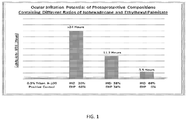
- FIG. 1 is a chart showing ocular irritation potential of photoprotective compositions
- cosmetic composition may include, but is not limited to, the following: sunscreens, dermatological compositions, make-up compositions, make-up removers, cleansers, lotions, gels, creams, sticks, balms, lip balms, powders, milks, conditioners, sprays, eye-liners, solutions, or serums.
- sunscreens dermatological compositions
- make-up compositions make-up removers
- cleansers lotions, gels, creams, sticks, balms, lip balms, powders, milks, conditioners, sprays, eye-liners, solutions, or serums.
- the present disclosure is drawn to a photoprotective composition as defined in claim 1 that comprises at least one photoactive agent, at least one aliphatic hydrocarbon, and at least one ester.
- the one or more photoactive agents comprises p -aminobenzoic acid (PABA), butyl methoxydibenzoylmethane, benzophenones, hydroxy-substituted benzophenones, methoxy-substituted benzophenones, benzophonone-1, benzophenone-2, benzophenone-3, benzophenone-4, benzophenone-6, benzophenone-8, benzophenone-12, methoxycinnamate, ethyl dihdroxypropyl-p-aminobenzoate, glyceryl-p-aminobenzoate, homosalate, methyl anthranilate, octocrylene, octyl dimethyl-p-aminobenzoate, octyl methoxycinnamate, octyl salicylate, 2 phenylbenzimidazole-5-sulphonic acid, triethanolamine salicylate, 3-(4-methyl
- the one or more photoactive agents are present in an amount about 0.1 wt. % to about 40 wt. %, based on the total weight of the photoprotective composition.
- the one or more photoactive agents comprises: homosalate (trade name PARSOL® H MS) in amount less than or equal to 15 wt. %, octisalate (trade name PARSOL EHS) in an amount less than or equal to 5 wt. %, octocrylene (trade name PARSOL 340) in an amount less than or equal to 10 wt. %, avobenzone (PARSOL 1789) in an amount less than or equal to 5 wt.
- the photoprotective composition may be sufficient with only one or two or three photoactive agents. For instance, in one embodiment, oxybenzone is not needed in order to provide a photoprotective composition.
- the at least one aliphatic hydrocarbon comprises isohexadecane (trade name PERMETHYL® 101A) or isododecane (trade name PERMETHYL 99A), and combinations thereof.
- the at least one aliphatic hydrocarbon is present in an amount less than or equal to about 75 wt. %, based on the total weight of the photoprotective composition. In another embodiment, the at least one aliphatic hydrocarbon is present in an amount of about 10 wt. % to about 75 wt. %, based on the total weight of the photoprotective composition. In yet another embodiment, the at least one aliphatic hydrocarbon is present in an amount between about 10 wt. % and about 50 wt. %, based on the total weight of the photoprotective composition.
- the aliphatic hydrocarbon comprises isohexadecane, isododecane, and combinations thereof.
- the at least one ester comprises octyldodecyl citrate cross polymer (trade name COSMOSURF® CE-100), cetearyl ethylhexanoate (trade name SCHERCEMOL 1688), ethylhexyl palmitate (trade name CERAPHYL® 368), isononyl isononanoate (trade name DERMOL 99), octyldodecyl neopentanoate (trade name ELEFAC® 1-205), isodecyl neopentanoate (trade name BERNEL Ester 105), decyl oleate (trade name CERAPHYL 140), capric triglycerides and caprylic triglycerides such as those known by trade name DERMOL M5, isopropyl myristate (trade name DERMOL IPM), and combinations thereof.
- octyldodecyl citrate cross polymer trade name COS
- the at least one ester is present in an amount less than or equal to about 75 wt. %, based on the total weight of the photoprotective composition. In another embodiment, the at least one ester is present in an amount of about 20 wt. % to about 60 wt. %, based on the total weight of the photoprotective composition.
- compositions A1, A2 and A3 are not part of the invention as claimed.
- the photoprotective composition can provide a critical wavelength of greater than or equal to 370 nm.
- in-vivo SPF very water resistance was accomplished at Harrison Research, Laboratories, Union, NJ, according to the guidance provided in 21 CFR 201.327 specifying a product application dose of 2 mg/cm 2 on human subjects. Results indicated that SPF can be boosted with adjuvants such as ethylhexyl methoxycrylene and polysilicone-15. Both in vitro and in vivo SPF test results indicate that there is essentially no difference in UVR responses between the various ratios of isohexadecane and ethylhexyl palmitate. Additionally, according to the FDA critical wavelength test method, the tested embodiments of photoprotective compositions of the present disclosure meet the minimum 370 nm critical wavelength criteria, thus establishing the broad spectrum photoprotective nature of the present disclosure's photoprotective compositions.
- compositions B2 and B3 are not part of the invention as claimed. comparison of photoprotective compositions A1 and B1 further support the ratios of isohexadecane, isododecane, and ethylhexyl palmitate are interchangeable with essentially no effect on the in vitro SPF value.
- the bemotrizinol prototype compositions did not meet the 1/3 UVA ratio according to the ISO 24443 method due to the SPF boosting provided by the addition of butyloctyl salicylate.
- the B7 embodiment of the photoprotective composition achieved the optional 1/3 UVA ratio and the SPF VWR 60.
- the photoprotective composition meets the 1/3 UVA ratio requirement of ISO 24443.
- the present disclosure's photoprotective composition is provided such that the composition is a single phase.
- the photoprotective composition is mixed in one stage (i.e., a single phase) such that multiple phases or stages where certain water, emulsion or oil phases are required in order to obtain a suitable photoprotective composition are unnecessary. As such, the number of steps that are required in manufacturing the photoprotective composition of the present disclosure are reduced.
- the photoprotective composition is homogenous such that the product does not require shaking, agitation, or other physical movement in order to dispense the photoprotective composition from a container such that the photoprotective composition is of a substantially uniform consistency. Homogeneity can be facilitated by embodiments of the present disclosure that are single phase, but homogeneity can be achieved with liquids that are not a single phase.
- the photoprotective composition is substantially non-whitening.
- the photoprotective composition is substantially non-whitening upon being dispensed from a container such that the photoprotective composition is substantially non-whitening when applied to a substrate.
- the photoprotective composition is substantially non-whitening upon removal from a canister, upon topical application, upon a significant length of time passing after topical application, or any combinations thereof.
- the photoprotective composition may also be substantially non-whitening after being topically applied and having sufficient time to dry.
- the photoprotective composition may also be substantially non-whitening when applied to substantially wet or substantially dry substrates, or combinations thereof. Said another way, the photoprotective composition is substantially non-whitening when topically applied to a substantially wet substrate, to a substantially dry substrate, or combinations thereof.
- a substantially non-whitening composition can be quantified by visual perception studies including the ability to identify/ascertain something lying below/underneath a composition.
- a substantially non-whitening liquid is defined by the ability to read font size of 10 point or less printed on a substrate onto which a liquid is applied.
- a substantially non-whitening liquid visual perception study requires being able to read a font size of 4 to 6 through 7,62cm (three (3) inches) of liquid.
- the following scale is exemplary:
- the photoprotective composition is substantially non-whitening such that 10 point Arial font can be read through 7,62cm (three (3) inches) of the photoprotective composition liquid.
- the photoprotective composition is substantially non-whitening such that 8 point Arial font can be read through 7,62cm (three (3) inches) of the photoprotective composition liquid.
- the photoprotective composition is substantially non-whitening such that 6 point Arial font can be read through 7,62cm (three (3) inches) of the photoprotective composition liquid.
- an embodiment of the photoprotective composition is substantially non-whitening such that 4 point Arial font can be read through 7,62cm (three (3) inches) of the photoprotective composition liquid.
- Another means of ascertaining of whether or not a liquid is substantially non-whitening is by how the liquid visually appears when applied to a substantially wet substrate, a substantially dry substrate, or combinations thereof.
- the liquid should not produce an opaque film upon (a) initial application of the liquid to the substrate, regardless of whether the substrate is wet, dry or combinations thereof, (b) upon being lathered, oscillated, or rubbed onto, over and/or into the substrate, (c) after a sufficient time has passed between either or both of (a) and (b) such that the substrate has had a chance to dry or settle into a finally-applied state on the substrate.
- the photoprotective composition does not produce an opaque film upon initial application to a substrate, wherein the substrate is substantially wet, substantially dry, or combinations thereof. In another embodiment, the photoprotective composition does not produce an opaque film upon lathering, oscillation, rubbing onto, over or into the substrate, wherein the substrate is substantially wet, substantially dry, or combinations thereof. In another embodiment, the photoprotective composition does not produce an opaque film after the photoprotective composition has had sufficient time to dry after (a) initial application to a substantially wet substrate, a substantially dry substrate, or combinations thereof, (b) lathering, oscillation or rubbing onto, over and into a substantially wet substrate, a substantially dry substrate, or combinations thereof, or both (a) and (b). In a preferred embodiment, the photoprotective composition never leaves an opaque film upon application to a substantially wet substrate, a substantially dry substrate, or combinations thereof.
- photoprotective compositions of the present disclosure it was observed that high levels of isohexadecane, especially those of about 70 wt. %, limited the solubility and/or compatibility of other ingredients which cause undesirable characteristics within the entire photoprotective composition such as, i.e., hazing, oily segregation, and/or precipitation from the composition, and combinations thereof. Limited solubility was observed with polyester materials and their diluents of propylene glycol dibenzoate and neopentyl glycol heptanoate. Dimethicone with a viscosity of about 350 cst at a 1 wt. % concentration, for example, causes hazing.
- a suitable amount of diluent for avobenzone became critical as crystals appeared in stability samples after storage for three (3) months at 40°C.
- finding a photoprotective composition that is substantially non-irritating and also does not cause other deleterious effects i.e., affecting homogeneity, affecting mixing of chemicals thereby instigating separation, clouding or whitening the liquid, etc. is difficult.
- the photoprotective composition is substantially non-irritating.
- the photoprotective composition is substantially non-irritating in that it is mild, or in other words, it elicits substantially no dermal irritation, such as but not limited to, i.e., sensitization, erythema, stinging, burning, itching, eczema, flaking, drying, other skin conditions and combinations thereof.
- the photoprotective composition is substantially non-irritating such that upon topical application, minimal dermal irritation is elicited.
- Dermal irritation or sensitization can be quantitatively and qualitatively ascertained through human clinical trials known as Human Repeat Insult Patch Testing (HRIPT).
- HRIPT trial(s) comprise a repeat insult patch test with a minimum of two-hundred (200) human subjects. Each human subject is qualified and thereafter participates in the study.
- Such HRIPT tests were conducted regarding several embodiments of the photoprotective composition of the present disclosure.
- the testing facility used for purposes of the present disclosure was Clinical Research Laboratories, Inc., Piscataway, NJ (CRL). Prior to applying a patch, the test area was wiped with 70% isopropyl alcohol and allowed to dry. The test material was applied to the upper back (between the scapulae) and was allowed to remain in direct skin contact for a period of twenty-four (24) hours. Patches were applied to the same site on Monday, Wednesday and Friday, for a total of nine (9) applications during the induction period.
- the sites were graded by a CRL technician for dermal irritation twenty-four (24) hours after removal of the patches by the subjects on Tuesday and Thursday and forty-eight (48) hours after removal of the patches on Saturday, unless the patching schedule was altered as described above. If a 2+ reaction or greater occurred, the test material was applied to an adjacent virgin site. If a 2+ reaction or greater occurred on the new site, the subject was not patched again during the induction phase but was challenged on the appropriate day of the study. At the discretion of the Study Director, patch sites with scores less than a 2+ may have been changed. Following approximately a two (2) week rest period, the challenge patches were applied to previously untreated test sites on the back.
- test sites were graded by CRL according to the following scoring system:
- a substantially non-irritating composition is also substantially non-whitening.
- Table 5 Human Dermal Clinical Trial Results IHD EHP Irritation Sensitization A3 73.48 % 0.00 % Several Incidences Possibly One A4 20.00 % 56.78 % No Incidences No Incidences A5 40.00 % 36.78 % No Incidences No Incidences IHD isohexadecane
- EHP ethylhexyl palmitate
- the present disclosure's photoprotective composition is substantially non-irritating in that it is mild, or in other words, it elicits substantially no ocular irritation, such as but not limited to, i.e., non-lacrimating (non-tearing, tear-free); does not induce stinging, burning, or itching; does not induce ocular, bulbar conjunctival irritation, palpebral conjunctival irritation, or any combinations thereof.
- the photoprotective composition is substantially non-irritating such that upon topical application, minimal ocular irritation is elicited. Ocular irritation can be qualitatively and quantitatively ascertained by EpiOcularTM Human Cell construct testing. Such testing was done at the Institute for in Vitro Sciences.
- the MTT (3-(4,5-dimethylthiazol-2-yl)-2,5-diphenyltetrazolium bromide) conversion assay which means the NAD(P)H-dependent microsomal enzyme reduction of MTT (and to a lesser extent, the succinate dehydrogenase reduction of MTT) to a blue formazan precipitate, was used to assess cellular metabolism after exposure to the test article for various exposure times.
- the positive control for the studies was 0.3% Triton-X-100 (i.e. an irritating composition), and the negative control was sterile deionized water.
- the concentration of isohexadecane was unexpectedly found to influence how little dermal irritation was elicited. It was further unexpectedly discovered that a correlation between isohexadecane and ethylhexyl palmitate (isohexadecane: ethylhexyl palmitate) also influences eliciting substantially no dermal irritation. In other words the ratio of isohexadecane (IHD) to ethylhexyl palmitate (EHP) affects the amount, or lack thereof, of dermal irritation that is elicited.
- IHD isohexadecane
- EHP ethylhexyl palmitate
- Two white tissues were provided to blot any tears which fell from the eye.
- the eyes were examined by the Ophthalmological Investigator and graded according to the Scoring Scale, shown below.
- the eyes were examined and scored again at five (5) minutes, followed by the washing of the eyes to flush them out.
- the eyes were again examined and scored at fifteen (15) minutes and one (1) hour post-instillation. If residual reactions had remained, the Ophthalmological Investigator would have flushed the eyes with an irrigation solution. Any subject who exhibited a 1-level or higher score at one (1) hour would not have been dismissed until he or she returned to a zero (0) level score.
- the subjects were not permitted to apply any product directly to the eyes, eyelids or eyelashes, and were seated in a secure area.
- the maximum (i.e. worst) score is sixty (60) points at each time interval (i.e. after thirty (30) seconds, after five (5) minutes, after fifteen (15) minutes, and after sixty (60) minutes).
- twenty (20) subjects multiplied by a worst score for all subjects of three (3) points yields a total score of sixty (60) points.
- a passing score for no lacrimation is less than or equal to four (4) points to account for lack of distinction between real and subjectivity randomness. Note the rigid standard requiring less than or equal to four (4) point score while the scale provides for sixty (60) points. In other words, achieving a lacrimation score of less than or equal to four (4) is enormous in view of prior art formulations.
- the maximum (i.e. worst) score is sixty (60) points at each time interval (i.e. after thirty (30) seconds, after five (5) minutes, after fifteen (15) minutes, and after sixty (60) minutes).
- a passing score for no stinging is less than or equal to four (4) points to account for lack of distinguishing between real and subjectivity randomness.
- Note the rigid standard requiring less than or equal to four (4) point score while the scale provides for sixty (60) points.
- achieving a stinging score of less than or equal to four (4) is unexpected and great in view of prior art formulations.
- achieving a lacrimation score of less than or equal to four (4) and a stinging score of less than our equal to four (4) is further unexpected and remarkable.
- results from the two (2) human ocular clinical trials are summarized below.
- the results for the twenty (20) subjects per each trial indicate that both compositions passed, indicating the composition is substantially non-irritating to the eyes as the photoprotective composition embodiments tested showed scores indicating substantially no ocular lacrimation was elicited and substantially no ocular stinging was elicited.
- the photoprotective compositions of the present disclosure are substantially non-irritating in that there is substantially no ocular lacrimation and/or substantially no ocular stinging.
- Table 6 Human Ocular Clinical Trial Results IHD EHP Lacrimation Sting A1 73.48 % 0.00 % Pass 0/20 Pass 4/20 A7 20.00 % 54.41 % Pass 0/20 Pass 1/20
- the present disclosure has found light to medium weight hydrocarbons with a viscosity of about 2 CST to about 100 CST at 40°C (as per the ASTM D-445 standard) contribute to substantially non-irritating photoprotective compositions.
- these hydrocarbons are highly emollient, light weight and slightly volatile such as but not limited to, i.e. isohexadecane, isododecane, and other aliphatic hydrocarbons such as but not limited to, i.e. mineral oil, waxes, C 13 to C 22 alkanes, and C 12 to C 16 isoparaffins.
- the tested embodiments of photoprotective compositions A7 plus 0.2% fragrance performed well in the "wet skin" in vivo SPFVWR test.
- the modified composition is test photoprotective composition A8
- the modified composition was test photoprotective composition A8
- the test photoprotective composition was applied immediately to wet skin so that air drying could not occur between immersion and application steps.
- the human subjects were then treated according to the FDA SPFVWR assay.
- Table 7 Composition Protocol in vivo SPF A7 FDA SPF VWR 56.93 @ 95%CI 10 subjects
- the photoprotective composition are water-resistant.
- the photoprotective composition meets the Sun Protection Factor Very Water Resistance threshold.
- the photoprotective composition may be suitable for sustaining water-resistance for at least forty (40) minutes.
- the photoprotective composition may be suitable for sustaining water-resistance for at least eighty (80) minutes.
- the photoprotective composition may be suitable to sustain a suitable level of photoprotection, as demonstrated by any or all of the FDA critical wavelength method, the UVAPF method, and/or the ISO24443 method, for a period of forty (40), and/or eighty (80) minutes.
- the photoprotective composition is capable of sustaining an FDA SPF rating of 15, 30, 50, or 50+, for a period of forty (40), and/or eighty minutes (80) under the FDA VWR test method.
- a photoprotective composition is substantially non-whitening and is also substantially non-irritating.
- the photoprotective composition is substantially non-whitening on a substantially dry substrate.
- the photoprotective composition may be substantially non-whitening on a substantially wet substrate.
- the photoprotective composition may be substantially non-whitening on a substantially wet substrate and a substantially dry substrate.
- the photoprotective composition is substantially non-whitening upon dispensing from a container and upon application to a substrate.
- the photoprotective composition is also substantially non-whitening after a sufficient amount of time has elapsed in order to permit the photoprotective composition to dry onto, over and/or into the substrate.
- the photoprotective composition are substantially non-whitening upon being rubbed, lathered, and oscillated onto, over and/or into the substrate.
- the photoprotective composition of these embodiments is completely non-whitening.
- the photoprotective composition may also be substantially non-irritating such that is causes substantially no dermal irritation.
- the photoprotective composition may also be substantially non-irritating in that it causes substantially no ocular irritation.
- the photoprotective composition may also be substantially non-irritating in that it causes substantially no ocular lacrimation, substantially no ocular sting, or both.
- the photoprotective composition is preferably non-irritating.
- the photoprotective composition preferably causes no ocular lacrimation, causes no ocular sting, causes no dermal irritation, or any combinations thereof.
- the photoprotective composition may also be homogenous, a single phase, anhydrous, water-resistant, or any combinations thereof.
- a photoprotective composition that is, for instance, i.e., non-irritating and/or non-whitening, may further be a single phase and/or is homogenous and/or anhydrous, and achieving this without (i.e., such that the photoprotective composition is substantially free of) alcohol, preservatives, further active ingredients (i.e., oxybenzone), surfactants, other chemicals, or any combinations thereof.
- the photoprotective composition is free of preservatives, of surfactants, of alcohol, of emulsifiers and of silicone but can include other ingredients i.e., solvents, emollients, skin protectants, additional film forming and/or water proofing agents, SPF boosters, vitamins and/or antioxidants, thickening agents, moisturizers, humectants, bio-actives, pH adjuster/chelating agents, fragrances, effect pigments, color additives, lubricants, elastomers, and any combinations thereof.
- other ingredients i.e., solvents, emollients, skin protectants, additional film forming and/or water proofing agents, SPF boosters, vitamins and/or antioxidants, thickening agents, moisturizers, humectants, bio-actives, pH adjuster/chelating agents, fragrances, effect pigments, color additives, lubricants, elastomers, and any combinations thereof.
- the containers were tested prior to filling the containers with the photoprotective compositions and after filling.
- the embodiments tested include A1, A2, and A7; all of these tested embodiments were found to contain no colonies of total plate count and on enrichment plates, and thus passed the internal test.
- at least one preservative may be prove beneficial, the present disclosure provides for embodiments that do not require preservatives.
- a film former/waterproofing agent is selected from the group consisting of mineral oil, lotus japonicas symbiosome extract, C 14 to C 22 alkanes, C 13 to C 16 isoparaffins, C 12 to C 14 isoparaffins, C 13 to C 15 alkanes, polyester-10, propylene glycol dibenzoate, polyester-7, neopentyl glycol diheptanoate, polyester-17, and combinations thereof.
- the photoprotective composition may be easier to manufacture.
- the key components of the photoprotective composition of the present disclosure inherently possess oil solubility (i.e., are lipophilic).
- the constituents of the photoprotective compositions of the present disclosure may be amphipathic.
- embodiments of the present disclosure can be manufactured at ambient conditions and thus don't require elevated temperatures for manufacture.
- heat may optionally be applied in order to reduce processing time, but increased temperature or heat is not necessary otherwise.
- manufacturing can be shortened from a time standpoint if solid ingredients (i.e., avobenzone, bemotrizinol, waxes, and other ingredients that are substantially solid at room temperature) are mixed with liquids and then heated to melt temperature. Adding liquids may also be used to cool the batch quickly, and as such, one skilled in the art will appreciate that the photoprotective compositions of the present disclosure can provide fewer processing steps, fewer processing constraints (i.e., ambient temperature may be sufficient), and combinations thereof.
- solid ingredients i.e., avobenzone, bemotrizinol, waxes, and other ingredients that are substantially solid at room temperature
- Adding liquids may also be used to cool the batch quickly, and as such, one skilled in the art will appreciate that the photoprotective compositions of the present disclosure can provide fewer processing steps, fewer processing constraints (i.e., ambient temperature may be sufficient), and combinations thereof.
- the photoprotective composition can be filled into any number of bottles, tottles, tubes having a variety of closing means, pumps, sprays (i.e., aerosols, bag on valve), amongst others, and combinations thereof.
- Aerosol embodiments can be filled with various propellants and combinations of propellants, depending on requirements for that product.
- Propellants that may be used include but are not limited to, i.e., isobutene, isobutene/propane, dimethyl ether, tetraflouroethane, and 1,1-difluoroethane. Ratios of propellant to the photoprotective composition concentrate can be adjusted to account for cost, aesthetics, and product performance objectives.
- Alcohol is not necessary. Alcohols often elicit dermal and/or ocular irritation (i.e., stinging and/or burning) and as such, are not required for purposes of the present disclosure. In view of the absence of alcohol, embodiments of the present disclosure may be more suitable for sprays including both aerosol and bag on valve systems. Embodiments without alcohol are potentially less-flammable than formulations containing alcohol.
- At least one propellant may be used such as, but not limited to, i.e., isobutene, propane, dimethyl ether, tetraflouroethane, 1,1-difluoroethane, and combinations thereof.
- the photoprotective composition concentrate and propellant are added to an aerosol container in a ratio of about 70:30 to about 60:40.
- the tetraflouroethane and difluoroethane propellants were tested and are non-flammable in view of the flame extension test.
- the photoprotective composition concentrate and propellant are added to an aerosol container in a ratio of about 70:30.
- the tetraflouroethane and isobutene propellants were evaluated to determine what blends of tetraflouroethane and isobutene propellants would provide a non-flammable product at a reasonable cost. In other words, it was found that a lowest ratio of tetraflouroethane to isobutene propellant that achieved no flame extension was a ratio of about 3:1.
- the ratio of the photoprotective composition and the propellant can be between about 2.5:1 and about 1.25:1.
- the embodiment comprising dimethyl ether Upon applying to dry skin, the embodiment comprising dimethyl ether was surprisingly found to be significantly shinier and more oily and/or greasier than the embodiment comprising dimethyl ether.
- the currently sold BANANA BOAT SPORT Lotion Spray was more difficult to rub-in and/or spread, and furthermore, whitened the skin.
- the embodiments of the present disclosure were found to be easy to rub-in and/or spread, and were substantially non-whitening.
- the above-mentioned tested embodiments demonstrate the photoprotective composition of the present disclosure provide a significantly improved consumer experience, as identified in the above-mentioned sensory characteristics/factors.
- the present disclosure has unexpectedly achieved a photoprotective composition that provides for one or more of these sensory characteristics/factors, one or more of the physical attributes and/or characteristics that provides for the sensory results shown above, and that a plurality of embodiments, as demonstrated above and throughout the present disclosure can achieve the desired performance criteria acknowledged throughout the present disclosure.
Landscapes
- Health & Medical Sciences (AREA)
- Life Sciences & Earth Sciences (AREA)
- Animal Behavior & Ethology (AREA)
- General Health & Medical Sciences (AREA)
- Public Health (AREA)
- Veterinary Medicine (AREA)
- Birds (AREA)
- Epidemiology (AREA)
- Emergency Medicine (AREA)
- Dermatology (AREA)
- Cosmetics (AREA)
Claims (6)
- Wasserfreie einphasige hautschützende Lichtschutzzusammensetzung, umfassend:wenigstens ein photoaktives Mittel, das aus der Gruppe ausgewählt ist, die aus p-Aminobenzoesäure, Butylmethoxydibenzoylmethan, Benzophenonen, hydroxysubstituierten Benzophenonen, methoxysubstituierten Benzophenonen, Benzophenon-1, Benzophenon-2, Benzophenon-3 (Oxybenzon), Benzophenon-4, Benzophenon-6, Benzophenon-8, Benzophenon-12, Methoxycinnamat, Ethyldihydroxypropyl-p-aminobenzoat, Glyceryl-p-aminobenzoat, Homosalat, Methylanthranilat, Octocrylen, Octyldimethyl-p-aminobenzoat, Octylmethoxycinnamat, Octylsalicylat (Octisalat), 2-Phenylbenzimidazol-5-sulfonsäure, Triethanolaminsalicylat, 3-(4-Methylbenzyliden)campher, Rohvaseline, 3-(4-Methylbenzyliden)bornan-2-on (Methylbenzylidencampher), Benzotriazol, Phenylbenzimidazol-5-sulfonsäure, Methylenbis(benzotriazolyltetramethylbutylphenol), Butylmethoxydibenzoylmethan (Avobenzon), Octocrylen, Bis-ethylhexyloxyphenolmethoxyphenyltriazin, 4-Isopropyldibenzoylmethan, Metalloxiden, Zinkoxid, Titandioxid und irgendwelchen Kombinationen davon besteht;wenigstens einen aliphatischen Kohlenwasserstoff, der aus der Gruppe ausgewählt ist, die aus Isohexadecan, Isododecan und Kombinationen davon besteht; undwenigstens einen Ester, der aus der Gruppe ausgewählt ist, die aus Octyldodecylcitrat-Kreuzpolymer, Cetearylethylhexanoat, Ethylhexylpalmitat, Isononylisononanoat, Octyldodecylneopentanoat, Isodecylneopentanoat, Decyloleat, Caprinsäuretriglyceriden, Caprylsäuretriglyceriden, Isopropylmyristat und Kombinationen davon besteht;wobei die Lichtschutzzusammensetzung frei von Konservierungsstoffen, frei von Tensiden, frei von Alkohol, frei von Emulgatoren und frei von Silikon ist; undwobei die Lichtschutzzusammensetzung nichtweißend, nichtreizend oder beides ist.
- Lichtschutzzusammensetzung gemäß Anspruch 1, wobei das wenigstens eine photoaktive Mittel in einer Menge von 0,1 Gew.-% bis 40 Gew.-% vorhanden ist, bezogen auf das Gesamtgewicht der Lichtschutzzusammensetzung, wobei das wenigstens eine photoaktive Mittel vorzugsweise umfasst: Homosalat in einer Menge von weniger oder gleich 15 Gew.-%, Octisalat in einer Menge von weniger oder gleich 5 Gew.-%, Octocrylen in einer Menge von weniger oder gleich 10 Gew.-%, Avobenzon in einer Menge von weniger oder gleich 5 Gew.-%, Oxybenzon in einer Menge von weniger oder gleich 0,5 Gew.-% und Bisethylhexyloxyphenolmethoxyphenyltriazin in einer Menge von weniger oder gleich 2,0 Gew.-%, bezogen auf das Gesamtgewicht der Lichtschutzzusammensetzung.
- Lichtschutzzusammensetzung gemäß Anspruch 1 oder 2, wobei der wenigstens eine aliphatische Kohlenwasserstoff in einer Menge von weniger oder gleich 75 Gew.-% vorhanden ist, bezogen auf das Gesamtgewicht der Lichtschutzzusammensetzung, wobei vorzugsweise der wenigstens eine aliphatische Kohlenwasserstoff in einer Menge von 10 Gew.-% bis 75 Gew.-% vorhanden ist, bezogen auf das Gesamtgewicht der Lichtschutzzusammensetzung.
- Lichtschutzzusammensetzung gemäß einem der vorstehenden Ansprüche, wobei der wenigstens eine Ester in einer Menge von weniger oder gleich 75 Gew.-% vorhanden ist, bezogen auf das Gesamtgewicht der Lichtschutzzusammensetzung, wobei vorzugsweise der wenigstens eine Ester in einer Menge von 20 Gew.-% bis 60 Gew.-% vorhanden ist, bezogen auf das Gesamtgewicht der Lichtschutzzusammensetzung.
- Lichtschutzzusammensetzung gemäß Anspruch 1, umfassend:wenigstens ein photoaktives Mittel in einer Menge von 0,1 Gew.-% bis 40 Gew.-% und ausgewählt aus der Gruppe, die aus Homosalat, Octisalat, Octocrylen, Avobenzon, Oxybenzon und Kombinationen davon besteht;wenigstens einen aliphatischen Kohlenwasserstoff in einer Menge von weniger als 75 Gew.-%; undwenigstens einen Ester in einer Menge von weniger als 75 Gew.-%;wobei die Lichtschutzzusammensetzung nicht augenreizend ist.
- Lichtschutzzusammensetzung gemäß Anspruch 5, wobei der wenigstens eine Ester Ethylhexylpalmitat umfasst.
Applications Claiming Priority (2)
| Application Number | Priority Date | Filing Date | Title |
|---|---|---|---|
| US201361807089P | 2013-04-01 | 2013-04-01 | |
| PCT/US2014/032325 WO2015152865A1 (en) | 2014-03-31 | 2014-03-31 | Non-irritating, non-whitening photoprotective compositions |
Publications (2)
| Publication Number | Publication Date |
|---|---|
| EP3013313A1 EP3013313A1 (de) | 2016-05-04 |
| EP3013313B1 true EP3013313B1 (de) | 2018-12-26 |
Family
ID=55586467
Family Applications (1)
| Application Number | Title | Priority Date | Filing Date |
|---|---|---|---|
| EP14725296.9A Active EP3013313B1 (de) | 2013-04-01 | 2014-03-31 | Nicht reizende und nicht bleichende lichtschutzzusammensetzungen |
Country Status (2)
| Country | Link |
|---|---|
| EP (1) | EP3013313B1 (de) |
| ES (1) | ES2713436T3 (de) |
-
2014
- 2014-03-31 EP EP14725296.9A patent/EP3013313B1/de active Active
- 2014-03-31 ES ES14725296T patent/ES2713436T3/es active Active
Non-Patent Citations (1)
| Title |
|---|
| None * |
Also Published As
| Publication number | Publication date |
|---|---|
| ES2713436T3 (es) | 2019-05-21 |
| EP3013313A1 (de) | 2016-05-04 |
Similar Documents
| Publication | Publication Date | Title |
|---|---|---|
| AU2014389566B2 (en) | Non-irritating, non-whitening photoprotective compositions | |
| US11304887B2 (en) | Synergistic photoprotective compositions | |
| AU689100B2 (en) | Sunscreens containing plant extracts | |
| JP3749548B2 (ja) | 高spf日焼け止め処方物 | |
| KR100844036B1 (ko) | 화장료 | |
| KR0131461B1 (ko) | 토코페롤 소르베이트를 함유하는 광보호 조성물 | |
| US7175834B2 (en) | Sunscreen composition with enhanced SPF and water resistant properties | |
| US8263045B2 (en) | Sunless tanning composition and method of sunless tanning | |
| US20070160548A1 (en) | Moisturizing sunless tanning composition | |
| JPS6251608A (ja) | 改良されたモイスチユアライジングロ−シヨン | |
| US6858200B2 (en) | Sunscreen formulations | |
| AU2005311896A1 (en) | System for improved percutaneous absorption of skin benefiting agents | |
| EP2397119A1 (de) | Emulsion | |
| US20170189294A1 (en) | Non-Irritating, Non-Whitening Photoprotective Compositions | |
| WO2002003929A1 (en) | Sunscreen composition with enhanced spf and water resistant properties | |
| EP3013313B1 (de) | Nicht reizende und nicht bleichende lichtschutzzusammensetzungen | |
| CN120857922A (zh) | 不含水的个人护理组合物 | |
| JPH1192327A (ja) | 清涼感組成物 | |
| Brown et al. | Sun damage and sunscreen preparations | |
| MXPA98004543A (en) | Self-hardening DIHYDROXYACETONE FORMULATIONS THAT HAVE IMPROVED STABILITY AND THAT PROVIDE BETTER ASSET | |
| HK1172563A (en) | Sunscreen compositions with low eye-sting and high spf | |
| AU5515200A (en) | Sunscreen formulations | |
| HK1172561B (en) | Sunscreen compositions |
Legal Events
| Date | Code | Title | Description |
|---|---|---|---|
| PUAI | Public reference made under article 153(3) epc to a published international application that has entered the european phase |
Free format text: ORIGINAL CODE: 0009012 |
|
| 17P | Request for examination filed |
Effective date: 20151102 |
|
| AK | Designated contracting states |
Kind code of ref document: A1 Designated state(s): AL AT BE BG CH CY CZ DE DK EE ES FI FR GB GR HR HU IE IS IT LI LT LU LV MC MK MT NL NO PL PT RO RS SE SI SK SM TR |
|
| AX | Request for extension of the european patent |
Extension state: BA ME |
|
| DAX | Request for extension of the european patent (deleted) | ||
| RAP1 | Party data changed (applicant data changed or rights of an application transferred) |
Owner name: EDGEWELL PERSONAL CARE BRANDS, LLC |
|
| STAA | Information on the status of an ep patent application or granted ep patent |
Free format text: STATUS: EXAMINATION IS IN PROGRESS |
|
| 17Q | First examination report despatched |
Effective date: 20170515 |
|
| RIC1 | Information provided on ipc code assigned before grant |
Ipc: A61K 8/38 20060101AFI20180426BHEP Ipc: A61K 8/35 20060101ALI20180426BHEP Ipc: A61K 8/37 20060101ALI20180426BHEP Ipc: A61K 8/85 20060101ALI20180426BHEP Ipc: A61K 8/31 20060101ALI20180426BHEP Ipc: A61Q 17/04 20060101ALI20180426BHEP |
|
| GRAP | Despatch of communication of intention to grant a patent |
Free format text: ORIGINAL CODE: EPIDOSNIGR1 |
|
| STAA | Information on the status of an ep patent application or granted ep patent |
Free format text: STATUS: GRANT OF PATENT IS INTENDED |
|
| INTG | Intention to grant announced |
Effective date: 20180606 |
|
| GRAJ | Information related to disapproval of communication of intention to grant by the applicant or resumption of examination proceedings by the epo deleted |
Free format text: ORIGINAL CODE: EPIDOSDIGR1 |
|
| STAA | Information on the status of an ep patent application or granted ep patent |
Free format text: STATUS: EXAMINATION IS IN PROGRESS |
|
| GRAR | Information related to intention to grant a patent recorded |
Free format text: ORIGINAL CODE: EPIDOSNIGR71 |
|
| GRAS | Grant fee paid |
Free format text: ORIGINAL CODE: EPIDOSNIGR3 |
|
| INTC | Intention to grant announced (deleted) | ||
| STAA | Information on the status of an ep patent application or granted ep patent |
Free format text: STATUS: GRANT OF PATENT IS INTENDED |
|
| GRAA | (expected) grant |
Free format text: ORIGINAL CODE: 0009210 |
|
| STAA | Information on the status of an ep patent application or granted ep patent |
Free format text: STATUS: THE PATENT HAS BEEN GRANTED |
|
| INTG | Intention to grant announced |
Effective date: 20181114 |
|
| AK | Designated contracting states |
Kind code of ref document: B1 Designated state(s): AL AT BE BG CH CY CZ DE DK EE ES FI FR GB GR HR HU IE IS IT LI LT LU LV MC MK MT NL NO PL PT RO RS SE SI SK SM TR |
|
| REG | Reference to a national code |
Ref country code: GB Ref legal event code: FG4D |
|
| REG | Reference to a national code |
Ref country code: CH Ref legal event code: EP |
|
| REG | Reference to a national code |
Ref country code: AT Ref legal event code: REF Ref document number: 1080430 Country of ref document: AT Kind code of ref document: T Effective date: 20190115 |
|
| REG | Reference to a national code |
Ref country code: DE Ref legal event code: R096 Ref document number: 602014038591 Country of ref document: DE |
|
| REG | Reference to a national code |
Ref country code: IE Ref legal event code: FG4D |
|
| PG25 | Lapsed in a contracting state [announced via postgrant information from national office to epo] |
Ref country code: FI Free format text: LAPSE BECAUSE OF FAILURE TO SUBMIT A TRANSLATION OF THE DESCRIPTION OR TO PAY THE FEE WITHIN THE PRESCRIBED TIME-LIMIT Effective date: 20181226 Ref country code: LT Free format text: LAPSE BECAUSE OF FAILURE TO SUBMIT A TRANSLATION OF THE DESCRIPTION OR TO PAY THE FEE WITHIN THE PRESCRIBED TIME-LIMIT Effective date: 20181226 Ref country code: BG Free format text: LAPSE BECAUSE OF FAILURE TO SUBMIT A TRANSLATION OF THE DESCRIPTION OR TO PAY THE FEE WITHIN THE PRESCRIBED TIME-LIMIT Effective date: 20190326 Ref country code: HR Free format text: LAPSE BECAUSE OF FAILURE TO SUBMIT A TRANSLATION OF THE DESCRIPTION OR TO PAY THE FEE WITHIN THE PRESCRIBED TIME-LIMIT Effective date: 20181226 Ref country code: LV Free format text: LAPSE BECAUSE OF FAILURE TO SUBMIT A TRANSLATION OF THE DESCRIPTION OR TO PAY THE FEE WITHIN THE PRESCRIBED TIME-LIMIT Effective date: 20181226 Ref country code: NO Free format text: LAPSE BECAUSE OF FAILURE TO SUBMIT A TRANSLATION OF THE DESCRIPTION OR TO PAY THE FEE WITHIN THE PRESCRIBED TIME-LIMIT Effective date: 20190326 |
|
| REG | Reference to a national code |
Ref country code: NL Ref legal event code: MP Effective date: 20181226 |
|
| REG | Reference to a national code |
Ref country code: LT Ref legal event code: MG4D |
|
| REG | Reference to a national code |
Ref country code: ES Ref legal event code: FG2A Ref document number: 2713436 Country of ref document: ES Kind code of ref document: T3 Effective date: 20190521 |
|
| PG25 | Lapsed in a contracting state [announced via postgrant information from national office to epo] |
Ref country code: AL Free format text: LAPSE BECAUSE OF FAILURE TO SUBMIT A TRANSLATION OF THE DESCRIPTION OR TO PAY THE FEE WITHIN THE PRESCRIBED TIME-LIMIT Effective date: 20181226 Ref country code: GR Free format text: LAPSE BECAUSE OF FAILURE TO SUBMIT A TRANSLATION OF THE DESCRIPTION OR TO PAY THE FEE WITHIN THE PRESCRIBED TIME-LIMIT Effective date: 20190327 Ref country code: RS Free format text: LAPSE BECAUSE OF FAILURE TO SUBMIT A TRANSLATION OF THE DESCRIPTION OR TO PAY THE FEE WITHIN THE PRESCRIBED TIME-LIMIT Effective date: 20181226 Ref country code: SE Free format text: LAPSE BECAUSE OF FAILURE TO SUBMIT A TRANSLATION OF THE DESCRIPTION OR TO PAY THE FEE WITHIN THE PRESCRIBED TIME-LIMIT Effective date: 20181226 |
|
| REG | Reference to a national code |
Ref country code: AT Ref legal event code: MK05 Ref document number: 1080430 Country of ref document: AT Kind code of ref document: T Effective date: 20181226 |
|
| PG25 | Lapsed in a contracting state [announced via postgrant information from national office to epo] |
Ref country code: NL Free format text: LAPSE BECAUSE OF FAILURE TO SUBMIT A TRANSLATION OF THE DESCRIPTION OR TO PAY THE FEE WITHIN THE PRESCRIBED TIME-LIMIT Effective date: 20181226 |
|
| PG25 | Lapsed in a contracting state [announced via postgrant information from national office to epo] |
Ref country code: IT Free format text: LAPSE BECAUSE OF FAILURE TO SUBMIT A TRANSLATION OF THE DESCRIPTION OR TO PAY THE FEE WITHIN THE PRESCRIBED TIME-LIMIT Effective date: 20181226 Ref country code: CZ Free format text: LAPSE BECAUSE OF FAILURE TO SUBMIT A TRANSLATION OF THE DESCRIPTION OR TO PAY THE FEE WITHIN THE PRESCRIBED TIME-LIMIT Effective date: 20181226 Ref country code: PT Free format text: LAPSE BECAUSE OF FAILURE TO SUBMIT A TRANSLATION OF THE DESCRIPTION OR TO PAY THE FEE WITHIN THE PRESCRIBED TIME-LIMIT Effective date: 20190426 Ref country code: PL Free format text: LAPSE BECAUSE OF FAILURE TO SUBMIT A TRANSLATION OF THE DESCRIPTION OR TO PAY THE FEE WITHIN THE PRESCRIBED TIME-LIMIT Effective date: 20181226 |
|
| PG25 | Lapsed in a contracting state [announced via postgrant information from national office to epo] |
Ref country code: SK Free format text: LAPSE BECAUSE OF FAILURE TO SUBMIT A TRANSLATION OF THE DESCRIPTION OR TO PAY THE FEE WITHIN THE PRESCRIBED TIME-LIMIT Effective date: 20181226 Ref country code: RO Free format text: LAPSE BECAUSE OF FAILURE TO SUBMIT A TRANSLATION OF THE DESCRIPTION OR TO PAY THE FEE WITHIN THE PRESCRIBED TIME-LIMIT Effective date: 20181226 Ref country code: IS Free format text: LAPSE BECAUSE OF FAILURE TO SUBMIT A TRANSLATION OF THE DESCRIPTION OR TO PAY THE FEE WITHIN THE PRESCRIBED TIME-LIMIT Effective date: 20190426 Ref country code: EE Free format text: LAPSE BECAUSE OF FAILURE TO SUBMIT A TRANSLATION OF THE DESCRIPTION OR TO PAY THE FEE WITHIN THE PRESCRIBED TIME-LIMIT Effective date: 20181226 Ref country code: SM Free format text: LAPSE BECAUSE OF FAILURE TO SUBMIT A TRANSLATION OF THE DESCRIPTION OR TO PAY THE FEE WITHIN THE PRESCRIBED TIME-LIMIT Effective date: 20181226 |
|
| REG | Reference to a national code |
Ref country code: DE Ref legal event code: R097 Ref document number: 602014038591 Country of ref document: DE |
|
| PG25 | Lapsed in a contracting state [announced via postgrant information from national office to epo] |
Ref country code: AT Free format text: LAPSE BECAUSE OF FAILURE TO SUBMIT A TRANSLATION OF THE DESCRIPTION OR TO PAY THE FEE WITHIN THE PRESCRIBED TIME-LIMIT Effective date: 20181226 Ref country code: MC Free format text: LAPSE BECAUSE OF FAILURE TO SUBMIT A TRANSLATION OF THE DESCRIPTION OR TO PAY THE FEE WITHIN THE PRESCRIBED TIME-LIMIT Effective date: 20181226 Ref country code: DK Free format text: LAPSE BECAUSE OF FAILURE TO SUBMIT A TRANSLATION OF THE DESCRIPTION OR TO PAY THE FEE WITHIN THE PRESCRIBED TIME-LIMIT Effective date: 20181226 |
|
| REG | Reference to a national code |
Ref country code: CH Ref legal event code: PL |
|
| PLBE | No opposition filed within time limit |
Free format text: ORIGINAL CODE: 0009261 |
|
| STAA | Information on the status of an ep patent application or granted ep patent |
Free format text: STATUS: NO OPPOSITION FILED WITHIN TIME LIMIT |
|
| PG25 | Lapsed in a contracting state [announced via postgrant information from national office to epo] |
Ref country code: LU Free format text: LAPSE BECAUSE OF NON-PAYMENT OF DUE FEES Effective date: 20190331 |
|
| 26N | No opposition filed |
Effective date: 20190927 |
|
| REG | Reference to a national code |
Ref country code: BE Ref legal event code: MM Effective date: 20190331 |
|
| PG25 | Lapsed in a contracting state [announced via postgrant information from national office to epo] |
Ref country code: IE Free format text: LAPSE BECAUSE OF NON-PAYMENT OF DUE FEES Effective date: 20190331 Ref country code: LI Free format text: LAPSE BECAUSE OF NON-PAYMENT OF DUE FEES Effective date: 20190331 Ref country code: CH Free format text: LAPSE BECAUSE OF NON-PAYMENT OF DUE FEES Effective date: 20190331 |
|
| PG25 | Lapsed in a contracting state [announced via postgrant information from national office to epo] |
Ref country code: SI Free format text: LAPSE BECAUSE OF FAILURE TO SUBMIT A TRANSLATION OF THE DESCRIPTION OR TO PAY THE FEE WITHIN THE PRESCRIBED TIME-LIMIT Effective date: 20181226 Ref country code: BE Free format text: LAPSE BECAUSE OF NON-PAYMENT OF DUE FEES Effective date: 20190331 |
|
| PG25 | Lapsed in a contracting state [announced via postgrant information from national office to epo] |
Ref country code: TR Free format text: LAPSE BECAUSE OF FAILURE TO SUBMIT A TRANSLATION OF THE DESCRIPTION OR TO PAY THE FEE WITHIN THE PRESCRIBED TIME-LIMIT Effective date: 20181226 |
|
| PG25 | Lapsed in a contracting state [announced via postgrant information from national office to epo] |
Ref country code: MT Free format text: LAPSE BECAUSE OF NON-PAYMENT OF DUE FEES Effective date: 20190331 |
|
| PG25 | Lapsed in a contracting state [announced via postgrant information from national office to epo] |
Ref country code: CY Free format text: LAPSE BECAUSE OF FAILURE TO SUBMIT A TRANSLATION OF THE DESCRIPTION OR TO PAY THE FEE WITHIN THE PRESCRIBED TIME-LIMIT Effective date: 20181226 |
|
| PG25 | Lapsed in a contracting state [announced via postgrant information from national office to epo] |
Ref country code: HU Free format text: LAPSE BECAUSE OF FAILURE TO SUBMIT A TRANSLATION OF THE DESCRIPTION OR TO PAY THE FEE WITHIN THE PRESCRIBED TIME-LIMIT; INVALID AB INITIO Effective date: 20140331 |
|
| PG25 | Lapsed in a contracting state [announced via postgrant information from national office to epo] |
Ref country code: MK Free format text: LAPSE BECAUSE OF FAILURE TO SUBMIT A TRANSLATION OF THE DESCRIPTION OR TO PAY THE FEE WITHIN THE PRESCRIBED TIME-LIMIT Effective date: 20181226 |
|
| P01 | Opt-out of the competence of the unified patent court (upc) registered |
Effective date: 20230526 |
|
| PGFP | Annual fee paid to national office [announced via postgrant information from national office to epo] |
Ref country code: ES Payment date: 20250401 Year of fee payment: 12 |
|
| PGFP | Annual fee paid to national office [announced via postgrant information from national office to epo] |
Ref country code: GB Payment date: 20260327 Year of fee payment: 13 |
|
| PGFP | Annual fee paid to national office [announced via postgrant information from national office to epo] |
Ref country code: DE Payment date: 20260327 Year of fee payment: 13 |
|
| PGFP | Annual fee paid to national office [announced via postgrant information from national office to epo] |
Ref country code: FR Payment date: 20260325 Year of fee payment: 13 |