EP3003194B1 - Unterstützungsvorrichtung zur unterstützung eines benutzers während eines interventionsverfahrens - Google Patents
Unterstützungsvorrichtung zur unterstützung eines benutzers während eines interventionsverfahrens Download PDFInfo
- Publication number
- EP3003194B1 EP3003194B1 EP14725449.4A EP14725449A EP3003194B1 EP 3003194 B1 EP3003194 B1 EP 3003194B1 EP 14725449 A EP14725449 A EP 14725449A EP 3003194 B1 EP3003194 B1 EP 3003194B1
- Authority
- EP
- European Patent Office
- Prior art keywords
- target element
- image
- representation
- target
- dimensional
- Prior art date
- Legal status (The legal status is an assumption and is not a legal conclusion. Google has not performed a legal analysis and makes no representation as to the accuracy of the status listed.)
- Active
Links
Images



Classifications
-
- A—HUMAN NECESSITIES
- A61—MEDICAL OR VETERINARY SCIENCE; HYGIENE
- A61B—DIAGNOSIS; SURGERY; IDENTIFICATION
- A61B5/00—Measuring for diagnostic purposes; Identification of persons
- A61B5/05—Detecting, measuring or recording for diagnosis by means of electric currents or magnetic fields; Measuring using microwaves or radio waves
-
- A—HUMAN NECESSITIES
- A61—MEDICAL OR VETERINARY SCIENCE; HYGIENE
- A61B—DIAGNOSIS; SURGERY; IDENTIFICATION
- A61B34/00—Computer-aided surgery; Manipulators or robots specially adapted for use in surgery
- A61B34/10—Computer-aided planning, simulation or modelling of surgical operations
-
- A—HUMAN NECESSITIES
- A61—MEDICAL OR VETERINARY SCIENCE; HYGIENE
- A61B—DIAGNOSIS; SURGERY; IDENTIFICATION
- A61B34/00—Computer-aided surgery; Manipulators or robots specially adapted for use in surgery
- A61B34/20—Surgical navigation systems; Devices for tracking or guiding surgical instruments, e.g. for frameless stereotaxis
-
- A—HUMAN NECESSITIES
- A61—MEDICAL OR VETERINARY SCIENCE; HYGIENE
- A61B—DIAGNOSIS; SURGERY; IDENTIFICATION
- A61B90/00—Instruments, implements or accessories specially adapted for surgery or diagnosis and not covered by any of the groups A61B1/00 - A61B50/00, e.g. for luxation treatment or for protecting wound edges
- A61B90/10—Instruments, implements or accessories specially adapted for surgery or diagnosis and not covered by any of the groups A61B1/00 - A61B50/00, e.g. for luxation treatment or for protecting wound edges for stereotaxic surgery, e.g. frame-based stereotaxis
- A61B90/11—Instruments, implements or accessories specially adapted for surgery or diagnosis and not covered by any of the groups A61B1/00 - A61B50/00, e.g. for luxation treatment or for protecting wound edges for stereotaxic surgery, e.g. frame-based stereotaxis with guides for needles or instruments, e.g. arcuate slides or ball joints
-
- A—HUMAN NECESSITIES
- A61—MEDICAL OR VETERINARY SCIENCE; HYGIENE
- A61B—DIAGNOSIS; SURGERY; IDENTIFICATION
- A61B34/00—Computer-aided surgery; Manipulators or robots specially adapted for use in surgery
- A61B34/20—Surgical navigation systems; Devices for tracking or guiding surgical instruments, e.g. for frameless stereotaxis
- A61B2034/2046—Tracking techniques
- A61B2034/2061—Tracking techniques using shape-sensors, e.g. fiber shape sensors with Bragg gratings
-
- A—HUMAN NECESSITIES
- A61—MEDICAL OR VETERINARY SCIENCE; HYGIENE
- A61B—DIAGNOSIS; SURGERY; IDENTIFICATION
- A61B90/00—Instruments, implements or accessories specially adapted for surgery or diagnosis and not covered by any of the groups A61B1/00 - A61B50/00, e.g. for luxation treatment or for protecting wound edges
- A61B90/36—Image-producing devices or illumination devices not otherwise provided for
- A61B2090/364—Correlation of different images or relation of image positions in respect to the body
-
- A—HUMAN NECESSITIES
- A61—MEDICAL OR VETERINARY SCIENCE; HYGIENE
- A61B—DIAGNOSIS; SURGERY; IDENTIFICATION
- A61B90/00—Instruments, implements or accessories specially adapted for surgery or diagnosis and not covered by any of the groups A61B1/00 - A61B50/00, e.g. for luxation treatment or for protecting wound edges
- A61B90/36—Image-producing devices or illumination devices not otherwise provided for
- A61B90/37—Surgical systems with images on a monitor during operation
- A61B2090/376—Surgical systems with images on a monitor during operation using X-rays, e.g. fluoroscopy
Definitions
- the invention relates to an assisting apparatus and an assisting computer program for assisting a user in moving an insertion element to be inserted into an object to a target element within the object.
- the invention relates further to an interventional system for introducing an insertion element into an object comprising the assisting apparatus.
- WO 2008/071014 A1 discloses a method for computer assisted distal locking of intramedullary nails.
- a virtual geometric representation of a distal part of an intramedullary nail with a distal locking hole is established, and first and second medical images are acquired by a radioscopic unit, wherein both images show the distal part with the distal locking hole and wherein the images have been acquired in different acquisition directions.
- the position of a longitudinal axis of the distal part and the position of an axis of the distal locking hole are computed by using the images and the virtual geometric representation.
- the computed positional information is used by an external guide means for drilling a hole in a bone which is aligned with the distal locking hole.
- US 2006/0079745 A1 discloses a navigation system for deploying a medical device within a subject, and for enhancement of a display image of anatomical features for viewing the projected location and movement of medical devices, and projected locations of a variety of anatomical features and other spatial markers in the operating region.
- the display of an X-ray imaging system information is augmented in a manner such that a physician can more easily become oriented in three dimensions with the use of a single-plane X-ray display.
- the projection of points and geometrical shapes within the subject body onto a known imaging plane can be obtained using associated imaging parameters and projective geometry.
- US 2005/0107688 A1 discloses a system for delivering a stent to a selected position within a lumen of a body of a patient, wherein the stent is attached to a catheter.
- the system comprises a user interface for receiving a position input indicating the selected position and a medical positioning system for determining the current position of the stent within the lumen.
- a processor superimposes a stent representation representing the current position of the stent, while the catheter is moved within the lumen, and a marking representation representing the position input on an image of the lumen.
- US 2011/0261180 A1 discloses a system for performing a medical procedure on a patient, wherein the system comprises an imaging head defining a field of view relative to the patient.
- the imaging head includes a radio-frequency transmitter that emits a signal in the field of view and a radio-frequency receiver that receives a reflected signal based on an electrical property of a material in the field of view.
- a control module determines, based on the reflected signal received by the radio-frequency receiver, a location of a boundary of the material within the field of view, which is shown on a display.
- x-ray projection images are acquired and displayed for allowing a physician to determine the position of an insertion element like a guide wire and the position of a target element like a vessel opening within a person.
- the projection image is a two-dimensional image, which does not provide sufficient information for allowing the physician to accurately determine the positions of the insertion element and the target element within the person.
- the physician has therefore to, for instance, acquire projection images in different acquisition directions for more accurately determining these positions. This leads to a relatively high radiation dose applied to the person and takes a relatively long time.
- an assisting apparatus for assisting a user in moving an insertion element to be inserted into an object to a target element within the object being a living being is presented, wherein the target element is an inner part of the living being, wherein the assisting apparatus comprises:
- the target element representation is generated such that it represents the target element within the object in its three-dimensional position and three-dimensional orientation and with its size based on the target element image
- the tracking unit tracks the three-dimensional position of the insertion element within the object, while the insertion element is moved to the target element
- the display displays this target element representation and the tracked position of the insertion element, the three-dimensional position and orientation of the target element relative to the actual position of the insertion element is provided to the user, while the insertion element is moved to the target element, which allows the user to more accurately and faster move the insertion element to the target element.
- the tracking unit is preferentially adapted to track the three-dimensional position of the insertion element in realtime within the object, while the insertion element is moved to the target element.
- the display is preferentially adapted to display the target element representation representing the target element within the object in its three-dimensional position and three-dimensional orientation and with its size on a two-dimensional surface.
- the display can be adapted to simulate a projection of the target element representation onto the two-dimensional surface for displaying the target element representation on the two-dimensional surface.
- the three-dimensional position of the insertion element may be virtually projected onto the two-dimensional surface, in order to show the spatial relation between the target element and the insertion element on the display, especially in realtime.
- the target element image providing unit can be adapted to provide a three-dimensional computed tomography image, magnetic resonance image, nuclear image like a positron emission tomography image or a single photon emission computed tomography image, an ultrasound image, et cetera as the target element image.
- the target element image providing unit can also be adapted to provide two or more two-dimensional images, in particular, two or more two-dimensional projection images, as target element images, wherein the target element representation generating unit can be adapted to generate the target element representation based on the two or more two-dimensional target element images.
- the object is a living being like a person or an animal, wherein the target element is an inner part of the living being like a vessel, especially an opening of a vessel.
- the insertion element may be an interventional device like a needle or a catheter.
- the insertion element can also be another interventional element like a graft, for instance, a stent.
- the target element image providing unit can be a storing unit, in which the target element image is stored already and from which the target element image can be retrieved for providing the same.
- the target element image providing unit can also be a receiving unit for receiving the target element image from another unit like an imaging modality generating the target element image.
- the target element image providing unit can be the imaging modality generating the target element image.
- the target element representation generating unit is adapted to segment the target element within the provided target element image for generating the target element representation.
- the target element representation generating unit can be adapted to segment the entire target element or only a part of the target element for generating a target element representation. For instance, if the target element comprises an opening, the target element representation generating unit is adapted to segment the edge of the opening only and to provide a ring-like target element representation having a three-dimensional position, a three-dimensional orientation and a size, which correspond to the three-dimensional position, the three-dimensional orientation and the size of the segmented opening.
- one or several target element images show the ostium of the renal artery and a ring may be sized, positioned and oriented such that it corresponds to the ostium of the renal artery, in order to generate the target element representation.
- the shape of the ring therefore depends on the shape of the opening.
- the ring may be elliptical, circular or shaped in another way. This displaying of the ring and the tracked position of the insertion element very effectively assists the user in moving the insertion element through the opening of the target element by moving the insertion element such that the displayed tracked position of the insertion element penetrates the displayed ring.
- the target element representation generating unit may also be adapted to generate a target element representation comprising an indication indicating a center of a ring having a three-dimensional position, a three-dimensional orientation and size which correspond to a three-dimensional position, a three-dimensional orientation and size of an opening of the target element.
- the assisting apparatus may further comprise a projected position determination unit for determining the position of at least a part of the insertion element projected onto a ring plane defined by the ring of the target element representation, wherein the display is adapted to display the projected position of at least the part of the insertion element within the ring plane together with the ring.
- the position of a tip of the insertion element may be projected onto the ring plane. This shows to the user how centrally the insertion element is actually arranged with respect to the opening of the target element, which allows the user to correct the position of the insertion element relative to the opening of the target element, for instance, by moving the insertion element within the object such that the projected position of the insertion element displayed on the display is located more centrally within the displayed ring. If a part of the insertion element is already located within the ring, the position of this part may be regarded as the projected position such that it can be indicated how centrally this part is located within the ring.
- the target element comprises preferentially a tube-like element, wherein the target element representation generating unit is adapted to generate a target element representation comprising a cylinder having a three-dimensional position, a three-dimensional orientation and size which correspond to a three-dimensional position, a three-dimensional orientation and size of the tube-like element of the target element.
- the target element representation generating unit is adapted to generate a target element representation comprising a cylinder having a three-dimensional position, a three-dimensional orientation and size which correspond to a three-dimensional position, a three-dimensional orientation and size of the tube-like element of the target element.
- the target element comprises several openings
- the target element representation generating unit is adapted to generate a target element representation comprising several rings representing the several openings of the target element within the object in the three-dimensional position, the three-dimensional orientation and size of the openings of the target element, wherein also the tracked insertion element has openings
- the display is adapted to display the rings of the target element representation and rings representing the openings of the insertion element.
- the user therefore just needs to move the insertion element such that on the display the rings representing the openings of the insertion element match the rings of the target element representation, in order to accurately position the insertion element within the target element.
- the insertion element is preferentially a stent having openings, which should be positioned within a vessel, which also has openings, such that the openings of the stent match the openings of the vessel.
- the assisting apparatus may further comprise a distance determination unit for determining a distance between the target element and the insertion element based on the generated target element representation and the tracked position of the insertion element, wherein the display is adapted to display the determined distance.
- the tracking unit may be adapted to also track an orientation of the insertion element within the object, wherein the assisting apparatus may further comprise an orientation determination unit for determining an orientation of the insertion element relative to the target element based on the generated target element representation and the tracked orientation of the insertion element, wherein the display is adapted to display the determined orientation. Displaying the distance of the insertion element relative to the target element and/or the orientation of the insertion element relative to the target element provides further information to the user, which may allow the user to position the insertion element relative to the target element even faster and/or even more accurately.
- the assisting apparatus comprises an object image providing unit for providing an object image showing at least a part of the object, wherein the display is adapted to display the target element representation and the tracked position of the insertion element on the object image, i.e. the display may be adapted to display the target element representation in its three-dimensional position and orientation and with its size on the object image.
- the object image providing unit may be adapted to provide a pre-acquired image and/or an actual image of the object as the object image.
- the tracked position is the position of the tip of the insertion element. It may be displayed as a simplified icon on the object image, which may be a two-dimensional realtime image like a two-dimensional x-ray fluoroscopy image.
- the object image providing unit may be adapted to provide several object images, which correspond to different image acquisition directions, wherein the display may be adapted to display the target element representation and the tracked position of the insertion element on the several object images.
- the object image providing unit may be adapted to provide several, particularly two, two-dimensional object images, wherein the display may be adapted to display the target element representation and the tracked position of the insertion element on the several two-dimensional object images. If two object images are provided, they preferentially correspond to acquisition directions which are perpendicular to each other.
- Displaying the target element representation and the tracked position of the insertion element on an object image provides the user with further helpful information, particularly anatomical information if the object image is an anatomical image, which can allow the user to position the insertion element relative to the target element even faster and even more accurately.
- the tracking unit is adapted to also track the orientation of the insertion element, wherein the object image providing unit is adapted to provide the object image such that its image acquisition direction depends on the tracked orientation of the insertion element.
- the object image providing unit can comprise assignments between orientations of the insertion element relative to the target element and acquisition directions, wherein the object image providing unit can be adapted to select the image acquisition direction for providing the object image based on the actual tracked orientation of the insertion element relative to the target element and the stored assignments. These assignments can be predefined such that always an object image is displayed in an image acquisition direction, which is optimized for assisting the user in positioning the insertion element relative to the target element.
- the object image providing unit and the target element image providing unit can be integrated, i.e. the same unit can provide the target element image and the object image.
- the object image can be the target element image, i.e. the target element representation can be generated based on the object image and the target element representation can then be shown together with the tracked position of the insertion element on the object image.
- the target element image providing unit is adapted to provide a live image of the target element as the target element image
- the target element representation generating unit is adapted to generate a live target element representation representing the target element within the object in its actual three-dimensional position and three-dimensional orientation and with its size based on the live target element image
- the display is adapted to display the live target element representation and the tracked position of the insertion element. This allows the user to fast and accurately approach the target element, even if the target element moves during the insertion procedure.
- the assisting apparatus may further comprise a moving zone providing unit for providing a zone within the object, within which the insertion element should be moved only, wherein the display is adapted to also display the moving zone.
- the moving zone providing unit can be adapted to provide a stored moving zone, which has been determined before inserting the insertion element, or the moving zone providing unit can be adapted to determine the moving zone.
- the moving zone can be regarded as being a safety zone, in which the insertion element should be moved only.
- the moving zone can be ring-like or tubular, for example, cylindrical or forming a curvilinear tube, wherein the moving zone may be arranged within a vessel and dimensioned such that, if the insertion element remains within the moving zone, inner walls of the vessel are not touched by the insertion element.
- the moving zone can be determined by segmenting elements within the object in an object image and/or in a target element image and by defining a forbidden region around the segmented elements, which should not be entered by the insertion element.
- the moving zone can help the user to avoid, for instance, dissections.
- the tracking unit is preferentially adapted to track the position of the insertion element by using optical shape sensing.
- optical shape sensing can be used to provide a four-dimensional tracking of the insertion element, while the insertion element is moved to the target element. This tracking can be performed in a way which is relatively simple for the user. For instance, no further external fields like electromagnetic fields, no further radiation like further x-ray radiation, et cetera is needed for tracking the position of the insertion element within the object.
- an interventional system for introducing an insertion element into an object comprising the interventional system and the assisting apparatus as defined in claim 1.
- an assisting computer program for assisting a user in moving an insertion element within an object to a target element comprises program code means for causing an assisting apparatus as defined in claim 1 to carry out the steps of an assisting method, when the assisting computer program is run on a computer controlling the assisting apparatus, wherein the assisting method comprises:
- Fig. 1 shows schematically and exemplarily an embodiment of an interventional system for introducing an insertion element into a person.
- the insertion element is catheter 11 to be inserted into a heart 9 of the person 8 lying on a support means 10 like a table.
- a user like a physician can navigate the catheter 11 within the person 8 by using a handling unit 16.
- the handling unit 16 may allow the user to directly manipulate the catheter 11 or to manipulate the catheter 11 via a joystick, a graphical user interface or another means.
- the interventional system 1 comprises an assisting apparatus 2 for assisting the user in moving the catheter 11 to a target element within the person 8.
- the assisting apparatus 2 comprises a computing device 13 with a target element image providing unit 14 for providing a three-dimensional target element image showing the target element and a target element representation generating unit 15 for generating a target element representation representing the target element within the object in its three-dimensional position and three-dimensional orientation and with its size based on the target element image.
- the target element image providing unit 14 is a storing unit, in which a three-dimensional computed tomography image showing the target element is stored as the three-dimensional target element image, and the target element representation generating unit 15 is adapted to generate the target element representation by segmenting the target element in the provided three-dimensional computed tomography image.
- the assisting apparatus 2 further comprises a tracking unit 17 for tracking the position of the insertion element 11 within the person 8.
- the tracking unit 17 is adapted to track the position of the insertion element 11 by using optical shape sensing.
- the insertion element 11 comprises an optical fiber being adapted to allow the tracking unit 17 to determine the position of the insertion element 11 within the person 8 by optical shape sensing.
- the optical shape sensing may be performed in accordance with the description in US 7,772,541 B2 , or in accordance with another known optical shape sensing technique.
- the assisting apparatus 2 further comprises an object image providing unit 3 for providing an object image being, in this embodiment, an actual image of at least a part of the person 8 including the target element.
- the object image providing unit 3 is a C-arm fluoroscopy device comprising an x-ray tube 5 for emitting x-rays 6 for traversing the person 8.
- the fluoroscopy device 3 further comprises an x-ray detector 4 for detecting the x-rays 6 after having traversed the person 8.
- the x-ray tube 5 and the x-ray detector 4 are mounted on a C-arm 7, which is movable with respect to the support means 10 and thus with respect to the person 8, in order to allow the object image providing unit 3 to acquire actual projection images in different acquisition directions.
- the C-arm 7, the x-ray tube 5 and the x-ray detector 4 are controlled by a control unit 12, which is also adapted to produce the actual images based on detection values received from the x-ray detector 4.
- the produced actual images are two-dimensional projection images.
- the assisting apparatus 2 further comprises an input unit 22 for allowing the user to input commands like a start command for starting the assisting procedure or a stop command for stopping the assisting procedure and a display 18.
- the input unit 22 may be a keyboard, a computer mouse, a touch screen, et cetera.
- the display 18 is adapted to display the target element representation and the tracked position of the insertion element 11 on the acquired actual image, i.e. in this embodiment on the acquired two-dimensional x-ray fluoroscopy projection image.
- the target element comprises a tube-like element and an opening, i.e. the target element is a tube-like element with an opening or the target element is a larger component comprising besides other elements the tube-like element and an opening, wherein the opening may be an opening of the tube-like element or an opening of another element of the target element.
- the target element may comprise a vessel with an opening.
- the target element representation generating unit 15 can then be adapted to generate a target element representation comprising a ring having a three-dimensional position, a three-dimensional rotation and size, which correspond to a three-dimensional position, a three-dimensional rotation and size of the opening.
- the target element may comprise the ostium of the renal artery and the target element representation generating unit 15 may be adapted to generate a ring sized, positioned and oriented such that it corresponds to the ostium of the renal artery.
- the target element representation generating unit 15 may also be adapted to generate a target element representation comprising a cylinder having a three-dimensional position, three-dimensional orientation and size, which correspond to a three-dimensional position, three-dimensional orientation and size of the tube-like element of the target element.
- the target element representation generating unit 15 may be adapted to generate a target element representation comprising an indication indicating a center of a ring having a three-dimensional position, three-dimensional orientation and size, which correspond to a three-dimensional position, three-dimensional orientation and size of an opening of the target element.
- the target element may also comprise several openings, wherein in this case the target element representation generating unit 15 may be adapted to generate a target element representation comprising several rings representing the several openings of the target element within the person 8 in the three-dimensional position, the three-dimensional orientation and the size of the openings of the target element.
- the display 18 is adapted to display the respective target element representation and the respective tracked position of the insertion element on the respective actual image of the person 8.
- On the actual image at least the target element representation is displayed such that this displaying of the target element representation corresponds to the three-dimensional position, three-dimensional orientation and the size of the target element representation, in order to allow the user to grasp this three-dimensional information from the displaying of the target element representation on the actual image.
- This displaying is performed such that the user can see the three-dimensional position, the three-dimensional orientation and the size of the target element representation relative to the insertion element on the actual image being the object image in this example.
- the display 18 can be adapted to virtually project the determined target element representation onto the object image under consideration of the image acquisition geometry used for generating the object image.
- the tracked three-dimensional position of the insertion element can be projected onto the two-dimensional object image in this way, in order to visualize the three-dimensional spatial relation between the target element and the insertion element on the object image.
- the object image providing unit 3 can be adapted to acquire two-dimensional object images in at least two image acquisition directions, which may be perpendicular to each other.
- Such two object images 30, 31 are exemplarily and schematically shown in Fig. 2 .
- the target element representation 38 comprises two rings 32, 33 and a cylinder 34, wherein on the left object image 30 also the cylinder 34 is displayed and on the right object image 31 only the two rings 32, 34 are displayed, because the acquisition direction of the right object image 31 is parallel to the longitudinal axis of the cylinder 34.
- the tracked position of the insertion element as determined by optical shape sensing is indicated in the object images 30, 31 by the line 35.
- the two object images 30, 31 can be pre-acquired object images, or one object image can be a pre-acquired object image and the other object image can be an actual live object image.
- the two object images 30, 31 together with the target element representation and the three-dimensional position of the insertion element can be regarded as forming a virtual biplane view, in which the position of the insertion element, in particular, the line 35, can be shown in a three-dimensional live view on both object images simultaneously together with the target element representation.
- one monoplane projection system i.e. the monoplane object image providing unit 3 can acquire, for instance, two projection images, wherein the view provided by the system can be similar to the view of a biplane system like a true physical biplane C-arm system.
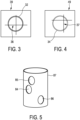
- the assisting apparatus 2 further comprises a projected position determination unit 19 for determining the position of the insertion element projected onto a ring plane defined by the respective ring 32, 34, wherein the display 18 is adapted to also display the projected position of the insertion element within the ring plane 39, 49 together with the ring 32, 34 as schematically and exemplarily illustrated in Figs. 3 and 4 .
- the projected position is indicated by the crosses 36 and 37, respectively. If the tip of the insertion element has not already passed the respective ring 32, 34, the projected position of the insertion element is preferentially the projected position of the tip of the insertion element. If the tip of the insertion element has already passed the respective ring 32, 34 as schematically and exemplarily shown in Fig.
- the projected position shown in Figs. 3 and 4 by the crosses 36, 37 are the positions of the respective part of the insertion element in the respective ring plane 39, 49 as determined by optical shape sensing.
- the crosses 36, 37 can be regarded as being crosshairs, which further assist the user in navigating the insertion element through the target element.
- the target element may be a vessel having several side openings and the insertion element may be a stent having corresponding side openings, wherein the stent should be positioned within the vessel by using, for instance, the catheter 11 such that the openings of the stent match the openings of the vessel.
- Fig. 5 schematically and exemplarily illustrates such a stent 87 with openings 84, 85 and 86.
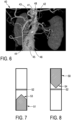
- Fig. 6 schematically and exemplarily shows a target element representation 48 with three rings 41, 42, 43 representing the three openings of the vessel and three rings 44, 45, 46 indicating the position of the openings of the stent as determined by optical shape sensing on an object image 40.
- the dimensions of the openings 84, 85 and 86 of the stent 87 and the orientations and positions of these openings 84, 85 and 86 relative to the stent 87 can be determined from x-ray projection images showing the stent 87, which may be provided by the object image providing unit 3, i.e. by the above described x-ray C-arm system.
- features of the openings of the stent can be manually or automatically extracted from two or more x-ray projection images, which correspond to different image acquisition directions and which show the stent 87 with the openings 84, 85 and 86, wherein these extracted features can be used to determine the size and the three-dimensional position and orientation of the rings 84, 85 and 86 relative to the three-dimensional position and orientation of the stent 87 such that based on these spatial relations and the tracked three-dimensional position and three-dimensional orientation of the stent 87 the three-dimensional position and three-dimensional orientation of the rings 84, 85 and 86 can be determined.
- the extracted features may be markers around the respective opening, which may be extracted, particularly automatically extracted, by using a stent boost algorithm as for example described in WO2005104951A1 , wherein these markers may then be used to determine the dimensions, and the orientations and positions of the openings 84, 85 and 86 relative to the three-dimensional position and orientation of the stent.
- the resulting three-dimensional representation of these rings 84, 85 and 86 can be shown on the display 18.
- the rings 44, 45, 46 are moved accordingly on the display 18 as determined by optical shape sensing such that the user can correctly position the stent 87, if the user moves the stent such that the rings 44, 45, 46 match the rings 41, 42, 43 on the display 18.
- the assisting apparatus 2 further comprises a distance determination unit 20 for determining a distance between the target element and the insertion element based on the generated target element representation 48 and the tracked position of the insertion element 87, wherein the display 18 is adapted to display also the determined distance.
- a line 52 is shown, which symbolizes the zero distance between the desired position of the stent 87 and the actual position of the stent 87 and the bar 51 with the tip 53 indicates the distance to the desired final position of the stent and the required movement direction of the stent.
- the tip 53 of the bar 51 indicates a forward movement direction.
- the stent 87 has been moved too far, this may be indicated as schematically and exemplarily shown in Fig. 8 , in which the tip 54 of the bar 50 points in a direction being opposite to the direction in which the tip 53 of the bar 51 points in Fig. 7 .
- the distance may also explicitly be displayed on the display 18, i.e. it may be displayed that the distance between the actual position of the stent 87 and the desired final position of the stent 87 is, for example, +2 mm or -3 mm.
- the tracking unit 17 is preferentially also adapted to track the orientation of the insertion element within the person 8 and the assisting apparatus 2 preferentially further comprises an orientation determination unit 21 for determining an orientation of the insertion element relative to the target element based on the generated target element representation and the tracked orientation of the insertion element, wherein the display 18 may be adapted to display also the determined orientation.
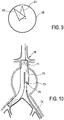
- the orientation determination unit 21 may determine the orientation of the openings 84, 85, 86 of the stent 87 in a circumferential direction of the stent 87 relative to the positions of the openings 41, 42, 43 of the target element representation 48. This orientation may be indicated on the display 18 as schematically and exemplarily shown in Fig. 9 . In Fig.
- the triangle 61 within the circle 60 indicates the correct desired rotational position of the stent and the triangle 62 indicates the actual rotational position of the stent, i.e. the actual rotational position of the openings 44, 45, 46 in the circumferential direction of the stent 87. If the user modifies this rotational position of the stent 87, this will directly be shown by a corresponding rotational movement of the triangle 62. In this way the user can rotate the stent 87 such that its rotational position matches the final desired rotational position by using the display of the rotational positions as illustrated in Fig. 9 .
- the user can start pushing the endograft 87 represented by the virtual rings 44, 45 and 46 in the positions schematically and exemplarily shown in Fig. 6 , in order to slowly shift the endograft 87 to the position and the orientation schematically and exemplarily indicated by the rings 41, 42 and 43 in Fig. 6 , which represent the desired final position and orientation of the endograft 87. If the rings 44, 45 and 46 match the rings 41, 42 and 43, this indicates to the user that the original endograft openings 84, 85, 86 match the vessel ostia. It should be noted that Fig.
- FIG. 6 is just a schematic figure for illustrating the concept of displaying the target element representation 48 and the tracked position 44, 45, 46 of the insertion element, which is an endograft in this example, i.e., for instance, in a real application the rings may have a different size.
- translation and rotation parameters may alternatively or additionally be obtained by using a single value decomposition algorithm, wherein the position of the stent tracked by optical shape sensing can be used as an initialization or as a constraint of the solution space of the single value decomposition algorithm.
- the single value decomposition algorithm which may be performed by the distance determination unit and/or the orientation determination unit, may be applied to a first set of points defining the positions of the openings of the vessel, in particular, defining positions of landmarks around the openings of the vessel, which may be obtained from the target element image, and to a second set of points defining the positions of the openings of the stent, in particular, defining positions of landmarks around the openings of the stent, which may be obtained from live images like live x-ray projection images.
- the result of this application of the single value decomposition algorithm is a 4x4 matrix that provides translation and rotation information, which is indicative of the remaining translation and rotation of the stent required for generating a best match between the openings of the vessel and the openings of the stent.
- This remaining translation and rotation may be calculated and shown on the display in real-time, particularly as illustrated in Figs. 7 to 9 .
- the provided object image is a three-dimensional segmented vessel image.
- the object image, on which the target element representation and the tracked position, for instance, corresponding rings, are displayed can be another kind of image like a real two-dimensional projection image, a two-dimensional cross section of a three-dimensional computed tomography image, a virtual two-dimensional projection image determined by virtually forward projecting an image of the object which may be a model of the object, et cetera.
- the object image may be an image, which has been acquired before the interventional procedure or during the interventional procedure.
- the target element and the tracked position, i.e., for instance, corresponding rings may be displayed simultaneously on several object images like different two-dimensional projection images which correspond to different image acquisition directions.
- the assisting apparatus 2 further comprises a moving zone providing unit 23 for providing a zone within the object, within which the insertion element should be moved only, wherein the display 18 is adapted to also display the moving zone.
- the moving zone is a safety zone, wherein the insertion element should be navigated such that it remains within the safety zone.
- the moving zone providing unit 23 can be adapted to provide an already stored moving zone or it can be adapted to determine the moving zone depending on, for instance, the target element image and/or the object image. In particular, an element visible in the target element image or the object image can be segmented and the moving zone can be determined such that the segmented element and a region around the segmented element are excluded from the moving zone.
- the segmented element may be an inner vessel wall and the moving zone may be determined such that it is arranged within the vessel and with a distance to the inner vessel wall, in order to avoid a touching of the walls along the entire insertion element while being moved to the target element. This can reduce the likelihood of unwanted dissections.
- Fig. 10 schematically and exemplarily illustrates a cannulation of a contralateral limb of an endograft 71 within a vessel structure 70.
- the target element 73 is the ring surrounding the opening 72 of the limb 75 of the endograft 71.
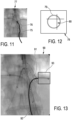
- Fig. 11 shows schematically and exemplarily a target element representation 76 being a ring displayed on an actual image 77 in its three-dimensional position, three-dimensional orientation and its size, which correspond to the three-dimensional position, the three-dimensional orientation and the size of the ring 73 surrounding the opening of the limb 75 of the endograft 71.
- a line 75 indicating the catheter 74 is shown on the actual image 77.
- FIG. 12 shows the position of a part of the catheter 74 intersecting a ring plane 78 defined by the ring 73, wherein in Fig. 12 the ring is indicated by the circle 79 and the position of the part of the catheter 74 within the ring 73 is indicated by the cross 80.
- the x-ray C-arm system 3 can be adapted to provide object images corresponding to different acquisition directions, particularly to perpendicular acquisition directions. For instance, it can be adapted to provide a left anterior oblique image, a right anterior oblique image, a cranial image and/or a caudal image of, for example, a target vessel. If the target element is a target vessel, the x-ray C-arm system 3 can also be adapted to provide a cross-section view object image showing the target vessel. For acquiring the cross-section view object image showing the target vessel the C-arm is moved in an orientation that is "bull's eye" of the tube formed by the target vessel, wherein the image acquisition direction is substantially aligned with the axis of the target vessel.
- the tracking unit 17 is preferentially also adapted to track the orientation of the insertion element, wherein the object image providing unit 3, i.e. in this embodiment the x-ray C-arm system 3, is adapted to provide the object image such that its acquisition direction depends on the tracked orientation of the insertion element.
- the object image providing unit 3 i.e. in this embodiment the x-ray C-arm system 3
- the object image providing unit 2 can be adapted such that, if the insertion element approaches the first ring 32, an object image is shown, which allows the user to accurately cannulate the first ring 32, and to display an object image, which allows the user to accurately cannulate the second ring 33, if the insertion element has traversed the first ring 32 and approaches the second ring 33.
- the object image providing unit 3 can provide an object image having an acquisition direction being substantially perpendicular to the ring plane defined by the first ring 32 and, if the insertion element approaches the second ring 33, the object image providing unit 3 may show an object image having an acquisition direction being substantially perpendicular to the ring plane defined by the second ring 33.
- the C-arm can follow the optical shape sensing device orientation to best cannulate the first ring 32 and then automatically reposition the angulation to optimize for a best cannulation of the second ring 33, i.e. the C-arm and the target elements can be sync'ed via optical shape sensing in space and time.
- the dependence of the respective acquisition direction on the respective optical shape sensing orientation can be predefined, in particular, predefined by the user in accordance with the user's preferences.
- the dependence may be predefined such that the acquisition direction encloses with the respective ring plane an angle of, for example, 45°.
- the object image providing unit 3 may be adapted to provide a single two-dimensional fluoroscopy image, a cine two-dimensional fluoroscopy image, two two-dimensional fluoroscopy images for providing a biplane view, more than two two-dimensional fluoroscopy images et cetera.
- the object image providing unit may also be adapted to provide an actual three-dimensional image, in particular, a live three-dimensional image, which may be provided by an ultrasound imaging unit.
- an older image may be shown for providing anatomical context, wherein on this older image the target element representation and an indication indicating the insertion element may be shown.
- the anatomical context can also be provided in another way.
- a roadmap can be displayed together with the target element representation and a representation of the insertion element for providing the anatomical context.
- the roadmap may be determined in advance by segmenting a vessel structure in a three-dimensional image of the person, which may be a computed tomography image or a magnetic resonance image.
- the object image providing unit is adapted to provide an x-ray fluoroscopy image of the person 8, which preferentially includes the insertion element, in particular, the tip of the insertion element, the object image providing unit may also be adapted to use another imaging modality for providing the actual image like an ultrasound imaging unit.
- the object image providing unit can be adapted to provide an actual image of a part of the person only, which includes the tracked position of the insertion element, particularly the tracked position of the tip of the insertion element.
- collimators of the C-arm fluoroscopy system described above with reference to Fig. 1 can be adapted to focus the x-rays 6 onto a region within the person including the tracked position of the insertion element. This focusing of the radiation onto this region can be performed automatically or manually given the respective tracked position of the insertion element.
- An automatic feedback loop can be implemented, in order to enable the object image providing unit to provide an actual image of the region including the insertion element based on the tracked position of the insertion element. This focusing of the radiation onto this region can reduce the x-ray radiation applied to the person.
- another imaging modality is used for providing an object image like a computed tomography system, a three-dimensional ultrasound system, a magnetic resonance imaging system et cetera, also to these imaging modalities the concept of focusing the imaging onto, for instance, a tip or any desired part of the optical shape sensing enabled insertion element can be applied.
- the display is adapted to display a part of the actual image, which includes the tracked position of the insertion element, in particular, the tracked position of the tip of the insertion element, in a magnified view as schematically and exemplarily shown in Fig. 13 .
- a target element representation 91 and a line indicating the insertion element 92 can be displayed on an actual image 90, wherein the tip of the insertion element being, in this embodiment, a catheter, is shown in a magnified view 93.
- step 101 a three-dimensional target element image is provided, which shows the target element, by the target element image providing unit 14.
- a target element representation representing the target element within the object in the three-dimensional position, the three-dimensional orientation and the size of the target element is generated based on the target element image by the target element representation generating unit 15.
- the tracking unit 17 tracks the position of the insertion element within the object and in step 104 the target element representation and the tracked position of the insertion element are shown by the display 18.
- step 105 it is determined whether an abort criterion is fulfilled, wherein, if the abort criterion is not fulfilled, the assisting method continues with step 103. Otherwise the assisting method ends in step 106.
- the abort criterion may be, for instance, whether a user has input an abort command into the system by using the input unit 22 or whether the insertion element has reached the target element.
- the system described above with reference to Fig. 1 can be adapted to position and probably size a three-dimensional ring on an image as the main target of the anatomy, i.e. as the target element.
- This main target of the anatomy may be, for instance, the ostium of the renal artery, which can be represented as a three-dimensional ring of, for instance, 8 mm diameter in a precise position and angulation at the ostium.
- the position and size can be obtained from a computed tomography scan of the patient, which may be provided as the target element image and which may be segmented.
- the target element image can be registered to the real-time image, i.e. to the actual object image, for instance, via fluoroscopy or optical shape sensing.
- the target element image providing unit, the object image providing unit, i.e. in the above described embodiment the x-ray C-arm system, and the tracking unit are registered with respect to each other.
- the registration between these different components can be performed in several ways. For instance, if the target element image providing unit is adapted to provide a three-dimensional computed tomography image as the target element image and if the object image providing unit is adapted to provide two or more two-dimensional x-ray projection images as the object images, the target element image providing unit and the object image providing unit can be registered with respect to each other by performing a known 2D-3D registration.
- the computed tomography target element image may be registered with the computed tomography object image by using, for instance, point matching or volume matching procedures.
- the tracking unit can be registered with the object image providing unit by identifying the position of the insertion element in the object image and by also determining this position by the tracking unit.
- the tracking unit is then also registered with the target element image providing unit, if the target element image providing unit is registered with the object image providing unit.
- the tracking unit can also directly be registered with the target element image providing unit by, for instance, detecting the shape of certain vessels shown in the target element image and by matching these shapes with the tracked shape of the insertion element, when the insertion element is inserted into these vessels.
- the assisting apparatus described above with reference to Fig. 1 provides the relevant and meaningful information to cannulate, for instance, the renal artery, as a simple three-dimensional ring on an interventional two-dimensional x-ray image.
- the tracked interventional device i.e. the insertion element
- the tracking of the interventional device is preferentially performed by means of optical shape sensing.
- the three-dimensional ring can be augmented as a cylinder to offer information about the length or depth of the targeted artery to optimize cannulation safety and properly assist with the sizing of, for instance, an angioplasty balloon or stent.
- the assisting apparatus can further be adapted to enable a virtual biplane environment as the anatomy can be visualized with the imager, i.e. with the object image providing unit, from two or more perspectives, for instance, in a left anterior oblique and a right anterior oblique direction.
- the context of simple x-ray images can provide a context for the physician that he/she is used to.
- the indication of the interventional device and the one or several rings of the target element representation are preferentially overlaid in three dimensions and live in all viewing images, i.e. in all images used for providing the anatomical context. This renders a simple yet intuitive and powerful environment to help a physician to engage with the target, thereby reducing trials-and-errors, saving time and reducing unnecessary radiation and contrast.
- the assisting apparatus described above with reference to Fig. 1 is preferentially adapted to be used during an endovascular aneurysm repair (EVAR) procedure.
- EVAR endovascular aneurysm repair
- the assisting apparatus can be adapted to determine several target element representations for several target elements and to allow the user to select one or several of the target element representations to be displayed on the display.
- the assisting apparatus can be adapted to provide a pull-down menu for allowing the user to select a desired target element representation. This may allow the user to focus on a certain target element only, for instance, on the right renal artery, because only the target element representation determined for this respective target element may be shown on the display and not other target element representations determined for other target elements, i.e. the other target element representations may be hidden.
- the target element image providing unit is adapted to provide several two-dimensional target element images or a three-dimensional target element image
- the target element image providing unit can also be adapted to provide a four-dimensional target element image, i.e. a dynamic three-dimensional target element image.
- the target element image providing unit can be adapted to provide cardiac and respiratory gated pre-acquired three-dimensional images as the four-dimensional target element image, or a live three-dimensional image as the target element image.
- the target element representation generating unit can be adapted to generate a dynamic target element representation, which can be shown on the display together with the tracked position of the insertion element optionally on an object image for providing some anatomical information.
- the object image providing unit can be adapted to provide a dynamic three-dimensional image.
- the target element image providing unit is adapted to provide one or several target element images of a same imaging modality
- the target element image providing unit may be adapted to provide images from different imaging modalities or images from fused imaging modalities as target element images
- the target element representation generating unit can be adapted to generate the target element representation based on the target element images from different or fused imaging modalities.
- These different or fused imaging modalities may include at least two of x-ray projection imaging, computed tomography imaging, magnetic resonance imaging, ultrasound imaging, et cetera, wherein the respective image of the respective imaging modality may be a two-dimensional image, a three-dimensional image or a four-dimensional image.
- the object image providing unit can be adapted to provide several object images from different or fused imaging modalities, wherein the target element representation and the tracked position of the insertion element may be displayed on the several object images from the different or fused imaging modalities.
- the target element representation generating unit is adapted to generate a target element representation comprising a ring
- the target element representation generating unit may be adapted to generate a target element representation comprising another element like a cube, a sphere, et cetera, which is dimensioned, oriented and positioned such that its dimension, orientation and position correspond to the dimension, orientation and position of the target element, which in this case has substantially the shape of a cube, a sphere, et cetera.
- the insertion element is a stent having three openings
- the insertion element can also be a stent having only a single opening, two openings or more than three openings.
- the insertion element may also be another element, especially another element to be inserted having one or more openings.
- a single ring of a target element representation may be displayed together with a single ring representing a single opening of an insertion element like a fenestrated stent.
- a single unit or device may fulfill the functions of several items recited in the claims.
- the mere fact that certain measures are recited in mutually different dependent claims does not indicate that a combination of these measures cannot be used to advantage.
- Operations like the generation of the target element representation, the determination of the distance between the target element and the insertion element, the determination of the orientation of the insertion element relative to the target element et cetera performed by one or several units or devices, can be performed by any other number of units or devices.
- These operations and/or the control of the assisting apparatus in accordance with the assisting method can be implemented as program code of a computer program and/or as dedicated hardware.
- a computer program may be stored/distributed on a suitable medium, such as an optical storage medium or a solid-state medium, supplied together with or as part of other hardware, but may also be distributed in other forms, such as via the Internet or other wired or wireless telecommunication systems.
- a suitable medium such as an optical storage medium or a solid-state medium, supplied together with or as part of other hardware, but may also be distributed in other forms, such as via the Internet or other wired or wireless telecommunication systems.
- the invention relates to an assisting apparatus for assisting a user in moving an insertion element like a catheter to a target element within, for instance, a person.
- a target element representation representing the target element within the object in its three-dimensional position and three-dimensional orientation and with its size is generated based on a provided target element image.
- a three-dimensional position of the insertion element is tracked, while the insertion element is moved to the target element, and the target element representation and the tracked position of the insertion element are displayed.
- the three-dimensional position and orientation of the target element relative to the actual position of the insertion element can therefore be shown to the user, while the insertion element is moved to the target element, which allows the user to more accurately and faster move the insertion element to the target element.
Landscapes
- Health & Medical Sciences (AREA)
- Life Sciences & Earth Sciences (AREA)
- Surgery (AREA)
- Engineering & Computer Science (AREA)
- Animal Behavior & Ethology (AREA)
- Veterinary Medicine (AREA)
- Biomedical Technology (AREA)
- Heart & Thoracic Surgery (AREA)
- Medical Informatics (AREA)
- Molecular Biology (AREA)
- Nuclear Medicine, Radiotherapy & Molecular Imaging (AREA)
- General Health & Medical Sciences (AREA)
- Public Health (AREA)
- Robotics (AREA)
- Pathology (AREA)
- Oral & Maxillofacial Surgery (AREA)
- Radiology & Medical Imaging (AREA)
- Physics & Mathematics (AREA)
- Biophysics (AREA)
- Apparatus For Radiation Diagnosis (AREA)
- Prostheses (AREA)
Claims (13)
- Ein Assistenzgerät zum Unterstützen eines Benutzers beim Bewegen eines Einführelements, das in ein Objekt in einem Zielelement eingeführt werden soll, wobei das Objekt ein Lebewesen ist, wobei das Zielelement ein innerer Teil des Lebewesens ist. Das Assistenzgerät (2) umfasst:- eine Bildbereitstellungseinheit (14) für das Zielelement zum Bereitstellen eines Zielelementbildes, welches das Zielelement zeigt, wobei das Zielelement mindestens eine Öffnung umfasst,- eine Erzeugungseinheit (15) zum Erzeugen einer Zielelementdarstellung (38; 48), die die mindestens eine Öffnung des Zielelements innerhalb des Objekts in seiner dreidimensionalen Position und dreidimensionalen Orientierung und mit seiner Größe auf dem Zielelementbild darstellt, wobei die Erzeugungseinheit (15) angepasst ist, um eine Zielelementdarstellung (48) zu erzeugen, die mindestens einen Ring (41, 42, 43) umfasst, der die mindestens eine Öffnung des Zielelements innerhalb des Objekts in der dreidimensionalen Position darstellt, sowie die dreidimensionale Orientierung und Größe der mindestens einen Öffnung des Zielelements, wobei die Erzeugungseinheit angepasst ist, das Zielelement innerhalb des bereitgestellten Zielelementbilds zum Erzeugen der Zielelementdarstellung zu segmentieren,- eine Nachführeinheit (17) zum Nachführen einer dreidimensionalen Position des Einführelements innerhalb des Objekts, während das Einführelement zu dem Zielelement bewegt wird, wobei das nachgeführte Einführelement mindestens eine Öffnung aufweist,- Mittel zum Bestimmen mindestens eines Rings (44, 45, 46), der die mindestens eine Öffnung des Einführelements darstellt, und- eine Anzeige (18) zum Anzeigen des mindestens einen Rings der Zielelementdarstellung (48) und des mindestens einen Rings, der die mindestens eine Öffnung des Einführelements darstellt, wobei die Bildbereitstellungseinheit für das Zielelement und die Nachführeinheit gegeneinander registriert sind.
- Assistenzgerät nach Anspruch 1, wobei das Assistenzgerät (2) ferner eine Bestimmungseinheit für eine Projektionsposition (19) zum Bestimmen der Position zumindest eines Teils des Einführelements projiziert auf eine definierte Ringebene (39; 49) umfasst, bestimmt durch einen Ring (32; 34), der die mindestens eine Öffnung der Zielelementdarstellung (38; 48) darstellt, wobei die Anzeige (18) angepasst ist, um die projizierte Position zumindest des Teils des Einführelements innerhalb der Ringebene (39; 49) zusammen mit dem Ring (32; 34) anzuzeigen, der die mindestens eine Öffnung der Zielelementdarstellung (38; 48) darstellt.
- Assistenzgerät nach Anspruch 1, wobei das Zielelement ein röhrenartiges Element umfasst und wobei die Erzeugungseinheit (15) angepasst ist, eine Zielelementdarstellung (38) zu erzeugen, die einen Zylinder (34) umfasst, der eine dreidimensionale Position, eine dreidimensionale Orientierung und Größe, die einer dreidimensionalen Position entspricht, sowie eine dreidimensionale Orientierung und Größe des röhrenartigen Elements des Zielelements aufweist.
- Assistenzgerät nach Anspruch 1, wobei das Zielelement mehrere Öffnungen umfasst, wobei die Zielelementdarstellungs-Erzeugungseinheit (15) angepasst ist, eine Zielelementdarstellung (48) zu erzeugen, die mehrere Ringe (41, 42, 43) umfasst, die die mehreren Öffnungen des Zielelements innerhalb des Objekts in der dreidimensionalen Position, die dreidimensionale Orientierung und Größe der Öffnungen des Zielelements darstellen, wobei das verfolgte Einführelement Öffnungen aufweist, wobei die Anzeige (18) dazu eingerichtet ist, die Ringe der Zielelementdarstellung (48) und Ringe, welche die Öffnungen des Einführelements darstellen, anzuzeigen.
- Assistenzgerät nach Anspruch 1, wobei das Assistenzgerät (2) ferner eine Abstandsbestimmungseinheit (20) zum Bestimmen eines Abstands zwischen dem Zielelement und dem Einführelement basierend auf der erzeugten Zielelementdarstellung (38; 48) und der verfolgten Position des Einführelements umfasst, wobei die Anzeige (18) angepasst ist, den ermittelten Abstand anzuzeigen.
- Assistenzgerät nach Anspruch 1, wobei die Nachführeinheit (17) angepasst ist, auch eine Orientierung des Einführelements innerhalb des Objekts zu verfolgen, wobei das Assistenzgerät (2) ferner eine Orientierungsbestimmungseinheit (21) zum Bestimmen einer Orientierung des Einführelements relativ zu dem Zielelement basierend auf der erzeugten Zielelementdarstellung (38; 48) und der verfolgten Orientierung des Einführelements umfasst, wobei die Anzeige (18) angepasst ist, die bestimmte Orientierung anzuzeigen.
- Assistenzgerät nach Anspruch 1, wobei das Assistenzgerät (2) eine Objektbildbereitstellungseinheit (3) zum Bereitstellen eines Objektbildes umfasst, welches zumindest einen Teil des Objekts zeigt, wobei die Anzeige (18) angepasst ist, um die Zielelementdarstellung und die nachgeführte Position des Einführelements auf dem Objektbild anzuzeigen.
- Assistenzgerät nach Anspruch 7, wobei die Nachführeinheit (17) angepasst ist, um auch die Ausrichtung des Einführelements zu verfolgen, wobei die Objektbild-Bereitstellungseinheit (2) angepasst ist, das Objektbild so bereitzustellen, dass seine Bilderfassungsrichtung von der nachgeführten Ausrichtung des Einführelements abhängt.
- Assistenzgerät nach Anspruch 1, wobei- die Zielelementbild-Bereitstellungseinheit (14) angepasst ist, ein Live-Bild des Zielelements als das Zielelementbild bereitzustellen,- die Erzeugungseinheit (15) für die Darstellung des Zielelements angepasst ist zum Erzeugen einer Live-Zielelementdarstellung, die das Zielelement innerhalb des Objekts in seiner tatsächlichen dreidimensionalen Position und dreidimensionalen Orientierung und mit seiner Größe basierend auf dem Live-Zielelementbild darstellt, und- die Anzeige (18) angepasst ist, um die Live-Zielelementdarstellung und die verfolgte Position des Einführelements anzuzeigen.
- Assistenzgerät nach Anspruch 1, wobei die Assistenzgerät (2) ferner eine Bewegungszonen-Bereitstellungseinheit (23) zum Bereitstellen einer Zone innerhalb des Objekts umfasst, innerhalb der das Einführelement ausschließlich bewegt werden sollte, wobei die Anzeige (18) angepasst ist, um auch die Bewegungszone anzuzeigen.
- Assistenzgerät nach Anspruch 1, wobei die Nachführeinheit (17) angepasst ist, um die Position des Einführelements durch Verwenden einer optischen Formerfassung zu verfolgen.
- Eingriffssystem zum Einführen eines Einführelements in ein Objekt, wobei das Eingriffssystem (1) umfasst:- das Einführelement (11), und- das Assistenzgerät (2) nach Anspruch 1.
- Assistierendes Computerprogramm zum Assistieren eines Benutzers beim Bewegen eines Einführelements innerhalb eines Objekts zu einem Zielelement, dadurch gekennzeichnet, dass das Assistenzcomputerprogramm Programmcodemittel umfasst, die ein Assistenzgerät wie in Anspruch 1 definiert veranlassen, die Schritte eines Assistenzverfahrens auszuführen, wenn das Assistenzcomputerprogramm auf einem Computer ausgeführt wird, der das Assistenzgerät steuert, wobei das Assistenzverfahren umfasst:- Bereitstellen eines Zielelementbildes, das das Zielelement zeigt, wobei das Zielelement mindestens eine Öffnung umfasst, durch eine Zielelementbild-Bereitstellungseinheit (14),- zum Erzeugen einer Zielelementdarstellung (38; 48), die die mindestens eine Öffnung des Zielelements innerhalb des Objekts in seiner dreidimensionalen Position und dreidimensionalen Orientierung und mit seiner Größe darstellt, basierend auf dem Zielelementbild durch eine Zielelementdarstellung Erzeugungseinheit (15), wobei die Erzeugungseinheit (15) angepasst ist, um eine Zielelementdarstellung (48) zu erzeugen, die mindestens einen Ring (41, 42, 43) umfasst, der die mindestens eine Öffnung des Zielelements innerhalb des Objekts in der dreidimensionalen Position darstellt, sowie die dreidimensionale Orientierung und Größe der mindestens einen Öffnung des Zielelements, wobei die Erzeugungseinheit angepasst ist, das Zielelement innerhalb des bereitgestellten Zielelementbilds zum Erzeugen der Zielelementdarstellung zu segmentieren,- zum Nachführen einer dreidimensionalen Position des Einführelements innerhalb des Objekts, während das Einführelement zu dem Zielelement bewegt wird, wobei das nachgeführte Einführelement mindestens eine Öffnung aufweist, durch eine Nachführeinheit (17),- Bestimmen mindestens eines Rings (44, 45, 46), der die mindestens eine Öffnung des Einführelements darstellt, und- Anzeige des mindestens einen Rings der Zielelementdarstellung (48) und des mindestens einen Rings, der die mindestens eine Öffnung des Einführelements darstellt, auf einer Anzeige (18), wobei die Bildbereitstellungseinheit für das Zielelement und die Nachführeinheit gegeneinander registriert sind.
Priority Applications (1)
| Application Number | Priority Date | Filing Date | Title |
|---|---|---|---|
| EP14725449.4A EP3003194B1 (de) | 2013-05-31 | 2014-05-21 | Unterstützungsvorrichtung zur unterstützung eines benutzers während eines interventionsverfahrens |
Applications Claiming Priority (3)
| Application Number | Priority Date | Filing Date | Title |
|---|---|---|---|
| EP13169953 | 2013-05-31 | ||
| PCT/EP2014/060376 WO2014191262A2 (en) | 2013-05-31 | 2014-05-21 | Assisting apparatus for assisting a user during an interventional procedure |
| EP14725449.4A EP3003194B1 (de) | 2013-05-31 | 2014-05-21 | Unterstützungsvorrichtung zur unterstützung eines benutzers während eines interventionsverfahrens |
Publications (2)
| Publication Number | Publication Date |
|---|---|
| EP3003194A2 EP3003194A2 (de) | 2016-04-13 |
| EP3003194B1 true EP3003194B1 (de) | 2023-03-08 |
Family
ID=48577527
Family Applications (1)
| Application Number | Title | Priority Date | Filing Date |
|---|---|---|---|
| EP14725449.4A Active EP3003194B1 (de) | 2013-05-31 | 2014-05-21 | Unterstützungsvorrichtung zur unterstützung eines benutzers während eines interventionsverfahrens |
Country Status (7)
| Country | Link |
|---|---|
| US (1) | US11690676B2 (de) |
| EP (1) | EP3003194B1 (de) |
| JP (1) | JP5960377B1 (de) |
| CN (1) | CN105246429B (de) |
| BR (1) | BR112015029467A2 (de) |
| RU (1) | RU2687826C2 (de) |
| WO (1) | WO2014191262A2 (de) |
Families Citing this family (14)
| Publication number | Priority date | Publication date | Assignee | Title |
|---|---|---|---|---|
| CN105578984B (zh) | 2013-09-24 | 2021-02-26 | 皇家飞利浦有限公司 | 介入工具的声学3d跟踪 |
| JP6734282B2 (ja) | 2015-01-22 | 2020-08-05 | コーニンクレッカ フィリップス エヌ ヴェKoninklijke Philips N.V. | 予め組み込まれた又は取り外し可能な光学形状検知アタッチメントによるエンドグラフトの視覚化 |
| US10939967B2 (en) | 2015-01-22 | 2021-03-09 | Koninklijke Philips N.V. | Robotic control of an endovascular deployment device with optical shape sensing feedback |
| JP6794361B2 (ja) * | 2015-01-22 | 2020-12-02 | コーニンクレッカ フィリップス エヌ ヴェKoninklijke Philips N.V. | 光学形状検出によるエンドグラフトの視覚化 |
| KR102531117B1 (ko) * | 2015-10-07 | 2023-05-10 | 삼성메디슨 주식회사 | 대상체를 나타내는 영상을 디스플레이하는 방법 및 장치. |
| CN108366834B (zh) * | 2015-12-17 | 2021-04-09 | 皇家飞利浦有限公司 | 导航辅助系统 |
| DE102016119579B4 (de) * | 2016-10-13 | 2023-08-17 | Fraunhofer-Gesellschaft zur Förderung der angewandten Forschung e.V. | Positionsbestimmungsvorrichtung zum Bestimmen einer Position eines Instruments innerhalb einer röhrenförmigen Struktur |
| US11364077B2 (en) * | 2017-03-24 | 2022-06-21 | The Spectranetics Corporation | Laser energy delivery devices including distal tip orientation indicators |
| DE102018108643A1 (de) | 2018-04-11 | 2019-11-14 | Fraunhofer-Gesellschaft zur Förderung der angewandten Forschung e.V. | Positionsbestimmungsvorrichtung zum Bestimmen einer Position eines Gegenstands innerhalb einer tubulären Struktur |
| EP3682836A1 (de) * | 2019-01-21 | 2020-07-22 | Koninklijke Philips N.V. | Unterstützung beim bewegen eines einführungselements innerhalb eines objekts |
| EP3838209A1 (de) | 2019-12-20 | 2021-06-23 | Koninklijke Philips N.V. | Erzeugung interaktiver zonen für interventionelle medizinische vorrichtungen |
| CN111436937B (zh) * | 2020-03-16 | 2024-06-11 | 北京东软医疗设备有限公司 | 导管/导丝跟踪方法、装置及扫描设备 |
| DE102020204985A1 (de) * | 2020-04-21 | 2021-10-21 | Siemens Healthcare Gmbh | Steuerung eines robotisch bewegten medizinischen Objekts |
| EP4343686B1 (de) * | 2022-09-23 | 2026-05-06 | Siemens Healthineers AG | Verfahren und system zur erkennung einer gefässkatheterspitze in medizinischen bildern |
Citations (2)
| Publication number | Priority date | Publication date | Assignee | Title |
|---|---|---|---|---|
| WO2002009611A2 (de) * | 2000-08-01 | 2002-02-07 | Stryker Leibinger Gmbh & Co., Kg. | Verfahren zum navigieren im körperinneren anhand dreidimensional visualisierter strukturen |
| US20110237936A1 (en) * | 2010-03-25 | 2011-09-29 | Medtronic, Inc. | Method and Apparatus for Guiding an External Needle to an Implantable Device |
Family Cites Families (23)
| Publication number | Priority date | Publication date | Assignee | Title |
|---|---|---|---|---|
| US5190045A (en) * | 1989-09-28 | 1993-03-02 | Frazin Leon J | Method and device for doppler-guided and imaged retrograde catheterization |
| US7778688B2 (en) * | 1999-05-18 | 2010-08-17 | MediGuide, Ltd. | System and method for delivering a stent to a selected position within a lumen |
| US20040034297A1 (en) | 2002-08-13 | 2004-02-19 | General Electric Company | Medical device positioning system and method |
| US7697972B2 (en) * | 2002-11-19 | 2010-04-13 | Medtronic Navigation, Inc. | Navigation system for cardiac therapies |
| JP2005103804A (ja) | 2003-09-29 | 2005-04-21 | Dainippon Printing Co Ltd | 熱転写受像シート |
| US7450743B2 (en) | 2004-01-21 | 2008-11-11 | Siemens Medical Solutions Usa, Inc. | Method and system of affine registration of inter-operative two dimensional images and pre-operative three dimensional images |
| CN1261081C (zh) * | 2004-03-17 | 2006-06-28 | 哈尔滨工业大学 | 基于图像导航的机器人辅助带锁髓内钉锁定系统 |
| US7772541B2 (en) | 2004-07-16 | 2010-08-10 | Luna Innnovations Incorporated | Fiber optic position and/or shape sensing based on rayleigh scatter |
| US7831294B2 (en) * | 2004-10-07 | 2010-11-09 | Stereotaxis, Inc. | System and method of surgical imagining with anatomical overlay for navigation of surgical devices |
| CN2748042Y (zh) * | 2004-10-22 | 2005-12-28 | 上海导向医疗系统有限公司 | 脏器冷冻介入手术计算机辅助导航系统 |
| WO2006121883A1 (en) | 2005-05-05 | 2006-11-16 | Boston Scientific Scimed, Inc. | Steerable catheter for performing medical procedure adjacent pulmonary vein ostia |
| US7711165B2 (en) * | 2005-07-28 | 2010-05-04 | Siemens Medical Solutions Usa, Inc. | System and method for coronary artery segmentation of cardiac CT volumes |
| US7632304B2 (en) * | 2005-09-07 | 2009-12-15 | Rbkpark Llc | Coronary stent |
| EP2030169B1 (de) * | 2006-05-24 | 2018-12-19 | Koninklijke Philips N.V. | Koordinatensystem-registration |
| US8118818B2 (en) | 2006-12-15 | 2012-02-21 | Ao Technology Ag | Method and device for computer assisted distal locking of intramedullary nails |
| WO2010058398A2 (en) * | 2007-03-08 | 2010-05-27 | Sync-Rx, Ltd. | Image processing and tool actuation for medical procedures |
| US20080275467A1 (en) | 2007-05-02 | 2008-11-06 | Siemens Corporate Research, Inc. | Intraoperative guidance for endovascular interventions via three-dimensional path planning, x-ray fluoroscopy, and image overlay |
| US20090163800A1 (en) * | 2007-12-20 | 2009-06-25 | Siemens Corporate Research, Inc. | Tools and methods for visualization and motion compensation during electrophysiology procedures |
| WO2009129477A1 (en) * | 2008-04-18 | 2009-10-22 | Medtronic, Inc. | Method and apparatus for mapping a structure |
| US8494608B2 (en) | 2008-04-18 | 2013-07-23 | Medtronic, Inc. | Method and apparatus for mapping a structure |
| US8632468B2 (en) * | 2009-02-25 | 2014-01-21 | Koninklijke Philips N.V. | Method, system and devices for transjugular intrahepatic portosystemic shunt (TIPS) procedures |
| US8717430B2 (en) | 2010-04-26 | 2014-05-06 | Medtronic Navigation, Inc. | System and method for radio-frequency imaging, registration, and localization |
| EP2717798B1 (de) | 2011-06-07 | 2018-04-04 | Koninklijke Philips N.V. | Vorrichtung zur bestimmung einer drehposition |
-
2014
- 2014-05-21 EP EP14725449.4A patent/EP3003194B1/de active Active
- 2014-05-21 US US14/787,279 patent/US11690676B2/en active Active
- 2014-05-21 WO PCT/EP2014/060376 patent/WO2014191262A2/en not_active Ceased
- 2014-05-21 BR BR112015029467A patent/BR112015029467A2/pt not_active Application Discontinuation
- 2014-05-21 RU RU2015156302A patent/RU2687826C2/ru active
- 2014-05-21 CN CN201480030313.XA patent/CN105246429B/zh active Active
- 2014-05-21 JP JP2016514382A patent/JP5960377B1/ja active Active
Patent Citations (2)
| Publication number | Priority date | Publication date | Assignee | Title |
|---|---|---|---|---|
| WO2002009611A2 (de) * | 2000-08-01 | 2002-02-07 | Stryker Leibinger Gmbh & Co., Kg. | Verfahren zum navigieren im körperinneren anhand dreidimensional visualisierter strukturen |
| US20110237936A1 (en) * | 2010-03-25 | 2011-09-29 | Medtronic, Inc. | Method and Apparatus for Guiding an External Needle to an Implantable Device |
Also Published As
| Publication number | Publication date |
|---|---|
| WO2014191262A3 (en) | 2015-03-12 |
| WO2014191262A2 (en) | 2014-12-04 |
| US11690676B2 (en) | 2023-07-04 |
| EP3003194A2 (de) | 2016-04-13 |
| RU2015156302A3 (de) | 2018-03-27 |
| US20160081760A1 (en) | 2016-03-24 |
| JP2016523596A (ja) | 2016-08-12 |
| BR112015029467A2 (pt) | 2017-07-25 |
| CN105246429A (zh) | 2016-01-13 |
| JP5960377B1 (ja) | 2016-08-02 |
| CN105246429B (zh) | 2018-06-26 |
| RU2687826C2 (ru) | 2019-05-16 |
| RU2015156302A (ru) | 2017-07-06 |
Similar Documents
| Publication | Publication Date | Title |
|---|---|---|
| US11690676B2 (en) | Assisting apparatus for assisting a user during an interventional procedure | |
| US11857281B2 (en) | Robot-assisted driving systems and methods | |
| US12495952B2 (en) | Intelligent display | |
| JP6604977B2 (ja) | 3dのナビゲーションの間に距離および向きのフィードバックを提供するシステム | |
| CN113614844A (zh) | 动态介入三维模型变形 | |
| CN105517489B (zh) | 导航系统 | |
| US10806520B2 (en) | Imaging apparatus for imaging a first object within a second object | |
| US11980423B2 (en) | Navigation assistance system |
Legal Events
| Date | Code | Title | Description |
|---|---|---|---|
| PUAI | Public reference made under article 153(3) epc to a published international application that has entered the european phase |
Free format text: ORIGINAL CODE: 0009012 |
|
| 17P | Request for examination filed |
Effective date: 20160104 |
|
| AK | Designated contracting states |
Kind code of ref document: A2 Designated state(s): AL AT BE BG CH CY CZ DE DK EE ES FI FR GB GR HR HU IE IS IT LI LT LU LV MC MK MT NL NO PL PT RO RS SE SI SK SM TR |
|
| AX | Request for extension of the european patent |
Extension state: BA ME |
|
| DAX | Request for extension of the european patent (deleted) | ||
| STAA | Information on the status of an ep patent application or granted ep patent |
Free format text: STATUS: EXAMINATION IS IN PROGRESS |
|
| 17Q | First examination report despatched |
Effective date: 20180622 |
|
| RAP1 | Party data changed (applicant data changed or rights of an application transferred) |
Owner name: KONINKLIJKE PHILIPS N.V. |
|
| GRAP | Despatch of communication of intention to grant a patent |
Free format text: ORIGINAL CODE: EPIDOSNIGR1 |
|
| STAA | Information on the status of an ep patent application or granted ep patent |
Free format text: STATUS: GRANT OF PATENT IS INTENDED |
|
| RIC1 | Information provided on ipc code assigned before grant |
Ipc: A61B 34/10 20160101ALI20220912BHEP Ipc: A61B 34/20 20160101AFI20220912BHEP |
|
| INTG | Intention to grant announced |
Effective date: 20221011 |
|
| RIN1 | Information on inventor provided before grant (corrected) |
Inventor name: VERARD, LAURENT |
|
| GRAS | Grant fee paid |
Free format text: ORIGINAL CODE: EPIDOSNIGR3 |
|
| GRAA | (expected) grant |
Free format text: ORIGINAL CODE: 0009210 |
|
| STAA | Information on the status of an ep patent application or granted ep patent |
Free format text: STATUS: THE PATENT HAS BEEN GRANTED |
|
| AK | Designated contracting states |
Kind code of ref document: B1 Designated state(s): AL AT BE BG CH CY CZ DE DK EE ES FI FR GB GR HR HU IE IS IT LI LT LU LV MC MK MT NL NO PL PT RO RS SE SI SK SM TR |
|
| REG | Reference to a national code |
Ref country code: GB Ref legal event code: FG4D |
|
| REG | Reference to a national code |
Ref country code: CH Ref legal event code: EP Ref country code: AT Ref legal event code: REF Ref document number: 1552061 Country of ref document: AT Kind code of ref document: T Effective date: 20230315 |
|
| REG | Reference to a national code |
Ref country code: IE Ref legal event code: FG4D |
|
| REG | Reference to a national code |
Ref country code: DE Ref legal event code: R096 Ref document number: 602014086405 Country of ref document: DE |
|
| REG | Reference to a national code |
Ref country code: LT Ref legal event code: MG9D |
|
| REG | Reference to a national code |
Ref country code: NL Ref legal event code: MP Effective date: 20230308 |
|
| PG25 | Lapsed in a contracting state [announced via postgrant information from national office to epo] |
Ref country code: RS Free format text: LAPSE BECAUSE OF FAILURE TO SUBMIT A TRANSLATION OF THE DESCRIPTION OR TO PAY THE FEE WITHIN THE PRESCRIBED TIME-LIMIT Effective date: 20230308 Ref country code: NO Free format text: LAPSE BECAUSE OF FAILURE TO SUBMIT A TRANSLATION OF THE DESCRIPTION OR TO PAY THE FEE WITHIN THE PRESCRIBED TIME-LIMIT Effective date: 20230608 Ref country code: LV Free format text: LAPSE BECAUSE OF FAILURE TO SUBMIT A TRANSLATION OF THE DESCRIPTION OR TO PAY THE FEE WITHIN THE PRESCRIBED TIME-LIMIT Effective date: 20230308 Ref country code: LT Free format text: LAPSE BECAUSE OF FAILURE TO SUBMIT A TRANSLATION OF THE DESCRIPTION OR TO PAY THE FEE WITHIN THE PRESCRIBED TIME-LIMIT Effective date: 20230308 Ref country code: HR Free format text: LAPSE BECAUSE OF FAILURE TO SUBMIT A TRANSLATION OF THE DESCRIPTION OR TO PAY THE FEE WITHIN THE PRESCRIBED TIME-LIMIT Effective date: 20230308 Ref country code: ES Free format text: LAPSE BECAUSE OF FAILURE TO SUBMIT A TRANSLATION OF THE DESCRIPTION OR TO PAY THE FEE WITHIN THE PRESCRIBED TIME-LIMIT Effective date: 20230308 |
|
| REG | Reference to a national code |
Ref country code: AT Ref legal event code: MK05 Ref document number: 1552061 Country of ref document: AT Kind code of ref document: T Effective date: 20230308 |
|
| PG25 | Lapsed in a contracting state [announced via postgrant information from national office to epo] |
Ref country code: SE Free format text: LAPSE BECAUSE OF FAILURE TO SUBMIT A TRANSLATION OF THE DESCRIPTION OR TO PAY THE FEE WITHIN THE PRESCRIBED TIME-LIMIT Effective date: 20230308 Ref country code: NL Free format text: LAPSE BECAUSE OF FAILURE TO SUBMIT A TRANSLATION OF THE DESCRIPTION OR TO PAY THE FEE WITHIN THE PRESCRIBED TIME-LIMIT Effective date: 20230308 Ref country code: GR Free format text: LAPSE BECAUSE OF FAILURE TO SUBMIT A TRANSLATION OF THE DESCRIPTION OR TO PAY THE FEE WITHIN THE PRESCRIBED TIME-LIMIT Effective date: 20230609 Ref country code: FI Free format text: LAPSE BECAUSE OF FAILURE TO SUBMIT A TRANSLATION OF THE DESCRIPTION OR TO PAY THE FEE WITHIN THE PRESCRIBED TIME-LIMIT Effective date: 20230308 |
|
| PG25 | Lapsed in a contracting state [announced via postgrant information from national office to epo] |
Ref country code: SM Free format text: LAPSE BECAUSE OF FAILURE TO SUBMIT A TRANSLATION OF THE DESCRIPTION OR TO PAY THE FEE WITHIN THE PRESCRIBED TIME-LIMIT Effective date: 20230308 Ref country code: RO Free format text: LAPSE BECAUSE OF FAILURE TO SUBMIT A TRANSLATION OF THE DESCRIPTION OR TO PAY THE FEE WITHIN THE PRESCRIBED TIME-LIMIT Effective date: 20230308 Ref country code: PT Free format text: LAPSE BECAUSE OF FAILURE TO SUBMIT A TRANSLATION OF THE DESCRIPTION OR TO PAY THE FEE WITHIN THE PRESCRIBED TIME-LIMIT Effective date: 20230710 Ref country code: EE Free format text: LAPSE BECAUSE OF FAILURE TO SUBMIT A TRANSLATION OF THE DESCRIPTION OR TO PAY THE FEE WITHIN THE PRESCRIBED TIME-LIMIT Effective date: 20230308 Ref country code: CZ Free format text: LAPSE BECAUSE OF FAILURE TO SUBMIT A TRANSLATION OF THE DESCRIPTION OR TO PAY THE FEE WITHIN THE PRESCRIBED TIME-LIMIT Effective date: 20230308 Ref country code: AT Free format text: LAPSE BECAUSE OF FAILURE TO SUBMIT A TRANSLATION OF THE DESCRIPTION OR TO PAY THE FEE WITHIN THE PRESCRIBED TIME-LIMIT Effective date: 20230308 |
|
| PG25 | Lapsed in a contracting state [announced via postgrant information from national office to epo] |
Ref country code: SK Free format text: LAPSE BECAUSE OF FAILURE TO SUBMIT A TRANSLATION OF THE DESCRIPTION OR TO PAY THE FEE WITHIN THE PRESCRIBED TIME-LIMIT Effective date: 20230308 Ref country code: PL Free format text: LAPSE BECAUSE OF FAILURE TO SUBMIT A TRANSLATION OF THE DESCRIPTION OR TO PAY THE FEE WITHIN THE PRESCRIBED TIME-LIMIT Effective date: 20230308 Ref country code: IS Free format text: LAPSE BECAUSE OF FAILURE TO SUBMIT A TRANSLATION OF THE DESCRIPTION OR TO PAY THE FEE WITHIN THE PRESCRIBED TIME-LIMIT Effective date: 20230708 |
|
| REG | Reference to a national code |
Ref country code: DE Ref legal event code: R097 Ref document number: 602014086405 Country of ref document: DE |
|
| REG | Reference to a national code |
Ref country code: CH Ref legal event code: PL |
|
| PLBE | No opposition filed within time limit |
Free format text: ORIGINAL CODE: 0009261 |
|
| STAA | Information on the status of an ep patent application or granted ep patent |
Free format text: STATUS: NO OPPOSITION FILED WITHIN TIME LIMIT |
|
| PG25 | Lapsed in a contracting state [announced via postgrant information from national office to epo] |
Ref country code: MC Free format text: LAPSE BECAUSE OF FAILURE TO SUBMIT A TRANSLATION OF THE DESCRIPTION OR TO PAY THE FEE WITHIN THE PRESCRIBED TIME-LIMIT Effective date: 20230308 |
|
| REG | Reference to a national code |
Ref country code: BE Ref legal event code: MM Effective date: 20230531 |
|
| PG25 | Lapsed in a contracting state [announced via postgrant information from national office to epo] |
Ref country code: SI Free format text: LAPSE BECAUSE OF FAILURE TO SUBMIT A TRANSLATION OF THE DESCRIPTION OR TO PAY THE FEE WITHIN THE PRESCRIBED TIME-LIMIT Effective date: 20230308 Ref country code: MC Free format text: LAPSE BECAUSE OF FAILURE TO SUBMIT A TRANSLATION OF THE DESCRIPTION OR TO PAY THE FEE WITHIN THE PRESCRIBED TIME-LIMIT Effective date: 20230308 Ref country code: LU Free format text: LAPSE BECAUSE OF NON-PAYMENT OF DUE FEES Effective date: 20230521 Ref country code: LI Free format text: LAPSE BECAUSE OF NON-PAYMENT OF DUE FEES Effective date: 20230531 Ref country code: DK Free format text: LAPSE BECAUSE OF FAILURE TO SUBMIT A TRANSLATION OF THE DESCRIPTION OR TO PAY THE FEE WITHIN THE PRESCRIBED TIME-LIMIT Effective date: 20230308 Ref country code: CH Free format text: LAPSE BECAUSE OF NON-PAYMENT OF DUE FEES Effective date: 20230531 |
|
| 26N | No opposition filed |
Effective date: 20231211 |
|
| REG | Reference to a national code |
Ref country code: IE Ref legal event code: MM4A |
|
| PG25 | Lapsed in a contracting state [announced via postgrant information from national office to epo] |
Ref country code: IE Free format text: LAPSE BECAUSE OF NON-PAYMENT OF DUE FEES Effective date: 20230521 |
|
| PG25 | Lapsed in a contracting state [announced via postgrant information from national office to epo] |
Ref country code: IE Free format text: LAPSE BECAUSE OF NON-PAYMENT OF DUE FEES Effective date: 20230521 |
|
| PG25 | Lapsed in a contracting state [announced via postgrant information from national office to epo] |
Ref country code: IT Free format text: LAPSE BECAUSE OF FAILURE TO SUBMIT A TRANSLATION OF THE DESCRIPTION OR TO PAY THE FEE WITHIN THE PRESCRIBED TIME-LIMIT Effective date: 20230308 Ref country code: BE Free format text: LAPSE BECAUSE OF NON-PAYMENT OF DUE FEES Effective date: 20230531 |
|
| PG25 | Lapsed in a contracting state [announced via postgrant information from national office to epo] |
Ref country code: BG Free format text: LAPSE BECAUSE OF FAILURE TO SUBMIT A TRANSLATION OF THE DESCRIPTION OR TO PAY THE FEE WITHIN THE PRESCRIBED TIME-LIMIT Effective date: 20230308 |
|
| PG25 | Lapsed in a contracting state [announced via postgrant information from national office to epo] |
Ref country code: BG Free format text: LAPSE BECAUSE OF FAILURE TO SUBMIT A TRANSLATION OF THE DESCRIPTION OR TO PAY THE FEE WITHIN THE PRESCRIBED TIME-LIMIT Effective date: 20230308 |
|
| PGFP | Annual fee paid to national office [announced via postgrant information from national office to epo] |
Ref country code: DE Payment date: 20250528 Year of fee payment: 12 |
|
| PGFP | Annual fee paid to national office [announced via postgrant information from national office to epo] |
Ref country code: GB Payment date: 20250520 Year of fee payment: 12 |
|
| PGFP | Annual fee paid to national office [announced via postgrant information from national office to epo] |
Ref country code: FR Payment date: 20250526 Year of fee payment: 12 |
|
| PG25 | Lapsed in a contracting state [announced via postgrant information from national office to epo] |
Ref country code: CY Free format text: LAPSE BECAUSE OF FAILURE TO SUBMIT A TRANSLATION OF THE DESCRIPTION OR TO PAY THE FEE WITHIN THE PRESCRIBED TIME-LIMIT; INVALID AB INITIO Effective date: 20140521 |
|
| PG25 | Lapsed in a contracting state [announced via postgrant information from national office to epo] |
Ref country code: HU Free format text: LAPSE BECAUSE OF FAILURE TO SUBMIT A TRANSLATION OF THE DESCRIPTION OR TO PAY THE FEE WITHIN THE PRESCRIBED TIME-LIMIT; INVALID AB INITIO Effective date: 20140521 |
|
| PG25 | Lapsed in a contracting state [announced via postgrant information from national office to epo] |
Ref country code: TR Free format text: LAPSE BECAUSE OF FAILURE TO SUBMIT A TRANSLATION OF THE DESCRIPTION OR TO PAY THE FEE WITHIN THE PRESCRIBED TIME-LIMIT Effective date: 20230308 |