EP3002124A1 - Lithographic printing plate precursor and process for making lithographic printing plate - Google Patents
Lithographic printing plate precursor and process for making lithographic printing plate Download PDFInfo
- Publication number
- EP3002124A1 EP3002124A1 EP15186656.3A EP15186656A EP3002124A1 EP 3002124 A1 EP3002124 A1 EP 3002124A1 EP 15186656 A EP15186656 A EP 15186656A EP 3002124 A1 EP3002124 A1 EP 3002124A1
- Authority
- EP
- European Patent Office
- Prior art keywords
- printing plate
- lithographic printing
- component
- group
- plate precursor
- Prior art date
- Legal status (The legal status is an assumption and is not a legal conclusion. Google has not performed a legal analysis and makes no representation as to the accuracy of the status listed.)
- Granted
Links
- 239000002243 precursor Substances 0.000 title claims abstract description 127
- 238000000034 method Methods 0.000 title claims abstract description 63
- 230000008569 process Effects 0.000 title claims abstract description 27
- 150000001875 compounds Chemical class 0.000 claims abstract description 72
- 229920001577 copolymer Polymers 0.000 claims abstract description 18
- 239000006096 absorbing agent Substances 0.000 claims abstract description 13
- XLYOFNOQVPJJNP-UHFFFAOYSA-N water Substances O XLYOFNOQVPJJNP-UHFFFAOYSA-N 0.000 claims description 81
- 238000011161 development Methods 0.000 claims description 55
- 239000000470 constituent Substances 0.000 claims description 51
- 239000002245 particle Substances 0.000 claims description 32
- 229920003169 water-soluble polymer Polymers 0.000 claims description 19
- 239000000203 mixture Substances 0.000 claims description 18
- ABLZXFCXXLZCGV-UHFFFAOYSA-N phosphonic acid group Chemical group P(O)(O)=O ABLZXFCXXLZCGV-UHFFFAOYSA-N 0.000 claims description 17
- IIRVGTWONXBBAW-UHFFFAOYSA-M disodium;dioxido(oxo)phosphanium Chemical group [Na+].[Na+].[O-][P+]([O-])=O IIRVGTWONXBBAW-UHFFFAOYSA-M 0.000 claims description 16
- 239000011230 binding agent Substances 0.000 claims description 13
- 125000002887 hydroxy group Chemical group [H]O* 0.000 claims description 11
- 230000002209 hydrophobic effect Effects 0.000 claims description 9
- 125000003178 carboxy group Chemical group [H]OC(*)=O 0.000 claims description 8
- 239000003505 polymerization initiator Substances 0.000 claims description 8
- 125000005702 oxyalkylene group Chemical group 0.000 claims description 7
- 229920001169 thermoplastic Polymers 0.000 claims description 6
- HNJBEVLQSNELDL-UHFFFAOYSA-N pyrrolidin-2-one Chemical group O=C1CCCN1 HNJBEVLQSNELDL-UHFFFAOYSA-N 0.000 claims description 4
- 125000002270 phosphoric acid ester group Chemical group 0.000 claims 2
- 229920000642 polymer Polymers 0.000 abstract description 56
- 239000000463 material Substances 0.000 abstract description 30
- 230000007246 mechanism Effects 0.000 abstract description 13
- 238000010186 staining Methods 0.000 abstract description 12
- 239000010410 layer Substances 0.000 description 153
- -1 carboxylate anion Chemical class 0.000 description 114
- 230000018109 developmental process Effects 0.000 description 53
- 239000000243 solution Substances 0.000 description 41
- 239000011248 coating agent Substances 0.000 description 38
- 238000000576 coating method Methods 0.000 description 38
- 239000000976 ink Substances 0.000 description 36
- 125000003118 aryl group Chemical group 0.000 description 32
- 239000007864 aqueous solution Substances 0.000 description 31
- 230000000052 comparative effect Effects 0.000 description 30
- 125000001931 aliphatic group Chemical group 0.000 description 29
- 229910052782 aluminium Inorganic materials 0.000 description 25
- XAGFODPZIPBFFR-UHFFFAOYSA-N aluminium Chemical compound [Al] XAGFODPZIPBFFR-UHFFFAOYSA-N 0.000 description 22
- 125000002947 alkylene group Chemical group 0.000 description 21
- 239000000975 dye Substances 0.000 description 21
- 239000011241 protective layer Substances 0.000 description 21
- 229920003171 Poly (ethylene oxide) Polymers 0.000 description 19
- 239000007787 solid Substances 0.000 description 18
- 230000015572 biosynthetic process Effects 0.000 description 17
- 239000003795 chemical substances by application Substances 0.000 description 17
- 239000007788 liquid Substances 0.000 description 17
- 238000012545 processing Methods 0.000 description 17
- 150000003839 salts Chemical class 0.000 description 16
- 150000002148 esters Chemical class 0.000 description 15
- 238000011156 evaluation Methods 0.000 description 15
- 238000005755 formation reaction Methods 0.000 description 15
- 150000003014 phosphoric acid esters Chemical group 0.000 description 14
- 239000000194 fatty acid Substances 0.000 description 13
- 125000005647 linker group Chemical group 0.000 description 13
- 239000004094 surface-active agent Substances 0.000 description 13
- HEMHJVSKTPXQMS-UHFFFAOYSA-M Sodium hydroxide Chemical compound [OH-].[Na+] HEMHJVSKTPXQMS-UHFFFAOYSA-M 0.000 description 12
- 235000014113 dietary fatty acids Nutrition 0.000 description 12
- 238000001035 drying Methods 0.000 description 12
- 229930195729 fatty acid Natural products 0.000 description 12
- 238000010438 heat treatment Methods 0.000 description 12
- 239000011859 microparticle Substances 0.000 description 12
- ZWEHNKRNPOVVGH-UHFFFAOYSA-N 2-Butanone Chemical compound CCC(C)=O ZWEHNKRNPOVVGH-UHFFFAOYSA-N 0.000 description 11
- RTZKZFJDLAIYFH-UHFFFAOYSA-N Diethyl ether Chemical compound CCOCC RTZKZFJDLAIYFH-UHFFFAOYSA-N 0.000 description 11
- 239000004372 Polyvinyl alcohol Substances 0.000 description 11
- 125000004430 oxygen atom Chemical group O* 0.000 description 11
- 229920002451 polyvinyl alcohol Polymers 0.000 description 11
- 235000019422 polyvinyl alcohol Nutrition 0.000 description 11
- 125000001424 substituent group Chemical group 0.000 description 11
- QGZKDVFQNNGYKY-UHFFFAOYSA-O Ammonium Chemical compound [NH4+] QGZKDVFQNNGYKY-UHFFFAOYSA-O 0.000 description 10
- 239000002253 acid Substances 0.000 description 10
- 239000006185 dispersion Substances 0.000 description 10
- 239000003921 oil Substances 0.000 description 10
- ARXJGSRGQADJSQ-UHFFFAOYSA-N 1-methoxypropan-2-ol Chemical compound COCC(C)O ARXJGSRGQADJSQ-UHFFFAOYSA-N 0.000 description 9
- BVKZGUZCCUSVTD-UHFFFAOYSA-M Bicarbonate Chemical compound OC([O-])=O BVKZGUZCCUSVTD-UHFFFAOYSA-M 0.000 description 9
- BVKZGUZCCUSVTD-UHFFFAOYSA-L Carbonate Chemical compound [O-]C([O-])=O BVKZGUZCCUSVTD-UHFFFAOYSA-L 0.000 description 9
- IAYPIBMASNFSPL-UHFFFAOYSA-N Ethylene oxide Chemical group C1CO1 IAYPIBMASNFSPL-UHFFFAOYSA-N 0.000 description 9
- OKKJLVBELUTLKV-UHFFFAOYSA-N Methanol Chemical compound OC OKKJLVBELUTLKV-UHFFFAOYSA-N 0.000 description 9
- 230000032683 aging Effects 0.000 description 9
- 125000003277 amino group Chemical group 0.000 description 9
- 239000003094 microcapsule Substances 0.000 description 9
- 238000005406 washing Methods 0.000 description 9
- VEXZGXHMUGYJMC-UHFFFAOYSA-N Hydrochloric acid Chemical compound Cl VEXZGXHMUGYJMC-UHFFFAOYSA-N 0.000 description 8
- QAOWNCQODCNURD-UHFFFAOYSA-N Sulfuric acid Chemical compound OS(O)(=O)=O QAOWNCQODCNURD-UHFFFAOYSA-N 0.000 description 8
- 238000009472 formulation Methods 0.000 description 8
- 125000004435 hydrogen atom Chemical group [H]* 0.000 description 8
- 239000000178 monomer Substances 0.000 description 8
- 229920001223 polyethylene glycol Polymers 0.000 description 8
- 229920000881 Modified starch Polymers 0.000 description 7
- 239000002202 Polyethylene glycol Substances 0.000 description 7
- 125000000217 alkyl group Chemical group 0.000 description 7
- 238000006243 chemical reaction Methods 0.000 description 7
- 230000000694 effects Effects 0.000 description 7
- 230000006870 function Effects 0.000 description 7
- 125000000524 functional group Chemical group 0.000 description 7
- 150000002433 hydrophilic molecules Chemical class 0.000 description 7
- 239000000126 substance Substances 0.000 description 7
- OZAIFHULBGXAKX-UHFFFAOYSA-N 2-(2-cyanopropan-2-yldiazenyl)-2-methylpropanenitrile Chemical compound N#CC(C)(C)N=NC(C)(C)C#N OZAIFHULBGXAKX-UHFFFAOYSA-N 0.000 description 6
- IJGRMHOSHXDMSA-UHFFFAOYSA-N Atomic nitrogen Chemical compound N#N IJGRMHOSHXDMSA-UHFFFAOYSA-N 0.000 description 6
- XEKOWRVHYACXOJ-UHFFFAOYSA-N Ethyl acetate Chemical compound CCOC(C)=O XEKOWRVHYACXOJ-UHFFFAOYSA-N 0.000 description 6
- LYCAIKOWRPUZTN-UHFFFAOYSA-N Ethylene glycol Chemical compound OCCO LYCAIKOWRPUZTN-UHFFFAOYSA-N 0.000 description 6
- 239000004368 Modified starch Substances 0.000 description 6
- PPBRXRYQALVLMV-UHFFFAOYSA-N Styrene Chemical compound C=CC1=CC=CC=C1 PPBRXRYQALVLMV-UHFFFAOYSA-N 0.000 description 6
- 239000003960 organic solvent Substances 0.000 description 6
- 238000006116 polymerization reaction Methods 0.000 description 6
- 229920005989 resin Polymers 0.000 description 6
- 239000011347 resin Substances 0.000 description 6
- 239000007921 spray Substances 0.000 description 6
- QGKMIGUHVLGJBR-UHFFFAOYSA-M (4z)-1-(3-methylbutyl)-4-[[1-(3-methylbutyl)quinolin-1-ium-4-yl]methylidene]quinoline;iodide Chemical compound [I-].C12=CC=CC=C2N(CCC(C)C)C=CC1=CC1=CC=[N+](CCC(C)C)C2=CC=CC=C12 QGKMIGUHVLGJBR-UHFFFAOYSA-M 0.000 description 5
- LFQSCWFLJHTTHZ-UHFFFAOYSA-N Ethanol Chemical compound CCO LFQSCWFLJHTTHZ-UHFFFAOYSA-N 0.000 description 5
- YCKRFDGAMUMZLT-UHFFFAOYSA-N Fluorine atom Chemical compound [F] YCKRFDGAMUMZLT-UHFFFAOYSA-N 0.000 description 5
- 244000068988 Glycine max Species 0.000 description 5
- 235000010469 Glycine max Nutrition 0.000 description 5
- 239000007983 Tris buffer Substances 0.000 description 5
- 239000004359 castor oil Substances 0.000 description 5
- 235000019438 castor oil Nutrition 0.000 description 5
- 239000012153 distilled water Substances 0.000 description 5
- 229910052731 fluorine Inorganic materials 0.000 description 5
- ZEMPKEQAKRGZGQ-XOQCFJPHSA-N glycerol triricinoleate Natural products CCCCCC[C@@H](O)CC=CCCCCCCCC(=O)OC[C@@H](COC(=O)CCCCCCCC=CC[C@@H](O)CCCCCC)OC(=O)CCCCCCCC=CC[C@H](O)CCCCCC ZEMPKEQAKRGZGQ-XOQCFJPHSA-N 0.000 description 5
- 125000005843 halogen group Chemical group 0.000 description 5
- 125000000623 heterocyclic group Chemical group 0.000 description 5
- 125000002496 methyl group Chemical group [H]C([H])([H])* 0.000 description 5
- 229910052760 oxygen Inorganic materials 0.000 description 5
- 125000000843 phenylene group Chemical group C1(=C(C=CC=C1)*)* 0.000 description 5
- 239000000049 pigment Substances 0.000 description 5
- 229920002503 polyoxyethylene-polyoxypropylene Polymers 0.000 description 5
- 229920000036 polyvinylpyrrolidone Polymers 0.000 description 5
- 239000001267 polyvinylpyrrolidone Substances 0.000 description 5
- 235000013855 polyvinylpyrrolidone Nutrition 0.000 description 5
- 238000002360 preparation method Methods 0.000 description 5
- 239000000047 product Substances 0.000 description 5
- BDERNNFJNOPAEC-UHFFFAOYSA-N propan-1-ol Chemical compound CCCO BDERNNFJNOPAEC-UHFFFAOYSA-N 0.000 description 5
- 229910052717 sulfur Inorganic materials 0.000 description 5
- 125000004434 sulfur atom Chemical group 0.000 description 5
- XNWFRZJHXBZDAG-UHFFFAOYSA-N 2-METHOXYETHANOL Chemical compound COCCO XNWFRZJHXBZDAG-UHFFFAOYSA-N 0.000 description 4
- XLLIQLLCWZCATF-UHFFFAOYSA-N 2-methoxyethyl acetate Chemical compound COCCOC(C)=O XLLIQLLCWZCATF-UHFFFAOYSA-N 0.000 description 4
- HRPVXLWXLXDGHG-UHFFFAOYSA-N Acrylamide Chemical compound NC(=O)C=C HRPVXLWXLXDGHG-UHFFFAOYSA-N 0.000 description 4
- NLHHRLWOUZZQLW-UHFFFAOYSA-N Acrylonitrile Chemical compound C=CC#N NLHHRLWOUZZQLW-UHFFFAOYSA-N 0.000 description 4
- FBPFZTCFMRRESA-FSIIMWSLSA-N D-Glucitol Natural products OC[C@H](O)[C@H](O)[C@@H](O)[C@H](O)CO FBPFZTCFMRRESA-FSIIMWSLSA-N 0.000 description 4
- FBPFZTCFMRRESA-JGWLITMVSA-N D-glucitol Chemical compound OC[C@H](O)[C@@H](O)[C@H](O)[C@H](O)CO FBPFZTCFMRRESA-JGWLITMVSA-N 0.000 description 4
- 239000004375 Dextrin Substances 0.000 description 4
- 229920001353 Dextrin Polymers 0.000 description 4
- KFZMGEQAYNKOFK-UHFFFAOYSA-N Isopropanol Chemical compound CC(C)O KFZMGEQAYNKOFK-UHFFFAOYSA-N 0.000 description 4
- GRYLNZFGIOXLOG-UHFFFAOYSA-N Nitric acid Chemical compound O[N+]([O-])=O GRYLNZFGIOXLOG-UHFFFAOYSA-N 0.000 description 4
- 229920002472 Starch Polymers 0.000 description 4
- 239000003513 alkali Substances 0.000 description 4
- 229910052783 alkali metal Inorganic materials 0.000 description 4
- 125000004450 alkenylene group Chemical group 0.000 description 4
- 150000005215 alkyl ethers Chemical class 0.000 description 4
- QVGXLLKOCUKJST-UHFFFAOYSA-N atomic oxygen Chemical compound [O] QVGXLLKOCUKJST-UHFFFAOYSA-N 0.000 description 4
- 230000015556 catabolic process Effects 0.000 description 4
- 229920002678 cellulose Polymers 0.000 description 4
- 239000001913 cellulose Substances 0.000 description 4
- 235000010980 cellulose Nutrition 0.000 description 4
- 230000003247 decreasing effect Effects 0.000 description 4
- 238000006731 degradation reaction Methods 0.000 description 4
- 235000019425 dextrin Nutrition 0.000 description 4
- OZLBDYMWFAHSOQ-UHFFFAOYSA-N diphenyliodanium Chemical class C=1C=CC=CC=1[I+]C1=CC=CC=C1 OZLBDYMWFAHSOQ-UHFFFAOYSA-N 0.000 description 4
- 238000005530 etching Methods 0.000 description 4
- 150000004665 fatty acids Chemical class 0.000 description 4
- 239000011737 fluorine Substances 0.000 description 4
- 238000005227 gel permeation chromatography Methods 0.000 description 4
- 239000011521 glass Substances 0.000 description 4
- RKJUIXBNRJVNHR-UHFFFAOYSA-N indolenine group Chemical group N1=CCC2=CC=CC=C12 RKJUIXBNRJVNHR-UHFFFAOYSA-N 0.000 description 4
- 229920001427 mPEG Polymers 0.000 description 4
- 235000019426 modified starch Nutrition 0.000 description 4
- 229910017604 nitric acid Inorganic materials 0.000 description 4
- 229910052757 nitrogen Inorganic materials 0.000 description 4
- 239000001301 oxygen Substances 0.000 description 4
- 239000006174 pH buffer Substances 0.000 description 4
- 229920000058 polyacrylate Polymers 0.000 description 4
- 229920000223 polyglycerol Polymers 0.000 description 4
- 229920001282 polysaccharide Polymers 0.000 description 4
- 239000005017 polysaccharide Substances 0.000 description 4
- 150000004804 polysaccharides Chemical class 0.000 description 4
- 238000007788 roughening Methods 0.000 description 4
- 239000004065 semiconductor Substances 0.000 description 4
- 230000035945 sensitivity Effects 0.000 description 4
- 239000000600 sorbitol Substances 0.000 description 4
- 239000008107 starch Substances 0.000 description 4
- 235000019698 starch Nutrition 0.000 description 4
- 238000011144 upstream manufacturing Methods 0.000 description 4
- CSCPPACGZOOCGX-UHFFFAOYSA-N Acetone Chemical compound CC(C)=O CSCPPACGZOOCGX-UHFFFAOYSA-N 0.000 description 3
- PEDCQBHIVMGVHV-UHFFFAOYSA-N Glycerine Chemical compound OCC(O)CO PEDCQBHIVMGVHV-UHFFFAOYSA-N 0.000 description 3
- DGAQECJNVWCQMB-PUAWFVPOSA-M Ilexoside XXIX Chemical compound C[C@@H]1CC[C@@]2(CC[C@@]3(C(=CC[C@H]4[C@]3(CC[C@@H]5[C@@]4(CC[C@@H](C5(C)C)OS(=O)(=O)[O-])C)C)[C@@H]2[C@]1(C)O)C)C(=O)O[C@H]6[C@@H]([C@H]([C@@H]([C@H](O6)CO)O)O)O.[Na+] DGAQECJNVWCQMB-PUAWFVPOSA-M 0.000 description 3
- CERQOIWHTDAKMF-UHFFFAOYSA-N Methacrylic acid Chemical compound CC(=C)C(O)=O CERQOIWHTDAKMF-UHFFFAOYSA-N 0.000 description 3
- LRHPLDYGYMQRHN-UHFFFAOYSA-N N-Butanol Chemical compound CCCCO LRHPLDYGYMQRHN-UHFFFAOYSA-N 0.000 description 3
- AMQJEAYHLZJPGS-UHFFFAOYSA-N N-Pentanol Chemical compound CCCCCO AMQJEAYHLZJPGS-UHFFFAOYSA-N 0.000 description 3
- 229920002125 Sokalan® Polymers 0.000 description 3
- YXFVVABEGXRONW-UHFFFAOYSA-N Toluene Chemical compound CC1=CC=CC=C1 YXFVVABEGXRONW-UHFFFAOYSA-N 0.000 description 3
- 238000010521 absorption reaction Methods 0.000 description 3
- 238000007259 addition reaction Methods 0.000 description 3
- 150000001340 alkali metals Chemical class 0.000 description 3
- 125000004432 carbon atom Chemical group C* 0.000 description 3
- 125000002843 carboxylic acid group Chemical group 0.000 description 3
- 125000002091 cationic group Chemical group 0.000 description 3
- 150000001768 cations Chemical class 0.000 description 3
- 238000007334 copolymerization reaction Methods 0.000 description 3
- 238000013461 design Methods 0.000 description 3
- 238000009826 distribution Methods 0.000 description 3
- 230000005611 electricity Effects 0.000 description 3
- 239000003792 electrolyte Substances 0.000 description 3
- 125000001495 ethyl group Chemical group [H]C([H])([H])C([H])([H])* 0.000 description 3
- 238000002474 experimental method Methods 0.000 description 3
- 125000005842 heteroatom Chemical group 0.000 description 3
- 150000002430 hydrocarbons Chemical group 0.000 description 3
- XMBWDFGMSWQBCA-UHFFFAOYSA-N hydrogen iodide Chemical class I XMBWDFGMSWQBCA-UHFFFAOYSA-N 0.000 description 3
- 238000003780 insertion Methods 0.000 description 3
- 230000037431 insertion Effects 0.000 description 3
- ZFSLODLOARCGLH-UHFFFAOYSA-N isocyanuric acid Chemical compound OC1=NC(O)=NC(O)=N1 ZFSLODLOARCGLH-UHFFFAOYSA-N 0.000 description 3
- 238000004519 manufacturing process Methods 0.000 description 3
- VLKZOEOYAKHREP-UHFFFAOYSA-N n-Hexane Chemical compound CCCCCC VLKZOEOYAKHREP-UHFFFAOYSA-N 0.000 description 3
- QNVRIHYSUZMSGM-UHFFFAOYSA-N n-butyl methyl carbinol Natural products CCCCC(C)O QNVRIHYSUZMSGM-UHFFFAOYSA-N 0.000 description 3
- 229920002037 poly(vinyl butyral) polymer Polymers 0.000 description 3
- 239000004584 polyacrylic acid Substances 0.000 description 3
- 229920001451 polypropylene glycol Polymers 0.000 description 3
- 229920005749 polyurethane resin Polymers 0.000 description 3
- 238000003672 processing method Methods 0.000 description 3
- 238000010526 radical polymerization reaction Methods 0.000 description 3
- 238000007127 saponification reaction Methods 0.000 description 3
- 239000011734 sodium Substances 0.000 description 3
- 229910052708 sodium Inorganic materials 0.000 description 3
- 239000002904 solvent Substances 0.000 description 3
- 239000012798 spherical particle Substances 0.000 description 3
- 125000005156 substituted alkylene group Chemical group 0.000 description 3
- 150000005846 sugar alcohols Polymers 0.000 description 3
- 150000003871 sulfonates Chemical class 0.000 description 3
- RWSOTUBLDIXVET-UHFFFAOYSA-O sulfonium Chemical compound [SH3+] RWSOTUBLDIXVET-UHFFFAOYSA-O 0.000 description 3
- 230000003746 surface roughness Effects 0.000 description 3
- 238000003786 synthesis reaction Methods 0.000 description 3
- 239000008096 xylene Substances 0.000 description 3
- BPXVHIRIPLPOPT-UHFFFAOYSA-N 1,3,5-tris(2-hydroxyethyl)-1,3,5-triazinane-2,4,6-trione Chemical compound OCCN1C(=O)N(CCO)C(=O)N(CCO)C1=O BPXVHIRIPLPOPT-UHFFFAOYSA-N 0.000 description 2
- KBPLFHHGFOOTCA-UHFFFAOYSA-N 1-Octanol Chemical compound CCCCCCCCO KBPLFHHGFOOTCA-UHFFFAOYSA-N 0.000 description 2
- BBMCTIGTTCKYKF-UHFFFAOYSA-N 1-heptanol Chemical compound CCCCCCCO BBMCTIGTTCKYKF-UHFFFAOYSA-N 0.000 description 2
- JNAYPSWVMNJOPQ-UHFFFAOYSA-N 2,3-bis(16-methylheptadecanoyloxy)propyl 16-methylheptadecanoate Chemical compound CC(C)CCCCCCCCCCCCCCC(=O)OCC(OC(=O)CCCCCCCCCCCCCCC(C)C)COC(=O)CCCCCCCCCCCCCCC(C)C JNAYPSWVMNJOPQ-UHFFFAOYSA-N 0.000 description 2
- ASKIVFGGGGIGKH-UHFFFAOYSA-N 2,3-dihydroxypropyl 16-methylheptadecanoate Chemical compound CC(C)CCCCCCCCCCCCCCC(=O)OCC(O)CO ASKIVFGGGGIGKH-UHFFFAOYSA-N 0.000 description 2
- FDSUVTROAWLVJA-UHFFFAOYSA-N 2-[[3-hydroxy-2,2-bis(hydroxymethyl)propoxy]methyl]-2-(hydroxymethyl)propane-1,3-diol;prop-2-enoic acid Chemical compound OC(=O)C=C.OC(=O)C=C.OC(=O)C=C.OC(=O)C=C.OC(=O)C=C.OCC(CO)(CO)COCC(CO)(CO)CO FDSUVTROAWLVJA-UHFFFAOYSA-N 0.000 description 2
- CNPVJWYWYZMPDS-UHFFFAOYSA-N 2-methyldecane Chemical compound CCCCCCCCC(C)C CNPVJWYWYZMPDS-UHFFFAOYSA-N 0.000 description 2
- YEJRWHAVMIAJKC-UHFFFAOYSA-N 4-Butyrolactone Chemical compound O=C1CCCO1 YEJRWHAVMIAJKC-UHFFFAOYSA-N 0.000 description 2
- 244000215068 Acacia senegal Species 0.000 description 2
- NIXOWILDQLNWCW-UHFFFAOYSA-M Acrylate Chemical compound [O-]C(=O)C=C NIXOWILDQLNWCW-UHFFFAOYSA-M 0.000 description 2
- KWIUHFFTVRNATP-UHFFFAOYSA-N Betaine Natural products C[N+](C)(C)CC([O-])=O KWIUHFFTVRNATP-UHFFFAOYSA-N 0.000 description 2
- BTBUEUYNUDRHOZ-UHFFFAOYSA-N Borate Chemical compound [O-]B([O-])[O-] BTBUEUYNUDRHOZ-UHFFFAOYSA-N 0.000 description 2
- 229920002134 Carboxymethyl cellulose Polymers 0.000 description 2
- 229920000858 Cyclodextrin Polymers 0.000 description 2
- YMWUJEATGCHHMB-UHFFFAOYSA-N Dichloromethane Chemical compound ClCCl YMWUJEATGCHHMB-UHFFFAOYSA-N 0.000 description 2
- RWSOTUBLDIXVET-UHFFFAOYSA-N Dihydrogen sulfide Chemical class S RWSOTUBLDIXVET-UHFFFAOYSA-N 0.000 description 2
- WSFSSNUMVMOOMR-UHFFFAOYSA-N Formaldehyde Chemical compound O=C WSFSSNUMVMOOMR-UHFFFAOYSA-N 0.000 description 2
- 229920000084 Gum arabic Polymers 0.000 description 2
- 229920002153 Hydroxypropyl cellulose Polymers 0.000 description 2
- KWIUHFFTVRNATP-UHFFFAOYSA-O N,N,N-trimethylglycinium Chemical compound C[N+](C)(C)CC(O)=O KWIUHFFTVRNATP-UHFFFAOYSA-O 0.000 description 2
- IMNFDUFMRHMDMM-UHFFFAOYSA-N N-Heptane Chemical compound CCCCCCC IMNFDUFMRHMDMM-UHFFFAOYSA-N 0.000 description 2
- CTQNGGLPUBDAKN-UHFFFAOYSA-N O-Xylene Chemical compound CC1=CC=CC=C1C CTQNGGLPUBDAKN-UHFFFAOYSA-N 0.000 description 2
- NBIIXXVUZAFLBC-UHFFFAOYSA-N Phosphoric acid Chemical group OP(O)(O)=O NBIIXXVUZAFLBC-UHFFFAOYSA-N 0.000 description 2
- 239000004698 Polyethylene Substances 0.000 description 2
- 229920001214 Polysorbate 60 Polymers 0.000 description 2
- GOOHAUXETOMSMM-UHFFFAOYSA-N Propylene oxide Chemical group CC1CO1 GOOHAUXETOMSMM-UHFFFAOYSA-N 0.000 description 2
- CDBYLPFSWZWCQE-UHFFFAOYSA-L Sodium Carbonate Chemical compound [Na+].[Na+].[O-]C([O-])=O CDBYLPFSWZWCQE-UHFFFAOYSA-L 0.000 description 2
- 239000004115 Sodium Silicate Substances 0.000 description 2
- UIIMBOGNXHQVGW-UHFFFAOYSA-M Sodium bicarbonate Chemical compound [Na+].OC([O-])=O UIIMBOGNXHQVGW-UHFFFAOYSA-M 0.000 description 2
- XTXRWKRVRITETP-UHFFFAOYSA-N Vinyl acetate Chemical compound CC(=O)OC=C XTXRWKRVRITETP-UHFFFAOYSA-N 0.000 description 2
- RJDOZRNNYVAULJ-UHFFFAOYSA-L [O--].[O--].[O--].[O--].[O--].[O--].[O--].[O--].[O--].[O--].[F-].[F-].[Mg++].[Mg++].[Mg++].[Al+3].[Si+4].[Si+4].[Si+4].[K+] Chemical compound [O--].[O--].[O--].[O--].[O--].[O--].[O--].[O--].[O--].[O--].[F-].[F-].[Mg++].[Mg++].[Mg++].[Al+3].[Si+4].[Si+4].[Si+4].[K+] RJDOZRNNYVAULJ-UHFFFAOYSA-L 0.000 description 2
- 235000010489 acacia gum Nutrition 0.000 description 2
- 239000000205 acacia gum Substances 0.000 description 2
- 150000008065 acid anhydrides Chemical class 0.000 description 2
- 239000000654 additive Substances 0.000 description 2
- 235000010443 alginic acid Nutrition 0.000 description 2
- 229920000615 alginic acid Polymers 0.000 description 2
- 239000000783 alginic acid Substances 0.000 description 2
- 229960001126 alginic acid Drugs 0.000 description 2
- 125000003342 alkenyl group Chemical group 0.000 description 2
- 125000003545 alkoxy group Chemical group 0.000 description 2
- 150000001346 alkyl aryl ethers Chemical group 0.000 description 2
- 125000000304 alkynyl group Chemical group 0.000 description 2
- 125000004419 alkynylene group Chemical group 0.000 description 2
- 150000001450 anions Chemical class 0.000 description 2
- 238000002048 anodisation reaction Methods 0.000 description 2
- 239000002518 antifoaming agent Substances 0.000 description 2
- 239000008346 aqueous phase Substances 0.000 description 2
- QUKGYYKBILRGFE-UHFFFAOYSA-N benzyl acetate Chemical compound CC(=O)OCC1=CC=CC=C1 QUKGYYKBILRGFE-UHFFFAOYSA-N 0.000 description 2
- 229960003237 betaine Drugs 0.000 description 2
- 229920001400 block copolymer Polymers 0.000 description 2
- 229940063013 borate ion Drugs 0.000 description 2
- 239000001768 carboxy methyl cellulose Substances 0.000 description 2
- 235000010948 carboxy methyl cellulose Nutrition 0.000 description 2
- 229920003064 carboxyethyl cellulose Polymers 0.000 description 2
- 150000001732 carboxylic acid derivatives Chemical class 0.000 description 2
- 239000008112 carboxymethyl-cellulose Substances 0.000 description 2
- 239000003093 cationic surfactant Substances 0.000 description 2
- 239000002738 chelating agent Substances 0.000 description 2
- 239000011247 coating layer Substances 0.000 description 2
- 239000007859 condensation product Substances 0.000 description 2
- JHIVVAPYMSGYDF-UHFFFAOYSA-N cyclohexanone Chemical compound O=C1CCCCC1 JHIVVAPYMSGYDF-UHFFFAOYSA-N 0.000 description 2
- MWKFXSUHUHTGQN-UHFFFAOYSA-N decan-1-ol Chemical compound CCCCCCCCCCO MWKFXSUHUHTGQN-UHFFFAOYSA-N 0.000 description 2
- 238000005238 degreasing Methods 0.000 description 2
- 238000010586 diagram Methods 0.000 description 2
- FLKPEMZONWLCSK-UHFFFAOYSA-N diethyl phthalate Chemical compound CCOC(=O)C1=CC=CC=C1C(=O)OCC FLKPEMZONWLCSK-UHFFFAOYSA-N 0.000 description 2
- 229910001873 dinitrogen Inorganic materials 0.000 description 2
- 239000002270 dispersing agent Substances 0.000 description 2
- 238000005868 electrolysis reaction Methods 0.000 description 2
- 125000003700 epoxy group Chemical group 0.000 description 2
- ZSIAUFGUXNUGDI-UHFFFAOYSA-N hexan-1-ol Chemical compound CCCCCCO ZSIAUFGUXNUGDI-UHFFFAOYSA-N 0.000 description 2
- 239000001863 hydroxypropyl cellulose Substances 0.000 description 2
- 235000010977 hydroxypropyl cellulose Nutrition 0.000 description 2
- 239000001866 hydroxypropyl methyl cellulose Substances 0.000 description 2
- 229920003088 hydroxypropyl methyl cellulose Polymers 0.000 description 2
- 235000010979 hydroxypropyl methyl cellulose Nutrition 0.000 description 2
- UFVKGYZPFZQRLF-UHFFFAOYSA-N hydroxypropyl methyl cellulose Chemical compound OC1C(O)C(OC)OC(CO)C1OC1C(O)C(O)C(OC2C(C(O)C(OC3C(C(O)C(O)C(CO)O3)O)C(CO)O2)O)C(CO)O1 UFVKGYZPFZQRLF-UHFFFAOYSA-N 0.000 description 2
- 238000007654 immersion Methods 0.000 description 2
- 229910052740 iodine Inorganic materials 0.000 description 2
- 150000002500 ions Chemical class 0.000 description 2
- 125000001261 isocyanato group Chemical group *N=C=O 0.000 description 2
- 150000002736 metal compounds Chemical class 0.000 description 2
- 239000001923 methylcellulose Substances 0.000 description 2
- 235000010981 methylcellulose Nutrition 0.000 description 2
- 229960002900 methylcellulose Drugs 0.000 description 2
- 238000002156 mixing Methods 0.000 description 2
- DNIAPMSPPWPWGF-UHFFFAOYSA-N monopropylene glycol Natural products CC(O)CO DNIAPMSPPWPWGF-UHFFFAOYSA-N 0.000 description 2
- SGCOOLQXTVQUQF-UHFFFAOYSA-N naphthalen-1-ol;oxirane Chemical compound C1CO1.C1=CC=C2C(O)=CC=CC2=C1 SGCOOLQXTVQUQF-UHFFFAOYSA-N 0.000 description 2
- 125000001624 naphthyl group Chemical group 0.000 description 2
- ZWRUINPWMLAQRD-UHFFFAOYSA-N nonan-1-ol Chemical compound CCCCCCCCCO ZWRUINPWMLAQRD-UHFFFAOYSA-N 0.000 description 2
- SJWFXCIHNDVPSH-UHFFFAOYSA-N octan-2-ol Chemical compound CCCCCCC(C)O SJWFXCIHNDVPSH-UHFFFAOYSA-N 0.000 description 2
- VSXGXPNADZQTGQ-UHFFFAOYSA-N oxirane;phenol Chemical compound C1CO1.OC1=CC=CC=C1 VSXGXPNADZQTGQ-UHFFFAOYSA-N 0.000 description 2
- 238000005192 partition Methods 0.000 description 2
- 230000000149 penetrating effect Effects 0.000 description 2
- 239000012071 phase Substances 0.000 description 2
- XYFCBTPGUUZFHI-UHFFFAOYSA-O phosphonium Chemical compound [PH4+] XYFCBTPGUUZFHI-UHFFFAOYSA-O 0.000 description 2
- 239000002798 polar solvent Substances 0.000 description 2
- 229920003229 poly(methyl methacrylate) Polymers 0.000 description 2
- 229920000768 polyamine Polymers 0.000 description 2
- 229920000573 polyethylene Polymers 0.000 description 2
- 239000004926 polymethyl methacrylate Substances 0.000 description 2
- 229920001296 polysiloxane Polymers 0.000 description 2
- 150000003242 quaternary ammonium salts Chemical class 0.000 description 2
- 230000009467 reduction Effects 0.000 description 2
- 239000013558 reference substance Substances 0.000 description 2
- 238000010992 reflux Methods 0.000 description 2
- NTHWMYGWWRZVTN-UHFFFAOYSA-N sodium silicate Chemical compound [Na+].[Na+].[O-][Si]([O-])=O NTHWMYGWWRZVTN-UHFFFAOYSA-N 0.000 description 2
- 229910052911 sodium silicate Inorganic materials 0.000 description 2
- 238000005507 spraying Methods 0.000 description 2
- 238000003756 stirring Methods 0.000 description 2
- LENZDBCJOHFCAS-UHFFFAOYSA-N tris Chemical compound OCC(N)(CO)CO LENZDBCJOHFCAS-UHFFFAOYSA-N 0.000 description 2
- 125000000391 vinyl group Chemical group [H]C([*])=C([H])[H] 0.000 description 2
- 229920002554 vinyl polymer Polymers 0.000 description 2
- JNYAEWCLZODPBN-JGWLITMVSA-N (2r,3r,4s)-2-[(1r)-1,2-dihydroxyethyl]oxolane-3,4-diol Chemical compound OC[C@@H](O)[C@H]1OC[C@H](O)[C@H]1O JNYAEWCLZODPBN-JGWLITMVSA-N 0.000 description 1
- LNAZSHAWQACDHT-XIYTZBAFSA-N (2r,3r,4s,5r,6s)-4,5-dimethoxy-2-(methoxymethyl)-3-[(2s,3r,4s,5r,6r)-3,4,5-trimethoxy-6-(methoxymethyl)oxan-2-yl]oxy-6-[(2r,3r,4s,5r,6r)-4,5,6-trimethoxy-2-(methoxymethyl)oxan-3-yl]oxyoxane Chemical compound CO[C@@H]1[C@@H](OC)[C@H](OC)[C@@H](COC)O[C@H]1O[C@H]1[C@H](OC)[C@@H](OC)[C@H](O[C@H]2[C@@H]([C@@H](OC)[C@H](OC)O[C@@H]2COC)OC)O[C@@H]1COC LNAZSHAWQACDHT-XIYTZBAFSA-N 0.000 description 1
- NMRPBPVERJPACX-UHFFFAOYSA-N (3S)-octan-3-ol Natural products CCCCCC(O)CC NMRPBPVERJPACX-UHFFFAOYSA-N 0.000 description 1
- WSLDOOZREJYCGB-UHFFFAOYSA-N 1,2-Dichloroethane Chemical compound ClCCCl WSLDOOZREJYCGB-UHFFFAOYSA-N 0.000 description 1
- RTTZISZSHSCFRH-UHFFFAOYSA-N 1,3-bis(isocyanatomethyl)benzene Chemical compound O=C=NCC1=CC=CC(CN=C=O)=C1 RTTZISZSHSCFRH-UHFFFAOYSA-N 0.000 description 1
- LDVVTQMJQSCDMK-UHFFFAOYSA-N 1,3-dihydroxypropan-2-yl formate Chemical compound OCC(CO)OC=O LDVVTQMJQSCDMK-UHFFFAOYSA-N 0.000 description 1
- 239000005968 1-Decanol Substances 0.000 description 1
- JOLQKTGDSGKSKJ-UHFFFAOYSA-N 1-ethoxypropan-2-ol Chemical compound CCOCC(C)O JOLQKTGDSGKSKJ-UHFFFAOYSA-N 0.000 description 1
- IXPNQXFRVYWDDI-UHFFFAOYSA-N 1-methyl-2,4-dioxo-1,3-diazinane-5-carboximidamide Chemical compound CN1CC(C(N)=N)C(=O)NC1=O IXPNQXFRVYWDDI-UHFFFAOYSA-N 0.000 description 1
- IBLKWZIFZMJLFL-UHFFFAOYSA-N 1-phenoxypropan-2-ol Chemical compound CC(O)COC1=CC=CC=C1 IBLKWZIFZMJLFL-UHFFFAOYSA-N 0.000 description 1
- WAPNOHKVXSQRPX-UHFFFAOYSA-N 1-phenylethanol Chemical compound CC(O)C1=CC=CC=C1 WAPNOHKVXSQRPX-UHFFFAOYSA-N 0.000 description 1
- XDOFQFKRPWOURC-UHFFFAOYSA-N 16-methylheptadecanoic acid Chemical compound CC(C)CCCCCCCCCCCCCCC(O)=O XDOFQFKRPWOURC-UHFFFAOYSA-N 0.000 description 1
- AEQDJSLRWYMAQI-UHFFFAOYSA-N 2,3,9,10-tetramethoxy-6,8,13,13a-tetrahydro-5H-isoquinolino[2,1-b]isoquinoline Chemical compound C1CN2CC(C(=C(OC)C=C3)OC)=C3CC2C2=C1C=C(OC)C(OC)=C2 AEQDJSLRWYMAQI-UHFFFAOYSA-N 0.000 description 1
- GZMAAYIALGURDQ-UHFFFAOYSA-N 2-(2-hexoxyethoxy)ethanol Chemical compound CCCCCCOCCOCCO GZMAAYIALGURDQ-UHFFFAOYSA-N 0.000 description 1
- XXXFZKQPYACQLD-UHFFFAOYSA-N 2-(2-hydroxyethoxy)ethyl acetate Chemical compound CC(=O)OCCOCCO XXXFZKQPYACQLD-UHFFFAOYSA-N 0.000 description 1
- KKFDCBRMNNSAAW-UHFFFAOYSA-N 2-(morpholin-4-yl)ethanol Chemical compound OCCN1CCOCC1 KKFDCBRMNNSAAW-UHFFFAOYSA-N 0.000 description 1
- WOFPPJOZXUTRAU-UHFFFAOYSA-N 2-Ethyl-1-hexanol Natural products CCCCC(O)CCC WOFPPJOZXUTRAU-UHFFFAOYSA-N 0.000 description 1
- OJPDDQSCZGTACX-UHFFFAOYSA-N 2-[n-(2-hydroxyethyl)anilino]ethanol Chemical compound OCCN(CCO)C1=CC=CC=C1 OJPDDQSCZGTACX-UHFFFAOYSA-N 0.000 description 1
- MWGATWIBSKHFMR-UHFFFAOYSA-N 2-anilinoethanol Chemical compound OCCNC1=CC=CC=C1 MWGATWIBSKHFMR-UHFFFAOYSA-N 0.000 description 1
- POAOYUHQDCAZBD-UHFFFAOYSA-N 2-butoxyethanol Chemical compound CCCCOCCO POAOYUHQDCAZBD-UHFFFAOYSA-N 0.000 description 1
- ZNQVEEAIQZEUHB-UHFFFAOYSA-N 2-ethoxyethanol Chemical compound CCOCCO ZNQVEEAIQZEUHB-UHFFFAOYSA-N 0.000 description 1
- YIWUKEYIRIRTPP-UHFFFAOYSA-N 2-ethylhexan-1-ol Chemical compound CCCCC(CC)CO YIWUKEYIRIRTPP-UHFFFAOYSA-N 0.000 description 1
- 229940100555 2-methyl-4-isothiazolin-3-one Drugs 0.000 description 1
- QCDWFXQBSFUVSP-UHFFFAOYSA-N 2-phenoxyethanol Chemical compound OCCOC1=CC=CC=C1 QCDWFXQBSFUVSP-UHFFFAOYSA-N 0.000 description 1
- CUZKCNWZBXLAJX-UHFFFAOYSA-N 2-phenylmethoxyethanol Chemical compound OCCOCC1=CC=CC=C1 CUZKCNWZBXLAJX-UHFFFAOYSA-N 0.000 description 1
- 125000003903 2-propenyl group Chemical group [H]C([*])([H])C([H])=C([H])[H] 0.000 description 1
- PYSRRFNXTXNWCD-UHFFFAOYSA-N 3-(2-phenylethenyl)furan-2,5-dione Chemical compound O=C1OC(=O)C(C=CC=2C=CC=CC=2)=C1 PYSRRFNXTXNWCD-UHFFFAOYSA-N 0.000 description 1
- ZOMPBXWFMAJRRU-UHFFFAOYSA-N 3-ethyloxiran-2-one Chemical compound CCC1OC1=O ZOMPBXWFMAJRRU-UHFFFAOYSA-N 0.000 description 1
- DQYSALLXMHVJAV-UHFFFAOYSA-M 3-heptyl-2-[(3-heptyl-4-methyl-1,3-thiazol-3-ium-2-yl)methylidene]-4-methyl-1,3-thiazole;iodide Chemical compound [I-].CCCCCCCN1C(C)=CS\C1=C\C1=[N+](CCCCCCC)C(C)=CS1 DQYSALLXMHVJAV-UHFFFAOYSA-M 0.000 description 1
- CCTFMNIEFHGTDU-UHFFFAOYSA-N 3-methoxypropyl acetate Chemical compound COCCCOC(C)=O CCTFMNIEFHGTDU-UHFFFAOYSA-N 0.000 description 1
- BHJPEPMMKXNBKV-UHFFFAOYSA-N 4,4-dimethyl-1,3,2-dioxasilolane Chemical compound CC1(C)CO[SiH2]O1 BHJPEPMMKXNBKV-UHFFFAOYSA-N 0.000 description 1
- ZCYVEMRRCGMTRW-UHFFFAOYSA-N 7553-56-2 Chemical compound [I] ZCYVEMRRCGMTRW-UHFFFAOYSA-N 0.000 description 1
- LPEKGGXMPWTOCB-UHFFFAOYSA-N 8beta-(2,3-epoxy-2-methylbutyryloxy)-14-acetoxytithifolin Natural products COC(=O)C(C)O LPEKGGXMPWTOCB-UHFFFAOYSA-N 0.000 description 1
- 229920001450 Alpha-Cyclodextrin Polymers 0.000 description 1
- VHUUQVKOLVNVRT-UHFFFAOYSA-N Ammonium hydroxide Chemical compound [NH4+].[OH-] VHUUQVKOLVNVRT-UHFFFAOYSA-N 0.000 description 1
- LVDKZNITIUWNER-UHFFFAOYSA-N Bronopol Chemical compound OCC(Br)(CO)[N+]([O-])=O LVDKZNITIUWNER-UHFFFAOYSA-N 0.000 description 1
- DKPFZGUDAPQIHT-UHFFFAOYSA-N Butyl acetate Natural products CCCCOC(C)=O DKPFZGUDAPQIHT-UHFFFAOYSA-N 0.000 description 1
- MRABAEUHTLLEML-UHFFFAOYSA-N Butyl lactate Chemical compound CCCCOC(=O)C(C)O MRABAEUHTLLEML-UHFFFAOYSA-N 0.000 description 1
- ISBWNEKJSSLXOD-UHFFFAOYSA-N Butyl levulinate Chemical compound CCCCOC(=O)CCC(C)=O ISBWNEKJSSLXOD-UHFFFAOYSA-N 0.000 description 1
- PSGXCPOEZUIKHQ-UHFFFAOYSA-L C(CCC(=O)[O-])(=O)[O-].C(CN)N.[Na+].[Na+].[Na+] Chemical compound C(CCC(=O)[O-])(=O)[O-].C(CN)N.[Na+].[Na+].[Na+] PSGXCPOEZUIKHQ-UHFFFAOYSA-L 0.000 description 1
- OKTJSMMVPCPJKN-UHFFFAOYSA-N Carbon Chemical compound [C] OKTJSMMVPCPJKN-UHFFFAOYSA-N 0.000 description 1
- 229920002085 Dialdehyde starch Polymers 0.000 description 1
- QXNVGIXVLWOKEQ-UHFFFAOYSA-N Disodium Chemical compound [Na][Na] QXNVGIXVLWOKEQ-UHFFFAOYSA-N 0.000 description 1
- 102000004190 Enzymes Human genes 0.000 description 1
- 108090000790 Enzymes Proteins 0.000 description 1
- JOYRKODLDBILNP-UHFFFAOYSA-N Ethyl urethane Chemical compound CCOC(N)=O JOYRKODLDBILNP-UHFFFAOYSA-N 0.000 description 1
- 239000001116 FEMA 4028 Substances 0.000 description 1
- 239000004354 Hydroxyethyl cellulose Substances 0.000 description 1
- 229920000663 Hydroxyethyl cellulose Polymers 0.000 description 1
- HEFNNWSXXWATRW-UHFFFAOYSA-N Ibuprofen Chemical compound CC(C)CC1=CC=C(C(C)C(O)=O)C=C1 HEFNNWSXXWATRW-UHFFFAOYSA-N 0.000 description 1
- WHXSMMKQMYFTQS-UHFFFAOYSA-N Lithium Chemical compound [Li] WHXSMMKQMYFTQS-UHFFFAOYSA-N 0.000 description 1
- 240000003183 Manihot esculenta Species 0.000 description 1
- 235000016735 Manihot esculenta subsp esculenta Nutrition 0.000 description 1
- NTIZESTWPVYFNL-UHFFFAOYSA-N Methyl isobutyl ketone Chemical compound CC(C)CC(C)=O NTIZESTWPVYFNL-UHFFFAOYSA-N 0.000 description 1
- UIHCLUNTQKBZGK-UHFFFAOYSA-N Methyl isobutyl ketone Natural products CCC(C)C(C)=O UIHCLUNTQKBZGK-UHFFFAOYSA-N 0.000 description 1
- FXHOOIRPVKKKFG-UHFFFAOYSA-N N,N-Dimethylacetamide Chemical compound CN(C)C(C)=O FXHOOIRPVKKKFG-UHFFFAOYSA-N 0.000 description 1
- SECXISVLQFMRJM-UHFFFAOYSA-N N-Methylpyrrolidone Chemical compound CN1CCCC1=O SECXISVLQFMRJM-UHFFFAOYSA-N 0.000 description 1
- WHNWPMSKXPGLAX-UHFFFAOYSA-N N-Vinyl-2-pyrrolidone Chemical compound C=CN1CCCC1=O WHNWPMSKXPGLAX-UHFFFAOYSA-N 0.000 description 1
- AKNUHUCEWALCOI-UHFFFAOYSA-N N-ethyldiethanolamine Chemical compound OCCN(CC)CCO AKNUHUCEWALCOI-UHFFFAOYSA-N 0.000 description 1
- 239000004677 Nylon Substances 0.000 description 1
- 240000007594 Oryza sativa Species 0.000 description 1
- 235000007164 Oryza sativa Nutrition 0.000 description 1
- 229910019142 PO4 Inorganic materials 0.000 description 1
- RVGRUAULSDPKGF-UHFFFAOYSA-N Poloxamer Chemical compound C1CO1.CC1CO1 RVGRUAULSDPKGF-UHFFFAOYSA-N 0.000 description 1
- 229920002845 Poly(methacrylic acid) Polymers 0.000 description 1
- 239000004793 Polystyrene Substances 0.000 description 1
- ZLMJMSJWJFRBEC-UHFFFAOYSA-N Potassium Chemical compound [K] ZLMJMSJWJFRBEC-UHFFFAOYSA-N 0.000 description 1
- 239000004373 Pullulan Substances 0.000 description 1
- 229920001218 Pullulan Polymers 0.000 description 1
- JUJWROOIHBZHMG-UHFFFAOYSA-N Pyridine Chemical class C1=CC=NC=C1 JUJWROOIHBZHMG-UHFFFAOYSA-N 0.000 description 1
- 240000004274 Sarcandra glabra Species 0.000 description 1
- 235000010842 Sarcandra glabra Nutrition 0.000 description 1
- DBMJMQXJHONAFJ-UHFFFAOYSA-M Sodium laurylsulphate Chemical compound [Na+].CCCCCCCCCCCCOS([O-])(=O)=O DBMJMQXJHONAFJ-UHFFFAOYSA-M 0.000 description 1
- 244000061456 Solanum tuberosum Species 0.000 description 1
- 235000002595 Solanum tuberosum Nutrition 0.000 description 1
- 229920000147 Styrene maleic anhydride Polymers 0.000 description 1
- 229930006000 Sucrose Natural products 0.000 description 1
- CZMRCDWAGMRECN-UGDNZRGBSA-N Sucrose Chemical compound O[C@H]1[C@H](O)[C@@H](CO)O[C@@]1(CO)O[C@@H]1[C@H](O)[C@@H](O)[C@H](O)[C@@H](CO)O1 CZMRCDWAGMRECN-UGDNZRGBSA-N 0.000 description 1
- YSMRWXYRXBRSND-UHFFFAOYSA-N TOTP Chemical compound CC1=CC=CC=C1OP(=O)(OC=1C(=CC=CC=1)C)OC1=CC=CC=C1C YSMRWXYRXBRSND-UHFFFAOYSA-N 0.000 description 1
- BOTDANWDWHJENH-UHFFFAOYSA-N Tetraethyl orthosilicate Chemical compound CCO[Si](OCC)(OCC)OCC BOTDANWDWHJENH-UHFFFAOYSA-N 0.000 description 1
- UWHCKJMYHZGTIT-UHFFFAOYSA-N Tetraethylene glycol, Natural products OCCOCCOCCOCCO UWHCKJMYHZGTIT-UHFFFAOYSA-N 0.000 description 1
- 235000021307 Triticum Nutrition 0.000 description 1
- 244000098338 Triticum aestivum Species 0.000 description 1
- 235000010724 Wisteria floribunda Nutrition 0.000 description 1
- 240000008042 Zea mays Species 0.000 description 1
- 235000005824 Zea mays ssp. parviglumis Nutrition 0.000 description 1
- 235000002017 Zea mays subsp mays Nutrition 0.000 description 1
- HVVWZTWDBSEWIH-UHFFFAOYSA-N [2-(hydroxymethyl)-3-prop-2-enoyloxy-2-(prop-2-enoyloxymethyl)propyl] prop-2-enoate Chemical compound C=CC(=O)OCC(CO)(COC(=O)C=C)COC(=O)C=C HVVWZTWDBSEWIH-UHFFFAOYSA-N 0.000 description 1
- JNGWKQJZIUZUPR-UHFFFAOYSA-N [3-(dodecanoylamino)propyl](hydroxy)dimethylammonium Chemical compound CCCCCCCCCCCC(=O)NCCC[N+](C)(C)[O-] JNGWKQJZIUZUPR-UHFFFAOYSA-N 0.000 description 1
- MPIAGWXWVAHQBB-UHFFFAOYSA-N [3-prop-2-enoyloxy-2-[[3-prop-2-enoyloxy-2,2-bis(prop-2-enoyloxymethyl)propoxy]methyl]-2-(prop-2-enoyloxymethyl)propyl] prop-2-enoate Chemical compound C=CC(=O)OCC(COC(=O)C=C)(COC(=O)C=C)COCC(COC(=O)C=C)(COC(=O)C=C)COC(=O)C=C MPIAGWXWVAHQBB-UHFFFAOYSA-N 0.000 description 1
- 229920006322 acrylamide copolymer Polymers 0.000 description 1
- NIXOWILDQLNWCW-UHFFFAOYSA-N acrylic acid group Chemical group C(C=C)(=O)O NIXOWILDQLNWCW-UHFFFAOYSA-N 0.000 description 1
- 125000003647 acryloyl group Chemical group O=C([*])C([H])=C([H])[H] 0.000 description 1
- 125000002252 acyl group Chemical group 0.000 description 1
- 125000004423 acyloxy group Chemical group 0.000 description 1
- 238000012644 addition polymerization Methods 0.000 description 1
- 238000007754 air knife coating Methods 0.000 description 1
- 150000004781 alginic acids Chemical class 0.000 description 1
- 150000001338 aliphatic hydrocarbons Chemical class 0.000 description 1
- 229910052910 alkali metal silicate Inorganic materials 0.000 description 1
- 229910052784 alkaline earth metal Inorganic materials 0.000 description 1
- 150000001342 alkaline earth metals Chemical class 0.000 description 1
- 125000004453 alkoxycarbonyl group Chemical group 0.000 description 1
- 229940045714 alkyl sulfonate alkylating agent Drugs 0.000 description 1
- 150000008052 alkyl sulfonates Chemical class 0.000 description 1
- HFHDHCJBZVLPGP-RWMJIURBSA-N alpha-cyclodextrin Chemical compound OC[C@H]([C@H]([C@@H]([C@H]1O)O)O[C@H]2O[C@@H]([C@@H](O[C@H]3O[C@H](CO)[C@H]([C@@H]([C@H]3O)O)O[C@H]3O[C@H](CO)[C@H]([C@@H]([C@H]3O)O)O[C@H]3O[C@H](CO)[C@H]([C@@H]([C@H]3O)O)O3)[C@H](O)[C@H]2O)CO)O[C@@H]1O[C@H]1[C@H](O)[C@@H](O)[C@@H]3O[C@@H]1CO HFHDHCJBZVLPGP-RWMJIURBSA-N 0.000 description 1
- 229940043377 alpha-cyclodextrin Drugs 0.000 description 1
- XPNGNIFUDRPBFJ-UHFFFAOYSA-N alpha-methylbenzylalcohol Natural products CC1=CC=CC=C1CO XPNGNIFUDRPBFJ-UHFFFAOYSA-N 0.000 description 1
- AMVQGJHFDJVOOB-UHFFFAOYSA-H aluminium sulfate octadecahydrate Chemical compound O.O.O.O.O.O.O.O.O.O.O.O.O.O.O.O.O.O.[Al+3].[Al+3].[O-]S([O-])(=O)=O.[O-]S([O-])(=O)=O.[O-]S([O-])(=O)=O AMVQGJHFDJVOOB-UHFFFAOYSA-H 0.000 description 1
- ANBBXQWFNXMHLD-UHFFFAOYSA-N aluminum;sodium;oxygen(2-) Chemical compound [O-2].[O-2].[Na+].[Al+3] ANBBXQWFNXMHLD-UHFFFAOYSA-N 0.000 description 1
- 238000007112 amidation reaction Methods 0.000 description 1
- 125000003368 amide group Chemical group 0.000 description 1
- 150000001408 amides Chemical group 0.000 description 1
- 150000001412 amines Chemical class 0.000 description 1
- 150000001413 amino acids Chemical class 0.000 description 1
- QGZKDVFQNNGYKY-UHFFFAOYSA-N ammonia Natural products N QGZKDVFQNNGYKY-UHFFFAOYSA-N 0.000 description 1
- 235000010407 ammonium alginate Nutrition 0.000 description 1
- 239000000728 ammonium alginate Substances 0.000 description 1
- KPGABFJTMYCRHJ-YZOKENDUSA-N ammonium alginate Chemical compound [NH4+].[NH4+].O1[C@@H](C([O-])=O)[C@@H](OC)[C@H](O)[C@H](O)[C@@H]1O[C@@H]1[C@@H](C([O-])=O)O[C@@H](O)[C@@H](O)[C@H]1O KPGABFJTMYCRHJ-YZOKENDUSA-N 0.000 description 1
- 229940072049 amyl acetate Drugs 0.000 description 1
- PGMYKACGEOXYJE-UHFFFAOYSA-N anhydrous amyl acetate Natural products CCCCCOC(C)=O PGMYKACGEOXYJE-UHFFFAOYSA-N 0.000 description 1
- 125000000129 anionic group Chemical group 0.000 description 1
- 239000003945 anionic surfactant Substances 0.000 description 1
- 239000007900 aqueous suspension Substances 0.000 description 1
- 238000000149 argon plasma sintering Methods 0.000 description 1
- 150000004945 aromatic hydrocarbons Chemical class 0.000 description 1
- 125000001769 aryl amino group Chemical group 0.000 description 1
- 150000008378 aryl ethers Chemical class 0.000 description 1
- 125000005161 aryl oxy carbonyl group Chemical group 0.000 description 1
- 125000000732 arylene group Chemical group 0.000 description 1
- 125000004104 aryloxy group Chemical group 0.000 description 1
- 239000012298 atmosphere Substances 0.000 description 1
- 125000004429 atom Chemical group 0.000 description 1
- 230000004888 barrier function Effects 0.000 description 1
- 230000008901 benefit Effects 0.000 description 1
- 229940077388 benzenesulfonate Drugs 0.000 description 1
- SRSXLGNVWSONIS-UHFFFAOYSA-M benzenesulfonate Chemical compound [O-]S(=O)(=O)C1=CC=CC=C1 SRSXLGNVWSONIS-UHFFFAOYSA-M 0.000 description 1
- 229940007550 benzyl acetate Drugs 0.000 description 1
- WHGYBXFWUBPSRW-FOUAGVGXSA-N beta-cyclodextrin Chemical compound OC[C@H]([C@H]([C@@H]([C@H]1O)O)O[C@H]2O[C@@H]([C@@H](O[C@H]3O[C@H](CO)[C@H]([C@@H]([C@H]3O)O)O[C@H]3O[C@H](CO)[C@H]([C@@H]([C@H]3O)O)O[C@H]3O[C@H](CO)[C@H]([C@@H]([C@H]3O)O)O[C@H]3O[C@H](CO)[C@H]([C@@H]([C@H]3O)O)O3)[C@H](O)[C@H]2O)CO)O[C@@H]1O[C@H]1[C@H](O)[C@@H](O)[C@@H]3O[C@@H]1CO WHGYBXFWUBPSRW-FOUAGVGXSA-N 0.000 description 1
- 235000011175 beta-cyclodextrine Nutrition 0.000 description 1
- 229960004853 betadex Drugs 0.000 description 1
- 229910052794 bromium Inorganic materials 0.000 description 1
- 239000000872 buffer Substances 0.000 description 1
- 239000001191 butyl (2R)-2-hydroxypropanoate Substances 0.000 description 1
- 229940043232 butyl acetate Drugs 0.000 description 1
- HJZGNWSIJASHMX-UHFFFAOYSA-N butyl acetate;ethane-1,2-diol Chemical compound OCCO.CCCCOC(C)=O HJZGNWSIJASHMX-UHFFFAOYSA-N 0.000 description 1
- 229940005460 butyl levulinate Drugs 0.000 description 1
- 229910052799 carbon Inorganic materials 0.000 description 1
- 229920003065 carboxyethylmethyl cellulose Polymers 0.000 description 1
- 230000008859 change Effects 0.000 description 1
- 229910052801 chlorine Inorganic materials 0.000 description 1
- MVPPADPHJFYWMZ-UHFFFAOYSA-N chlorobenzene Chemical compound ClC1=CC=CC=C1 MVPPADPHJFYWMZ-UHFFFAOYSA-N 0.000 description 1
- 239000013065 commercial product Substances 0.000 description 1
- 238000006482 condensation reaction Methods 0.000 description 1
- 235000005822 corn Nutrition 0.000 description 1
- 229920006037 cross link polymer Polymers 0.000 description 1
- 238000004132 cross linking Methods 0.000 description 1
- 238000007766 curtain coating Methods 0.000 description 1
- 125000004093 cyano group Chemical group *C#N 0.000 description 1
- 125000004122 cyclic group Chemical group 0.000 description 1
- 230000000593 degrading effect Effects 0.000 description 1
- 230000006866 deterioration Effects 0.000 description 1
- 125000004663 dialkyl amino group Chemical group 0.000 description 1
- 125000004986 diarylamino group Chemical group 0.000 description 1
- XXJWXESWEXIICW-UHFFFAOYSA-N diethylene glycol monoethyl ether Chemical compound CCOCCOCCO XXJWXESWEXIICW-UHFFFAOYSA-N 0.000 description 1
- 229940075557 diethylene glycol monoethyl ether Drugs 0.000 description 1
- 238000009792 diffusion process Methods 0.000 description 1
- 239000004205 dimethyl polysiloxane Substances 0.000 description 1
- 235000013870 dimethyl polysiloxane Nutrition 0.000 description 1
- 238000003618 dip coating Methods 0.000 description 1
- USIUVYZYUHIAEV-UHFFFAOYSA-N diphenyl ether Chemical compound C=1C=CC=CC=1OC1=CC=CC=C1 USIUVYZYUHIAEV-UHFFFAOYSA-N 0.000 description 1
- BJZIJOLEWHWTJO-UHFFFAOYSA-H dipotassium;hexafluorozirconium(2-) Chemical compound [F-].[F-].[F-].[F-].[F-].[F-].[K+].[K+].[Zr+4] BJZIJOLEWHWTJO-UHFFFAOYSA-H 0.000 description 1
- 238000007598 dipping method Methods 0.000 description 1
- YGSZNSDQUQYJCY-UHFFFAOYSA-L disodium;naphthalene-1,5-disulfonate Chemical compound [Na+].[Na+].C1=CC=C2C(S(=O)(=O)[O-])=CC=CC2=C1S([O-])(=O)=O YGSZNSDQUQYJCY-UHFFFAOYSA-L 0.000 description 1
- 239000004815 dispersion polymer Substances 0.000 description 1
- ODQWQRRAPPTVAG-GZTJUZNOSA-N doxepin Chemical compound C1OC2=CC=CC=C2C(=C/CCN(C)C)/C2=CC=CC=C21 ODQWQRRAPPTVAG-GZTJUZNOSA-N 0.000 description 1
- 239000000428 dust Substances 0.000 description 1
- 239000000839 emulsion Substances 0.000 description 1
- 239000003822 epoxy resin Substances 0.000 description 1
- CVDUUPMTIHXQKC-UHFFFAOYSA-N ethene 1,3,5-triazinane-2,4,6-trione Chemical group C=C.O=C1NC(=O)NC(=O)N1 CVDUUPMTIHXQKC-UHFFFAOYSA-N 0.000 description 1
- FYUWIEKAVLOHSE-UHFFFAOYSA-N ethenyl acetate;1-ethenylpyrrolidin-2-one Chemical compound CC(=O)OC=C.C=CN1CCCC1=O FYUWIEKAVLOHSE-UHFFFAOYSA-N 0.000 description 1
- 229940093499 ethyl acetate Drugs 0.000 description 1
- 230000001747 exhibiting effect Effects 0.000 description 1
- 239000010685 fatty oil Substances 0.000 description 1
- 230000004927 fusion Effects 0.000 description 1
- GDSRMADSINPKSL-HSEONFRVSA-N gamma-cyclodextrin Chemical compound OC[C@H]([C@H]([C@@H]([C@H]1O)O)O[C@H]2O[C@@H]([C@@H](O[C@H]3O[C@H](CO)[C@H]([C@@H]([C@H]3O)O)O[C@H]3O[C@H](CO)[C@H]([C@@H]([C@H]3O)O)O[C@H]3O[C@H](CO)[C@H]([C@@H]([C@H]3O)O)O[C@H]3O[C@H](CO)[C@H]([C@@H]([C@H]3O)O)O[C@H]3O[C@H](CO)[C@H]([C@@H]([C@H]3O)O)O3)[C@H](O)[C@H]2O)CO)O[C@@H]1O[C@H]1[C@H](O)[C@@H](O)[C@@H]3O[C@@H]1CO GDSRMADSINPKSL-HSEONFRVSA-N 0.000 description 1
- 229940080345 gamma-cyclodextrin Drugs 0.000 description 1
- 239000007789 gas Substances 0.000 description 1
- 230000008570 general process Effects 0.000 description 1
- 125000002791 glucosyl group Chemical group C1([C@H](O)[C@@H](O)[C@H](O)[C@H](O1)CO)* 0.000 description 1
- 229940074052 glyceryl isostearate Drugs 0.000 description 1
- 230000005484 gravity Effects 0.000 description 1
- 150000008282 halocarbons Chemical class 0.000 description 1
- NGAZZOYFWWSOGK-UHFFFAOYSA-N heptan-3-one Chemical compound CCCCC(=O)CC NGAZZOYFWWSOGK-UHFFFAOYSA-N 0.000 description 1
- MNWFXJYAOYHMED-UHFFFAOYSA-M heptanoate Chemical compound CCCCCCC([O-])=O MNWFXJYAOYHMED-UHFFFAOYSA-M 0.000 description 1
- FUZZWVXGSFPDMH-UHFFFAOYSA-N hexanoic acid Chemical compound CCCCCC(O)=O FUZZWVXGSFPDMH-UHFFFAOYSA-N 0.000 description 1
- 230000007062 hydrolysis Effects 0.000 description 1
- 238000006460 hydrolysis reaction Methods 0.000 description 1
- 230000005660 hydrophilic surface Effects 0.000 description 1
- WGCNASOHLSPBMP-UHFFFAOYSA-N hydroxyacetaldehyde Natural products OCC=O WGCNASOHLSPBMP-UHFFFAOYSA-N 0.000 description 1
- 235000019447 hydroxyethyl cellulose Nutrition 0.000 description 1
- 229920003063 hydroxymethyl cellulose Polymers 0.000 description 1
- 229940031574 hydroxymethyl cellulose Drugs 0.000 description 1
- 229920003132 hydroxypropyl methylcellulose phthalate Polymers 0.000 description 1
- 229940031704 hydroxypropyl methylcellulose phthalate Drugs 0.000 description 1
- 238000005286 illumination Methods 0.000 description 1
- 230000006872 improvement Effects 0.000 description 1
- 239000003999 initiator Substances 0.000 description 1
- 229910017053 inorganic salt Inorganic materials 0.000 description 1
- 230000003993 interaction Effects 0.000 description 1
- 238000011835 investigation Methods 0.000 description 1
- 239000011630 iodine Substances 0.000 description 1
- MGFYSGNNHQQTJW-UHFFFAOYSA-N iodonium Chemical compound [IH2+] MGFYSGNNHQQTJW-UHFFFAOYSA-N 0.000 description 1
- 239000012948 isocyanate Substances 0.000 description 1
- IQPQWNKOIGAROB-UHFFFAOYSA-N isocyanate group Chemical group [N-]=C=O IQPQWNKOIGAROB-UHFFFAOYSA-N 0.000 description 1
- 150000002513 isocyanates Chemical class 0.000 description 1
- 125000001449 isopropyl group Chemical group [H]C([H])([H])C([H])(*)C([H])([H])[H] 0.000 description 1
- 150000002576 ketones Chemical class 0.000 description 1
- 229910052744 lithium Inorganic materials 0.000 description 1
- 238000005259 measurement Methods 0.000 description 1
- 229910052751 metal Inorganic materials 0.000 description 1
- 239000002184 metal Substances 0.000 description 1
- 229910044991 metal oxide Inorganic materials 0.000 description 1
- 150000004706 metal oxides Chemical class 0.000 description 1
- FQPSGWSUVKBHSU-UHFFFAOYSA-N methacrylamide Chemical compound CC(=C)C(N)=O FQPSGWSUVKBHSU-UHFFFAOYSA-N 0.000 description 1
- 125000005395 methacrylic acid group Chemical group 0.000 description 1
- 229920000609 methyl cellulose Polymers 0.000 description 1
- CRVGTESFCCXCTH-UHFFFAOYSA-N methyl diethanolamine Chemical compound OCCN(C)CCO CRVGTESFCCXCTH-UHFFFAOYSA-N 0.000 description 1
- 229940057867 methyl lactate Drugs 0.000 description 1
- XJRBAMWJDBPFIM-UHFFFAOYSA-N methyl vinyl ether Chemical compound COC=C XJRBAMWJDBPFIM-UHFFFAOYSA-N 0.000 description 1
- SNVLJLYUUXKWOJ-UHFFFAOYSA-N methylidenecarbene Chemical compound C=[C] SNVLJLYUUXKWOJ-UHFFFAOYSA-N 0.000 description 1
- BEGLCMHJXHIJLR-UHFFFAOYSA-N methylisothiazolinone Chemical compound CN1SC=CC1=O BEGLCMHJXHIJLR-UHFFFAOYSA-N 0.000 description 1
- 150000007522 mineralic acids Chemical class 0.000 description 1
- 238000012986 modification Methods 0.000 description 1
- 230000004048 modification Effects 0.000 description 1
- YKYONYBAUNKHLG-UHFFFAOYSA-N n-Propyl acetate Natural products CCCOC(C)=O YKYONYBAUNKHLG-UHFFFAOYSA-N 0.000 description 1
- PSZYNBSKGUBXEH-UHFFFAOYSA-M naphthalene-1-sulfonate Chemical compound C1=CC=C2C(S(=O)(=O)[O-])=CC=CC2=C1 PSZYNBSKGUBXEH-UHFFFAOYSA-M 0.000 description 1
- 238000006386 neutralization reaction Methods 0.000 description 1
- 229910052759 nickel Inorganic materials 0.000 description 1
- PXHVJJICTQNCMI-UHFFFAOYSA-N nickel Substances [Ni] PXHVJJICTQNCMI-UHFFFAOYSA-N 0.000 description 1
- 125000004433 nitrogen atom Chemical group N* 0.000 description 1
- 239000002736 nonionic surfactant Substances 0.000 description 1
- 229920001778 nylon Polymers 0.000 description 1
- 150000007524 organic acids Chemical class 0.000 description 1
- 229920000620 organic polymer Polymers 0.000 description 1
- 150000004028 organic sulfates Chemical class 0.000 description 1
- 238000000643 oven drying Methods 0.000 description 1
- 239000010893 paper waste Substances 0.000 description 1
- 230000035515 penetration Effects 0.000 description 1
- WXZMFSXDPGVJKK-UHFFFAOYSA-N pentaerythritol Chemical compound OCC(CO)(CO)CO WXZMFSXDPGVJKK-UHFFFAOYSA-N 0.000 description 1
- 230000000737 periodic effect Effects 0.000 description 1
- 239000003208 petroleum Substances 0.000 description 1
- 229960005323 phenoxyethanol Drugs 0.000 description 1
- 125000001997 phenyl group Chemical group [H]C1=C([H])C([H])=C(*)C([H])=C1[H] 0.000 description 1
- WVDDGKGOMKODPV-ZQBYOMGUSA-N phenyl(114C)methanol Chemical compound O[14CH2]C1=CC=CC=C1 WVDDGKGOMKODPV-ZQBYOMGUSA-N 0.000 description 1
- KTNLYTNKBOKXRW-UHFFFAOYSA-N phenyliodanium Chemical compound [IH+]C1=CC=CC=C1 KTNLYTNKBOKXRW-UHFFFAOYSA-N 0.000 description 1
- RMVRSNDYEFQCLF-UHFFFAOYSA-O phenylsulfanium Chemical compound [SH2+]C1=CC=CC=C1 RMVRSNDYEFQCLF-UHFFFAOYSA-O 0.000 description 1
- 239000010452 phosphate Substances 0.000 description 1
- 229920000435 poly(dimethylsiloxane) Polymers 0.000 description 1
- 229920000172 poly(styrenesulfonic acid) Polymers 0.000 description 1
- 229920002401 polyacrylamide Polymers 0.000 description 1
- 229920001515 polyalkylene glycol Polymers 0.000 description 1
- 229920006122 polyamide resin Polymers 0.000 description 1
- 238000006068 polycondensation reaction Methods 0.000 description 1
- 229920000647 polyepoxide Polymers 0.000 description 1
- 229920001225 polyester resin Polymers 0.000 description 1
- 239000004645 polyester resin Substances 0.000 description 1
- 229920001228 polyisocyanate Polymers 0.000 description 1
- 239000005056 polyisocyanate Substances 0.000 description 1
- 229920005596 polymer binder Polymers 0.000 description 1
- 239000002491 polymer binding agent Substances 0.000 description 1
- 229920005862 polyol Polymers 0.000 description 1
- 150000003077 polyols Chemical class 0.000 description 1
- 229920002223 polystyrene Polymers 0.000 description 1
- 229940005642 polystyrene sulfonic acid Drugs 0.000 description 1
- 229920002635 polyurethane Polymers 0.000 description 1
- 239000004814 polyurethane Substances 0.000 description 1
- 229910052700 potassium Inorganic materials 0.000 description 1
- 239000011591 potassium Substances 0.000 description 1
- 239000003755 preservative agent Substances 0.000 description 1
- 230000002335 preservative effect Effects 0.000 description 1
- 230000001737 promoting effect Effects 0.000 description 1
- SCUZVMOVTVSBLE-UHFFFAOYSA-N prop-2-enenitrile;styrene Chemical compound C=CC#N.C=CC1=CC=CC=C1 SCUZVMOVTVSBLE-UHFFFAOYSA-N 0.000 description 1
- 229940090181 propyl acetate Drugs 0.000 description 1
- RUOJZAUFBMNUDX-UHFFFAOYSA-N propylene carbonate Chemical compound CC1COC(=O)O1 RUOJZAUFBMNUDX-UHFFFAOYSA-N 0.000 description 1
- LLHKCFNBLRBOGN-UHFFFAOYSA-N propylene glycol methyl ether acetate Chemical compound COCC(C)OC(C)=O LLHKCFNBLRBOGN-UHFFFAOYSA-N 0.000 description 1
- 235000019423 pullulan Nutrition 0.000 description 1
- 239000008262 pumice Substances 0.000 description 1
- WVIICGIFSIBFOG-UHFFFAOYSA-N pyrylium Chemical class C1=CC=[O+]C=C1 WVIICGIFSIBFOG-UHFFFAOYSA-N 0.000 description 1
- 150000003254 radicals Chemical class 0.000 description 1
- 235000009566 rice Nutrition 0.000 description 1
- 238000007142 ring opening reaction Methods 0.000 description 1
- 239000010731 rolling oil Substances 0.000 description 1
- HFHDHCJBZVLPGP-UHFFFAOYSA-N schardinger α-dextrin Chemical class O1C(C(C2O)O)C(CO)OC2OC(C(C2O)O)C(CO)OC2OC(C(C2O)O)C(CO)OC2OC(C(O)C2O)C(CO)OC2OC(C(C2O)O)C(CO)OC2OC2C(O)C(O)C1OC2CO HFHDHCJBZVLPGP-UHFFFAOYSA-N 0.000 description 1
- 230000001235 sensitizing effect Effects 0.000 description 1
- 229910052710 silicon Inorganic materials 0.000 description 1
- 239000010703 silicon Substances 0.000 description 1
- 235000010413 sodium alginate Nutrition 0.000 description 1
- 239000000661 sodium alginate Substances 0.000 description 1
- 229940005550 sodium alginate Drugs 0.000 description 1
- 229910001388 sodium aluminate Inorganic materials 0.000 description 1
- 229910000030 sodium bicarbonate Inorganic materials 0.000 description 1
- 235000017557 sodium bicarbonate Nutrition 0.000 description 1
- 229910000029 sodium carbonate Inorganic materials 0.000 description 1
- 239000000176 sodium gluconate Substances 0.000 description 1
- 235000012207 sodium gluconate Nutrition 0.000 description 1
- 229940005574 sodium gluconate Drugs 0.000 description 1
- 238000004528 spin coating Methods 0.000 description 1
- 230000006641 stabilisation Effects 0.000 description 1
- 238000011105 stabilization Methods 0.000 description 1
- 238000010561 standard procedure Methods 0.000 description 1
- 239000007858 starting material Substances 0.000 description 1
- 238000001256 steam distillation Methods 0.000 description 1
- 238000005728 strengthening Methods 0.000 description 1
- 150000003440 styrenes Chemical class 0.000 description 1
- 125000005504 styryl group Chemical group 0.000 description 1
- 125000000547 substituted alkyl group Chemical group 0.000 description 1
- 125000003107 substituted aryl group Chemical group 0.000 description 1
- 125000005650 substituted phenylene group Chemical group 0.000 description 1
- KDYFGRWQOYBRFD-UHFFFAOYSA-L succinate(2-) Chemical compound [O-]C(=O)CCC([O-])=O KDYFGRWQOYBRFD-UHFFFAOYSA-L 0.000 description 1
- 239000005720 sucrose Substances 0.000 description 1
- 125000000020 sulfo group Chemical group O=S(=O)([*])O[H] 0.000 description 1
- 125000000565 sulfonamide group Chemical group 0.000 description 1
- BDHFUVZGWQCTTF-UHFFFAOYSA-M sulfonate Chemical compound [O-]S(=O)=O BDHFUVZGWQCTTF-UHFFFAOYSA-M 0.000 description 1
- 125000000542 sulfonic acid group Chemical group 0.000 description 1
- 239000013589 supplement Substances 0.000 description 1
- 230000001629 suppression Effects 0.000 description 1
- 230000008961 swelling Effects 0.000 description 1
- 239000003760 tallow Substances 0.000 description 1
- 239000008399 tap water Substances 0.000 description 1
- 235000020679 tap water Nutrition 0.000 description 1
- LFQCEHFDDXELDD-UHFFFAOYSA-N tetramethyl orthosilicate Chemical compound CO[Si](OC)(OC)OC LFQCEHFDDXELDD-UHFFFAOYSA-N 0.000 description 1
- 238000005979 thermal decomposition reaction Methods 0.000 description 1
- 239000004416 thermosoftening plastic Substances 0.000 description 1
- 125000003396 thiol group Chemical group [H]S* 0.000 description 1
- 238000004448 titration Methods 0.000 description 1
- 238000012546 transfer Methods 0.000 description 1
- 238000013519 translation Methods 0.000 description 1
- DQWPFSLDHJDLRL-UHFFFAOYSA-N triethyl phosphate Chemical compound CCOP(=O)(OCC)OCC DQWPFSLDHJDLRL-UHFFFAOYSA-N 0.000 description 1
- JLGLQAWTXXGVEM-UHFFFAOYSA-N triethylene glycol monomethyl ether Chemical compound COCCOCCOCCO JLGLQAWTXXGVEM-UHFFFAOYSA-N 0.000 description 1
- WLOQLWBIJZDHET-UHFFFAOYSA-N triphenylsulfonium Chemical compound C1=CC=CC=C1[S+](C=1C=CC=CC=1)C1=CC=CC=C1 WLOQLWBIJZDHET-UHFFFAOYSA-N 0.000 description 1
- 239000012953 triphenylsulfonium Substances 0.000 description 1
- QEHXDDFROMGLSP-VDBFCSKJSA-K trisodium;(2s)-2-[2-[[(1s)-1-carboxy-2-carboxylatoethyl]amino]ethylamino]butanedioate Chemical compound [Na+].[Na+].[Na+].OC(=O)C[C@@H](C([O-])=O)NCCN[C@H](C([O-])=O)CC([O-])=O QEHXDDFROMGLSP-VDBFCSKJSA-K 0.000 description 1
- NQPDZGIKBAWPEJ-UHFFFAOYSA-N valeric acid Chemical compound CCCCC(O)=O NQPDZGIKBAWPEJ-UHFFFAOYSA-N 0.000 description 1
- 229920003176 water-insoluble polymer Polymers 0.000 description 1
- 229920001285 xanthan gum Polymers 0.000 description 1
- 235000010493 xanthan gum Nutrition 0.000 description 1
- 239000000230 xanthan gum Substances 0.000 description 1
- 229940082509 xanthan gum Drugs 0.000 description 1
- 125000006839 xylylene group Chemical group 0.000 description 1
- 239000002888 zwitterionic surfactant Substances 0.000 description 1
- 229910000859 α-Fe Inorganic materials 0.000 description 1
Images


Classifications
-
- B—PERFORMING OPERATIONS; TRANSPORTING
- B41—PRINTING; LINING MACHINES; TYPEWRITERS; STAMPS
- B41C—PROCESSES FOR THE MANUFACTURE OR REPRODUCTION OF PRINTING SURFACES
- B41C1/00—Forme preparation
- B41C1/10—Forme preparation for lithographic printing; Master sheets for transferring a lithographic image to the forme
- B41C1/1008—Forme preparation for lithographic printing; Master sheets for transferring a lithographic image to the forme by removal or destruction of lithographic material on the lithographic support, e.g. by laser or spark ablation; by the use of materials rendered soluble or insoluble by heat exposure, e.g. by heat produced from a light to heat transforming system; by on-the-press exposure or on-the-press development, e.g. by the fountain of photolithographic materials
- B41C1/1016—Forme preparation for lithographic printing; Master sheets for transferring a lithographic image to the forme by removal or destruction of lithographic material on the lithographic support, e.g. by laser or spark ablation; by the use of materials rendered soluble or insoluble by heat exposure, e.g. by heat produced from a light to heat transforming system; by on-the-press exposure or on-the-press development, e.g. by the fountain of photolithographic materials characterised by structural details, e.g. protective layers, backcoat layers or several imaging layers
-
- B—PERFORMING OPERATIONS; TRANSPORTING
- B41—PRINTING; LINING MACHINES; TYPEWRITERS; STAMPS
- B41C—PROCESSES FOR THE MANUFACTURE OR REPRODUCTION OF PRINTING SURFACES
- B41C2210/00—Preparation or type or constituents of the imaging layers, in relation to lithographic printing forme preparation
- B41C2210/04—Negative working, i.e. the non-exposed (non-imaged) areas are removed
-
- B—PERFORMING OPERATIONS; TRANSPORTING
- B41—PRINTING; LINING MACHINES; TYPEWRITERS; STAMPS
- B41C—PROCESSES FOR THE MANUFACTURE OR REPRODUCTION OF PRINTING SURFACES
- B41C2210/00—Preparation or type or constituents of the imaging layers, in relation to lithographic printing forme preparation
- B41C2210/06—Developable by an alkaline solution
-
- B—PERFORMING OPERATIONS; TRANSPORTING
- B41—PRINTING; LINING MACHINES; TYPEWRITERS; STAMPS
- B41C—PROCESSES FOR THE MANUFACTURE OR REPRODUCTION OF PRINTING SURFACES
- B41C2210/00—Preparation or type or constituents of the imaging layers, in relation to lithographic printing forme preparation
- B41C2210/08—Developable by water or the fountain solution
-
- B—PERFORMING OPERATIONS; TRANSPORTING
- B41—PRINTING; LINING MACHINES; TYPEWRITERS; STAMPS
- B41C—PROCESSES FOR THE MANUFACTURE OR REPRODUCTION OF PRINTING SURFACES
- B41C2210/00—Preparation or type or constituents of the imaging layers, in relation to lithographic printing forme preparation
- B41C2210/10—Developable by an acidic solution
-
- B—PERFORMING OPERATIONS; TRANSPORTING
- B41—PRINTING; LINING MACHINES; TYPEWRITERS; STAMPS
- B41C—PROCESSES FOR THE MANUFACTURE OR REPRODUCTION OF PRINTING SURFACES
- B41C2210/00—Preparation or type or constituents of the imaging layers, in relation to lithographic printing forme preparation
- B41C2210/26—Preparation or type or constituents of the imaging layers, in relation to lithographic printing forme preparation characterised by a macromolecular compound or binder obtained by reactions not involving carbon-to-carbon unsaturated bonds
Definitions
- the present invention relates to a lithographic printing plate precursor and a process for making a lithographic printing plate.
- a positive-working recording material and a negative-working recording material can first be cited as materials that enable recording to be carried out with an infrared laser having an image recording wavelength of at least 760 nm.
- a radically polymerizable negative-working recording material, etc. as a recording material that is responsive to a UV light or visible light laser of 300 nm to 700 nm.
- a slip mechanism to a dampener of a lithographic printer.
- the slip mechanism of the dampening form roller is a mechanism that enables a dampening form roller to be rotated at different surface speed from that of a plate cylinder. When this mechanism is operated, the dampening form roller and the plate cylinder rotate at different surface speeds, thus temporarily causing slippage between the two.
- a lithographic printing plate precursor For a lithographic printing plate precursor, it is important to achieve both printing durability and stain resistance of a printing plate at the same time, and in order to meet this requirement a lithographic printing plate precursor in which a hydrophilic layer having higher adhesion to a support surface is provided to thus improve both printing durability and stain resistance is known.
- JP-A-2008-250226 discloses a lithographic printing plate precursor comprising, in order above a support, a layer comprising a compound containing an ethylenically unsaturated bond and a functional group that interacts with the support surface and a polymer compound containing an ethylenically unsaturated bond, a functional group that interacts with the support surface, and a hydrophilic functional group, and an image formation layer.
- JP-A-2013-205569 discloses a lithographic printing plate precursor comprising, in order above a support, a layer comprising a polyfunctional ethylenically unsaturated compound and a polymer compound having a polymer having a polyalkyleneoxy bond in a side chain, and an image formation layer.
- a lithographic printing method comprising a step of carrying out processing by rotating a dampening form roller and a plate cylinder at different surface speeds is described in JP-A-2004-284223 .
- a lithographic printing plate precursor that has excellent printing durability and developability and that has stain resistance, in particular resistance to staining of a non-image area of a printed material that occurs due to the operation of a slip mechanism of a dampener, and a process for making a lithographic printing plate using the lithographic printing plate precursor.
- the lithographic printing plate precursor of the present invention is a lithographic printing plate precursor comprising an image recording layer that can be developed with a dampening water composition and/or a printing ink, the precursor comprising, in order above a support, an intermediate layer and an image recording layer, the intermediate layer comprising, as Component A, a copolymer comprising constituent repeating unit 1-1 comprising a phosphonic acid structure, a phosphonic acid salt structure, a phosphoric acid ester structure, or a phosphoric acid ester salt structure in a side chain and constituent repeating unit 1-2 comprising a zwitterionic structure in a side chain, the image recording layer comprising an infrared absorbing agent, either the intermediate layer or the image recording layer comprising, as Component B, a water-soluble polymer compound that does not have a phosphonic acid structure, a phosphonic acid salt structure, a phosphoric acid ester structure, or a phosphoric acid ester salt structure, and the mass ratio of Component A and Com
- Component A has a zwitterionic structure and also has a phosphonic acid structure, a phosphonic acid salt structure, a phosphoric acid ester structure, or a phosphoric acid ester salt structure on the support surface, it is surmised that it has an effect in further diffusing dampening water at the support interface.
- Component B does not have a phosphonic acid structure, a phosphonic acid salt structure, a phosphoric acid ester structure, or a phosphoric acid ester salt structure, has little interaction with the support, does not stay on the support surface, and is present more easily in the intermediate layer or the image recording layer. Furthermore, due to its high water solubility, it is believed to have the function of increasing the amount of dampening water that can reach the support interface and also have the function of making the support surface hydrophilic. Because of this, Component B has an effect in promoting development, and is believed to exhibit the effects of the present invention.
- an on-machine development type lithographic printing plate precursor does not include a processing step in which a developer or a gumming liquid is used after imagewise exposure or a hydrophilization treatment step, removal of a non-image area and hydrophilization become insufficient, and when printing is carried out by contacting a dampening form roller and/or an ink-application roller having a surface speed that is different from the surface speed of a plate material, there is a possibility that the ink will become attached to a non-image area, but by the use of the two types of polymer compounds above in combination it is possible to suppress the attachment of ink to a non-image area.
- a lithographic printing plate precursor that has excellent printing durability and developability and that has stain resistance, in particular resistance to staining of a non-image area of a printed material that occurs due to the operation of a slip mechanism of a dampener, and a process for making a lithographic printing plate using the lithographic printing plate precursor.
- any reference to a group in a compound represented by a general formula without indicating that the group is substituted or unsubstituted includes the group not only unsubstituted but also substituted if the group may be further substituted, unless otherwise specified.
- the reference in a formula that "R represents alkyl, aryl or heterocyclyl” means that "R represents unsubstituted alkyl, substituted alkyl, unsubstituted aryl, substituted aryl, unsubstituted heterocyclyl or substituted heterocyclyl".
- (meth)acrylamide refers to the concept including both methacrylamide and acrylamide.
- 'Component A' the 'constituent repeating unit 1-1 comprising a phosphonic acid structure, a phosphonic acid salt structure, a phosphoric acid ester structure, or a phosphoric acid ester salt structure in a side chain', etc.
- 'repeating unit 1-1' the 'constituent repeating unit 1-1 comprising a phosphonic acid structure, a phosphonic acid salt structure, a phosphoric acid ester structure, or a phosphoric acid ester salt structure in a side chain', etc.
- a lithographic printing plate precursor of the present invention has an intermediate layer between the support and the image recording layer and the intermediate layer comprises, as Component A, a copolymer comprising constituent repeating unit 1-1 comprising a phosphonic acid structure, a phosphonic acid salt structure, a phosphoric acid ester structure, or a phosphoric acid ester salt structure in a side chain and constituent repeating unit 1-2 comprising a zwitterionic structure in a side chain
- Constituent repeating unit 1-1 comprising phosphonic acid structure, phosphonic acid salt structure, phosphoric acid ester structure, or phosphoric acid ester salt structure in side chain
- Component A in the present invention comprises constituent repeating unit 1-1 comprising a phosphonic acid structure, a phosphonic acid salt structure, a phosphoric acid ester structure, or a phosphoric acid ester salt structure in a side chain.
- constituent repeating unit 1-1 preferably has a structure represented by Formula b2-1 or b2-2 below.
- M 21 and M 22 independently denote a hydrogen atom, a metal atom belonging to the alkali metals or alkaline earth metals, or ammonium.
- Y 2 denotes a single bond or a divalent linking group selected from the group consisting of - CO-, -O-, -NH-, a divalent aliphatic group, a divalent aromatic group, and a combination thereof.
- * denotes a site bonded to a main chain of a polymer compound.
- the numerical value on the right-hand side of the parentheses denotes repeat number.
- Y 2 formed from the combination Preferred specific examples of Y 2 formed from the combination are listed below. In the examples below, the left-hand side is bonded to a main chain.
- the divalent aliphatic group in L201 to L204 means an alkylene group, a substituted alkylene group, an alkenylene group, a substituted alkenylene group, an alkynylene group, a substituted alkynylene group, or a polyalkyleneoxy group. Among them, an alkylene group, a substituted alkylene group, an alkenylene group, and a substituted alkenylene group are preferable, and an alkylene group and a substituted alkylene group are more preferable.
- the divalent aliphatic group is preferably a chain-form structure rather than a cyclic structure, and is more preferably a straight-chain structure rather than a branched chain-form structure.
- the number of carbon atoms in the divalent aliphatic group is preferably 1 to 20, more preferably 1 to 15, yet more preferably 1 to 12, still more preferably 1 to 10, and most preferably 1 to 8.
- Preferred examples of the substituent on the divalent aliphatic group include a halogen atom (F, Cl, Br, I), a hydroxy group, a carboxy group, an amino group, a cyano group, an aryl group, an alkoxy group, an aryloxy group, an acyl group, an alkoxycarbonyl group, an aryloxycarbonyl group, an acyloxy group, a monoalkylamino group, a dialkylamino group, an arylamino group, and a diarylamino group.
- a halogen atom F, Cl, Br, I
- a hydroxy group a carboxy group, an amino group, a cyano group, an aryl group, an alkoxy group, an aryloxy group, an acyl group, an alkoxycarbonyl group, an aryloxycarbonyl group, an acyloxy group, a monoalkylamino group, a dialkylamino group, an
- Preferred examples of the divalent aromatic group in L201 to L204 include a phenylene group, a substituted phenylene group, a naphthalene group, and a substituted naphthalene group, and a phenylene group is more preferable.
- Preferred examples of the substituent of the divalent aromatic group include, in addition to the examples cited for the substituent of the divalent aliphatic group, an alkyl group.
- Preferred specific examples of Formulae b2-1 and b2-2 include the structures below.
- the present invention should not be construed as being limited to the structures below.
- * denotes a site bonded to a main chain of a polymer compound.
- the numerical value next to the repeating unit of the side chain means the repeat number of the repeating unit.
- the content of constituent repeating unit 1-1 relative to the total mass of Component A used in the present invention is preferably in the range of 1 to 40 from the viewpoint of printing durability, stain resistance, and developability, more preferably in the range of 3 to 30 mass%, and yet more preferably in the range of 5 to 20 mass%.
- Constituent repeating unit 1-2 comprising zwitterionic structure in side chain
- Component A in the present invention further comprises constituent repeating unit 1-2 comprising a zwitterionic structure in a side chain.
- constituent repeating unit 1-2 preferably comprises a structure represented by Formulae b4-1 or b4-2 below.
- R 41 and R 42 independently denote a hydrogen atom, an alkyl group, an alkenyl group, an alkynyl group, an aryl group, or a heterocyclic group, R 41 and R 42 may be bonded to each other to form a ring structure, L 41 and L 42 denote a linking group, A - denotes a structure having an anion, and E + denotes a structure having a cation.
- Y 4 denotes a divalent linking group bonded to a main chain of a polymer compound. * denotes the site bonded to the main chain of a polymer compound.
- Formula b4-1 is first explained.
- the number of carbons of the alkyl group, alkenyl group, alkynyl group, aryl group, or heterocyclic group denoted by R 41 and R 42 is preferably 1 to 30 carbons, more preferably 1 to 20 carbons, particularly preferably 1 to 15 carbons, and most preferably 1 to 8 carbons.
- the ring structure formed by R 41 and R 42 bonding to each other may have a heteroatom such as an oxygen atom and is preferably a 5- to 10-membered ring, and more preferably a 5- or 6-membered ring.
- R 41 or R 42 are the same as those described in JP-A-2013-205569 .
- Particularly preferred examples of R 41 and R 42 include a hydrogen atom, a methyl group, and an ethyl group from the viewpoint of the effect and ready availability.
- Y 4 preferred examples of the divalent linking group denoted by Y 4 are the same as those described in JP-A-2013-205569 . It is preferably a single bond, -CO-, a divalent aliphatic group, a divalent aromatic group, L401: - CO-O-divalent aliphatic group-, L402: -CO-O-divalent aromatic group-, L403: -CO-NH-divalent aliphatic group-, or L404 :-CO-NH-divalent aromatic group. From the viewpoint of stain resistance, Y 4 is preferably L404 or L403, and more preferably L403. Furthermore, the divalent aliphatic group of L403 is preferably a straight-chain alkylene group having 2 to 4 carbons, and most preferably a straight-chain alkylene group having 3 carbons from the viewpoint of synthetic suitability.
- L 41 is the same as those described in JP-A-2013-205569 . It is preferably -CO-, -O-, -NH-, a divalent aliphatic group, a divalent aromatic group, or a linking group formed by a combination thereof, the linking group, including the number of carbons of a substituent that is described later, preferably having no greater than 30 carbons. Specific examples thereof include an alkylene group (preferably 1 to 20 carbons, and more preferably 1 to 10 carbons), and an arylene group such as phenylene or xylylene (preferably 6 to 15 carbons, and more preferably 6 to 10 carbons).
- L 41 is preferably a straight-chain alkylene group having 3 to 5 carbons, more preferably a straight-chain alkylene group having 4 or 5 carbons, and most preferably a straight-chain alkylene group having 4 carbons.
- a - is preferably a carboxylate anion, a sulfonate anion, a phosphate anion, a phosphonate anion, or a phosphinate anion.
- a - is most preferably a sulfonate anion.
- a combination in which L 41 is a straight-chain alkylene group having 4 or 5 carbons and A - is a sulfonate anion is preferable, and a combination in which L 41 is a straight-chain alkylene group having 4 carbons and A - is a sulfonate anion is most preferable.
- Preferred specific examples of the zwitterionic structure represented by Formula b4-1 include the structures below. * in the Formulae below denotes a site bonded to a polymer main chain of Component A.
- L 42 has the same meaning as that of L 41 in Formula b4-1, and preferred embodiments are also the same.
- Y 4 has the same meaning as that of Y 4 in Formula b4-1, and preferred embodiments are also the same.
- E + denotes a structure having a cation, and preferably a structure having ammonium, phosphonium, iodonium, or sulfonium. It is more preferably a structure having ammonium or phosphonium, and particularly preferably a structure having ammonium.
- the structure having a cation examples include a trimethylammonio group, a triethylammonio group, a tributylammonio group, a benzyldimethylammonio group, a diethylhexylammonio group, a (2-hydroxyethyl)dimethylammonio group, a pyridinio group, an N -methylimidazolio group, an N -acridinio group, a trimethylphosphonio group, a triethylphosphonio group, and a triphenylphosphonio group.
- a most preferred combination of L 42 , Y 4 , and E + is a combination in which L 42 is an alkylene group having 2 to 4 carbons, Y 4 is L401 or L403, and E + is a trimethylammonio group or a triethylammonio group.
- Preferred specific examples of the zwitterionic structure represented b y Formula b4-2 include the structures below.
- * denot es a site bonded to a polymer main chain of Component A
- Et denotes an ethyl group.
- the content of the constituent repeating unit 1-2 comprising a zwitterionic structure in a side chain is preferably in the range of 50 to 95 mass% relative to the total mass of Component A, more preferably in the range of 60 to 90 mass%, and yet more preferably in the range of 70 to 85 mass%.
- Constituent repeating unit 1-3 comprising ethylenically unsaturated double bond in side chain
- Component A used in the present invention preferably comprises constituent repeating unit 1-3 comprising an ethylenically unsaturated double bond in a side chain in order to improve the film strength of an image area.
- Constituent repeating unit 1-3 preferably has at least one of the structures represented by Formulae b3-1, b3-2, and b3-3 below.
- X 31 and X 32 independently denote an oxygen atom, a sulfur atom, or -N(R 36 )-.
- X 33 denotes an oxygen atom, a sulfur atom, -N(R 37 )-, or a phenylene group.
- the Y 3 s independently denote a single bond or a divalent linking group selected from the group consisting of -CO-, -O-, -NH-, a divalent aliphatic group, a divalent aromatic group, and a combination thereof.
- R 31 to R 37 independently denote a monovalent substituent, and * denotes a site bonded to a main chain of a polymer compound.
- X 31 and X 32 are oxygen atoms, sulfur atoms, or -N(R 36 )-, and preferably oxygen atoms or -N(R 36 )-.
- X 33 is an oxygen atom, a sulfur atom, -N(R 37 )-, or a phenylene group, and preferably an oxygen atom or -N(R 37 )-.
- Y 3 is a single bond or a divalent linking group selected from the group consisting of -CO-, -O-, -NH-, a divalent aliphatic group, a divalent aromatic group, and a combination thereof.
- Y 3 formed from the above combination include those below.
- the left-hand side is bonded to a main chain.
- the divalent aliphatic group has the same meaning as that of the divalent aliphatic group in L201 to L204, and preferred embodiments are also the same.
- the divalent aromatic group has the same meaning as that of the divalent aromatic group in L201 to L204, and preferred embodiments are also the same.
- Y 3 is preferably a single bond, -CO-, a divalent aliphatic group, a divalent aromatic group, or the above L301 to L312. Furthermore, from the viewpoint of stain resistance, Y 3 is preferably the above L301, L303, L305, or L309.
- the divalent aliphatic group of L301, L303, L305, or L309 is yet more preferably an alkylene group having 1 to 10 carbons or a divalent linking group having 1 to 10 carbons in which 2 or more alkylene groups are bonded via an oxygen atom linking group (the alkylene groups being independently optionally substituted).
- the divalent linking group in which 2 or more alkylene groups are bonded via an oxygen atom linking group is particularly preferably an ethylene oxide chain, a propylene oxide chain, or a combination thereof.
- constituent repeating unit 1-3 comprising an ethylenically unsaturated group in a side chain is preferably a constituent repeating unit having a structure represented by b3-1.
- Preferred specific examples of the structure represented by Formula b3-1 to Formula b3-3 include the structures below.
- the present invention should not be construed as being limited to the structures below.
- * denotes a site bonded to a main chain of a polymer compound.
- the content of constituent repeating unit 1-3 is preferably in the range of 1 to 30 mass% relative to the total mass of the entire constituent units of Component A from the viewpoint of printing durability and stain resistance, more preferably in the range of 3 to 20 mass%, and yet more preferably in the range of 5 to 15 mass%.
- the total content of constituent repeating units 1-1 and 1-2 relative to the total mass of Component A is preferably in the range of 50 to 95 mass%, more preferably in the range of 70 to 95 mass%, and yet more preferably in the range of 70 to 90 mass%.
- the weight-average molecular weight (Mw) of Component A used in the present invention may be set freely by the performance design of the lithographic printing plate precursor. From the viewpoint of printing durability and stain resistance, the weight-average molecular weight is preferably 2,000 to 1,000,000, more preferably 2,000 to 500,000, and most preferably 8,000 to 300,000.
- the weight-average molecular weight (Mw) may be measured by a gel permeation chromatography (GPC) method with polyethylene glycol as a reference substance.
- Component A used in the present invention may also be synthesized by a known method, the synthesis preferably employing a radical polymerization method and, subsequently, a ureation reaction between an amino group of the polymer side chain and an isocyanate having a radically polymerizable reactive group or an amidation reaction between an amino group of the polymer side chain and an acid anhydride having a radically polymerizable reactive group.
- a standard radical polymerization method may be referred to in for example 'Shin-kobunshi Jikken-gaku 3' (New Polymer Experiments 3) (edited by the Society of Polymer Science, Japan, Kyoritsu Publishing, published on 28th March 1996 ), 'Kobunshi-no Gosei-to-Hannou' (Synthesis and Reactions of Polymers 1) (edited by the Society of Polymer Science, Japan, Kyoritsu Publishing, published on May 1992 ), 'Shin-jikken Kagaku-koza 19, Kobunshi Kagaku' (I) (New Experimental Chemistry Lecture, Polymer Chemistry (I)) (Ed.
- Component A in the intermediate layer used in the present invention one type may be used on its own or two or more types may be used in combination.
- the content of Component A in the intermediate layer used in the present invention is preferably 50 to 99.9 mass% relative to the total mass of the total solids content, excluding volatile components, in the intermediate layer, more preferably 60 to 99.9 mass%, and yet more preferably 70 to 99.9 mass%.
- the coat weight (total solids content mass) of the intermediate layer used in the present invention is preferably 0.1 to 100 mg/m 2 , and more preferably 1 to 30 mg/m 2 .
- compositional ratio of the polymer structure is expressed as mass percent.
- a water-soluble polymer compound that does not have a phosphonic acid structure, a phosphonic acid salt structure, a phosphoric acid ester structure, or a phosphoric acid ester salt structure is contained in the intermediate layer or the image recording layer.
- the water-soluble polymer compound is preferably a polymer compound of which at least 1 g dissolves in 100 g of water at 25°C, more preferably a polymer compound of which at least 5 g dissolves in 100 g of water at 25°C, and yet more preferably a polymer compound of which at least 10 g dissolves in 100 g of water at 25°C.
- Component B is contained in at least one of the intermediate layer and the image recording layer. It is preferable for the image recording layer to contain Component B because Component B has the function of efficiently increasing the amount of dampening water penetrating into the support interface when Component B is contained within the image recording layer.
- the water-soluble polymer preferably comprises as a repeating unit at least one selected from the group consisting of a hydroxy group-containing structure, a carboxy group-containing structure, a pyrrolidone group-containing structure, and an oxyalkylene group-containing structure, which have affinity toward water in particular, and more preferably comprises as a constituent repeating unit an oxyalkylene group-containing structure.
- hydroxy group-containing water-soluble polymer examples include gum arabic, gum soya, carboxymethylcellulose, hydroxymethylcellulose, hydroxyethylcellulose, polyhydroxyethylated cellulose, hydroxypropylcellulose, hydroxypropylmethylcellulose, glyoxalated hydroxypropylmethylcellulose, hydroxypropylmethylcellulose phthalate, methylcellulose, ⁇ -cyclodextrin, ⁇ -cyclodextrin, ⁇ -cyclodextrin, white dextrin, red dextrin, pullulan, enzymatically-decomposed etherified dextrin, maltose-modified cyclodextrin, pregelatinized starch, grafted starch, dialdehyde starch, periodic acid-modified starch, hydroxyether-modified starch, cationic starch ether, alkali cellulose, industrial cationic starch, and polyvinyl alcohol.
- carboxy group-containing water-soluble polymer examples include polyacrylic acid, carboxyethylcellulose, alginic acid, sodium alginate, ammonium alginate, alginic acid propylene glycol ester, xanthan gum, a copolymer containing acrylic acid units, polymethacrylic acid, and a copolymer containing methacrylic acid units.
- pyrrolidone group-containing water-soluble polymer examples include polyvinylpyrrolidone and a copolymer of vinylpyrrolidone and vinyl acetate.
- the oxyalkylene group-containing water-soluble polymer examples include a polyalkylene glycol such as polyethylene glycol, polypropylene glycol, or polyoxyethylene polyoxypropylene glycol (also called a polyoxyethylene-polyoxypropylene condensation product), a polyoxyalkylene monoalkyl or aryl ether such as poly(ethylene glycol) methyl ether or poly(ethylene glycol) phenyl ether, a polyoxyethylene polyoxypropylene alkyl ether, a polyglycerol or an ether thereof such as polyglycerol, polyoxyethylene glycerol, polyoxypropylene glyceryl ether, or polyoxyethylene polyoxypropylene glyceryl ether, and an ester having a polyoxyalkylene structure such as a polyoxyethylene monoester, a polyoxyethylene alkyl ether ester, polyoxyethylene glyceryl isostearate, polyoxyethylene glyceryl triisostearate, polyoxyethylene g
- a polyoxyalkylene monoalkyl ether is preferable, and poly(ethylene glycol) methyl ether is more preferable.
- compositional ratio of the polymer structure is expressed as mass percent.
- the weight-average molecular weight (Mw) of Component B used in the present invention may be set freely by the performance design of the lithographic printing plate precursor.
- the weight-average molecular weight (Mw) is preferably in the range of 1,000 to 200,000.
- the weight-average molecular weight (Mw) is more preferably 3,000 to 100,000, and yet more preferably 3,000 to 50,000.
- GPC gel permeation chromatography
- it is more preferably 1:0.7 to 1:4, and yet more preferably 1:0.8 to 1:3.
- a image recording layer in the lithographic printing plate precursor of the present invention contains an infrared absorbing agent.
- the infrared absorbing agent used in the present invention has a maximum absorption in a wavelength region of 750 to 1,400 nm.
- a sensitizing dye having a maximum absorption in a wavelength region of 750 to 1,400 nm enables a lithographic printing plate precursor having excellent developability to be obtained.
- the infrared absorbing agent a dye or a pigment is preferably used.
- a cyanine dye, a squarylium dye, a pyrylium salt, a nickel thiolate complex, and an indolenine cyanine dye are exemplified.
- a cyanine dye and an indolenine cyanine dye are more preferable, and a cyanine dye represented by Formula (a) below is particularly preferable.
- X 131 denotes a hydrogen atom, a halogen atom, -NPh 2 , - X 132 -L 131 , or the group shown below.
- Ph denotes a phenyl group
- X 132 denotes an oxygen atom, a nitrogen atom, or a sulfur atom
- L 131 denotes a hydrocarbon group having 1 to 12 carbon atoms, a hetero atom (N, S, O, a halogen atom, or Se)-containing aryl group, or a hetero atom-containing hydrocarbon group having 1 to 12 carbon atoms.
- X a - is defined in the same manner as for Z a - , which is described later
- R 141 denotes a hydrogen atom or a substituent selected from the group consisting of an alkyl group, an aryl group, a substituted or unsubstituted amino group, and a halogen atom.
- infrared absorbing dyes only one type may be used or two or more types may be used in combination, and an infrared absorbing agent other than an infrared absorbing dye, such as a pigment, may be used in combination.
- an infrared absorbing agent other than an infrared absorbing dye such as a pigment
- the pigment compounds described in paragraphs. 0072 to 0076 of JP-A-2008-195018 are preferable.
- the amount of the infrared absorbing dyes added is preferably 0.05 to 30 parts by mass relative to 100 parts by mass of the total solids content of the image recording layer, more preferably 0.1 to 20 parts by mass, and yet more preferably 0.2 to 10 parts by mass.
- the image recording layer in the lithographic printing plate precursor of the present invention preferably contains a polymerizable compound as Component C, a binder as Component D and a polymerization initiator as Component E.
- the image recording layer in the lithographic printing plate precursor of the present invention is preferably a photosensitive layer (hereinafter, the image recording layer is also called a 'photosensitive layer').
- the image recording layer in the lithographic printing plate precursor of the present invention preferably contains a polymerizable compound as Component C.
- the polymerizable compound described in JP-A-2013-205569 may be used.
- JP-A-2002-287344 JP-A-2008-256850 , JP-A-2001-342222 , JP-AH9-179296 , JP-A-H9-179297 , JP-A-H9-179298 , JP-A-2004-294935 , JP-A-2006-243493 , JP-A-2002-275129 , JP-A-2003-64130 , JP-A-2003-280187 , JP-A-10-333321 etc.
- a monomer that is an ester of a polyhydric alcohol compound and an unsaturated carboxylic acid include a (meth)acrylic acid ester such as ethylene glycol di(meth)acrylate, etc.
- a monomer that is an amide of a polyamine compound and an unsaturated carboxylic acid include methylene-bis-(meth)acrylamide.
- a urethane-based addition-polymerizable compound produced by an addition reaction of an isocyanato group and a hydroxy group is also suitable, and specific examples thereof include a vinylurethane compound containing two or more polymerizable vinyl groups per molecule in which a hydroxy group-containing vinyl monomer represented by Formula (P) below is added to a polyisocyanate compound having two or more isocyanato groups per molecule described in JP-B-48-41708 .
- CH 2 C(R 104 )COOCH 2 CH(R 105 )OH (P)
- R 104 and R 105 independently denote H or CH 3 .
- an isocyanuric acid ethylene oxide-modified (meth)acrylate such as tris((meth)acryloyloxyethyl) isocyanurate or bis((meth)acryloyloxyethyl)hydroxyethyl isocyanurate is particularly preferable.
- the content of Component C is preferably 5 to 75 mass% relative to the total solids content mass of the photosensitive layer, more preferably 25 to 70 mass%, and particularly preferably 30 to 60 mass%.
- the image recording layer (photosensitive layer) in the lithographic printing plate precursor of the present invention preferably contains a binder as Component D.
- the binder described in JP-A-2013-205569 may be used.
- a binder is preferably a polymer binder resin having a molecular weight of at least 2,000, more preferably 2,000 to 500,000 and yet more preferably 10,000 to 300,000. Furthermore, Component D does not include Component B.
- Component D one that can support a photosensitive layer component above a support and that can be removed by a developer is used.
- Component D include a (meth)acrylic polymer, a polyurethane resin, a polyvinyl alcohol resin, a polyvinyl butyral resin, a polyvinyl formal resin, a polyamide resin, a polyester resin and an epoxy resin, etc.
- a (meth)acrylic polymer, a polyurethane resin and a polyvinyl butyral resin are more preferable and a (meth)acrylic polymer, a polyurethane resin and a polyvinyl butyral resin are yet more preferable.
- Preferred examples of the (meth)acrylic polymer as Component D in the present invention include a copolymer comprising a repeating unit comprising an acid group.
- the acid group include a carboxylic acid group, a sulfonic acid group, a phosphonic acid group, a phosphoric acid group, and a sulfonamide group, and a carboxylic acid group is particularly preferable.
- R 211 denotes a hydrogen atom or a methyl group
- R 212 denotes a single bond or an (n211+1)-valent linking group.
- a 211 denotes an oxygen atom or -NR 3 -
- R 3 denotes a hydrogen atom or a monovalent hydrocarbon group having 1 to 10 carbons.
- n211 denotes an integer of 1 to 5.
- the proportion (mole%) of carboxylic acid group-containing copolymerization components in the total copolymerization components of Component D is, from the viewpoint of developability, preferably 1% to 70%. From the viewpoint of a balance being achieved between developability and printing durability, it is more preferably 1% to 50%, and particularly preferably 1% to 30%.
- Component D used in the present invention preferably has the crosslinkable group.
- the crosslinkable group referred to here is a group that crosslinks Component D in the process of a radical polymerization reaction occurring in the photosensitive layer when the lithographic printing plate precursor is exposed.
- the group is not particularly limited as long as it has the above function, and examples thereof include, as a functional group that can undergo an addition polymerization reaction, an ethylenically unsaturated bond group, an amino group, and an epoxy group. It may be a functional group that can become a radical upon exposure to light, and examples of such a crosslinkable group include a thiol group, and a halogen group.
- an ethylenically unsaturated bond group is preferable, and as the ethylenically unsaturated bond group, a styryl group, a (meth)acryloyl group, and an allyl group are preferable.
- the content of the crosslinkable group (content of radically polymerizable unsaturated double bond determined by iodine titration) in Component D is preferably 0.01 to 10.0 mmol, more preferably 0.05 to 9.0 mmol, and yet more preferably 0.1 to 8.0 mmol, per g of the Component D.
- Component D used in the present invention may have a constituent unit derived from a monomer such as a (meth)acrylic acid alkyl or aralkyl ester, (meth)acrylamide or a derivative thereof, ⁇ -hydroxymethyl acrylate, or a styrene derivative, in addition to the acid group-containing constituent unit and crosslinkable group-containing constituent unit.
- a monomer such as a (meth)acrylic acid alkyl or aralkyl ester, (meth)acrylamide or a derivative thereof, ⁇ -hydroxymethyl acrylate, or a styrene derivative.
- Preferred examples of the monomer include examples described in JP-A-2013-205569 .
- Component D preferably has a hydrophilic group.
- the hydrophilic group contributes to the imparting of on-machine developability to the photosensitive layer.
- printing durability and on-machine developability can be achieved at the same time.
- hydrophilic group that Component D may have include a hydroxy group, a carboxy group, an alkylene oxide structure, an amino group, an ammonium group, an amide group, a sulfo group, and a phosphoric acid group, among them an alkylene oxide structure having 1 to 9 alkylene oxide units having 2 or 3 carbons being preferable. Imparting a hydrophilic group to a binder is carried out for example by copolymerization of a monomer having a hydrophilic group.
- Component D preferably has a weight-average molecular weight of 2,000 or more, and more preferably 10,000 to 300,000, and a number-average molecular weight of 1,000 or more, and more preferably 2,000 to 250,000.
- the polydispersity is preferably 1.1 to 10.
- Component D may be used singly or in a combination of two or more types as a mixture.
- the content of Component D is preferably 5 to 75 mass % relative to the total solids content of the photosensitive layer, more preferably 10 to 70 mass %, and yet more preferably 10 to 60 mass %.
- the total content of Component C and Component D is preferably no greater than 90 mass % relative to the total solids content of the photosensitive layer, and more preferably 35 to 80 mass %. When in the above-mentioned range, sensitivity and developability are excellent.
- the image recording layer in the lithographic printing plate precursor of the present invention preferably contains a polymerization initiator as Component E. It is not particularly limited in the present invention, the polymerization initiator described in JP-A-2013-205569 is preferably used. Among them, an onium salt is preferably used. The polymerization initiator may be used singly or in a combination of two or more types.
- Examples of an onium salt include an iodonium salt and a sulfonium salt.
- Examples of an iodonium salt preferably include a diphenyliodonium salt, in particular, more preferably a diphenyl iodonium salt substituted by an electron-releasing group such as an alkyl group and an alkoxyl group and yet more preferably an asymmetric diphenyl iodonium salt.
- diphenyliodonium salt examples include diphenyliodonium hexafluorophosphate, 4-metoxyphenyl-4-(2-methylpropyl)phenyliodonium hexafluorophosphate, 4-(2-methylpropyl)phenyl-p-tryliodonium hexafluorophosphate, 4-hexyloxyphenyl-2,4,6-trimetoxyphenyliodonium hexafluorophosphate, 4-hexyloxyphenyl-2,4-dietoxyphenyliodonium tetrafluoroborate, 4-octyloxyphenyl-2,4,6-trimetoxyphenyliodonium 1-perfluorobutanesulfonate, 4-octyloxyphenyl-2,4,6-trimetoxyphenyliodonium hexafluorophosphate and bis(4-t-butylphenyl)iodonium tetrapheny
- sulfonium salt examples include triphenylsulfonium hexafluorophosphate, triphenylsulfonium benzoylfomate, bis(4-chrolophenyl)phenylsulfonium benzoylfomate, bis(4-chrolophenyl)-4-methylphenylsulfonium tetrafluoroborate, tris(4-chrolophenyl)sulfonium 3,5-bis(metoxycarbonyl)benzenesulfonate, tris(4-chrolophenyl)sulfonium hexafluorophosphate.
- an iodonium salt is preferable.
- An onium salt is particularly preferably used in a combination with an infrared absorbing agent having a maximum absorption in a wavelength region of 750 to 1,400 nm.
- the polymerization initiator is preferably used singly or in a combination of two or more types.
- the content of Component E is preferably 0.01 to 20 mass % relative to the total solids content of the photosensitive layer, more preferably 0.1 to 15 mass %, and yet more preferably 1.0 to 10 mass %.
- the image recording layer of the lithographic printing plate precursor of the present invention preferably comprises a low-molecular-weight hydrophilic compound as Component F.
- Component F is preferably contained since on-machine developability can be improved without degrading the printing durability of the lithographic printing plate precursor of the present invention.
- Component F is the same as those described in paragraph 0100 et seq. of JP-A-2013-205569 . Among them, it is preferable for at least one selected from a polyol, an organic sulfate, an organic sulfonate, and a betaine to be contained.
- Component F Since the compound cited as a preferred example of Component F has a small-structured hydrophobic moiety and hardly any surface activity, the hydrophobicity or the film strength of an image area is not degraded due to dampening water penetrating into an exposed image recording layer portion (image area), and ink acceptance and printing durability of a photosensitive layer can be maintained well.
- Component F is preferably 0.5 to 20 mass % relative to the total solids content of the photosensitive layer, more preferably 1 to 15 mass %, and yet more preferably 2 to 10 mass %.
- Component F is preferably used singly or in a combination of two or more types.
- the image recording layer of the lithographic printing plate precursor of the present invention may comprise as Component G an oleophilizing agent.
- the image recording layer may preferably comprise Component G, such as a phosphonium compound, a nitrogen-containing low-molecular-weight compound, or an ammonium group-containing polymer, in order to improve laydown.
- Component G functions as a surface covering agent for the inorganic lamellar compound, thereby preventing degradation of laydown during printing due to the inorganic lamellar compound.
- a phosphonium compound, a quaternary ammonium salt, or a pyridinium salt is preferable.
- Preferred oleophilizing agents are the same as those described in JP-A-2013-205569 .
- the content of Component G is preferably 0.01 to 30.0 mass % relative to the total solids content of the photosensitive layer, more preferably 0.1 to 15.0 mass %, and yet more preferably 1 to 5 mass %.
- the image recording layer of the lithographic printing plate precursor of the present invention may comprise as Component H a hydrophobizing precursor.
- the photosensitive layer may comprise as Component H a hydrophobizing precursor in order to improve the on-machine developability.
- the hydrophobizing precursor means particles that can convert the photosensitive layer into being hydrophobic when heat is applied.
- the particles are preferably at least one type selected from hydrophobic thermoplastic polymer particles, thermoreactive polymer particles, polymerizable group-containing polymer particles, hydrophobic compound-encapsulating microcapsules, and a microgel (crosslinked polymer particles).
- hydrophobic thermoplastic polymer particles thermoreactive polymer particles
- polymerizable group-containing polymer particles polymerizable group-containing polymer particles
- hydrophobic compound-encapsulating microcapsules hydrophobic compound-encapsulating microcapsules
- a microgel crosslinked polymer particles
- Such a hydrophobizing precursor is the same as one described in JP-A-2013-205569 .
- More preferred examples include polystyrene, a styrene- and acrylonitrile-containing copolymer, and polymethyl methacrylate.
- the average particle size of the hydrophobic thermoplastic polymer particles used in the present invention is preferably 0.01 to 2.0 ⁇ m.
- thermoreactive polymer particles used in the present invention include thermoreactive group-containing polymer particles, and they form a hydrophobizing region due to crosslinking by a thermal reaction and change of a functional group at that time.
- thermoreactive group in the thermoreactive group-containing polymer particles used in the present invention include a polymerizable group described in JP-A-2013-20556 , an isocyanate group for carrying out an addition reaction or a blocked form thereof, an epoxy group, a vinyloxy group, and an active hydrogen atom-containing functional group that reacts with the above (e.g. an amino group, a hydroxy group, a carboxy group, etc.), a carboxy group for carrying out a condensation reaction and a hydroxy group or amino group that react with the above, and an acid anhydride for carrying out a ring-opening addition reaction and an amino group or hydroxy group that react with the above.
- a polymerizable group described in JP-A-2013-20556 an isocyanate group for carrying out an addition reaction or a blocked form thereof
- an epoxy group e.g. an amino group, a hydroxy group, a carboxy group, etc.
- carboxy group for carrying out a condensation reaction and a hydroxy group or
- microcapsules used in the present invention include those in which the whole or part of the constituent components of the photosensitive layer is encapsulated in microcapsules as described in JP-A-2001-277740 or JP-A-2001-277742 .
- the constituent components of the photosensitive layer may also be contained outside the microcapsules.
- a preferred embodiment is one in which the microcapsule-containing photosensitive layer includes a hydrophobic constituent component within the microcapsules, and contains a hydrophilic constituent component outside the microcapsules.
- the microgel used in the present invention may comprise part of the constituent components of the photosensitive layer in at least one of the interior and the surface of the microgel.
- a reactive microgel is formed by having a radically polymerizable group on the surface is particularly preferable from the viewpoint of image formation sensitivity and printing durability.
- Making microcapsules or a microgel using the constituent components of the photosensitive layer may be carried out by a known method.
- the average particle size of the microcapsules or the microgel is preferably 0.01 to 3.0 ⁇ m, more preferably 0.05 to 2.0 ⁇ m, and particularly preferably 0.10 to 1.0 ⁇ m. Good resolution and aging stability are obtained within this range.
- the content of Component H is preferably 5 to 90 mass % relative to the total solids content of the photosensitive layer.
- the image recording layer of the lithographic plate precursor in the present invention may comprise the (I) other photosensitive layer components other than Component A to Component H above.
- the content of component I is preferably 0.01 to 20 mass % relative to the total solids content of the photosensitive layer, more preferably 1 to 10 mass %, and yet more preferably 1 to 5 mass %.
- the photosensitive layer may further contain various additives as necessary.
- the additives described in JP-A-2013-205569 may be used.
- the method for forming the image recording layer (photosensitive layer) in the printing plate precursor of the present invention is not particularly limited and may be a known method.
- the photosensitive layer according to the invention is formed by dissolving or dispersing each of the necessary components described above in an appropriate solvent to prepare a coating solution and coating the coating solution.
- the solvents used include, for example, methyl ethyl ketone, ethylene glycol monomethyl ether, 1-methoxy-2-propanol, 2-methoxyethyl acetate, 1-methoxy-2-propyl acetate and ⁇ -butyrolactone, but the invention should not be construed as being limited thereto.
- the solvents are preferably used singly or in a combination of two or more types.
- the solid content concentration of the coating solution is preferably from 1 to 50 mass %.
- the coating amount (solid content) of the photosensitive layer is preferably from 0.3 to 3.0 g/m 2 .
- Various methods can be used for the coating. Examples of the method include bar coater coating, spin coating, spray coating, curtain coating, dip coating, air knife coating, blade coating, and roll coating.
- the image recording layer used in the lithographic printing plate precursor of the present invention is preferably removable with a dampening water composition and/or a printing ink.
- the support used for the lithographic printing plate precursor of the present invention is not particularly limited and may be a dimensionally stable plate-form hydrophilic support. Particularly, an aluminum plate is preferable. Examples of the support described in JP-A-2013-205569 , which may be appropriately used.
- a support surface in order to improve the hydrophilicity of a non-image region to thus prevent printing stains, it is preferable to subject a support surface to a hydrophilization treatment.
- Examples of the hydrophilization treatment of a support surface include a treatment with an alkali metal silicate in which a support is immersed or electrolyzed in an aqueous solution of sodium silicate, etc., a treatment with potassium fluorozirconate, and a treatment with polyvinylphosphonic acid; a treatment method involving immersion in an aqueous solution of polyvinylphosphonic acid is preferably used.
- a protective layer oxygen-blocking layer
- oxygen-blocking layer is preferably provided on the photosensitive layer in order to prevent diffusion and penetration of oxygen, which inhibits a polymerization reaction at the time of exposure.
- either a water-soluble polymer or a water-insoluble polymer may be used by appropriate selection, and two or more types may be mixed as necessary and used.
- Specific examples include polyvinyl alcohol, a modified polyvinyl alcohol, polyvinylpyrrolidone, a water-soluble cellulose derivative, and a poly(meth)acrylonitrile.
- use of polyvinyl alcohol as a main component can give the best results in terms of basic characteristics such as oxygen barrier properties and development removability.
- polyvinylalcohol examples are described in paragraphs 0216 to 0217 of JP-A-2013-205569 , and may be appropriately used.
- an inorganic layered compound is contained in the protective layer for the purpose of improving the oxygen-blocking properties and the photosensitive layer surface protection properties.
- a fluorine-based swelling synthetic mica which is a synthetic inorganic layered compound, is particularly useful.
- Specific preferred examples include inorganic layered compounds described in JP-A-2005-119273 .
- the coat weight of the protective layer is preferably in the range of 0.05 to 10 g/m 2 .
- the protective layer contains the inorganic layered compound, it is more preferably in the range of 0.1 to 5 g/m 2 , and when the protective layer does not contain the inorganic layered compound, it is more preferably in the range of 0.5 to 5 g/m 2 .
- a backcoat layer may as necessary be provided on the back surface of the support.
- the backcoat layer there can preferably be cited, for example, a coating layer comprising an organic polymer compound described in JP-A-5-45885 , and a coating layer comprising a metal oxide obtained by hydrolysis and polycondensation of an organic metal compound or an inorganic metal compound described in JP-A-6-35174 .
- a coating layer comprising an organic polymer compound described in JP-A-5-45885
- a coating layer comprising a metal oxide obtained by hydrolysis and polycondensation of an organic metal compound or an inorganic metal compound described in JP-A-6-35174 .
- an alkoxy compound of silicon such as Si(OCH 3 ) 4 , Si(OC 2 H 5 ) 4 , Si(OC 3 H 7 ) 4 , or Si(OC 4 H 9 ) 4 is preferable since starting materials are inexpensive and readily available.
- a lithographic printing plate may be made by processing the lithographic printing plate precursor of the present invention by imagewise exposure.
- a first embodiment of the process for making a lithographic printing plate of the present invention comprises an exposure step of imagewise exposing the lithographic printing plate precursor of the present invention and a development step of removing a non-exposed area of the image recording layer of the lithographic printing plate precursor in the presence of a developer having a pH of 2 to 14.
- a second embodiment of the process for making a lithographic printing plate of the present invention comprises an exposure step of imagewise exposing the lithographic printing plate precursor of the present invention and a development step of removing a non-exposed area of the image recording layer of the lithographic printing plate precursor by supplying a printing ink and dampening water on a printer.
- the lithographic printing plate precursor of the present invention may also be made into a lithographic printing plate when a water washing step is contained in the development step.
- the process for making a lithographic printing plate of the present invention preferably comprises an exposure step of imagewise exposing the lithographic printing plate precursor of the present invention.
- the lithographic printing plate precursor of the present invention is preferably exposed to a laser through a transparent original image having a line image, a halftone image, etc., or imagewise exposed by laser light scanning using digital data.
- the wavelength of the light source employed is preferably 750 to 1,400 nm.
- a solid-state laser and a semiconductor laser that emit infrared are suitable.
- the output is preferably at least 100 mW
- the exposure time per pixel is preferably within 20 microseconds
- the illumination energy level is preferably 10 to 300 mJ/cm 2 .
- the exposure mechanism may be any of a drum inner face method, a drum outer face method, a flat bed method, etc.
- Imagewise exposure may be carried out by a standard method using a plate setter, etc.
- imagewise exposure may be carried out on the printer.
- the process for making a lithographic printing plate of the present invention preferably comprises a development step of removing a non-exposed area of the image recording layer of the lithographic printing plate precursor in the presence of a developer having a pH of 2 to 14. Furthermore, the process for making a lithographic printing plate of the present invention preferably comprises a development step of removing a non-exposed area of the image recording layer of the lithographic printing plate precursor by supplying a printing ink and dampening water on a printer. The process for making a lithographic printing plate of the present invention preferably comprises either one of the two steps as the development step.
- processing is preferably carried out by (1) a method in which development is carried out using a developer having a pH of 2 to 14 (developer processing method) or (2) a method in which development is carried out while applying dampening water and an ink on a printer (on-machine development method).
- the lithographic printing plate precursor is treated using the developer of pH 2 to 14, so as to remove the photosensitive layer in non-exposed areas, and thereby lithographic printing plate is manufactured.
- the protective layer is removed by pre-water washing, subjected to alkaline development, post-water washing for removing alkali by water washing, gum solution treatment, and drying process, to thereby obtain the lithographic printing plate.
- a strong alkaline developer pH12 or above
- the developer used herein has pH value of 2 to 14.
- the developer preferably contains a surfactant or water-soluble polymer compound, so as to concomitantly allow the development and gum solution treatment to proceed. Accordingly, the post-water washing is not indispensable, and the development and the gum solution treatment may be proceeded in a single solution.
- the pre-water washing is not indispensable, so that also the removal of the protective layer may be proceeded concomitantly with the gum solution treatment.
- the development and gum solution treatment is preferably followed by removal of excessive developer using a squeeze roller for example, and drying.
- the development by developer in the lithographic printing plate precursor of the present invention may be proceeded as usual at 0 to 60° C., preferably 15 to 40° C. or around, typically by a method of dipping the exposed lithographic printing plate precursor into a developer followed by rubbing with a brush, or a method of spraying a developer followed by rubbing with a brush.
- the development using the developer is successfully implemented on an automatic processor, equipped with a developer feeder and a rubbing member.
- the automatic processor having rotating brush rollers as the rubbing member is particularly preferable.
- the automatic processor preferably has a unit for removing excessive developer, such as squeeze rollers, and a drying unit such as a hot air blower, on the downstream side of the developing unit.
- the automatic processor may have a pre-heating unit for heating the exposed lithographic printing plate precursor, on the upstream side of the developing unit.
- FIG. 1 The example of the automatic processor used for the method of manufacturing a lithographic printing plate of the present invention is illustrated in FIG. 1 .
- the automatic processor 100 illustrated in FIG. 1 is composed of a chamber shaped by an equipment frame 202, and has a pre-heating section 200, a developing section 300 and a drying section 400 aligned in line in the direction of a feed path 11 along which the lithographic printing plate precursor is fed (indicated by arrow A).
- the pre-heating section 200 has a heating chamber 208 with a feeding port 212 and an output port 218, and has tandem rollers 210, heaters 214 and a circulating fan 216 arranged therein.
- the developing section 300 is partitioned by an outer panel 310 from the pre-heating section 200, and the outer panel 310 has an insertion slit 312.
- a process tank 306 having therein a developing tank 308 filled with a developer, and an insertion roller pair 304 for guiding the lithographic printing plate precursor into the process tank 306.
- the upper portion of the developing tank 308 is covered with a shielding lid 324.
- a guide roller 344 and a guiding member 342 Inside the developing tank 308, there is provided a guide roller 344 and a guiding member 342, an immersed roller pair 316, a brush roller pair 322, a brush roller pair 326, and an output roller pair 318 which are aligned in sequence from the upstream side of the feeding direction.
- the lithographic printing plate precursor brought into the developing tank 308 is dipped in the developer, and allowed to pass through the rotating brush roller pairs 322, 326, to be removed with the non-image-forming area.
- the spray pipe 330 is connected to a pump (not illustrated), and the developer in the developing tank 308 sucked up by the pump is ejected through the spray pipe 330 into the developing tank 308.
- the external tank 50 is connected to a second circulating pipe C2.
- the second circulating pipe C2 is provided with a filter unit 54 and a developer feed pump 55. By the developer feed pump 55, the developer is fed from the external tank 50 to the developing tank 308.
- the external tank 50 is provided with a upper level gauge 52 and a lower level gauge 53.
- the developing tank 308 is connected through a third circulating pipe C3 to a supplementary water tank 71.
- the third circulating pipe C3 is provided with a water supplement pump 72 by which water reserved in the supplementary water tank 71 is fed to the developing tank 308.
- a liquid temperature sensor 336 is provided on the upstream side of the immersed roller pair 316, and a level gauge 338 is provided on the upstream side of the output roller pair 318.
- a partition board 332 placed between the developing section 300 and the drying section 400 has an insertion slit 334 provided thereto.
- a shutter (not illustrated) which closes the path when the lithographic printing plate precursor 11 does not travel on the path.
- the drying section 400 has a support roller 402, ducts 410, 412, a feed roller pair 406, ducts 410, 412, and a feed roller pair 408 aligned therein in sequence.
- Each of the ducts 410, 412 has a slit hole 414 provided to the tip thereof.
- the drying section 400 has provided thereto an unillustrated drying unit such as a hot air blower, heat generator or the like.
- the drying section 400 has a discharge port 404, through which the lithographic printing plate 11 dried by the drying unit is ejected.
- the developer used in development processing comprises an aqueous solution having a pH of 2 to 14 or a surfactant.
- the developer is preferably an aqueous solution containing water as a main component (containing at least 60 mass% of water), and particularly preferably an aqueous solution containing a surfactant (anionic, nonionic, cationic, amphoteric, etc.) or an aqueous solution containing a water-soluble polymer compound.
- An aqueous solution containing both a surfactant and a water-soluble polymer compound is preferable.
- the pH of the developer is more preferably 2.0 to 10.0, yet more preferably 3.5 to 10.0, and particularly preferably 6.5 to 10.0.
- the anionic surfactant to be comprised in the above developer in the present invention is not particularly limited but examples thereof include fatty acid salts, abietates, hydroxyalkanesulfonates, alkanesulfonates, dialkylsulfosuccinates, linear alkylbenzenesulfonates, branched alkylbenzenesulfonates, alkylnaphthalenesulfonates, alkyldiphenylether (di)sulfonates, alkylphenoxypolyoxyethylene alkylsulfonates, salts of polyoxyethylene alkylsulfophenyl ether, sodium N-methyl-N-oleyltaurates, monoamide disodium N-alkylsulfosuccinates, petroleum sulfonates, sulfated castor oil, sulfated tallow oil, salts of sulfuric ester of fatty acid alkyl ester, salts of alkylsulfur
- the cationic surfactant to be comprised in the above developer in the present invention is not particularly limited and a conventionally known cationic surfactant may be used. Examples thereof include alkylamine salts, quaternary ammonium salts, alkylimidazolinium salts, polyoxyethylene alkylamine salts and polyethylene polyamine derivatives.
- the nonionic surfactant to be comprised in the above developer in the present invention is not particularly limited, but examples thereof include a polyethylene glycol-type higher alcohol ethylene oxide adduct, an alkylphenol ethylene oxide adduct, an alkylnaphthol ethylene oxide adduct, a phenol ethylene oxide adduct, a naphthol ethylene oxide adduct, a fatty acid ethylene oxide adduct, a polyhydric alcohol fatty acid ester ethylene oxide adduct, a higher alkylamine ethylene oxide adduct, a fatty acid amide ethylene oxide adduct, a fatty oil ethylene oxide adduct, a polypropylene glycol ethylene oxide adduct, a dimethylsiloxane-ethylene oxide block copolymer, a dimethylsiloxane-(propylene oxide-ethylene oxide) block copolymer, a fatty acid ester of polyhydric alcohol-type gly
- the zwitterionic surfactant to be comprised in the above developer in the present invention is not particularly limited but includes an amine oxide type such as alkyldimethylamine oxide, a betaine type such as alkylbetaine, and an amino acid type such as alkylamino-fatty acid sodium salt.
- an alkyldimethylamine oxide which may have a substituent an alkylcarboxybetaine which may have a substituent, and an alkylsulfobetaine which may have a substituent, are preferably used.
- the surfactant may be used singly or in a combination of two or more types as a mixture.
- the proportion of the surfactant in the developer is preferably from 0.01 to 20 mass %, more preferably from 0.1 to 10 mass %.
- the water-soluble polymer compound for use in the developer according to the invention includes, for example, soybean polysaccharide, modified starch, gum arabic, dextrin, a cellulose derivative (for example, carboxymethyl cellulose, carboxyethyl cellulose or methyl cellulose) or a modified product thereof, pllulan, polyvinyl alcohol or a derivative thereof, polyvinyl pyrrolidone, polyacrylamide, an acrylamide copolymer, a vinyl methyl ether/maleic anhydride copolymer, a vinyl acetate/maleic anhydride copolymer, a styrene/maleic anhydride copolymer, polyvinylsulfonic acid or a salt thereof and a polystyrenesulfonic acid or a salt thereof.
- soybean polysaccharide modified starch, gum arabic, dextrin
- a cellulose derivative for example, carboxymethyl cellulose, carboxyethyl cellulose or methyl cellulose
- soybean polysaccharide known soybean polysaccharide can be used.
- SOYAFIVE trade name, produced by Fuji Oil Co., Ltd.
- the soybean polysaccharide preferably used is that having viscosity in a range from 10 to 100 mPa/sec in the 10% by weight aqueous solution thereof.
- modified starch known modified starch can be used.
- the modified starch can be prepared, for example, by a method wherein starch, for example, of corn, potato, tapioca, rice or wheat is decomposed, for example, with an acid or an enzyme to an extent that the number of glucose residue per molecule is from 5 to 30 and then oxypropylene is added thereto in an alkali.
- the content of the water-soluble polymer compound in the developer is preferably from 0.1 to 20% by weight, and more preferably from 0.5 to 10% by mass.
- a pH buffer agent may be incorporated into the developer for use in the invention.
- a pH buffer agent exhibiting a pH buffer function at pH from 2 to 14 is used without particular restriction in the developer according to the invention.
- a weak alkaline buffer agent is preferably used and includes, for example, (a) a carbonate ion and a hydrogen carbonate ion, (b) a borate ion, (c) a water-soluble amine compound and an ion of the water-soluble amine compound, and combinations thereof.
- a combination of a carbonate ion and a hydrogen carbonate ion, (b) a borate ion, or (c) a combination of a water-soluble amine compound and an ion of the water-soluble amine compound exhibits a pH buffer function in the developer to prevent fluctuation of the pH even when the developer is used for a long period of time.
- a carbonate ion and a hydrogen carbonate ion is particularly preferred.
- a carbonate and a hydrogen carbonate may be added to the developer or a carbonate ion and a hydrogen carbonate ion may be generated by adding a carbonate or a hydrogen carbonate to the developer and then adjusting the pH.
- the carbonate or hydrogen carbonate used is not particularly restricted and it is preferably an alkali metal salt thereof.
- the alkali metal include lithium, sodium and potassium and sodium is particularly preferable.
- the alkali metals may be used individually or in combination of two or more thereof.
- the total amount of the carbonate ion and hydrogen carbonate ion is preferably from 0.05 to 5 mole/l, more preferably from 0.07 to 2 mole/l, particularly preferably from 0.1 to 1 mole/l, in the developer.
- the developer for use in, the present invention may contain an organic solvent.
- an organic solvent for example, an aliphatic hydrocarbon (e.g., hexane, heptane, Isopar E, Isopar H, Isopar G (produced by Esso Chemical Co., Ltd.)), an aromatic hydrocarbon (e.g., toluene or xylene), a halogenated hydrocarbon (methylene dichloride, ethylene dichloride, trichlene or monochlorobenzene) or a polar solvent is exemplified.
- an aliphatic hydrocarbon e.g., hexane, heptane, Isopar E, Isopar H, Isopar G (produced by Esso Chemical Co., Ltd.
- an aromatic hydrocarbon e.g., toluene or xylene
- a halogenated hydrocarbon methylene dichloride, ethylene dichloride, trichlene or mono
- the polar solvent examples include an alcohol (e.g., methanol, ethanol, propanol, isopropanol, 1-butanol, 1-pentanol, 1-hexanol, 1-heptanol, 1-octanol, 2-octanol, 2-ethyl-1-hexanol, 1-nonanol, 1-decanol, benzyl alcohol, ethylene glycol monomethyl ether, 2-ethyoxyethanol, diethylene glycol monoethyl ether, diethylene glycol monohexyl ether, triethylene glycol monomethyl ether, propylene glycol monoethyl ether, propylene glycol monomethyl ether, polyethylene glycol monomethyl ether, polypropylene glycol, tetraethylene glycol, ethylene glycol monobutyl ether, ethylene glycol monobenzyl ether, ethylene glycol monophenyl ether, propylene glycol monophenyl ether, methyl pheny
- the organic solvents are preferably used singly or in a combination of two or more types.
- the organic solvent When the organic solvent is insoluble in water, it may be employed by being solubilized in water using a surfactant or the like.
- the concentration of the organic solvent is desirably less than 40% by weight in view of safety and inflammability.
- the developer according to the invention may contain a preservative, a chelating agent, a defoaming agent, an organic acid, an inorganic acid, an inorganic salt or the like in addition to the components described above. Specifically, compounds described in Paragraphs 0266 to 0270 of JP-A-2007-206217 are preferably used.
- the developer for use in the invention can be used as a developer and a development replenisher for the exposed lithographic printing plate precursor. Also, it is preferably applied to the automatic development processor described above. In the case of conducting the development processing using an automatic development processor, the developer becomes fatigued in accordance with the processing amount, and hence the processing ability may be restored using a replenisher or a fresh developer.
- an oil-based ink and an aqueous component are supplied to a lithographic printing plate precursor that has been imagewise exposed on the printer to thus remove the photosensitive layer of a non-image area, thereby making a lithographic printing plate.
- a lithographic printing plate precursor is imagewise exposed and then mounted on a printer as it is without any processing, or a lithographic printing plate precursor is mounted on a printer and then imagewise exposed on the printer; printing is subsequently carried out by supplying an oil-based ink and an aqueous component, in the initial stage of printing uncured photosensitive layer is dissolved or decomposed by the supplied oil-based ink and/or aqueous component in a non-image area and removed, and a hydrophilic surface is exposed in that area.
- the photosensitive layer cured by exposure forms an oil-based ink-receiving area having an oleophilic surface.
- It may be either an oil-based ink or an aqueous component that is first supplied to a plate surface, but from the viewpoint of preventing an aqueous component from being contaminated with a photosensitive layer component that has been removed, it is preferable to first supply an oil-based ink.
- the lithographic printing plate precursor is subjected to on-machine development on the printer and used as it is for printing of a large number of sheets.
- the oil-based ink and the aqueous component a usual printing ink and dampening water for lithographic printing are suitably used.
- the entire face of the lithographic printing plate precursor may be heated as necessary before exposure, during exposure, or during the period after exposure but before development.
- Such heating promotes an image formation reaction in the photosensitive layer, thereby resulting in advantages such as improvement of sensitivity and printing durability and stabilization of sensitivity.
- it is also effective, for the purpose of improving image strength and printing durability, to subject an image after processing to heating of the whole face or exposure of the whole face. It is usually preferable to carry out heating prior to development under mild conditions of 150°C or lower. When the temperature is too high, the problem of a non-image area being cured might occur.
- Heating after development utilizes very strong conditions for heating. It is usually in the range of 100°C to 500°C. When the temperature is low, a sufficient image strengthening effect cannot be obtained, and when it is too high, there might be problems such as degradation of the support and thermal decomposition of the image area.
- 'parts' and '%' below means 'parts by mass' and 'mass%'.
- Compounds A-1 to A-7 used in the Examples are the same compounds as Compounds A-1 to A-7 described above.
- This plate was immersed in a 25 mass% aqueous solution of sodium hydroxide at 45°C for 9 seconds to thus carry out etching, washed with water, then immersed in a 20 mass% aqueous solution of nitric acid at 60°C for a further 20 seconds, and washed with water.
- the amount of etching of the grained surface here was about 3 g/m 2 .
- an electrochemical surface roughening treatment was continuously carried out using 60 Hz AC voltage.
- the electrolyte used here was a 1 mass% aqueous solution of nitric acid (containing aluminum ions at 0.5 mass%), and the liquid temperature was 50°C.
- An electrochemical surface roughening treatment was carried out with a carbon electrode as a counter electrode using an AC power source waveform with a trapezoidal rectangular wave AC having a time TP for the current value to reach a peak from zero of 0.8 msec and a duty ratio of 1:1.
- Ferrite was used as an auxiliary anode.
- the electric current density was 30 A/dm 2 as a peak current value, and 5% of the current flowing from a power source was diverted to the auxiliary anode.
- the quantity of electricity in nitric acid electrolysis was 175 C/dm 2 .
- an electrochemical surface roughening treatment was carried out in a 0.5 mass% aqueous solution of hydrochloric acid (containing aluminum ions at 0.5 mass%) as an electrolyte at a liquid temperature of 50°C under conditions in which the quantity of electricity when the aluminum plate was the anode was 50 C/dm 2 in the same method as that for nitric acid electrolysis, and then washed with water using a spray.
- hydrochloric acid containing aluminum ions at 0.5 mass%
- a 2.5 g/m 2 direct current anodized film was provided on the aluminum plate under conditions of an electric current density of 15 A/dm 2 using a 15 mass% aqueous solution of sulfuric acid (containing aluminum ions at 0.5 mass%) as an electrolyte, and the plate was then washed with water, dried, and treated with a 1 mass% aqueous solution of sodium silicate at 20°C for 10 seconds, thus producing aluminum support 1.
- the surface roughness was measured and found to be 0.54 ⁇ m (RA expressed in accordance with JIS B0601).
- a 0.24 mm thick aluminum plate (material 1050, temper H16) was immersed in a 5% aqueous solution of sodium hydroxide maintained at 65°C, subjected to a degreasing treatment for 1 minute, and then washed with water.
- This aluminum plate was immersed in a 10% aqueous solution of hydrochloric acid maintained at 25°C for 1 minute so as to carry out neutralization, and then washed with water.
- this aluminum plate was electrolytically roughened in a 0.3 mass% aqueous solution of hydrochloric acid at 25°C under conditions of an electric current density of 100 A/dm 2 using alternating current for 60 seconds, and then subjected to a desmutting treatment in a 5% aqueous solution of sodium hydroxide maintained at 60°C for 10 seconds.
- This aluminum plate was subjected to anodization in a 15% aqueous solution of sulfuric acid at 25°C under conditions of an electric current density of 10 A/dm 2 and a voltage of 15 V for 1 minute, thus producing aluminum support 2.
- the surface roughness thereof was measured and found to be 0.44 ⁇ m (RA expressed in accordance with JIS B0601).
- a 0.19 mm thick aluminum plate was degreased by immersing it in a 40 g/L sodium hydroxide aqueous solution at 60°C for 8 seconds and washed with desalted water for 2 seconds. Subsequently, the aluminum plate was subjected to an electrochemical surface roughening treatment in an aqueous solution containing 12 g/L hydrochloric acid and 38 g/L aluminum sulfate (octadecahydrate) using alternating current for 15 seconds at a temperature of 33°C and an electric current density of 130 A/dm 2 .
- the aluminum plate was subjected to desmutting by etching using a 155 g/L aqueous solution of sulfuric acid at 70°C for 4 seconds, and washed with desalted water at 25°C for 2 seconds.
- the aluminum plate was subjected to anodization in 155 g/L sulfuric acid in an aqueous solution for 13 seconds at a temperature of 45°C and an electric current density of 22 A/dm 2 , and washed with desalted water for 2 seconds.
- it was post-treated using a 4 g/L aqueous solution of polyvinylphosphonic acid at 40°C for 10 seconds, washed with desalted water at 20°C for 2 seconds, and dried.
- the support thus obtained had a surface roughness Ra of 0.21 ⁇ m and an anodized film amount of 4 g/m 2 .
- Aluminum supports 1 to 3 were coated with an intermediate layer coating solution having the formulation below using a bar coater and dried at 100°C for 1 minute, thus forming an undercoat layer.
- the dry coat weight of the intermediate layer was 18 mg/m 2 .
- the intermediate layer formed as above was bar-coated with image recording layer coating solution (1-1) having the formulation below, and oven drying was carried out at 100°C for 60 seconds, thus forming an image recording layer having a dry coat weight of 1.0 g/m 2 .
- Image recording layer coating solution (1-1) was obtained by mixing and stirring photosensitive liquid (1-1) and microgel liquid (1) below immediately prior to coating.
- Benzyldimethyloctylammonium hexafluorophosphate 0.018 parts
- Oleophilizing agent Ammonium group-containing polymer (structure below, reduced specific viscosity 44 cSt/g/ml): 0.035 parts
- Fluorine-based surfactant (1) (structure below): 0.001 parts
- 2-Butanone 1.091 parts
- 1-Methoxy-2-propanol 8.609 parts
- Microgel (1) 2.640 parts Distilled water: 2.425 parts
- binder polymer (1) IR-absorbing dye (1), radical-generating agent (1), phosphonium compound (1), low-molecular-weight hydrophilic compound (1), ammonium group-containing polymer, and fluorine-based surfactant (1) described above are as follows.
- the oil phase component and the aqueous phase component were mixed and emulsified using a homogenizer at 12,000 rpm for 10 minutes.
- the emulsion thus obtained was added to 25 g of distilled water, stirred at room temperature for 30 minutes, and then stirred at 50°C for 3 hours.
- the microgel liquid thus obtained was diluted with distilled water so that the solids content concentration became 15 mass%, and this was defined as microgel (1) above.
- the average particle size of the microgel was measured by a light scattering method and found to be 0.2 ⁇ m.
- Image recording layer coating solution (1-2) having the formulation below was applied to the intermediate layer by bar coating and then oven-dried at 100°C for 60 seconds, thus forming an image recording layer having a dry coat weight of 1.0 g/m 2 .
- Image recording layer coating solution (1-2) was obtained by mixing and stirring photosensitive liquid (1-2) below and microgel liquid (1) immediately prior to coating.
- Image recording layer coating solution (2) having the formulation below was applied to the intermediate layer by bar coating and then oven-dried at 70°C for 60 seconds, thus forming image recording layer 2 having a dry coat weight of 0.6 g/m 2 .
- a four-necked flask equipped with a stirrer, a thermometer, a dropping funnel, a nitrogen inlet, and a reflux condenser was charged with 20 g of polyethylene glycol methyl ether methacrylate (PEGMA average ethylene glycol repeat unit 50), 200 g of distilled water, and 200 g of n -propanol and heated to an internal temperature of 70°C while subjecting it to oxygen removal by introducing nitrogen gas. Subsequently, a mixture of 10 g of styrene (St), 80 g of acrylonitrile (AN), and 0.8 g 2,2'-azobisisobutyronitrile, which was mixed in advance, was added dropwise over 1 hour.
- PGMA average ethylene glycol repeat unit 50 polyethylene glycol methyl ether methacrylate
- AN acrylonitrile
- 2,2'-azobisisobutyronitrile 2,2'-azobisisobutyronitrile
- the particle size distribution was determined by taking an electron microscope photograph of the polymer microparticles, measuring the particle size of a total of 5,000 microparticles on the photograph, splitting a section from zero to the maximum value of the particle size measurement into 50 on a log scale, and plotting the frequency of occurrence of each particle size.
- the particle size of a spherical particle having the same particle area as the particle area of the non-spherical particles on the photograph was defined as the particle size.
- the support having an intermediate layer was bar-coated with image recording layer coating solution (3) below and oven-dried at 70°C for 60 seconds, thus producing an image recording layer having a dry coat weight of 0.6 g/m 2 .
- a four-necked flask equipped with a stirrer, a thermometer, a dropping funnel, a nitrogen inlet, and a reflux condenser was charged with 350 mL of distilled water and heated to an internal temperature of 80°C while carrying out removal of oxygen by introducing nitrogen gas.
- 1.5 g of sodium dodecyl sulfate was added as a dispersant, 0.45 g of ammonium persulfide was further added as an initiator, and 45.0 g of styrene was then added dropwise from a dropping funnel over about 1 hour. After completion of the dropwise addition, the reaction was carried out as it was for a further 5 hours, and unreacted monomer was then removed by steam distillation.
- polymer microparticle aqueous dispersion (2) The particle size distribution of the polymer microparticles measured in the same manner as for polymer microparticle aqueous dispersion (1) had a maximum value at a particle size of 60 nm.
- the support having an intermediate layer was bar-coated with image recording layer coating solution (4) below and oven-dried at 50°C for 60 seconds, thus producing an image recording layer having a dry coat weight of 0.8 g/m 2 .
- Thermoplastic microparticle polymer SAN styrene/acrylonitrile copolymer (molar ratio 50/50), Tg: 99°C, average particle size: 60 nm: 0.7 parts
- Polyglycerol compound PG-1 polyglycerol PGL 10 (number of repeating units: 10) (Daicel): 0.005 parts
- the pH of the mixture was adjusted to 3.6 bv adding water.
- Image recording layer coating solution (5) having the formulation below was applied by bar coating and oven-dried at 82°C for 90 seconds, thus forming an image recording layer having a dry coat weight of 1.2 g/m 2 .
- Binder polymer (structure below): 1.75 parts HyBridur 580 (urethane-acrylic hybrid polymer dispersion (40%), Air Products And Chemicals): 2.34 parts as solids content SR399 (dipentaerythritol pentaacrylate available from Sartomer Company Inc. Japan): 2.66 parts NK-Ester A-DPH (dipentaerythritol hexaacrylate available from Nakamura Chemical Co., Ltd.): 2.66 parts CD9053 (trifunctional organic acid ester compound available from Sartomer Company Inc.
- DisperByk 167 is a dispersant available from Byk Chemie.
- Protective layer coating solution 1 having the formulation below was applied using a bar at a dry coat weight of 0.75 g/m 2 and then dried at 125°C for 70 seconds, thus forming protective layer 1.
- Protective layer coating solution 2 having the formulation below was applied using a bar at a dry coat weight of 0.75 g/m 2 and then dried at 125°C for 70 seconds, thus forming protective layer 2.
- the lithographic printing plate precursor thus obtained was exposed using an infrared semiconductor laser-equipped T-6000 III Luxel PLATESETTER manufactured by Fujifilm Corporation under conditions of a drum outer face rotational speed of 1,000rpm, a laser output of 70%, and a resolution of 2,400 dpi.
- the exposed image contained a solid image and a 50% halftone chart of a 20 ⁇ m dot FM screen.
- a lithographic printing plate obtained as above was mounted on a plate cylinder of a printer having an Alcolor dampener.
- the printer was equipped with the above dampening water and as inks a sheetfed ink and an S type Fusion-G process red ink manufactured by DIC GRAPHICS CORPORATION.
- As printing paper Geiou Matt C2S was used.
- the printer was operated at 3,000 rotations per hour, 10 rotations (number of rotations of plate cylinder) of water application to the plate face by means of the dampening form roller and 3 rotations (as above) of ink application to the plate face by the ink-application roller were carried out, printing was then started by carrying out impression, and printing was carried out up to 5,000 sheets by increasing the print speed.
- the amount of dampening water minimum amount of water lift
- the 5,000th sheet of printed material was evaluated in terms of the items below. The results obtained are shown in Table 2.
- Staining in a non-image area positioned beneath a solid printed area of a printed material was evaluated using the evaluation criteria below.
- the evaluation results are shown in Table 2. The closer to 4 the evaluation was, the more suppressed was staining of the non-image area of the printed material caused by operating the slip mechanism of the dampener.
- Each lithographic printing plate precursor shown in Table 3 was imagewise exposed with a 50% screen tint in a Trendsetter 3244VX manufactured by Creo (equipped with a water cooled type 40 W infrared semiconductor laser (830 nm)) under conditions of an output of 9 W, a drum outer face rotational speed of 210 rpm, and a resolution 2,400 dpi. Subsequently, processing was carried out using a developer in an automated processor having the structure shown in FIG. 2 by setting the heater so that the plate surface temperature was 100°C for a preheated area and the transport speed so that the immersion time (developing time) in the developer was 20 seconds. As the developer, developer 1 below was used.
- TRANS-G (N) black ink Dainippon Ink and Chemicals, Incorporated
- the above processing was carried out with the transport speed being changed to a variety of speeds, and the cyan density in a non-image area of the lithographic printing plate thus obtained was measured using a Macbeth densitometer.
- the transport speed at which the cyan density of the non-image area became equal to the cyan density of the aluminum support was determined and defined as the developability.
- the value obtained for Comparative Example 11 was used as a reference (100), and the relative developability defined as shown below was obtained. The results are shown in Table 3. The larger the relative developability, the higher the developability and the better the performance.
- Relative developability (transport speed of target lithographic printing plate precursor)/(transport speed of reference lithographic printing plate precursor)
- the printer was operated at 3,000 rotations per hour, 10 rotations (number of rotations of plate cylinder) of water application to the plate face by means of a dampening form roller and 3 rotations (as above) of ink application to the plate face by the ink-application roller were carried out, printing was then started by carrying out impression, and printing was carried out up to the number described in Table 3 by increasing the print speed.
- the amount of dampening water minimum amount of water lift
- the 5,000th sheet of printed material was evaluated in terms of the items below. The results obtained are shown in Table 3.
- Staining in a non-image area positioned beneath a solid printed area of a printed material was evaluated using the evaluation criteria below. The closer to 4 the evaluation was, the more suppressed was staining of the non-image area of the printed material caused by operating the slip mechanism of the dampener.
Landscapes
- Physics & Mathematics (AREA)
- Optics & Photonics (AREA)
- Thermal Sciences (AREA)
- Engineering & Computer Science (AREA)
- Manufacturing & Machinery (AREA)
- Materials For Photolithography (AREA)
Abstract
the intermediate layer comprising, as Component A, a specific copolymer,
the image recording layer comprising an infrared absorbing agent,
either the intermediate layer or the image recording layer comprising, as Component B, a specific polymer compound, and
the mass ratio of Component A and Component B being Component A:Component B = 1:0.5 to 1:5.
Description
- The present invention relates to a lithographic printing plate precursor and a process for making a lithographic printing plate.
- In the field of lithographic printing plate precursors, high-output and small-sized solid-state, semiconductor, and gas lasers that emit UV light, visible light, and infrared light having a wavelength of 300 nm to 1,200 nm have become easily available, and these lasers are very useful as a recording light source when making a plate directly from digital data from a computer, etc. Various investigations have been carried out into recording materials that respond to these various types of laser light; as representatives, a positive-working recording material and a negative-working recording material can first be cited as materials that enable recording to be carried out with an infrared laser having an image recording wavelength of at least 760 nm. There can secondly be cited a radically polymerizable negative-working recording material, etc. as a recording material that is responsive to a UV light or visible light laser of 300 nm to 700 nm.
- On the other hand, in the field of lithographic printing methods, for the purpose of improving productivity by means of a reduction in time or a reduction in the amount of waste paper at the start of printing, uniformity of water lift of dampening water for printing, and removability, etc. of dirt or paper dust due to printing paper, the application of a slip mechanism to a dampener of a lithographic printer has been carried out in recent years. As one example, there can be cited a method in which a slip mechanism is applied to a dampening form roller. The slip mechanism of the dampening form roller is a mechanism that enables a dampening form roller to be rotated at different surface speed from that of a plate cylinder. When this mechanism is operated, the dampening form roller and the plate cylinder rotate at different surface speeds, thus temporarily causing slippage between the two.
- For a lithographic printing plate precursor, it is important to achieve both printing durability and stain resistance of a printing plate at the same time, and in order to meet this requirement a lithographic printing plate precursor in which a hydrophilic layer having higher adhesion to a support surface is provided to thus improve both printing durability and stain resistance is known. For example,
JP-A-2008-250226 JP-A-2013-205569 - A lithographic printing method comprising a step of carrying out processing by rotating a dampening form roller and a plate cylinder at different surface speeds is described in
JP-A-2004-284223 - However, it has been found that these known techniques have the problem that, when aging occurs under a high humidity atmosphere, the developability in particular of an on-machine development type lithographic printing plate precursor, for which development is carried out using dampening water and/or ink on a printer, is greatly degraded. It has also been found that, when printing is carried out using an on-machine development type lithographic printing plate precursor by operating a slip mechanism of a dampener, if a large number of prints are made, staining on a non-image area of a printed material (scumming) occurs and, furthermore, staining also occurs in a section, other than the printing paper, of a blanket cylinder or a pressure cylinder of the printer, which is a new problem. Furthermore, it has been found that there is the problem that due to the operation of the dampener slip mechanism the printing durability is degraded.
- Therefore, it is an object of the present invention to provide a lithographic printing plate precursor that has excellent printing durability and developability and that has stain resistance, in particular resistance to staining of a non-image area of a printed material that occurs due to the operation of a slip mechanism of a dampener, and a process for making a lithographic printing plate using the lithographic printing plate precursor.
- The above object of the present invention has been achieved by the following means of <1> and <11> to <12>. Preferable embodiments <2> to <10> will also be described below.
- <1> A lithographic printing plate precursor comprising, in order above a support, an intermediate layer and an image recording layer, the intermediate layer comprising, as Component A, a copolymer comprising constituent repeating unit 1-1 comprising a phosphonic acid structure, a phosphonic acid salt structure, a phosphoric acid ester structure, or a phosphoric acid ester salt structure in a side chain and constituent repeating unit 1-2 comprising a zwitterionic structure in a side chain, the image recording layer comprising an infrared absorbing agent, either the intermediate layer or the image recording layer comprising, as Component B, a water-soluble polymer compound that does not have a phosphonic acid structure, a phosphonic acid salt structure, a phosphoric acid ester structure, or a phosphoric acid ester salt structure, and the mass ratio of Component A and Component B being Component A:Component B = 1:0.5 to 1:5,
- <2> the lithographic printing plate precursor according to <1>, wherein Component B has a weight-average molecular weight of at least 1,000 but no greater than 200,000,
- <3> the lithographic printing plate precursor according to <1> or <2>, wherein Component B comprises as a constituent repeating unit at least one selected from the group consisting of a hydroxy group-containing structure, a carboxy group-containing structure, a pyrrolidone group-containing structure, and an oxyalkylene group-containing structure,
- <4> the lithographic printing plate precursor according to <3>, wherein Component B comprises an oxyalkylene group-containing structure as a constituent repeating unit,
- <5> the lithographic printing plate precursor according to any one of <1> to <4>, wherein Component A further comprises constituent repeating unit 1-3 comprising an ethylenically unsaturated double bond in a side chain,
- <6> the lithographic printing plate precursor according to any one of <1> to <5>, wherein constituent repeating unit 1-2 has a content of at least 50 mass% but no greater than 90 mass% relative to the total mass of Component A,
- <7> the lithographic printing plate precursor according to any one of <1> to <6>, wherein constituent repeating units 1-1 and 1-2 have a total content of at least 70 mass% but no greater than 95 mass% relative to the total mass of Component A,
- <8> the lithographic printing plate precursor according to any one of <1> to <7>, wherein the image recording layer further comprises a polymerizable compound as Component C, a binder as Component D, and a polymerization initiator as Component E,
- <9> the lithographic printing plate precursor according to any one of <1> to <8>, wherein the image recording layer comprises hydrophobic thermoplastic polymer particles,
- <10> the lithographic printing plate precursor according to any one of <1> to <9>, wherein the image recording layer is removable with dampening water composition and/or a printing ink,
- <11> a process for making a lithographic printing plate comprising, an exposure step of imagewise exposing the lithographic printing plate precursor according to any one of <1> to <10>, and
a development step of removing a non-exposed area of the image recording layer of the lithographic printing plate precursor in the presence of a developer having a pH of 2 to 14, - <12> a process for making a lithographic printing plate comprising, an exposure step of imagewise exposing the lithographic printing plate precursor according to any one of <1> to <10>, and a development step of removing a non-exposed area of the image recording layer of the lithographic printing plate precursor by supplying a printing ink and dampening water on a printer.
- The lithographic printing plate precursor of the present invention is a lithographic printing plate precursor comprising an image recording layer that can be developed with a dampening water composition and/or a printing ink, the precursor comprising, in order above a support, an intermediate layer and an image recording layer, the intermediate layer comprising, as Component A, a copolymer comprising constituent repeating unit 1-1 comprising a phosphonic acid structure, a phosphonic acid salt structure, a phosphoric acid ester structure, or a phosphoric acid ester salt structure in a side chain and constituent repeating unit 1-2 comprising a zwitterionic structure in a side chain, the image recording layer comprising an infrared absorbing agent, either the intermediate layer or the image recording layer comprising, as Component B, a water-soluble polymer compound that does not have a phosphonic acid structure, a phosphonic acid salt structure, a phosphoric acid ester structure, or a phosphoric acid ester salt structure, and the mass ratio of Component A and Component B being Component A:Component B = 1:0.5 to 1:5.
- Since Component A has a zwitterionic structure and also has a phosphonic acid structure, a phosphonic acid salt structure, a phosphoric acid ester structure, or a phosphoric acid ester salt structure on the support surface, it is surmised that it has an effect in further diffusing dampening water at the support interface.
- Component B does not have a phosphonic acid structure, a phosphonic acid salt structure, a phosphoric acid ester structure, or a phosphoric acid ester salt structure, has little interaction with the support, does not stay on the support surface, and is present more easily in the intermediate layer or the image recording layer. Furthermore, due to its high water solubility, it is believed to have the function of increasing the amount of dampening water that can reach the support interface and also have the function of making the support surface hydrophilic. Because of this, Component B has an effect in promoting development, and is believed to exhibit the effects of the present invention.
- Furthermore, since an on-machine development type lithographic printing plate precursor does not include a processing step in which a developer or a gumming liquid is used after imagewise exposure or a hydrophilization treatment step, removal of a non-image area and hydrophilization become insufficient, and when printing is carried out by contacting a dampening form roller and/or an ink-application roller having a surface speed that is different from the surface speed of a plate material, there is a possibility that the ink will become attached to a non-image area, but by the use of the two types of polymer compounds above in combination it is possible to suppress the attachment of ink to a non-image area.
- By the use of these two types of polymer compounds in combination, it is possible to impart stable developability after aging while maintaining high printing durability, and in a method in which printing is carried out by contacting a dampening form roller and/or an ink-application roller having a surface speed that is different from the surface speed of a plate material, it is possible to enable printing to be carried out without staining a printed material, a blanket, or a pressure cylinder.
- In accordance with the present invention, there can be provided a lithographic printing plate precursor that has excellent printing durability and developability and that has stain resistance, in particular resistance to staining of a non-image area of a printed material that occurs due to the operation of a slip mechanism of a dampener, and a process for making a lithographic printing plate using the lithographic printing plate precursor.
-
FIG. 1 A schematic diagram of the constitution of one example of an automatic processor used in the present invention. -
FIG. 2 A schematic diagram of the constitution of another example of an automatic processor used in the present invention. - The present invention will be explained in detail below. While the explanation will occasionally be based on representative embodiments of the present invention, the present invention is not limited to these embodiments. Note in this specification that the wording "to" with preceding and succeeding numerals is used for indicating a numerical range with the lower and upper limits thereof respectively given by these numerals.
- As used herein, any reference to a group in a compound represented by a general formula without indicating that the group is substituted or unsubstituted includes the group not only unsubstituted but also substituted if the group may be further substituted, unless otherwise specified. For example, the reference in a formula that "R represents alkyl, aryl or heterocyclyl" means that "R represents unsubstituted alkyl, substituted alkyl, unsubstituted aryl, substituted aryl, unsubstituted heterocyclyl or substituted heterocyclyl". As used herein, "(meth)acrylamide" refers to the concept including both methacrylamide and acrylamide. Further, in the present invention, "mass %" and "weight %" have the same meaning, and "part(s) by mass" and "part(s) by weight" have the same meaning. Furthermore, 'a copolymer comprising constituent repeating unit 1-1 comprising a phosphonic acid structure, a phosphonic acid salt structure, a phosphoric acid ester structure, or a phosphoric acid ester salt structure in a side chain and constituent repeating unit 1-2 comprising a zwitterionic structure in a side chain', etc. is also simply called 'Component A', etc., and the 'constituent repeating unit 1-1 comprising a phosphonic acid structure, a phosphonic acid salt structure, a phosphoric acid ester structure, or a phosphoric acid ester salt structure in a side chain', etc. is also simply called 'repeating unit 1-1', etc.
- A lithographic printing plate precursor of the present invention is characteraized by that it comprises, in order above a support, an intermediate layer and an image recording layer, the intermediate layer comprising, as Component A, a copolymer comprising constituent repeating unit 1-1 comprising a phosphonic acid structure, a phosphonic acid salt structure, a phosphoric acid ester structure, or a phosphoric acid ester salt structure in a side chain and constituent repeating unit 1-2 comprising a zwitterionic structure in a side chain, the image recording layer comprising an infrared absorbing agent, either the intermediate layer or the image recording layer comprising, as Component B, a water-soluble polymer compound that does not have a phosphonic acid structure, a phosphonic acid salt structure, a phosphoric acid ester structure, or a phosphoric acid ester salt structure, and the mass ratio of Component A and Component B being Component A:Component B = 1:0.5 to 1:5.
- A lithographic printing plate precursor of the present invention has an intermediate layer between the support and the image recording layer and the intermediate layer comprises, as Component A, a copolymer comprising constituent repeating unit 1-1 comprising a phosphonic acid structure, a phosphonic acid salt structure, a phosphoric acid ester structure, or a phosphoric acid ester salt structure in a side chain and constituent repeating unit 1-2 comprising a zwitterionic structure in a side chain
- Component A in the present invention comprises constituent repeating unit 1-1 comprising a phosphonic acid structure, a phosphonic acid salt structure, a phosphoric acid ester structure, or a phosphoric acid ester salt structure in a side chain. Specifically, constituent repeating unit 1-1 preferably has a structure represented by Formula b2-1 or b2-2 below.

- M21 and M22 independently denote a hydrogen atom, a metal atom belonging to the alkali metals or alkaline earth metals, or ammonium. Y2 denotes a single bond or a divalent linking group selected from the group consisting of - CO-, -O-, -NH-, a divalent aliphatic group, a divalent aromatic group, and a combination thereof. * denotes a site bonded to a main chain of a polymer compound. Furthermore, the numerical value on the right-hand side of the parentheses denotes repeat number.
- Preferred specific examples of Y2 formed from the combination are listed below. In the examples below, the left-hand side is bonded to a main chain.
L201: -CO-O-divalent aliphatic group-
L202: -CO-O-divalent aromatic group-
L203: -CO-NH-divalent aliphatic group-
L204: -CO-NH-divalent aromatic group- - The divalent aliphatic group in L201 to L204 means an alkylene group, a substituted alkylene group, an alkenylene group, a substituted alkenylene group, an alkynylene group, a substituted alkynylene group, or a polyalkyleneoxy group. Among them, an alkylene group, a substituted alkylene group, an alkenylene group, and a substituted alkenylene group are preferable, and an alkylene group and a substituted alkylene group are more preferable.
- The divalent aliphatic group is preferably a chain-form structure rather than a cyclic structure, and is more preferably a straight-chain structure rather than a branched chain-form structure. The number of carbon atoms in the divalent aliphatic group is preferably 1 to 20, more preferably 1 to 15, yet more preferably 1 to 12, still more preferably 1 to 10, and most preferably 1 to 8.
- Preferred examples of the substituent on the divalent aliphatic group include a halogen atom (F, Cl, Br, I), a hydroxy group, a carboxy group, an amino group, a cyano group, an aryl group, an alkoxy group, an aryloxy group, an acyl group, an alkoxycarbonyl group, an aryloxycarbonyl group, an acyloxy group, a monoalkylamino group, a dialkylamino group, an arylamino group, and a diarylamino group.
- Preferred examples of the divalent aromatic group in L201 to L204 include a phenylene group, a substituted phenylene group, a naphthalene group, and a substituted naphthalene group, and a phenylene group is more preferable.
- Preferred examples of the substituent of the divalent aromatic group include, in addition to the examples cited for the substituent of the divalent aliphatic group, an alkyl group.
- Preferred specific examples of Formulae b2-1 and b2-2 include the structures below. The present invention should not be construed as being limited to the structures below. In the formulae below, * denotes a site bonded to a main chain of a polymer compound. The numerical value next to the repeating unit of the side chain means the repeat number of the repeating unit.


- The content of constituent repeating unit 1-1 relative to the total mass of Component A used in the present invention is preferably in the range of 1 to 40 from the viewpoint of printing durability, stain resistance, and developability, more preferably in the range of 3 to 30 mass%, and yet more preferably in the range of 5 to 20 mass%.
- Component A in the present invention further comprises constituent repeating unit 1-2 comprising a zwitterionic structure in a side chain. Specifically, constituent repeating unit 1-2 preferably comprises a structure represented by Formulae b4-1 or b4-2 below.
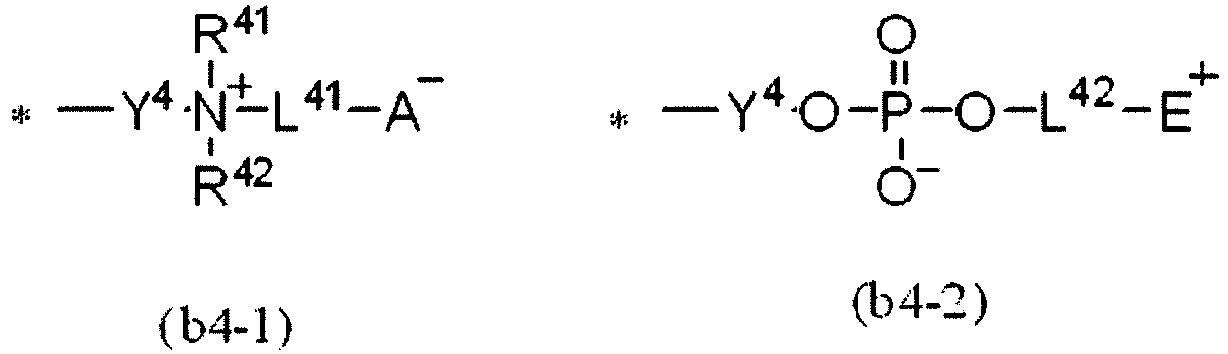
- In Formula b4-1 and Formula b4-2, R41 and R42 independently denote a hydrogen atom, an alkyl group, an alkenyl group, an alkynyl group, an aryl group, or a heterocyclic group, R41 and R42 may be bonded to each other to form a ring structure, L41 and L42 denote a linking group, A- denotes a structure having an anion, and E+ denotes a structure having a cation. Y4 denotes a divalent linking group bonded to a main chain of a polymer compound. * denotes the site bonded to the main chain of a polymer compound.
- Formula b4-1 is first explained. In Formula b4-1, the number of carbons of the alkyl group, alkenyl group, alkynyl group, aryl group, or heterocyclic group denoted by R41 and R42, including the number of carbons of a substituent that is described later, is preferably 1 to 30 carbons, more preferably 1 to 20 carbons, particularly preferably 1 to 15 carbons, and most preferably 1 to 8 carbons.
- The ring structure formed by R41 and R42 bonding to each other may have a heteroatom such as an oxygen atom and is preferably a 5- to 10-membered ring, and more preferably a 5- or 6-membered ring.
- Preferred examples of R41 or R42 are the same as those described in
JP-A-2013-205569 - In Formula b4-1, preferred examples of the divalent linking group denoted by Y4 are the same as those described in
JP-A-2013-205569 - In Formula b4-2, preferred examples of L41 are the same as those described in
JP-A-2013-205569 - In Formula b4-1, A- is preferably a carboxylate anion, a sulfonate anion, a phosphate anion, a phosphonate anion, or a phosphinate anion.
- Specifically, the anions below can be cited as preferred examples.

- From the viewpoint of stain resistance, A- is most preferably a sulfonate anion. Furthermore, in Formula b4-1 a combination in which L41 is a straight-chain alkylene group having 4 or 5 carbons and A- is a sulfonate anion is preferable, and a combination in which L41 is a straight-chain alkylene group having 4 carbons and A- is a sulfonate anion is most preferable.
- A combination in which Y4 is L401 or L403, R41 and R42 are independently an ethyl group or a methyl group, L41 is a straight-chain alkylene group having 4 or 5 carbons, and A- is a sulfonate anion is preferable. Furthermore, a combination in which Y4 is L403, R41 and R42 are methyl groups, L41 is a straight-chain alkylene group having 4 carbons, and A- is a sulfonate anion is more preferable.
- Preferred specific examples of the zwitterionic structure represented by Formula b4-1 include the structures below. * in the Formulae below denotes a site bonded to a polymer main chain of Component A.


- The zwitterionic structure represented by Formula b4-2 is now explained.
- In Formula b4-2, L42 has the same meaning as that of L41 in Formula b4-1, and preferred embodiments are also the same. Y4 has the same meaning as that of Y4 in Formula b4-1, and preferred embodiments are also the same.
- E+ denotes a structure having a cation, and preferably a structure having ammonium, phosphonium, iodonium, or sulfonium. It is more preferably a structure having ammonium or phosphonium, and particularly preferably a structure having ammonium. Specific examples of the structure having a cation include a trimethylammonio group, a triethylammonio group, a tributylammonio group, a benzyldimethylammonio group, a diethylhexylammonio group, a (2-hydroxyethyl)dimethylammonio group, a pyridinio group, an N-methylimidazolio group, an N-acridinio group, a trimethylphosphonio group, a triethylphosphonio group, and a triphenylphosphonio group.
- A most preferred combination of L42, Y4, and E+ is a combination in which L42 is an alkylene group having 2 to 4 carbons, Y4 is L401 or L403, and E+ is a trimethylammonio group or a triethylammonio group.
- Preferred specific examples of the zwitterionic structure represented b y Formula b4-2 include the structures below. In the formulae below, * denot es a site bonded to a polymer main chain of Component A, and Et denotes an ethyl group.



- In the present invention, from the viewpoint of stain resistance and developability, the content of the constituent repeating unit 1-2 comprising a zwitterionic structure in a side chain is preferably in the range of 50 to 95 mass% relative to the total mass of Component A, more preferably in the range of 60 to 90 mass%, and yet more preferably in the range of 70 to 85 mass%.
- Constituent repeating unit 1-3 comprising ethylenically unsaturated double bond in side chain
- Component A used in the present invention preferably comprises constituent repeating unit 1-3 comprising an ethylenically unsaturated double bond in a side chain in order to improve the film strength of an image area. Constituent repeating unit 1-3 preferably has at least one of the structures represented by Formulae b3-1, b3-2, and b3-3 below.

- In the Formulae, X31 and X32 independently denote an oxygen atom, a sulfur atom, or -N(R36)-. X33 denotes an oxygen atom, a sulfur atom, -N(R37)-, or a phenylene group. The Y3s independently denote a single bond or a divalent linking group selected from the group consisting of -CO-, -O-, -NH-, a divalent aliphatic group, a divalent aromatic group, and a combination thereof. R31 to R37 independently denote a monovalent substituent, and * denotes a site bonded to a main chain of a polymer compound.
- In Formula b3-1 to Formula b3-3, X31 and X32 are oxygen atoms, sulfur atoms, or -N(R36)-, and preferably oxygen atoms or -N(R36)-. X33 is an oxygen atom, a sulfur atom, -N(R37)-, or a phenylene group, and preferably an oxygen atom or -N(R37)-.
- In Formula b3-1 to Formula b3-3, Y3 is a single bond or a divalent linking group selected from the group consisting of -CO-, -O-, -NH-, a divalent aliphatic group, a divalent aromatic group, and a combination thereof.
- Preferred specific examples of Y3 formed from the above combination include those below. In the examples, the left-hand side is bonded to a main chain.
L301:-CO-O-divalent aliphatic group-
L302:-CO-O-divalent aromatic group-
L303:-CO-NH-divalent aliphatic group-
L304:-CO-NH-divalent aromatic group-
L305:-CO-O-divalent aliphatic group-O-CO-NH-divalent aliphatic group-
L306:-CO-O-divalent aliphatic group-O-CO-NH-divalent aromatic group-
L307:-CO-O-divalent aromatic group-O-CO-NH-divalent aliphatic group-
L308:-CO-O-divalent aromatic group-O-CO-NH-divalent aromatic group-
L309:-CO-NH-divalent aliphatic group-NH-CO-NH-divalent aliphatic group-
L310:-CO-NH-divalent aliphatic group-NH-CO-NH-divalent aromatic group-
L311:-CO-NH-divalent aromatic group-NH-CO-NH-divalent aliphatic group-
L312:-CO-NH-divalent aromatic group-NH-CO-NH-divalent aromatic group- - In L301 to L312, the divalent aliphatic group has the same meaning as that of the divalent aliphatic group in L201 to L204, and preferred embodiments are also the same. In L301 to L312, the divalent aromatic group has the same meaning as that of the divalent aromatic group in L201 to L204, and preferred embodiments are also the same.
- In Formula b3-1 to Formula b3-3, Y3 is preferably a single bond, -CO-, a divalent aliphatic group, a divalent aromatic group, or the above L301 to L312. Furthermore, from the viewpoint of stain resistance, Y3 is preferably the above L301, L303, L305, or L309. The divalent aliphatic group of L301, L303, L305, or L309 is yet more preferably an alkylene group having 1 to 10 carbons or a divalent linking group having 1 to 10 carbons in which 2 or more alkylene groups are bonded via an oxygen atom linking group (the alkylene groups being independently optionally substituted). The divalent linking group in which 2 or more alkylene groups are bonded via an oxygen atom linking group is particularly preferably an ethylene oxide chain, a propylene oxide chain, or a combination thereof.
- Among the structures of Formula b3-1 to Formula b3-3, from the viewpoint of stain resistance and printing durability, constituent repeating unit 1-3 comprising an ethylenically unsaturated group in a side chain is preferably a constituent repeating unit having a structure represented by b3-1.
- Preferred specific examples of the structure represented by Formula b3-1 to Formula b3-3 include the structures below. The present invention should not be construed as being limited to the structures below. In the Formulae below, * denotes a site bonded to a main chain of a polymer compound.






- The content of constituent repeating unit 1-3 is preferably in the range of 1 to 30 mass% relative to the total mass of the entire constituent units of Component A from the viewpoint of printing durability and stain resistance, more preferably in the range of 3 to 20 mass%, and yet more preferably in the range of 5 to 15 mass%.
- In the present invention, the total content of constituent repeating units 1-1 and 1-2 relative to the total mass of Component A, from the viewpoint of stain resistance and developability, is preferably in the range of 50 to 95 mass%, more preferably in the range of 70 to 95 mass%, and yet more preferably in the range of 70 to 90 mass%.
- The weight-average molecular weight (Mw) of Component A used in the present invention may be set freely by the performance design of the lithographic printing plate precursor. From the viewpoint of printing durability and stain resistance, the weight-average molecular weight is preferably 2,000 to 1,000,000, more preferably 2,000 to 500,000, and most preferably 8,000 to 300,000.
- The weight-average molecular weight (Mw) may be measured by a gel permeation chromatography (GPC) method with polyethylene glycol as a reference substance.
- Component A used in the present invention may also be synthesized by a known method, the synthesis preferably employing a radical polymerization method and, subsequently, a ureation reaction between an amino group of the polymer side chain and an isocyanate having a radically polymerizable reactive group or an amidation reaction between an amino group of the polymer side chain and an acid anhydride having a radically polymerizable reactive group.
- A standard radical polymerization method may be referred to in for example 'Shin-kobunshi Jikken-gaku 3' (New Polymer Experiments 3) (edited by the Society of Polymer Science, Japan, Kyoritsu Publishing, published on 28th March 1996), 'Kobunshi-no Gosei-to-Hannou' (Synthesis and Reactions of Polymers 1) (edited by the Society of Polymer Science, Japan, Kyoritsu Publishing, published on May 1992), 'Shin-jikken Kagaku-koza 19, Kobunshi Kagaku' (I) (New Experimental Chemistry Lecture, Polymer Chemistry (I)) (Ed. by Chemical Society of Japan, Maruzen Co., Ltd., published on 20th November 1980), 'Busshitsu-kogaku-koza Kobunshi Gosei-kagaku' (Material Engineering Lecture, Polymer Synthetic Chemistry) (Tokyo Denki University Publishing, published on September 1995).
- With regard to Component A in the intermediate layer used in the present invention, one type may be used on its own or two or more types may be used in combination.
- The content of Component A in the intermediate layer used in the present invention is preferably 50 to 99.9 mass% relative to the total mass of the total solids content, excluding volatile components, in the intermediate layer, more preferably 60 to 99.9 mass%, and yet more preferably 70 to 99.9 mass%.
- As mentioned above, the coat weight (total solids content mass) of the intermediate layer used in the present invention is preferably 0.1 to 100 mg/m2, and more preferably 1 to 30 mg/m2.
- Preferred specific examples of Component A used in the present invention are shown together with the weight-average molecular weight, but the present invention should not be construed as being limited to these examples. Furthermore, the compositional ratio of the polymer structure (content ratio of constituent units) is expressed as mass percent.


- In the present invention, as Component B a water-soluble polymer compound that does not have a phosphonic acid structure, a phosphonic acid salt structure, a phosphoric acid ester structure, or a phosphoric acid ester salt structure is contained in the intermediate layer or the image recording layer. The water-soluble polymer compound is preferably a polymer compound of which at least 1 g dissolves in 100 g of water at 25°C, more preferably a polymer compound of which at least 5 g dissolves in 100 g of water at 25°C, and yet more preferably a polymer compound of which at least 10 g dissolves in 100 g of water at 25°C.
- Component B is contained in at least one of the intermediate layer and the image recording layer. It is preferable for the image recording layer to contain Component B because Component B has the function of efficiently increasing the amount of dampening water penetrating into the support interface when Component B is contained within the image recording layer.
- The water-soluble polymer preferably comprises as a repeating unit at least one selected from the group consisting of a hydroxy group-containing structure, a carboxy group-containing structure, a pyrrolidone group-containing structure, and an oxyalkylene group-containing structure, which have affinity toward water in particular, and more preferably comprises as a constituent repeating unit an oxyalkylene group-containing structure.
- Specific examples of the hydroxy group-containing water-soluble polymer include gum arabic, gum soya, carboxymethylcellulose, hydroxymethylcellulose, hydroxyethylcellulose, polyhydroxyethylated cellulose, hydroxypropylcellulose, hydroxypropylmethylcellulose, glyoxalated hydroxypropylmethylcellulose, hydroxypropylmethylcellulose phthalate, methylcellulose, α-cyclodextrin, β-cyclodextrin, γ-cyclodextrin, white dextrin, red dextrin, pullulan, enzymatically-decomposed etherified dextrin, maltose-modified cyclodextrin, pregelatinized starch, grafted starch, dialdehyde starch, periodic acid-modified starch, hydroxyether-modified starch, cationic starch ether, alkali cellulose, industrial cationic starch, and polyvinyl alcohol.
- Specific examples of the carboxy group-containing water-soluble polymer include polyacrylic acid, carboxyethylcellulose, alginic acid, sodium alginate, ammonium alginate, alginic acid propylene glycol ester, xanthan gum, a copolymer containing acrylic acid units, polymethacrylic acid, and a copolymer containing methacrylic acid units.
- Specific examples of the pyrrolidone group-containing water-soluble polymer include polyvinylpyrrolidone and a copolymer of vinylpyrrolidone and vinyl acetate.
- Specific examples of the oxyalkylene group-containing water-soluble polymer include a polyalkylene glycol such as polyethylene glycol, polypropylene glycol, or polyoxyethylene polyoxypropylene glycol (also called a polyoxyethylene-polyoxypropylene condensation product), a polyoxyalkylene monoalkyl or aryl ether such as poly(ethylene glycol) methyl ether or poly(ethylene glycol) phenyl ether, a polyoxyethylene polyoxypropylene alkyl ether, a polyglycerol or an ether thereof such as polyglycerol, polyoxyethylene glycerol, polyoxypropylene glyceryl ether, or polyoxyethylene polyoxypropylene glyceryl ether, and an ester having a polyoxyalkylene structure such as a polyoxyethylene monoester, a polyoxyethylene alkyl ether ester, polyoxyethylene glyceryl isostearate, polyoxyethylene glyceryl triisostearate, polyoxyethylene glyceryl triisostearate, polyoxyethylene trimethylolpropane distearate, a polyoxyethylene sorbitan monofatty acid ester, a polyoxyethylene sorbitan fatty acid ester, polyoxyethylene hardened castor oil, a polyoxyethylene hardened castor oil monofatty acid ester, polyoxyethylene hardened castor oil succinate, polyoxyethylene castor oil, polyoxyethylene sorbitol tetraoleate, polyoxyethylene sorbitol tetraisostearate, or polyoxyethylene sorbitol isostearate.
- Among them, a polyoxyalkylene monoalkyl ether is preferable, and poly(ethylene glycol) methyl ether is more preferable.
- Preferred specific examples of Component B used in the present invention are listed together with the weight-average molecular weight, but the present invention should not be construed as being limited thereto. Furthermore, the compositional ratio of the polymer structure (content ratio of constituent units) is expressed as mass percent.

- The weight-average molecular weight (Mw) of Component B used in the present invention may be set freely by the performance design of the lithographic printing plate precursor. The weight-average molecular weight (Mw) is preferably in the range of 1,000 to 200,000. The weight-average molecular weight (Mw) is more preferably 3,000 to 100,000, and yet more preferably 3,000 to 50,000. When the weight-average molecular weight (Mw) is at least 1,000 an effect in suppressing the degradation of developability over time may be sufficiently exhibited, and when it is no greater than 200,000 the printing durability is also excellent. It may be measured by a gel permeation chromatography (GPC) method with polyethylene glycol as a reference substance.
- In the present invention, the mass ratio of Component A and Component B is Component A:Component B = 1:0.5 to 1:5. When it is less than 0.5 the developability is insufficient, and when it exceeds 5 the printing durability is degraded. It is more preferably 1:0.7 to 1:4, and yet more preferably 1:0.8 to 1:3.
- A image recording layer in the lithographic printing plate precursor of the present invention contains an infrared absorbing agent.
- The infrared absorbing agent used in the present invention has a maximum absorption in a wavelength region of 750 to 1,400 nm. In particular, since an on-machine development type lithographic printing plate precursor might undergo on-machine development in a printer under a white lamp, use of a sensitizing dye having a maximum absorption in a wavelength region of 750 to 1,400 nm enables a lithographic printing plate precursor having excellent developability to be obtained.
- As the infrared absorbing agent, a dye or a pigment is preferably used.
- As the above dye, commercial dyes and known dyes described in the literature such as 'Senryo Binran' (Dye Handbook) (Ed. The Society of Synthetic Organic Chemistry, Japan, 1970), etc. may be used.
- Among these dyes, a cyanine dye, a squarylium dye, a pyrylium salt, a nickel thiolate complex, and an indolenine cyanine dye are exemplified. A cyanine dye and an indolenine cyanine dye are more preferable, and a cyanine dye represented by Formula (a) below is particularly preferable.

- In Formula (a), X131 denotes a hydrogen atom, a halogen atom, -NPh2, - X132-L131, or the group shown below. Here, Ph denotes a phenyl group

- In Formula (a), X132 denotes an oxygen atom, a nitrogen atom, or a sulfur atom, L131 denotes a hydrocarbon group having 1 to 12 carbon atoms, a hetero atom (N, S, O, a halogen atom, or Se)-containing aryl group, or a hetero atom-containing hydrocarbon group having 1 to 12 carbon atoms. Xa - is defined in the same manner as for Za -, which is described later, and R141 denotes a hydrogen atom or a substituent selected from the group consisting of an alkyl group, an aryl group, a substituted or unsubstituted amino group, and a halogen atom.
- Preferable examples of the substituent are the same as those described in
JP-A-2013-205569 - With regard to such infrared absorbing dyes, only one type may be used or two or more types may be used in combination, and an infrared absorbing agent other than an infrared absorbing dye, such as a pigment, may be used in combination. As the pigment, compounds described in paragraphs. 0072 to 0076 of
JP-A-2008-195018 - The amount of the infrared absorbing dyes added is preferably 0.05 to 30 parts by mass relative to 100 parts by mass of the total solids content of the image recording layer, more preferably 0.1 to 20 parts by mass, and yet more preferably 0.2 to 10 parts by mass.
- The image recording layer in the lithographic printing plate precursor of the present invention preferably contains a polymerizable compound as Component C, a binder as Component D and a polymerization initiator as Component E. The image recording layer in the lithographic printing plate precursor of the present invention is preferably a photosensitive layer (hereinafter, the image recording layer is also called a 'photosensitive layer'). (C) Polymerizable compound
- The image recording layer in the lithographic printing plate precursor of the present invention preferably contains a polymerizable compound as Component C. The polymerizable compound described in
JP-A-2013-205569 - These are described in Published Japanese translation
2006-508380 PCT application, JP-A-2002-287344 JP-A-2008-256850 JP-A-2001-342222 JP-AH9-179296 JP-A-H9-179297 JP-A-H9-179298 JP-A-2004-294935 JP-A-2006-243493 JP-A-2002-275129 JP-A-2003-64130 JP-A-2003-280187 JP-A-10-333321 - Specific examples of a monomer that is an ester of a polyhydric alcohol compound and an unsaturated carboxylic acid include a (meth)acrylic acid ester such as ethylene glycol di(meth)acrylate, etc. Specific examples of a monomer that is an amide of a polyamine compound and an unsaturated carboxylic acid include methylene-bis-(meth)acrylamide.
- Furthermore, a urethane-based addition-polymerizable compound produced by an addition reaction of an isocyanato group and a hydroxy group is also suitable, and specific examples thereof include a vinylurethane compound containing two or more polymerizable vinyl groups per molecule in which a hydroxy group-containing vinyl monomer represented by Formula (P) below is added to a polyisocyanate compound having two or more isocyanato groups per molecule described in
JP-B-48-41708
CH2=C(R104)COOCH2CH(R105)OH (P)
R104 and R105 independently denote H or CH3. - Among the above, in the case of a lithographic printing plate precursor applied to on-machine development, from the viewpoint of achieving a balance between the hydrophilicity involved in on-machine developability and the polymerizability involved in printing durability, an isocyanuric acid ethylene oxide-modified (meth)acrylate such as tris((meth)acryloyloxyethyl) isocyanurate or bis((meth)acryloyloxyethyl)hydroxyethyl isocyanurate is particularly preferable.
- Details of the structure of Component C and the method of use such as its use on its own or in combination or the amount added can be freely set in accordance with the final performance design of the lithographic printing plate precursor.
- In the present invention the content of Component C is preferably 5 to 75 mass% relative to the total solids content mass of the photosensitive layer, more preferably 25 to 70 mass%, and particularly preferably 30 to 60 mass%.
- The image recording layer (photosensitive layer) in the lithographic printing plate precursor of the present invention preferably contains a binder as Component D. The binder described in
JP-A-2013-205569 - As Component D contained in the photosensitive layer in the lithographic printing plate precursor of the present invention, a binder is preferably a polymer binder resin having a molecular weight of at least 2,000, more preferably 2,000 to 500,000 and yet more preferably 10,000 to 300,000. Furthermore, Component D does not include Component B.
- As Component D, one that can support a photosensitive layer component above a support and that can be removed by a developer is used.
- Preferably examples of Component D include a (meth)acrylic polymer, a polyurethane resin, a polyvinyl alcohol resin, a polyvinyl butyral resin, a polyvinyl formal resin, a polyamide resin, a polyester resin and an epoxy resin, etc. Among them, a (meth)acrylic polymer, a polyurethane resin and a polyvinyl butyral resin are more preferable and a (meth)acrylic polymer, a polyurethane resin and a polyvinyl butyral resin are yet more preferable.
- Preferred examples of the (meth)acrylic polymer as Component D in the present invention include a copolymer comprising a repeating unit comprising an acid group. Examples of the acid group include a carboxylic acid group, a sulfonic acid group, a phosphonic acid group, a phosphoric acid group, and a sulfonamide group, and a carboxylic acid group is particularly preferable. A polymer comprising (meth)acrylic acid as a polymerization monomer or a polymer comprising a repeating unit derived from (meth)acrylic acid and represented by Formula (I) below, described in
JP-A-2013-205569 
- In Formula (I), R211 denotes a hydrogen atom or a methyl group, and R212 denotes a single bond or an (n211+1)-valent linking group. A211 denotes an oxygen atom or -NR3-, and R3 denotes a hydrogen atom or a monovalent hydrocarbon group having 1 to 10 carbons. n211 denotes an integer of 1 to 5.
- The proportion (mole%) of carboxylic acid group-containing copolymerization components in the total copolymerization components of Component D is, from the viewpoint of developability, preferably 1% to 70%. From the viewpoint of a balance being achieved between developability and printing durability, it is more preferably 1% to 50%, and particularly preferably 1% to 30%.
- Component D used in the present invention preferably has the crosslinkable group. The crosslinkable group referred to here is a group that crosslinks Component D in the process of a radical polymerization reaction occurring in the photosensitive layer when the lithographic printing plate precursor is exposed. The group is not particularly limited as long as it has the above function, and examples thereof include, as a functional group that can undergo an addition polymerization reaction, an ethylenically unsaturated bond group, an amino group, and an epoxy group. It may be a functional group that can become a radical upon exposure to light, and examples of such a crosslinkable group include a thiol group, and a halogen group. Among them, an ethylenically unsaturated bond group is preferable, and as the ethylenically unsaturated bond group, a styryl group, a (meth)acryloyl group, and an allyl group are preferable.
- The content of the crosslinkable group (content of radically polymerizable unsaturated double bond determined by iodine titration) in Component D is preferably 0.01 to 10.0 mmol, more preferably 0.05 to 9.0 mmol, and yet more preferably 0.1 to 8.0 mmol, per g of the Component D.
- Component D used in the present invention may have a constituent unit derived from a monomer such as a (meth)acrylic acid alkyl or aralkyl ester, (meth)acrylamide or a derivative thereof, α-hydroxymethyl acrylate, or a styrene derivative, in addition to the acid group-containing constituent unit and crosslinkable group-containing constituent unit. Preferred examples of the monomer include examples described in
JP-A-2013-205569 - Furthermore, when the lithographic printing plate precursor of the present invention is a lithographic printing plate precursor to which on-machine development is applied, Component D preferably has a hydrophilic group. The hydrophilic group contributes to the imparting of on-machine developability to the photosensitive layer. In particular, due to the coexistence of the crosslinkable group and the hydrophilic group, printing durability and on-machine developability can be achieved at the same time.
- Examples of the hydrophilic group that Component D may have include a hydroxy group, a carboxy group, an alkylene oxide structure, an amino group, an ammonium group, an amide group, a sulfo group, and a phosphoric acid group, among them an alkylene oxide structure having 1 to 9 alkylene oxide units having 2 or 3 carbons being preferable. Imparting a hydrophilic group to a binder is carried out for example by copolymerization of a monomer having a hydrophilic group.
- Component D preferably has a weight-average molecular weight of 2,000 or more, and more preferably 10,000 to 300,000, and a number-average molecular weight of 1,000 or more, and more preferably 2,000 to 250,000. The polydispersity (weight-average molecular weight/number-average molecular weight) is preferably 1.1 to 10.
- Component D may be used singly or in a combination of two or more types as a mixture.
- From the view point of good strength for an image area and good image formation properties, the content of Component D is preferably 5 to 75 mass % relative to the total solids content of the photosensitive layer, more preferably 10 to 70 mass %, and yet more preferably 10 to 60 mass %.
- Furthermore, the total content of Component C and Component D is preferably no greater than 90 mass % relative to the total solids content of the photosensitive layer, and more preferably 35 to 80 mass %. When in the above-mentioned range, sensitivity and developability are excellent.
- The image recording layer in the lithographic printing plate precursor of the present invention preferably contains a polymerization initiator as Component E. It is not particularly limited in the present invention, the polymerization initiator described in
JP-A-2013-205569 - Examples of an onium salt include an iodonium salt and a sulfonium salt.
- Specific examples of these compounds are shown below, but the present invention is not limited by these examples.
- Examples of an iodonium salt preferably include a diphenyliodonium salt, in particular, more preferably a diphenyl iodonium salt substituted by an electron-releasing group such as an alkyl group and an alkoxyl group and yet more preferably an asymmetric diphenyl iodonium salt. Examples of the diphenyliodonium salt include diphenyliodonium hexafluorophosphate, 4-metoxyphenyl-4-(2-methylpropyl)phenyliodonium hexafluorophosphate, 4-(2-methylpropyl)phenyl-p-tryliodonium hexafluorophosphate, 4-hexyloxyphenyl-2,4,6-trimetoxyphenyliodonium hexafluorophosphate, 4-hexyloxyphenyl-2,4-dietoxyphenyliodonium tetrafluoroborate, 4-octyloxyphenyl-2,4,6-trimetoxyphenyliodonium 1-perfluorobutanesulfonate, 4-octyloxyphenyl-2,4,6-trimetoxyphenyliodonium hexafluorophosphate and bis(4-t-butylphenyl)iodonium tetraphenylborate.
- Examples of the sulfonium salt include triphenylsulfonium hexafluorophosphate, triphenylsulfonium benzoylfomate, bis(4-chrolophenyl)phenylsulfonium benzoylfomate, bis(4-chrolophenyl)-4-methylphenylsulfonium tetrafluoroborate, tris(4-chrolophenyl)sulfonium 3,5-bis(metoxycarbonyl)benzenesulfonate, tris(4-chrolophenyl)sulfonium hexafluorophosphate.
- Among them, an iodonium salt is preferable. An onium salt is particularly preferably used in a combination with an infrared absorbing agent having a maximum absorption in a wavelength region of 750 to 1,400 nm.
- The polymerization initiator is preferably used singly or in a combination of two or more types.
- The content of Component E is preferably 0.01 to 20 mass % relative to the total solids content of the photosensitive layer, more preferably 0.1 to 15 mass %, and yet more preferably 1.0 to 10 mass %.
- The image recording layer of the lithographic printing plate precursor of the present invention preferably comprises a low-molecular-weight hydrophilic compound as Component F. In the present invention, Component F is preferably contained since on-machine developability can be improved without degrading the printing durability of the lithographic printing plate precursor of the present invention.
- Component F is the same as those described in paragraph 0100 et seq. of
JP-A-2013-205569 - Since the compound cited as a preferred example of Component F has a small-structured hydrophobic moiety and hardly any surface activity, the hydrophobicity or the film strength of an image area is not degraded due to dampening water penetrating into an exposed image recording layer portion (image area), and ink acceptance and printing durability of a photosensitive layer can be maintained well.
- The content of Component F is preferably 0.5 to 20 mass % relative to the total solids content of the photosensitive layer, more preferably 1 to 15 mass %, and yet more preferably 2 to 10 mass %. Component F is preferably used singly or in a combination of two or more types.
- The image recording layer of the lithographic printing plate precursor of the present invention may comprise as Component G an oleophilizing agent.
- In the present invention, the image recording layer may preferably comprise Component G, such as a phosphonium compound, a nitrogen-containing low-molecular-weight compound, or an ammonium group-containing polymer, in order to improve laydown. In particular, when a protective layer of the lithographic printing plate precursor of the present invention comprises an inorganic lamellar compound, Component G functions as a surface covering agent for the inorganic lamellar compound, thereby preventing degradation of laydown during printing due to the inorganic lamellar compound. A phosphonium compound, a quaternary ammonium salt, or a pyridinium salt is preferable. Preferred oleophilizing agents are the same as those described in
JP-A-2013-205569 - The content of Component G is preferably 0.01 to 30.0 mass % relative to the total solids content of the photosensitive layer, more preferably 0.1 to 15.0 mass %, and yet more preferably 1 to 5 mass %.
- The image recording layer of the lithographic printing plate precursor of the present invention may comprise as Component H a hydrophobizing precursor.
- In the present invention, the photosensitive layer may comprise as Component H a hydrophobizing precursor in order to improve the on-machine developability.
- The hydrophobizing precursor means particles that can convert the photosensitive layer into being hydrophobic when heat is applied.
- The particles are preferably at least one type selected from hydrophobic thermoplastic polymer particles, thermoreactive polymer particles, polymerizable group-containing polymer particles, hydrophobic compound-encapsulating microcapsules, and a microgel (crosslinked polymer particles). Among them, polymerizable group-containing polymer particles and a microgel are preferable. From the viewpoint of developability, it is preferable for it to comprise hydrophobic thermoplastic polymer particles.
- Such a hydrophobizing precursor is the same as one described in
JP-A-2013-205569 - More preferred examples include polystyrene, a styrene- and acrylonitrile-containing copolymer, and polymethyl methacrylate.
- The average particle size of the hydrophobic thermoplastic polymer particles used in the present invention is preferably 0.01 to 2.0 µm.
- Examples of the thermoreactive polymer particles used in the present invention include thermoreactive group-containing polymer particles, and they form a hydrophobizing region due to crosslinking by a thermal reaction and change of a functional group at that time.
- Preferred examples of the thermoreactive group in the thermoreactive group-containing polymer particles used in the present invention include a polymerizable group described in
JP-A-2013-20556 - Examples of the microcapsules used in the present invention include those in which the whole or part of the constituent components of the photosensitive layer is encapsulated in microcapsules as described in
JP-A-2001-277740 JP-A-2001-277742 - The microgel used in the present invention may comprise part of the constituent components of the photosensitive layer in at least one of the interior and the surface of the microgel. In particular, an embodiment in which a reactive microgel is formed by having a radically polymerizable group on the surface is particularly preferable from the viewpoint of image formation sensitivity and printing durability.
- Making microcapsules or a microgel using the constituent components of the photosensitive layer may be carried out by a known method.
- The average particle size of the microcapsules or the microgel is preferably 0.01 to 3.0 µm, more preferably 0.05 to 2.0 µm, and particularly preferably 0.10 to 1.0 µm. Good resolution and aging stability are obtained within this range.
- The content of Component H is preferably 5 to 90 mass % relative to the total solids content of the photosensitive layer.
- The image recording layer of the lithographic plate precursor in the present invention may comprise the (I) other photosensitive layer components other than Component A to Component H above.
- The content of component I is preferably 0.01 to 20 mass % relative to the total solids content of the photosensitive layer, more preferably 1 to 10 mass %, and yet more preferably 1 to 5 mass %.
- The photosensitive layer may further contain various additives as necessary. The additives described in
JP-A-2013-205569 - The method for forming the image recording layer (photosensitive layer) in the printing plate precursor of the present invention is not particularly limited and may be a known method. The photosensitive layer according to the invention is formed by dissolving or dispersing each of the necessary components described above in an appropriate solvent to prepare a coating solution and coating the coating solution. The solvents used include, for example, methyl ethyl ketone, ethylene glycol monomethyl ether, 1-methoxy-2-propanol, 2-methoxyethyl acetate, 1-methoxy-2-propyl acetate and γ-butyrolactone, but the invention should not be construed as being limited thereto. The solvents are preferably used singly or in a combination of two or more types. The solid content concentration of the coating solution is preferably from 1 to 50 mass %.
- The coating amount (solid content) of the photosensitive layer is preferably from 0.3 to 3.0 g/m2. Various methods can be used for the coating. Examples of the method include bar coater coating, spin coating, spray coating, curtain coating, dip coating, air knife coating, blade coating, and roll coating.
- The image recording layer used in the lithographic printing plate precursor of the present invention is preferably removable with a dampening water composition and/or a printing ink.
- The support used for the lithographic printing plate precursor of the present invention is not particularly limited and may be a dimensionally stable plate-form hydrophilic support. Particularly, an aluminum plate is preferable. Examples of the support described in
JP-A-2013-205569 - In the lithographic printing plate precursor of the present invention, in order to improve the hydrophilicity of a non-image region to thus prevent printing stains, it is preferable to subject a support surface to a hydrophilization treatment.
- Examples of the hydrophilization treatment of a support surface include a treatment with an alkali metal silicate in which a support is immersed or electrolyzed in an aqueous solution of sodium silicate, etc., a treatment with potassium fluorozirconate, and a treatment with polyvinylphosphonic acid; a treatment method involving immersion in an aqueous solution of polyvinylphosphonic acid is preferably used.
- In the lithographic printing plate precursor of the present invention, a protective layer (oxygen-blocking layer) is preferably provided on the photosensitive layer in order to prevent diffusion and penetration of oxygen, which inhibits a polymerization reaction at the time of exposure.
- As a material that can be used in the protective layer, either a water-soluble polymer or a water-insoluble polymer may be used by appropriate selection, and two or more types may be mixed as necessary and used. Specific examples include polyvinyl alcohol, a modified polyvinyl alcohol, polyvinylpyrrolidone, a water-soluble cellulose derivative, and a poly(meth)acrylonitrile. Among them, it is preferable to use a water-soluble polymer compound having relatively good crystallinity. Specifically, use of polyvinyl alcohol as a main component can give the best results in terms of basic characteristics such as oxygen barrier properties and development removability.
- Examples of the polyvinylalcohol are described in paragraphs 0216 to 0217 of
JP-A-2013-205569 - Furthermore, it is also preferable for an inorganic layered compound to be contained in the protective layer for the purpose of improving the oxygen-blocking properties and the photosensitive layer surface protection properties. Among inorganic layered compounds, a fluorine-based swelling synthetic mica, which is a synthetic inorganic layered compound, is particularly useful. Specific preferred examples include inorganic layered compounds described in
JP-A-2005-119273 - The coat weight of the protective layer is preferably in the range of 0.05 to 10 g/m2. When the protective layer contains the inorganic layered compound, it is more preferably in the range of 0.1 to 5 g/m2, and when the protective layer does not contain the inorganic layered compound, it is more preferably in the range of 0.5 to 5 g/m2.
- In the lithographic printing plate precursor of the present invention, a backcoat layer may as necessary be provided on the back surface of the support.
- As the backcoat layer, there can preferably be cited, for example, a coating layer comprising an organic polymer compound described in
JP-A-5-45885 JP-A-6-35174 - A lithographic printing plate may be made by processing the lithographic printing plate precursor of the present invention by imagewise exposure.
- A first embodiment of the process for making a lithographic printing plate of the present invention comprises an exposure step of imagewise exposing the lithographic printing plate precursor of the present invention and a development step of removing a non-exposed area of the image recording layer of the lithographic printing plate precursor in the presence of a developer having a pH of 2 to 14.
- A second embodiment of the process for making a lithographic printing plate of the present invention comprises an exposure step of imagewise exposing the lithographic printing plate precursor of the present invention and a development step of removing a non-exposed area of the image recording layer of the lithographic printing plate precursor by supplying a printing ink and dampening water on a printer.
- With regard to the process for making a lithographic printing plate of the present invention, preferred embodiments for each step are explained below in sequence. In accordance with the process for making a lithographic printing plate of the present invention, the lithographic printing plate precursor of the present invention may also be made into a lithographic printing plate when a water washing step is contained in the development step.
- The process for making a lithographic printing plate of the present invention preferably comprises an exposure step of imagewise exposing the lithographic printing plate precursor of the present invention. The lithographic printing plate precursor of the present invention is preferably exposed to a laser through a transparent original image having a line image, a halftone image, etc., or imagewise exposed by laser light scanning using digital data.
- The wavelength of the light source employed is preferably 750 to 1,400 nm. As a light source at 750 to 1,400 nm, a solid-state laser and a semiconductor laser that emit infrared are suitable. With regard to the infrared laser, the output is preferably at least 100 mW, the exposure time per pixel is preferably within 20 microseconds, and the illumination energy level is preferably 10 to 300 mJ/cm2. Furthermore, in order to shorten the exposure time it is preferable to use a multi-beam laser device. The exposure mechanism may be any of a drum inner face method, a drum outer face method, a flat bed method, etc.
- Imagewise exposure may be carried out by a standard method using a plate setter, etc. In the case of on-machine development, after a lithographic printing plate precursor is mounted on a printer, imagewise exposure may be carried out on the printer.
- The process for making a lithographic printing plate of the present invention preferably comprises a development step of removing a non-exposed area of the image recording layer of the lithographic printing plate precursor in the presence of a developer having a pH of 2 to 14. Furthermore, the process for making a lithographic printing plate of the present invention preferably comprises a development step of removing a non-exposed area of the image recording layer of the lithographic printing plate precursor by supplying a printing ink and dampening water on a printer. The process for making a lithographic printing plate of the present invention preferably comprises either one of the two steps as the development step. That is, in the process for making a lithographic printing plate of the present invention, processing is preferably carried out by (1) a method in which development is carried out using a developer having a pH of 2 to 14 (developer processing method) or (2) a method in which development is carried out while applying dampening water and an ink on a printer (on-machine development method).
- The developer processing method and the on-machine development method are explained below.
- In the solution developing process, the lithographic printing plate precursor is treated using the developer of pH 2 to 14, so as to remove the photosensitive layer in non-exposed areas, and thereby lithographic printing plate is manufactured.
- In a general process of development using a strong alkaline developer (pH12 or above), the protective layer is removed by pre-water washing, subjected to alkaline development, post-water washing for removing alkali by water washing, gum solution treatment, and drying process, to thereby obtain the lithographic printing plate.
- According to a first preferable embodiment of the present invention, the developer used herein has pH value of 2 to 14. In this embodiment, the developer preferably contains a surfactant or water-soluble polymer compound, so as to concomitantly allow the development and gum solution treatment to proceed. Accordingly, the post-water washing is not indispensable, and the development and the gum solution treatment may be proceeded in a single solution.
- Also the pre-water washing is not indispensable, so that also the removal of the protective layer may be proceeded concomitantly with the gum solution treatment. In the process for making the lithographic printing plate of the present invention, it is preferred not to include the water washing step before and after the solution development step. In the process for making the lithographic printing plate of the present invention, the development and gum solution treatment is preferably followed by removal of excessive developer using a squeeze roller for example, and drying.
- The development by developer in the lithographic printing plate precursor of the present invention may be proceeded as usual at 0 to 60° C., preferably 15 to 40° C. or around, typically by a method of dipping the exposed lithographic printing plate precursor into a developer followed by rubbing with a brush, or a method of spraying a developer followed by rubbing with a brush.
- The development using the developer is successfully implemented on an automatic processor, equipped with a developer feeder and a rubbing member. The automatic processor having rotating brush rollers as the rubbing member is particularly preferable. The automatic processor preferably has a unit for removing excessive developer, such as squeeze rollers, and a drying unit such as a hot air blower, on the downstream side of the developing unit. Moreover, the automatic processor may have a pre-heating unit for heating the exposed lithographic printing plate precursor, on the upstream side of the developing unit.
- The example of the automatic processor used for the method of manufacturing a lithographic printing plate of the present invention is illustrated in
FIG. 1 . - The
automatic processor 100 illustrated inFIG. 1 is composed of a chamber shaped by anequipment frame 202, and has apre-heating section 200, a developingsection 300 and adrying section 400 aligned in line in the direction of a feed path 11 along which the lithographic printing plate precursor is fed (indicated by arrow A). - The
pre-heating section 200 has aheating chamber 208 with a feedingport 212 and anoutput port 218, and hastandem rollers 210,heaters 214 and a circulatingfan 216 arranged therein. - The developing
section 300 is partitioned by anouter panel 310 from thepre-heating section 200, and theouter panel 310 has aninsertion slit 312. - Inside the developing
section 300, there is provided aprocess tank 306 having therein a developingtank 308 filled with a developer, and aninsertion roller pair 304 for guiding the lithographic printing plate precursor into theprocess tank 306. The upper portion of the developingtank 308 is covered with a shieldinglid 324. - Inside the developing
tank 308, there is provided aguide roller 344 and a guidingmember 342, an immersedroller pair 316, abrush roller pair 322, abrush roller pair 326, and anoutput roller pair 318 which are aligned in sequence from the upstream side of the feeding direction. The lithographic printing plate precursor brought into the developingtank 308 is dipped in the developer, and allowed to pass through the rotating brush roller pairs 322, 326, to be removed with the non-image-forming area. - Below the brush roller pairs 322, 326, there is provided a
spray 330. Thespray pipe 330 is connected to a pump (not illustrated), and the developer in the developingtank 308 sucked up by the pump is ejected through thespray pipe 330 into the developingtank 308. - On the sidewall of the developing
tank 308, there is provided anoverflow port 51 opened at the top end portion of a first circulating pipe C1, so as to allow an excessive portion of the developer to flow into theoverflow port 51, run down through the first circulating pipe C1, to be discharged into anexternal tank 50 provided outside the developingsection 300. - The
external tank 50 is connected to a second circulating pipe C2. The second circulating pipe C2 is provided with a filter unit 54 and adeveloper feed pump 55. By thedeveloper feed pump 55, the developer is fed from theexternal tank 50 to the developingtank 308. Theexternal tank 50 is provided with a upper level gauge 52 and a lower level gauge 53. - The developing
tank 308 is connected through a third circulating pipe C3 to asupplementary water tank 71. The third circulating pipe C3 is provided with awater supplement pump 72 by which water reserved in thesupplementary water tank 71 is fed to the developingtank 308. - A
liquid temperature sensor 336 is provided on the upstream side of the immersedroller pair 316, and alevel gauge 338 is provided on the upstream side of theoutput roller pair 318. - A
partition board 332 placed between the developingsection 300 and thedrying section 400 has aninsertion slit 334 provided thereto. On a path between the developingsection 300 and thedrying section 400, there is provided a shutter (not illustrated) which closes the path when the lithographic printing plate precursor 11 does not travel on the path. - The
drying section 400 has asupport roller 402,ducts feed roller pair 406,ducts feed roller pair 408 aligned therein in sequence. Each of theducts slit hole 414 provided to the tip thereof. - The
drying section 400 has provided thereto an unillustrated drying unit such as a hot air blower, heat generator or the like. Thedrying section 400 has adischarge port 404, through which the lithographic printing plate 11 dried by the drying unit is ejected. - In the present invention the developer used in development processing comprises an aqueous solution having a pH of 2 to 14 or a surfactant. The developer is preferably an aqueous solution containing water as a main component (containing at least 60 mass% of water), and particularly preferably an aqueous solution containing a surfactant (anionic, nonionic, cationic, amphoteric, etc.) or an aqueous solution containing a water-soluble polymer compound. An aqueous solution containing both a surfactant and a water-soluble polymer compound is preferable. The pH of the developer is more preferably 2.0 to 10.0, yet more preferably 3.5 to 10.0, and particularly preferably 6.5 to 10.0. In particular, in a method in which a developer having a pH of 2.0 to 10.0 is used, it is very difficult to satisfy all of stain resistance, printing durability, and suppression of degradation of stain resistance after aging. The reason therefor can be explained as follows. That is, when the same material for a lithographic printing plate precursor is used but the type of developer is changed, compared with an alkali developer having a pH of 12 to 13, which has been used conventionally, a developer having a pH of 2.0 to 10.0 degrades the stain resistance of an unexposed portion. When the hydrophilicity of a material is increased in an attempt to improve the stain resistance when using a developer having a pH of 2.0 to 10.0, the printing durability tends to be degraded. In accordance with use of the lithographic printing plate precursor of the present invention, such a developer having a pH of 2.0 to 10.0 can preferably be used.
- The anionic surfactant to be comprised in the above developer in the present invention is not particularly limited but examples thereof include fatty acid salts, abietates, hydroxyalkanesulfonates, alkanesulfonates, dialkylsulfosuccinates, linear alkylbenzenesulfonates, branched alkylbenzenesulfonates, alkylnaphthalenesulfonates, alkyldiphenylether (di)sulfonates, alkylphenoxypolyoxyethylene alkylsulfonates, salts of polyoxyethylene alkylsulfophenyl ether, sodium N-methyl-N-oleyltaurates, monoamide disodium N-alkylsulfosuccinates, petroleum sulfonates, sulfated castor oil, sulfated tallow oil, salts of sulfuric ester of fatty acid alkyl ester, salts of alkylsulfuric ester, salts of sulfuric ester of polyoxyethylene alkyl ether, salts of sulfuric ester of fatty acid monoglyceride, salts of sulfuric ester of polyoxyethylene alkylphenyl ether, salts of sulfuric ester of polyoxyethylene styrylphenyl ether, salts of alkylphosphoric ester, salts of phosphoric ester of polyoxyethylene alkyl ether, salts of phosphoric ester of polyoxyethylene alkylphenyl ether, partially saponified produces of styrene-maleic anhydride copolymer, partially saponified products of olefin-maleic anhydride copolymer, and naphthalene sulfonate formalin condensates. Among these, alkylbenzenesulfonates, alkylnaphthalenesulfonates and alkyldiphenylether (di)sulfonates are preferably used.
- The cationic surfactant to be comprised in the above developer in the present invention is not particularly limited and a conventionally known cationic surfactant may be used. Examples thereof include alkylamine salts, quaternary ammonium salts, alkylimidazolinium salts, polyoxyethylene alkylamine salts and polyethylene polyamine derivatives.
- The nonionic surfactant to be comprised in the above developer in the present invention is not particularly limited, but examples thereof include a polyethylene glycol-type higher alcohol ethylene oxide adduct, an alkylphenol ethylene oxide adduct, an alkylnaphthol ethylene oxide adduct, a phenol ethylene oxide adduct, a naphthol ethylene oxide adduct, a fatty acid ethylene oxide adduct, a polyhydric alcohol fatty acid ester ethylene oxide adduct, a higher alkylamine ethylene oxide adduct, a fatty acid amide ethylene oxide adduct, a fatty oil ethylene oxide adduct, a polypropylene glycol ethylene oxide adduct, a dimethylsiloxane-ethylene oxide block copolymer, a dimethylsiloxane-(propylene oxide-ethylene oxide) block copolymer, a fatty acid ester of polyhydric alcohol-type glycerol, a fatty acid ester of pentaerythritol, a fatty acid ester of sorbitol or sorbitan, a fatty acid ester of sucrose, an alkyl ether of polyhydric alcohol, and a fatty acid amide of alkanolamines. Among these, those having an aromatic ring and an ethylene oxide chain are preferred, and an alkyl-substituted or unsubstituted phenol ethylene oxide adduct and an alkyl-substituted or unsubstituted naphthol ethylene oxide adduct are more preferred.
- The zwitterionic surfactant to be comprised in the above developer in the present invention is not particularly limited but includes an amine oxide type such as alkyldimethylamine oxide, a betaine type such as alkylbetaine, and an amino acid type such as alkylamino-fatty acid sodium salt. In particular, an alkyldimethylamine oxide which may have a substituent, an alkylcarboxybetaine which may have a substituent, and an alkylsulfobetaine which may have a substituent, are preferably used. As for specific examples thereof, a compound represented by formula (2) in paragraph 0256 of
JP-A-2008-203359 JP-A-2008-276166 JP-A-2009-47927 - The surfactant may be used singly or in a combination of two or more types as a mixture. And the proportion of the surfactant in the developer is preferably from 0.01 to 20 mass %, more preferably from 0.1 to 10 mass %.
- The water-soluble polymer compound for use in the developer according to the invention includes, for example, soybean polysaccharide, modified starch, gum arabic, dextrin, a cellulose derivative (for example, carboxymethyl cellulose, carboxyethyl cellulose or methyl cellulose) or a modified product thereof, pllulan, polyvinyl alcohol or a derivative thereof, polyvinyl pyrrolidone, polyacrylamide, an acrylamide copolymer, a vinyl methyl ether/maleic anhydride copolymer, a vinyl acetate/maleic anhydride copolymer, a styrene/maleic anhydride copolymer, polyvinylsulfonic acid or a salt thereof and a polystyrenesulfonic acid or a salt thereof.
- As the soybean polysaccharide, known soybean polysaccharide can be used. For example, as a commercial product, SOYAFIVE (trade name, produced by Fuji Oil Co., Ltd.) is available and various grade products can be used. The soybean polysaccharide preferably used is that having viscosity in a range from 10 to 100 mPa/sec in the 10% by weight aqueous solution thereof.
- As the modified starch, known modified starch can be used. The modified starch can be prepared, for example, by a method wherein starch, for example, of corn, potato, tapioca, rice or wheat is decomposed, for example, with an acid or an enzyme to an extent that the number of glucose residue per molecule is from 5 to 30 and then oxypropylene is added thereto in an alkali.
- Two or more water-soluble polymer compounds may be used in combination. The content of the water-soluble polymer compound in the developer is preferably from 0.1 to 20% by weight, and more preferably from 0.5 to 10% by mass.
- Into the developer for use in the invention, a pH buffer agent may be incorporated. A pH buffer agent exhibiting a pH buffer function at pH from 2 to 14 is used without particular restriction in the developer according to the invention. In the invention, a weak alkaline buffer agent is preferably used and includes, for example, (a) a carbonate ion and a hydrogen carbonate ion, (b) a borate ion, (c) a water-soluble amine compound and an ion of the water-soluble amine compound, and combinations thereof. Specifically, for example, (a) a combination of a carbonate ion and a hydrogen carbonate ion, (b) a borate ion, or (c) a combination of a water-soluble amine compound and an ion of the water-soluble amine compound exhibits a pH buffer function in the developer to prevent fluctuation of the pH even when the developer is used for a long period of time. As a result, for example, the deterioration of development property resulting from the fluctuation of pH and the occurrence of development scum are restrained. The combination of a carbonate ion and a hydrogen carbonate ion is particularly preferred.
- In order for a carbonate ion and a hydrogen carbonate ion to be present in the developer, a carbonate and a hydrogen carbonate may be added to the developer or a carbonate ion and a hydrogen carbonate ion may be generated by adding a carbonate or a hydrogen carbonate to the developer and then adjusting the pH. The carbonate or hydrogen carbonate used is not particularly restricted and it is preferably an alkali metal salt thereof. Examples of the alkali metal include lithium, sodium and potassium and sodium is particularly preferable. The alkali metals may be used individually or in combination of two or more thereof.
- The total amount of the carbonate ion and hydrogen carbonate ion is preferably from 0.05 to 5 mole/l, more preferably from 0.07 to 2 mole/l, particularly preferably from 0.1 to 1 mole/l, in the developer.
- The developer for use in, the present invention may contain an organic solvent. As the organic solvent to be contained, for example, an aliphatic hydrocarbon (e.g., hexane, heptane, Isopar E, Isopar H, Isopar G (produced by Esso Chemical Co., Ltd.)), an aromatic hydrocarbon (e.g., toluene or xylene), a halogenated hydrocarbon (methylene dichloride, ethylene dichloride, trichlene or monochlorobenzene) or a polar solvent is exemplified. Examples of the polar solvent include an alcohol (e.g., methanol, ethanol, propanol, isopropanol, 1-butanol, 1-pentanol, 1-hexanol, 1-heptanol, 1-octanol, 2-octanol, 2-ethyl-1-hexanol, 1-nonanol, 1-decanol, benzyl alcohol, ethylene glycol monomethyl ether, 2-ethyoxyethanol, diethylene glycol monoethyl ether, diethylene glycol monohexyl ether, triethylene glycol monomethyl ether, propylene glycol monoethyl ether, propylene glycol monomethyl ether, polyethylene glycol monomethyl ether, polypropylene glycol, tetraethylene glycol, ethylene glycol monobutyl ether, ethylene glycol monobenzyl ether, ethylene glycol monophenyl ether, propylene glycol monophenyl ether, methyl phenyl carbinol, amyl alcohol or methylamyl alcohol), a ketone (e.g., acetone, methyl ethyl ketone, ethyl butyl ketone, methyl isobutyl ketone or cyclohexanone), an ester (e.g., ethyl acetate, propyl acetate, butyl acetate, amyl acetate, benzyl acetate, methyl lactate, butyl lactate, ethylene glycol monobutyl acetate, polyethylene glycol monomethyl ether acetate, diethylene glycol acetate, diethyl phthalate or butyl levulinate) and others (e.g., triethyl phosphate, tricresyl phosphate, N-phenylethanolamine, N-phenyldiethanolamine, N-methyldiethanolamine, N-ethyldiethanolamine, 4-(2-hydroxyethyl)morpholine, N,N-dimethylacetamide or N-methylpyrrolidone).
- The organic solvents are preferably used singly or in a combination of two or more types. When the organic solvent is insoluble in water, it may be employed by being solubilized in water using a surfactant or the like. In the case where the developer contains an organic solvent, the concentration of the organic solvent is desirably less than 40% by weight in view of safety and inflammability. The developer according to the invention may contain a preservative, a chelating agent, a defoaming agent, an organic acid, an inorganic acid, an inorganic salt or the like in addition to the components described above. Specifically, compounds described in Paragraphs 0266 to 0270 of
JP-A-2007-206217 - The developer for use in the invention can be used as a developer and a development replenisher for the exposed lithographic printing plate precursor. Also, it is preferably applied to the automatic development processor described above. In the case of conducting the development processing using an automatic development processor, the developer becomes fatigued in accordance with the processing amount, and hence the processing ability may be restored using a replenisher or a fresh developer.
- In the on-machine development method, an oil-based ink and an aqueous component are supplied to a lithographic printing plate precursor that has been imagewise exposed on the printer to thus remove the photosensitive layer of a non-image area, thereby making a lithographic printing plate.
- That is, a lithographic printing plate precursor is imagewise exposed and then mounted on a printer as it is without any processing, or a lithographic printing plate precursor is mounted on a printer and then imagewise exposed on the printer; printing is subsequently carried out by supplying an oil-based ink and an aqueous component, in the initial stage of printing uncured photosensitive layer is dissolved or decomposed by the supplied oil-based ink and/or aqueous component in a non-image area and removed, and a hydrophilic surface is exposed in that area. On the other hand, in an exposed portion, the photosensitive layer cured by exposure forms an oil-based ink-receiving area having an oleophilic surface. It may be either an oil-based ink or an aqueous component that is first supplied to a plate surface, but from the viewpoint of preventing an aqueous component from being contaminated with a photosensitive layer component that has been removed, it is preferable to first supply an oil-based ink. In this way, the lithographic printing plate precursor is subjected to on-machine development on the printer and used as it is for printing of a large number of sheets. As the oil-based ink and the aqueous component, a usual printing ink and dampening water for lithographic printing are suitably used.
- In the process for making a lithographic printing plate using the lithographic printing plate precursor of the present invention, regardless of the development method, the entire face of the lithographic printing plate precursor may be heated as necessary before exposure, during exposure, or during the period after exposure but before development. Such heating promotes an image formation reaction in the photosensitive layer, thereby resulting in advantages such as improvement of sensitivity and printing durability and stabilization of sensitivity. Furthermore, in the case of a developer processing method, it is also effective, for the purpose of improving image strength and printing durability, to subject an image after processing to heating of the whole face or exposure of the whole face. It is usually preferable to carry out heating prior to development under mild conditions of 150°C or lower. When the temperature is too high, the problem of a non-image area being cured might occur. Heating after development utilizes very strong conditions for heating. It is usually in the range of 100°C to 500°C. When the temperature is low, a sufficient image strengthening effect cannot be obtained, and when it is too high, there might be problems such as degradation of the support and thermal decomposition of the image area.
- Aspects of the present invention are explained more specifically by reference to Examples below. The materials, amounts used, proportions, processing details, processing procedure, etc. shown in the Examples below may be modified as appropriate as long as the modifications do not depart from the spirit of the present invention. Therefore, the scope of the present invention should not be construed as being limited by the specific examples shown below.
- Unless otherwise specified, 'parts' and '%' below means 'parts by mass' and 'mass%'.
- Compounds A-1 to A-7 used in the Examples are the same compounds as Compounds A-1 to A-7 described above.
- In order to remove rolling oil on the surface of a 0.3 mm thick aluminum plate (material: JIS A1050), it was subjected to a degreasing treatment using a 10 mass% aqueous solution of sodium aluminate at 50°C for 30 seconds, and the aluminum surface was grained using three nylon brushes implanted with bundled bristles having a diameter of 0.3mm and an aqueous suspension of pumice having a median diameter of 25 µm (specific gravity 1.1 g/cm3) and washed well with water. This plate was immersed in a 25 mass% aqueous solution of sodium hydroxide at 45°C for 9 seconds to thus carry out etching, washed with water, then immersed in a 20 mass% aqueous solution of nitric acid at 60°C for a further 20 seconds, and washed with water. The amount of etching of the grained surface here was about 3 g/m2.
- Subsequently, an electrochemical surface roughening treatment was continuously carried out using 60 Hz AC voltage. The electrolyte used here was a 1 mass% aqueous solution of nitric acid (containing aluminum ions at 0.5 mass%), and the liquid temperature was 50°C. An electrochemical surface roughening treatment was carried out with a carbon electrode as a counter electrode using an AC power source waveform with a trapezoidal rectangular wave AC having a time TP for the current value to reach a peak from zero of 0.8 msec and a duty ratio of 1:1. Ferrite was used as an auxiliary anode. The electric current density was 30 A/dm2 as a peak current value, and 5% of the current flowing from a power source was diverted to the auxiliary anode.
- With regard to the quantity of electricity in nitric acid electrolysis, the quantity of electricity when the aluminum plate was the anode was 175 C/dm2.
- Subsequently, washing with water using a spray was carried out.
- Next, an electrochemical surface roughening treatment was carried out in a 0.5 mass% aqueous solution of hydrochloric acid (containing aluminum ions at 0.5 mass%) as an electrolyte at a liquid temperature of 50°C under conditions in which the quantity of electricity when the aluminum plate was the anode was 50 C/dm2 in the same method as that for nitric acid electrolysis, and then washed with water using a spray. A 2.5 g/m2 direct current anodized film was provided on the aluminum plate under conditions of an electric current density of 15 A/dm2 using a 15 mass% aqueous solution of sulfuric acid (containing aluminum ions at 0.5 mass%) as an electrolyte, and the plate was then washed with water, dried, and treated with a 1 mass% aqueous solution of sodium silicate at 20°C for 10 seconds, thus producing aluminum support 1. The surface roughness was measured and found to be 0.54 µm (RA expressed in accordance with JIS B0601).
- A 0.24 mm thick aluminum plate (material 1050, temper H16) was immersed in a 5% aqueous solution of sodium hydroxide maintained at 65°C, subjected to a degreasing treatment for 1 minute, and then washed with water. This aluminum plate was immersed in a 10% aqueous solution of hydrochloric acid maintained at 25°C for 1 minute so as to carry out neutralization, and then washed with water. Subsequently, this aluminum plate was electrolytically roughened in a 0.3 mass% aqueous solution of hydrochloric acid at 25°C under conditions of an electric current density of 100 A/dm2 using alternating current for 60 seconds, and then subjected to a desmutting treatment in a 5% aqueous solution of sodium hydroxide maintained at 60°C for 10 seconds. This aluminum plate was subjected to anodization in a 15% aqueous solution of sulfuric acid at 25°C under conditions of an electric current density of 10 A/dm2 and a voltage of 15 V for 1 minute, thus producing aluminum support 2. The surface roughness thereof was measured and found to be 0.44 µm (RA expressed in accordance with JIS B0601).
- A 0.19 mm thick aluminum plate was degreased by immersing it in a 40 g/L sodium hydroxide aqueous solution at 60°C for 8 seconds and washed with desalted water for 2 seconds. Subsequently, the aluminum plate was subjected to an electrochemical surface roughening treatment in an aqueous solution containing 12 g/L hydrochloric acid and 38 g/L aluminum sulfate (octadecahydrate) using alternating current for 15 seconds at a temperature of 33°C and an electric current density of 130 A/dm2. After washing with desalted water for 2 seconds, the aluminum plate was subjected to desmutting by etching using a 155 g/L aqueous solution of sulfuric acid at 70°C for 4 seconds, and washed with desalted water at 25°C for 2 seconds. The aluminum plate was subjected to anodization in 155 g/L sulfuric acid in an aqueous solution for 13 seconds at a temperature of 45°C and an electric current density of 22 A/dm2, and washed with desalted water for 2 seconds. Furthermore, it was post-treated using a 4 g/L aqueous solution of polyvinylphosphonic acid at 40°C for 10 seconds, washed with desalted water at 20°C for 2 seconds, and dried. The support thus obtained had a surface roughness Ra of 0.21 µm and an anodized film amount of 4 g/m2.
- Aluminum supports 1 to 3 were coated with an intermediate layer coating solution having the formulation below using a bar coater and dried at 100°C for 1 minute, thus forming an undercoat layer. The dry coat weight of the intermediate layer was 18 mg/m2.
-
- Component A described in Table 1, or comparative polymer compounds R-1 and R-2 below: 0.50 parts
- Component B described in Table 1, or comparative compounds R-2, R-3, and R-4 below: amount added described in Table 1
- Methanol: 90.0 parts
- Pure water: 10.0 parts
- The structures of comparative compounds R-1 to R-4 are shown below. In the compound examples below, the numerical value written by the side of each repeating unit (numerical value written by the side of main chain repeating unit) denotes the mole percent of the repeating unit. The numerical value written by the side of the repeating unit in a side chain denotes the repeat number of the repeating unit.
-

-

-

-

- The intermediate layer formed as above was bar-coated with image recording layer coating solution (1-1) having the formulation below, and oven drying was carried out at 100°C for 60 seconds, thus forming an image recording layer having a dry coat weight of 1.0 g/m2.
- Image recording layer coating solution (1-1) was obtained by mixing and stirring photosensitive liquid (1-1) and microgel liquid (1) below immediately prior to coating.
-
- Binder polymer (1) (structure below): 0.240 parts
- IR-absorbing dye (1) (structure below): 0.030 parts
- Radical-generating agent (1) (structure below): 0.162 parts
- Radically polymerizable compound Tris(acryloyloxyethyl) isocyanurate
- (NK Ester A-9300, Shin-Nakamura Chemical Co., Ltd.): 0.192 parts Low-molecular-weight hydrophilic compound
- Tris(2-hydroxyethyl) isocyanurate: 0.062 parts
- Low-molecular-weight hydrophilic compound (1) (structure below): 0.050 parts Oleophilizing agent Phosphonium compound (1) (structure below): 0.055 parts
- Benzyldimethyloctylammonium hexafluorophosphate: 0.018 parts Oleophilizing agent Ammonium group-containing polymer (structure below, reduced specific viscosity 44 cSt/g/ml): 0.035 parts Fluorine-based surfactant (1) (structure below): 0.001 parts
2-Butanone: 1.091 parts
1-Methoxy-2-propanol: 8.609 parts - Microgel (1): 2.640 parts
Distilled water: 2.425 parts - The structures of binder polymer (1), IR-absorbing dye (1), radical-generating agent (1), phosphonium compound (1), low-molecular-weight hydrophilic compound (1), ammonium group-containing polymer, and fluorine-based surfactant (1) described above are as follows.


- As an oil phase component, 10 g of trimethylolpropane xylene diisocyanate adduct (Mitsui Chemicals Polyurethanes, Inc., Takenate D-110N), 3.15 g of pentaerythritol triacrylate (Nippon Kayaku Co., Ltd., SR444), and 0.1 g of Pionin A-41C (Takemoto Oil & Fat Co., Ltd.) were dissolved in 17 g of ethyl acetate. As an aqueous phase component, 40 g of a 4 mass% aqueous solution of PVA-205 was prepared. The oil phase component and the aqueous phase component were mixed and emulsified using a homogenizer at 12,000 rpm for 10 minutes. The emulsion thus obtained was added to 25 g of distilled water, stirred at room temperature for 30 minutes, and then stirred at 50°C for 3 hours. The microgel liquid thus obtained was diluted with distilled water so that the solids content concentration became 15 mass%, and this was defined as microgel (1) above. The average particle size of the microgel was measured by a light scattering method and found to be 0.2 µm.
- Image recording layer coating solution (1-2) having the formulation below was applied to the intermediate layer by bar coating and then oven-dried at 100°C for 60 seconds, thus forming an image recording layer having a dry coat weight of 1.0 g/m2. Image recording layer coating solution (1-2) was obtained by mixing and stirring photosensitive liquid (1-2) below and microgel liquid (1) immediately prior to coating.
-
- Binder polymer (1): 0.240 parts
- IR-absorbing dye (1): 0.030 parts
- Radical-generating agent (1): 0.162 parts
- Radically polymerizable compound Tris(acryloyloxyethyl) isocyanurate
- (NK Ester A-9300, Shin-Nakamura Chemical Co., Ltd.): 0.192 parts Low-molecular-weight hydrophilic compound
- Tris(2-hydroxyethyl) isocyanurate: 0.062 parts Low-molecular-weight hydrophilic compound (1): 0.050 parts Oleophilizing agent Phosphonium compound (1): 0.055 parts Oleophilizing agent
- Benzyldimethyloctylammonium hexafluorophosphate: 0.018 parts Oleophilizing agent Ammonium group-containing polymer (structure below, reduced specific viscosity 44cSt/g/ml): 0.035 parts Fluorine-based surfactant (1): 0.001 parts
- 2-Butanone: 1.091 parts
- 1-Methoxy-2-propanol: 8.609 parts
- B-1 (corresponding to Component B of the present invention) poly(ethylene glycol) methyl ether (SIGMA-ALDRICH): amount added was such that the ratio of Component B relative to Component A was 1
- Image recording layer coating solution (2) having the formulation below was applied to the intermediate layer by bar coating and then oven-dried at 70°C for 60 seconds, thus forming image recording layer 2 having a dry coat weight of 0.6 g/m2.
-
- Polymer microparticle aqueous dispersion (1): 20.0 parts
- IR-absorbing dye (2) (structure below): 0.2 parts
- Radical-generating agent Irgacure 250 (Ciba Speciality Chemicals): 0.5 parts
- Radically polymerizable compound SR-399 (Sartomer Company Inc.): 1.50 parts
- Mercapto-3-triazole: 0.2 parts
- Byk336 (Byk Chemie): 0.4 parts
- Klucel M (Hercules): 0.05 parts
- ELVACITE 4026 (Ineos AcrylicA): 2.5 parts
- n-Propanol: 55.0 parts
- 2-Butanone: 17.0 parts
- Compounds described by the product name in the formulations are as follows.
- Irgacure 250: (4-methoxyphenyl)[4-(2-methylpropyl)phenyl]iodonium hexafluorophosphate (75 mass% propylene carbonate solution) SR-399: dipentaerythritol pentaacrylate
- Byk336: modified dimethylpolysiloxane copolymer (25 mass% xylene/methoxypropyl acetate solution)
- Klucel M: hydroxypropylcellulose (2 mass% aqueous solution)
- ELVACITE 4026: highly branched polymethyl methacrylate (10 mass% 2-butanone solution)

- A four-necked flask equipped with a stirrer, a thermometer, a dropping funnel, a nitrogen inlet, and a reflux condenser was charged with 20 g of polyethylene glycol methyl ether methacrylate (PEGMA average ethylene glycol repeat unit 50), 200 g of distilled water, and 200 g of n-propanol and heated to an internal temperature of 70°C while subjecting it to oxygen removal by introducing nitrogen gas. Subsequently, a mixture of 10 g of styrene (St), 80 g of acrylonitrile (AN), and 0.8 g 2,2'-azobisisobutyronitrile, which was mixed in advance, was added dropwise over 1 hour. After completion of the dropwise addition, the reaction was continued as it was for 5 hours, 0.4 g of 2,2'-azobisisobutyronitrile was added, and the internal temperature was increased to 80°C. Subsequently, 0.5 g of 2,2'-azobisisobutyronitrile was added over 6 hours. When the reaction had been carried out for a total of 20 hours polymerization had proceeded to at least 98%, and polymer microparticle aqueous dispersion (1) having a PEGMA/St/AN mass ratio of 10/10/80 was obtained. The particle size distribution of the polymer microparticles had a maximum value at a particle size of 150 nm.
- Here, the particle size distribution was determined by taking an electron microscope photograph of the polymer microparticles, measuring the particle size of a total of 5,000 microparticles on the photograph, splitting a section from zero to the maximum value of the particle size measurement into 50 on a log scale, and plotting the frequency of occurrence of each particle size. As for non-spherical particles, the particle size of a spherical particle having the same particle area as the particle area of the non-spherical particles on the photograph was defined as the particle size.
- The support having an intermediate layer was bar-coated with image recording layer coating solution (3) below and oven-dried at 70°C for 60 seconds, thus producing an image recording layer having a dry coat weight of 0.6 g/m2.
-
- Polymer microparticle aqueous dispersion (2): 33.0 parts
- IR-absorbing dye (3) (structure below): 1.0 part
- Polyacrylic acid (mass average molar mass 20,000): 0.05 parts
- Disodium 1,5-naphthalenedisulfonate: 0.1 parts
- Methanol: 16.0 parts

- A four-necked flask equipped with a stirrer, a thermometer, a dropping funnel, a nitrogen inlet, and a reflux condenser was charged with 350 mL of distilled water and heated to an internal temperature of 80°C while carrying out removal of oxygen by introducing nitrogen gas. 1.5 g of sodium dodecyl sulfate was added as a dispersant, 0.45 g of ammonium persulfide was further added as an initiator, and 45.0 g of styrene was then added dropwise from a dropping funnel over about 1 hour. After completion of the dropwise addition, the reaction was carried out as it was for a further 5 hours, and unreacted monomer was then removed by steam distillation. Subsequently, the mixture was cooled, the pH was adjusted to 6 using aqueous ammonia, and finally pure water was added to give a non-volatile content of 15 mass%, thus giving polymer microparticle aqueous dispersion (2). The particle size distribution of the polymer microparticles measured in the same manner as for polymer microparticle aqueous dispersion (1) had a maximum value at a particle size of 60 nm.
- The support having an intermediate layer was bar-coated with image recording layer coating solution (4) below and oven-dried at 50°C for 60 seconds, thus producing an image recording layer having a dry coat weight of 0.8 g/m2.
- Thermoplastic microparticle polymer SAN: styrene/acrylonitrile copolymer (
molar ratio 50/50), Tg: 99°C, average particle size: 60 nm: 0.7 parts
Polyglycerol compound PG-1: polyglycerol PGL 10 (number of repeating units: 10)
(Daicel): 0.005 parts
Infrared absorbing agent (structure below): 0.12 x 10⁻³ parts - The pH of the mixture was adjusted to 3.6 bv adding water.

- Image recording layer coating solution (5) having the formulation below was applied by bar coating and oven-dried at 82°C for 90 seconds, thus forming an image recording layer having a dry coat weight of 1.2 g/m2.
- Binder polymer (structure below): 1.75 parts
HyBridur 580 (urethane-acrylic hybrid polymer dispersion (40%), Air Products And Chemicals): 2.34 parts as solids content
SR399 (dipentaerythritol pentaacrylate available from Sartomer Company Inc. Japan): 2.66 parts
NK-Ester A-DPH (dipentaerythritol hexaacrylate available from Nakamura Chemical Co., Ltd.): 2.66 parts
CD9053 (trifunctional organic acid ester compound available from Sartomer Company Inc. Japan): 0.53 parts
bis-tert-Butylphenyliodonium tetraphenylborate: 0.96 parts
Fluor N2900 (surfactant available from Cytnix): 0.11 parts
Pigment 1: 0.73 parts
IR-absorbing agent (2) below: 0.27 parts
Ion-exchanged water: 13.77 parts
1-Methoxy-2-propanol: 48.18 parts
2-Butyrolactone: 13.77 parts
2-Butanone: 1.94 parts -


- DisperByk 167 is a dispersant available from Byk Chemie.
- Protective layer coating solution 1 having the formulation below was applied using a bar at a dry coat weight of 0.75 g/m2 and then dried at 125°C for 70 seconds, thus forming protective layer 1.
-
- Polyvinyl alcohol (degree of saponification: 98 mole%, degree of polymerization: 500): 40 parts
- Polyvinylpyrrolidone (weight-average molecular weight: 50,000): 5 parts
- Poly[vinylpyrrolidone/vinyl acetate (1/1)] (weight-average molecular weight: 70,000): 0.5 parts
- Surfactant (Emalex 710, Nihon Emulsion Co., Ltd.): 0.5 parts
- Water: 950 parts
- Protective layer coating solution 2 having the formulation below was applied using a bar at a dry coat weight of 0.75 g/m2 and then dried at 125°C for 70 seconds, thus forming protective layer 2.
-
- 6 mass% aqueous solution of sulfonic acid-modified polyvinyl alcohol (CKS50, degree of saponification at least 99 mole%, degree of
polymerization 300, The Nippon Synthetic Chemical Industry Co., Ltd.): 0.55 parts - 6 mass% aqueous solution of polyvinyl alcohol (PVA-405, degree of saponification 81.5 mole%, degree of polymerization 500, 6 mass% aqueous solution, Kuraray Co., Ltd.): 0.03 parts
- 1 mass% aqueous solution of surfactant (Emalex 710, Nihon Emulsion Co., Ltd.):0.86 parts
- Ion-exchanged water: 6.0 parts
- 6.4 g of the synthetic mica Somasif ME-100 (Co-op Chemical Co., Ltd.) was added to 193.6 g of ion-exchanged water, and the mixture was dispersed using a homogenizer to give an average particle size (laser scattering) of 3 µm, thus preparing inorganic lamellar compound dispersion (1). The aspect ratio of the scattered particles thus obtained was at least 100.
- The aluminum support, the type of Component A and the type of Component B added to the intermediate layer, the image recording layer coating solution, and the protective layer coating solution were combined as shown in Table 1 below, thus producing lithographic printing plate precursors P-1 to P-28 and P'-1 to P'-13.
(Table 1-1) Printing plate precursor Support Intermediate layer (A) Intermediate layer (B) Mass Ratio of (B) relative to (A) Image recording layer coating solution Protective layer coating solution Example 1 P-1 1 A-1 B-1 1 1-1 2 Example 2 P-2 1 A-2 B-1 1 1-1 2 Example 3 P-3 1 A-3 B-1 1 1-1 2 Example 4 P-4 1 A-4 B-1 1 1-1 2 Example 5 P-5 1 A-5 B-1 1 1-1 2 Example 6 P-6 1 A-1 B-1 0.5 1-1 2 Example 7 P-7 1 A-1 B-1 5 1-1 2 Example 8 P-8 1 A-1 B-1 1 1-1 1 Example 9 P-9 1 A-1 B-1 1.44 2 1 Example 10 P-10 2 A-1 B-1 1.44 2 2 Example 11 P-11 2 A-1 B-1 1.91 3 1 Example 12 P-12 2 A-1 B-1 1.91 3 2 Example 13 P-13 1 A-1 B-2 1 1-1 2 Example 14 P-14 1 A-1 B-3 1 1-1 2 Example 15 P-15 1 A-1 B-4 1 1-1 2 Example 16 P-16 1 A-1 B-5 1 1-1 2 Example 17 P-17 1 A-6 B-1 1 1-1 2 Example 18 P-18 1 A-7 B-1 1 1-1 2 Example 19 P-19 3 A-1 B-1 1 4 1 Example 20 P-20 1 A-1 None 1 1-2 1 Example 21 P-21 1 A-1 None 1 1-2 2 Example 22 P-22 1 A-1 B-6 1 1-1 2 Example 23 P-23 1 A-1 B-1 1 5 2 Example 24 P-24 1 A-1 B-2 1 5 2 Example 25 P-25 1 A-1 B-3 1 5 2 Example 26 P-26 1 A-1 B-4 1 5 2 (Table 1-2) Printing plate precursor Support Intermediate layer (A) Intermediate layer (B) Mass Ratio of (B) relative to (A) Image recording layer coating solution Protective layer coating solution Example 27 P-27 1 A-1 B-5 1 5 2 Example 28 P-28 1 A-1 B-6 1 5 2 Comparative Example 1 P'-1 1 A-1 None 0 1-1 2 Comparative Example 2 P'-2 1 None B-1 - 1-1 2 Comparative Example 3 P'-3 1 None None 0 1-1 2 Comparative Example 4 P'-4 1 A-1 B-1 0.3 1-1 2 Comparative Example 5 P'-5 1 A-1 B-1 7 1-1 2 Comparative Example 6 P'-6 1 R-1 None 0 1-1 2 Comparative Example 7 P'-7 1 R-2 None 0 1-1 2 Comparative Example 8 P'-8 1 R-1 R-2 1 1-1 2 Comparative Example 9 P'-9 1 R-1 R-3 1 1-1 2 Comparative Example 10 P'-10 1 R-1 R-4 1 1-1 2 Comparative Example 11 P'-11 1 R-1 None 0 5 2 Comparative Example 12 P'-12 1 R-2 None 0 5 2 Comparative Example 13 P'-13 1 R-1 R-2 1 5 2 - B-1 poly(ethylene glycol) methyl ether (732621, number-average molecular weight (Mn): 10,000, SIGMA-ALDRICH)
- B-2 polyethylene glycol (92897, molecular weight range (Mr): 8,500 to 11,500, SIGMA-ALDRICH)
- B-3 polyvinyl alcohol (341584, weight-average molecular weight (Mw): 89,000 to 98,000, SIGMA-ALDRICH)
- B-4 polyacrylic acid (181293, Mn: 130,000, SIGMA-ALDRICH)
- B-5 polyvinylpyrrolidone (PVP40, average molecular weight 40,000, SIGMA-ALDRICH)
- B-6 polyoxyethylene-polyoxypropylene condensation product (Pluronic L44, average molecular weight 2,200, ADEKA)
- The lithographic printing plate precursor thus obtained was exposed using an infrared semiconductor laser-equipped T-6000 III Luxel PLATESETTER manufactured by Fujifilm Corporation under conditions of a drum outer face rotational speed of 1,000rpm, a laser output of 70%, and a resolution of 2,400 dpi. The exposed image contained a solid image and a 50% halftone chart of a 20 µm dot FM screen.
- The exposed plate precursor thus obtained was mounted on a plate cylinder of a LITHRONE 26 printer manufactured by Komori Corporation without processing. While a dampening roller was reduced in speed by 5% with respect to a plate cylinder, dampening water and ink were supplied by the
LITHRONE 26 standard automated print start method using Ecolity-2 (Fujifilm Corporation)/tap water = 2/98 (volume ratio) dampening water and Space Color Fusion G black ink (DIC GRAPHICS CORPORATION) so as to carry out on-machine development, and 500 sheets of Tokubishi Art (76.5 kg) paper were then printed at a printing speed of 10,000 sheets per hour. - The number of sheets of printing paper required to attain a state in which on-machine development of an unexposed portion of the image recording layer on the printer was completed and there was no ink transfer to a non-image area was measured and defined as the on-machine developability. The results are shown in Table 2.
- With regard to on-machine developability after aging, the same experiment as above was carried out using a lithographic printing plate precursor that had been subjected to forced aging at a temperature of 60°C and a humidity of 70% for 2 days, and the on-machine developability was measured. The results are shown in Table 2.
- After the evaluation of on-machine developability prior to aging described above was carried out, printing was further carried out. As the number of prints was increased, since the image recording layer was gradually abraded, the ink density on the printed material decreased. The number of prints when the value obtained from the percentage halftone area of the
FM screen 50% halftone in the printed material measured using a Gretag densitometer decreased by 5% compared with the 100th print was defined as the number of sheets to the end of printing, and the printing durability was thus evaluated. The results are shown in Table 2. - A lithographic printing plate obtained as above was mounted on a plate cylinder of a printer having an Alcolor dampener.
- The printer was equipped with the above dampening water and as inks a sheetfed ink and an S type Fusion-G process red ink manufactured by DIC GRAPHICS CORPORATION. As printing paper, Geiou Matt C2S was used.
- Subsequently, while reducing the speed of the dampening roller by 12% with respect to the plate cylinder, the printer was operated at 3,000 rotations per hour, 10 rotations (number of rotations of plate cylinder) of water application to the plate face by means of the dampening form roller and 3 rotations (as above) of ink application to the plate face by the ink-application roller were carried out, printing was then started by carrying out impression, and printing was carried out up to 5,000 sheets by increasing the print speed. With regard to printing, the amount of dampening water (minimum amount of water lift) that did not cause staining or decrease the ink density was determined, and printing was carried out with this minimum amount of water lift.
- The 5,000th sheet of printed material was evaluated in terms of the items below. The results obtained are shown in Table 2.
- Staining in a non-image area positioned beneath a solid printed area of a printed material was evaluated using the evaluation criteria below. The evaluation results are shown in Table 2. The closer to 4 the evaluation was, the more suppressed was staining of the non-image area of the printed material caused by operating the slip mechanism of the dampener.
- 4: not stained at all
- 3: could not be identified by eye, but when examined using magnifying glass, attachment of spot-shaped ink could be found
- 2: difficult to identify by eye, but when examined using magnifying glass, there was attachment of spot-shaped ink (some problem in practice)
- 1: colored red when examined by eye
- Each lithographic printing plate precursor shown in Table 3 was imagewise exposed with a 50% screen tint in a Trendsetter 3244VX manufactured by Creo (equipped with a water cooled type 40 W infrared semiconductor laser (830 nm)) under conditions of an output of 9 W, a drum outer face rotational speed of 210 rpm, and a resolution 2,400 dpi. Subsequently, processing was carried out using a developer in an automated processor having the structure shown in
FIG. 2 by setting the heater so that the plate surface temperature was 100°C for a preheated area and the transport speed so that the immersion time (developing time) in the developer was 20 seconds. As the developer, developer 1 below was used. -
- Surfactant-1 (Softazoline LPB-R, Kawaken Fine Chemicals Co., Ltd.) 15 parts
- Surfactant-2 (Softazoline LAO, Kawaken Fine Chemicals Co., Ltd.): 4 parts
- Chelating agent trisodium ethylenediamine succinate (Octaquest E30, InnoSpec
- Specialty Chemicals): 0.68 parts
- 2-Bromo-2-nitropropane-1,3-diol: 0.025 parts
- 2-Methyl-4-isothiazolin-3-one: 0.025 parts
- Silicone-based antifoaming agent (TSA739, GE TOSHIBA SILICONES): 0.15 parts
- Sodium gluconate: 1.5 parts
- Sodium carbonate: 1.06 parts
- Sodium bicarbonate: 0.52 parts
- Water: 77.04 parts
- The lithographic printing plate thus obtained was mounted on an SOR-M printer manufactured by Heidelberg, and printing was carried out using dampening water (EU-3 (etching liquid, Fujifilm Corporation)/water/isopropyl alcohol = 1/89/10 (ratio by volume)) and TRANS-G (N) black ink (Dainippon Ink and Chemicals, Incorporated) at a printing speed of 6,000 sheets per hour.
- With regard to each lithographic printing plate precursor, the printing durability and developability were evaluated as described below. The results are shown in the Table below.
- As the number of prints was increased, since the image recording layer was gradually abraded, the ink density on the printed material decreased. The number of prints when the value obtained from the percentage halftone area of the
FM screen 50% halftone in the printed material measured using a Gretag densitometer decreased by 5% compared with the 100th print was defined as the number of sheets to the end of printing, and the printing durability was thus evaluated. The results are shown in Table 3. - The above processing was carried out with the transport speed being changed to a variety of speeds, and the cyan density in a non-image area of the lithographic printing plate thus obtained was measured using a Macbeth densitometer. The transport speed at which the cyan density of the non-image area became equal to the cyan density of the aluminum support was determined and defined as the developability. The value obtained for Comparative Example 11 was used as a reference (100), and the relative developability defined as shown below was obtained. The results are shown in Table 3. The larger the relative developability, the higher the developability and the better the performance.
- Relative developability = (transport speed of target lithographic printing plate precursor)/(transport speed of reference lithographic printing plate precursor)
- With regard to developability after aging, the same experiment as above was carried out using a lithographic printing plate precursor that had been subjected to forced aging at a temperature of 60°C and a humidity of 70% for 2 days, and the developability was measured. The results are shown in Table 3.
- Subsequently, while reducing the speed of the dampening roller by 12% with respect to the plate cylinder, the printer was operated at 3,000 rotations per hour, 10 rotations (number of rotations of plate cylinder) of water application to the plate face by means of a dampening form roller and 3 rotations (as above) of ink application to the plate face by the ink-application roller were carried out, printing was then started by carrying out impression, and printing was carried out up to the number described in Table 3 by increasing the print speed. With regard to printing, the amount of dampening water (minimum amount of water lift) that did not cause staining or decrease the ink density was determined, and printing was carried out with this minimum amount of water lift.
- The 5,000th sheet of printed material was evaluated in terms of the items below. The results obtained are shown in Table 3.
- Staining in a non-image area positioned beneath a solid printed area of a printed material was evaluated using the evaluation criteria below. The closer to 4 the evaluation was, the more suppressed was staining of the non-image area of the printed material caused by operating the slip mechanism of the dampener.
- 4: not stained at all
- 3: could not be identified by eye, but when examined using magnifying glass, attachment of spot-shaped ink could be found
- 2: difficult to identify by eye, but when examined using magnifying glass, there was attachment of spot-shaped ink
- 1: colored red when examined by eye
| Printing plate | On-machine developability (sheets) | On-machine developability (sheets) after 2 days at 60°C, 70% | Printing durability (10,000 sheets) | Evaluation of stain resistance when there is water supply roller slip | |
| Example 1 | P-1 | 10 | 20 | 4.5 | 4 |
| Example 2 | P-2 | 10 | 20 | 4.5 | 4 |
| Example 3 | P-3 | 10 | 30 | 3.0 | 3 |
| Example 4 | P-4 | 10 | 30 | 3.0 | 3 |
| Example 5 | P-5 | 10 | 20 | 3.0 | 4 |
| Example 6 | P-6 | 10 | 20 | 4.0 | 4 |
| Example 7 | P-7 | 10 | 15 | 2.5 | 4 |
| Example 8 | P-8 | 10 | 20 | 4.0 | 4 |
| Example 9 | P-9 | 10 | 20 | 4.0 | 4 |
| Example 10 | P-10 | 10 | 20 | 4.5 | 4 |
| Example 11 | P-11 | 10 | 20 | 4.0 | 4 |
| Example 12 | P-12 | 10 | 20 | 4.5 | 4 |
| Example 13 | P-13 | 10 | 20 | 3.0 | 4 |
| Example 14 | P-14 | 10 | 30 | 3.5 | 4 |
| Example 15 | P-15 | 10 | 30 | 3.0 | 4 |
| Example 16 | P-16 | 10 | 30 | 3.0 | 4 |
| Example 17 | P-17 | 10 | 30 | 3.0 | 3 |
| Example 18 | P-18 | 10 | 20 | 1.5 | 4 |
| Example 19 | P-19 | 10 | 20 | 3.0 | 4 |
| Example 20 | P-20 | 10 | 15 | 4.5 | 4 |
| Example 21 | P-21 | 10 | 15 | 4.5 | 4 |
| Example 22 | P-22 | 10 | 25 | 4.0 | 4 |
| Comparative Example 1 | P'-1 | 15 | ≥200 | 4.5 | 4 |
| Comparative Example 2 | P'-2 | 18 | 150 | 3.0 | 4 |
| Comparative Example 3 | P'-3 | 20 | ≥200 | 4.0 | 4 |
| Comparative Example 4 | P'-4 | 14 | 80 | 3.5 | 4 |
| Comparative Example 5 | P'-5 | 9 | 16 | 1.5 | 2 |
| Comparative Example 6 | P'-6 | 13 | 150 | 3.8 | 3 |
| Comparative Example 7 | P'-7 | 10 | 150 | 3.0 | 1 |
| Comparative Example 8 | P'-8 | 10 | 150 | 3.5 | 1 |
| Comparative Example 9 | P'-9 | 10 | ≥200 | 3.0 | 1 |
| Comparative Example 10 | P'-10 | 10 | 70 | 1.5 | 1 |
| Printing plate | Developer | Develop -ability | Developability after 2 days at 60°C, 70% | Printing durability (10,000 sheets) | Evaluation of stain resistance when there is water supply roller slip | |
| Example 23 | P-23 | 1 | 150 | 250 | 4.5 | 4 |
| Example 24 | P-24 | 1 | 150 | 250 | 4.5 | 4 |
| Example 25 | P-25 | 1 | 100 | 180 | 4.5 | 4 |
| Example 26 | P-26 | 1 | 100 | 150 | 4.5 | 4 |
| Example 27 | P-27 | 1 | 100 | 190 | 4.5 | 4 |
| Example 28 | P-28 | 1 | 150 | 250 | 4.5 | 4 |
| Comparative Example 11 | P'-11 | 1 | 100 | 100 | 3.0 | 1 |
| Comparative Example 12 | P'-12 | 1 | 100 | 95 | 3.0 | 4 |
| Comparative Example 13 | P'-13 | 1 | 100 | 100 | 3.0 | 1 |
Claims (12)
- A lithographic printing plate precursor comprising, in order above a support, an intermediate layer and an image recording layer,
the intermediate layer comprising, as Component A, a copolymer comprising constituent repeating unit 1-1 comprising a phosphonic acid structure, a phosphonic acid salt structure, a phosphoric acid ester structure, or a phosphoric acid ester salt structure in a side chain and constituent repeating unit 1-2 comprising a zwitterionic structure in a side chain,
the image recording layer comprising an infrared absorbing agent,
either the intermediate layer or the image recording layer comprising, as Component B, a water-soluble polymer compound that does not have a phosphonic acid structure, a phosphonic acid salt structure, a phosphoric acid ester structure, or a phosphoric acid ester salt structure, and
the mass ratio of Component A and Component B being Component A:Component B = 1:0.5 to 1:5. - The lithographic printing plate precursor according to Claim 1, wherein Component B has a weight-average molecular weight of at least 1,000 but no greater than 200,000.
- The lithographic printing plate precursor according to Claim 1 or 2, wherein Component B comprises as a constituent repeating unit at least one selected from the group consisting of a hydroxy group-containing structure, a carboxy group-containing structure, a pyrrolidone group-containing structure, and an oxyalkylene group-containing structure.
- The lithographic printing plate precursor according to Claim 3, wherein Component B comprises an oxyalkylene group-containing structure as a constituent repeating unit.
- The lithographic printing plate precursor according to any one of Claims 1 to 4, wherein Component A further comprises constituent repeating unit 1-3 comprising an ethylenically unsaturated double bond in a side chain.
- The lithographic printing plate precursor according to any one of Claims 1 to 5, wherein constituent repeating unit 1-2 has a content of at least 50 mass% but no greater than 90 mass% relative to the total mass of Component A.
- The lithographic printing plate precursor according to any one of Claims 1 to 6, wherein constituent repeating units 1-1 and 1-2 have a total content of at least 70 mass% but no greater than 95 mass% relative to the total mass of Component A.
- The lithographic printing plate precursor according to any one of Claims 1 to 7, wherein the image recording layer further comprises a polymerizable compound as Component C, a binder as Component D, and a polymerization initiator as Component E.
- The lithographic printing plate precursor according to any one of Claims 1 to 8, wherein the image recording layer comprises hydrophobic thermoplastic polymer particles.
- The lithographic printing plate precursor according to any one of Claims 1 to 9, wherein the image recording layer is removable with dampening water composition and/or a printing ink.
- A process for making a lithographic printing plate comprising
an exposure step of imagewise exposing the lithographic printing plate precursor according to any one of Claims 1 to 10, and
a development step of removing a non-exposed area of the image recording layer of the lithographic printing plate precursor in the presence of a developer having a pH of 2 to 14. - A process for making a lithographic printing plate comprising
an exposure step of imagewise exposing the lithographic printing plate precursor according to any one of Claims 1 to 10, and
a development step of removing a non-exposed area of the image recording layer of the lithographic printing plate precursor by supplying a printing ink and dampening water on a printer.
Applications Claiming Priority (2)
| Application Number | Priority Date | Filing Date | Title |
|---|---|---|---|
| JP2014202352 | 2014-09-30 | ||
| JP2014240798A JP6133261B2 (en) | 2014-09-30 | 2014-11-28 | Planographic printing plate precursor and lithographic printing plate making method |
Publications (2)
| Publication Number | Publication Date |
|---|---|
| EP3002124A1 true EP3002124A1 (en) | 2016-04-06 |
| EP3002124B1 EP3002124B1 (en) | 2017-08-23 |
Family
ID=54249309
Family Applications (1)
| Application Number | Title | Priority Date | Filing Date |
|---|---|---|---|
| EP15186656.3A Not-in-force EP3002124B1 (en) | 2014-09-30 | 2015-09-24 | Lithographic printing plate precursor and process for making lithographic printing plate |
Country Status (1)
| Country | Link |
|---|---|
| EP (1) | EP3002124B1 (en) |
Families Citing this family (1)
| Publication number | Priority date | Publication date | Assignee | Title |
|---|---|---|---|---|
| US12429774B2 (en) | 2022-08-04 | 2025-09-30 | Eastman Kodak Company | Lithographic printing plate precursors, methods of using and manufacture |
Citations (30)
| Publication number | Priority date | Publication date | Assignee | Title |
|---|---|---|---|---|
| JPS4841708B1 (en) | 1970-01-13 | 1973-12-07 | ||
| JPH0545885A (en) | 1991-08-19 | 1993-02-26 | Fuji Photo Film Co Ltd | Photosensitive planographic printing plate |
| JPH0635174A (en) | 1992-07-16 | 1994-02-10 | Fuji Photo Film Co Ltd | Photosensitive planographic printing plate and processing method for the same |
| JPH09179297A (en) | 1995-12-22 | 1997-07-11 | Mitsubishi Chem Corp | Photopolymerizable composition |
| JPH09179298A (en) | 1995-12-22 | 1997-07-11 | Mitsubishi Chem Corp | Photopolymerizable composition |
| JPH09179296A (en) | 1995-12-22 | 1997-07-11 | Mitsubishi Chem Corp | Photopolymerizable composition |
| JPH10333321A (en) | 1997-06-03 | 1998-12-18 | Mitsubishi Chem Corp | Printed development photosensitive lithographic printing plate and plate making method |
| JP2001277740A (en) | 2000-01-27 | 2001-10-10 | Fuji Photo Film Co Ltd | Original plate for lithographic printing plate |
| JP2001277742A (en) | 2000-01-27 | 2001-10-10 | Fuji Photo Film Co Ltd | Original plate for lithographic printing plate |
| JP2001342222A (en) | 2000-03-30 | 2001-12-11 | Mitsubishi Chemicals Corp | Photocurable composition, low birefringence optical member and method for producing the same |
| JP2002275129A (en) | 2001-03-14 | 2002-09-25 | Fuji Photo Film Co Ltd | Radical-polymerizable compound |
| JP2002287344A (en) | 2001-03-27 | 2002-10-03 | Fuji Photo Film Co Ltd | Photopolymerizable planographic printing plate |
| JP2003064130A (en) | 2001-08-29 | 2003-03-05 | Fuji Photo Film Co Ltd | Photo-polymerizable composition |
| JP2003280187A (en) | 2002-03-25 | 2003-10-02 | Fuji Photo Film Co Ltd | Photopolymerizable composition |
| JP2004284223A (en) | 2003-03-24 | 2004-10-14 | Fuji Photo Film Co Ltd | Lithographic printing method and printing equipment |
| JP2004294935A (en) | 2003-03-28 | 2004-10-21 | Mitsubishi Paper Mills Ltd | Photosensitive composition and photosensitive lithographic printing plate material |
| JP2005119273A (en) | 2003-09-24 | 2005-05-12 | Fuji Photo Film Co Ltd | Lithographic printing original plate and lithographic printing method |
| JP2006508380A (en) | 2002-11-28 | 2006-03-09 | コダック ポリクロウム グラフィクス ゲゼルシャフト ミット ベシュレンクテル ハフツング | Radiation sensitive element |
| JP2006243493A (en) | 2005-03-04 | 2006-09-14 | Fuji Photo Film Co Ltd | Photosensitive lithographic printing plate |
| JP2007206217A (en) | 2006-01-31 | 2007-08-16 | Fujifilm Corp | Planographic printing plate preparation method and planographic printing plate precursor |
| JP2008195018A (en) | 2007-02-15 | 2008-08-28 | Fujifilm Corp | Planographic printing plate precursor and planographic printing method |
| JP2008203359A (en) | 2007-02-16 | 2008-09-04 | Fujifilm Corp | Preparation method of lithographic printing plate |
| JP2008250226A (en) | 2007-03-30 | 2008-10-16 | Fujifilm Corp | Preparation of lithographic printing plate precursor and lithographic printing plate |
| JP2008256850A (en) | 2007-04-03 | 2008-10-23 | Mitsubishi Chemicals Corp | Photopolymerizable composition |
| JP2008276166A (en) | 2006-09-29 | 2008-11-13 | Fujifilm Corp | Development processing solution for lithographic printing plate and plate making method of lithographic printing plate |
| JP2009047927A (en) | 2007-08-20 | 2009-03-05 | Fujifilm Corp | Development processing solution for lithographic printing plate and plate making method of lithographic printing plate |
| WO2012127698A1 (en) * | 2011-03-24 | 2012-09-27 | Fujifilm Corporation | Lithographic printing plate precursor and plate making method thereof |
| JP2013020556A (en) | 2011-07-13 | 2013-01-31 | Fuji Electric Co Ltd | Vehicle guidance system and vehicle guidance method |
| JP2013205569A (en) | 2012-03-28 | 2013-10-07 | Fujifilm Corp | Planographic printing plate precursor and method of making planographic printing plate |
| US20140011138A1 (en) * | 2009-03-02 | 2014-01-09 | Fujifilm Corporation | Lithographic printing plate precursor and method of preparing lithographic printing plate |
-
2015
- 2015-09-24 EP EP15186656.3A patent/EP3002124B1/en not_active Not-in-force
Patent Citations (30)
| Publication number | Priority date | Publication date | Assignee | Title |
|---|---|---|---|---|
| JPS4841708B1 (en) | 1970-01-13 | 1973-12-07 | ||
| JPH0545885A (en) | 1991-08-19 | 1993-02-26 | Fuji Photo Film Co Ltd | Photosensitive planographic printing plate |
| JPH0635174A (en) | 1992-07-16 | 1994-02-10 | Fuji Photo Film Co Ltd | Photosensitive planographic printing plate and processing method for the same |
| JPH09179297A (en) | 1995-12-22 | 1997-07-11 | Mitsubishi Chem Corp | Photopolymerizable composition |
| JPH09179298A (en) | 1995-12-22 | 1997-07-11 | Mitsubishi Chem Corp | Photopolymerizable composition |
| JPH09179296A (en) | 1995-12-22 | 1997-07-11 | Mitsubishi Chem Corp | Photopolymerizable composition |
| JPH10333321A (en) | 1997-06-03 | 1998-12-18 | Mitsubishi Chem Corp | Printed development photosensitive lithographic printing plate and plate making method |
| JP2001277740A (en) | 2000-01-27 | 2001-10-10 | Fuji Photo Film Co Ltd | Original plate for lithographic printing plate |
| JP2001277742A (en) | 2000-01-27 | 2001-10-10 | Fuji Photo Film Co Ltd | Original plate for lithographic printing plate |
| JP2001342222A (en) | 2000-03-30 | 2001-12-11 | Mitsubishi Chemicals Corp | Photocurable composition, low birefringence optical member and method for producing the same |
| JP2002275129A (en) | 2001-03-14 | 2002-09-25 | Fuji Photo Film Co Ltd | Radical-polymerizable compound |
| JP2002287344A (en) | 2001-03-27 | 2002-10-03 | Fuji Photo Film Co Ltd | Photopolymerizable planographic printing plate |
| JP2003064130A (en) | 2001-08-29 | 2003-03-05 | Fuji Photo Film Co Ltd | Photo-polymerizable composition |
| JP2003280187A (en) | 2002-03-25 | 2003-10-02 | Fuji Photo Film Co Ltd | Photopolymerizable composition |
| JP2006508380A (en) | 2002-11-28 | 2006-03-09 | コダック ポリクロウム グラフィクス ゲゼルシャフト ミット ベシュレンクテル ハフツング | Radiation sensitive element |
| JP2004284223A (en) | 2003-03-24 | 2004-10-14 | Fuji Photo Film Co Ltd | Lithographic printing method and printing equipment |
| JP2004294935A (en) | 2003-03-28 | 2004-10-21 | Mitsubishi Paper Mills Ltd | Photosensitive composition and photosensitive lithographic printing plate material |
| JP2005119273A (en) | 2003-09-24 | 2005-05-12 | Fuji Photo Film Co Ltd | Lithographic printing original plate and lithographic printing method |
| JP2006243493A (en) | 2005-03-04 | 2006-09-14 | Fuji Photo Film Co Ltd | Photosensitive lithographic printing plate |
| JP2007206217A (en) | 2006-01-31 | 2007-08-16 | Fujifilm Corp | Planographic printing plate preparation method and planographic printing plate precursor |
| JP2008276166A (en) | 2006-09-29 | 2008-11-13 | Fujifilm Corp | Development processing solution for lithographic printing plate and plate making method of lithographic printing plate |
| JP2008195018A (en) | 2007-02-15 | 2008-08-28 | Fujifilm Corp | Planographic printing plate precursor and planographic printing method |
| JP2008203359A (en) | 2007-02-16 | 2008-09-04 | Fujifilm Corp | Preparation method of lithographic printing plate |
| JP2008250226A (en) | 2007-03-30 | 2008-10-16 | Fujifilm Corp | Preparation of lithographic printing plate precursor and lithographic printing plate |
| JP2008256850A (en) | 2007-04-03 | 2008-10-23 | Mitsubishi Chemicals Corp | Photopolymerizable composition |
| JP2009047927A (en) | 2007-08-20 | 2009-03-05 | Fujifilm Corp | Development processing solution for lithographic printing plate and plate making method of lithographic printing plate |
| US20140011138A1 (en) * | 2009-03-02 | 2014-01-09 | Fujifilm Corporation | Lithographic printing plate precursor and method of preparing lithographic printing plate |
| WO2012127698A1 (en) * | 2011-03-24 | 2012-09-27 | Fujifilm Corporation | Lithographic printing plate precursor and plate making method thereof |
| JP2013020556A (en) | 2011-07-13 | 2013-01-31 | Fuji Electric Co Ltd | Vehicle guidance system and vehicle guidance method |
| JP2013205569A (en) | 2012-03-28 | 2013-10-07 | Fujifilm Corp | Planographic printing plate precursor and method of making planographic printing plate |
Non-Patent Citations (1)
| Title |
|---|
| "Senryo Binran (Dye Handbook)", 1970, THE SOCIETY OF SYNTHETIC ORGANIC CHEMISTRY |
Also Published As
| Publication number | Publication date |
|---|---|
| EP3002124B1 (en) | 2017-08-23 |
Similar Documents
| Publication | Publication Date | Title |
|---|---|---|
| EP2660068B1 (en) | Planographic printing plate precursor and planographic printing method | |
| JP7220760B2 (en) | Lithographic printing plate precursor and method for preparing lithographic printing plate | |
| EP2735444B1 (en) | Lithographic printing plate precursor for newspaper printing and method for producing the same, and plate making method of lithographic printing plate | |
| EP2576231B1 (en) | Lithographic printing plate precursor, plate making method thereof and novel polymer compound | |
| EP2905144B1 (en) | Lithographic printing original plate and plate making method | |
| EP2339401B1 (en) | Method of preparing lithographic printing plate | |
| EP2821854B1 (en) | Lithographic printing plate precursors and processes for preparing lithographic printing plates | |
| EP2644380B1 (en) | Lithographic printing plate precursor | |
| EP2383612B1 (en) | Lithographic printing plate precursor and plate making method thereof | |
| EP2492752B1 (en) | Lithographic printing plate precursor and plate making method thereof | |
| JP2017132227A (en) | Negative type lithographic printing plate precursor and method for preparing lithographic printing plate | |
| US20200166846A1 (en) | On-press development type lithographic printing plate precursor and method for producing lithographic printing plate | |
| US9188868B2 (en) | Lithographic printing plate precursors and processes for preparing lithographic printing plates | |
| JP6133261B2 (en) | Planographic printing plate precursor and lithographic printing plate making method | |
| US8722310B2 (en) | Lithographic printing plate precursor and method of preparing lithographic printing plate using the same | |
| EP2762326B1 (en) | Printing method using on press development lithographic printing plate precursor | |
| US20140360396A1 (en) | Lithographic printing plate precursors and processes for preparing lithographic printing plates | |
| EP3002124B1 (en) | Lithographic printing plate precursor and process for making lithographic printing plate | |
| EP2441783B1 (en) | Lithographic printing plate precursor and lithographic printing method | |
| EP3001249B1 (en) | Lithographic printing plate precursors and processes for preparing lithographic printing plates | |
| WO2012127698A1 (en) | Lithographic printing plate precursor and plate making method thereof | |
| EP2354851B1 (en) | Lithographic printing plate precursor and method of preparing lithographic printing plate | |
| EP3330096A1 (en) | Planographic printing plate original, planographic printing plate manufacturing method, and organic-inorganic hybrid particles | |
| US11633948B2 (en) | Method for making lithographic printing plates | |
| WO2015146716A1 (en) | Lithographic printing method |
Legal Events
| Date | Code | Title | Description |
|---|---|---|---|
| PUAI | Public reference made under article 153(3) epc to a published international application that has entered the european phase |
Free format text: ORIGINAL CODE: 0009012 |
|
| AK | Designated contracting states |
Kind code of ref document: A1 Designated state(s): AL AT BE BG CH CY CZ DE DK EE ES FI FR GB GR HR HU IE IS IT LI LT LU LV MC MK MT NL NO PL PT RO RS SE SI SK SM TR |
|
| AX | Request for extension of the european patent |
Extension state: BA ME |
|
| 17P | Request for examination filed |
Effective date: 20161004 |
|
| RBV | Designated contracting states (corrected) |
Designated state(s): AL AT BE BG CH CY CZ DE DK EE ES FI FR GB GR HR HU IE IS IT LI LT LU LV MC MK MT NL NO PL PT RO RS SE SI SK SM TR |
|
| GRAP | Despatch of communication of intention to grant a patent |
Free format text: ORIGINAL CODE: EPIDOSNIGR1 |
|
| INTG | Intention to grant announced |
Effective date: 20170404 |
|
| RIN1 | Information on inventor provided before grant (corrected) |
Inventor name: KUDO, KOTARO |
|
| GRAS | Grant fee paid |
Free format text: ORIGINAL CODE: EPIDOSNIGR3 |
|
| GRAA | (expected) grant |
Free format text: ORIGINAL CODE: 0009210 |
|
| AK | Designated contracting states |
Kind code of ref document: B1 Designated state(s): AL AT BE BG CH CY CZ DE DK EE ES FI FR GB GR HR HU IE IS IT LI LT LU LV MC MK MT NL NO PL PT RO RS SE SI SK SM TR |
|
| REG | Reference to a national code |
Ref country code: GB Ref legal event code: FG4D |
|
| REG | Reference to a national code |
Ref country code: CH Ref legal event code: EP |
|
| REG | Reference to a national code |
Ref country code: AT Ref legal event code: REF Ref document number: 920893 Country of ref document: AT Kind code of ref document: T Effective date: 20170915 |
|
| REG | Reference to a national code |
Ref country code: IE Ref legal event code: FG4D |
|
| REG | Reference to a national code |
Ref country code: DE Ref legal event code: R096 Ref document number: 602015004270 Country of ref document: DE |
|
| REG | Reference to a national code |
Ref country code: NL Ref legal event code: MP Effective date: 20170823 |
|
| REG | Reference to a national code |
Ref country code: LT Ref legal event code: MG4D |
|
| REG | Reference to a national code |
Ref country code: AT Ref legal event code: MK05 Ref document number: 920893 Country of ref document: AT Kind code of ref document: T Effective date: 20170823 |
|
| PG25 | Lapsed in a contracting state [announced via postgrant information from national office to epo] |
Ref country code: AT Free format text: LAPSE BECAUSE OF FAILURE TO SUBMIT A TRANSLATION OF THE DESCRIPTION OR TO PAY THE FEE WITHIN THE PRESCRIBED TIME-LIMIT Effective date: 20170823 Ref country code: HR Free format text: LAPSE BECAUSE OF FAILURE TO SUBMIT A TRANSLATION OF THE DESCRIPTION OR TO PAY THE FEE WITHIN THE PRESCRIBED TIME-LIMIT Effective date: 20170823 Ref country code: NO Free format text: LAPSE BECAUSE OF FAILURE TO SUBMIT A TRANSLATION OF THE DESCRIPTION OR TO PAY THE FEE WITHIN THE PRESCRIBED TIME-LIMIT Effective date: 20171123 Ref country code: LT Free format text: LAPSE BECAUSE OF FAILURE TO SUBMIT A TRANSLATION OF THE DESCRIPTION OR TO PAY THE FEE WITHIN THE PRESCRIBED TIME-LIMIT Effective date: 20170823 Ref country code: SE Free format text: LAPSE BECAUSE OF FAILURE TO SUBMIT A TRANSLATION OF THE DESCRIPTION OR TO PAY THE FEE WITHIN THE PRESCRIBED TIME-LIMIT Effective date: 20170823 Ref country code: NL Free format text: LAPSE BECAUSE OF FAILURE TO SUBMIT A TRANSLATION OF THE DESCRIPTION OR TO PAY THE FEE WITHIN THE PRESCRIBED TIME-LIMIT Effective date: 20170823 Ref country code: FI Free format text: LAPSE BECAUSE OF FAILURE TO SUBMIT A TRANSLATION OF THE DESCRIPTION OR TO PAY THE FEE WITHIN THE PRESCRIBED TIME-LIMIT Effective date: 20170823 |
|
| PG25 | Lapsed in a contracting state [announced via postgrant information from national office to epo] |
Ref country code: BG Free format text: LAPSE BECAUSE OF FAILURE TO SUBMIT A TRANSLATION OF THE DESCRIPTION OR TO PAY THE FEE WITHIN THE PRESCRIBED TIME-LIMIT Effective date: 20171123 Ref country code: GR Free format text: LAPSE BECAUSE OF FAILURE TO SUBMIT A TRANSLATION OF THE DESCRIPTION OR TO PAY THE FEE WITHIN THE PRESCRIBED TIME-LIMIT Effective date: 20171124 Ref country code: IS Free format text: LAPSE BECAUSE OF FAILURE TO SUBMIT A TRANSLATION OF THE DESCRIPTION OR TO PAY THE FEE WITHIN THE PRESCRIBED TIME-LIMIT Effective date: 20171223 Ref country code: RS Free format text: LAPSE BECAUSE OF FAILURE TO SUBMIT A TRANSLATION OF THE DESCRIPTION OR TO PAY THE FEE WITHIN THE PRESCRIBED TIME-LIMIT Effective date: 20170823 Ref country code: PL Free format text: LAPSE BECAUSE OF FAILURE TO SUBMIT A TRANSLATION OF THE DESCRIPTION OR TO PAY THE FEE WITHIN THE PRESCRIBED TIME-LIMIT Effective date: 20170823 Ref country code: ES Free format text: LAPSE BECAUSE OF FAILURE TO SUBMIT A TRANSLATION OF THE DESCRIPTION OR TO PAY THE FEE WITHIN THE PRESCRIBED TIME-LIMIT Effective date: 20170823 Ref country code: LV Free format text: LAPSE BECAUSE OF FAILURE TO SUBMIT A TRANSLATION OF THE DESCRIPTION OR TO PAY THE FEE WITHIN THE PRESCRIBED TIME-LIMIT Effective date: 20170823 |
|
| PG25 | Lapsed in a contracting state [announced via postgrant information from national office to epo] |
Ref country code: CZ Free format text: LAPSE BECAUSE OF FAILURE TO SUBMIT A TRANSLATION OF THE DESCRIPTION OR TO PAY THE FEE WITHIN THE PRESCRIBED TIME-LIMIT Effective date: 20170823 Ref country code: RO Free format text: LAPSE BECAUSE OF FAILURE TO SUBMIT A TRANSLATION OF THE DESCRIPTION OR TO PAY THE FEE WITHIN THE PRESCRIBED TIME-LIMIT Effective date: 20170823 Ref country code: DK Free format text: LAPSE BECAUSE OF FAILURE TO SUBMIT A TRANSLATION OF THE DESCRIPTION OR TO PAY THE FEE WITHIN THE PRESCRIBED TIME-LIMIT Effective date: 20170823 |
|
| REG | Reference to a national code |
Ref country code: DE Ref legal event code: R097 Ref document number: 602015004270 Country of ref document: DE |
|
| PG25 | Lapsed in a contracting state [announced via postgrant information from national office to epo] |
Ref country code: MC Free format text: LAPSE BECAUSE OF FAILURE TO SUBMIT A TRANSLATION OF THE DESCRIPTION OR TO PAY THE FEE WITHIN THE PRESCRIBED TIME-LIMIT Effective date: 20170823 Ref country code: IT Free format text: LAPSE BECAUSE OF FAILURE TO SUBMIT A TRANSLATION OF THE DESCRIPTION OR TO PAY THE FEE WITHIN THE PRESCRIBED TIME-LIMIT Effective date: 20170823 Ref country code: EE Free format text: LAPSE BECAUSE OF FAILURE TO SUBMIT A TRANSLATION OF THE DESCRIPTION OR TO PAY THE FEE WITHIN THE PRESCRIBED TIME-LIMIT Effective date: 20170823 Ref country code: SM Free format text: LAPSE BECAUSE OF FAILURE TO SUBMIT A TRANSLATION OF THE DESCRIPTION OR TO PAY THE FEE WITHIN THE PRESCRIBED TIME-LIMIT Effective date: 20170823 Ref country code: SK Free format text: LAPSE BECAUSE OF FAILURE TO SUBMIT A TRANSLATION OF THE DESCRIPTION OR TO PAY THE FEE WITHIN THE PRESCRIBED TIME-LIMIT Effective date: 20170823 |
|
| REG | Reference to a national code |
Ref country code: IE Ref legal event code: MM4A |
|
| REG | Reference to a national code |
Ref country code: BE Ref legal event code: MM Effective date: 20170930 |
|
| PG25 | Lapsed in a contracting state [announced via postgrant information from national office to epo] |
Ref country code: LU Free format text: LAPSE BECAUSE OF NON-PAYMENT OF DUE FEES Effective date: 20170924 |
|
| PLBE | No opposition filed within time limit |
Free format text: ORIGINAL CODE: 0009261 |
|
| REG | Reference to a national code |
Ref country code: FR Ref legal event code: ST Effective date: 20180531 |
|
| STAA | Information on the status of an ep patent application or granted ep patent |
Free format text: STATUS: NO OPPOSITION FILED WITHIN TIME LIMIT |
|
| PG25 | Lapsed in a contracting state [announced via postgrant information from national office to epo] |
Ref country code: IE Free format text: LAPSE BECAUSE OF NON-PAYMENT OF DUE FEES Effective date: 20170924 |
|
| 26N | No opposition filed |
Effective date: 20180524 |
|
| PG25 | Lapsed in a contracting state [announced via postgrant information from national office to epo] |
Ref country code: BE Free format text: LAPSE BECAUSE OF NON-PAYMENT OF DUE FEES Effective date: 20170930 Ref country code: FR Free format text: LAPSE BECAUSE OF NON-PAYMENT OF DUE FEES Effective date: 20171023 Ref country code: SI Free format text: LAPSE BECAUSE OF FAILURE TO SUBMIT A TRANSLATION OF THE DESCRIPTION OR TO PAY THE FEE WITHIN THE PRESCRIBED TIME-LIMIT Effective date: 20170823 |
|
| PG25 | Lapsed in a contracting state [announced via postgrant information from national office to epo] |
Ref country code: MT Free format text: LAPSE BECAUSE OF NON-PAYMENT OF DUE FEES Effective date: 20170924 |
|
| REG | Reference to a national code |
Ref country code: CH Ref legal event code: PL |
|
| PG25 | Lapsed in a contracting state [announced via postgrant information from national office to epo] |
Ref country code: HU Free format text: LAPSE BECAUSE OF FAILURE TO SUBMIT A TRANSLATION OF THE DESCRIPTION OR TO PAY THE FEE WITHIN THE PRESCRIBED TIME-LIMIT; INVALID AB INITIO Effective date: 20150924 |
|
| PG25 | Lapsed in a contracting state [announced via postgrant information from national office to epo] |
Ref country code: CH Free format text: LAPSE BECAUSE OF NON-PAYMENT OF DUE FEES Effective date: 20180930 Ref country code: LI Free format text: LAPSE BECAUSE OF NON-PAYMENT OF DUE FEES Effective date: 20180930 |
|
| PG25 | Lapsed in a contracting state [announced via postgrant information from national office to epo] |
Ref country code: CY Free format text: LAPSE BECAUSE OF FAILURE TO SUBMIT A TRANSLATION OF THE DESCRIPTION OR TO PAY THE FEE WITHIN THE PRESCRIBED TIME-LIMIT Effective date: 20170823 |
|
| PGFP | Annual fee paid to national office [announced via postgrant information from national office to epo] |
Ref country code: DE Payment date: 20190910 Year of fee payment: 5 |
|
| PG25 | Lapsed in a contracting state [announced via postgrant information from national office to epo] |
Ref country code: MK Free format text: LAPSE BECAUSE OF FAILURE TO SUBMIT A TRANSLATION OF THE DESCRIPTION OR TO PAY THE FEE WITHIN THE PRESCRIBED TIME-LIMIT Effective date: 20170823 |
|
| PGFP | Annual fee paid to national office [announced via postgrant information from national office to epo] |
Ref country code: GB Payment date: 20190920 Year of fee payment: 5 |
|
| PG25 | Lapsed in a contracting state [announced via postgrant information from national office to epo] |
Ref country code: TR Free format text: LAPSE BECAUSE OF FAILURE TO SUBMIT A TRANSLATION OF THE DESCRIPTION OR TO PAY THE FEE WITHIN THE PRESCRIBED TIME-LIMIT Effective date: 20170823 |
|
| PG25 | Lapsed in a contracting state [announced via postgrant information from national office to epo] |
Ref country code: PT Free format text: LAPSE BECAUSE OF FAILURE TO SUBMIT A TRANSLATION OF THE DESCRIPTION OR TO PAY THE FEE WITHIN THE PRESCRIBED TIME-LIMIT Effective date: 20170823 |
|
| PG25 | Lapsed in a contracting state [announced via postgrant information from national office to epo] |
Ref country code: AL Free format text: LAPSE BECAUSE OF FAILURE TO SUBMIT A TRANSLATION OF THE DESCRIPTION OR TO PAY THE FEE WITHIN THE PRESCRIBED TIME-LIMIT Effective date: 20170823 |
|
| REG | Reference to a national code |
Ref country code: DE Ref legal event code: R119 Ref document number: 602015004270 Country of ref document: DE |
|
| GBPC | Gb: european patent ceased through non-payment of renewal fee |
Effective date: 20200924 |
|
| PG25 | Lapsed in a contracting state [announced via postgrant information from national office to epo] |
Ref country code: DE Free format text: LAPSE BECAUSE OF NON-PAYMENT OF DUE FEES Effective date: 20210401 |
|
| PG25 | Lapsed in a contracting state [announced via postgrant information from national office to epo] |
Ref country code: GB Free format text: LAPSE BECAUSE OF NON-PAYMENT OF DUE FEES Effective date: 20200924 |