EP2998576B1 - Heat/acoustic wave conversion component and heat/acoustic wave conversion unit - Google Patents
Heat/acoustic wave conversion component and heat/acoustic wave conversion unit Download PDFInfo
- Publication number
- EP2998576B1 EP2998576B1 EP15185199.5A EP15185199A EP2998576B1 EP 2998576 B1 EP2998576 B1 EP 2998576B1 EP 15185199 A EP15185199 A EP 15185199A EP 2998576 B1 EP2998576 B1 EP 2998576B1
- Authority
- EP
- European Patent Office
- Prior art keywords
- heat
- acoustic wave
- wave conversion
- conversion component
- honeycomb
- Prior art date
- Legal status (The legal status is an assumption and is not a legal conclusion. Google has not performed a legal analysis and makes no representation as to the accuracy of the status listed.)
- Active
Links
Images



Classifications
-
- F—MECHANICAL ENGINEERING; LIGHTING; HEATING; WEAPONS; BLASTING
- F03—MACHINES OR ENGINES FOR LIQUIDS; WIND, SPRING, OR WEIGHT MOTORS; PRODUCING MECHANICAL POWER OR A REACTIVE PROPULSIVE THRUST, NOT OTHERWISE PROVIDED FOR
- F03G—SPRING, WEIGHT, INERTIA OR LIKE MOTORS; MECHANICAL-POWER PRODUCING DEVICES OR MECHANISMS, NOT OTHERWISE PROVIDED FOR OR USING ENERGY SOURCES NOT OTHERWISE PROVIDED FOR
- F03G7/00—Mechanical-power-producing mechanisms, not otherwise provided for or using energy sources not otherwise provided for
-
- F—MECHANICAL ENGINEERING; LIGHTING; HEATING; WEAPONS; BLASTING
- F02—COMBUSTION ENGINES; HOT-GAS OR COMBUSTION-PRODUCT ENGINE PLANTS
- F02G—HOT GAS OR COMBUSTION-PRODUCT POSITIVE-DISPLACEMENT ENGINE PLANTS; USE OF WASTE HEAT OF COMBUSTION ENGINES; NOT OTHERWISE PROVIDED FOR
- F02G1/00—Hot gas positive-displacement engine plants
- F02G1/04—Hot gas positive-displacement engine plants of closed-cycle type
- F02G1/043—Hot gas positive-displacement engine plants of closed-cycle type the engine being operated by expansion and contraction of a mass of working gas which is heated and cooled in one of a plurality of constantly communicating expansible chambers, e.g. Stirling cycle type engines
- F02G1/0435—Hot gas positive-displacement engine plants of closed-cycle type the engine being operated by expansion and contraction of a mass of working gas which is heated and cooled in one of a plurality of constantly communicating expansible chambers, e.g. Stirling cycle type engines the engine being of the free piston type
-
- F—MECHANICAL ENGINEERING; LIGHTING; HEATING; WEAPONS; BLASTING
- F03—MACHINES OR ENGINES FOR LIQUIDS; WIND, SPRING, OR WEIGHT MOTORS; PRODUCING MECHANICAL POWER OR A REACTIVE PROPULSIVE THRUST, NOT OTHERWISE PROVIDED FOR
- F03G—SPRING, WEIGHT, INERTIA OR LIKE MOTORS; MECHANICAL-POWER PRODUCING DEVICES OR MECHANISMS, NOT OTHERWISE PROVIDED FOR OR USING ENERGY SOURCES NOT OTHERWISE PROVIDED FOR
- F03G7/00—Mechanical-power-producing mechanisms, not otherwise provided for or using energy sources not otherwise provided for
- F03G7/002—Mechanical-power-producing mechanisms, not otherwise provided for or using energy sources not otherwise provided for using the energy of vibration of fluid columns
-
- F—MECHANICAL ENGINEERING; LIGHTING; HEATING; WEAPONS; BLASTING
- F25—REFRIGERATION OR COOLING; COMBINED HEATING AND REFRIGERATION SYSTEMS; HEAT PUMP SYSTEMS; MANUFACTURE OR STORAGE OF ICE; LIQUEFACTION SOLIDIFICATION OF GASES
- F25B—REFRIGERATION MACHINES, PLANTS OR SYSTEMS; COMBINED HEATING AND REFRIGERATION SYSTEMS; HEAT PUMP SYSTEMS
- F25B9/00—Compression machines, plants or systems, in which the refrigerant is air or other gas of low boiling point
- F25B9/14—Compression machines, plants or systems, in which the refrigerant is air or other gas of low boiling point characterised by the cycle used, e.g. Stirling cycle
- F25B9/145—Compression machines, plants or systems, in which the refrigerant is air or other gas of low boiling point characterised by the cycle used, e.g. Stirling cycle pulse-tube cycle
-
- F—MECHANICAL ENGINEERING; LIGHTING; HEATING; WEAPONS; BLASTING
- F02—COMBUSTION ENGINES; HOT-GAS OR COMBUSTION-PRODUCT ENGINE PLANTS
- F02G—HOT GAS OR COMBUSTION-PRODUCT POSITIVE-DISPLACEMENT ENGINE PLANTS; USE OF WASTE HEAT OF COMBUSTION ENGINES; NOT OTHERWISE PROVIDED FOR
- F02G2243/00—Stirling type engines having closed regenerative thermodynamic cycles with flow controlled by volume changes
- F02G2243/30—Stirling type engines having closed regenerative thermodynamic cycles with flow controlled by volume changes having their pistons and displacers each in separate cylinders
- F02G2243/50—Stirling type engines having closed regenerative thermodynamic cycles with flow controlled by volume changes having their pistons and displacers each in separate cylinders having resonance tubes
- F02G2243/54—Stirling type engines having closed regenerative thermodynamic cycles with flow controlled by volume changes having their pistons and displacers each in separate cylinders having resonance tubes thermo-acoustic
-
- F—MECHANICAL ENGINEERING; LIGHTING; HEATING; WEAPONS; BLASTING
- F25—REFRIGERATION OR COOLING; COMBINED HEATING AND REFRIGERATION SYSTEMS; HEAT PUMP SYSTEMS; MANUFACTURE OR STORAGE OF ICE; LIQUEFACTION SOLIDIFICATION OF GASES
- F25B—REFRIGERATION MACHINES, PLANTS OR SYSTEMS; COMBINED HEATING AND REFRIGERATION SYSTEMS; HEAT PUMP SYSTEMS
- F25B2309/00—Gas cycle refrigeration machines
- F25B2309/14—Compression machines, plants or systems characterised by the cycle used
- F25B2309/1402—Pulse-tube cycles with acoustic driver
Definitions
- the present invention relates to heat/acoustic wave conversion components and heat/acoustic wave conversion units. More particularly, the present invention relates to a heat/acoustic wave conversion component to convert heat and acoustic-wave energy mutually, and a heat/acoustic wave conversion unit including a heat/acoustic wave conversion component and a heat exchanger.
- thermoacoustic effect is a phenomenon to generate acoustic waves using heat. More specifically, the thermoacoustic effect is a phenomenon to oscillate an acoustic-wave transmitting medium in the thin tube to generate acoustic waves when heat is applied to one end part of a thin tube to form a temperature gradient at the thin tube.
- a honeycomb structure including a large number of through holes each having a small diameter is often used as a collective form of the thin tubes causing a thermoacoustic effect (see e.g., Patent Documents 1 to 3), or in some cases, a solid porous matrix is used (see, e.g., Patent Document 4).
- honeycomb structure itself has been used for various purposes, without reference to the thermoacoustic effect, because of its three-dimensional geometry having a large surface area.
- a typical example is a honeycomb structure to load catalyst for exhaust purification to remove fine particles from exhaust gas of automobiles, and various types of structures have been developed conventionally.
- Another example is a honeycomb structure having small through holes of a few tens to a few hundreds ⁇ m in diameter, which is developed as an ion catalyst (see Non-Patent Documents 1, 2, for example). They are manufactured by a chemical method solely, which is totally different from extrusion that is typically used for honeycomb structures as filters.
- honeycomb structures have been well known conventionally, they are required to have specific properties to be suitable for a thermoacoustic effect when these structures are used as heat/acoustic wave conversion components to exert the thermoacoustic effect.
- the through holes preferably have a small diameter
- Patent Document 3 proposes a honeycomb structure for a thermoacoustic effect, including through holes having a diameter of 0.5 mm or more and less 1.0 mm that is smaller than that of honeycomb structures to load catalyst for exhaust purification.
- Non-Patent Documents 1 and 2 have a very small pore diameter, they are manufactured by a chemical method solely, and so they have limited lengths and durability and so are not suitable for the honeycomb structure for a thermoacoustic effect very much.
- the honeycomb structure for a thermoacoustic effect of Patent Document 3 satisfies a necessary condition that is durable in the use as a heat/acoustic wave conversion component to exert a thermoacoustic effect, and then has the advantage of having an excellent heat/acoustic wave conversion function.
- Patent Document 3 does not consider the durability of the component at all when it is used for a long time as a heat/acoustic wave conversion component. For instance, when the component is used for a long time as a heat/acoustic wave conversion component, then local heating and local cooling will be performed continuously to let the component have a temperature gradient, and so the component has to have sufficient durability against thermal stress resulting from such a temperature difference. In this way, honeycomb structures, when they are used as a heat/acoustic wave conversion component, have to be improved more.
- the present invention aims to provide a heat/acoustic wave conversion component having a honeycomb structure and with improved durability, and a heat/acoustic wave conversion unit including such a heat/acoustic wave conversion component and a heat exchanger.
- the present invention provides the following heat/acoustic wave conversion component and heat/acoustic wave conversion unit.
- the heat/acoustic wave conversion unit of the present invention has values of hydraulic diameter, open frontal area, heat conductivity, and a ratio HD/L of the hydraulic diameter HD to the length L of the honeycomb segment that are in the numerical ranges defined in the above [1], the heat/acoustic wave conversion component can achieve improved durability while keeping sufficient energy conversion efficiency to convert heat into acoustic wave energy by a thermoacoustic effect.
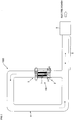
- FIG. 1 schematically shows the configuration of a power generation system, to which one embodiment of a heat/acoustic wave conversion unit and a heat/acoustic wave conversion component of the present invention is applied.
- a power generation system 1000 in FIG. 1 includes a heat/acoustic wave conversion unit 100, a looped tube 4, a resonant tube 5 and an energy converter 6.
- the looped tube 4 is a loop-shaped tube that is connected to an end on the upper side (upper end) and an end on the lower side (lower end) in the drawing of the heat/acoustic wave conversion unit 100.
- the resonant tube 5 is a straight tube, having one end connected to the looped tube 4 and the other end connected to the energy converter 6.
- the resonant tube 5 and the energy converter 6 as a whole makes up a tube that is substantially closed in the end on the right side of the drawing.
- the heat/acoustic wave conversion unit 100 includes a heat/acoustic wave conversion component 1, a high-temperature side heat exchanger 2 and a low-temperature side heat exchanger 3.
- the high-temperature side heat exchanger 2 receives the inflow of heated fluid at high temperatures (e.g., high-temperature exhaust gas), and transmits the heat thereof to the lower end of the heat/acoustic wave conversion component 1 of FIG. 1 to let the heated fluid having a temperature lower than that at the time of inflow flow out.
- the low-temperature side heat exchanger 3 receives the inflow of cooled fluid (e.g., water) at relatively low temperatures compared with the heated fluid flowing in the high-temperature side heat exchanger 2 and transmits the cold heat to the upper end of the heat/acoustic wave conversion component 1 of FIG. 1 to let the cooled fluid having a temperature higher than that at the inflow flow out.
- cooled fluid e.g., water
- the heat/acoustic wave conversion component 1 has a honeycomb structure including a plurality of through holes (hereinafter called cells) like thin tubes that are elongated vertically in the drawing. Each cell is partitioned from the neighboring cells by a partition wall, and is in communication with the looped tube 4 via the high-temperature side heat exchanger 2 and the low-temperature side heat exchanger 3.
- the looped tube 4, the resonant tube 5 and each cell of the heat/acoustic wave conversion component 1 are internally filled with working fluid that generates oscillations of longitudinal waves and transmits acoustic waves.
- working fluid includes gas having low viscosity and being less reactive, such as rare gas.
- thermoacoustic effect refers to generation of acoustic waves due to the self-induced oscillation of working fluid resulting from heat. The following briefly describes this self-induced oscillation (a lot of documents describe the details, and Patent Document 3 also provides the detailed descriptions thereon, for example).
- the heat/acoustic wave conversion component 1 includes a plurality of cells like thin tubes and the self-induced oscillation occurs in each cell, acoustic waves as the collection of oscillations of the working fluid in these plurality of cells are then issued from the heat/acoustic wave conversion component 1 to the looped tube 4. Then such acoustic waves are transmitted through the looped tube 4 in the direction of the dotted arrows in the drawing. Most of the acoustic waves transmitted through the looped tube 4 travels in the resonant tube 5 to the right in the drawing.
- the resonant tube 5 and the energy converter 6 as a whole makes up a tube that is substantially closed in the end on the right side of the drawing, and so some of the acoustic waves are reflected and travel to the left in the opposite direction in the drawing. Then, both of these traveling waves are overlapped in the resonant tube 5. At this time, if the frequency of the traveling waves matches with the resonant frequency that is determined, for example, by the length of the resonant tube 5 then so-called resonance occurs in the resonant tube 5, and steady waves are generated, which are overlapped waves of both of these traveling waves and have the resonant frequency. In the drawing, the double-headed arrow in the dashed-dotted line indicates the presence of the steady waves.
- the energy converter 6 is equipped with a mechanism not shown that is capable of changing the effective length of the resonant tube 5, which can adjust the resonance frequency so as to cause the resonance.
- An exemplary mechanism to change the effective length of the resonant tube 5 includes one described in Patent Document 1, for example. Although the following describes the case where the effective length of the resonant tube 5 can be changed, in the power generation system 1000 of Fig. 1 , a dominant frequency component of the frequency components of acoustic waves generated at the heat/acoustic wave conversion component 1 and traveling through the looped tube 4 may be determined beforehand, and the length of the resonant tube 5 may be configured beforehand to be a special length which makes the frequency of the dominant frequency component the resonance frequency.
- the energy converter 6 is equipped with a mechanism to convert acoustic waves into electrical signals as well.
- An exemplary conversion mechanism of such a type includes a mechanism equipped with a microphone as described in Patent Document 1.
- the conversion mechanism including a microphone is the simplest one, the conversion mechanism is not limited to such a mechanism including a microphone.
- conventionally known various mechanisms e.g., the mechanism of Patent Document 2, which is to convert acoustic-wave energy to mechanical energy and then convert such mechanical energy to electric power by electromagnetic induction, can be used.
- the power generation system 1000 of FIG. 1 can convert heat of high-temperature heated fluid (e.g., high-temperature exhaust gas) flowing into the high-temperature side heat exchanger 2 into electric power, and so enables effective use (recycling) of energy.
- high-temperature heated fluid e.g., high-temperature exhaust gas
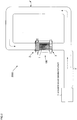
- FIG. 2 schematically shows a cold heat generation system, to which the heat/acoustic wave conversion unit 100 and the heat/acoustic wave conversion component 1 in FIG. 1 are applied.
- a cold heat generation system 2000 in FIG. 2 includes a looped tube 4', a transmission tube 5', an acoustic-wave generation part 7, and the heat/acoustic wave conversion unit 100 described referring to FIG. 1 .
- the looped tube 4' is a loop-shaped tube that is connected to an end on the upper side (upper end) and an end on the lower side (lower end) of the heat/acoustic wave conversion unit 100 in Fig. 2 , and is in communication with the plurality of cells of the heat/acoustic wave conversion component 1 via the high-temperature side heat exchanger 2 and the low-temperature side heat exchanger 3.
- the transmission tube 5' is a straight tube, having one end connected to the looped tube 4' and the other end connected to the acoustic-wave generation part 7.
- the acoustic-wave generation part 7 has a function of generating acoustic waves, and an example of the acoustic-wave generation part 7 includes a speaker that receives electric power and outputs acoustic waves.
- Another example is a system that is obtained by removing the energy converter 6 from the power generation system 1000 in Fig. 1 and that receives heat and generates acoustic waves (in this case, the resonant tube 5 on the right side is an open end where no reflections occur, and so unlike the state of Fig. 1 , traveling waves toward right are transmitted in the resonant tube 5).
- the heat/acoustic wave conversion unit 100 has the same configuration as that described with reference to FIG. 1 , it is configured so that, unlike FIG. 1 , cooled fluid (e.g., water), which is similar to the cooled fluid flowing into the low-temperature side heat exchanger 3 in FIG. 1 , flows into both of the high-temperature side heat exchanger 2 and the low-temperature side heat exchanger 3 of FIG. 2 .
- cooled fluid e.g., water
- looped tube 4', the transmission tube 5' and each cell of the heat/acoustic wave conversion component 1 are internally filled with working fluid that generates oscillations of longitudinal waves and transmits acoustic waves.
- Working fluid similar to that used in the power generation system 1000 of FIG. 1 can be used.
- Acoustic waves generated at the acoustic-wave generation part 7 are transmitted through the transmission tube 5' in the direction of the dashed-dotted arrow in Fig. 2 , and then are transmitted through the looped tube 4' in the direction of the dashed line arrow in Fig. 2 . Then, the acoustic waves reach the heat/acoustic wave conversion unit 100, and travel in each cell from the upper side in Fig. 2 of the heat/acoustic wave conversion component 1. At this time, due to heat transport by acoustic waves, the system can have a state where the end on the high-temperature side heat exchanger 2 side has a relatively higher in temperature than the end on the low-temperature side heat exchanger 3 side.
- cooled fluid close to the ambient temperature flows in, and the fluid at a temperature higher than the ambient temperature flows out.
- the end of the heat/acoustic wave conversion component 1 on the low-temperature side heat exchanger 3 side has a temperature lower than the ambient temperature.
- cooled fluid close to the ambient temperature flows in, and the fluid at a temperature lower than the ambient temperature flows out because heat is taken by the end of the heat/acoustic wave conversion component 1 on the low-temperature side heat exchanger 3 side.
- cold heat is output in the form of cold water.
- the cold heat generation system 2000 in FIG. 2 can output cold heat using acoustic-wave energy generated at the acoustic-wave generation part 7.
- the system corresponding to the power generation system 1000 of FIG. 1 other than the energy converter 6 high-temperature heated fluid (e.g., high-temperature exhaust gas) flowing into the high-temperature side heat exchanger 2 of FIG. 1 can be converted into cold heat, which then enables effective use (recycling) of energy.
- high-temperature heated fluid e.g., high-temperature exhaust gas
- the heat/acoustic wave conversion unit 100 that is one embodiment of the present invention plays a very important role. Then the following describes the heat/acoustic wave conversion unit 100 in more details, by way of an exemplary situation where that is used in the power generation system 1000 of FIG. 1 .
- the following describes the power generation system 1000 of FIG. 1 by way of an example where high-temperature heated fluid (e.g., exhaust gas itself) at about 400 to 600°C that are typical temperatures of the exhaust gas from automobiles flows in the high-temperature side heat exchanger 2 of FIG.
- low-temperature cooled fluid e.g., water
- a temperature difference between both ends of the heat/acoustic wave conversion component 1 is about 330 to 580°C.
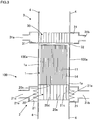
- FIG. 3 schematically shows the configuration of the heat/acoustic wave conversion unit 100 of FIG. 1 .
- the heat/acoustic wave conversion unit 100 includes a heat/acoustic wave conversion component 1, a high-temperature side heat exchanger 2 and a low-temperature side heat exchanger 3 as well as a metal member 32 and an interference member 1a. These components as a whole are stored in a housing 100a and are connected to a looped tube 4 (see FIG. 1 also).
- the heat/acoustic wave conversion component 1 has a honeycomb structure in which a plurality of cells 14, each being a thin-tube like through hole, are partitioned and defined by a partition wall 11.
- the word "cell” in the present specification refers to a through hole only that does not include the partition wall.
- the heat/acoustic wave conversion component 1 actually has a structure including several honeycomb segments having such a honeycomb structure that are bonded, and such a segmented structure will be described later.
- FIG. 3 shows the arrangement of the cells 14 only, for the ease of explanation.
- Each cell 14 has a penetrating direction (an extending direction in which each cell 14 extends) that is the vertical direction of FIG.
- the present invention may have a form without the metal member 32.
- the metal member 32 is a metal member having a plate shape, at a center part of which a plurality of parallel slits (not shown) are formed, and FIG. 3 shows only a side-face part (thickness part) of the plate shape.
- the low-temperature side heat exchanger 3 includes the mesh lamination body 30 including a plurality of metal mesh plates (e.g., made of copper).
- the low-temperature side heat exchanger 3 includes a low-temperature side annular tube 31 also that is an annular tube surrounding the side face of the mesh lamination body 30.
- FIG. 3 schematically shows the state where such a low-temperature side annular tube 31 surrounding the side face of the mesh lamination body 30 sandwiches the mesh lamination body 30 from both sides at a cross-section including an inflow port 31a and an outflow port 31b.
- This low-temperature side annular tube 31 has a function of receiving, from the inflow port 31 a, the inflow of cooled fluid (e.g., water) that is at a relatively low temperature with reference to the heated fluid flowing into the high-temperature side heat exchanger 2 described later, and transmitting cold heat of the cooled fluid to the mesh lamination body 30 (in other words, transmits heat at the mesh lamination body 30 to the cooled fluid) and letting cooled fluid with an increased temperature flow out from the outflow port 31b.
- cooled fluid e.g., water
- the metal member 32 is preferably made of a material having large heat conductivity, which may be made of e.g., copper.
- the heat/acoustic wave conversion unit of the present invention is not limited especially about the details of the low-temperature side heat exchanger, and a conventionally known heat exchanger may be used.
- the same configuration as that of the high-temperature side heat exchanger 2 described later may be used.
- FIG. 3 schematically shows the cross section of the surrounding interference member 1a as two parts that sandwich the heat/acoustic wave conversion component 1 from both of right and left sides in the drawing.
- This interference member 1 a has a function as a thermal insulator to avoid heat transmission between the ends of the heat/acoustic wave conversion component 1 on the low-temperature side heat exchanger 3 side and on the high-temperature side heat exchanger 2 side via the surrounding environment outside of the heat/acoustic wave conversion component 1.
- the high-temperature side heat exchanger 2 includes a heat-exchanging honeycomb structure 20 and a high-temperature side annular tube 21.
- the heat-exchanging honeycomb structure 20 has a honeycomb structure similarly to the heat/acoustic wave conversion component 1, including two or more cells 20d, each being a thin-tube like through hole penetrating vertically in FIG. 3 , that are partitioned and defined by a partition wall 20a.
- the high-temperature side annular tube 21 is an annular tube surrounding the side face of the heat-exchanging honeycomb structure 20, and has a function of receiving, from an inflow port 21a, the inflow of high-temperature heated fluid (e.g., high-temperature exhaust gas), transmitting heat of the heated fluid to the heat-exchanging honeycomb structure 20 and letting heated fluid with a decreased temperature flow out from an outflow port 21b. Then as shown in FIG. 3 , the high-temperature side annular tube 21 internally includes a metal or ceramic fin 21e containing SiC (silicon carbide) as a main component to increase the contact area with the heated fluid.
- SiC silicon carbide
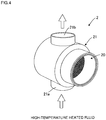
- FIG. 4 is a perspective view showing the appearance of the high-temperature side heat exchanger 2 in the heat/acoustic wave conversion unit 100 of FIG. 3
- FIG. 5 is a cross-sectional view of the high-temperature side heat exchanger 2, which is a plan view including the inflow port 21a and the outflow port 21b of the high-temperature side annular tube 21.
- the high-temperature side heat exchanger 2 includes the heat-exchanging honeycomb structure 20 that is fitted in a center hollow part of the annular shape of the high-temperature side annular tube 21.
- high-temperature heated fluid e.g., high-temperature exhaust gas
- the high-temperature heated fluid flowing in through the inflow port 21 a directly hits a circumferential wall 20b defining the circular circumference of the heat-exchanging honeycomb structure 20 and then is branched off into left and right two sides of the circumferential wall 20b and travels along the circumferential wall 20b. Then they join together at the outflow port 21b to flow out.
- the high-temperature heated fluid directly comes into contact with the circumferential wall 20b of the heat-exchanging honeycomb structure 20, whereby a lot of heat is directly transmitted from the high-temperature heated fluid to the circumferential wall 20b, and such heat is transmitted to the partition wall 20a in the heat-exchanging honeycomb structure 20 and the working fluid inside of the cells 20d as well.
- the heat-exchanging honeycomb structure 20 can directly come into contact with the high-temperature heated fluid because the heat-exchanging honeycomb structure 20 is made of a material having high heat resistance and good heat conductivity as described later, and such a direct contact with the heated fluid can suppress heat loss and improve heat-exchanging efficiency as compared with the case including another member intervening therebetween.
- the present invention may have a form in which, instead of such a direct contact of the circumferential wall 20b of the heat-exchanging honeycomb structure 20 with high-temperature heated fluid, the circumferential wall 20b is surrounded with metal.
- high-pressure gas e.g., inert rare gas such as argon
- the metal surrounding the circumferential wall 20b has a circumferential face, on which a metal fin (see fin 21 e in FIG. 3 , for example) is preferably provided so as to protrude in the outward direction (radial direction) from the center of the heat-exchanging honeycomb structure 20 of FIG. 5 .
- a metal fin see fin 21 e in FIG. 3 , for example
- This is to increase the contact area with the high-temperature heated fluid and improve heat-exchanging efficiency. If the contact area with the high-temperature heated fluid is small, exchange of heat between the high-temperature heated fluid and the high-temperature side heat exchanger 2 is not sufficient, and so the heat-exchanging efficiency of the high-temperature side heat exchanger 2 deteriorates. In this way, it is important for the high-temperature side heat exchanger 2 to maximize the contact area with the high-temperature heated fluid.
- another honeycomb structure made of a ceramic material containing SiC (silicon carbide) as a main component is fitted in the tube of the high-temperature side annular tube.
- a ceramic material containing SiC (silicon carbide) as a main component has higher heat conductivity at high temperatures than that of metal fins, and the contact area with high-temperature gas also can be increased dramatically. Further, this can avoid a problem of erosion and deterioration due to high-temperature heated fluid, which can be a problem for metal fins.
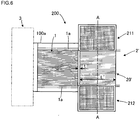
- FIG. 6 schematically shows one form of a heat/acoustic wave conversion unit including another honeycomb structure fitted in the high-temperature side annular tube.
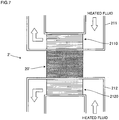
- FIG. 7 is a schematic cross-sectional view of the high-temperature side heat exchanger taken along the line A-A of FIG. 6 .
- FIGs. 6 and 7 the same reference numerals are assigned to the same elements as those in FIGs. 3 to 5 , and their duplicated descriptions are omitted.
- a high-temperature side heat exchanger 2' in a heat/acoustic wave conversion unit 200 in FIG. 6 includes a heat-exchanging honeycomb structure 20' and two mutually different high-temperature side annular tubes 211 and 212.
- the heat-exchanging honeycomb structure 20' has a honeycomb structure including two or more cells penetrating horizontally in the drawing that are partitioned and defined by a partition wall, and transmits heat transmitted from heated fluid via the two different high-temperature side annular tubes 211 and 212 to the heat/acoustic wave conversion component 1.
- the heat-exchanging honeycomb structure 20' is disposed with a distance t from the heat/acoustic wave conversion component 1.
- the two high-temperature side annular tubes 211 and 212 internally include in-tube honeycomb structures 2110 and 2120, respectively, made of a ceramic material containing SiC (silicon carbide) as a main component.
- These in-tube honeycomb structures 2110 and 2120 both have a honeycomb structure including two or more cells penetrating horizontally in the drawing that are partitioned and defined by a partition wall. As shown in the arrows of the drawing, heated fluid flowing in the two high-temperature side annular tubes 211 and 212 passes through each cell of the in-tube honeycomb structures 2110 and 2120, and then flows out.
- FIG. 7 shows the cross-section of the heat-exchanging honeycomb structure 20' as a rectangular shape for simplicity, it may have a circular cross section as in FIGs. 4 and 5 , and a substantially similar configuration can be realized when the high-temperature side annular tubes 211 and 212 have a shape along the circle.
- the circumferential wall of the heat-exchanging honeycomb structure 20' is surrounded with a metal tube, on an outside of which the two in-tube honeycomb structures 2110 and 2120 made of a ceramic material containing SiC (silicon carbide) as a main component are disposed.
- the heat-exchanging honeycomb structure 20' is not in a direct contact with the heated fluid, and so erosion and deterioration due to high-temperature heated fluid can be suppressed.
- inert rare gas e.g., argon
- the heat-exchanging honeycomb structure 20' may be made of a metal material having good heat conductivity, such as copper, as well as a ceramic material containing SiC (silicon carbide) as a main component.
- the heat-exchanging honeycomb structure 20' in FIG. 6 preferably has a length L' of the order of wavelength of acoustic waves generated from oscillations of the working fluid. If the length L' is too long with reference to the wavelength of acoustic waves, the heat given to the working fluid (e.g., inert rare gas) will be insufficient. If the length L' is too short with reference to the wavelength of acoustic waves, then working fluid may pass through the heat-exchanging honeycomb structure 20' from the outside and reach the heat/acoustic wave conversion component 1, and the working fluid at a relatively low temperature may cool the end of the heat/acoustic wave conversion component 1 on the high-temperature side heat exchanger side unfortunately.
- the working fluid e.g., inert rare gas
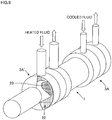
- FIG. 8 schematically shows another form of the heat/acoustic wave conversion unit of the present invention that is different from the heat/acoustic wave conversion units in FIGs. 6 and 7
- FIG. 9 schematically shows still another form of the heat/acoustic wave conversion unit that is different from the heat/acoustic wave conversion unit in FIG. 8 .
- heated fluid flows into the high-temperature side heat exchanger 2A from the upper side of the drawing and flows through the high-temperature side heat exchanger 2A, and then flows out toward the lower side of the drawing.
- heated fluid flows into the high-temperature side heat exchanger 2A' from the upper side of the drawing and flows through the high-temperature side heat exchanger 2A', and then flows out toward the upper side of the drawing.
- FIGs. 8 and 9 show the configuration partially as a perspective view to clarify the internal configurations (configuration including the following two honeycomb structures 22, 23).
- the high-temperature side heat exchanger 2A in Fig. 8 and the high-temperature side heat exchanger 2A' in Fig. 9 include a pillar-shaped honeycomb structure 23 made of a metal material, and a hollow and round pillar-shaped (in other words, a cylindrical shape having a thickness) honeycomb structure 22 made of a ceramic material containing SiC (silicon carbide) as a main component surrounding the honeycomb structure.
- a metal mesh outer tube 23a described later which is made of the same metal material, is formed integrally with the metal honeycomb structure 23.
- a metalized layer which is described later, is present between the two honeycomb structures 22 and 23.
- honeycomb structures 22 and 23 both have a honeycomb structure including two or more round pillar-shaped cells penetrating in the elongated direction that are partitioned and defined by a partition wall. Such a configuration in Figs. 8 and 9 also can suppress heat loss and improve heat conversion efficiency.
- honeycomb structure including the honeycomb structure 23 made of a metal material, and instead of this, a mesh structure made up of metal mesh may be used.
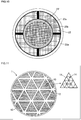
- FIG. 10 is a cross-sectional view of a high-temperature side heat exchanger having a mesh structure.
- the high-temperature side heat exchanger in FIG. 10 includes, inside of the honeycomb structure 22 made of a ceramic material containing SiC (silicon carbide) as a main component that is surrounded with a metal outer tube 22a, a metal mesh member 23' via a cylindrical metalized layer 23b and a metal mesh outer tube 23a.
- the metalized layer 23b is a layer formed by baking of metal such as molybdenum and manganese, which is a layer to bond the metal mesh outer tube 23a made of metal and the honeycomb structure 22 made of ceramic.
- the configuration in FIG. 10 also can suppress heat loss and improve heat-exchanging efficiency.
- the end face of the heat-exchanging honeycomb structure 20 on the heat/acoustic wave conversion component 1 side (the upper end face of the heat-exchanging honeycomb structure 20) is in a direct contact with the end face of the heat/acoustic wave conversion component 1 on the high-temperature side heat exchanger 2 side (the lower end face of the heat/acoustic wave conversion component 1).
- this upper end face of the heat-exchanging honeycomb structure 20 is called a contact face 20s.
- gap t as in FIG.
- heat/acoustic wave conversion component 1 may be present between the heat/acoustic wave conversion component 1 and the heat-exchanging honeycomb structure 20 in the present invention.
- heat transmitted to the heat-exchanging honeycomb structure 20 is transmitted to working fluid coming into contact with the heat-exchanging honeycomb structure 20, and the heated working fluid comes into contact with the vicinity of the end face of the heat/acoustic wave conversion component 1 due to displacement of the working fluid, which corresponds to oscillations of acoustic waves, to heat the vicinity of the end face.
- This allows the end of the heat/acoustic wave conversion component 1 on the high-temperature side heat exchanger 2 side to keep a relatively high-temperature state as compared with the end on the low-temperature side heat exchanger 3 side.
- This heat-exchanging honeycomb structure 20 is made of a ceramic material containing SiC (silicon carbide) as a main component. Since a ceramic material has high heat resistance, such a material is suitable for the material of the heat-exchanging honeycomb structure 20 that directly comes into contact with high-temperature heated fluid as stated above. Further, since a ceramic material containing SiC (silicon carbide) as a main component has relatively good heat conductivity among other ceramic materials, such a material is suitable for a function to let the heat-exchanging honeycomb structure 20 transmit heat to the heat/acoustic wave conversion component 1 as stated above.
- containing SiC silicon carbide as a main component
- SiC SiC accounts for 50 mass% or more of the material of the heat-exchanging honeycomb structure 20.
- the porosity is preferably 0 to 10%. It is then preferable that the thickness of the partition wall 20a is 0.25 to 0.51 mm and the cell density is 15 to 62 cells/cm 2 .
- the ceramic material containing SiC as a main component include simple SiC as well as Si impregnated SiC, (Si+Al) impregnated SiC, metal composite SiC, recrystallized SiC, Si 3 N 4 and SiC.
- Si impregnated SiC and (Si+Al) impregnated SiC are preferable. This is because Si impregnated SiC has good heat conductivity and heat resistance, and has low porosity although it is a porous body and so is formed densely, and then it can realize relatively high strength as compared with SiC without impregnated Si.
- the heat-exchanging honeycomb structure 20 has a configuration of the triangle cells 20d that are arranged periodically with a period of a constant length in the plane perpendicular to the penetrating direction of the cells 20d.
- the heat/acoustic wave conversion component 1 to which heat is to be transmitted also has a similar configuration in the honeycomb segment described later that is a collective form of a plurality of cells 14, and the period of the cells 20d in the heat-exchanging honeycomb structure 20 is integral multiples of 10 or more of the period of cells 14 in the heat/acoustic wave conversion component 1.
- the cells 20d of the heat-exchanging honeycomb structure 20 have the same shape as that of the cells 14 of the heat/acoustic wave conversion component 1 to which heat is to be transmitted, and the period of the cells 20d of the heat-exchanging honeycomb structure 20 is integral multiples of the period of the cells 14 of the heat/acoustic wave conversion component 1, whereby working fluid contained inside the cells 20d of the heat-exchanging honeycomb structure 20 and the cells 14 of the heat/acoustic wave conversion component 1 can move smoothly.
- the period of the cells of the heat-exchanging honeycomb structure 20 is larger than the period of the cells of the heat/acoustic wave conversion component 1 because the cells 14 of the heat/acoustic wave conversion component 1 are required to be very thin through holes to cause self-induced oscillations as stated above.
- the heat-exchanging honeycomb structure 20 may play a role of heat exchange simply, and so the period of them is larger than the period of the cells 14 of the heat/acoustic wave conversion component 1 by one digit (ten times) or more.
- a honeycomb segment described later of the heat/acoustic wave conversion component 1 has a periodic arrangement with a period of a constant length, and the period of the cells of the heat-exchanging honeycomb structure 20 is preferably integral divisions of the period of this honeycomb segment (in other words, the period of this honeycomb segment is integral multiples of the period of the cells of the heat-exchanging honeycomb structure 20).
- the integral multiples as stated above preferably are 5 to 20 times.
- the contact face 20s of the heat-exchanging honeycomb structure 20 with the heat/acoustic wave conversion component 1 is displaced toward the heat/acoustic wave conversion component 1 (upper side in the drawing) from a heat-receiving region 21c where the heat-exchanging honeycomb structure 20 directly comes into contact with high-temperature heated fluid to receive heat therefrom, and so does not overlap with the heat-receiving region 21c. If the contact face 20s overlaps with the heat-receiving region 21 c, a temperature may differ greatly between the periphery of an edge of the contact face 20s closer to the heat-receiving region 21c and a center region away from the heat-receiving region 21c.
- the end (lower end in FIG. 3 ) of the heat/acoustic wave conversion component 1 on the heat-exchanging honeycomb structure 20 side is not heated uniformly, and so the cells of the heat/acoustic wave conversion component 1 cause non-uniform self-induced oscillations unfortunately.
- the heat-exchanging honeycomb structure 20 in FIG. 3 is configured so as not to overlap the contact face 20s with the heat-receiving region 21c to avoid such a problem.
- the heat-exchanging honeycomb structure 20 includes a slit 20c as a gap part of the circumferential wall 20b, the slit extending in the penetrating direction of the cells 20d.
- FIG. 5 shows the example of slits 20c formed at four positions of the circumferential face of the heat-exchanging honeycomb structure 20.
- Such slits 20c can mitigate thermal stress applied to the circumferential wall 20b when high-temperature heated fluid directly comes into contact with the circumferential wall 20b, which then can suppress breakage or peeling-off of the circumferential wall 20b and the partition wall 20a.
- the high-temperature side annular tube 21 is provided with four heat-resistant metal plates 21d along the extending direction of the slits 20c to fill the gaps at the slits 20c and extend. These four heat-resistant metal plates 21d can prevent working fluid from leaking into the high-temperature side annular tube 21 through the four slits 20c.
- the heat-exchanging honeycomb structure 20 is supported by fitting into these four heat-resistant metal plates 21d at an annular center part of the high-temperature side annular tube 21.
- These four heat-resistant metal plates 21d are provided with fins 21e (see FIG. 3 also) made of metal or ceramic containing SiC (silicon carbide) as a main component, the fins protruding outward (radial direction) from the center of the heat-exchanging honeycomb structure 20 in FIG. 5 .
- FIG. 11 is a cross-sectional view of the heat/acoustic wave conversion component 1 in FIG. 3 in a plane perpendicular to the penetrating direction of the cells 14 of the heat/acoustic wave conversion component 1.
- the heat/acoustic wave conversion component 1 includes a plurality of honeycomb segments 15 each being a monolithic configuration, a bonding part 12 to bond the honeycomb segments 15 mutually, and a circumferential wall 13 that surrounds the circumference of the honeycomb structure body including these bonded members.
- Each of the honeycomb segments 15 includes a plurality of cells 14, each being a thin-tube like through hole, that are partitioned and defined by a partition wall 11.
- hydraulic diameter HD of the cells 14 is one of the important factors to generate acoustic waves by self-induced oscillations, and so the hydraulic diameter HD of the cells 14 of each honeycomb segment in the heat/acoustic wave conversion component 1 has a very small value of 0.4 mm or less.
- Such cells with a very small hydraulic diameter HD can realize a sufficient thermoacoustic effect from the heat/acoustic wave conversion component 1.
- thermoacoustic wave conversion component 1 includes each honeycomb segment having an open frontal area of 60% or more, from which a larger thermoacoustic effect can be obtained. If the open frontal area is less than 60%, the number of cells contributing to the thermoacoustic effect is too small, and so a very large thermoacoustic effect cannot be achieved therefrom.
- the open frontal area at the honeycomb segments 15 is suppressed to be 93% or less. Actually if the open frontal area exceeds 93%, damage of the honeycomb segments 15 due to thermal distortion and twisting (thermal stress described later) resulting from impacts of generated acoustic waves and a temperature difference at both ends of the honeycomb segments cannot be ignored.
- the open frontal area at the end faces of each honeycomb segment in the heat/acoustic wave conversion component 1 that is 60% or more and 93% or less can achieve adequate balance between a sufficient thermoacoustic effect and sufficient durability.
- the open frontal area of 80% or more and 93% or less is preferable in the open frontal area of 60% or more and 93% or less.
- the open frontal area can be obtained by taking an image of a cross section perpendicular to the penetrating direction by a microscope, and determining the material-part area S1 and the gap-part area S2 from the taken image of the cross section. Then the open frontal area can be obtained as S2/(S1+S2) based on S1 and S2.
- the material making up of each honeycomb segment in the heat/acoustic wave conversion component 1 has low heat conductivity of 5 W/mK or less. If the heat conductivity is larger than 5 W/mK, heat is transmitted through the partition wall 11 from the high-temperature side heat exchanger 2 side to the low-temperature side heat exchanger 3 side in each honeycomb segment before heat exchange between the working fluid in each cell and the partition wall 11 becomes sufficient. As a result, a sufficient thermoacoustic effect may not be obtained. On the other hand, such low heat conductivity of 5 W/mK or less leads to sufficient heat exchange between the working fluid in each cell and the partition wall 11, and so a sufficient thermoacoustic effect can be obtained.
- Heat conductivity of 1.5 W/mK or less is preferable in the heat conductive of 5 W/mK or less. If the heat conductivity is too small, then the end face of the heat/acoustic wave conversion component 1 on the high-temperature side heat exchanger 2 side only has a high temperature locally, meaning a failure to transmit heat to the wall face in the cells and so the difficulty to generate a thermoacoustic effect. Then, heat conductivity of at least 0.01 W/mK is preferable.
- the heat conductivity can be obtained by a temperature gradient method (steady method). Specifically, the heat conductivity can be obtained as follows. Firstly, a plate-shaped test sample is cut out from a target for the heat conductivity measurement, and such a plate-shaped test sample is sandwiched between spacers whose heat conductivity is known (e.g., made of metals, such as copper and stainless steel). Then, one side thereof is heated to 30°C to 200°C, and the other side is cooled to 20 to 25°C, whereby a certain temperature difference is given in the thickness direction of the test sample. Then, the heat flow rate transmitted is obtained by the temperature gradient in the spacers, and this heat flow rate is divided by the temperature difference to calculate the heat conductivity.
- spacers whose heat conductivity is known (e.g., made of metals, such as copper and stainless steel). Then, one side thereof is heated to 30°C to 200°C, and the other side is cooled to 20 to 25°C, whereby a certain temperature difference is given
- the honeycomb segment 15 has a ratio HD/L of the hydraulic diameter HD as stated above to the length L that is 0.005 or more and less than 0.02. If HD/L is less than 0.005, the honeycomb segment 15 is too long as compared with the hydraulic diameter HD. Then working fluid in each cell of the honeycomb segment 15 will be less affected from a temperature difference between both ends of the honeycomb segments. In this case, heat exchange between the working fluid in each cell and the partition wall 11 is not sufficient and so a sufficient thermoacoustic effect cannot be obtained. On the other hand, if HD/L is 0.02 or more, then the honeycomb segment 15 is too short as compared with the hydraulic diameter HD.
- the heat/acoustic wave conversion component 1 is configured to have the ratio HD/L of 0.005 or more and less than 0.02 in each honeycomb segment, and so heat exchange between the working fluid in each cell and the partition wall 11 is sufficient. As a result, the heat/acoustic wave conversion component 1 can have a sufficient thermoacoustic effect.
- the heat/acoustic wave conversion component 1 has a bonding structure in which the honeycomb segments 15 are mutually bonded with the bonding part 12 as shown in FIG. 11 , whereby the bonding part 12 can exert a buffer effect to thermal stress.
- thermal stress resulting from a difference in the amount of thermal expansion between the both ends typically acts on the heat/acoustic wave conversion component 1.
- Such a bonding structure allows the bonding part 12 to generate an elastic force against such thermal stress while deforming elastically to some extent and weakening the thermal stress (buffer effect). Then thermal stress acts less directly on the honeycomb segments 15 themselves, and so damage on the honeycomb segments 15, and accordingly on the heat/acoustic wave conversion component 1 as a whole can be suppressed.
- each honeycomb segment may include cells 14 having a shape in a plane perpendicular to the penetrating direction of the cells that are various polygons, such as triangles, quadrangles, pentagons and hexagons as well as ellipses (including a perfect circle shape), where triangles, quadrangles and hexagons and their combinations are preferable.
- various polygons such as triangles, quadrangles, pentagons and hexagons as well as ellipses (including a perfect circle shape), where triangles, quadrangles and hexagons and their combinations are preferable.
- ellipses including a perfect circle shape
- Such triangular cells 14 are particularly preferable because, among various polygonal shapes and elliptical cell shapes, triangular cell shapes are the most suitable for the arrangement of a lot of cells while minimizing the thickness of the partition wall. Note here that, in the case of a honeycomb structure to load catalyst for exhaust purification to remove fine particles from exhaust gas of automobiles, if their cells have corners at acute angles, fine particles easily accumulate at the corners unfortunately. Then, such a honeycomb structure practically does not have triangular cell shapes in many cases, although it can have such a shape in principle.
- honeycomb segment honeycomb segment
- working fluid gas such as rare gas
- a honeycomb segment of the present invention favorably has the same shape as that of the cells so that the shape of the cells is directly reflected, because the honeycomb segment is a collective form of a plurality of cells, and from the viewpoint of arranging as many as possible of cells on the cross section of the heat/acoustic wave conversion component as a whole.
- the honeycomb segments 15 when the cells 14 have a triangular shape as in FIG. 11 , then the honeycomb segments 15 also have a triangular shape so that the shape of the cells 14 is directly reflected.
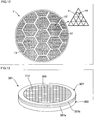
- FIG. 11 shows the state where triangle honeycomb segments 15 are periodically arranged in a plane of Fig 11 at a part other than the vicinity of the circumferential wall 13 of the heat/acoustic wave conversion component 1.
- the honeycomb segments may have a hexagonal shape other than a triangular shape. This is because a hexagon can be made up of six triangles.
- FIG. 12 shows an example where cells have a triangular shape, and honeycomb segments have a hexagonal shape.
- FIG. 12 the same reference numerals are assigned to the same elements as those in FIG. 11 , and their duplicated descriptions are omitted.
- triangular cells 14 are periodically arranged in a plane perpendicular to the penetrating direction of the cells 14 in a honeycomb segment 15'.
- This honeycomb segment 15' has a hexagonal shape, and a plurality of these hexagonal honeycomb segments 15' are periodically arranged in a plane of FIG. 11 at a part other than the vicinity of the circumferential wall 13 of the heat/acoustic wave conversion component 1'.
- Such a form also enables as many as possible of cells to be arranged on the cross section of the heat/acoustic wave conversion component 1' as a whole.
- both of the materials making up the bonding part 12 and the circumferential wall 13 as stated above have a Young's modulus that is less than 30% of the Young's modulus of the material making up the honeycomb segments 15, and the material making up the bonding part 12 has a thermal expansion coefficient that is 70% or more and less than 130% of the thermal expansion coefficient of the material making up the honeycomb segments 15. Then, the material making up the bonding part 12 has heat capacity per unit volume that is 50% or more of the heat capacity per unit volume of the material making up the honeycomb segments 15.
- Such a Young's modulus of the materials making up the bonding part 12 and the circumferential wall 13 that is less than 30% of the Young's modulus of the material making up the honeycomb segments 15 leads to a sufficient buffer effect to the thermal stress as stated above.
- the thermal expansion coefficient and the heat capacity per unit volume of the bonding part 12 and the circumferential wall 13 differ greatly from the thermal expansion coefficient and the heat capacity per unit volume of the material making up the honeycomb segments 15 due to a difference in materials, then a problem such as peeling-off occurs between the bonding part 12 or the circumferential wall 13 and the honeycomb segments 15, and then durability against thermal stress may be degraded in this case also.
- the thermal expansion coefficient and the heat capacity per unit volume of the bonding part 12 and the circumferential wall 13 within the aforementioned numerical range can lead to sufficient durability against thermal stress.
- the Young's modulus is calculated in the following way. Firstly, a plate-shaped sample having predetermined dimensions is cut out for each material. The dimensions are those for a plate having a square-shaped face belonging to the range of 10 ⁇ 10 mm to 30x30 mm and a thickness belonging to the range of 0.5 to 3 mm, which is common to these materials. Let that S denotes the area of the plate-shaped sample (mm 2 ) and t denotes the thickness (mm), then variations ⁇ t (mm) in the thickness of the sample is measured when load W (N) belonging to the range of 0 to 3 MPa is applied to the face of the plate-shaped sample. This load W also is common to these materials.
- E denotes the Young's modulus.
- the Young's modulus is measured for a sample having a honeycomb structure as stated above, and then the measured Young's modulus is converted into the Young's modulus of the material making up the honeycomb segments 15 (i.e., the Young's modulus as the material property of the honeycomb segments 15 that is irrespective of the honeycomb structure) considering the honeycomb structure.
- the thermal expansion coefficient can be obtained pursuant to the "measurement method of thermal expansion of fine ceramics by thermo-mechanical analysis” that is described in JIS R1618-2002.
- a rod-shaped member having the size specified in JIS R1618-2002 is cut out from the honeycomb segments 15 so that the length direction of a rod-shaped member to be measured specified in JIS R1618-2002 agrees with the penetrating direction of the cells of the honeycomb segments 15, and then the thermal expansion coefficient is obtained by the method specified in JIS R1618-2002.
- the thus obtained thermal expansion coefficient can be used as a thermal expansion coefficient of the material in the direction agreeing with the cell penetrating direction.
- the heat capacity per unit volume (e.g., 1 cc) can be obtained as follows. Firstly, a part of the measurement target is pulverized to be a powder form. Then such a powder-form target is used as a sample, and then a relationship between input heat and temperature rise of the sample is examined using an adiabatic calorimeter. In this way, the heat capacity per unit volume of the sample can be obtained. Then, the thus obtained heat capacity per unit volume is multiplied by density (mass per unit volume) of the measurement target used as the sample before pulverization, whereby the heat capacity per unit volume (e.g., 1 cc) can be obtained.
- density mass per unit volume
- the honeycomb segments 15 preferably include, as a main component, one or two or more in combination of cordierite, mullite, aluminum titanate, alumina, silicon nitride, silicon carbide, and heat resistance resins. Containing "as a main component" means that the material accounts for 50 mass% or more of the honeycomb segments 15.
- the bonding part 12 and the circumferential wall 13 are preferably prepared by using a coating material including inorganic particles and colloidal oxide as a bonding material and an outer coating material to form and the circumferential wall.
- Exemplary inorganic particles include particles made of a ceramic material containing one or two or more in combination of cordierite, alumina, aluminum titanate, silicon carbide, silicon nitride, mullite, zirconia, zirconium phosphate and titania, or particles of Fe-Cr-Al-based metal, nickel-based metal and silicon(metal silicon)-silicon carbide based composite materials.
- Exemplary colloidal oxide includes silica sol and alumina sol.
- the bonding width of two honeycomb segments 15 mutually bonded is 0.2 mm or more and 4 mm or less, and the ratio of the total cross-sectional area of the bonding part 12 to the cross-sectional area of the heat/acoustic wave conversion component 1 in a plane perpendicular to the penetrating direction of the cells 14 is 10% or less.
- Such a bonding width of two honeycomb segments 15 mutually bonded and ratio of the total cross-sectional area of the bonding part 12 to the cross-sectional area of the heat/acoustic wave conversion component 1 in these numerical ranges can lead to sufficient durability against thermal stress while suppressing a decrease in thermoacoustic effect, resulting from a decrease in open frontal area due to the bonding part 12.
- each of the plurality of honeycomb segments 15 preferably has a cross-sectional area in a plane perpendicular to the penetrating direction of the cells 14 that is 3 cm 2 or more and 12 cm 2 or less.
- a cross section of the heat/acoustic wave conversion component 1 in a plane perpendicular to the penetrating direction of the cells 14 has an equivalent circle diameter D of 30 mm or more and 100 mm or less, and the ratio L/D of the length L of the honeycomb segment 15 to the equivalent circle diameter D is 0.3 or more and 1.0 or less.
- the "equivalent circle diameter" is defined as D in the representation of the cross-sectional area of the heat/acoustic wave conversion component 1 as ⁇ D 2 /4.
- the ratio L/D of the length L of the honeycomb segment 15 to the equivalent circle diameter D in the numerical range of 30 mm or more and 100 mm or less may be 0.3 or more and 1.0 or less, whereby a heat/acoustic wave conversion component having a sufficient thermoacoustic effect and an adequate size can be realized.
- the material making up the honeycomb segments 15 in the heat/acoustic wave conversion component 1 has a ratio of thermal expansion at 20 to 800°C that is 6 ppm/K or less.
- Such a ratio of thermal expansion at 20 to 800°C of 6 ppm/K or less of the material making up the honeycomb segments 15 can suppress damage on the honeycomb segments 15 when a temperature difference occurs at the both ends, and accordingly suppress damage on the heat/acoustic wave conversion component 1.
- a ratio of thermal expansion of 4 ppm/K or less is more preferable in the ratio of thermal expansion of 6 ppm/K or less.
- the heat/acoustic wave conversion component 1 has a length L of the honeycomb segments 15 that is 5 mm or more and 60 mm or less.
- Each of the honeycomb segments having a cross sectional area in the aforementioned numerical range can achieve a sufficient thermoacoustic effect.
- the following describes a method for manufacturing the heat/acoustic wave conversion component 1.
- the following describes the case where the honeycomb segments 15 are made of a ceramic material.
- binder, surfactant, pore former, water and the like are added to a ceramic raw material to prepare a forming raw material.
- the ceramic raw material preferably includes one or two or more in combination of a cordierite forming raw material, a silicon carbide-cordierite based composite material, aluminum titanate, silicon carbide, a silicon-silicon carbide based composite material, alumina, mullite, spinel, lithium aluminum silicate, and Fe-Cr-Al based alloy.
- a cordierite forming raw material is preferable.
- the cordierite forming raw material is a ceramic raw material formulated to have a chemical composition in the range of 42 to 56 mass% of silica, 30 to 45 mass% of alumina and 12 to 16 mass% of magnesia, and forms cordierite after firing.
- the ceramic raw material preferably is contained to be 40 to 90 mass% with reference to the forming raw material as a whole.
- Exemplary binder includes methyl cellulose, hydroxypropoxyl cellulose, hydroxyethylcellulose, carboxymethylcellulose, or polyvinyl alcohol. Among them, methyl cellulose and hydroxypropoxyl cellulose are preferably used together.
- the content of the binder is preferably 2 to 20 mass% with reference to the forming raw material as a whole.
- the content of water is preferably 7 to 45 mass% with reference to the forming raw material as a whole.
- Exemplary surfactant used includes ethylene glycol, dextrin, fatty acid soap, or polyalcohol. They may be used alone or in combination of two or more types. The content of the surfactant is preferably 5 mass% or less with reference to the forming raw material as a whole.
- the pore former is not limited especially as long as it forms pores by firing.
- Exemplary pore former includes starch, foamable resin, water absorbable resin or silica gel.
- the content of the pore former is preferably 15 mass% or less with reference to the forming raw material as a whole.
- a kneaded material is prepared by kneading the forming raw material.
- a method for preparing a kneaded material by kneading the forming raw material is not limited especially. For instance, a kneader or a vacuum pugmill may be used for this purpose.
- the kneaded material is extruded, whereby a plurality of honeycomb formed bodies are prepared, including a partition wall defining a plurality of cells.
- a die having a shape in accordance with the hydraulic diameter of each cell, the open frontal area, the shape of the honeycomb segments, the cell shape, and the period of the cells as stated above is preferably used.
- a preferable material of the die is cemented carbide having wear resistance. Values of the hydraulic diameter of each cell, the open frontal area, or the like of each honeycomb formed body are determined, preferably while considering contraction generated during drying and firing described later as well.
- honeycomb segments 15 having a very small hydraulic diameter of each cell and having a large open frontal area (having large cell density) as stated above to exert a larger thermoacoustic effect cannot be manufactured by simply using an extrusion method as it is (i.e., by simply executing a similar manufacturing method using a different die to form high-density pores) that is used for a conventional honeycomb structure to load catalyst for exhaust purification, which is free from such constraints, due to the following two problems.
- the first problem is that, during extrusion, kneaded material extruded at a high temperature adheres to the holes in a forming die, which easily generates clogging. This problem is mentioned by Patent Document 3 also in paragraph [0021].
- the second problem is that a die used for a honeycomb structure as in the honeycomb segments 15 having a very small hydraulic diameter of each cell and having a large open frontal area (having large cell density) inevitably includes a very thin and minute part (typically a part of about 0.3 mm in thickness). Then, such a minute part often is damaged (e.g., is torn) by viscous friction during kneaded material extrusion.
- the manufacturing method of the heat/acoustic wave conversion component 1 has the following configuration to solve these two problems.
- a kneaded material is extruded using another die (hereinafter called a dummy die) having a very small thickness of ribs that is 0.04 mm or more and 0.09 mm or less.
- the "thickness of ribs" here refers to the thickness of the partition wall of the honeycomb formed body, and means a slit width of the die.
- Each slit is a hole to discharge the kneaded material and is to determine the shape of each partition wall part at the honeycomb structure to be manufactured.
- the "thickness of ribs" means the slit width.
- the second problem is solved by reducing viscosity of the kneaded material used for extrusion greatly as compared with the viscosity of a kneaded material used for a conventional honeycomb structure to load catalyst for exhaust purification so as to reduce the viscous friction while keeping the range of a shape-holding property (i.e. the shape of the formed body is not distorted) of the formed body of the honeycomb segments 15 during extrusion.
- a shape-holding property i.e. the shape of the formed body is not distorted
- the ratio of water in the kneaded material has to be more strictly controlled than in the manufacturing of a conventional honeycomb structure to load catalyst for exhaust purification (i.e., keeping an error between the control target of the water ratio and the actual water ratio in a very narrow range).
- the ratio of water in the kneaded material is 40 to 42 parts by mass with reference to 100 parts by mass of the kneaded material solid component that is used to manufacture the honeycomb segments 15, while the ratio of water in the kneaded material is 25 to 35 parts by mass with reference to 100 parts by mass of the kneaded material solid component that is used to manufacture a conventional honeycomb structure to load catalyst for exhaust purification.
- the ratio of water in the kneaded material increases, then viscosity of the kneaded material decreases and adequate fluctuations occur in the shape of the formed body of the honeycomb segments 15. This leads to another advantageous effect that self-induced oscillations of acoustic waves likely occur.
- the following describes a die that is used to prepare a honeycomb formed body (i.e., extrusion) in the present embodiment.
- a honeycomb formed body i.e., extrusion
- the following mainly describes the case where cells have a quadrangular shape.
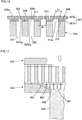
- FIG. 13 is a perspective view showing the appearance of a die that is used to prepare a honeycomb formed body in the present embodiment
- FIG. 14 is a perspective view showing the appearance of the die in FIG. 13 that is viewed from the opposite side of FIG. 13
- FIG. 15 is an enlarged plan view showing a part of the surface of the die in FIG. 13
- FIG. 16 schematically shows a cross section of the die of FIG. 15 taken along the line A-A'.
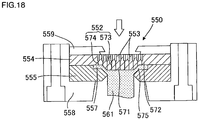
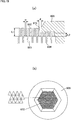
- a die 301 includes a second plate-shaped part 303, and a first plate-shaped part 307 made of tungsten carbide based cemented carbide.
- the second plate-shaped part 303 is made of at least one type selected from the group consisting of iron, steel materials, aluminum alloy, copper alloy, titanium alloy and nickel alloy, and this second plate-shaped part 303 includes a back hole 305 to introduce the forming raw material of the honeycomb formed body.
- the first plate-shaped part 307 includes a hole part 311 that is in communication with the back hole 305, and also includes a slit 309 that is in communication with the hole part 311 and defines a cell block 313.
- This first plate-shaped part 307 includes a first layer 307a disposed on the second plate-shaped part 303 side and a second layer 307b disposed on the first layer 307a.
- the hole part 311 is open at both of the faces of the first layer 307a
- the slit 309 is open at both of the faces of the second layer 307b.
- FIG. 16 shows the state where the hole part 311 has an open end 311a at a first bonding face 310 that agrees with an open end 305a of the back hole 305 at the second bonding face.
- Such a configuration of the die 301 is to lengthen the life of the die as described later.
- the die 301 preferably has a thickness of 4 to 10 mm. If the thickness is less than 4 mm, the die may be broken during forming. If the thickness is more than 10 mm, pressure loss is high during forming of a honeycomb structure, meaning difficulty in forming in some cases.
- the second plate-shaped part 303 includes a plate-shaped member made of at least one type selected from the group consisting of iron, steel materials, aluminum alloy, copper alloy, titanium alloy and nickel alloy.
- steel materials are at least one type selected from the group consisting of stainless steel, dies steel and high-speed steel. Among these materials, steel materials are preferable as the material of the second plate-shaped part 303, and stainless steel is more preferable.
- free-machining material is a material that can be easily ground as compared with tungsten carbide based cemented carbide. Since the second plate-shaped part 303 does not include the slit 309, wearing is less problematic in the second plate-shaped part 303 than in the first plate-shaped part 307. Since the second plate-shaped part 303 is made of free-machining material, the second plate-shaped part 303 has excellent workability as compared with tungsten carbide based cemented carbide. Further the cost for free-machining material is lower than that of the tungsten carbide based cemented carbide, and so the manufacturing cost can be reduced.
- Stainless steel that is one type of the materials available as the second plate-shaped part 303 may be well-known stainless steel. For instance, it may be SUS304, SUS303 and the like.
- the size of the second plate-shaped part 303 is not limited especially, and it may have a desired size depending on the purpose.
- the diameter of the circular plate is preferably 20 to 40 mm.
- the thickness of the second plate-shaped part 303 is preferably 2 to 8 mm. If the thickness is less than 2 mm, it may generate deformation and breakage due to stress from forming resistance, and if the thickness is more than 8 mm, forming resistance is excessive, meaning difficulty in extrusion of the formed body.
- the second plate-shaped part 303 includes the back hole 305 to introduce the forming raw material
- the back hole 305 is a through hole (a hole that is open at both faces of the second plate-shaped part 303) to introduce the forming raw material.
- the forming raw material for the honeycomb structure is introduced from the back hole 305.
- the back hole 305 may have any shape as long as it can guide the introduced forming raw material to the hole part 311 and the slit 309, and the back hole 305 preferably has a circular shape in a cross section orthogonal to the flowing direction of the forming raw material (thickness direction of the second plate-shaped part).
- the open end of the back hole 305 preferably has a diameter of 0.15 to 0.45 mm, where 0.25 to 0.40 mm is more preferable.
- a back hole 305 can be formed by machine processing, such as electrochemical machining (ECM), electrical discharge machining (EDM), laser processing and drill processing, for example.
- ECM electrochemical machining
- the space in the back hole is preferably in a round-pillar shape.
- the diameter (diameter of the back hole) in a cross section orthogonal to the flowing direction of the forming raw material (thickness direction of the second plate-shaped part) in the back hole can have a constant value.
- the diameter of the back hole is equal to the diameter of the open end of the back hole at the second bonding face.
- the number of back holes is not limited especially, which can be decided appropriately depending on the shape of the honeycomb structure to be manufactured, for example.
- the back holes preferably are disposed at all of the positions corresponding to the partition wall intersections, and when the cells have a quadrangular shape, then the back holes are preferably disposed at alternate intersections of the honeycomb partition wall in a staggered pattern.
- the first plate-shaped part 307 includes a plate-shaped member made of tungsten carbide based cemented carbide.
- the width of the slit 309 is very narrow as compared with the diameter of the back hole 305. This means that, when the forming raw material is extruded, pressure in the back hole 305 is increased and stress concentrates on the slit 309, which often leads to problems of wearing and deformation, for example.
- the first plate-shaped part 307 is made of tungsten carbide based cemented carbide that is a material having wear resistance.
- tungsten carbide based cemented carbide (cemented carbide) is an alloy where tungsten carbide and a bonding material are sintered.
- the bonding material is preferably at least one type of metal selected from the group consisting of cobalt (Co), iron (Fe), nickel (Ni), titanium (Ti) and Chromium (Cr).
- Such tungsten carbide based cemented carbide has especially excellent wear resistance and mechanical strength.
- the size of the first plate-shaped part 307 is not limited especially, and it may have a desired size in accordance with the purpose.
- the diameter of the circular plate is preferably 20 to 40 mm.
- the diameter of the first plate-shaped part 307 is 90 to 100% of the diameter of the second plate-shaped part 303.
- the thickness of the first plate-shaped part 307 is preferably 0.3 to 1.2 mm, where 0.5 to 0.9 mm is more preferable.
- the thickness of the first plate-shaped part 307 is preferably 0.05 to 2 times the thickness of the second plate-shaped part 303.
- the first plate-shaped part 307 includes the first layer 307a disposed on the second plate-shaped part 303 side and the second layer 307b disposed on the first layer 307a. Since the die 301 at the first plate-shaped part includes these two layers of the first layer 307a and the second layer 307b, stress during extrusion can be mitigated, and so breakage can be prevented.
- the first layer 307a and the second layer 307b may be made of the same type of materials or of different types of materials.
- the first layer 307a is one layer making up the first plate-shaped part 307, and is disposed on the second plate-shaped part 303 side.
- the first layer 307a includes the hole part 311.
- the first layer 307a preferably is a layer made of cemented carbide having Vickers hardness of 2,000 to 3,000 HV and having the Young's modulus of 600 to 800 GPa. When the first layer 307a has such Vickers hardness and Young's modulus, it can be a layer having hardness and toughness that can resist the stress applied to the hole part 311.
- the hole part 311 is open at both faces of the first layer 307a.
- the first layer 307a preferably has Vickers hardness of 2,000 to 3,000 HV, where 2,000 to 2,200 HV is more preferable. With such predetermined Vickers hardness, the first layer 307a can have hardness so as to resist the stress from the ceramic raw material flowing into the hole part 311 from the back hole 305. Then wearing of the hole part 311 can be prevented. If the Vickers hardness of the first layer 307a is less than 2,000 HV, wearing may occur due to the lack of strength. If the Vickers hardness of the first layer 307a exceeds 3,000 HV, it is too hard, and so the first layer 307a may easily break.
- the first layer 307a preferably has the Young's modulus of 600 to 800 GPa, where 600 to 700 GPa is more preferable. This can prevent breakage of the first layer 307a. If the Young's modulus of the first layer 307a is less than 600 GPa, the toughness is too small, which may cause problems such as breakage. If the Young's modulus exceeds 800 GPa, the toughness is too large, which may lead to the risk of deformation of the hole part 311. When the honeycomb structure is formed using a die having the deformed hole part 311, then distortion occurs at the honeycomb structure and the formability deteriorates.
- the second layer 307b is one layer making up the first plate-shaped part 307, and is disposed on the first layer 307a.
- the second layer 307b includes the slit 309, and the slit 309 is open at both faces of the second layer 307b.
- both faces of the second layer 307b mean both faces including the face of the second layer 307b in contact with (bonded to) the first layer 307a and the face on the opposite side (rear side) of the face in contact with the first layer 307a.
- the discharge port of the forming raw material at the slit 309 is indicated as an open end 309a of the slit 309.
- the second layer 307b preferably has Vickers hardness of 500 to 3,000 HV and the Young's modulus of 400 to 700 GPa.
- Vickers hardness and Young's modulus it can be a layer having sufficient hardness and toughness that can resist the stress applied to the slit 309. Then deformation and wearing of the slit 309 can be prevented.
- the second layer 307b preferably has Vickers hardness of 500 to 3,000 HV, where Vickers hardness of 2,000 to 3,000 HV is more preferable. Such Vickers hardness can suppress wearing of the second layer 307b. If the Vickers hardness of the second layer 307b is less than 500 HV, wearing may occur easily due to the lack of hardness. If the Vickers hardness exceeds 3,000 HV, the second layer 307b may easily break.
- the second layer 307b preferably has the Young's modulus of 400 to 700 GPa, where the Young's modulus of 500 to 700 GPa is more preferable. Such Young's modulus of the second layer 307b makes the layer hard to break. If the Young's modulus of the second layer 307b is less than 400 GPa, problems such as breakage easily occur due to too small toughness. If the Young's modulus exceeds 700 GPa, then the toughness is too large, and so the second layer 307b easily is deformed.
- the Vickers hardness and the Young's modulus of the second layer 307b are larger than the Vickers hardness and the Young's modulus of the first layer 307a. That is, it is preferable that the Vickers hardness of the second layer 307b is larger than the Vickers hardness of the first layer 307a, and the Young's modulus of the second layer 307b is larger than the Young's modulus of the first layer 307a. In such a relationship, the second layer 307b including the slit 309 hardly becomes worn, and the first layer 307a including the hole part 311 hardly breaks. Then, the life of the die can be lengthened more due to the second layer 307b suppressing wearing and the first layer 307a suppressing breakage.
- the Vickers hardness of the second layer 307b is larger than the Vickers hardness of the first layer 307a by 1,000 to 2,500 HV, and the Young's modulus of the second layer 307b is larger than the Young's modulus of the first layer 307a by 50 to 300 GPa. Then, the first plate-shaped part 307 can have the second layer 307b having wear resistance and the first layer 307a having high toughness reliably, and so the life of the die can be lengthened.
- the thickness of the first layer 307a is preferably 0.1 to 5 mm, and the thickness of the first layer 307a is 0.2 to 5 mm more preferably. Such a range of the thickness of the first layer 307a can suppress wearing of the second plate-shaped part effectively. If the thickness of the first layer 307a is less than 0.1 mm, the second plate-shaped part easily becomes worn. If the thickness of the first layer 307a exceeds 5 mm, pressure during extrusion may increase too high due to such a thick die.
- the thickness of the second layer 307b is preferably 0.3 to 4 mm, and the thickness is 1 to 4 mm more preferably. Such a range of the thickness of the second layer 307b can suppress deformation of the honeycomb structure after extrusion. If the thickness of the second layer 307b is less than 0.3 mm, the honeycomb structure after extrusion may be deformed, and the second layer 307b may become worn or be deformed. If the thickness of the second layer 307b exceeds 4 mm, then the second layer 307b is too thick and so the depth of the slit (the length of the slit in the extruding direction of the forming raw material) is too large, so that pressure during extrusion becomes too high.
- a part surrounded by the slit is extremely long and thin, and the part may be torn due to friction with kneaded material. In order to prevent such events, a deep slit is not allowed.
- the slit is shallow in an adequate degree, then relative fluctuations in the slit depth increase between a plurality of slits.
- the honeycomb structure after extrusion also can have adequate fluctuations in shape, and so self-induced oscillations of acoustic waves easily occur.
- the first plate-shaped part 307 includes the slit 309 that is in communication with the hole part 311 and is to form the forming raw material.
- the slit 309 is a gap (cut) formed in the first plate-shaped part 307.
- the forming raw material introduced from the back hole 305 enters the slit 309 in the die, and then the forming raw material is pushed out from the open end 309a of the slit 309, whereby a formed body in a honeycomb shape can be formed.
- the slit 309 is open at both faces of the second layer 307b.
- the slit 309 may be formed at the second layer 307b only, it is preferable that the slit is formed at the first layer 307a as well.
- the slit 309 formed at the second layer 307b is extended to the first layer side so as to be formed at the first layer 307a preferably.
- the slit 309 at the first layer 307a is formed at the face of the first layer 307a in contact with the second layer 307b. Then in this case, the depth of the slit 309 is larger than the thickness of the second layer 307b.
- the depth of the slit 309 is 0.3 to 1.0 mm, where 0.4 to 0.8 mm is more preferable. It is preferable that the depth of the slit 309 at a part extended to the first layer side is 0.1 to 0.5 mm, where 0.2 to 0.5 mm is more preferable. This can form a formed body of a favorable honeycomb shape. It is preferable that the width of the slit 309 is 0.03 to 0.05 mm, where 0.04 to 0.05 mm is more preferable.
- the first layer 307a of the first plate-shaped part 307 includes the hole part 311 therein, where this hole part 311 is in communication with the back hole 305 formed at the second plate-shaped part 303 and the slit 309 formed at the first plate-shaped part 307.
- the hole part 311 is a through hole as well that is formed at the first layer 307a of the first plate-shaped part 307.
- the hole part 311 is a through hole that is open at the face of the second layer 307b on the side in contact with the second plate-shaped part 303 (the first bonding face 310 of the first plate-shaped part 307) and is open at the face of the second layer 307b in contact with the first layer 307a (the other face 307ba of the second layer).
- the first bonding face 310 is a face of the first plate-shaped part 307 that is bonded (in contact with) to the second plate-shaped part 303.
- Such a hole part 311 allows a forming raw material introduced from the back hole 305 formed at the second plate-shaped part 303 to pass through the hole part 311 and enter the slit 309.
- the forming raw material is pushed out from the open end 309a of the slit 309, whereby a honeycomb shaped formed body (honeycomb structure) can be formed.
- the depth h of the hole part 311 (see FIG. 16 ) is 0.1 to 4 mm, where 0.2 to 3 mm is more preferable. Such a range of the depth h of the hole part 311 can suppress wearing at the second plate-shaped part 303 effectively. If the depth h of the hole part is less than 0.1 mm, the strength of the first plate-shaped part 307 easily deteriorates during extrusion of the forming raw material.
- the depth h of the hole part 311 is a distance from the first bonding face 310 of the first plate-shaped part 307 to the other face 307ba of the second layer 307b as shown in FIG. 16 .
- the depth of the hole part 311 equals the thickness of the first layer 307a. It is preferable that the diameter of the open end 311 a of the hole part 311 is 0.15 to 0.4 mm, where 0.2 to 0.4 mm is more preferable.
- the hole part 311 may be formed by machine processing, such as electrochemical machining (ECM), electrical discharge machining (EDM), laser processing and drill processing, for example. Among these methods, electrochemical machining (ECM) is preferable because it can form the hole part 311 effectively and precisely.
- the space in the hole part 311 is preferably in a round-pillar shape.
- the diameter (diameter of the hole part 311) in a cross section orthogonal to the flowing direction of the forming raw material (thickness direction of the first plate-shaped part) in the hole part 311 can have a constant value.
- the diameter of the hole part 311 is equal to the diameter of the open end 311 a of the hole part at the first bonding face 310.
- the number of the hole parts 311 is preferably the same number as that of the back holes.
- the die 301 is formed so that the diameter d1 of the open end 311a (circle) of the hole part 311 at the first bonding face 310 is the same size as that of the diameter D1 of the open end 305a (circle) of the back hole at the second bonding face 306.
- the second bonding face 306 is a face of the second plate-shaped part 303 that is bonded to (in contact with) the first plate-shaped part 307.
- the open end 311a of the hole part 311 at the first bonding face 310 is an inlet part of the through hole (inflow part of the forming raw material) that is open at the first bonding face 310.
- the open end 305a of the back hole 305 at the second bonding face 306 is an outlet part (outlet part of the forming raw material) on the second bonding face 306 side that is open at the second bonding face 306 of the back hole 305. As the forming raw material passes through this outlet part, it is then supplied to the hole part 311.
- the die includes a retainer plate configuraion to fix the die for extrusion.
- FIG. 17 shows an example of the retainer plate configuration.
- a rear retaining part 403 can adjust the amount of kneaded material that flows in.
- a die 401 is fixed by a retainer 402, and a forming raw material that is pushed out from a gap 405 between the die 401 and the retainer 402 defines a circumferential part of a honeycomb formed body 404 while being adjusted by an inclined face 406 and an opposed face 407.
- FIG. 18 shows another example of the retainer plate configuration that is different from FIG. 17 .
- a retainer plate configuration 550 of FIG. 18 the forming raw material is pushed out in the direction of the downward arrow in FIG. 18 .
- This retainer plate configuration 550 includes a back hole 553 to supply a forming raw material, a die 554 having a slit 552 to push out the forming raw material and a retaining plate 555 that is disposed downstream of the die 554.
- the die 554 includes an inside part 571 and a circumference part 572.
- the inside part 571 protrudes toward the downstream (downward in FIG. 18 ) to define a step height 575 with the circumference part 572, and this inside part 571 is provided with a slit 573 to form a honeycomb structure.
- the circumference part 572 is then provided with a slit 574 that is shorter than the slit 573.
- a gap part 557 to form the outer wall of the honeycomb structure is formed.
- a retaining jig 558 and a rear-retaining plate 559 are holders to set the die 554 and the retaining plate 555.
- the forming raw material is pushed out from the upstream side of the die 554 (above in FIG. 18 ) toward the downstream via the die 554 by an extruder (not shown).
- the forming raw material 561 that is pushed out from the slit 573 at the inside part 571 of the die 554, the slit being open on the downstream side, is formed to be a honeycomb structure including a lot of cells.
- the forming raw material 561 that is pushed out from the slit 574 at the circumference part 572 of the die 554 has a crushed honeycomb shape by the action at the gap part 557, and changes the traveling direction from the pushing-out direction to the direction toward the step height 575 and changes again the traveling direction to the pushing-out direction at the place where the retaining plate 555 is open so as to form the outer wall surrounding the cells.
- FIG. 19 shows still another example of the retainer plate configuration.
- FIG. 20 shows a further example of the retainer plate configuration that is different from FIG. 19 .
- the retainer plate configuration in FIG. 19(a) includes a die 604 having slits 602 to form the periodic arrangement of regular triangles as shown in FIG. 19(b) .
- This die 604 is to form a honeycomb structure having a regular triangular cell shape, which is fixed by a retaining plate 605.
- the slits 602 are in communication with back holes 603.
- the shape (dimensions) of the honeycomb formed body to be formed is determined by the length L1 of the slits 602, the length L2 that is a difference between the length L1 of the slits 602 and the height of a step height 615, the width W of the slits 602 and the distance d between the retaining plate 605 and the step height 615.
- FIG. 20 shows a further example of the retainer plate configuration that is different from FIG. 19 .
- the retainer plate configuration in FIG. 20(a) includes a die 704 having slits 702 to form the periodic arrangement of squares as shown in FIG. 20(b) .
- This die 704 is to form a honeycomb structure having a square cell shape, which is fixed by a retaining plate 705.
- the slits 702 are in communication with back holes 703.
- the shape (dimensions) of the honeycomb formed body to be formed is determined by the length L1 of the slits 702, the length L2 that is obtained by subtracting the height of a step height 715 from the length L1 of the slits 702, the width W of the slits 702 and the distance d between the retaining plate 705 and the step height 715.
- the length L1 of the slits 702 is 0.3 to 1.0 mm, where 0.4 to 0.8 mm is more preferable. Then it is preferable that the length L2 as the difference is 0.1 to 0.5 mm.
- a method for drying is not limited especially, and exemplary methods include an electromagnetic wave heating method such as microwave heat-drying and highfrequency induction heating drying and an external heating method such as hot air drying and superheated steam drying. After a certain amount of water may be dried by an electromagnetic wave heating method, followed by an external heating method to dry the remaining water. In this case, it is preferable that, after 30 to 90 mass% of water with reference to the water amount before drying is removed by an electromagnetic heating method, followed by an external heating method to reduce water amount to 3 mass% or less.
- a preferable electromagnetic wave heating method includes induction heating drying, and a preferable external heating method includes hot air drying.
- exemplary method includes a method using a circular saw cutter.
- the plurality of honeycomb formed bodies are fired to complete a plurality of honeycomb segments 15. It is preferable to perform calcination before firing to remove the binder and the like.
- the calcination is preferably performed at 400 to 500°C for 0.5 to 20 hours in the ambient atmosphere.
- a method for calcination or firing is not limited especially, and they may be performed using an electric furnace, a gas furnace, or the like.
- As the firing conditions it is preferably heated at 1,300 to 1,500°C for 1 to 20 hours in an inert atmosphere of nitrogen, argon, or the like when a silicon-silicon carbide based composite material is used, for example.
- an oxide-based material is used, it is preferably heated at 1,300 to 1,500°C for 1 to 20 hours in an oxygen atmosphere.
- the plurality of honeycomb segments 15 are arranged so that their side faces are opposed, which are then bonded with a bonding material that is a material before solidification of the bonding part 12, followed by drying.
- a method to apply the bonding material to the side faces of the honeycomb segments is not limited especially, and a conventional method using a brush may be used, and it is preferable to apply it on the opposed side faces as a whole. This is because the bonding part 12 plays a role of buffering (absorbing) thermal stress as stated above, in addition to the role of bonding the honeycomb segments mutually.
- the bonding material may be slurry, for example, which is prepared by adding an additive such as organic binder, foamable resin or dispersing agent to a raw material including inorganic particles and colloidal oxide, to which water is added, followed by kneading.
- exemplary inorganic particles include particles made of a ceramic material containing one or two or more in combination of cordierite, alumina, aluminum titanate, silicon carbide, silicon nitride, mullite, zirconia, zirconium phosphate and titania, or particles of Fe-Cr-Al-based metal, nickel-based metal and silicon (metal silicon)-silicon carbide based composite materials.
- Exemplary colloidal oxide includes silica sol and alumina sol.
- the circumferential part of these plurality of honeycomb segments 15 mutually bonded with the bonding material as a whole is cut so as to achieve a desired cross-sectional shape of the heat/acoustic wave conversion component 1.
- an outer coating material is applied to the circumferential face of the plurality of honeycomb segments 15 after cutting as a whole, followed by drying.
- the outer coating material used may be the same material as that of the bonding material.
- a method for applying the outer coating material is not limited especially, and for example, the coating material may be coated with a rubber spatula, for example, while rotating the honeycomb segment bonded body on a wheel.
- the heat-exchanging honeycomb structure 20 in the high-temperature side heat exchanger 2 of FIG. 3 can be manufactured by a manufacturing method similar to the method for manufacturing the heat/acoustic wave conversion component 1 as stated above, other than that mixture of carbon powder (e.g., graphite powder) with SiC powder is used as the ceramic raw material, a die suitable for a honeycomb formed body having a relatively large hydraulic diameter of cells is used as the die for extrusion, and the process for segment bonding is omitted (i.e., a honeycomb structure is manufactured using a single honeycomb segment).
- this heat-exchanging honeycomb structure 20 for example, including a Si impregnated SiC composite material as a main component, it is preferable that a kneaded material prepared by mixing SiC powder with carbon powder and kneading for adjustment is formed to be a honeycomb formed body, then drying and sintering processing are performed thereto, and then molten silicon (Si) is impregnated in this honeycomb formed body.
- a kneaded material prepared by mixing SiC powder with carbon powder and kneading for adjustment is formed to be a honeycomb formed body, then drying and sintering processing are performed thereto, and then molten silicon (Si) is impregnated in this honeycomb formed body.
- Such processing can form a configuration where coagulation of metal Si (metal silicon) surrounds the surface of SiC particles after the sintering processing, and SiC particles are mutually bonded via metal Si.
- Such a configuration can achieve high heat durability and heat conductivity in spite of the dense configuration
- molten silicon Si
- other metals such as Al, Ni, Cu, Ag, Be, Mg, and Ti may be used for impregnation.
- coagulation of metal Si (metal silicon) and other metals used for impregnation surrounds the surface of SiC particles, and SiC particles are mutually bonded via metal Si and other metals used for impregnation in the formed configuration.
- Such a configuration also can achieve high heat durability and heat conductivity in spite of the dense configuration with small porosity.
- particles of silicon (metal silicon)-silicon carbide based composite material is preferably used for the same reason as stated above, among the particles made of the materials as stated above as the candidates of inorganic particles of the material of the outer coating material (the material of the bonding material of the heat/acoustic wave conversion component 1).
- a heat resistant metal plate 21 d and a fin 21e may be formed when the high-temperature side annular tube 21 is manufactured as described below.
- the high-temperature side annular tube 21 on the high-temperature side heat exchanger 2 in FIG. 3 is prepared by forming a material of high heat resistance to be an annular shape (herein, the annular shape such that a part of the wall face on the center side is partially omitted so that, when being coupled with the heat-exchanging honeycomb structure 20, a part of the circumferential wall of the heat-exchanging honeycomb structure 20 is exposed in the high-temperature side annular tube).
- a material of high heat resistance is not limited especially, and specific examples include metal such as stainless steel and copper of high heat resistance and ceramic materials (e.g., those listed as the materials of the heat/acoustic wave conversion component 1 and the heat-exchanging honeycomb structure 20).
- the high-temperature side heat exchanger 2 in FIG. 3 is completed basically by assembling the heat-exchanging honeycomb structure 20 at a center part that is a hole at the annular shape of the high-temperature side annular tube 21.
- the following describes a method for manufacturing the low-temperature side heat exchanger 3 in FIG. 3 .
- a conventionally known heat exchanger is used as the low-temperature side heat exchanger 3
- a method for manufacturing such a conventionally known heat exchanger can be used.
- the device having the same configuration as that of the high-temperature side heat exchanger 2 stated above is used as the low-temperature side heat exchanger 3
- the same manufacturing method as that of the high-temperature side heat exchanger 2 as stated above can be used.
- the metal member 32, the housing 100a, and the interference member 1a As other members of the heat/acoustic wave conversion unit 100 in FIG. 3 , e.g., the metal member 32, the housing 100a, and the interference member 1a, those conventionally known can be used, and they can be manufactured by a conventionally known method.
- cordierite forming raw material was used as the ceramic raw material. Then 35 parts by mass of dispersing medium, 6 parts by mass of organic binder, and 0.5 parts by mass of dispersing agent were added to 100 parts by mass of the cordierite forming raw material, followed by mixing and kneading to prepare a kneaded material.
- the cordierite forming raw material used included 38.9 parts by mass of talc of 3 ⁇ m in average particle size, 40.7 parts by mass of kaolin of 1 ⁇ m in average particle size, 5.9 parts by mass of alumina of 0.3 ⁇ m in average particle size, and 11.5 parts by mass of boehmite of 0.5 ⁇ m in average particle size.
- the average particle size refers to a median diameter (d50) in the particle distribution of each raw material.
- Water was used as the dispersing medium. Hydroxypropylmethylcellulose was used as the organic binder. Ethylene glycol was used as the dispersing agent.
- the thus obtained kneaded material was extruded using a die, so that a plurality of honeycomb formed bodies each including triangular cells and having a hexagonal overall shape were prepared.
- the kneaded material was extruded using a dummy die of about 0.07 mm in rib thickness. Then, using the kneaded material after the extrusion using this dummy die, extrusion using the real die was executed.
- the ratio of water in the kneaded material used for the extrusion using the real die was strictly controlled in the kneaded material component so that it was 41 parts by mass (error was within ⁇ 1 part by mass) with reference to 100 parts by mass of the kneaded material solid component.
- the retainer plate configuration in FIG. 19 was used as the retainer plate configuration for the die.
- the length L1 (see FIG. 19 ) of the slit was 0.5 mm
- the length L2 (see FIG. 19 ) obtained by subtracting the height of the step height from the slit length L1 was 0.2 mm.
- the width W (see FIG. 19 ) of the slit was 0.05 mm
- the distance d (see FIG. 19 ) between the retaining plate and the step height was 0.5 mm.
- honeycomb formed bodies were dried by a microwave dryer, and then were dried completely by a hot-air drier, and then both end faces of the honeycomb formed body were cut so as to adjust the length of the honeycomb formed body in the cell penetrating direction.
- a honeycomb formed body was dried by a hot-air drier, and then was fired at 1,445°C for 5 hours, whereby the honeycomb segments were completed.
- the plurality of honeycomb segments were arranged so that their side faces are opposed, which were then bonded with a bonding material that was a material before solidification of the bonding part 12, followed by drying.
- a bonding material was a material before solidification of the bonding part 12, followed by drying.
- An application method at this time was using a brush, and it was applied on the opposed side faces as a whole.
- the bonding material was slurry prepared by adding organic binder, foamable resin and dispersing agent to a raw material including cordierite particles and silica sol, to which water was added and kneaded.
- the circumferential part of these plurality of honeycomb segments mutually bonded with the bonding material as a whole was cut to have a round-pillar shape.
- an outer coating material was applied to the circumferential face of the plurality of honeycomb segments 15 after cutting as a whole, followed by drying.
- An application method at this time was using a rubber spatula, while rotating the plurality of honeycomb segments after cutting as a whole on a wheel.
- the outer coating material used may be the same material as that of the bonding material.
- honeycomb segment was chosen at random. Then, as for this honeycomb segment, the following properties were measured, including: the hydraulic diameter HD of the cells; the open frontal area; the heat conductivity of the material; the length L between both end faces; the Young's modulus of the material; the thermal expansion coefficient of the material (at room temperatures); the heat capacity per unit volume of the material; and the cross-sectional area in a plane perpendicular to the cell penetrating direction.
- the hydraulic diameter HD of the cells was obtained as follows. That is, an enlarged photo of the cross section of the one honeycomb segment in a plane perpendicular to the cell penetrating direction was taken, and 10 cells were selected at random in this honeycomb segment.
- the Young's modulus of the material (the same as the Young's modulus of the circumferential wall), the thermal expansion coefficient of the material (at room temperatures), the heat capacity per unit volume of the material, the width of the bonding part between neighboring honeycomb segments, and the total cross-sectional area at the bonding part in a plane perpendicular to the cell penetrating direction were measured.
- the diameter and the cross-sectional area of the heat/acoustic wave conversion component were measured in a plane perpendicular to the cell penetrating direction.
- the following fourteen types of parameters include ones that are not independent mutually and change together with other parameters, but such parameters also are described for the sake of descriptions.
- Table 1 describes the values of parameters from (1) to (9) that do not directly relate to the bonding part among these fourteen parameters for the heat/acoustic wave conversion component of Example 1, and Table 2 describes the values of parameters from (10) to (14) that relate to the bonding part.
- Table 2 describes the segmented structure (bonded type or monolithic type) and the shapes of the cells and segments in addition to the value of parameters from (10) to (14).
- Experiment 1 was as follows. Firstly, the heat/acoustic wave conversion component of Example 1 was assembled in the power generation system 1000 of FIG. 1 , instead of the heat/acoustic wave conversion component 1. Then, exhaust gas from an automobile at about 500°C was allowed to flow into the high-temperature side heat exchanger 2, and the temperature of the exhaust gas flowing out whose temperature fell to some extent was measured. Based on a temperature change at this time, the amount of heat flowing into this power generation system was calculated. Due to the flowing-in of this exhaust gas, the end of the heat/acoustic wave conversion component on the side of the high-temperature side heat exchanger 2 had a temperature kept about at 500°C.
- Experiment 2 was as follows. Flowing-in of the exhaust gas as stated above was performed continuously for 24 hours. After a lapse of 24 hours, damage of the heat/acoustic wave conversion component was observed using a magnifying glass so as to examine how many small chips and cracks it had.
- Heat/acoustic wave conversion components as Examples 2, 3 and Comparative Examples 1 to 3 were manufactured by the same manufacturing method as that of the manufacturing method of Example 1 as stated above except that a die used for extrusion was different, where these heat/acoustic wave conversion components were different from Example 1 only in the values of parameters (hydraulic diameter HD and HD/L) relating to the hydraulic diameter HD of the cells among the fourteen types of parameters as stated above.
- Heat/acoustic wave conversion components as Examples 4 to 7 and Comparative Examples 4 to 7 were manufactured by the same manufacturing method as that of the manufacturing method of Example 1 as stated above except that a die used for extrusion was different, where these heat/acoustic wave conversion components were different from Example 1 only in the values of the open frontal area of segments among the fourteen types of parameters as stated above.
- Heat/acoustic wave conversion components as Examples 8 to 11 and Comparative Example 8 were manufactured by the same manufacturing method as that of the manufacturing method of Example 1 as stated above except that a ceramic raw material was different, where these heat/acoustic wave conversion components were different from Example 1 only in the parameters (heat conductivity and thermal expansion coefficient) relating to heat conductivity of the segments among the fourteen types of parameters as stated above.
- the ratio of talc, kaolin, alumina and boehmite in Example 1 was changed, whereby the heat/acoustic wave conversion component had heat conductivity higher than or at the same degree as that of Example 1.
- Example 10 For Examples 10, 11 and Comparative Example 8, an alumina-cordierite based composite material, a metal silicon-silicon carbide-cordierite based composite material, and a silicon carbide-cordierite based composite material were used, respectively, instead of cordierite forming raw material in Example 1, whereby they had different parameters relating to heat conductivity from that of Example 1.
- a heat/acoustic wave conversion component as Comparative Example 9 was manufactured by the same manufacturing method as that of the manufacturing method of Example 1 as stated above except that it did not include the step to bond a plurality of honeycomb segments, i.e., the heat/acoustic wave conversion component was manufactured including only one honeycomb segment, where the heat/acoustic wave conversion component was different from Example 1 only in that the segmented structure (bonded type/monolithic type) was of a monolithic type.
- Heat/acoustic wave conversion components as Examples 12, 13 and Comparative Examples 10 to 14 were manufactured by the same manufacturing method as that of the manufacturing method of Example 1 as stated above except that the length of extrusion was different during extrusion, where these heat/acoustic wave conversion components were different from Example 1 only in the values of parameters (length L, L/D and HD/L of segment) relating to the length L of the segment among the fourteen types of parameters as stated above.
- Table 3 shows the experimental results of Examples 1 to 13 and Comparative Examples 1 to 14 as explained above, together with the values of parameters different from those of Example 1.
- [Table 3] Cell hydraulic diameter HD (mm) Segment open frontal area (%) Segment heat conductivity (W/mK) Segment thermal expansion coefficient (ppm/K) Bonding/monolithic Segment length L/heat/acoustic wave conversion component diameter D Segment length L (mm) Hydraulic diameter HD/segment length L Energy conversion efficiency (%) Damage degree Ex. 1 0.2 80 1 1.2 Bounding 0.75 30 0.0067 30 0 Ex. 2 0.3 80 1 1.2 Bonding 0.75 30 0.0100 27 0 Ex. 3 0.4 80 1 1.2 Bonding 0.75 30 0.0133 22 0 Comp. Ex.
- Example 1 had much less damage than Comparative Example 9. This shows that the bonded type is required to avoid damage.
- Comparative Example 10 and Comparative Example 14 had extremely bad results for both of the energy conversion efficiency and damage among Examples 12, 13 and Comparative Examples 10 to 14. Then, it can be said that the length L of the honeycomb segment that is about 5 mm or more and 60 mm or less is desirable.
- Heat/acoustic wave conversion components as Examples 14 to 16 were manufactured by the same manufacturing method as that of the manufacturing method of Example 1 as stated above except that a different die was used during extrusion, where these heat/acoustic wave conversion components were different from Example 1 in cell shape or honeycomb segment shape.
- Example 1 and Example 14 had slightly higher energy conversion efficiency than Examples 15 and 16. This shows that a triangular cell shape and a triangular or hexagonal honeycomb segment are preferable for a large thermoacoustic effect.
- Heat/acoustic wave conversion components as Examples 17 to 28 were manufactured by the same manufacturing method as that of the manufacturing method of Example 1 as stated above except that materials of the circumferential wall and the bonding part were different, where these heat/acoustic wave conversion components were different from Example 1 in any one of the Young's modulus at the circumferential wall, and the Young's modulus, the thermal expansion coefficient, and the heat capacity per unit volume of the bonding part.
- Example 17 had slightly less damage than Examples 18 and 19. This shows that the Young's modulus of the material making up the circumferential wall being less than 30% of the Young's modulus of the material making up the honeycomb segment is preferable to avoid damage.
- Example 20 had slightly less damage than Examples 21 and 22. This shows that the Young's modulus of the material making up the bonding part being less than 30% of the Young's modulus of the material making up the honeycomb segment is preferable to avoid damage.
- Example 28 had higher energy conversion efficiency than Example 27. This shows that the heat capacity per unit volume of the material making up the bonding part being 50% or more of the heat capacity per unit volume of the material making up the honeycomb segment is preferable to have a larger thermoacoustic effect.
- Heat/acoustic wave conversion components as Examples 29 to 32 were manufactured by the same manufacturing method as that of the manufacturing method of Example 1 as stated above except that different dies were used during extrusion, where these heat/acoustic wave conversion components were different from Example 1 only in the value of cross-sectional area of the honeycomb segment among the fourteen types of parameters as stated above.
- Heat/acoustic wave conversion components as Examples 33 to 35 were manufactured by the same manufacturing method as that of the manufacturing method of Example 1 as stated above except that a cordierite forming raw material was different, where these heat/acoustic wave conversion components were different from Example 1 only in the value of thermal expansion coefficient of the honeycomb segments among the fourteen types of parameters as stated above.
- the heat/acoustic wave conversion components of these Examples 33 to 35 had larger thermal expansion coefficients than Example 1 by changing the ratio of talc, kaolin, alumina and boehmite in Example 1.
- Examples 30 and 31 had slightly higher energy conversion efficiency and slightly less damage than Examples 29 and 32. This shows that the cross-sectional area of one honeycomb segment of 3 cm 2 or more and 12 cm 2 or less is preferable for a larger thermoacoustic effect and avoidance of damage.
- Example 33 As is found from a comparison between Examples 33 to 35 having different thermal expansion coefficients of the honeycomb segment, Examples 33 and 34 had slightly less damage than Example 35. This shows that the thermal expansion ratio of one honeycomb segment of 6 ppm/K or less is preferable for avoidance of damage.
- Heat/acoustic wave conversion components as Examples 36 to 39 were manufactured by the same manufacturing method as that of the manufacturing method of Example 1 as stated above except that the diameter of the circle-shape was different when the circumferential part of a plurality of honeycomb segments mutually bonded as a whole is cut to be the circular-shape, where these heat/acoustic wave conversion components were different from Example 1 only in the value of parameters (diameter D and L/D of the heat/acoustic wave conversion component,) relating to the diameter D of the heat/acoustic wave conversion component among the fourteen types of parameters as stated above.
- these Examples 36 to 39 had a different number of honeycomb segments included in the heat/acoustic wave conversion components (the width of the bonding part was the same).
- Heat/acoustic wave conversion components as Examples 40 to 43 were manufactured by the same manufacturing method as that of the manufacturing method of Example 1 as stated above except that the width of the bonding part was different when a plurality of honeycomb segments were bonded, where these heat/acoustic wave conversion components were different from Example 1 only in the value of parameters (width of the bonding part and the diameter D of the heat/acoustic wave conversion components) relating to the width of the bonding part among the fourteen types of parameters as stated above.
- Examples 37 and 38 had slightly higher energy conversion efficiency and slightly less damage than Examples 36 and 39. This shows that the diameter D of the heat/acoustic wave conversion component of 30 mm or more and 100 mm or less and L/D of 0.3 or more and 1.0 or less are preferable for a larger thermoacoustic effect and avoidance of damage.
- Examples 41 and 42 had slightly less damage than Examples 40 and 43.
- the bonding width between neighboring honeycomb segments of 0.2 mm or more and 4 mm or less is preferable for avoidance of damage.
- the bonding width is actually 0.2 mm or more and 4 mm or less, the ratio of the total cross-sectional area of the bonding part to the cross-sectional area of the heat/acoustic wave conversion component in the plane (perpendicular plane) perpendicular to the cell penetrating direction is actually 10% or less.
- the bonding width is 0.2 mm or more and 4 mm or less and the ratio of the total cross-sectional area of the bonding part to the cross-sectional area of the heat/acoustic wave conversion component is 10% or less.
- pre-extrusion is preferably performed using a dummy die having a rib thickness of 0.04 mm or more and 0.09 mm or less and the ratio of water in the kneaded material is preferably 40 to 42 parts by mass with reference to 100 parts by mass of the kneaded material solid component.
- the present invention is favorably used in a system that effectively uses heat from exhaust gas of automobiles or the like to generate electric power and cold heat. Description of Reference Numerals
Landscapes
- Engineering & Computer Science (AREA)
- Chemical & Material Sciences (AREA)
- Combustion & Propulsion (AREA)
- Mechanical Engineering (AREA)
- General Engineering & Computer Science (AREA)
- Physics & Mathematics (AREA)
- Thermal Sciences (AREA)
- Heat-Exchange Devices With Radiators And Conduit Assemblies (AREA)
- Soundproofing, Sound Blocking, And Sound Damping (AREA)
Applications Claiming Priority (1)
| Application Number | Priority Date | Filing Date | Title |
|---|---|---|---|
| JP2014192022A JP6373697B2 (ja) | 2014-09-19 | 2014-09-19 | 熱・音波変換部品および熱・音波変換ユニット |
Publications (2)
| Publication Number | Publication Date |
|---|---|
| EP2998576A1 EP2998576A1 (en) | 2016-03-23 |
| EP2998576B1 true EP2998576B1 (en) | 2016-12-07 |
Family
ID=54150253
Family Applications (1)
| Application Number | Title | Priority Date | Filing Date |
|---|---|---|---|
| EP15185199.5A Active EP2998576B1 (en) | 2014-09-19 | 2015-09-15 | Heat/acoustic wave conversion component and heat/acoustic wave conversion unit |
Country Status (3)
| Country | Link |
|---|---|
| US (1) | US9765760B2 (enExample) |
| EP (1) | EP2998576B1 (enExample) |
| JP (1) | JP6373697B2 (enExample) |
Families Citing this family (3)
| Publication number | Priority date | Publication date | Assignee | Title |
|---|---|---|---|---|
| US10041747B2 (en) * | 2010-09-22 | 2018-08-07 | Raytheon Company | Heat exchanger with a glass body |
| KR101574521B1 (ko) * | 2014-03-18 | 2015-12-04 | 한국과학기술연구원 | 계층구조를 이용하여 내재된 형태를 가지는 형태변환소재 및 이를 포함하는 전극 |
| JP7000358B2 (ja) * | 2017-02-10 | 2022-02-04 | 日本碍子株式会社 | 冷気・暖気発生システム |
Family Cites Families (16)
| Publication number | Priority date | Publication date | Assignee | Title |
|---|---|---|---|---|
| US4114380A (en) | 1977-03-03 | 1978-09-19 | Peter Hutson Ceperley | Traveling wave heat engine |
| US5220789A (en) * | 1991-03-05 | 1993-06-22 | Ford Motor Company | Integral unitary manifold-muffler-catalyst device |
| US5901556A (en) | 1997-11-26 | 1999-05-11 | The United States Of America As Represented By The Secretary Of The Navy | High-efficiency heat-driven acoustic cooling engine with no moving parts |
| JP4293753B2 (ja) * | 2002-03-19 | 2009-07-08 | 日本碍子株式会社 | ハニカムフィルター |
| US6725670B2 (en) * | 2002-04-10 | 2004-04-27 | The Penn State Research Foundation | Thermoacoustic device |
| JP2005180294A (ja) * | 2003-12-18 | 2005-07-07 | Toyota Motor Corp | 熱音響エンジン |
| WO2006137163A1 (ja) * | 2005-06-24 | 2006-12-28 | Ibiden Co., Ltd. | ハニカム構造体 |
| WO2006137162A1 (ja) * | 2005-06-24 | 2006-12-28 | Ibiden Co., Ltd. | ハニカム構造体、ハニカム構造体集合体及びハニカム触媒 |
| WO2007000847A1 (ja) * | 2005-06-29 | 2007-01-04 | Ibiden Co., Ltd. | ハニカム構造体 |
| JP5328174B2 (ja) * | 2008-02-20 | 2013-10-30 | 日本碍子株式会社 | 目封止ハニカム構造体 |
| FR2956200B1 (fr) | 2010-02-10 | 2012-03-23 | Maurice Xavier Francois | Machine thermoacoustique a boucle de retroaction electrique |
| JP5189629B2 (ja) * | 2010-09-21 | 2013-04-24 | 日本碍子株式会社 | 排ガス浄化用ハニカム構造体及び排ガス浄化用ハニカム触媒体 |
| JP2012112621A (ja) * | 2010-11-26 | 2012-06-14 | Tokai Univ | 熱音響機関 |
| JP5643681B2 (ja) * | 2011-03-10 | 2014-12-17 | 日本碍子株式会社 | ハニカムフィルタ |
| JP5616287B2 (ja) * | 2011-05-13 | 2014-10-29 | 日本電信電話株式会社 | 熱音響装置用スタックおよび熱音響装置用スタックの製造方法 |
| JP2013202557A (ja) * | 2012-03-29 | 2013-10-07 | Kubota Corp | ハニカムフィルタ |
-
2014
- 2014-09-19 JP JP2014192022A patent/JP6373697B2/ja active Active
-
2015
- 2015-09-11 US US14/851,628 patent/US9765760B2/en active Active
- 2015-09-15 EP EP15185199.5A patent/EP2998576B1/en active Active
Non-Patent Citations (1)
| Title |
|---|
| None * |
Also Published As
| Publication number | Publication date |
|---|---|
| US20160084238A1 (en) | 2016-03-24 |
| US9765760B2 (en) | 2017-09-19 |
| JP2016061532A (ja) | 2016-04-25 |
| EP2998576A1 (en) | 2016-03-23 |
| JP6373697B2 (ja) | 2018-08-15 |
Similar Documents
| Publication | Publication Date | Title |
|---|---|---|
| EP2998578B1 (en) | Heat/acoustic wave conversion unit | |
| EP2998575B1 (en) | Heat/acoustic wave conversion component and heat/acoustic wave conversion unit | |
| JP5944897B2 (ja) | 熱交換部材 | |
| EP2944366A2 (en) | Honeycomb structure | |
| EP2998577B1 (en) | Heat/acoustic wave conversion component and heat/acoustic wave conversion unit | |
| EP2998576B1 (en) | Heat/acoustic wave conversion component and heat/acoustic wave conversion unit | |
| US9771927B2 (en) | Heat/acoustic wave conversion component and heat/acoustic wave conversion unit | |
| JP5345371B2 (ja) | ハニカム構造体の製造方法 | |
| JP2016211517A (ja) | 水回収装置 | |
| JP2017145171A (ja) | 目封止ハニカム構造体、及び目封止ハニカム構造体の製造方法 | |
| US9777714B2 (en) | Heat/acoustic wave conversion component and heat/acoustic wave conversion unit | |
| US10279559B2 (en) | Method for manufacturing honeycomb structure | |
| EP2684590B1 (en) | Honeycomb structure | |
| JP6400395B2 (ja) | ハニカム構造体の製造方法 | |
| JP6389401B2 (ja) | 押出成形用金型 |
Legal Events
| Date | Code | Title | Description |
|---|---|---|---|
| PUAI | Public reference made under article 153(3) epc to a published international application that has entered the european phase |
Free format text: ORIGINAL CODE: 0009012 |
|
| AK | Designated contracting states |
Kind code of ref document: A1 Designated state(s): AL AT BE BG CH CY CZ DE DK EE ES FI FR GB GR HR HU IE IS IT LI LT LU LV MC MK MT NL NO PL PT RO RS SE SI SK SM TR |
|
| AX | Request for extension of the european patent |
Extension state: BA ME |
|
| 17P | Request for examination filed |
Effective date: 20160506 |
|
| RBV | Designated contracting states (corrected) |
Designated state(s): AL AT BE BG CH CY CZ DE DK EE ES FI FR GB GR HR HU IE IS IT LI LT LU LV MC MK MT NL NO PL PT RO RS SE SI SK SM TR |
|
| RIC1 | Information provided on ipc code assigned before grant |
Ipc: F03G 7/00 20060101AFI20160523BHEP Ipc: F02G 1/043 20060101ALI20160523BHEP Ipc: F25B 9/14 20060101ALI20160523BHEP Ipc: H02K 35/06 20060101ALI20160523BHEP |
|
| GRAP | Despatch of communication of intention to grant a patent |
Free format text: ORIGINAL CODE: EPIDOSNIGR1 |
|
| INTG | Intention to grant announced |
Effective date: 20160704 |
|
| INTG | Intention to grant announced |
Effective date: 20160711 |
|
| GRAS | Grant fee paid |
Free format text: ORIGINAL CODE: EPIDOSNIGR3 |
|
| GRAA | (expected) grant |
Free format text: ORIGINAL CODE: 0009210 |
|
| AK | Designated contracting states |
Kind code of ref document: B1 Designated state(s): AL AT BE BG CH CY CZ DE DK EE ES FI FR GB GR HR HU IE IS IT LI LT LU LV MC MK MT NL NO PL PT RO RS SE SI SK SM TR |
|
| REG | Reference to a national code |
Ref country code: GB Ref legal event code: FG4D |
|
| REG | Reference to a national code |
Ref country code: CH Ref legal event code: EP Ref country code: AT Ref legal event code: REF Ref document number: 851985 Country of ref document: AT Kind code of ref document: T Effective date: 20161215 |
|
| REG | Reference to a national code |
Ref country code: IE Ref legal event code: FG4D |
|
| REG | Reference to a national code |
Ref country code: DE Ref legal event code: R096 Ref document number: 602015000928 Country of ref document: DE |
|
| PG25 | Lapsed in a contracting state [announced via postgrant information from national office to epo] |
Ref country code: LV Free format text: LAPSE BECAUSE OF FAILURE TO SUBMIT A TRANSLATION OF THE DESCRIPTION OR TO PAY THE FEE WITHIN THE PRESCRIBED TIME-LIMIT Effective date: 20161207 |
|
| REG | Reference to a national code |
Ref country code: LT Ref legal event code: MG4D |
|
| REG | Reference to a national code |
Ref country code: NL Ref legal event code: MP Effective date: 20161207 |
|
| PG25 | Lapsed in a contracting state [announced via postgrant information from national office to epo] |
Ref country code: NO Free format text: LAPSE BECAUSE OF FAILURE TO SUBMIT A TRANSLATION OF THE DESCRIPTION OR TO PAY THE FEE WITHIN THE PRESCRIBED TIME-LIMIT Effective date: 20170307 Ref country code: GR Free format text: LAPSE BECAUSE OF FAILURE TO SUBMIT A TRANSLATION OF THE DESCRIPTION OR TO PAY THE FEE WITHIN THE PRESCRIBED TIME-LIMIT Effective date: 20170308 Ref country code: LT Free format text: LAPSE BECAUSE OF FAILURE TO SUBMIT A TRANSLATION OF THE DESCRIPTION OR TO PAY THE FEE WITHIN THE PRESCRIBED TIME-LIMIT Effective date: 20161207 Ref country code: SE Free format text: LAPSE BECAUSE OF FAILURE TO SUBMIT A TRANSLATION OF THE DESCRIPTION OR TO PAY THE FEE WITHIN THE PRESCRIBED TIME-LIMIT Effective date: 20161207 |
|
| REG | Reference to a national code |
Ref country code: AT Ref legal event code: MK05 Ref document number: 851985 Country of ref document: AT Kind code of ref document: T Effective date: 20161207 |
|
| PG25 | Lapsed in a contracting state [announced via postgrant information from national office to epo] |
Ref country code: FI Free format text: LAPSE BECAUSE OF FAILURE TO SUBMIT A TRANSLATION OF THE DESCRIPTION OR TO PAY THE FEE WITHIN THE PRESCRIBED TIME-LIMIT Effective date: 20161207 Ref country code: RS Free format text: LAPSE BECAUSE OF FAILURE TO SUBMIT A TRANSLATION OF THE DESCRIPTION OR TO PAY THE FEE WITHIN THE PRESCRIBED TIME-LIMIT Effective date: 20161207 Ref country code: ES Free format text: LAPSE BECAUSE OF FAILURE TO SUBMIT A TRANSLATION OF THE DESCRIPTION OR TO PAY THE FEE WITHIN THE PRESCRIBED TIME-LIMIT Effective date: 20161207 Ref country code: HR Free format text: LAPSE BECAUSE OF FAILURE TO SUBMIT A TRANSLATION OF THE DESCRIPTION OR TO PAY THE FEE WITHIN THE PRESCRIBED TIME-LIMIT Effective date: 20161207 |
|
| PG25 | Lapsed in a contracting state [announced via postgrant information from national office to epo] |
Ref country code: NL Free format text: LAPSE BECAUSE OF FAILURE TO SUBMIT A TRANSLATION OF THE DESCRIPTION OR TO PAY THE FEE WITHIN THE PRESCRIBED TIME-LIMIT Effective date: 20161207 |
|
| PG25 | Lapsed in a contracting state [announced via postgrant information from national office to epo] |
Ref country code: SK Free format text: LAPSE BECAUSE OF FAILURE TO SUBMIT A TRANSLATION OF THE DESCRIPTION OR TO PAY THE FEE WITHIN THE PRESCRIBED TIME-LIMIT Effective date: 20161207 Ref country code: EE Free format text: LAPSE BECAUSE OF FAILURE TO SUBMIT A TRANSLATION OF THE DESCRIPTION OR TO PAY THE FEE WITHIN THE PRESCRIBED TIME-LIMIT Effective date: 20161207 Ref country code: RO Free format text: LAPSE BECAUSE OF FAILURE TO SUBMIT A TRANSLATION OF THE DESCRIPTION OR TO PAY THE FEE WITHIN THE PRESCRIBED TIME-LIMIT Effective date: 20161207 Ref country code: IS Free format text: LAPSE BECAUSE OF FAILURE TO SUBMIT A TRANSLATION OF THE DESCRIPTION OR TO PAY THE FEE WITHIN THE PRESCRIBED TIME-LIMIT Effective date: 20170407 Ref country code: CZ Free format text: LAPSE BECAUSE OF FAILURE TO SUBMIT A TRANSLATION OF THE DESCRIPTION OR TO PAY THE FEE WITHIN THE PRESCRIBED TIME-LIMIT Effective date: 20161207 |
|
| REG | Reference to a national code |
Ref country code: FR Ref legal event code: PLFP Year of fee payment: 3 |
|
| PG25 | Lapsed in a contracting state [announced via postgrant information from national office to epo] |
Ref country code: BE Free format text: LAPSE BECAUSE OF FAILURE TO SUBMIT A TRANSLATION OF THE DESCRIPTION OR TO PAY THE FEE WITHIN THE PRESCRIBED TIME-LIMIT Effective date: 20161207 Ref country code: PT Free format text: LAPSE BECAUSE OF FAILURE TO SUBMIT A TRANSLATION OF THE DESCRIPTION OR TO PAY THE FEE WITHIN THE PRESCRIBED TIME-LIMIT Effective date: 20170407 Ref country code: BG Free format text: LAPSE BECAUSE OF FAILURE TO SUBMIT A TRANSLATION OF THE DESCRIPTION OR TO PAY THE FEE WITHIN THE PRESCRIBED TIME-LIMIT Effective date: 20170307 Ref country code: SM Free format text: LAPSE BECAUSE OF FAILURE TO SUBMIT A TRANSLATION OF THE DESCRIPTION OR TO PAY THE FEE WITHIN THE PRESCRIBED TIME-LIMIT Effective date: 20161207 Ref country code: AT Free format text: LAPSE BECAUSE OF FAILURE TO SUBMIT A TRANSLATION OF THE DESCRIPTION OR TO PAY THE FEE WITHIN THE PRESCRIBED TIME-LIMIT Effective date: 20161207 Ref country code: PL Free format text: LAPSE BECAUSE OF FAILURE TO SUBMIT A TRANSLATION OF THE DESCRIPTION OR TO PAY THE FEE WITHIN THE PRESCRIBED TIME-LIMIT Effective date: 20161207 Ref country code: IT Free format text: LAPSE BECAUSE OF FAILURE TO SUBMIT A TRANSLATION OF THE DESCRIPTION OR TO PAY THE FEE WITHIN THE PRESCRIBED TIME-LIMIT Effective date: 20161207 |
|
| REG | Reference to a national code |
Ref country code: DE Ref legal event code: R097 Ref document number: 602015000928 Country of ref document: DE |
|
| PLBE | No opposition filed within time limit |
Free format text: ORIGINAL CODE: 0009261 |
|
| STAA | Information on the status of an ep patent application or granted ep patent |
Free format text: STATUS: NO OPPOSITION FILED WITHIN TIME LIMIT |
|
| 26N | No opposition filed |
Effective date: 20170908 |
|
| PG25 | Lapsed in a contracting state [announced via postgrant information from national office to epo] |
Ref country code: DK Free format text: LAPSE BECAUSE OF FAILURE TO SUBMIT A TRANSLATION OF THE DESCRIPTION OR TO PAY THE FEE WITHIN THE PRESCRIBED TIME-LIMIT Effective date: 20161207 Ref country code: SI Free format text: LAPSE BECAUSE OF FAILURE TO SUBMIT A TRANSLATION OF THE DESCRIPTION OR TO PAY THE FEE WITHIN THE PRESCRIBED TIME-LIMIT Effective date: 20161207 |
|
| PG25 | Lapsed in a contracting state [announced via postgrant information from national office to epo] |
Ref country code: MC Free format text: LAPSE BECAUSE OF FAILURE TO SUBMIT A TRANSLATION OF THE DESCRIPTION OR TO PAY THE FEE WITHIN THE PRESCRIBED TIME-LIMIT Effective date: 20161207 |
|
| REG | Reference to a national code |
Ref country code: IE Ref legal event code: MM4A |
|
| PG25 | Lapsed in a contracting state [announced via postgrant information from national office to epo] |
Ref country code: LU Free format text: LAPSE BECAUSE OF NON-PAYMENT OF DUE FEES Effective date: 20170915 |
|
| PG25 | Lapsed in a contracting state [announced via postgrant information from national office to epo] |
Ref country code: IE Free format text: LAPSE BECAUSE OF NON-PAYMENT OF DUE FEES Effective date: 20170915 |
|
| REG | Reference to a national code |
Ref country code: FR Ref legal event code: PLFP Year of fee payment: 4 |
|
| PG25 | Lapsed in a contracting state [announced via postgrant information from national office to epo] |
Ref country code: MT Free format text: LAPSE BECAUSE OF NON-PAYMENT OF DUE FEES Effective date: 20170915 |
|
| REG | Reference to a national code |
Ref country code: CH Ref legal event code: PL |
|
| PG25 | Lapsed in a contracting state [announced via postgrant information from national office to epo] |
Ref country code: HU Free format text: LAPSE BECAUSE OF FAILURE TO SUBMIT A TRANSLATION OF THE DESCRIPTION OR TO PAY THE FEE WITHIN THE PRESCRIBED TIME-LIMIT; INVALID AB INITIO Effective date: 20150915 |
|
| PG25 | Lapsed in a contracting state [announced via postgrant information from national office to epo] |
Ref country code: LI Free format text: LAPSE BECAUSE OF NON-PAYMENT OF DUE FEES Effective date: 20180930 Ref country code: CH Free format text: LAPSE BECAUSE OF NON-PAYMENT OF DUE FEES Effective date: 20180930 |
|
| PG25 | Lapsed in a contracting state [announced via postgrant information from national office to epo] |
Ref country code: CY Free format text: LAPSE BECAUSE OF FAILURE TO SUBMIT A TRANSLATION OF THE DESCRIPTION OR TO PAY THE FEE WITHIN THE PRESCRIBED TIME-LIMIT Effective date: 20161207 |
|
| PGFP | Annual fee paid to national office [announced via postgrant information from national office to epo] |
Ref country code: FR Payment date: 20190815 Year of fee payment: 5 |
|
| PG25 | Lapsed in a contracting state [announced via postgrant information from national office to epo] |
Ref country code: MK Free format text: LAPSE BECAUSE OF FAILURE TO SUBMIT A TRANSLATION OF THE DESCRIPTION OR TO PAY THE FEE WITHIN THE PRESCRIBED TIME-LIMIT Effective date: 20161207 |
|
| PG25 | Lapsed in a contracting state [announced via postgrant information from national office to epo] |
Ref country code: TR Free format text: LAPSE BECAUSE OF FAILURE TO SUBMIT A TRANSLATION OF THE DESCRIPTION OR TO PAY THE FEE WITHIN THE PRESCRIBED TIME-LIMIT Effective date: 20161207 |
|
| PG25 | Lapsed in a contracting state [announced via postgrant information from national office to epo] |
Ref country code: AL Free format text: LAPSE BECAUSE OF FAILURE TO SUBMIT A TRANSLATION OF THE DESCRIPTION OR TO PAY THE FEE WITHIN THE PRESCRIBED TIME-LIMIT Effective date: 20161207 |
|
| GBPC | Gb: european patent ceased through non-payment of renewal fee |
Effective date: 20190915 |
|
| PG25 | Lapsed in a contracting state [announced via postgrant information from national office to epo] |
Ref country code: GB Free format text: LAPSE BECAUSE OF NON-PAYMENT OF DUE FEES Effective date: 20190915 |
|
| PG25 | Lapsed in a contracting state [announced via postgrant information from national office to epo] |
Ref country code: FR Free format text: LAPSE BECAUSE OF NON-PAYMENT OF DUE FEES Effective date: 20200930 |
|
| PGFP | Annual fee paid to national office [announced via postgrant information from national office to epo] |
Ref country code: DE Payment date: 20250730 Year of fee payment: 11 |